EP4506784A1 - Adaptives thermisches drosselungsverfahren und zugehöriges system - Google Patents
Adaptives thermisches drosselungsverfahren und zugehöriges system Download PDFInfo
- Publication number
- EP4506784A1 EP4506784A1 EP23191831.9A EP23191831A EP4506784A1 EP 4506784 A1 EP4506784 A1 EP 4506784A1 EP 23191831 A EP23191831 A EP 23191831A EP 4506784 A1 EP4506784 A1 EP 4506784A1
- Authority
- EP
- European Patent Office
- Prior art keywords
- thermal
- controller
- thermal control
- thermal throttling
- control instruction
- Prior art date
- Legal status (The legal status is an assumption and is not a legal conclusion. Google has not performed a legal analysis and makes no representation as to the accuracy of the status listed.)
- Pending
Links
Images




Classifications
-
- G—PHYSICS
- G06—COMPUTING OR CALCULATING; COUNTING
- G06F—ELECTRIC DIGITAL DATA PROCESSING
- G06F1/00—Details not covered by groups G06F3/00 - G06F13/00 and G06F21/00
- G06F1/16—Constructional details or arrangements
- G06F1/20—Cooling means
- G06F1/206—Cooling means comprising thermal management
-
- G—PHYSICS
- G06—COMPUTING OR CALCULATING; COUNTING
- G06F—ELECTRIC DIGITAL DATA PROCESSING
- G06F1/00—Details not covered by groups G06F3/00 - G06F13/00 and G06F21/00
- G06F1/26—Power supply means, e.g. regulation thereof
- G06F1/32—Means for saving power
- G06F1/3203—Power management, i.e. event-based initiation of a power-saving mode
- G06F1/3206—Monitoring of events, devices or parameters that trigger a change in power modality
-
- G—PHYSICS
- G06—COMPUTING OR CALCULATING; COUNTING
- G06F—ELECTRIC DIGITAL DATA PROCESSING
- G06F1/00—Details not covered by groups G06F3/00 - G06F13/00 and G06F21/00
- G06F1/26—Power supply means, e.g. regulation thereof
- G06F1/32—Means for saving power
- G06F1/3203—Power management, i.e. event-based initiation of a power-saving mode
- G06F1/3234—Power saving characterised by the action undertaken
- G06F1/324—Power saving characterised by the action undertaken by lowering clock frequency
-
- G—PHYSICS
- G06—COMPUTING OR CALCULATING; COUNTING
- G06F—ELECTRIC DIGITAL DATA PROCESSING
- G06F1/00—Details not covered by groups G06F3/00 - G06F13/00 and G06F21/00
- G06F1/26—Power supply means, e.g. regulation thereof
- G06F1/32—Means for saving power
- G06F1/3203—Power management, i.e. event-based initiation of a power-saving mode
- G06F1/3234—Power saving characterised by the action undertaken
- G06F1/3243—Power saving in microcontroller unit
-
- G—PHYSICS
- G06—COMPUTING OR CALCULATING; COUNTING
- G06F—ELECTRIC DIGITAL DATA PROCESSING
- G06F1/00—Details not covered by groups G06F3/00 - G06F13/00 and G06F21/00
- G06F1/26—Power supply means, e.g. regulation thereof
- G06F1/32—Means for saving power
- G06F1/3203—Power management, i.e. event-based initiation of a power-saving mode
- G06F1/3234—Power saving characterised by the action undertaken
- G06F1/3296—Power saving characterised by the action undertaken by lowering the supply or operating voltage
-
- G—PHYSICS
- G06—COMPUTING OR CALCULATING; COUNTING
- G06F—ELECTRIC DIGITAL DATA PROCESSING
- G06F9/00—Arrangements for program control, e.g. control units
- G06F9/06—Arrangements for program control, e.g. control units using stored programs, i.e. using an internal store of processing equipment to receive or retain programs
- G06F9/46—Multiprogramming arrangements
- G06F9/50—Allocation of resources, e.g. of the central processing unit [CPU]
- G06F9/5094—Allocation of resources, e.g. of the central processing unit [CPU] where the allocation takes into account power or heat criteria
Definitions
- CPU/GPU of an electronic device such as a mobile phone or a computer
- APP application
- the system may reduce the operating frequency of the CPU/GPU, causing fluctuations in the frame rate of the game (such as frames per second, FPS), and affecting the user's experience. Therefore, finding ways to achieve thermal throttling without compromising the user's gaming experience has become a goal in the industry.
- the purpose of the present invention is to provide an adaptive thermal throttling method and related system to improve the drawback of the prior art.
- a system and a method according to the invention are defined in the independent claims.
- the dependent claims define preferred embodiments thereof.
- the embodiment of the present invention discloses a system, comprising a controller, configured to receive at least one thermal control setting and a system temperature, and to perform a first thermal throttling operation according to at least one thermal control instruction; and an application (APP), coupled to the controller, configured to receive the at least one thermal control setting and the system temperature from the controller, and to generate the at least one thermal control instruction according to the at least one thermal control setting and the system temperature.
- a controller configured to receive at least one thermal control setting and a system temperature, and to perform a first thermal throttling operation according to at least one thermal control instruction
- APP application
- the embodiment of the present invention discloses an adaptive thermal throttling method, comprising receiving, by an application (APP), at least one thermal control setting and a system temperature of a system via a controller; generating, by the APP, at least one thermal control instruction according to the at least one thermal control setting and the system temperature, and providing the at least one thermal control instruction to the controller; performing, by the controller, a first thermal throttling operation according to the at least one thermal control instruction.
- APP application
- APP application
- FIG. 1 is a schematic diagram of a thermal throttling system 1.
- the thermal throttling system 1 includes a first controller 10 of a user equipment (UE) and an application (APP) 12.
- the UE which may be a mobile phone or a computer, runs the APP 12, such as a gaming or drawing APP. While the UE is running the APP 12, a CPU or GPU thereof may continuously generate heat. If heat accumulates, the UE may enter an overheating state.
- FIG. 2 is a temperature diagram of the thermal throttling operation.
- the overheating state occurs when a system temperature exceeds a throttling temperature.
- the first controller 10 starts to perform the thermal throttling operation.
- the first controller 10 may gradually reduce a game frame rate by lowering a target FPS of the gaming APP or setting the target FPS to a low fixed value before the UE enters the overheating state. This helps avoid severe FPS fluctuations or lag while running the game APP.
- thermal throttling is achieved, the user's gaming experience may still be compromised due to reduced FPS.
- FIG. 3 is a schematic diagram of an adaptive thermal throttling system 3 according to an embodiment of the present invention.
- the adaptive thermal throttling system 3 is derived from the thermal throttling system 1, so the same components are denoted by the same symbols.
- the difference between the adaptive thermal throttling system 3 and the thermal throttling system 1 is that a second controller 14 of the platform is coupled between the first controller 10 and the APP 12.
- the APP 12 may receive at least one thermal control setting and the system temperature from the first controller 10 via the second controller 14, and accordingly generate the at least one thermal control instruction.
- the second controller 14 may perform a first thermal throttling operation based on the at least one thermal control instruction, thereby preventing the UE from entering the overheating state. It should be noted that in contrast to the thermal throttling system 1, where the APP 12 does not participate in the thermal throttling operation, in the adaptive thermal throttling system 3, the APP 12 does.
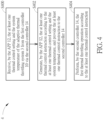
- the operations of the adaptive thermal throttling system 3 may be summarized as an adaptive thermal throttling method 4, as shown in FIG. 4 .
- the adaptive thermal throttling method 4 includes the following steps:
- Step S400 Receive, by the APP 12, the at least one thermal control setting and the system temperature of the adaptive thermal throttling system 3 from the first controller 10 via the second controller 14.
- Step S402 Generate, by the APP 12, the at least one thermal control instruction according to the at least one thermal control setting and the system temperature, and provide the at least one thermal control instruction to the second controller 14.
- Step S404 Perform, by the second controller 14, the first thermal throttling operation according to the at least one thermal control instruction.
- the APP 12 receives the at least one thermal control setting and the system temperature from the first controller 10 via the second controller 14. Specifically, a sensor of the UE (not shown in FIG. 3 ) generates the system temperature. The first controller 10 determines the at least one thermal control setting, such as a thermal alert condition, a high load condition, a drop frame condition, a target power, a boost permission, or an APP programming interface query permission. These thermal control settings are well known in the art, and will not be described in detail here. For example, the thermal alert condition is used to warn that the system temperature may be too high.
- step S402 the APP 12 generates the at least one thermal control instruction based on the at least one thermal control setting and the system temperature, and provides the at least one thermal control instruction to the second controller 14.
- FIG. 5 is a temperature diagram of the first thermal throttling operation according to the embodiment of the present invention.
- the APP 12 generates a first threshold according to the at least one thermal control setting, and compares the first threshold with the system temperature to generate the at least one thermal control instruction.
- the at least one thermal control instruction may include decreasing or increasing an image quality, a character movement update frequency, etc.
- the at least one thermal control instruction may include decreasing or increasing target performance of a CPU or GPU of the UE.
- step S404 the second controller 14 performs the first thermal throttling operation based on the at least one thermal control instruction.
- the at least one thermal control instruction indicates a decrease in image quality and character movement update frequency to reduce the load on the CPU/GPU while running the APP 12. This causes the system temperature to drop and prevents the UE from entering the overheating state.
- the at least one thermal control instruction indicates an increase in image quality and character movement update frequency to increase the load on the CPU/GPU while running the APP 12. Therefore, the user's gaming experience is improved.
- the adaptive thermal throttling system 3 may combine the first thermal throttling operation with the thermal throttling operation. As shown in FIG. 5 , if the system temperature continues to rise above the throttling threshold after performing the first thermal throttling operation, the second controller 14 may perform the thermal throttling operation to prevent the UE from entering the overheating state. It should be note that the throttling threshold is larger than the first threshold.
- FIG. 6 is a schematic diagram of an adaptive thermal throttling system 6 according to an embodiment of the present invention.
- the difference between the adaptive thermal throttling system 6 and the adaptive thermal throttling system 3 is that the second controller 14 of the adaptive thermal throttling system 6 may query the first controller 10 about providing the at least one thermal control setting or performing the first thermal throttling operation according to the at least one thermal control instruction. Further details and derivative changes of the adaptive thermal throttling system 6 may be referred to the above, and will not be repeated here.
- the adaptive thermal throttling systems 3, 6 are different embodiments of the present invention.
- Those skilled in the art should readily make combinations, modifications and/or alterations on the abovementioned description and examples.
- the abovementioned description, steps, procedures and/or processes including suggested steps can be realized by means that could be hardware, software, firmware (known as a combination of a hardware device and computer instructions and data that reside as read-only software on the hardware device), an electronic system, or combination thereof.
- hardware can include analog, digital and mixed circuits known as microcircuit, microchip, or silicon chip.
- Examples of the electronic system may include a system on chip (SoC), system in package (SiP), a computer on module (CoM) and the computer system.
- SoC system on chip
- SiP system in package
- CoM computer on module
- the storage unit may include read-only memory (ROM), flash memory, random access memory (RAM), subscriber identity module (SIM), hard disk, or CD-ROM/DVD-ROM/BD-ROM, but not limited thereto.
- the first controller 10 and the second controller 14 may read and execute the program codes or the instructions stored in the storage unit for realizing the abovementioned functions.
- the APP in the adaptive thermal throttling system of the present invention, the APP generates the thermal control instructions that allow the UE to adjust the load or the target performance of the CPU/GPU. In this way, compared with the prior art, the adaptive thermal throttling system of the present invention prevents changes in FPS and improves the user's experience.
Landscapes
- Engineering & Computer Science (AREA)
- Theoretical Computer Science (AREA)
- Physics & Mathematics (AREA)
- General Engineering & Computer Science (AREA)
- General Physics & Mathematics (AREA)
- Human Computer Interaction (AREA)
- Software Systems (AREA)
- Control Of Temperature (AREA)
Applications Claiming Priority (1)
| Application Number | Priority Date | Filing Date | Title |
|---|---|---|---|
| US18/231,256 US20250053211A1 (en) | 2023-08-08 | 2023-08-08 | Adaptive Thermal Throttling Method and Related System |
Publications (1)
| Publication Number | Publication Date |
|---|---|
| EP4506784A1 true EP4506784A1 (de) | 2025-02-12 |
Family
ID=87696067
Family Applications (1)
| Application Number | Title | Priority Date | Filing Date |
|---|---|---|---|
| EP23191831.9A Pending EP4506784A1 (de) | 2023-08-08 | 2023-08-17 | Adaptives thermisches drosselungsverfahren und zugehöriges system |
Country Status (4)
| Country | Link |
|---|---|
| US (1) | US20250053211A1 (de) |
| EP (1) | EP4506784A1 (de) |
| CN (1) | CN119472947A (de) |
| TW (1) | TW202522172A (de) |
Citations (2)
| Publication number | Priority date | Publication date | Assignee | Title |
|---|---|---|---|---|
| US20150348226A1 (en) * | 2014-05-30 | 2015-12-03 | Apple Inc. | Selective gpu throttling |
| US20170371390A1 (en) * | 2016-06-24 | 2017-12-28 | Mediatek Inc. | Electronic device and method for controlling user experience with application on electronic device |
Family Cites Families (6)
| Publication number | Priority date | Publication date | Assignee | Title |
|---|---|---|---|---|
| JP4006634B2 (ja) * | 2002-10-10 | 2007-11-14 | ソニー株式会社 | 情報処理装置および方法、並びにプログラム |
| US9122464B2 (en) * | 2011-12-22 | 2015-09-01 | Intel Corporation | Method, apparatus, and system for energy efficiency and energy conservation including energy efficient processor thermal throttling using deep power down mode |
| US10203746B2 (en) * | 2014-05-30 | 2019-02-12 | Apple Inc. | Thermal mitigation using selective task modulation |
| US9785208B2 (en) * | 2015-03-20 | 2017-10-10 | Dell Products Lp | Systems and methods of adaptive thermal control for information handling systems |
| US10146280B2 (en) * | 2016-09-29 | 2018-12-04 | Lenovo Enterprise Solutions (Singapore) Pte. Ltd. | Reconfiguration of computing device and/or non-volatile memory devices based on thermal analysis |
| US12366968B2 (en) * | 2022-11-30 | 2025-07-22 | Micron Technology, Inc. | Host device controlled low temperature thermal throttling |
-
2023
- 2023-08-08 US US18/231,256 patent/US20250053211A1/en active Pending
- 2023-08-17 EP EP23191831.9A patent/EP4506784A1/de active Pending
-
2024
- 2024-08-08 CN CN202411086076.0A patent/CN119472947A/zh active Pending
- 2024-08-08 TW TW113129798A patent/TW202522172A/zh unknown
Patent Citations (2)
| Publication number | Priority date | Publication date | Assignee | Title |
|---|---|---|---|---|
| US20150348226A1 (en) * | 2014-05-30 | 2015-12-03 | Apple Inc. | Selective gpu throttling |
| US20170371390A1 (en) * | 2016-06-24 | 2017-12-28 | Mediatek Inc. | Electronic device and method for controlling user experience with application on electronic device |
Non-Patent Citations (1)
| Title |
|---|
| KIM SEYEON SEYEON625@KAIST AC KR ET AL: "zTT learning-based DVFS with zero thermal throttling for mobile devices", PROCEEDINGS OF THE 19TH ANNUAL INTERNATIONAL CONFERENCE ON MOBILE SYSTEMS, APPLICATIONS, AND SERVICES, ACMPUB27, NEW YORK, NY, USA, 24 June 2021 (2021-06-24), pages 41 - 53, XP058536139, ISBN: 978-1-4503-8445-2, DOI: 10.1145/3458864.3468161 * |
Also Published As
| Publication number | Publication date |
|---|---|
| CN119472947A (zh) | 2025-02-18 |
| US20250053211A1 (en) | 2025-02-13 |
| TW202522172A (zh) | 2025-06-01 |
Similar Documents
| Publication | Publication Date | Title |
|---|---|---|
| KR102786346B1 (ko) | 전자 장치 및 듀얼 업링크 동작으로 인한 자가 간섭을 줄이는 방법 | |
| EP1873913A1 (de) | Temperaturabhängige Leistungseinstellung eines Sendegerätes | |
| US9521246B2 (en) | Thermal control method and thermal control system | |
| WO2016101111A1 (zh) | 一种减小WiF i和LTE间干扰的方法和装置 | |
| JPH09330387A (ja) | 半導体集積回路、icカード、及びicカードシステム | |
| US10916960B2 (en) | Charging current regulation method, regulation device and terminal | |
| EP3089523B1 (de) | Verfahren und vorrichtung zur steuerung der sendeleistung | |
| EP3276926A1 (de) | Verfahren und vorrichtung zur verhinderung von interferenzen zwischen kamera und antenne sowie elektronische vorrichtung | |
| CN110750148B (zh) | 终端及其温度控制方法和计算机可读存储介质 | |
| CN113137702A (zh) | 空调压缩机频率调整的方法和空调 | |
| US20250053211A1 (en) | Adaptive Thermal Throttling Method and Related System | |
| US20160034009A1 (en) | Thermal protection method for referring to thermal headroom to control selection of computing power setting of processor-based system and related machine readable medium | |
| US12335914B2 (en) | Terminal default paging DRX setup method and apparatus, and electronic device and storage medium | |
| US7415604B2 (en) | Method for adjusting an operating rate of a graphics card | |
| CN113525108A (zh) | 电动汽车的充电控制方法、充电控制系统及存储介质 | |
| KR100492548B1 (ko) | 이동통신 단말기에서 사용자 인증모듈(uim)의 무단사용억제방법 | |
| CN112198953A (zh) | 终端设备的控制方法、控制装置及控制设备 | |
| JP4453288B2 (ja) | 移動体通信網、移動体端末及びそれらに用いるアウタループ電力制御方法 | |
| CN114173336B (zh) | 鉴权失败的处理方法、装置、终端及网络侧设备 | |
| US10057874B2 (en) | Communication apparatus, control method of communication apparatus, and non-transitory computer-readable storage medium | |
| CN114258095A (zh) | 行动装置漫游方法、电子装置及计算机可读存储媒体 | |
| US20250081408A1 (en) | Fan efficiency control method and server | |
| JP2005094772A (ja) | 携帯端末機の再スキャン装置及び方法 | |
| EP4398525A1 (de) | Verfahren zur identifizierung eines startszenarios oder heimrückkehrszenarios und vorrichtung | |
| US20190211758A1 (en) | Apparatus and method for controlling operation of engine |
Legal Events
| Date | Code | Title | Description |
|---|---|---|---|
| PUAI | Public reference made under article 153(3) epc to a published international application that has entered the european phase |
Free format text: ORIGINAL CODE: 0009012 |
|
| STAA | Information on the status of an ep patent application or granted ep patent |
Free format text: STATUS: REQUEST FOR EXAMINATION WAS MADE |
|
| 17P | Request for examination filed |
Effective date: 20241217 |
|
| AK | Designated contracting states |
Kind code of ref document: A1 Designated state(s): AL AT BE BG CH CY CZ DE DK EE ES FI FR GB GR HR HU IE IS IT LI LT LU LV MC ME MK MT NL NO PL PT RO RS SE SI SK SM TR |