EP4506401A1 - Easy-to-recycle absorbent article, and method for manufacturing recycled raw material, fiber, and fiber product - Google Patents
Easy-to-recycle absorbent article, and method for manufacturing recycled raw material, fiber, and fiber product Download PDFInfo
- Publication number
- EP4506401A1 EP4506401A1 EP23784768.6A EP23784768A EP4506401A1 EP 4506401 A1 EP4506401 A1 EP 4506401A1 EP 23784768 A EP23784768 A EP 23784768A EP 4506401 A1 EP4506401 A1 EP 4506401A1
- Authority
- EP
- European Patent Office
- Prior art keywords
- raw material
- absorbent article
- melt
- mass
- exterior
- Prior art date
- Legal status (The legal status is an assumption and is not a legal conclusion. Google has not performed a legal analysis and makes no representation as to the accuracy of the status listed.)
- Pending
Links
Images

Classifications
-
- B—PERFORMING OPERATIONS; TRANSPORTING
- B29—WORKING OF PLASTICS; WORKING OF SUBSTANCES IN A PLASTIC STATE IN GENERAL
- B29B—PREPARATION OR PRETREATMENT OF THE MATERIAL TO BE SHAPED; MAKING GRANULES OR PREFORMS; RECOVERY OF PLASTICS OR OTHER CONSTITUENTS OF WASTE MATERIAL CONTAINING PLASTICS
- B29B17/00—Recovery of plastics or other constituents of waste material containing plastics
- B29B17/0026—Recovery of plastics or other constituents of waste material containing plastics by agglomeration or compacting
-
- A—HUMAN NECESSITIES
- A61—MEDICAL OR VETERINARY SCIENCE; HYGIENE
- A61F—FILTERS IMPLANTABLE INTO BLOOD VESSELS; PROSTHESES; DEVICES PROVIDING PATENCY TO, OR PREVENTING COLLAPSING OF, TUBULAR STRUCTURES OF THE BODY, e.g. STENTS; ORTHOPAEDIC, NURSING OR CONTRACEPTIVE DEVICES; FOMENTATION; TREATMENT OR PROTECTION OF EYES OR EARS; BANDAGES, DRESSINGS OR ABSORBENT PADS; FIRST-AID KITS
- A61F13/00—Bandages or dressings; Absorbent pads
- A61F13/15—Absorbent pads, e.g. sanitary towels, swabs or tampons for external or internal application to the body; Supporting or fastening means therefor; Tampon applicators
- A61F13/51—Absorbent pads, e.g. sanitary towels, swabs or tampons for external or internal application to the body; Supporting or fastening means therefor; Tampon applicators characterised by the outer layers of the pads
- A61F13/514—Backsheet, i.e. the impermeable cover or layer furthest from the skin
- A61F13/51401—Backsheet, i.e. the impermeable cover or layer furthest from the skin characterised by the material
-
- C—CHEMISTRY; METALLURGY
- C08—ORGANIC MACROMOLECULAR COMPOUNDS; THEIR PREPARATION OR CHEMICAL WORKING-UP; COMPOSITIONS BASED THEREON
- C08J—WORKING-UP; GENERAL PROCESSES OF COMPOUNDING; AFTER-TREATMENT NOT COVERED BY SUBCLASSES C08B, C08C, C08F, C08G or C08H
- C08J11/00—Recovery or working-up of waste materials
- C08J11/04—Recovery or working-up of waste materials of polymers
- C08J11/06—Recovery or working-up of waste materials of polymers without chemical reactions
-
- B—PERFORMING OPERATIONS; TRANSPORTING
- B29—WORKING OF PLASTICS; WORKING OF SUBSTANCES IN A PLASTIC STATE IN GENERAL
- B29L—INDEXING SCHEME ASSOCIATED WITH SUBCLASS B29C, RELATING TO PARTICULAR ARTICLES
- B29L2031/00—Other particular articles
- B29L2031/48—Wearing apparel
- B29L2031/4871—Underwear
- B29L2031/4878—Diapers, napkins
-
- C—CHEMISTRY; METALLURGY
- C08—ORGANIC MACROMOLECULAR COMPOUNDS; THEIR PREPARATION OR CHEMICAL WORKING-UP; COMPOSITIONS BASED THEREON
- C08J—WORKING-UP; GENERAL PROCESSES OF COMPOUNDING; AFTER-TREATMENT NOT COVERED BY SUBCLASSES C08B, C08C, C08F, C08G or C08H
- C08J2300/00—Characterised by the use of unspecified polymers
- C08J2300/30—Polymeric waste or recycled polymer
Definitions
- the present invention relates to an easily recyclable absorbent article, and to a method for producing recycled materials, fibers and fiber products.
- PTL 1 discloses a method for efficiently producing, from used sanitary products, ash meeting sanitary product standards, and antibacterial recycled pulp, which can be reused for sanitary products, the method being characterized by including an ozone treatment step in which used sanitary products or pulp fibers are immersed in an ozone-containing aqueous solution to decompose the super-absorbent polymer which is in the used sanitary products or adhering to the pulp fibers, wherein prior to the ozone treatment step, simultaneously with the ozone treatment step or after the ozone treatment step, the used sanitary products or pulp fibers are treated with a cationic antimicrobial agent.
- PTL 2 discloses a method for producing recycled products from structural components of used absorbent articles, sorting out and recovering the structural components according to their properties and reutilizing them according to their properties, the method comprising a material separation step in which numerous used absorbent articles are separated at least into different films and absorbent body materials, a film-sorting step in which the different separated films are sorted out into different types of recyclable films according to their filler contents, and a pellet-forming step in which the different types of recyclable films that have been separated are used to form different recycled resin pellets according to their filler contents.
- An absorbent article is generally composed of interior materials including a front sheet and absorbent body, and exterior materials including a back sheet and a gather, with the mass of the exterior part making up a large percentage of about 30% of the total mass of the absorbent article, and it is therefore desirable for such exterior parts to be recycled.
- PTL 1 only discloses a method of incineration for heat recovery of exterior parts for solid fuel (RPF), without disclosing any technique for recycling the exterior parts.
- PTL 2 which discloses a method of sorting and recycling of only the exterior films among the structural components of absorbent materials, does not disclose any technique for recycling without sorting all of the exterior parts.
- the object of the invention is to provide absorbent articles whose exterior parts can be easily recycled, a method for producing recycled materials or fibers from the absorbent articles, and a method for producing fiber products from the fibers.
- the present inventors have completed this invention upon finding, unexpectedly, that the aforementioned problem is solved if all of the main members of the exterior parts of absorbent articles include thermoplastic resins.
- the present invention provides the following.
- Fig. 1 is a diagram showing a construction example for an easily recyclable absorbent article according to an embodiment.
- thermoplastic as used herein means that the compound has a reversible property whereby it can be melted by heating at below its decomposition temperature, exhibiting plastic flow while in the molten state, and then solidifying by cooling.
- recycling refers to the reuse of products that are no longer needed for daily activities and goods obtained secondary to industrial activities, as resources, or to their recovery and regeneration for effective utilization, and the term includes material recycling and chemical recycling. It also includes, for example, obtaining recycled materials from used sanitary materials or sanitary materials rejected during production due to poor quality.
- One embodiment of the invention is an easily recyclable absorbent article comprising an interior part containing a front sheet and an absorbent body, and an exterior part constituting the non-interior part and containing a back sheet and a gather, wherein the back sheet includes a sheet material comprising a thermoplastic resin, and the gather includes thermoplastic elastic yarn (this will hereunder also be referred to simply as "absorbent article").
- the absorbent article of this embodiment is used to absorb and retain fluids excreted from the body, which consist mainly of urine, menstrual blood and excreta.
- Absorbent articles include, but are not limited to, disposable diapers, sanitary napkins, incontinence pads and panty liners, for example, also including a wide variety of products used for absorption of fluids excreted from the human body.
- Interior parts are the parts that comprise the wearer sides of absorbent articles, and they include front sheets and absorbent bodies. Interior parts may also include three-dimensional gathers which serve to prevent leakage.
- Front sheets are liquid-permeable sheets that initially receive excreted body fluids into absorbent articles, and conventional sheet materials such as spunbond nonwoven fabrics are used.
- An absorbent body is the portion that absorbs and retains body fluid excreted from the body, being disposed between a front sheet and a back sheet.
- Absorbent bodies used may be any conventionally known types, but they typically include pulp fibers, super-absorbent polymers (SAP) and water-absorbing sheets.
- Exterior parts are portions constituting the non-interior parts, and they include back sheets and gathers.
- the back sheet includes a sheet material which comprises a thermoplastic resin, while the gather includes thermoplastic elastic yarn.
- the main members of the exterior part all include a thermoplastic resin, and since this feature allows recycled materials or fibers to be molded by thermoforming of the exterior part as a whole, the absorbent article is easy to recycle.
- the back sheet is a liquid-impermeable sheet that prevents leakage of body fluids retained in the absorbent body, and it comprises a sheet material that includes a thermoplastic resin.
- Back sheets include sheet materials such as nonwoven fabrics and synthetic resin films, or composite sheets of nonwoven fabrics and synthetic resin films.
- the sheet material in a back sheet may include a polyolefin resin such as polyethylene or polypropylene, a polyamide resin such as 6-nylon or 6,6-nylon, or a polyester resin such as polyethylene terephthalate (PET) or polybutylene terephthalate (PBT), and it preferably includes a polyolefin resin.
- PET polyethylene terephthalate
- PBT polybutylene terephthalate
- the back sheet may also include an inorganic filler or pigment.
- inorganic fillers to be included in the back sheet are calcium carbonate, calcium oxide, zeolite, amorphous aluminosilicates, clay, synthetic silica, titanium oxide, alumina, barium sulfate, aluminum sulfate and magnesium hydroxide, among which calcium carbonate, zeolite, amorphous aluminosilicates, barium sulfate, synthetic silica and magnesium hydroxide are preferred, and calcium carbonate and barium sulfate are especially preferred.
- the particle size of the inorganic filler is preferably 0.1 ⁇ m to 30 ⁇ m, more preferably 1 ⁇ m to 20 ⁇ m and even more preferably 3 ⁇ m to 10 ⁇ m, from the viewpoint of discharge stability during melt kneading.
- the content of the inorganic filler is preferably 20 mass% or lower, more preferably 15 mass% or lower, even more preferably 10 mass% or lower and most preferably 5 mass% or lower with respect to the mass of the exterior part, from the viewpoint of discharge stability during discharge of the molten polymer after melt kneading.
- the content of thermoplastic resins with an outflow start temperature of 230°C or higher in the sheet material in the back sheet is preferably 30 mass% or lower, more preferably 20 mass% or lower, even more preferably 10 mass% or lower and most preferably 5 mass% or lower with respect to the mass of the exterior part.
- a gather is a stretching member with multiple folds which stretches in at least one direction, and it is provided around the waist or leg sections of an absorbent article.
- the gather may be formed with thermoplastic elastic yarn joining to back sheet sections, or it may be formed with thermoplastic elastic yarn joining to a separate sheet material from the back sheet, where the separate sheet material used may be a sheet material including the same thermoplastic resin as the back sheet.
- thermoplastic elastic yarn in the gather is yarn having a thermoplastic property and stretchability.
- thermoplastic elastic yarn include yarns comprising styrene-based, olefin-based, polyester-based and polyurethane-based thermoplastic elastomers, although elastic yarn comprising polyurethane-based thermoplastic elastomers (hereunder also referred to as "thermoplastic polyurethane elastic yarn”) is preferred.
- Thermoplastic elastic yarn has an outflow start temperature of preferably 160°C or higher, 170°C or higher or 180°C or higher, and preferably 220°C or lower, 215°C or lower or 210°C or lower. If the outflow start temperature is 160°C or higher the heat resistance will be sufficiently high and heat-induced yarn breakage will be less likely to occur during hot-melt adhesive coating in the absorbent article production process. If the outflow start temperature is 220°C or lower, there will be no need for thawing at excessively high temperature during recycling, thus helping to prevent progressive thermal decomposition of the polyurethane.
- the outflow start temperature is determined using a Shimadzu CFT-500D Flow Tester (product of Shimadzu Corp.) under conditions with a sample amount of 1.5 g, a die (nozzle) diameter of 0.5 mm and a thickness of 1.0 mm, after applying an extrusion load of 49 N and preheating for 240 seconds at an initial preset temperature of 120°C, with a uniform temperature increase rate of 3°C/min and determining the flow temperature when the polymer begins to flow out, and it is the average value for three measurements.
- Shimadzu CFT-500D Flow Tester product of Shimadzu Corp.
- thermoplastic polyurethane elastic yarn is not particularly restricted so long as it has a thermoplastic property and includes a polyurethane.
- the thermoplastic polyurethane elastic yarn preferably includes a polyurethane which is a polymer of a polymer polyol, a diisocyanate and an active hydrogen-containing compound that reacts with isocyanate groups.
- the polymer polyol to be used for polymerization of the polyurethane is preferably a polyalkylene ether diol, polyester diol or polycarbonate diol, which are commonly used in polymerization of polyurethanes, and it is most preferably a polyalkylene ether diol with a number-average molecular weight of 900 to 3,000.
- Polyalkylene ether diols include those wherein the alkylene groups are tetramethylene groups, or wherein they are tetramethylene groups and straight-chain or branched alkylene groups of 1 to 8 carbon atoms.
- polytetramethylene ether diol Specifically preferred are polytetramethylene ether diol, copolymerized poly(tetramethylene-neopentylene)ether diol and copolymerized poly(tetramethylene-2-methylbutylene)ether diol.
- diisocyanates to be used for polymerization of the polyurethane include all aliphatic, alicyclic and aromatic diisocyanates that dissolve or are liquid under the reaction conditions, and specifically methylene-bis(4-phenylisocyanate), methylene-bis(3-methyl-4-phenylisocyanate), 2,4-tolylene diisocyanate, 2,6-tolylene diisocyanate, m- andp-xylylene diisocyanate, ⁇ , ⁇ , ⁇ ', ⁇ '-tetramethyl-xylylene diisocyanate, m- andp-phenylene diisocyanate, 4,4'-dimethyl-1,3-xylylene diisocyanate, 1-alkylphenylene-2,4- and 2,6-diisocyanate, 3-( ⁇ -isocyanatoethyl)phenylisocyanate, 2,6-diethylphenylene-1,4-diisocyanate, diphenyl
- active hydrogen-containing compounds to be used for polymerization of the polyurethane include low-molecular-weight glycols, and specifically ethylene glycol, 1,2-propylene glycol, 1,3-propylene glycol, 2,2-dimethyl-1,3-propanediol, 1,4-butanediol, 1,3-butanediol, hexamethylene glycol, diethylene glycol, 1,10-decanediol, 1,3-dimethylolcyclohexane and 1,4-dimethylolcyclohexanehydrazine, with 1,4-butanediol being especially preferred.
- Alkanolamines such as monoethanolamine may also be used as active hydrogen-containing compounds.
- thermoplastic polyurethane elastic yarn preferably has no chemical crosslinking, and especially it preferably has no allophanate bonds with crosslinking of urethane bonds by reaction with isocyanate groups.
- thermoplastic polyurethane elastic yarn may also include additives such as stabilizers or plasticizers as necessary.
- Stabilizers include compounds commonly used in polyurethane resins, such as UV absorbers, antioxidants, light stabilizers, gasproof stabilizers and antistatic agents.
- the exterior parts may also include hot-melt adhesives, used for adhesion between the different structural components.
- a hot-melt adhesive normally comprises a base polymer, a tackifier and a plasticizer.
- base polymers include acrylic-based, silicone-based, rubber-based and olefin-based polymers.
- acrylic-based polymers include (co)polymers composed mainly of vinyl monomers such as 2-ethylhexyl acrylate, butyl acrylate, ethyl acrylate, cyanoacrylate, vinyl acetate and methyl methacrylate (for example, ethylene-vinyl acetate copolymer).
- silicone-based polymers include polydimethylsiloxane polymers.
- rubber-based polymers examples include natural rubber, polyisoprene, styrenebutadiene copolymer (SBR), styrene-isoprene-styrene block copolymer (SIS), styrene-butadiene-styrene block copolymer (SBS), styrene-ethylene-butadiene-styrene block copolymer (SEBS) and styrene-ethylene-propylene-styrene block copolymer(SEPS).
- SBR styrenebutadiene copolymer
- SIS styrene-isoprene-styrene block copolymer
- SBS styrene-butadiene-styrene block copolymer
- SEBS styrene-ethylene-propylene-styrene block copolymer
- the hot-melt adhesive content is preferably 20 mass% or lower, more preferably 15 mass% or lower, even more preferably 10 mass% or lower and most preferably 5 mass% or lower with respect to the mass of the exterior parts, from the viewpoint of reducing adhesion of the exterior parts separated from the sanitary materials during the recycling step, and thus improving handling.
- the exterior parts may also include members such as fastening tape or other fastening materials, or may be modified by printing, for example, within a range that does not inhibit the recycling properties.
- the coefficient of variation of the melt viscosity of the exterior part is preferably 3% or lower, more preferably 2% or lower, even more preferably 1% or lower and most preferably 0.5% or lower, as obtained by the following procedure:
- the value obtained by dividing the maximum value of the melt viscosity at 200 to 220°C as measured using a flow tester under conditions with an extrusion load of 49 N, a starting temperature of 120°C and a temperature increase of 3°C/min, for pellets obtained by melt kneading the exterior parts, by the maximum of the melt viscosity at 200 to 220°C as measured by the same method for pellets obtained by melt kneading only the back sheets of the exterior parts is preferably 5.0 or lower, more preferably 4.0 or lower and even more preferably 3.0 or lower.
- melt viscosity ratio lowers the rate of variation in the strands, improves the kneaded state in the extruder and reduces variation in discharge, thus stabilizing the form during pelletizing and improving the recycling property.
- the recycled material there is less variation in viscosity during remolding such as fiberization, resulting in better moldability and improved recycling properties.
- Another embodiment of the invention is a method for producing a recycled material, the method comprising the following steps:
- the exterior parts used for this embodiment may be separated from the absorbent articles by any means, with no particular restriction on the separation method, which may be any method known in the prior art.
- the absorbent articles may be pre-consumer products or post-consumer products.
- the exterior parts may also be washed, dried, sterilized, cut and/or pulverized before or after separation.
- the exterior parts are preferably melt kneaded in a washed, dried, sterilized, cut and/or pulverized state.
- the method of melt kneading is not particularly restricted, and it may be a method using a screw, for example.
- Virgin raw material may also be added during the melt kneading to stabilize the quality of the finally obtained recycled material.
- the structural components of the absorbent articles other than the exterior parts, including thermoplastic resins may also be added within a range that does not inhibit the recycling properties, and for example, all of the structural components other than the absorbent body of the absorbent article may be added.
- the product obtained by melt kneading is pelletized using a publicly known method such as a strand cut method, die face-cut method, flat die method, ring die method, hot cut method or screw method, for example, to yield a recycled material.
- a publicly known method such as a strand cut method, die face-cut method, flat die method, ring die method, hot cut method or screw method, for example, to yield a recycled material.
- Another embodiment of the invention is a method for producing a recycled material, the method comprising the following steps:
- the method for separating the exterior parts from absorbent articles according to this embodiment may be any method known in the prior art without any particular limitations.
- the absorbent articles may be pre-consumer products or post-consumer products.
- the exterior parts may also be washed, dried, sterilized, cut and/or pulverized before or after separation.
- the exterior parts are preferably melt kneaded in a washed, dried, sterilized, cut and/or pulverized state.
- the method of melt kneading is not particularly restricted, and it may be a method using a screw, for example.
- Virgin raw material may also be added during the melt kneading to stabilize the quality of the finally obtained recycled material.
- the structural components of the absorbent articles other than the exterior parts, including thermoplastic resins may also be added within a range that does not inhibit the recycling properties, and for example, all of the structural components other than the absorbent body of the absorbent article may be added.
- the product obtained by melt kneading is pelletized using a publicly known method such as a strand cut method, die face-cut method, flat die method, ring die method, hot cut method or screw method, for example, to yield a recycled material.
- a publicly known method such as a strand cut method, die face-cut method, flat die method, ring die method, hot cut method or screw method, for example, to yield a recycled material.
- the method for producing a recycled material may also produce strands during the pelletizing step.
- the distance between strand discharge holes is preferably 5 mm or greater, more preferably 7 mm or greater, even more preferably 10 mm or greater and most preferably 15 mm or greater, from the viewpoint of preventing fusion or adhesion between the strands due to fluctuation or disordering of the strands.
- the lower limit for the outer diameters of the strands is preferably 2 mm or greater, more preferably 4 mm or greater, even more preferably 6 mm or greater and most preferably 8 mm or greater.
- the upper limit for the outer shapes is preferably 20 mm or less, more preferably 15 mm or less, even more preferably 12 mm or less and most preferably 10 mm or less.
- the method for producing a recycled material may also include carrying out water-cooling during the pelletizing step.
- the water temperature is preferably kept to 50°C or lower, more preferably 40°C or lower, even more preferably 30°C or lower and most preferably 20°C or lower, from the viewpoint of lowering adhesion between the polymer discharged after melt kneading and improving the cutting property for pelletizing.
- a water-cooling tank may be provided after the melt kneading.
- the height fluctuation of the water surface is preferably 100 mm or less, more preferably 80 mm or less, even more preferably 50 mm or less and most preferably 30 mm or less, from the viewpoint of preventing fusion or adhesion between the strands due to fluctuation or disordering of the strands.
- the height from the strand discharge holes to the water surface of the water-cooling tank is also preferably 500 mm or less, more preferably 300 mm or less, even more preferably 100 mm or less and most preferably 50 mm or less, from the viewpoint of preventing fusion or adhesion between the strands due to fluctuation or disordering of the strands.
- the water content just before cutting of the strands is preferably 20 mass% or lower, more preferably 10 mass% or lower, even more preferably 5 mass% or lower and most preferably 3 mass% or lower, from the viewpoint of reducing stickiness of the strands during the pelletizing step.
- the water content is measured by the following procedure.
- the sampled strand is placed in a vacuum dryer set to a furnace temperature of 100°C and held for 12 hours in a vacuum state produced using a vacuum pump, to obtain a dried strand.
- Water content (mass%) ⁇ (Mass before drying (g) - mass after drying (g))/mass after drying (g) ⁇ ⁇ 100.
- the pellet temperature during bagging is preferably 60°C or lower, more preferably 50°C or lower, even more preferably 40°C or lower and most preferably 30°C or lower, from the viewpoint of preventing aggregation of the recycled material.
- the recycled material produced by this method can be suitably used in products such as automobile parts, household appliance parts, packaging films, food containers, caps, trays, containers, pallets, costume boxes, fibers, medical equipment, daily commodities and garbage containers.
- Another embodiment of the invention is a method for producing fibers, the method comprising a step of fiberizing a recycled material produced by the method described above.
- the fiberizing method used may be based on any publicly known technology, such as wet spinning, dry spinning or melt spinning.
- Yet another embodiment of the invention is a method for producing a fiber product using fibers produced by the method described above.
- the term "fiber product” used here refers to a fiber-containing product, and specific examples include woven fabrics, knitted fabrics, nonwoven fabrics, clothing, bedding supplies, interior goods, household goods, fishing nets, ropes, outdoor supplies, industrial materials, reinforcing materials for plastics and concrete, and absorbent articles. Producing an absorbent article by the method of this embodiment achieves what is known as "horizontal recycling".
- Another embodiment of the invention is a method for producing fibers, the method comprising the following steps:
- the exterior parts used for this embodiment may be separated from the absorbent articles by any means, with no particular restriction on the separation method, which may be any method known in the prior art.
- the absorbent articles may be pre-consumer products or post-consumer products.
- the exterior parts may also be washed, dried, sterilized, cut and/or pulverized before or after separation.
- the exterior parts are preferably melt kneaded in a washed, dried, sterilized, cut and/or pulverized state.
- the method of melt kneading is not particularly restricted, and it may be a method using a screw, for example.
- Virgin raw material may also be added during melt kneading in order to stabilize spinning during the spinning step and stabilize the quality of the finally obtained fibers.
- the structural components of the absorbent articles other than the exterior parts including thermoplastic resins, may also be added within a range that does not inhibit the recycling properties, and for example, all of the structural components other than the absorbent body of the absorbent article may be added.
- melt spinning The product obtained by melt kneading is provided directly to melt spinning without pelletizing, to yield fibers.
- the method of melt spinning may be any method known in the prior art.
- the fibers produced in this manner can be suitably used in clothing, bedding supplies, interior goods, household goods, fishing nets, ropes, outdoor supplies, industrial materials, or reinforcing materials for plastics and concrete.
- Yet another embodiment of the invention is a method for producing fibers, the method comprising the following steps:
- the method for separating the exterior parts from absorbent articles according to this embodiment may be any method known in the prior art, without any particular limitations.
- the absorbent articles may be pre-consumer products or post-consumer products.
- the exterior parts may also be washed, dried, sterilized, cut and/or pulverized before or after separation, and for example, all of the structural components other than the absorbent bodies of the absorbent articles may be added.
- the exterior parts are preferably melt kneaded in a washed, dried, sterilized, cut and/or pulverized state.
- the method of melt kneading is not particularly restricted, and it may be a method using a screw, for example.
- Virgin raw material may also be added during melt kneading in order to stabilize spinning during the spinning step and stabilize the quality of the finally obtained fibers.
- structural components of the absorbent articles other than the exterior parts including thermoplastic resins, may also be added within a range that does not inhibit the recycling properties.
- melt spinning The product obtained by melt kneading is provided directly to melt spinning without pelletizing, to yield fibers.
- the method of melt spinning may be any method known in the prior art.
- the fibers produced in this manner can be suitably used in clothing, bedding supplies, interior goods, household goods, fishing nets, ropes, outdoor supplies, industrial materials, or reinforcing materials for plastics and concrete.
- the addition rate is preferably 1 mass% or greater, more preferably 10 mass% or greater, even more preferably 20 mass% or greater, especially preferably 30 mass% and most preferably 40 mass%, and preferably 95 mass% or lower, more preferably 80 mass% or lower, even more preferably 70 mass% or lower, especially preferably 60 mass% or lower and most preferably 50 mass% or lower, with respect to the finally produced recycled material or fibers.
- the addition rate of virgin raw material is 1 mass% or greater, the weight of the virgin raw material will push it into the raw material feeder during the melt kneading step with minimal catching or clogging, even if the shapes of the separated exterior parts are non-uniform or the bulk density is low. If the addition rate of the virgin raw material is 95 mass% or lower, the difference between the melt viscosity of the exterior parts and virgin raw material will be small, reducing fluctuation in torque during melt kneading and stabilizing both the kneading state and discharge, to obtain uniform shapes for the recycled material or fibers.
- the starting material such as the separated exterior parts supplied for melt kneading
- the raw material feeder of the extruder is also preferably cooled, specifically so that the temperature of the surface of the chute section is preferably 100°C or lower, more preferably 80°C or lower, even more preferably 60°C or lower and most preferably 40°C or lower.
- Cooling of the raw material and/or the raw material feeder of the extruder will help to prevent trouble during production caused by adhesion of the exterior parts onto the apparatus or their mutual adhesion and hardening, due to the hot-melt adhesives included in the separated exterior parts, which can interfere with drawing of the exterior parts into the raw material feeder.
- a lubricant may also be added during the melt kneading step in the method for producing recycled material or the method for producing fibers described above.
- a lubricant may be a metal salt of a fatty acid, for example.
- the number of carbon atoms of the fatty acid is preferably 8 to 30, more preferably 11 to 28 and even more preferably 12 to 22, with specific examples including metal salts of fatty acids such as stearic acid, palmitic acid, lauric acid, behenic acid and 12-hydroxystearic acid.
- metals to form salts with fatty acids include alkali metals such as lithium, potassium and sodium and alkaline earth metals such as magnesium, calcium and barium.
- Calcium stearate is a particularly suitable fatty acid metal salt as a lubricant.
- the lubricant is added at preferably greater than 0 mass%, and preferably 1 mass% or lower, more preferably 0.7 mass% or lower, even more preferably 0.5 mass% and most preferably 0.3 mass% or lower, with respect to the mass of the exterior parts.
- their bulk density when loaded into the raw material feeder is preferably 0.1 g/cm 3 to 1.0 g/cm 3 , more preferably 0.2 g/cm 3 to 0.9 g/cm 3 , even more preferably 0.3 g/cm 3 to 0.8 g/cm 3 and most preferably 0.4 g/cm 3 to 0.7 g/cm 3 .
- a measuring sample was prepared by melt kneading and pelletizing an exterior part. Using a Rheograf20 capillary rheometer (product of Goettfert Co.), a 0.5 mm ⁇ 5.0 mm capillary die was mounted onto a barrel with a barrel diameter of 9.55 mm, and heated to a furnace temperature of 230°C. About 5 g of sample was pushed in from the top of the barrel in gradual amounts while avoiding formation of air bubbles.
- the arbitrary 3 minute period is selected in a range that does not include any sudden reduction in pressure caused by trapped air bubbles, or sudden increase in pressure caused by contaminants getting caught in the capillaries. Measurement is repeated if an arbitrary continuous 3 minute period cannot be ensured due to sudden pressure fluctuation.
- the melt viscosity ⁇ is determined by solving the following simultaneous equations (1) to (4).
- the coefficient of variation (%) is the value obtained by calculating the standard deviation and average value for the melt viscosity during the arbitrary continuous 3 minute period, and dividing the standard deviation by the average value.
- Q is the flow rate of the molten resin (mm 3 /s)
- A is the piston cross-sectional area (mm 2 )
- v is the piston speed (mm/s)
- ⁇ is the apparent shear rate (s -1 )
- D is the capillary inner diameter (mm)
- ⁇ is the apparent shearing stress (Pa)
- P is the barrel bottom pressure (Pa)
- L is the capillary length (mm)
- ⁇ is the melt viscosity (Pa ⁇ sec).
- the elastic yarn was cut to a suitable length to prepare a measuring sample.
- a Shimadzu CFT-500D Flow Tester (product of Shimadzu Corp.) is used under conditions with a sample amount of 1.5 g, a die (nozzle) diameter of 0.5 mm and a thickness of 1.0 mm, after applying an extrusion load of 49 N and preheating for 240 seconds at an initial preset temperature of 120°C, with a uniform temperature increase rate of 3°C/min, and determining the plunger stroke-temperature curve during that time.
- the sample gradually warms as a uniform temperature increase rate is approached, causing the polymer to begin to flow out.
- the temperature at the point where the polymer begins to flow out is recorded as the outflow start temperature.
- the measurement is performed 3 times and the average temperature is recorded as the outflow start temperature.
- a CFT-500D Shimadzu flow tester product of Shimadzu Corp.
- preheating was carried out for 240 seconds at an initial preset temperature of 120°C with a 49 N extrusion load applied, under conditions with a sample amount of 1.5 g, a die (nozzle) diameter of 0.5 mm and a thickness of 1.0 mm, after which the temperature was increased at a uniform rate of 3°C/min, periodically recording the degree of lowering of the piston when the melted pellets were extruded through the die hole below the cylinder (the outflow rate) and drawing a flow curve with the degree of lowering as the abscissa and time as the ordinate, from which the melt viscosity at 200 to 220°C was detected.
- the value of the melt viscosity ratio is the maximum value for the melt viscosity of the pellets obtained by melt kneading exterior parts divided by the maximum value for the melt viscosity of the pellets obtained by melt kneading only the back sheets of the exterior parts.
- a smaller fluctuation rate in the outer shape of the strand improves the kneaded state in the extruder and reduces variation in discharge, thus stabilizing the form during pelletizing and improving the recycling properties, or in other words, resulting in "easy recyclability".
- a fluctuation rate of lower than 100% may be considered to be a sufficiently satisfactory recycling property.
- the exterior parts of the diapers had as the back sheet a thermoplastic polypropylene nonwoven fabric laminated with a thermoplastic polyethylene film, with a gather formed by bonding of dry spun spandex to the back sheet with a styrene-based hot-melt adhesive.
- the exterior parts consisted of 75 mass% of the polypropylene nonwoven fabric, 16 mass% of the polyethylene film, 4 mass% of the dry spun spandex and 5 mass% of the hot-melt adhesive with respect to the total mass of the exterior parts.
- the dry spun spandex had an outflow start temperature of 235°C, and no thermoplasticity.
- the exterior parts were separated from multiple diapers by hand to obtain approximately 1.3 kg of exterior parts.
- the separated exterior parts were hot pressed at 150°C for 20 seconds through heat-resistant paper, cooled to room temperature, and cut to about 5 to 10 mm using a cutter, to obtain exterior part cut fragments.
- the exterior part cut fragments were melt kneaded at 160°C to 180°C using a twin-screw extruder and extruded as a strand into a water-cooling tank from three discharge holes with a hole distance of 5 mm, and after cooling, the strand was cut with a pelletizer to create pellets.
- 150.95 g of 1,4-butanediol was added and the mixture was stirred for 15 minutes to obtain a polyurethane with a viscosity of 200 Pa•s (30°C).
- the obtained polyurethane resin was crushed into powder with a size of about 3 mm using a Model UG-280 crusher by Horai Co. After adding 0.35 parts by mass of dried ethylenebisstearamide to the polyurethane resin powder and loading the mixture into a hopper, it was melted in an extruder. After then metering and pressurizing with a gear pump installed at the head and filtering with a filter, the melt was discharged from a 60-hole nozzle with a 0.23 mm diameter at a die temperature of 210°C, with a throughput of 31 g/min.
- a ring-type false twisting machine set 5 m below was used for propagation of twisting with a 1400 mm location of convergence, as the distance from the spinneret to the location of twist propagation, after which a treatment agent composed mainly of polydimethylsiloxane and mineral oil was applied while winding up at a speed of 500 m/min, to obtain thermoplastic polyurethane elastic yarn with a monofilament size of 10 dtex, a total fineness of 620 dtex and an outflow start temperature of 182°C.
- the treatment agent application rate on the polyurethane elastic yarn was 2 parts by mass.
- Pellets were obtained as recycled material in the same manner as Comparative Example 1, except that the dry spun spandex of the diapers used in Comparative Example 1 was changed to the aforementioned thermoplastic polyurethane elastic yarn.
- Polyurethane elastic yarn with an outflow start temperature of 220°C was obtained in the same manner as Example 1, except that the amount of 4,4'-diphenylmethane diisocyanate was 1134.47 g, the amount of 1,4-butanediol was 292.47 g and the die temperature was 230°C.
- Pellets were obtained as recycled material in the same manner as Comparative Example 1, except that the dry spun spandex of the diapers used in Comparative Example 1 was changed to the aforementioned thermoplastic polyurethane elastic yarn.
- Pellets were obtained as recycled material in the same manner as Example 1, except that polypropylene pellets as virgin raw material were added at 10 parts by mass to 90 parts by mass of the exterior part cut fragments, prior to melt kneading.
- Pellets were obtained as recycled material in the same manner as Example 3, except that the virgin raw material was added at 50 parts by mass to 50 parts by mass of the exterior part cut fragments.
- Pellets were obtained as recycled material in the same manner as Example 3, except that the virgin raw material was added at 80 parts by mass to 20 parts by mass of the exterior part cut fragments.
- Pellets were obtained as recycled material in the same manner as Example 3, except that the distance between the strand discharge holes was 10 mm.
- Pellets were obtained as recycled material in the same manner as Example 6, except that a temperature of 20 to 22°C was maintained in the water-cooling tank by flowing cooling water into the water-cooling tank.
- Pellets were obtained as recycled material in the same manner as Example 7, except that fluctuation in the liquid surface height was controlled to a maximum of 15 mm by placing a screen in the water-cooling tank and adjusting the locations of loading and drainage.
- Pellets were obtained as recycled material in the same manner as Example 8, except that the water content just before cutting the strand was kept to 5 mass% by blowing off the moisture adhering to the strand with compressed air, during the period from leaving the water-cooling tank until entering the pelletizer.
- Pellets were obtained as recycled material in the same manner as Example 8, except that the exterior parts were cut without pressing, obtaining a bulk density of 0.3 g/cm 3 for the cut fragments of the exterior parts.
- Example 1 shows the measurement results for Comparative Example 1 and Examples 1 to 10.
- Example 1 Example 1
- Example 2 Example 3
- Example 4 Example 5
- Example 6 Example 7
- Example 8 Example 9
- Example 10 Elastic yarn outflow start temperature (°C) 235 182 220 182 182 182 182 182 182 182 182 182
- Bulk density of raw material (exterior part cut fragments) (g/cm 3 ) 0.5 0.5 0.5 0.5 0.5 0.5 0.5 0.5 0.3
- Coefficient of variation of melt viscosity 0.8 0.2 0.4 0.4 0.2 0.3 0.4 0.3 0.3 0.3 0.4
- Melt viscosity ratio value 7 4 1 1 1.5
- Addition of virgin raw material with respect to recycled material (mass%) 0 0 0 10 50
- 10 10
- 0 Distance between strand discharge holes (mm) 5 5 5 5 5
- 10 10
- Water-cooling tank internal temperature (°C) 32-35 25-27 30-32
- the pellets created in Comparative Example 1 and Examples 1 to 10 were each used for melt spinning by a publicly known method under the same conditions. Specifically, the pellets were melted with an extruder at 200 to 230°C, weighed by a gear pump mounted on the head, pressed, and filtered with a filter comprising a stack of three wire nets of 50 mesh, 200 mesh and 400 mesh, after which they were discharged from a 12-hole nozzle with a diameter of 0.4 mm at a discharge throughput of 15 g/min, at a die temperature of 220°C.
- An absorbent article of the invention is easy to recycle after disposal and can therefore be suitably used as an environmentally friendly absorbent article. Moreover, the method for producing recycled materials and the method for producing fibers of the invention can be suitably used as methods for obtaining recycled materials and fibers from waste absorbent articles.
Landscapes
- Health & Medical Sciences (AREA)
- Engineering & Computer Science (AREA)
- Life Sciences & Earth Sciences (AREA)
- Chemical & Material Sciences (AREA)
- Public Health (AREA)
- Dermatology (AREA)
- Vascular Medicine (AREA)
- Biomedical Technology (AREA)
- Animal Behavior & Ethology (AREA)
- General Health & Medical Sciences (AREA)
- Epidemiology (AREA)
- Veterinary Medicine (AREA)
- Sustainable Development (AREA)
- Heart & Thoracic Surgery (AREA)
- Chemical Kinetics & Catalysis (AREA)
- Medicinal Chemistry (AREA)
- Polymers & Plastics (AREA)
- Organic Chemistry (AREA)
- Environmental & Geological Engineering (AREA)
- Mechanical Engineering (AREA)
- Artificial Filaments (AREA)
Abstract
Description
- The present invention relates to an easily recyclable absorbent article, and to a method for producing recycled materials, fibers and fiber products.
- Techniques for recycling used absorbent articles are known.
- PTL 1 discloses a method for efficiently producing, from used sanitary products, ash meeting sanitary product standards, and antibacterial recycled pulp, which can be reused for sanitary products, the method being characterized by including an ozone treatment step in which used sanitary products or pulp fibers are immersed in an ozone-containing aqueous solution to decompose the super-absorbent polymer which is in the used sanitary products or adhering to the pulp fibers, wherein prior to the ozone treatment step, simultaneously with the ozone treatment step or after the ozone treatment step, the used sanitary products or pulp fibers are treated with a cationic antimicrobial agent.
-
PTL 2 discloses a method for producing recycled products from structural components of used absorbent articles, sorting out and recovering the structural components according to their properties and reutilizing them according to their properties, the method comprising a material separation step in which numerous used absorbent articles are separated at least into different films and absorbent body materials, a film-sorting step in which the different separated films are sorted out into different types of recyclable films according to their filler contents, and a pellet-forming step in which the different types of recyclable films that have been separated are used to form different recycled resin pellets according to their filler contents. -
- [PTL 1]
Japanese Unexamined Patent Publication No. 2016-79525 - [PTL 2]
Japanese Unexamined Patent Publication No. 2018-171780 - In recent years there is increasing demand for reducing carbon dioxide and trash produced by treatment of absorbent article waste, and providing added value to the waste by recycling the waste. An absorbent article is generally composed of interior materials including a front sheet and absorbent body, and exterior materials including a back sheet and a gather, with the mass of the exterior part making up a large percentage of about 30% of the total mass of the absorbent article, and it is therefore desirable for such exterior parts to be recycled.
- However, PTL 1 only discloses a method of incineration for heat recovery of exterior parts for solid fuel (RPF), without disclosing any technique for recycling the exterior parts.
- Moreover,
PTL 2 which discloses a method of sorting and recycling of only the exterior films among the structural components of absorbent materials, does not disclose any technique for recycling without sorting all of the exterior parts. - Thus, absorbent articles whose entire exterior parts can be easily recycled, and a method for recycling their entire exterior parts, have not been known.
- In light of the aforementioned problems of the prior art, the object of the invention is to provide absorbent articles whose exterior parts can be easily recycled, a method for producing recycled materials or fibers from the absorbent articles, and a method for producing fiber products from the fibers.
- The present inventors have completed this invention upon finding, unexpectedly, that the aforementioned problem is solved if all of the main members of the exterior parts of absorbent articles include thermoplastic resins.
- Specifically, the present invention provides the following.
- [1] An easily recyclable absorbent article comprising:
- an interior part containing a front sheet and absorbent body, and
- an exterior part constituting the non-interior part and containing a back sheet and a gather, wherein the back sheet includes a sheet material comprising a thermoplastic resin, and
- the gather includes thermoplastic elastic yarn.
- [2] The easily recyclable absorbent article according to [1] above, wherein the outflow start temperature of the thermoplastic elastic yarn is 160°C to 220°C.
- [3] The easily recyclable absorbent article according to [1] or [2] above, wherein the thermoplastic elastic yarn is thermoplastic polyurethane yarn.
- [4] The easily recyclable absorbent article according to any one of [1] to [3] above, wherein the exterior part contains a hot-melt adhesive.
- [5] The easily recyclable absorbent article according to any one of [1] to [4] above, wherein the exterior part contains a thermoplastic film.
- [6] The easily recyclable absorbent article according to any one of [1] to [5] above, wherein the coefficient of variation of the melt viscosity of the exterior part is 0.5 or lower, as obtained by the following procedure:
- melt kneading the exterior part to obtain pellets;
- allowing the pellets to stand for 30 minutes in the furnace of a capillary rheometer set to 230°C;
- measuring the melt viscosity at a shear rate of 1857/sec while holding at 230°C; and
- calculating the coefficient of variation of the melt viscosity during an arbitrary 3 minute period from 8 minutes after the start of measurement until the end of measurement.
- [7] The easily recyclable absorbent article according to any one of [1] to [6] above, wherein the exterior part has a value of 5.0 or lower for the quotient of the maximum of the melt viscosity at 200 to 220°C measured using a flow tester under conditions with an extrusion load of 49 N, a starting temperature of 120°C and a temperature increase of 3°C/min, for pellets obtained by melt kneading the exterior part, divided by the maximum of the melt viscosity at 200 to 220°C measured by the same method for pellets obtained by melt kneading only the back sheet of the exterior part.
- [8] A method for producing a recycled material, the method comprising the following steps:
- (1) a step of at least melt kneading exterior parts separated from easily recyclable absorbent articles according to any one of [1] to [7] above, and
- (2) a step of pelletizing the product of step (1).
- [9] The method according to [8] above, wherein virgin raw material is further added in step (1).
- [10] The method according to [9] above, wherein virgin raw material is added at 1 to 95 mass% to the recycled material in step (1).
- [11] A method for producing a recycled material, the method comprising the following steps:
- (i) a step of separating at least exterior parts from easily recyclable absorbent articles according to any one of [1] to [7] above,
- (ii) a step of at least melt kneading the exterior parts separated in step (i) and
- (iii) a step of pelletizing the product of step (ii).
- [12] The method according to [8] above, wherein virgin raw material is further added in step (ii).
- [13] The method according to [12] above, wherein virgin raw material is added at 1 to 95 mass% to the recycled material in step (ii).
- [14] A method for producing fibers, the method comprising a step of fiberizing recycled material produced by the production method according to any one of [8] to [13] above.
- [15] A method for producing a fiber product, the method comprising a step of using fibers produced by the method according to [14] above for production of a fiber product.
- [16] A method for producing fibers, the method comprising the following steps:
- (A) a step of at least melt kneading exterior parts separated from easily recyclable absorbent articles according to any one of [1] to [7] above, and
- (B) a step of melt spinning the product of step (A).
- [17] The method according to [16] above, wherein virgin raw material is further added in step (B).
- [18] The method according to [17] above, wherein virgin raw material is added at 1 to 95 mass% to the recycled material in step (B).
- [19] A method for producing fibers, the method comprising the following steps:
- (a) a step of separating at least exterior parts from easily recyclable absorbent articles according to any one of [1] to [7] above,
- (b) a step of at least melt kneading the exterior parts separated in step (a) and
- (c) a step of melt spinning the product of step (b).
- [20] The method according to [19] above, wherein virgin raw material is further added in step (b).
- [21] The method according to [20] above, wherein virgin raw material is added at 1 to 95 mass% to the recycled material in step (b).
- According to the invention it is possible to provide absorbent articles whose exterior parts can be easily recycled, a method for producing recycled materials or fibers from the absorbent articles, and a method for producing fiber products from the fibers.
-
Fig. 1 is a diagram showing a construction example for an easily recyclable absorbent article according to an embodiment. - The invention will now be explained in detail by embodiments. The present invention is not limited to the embodiments described below, however, and various modifications may be implemented within the scope of the gist thereof.
- The term "thermoplastic" as used herein means that the compound has a reversible property whereby it can be melted by heating at below its decomposition temperature, exhibiting plastic flow while in the molten state, and then solidifying by cooling.
- The term "recycling" as used herein refers to the reuse of products that are no longer needed for daily activities and goods obtained secondary to industrial activities, as resources, or to their recovery and regeneration for effective utilization, and the term includes material recycling and chemical recycling. It also includes, for example, obtaining recycled materials from used sanitary materials or sanitary materials rejected during production due to poor quality.
- One embodiment of the invention is an easily recyclable absorbent article comprising an interior part containing a front sheet and an absorbent body, and an exterior part constituting the non-interior part and containing a back sheet and a gather, wherein the back sheet includes a sheet material comprising a thermoplastic resin, and the gather includes thermoplastic elastic yarn (this will hereunder also be referred to simply as "absorbent article").
- The absorbent article of this embodiment is used to absorb and retain fluids excreted from the body, which consist mainly of urine, menstrual blood and excreta. Absorbent articles include, but are not limited to, disposable diapers, sanitary napkins, incontinence pads and panty liners, for example, also including a wide variety of products used for absorption of fluids excreted from the human body.
- Interior parts are the parts that comprise the wearer sides of absorbent articles, and they include front sheets and absorbent bodies. Interior parts may also include three-dimensional gathers which serve to prevent leakage.
- Front sheets are liquid-permeable sheets that initially receive excreted body fluids into absorbent articles, and conventional sheet materials such as spunbond nonwoven fabrics are used.
- An absorbent body is the portion that absorbs and retains body fluid excreted from the body, being disposed between a front sheet and a back sheet. Absorbent bodies used may be any conventionally known types, but they typically include pulp fibers, super-absorbent polymers (SAP) and water-absorbing sheets.
- Exterior parts are portions constituting the non-interior parts, and they include back sheets and gathers. In the absorbent article of the embodiment, the back sheet includes a sheet material which comprises a thermoplastic resin, while the gather includes thermoplastic elastic yarn. In other words, it is a feature of the absorbent article of the embodiment that the main members of the exterior part all include a thermoplastic resin, and since this feature allows recycled materials or fibers to be molded by thermoforming of the exterior part as a whole, the absorbent article is easy to recycle.
- The back sheet is a liquid-impermeable sheet that prevents leakage of body fluids retained in the absorbent body, and it comprises a sheet material that includes a thermoplastic resin. Back sheets include sheet materials such as nonwoven fabrics and synthetic resin films, or composite sheets of nonwoven fabrics and synthetic resin films. The sheet material in a back sheet may include a polyolefin resin such as polyethylene or polypropylene, a polyamide resin such as 6-nylon or 6,6-nylon, or a polyester resin such as polyethylene terephthalate (PET) or polybutylene terephthalate (PBT), and it preferably includes a polyolefin resin.
- The back sheet may also include an inorganic filler or pigment. Examples of types of inorganic fillers to be included in the back sheet are calcium carbonate, calcium oxide, zeolite, amorphous aluminosilicates, clay, synthetic silica, titanium oxide, alumina, barium sulfate, aluminum sulfate and magnesium hydroxide, among which calcium carbonate, zeolite, amorphous aluminosilicates, barium sulfate, synthetic silica and magnesium hydroxide are preferred, and calcium carbonate and barium sulfate are especially preferred.
- The particle size of the inorganic filler is preferably 0.1 µm to 30 µm, more preferably 1 µm to 20 µm and even more preferably 3 µm to 10 µm, from the viewpoint of discharge stability during melt kneading.
- The content of the inorganic filler is preferably 20 mass% or lower, more preferably 15 mass% or lower, even more preferably 10 mass% or lower and most preferably 5 mass% or lower with respect to the mass of the exterior part, from the viewpoint of discharge stability during discharge of the molten polymer after melt kneading.
- From the viewpoint of discharge stability during discharge of the molten polymer after melt kneading, the content of thermoplastic resins with an outflow start temperature of 230°C or higher in the sheet material in the back sheet is preferably 30 mass% or lower, more preferably 20 mass% or lower, even more preferably 10 mass% or lower and most preferably 5 mass% or lower with respect to the mass of the exterior part.
- A gather is a stretching member with multiple folds which stretches in at least one direction, and it is provided around the waist or leg sections of an absorbent article. The gather may be formed with thermoplastic elastic yarn joining to back sheet sections, or it may be formed with thermoplastic elastic yarn joining to a separate sheet material from the back sheet, where the separate sheet material used may be a sheet material including the same thermoplastic resin as the back sheet.
- The thermoplastic elastic yarn in the gather is yarn having a thermoplastic property and stretchability. Examples of thermoplastic elastic yarn include yarns comprising styrene-based, olefin-based, polyester-based and polyurethane-based thermoplastic elastomers, although elastic yarn comprising polyurethane-based thermoplastic elastomers (hereunder also referred to as "thermoplastic polyurethane elastic yarn") is preferred.
- Thermoplastic elastic yarn has an outflow start temperature of preferably 160°C or higher, 170°C or higher or 180°C or higher, and preferably 220°C or lower, 215°C or lower or 210°C or lower. If the outflow start temperature is 160°C or higher the heat resistance will be sufficiently high and heat-induced yarn breakage will be less likely to occur during hot-melt adhesive coating in the absorbent article production process. If the outflow start temperature is 220°C or lower, there will be no need for thawing at excessively high temperature during recycling, thus helping to prevent progressive thermal decomposition of the polyurethane. The outflow start temperature is determined using a Shimadzu CFT-500D Flow Tester (product of Shimadzu Corp.) under conditions with a sample amount of 1.5 g, a die (nozzle) diameter of 0.5 mm and a thickness of 1.0 mm, after applying an extrusion load of 49 N and preheating for 240 seconds at an initial preset temperature of 120°C, with a uniform temperature increase rate of 3°C/min and determining the flow temperature when the polymer begins to flow out, and it is the average value for three measurements.
- The thermoplastic polyurethane elastic yarn is not particularly restricted so long as it has a thermoplastic property and includes a polyurethane. The thermoplastic polyurethane elastic yarn preferably includes a polyurethane which is a polymer of a polymer polyol, a diisocyanate and an active hydrogen-containing compound that reacts with isocyanate groups.
- The polymer polyol to be used for polymerization of the polyurethane is preferably a polyalkylene ether diol, polyester diol or polycarbonate diol, which are commonly used in polymerization of polyurethanes, and it is most preferably a polyalkylene ether diol with a number-average molecular weight of 900 to 3,000. Polyalkylene ether diols include those wherein the alkylene groups are tetramethylene groups, or wherein they are tetramethylene groups and straight-chain or branched alkylene groups of 1 to 8 carbon atoms. Specifically preferred are polytetramethylene ether diol, copolymerized poly(tetramethylene-neopentylene)ether diol and copolymerized poly(tetramethylene-2-methylbutylene)ether diol.
- Examples of diisocyanates to be used for polymerization of the polyurethane include all aliphatic, alicyclic and aromatic diisocyanates that dissolve or are liquid under the reaction conditions, and specifically methylene-bis(4-phenylisocyanate), methylene-bis(3-methyl-4-phenylisocyanate), 2,4-tolylene diisocyanate, 2,6-tolylene diisocyanate, m- andp-xylylene diisocyanate, α,α,α',α'-tetramethyl-xylylene diisocyanate, m- andp-phenylene diisocyanate, 4,4'-dimethyl-1,3-xylylene diisocyanate, 1-alkylphenylene-2,4- and 2,6-diisocyanate, 3-(α-isocyanatoethyl)phenylisocyanate, 2,6-diethylphenylene-1,4-diisocyanate, diphenyl-dimethylmethane-4,4-diisocyanate, diphenyl ether-4,4'-diisocyanate, naphthylene-1,5-diisocyanate, 1,6-hexamethylene diisocyanate, methylene-bis(4-cyclohexylisocyanate), 1,3- and 1,4-cyclohexylene diisocyanate, trimethylene diisocyanate, tetramethylene diisocyanate, pentamethylene diisocyanate, hexamethylene diisocyanate and isophorone diisocyanate, with methylene-bis(4-phenylisocyanate) being especially preferred.
- Examples of active hydrogen-containing compounds to be used for polymerization of the polyurethane include low-molecular-weight glycols, and specifically ethylene glycol, 1,2-propylene glycol, 1,3-propylene glycol, 2,2-dimethyl-1,3-propanediol, 1,4-butanediol, 1,3-butanediol, hexamethylene glycol, diethylene glycol, 1,10-decanediol, 1,3-dimethylolcyclohexane and 1,4-dimethylolcyclohexanehydrazine, with 1,4-butanediol being especially preferred. Alkanolamines such as monoethanolamine may also be used as active hydrogen-containing compounds.
- From the viewpoint of recycling properties, the thermoplastic polyurethane elastic yarn preferably has no chemical crosslinking, and especially it preferably has no allophanate bonds with crosslinking of urethane bonds by reaction with isocyanate groups.
- The thermoplastic polyurethane elastic yarn may also include additives such as stabilizers or plasticizers as necessary. Stabilizers include compounds commonly used in polyurethane resins, such as UV absorbers, antioxidants, light stabilizers, gasproof stabilizers and antistatic agents.
- The exterior parts may also include hot-melt adhesives, used for adhesion between the different structural components. A hot-melt adhesive normally comprises a base polymer, a tackifier and a plasticizer. Examples of base polymers include acrylic-based, silicone-based, rubber-based and olefin-based polymers. Examples of acrylic-based polymers include (co)polymers composed mainly of vinyl monomers such as 2-ethylhexyl acrylate, butyl acrylate, ethyl acrylate, cyanoacrylate, vinyl acetate and methyl methacrylate (for example, ethylene-vinyl acetate copolymer). Examples of silicone-based polymers include polydimethylsiloxane polymers. Examples of rubber-based polymers include natural rubber, polyisoprene, styrenebutadiene copolymer (SBR), styrene-isoprene-styrene block copolymer (SIS), styrene-butadiene-styrene block copolymer (SBS), styrene-ethylene-butadiene-styrene block copolymer (SEBS) and styrene-ethylene-propylene-styrene block copolymer(SEPS).
- The hot-melt adhesive content is preferably 20 mass% or lower, more preferably 15 mass% or lower, even more preferably 10 mass% or lower and most preferably 5 mass% or lower with respect to the mass of the exterior parts, from the viewpoint of reducing adhesion of the exterior parts separated from the sanitary materials during the recycling step, and thus improving handling.
- The exterior parts may also include members such as fastening tape or other fastening materials, or may be modified by printing, for example, within a range that does not inhibit the recycling properties.
- From the viewpoint of reducing variation in viscosity during the recycling step and improving the productivity (recycling property) of the recycled material, the coefficient of variation of the melt viscosity of the exterior part is preferably 3% or lower, more preferably 2% or lower, even more preferably 1% or lower and most preferably 0.5% or lower, as obtained by the following procedure:
- melt kneading the exterior parts to obtain pellets;
- allowing the pellets to stand for 30 minutes in the furnace of a capillary rheometer set to 230°C;
- measuring the melt viscosity at a shear rate of 1857/sec while holding at 230°C; and
- measuring the coefficient of variation of the melt viscosity during an arbitrary 3 minute period from 8 minutes after the start of measurement until the end of measurement (hereunder also referred to simply as "coefficient of variation of the melt viscosity"). A smaller coefficient of variation of the melt viscosity lowers the rate of variation in the outer shapes of the strands, improves the kneaded state in the extruder and reduces variation in discharge, thus stabilizing the form during pelletizing and improving the recycling properties. Moreover when the recycled material is used, there is less variation in viscosity during remolding such as fiberization, resulting in better moldability and improved recycling properties.
- From the viewpoint of reducing variation in viscosity of the exterior parts during the recycling steps to increase productivity of the recycled material, the value obtained by dividing the maximum value of the melt viscosity at 200 to 220°C as measured using a flow tester under conditions with an extrusion load of 49 N, a starting temperature of 120°C and a temperature increase of 3°C/min, for pellets obtained by melt kneading the exterior parts, by the maximum of the melt viscosity at 200 to 220°C as measured by the same method for pellets obtained by melt kneading only the back sheets of the exterior parts (hereunder referred to as "value of the melt viscosity ratio") is preferably 5.0 or lower, more preferably 4.0 or lower and even more preferably 3.0 or lower. A smaller value for the melt viscosity ratio lowers the rate of variation in the strands, improves the kneaded state in the extruder and reduces variation in discharge, thus stabilizing the form during pelletizing and improving the recycling property. Moreover when the recycled material is used, there is less variation in viscosity during remolding such as fiberization, resulting in better moldability and improved recycling properties.
- Another embodiment of the invention is a method for producing a recycled material, the method comprising the following steps:
- (1) a step of at least melt kneading exterior parts separated from easily recyclable absorbent articles as described above, and
- (2) a step of pelletizing the product of step (1).
- The exterior parts used for this embodiment may be separated from the absorbent articles by any means, with no particular restriction on the separation method, which may be any method known in the prior art. The absorbent articles may be pre-consumer products or post-consumer products. The exterior parts may also be washed, dried, sterilized, cut and/or pulverized before or after separation.
- The exterior parts are preferably melt kneaded in a washed, dried, sterilized, cut and/or pulverized state. The method of melt kneading is not particularly restricted, and it may be a method using a screw, for example. Virgin raw material may also be added during the melt kneading to stabilize the quality of the finally obtained recycled material. During melt kneading, the structural components of the absorbent articles other than the exterior parts, including thermoplastic resins, may also be added within a range that does not inhibit the recycling properties, and for example, all of the structural components other than the absorbent body of the absorbent article may be added.
- The product obtained by melt kneading is pelletized using a publicly known method such as a strand cut method, die face-cut method, flat die method, ring die method, hot cut method or screw method, for example, to yield a recycled material.
- Another embodiment of the invention is a method for producing a recycled material, the method comprising the following steps:
- (i) a step of separating at least exterior parts from easily recyclable absorbent articles as described above,
- (ii) a step of at least melt kneading the exterior parts separated in step (i) and
- (iii) a step of pelletizing the product of step (ii).
- The method for separating the exterior parts from absorbent articles according to this embodiment may be any method known in the prior art without any particular limitations. The absorbent articles may be pre-consumer products or post-consumer products. The exterior parts may also be washed, dried, sterilized, cut and/or pulverized before or after separation.
- The exterior parts are preferably melt kneaded in a washed, dried, sterilized, cut and/or pulverized state. The method of melt kneading is not particularly restricted, and it may be a method using a screw, for example. Virgin raw material may also be added during the melt kneading to stabilize the quality of the finally obtained recycled material. During melt kneading, the structural components of the absorbent articles other than the exterior parts, including thermoplastic resins, may also be added within a range that does not inhibit the recycling properties, and for example, all of the structural components other than the absorbent body of the absorbent article may be added.
- The product obtained by melt kneading is pelletized using a publicly known method such as a strand cut method, die face-cut method, flat die method, ring die method, hot cut method or screw method, for example, to yield a recycled material.
- The method for producing a recycled material may also produce strands during the pelletizing step. When strands are produced, the distance between strand discharge holes is preferably 5 mm or greater, more preferably 7 mm or greater, even more preferably 10 mm or greater and most preferably 15 mm or greater, from the viewpoint of preventing fusion or adhesion between the strands due to fluctuation or disordering of the strands. The lower limit for the outer diameters of the strands is preferably 2 mm or greater, more preferably 4 mm or greater, even more preferably 6 mm or greater and most preferably 8 mm or greater. The upper limit for the outer shapes is preferably 20 mm or less, more preferably 15 mm or less, even more preferably 12 mm or less and most preferably 10 mm or less.
- The method for producing a recycled material may also include carrying out water-cooling during the pelletizing step. When water-cooling is carried out, the water temperature is preferably kept to 50°C or lower, more preferably 40°C or lower, even more preferably 30°C or lower and most preferably 20°C or lower, from the viewpoint of lowering adhesion between the polymer discharged after melt kneading and improving the cutting property for pelletizing.
- When water-cooling is carried out, a water-cooling tank may be provided after the melt kneading. When a water-cooling tank is provided, the height fluctuation of the water surface is preferably 100 mm or less, more preferably 80 mm or less, even more preferably 50 mm or less and most preferably 30 mm or less, from the viewpoint of preventing fusion or adhesion between the strands due to fluctuation or disordering of the strands. When a water-cooling tank is provided, the height from the strand discharge holes to the water surface of the water-cooling tank is also preferably 500 mm or less, more preferably 300 mm or less, even more preferably 100 mm or less and most preferably 50 mm or less, from the viewpoint of preventing fusion or adhesion between the strands due to fluctuation or disordering of the strands.
- In the method for producing a recycled material, the water content just before cutting of the strands is preferably 20 mass% or lower, more preferably 10 mass% or lower, even more preferably 5 mass% or lower and most preferably 3 mass% or lower, from the viewpoint of reducing stickiness of the strands during the pelletizing step.
- The water content is measured by the following procedure.
- Approximately 100 g of a strand is sampled just before entering the pelletizer, and the mass is measured.
- The sampled strand is placed in a vacuum dryer set to a furnace temperature of 100°C and held for 12 hours in a vacuum state produced using a vacuum pump, to obtain a dried strand.
- The dried strand mass is measured and the water content is determined by the following formula:
Water content (mass%) = {(Mass before drying (g) - mass after drying (g))/mass after drying (g)} × 100. - When the recycled material produced by this method is to be bagged, the pellet temperature during bagging is preferably 60°C or lower, more preferably 50°C or lower, even more preferably 40°C or lower and most preferably 30°C or lower, from the viewpoint of preventing aggregation of the recycled material.
- The recycled material produced by this method can be suitably used in products such as automobile parts, household appliance parts, packaging films, food containers, caps, trays, containers, pallets, costume boxes, fibers, medical equipment, daily commodities and garbage containers.
- Another embodiment of the invention is a method for producing fibers, the method comprising a step of fiberizing a recycled material produced by the method described above. The fiberizing method used may be based on any publicly known technology, such as wet spinning, dry spinning or melt spinning.
- Yet another embodiment of the invention is a method for producing a fiber product using fibers produced by the method described above. The term "fiber product" used here refers to a fiber-containing product, and specific examples include woven fabrics, knitted fabrics, nonwoven fabrics, clothing, bedding supplies, interior goods, household goods, fishing nets, ropes, outdoor supplies, industrial materials, reinforcing materials for plastics and concrete, and absorbent articles. Producing an absorbent article by the method of this embodiment achieves what is known as "horizontal recycling".
- Another embodiment of the invention is a method for producing fibers, the method comprising the following steps:
- (A) a step of at least melt kneading exterior parts separated from easily recyclable absorbent articles as described above, and
- (B) a step of melt spinning the product of step (A).
- The exterior parts used for this embodiment may be separated from the absorbent articles by any means, with no particular restriction on the separation method, which may be any method known in the prior art. The absorbent articles may be pre-consumer products or post-consumer products. The exterior parts may also be washed, dried, sterilized, cut and/or pulverized before or after separation.
- The exterior parts are preferably melt kneaded in a washed, dried, sterilized, cut and/or pulverized state. The method of melt kneading is not particularly restricted, and it may be a method using a screw, for example. Virgin raw material may also be added during melt kneading in order to stabilize spinning during the spinning step and stabilize the quality of the finally obtained fibers. During melt kneading, the structural components of the absorbent articles other than the exterior parts, including thermoplastic resins, may also be added within a range that does not inhibit the recycling properties, and for example, all of the structural components other than the absorbent body of the absorbent article may be added.
- The product obtained by melt kneading is provided directly to melt spinning without pelletizing, to yield fibers. The method of melt spinning may be any method known in the prior art.
- The fibers produced in this manner can be suitably used in clothing, bedding supplies, interior goods, household goods, fishing nets, ropes, outdoor supplies, industrial materials, or reinforcing materials for plastics and concrete.
- Yet another embodiment of the invention is a method for producing fibers, the method comprising the following steps:
- (a) a step of separating at least exterior parts from easily recyclable absorbent articles as described above,
- (b) a step of at least melt kneading the exterior parts separated in step (a) and
- (c) a step of melt spinning the product of step (b).
- The method for separating the exterior parts from absorbent articles according to this embodiment may be any method known in the prior art, without any particular limitations. The absorbent articles may be pre-consumer products or post-consumer products. The exterior parts may also be washed, dried, sterilized, cut and/or pulverized before or after separation, and for example, all of the structural components other than the absorbent bodies of the absorbent articles may be added.
- The exterior parts are preferably melt kneaded in a washed, dried, sterilized, cut and/or pulverized state. The method of melt kneading is not particularly restricted, and it may be a method using a screw, for example. Virgin raw material may also be added during melt kneading in order to stabilize spinning during the spinning step and stabilize the quality of the finally obtained fibers. During melt kneading, structural components of the absorbent articles other than the exterior parts, including thermoplastic resins, may also be added within a range that does not inhibit the recycling properties.
- The product obtained by melt kneading is provided directly to melt spinning without pelletizing, to yield fibers. The method of melt spinning may be any method known in the prior art.
- The fibers produced in this manner can be suitably used in clothing, bedding supplies, interior goods, household goods, fishing nets, ropes, outdoor supplies, industrial materials, or reinforcing materials for plastics and concrete.
- When virgin raw material is added in the melt kneading step of the method for producing recycled materials or the method for producing fibers as described above, the addition rate is preferably 1 mass% or greater, more preferably 10 mass% or greater, even more preferably 20 mass% or greater, especially preferably 30 mass% and most preferably 40 mass%, and preferably 95 mass% or lower, more preferably 80 mass% or lower, even more preferably 70 mass% or lower, especially preferably 60 mass% or lower and most preferably 50 mass% or lower, with respect to the finally produced recycled material or fibers. If the addition rate of virgin raw material is 1 mass% or greater, the weight of the virgin raw material will push it into the raw material feeder during the melt kneading step with minimal catching or clogging, even if the shapes of the separated exterior parts are non-uniform or the bulk density is low. If the addition rate of the virgin raw material is 95 mass% or lower, the difference between the melt viscosity of the exterior parts and virgin raw material will be small, reducing fluctuation in torque during melt kneading and stabilizing both the kneading state and discharge, to obtain uniform shapes for the recycled material or fibers.
- In the melt kneading step of the method for producing recycled materials or the method for producing fibers described above, it is preferred to cool the starting material, such as the separated exterior parts supplied for melt kneading, specifically to a temperature of preferably 60°C or lower, more preferably 50°C or lower, more preferably 40°C or lower and most preferably 30°C or lower. The raw material feeder of the extruder is also preferably cooled, specifically so that the temperature of the surface of the chute section is preferably 100°C or lower, more preferably 80°C or lower, even more preferably 60°C or lower and most preferably 40°C or lower. Cooling of the raw material and/or the raw material feeder of the extruder will help to prevent trouble during production caused by adhesion of the exterior parts onto the apparatus or their mutual adhesion and hardening, due to the hot-melt adhesives included in the separated exterior parts, which can interfere with drawing of the exterior parts into the raw material feeder.
- A lubricant may also be added during the melt kneading step in the method for producing recycled material or the method for producing fibers described above. A lubricant may be a metal salt of a fatty acid, for example. When the lubricant is a fatty acid, the number of carbon atoms of the fatty acid is preferably 8 to 30, more preferably 11 to 28 and even more preferably 12 to 22, with specific examples including metal salts of fatty acids such as stearic acid, palmitic acid, lauric acid, behenic acid and 12-hydroxystearic acid. Examples of metals to form salts with fatty acids include alkali metals such as lithium, potassium and sodium and alkaline earth metals such as magnesium, calcium and barium. Calcium stearate is a particularly suitable fatty acid metal salt as a lubricant. The lubricant is added at preferably greater than 0 mass%, and preferably 1 mass% or lower, more preferably 0.7 mass% or lower, even more preferably 0.5 mass% and most preferably 0.3 mass% or lower, with respect to the mass of the exterior parts.
- From the viewpoint of improving the ability to bite and feed the raw materials into the raw material feeder during the melt kneading step of the method for producing recycled materials or the method for producing fibers, their bulk density when loaded into the raw material feeder is preferably 0.1 g/cm 3 to 1.0 g/cm3, more preferably 0.2 g/cm 3 to 0.9 g/cm3, even more preferably 0.3 g/cm3 to 0.8 g/cm3 and most preferably 0.4 g/cm3 to 0.7 g/cm3.
- The present invention will now be explained in more specific detail through the following Examples and Comparative Examples, with the understanding that the invention is in no way limited to the Examples.
- The evaluation methods used in the Examples will now be explained.
- A measuring sample was prepared by melt kneading and pelletizing an exterior part. Using a Rheograf20 capillary rheometer (product of Goettfert Co.), a 0.5 mm × 5.0 mm capillary die was mounted onto a barrel with a barrel diameter of 9.55 mm, and heated to a furnace temperature of 230°C. About 5 g of sample was pushed in from the top of the barrel in gradual amounts while avoiding formation of air bubbles. After loading the sample, it was allowed to stand for 30 minutes with application of a load, and measurement of the melt viscosity was initiated at a shear rate of 1857/sec while maintaining a temperature of 230°C, calculating the coefficient of variation of the melt viscosity during an arbitrary continuous 3 minutes from 8 minutes after starting until completion (when the sample discharged and no longer remained in the barrel, or when the piston was pushed to the lowest point of the barrel and the equipment was in a stopped state). The arbitrary 3 minute period is selected in a range that does not include any sudden reduction in pressure caused by trapped air bubbles, or sudden increase in pressure caused by contaminants getting caught in the capillaries. Measurement is repeated if an arbitrary continuous 3 minute period cannot be ensured due to sudden pressure fluctuation. The melt viscosity η is determined by solving the following simultaneous equations (1) to (4). The coefficient of variation (%) is the value obtained by calculating the standard deviation and average value for the melt viscosity during the arbitrary continuous 3 minute period, and dividing the standard deviation by the average value.


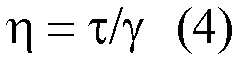
- The elastic yarn was cut to a suitable length to prepare a measuring sample. A Shimadzu CFT-500D Flow Tester (product of Shimadzu Corp.) is used under conditions with a sample amount of 1.5 g, a die (nozzle) diameter of 0.5 mm and a thickness of 1.0 mm, after applying an extrusion load of 49 N and preheating for 240 seconds at an initial preset temperature of 120°C, with a uniform temperature increase rate of 3°C/min, and determining the plunger stroke-temperature curve during that time. The sample gradually warms as a uniform temperature increase rate is approached, causing the polymer to begin to flow out. The temperature at the point where the polymer begins to flow out is recorded as the outflow start temperature. The measurement is performed 3 times and the average temperature is recorded as the outflow start temperature.
- The exterior parts, and only the back sheets of the exterior parts, were each melt kneaded and pelletized to prepare separate measuring samples, and provided for the following measurement. Using a CFT-500D Shimadzu flow tester (product of Shimadzu Corp.), preheating was carried out for 240 seconds at an initial preset temperature of 120°C with a 49 N extrusion load applied, under conditions with a sample amount of 1.5 g, a die (nozzle) diameter of 0.5 mm and a thickness of 1.0 mm, after which the temperature was increased at a uniform rate of 3°C/min, periodically recording the degree of lowering of the piston when the melted pellets were extruded through the die hole below the cylinder (the outflow rate) and drawing a flow curve with the degree of lowering as the abscissa and time as the ordinate, from which the melt viscosity at 200 to 220°C was detected. The value of the melt viscosity ratio is the maximum value for the melt viscosity of the pellets obtained by melt kneading exterior parts divided by the maximum value for the melt viscosity of the pellets obtained by melt kneading only the back sheets of the exterior parts.
- In the strand production step of the following Examples, an LS-9030D biaxial outer shape measuring tool by Keyence Corp. was set so as to allow measurement of the outer diameter of the strand at a location 35 mm below the discharge hole, measuring the outer diameter of the strand for 1 minute and calculating the fluctuation rate in the outer diameter of the strand by the following formula:
Outer diameter fluctuation rate (%) = {(Maximum outer diameter - minimum outer diameter)/average outer diameter} × 100 - For this evaluation, a smaller fluctuation rate in the outer shape of the strand improves the kneaded state in the extruder and reduces variation in discharge, thus stabilizing the form during pelletizing and improving the recycling properties, or in other words, resulting in "easy recyclability". A fluctuation rate of lower than 100% may be considered to be a sufficiently satisfactory recycling property.
- Commercially available diapers were used as absorbent articles. The exterior parts of the diapers had as the back sheet a thermoplastic polypropylene nonwoven fabric laminated with a thermoplastic polyethylene film, with a gather formed by bonding of dry spun spandex to the back sheet with a styrene-based hot-melt adhesive. The exterior parts consisted of 75 mass% of the polypropylene nonwoven fabric, 16 mass% of the polyethylene film, 4 mass% of the dry spun spandex and 5 mass% of the hot-melt adhesive with respect to the total mass of the exterior parts. The dry spun spandex had an outflow start temperature of 235°C, and no thermoplasticity. The exterior parts were separated from multiple diapers by hand to obtain approximately 1.3 kg of exterior parts. The separated exterior parts were hot pressed at 150°C for 20 seconds through heat-resistant paper, cooled to room temperature, and cut to about 5 to 10 mm using a cutter, to obtain exterior part cut fragments. The exterior part cut fragments were melt kneaded at 160°C to 180°C using a twin-screw extruder and extruded as a strand into a water-cooling tank from three discharge holes with a hole distance of 5 mm, and after cooling, the strand was cut with a pelletizer to create pellets.
- A 2400 g portion of polytetramethylene ether diol with a number-average molecular weight of 1800, and 750.75 g of 4,4'-diphenylmethane diisocyanate, were reacted for 3 hours at 60°C while stirring under a dry nitrogen atmosphere, to obtain a polyurethane prepolymer capped at both ends with isocyanate groups. After mixing 9 g of AO-60 by Adeka as an antioxidant and 9 g of LA-36 by Adeka as an ultraviolet absorber into the reaction mixture, 150.95 g of 1,4-butanediol was added and the mixture was stirred for 15 minutes to obtain a polyurethane with a viscosity of 200 Pa•s (30°C).
- It was then poured out onto a TEFLONR tray and annealed for 19 hours in a hot air oven at 110°C with the polyurethane in the tray, to obtain a polyurethane resin.
- The obtained polyurethane resin was crushed into powder with a size of about 3 mm using a Model UG-280 crusher by Horai Co. After adding 0.35 parts by mass of dried ethylenebisstearamide to the polyurethane resin powder and loading the mixture into a hopper, it was melted in an extruder. After then metering and pressurizing with a gear pump installed at the head and filtering with a filter, the melt was discharged from a 60-hole nozzle with a 0.23 mm diameter at a die temperature of 210°C, with a throughput of 31 g/min. Cold air at a temperature of 16°C was blown in at a cold air speed of 0.6 m/s from a cold air chamber with a cold air length of 900 mm, striking the yarn perpendicularly. A ring-type false twisting machine set 5 m below was used for propagation of twisting with a 1400 mm location of convergence, as the distance from the spinneret to the location of twist propagation, after which a treatment agent composed mainly of polydimethylsiloxane and mineral oil was applied while winding up at a speed of 500 m/min, to obtain thermoplastic polyurethane elastic yarn with a monofilament size of 10 dtex, a total fineness of 620 dtex and an outflow start temperature of 182°C. The treatment agent application rate on the polyurethane elastic yarn was 2 parts by mass.
- Pellets were obtained as recycled material in the same manner as Comparative Example 1, except that the dry spun spandex of the diapers used in Comparative Example 1 was changed to the aforementioned thermoplastic polyurethane elastic yarn.
- Polyurethane elastic yarn with an outflow start temperature of 220°C was obtained in the same manner as Example 1, except that the amount of 4,4'-diphenylmethane diisocyanate was 1134.47 g, the amount of 1,4-butanediol was 292.47 g and the die temperature was 230°C. Pellets were obtained as recycled material in the same manner as Comparative Example 1, except that the dry spun spandex of the diapers used in Comparative Example 1 was changed to the aforementioned thermoplastic polyurethane elastic yarn.
- Pellets were obtained as recycled material in the same manner as Example 1, except that polypropylene pellets as virgin raw material were added at 10 parts by mass to 90 parts by mass of the exterior part cut fragments, prior to melt kneading.
- Pellets were obtained as recycled material in the same manner as Example 3, except that the virgin raw material was added at 50 parts by mass to 50 parts by mass of the exterior part cut fragments.
- Pellets were obtained as recycled material in the same manner as Example 3, except that the virgin raw material was added at 80 parts by mass to 20 parts by mass of the exterior part cut fragments.
- Pellets were obtained as recycled material in the same manner as Example 3, except that the distance between the strand discharge holes was 10 mm.
- Pellets were obtained as recycled material in the same manner as Example 6, except that a temperature of 20 to 22°C was maintained in the water-cooling tank by flowing cooling water into the water-cooling tank.
- Pellets were obtained as recycled material in the same manner as Example 7, except that fluctuation in the liquid surface height was controlled to a maximum of 15 mm by placing a screen in the water-cooling tank and adjusting the locations of loading and drainage.
- Pellets were obtained as recycled material in the same manner as Example 8, except that the water content just before cutting the strand was kept to 5 mass% by blowing off the moisture adhering to the strand with compressed air, during the period from leaving the water-cooling tank until entering the pelletizer.
- Pellets were obtained as recycled material in the same manner as Example 8, except that the exterior parts were cut without pressing, obtaining a bulk density of 0.3 g/cm3 for the cut fragments of the exterior parts.
- Table 1 shows the measurement results for Comparative Example 1 and Examples 1 to 10.
[Table 1] Comp. Example 1 Example 1 Example 2 Example 3 Example 4 Example 5 Example 6 Example 7 Example 8 Example 9 Example 10 Elastic yarn outflow start temperature (°C) 235 182 220 182 182 182 182 182 182 182 182 Bulk density of raw material (exterior part cut fragments) (g/cm3) 0.5 0.5 0.5 0.5 0.5 0.5 0.5 0.5 0.5 0.5 0.3 Coefficient of variation of melt viscosity 0.8 0.2 0.4 0.4 0.2 0.3 0.4 0.3 0.3 0.3 0.4 Melt viscosity ratio value 7 1 4 1 1 1.5 1 1 1 1 1 Addition of virgin raw material with respect to recycled material (mass%) 0 0 0 10 50 80 10 10 10 10 0 Distance between strand discharge holes (mm) 5 5 5 5 5 5 10 10 10 10 10 Water-cooling tank internal temperature (°C) 32-35 25-27 30-32 25-27 25-27 25-27 25-27 20-22 20-22 20-22 20-22 Maximum fluctuation of liquid surface height (mm) 20 20 20 20 20 20 20 40 15 15 15 Water content just before strand cutting (mass%) 10 10 10 10 10 10 10 10 10 5 10 Strand outer diameter fluctuation rate (%) 250 20 80 70 15 40 50 40 30 20 60 - In Table 1 it is seen that with the absorbent articles of Examples 1 to 10 wherein all of the main structural components of the exterior parts contained thermoplastic resins, the rate of outer diameter fluctuation of the strands was low during creation of pellets as the recycled material, and therefore recycling was easy.
- The pellets created in Comparative Example 1 and Examples 1 to 10 were each used for melt spinning by a publicly known method under the same conditions. Specifically, the pellets were melted with an extruder at 200 to 230°C, weighed by a gear pump mounted on the head, pressed, and filtered with a filter comprising a stack of three wire nets of 50 mesh, 200 mesh and 400 mesh, after which they were discharged from a 12-hole nozzle with a diameter of 0.4 mm at a discharge throughput of 15 g/min, at a die temperature of 220°C. Cold air at a temperature of 16°C was blown in at a cold air speed of 0.6 m/s from a cold air chamber with a cold air length of 900 mm, striking the yarn perpendicularly. The yarn was then wound up at a speed of 1000 m/min, and spinning was carried out under conditions to obtain yarn with a monofilament size of 1.3 dtex and a total fineness of 16 dtex. When the pellets created in Comparative Example 1 were used, the spinning pack pressure increased drastically at 0.3 MPa/min, with frequent yarn breakage once every 3 minutes, making it impossible to achieve stable spinning. When the pellets created in Examples 1 to 10 were used, however, the spinning pack pressure was 0.1 MPa/hr or lower, with no drastic increase in pressure and no yarn breakage during 5 hours of spinning, allowing stable spinning to be carried out. This demonstrated that the absorbent articles of Examples 1 to 10, wherein all of the main structural components of the exterior parts contained thermoplastic resins, allow easy recycling of the exterior parts.
- An absorbent article of the invention is easy to recycle after disposal and can therefore be suitably used as an environmentally friendly absorbent article. Moreover, the method for producing recycled materials and the method for producing fibers of the invention can be suitably used as methods for obtaining recycled materials and fibers from waste absorbent articles.
-
- 1 Absorbent article
- 2 Front sheet
- 3 Absorbent body
- 4 Back sheet
- 5 Gather
- 6 Thermoplastic elastic yarn
- 7 Fastening material
Claims (21)
- An easily recyclable absorbent article comprising:an interior part containing a front sheet and absorbent body, andan exterior part constituting the non-interior part and containing a back sheet and a gather, wherein the back sheet includes a sheet material comprising a thermoplastic resin, andthe gather includes thermoplastic elastic yarn.
- The absorbent article according to claim 1, wherein the outflow start temperature of the thermoplastic elastic yarn is 160°C to 220°C.
- The easily recyclable absorbent article according to claim 1 or 2, wherein the thermoplastic elastic yarn is thermoplastic polyurethane yarn.
- The easily recyclable absorbent article according to claim 1 or 2, wherein the exterior part contains a hot-melt adhesive.
- The easily recyclable absorbent article according to claim 1 or 2, wherein the exterior part contains a thermoplastic film.
- The easily recyclable absorbent article according to claim 1 or 2, wherein the coefficient of variation of the melt viscosity of the exterior part is 0.5 or lower, as obtained by the following procedure:melt kneading the exterior part to obtain pellets;allowing the pellets to stand for 30 minutes in the furnace of a capillary rheometer set to 230°C;measuring the melt viscosity at a shear rate of 1857/sec while holding at 230°C; andcalculating the coefficient of variation of the melt viscosity during an arbitrary 3 minute period from 8 minutes after the start of measurement until the end of measurement.
- The easily recyclable absorbent article according to claim 1 or 2, wherein the exterior part has a value of 5.0 or lower for the quotient of the maximum of the melt viscosity at 200 to 220°C measured using a flow tester under conditions with an extrusion load of 49 N, a starting temperature of 120°C and a temperature increase of 3°C/min, for pellets obtained by melt kneading the exterior part, divided by the maximum of the melt viscosity at 200 to 220°C measured by the same method for pellets obtained by melt kneading only the back sheet of the exterior part.
- A method for producing a recycled material, the method comprising the following steps:(1) a step of at least melt kneading exterior parts separated from easily recyclable absorbent articles according to claim 1 or 2, and(2) a step of pelletizing the product of step (1).
- The method according to claim 8, wherein virgin raw material is further added in step (1).
- The method according to claim 9, wherein virgin raw material is added at 1 to 95 mass% to the recycled material in step (1).
- A method for producing a recycled material, the method comprising the following steps:(i) a step of separating at least exterior parts from easily recyclable absorbent articles according to claim 1 or 2,(ii) a step of at least melt kneading the exterior parts separated in step (i) and(iii) a step of pelletizing the product of step (ii).
- The method according to claim 11, wherein virgin raw material is further added in step (ii).
- The method according to claim 12, wherein virgin raw material is added at 1 to 95 mass% to the recycled material in step (ii).
- A method for producing fibers, the method comprising a step of fiberizing recycled material produced by the production method according to claim 8.
- A method for producing a fiber product, wherein a fiber product is produced using fibers produced by the method according to claim 14.
- A method for producing fibers, the method comprising the following steps:(A) a step of at least melt kneading exterior parts separated from easily recyclable absorbent articles according to claim 1 or 2, and(B) a step of melt spinning the product of step (A).
- The method according to claim 16, wherein virgin raw material is further added in step (A).
- The method according to claim 17, wherein virgin raw material is added at 1 to 95 mass% to the recycled material in step (A).
- A method for producing fibers, the method comprising the following steps:(a) a step of separating at least exterior parts from easily recyclable absorbent articles according to claim 1 or 2,(b) a step of at least melt kneading the exterior parts separated in step (a) and(c) a step of melt spinning the product of step (b).
- The method according to claim 19, wherein virgin raw material is further added in step (b).
- The method according to claim 20, wherein virgin raw material is added at 1 to 95 mass% to the recycled material in step (b).
Applications Claiming Priority (2)
| Application Number | Priority Date | Filing Date | Title |
|---|---|---|---|
| JP2022063616 | 2022-04-06 | ||
| PCT/JP2023/014079 WO2023195484A1 (en) | 2022-04-06 | 2023-04-05 | Easy-to-recycle absorbent article, and method for manufacturing recycled raw material, fiber, and fiber product |
Publications (2)
| Publication Number | Publication Date |
|---|---|
| EP4506401A1 true EP4506401A1 (en) | 2025-02-12 |
| EP4506401A4 EP4506401A4 (en) | 2025-07-23 |
Family
ID=88243115
Family Applications (1)
| Application Number | Title | Priority Date | Filing Date |
|---|---|---|---|
| EP23784768.6A Pending EP4506401A4 (en) | 2022-04-06 | 2023-04-05 | Easily reprocessable absorbent article and process for producing recycled raw material, fiber, and fiber product |
Country Status (4)
| Country | Link |
|---|---|
| EP (1) | EP4506401A4 (en) |
| JP (1) | JPWO2023195484A1 (en) |
| CN (1) | CN119031896A (en) |
| WO (1) | WO2023195484A1 (en) |
Cited By (1)
| Publication number | Priority date | Publication date | Assignee | Title |
|---|---|---|---|---|
| EP4714651A1 (en) * | 2024-09-23 | 2026-03-25 | Ontex BV | Post-consumer recycled material in flexible packages comprising absorbent articles |
Family Cites Families (8)
| Publication number | Priority date | Publication date | Assignee | Title |
|---|---|---|---|---|
| JP3492205B2 (en) * | 1998-06-30 | 2004-02-03 | ユニ・チャーム株式会社 | Pants-type disposable diapers |
| JP6195145B2 (en) * | 2013-02-06 | 2017-09-13 | 学校法人福岡大学 | Recycling method of used paper diaper, production method of soil improvement material, and recycling system of used paper diaper |
| JP6203158B2 (en) | 2014-10-15 | 2017-09-27 | ユニ・チャーム株式会社 | Method for producing recycled pulp from used sanitary products |
| JP2017036405A (en) * | 2015-08-11 | 2017-02-16 | 有限会社吉岡産業 | Synthetic resin mixed molded product and method for producing the same |
| JP6865619B2 (en) | 2017-03-31 | 2021-04-28 | ユニ・チャーム株式会社 | How to Make Recycled Products, Recycled Resin Pellets, and Recycled Films |
| JP7270497B2 (en) * | 2019-07-30 | 2023-05-10 | 花王株式会社 | How to collect recycled resources |
| TWI809315B (en) * | 2019-09-24 | 2023-07-21 | 日商旭化成股份有限公司 | Regenerated polyurethane elastic fiber, its production method, fiber structure containing the regenerated polyurethane elastic fiber, gathered part, and hygienic material |
| CN116096949A (en) * | 2020-09-11 | 2023-05-09 | 旭化成株式会社 | Polyurethane elastic fiber, gather member containing same, and sanitary material |
-
2023
- 2023-04-05 WO PCT/JP2023/014079 patent/WO2023195484A1/en not_active Ceased
- 2023-04-05 EP EP23784768.6A patent/EP4506401A4/en active Pending
- 2023-04-05 CN CN202380031259.XA patent/CN119031896A/en active Pending
- 2023-04-05 JP JP2024514290A patent/JPWO2023195484A1/ja active Pending
Cited By (1)
| Publication number | Priority date | Publication date | Assignee | Title |
|---|---|---|---|---|
| EP4714651A1 (en) * | 2024-09-23 | 2026-03-25 | Ontex BV | Post-consumer recycled material in flexible packages comprising absorbent articles |
Also Published As
| Publication number | Publication date |
|---|---|
| WO2023195484A1 (en) | 2023-10-12 |
| JPWO2023195484A1 (en) | 2023-10-12 |
| CN119031896A (en) | 2024-11-26 |
| EP4506401A4 (en) | 2025-07-23 |
Similar Documents
| Publication | Publication Date | Title |
|---|---|---|
| CN101283034B (en) | Water stable composition and articles comprising starch, and methods of making the same | |
| KR100722891B1 (en) | Biodegradable Thermoplastic Nonwoven Web for Fluid Control | |
| EP0569154B1 (en) | Biodegradable disposable diaper | |
| EP2794215B1 (en) | Method for forming a thermoplastic composition that contains a plasticized starch polymer | |
| US8940205B2 (en) | Production of useful articles from waste material | |
| JP5335705B2 (en) | Superabsorbent nonwoven fabric and method for producing the same | |
| CZ221196A3 (en) | Biologically degradable copolymer and plastic parts, which contain biologically degradable copolymers of 3-hydroxyhexanoate | |
| JPH09509456A (en) | Spraying method using gas flow for producing biodegradable fibrils, non-woven fabric composed of biodegradable fibrils, and article composed of such non-woven fabric | |
| EP4506401A1 (en) | Easy-to-recycle absorbent article, and method for manufacturing recycled raw material, fiber, and fiber product | |
| KR20230062617A (en) | Water-soluble fibers having post-process modification and articles containing the same | |
| KR102556244B1 (en) | polymeric substances | |
| WO2023190074A1 (en) | Melt-blown nonwoven fabric and hygienic material | |
| KR102548677B1 (en) | porous polyester material | |
| JP2026074150A (en) | Methods for manufacturing easily recyclable absorbent articles, as well as recycled raw materials, fibers, and textile products. | |
| EP4245794A1 (en) | Water-absorbing resin particles, absorbent, and absorbent article | |
| US20230272558A1 (en) | Polyurethane Elastic Fiber, Gather Member Containing Same, and Sanitary Material | |
| JPH11286864A (en) | Biodegradable nonwoven | |
| JP2003514134A (en) | Biodegradable nonwoven with improved fluid handling properties and disposable articles containing same | |
| JP2000096416A (en) | Biodegradable nonwoven | |
| TW202507111A (en) | Three-dimensional network structure and manufacturing method thereof | |
| EP4245795A1 (en) | Water-absorbing resin particle, absorber, and absorbent article | |
| US20230149228A1 (en) | Absorbent layers suitable for use in absorbent articles and methods for making same | |
| WO2008018920A2 (en) | Fully integrated method for producing absorbent products | |
| WO2002036043A2 (en) | Internal wetting agent for use in manufacture if polymeric films and fabrics for disposable absorbent articles | |
| JP2023077190A (en) | Mixed fiber nonwoven fabric and its manufacturing method |
Legal Events
| Date | Code | Title | Description |
|---|---|---|---|
| STAA | Information on the status of an ep patent application or granted ep patent |
Free format text: STATUS: THE INTERNATIONAL PUBLICATION HAS BEEN MADE |
|
| PUAI | Public reference made under article 153(3) epc to a published international application that has entered the european phase |
Free format text: ORIGINAL CODE: 0009012 |
|
| STAA | Information on the status of an ep patent application or granted ep patent |
Free format text: STATUS: REQUEST FOR EXAMINATION WAS MADE |
|
| 17P | Request for examination filed |
Effective date: 20241002 |
|
| AK | Designated contracting states |
Kind code of ref document: A1 Designated state(s): AL AT BE BG CH CY CZ DE DK EE ES FI FR GB GR HR HU IE IS IT LI LT LU LV MC ME MK MT NL NO PL PT RO RS SE SI SK SM TR |
|
| STAA | Information on the status of an ep patent application or granted ep patent |
Free format text: STATUS: EXAMINATION IS IN PROGRESS |
|
| DAV | Request for validation of the european patent (deleted) | ||
| DAX | Request for extension of the european patent (deleted) | ||
| A4 | Supplementary search report drawn up and despatched |
Effective date: 20250623 |
|
| RIC1 | Information provided on ipc code assigned before grant |
Ipc: C08J 11/06 20060101AFI20250616BHEP Ipc: B29B 17/02 20060101ALI20250616BHEP Ipc: A61F 13/49 20060101ALI20250616BHEP Ipc: A61F 13/514 20060101ALI20250616BHEP Ipc: B29B 17/00 20060101ALI20250616BHEP Ipc: B29L 31/48 20060101ALI20250616BHEP |
|
| 17Q | First examination report despatched |
Effective date: 20250707 |