EP4506036A2 - Chimeric antigen receptors targeting fc receptor-like 5 and uses thereof - Google Patents
Chimeric antigen receptors targeting fc receptor-like 5 and uses thereof Download PDFInfo
- Publication number
- EP4506036A2 EP4506036A2 EP24206281.8A EP24206281A EP4506036A2 EP 4506036 A2 EP4506036 A2 EP 4506036A2 EP 24206281 A EP24206281 A EP 24206281A EP 4506036 A2 EP4506036 A2 EP 4506036A2
- Authority
- EP
- European Patent Office
- Prior art keywords
- seq
- set forth
- sequence set
- chain variable
- variable region
- Prior art date
- Legal status (The legal status is an assumption and is not a legal conclusion. Google has not performed a legal analysis and makes no representation as to the accuracy of the status listed.)
- Pending
Links
Images













Classifications
-
- A—HUMAN NECESSITIES
- A61—MEDICAL OR VETERINARY SCIENCE; HYGIENE
- A61K—PREPARATIONS FOR MEDICAL, DENTAL OR TOILETRY PURPOSES
- A61K35/00—Medicinal preparations containing materials or reaction products thereof with undetermined constitution
- A61K35/12—Materials from mammals; Compositions comprising non-specified tissues or cells; Compositions comprising non-embryonic stem cells; Genetically modified cells
- A61K35/14—Blood; Artificial blood
- A61K35/17—Lymphocytes; B-cells; T-cells; Natural killer cells; Interferon-activated or cytokine-activated lymphocytes
-
- A—HUMAN NECESSITIES
- A61—MEDICAL OR VETERINARY SCIENCE; HYGIENE
- A61K—PREPARATIONS FOR MEDICAL, DENTAL OR TOILETRY PURPOSES
- A61K39/00—Medicinal preparations containing antigens or antibodies
- A61K39/0005—Vertebrate antigens
- A61K39/0011—Cancer antigens
-
- A—HUMAN NECESSITIES
- A61—MEDICAL OR VETERINARY SCIENCE; HYGIENE
- A61K—PREPARATIONS FOR MEDICAL, DENTAL OR TOILETRY PURPOSES
- A61K39/00—Medicinal preparations containing antigens or antibodies
- A61K39/0005—Vertebrate antigens
- A61K39/0011—Cancer antigens
- A61K39/001102—Receptors, cell surface antigens or cell surface determinants
- A61K39/001129—Molecules with a "CD" designation not provided for elsewhere
-
- A—HUMAN NECESSITIES
- A61—MEDICAL OR VETERINARY SCIENCE; HYGIENE
- A61K—PREPARATIONS FOR MEDICAL, DENTAL OR TOILETRY PURPOSES
- A61K40/00—Cellular immunotherapy
- A61K40/10—Cellular immunotherapy characterised by the cell type used
- A61K40/11—T-cells, e.g. tumour infiltrating lymphocytes [TIL] or regulatory T [Treg] cells; Lymphokine-activated killer [LAK] cells
-
- A—HUMAN NECESSITIES
- A61—MEDICAL OR VETERINARY SCIENCE; HYGIENE
- A61K—PREPARATIONS FOR MEDICAL, DENTAL OR TOILETRY PURPOSES
- A61K40/00—Cellular immunotherapy
- A61K40/10—Cellular immunotherapy characterised by the cell type used
- A61K40/15—Natural-killer [NK] cells; Natural-killer T [NKT] cells
-
- A—HUMAN NECESSITIES
- A61—MEDICAL OR VETERINARY SCIENCE; HYGIENE
- A61K—PREPARATIONS FOR MEDICAL, DENTAL OR TOILETRY PURPOSES
- A61K40/00—Cellular immunotherapy
- A61K40/30—Cellular immunotherapy characterised by the recombinant expression of specific molecules in the cells of the immune system
- A61K40/31—Chimeric antigen receptors [CAR]
-
- A—HUMAN NECESSITIES
- A61—MEDICAL OR VETERINARY SCIENCE; HYGIENE
- A61K—PREPARATIONS FOR MEDICAL, DENTAL OR TOILETRY PURPOSES
- A61K40/00—Cellular immunotherapy
- A61K40/30—Cellular immunotherapy characterised by the recombinant expression of specific molecules in the cells of the immune system
- A61K40/35—Cytokines
-
- A—HUMAN NECESSITIES
- A61—MEDICAL OR VETERINARY SCIENCE; HYGIENE
- A61K—PREPARATIONS FOR MEDICAL, DENTAL OR TOILETRY PURPOSES
- A61K40/00—Cellular immunotherapy
- A61K40/40—Cellular immunotherapy characterised by antigens that are targeted or presented by cells of the immune system
- A61K40/41—Vertebrate antigens
- A61K40/42—Cancer antigens
- A61K40/4202—Receptors, cell surface antigens or cell surface determinants
-
- A—HUMAN NECESSITIES
- A61—MEDICAL OR VETERINARY SCIENCE; HYGIENE
- A61K—PREPARATIONS FOR MEDICAL, DENTAL OR TOILETRY PURPOSES
- A61K40/00—Cellular immunotherapy
- A61K40/40—Cellular immunotherapy characterised by antigens that are targeted or presented by cells of the immune system
- A61K40/41—Vertebrate antigens
- A61K40/42—Cancer antigens
- A61K40/4202—Receptors, cell surface antigens or cell surface determinants
- A61K40/421—Immunoglobulin superfamily
- A61K40/4211—CD19 or B4
-
- A—HUMAN NECESSITIES
- A61—MEDICAL OR VETERINARY SCIENCE; HYGIENE
- A61P—SPECIFIC THERAPEUTIC ACTIVITY OF CHEMICAL COMPOUNDS OR MEDICINAL PREPARATIONS
- A61P35/00—Antineoplastic agents
-
- A—HUMAN NECESSITIES
- A61—MEDICAL OR VETERINARY SCIENCE; HYGIENE
- A61P—SPECIFIC THERAPEUTIC ACTIVITY OF CHEMICAL COMPOUNDS OR MEDICINAL PREPARATIONS
- A61P35/00—Antineoplastic agents
- A61P35/02—Antineoplastic agents specific for leukemia
-
- A—HUMAN NECESSITIES
- A61—MEDICAL OR VETERINARY SCIENCE; HYGIENE
- A61P—SPECIFIC THERAPEUTIC ACTIVITY OF CHEMICAL COMPOUNDS OR MEDICINAL PREPARATIONS
- A61P35/00—Antineoplastic agents
- A61P35/04—Antineoplastic agents specific for metastasis
-
- C—CHEMISTRY; METALLURGY
- C07—ORGANIC CHEMISTRY
- C07K—PEPTIDES
- C07K14/00—Peptides having more than 20 amino acids; Gastrins; Somatostatins; Melanotropins; Derivatives thereof
- C07K14/435—Peptides having more than 20 amino acids; Gastrins; Somatostatins; Melanotropins; Derivatives thereof from animals; from humans
- C07K14/705—Receptors; Cell surface antigens; Cell surface determinants
- C07K14/70503—Immunoglobulin superfamily
- C07K14/7051—T-cell receptor (TcR)-CD3 complex
-
- C—CHEMISTRY; METALLURGY
- C07—ORGANIC CHEMISTRY
- C07K—PEPTIDES
- C07K14/00—Peptides having more than 20 amino acids; Gastrins; Somatostatins; Melanotropins; Derivatives thereof
- C07K14/435—Peptides having more than 20 amino acids; Gastrins; Somatostatins; Melanotropins; Derivatives thereof from animals; from humans
- C07K14/705—Receptors; Cell surface antigens; Cell surface determinants
- C07K14/70503—Immunoglobulin superfamily
- C07K14/70517—CD8
-
- C—CHEMISTRY; METALLURGY
- C07—ORGANIC CHEMISTRY
- C07K—PEPTIDES
- C07K14/00—Peptides having more than 20 amino acids; Gastrins; Somatostatins; Melanotropins; Derivatives thereof
- C07K14/435—Peptides having more than 20 amino acids; Gastrins; Somatostatins; Melanotropins; Derivatives thereof from animals; from humans
- C07K14/705—Receptors; Cell surface antigens; Cell surface determinants
- C07K14/70503—Immunoglobulin superfamily
- C07K14/70521—CD28, CD152
-
- C—CHEMISTRY; METALLURGY
- C07—ORGANIC CHEMISTRY
- C07K—PEPTIDES
- C07K14/00—Peptides having more than 20 amino acids; Gastrins; Somatostatins; Melanotropins; Derivatives thereof
- C07K14/435—Peptides having more than 20 amino acids; Gastrins; Somatostatins; Melanotropins; Derivatives thereof from animals; from humans
- C07K14/705—Receptors; Cell surface antigens; Cell surface determinants
- C07K14/7056—Lectin superfamily, e.g. CD23, CD72
-
- C—CHEMISTRY; METALLURGY
- C07—ORGANIC CHEMISTRY
- C07K—PEPTIDES
- C07K14/00—Peptides having more than 20 amino acids; Gastrins; Somatostatins; Melanotropins; Derivatives thereof
- C07K14/435—Peptides having more than 20 amino acids; Gastrins; Somatostatins; Melanotropins; Derivatives thereof from animals; from humans
- C07K14/705—Receptors; Cell surface antigens; Cell surface determinants
- C07K14/70578—NGF-receptor/TNF-receptor superfamily, e.g. CD27, CD30, CD40, CD95
-
- C—CHEMISTRY; METALLURGY
- C07—ORGANIC CHEMISTRY
- C07K—PEPTIDES
- C07K16/00—Immunoglobulins [IG], e.g. monoclonal or polyclonal antibodies
- C07K16/18—Immunoglobulins [IG], e.g. monoclonal or polyclonal antibodies against material from animals or humans
- C07K16/28—Immunoglobulins [IG], e.g. monoclonal or polyclonal antibodies against material from animals or humans against receptors, cell surface antigens or cell surface determinants
- C07K16/2803—Immunoglobulins [IG], e.g. monoclonal or polyclonal antibodies against material from animals or humans against receptors, cell surface antigens or cell surface determinants against the immunoglobulin superfamily
- C07K16/283—Immunoglobulins [IG], e.g. monoclonal or polyclonal antibodies against material from animals or humans against receptors, cell surface antigens or cell surface determinants against the immunoglobulin superfamily against Fc-receptors, e.g. CD16, CD32, CD64
-
- C—CHEMISTRY; METALLURGY
- C07—ORGANIC CHEMISTRY
- C07K—PEPTIDES
- C07K16/00—Immunoglobulins [IG], e.g. monoclonal or polyclonal antibodies
- C07K16/18—Immunoglobulins [IG], e.g. monoclonal or polyclonal antibodies against material from animals or humans
- C07K16/28—Immunoglobulins [IG], e.g. monoclonal or polyclonal antibodies against material from animals or humans against receptors, cell surface antigens or cell surface determinants
- C07K16/30—Immunoglobulins [IG], e.g. monoclonal or polyclonal antibodies against material from animals or humans against receptors, cell surface antigens or cell surface determinants from tumour cells
- C07K16/3061—Blood cells
-
- C—CHEMISTRY; METALLURGY
- C12—BIOCHEMISTRY; BEER; SPIRITS; WINE; VINEGAR; MICROBIOLOGY; ENZYMOLOGY; MUTATION OR GENETIC ENGINEERING
- C12N—MICROORGANISMS OR ENZYMES; COMPOSITIONS THEREOF; PROPAGATING, PRESERVING, OR MAINTAINING MICROORGANISMS; MUTATION OR GENETIC ENGINEERING; CULTURE MEDIA
- C12N15/00—Mutation or genetic engineering; DNA or RNA concerning genetic engineering, vectors, e.g. plasmids, or their isolation, preparation or purification; Use of hosts therefor
- C12N15/09—Recombinant DNA-technology
- C12N15/63—Introduction of foreign genetic material using vectors; Vectors; Use of hosts therefor; Regulation of expression
- C12N15/79—Vectors or expression systems specially adapted for eukaryotic hosts
- C12N15/85—Vectors or expression systems specially adapted for eukaryotic hosts for animal cells
- C12N15/86—Viral vectors
-
- C—CHEMISTRY; METALLURGY
- C12—BIOCHEMISTRY; BEER; SPIRITS; WINE; VINEGAR; MICROBIOLOGY; ENZYMOLOGY; MUTATION OR GENETIC ENGINEERING
- C12N—MICROORGANISMS OR ENZYMES; COMPOSITIONS THEREOF; PROPAGATING, PRESERVING, OR MAINTAINING MICROORGANISMS; MUTATION OR GENETIC ENGINEERING; CULTURE MEDIA
- C12N5/00—Undifferentiated human, animal or plant cells, e.g. cell lines; Tissues; Cultivation or maintenance thereof; Culture media therefor
- C12N5/06—Animal cells or tissues; Human cells or tissues
- C12N5/0602—Vertebrate cells
- C12N5/0634—Cells from the blood or the immune system
- C12N5/0636—T lymphocytes
-
- C—CHEMISTRY; METALLURGY
- C12—BIOCHEMISTRY; BEER; SPIRITS; WINE; VINEGAR; MICROBIOLOGY; ENZYMOLOGY; MUTATION OR GENETIC ENGINEERING
- C12N—MICROORGANISMS OR ENZYMES; COMPOSITIONS THEREOF; PROPAGATING, PRESERVING, OR MAINTAINING MICROORGANISMS; MUTATION OR GENETIC ENGINEERING; CULTURE MEDIA
- C12N9/00—Enzymes; Proenzymes; Compositions thereof; Processes for preparing, activating, inhibiting, separating or purifying enzymes
- C12N9/10—Transferases (2.)
- C12N9/12—Transferases (2.) transferring phosphorus containing groups, e.g. kinases (2.7)
- C12N9/1205—Phosphotransferases with an alcohol group as acceptor (2.7.1), e.g. protein kinases
-
- A—HUMAN NECESSITIES
- A61—MEDICAL OR VETERINARY SCIENCE; HYGIENE
- A61K—PREPARATIONS FOR MEDICAL, DENTAL OR TOILETRY PURPOSES
- A61K39/00—Medicinal preparations containing antigens or antibodies
- A61K2039/505—Medicinal preparations containing antigens or antibodies comprising antibodies
-
- A—HUMAN NECESSITIES
- A61—MEDICAL OR VETERINARY SCIENCE; HYGIENE
- A61K—PREPARATIONS FOR MEDICAL, DENTAL OR TOILETRY PURPOSES
- A61K39/00—Medicinal preparations containing antigens or antibodies
- A61K2039/51—Medicinal preparations containing antigens or antibodies comprising whole cells, viruses or DNA/RNA
- A61K2039/515—Animal cells
- A61K2039/5156—Animal cells expressing foreign proteins
-
- A—HUMAN NECESSITIES
- A61—MEDICAL OR VETERINARY SCIENCE; HYGIENE
- A61K—PREPARATIONS FOR MEDICAL, DENTAL OR TOILETRY PURPOSES
- A61K2121/00—Preparations for use in therapy
-
- A—HUMAN NECESSITIES
- A61—MEDICAL OR VETERINARY SCIENCE; HYGIENE
- A61K—PREPARATIONS FOR MEDICAL, DENTAL OR TOILETRY PURPOSES
- A61K2239/00—Indexing codes associated with cellular immunotherapy of group A61K40/00
- A61K2239/46—Indexing codes associated with cellular immunotherapy of group A61K40/00 characterised by the cancer treated
- A61K2239/48—Blood cells, e.g. leukemia or lymphoma
-
- A—HUMAN NECESSITIES
- A61—MEDICAL OR VETERINARY SCIENCE; HYGIENE
- A61K—PREPARATIONS FOR MEDICAL, DENTAL OR TOILETRY PURPOSES
- A61K2300/00—Mixtures or combinations of active ingredients, wherein at least one active ingredient is fully defined in groups A61K31/00 - A61K41/00
-
- C—CHEMISTRY; METALLURGY
- C07—ORGANIC CHEMISTRY
- C07K—PEPTIDES
- C07K2317/00—Immunoglobulins specific features
- C07K2317/30—Immunoglobulins specific features characterized by aspects of specificity or valency
- C07K2317/31—Immunoglobulins specific features characterized by aspects of specificity or valency multispecific
-
- C—CHEMISTRY; METALLURGY
- C07—ORGANIC CHEMISTRY
- C07K—PEPTIDES
- C07K2317/00—Immunoglobulins specific features
- C07K2317/30—Immunoglobulins specific features characterized by aspects of specificity or valency
- C07K2317/34—Identification of a linear epitope shorter than 20 amino acid residues or of a conformational epitope defined by amino acid residues
-
- C—CHEMISTRY; METALLURGY
- C07—ORGANIC CHEMISTRY
- C07K—PEPTIDES
- C07K2317/00—Immunoglobulins specific features
- C07K2317/50—Immunoglobulins specific features characterized by immunoglobulin fragments
- C07K2317/54—F(ab')2
-
- C—CHEMISTRY; METALLURGY
- C07—ORGANIC CHEMISTRY
- C07K—PEPTIDES
- C07K2317/00—Immunoglobulins specific features
- C07K2317/50—Immunoglobulins specific features characterized by immunoglobulin fragments
- C07K2317/55—Fab or Fab'
-
- C—CHEMISTRY; METALLURGY
- C07—ORGANIC CHEMISTRY
- C07K—PEPTIDES
- C07K2317/00—Immunoglobulins specific features
- C07K2317/50—Immunoglobulins specific features characterized by immunoglobulin fragments
- C07K2317/56—Immunoglobulins specific features characterized by immunoglobulin fragments variable (Fv) region, i.e. VH and/or VL
-
- C—CHEMISTRY; METALLURGY
- C07—ORGANIC CHEMISTRY
- C07K—PEPTIDES
- C07K2317/00—Immunoglobulins specific features
- C07K2317/50—Immunoglobulins specific features characterized by immunoglobulin fragments
- C07K2317/56—Immunoglobulins specific features characterized by immunoglobulin fragments variable (Fv) region, i.e. VH and/or VL
- C07K2317/565—Complementarity determining region [CDR]
-
- C—CHEMISTRY; METALLURGY
- C07—ORGANIC CHEMISTRY
- C07K—PEPTIDES
- C07K2317/00—Immunoglobulins specific features
- C07K2317/60—Immunoglobulins specific features characterized by non-natural combinations of immunoglobulin fragments
- C07K2317/62—Immunoglobulins specific features characterized by non-natural combinations of immunoglobulin fragments comprising only variable region components
- C07K2317/622—Single chain antibody (scFv)
-
- C—CHEMISTRY; METALLURGY
- C07—ORGANIC CHEMISTRY
- C07K—PEPTIDES
- C07K2317/00—Immunoglobulins specific features
- C07K2317/90—Immunoglobulins specific features characterized by (pharmaco)kinetic aspects or by stability of the immunoglobulin
- C07K2317/92—Affinity (KD), association rate (Ka), dissociation rate (Kd) or EC50 value
-
- C—CHEMISTRY; METALLURGY
- C07—ORGANIC CHEMISTRY
- C07K—PEPTIDES
- C07K2319/00—Fusion polypeptide
- C07K2319/01—Fusion polypeptide containing a localisation/targetting motif
- C07K2319/02—Fusion polypeptide containing a localisation/targetting motif containing a signal sequence
-
- C—CHEMISTRY; METALLURGY
- C07—ORGANIC CHEMISTRY
- C07K—PEPTIDES
- C07K2319/00—Fusion polypeptide
- C07K2319/01—Fusion polypeptide containing a localisation/targetting motif
- C07K2319/03—Fusion polypeptide containing a localisation/targetting motif containing a transmembrane segment
-
- C—CHEMISTRY; METALLURGY
- C07—ORGANIC CHEMISTRY
- C07K—PEPTIDES
- C07K2319/00—Fusion polypeptide
- C07K2319/33—Fusion polypeptide fusions for targeting to specific cell types, e.g. tissue specific targeting, targeting of a bacterial subspecies
-
- C—CHEMISTRY; METALLURGY
- C07—ORGANIC CHEMISTRY
- C07K—PEPTIDES
- C07K2319/00—Fusion polypeptide
- C07K2319/40—Fusion polypeptide containing a tag for immunodetection, or an epitope for immunisation
-
- C—CHEMISTRY; METALLURGY
- C07—ORGANIC CHEMISTRY
- C07K—PEPTIDES
- C07K2319/00—Fusion polypeptide
- C07K2319/70—Fusion polypeptide containing domain for protein-protein interaction
- C07K2319/74—Fusion polypeptide containing domain for protein-protein interaction containing a fusion for binding to a cell surface receptor
-
- C—CHEMISTRY; METALLURGY
- C12—BIOCHEMISTRY; BEER; SPIRITS; WINE; VINEGAR; MICROBIOLOGY; ENZYMOLOGY; MUTATION OR GENETIC ENGINEERING
- C12N—MICROORGANISMS OR ENZYMES; COMPOSITIONS THEREOF; PROPAGATING, PRESERVING, OR MAINTAINING MICROORGANISMS; MUTATION OR GENETIC ENGINEERING; CULTURE MEDIA
- C12N2510/00—Genetically modified cells
-
- C—CHEMISTRY; METALLURGY
- C12—BIOCHEMISTRY; BEER; SPIRITS; WINE; VINEGAR; MICROBIOLOGY; ENZYMOLOGY; MUTATION OR GENETIC ENGINEERING
- C12N—MICROORGANISMS OR ENZYMES; COMPOSITIONS THEREOF; PROPAGATING, PRESERVING, OR MAINTAINING MICROORGANISMS; MUTATION OR GENETIC ENGINEERING; CULTURE MEDIA
- C12N2740/00—Reverse transcribing RNA viruses
- C12N2740/00011—Details
- C12N2740/10011—Retroviridae
- C12N2740/10041—Use of virus, viral particle or viral elements as a vector
- C12N2740/10043—Use of virus, viral particle or viral elements as a vector viral genome or elements thereof as genetic vector
-
- C—CHEMISTRY; METALLURGY
- C12—BIOCHEMISTRY; BEER; SPIRITS; WINE; VINEGAR; MICROBIOLOGY; ENZYMOLOGY; MUTATION OR GENETIC ENGINEERING
- C12N—MICROORGANISMS OR ENZYMES; COMPOSITIONS THEREOF; PROPAGATING, PRESERVING, OR MAINTAINING MICROORGANISMS; MUTATION OR GENETIC ENGINEERING; CULTURE MEDIA
- C12N2740/00—Reverse transcribing RNA viruses
- C12N2740/00011—Details
- C12N2740/10011—Retroviridae
- C12N2740/13011—Gammaretrovirus, e.g. murine leukeamia virus
- C12N2740/13041—Use of virus, viral particle or viral elements as a vector
- C12N2740/13043—Use of virus, viral particle or viral elements as a vector viral genome or elements thereof as genetic vector
-
- C—CHEMISTRY; METALLURGY
- C12—BIOCHEMISTRY; BEER; SPIRITS; WINE; VINEGAR; MICROBIOLOGY; ENZYMOLOGY; MUTATION OR GENETIC ENGINEERING
- C12N—MICROORGANISMS OR ENZYMES; COMPOSITIONS THEREOF; PROPAGATING, PRESERVING, OR MAINTAINING MICROORGANISMS; MUTATION OR GENETIC ENGINEERING; CULTURE MEDIA
- C12N2840/00—Vectors comprising a special translation-regulating system
- C12N2840/20—Vectors comprising a special translation-regulating system translation of more than one cistron
- C12N2840/203—Vectors comprising a special translation-regulating system translation of more than one cistron having an IRES
Definitions
- the presently disclosed subject matter provides for methods and compositions for treating cancer. It relates to chimeric antigen receptors (CARs) that specifically target Fc Receptor-like 5 (FcRL5), e.g ., domain 9 of FcRL5, immunoresponsive cells comprising such CARs, and methods of using such cells for treating cancer (e.g., multiple myeloma).
- CARs chimeric antigen receptors
- FcRL5 Fc Receptor-like 5
- FcRL5 Fc Receptor-like 5
- immunoresponsive cells comprising such CARs
- T cells and other immune cells may be modified to target tumor antigens through the introduction of genetic material coding for artificial or synthetic receptors for antigen, termed Chimeric Antigen Receptors (CARs), specific to selected antigens.
- CARs Chimeric Antigen Receptors
- MM Multiple myeloma
- GvM immuno-therapeutic graft versus myeloma
- Myeloma is expected to be an ideal disease to test adoptive T cell therapy.
- allogeneic transplants demonstrate that the T cell can be a curative treatment, even with minimal or no concomitant chemotherapy such as after non-myeloablative transplants or post-transplantation donor lymphocyte infusions.
- the immediate post-autologous transplant period could be an optimal time to administer T cells, and myeloma is one of the few diseases where autologous stem cell transplantation is the standard of care.
- the immunomodulatory drug lenalidomide may improve CAR based therapy, as has been shown in mice ( Bertilaccio et al., Blood 122, 4171 (2013 )), and lenalidomide is commonly used to treat MM.
- adoptive T cell therapy works best in bone marrow predominant disease such as ALL ( Brentjens et al., Science translational medicine 5, 177ra138 (2013 ); Davila et al., Science translational medicine 6, 224ra225 (2014 )), when compared to solid tumors or extra-medullary CLL (Brentjens et al. (2011)) and similar to ALL, myeloma is a disease of the bone marrow.
- ALL Brentjens et al., Science translational medicine 5, 177ra138 (2013 ); Davila et al., Science translational medicine 6, 224ra225 (2014 )
- myeloma is a disease of the bone marrow.
- the presently disclosed subject matter generally provides chimeric antigen receptors (CARs) that specifically target Fc Receptor-like 5 (FcRL5), immunoresponsive cells comprising such CARs, and uses of these CARs and immunoresponsive cells for treating multiple myeloma.
- CARs chimeric antigen receptors
- FcRL5 Fc Receptor-like 5
- the presently disclosed subject matter provides CARs.
- the CAR comprises an extracellular antigen-binding domain, a transmembrane domain and an intracellular domain, where the extracellular antigen-binding domain specifically binds to FcRL5.
- the extracellular antigen-binding domain binds to domain 9 of FcRL5.
- the extracellular antigen-binding domain is a single-chain variable fragment (scFv). In certain embodiments, the extracellular antigen-binding domain is a murine scFv. In certain embodiments, the extracellular antigen-binding domain is a human scFv. In certain non-limiting embodiments, the extracellular antigen-binding domain is a Fab, which is optionally crosslinked. In certain non-limiting embodiments, the extracellular binding domain is a F(ab) 2 . In certain non-limiting embodiments, any of the foregoing molecules can be comprised in a fusion protein with a heterologous sequence to form the extracellular antigen-binding domain.
- the extracellular antigen-binding domain specifically binds to FcRL5 with a binding affinity (K d ) of from about 1 x 10 -11 M to about 3 x 10 -6 M, 1 x 10 -10 M to about 3 x 10 -6 M or 1 x 10 -9 M to about 3 x 10 -6 M. In certain embodiments, the extracellular antigen-binding domain specifically binds to domain 8 or 9 of FcRL5 with a K d of from about 1 x 10 -9 M to about 3 x 10 -6 M.
- K d binding affinity
- the extracellular antigen-binding domain comprises a light chain variable region comprising an amino acid sequence that is at least 80%, 81%, 82%, 83%, 84%, 85%, 86%, 87%, 88%, 89%, 90%, 91%, 92%, 93%, 94%, 95%, 96%, 97%, 98% or 99% homologous to an amino acid sequence selected from the group consisting of SEQ ID NO:3, SEQ ID NO:7, SEQ ID NO:11, SEQ ID NO:15, SEQ ID NO:19, SEQ ID NO:23, SEQ ID NO:27, SEQ ID NO:31, SEQ ID NO:35, SEQ ID NO:39, SEQ ID NO:43, SEQ ID NO:47, SEQ ID NO:51, SEQ ID NO:55, SEQ ID NO:59, SEQ ID NO:63, SEQ ID NO:67, SEQ ID NO:71, SEQ ID NO:75, SEQ ID NO:79, SEQ ID NO:83, SEQ ID NO:
- the extracellular antigen-binding domain comprises a heavy chain variable region comprising an amino acid sequence that is at least 80%, 81%, 82%, 83%, 84%, 85%, 86%, 87%, 88%, 89%, 90%, 91%, 92%, 93%, 94%, 95%, 96%, 97%, 98% or 99% homologous to an amino acid sequence selected from the group consisting of SEQ ID NO:4, SEQ ID NO:8, SEQ ID NO:12, SEQ ID NO:16, SEQ ID NO:20, SEQ ID NO:24, SEQ ID NO:28, SEQ ID NO:32, SEQ ID NO:36, SEQ ID NO:40, SEQ ID NO:44, SEQ ID NO:48, SEQ ID NO:52, SEQ ID NO:56, SEQ ID NO:60, SEQ ID NO:64, SEQ ID NO:68, SEQ ID NO:72, SEQ ID NO:76, SEQ ID NO:80, SEQ ID NO:84, SEQ ID NO:88
- the extracellular antigen-binding domain comprises (a) a light chain variable region comprising an amino acid sequence that is at least 80%, 81%, 82%, 83%, 84%, 85%, 86%, 87%, 88%, 89%, 90%, 91%, 92%, 93%, 94%, 95%, 96%, 97%, 98% or 99% homologous to an amino acid sequence selected from the group consisting of SEQ ID NO:3, SEQ ID NO:7, SEQ ID NO:11, SEQ ID NO:15, SEQ ID NO:19, SEQ ID NO:23, SEQ ID NO:27, SEQ ID NO:31, SEQ ID NO:35, SEQ ID NO:39, SEQ ID NO:43, SEQ ID NO:47, SEQ ID NO:51, SEQ ID NO:55, SEQ ID NO:59, SEQ ID NO:63, SEQ ID NO:67, SEQ ID NO:71, SEQ ID NO:75, SEQ ID NO:79, SEQ ID NO:83, SEQ ID NO:3,
- the extracellular antigen-binding domain comprises a light chain variable region comprising an amino acid sequence selected from the group consisting of SEQ ID NO:3, SEQ ID NO:7, SEQ ID NO:11, SEQ ID NO:15, SEQ ID NO:19, SEQ ID NO:23, SEQ ID NO:27, SEQ ID NO:31, SEQ ID NO:35, SEQ ID NO:39, SEQ ID NO:43, SEQ ID NO:47, SEQ ID NO:51, SEQ ID NO:55, SEQ ID NO:59, SEQ ID NO:63, SEQ ID NO:67, SEQ ID NO:71, SEQ ID NO:75, SEQ ID NO:79, SEQ ID NO:83, SEQ ID NO:87, SEQ ID NO:91, SEQ ID NO:95, SEQ ID NO:99, SEQ ID NO:103, SEQ ID NO:107, SEQ ID NO:111, SEQ ID NO:115, SEQ ID NO:119, SEQ ID NO:123, SEQ ID NO:
- the extracellular antigen-binding domain comprises a heavy chain variable region comprising an amino acid sequence selected from the group consisting of SEQ ID NO:4, SEQ ID NO:8, SEQ ID NO:12, SEQ ID NO:16, SEQ ID NO:20, SEQ ID NO:24, SEQ ID NO:28, SEQ ID NO:32, SEQ ID NO:36, SEQ ID NO:40, SEQ ID NO:44, SEQ ID NO:48, SEQ ID NO:52, SEQ ID NO:56, SEQ ID NO:60, SEQ ID NO:64, SEQ ID NO:68, SEQ ID NO:72, SEQ ID NO:76, SEQ ID NO:80, SEQ ID NO:84, SEQ ID NO:88, SEQ ID NO:92, SEQ ID NO:96, SEQ ID NO:100, SEQ ID NO:104, SEQ ID NO:108, SEQ ID NO:112, SEQ ID NO:116, SEQ ID NO:120, SEQ ID NO:124, SEQ ID NO:12
- the extracellular antigen-binding domain comprises a heavy chain variable region comprising amino acids having the sequence set forth in SEQ ID NO:915. In certain embodiments, the extracellular antigen-binding domain comprises a light chain variable region comprising amino acids having the sequence set forth in SEQ ID NO:917. In certain embodiments, the extracellular antigen-binding domain comprises a heavy chain variable region comprising amino acids having the sequence set forth in SEQ ID NO:919. In certain embodiments, the extracellular antigen-binding domain comprises a light chain variable region comprising amino acids having the sequence set forth in SEQ ID NO:921. In certain embodiments, the extracellular antigen-binding domain comprises a heavy chain variable region comprising amino acids having the sequence set forth in SEQ ID NO:144.
- the extracellular antigen-binding domain comprises a light chain variable region comprising amino acids having the sequence set forth in SEQ ID NO:143. In certain embodiments, the extracellular antigen-binding domain comprises a heavy chain variable region comprising amino acids having the sequence set forth in SEQ ID NO:216. In certain embodiments, the extracellular antigen-binding domain comprises a light chain variable region comprising amino acids having the sequence set forth in SEQ ID NO:215. In certain embodiments, the extracellular antigen-binding domain comprises a heavy chain variable region comprising amino acids having the sequence set forth in SEQ ID NO:220. In certain embodiments, the extracellular antigen-binding domain comprises a light chain variable region comprising amino acids having the sequence set forth in SEQ ID NO:219.
- the extracellular antigen-binding domain comprises a heavy chain variable region comprising amino acids having the sequence set forth in SEQ ID NO:236. In certain embodiments, the extracellular antigen-binding domain comprises a light chain variable region comprising amino acids having the sequence set forth in SEQ ID NO:235. In certain embodiments, the extracellular antigen-binding domain comprises a heavy chain variable region comprising amino acids having the sequence set forth in SEQ ID NO:268. In certain embodiments, the extracellular antigen-binding domain comprises a light chain variable region comprising amino acids having the sequence set forth in SEQ ID NO:267.
- the extracellular antigen-binding domain comprises a heavy chain variable region comprising amino acids having the sequence set forth in SEQ ID NO:116. In certain embodiments, the extracellular antigen-binding domain comprises a light chain variable region comprising amino acids having the sequence set forth in SEQ ID NO:115. In certain embodiments, the extracellular antigen-binding domain comprises a heavy chain variable region comprising amino acids having the sequence set forth in SEQ ID NO:172. In certain embodiments, the extracellular antigen-binding domain comprises a light chain variable region comprising amino acids having the sequence set forth in SEQ ID NO:171.
- the extracellular antigen-binding domain comprises (a) a light chain variable region comprising an amino acid sequence selected from the group consisting of SEQ ID NO:3, SEQ ID NO:7, SEQ ID NO:11, SEQ ID NO:15, SEQ ID NO:19, SEQ ID NO:23, SEQ ID NO:27, SEQ ID NO:31, SEQ ID NO:35, SEQ ID NO:39, SEQ ID NO:43, SEQ ID NO:47, SEQ ID NO:51, SEQ ID NO:55, SEQ ID NO:59, SEQ ID NO:63, SEQ ID NO:67, SEQ ID NO:71, SEQ ID NO:75, SEQ ID NO:79, SEQ ID NO:83, SEQ ID NO:87, SEQ ID NO:91, SEQ ID NO:95, SEQ ID NO:99, SEQ ID NO:103, SEQ ID NO:107, SEQ ID NO:111, SEQ ID NO:115, SEQ ID NO:119, SEQ ID NO:123, SEQ
- the extracellular antigen-binding domain comprises (a) a heavy chain variable region comprising amino acids having the sequence set forth in SEQ ID NO:915; and (b) a light chain variable region comprising amino acids having the sequence set forth in SEQ ID NO:917.
- the extracellular antigen-binding domain comprises extracellular antigen-binding domain comprises (a) a heavy chain variable region comprising amino acids having the sequence set forth in SEQ ID NO:919; and (b) a light chain variable region comprising amino acids having the sequence set forth in SEQ ID NO:921.
- the extracellular antigen-binding domain comprises (a) a heavy chain variable region comprising amino acids having the sequence set forth in SEQ ID NO:144, and (b) a light chain variable region comprising amino acids having the sequence set forth in SEQ ID NO:143. In certain embodiments, the extracellular antigen-binding domain comprises (a) a heavy chain variable region comprising amino acids having the sequence set forth in SEQ ID NO:216, and (b) a light chain variable region comprising amino acids having the sequence set forth in SEQ ID NO:215.
- the extracellular antigen-binding domain comprises (a) a heavy chain variable region comprising amino acids having the sequence set forth in SEQ ID NO:220, and (b) a light chain variable region comprising amino acids having the sequence set forth in SEQ ID NO:219.
- the extracellular antigen-binding domain comprises (a) a heavy chain variable region comprising amino acids having the sequence set forth in SEQ ID NO:236, and (b) a light chain variable region comprising amino acids having the sequence set forth in SEQ ID NO:235.
- the extracellular antigen-binding domain comprises (a) a heavy chain variable region comprising amino acids having the sequence set forth in SEQ ID NO:268, and (b) a light chain variable region comprising amino acids having the sequence set forth in SEQ ID NO:267. In certain embodiments, the extracellular antigen-binding domain comprises (a) a heavy chain variable region comprising amino acids having the sequence set forth in SEQ ID NO:116, and (b) a light chain variable region comprising amino acids having the sequence set forth in SEQ ID NO:115.
- the extracellular antigen-binding domain comprises (a) a heavy chain variable region comprising amino acids having the sequence set forth in SEQ ID NO:172, and (b) a light chain variable region comprising amino acids having the sequence set forth in SEQ ID NO:171.
- the extracellular antigen-binding domain comprises both of said heavy and light chains, optionally with a linker sequence, for example a linker peptide, between the heavy chain variable region and the light chain variable region.
- the extracellular antigen-binding domain comprises (a) a heavy chain variable region comprising amino acids having the sequence set forth in SEQ ID NO:915, and (b) a light chain variable region comprising amino acids having the sequence set forth in SEQ ID NO:917, optionally with (c) a linker sequence, for example a linker peptide, between the heavy chain variable region and the light chain variable region.
- the extracellular antigen-binding domain comprises (a) a heavy chain variable region comprising amino acids having the sequence set forth in SEQ ID NO:919 and (b) a light chain variable region comprising amino acids having the sequence set forth in SEQ ID NO:92, optionally with (c) a linker sequence, for example a linker peptide, between the heavy chain variable region and the light chain variable region.
- the extracellular antigen-binding domain comprises (a) a heavy chain variable region comprising amino acids having the sequence set forth in SEQ ID NO: 144 and (b) a light chain variable region comprising amino acids having the sequence set forth in SEQ ID NO:143, optionally with (c) a linker sequence, for example a linker peptide, between the heavy chain variable region and the light chain variable region.
- the extracellular antigen-binding domain comprises (a) a heavy chain variable region comprising amino acids having the sequence set forth in SEQ ID NO:216 and (b) a light chain variable region comprising amino acids having the sequence set forth in SEQ ID NO:215, optionally with (c) a linker sequence, for example a linker peptide, between the heavy chain variable region and the light chain variable region.
- the extracellular antigen-binding domain comprises (a) a heavy chain variable region comprising amino acids having the sequence set forth in SEQ ID NO:220 and (b) a light chain variable region comprising amino acids having the sequence set forth in SEQ ID NO:219, optionally with (c) a linker sequence, for example a linker peptide, between the heavy chain variable region and the light chain variable region.
- the extracellular antigen-binding domain comprises (a) a heavy chain variable region comprising amino acids having the sequence set forth in SEQ ID NO:236 and (b) a light chain variable region comprising amino acids having the sequence set forth in SEQ ID NO:235, optionally with (c) a linker sequence, for example a linker peptide, between the heavy chain variable region and the light chain variable region.
- the extracellular antigen-binding domain comprises (a) a heavy chain variable region comprising amino acids having the sequence set forth in SEQ ID NO:268 and (b) a light chain variable region comprising amino acids having the sequence set forth in SEQ ID NO:267, optionally with (c) a linker sequence, for example a linker peptide, between the heavy chain variable region and the light chain variable region.
- the extracellular antigen-binding domain comprises (a) a heavy chain variable region comprising amino acids having the sequence set forth in SEQ ID NO:116 and (b) a light chain variable region comprising amino acids having the sequence set forth in SEQ ID NO:115, optionally with (c) a linker sequence, for example a linker peptide, between the heavy chain variable region and the light chain variable region.
- the extracellular antigen-binding domain comprises (a) a heavy chain variable region comprising amino acids having the sequence set forth in SEQ ID NO:172 and (b) a light chain variable region comprising amino acids having the sequence set forth in SEQ ID NO:171, optionally with (c) a linker sequence, for example a linker peptide, between the heavy chain variable region and the light chain variable region.
- the extracellular antigen-binding domain comprises (a) a heavy chain variable region CDR3 comprising an amino acid sequence selected from the group consisting of SEQ ID NOs: 311, 317, 323, 328, 334, 337, 342, 347, 351, 356, 362, 368, 374, 376, 380, 384, 389, 394, 396, 400, 405, 408, 412, 415, 422, 427, 432, 437, 442, 446, 451, 453, 456, 458, 459, 463, 464, 467, 473, 476, 482, 486, 489, 492, 494, 497, 502, 507, 512, 517, 522, 527, 529, 532, 536, 539, 543, 546, 550, 553, 555, 561, 567, 570, 574, 577, 578, 579, 584, 578, 587, 591, 925 and 931; and (b) a light chain
- the extracellular antigen-binding domain comprises: (a) a heavy chain variable region CDR1 comprising an amino acid sequence selected from the group consisting of SEQ ID NOs: 309, 315, 321, 326, 332, 335, 340, 346, 354, 360, 366, 372, 378, 387, 393, 403, 411, 420, 425, 436, 440, 444, 471, 480, 500, 510, 515, 520, 525, 537, 551, 559, 565, 582, 589, 923 and 929; (b) a heavy chain variable region CDR2 comprising an amino acid sequence selected from the group consisting of SEQ ID NOs: 310, 316, 322, 327, 333, 336, 341, 355, 361, 367, 373, 379, 388, 404, 412, 421, 426, 431, 441, 445, 450, 466, 472, 475, 481, 496, 501, 506, 511
- the extracellular antigen-binding domain comprises (a) a heavy chain variable region CDR1 comprising amino acids having the sequence set forth in SEQ ID NO:923 or conservative modifications thereof, (b) a heavy chain variable region CDR2 comprising amino acids having the sequence set forth in SEQ ID NO:924 or conservative modifications thereof, and (c) a heavy chain variable region CDR3 comprising amino acids having the sequence set forth in SEQ ID NO:925 or conservative modifications thereof.
- the extracellular antigen-binding domain comprises (a) a light chain variable region CDR1 comprising amino acids having the sequence set forth in SEQ ID NO:926 or conservative modifications thereof, (b) a light chain variable region CDR2 comprising amino acids having the sequence set forth in SEQ ID NO:927 or conservative modifications thereof, and (c) a light chain variable region CDR3 comprising amino acids having the sequence set forth in SEQ ID NO:928 or conservative modifications thereof.
- the extracellular antigen-binding domain comprises (a) a heavy chain variable region CDR1 comprising amino acids having the sequence set forth in SEQ ID NO:929 or conservative modifications thereof, (b) a heavy chain variable region CDR2 comprising amino acids having the sequence set forth in SEQ ID NO:930 or conservative modifications thereof, and (c) a heavy chain variable region CDR3 comprising amino acids having the sequence set forth in SEQ ID NO:931 or conservative modifications thereof.
- the extracellular antigen-binding domain comprises (a) a light chain variable region CDR1 comprising amino acids having the sequence set forth in SEQ ID NO:932 or conservative modifications thereof, (b) a light chain variable region CDR2 comprising amino acids having the sequence set forth in SEQ ID NO:933 or conservative modifications thereof, and (c) a light chain variable region CDR3 comprising amino acids having the sequence set forth in SEQ ID NO:934 or conservative modifications thereof.
- the extracellular antigen-binding domain comprises: (a) a heavy chain variable region CDR1 comprising amino acids having the sequence set forth in SEQ ID NO:923 or conservative modifications thereof, (b) a heavy chain variable region CDR2 comprising amino acids having the sequence set forth in SEQ ID NO:924 or conservative modifications thereof, (c) a heavy chain variable region CDR3 comprising amino acids having the sequence set forth in SEQ ID NO:925 or conservative modifications thereof, (d) a light chain variable region CDR1 comprising amino acids having the sequence set forth in SEQ ID NO:926 or conservative modifications thereof, (e) a light chain variable region CDR2 comprising amino acids having the sequence set forth in SEQ ID NO:927 or conservative modifications thereof, and (f) a light chain variable region CDR3 comprising amino acids having the sequence set forth in SEQ ID NO:928 or conservative modifications thereof.
- the extracellular antigen-binding domain comprises: (a) a heavy chain variable region CDR1 comprising amino acids having the sequence set forth in SEQ ID NO:929 or conservative modifications thereof, (b) a heavy chain variable region CDR2 comprising amino acids having the sequence set forth in SEQ ID NO:930 or conservative modifications thereof, (c) a heavy chain variable region CDR3 comprising amino acids having the sequence set forth in SEQ ID NO:931 or conservative modifications thereof, (d) a light chain variable region CDR1 comprising amino acids having the sequence set forth in SEQ ID NO:932 or conservative modifications thereof, (e) a light chain variable region CDR2 comprising amino acids having the sequence set forth in SEQ ID NO:933 or conservative modifications thereof, and (f) a light chain variable region CDR3 comprising amino acids having the sequence set forth in SEQ ID NO:934 or conservative modifications thereof.
- the extracellular antigen-binding domain comprises: (a) a heavy chain variable region CDR1 comprising the amino acid sequence of SEQ ID NO:411 or conservative modifications thereof; (b) a heavy chain variable region CDR2 comprising the amino acid sequence of SEQ ID NO:412 or conservative modifications thereof; (c) a heavy chain variable region CDR3 comprising the amino acid sequence of SEQ ID NO:463 or conservative modifications thereof; (d) a light chain variable region CDR1 comprising the amino acid sequence of SEQ ID NO:318 or conservative modifications thereof; (e) a light chain variable region CDR2 comprising the amino acid sequence of SEQ ID NO:319 or conservative modifications thereof; and (f) a light chain variable region CDR3 comprising the amino acid sequence of SEQ ID NO:419 or conservative modifications thereof.
- the extracellular antigen-binding domain comprises: (a) a heavy chain variable region CDR1 comprising the amino acid sequence of SEQ ID NO:515 or conservative modifications thereof; (b) a heavy chain variable region CDR2 comprising the amino acid sequence of SEQ ID NO:516 or conservative modifications thereof; (c) a heavy chain variable region CDR3 comprising the amino acid sequence of SEQ ID NO:517 or conservative modifications thereof; (d) a light chain variable region CDR1 comprising the amino acid sequence of SEQ ID NO:318 or conservative modifications thereof; (e) a light chain variable region CDR2 comprising the amino acid sequence of SEQ ID NO:319 or conservative modifications thereof; and (f) a light chain variable region CDR3 comprising the amino acid sequence of SEQ ID NO:531 or conservative modifications thereof.
- the extracellular antigen-binding comprises: (a) a heavy chain variable region CDR1 comprising the amino acid sequence of SEQ ID NO:403 or conservative modifications thereof; (b) a heavy chain variable region CDR2 comprising the amino acid sequence of SEQ ID NO:404 or conservative modifications thereof; (c) a heavy chain variable region CDR3 comprising the amino acid sequence of SEQ ID NO:532 or conservative modifications thereof; (d) a light chain variable region CDR1 comprising the amino acid sequence of SEQ ID NO:533 or conservative modifications thereof; (e) a light chain variable region CDR2 comprising the amino acid sequence of SEQ ID NO:534 or conservative modifications thereof; and (f) a light chain variable region CDR3 comprising the amino acid sequence of SEQ ID NO:535.
- the extracellular antigen-binding domain comprises: (a) a heavy chain variable region CDR1 comprising the amino acid sequence of SEQ ID NO:411 or conservative modifications thereof; (b) a heavy chain variable region CDR2 comprising the amino acid sequence of SEQ ID NO:412 or conservative modifications thereof; (c) a heavy chain variable region CDR3 comprising the amino acid sequence of SEQ ID NO:543 or conservative modifications thereof; (d) a light chain variable region CDR1 comprising the amino acid sequence of SEQ ID NO:544 or conservative modifications thereof; (e) a light chain variable region CDR2 comprising the amino acid sequence of SEQ ID NO:448 or conservative modifications thereof; and (f) a light chain variable region CDR3 comprising the amino acid sequence of SEQ ID NO:545 or conservative modifications thereof.
- the extracellular antigen-binding domain comprises: (a) a heavy chain variable region CDR1 comprising the amino acid sequence of SEQ ID NO:372 or conservative modifications thereof; (b) a heavy chain variable region CDR2 comprising the amino acid sequence of SEQ ID NO:475 or conservative modifications thereof; (c) a heavy chain variable region CDR3 comprising the amino acid sequence of SEQ ID NO:570 or conservative modifications thereof; (d) a light chain variable region CDR1 comprising the amino acid sequence of SEQ ID NO:571 thereof; (e) a light chain variable region CDR2 comprising the amino acid sequence of SEQ ID NO:572 or conservative modifications thereof; and (f) a light chain variable region CDR3 comprising the amino acid sequence of SEQ ID NO:573 or conservative modifications thereof.
- the extracellular antigen-binding domain comprises: (a) a heavy chain variable region CDR1 comprising the amino acid sequence of SEQ ID NO:440 or conservative modifications thereof; (b) a heavy chain variable region CDR2 comprising the amino acid sequence of SEQ ID NO:441 or conservative modifications thereof; (c) a heavy chain variable region CDR3 comprising the amino acid sequence of SEQ ID NO:442 or conservative modifications thereof; (d) a light chain variable region CDR1 comprising the amino acid sequence of SEQ ID NO:329 or conservative modifications thereof; (e) a light chain variable region CDR2 comprising the amino acid sequence of SEQ ID NO:330 or conservative modifications thereof; and (f) a light chain variable region CDR3 comprising the amino acid sequence of SEQ ID NO:443 or conservative modifications thereof.
- the extracellular antigen-binding domain comprises: (a) a heavy chain variable region CDR1 comprising the amino acid sequence of SEQ ID NO:309 or conservative modifications thereof; (b) a heavy chain variable region CDR2 comprising the amino acid sequence of SEQ ID NO:310 or conservative modifications thereof; (c) a heavy chain variable region CDR3 comprising the amino acid sequence of SEQ ID NO:489 or conservative modifications thereof; (d) a light chain variable region CDR1 comprising the amino acid sequence of SEQ ID NO:490 or conservative modifications thereof; (e) a light chain variable region CDR2 comprising the amino acid sequence of SEQ ID NO:313 or conservative modifications thereof; and (f) a light chain variable region CDR3 comprising the amino acid sequence of SEQ ID NO:491 or conservative modifications thereof.
- the extracellular antigen-binding domain comprises amino acids having the sequence set forth in SEQ ID NO:664 or conservative modifications thereof. In certain embodiments, the extracellular antigen-binding domain comprises amino acids having the sequence set forth in SEQ ID NO:700 or conservative modifications thereof. In certain embodiments, the extracellular antigen-binding domain comprises amino acids having the sequence set forth in SEQ ID NO:702 or conservative modifications thereof. In certain embodiments, the extracellular antigen-binding domain comprises amino acids having the sequence set forth in SEQ ID NO:710 or conservative modifications thereof. In certain embodiments, the extracellular antigen-binding domain comprises amino acids having the sequence set forth in SEQ ID NO:726 or conservative modifications thereof.
- the extracellular antigen-binding domain comprises amino acids having the sequence set forth in SEQ ID NO:650 or conservative modifications thereof. In certain embodiments, the extracellular antigen-binding domain comprises amino acids having the sequence set forth in SEQ ID NO:678 or conservative modifications thereof.
- the extracellular antigen-binding domain comprises (a) a heavy chain variable region CDR1 comprising amino acids having the sequence set forth in SEQ ID NO:923 or conservative modifications thereof, a heavy chain variable region CDR2 comprising amino acids having the sequence set forth in SEQ ID NO:924 or conservative modifications thereof, and a heavy chain variable region CDR3 comprising amino acids having the sequence set forth in SEQ ID NO:925 or conservative modifications thereof, and (ii) a light chain variable region CDR1 comprising amino acids having the sequence set forth in SEQ ID NO:926 or conservative modifications thereof, a light chain variable region CDR2 comprising amino acids having the sequence set forth in SEQ ID NO:927 or conservative modifications thereof, and a light chain variable region CDR3 comprising amino acids having the sequence set forth in SEQ ID NO:928 or conservative modifications thereof, optionally with (iii) a linker sequence, for example a linker peptide, between the heavy chain variable region and the light chain variable region.
- a linker sequence for example a link
- the extracellular antigen-binding domain comprises (i) a heavy chain variable region CDR1 comprising amino acids having the sequence set forth in SEQ ID NO:929 or conservative modifications thereof, a heavy chain variable region CDR2 comprising amino acids having the sequence set forth in SEQ ID NO:930 or conservative modifications thereof, and a heavy chain variable region CDR3 comprising amino acids having the sequence set forth in SEQ ID NO:931 or conservative modifications thereof, and (ii) a light chain variable region CDR1 comprising amino acids having the sequence set forth in SEQ ID NO:932 or conservative modifications thereof, a light chain variable region CDR2 comprising amino acids having the sequence set forth in SEQ ID NO:933 or conservative modifications thereof, and a light chain variable region CDR3 comprising amino acids having the sequence set forth in SEQ ID NO:934 or conservative modifications thereof, optionally with (iii) a linker sequence, for example a linker peptide, between the heavy chain variable region and the light chain variable region.
- a linker sequence for example a
- the extracellular antigen-binding domain comprises: (a) a heavy chain variable region CDR1 comprising the amino acid sequence of SEQ ID NO:411 or conservative modifications thereof; (b) a heavy chain variable region CDR2 comprising the amino acid sequence of SEQ ID NO:412 or conservative modifications thereof; (c) a heavy chain variable region CDR3 comprising the amino acid sequence of SEQ ID NO:463 or conservative modifications thereof; (d) a light chain variable region CDR1 comprising the amino acid sequence of SEQ ID NO:318 or conservative modifications thereof; (e) a light chain variable region CDR2 comprising the amino acid sequence of SEQ ID NO:319 or conservative modifications thereof; and (f) a light chain variable region CDR3 comprising the amino acid sequence of SEQ ID NO:419 or conservative modifications thereof, optionally with (g) a linker sequence, for example a linker peptide, between the heavy chain variable region and the light chain variable region.
- a linker sequence for example a linker peptide
- the extracellular antigen-binding domain comprises: (a) a heavy chain variable region CDR1 comprising the amino acid sequence of SEQ ID NO:515 or conservative modifications thereof; (b) a heavy chain variable region CDR2 comprising the amino acid sequence of SEQ ID NO:516 or conservative modifications thereof; (c) a heavy chain variable region CDR3 comprising the amino acid sequence of SEQ ID NO:517 or conservative modifications thereof; (d) a light chain variable region CDR1 comprising the amino acid sequence of SEQ ID NO:318 or conservative modifications thereof; (e) a light chain variable region CDR2 comprising the amino acid sequence of SEQ ID NO:319 or conservative modifications thereof; and (f) a light chain variable region CDR3 comprising the amino acid sequence of SEQ ID NO:531 or conservative modifications thereof, optionally with (g) a linker sequence, for example a linker peptide, between the heavy chain variable region and the light chain variable region.
- a linker sequence for example a linker peptide
- the extracellular antigen-binding comprises: (a) a heavy chain variable region CDR1 comprising the amino acid sequence of SEQ ID NO:403 or conservative modifications thereof; (b) a heavy chain variable region CDR2 comprising the amino acid sequence of SEQ ID NO:404 or conservative modifications thereof; (c) a heavy chain variable region CDR3 comprising the amino acid sequence of SEQ ID NO:532 or conservative modifications thereof; (d) a light chain variable region CDR1 comprising the amino acid sequence of SEQ ID NO:533 or conservative modifications thereof; (e) a light chain variable region CDR2 comprising the amino acid sequence of SEQ ID NO:534 or conservative modifications thereof; and (f) a light chain variable region CDR3 comprising the amino acid sequence of SEQ ID NO:535, optionally with (g) a linker sequence, for example a linker peptide, between the heavy chain variable region and the light chain variable region.
- a linker sequence for example a linker peptide
- the extracellular antigen-binding domain comprises: (a) a heavy chain variable region CDR1 comprising the amino acid sequence of SEQ ID NO:411 or conservative modifications thereof; (b) a heavy chain variable region CDR2 comprising the amino acid sequence of SEQ ID NO:412 or conservative modifications thereof; (c) a heavy chain variable region CDR3 comprising the amino acid sequence of SEQ ID NO:543 or conservative modifications thereof; (d) a light chain variable region CDR1 comprising the amino acid sequence of SEQ ID NO:544 or conservative modifications thereof; (e) a light chain variable region CDR2 comprising the amino acid sequence of SEQ ID NO:448 or conservative modifications thereof; and (f) a light chain variable region CDR3 comprising the amino acid sequence of SEQ ID NO:545 or conservative modifications thereof, optionally with (g) a linker sequence, for example a linker peptide, between the heavy chain variable region and the light chain variable region.
- a linker sequence for example a linker peptide
- the extracellular antigen-binding domain comprises: (a) a heavy chain variable region CDR1 comprising the amino acid sequence of SEQ ID NO:372 or conservative modifications thereof; (b) a heavy chain variable region CDR2 comprising the amino acid sequence of SEQ ID NO:475 or conservative modifications thereof; (c) a heavy chain variable region CDR3 comprising the amino acid sequence of SEQ ID NO:570 or conservative modifications thereof; (d) a light chain variable region CDR1 comprising the amino acid sequence of SEQ ID NO:571 or conservative modifications thereof; (e) a light chain variable region CDR2 comprising the amino acid sequence of SEQ ID NO:572 or conservative modifications thereof; and (f) a light chain variable region CDR3 comprising the amino acid sequence of SEQ ID NO:573 or conservative modifications thereof, optionally with (g) a linker sequence, for example a linker peptide, between the heavy chain variable region and the light chain variable region.
- a linker sequence for example a linker peptide
- the extracellular antigen-binding domain comprises: (a) a heavy chain variable region CDR1 comprising the amino acid sequence of SEQ ID NO:440 or conservative modifications thereof; (b) a heavy chain variable region CDR2 comprising the amino acid sequence of SEQ ID NO:441 or conservative modifications thereof; (c) a heavy chain variable region CDR3 comprising the amino acid sequence of SEQ ID NO:442 or conservative modifications thereof; (d) a light chain variable region CDR1 comprising the amino acid sequence of SEQ ID NO:329 or conservative modifications thereof; (e) a light chain variable region CDR2 comprising the amino acid sequence of SEQ ID NO:330 or conservative modifications thereof; and (f) a light chain variable region CDR3 comprising the amino acid sequence of SEQ ID NO:443 or conservative modifications thereof, optionally with (g) a linker sequence, for example a linker peptide, between the heavy chain variable region and the light chain variable region.
- a linker sequence for example a linker peptide
- the extracellular antigen-binding domain comprises: (a) a heavy chain variable region CDR1 comprising the amino acid sequence of SEQ ID NO:309 or conservative modifications thereof; (b) a heavy chain variable region CDR2 comprising the amino acid sequence of SEQ ID NO:310 or conservative modifications thereof; (c) a heavy chain variable region CDR3 comprising the amino acid sequence of SEQ ID NO:489 or conservative modifications thereof; (d) a light chain variable region CDR1 comprising the amino acid sequence of SEQ ID NO:490 or conservative modifications thereof; (e) a light chain variable region CDR2 comprising the amino acid sequence of SEQ ID NO:313 or conservative modifications thereof; and (f) a light chain variable region CDR3 comprising the amino acid sequence of SEQ ID NO:491 or conservative modifications thereof, optionally with (g) a linker sequence, for example a linker peptide, between the heavy chain variable region and the light chain variable region.
- a linker sequence for example a linker peptide
- the linker peptide comprises an amino acid sequence selected from the group consisting of SEQ ID NO:307 and SEQ ID NO:897.
- the extracellular antigen-binding domain binds to FcRL5 comprising the amino acid sequence set forth in SEQ ID NO:899. In certain embodiments, the extracellular antigen-binding domain binds to an epitope comprising the amino acid sequence set forth in SEQ ID NO:964. In certain embodiments, the extracellular antigen-binding domain binds to an epitope comprising the amino acid sequence set forth in SEQ ID NO:965.
- the extracellular antigen-binding domain is covalently joined to a transmembrane domain.
- the extracellular antigen-binding domain can comprise a signal peptide that is covalently joined to the 5' terminus of the extracellular antigen-binding domain.
- the transmembrane domain of the CAR comprises a CD8 polypeptide, a CD28 polypeptide, a CD3 ⁇ polypeptide, a CD4 polypeptide, a 4-1BB polypeptide, an OX40 polypeptide, an ICOS polypeptide, a CTLA-4 polypeptide, a PD-1 polypeptide, a LAG-3 polypeptide, a 2B4 polypeptide, a BTLA polypeptide, a synthetic peptide (not based on a protein associated with the immune response), or a combination thereof.
- the transmembrane domain comprises a CD8 polypeptide.
- the transmembrane domain comprises a CD28 polypeptide.
- the intracellular domain comprises a CD3 ⁇ polypeptide.
- the intracellular domain further comprises at least one signaling region.
- the at least one signaling region comprises a CD28 polypeptide, a 4-1BB polypeptide, an OX40 polypeptide, an ICOS polypeptide, a DAP-10 polypeptide, a PD-1 polypeptide, a CTLA-4 polypeptide, a LAG-3 polypeptide, a 2B4 polypeptide, a BTLA polypeptide, a synthetic peptide (not based on a protein associated with the immune response), or a combination thereof.
- the signaling region is a co-stimulatory signaling region.
- the co-stimulatory signaling region comprises a CD28 polypeptide, a 4-1BB polypeptide, an OX40 polypeptide, an ICOS polypeptide, a DAP-10 polypeptide, or a combination thereof.
- the at least one co-stimulatory signaling region comprises a CD28 polypeptide.
- the transmembrane domain comprises a CD28 polypeptide
- the intracellular domain comprises a CD3 ⁇ polypeptide
- the co-stimulatory signaling domain comprises a CD28 polypeptide.
- the transmembrane domain comprises a CD8 polypeptide
- the intracellular domain comprises a CD3 ⁇ polypeptide
- the co-stimulatory signaling domain comprises a 4-1BB polypeptide.
- the CAR is recombinantly expressed.
- the CAR can be expressed from a vector.
- the vector is a ⁇ -retroviral rector.
- the presently disclosed subject matter also provides isolated immunoresponsive cells comprising the above-described CARs.
- the isolated immunoresponsive cell is transduced with the CAR, for example, the CAR is constitutively expressed on the surface of the immunoresponsive cell.
- the isolated immunoresponsive cell is further transduced with at least one co-stimulatory ligand such that the immunoresponsive cell expresses the at least one co-stimulatory ligand.
- the at least one co-stimulatory ligand is selected from the group consisting of 4-1BBL, CD80, CD86, CD70, OX40L, CD48, TNFRSF14, and combinations thereof.
- the isolated immunoresponsive cell is further transduced with at least one cytokine such that the immunoresponsive cell secrets the at least one cytokine.
- the at least one cytokine is selected from the group consisting of IL-2, IL-3, IL-6, IL-7, IL-11, IL-12, IL-15, IL-17, IL-21, and combinations thereof.
- the isolated immunoresponsive cell is selected from the group consisting of a T cell, a Natural Killer (NK) cell, a cytotoxic T lymphocyte (CTL), a regulatory T cell, a human embryonic stem cell, a lymphoid progenitor cell, a T cell-precursor cell, and a pluripotent stem cell from which lymphoid cells may be differentiated.
- the immunoresponsive cell is a T cell.
- the presently disclosed subject matter further provides nucleic acid molecules encoding the presently disclosed CARs, vectors comprising the nucleic acid molecules, and host cells expressing such nucleic acid molecules.
- the nucleic acid molecule comprises nucleic acids having the sequence set forth in SEQ ID NO:951.
- the nucleic acid molecule comprises nucleic acids having the sequence set forth in SEQ ID NO:952.
- the vector is a ⁇ -retroviral vector.
- the host cell is a T cell.
- the presently disclosed subject matter provides methods of using the above-described immunoresponsive cell for reducing tumor burden in a subject.
- the presently disclosed subject matter provides methods of reducing tumor burden in a subject, where the method comprises administering an effective amount of the presently disclosed immunoresponsive cell to the subject, thereby inducing tumor cell death in the subject.
- the method reduces the number of tumor cells.
- the method reduces the tumor size.
- the method eradicates the tumor in the subject.
- the tumor is selected from the group consisting of multiple myeloma, Non-Hodgkin Lymphoma (especially Mantle Cell), Hodgkin Lymphoma, Chronic Lymphocytic Leukemia (CLL), Acute lymphocytic leukemia (ALL), Hairy Cell Leukemia, Burketts Lymphoma, and Waldenstrom's Macroglobulinemia.
- the tumor is multiple myeloma.
- the subject is a human.
- the immunoresponsive cell is a T cell.
- the presently disclosed subject matter provides methods of using the above-described immunoresponsive cell for increasing or lengthening survival of a subject having neoplasia.
- the presently disclosed subject matter provides methods of increasing or lengthening survival of a subject having neoplasia, where the method comprises administering an effective amount of the presently disclosed immunoresponsive cell to the subject, thereby increasing or lengthening survival of the subject.
- the neoplasia is selected from the group consisting of multiple myeloma, Non-Hodgkin Lymphoma (especially Mantle Cell), Hodgkin Lymphoma, Chronic Lymphocytic Leukemia (CLL), Acute lymphocytic leukemia (ALL), Hairy Cell Leukemia, Burketts Lymphoma, and Waldenstrom's Macroglobulinemia.
- the neoplasia is multiple myeloma.
- the method reduces or eradicates tumor burden in the subject.
- the presently disclosed subject matter also provides methods for producing an immunoresponsive cell that binds to Fc Receptor-like 5 (FcRL5), e.g. , domain 9 of FcRL5.
- the method comprises introducing into the immunoresponsive cell a nucleic acid sequence that encodes a chimeric antigen receptor (CAR), which comprises an extracellular antigen-binding domain, a transmembrane domain and an intracellular domain, wherein the extracellular antigen-binding domain specifically binds to Fc Receptor-like 5 (FcRL5).
- the extracellular antigen-binding domain is an scFv.
- the presently disclosed subject matter further provides pharmaceutical compositions comprising an effective amount of the presently disclosed immunoresponsive cells and a pharmaceutically acceptable excipient.
- the pharmaceutical compositions are for treating a neoplasia.
- the neoplasia is selected from the group consisting of multiple myeloma, Non-Hodgkin Lymphoma (especially Mantle Cell), Hodgkin Lymphoma, Chronic Lymphocytic Leukemia (CLL), Acute lymphocytic leukemia (ALL), Hairy Cell Leukemia, Burketts Lymphoma, and Waldenstrom's Macroglobulinemia.
- the neoplasia is multiple myeloma.
- kits for treating a neoplasia comprising the presently disclosed immunoresponsive cells.
- the kit further include written instructions for using the immunoresponsive cell for treating a neoplasia.
- the neoplasia is selected from the group consisting of multiple myeloma, Non-Hodgkin Lymphoma (especially Mantle Cell), Hodgkin Lymphoma, Chronic Lymphocytic Leukemia (CLL), Acute lymphocytic leukemia (ALL), Hairy Cell Leukemia, Burketts Lymphoma, and Waldenstrom's Macroglobulinemia.
- the neoplasia is multiple myeloma.
- the presently disclosed subject matter generally provides FcRL5-targeted chimeric antigen receptors (CARs).
- the CAR comprises an extracellular antigen-binding domain, a transmembrane domain and an intracellular domain, where the extracellular antigen-binding domain specifically binds to FcRL5.
- the extracellular antigen-binding domain specifically binds to domain 7, 8 or 9 of FcRL5.
- the presently disclosed subject matter also provides immunoresponsive cells (e.g., T cell, a Natural Killer (NK) cell, a cytotoxic T lymphocyte (CTL), a regulatory T cell, a human embryonic stem cell, a lymphoid progenitor cell, a T cell-precursor cell, and a pluripotent stem cell from which lymphoid cells may be differentiated) expressing the FcRL5-targeted CARs, and methods of using such immunoresponsive cells for treating a tumor, e.g ., multiple myeloma.
- immunoresponsive cells e.g., T cell, a Natural Killer (NK) cell, a cytotoxic T lymphocyte (CTL), a regulatory T cell, a human embryonic stem cell, a lymphoid progenitor cell, a T cell-precursor cell, and a pluripotent stem cell from which lymphoid cells may be differentiated
- FcRL5-targeted CARs e.g.,
- the term “about” or “approximately” means within an acceptable error range for the particular value as determined by one of ordinary skill in the art, which will depend in part on how the value is measured or determined, i.e., the limitations of the measurement system. For example, “about” can mean within 3 or more than 3 standard deviations, per the practice in the art. Alternatively, “about” can mean a range of up to 20%, preferably up to 10%, more preferably up to 5%, and more preferably still up to 1% of a given value. Alternatively, particularly with respect to biological systems or processes, the term can mean within an order of magnitude, preferably within 5-fold, and more preferably within 2-fold, of a value.
- a cell population refers to a group of at least two cells expressing similar or different phenotypes.
- a cell population can include at least about 10, at least about 100, at least about 200, at least about 300, at least about 400, at least about 500, at least about 600, at least about 700, at least about 800, at least about 900, at least about 1000 cells expressing similar or different phenotypes.
- the term “antibody” means not only intact antibody molecules, but also fragments of antibody molecules that retain immunogen-binding ability. Such fragments are also well known in the art and are regularly employed both in vitro and in vivo. Accordingly, as used herein, the term “antibody” means not only intact immunoglobulin molecules but also the well-known active fragments F(ab') 2 , and Fab. F(ab') 2 , and Fab fragments that lack the Fe fragment of intact antibody, clear more rapidly from the circulation, and may have less non-specific tissue binding of an intact antibody ( Wahl et al., J. Nucl. Med. 24:316-325 (1983 ).
- the antibodies of the invention comprise whole native antibodies, bispecific antibodies; chimeric antibodies; Fab, Fab', single chain V region fragments (scFv), fusion polypeptides, and unconventional antibodies.
- single-chain variable fragment is a fusion protein of the variable regions of the heavy (V H ) and light chains (V L ) of an immunoglobulin ( e.g ., mouse or human) covalently linked to form a V H ::VL heterodimer.
- the heavy (V H ) and light chains (V L ) are either joined directly or joined by a peptide-encoding linker ( e.g ., 10, 15, 20, 25 amino acids), which connects the N-terminus of the V H with the C-terminus of the V L , or the C-terminus of the V H with the N-terminus of the V L .
- the linker is usually rich in glycine for flexibility, as well as serine or threonine for solubility.
- the linker can link the heavy chain variable region and the light chain variable region of the extracellular antigen-binding domain.
- Non-limiting examples of linkers are disclosed in Shen et al., Anal. Chem. 80(6):1910-1917 (2008 ) and WO 2014/087010 , the contents of which are hereby incorporated by reference in their entireties.
- the linker is a G4S linker.
- the linker comprises amino acids having the sequence set forth in SEQ ID NO:897 as provided below. GGGGSGGGGSGGGGS [SEQ ID NO:897].
- the nucleic acid sequence encoding the amino acid sequence of SEQ ID NO:897 is set forth in SEQ ID NO:898, which is provided below: GGTGGAGGTGGATCAGGTGGAGGTGGATCTGGTGGAGGTGGATCT [SEQ ID NO:898].
- the linker comprises amino acids having the sequence set forth in SEQ ID NO:307 as provided below: SRGGGGSGGGGSGGGGSLEMA [SEQ ID NO:307].
- the nucleic acid sequence encoding the amino acid sequence of SEQ ID NO:307 is set forth in SEQ ID NO:305, which is provided below: TCTAGAGGTGGTGGTGGTAGCGGCGGCGGCGGCTCTGGTGGTGGTGGATCCCTCGAGATGGCC [SEQ ID NO: 305].
- Single chain Fv polypeptide antibodies can be expressed from a nucleic acid comprising V H - and V L -encoding sequences as described by Huston, et al. (Proc. Nat. Acad. Sci. USA, 85:5879-5883, 1988 ). See, also, U.S. Patent Nos. 5,091,513 , 5,132,405 and 4,956,778 ; and U.S. Patent Publication Nos. 20050196754 and 20050196754 .
- Antagonistic scFvs having inhibitory activity have been described (see, e.g., Zhao et al., Hyrbidoma (Larchmt) 2008 27(6):455-51 ; Peter et al., J Cachexia Sarcopenia Muscle 2012 August 12 ; Shieh et al., J Imunol2009 183(4):2277-85 ; Giomarelli et al., Thromb Haemost 2007 97(6):955-63 ; Fife eta., J Clin Invst 2006 116(8):2252-61 ; Brocks et al., Immunotechnology 1997 3(3):173-84 ; Moosmayer et al., Ther Immunol 1995 2(10:31-40 ).
- F(ab) refers to a fragment of an antibody structure that binds to an antigen but is monovalent and does not have a Fc portion, for example, an antibody digested by the enzyme papain yields two F(ab) fragments and an Fc fragment (e.g., a heavy (H) chain constant region; Fc region that does not bind to an antigen).
- an antibody digested by the enzyme papain yields two F(ab) fragments and an Fc fragment (e.g., a heavy (H) chain constant region; Fc region that does not bind to an antigen).
- F(ab') 2 refers to an antibody fragment generated by pepsin digestion of whole IgG antibodies, wherein this fragment has two antigen binding (ab') (bivalent) regions, wherein each (ab') region comprises two separate amino acid chains, a part of a H chain and a light (L) chain linked by an S-S bond for binding an antigen and where the remaining H chain portions are linked together.
- a "F(ab') 2 " fragment can be split into two individual Fab' fragments.
- vector refers to any genetic element, such as a plasmid, phage, transposon, cosmid, chromosome, virus, virion, etc., which is capable of replication when associated with the proper control elements and which can transfer gene sequences into cells.
- vector includes cloning and expression vehicles, as well as viral vectors and plasmid vectors.
- expression vector refers to a recombinant nucleic acid sequence, i.e ., recombinant DNA molecule, containing a desired coding sequence and appropriate nucleic acid sequences necessary for the expression of the operably linked coding sequence in a particular host organism.
- Nucleic acid sequences necessary for expression in prokaryotes usually include a promoter, an operator (optional), and a ribosome binding site, often along with other sequences.
- Eukaryotic cells are known to utilize promoters, enhancers, and termination and polyadenylation signals.
- CDRs are defined as the complementarity determining region amino acid sequences of an antibody which are the hypervariable regions of immunoglobulin heavy and light chains. See, e.g., Kabat et al., Sequences of Proteins of Immunological Interest, 4th U. S. Department of Health and Human Services, National Institutes of Health (1987 ). Generally, antibodies comprise three heavy chain and three light chain CDRs or CDR regions in the variable region. CDRs provide the majority of contact residues for the binding of the antibody to the antigen or epitope. In certain embodiments, the CDRs regions are delineated using the Kabat system ( Kabat, E. A., et al. (1991) Sequences of Proteins of Immunological Interest, Fifth Edition, U.S. Department of Health and Human Services, NIH Publication No. 91-3242 ).
- affinity is meant a measure of binding strength. Without being bound to theory, affinity depends on the closeness of stereochemical fit between antibody combining sites and antigen determinants, on the size of the area of contact between them, and on the distribution of charged and hydrophobic groups. Affinity also includes the term “avidity,” which refers to the strength of the antigen-antibody bond after formation of reversible complexes. Methods for calculating the affinity of an antibody for an antigen are known in the art, comprising use of binding experiments to calculate affinity. Antibody activity in functional assays (e.g ., flow cytometry assay) is also reflective of antibody affinity. Antibodies and affinities can be phenotypically characterized and compared using functional assays (e.g ., flow cytometry assay).
- Nucleic acid molecules useful in the methods of the invention include any nucleic acid molecule that encodes a polypeptide of the invention or a fragment thereof. Such nucleic acid molecules need not be 100% identical with an endogenous nucleic acid sequence, but will typically exhibit substantial identity. Polynucleotides having "substantial identity" to an endogenous sequence are typically capable of hybridizing with at least one strand of a double-stranded nucleic acid molecule. By “hybridize” is meant pair to form a double-stranded molecule between complementary polynucleotide sequences ( e.g ., a gene described herein), or portions thereof, under various conditions of stringency. (See, e.g., Wahl, G. M. and S. L. Berger (1987) Methods Enzymol. 152:399 ; Kimmel, A. R. (1987) Methods Enzymol. 152:507 ).
- stringent salt concentration will ordinarily be less than about 750 mM NaCl and 75 mM trisodium citrate, preferably less than about 500 mM NaCl and 50 mM trisodium citrate, and more preferably less than about 250 mM NaCl and 25 mM trisodium citrate.
- Low stringency hybridization can be obtained in the absence of organic solvent, e.g ., formamide, while high stringency hybridization can be obtained in the presence of at least about 35% formamide, and more preferably at least about 50% formamide.
- Stringent temperature conditions will ordinarily include temperatures of at least about 30°C, more preferably of at least about 37°C, and most preferably of at least about 42°C.
- Varying additional parameters, such as hybridization time, the concentration of detergent, e.g ., sodium dodecyl sulfate (SDS), and the inclusion or exclusion of carrier DNA, are well known to those skilled in the art.
- concentration of detergent e.g ., sodium dodecyl sulfate (SDS)
- SDS sodium dodecyl sulfate
- Various levels of stringency are accomplished by combining these various conditions as needed.
- hybridization will occur at 30° C in 750 mM NaCl, 75 mM trisodium citrate, and 1% SDS.
- hybridization will occur at 37° C in 500 mM NaCl, 50 mM trisodium citrate, 1% SDS, 35% formamide, and 100 ⁇ g/ml denatured salmon sperm DNA (ssDNA).
- hybridization will occur at 42° C in 250 mM NaCl, 25 mM trisodium citrate, 1% SDS, 50% formamide, and 200 ⁇ g/ml ssDNA. Useful variations on these conditions will be readily apparent to those skilled in the art.
- wash stringency conditions can be defined by salt concentration and by temperature. As above, wash stringency can be increased by decreasing salt concentration or by increasing temperature.
- stringent salt concentration for the wash steps will preferably be less than about 30 mM NaCl and 3 mM trisodium citrate, and most preferably less than about 15 mM NaCl and 1.5 mM trisodium citrate.
- Stringent temperature conditions for the wash steps will ordinarily include a temperature of at least about 25° C, more preferably of at least about 42° C, and even more preferably of at least about 68° C.
- wash steps will occur at 25° C in 30 mM NaCl, 3 mM trisodium citrate, and 0.1% SDS. In a more preferred embodiment, wash steps will occur at 42° C. in 15 mM NaCl, 1.5 mM trisodium citrate, and 0.1% SDS. In a more preferred embodiment, wash steps will occur at 68° C in 15 mM NaCl, 1.5 mM trisodium citrate, and 0.1% SDS. Additional variations on these conditions will be readily apparent to those skilled in the art. Hybridization techniques are well known to those skilled in the art and are described, for example, in Benton and Davis (Science 196:180, 1977 ); Grunstein and Rogness (Proc. Natl.
- substantially identical is meant a polypeptide or nucleic acid molecule exhibiting at least 50% identity to a reference amino acid sequence (for example, any one of the amino acid sequences described herein) or nucleic acid sequence (for example, any one of the nucleic acid sequences described herein).
- a reference amino acid sequence for example, any one of the amino acid sequences described herein
- nucleic acid sequence for example, any one of the nucleic acid sequences described herein.
- such a sequence is at least 60%, more preferably 80% or 85%, and more preferably 90%, 95% or even 99% identical at the amino acid level or nucleic acid to the sequence used for comparison.
- Sequence identity is typically measured using sequence analysis software (for example, Sequence Analysis Software Package of the Genetics Computer Group, University of Wisconsin Biotechnology Center, 1710 University Avenue, Madison, Wis. 53705, BLAST, BESTFIT, GAP, or PILEUP/PRETTYBOX programs). Such software matches identical or similar sequences by assigning degrees of homology to various substitutions, deletions, and/or other modifications.
- sequence analysis software for example, Sequence Analysis Software Package of the Genetics Computer Group, University of Wisconsin Biotechnology Center, 1710 University Avenue, Madison, Wis. 53705, BLAST, BESTFIT, GAP, or PILEUP/PRETTYBOX programs.
- sequence analysis software for example, Sequence Analysis Software Package of the Genetics Computer Group, University of Wisconsin Biotechnology Center, 1710 University Avenue, Madison, Wis. 53705, BLAST, BESTFIT, GAP, or PILEUP/PRETTYBOX programs.
- Such software matches identical or similar sequences by assigning degrees of homology to various substitutions, deletions, and/or other modifications.
- analog refers to a structurally related polypeptide or nucleic acid molecule having the function of a reference polypeptide or nucleic acid molecule.
- the term "ligand” refers to a molecule that binds to a receptor.
- the ligand binds a receptor on another cell, allowing for cell-to-cell recognition and/or interaction.
- disease refers to any condition or disorder that damages or interferes with the normal function of a cell, tissue, or organ. Examples of diseases include neoplasia or pathogen infection of cell.
- an “effective amount” refers to an amount sufficient to have a therapeutic effect.
- an “effective amount” is an amount sufficient to arrest, ameliorate, or inhibit the continued proliferation, growth, or metastasis ( e.g ., invasion, or migration) of a neoplasia.
- heterologous nucleic acid molecule or polypeptide refers to a nucleic acid molecule (e.g., a cDNA, DNA or RNA molecule) or polypeptide that is not normally present in a cell or sample obtained from a cell.
- This nucleic acid may be from another organism, or it may be, for example, an mRNA molecule that is not normally expressed in a cell or sample.
- immunoresponsive cell refers to a cell that functions in an immune response or a progenitor, or progeny thereof.
- modulate refers positively or negatively alter.
- exemplary modulations include an about 1%, about 2%, about 5%, about 10%, about 25%, about 50%, about 75%, or about 100% change.
- the term "increase” refers to alter positively by at least about 5%, including, but not limited to, alter positively by about 5%, by about 10%, by about 25%, by about 30%, by about 50%, by about 75%, or by about 100%.
- the term “reduce” refers to alter negatively by at least about 5% including, but not limited to, alter negatively by about 5%, by about 10%, by about 25%, by about 30%, by about 50%, by about 75%, or by about 100%.
- isolated cell refers to a cell that is separated from the molecular and/or cellular components that naturally accompany the cell.
- the term “isolated,” “purified,” or “biologically pure” refers to material that is free to varying degrees from components which normally accompany it as found in its native state. “Isolate” denotes a degree of separation from original source or surroundings. “Purify” denotes a degree of separation that is higher than isolation.
- a “purified” or “biologically pure” protein is sufficiently free of other materials such that any impurities do not materially affect the biological properties of the protein or cause other adverse consequences. That is, a nucleic acid or peptide of this invention is purified if it is substantially free of cellular material, viral material, or culture medium when produced by recombinant DNA techniques, or chemical precursors or other chemicals when chemically synthesized.
- Purity and homogeneity are typically determined using analytical chemistry techniques, for example, polyacrylamide gel electrophoresis or high performance liquid chromatography.
- the term "purified" can denote that a nucleic acid or protein gives rise to essentially one band in an electrophoretic gel.
- modifications for example, phosphorylation or glycosylation, different modifications may give rise to different isolated proteins, which can be separately purified.
- secreted is meant a polypeptide that is released from a cell via the secretory pathway through the endoplasmic reticulum, Golgi apparatus, and as a vesicle that transiently fuses at the cell plasma membrane, releasing the proteins outside of the cell.
- the term “specifically binds” or “specifically binds to” or “specifically target” is meant a polypeptide or fragment thereof that recognizes and binds a biological molecule of interest (e.g., a polypeptide), but which does not substantially recognize and bind other molecules in a sample, for example, a biological sample, which naturally includes a polypeptide of the invention.
- treating refers to clinical intervention in an attempt to alter the disease course of the individual or cell being treated, and can be performed either for prophylaxis or during the course of clinical pathology.
- Therapeutic effects of treatment include, without limitation, preventing occurrence or recurrence of disease, alleviation of symptoms, diminishment of any direct or indirect pathological consequences of the disease, preventing metastases, decreasing the rate of disease progression, amelioration or palliation of the disease state, and remission or improved prognosis.
- a treatment can prevent deterioration due to a disorder in an affected or diagnosed subject or a subject suspected of having the disorder, but also a treatment may prevent the onset of the disorder or a symptom of the disorder in a subject at risk for the disorder or suspected of having the disorder.
- the term "subject” refers to any animal (e.g ., a mammal), including, but not limited to, humans, non-human primates, rodents, and the like ( e.g., which is to be the recipient of a particular treatment, or from whom cells are harvested).
- Fc Receptor-Like 5 (also known as “CD307e” or “IRTA2”) is a rational target for treating multiple myeloma as it is expressed on B cells and plasma cells.
- FcRL5 binds to the Fc portion of IgG and contributes to B cell receptor signaling and B cell proliferation ( Franco et al., Journal of immunology 190, 5739-5746 (2013 ); Dement-Brown et al., Journal of leukocyte biology 91, 59-67 (2012 ).
- CLL chronic lymphocytic leukemia
- MM multiple myeloma
- FcRL5 is on 1q21 and has been found to be involved in 1q21 abnormalities in B cell malignancies ( Hatzivassiliou et al., Immunity 14, 277-289 (2001 )).
- Amplification of 1q21 is found in 48% of MM patients at diagnosis and 67% of patients at relapse, and correlates with a worse prognosis ( An et al., Haematologica 99, 353-359 (2014 )).
- An antibody-drug conjugate targeting FcRL5 was effective in treating an in vivo murine model of MM (Elkins et al. (2012)).
- Non-limiting examples of human FcRL5 amino acid sequences can be found under GenBank Protein Accession Nos: AAI01070.1; XP_011508332.1; XP_011508334.1; XP_011508333.1; XP_011508332.1; and NP_001182317.1.
- FcRL5 is human FcRL5 having the amino acid sequence set forth in SEQ ID NO:899, or fragments thereof. SEQ ID NO:899 is provided below:
- FcRL5 comprises 9 immunoglobulin (Ig)-like domains, e.g ., domain 1, domain 2, domain 3, domain 4, domain 5, domain 6, domain 7, domain 8 and domain 9 ( see Figure 3A and 3C ).
- domain 9 of FcRL5 comprises the amino acid sequence set forth in SEQ ID NO:900. SEQ ID NO:900 is provided below.
- domain 9 of FcRL5 can have the amino acid sequence set forth in SEQ ID NO:963, or fragments thereof.
- SEQ ID NO:963 is provided below:
- domain 9 of FcRL5 comprises an amino acid sequence that is at least 80%, 81%, 82%, 83%, 84%, 85%, 86%, 87%, 88%, 89%, 90%, 91%, 92%, 93%, 94%, 95%, 96%, 97%, 98% or 99% homologous to the amino acid sequence of SEQ ID NO:900 or 963.
- CAR Chimeric Antigen Receptor
- Chimeric antigen receptors are engineered receptors, which graft or confer a specificity of interest onto an immune effector cell.
- CARs can be used to graft the specificity of a monoclonal antibody onto a T cell; with transfer of their coding sequence facilitated by retroviral vectors.
- First generation CARs are typically composed of an extracellular antigen binding domain (e.g ., a single-chain variable fragments (scFv)) fused to a transmembrane domain, fused to cytoplasmic/intracellular domain of the T cell receptor chain.
- scFv single-chain variable fragments
- First generation CARs typically have the intracellular domain from the CD3 ⁇ - chain, which is the primary transmitter of signals from endogenous TCRs.
- “First generation” CARs can provide de novo antigen recognition and cause activation of both CD4 + and CD8 + T cells through their CD3 ⁇ chain signaling domain in a single fusion molecule, independent of HLA-mediated antigen presentation.
- “Second generation” CARs add intracellular domains from various co-stimulatory molecules (e.g ., CD28, 4-1BB, ICOS, OX40) to the cytoplasmic tail of the CAR to provide additional signals to the T cell.
- "Second generation” CARs comprise those that provide both co-stimulation (e.g ., CD28 or 4-1BB) and activation (CD3 ⁇ ). Preclinical studies have indicated that "Second Generation” CARs can improve the anti-tumor activity of T cells.
- “Second Generation” CAR modified T cells were demonstrated in clinical trials targeting the CD 19 molecule in patients with chronic lymphoblastic leukemia (CLL) and acute lymphoblastic leukemia (ALL).
- “Third generation” CARs comprise those that provide multiple co-stimulation (e.g ., CD28 and 4-1BB) and activation (CD3 ⁇ ).
- the CARs comprise an extracellular antigen-binding domain, a transmembrane domain and an intracellular domain, where the extracellular antigen-binding domain binds to FcRL5.
- the extracellular antigen-binding domain is a scFv.
- the extracellular antigen-binding domain is a Fab, which is optionally crosslinked.
- the extracellular binding domain is a F(ab) 2 .
- any of the foregoing molecules may be comprised in a fusion protein with a heterologous sequence to form the extracellular antigen-binding domain.
- the extracellular antigen-binding domain of a CAR of the present disclosure has a high binding specificity as well as high binding affinity to FcRL5 or domain 9 of FcRL5. In certain non-limiting embodiments, the extracellular antigen-binding domain of a CAR of the present disclosure has a high binding specificity as well as high binding affinity to domain 8 of FcRL5. In certain non-limiting embodiments, the extracellular antigen-binding domain of a CAR of the present disclosure has a high binding specificity as well as high binding affinity to domain 7 of FcRL5.
- the extracellular antigen-binding domain of the CAR (embodied, for example, in an scFv or an analog thereof) binds to FcRL5 (or domain 8 or domain 9 of FcRL5) with a dissociation constant (K d ) of about 3 x 10 -6 M or less.
- K d is about 1 x 10 -6 M or less, about 1 x 10 -7 M or less, about 1 x 10 -8 M or less, about 1 x 10 -9 M or less, about 1 x 10 -10 M or less or about 1 x 10 -11 M or less.
- the K d is from about 1 x 10 -11 M to about 3 x 10 -6 M, 1 x 10 -10 M to about 3 x 10 -6 M or from about 1 x 10 -9 M to about 3 x 10 -6 M, such as from about 1 x 10 -9 M to about 1 x 10 -8 M, from about 1 x 10 -8 M to about 1 x 10 -7 M, or from about 1 x 10 -7 M to about 1 x 10 -6 M, or from about 1 x 10 -6 M to about 3 x 10 -6 M.
- Binding of the extracellular antigen-binding domain (embodiment, for example, in an scFv or an analog thereof) of a presently disclosed CAR to FcRL5 (or domain 8 or domain 9 of FcRL5) can be confirmed by, for example, enzyme-linked immunosorbent assay (ELISA), radioimmunoassay (RIA), FACS analysis, bioassay (e.g ., growth inhibition), or Western Blot assay.
- ELISA enzyme-linked immunosorbent assay
- RIA radioimmunoassay
- FACS analysis e.g ., FACS analysis
- bioassay e.g ., growth inhibition
- Western Blot assay e.g., Western Blot assay.
- Each of these assays generally detect the presence of protein-antibody complexes of particular interest by employing a labeled reagent (e.g., an antibody, or an scFv) specific for the complex of interest.
- the scFv can be radioactively labeled and used in a radioimmunoassay (RIA) (see, for example, Weintraub, B., Principles of Radioimmunoassays, Seventh Training Course on Radioligand Assay Techniques, The Endocrine Society, March, 1986 , which is incorporated by reference herein).
- the radioactive isotope can be detected by such means as the use of a ⁇ counter or a scintillation counter or by autoradiography.
- the FcRL5-targeted extracellular antigen-binding domain is labeled with a fluorescent marker.
- Non-limiting examples of fluorescent markers include green fluorescent protein (GFP), blue fluorescent protein (e.g., EBFP, EBFP2, Azurite, and mKalama1), cyan fluorescent protein (e.g., ECFP, Cerulean, and CyPet), and yellow fluorescent protein (e.g., YFP, Citrine, Venus, and YPet).
- GFP green fluorescent protein
- blue fluorescent protein e.g., EBFP, EBFP2, Azurite, and mKalama1
- cyan fluorescent protein e.g., ECFP, Cerulean, and CyPet
- yellow fluorescent protein e.g., YFP, Citrine, Venus, and YPet.
- the FcRL5-targeted human scFv is labeled with GFP.
- the extracellular antigen-binding domain of a presently disclosed CAR comprises a single-chain variable fragment (scFv).
- the extracellular antigen-binding domain of a presently disclosed CAR comprises a human scFv that specifically binds to human FcRL5.
- the extracellular antigen-binding domain of a presently disclosed CAR comprises a murine scFv that specifically binds to human FcRL5.
- the extracellular antigen-binding domain of a presently disclosed CAR comprises a scFv that specifically binds to at least a portion of domain 7 of FcRL5.
- the extracellular antigen-binding domain of a presently disclosed CAR comprises a scFv that specifically binds to at least a portion of domain 8 of FcRL5. In certain embodiments, the extracellular antigen-binding domain of a presently disclosed CAR comprises a scFv that specifically binds to at least a portion of domain 9 of FcRL5.
- domain 9 of FcRL5 comprises the amino acid sequence set forth in SEQ ID NO:900 or 963, or fragments thereof.
- the extracellular antigen-binding domain is a murine scFv obtained from two commercially available mouse hybridomas binding different extracellular epitopes on human FcRL5, which have been characterized in the Franco et al., Journal of Immunology (2013);190:5739-5746 ; Ise et al., Clinical cancer research: an official fournal of the American Association for Cancer Research (2005);11:87-96 ; and Ise et al., Clinical chemistry and laboratory medicine: CCLM/FESCC (2006);44:594-602 , each of which are herein incorporated by reference in their entireties.
- the extracellular antigen-binding domain is a murine scFv that is derived from a heavy chain variable region and a light chain variable region of an antibody that binds to human FcRL5, e.g ., antibodies F56 and F119 as disclosed in Ise et al. (2005), which is herein incorporated by reference in its entirety.
- the extracellular antigen-binding domain comprises a light chain variable region comprising an amino acid sequence selected from the group consisting of SEQ ID NO:3, SEQ ID NO:7, SEQ ID NO:11, SEQ ID NO:15, SEQ ID NO:19, SEQ ID NO:23, SEQ ID NO:27, SEQ ID NO:31, SEQ ID NO:35, SEQ ID NO:39, SEQ ID NO:43, SEQ ID NO:47, SEQ ID NO:51, SEQ ID NO:55, SEQ ID NO:59, SEQ ID NO:63, SEQ ID NO:67, SEQ ID NO:71, SEQ ID NO:75, SEQ ID NO:79, SEQ ID NO:83, SEQ ID NO:87, SEQ ID NO:91, SEQ ID NO:95, SEQ ID NO:99, SEQ ID NO:103, SEQ ID NO:107, SEQ ID NO:111, SEQ ID NO:115, SEQ ID NO:
- the extracellular antigen-binding domain comprises a heavy chain variable region comprising an amino acid sequence selected from the group consisting of SEQ ID NO:4, SEQ ID NO:8, SEQ ID NO:12, SEQ ID NO:16, SEQ ID NO:20, SEQ ID NO:24, SEQ ID NO:28, SEQ ID NO:32, SEQ ID NO:36, SEQ ID NO:40, SEQ ID NO:44, SEQ ID NO:48, SEQ ID NO:52, SEQ ID NO:56, SEQ ID NO:60, SEQ ID NO:64, SEQ ID NO:68, SEQ ID NO:72, SEQ ID NO:76, SEQ ID NO:80, SEQ ID NO:84, SEQ ID NO:88, SEQ ID NO:92, SEQ ID NO:96, SEQ ID NO:100, SEQ ID NO:104, SEQ ID NO:108, SEQ ID NO:112, SEQ ID NO:116, SEQ ID NO:120
- the extracellular antigen-binding domain (e.g ., scFv) comprises a heavy chain variable region comprising amino acids having the sequence set forth in SEQ ID NO:915 as provided below.
- the nucleic acid sequence encoding the amino acid sequence of SEQ ID NO:915 is set forth in SEQ ID NO:916 as provided below.
- the extracellular antigen-binding domain (e.g ., scFv) comprises a light chain variable region comprising amino acids having the sequence set forth in SEQ ID NO:917 as provided below.
- the nucleic acid sequence encoding the amino acid sequence of SEQ ID NO:917 is set forth in SEQ ID NO:918 as provided below.
- the extracellular antigen-binding domain (e.g ., scFv) comprises a heavy chain variable region comprising amino acids having the sequence set forth in SEQ ID NO:919 as provided below.
- the nucleic acid sequence encoding the amino acid sequence of SEQ ID NO:3 is set forth in SEQ ID NO:920 as provided below.
- the extracellular antigen-binding domain (e.g ., scFv) comprises a light chain variable region comprising amino acids having the sequence set forth in SEQ ID NO:921 as provided below.
- the nucleic acid sequence encoding the amino acid sequence of SEQ ID NO:921 is set forth in SEQ ID NO:922 as provided below.
- the extracellular antigen-binding domain (e.g ., scFv) comprises a heavy chain variable region comprising amino acids having the sequence set forth in SEQ ID NO:144.
- the nucleic acid sequence encoding the amino acid sequence of SEQ ID NO:144 is set forth in SEQ ID NO:142.
- the extracellular antigen-binding domain (e.g ., scFv) comprises a light chain variable region comprising amino acids having the sequence set forth in SEQ ID NO:143.
- the nucleic acid sequence encoding the amino acid sequence of SEQ ID NO:143 is set forth in SEQ ID NO:141.
- the extracellular antigen-binding domain (e.g ., scFv) comprises a heavy chain variable region comprising amino acids having the sequence set forth in SEQ ID NO:216.
- the nucleic acid sequence encoding the amino acid sequence of SEQ ID NO:216 is set forth in SEQ ID NO:214.
- the extracellular antigen-binding domain (e.g ., scFv) comprises a light chain variable region comprising amino acids having the sequence set forth in SEQ ID NO:215.
- the nucleic acid sequence encoding the amino acid sequence of SEQ ID NO:215 is set forth in SEQ ID NO:213.
- the extracellular antigen-binding domain (e.g ., scFv) comprises a heavy chain variable region comprising amino acids having the sequence set forth in SEQ ID NO:220.
- the nucleic acid sequence encoding the amino acid sequence of SEQ ID NO:220 is set forth in SEQ ID NO:218.
- the extracellular antigen-binding domain (e.g ., scFv) comprises a light chain variable region comprising amino acids having the sequence set forth in SEQ ID NO:219.
- the nucleic acid sequence encoding the amino acid sequence of SEQ ID NO:219 is set forth in SEQ ID NO:217.
- the extracellular antigen-binding domain (e.g. , scFv) comprises a heavy chain variable region comprising amino acids having the sequence set forth in SEQ ID NO:236.
- the nucleic acid sequence encoding the amino acid sequence of SEQ ID NO:236 is set forth in SEQ ID NO:234.
- the extracellular antigen-binding domain (e.g ., scFv) comprises a light chain variable region comprising amino acids having the sequence set forth in SEQ ID NO:235.
- the nucleic acid sequence encoding the amino acid sequence of SEQ ID NO:235 is set forth in SEQ ID NO:232.
- the extracellular antigen-binding domain (e.g. , scFv) comprises a heavy chain variable region comprising amino acids having the sequence set forth in SEQ ID NO:268.
- the nucleic acid sequence encoding the amino acid sequence of SEQ ID NO:268 is set forth in SEQ ID NO:266.
- the extracellular antigen-binding domain (e.g ., scFv) comprises a light chain variable region comprising amino acids having the sequence set forth in SEQ ID NO:267.
- the nucleic acid sequence encoding the amino acid sequence of SEQ ID NO:267 is set forth in SEQ ID NO:265.
- the extracellular antigen-binding domain (e.g ., scFv) comprises a heavy chain variable region comprising amino acids having the sequence set forth in SEQ ID NO:172.
- the nucleic acid sequence encoding the amino acid sequence of SEQ ID NO:172 is set forth in SEQ ID NO:170.
- the extracellular antigen-binding domain (e.g ., scFv) comprises a light chain variable region comprising amino acids having the sequence set forth in SEQ ID NO:171.
- the nucleic acid sequence encoding the amino acid sequence of SEQ ID NO:171 is set forth in SEQ ID NO:169.
- the extracellular antigen-binding domain (e.g ., scFv) comprises a heavy chain variable region comprising amino acids having the sequence set forth in SEQ ID NO:116.
- the nucleic acid sequence encoding the amino acid sequence of SEQ ID NO:116 is set forth in SEQ ID NO:114.
- the extracellular antigen-binding domain (e.g ., scFv) comprises a light chain variable region comprising amino acids having the sequence set forth in SEQ ID NO:115.
- the nucleic acid sequence encoding the amino acid sequence of SEQ ID NO:115 is set forth in SEQ ID NO:113.
- the extracellular antigen-binding domain comprises (a) a light chain variable region comprising an amino acid sequence selected from the group consisting of SEQ ID NO:3, SEQ ID NO:7, SEQ ID NO:11, SEQ ID NO:15, SEQ ID NO:19, SEQ ID NO:23, SEQ ID NO:27, SEQ ID NO:31, SEQ ID NO:35, SEQ ID NO:39, SEQ ID NO:43, SEQ ID NO:47, SEQ ID NO:51, SEQ ID NO:55, SEQ ID NO:59, SEQ ID NO:63, SEQ ID NO:67, SEQ ID NO:71, SEQ ID NO:75, SEQ ID NO:79, SEQ ID NO:83, SEQ ID NO:87, SEQ ID NO:91, SEQ ID NO:95, SEQ ID NO:99, SEQ ID NO:103, SEQ ID NO:107, SEQ ID NO:111, SEQ ID NO:115, SEQ
- the extracellular antigen-binding domain (e.g ., scFv) comprises (a) a light chain variable region comprising amino acids having a sequence set forth in SEQ ID NO:3, and (b) a heavy chain variable region comprising amino acids having a sequence set forth in SEQ ID NO:4.
- the extracellular antigen-binding domain (e.g ., scFv) comprises (a) a light chain variable region comprising amino acids having a sequence set forth in SEQ ID NO:7, and (b) a heavy chain variable region comprising amino acids having a sequence set forth in SEQ ID NO:8.
- the extracellular antigen-binding domain (e.g ., scFv) comprises (a) a light chain variable region comprising amino acids having a sequence set forth in SEQ ID NO:11, and (b) a heavy chain variable region comprising amino acids having a sequence set forth in SEQ ID NO:12.
- the extracellular antigen-binding domain (e.g ., scFv) comprises (a) a light chain variable region comprising amino acids having a sequence set forth in SEQ ID NO:15, and (b) a heavy chain variable region comprising amino acids having a sequence set forth in SEQ ID NO:16.
- the extracellular antigen-binding domain (e.g ., scFv) comprises (a) a light chain variable region comprising amino acids having a sequence set forth in SEQ ID NO:19, and (b) a heavy chain variable region comprising amino acids having a sequence set forth in SEQ ID NO:20.
- the extracellular antigen-binding domain (e.g ., scFv) comprises (a) a light chain variable region comprising amino acids having a sequence set forth in SEQ ID NO:23, and (b) a heavy chain variable region comprising amino acids having a sequence set forth in SEQ ID NO:24.
- the extracellular antigen-binding domain (e.g ., scFv) comprises (a) a light chain variable region comprising amino acids having a sequence set forth in SEQ ID NO:27, and (b) a heavy chain variable region comprising amino acids having a sequence set forth in SEQ ID NO:28.
- the extracellular antigen-binding domain (e.g ., scFv) comprises (a) a light chain variable region comprising amino acids having a sequence set forth in SEQ ID NO:31, and (b) a heavy chain variable region comprising amino acids having a sequence set forth in SEQ ID NO:32.
- the extracellular antigen-binding domain (e.g ., scFv) comprises (a) a light chain variable region comprising amino acids having a sequence set forth in SEQ ID NO:35, and (b) a heavy chain variable region comprising amino acids having a sequence set forth in SEQ ID NO:36.
- the extracellular antigen-binding domain (e.g ., scFv) comprises (a) a light chain variable region comprising amino acids having a sequence set forth in SEQ ID NO:39, and (b) a heavy chain variable region comprising amino acids having a sequence set forth in SEQ ID NO:40.
- the extracellular antigen-binding domain (e.g ., scFv) comprises (a) a light chain variable region comprising amino acids having a sequence set forth in SEQ ID NO:43, and (b) a heavy chain variable region comprising amino acids having a sequence set forth in SEQ ID NO:44.
- the extracellular antigen-binding domain (e.g ., scFv) comprises (a) a light chain variable region comprising amino acids having a sequence set forth in SEQ ID NO:47, and (b) a heavy chain variable region comprising amino acids having a sequence set forth in SEQ ID NO:48.
- the extracellular antigen-binding domain (e.g ., scFv) comprises (a) a light chain variable region comprising amino acids having a sequence set forth in SEQ ID NO:51, and (b) a heavy chain variable region comprising amino acids having a sequence set forth in SEQ ID NO:52.
- the extracellular antigen-binding domain (e.g ., scFv) comprises (a) a light chain variable region comprising amino acids having a sequence set forth in SEQ ID NO:55, and (b) a heavy chain variable region comprising amino acids having a sequence set forth in SEQ ID NO:56.
- the extracellular antigen-binding domain (e.g ., scFv) comprises (a) a light chain variable region comprising amino acids having a sequence set forth in SEQ ID NO:59, and (b) a heavy chain variable region comprising amino acids having a sequence set forth in SEQ ID NO:60.
- the extracellular antigen-binding domain (e.g ., scFv) comprises (a) a light chain variable region comprising amino acids having a sequence set forth in SEQ ID NO:63, and (b) a heavy chain variable region comprising amino acids having a sequence set forth in SEQ ID NO:64.
- the extracellular antigen-binding domain (e.g ., scFv) comprises (a) a light chain variable region comprising amino acids having a sequence set forth in SEQ ID NO:67, and (b) a heavy chain variable region comprising amino acids having a sequence set forth in SEQ ID NO:68.
- the extracellular antigen-binding domain (e.g ., scFv) comprises (a) a light chain variable region comprising amino acids having a sequence set forth in SEQ ID NO:71, and (b) a heavy chain variable region comprising amino acids having a sequence set forth in SEQ ID NO:72.
- the extracellular antigen-binding domain (e.g ., scFv) comprises (a) a light chain variable region comprising amino acids having a sequence set forth in SEQ ID NO:75, and (b) a heavy chain variable region comprising amino acids having a sequence set forth in SEQ ID NO:76.
- the extracellular antigen-binding domain (e.g ., scFv) comprises (a) a light chain variable region comprising amino acids having a sequence set forth in SEQ ID NO:79, and (b) a heavy chain variable region comprising amino acids having a sequence set forth in SEQ ID NO:80.
- the extracellular antigen-binding domain (e.g ., scFv) comprises (a) a light chain variable region comprising amino acids having a sequence set forth in SEQ ID NO:83, and (b) a heavy chain variable region comprising amino acids having a sequence set forth in SEQ ID NO:84.
- the extracellular antigen-binding domain (e.g ., scFv) comprises (a) a light chain variable region comprising amino acids having a sequence set forth in SEQ ID NO:87, and (b) a heavy chain variable region comprising amino acids having a sequence set forth in SEQ ID NO:88.
- the extracellular antigen-binding domain (e.g ., scFv) comprises (a) a light chain variable region comprising amino acids having a sequence set forth in SEQ ID NO:91, and (b) a heavy chain variable region comprising amino acids having a sequence set forth in SEQ ID NO:92.
- the extracellular antigen-binding domain (e.g ., scFv) comprises (a) a light chain variable region comprising amino acids having a sequence set forth in SEQ ID NO:95, and (b) a heavy chain variable region comprising amino acids having a sequence set forth in SEQ ID NO:96.
- the extracellular antigen-binding domain (e.g ., scFv) comprises (a) a light chain variable region comprising amino acids having a sequence set forth in SEQ ID NO:99, and (b) a heavy chain variable region comprising amino acids having a sequence set forth in SEQ ID NO:100.
- the extracellular antigen-binding domain (e.g ., scFv) comprises (a) a light chain variable region comprising amino acids having a sequence set forth in SEQ ID NO:103, and (b) a heavy chain variable region comprising amino acids having a sequence set forth in SEQ ID NO:104.
- the extracellular antigen-binding domain (e.g ., scFv) comprises (a) a light chain variable region comprising amino acids having a sequence set forth in SEQ ID NO:107, and (b) a heavy chain variable region comprising amino acids having a sequence set forth in SEQ ID NO:108.
- the extracellular antigen-binding domain (e.g ., scFv) comprises (a) a light chain variable region comprising amino acids having a sequence set forth in SEQ ID NO:111, and (b) a heavy chain variable region comprising amino acids having a sequence set forth in SEQ ID NO:112.
- the extracellular antigen-binding domain (e.g ., scFv) comprises (a) a light chain variable region comprising amino acids having a sequence set forth in SEQ ID NO:115, and (b) a heavy chain variable region comprising amino acids having a sequence set forth in SEQ ID NO:116.
- the extracellular antigen-binding domain (e.g ., scFv) comprises (a) a light chain variable region comprising amino acids having a sequence set forth in SEQ ID NO:119, and (b) a heavy chain variable region comprising amino acids having a sequence set forth in SEQ ID NO:120.
- the extracellular antigen-binding domain (e.g ., scFv) comprises (a) a light chain variable region comprising amino acids having a sequence set forth in SEQ ID NO:123, and (b) a heavy chain variable region comprising amino acids having a sequence set forth in SEQ ID NO:124.
- the extracellular antigen-binding domain (e.g ., scFv) comprises (a) a light chain variable region comprising amino acids having a sequence set forth in SEQ ID NO:127, and (b) a heavy chain variable region comprising amino acids having a sequence set forth in SEQ ID NO:128.
- the extracellular antigen-binding domain (e.g ., scFv) comprises (a) a light chain variable region comprising amino acids having a sequence set forth in SEQ ID NO:131, and (b) a heavy chain variable region comprising amino acids having a sequence set forth in SEQ ID NO:132.
- the extracellular antigen-binding domain (e.g ., scFv) comprises (a) a light chain variable region comprising amino acids having a sequence set forth in SEQ ID NO:135, and (b) a heavy chain variable region comprising amino acids having a sequence set forth in SEQ ID NO:136.
- the extracellular antigen-binding domain (e.g ., scFv) comprises (a) a light chain variable region comprising amino acids having a sequence set forth in SEQ ID NO:139, and (b) a heavy chain variable region comprising amino acids having a sequence set forth in SEQ ID NO:140.
- the extracellular antigen-binding domain (e.g ., scFv) comprises (a) a light chain variable region comprising amino acids having a sequence set forth in SEQ ID NO:143, and (b) a heavy chain variable region comprising amino acids having a sequence set forth in SEQ ID NO:144.
- the extracellular antigen-binding domain (e.g ., scFv) comprises (a) a light chain variable region comprising amino acids having a sequence set forth in SEQ ID NO:147, and (b) a heavy chain variable region comprising amino acids having a sequence set forth in SEQ ID NO:148.
- the extracellular antigen-binding domain (e.g ., scFv) comprises (a) a light chain variable region comprising amino acids having a sequence set forth in SEQ ID NO:151, and (b) a heavy chain variable region comprising amino acids having a sequence set forth in SEQ ID NO:152.
- the extracellular antigen-binding domain (e.g ., scFv) comprises (a) a light chain variable region comprising amino acids having a sequence set forth in SEQ ID NO:155, and (b) a heavy chain variable region comprising amino acids having a sequence set forth in SEQ ID NO:156.
- the extracellular antigen-binding domain (e.g. , scFv) comprises (a) a light chain variable region comprising amino acids having a sequence set forth in SEQ ID NO:159, and (b) a heavy chain variable region comprising amino acids having a sequence set forth in SEQ ID NO:160.
- the extracellular antigen-binding domain (e.g ., scFv) comprises (a) a light chain variable region comprising amino acids having a sequence set forth in SEQ ID NO:163, and (b) a heavy chain variable region comprising amino acids having a sequence set forth in SEQ ID NO:164.
- the extracellular antigen-binding domain (e.g ., scFv) comprises (a) a light chain variable region comprising amino acids having a sequence set forth in SEQ ID NO:167, and (b) a heavy chain variable region comprising amino acids having a sequence set forth in SEQ ID NO:168.
- the extracellular antigen-binding domain (e.g ., scFv) comprises (a) a light chain variable region comprising amino acids having a sequence set forth in SEQ ID NO:171, and (b) a heavy chain variable region comprising amino acids having a sequence set forth in SEQ ID NO:172.
- the extracellular antigen-binding domain (e.g ., scFv) comprises (a) a light chain variable region comprising amino acids having a sequence set forth in SEQ ID NO:175, and (b) a heavy chain variable region comprising amino acids having a sequence set forth in SEQ ID NO:176.
- the extracellular antigen-binding domain (e.g ., scFv) comprises (a) a light chain variable region comprising amino acids having a sequence set forth in SEQ ID NO:179, and (b) a heavy chain variable region comprising amino acids having a sequence set forth in SEQ ID NO:180.
- the extracellular antigen-binding domain (e.g ., scFv) comprises (a) a light chain variable region comprising amino acids having a sequence set forth in SEQ ID NO:183, and (b) a heavy chain variable region comprising amino acids having a sequence set forth in SEQ ID NO:184.
- the extracellular antigen-binding domain (e.g ., scFv) comprises (a) a light chain variable region comprising amino acids having a sequence set forth in SEQ ID NO:187, and (b) a heavy chain variable region comprising amino acids having a sequence set forth in SEQ ID NO:188.
- the extracellular antigen-binding domain (e.g ., scFv) comprises (a) a light chain variable region comprising amino acids having a sequence set forth in SEQ ID NO:191, and (b) a heavy chain variable region comprising amino acids having a sequence set forth in SEQ ID NO:192.
- the extracellular antigen-binding domain (e.g ., scFv) comprises (a) a light chain variable region comprising amino acids having a sequence set forth in SEQ ID NO:195, and (b) a heavy chain variable region comprising amino acids having a sequence set forth in SEQ ID NO:196.
- the extracellular antigen-binding domain (e . g ., scFv) comprises (a) a light chain variable region comprising amino acids having a sequence set forth in SEQ ID NO:199, and (b) a heavy chain variable region comprising amino acids having a sequence set forth in SEQ ID NO:200.
- the extracellular antigen-binding domain (e.g ., scFv) comprises (a) a light chain variable region comprising amino acids having a sequence set forth in SEQ ID NO:203, and (b) a heavy chain variable region comprising amino acids having a sequence set forth in SEQ ID NO:204.
- the extracellular antigen-binding domain (e.g ., scFv) comprises (a) a light chain variable region comprising amino acids having a sequence set forth in SEQ ID NO:207, and (b) a heavy chain variable region comprising amino acids having a sequence set forth in SEQ ID NO:208.
- the extracellular antigen-binding domain (e.g ., scFv) comprises (a) a light chain variable region comprising amino acids having a sequence set forth in SEQ ID NO:211, and (b) a heavy chain variable region comprising amino acids having a sequence set forth in SEQ ID NO:212.
- the extracellular antigen-binding domain (e.g ., scFv) comprises (a) a light chain variable region comprising amino acids having a sequence set forth in SEQ ID NO:215, and (b) a heavy chain variable region comprising amino acids having a sequence set forth in SEQ ID NO:216.
- the extracellular antigen-binding domain (e.g ., scFv) comprises (a) a light chain variable region comprising amino acids having a sequence set forth in SEQ ID NO:219, and (b) a heavy chain variable region comprising amino acids having a sequence set forth in SEQ ID NO:220.
- the extracellular antigen-binding domain (e.g ., scFv) comprises (a) a light chain variable region comprising amino acids having a sequence set forth in SEQ ID NO:223, and (b) a heavy chain variable region comprising amino acids having a sequence set forth in SEQ ID NO:224.
- the extracellular antigen-binding domain (e.g ., scFv) comprises (a) a light chain variable region comprising amino acids having a sequence set forth in SEQ ID NO:227, and (b) a heavy chain variable region comprising amino acids having a sequence set forth in SEQ ID NO:228.
- the extracellular antigen-binding domain (e.g ., scFv) comprises (a) a light chain variable region comprising amino acids having a sequence set forth in SEQ ID NO:231, and (b) a heavy chain variable region comprising amino acids having a sequence set forth in SEQ ID NO:232.
- the extracellular antigen-binding domain (e.g ., scFv) comprises (a) a light chain variable region comprising amino acids having a sequence set forth in SEQ ID NO:235, and (b) a heavy chain variable region comprising amino acids having a sequence set forth in SEQ ID NO:236.
- the extracellular antigen-binding domain (e.g ., scFv) comprises (a) a light chain variable region comprising amino acids having a sequence set forth in SEQ ID NO:239, and (b) a heavy chain variable region comprising amino acids having a sequence set forth in SEQ ID NO:240.
- the extracellular antigen-binding domain (e.g ., scFv) comprises (a) a light chain variable region comprising amino acids having a sequence set forth in SEQ ID NO:243, and (b) a heavy chain variable region comprising amino acids having a sequence set forth in SEQ ID NO:244.
- the extracellular antigen-binding domain (e.g. , scFv) comprises (a) a light chain variable region comprising amino acids having a sequence set forth in SEQ ID NO:247, and (b) a heavy chain variable region comprising amino acids having a sequence set forth in SEQ ID NO:248.
- the extracellular antigen-binding domain (e.g ., scFv) comprises (a) a light chain variable region comprising amino acids having a sequence set forth in SEQ ID NO:251, and (b) a heavy chain variable region comprising amino acids having a sequence set forth in SEQ ID NO:252.
- the extracellular antigen-binding domain (e.g ., scFv) comprises (a) a light chain variable region comprising amino acids having a sequence set forth in SEQ ID NO:255, and (b) a heavy chain variable region comprising amino acids having a sequence set forth in SEQ ID NO:256.
- the extracellular antigen-binding domain (e.g ., scFv) comprises (a) a light chain variable region comprising amino acids having a sequence set forth in SEQ ID NO:259, and (b) a heavy chain variable region comprising amino acids having a sequence set forth in SEQ ID NO:260.
- the extracellular antigen-binding domain (e.g ., scFv) comprises (a) a light chain variable region comprising amino acids having a sequence set forth in SEQ ID NO:263, and (b) a heavy chain variable region comprising amino acids having a sequence set forth in SEQ ID NO:264.
- the extracellular antigen-binding domain (e.g ., scFv) comprises (a) a light chain variable region comprising amino acids having a sequence set forth in SEQ ID NO:267, and (b) a heavy chain variable region comprising amino acids having a sequence set forth in SEQ ID NO:268.
- the extracellular antigen-binding domain (e.g ., scFv) comprises (a) a light chain variable region comprising amino acids having a sequence set forth in SEQ ID NO:271, and (b) a heavy chain variable region comprising amino acids having a sequence set forth in SEQ ID NO:272.
- the extracellular antigen-binding domain (e.g ., scFv) comprises (a) a light chain variable region comprising amino acids having a sequence set forth in SEQ ID NO:275, and (b) a heavy chain variable region comprising amino acids having a sequence set forth in SEQ ID NO:276.
- the extracellular antigen-binding domain (e.g ., scFv) comprises (a) a light chain variable region comprising amino acids having a sequence set forth in SEQ ID NO:279, and (b) a heavy chain variable region comprising amino acids having a sequence set forth in SEQ ID NO:280.
- the extracellular antigen-binding domain (e.g ., scFv) comprises (a) a light chain variable region comprising amino acids having a sequence set forth in SEQ ID NO:283, and (b) a heavy chain variable region comprising amino acids having a sequence set forth in SEQ ID NO:284.
- the extracellular antigen-binding domain (e.g ., scFv) comprises (a) a light chain variable region comprising amino acids having a sequence set forth in SEQ ID NO:287, and (b) a heavy chain variable region comprising amino acids having a sequence set forth in SEQ ID NO:288.
- the extracellular antigen-binding domain (e.g ., scFv) comprises (a) a light chain variable region comprising amino acids having a sequence set forth in SEQ ID NO:291, and (b) a heavy chain variable region comprising amino acids having a sequence set forth in SEQ ID NO:292.
- the extracellular antigen-binding domain (e.g ., scFv) comprises (a) a light chain variable region comprising amino acids having a sequence set forth in SEQ ID NO:279, and (b) a heavy chain variable region comprising amino acids having a sequence set forth in SEQ ID NO:280.
- the extracellular antigen-binding domain (e.g ., scFv) comprises (a) a light chain variable region comprising amino acids having a sequence set forth in SEQ ID NO:283, and (b) a heavy chain variable region comprising amino acids having a sequence set forth in SEQ ID NO:284.
- the extracellular antigen-binding domain (e.g ., scFv) comprises (a) a light chain variable region comprising amino acids having a sequence set forth in SEQ ID NO:287, and (b) a heavy chain variable region comprising amino acids having a sequence set forth in SEQ ID NO:288.
- the extracellular antigen-binding domain (e.g ., scFv) comprises (a) a light chain variable region comprising amino acids having a sequence set forth in SEQ ID NO:291, and (b) a heavy chain variable region comprising amino acids having a sequence set forth in SEQ ID NO:292.
- the extracellular antigen-binding domain (e.g ., scFv) comprises (a) a light chain variable region comprising amino acids having a sequence set forth in SEQ ID NO:295, and (b) a heavy chain variable region comprising amino acids having a sequence set forth in SEQ ID NO:296.
- the extracellular antigen-binding domain (e.g ., scFv) comprises (a) a light chain variable region comprising amino acids having a sequence set forth in SEQ ID NO:299, and (b) a heavy chain variable region comprising amino acids having a sequence set forth in SEQ ID NO:300.
- the extracellular antigen-binding domain (e.g ., scFv) comprises (a) a light chain variable region comprising amino acids having a sequence set forth in SEQ ID NO:303, and (b) a heavy chain variable region comprising amino acids having a sequence set forth in SEQ ID NO:304.
- the extracellular antigen-binding domain (e.g ., scFv) comprises (a) a heavy chain variable region comprising amino acids having the sequence set forth in SEQ ID NO:915, and (b) a light chain variable region comprising amino acids having the sequence set forth in SEQ ID NO:917.
- the extracellular antigen-binding domain (e.g ., scFv) comprises (a) a heavy chain variable region comprising amino acids having the sequence set forth in SEQ ID NO:919, and (b) a light chain variable region comprising amino acids having the sequence set forth in SEQ ID NO:921.
- the extracellular antigen-binding domain (e.g ., scFv) comprises heavy and light chain variable regions comprising amino acid sequences that are homologous to the amino acid sequences described herein and as disclosed in Tables 1-76.
- the extracellular antigen-binding domain comprises a light chain variable region comprising an amino acid sequence that is at least 80%, 81%, 82%, 83%, 84%, 85%, 86%, 87%, 88%, 89%, 90%, 91%, 92%, 93%, 94%, 95%, 96%, 97%, 98% or 99% homologous to an amino acid sequence selected from the group consisting of SEQ ID NO:3, SEQ ID NO:7, SEQ ID NO:11, SEQ ID NO:15, SEQ ID NO:19, SEQ ID NO:23, SEQ ID NO:27, SEQ ID NO:31, SEQ ID NO:35, SEQ ID NO:39, SEQ ID NO:43, SEQ ID NO:47, SEQ ID NO:51, SEQ ID NO:55, SEQ ID NO:59, SEQ ID NO:63, SEQ ID NO:67, SEQ ID NO:71, SEQ ID NO:75,
- the extracellular antigen-binding domain comprises a heavy chain variable region comprising an amino acid sequence that is at least 80%, 81%, 82%, 83%, 84%, 85%, 86%, 87%, 88%, 89%, 90%, 91%, 92%, 93%, 94%, 95%, 96%, 97%, 98% or 99% homologous to an amino acid sequence selected from the group consisting of SEQ ID NO:4, SEQ ID NO:8, SEQ ID NO:12, SEQ ID NO:16, SEQ ID NO:20, SEQ ID NO:24, SEQ ID NO:28, SEQ ID NO:32, SEQ ID NO:36, SEQ ID NO:40, SEQ ID NO:44, SEQ ID NO:48, SEQ ID NO:52, SEQ ID NO:56, SEQ ID NO:60, SEQ ID NO:64, SEQ ID NO:68, SEQ ID NO:72, SEQ ID NO:76, SEQ ID NO:80
- the extracellular antigen-binding domain comprises (a) a light chain variable region comprising an amino acid sequence that is at least 80%, 81%, 82%, 83%, 84%, 85%, 86%, 87%, 88%, 89%, 90%, 91%, 92%, 93%, 94%, 95%, 96%, 97%, 98% or 99% homologous to an amino acid sequence selected from the group consisting of SEQ ID NO:3, SEQ ID NO:7, SEQ ID NO:11, SEQ ID NO:15, SEQ ID NO:19, SEQ ID NO:23, SEQ ID NO:27, SEQ ID NO:31, SEQ ID NO:35, SEQ ID NO:39, SEQ ID NO:43, SEQ ID NO:47, SEQ ID NO:51, SEQ ID NO:55, SEQ ID NO:59, SEQ ID NO:63, SEQ ID NO:67, SEQ ID NO:71, SEQ ID NO:75, SEQ
- the extracellular antigen-binding domain (e.g ., scFv) comprises (a) a light chain variable region comprising an amino acid sequence that is at least 80%, 81%, 82%, 83%, 84%, 85%, 86%, 87%, 88%, 89%, 90%, 91%, 92%, 93%, 94%, 95%, 96%, 97%, 98% or 99% homologous to the amino acid sequence set forth in SEQ ID NO:143, and (b) a heavy chain variable region comprising an amino acid sequence that is at least 80%, 81%, 82%, 83%, 84%, 85%, 86%, 87%, 88%, 89%, 90%, 91%, 92%, 93%, 94%, 95%, 96%, 97%, 98% or 99% homologous to the amino acid sequence set forth in SEQ ID NO:144, wherein the extracellular antigen-binding domain binds to an FcRL5 polypeptide.
- the extracellular antigen-binding domain (e.g ., scFv) comprises (a) a light chain variable region comprising an amino acid sequence that is at least 80%, 81%, 82%, 83%, 84%, 85%, 86%, 87%, 88%, 89%, 90%, 91%, 92%, 93%, 94%, 95%, 96%, 97%, 98% or 99% homologous to the amino acid sequence set forth in SEQ ID NO:215, and (b) a heavy chain variable region comprising an amino acid sequence that is at least 80%, 81%, 82%, 83%, 84%, 85%, 86%, 87%, 88%, 89%, 90%, 91%, 92%, 93%, 94%, 95%, 96%, 97%, 98% or 99% homologous to the amino acid sequence set forth in SEQ ID NO:216, wherein the extracellular antigen-binding domain binds to an FcRL5 polypeptide.
- the extracellular antigen-binding domain (e.g ., scFv) comprises (a) a light chain variable region comprising an amino acid sequence that is at least 80%, 81%, 82%, 83%, 84%, 85%, 86%, 87%, 88%, 89%, 90%, 91%, 92%, 93%, 94%, 95%, 96%, 97%, 98% or 99% homologous to the amino acid sequence set forth in SEQ ID NO:219, and (b) a heavy chain variable comprising an amino acid sequence that is at least 80%, 81%, 82%, 83%, 84%, 85%, 86%, 87%, 88%, 89%, 90%, 91%, 92%, 93%, 94%, 95%, 96%, 97%, 98% or 99% homologous to the amino acid sequence set forth in SEQ ID NO:220, wherein the extracellular antigen-binding domain binds to an FcRL5 polypeptide.
- the extracellular antigen-binding domain (e.g ., scFv) comprises (a) a light chain variable comprising an amino acid sequence that is at least 80%, 81%, 82%, 83%, 84%, 85%, 86%, 87%, 88%, 89%, 90%, 91%, 92%, 93%, 94%, 95%, 96%, 97%, 98% or 99% homologous to the amino acid sequence set forth in SEQ ID NO:235, and (b) a heavy chain variable region comprising an amino acid sequence that is at least 80%, 81%, 82%, 83%, 84%, 85%, 86%, 87%, 88%, 89%, 90%, 91%, 92%, 93%, 94%, 95%, 96%, 97%, 98% or 99% homologous to the amino acid sequence set forth in SEQ ID NO:236, wherein the extracellular antigen-binding domain binds to an FcRL5 polypeptide.
- the extracellular antigen-binding domain (e.g ., scFv) comprises (a) a light chain variable region comprising an amino acid sequence that is at least 80%, 81%, 82%, 83%, 84%, 85%, 86%, 87%, 88%, 89%, 90%, 91%, 92%, 93%, 94%, 95%, 96%, 97%, 98% or 99% homologous to the amino acid sequence set forth in SEQ ID NO:267, and (b) a heavy chain variable region comprising an amino acid sequence that is at least 80%, 81%, 82%, 83%, 84%, 85%, 86%, 87%, 88%, 89%, 90%, 91%, 92%, 93%, 94%, 95%, 96%, 97%, 98% or 99% homologous to the amino acid sequence set forth in SEQ ID NO:268, wherein the extracellular antigen-binding domain binds to an FcRL5 polypeptide.
- the extracellular antigen-binding domain (e.g ., scFv) comprises (a) a heavy chain variable region comprising an amino acid sequence that is at least 80%, 81%, 82%, 83%, 84%, 85%, 86%, 87%, 88%, 89%, 90%, 91%, 92%, 93%, 94%, 95%, 96%, 97%, 98% or 99% homologous to the amino acid sequence set forth in SEQ ID NO:915, and (b) a light chain variable region comprising an amino acid sequence that is at least 80%, 81%, 82%, 83%, 84%, 85%, 86%, 87%, 88%, 89%, 90%, 91%, 92%, 93%, 94%, 95%, 96%, 97%, 98% or 99% homologous to the amino acid sequence set forth in SEQ ID NO:917, wherein the extracellular antigen-binding domain binds to an FcRL5 polypeptide.
- the extracellular antigen-binding domain (e.g ., scFv) comprises (a) a heavy chain variable region comprising an amino acid sequence that is at least 80%, 81%, 82%, 83%, 84%, 85%, 86%, 87%, 88%, 89%, 90%, 91%, 92%, 93%, 94%, 95%, 96%, 97%, 98% or 99% homologous to the amino acid sequence set forth in SEQ ID NO:919, and (b) a light chain variable region comprising an amino acid sequence that is at least 80%, 81%, 82%, 83%, 84%, 85%, 86%, 87%, 88%, 89%, 90%, 91%, 92%, 93%, 94%, 95%, 96%, 97%, 98% or 99% homologous to the amino acid sequence set forth in SEQ ID NO:921, wherein the extracellular antigen-binding domain binds to an FcRL5 polypeptide.
- the extracellular antigen-binding domain (e.g ., scFv) comprises (a) a light chain variable comprising an amino acid sequence that is at least 80%, 81%, 82%, 83%, 84%, 85%, 86%, 87%, 88%, 89%, 90%, 91%, 92%, 93%, 94%, 95%, 96%, 97%, 98% or 99% homologous to the amino acid sequence set forth in SEQ ID NO:115, and (b) a heavy chain variable region comprising an amino acid sequence that is at least 80%, 81%, 82%, 83%, 84%, 85%, 86%, 87%, 88%, 89%, 90%, 91%, 92%, 93%, 94%, 95%, 96%, 97%, 98% or 99% homologous to the amino acid sequence set forth in SEQ ID NO:116, wherein the extracellular antigen-binding domain binds to an FcRL5 polypeptide.
- the extracellular antigen-binding domain (e.g ., scFv) comprises (a) a light chain variable comprising an amino acid sequence that is at least 80%, 81%, 82%, 83%, 84%, 85%, 86%, 87%, 88%, 89%, 90%, 91%, 92%, 93%, 94%, 95%, 96%, 97%, 98% or 99% homologous to the amino acid sequence set forth in SEQ ID NO:171, and (b) a heavy chain variable region comprising an amino acid sequence that is at least 80%, 81%, 82%, 83%, 84%, 85%, 86%, 87%, 88%, 89%, 90%, 91%, 92%, 93%, 94%, 95%, 96%, 97%, 98% or 99% homologous to the amino acid sequence set forth in SEQ ID NO:172, wherein the extracellular antigen-binding domain binds to an FcRL5 polypeptide.
- An extracellular antigen-binding domain (e.g ., scFv) comprising V H and/or V L regions having high ( i.e., 80% or greater) homology to the V H and V L regions of the sequences set forth above, can be obtained by mutagenesis (e.g ., site-directed or PCR-mediated mutagenesis), followed by testing of the encoded altered scFv for retained function ( i.e., the binding affinity) using the binding assays described herein.
- mutagenesis e.g ., site-directed or PCR-mediated mutagenesis
- a V L sequence having at least 90%, 91%, 92%, 93%, 94%, 95%, 96%, 97%, 98% or 99% identity contains substitutions (e.g ., conservative substitutions to generate conservative modifications of a sequence), insertions or deletions relative to the reference sequence, but an extracellular antigen-binding domain (e.g ., scFv) comprising that sequence retains the ability to bind to FcRL5.
- a V H sequence having at least 90%, 91%, 92%, 93%, 94%, 95%, 96%, 97%, 98%, or 99% identity contains substitutions (e.g.
- a total of about 1 to about 10 amino acids have been substituted, inserted and/or deleted in the disclosed sequences.
- a V H sequence or a V L sequence can have up to about one, up to about two, up to about three, up to about four, up to about five, up to about six, up to about seven, up to about eight, up to about nine or up to about ten amino acid residues that are modified and/or substituted.
- conservative modifications are provided below, e.g ., within Table 231.
- the presently disclosed subject matter further provides extracellular antigen-binding domains (e.g ., scFv) that comprise heavy chain variable region and light chain variable region CDRs, e.g., CDR1s, CDR2s and CDR3s, as disclosed herein in Tables 229 and 230.
- the CDR regions are delineated using the Kabat system ( Kabat, E. A., et al. (1991) Sequences of Proteins of Immunological Interest, Fifth Edition, U.S. Department of Health and Human Services, NIH Publication No. 91-3242 ).
- the present disclosure further provides extracellular antigen-binding domains (e.g ., scFv) that comprise conservative modifications of the antibody sequences disclosed herein.
- an extracellular antigen-binding domains e.g., scFv
- a heavy chain variable region comprising CDR1, CDR2 and CDR3 sequences and a light chain variable region comprising CDR1, CDR2 and CDR3 sequences, wherein one or more of these CDR sequences comprise specified amino acid sequences disclosed herein, or conservative modifications thereof, and wherein the extracellular antigen-binding domains retain the desired functional properties.
- CDR1, CDR2 and CDR3 sequences e.g., a heavy chain variable region comprising CDR1, CDR2 and CDR3 sequences and a light chain variable region comprising CDR1, CDR2 and CDR3 sequences, wherein one or more of these CDR sequences comprise specified amino acid sequences disclosed herein, or conservative modifications thereof, and wherein the extracellular antigen-binding domains retain the desired functional properties. See Tables 229 and 230.
- the presently disclosed subject matter provides an extracellular antigen-binding domain (e.g ., scFv) comprising a light chain variable region, wherein the light chain variable region comprises: (a) a CDR1 comprising an amino acid sequence selected from the group consisting of SEQ ID NOs: 312, 3118, 324, 329, 338, 343, 348, 352, 357, 363, 369, 381, 390, 397, 401, 406, 416, 423, 428, 433, 447, 460, 468, 474, 477, 483, 490, 498, 503, 508, 518, 533, 540, 544, 547, 556, 562, 568, 571, 580, 585, 588, 926 and 932, and conservative modifications thereof; (b) a CDR2 comprising an amino acid sequence selected from the group consisting of SEQ ID NOs:313, 319, 330, 344, 349, 358, 364, 370,
- the extracellular antigen-binding domain comprises a heavy chain variable region, wherein the heavy chain variable region comprises: (a) a CDR1 comprising an amino acid sequence selected from the group consisting of SEQ ID NOs: 309, 315, 321, 326, 332, 335, 340, 346, 354, 360, 366, 372, 378, 387, 393, 403, 411, 420, 425, 436, 440, 444, 471, 480, 500, 510, 515, 520, 525, 537, 551, 559, 565, 582, 589, 923 and 929 and conservative modifications thereof; (b) a CDR2 comprising an amino acid sequence selected from the group consisting of SEQ ID NOs: 310, 316, 322, 327, 333, 336, 341, 355, 361, 367, 373, 379, 388, 404, 412, 421, 426, 431, 441, 4
- the extracellular antigen-binding domain (e.g ., scFv) comprises (a) a heavy chain variable region CDR1 comprising the amino acid sequence of SEQ ID NO:411 or conservative modifications thereof; (b) a heavy chain variable region CDR2 comprising the amino acid sequence of SEQ ID NO:412 or conservative modifications thereof; and (c) a heavy chain variable region CDR3 comprising the amino acid sequence of SEQ ID NO:463 or conservative modifications thereof.
- the extracellular antigen-binding domain (e.g ., scFv) comprises (a) a light chain variable region CDR1 comprising the amino acid sequence of SEQ ID NO:318 or conservative modifications thereof; (b) a light chain variable region CDR2 comprising the amino acid sequence of SEQ ID NO:319 or conservative modifications thereof; and (c) a light chain variable region CDR3 comprising the amino acid sequence of SEQ ID NO:419 or conservative modifications thereof.
- the extracellular antigen-binding domain (e.g ., scFv) comprises (a) a heavy chain variable region CDR1 comprising the amino acid sequence of SEQ ID NO:515 or conservative modifications thereof; (b) a heavy chain variable region CDR2 comprising the amino acid sequence of SEQ ID NO:516 or conservative modifications thereof; and (c) a heavy chain variable region CDR3 comprising the amino acid sequence of SEQ ID NO:517 or conservative modifications thereof.
- the extracellular antigen-binding domain (e.g ., scFv) comprises (a) a light chain variable region CDR1 comprising the amino acid sequence of SEQ ID NO:318 or conservative modifications thereof; (b) a light chain variable region CDR2 comprising the amino acid sequence of SEQ ID NO:319 or conservative modifications thereof; and (c) a light chain variable region CDR3 comprising the amino acid sequence of SEQ ID NO:531 or conservative modifications thereof.
- the extracellular antigen-binding domain (e.g ., scFv) comprises (a) a heavy chain variable region CDR1 comprising the amino acid sequence of SEQ ID NO:403 or conservative modifications thereof; (b) a heavy chain variable region CDR2 comprising the amino acid sequence of SEQ ID NO:404 or conservative modifications thereof; and (c) a heavy chain variable region CDR3 comprising the amino acid sequence of SEQ ID NO:532 or conservative modifications thereof.
- the extracellular antigen-binding domain (e.g ., scFv) comprises (a) a light chain variable region CDR1 comprising the amino acid sequence of SEQ ID NO:533 or conservative modifications thereof; (b) a light chain variable region CDR2 comprising the amino acid sequence of SEQ ID NO:534 or conservative modifications thereof; and (c) a light chain variable region CDR3 comprising the amino acid sequence of SEQ ID NO:535 or conservative modifications thereof.
- the extracellular antigen-binding domain (e.g ., scFv) comprises (a) a heavy chain variable region CDR1 comprising the amino acid sequence of SEQ ID NO:411 or conservative modifications thereof; (b) a heavy chain variable region CDR2 comprising the amino acid sequence of SEQ ID NO:412 or conservative modifications thereof; and (c) a heavy chain variable region CDR3 comprising the amino acid sequence of SEQ ID NO:543 or conservative modifications thereof.
- the extracellular antigen-binding domain (e.g ., scFv) comprises (a) a light chain variable region CDR1 comprising the amino acid sequence of SEQ ID NO:544 or conservative modifications thereof; (b) a light chain variable region CDR2 comprising the amino acid sequence of SEQ ID NO:448 or conservative modifications thereof; and (c) a light chain variable region CDR3 comprising the amino acid sequence of SEQ ID NO:545 or conservative modifications thereof.
- the extracellular antigen-binding domain (e.g ., scFv) comprises (a) a heavy chain variable region CDR1 comprising the amino acid sequence of SEQ ID NO:372 or conservative modifications thereof; (b) a heavy chain variable region CDR2 comprising the amino acid sequence of SEQ ID NO:475 or conservative modifications thereof; and (c) a heavy chain variable region CDR3 comprising the amino acid sequence of SEQ ID NO:570 or conservative modifications thereof.
- the extracellular antigen-binding domain (e.g ., scFv) comprises (a) a light chain variable region CDR1 comprising the amino acid sequence of SEQ ID NO:571 or conservative modifications thereof; (b) a light chain variable region CDR2 comprising the amino acid sequence of SEQ ID NO:572 or conservative modifications thereof; and (c) a light chain variable region CDR3 comprising the amino acid sequence of SEQ ID NO:573 or conservative modifications thereof.
- the extracellular antigen-binding domain (e.g ., scFv) comprises (a) a heavy chain variable region CDR1 comprising the amino acid sequence of SEQ ID NO:440 or conservative modifications thereof; (b) a heavy chain variable region CDR2 comprising the amino acid sequence of SEQ ID NO:441 or conservative modifications thereof; and (c) a heavy chain variable region CDR3 comprising the amino acid sequence of SEQ ID NO:442 or conservative modifications thereof.
- the extracellular antigen-binding domain (e.g ., scFv) comprises (a) a light chain variable region CDR1 comprising the amino acid sequence of SEQ ID NO:329 or conservative modifications thereof; (b) a light chain variable region CDR2 comprising the amino acid sequence of SEQ ID NO:330 or conservative modifications thereof; and (c) a light chain variable region CDR3 comprising the amino acid sequence of SEQ ID NO:443 or conservative modifications thereof.
- the extracellular antigen-binding domain (e.g ., scFv) comprises (a) a heavy chain variable region CDR1 comprising the amino acid sequence of SEQ ID NO:309 or conservative modifications thereof; (b) a heavy chain variable region CDR2 comprising the amino acid sequence of SEQ ID NO:310 or conservative modifications thereof; and (c) a heavy chain variable region CDR3 comprising the amino acid sequence of SEQ ID NO:489 or conservative modifications thereof.
- the extracellular antigen-binding domain (e.g ., scFv) comprises (a) a light chain variable region CDR1 comprising the amino acid sequence of SEQ ID NO:490 or conservative modifications thereof; (b) a light chain variable region CDR2 comprising the amino acid sequence of SEQ ID NO:313 or conservative modifications thereof; and (c) a light chain variable region CDR3 comprising the amino acid sequence of SEQ ID NO:491 or conservative modifications thereof.
- the extracellular antigen-binding domain (e.g ., scFv) comprises (a) a heavy chain variable region CDR1 comprising amino acids having the sequence set forth in SEQ ID NO:923 or conservative modifications thereof; (b) a heavy chain variable region CDR2 comprising amino acids having the sequence set forth in SEQ ID NO:924 or conservative modifications thereof; and (c) a heavy chain variable region CDR3 comprising amino acids having the sequence set forth in SEQ ID NO:925 or conservative modifications thereof.
- the extracellular antigen-binding domain comprises (a) a light chain variable region CDR1 comprising amino acids having the sequence set forth in SEQ ID NO:926 or conservative modifications thereof; (b) a light chain variable region CDR2 comprising amino acids having the sequence set forth in SEQ ID NO:927 or conservative modifications thereof; and (c) a light chain variable region CDR3 comprising amino acids having the sequence set forth in SEQ ID NO:928 or conservative modifications thereof.
- the extracellular antigen-binding domain (e.g ., scFv) comprises (a) a heavy chain variable region CDR1 comprising amino acids having the sequence set forth in SEQ ID NO:929 or conservative modifications thereof; (b) a heavy chain variable region CDR2 comprising amino acids having the sequence set forth in SEQ ID NO:930 or conservative modifications thereof; and (c) a heavy chain variable region CDR3 comprising amino acids having the sequence set forth in SEQ ID NO:931 or conservative modifications thereof.
- a heavy chain variable region CDR1 comprising amino acids having the sequence set forth in SEQ ID NO:929 or conservative modifications thereof
- a heavy chain variable region CDR2 comprising amino acids having the sequence set forth in SEQ ID NO:930 or conservative modifications thereof
- a heavy chain variable region CDR3 comprising amino acids having the sequence set forth in SEQ ID NO:931 or conservative modifications thereof.
- the extracellular antigen-binding domain comprises (a) a light chain variable region CDR1 comprising amino acids having the sequence set forth in SEQ ID NO:932 or conservative modifications thereof; (b) a light chain variable region CDR2 comprising amino acids having the sequence set forth in SEQ ID NO: 933 or conservative modifications thereof; and (c) a light chain variable region CDR3 comprising amino acids having the sequence set forth in SEQ ID NO:934 or conservative modifications thereof.
- the presently disclosed subject matter provides an extracellular antigen-binding domain (e.g ., scFv) comprising a heavy chain variable region comprising CDR1, CDR2, and CDR3 sequences and a light chain variable region comprising CDR1, CDR2, and CDR3 sequences, wherein: (a) the heavy chain variable region CDR3 comprises an amino acid sequence selected from the group consisting of SEQ ID NOs: 311, 317, 323, 328, 334, 337, 342, 347, 351, 356, 362, 368, 374, 376, 380, 384, 389, 394, 396, 400, 405, 408, 412, 415, 422, 427, 432, 437, 442, 446, 451, 453, 456, 458, 459, 463, 464, 467, 473, 476, 482, 486, 489, 492, 494, 497, 502, 507, 512, 517, 522, 527, 529, 532, 536, 539,
- the extracellular antigen-binding domain (e.g ., scFv) comprises (a) a heavy chain variable region CDR3 comprising the amino acid sequence of SEQ ID NO:463 or conservative modifications thereof; and (b) a light chain variable region CDR3 comprising the amino acid sequence of SEQ ID NO:419 or conservative modifications thereof; wherein the extracellular antigen-binding domain specifically binds FcRL5.
- the extracellular antigen-binding domain (e.g ., scFv) comprises (a) a heavy chain variable region CDR3 comprising the amino acid sequence of SEQ ID NO:517 or conservative modifications thereof; and (b) a light chain variable region CDR3 comprising the amino acid sequence of SEQ ID NO:531 or conservative modifications thereof; wherein the extracellular antigen-binding domain specifically binds FcRL5.
- the extracellular antigen-binding domain (e.g ., scFv) comprises (a) a heavy chain variable region CDR3 comprising the amino acid sequence of SEQ ID NO:532 or conservative modifications thereof; and (b) a light chain variable region CDR3 comprising the amino acid sequence of SEQ ID NO:535 or conservative modifications thereof; wherein the antibody or antigen-binding fragment thereof specifically binds FcRL5.
- the extracellular antigen-binding domain (e.g ., scFv) comprises (a) a heavy chain variable region CDR3 comprising the amino acid sequence of SEQ ID NO:543 or conservative modifications thereof; and (b) a light chain variable region CDR3 comprising the amino acid sequence of SEQ ID NO:545 or conservative modifications thereof; wherein the extracellular antigen-binding domain specifically binds FcRL5.
- the extracellular antigen-binding domain (e.g ., scFv) comprises (a) a heavy chain variable region CDR3 comprising the amino acid sequence of SEQ ID NO:570 or conservative modifications thereof; and (b) a light chain variable region CDR3 comprising the amino acid sequence of SEQ ID NO:573 or conservative modifications thereof; wherein the antibody or antigen-binding fragment thereof specifically binds FcRL5.
- the extracellular antigen-binding domain (e.g ., scFv) comprises (a) a heavy chain variable region CDR3 comprising amino acids having the sequence set forth in SEQ ID NO:925 or conservative modifications thereof; and (b) and a light chain variable region CDR3 comprising amino acids having the sequence set forth in SEQ ID NO:928 or conservative modifications thereof; wherein the extracellular antigen-binding domain specifically binds FcRL5.
- scFv comprises (a) a heavy chain variable region CDR3 comprising amino acids having the sequence set forth in SEQ ID NO:925 or conservative modifications thereof; and (b) and a light chain variable region CDR3 comprising amino acids having the sequence set forth in SEQ ID NO:928 or conservative modifications thereof; wherein the extracellular antigen-binding domain specifically binds FcRL5.
- the extracellular antigen-binding domain (e.g ., scFv) comprises (a) a heavy chain variable region CDR3 comprising amino acids having the sequence set forth in SEQ ID NO:931 or conservative modifications thereof; and (b) a light chain variable region CDR3 comprising amino acids having the sequence set forth in SEQ ID NO:934 or conservative modifications thereof.
- the extracellular antigen-binding domain (e.g ., scFv) comprises (a) a heavy chain variable region CDR3 comprising the amino acid sequence of SEQ ID NO:442 or conservative modifications thereof; and (b) a light chain variable region CDR3 comprising the amino acid sequence of SEQ ID NO:443 or conservative modifications thereof; wherein the extracellular antigen-binding domain specifically binds FcRL5.
- the extracellular antigen-binding domain (e.g ., scFv) comprises (a) a heavy chain variable region CDR3 comprising the amino acid sequence of SEQ ID NO:489 or conservative modifications thereof; and (b) a light chain variable region CDR3 comprising the amino acid sequence of SEQ ID NO:491 or conservative modifications thereof; wherein the extracellular antigen-binding domain specifically binds FcRL5.
- the presently disclosed subject matter provides an extracellular antigen-binding domain (e.g ., scFv) comprising a heavy chain variable region comprising CDR1, CDR2, and CDR3 sequences and a light chain variable region comprising CDR1, CDR2, and CDR3 sequences, wherein: (a) the heavy chain variable region CDR1 comprises an amino acid sequence selected from the group consisting of SEQ ID NOs: 309, 315, 321, 326, 332, 335, 340, 346, 354, 360, 366, 372, 378, 387, 393, 403, 411, 420, 425, 436, 440, 444, 471, 480, 500, 510, 515, 520, 525, 537, 551, 559, 565, 582, 589, 923 and 929, and conservative modifications thereof; (b) the heavy chain variable region CDR2 comprises an amino acid sequence selected from the group consisting of SEQ ID NOs: 310, 316, 322, 3
- the extracellular antigen-binding domain (e . g ., scFv) comprises (a) a heavy chain variable region CDR1 comprising the amino acid sequence of SEQ ID NO:411 or conservative modifications thereof; (b) a heavy chain variable region CDR2 comprising the amino acid sequence of SEQ ID NO:412 or conservative modifications thereof; (c) a heavy chain variable region CDR3 comprising the amino acid sequence of SEQ ID NO:463 or conservative modifications thereof; (d) a light chain variable region CDR1 comprising the amino acid sequence of SEQ ID NO:318 or conservative modifications thereof; (e) a light chain variable region CDR2 comprising the amino acid sequence of SEQ ID NO:319 or conservative modifications thereof; and (f) a light chain variable region CDR3 comprising the amino acid sequence of SEQ ID NO:419 or conservative modifications thereof.
- the extracellular antigen-binding domain comprises (a) a heavy chain variable region CDR1 comprising the amino acid sequence of SEQ ID NO:515 or conservative modifications thereof; (b) a heavy chain variable region CDR2 comprising the amino acid sequence of SEQ ID NO:516 or conservative modifications thereof; (c) a heavy chain variable region CDR3 comprising the amino acid sequence of SEQ ID NO:517 or conservative modifications thereof; (d) a light chain variable region CDR1 comprising the amino acid sequence of SEQ ID NO:318 or conservative modifications thereof; (e) a light chain variable region CDR2 comprising the amino acid sequence of SEQ ID NO:319 or conservative modifications thereof; and (f) a light chain variable region CDR3 comprising the amino acid sequence of SEQ ID NO:531 or conservative modifications thereof.
- the extracellular antigen-binding domain comprises (a) a heavy chain variable region CDR1 comprising the amino acid sequence of SEQ ID NO:403 or conservative modifications thereof; (b) a heavy chain variable region CDR2 comprising the amino acid sequence of SEQ ID NO:404 or conservative modifications thereof; (c) a heavy chain variable region CDR3 comprising the amino acid sequence of SEQ ID NO:532 or conservative modifications thereof; (d) a light chain variable region CDR1 comprising the amino acid sequence of SEQ ID NO:533 or conservative modifications thereof; (e) a light chain variable region CDR2 comprising the amino acid sequence of SEQ ID NO:534 or conservative modifications thereof; and (f) a light chain variable region CDR3 comprising the amino acid sequence of SEQ ID NO:535 or conservative modifications thereof.
- scFv comprises (a) a heavy chain variable region CDR1 comprising the amino acid sequence of SEQ ID NO:403 or conservative modifications thereof; (b) a heavy chain variable region CDR2 comprising the amino acid sequence of
- the extracellular antigen-binding domain comprises (a) a heavy chain variable region CDR1 comprising the amino acid sequence of SEQ ID NO:411 or conservative modifications thereof; (b) a heavy chain variable region CDR2 comprising the amino acid sequence of SEQ ID NO:412 or conservative modifications thereof; (c) a heavy chain variable region CDR3 comprising the amino acid sequence of SEQ ID NO:543 or conservative modifications thereof; (d) a light chain variable region CDR1 comprising the amino acid sequence of SEQ ID NO:544 or conservative modifications thereof; (e) a light chain variable region CDR2 comprising the amino acid sequence of SEQ ID NO:448 or conservative modifications thereof; and (f) a light chain variable region CDR3 comprising the amino acid sequence of SEQ ID NO:545 or conservative modifications thereof.
- the extracellular antigen-binding domain comprises (a) a heavy chain variable region CDR1 comprising the amino acid sequence of SEQ ID NO:372 or conservative modifications thereof; (b) a heavy chain variable region CDR2 comprising the amino acid sequence of SEQ ID NO:475 or conservative modifications thereof; (c) a heavy chain variable region CDR3 comprising the amino acid sequence of SEQ ID NO:570 or conservative modifications thereof; (d) a light chain variable region CDR1 comprising the amino acid sequence of SEQ ID NO:571 or conservative modifications thereof; (e) a light chain variable region CDR2 comprising the amino acid sequence of SEQ ID NO:572 or conservative modifications thereof; and (f) a light chain variable region CDR3 comprising the amino acid sequence of SEQ ID NO:573 or conservative modifications thereof.
- the extracellular antigen-binding domain comprises (a) a heavy chain variable region CDR1 comprising amino acids having the sequence set forth in SEQ ID NO:923 or conservative modifications thereof; (b) a heavy chain variable region CDR2 comprising amino acids having the sequence set forth in SEQ ID NO:924 or conservative modifications thereof; (c) a heavy chain variable region CDR3 comprising amino acids having the sequence set forth in SEQ ID NO:925 or conservative modifications thereof; (d) a light chain variable region CDR1 comprising amino acids having the sequence set forth in SEQ ID NO:926 or conservative modifications thereof; (e) a light chain variable region CDR2 comprising amino acids having the sequence set forth in SEQ ID NO:927 or conservative modifications thereof; and (f) and a light chain variable region CDR3 comprising amino acids having the sequence set forth in SEQ ID NO:928 or conservative modifications thereof.
- a heavy chain variable region CDR1 comprising amino acids having the sequence set forth in SEQ ID NO:923 or conservative modifications thereof
- the extracellular antigen-binding domain comprises (a) a heavy chain variable region CDR1 comprising amino acids having the sequence set forth in SEQ ID NO:929 or conservative modifications thereof; (b) a heavy chain variable region CDR2 comprising amino acids having the sequence set forth in SEQ ID NO:930 or conservative modifications thereof; (c) a heavy chain variable region CDR3 comprising amino acids having the sequence set forth in SEQ ID NO:931 or conservative modifications thereof; (d) a light chain variable region CDR1 comprising amino acids having the sequence set forth in SEQ ID NO:932 or conservative modifications thereof; (e) a light chain variable region CDR2 comprising amino acids having the sequence set forth in SEQ ID NO:933 or conservative modifications thereof, and (f) a light chain variable region CDR3 comprising amino acids having the sequence set forth in SEQ ID NO:934 or conservative modifications thereof.
- a heavy chain variable region CDR1 comprising amino acids having the sequence set forth in SEQ ID NO:929 or conservative modifications thereof
- a presently disclosed anti-FcRL5 antibody or antigen-binding fragment thereof comprises: (a) a heavy chain variable region CDR1 comprising the amino acid sequence of SEQ ID NO:440 or conservative modifications thereof; (b) a heavy chain variable region CDR2 comprising the amino acid sequence of SEQ ID NO:441 or conservative modifications thereof; (c) a heavy chain variable region CDR3 comprising the amino acid sequence of SEQ ID NO:442 or conservative modifications thereof; (d) a light chain variable region CDR1 comprising the amino acid sequence of SEQ ID NO:329 or conservative modifications thereof; (e) a light chain variable region CDR2 comprising the amino acid sequence of SEQ ID NO:330 or conservative modifications thereof; and (f) a light chain variable region CDR3 comprising the amino acid sequence of SEQ ID NO:443 or conservative modifications thereof.
- a presently disclosed anti-FcRL5 antibody or antigen-binding fragment thereof comprises: (a) a heavy chain variable region CDR1 comprising the amino acid sequence of SEQ ID NO:309 or conservative modifications thereof; (b) a heavy chain variable region CDR2 comprising the amino acid sequence of SEQ ID NO:310 or conservative modifications thereof; (c) a heavy chain variable region CDR3 comprising the amino acid sequence of SEQ ID NO:489 or conservative modifications thereof; (d) a light chain variable region CDR1 comprising the amino acid sequence of SEQ ID NO:490 or conservative modifications thereof; (e) a light chain variable region CDR2 comprising the amino acid sequence of SEQ ID NO:313 or conservative modifications thereof; and (f) a light chain variable region CDR3 comprising the amino acid sequence of SEQ ID NO:491 or conservative modifications thereof.
- the terms “conservative sequence modifications” and “conservative modifications” refers to amino acid modifications that do not significantly affect or alter the binding characteristics of the presently disclosed CAR (e.g., the extracellular antigen-binding domain) comprising the amino acid sequence. Such conservative modifications include amino acid substitutions, additions and deletions. Modifications can be introduced into the human scFv of the presently disclosed subject matter by standard techniques known in the art, such as site-directed mutagenesis and PCR-mediated mutagenesis. Amino acids can be classified into groups according to their physicochemical properties such as charge and polarity.
- amino acids can be classified by charge: positively-charged amino acids include lysine, arginine, histidine, negatively-charged amino acids include aspartic acid, glutamic acid, neutral charge amino acids include alanine, asparagine, cysteine, glutamine, glycine, isoleucine, leucine, methionine, phenylalanine, proline, serine, threonine, tryptophan, tyrosine, and valine.
- amino acids can be classified by polarity: polar amino acids include arginine (basic polar), asparagine, aspartic acid (acidic polar), glutamic acid (acidic polar), glutamine, histidine (basic polar), lysine (basic polar), serine, threonine, and tyrosine; non-polar amino acids include alanine, cysteine, glycine, isoleucine, leucine, methionine, phenylalanine, proline, tryptophan, and valine.
- one or more amino acid residues within a CDR region can be replaced with other amino acid residues from the same group and the altered antibody can be tested for retained function (i.e., the functions set forth in (c) through (1) above) using the functional assays described herein.
- no more than one, no more than two, no more than three, no more than four, no more than five residues within a specified sequence or a CDR region are altered. Exemplary conservative amino acid substitutions are shown in Table 231.
- an extracellular antigen-binding domain of the CAR can comprise a linker connecting the heavy chain variable region and light chain variable region of the extracellular antigen-binding domain.
- linker refers to a functional group (e.g ., chemical or polypeptide) that covalently attaches two or more polypeptides or nucleic acids so that they are connected to one another.
- a "peptide linker” refers to one or more amino acids used to couple two proteins together ( e.g., to couple V H and V L domains).
- Non-limiting examples of peptide linkers are disclosed in Shen et al., Anal. Chem. 80(6):1910-1917 (2008 ).
- the linker is a G4S linker that comprises amino acids having the sequence set forth in SEQ ID NO:897.
- the nucleotide sequence encoding the amino acid sequence of SEQ ID NO:897 is set forth in SEQ ID NO:898.
- the linker comprises amino acids having the sequence set forth in SEQ ID NO:307.
- the nucleotide sequence encoding the amino acid sequence of SEQ ID NO:307 is set forth in SEQ ID NO:305.
- the linker comprises amino acids having the sequence set forth in SEQ ID NO:901 as provided below. GGGGS [SEQ ID NO:901].
- the linker comprises amino acids having the sequence set forth in SEQ ID NO:902 as provided below. SGGSGGS [SEQ ID NO:902].
- the linker comprises amino acids having the sequence set forth in SEQ ID NO:903 as provided below. GGGGSGGGS [SEQ ID NO:903].
- the linker comprises amino acids having the sequence set forth in SEQ ID NO:904 as provided below. GGGGSGGGGS [SEQ ID NO:904].
- the linker comprises amino acids having the sequence set forth in SEQ ID NO:905 as provided below. GGGGSGGGGSGGGGGGGS [SEQ ID NO:905].
- the linker comprises amino acids having the sequence set forth in SEQ ID NO:906 as provided below. GGGGSGGGGSGGGGSGGGGS [SEQ ID NO:906].
- the linker comprises amino acids having the sequence set forth in SEQ ID NO:907 as provided below. GGGGSGGGGSGGGGSGGGGSGGGGS [SEQ ID NO:907].
- the linker comprises amino acids having the sequence set forth in SEQ ID NO:908 as provided below. GGGGSGGGGSGGGGSGGGGSGGGGSGGGGS [SEQ ID NO:908].
- the linker comprises amino acids having the sequence set forth in SEQ ID NO:909 as provided below.
- the linker comprises amino acids having the sequence set forth in SEQ ID NO:910 as provided below.
- EPKSCDKTHTCPPCP [SEQ ID NO:910].
- the linker comprises amino acids having the sequence set forth in SEQ ID NO:911 as provided below. GGGGSGGGSEPKSCDKTHTCPPCP [SEQ ID NO:911].
- the linker comprises amino acids having the sequence set forth in SEQ ID NO:912 as provided below.
- the linker comprises amino acids having the sequence set forth in SEQ ID NO:913 as provided below.
- GSGSGS [SEQ ID NO:913] .
- the linker comprises amino acids having the sequence set forth in SEQ ID NO:914 as provided below. AAA [SEQ ID NO:914].
- the extracellular antigen-binding domain (e.g ., scFv) comprises a heavy chain variable region, a light chain variable region and a linker peptide between the heavy chain variable region and the light chain variable region.
- extracellular antigen-binding domains e.g ., scFvs
- scFvs of the present disclosure that comprise a heavy chain variable region, a light chain variable region and a linker peptide are disclosed in Tables 77-152.
- the extracellular antigen-binding domain e.g ., scFv having a heavy chain variable region, a light chain variable region and a linker peptide comprises the amino acid sequence of SEQ ID NO:650 or conservative modifications of.
- the extracellular antigen-binding domain e.g ., scFv having a heavy chain variable region, a light chain variable region and a linker peptide comprises the amino acid sequence of SEQ ID NO:664 or conservative modifications of.
- the extracellular antigen-binding domain e.g ., scFv having a heavy chain variable region, a light chain variable region and a linker peptide comprises the amino acid sequence of SEQ ID NO:678 or conservative modifications of.
- the extracellular antigen-binding domain e.g ., scFv having a heavy chain variable region, a light chain variable region and a linker peptide comprises the amino acid sequence of SEQ ID NO:700 or conservative modifications of.
- the extracellular antigen-binding domain e.g ., scFv having a heavy chain variable region, a light chain variable region and a linker peptide comprises the amino acid sequence of SEQ ID NO:702 or conservative modifications of.
- the extracellular antigen-binding domain e.g ., scFv having a heavy chain variable region, a light chain variable region and a linker peptide comprises the amino acid sequence of SEQ ID NO:710 or conservative modifications of.
- the extracellular antigen-binding domain e.g ., scFv having a heavy chain variable region, a light chain variable region and a linker peptide comprises the amino acid sequence of SEQ ID NO:726 or conservative modifications of.
- the extracellular antigen-binding domain e.g ., scFv having a heavy chain variable region, a light chain variable region and a linker peptide comprises the amino acid sequence of SEQ ID NO:650 or conservative modifications of.
- the extracellular antigen-binding domain e.g ., scFv having a heavy chain variable region, a light chain variable region and a linker peptide comprises the amino acid sequence of SEQ ID NO:678 or conservative modifications of.
- the extracellular antigen-binding domain can comprise a leader or a signal peptide that directs the nascent protein into the endoplasmic reticulum.
- Signal peptide or leader can be essential if the CAR is to be glycosylated and anchored in the cell membrane.
- the signal sequence or leader can be a peptide sequence (about 5, about 10, about 15, about 20, about 25, or about 30 amino acids long) present at the N-terminus of newly synthesized proteins that directs their entry to the secretory pathway.
- the signal peptide is covalently joined to the 5' terminus of the extracellular antigen-binding domain.
- the signal peptide comprises a CD8 polypeptide comprising amino acids having the sequence set forth in SEQ ID NO:26 as provided below.
- SEQ ID NO:936 ATGGCTCTCCCAGTGACTGCCCTACTGCTTCCCCTAGCGCTTCTCCTGCATGCAGCTCGT [SEQ ID NO:936]
- the signal peptide comprises amino acids having the sequence set forth in SEQ ID NO:937 as provided below.
- SEQ ID NO:938 The nucleotide sequence encoding the amino acid sequence of SEQ ID NO:937 is set forth in SEQ ID NO:938, which is provided below: ATGGAAACCGACACCCTGCTGCTGTGGGTGCTGCTGCTGTGGGTGCCAGGATCCACAGGA [SEQ ID NO:938]
- the extracellular antigen-binding domain e.g ., the human scFv
- the extracellular antigen-binding domain comprises a heavy chain variable region, a light chain variable region, a linker peptide between the heavy chain variable region and the light chain variable region, and an His-tag and an HA-tag.
- the amino acid sequence of the His-tag and HA-tag comprises the amino acid sequence of SEQ ID NO:308.
- the nucleotide sequence encoding SEQ ID NO: 308 is SEQ ID NO: 306.
- the extracellular antigen-binding domain binds to a human FcRL5 polypeptide comprising the amino acid sequence set forth in SEQ ID NO: 899.
- the extracellular antigen-binding domain e.g ., the human scFv
- binds to an epitope in domain 9 e.g., amino acids 754-835 of SEQ ID NO:899.
- the extracellular antigen-binding domain e.g ., the human scFv
- binds to an epitope in domain 8 e.g., amino acids 658-731 of SEQ ID NO:899).
- the extracellular antigen-binding domain binds to an epitope within domain 9 comprising amino acids 829-840 of SEQ ID NO:899.
- the extracellular antigen-binding domain binds to an epitope within domain 8 comprising amino acids 657-667 of SEQ ID NO:899.
- the extracellular antigen-binding domain binds to an epitope comprising the amino acid sequence RSETVTLYITGL (SEQ ID NO:964).
- an antibody or an antigen-binding fragment thereof of the present disclosure binds to an epitope comprising the amino acid sequence SRPILTFRAPR (SEQ ID NO:965).
- the transmembrane domain of the CAR comprises a hydrophobic alpha helix that spans at least a portion of the membrane. Different transmembrane domains result in different receptor stability. After antigen recognition, receptors cluster and a signal is transmitted to the cell.
- the transmembrane domain of the CAR can comprise a CD8 polypeptide, a CD28 polypeptide, a CD3 ⁇ polypeptide, a CD4 polypeptide, a 4-1BB polypeptide, an OX40 polypeptide, an ICOS polypeptide, a CTLA-4 polypeptide, a PD-1 polypeptide, a LAG-3 polypeptide, a 2B4 polypeptide, a BTLA polypeptide, a synthetic peptide (not based on a protein associated with the immune response), or a combination thereof.
- the transmembrane domain of a presently disclosed CAR comprises a CD28 polypeptide.
- the CD28 polypeptide can have an amino acid sequence that is at least about 85%, about 90%, about 95%, about 96%, about 97%, about 98%, about 99% or 100% homologous to the sequence having a NCBI Reference No: P10747 or NP_006130 (SEQ ID NO:939), or fragments thereof, and/or may optionally comprise up to one or up to two or up to three conservative amino acid substitutions.
- the CD28 polypeptide can have an amino acid sequence that is a consecutive portion of SEQ ID NO:939 which is at least 20, or at least 30, or at least 40, or at least 50, and up to 220 amino acids in length.
- the CD28 polypeptide has an amino acid sequence of amino acids 1 to 220, 1 to 50, 50 to 100, 100 to 150, 150 to 200, or 200 to 220 of SEQ ID NO:939.
- the CAR of the presently disclosed subject matter comprises a transmembrane domain comprising a CD28 polypeptide, and an intracellular domain comprising a co-stimulatory signaling region that comprises a CD28 polypeptide.
- the CD28 polypeptide comprised in the transmembrane domain and the intracellular domain has an amino acid sequence of amino acids 114 to 220 of SEQ ID NO:939.
- SEQ ID NO:939 is provided below:
- a "CD28 nucleic acid molecule” refers to a polynucleotide encoding a CD28 polypeptide.
- the CD28 nucleic acid molecule encoding the CD28 polypeptide comprised in the transmembrane domain and the intracellular domain (e.g., the co-stimulatory signaling region) of the presently disclosed CAR comprises nucleic acids having the sequence set forth in SEQ ID NO:940 as provided below.
- the transmembrane domain of a presently disclosed CAR comprises a CD8 polypeptide.
- the CD8 polypeptide can have an amino acid sequence that is at least about 85%, about 90%, about 95%, about 96%, about 97%, about 98%, about 99% or 100% homologous to the sequence having a NCBI Reference No: AAH25715 (SEQ ID NO:960), or fragments thereof, and/or may optionally comprise up to one or up to two or up to three conservative amino acid substitutions.
- the CD8 polypeptide can have an amino acid sequence that is a consecutive portion of SEQ ID NO:960 which is at least 20, or at least 30, or at least 40, or at least 50, or at least 70, or at least 100, or at least 150, or at least 200 and up to 235 amino acids in length.
- the CD8 polypeptide has an amino acid sequence of amino acids 1 to 235, 1 to 50, 50 to 100, 100 to 150, 150 to 200, 130 to 210, or 200 to 235 of SEQ ID NO:960.
- the CAR of the presently disclosed subject matter comprises a transmembrane domain comprising a CD8 polypeptide.
- the CD8 polypeptide comprised in the transmembrane domain has an amino acid sequence of amino acids 137 to 207 of SEQ ID NO:960.
- SEQ ID NO:960 is provided below:
- a "CD8 nucleic acid molecule” refers to a polynucleotide encoding a CD8 polypeptide.
- the CD8 nucleic acid molecule encoding the CD8 polypeptide comprised in the transmembrane domain and the intracellular domain (e.g., the co-stimulatory signaling region) of the presently disclosed CAR comprises nucleic acids having the sequence set forth in SEQ ID NO:961 as provided below.
- a CAR can also comprise a spacer region that links the extracellular antigen-binding domain to the transmembrane domain.
- the spacer region can be flexible enough to allow the antigen binding domain to orient in different directions to facilitate antigen recognition.
- the spacer region can be the hinge region from IgG1, or the CH 2 CH 3 region of immunoglobulin and portions of CD3.
- an intracellular domain of the CAR can comprise a CD3 ⁇ polypeptide, which can activate or stimulate a cell (e.g., a cell of the lymphoid lineage, e.g., a T cell).
- CD3 ⁇ comprises three ITAMs, and transmits an activation signal to the cell (e.g., a cell of the lymphoid lineage, e.g., a T cell) after antigen is bound.
- the CD3 ⁇ polypeptide can have an amino acid sequence that is at least about 85%, about 90%, about 95%, about 96%, about 97%, about 98%, about 99% or about 100% homologous to the sequence set forth in SEQ ID NO:941, or fragments thereof, and/or may optionally comprise up to one or up to two or up to three conservative amino acid substitutions.
- the CD3 ⁇ polypeptide can have an amino acid sequence that is a consecutive portion of SEQ ID NO:941 which is at least 20, or at least 30, or at least 40, or at least 50, and up to 163 amino acids in length.
- the CD3 ⁇ polypeptide has an amino acid sequence of amino acids 1 to 163, 1 to 50, 50 to 100, 100 to 150, or 150 to 163 of SEQ ID NO:941.
- the CD3 ⁇ polypeptide comprised in the intracellular domain of a presently disclosed CAR has an amino acid sequence of amino acids 52 to 163 of SEQ ID NO: 941.
- SEQ ID NO: 941 is provided below:
- a "CD3 ⁇ nucleic acid molecule” refers to a polynucleotide encoding a CD3 ⁇ polypeptide.
- the CD3 ⁇ nucleic acid molecule encoding the CD3 ⁇ polypeptide comprised in the intracellular domain of a presently disclosed CARs comprises nucleic acids having the sequence set forth in SEQ ID NO:942 as provided below.
- an intracellular domain of the CAR further comprises at least one signaling region.
- the at least one signaling region can include a CD28 polypeptide, a 4-1BB polypeptide, an OX40 polypeptide, an ICOS polypeptide, a DAP-10 polypeptide, a PD-1 polypeptide, a CTLA-4 polypeptide, a LAG-3 polypeptide, a 2B4 polypeptide, a BTLA polypeptide, a synthetic peptide (not based on a protein associated with the immune response), or a combination thereof.
- the signaling region is a co-stimulatory signaling region.
- the co-stimulatory region comprises at least one co-stimulatory molecule, which can provide optimal lymphocyte activation.
- co-stimulatory molecules refer to cell surface molecules other than antigen receptors or their ligands that are required for an efficient response of lymphocytes to antigen.
- the at least one co-stimulatory signaling region can include a CD28 polypeptide, a 4-1BB polypeptide, an OX40 polypeptide, an ICOS polypeptide, a DAP-10 polypeptide, or a combination thereof.
- the co-stimulatory molecule can bind to a co-stimulatory ligand, which is a protein expressed on cell surface that upon binding to its receptor produces a co-stimulatory response, i.e., an intracellular response that effects the stimulation provided when an antigen binds to its CAR molecule.
- Co-stimulatory ligands include, but are not limited to CD80, CD86, CD70, OX40L, 4-1BBL, CD48, TNFRSF14, and PD-L1.
- a 4-1BB ligand i.e., 4-1BBL
- 4-1BB also known as "CD137”
- CARs comprising an intracellular domain that comprises a co-stimulatory signaling region comprising 4-1BB, ICOS or DAP-10 are disclosed in U.S.
- the intracellular domain of the CAR comprises a co-stimulatory signaling region that comprises a CD28 polypeptide.
- the intracellular domain of the CAR comprises a co-stimulatory signaling region that comprises two co-stimulatory molecules:CD28 and 4-1BB or CD28 and OX40.
- the 4-1BB polypeptide can act as a tumor necrosis factor (TNF) ligand and have stimulatory activity.
- the 4-1BB polypeptide can have an amino acid sequence that is at least about 85%, about 90%, about 95%, about 96%, about 97%, about 98%, about 99% or 100% homologous to the sequence having a NCBI Reference No: P41273 or NP_001552 (SEQ ID NO:943) or fragments thereof, and/or may optionally comprise up to one or up to two or up to three conservative amino acid substitutions.
- the 4-1BB polypeptide comprised in the intracellular domain of a presently disclosed CAR has an amino acid sequence of amino acids 214 to 255 of SEQ ID NO: 943.
- SEQ ID NO:943 is provided below:
- a "4-1BB nucleic acid molecule” refers to a polynucleotide encoding a 4-1BB polypeptide.
- the 4-1BB nucleic acid molecule encoding the 4-1BB polypeptide comprised in the intracellular domain of a presently disclosed CARs comprises nucleic acids having the sequence set forth in SEQ ID NO: 962 as provided below.
- An OX40 polypeptide can have an amino acid sequence that is at least about 85%, about 90%, about 95%, about 96%, about 97%, about 98%, about 99% or 100% homologous to the sequence having a NCBI Reference No: P43489 or NP_003318 (SEQ ID NO:944), or fragments thereof, and/or may optionally comprise up to one or up to two or up to three conservative amino acid substitutions.
- SEQ ID NO:944 is provided below:
- an "OX40 nucleic acid molecule” refers to a polynucleotide encoding an OX40 polypeptide.
- An ICOS polypeptide can have an amino acid sequence that is at least about 85%, about 90%, about 95%, about 96%, about 97%, about 98%, about 99% or 100% homologous to the sequence having a NCBI Reference No: NP_036224 (SEQ ID NO:945) or fragments thereof, and/or may optionally comprise up to one or up to two or up to three conservative amino acid substitutions.
- SEQ ID NO:945 is provided below:
- an "ICOS nucleic acid molecule” refers to a polynucleotide encoding an ICOS polypeptide.
- CTLA-4 is an inhibitory receptor expressed by activated T cells, which when engaged by its corresponding ligands (CD80 and CD86; B7-1 and B7-2, respectively), mediates activated T cell inhibition or anergy.
- ligands CD80 and CD86; B7-1 and B7-2, respectively.
- CTLA-4 blockade by systemic antibody infusion enhanced the endogenous anti-tumor response albeit, in the clinical setting, with significant unforeseen toxicities.
- CTLA-4 contains an extracellular V domain, a transmembrane domain, and a cytoplasmic tail. Alternate splice variants, encoding different isoforms, have been characterized. The membrane-bound isoform functions as a homodimer interconnected by a disulfide bond, while the soluble isoform functions as a monomer. The intracellular domain is similar to that of CD28, in that it has no intrinsic catalytic activity and contains one YVKM motif able to bind PI3K, PP2A and SHP-2 and one proline-rich motif able to bind SH3 containing proteins.
- CTLA-4 One role of CTLA-4 in inhibiting T cell responses seem to be directly via SHP-2 and PP2A dephosphorylation of TCR-proximal signaling proteins such as CD3 and LAT. CTLA-4 can also affect signaling indirectly via competing with CD28 for CD80/86 binding. CTLA-4 has also been shown to bind and/or interact with PI3K, CD80, AP2M1, and PPP2R5A.
- a CTLA-4 polypeptide can have an amino acid sequence that is at least about 85%, about 90%, about 95%, about 96%, about 97%, about 98%, about 99% or about 100% homologous to UniProtKB/Swiss-Prot Ref. No.: P16410.3 (SEQ ID NO:946) (homology herein may be determined using standard software such as BLAST or FASTA) or fragments thereof, and/or may optionally comprise up to one or up to two or up to three conservative amino acid substitutions.
- SEQ ID NO:946 is provided below: 181 LTAVSLSKML KKRSPLTTGV YVKMPPTEPE CEKQFQPYFI PIN [SEQ ID NO:946]
- CTLA-4 nucleic acid molecule refers to a polynucleotide encoding a CTLA-4 polypeptide.
- PD-1 is a negative immune regulator of activated T cells upon engagement with its corresponding ligands PD-L1 and PD-L2 expressed on endogenous macrophages and dendritic cells.
- PD-1 is a type I membrane protein of 268 amino acids.
- PD-1 has two ligands, PD-L1 and PD-L2, which are members of the B7 family.
- the protein's structure comprises an extracellular IgV domain followed by a transmembrane region and an intracellular tail.
- the intracellular tail contains two phosphorylation sites located in an immunoreceptor tyrosine-based inhibitory motif and an immunoreceptor tyrosine- based switch motif, that PD-1 negatively regulates TCR signals.
- SHP- I and SHP-2 phosphatases bind to the cytoplasmic tail of PD-1 upon ligand binding. Upregulation of PD-L1 is one mechanism tumor cells may evade the host immune system. In pre- clinical and clinical trials, PD-1 blockade by antagonistic antibodies induced anti-tumor responses mediated through the host endogenous immune system.
- a PD-1 polypeptide can have an amino acid sequence that is at least about 85%, about 90%, about 95%, about 96%, about 97%, about 98%, about 99% or about 100% homologous to NCBI Reference No: NP_005009.2 (SEQ ID NO:947) or fragments thereof, and/or may optionally comprise up to one or up to two or up to three conservative amino acid substitutions.
- SEQ ID NO:947 is provided below:
- a "PD-1 nucleic acid molecule” refers to a polynucleotide encoding a PD-1 polypeptide.
- Lymphocyte-activation protein 3 (LAG-3) is a negative immune regulator of immune cells.
- LAG-3 belongs to the immunoglobulin (lg) superfamily and contains 4 extracellular Ig-like domains.
- the LAG3 gene contains 8 exons.
- the sequence data, exon/intron organization, and chromosomal localization all indicate a close relationship of LAG3 to CD4.
- LAG3 has also been designated CD223 (cluster of differentiation 223).
- a LAG-3 polypeptide can have an amino acid sequence that is at least about 85%, about 90%, about 95%, about 96%, about 97%, about 98%, about 99% or about 100% homologous to UniProtKB/Swiss-Prot Ref. No.: P18627.5 (SEQ ID NO:948) or fragments thereof, and/or may optionally comprise up to one or up to two or up to three conservative amino acid substitutions.
- SEQ ID NO:948 is provided below:
- LAG-3 nucleic acid molecule refers to a polynucleotide encoding a LAG-3 polypeptide.
- Natural Killer Cell Receptor 2B4 (2B4) mediates non-MHC restricted cell killing on NK cells and subsets of T cells. To date, the function of 2B4 is still under investigation, with the 2B4-S isoform believed to be an activating receptor, and the 2B4- L isoform believed to be a negative immune regulator of immune cells. 2B4 becomes engaged upon binding its high-affinity ligand, CD48. 2B4 contains a tyrosine-based switch motif, a molecular switch that allows the protein to associate with various phosphatases. 2B4 has also been designated CD244 (cluster of differentiation 244).
- a 2B4 polypeptide can have an amino acid sequence that is at least about 85%, about 90%, about 95%, about 96%, about 97%, about 98%, about 99% or about 100% homologous to UniProtKB/Swiss-Prot Ref. No.: Q9BZW8.2 (SEQ ID NO:949) or fragments thereof, and/or may optionally comprise up to one or up to two or up to three conservative amino acid substitutions.
- SEQ ID NO:949 is provided below:
- a "2B4 nucleic acid molecule” refers to a polynucleotide encoding a 2B4 polypeptide.
- B- and T-lymphocyte attenuator (BTLA) expression is induced during activation of T cells, and BTLA remains expressed on Th1 cells but not Th2 cells.
- BTLA interacts with a B7 homolog, B7H4.
- TNF-R tumor necrosis family receptors
- BTLA is a ligand for tumor necrosis factor (receptor) superfamily, member 14 (TNFRSF14), also known as herpes virus entry mediator (HVEM).
- HVEM herpes virus entry mediator
- BTLA-HVEM complexes negatively regulate T-cell immune responses.
- BTLA activation has been shown to inhibit the function of human CD8 + cancer-specific T cells.
- BTLA has also been designated as CD272 (cluster of differentiation 272).
- a BTLA polypeptide can have an amino acid sequence that is at least about 85%, about 90%, about 95%, about 96%, about 97%, about 98%, about 99% or about 100% homologous to UniProtKB/Swiss-Prot Ref. No.: Q7Z6A9.3 (SEQ ID NO:950) or fragments thereof, and/or may optionally comprise up to one or up to two or up to three conservative amino acid substitutions.
- SEQ ID NO:950 is provided below:
- a "BTLA nucleic acid molecule” refers to a polynucleotide encoding a BTLA polypeptide.
- the CAR comprises an extracellular antigen-binding region that specifically binds to human FcRL5, a transmembrane domain comprising a CD28 polypeptide, and an intracellular domain comprising a CD3 ⁇ polypeptide and a co-stimulatory signaling region that comprises a CD28 polypeptide, as shown in Figure 9 .
- the CAR also comprises a signal peptide or a leader covalently joined to the 5' terminus of the extracellular antigen-binding domain.
- the signal peptide comprises a CD8 polypeptide.
- the CAR of the presently disclosed subject matter can further comprise an inducible promoter, for expressing nucleic acid sequences in human cells.
- Promoters for use in expressing CAR genes can be a constitutive promoter, such as ubiquitin C (UbiC) promoter.
- the presently disclosed subject matter also provides isolated nucleic acid molecule encoding the FcRL5-targeted CAR described herein or a functional portion thereof.
- the isolated nucleic acid molecule encodes a presently disclosed FcRL5-targeted CAR comprising an scFv that specifically binds to human FcRL5, a transmembrane domain comprising a CD28 polypeptide, and an intracellular domain comprising a CD3 ⁇ polypeptide and a co-stimulatory signaling region comprising a CD28 polypeptide.
- the scFv is a fully human scFv.
- the scFv is a murine scFv.
- the isolated nucleic acid molecule comprises nucleic acids having the sequence set forth in SEQ ID NO:951 provided below: ATGGCTCTCCCAGTGACTGCCCTACTGCTTCCCCTAGCGCTTCTCCTGCATGCAGCTCGTGTGAAGCTG CAGGAGTCTGGGGGAGGCTTAGTGCAGCCTGGAGGGTCCCGGAAACTCTCCTGTGCAGCCTCTGGATTC ACTTTCAGTATCTTTGGATTGCACTGGGTTCGTCAGGCTCCAGAGAAGGGGCTGGAGTGGGTCGCATAC ATTAGTGGTGACAGTAATACCATCTACTATGCAGACACAGTGAAGGGCCGATTCACCATCTCCAGAGAC AATCCCAAGAACACCCTGTTCCTGCAAATGACCAGTCTAAGGTCTGAGGACACGGCCATGTATTACTGT GCAAGAAATAGCTACTATGCTCTGGACTACTGGGGCCAAGGGACCACGGTCACCGTCTCCTCAGGTGGA GGTGGATCAGGTGGATCTGGTGGATGGATCAGGTGGATCTGGTG
- the isolated nucleic acid molecule comprises nucleic acids having the sequence set forth in SEQ ID NO:952 provided below: ATGGAGACAGACACACTCCTGCTATGGGTACTGCTGCTCTGGGTTCCAGGTTCCACTGGTGACGTCCA ACTGCAGGAGTCAGGGGGAGGCTTAGTGCAGCCTGGAGGGTCCCGGAAACTCTCCTGTACAGCCTCTGG ATTCACTTTCAGTAGCTTTGGAATGCACTGGGTTCGTCAGGCTCCAGAGAAGGGGCTGGAGTGGGTCGC ATACATTAGTAGTGGCAGTAATAACATCTACTTTGCGGACACAGTGAAGGGCCGATTCACCATCTCCAG AGACAATCCCAAGAACACCCTGTTCCTGCAAATGACCAGTCTAAGGTCTGAGGACACGGCCATGTATTA CTGTGCAAGATCGGAATACTACGGTAGTAGCCATATGGACTACTGGGGCCAAGGGACCACGGTCACCGTCTGGGGTCACCGTCTGGGGTCACCGTCTGGGGTCAGGTATTA CTGTGCAA
- the isolated nucleic acid molecule having the nucleotide sequence of SEQ ID NO:952 encodes a FcRL-5-targeted CAR comprising a murine scFv that comprises a heavy chain variable region comprising amino acids having the sequence set forth in SEQ ID NO:919, a light chain variable region comprising amino acids having the sequence set forth in SEQ ID NO:921, and a linker having an amino acid sequence of SEQ ID NO:897 positioned between the heavy chain variable region and the light chain variable region, a transmembrane domain comprising a CD28 polypeptide, and an intracellular domain comprising a CD3 ⁇ polypeptide and a co-stimulatory signaling region comprising a CD28 polypeptide.
- the isolated nucleic acid molecule comprises nucleic acids having the sequence set forth in SEQ ID NO:953 provided below: CCGGTGGTACCTCACCCTTACCGAGTCGGCGACACAGTGTGGGTCCGCCGACACCAGACTAAGAACCTA GAACCTCGCTGGAAAGGACCTTACACAGTCCTGCTGACCACCCCCACCGCCCTCAAAGTAGACGGCATC GCAGCTTGGATACACGCCGCCCACGTGAAGGCTGCCGACCCCGGGGGTGGACCATCCTCTAGACTGCCA TGGAAACCGATACACTGCTGCTGTGGGTGCTGCTGCTGTGGGTGCCAGGATCCACAGGCTCCTATGTGC TGACTCAGCCACCCTCAGTGTCAGTGGCCCCAGGAAAGACGGCCAGGATTACCTGTGGGGGAAACAACA TTGGAAGTAAAAGTGTGCACTGGTACCAGCAGAAGCCAGGAAAGACGGCCAGGATTACCTGTGGGGGAAACAACA TTGGAAGTAAAAGTGTGCACTGGTACCAGCAGAAGCCAGGG
- the isolated nucleic acid molecule having the nucleotide sequence of SEQ ID NO:953 encodes a FcRL-5-targeted CAR (designated as 31 FcRL5-targeted BBz CAR) comprising a fully human scFv (encoded by nucleotides 207-998 of SEQ ID NO:953) that comprises a heavy chain variable region comprising amino acids having the sequence set forth in SEQ ID NO: 116, a light chain variable region comprising amino acids having the sequence set forth in SEQ ID NO: 115, and a linker having an amino acid sequence of SEQ ID NO:307 positioned between the heavy chain variable region and the light chain variable region, a transmembrane domain comprising a CD8 polypeptide having 137 to 207 of SEQ ID NO: 960, and an intracellular domain comprising a CD3 ⁇ polypeptide comprising amino acids 52 to 163 of SEQ ID NO: 941, and a co-stimulatory signaling region comprising a 4-1BB
- Nucleotides 270-998 of SEQ ID NO: 953 encodes the human scFv.
- Nucleotides 1008-1220 of SEQ ID NO: 953 encodes the CD8 polypeptide comprised in the transmembrane domain.
- Nucleotides 1221-1346 of SEQ ID NO: 953 encodes the 4-1BB polypeptide comprised in the intracellular domain.
- Nucleotides 1347-1685 of SEQ ID NO: 953 encodes the CD3zeta polypeptide comprised in the intracellular domain. Other portions of SEQ ID NO: 953 are shown in Table 232.
- the isolated nucleic acid molecule comprises nucleic acids having the sequence set forth in SEQ ID NO:954 provided below:
- the isolated nucleic acid molecule having the nucleotide sequence of SEQ ID NO:954 encodes a FcRL-5-targeted CAR (designated as 39 FcRL5-targeted BBz CAR) comprising a fully human scFv (encoded by nucleotides 207-1013 of SEQ ID NO:954) that comprises a heavy chain variable region comprising amino acids having the sequence set forth in SEQ ID NO:144, a light chain variable region comprising amino acids having the sequence set forth in SEQ ID NO:143, and a linker having an amino acid sequence of SEQ ID NO:307 positioned between the heavy chain variable region and the light chain variable region, a transmembrane domain comprising a CD8 polypeptide having 137 to 207 of SEQ ID NO: 960, and an intracellular domain comprising a CD3 ⁇ polypeptide comprising amino acids 52 to 163 of SEQ ID NO: 941, and a co-stimulatory signaling region comprising a 4-1BB poly
- Nucleotides 207-1013 of SEQ ID NO: 954 encodes the human scFv.
- Nucleotides 1023-1235 of SEQ ID NO: 954 encodes the CD8 polypeptide comprised in the transmembrane domain.
- Nucleotides 1236-1361 of SEQ ID NO: 954 encodes the 4-1BB polypeptide comprised in the intracellular domain.
- Nucleotides 1362-1700 of SEQ ID NO: 954 encodes the CD3zeta polypeptide comprised in the intracellular domain. Other portions of SEQ ID NO: 954 are shown in Table 233.
- the isolated nucleic acid molecule comprises nucleic acids having the sequence set forth in SEQ ID NO:955 provided below: CCGGTGGTACCTCACCCTTACCGAGTCGGCGACACAGTGTGGGTCCGCCGACACCAGACTAAGAACCTA GAACCTCGCTGGAAAGGACCTTACACAGTCCTGCTGACCACCACCCCCACCGCCCTCAAAGTAGACGGCATC GCAGCTTGGATACACGCCGCCCACGTGAAGGCTGCCGACCCCGGGGGTGGACCATCCTCTAGACTGCCA TGGAAACCGACACCCTGCTGCTGTGGGTGCTGCTGCTGTGGGTGCCAGGATCCACAGGACAGTCTGTCG TGACGCAGCCACCCTCAGCGTCTGGGACCCCCGGGCAGAGGGTCACCATCTCTTGTTCTGGAAGCAGCT CCAACATCGGAAGTAATTATGTATACTGGTACCAGCAGCTCCCAGGAACGGCCCCCAAACTCCTCATCT ATAGTAATAATCAGCGGCCCTCAGGGGTCCCTGACCG
- the isolated nucleic acid molecule having the nucleotide sequence of SEQ ID NO:955 encodes a FcRL-5-targeted CAR (designated as 69 FcRL5-targeted BBz CAR) comprising a fully human scFv (encoded by nucleotides 207-1037 of SEQ ID NO:955) that comprises a heavy chain variable region comprising amino acids having the sequence set forth in SEQ ID NO:172, a light chain variable region comprising amino acids having the sequence set forth in SEQ ID NO:171, and a linker having an amino acid sequence of SEQ ID NO:307 positioned between the heavy chain variable region and the light chain variable region, a transmembrane domain comprising a CD8 polypeptide having 137 to 207 of SEQ ID NO: 960, and an intracellular domain comprising a CD3 ⁇ polypeptide comprising amino acids 52 to 163 of SEQ ID NO: 941, and a co-stimulatory signaling region comprising a 4-1BB
- Nucleotides 207-1037 of SEQ ID NO: 955 encodes the human scFv.
- Nucleotides 1047-1259 of SEQ ID NO: 955 encodes the CD8 polypeptide comprised in the transmembrane domain.
- Nucleotides 1260-1385 of SEQ ID NO: 955 encodes the 4-1BB polypeptide comprised in the intracellular domain.
- Nucleotides 1386-1724 of SEQ ID NO: 955 encodes the CD3zeta polypeptide comprised in the intracellular domain. Other portions of SEQ ID NO: 955 are shown in Table 234.
- the isolated nucleic acid molecule comprises nucleic acids having the sequence set forth in SEQ ID NO:956 provided below:
- the isolated nucleic acid molecule having the nucleotide sequence of SEQ ID NO:956 encodes a FcRL-5-targeted CAR (designated as 104 FcRL5-targeted BBz CAR) comprising a fully human scFv (encoded by nucleotides 207-1010) that comprises a heavy chain variable region comprising amino acids having the sequence set forth in SEQ ID NO:216, a light chain variable region comprising amino acids having the sequence set forth in SEQ ID NO:215, and a linker having an amino acid sequence of SEQ ID NO:307 positioned between the heavy chain variable region and the light chain variable region, a transmembrane domain comprising a CD8 polypeptide having 137 to 207 of SEQ ID NO: 960, and an intracellular domain comprising a CD3 ⁇ polypeptide comprising amino acids 52 to 163 of SEQ ID NO: 941, and a co-stimulatory signaling region comprising a 4-1BB polypeptide having amino acids
- Nucleotides 207-1010 of SEQ ID NO: 956 encodes the human scFv.
- Nucleotides 1020-1232 of SEQ ID NO: 956 encodes the CD8 polypeptide comprised in the transmembrane domain.
- Nucleotides 1233-1358 of SEQ ID NO: 956 encodes the 4-1BB polypeptide comprised in the intracellular domain.
- Nucleotides 1359-1697 of SEQ ID NO: 956 encodes the CD3zeta polypeptide comprised in the intracellular domain. Other portions of SEQ ID NO: 956 are shown in Table 235.
- the isolated nucleic acid molecule comprises nucleic acids having the sequence set forth in SEQ ID NO:957 provided below: CCGGTGGTACCTCACCCTTACCGAGTCGGCGACACAGTGTGGGTCCGCCGACACCAGACTAAGAACCTA GAACCTCGCTGGAAAGGACCTTACACAGTCCTGCTGACCACCCCCACCGCCCTCAAAGTAGACGGCATC GCAGCTTGGATACACGCCGCCCACGTGAAGGCTGCCGACCCCGGGGGTGGACCATCCTCTAGACTGCCA TGGAAACCGATACACTGCTGCTGTGGGTGCTGCTGCTGTGGGTGCCAGGATCCACAGGCTCCTATGTGC TGACTCAGCCACCCTCAGTGTCCGTGTCCCCAGGACAGACAGCCAGCATCACCTGCTCTGGAGATAGAT TGACGAATAAATATGTTTCCTGGTATCAACAGAAGCCAGGCCAGTCCCCTGTGTTGGTCATCTATGAGG ATGCCAAGCGGCCCTCAGGGATCCCTGCGCGCGTGTCCC
- the isolated nucleic acid molecule having the nucleotide sequence of SEQ ID NO:957 encodes a FcRL-5-targeted CAR (designated as 105 FcRL5-targeted BBz CAR) comprising a fully human scFv (encoded by nucleotides 207-1019) that comprises a heavy chain variable region comprising amino acids having the sequence set forth in SEQ ID NO:220, a light chain variable region comprising amino acids having the sequence set forth in SEQ ID NO:219, and a linker having an amino acid sequence of SEQ ID NO:307 positioned between the heavy chain variable region and the light chain variable region, a transmembrane domain comprising a CD8 polypeptide having 137 to 207 of SEQ ID NO: 960, and an intracellular domain comprising a CD3 ⁇ polypeptide comprising amino acids 52 to 163 of SEQ ID NO: 941, and a co-stimulatory signaling region comprising a 4-1BB polypeptide having amino
- Nucleotides 207-1019 of SEQ ID NO: 957 encodes the human scFv.
- Nucleotides 1029-1241 of SEQ ID NO: 957 encodes the CD8 polypeptide comprised in the transmembrane domain.
- Nucleotides 1242-1367 of SEQ ID NO: 957 encodes the 4-1BB polypeptide comprised in the intracellular domain.
- Nucleotides 1368-1706 of SEQ ID NO: 957 encodes the CD3zeta polypeptide comprised in the intracellular domain. Other portions of SEQ ID NO: 957 are shown in Table 236.
- the isolated nucleic acid molecule comprises nucleic acids having the sequence set forth in SEQ ID NO:958 provided below: CCGGTGGTACCTCACCCTTACCGAGTCGGCGACACAGTGTGGGTCCGCCGACACCAGACTAAGAACCTA GAACCTCGCTGGAAAGGACCTTACACAGTCCTGCTGACCACCACCCCCACCGCCCTCAAAGTAGACGGCATC GCAGCTTGGATACACGCCGCCCACGTGAAGGCTGCCGACCCCGGGGGTGGACCATCCTCTAGACTGCCA TGGAAACCGACACCCTGCTGCTGTGGGTGCTGCTGCTGTGGGTGCCAGGATCCACAGGACTGCCTGTGC TGACTCAGCCACCCTCAGCGTCTGCGACCCCCGGGCAGAGGGTCACCATCTCTTGTTCTGGAACCACCT CCAACATCGATAATAATCAGCGGCCCTCAGGGGTCCCTGACCG
- the isolated nucleic acid molecule having the nucleotide sequence of SEQ ID NO:958 encodes a FcRL-5-targeted CAR (designated as 109 FcRL5-targeted BBz CAR) comprising a fully human scFv (encoded by nucleotides 207-1031) that comprises a heavy chain variable region comprising amino acids having the sequence set forth in SEQ ID NO:236, a light chain variable region comprising amino acids having the sequence set forth in SEQ ID NO:235, and a linker having an amino acid sequence of SEQ ID NO:307 positioned between the heavy chain variable region and the light chain variable region, a transmembrane domain comprising a CD8 polypeptide having 137 to 207 of SEQ ID NO: 960, and an intracellular domain comprising a CD3 ⁇ polypeptide comprising amino acids 52 to 163 of SEQ ID NO: 941, and a co-stimulatory signaling region comprising a 4-1BB polypeptide having amino acids
- Nucleotides 207-1031 of SEQ ID NO: 957 encodes the human scFv.
- Nucleotides 1041-1253 of SEQ ID NO: 958 encodes the CD8 polypeptide comprised in the transmembrane domain.
- Nucleotides 1254-1379 of SEQ ID NO: 958 encodes the 4-1BB polypeptide comprised in the intracellular domain.
- Nucleotides 1380-1718 of SEQ ID NO: 958 encodes the CD3zeta polypeptide comprised in the intracellular domain. Other portions of SEQ ID NO: 958 are shown in Table 237.
- the isolated nucleic acid molecule comprises nucleic acids having the sequence set forth in SEQ ID NO:959 provided below: CCGGTGGTACCTCACCCTTACCGAGTCGGCGACACAGTGTGGGTCCGCCGACACCAGACTAAGAACCTA GAACCTCGCTGGAAAGGACCTTACACAGTCCTGCTGACCACCCCCACCGCCCTCAAAGTAGACGGCATC GCAGCTTGGATACACGCCGCCCACGTGAAGGCTGCCGACCCCGGGGGTGGACCATCCTCTAGACTGCCA TGGAAACCGATACACTGCTGCTGTGGGTGCTGCTGCTGTGGGTGCCAGGATCCACAGGCGATGTTGTGA TGACTCAGTCTCCACCCTGTCCGTCACCCCTGGAGAGCCGGCCTCCATCACCTGCAGGTCTAGTC AGAGCCTCCTGGAAAGAAATGCATACAACTACTTGGATTGGTACCTGCAGAGGCCAGGACAGTCTCCAC AGCTCCTGATCTACTTGGGTTCTAATCGGGCCGCCGGGGGGTCTAGTC
- the isolated nucleic acid molecule having the nucleotide sequence of SEQ ID NO:959 encodes a FcRL-5-targeted CAR (designated as 117 FcRL5-targeted BBz CAR) comprising a fully human scFv (encoded by nucleotides 207-1025 of SEQ ID NO:959) that comprises a heavy chain variable region comprising amino acids having the sequence set forth in SEQ ID NO:268, a light chain variable region comprising amino acids having the sequence set forth in SEQ ID NO:267, and a linker having an amino acid sequence of SEQ ID NO:307 positioned between the heavy chain variable region and the light chain variable region, a transmembrane domain comprising a CD8 polypeptide having 137 to 207 of SEQ ID NO: 960, and an intracellular domain comprising a CD3 ⁇ polypeptide comprising amino acids 52 to 163 of SEQ ID NO: 941, and a co-stimulatory signaling region comprising a 4-1
- Nucleotides 207-1025 of SEQ ID NO: 959 encodes the human scFv.
- Nucleotides 1035-1247 of SEQ ID NO: 959 encodes the CD8 polypeptide comprised in the transmembrane domain.
- Nucleotides 1248-1373 of SEQ ID NO: 959 encodes the 4-1BB polypeptide comprised in the intracellular domain.
- Nucleotides 1374-1712 of SEQ ID NO: 959 encodes the CD3zeta polypeptide comprised in the intracellular domain. Other portions of SEQ ID NO: 959 are shown in Table 238.
- the isolated nucleic acid molecule encodes a functional portion of a presently disclosed FcRL5-targeted CAR.
- the term "functional portion” refers to any portion, part or fragment of a presently disclosed FcRL5-targeted CAR, which portion, part or fragment retains the biological activity of the FcRL5-targeted CAR (the parent CAR).
- functional portions encompass the portions, parts or fragments of a presently disclosed FcRL5-targeted CAR that retains the ability to recognize a target cell, to treat a disease, e . g ., multiple myeloma, to a similar, same, or even a higher extent as the parent CAR.
- an isolated nucleic acid molecule encoding a functional portion of a presently disclosed FcRL5-targeted CAR can encode a protein comprising, e . g ., about 10%, 20%, 25%, 30%, 35%, 40%, 45%, 50%, 55%, 60%, 65%, 70%, 75%, 80%, 85%, 90%, and 95%, or more of the parent CAR, e.g., of the nucleic acid sequences set forth in SEQ ID NO:951, SEQ ID NO:952, SEQ ID NO:953, SEQ ID NO:954, SEQ ID NO:955, SEQ ID NO:956, SEQ ID NO:957, SEQ ID NO:958 or SEQ ID NO:959.
- the presently disclosed subject matter provides immunoresponsive cells expressing a CAR that comprises an extracellular antigen-binding domain, a transmembrane domain and an intracellular domain, where the extracellular antigen-binding domain specifically binds to FcRL5 (e . g ., human FcRL5), as described above.
- FcRL5 e . g ., human FcRL5
- the extracellular antigen-binding domain specifically binds to domain 7 of FcRL5.
- the extracellular antigen-binding domain specifically binds to domain 8 of FcRL5.
- the extracellular antigen-binding domain specifically binds to domain 9 of FcRL5.
- the immunoresponsive cells can be transduced with a presently disclosed CAR such that the cells express the CAR.
- the presently disclosed subject matter also provides methods of using such cells for the treatment of a tumor, e.g ., multiple myeloma (MM).
- the immunoresponsive cells of the presently disclosed subject matter can be cells of the lymphoid lineage.
- the lymphoid lineage comprising B, T and natural killer (NK) cells, provides for the production of antibodies, regulation of the cellular immune system, detection of foreign agents in the blood, detection of cells foreign to the host, and the like.
- Non-limiting examples of immunoresponsive cells of the lymphoid lineage include T cells, Natural Killer (NK) cells, cytotoxic T lymphocytes (CTLs), regulatory T cells, embryonic stem cells, and pluripotent stem cells (e.g., those from which lymphoid cells may be differentiated).
- T cells can be lymphocytes that mature in the thymus and are chiefly responsible for cell-mediated immunity. T cells are involved in the adaptive immune system.
- the T cells of the presently disclosed subject matter can be any type of T cells, including, but not limited to, T helper cells, cytotoxic T cells, memory T cells (including central memory T cells, stem-cell-like memory T cells (or stem-like memory T cells), and two types of effector memory T cells: e.g., T EM cells and T EMRA cells), Regulatory T cells (also known as suppressor T cells), Natural killer T cells, Mucosal associated invariant T cells, and ⁇ T cells.
- the CAR-expressing T cells express Foxp3 to achieve and maintain a T regulatory phenotype.
- Natural killer (NK) cells can be lymphocytes that are part of cell-mediated immunity and act during the innate immune response. NK cells do not require prior activation in order to perform their cytotoxic effect on target cells. Cytotoxic T cells (CTL or killer T cells) are a subset of T lymphocytes capable of inducing the death of infected somatic or tumor cells.
- the immunoresponsive cells of the presently disclosed subject matter can express an extracellular antigen-binding domain (e . g ., an scFV, a Fab that is optionally crosslinked, or a F(ab) 2 ) that specifically binds to FcRL5 ( e . g ., human FcRL5), for the treatment of multiple myeloma.
- an extracellular antigen-binding domain e . g ., an scFV, a Fab that is optionally crosslinked, or a F(ab) 2
- FcRL5 e . g ., human FcRL5
- Such immunoresponsive cells can be administered to a subject ( e.g., a human subject) in need thereof for the treatment of multiple myeloma.
- the immunoresponsive cell is a T cell.
- the T cell can be a CD4 + T cell or a CD8 + T cell.
- the T cell is a CD4 + T cell.
- a presently disclosed immunoresponsive cell can be further transduced with at least one co-stimulatory ligand, such that the immunoresponsive cell co-expresses or is induced to co-express the FcRL5-specific CAR and the at least one co-stimulatory ligand.
- the interaction between the FcRL5-specific CAR and at least one co-stimulatory ligand provides a non-antigen-specific signal important for full activation of an immunoresponsive cell (e.g., T cell).
- Co-stimulatory ligands include, but are not limited to, members of the tumor necrosis factor (TNF) superfamily, and immunoglobulin (Ig) superfamily ligands.
- TNF is a cytokine involved in systemic inflammation and stimulates the acute phase reaction. Its primary role is in the regulation of immune cells.
- TNF superfamily share a number of common features. The majority of TNF superfamily members are synthesized as type II transmembrane proteins (extracellular C-terminus) containing a short cytoplasmic segment and a relatively long extracellular region.
- TNF superfamily members include, without limitation, nerve growth factor (NGF), CD40L (CD40L)/CD154, CD137L/4-1BBL, TNF- ⁇ , CD134L/OX40L/CD252, CD27L/CD70, Fas ligand (FasL), CD30L/CD153, tumor necrosis factor beta (TNF ⁇ )/lymphotoxin-alpha (LT ⁇ ), lymphotoxin-beta (LT ⁇ ), CD257/B cell-activating factor (BAFF)/Blys/THANK/Tall-1, glucocorticoid-induced TNF Receptor ligand (GITRL), and TNF-related apoptosis-inducing ligand (TRAIL), LIGHT (TNFSF14).
- NGF nerve growth factor
- CD40L CD40L
- CD154 CD137L/4-1BBL
- TNF- ⁇ CD134L/OX40L/CD252, CD27L/CD70
- Fas ligand Fa
- immunoglobulin (Ig) superfamily is a large group of cell surface and soluble proteins that are involved in the recognition, binding, or adhesion processes of cells. These proteins share structural features with immunoglobulins -- they possess an immunoglobulin domain (fold).
- Immunoglobulin superfamily ligands include, but are not limited to, CD80 and CD86, both ligands for CD28, PD-L1/(B7-H1) that ligands for PD-1.
- the at least one co-stimulatory ligand is selected from the group consisting of 4-1BBL, CD80, CD86, CD70, OX40L, CD48, TNFRSF14, PD-L1, and combinations thereof.
- the immunoresponsive cell is transduced with one co-stimulatory ligand that is 4-1BBL. In certain embodiments, the immunoresponsive cell is transduced with two co-stimulatory ligands that are 4-1BBL and CD80. CARs transduced with at least one co-stimulatory ligand are described in U.S. Patent No. 8,389,282 , which is incorporated by reference in its entirety.
- a presently disclosed immunoresponsive cell can be further transduced with at least one cytokine, such that the immunoresponsive cell secretes the at least one cytokine as well as expresses the FcRL5-specific CAR.
- the at least one cytokine is selected from the group consisting of IL-2, IL-3, IL-6, IL-7, IL-11, IL-12, IL-15, IL-17, and IL-21.
- the cytokine is IL-12.
- the FcRL5-specific or FcRL5-targeted human lymphocytes that can be used in peripheral donor lymphocytes, e.g., those disclosed in Sadelain, M., et al. 2003 Nat Rev Cancer 3:35-45 (disclosing peripheral donor lymphocytes genetically modified to express CARs), in Morgan, R.A., et al. 2006 Science 314:126-129 (disclosing peripheral donor lymphocytes genetically modified to express a full-length tumor antigen-recognizing T cell receptor complex comprising the ⁇ and ⁇ heterodimer), in Panelli, M.C., et al. 2000 J Immunol 164:495-504 ; Panelli, M.C., et al.
- TILs tumor infiltrating lymphocytes
- AAPCs artificial antigen-presenting cells
- pulsed dendritic cells The immunoresponsive cells (e.g., T cells) can be autologous, non-autologous (e.g., allogeneic), or derived in vitro from engineered progenitor or stem cells.
- a presently disclosed immunoresponsive cell expresses from about 1 to about 4, from about 2 to about 4, from about 3 to about 4, from about 1 to about 2, from about 1 to about 3, or from about 2 to about 3 vector copy numbers/cell of a presently disclosed FcRL5-specific CAR.
- the unpurified source of CTLs may be any known in the art, such as the bone marrow, fetal, neonate or adult or other hematopoietic cell source, e.g., fetal liver, peripheral blood or umbilical cord blood.
- hematopoietic cell source e.g., fetal liver, peripheral blood or umbilical cord blood.
- Various techniques can be employed to separate the cells. For instance, negative selection methods can remove non-CTLs initially.
- Monoclonal antibodies are particularly useful for identifying markers associated with particular cell lineages and/or stages of differentiation for both positive and negative selections.
- a large proportion of terminally differentiated cells can be initially removed by a relatively crude separation.
- magnetic bead separations can be used initially to remove large numbers of irrelevant cells.
- at least about 80%, usually at least 70% of the total hematopoietic cells will be removed prior to cell isolation.
- Procedures for separation include, but are not limited to, density gradient centrifugation; resetting; coupling to particles that modify cell density; magnetic separation with antibody-coated magnetic beads; affinity chromatography; cytotoxic agents joined to or used in conjunction with a mAb, including, but not limited to, complement and cytotoxins; and panning with antibody attached to a solid matrix, e.g . plate, chip, elutriation or any other convenient technique.
- Techniques for separation and analysis include, but are not limited to, flow cytometry, which can have varying degrees of sophistication, e . g ., a plurality of color channels, low angle and obtuse light scattering detecting channels, impedance channels.
- the cells can be selected against dead cells, by employing dyes associated with dead cells such as propidium iodide (PI).
- PI propidium iodide
- the cells are collected in a medium comprising 2% fetal calf serum (FCS) or 0.2% bovine serum albumin (BSA) or any other suitable, preferably sterile, isotonic medium.
- FCS fetal calf serum
- BSA bovine serum albumin
- immunoresponsive cells e.g., T cells, CTL cells, NK cells
- the vector can be a retroviral vector (e . g ., gamma retroviral), which is employed for the introduction of the DNA or RNA construct into the host cell genome.
- a polynucleotide encoding the FcRL5-specific CAR can be cloned into a retroviral vector and expression can be driven from its endogenous promoter, from the retroviral long terminal repeat, or from an alternative internal promoter.
- Non-viral vectors or RNA may be used as well. Random chromosomal integration, or targeted integration ( e . g ., using a nuclease, transcription activator-like effector nucleases (TALENs), Zinc-finger nucleases (ZFNs), and/or clustered regularly interspaced short palindromic repeats (CRISPRs), or transgene expression (e.g., using a natural or chemically modified RNA) can be used.
- TALENs transcription activator-like effector nucleases
- ZFNs Zinc-finger nucleases
- CRISPRs clustered regularly interspaced short palindromic repeats
- transgene expression e.g., using a natural or chemically modified RNA
- a retroviral vector is generally employed for transduction, however any other suitable viral vector or non-viral delivery system can be used.
- retroviral gene transfer for subsequent genetic modification of the cells to provide cells comprising an antigen presenting complex comprising at least two co-stimulatory ligands, retroviral gene transfer (transduction) likewise proves effective.
- Combinations of retroviral vector and an appropriate packaging line are also suitable, where the capsid proteins will be functional for infecting human cells.
- Various amphotropic virus-producing cell lines are known, including, but not limited to, PA12 ( Miller, et al. (1985) Mol. Cell. Biol. 5:431-437 ); PA317 ( Miller, et al.
- Non -amphotropic particles are suitable too, e.g., particles pseudotyped with VSVG, RD114 or GALV envelope and any other known in the art.
- Possible methods of transduction also include direct co-culture of the cells with producer cells, e.g., by the method of Bregni, et al. (1992) Blood 80:1418-1422 , or culturing with viral supernatant alone or concentrated vector stocks with or without appropriate growth factors and polycations, e.g., by the method of Xu, et al. (1994) Exp. Hemat. 22:223-230 ; and Hughes, et al. (1992) J. Clin. Invest. 89:1817 .
- Transducing viral vectors can be used to express a co-stimulatory ligand (e.g., 4-1BBL and IL-12) in an immunoresponsive cell.
- a co-stimulatory ligand e.g., 4-1BBL and IL-12
- the chosen vector exhibits high efficiency of infection and stable integration and expression (see, e.g., Cayouette et al., Human Gene Therapy 8:423-430, 1997 ; Kido et al., Current Eye Research 15:833-844, 1996 ; Bloomer et al., Journal of Virology 71:6641-6649, 1997 ; Naldini et al., Science 272:263 267, 1996 ; and Miyoshi et al., Proc. Natl. Acad. Sci. U.S.A.
- viral vectors that can be used include, for example, adenoviral, lentiviral, and adeno-associated viral vectors, vaccinia virus, a bovine papilloma virus, or a herpes virus, such as Epstein-Barr Virus (also see, for example, the vectors of Miller, Human Gene Therapy 15-14, 1990 ; Friedman, Science 244:1275-1281, 1989 ; Eglitis et al., BioTechniques 6:608-614, 1988 ; Tolstoshev et al., Current Opinion in Biotechnology 1:55-61, 1990 ; Sharp, The Lancet 337:1277-1278, 1991 ; Cometta et al., Nucleic Acid Research and Molecular Biology 36:311-322, 1987 ; Anderson, Science 226:401-409, 1984 ; Moen, Blood Cells 17:407-416, 1991 ; Miller et al., Biotechnology 7:980-990, 1989
- Retroviral vectors are particularly well developed and have been used in clinical settings ( Rosenberg et al., N. Engl. J. Med 323:370, 1990 ; Anderson et al., U.S. Pat. No. 5,399,346 ).
- the vector expressing a presently disclosed FcRL5-targeted CAR is a retroviral vector, e.g., a 293galv9 retroviral vector.
- Non-viral approaches can also be employed for the expression of a protein in cell.
- a nucleic acid molecule can be introduced into a cell by administering the nucleic acid in the presence of lipofection ( Feigner et al., Proc. Nat'l. Acad. Sci. U.S.A. 84:7413, 1987 ; Ono et al., Neuroscience Letters 17:259, 1990 ; Brigham et al., Am. J. Med. Sci.
- Transplantation of normal genes into the affected tissues of a subject can also be accomplished by transferring a normal nucleic acid into a cultivatable cell type ex vivo (e.g., an autologous or heterologous primary cell or progeny thereof), after which the cell (or its descendants) are injected into a targeted tissue or are injected systemically.
- Recombinant receptors can also be derived or obtained using transposases or targeted nucleases (e . g . Zinc finger nucleases, meganucleases, or TALE nucleases).
- Transient expression may be obtained by RNA electroporation.
- cDNA expression for use in polynucleotide therapy methods can be directed from any suitable promoter (e.g., the human cytomegalovirus (CMV), simian virus 40 (SV40), or metallothionein promoters), and regulated by any appropriate mammalian regulatory element or intron (e.g. the elongation factor 1 ⁇ enhancer/promoter/intron structure).
- CMV human cytomegalovirus
- SV40 simian virus 40
- metallothionein promoters regulated by any appropriate mammalian regulatory element or intron (e.g. the elongation factor 1 ⁇ enhancer/promoter/intron structure).
- enhancers known to preferentially direct gene expression in specific cell types can be used to direct the expression of a nucleic acid.
- T he enhancers used can include, without limitation, those that are characterized as tissue- or cell-specific enhancers.
- regulation can be mediated by the cognate regulatory sequences or, if desired, by regulatory sequences derived from a heterologous source, including any of the promoters or regulatory elements described above.
- the resulting cells can be grown under conditions similar to those for unmodified cells, whereby the modified cells can be expanded and used for a variety of purposes.
- extracellular antigen-binding domains that specifically binds to FcRL5 (e.g., human FcRL5) (e.g., an scFv, such as an scFv derived from antibodies F56 and F119, a Fab, or a (Fab) 2 ), CD3 ⁇ , CD8, CD28, etc. polypeptides or fragments thereof, and polynucleotides encoding thereof that are modified in ways that enhance their anti-tumor activity when expressed in an immunoresponsive cell.
- the presently disclosed subject matter further provides extracellular antigen-binding domains that specifically binds to domain 9 FcRL5 ( e .
- domain 7, domain 8 or domain 9 of human FcRL5) e.g., an scFv, a Fab, or a (Fab) 2
- CD3 ⁇ , CD8, CD28, etc. polypeptides or fragments thereof, and polynucleotides encoding thereof that are modified in ways that enhance their anti-tumor activity when expressed in an immunoresponsive cell.
- the presently disclosed subject matter provides methods for optimizing an amino acid sequence or a nucleic acid sequence by producing an alteration in the sequence. Such alterations may comprise certain mutations, deletions, insertions, or post-translational modifications.
- the presently disclosed subject matter further comprises analogs of any naturally-occurring polypeptide of the presently disclosed subject matter. Analogs can differ from a naturally-occurring polypeptide of the presently disclosed subject matter by amino acid sequence differences, by post-translational modifications, or by both.
- Analogs of the presently disclosed subject matter can generally exhibit at least about 85%, about 90%, about 91%, about 92%, about 93%, about 94%, about 95%, about 96%, about 97%, about 98%, about 99% or more identity with all or part of a naturally-occurring amino, acid sequence of the presently disclosed subject matter.
- the length of sequence comparison is at least 5, 10, 15, 20, 25, 50, 75, 100 or more amino acid residues.
- a BLAST program may be used, with a probability score between e -3 and e -100 indicating a closely related sequence.
- Modifications comprise in vivo and in vitro chemical derivatization of polypeptides, e .
- Analogs can also differ from the naturally-occurring polypeptides of the presently disclosed subject matter by alterations in primary sequence. These include genetic variants, both natural and induced (for example, resulting from random mutagenesis by irradiation or exposure to ethanemethylsulfate or by site-specific mutagenesis as described in Sambrook, Fritsch and Maniatis, Molecular Cloning: A Laboratory Manual (2d ed.), CSH Press, 1989 , or Ausubel et al., supra).
- cyclized peptides, molecules, and analogs which contain residues other than L-amina acids, e . g ., D-amino acids or non-naturally occurring or synthetic amino acids, e.g., beta ( ⁇ ) or gamma ( ⁇ ) amino acids.
- the presently disclosed subject matter also provides fragments of any one of the polypeptides or peptide domains of the presently disclosed subject matter.
- a fragment can be at least 5, 10, 13, or 15 amino acids.
- a fragment is at least 20 contiguous amino acids, at least 30 contiguous amino acids, or at least 50 contiguous amino acids.
- a fragment is at least 60 to 80, 100, 200, 300 or more contiguous amino acids. Fragments of the presently disclosed subject matter can be generated by methods known to those of ordinary skill in the art or may result from normal protein processing (e . g ., removal of amino acids from the nascent polypeptide that are not required for biological activity or removal of amino acids by alternative mRNA splicing or alternative protein processing events).
- Non-protein analogs have a chemical structure designed to mimic the functional activity of a protein of the invention. Such analogs are administered according to methods of the presently disclosed subject matter. Such analogs may exceed the physiological activity of the original polypeptide. Methods of analog design are well known in the art, and synthesis of analogs can be carried out according to such methods by modifying the chemical structures such that the resultant analogs increase the anti-neoplastic activity of the original polypeptide when expressed in an immunoresponsive cell. These chemical modifications include, but are not limited to, substituting alternative R groups and varying the degree of saturation at specific carbon atoms of a reference polypeptide.
- the protein analogs can be relatively resistant to in vivo degradation, resulting in a more prolonged therapeutic effect upon administration. Assays for measuring functional activity include, but are not limited to, those described in the Examples below.
- the polynucleotides encoding an extracellular antigen-binding domain that specifically binds to FcRL5 can be modified by codon optimization.
- Codon optimization can alter both naturally occurring and recombinant gene sequences to achieve the highest possible levels of productivity in any given expression system.
- Factors that are involved in different stages of protein expression include codon adaptability, mRNA structure, and various cis-elements in transcription and translation.
- Any suitable codon optimization methods or technologies that are known to ones skilled in the art can be used to modify the polynucleotids of the presently disclosed subject matter, including, but not limited to, OPTIMUMGENE TM , Encor optimization, and Blue Heron.
- FcRL5-specific CARs and immunoresponsive cells expressing thereof of the presently disclosed subject matter can be provided systemically or directly to a subject for treating or preventing a neoplasia.
- the FcRL5-specific CARs and immunoresponsive cells expressing thereof are directly injected into an organ of interest (e . g ., an organ affected by a neoplasia).
- the FcRL5-specific CARs and immunoresponsive cells expressing thereof are provided indirectly to the organ of interest, for example, by administration into the circulatory system ( e . g ., the tumor vasculature).
- Expansion and differentiation agents can be provided prior to, during or after administration of cells and compositions to increase production of T cells in vitro or in vivo.
- FcRL5-specific CARs and immunoresponsive cells expressing thereof of the presently disclosed subject matter can be administered in any physiologically acceptable vehicle, normally intravascularly, although they may also be introduced into bone or other convenient site where the cells may find an appropriate site for regeneration and differentiation (e . g ., thymus). Usually, at least 1 x 10 5 cells can be administered, eventually reaching 1 x 10 10 or more.
- a cell population comprising immunoresponsive cells expressing a FcRL5-specific CAR can comprise a purified population of cells. Those skilled in the art can readily determine the percentage of immunoresponsive cells in a cell population using various well-known methods, such as fluorescence activated cell sorting (FACS).
- FACS fluorescence activated cell sorting
- the ranges of purity in cell populations comprising genetically modified immunoresponsive cells expressing a FcRL5-specific CAR can be from about 50% to about 55%, from about 55% to about 60%, from about 65% to about 70%, from about 70% to about 75%, from about 75% to about 80%, from about 80% to about 85%; from about 85% to about 90%, from about 90% to about 95%, or from about 95 to about 100%. Dosages can be readily adjusted by those skilled in the art ( e . g ., a decrease in purity may require an increase in dosage).
- the immunoresponsive cells can be introduced by injection, catheter, or the like. If desired, factors can also be included, including, but not limited to, interleukins, e . g .
- IL-2 IL-2, IL-3, IL 6, IL-11, IL-7, IL-12, IL-15, IL-21, as well as the other interleukins, the colony stimulating factors, such as G-, M- and GM-CSF, interferons, e . g ., ⁇ -interferon.
- the colony stimulating factors such as G-, M- and GM-CSF, interferons, e . g ., ⁇ -interferon.
- compositions of the presently disclosed subject matter comprise pharmaceutical compositions comprising immunoresponsive cells expressing a FcRL5-specific CAR and a pharmaceutically acceptable carrier.
- Administration can be autologous or non-autologous.
- immunoresponsive cells expressing a FcRL5-specific CAR and compositions comprising thereof can be obtained from one subject, and administered to the same subject or a different, compatible subject.
- Peripheral blood derived T cells of the presently disclosed subject matter or their progeny e.g., in vivo, ex vivo or in vitro derived
- a pharmaceutical composition of the presently disclosed subject matter e.g., a pharmaceutical composition comprising immunoresponsive cells expressing a FcRL5-specific CAR
- a pharmaceutical composition comprising immunoresponsive cells expressing a FcRL5-specific CAR
- it can be formulated in a unit dosage injectable form (solution, suspension, emulsion).
- Immunoresponsive cells expressing a generally FcRL5-specific CAR and compositions comprising thereof of the presently disclosed subject matter can be conveniently provided as sterile liquid preparations, e . g ., isotonic aqueous solutions, suspensions, emulsions, dispersions, or viscous compositions, which may be buffered to a selected pH.
- sterile liquid preparations e . g ., isotonic aqueous solutions, suspensions, emulsions, dispersions, or viscous compositions, which may be buffered to a selected pH.
- Liquid preparations are normally easier to prepare than gels, other viscous compositions, and solid compositions. Additionally, liquid compositions are somewhat more convenient to administer, especially by injection. Viscous compositions, on the other hand, can be formulated within the appropriate viscosity range to provide longer contact periods with specific tissues.
- Liquid or viscous compositions can comprise carriers, which can be a solvent or dispersing medium containing, for example, water, saline, phosphate buffered saline, polyol (for example, glycerol, propylene glycol, liquid polyethylene glycol, and the like) and suitable mixtures thereof.
- carriers can be a solvent or dispersing medium containing, for example, water, saline, phosphate buffered saline, polyol (for example, glycerol, propylene glycol, liquid polyethylene glycol, and the like) and suitable mixtures thereof.
- Sterile injectable solutions can be prepared by incorporating the compositions comprising immunoresponsive cells expressing a generally FcRL5-specific CAR of the presently disclosed subject matter in the required amount of the appropriate solvent with various amounts of the other ingredients, as desired.
- Such compositions may be in admixture with a suitable carrier, diluent, or excipient such as sterile water, physiological saline, glucose, dextrose, or the like.
- the compositions can also be lyophilized.
- the compositions can contain auxiliary substances such as wetting, dispersing, or emulsifying agents ( e .
- compositions which enhance the stability and sterility of the compositions, including antimicrobial preservatives, antioxidants, chelating agents, and buffers, can be added.
- Prevention of the action of microorganisms can be ensured by various antibacterial and antifungal agents, for example, parabens, chlorobutanol, phenol, sorbic acid, and the like.
- Prolonged absorption of the injectable pharmaceutical form can be brought about by the use of agents delaying absorption, for example, alum inurn monostearate and gelatin. According to the present invention, however, any vehicle, diluent, or additive used would have to be compatible with the immunoresponsive cells expressing a generally FcRL5-specific CAR of the presently disclosed subject matter.
- compositions can be isotonic, i.e., they can have the same osmotic pressure as blood and lacrimal fluid.
- T he desired isotonicity of the compositions of the presently disclosed subject matter may be accomplished using sodium chloride, or other pharmaceutically acceptable agents such as dextrose, boric acid, sodium tartrate, propylene glycol or other inorganic or organic solutes.
- Sodium chloride is preferred particularly for buffers containing sodium ions.
- Viscosity of the compositions can be maintained at the selected level using a pharmaceutically acceptable thickening agent.
- Methylcellulose can be used because it is readily and economically available and is easy to work with.
- suitable thickening agents include, for example, xanthan gum, carboxymethyl cellulose, hydroxypropyl cellulose, carbomer, and the like.
- concentration of the thickener can depend upon the agent selected. The important point is to use an amount that will achieve the selected viscosity.
- liquid dosage form e.g., whether the composition is to be formulated into a solution, a suspension, gel or another liquid form, such as a time release form or liquid-filled form.
- compositions should be selected to be chemically inert and will not affect the viability or efficacy of the immunoresponsive cells as describe in the presently disclosed subject matter. This will present no problem to those skilled in chemical and pharmaceutical principles, or problems can be readily avoided by reference to standard texts or by simple experiments (not involving undue experimentation), from this disclosure and the documents cited herein.
- the quantity of cells to be administered will vary for the subject being treated. In certain embodiments, from about 10 4 to about 10 10 , from about 10 5 to about 10 9 , or from about 10 6 to about 10 8 immunoresponsive cells of the presently disclosed subject matter are administered to a subject. More effective cells may be administered in even smaller numbers. In certain embodiments, at least about 1 x 10 8 , about 2 x 10 8 , about 3 x 10 8 , about 4 x 10 8 , and about 5 x 10 8 immunoresponsive cells of the presently disclosed subject matter are administered to a human subject.
- any additives in addition to the active cell(s) and/or agent(s) are present in an amount of from about 0.001% to about 50% by weight) solution in phosphate buffered saline, and the active ingredient is present in the order of micrograms to milligrams, such as from about 0.0001 wt% to about 5 wt %, from about 0.0001 wt% to about 1 wt %, from about 0.0001 wt% to about 0.05 wt%, from about 0.001 wt% to about 20 wt %, from about 0.01 wt% to about 10 wt %, or from about 0.05 wt% to about 5 wt %.
- toxicity should be determined, such as by determining the lethal dose (LD) and LD50 in a suitable animal model e.g., rodent such as mouse; and, the dosage of the composition(s), concentration of components therein and timing of administering the composition(s), which elicit a suitable response.
- LD lethal dose
- LD50 low dose
- suitable animal model e.g., rodent such as mouse
- dosage of the composition(s), concentration of components therein and timing of administering the composition(s) which elicit a suitable response.
- Tumor Microenvironment Tumors have a microenvironment that is hostile to the host immune response involving a series of mechanisms by malignant cells to protect themselves from immune recognition and elimination.
- This "hostile tumor microenvironment” comprises a variety of immune suppressive factors including infiltrating regulatory CD4 + T cells (Tregs), myeloid derived suppressor cells (MDSCs), tumor associated macrophages (TAMs), immune suppressive cytokines including IL-10 and TGF- ⁇ , and expression of ligands targeted to immune suppressive receptors expressed by activated T cells (CTLA-4 and PD-1).
- Tregs infiltrating regulatory CD4 + T cells
- MDSCs myeloid derived suppressor cells
- TAMs tumor associated macrophages
- immune suppressive cytokines including IL-10 and TGF- ⁇
- CTL-4 and PD-1 immune suppressive cytokines
- CTL-4 and PD-1 tumor suppressive cytokines
- Tumor antigens must contain peptide epitopes that are presented by the tumor and can be recognized by specific cytotoxic T lymphocytes (CTLs).
- CTLs cytotoxic T lymphocytes
- the primed CTLs must expand to a sufficient number and migrate to tumor sites, wherein they mature into effectors to perform their functions, which are enhanced by helper T cells and dampened by Tregs and inhibitory macrophages.
- T cell engineering is a technological strategy to potentially resolve many previously observed shortcomings of earlier immunotherapeutic approaches.
- researchers have reported dramatic complete remissions in relapsed ( Brentjens et al., Blood 118, 4817-4828 (2011 ) and Brentjens et al., Science translational medicine 5, 177ra138 (2013 )), chemorefractory leukemia and metastatic melanoma ( Hunder et al., N. Engl.J.Med. 358, 2698-2703 (2008 ); Rosenberg et al., Nat. Rev. Cancer 8, 299-308 (2008 ); and Dudley et al., J Clin Oncol 26, 5233-5239 (2008 )), obtained with autologous peripheral blood T cells targeted to a defined antigen (CD19 and NY-ESO-1, respectively).
- T cell engineering can be used to redirect T cells toward tumor antigens and to enhance T cell function.
- One impetus for genetic T cell modification is the potential to enhance T cell survival and expansion and to offset T cell death, anergy, and immune suppression.
- the genetic targeting of T cells can also be refined to prevent undesired destruction of normal tissues.
- CARs Chimeric antigen receptors
- Tumor-specific T cells can be generated by the transfer of genes that encode CARs ( Brentjens et al., Clin.Cancer Res. 13, 5426-5435 (2007 ); Gade et al., Cancer Res. 65, 9080-9088 (2005 ); Maher et al., Nat.Biotechnol. 20, 70-75 (2002 ); Kershaw et al., J Immunol 173, 2143-2150 (2004 ); Sadelain et al., Curr Opin Immunol (2009 ); and Hollyman et al., J Immunother 32, 169-180 (2009 )).
- Second-generation CARs comprise a tumor antigen-binding domain fused to an intracellular signaling domain capable of activating T cells and a co-stimulatory domain designed to augment T cell potency and persistence ( Sadelain et al., Cancer discovery 3, 388-398 (2013 )).
- CAR design can therefore reconcile antigen recognition with signal transduction, two functions that are physiologically borne by two separate complexes, the TCR heterodimer and the CD3 complex.
- the CAR's extracellular antigen-binding domain is usually derived from a murine monoclonal antibody (mAb) or from receptors or their ligands.
- Antigen recognition is therefore not MHC-restricted ( Riviere et al., Curr Hematol Rep 3, 290-297 (2004 ); and Stephan et al., Nat. Med. 13, 1440-1449 (2007 )) and is therefore applicable to any patient expressing the target antigen, using the same CAR.
- Antigen binding by the CARs triggers phosphorylation of immunoreceptor tyrosine-based activation motifs (ITAMs) in the intracellular domain, initiating a signaling cascade required for cytolysis induction, cytokine secretion, and proliferation. Because MHC restriction of antigen recognition is bypassed, the function of CAR-targeted T cells is not affected by HLA downregulation or defects in the antigen-processing machinery.
- ITAMs immunoreceptor tyrosine-based activation motifs
- T cell requirements for expansion and survival Proliferation of tumor-specific T cells is needed ex vivo and is arguably desirable in vivo. T cell proliferation must be accompanied by T cell survival to permit absolute T cell expansion and persistence. To proliferate in response to antigen, T cells must receive two signals. One is provided by TCR recognition of antigenic peptide/MHC complexes displayed on the surface of antigen-presenting cells (APCs) ( Sadelain et al., Curr Opin Immunol (2009 )). The other is provided by a T cell co-stimulatory receptor, such as the CD28 or 4-1BB receptors.
- APCs antigen-presenting cells
- Lymphocytes are multifunctional "drugs" that exhibit dynamically evolving effects after infusion. Upon antigen encounter, tumor-specific T cells activate and/or release a variety of proteins that can trigger tumor killing, T cell proliferation, and recruitment or immunomodulation of other immune cells. Thus, measuring which proteins are secreted from which cells, in what quantity, and at what time point yields profound insights into why a particular patient is or is not responding and provides critical feedback for designing more-effective trials. These assay systems will permit direct and meaningful comparisons of clinical approaches and thus help design rational, next-generation therapeutic strategies.
- the amount administered is an amount effective in producing the desired effect.
- An effective amount can be provided in one or a series of administrations.
- An effective amount can be provided in a bolus or by continuous perfusion.
- an “effective amount” is an amount sufficient to affect a beneficial or desired clinical result upon treatment.
- An effective amount can be administered to a subject in one or more doses.
- an effective amount is an amount that is sufficient to palliate, ameliorate, stabilize, reverse or slow the progression of the disease, or otherwise reduce the pathological consequences of the disease.
- the effective amount is generally determined by the physician on a case-by-case basis and is within the skill of one in the art. Several factors are typically taken into account when determining an appropriate dosage to achieve an effective amount. These factors include age, sex and weight of the subject, the condition being treated, the severity of the condition and the form and effective concentration of the immunoresponsive cells administered.
- cell doses in the range of about 10 6 to about 10 10 are typically infused.
- the immunoresponsive cells are induced that are specifically directed against one specific antigen (e.g., FcRL5).
- FcRL5 specific antigen
- "Induction" of T cells can include inactivation of antigen-specific T cells such as by deletion or anergy. Inactivation is particularly useful to establish or reestablish tolerance such as in autoimmune disorders.
- the immunoresponsive cells of the presently disclosed subject matter can be administered by any methods known in the art, including, but not limited to, pleural administration, intravenous administration, subcutaneous administration, intranodal administration, intratumoral administration, intrathecal administration, intrapleural administration, intraperitoneal administration, and direct administration to the thymus.
- the immunoresponsive cells and the compositions comprising thereof are intravenously administered to the subject in need.
- the presently disclosed subject matter provides various methods of using the immunoresponsive cells (e.g., T cells) expressing a FcRL5-specific CAR.
- the presently disclosed subject matter provides methods of reducing tumor burden in a subject.
- the method of reducing tumor burden comprises administering an effective amount of the presently disclosed immunoresponsive cell to the subject, thereby inducing tumor cell death in the subject.
- the presently disclosed immunoresponsive cell can reduce the number of tumor cells, reduce tumor size, and/or eradicate the tumor in the subject.
- Non-limiting examples of suitable tumors include multiple myeloma, Non-Hodgkin Lymphoma (especially Mantle Cell), Hodgkin Lymphoma, Chronic Lymphocytic Leukemia (CLL), Acute lymphocytic leukemia (ALL), Hairy Cell Leukemia, Burketts Lymphoma, and Waldenstrom's Macroglobulinemia.
- the presently disclosed subject matter also provides methods of increasing or lengthening survival of a subject having a neoplasia.
- the method of increasing or lengthening survival of a subject having neoplasia comprises administering an effective amount of the presently disclosed immunoresponsive cell to the subject, thereby increasing or lengthening survival of the subject.
- the method can reduce or eradicate tumor burden in the subject.
- the presently disclosed subject matter further provides methods for treating or preventing a neoplasia in a subject, comprising administering the presently disclosed immunoresponsive cell to the subject.
- Neoplasia refers to a disease characterized by the pathological proliferation of a cell or tissue and its subsequent migration to or invasion of other tissues or organs. Neoplasia growth is typically uncontrolled and progressive, and occurs under conditions that would not elicit, or would cause cessation of, multiplication of normal cells.
- Neoplasias can affect a variety of cell types, tissues, or organs, including but not limited to an organ selected from the group consisting of bladder, colon, bone, brain, breast, cartilage, glia, esophagus, fallopian tube, gallbladder, heart, intestines, kidney, liver, lung, lymph node, nervous tissue, ovaries, pleura, pancreas, prostate, skeletal muscle, skin, spinal cord, spleen, stomach, testes, thymus, thyroid, trachea, urogenital tract, ureter, urethra, uterus, and vagina, or a tissue or cell type thereof.
- Neoplasias include cancers, such as sarcomas, carcinomas, or plasmacytomas (malignant tumor of the plasma cells).
- Cancers whose growth may be inhibited using the immunoresponsive cells of the presently disclosed subject matter comprise cancers typically responsive to immunotherapy.
- Non-limiting examples of cancers for treatment include multiple myeloma, Non-Hodgkin Lymphoma (especially Mantle Cell), Hodgkin Lymphoma, Chronic Lymphocytic Leukemia (CLL), Acute lymphocytic leukemia (ALL), Hairy Cell Leukemia, Burketts Lymphoma, and Waldenstrom's Macroglobulinemia.
- the cancer is multiple myeloma.
- the presently disclosed subject matter provides methods of increasing immune-activating cytokine production in response to a cancer cell in a subject.
- the method comprises administering the presently disclosed immunoresponsive cell to the subject.
- the immune-activating cytokine can be granulocyte macrophage colony stimulating factor (GM-CSF), IFN- ⁇ , IFN- ⁇ , IFN- ⁇ , TNF- ⁇ , IL-2, IL-3, IL-6, IL-11, IL-7, IL-12, IL-15, IL-21, interferon regulatory factor 7 (IRF7), and combinations thereof.
- the immunoresponsive cells including an FcRL5-specific CAR of the presently disclosed subject matter increase the production of GM-CSF, IFN- ⁇ , and/or TNF- ⁇ .
- Suitable human subjects for therapy typically comprise two treatment groups that can be distinguished by clinical criteria.
- Subjects with "advanced disease” or "high tumor burden” are those who bear a clinically measurable tumor (e.g., multiple myeloma).
- a clinically measurable tumor is one that can be detected on the basis of tumor mass (e.g., by palpation, CAT scan, sonogram, mammogram or X-ray; positive biochemical or histopathologic markers on their own are insufficient to identify this population).
- a pharmaceutical composition embodied in the presently disclosed subject matter is administered to these subjects to elicit an anti-tumor response, with the objective of palliating their condition.
- reduction in tumor mass occurs as a result, but any clinical improvement constitutes a benefit.
- Clinical improvement comprises decreased risk or rate of progression or reduction in pathological consequences of the tumor (e.g., multiple myeloma).
- a second group of suitable subjects is known in the art as the "adjuvant group.” These are individuals who have had a history of neoplasia (e.g., multiple myeloma), but have been responsive to another mode of therapy.
- the prior therapy can have included, but is not restricted to, surgical resection, radiotherapy, and traditional chemotherapy.
- these individuals have no clinically measurable tumor.
- they are suspected of being at risk for progression of the disease, either near the original tumor site, or by metastases.
- This group can be further subdivided into high-risk and low-risk individuals. The subdivision is made on the basis of features observed before or after the initial treatment. These features are known in the clinical arts, and are suitably defined for each different neoplasia.
- neoplasia e.g., multiple myeloma
- Another group has a genetic predisposition to neoplasia (e.g., multiple myeloma) but has not yet evidenced clinical signs of neoplasia (e.g., multiple myeloma).
- women testing positive for a genetic mutation associated with breast cancer, but still of childbearing age can wish to receive one or more of the antigen-binding fragments described herein in treatment prophylactically to prevent the occurrence of neoplasia until it is suitable to perform preventive surgery.
- the subjects can have an advanced form of disease (e.g., multiple myeloma), in which case the treatment objective can include mitigation or reversal of disease progression, and /or amelioration of side effects.
- the subjects can have a history of the condition, for which they have already been treated, in which case the therapeutic objective will typically include a decrease or delay in the risk of recurrence.
- FcRL5-specific CAR-expressing immunoresponsive cells e.g., T cells
- T cells FcRL5-specific CAR-expressing immunoresponsive cells
- T-cell transformation e.g., graft versus-host disease (GvHD)
- GvHD graft versus-host disease
- a potential solution to this problem is engineering a suicide gene into the CAR-expressing T cells.
- Suitable suicide genes include, but are not limited to, Herpes simplex virus thymidine kinase (hsv-tk), inducible Caspase 9 Suicide gene (iCasp-9), and a truncated human epidermal growth factor receptor (EGFRt) polypeptide.
- the suicide gene is an EGFRt polypeptide.
- the EGFRt polypeptide can enable T cell elimination by administering anti-EGFR monoclonal antibody (e.g., cetuximab).
- EGFRt can be covalently joined to the 3' terminus of the intracellular domain of the FcRL5-specific CAR.
- the suicide gene can be included within the vector comprising nucleic acids encoding the presently disclosed FcRL5-specific CARs.
- administration of a prodrug designed to activate the suicide gene e.g., a prodrug (e.g., AP1903 that can activates iCasp-9) during malignant T-cell transformation (e.g., GVHD) triggers apoptosis in the suicide gene-activated CAR-expressing T cells.
- kits for the treatment or prevention of a neoplasia e.g., multiple myeloma
- the kit comprises a therapeutic or prophylactic composition containing an effective amount of an immunoresponsive cell comprising a FcRL5-specific CAR in unit dosage form.
- the cells further expresses at least one co-stimulatory ligand.
- the kit comprises a sterile container which contains a therapeutic or prophylactic vaccine; such containers can be boxes, ampules, bottles, vials, tubes, bags, pouches, blister-packs, or other suitable container forms known in the art.
- Such containers can be made of plastic, glass, laminated paper, metal foil, or other materials suitable for holding medicaments.
- the immunoresponsive cell is provided together with instructions for administering the cell to a subject having or at risk of developing a neoplasia (e.g., multiple myeloma).
- the instructions will generally include information about the use of the composition for the treatment or prevention of a neoplasia ( e.g., multiple myeloma).
- the instructions include at least one of the following: description of the therapeutic agent; dosage schedule and administration for treatment or prevention of a neoplasia ( e.g., multiple myeloma) or symptoms thereof; precautions; warnings; indications; counter-indications; overdosage information; adverse reactions; animal pharmacology; clinical studies; and/or references.
- the instructions may be printed directly on the container (when present), or as a label applied to the container, or as a separate sheet, pamphlet, card, or folder supplied in or with the container.
- scFvs extracellular antigen-binding domains
- Exemplary extracellular antigen-binding domains comprising a heavy chain variable region, a light chain variable region and a linker peptide
- Exemplary extracellular antigen-binding domains comprising a heavy chain variable region, a light chain variable region, a linker peptide and a His-tag and HA-tag
- human FcRL5 was assessed and evaluated in various tissues. As shown in Figure 1 , human FcRL5 was highly expressed in lymphoma and multiple myeloma, but not in other tissues. Top panel of Figure 1 shows differential expression of human FcRL5 in tumor cell lines from the Cancer Cell Line Encyclopedia (CCLE). The bottom panel of Figure 1 shows differential expression of human FcRL5 in normal tissue from BioGPS. As shown in Figure 1 , human FcRL5 expression is limited to MM and lymphoma compared to other malignant cells. Normal expression appeared limited to B-cells and plasma cells. Potential FcRL5 targeted CAR T cell eradication of these normal cell types may not have significant adverse effects based on inventors' patient experience with CD 19 targeted CAR T cells. Any lack of physiologic antibody production can be addressed with intravenous immunoglobulin treatment.
- CCLE Cancer Cell Line Encyclopedia
- Example 2 Selection of ScFv specific for FcRL5 using a fully human phage display library.
- Phage display selection against FcRL5 was conducted using a cell panning strategy with 31 human scFv naive and semi-synthetic phage sub-libraries.
- FcRL5 overexpressing 3T3 cells were used in positive panning
- FcRL1, 2, 3, 4 and 6 overexpressing 3T3 cells (5 cell lines in total) were used in negative panning ( Figure 2 ).
- Bound clones were then eluted and used to infect E. Coli XL1-Blue.
- the scFv phage clones expressed in the bacteria were purified as previously described ( Yasmina, et al.
- FcRL5 contains 9 extracellular immunoglobulin-like domains (domains 1-9) and can be present within a cell in a soluble isoform, a glycosyl-phosphotidyl inositol (GPI)-anchor type isoform and a transmembrane-type isoform ( Figure 3A ). As shown in Figure 2A, the transmembrane-type isoform of FcRL5 has domain 9; whereas, the soluble isoform and the GPI-anchor type isoform do not.
- domains 1-9 the transmembrane-type isoform of FcRL5 has domain 9; whereas, the soluble isoform and the GPI-anchor type isoform do not.
- scFv targeting human FcRL5 For generation of a scFv targeting human FcRL5, two commercially available mouse hybridomas binding different extracellular epitopes on human FcRL5 (Franco (2013); Ise et al. (2005); Ise et al. (2006)) were obtained. From these hybridomas, two scFvs targeting human FcRL5 were obtained. One scFv was generated by synthesizing the heavy and light chain variable region of murine anti-human FcRL5 antibody F56 as described in Ise et al. (2005) with a G4S linker having the amino acid sequence of SEQ ID NO:897.
- a second scFv was generated by synthesizing the heavy and light chain variable region of murine anti-human FcRL5 antibody F119 as described in Ise et al. (2005) with a G4S linker having the amino acid sequence of SEQ ID NO:897.
- F56 FcRL5-28z CAR and F119 FcRL5-28z CAR Two FcRL5 CARs were generated: F56 FcRL5-28z CAR and F119 FcRL5-28z CAR.
- F56 FcRL5-28z CAR and F119 FcRL5-28z CAR have similar structure, e.g. , each has a transmembrance domain comprising a CD28 polypeptide, and an intracellular domain comprising a CD3 ⁇ polypeptide and a co-stimulatory signaling region that comprises a CD28 polypeptide, as shown in Figure 9A .
- F56 FcRL5-28z CAR comprises an scFv derived from antibody F56
- F119 FcRL5-28z CAR comprises an scFv derived from antibody F119.
- F56 FcRL5-28z CAR and F119 FcRL5-28z CAR were cloned into a retroviral vector 293galv9.
- Human T cells unselected (CD4 and CD8) human T cells from a healthy donor
- F56 FcRL5-28z CAR and F119 FcRL5-28z CAR were transduced with each of F56 FcRL5-28z CAR and F119 FcRL5-28z CAR such that the T cells expressed F56 FcRL5-28z CAR or F119 FcRL5-28z CAR.
- This Example discloses the generation of CARs targeting human FcRL5 using the fully human scFvs described herein.
- ET200-31 scFv, ET200-39 scFv, ET200-69 scFv, ET200-104 scFv, ET200-105 scFv, ET200-109 scFv and ET200-117 scFvs were used to generate second generation FcRL5-targeted CARs designated as 31 FcRL5 BBz CAR, 39 FcRL5 BBz CAR, 69 FcRL5 BBz CAR, 104 FcRL5 BBz CAR, 105 FcRL5 BBz CAR, 109 FcRL5 BBz CAR and 117 FcRL5 BBz CAR with either a 4-1BB co-stimulatory domain and a CD3 ⁇ polypeptide ( see Figures 9B-16 ).
- the FcRL5-targeted 4-1BB containing CARs have a similar structure, e.g ., each has a CD8a polypeptide transmembrane domain, and an intracellular domain comprising co-stimulatory signaling region consisting of a CD3 ⁇ polypeptide and a 4-1BB polypeptide, as shown in Figure 9B .
- Each of these FcRL5-targeted CARs were cloned into an SFG retroviral vector, as an example the 4-1BB containing CAR vectors are shown in Figures 10-16 . These viral vectors are then transduced into HEK 293galv9 viral packaging cells in order to generate a stable packaging line for generation of CAR+ T cells.
- Human primary T cells were transduced using supernatant from retroviral galv9 HEK 293 packaging cells to express a FcRL5-targeted 4-1BBz CAR (generated using the anti-FcRL5 ET200-104 scFv).
- the cell surface expression of the FcRLS-targeted CAR was determined by binding to recombinant human FcRL5 which was modified to contain a His tag followed by the binding of a PE conjugated anti-HIS tag secondary antibody, as shown in Figure 17 .
- Cell surface detection was validated by flow cytometry. As shown in Figure 17 , the FcRL5-targeted CAR was expressed on the transduced T cells.
- the cytotoxic effects of the FcRL5-targeted 4-1BB CAR T cells were analyzed using Raji (a Burkett's lymphoma cell line) cells transduced to express luciferase and FcRL5 antigen or the control GPRCSD (an irrelevant antigen). T cells expressing the 4-1BB CAR generated using the anti-FcRL5 ET200-69 scFv were used in these experiments (referred to herein as " ⁇ FcRL5-69 BBz").
- the number of live cells is determined after 36h co-culture by bioluminescent imaging (BLI).
- FcRL5-targeted CAR T cells specifically lysed Raji cells transduced to express luciferase and FcRL5 antigen (Figure 18A) but not control GPRCSD expressing Raji cells which are lysed by GPRC5D-targeted CAR T cells ( Figure 18B).
- This Example describes the cytokine secretion of FcRL5-targeted CAR T cells.
- T cells expressing the 4-1BB CAR generated using the anti-FcRL5 ET200-69 scFv were used in these experiments.
- IL-2, INF ⁇ , and TNF ⁇ secretion after 24h co-culture of FcRL5 targeted CAR T cells on a monolayer of 3T3 cells transduced with either FcRL5 or CD19 was assessed by Luminex multiplex analysis.
- signaling through the CAR of FcRL5-targeted CAR T cells induced cytokine secretion consistent with T cell activation.
- This Example describes the proliferation of FcRL5-targeted CAR T cells upon antigen stimulation.
- T cells expressing the 4-1BB CAR generated using the anti-FcRL5 ET200-69 scFv was used in these experiments.
- 500,000 FcRLS- or CD19-targeted CAR+ T cells/ml were placed on a monolayer of 3T3 cells that have been transduced with either FcRL5 or CD19 (3T3-FcRL; 3T3-CD19). After 4 days, CAR+ T cells were stained and counted by flow cytometry with the inclusion of a known concentration of counting microbeads.
- antigen stimulation of FcRL5-targeted CAR T cells induced proliferation.
- FcRL5-targeted CAR T cells co-cultured with 3T3-FcRL5 cells expanded to be 2.9 times greater then FcRL5-targeted CAR T cells co-cultured with 3T3-CD19 cells, while control CD19 targeted CAR T cells co-cultured with 3T3-CD19 cells similarly expanded to be 2.5 fold greater then CD19 targeted CAR T cells co-cultured with 3T3-FcRL5 cells ( Figure 20 ).
- Two anti-FcRL5 bispecific antibodies ET200-104 and ET200-117, were analyzed by Pepscan to determine epitope specificity. See Table 239.
- the target protein is human FcRL5 comprising amino acids 1-851 of SEQ ID NO: 899.
- Table 239 Name Origin Concentration Location ET200-104 bispecific scFV human 2.0 mg/ml +4°C/22
- ET200-117 bispecific scFV human 1.6 mg/ml +4°C/22
- CLIPS technology structurally fixes peptides into defined three-dimensional structures. This results in functional mimics of even the most complex binding sites. CLIPS technology is now routinely used to shape peptide libraries into single, double or triple looped structures as well as sheet- and helix-like folds ( Figure 21 ).
- CLIPS library screening starts with the conversion of the target protein into a library of up to 10,000 overlapping peptide constructs, using a combinatorial matrix design. On a solid carrier, a matrix of linear peptides is synthesized, which are subsequently shaped into spatially defined CLIPS constructs ( Figure 22 ). Constructs representing both parts of the discontinuous epitope in the correct conformation bind the antibody with high affinity, which is detected and quantified. Constructs presenting the incomplete epitope bind the antibody with lower affinity, whereas constructs not containing the epitope do not bind at all. Affinity information is used in iterative screens to define the sequence and conformation of epitopes in detail.
- a heat map is a graphical representation of data where the values taken by a variable in a two-dimensional map are represented as colors.
- a two-dimensional map can be derived from the independent sequences of the first and second loops.
- the sequences of the 16 CLIPS peptides depicted in Figure 24 are effectively permutations of 4 unique sub-sequences in loop 1 (colored in blue in Figure 23 ) and 4 unique sub-sequences in loop 2 (colored in green in Figure 23 ).
- the observed ELISA data (colored in red in Figure 24A ) can be plotted in a 4x4 matrix, where each X coordinate corresponds to the sequence of the first loop, and each Y coordinate corresponds to the sequence of the second loop.
- the ELISA value observed for CLIPS peptide CLSSERERVEDLFEYECELLTSEPIFHCRQEDC (indicated with an arrow in Figure 23A) can be found at the third row, third column of Figure 24B (indicated with an arrow and a red square).
- ELISA values can be replaced with colors from a continuous gradient. In this case, extremely low values are colored in green, extremely high values are colored in red, and average values are colored in black (see Figure 24C ). For the aforementioned example, the average value is 0.71.
- CLIPS Chemically Linked Peptides on Scaffolds
- the CLIPS template bound to side-chains of two cysteines as present in the solid-phase bound peptides of the peptide-arrays (455 wells plate with 3 ⁇ l wells).
- the peptide arrays were gently shaken in the solution for 30 to 60 minutes while completely covered in solution.
- the peptide arrays were washed extensively with excess of H 2 O and sonicated in disrupt-buffer containing 1 % SDS/0.1 % betamercaptoethanol in PBS (pH 7.2) at 70°C for 30 minutes, followed by sonication in H 2 O for another 45 minutes.
- the T3 CLIPS carrying peptides were made in a similar way but now with three cysteines.
- ELISA Screening The binding of antibody to each of the synthesized peptides was tested in a PEPSCAN-based ELISA.
- the peptide arrays were incubated with primary antibody solution (overnight at 4°C). After washing, the peptide arrays were incubated with a 1/1000 dilution of an appropriate antibody peroxidase conjugate (SBA) for one hour at 25°C. After washing, the peroxidase substrate 2,2'-azino-di-3-ethylbenzthiazoline sulfonate (ABTS) and 2 ⁇ l/ml of 3 percent H 2 O 2 were added. After one hour, the color development was measured. The color development was quantified with a charge coupled device (CCD) - camera and an image processing system.
- CCD charge coupled device
- Synthesis quality control To verify the quality of the synthesized peptides, a separate set of positive and negative control peptides was synthesized in parallel. These were screened with antibody 57.9 (ref. Posthumus et al., J. Virology, 1990, 64:3304-3309 ).
- Antibody binding depends on a combination of factors, including concentration of the antibody and the amounts and nature of competing proteins in the ELISA buffer. Also, the pre-coat conditions (the specific treatment of the peptide arrays prior to incubation with the experimental sample) affected binding. These details are summed up in Table 240. For the Pepscan Buffer and Preconditioning (SQ), the numbers indicate the relative amount of competing protein (a combination of horse serum and ovalbumin). Table 240. Screening conditions Label Dilution Sample Buffer Pre-conditioning ET200-104 8 ⁇ g/ml PBS-Tween PBS-Tween ET200-117 3 ⁇ g/ml PBS-Tween 0.1% SQ
- Herceptin was used as an internal negative control at high concentration in the absence of blocking buffer. Herceptin bound peptides with common sequences LRGSPLILYRF, LRGSSPILYWF and APRGSPPILYW ( Figure 25 ). Peptides containing aforementioned sequences were excluded from epitope candidates for test samples.
- ET200-104 When tested under low stringency conditions and at a high concentration antibody ET200-104 binds multiple peptide motifs in all sets ( Figure 26 ). The majority of peptides bound were suspected to be the result of non-specific hydrophic interactions based on the results obtained for Herceptin (internal negative control). However, binding of peptides containing motif 657 SRPILTFRAPR 667 was proposed to be specific, and was uniquely attributed to sample ET200-104.
Landscapes
- Health & Medical Sciences (AREA)
- Life Sciences & Earth Sciences (AREA)
- Chemical & Material Sciences (AREA)
- Organic Chemistry (AREA)
- General Health & Medical Sciences (AREA)
- Immunology (AREA)
- Genetics & Genomics (AREA)
- Zoology (AREA)
- Medicinal Chemistry (AREA)
- Molecular Biology (AREA)
- Biochemistry (AREA)
- Engineering & Computer Science (AREA)
- Cell Biology (AREA)
- Animal Behavior & Ethology (AREA)
- Public Health (AREA)
- Veterinary Medicine (AREA)
- Biophysics (AREA)
- Proteomics, Peptides & Aminoacids (AREA)
- Epidemiology (AREA)
- Biomedical Technology (AREA)
- Wood Science & Technology (AREA)
- Bioinformatics & Cheminformatics (AREA)
- Biotechnology (AREA)
- Gastroenterology & Hepatology (AREA)
- Toxicology (AREA)
- Microbiology (AREA)
- General Engineering & Computer Science (AREA)
- Hematology (AREA)
- Pharmacology & Pharmacy (AREA)
- Oncology (AREA)
- Chemical Kinetics & Catalysis (AREA)
- Nuclear Medicine, Radiotherapy & Molecular Imaging (AREA)
- General Chemical & Material Sciences (AREA)
- Virology (AREA)
- Mycology (AREA)
- Plant Pathology (AREA)
- Physics & Mathematics (AREA)
- Developmental Biology & Embryology (AREA)
- Peptides Or Proteins (AREA)
- Micro-Organisms Or Cultivation Processes Thereof (AREA)
Abstract


Description
- This application claims priority to
U.S. Provisional Patent Application Serial No. 62/088,164, filed December 5, 2014 - The presently disclosed subject matter provides for methods and compositions for treating cancer. It relates to chimeric antigen receptors (CARs) that specifically target Fc Receptor-like 5 (FcRL5), e.g.,
domain 9 of FcRL5, immunoresponsive cells comprising such CARs, and methods of using such cells for treating cancer (e.g., multiple myeloma). - Cell-based immunotherapy is a therapy with curative potential for the treatment of cancer. T cells and other immune cells may be modified to target tumor antigens through the introduction of genetic material coding for artificial or synthetic receptors for antigen, termed Chimeric Antigen Receptors (CARs), specific to selected antigens. Targeted T cell therapy using CARs has shown recent clinical success in treating hematologic malignancies.
- Multiple myeloma (MM) is the second most common hematologic malignancy mortality (Siegel et al., CA:a cancer journal for clinicians 63, 11-30 (2013)). Approximately 25% of patients have high-risk cytogenetics, which portends a median survival of less then 2 years (Boyd et al., Genes, chromosomes & ); Shaughnessy et al., Blood 109, 2276-2284 (2007)). While recent strides have been made, regardless of cytogenetics, the disease is still considered incurable outside the immuno-therapeutic graft versus myeloma (GvM) effect of an allogeneic transplant. However, allogeneic transplants are limited by ineligibility and high rates of transplant-associated morbidity and mortality (Gahrton et al., The New England journal of medicine 325, 1267-1273 (1991)). Similar to the GvM effect, a potentially curative T cell effect may be achieved with minimal toxicity through autologous adoptive T cell therapy.
- Myeloma is expected to be an ideal disease to test adoptive T cell therapy. First, allogeneic transplants demonstrate that the T cell can be a curative treatment, even with minimal or no concomitant chemotherapy such as after non-myeloablative transplants or post-transplantation donor lymphocyte infusions. Second, conditioning chemotherapy, possibly through the mechanism of depleting regulatory T cells (Tregs), enhances the efficacy of adoptive T cell therapy (Brentjens et al., Blood 118, 4817-4828 (2011) and Pegram et al., Blood 119, 4133-4141 (2012)) as such, the immediate post-autologous transplant period could be an optimal time to administer T cells, and myeloma is one of the few diseases where autologous stem cell transplantation is the standard of care. Third, the immunomodulatory drug lenalidomide may improve CAR based therapy, as has been shown in mice (Bertilaccio et al., Blood 122, 4171 (2013)), and lenalidomide is commonly used to treat MM. Fourth, adoptive T cell therapy works best in bone marrow predominant disease such as ALL (Brentjens et al., Science ); Davila et al., Science translational medicine 6, 224ra225 (2014)), when compared to solid tumors or extra-medullary CLL (Brentjens et al. (2011)) and similar to ALL, myeloma is a disease of the bone marrow.
- While there are various reasons to expect that adoptive T cell therapy may work well in MM, expanding adoptive T cell therapy to myeloma poses unique challenges. Unlike other B-cell malignancies, CD19 expression is seen in only 2% of myeloma patients (Bataille et al., Haematologica 91, 1234-1240 (2006)). Furthermore, unlike CD19, the common extracellular immunophenotypic markers in myeloma (CD138, CD38, and CD56) are all co-expressed on other essential cell types, and CARs to any of these targets could lead to unacceptable "off tumor, on target" toxicity (Brentjens et al. (2013)) which can be fatal even in targets where antibodies are well tolerated, as was the case with a HER2 targeted CAR (Morgan et al., Molecular therapy: the journal of the American Society of Gene Therapy 18, 843-851 (2010)). Accordingly, there are needs for novel therapeutic strategies to design CARs targeting antigens that are highly expressed in MM cells and limited expression in normal tissues for treating multiple myeloma, which strategies capable of inducing potent tumor eradication with minimal toxicity and immunogenicity.
- The presently disclosed subject matter generally provides chimeric antigen receptors (CARs) that specifically target Fc Receptor-like 5 (FcRL5), immunoresponsive cells comprising such CARs, and uses of these CARs and immunoresponsive cells for treating multiple myeloma.
- The presently disclosed subject matter provides CARs. In one non-limiting example, the CAR comprises an extracellular antigen-binding domain, a transmembrane domain and an intracellular domain, where the extracellular antigen-binding domain specifically binds to FcRL5. In certain embodiments, the extracellular antigen-binding domain binds to
domain 9 of FcRL5. - In certain non-limiting embodiments, the extracellular antigen-binding domain is a single-chain variable fragment (scFv). In certain embodiments, the extracellular antigen-binding domain is a murine scFv. In certain embodiments, the extracellular antigen-binding domain is a human scFv. In certain non-limiting embodiments, the extracellular antigen-binding domain is a Fab, which is optionally crosslinked. In certain non-limiting embodiments, the extracellular binding domain is a F(ab)2. In certain non-limiting embodiments, any of the foregoing molecules can be comprised in a fusion protein with a heterologous sequence to form the extracellular antigen-binding domain. In certain embodiments, the extracellular antigen-binding domain specifically binds to FcRL5 with a binding affinity (Kd) of from about 1 x 10-11 M to about 3 x 10⁻⁶ M, 1 x 10⁻¹⁰ M to about 3 x 10⁻⁶ M or 1 x 10⁻⁹ M to about 3 x 10⁻⁶ M. In certain embodiments, the extracellular antigen-binding domain specifically binds to
domain - In certain embodiments, the extracellular antigen-binding domain comprises a light chain variable region comprising an amino acid sequence that is at least 80%, 81%, 82%, 83%, 84%, 85%, 86%, 87%, 88%, 89%, 90%, 91%, 92%, 93%, 94%, 95%, 96%, 97%, 98% or 99% homologous to an amino acid sequence selected from the group consisting of SEQ ID NO:3, SEQ ID NO:7, SEQ ID NO:11, SEQ ID NO:15, SEQ ID NO:19, SEQ ID NO:23, SEQ ID NO:27, SEQ ID NO:31, SEQ ID NO:35, SEQ ID NO:39, SEQ ID NO:43, SEQ ID NO:47, SEQ ID NO:51, SEQ ID NO:55, SEQ ID NO:59, SEQ ID NO:63, SEQ ID NO:67, SEQ ID NO:71, SEQ ID NO:75, SEQ ID NO:79, SEQ ID NO:83, SEQ ID NO:87, SEQ ID NO:91, SEQ ID NO:95, SEQ ID NO:99, SEQ ID NO:103, SEQ ID NO:107, SEQ ID NO:111, SEQ ID NO:115, SEQ ID NO:119, SEQ ID NO:123, SEQ ID NO:127, SEQ ID NO:131, SEQ ID NO:135, SEQ ID NO:139, SEQ ID NO:143, SEQ ID NO:147, SEQ ID NO:151, SEQ ID NO:155, SEQ ID NO:159, SEQ ID NO:163, SEQ ID NO:167, SEQ ID NO:171, SEQ ID NO:175, SEQ ID NO:179, SEQ ID NO:183, SEQ ID NO:187, SEQ ID NO:191, SEQ ID NO:195, SEQ ID NO:199, SEQ ID NO:203, SEQ ID NO:207, SEQ ID NO:211, SEQ ID NO:215, SEQ ID NO:219, SEQ ID NO:223, SEQ ID NO:227, SEQ ID NO:231, SEQ ID NO:235, SEQ ID NO:239, SEQ ID NO:243, SEQ ID NO:247, SEQ ID NO:251, SEQ ID NO:255, SEQ ID NO:259, SEQ ID NO:263, SEQ ID NO:267, SEQ ID NO:271, SEQ ID NO:275, SEQ ID NO:279, SEQ ID NO:283, SEQ ID NO:287, SEQ ID NO:291, SEQ ID NO:295, SEQ ID NO:299, SEQ ID NO:303, SEQ ID NO:917 and SEQ ID NO:921, wherein the extracellular antigen-binding domain binds to FcRL5.
- In certain embodiments, the extracellular antigen-binding domain comprises a heavy chain variable region comprising an amino acid sequence that is at least 80%, 81%, 82%, 83%, 84%, 85%, 86%, 87%, 88%, 89%, 90%, 91%, 92%, 93%, 94%, 95%, 96%, 97%, 98% or 99% homologous to an amino acid sequence selected from the group consisting of SEQ ID NO:4, SEQ ID NO:8, SEQ ID NO:12, SEQ ID NO:16, SEQ ID NO:20, SEQ ID NO:24, SEQ ID NO:28, SEQ ID NO:32, SEQ ID NO:36, SEQ ID NO:40, SEQ ID NO:44, SEQ ID NO:48, SEQ ID NO:52, SEQ ID NO:56, SEQ ID NO:60, SEQ ID NO:64, SEQ ID NO:68, SEQ ID NO:72, SEQ ID NO:76, SEQ ID NO:80, SEQ ID NO:84, SEQ ID NO:88, SEQ ID NO:92, SEQ ID NO:96, SEQ ID NO:100, SEQ ID NO:104, SEQ ID NO:108, SEQ ID NO:112, SEQ ID NO:116, SEQ ID NO:120, SEQ ID NO:124, SEQ ID NO:128, SEQ ID NO:132, SEQ ID NO:136, SEQ ID NO:140, SEQ ID NO:144, SEQ ID NO:148, SEQ ID NO:152, SEQ ID NO:156, SEQ ID NO:160, SEQ ID NO:164, SEQ ID NO:168, SEQ ID NO:172, SEQ ID NO:176, SEQ ID NO:180, SEQ ID NO:184, SEQ ID NO:188, SEQ ID NO:192, SEQ ID NO:196, SEQ ID NO:200, SEQ ID NO:204, SEQ ID NO:208, SEQ ID NO:212, SEQ ID NO:216, SEQ ID NO:220, SEQ ID NO:224, SEQ ID NO:228, SEQ ID NO:232, SEQ ID NO:236, SEQ ID NO:240, SEQ ID NO:244, SEQ ID NO:248, SEQ ID NO:252, SEQ ID NO:256, SEQ ID NO:260, SEQ ID NO:264, SEQ ID NO:268, SEQ ID NO:272, SEQ ID NO:276, SEQ ID NO:280, SEQ ID NO:284, SEQ ID NO:288, SEQ ID NO:292, SEQ ID NO:296, SEQ ID NO:300, SEQ ID NO:304, SEQ ID NO:915 and SEQ ID NO:919, wherein the extracellular antigen-binding domain binds to FcRL5.
- In certain embodiments, the extracellular antigen-binding domain comprises (a) a light chain variable region comprising an amino acid sequence that is at least 80%, 81%, 82%, 83%, 84%, 85%, 86%, 87%, 88%, 89%, 90%, 91%, 92%, 93%, 94%, 95%, 96%, 97%, 98% or 99% homologous to an amino acid sequence selected from the group consisting of SEQ ID NO:3, SEQ ID NO:7, SEQ ID NO:11, SEQ ID NO:15, SEQ ID NO:19, SEQ ID NO:23, SEQ ID NO:27, SEQ ID NO:31, SEQ ID NO:35, SEQ ID NO:39, SEQ ID NO:43, SEQ ID NO:47, SEQ ID NO:51, SEQ ID NO:55, SEQ ID NO:59, SEQ ID NO:63, SEQ ID NO:67, SEQ ID NO:71, SEQ ID NO:75, SEQ ID NO:79, SEQ ID NO:83, SEQ ID NO:87, SEQ ID NO:91, SEQ ID NO:95, SEQ ID NO:99, SEQ ID NO:103, SEQ ID NO:107, SEQ ID NO:111, SEQ ID NO:115, SEQ ID NO:119, SEQ ID NO:123, SEQ ID NO:127, SEQ ID NO:131, SEQ ID NO:135, SEQ ID NO:139, SEQ ID NO:143, SEQ ID NO:147, SEQ ID NO:151, SEQ ID NO:155, SEQ ID NO:159, SEQ ID NO:163, SEQ ID NO:167, SEQ ID NO:171, SEQ ID NO:175, SEQ ID NO:179, SEQ ID NO:183, SEQ ID NO:187, SEQ ID NO:191, SEQ ID NO:195, SEQ ID NO:199, SEQ ID NO:203, SEQ ID NO:207, SEQ ID NO:211, SEQ ID NO:215, SEQ ID NO:219, SEQ ID NO:223, SEQ ID NO:227, SEQ ID NO:231, SEQ ID NO:235, SEQ ID NO:239, SEQ ID NO:243, SEQ ID NO:247, SEQ ID NO:251, SEQ ID NO:255, SEQ ID NO:259, SEQ ID NO:263, SEQ ID NO:267, SEQ ID NO:271, SEQ ID NO:275, SEQ ID NO:279, SEQ ID NO:283, SEQ ID NO:287, SEQ ID NO:291, SEQ ID NO:295, SEQ ID NO:299, SEQ ID NO:303, SEQ ID NO:917 and SEQ ID NO:921; and (b) a heavy chain variable region comprising an amino acid sequence that is at least 80%, 81%, 82%, 83%, 84%, 85%, 86%, 87%, 88%, 89%, 90%, 91%, 92%, 93%, 94%, 95%, 96%, 97%, 98% or 99% homologous to an amino acid sequence selected from the group consisting of SEQ ID NO:4, SEQ ID NO:8, SEQ ID NO:12, SEQ ID NO:16, SEQ ID NO:20, SEQ ID NO:24, SEQ ID NO:28, SEQ ID NO:32, SEQ ID NO:36, SEQ ID NO:40, SEQ ID NO:44, SEQ ID NO:48, SEQ ID NO:52, SEQ ID NO:56, SEQ ID NO:60, SEQ ID NO:64, SEQ ID NO:68, SEQ ID NO:72, SEQ ID NO:76, SEQ ID NO:80, SEQ ID NO:84, SEQ ID NO:88, SEQ ID NO:92, SEQ ID NO:96, SEQ ID NO:100, SEQ ID NO:104, SEQ ID NO:108, SEQ ID NO:112, SEQ ID NO:116, SEQ ID NO:120, SEQ ID NO:124, SEQ ID NO:128, SEQ ID NO:132, SEQ ID NO:136, SEQ ID NO:140, SEQ ID NO:144, SEQ ID NO:148, SEQ ID NO:152, SEQ ID NO:156, SEQ ID NO:160, SEQ ID NO:164, SEQ ID NO:168, SEQ ID NO:172, SEQ ID NO:176, SEQ ID NO:180, SEQ ID NO:184, SEQ ID NO:188, SEQ ID NO:192, SEQ ID NO:196, SEQ ID NO:200, SEQ ID NO:204, SEQ ID NO:208, SEQ ID NO:212, SEQ ID NO:216, SEQ ID NO:220, SEQ ID NO:224, SEQ ID NO:228, SEQ ID NO:232, SEQ ID NO:236, SEQ ID NO:240, SEQ ID NO:244, SEQ ID NO:248, SEQ ID NO:252, SEQ ID NO:256, SEQ ID NO:260, SEQ ID NO:264, SEQ ID NO:268, SEQ ID NO:272, SEQ ID NO:276, SEQ ID NO:280, SEQ ID NO:284, SEQ ID NO:288, SEQ ID NO:292, SEQ ID NO:296, SEQ ID NO:300, SEQ ID NO:304, SEQ ID NO:915 and SEQ ID NO:919, wherein the extracellular antigen-binding domain binds to FcRL5.
- In certain embodiments, the extracellular antigen-binding domain comprises a light chain variable region comprising an amino acid sequence selected from the group consisting of SEQ ID NO:3, SEQ ID NO:7, SEQ ID NO:11, SEQ ID NO:15, SEQ ID NO:19, SEQ ID NO:23, SEQ ID NO:27, SEQ ID NO:31, SEQ ID NO:35, SEQ ID NO:39, SEQ ID NO:43, SEQ ID NO:47, SEQ ID NO:51, SEQ ID NO:55, SEQ ID NO:59, SEQ ID NO:63, SEQ ID NO:67, SEQ ID NO:71, SEQ ID NO:75, SEQ ID NO:79, SEQ ID NO:83, SEQ ID NO:87, SEQ ID NO:91, SEQ ID NO:95, SEQ ID NO:99, SEQ ID NO:103, SEQ ID NO:107, SEQ ID NO:111, SEQ ID NO:115, SEQ ID NO:119, SEQ ID NO:123, SEQ ID NO:127, SEQ ID NO:131, SEQ ID NO:135, SEQ ID NO:139, SEQ ID NO:143, SEQ ID NO:147, SEQ ID NO:151, SEQ ID NO:155, SEQ ID NO:159, SEQ ID NO:163, SEQ ID NO:167, SEQ ID NO:171, SEQ ID NO:175, SEQ ID NO:179, SEQ ID NO:183, SEQ ID NO:187, SEQ ID NO:191, SEQ ID NO:195, SEQ ID NO:199, SEQ ID NO:203, SEQ ID NO:207, SEQ ID NO:211, SEQ ID NO:215, SEQ ID NO:219, SEQ ID NO:223, SEQ ID NO:227, SEQ ID NO:231, SEQ ID NO:235, SEQ ID NO:239, SEQ ID NO:243, SEQ ID NO:247, SEQ ID NO:251, SEQ ID NO:255, SEQ ID NO:259, SEQ ID NO:263, SEQ ID NO:267, SEQ ID NO:271, SEQ ID NO:275, SEQ ID NO:279, SEQ ID NO:283, SEQ ID NO:287, SEQ ID NO:291, SEQ ID NO:295, SEQ ID NO:299, SEQ ID NO:303, SEQ ID NO:917, SEQ ID NO:921 and conservative modifications thereof.
- In certain embodiments, the extracellular antigen-binding domain comprises a heavy chain variable region comprising an amino acid sequence selected from the group consisting of SEQ ID NO:4, SEQ ID NO:8, SEQ ID NO:12, SEQ ID NO:16, SEQ ID NO:20, SEQ ID NO:24, SEQ ID NO:28, SEQ ID NO:32, SEQ ID NO:36, SEQ ID NO:40, SEQ ID NO:44, SEQ ID NO:48, SEQ ID NO:52, SEQ ID NO:56, SEQ ID NO:60, SEQ ID NO:64, SEQ ID NO:68, SEQ ID NO:72, SEQ ID NO:76, SEQ ID NO:80, SEQ ID NO:84, SEQ ID NO:88, SEQ ID NO:92, SEQ ID NO:96, SEQ ID NO:100, SEQ ID NO:104, SEQ ID NO:108, SEQ ID NO:112, SEQ ID NO:116, SEQ ID NO:120, SEQ ID NO:124, SEQ ID NO:128, SEQ ID NO:132, SEQ ID NO:136, SEQ ID NO:140, SEQ ID NO:144, SEQ ID NO:148, SEQ ID NO:152, SEQ ID NO:156, SEQ ID NO:160, SEQ ID NO:164, SEQ ID NO:168, SEQ ID NO:172, SEQ ID NO:176, SEQ ID NO:180, SEQ ID NO:184, SEQ ID NO:188, SEQ ID NO:192, SEQ ID NO:196, SEQ ID NO:200, SEQ ID NO:204, SEQ ID NO:208, SEQ ID NO:212, SEQ ID NO:216, SEQ ID NO:220, SEQ ID NO:224, SEQ ID NO:228, SEQ ID NO:232, SEQ ID NO:236, SEQ ID NO:240, SEQ ID NO:244, SEQ ID NO:248, SEQ ID NO:252, SEQ ID NO:256, SEQ ID NO:260, SEQ ID NO:264, SEQ ID NO:268, SEQ ID NO:272, SEQ ID NO:276, SEQ ID NO:280, SEQ ID NO:284, SEQ ID NO:288, SEQ ID NO:292, SEQ ID NO:296, SEQ ID NO:300, SEQ ID NO:304, SEQ ID NO:915, SEQ ID NO:919 and conservative modifications thereof.
- In certain embodiments, the extracellular antigen-binding domain comprises a heavy chain variable region comprising amino acids having the sequence set forth in SEQ ID NO:915. In certain embodiments, the extracellular antigen-binding domain comprises a light chain variable region comprising amino acids having the sequence set forth in SEQ ID NO:917. In certain embodiments, the extracellular antigen-binding domain comprises a heavy chain variable region comprising amino acids having the sequence set forth in SEQ ID NO:919. In certain embodiments, the extracellular antigen-binding domain comprises a light chain variable region comprising amino acids having the sequence set forth in SEQ ID NO:921. In certain embodiments, the extracellular antigen-binding domain comprises a heavy chain variable region comprising amino acids having the sequence set forth in SEQ ID NO:144. In certain embodiments, the extracellular antigen-binding domain comprises a light chain variable region comprising amino acids having the sequence set forth in SEQ ID NO:143. In certain embodiments, the extracellular antigen-binding domain comprises a heavy chain variable region comprising amino acids having the sequence set forth in SEQ ID NO:216. In certain embodiments, the extracellular antigen-binding domain comprises a light chain variable region comprising amino acids having the sequence set forth in SEQ ID NO:215. In certain embodiments, the extracellular antigen-binding domain comprises a heavy chain variable region comprising amino acids having the sequence set forth in SEQ ID NO:220. In certain embodiments, the extracellular antigen-binding domain comprises a light chain variable region comprising amino acids having the sequence set forth in SEQ ID NO:219. In certain embodiments, the extracellular antigen-binding domain comprises a heavy chain variable region comprising amino acids having the sequence set forth in SEQ ID NO:236. In certain embodiments, the extracellular antigen-binding domain comprises a light chain variable region comprising amino acids having the sequence set forth in SEQ ID NO:235. In certain embodiments, the extracellular antigen-binding domain comprises a heavy chain variable region comprising amino acids having the sequence set forth in SEQ ID NO:268. In certain embodiments, the extracellular antigen-binding domain comprises a light chain variable region comprising amino acids having the sequence set forth in SEQ ID NO:267. In certain embodiments, the extracellular antigen-binding domain comprises a heavy chain variable region comprising amino acids having the sequence set forth in SEQ ID NO:116. In certain embodiments, the extracellular antigen-binding domain comprises a light chain variable region comprising amino acids having the sequence set forth in SEQ ID NO:115. In certain embodiments, the extracellular antigen-binding domain comprises a heavy chain variable region comprising amino acids having the sequence set forth in SEQ ID NO:172. In certain embodiments, the extracellular antigen-binding domain comprises a light chain variable region comprising amino acids having the sequence set forth in SEQ ID NO:171.
- In certain embodiments, the extracellular antigen-binding domain comprises (a) a light chain variable region comprising an amino acid sequence selected from the group consisting of SEQ ID NO:3, SEQ ID NO:7, SEQ ID NO:11, SEQ ID NO:15, SEQ ID NO:19, SEQ ID NO:23, SEQ ID NO:27, SEQ ID NO:31, SEQ ID NO:35, SEQ ID NO:39, SEQ ID NO:43, SEQ ID NO:47, SEQ ID NO:51, SEQ ID NO:55, SEQ ID NO:59, SEQ ID NO:63, SEQ ID NO:67, SEQ ID NO:71, SEQ ID NO:75, SEQ ID NO:79, SEQ ID NO:83, SEQ ID NO:87, SEQ ID NO:91, SEQ ID NO:95, SEQ ID NO:99, SEQ ID NO:103, SEQ ID NO:107, SEQ ID NO:111, SEQ ID NO:115, SEQ ID NO:119, SEQ ID NO:123, SEQ ID NO:127, SEQ ID NO:131, SEQ ID NO:135, SEQ ID NO:139, SEQ ID NO:143, SEQ ID NO:147, SEQ ID NO:151, SEQ ID NO:155, SEQ ID NO:159, SEQ ID NO:163, SEQ ID NO:167, SEQ ID NO:171, SEQ ID NO:175, SEQ ID NO:179, SEQ ID NO:183, SEQ ID NO:187, SEQ ID NO:191, SEQ ID NO:195, SEQ ID NO:199, SEQ ID NO:203, SEQ ID NO:207, SEQ ID NO:211, SEQ ID NO:215, SEQ ID NO:219, SEQ ID NO:223, SEQ ID NO:227, SEQ ID NO:231, SEQ ID NO:235, SEQ ID NO:239, SEQ ID NO:243, SEQ ID NO:247, SEQ ID NO:251, SEQ ID NO:255, SEQ ID NO:259, SEQ ID NO:263, SEQ ID NO:267, SEQ ID NO:271, SEQ ID NO:275, SEQ ID NO:279, SEQ ID NO:283, SEQ ID NO:287, SEQ ID NO:291, SEQ ID NO:295, SEQ ID NO:299, SEQ ID NO:303, SEQ ID NO:917, SEQ ID NO:921 and conservative modifications thereof; and (b) a heavy chain variable region comprising an amino acid sequence selected from the group consisting of SEQ ID NO:4, SEQ ID NO:8, SEQ ID NO:12, SEQ ID NO:16, SEQ ID NO:20, SEQ ID NO:24, SEQ ID NO:28, SEQ ID NO:32, SEQ ID NO:36, SEQ ID NO:40, SEQ ID NO:44, SEQ ID NO:48, SEQ ID NO:52, SEQ ID NO:56, SEQ ID NO:60, SEQ ID NO:64, SEQ ID NO:68, SEQ ID NO:72, SEQ ID NO:76, SEQ ID NO:80, SEQ ID NO:84, SEQ ID NO:88, SEQ ID NO:92, SEQ ID NO:96, SEQ ID NO:100, SEQ ID NO:104, SEQ ID NO:108, SEQ ID NO:112, SEQ ID NO:116, SEQ ID NO:120, SEQ ID NO:124, SEQ ID NO:128, SEQ ID NO:132, SEQ ID NO:136, SEQ ID NO:140, SEQ ID NO:144, SEQ ID NO:148, SEQ ID NO:152, SEQ ID NO:156, SEQ ID NO:160, SEQ ID NO:164, SEQ ID NO:168, SEQ ID NO:172, SEQ ID NO:176, SEQ ID NO:180, SEQ ID NO:184, SEQ ID NO:188, SEQ ID NO:192, SEQ ID NO:196, SEQ ID NO:200, SEQ ID NO:204, SEQ ID NO:208, SEQ ID NO:212, SEQ ID NO:216, SEQ ID NO:220, SEQ ID NO:224, SEQ ID NO:228, SEQ ID NO:232, SEQ ID NO:236, SEQ ID NO:240, SEQ ID NO:244, SEQ ID NO:248, SEQ ID NO:252, SEQ ID NO:256, SEQ ID NO:260, SEQ ID NO:264, SEQ ID NO:268, SEQ ID NO:272, SEQ ID NO:276, SEQ ID NO:280, SEQ ID NO:284, SEQ ID NO:288, SEQ ID NO:292, SEQ ID NO:296, SEQ ID NO:300, SEQ ID NO:304, SEQ ID NO:915, SEQ ID NO:919 and conservative modifications thereof.
- In certain embodiments, the extracellular antigen-binding domain comprises (a) a heavy chain variable region comprising amino acids having the sequence set forth in SEQ ID NO:915; and (b) a light chain variable region comprising amino acids having the sequence set forth in SEQ ID NO:917. In certain embodiments, the extracellular antigen-binding domain comprises extracellular antigen-binding domain comprises (a) a heavy chain variable region comprising amino acids having the sequence set forth in SEQ ID NO:919; and (b) a light chain variable region comprising amino acids having the sequence set forth in SEQ ID NO:921. In certain embodiments, the extracellular antigen-binding domain comprises (a) a heavy chain variable region comprising amino acids having the sequence set forth in SEQ ID NO:144, and (b) a light chain variable region comprising amino acids having the sequence set forth in SEQ ID NO:143. In certain embodiments, the extracellular antigen-binding domain comprises (a) a heavy chain variable region comprising amino acids having the sequence set forth in SEQ ID NO:216, and (b) a light chain variable region comprising amino acids having the sequence set forth in SEQ ID NO:215. In certain embodiments, the extracellular antigen-binding domain comprises (a) a heavy chain variable region comprising amino acids having the sequence set forth in SEQ ID NO:220, and (b) a light chain variable region comprising amino acids having the sequence set forth in SEQ ID NO:219. In certain embodiments, the extracellular antigen-binding domain comprises (a) a heavy chain variable region comprising amino acids having the sequence set forth in SEQ ID NO:236, and (b) a light chain variable region comprising amino acids having the sequence set forth in SEQ ID NO:235. In certain embodiments, the extracellular antigen-binding domain comprises (a) a heavy chain variable region comprising amino acids having the sequence set forth in SEQ ID NO:268, and (b) a light chain variable region comprising amino acids having the sequence set forth in SEQ ID NO:267. In certain embodiments, the extracellular antigen-binding domain comprises (a) a heavy chain variable region comprising amino acids having the sequence set forth in SEQ ID NO:116, and (b) a light chain variable region comprising amino acids having the sequence set forth in SEQ ID NO:115. In certain embodiments, the extracellular antigen-binding domain comprises (a) a heavy chain variable region comprising amino acids having the sequence set forth in SEQ ID NO:172, and (b) a light chain variable region comprising amino acids having the sequence set forth in SEQ ID NO:171.
- In certain non-limiting embodiments, the extracellular antigen-binding domain comprises both of said heavy and light chains, optionally with a linker sequence, for example a linker peptide, between the heavy chain variable region and the light chain variable region. For example, in certain non-limiting embodiments, the extracellular antigen-binding domain comprises (a) a heavy chain variable region comprising amino acids having the sequence set forth in SEQ ID NO:915, and (b) a light chain variable region comprising amino acids having the sequence set forth in SEQ ID NO:917, optionally with (c) a linker sequence, for example a linker peptide, between the heavy chain variable region and the light chain variable region. In certain embodiments, the extracellular antigen-binding domain comprises (a) a heavy chain variable region comprising amino acids having the sequence set forth in SEQ ID NO:919 and (b) a light chain variable region comprising amino acids having the sequence set forth in SEQ ID NO:92, optionally with (c) a linker sequence, for example a linker peptide, between the heavy chain variable region and the light chain variable region. In certain embodiments, the extracellular antigen-binding domain comprises (a) a heavy chain variable region comprising amino acids having the sequence set forth in SEQ ID NO: 144 and (b) a light chain variable region comprising amino acids having the sequence set forth in SEQ ID NO:143, optionally with (c) a linker sequence, for example a linker peptide, between the heavy chain variable region and the light chain variable region. In certain embodiments, the extracellular antigen-binding domain comprises (a) a heavy chain variable region comprising amino acids having the sequence set forth in SEQ ID NO:216 and (b) a light chain variable region comprising amino acids having the sequence set forth in SEQ ID NO:215, optionally with (c) a linker sequence, for example a linker peptide, between the heavy chain variable region and the light chain variable region. In certain embodiments, the extracellular antigen-binding domain comprises (a) a heavy chain variable region comprising amino acids having the sequence set forth in SEQ ID NO:220 and (b) a light chain variable region comprising amino acids having the sequence set forth in SEQ ID NO:219, optionally with (c) a linker sequence, for example a linker peptide, between the heavy chain variable region and the light chain variable region. In certain embodiments, the extracellular antigen-binding domain comprises (a) a heavy chain variable region comprising amino acids having the sequence set forth in SEQ ID NO:236 and (b) a light chain variable region comprising amino acids having the sequence set forth in SEQ ID NO:235, optionally with (c) a linker sequence, for example a linker peptide, between the heavy chain variable region and the light chain variable region. In certain embodiments, the extracellular antigen-binding domain comprises (a) a heavy chain variable region comprising amino acids having the sequence set forth in SEQ ID NO:268 and (b) a light chain variable region comprising amino acids having the sequence set forth in SEQ ID NO:267, optionally with (c) a linker sequence, for example a linker peptide, between the heavy chain variable region and the light chain variable region. In certain embodiments, the extracellular antigen-binding domain comprises (a) a heavy chain variable region comprising amino acids having the sequence set forth in SEQ ID NO:116 and (b) a light chain variable region comprising amino acids having the sequence set forth in SEQ ID NO:115, optionally with (c) a linker sequence, for example a linker peptide, between the heavy chain variable region and the light chain variable region. In certain embodiments, the extracellular antigen-binding domain comprises (a) a heavy chain variable region comprising amino acids having the sequence set forth in SEQ ID NO:172 and (b) a light chain variable region comprising amino acids having the sequence set forth in SEQ ID NO:171, optionally with (c) a linker sequence, for example a linker peptide, between the heavy chain variable region and the light chain variable region.
- In certain embodiments, the extracellular antigen-binding domain comprises (a) a heavy chain variable region CDR3 comprising an amino acid sequence selected from the group consisting of SEQ ID NOs: 311, 317, 323, 328, 334, 337, 342, 347, 351, 356, 362, 368, 374, 376, 380, 384, 389, 394, 396, 400, 405, 408, 412, 415, 422, 427, 432, 437, 442, 446, 451, 453, 456, 458, 459, 463, 464, 467, 473, 476, 482, 486, 489, 492, 494, 497, 502, 507, 512, 517, 522, 527, 529, 532, 536, 539, 543, 546, 550, 553, 555, 561, 567, 570, 574, 577, 578, 579, 584, 578, 587, 591, 925 and 931; and (b) a light chain variable region CDR3 comprising an amino acid sequence selected from the group consisting of SEQ ID NOs: 314, 320, 325, 331, 339, 345, 350, 353, 359, 365, 371, 377, 383, 386, 392, 395, 399, 402, 407, 410, 414, 418, 419, 424, 430, 435, 439, 443, 449, 452, 455, 457, 462, 465, 470, 479, 485, 488, 491, 493, 495, 499, 505, 509, 514, 519, 524, 528, 530, 531, 535, 541, 542, 545, 549, 554, 558, 564, 569, 573, 576, 581, 592, 928 and 934.
- In certain embodiments, the extracellular antigen-binding domain comprises: (a) a heavy chain variable region CDR1 comprising an amino acid sequence selected from the group consisting of SEQ ID NOs: 309, 315, 321, 326, 332, 335, 340, 346, 354, 360, 366, 372, 378, 387, 393, 403, 411, 420, 425, 436, 440, 444, 471, 480, 500, 510, 515, 520, 525, 537, 551, 559, 565, 582, 589, 923 and 929; (b) a heavy chain variable region CDR2 comprising an amino acid sequence selected from the group consisting of SEQ ID NOs: 310, 316, 322, 327, 333, 336, 341, 355, 361, 367, 373, 379, 388, 404, 412, 421, 426, 431, 441, 445, 450, 466, 472, 475, 481, 496, 501, 506, 511, 516, 521, 526, 538, 552, 560, 566, 583, 590, 924 and 930; (c) a heavy chain variable region CDR3 comprising an amino acid sequence selected from the group consisting of SEQ ID NOs: 311, 317, 323, 328, 334, 337, 342, 347, 351, 356, 362, 368, 374, 376, 380, 384, 389, 394, 396, 400, 405, 408, 412, 415, 422, 427, 432, 437, 442, 446, 451, 453, 456, 458, 459, 463, 464, 467, 473, 476, 482, 486, 489, 492, 494, 497, 502, 507, 512, 517, 522, 527, 529, 532, 536, 539, 543, 546, 550, 553, 555, 561, 567, 570, 574, 577, 578, 579, 584, 578, 587, 591, 925 and 931; (d) a light chain variable region CDR1 comprising an amino acid sequence selected from the group consisting of SEQ ID NOs: 312, 318, 324, 329, 338, 343, 348, 352, 357, 363, 369, 381, 390, 397, 401, 406, 416, 423, 428, 433, 447, 460, 468, 474, 477, 483, 490, 498, 503, 508, 518, 533, 540, 544, 547, 556, 562, 568, 571, 580, 585, 588, 926 and 932; (e) a light chain variable region CDR2 comprising an amino acid sequence selected from the group consisting of SEQ ID NOs: 313, 319, 330, 344, 349, 358, 364, 370, 382, 385, 391, 398, 409, 417, 429, 434, 438, 448, 454, 461, 469, 478, 484, 487, 504, 513, 523, 534, 429, 448, 548, 557, 563, 572, 575, 586, 927 and 933; and (f) a light chain variable region CDR3 comprising an amino acid sequence selected from the group consisting of SEQ ID NOs: 314, 320, 325, 331, 339, 345, 350, 353, 359, 365, 371, 377, 383, 386, 392, 395, 399, 402, 407, 410, 414, 418, 419, 424, 430, 435, 439, 443, 449, 452, 455, 457, 462, 465, 470, 479, 485, 488, 491, 493, 495, 499, 505, 509, 514, 519, 524, 528, 530, 531, 535, 541, 542, 545, 549, 554, 558, 564, 569, 573, 576, 581, 592, 928 and 934.
- In certain embodiments, the extracellular antigen-binding domain comprises (a) a heavy chain variable region CDR1 comprising amino acids having the sequence set forth in SEQ ID NO:923 or conservative modifications thereof, (b) a heavy chain variable region CDR2 comprising amino acids having the sequence set forth in SEQ ID NO:924 or conservative modifications thereof, and (c) a heavy chain variable region CDR3 comprising amino acids having the sequence set forth in SEQ ID NO:925 or conservative modifications thereof. In certain embodiments, the extracellular antigen-binding domain comprises (a) a light chain variable region CDR1 comprising amino acids having the sequence set forth in SEQ ID NO:926 or conservative modifications thereof, (b) a light chain variable region CDR2 comprising amino acids having the sequence set forth in SEQ ID NO:927 or conservative modifications thereof, and (c) a light chain variable region CDR3 comprising amino acids having the sequence set forth in SEQ ID NO:928 or conservative modifications thereof.
- In certain embodiments, the extracellular antigen-binding domain comprises (a) a heavy chain variable region CDR1 comprising amino acids having the sequence set forth in SEQ ID NO:929 or conservative modifications thereof, (b) a heavy chain variable region CDR2 comprising amino acids having the sequence set forth in SEQ ID NO:930 or conservative modifications thereof, and (c) a heavy chain variable region CDR3 comprising amino acids having the sequence set forth in SEQ ID NO:931 or conservative modifications thereof. In certain embodiments, the extracellular antigen-binding domain comprises (a) a light chain variable region CDR1 comprising amino acids having the sequence set forth in SEQ ID NO:932 or conservative modifications thereof, (b) a light chain variable region CDR2 comprising amino acids having the sequence set forth in SEQ ID NO:933 or conservative modifications thereof, and (c) a light chain variable region CDR3 comprising amino acids having the sequence set forth in SEQ ID NO:934 or conservative modifications thereof.
- In certain embodiments, the extracellular antigen-binding domain comprises: (a) a heavy chain variable region CDR1 comprising amino acids having the sequence set forth in SEQ ID NO:923 or conservative modifications thereof, (b) a heavy chain variable region CDR2 comprising amino acids having the sequence set forth in SEQ ID NO:924 or conservative modifications thereof, (c) a heavy chain variable region CDR3 comprising amino acids having the sequence set forth in SEQ ID NO:925 or conservative modifications thereof, (d) a light chain variable region CDR1 comprising amino acids having the sequence set forth in SEQ ID NO:926 or conservative modifications thereof, (e) a light chain variable region CDR2 comprising amino acids having the sequence set forth in SEQ ID NO:927 or conservative modifications thereof, and (f) a light chain variable region CDR3 comprising amino acids having the sequence set forth in SEQ ID NO:928 or conservative modifications thereof.
- In certain embodiments, the extracellular antigen-binding domain comprises: (a) a heavy chain variable region CDR1 comprising amino acids having the sequence set forth in SEQ ID NO:929 or conservative modifications thereof, (b) a heavy chain variable region CDR2 comprising amino acids having the sequence set forth in SEQ ID NO:930 or conservative modifications thereof, (c) a heavy chain variable region CDR3 comprising amino acids having the sequence set forth in SEQ ID NO:931 or conservative modifications thereof, (d) a light chain variable region CDR1 comprising amino acids having the sequence set forth in SEQ ID NO:932 or conservative modifications thereof, (e) a light chain variable region CDR2 comprising amino acids having the sequence set forth in SEQ ID NO:933 or conservative modifications thereof, and (f) a light chain variable region CDR3 comprising amino acids having the sequence set forth in SEQ ID NO:934 or conservative modifications thereof.
- In certain embodiments, the extracellular antigen-binding domain comprises: (a) a heavy chain variable region CDR1 comprising the amino acid sequence of SEQ ID NO:411 or conservative modifications thereof; (b) a heavy chain variable region CDR2 comprising the amino acid sequence of SEQ ID NO:412 or conservative modifications thereof; (c) a heavy chain variable region CDR3 comprising the amino acid sequence of SEQ ID NO:463 or conservative modifications thereof; (d) a light chain variable region CDR1 comprising the amino acid sequence of SEQ ID NO:318 or conservative modifications thereof; (e) a light chain variable region CDR2 comprising the amino acid sequence of SEQ ID NO:319 or conservative modifications thereof; and (f) a light chain variable region CDR3 comprising the amino acid sequence of SEQ ID NO:419 or conservative modifications thereof.
- In certain embodiments, the extracellular antigen-binding domain comprises: (a) a heavy chain variable region CDR1 comprising the amino acid sequence of SEQ ID NO:515 or conservative modifications thereof; (b) a heavy chain variable region CDR2 comprising the amino acid sequence of SEQ ID NO:516 or conservative modifications thereof; (c) a heavy chain variable region CDR3 comprising the amino acid sequence of SEQ ID NO:517 or conservative modifications thereof; (d) a light chain variable region CDR1 comprising the amino acid sequence of SEQ ID NO:318 or conservative modifications thereof; (e) a light chain variable region CDR2 comprising the amino acid sequence of SEQ ID NO:319 or conservative modifications thereof; and (f) a light chain variable region CDR3 comprising the amino acid sequence of SEQ ID NO:531 or conservative modifications thereof.
- In certain embodiments, the extracellular antigen-binding comprises: (a) a heavy chain variable region CDR1 comprising the amino acid sequence of SEQ ID NO:403 or conservative modifications thereof; (b) a heavy chain variable region CDR2 comprising the amino acid sequence of SEQ ID NO:404 or conservative modifications thereof; (c) a heavy chain variable region CDR3 comprising the amino acid sequence of SEQ ID NO:532 or conservative modifications thereof; (d) a light chain variable region CDR1 comprising the amino acid sequence of SEQ ID NO:533 or conservative modifications thereof; (e) a light chain variable region CDR2 comprising the amino acid sequence of SEQ ID NO:534 or conservative modifications thereof; and (f) a light chain variable region CDR3 comprising the amino acid sequence of SEQ ID NO:535.
- In certain embodiments, the extracellular antigen-binding domain comprises: (a) a heavy chain variable region CDR1 comprising the amino acid sequence of SEQ ID NO:411 or conservative modifications thereof; (b) a heavy chain variable region CDR2 comprising the amino acid sequence of SEQ ID NO:412 or conservative modifications thereof; (c) a heavy chain variable region CDR3 comprising the amino acid sequence of SEQ ID NO:543 or conservative modifications thereof; (d) a light chain variable region CDR1 comprising the amino acid sequence of SEQ ID NO:544 or conservative modifications thereof; (e) a light chain variable region CDR2 comprising the amino acid sequence of SEQ ID NO:448 or conservative modifications thereof; and (f) a light chain variable region CDR3 comprising the amino acid sequence of SEQ ID NO:545 or conservative modifications thereof.
- In certain embodiments, the extracellular antigen-binding domain comprises: (a) a heavy chain variable region CDR1 comprising the amino acid sequence of SEQ ID NO:372 or conservative modifications thereof; (b) a heavy chain variable region CDR2 comprising the amino acid sequence of SEQ ID NO:475 or conservative modifications thereof; (c) a heavy chain variable region CDR3 comprising the amino acid sequence of SEQ ID NO:570 or conservative modifications thereof; (d) a light chain variable region CDR1 comprising the amino acid sequence of SEQ ID NO:571 thereof; (e) a light chain variable region CDR2 comprising the amino acid sequence of SEQ ID NO:572 or conservative modifications thereof; and (f) a light chain variable region CDR3 comprising the amino acid sequence of SEQ ID NO:573 or conservative modifications thereof.
- In certain embodiments, the extracellular antigen-binding domain comprises: (a) a heavy chain variable region CDR1 comprising the amino acid sequence of SEQ ID NO:440 or conservative modifications thereof; (b) a heavy chain variable region CDR2 comprising the amino acid sequence of SEQ ID NO:441 or conservative modifications thereof; (c) a heavy chain variable region CDR3 comprising the amino acid sequence of SEQ ID NO:442 or conservative modifications thereof; (d) a light chain variable region CDR1 comprising the amino acid sequence of SEQ ID NO:329 or conservative modifications thereof; (e) a light chain variable region CDR2 comprising the amino acid sequence of SEQ ID NO:330 or conservative modifications thereof; and (f) a light chain variable region CDR3 comprising the amino acid sequence of SEQ ID NO:443 or conservative modifications thereof.
- In certain embodiments, the extracellular antigen-binding domain comprises: (a) a heavy chain variable region CDR1 comprising the amino acid sequence of SEQ ID NO:309 or conservative modifications thereof; (b) a heavy chain variable region CDR2 comprising the amino acid sequence of SEQ ID NO:310 or conservative modifications thereof; (c) a heavy chain variable region CDR3 comprising the amino acid sequence of SEQ ID NO:489 or conservative modifications thereof; (d) a light chain variable region CDR1 comprising the amino acid sequence of SEQ ID NO:490 or conservative modifications thereof; (e) a light chain variable region CDR2 comprising the amino acid sequence of SEQ ID NO:313 or conservative modifications thereof; and (f) a light chain variable region CDR3 comprising the amino acid sequence of SEQ ID NO:491 or conservative modifications thereof.
- In certain non-limiting embodiments, the extracellular antigen-binding domain comprises amino acids having the sequence set forth in SEQ ID NO:664 or conservative modifications thereof. In certain embodiments, the extracellular antigen-binding domain comprises amino acids having the sequence set forth in SEQ ID NO:700 or conservative modifications thereof. In certain embodiments, the extracellular antigen-binding domain comprises amino acids having the sequence set forth in SEQ ID NO:702 or conservative modifications thereof. In certain embodiments, the extracellular antigen-binding domain comprises amino acids having the sequence set forth in SEQ ID NO:710 or conservative modifications thereof. In certain embodiments, the extracellular antigen-binding domain comprises amino acids having the sequence set forth in SEQ ID NO:726 or conservative modifications thereof. In certain embodiments, the extracellular antigen-binding domain comprises amino acids having the sequence set forth in SEQ ID NO:650 or conservative modifications thereof. In certain embodiments, the extracellular antigen-binding domain comprises amino acids having the sequence set forth in SEQ ID NO:678 or conservative modifications thereof.
- In certain non-limiting embodiments, the extracellular antigen-binding domain comprises (a) a heavy chain variable region CDR1 comprising amino acids having the sequence set forth in SEQ ID NO:923 or conservative modifications thereof, a heavy chain variable region CDR2 comprising amino acids having the sequence set forth in SEQ ID NO:924 or conservative modifications thereof, and a heavy chain variable region CDR3 comprising amino acids having the sequence set forth in SEQ ID NO:925 or conservative modifications thereof, and (ii) a light chain variable region CDR1 comprising amino acids having the sequence set forth in SEQ ID NO:926 or conservative modifications thereof, a light chain variable region CDR2 comprising amino acids having the sequence set forth in SEQ ID NO:927 or conservative modifications thereof, and a light chain variable region CDR3 comprising amino acids having the sequence set forth in SEQ ID NO:928 or conservative modifications thereof, optionally with (iii) a linker sequence, for example a linker peptide, between the heavy chain variable region and the light chain variable region.
- In another non-limiting embodiment, the extracellular antigen-binding domain comprises (i) a heavy chain variable region CDR1 comprising amino acids having the sequence set forth in SEQ ID NO:929 or conservative modifications thereof, a heavy chain variable region CDR2 comprising amino acids having the sequence set forth in SEQ ID NO:930 or conservative modifications thereof, and a heavy chain variable region CDR3 comprising amino acids having the sequence set forth in SEQ ID NO:931 or conservative modifications thereof, and (ii) a light chain variable region CDR1 comprising amino acids having the sequence set forth in SEQ ID NO:932 or conservative modifications thereof, a light chain variable region CDR2 comprising amino acids having the sequence set forth in SEQ ID NO:933 or conservative modifications thereof, and a light chain variable region CDR3 comprising amino acids having the sequence set forth in SEQ ID NO:934 or conservative modifications thereof, optionally with (iii) a linker sequence, for example a linker peptide, between the heavy chain variable region and the light chain variable region.
- In certain embodiments, the extracellular antigen-binding domain comprises: (a) a heavy chain variable region CDR1 comprising the amino acid sequence of SEQ ID NO:411 or conservative modifications thereof; (b) a heavy chain variable region CDR2 comprising the amino acid sequence of SEQ ID NO:412 or conservative modifications thereof; (c) a heavy chain variable region CDR3 comprising the amino acid sequence of SEQ ID NO:463 or conservative modifications thereof; (d) a light chain variable region CDR1 comprising the amino acid sequence of SEQ ID NO:318 or conservative modifications thereof; (e) a light chain variable region CDR2 comprising the amino acid sequence of SEQ ID NO:319 or conservative modifications thereof; and (f) a light chain variable region CDR3 comprising the amino acid sequence of SEQ ID NO:419 or conservative modifications thereof, optionally with (g) a linker sequence, for example a linker peptide, between the heavy chain variable region and the light chain variable region.
- In certain embodiments, the extracellular antigen-binding domain comprises: (a) a heavy chain variable region CDR1 comprising the amino acid sequence of SEQ ID NO:515 or conservative modifications thereof; (b) a heavy chain variable region CDR2 comprising the amino acid sequence of SEQ ID NO:516 or conservative modifications thereof; (c) a heavy chain variable region CDR3 comprising the amino acid sequence of SEQ ID NO:517 or conservative modifications thereof; (d) a light chain variable region CDR1 comprising the amino acid sequence of SEQ ID NO:318 or conservative modifications thereof; (e) a light chain variable region CDR2 comprising the amino acid sequence of SEQ ID NO:319 or conservative modifications thereof; and (f) a light chain variable region CDR3 comprising the amino acid sequence of SEQ ID NO:531 or conservative modifications thereof, optionally with (g) a linker sequence, for example a linker peptide, between the heavy chain variable region and the light chain variable region.
- In certain embodiments, the extracellular antigen-binding comprises: (a) a heavy chain variable region CDR1 comprising the amino acid sequence of SEQ ID NO:403 or conservative modifications thereof; (b) a heavy chain variable region CDR2 comprising the amino acid sequence of SEQ ID NO:404 or conservative modifications thereof; (c) a heavy chain variable region CDR3 comprising the amino acid sequence of SEQ ID NO:532 or conservative modifications thereof; (d) a light chain variable region CDR1 comprising the amino acid sequence of SEQ ID NO:533 or conservative modifications thereof; (e) a light chain variable region CDR2 comprising the amino acid sequence of SEQ ID NO:534 or conservative modifications thereof; and (f) a light chain variable region CDR3 comprising the amino acid sequence of SEQ ID NO:535, optionally with (g) a linker sequence, for example a linker peptide, between the heavy chain variable region and the light chain variable region.
- In certain embodiments, the extracellular antigen-binding domain comprises: (a) a heavy chain variable region CDR1 comprising the amino acid sequence of SEQ ID NO:411 or conservative modifications thereof; (b) a heavy chain variable region CDR2 comprising the amino acid sequence of SEQ ID NO:412 or conservative modifications thereof; (c) a heavy chain variable region CDR3 comprising the amino acid sequence of SEQ ID NO:543 or conservative modifications thereof; (d) a light chain variable region CDR1 comprising the amino acid sequence of SEQ ID NO:544 or conservative modifications thereof; (e) a light chain variable region CDR2 comprising the amino acid sequence of SEQ ID NO:448 or conservative modifications thereof; and (f) a light chain variable region CDR3 comprising the amino acid sequence of SEQ ID NO:545 or conservative modifications thereof, optionally with (g) a linker sequence, for example a linker peptide, between the heavy chain variable region and the light chain variable region.
- In certain embodiments, the extracellular antigen-binding domain comprises: (a) a heavy chain variable region CDR1 comprising the amino acid sequence of SEQ ID NO:372 or conservative modifications thereof; (b) a heavy chain variable region CDR2 comprising the amino acid sequence of SEQ ID NO:475 or conservative modifications thereof; (c) a heavy chain variable region CDR3 comprising the amino acid sequence of SEQ ID NO:570 or conservative modifications thereof; (d) a light chain variable region CDR1 comprising the amino acid sequence of SEQ ID NO:571 or conservative modifications thereof; (e) a light chain variable region CDR2 comprising the amino acid sequence of SEQ ID NO:572 or conservative modifications thereof; and (f) a light chain variable region CDR3 comprising the amino acid sequence of SEQ ID NO:573 or conservative modifications thereof, optionally with (g) a linker sequence, for example a linker peptide, between the heavy chain variable region and the light chain variable region.
- In certain embodiments, the extracellular antigen-binding domain comprises: (a) a heavy chain variable region CDR1 comprising the amino acid sequence of SEQ ID NO:440 or conservative modifications thereof; (b) a heavy chain variable region CDR2 comprising the amino acid sequence of SEQ ID NO:441 or conservative modifications thereof; (c) a heavy chain variable region CDR3 comprising the amino acid sequence of SEQ ID NO:442 or conservative modifications thereof; (d) a light chain variable region CDR1 comprising the amino acid sequence of SEQ ID NO:329 or conservative modifications thereof; (e) a light chain variable region CDR2 comprising the amino acid sequence of SEQ ID NO:330 or conservative modifications thereof; and (f) a light chain variable region CDR3 comprising the amino acid sequence of SEQ ID NO:443 or conservative modifications thereof, optionally with (g) a linker sequence, for example a linker peptide, between the heavy chain variable region and the light chain variable region.
- In certain embodiments, the extracellular antigen-binding domain comprises: (a) a heavy chain variable region CDR1 comprising the amino acid sequence of SEQ ID NO:309 or conservative modifications thereof; (b) a heavy chain variable region CDR2 comprising the amino acid sequence of SEQ ID NO:310 or conservative modifications thereof; (c) a heavy chain variable region CDR3 comprising the amino acid sequence of SEQ ID NO:489 or conservative modifications thereof; (d) a light chain variable region CDR1 comprising the amino acid sequence of SEQ ID NO:490 or conservative modifications thereof; (e) a light chain variable region CDR2 comprising the amino acid sequence of SEQ ID NO:313 or conservative modifications thereof; and (f) a light chain variable region CDR3 comprising the amino acid sequence of SEQ ID NO:491 or conservative modifications thereof, optionally with (g) a linker sequence, for example a linker peptide, between the heavy chain variable region and the light chain variable region.
- In certain embodiments, the linker peptide comprises an amino acid sequence selected from the group consisting of SEQ ID NO:307 and SEQ ID NO:897.
- In certain embodiments, the extracellular antigen-binding domain binds to FcRL5 comprising the amino acid sequence set forth in SEQ ID NO:899. In certain embodiments, the extracellular antigen-binding domain binds to an epitope comprising the amino acid sequence set forth in SEQ ID NO:964. In certain embodiments, the extracellular antigen-binding domain binds to an epitope comprising the amino acid sequence set forth in SEQ ID NO:965.
- In accordance with the presently disclosed subject matter, the extracellular antigen-binding domain is covalently joined to a transmembrane domain. The extracellular antigen-binding domain can comprise a signal peptide that is covalently joined to the 5' terminus of the extracellular antigen-binding domain. In certain embodiments, the transmembrane domain of the CAR comprises a CD8 polypeptide, a CD28 polypeptide, a CD3ζ polypeptide, a CD4 polypeptide, a 4-1BB polypeptide, an OX40 polypeptide, an ICOS polypeptide, a CTLA-4 polypeptide, a PD-1 polypeptide, a LAG-3 polypeptide, a 2B4 polypeptide, a BTLA polypeptide, a synthetic peptide (not based on a protein associated with the immune response), or a combination thereof. In a non-limiting embodiment, the transmembrane domain comprises a CD8 polypeptide. In certain embodiments, the transmembrane domain comprises a CD28 polypeptide.
- In accordance with the presently disclosed subject matter, in certain embodiments, the intracellular domain comprises a CD3ζ polypeptide. In certain embodiments, the intracellular domain further comprises at least one signaling region. In certain embodiments, the at least one signaling region comprises a CD28 polypeptide, a 4-1BB polypeptide, an OX40 polypeptide, an ICOS polypeptide, a DAP-10 polypeptide, a PD-1 polypeptide, a CTLA-4 polypeptide, a LAG-3 polypeptide, a 2B4 polypeptide, a BTLA polypeptide, a synthetic peptide (not based on a protein associated with the immune response), or a combination thereof. In certain embodiments, the signaling region is a co-stimulatory signaling region. In certain embodiments, the co-stimulatory signaling region comprises a CD28 polypeptide, a 4-1BB polypeptide, an OX40 polypeptide, an ICOS polypeptide, a DAP-10 polypeptide, or a combination thereof. In certain embodiments, the at least one co-stimulatory signaling region comprises a CD28 polypeptide. In certain non-limiting embodiments, the transmembrane domain comprises a CD28 polypeptide, the intracellular domain comprises a CD3ζ polypeptide, and the co-stimulatory signaling domain comprises a CD28 polypeptide. In certain non-limiting embodiments, the transmembrane domain comprises a CD8 polypeptide, the intracellular domain comprises a CD3ζ polypeptide, and the co-stimulatory signaling domain comprises a 4-1BB polypeptide.
- In certain embodiments, the CAR is recombinantly expressed. The CAR can be expressed from a vector. In certain embodiments, the vector is a γ-retroviral rector.
- The presently disclosed subject matter also provides isolated immunoresponsive cells comprising the above-described CARs. In certain embodiments, the isolated immunoresponsive cell is transduced with the CAR, for example, the CAR is constitutively expressed on the surface of the immunoresponsive cell. In certain embodiments, the isolated immunoresponsive cell is further transduced with at least one co-stimulatory ligand such that the immunoresponsive cell expresses the at least one co-stimulatory ligand. In certain embodiments, the at least one co-stimulatory ligand is selected from the group consisting of 4-1BBL, CD80, CD86, CD70, OX40L, CD48, TNFRSF14, and combinations thereof. In certain embodiments, the isolated immunoresponsive cell is further transduced with at least one cytokine such that the immunoresponsive cell secrets the at least one cytokine. In certain embodiments, the at least one cytokine is selected from the group consisting of IL-2, IL-3, IL-6, IL-7, IL-11, IL-12, IL-15, IL-17, IL-21, and combinations thereof. In certain embodiments, the isolated immunoresponsive cell is selected from the group consisting of a T cell, a Natural Killer (NK) cell, a cytotoxic T lymphocyte (CTL), a regulatory T cell, a human embryonic stem cell, a lymphoid progenitor cell, a T cell-precursor cell, and a pluripotent stem cell from which lymphoid cells may be differentiated. In certain embodiments, the immunoresponsive cell is a T cell.
- The presently disclosed subject matter further provides nucleic acid molecules encoding the presently disclosed CARs, vectors comprising the nucleic acid molecules, and host cells expressing such nucleic acid molecules. In certain embodiments, the nucleic acid molecule comprises nucleic acids having the sequence set forth in SEQ ID NO:951. In certain embodiments, the nucleic acid molecule comprises nucleic acids having the sequence set forth in SEQ ID NO:952. In certain embodiments, the vector is a γ-retroviral vector. In certain embodiments, the host cell is a T cell.
- Furthermore, the presently disclosed subject matter provides methods of using the above-described immunoresponsive cell for reducing tumor burden in a subject. For example, the presently disclosed subject matter provides methods of reducing tumor burden in a subject, where the method comprises administering an effective amount of the presently disclosed immunoresponsive cell to the subject, thereby inducing tumor cell death in the subject. In certain embodiments, the method reduces the number of tumor cells. In another embodiment, the method reduces the tumor size. In yet another embodiment, the method eradicates the tumor in the subject. In certain embodiments, the tumor is selected from the group consisting of multiple myeloma, Non-Hodgkin Lymphoma (especially Mantle Cell), Hodgkin Lymphoma, Chronic Lymphocytic Leukemia (CLL), Acute lymphocytic leukemia (ALL), Hairy Cell Leukemia, Burketts Lymphoma, and Waldenstrom's Macroglobulinemia. In certain embodiments, the tumor is multiple myeloma. In certain embodiments, the subject is a human. In certain embodiments, the immunoresponsive cell is a T cell.
- Furthermore, the presently disclosed subject matter provides methods of using the above-described immunoresponsive cell for increasing or lengthening survival of a subject having neoplasia. For example, the presently disclosed subject matter provides methods of increasing or lengthening survival of a subject having neoplasia, where the method comprises administering an effective amount of the presently disclosed immunoresponsive cell to the subject, thereby increasing or lengthening survival of the subject. In certain embodiments, the neoplasia is selected from the group consisting of multiple myeloma, Non-Hodgkin Lymphoma (especially Mantle Cell), Hodgkin Lymphoma, Chronic Lymphocytic Leukemia (CLL), Acute lymphocytic leukemia (ALL), Hairy Cell Leukemia, Burketts Lymphoma, and Waldenstrom's Macroglobulinemia. In certain embodiments, the neoplasia is multiple myeloma. In certain embodiments, the method reduces or eradicates tumor burden in the subject.
- The presently disclosed subject matter also provides methods for producing an immunoresponsive cell that binds to Fc Receptor-like 5 (FcRL5), e.g.,
domain 9 of FcRL5. In one non-limiting example, the method comprises introducing into the immunoresponsive cell a nucleic acid sequence that encodes a chimeric antigen receptor (CAR), which comprises an extracellular antigen-binding domain, a transmembrane domain and an intracellular domain, wherein the extracellular antigen-binding domain specifically binds to Fc Receptor-like 5 (FcRL5). In a specific non-limiting embodiment, the extracellular antigen-binding domain is an scFv. - The presently disclosed subject matter further provides pharmaceutical compositions comprising an effective amount of the presently disclosed immunoresponsive cells and a pharmaceutically acceptable excipient. In certain embodiments, the pharmaceutical compositions are for treating a neoplasia. In certain embodiments, the neoplasia is selected from the group consisting of multiple myeloma, Non-Hodgkin Lymphoma (especially Mantle Cell), Hodgkin Lymphoma, Chronic Lymphocytic Leukemia (CLL), Acute lymphocytic leukemia (ALL), Hairy Cell Leukemia, Burketts Lymphoma, and Waldenstrom's Macroglobulinemia. In certain embodiments, the neoplasia is multiple myeloma.
- The presently disclosed subject matter further provides kits for treating a neoplasia, comprising the presently disclosed immunoresponsive cells. In certain embodiments, the kit further include written instructions for using the immunoresponsive cell for treating a neoplasia. In certain embodiments, the neoplasia is selected from the group consisting of multiple myeloma, Non-Hodgkin Lymphoma (especially Mantle Cell), Hodgkin Lymphoma, Chronic Lymphocytic Leukemia (CLL), Acute lymphocytic leukemia (ALL), Hairy Cell Leukemia, Burketts Lymphoma, and Waldenstrom's Macroglobulinemia. In certain embodiments, the neoplasia is multiple myeloma.
- Aspects or embodiments of the invention may also be provided according to the following paragraphs:
- 1. A chimeric antigen receptor (CAR), comprising an extracellular antigen-binding domain, a transmembrane domain and an intracellular domain, wherein the extracellular antigen-binding domain that specifically binds to Fc Receptor-like 5 (FcRL5).
- 2. The CAR of
paragraph 1, wherein the extracellular antigen-binding domain is a single-chain variable fragment (scFv). - 3. The CAR of
paragraph 2, wherein the extracellular antigen-binding domain is a murine scFv. - 4. The CAR of
paragraph 2, wherein the extracellular antigen-binding domain is a human scFv. - 5. The CAR of
paragraph 1, wherein the extracellular antigen-binding domain is a Fab, which is optionally crosslinked. - 6. The CAR of
paragraph 1, wherein the extracellular antigen-binding domain is a F(ab')2. - 7. The CAR of any one of paragraphs 2-6, one or more of the scFv, Fab and F(ab')2 are comprised in a fusion protein with a heterologous sequence to form the extracellular antigen-binding domain.
- 8. The CAR of any one of paragraphs 1-7, wherein the extracellular antigen-binding domain of the CAR binds to FcRL5 with a binding affinity (Kd) of from about 1 x 10⁻⁹ M to about 3 x 10⁻⁶ M.
- 9. The CAR of any one of paragraphs 1-8, wherein the extracellular antigen-binding domain of the CAR binds to domain 7,
domain 8 ordomain 9 of FcRL5 with a binding affinity (Kd) of from about 1 x 10⁻⁹ M to about 3 x 10⁻⁶ M. - 10. The CAR of any one of paragraphs 1-9, wherein the extracellular antigen-binding domain comprises a light chain variable region comprising an amino acid sequence that is at least 80%, 81%, 82%, 83%, 84%, 85%, 86%, 87%, 88%, 89%, 90%, 91%, 92%, 93%, 94%, 95%, 96%, 97%, 98% or 99% homologous to an amino acid sequence selected from the group consisting of SEQ ID NO:3, SEQ ID NO:7, SEQ ID NO:11, SEQ ID NO:15, SEQ ID NO:19, SEQ ID NO:23, SEQ ID NO:27, SEQ ID NO:31, SEQ ID NO:35, SEQ ID NO:39, SEQ ID NO:43, SEQ ID NO:47, SEQ ID NO:51, SEQ ID NO:55, SEQ ID NO:59, SEQ ID NO:63, SEQ ID NO:67, SEQ ID NO:71, SEQ ID NO:75, SEQ ID NO:79, SEQ ID NO:83, SEQ ID NO:87, SEQ ID NO:91, SEQ ID NO:95, SEQ ID NO:99, SEQ ID NO:103, SEQ ID NO:107, SEQ ID NO:111, SEQ ID NO:115, SEQ ID NO:119, SEQ ID NO:123, SEQ ID NO:127, SEQ ID NO: 131, SEQ ID NO:135, SEQ ID NO:139, SEQ ID NO:143, SEQ ID NO:147, SEQ ID NO:151, SEQ ID NO:155, SEQ ID NO:159, SEQ ID NO:163, SEQ ID NO:167, SEQ ID NO:171, SEQ ID NO:175, SEQ ID NO:179, SEQ ID NO:183, SEQ ID NO: 187, SEQ ID NO:191, SEQ ID NO:195, SEQ ID NO:199, SEQ ID NO:203, SEQ ID NO:207, SEQ ID NO:211, SEQ ID NO:215, SEQ ID NO:219, SEQ ID NO:223, SEQ ID NO:227, SEQ ID NO:231, SEQ ID NO:235, SEQ ID NO:239, SEQ ID NO:243, SEQ ID NO:247, SEQ ID NO:251, SEQ ID NO:255, SEQ ID NO:259, SEQ ID NO:263, SEQ ID NO:267, SEQ ID NO:271, SEQ ID NO:275, SEQ ID NO:279, SEQ ID NO:283, SEQ ID NO:287, SEQ ID NO:291, SEQ ID NO:295, SEQ ID NO:299, SEQ ID NO:303, SEQ ID NO:917 and SEQ ID NO:921, wherein the extracellular antigen-binding domain binds to FcRL5.
- 11. The CAR of any one of paragraphs 1-9, wherein the extracellular antigen-binding domain comprises a heavy chain variable region comprising an amino acid sequence that is at least 80%, 81%, 82%, 83%, 84%, 85%, 86%, 87%, 88%, 89%, 90%, 91%, 92%, 93%, 94%, 95%, 96%, 97%, 98% or 99% homologous to an amino acid sequence selected from the group consisting of SEQ ID NO:4, SEQ ID NO:8, SEQ ID NO:12, SEQ ID NO:16, SEQ ID NO:20, SEQ ID NO:24, SEQ ID NO:28, SEQ ID NO:32, SEQ ID NO:36, SEQ ID NO:40, SEQ ID NO:44, SEQ ID NO:48, SEQ ID NO:52, SEQ ID NO:56, SEQ ID NO:60, SEQ ID NO:64, SEQ ID NO:68, SEQ ID NO:72, SEQ ID NO:76, SEQ ID NO:80, SEQ ID NO:84, SEQ ID NO:88, SEQ ID NO:92, SEQ ID NO:96, SEQ ID NO:100, SEQ ID NO:104, SEQ ID NO:108, SEQ ID NO:112, SEQ ID NO:116, SEQ ID NO:120, SEQ ID NO:124, SEQ ID NO:128, SEQ ID NO: 132, SEQ ID NO:136, SEQ ID NO:140, SEQ ID NO:144, SEQ ID NO:148, SEQ ID NO:152, SEQ ID NO:156, SEQ ID NO:160, SEQ ID NO:164, SEQ ID NO:168, SEQ ID NO:172, SEQ ID NO:176, SEQ ID NO:180, SEQ ID NO:184, SEQ ID NO: 188, SEQ ID NO:192, SEQ ID NO:196, SEQ ID NO:200, SEQ ID NO:204, SEQ ID NO:208, SEQ ID NO:212, SEQ ID NO:216, SEQ ID NO:220, SEQ ID NO:224, SEQ ID NO:228, SEQ ID NO:232, SEQ ID NO:236, SEQ ID NO:240, SEQ ID NO:244, SEQ ID NO:248, SEQ ID NO:252, SEQ ID NO:256, SEQ ID NO:260, SEQ ID NO:264, SEQ ID NO:268, SEQ ID NO:272, SEQ ID NO:276, SEQ ID NO:280, SEQ ID NO:284, SEQ ID NO:288, SEQ ID NO:292, SEQ ID NO:296, SEQ ID NO:300, SEQ ID NO:304, SEQ ID NO:915 and SEQ ID NO:919, wherein the extracellular antigen-binding domain binds to FcRL5.
- 12. The CAR of any one of paragraphs 1-9, wherein the extracellular antigen-binding domain comprises (a) a light chain variable region comprising an amino acid sequence that is at least 80%, 81%, 82%, 83%, 84%, 85%, 86%, 87%, 88%, 89%, 90%, 91%, 92%, 93%, 94%, 95%, 96%, 97%, 98% or 99% homologous to an amino acid sequence selected from the group consisting of SEQ ID NO:3, SEQ ID NO:7, SEQ ID NO:11, SEQ ID NO:15, SEQ ID NO:19, SEQ ID NO:23, SEQ ID NO:27, SEQ ID NO:31, SEQ ID NO:35, SEQ ID NO:39, SEQ ID NO:43, SEQ ID NO:47, SEQ ID NO:51, SEQ ID NO:55, SEQ ID NO:59, SEQ ID NO:63, SEQ ID NO:67, SEQ ID NO:71, SEQ ID NO:75, SEQ ID NO:79, SEQ ID NO:83, SEQ ID NO:87, SEQ ID NO:91, SEQ ID NO:95, SEQ ID NO:99, SEQ ID NO:103, SEQ ID NO:107, SEQ ID NO:111, SEQ ID NO:115, SEQ ID NO:119, SEQ ID NO:123, SEQ ID NO:127, SEQ ID NO: 131, SEQ ID NO:135, SEQ ID NO:139, SEQ ID NO:143, SEQ ID NO:147, SEQ ID NO:151, SEQ ID NO:155, SEQ ID NO:159, SEQ ID NO:163, SEQ ID NO:167, SEQ ID NO:171, SEQ ID NO:175, SEQ ID NO:179, SEQ ID NO:183, SEQ ID NO: 187, SEQ ID NO:191, SEQ ID NO:195, SEQ ID NO:199, SEQ ID NO:203, SEQ ID NO:207, SEQ ID NO:211, SEQ ID NO:215, SEQ ID NO:219, SEQ ID NO:223, SEQ ID NO:227, SEQ ID NO:231, SEQ ID NO:235, SEQ ID NO:239, SEQ ID NO:243, SEQ ID NO:247, SEQ ID NO:251, SEQ ID NO:255, SEQ ID NO:259, SEQ ID NO:263, SEQ ID NO:267, SEQ ID NO:271, SEQ ID NO:275, SEQ ID NO:279, SEQ ID NO:283, SEQ ID NO:287, SEQ ID NO:291, SEQ ID NO:295, SEQ ID NO:299, SEQ ID NO:303, SEQ ID NO:917 and SEQ ID NO:921; and (b) a heavy chain variable region comprising an amino acid sequence that is at least 80%, 81%, 82%, 83%, 84%, 85%, 86%, 87%, 88%, 89%, 90%, 91%, 92%, 93%, 94%, 95%, 96%, 97%, 98% or 99% homologous to an amino acid sequence selected from the group consisting of SEQ ID NO:4, SEQ ID NO:8, SEQ ID NO:12, SEQ ID NO:16, SEQ ID NO:20, SEQ ID NO:24, SEQ ID NO:28, SEQ ID NO:32, SEQ ID NO:36, SEQ ID NO:40, SEQ ID NO:44, SEQ ID NO:48, SEQ ID NO:52, SEQ ID NO:56, SEQ ID NO:60, SEQ ID NO:64, SEQ ID NO:68, SEQ ID NO:72, SEQ ID NO:76, SEQ ID NO:80, SEQ ID NO:84, SEQ ID NO:88, SEQ ID NO:92, SEQ ID NO:96, SEQ ID NO:100, SEQ ID NO:104, SEQ ID NO:108, SEQ ID NO:112, SEQ ID NO:116, SEQ ID NO:120, SEQ ID NO:124, SEQ ID NO:128, SEQ ID NO:132, SEQ ID NO:136, SEQ ID NO:140, SEQ ID NO:144, SEQ ID NO:148, SEQ ID NO:152, SEQ ID NO:156, SEQ ID NO:160, SEQ ID NO:164, SEQ ID NO:168, SEQ ID NO:172, SEQ ID NO:176, SEQ ID NO:180, SEQ ID NO:184, SEQ ID NO:188, SEQ ID NO:192, SEQ ID NO:196, SEQ ID NO:200, SEQ ID NO:204, SEQ ID NO:208, SEQ ID NO:212, SEQ ID NO:216, SEQ ID NO:220, SEQ ID NO:224, SEQ ID NO:228, SEQ ID NO:232, SEQ ID NO:236, SEQ ID NO:240, SEQ ID NO:244, SEQ ID NO:248, SEQ ID NO:252, SEQ ID NO:256, SEQ ID NO:260, SEQ ID NO:264, SEQ ID NO:268, SEQ ID NO:272, SEQ ID NO:276, SEQ ID NO:280, SEQ ID NO:284, SEQ ID NO:288, SEQ ID NO:292, SEQ ID NO:296, SEQ ID NO:300, SEQ ID NO:304, SEQ ID NO:915 and SEQ ID NO:919, wherein the extracellular antigen-binding domain binds to FcRL5.
- 13. The CAR of any one of paragraphs 1-9, wherein the extracellular antigen-binding domain comprises a light chain variable region comprising an amino acid sequence selected from the group consisting of SEQ ID NO:3, SEQ ID NO:7, SEQ ID NO:11, SEQ ID NO:15, SEQ ID NO:19, SEQ ID NO:23, SEQ ID NO:27, SEQ ID NO:31, SEQ ID NO:35, SEQ ID NO:39, SEQ ID NO:43, SEQ ID NO:47, SEQ ID NO:51, SEQ ID NO:55, SEQ ID NO:59, SEQ ID NO:63, SEQ ID NO:67, SEQ ID NO:71, SEQ ID NO:75, SEQ ID NO:79, SEQ ID NO:83, SEQ ID NO:87, SEQ ID NO:91, SEQ ID NO:95, SEQ ID NO:99, SEQ ID NO:103, SEQ ID NO:107, SEQ ID NO:111, SEQ ID NO:115, SEQ ID NO:119, SEQ ID NO:123, SEQ ID NO:127, SEQ ID NO:131, SEQ ID NO:135, SEQ ID NO:139, SEQ ID NO:143, SEQ ID NO:147 SEQ ID NO:151, SEQ ID NO:155, SEQ ID NO:159, SEQ ID NO:163, SEQ ID NO:167, SEQ ID NO: 171, SEQ ID NO:175, SEQ ID NO:179, SEQ ID NO:183, SEQ ID NO:187, SEQ ID NO:191, SEQ ID NO:195, SEQ ID NO:199, SEQ ID NO:203, SEQ ID NO:207, SEQ ID NO:211, SEQ ID NO:215, SEQ ID NO:219, SEQ ID NO:223, SEQ ID NO:227, SEQ ID NO:231, SEQ ID NO:235, SEQ ID NO:239, SEQ ID NO:243, SEQ ID NO:247, SEQ ID NO:251, SEQ ID NO:255, SEQ ID NO:259, SEQ ID NO:263, SEQ ID NO:267, SEQ ID NO:271, SEQ ID NO:275, SEQ ID NO:279, SEQ ID NO:283, SEQ ID NO:287, SEQ ID NO:291, SEQ ID NO:295, SEQ ID NO:299, SEQ ID NO:303, SEQ ID NO:917, SEQ ID NO:921 and conservative modifications thereof.
- 14. The CAR of any one of paragraphs 1-9, wherein the extracellular antigen-binding domain comprises a heavy chain variable region comprising an amino acid sequence selected from the group consisting of SEQ ID NO:4, SEQ ID NO:8, SEQ ID NO:12, SEQ ID NO:16, SEQ ID NO:20, SEQ ID NO:24, SEQ ID NO:28, SEQ ID NO:32, SEQ ID NO:36, SEQ ID NO:40, SEQ ID NO:44, SEQ ID NO:48, SEQ ID NO:52, SEQ ID NO:56, SEQ ID NO:60, SEQ ID NO:64, SEQ ID NO:68, SEQ ID NO:72, SEQ ID NO:76, SEQ ID NO:80, SEQ ID NO:84, SEQ ID NO:88, SEQ ID NO:92, SEQ ID NO:96, SEQ ID NO:100, SEQ ID NO:104, SEQ ID NO:108, SEQ ID NO:112, SEQ ID NO: 116, SEQ ID NO:120, SEQ ID NO:124, SEQ ID NO:128, SEQ ID NO:132, SEQ ID NO:136, SEQ ID NO:140, SEQ ID NO:144, SEQ ID NO:148, SEQ ID NO:152, SEQ ID NO:156, SEQ ID NO:160, SEQ ID NO:164, SEQ ID NO:168, SEQ ID NO: 172, SEQ ID NO:176, SEQ ID NO:180, SEQ ID NO:184, SEQ ID NO:188, SEQ ID NO:192, SEQ ID NO:196, SEQ ID NO:200, SEQ ID NO:204, SEQ ID NO:208, SEQ ID NO:212, SEQ ID NO:216, SEQ ID NO:220, SEQ ID NO:224, SEQ ID NO:228, SEQ ID NO:232, SEQ ID NO:236, SEQ ID NO:240, SEQ ID NO:244, SEQ ID NO:248, SEQ ID NO:252, SEQ ID NO:256, SEQ ID NO:260, SEQ ID NO:264, SEQ ID NO:268, SEQ ID NO:272, SEQ ID NO:276, SEQ ID NO:280, SEQ ID NO:284, SEQ ID NO:288, SEQ ID NO:292, SEQ ID NO:296, SEQ ID NO:300, SEQ ID NO:304, SEQ ID NO:915, SEQ ID NO:919 and conservative modifications thereof.
- 15. The CAR of any one of paragraphs 1-9, wherein the extracellular antigen-binding domain comprises a heavy chain variable region comprising amino acids having the sequence set forth in SEQ ID NO:915.
- 16. The CAR of any one of paragraphs 1-9, wherein the extracellular antigen-binding domain comprises a light chain variable region comprising amino acids having the sequence set forth in SEQ ID NO:917.
- 17. The CAR of any one of paragraphs 1-9, wherein the extracellular antigen-binding domain comprises a heavy chain variable region comprising amino acids having the sequence set forth in SEQ ID NO:919.
- 18. The CAR of any one of paragraphs 1-9, wherein the extracellular antigen-binding domain comprises a light chain variable region comprising amino acids having the sequence set forth in SEQ ID NO:921.
- 19. The CAR of any one of paragraphs 1-9, wherein the extracellular antigen-binding domain comprises a heavy chain variable region comprising amino acids having the sequence set forth in SEQ ID NO: 144.
- 20. The CAR of any one of paragraphs 1-9, wherein the extracellular antigen-binding domain comprises a light chain variable region comprising amino acids having the sequence set forth in SEQ ID NO: 143.
- 21. The CAR of any one of paragraphs 1-9, wherein the extracellular antigen-binding domain comprises a heavy chain variable region comprising amino acids having the sequence set forth in SEQ ID NO:216.
- 22. The CAR of any one of paragraphs 1-9, wherein the extracellular antigen-binding domain comprises a light chain variable region comprising amino acids having the sequence set forth in SEQ ID NO:215.
- 23. The CAR of any one of paragraphs 1-9, wherein the extracellular antigen-binding domain comprises a heavy chain variable region comprising amino acids having the sequence set forth in SEQ ID NO:220.
- 24. The CAR of any one of paragraphs 1-9, wherein the extracellular antigen-binding domain comprises a light chain variable region comprising amino acids having the sequence set forth in SEQ ID NO:219.
- 25. The CAR of any one of paragraphs 1-9, wherein the extracellular antigen-binding domain comprises a heavy chain variable region comprising amino acids having the sequence set forth in SEQ ID NO:236.
- 26. The CAR of any one of paragraphs 1-9, wherein the extracellular antigen-binding domain comprises a light chain variable region comprising amino acids having the sequence set forth in SEQ ID NO:235.
- 27. The CAR of any one of paragraphs 1-9, wherein the extracellular antigen-binding domain comprises a heavy chain variable region comprising amino acids having the sequence set forth in SEQ ID NO:268.
- 28. The CAR of any one of paragraphs 1-9, wherein the extracellular antigen-binding domain comprises a light chain variable region comprising amino acids having the sequence set forth in SEQ ID NO:267.
- 29. The CAR of any one of paragraphs 1-9, wherein the extracellular antigen-binding domain comprises a heavy chain variable region comprising amino acids having the sequence set forth in SEQ ID NO: 116.
- 30. The CAR of any one of paragraphs 1-9, wherein the extracellular antigen-binding domain comprises a light chain variable region comprising amino acids having the sequence set forth in SEQ ID NO: 115.
- 31. The CAR of any one of paragraphs 1-9, wherein the extracellular antigen-binding domain comprises a heavy chain variable region comprising amino acids having the sequence set forth in SEQ ID NO: 172.
- 32. The CAR of any one of paragraphs 1-9, wherein the extracellular antigen-binding domain comprises a light chain variable region comprising amino acids having the sequence set forth in SEQ ID NO: 171.
- 33. The CAR of any one of paragraphs 1-9, wherein the extracellular antigen-binding domain comprises (a) a light chain variable region comprising an amino acid sequence selected from the group consisting of SEQ ID NO:3, SEQ ID NO:7, SEQ ID NO:11, SEQ ID NO:15, SEQ ID NO:19, SEQ ID NO:23, SEQ ID NO:27, SEQ ID NO:31, SEQ ID NO:35, SEQ ID NO:39, SEQ ID NO:43, SEQ ID NO:47, SEQ ID NO:51, SEQ ID NO:55, SEQ ID NO:59, SEQ ID NO:63, SEQ ID NO:67, SEQ ID NO:71, SEQ ID NO:75, SEQ ID NO:79, SEQ ID NO:83, SEQ ID NO:87, SEQ ID NO:91, SEQ ID NO:95, SEQ ID NO:99, SEQ ID NO:103, SEQ ID NO:107, SEQ ID NO:111, SEQ ID NO:115, SEQ ID NO:119, SEQ ID NO:123, SEQ ID NO:127, SEQ ID NO:131, SEQ ID NO:135, SEQ ID NO:139, SEQ ID NO:143, SEQ ID NO:147, SEQ ID NO:151, SEQ ID NO:155, SEQ ID NO:159, SEQ ID NO:163, SEQ ID NO:167, SEQ ID NO:171, SEQ ID NO:175, SEQ ID NO:179, SEQ ID NO:183, SEQ ID NO:187, SEQ ID NO:191, SEQ ID NO:195, SEQ ID NO:199, SEQ ID NO:203, SEQ ID NO:207, SEQ ID NO:211, SEQ ID NO:215, SEQ ID NO:219, SEQ ID NO:223, SEQ ID NO:227, SEQ ID NO:231, SEQ ID NO:235, SEQ ID NO:239, SEQ ID NO:243, SEQ ID NO:247, SEQ ID NO:251, SEQ ID NO:255, SEQ ID NO:259, SEQ ID NO:263, SEQ ID NO:267, SEQ ID NO:271, SEQ ID NO:275, SEQ ID NO:279, SEQ ID NO:283, SEQ ID NO:287, SEQ ID NO:291, SEQ ID NO:295, SEQ ID NO:299, SEQ ID NO:303, SEQ ID NO:917, SEQ ID NO:921 and conservative modifications thereof; and (b) a heavy chain variable region comprising an amino acid sequence selected from the group consisting of SEQ ID NO:4, SEQ ID NO:8, SEQ ID NO:12, SEQ ID NO:16, SEQ ID NO:20, SEQ ID NO:24, SEQ ID NO:28, SEQ ID NO:32, SEQ ID NO:36, SEQ ID NO:40, SEQ ID NO:44, SEQ ID NO:48, SEQ ID NO:52, SEQ ID NO:56, SEQ ID NO:60, SEQ ID NO:64, SEQ ID NO:68, SEQ ID NO:72, SEQ ID NO:76, SEQ ID NO:80, SEQ ID NO:84, SEQ ID NO:88, SEQ ID NO:92, SEQ ID NO:96, SEQ ID NO:100, SEQ ID NO:104, SEQ ID NO:108, SEQ ID NO:112, SEQ ID NO: 116, SEQ ID NO:120, SEQ ID NO:124, SEQ ID NO:128, SEQ ID NO:132, SEQ ID NO:136, SEQ ID NO:140, SEQ ID NO:144, SEQ ID NO:148, SEQ ID NO:152, SEQ ID NO:156, SEQ ID NO:160, SEQ ID NO:164, SEQ ID NO:168, SEQ ID NO: 172, SEQ ID NO:176, SEQ ID NO:180, SEQ ID NO:184, SEQ ID NO:188, SEQ ID NO:192, SEQ ID NO:196, SEQ ID NO:200, SEQ ID NO:204, SEQ ID NO:208, SEQ ID NO:212, SEQ ID NO:216, SEQ ID NO:220, SEQ ID NO:224, SEQ ID NO:228, SEQ ID NO:232, SEQ ID NO:236, SEQ ID NO:240, SEQ ID NO:244, SEQ ID NO:248, SEQ ID NO:252, SEQ ID NO:256, SEQ ID NO:260, SEQ ID NO:264, SEQ ID NO:268, SEQ ID NO:272, SEQ ID NO:276, SEQ ID NO:280, SEQ ID NO:284, SEQ ID NO:288, SEQ ID NO:292, SEQ ID NO:296, SEQ ID NO:300, SEQ ID NO:304, SEQ ID NO:915, SEQ ID NO:919 and conservative modifications thereof.
- 34. The CAR of any one of paragraphs 1-9, wherein the extracellular antigen-binding domain comprises (a) a heavy chain variable region comprising amino acids having the sequence set forth in SEQ ID NO:915; and (b) a light chain variable region comprising amino acids having the sequence set forth in SEQ ID NO:917.
- 35. The CAR of any one of paragraphs 1-9, wherein the extracellular antigen-binding domain comprises (a) a heavy chain variable region comprising amino acids having the sequence set forth in SEQ ID NO:919; and (b) a light chain variable region comprising amino acids having the sequence set forth in SEQ ID NO:921.
- 36. The CAR of any one of paragraphs 1-9, wherein the extracellular antigen-binding domain comprises (a) a heavy chain variable region comprising amino acids having the sequence set forth in SEQ ID NO:144, and (b) a light chain variable region comprising amino acids having the sequence set forth in SEQ ID NO: 143.
- 37. The CAR of any one of paragraphs 1-9, wherein the extracellular antigen-binding domain comprises (a) a heavy chain variable region comprising amino acids having the sequence set forth in SEQ ID NO:216, and (b) a light chain variable region comprising amino acids having the sequence set forth in SEQ ID NO:215.
- 38. The CAR of any one of paragraphs 1-9, wherein the extracellular antigen-binding domain comprises (a) a heavy chain variable region comprising amino acids having the sequence set forth in SEQ ID NO:220, and (b) a light chain variable region comprising amino acids having the sequence set forth in SEQ ID NO:219.
- 39. The CAR of any one of paragraphs 1-9, wherein the extracellular antigen-binding domain comprises (a) a heavy chain variable region comprising amino acids having the sequence set forth in SEQ ID NO:236, and (b) a light chain variable region comprising amino acids having the sequence set forth in SEQ ID NO:235.
- 40. The CAR of any one of paragraphs 1-9, wherein the extracellular antigen-binding domain comprises (a) a heavy chain variable region comprising amino acids having the sequence set forth in SEQ ID NO:268, and (b) a light chain variable region comprising amino acids having the sequence set forth in SEQ ID NO:267.
- 41. The CAR of any one of paragraphs 1-9, wherein the extracellular antigen-binding domain comprises (a) a heavy chain variable region comprising amino acids having the sequence set forth in SEQ ID NO:116, and (b) a light chain variable region comprising amino acids having the sequence set forth in SEQ ID NO: 115.
- 42. The CAR of any one of paragraphs 1-9, wherein the extracellular antigen-binding domain comprises (a) a heavy chain variable region comprising amino acids having the sequence set forth in SEQ ID NO:172, and (b) a light chain variable region comprising amino acids having the sequence set forth in SEQ ID NO: 171.
- 43. The CAR of any one of paragraphs 1-9, wherein the extracellular antigen-binding domain comprises (a) a heavy chain variable region CDR3 comprising an amino acid sequence selected from the group consisting of SEQ ID NOs: 311, 317, 323, 328, 334, 337, 342, 347, 351, 356, 362, 368, 374, 376, 380, 384, 389, 394, 396, 400, 405, 408, 412, 415, 422, 427, 432, 437, 442, 446, 451, 453, 456, 458, 459, 463, 464, 467, 473, 476, 482, 486, 489, 492, 494, 497, 502, 507, 512, 517, 522, 527, 529, 532, 536, 539, 543, 546, 550, 553, 555, 561, 567, 570, 574, 577, 578, 579, 584, 578, 587, 591, 925 and 931; and (b) a light chain variable region CDR3 comprising an amino acid sequence selected from the group consisting of SEQ ID NOs: 314, 320, 325, 331, 339, 345, 350, 353, 359, 365, 371, 377, 383, 386, 392, 395, 399, 402, 407, 410, 414, 418, 419, 424, 430, 435, 439, 443, 449, 452, 455, 457, 462, 465, 470, 479, 485, 488, 491, 493, 495, 499, 505, 509, 514, 519, 524, 528, 530, 531, 535, 541, 542, 545, 549, 554, 558, 564, 569, 573, 576, 581, 592, 928 and 934.
- 44. The CAR of any one of paragraphs 1-9, wherein the extracellular antigen-binding domain comprises:
- (a) (a) a heavy chain variable region CDR1 comprising an amino acid sequence selected from the group consisting of SEQ ID NOs: 309, 315, 321, 326, 332, 335, 340, 346, 354, 360, 366, 372, 378, 387, 393, 403, 411, 420, 425, 436, 440, 444, 471, 480, 500, 510, 515, 520, 525, 537, 551, 559, 565, 582, 589, 923 and 929;
- (b) (b) a heavy chain variable region CDR2 comprising an amino acid sequence selected from the group consisting of SEQ ID NOs: 310, 316, 322, 327, 333, 336, 341, 355, 361, 367, 373, 379, 388, 404, 412, 421, 426, 431, 441, 445, 450, 466, 472, 475, 481, 496, 501, 506, 511, 516, 521, 526, 538, 552, 560, 566, 583, 590, 924 and 930;
- (c) (c) a heavy chain variable region CDR3 comprising an amino acid sequence selected from the group consisting of SEQ ID NOs: 311, 317, 323, 328, 334, 337, 342, 347, 351, 356, 362, 368, 374, 376, 380, 384, 389, 394, 396, 400, 405, 408, 412, 415, 422, 427, 432, 437, 442, 446, 451, 453, 456, 458, 459, 463, 464, 467, 473, 476, 482, 486, 489, 492, 494, 497, 502, 507, 512, 517, 522, 527, 529, 532, 536, 539, 543, 546, 550, 553, 555, 561, 567, 570, 574, 577, 578, 579, 584, 578, 587, 591, 925 and 931;
- (d) (d) a light chain variable region CDR1 comprising an amino acid sequence selected from the group consisting of SEQ ID NOs: 312, 318, 324, 329, 338, 343, 348, 352, 357, 363, 369, 381, 390, 397, 401, 406, 416, 423, 428, 433, 447, 460, 468, 474, 477, 483, 490, 498, 503, 508, 518, 533, 540, 544, 547, 556, 562, 568, 571, 580, 585, 588, 926 and 931;
- (e) (e) a light chain variable region CDR2 comprising an amino acid sequence selected from the group consisting of SEQ ID NOs: 313, 319, 330, 344, 349, 358, 364, 370, 382, 385, 391, 398, 409, 417, 429, 434, 438, 448, 454, 461, 469, 478, 484, 487, 504, 513, 523, 534, 429, 448, 548, 557, 563, 572, 575, 586, 927 and 933; and
- (f) (f) a light chain variable region CDR3 comprising an amino acid sequence selected from the group consisting of SEQ ID NOs: 314, 320, 325, 331, 339, 345, 350, 353, 359, 365, 371, 377, 383, 386, 392, 395, 399, 402, 407, 410, 414, 418, 419, 424, 430, 435, 439, 443, 449, 452, 455, 457, 462, 465, 470, 479, 485, 488, 491, 493, 495, 499, 505, 509, 514, 519, 524, 528, 530, 531, 535, 541, 542, 545, 549, 554, 558, 564, 569, 573, 576, 581, 592, 928 and 934.
- 45. The CAR of any one of paragraphs 1-9, wherein the extracellular antigen-binding domain comprises (a) a heavy chain variable region CDR1 comprising amino acids having the sequence set forth in SEQ ID NO:923 or conservative modifications thereof, (b) a heavy chain variable region CDR2 comprising amino acids having the sequence set forth in SEQ ID NO:924 or conservative modifications thereof, (c) a heavy chain variable region CDR3 comprising amino acids having the sequence set forth in SEQ ID NO:925 or conservative modifications thereof, (d) a light chain variable region CDR1 comprising amino acids having the sequence set forth in SEQ ID NO:926 or conservative modifications thereof, (e) a light chain variable region CDR2 comprising amino acids having the sequence set forth in SEQ ID NO:927 or conservative modifications thereof, and (f) a light chain variable region CDR3 comprising amino acids having the sequence set forth in SEQ ID NO:928 or conservative modifications thereof.
- 46. The CAR of any one of paragraphs 1-9, wherein the extracellular antigen-binding domain comprises (a) a heavy chain variable region CDR1 comprising amino acids having the sequence set forth in SEQ ID NO:929 or conservative modifications thereof, (b) a heavy chain variable region CDR2 comprising amino acids having the sequence set forth in SEQ ID NO:930 or conservative modifications thereof, (c) a heavy chain variable region CDR3 comprising amino acids having the sequence set forth in SEQ ID NO:931 or conservative modifications thereof, (d) a light chain variable region CDR1 comprising amino acids having the sequence set forth in SEQ ID NO:932 or conservative modifications thereof, (e) a light chain variable region CDR2 comprising amino acids having the sequence set forth in SEQ ID NO:933 or conservative modifications thereof, and (f) a light chain variable region CDR3 comprising amino acids having the sequence set forth in SEQ ID NO:934 or conservative modifications thereof.
- 47. The CAR of any one of paragraphs 1-9, wherein the extracellular antigen-binding domain comprises (a) a heavy chain variable region CDR1 comprising the amino acid sequence of SEQ ID NO:411 or conservative modifications thereof; (b) a heavy chain variable region CDR2 comprising the amino acid sequence of SEQ ID NO:412 or conservative modifications thereof; (c) a heavy chain variable region CDR3 comprising the amino acid sequence of SEQ ID NO:463 or conservative modifications thereof; (d) a light chain variable region CDR1 comprising the amino acid sequence of SEQ ID NO:318 or conservative modifications thereof; (e) a light chain variable region CDR2 comprising the amino acid sequence of SEQ ID NO:319 or conservative modifications thereof; and (f) a light chain variable region CDR3 comprising the amino acid sequence of SEQ ID NO:419.
- 48. The CAR of any one of paragraphs 1-9, wherein the extracellular antigen-binding domain comprises (a) a heavy chain variable region CDR1 comprising the amino acid sequence of SEQ ID NO:515 or conservative modifications thereof; (b) a heavy chain variable region CDR2 comprising the amino acid sequence of SEQ ID NO:516 or conservative modifications thereof; (c) a heavy chain variable region CDR3 comprising the amino acid sequence of SEQ ID NO:517 or conservative modifications thereof; (d) a light chain variable region CDR1 comprising the amino acid sequence of SEQ ID NO:318 or conservative modifications thereof; (e) a light chain variable region CDR2 comprising the amino acid sequence of SEQ ID NO:319 or conservative modifications thereof; and (f) a light chain variable region CDR3 comprising the amino acid sequence of SEQ ID NO:531 or conservative modifications thereof.
- 49. The CAR of any one of paragraphs 1-9, wherein the extracellular antigen-binding domain comprises (a) a heavy chain variable region CDR1 comprising the amino acid sequence of SEQ ID NO:403 or conservative modifications thereof; (b) a heavy chain variable region CDR2 comprising the amino acid sequence of SEQ ID NO:404 or conservative modifications thereof; (c) a heavy chain variable region CDR3 comprising the amino acid sequence of SEQ ID NO:532 or conservative modifications thereof; (d) a light chain variable region CDR1 comprising the amino acid sequence of SEQ ID NO:533 or conservative modifications thereof; (e) a light chain variable region CDR2 comprising the amino acid sequence of SEQ ID NO:534 or conservative modifications thereof; and (f) a light chain variable region CDR3 comprising the amino acid sequence of SEQ ID NO:535.
- 50. The CAR of any one of paragraphs 1-9, wherein the extracellular antigen-binding domain comprises (a) a heavy chain variable region CDR1 comprising the amino acid sequence of SEQ ID NO:411 or conservative modifications thereof; (b) a heavy chain variable region CDR2 comprising the amino acid sequence of SEQ ID NO:412 or conservative modifications thereof; (c) a heavy chain variable region CDR3 comprising the amino acid sequence of SEQ ID NO:543 or conservative modifications thereof; (d) a light chain variable region CDR1 comprising the amino acid sequence of SEQ ID NO:544 or conservative modifications thereof; (e) a light chain variable region CDR2 comprising the amino acid sequence of SEQ ID NO:448 or conservative modifications thereof; and (f) a light chain variable region CDR3 comprising the amino acid sequence of SEQ ID NO:545 or conservative modifications thereof.
- 51. The CAR of any one of paragraphs 1-9, wherein the extracellular antigen-binding domain comprises (a) a heavy chain variable region CDR1 comprising the amino acid sequence of SEQ ID NO:372 or conservative modifications thereof; (b) a heavy chain variable region CDR2 comprising the amino acid sequence of SEQ ID NO:475 or conservative modifications thereof; (c) a heavy chain variable region CDR3 comprising the amino acid sequence of SEQ ID NO:570 or conservative modifications thereof; (d) a light chain variable region CDR1 comprising the amino acid sequence of SEQ ID NO:571 or conservative modifications thereof; (e) a light chain variable region CDR2 comprising the amino acid sequence of SEQ ID NO:572 or conservative modifications thereof; and (f) a light chain variable region CDR3 comprising the amino acid sequence of SEQ ID NO:573 or conservative modifications thereof.
- 52. The CAR of any one of paragraphs 1-9, wherein the extracellular antigen-binding domain comprises: (a) a heavy chain variable region CDR1 comprising the amino acid sequence of SEQ ID NO:440 or conservative modifications thereof; (b) a heavy chain variable region CDR2 comprising the amino acid sequence of SEQ ID NO:441 or conservative modifications thereof; (c) a heavy chain variable region CDR3 comprising the amino acid sequence of SEQ ID NO:442 or conservative modifications thereof; (d) a light chain variable region CDR1 comprising the amino acid sequence of SEQ ID NO:329 or conservative modifications thereof; (e) a light chain variable region CDR2 comprising the amino acid sequence of SEQ ID NO:330 or conservative modifications thereof; and (f) a light chain variable region CDR3 comprising the amino acid sequence of SEQ ID NO:443 or conservative modifications thereof.
- 53. The CAR of any one of paragraphs 1-9, wherein the extracellular antigen-binding domain comprises: (a) a heavy chain variable region CDR1 comprising the amino acid sequence of SEQ ID NO:309 or conservative modifications thereof; (b) a heavy chain variable region CDR2 comprising the amino acid sequence of SEQ ID NO:310 or conservative modifications thereof; (c) a heavy chain variable region CDR3 comprising the amino acid sequence of SEQ ID NO:489 or conservative modifications thereof; (d) a light chain variable region CDR1 comprising the amino acid sequence of SEQ ID NO:490 or conservative modifications thereof; (e) a light chain variable region CDR2 comprising the amino acid sequence of SEQ ID NO:313 or conservative modifications thereof; and (f) a light chain variable region CDR3 comprising the amino acid sequence of SEQ ID NO:491 or conservative modifications thereof.
- 54. The CAR of any one of paragraphs 43-53, wherein one or more of the CDRs of the extracellular antigen-binding domain have up to about 5 amino acid substitutions.
- 55. The CAR of any one of paragraphs 43-53, wherein one or more of the CDRs of the extracellular antigen-binding domain have up to about 3 amino acid substitutions.
- 56. The CAR of any one of paragraphs 1-55, wherein the extracellular antigen-binding domain comprises a linker between a heavy chain variable region and a light chain variable region of the extracellular antigen-binding domain.
- 57. The CAR of paragraph 56, wherein the linker comprises an amino acid sequence selected from the group consisting of SEQ ID NO:307 and SEQ ID NO:897.
- 58. The CAR of any one of paragraphs 1-57, wherein the extracellular antigen-binding domain comprises a signal peptide that is covalently joined to the 5' terminus of the extracellular antigen-binding domain.
- 59. The CAR of any one of paragraphs 1-58, wherein the FcRL5 comprises the amino acid sequence set forth in SEQ ID NO:899.
- 60. The CAR of any one of paragraphs 1-59, wherein the extracellular antigen-binding domain binds an epitope comprising the amino acid sequence set forth in SEQ ID NO:964.
- 61. The CAR of any one of paragraphs 1-59, wherein the extracellular antigen-binding domain binds to an epitope comprising the amino acid sequence set forth in SEQ ID NO:965.
- 62. The CAR of any one of paragraphs 1-61, wherein the transmembrane domain comprises a CD8 polypeptide, a CD28 polypeptide, a CD3ζ polypeptide, a CD4 polypeptide, a 4-1BB polypeptide, an OX40 polypeptide, an ICOS polypeptide, a CTLA-4 polypeptide, a PD-1 polypeptide, a LAG-3 polypeptide, a 2B4 polypeptide, a BTLA polypeptide, a synthetic peptide (not based on a protein associated with the immune response), or a combination thereof.
- 63. The CAR of any one of paragraphs 1-62, wherein the transmembrane domain comprises a CD8 polypeptide.
- 64. The CAR of any one of paragraphs 1-62, wherein the transmembrane domain comprises a CD28 polypeptide.
- 65. The CAR of any one of paragraphs 1-62, wherein the intracellular domain comprises a CD3ζ polypeptide.
- 66. The CAR of any one of paragraphs 1-65, wherein the intracellular domain further comprises at least one signaling region.
- 67. The CAR of paragraph 66, wherein the at least one signaling region comprises a CD28 polypeptide, a 4-1BB polypeptide, an OX40 polypeptide, an ICOS polypeptide, a PD-1 polypeptide, a CTLA-4 polypeptide, a LAG-3 polypeptide, a 2B4 polypeptide, a BTLA polypeptide, a synthetic peptide (not based on a protein associated with the immune response), or a combination thereof.
- 68. CAR of paragraph 66 or 67, wherein the signaling region is a co-stimulatory signaling region.
- 69. The CAR of paragraph 68, wherein the at least one co-stimulatory signaling region comprises a CD28 polypeptide, a 4-1BB polypeptide, an OX40 polypeptide, an ICOS polypeptide, a DAP-10 polypeptide, or a combination thereof.
- 70. The CAR of paragraph 68, wherein the at least one co-stimulatory signaling region comprises a CD28 polypeptide.
- 71. The CAR of any one of paragraphs 1-62, wherein the transmembrane domain comprises a CD28 polypeptide, the intracellular domain comprises a CD3ζ polypeptide, and the co-stimulatory signaling domain comprises a CD28 polypeptide.
- 72. The CAR of any one of paragraphs 1-62, wherein the transmembrane domain comprises a CD8 polypeptide, the intracellular domain comprises a CD3ζ polypeptide, and the co-stimulatory signaling domain comprises a 4-1BB polypeptide.
- 73. The CAR of any one of paragraphs 1-72, wherein the CAR is recombinantly expressed.
- 74. The CAR of any one of paragraphs 1-73, wherein the CAR is expressed from a vector.
- 75. The CAR of paragraph 74, wherein the vector is a γ-retroviral rector.
- 76. An isolated immunoresponsive cell comprising the CAR of any one of the preceding paragraphs.
- 77. The isolated immunoresponsive cell of paragraph 76, wherein the immunoresponsive cell is transduced with the CAR.
- 78. The isolated immunoresponsive cell of paragraph 76 or 77, wherein the CAR is constitutively expressed on the surface of the immunoresponsive cell.
- 79. The isolated immunoresponsive cell of any one of paragraphs 76-78, wherein the isolated immunoresponsive cell is further transduced with at least one co-stimulatory ligand such that the immunoresponsive cell expresses the at least one co-stimulatory ligand.
- 80. The isolated immunoresponsive cell of paragraph 79, wherein the at least one co-stimulatory ligand is selected from the group consisting of 4-1BBL, CD80, CD86, CD70, OX40L, CD48, TNFRSF14, and combinations thereof.
- 81. The isolated immunoresponsive cell of any one of paragraphs 76-80, wherein the isolated immunoresponsive cell is further transduced with at least one cytokine such that the immunoresponsive cell secrets the at least one cytokine.
- 82. The isolated immunoresponsive cell of paragraph 81, wherein the at least one cytokine is selected from the group consisting of IL-2, IL-3, IL-6, IL-7, IL-11, IL-12, IL-15, IL-17, IL-21, and combinations thereof.
- 83. The isolated immunoresponsive cell of any one of paragraphs 76-82, wherein the immunoresponsive cell is selected from the group consisting of a T cell, a Natural Killer (NK) cell, a cytotoxic T lymphocyte (CTL), a regulatory T cell, a human embryonic stem cell, a lymphoid progenitor cell, a T cell-precursor cell, and a pluripotent stem cell from which lymphoid cells may be differentiated.
- 84. The isolated immunoresponsive cell of paragraph 83, wherein the immunoresponsive cell is a T cell.
- 85. An isolated nucleic acid molecule encoding the chimeric antigen receptor (CAR) of any one of paragraphs 1-75.
- 86. The isolated nucleic acid molecule of paragraph 85, comprising a nucleic acid selected from the group consisting of SEQ ID NOs:951-959.
- 87. The isolated nucleic acid sequence of paragraph 85, comprising nucleic acids having the sequence set forth in SEQ ID NO:951.
- 88. The isolated nucleic acid sequence of paragraph 85, comprising nucleic acids having the sequence set forth in SEQ ID NO:952.
- 89. The isolated nucleic acid sequence of paragraph 85, comprising nucleic acids having the sequence set forth in SEQ ID NO:953.
- 90. The isolated nucleic acid sequence of paragraph 85, comprising nucleic acids having the sequence set forth in SEQ ID NO:954.
- 91. The isolated nucleic acid sequence of paragraph 85, comprising nucleic acids having the sequence set forth in SEQ ID NO:955.
- 92. The isolated nucleic acid sequence of paragraph 85, comprising nucleic acids having the sequence set forth in SEQ ID NO:956.
- 93. The isolated nucleic acid sequence of paragraph 85, comprising nucleic acids having the sequence set forth in SEQ ID NO:957.
- 94. The isolated nucleic acid sequence of paragraph 85, comprising nucleic acids having the sequence set forth in SEQ ID NO:958.
- 95. The isolated nucleic acid sequence of paragraph 85, comprising nucleic acids having the sequence set forth in SEQ ID NO:959.
- 96. A vector comprising the isolated nucleic acid molecule of any one of paragraphs 85-95.
- 97. The vector of paragraph 96, wherein the vector is a γ-retroviral rector.
- 98. A host cell expressing the nucleic acid molecule of any one of paragraphs 85-95.
- 99. The host cell of paragraph 98, wherein the host cell is a T cell.
- 100. A method of reducing tumor burden in a subject, comprising administering an effective amount of the immunoresponsive cell of any one of paragraphs 76-84 to the subject, thereby inducing tumor cell death in the subject.
- 101. The method of
paragraph 100, wherein the method reduces the number of tumor cells. - 102. The method of
paragraph 100, wherein the method reduces tumor size. - 103. The method of
paragraph 100, wherein the method eradicates the tumor in the subj ect. - 104. The method of any one of paragraphs 100-103, wherein the tumor is selected from the group consisting of multiple myeloma, Non-Hodgkin Lymphoma (especially Mantle Cell), Hodgkin Lymphoma, Chronic Lymphocytic Leukemia (CLL), Acute lymphocytic leukemia (ALL), Hairy Cell Leukemia, Burketts Lymphoma, and Waldenstrom's Macroglobulinemia.
- 105. The method of any one of paragraphs 100-104, wherein the tumor is multiple myeloma.
- 106. The method of any one of paragraphs 100-105, wherein the subject is a human.
- 107. The method of any one of paragraphs 100-106, wherein the immunoresponsive cell is a T cell.
- 108. A method of increasing or lengthening survival of a subject having neoplasia, comprising administering an effective amount of the immunoresponsive cell of any one of paragraphs 76-84 to the subject, thereby increasing or lengthening survival of the subject.
- 109. The method of paragraph 108, wherein the neoplasia is selected from the group consisting of multiple myeloma, Non-Hodgkin Lymphoma (especially Mantle Cell), Hodgkin Lymphoma, Chronic Lymphocytic Leukemia (CLL), Acute lymphocytic leukemia (ALL), Hairy Cell Leukemia, Burketts Lymphoma, and Waldenstrom's Macroglobulinemia.
- 110. The method of
paragraph 108 or 109, wherein the neoplasia is multiple myeloma. - 111. The method of any one of paragraphs 108-110, wherein the method reduces or eradicates tumor burden in the subject.
- 112. A method for producing an immunoresponsive cell that binds to Fc Receptor-like 5 (FcRL5), comprising introducing into the immunoresponsive cell a nucleic acid sequence that encodes a chimeric antigen receptor (CAR) comprising an extracellular antigen-binding domain, a transmembrane domain and an intracellular domain, wherein the extracellular antigen-binding domain that specifically binds to FcRL5.
- 113. A pharmaceutical composition comprising an effective amount of the immunoresponsive cell of any one of paragraphs 76-84 and a pharmaceutically acceptable excipient.
- 114. The pharmaceutical composition of paragraph 113, wherein the pharmaceutical composition is for treating a neoplasia.
- 115. The pharmaceutical composition of paragraph 114, wherein the neoplasia is selected from the group consisting of multiple myeloma, Non-Hodgkin Lymphoma (especially Mantle Cell), Hodgkin Lymphoma, Chronic Lymphocytic Leukemia (CLL), Acute lymphocytic leukemia (ALL), Hairy Cell Leukemia, Burketts Lymphoma, and Waldenstrom's Macroglobulinemia.
- 116. The pharmaceutical composition of paragraph 113, 114 or 115, wherein the neoplasia is multiple myeloma.
- 117. A kit for treating a neoplasia, comprising the immunoresponsive cell of any one of paragraphs 76-84.
- 118. The kit of
paragraph 117, wherein the kit further comprises written instructions for using the immunoresponsive cell for treating a subject having a neoplasia. - 119. The kit of
paragraph 117 or 118, wherein the neoplasia is selected from the group consisting of multiple myeloma, Non-Hodgkin Lymphoma (especially Mantle Cell), Hodgkin Lymphoma, Chronic Lymphocytic Leukemia (CLL), Acute lymphocytic leukemia (ALL), Hairy Cell Leukemia, Burketts Lymphoma, and Waldenstrom's Macroglobulinemia. - 120. The kit of
paragraph 117, 118 or 119, wherein the neoplasia is multiple myeloma. - The following Detailed Description, given by way of example, but not intended to limit the invention to specific embodiments described, may be understood in conjunction with the accompanying drawings.
-
Figure 1 depicts the FcRL5 expression in various normal tissues and human cancer cell lines. -
Figure 2 depicts the screening of anti-FcRL5 scFvs using 3T3 cells expressing FcRL5 or FcRL1, 2, 3, 4 or 6. -
Figure 3A-D . (A) A representation of the domains of FcRL5 and the soluble, glycosylphosphatidylinositol (GPI)-anchored and transmembrane forms of FcRL5. (B) A representation of the vector used to express a mutated form of FcRL5 that lacks domain 9 (also referred to herein as FcRL5Δdom9). (C) The nucleotide sequences of full length FcRL5 and the form of FcRL5 that lacksdomain 9. (D) A representation of the differences in the nucleotide sequences of full length FcRL5 and the mutated form of FcRL5 in whichdomain 9 is deleted (referred to herein as "FcRL5Δdom9"). -
Figure 4 depicts the screening of anti-FcRL5 scFv ET200-39 on 3T3 cells expressing FcRL5Δdom9. -
Figure 5 depicts the screening of anti-FcRL5 scFv ET200-104 on 3T3 cells expressing FcRL5Δdom9. -
Figure 6 depicts the screening of anti-FcRL5 scFv ET200-105 on 3T3 cells expressing FcRL5Δdom9. -
Figure 7 depicts the screening of anti-FcRL5 scFv ET200-109 on 3T3 cells expressing FcRL5Δdom9. -
Figure 8 depicts the screening of anti-FcRL5 scFv ET200-117 on 3T3 cells expressing FcRL5Δdom9. -
Figure 9A-B . Schematics of chimeric antigen receptor targeting FcRL5 in accordance with non-limiting embodiments of the presently disclosed subject matter. (A) Schematic of FcRL5-targeted CAR with CD28 co-stimulatory domain and CD3zeta. (B) Schematic of FcRL5-targeted CAR with 4-1BB co-stimulatory domain and CD3zeta. -
Figure 10 depicts the vector map of a chimeric antigen receptor targeting FcRL5 using scFV ET200-31 in accordance with one non-limiting embodiment of the presently disclosed subject matter. -
Figure 11 depicts the vector map of a chimeric antigen receptor targeting FcRL5 using scFV ET200-39 in accordance with one non-limiting embodiment of the presently disclosed subject matter. -
Figure 12 depicts the vector map of a chimeric antigen receptor targeting FcRL5 using scFV ET200-69 in accordance with one non-limiting embodiment of the presently disclosed subject matter. -
Figure 13 depicts the vector map of a chimeric antigen receptor targeting FcRL5 using scFV ET200-104 in accordance with one non-limiting embodiment of the presently disclosed subject matter. -
Figure 14 depicts the vector map of a chimeric antigen receptor targeting FcRL5 using scFV ET200-105 in accordance with one non-limiting embodiment of the presently disclosed subject matter. -
Figure 15 depicts the vector map of a chimeric antigen receptor targeting FcRL5 using scFV ET200-109 in accordance with one non-limiting embodiment of the presently disclosed subject matter. -
Figure 16 depicts the vector map of a chimeric antigen receptor targeting FcRL5 using scFV ET200-117 in accordance with one non-limiting embodiment of the presently disclosed subject matter. -
Figure 17 depicts the expression of FcRL5-targeted chimeric antigen receptors on the surface of transduced T cells. -
Figure 18 depicts the cytotoxicity of FcRL5-targeted chimeric antigen receptor T cells for FcRL5-expressing cells. -
Figure 19 depicts the induction of cytokine secretion of FcRL5-targeted chimeric antigen receptor T cells. -
Figure 20 depicts the proliferation of FcRL5-targeted chimeric antigen receptor T cells upon antigen stimulation. -
Figure 21 illustrates the CLIPS technology. The CLIPS reaction takes place between bromo groups of the CLIPS scaffold and thiol sidechains of cysteines. The reaction is fast and specific under mild conditions. Using this elegant chemistry, native protein sequences are transformed into CLIPS constructs with a range of structures. From left to right: two different single T2 loops, T3 double loop, conjugated T2+T3 loops, stabilized beta sheet, and stabilized alpha helix (Timmerman et al., J. Mol. Recognit. 2007; 20: 283-29). -
Figure 22 illustrates combinatorial clips library screening. The target protein (left) containing a discontinuous conformational epitope is converted into a matrix library (middle). Combinatorial peptides are synthesized on a proprietary minicard and chemically converted into spatially defined CLIPS constructs (right). -
Figure 23 depicts T3 looped CLIPSTM construct. -
Figure 24A-D illustrates heat map technology. (A) Table of combined peptides, with two sub-sequences indicated as "Loop 1" and "Loop 2." (B) Data from A displayed as a matrix. (C) Color bar indication of the heat map representation. (D) Heat map visualization of data from A. -
Figure 25 shows heatmap analysis of data recorded for Herceptin. -
Figure 26 shows heatmap analysis of data recorded for ET200-104. -
Figure 27 illustrates a 3D model of amino acid residues 380-731 of FcRL55 with peptide stretch 657SRPILTFRAPR667 highlighted. - The presently disclosed subject matter generally provides FcRL5-targeted chimeric antigen receptors (CARs). In one non-limiting example, the CAR comprises an extracellular antigen-binding domain, a transmembrane domain and an intracellular domain, where the extracellular antigen-binding domain specifically binds to FcRL5. In certain embodiments, the extracellular antigen-binding domain specifically binds to
domain - Unless defined otherwise, all technical and scientific terms used herein have the meaning commonly understood by a person skilled in the art to which this invention belongs. The following references provide one of skill with a general definition of many of the terms used in this invention: Singleton et al., Dictionary of Microbiology and Molecular Biology (2nd ed. 1994); The Cambridge Dictionary of Science and Technology (Walker ed., 1988); The Glossary of Genetics, 5th Ed., R. Rieger et al. (eds.), Springer Verlag (1991); and Hale & Marham, The Harper Collins Dictionary of Biology (1991). As used herein, the following terms have the meanings ascribed to them below, unless specified otherwise.
- As used herein, the term "about" or "approximately" means within an acceptable error range for the particular value as determined by one of ordinary skill in the art, which will depend in part on how the value is measured or determined, i.e., the limitations of the measurement system. For example, "about" can mean within 3 or more than 3 standard deviations, per the practice in the art. Alternatively, "about" can mean a range of up to 20%, preferably up to 10%, more preferably up to 5%, and more preferably still up to 1% of a given value. Alternatively, particularly with respect to biological systems or processes, the term can mean within an order of magnitude, preferably within 5-fold, and more preferably within 2-fold, of a value.
- As used herein, the term "cell population" refers to a group of at least two cells expressing similar or different phenotypes. In non-limiting examples, a cell population can include at least about 10, at least about 100, at least about 200, at least about 300, at least about 400, at least about 500, at least about 600, at least about 700, at least about 800, at least about 900, at least about 1000 cells expressing similar or different phenotypes.
- As used herein, the term "antibody" means not only intact antibody molecules, but also fragments of antibody molecules that retain immunogen-binding ability. Such fragments are also well known in the art and are regularly employed both in vitro and in vivo. Accordingly, as used herein, the term "antibody" means not only intact immunoglobulin molecules but also the well-known active fragments F(ab')2, and Fab. F(ab')2, and Fab fragments that lack the Fe fragment of intact antibody, clear more rapidly from the circulation, and may have less non-specific tissue binding of an intact antibody (Wahl et al., J. Nucl. Med. 24:316-325 (1983). The antibodies of the invention comprise whole native antibodies, bispecific antibodies; chimeric antibodies; Fab, Fab', single chain V region fragments (scFv), fusion polypeptides, and unconventional antibodies.
- As used herein, the term "single-chain variable fragment" or "scFv" is a fusion protein of the variable regions of the heavy (VH) and light chains (VL) of an immunoglobulin (e.g., mouse or human) covalently linked to form a VH::VL heterodimer. The heavy (VH) and light chains (VL) are either joined directly or joined by a peptide-encoding linker (e.g., 10, 15, 20, 25 amino acids), which connects the N-terminus of the VH with the C-terminus of the VL, or the C-terminus of the VH with the N-terminus of the VL. The linker is usually rich in glycine for flexibility, as well as serine or threonine for solubility. The linker can link the heavy chain variable region and the light chain variable region of the extracellular antigen-binding domain. Non-limiting examples of linkers are disclosed in Shen et al., Anal. Chem. 80(6):1910-1917 (2008) and
WO 2014/087010 , the contents of which are hereby incorporated by reference in their entireties. In certain embodiments, the linker is a G4S linker. - In a non-limiting example, the linker comprises amino acids having the sequence set forth in SEQ ID NO:897 as provided below.
GGGGSGGGGSGGGGS [SEQ ID NO:897]. In certain embodiments, the nucleic acid sequence encoding the amino acid sequence of SEQ ID NO:897 is set forth in SEQ ID NO:898, which is provided below:
GGTGGAGGTGGATCAGGTGGAGGTGGATCTGGTGGAGGTGGATCT [SEQ ID NO:898]. - In another non-limiting example, the linker comprises amino acids having the sequence set forth in SEQ ID NO:307 as provided below:
SRGGGGSGGGGSGGGGSLEMA [SEQ ID NO:307]. In certain embodiments, the nucleic acid sequence encoding the amino acid sequence of SEQ ID NO:307 is set forth in SEQ ID NO:305, which is provided below:
TCTAGAGGTGGTGGTGGTAGCGGCGGCGGCGGCTCTGGTGGTGGTGGATCCCTCGAGATGGCC [SEQ ID NO: 305]. - Despite removal of the constant regions and the introduction of a linker, scFv proteins retain the specificity of the original immunoglobulin. Single chain Fv polypeptide antibodies can be expressed from a nucleic acid comprising VH - and VL -encoding sequences as described by Huston, et al. (Proc. Nat. Acad. Sci. USA, 85:5879-5883, 1988). See, also,
U.S. Patent Nos. 5,091,513 ,5,132,405 and4,956,778 ; andU.S. Patent Publication Nos. 20050196754 and20050196754 . Antagonistic scFvs having inhibitory activity have been described (see, e.g., Zhao et al., Hyrbidoma (Larchmt) 2008 27(6):455-51; Peter et al., J Cachexia Sarcopenia Muscle 2012 August 12; Shieh et al., J Imunol2009 183(4):2277-85; Giomarelli et al., Thromb Haemost 2007 97(6):955-63; Fife eta., J Clin Invst 2006 116(8):2252-61; Brocks et al., Immunotechnology 1997 3(3):173-84; Moosmayer et al., Ther Immunol 1995 2(10:31-40). Agonistic scFvs having stimulatory activity have been described (see, e.g., Peter et al., J Bioi Chern 2003 25278(38):36740-7; Xie et al., Nat Biotech 1997 15(8):768-71; Ledbetter et al., Crit Rev Immunol1997 17(5-6):427-55; Ho et al., BioChim Biophys Acta 2003 1638(3):257-66). - As used herein, "F(ab)" refers to a fragment of an antibody structure that binds to an antigen but is monovalent and does not have a Fc portion, for example, an antibody digested by the enzyme papain yields two F(ab) fragments and an Fc fragment (e.g., a heavy (H) chain constant region; Fc region that does not bind to an antigen).
- As used herein, "F(ab')2" refers to an antibody fragment generated by pepsin digestion of whole IgG antibodies, wherein this fragment has two antigen binding (ab') (bivalent) regions, wherein each (ab') region comprises two separate amino acid chains, a part of a H chain and a light (L) chain linked by an S-S bond for binding an antigen and where the remaining H chain portions are linked together. A "F(ab')2" fragment can be split into two individual Fab' fragments.
- As used herein, the term "vector" refers to any genetic element, such as a plasmid, phage, transposon, cosmid, chromosome, virus, virion, etc., which is capable of replication when associated with the proper control elements and which can transfer gene sequences into cells. Thus, the term includes cloning and expression vehicles, as well as viral vectors and plasmid vectors.
- As used herein, the term "expression vector" refers to a recombinant nucleic acid sequence, i.e., recombinant DNA molecule, containing a desired coding sequence and appropriate nucleic acid sequences necessary for the expression of the operably linked coding sequence in a particular host organism. Nucleic acid sequences necessary for expression in prokaryotes usually include a promoter, an operator (optional), and a ribosome binding site, often along with other sequences. Eukaryotic cells are known to utilize promoters, enhancers, and termination and polyadenylation signals.
- As used herein, "CDRs" are defined as the complementarity determining region amino acid sequences of an antibody which are the hypervariable regions of immunoglobulin heavy and light chains. See, e.g., Kabat et al., Sequences of Proteins of Immunological Interest, 4th U. S. Department of Health and Human Services, National Institutes of Health (1987). Generally, antibodies comprise three heavy chain and three light chain CDRs or CDR regions in the variable region. CDRs provide the majority of contact residues for the binding of the antibody to the antigen or epitope. In certain embodiments, the CDRs regions are delineated using the Kabat system (Kabat, E. A., et al. (1991) Sequences of Proteins of Immunological Interest, Fifth Edition, U.S. Department of Health and Human Services, NIH Publication No. 91-3242).
- As used herein, the term "affinity" is meant a measure of binding strength. Without being bound to theory, affinity depends on the closeness of stereochemical fit between antibody combining sites and antigen determinants, on the size of the area of contact between them, and on the distribution of charged and hydrophobic groups. Affinity also includes the term "avidity," which refers to the strength of the antigen-antibody bond after formation of reversible complexes. Methods for calculating the affinity of an antibody for an antigen are known in the art, comprising use of binding experiments to calculate affinity. Antibody activity in functional assays (e.g., flow cytometry assay) is also reflective of antibody affinity. Antibodies and affinities can be phenotypically characterized and compared using functional assays (e.g., flow cytometry assay).
- Nucleic acid molecules useful in the methods of the invention include any nucleic acid molecule that encodes a polypeptide of the invention or a fragment thereof. Such nucleic acid molecules need not be 100% identical with an endogenous nucleic acid sequence, but will typically exhibit substantial identity. Polynucleotides having "substantial identity" to an endogenous sequence are typically capable of hybridizing with at least one strand of a double-stranded nucleic acid molecule. By "hybridize" is meant pair to form a double-stranded molecule between complementary polynucleotide sequences (e.g., a gene described herein), or portions thereof, under various conditions of stringency. (See, e.g., Wahl, G. M. and S. L. Berger (1987) Methods Enzymol. 152:399; Kimmel, A. R. (1987) Methods Enzymol. 152:507).
- For example, stringent salt concentration will ordinarily be less than about 750 mM NaCl and 75 mM trisodium citrate, preferably less than about 500 mM NaCl and 50 mM trisodium citrate, and more preferably less than about 250 mM NaCl and 25 mM trisodium citrate. Low stringency hybridization can be obtained in the absence of organic solvent, e.g., formamide, while high stringency hybridization can be obtained in the presence of at least about 35% formamide, and more preferably at least about 50% formamide. Stringent temperature conditions will ordinarily include temperatures of at least about 30°C, more preferably of at least about 37°C, and most preferably of at least about 42°C. Varying additional parameters, such as hybridization time, the concentration of detergent, e.g., sodium dodecyl sulfate (SDS), and the inclusion or exclusion of carrier DNA, are well known to those skilled in the art. Various levels of stringency are accomplished by combining these various conditions as needed. In a preferred: embodiment, hybridization will occur at 30° C in 750 mM NaCl, 75 mM trisodium citrate, and 1% SDS. In a more preferred embodiment, hybridization will occur at 37° C in 500 mM NaCl, 50 mM trisodium citrate, 1% SDS, 35% formamide, and 100 µg/ml denatured salmon sperm DNA (ssDNA). In a most preferred embodiment, hybridization will occur at 42° C in 250 mM NaCl, 25 mM trisodium citrate, 1% SDS, 50% formamide, and 200 µg/ml ssDNA. Useful variations on these conditions will be readily apparent to those skilled in the art.
- For most applications, washing steps that follow hybridization will also vary in stringency. Wash stringency conditions can be defined by salt concentration and by temperature. As above, wash stringency can be increased by decreasing salt concentration or by increasing temperature. For example, stringent salt concentration for the wash steps will preferably be less than about 30 mM NaCl and 3 mM trisodium citrate, and most preferably less than about 15 mM NaCl and 1.5 mM trisodium citrate. Stringent temperature conditions for the wash steps will ordinarily include a temperature of at least about 25° C, more preferably of at least about 42° C, and even more preferably of at least about 68° C. In a preferred embodiment, wash steps will occur at 25° C in 30 mM NaCl, 3 mM trisodium citrate, and 0.1% SDS. In a more preferred embodiment, wash steps will occur at 42° C. in 15 mM NaCl, 1.5 mM trisodium citrate, and 0.1% SDS. In a more preferred embodiment, wash steps will occur at 68° C in 15 mM NaCl, 1.5 mM trisodium citrate, and 0.1% SDS. Additional variations on these conditions will be readily apparent to those skilled in the art. Hybridization techniques are well known to those skilled in the art and are described, for example, in Benton and Davis (Science 196:180, 1977); Grunstein and Rogness (Proc. Natl. Acad. Sci., USA 72:3961, 1975); Ausubel et al. (Current Protocols in Molecular Biology, Wiley Interscience, New York, 2001); Berger and Kimmel (Guide to Molecular Cloning Techniques, 1987, Academic Press, New York); and Sambrook et al., Molecular Cloning: A Laboratory Manual, Cold Spring Harbor Laboratory Press, New York.
- By "substantially identical" is meant a polypeptide or nucleic acid molecule exhibiting at least 50% identity to a reference amino acid sequence (for example, any one of the amino acid sequences described herein) or nucleic acid sequence (for example, any one of the nucleic acid sequences described herein). Preferably, such a sequence is at least 60%, more preferably 80% or 85%, and more preferably 90%, 95% or even 99% identical at the amino acid level or nucleic acid to the sequence used for comparison.
- Sequence identity is typically measured using sequence analysis software (for example, Sequence Analysis Software Package of the Genetics Computer Group, University of Wisconsin Biotechnology Center, 1710 University Avenue, Madison, Wis. 53705, BLAST, BESTFIT, GAP, or PILEUP/PRETTYBOX programs). Such software matches identical or similar sequences by assigning degrees of homology to various substitutions, deletions, and/or other modifications. In an exemplary approach to determining the degree of identity, a BLAST program may be used, with a probability score between e-3 and e-100 indicating a closely related sequence.
- As used herein, the term "analog" refers to a structurally related polypeptide or nucleic acid molecule having the function of a reference polypeptide or nucleic acid molecule.
- As used herein, the term "ligand" refers to a molecule that binds to a receptor. In particular, the ligand binds a receptor on another cell, allowing for cell-to-cell recognition and/or interaction.
- As used herein, the term "disease" refers to any condition or disorder that damages or interferes with the normal function of a cell, tissue, or organ. Examples of diseases include neoplasia or pathogen infection of cell.
- As used herein, the term "effective amount" refers to an amount sufficient to have a therapeutic effect. In certain embodiments, an "effective amount" is an amount sufficient to arrest, ameliorate, or inhibit the continued proliferation, growth, or metastasis (e.g., invasion, or migration) of a neoplasia.
- As used herein, the term "heterologous nucleic acid molecule or polypeptide" refers to a nucleic acid molecule (e.g., a cDNA, DNA or RNA molecule) or polypeptide that is not normally present in a cell or sample obtained from a cell. This nucleic acid may be from another organism, or it may be, for example, an mRNA molecule that is not normally expressed in a cell or sample.
- As used herein, the term "immunoresponsive cell" refers to a cell that functions in an immune response or a progenitor, or progeny thereof.
- As used herein, the term "modulate" refers positively or negatively alter. Exemplary modulations include an about 1%, about 2%, about 5%, about 10%, about 25%, about 50%, about 75%, or about 100% change.
- As used herein, the term "increase" refers to alter positively by at least about 5%, including, but not limited to, alter positively by about 5%, by about 10%, by about 25%, by about 30%, by about 50%, by about 75%, or by about 100%.
- As used herein, the term "reduce" refers to alter negatively by at least about 5% including, but not limited to, alter negatively by about 5%, by about 10%, by about 25%, by about 30%, by about 50%, by about 75%, or by about 100%.
- As used herein, the term "isolated cell" refers to a cell that is separated from the molecular and/or cellular components that naturally accompany the cell.
- As used herein, the term "isolated," "purified," or "biologically pure" refers to material that is free to varying degrees from components which normally accompany it as found in its native state. "Isolate" denotes a degree of separation from original source or surroundings. "Purify" denotes a degree of separation that is higher than isolation. A "purified" or "biologically pure" protein is sufficiently free of other materials such that any impurities do not materially affect the biological properties of the protein or cause other adverse consequences. That is, a nucleic acid or peptide of this invention is purified if it is substantially free of cellular material, viral material, or culture medium when produced by recombinant DNA techniques, or chemical precursors or other chemicals when chemically synthesized. Purity and homogeneity are typically determined using analytical chemistry techniques, for example, polyacrylamide gel electrophoresis or high performance liquid chromatography. The term "purified" can denote that a nucleic acid or protein gives rise to essentially one band in an electrophoretic gel. For a protein that can be subjected to modifications, for example, phosphorylation or glycosylation, different modifications may give rise to different isolated proteins, which can be separately purified.
- As used herein, the term "secreted" is meant a polypeptide that is released from a cell via the secretory pathway through the endoplasmic reticulum, Golgi apparatus, and as a vesicle that transiently fuses at the cell plasma membrane, releasing the proteins outside of the cell.
- As used herein, the term "specifically binds" or "specifically binds to" or "specifically target" is meant a polypeptide or fragment thereof that recognizes and binds a biological molecule of interest (e.g., a polypeptide), but which does not substantially recognize and bind other molecules in a sample, for example, a biological sample, which naturally includes a polypeptide of the invention.
- As used herein, the term "treating" or "treatment" refers to clinical intervention in an attempt to alter the disease course of the individual or cell being treated, and can be performed either for prophylaxis or during the course of clinical pathology. Therapeutic effects of treatment include, without limitation, preventing occurrence or recurrence of disease, alleviation of symptoms, diminishment of any direct or indirect pathological consequences of the disease, preventing metastases, decreasing the rate of disease progression, amelioration or palliation of the disease state, and remission or improved prognosis. By preventing progression of a disease or disorder, a treatment can prevent deterioration due to a disorder in an affected or diagnosed subject or a subject suspected of having the disorder, but also a treatment may prevent the onset of the disorder or a symptom of the disorder in a subject at risk for the disorder or suspected of having the disorder.
- As used herein, the term "subject" refers to any animal (e.g., a mammal), including, but not limited to, humans, non-human primates, rodents, and the like (e.g., which is to be the recipient of a particular treatment, or from whom cells are harvested).
- Fc Receptor-Like 5 (FcRL5) (also known as "CD307e" or "IRTA2") is a rational target for treating multiple myeloma as it is expressed on B cells and plasma cells. FcRL5 binds to the Fc portion of IgG and contributes to B cell receptor signaling and B cell proliferation (Franco et al., Journal of immunology 190, 5739-5746 (2013); Dement-Brown et al., Journal of leukocyte biology 91, 59-67 (2012). FcRL5 was found to be an alternative to CD138 as a FACS marker for malignant plasma cells from fresh or frozen patient samples with a mean relative MFI between 10-55 (n=23) (Ise et al., Leukemia 21, 169-174 (2007)). Another study confirmed cell surface expression of FcRL5 by FACS on primary patient samples from most chronic lymphocytic leukemia (CLL), and mantle cell lymphoma cases, and all multiple myeloma (MM) (n=8) cases tested (Ise et al. (2007)). A third group found high surface staining on plasma cells from normal bone marrows (n=7), in MGUS (n=16), and in MM (n=16), (MFI similar in all three groups, -1000 fold increase compared to isotype control) (Elkins et al., Molecular cancer therapeutics 11, 2222-2232 (2012)). FcRL5 is on 1q21 and has been found to be involved in 1q21 abnormalities in B cell malignancies (Hatzivassiliou et al., Immunity 14, 277-289 (2001)). Amplification of 1q21 is found in 48% of MM patients at diagnosis and 67% of patients at relapse, and correlates with a worse prognosis (An et al., Haematologica 99, 353-359 (2014)). An antibody-drug conjugate targeting FcRL5 was effective in treating an in vivo murine model of MM (Elkins et al. (2012)).
- Non-limiting examples of human FcRL5 amino acid sequences can be found under GenBank Protein Accession Nos: AAI01070.1; XP_011508332.1; XP_011508334.1; XP_011508333.1; XP_011508332.1; and NP_001182317.1.
- In certain non-limiting embodiments, FcRL5 is human FcRL5 having the amino acid sequence set forth in SEQ ID NO:899, or fragments thereof. SEQ ID NO:899 is provided below:

- In certain embodiments, FcRL5 comprises 9 immunoglobulin (Ig)-like domains, e.g.,
domain 1,domain 2,domain 3,domain 4,domain 5, domain 6, domain 7,domain 8 and domain 9 (seeFigure 3A and3C ). In certain embodiments,domain 9 of FcRL5 comprises the amino acid sequence set forth in SEQ ID NO:900. SEQ ID NO:900 is provided below.
- In certain embodiments,
domain 9 of FcRL5 can have the amino acid sequence set forth in SEQ ID NO:963, or fragments thereof. SEQ ID NO:963 is provided below:
- In certain embodiments,
domain 1 can comprise amino acids 23-100 of SEQ ID NO:899;domain 2 can comprise amino acids 105-185 of SEQ ID NO:899;domain 3 can comprise amino acids 191-273 of SEQ ID NO:899;domain 4 can comprise amino acids 287-373 of SEQ ID NO:899;domain 5 can comprise amino acids 380-466 of SEQ ID NO:899; domain 6 can comprise amino acids 490-555 of SEQ ID NO:899; domain 7 can comprise amino acids 565-638 of SEQ ID NO:899;domain 8 can comprise amino acids 658-731 of SEQ ID NO:899; anddomain 9 can comprise amino acids 754-835 of SEQ ID NO:899. - In certain embodiments,
domain 9 of FcRL5 comprises an amino acid sequence that is at least 80%, 81%, 82%, 83%, 84%, 85%, 86%, 87%, 88%, 89%, 90%, 91%, 92%, 93%, 94%, 95%, 96%, 97%, 98% or 99% homologous to the amino acid sequence of SEQ ID NO:900 or 963. - Chimeric antigen receptors (CARs) are engineered receptors, which graft or confer a specificity of interest onto an immune effector cell. CARs can be used to graft the specificity of a monoclonal antibody onto a T cell; with transfer of their coding sequence facilitated by retroviral vectors.
- There are three generations of CARs. "First generation" CARs are typically composed of an extracellular antigen binding domain (e.g., a single-chain variable fragments (scFv)) fused to a transmembrane domain, fused to cytoplasmic/intracellular domain of the T cell receptor chain. "First generation" CARs typically have the intracellular domain from the CD3ξ- chain, which is the primary transmitter of signals from endogenous TCRs. "First generation" CARs can provide de novo antigen recognition and cause activation of both CD4+ and CD8+ T cells through their CD3ζ chain signaling domain in a single fusion molecule, independent of HLA-mediated antigen presentation. "Second generation" CARs add intracellular domains from various co-stimulatory molecules (e.g., CD28, 4-1BB, ICOS, OX40) to the cytoplasmic tail of the CAR to provide additional signals to the T cell. "Second generation" CARs comprise those that provide both co-stimulation (e.g., CD28 or 4-1BB) and activation (CD3ζ). Preclinical studies have indicated that "Second Generation" CARs can improve the anti-tumor activity of T cells. For example, robust efficacy of "Second Generation" CAR modified T cells was demonstrated in clinical trials targeting the CD 19 molecule in patients with chronic lymphoblastic leukemia (CLL) and acute lymphoblastic leukemia (ALL). "Third generation" CARs comprise those that provide multiple co-stimulation (e.g., CD28 and 4-1BB) and activation (CD3ζ).
- In accordance with the presently disclosed subject matter, the CARs comprise an extracellular antigen-binding domain, a transmembrane domain and an intracellular domain, where the extracellular antigen-binding domain binds to FcRL5. In a specific non-limiting embodiment, the extracellular antigen-binding domain is a scFv. In a specific non-limiting embodiment, the extracellular antigen-binding domain is a Fab, which is optionally crosslinked. In a specific non-limiting embodiment, the extracellular binding domain is a F(ab)2. In a specific non-limiting embodiment, any of the foregoing molecules may be comprised in a fusion protein with a heterologous sequence to form the extracellular antigen-binding domain.
- In certain non-limiting embodiments, the extracellular antigen-binding domain of a CAR of the present disclosure has a high binding specificity as well as high binding affinity to FcRL5 or
domain 9 of FcRL5. In certain non-limiting embodiments, the extracellular antigen-binding domain of a CAR of the present disclosure has a high binding specificity as well as high binding affinity todomain 8 of FcRL5. In certain non-limiting embodiments, the extracellular antigen-binding domain of a CAR of the present disclosure has a high binding specificity as well as high binding affinity to domain 7 of FcRL5. For example, in such embodiments, the extracellular antigen-binding domain of the CAR (embodied, for example, in an scFv or an analog thereof) binds to FcRL5 (ordomain 8 ordomain 9 of FcRL5) with a dissociation constant (Kd) of about 3 x 10⁻⁶ M or less. In certain embodiments, the Kd is about 1 x 10⁻⁶ M or less, about 1 x 10⁻⁷ M or less, about 1 x 10⁻⁸ M or less, about 1 x 10⁻⁹ M or less, about 1 x 10⁻¹⁰ M or less or about 1 x 10-11 M or less. In certain embodiments, the Kd is from about 1 x 10-11 M to about 3 x 10⁻⁶ M, 1 x 10⁻¹⁰ M to about 3 x 10⁻⁶ M or from about 1 x 10⁻⁹ M to about 3 x 10⁻⁶ M, such as from about 1 x 10⁻⁹ M to about 1 x 10⁻⁸ M, from about 1 x 10⁻⁸ M to about 1 x 10⁻⁷ M, or from about 1 x 10⁻⁷ M to about 1 x 10⁻⁶ M, or from about 1 x 10⁻⁶ M to about 3 x 10⁻⁶ M. - Binding of the extracellular antigen-binding domain (embodiment, for example, in an scFv or an analog thereof) of a presently disclosed CAR to FcRL5 (or
domain 8 ordomain 9 of FcRL5) can be confirmed by, for example, enzyme-linked immunosorbent assay (ELISA), radioimmunoassay (RIA), FACS analysis, bioassay (e.g., growth inhibition), or Western Blot assay. Each of these assays generally detect the presence of protein-antibody complexes of particular interest by employing a labeled reagent (e.g., an antibody, or an scFv) specific for the complex of interest. For example, the scFv can be radioactively labeled and used in a radioimmunoassay (RIA) (see, for example, Weintraub, B., Principles of Radioimmunoassays, Seventh Training Course on Radioligand Assay Techniques, The Endocrine Society, March, 1986, which is incorporated by reference herein). The radioactive isotope can be detected by such means as the use of a γ counter or a scintillation counter or by autoradiography. In certain embodiments, the FcRL5-targeted extracellular antigen-binding domain is labeled with a fluorescent marker. Non-limiting examples of fluorescent markers include green fluorescent protein (GFP), blue fluorescent protein (e.g., EBFP, EBFP2, Azurite, and mKalama1), cyan fluorescent protein (e.g., ECFP, Cerulean, and CyPet), and yellow fluorescent protein (e.g., YFP, Citrine, Venus, and YPet). In certain embodiments, the FcRL5-targeted human scFv is labeled with GFP. - In certain embodiments, the extracellular antigen-binding domain of a presently disclosed CAR comprises a single-chain variable fragment (scFv). In one specific embodiment, the extracellular antigen-binding domain of a presently disclosed CAR comprises a human scFv that specifically binds to human FcRL5. In another specific embodiment, the extracellular antigen-binding domain of a presently disclosed CAR comprises a murine scFv that specifically binds to human FcRL5. In certain embodiments, the extracellular antigen-binding domain of a presently disclosed CAR comprises a scFv that specifically binds to at least a portion of domain 7 of FcRL5. In certain embodiments, the extracellular antigen-binding domain of a presently disclosed CAR comprises a scFv that specifically binds to at least a portion of
domain 8 of FcRL5. In certain embodiments, the extracellular antigen-binding domain of a presently disclosed CAR comprises a scFv that specifically binds to at least a portion ofdomain 9 of FcRL5. For example, and not by way of limitation,domain 9 of FcRL5 comprises the amino acid sequence set forth in SEQ ID NO:900 or 963, or fragments thereof. - In certain embodiments, the extracellular antigen-binding domain is a murine scFv obtained from two commercially available mouse hybridomas binding different extracellular epitopes on human FcRL5, which have been characterized in the Franco et al., Journal of Immunology (2013);190:5739-5746; Ise et al., Clinical cancer research: an official fournal of the American Association for Cancer Research (2005);11:87-96; and Ise et al., Clinical chemistry and laboratory medicine: CCLM/FESCC (2006);44:594-602, each of which are herein incorporated by reference in their entireties. In certain embodiments, the extracellular antigen-binding domain is a murine scFv that is derived from a heavy chain variable region and a light chain variable region of an antibody that binds to human FcRL5, e.g., antibodies F56 and F119 as disclosed in Ise et al. (2005), which is herein incorporated by reference in its entirety.
- In certain embodiments, the extracellular antigen-binding domain (e.g., scFv) comprises a light chain variable region comprising an amino acid sequence selected from the group consisting of SEQ ID NO:3, SEQ ID NO:7, SEQ ID NO:11, SEQ ID NO:15, SEQ ID NO:19, SEQ ID NO:23, SEQ ID NO:27, SEQ ID NO:31, SEQ ID NO:35, SEQ ID NO:39, SEQ ID NO:43, SEQ ID NO:47, SEQ ID NO:51, SEQ ID NO:55, SEQ ID NO:59, SEQ ID NO:63, SEQ ID NO:67, SEQ ID NO:71, SEQ ID NO:75, SEQ ID NO:79, SEQ ID NO:83, SEQ ID NO:87, SEQ ID NO:91, SEQ ID NO:95, SEQ ID NO:99, SEQ ID NO:103, SEQ ID NO:107, SEQ ID NO:111, SEQ ID NO:115, SEQ ID NO:119, SEQ ID NO:123, SEQ ID NO:127, SEQ ID NO:131, SEQ ID NO:135, SEQ ID NO:139, SEQ ID NO:143, SEQ ID NO:147, SEQ ID NO:151, SEQ ID NO:155, SEQ ID NO:159, SEQ ID NO:163, SEQ ID NO:167, SEQ ID NO:171, SEQ ID NO:175, SEQ ID NO:179, SEQ ID NO:183, SEQ ID NO:187, SEQ ID NO:191, SEQ ID NO:195, SEQ ID NO:199, SEQ ID NO:203, SEQ ID NO:207, SEQ ID NO:211, SEQ ID NO:215, SEQ ID NO:219, SEQ ID NO:223, SEQ ID NO:227, SEQ ID NO:231, SEQ ID NO:235, SEQ ID NO:239, SEQ ID NO:243, SEQ ID NO:247, SEQ ID NO:251, SEQ ID NO:255, SEQ ID NO:259, SEQ ID NO:263, SEQ ID NO:267, SEQ ID NO:271, SEQ ID NO:275, SEQ ID NO:279, SEQ ID NO:283, SEQ ID NO:287, SEQ ID NO:291, SEQ ID NO:295, SEQ ID NO:299, SEQ ID NO:303, SEQ ID NO:917 and SEQ ID NO:921, wherein the scFv antibody binds to an FcRL5 polypeptide.
- In certain embodiments, the extracellular antigen-binding domain (e.g., scFv) comprises a heavy chain variable region comprising an amino acid sequence selected from the group consisting of SEQ ID NO:4, SEQ ID NO:8, SEQ ID NO:12, SEQ ID NO:16, SEQ ID NO:20, SEQ ID NO:24, SEQ ID NO:28, SEQ ID NO:32, SEQ ID NO:36, SEQ ID NO:40, SEQ ID NO:44, SEQ ID NO:48, SEQ ID NO:52, SEQ ID NO:56, SEQ ID NO:60, SEQ ID NO:64, SEQ ID NO:68, SEQ ID NO:72, SEQ ID NO:76, SEQ ID NO:80, SEQ ID NO:84, SEQ ID NO:88, SEQ ID NO:92, SEQ ID NO:96, SEQ ID NO:100, SEQ ID NO:104, SEQ ID NO:108, SEQ ID NO:112, SEQ ID NO:116, SEQ ID NO:120, SEQ ID NO:124, SEQ ID NO:128, SEQ ID NO:132, SEQ ID NO:136, SEQ ID NO:140, SEQ ID NO:144, SEQ ID NO:148, SEQ ID NO:152, SEQ ID NO:156, SEQ ID NO:160, SEQ ID NO:164, SEQ ID NO:168, SEQ ID NO:172, SEQ ID NO:176, SEQ ID NO:180, SEQ ID NO:184, SEQ ID NO:188, SEQ ID NO:192, SEQ ID NO:196, SEQ ID NO:200, SEQ ID NO:204, SEQ ID NO:208, SEQ ID NO:212, SEQ ID NO:216, SEQ ID NO:220, SEQ ID NO:224, SEQ ID NO:228, SEQ ID NO:232, SEQ ID NO:236, SEQ ID NO:240, SEQ ID NO:244, SEQ ID NO:248, SEQ ID NO:252, SEQ ID NO:256, SEQ ID NO:260, SEQ ID NO:264, SEQ ID NO:268, SEQ ID NO:272, SEQ ID NO:276, SEQ ID NO:280, SEQ ID NO:284, SEQ ID NO:288, SEQ ID NO:292, SEQ ID NO:296, SEQ ID NO:300, SEQ ID NO:304, SEQ ID NO:915 and SEQ ID NO:919.
- In certain embodiments, the extracellular antigen-binding domain (e.g., scFv) comprises a heavy chain variable region comprising amino acids having the sequence set forth in SEQ ID NO:915 as provided below.

- The nucleic acid sequence encoding the amino acid sequence of SEQ ID NO:915 is set forth in SEQ ID NO:916 as provided below.

- In certain embodiments, the extracellular antigen-binding domain (e.g., scFv) comprises a light chain variable region comprising amino acids having the sequence set forth in SEQ ID NO:917 as provided below.

- The nucleic acid sequence encoding the amino acid sequence of SEQ ID NO:917 is set forth in SEQ ID NO:918 as provided below.

- In certain embodiments, the extracellular antigen-binding domain (e.g., scFv) comprises a heavy chain variable region comprising amino acids having the sequence set forth in SEQ ID NO:919 as provided below.

- The nucleic acid sequence encoding the amino acid sequence of SEQ ID NO:3 is set forth in SEQ ID NO:920 as provided below.

- In certain embodiments, the extracellular antigen-binding domain (e.g., scFv) comprises a light chain variable region comprising amino acids having the sequence set forth in SEQ ID NO:921 as provided below.

- The nucleic acid sequence encoding the amino acid sequence of SEQ ID NO:921 is set forth in SEQ ID NO:922 as provided below.

- In certain embodiments, the extracellular antigen-binding domain (e.g., scFv) comprises a heavy chain variable region comprising amino acids having the sequence set forth in SEQ ID NO:144. The nucleic acid sequence encoding the amino acid sequence of SEQ ID NO:144 is set forth in SEQ ID NO:142.
- In certain embodiments, the extracellular antigen-binding domain (e.g., scFv) comprises a light chain variable region comprising amino acids having the sequence set forth in SEQ ID NO:143. The nucleic acid sequence encoding the amino acid sequence of SEQ ID NO:143 is set forth in SEQ ID NO:141.
- In certain embodiments, the extracellular antigen-binding domain (e.g., scFv) comprises a heavy chain variable region comprising amino acids having the sequence set forth in SEQ ID NO:216. The nucleic acid sequence encoding the amino acid sequence of SEQ ID NO:216 is set forth in SEQ ID NO:214.
- In certain embodiments, the extracellular antigen-binding domain (e.g., scFv) comprises a light chain variable region comprising amino acids having the sequence set forth in SEQ ID NO:215. The nucleic acid sequence encoding the amino acid sequence of SEQ ID NO:215 is set forth in SEQ ID NO:213.
- In certain embodiments, the extracellular antigen-binding domain (e.g., scFv) comprises a heavy chain variable region comprising amino acids having the sequence set forth in SEQ ID NO:220. The nucleic acid sequence encoding the amino acid sequence of SEQ ID NO:220 is set forth in SEQ ID NO:218.
- In certain embodiments, the extracellular antigen-binding domain (e.g., scFv) comprises a light chain variable region comprising amino acids having the sequence set forth in SEQ ID NO:219. The nucleic acid sequence encoding the amino acid sequence of SEQ ID NO:219 is set forth in SEQ ID NO:217.
- In certain embodiments, the extracellular antigen-binding domain (e.g., scFv) comprises a heavy chain variable region comprising amino acids having the sequence set forth in SEQ ID NO:236. The nucleic acid sequence encoding the amino acid sequence of SEQ ID NO:236 is set forth in SEQ ID NO:234.
- In certain embodiments, the extracellular antigen-binding domain (e.g., scFv) comprises a light chain variable region comprising amino acids having the sequence set forth in SEQ ID NO:235. The nucleic acid sequence encoding the amino acid sequence of SEQ ID NO:235 is set forth in SEQ ID NO:232.
- In certain embodiments, the extracellular antigen-binding domain (e.g., scFv) comprises a heavy chain variable region comprising amino acids having the sequence set forth in SEQ ID NO:268. The nucleic acid sequence encoding the amino acid sequence of SEQ ID NO:268 is set forth in SEQ ID NO:266.
- In certain embodiments, the extracellular antigen-binding domain (e.g., scFv) comprises a light chain variable region comprising amino acids having the sequence set forth in SEQ ID NO:267. The nucleic acid sequence encoding the amino acid sequence of SEQ ID NO:267 is set forth in SEQ ID NO:265.
- In certain embodiments, the extracellular antigen-binding domain (e.g., scFv) comprises a heavy chain variable region comprising amino acids having the sequence set forth in SEQ ID NO:172. The nucleic acid sequence encoding the amino acid sequence of SEQ ID NO:172 is set forth in SEQ ID NO:170.
- In certain embodiments, the extracellular antigen-binding domain (e.g., scFv) comprises a light chain variable region comprising amino acids having the sequence set forth in SEQ ID NO:171. The nucleic acid sequence encoding the amino acid sequence of SEQ ID NO:171 is set forth in SEQ ID NO:169.
- In certain embodiments, the extracellular antigen-binding domain (e.g., scFv) comprises a heavy chain variable region comprising amino acids having the sequence set forth in SEQ ID NO:116. The nucleic acid sequence encoding the amino acid sequence of SEQ ID NO:116 is set forth in SEQ ID NO:114.
- In certain embodiments, the extracellular antigen-binding domain (e.g., scFv) comprises a light chain variable region comprising amino acids having the sequence set forth in SEQ ID NO:115. The nucleic acid sequence encoding the amino acid sequence of SEQ ID NO:115 is set forth in SEQ ID NO:113.
- In certain embodiments, the extracellular antigen-binding domain (e.g., scFv) comprises (a) a light chain variable region comprising an amino acid sequence selected from the group consisting of SEQ ID NO:3, SEQ ID NO:7, SEQ ID NO:11, SEQ ID NO:15, SEQ ID NO:19, SEQ ID NO:23, SEQ ID NO:27, SEQ ID NO:31, SEQ ID NO:35, SEQ ID NO:39, SEQ ID NO:43, SEQ ID NO:47, SEQ ID NO:51, SEQ ID NO:55, SEQ ID NO:59, SEQ ID NO:63, SEQ ID NO:67, SEQ ID NO:71, SEQ ID NO:75, SEQ ID NO:79, SEQ ID NO:83, SEQ ID NO:87, SEQ ID NO:91, SEQ ID NO:95, SEQ ID NO:99, SEQ ID NO:103, SEQ ID NO:107, SEQ ID NO:111, SEQ ID NO:115, SEQ ID NO:119, SEQ ID NO:123, SEQ ID NO:127, SEQ ID NO:131, SEQ ID NO:135, SEQ ID NO:139, SEQ ID NO:143, SEQ ID NO:147, SEQ ID NO:151, SEQ ID NO:155, SEQ ID NO:159, SEQ ID NO:163, SEQ ID NO:167, SEQ ID NO:171, SEQ ID NO:175, SEQ ID NO:179, SEQ ID NO:183, SEQ ID NO:187, SEQ ID NO:191, SEQ ID NO:195, SEQ ID NO:199, SEQ ID NO:203, SEQ ID NO:207, SEQ ID NO:211, SEQ ID NO:215, SEQ ID NO:219, SEQ ID NO:223, SEQ ID NO:227, SEQ ID NO:231, SEQ ID NO:235, SEQ ID NO:239, SEQ ID NO:243, SEQ ID NO:247, SEQ ID NO:251, SEQ ID NO:255, SEQ ID NO:259, SEQ ID NO:263, SEQ ID NO:267, SEQ ID NO:271, SEQ ID NO:275, SEQ ID NO:279, SEQ ID NO:283, SEQ ID NO:287, SEQ ID NO:291, SEQ ID NO:295, SEQ ID NO:299, SEQ ID NO:303, SEQ ID NO:917, SEQ ID NO:921 and (b) a heavy chain variable region comprising an amino acid sequence selected from the group consisting of SEQ ID NO:4, SEQ ID NO:8, SEQ ID NO:12, SEQ ID NO:16, SEQ ID NO:20, SEQ ID NO:24, SEQ ID NO:28, SEQ ID NO:32, SEQ ID NO:36, SEQ ID NO:40, SEQ ID NO:44, SEQ ID NO:48, SEQ ID NO:52, SEQ ID NO:56, SEQ ID NO:60, SEQ ID NO:64, SEQ ID NO:68, SEQ ID NO:72, SEQ ID NO:76, SEQ ID NO:80, SEQ ID NO:84, SEQ ID NO:88, SEQ ID NO:92, SEQ ID NO:96, SEQ ID NO:100, SEQ ID NO:104, SEQ ID NO:108, SEQ ID NO:112, SEQ ID NO:116, SEQ ID NO:120, SEQ ID NO:124, SEQ ID NO:128, SEQ ID NO:132, SEQ ID NO:136, SEQ ID NO:140, SEQ ID NO:144, SEQ ID NO:148, SEQ ID NO:152, SEQ ID NO:156, SEQ ID NO:160, SEQ ID NO:164, SEQ ID NO:168, SEQ ID NO:172, SEQ ID NO:176, SEQ ID NO:180, SEQ ID NO:184, SEQ ID NO:188, SEQ ID NO:192, SEQ ID NO:196, SEQ ID NO:200, SEQ ID NO:204, SEQ ID NO:208, SEQ ID NO:212, SEQ ID NO:216, SEQ ID NO:220, SEQ ID NO:224, SEQ ID NO:228, SEQ ID NO:232, SEQ ID NO:236, SEQ ID NO:240, SEQ ID NO:244, SEQ ID NO:248, SEQ ID NO:252, SEQ ID NO:256, SEQ ID NO:260, SEQ ID NO:264, SEQ ID NO:268, SEQ ID NO:272, SEQ ID NO:276, SEQ ID NO:280, SEQ ID NO:284, SEQ ID NO:288, SEQ ID NO:292, SEQ ID NO:296, SEQ ID NO:300, SEQ ID NO:304, SEQ ID NO:917 and SEQ ID NO:921, wherein the extracellular binding domain binds to an FcRL5 polypeptide.
- In certain embodiments, the extracellular antigen-binding domain (e.g., scFv) comprises (a) a light chain variable region comprising amino acids having a sequence set forth in SEQ ID NO:3, and (b) a heavy chain variable region comprising amino acids having a sequence set forth in SEQ ID NO:4.
- In certain embodiments, the extracellular antigen-binding domain (e.g., scFv) comprises (a) a light chain variable region comprising amino acids having a sequence set forth in SEQ ID NO:7, and (b) a heavy chain variable region comprising amino acids having a sequence set forth in SEQ ID NO:8.
- In certain embodiments, the extracellular antigen-binding domain (e.g., scFv) comprises (a) a light chain variable region comprising amino acids having a sequence set forth in SEQ ID NO:11, and (b) a heavy chain variable region comprising amino acids having a sequence set forth in SEQ ID NO:12.
- In certain embodiments, the extracellular antigen-binding domain (e.g., scFv) comprises (a) a light chain variable region comprising amino acids having a sequence set forth in SEQ ID NO:15, and (b) a heavy chain variable region comprising amino acids having a sequence set forth in SEQ ID NO:16.
- In certain embodiments, the extracellular antigen-binding domain (e.g., scFv) comprises (a) a light chain variable region comprising amino acids having a sequence set forth in SEQ ID NO:19, and (b) a heavy chain variable region comprising amino acids having a sequence set forth in SEQ ID NO:20.
- In certain embodiments, the extracellular antigen-binding domain (e.g., scFv) comprises (a) a light chain variable region comprising amino acids having a sequence set forth in SEQ ID NO:23, and (b) a heavy chain variable region comprising amino acids having a sequence set forth in SEQ ID NO:24.
- In certain embodiments, the extracellular antigen-binding domain (e.g., scFv) comprises (a) a light chain variable region comprising amino acids having a sequence set forth in SEQ ID NO:27, and (b) a heavy chain variable region comprising amino acids having a sequence set forth in SEQ ID NO:28.
- In certain embodiments, the extracellular antigen-binding domain (e.g., scFv) comprises (a) a light chain variable region comprising amino acids having a sequence set forth in SEQ ID NO:31, and (b) a heavy chain variable region comprising amino acids having a sequence set forth in SEQ ID NO:32.
- In certain embodiments, the extracellular antigen-binding domain (e.g., scFv) comprises (a) a light chain variable region comprising amino acids having a sequence set forth in SEQ ID NO:35, and (b) a heavy chain variable region comprising amino acids having a sequence set forth in SEQ ID NO:36.
- In certain embodiments, the extracellular antigen-binding domain (e.g., scFv) comprises (a) a light chain variable region comprising amino acids having a sequence set forth in SEQ ID NO:39, and (b) a heavy chain variable region comprising amino acids having a sequence set forth in SEQ ID NO:40.
- In certain embodiments, the extracellular antigen-binding domain (e.g., scFv) comprises (a) a light chain variable region comprising amino acids having a sequence set forth in SEQ ID NO:43, and (b) a heavy chain variable region comprising amino acids having a sequence set forth in SEQ ID NO:44.
- In certain embodiments, the extracellular antigen-binding domain (e.g., scFv) comprises (a) a light chain variable region comprising amino acids having a sequence set forth in SEQ ID NO:47, and (b) a heavy chain variable region comprising amino acids having a sequence set forth in SEQ ID NO:48.
- In certain embodiments, the extracellular antigen-binding domain (e.g., scFv) comprises (a) a light chain variable region comprising amino acids having a sequence set forth in SEQ ID NO:51, and (b) a heavy chain variable region comprising amino acids having a sequence set forth in SEQ ID NO:52.
- In certain embodiments, the extracellular antigen-binding domain (e.g., scFv) comprises (a) a light chain variable region comprising amino acids having a sequence set forth in SEQ ID NO:55, and (b) a heavy chain variable region comprising amino acids having a sequence set forth in SEQ ID NO:56.
- In certain embodiments, the extracellular antigen-binding domain (e.g., scFv) comprises (a) a light chain variable region comprising amino acids having a sequence set forth in SEQ ID NO:59, and (b) a heavy chain variable region comprising amino acids having a sequence set forth in SEQ ID NO:60.
- In certain embodiments, the extracellular antigen-binding domain (e.g., scFv) comprises (a) a light chain variable region comprising amino acids having a sequence set forth in SEQ ID NO:63, and (b) a heavy chain variable region comprising amino acids having a sequence set forth in SEQ ID NO:64.
- In certain embodiments, the extracellular antigen-binding domain (e.g., scFv) comprises (a) a light chain variable region comprising amino acids having a sequence set forth in SEQ ID NO:67, and (b) a heavy chain variable region comprising amino acids having a sequence set forth in SEQ ID NO:68.
- In certain embodiments, the extracellular antigen-binding domain (e.g., scFv) comprises (a) a light chain variable region comprising amino acids having a sequence set forth in SEQ ID NO:71, and (b) a heavy chain variable region comprising amino acids having a sequence set forth in SEQ ID NO:72.
- In certain embodiments, the extracellular antigen-binding domain (e.g., scFv) comprises (a) a light chain variable region comprising amino acids having a sequence set forth in SEQ ID NO:75, and (b) a heavy chain variable region comprising amino acids having a sequence set forth in SEQ ID NO:76.
- In certain embodiments, the extracellular antigen-binding domain (e.g., scFv) comprises (a) a light chain variable region comprising amino acids having a sequence set forth in SEQ ID NO:79, and (b) a heavy chain variable region comprising amino acids having a sequence set forth in SEQ ID NO:80.
- In certain embodiments, the extracellular antigen-binding domain (e.g., scFv) comprises (a) a light chain variable region comprising amino acids having a sequence set forth in SEQ ID NO:83, and (b) a heavy chain variable region comprising amino acids having a sequence set forth in SEQ ID NO:84.
- In certain embodiments, the extracellular antigen-binding domain (e.g., scFv) comprises (a) a light chain variable region comprising amino acids having a sequence set forth in SEQ ID NO:87, and (b) a heavy chain variable region comprising amino acids having a sequence set forth in SEQ ID NO:88.
- In certain embodiments, the extracellular antigen-binding domain (e.g., scFv) comprises (a) a light chain variable region comprising amino acids having a sequence set forth in SEQ ID NO:91, and (b) a heavy chain variable region comprising amino acids having a sequence set forth in SEQ ID NO:92.
- In certain embodiments, the extracellular antigen-binding domain (e.g., scFv) comprises (a) a light chain variable region comprising amino acids having a sequence set forth in SEQ ID NO:95, and (b) a heavy chain variable region comprising amino acids having a sequence set forth in SEQ ID NO:96.
- In certain embodiments, the extracellular antigen-binding domain (e.g., scFv) comprises (a) a light chain variable region comprising amino acids having a sequence set forth in SEQ ID NO:99, and (b) a heavy chain variable region comprising amino acids having a sequence set forth in SEQ ID NO:100.
- In certain embodiments, the extracellular antigen-binding domain (e.g., scFv) comprises (a) a light chain variable region comprising amino acids having a sequence set forth in SEQ ID NO:103, and (b) a heavy chain variable region comprising amino acids having a sequence set forth in SEQ ID NO:104.
- In certain embodiments, the extracellular antigen-binding domain (e.g., scFv) comprises (a) a light chain variable region comprising amino acids having a sequence set forth in SEQ ID NO:107, and (b) a heavy chain variable region comprising amino acids having a sequence set forth in SEQ ID NO:108.
- In certain embodiments, the extracellular antigen-binding domain (e.g., scFv) comprises (a) a light chain variable region comprising amino acids having a sequence set forth in SEQ ID NO:111, and (b) a heavy chain variable region comprising amino acids having a sequence set forth in SEQ ID NO:112.
- In certain embodiments, the extracellular antigen-binding domain (e.g., scFv) comprises (a) a light chain variable region comprising amino acids having a sequence set forth in SEQ ID NO:115, and (b) a heavy chain variable region comprising amino acids having a sequence set forth in SEQ ID NO:116.
- In certain embodiments, the extracellular antigen-binding domain (e.g., scFv) comprises (a) a light chain variable region comprising amino acids having a sequence set forth in SEQ ID NO:119, and (b) a heavy chain variable region comprising amino acids having a sequence set forth in SEQ ID NO:120.
- In certain embodiments, the extracellular antigen-binding domain (e.g., scFv) comprises (a) a light chain variable region comprising amino acids having a sequence set forth in SEQ ID NO:123, and (b) a heavy chain variable region comprising amino acids having a sequence set forth in SEQ ID NO:124.
- In certain embodiments, the extracellular antigen-binding domain (e.g., scFv) comprises (a) a light chain variable region comprising amino acids having a sequence set forth in SEQ ID NO:127, and (b) a heavy chain variable region comprising amino acids having a sequence set forth in SEQ ID NO:128.
- In certain embodiments, the extracellular antigen-binding domain (e.g., scFv) comprises (a) a light chain variable region comprising amino acids having a sequence set forth in SEQ ID NO:131, and (b) a heavy chain variable region comprising amino acids having a sequence set forth in SEQ ID NO:132.
- In certain embodiments, the extracellular antigen-binding domain (e.g., scFv) comprises (a) a light chain variable region comprising amino acids having a sequence set forth in SEQ ID NO:135, and (b) a heavy chain variable region comprising amino acids having a sequence set forth in SEQ ID NO:136.
- In certain embodiments, the extracellular antigen-binding domain (e.g., scFv) comprises (a) a light chain variable region comprising amino acids having a sequence set forth in SEQ ID NO:139, and (b) a heavy chain variable region comprising amino acids having a sequence set forth in SEQ ID NO:140.
- In certain embodiments, the extracellular antigen-binding domain (e.g., scFv) comprises (a) a light chain variable region comprising amino acids having a sequence set forth in SEQ ID NO:143, and (b) a heavy chain variable region comprising amino acids having a sequence set forth in SEQ ID NO:144.
- In certain embodiments, the extracellular antigen-binding domain (e.g., scFv) comprises (a) a light chain variable region comprising amino acids having a sequence set forth in SEQ ID NO:147, and (b) a heavy chain variable region comprising amino acids having a sequence set forth in SEQ ID NO:148.
- In certain embodiments, the extracellular antigen-binding domain (e.g., scFv) comprises (a) a light chain variable region comprising amino acids having a sequence set forth in SEQ ID NO:151, and (b) a heavy chain variable region comprising amino acids having a sequence set forth in SEQ ID NO:152.
- In certain embodiments, the extracellular antigen-binding domain (e.g., scFv) comprises (a) a light chain variable region comprising amino acids having a sequence set forth in SEQ ID NO:155, and (b) a heavy chain variable region comprising amino acids having a sequence set forth in SEQ ID NO:156.
- In certain embodiments, the extracellular antigen-binding domain (e.g., scFv) comprises (a) a light chain variable region comprising amino acids having a sequence set forth in SEQ ID NO:159, and (b) a heavy chain variable region comprising amino acids having a sequence set forth in SEQ ID NO:160.
- In certain embodiments, the extracellular antigen-binding domain (e.g., scFv) comprises (a) a light chain variable region comprising amino acids having a sequence set forth in SEQ ID NO:163, and (b) a heavy chain variable region comprising amino acids having a sequence set forth in SEQ ID NO:164.
- In certain embodiments, the extracellular antigen-binding domain (e.g., scFv) comprises (a) a light chain variable region comprising amino acids having a sequence set forth in SEQ ID NO:167, and (b) a heavy chain variable region comprising amino acids having a sequence set forth in SEQ ID NO:168.
- In certain embodiments, the extracellular antigen-binding domain (e.g., scFv) comprises (a) a light chain variable region comprising amino acids having a sequence set forth in SEQ ID NO:171, and (b) a heavy chain variable region comprising amino acids having a sequence set forth in SEQ ID NO:172.
- In certain embodiments, the extracellular antigen-binding domain (e.g., scFv) comprises (a) a light chain variable region comprising amino acids having a sequence set forth in SEQ ID NO:175, and (b) a heavy chain variable region comprising amino acids having a sequence set forth in SEQ ID NO:176.
- In certain embodiments, the extracellular antigen-binding domain (e.g., scFv) comprises (a) a light chain variable region comprising amino acids having a sequence set forth in SEQ ID NO:179, and (b) a heavy chain variable region comprising amino acids having a sequence set forth in SEQ ID NO:180.
- In certain embodiments, the extracellular antigen-binding domain (e.g., scFv) comprises (a) a light chain variable region comprising amino acids having a sequence set forth in SEQ ID NO:183, and (b) a heavy chain variable region comprising amino acids having a sequence set forth in SEQ ID NO:184.
- In certain embodiments, the extracellular antigen-binding domain (e.g., scFv) comprises (a) a light chain variable region comprising amino acids having a sequence set forth in SEQ ID NO:187, and (b) a heavy chain variable region comprising amino acids having a sequence set forth in SEQ ID NO:188.
- In certain embodiments, the extracellular antigen-binding domain (e.g., scFv) comprises (a) a light chain variable region comprising amino acids having a sequence set forth in SEQ ID NO:191, and (b) a heavy chain variable region comprising amino acids having a sequence set forth in SEQ ID NO:192.
- In certain embodiments, the extracellular antigen-binding domain (e.g., scFv) comprises (a) a light chain variable region comprising amino acids having a sequence set forth in SEQ ID NO:195, and (b) a heavy chain variable region comprising amino acids having a sequence set forth in SEQ ID NO:196.
- In certain embodiments, the extracellular antigen-binding domain (e.g., scFv) comprises (a) a light chain variable region comprising amino acids having a sequence set forth in SEQ ID NO:199, and (b) a heavy chain variable region comprising amino acids having a sequence set forth in SEQ ID NO:200.
- In certain embodiments, the extracellular antigen-binding domain (e.g., scFv) comprises (a) a light chain variable region comprising amino acids having a sequence set forth in SEQ ID NO:203, and (b) a heavy chain variable region comprising amino acids having a sequence set forth in SEQ ID NO:204.
- In certain embodiments, the extracellular antigen-binding domain (e.g., scFv) comprises (a) a light chain variable region comprising amino acids having a sequence set forth in SEQ ID NO:207, and (b) a heavy chain variable region comprising amino acids having a sequence set forth in SEQ ID NO:208.
- In certain embodiments, the extracellular antigen-binding domain (e.g., scFv) comprises (a) a light chain variable region comprising amino acids having a sequence set forth in SEQ ID NO:211, and (b) a heavy chain variable region comprising amino acids having a sequence set forth in SEQ ID NO:212.
- In certain embodiments, the extracellular antigen-binding domain (e.g., scFv) comprises (a) a light chain variable region comprising amino acids having a sequence set forth in SEQ ID NO:215, and (b) a heavy chain variable region comprising amino acids having a sequence set forth in SEQ ID NO:216.
- In certain embodiments, the extracellular antigen-binding domain (e.g., scFv) comprises (a) a light chain variable region comprising amino acids having a sequence set forth in SEQ ID NO:219, and (b) a heavy chain variable region comprising amino acids having a sequence set forth in SEQ ID NO:220.
- In certain embodiments, the extracellular antigen-binding domain (e.g., scFv) comprises (a) a light chain variable region comprising amino acids having a sequence set forth in SEQ ID NO:223, and (b) a heavy chain variable region comprising amino acids having a sequence set forth in SEQ ID NO:224.
- In certain embodiments, the extracellular antigen-binding domain (e.g., scFv) comprises (a) a light chain variable region comprising amino acids having a sequence set forth in SEQ ID NO:227, and (b) a heavy chain variable region comprising amino acids having a sequence set forth in SEQ ID NO:228.
- In certain embodiments, the extracellular antigen-binding domain (e.g., scFv) comprises (a) a light chain variable region comprising amino acids having a sequence set forth in SEQ ID NO:231, and (b) a heavy chain variable region comprising amino acids having a sequence set forth in SEQ ID NO:232.
- In certain embodiments, the extracellular antigen-binding domain (e.g., scFv) comprises (a) a light chain variable region comprising amino acids having a sequence set forth in SEQ ID NO:235, and (b) a heavy chain variable region comprising amino acids having a sequence set forth in SEQ ID NO:236.
- In certain embodiments, the extracellular antigen-binding domain (e.g., scFv) comprises (a) a light chain variable region comprising amino acids having a sequence set forth in SEQ ID NO:239, and (b) a heavy chain variable region comprising amino acids having a sequence set forth in SEQ ID NO:240.
- In certain embodiments, the extracellular antigen-binding domain (e.g., scFv) comprises (a) a light chain variable region comprising amino acids having a sequence set forth in SEQ ID NO:243, and (b) a heavy chain variable region comprising amino acids having a sequence set forth in SEQ ID NO:244.
- In certain embodiments, the extracellular antigen-binding domain (e.g., scFv) comprises (a) a light chain variable region comprising amino acids having a sequence set forth in SEQ ID NO:247, and (b) a heavy chain variable region comprising amino acids having a sequence set forth in SEQ ID NO:248.
- In certain embodiments, the extracellular antigen-binding domain (e.g., scFv) comprises (a) a light chain variable region comprising amino acids having a sequence set forth in SEQ ID NO:251, and (b) a heavy chain variable region comprising amino acids having a sequence set forth in SEQ ID NO:252.
- In certain embodiments, the extracellular antigen-binding domain (e.g., scFv) comprises (a) a light chain variable region comprising amino acids having a sequence set forth in SEQ ID NO:255, and (b) a heavy chain variable region comprising amino acids having a sequence set forth in SEQ ID NO:256.
- In certain embodiments, the extracellular antigen-binding domain (e.g., scFv) comprises (a) a light chain variable region comprising amino acids having a sequence set forth in SEQ ID NO:259, and (b) a heavy chain variable region comprising amino acids having a sequence set forth in SEQ ID NO:260.
- In certain embodiments, the extracellular antigen-binding domain (e.g., scFv) comprises (a) a light chain variable region comprising amino acids having a sequence set forth in SEQ ID NO:263, and (b) a heavy chain variable region comprising amino acids having a sequence set forth in SEQ ID NO:264.
- In certain embodiments, the extracellular antigen-binding domain (e.g., scFv) comprises (a) a light chain variable region comprising amino acids having a sequence set forth in SEQ ID NO:267, and (b) a heavy chain variable region comprising amino acids having a sequence set forth in SEQ ID NO:268.
- In certain embodiments, the extracellular antigen-binding domain (e.g., scFv) comprises (a) a light chain variable region comprising amino acids having a sequence set forth in SEQ ID NO:271, and (b) a heavy chain variable region comprising amino acids having a sequence set forth in SEQ ID NO:272.
- In certain embodiments, the extracellular antigen-binding domain (e.g., scFv) comprises (a) a light chain variable region comprising amino acids having a sequence set forth in SEQ ID NO:275, and (b) a heavy chain variable region comprising amino acids having a sequence set forth in SEQ ID NO:276.
- In certain embodiments, the extracellular antigen-binding domain (e.g., scFv) comprises (a) a light chain variable region comprising amino acids having a sequence set forth in SEQ ID NO:279, and (b) a heavy chain variable region comprising amino acids having a sequence set forth in SEQ ID NO:280.
- In certain embodiments, the extracellular antigen-binding domain (e.g., scFv) comprises (a) a light chain variable region comprising amino acids having a sequence set forth in SEQ ID NO:283, and (b) a heavy chain variable region comprising amino acids having a sequence set forth in SEQ ID NO:284.
- In certain embodiments, the extracellular antigen-binding domain (e.g., scFv) comprises (a) a light chain variable region comprising amino acids having a sequence set forth in SEQ ID NO:287, and (b) a heavy chain variable region comprising amino acids having a sequence set forth in SEQ ID NO:288.
- In certain embodiments, the extracellular antigen-binding domain (e.g., scFv) comprises (a) a light chain variable region comprising amino acids having a sequence set forth in SEQ ID NO:291, and (b) a heavy chain variable region comprising amino acids having a sequence set forth in SEQ ID NO:292.
- In certain embodiments, the extracellular antigen-binding domain (e.g., scFv) comprises (a) a light chain variable region comprising amino acids having a sequence set forth in SEQ ID NO:279, and (b) a heavy chain variable region comprising amino acids having a sequence set forth in SEQ ID NO:280.
- In certain embodiments, the extracellular antigen-binding domain (e.g., scFv) comprises (a) a light chain variable region comprising amino acids having a sequence set forth in SEQ ID NO:283, and (b) a heavy chain variable region comprising amino acids having a sequence set forth in SEQ ID NO:284.
- In certain embodiments, the extracellular antigen-binding domain (e.g., scFv) comprises (a) a light chain variable region comprising amino acids having a sequence set forth in SEQ ID NO:287, and (b) a heavy chain variable region comprising amino acids having a sequence set forth in SEQ ID NO:288.
- In certain embodiments, the extracellular antigen-binding domain (e.g., scFv) comprises (a) a light chain variable region comprising amino acids having a sequence set forth in SEQ ID NO:291, and (b) a heavy chain variable region comprising amino acids having a sequence set forth in SEQ ID NO:292.
- In certain embodiments, the extracellular antigen-binding domain (e.g., scFv) comprises (a) a light chain variable region comprising amino acids having a sequence set forth in SEQ ID NO:295, and (b) a heavy chain variable region comprising amino acids having a sequence set forth in SEQ ID NO:296.
- In certain embodiments, the extracellular antigen-binding domain (e.g., scFv) comprises (a) a light chain variable region comprising amino acids having a sequence set forth in SEQ ID NO:299, and (b) a heavy chain variable region comprising amino acids having a sequence set forth in SEQ ID NO:300.
- In certain embodiments, the extracellular antigen-binding domain (e.g., scFv) comprises (a) a light chain variable region comprising amino acids having a sequence set forth in SEQ ID NO:303, and (b) a heavy chain variable region comprising amino acids having a sequence set forth in SEQ ID NO:304.
- In certain embodiments, the extracellular antigen-binding domain (e.g., scFv) comprises (a) a heavy chain variable region comprising amino acids having the sequence set forth in SEQ ID NO:915, and (b) a light chain variable region comprising amino acids having the sequence set forth in SEQ ID NO:917.
- In certain embodiments, the extracellular antigen-binding domain (e.g., scFv) comprises (a) a heavy chain variable region comprising amino acids having the sequence set forth in SEQ ID NO:919, and (b) a light chain variable region comprising amino acids having the sequence set forth in SEQ ID NO:921.
- In certain embodiments, the extracellular antigen-binding domain (e.g., scFv) comprises heavy and light chain variable regions comprising amino acid sequences that are homologous to the amino acid sequences described herein and as disclosed in Tables 1-76. For example, and not by way of limitation, the extracellular antigen-binding domain (e.g., scFv) comprises a light chain variable region comprising an amino acid sequence that is at least 80%, 81%, 82%, 83%, 84%, 85%, 86%, 87%, 88%, 89%, 90%, 91%, 92%, 93%, 94%, 95%, 96%, 97%, 98% or 99% homologous to an amino acid sequence selected from the group consisting of SEQ ID NO:3, SEQ ID NO:7, SEQ ID NO:11, SEQ ID NO:15, SEQ ID NO:19, SEQ ID NO:23, SEQ ID NO:27, SEQ ID NO:31, SEQ ID NO:35, SEQ ID NO:39, SEQ ID NO:43, SEQ ID NO:47, SEQ ID NO:51, SEQ ID NO:55, SEQ ID NO:59, SEQ ID NO:63, SEQ ID NO:67, SEQ ID NO:71, SEQ ID NO:75, SEQ ID NO:79, SEQ ID NO:83, SEQ ID NO:87, SEQ ID NO:91, SEQ ID NO:95, SEQ ID NO:99, SEQ ID NO:103, SEQ ID NO:107, SEQ ID NO:111, SEQ ID NO:115, SEQ ID NO:119, SEQ ID NO:123, SEQ ID NO:127, SEQ ID NO:131, SEQ ID NO:135, SEQ ID NO:139, SEQ ID NO:143, SEQ ID NO:147, SEQ ID NO:151, SEQ ID NO:155, SEQ ID NO:159, SEQ ID NO:163, SEQ ID NO:167, SEQ ID NO:171, SEQ ID NO:175, SEQ ID NO:179, SEQ ID NO:183, SEQ ID NO:187, SEQ ID NO:191, SEQ ID NO:195, SEQ ID NO:199, SEQ ID NO:203, SEQ ID NO:207, SEQ ID NO:211, SEQ ID NO:215, SEQ ID NO:219, SEQ ID NO:223, SEQ ID NO:227, SEQ ID NO:231, SEQ ID NO:235, SEQ ID NO:239, SEQ ID NO:243, SEQ ID NO:247, SEQ ID NO:251, SEQ ID NO:255, SEQ ID NO:259, SEQ ID NO:263, SEQ ID NO:267, SEQ ID NO:271, SEQ ID NO:275, SEQ ID NO:279, SEQ ID NO:283, SEQ ID NO:287, SEQ ID NO:291, SEQ ID NO:295, SEQ ID NO:299, SEQ ID NO:303, SEQ ID NO:917 and SEQ ID NO:921.
- In certain embodiments, the extracellular antigen-binding domain (e.g., scFv) comprises a heavy chain variable region comprising an amino acid sequence that is at least 80%, 81%, 82%, 83%, 84%, 85%, 86%, 87%, 88%, 89%, 90%, 91%, 92%, 93%, 94%, 95%, 96%, 97%, 98% or 99% homologous to an amino acid sequence selected from the group consisting of SEQ ID NO:4, SEQ ID NO:8, SEQ ID NO:12, SEQ ID NO:16, SEQ ID NO:20, SEQ ID NO:24, SEQ ID NO:28, SEQ ID NO:32, SEQ ID NO:36, SEQ ID NO:40, SEQ ID NO:44, SEQ ID NO:48, SEQ ID NO:52, SEQ ID NO:56, SEQ ID NO:60, SEQ ID NO:64, SEQ ID NO:68, SEQ ID NO:72, SEQ ID NO:76, SEQ ID NO:80, SEQ ID NO:84, SEQ ID NO:88, SEQ ID NO:92, SEQ ID NO:96, SEQ ID NO:100, SEQ ID NO:104, SEQ ID NO:108, SEQ ID NO:112, SEQ ID NO:116, SEQ ID NO:120, SEQ ID NO:124, SEQ ID NO:128, SEQ ID NO:132, SEQ ID NO:136, SEQ ID NO:140, SEQ ID NO:144, SEQ ID NO:148, SEQ ID NO:152, SEQ ID NO:156, SEQ ID NO:160, SEQ ID NO:164, SEQ ID NO:168, SEQ ID NO:172, SEQ ID NO:176, SEQ ID NO:180, SEQ ID NO:184, SEQ ID NO:188, SEQ ID NO:192, SEQ ID NO:196, SEQ ID NO:200, SEQ ID NO:204, SEQ ID NO:208, SEQ ID NO:212, SEQ ID NO:216, SEQ ID NO:220, SEQ ID NO:224, SEQ ID NO:228, SEQ ID NO:232, SEQ ID NO:236, SEQ ID NO:240, SEQ ID NO:244, SEQ ID NO:248, SEQ ID NO:252, SEQ ID NO:256, SEQ ID NO:260, SEQ ID NO:264, SEQ ID NO:268, SEQ ID NO:272, SEQ ID NO:276, SEQ ID NO:280, SEQ ID NO:284, SEQ ID NO:288, SEQ ID NO:292, SEQ ID NO:296, SEQ ID NO:300, SEQ ID NO:304, SEQ ID NO:915 and SEQ ID NO:919.
- In certain embodiments, the extracellular antigen-binding domain (e.g., scFv) comprises (a) a light chain variable region comprising an amino acid sequence that is at least 80%, 81%, 82%, 83%, 84%, 85%, 86%, 87%, 88%, 89%, 90%, 91%, 92%, 93%, 94%, 95%, 96%, 97%, 98% or 99% homologous to an amino acid sequence selected from the group consisting of SEQ ID NO:3, SEQ ID NO:7, SEQ ID NO:11, SEQ ID NO:15, SEQ ID NO:19, SEQ ID NO:23, SEQ ID NO:27, SEQ ID NO:31, SEQ ID NO:35, SEQ ID NO:39, SEQ ID NO:43, SEQ ID NO:47, SEQ ID NO:51, SEQ ID NO:55, SEQ ID NO:59, SEQ ID NO:63, SEQ ID NO:67, SEQ ID NO:71, SEQ ID NO:75, SEQ ID NO:79, SEQ ID NO:83, SEQ ID NO:87, SEQ ID NO:91, SEQ ID NO:95, SEQ ID NO:99, SEQ ID NO:103, SEQ ID NO:107, SEQ ID NO:111, SEQ ID NO:115, SEQ ID NO:119, SEQ ID NO:123, SEQ ID NO:127, SEQ ID NO:131, SEQ ID NO:135, SEQ ID NO:139, SEQ ID NO:143, SEQ ID NO:147, SEQ ID NO:151, SEQ ID NO:155, SEQ ID NO:159, SEQ ID NO:163, SEQ ID NO:167, SEQ ID NO:171, SEQ ID NO:175, SEQ ID NO:179, SEQ ID NO:183, SEQ ID NO:187, SEQ ID NO:191, SEQ ID NO:195, SEQ ID NO:199, SEQ ID NO:203, SEQ ID NO:207, SEQ ID NO:211, SEQ ID NO:215, SEQ ID NO:219, SEQ ID NO:223, SEQ ID NO:227, SEQ ID NO:231, SEQ ID NO:235, SEQ ID NO:239, SEQ ID NO:243, SEQ ID NO:247, SEQ ID NO:251, SEQ ID NO:255, SEQ ID NO:259, SEQ ID NO:263, SEQ ID NO:267, SEQ ID NO:271, SEQ ID NO:275, SEQ ID NO:279, SEQ ID NO:283, SEQ ID NO:287, SEQ ID NO:291, SEQ ID NO:295, SEQ ID NO:299, SEQ ID NO:303, SEQ ID NO:917 and SEQ ID NO:921; and (b) a heavy chain variable region comprising an amino acid sequence that is at least 80%, 81%, 82%, 83%, 84%, 85%, 86%, 87%, 88%, 89%, 90%, 91%, 92%, 93%, 94%, 95%, 96%, 97%, 98% or 99% homologous to an amino acid sequence selected from the group consisting of SEQ ID NO:4, SEQ ID NO:8, SEQ ID NO:12, SEQ ID NO:16, SEQ ID NO:20, SEQ ID NO:24, SEQ ID NO:28, SEQ ID NO:32, SEQ ID NO:36, SEQ ID NO:40, SEQ ID NO:44, SEQ ID NO:48, SEQ ID NO:52, SEQ ID NO:56, SEQ ID NO:60, SEQ ID NO:64, SEQ ID NO:68, SEQ ID NO:72, SEQ ID NO:76, SEQ ID NO:80, SEQ ID NO:84, SEQ ID NO:88, SEQ ID NO:92, SEQ ID NO:96, SEQ ID NO:100, SEQ ID NO:104, SEQ ID NO:108, SEQ ID NO:112, SEQ ID NO:116, SEQ ID NO:120, SEQ ID NO:124, SEQ ID NO:128, SEQ ID NO:132, SEQ ID NO:136, SEQ ID NO:140, SEQ ID NO:144, SEQ ID NO:148, SEQ ID NO:152, SEQ ID NO:156, SEQ ID NO:160, SEQ ID NO:164, SEQ ID NO:168, SEQ ID NO:172, SEQ ID NO:176, SEQ ID NO:180, SEQ ID NO:184, SEQ ID NO:188, SEQ ID NO:192, SEQ ID NO:196, SEQ ID NO:200, SEQ ID NO:204, SEQ ID NO:208, SEQ ID NO:212, SEQ ID NO:216, SEQ ID NO:220, SEQ ID NO:224, SEQ ID NO:228, SEQ ID NO:232, SEQ ID NO:236, SEQ ID NO:240, SEQ ID NO:244, SEQ ID NO:248, SEQ ID NO:252, SEQ ID NO:256, SEQ ID NO:260, SEQ ID NO:264, SEQ ID NO:268, SEQ ID NO:272, SEQ ID NO:276, SEQ ID NO:280, SEQ ID NO:284, SEQ ID NO:288, SEQ ID NO:292, SEQ ID NO:296, SEQ ID NO:300, SEQ ID NO:304, SEQ ID NO:915 and SEQ ID NO:919.
- In certain embodiments, the extracellular antigen-binding domain (e.g., scFv) comprises (a) a light chain variable region comprising an amino acid sequence that is at least 80%, 81%, 82%, 83%, 84%, 85%, 86%, 87%, 88%, 89%, 90%, 91%, 92%, 93%, 94%, 95%, 96%, 97%, 98% or 99% homologous to the amino acid sequence set forth in SEQ ID NO:143, and (b) a heavy chain variable region comprising an amino acid sequence that is at least 80%, 81%, 82%, 83%, 84%, 85%, 86%, 87%, 88%, 89%, 90%, 91%, 92%, 93%, 94%, 95%, 96%, 97%, 98% or 99% homologous to the amino acid sequence set forth in SEQ ID NO:144, wherein the extracellular antigen-binding domain binds to an FcRL5 polypeptide.
- In certain embodiments, the extracellular antigen-binding domain (e.g., scFv) comprises (a) a light chain variable region comprising an amino acid sequence that is at least 80%, 81%, 82%, 83%, 84%, 85%, 86%, 87%, 88%, 89%, 90%, 91%, 92%, 93%, 94%, 95%, 96%, 97%, 98% or 99% homologous to the amino acid sequence set forth in SEQ ID NO:215, and (b) a heavy chain variable region comprising an amino acid sequence that is at least 80%, 81%, 82%, 83%, 84%, 85%, 86%, 87%, 88%, 89%, 90%, 91%, 92%, 93%, 94%, 95%, 96%, 97%, 98% or 99% homologous to the amino acid sequence set forth in SEQ ID NO:216, wherein the extracellular antigen-binding domain binds to an FcRL5 polypeptide.
- In certain embodiments, the extracellular antigen-binding domain (e.g., scFv) comprises (a) a light chain variable region comprising an amino acid sequence that is at least 80%, 81%, 82%, 83%, 84%, 85%, 86%, 87%, 88%, 89%, 90%, 91%, 92%, 93%, 94%, 95%, 96%, 97%, 98% or 99% homologous to the amino acid sequence set forth in SEQ ID NO:219, and (b) a heavy chain variable comprising an amino acid sequence that is at least 80%, 81%, 82%, 83%, 84%, 85%, 86%, 87%, 88%, 89%, 90%, 91%, 92%, 93%, 94%, 95%, 96%, 97%, 98% or 99% homologous to the amino acid sequence set forth in SEQ ID NO:220, wherein the extracellular antigen-binding domain binds to an FcRL5 polypeptide.
- In certain embodiments, the extracellular antigen-binding domain (e.g., scFv) comprises (a) a light chain variable comprising an amino acid sequence that is at least 80%, 81%, 82%, 83%, 84%, 85%, 86%, 87%, 88%, 89%, 90%, 91%, 92%, 93%, 94%, 95%, 96%, 97%, 98% or 99% homologous to the amino acid sequence set forth in SEQ ID NO:235, and (b) a heavy chain variable region comprising an amino acid sequence that is at least 80%, 81%, 82%, 83%, 84%, 85%, 86%, 87%, 88%, 89%, 90%, 91%, 92%, 93%, 94%, 95%, 96%, 97%, 98% or 99% homologous to the amino acid sequence set forth in SEQ ID NO:236, wherein the extracellular antigen-binding domain binds to an FcRL5 polypeptide.
- In certain embodiments, the extracellular antigen-binding domain (e.g., scFv) comprises (a) a light chain variable region comprising an amino acid sequence that is at least 80%, 81%, 82%, 83%, 84%, 85%, 86%, 87%, 88%, 89%, 90%, 91%, 92%, 93%, 94%, 95%, 96%, 97%, 98% or 99% homologous to the amino acid sequence set forth in SEQ ID NO:267, and (b) a heavy chain variable region comprising an amino acid sequence that is at least 80%, 81%, 82%, 83%, 84%, 85%, 86%, 87%, 88%, 89%, 90%, 91%, 92%, 93%, 94%, 95%, 96%, 97%, 98% or 99% homologous to the amino acid sequence set forth in SEQ ID NO:268, wherein the extracellular antigen-binding domain binds to an FcRL5 polypeptide.
- In certain embodiments, the extracellular antigen-binding domain (e.g., scFv) comprises (a) a heavy chain variable region comprising an amino acid sequence that is at least 80%, 81%, 82%, 83%, 84%, 85%, 86%, 87%, 88%, 89%, 90%, 91%, 92%, 93%, 94%, 95%, 96%, 97%, 98% or 99% homologous to the amino acid sequence set forth in SEQ ID NO:915, and (b) a light chain variable region comprising an amino acid sequence that is at least 80%, 81%, 82%, 83%, 84%, 85%, 86%, 87%, 88%, 89%, 90%, 91%, 92%, 93%, 94%, 95%, 96%, 97%, 98% or 99% homologous to the amino acid sequence set forth in SEQ ID NO:917, wherein the extracellular antigen-binding domain binds to an FcRL5 polypeptide.
- In certain embodiments, the extracellular antigen-binding domain (e.g., scFv) comprises (a) a heavy chain variable region comprising an amino acid sequence that is at least 80%, 81%, 82%, 83%, 84%, 85%, 86%, 87%, 88%, 89%, 90%, 91%, 92%, 93%, 94%, 95%, 96%, 97%, 98% or 99% homologous to the amino acid sequence set forth in SEQ ID NO:919, and (b) a light chain variable region comprising an amino acid sequence that is at least 80%, 81%, 82%, 83%, 84%, 85%, 86%, 87%, 88%, 89%, 90%, 91%, 92%, 93%, 94%, 95%, 96%, 97%, 98% or 99% homologous to the amino acid sequence set forth in SEQ ID NO:921, wherein the extracellular antigen-binding domain binds to an FcRL5 polypeptide.
- In certain embodiments, the extracellular antigen-binding domain (e.g., scFv) comprises (a) a light chain variable comprising an amino acid sequence that is at least 80%, 81%, 82%, 83%, 84%, 85%, 86%, 87%, 88%, 89%, 90%, 91%, 92%, 93%, 94%, 95%, 96%, 97%, 98% or 99% homologous to the amino acid sequence set forth in SEQ ID NO:115, and (b) a heavy chain variable region comprising an amino acid sequence that is at least 80%, 81%, 82%, 83%, 84%, 85%, 86%, 87%, 88%, 89%, 90%, 91%, 92%, 93%, 94%, 95%, 96%, 97%, 98% or 99% homologous to the amino acid sequence set forth in SEQ ID NO:116, wherein the extracellular antigen-binding domain binds to an FcRL5 polypeptide.
- In certain embodiments, the extracellular antigen-binding domain (e.g., scFv) comprises (a) a light chain variable comprising an amino acid sequence that is at least 80%, 81%, 82%, 83%, 84%, 85%, 86%, 87%, 88%, 89%, 90%, 91%, 92%, 93%, 94%, 95%, 96%, 97%, 98% or 99% homologous to the amino acid sequence set forth in SEQ ID NO:171, and (b) a heavy chain variable region comprising an amino acid sequence that is at least 80%, 81%, 82%, 83%, 84%, 85%, 86%, 87%, 88%, 89%, 90%, 91%, 92%, 93%, 94%, 95%, 96%, 97%, 98% or 99% homologous to the amino acid sequence set forth in SEQ ID NO:172, wherein the extracellular antigen-binding domain binds to an FcRL5 polypeptide.
- An extracellular antigen-binding domain (e.g., scFv) comprising VH and/or VL regions having high (i.e., 80% or greater) homology to the VH and VL regions of the sequences set forth above, can be obtained by mutagenesis (e.g., site-directed or PCR-mediated mutagenesis), followed by testing of the encoded altered scFv for retained function (i.e., the binding affinity) using the binding assays described herein. In certain embodiments, a VL sequence having at least 90%, 91%, 92%, 93%, 94%, 95%, 96%, 97%, 98% or 99% identity contains substitutions (e.g., conservative substitutions to generate conservative modifications of a sequence), insertions or deletions relative to the reference sequence, but an extracellular antigen-binding domain (e.g., scFv) comprising that sequence retains the ability to bind to FcRL5. In certain embodiments, a VH sequence having at least 90%, 91%, 92%, 93%, 94%, 95%, 96%, 97%, 98%, or 99% identity contains substitutions (e.g., conservative substitutions), insertions or deletions relative to the reference sequence, but an extracellular antigen-binding domain (e.g., scFv) comprising that sequence retains the ability to bind to FcRL5. In certain embodiments, a total of about 1 to about 10 amino acids have been substituted, inserted and/or deleted in the disclosed sequences. For example, and not by way of limitation, a VH sequence or a VL sequence, can have up to about one, up to about two, up to about three, up to about four, up to about five, up to about six, up to about seven, up to about eight, up to about nine or up to about ten amino acid residues that are modified and/or substituted. Non-limiting examples of conservative modifications are provided below, e.g., within Table 231.
- The presently disclosed subject matter further provides extracellular antigen-binding domains (e.g., scFv) that comprise heavy chain variable region and light chain variable region CDRs, e.g., CDR1s, CDR2s and CDR3s, as disclosed herein in Tables 229 and 230. The CDR regions are delineated using the Kabat system (Kabat, E. A., et al. (1991) Sequences of Proteins of Immunological Interest, Fifth Edition, U.S. Department of Health and Human Services, NIH Publication No. 91-3242). The present disclosure further provides extracellular antigen-binding domains (e.g., scFv) that comprise conservative modifications of the antibody sequences disclosed herein. For example, and not by way of limitation, an extracellular antigen-binding domains (e.g., scFv) of the presently disclosed subject matter comprises a heavy chain variable region comprising CDR1, CDR2 and CDR3 sequences and a light chain variable region comprising CDR1, CDR2 and CDR3 sequences, wherein one or more of these CDR sequences comprise specified amino acid sequences disclosed herein, or conservative modifications thereof, and wherein the extracellular antigen-binding domains retain the desired functional properties. See Tables 229 and 230.
- In certain embodiments, the presently disclosed subject matter provides an extracellular antigen-binding domain (e.g., scFv) comprising a light chain variable region, wherein the light chain variable region comprises: (a) a CDR1 comprising an amino acid sequence selected from the group consisting of SEQ ID NOs: 312, 3118, 324, 329, 338, 343, 348, 352, 357, 363, 369, 381, 390, 397, 401, 406, 416, 423, 428, 433, 447, 460, 468, 474, 477, 483, 490, 498, 503, 508, 518, 533, 540, 544, 547, 556, 562, 568, 571, 580, 585, 588, 926 and 932, and conservative modifications thereof; (b) a CDR2 comprising an amino acid sequence selected from the group consisting of SEQ ID NOs:313, 319, 330, 344, 349, 358, 364, 370, 382, 385, 391, 398, 409, 417, 429, 434, 438, 448, 454, 461, 469, 478, 484, 487, 504, 513, 523, 534, 429, 448, 548, 557, 563, 572, 575, 586, 927 and 933, and conservative modifications thereof; and (c) a CDR3 comprising an amino acid sequence selected from the group consisting of SEQ ID NOs: 314, 320, 325, 331, 339, 345, 350, 353, 359, 365, 371, 377, 383, 386, 392, 395, 399, 402, 407, 410, 414, 418, 419, 424, 430, 435, 439, 443, 449, 452, 455, 457, 462, 465, 470, 479, 485, 488, 491, 493, 495, 499, 505, 509, 514, 519, 524, 528, 530, 531, 535, 541, 542, 545, 549, 554, 558, 564, 569, 573, 576, 581, 592, 928 and 934, and conservative modifications thereof.
- In certain embodiments, the extracellular antigen-binding domain (e.g., scFv) comprises a heavy chain variable region, wherein the heavy chain variable region comprises: (a) a CDR1 comprising an amino acid sequence selected from the group consisting of SEQ ID NOs: 309, 315, 321, 326, 332, 335, 340, 346, 354, 360, 366, 372, 378, 387, 393, 403, 411, 420, 425, 436, 440, 444, 471, 480, 500, 510, 515, 520, 525, 537, 551, 559, 565, 582, 589, 923 and 929 and conservative modifications thereof; (b) a CDR2 comprising an amino acid sequence selected from the group consisting of SEQ ID NOs: 310, 316, 322, 327, 333, 336, 341, 355, 361, 367, 373, 379, 388, 404, 412, 421, 426, 431, 441, 445, 450, 466, 472, 475, 481, 496, 501, 506, 511, 516, 521, 526, 538, 552, 560, 566, 583, 590, 924 and 930 and conservative modifications thereof; and (c) a CDR3 comprising an amino acid sequence selected from the group consisting of SEQ ID NOs: 311, 317, 323, 328, 334, 337, 342, 347, 351, 356, 362, 368, 374, 376, 380, 384, 389, 394, 396, 400, 405, 408, 412, 415, 422, 427, 432, 437, 442, 446, 451, 453, 456, 458, 459, 463, 464, 467, 473, 476, 482, 486, 489, 492, 494, 497, 502, 507, 512, 517, 522, 527, 529, 532, 536, 539, 543, 546, 550, 553, 555, 561, 567, 570, 574, 577, 578, 579, 584, 578, 587, 591, 925 and 931, and conservative modifications thereof.
- In certain embodiments, the extracellular antigen-binding domain (e.g., scFv) comprises (a) a heavy chain variable region CDR1 comprising the amino acid sequence of SEQ ID NO:411 or conservative modifications thereof; (b) a heavy chain variable region CDR2 comprising the amino acid sequence of SEQ ID NO:412 or conservative modifications thereof; and (c) a heavy chain variable region CDR3 comprising the amino acid sequence of SEQ ID NO:463 or conservative modifications thereof. In certain embodiments, the extracellular antigen-binding domain (e.g., scFv) comprises (a) a light chain variable region CDR1 comprising the amino acid sequence of SEQ ID NO:318 or conservative modifications thereof; (b) a light chain variable region CDR2 comprising the amino acid sequence of SEQ ID NO:319 or conservative modifications thereof; and (c) a light chain variable region CDR3 comprising the amino acid sequence of SEQ ID NO:419 or conservative modifications thereof.
- In certain embodiments, the extracellular antigen-binding domain (e.g., scFv) comprises (a) a heavy chain variable region CDR1 comprising the amino acid sequence of SEQ ID NO:515 or conservative modifications thereof; (b) a heavy chain variable region CDR2 comprising the amino acid sequence of SEQ ID NO:516 or conservative modifications thereof; and (c) a heavy chain variable region CDR3 comprising the amino acid sequence of SEQ ID NO:517 or conservative modifications thereof. In certain embodiments, the extracellular antigen-binding domain (e.g., scFv) comprises (a) a light chain variable region CDR1 comprising the amino acid sequence of SEQ ID NO:318 or conservative modifications thereof; (b) a light chain variable region CDR2 comprising the amino acid sequence of SEQ ID NO:319 or conservative modifications thereof; and (c) a light chain variable region CDR3 comprising the amino acid sequence of SEQ ID NO:531 or conservative modifications thereof.
- In certain embodiments, the extracellular antigen-binding domain (e.g., scFv) comprises (a) a heavy chain variable region CDR1 comprising the amino acid sequence of SEQ ID NO:403 or conservative modifications thereof; (b) a heavy chain variable region CDR2 comprising the amino acid sequence of SEQ ID NO:404 or conservative modifications thereof; and (c) a heavy chain variable region CDR3 comprising the amino acid sequence of SEQ ID NO:532 or conservative modifications thereof. In certain embodiments, the extracellular antigen-binding domain (e.g., scFv) comprises (a) a light chain variable region CDR1 comprising the amino acid sequence of SEQ ID NO:533 or conservative modifications thereof; (b) a light chain variable region CDR2 comprising the amino acid sequence of SEQ ID NO:534 or conservative modifications thereof; and (c) a light chain variable region CDR3 comprising the amino acid sequence of SEQ ID NO:535 or conservative modifications thereof.
- In certain embodiments, the extracellular antigen-binding domain (e.g., scFv) comprises (a) a heavy chain variable region CDR1 comprising the amino acid sequence of SEQ ID NO:411 or conservative modifications thereof; (b) a heavy chain variable region CDR2 comprising the amino acid sequence of SEQ ID NO:412 or conservative modifications thereof; and (c) a heavy chain variable region CDR3 comprising the amino acid sequence of SEQ ID NO:543 or conservative modifications thereof. In certain embodiments, the extracellular antigen-binding domain (e.g., scFv) comprises (a) a light chain variable region CDR1 comprising the amino acid sequence of SEQ ID NO:544 or conservative modifications thereof; (b) a light chain variable region CDR2 comprising the amino acid sequence of SEQ ID NO:448 or conservative modifications thereof; and (c) a light chain variable region CDR3 comprising the amino acid sequence of SEQ ID NO:545 or conservative modifications thereof.
- In certain embodiments, the extracellular antigen-binding domain (e.g., scFv) comprises (a) a heavy chain variable region CDR1 comprising the amino acid sequence of SEQ ID NO:372 or conservative modifications thereof; (b) a heavy chain variable region CDR2 comprising the amino acid sequence of SEQ ID NO:475 or conservative modifications thereof; and (c) a heavy chain variable region CDR3 comprising the amino acid sequence of SEQ ID NO:570 or conservative modifications thereof. In certain embodiments, the extracellular antigen-binding domain (e.g., scFv) comprises (a) a light chain variable region CDR1 comprising the amino acid sequence of SEQ ID NO:571 or conservative modifications thereof; (b) a light chain variable region CDR2 comprising the amino acid sequence of SEQ ID NO:572 or conservative modifications thereof; and (c) a light chain variable region CDR3 comprising the amino acid sequence of SEQ ID NO:573 or conservative modifications thereof.
- In certain embodiments, the extracellular antigen-binding domain (e.g., scFv) comprises (a) a heavy chain variable region CDR1 comprising the amino acid sequence of SEQ ID NO:440 or conservative modifications thereof; (b) a heavy chain variable region CDR2 comprising the amino acid sequence of SEQ ID NO:441 or conservative modifications thereof; and (c) a heavy chain variable region CDR3 comprising the amino acid sequence of SEQ ID NO:442 or conservative modifications thereof. In certain embodiments, the extracellular antigen-binding domain (e.g., scFv) comprises (a) a light chain variable region CDR1 comprising the amino acid sequence of SEQ ID NO:329 or conservative modifications thereof; (b) a light chain variable region CDR2 comprising the amino acid sequence of SEQ ID NO:330 or conservative modifications thereof; and (c) a light chain variable region CDR3 comprising the amino acid sequence of SEQ ID NO:443 or conservative modifications thereof.
- In certain embodiments, the extracellular antigen-binding domain (e.g., scFv) comprises (a) a heavy chain variable region CDR1 comprising the amino acid sequence of SEQ ID NO:309 or conservative modifications thereof; (b) a heavy chain variable region CDR2 comprising the amino acid sequence of SEQ ID NO:310 or conservative modifications thereof; and (c) a heavy chain variable region CDR3 comprising the amino acid sequence of SEQ ID NO:489 or conservative modifications thereof. In certain embodiments, the extracellular antigen-binding domain (e.g., scFv) comprises (a) a light chain variable region CDR1 comprising the amino acid sequence of SEQ ID NO:490 or conservative modifications thereof; (b) a light chain variable region CDR2 comprising the amino acid sequence of SEQ ID NO:313 or conservative modifications thereof; and (c) a light chain variable region CDR3 comprising the amino acid sequence of SEQ ID NO:491 or conservative modifications thereof.
- In certain embodiments, the extracellular antigen-binding domain (e.g., scFv) comprises (a) a heavy chain variable region CDR1 comprising amino acids having the sequence set forth in SEQ ID NO:923 or conservative modifications thereof; (b) a heavy chain variable region CDR2 comprising amino acids having the sequence set forth in SEQ ID NO:924 or conservative modifications thereof; and (c) a heavy chain variable region CDR3 comprising amino acids having the sequence set forth in SEQ ID NO:925 or conservative modifications thereof. In certain embodiments, the extracellular antigen-binding domain comprises (a) a light chain variable region CDR1 comprising amino acids having the sequence set forth in SEQ ID NO:926 or conservative modifications thereof; (b) a light chain variable region CDR2 comprising amino acids having the sequence set forth in SEQ ID NO:927 or conservative modifications thereof; and (c) a light chain variable region CDR3 comprising amino acids having the sequence set forth in SEQ ID NO:928 or conservative modifications thereof.
- In certain embodiments, the extracellular antigen-binding domain (e.g., scFv) comprises (a) a heavy chain variable region CDR1 comprising amino acids having the sequence set forth in SEQ ID NO:929 or conservative modifications thereof; (b) a heavy chain variable region CDR2 comprising amino acids having the sequence set forth in SEQ ID NO:930 or conservative modifications thereof; and (c) a heavy chain variable region CDR3 comprising amino acids having the sequence set forth in SEQ ID NO:931 or conservative modifications thereof. In certain embodiments, the extracellular antigen-binding domain comprises (a) a light chain variable region CDR1 comprising amino acids having the sequence set forth in SEQ ID NO:932 or conservative modifications thereof; (b) a light chain variable region CDR2 comprising amino acids having the sequence set forth in SEQ ID NO: 933 or conservative modifications thereof; and (c) a light chain variable region CDR3 comprising amino acids having the sequence set forth in SEQ ID NO:934 or conservative modifications thereof.
- The presently disclosed subject matter provides an extracellular antigen-binding domain (e.g., scFv) comprising a heavy chain variable region comprising CDR1, CDR2, and CDR3 sequences and a light chain variable region comprising CDR1, CDR2, and CDR3 sequences, wherein: (a) the heavy chain variable region CDR3 comprises an amino acid sequence selected from the group consisting of SEQ ID NOs: 311, 317, 323, 328, 334, 337, 342, 347, 351, 356, 362, 368, 374, 376, 380, 384, 389, 394, 396, 400, 405, 408, 412, 415, 422, 427, 432, 437, 442, 446, 451, 453, 456, 458, 459, 463, 464, 467, 473, 476, 482, 486, 489, 492, 494, 497, 502, 507, 512, 517, 522, 527, 529, 532, 536, 539, 543, 546, 550, 553, 555, 561, 567, 570, 574, 577, 578, 579, 584, 578, 587, 591, 925 and 931, and conservative modifications thereof; and (b) the light chain variable region CDR3 comprises an amino acid sequence selected from the group consisting of SEQ ID NOs: 314, 320, 325, 331, 339, 345, 350, 353, 359, 365, 371, 377, 383, 386, 392, 395, 399, 402, 407, 410, 414, 418, 419, 424, 430, 435, 439, 443, 449, 452, 455, 457, 462, 465, 470, 479, 485, 488, 491, 493, 495, 499, 505, 509, 514, 519, 524, 528, 530, 531, 535, 541, 542, 545, 549, 554, 558, 564, 569, 573, 576, 581, 592, 928 and 934 and conservative modifications thereof; wherein the extracellular antigen-binding domain specifically binds to human FcRL5.
- In certain embodiments, the extracellular antigen-binding domain (e.g., scFv) comprises (a) a heavy chain variable region CDR3 comprising the amino acid sequence of SEQ ID NO:463 or conservative modifications thereof; and (b) a light chain variable region CDR3 comprising the amino acid sequence of SEQ ID NO:419 or conservative modifications thereof; wherein the extracellular antigen-binding domain specifically binds FcRL5.
- In certain embodiments, the extracellular antigen-binding domain (e.g., scFv) comprises (a) a heavy chain variable region CDR3 comprising the amino acid sequence of SEQ ID NO:517 or conservative modifications thereof; and (b) a light chain variable region CDR3 comprising the amino acid sequence of SEQ ID NO:531 or conservative modifications thereof; wherein the extracellular antigen-binding domain specifically binds FcRL5.
- In certain embodiments, the extracellular antigen-binding domain (e.g., scFv) comprises (a) a heavy chain variable region CDR3 comprising the amino acid sequence of SEQ ID NO:532 or conservative modifications thereof; and (b) a light chain variable region CDR3 comprising the amino acid sequence of SEQ ID NO:535 or conservative modifications thereof; wherein the antibody or antigen-binding fragment thereof specifically binds FcRL5.
- In certain embodiments, the extracellular antigen-binding domain (e.g., scFv) comprises (a) a heavy chain variable region CDR3 comprising the amino acid sequence of SEQ ID NO:543 or conservative modifications thereof; and (b) a light chain variable region CDR3 comprising the amino acid sequence of SEQ ID NO:545 or conservative modifications thereof; wherein the extracellular antigen-binding domain specifically binds FcRL5.
- In certain embodiments, the extracellular antigen-binding domain (e.g., scFv) comprises (a) a heavy chain variable region CDR3 comprising the amino acid sequence of SEQ ID NO:570 or conservative modifications thereof; and (b) a light chain variable region CDR3 comprising the amino acid sequence of SEQ ID NO:573 or conservative modifications thereof; wherein the antibody or antigen-binding fragment thereof specifically binds FcRL5.
- In certain embodiments, the extracellular antigen-binding domain (e.g., scFv) comprises (a) a heavy chain variable region CDR3 comprising amino acids having the sequence set forth in SEQ ID NO:925 or conservative modifications thereof; and (b) and a light chain variable region CDR3 comprising amino acids having the sequence set forth in SEQ ID NO:928 or conservative modifications thereof; wherein the extracellular antigen-binding domain specifically binds FcRL5.
- In certain embodiments, the extracellular antigen-binding domain (e.g., scFv) comprises (a) a heavy chain variable region CDR3 comprising amino acids having the sequence set forth in SEQ ID NO:931 or conservative modifications thereof; and (b) a light chain variable region CDR3 comprising amino acids having the sequence set forth in SEQ ID NO:934 or conservative modifications thereof.
- In certain embodiments, the extracellular antigen-binding domain (e.g., scFv) comprises (a) a heavy chain variable region CDR3 comprising the amino acid sequence of SEQ ID NO:442 or conservative modifications thereof; and (b) a light chain variable region CDR3 comprising the amino acid sequence of SEQ ID NO:443 or conservative modifications thereof; wherein the extracellular antigen-binding domain specifically binds FcRL5.
- In certain embodiments, the extracellular antigen-binding domain (e.g., scFv) comprises (a) a heavy chain variable region CDR3 comprising the amino acid sequence of SEQ ID NO:489 or conservative modifications thereof; and (b) a light chain variable region CDR3 comprising the amino acid sequence of SEQ ID NO:491 or conservative modifications thereof; wherein the extracellular antigen-binding domain specifically binds FcRL5.
- In certain embodiments, the presently disclosed subject matter provides an extracellular antigen-binding domain (e.g., scFv) comprising a heavy chain variable region comprising CDR1, CDR2, and CDR3 sequences and a light chain variable region comprising CDR1, CDR2, and CDR3 sequences, wherein: (a) the heavy chain variable region CDR1 comprises an amino acid sequence selected from the group consisting of SEQ ID NOs: 309, 315, 321, 326, 332, 335, 340, 346, 354, 360, 366, 372, 378, 387, 393, 403, 411, 420, 425, 436, 440, 444, 471, 480, 500, 510, 515, 520, 525, 537, 551, 559, 565, 582, 589, 923 and 929, and conservative modifications thereof; (b) the heavy chain variable region CDR2 comprises an amino acid sequence selected from the group consisting of SEQ ID NOs: 310, 316, 322, 327, 333, 336, 341, 355, 361, 367, 373, 379, 388, 404, 412, 421, 426, 431, 441, 445, 450, 466, 472, 475, 481, 496, 501, 506, 511, 516, 521, 526, 538, 552, 560, 566, 583, 590, 924 and 930, and conservative modifications thereof; (c) the heavy chain variable region CDR3 comprises an amino acid sequence selected from the group consisting of SEQ ID NOs: 311, 317, 323, 328, 334, 337, 342, 347, 351, 356, 362, 368, 374, 376, 380, 384, 389, 394, 396, 400, 405, 408, 412, 415, 422, 427, 432, 437, 442, 446, 451, 453, 456, 458, 459, 463, 464, 467, 473, 476, 482, 486, 489, 492, 494, 497, 502, 507, 512, 517, 522, 527, 529, 532, 536, 539, 543, 546, 550, 553, 555, 561, 567, 570, 574, 577, 578, 579, 584, 578, 587, 591, 925 and 931 and conservative modifications thereof; (d) the light chain variable region CDR1 comprises an amino acid sequence selected from the group consisting of SEQ ID NOs: 312, 3118, 324, 329, 338, 343, 348, 352, 357, 363, 369, 381, 390, 397, 401, 406, 416, 423, 428, 433, 447, 460, 468, 474, 477, 483, 490, 498, 503, 508, 518, 533, 540, 544, 547, 556, 562, 568, 571, 580, 585, 588, 926 and 932 and conservative modifications thereof; (e) the light chain variable region CDR2 comprises an amino acid sequence selected from the group consisting of SEQ ID NOs:313, 319, 330, 344, 349, 358, 364, 370, 382, 385, 391, 398, 409, 417, 429, 434, 438, 448, 454, 461, 469, 478, 484, 487, 504, 513, 523, 534, 429, 448, 548, 557, 563, 572, 575, 586, 927 and 933 and conservative modifications thereof; and (f) the light chain variable region CDR3 comprises an amino acid sequence selected from the group consisting of SEQ ID NOs: 314, 320, 325, 331, 339, 345, 350, 353, 359, 365, 371, 377, 383, 386, 392, 395, 399, 402, 407, 410, 414, 418, 419, 424, 430, 435, 439, 443, 449, 452, 455, 457, 462, 465, 470, 479, 485, 488, 491, 493, 495, 499, 505, 509, 514, 519, 524, 528, 530, 531, 535, 541, 542, 545, 549, 554, 558, 564, 569, 573, 576, 581, 592, 928 and 934 and conservative modifications thereof; wherein the extracellular antigen-binding domain specifically binds FcRL5.
- In certain embodiments, the extracellular antigen-binding domain (e.g., scFv) comprises (a) a heavy chain variable region CDR1 comprising the amino acid sequence of SEQ ID NO:411 or conservative modifications thereof; (b) a heavy chain variable region CDR2 comprising the amino acid sequence of SEQ ID NO:412 or conservative modifications thereof; (c) a heavy chain variable region CDR3 comprising the amino acid sequence of SEQ ID NO:463 or conservative modifications thereof; (d) a light chain variable region CDR1 comprising the amino acid sequence of SEQ ID NO:318 or conservative modifications thereof; (e) a light chain variable region CDR2 comprising the amino acid sequence of SEQ ID NO:319 or conservative modifications thereof; and (f) a light chain variable region CDR3 comprising the amino acid sequence of SEQ ID NO:419 or conservative modifications thereof.
- In certain embodiments, the extracellular antigen-binding domain (e.g., scFv) comprises (a) a heavy chain variable region CDR1 comprising the amino acid sequence of SEQ ID NO:515 or conservative modifications thereof; (b) a heavy chain variable region CDR2 comprising the amino acid sequence of SEQ ID NO:516 or conservative modifications thereof; (c) a heavy chain variable region CDR3 comprising the amino acid sequence of SEQ ID NO:517 or conservative modifications thereof; (d) a light chain variable region CDR1 comprising the amino acid sequence of SEQ ID NO:318 or conservative modifications thereof; (e) a light chain variable region CDR2 comprising the amino acid sequence of SEQ ID NO:319 or conservative modifications thereof; and (f) a light chain variable region CDR3 comprising the amino acid sequence of SEQ ID NO:531 or conservative modifications thereof.
- In certain embodiments, the extracellular antigen-binding domain (e.g., scFv) comprises (a) a heavy chain variable region CDR1 comprising the amino acid sequence of SEQ ID NO:403 or conservative modifications thereof; (b) a heavy chain variable region CDR2 comprising the amino acid sequence of SEQ ID NO:404 or conservative modifications thereof; (c) a heavy chain variable region CDR3 comprising the amino acid sequence of SEQ ID NO:532 or conservative modifications thereof; (d) a light chain variable region CDR1 comprising the amino acid sequence of SEQ ID NO:533 or conservative modifications thereof; (e) a light chain variable region CDR2 comprising the amino acid sequence of SEQ ID NO:534 or conservative modifications thereof; and (f) a light chain variable region CDR3 comprising the amino acid sequence of SEQ ID NO:535 or conservative modifications thereof.
- In certain embodiments, the extracellular antigen-binding domain (e.g., scFv) comprises (a) a heavy chain variable region CDR1 comprising the amino acid sequence of SEQ ID NO:411 or conservative modifications thereof; (b) a heavy chain variable region CDR2 comprising the amino acid sequence of SEQ ID NO:412 or conservative modifications thereof; (c) a heavy chain variable region CDR3 comprising the amino acid sequence of SEQ ID NO:543 or conservative modifications thereof; (d) a light chain variable region CDR1 comprising the amino acid sequence of SEQ ID NO:544 or conservative modifications thereof; (e) a light chain variable region CDR2 comprising the amino acid sequence of SEQ ID NO:448 or conservative modifications thereof; and (f) a light chain variable region CDR3 comprising the amino acid sequence of SEQ ID NO:545 or conservative modifications thereof.
- In certain embodiments, the extracellular antigen-binding domain (e.g., scFv) comprises (a) a heavy chain variable region CDR1 comprising the amino acid sequence of SEQ ID NO:372 or conservative modifications thereof; (b) a heavy chain variable region CDR2 comprising the amino acid sequence of SEQ ID NO:475 or conservative modifications thereof; (c) a heavy chain variable region CDR3 comprising the amino acid sequence of SEQ ID NO:570 or conservative modifications thereof; (d) a light chain variable region CDR1 comprising the amino acid sequence of SEQ ID NO:571 or conservative modifications thereof; (e) a light chain variable region CDR2 comprising the amino acid sequence of SEQ ID NO:572 or conservative modifications thereof; and (f) a light chain variable region CDR3 comprising the amino acid sequence of SEQ ID NO:573 or conservative modifications thereof.
- In certain embodiments, the extracellular antigen-binding domain (e.g., scFv) comprises (a) a heavy chain variable region CDR1 comprising amino acids having the sequence set forth in SEQ ID NO:923 or conservative modifications thereof; (b) a heavy chain variable region CDR2 comprising amino acids having the sequence set forth in SEQ ID NO:924 or conservative modifications thereof; (c) a heavy chain variable region CDR3 comprising amino acids having the sequence set forth in SEQ ID NO:925 or conservative modifications thereof; (d) a light chain variable region CDR1 comprising amino acids having the sequence set forth in SEQ ID NO:926 or conservative modifications thereof; (e) a light chain variable region CDR2 comprising amino acids having the sequence set forth in SEQ ID NO:927 or conservative modifications thereof; and (f) and a light chain variable region CDR3 comprising amino acids having the sequence set forth in SEQ ID NO:928 or conservative modifications thereof.
- In certain embodiments, the extracellular antigen-binding domain (e.g., scFv) comprises (a) a heavy chain variable region CDR1 comprising amino acids having the sequence set forth in SEQ ID NO:929 or conservative modifications thereof; (b) a heavy chain variable region CDR2 comprising amino acids having the sequence set forth in SEQ ID NO:930 or conservative modifications thereof; (c) a heavy chain variable region CDR3 comprising amino acids having the sequence set forth in SEQ ID NO:931 or conservative modifications thereof; (d) a light chain variable region CDR1 comprising amino acids having the sequence set forth in SEQ ID NO:932 or conservative modifications thereof; (e) a light chain variable region CDR2 comprising amino acids having the sequence set forth in SEQ ID NO:933 or conservative modifications thereof, and (f) a light chain variable region CDR3 comprising amino acids having the sequence set forth in SEQ ID NO:934 or conservative modifications thereof.
- In certain embodiments, a presently disclosed anti-FcRL5 antibody or antigen-binding fragment thereof comprises: (a) a heavy chain variable region CDR1 comprising the amino acid sequence of SEQ ID NO:440 or conservative modifications thereof; (b) a heavy chain variable region CDR2 comprising the amino acid sequence of SEQ ID NO:441 or conservative modifications thereof; (c) a heavy chain variable region CDR3 comprising the amino acid sequence of SEQ ID NO:442 or conservative modifications thereof; (d) a light chain variable region CDR1 comprising the amino acid sequence of SEQ ID NO:329 or conservative modifications thereof; (e) a light chain variable region CDR2 comprising the amino acid sequence of SEQ ID NO:330 or conservative modifications thereof; and (f) a light chain variable region CDR3 comprising the amino acid sequence of SEQ ID NO:443 or conservative modifications thereof.
- In certain embodiments, a presently disclosed anti-FcRL5 antibody or antigen-binding fragment thereof comprises: (a) a heavy chain variable region CDR1 comprising the amino acid sequence of SEQ ID NO:309 or conservative modifications thereof; (b) a heavy chain variable region CDR2 comprising the amino acid sequence of SEQ ID NO:310 or conservative modifications thereof; (c) a heavy chain variable region CDR3 comprising the amino acid sequence of SEQ ID NO:489 or conservative modifications thereof; (d) a light chain variable region CDR1 comprising the amino acid sequence of SEQ ID NO:490 or conservative modifications thereof; (e) a light chain variable region CDR2 comprising the amino acid sequence of SEQ ID NO:313 or conservative modifications thereof; and (f) a light chain variable region CDR3 comprising the amino acid sequence of SEQ ID NO:491 or conservative modifications thereof.
- As used herein, the terms "conservative sequence modifications" and "conservative modifications" refers to amino acid modifications that do not significantly affect or alter the binding characteristics of the presently disclosed CAR (e.g., the extracellular antigen-binding domain) comprising the amino acid sequence. Such conservative modifications include amino acid substitutions, additions and deletions. Modifications can be introduced into the human scFv of the presently disclosed subject matter by standard techniques known in the art, such as site-directed mutagenesis and PCR-mediated mutagenesis. Amino acids can be classified into groups according to their physicochemical properties such as charge and polarity.
- Conservative amino acid substitutions are ones in which the amino acid residue is replaced with an amino acid within the same group. For example, amino acids can be classified by charge: positively-charged amino acids include lysine, arginine, histidine, negatively-charged amino acids include aspartic acid, glutamic acid, neutral charge amino acids include alanine, asparagine, cysteine, glutamine, glycine, isoleucine, leucine, methionine, phenylalanine, proline, serine, threonine, tryptophan, tyrosine, and valine. In addition, amino acids can be classified by polarity: polar amino acids include arginine (basic polar), asparagine, aspartic acid (acidic polar), glutamic acid (acidic polar), glutamine, histidine (basic polar), lysine (basic polar), serine, threonine, and tyrosine; non-polar amino acids include alanine, cysteine, glycine, isoleucine, leucine, methionine, phenylalanine, proline, tryptophan, and valine. Thus, one or more amino acid residues within a CDR region can be replaced with other amino acid residues from the same group and the altered antibody can be tested for retained function (i.e., the functions set forth in (c) through (1) above) using the functional assays described herein. In certain embodiments, no more than one, no more than two, no more than three, no more than four, no more than five residues within a specified sequence or a CDR region are altered. Exemplary conservative amino acid substitutions are shown in Table 231.
Table 231 Original Residue Exemplary conservative amino acid Substitutions Ala (A) Val; Leu; Ile Arg (R) Lys; Gln; Asn Asn (N) Gln; His; Asp, Lys; Arg Asp (D) Glu; Asn Cys (C) Ser; Ala Gin (Q) Asn; Glu Glu (E) Asp; Gin Gly (G) Ala His (H) Asn; Gin; Lys; Arg Ile (I) Leu; Val; Met; Ala; Phe Leu (L) Ile; Val; Met; Ala; Phe Lys (K) Arg; Gln; Asn Met (M) Leu; Phe; He Phe (F) Trp; Leu; Val; Ile; Ala; Tyr Pro (P) Ala Ser (S) Thr Thr (T) Val; Ser Trp (W) Tyr; Phe Tyr (Y) Trp; Phe; Thr; Ser Val (V) Ile; Leu; Met; Phe; Ala - In certain non-limiting embodiments, an extracellular antigen-binding domain of the CAR can comprise a linker connecting the heavy chain variable region and light chain variable region of the extracellular antigen-binding domain. As used herein, the term "linker" refers to a functional group (e.g., chemical or polypeptide) that covalently attaches two or more polypeptides or nucleic acids so that they are connected to one another. As used herein, a "peptide linker" refers to one or more amino acids used to couple two proteins together (e.g., to couple VH and VL domains). Non-limiting examples of peptide linkers are disclosed in Shen et al., Anal. Chem. 80(6):1910-1917 (2008).
- In one non-limiting example, the linker is a G4S linker that comprises amino acids having the sequence set forth in SEQ ID NO:897. In certain embodiments, the nucleotide sequence encoding the amino acid sequence of SEQ ID NO:897 is set forth in SEQ ID NO:898. In one non-limiting example, the linker comprises amino acids having the sequence set forth in SEQ ID NO:307. In certain embodiments, the nucleotide sequence encoding the amino acid sequence of SEQ ID NO:307 is set forth in SEQ ID NO:305.
- In certain embodiments, the linker comprises amino acids having the sequence set forth in SEQ ID NO:901 as provided below.
GGGGS [SEQ ID NO:901]. - In certain embodiments, the the linker comprises amino acids having the sequence set forth in SEQ ID NO:902 as provided below.
SGGSGGS [SEQ ID NO:902]. - In certain embodiments, the the linker comprises amino acids having the sequence set forth in SEQ ID NO:903 as provided below.
GGGGSGGGS [SEQ ID NO:903]. - In certain embodiments, the the linker comprises amino acids having the sequence set forth in SEQ ID NO:904 as provided below.
GGGGSGGGGS [SEQ ID NO:904]. - In certain embodiments, the the linker comprises amino acids having the sequence set forth in SEQ ID NO:905 as provided below.
GGGGSGGGGSGGGGGGGS [SEQ ID NO:905]. - In certain embodiments, the the linker comprises amino acids having the sequence set forth in SEQ ID NO:906 as provided below.
GGGGSGGGGSGGGGSGGGGS [SEQ ID NO:906]. - In certain embodiments, the the linker comprises amino acids having the sequence set forth in SEQ ID NO:907 as provided below.
GGGGSGGGGSGGGGSGGGGSGGGGS [SEQ ID NO:907]. - In certain embodiments, the the linker comprises amino acids having the sequence set forth in SEQ ID NO:908 as provided below.
GGGGSGGGGSGGGGSGGGGSGGGGSGGGGS [SEQ ID NO:908]. - In certain embodiments, the the linker comprises amino acids having the sequence set forth in SEQ ID NO:909 as provided below.
GGGGSGGGGSGGGGSGGGGSGGGGSGGGGSGGGGS [SEQ ID NO:909]. - In certain embodiments, the the linker comprises amino acids having the sequence set forth in SEQ ID NO:910 as provided below.
EPKSCDKTHTCPPCP [SEQ ID NO:910]. - In certain embodiments, the the linker comprises amino acids having the sequence set forth in SEQ ID NO:911 as provided below.
GGGGSGGGSEPKSCDKTHTCPPCP [SEQ ID NO:911]. - In certain embodiments, the the linker comprises amino acids having the sequence set forth in SEQ ID NO:912 as provided below.
ELKTPLGDTTHTCPRCPEPKSCDTPPPCPRCPEPKSCDTPPPCPRCPEPKSCDTPPPCPRCP [SEQ ID NO:912]. - In certain embodiments, the the linker comprises amino acids having the sequence set forth in SEQ ID NO:913 as provided below.
GSGSGS [SEQ ID NO:913] . - In certain embodiments, the the linker comprises amino acids having the sequence set forth in SEQ ID NO:914 as provided below.
AAA [SEQ ID NO:914]. - In certain embodiments, the extracellular antigen-binding domain (e.g., scFv) comprises a heavy chain variable region, a light chain variable region and a linker peptide between the heavy chain variable region and the light chain variable region. Non-limiting examples of extracellular antigen-binding domains, e.g., scFvs, of the present disclosure that comprise a heavy chain variable region, a light chain variable region and a linker peptide are disclosed in Tables 77-152. For example, and not by way of limitation, the extracellular antigen-binding domain comprising a heavy chain variable region, a light chain variable region and a linker peptide of the present disclosure comprises an amino acid sequence selected from the group consisting of SEQ ID NO:594, SEQ ID NO:596, SEQ ID NO:598, SEQ ID NO:600, SEQ ID NO:602, SEQ ID NO:604, SEQ ID NO:606, SEQ ID NO:608, SEQ ID NO:610, SEQ ID NO:612, SEQ ID NO:614, SEQ ID NO:616, SEQ ID NO:618, SEQ ID NO:620, SEQ ID NO:622, SEQ ID NO:624, SEQ ID NO:626, SEQ ID NO:628, SEQ ID NO:630, SEQ ID NO:632, SEQ ID NO:634, SEQ ID NO:636, SEQ ID NO:638, SEQ ID NO:640, SEQ ID NO:642, SEQ ID NO:644, SEQ ID NO:646, SEQ ID NO:648, SEQ ID NO:650, SEQ ID NO:652, SEQ ID NO:654, SEQ ID NO:656, SEQ ID NO:658, SEQ ID NO:660, SEQ ID NO:662, SEQ ID NO:664, SEQ ID NO:666, SEQ ID NO:668, SEQ ID NO:670, SEQ ID NO:672, SEQ ID NO:674, SEQ ID NO:676, SEQ ID NO:678, SEQ ID NO:680, SEQ ID NO:682, SEQ ID NO:684, SEQ ID NO:686, SEQ ID NO:688, SEQ ID NO:690, SEQ ID NO:692, SEQ ID NO:694, SEQ ID NO:696, SEQ ID NO:698, SEQ ID NO:700, SEQ ID NO:702, SEQ ID NO:704, SEQ ID NO:706, SEQ ID NO:708, SEQ ID NO:710, SEQ ID NO:712, SEQ ID NO:714, SEQ ID NO:716, SEQ ID NO:718, SEQ ID NO:720, SEQ ID NO:722, SEQ ID NO:724, SEQ ID NO:726, SEQ ID NO:728, SEQ ID NO:730, SEQ ID NO:732, SEQ ID NO:734, SEQ ID NO:736, SEQ ID NO:738, SEQ ID NO:740, SEQ ID NO:742, SEQ ID NO:744 and conservative modifications of (as shown in Tables 77-152).
- In certain embodiments, the extracellular antigen-binding domain (e.g., scFv) having a heavy chain variable region, a light chain variable region and a linker peptide comprises the amino acid sequence of SEQ ID NO:650 or conservative modifications of.
- In certain embodiments, the extracellular antigen-binding domain (e.g., scFv) having a heavy chain variable region, a light chain variable region and a linker peptide comprises the amino acid sequence of SEQ ID NO:664 or conservative modifications of.
- In certain embodiments, the extracellular antigen-binding domain (e.g., scFv) having a heavy chain variable region, a light chain variable region and a linker peptide comprises the amino acid sequence of SEQ ID NO:678 or conservative modifications of.
- In certain embodiments, the extracellular antigen-binding domain (e.g., scFv) having a heavy chain variable region, a light chain variable region and a linker peptide comprises the amino acid sequence of SEQ ID NO:700 or conservative modifications of.
- In certain embodiments, the extracellular antigen-binding domain (e.g., scFv) having a heavy chain variable region, a light chain variable region and a linker peptide comprises the amino acid sequence of SEQ ID NO:702 or conservative modifications of.
- In certain embodiments, the extracellular antigen-binding domain (e.g., scFv) having a heavy chain variable region, a light chain variable region and a linker peptide comprises the amino acid sequence of SEQ ID NO:710 or conservative modifications of.
- In certain embodiments, the extracellular antigen-binding domain (e.g., scFv) having a heavy chain variable region, a light chain variable region and a linker peptide comprises the amino acid sequence of SEQ ID NO:726 or conservative modifications of.
- In certain embodiments, the extracellular antigen-binding domain (e.g., scFv) having a heavy chain variable region, a light chain variable region and a linker peptide comprises the amino acid sequence of SEQ ID NO:650 or conservative modifications of.
- In certain embodiments, the extracellular antigen-binding domain (e.g., scFv) having a heavy chain variable region, a light chain variable region and a linker peptide comprises the amino acid sequence of SEQ ID NO:678 or conservative modifications of.
- In addition, the extracellular antigen-binding domain can comprise a leader or a signal peptide that directs the nascent protein into the endoplasmic reticulum. Signal peptide or leader can be essential if the CAR is to be glycosylated and anchored in the cell membrane. The signal sequence or leader can be a peptide sequence (about 5, about 10, about 15, about 20, about 25, or about 30 amino acids long) present at the N-terminus of newly synthesized proteins that directs their entry to the secretory pathway. In non-limiting examples, the signal peptide is covalently joined to the 5' terminus of the extracellular antigen-binding domain. In certain embodiments, the signal peptide comprises a CD8 polypeptide comprising amino acids having the sequence set forth in SEQ ID NO:26 as provided below.
MALPVTALLLPLALLLHAAR [SEQ ID NO:935] - The nucleotide sequence encoding the amino acid sequence of SEQ ID NO:935 is set forth in SEQ ID NO:936, which is provided below:
ATGGCTCTCCCAGTGACTGCCCTACTGCTTCCCCTAGCGCTTCTCCTGCATGCAGCTCGT [SEQ ID NO:936] - In another embodiment, the signal peptide comprises amino acids having the sequence set forth in SEQ ID NO:937 as provided below.
METDTLLLWVLLLWVPGSTG [SEQ ID NO:937] - The nucleotide sequence encoding the amino acid sequence of SEQ ID NO:937 is set forth in SEQ ID NO:938, which is provided below:
ATGGAAACCGACACCCTGCTGCTGTGGGTGCTGCTGCTGTGGGTGCCAGGATCCACAGGA [SEQ ID NO:938] - In certain embodiments, the extracellular antigen-binding domain, e.g., the human scFv, comprises a heavy chain variable region, a light chain variable region, a linker peptide between the heavy chain variable region and the light chain variable region, and an His-tag and an HA-tag. In certain embodiments, the amino acid sequence of the His-tag and HA-tag comprises the amino acid sequence of SEQ ID NO:308. The nucleotide sequence encoding SEQ ID NO: 308 is SEQ ID NO: 306.
- In certain embodiments, the extracellular antigen-binding domain, e.g., the human scFv, binds to a human FcRL5 polypeptide comprising the amino acid sequence set forth in SEQ ID NO: 899. In certain embodiments, the extracellular antigen-binding domain, e.g., the human scFv, binds to an epitope in domain 9 (e.g., amino acids 754-835 of SEQ ID NO:899). In certain embodiments, the extracellular antigen-binding domain, e.g., the human scFv, binds to an epitope in domain 8 (e.g., amino acids 658-731 of SEQ ID NO:899). In certain embodiments, the extracellular antigen-binding domain, e.g., the human scFv, binds to an epitope within
domain 9 comprising amino acids 829-840 of SEQ ID NO:899. In certain embodiments, the extracellular antigen-binding domain, e.g., the human scFv, binds to an epitope withindomain 8 comprising amino acids 657-667 of SEQ ID NO:899. For example, and not by way of limitation, the extracellular antigen-binding domain, e.g., the human scFv, binds to an epitope comprising the amino acid sequence RSETVTLYITGL (SEQ ID NO:964). In certain embodiments, In certain embodiments, an antibody or an antigen-binding fragment thereof of the present disclosure binds to an epitope comprising the amino acid sequence SRPILTFRAPR (SEQ ID NO:965). - In certain non-limiting embodiments, the transmembrane domain of the CAR comprises a hydrophobic alpha helix that spans at least a portion of the membrane. Different transmembrane domains result in different receptor stability. After antigen recognition, receptors cluster and a signal is transmitted to the cell. In accordance with the presently disclosed subject matter, the transmembrane domain of the CAR can comprise a CD8 polypeptide, a CD28 polypeptide, a CD3ζ polypeptide, a CD4 polypeptide, a 4-1BB polypeptide, an OX40 polypeptide, an ICOS polypeptide, a CTLA-4 polypeptide, a PD-1 polypeptide, a LAG-3 polypeptide, a 2B4 polypeptide, a BTLA polypeptide, a synthetic peptide (not based on a protein associated with the immune response), or a combination thereof.
- In certain embodiments, the transmembrane domain of a presently disclosed CAR comprises a CD28 polypeptide. The CD28 polypeptide can have an amino acid sequence that is at least about 85%, about 90%, about 95%, about 96%, about 97%, about 98%, about 99% or 100% homologous to the sequence having a NCBI Reference No: P10747 or NP_006130 (SEQ ID NO:939), or fragments thereof, and/or may optionally comprise up to one or up to two or up to three conservative amino acid substitutions. In non-limiting embodiments, the CD28 polypeptide can have an amino acid sequence that is a consecutive portion of SEQ ID NO:939 which is at least 20, or at least 30, or at least 40, or at least 50, and up to 220 amino acids in length. Alternatively or additionally, in non-limiting various embodiments, the CD28 polypeptide has an amino acid sequence of
amino acids 1 to 220, 1 to 50, 50 to 100, 100 to 150, 150 to 200, or 200 to 220 of SEQ ID NO:939. In certain embodiments, the CAR of the presently disclosed subject matter comprises a transmembrane domain comprising a CD28 polypeptide, and an intracellular domain comprising a co-stimulatory signaling region that comprises a CD28 polypeptide. In certain embodiments, the CD28 polypeptide comprised in the transmembrane domain and the intracellular domain has an amino acid sequence of amino acids 114 to 220 of SEQ ID NO:939. - SEQ ID NO:939 is provided below:

- In accordance with the presently disclosed subject matter, a "CD28 nucleic acid molecule" refers to a polynucleotide encoding a CD28 polypeptide. In certain embodiments, the CD28 nucleic acid molecule encoding the CD28 polypeptide comprised in the transmembrane domain and the intracellular domain (e.g., the co-stimulatory signaling region) of the presently disclosed CAR (amino acids 114 to 220 of SEQ ID NO:939) comprises nucleic acids having the sequence set forth in SEQ ID NO:940 as provided below.

- In certain embodiments, the transmembrane domain of a presently disclosed CAR comprises a CD8 polypeptide. The CD8 polypeptide can have an amino acid sequence that is at least about 85%, about 90%, about 95%, about 96%, about 97%, about 98%, about 99% or 100% homologous to the sequence having a NCBI Reference No: AAH25715 (SEQ ID NO:960), or fragments thereof, and/or may optionally comprise up to one or up to two or up to three conservative amino acid substitutions. In non-limiting embodiments, the CD8 polypeptide can have an amino acid sequence that is a consecutive portion of SEQ ID NO:960 which is at least 20, or at least 30, or at least 40, or at least 50, or at least 70, or at least 100, or at least 150, or at least 200 and up to 235 amino acids in length. Alternatively or additionally, in non-limiting various embodiments, the CD8 polypeptide has an amino acid sequence of
amino acids 1 to 235, 1 to 50, 50 to 100, 100 to 150, 150 to 200, 130 to 210, or 200 to 235 of SEQ ID NO:960. In certain embodiments, the CAR of the presently disclosed subject matter comprises a transmembrane domain comprising a CD8 polypeptide. In certain embodiments, the CD8 polypeptide comprised in the transmembrane domain has an amino acid sequence of amino acids 137 to 207 of SEQ ID NO:960. - SEQ ID NO:960 is provided below:

- In accordance with the presently disclosed subject matter, a "CD8 nucleic acid molecule" refers to a polynucleotide encoding a CD8 polypeptide. In certain embodiments, the CD8 nucleic acid molecule encoding the CD8 polypeptide comprised in the transmembrane domain and the intracellular domain (e.g., the co-stimulatory signaling region) of the presently disclosed CAR (amino acids 137 to 207 of SEQ ID NO:960) comprises nucleic acids having the sequence set forth in SEQ ID NO:961 as provided below.

- In certain non-limiting embodiments, a CAR can also comprise a spacer region that links the extracellular antigen-binding domain to the transmembrane domain. The spacer region can be flexible enough to allow the antigen binding domain to orient in different directions to facilitate antigen recognition. The spacer region can be the hinge region from IgG1, or the CH2CH3 region of immunoglobulin and portions of CD3.
- In certain non-limiting embodiments, an intracellular domain of the CAR can comprise a CD3ζ polypeptide, which can activate or stimulate a cell (e.g., a cell of the lymphoid lineage, e.g., a T cell). CD3ζ comprises three ITAMs, and transmits an activation signal to the cell (e.g., a cell of the lymphoid lineage, e.g., a T cell) after antigen is bound. The CD3ζ polypeptide can have an amino acid sequence that is at least about 85%, about 90%, about 95%, about 96%, about 97%, about 98%, about 99% or about 100% homologous to the sequence set forth in SEQ ID NO:941, or fragments thereof, and/or may optionally comprise up to one or up to two or up to three conservative amino acid substitutions. In non-limiting embodiments, the CD3ζ polypeptide can have an amino acid sequence that is a consecutive portion of SEQ ID NO:941 which is at least 20, or at least 30, or at least 40, or at least 50, and up to 163 amino acids in length. Alternatively or additionally, in non-limiting various embodiments, the CD3ζ polypeptide has an amino acid sequence of
amino acids 1 to 163, 1 to 50, 50 to 100, 100 to 150, or 150 to 163 of SEQ ID NO:941. In certain embodiments, the CD3ζ polypeptide comprised in the intracellular domain of a presently disclosed CAR has an amino acid sequence of amino acids 52 to 163 of SEQ ID NO: 941. - SEQ ID NO: 941 is provided below:

- In accordance with the presently disclosed subject matter, a "CD3ζ nucleic acid molecule" refers to a polynucleotide encoding a CD3ζ polypeptide. In certain embodiments, the CD3ζ nucleic acid molecule encoding the CD3ζ polypeptide comprised in the intracellular domain of a presently disclosed CARs (amino acids 52 to 163 of SEQ ID NO: 941) comprises nucleic acids having the sequence set forth in SEQ ID NO:942 as provided below.

- In certain non-limiting embodiments, an intracellular domain of the CAR further comprises at least one signaling region. The at least one signaling region can include a CD28 polypeptide, a 4-1BB polypeptide, an OX40 polypeptide, an ICOS polypeptide, a DAP-10 polypeptide, a PD-1 polypeptide, a CTLA-4 polypeptide, a LAG-3 polypeptide, a 2B4 polypeptide, a BTLA polypeptide, a synthetic peptide (not based on a protein associated with the immune response), or a combination thereof.
- In certain embodiments, the signaling region is a co-stimulatory signaling region. In certain embodiments, the co-stimulatory region comprises at least one co-stimulatory molecule, which can provide optimal lymphocyte activation. As used herein, "co-stimulatory molecules" refer to cell surface molecules other than antigen receptors or their ligands that are required for an efficient response of lymphocytes to antigen. The at least one co-stimulatory signaling region can include a CD28 polypeptide, a 4-1BB polypeptide, an OX40 polypeptide, an ICOS polypeptide, a DAP-10 polypeptide, or a combination thereof. The co-stimulatory molecule can bind to a co-stimulatory ligand, which is a protein expressed on cell surface that upon binding to its receptor produces a co-stimulatory response, i.e., an intracellular response that effects the stimulation provided when an antigen binds to its CAR molecule. Co-stimulatory ligands, include, but are not limited to CD80, CD86, CD70, OX40L, 4-1BBL, CD48, TNFRSF14, and PD-L1. As one example, a 4-1BB ligand (i.e., 4-1BBL) may bind to 4-1BB (also known as "CD137") for providing an intracellular signal that in combination with a CAR signal induces an effector cell function of the CAR+ T cell. CARs comprising an intracellular domain that comprises a co-stimulatory signaling region comprising 4-1BB, ICOS or DAP-10 are disclosed in
U.S. 7,446,190 (e.g., the nucleotide sequence encoding 4-1BB is set forth in SEQ ID NO:15, the nucleotide sequence encoding ICOS is set forth in SEQ ID NO:16, and the nucleotide sequence encoding DAP-10 is set forth in SEQ ID NO: 17 inU.S.7,446,190 ), which is herein incorporated by reference in its entirety. In certain embodiments, the intracellular domain of the CAR comprises a co-stimulatory signaling region that comprises a CD28 polypeptide. In certain embodiments, the intracellular domain of the CAR comprises a co-stimulatory signaling region that comprises two co-stimulatory molecules:CD28 and 4-1BB or CD28 and OX40. - 4-1BB can act as a tumor necrosis factor (TNF) ligand and have stimulatory activity. The 4-1BB polypeptide can have an amino acid sequence that is at least about 85%, about 90%, about 95%, about 96%, about 97%, about 98%, about 99% or 100% homologous to the sequence having a NCBI Reference No: P41273 or NP_001552 (SEQ ID NO:943) or fragments thereof, and/or may optionally comprise up to one or up to two or up to three conservative amino acid substitutions. In certain embodiments, the 4-1BB polypeptide comprised in the intracellular domain of a presently disclosed CAR has an amino acid sequence of amino acids 214 to 255 of SEQ ID NO: 943. SEQ ID NO:943 is provided below:

- In accordance with the presently disclosed subject matter, a "4-1BB nucleic acid molecule" refers to a polynucleotide encoding a 4-1BB polypeptide. In certain embodiments, the 4-1BB nucleic acid molecule encoding the 4-1BB polypeptide comprised in the intracellular domain of a presently disclosed CARs (amino acids 214 to 255 of SEQ ID NO: 943) comprises nucleic acids having the sequence set forth in SEQ ID NO: 962 as provided below.

- An OX40 polypeptide can have an amino acid sequence that is at least about 85%, about 90%, about 95%, about 96%, about 97%, about 98%, about 99% or 100% homologous to the sequence having a NCBI Reference No: P43489 or NP_003318 (SEQ ID NO:944), or fragments thereof, and/or may optionally comprise up to one or up to two or up to three conservative amino acid substitutions.
- SEQ ID NO:944 is provided below:

- In accordance with the presently disclosed subject matter, an "OX40 nucleic acid molecule" refers to a polynucleotide encoding an OX40 polypeptide.
- An ICOS polypeptide can have an amino acid sequence that is at least about 85%, about 90%, about 95%, about 96%, about 97%, about 98%, about 99% or 100% homologous to the sequence having a NCBI Reference No: NP_036224 (SEQ ID NO:945) or fragments thereof, and/or may optionally comprise up to one or up to two or up to three conservative amino acid substitutions.
- SEQ ID NO:945 is provided below:

- In accordance with the presently disclosed subject matter, an "ICOS nucleic acid molecule" refers to a polynucleotide encoding an ICOS polypeptide.
- CTLA-4 is an inhibitory receptor expressed by activated T cells, which when engaged by its corresponding ligands (CD80 and CD86; B7-1 and B7-2, respectively), mediates activated T cell inhibition or anergy. In both preclinical and clinical studies, CTLA-4 blockade by systemic antibody infusion, enhanced the endogenous anti-tumor response albeit, in the clinical setting, with significant unforeseen toxicities.
- CTLA-4 contains an extracellular V domain, a transmembrane domain, and a cytoplasmic tail. Alternate splice variants, encoding different isoforms, have been characterized. The membrane-bound isoform functions as a homodimer interconnected by a disulfide bond, while the soluble isoform functions as a monomer. The intracellular domain is similar to that of CD28, in that it has no intrinsic catalytic activity and contains one YVKM motif able to bind PI3K, PP2A and SHP-2 and one proline-rich motif able to bind SH3 containing proteins. One role of CTLA-4 in inhibiting T cell responses seem to be directly via SHP-2 and PP2A dephosphorylation of TCR-proximal signaling proteins such as CD3 and LAT. CTLA-4 can also affect signaling indirectly via competing with CD28 for CD80/86 binding. CTLA-4 has also been shown to bind and/or interact with PI3K, CD80, AP2M1, and PPP2R5A.
- In accordance with the presently disclosed subject matter, a CTLA-4 polypeptide can have an amino acid sequence that is at least about 85%, about 90%, about 95%, about 96%, about 97%, about 98%, about 99% or about 100% homologous to UniProtKB/Swiss-Prot Ref. No.: P16410.3 (SEQ ID NO:946) (homology herein may be determined using standard software such as BLAST or FASTA) or fragments thereof, and/or may optionally comprise up to one or up to two or up to three conservative amino acid substitutions.
- SEQ ID NO:946 is provided below:181 LTAVSLSKML KKRSPLTTGV YVKMPPTEPE CEKQFQPYFI PIN [SEQ ID NO:946]

- In accordance with the presently disclosed subject matter, a "CTLA-4 nucleic acid molecule" refers to a polynucleotide encoding a CTLA-4 polypeptide.
- PD-1 is a negative immune regulator of activated T cells upon engagement with its corresponding ligands PD-L1 and PD-L2 expressed on endogenous macrophages and dendritic cells. PD-1 is a type I membrane protein of 268 amino acids. PD-1 has two ligands, PD-L1 and PD-L2, which are members of the B7 family. The protein's structure comprises an extracellular IgV domain followed by a transmembrane region and an intracellular tail. The intracellular tail contains two phosphorylation sites located in an immunoreceptor tyrosine-based inhibitory motif and an immunoreceptor tyrosine- based switch motif, that PD-1 negatively regulates TCR signals. SHP- I and SHP-2 phosphatases bind to the cytoplasmic tail of PD-1 upon ligand binding. Upregulation of PD-L1 is one mechanism tumor cells may evade the host immune system. In pre- clinical and clinical trials, PD-1 blockade by antagonistic antibodies induced anti-tumor responses mediated through the host endogenous immune system.
- In accordance with the presently disclosed subject matter, a PD-1 polypeptide can have an amino acid sequence that is at least about 85%, about 90%, about 95%, about 96%, about 97%, about 98%, about 99% or about 100% homologous to NCBI Reference No: NP_005009.2 (SEQ ID NO:947) or fragments thereof, and/or may optionally comprise up to one or up to two or up to three conservative amino acid substitutions.
- SEQ ID NO:947 is provided below:

- In accordance with the presently disclosed subject matter, a "PD-1 nucleic acid molecule" refers to a polynucleotide encoding a PD-1 polypeptide.
- Lymphocyte-activation protein 3 (LAG-3) is a negative immune regulator of immune cells. LAG-3 belongs to the immunoglobulin (lg) superfamily and contains 4 extracellular Ig-like domains. The LAG3 gene contains 8 exons. The sequence data, exon/intron organization, and chromosomal localization all indicate a close relationship of LAG3 to CD4. LAG3 has also been designated CD223 (cluster of differentiation 223).
- In accordance with the the presently disclosed subject matter, a LAG-3 polypeptide can have an amino acid sequence that is at least about 85%, about 90%, about 95%, about 96%, about 97%, about 98%, about 99% or about 100% homologous to UniProtKB/Swiss-Prot Ref. No.: P18627.5 (SEQ ID NO:948) or fragments thereof, and/or may optionally comprise up to one or up to two or up to three conservative amino acid substitutions.
- SEQ ID NO:948 is provided below:

- In accordance with the presently disclosed subject matter, a "LAG-3 nucleic acid molecule" refers to a polynucleotide encoding a LAG-3 polypeptide.
- Natural Killer Cell Receptor 2B4 (2B4) mediates non-MHC restricted cell killing on NK cells and subsets of T cells. To date, the function of 2B4 is still under investigation, with the 2B4-S isoform believed to be an activating receptor, and the 2B4- L isoform believed to be a negative immune regulator of immune cells. 2B4 becomes engaged upon binding its high-affinity ligand, CD48. 2B4 contains a tyrosine-based switch motif, a molecular switch that allows the protein to associate with various phosphatases. 2B4 has also been designated CD244 (cluster of differentiation 244).
- In accordance with the presently disclosed subject matter, a 2B4 polypeptide can have an amino acid sequence that is at least about 85%, about 90%, about 95%, about 96%, about 97%, about 98%, about 99% or about 100% homologous to UniProtKB/Swiss-Prot Ref. No.: Q9BZW8.2 (SEQ ID NO:949) or fragments thereof, and/or may optionally comprise up to one or up to two or up to three conservative amino acid substitutions.
- SEQ ID NO:949 is provided below:

- In accordance with the presently disclosed subject matter, a "2B4 nucleic acid molecule" refers to a polynucleotide encoding a 2B4 polypeptide.
- B- and T-lymphocyte attenuator (BTLA) expression is induced during activation of T cells, and BTLA remains expressed on Th1 cells but not Th2 cells. Like PD1 and CTLA4, BTLA interacts with a B7 homolog, B7H4. However, unlike PD-1 and CTLA-4, BTLA displays T-Cell inhibition via interaction with tumor necrosis family receptors (TNF-R), not just the B7 family of cell surface receptors. BTLA is a ligand for tumor necrosis factor (receptor) superfamily, member 14 (TNFRSF14), also known as herpes virus entry mediator (HVEM). BTLA-HVEM complexes negatively regulate T-cell immune responses. BTLA activation has been shown to inhibit the function of human CD8+ cancer-specific T cells. BTLA has also been designated as CD272 (cluster of differentiation 272).
- In accordance with the presently disclosed subject matter, a BTLA polypeptide can have an amino acid sequence that is at least about 85%, about 90%, about 95%, about 96%, about 97%, about 98%, about 99% or about 100% homologous to UniProtKB/Swiss-Prot Ref. No.: Q7Z6A9.3 (SEQ ID NO:950) or fragments thereof, and/or may optionally comprise up to one or up to two or up to three conservative amino acid substitutions.
- SEQ ID NO:950 is provided below:

- In accordance with the presently disclosed subject matter, a "BTLA nucleic acid molecule" refers to a polynucleotide encoding a BTLA polypeptide.
- In certain embodiments, the CAR comprises an extracellular antigen-binding region that specifically binds to human FcRL5, a transmembrane domain comprising a CD28 polypeptide, and an intracellular domain comprising a CD3ζ polypeptide and a co-stimulatory signaling region that comprises a CD28 polypeptide, as shown in
Figure 9 . As shown inFigure 9 , the CAR also comprises a signal peptide or a leader covalently joined to the 5' terminus of the extracellular antigen-binding domain. The signal peptide comprises a CD8 polypeptide. - In certain embodiments, the CAR of the presently disclosed subject matter can further comprise an inducible promoter, for expressing nucleic acid sequences in human cells. Promoters for use in expressing CAR genes can be a constitutive promoter, such as ubiquitin C (UbiC) promoter.
- The presently disclosed subject matter also provides isolated nucleic acid molecule encoding the FcRL5-targeted CAR described herein or a functional portion thereof. In certain embodiments, the isolated nucleic acid molecule encodes a presently disclosed FcRL5-targeted CAR comprising an scFv that specifically binds to human FcRL5, a transmembrane domain comprising a CD28 polypeptide, and an intracellular domain comprising a CD3ξ polypeptide and a co-stimulatory signaling region comprising a CD28 polypeptide. In certain embodiments, the scFv is a fully human scFv. In certain embodiments, the scFv is a murine scFv. In certain non-limiting embodiments, the isolated nucleic acid molecule comprises nucleic acids having the sequence set forth in SEQ ID NO:951 provided below:
ATGGCTCTCCCAGTGACTGCCCTACTGCTTCCCCTAGCGCTTCTCCTGCATGCAGCTCGTGTGAAGCTG CAGGAGTCTGGGGGAGGCTTAGTGCAGCCTGGAGGGTCCCGGAAACTCTCCTGTGCAGCCTCTGGATTC ACTTTCAGTATCTTTGGATTGCACTGGGTTCGTCAGGCTCCAGAGAAGGGGCTGGAGTGGGTCGCATAC ATTAGTGGTGACAGTAATACCATCTACTATGCAGACACAGTGAAGGGCCGATTCACCATCTCCAGAGAC AATCCCAAGAACACCCTGTTCCTGCAAATGACCAGTCTAAGGTCTGAGGACACGGCCATGTATTACTGT GCAAGAAATAGCTACTATGCTCTGGACTACTGGGGCCAAGGGACCACGGTCACCGTCTCCTCAGGTGGA GGTGGATCAGGTGGAGGTGGATCTGGTGGAGGTGGATCTGACATTGAGCTCACCCAGTCTCCAGCAATC ATGTCTGTATCTCCAGGTGAAAAGGTCACCATGACCTGCAGGGCCAGCTCAAGTGTCAGTTCCAGTTAC TTGCACTGGTACCAGCAGAGGTCAGGTGCCTCCCCCAAAATCTGGATTTATAGCACATCCAACTTGGCT TCTGGAGTCCCTGCTCGCTTCAGTGGCAGTGGGACTGGGACCTCTTACTCTCTCACAATCAGCAGTGTG GAGGCTGAAGATGCTGCCACTTATTACTGCCAGCAGTACAGTGGTTACCCGTGGACGTTCGGTGGAGGG ACCAAGCTGGAGATCGAACAAAAACTCATCTCAGAAGAGGATCTGGCGGCCGCAATTGAAGTTATGTAT CCTCCTCCTTACCTAGACAATGAGAAGAGCAATGGAACCATTATCCATGTGAAAGGGAAACACCTTTGT CCAAGTCCCCTATTTCCCGGACCTTCTAAGCCCTTTTGGGTGCTGGTGGTGGTTGGTGGAGTCCTGGCT TGCTATAGCTTGCTAGTAACAGTGGCCTTTATTATTTTCTGGGTGAGGAGTAAGAGGAGCAGGCTCCTG CACAGTGACTACATGAACATGACTCCCCGCCGCCCCGGGCCCACCCGCAAGCATTACCAGCCCTATGCC CCACCACGCGACTTCGCAGCCTATCGCTCCAGAGTGAAGTTCAGCAGGAGCGCAGACGCCCCCGCGTAC CAGCAGGGCCAGAACCAGCTCTATAACGAGCTCAATCTAGGACGAAGAGAGGAGTACGATGTTTTGGAC AAGAGACGTGGCCGGGACCCTGAGATGGGGGGAAAGCCGAGAAGGAAGAACCCTCAGGAAGGCCTGTAC AATGAACTGCAGAAAGATAAGATGGCGGAGGCCTACAGTGAGATTGGGATGAAAGGCGAGCGCCGGAGG GGCAAGGGGCACGATGGCCTTTACCAGGGTCTCAGTACAGCCACCAAGGACACCTACGACGCCCTTCAC ATGCAGGCCCTGCCCCCTCGCTAA [SEQ ID NO:951] The isolated nucleic acid molecule having the nucleotide sequence of SEQ ID NO:951 encodes a FcRL-5-targeted CAR comprising a murine scFv that comprises a heavy chain variable region comprising amino acids having the sequence set forth in SEQ ID NO:915, a light chain variable region comprising amino acids having the sequence set forth in SEQ ID NO:917, and a linker having an amino acid sequence of SEQ ID NO:897 positioned between the heavy chain variable region and the light chain variable region, a transmembrane domain comprising a CD28 polypeptide, and an intracellular domain comprising a CD3ξ polypeptide and a co-stimulatory signaling region comprising a CD28 polypeptide. - In another specific non-limiting example, the isolated nucleic acid molecule comprises nucleic acids having the sequence set forth in SEQ ID NO:952 provided below:
ATGGAGACAGACACACTCCTGCTATGGGTACTGCTGCTCTGGGTTCCAGGTTCCACTGGTGACGTCCA ACTGCAGGAGTCAGGGGGAGGCTTAGTGCAGCCTGGAGGGTCCCGGAAACTCTCCTGTACAGCCTCTGG ATTCACTTTCAGTAGCTTTGGAATGCACTGGGTTCGTCAGGCTCCAGAGAAGGGGCTGGAGTGGGTCGC ATACATTAGTAGTGGCAGTAATAACATCTACTTTGCGGACACAGTGAAGGGCCGATTCACCATCTCCAG AGACAATCCCAAGAACACCCTGTTCCTGCAAATGACCAGTCTAAGGTCTGAGGACACGGCCATGTATTA CTGTGCAAGATCGGAATACTACGGTAGTAGCCATATGGACTACTGGGGCCAAGGGACCACGGTCACCGT CTCCTCAGGTGGAGGTGGATCAGGTGGAGGTGGATCTGGTGGAGGTGGATCTGACATTGAGCTCACCCA GTCTCCAAAATTCATGTCCACATCAGTAGGAGACAGGGTCAGCGTCACCTGCAAGGCCAGTCAGAATGT GGGTACTAATGTAGCCTGGTATCAACAGAAACCAGGACAATCTCCTAAACCACTGATTTACTCGGCAAC CTACCGGAACAGTGGAGTCCCTGATCGCTTCACAGGCAGTGGATCTGGGACAGATTTCACTCTCACCAT CACTAACGTGCAGTCTAAAGACTTGGCAGACTATTTCTGTCAACAATATAACAGGTATCCGTACACGTC CGGAGGGGGGACCAAGCTGGAGATCGAACAAAAACTCATCTCAGAAGAGGATCTGGCGGCCGCAATTGA AGTTATGTATCCTCCTCCTTACCTAGACAATGAGAAGAGCAATGGAACCATTATCCATGTGAAAGGGAA ACACCTTTGTCCAAGTCCCCTATTTCCCGGACCTTCTAAGCCCTTTTGGGTGCTGGTGGTGGTTGGTGG AGTCCTGGCTTGCTATAGCTTGCTAGTAACAGTGGCCTTTATTATTTTCTGGGTGAGGAGTAAGAGGAG CAGGCTCCTGCACAGTGACTACATGAACATGACTCCCCGCCGCCCCGGGCCCACCCGCAAGCATTACCA GCCCTATGCCCCACCACGCGACTTCGCAGCCTATCGCTCCAGAGTGAAGTTCAGCAGGAGCGCAGACGC CCCCGCGTACCAGCAGGGCCAGAACCAGCTCTATAACGAGCTCAATCTAGGACGAAGAGAGGAGTACGA TGTTTTGGACAAGAGACGTGGCCGGGACCCTGAGATGGGGGGAAAGCCGAGAAGGAAGAACCCTCAGGA AGGCCTGTACAATGAACTGCAGAAAGATAAGATGGCGGAGGCCTACAGTGAGATTGGGATGAAAGGCGA GCGCCGGAGGGGCAAGGGGCACGATGGCCTTTACCAGGGTCTCAGTACAGCCACCAAGGACACCTACGA CGCCCTTCACATGCAGGCCCTGCCCCCTCGCTAA [SEQ ID NO: 952]. The isolated nucleic acid molecule having the nucleotide sequence of SEQ ID NO:952 encodes a FcRL-5-targeted CAR comprising a murine scFv that comprises a heavy chain variable region comprising amino acids having the sequence set forth in SEQ ID NO:919, a light chain variable region comprising amino acids having the sequence set forth in SEQ ID NO:921, and a linker having an amino acid sequence of SEQ ID NO:897 positioned between the heavy chain variable region and the light chain variable region, a transmembrane domain comprising a CD28 polypeptide, and an intracellular domain comprising a CD3ξ polypeptide and a co-stimulatory signaling region comprising a CD28 polypeptide. - In certain embodiments, the isolated nucleic acid molecule comprises nucleic acids having the sequence set forth in SEQ ID NO:953 provided below:
CCGGTGGTACCTCACCCTTACCGAGTCGGCGACACAGTGTGGGTCCGCCGACACCAGACTAAGAACCTA GAACCTCGCTGGAAAGGACCTTACACAGTCCTGCTGACCACCCCCACCGCCCTCAAAGTAGACGGCATC GCAGCTTGGATACACGCCGCCCACGTGAAGGCTGCCGACCCCGGGGGTGGACCATCCTCTAGACTGCCA TGGAAACCGATACACTGCTGCTGTGGGTGCTGCTGCTGTGGGTGCCAGGATCCACAGGCTCCTATGTGC TGACTCAGCCACCCTCAGTGTCAGTGGCCCCAGGAAAGACGGCCAGGATTACCTGTGGGGGAAACAACA TTGGAAGTAAAAGTGTGCACTGGTACCAGCAGAAGCCAGGCCAGGCCCCTGTGCTGGTCATCTATTATG ATAGCGACCGGCCCTCAGGGATCCCTGAGCGATTCTCTGGCTCCAACTCTGGGAACACGGCCACCCTGA CCATCAGCAGGGTCGAAGCCGGGGATGAGGCCGACTATTACTGTCAGGTGTGGGATAGTAGTAGTGATT ATGTCTTCGGAACTGGGACCAAGGTCACCGTCCTAGGTTCTAGAGGTGGTGGTGGTAGCGGCGGCGGCG GCTCTGGTGGTGGTGGATCCCTCGAGATGGCCGAGGTGCAGCTGGTGGAGACTGGGGGAGGCTTGGTCA AGCCTGGAGGGTCCCTGAGACTCTCCTGTGCAGCCTCTGGATTCACCGTCAGTGACTACTACATGAGCT GGATCCGCCAGGCTCCAGGGAAGGGCCTGGAGTGGATTTCATACATTAGTGGTAGTGGTAATAGCATAT ACTACGCAGACTCTGTGAAGGGCCGATTCACCATCTCCAGGGACAACGCCAAGAACTCACTGGATCTGC AAATGACCAGCCTGAGAGCCGAGGACACGGCCGTATATTACTGTGCGCGCTCTACTAAATTCGATTACT GGGGTCAAGGTACTCTGGTGACCGTCTCCTCAGCGGCCGCACCCACCACGACGCCAGCGCCGCGACCAC CAACCCCGGCGCCCACGATCGCGTCGCAGCCCCTGTCCCTGCGCCCAGAGGCGTGCCGGCCAGCGGCGG GGGGCGCAGTGCACACGAGGGGGCTGGACTTCGCCTGTGATATCTACATCTGGGCGCCCCTGGCCGGGA CTTGTGGGGTCCTTCTCCTGTCACTGGTTATCACCCTTTACTGCAACAAACGGGGCAGAAAGAAGCTCC TGTATATATTCAAACAACCATTTATGAGACCAGTACAAACTACTCAAGAGGAAGATGGCTGTAGCTGCC GATTTCCAGAAGAAGAAGAAGGAGGATGTGAACTGAGAGTGAAGTTCAGCAGGAGCGCAGAGCCCCCCG CGTACCAGCAGGGCCAGAACCAGCTCTATAACGAGCTCAATCTAGGACGAAGAGAGGAGTACGATGTTT TGGACAAGAGACGTGGCCGGGACCCTGAGATGGGGGGAAAGCCGAGAAGGAAGAACCCTCAGGAAGGCC TGTACAATGAACTGCAGAAAGATAAGATGGCGGAGGCCTACAGTGAGATTGGGATGAAAGGCGAGCGCC GGAGGGGCAAGGGGCACGATGGCCTTTACCAGGGTCTCAGTACAGCCACCAAGGACACCTACGACGCCC TTCACATGCAGGCCCTGCCCCCTCGCTAACAGCCACTCGAGGATCCGGATTAGTCCAATTTGTTAAAGA CAGGATATCAGTGGTCCAGGCTCTAGTTTTGACTCAACAATATCACCAGCTGAAGCCTATAGAGTACGA GCCATAGATAAAATAAAAGATTTTATTTAGTCTCCAGAAAAAGGGGGGAATGAAAGACCCCACCTGTAG GTTTGGCAAGCTAGCTTAAGTAACGCCATTTTGCAAGGCATGGAAAAATACATAACTGAGAATAGAGAA GTTCAGATCAAGGTCAGGAACAGATGGAACAGCTGAATATGGGCCAAACAGGATATCTGTGGTAAGCAG TTCCTGCCCCGGCTCAGGGCCAAGAACAGATGGAACAGCTGAATATGGGCCAAACAGGATATCTGTGGT AAGCAGTTCCTGCCCCGGCTCAGGGCCAAGAACAGATGGTCCCCAGATGCGGTCCAGCCCTCAGCAGTT TCTAGAGAACCATCAGATGTTTCCAGGGTGCCCCAAGGACCTGAAATGACCCTGTGCCTTATTTGAACT AACCAATCAGTTCGCTTCTCGCTTCTGTTCGCGCGCTTCTGCTCCCCGAGCTCAATAAAAGAGCCCACA ACCCCTCACTCGGGGCGCCAGTCCTCCGATTGACTGAGTCGCCCGGGTACCCGTGTATCCAATAAACCC TCTTGCAGTTGCATCCGACTTGTGGTCTCGCTGTTCCTTGGGAGGGTCTCCTCTGAGTGATTGACTACC CGTCAGCGGGGGTCTTTCACACATGCAGCATGTATCAAAATTAATTTGGTTTTTTTTCTTAAGTATTTA CATTAAATGGCCATAGTACTTAAAGTTACATTGGCTTCCTTGAAATAAACATGGAGTATTCAGAATGTG TCATAAATATTTCTAATTTTAAGATAGTATCTCCATTGGCTTTCTACTTTTTCTTTTATTTTTTTTTGT CCTCTGTCTTCCATTTGTTGTTGTTGTTGTTTGTTTGTTTGTTTGTTGGTTGGTTGGTTAATTTTTTTT TAAAGATCCTACACTATAGTTCAAGCTAGACTATTAGCTACTCTGTAACCCAGGGTGACCTTGAAGTCA TGGGTAGCCTGCTGTTTTAGCCTTCCCACATCTAAGATTACAGGTATGAGCTATCATTTTTGGTATATT GATTGATTGATTGATTGATGTGTGTGTGTGTGATTGTGTTTGTGTGTGTGACTGTGAAAATGTGTGTAT GGGTGTGTGTGAATGTGTGTATGTATGTGTGTGTGTGAGTGTGTGTGTGTGTGTGTGCATGTGTGTGTG TGTGACTGTGTCTATGTGTATGACTGTGTGTGTGTGTGTGTGTGTGTGTGTGTGTGTGTGTGTGTGTGT GTTGTGAAAAAATATTCTATGGTAGTGAGAGCCAACGCTCCGGCTCAGGTGTCAGGTTGGTTTTTGAGA CAGAGTCTTTCACTTAGCTTGGAATTCACTGGCCGTCGTTTTACAACGTCGTGACTGGGAAAACCCTGG CGTTACCCAACTTAATCGCCTTGCAGCACATCCCCCTTTCGCCAGCTGGCGTAATAGCGAAGAGGCCCG CACCGATCGCCCTTCCCAACAGTTGCGCAGCCTGAATGGCGAATGGCGCCTGATGCGGTATTTTCTCCT TACGCATCTGTGCGGTATTTCACACCGCATATGGTGCACTCTCAGTACAATCTGCTCTGATGCCGCATA GTTAAGCCAGCCCCGACACCCGCCAACACCCGCTGACGCGCCCTGACGGGCTTGTCTGCTCCCGGCATC CGCTTACAGACAAGCTGTGACCGTCTCCGGGAGCTGCATGTGTCAGAGGTTTTCACCGTCATCACCGAA ACGCGCGATGACGAAAGGGCCTCGTGATACGCCTATTTTTATAGGTTAATGTCATGATAATAATGGTTT CTTAGACGTCAGGTGGCACTTTTCGGGGAAATGTGCGCGGAACCCCTATTTGTTTATTTTTCTAAATAC ATTCAAATATGTATCCGCTCATGAGACAATAACCCTGATAAATGCTTCAATAATATTGAAAAAGGAAGA GTATGAGTATTCAACATTTCCGTGTCGCCCTTATTCCCTTTTTTGCGGCATTTTGCCTTCCTGTTTTTG CTCACCCAGAAACGCTGGTGAAAGTAAAAGATGCTGAAGATCAGTTGGGTGCACGAGTGGGTTACATCG AACTGGATCTCAACAGCGGTAAGATCCTTGAGAGTTTTCGCCCCGAAGAACGTTTTCCAATGATGAGCA CTTTTAAAGTTCTGCTATGTGGCGCGGTATTATCCCGTATTGACGCCGGGCAAGAGCAACTCGGTCGCC GCATACACTATTCTCAGAATGACTTGGTTGAGTACTCACCAGTCACAGAAAAGCATCTTACGGATGGCA TGACAGTAAGAGAATTATGCAGTGCTGCCATAACCATGAGTGATAACACTGCGGCCAACTTACTTCTGA CAACGATCGGAGGACCGAAGGAGCTAACCGCTTTTTTGCACAACATGGGGGATCATGTAACTCGCCTTG ATCGTTGGGAACCGGAGCTGAATGAAGCCATACCAAACGACGAGCGTGACACCACGATGCCTGTAGCAA TGGCAACAACGTTGCGCAAACTATTAACTGGCGAACTACTTACTCTAGCTTCCCGGCAACAATTAATAG ACTGGATGGAGGCGGATAAAGTTGCAGGACCACTTCTGCGCTCGGCCCTTCCGGCTGGCTGGTTTATTG CTGATAAATCTGGAGCCGGTGAGCGTGGGTCTCGCGGTATCATTGCAGCACTGGGGCCAGATGGTAAGC CCTCCCGTATCGTAGTTATCTACACGACGGGGAGTCAGGCAACTATGGATGAACGAAATAGACAGATCG CTGAGATAGGTGCCTCACTGATTAAGCATTGGTAACTGTCAGACCAAGTTTACTCATATATACTTTAGA TTGATTTAAAACTTCATTTTTAATTTAAAAGGATCTAGGTGAAGATCCTTTTTGATAATCTCATGACCA AAATCCCTTAACGTGAGTTTTCGTTCCACTGAGCGTCAGACCCCGTAGAAAAGATCAAAGGATCTTCTT GAGATCCTTTTTTTCTGCGCGTAATCTGCTGCTTGCAAACAAAAAAACCACCGCTACCAGCGGTGGTTT GTTTGCCGGATCAAGAGCTACCAACTCTTTTTCCGAAGGTAACTGGCTTCAGCAGAGCGCAGATACCAA ATACTGTCCTTCTAGTGTAGCCGTAGTTAGGCCACCACTTCAAGAACTCTGTAGCACCGCCTACATACC TCGCTCTGCTAATCCTGTTACCAGTGGCTGCTGCCAGTGGCGATAAGTCGTGTCTTACCGGGTTGGACT CAAGACGATAGTTACCGGATAAGGCGCAGCGGTCGGGCTGAACGGGGGGTTCGTGCACACAGCCCAGCT TGGAGCGAACGACCTACACCGAACTGAGATACCTACAGCGTGAGCATTGAGAAAGCGCCACGCTTCCCG AAGGGAGAAAGGCGGACAGGTATCCGGTAAGCGGCAGGGTCGGAACAGGAGAGCGCACGAGGGAGCTTC CAGGGGGAAACGCCTGGTATCTTTATAGTCCTGTCGGGTTTCGCCACCTCTGACTTGAGCGTCGATTTT TGTGATGCTCGTCAGGGGGGCGGAGCCTATGGAAAAACGCCAGCAACGCGGCCTTTTTACGGTTCCTGG CCTTTTGCTGGCCTTTTGCTCACATGTTCTTTCCTGCGTTATCCCCTGATTCTGTGGATAACCGTATTA CCGCCTTTGAGTGAGCTGATACCGCTCGCCGCAGCCGAACGACCGAGCGCAGCGAGTCAGTGAGCGAGG AAGCGGAAGAGCGCCCAATACGCAAACCGCCTCTCCCCGCGCGTTGGCCGATTCATTAATGCAGCTGGC ACGACAGGTTTCCCGACTGGAAAGCGGGCAGTGAGCGCAACGCAATTAATGTGAGTTAGCTCACTCATT AGGCACCCCAGGCTTTACACTTTATGCTTCCGGCTCGTATGTTGTGTGGAATTGTGAGCGGATAACAAT TTCACACAGGAAACAGCTATGACCATGATTACGCCAAGCTTTGCTCTTAGGAGTTTCCTAATACATCCC AAACTCAAATATATAAAGCATTTGACTTGTTCTATGCCCTAGGGGGCGGGGGGAAGCTAAGCCAGCTTT TTTTAACATTTAAAATGTTAATTCCATTTTAAATGCACAGATGTTTTTATTTCATAAGGGTTTCAATGT GCATGAATGCTGCAATATTCCTGTTACCAAAGCTAGTATAAATAAAAATAGATAAACGTGGAAATTACT TAGAGTTTCTGTCATTAACGTTTCCTTCCTCAGTTGACAACATAAATGCGCTGCTGAGCAAGCCAGTTT GCATCTGTCAGGATCAATTTCCCATTATGCCAGTCATATTAATTACTAGTCAATTAGTTGATTTTTATT TTTGACATATACATGTGAATGAAAGACCCCACCTGTAGGTTTGGCAAGCTAGCTTAAGTAACGCCATTT TGCAAGGCATGGAAAAATACATAACTGAGAATAGAAAAGTTCAGATCAAGGTCAGGAACAGATGGAACA GCTGAATATGGGCCAAACAGGATATCTGTGGTAAGCAGTTCCTGCCCCGGCTCAGGGCCAAGAACAGAT GGAACAGCTGAATATGGGCCAAACAGGATATCTGTGGTAAGCAGTTCCTGCCCCGGCTCAGGGCCAAGA ACAGATGGTCCCCAGATGCGGTCCAGCCCTCAGCAGTTTCTAGAGAACCATCAGATGTTTCCAGGGTGC CCCAAGGACCTGAAATGACCCTGTGCCTTATTTGAACTAACCAATCAGTTCGCTTCTCGCTTCTGTTCG CGCGCTTATGCTCCCCGAGCTCAATAAAAGAGCCCACAACCCCTCACTCGGGGCGCCAGTCCTCCGATT GACTGAGTCGCCCGGGTACCCGTGTATCCAATAAACCCTCTTGCAGTTGCATCCGACTTGTGGTCTCGC TGTTCCTTGGGAGGGTCTCCTCTGAGTGATTGACTACCCGTCAGCGGGGGTCTTTCATTTGGGGGCTCG TCCGGGATCGGGAGACCCCTGCCCAGGGACCACCGACCCACCACCGGGAGGTAAGCTGGCCAGCAACTT ATCTGTGTCTGTCCGATTGTCTAGTGTCTATGACTGATTTTATGCGCCTGCGTCGGTACTAGTTAGCTA ACTAGCTCTGTATCTGGCGGACCCGTGGTGGAACTGACGAGTTCGGAACACCCGGCCGCAACCCTGGGA GACGTCCCAGGGACTTCGGGGGCCGTTTTTGTGGCCCGACCTGAGTCCTAAAATCCCGATCGTTTAGGA CTCTTTGGTGCACCCCCCTTAGAGGAGGGATATGTGGTTCTGGTAGGAGACGAGAACCTAAAACAGTTC CCGCCTCCGTCTGAATTTTTGCTTTCGGTTTGGGACCGAAGCCGCGCCGCGCGTCTTGTCTGCTGCAGC ATCGTTCTGTGTTGTCTCTGTCTGACTGTGTTTCTGTATTTGTCTGAAAATATGGGCCCGGGCTAGACT GTTACCACTCCCTTAAGTTTGACCTTAGGTCACTGGAAAGATGTCGAGCGGATCGCTCACAACCAGTCG GTAGATGTCAAGAAGAGACGTTGGGTTACCTTCTGCTCTGCAGAATGGCCAACCTTTAACGTCGGATGG CCGCGAGACGGCACCTTTAACCGAGACCTCATCACCCAGGTTAAGATCAAGGTCTTTTCACCTGGCCCG CATGGACACCCAGACCAGGTCCCCTACATCGTGACCTGGGAAGCCTTGGCTTTTGACCCCCCTCCCTGG GTCAAGCCCTTTGTACACCCTAAGCCTCCGCCTCCTCTTCCTCCATCCGCCCCGTCTCTCCCCCTTGAA CCTCCTCGTTCGACCCCGCCTCGATCCTCCCTTTATCCAGCCCTCACTCCTTCTCTAGGCGCCCCCATA TGGCCATATGAGATCTTATATGGGGCACCCCCGCCCCTTGTAAACTTCCCTGACCCTGACATGACAAGA GTTACTAACAGCCCCTCTCTCCAAGCTCACTTACAGGCTCTCTACTTAGTCCAGCACGAAGTCTGGAGA CCTCTGGCGGCAGCCTACCAAGAACAACTGGACCGA [SEQ ID NO:953]. The isolated nucleic acid molecule having the nucleotide sequence of SEQ ID NO:953 encodes a FcRL-5-targeted CAR (designated as 31 FcRL5-targeted BBz CAR) comprising a fully human scFv (encoded by nucleotides 207-998 of SEQ ID NO:953) that comprises a heavy chain variable region comprising amino acids having the sequence set forth in SEQ ID NO: 116, a light chain variable region comprising amino acids having the sequence set forth in SEQ ID NO: 115, and a linker having an amino acid sequence of SEQ ID NO:307 positioned between the heavy chain variable region and the light chain variable region, a transmembrane domain comprising a CD8 polypeptide having 137 to 207 of SEQ ID NO: 960, and an intracellular domain comprising a CD3ξ polypeptide comprising amino acids 52 to 163 of SEQ ID NO: 941, and a co-stimulatory signaling region comprising a 4-1BB polypeptide having amino acids 214-255 of SEQ ID NO: 943. Nucleotides 270-998 of SEQ ID NO: 953 encodes the human scFv. Nucleotides 1008-1220 of SEQ ID NO: 953 encodes the CD8 polypeptide comprised in the transmembrane domain. Nucleotides 1221-1346 of SEQ ID NO: 953 encodes the 4-1BB polypeptide comprised in the intracellular domain. Nucleotides 1347-1685 of SEQ ID NO: 953 encodes the CD3zeta polypeptide comprised in the intracellular domain. Other portions of SEQ ID NO: 953 are shown in Table 232.Table 232 Portions Nucleotide Sequence Positions of SEQ ID NO: 953 Number of Nucleotides anti-FcRL5 scFv 31 207..998 792 CD8a TM 1008..1220 213 4-1BB 1221..1346 126 CD3zeta 1347..1685 339 LTR 1965..2434 470 M13 fwd 3133..3149 17 AmpR promoter 3624..3728 105 AmpR 3729..4589 861 on 4760..5348 589 CAP binding site 5636..5657 22 lac promoter 5672..5702 31 lac operator 5710..5726 17 M13 rev 5734..5750 17 LTR 6159..6752 594 MMLV Psi 6815..7172 358 gag (truncated) 7237..7653 417 - In certain embodiments, the isolated nucleic acid molecule comprises nucleic acids having the sequence set forth in SEQ ID NO:954 provided below:


- The isolated nucleic acid molecule having the nucleotide sequence of SEQ ID NO:954 encodes a FcRL-5-targeted CAR (designated as 39 FcRL5-targeted BBz CAR) comprising a fully human scFv (encoded by nucleotides 207-1013 of SEQ ID NO:954) that comprises a heavy chain variable region comprising amino acids having the sequence set forth in SEQ ID NO:144, a light chain variable region comprising amino acids having the sequence set forth in SEQ ID NO:143, and a linker having an amino acid sequence of SEQ ID NO:307 positioned between the heavy chain variable region and the light chain variable region, a transmembrane domain comprising a CD8 polypeptide having 137 to 207 of SEQ ID NO: 960, and an intracellular domain comprising a CD3ξ polypeptide comprising amino acids 52 to 163 of SEQ ID NO: 941, and a co-stimulatory signaling region comprising a 4-1BB polypeptide having amino acids 214-255 of SEQ ID NO: 943. Nucleotides 207-1013 of SEQ ID NO: 954 encodes the human scFv. Nucleotides 1023-1235 of SEQ ID NO: 954 encodes the CD8 polypeptide comprised in the transmembrane domain. Nucleotides 1236-1361 of SEQ ID NO: 954 encodes the 4-1BB polypeptide comprised in the intracellular domain. Nucleotides 1362-1700 of SEQ ID NO: 954 encodes the CD3zeta polypeptide comprised in the intracellular domain. Other portions of SEQ ID NO: 954 are shown in Table 233.
Table 233 Portions Nucleotide Sequence Positions of SEQ ID NO: 954 Number of Nucleotides anti-FcRL5 scFv 39 207..1013 807 CD8a TM 1023..1235 213 4-1BB 1236..1361 126 CD3zeta 1362..1700 339 LTR 1980..2449 470 M13 fwd 3148..3164 17 AmpR promoter 3639..3743 105 AmpR 3744..4604 861 on 4775..5363 589 CAP binding site 5651..5672 22 lac promoter 5687..5717 31 lac operator 5725..5741 17 M13 rev 5749..5765 17 LTR 6174..6767 594 MMLV Psi 6830..7187 358 gag (truncated) 7252..7668 417 - In certain embodiments, the isolated nucleic acid molecule comprises nucleic acids having the sequence set forth in SEQ ID NO:955 provided below:
CCGGTGGTACCTCACCCTTACCGAGTCGGCGACACAGTGTGGGTCCGCCGACACCAGACTAAGAACCTA GAACCTCGCTGGAAAGGACCTTACACAGTCCTGCTGACCACCCCCACCGCCCTCAAAGTAGACGGCATC GCAGCTTGGATACACGCCGCCCACGTGAAGGCTGCCGACCCCGGGGGTGGACCATCCTCTAGACTGCCA TGGAAACCGACACCCTGCTGCTGTGGGTGCTGCTGCTGTGGGTGCCAGGATCCACAGGACAGTCTGTCG TGACGCAGCCACCCTCAGCGTCTGGGACCCCCGGGCAGAGGGTCACCATCTCTTGTTCTGGAAGCAGCT CCAACATCGGAAGTAATTATGTATACTGGTACCAGCAGCTCCCAGGAACGGCCCCCAAACTCCTCATCT ATAGTAATAATCAGCGGCCCTCAGGGGTCCCTGACCGATTCTCTGGCTCCAAGTCTGGCACCTCAGCCT CCCTGGCCATCAGTGGGCTCCGGTCCGAGGATGAGGCTGATTATTACTGTGCAGCATGGGATGACAGCC TGAGTGGTTATGTCTTCGGAACTGGGACCAAGCTGACCGTCCTAGGTTCTAGAGGTGGTGGTGGTAGCG GCGGCGGCGGCTCTGGTGGTGGTGGATCCCTCGAGATGGCCCAGGTGCAGCTACAGCAGTGGGGCGCAG GACTGTTGAAGCCTTCGGAGACCCTGTCCCTCACCTGCGCTGTCTATGGTGGGTCCTTCAGTGGTTACT ACTGGAGCTGGATCCGCCAGCCCCCAGGGAAGGGGCTGGAGTGGATTGGGGAAATCAATCATAGTGGAA GCACCAACTACAACCCGTCCCTCAAGAGTCGAGTCACCATATCAGTAGACACGTCCAAGAACCAGTTCT CCCTGAAGCTGAGCTCTGTGACCGCCGCGGACACGGCCGTGTATTACTGTGCGCGCCTGTACGAAGGTG GTTACCATGGTTGGGGTTCTTGGCTGTCTTCTGATTCTTGGGGTCAAGGTACTCTGGTGACCGTCTCCT CAGCGGCCGCACCCACCACGACGCCAGCGCCGCGACCACCAACCCCGGCGCCCACGATCGCGTCGCAGC CCCTGTCCCTGCGCCCAGAGGCGTGCCGGCCAGCGGCGGGGGGCGCAGTGCACACGAGGGGGCTGGACT TCGCCTGTGATATCTACATCTGGGCGCCCCTGGCCGGGACTTGTGGGGTCCTTCTCCTGTCACTGGTTA TCACCCTTTACTGCAACAAACGGGGCAGAAAGAAGCTCCTGTATATATTCAAACAACCATTTATGAGAC CAGTACAAACTACTCAAGAGGAAGATGGCTGTAGCTGCCGATTTCCAGAAGAAGAAGAAGGAGGATGTG AACTGAGAGTGAAGTTCAGCAGGAGCGCAGAGCCCCCCGCGTACCAGCAGGGCCAGAACCAGCTCTATA ACGAGCTCAATCTAGGACGAAGAGAGGAGTACGATGTTTTGGACAAGAGACGTGGCCGGGACCCTGAGA TGGGGGGAAAGCCGAGAAGGAAGAACCCTCAGGAAGGCCTGTACAATGAACTGCAGAAAGATAAGATGG CGGAGGCCTACAGTGAGATTGGGATGAAAGGCGAGCGCCGGAGGGGCAAGGGGCACGATGGCCTTTACC AGGGTCTCAGTACAGCCACCAAGGACACCTACGACGCCCTTCACATGCAGGCCCTGCCCCCTCGCTAAC AGCCACTCGAGGATCCGGATTAGTCCAATTTGTTAAAGACAGGATATCAGTGGTCCAGGCTCTAGTTTT GACTCAACAATATCACCAGCTGAAGCCTATAGAGTACGAGCCATAGATAAAATAAAAGATTTTATTTAG TCTCCAGAAAAAGGGGGGAATGAAAGACCCCACCTGTAGGTTTGGCAAGCTAGCTTAAGTAACGCCATT TTGCAAGGCATGGAAAAATACATAACTGAGAATAGAGAAGTTCAGATCAAGGTCAGGAACAGATGGAAC AGCTGAATATGGGCCAAACAGGATATCTGTGGTAAGCAGTTCCTGCCCCGGCTCAGGGCCAAGAACAGA TGGAACAGCTGAATATGGGCCAAACAGGATATCTGTGGTAAGCAGTTCCTGCCCCGGCTCAGGGCCAAG AACAGATGGTCCCCAGATGCGGTCCAGCCCTCAGCAGTTTCTAGAGAACCATCAGATGTTTCCAGGGTG CCCCAAGGACCTGAAATGACCCTGTGCCTTATTTGAACTAACCAATCAGTTCGCTTCTCGCTTCTGTTC GCGCGCTTCTGCTCCCCGAGCTCAATAAAAGAGCCCACAACCCCTCACTCGGGGCGCCAGTCCTCCGAT TGACTGAGTCGCCCGGGTACCCGTGTATCCAATAAACCCTCTTGCAGTTGCATCCGACTTGTGGTCTCG CTGTTCCTTGGGAGGGTCTCCTCTGAGTGATTGACTACCCGTCAGCGGGGGTCTTTCACACATGCAGCA TGTATCAAAATTAATTTGGTTTTTTTTCTTAAGTATTTACATTAAATGGCCATAGTACTTAAAGTTACA TTGGCTTCCTTGAAATAAACATGGAGTATTCAGAATGTGTCATAAATATTTCTAATTTTAAGATAGTAT CTCCATTGGCTTTCTACTTTTTCTTTTATTTTTTTTTGTCCTCTGTCTTCCATTTGTTGTTGTTGTTGT TTGTTTGTTTGTTTGTTGGTTGGTTGGTTAATTTTTTTTTAAAGATCCTACACTATAGTTCAAGCTAGA CTATTAGCTACTCTGTAACCCAGGGTGACCTTGAAGTCATGGGTAGCCTGCTGTTTTAGCCTTCCCACA TCTAAGATTACAGGTATGAGCTATCATTTTTGGTATATTGATTGATTGATTGATTGATGTGTGTGTGTG TGATTGTGTTTGTGTGTGTGACTGTGAAAATGTGTGTATGGGTGTGTGTGAATGTGTGTATGTATGTGT GTGTGTGAGTGTGTGTGTGTGTGTGTGCATGTGTGTGTGTGTGACTGTGTCTATGTGTATGACTGTGTG TGTGTGTGTGTGTGTGTGTGTGTGTGTGTGTGTGTGTGTGTTGTGAAAAAATATTCTATGGTAGTGAGA GCCAACGCTCCGGCTCAGGTGTCAGGTTGGTTTTTGAGACAGAGTCTTTCACTTAGCTTGGAATTCACT GGCCGTCGTTTTACAACGTCGTGACTGGGAAAACCCTGGCGTTACCCAACTTAATCGCCTTGCAGCACA TCCCCCTTTCGCCAGCTGGCGTAATAGCGAAGAGGCCCGCACCGATCGCCCTTCCCAACAGTTGCGCAG CCTGAATGGCGAATGGCGCCTGATGCGGTATTTTCTCCTTACGCATCTGTGCGGTATTTCACACCGCAT ATGGTGCACTCTCAGTACAATCTGCTCTGATGCCGCATAGTTAAGCCAGCCCCGACACCCGCCAACACC CGCTGACGCGCCCTGACGGGCTTGTCTGCTCCCGGCATCCGCTTACAGACAAGCTGTGACCGTCTCCGG GAGCTGCATGTGTCAGAGGTTTTCACCGTCATCACCGAAACGCGCGATGACGAAAGGGCCTCGTGATAC GCCTATTTTTATAGGTTAATGTCATGATAATAATGGTTTCTTAGACGTCAGGTGGCACTTTTCGGGGAA ATGTGCGCGGAACCCCTATTTGTTTATTTTTCTAAATACATTCAAATATGTATCCGCTCATGAGACAAT AACCCTGATAAATGCTTCAATAATATTGAAAAAGGAAGAGTATGAGTATTCAACATTTCCGTGTCGCCC TTATTCCCTTTTTTGCGGCATTTTGCCTTCCTGTTTTTGCTCACCCAGAAACGCTGGTGAAAGTAAAAG ATGCTGAAGATCAGTTGGGTGCACGAGTGGGTTACATCGAACTGGATCTCAACAGCGGTAAGATCCTTG AGAGTTTTCGCCCCGAAGAACGTTTTCCAATGATGAGCACTTTTAAAGTTCTGCTATGTGGCGCGGTAT TATCCCGTATTGACGCCGGGCAAGAGCAACTCGGTCGCCGCATACACTATTCTCAGAATGACTTGGTTG AGTACTCACCAGTCACAGAAAAGCATCTTACGGATGGCATGACAGTAAGAGAATTATGCAGTGCTGCCA TAACCATGAGTGATAACACTGCGGCCAACTTACTTCTGACAACGATCGGAGGACCGAAGGAGCTAACCG CTTTTTTGCACAACATGGGGGATCATGTAACTCGCCTTGATCGTTGGGAACCGGAGCTGAATGAAGCCA TACCAAACGACGAGCGTGACACCACGATGCCTGTAGCAATGGCAACAACGTTGCGCAAACTATTAACTG GCGAACTACTTACTCTAGCTTCCCGGCAACAATTAATAGACTGGATGGAGGCGGATAAAGTTGCAGGAC CACTTCTGCGCTCGGCCCTTCCGGCTGGCTGGTTTATTGCTGATAAATCTGGAGCCGGTGAGCGTGGGT CTCGCGGTATCATTGCAGCACTGGGGCCAGATGGTAAGCCCTCCCGTATCGTAGTTATCTACACGACGG GGAGTCAGGCAACTATGGATGAACGAAATAGACAGATCGCTGAGATAGGTGCCTCACTGATTAAGCATT GGTAACTGTCAGACCAAGTTTACTCATATATACTTTAGATTGATTTAAAACTTCATTTTTAATTTAAAA GGATCTAGGTGAAGATCCTTTTTGATAATCTCATGACCAAAATCCCTTAACGTGAGTTTTCGTTCCACT GAGCGTCAGACCCCGTAGAAAAGATCAAAGGATCTTCTTGAGATCCTTTTTTTCTGCGCGTAATCTGCT GCTTGCAAACAAAAAAACCACCGCTACCAGCGGTGGTTTGTTTGCCGGATCAAGAGCTACCAACTCTTT TTCCGAAGGTAACTGGCTTCAGCAGAGCGCAGATACCAAATACTGTCCTTCTAGTGTAGCCGTAGTTAG GCCACCACTTCAAGAACTCTGTAGCACCGCCTACATACCTCGCTCTGCTAATCCTGTTACCAGTGGCTG CTGCCAGTGGCGATAAGTCGTGTCTTACCGGGTTGGACTCAAGACGATAGTTACCGGATAAGGCGCAGC GGTCGGGCTGAACGGGGGGTTCGTGCACACAGCCCAGCTTGGAGCGAACGACCTACACCGAACTGAGAT ACCTACAGCGTGAGCATTGAGAAAGCGCCACGCTTCCCGAAGGGAGAAAGGCGGACAGGTATCCGGTAA GCGGCAGGGTCGGAACAGGAGAGCGCACGAGGGAGCTTCCAGGGGGAAACGCCTGGTATCTTTATAGTC CTGTCGGGTTTCGCCACCTCTGACTTGAGCGTCGATTTTTGTGATGCTCGTCAGGGGGGCGGAGCCTAT GGAAAAACGCCAGCAACGCGGCCTTTTTACGGTTCCTGGCCTTTTGCTGGCCTTTTGCTCACATGTTCT TTCCTGCGTTATCCCCTGATTCTGTGGATAACCGTATTACCGCCTTTGAGTGAGCTGATACCGCTCGCC GCAGCCGAACGACCGAGCGCAGCGAGTCAGTGAGCGAGGAAGCGGAAGAGCGCCCAATACGCAAACCGC CTCTCCCCGCGCGTTGGCCGATTCATTAATGCAGCTGGCACGACAGGTTTCCCGACTGGAAAGCGGGCA GTGAGCGCAACGCAATTAATGTGAGTTAGCTCACTCATTAGGCACCCCAGGCTTTACACTTTATGCTTC CGGCTCGTATGTTGTGTGGAATTGTGAGCGGATAACAATTTCACACAGGAAACAGCTATGACCATGATT ACGCCAAGCTTTGCTCTTAGGAGTTTCCTAATACATCCCAAACTCAAATATATAAAGCATTTGACTTGT TCTATGCCCTAGGGGGCGGGGGGAAGCTAAGCCAGCTTTTTTTAACATTTAAAATGTTAATTCCATTTT AAATGCACAGATGTTTTTATTTCATAAGGGTTTCAATGTGCATGAATGCTGCAATATTCCTGTTACCAA AGCTAGTATAAATAAAAATAGATAAACGTGGAAATTACTTAGAGTTTCTGTCATTAACGTTTCCTTCCT CAGTTGACAACATAAATGCGCTGCTGAGCAAGCCAGTTTGCATCTGTCAGGATCAATTTCCCATTATGC CAGTCATATTAATTACTAGTCAATTAGTTGATTTTTATTTTTGACATATACATGTGAATGAAAGACCCC ACCTGTAGGTTTGGCAAGCTAGCTTAAGTAACGCCATTTTGCAAGGCATGGAAAAATACATAACTGAGA ATAGAAAAGTTCAGATCAAGGTCAGGAACAGATGGAACAGCTGAATATGGGCCAAACAGGATATCTGTG GTAAGCAGTTCCTGCCCCGGCTCAGGGCCAAGAACAGATGGAACAGCTGAATATGGGCCAAACAGGATA TCTGTGGTAAGCAGTTCCTGCCCCGGCTCAGGGCCAAGAACAGATGGTCCCCAGATGCGGTCCAGCCCT CAGCAGTTTCTAGAGAACCATCAGATGTTTCCAGGGTGCCCCAAGGACCTGAAATGACCCTGTGCCTTA TTTGAACTAACCAATCAGTTCGCTTCTCGCTTCTGTTCGCGCGCTTATGCTCCCCGAGCTCAATAAAAG AGCCCACAACCCCTCACTCGGGGCGCCAGTCCTCCGATTGACTGAGTCGCCCGGGTACCCGTGTATCCA ATAAACCCTCTTGCAGTTGCATCCGACTTGTGGTCTCGCTGTTCCTTGGGAGGGTCTCCTCTGAGTGAT TGACTACCCGTCAGCGGGGGTCTTTCATTTGGGGGCTCGTCCGGGATCGGGAGACCCCTGCCCAGGGAC CACCGACCCACCACCGGGAGGTAAGCTGGCCAGCAACTTATCTGTGTCTGTCCGATTGTCTAGTGTCTA TGACTGATTTTATGCGCCTGCGTCGGTACTAGTTAGCTAACTAGCTCTGTATCTGGCGGACCCGTGGTG GAACTGACGAGTTCGGAACACCCGGCCGCAACCCTGGGAGACGTCCCAGGGACTTCGGGGGCCGTTTTT GTGGCCCGACCTGAGTCCTAAAATCCCGATCGTTTAGGACTCTTTGGTGCACCCCCCTTAGAGGAGGGA TATGTGGTTCTGGTAGGAGACGAGAACCTAAAACAGTTCCCGCCTCCGTCTGAATTTTTGCTTTCGGTT TGGGACCGAAGCCGCGCCGCGCGTCTTGTCTGCTGCAGCATCGTTCTGTGTTGTCTCTGTCTGACTGTG TTTCTGTATTTGTCTGAAAATATGGGCCCGGGCTAGACTGTTACCACTCCCTTAAGTTTGACCTTAGGT CACTGGAAAGATGTCGAGCGGATCGCTCACAACCAGTCGGTAGATGTCAAGAAGAGACGTTGGGTTACC TTCTGCTCTGCAGAATGGCCAACCTTTAACGTCGGATGGCCGCGAGACGGCACCTTTAACCGAGACCTC ATCACCCAGGTTAAGATCAAGGTCTTTTCACCTGGCCCGCATGGACACCCAGACCAGGTCCCCTACATC GTGACCTGGGAAGCCTTGGCTTTTGACCCCCCTCCCTGGGTCAAGCCCTTTGTACACCCTAAGCCTCCG CCTCCTCTTCCTCCATCCGCCCCGTCTCTCCCCCTTGAACCTCCTCGTTCGACCCCGCCTCGATCCTCC CTTTATCCAGCCCTCACTCCTTCTCTAGGCGCCCCCATATGGCCATATGAGATCTTATATGGGGCACCC CCGCCCCTTGTAAACTTCCCTGACCCTGACATGACAAGAGTTACTAACAGCCCCTCTCTCCAAGCTCAC TTACAGGCTCTCTACTTAGTCCAGCACGAAGTCTGGAGACCTCTGGCGGCAGCCTACCAAGAACAACTG GACCGA [SEQ ID NO:955]. The isolated nucleic acid molecule having the nucleotide sequence of SEQ ID NO:955 encodes a FcRL-5-targeted CAR (designated as 69 FcRL5-targeted BBz CAR) comprising a fully human scFv (encoded by nucleotides 207-1037 of SEQ ID NO:955) that comprises a heavy chain variable region comprising amino acids having the sequence set forth in SEQ ID NO:172, a light chain variable region comprising amino acids having the sequence set forth in SEQ ID NO:171, and a linker having an amino acid sequence of SEQ ID NO:307 positioned between the heavy chain variable region and the light chain variable region, a transmembrane domain comprising a CD8 polypeptide having 137 to 207 of SEQ ID NO: 960, and an intracellular domain comprising a CD3ξ polypeptide comprising amino acids 52 to 163 of SEQ ID NO: 941, and a co-stimulatory signaling region comprising a 4-1BB polypeptide having amino acids 214-255 of SEQ ID NO: 943. Nucleotides 207-1037 of SEQ ID NO: 955 encodes the human scFv. Nucleotides 1047-1259 of SEQ ID NO: 955 encodes the CD8 polypeptide comprised in the transmembrane domain. Nucleotides 1260-1385 of SEQ ID NO: 955 encodes the 4-1BB polypeptide comprised in the intracellular domain. Nucleotides 1386-1724 of SEQ ID NO: 955 encodes the CD3zeta polypeptide comprised in the intracellular domain. Other portions of SEQ ID NO: 955 are shown in Table 234.Table 234 Portions Nucleotide Sequence Positions of SEQ ID NO: 955 Number of Nucleotides anti-FcRL5 scFv 69 207..1037 831 CD8a TM 1047..1259 213 4-1BB 1260..1385 126 CD3zeta 1386..1724 339 LTR 2004..2473 470 M13 fwd 3172..3188 17 AmpR promoter 3663..3767 105 AmpR 3768..4628 861 on 4799..5387 589 CAP binding site 5675..5696 22 lac promoter 5711..5741 31 lac operator 5749..5765 17 M13 rev 5773..5789 17 LTR 6198..6791 594 MMLV Psi 6854..7211 358 gag (truncated) 7276..7692 417 - In certain embodiments, the isolated nucleic acid molecule comprises nucleic acids having the sequence set forth in SEQ ID NO:956 provided below:


- The isolated nucleic acid molecule having the nucleotide sequence of SEQ ID NO:956 encodes a FcRL-5-targeted CAR (designated as 104 FcRL5-targeted BBz CAR) comprising a fully human scFv (encoded by nucleotides 207-1010) that comprises a heavy chain variable region comprising amino acids having the sequence set forth in SEQ ID NO:216, a light chain variable region comprising amino acids having the sequence set forth in SEQ ID NO:215, and a linker having an amino acid sequence of SEQ ID NO:307 positioned between the heavy chain variable region and the light chain variable region, a transmembrane domain comprising a CD8 polypeptide having 137 to 207 of SEQ ID NO: 960, and an intracellular domain comprising a CD3ξ polypeptide comprising amino acids 52 to 163 of SEQ ID NO: 941, and a co-stimulatory signaling region comprising a 4-1BB polypeptide having amino acids 214-255 of SEQ ID NO: 943. Nucleotides 207-1010 of SEQ ID NO: 956 encodes the human scFv. Nucleotides 1020-1232 of SEQ ID NO: 956 encodes the CD8 polypeptide comprised in the transmembrane domain. Nucleotides 1233-1358 of SEQ ID NO: 956 encodes the 4-1BB polypeptide comprised in the intracellular domain. Nucleotides 1359-1697 of SEQ ID NO: 956 encodes the CD3zeta polypeptide comprised in the intracellular domain. Other portions of SEQ ID NO: 956 are shown in Table 235.
Table 235 Portions Nucleotide Sequence Positions of SEQ ID NO: 956 Number of Nucleotides antiFcRL5 scFv 104 207..1010 804 CD8a TM 1020..1232 213 4-1BB 1233..1358 126 CD3zeta 1359..1697 339 LTR 1977..2446 470 M13 fwd 3145..3161 17 AmpR promoter 3636..3740 105 AmpR 3741..4601 861 on 4772..5360 589 CAP binding site 5648..5669 22 lac promoter 5684..5714 31 lac operator 5722..5738 17 M13 rev 5746..5762 17 LTR 6171..6764 594 MMLV Psi 6827..7184 358 gag (truncated) 7249..7665 417 - In certain embodiments, the isolated nucleic acid molecule comprises nucleic acids having the sequence set forth in SEQ ID NO:957 provided below:
CCGGTGGTACCTCACCCTTACCGAGTCGGCGACACAGTGTGGGTCCGCCGACACCAGACTAAGAACCTA GAACCTCGCTGGAAAGGACCTTACACAGTCCTGCTGACCACCCCCACCGCCCTCAAAGTAGACGGCATC GCAGCTTGGATACACGCCGCCCACGTGAAGGCTGCCGACCCCGGGGGTGGACCATCCTCTAGACTGCCA TGGAAACCGATACACTGCTGCTGTGGGTGCTGCTGCTGTGGGTGCCAGGATCCACAGGCTCCTATGTGC TGACTCAGCCACCCTCAGTGTCCGTGTCCCCAGGACAGACAGCCAGCATCACCTGCTCTGGAGATAGAT TGACGAATAAATATGTTTCCTGGTATCAACAGAAGCCAGGCCAGTCCCCTGTGTTGGTCATCTATGAGG ATGCCAAGCGGCCCTCAGGGATCCCTGCGCGATTCTCTGGCTCCAACTCTGGGAACACAGCCACTCTGA CCATCAGCGGGACCCAGGCTATGGATGAGTCTGAATATTACTGTCAGGCGTGGGACAGCAGTGTGGTGG TTTTTGGCGGAGGGACCAAGCTGACCGTCCTAGGTTCTAGAGGTGGTGGTGGTAGCGGCGGCGGCGGCT CTGGTGGTGGTGGATCCCTCGAGATGGCCGAGGTGCAGCTGGTGGAGTCTGGGGGAGGCTTGGTACAGC CTGGCAGGTCCCTGAGACTCTCCTGTGCAGCCTCTGGATTTACCTTTGATGATTATGCCATGCACTGGG TCCGGCAAGCTCCAGGGAAGGGCCTGGAGTGGGTCTCAGGTATTAGTTGGAATAGTGGTAGTATAGGCT ATGCGGACTCTGTGAAGGGCCGATTCACCATCTCCAGAGACAACGCCAAGAACTCCCTGTATCTGCAAA TGAACAGTCTGAGAGATGAGGACACGGCCTTGTATTACTGTGCAAAAGACCGAGGGGGGGGAGTTATCG TTAAGGATGCTTTTGATATCTGGGGCCAAGGGACAATGGTCACCGTCTCTTCAGCGGCCGCACCCACCA CGACGCCAGCGCCGCGACCACCAACCCCGGCGCCCACGATCGCGTCGCAGCCCCTGTCCCTGCGCCCAG AGGCGTGCCGGCCAGCGGCGGGGGGCGCAGTGCACACGAGGGGGCTGGACTTCGCCTGTGATATCTACA TCTGGGCGCCCCTGGCCGGGACTTGTGGGGTCCTTCTCCTGTCACTGGTTATCACCCTTTACTGCAACA AACGGGGCAGAAAGAAGCTCCTGTATATATTCAAACAACCATTTATGAGACCAGTACAAACTACTCAAG AGGAAGATGGCTGTAGCTGCCGATTTCCAGAAGAAGAAGAAGGAGGATGTGAACTGAGAGTGAAGTTCA GCAGGAGCGCAGAGCCCCCCGCGTACCAGCAGGGCCAGAACCAGCTCTATAACGAGCTCAATCTAGGAC GAAGAGAGGAGTACGATGTTTTGGACAAGAGACGTGGCCGGGACCCTGAGATGGGGGGAAAGCCGAGAA GGAAGAACCCTCAGGAAGGCCTGTACAATGAACTGCAGAAAGATAAGATGGCGGAGGCCTACAGTGAGA TTGGGATGAAAGGCGAGCGCCGGAGGGGCAAGGGGCACGATGGCCTTTACCAGGGTCTCAGTACAGCCA CCAAGGACACCTACGACGCCCTTCACATGCAGGCCCTGCCCCCTCGCTAACAGCCACTCGAGGATCCGG ATTAGTCCAATTTGTTAAAGACAGGATATCAGTGGTCCAGGCTCTAGTTTTGACTCAACAATATCACCA GCTGAAGCCTATAGAGTACGAGCCATAGATAAAATAAAAGATTTTATTTAGTCTCCAGAAAAAGGGGGG AATGAAAGACCCCACCTGTAGGTTTGGCAAGCTAGCTTAAGTAACGCCATTTTGCAAGGCATGGAAAAA TACATAACTGAGAATAGAGAAGTTCAGATCAAGGTCAGGAACAGATGGAACAGCTGAATATGGGCCAAA CAGGATATCTGTGGTAAGCAGTTCCTGCCCCGGCTCAGGGCCAAGAACAGATGGAACAGCTGAATATGG GCCAAACAGGATATCTGTGGTAAGCAGTTCCTGCCCCGGCTCAGGGCCAAGAACAGATGGTCCCCAGAT GCGGTCCAGCCCTCAGCAGTTTCTAGAGAACCATCAGATGTTTCCAGGGTGCCCCAAGGACCTGAAATG ACCCTGTGCCTTATTTGAACTAACCAATCAGTTCGCTTCTCGCTTCTGTTCGCGCGCTTCTGCTCCCCG AGCTCAATAAAAGAGCCCACAACCCCTCACTCGGGGCGCCAGTCCTCCGATTGACTGAGTCGCCCGGGT ACCCGTGTATCCAATAAACCCTCTTGCAGTTGCATCCGACTTGTGGTCTCGCTGTTCCTTGGGAGGGTC TCCTCTGAGTGATTGACTACCCGTCAGCGGGGGTCTTTCACACATGCAGCATGTATCAAAATTAATTTG GTTTTTTTTCTTAAGTATTTACATTAAATGGCCATAGTACTTAAAGTTACATTGGCTTCCTTGAAATAA ACATGGAGTATTCAGAATGTGTCATAAATATTTCTAATTTTAAGATAGTATCTCCATTGGCTTTCTACT TTTTCTTTTATTTTTTTTTGTCCTCTGTCTTCCATTTGTTGTTGTTGTTGTTTGTTTGTTTGTTTGTTG GTTGGTTGGTTAATTTTTTTTTAAAGATCCTACACTATAGTTCAAGCTAGACTATTAGCTACTCTGTAA CCCAGGGTGACCTTGAAGTCATGGGTAGCCTGCTGTTTTAGCCTTCCCACATCTAAGATTACAGGTATG AGCTATCATTTTTGGTATATTGATTGATTGATTGATTGATGTGTGTGTGTGTGATTGTGTTTGTGTGTG TGACTGTGAAAATGTGTGTATGGGTGTGTGTGAATGTGTGTATGTATGTGTGTGTGTGAGTGTGTGTGT GTGTGTGTGCATGTGTGTGTGTGTGACTGTGTCTATGTGTATGACTGTGTGTGTGTGTGTGTGTGTGTG TGTGTGTGTGTGTGTGTGTGTGTTGTGAAAAAATATTCTATGGTAGTGAGAGCCAACGCTCCGGCTCAG GTGTCAGGTTGGTTTTTGAGACAGAGTCTTTCACTTAGCTTGGAATTCACTGGCCGTCGTTTTACAACG TCGTGACTGGGAAAACCCTGGCGTTACCCAACTTAATCGCCTTGCAGCACATCCCCCTTTCGCCAGCTG GCGTAATAGCGAAGAGGCCCGCACCGATCGCCCTTCCCAACAGTTGCGCAGCCTGAATGGCGAATGGCG CCTGATGCGGTATTTTCTCCTTACGCATCTGTGCGGTATTTCACACCGCATATGGTGCACTCTCAGTAC AATCTGCTCTGATGCCGCATAGTTAAGCCAGCCCCGACACCCGCCAACACCCGCTGACGCGCCCTGACG GGCTTGTCTGCTCCCGGCATCCGCTTACAGACAAGCTGTGACCGTCTCCGGGAGCTGCATGTGTCAGAG GTTTTCACCGTCATCACCGAAACGCGCGATGACGAAAGGGCCTCGTGATACGCCTATTTTTATAGGTTA ATGTCATGATAATAATGGTTTCTTAGACGTCAGGTGGCACTTTTCGGGGAAATGTGCGCGGAACCCCTA TTTGTTTATTTTTCTAAATACATTCAAATATGTATCCGCTCATGAGACAATAACCCTGATAAATGCTTC AATAATATTGAAAAAGGAAGAGTATGAGTATTCAACATTTCCGTGTCGCCCTTATTCCCTTTTTTGCGG CATTTTGCCTTCCTGTTTTTGCTCACCCAGAAACGCTGGTGAAAGTAAAAGATGCTGAAGATCAGTTGG GTGCACGAGTGGGTTACATCGAACTGGATCTCAACAGCGGTAAGATCCTTGAGAGTTTTCGCCCCGAAG AACGTTTTCCAATGATGAGCACTTTTAAAGTTCTGCTATGTGGCGCGGTATTATCCCGTATTGACGCCG GGCAAGAGCAACTCGGTCGCCGCATACACTATTCTCAGAATGACTTGGTTGAGTACTCACCAGTCACAG AAAAGCATCTTACGGATGGCATGACAGTAAGAGAATTATGCAGTGCTGCCATAACCATGAGTGATAACA CTGCGGCCAACTTACTTCTGACAACGATCGGAGGACCGAAGGAGCTAACCGCTTTTTTGCACAACATGG GGGATCATGTAACTCGCCTTGATCGTTGGGAACCGGAGCTGAATGAAGCCATACCAAACGACGAGCGTG ACACCACGATGCCTGTAGCAATGGCAACAACGTTGCGCAAACTATTAACTGGCGAACTACTTACTCTAG CTTCCCGGCAACAATTAATAGACTGGATGGAGGCGGATAAAGTTGCAGGACCACTTCTGCGCTCGGCCC TTCCGGCTGGCTGGTTTATTGCTGATAAATCTGGAGCCGGTGAGCGTGGGTCTCGCGGTATCATTGCAG CACTGGGGCCAGATGGTAAGCCCTCCCGTATCGTAGTTATCTACACGACGGGGAGTCAGGCAACTATGG ATGAACGAAATAGACAGATCGCTGAGATAGGTGCCTCACTGATTAAGCATTGGTAACTGTCAGACCAAG TTTACTCATATATACTTTAGATTGATTTAAAACTTCATTTTTAATTTAAAAGGATCTAGGTGAAGATCC TTTTTGATAATCTCATGACCAAAATCCCTTAACGTGAGTTTTCGTTCCACTGAGCGTCAGACCCCGTAG AAAAGATCAAAGGATCTTCTTGAGATCCTTTTTTTCTGCGCGTAATCTGCTGCTTGCAAACAAAAAAAC CACCGCTACCAGCGGTGGTTTGTTTGCCGGATCAAGAGCTACCAACTCTTTTTCCGAAGGTAACTGGCT TCAGCAGAGCGCAGATACCAAATACTGTCCTTCTAGTGTAGCCGTAGTTAGGCCACCACTTCAAGAACT CTGTAGCACCGCCTACATACCTCGCTCTGCTAATCCTGTTACCAGTGGCTGCTGCCAGTGGCGATAAGT CGTGTCTTACCGGGTTGGACTCAAGACGATAGTTACCGGATAAGGCGCAGCGGTCGGGCTGAACGGGGG GTTCGTGCACACAGCCCAGCTTGGAGCGAACGACCTACACCGAACTGAGATACCTACAGCGTGAGCATT GAGAAAGCGCCACGCTTCCCGAAGGGAGAAAGGCGGACAGGTATCCGGTAAGCGGCAGGGTCGGAACAG GAGAGCGCACGAGGGAGCTTCCAGGGGGAAACGCCTGGTATCTTTATAGTCCTGTCGGGTTTCGCCACC TCTGACTTGAGCGTCGATTTTTGTGATGCTCGTCAGGGGGGCGGAGCCTATGGAAAAACGCCAGCAACG CGGCCTTTTTACGGTTCCTGGCCTTTTGCTGGCCTTTTGCTCACATGTTCTTTCCTGCGTTATCCCCTG ATTCTGTGGATAACCGTATTACCGCCTTTGAGTGAGCTGATACCGCTCGCCGCAGCCGAACGACCGAGC GCAGCGAGTCAGTGAGCGAGGAAGCGGAAGAGCGCCCAATACGCAAACCGCCTCTCCCCGCGCGTTGGC CGATTCATTAATGCAGCTGGCACGACAGGTTTCCCGACTGGAAAGCGGGCAGTGAGCGCAACGCAATTA ATGTGAGTTAGCTCACTCATTAGGCACCCCAGGCTTTACACTTTATGCTTCCGGCTCGTATGTTGTGTG GAATTGTGAGCGGATAACAATTTCACACAGGAAACAGCTATGACCATGATTACGCCAAGCTTTGCTCTT AGGAGTTTCCTAATACATCCCAAACTCAAATATATAAAGCATTTGACTTGTTCTATGCCCTAGGGGGCG GGGGGAAGCTAAGCCAGCTTTTTTTAACATTTAAAATGTTAATTCCATTTTAAATGCACAGATGTTTTT ATTTCATAAGGGTTTCAATGTGCATGAATGCTGCAATATTCCTGTTACCAAAGCTAGTATAAATAAAAA TAGATAAACGTGGAAATTACTTAGAGTTTCTGTCATTAACGTTTCCTTCCTCAGTTGACAACATAAATG CGCTGCTGAGCAAGCCAGTTTGCATCTGTCAGGATCAATTTCCCATTATGCCAGTCATATTAATTACTA GTCAATTAGTTGATTTTTATTTTTGACATATACATGTGAATGAAAGACCCCACCTGTAGGTTTGGCAAG CTAGCTTAAGTAACGCCATTTTGCAAGGCATGGAAAAATACATAACTGAGAATAGAAAAGTTCAGATCA AGGTCAGGAACAGATGGAACAGCTGAATATGGGCCAAACAGGATATCTGTGGTAAGCAGTTCCTGCCCC GGCTCAGGGCCAAGAACAGATGGAACAGCTGAATATGGGCCAAACAGGATATCTGTGGTAAGCAGTTCC TGCCCCGGCTCAGGGCCAAGAACAGATGGTCCCCAGATGCGGTCCAGCCCTCAGCAGTTTCTAGAGAAC CATCAGATGTTTCCAGGGTGCCCCAAGGACCTGAAATGACCCTGTGCCTTATTTGAACTAACCAATCAG TTCGCTTCTCGCTTCTGTTCGCGCGCTTATGCTCCCCGAGCTCAATAAAAGAGCCCACAACCCCTCACT CGGGGCGCCAGTCCTCCGATTGACTGAGTCGCCCGGGTACCCGTGTATCCAATAAACCCTCTTGCAGTT GCATCCGACTTGTGGTCTCGCTGTTCCTTGGGAGGGTCTCCTCTGAGTGATTGACTACCCGTCAGCGGG GGTCTTTCATTTGGGGGCTCGTCCGGGATCGGGAGACCCCTGCCCAGGGACCACCGACCCACCACCGGG AGGTAAGCTGGCCAGCAACTTATCTGTGTCTGTCCGATTGTCTAGTGTCTATGACTGATTTTATGCGCC TGCGTCGGTACTAGTTAGCTAACTAGCTCTGTATCTGGCGGACCCGTGGTGGAACTGACGAGTTCGGAA CACCCGGCCGCAACCCTGGGAGACGTCCCAGGGACTTCGGGGGCCGTTTTTGTGGCCCGACCTGAGTCC TAAAATCCCGATCGTTTAGGACTCTTTGGTGCACCCCCCTTAGAGGAGGGATATGTGGTTCTGGTAGGA GACGAGAACCTAAAACAGTTCCCGCCTCCGTCTGAATTTTTGCTTTCGGTTTGGGACCGAAGCCGCGCC GCGCGTCTTGTCTGCTGCAGCATCGTTCTGTGTTGTCTCTGTCTGACTGTGTTTCTGTATTTGTCTGAA AATATGGGCCCGGGCTAGACTGTTACCACTCCCTTAAGTTTGACCTTAGGTCACTGGAAAGATGTCGAG CGGATCGCTCACAACCAGTCGGTAGATGTCAAGAAGAGACGTTGGGTTACCTTCTGCTCTGCAGAATGG CCAACCTTTAACGTCGGATGGCCGCGAGACGGCACCTTTAACCGAGACCTCATCACCCAGGTTAAGATC AAGGTCTTTTCACCTGGCCCGCATGGACACCCAGACCAGGTCCCCTACATCGTGACCTGGGAAGCCTTG GCTTTTGACCCCCCTCCCTGGGTCAAGCCCTTTGTACACCCTAAGCCTCCGCCTCCTCTTCCTCCATCC GCCCCGTCTCTCCCCCTTGAACCTCCTCGTTCGACCCCGCCTCGATCCTCCCTTTATCCAGCCCTCACT CCTTCTCTAGGCGCCCCCATATGGCCATATGAGATCTTATATGGGGCACCCCCGCCCCTTGTAAACTTC CCTGACCCTGACATGACAAGAGTTACTAACAGCCCCTCTCTCCAAGCTCACTTACAGGCTCTCTACTTA GTCCAGCACGAAGTCTGGAGACCTCTGGCGGCAGCCTACCAAGAACAACTGGACCGA[SEQ ID NO:957]. The isolated nucleic acid molecule having the nucleotide sequence of SEQ ID NO:957 encodes a FcRL-5-targeted CAR (designated as 105 FcRL5-targeted BBz CAR) comprising a fully human scFv (encoded by nucleotides 207-1019) that comprises a heavy chain variable region comprising amino acids having the sequence set forth in SEQ ID NO:220, a light chain variable region comprising amino acids having the sequence set forth in SEQ ID NO:219, and a linker having an amino acid sequence of SEQ ID NO:307 positioned between the heavy chain variable region and the light chain variable region, a transmembrane domain comprising a CD8 polypeptide having 137 to 207 of SEQ ID NO: 960, and an intracellular domain comprising a CD3ξ polypeptide comprising amino acids 52 to 163 of SEQ ID NO: 941, and a co-stimulatory signaling region comprising a 4-1BB polypeptide having amino acids 214-255 of SEQ ID NO: 943. Nucleotides 207-1019 of SEQ ID NO: 957 encodes the human scFv. Nucleotides 1029-1241 of SEQ ID NO: 957 encodes the CD8 polypeptide comprised in the transmembrane domain. Nucleotides 1242-1367 of SEQ ID NO: 957 encodes the 4-1BB polypeptide comprised in the intracellular domain. Nucleotides 1368-1706 of SEQ ID NO: 957 encodes the CD3zeta polypeptide comprised in the intracellular domain. Other portions of SEQ ID NO: 957 are shown in Table 236.Table 236 Portions Nucleotide Sequence Positions of SEQ ID NO: 957 Number of Nucleotides antiFcRL5 scFv 105 207..1019 813 CD8a TM 1029..1241 213 4-1BB 1242..1367 126 CD3zeta 1368..1706 339 LTR 1986..2455 470 M13 fwd 3154..3170 17 AmpR promoter 3645..3749 105 AmpR 3750..4610 861 on 4781..5369 589 CAP binding site 5657..5678 22 lac promoter 5693..5723 31 lac operator 5731..5747 17 M13 rev 5755..5771 17 LTR 6180..6773 594 MMLV Psi 6836..7193 358 gag (truncated) 7258..7674 417 - In certain embodiments, the isolated nucleic acid molecule comprises nucleic acids having the sequence set forth in SEQ ID NO:958 provided below:
CCGGTGGTACCTCACCCTTACCGAGTCGGCGACACAGTGTGGGTCCGCCGACACCAGACTAAGAACCTA GAACCTCGCTGGAAAGGACCTTACACAGTCCTGCTGACCACCCCCACCGCCCTCAAAGTAGACGGCATC GCAGCTTGGATACACGCCGCCCACGTGAAGGCTGCCGACCCCGGGGGTGGACCATCCTCTAGACTGCCA TGGAAACCGACACCCTGCTGCTGTGGGTGCTGCTGCTGTGGGTGCCAGGATCCACAGGACTGCCTGTGC TGACTCAGCCACCCTCAGCGTCTGCGACCCCCGGGCAGAGGGTCACCATCTCTTGTTCTGGAACCACCT CCAACATCGGAAGTAATACTGTACACTGGTACCAGCAGCTCCCAGGGACGGCCCCCAAACTCCTCATCT ATAATAATAATCAGCGGCCCTCAGGGGTCCCTGACCGATTCTCTGGCTCCAAGTCTGGCACCTCAGCCT CCCTGGCCATCAGTGGGCTCCGGTCCGAGGATGAGGCTACATATTCCTGTGCAACATGGGATGACAGCC TGAGTGGTGTGGTCTTCGGCGGAGGGACCAAGCTGACCGTCCTAGGTTCTAGAGGTGGTGGTGGTAGCG GCGGCGGCGGCTCTGGTGGTGGTGGATCCCTCGAGATGGCCGAGGTCCAGCTGGTGCAGTCTGGGGCTG AGGTGAAGAAGCCTGGGTCCTCGGTGAAGGTCTCCTGCAAGGCTTCTGGAGGCACCTTCAGCAGCTATG CTATCAGCTGGGTGCGACAGGCCCCTGGACAAGGGCTTGAGTGGATGGGAGGGATCATCCCTATCTTTG GTACAGCAAACTACGCACAGAAGTTCCAGGGCAGAGTCACGATTACCGCGGACGAATCCACGAGCACAG CCTACATGGAGCTGAGCAGCCTGAGATCTGAGGACACGGCCGTGTATTACTGTGCGAGAGATCCCGCCT ACGGTGACTACGAGTATGATGCTTTTGATATCTGGGGCCAAGGGACAATGGTCACCGTCTCTTCAGCGG CCGCACCCACCACGACGCCAGCGCCGCGACCACCAACCCCGGCGCCCACGATCGCGTCGCAGCCCCTGT CCCTGCGCCCAGAGGCGTGCCGGCCAGCGGCGGGGGGCGCAGTGCACACGAGGGGGCTGGACTTCGCCT GTGATATCTACATCTGGGCGCCCCTGGCCGGGACTTGTGGGGTCCTTCTCCTGTCACTGGTTATCACCC TTTACTGCAACAAACGGGGCAGAAAGAAGCTCCTGTATATATTCAAACAACCATTTATGAGACCAGTAC AAACTACTCAAGAGGAAGATGGCTGTAGCTGCCGATTTCCAGAAGAAGAAGAAGGAGGATGTGAACTGA GAGTGAAGTTCAGCAGGAGCGCAGAGCCCCCCGCGTACCAGCAGGGCCAGAACCAGCTCTATAACGAGC TCAATCTAGGACGAAGAGAGGAGTACGATGTTTTGGACAAGAGACGTGGCCGGGACCCTGAGATGGGGG GAAAGCCGAGAAGGAAGAACCCTCAGGAAGGCCTGTACAATGAACTGCAGAAAGATAAGATGGCGGAGG CCTACAGTGAGATTGGGATGAAAGGCGAGCGCCGGAGGGGCAAGGGGCACGATGGCCTTTACCAGGGTC TCAGTACAGCCACCAAGGACACCTACGACGCCCTTCACATGCAGGCCCTGCCCCCTCGCTAACAGCCAC TCGAGGATCCGGATTAGTCCAATTTGTTAAAGACAGGATATCAGTGGTCCAGGCTCTAGTTTTGACTCA ACAATATCACCAGCTGAAGCCTATAGAGTACGAGCCATAGATAAAATAAAAGATTTTATTTAGTCTCCA GAAAAAGGGGGGAATGAAAGACCCCACCTGTAGGTTTGGCAAGCTAGCTTAAGTAACGCCATTTTGCAA GGCATGGAAAAATACATAACTGAGAATAGAGAAGTTCAGATCAAGGTCAGGAACAGATGGAACAGCTGA ATATGGGCCAAACAGGATATCTGTGGTAAGCAGTTCCTGCCCCGGCTCAGGGCCAAGAACAGATGGAAC AGCTGAATATGGGCCAAACAGGATATCTGTGGTAAGCAGTTCCTGCCCCGGCTCAGGGCCAAGAACAGA TGGTCCCCAGATGCGGTCCAGCCCTCAGCAGTTTCTAGAGAACCATCAGATGTTTCCAGGGTGCCCCAA GGACCTGAAATGACCCTGTGCCTTATTTGAACTAACCAATCAGTTCGCTTCTCGCTTCTGTTCGCGCGC TTCTGCTCCCCGAGCTCAATAAAAGAGCCCACAACCCCTCACTCGGGGCGCCAGTCCTCCGATTGACTG AGTCGCCCGGGTACCCGTGTATCCAATAAACCCTCTTGCAGTTGCATCCGACTTGTGGTCTCGCTGTTC CTTGGGAGGGTCTCCTCTGAGTGATTGACTACCCGTCAGCGGGGGTCTTTCACACATGCAGCATGTATC AAAATTAATTTGGTTTTTTTTCTTAAGTATTTACATTAAATGGCCATAGTACTTAAAGTTACATTGGCT TCCTTGAAATAAACATGGAGTATTCAGAATGTGTCATAAATATTTCTAATTTTAAGATAGTATCTCCAT TGGCTTTCTACTTTTTCTTTTATTTTTTTTTGTCCTCTGTCTTCCATTTGTTGTTGTTGTTGTTTGTTT GTTTGTTTGTTGGTTGGTTGGTTAATTTTTTTTTAAAGATCCTACACTATAGTTCAAGCTAGACTATTA GCTACTCTGTAACCCAGGGTGACCTTGAAGTCATGGGTAGCCTGCTGTTTTAGCCTTCCCACATCTAAG ATTACAGGTATGAGCTATCATTTTTGGTATATTGATTGATTGATTGATTGATGTGTGTGTGTGTGATTG TGTTTGTGTGTGTGACTGTGAAAATGTGTGTATGGGTGTGTGTGAATGTGTGTATGTATGTGTGTGTGT GAGTGTGTGTGTGTGTGTGTGCATGTGTGTGTGTGTGACTGTGTCTATGTGTATGACTGTGTGTGTGTG TGTGTGTGTGTGTGTGTGTGTGTGTGTGTGTGTGTTGTGAAAAAATATTCTATGGTAGTGAGAGCCAAC GCTCCGGCTCAGGTGTCAGGTTGGTTTTTGAGACAGAGTCTTTCACTTAGCTTGGAATTCACTGGCCGT CGTTTTACAACGTCGTGACTGGGAAAACCCTGGCGTTACCCAACTTAATCGCCTTGCAGCACATCCCCC TTTCGCCAGCTGGCGTAATAGCGAAGAGGCCCGCACCGATCGCCCTTCCCAACAGTTGCGCAGCCTGAA TGGCGAATGGCGCCTGATGCGGTATTTTCTCCTTACGCATCTGTGCGGTATTTCACACCGCATATGGTG CACTCTCAGTACAATCTGCTCTGATGCCGCATAGTTAAGCCAGCCCCGACACCCGCCAACACCCGCTGA CGCGCCCTGACGGGCTTGTCTGCTCCCGGCATCCGCTTACAGACAAGCTGTGACCGTCTCCGGGAGCTG CATGTGTCAGAGGTTTTCACCGTCATCACCGAAACGCGCGATGACGAAAGGGCCTCGTGATACGCCTAT TTTTATAGGTTAATGTCATGATAATAATGGTTTCTTAGACGTCAGGTGGCACTTTTCGGGGAAATGTGC GCGGAACCCCTATTTGTTTATTTTTCTAAATACATTCAAATATGTATCCGCTCATGAGACAATAACCCT GATAAATGCTTCAATAATATTGAAAAAGGAAGAGTATGAGTATTCAACATTTCCGTGTCGCCCTTATTC CCTTTTTTGCGGCATTTTGCCTTCCTGTTTTTGCTCACCCAGAAACGCTGGTGAAAGTAAAAGATGCTG AAGATCAGTTGGGTGCACGAGTGGGTTACATCGAACTGGATCTCAACAGCGGTAAGATCCTTGAGAGTT TTCGCCCCGAAGAACGTTTTCCAATGATGAGCACTTTTAAAGTTCTGCTATGTGGCGCGGTATTATCCC GTATTGACGCCGGGCAAGAGCAACTCGGTCGCCGCATACACTATTCTCAGAATGACTTGGTTGAGTACT CACCAGTCACAGAAAAGCATCTTACGGATGGCATGACAGTAAGAGAATTATGCAGTGCTGCCATAACCA TGAGTGATAACACTGCGGCCAACTTACTTCTGACAACGATCGGAGGACCGAAGGAGCTAACCGCTTTTT TGCACAACATGGGGGATCATGTAACTCGCCTTGATCGTTGGGAACCGGAGCTGAATGAAGCCATACCAA ACGACGAGCGTGACACCACGATGCCTGTAGCAATGGCAACAACGTTGCGCAAACTATTAACTGGCGAAC TACTTACTCTAGCTTCCCGGCAACAATTAATAGACTGGATGGAGGCGGATAAAGTTGCAGGACCACTTC TGCGCTCGGCCCTTCCGGCTGGCTGGTTTATTGCTGATAAATCTGGAGCCGGTGAGCGTGGGTCTCGCG GTATCATTGCAGCACTGGGGCCAGATGGTAAGCCCTCCCGTATCGTAGTTATCTACACGACGGGGAGTC AGGCAACTATGGATGAACGAAATAGACAGATCGCTGAGATAGGTGCCTCACTGATTAAGCATTGGTAAC TGTCAGACCAAGTTTACTCATATATACTTTAGATTGATTTAAAACTTCATTTTTAATTTAAAAGGATCT AGGTGAAGATCCTTTTTGATAATCTCATGACCAAAATCCCTTAACGTGAGTTTTCGTTCCACTGAGCGT CAGACCCCGTAGAAAAGATCAAAGGATCTTCTTGAGATCCTTTTTTTCTGCGCGTAATCTGCTGCTTGC AAACAAAAAAACCACCGCTACCAGCGGTGGTTTGTTTGCCGGATCAAGAGCTACCAACTCTTTTTCCGA AGGTAACTGGCTTCAGCAGAGCGCAGATACCAAATACTGTCCTTCTAGTGTAGCCGTAGTTAGGCCACC ACTTCAAGAACTCTGTAGCACCGCCTACATACCTCGCTCTGCTAATCCTGTTACCAGTGGCTGCTGCCA GTGGCGATAAGTCGTGTCTTACCGGGTTGGACTCAAGACGATAGTTACCGGATAAGGCGCAGCGGTCGG GCTGAACGGGGGGTTCGTGCACACAGCCCAGCTTGGAGCGAACGACCTACACCGAACTGAGATACCTAC AGCGTGAGCATTGAGAAAGCGCCACGCTTCCCGAAGGGAGAAAGGCGGACAGGTATCCGGTAAGCGGCA GGGTCGGAACAGGAGAGCGCACGAGGGAGCTTCCAGGGGGAAACGCCTGGTATCTTTATAGTCCTGTCG GGTTTCGCCACCTCTGACTTGAGCGTCGATTTTTGTGATGCTCGTCAGGGGGGCGGAGCCTATGGAAAA ACGCCAGCAACGCGGCCTTTTTACGGTTCCTGGCCTTTTGCTGGCCTTTTGCTCACATGTTCTTTCCTG CGTTATCCCCTGATTCTGTGGATAACCGTATTACCGCCTTTGAGTGAGCTGATACCGCTCGCCGCAGCC GAACGACCGAGCGCAGCGAGTCAGTGAGCGAGGAAGCGGAAGAGCGCCCAATACGCAAACCGCCTCTCC CCGCGCGTTGGCCGATTCATTAATGCAGCTGGCACGACAGGTTTCCCGACTGGAAAGCGGGCAGTGAGC GCAACGCAATTAATGTGAGTTAGCTCACTCATTAGGCACCCCAGGCTTTACACTTTATGCTTCCGGCTC GTATGTTGTGTGGAATTGTGAGCGGATAACAATTTCACACAGGAAACAGCTATGACCATGATTACGCCA AGCTTTGCTCTTAGGAGTTTCCTAATACATCCCAAACTCAAATATATAAAGCATTTGACTTGTTCTATG CCCTAGGGGGCGGGGGGAAGCTAAGCCAGCTTTTTTTAACATTTAAAATGTTAATTCCATTTTAAATGC ACAGATGTTTTTATTTCATAAGGGTTTCAATGTGCATGAATGCTGCAATATTCCTGTTACCAAAGCTAG TATAAATAAAAATAGATAAACGTGGAAATTACTTAGAGTTTCTGTCATTAACGTTTCCTTCCTCAGTTG ACAACATAAATGCGCTGCTGAGCAAGCCAGTTTGCATCTGTCAGGATCAATTTCCCATTATGCCAGTCA TATTAATTACTAGTCAATTAGTTGATTTTTATTTTTGACATATACATGTGAATGAAAGACCCCACCTGT AGGTTTGGCAAGCTAGCTTAAGTAACGCCATTTTGCAAGGCATGGAAAAATACATAACTGAGAATAGAA AAGTTCAGATCAAGGTCAGGAACAGATGGAACAGCTGAATATGGGCCAAACAGGATATCTGTGGTAAGC AGTTCCTGCCCCGGCTCAGGGCCAAGAACAGATGGAACAGCTGAATATGGGCCAAACAGGATATCTGTG GTAAGCAGTTCCTGCCCCGGCTCAGGGCCAAGAACAGATGGTCCCCAGATGCGGTCCAGCCCTCAGCAG TTTCTAGAGAACCATCAGATGTTTCCAGGGTGCCCCAAGGACCTGAAATGACCCTGTGCCTTATTTGAA CTAACCAATCAGTTCGCTTCTCGCTTCTGTTCGCGCGCTTATGCTCCCCGAGCTCAATAAAAGAGCCCA CAACCCCTCACTCGGGGCGCCAGTCCTCCGATTGACTGAGTCGCCCGGGTACCCGTGTATCCAATAAAC CCTCTTGCAGTTGCATCCGACTTGTGGTCTCGCTGTTCCTTGGGAGGGTCTCCTCTGAGTGATTGACTA CCCGTCAGCGGGGGTCTTTCATTTGGGGGCTCGTCCGGGATCGGGAGACCCCTGCCCAGGGACCACCGA CCCACCACCGGGAGGTAAGCTGGCCAGCAACTTATCTGTGTCTGTCCGATTGTCTAGTGTCTATGACTG ATTTTATGCGCCTGCGTCGGTACTAGTTAGCTAACTAGCTCTGTATCTGGCGGACCCGTGGTGGAACTG ACGAGTTCGGAACACCCGGCCGCAACCCTGGGAGACGTCCCAGGGACTTCGGGGGCCGTTTTTGTGGCC CGACCTGAGTCCTAAAATCCCGATCGTTTAGGACTCTTTGGTGCACCCCCCTTAGAGGAGGGATATGTG GTTCTGGTAGGAGACGAGAACCTAAAACAGTTCCCGCCTCCGTCTGAATTTTTGCTTTCGGTTTGGGAC CGAAGCCGCGCCGCGCGTCTTGTCTGCTGCAGCATCGTTCTGTGTTGTCTCTGTCTGACTGTGTTTCTG TATTTGTCTGAAAATATGGGCCCGGGCTAGACTGTTACCACTCCCTTAAGTTTGACCTTAGGTCACTGG AAAGATGTCGAGCGGATCGCTCACAACCAGTCGGTAGATGTCAAGAAGAGACGTTGGGTTACCTTCTGC TCTGCAGAATGGCCAACCTTTAACGTCGGATGGCCGCGAGACGGCACCTTTAACCGAGACCTCATCACC CAGGTTAAGATCAAGGTCTTTTCACCTGGCCCGCATGGACACCCAGACCAGGTCCCCTACATCGTGACC TGGGAAGCCTTGGCTTTTGACCCCCCTCCCTGGGTCAAGCCCTTTGTACACCCTAAGCCTCCGCCTCCT CTTCCTCCATCCGCCCCGTCTCTCCCCCTTGAACCTCCTCGTTCGACCCCGCCTCGATCCTCCCTTTAT CCAGCCCTCACTCCTTCTCTAGGCGCCCCCATATGGCCATATGAGATCTTATATGGGGCACCCCCGCCC CTTGTAAACTTCCCTGACCCTGACATGACAAGAGTTACTAACAGCCCCTCTCTCCAAGCTCACTTACAG GCTCTCTACTTAGTCCAGCACGAAGTCTGGAGACCTCTGGCGGCAGCCTACCAAGAACAACTGGACCGA [SEQ ID NO:958]. The isolated nucleic acid molecule having the nucleotide sequence of SEQ ID NO:958 encodes a FcRL-5-targeted CAR (designated as 109 FcRL5-targeted BBz CAR) comprising a fully human scFv (encoded by nucleotides 207-1031) that comprises a heavy chain variable region comprising amino acids having the sequence set forth in SEQ ID NO:236, a light chain variable region comprising amino acids having the sequence set forth in SEQ ID NO:235, and a linker having an amino acid sequence of SEQ ID NO:307 positioned between the heavy chain variable region and the light chain variable region, a transmembrane domain comprising a CD8 polypeptide having 137 to 207 of SEQ ID NO: 960, and an intracellular domain comprising a CD3ξ polypeptide comprising amino acids 52 to 163 of SEQ ID NO: 941, and a co-stimulatory signaling region comprising a 4-1BB polypeptide having amino acids 214-255 of SEQ ID NO: 943. Nucleotides 207-1031 of SEQ ID NO: 957 encodes the human scFv. Nucleotides 1041-1253 of SEQ ID NO: 958 encodes the CD8 polypeptide comprised in the transmembrane domain. Nucleotides 1254-1379 of SEQ ID NO: 958 encodes the 4-1BB polypeptide comprised in the intracellular domain. Nucleotides 1380-1718 of SEQ ID NO: 958 encodes the CD3zeta polypeptide comprised in the intracellular domain. Other portions of SEQ ID NO: 958 are shown in Table 237.Table 237 Portions Nucleotide Sequence Positions of SEQ ID NO: 958 Number of Nucleotides anti-FcRL5 scFv 109 207..1031 825 CD8a TM 1041..1253 213 4-1BB 1254..1379 126 CD3zeta 1380..1718 339 LTR 1998..2467 470 M13 fwd 3166..3182 17 AmpR promoter 3657..3761 105 AmpR 3762..4622 861 on 4793..5381 589 CAP binding site 5669..5690 22 lac promoter 5705..5735 31 lac operator 5743..5759 17 M13 rev 5767..5783 17 LTR 6192..6785 594 MMLV Psi 6848..7205 358 gag (truncated) 7270..7686 417 - In certain embodiments, the isolated nucleic acid molecule comprises nucleic acids having the sequence set forth in SEQ ID NO:959 provided below:
CCGGTGGTACCTCACCCTTACCGAGTCGGCGACACAGTGTGGGTCCGCCGACACCAGACTAAGAACCTA GAACCTCGCTGGAAAGGACCTTACACAGTCCTGCTGACCACCCCCACCGCCCTCAAAGTAGACGGCATC GCAGCTTGGATACACGCCGCCCACGTGAAGGCTGCCGACCCCGGGGGTGGACCATCCTCTAGACTGCCA TGGAAACCGATACACTGCTGCTGTGGGTGCTGCTGCTGTGGGTGCCAGGATCCACAGGCGATGTTGTGA TGACTCAGTCTCCACCCTCCCTGTCCGTCACCCCTGGAGAGCCGGCCTCCATCACCTGCAGGTCTAGTC AGAGCCTCCTGGAAAGAAATGCATACAACTACTTGGATTGGTACCTGCAGAGGCCAGGACAGTCTCCAC AGCTCCTGATCTACTTGGGTTCTAATCGGGCCGCCGGGGTCCCTGACAGGTTCAGTGGCAGTGGATCAG GCAGAGATTTTACACTGAAAATCAGCAGAGTGGAGCCTGAGGATGTTGGGGTTTATTACTGCATGCAAG CTCTACAAGCTCCGTTCACTTTCGGCGGAGGGACCAAGGTGGAGATCAAACGTTCTAGAGGTGGTGGTG GTAGCGGCGGCGGCGGCTCTGGTGGTGGTGGATCCCTCGAGATGGCCGAAGTGCAGCTGGTGCAGTCTG GGGGAGGCTTGGTACAGCCTGGGGGGTCCCTGAGACTCTCCTGTGCAGCCTCTGGATTCACCTTTAGCA GCTATGCCATGAGCTGGGTCCGCCAGGCTCCAGGGAAGGGGCTGGAGTGGGTCTCAGCTATTAGTGGTA GTGGTGGTAGCACATACTACGCAGACTCCGTGAAGGGCCGGTTCACCATCTCCAGAGACAATTCCAAGA ACACGCTGTATCTGCAAATGAACAGCCTGAGAGCCGAGGACACGGCCGTATATTACTGTGCGAAATGGG GCCCGTTTCAGGATGCTTTTGATATCTGGGGCCAAGGGACAATGGTCACCGTCTCTTCAGCGGCCGCAC CCACCACGACGCCAGCGCCGCGACCACCAACCCCGGCGCCCACGATCGCGTCGCAGCCCCTGTCCCTGC GCCCAGAGGCGTGCCGGCCAGCGGCGGGGGGCGCAGTGCACACGAGGGGGCTGGACTTCGCCTGTGATA TCTACATCTGGGCGCCCCTGGCCGGGACTTGTGGGGTCCTTCTCCTGTCACTGGTTATCACCCTTTACT GCAACAAACGGGGCAGAAAGAAGCTCCTGTATATATTCAAACAACCATTTATGAGACCAGTACAAACTA CTCAAGAGGAAGATGGCTGTAGCTGCCGATTTCCAGAAGAAGAAGAAGGAGGATGTGAACTGAGAGTGA AGTTCAGCAGGAGCGCAGAGCCCCCCGCGTACCAGCAGGGCCAGAACCAGCTCTATAACGAGCTCAATC TAGGACGAAGAGAGGAGTACGATGTTTTGGACAAGAGACGTGGCCGGGACCCTGAGATGGGGGGAAAGC CGAGAAGGAAGAACCCTCAGGAAGGCCTGTACAATGAACTGCAGAAAGATAAGATGGCGGAGGCCTACA GTGAGATTGGGATGAAAGGCGAGCGCCGGAGGGGCAAGGGGCACGATGGCCTTTACCAGGGTCTCAGTA CAGCCACCAAGGACACCTACGACGCCCTTCACATGCAGGCCCTGCCCCCTCGCTAACAGCCACTCGAGG ATCCGGATTAGTCCAATTTGTTAAAGACAGGATATCAGTGGTCCAGGCTCTAGTTTTGACTCAACAATA TCACCAGCTGAAGCCTATAGAGTACGAGCCATAGATAAAATAAAAGATTTTATTTAGTCTCCAGAAAAA GGGGGGAATGAAAGACCCCACCTGTAGGTTTGGCAAGCTAGCTTAAGTAACGCCATTTTGCAAGGCATG GAAAAATACATAACTGAGAATAGAGAAGTTCAGATCAAGGTCAGGAACAGATGGAACAGCTGAATATGG GCCAAACAGGATATCTGTGGTAAGCAGTTCCTGCCCCGGCTCAGGGCCAAGAACAGATGGAACAGCTGA ATATGGGCCAAACAGGATATCTGTGGTAAGCAGTTCCTGCCCCGGCTCAGGGCCAAGAACAGATGGTCC CCAGATGCGGTCCAGCCCTCAGCAGTTTCTAGAGAACCATCAGATGTTTCCAGGGTGCCCCAAGGACCT GAAATGACCCTGTGCCTTATTTGAACTAACCAATCAGTTCGCTTCTCGCTTCTGTTCGCGCGCTTCTGC TCCCCGAGCTCAATAAAAGAGCCCACAACCCCTCACTCGGGGCGCCAGTCCTCCGATTGACTGAGTCGC CCGGGTACCCGTGTATCCAATAAACCCTCTTGCAGTTGCATCCGACTTGTGGTCTCGCTGTTCCTTGGG AGGGTCTCCTCTGAGTGATTGACTACCCGTCAGCGGGGGTCTTTCACACATGCAGCATGTATCAAAATT AATTTGGTTTTTTTTCTTAAGTATTTACATTAAATGGCCATAGTACTTAAAGTTACATTGGCTTCCTTG AAATAAACATGGAGTATTCAGAATGTGTCATAAATATTTCTAATTTTAAGATAGTATCTCCATTGGCTT TCTACTTTTTCTTTTATTTTTTTTTGTCCTCTGTCTTCCATTTGTTGTTGTTGTTGTTTGTTTGTTTGT TTGTTGGTTGGTTGGTTAATTTTTTTTTAAAGATCCTACACTATAGTTCAAGCTAGACTATTAGCTACT CTGTAACCCAGGGTGACCTTGAAGTCATGGGTAGCCTGCTGTTTTAGCCTTCCCACATCTAAGATTACA GGTATGAGCTATCATTTTTGGTATATTGATTGATTGATTGATTGATGTGTGTGTGTGTGATTGTGTTTG TGTGTGTGACTGTGAAAATGTGTGTATGGGTGTGTGTGAATGTGTGTATGTATGTGTGTGTGTGAGTGT GTGTGTGTGTGTGTGCATGTGTGTGTGTGTGACTGTGTCTATGTGTATGACTGTGTGTGTGTGTGTGTG TGTGTGTGTGTGTGTGTGTGTGTGTGTGTTGTGAAAAAATATTCTATGGTAGTGAGAGCCAACGCTCCG GCTCAGGTGTCAGGTTGGTTTTTGAGACAGAGTCTTTCACTTAGCTTGGAATTCACTGGCCGTCGTTTT ACAACGTCGTGACTGGGAAAACCCTGGCGTTACCCAACTTAATCGCCTTGCAGCACATCCCCCTTTCGC CAGCTGGCGTAATAGCGAAGAGGCCCGCACCGATCGCCCTTCCCAACAGTTGCGCAGCCTGAATGGCGA ATGGCGCCTGATGCGGTATTTTCTCCTTACGCATCTGTGCGGTATTTCACACCGCATATGGTGCACTCT CAGTACAATCTGCTCTGATGCCGCATAGTTAAGCCAGCCCCGACACCCGCCAACACCCGCTGACGCGCC CTGACGGGCTTGTCTGCTCCCGGCATCCGCTTACAGACAAGCTGTGACCGTCTCCGGGAGCTGCATGTG TCAGAGGTTTTCACCGTCATCACCGAAACGCGCGATGACGAAAGGGCCTCGTGATACGCCTATTTTTAT AGGTTAATGTCATGATAATAATGGTTTCTTAGACGTCAGGTGGCACTTTTCGGGGAAATGTGCGCGGAA CCCCTATTTGTTTATTTTTCTAAATACATTCAAATATGTATCCGCTCATGAGACAATAACCCTGATAAA TGCTTCAATAATATTGAAAAAGGAAGAGTATGAGTATTCAACATTTCCGTGTCGCCCTTATTCCCTTTT TTGCGGCATTTTGCCTTCCTGTTTTTGCTCACCCAGAAACGCTGGTGAAAGTAAAAGATGCTGAAGATC AGTTGGGTGCACGAGTGGGTTACATCGAACTGGATCTCAACAGCGGTAAGATCCTTGAGAGTTTTCGCC CCGAAGAACGTTTTCCAATGATGAGCACTTTTAAAGTTCTGCTATGTGGCGCGGTATTATCCCGTATTG ACGCCGGGCAAGAGCAACTCGGTCGCCGCATACACTATTCTCAGAATGACTTGGTTGAGTACTCACCAG TCACAGAAAAGCATCTTACGGATGGCATGACAGTAAGAGAATTATGCAGTGCTGCCATAACCATGAGTG ATAACACTGCGGCCAACTTACTTCTGACAACGATCGGAGGACCGAAGGAGCTAACCGCTTTTTTGCACA ACATGGGGGATCATGTAACTCGCCTTGATCGTTGGGAACCGGAGCTGAATGAAGCCATACCAAACGACG AGCGTGACACCACGATGCCTGTAGCAATGGCAACAACGTTGCGCAAACTATTAACTGGCGAACTACTTA CTCTAGCTTCCCGGCAACAATTAATAGACTGGATGGAGGCGGATAAAGTTGCAGGACCACTTCTGCGCT CGGCCCTTCCGGCTGGCTGGTTTATTGCTGATAAATCTGGAGCCGGTGAGCGTGGGTCTCGCGGTATCA TTGCAGCACTGGGGCCAGATGGTAAGCCCTCCCGTATCGTAGTTATCTACACGACGGGGAGTCAGGCAA CTATGGATGAACGAAATAGACAGATCGCTGAGATAGGTGCCTCACTGATTAAGCATTGGTAACTGTCAG ACCAAGTTTACTCATATATACTTTAGATTGATTTAAAACTTCATTTTTAATTTAAAAGGATCTAGGTGA AGATCCTTTTTGATAATCTCATGACCAAAATCCCTTAACGTGAGTTTTCGTTCCACTGAGCGTCAGACC CCGTAGAAAAGATCAAAGGATCTTCTTGAGATCCTTTTTTTCTGCGCGTAATCTGCTGCTTGCAAACAA AAAAACCACCGCTACCAGCGGTGGTTTGTTTGCCGGATCAAGAGCTACCAACTCTTTTTCCGAAGGTAA CTGGCTTCAGCAGAGCGCAGATACCAAATACTGTCCTTCTAGTGTAGCCGTAGTTAGGCCACCACTTCA AGAACTCTGTAGCACCGCCTACATACCTCGCTCTGCTAATCCTGTTACCAGTGGCTGCTGCCAGTGGCG ATAAGTCGTGTCTTACCGGGTTGGACTCAAGACGATAGTTACCGGATAAGGCGCAGCGGTCGGGCTGAA CGGGGGGTTCGTGCACACAGCCCAGCTTGGAGCGAACGACCTACACCGAACTGAGATACCTACAGCGTG AGCATTGAGAAAGCGCCACGCTTCCCGAAGGGAGAAAGGCGGACAGGTATCCGGTAAGCGGCAGGGTCG GAACAGGAGAGCGCACGAGGGAGCTTCCAGGGGGAAACGCCTGGTATCTTTATAGTCCTGTCGGGTTTC GCCACCTCTGACTTGAGCGTCGATTTTTGTGATGCTCGTCAGGGGGGCGGAGCCTATGGAAAAACGCCA GCAACGCGGCCTTTTTACGGTTCCTGGCCTTTTGCTGGCCTTTTGCTCACATGTTCTTTCCTGCGTTAT CCCCTGATTCTGTGGATAACCGTATTACCGCCTTTGAGTGAGCTGATACCGCTCGCCGCAGCCGAACGA CCGAGCGCAGCGAGTCAGTGAGCGAGGAAGCGGAAGAGCGCCCAATACGCAAACCGCCTCTCCCCGCGC GTTGGCCGATTCATTAATGCAGCTGGCACGACAGGTTTCCCGACTGGAAAGCGGGCAGTGAGCGCAACG CAATTAATGTGAGTTAGCTCACTCATTAGGCACCCCAGGCTTTACACTTTATGCTTCCGGCTCGTATGT TGTGTGGAATTGTGAGCGGATAACAATTTCACACAGGAAACAGCTATGACCATGATTACGCCAAGCTTT GCTCTTAGGAGTTTCCTAATACATCCCAAACTCAAATATATAAAGCATTTGACTTGTTCTATGCCCTAG GGGGCGGGGGGAAGCTAAGCCAGCTTTTTTTAACATTTAAAATGTTAATTCCATTTTAAATGCACAGAT GTTTTTATTTCATAAGGGTTTCAATGTGCATGAATGCTGCAATATTCCTGTTACCAAAGCTAGTATAAA TAAAAATAGATAAACGTGGAAATTACTTAGAGTTTCTGTCATTAACGTTTCCTTCCTCAGTTGACAACA TAAATGCGCTGCTGAGCAAGCCAGTTTGCATCTGTCAGGATCAATTTCCCATTATGCCAGTCATATTAA TTACTAGTCAATTAGTTGATTTTTATTTTTGACATATACATGTGAATGAAAGACCCCACCTGTAGGTTT GGCAAGCTAGCTTAAGTAACGCCATTTTGCAAGGCATGGAAAAATACATAACTGAGAATAGAAAAGTTC AGATCAAGGTCAGGAACAGATGGAACAGCTGAATATGGGCCAAACAGGATATCTGTGGTAAGCAGTTCC TGCCCCGGCTCAGGGCCAAGAACAGATGGAACAGCTGAATATGGGCCAAACAGGATATCTGTGGTAAGC AGTTCCTGCCCCGGCTCAGGGCCAAGAACAGATGGTCCCCAGATGCGGTCCAGCCCTCAGCAGTTTCTA GAGAACCATCAGATGTTTCCAGGGTGCCCCAAGGACCTGAAATGACCCTGTGCCTTATTTGAACTAACC AATCAGTTCGCTTCTCGCTTCTGTTCGCGCGCTTATGCTCCCCGAGCTCAATAAAAGAGCCCACAACCC CTCACTCGGGGCGCCAGTCCTCCGATTGACTGAGTCGCCCGGGTACCCGTGTATCCAATAAACCCTCTT GCAGTTGCATCCGACTTGTGGTCTCGCTGTTCCTTGGGAGGGTCTCCTCTGAGTGATTGACTACCCGTC AGCGGGGGTCTTTCATTTGGGGGCTCGTCCGGGATCGGGAGACCCCTGCCCAGGGACCACCGACCCACC ACCGGGAGGTAAGCTGGCCAGCAACTTATCTGTGTCTGTCCGATTGTCTAGTGTCTATGACTGATTTTA TGCGCCTGCGTCGGTACTAGTTAGCTAACTAGCTCTGTATCTGGCGGACCCGTGGTGGAACTGACGAGT TCGGAACACCCGGCCGCAACCCTGGGAGACGTCCCAGGGACTTCGGGGGCCGTTTTTGTGGCCCGACCT GAGTCCTAAAATCCCGATCGTTTAGGACTCTTTGGTGCACCCCCCTTAGAGGAGGGATATGTGGTTCTG GTAGGAGACGAGAACCTAAAACAGTTCCCGCCTCCGTCTGAATTTTTGCTTTCGGTTTGGGACCGAAGC CGCGCCGCGCGTCTTGTCTGCTGCAGCATCGTTCTGTGTTGTCTCTGTCTGACTGTGTTTCTGTATTTG TCTGAAAATATGGGCCCGGGCTAGACTGTTACCACTCCCTTAAGTTTGACCTTAGGTCACTGGAAAGAT GTCGAGCGGATCGCTCACAACCAGTCGGTAGATGTCAAGAAGAGACGTTGGGTTACCTTCTGCTCTGCA GAATGGCCAACCTTTAACGTCGGATGGCCGCGAGACGGCACCTTTAACCGAGACCTCATCACCCAGGTT AAGATCAAGGTCTTTTCACCTGGCCCGCATGGACACCCAGACCAGGTCCCCTACATCGTGACCTGGGAA GCCTTGGCTTTTGACCCCCCTCCCTGGGTCAAGCCCTTTGTACACCCTAAGCCTCCGCCTCCTCTTCCT CCATCCGCCCCGTCTCTCCCCCTTGAACCTCCTCGTTCGACCCCGCCTCGATCCTCCCTTTATCCAGCC CTCACTCCTTCTCTAGGCGCCCCCATATGGCCATATGAGATCTTATATGGGGCACCCCCGCCCCTTGTA AACTTCCCTGACCCTGACATGACAAGAGTTACTAACAGCCCCTCTCTCCAAGCTCACTTACAGGCTCTC TACTTAGTCCAGCACGAAGTCTGGAGACCTCTGGCGGCAGCCTACCAAGAACAACTGGACCGA [SEQ ID NO:959]. The isolated nucleic acid molecule having the nucleotide sequence of SEQ ID NO:959 encodes a FcRL-5-targeted CAR (designated as 117 FcRL5-targeted BBz CAR) comprising a fully human scFv (encoded by nucleotides 207-1025 of SEQ ID NO:959) that comprises a heavy chain variable region comprising amino acids having the sequence set forth in SEQ ID NO:268, a light chain variable region comprising amino acids having the sequence set forth in SEQ ID NO:267, and a linker having an amino acid sequence of SEQ ID NO:307 positioned between the heavy chain variable region and the light chain variable region, a transmembrane domain comprising a CD8 polypeptide having 137 to 207 of SEQ ID NO: 960, and an intracellular domain comprising a CD3ξ polypeptide comprising amino acids 52 to 163 of SEQ ID NO: 941, and a co-stimulatory signaling region comprising a 4-1BB polypeptide having amino acids 214-255 of SEQ ID NO: 943. Nucleotides 207-1025 of SEQ ID NO: 959 encodes the human scFv. Nucleotides 1035-1247 of SEQ ID NO: 959 encodes the CD8 polypeptide comprised in the transmembrane domain. Nucleotides 1248-1373 of SEQ ID NO: 959 encodes the 4-1BB polypeptide comprised in the intracellular domain. Nucleotides 1374-1712 of SEQ ID NO: 959 encodes the CD3zeta polypeptide comprised in the intracellular domain. Other portions of SEQ ID NO: 959 are shown in Table 238.Table 238 Portions Nucleotide Sequence Positions of SEQ ID NO: 959 Number of Nucleotides anti-FcRL5 scFv 117 207.. 1025 819 CD8a TM 1035..1247 213 4-1BB 1248..1373 126 CD3zeta 1374..1712 339 LTR 1992..2461 470 M13 fwd 3160..3176 17 AmpR promoter 3651..3755 105 AmpR 3756..4616 861 on 4787..5375 589 CAP binding site 5663..5684 22 lac promoter 5699..5729 31 lac operator 5737..5753 17 M13 rev 5761..5777 17 LTR 6186..6779 594 MMLV Psi 6842..7199 358 gag (truncated) 7264..7680 417 - In certain embodiments, the isolated nucleic acid molecule encodes a functional portion of a presently disclosed FcRL5-targeted CAR. As used herein, the term "functional portion" refers to any portion, part or fragment of a presently disclosed FcRL5-targeted CAR, which portion, part or fragment retains the biological activity of the FcRL5-targeted CAR (the parent CAR). For example, functional portions encompass the portions, parts or fragments of a presently disclosed FcRL5-targeted CAR that retains the ability to recognize a target cell, to treat a disease, e.g., multiple myeloma, to a similar, same, or even a higher extent as the parent CAR. In certain embodiments, an isolated nucleic acid molecule encoding a functional portion of a presently disclosed FcRL5-targeted CAR can encode a protein comprising, e.g., about 10%, 20%, 25%, 30%, 35%, 40%, 45%, 50%, 55%, 60%, 65%, 70%, 75%, 80%, 85%, 90%, and 95%, or more of the parent CAR, e.g., of the nucleic acid sequences set forth in SEQ ID NO:951, SEQ ID NO:952, SEQ ID NO:953, SEQ ID NO:954, SEQ ID NO:955, SEQ ID NO:956, SEQ ID NO:957, SEQ ID NO:958 or SEQ ID NO:959.
- The presently disclosed subject matter provides immunoresponsive cells expressing a CAR that comprises an extracellular antigen-binding domain, a transmembrane domain and an intracellular domain, where the extracellular antigen-binding domain specifically binds to FcRL5 (e.g., human FcRL5), as described above. In certain embodiments, the extracellular antigen-binding domain specifically binds to domain 7 of FcRL5. In certain embodiments, the extracellular antigen-binding domain specifically binds to
domain 8 of FcRL5. In certain embodiments, the extracellular antigen-binding domain specifically binds todomain 9 of FcRL5. The immunoresponsive cells can be transduced with a presently disclosed CAR such that the cells express the CAR. The presently disclosed subject matter also provides methods of using such cells for the treatment of a tumor, e.g., multiple myeloma (MM). The immunoresponsive cells of the presently disclosed subject matter can be cells of the lymphoid lineage. The lymphoid lineage, comprising B, T and natural killer (NK) cells, provides for the production of antibodies, regulation of the cellular immune system, detection of foreign agents in the blood, detection of cells foreign to the host, and the like. Non-limiting examples of immunoresponsive cells of the lymphoid lineage include T cells, Natural Killer (NK) cells, cytotoxic T lymphocytes (CTLs), regulatory T cells, embryonic stem cells, and pluripotent stem cells (e.g., those from which lymphoid cells may be differentiated). T cells can be lymphocytes that mature in the thymus and are chiefly responsible for cell-mediated immunity. T cells are involved in the adaptive immune system. The T cells of the presently disclosed subject matter can be any type of T cells, including, but not limited to, T helper cells, cytotoxic T cells, memory T cells (including central memory T cells, stem-cell-like memory T cells (or stem-like memory T cells), and two types of effector memory T cells: e.g., TEM cells and TEMRA cells), Regulatory T cells (also known as suppressor T cells), Natural killer T cells, Mucosal associated invariant T cells, and γδ T cells. In certain embodiments, the CAR-expressing T cells express Foxp3 to achieve and maintain a T regulatory phenotype. Natural killer (NK) cells can be lymphocytes that are part of cell-mediated immunity and act during the innate immune response. NK cells do not require prior activation in order to perform their cytotoxic effect on target cells. Cytotoxic T cells (CTL or killer T cells) are a subset of T lymphocytes capable of inducing the death of infected somatic or tumor cells. - The immunoresponsive cells of the presently disclosed subject matter can express an extracellular antigen-binding domain (e.g., an scFV, a Fab that is optionally crosslinked, or a F(ab)2) that specifically binds to FcRL5 (e.g., human FcRL5), for the treatment of multiple myeloma. Such immunoresponsive cells can be administered to a subject (e.g., a human subject) in need thereof for the treatment of multiple myeloma. In certain embodiments, the immunoresponsive cell is a T cell. The T cell can be a CD4+ T cell or a CD8+ T cell. In certain embodiments, the T cell is a CD4+ T cell. In another embodiment, the T cell is a CD8+ T cell.
- A presently disclosed immunoresponsive cell can be further transduced with at least one co-stimulatory ligand, such that the immunoresponsive cell co-expresses or is induced to co-express the FcRL5-specific CAR and the at least one co-stimulatory ligand. The interaction between the FcRL5-specific CAR and at least one co-stimulatory ligand provides a non-antigen-specific signal important for full activation of an immunoresponsive cell (e.g., T cell). Co-stimulatory ligands include, but are not limited to, members of the tumor necrosis factor (TNF) superfamily, and immunoglobulin (Ig) superfamily ligands. TNF is a cytokine involved in systemic inflammation and stimulates the acute phase reaction. Its primary role is in the regulation of immune cells. Members of TNF superfamily share a number of common features. The majority of TNF superfamily members are synthesized as type II transmembrane proteins (extracellular C-terminus) containing a short cytoplasmic segment and a relatively long extracellular region. TNF superfamily members include, without limitation, nerve growth factor (NGF), CD40L (CD40L)/CD154, CD137L/4-1BBL, TNF-α, CD134L/OX40L/CD252, CD27L/CD70, Fas ligand (FasL), CD30L/CD153, tumor necrosis factor beta (TNFβ)/lymphotoxin-alpha (LTα), lymphotoxin-beta (LTβ), CD257/B cell-activating factor (BAFF)/Blys/THANK/Tall-1, glucocorticoid-induced TNF Receptor ligand (GITRL), and TNF-related apoptosis-inducing ligand (TRAIL), LIGHT (TNFSF14). The immunoglobulin (Ig) superfamily is a large group of cell surface and soluble proteins that are involved in the recognition, binding, or adhesion processes of cells. These proteins share structural features with immunoglobulins -- they possess an immunoglobulin domain (fold). Immunoglobulin superfamily ligands include, but are not limited to, CD80 and CD86, both ligands for CD28, PD-L1/(B7-H1) that ligands for PD-1. In certain embodiments, the at least one co-stimulatory ligand is selected from the group consisting of 4-1BBL, CD80, CD86, CD70, OX40L, CD48, TNFRSF14, PD-L1, and combinations thereof. In certain embodiments, the immunoresponsive cell is transduced with one co-stimulatory ligand that is 4-1BBL. In certain embodiments, the immunoresponsive cell is transduced with two co-stimulatory ligands that are 4-1BBL and CD80. CARs transduced with at least one co-stimulatory ligand are described in
U.S. Patent No. 8,389,282 , which is incorporated by reference in its entirety. - Furthermore, a presently disclosed immunoresponsive cell can be further transduced with at least one cytokine, such that the immunoresponsive cell secretes the at least one cytokine as well as expresses the FcRL5-specific CAR. In certain embodiments, the at least one cytokine is selected from the group consisting of IL-2, IL-3, IL-6, IL-7, IL-11, IL-12, IL-15, IL-17, and IL-21. In certain embodiments, the cytokine is IL-12.
- The FcRL5-specific or FcRL5-targeted human lymphocytes that can be used in peripheral donor lymphocytes, e.g., those disclosed in Sadelain, M., et al. 2003 Nat Rev Cancer 3:35-45 (disclosing peripheral donor lymphocytes genetically modified to express CARs), in Morgan, R.A., et al. 2006 Science 314:126-129 (disclosing peripheral donor lymphocytes genetically modified to express a full-length tumor antigen-recognizing T cell receptor complex comprising the α and β heterodimer), in Panelli, M.C., et al. 2000 J Immunol 164:495-504; Panelli, M.C., et al. 2000 J Immunol 164:4382-4392 (disclosing lymphocyte cultures derived from tumor infiltrating lymphocytes (TILs) in tumor biopsies), and in Dupont, J., et al. 2005 Cancer Res 65:5417-5427; Papanicolaou, G.A., et al. 2003 Blood 102:2498-2505 (disclosing selectively in vitro-expanded antigen-specific peripheral blood leukocytes employing artificial antigen-presenting cells (AAPCs) or pulsed dendritic cells). The immunoresponsive cells (e.g., T cells) can be autologous, non-autologous (e.g., allogeneic), or derived in vitro from engineered progenitor or stem cells.
- In certain embodiments, a presently disclosed immunoresponsive cell (e.g., T cell) expresses from about 1 to about 4, from about 2 to about 4, from about 3 to about 4, from about 1 to about 2, from about 1 to about 3, or from about 2 to about 3 vector copy numbers/cell of a presently disclosed FcRL5-specific CAR.
- The unpurified source of CTLs may be any known in the art, such as the bone marrow, fetal, neonate or adult or other hematopoietic cell source, e.g., fetal liver, peripheral blood or umbilical cord blood. Various techniques can be employed to separate the cells. For instance, negative selection methods can remove non-CTLs initially. Monoclonal antibodies are particularly useful for identifying markers associated with particular cell lineages and/or stages of differentiation for both positive and negative selections.
- A large proportion of terminally differentiated cells can be initially removed by a relatively crude separation. For example, magnetic bead separations can be used initially to remove large numbers of irrelevant cells. Preferably, at least about 80%, usually at least 70% of the total hematopoietic cells will be removed prior to cell isolation.
- Procedures for separation include, but are not limited to, density gradient centrifugation; resetting; coupling to particles that modify cell density; magnetic separation with antibody-coated magnetic beads; affinity chromatography; cytotoxic agents joined to or used in conjunction with a mAb, including, but not limited to, complement and cytotoxins; and panning with antibody attached to a solid matrix, e.g. plate, chip, elutriation or any other convenient technique.
- Techniques for separation and analysis include, but are not limited to, flow cytometry, which can have varying degrees of sophistication, e.g., a plurality of color channels, low angle and obtuse light scattering detecting channels, impedance channels.
- The cells can be selected against dead cells, by employing dyes associated with dead cells such as propidium iodide (PI). Preferably, the cells are collected in a medium comprising 2% fetal calf serum (FCS) or 0.2% bovine serum albumin (BSA) or any other suitable, preferably sterile, isotonic medium.
- Genetic modification of immunoresponsive cells (e.g., T cells, CTL cells, NK cells) can be accomplished by transducing a substantially homogeneous cell composition with a recombinant DNA or RNA construct. The vector can be a retroviral vector (e.g., gamma retroviral), which is employed for the introduction of the DNA or RNA construct into the host cell genome. For example, a polynucleotide encoding the FcRL5-specific CAR can be cloned into a retroviral vector and expression can be driven from its endogenous promoter, from the retroviral long terminal repeat, or from an alternative internal promoter.
- Non-viral vectors or RNA may be used as well. Random chromosomal integration, or targeted integration (e.g., using a nuclease, transcription activator-like effector nucleases (TALENs), Zinc-finger nucleases (ZFNs), and/or clustered regularly interspaced short palindromic repeats (CRISPRs), or transgene expression (e.g., using a natural or chemically modified RNA) can be used.
- For initial genetic modification of the cells to provide FcRL5-specific CAR expressing cells, a retroviral vector is generally employed for transduction, however any other suitable viral vector or non-viral delivery system can be used. For subsequent genetic modification of the cells to provide cells comprising an antigen presenting complex comprising at least two co-stimulatory ligands, retroviral gene transfer (transduction) likewise proves effective. Combinations of retroviral vector and an appropriate packaging line are also suitable, where the capsid proteins will be functional for infecting human cells. Various amphotropic virus-producing cell lines are known, including, but not limited to, PA12 (Miller, et al. (1985) Mol. Cell. Biol. 5:431-437); PA317 (Miller, et al. (1986) Mol. Cell. Biol. 6:2895-2902); and GRIP (Danos, et al. (1988) Proc. Natl. Acad. Sci. USA 85:6460-6464). Non -amphotropic particles are suitable too, e.g., particles pseudotyped with VSVG, RD114 or GALV envelope and any other known in the art.
- Possible methods of transduction also include direct co-culture of the cells with producer cells, e.g., by the method of Bregni, et al. (1992) Blood 80:1418-1422, or culturing with viral supernatant alone or concentrated vector stocks with or without appropriate growth factors and polycations, e.g., by the method of Xu, et al. (1994) Exp. Hemat. 22:223-230; and Hughes, et al. (1992) J. Clin. Invest. 89:1817.
- Transducing viral vectors can be used to express a co-stimulatory ligand (e.g., 4-1BBL and IL-12) in an immunoresponsive cell. Preferably, the chosen vector exhibits high efficiency of infection and stable integration and expression (see, e.g., Cayouette et al., Human Gene Therapy 8:423-430, 1997; Kido et al., Current Eye Research 15:833-844, 1996; Bloomer et al., Journal of Virology 71:6641-6649, 1997; Naldini et al., Science 272:263 267, 1996; and Miyoshi et al., Proc. Natl. Acad. Sci. U.S.A. 94:10319, 1997). Other viral vectors that can be used include, for example, adenoviral, lentiviral, and adeno-associated viral vectors, vaccinia virus, a bovine papilloma virus, or a herpes virus, such as Epstein-Barr Virus (also see, for example, the vectors of Miller, Human Gene Therapy 15-14, 1990; Friedman, Science 244:1275-1281, 1989; Eglitis et al., BioTechniques 6:608-614, 1988; Tolstoshev et al., Current Opinion in Biotechnology 1:55-61, 1990; Sharp, The Lancet 337:1277-1278, 1991; Cometta et al., Nucleic Acid Research and Molecular Biology 36:311-322, 1987; Anderson, Science 226:401-409, 1984; Moen, Blood Cells 17:407-416, 1991; Miller et al., Biotechnology 7:980-990, 1989; Le Gal La Salle et al., Science 259:988-990, 1993; and Johnson, Chest 107:77S- 83S, 1995). Retroviral vectors are particularly well developed and have been used in clinical settings (Rosenberg et al., N. Engl. J. Med 323:370, 1990;
Anderson et al., U.S. Pat. No. 5,399,346 ). - In certain non-limiting embodiments, the vector expressing a presently disclosed FcRL5-targeted CAR is a retroviral vector, e.g., a 293galv9 retroviral vector.
- Non-viral approaches can also be employed for the expression of a protein in cell. For example, a nucleic acid molecule can be introduced into a cell by administering the nucleic acid in the presence of lipofection (Feigner et al., Proc. Nat'l. Acad. Sci. U.S.A. 84:7413, 1987; Ono et al., Neuroscience Letters 17:259, 1990; Brigham et al., Am. J. Med. Sci. 298:278, 1989; Staubinger et al., Methods in Enzymology 101:512, 1983), asialoorosomucoid-polylysine conjugation (Wu et al., Journal of Biological Chemistry 263:14621 , 1988; Wu et al., Journal of Biological Chemistry 264:16985, 1989), or by micro-injection under surgical conditions (Wolff et al., Science 247:1465, 1990). Other non-viral means for gene transfer include transfection in vitro using calcium phosphate, DEAF dextran, electroporation, and protoplast fusion. Liposomes can also be potentially beneficial for delivery of DNA into a cell. Transplantation of normal genes into the affected tissues of a subject can also be accomplished by transferring a normal nucleic acid into a cultivatable cell type ex vivo (e.g., an autologous or heterologous primary cell or progeny thereof), after which the cell (or its descendants) are injected into a targeted tissue or are injected systemically. Recombinant receptors can also be derived or obtained using transposases or targeted nucleases (e.g. Zinc finger nucleases, meganucleases, or TALE nucleases). Transient expression may be obtained by RNA electroporation.
- cDNA expression for use in polynucleotide therapy methods can be directed from any suitable promoter (e.g., the human cytomegalovirus (CMV), simian virus 40 (SV40), or metallothionein promoters), and regulated by any appropriate mammalian regulatory element or intron (e.g. the
elongation factor 1 α enhancer/promoter/intron structure). For example, if desired, enhancers known to preferentially direct gene expression in specific cell types can be used to direct the expression of a nucleic acid. T he enhancers used can include, without limitation, those that are characterized as tissue- or cell-specific enhancers. Alternatively, if a genomic clone is used as a therapeutic construct, regulation can be mediated by the cognate regulatory sequences or, if desired, by regulatory sequences derived from a heterologous source, including any of the promoters or regulatory elements described above. - The resulting cells can be grown under conditions similar to those for unmodified cells, whereby the modified cells can be expanded and used for a variety of purposes.
- Also included in the presently disclosed subject matter are extracellular antigen-binding domains that specifically binds to FcRL5 (e.g., human FcRL5) (e.g., an scFv, such as an scFv derived from antibodies F56 and F119, a Fab, or a (Fab)2), CD3ζ, CD8, CD28, etc. polypeptides or fragments thereof, and polynucleotides encoding thereof that are modified in ways that enhance their anti-tumor activity when expressed in an immunoresponsive cell. In certain embodiments, the presently disclosed subject matter further provides extracellular antigen-binding domains that specifically binds to
domain 9 FcRL5 (e.g., domain 7,domain 8 ordomain 9 of human FcRL5) (e.g., an scFv, a Fab, or a (Fab)2), CD3ζ, CD8, CD28, etc. polypeptides or fragments thereof, and polynucleotides encoding thereof that are modified in ways that enhance their anti-tumor activity when expressed in an immunoresponsive cell. - The presently disclosed subject matter provides methods for optimizing an amino acid sequence or a nucleic acid sequence by producing an alteration in the sequence. Such alterations may comprise certain mutations, deletions, insertions, or post-translational modifications. The presently disclosed subject matter further comprises analogs of any naturally-occurring polypeptide of the presently disclosed subject matter. Analogs can differ from a naturally-occurring polypeptide of the presently disclosed subject matter by amino acid sequence differences, by post-translational modifications, or by both. Analogs of the presently disclosed subject matter can generally exhibit at least about 85%, about 90%, about 91%, about 92%, about 93%, about 94%, about 95%, about 96%, about 97%, about 98%, about 99% or more identity with all or part of a naturally-occurring amino, acid sequence of the presently disclosed subject matter. The length of sequence comparison is at least 5, 10, 15, 20, 25, 50, 75, 100 or more amino acid residues. Again, in an exemplary approach to determining the degree of identity, a BLAST program may be used, with a probability score between e-3 and e-100 indicating a closely related sequence. Modifications comprise in vivo and in vitro chemical derivatization of polypeptides, e.g., acetylation, carboxylation, phosphorylation, or glycosylation; such modifications may occur during polypeptide synthesis or processing or following treatment with isolated modifying enzymes. Analogs can also differ from the naturally-occurring polypeptides of the presently disclosed subject matter by alterations in primary sequence. These include genetic variants, both natural and induced (for example, resulting from random mutagenesis by irradiation or exposure to ethanemethylsulfate or by site-specific mutagenesis as described in Sambrook, Fritsch and Maniatis, Molecular Cloning: A Laboratory Manual (2d ed.), CSH Press, 1989, or Ausubel et al., supra). Also included are cyclized peptides, molecules, and analogs which contain residues other than L-amina acids, e.g., D-amino acids or non-naturally occurring or synthetic amino acids, e.g., beta (β) or gamma (γ) amino acids.
- In addition to full-length polypeptides, the presently disclosed subject matter also provides fragments of any one of the polypeptides or peptide domains of the presently disclosed subject matter. A fragment can be at least 5, 10, 13, or 15 amino acids. In certain embodiments, a fragment is at least 20 contiguous amino acids, at least 30 contiguous amino acids, or at least 50 contiguous amino acids. In certain embodiments, a fragment is at least 60 to 80, 100, 200, 300 or more contiguous amino acids. Fragments of the presently disclosed subject matter can be generated by methods known to those of ordinary skill in the art or may result from normal protein processing (e.g., removal of amino acids from the nascent polypeptide that are not required for biological activity or removal of amino acids by alternative mRNA splicing or alternative protein processing events).
- Non-protein analogs have a chemical structure designed to mimic the functional activity of a protein of the invention. Such analogs are administered according to methods of the presently disclosed subject matter. Such analogs may exceed the physiological activity of the original polypeptide. Methods of analog design are well known in the art, and synthesis of analogs can be carried out according to such methods by modifying the chemical structures such that the resultant analogs increase the anti-neoplastic activity of the original polypeptide when expressed in an immunoresponsive cell. These chemical modifications include, but are not limited to, substituting alternative R groups and varying the degree of saturation at specific carbon atoms of a reference polypeptide. The protein analogs can be relatively resistant to in vivo degradation, resulting in a more prolonged therapeutic effect upon administration. Assays for measuring functional activity include, but are not limited to, those described in the Examples below.
- In accordance with the presently disclosed subject matter, the polynucleotides encoding an extracellular antigen-binding domain that specifically binds to FcRL5 (e.g., an scFV (e.g., an scFv derived from antibodies F56 and F119), a Fab, Fab' or a (Fab')2), CD3ζ, CD8, CD28) can be modified by codon optimization. Codon optimization can alter both naturally occurring and recombinant gene sequences to achieve the highest possible levels of productivity in any given expression system. Factors that are involved in different stages of protein expression include codon adaptability, mRNA structure, and various cis-elements in transcription and translation. Any suitable codon optimization methods or technologies that are known to ones skilled in the art can be used to modify the polynucleotids of the presently disclosed subject matter, including, but not limited to, OPTIMUMGENE™, Encor optimization, and Blue Heron.
- FcRL5-specific CARs and immunoresponsive cells expressing thereof of the presently disclosed subject matter can be provided systemically or directly to a subject for treating or preventing a neoplasia. In certain embodiments, the FcRL5-specific CARs and immunoresponsive cells expressing thereof are directly injected into an organ of interest (e.g., an organ affected by a neoplasia). Alternatively or additionally, the FcRL5-specific CARs and immunoresponsive cells expressing thereof are provided indirectly to the organ of interest, for example, by administration into the circulatory system (e.g., the tumor vasculature). Expansion and differentiation agents can be provided prior to, during or after administration of cells and compositions to increase production of T cells in vitro or in vivo.
- FcRL5-specific CARs and immunoresponsive cells expressing thereof of the presently disclosed subject matter can be administered in any physiologically acceptable vehicle, normally intravascularly, although they may also be introduced into bone or other convenient site where the cells may find an appropriate site for regeneration and differentiation (e.g., thymus). Usually, at least 1 x 10⁵ cells can be administered, eventually reaching 1 x 10¹⁰ or more. A cell population comprising immunoresponsive cells expressing a FcRL5-specific CAR can comprise a purified population of cells. Those skilled in the art can readily determine the percentage of immunoresponsive cells in a cell population using various well-known methods, such as fluorescence activated cell sorting (FACS). The ranges of purity in cell populations comprising genetically modified immunoresponsive cells expressing a FcRL5-specific CAR can be from about 50% to about 55%, from about 55% to about 60%, from about 65% to about 70%, from about 70% to about 75%, from about 75% to about 80%, from about 80% to about 85%; from about 85% to about 90%, from about 90% to about 95%, or from about 95 to about 100%. Dosages can be readily adjusted by those skilled in the art (e.g., a decrease in purity may require an increase in dosage). The immunoresponsive cells can be introduced by injection, catheter, or the like. If desired, factors can also be included, including, but not limited to, interleukins, e.g. IL-2, IL-3, IL 6, IL-11, IL-7, IL-12, IL-15, IL-21, as well as the other interleukins, the colony stimulating factors, such as G-, M- and GM-CSF, interferons, e.g., γ-interferon.
- Compositions of the presently disclosed subject matter comprise pharmaceutical compositions comprising immunoresponsive cells expressing a FcRL5-specific CAR and a pharmaceutically acceptable carrier. Administration can be autologous or non-autologous. For example, immunoresponsive cells expressing a FcRL5-specific CAR and compositions comprising thereof can be obtained from one subject, and administered to the same subject or a different, compatible subject. Peripheral blood derived T cells of the presently disclosed subject matter or their progeny (e.g., in vivo, ex vivo or in vitro derived) can be administered via localized injection, including catheter administration, systemic injection, localized injection, intravenous injection, or parenteral administration. When administering a pharmaceutical composition of the presently disclosed subject matter (e.g., a pharmaceutical composition comprising immunoresponsive cells expressing a FcRL5-specific CAR), it can be formulated in a unit dosage injectable form (solution, suspension, emulsion).
- Immunoresponsive cells expressing a generally FcRL5-specific CAR and compositions comprising thereof of the presently disclosed subject matter can be conveniently provided as sterile liquid preparations, e.g., isotonic aqueous solutions, suspensions, emulsions, dispersions, or viscous compositions, which may be buffered to a selected pH. Liquid preparations are normally easier to prepare than gels, other viscous compositions, and solid compositions. Additionally, liquid compositions are somewhat more convenient to administer, especially by injection. Viscous compositions, on the other hand, can be formulated within the appropriate viscosity range to provide longer contact periods with specific tissues. Liquid or viscous compositions can comprise carriers, which can be a solvent or dispersing medium containing, for example, water, saline, phosphate buffered saline, polyol (for example, glycerol, propylene glycol, liquid polyethylene glycol, and the like) and suitable mixtures thereof.
- Sterile injectable solutions can be prepared by incorporating the compositions comprising immunoresponsive cells expressing a generally FcRL5-specific CAR of the presently disclosed subject matter in the required amount of the appropriate solvent with various amounts of the other ingredients, as desired. Such compositions may be in admixture with a suitable carrier, diluent, or excipient such as sterile water, physiological saline, glucose, dextrose, or the like. The compositions can also be lyophilized. The compositions can contain auxiliary substances such as wetting, dispersing, or emulsifying agents (e.g., methylcellulose), pH buffering agents, gelling or viscosity enhancing additives, preservatives, flavoring agents, colors, and the like, depending upon the route of administration and the preparation desired. Standard texts, such as "REMINGTON'S PHARMACEUTICAL SCIENCE," 17th edition, 1985, incorporated herein by reference, may be consulted to prepare suitable preparations, without undue experimentation.
- Various additives which enhance the stability and sterility of the compositions, including antimicrobial preservatives, antioxidants, chelating agents, and buffers, can be added. Prevention of the action of microorganisms can be ensured by various antibacterial and antifungal agents, for example, parabens, chlorobutanol, phenol, sorbic acid, and the like. Prolonged absorption of the injectable pharmaceutical form can be brought about by the use of agents delaying absorption, for example, alum inurn monostearate and gelatin. According to the present invention, however, any vehicle, diluent, or additive used would have to be compatible with the immunoresponsive cells expressing a generally FcRL5-specific CAR of the presently disclosed subject matter.
- The compositions can be isotonic, i.e., they can have the same osmotic pressure as blood and lacrimal fluid. T he desired isotonicity of the compositions of the presently disclosed subject matter may be accomplished using sodium chloride, or other pharmaceutically acceptable agents such as dextrose, boric acid, sodium tartrate, propylene glycol or other inorganic or organic solutes. Sodium chloride is preferred particularly for buffers containing sodium ions.
- Viscosity of the compositions, if desired, can be maintained at the selected level using a pharmaceutically acceptable thickening agent. Methylcellulose can be used because it is readily and economically available and is easy to work with. Other suitable thickening agents include, for example, xanthan gum, carboxymethyl cellulose, hydroxypropyl cellulose, carbomer, and the like. The concentration of the thickener can depend upon the agent selected. The important point is to use an amount that will achieve the selected viscosity. Obviously, the choice of suitable carriers and other additives will depend on the exact route of administration and the nature of the particular dosage form, e.g., liquid dosage form (e.g., whether the composition is to be formulated into a solution, a suspension, gel or another liquid form, such as a time release form or liquid-filled form).
- Those skilled in the art will recognize that the components of the compositions should be selected to be chemically inert and will not affect the viability or efficacy of the immunoresponsive cells as describe in the presently disclosed subject matter. This will present no problem to those skilled in chemical and pharmaceutical principles, or problems can be readily avoided by reference to standard texts or by simple experiments (not involving undue experimentation), from this disclosure and the documents cited herein.
- One consideration concerning the therapeutic use of the immunoresponsive cells of the presently disclosed subject matter is the quantity of cells necessary to achieve an optimal effect. The quantity of cells to be administered will vary for the subject being treated. In certain embodiments, from about 104 to about 1010 , from about 105 to about 109, or from about 106 to about 108 immunoresponsive cells of the presently disclosed subject matter are administered to a subject. More effective cells may be administered in even smaller numbers. In certain embodiments, at least about 1 x 10⁸, about 2 x 10⁸, about 3 x 10⁸, about 4 x 10⁸, and about 5 x 10⁸ immunoresponsive cells of the presently disclosed subject matter are administered to a human subject. The precise determination of what would be considered an effective dose may be based on factors individual to each subject, including their size, age, sex, weight, and condition of the particular subject. Dosages can be readily ascertained by those skilled in the art from this disclosure and the knowledge in the art.
- The skilled artisan can readily determine the amount of cells and optional additives, vehicles, and/or carrier in compositions and to be administered in methods of the presently disclosed subject matter. Typically, any additives (in addition to the active cell(s) and/or agent(s)) are present in an amount of from about 0.001% to about 50% by weight) solution in phosphate buffered saline, and the active ingredient is present in the order of micrograms to milligrams, such as from about 0.0001 wt% to about 5 wt %, from about 0.0001 wt% to about 1 wt %, from about 0.0001 wt% to about 0.05 wt%, from about 0.001 wt% to about 20 wt %, from about 0.01 wt% to about 10 wt %, or from about 0.05 wt% to about 5 wt %. For any composition to be administered to an animal or human, and for any particular method of administration, toxicity should be determined, such as by determining the lethal dose (LD) and LD50 in a suitable animal model e.g., rodent such as mouse; and, the dosage of the composition(s), concentration of components therein and timing of administering the composition(s), which elicit a suitable response. Such determinations do not require undue experimentation from the knowledge of the skilled artisan, this disclosure and the documents cited herein. And, the time for sequential administrations can be ascertained without undue experimentation.
- Tumor Microenvironment. Tumors have a microenvironment that is hostile to the host immune response involving a series of mechanisms by malignant cells to protect themselves from immune recognition and elimination. This "hostile tumor microenvironment" comprises a variety of immune suppressive factors including infiltrating regulatory CD4+ T cells (Tregs), myeloid derived suppressor cells (MDSCs), tumor associated macrophages (TAMs), immune suppressive cytokines including IL-10 and TGF-β, and expression of ligands targeted to immune suppressive receptors expressed by activated T cells (CTLA-4 and PD-1). These mechanisms of immune suppression play a role in the maintenance of tolerance and suppressing inappropriate immune responses, however within the tumor microenvironment these mechanisms prevent an effective anti-tumor immune response. Collectively these immune suppressive factors can induce either marked anergy or apoptosis of adoptively transferred CAR modified T cells upon encounter with targeted tumor cells.
- Challenges in tumor immunology. Effective tumor immunity requires recognition of tumor antigens and unopposed tumor elimination by immune effector cells. Tumor antigens must contain peptide epitopes that are presented by the tumor and can be recognized by specific cytotoxic T lymphocytes (CTLs). The primed CTLs must expand to a sufficient number and migrate to tumor sites, wherein they mature into effectors to perform their functions, which are enhanced by helper T cells and dampened by Tregs and inhibitory macrophages.
- Targeted T cell therapy with engineered T lymphocytes. T cell engineering is a groundbreaking strategy to potentially resolve many previously observed shortcomings of earlier immunotherapeutic approaches. Within the past year, researchers have reported dramatic complete remissions in relapsed (Brentjens et al., Blood 118, 4817-4828 (2011) and Brentjens et al., Science )), chemorefractory leukemia and metastatic melanoma (Hunder et al., N. Engl.J.Med. 358, 2698-2703 (2008); Rosenberg et al., ); and Dudley et al., J Clin Oncol 26, 5233-5239 (2008)), obtained with autologous peripheral blood T cells targeted to a defined antigen (CD19 and NY-ESO-1, respectively).
- Rationale for a genetic approach: Cell engineering can be used to redirect T cells toward tumor antigens and to enhance T cell function. One impetus for genetic T cell modification is the potential to enhance T cell survival and expansion and to offset T cell death, anergy, and immune suppression. The genetic targeting of T cells can also be refined to prevent undesired destruction of normal tissues.
- Chimeric antigen receptors (CARs): Tumor-specific T cells can be generated by the transfer of genes that encode CARs (Brentjens et al., Clin.Cancer Res. 13, 5426-5435 (2007); Gade et al., Cancer Res. 65, 9080-9088 (2005); Maher et al., Nat.Biotechnol. 20, 70-75 (2002); Kershaw et al., J Immunol 173, 2143-2150 (2004); Sadelain et al., Curr Opin Immunol (2009); and Hollyman et al., J Immunother 32, 169-180 (2009)). Second-generation CARs comprise a tumor antigen-binding domain fused to an intracellular signaling domain capable of activating T cells and a co-stimulatory domain designed to augment T cell potency and persistence (Sadelain et al., )). CAR design can therefore reconcile antigen recognition with signal transduction, two functions that are physiologically borne by two separate complexes, the TCR heterodimer and the CD3 complex. The CAR's extracellular antigen-binding domain is usually derived from a murine monoclonal antibody (mAb) or from receptors or their ligands. Antigen recognition is therefore not MHC-restricted (Riviere et al., ); and Stephan et al., Nat. Med. 13, 1440-1449 (2007)) and is therefore applicable to any patient expressing the target antigen, using the same CAR. Antigen binding by the CARs triggers phosphorylation of immunoreceptor tyrosine-based activation motifs (ITAMs) in the intracellular domain, initiating a signaling cascade required for cytolysis induction, cytokine secretion, and proliferation. Because MHC restriction of antigen recognition is bypassed, the function of CAR-targeted T cells is not affected by HLA downregulation or defects in the antigen-processing machinery.
- T cell requirements for expansion and survival: Proliferation of tumor-specific T cells is needed ex vivo and is arguably desirable in vivo. T cell proliferation must be accompanied by T cell survival to permit absolute T cell expansion and persistence. To proliferate in response to antigen, T cells must receive two signals. One is provided by TCR recognition of antigenic peptide/MHC complexes displayed on the surface of antigen-presenting cells (APCs) (Sadelain et al., Curr Opin Immunol (2009)). The other is provided by a T cell co-stimulatory receptor, such as the CD28 or 4-1BB receptors. Whereas the cytolytic activity of T cells does not require concomitant co-stimulation, there is a critical need for the provision of co-stimulatory signals to sustain the antitumor functions of adoptively transferred T cells, as previously demonstrated (Maher et al., Nat.Biotechnol. 20, 70-75 (2002); Sadelain et al., ); Krause et al., J Exp Med 188, 619-626 (1998);Gong et al., Neoplasia. 1, 123-127 (1999); and Lyddane et al., J.Immunol. 176, 3306-3310 (2006)).
- Immune monitoring: Lymphocytes are multifunctional "drugs" that exhibit dynamically evolving effects after infusion. Upon antigen encounter, tumor-specific T cells activate and/or release a variety of proteins that can trigger tumor killing, T cell proliferation, and recruitment or immunomodulation of other immune cells. Thus, measuring which proteins are secreted from which cells, in what quantity, and at what time point yields profound insights into why a particular patient is or is not responding and provides critical feedback for designing more-effective trials. These assay systems will permit direct and meaningful comparisons of clinical approaches and thus help design rational, next-generation therapeutic strategies.
- For treatment, the amount administered is an amount effective in producing the desired effect. An effective amount can be provided in one or a series of administrations. An effective amount can be provided in a bolus or by continuous perfusion.
- An "effective amount" (or, "therapeutically effective amount") is an amount sufficient to affect a beneficial or desired clinical result upon treatment. An effective amount can be administered to a subject in one or more doses. In terms of treatment, an effective amount is an amount that is sufficient to palliate, ameliorate, stabilize, reverse or slow the progression of the disease, or otherwise reduce the pathological consequences of the disease. The effective amount is generally determined by the physician on a case-by-case basis and is within the skill of one in the art. Several factors are typically taken into account when determining an appropriate dosage to achieve an effective amount. These factors include age, sex and weight of the subject, the condition being treated, the severity of the condition and the form and effective concentration of the immunoresponsive cells administered.
- For adoptive immunotherapy using antigen-specific T cells, cell doses in the range of about 106 to about 1010 (e.g., about 109 ) are typically infused. Upon administration of the immunoresponsive cells into the subject and subsequent differentiation, the immunoresponsive cells are induced that are specifically directed against one specific antigen (e.g., FcRL5). "Induction" of T cells can include inactivation of antigen-specific T cells such as by deletion or anergy. Inactivation is particularly useful to establish or reestablish tolerance such as in autoimmune disorders. The immunoresponsive cells of the presently disclosed subject matter can be administered by any methods known in the art, including, but not limited to, pleural administration, intravenous administration, subcutaneous administration, intranodal administration, intratumoral administration, intrathecal administration, intrapleural administration, intraperitoneal administration, and direct administration to the thymus. In certain embodiments, the immunoresponsive cells and the compositions comprising thereof are intravenously administered to the subject in need.
- The presently disclosed subject matter provides various methods of using the immunoresponsive cells (e.g., T cells) expressing a FcRL5-specific CAR. For example, the presently disclosed subject matter provides methods of reducing tumor burden in a subject. In one non-limiting example, the method of reducing tumor burden comprises administering an effective amount of the presently disclosed immunoresponsive cell to the subject, thereby inducing tumor cell death in the subject. The presently disclosed immunoresponsive cell can reduce the number of tumor cells, reduce tumor size, and/or eradicate the tumor in the subject. Non-limiting examples of suitable tumors include multiple myeloma, Non-Hodgkin Lymphoma (especially Mantle Cell), Hodgkin Lymphoma, Chronic Lymphocytic Leukemia (CLL), Acute lymphocytic leukemia (ALL), Hairy Cell Leukemia, Burketts Lymphoma, and Waldenstrom's Macroglobulinemia.
- The presently disclosed subject matter also provides methods of increasing or lengthening survival of a subject having a neoplasia. In one non-limiting example, the method of increasing or lengthening survival of a subject having neoplasia comprises administering an effective amount of the presently disclosed immunoresponsive cell to the subject, thereby increasing or lengthening survival of the subject. The method can reduce or eradicate tumor burden in the subject. The presently disclosed subject matter further provides methods for treating or preventing a neoplasia in a subject, comprising administering the presently disclosed immunoresponsive cell to the subject.
- As used herein, the term "neoplasia" refers to a disease characterized by the pathological proliferation of a cell or tissue and its subsequent migration to or invasion of other tissues or organs. Neoplasia growth is typically uncontrolled and progressive, and occurs under conditions that would not elicit, or would cause cessation of, multiplication of normal cells. Neoplasias can affect a variety of cell types, tissues, or organs, including but not limited to an organ selected from the group consisting of bladder, colon, bone, brain, breast, cartilage, glia, esophagus, fallopian tube, gallbladder, heart, intestines, kidney, liver, lung, lymph node, nervous tissue, ovaries, pleura, pancreas, prostate, skeletal muscle, skin, spinal cord, spleen, stomach, testes, thymus, thyroid, trachea, urogenital tract, ureter, urethra, uterus, and vagina, or a tissue or cell type thereof. Neoplasias include cancers, such as sarcomas, carcinomas, or plasmacytomas (malignant tumor of the plasma cells).
- Cancers whose growth may be inhibited using the immunoresponsive cells of the presently disclosed subject matter comprise cancers typically responsive to immunotherapy. Non-limiting examples of cancers for treatment include multiple myeloma, Non-Hodgkin Lymphoma (especially Mantle Cell), Hodgkin Lymphoma, Chronic Lymphocytic Leukemia (CLL), Acute lymphocytic leukemia (ALL), Hairy Cell Leukemia, Burketts Lymphoma, and Waldenstrom's Macroglobulinemia. In certain embodiments, the cancer is multiple myeloma.
- Additionally, the presently disclosed subject matter provides methods of increasing immune-activating cytokine production in response to a cancer cell in a subject. In one non-limiting example, the method comprises administering the presently disclosed immunoresponsive cell to the subject. The immune-activating cytokine can be granulocyte macrophage colony stimulating factor (GM-CSF), IFN-α, IFN-β, IFN-γ, TNF-α, IL-2, IL-3, IL-6, IL-11, IL-7, IL-12, IL-15, IL-21, interferon regulatory factor 7 (IRF7), and combinations thereof. In certain embodiments, the immunoresponsive cells including an FcRL5-specific CAR of the presently disclosed subject matter increase the production of GM-CSF, IFN-γ, and/or TNF-α.
- Suitable human subjects for therapy typically comprise two treatment groups that can be distinguished by clinical criteria. Subjects with "advanced disease" or "high tumor burden" are those who bear a clinically measurable tumor (e.g., multiple myeloma). A clinically measurable tumor is one that can be detected on the basis of tumor mass (e.g., by palpation, CAT scan, sonogram, mammogram or X-ray; positive biochemical or histopathologic markers on their own are insufficient to identify this population). A pharmaceutical composition embodied in the presently disclosed subject matter is administered to these subjects to elicit an anti-tumor response, with the objective of palliating their condition. Ideally, reduction in tumor mass occurs as a result, but any clinical improvement constitutes a benefit. Clinical improvement comprises decreased risk or rate of progression or reduction in pathological consequences of the tumor (e.g., multiple myeloma).
- A second group of suitable subjects is known in the art as the "adjuvant group." These are individuals who have had a history of neoplasia (e.g., multiple myeloma), but have been responsive to another mode of therapy. The prior therapy can have included, but is not restricted to, surgical resection, radiotherapy, and traditional chemotherapy. As a result, these individuals have no clinically measurable tumor. However, they are suspected of being at risk for progression of the disease, either near the original tumor site, or by metastases. This group can be further subdivided into high-risk and low-risk individuals. The subdivision is made on the basis of features observed before or after the initial treatment. These features are known in the clinical arts, and are suitably defined for each different neoplasia. Features typical of high-risk subgroups are those in which the tumor (e.g., multiple myeloma) has invaded neighboring tissues, or who show involvement of lymph nodes. Another group has a genetic predisposition to neoplasia (e.g., multiple myeloma) but has not yet evidenced clinical signs of neoplasia (e.g., multiple myeloma). For instance, women testing positive for a genetic mutation associated with breast cancer, but still of childbearing age, can wish to receive one or more of the antigen-binding fragments described herein in treatment prophylactically to prevent the occurrence of neoplasia until it is suitable to perform preventive surgery.
- The subjects can have an advanced form of disease (e.g., multiple myeloma), in which case the treatment objective can include mitigation or reversal of disease progression, and /or amelioration of side effects. The subjects can have a history of the condition, for which they have already been treated, in which case the therapeutic objective will typically include a decrease or delay in the risk of recurrence.
- Further modification can be introduced to the FcRL5-specific CAR-expressing immunoresponsive cells (e.g., T cells) to avert or minimize the risks of immunological complications (known as "malignant T-cell transformation"), e.g., graft versus-host disease (GvHD), or when healthy tissues express the same target antigens as the tumor cells, leading to outcomes similar to GvHD. A potential solution to this problem is engineering a suicide gene into the CAR-expressing T cells. Suitable suicide genes include, but are not limited to, Herpes simplex virus thymidine kinase (hsv-tk),
inducible Caspase 9 Suicide gene (iCasp-9), and a truncated human epidermal growth factor receptor (EGFRt) polypeptide. In certain embodiments, the suicide gene is an EGFRt polypeptide. The EGFRt polypeptide can enable T cell elimination by administering anti-EGFR monoclonal antibody (e.g., cetuximab). EGFRt can be covalently joined to the 3' terminus of the intracellular domain of the FcRL5-specific CAR. The suicide gene can be included within the vector comprising nucleic acids encoding the presently disclosed FcRL5-specific CARs. In this way, administration of a prodrug designed to activate the suicide gene (e.g., a prodrug (e.g., AP1903 that can activates iCasp-9) during malignant T-cell transformation (e.g., GVHD) triggers apoptosis in the suicide gene-activated CAR-expressing T cells. - The presently disclosed subject matter provides kits for the treatment or prevention of a neoplasia (e.g., multiple myeloma). In certain embodiments, the kit comprises a therapeutic or prophylactic composition containing an effective amount of an immunoresponsive cell comprising a FcRL5-specific CAR in unit dosage form. In particular embodiments, the cells further expresses at least one co-stimulatory ligand. In certain embodiments, the kit comprises a sterile container which contains a therapeutic or prophylactic vaccine; such containers can be boxes, ampules, bottles, vials, tubes, bags, pouches, blister-packs, or other suitable container forms known in the art. Such containers can be made of plastic, glass, laminated paper, metal foil, or other materials suitable for holding medicaments.
- If desired, the immunoresponsive cell is provided together with instructions for administering the cell to a subject having or at risk of developing a neoplasia (e.g., multiple myeloma). The instructions will generally include information about the use of the composition for the treatment or prevention of a neoplasia (e.g., multiple myeloma). In other embodiments, the instructions include at least one of the following: description of the therapeutic agent; dosage schedule and administration for treatment or prevention of a neoplasia (e.g., multiple myeloma) or symptoms thereof; precautions; warnings; indications; counter-indications; overdosage information; adverse reactions; animal pharmacology; clinical studies; and/or references. The instructions may be printed directly on the container (when present), or as a label applied to the container, or as a separate sheet, pamphlet, card, or folder supplied in or with the container.
-
Table 1 ET200-001 DNA Sequence (light chain variable region scFv linker heavy chain variable region His tag + HA tag) 
tctagaggtggtggtggtagcggcggcggcggctctggtggtggtggatccctcgagatggcc [SEQ ID NO: 305] 

Amino Acid Sequence (light chain variable region scFv linker heavy chain variable region His tag + HA tag) 
SRGGGGSGGGGSGGGGSLEMA [SEQ ID NO: 307] 
TSGQAGQHHHHHHGAYPYDVPDYAS [SEQ ID NO: 308] Table 2 ET200-002 DNA Sequence (light chain variable region scFv linker heavy chain variable region His tag + HA tag) 
tctagaggtggtggtggtagcggcggcggcggctctggtggtggtggatccctcgagatggcc [SEQ ID NO: 305] 

Amino Acid Sequence (light chain variable region scFv linker heavy chain variable region His tag + HA tag) 
SRGGGGSGGGGSGGGGSLEMA [SEQ ID NO: 307] 
TSGQAGQHHHHHHGAYPYDVPDYAS [SEQ ID NO: 308] Table 3 ET200-003 DNA Sequence (light chain variable region scFv linker heavy chain variable region His tag + HA tag) 
tctagaggtggtggtggtagcggcggcggcggctctggtggtggtggatccctcgagatggcc [SEQ ID NO: 305] 

Amino Acid Sequence (light chain variable region scFv linker heavy chain variable region His tag + HA tag) 
SRGGGGSGGGGSGGGGSLEMA [SEQ ID NO: 307] 
TSGQAGQHHHHHHGAYPYDVPDYAS [SEQ ID NO: 308] Table 4 ET200-006 DNA Sequence (light chain variable region scFv linker heavy chain variable region His tag + HA tag) 
tctagaggtggtggtggtagcggcggcggcggctctggtggtggtggatccctcgagatggcc [SEQ ID NO: 305] 

Amino Acid Sequence (light chain variable region scFv linker heavy chain variable region His tag + HA tag) 
SRGGGGSGGGGSGGGGSLEMA [SEQ ID NO: 307] 
TSGQAGQHHHHHHGAYPYDVPDYAS [SEQ ID NO: 308] Table 5 ET200-007 DNA Sequence (light chain variable region scFv linker heavy chain variable region His tag + HA tag) 
tctagaggtggtggtggtagcggcggcggcggctctggtggtggtggatccctcgagatggcc [SEQ ID NO: 305] 

Amino Acid Sequence (light chain variable region scFv linker heavy chain variable region His tag + HA tag) 
SRGGGGSGGGGSGGGGSLEMA [SEQ ID NO: 307] 
TSGQAGQHHHHHHGAYPYDVPDYAS [SEQ ID NO: 308] Table 6 ET200-008 DNA Sequence (light chain variable region scFv linker heavy chain variable region His tag + HA tag) 
tctagaggtggtggtggtagcggcggcggcggctctggtggtggtggatccctcgagatggcc [SEQ ID NO: 305] 

Amino Acid Sequence (light chain variable region scFv linker heavy chain variable region His tag + HA tag) 
SRGGGGSGGGGSGGGGSLEMA [SEQ ID NO: 307] 
TSGQAGQHHHHHHGAYPYDVPDYAS [SEQ ID NO: 308] Table 7 ET200-009 DNA Sequence (light chain variable region scFv linker heavy chain variable region His tag + HA tag) 
tctagaggtggtggtggtagcggcggcggcggctctggtggtggtggatccctcgagatggcc [SEQ ID NO: 305] 

Amino Acid Sequence (light chain variable region scFv linker heavy chain variable region His tag + HA tag) 
SRGGGGSGGGGSGGGGSLEMA [SEQ ID NO: 307] 
TSGQAGQHHHHHHGAYPYDVPDYAS [SEQ ID NO: 308] Table 8 ET200-010 DNA Sequence (light chain variable region scFv linker heavy chain variable region His tag + HA tag) 
tctagaggtggtggtggtagcggcggcggcggctctggtggtggtggatccctcgagatggcc [SEQ ID NO: 305] 

Amino Acid Sequence (light chain variable region scFv linker heavy chain variable region His tag + HA tag) 
SRGGGGSGGGGSGGGGSLEMA [SEQ ID NO: 307] 
TSGQAGQHHHHHHGAYPYDVPDYAS [SEQ ID NO: 308] Table 9 ET200-011 DNA Sequence (light chain variable region scFv linker heavy chain variable region His tag + HA tag) 
tctagaggtggtggtggtagcggcggcggcggctctggtggtggtggatccctcgagatggcc [SEQ ID NO: 305] 

Amino Acid Sequence (light chain variable region scFv linker heavy chain variable region His tag + HA tag) 
SRGGGGSGGGGSGGGGSLEMA [SEQ ID NO: 307] 
TSGQAGQHHHHHHGAYPYDVPDYAS [SEQ ID NO: 308] Table 10 ET200-012 DNA Sequence (light chain variable region scFv linker heavy chain variable region His tag + HA tag) 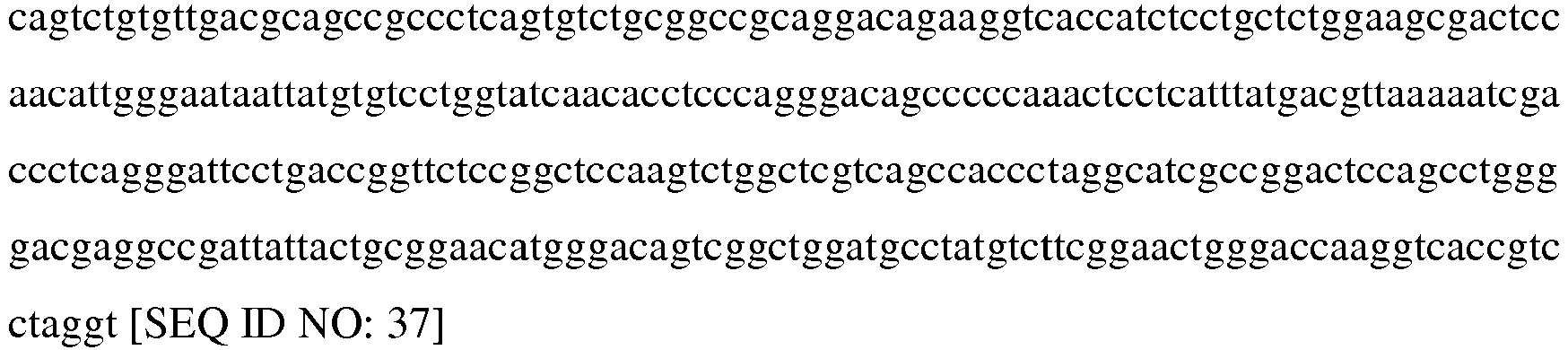
tctagaggtggtggtggtagcggcggcggcggctctggtggtggtggatccctcgagatggcc [SEQ ID NO: 305] 

Amino Acid Sequence (light chain variable region scFv linker heavy chain variable region His tag + HA tag) 
SRGGGGSGGGGSGGGGSLEMA [SEQ ID NO: 307] 
TSGQAGQHHHHHHGAYPYDVPDYAS [SEQ ID NO: 308] Table 11 ET200-013 DNA Sequence (light chain variable region scFv linker heavy chain variable region His tag + HA tag) 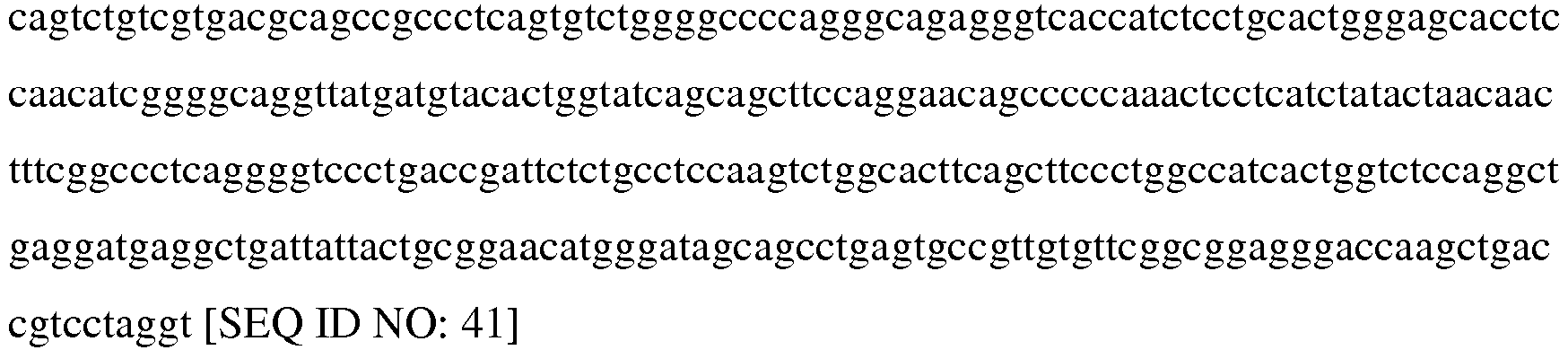
tctagaggtggtggtggtagcggcggcggcggctctggtggtggtggatccctcgagatggcc [SEQ ID NO: 305] 

Amino Acid Sequence (light chain variable region scFv linker heavy chain variable region His tag + HA tag) 
SRGGGGSGGGGSGGGGSLEMA [SEQ ID NO: 307] 
TSGQAGQHHHHHHGAYPYDVPDYAS [SEQ ID NO: 308] Table 12 ET200-014 DNA Sequence (light chain variable region scFv linker heavy chain variable region His tag + HA tag) 
tctagaggtggtggtggtagcggcggcggcggctctggtggtggtggatccctcgagatggcc [SEQ ID NO: 305] 

Amino Acid Sequence (light chain variable region scFv linker heavy chain variable region His tag + HA tag) 
SRGGGGSGGGGSGGGGSLEMA [SEQ ID NO: 307] 
TSGQAGQHHHHHHGAYPYDVPDYAS [SEQ ID NO: 308] Table 13 ET200-015 DNA Sequence (light chain variable region scFv linker heavy chain variable region His tag + HA tag) 
tctagaggtggtggtggtagcggcggcggcggctctggtggtggtggatccctcgagatggcc [SEQ ID NO: 305] 

Amino Acid Sequence (light chain variable region scFv linker heavy chain variable region His tag + HA tag) 
SRGGGGSGGGGSGGGGSLEMA [SEQ ID NO: 307] 
TSGQAGQHHHHHHGAYPYDVPDYAS [SEQ ID NO: 308] Table 14 ET200-016 DNA Sequence (light chain variable region scFv linker heavy chain variable region His tag + HA tag) 
tctagaggtggtggtggtagcggcggcggcggctctggtggtggtggatccctcgagatggcc [SEQ ID NO: 305] 

Amino Acid Sequence (light chain variable region scFv linker heavy chain variable region His tag + HA tag) 
SRGGGGSGGGGSGGGGSLEMA [SEQ ID NO: 307] 
TSGQAGQHHHHHHGAYPYDVPDYAS [SEQ ID NO: 308] Table 15 ET200-017 DNA Sequence (light chain variable region scFv linker heavy chain variable region His tag + HA tag) 
tctagaggtggtggtggtagcggcggcggcggctctggtggtggtggatccctcgagatggcc [SEQ ID NO: 305] 

Amino Acid Sequence (light chain variable region scFv linker heavy chain variable region His tag + HA tag) 
SRGGGGSGGGGSGGGGSLEMA [SEQ ID NO: 307] 
TSGQAGQHHHHHHGAYPYDVPDYAS [SEQ ID NO: 308] Table 16 ET200-018 DNA Sequence (light chain variable region scFv linker heavy chain variable region His tag + HA tag) 
tctagaggtggtggtggtagcggcggcggcggctctggtggtggtggatccctcgagatggcc [SEQ ID NO: 305] 

Amino Acid Sequence (light chain variable region scFv linker heavy chain variable region His tag + HA tag) 
SRGGGGSGGGGSGGGGSLEMA [SEQ ID NO: 307] 
TSGQAGQHHHHHHGAYPYDVPDYAS [SEQ ID NO: 308] Table 17 ET200-019 DNA Sequence (light chain variable region scFv linker heavy chain variable region His tag + HA tag) 
tctagaggtggtggtggtagcggcggcggcggctctggtggtggtggatccctcgagatggcc [SEQ ID NO: 305] 

Amino Acid Sequence (light chain variable region scFv linker heavy chain variable region His tag + HA tag) 
SRGGGGSGGGGSGGGGSLEMA [SEQ ID NO: 307] 
TSGQAGQHHHHHHGAYPYDVPDYAS [SEQ ID NO: 308] Table 18 ET200-020 DNA Sequence (light chain variable region scFv linker heavy chain variable region His tag + HA tag) 
tctagaggtggtggtggtagcggcggcggcggctctggtggtggtggatccctcgagatggcc [SEQ ID NO: 305] 

Amino Acid Sequence (light chain variable region scFv linker heavy chain variable region His tag + HA tag) 
SRGGGGSGGGGSGGGGSLEMA [SEQ ID NO: 307] 
TSGQAGQHHHHHHGAYPYDVPDYAS [SEQ ID NO: 308] Table 19 ET200-021 DNA Sequence (light chain variable region scFv linker heavy chain variable region His tag + HA tag) 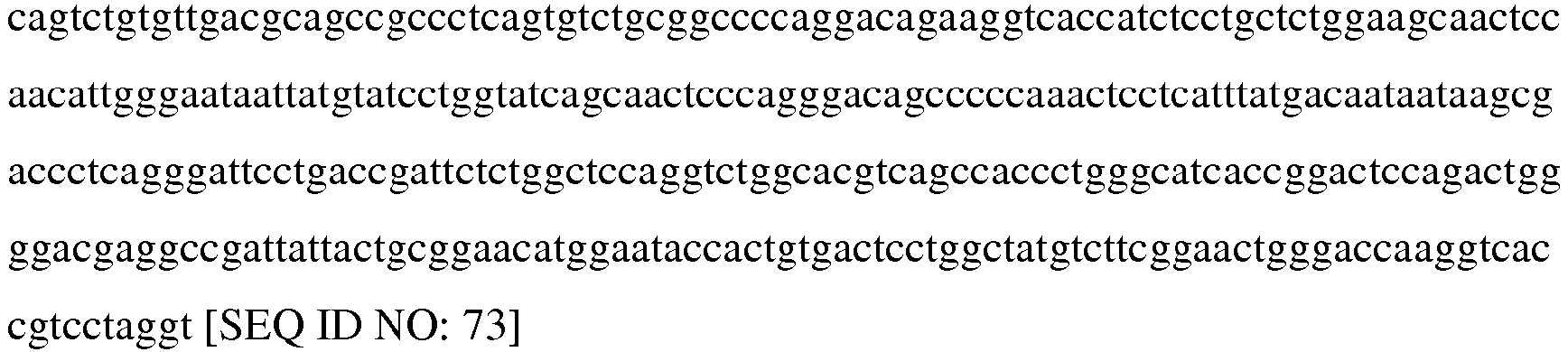
tctagaggtggtggtggtagcggcggcggcggctctggtggtggtggatccctcgagatggcc [SEQ ID NO: 305] 

Amino Acid Sequence (light chain variable region scFv linker heavy chain variable region His tag + HA tag) 
SRGGGGSGGGGSGGGGSLEMA [SEQ ID NO: 307] 
TSGQAGQHHHHHHGAYPYDVPDYAS [SEQ ID NO: 308] Table 20 ET200-022 DNA Sequence (light chain variable region scFv linker heavy chain variable region His tag + HA tag) 
tctagaggtggtggtggtagcggcggcggcggctctggtggtggtggatccctcgagatggcc [SEQ ID NO: 305] 

Amino Acid Sequence (light chain variable region scFv linker heavy chain variable region His tag + HA tag) 
SRGGGGSGGGGSGGGGSLEMA [SEQ ID NO: 307] 
TSGQAGQHHHHHHGAYPYDVPDYAS [SEQ ID NO: 308] Table 21 ET200-023 DNA Sequence (light chain variable region scFv linker heavy chain variable region His tag + HA tag) 
tctagaggtggtggtggtagcggcggcggcggctctggtggtggtggatccctcgagatggcc [SEQ ID NO: 305] 

Amino Acid Sequence (light chain variable region scFv linker heavy chain variable region His tag + HA tag) 
SRGGGGSGGGGSGGGGSLEMA [SEQ ID NO: 307] 
TSGQAGQHHHHHHGAYPYDVPDYAS [SEQ ID NO: 308] Table 22 ET200-024 DNA Sequence (light chain variable region scFv linker heavy chain variable region His tag + HA tag) 
tctagaggtggtggtggtagcggcggcggcggctctggtggtggtggatccctcgagatggcc [SEQ ID NO: 305] 

Amino Acid Sequence (light chain variable region scFv linker heavy chain variable region His tag + HA tag) 
SRGGGGSGGGGSGGGGSLEMA [SEQ ID NO: 307] 
TSGQAGQHHHHHHGAYPYDVPDYAS [SEQ ID NO: 308] Table 23 ET200-025 DNA Sequence (light chain variable region scFv linker heavy chain variable region His tag + HA tag) 
tctagaggtggtggtggtagcggcggcggcggctctggtggtggtggatccctcgagatggcc [SEQ ID NO: 305] 

Amino Acid Sequence (light chain variable region scFv linker heavy chain variable region His tag + HA tag) 
SRGGGGSGGGGSGGGGSLEMA [SEQ ID NO: 307] 
TSGQAGQHHHHHHGAYPYDVPDYAS [SEQ ID NO: 308] Table 24 ET200-026 DNA Sequence (light chain variable region scFv linker heavy chain variable region His tag + HA tag) 
tctagaggtggtggtggtagcggcggcggcggctctggtggtggtggatccctcgagatggcc [SEQ ID NO: 305] 

Amino Acid Sequence (light chain variable region scFv linker heavy chain variable region His tag + HA tag) 
SRGGGGSGGGGSGGGGSLEMA [SEQ ID NO: 307] 
TSGQAGQHHHHHHGAYPYDVPDYAS [SEQ ID NO: 308] Table 25 ET200-027 DNA Sequence (light chain variable region scFv linker heavy chain variable region His tag + HA tag) 
tctagaggtggtggtggtagcggcggcggcggctctggtggtggtggatccctcgagatggcc [SEQ ID NO: 305] 

Amino Acid Sequence (light chain variable region scFv linker heavy chain variable region His tag + HA tag) 
SRGGGGSGGGGSGGGGSLEMA [SEQ ID NO: 307] 
TSGQAGQHHHHHHGAYPYDVPDYAS [SEQ ID NO: 308] Table 26 ET200-028 DNA Sequence (light chain variable region scFv linker heavy chain variable region His tag + HA tag) 
tctagaggtggtggtggtagcggcggcggcggctctggtggtggtggatccctcgagatggcc [SEQ ID NO: 305] 

Amino Acid Sequence (light chain variable region scFv linker heavy chain variable region His tag + HA tag) 
SRGGGGSGGGGSGGGGSLEMA [SEQ ID NO: 307] 
TSGQAGQHHHHHHGAYPYDVPDYAS [SEQ ID NO: 308] Table 27 ET200-029 DNA Sequence (light chain variable region scFv linker heavy chain variable region His tag + HA tag) 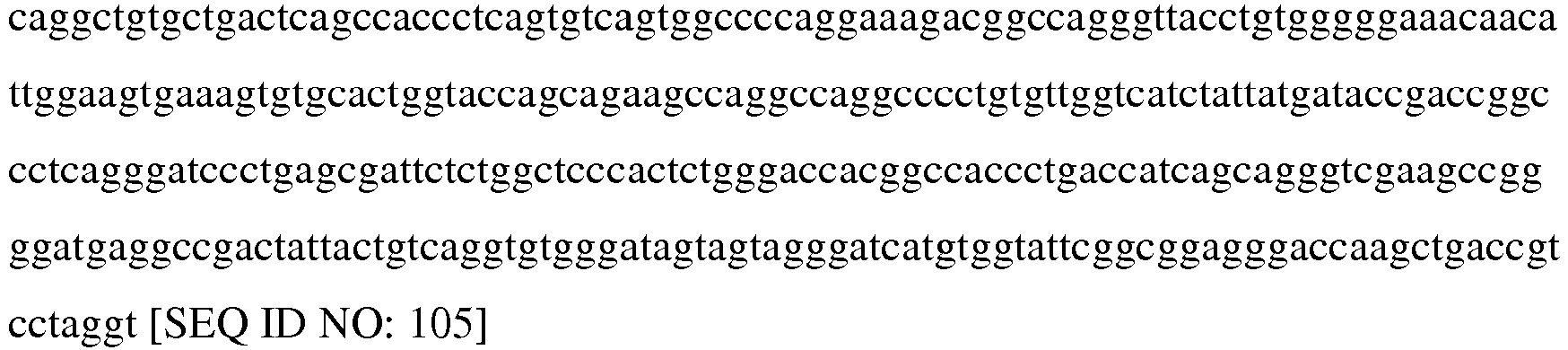
tctagaggtggtggtggtagcggcggcggcggctctggtggtggtggatccctcgagatggcc [SEQ ID NO: 305] 

Amino Acid Sequence (light chain variable region scFv linker heavy chain variable region His tag + HA tag) 
SRGGGGSGGGGSGGGGSLEMA [SEQ ID NO: 307] 
TSGQAGQHHHHHHGAYPYDVPDYAS [SEQ ID NO: 308] Table 28 ET200-030 DNA Sequence (light chain variable region scFv linker heavy chain variable region His tag + HA tag) 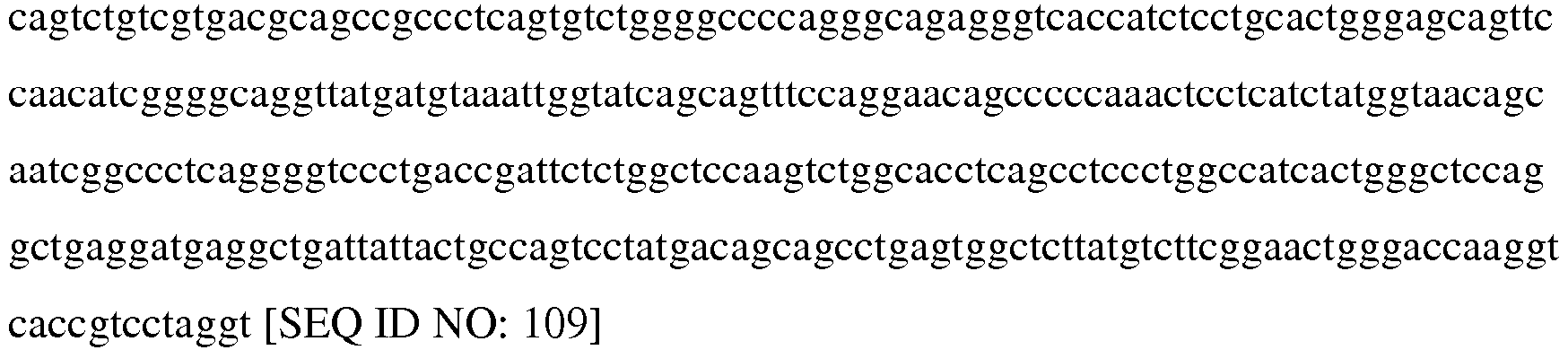
tctagaggtggtggtggtagcggcggcggcggctctggtggtggtggatccctcgagatggcc [SEQ ID NO: 305] 

Amino Acid Sequence (light chain variable region scFv linker heavy chain variable region His tag + HA tag) 
SRGGGGSGGGGSGGGGSLEMA [SEQ ID NO: 307] 
TSGQAGQHHHHHHGAYPYDVPDYAS [SEQ ID NO: 308] Table 29 ET200-031 DNA Sequence (light chain variable region scFv linker heavy chain variable region His tag + HA tag) 
tctagaggtggtggtggtagcggcggcggcggctctggtggtggtggatccctcgagatggcc [SEQ ID NO: 305] 

Amino Acid Sequence (light chain variable region scFv linker heavy chain variable region His tag + HA tag) 
SRGGGGSGGGGSGGGGSLEMA [SEQ ID NO: 307] 
TSGQAGQHHHHHHGAYPYDVPDYAS [SEQ ID NO: 308] Table 30 ET200-032 DNA Sequence (light chain variable region scFv linker heavy chain variable region His tag + HA tag) 
tctagaggtggtggtggtagcggcggcggcggctctggtggtggtggatccctcgagatggcc [SEQ ID NO: 305] 

Amino Acid Sequence (light chain variable region scFv linker heavy chain variable region His tag + HA tag) 
SRGGGGSGGGGSGGGGSLEMA [SEQ ID NO: 307] 
TSGQAGQHHHHHHGAYPYDVPDYAS [SEQ ID NO: 308] Table 31 ET200-033 DNA Sequence (light chain variable region scFv linker heavy chain variable region His tag + HA tag) 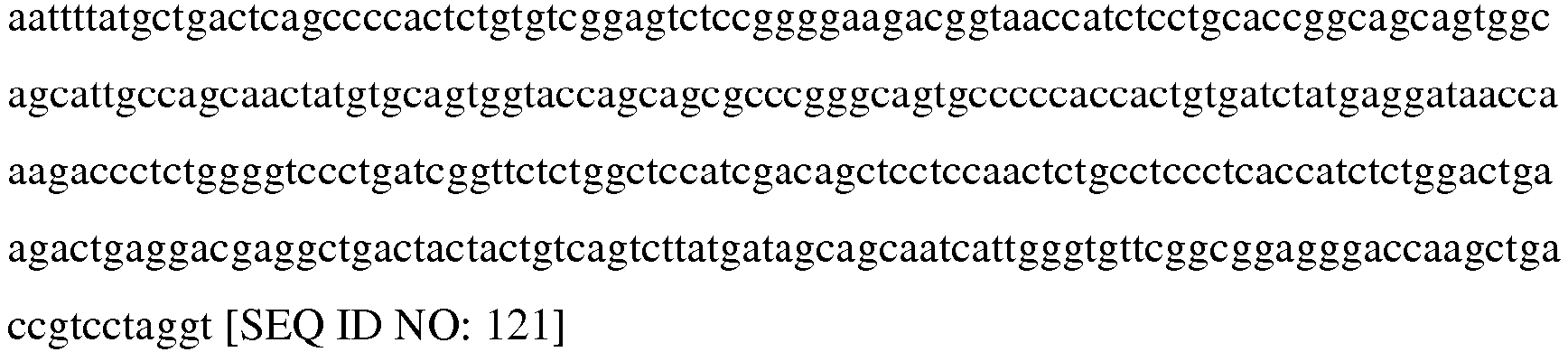
tctagaggtggtggtggtagcggcggcggcggctctggtggtggtggatccctcgagatggcc [SEQ ID NO: 305] 

Amino Acid Sequence (light chain variable region scFv linker heavy chain variable region His tag + HA tag) 
SRGGGGSGGGGSGGGGSLEMA [SEQ ID NO: 307] 
TSGQAGQHHHHHHGAYPYDVPDYAS [SEQ ID NO: 308] Table 32 ET200-034 DNA Sequence (light chain variable region scFv linker heavy chain variable region His tag + HA tag) 
tctagaggtggtggtggtagcggcggcggcggctctggtggtggtggatccctcgagatggcc [SEQ ID NO: 305] 

Amino Acid Sequence (light chain variable region scFv linker heavy chain variable region His tag + HA tag) 
SRGGGGSGGGGSGGGGSLEMA [SEQ ID NO: 307] 
TSGQAGQHHHHHHGAYPYDVPDYAS [SEQ ID NO: 308] Table 33 ET200-035 DNA Sequence (light chain variable region scFv linker heavy chain variable region His tag + HA tag) 
tctagaggtggtggtggtagcggcggcggcggctctggtggtggtggatccctcgagatggcc [SEQ ID NO: 305] 

Amino Acid Sequence (light chain variable region scFv linker heavy chain variable region His tag + HA tag) 
SRGGGGSGGGGSGGGGSLEMA [SEQ ID NO: 307] 
TSGQAGQHHHHHHGAYPYDVPDYAS [SEQ ID NO: 308] Table 34 ET200-037 DNA Sequence (light chain variable region scFv linker heavy chain variable region His tag + HA tag) 
tctagaggtggtggtggtagcggcggcggcggctctggtggtggtggatccctcgagatggcc [SEQ ID NO: 305] 

Amino Acid Sequence (light chain variable region scFv linker heavy chain variable region His tag + HA tag) 
SRGGGGSGGGGSGGGGSLEMA [SEQ ID NO: 307] 
TSGQAGQHHHHHHGAYPYDVPDYAS [SEQ ID NO: 308] Table 35 ET200-038 DNA Sequence (light chain variable region scFv linker heavy chain variable region His tag + HA tag) 
tctagaggtggtggtggtagcggcggcggcggctctggtggtggtggatccctcgagatggcc [SEQ ID NO: 305] 

Amino Acid Sequence (light chain variable region scFv linker heavy chain variable region His tag + HA tag) 
SRGGGGSGGGGSGGGGSLEMA [SEQ ID NO: 307] 
TSGQAGQHHHHHHGAYPYDVPDYAS [SEQ ID NO: 308] Table 36 ET200-039 DNA Sequence (light chain variable region scFv linker heavy chain variable region His tag + HA tag) 
tctagaggtggtggtggtagcggcggcggcggctctggtggtggtggatccctcgagatggcc [SEQ ID NO: 305] 

Amino Acid Sequence (light chain variable region scFv linker heavy chain variable region His tag + HA tag) 
SRGGGGSGGGGSGGGGSLEMA [SEQ ID NO: 307] 
TSGQAGQHHHHHHGAYPYDVPDYAS [SEQ ID NO: 308] Table 37 ET200-040 DNA Sequence (light chain variable region scFv linker heavy chain variable region His tag + HA tag) 
tctagaggtggtggtggtagcggcggcggcggctctggtggtggtggatccctcgagatggcc [SEQ ID NO: 305] 

Amino Acid Sequence (light chain variable region scFv linker heavy chain variable region His tag + HA tag) 
SRGGGGSGGGGSGGGGSLEMA [SEQ ID NO: 307] 
TSGQAGQHHHHHHGAYPYDVPDYAS [SEQ ID NO: 308] Table 38 ET200-041 DNA Sequence (light chain variable region scFv linker heavy chain variable region His tag + HA tag) 
tctagaggtggtggtggtagcggcggcggcggctctggtggtggtggatccctcgagatggcc [SEQ ID NO: 305] 

Amino Acid Sequence (light chain variable region scFv linker heavy chain variable region His tag + HA tag) 
SRGGGGSGGGGSGGGGSLEMA [SEQ ID NO: 307] 
TSGQAGQHHHHHHGAYPYDVPDYAS [SEQ ID NO: 308] Table 39 ET200-042 DNA Sequence (light chain variable region scFv linker heavy chain variable region His tag + HA tag) 
tctagaggtggtggtggtagcggcggcggcggctctggtggtggtggatccctcgagatggcc [SEQ ID NO: 305] 

Amino Acid Sequence (light chain variable region scFv linker heavy chain variable region His tag + HA tag) 
SRGGGGSGGGGSGGGGSLEMA [SEQ ID NO: 307] 
TSGQAGQHHHHHHGAYPYDVPDYAS [SEQ ID NO: 308] Table 40 ET200-043 DNA Sequence (light chain variable region scFv linker heavy chain variable region His tag + HA tag) 
tctagaggtggtggtggtagcggcggcggcggctctggtggtggtggatccctcgagatggcc [SEQ ID NO: 305] 

Amino Acid Sequence (light chain variable region scFv linker heavy chain variable region His tag + HA tag) 
SRGGGGSGGGGSGGGGSLEMA [SEQ ID NO: 307] 
TSGQAGQHHHHHHGAYPYDVPDYAS [SEQ ID NO: 308] Table 41 ET200-044 DNA Sequence (light chain variable region scFv linker heavy chain variable region His tag + HA tag) 
tctagaggtggtggtggtagcggcggcggcggctctggtggtggtggatccctcgagatggcc [SEQ ID NO: 305] 

Amino Acid Sequence (light chain variable region scFv linker heavy chain variable region His tag + HA tag) 
SRGGGGSGGGGSGGGGSLEMA [SEQ ID NO: 307] 
TSGQAGQHHHHHHGAYPYDVPDYAS [SEQ ID NO: 308] Table 42 ET200-045 DNA Sequence (light chain variable region scFv linker heavy chain variable region His tag + HA tag) 
tctagaggtggtggtggtagcggcggcggcggctctggtggtggtggatcccgagatggcc [SEQ ID NO: 305] 

Amino Acid Sequence (light chain variable region scFv linker heavy chain variable region His tag + HA tag) 
SRGGGGSGGGGSGGGGSLEMA [SEQ ID NO: 307] 
TSGQAGQHHHHHHGAYPYDVPDYAS [SEQ ID NO: 308] Table 43 ET200-069 DNA Sequence (light chain variable region scFv linker heavy chain variable region His tag + HA tag) 
tctagaggtggtggtggtagcggcggcggcggctctggtggtggtggatcccgagatggcc [SEQ ID NO: 305] 

Amino Acid Sequence (light chain variable region scFv linker heavy chain variable region His tag + HA tag) 
SRGGGGSGGGGSGGGGSLEMA [SEQ ID NO: 307] 
TSGQAGQHHHHHHGAYPYDVPDYAS [SEQ ID NO: 308] Table 44 ET200-078 DNA Sequence (light chain variable region scFv linker heavy chain variable region His tag + HA tag) 
tctagaggtggtggtggtagcggcggcggcggctctggtggtggtggatccctcgagatggcc [SEQ ID NO: 305] 

Amino Acid Sequence (light chain variable region scFv linker heavy chain variable region His tag + HA tag) 
SRGGGGSGGGGSGGGGSLEMA [SEQ ID NO: 307] 
TSGQAGQHHHHHHGAYPYDVPDYAS [SEQ ID NO: 308] Table 45 ET200-079 DNA Sequence (light chain variable region scFv linker heavy chain variable region His tag + HA tag) 
tctagaggtggtggtggtagcggcggcggcggctctggtggtggtggatcccgagatggcc [SEQ ID NO: 305] 

Amino Acid Sequence (light chain variable region scFv linker heavy chain variable region His tag + HA tag) 
SRGGGGSGGGGSGGGGSLEMA [SEQ ID NO: 307] 
TSGQAGQHHHHHHGAYPYDVPDYAS [SEQ ID NO: 308] Table 46 ET200-081 DNA Sequence (light chain variable region scFv linker heavy chain variable region His tag + HA tag) 
tctagaggtggtggtpgtagcggcggcggcggctctggtggtggtggatccctcgagatggcc [SEQ ID NO: 305] 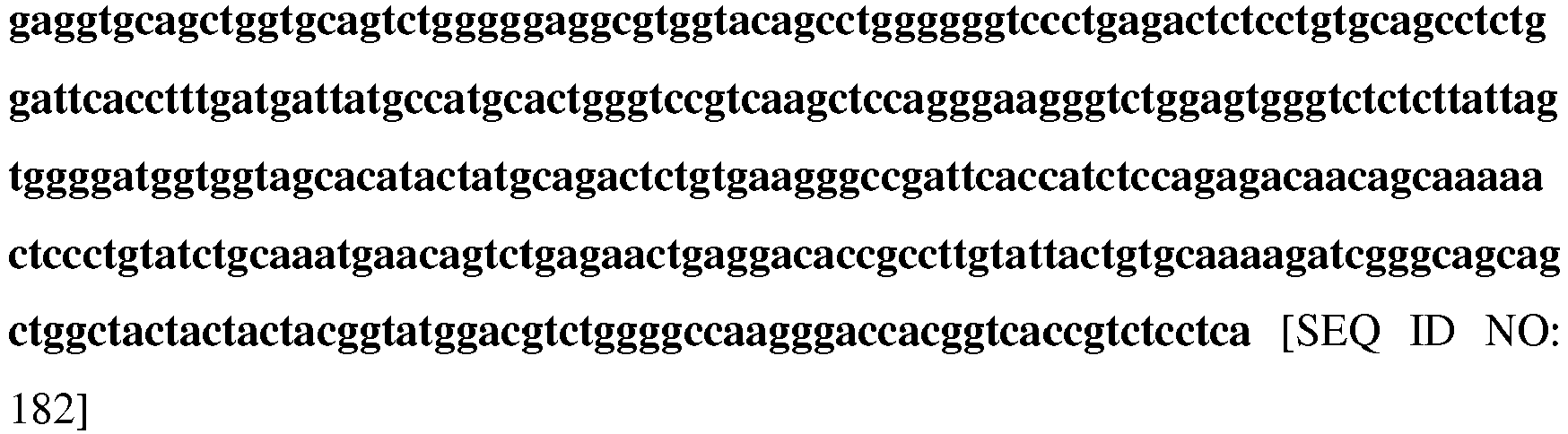

Amino Acid Sequence (light chain variable region scFv linker heavy chain variable region His tag + HA tag) 
SRGGGGSGGGGSGGGGSLEMA [SEQ ID NO: 307] 
TSGQAGQHHHHHHGAYPYDVPDYAS [SEQ ID NO: 308] Table 47 ET200-097 DNA Sequence (light chain variable region scFv linker heavy chain variable region His tag + HA tag) 
tctagaggtggtggtpgtagcggcggcggcggctctggtggtggtggatccctcgagatggcc [SEQ ID NO: 305] 

Amino Acid Sequence (light chain variable region scFv linker heavy chain variable region His tag + HA tag) 
SRGGGGSGGGGSGGGGSLEMA [SEQ ID NO: 307] 
TSGQAGQHHHHHHGAYPYDVPDYAS [SEQ ID NO: 308] Table 48 ET200-098 DNA Sequence (light chain variable region scFv linker heavy chain variable region His tag + HA tag) 
tctagaggtggtggtpgtagcggcggcggcggctctggtggtggtggatccctcgagatggcc [SEQ ID NO: 305] 

Amino Acid Sequence (light chain variable region scFv linker heavy chain variable region His tag + HA tag) 
SRGGGGSGGGGSGGGGSLEMA [SEQ ID NO: 307] 
TSGQAGQHHHHHHGAYPYDVPDYAS [SEQ ID NO: 308] Table 49 ET200-099 DNA Sequence (light chain variable region scFv linker heavy chain variable region His tag + HA tag) 
tctagaggtggtggtpgtagcggcggcggcggctctggtggtggtggatccctcgagatggcc [SEQ ID NO: 305] 

Amino Acid Sequence (light chain variable region scFv linker heavy chain variable region His tag + HA tag) 
SRGGGGSGGGGSGGGGSLEMA [SEQ ID NO: 307] 
TSGQAGQHHHHHHGAYPYDVPDYAS [SEQ ID NO: 308] Table 50 ET200-100 DNA Sequence (light chain variable region scFv linker heavy chain variable region His tag + HA tag) 
tctagaggtggtggtpgtagcggcggcggcggctctggtggtggtggatccctcgagatggcc [SEQ ID NO: 305] 

Amino Acid Sequence (light chain variable region scFv linker heavy chain variable region His tag + HA tag) 
SRGGGGSGGGGSGGGGSLEMA [SEQ ID NO: 307] 
TSGQAGQHHHHHHGAYPYDVPDYAS [SEQ ID NO: 308] Table 51 ET200-101 DNA Sequence (light chain variable region scFv linker heavy chain variable region His tag + HA tag) 
tctagaggtggtggtpgtagcggcggcggcggctctggtggtggtggatccctcgagatggcc [SEQ ID NO: 305] 

Amino Acid Sequence (light chain variable region scFv linker heavy chain variable region His tag + HA tag) 
SRGGGGSGGGGSGGGGSLEMA [SEQ ID NO: 307] 
TSGQAGQHHHHHHGAYPYDVPDYAS [SEQ ID NO: 308] Table 52 ET200-102 DNA Sequence (light chain variable region scFv linker heavy chain variable region His tag + HA tag) 
tctagaggtggtggtpgtagcggcggcggcggctctggtggtggtggatccctcgagatggcc [SEQ ID NO: 305] 

Amino Acid Sequence (light chain variable region scFv linker heavy chain variable region His tag + HA tag) 
SRGGGGSGGGGSGGGGSLEMA [SEQ ID NO: 307] 
TSGQAGQHHHHHHGAYPYDVPDYAS [SEQ ID NO: 308] Table 53 ET200-103 DNA Sequence (light chain variable region scFv linker heavy chain variable region His tag + HA tag) 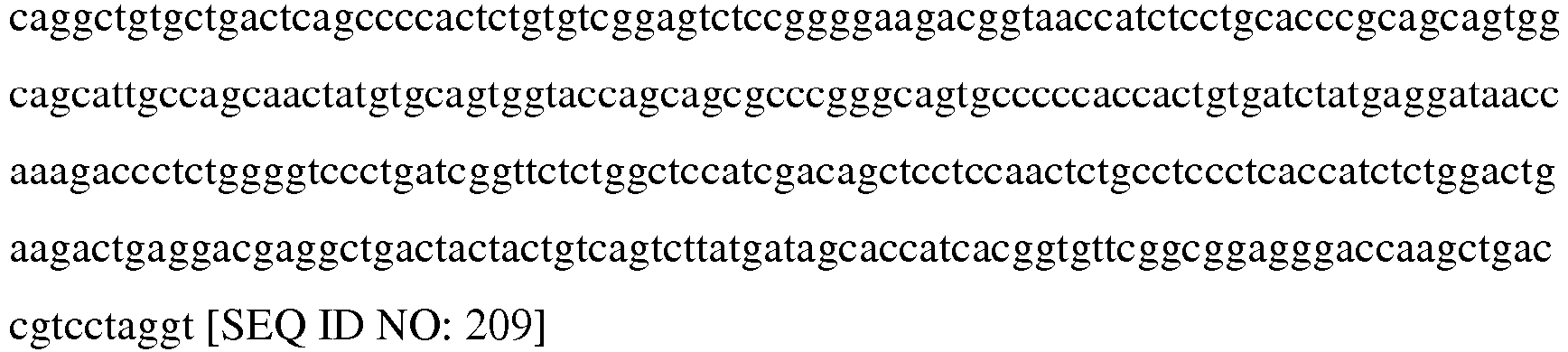
tctagaggtggtggtpgtagcggcggcggcggctctggtggtggtggatccctcgagatggcc [SEQ ID NO: 305] 

Amino Acid Sequence (light chain variable region scFv linker heavy chain variable region His tag + HA tag) 
SRGGGGSGGGGSGGGGSLEMA [SEQ ID NO: 307] 
TSGQAGQHHHHHHGAYPYDVPDYAS [SEQ ID NO: 308] Table 54 ET200-104 DNA Sequence (light chain variable region scFv linker heavy chain variable region His tag + HA tag) 
tctagaggtggtggtpgtagcggcggcggcggctctggtggtggtggatccctcgagatggcc [SEQ ID NO: 305] 

Amino Acid Sequence (light chain variable region scFv linker heavy chain variable region His tag + HA tag) 
SRGGGGSGGGGSGGGGSLEMA [SEQ ID NO: 307] 
TSGQAGQHHHHHHGAYPYDVPDYAS [SEQ ID NO: 308] Table 55 ET200-105 DNA Sequence (light chain variable region scFv linker heavy chain variable region His tag + HA tag) 
tctagaggtggtggtpgtagcggcggcggcggctctggtggtggtggatccctcgagatggcc [SEQ ID NO: 305] 

Amino Acid Sequence (light chain variable region scFv linker heavy chain variable region His tag + HA tag) 
SRGGGGSGGGGSGGGGSLEMA [SEQ ID NO: 307] 
TSGQAGQHHHHHHGAYPYDVPDYAS [SEQ ID NO: 308] Table 56 ET200-106 DNA Sequence (light chain variable region scFv linker heavy chain variable region His tag + HA tag) 
tctagaggtggtggtpgtagcggcggcggcggctctggtggtggtggatccctcgagatggcc [SEQ ID NO: 305] 

Amino Acid Sequence (light chain variable region scFv linker heavy chain variable region His tag + HA tag) 
SRGGGGSGGGGSGGGGSLEMA [SEQ ID NO: 307] 
TSGQAGQHHHHHHGAYPYDVPDYAS [SEQ ID NO: 308] Table 57 ET200-107 DNA Sequence (light chain variable region scFv linker heavy chain variable region His tag + HA tag) 
tctagaggtggtggtpgtagcggcggcggcggctctggtggtggtggatccctcgagatggcc [SEQ ID NO: 305] 

Amino Acid Sequence (light chain variable region scFv linker heavy chain variable region His tag + HA tag) 
SRGGGGSGGGGSGGGGSLEMA [SEQ ID NO: 307] 
TSGQAGQHHHHHHGAYPYDVPDYAS [SEQ ID NO: 308] Table 58 ET200-108 DNA Sequence (light chain variable region scFv linker heavy chain variable region His tag + HA tag) 
tctagaggtggtggtpgtagcggcggcggcggctctggtggtggtggatccctcgagatggcc [SEQ ID NO: 305] 

Amino Acid Sequence (light chain variable region scFv linker heavy chain variable region His tag + HA tag) 
SRGGGGSGGGGSGGGGSLEMA [SEQ ID NO: 307] 
TSGQAGQHHHHHHGAYPYDVPDYAS [SEQ ID NO: 308] Table 59 ET200-109 DNA Sequence (light chain variable region scFv linker heavy chain variable region His tag + HA tag) 
tctagaggtggtggtpgtagcggcggcggcggctctggtggtggtggatccctcgagatggcc [SEQ ID NO: 305] 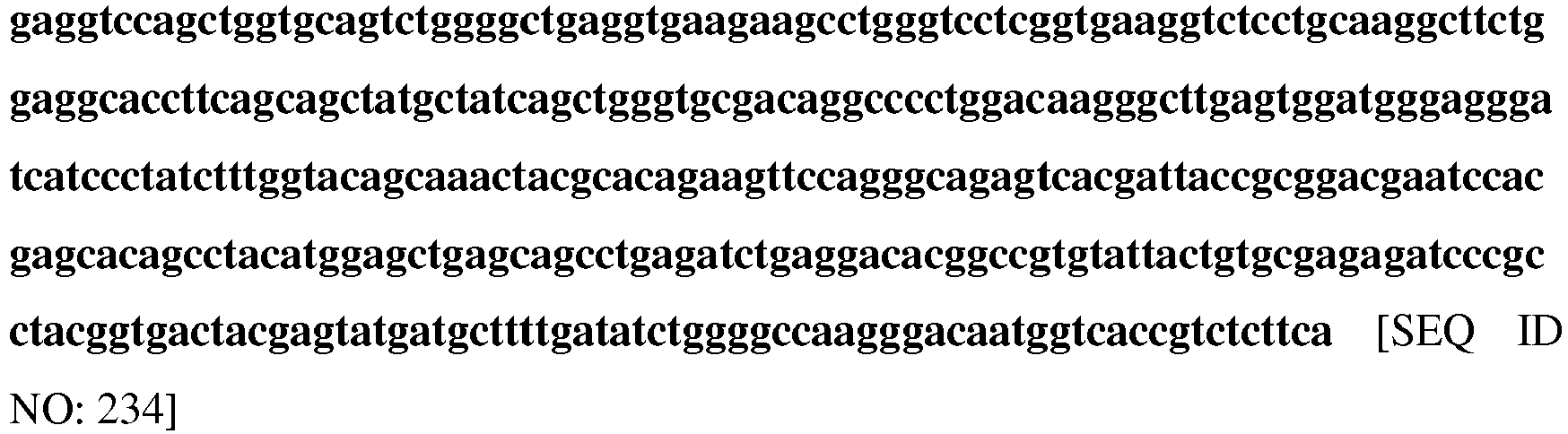

Amino Acid Sequence (light chain variable region scFv linker heavy chain variable region His tag + HA tag) 
SRGGGGSGGGGSGGGGSLEMA [SEQ ID NO: 307] 
TSGQAGQHHHHHHGAYPYDVPDYAS [SEQ ID NO: 308] Table 60 ET200-110 DNA Sequence (light chain variable region scFv linker heavy chain variable region His tag + HA tag) 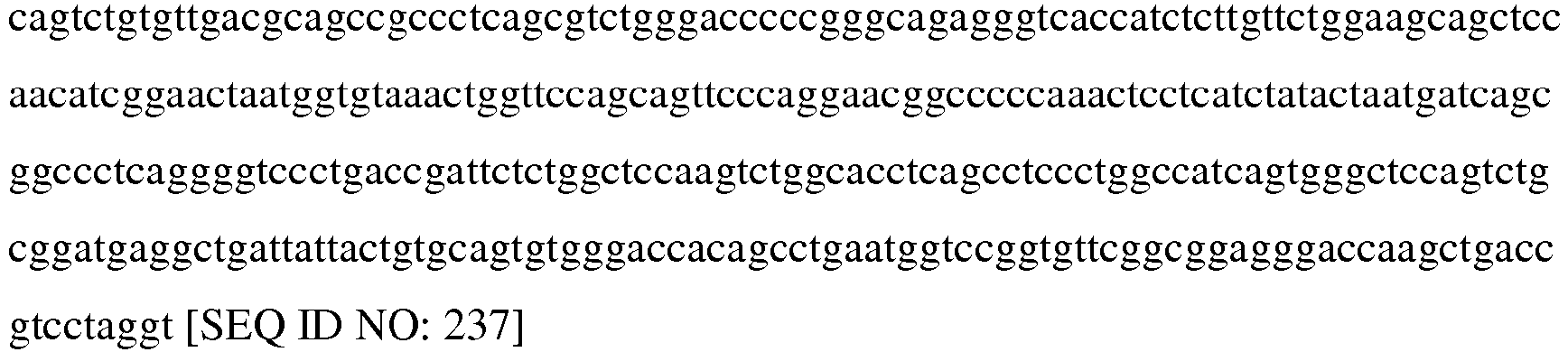
tctagaggtggtggtpgtagcggcggcggcggctctggtggtggtggatccctcgagatggcc [SEQ ID NO: 305] 

Amino Acid Sequence (light chain variable region scFv linker heavy chain variable region His tag + HA tag) 
SRGGGGSGGGGSGGGGSLEMA [SEQ ID NO: 307] 
TSGQAGQHHHHHHGAYPYDVPDYAS [SEQ ID NO: 308] Table 61 ET200-111 DNA Sequence (light chain variable region scFv linker heavy chain variable region His tag + HA tag) 
tctagaggtggtggtpgtagcggcggcggcggctctggtggtggtggatccctcgagatggcc [SEQ ID NO: 305] 

Amino Acid Sequence (light chain variable region scFv linker heavy chain variable region His tag + HA tag) 
SRGGGGSGGGGSGGGGSLEMA [SEQ ID NO: 307] 
TSGQAGQHHHHHHGAYPYDVPDYAS [SEQ ID NO: 308] Table 62 ET200-112 DNA Sequence (light chain variable region scFv linker heavy chain variable region His tag + HA tag) 
tctagaggtggtggtpgtagcggcggcggcggctctggtggtggtggatccctcgagatggcc [SEQ ID NO: 305] 

Amino Acid Sequence (light chain variable region scFv linker heavy chain variable region His tag + HA tag) 
SRGGGGSGGGGSGGGGSLEMA [SEQ ID NO: 307] 
TSGQAGQHHHHHHGAYPYDVPDYAS [SEQ ID NO: 308] Table 63 ET200-113 DNA Sequence (light chain variable region scFv linker heavy chain variable region His tag + HA tag) 
tctagaggtggtggtpgtagcggcggcggcggctctggtggtggtggatccctcgagatggcc [SEQ ID NO: 305] 

Amino Acid Sequence (light chain variable region scFv linker heavy chain variable region His tag + HA tag) 
SRGGGGSGGGGSGGGGSLEMA [SEQ ID NO: 307] 
TSGQAGQHHHHHHGAYPYDVPDYAS [SEQ ID NO: 308] Table 64 ET200-114 DNA Sequence (light chain variable region scFv linker heavy chain variable region His tag + HA tag) 
tctagaggtggtggtpgtagcggcggcggcggctctggtggtggtggatccctcgagatggcc [SEQ ID NO: 305] 

Amino Acid Sequence (light chain variable region scFv linker heavy chain variable region His tag + HA tag) 
SRGGGGSGGGGSGGGGSLEMA [SEQ ID NO: 307] 
TSGQAGQHHHHHHGAYPYDVPDYAS [SEQ ID NO: 308] Table 65 ET200-115 DNA Sequence (light chain variable region scFv linker heavy chain variable region His tag + HA tag) 
tctagaggtggtggtpgtagcggcggcggcggctctggtggtggtggatccctcgagatggcc [SEQ ID NO: 305] 

Amino Acid Sequence (light chain variable region scFv linker heavy chain variable region His tag + HA tag) 
SRGGGGSGGGGSGGGGSLEMA [SEQ ID NO: 307] 
TSGQAGQHHHHHHGAYPYDVPDYAS [SEQ ID NO: 308] Table 66 ET200-116 DNA Sequence (light chain variable region scFv linker heavy chain variable region His tag + HA tag) 
tctagaggtggtggtpgtagcggcggcggcggctctggtggtggtggatccctcgagatggcc [SEQ ID NO: 305] 

Amino Acid Sequence (light chain variable region scFv linker heavy chain variable region His tag + HA tag) 
SRGGGGSGGGGSGGGGSLEMA [SEQ ID NO: 307] 
TSGQAGQHHHHHHGAYPYDVPDYAS [SEQ ID NO: 308] Table 67 ET200-117 DNA Sequence (light chain variable region scFv linker heavy chain variable region His tag + HA tag) 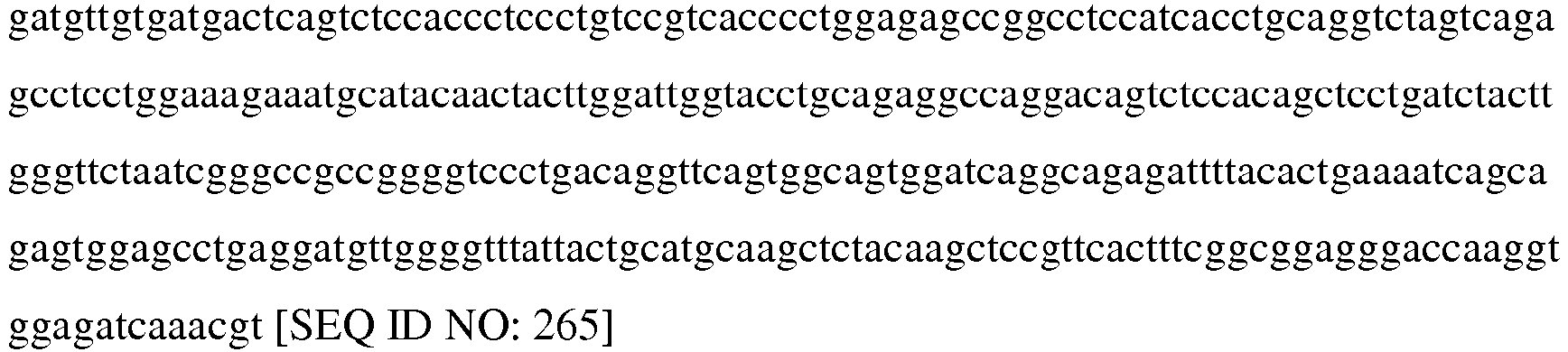
tctagaggtggtggtpgtagcggcggcggcggctctggtggtggtggatccctcgagatggcc [SEQ ID NO: 305] 

Amino Acid Sequence (light chain variable region scFv linker heavy chain variable region His tag + HA tag) 
SRGGGGSGGGGSGGGGSLEMA [SEQ ID NO: 307] 
TSGQAGQHHHHHHGAYPYDVPDYAS [SEQ ID NO: 308] Table 68 ET200-118 DNA Sequence (light chain variable region scFv linker heavy chain variable region His tag + HA tag) 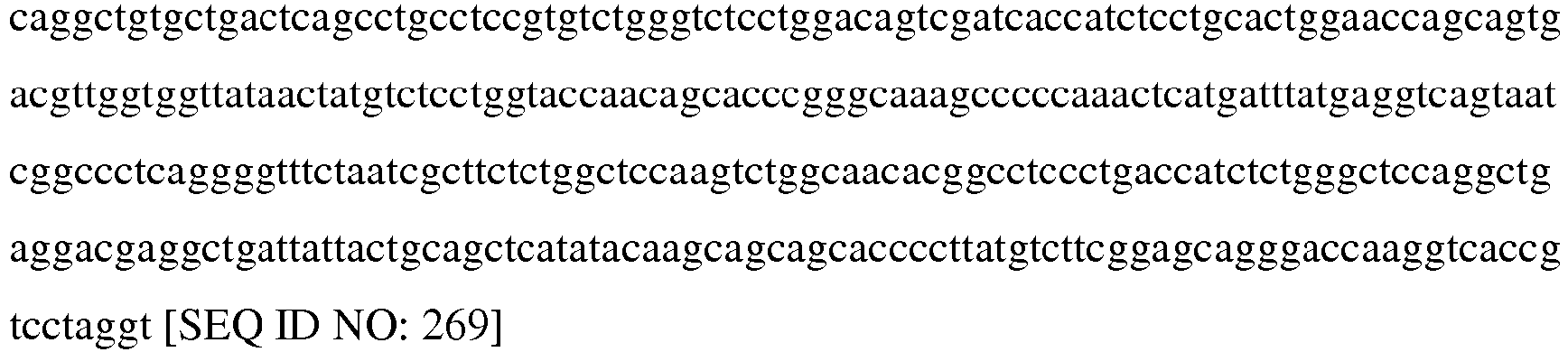
tctagaggtggtggtpgtagcggcggcggcggctctggtggtggtggatccctcgagatggcc [SEQ ID NO: 305] 

Amino Acid Sequence (light chain variable region scFv linker heavy chain variable region His tag + HA tag) 
SRGGGGSGGGGSGGGGSLEMA [SEQ ID NO: 307] 
TSGQAGQHHHHHHGAYPYDVPDYAS [SEQ ID NO: 308] Table 69 ET200-119 DNA Sequence (light chain variable region scFv linker heavy chain variable region His tag + HA tag) 
tctagaggtggtggtpgtagcggcggcggcggctctggtggtggtggatccctcgagatggcc [SEQ ID NO: 305] 

Amino Acid Sequence (light chain variable region scFv linker heavy chain variable region His tag + HA tag) 
SRGGGGSGGGGSGGGGSLEMA [SEQ ID NO: 307] 
TSGQAGQHHHHHHGAYPYDVPDYAS [SEQ ID NO: 308] Table 70 ET200-120 DNA Sequence (light chain variable region scFv linker heavy chain variable region His tag + HA tag) 
tctagaggtggtggtpgtagcggcggcggcggctctggtggtggtggatccctcgagatggcc [SEQ ID NO: 305] 

Amino Acid Sequence (light chain variable region scFv linker heavy chain variable region His tag + HA tag) 
SRGGGGSGGGGSGGGGSLEMA [SEQ ID NO: 307] 
TSGQAGQHHHHHHGAYPYDVPDYAS [SEQ ID NO: 308] Table 71 ET200-121 DNA Sequence (light chain variable region scFv linker heavy chain variable region His tag + HA tag) 
tctagaggtggtggtpgtagcggcggcggcggctctggtggtggtggatccctcgagatggcc [SEQ ID NO: 305] 

Amino Acid Sequence (light chain variable region scFv linker heavy chain variable region His tag + HA tag) 
SRGGGGSGGGGSGGGGSLEMA [SEQ ID NO: 307] 
TSGQAGQHHHHHHGAYPYDVPDYAS [SEQ ID NO: 308] Table 72 ET200-122 DNA Sequence (light chain variable region scFv linker heavy chain variable region His tag + HA tag) 
tctagaggtggtggtpgtagcggcggcggcggctctggtggtggtggatccctcgagatggcc [SEQ ID NO: 305] 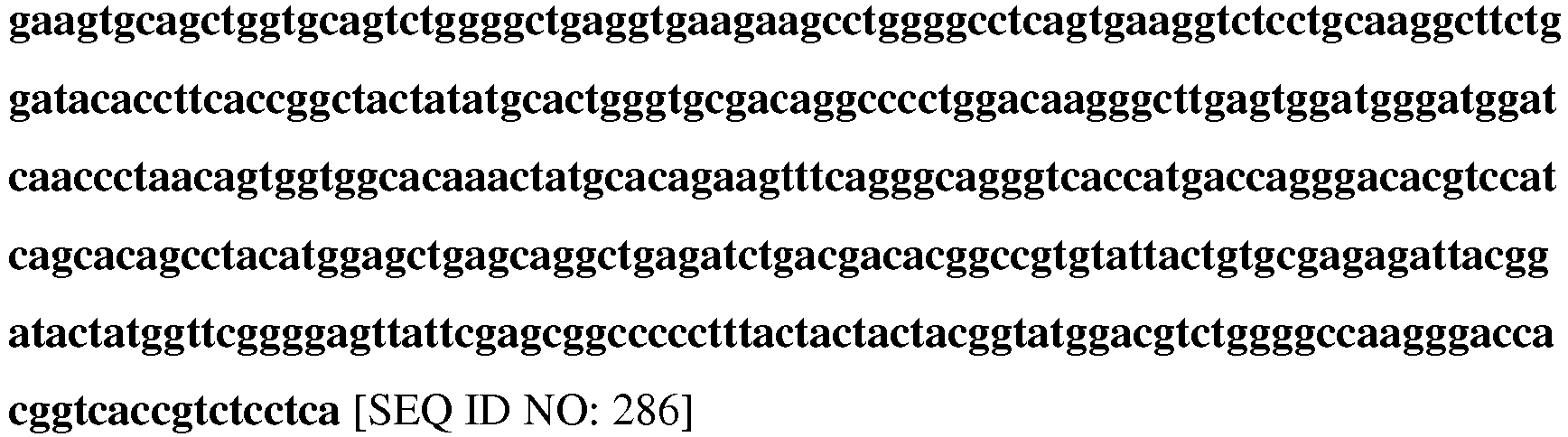

Amino Acid Sequence (light chain variable region scFv linker heavy chain variable region His tag + HA tag) 
SRGGGGSGGGGSGGGGSLEMA [SEQ ID NO: 307] 
TSGQAGQHHHHHHGAYPYDVPDYAS [SEQ ID NO: 308] Table 73 ET200-123 DNA Sequence (light chain variable region scFv linker heavy chain variable region His tag + HA tag) 
tctagaggtggtggtpgtagcggcggcggcggctctggtggtggtggatccctcgagatggcc [SEQ ID NO: 305] 

Amino Acid Sequence (light chain variable region scFv linker heavy chain variable region His tag + HA tag) 
SRGGGGSGGGGSGGGGSLEMA [SEQ ID NO: 307] 
TSGQAGQHHHHHHGAYPYDVPDYAS [SEQ ID NO: 308] Table 74 ET200-125 DNA Sequence (light chain variable region scFv linker heavy chain variable region His tag + HA tag) 
tctagaggtggtggtpgtagcggcggcggcggctctggtggtggtggatccctcgagatggcc [SEQ ID NO: 305] 

Amino Acid Sequence (light chain variable region scFv linker heavy chain variable region His tag + HA tag) 
SRGGGGSGGGGSGGGGSLEMA [SEQ ID NO: 307] 
TSGQAGQHHHHHHGAYPYDVPDYAS [SEQ ID NO: 308] Table 75 ET200-005 DNA Sequence (light chain variable region scFv linker heavy chain variable region His tag + HA tag) 
tctagaggtggtggtpgtagcggcggcggcggctctggtggtggtggatccctcgagatggcc [SEQ ID NO: 305] 

Amino Acid Sequence (light chain variable region scFv linker heavy chain variable region His tag + HA tag) 
SRGGGGSGGGGSGGGGSLEMA [SEQ ID NO: 307] 
TSGQAGQHHHHHHGAYPYDVPDYAS [SEQ ID NO: 308] Table 76 ET200-124 DNA Sequence (light chain variable region scFv linker heavy chain variable region His tag + HA tag) 
tctagaggtggtggtpgtagcggcggcggcggctctggtggtggtggatccctcgagatggcc [SEQ ID NO: 305] 

Amino Acid Sequence (light chain variable region scFv linker heavy chain variable region His tag + HA tag) 
SRGGGGSGGGGSGGGGSLEMA [SEQ ID NO: 307] 
TSGQAGQHHHHHHGAYPYDVPDYAS [SEQ ID NO: 308] -
Table 77 ET200-001 DNA Sequence 
Amino Acid Sequence 
Table 78 ET200-002 DNA Sequence 

Amino Acid Sequence 
Table 79 ET200-003 DNA Sequence 
Amino Acid Sequence 
Table 80 ET200-006 DNA Sequence 

Amino Acid Sequence 
Table 81 ET200-007 DNA Sequence 
Amino Acid Sequence 

Table 82 ET200-008 DNA Sequence 
Amino Acid Sequence 
Table 83 ET200-009 DNA Sequence 

Amino Acid Sequence 
Table 84 ET200-010 DNA Sequence 
Amino Acid Sequence 
Table 85 ET200-011 DNA Sequence 
Amino Acid Sequence 
Table 86 ET200-012 DNA Sequence 
Amino Acid Sequence 
Table 87 ET200-013 DNA Sequence 
Amino Acid Sequence 
Table 88 ET200-014 DNA Sequence 

Amino Acid Sequence 
Table 89 ET200-015 DNA Sequence 
Amino Acid Sequence 

Table 90 ET200-016 DNA Sequence 
Amino Acid Sequence 
Table 91 ET200-017 DNA Sequence 

Amino Acid Sequence 
Table 92 ET200-018 DNA Sequence 
Amino Acid Sequence 
Table 93 ET200-019 DNA Sequence 
Amino Acid Sequence 
Table 94 ET200-020 DNA Sequence 
Amino Acid Sequence 
Table 95 ET200-021 DNA Sequence 
Amino Acid Sequence 
Table 96 ET200-022 DNA Sequence 

Amino Acid Sequence 
Table 97 ET200-023 DNA Sequence 
Amino Acid Sequence 

Table 98 ET200-024 DNA Sequence 
Amino Acid Sequence 
Table 99 ET200-025 DNA Sequence 

Amino Acid Sequence 
Table 100 ET200-026 DNA Sequence 
Amino Acid Sequence 
Table 101 ET200-027 DNA Sequence 

Amino Acid Sequence 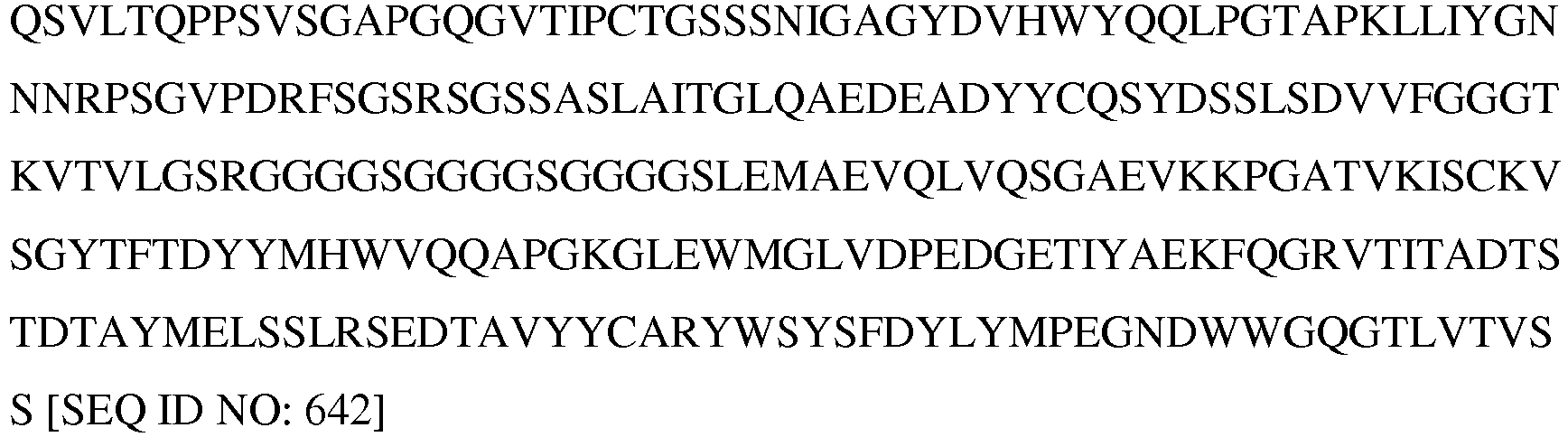
Table 102 ET200-028 DNA Sequence 
Amino Acid Sequence 

Table 103 ET200-029 DNA Sequence 
Amino Acid Sequence 
Table 104 ET200-030 DNA Sequence 

Amino Acid Sequence 
Table 105 ET200-031 DNA Sequence 
Amino Acid Sequence 
Table 106 ET200-032 DNA Sequence 
Amino Acid Sequence 
Table 107 ET200-033 DNA Sequence 
Amino Acid Sequence 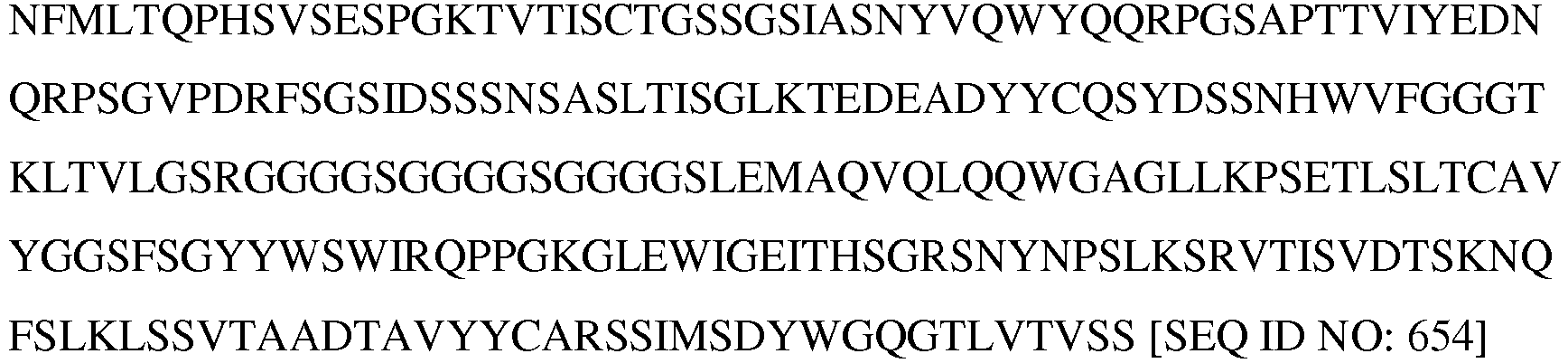
Table 108 ET200-034 DNA Sequence 
Amino Acid Sequence 
Table 109 ET200-035 DNA Sequence 

Amino Acid Sequence 
Table 110 ET200-037 DNA Sequence 
Amino Acid Sequence 
NO: 660] Table 111 ET200-038 DNA Sequence 
Amino Acid Sequence 
Table 112 ET200-039 DNA Sequence 

Amino Acid Sequence 
Table 113 ET200-040 DNA Sequence 
Amino Acid Sequence 
Table 114 ET200-041 DNA Sequence 

Amino Acid Sequence 
Table 115 ET200-042 DNA Sequence 
Amino Acid Sequence 

Table 116 ET200-043 DNA Sequence 
Amino Acid Sequence 
Table 117 ET200-044 DNA Sequence 

Amino Acid Sequence 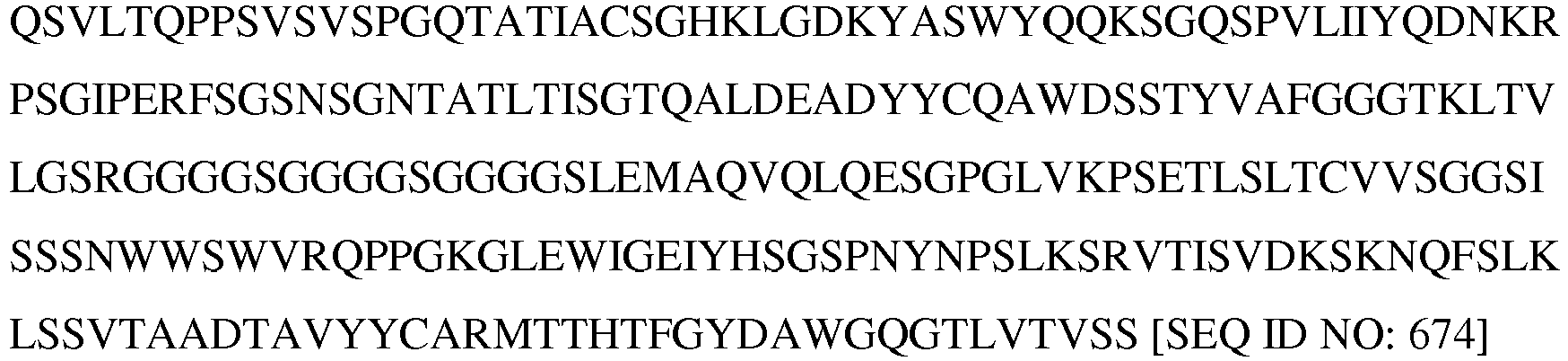
Table 118 ET200-045 DNA Sequence 
Amino Acid Sequence 
Table 119 ET200-069 DNA Sequence 
Amino Acid Sequence 
Table 120 ET200-078 DNA Sequence 
Amino Acid Sequence 
Table 121 ET200-079 DNA Sequence 
Amino Acid Sequence 
Table 122 ET200-081 DNA Sequence 

Amino Acid Sequence 
Table 123 ET200-097 DNA Sequence 
Amino Acid Sequence 

Table 124 ET200-098 DNA Sequence 
Amino Acid Sequence 
Table 125 ET200-099 DNA Sequence 

Amino Acid Sequence 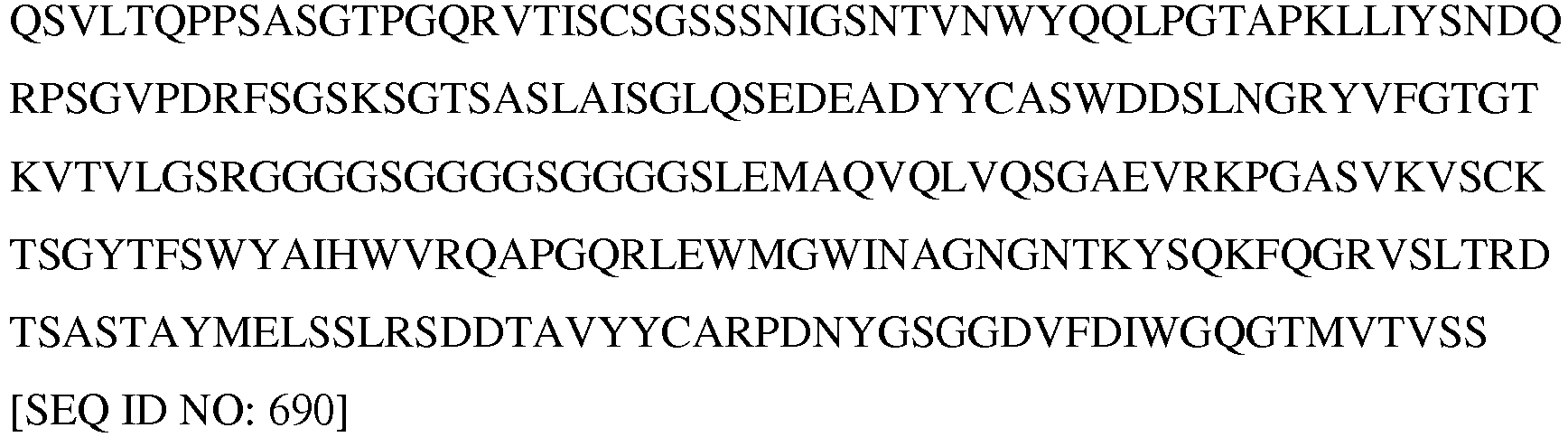
Table 126 ET200-100 DNA Sequence 
Amino Acid Sequence 
Table 127 ET200-101 DNA Sequence 

Amino Acid Sequence 
Table 128 ET200-102 DNA Sequence 
Amino Acid Sequence 

Table 129 ET200-103 DNA Sequence 
Amino Acid Sequence 
Table 130 ET200-104 DNA Sequence 

Amino Acid Sequence 
Table 131 ET200-105 DNA Sequence 
Amino Acid Sequence 
Table 132 ET200-106 DNA Sequence 
Amino Acid Sequence 
Table 133 ET200-107 DNA Sequence 
Amino Acid Sequence 
Table 134 ET200-108 DNA Sequence 
Amino Acid Sequence 
Table 135 ET200-109 DNA Sequence 

Amino Acid Sequence 
Table 136 ET200-110 DNA Sequence 
Amino Acid Sequence 

Table 137 ET200-111 DNA Sequence 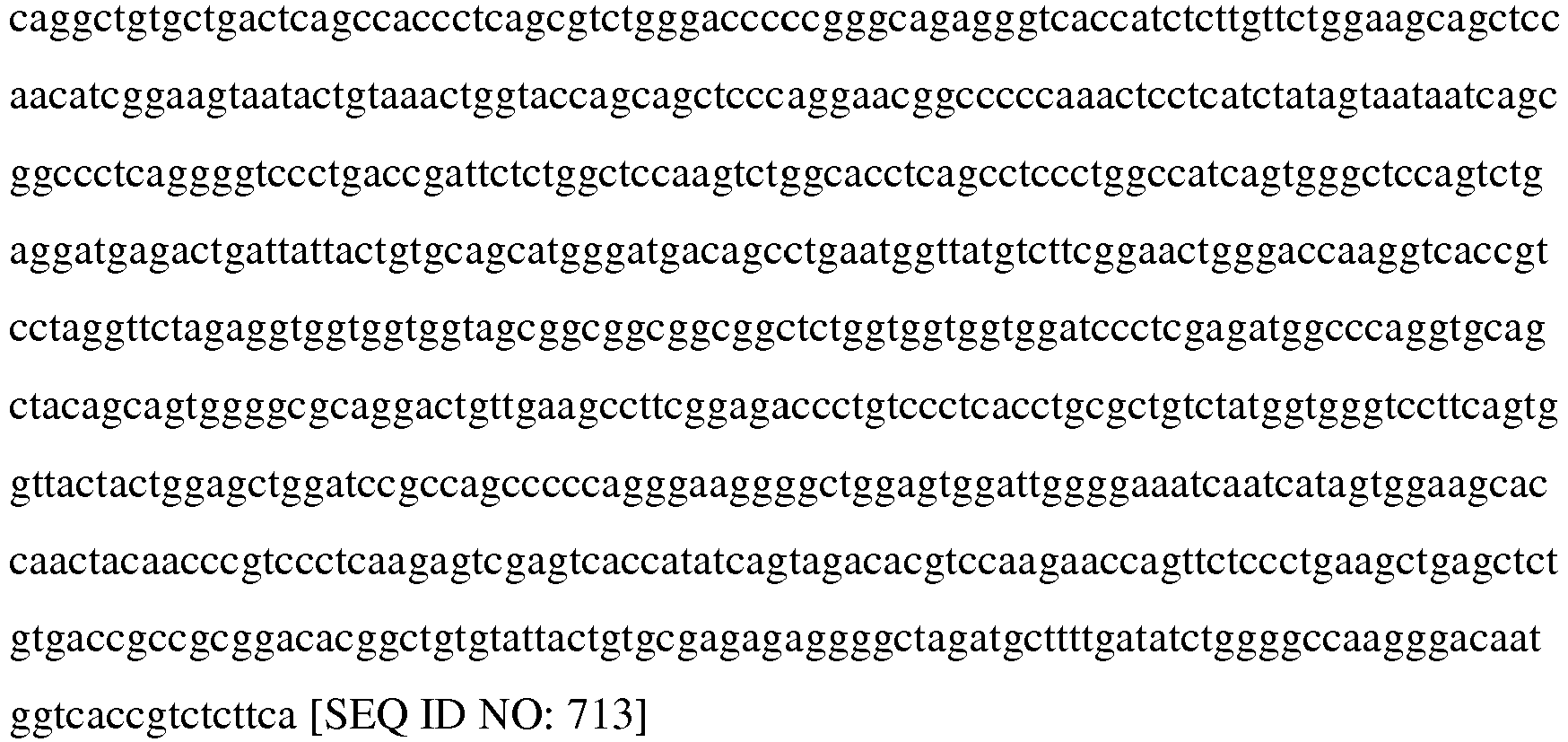
Amino Acid Sequence 
Table 138 ET200-112 DNA Sequence 

Amino Acid Sequence 
Table 139 ET200-113 DNA Sequence 
Amino Acid Sequence 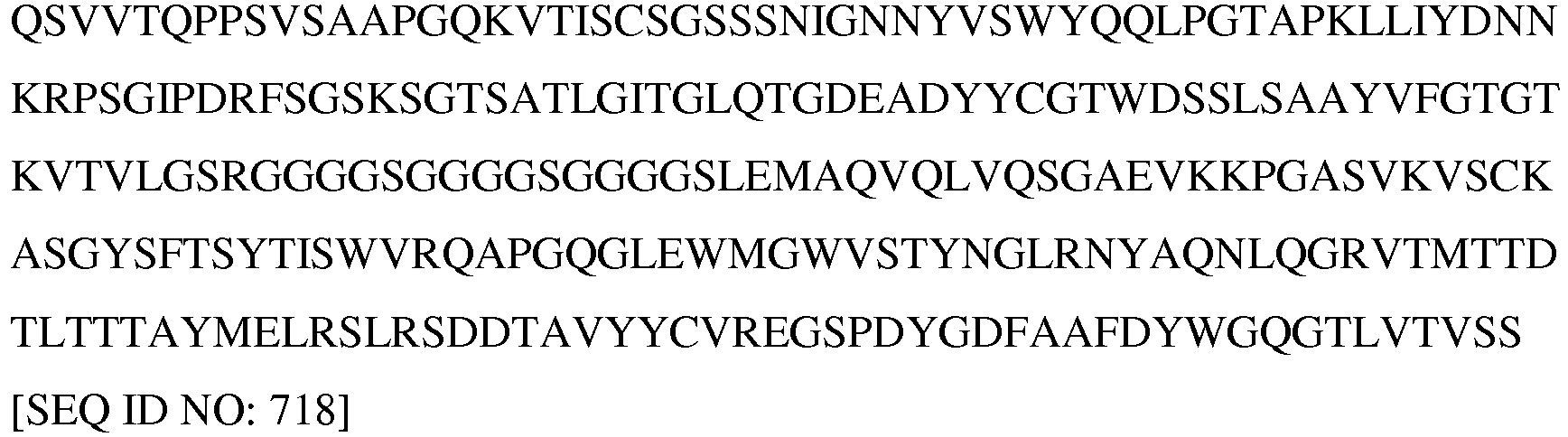
Table 140 ET200-114 DNA Sequence 
Amino Acid Sequence 


Table 141 ET200-115 DNA Sequence 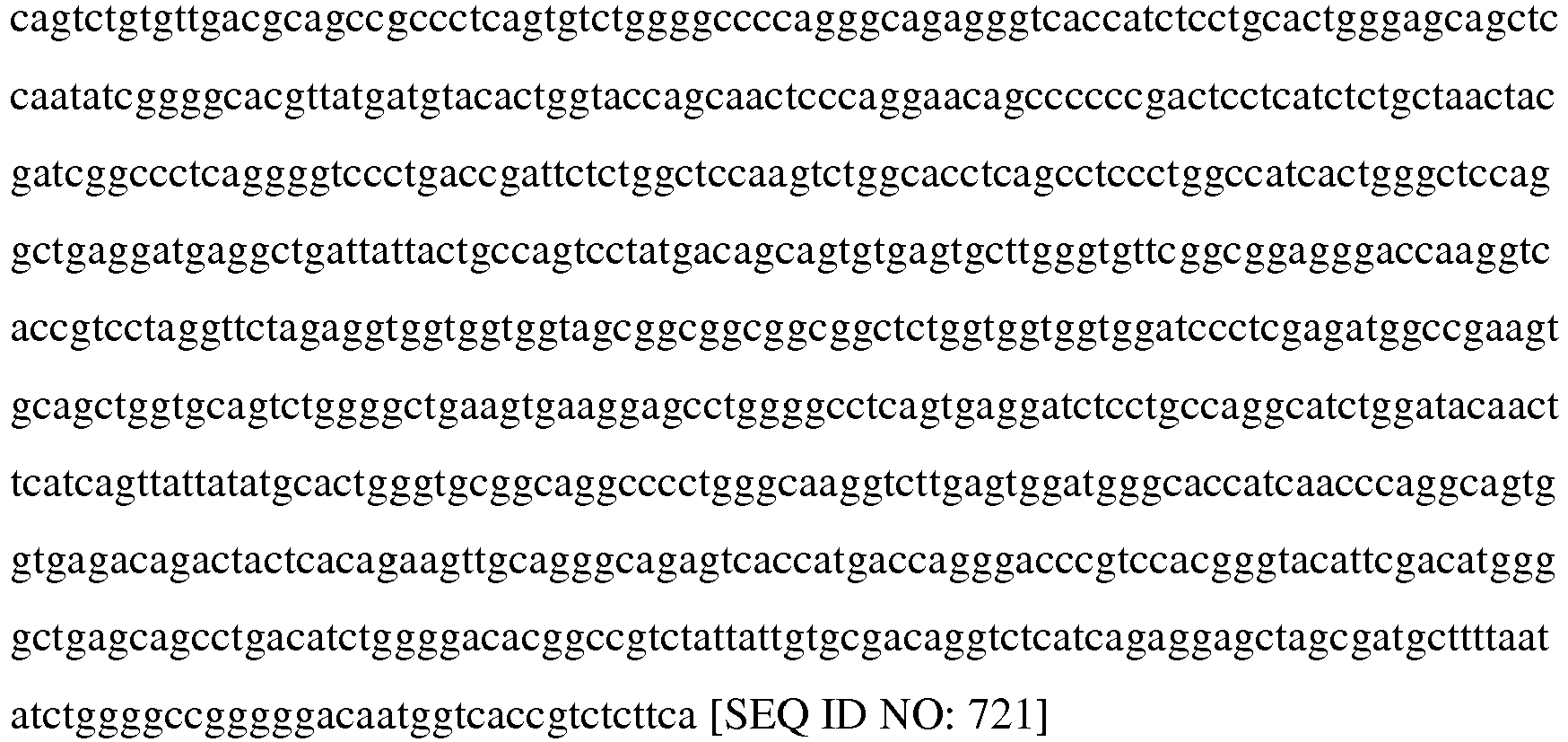
Amino Acid Sequence 

Table 142 ET200-116 DNA Sequence 
Amino Acid Sequence 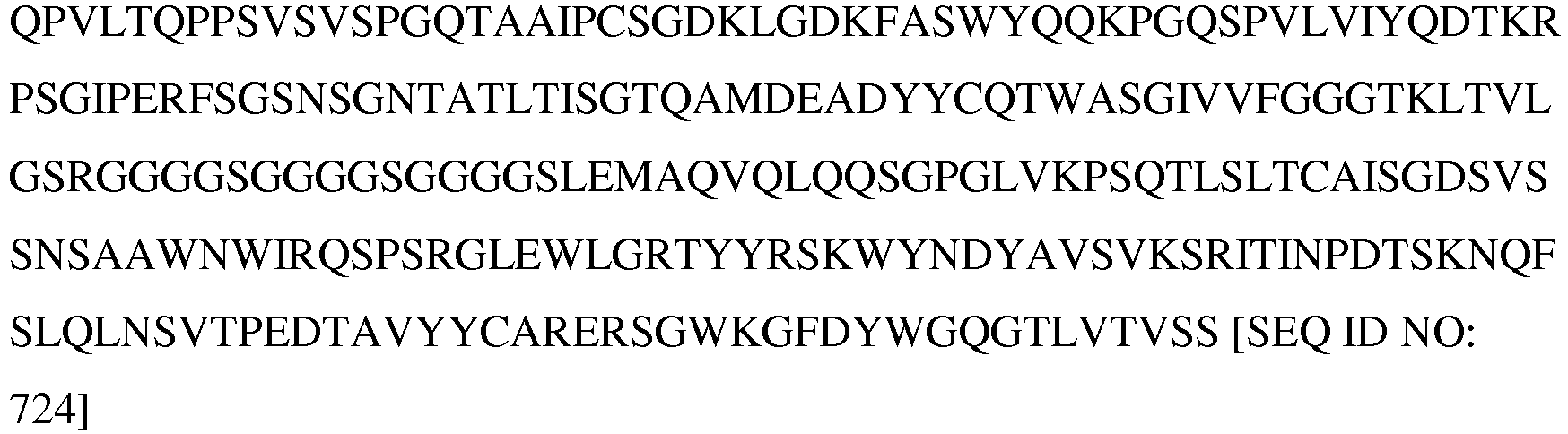
Table 143 ET200-117 DNA Sequence 

Amino Acid Sequence 


Table 144 ET200-118 DNA Sequence 
Amino Acid Sequence 
Table 145 ET200-119 DNA Sequence 
Amino Acid Sequence 
Table 146 ET200-120 DNA Sequence 
Amino Acid Sequence 
Table 147 ET200-121 DNA Sequence 
Amino Acid Sequence 
Table 148 ET200-122 DNA Sequence 

Amino Acid Sequence 
Table 149 ET200-123 DNA Sequence 
Amino Acid Sequence 

Table 150 ET200-125 DNA Sequence 
Amino Acid Sequence 
Table 151 ET200-005 DNA Sequence 

Amino Acid Sequence 


Table 152 ET200-124 DNA Sequence 
Amino Acid Sequence 
-
Table 153 ET200-001 DNA Sequence 
Amino Acid Sequence 
Table 154 ET200-002 DNA Sequence 

Amino Acid Sequence 
Table 155 ET200-003 DNA Sequence 
Amino Acid Sequence 

Table 156 ET200-006 DNA Sequence 
Amino Acid Sequence 
Table 157 ET200-007 DNA Sequence 

Amino Acid Sequence 
Table 158 ET200-008 DNA Sequence 
Amino Acid Sequence 
Table 159 ET200-009 DNA Sequence 
Amino Acid Sequence 
Table 160 ET200-010 DNA Sequence 
Amino Acid Sequence 
Table 161 ET200-011 DNA Sequence 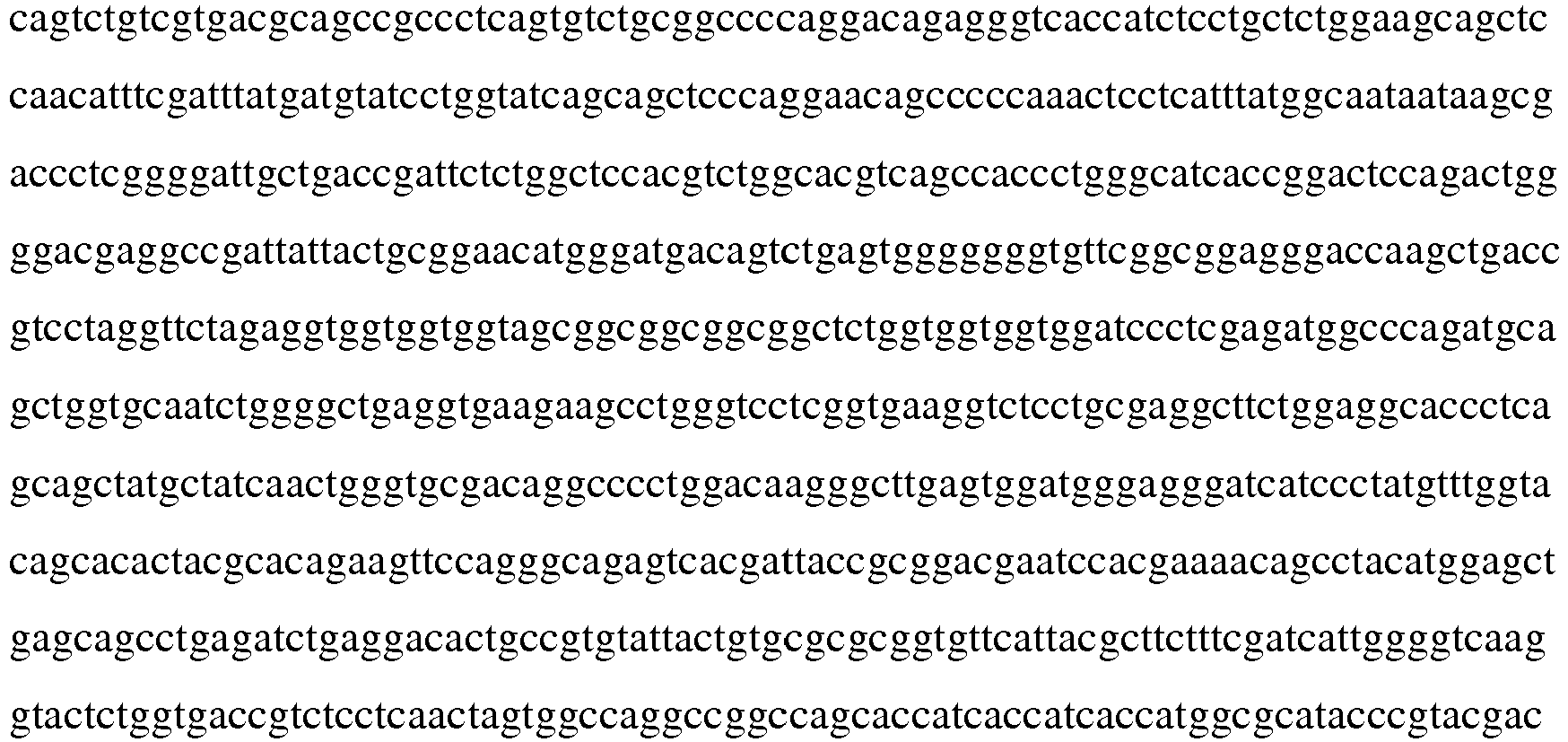

Amino Acid Sequence 
Table 162 ET200-012 DNA Sequence 
Amino Acid Sequence 
Table 163 ET200-013 DNA Sequence 
Amino Acid Sequence 
Table 164 ET200-014 DNA Sequence 

Amino Acid Sequence 
Table 165 ET200-015 DNA Sequence 
Amino Acid Sequence 
Table 166 ET200-016 DNA Sequence 
Amino Acid Sequence 
Table 167 ET200-017 DNA Sequence 

Amino Acid Sequence 
Table 168 ET200-018 DNA Sequence 
Amino Acid Sequence 

Table 169 ET200-019 DNA Sequence 
Amino Acid Sequence 
Table 170 ET200-020 DNA Sequence 

Amino Acid Sequence 
Table 171 ET200-021 DNA Sequence 
Amino Acid Sequence 

Table 172 ET200-022 DNA Sequence 
Amino Acid Sequence 
Table 173 ET200-023 DNA Sequence 

Amino Acid Sequence 
Table 174 ET200-024 DNA Sequence 
Amino Acid Sequence 
Table 175 ET200-025 DNA Sequence 
Amino Acid Sequence 
Table 176 ET200-026 DNA Sequence 
Amino Acid Sequence 
Table 177 ET200-027 DNA Sequence 

Amino Acid Sequence 


Table 178 ET200-028 DNA Sequence 
Amino Acid Sequence 
Table 179 ET200-029 DNA Sequence 
Amino Acid Sequence 
Table 180 ET200-030 DNA Sequence 

Amino Acid Sequence 
Table 181 ET200-031 DNA Sequence 
Amino Acid Sequence 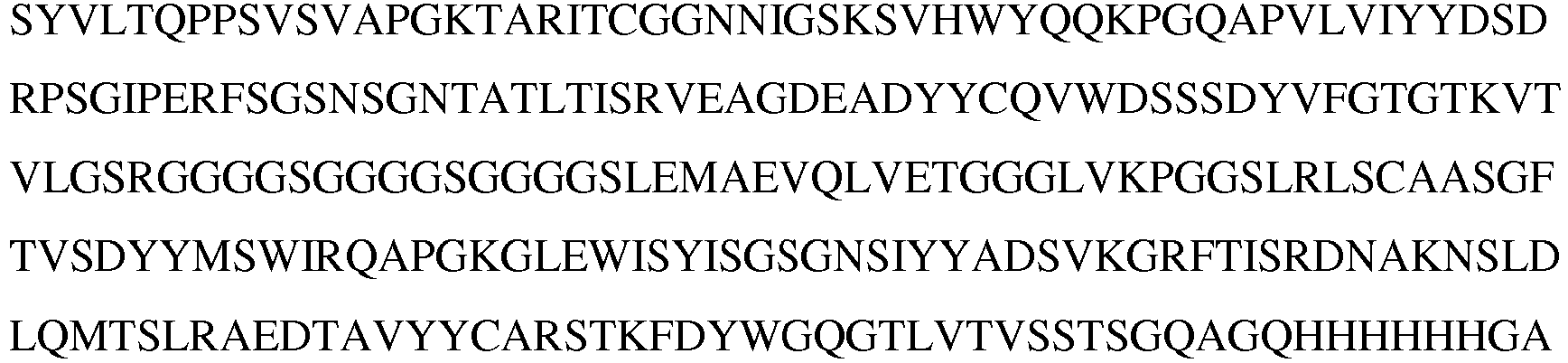

Table 182 ET200-032 DNA Sequence 
Amino Acid Sequence 


Table 183 ET200-033 DNA Sequence 

Amino Acid Sequence 
Table 184 ET200-034 DNA Sequence 
Amino Acid Sequence 



Table 185 ET200-035 DNA Sequence 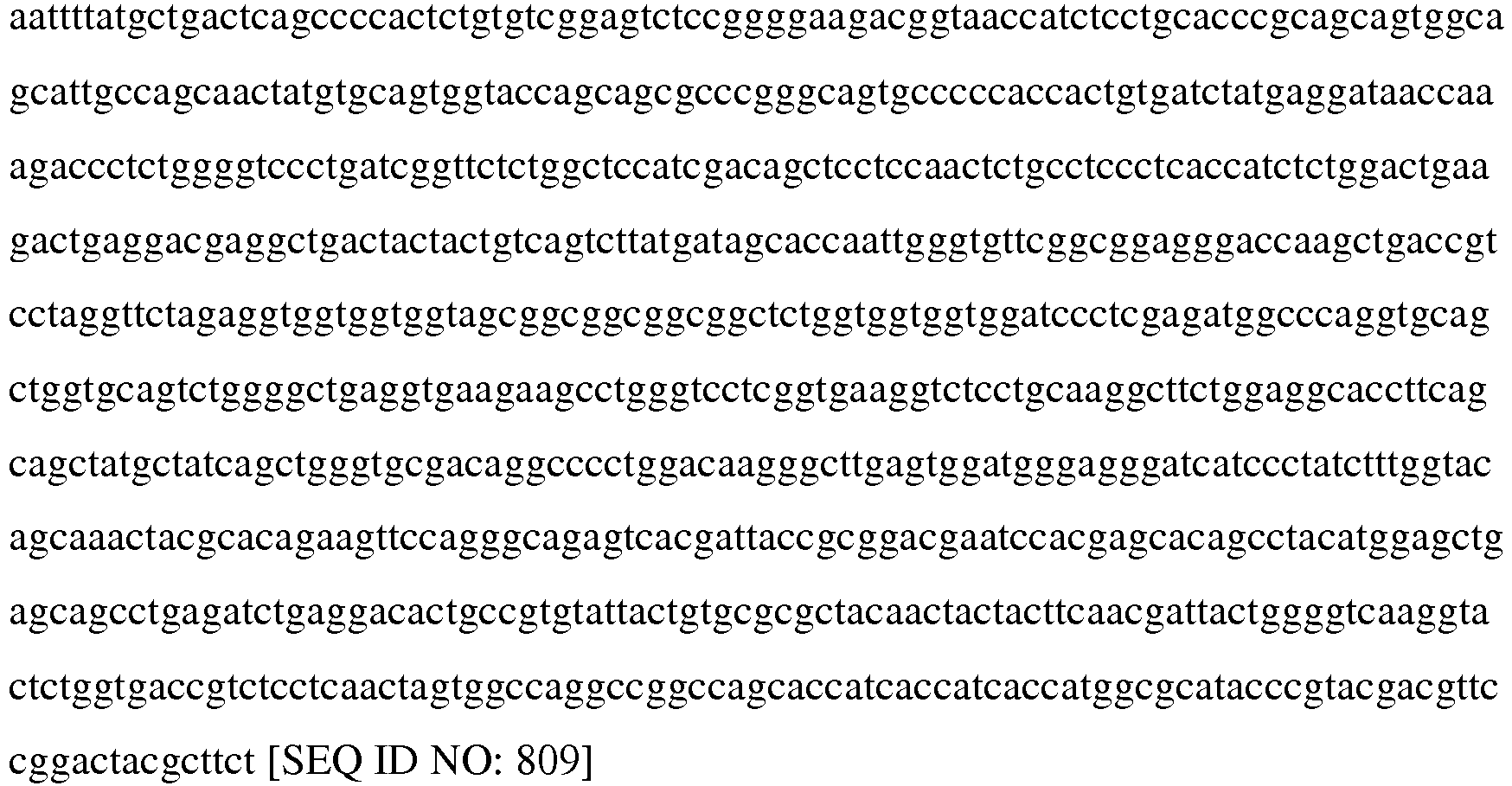
Amino Acid Sequence 
Table 186 ET200-037 DNA Sequence 

Amino Acid Sequence 
Table 187 ET200-038 DNA Sequence 
Amino Acid Sequence 

Table 188 ET200-039 DNA Sequence 
Amino Acid Sequence 
Table 189 ET200-040 DNA Sequence 

Amino Acid Sequence 
Table 190 ET200-041 DNA Sequence 
Amino Acid Sequence 
Table 191 ET200-042 DNA Sequence 
Amino Acid Sequence 
Table 192 ET200-043 DNA Sequence 
Amino Acid Sequence 
Table 193 ET200-044 DNA Sequence 

Amino Acid Sequence 
Table 194 ET200-045 DNA Sequence 
Amino Acid Sequence 
Table 195 ET200-069 DNA Sequence 
Amino Acid Sequence 
Table 196 ET200-078 DNA Sequence 

Amino Acid Sequence 
Table 197 ET200-079 DNA Sequence 
Amino Acid Sequence 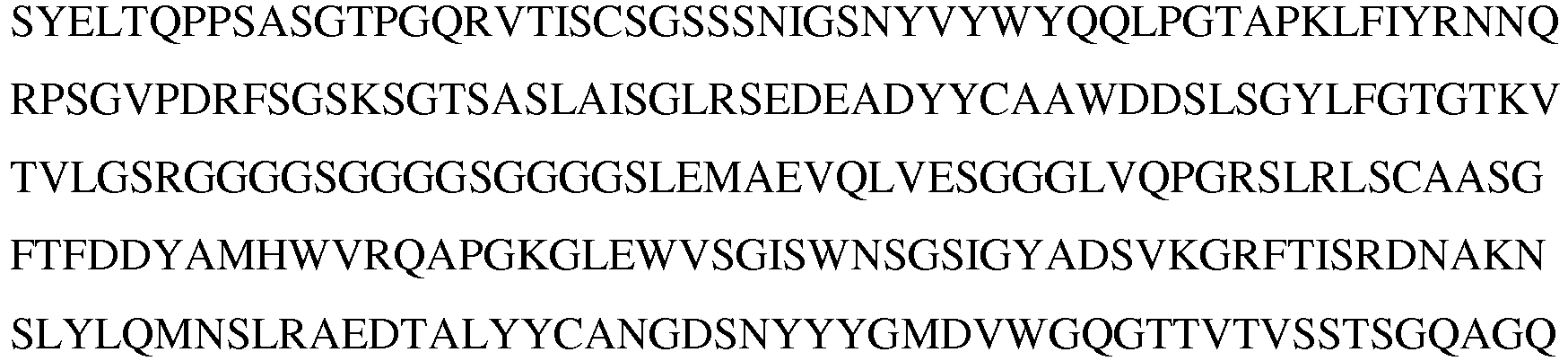

Table 198 ET200-081 DNA Sequence 
Amino Acid Sequence 
Table 199 ET200-097 DNA Sequence 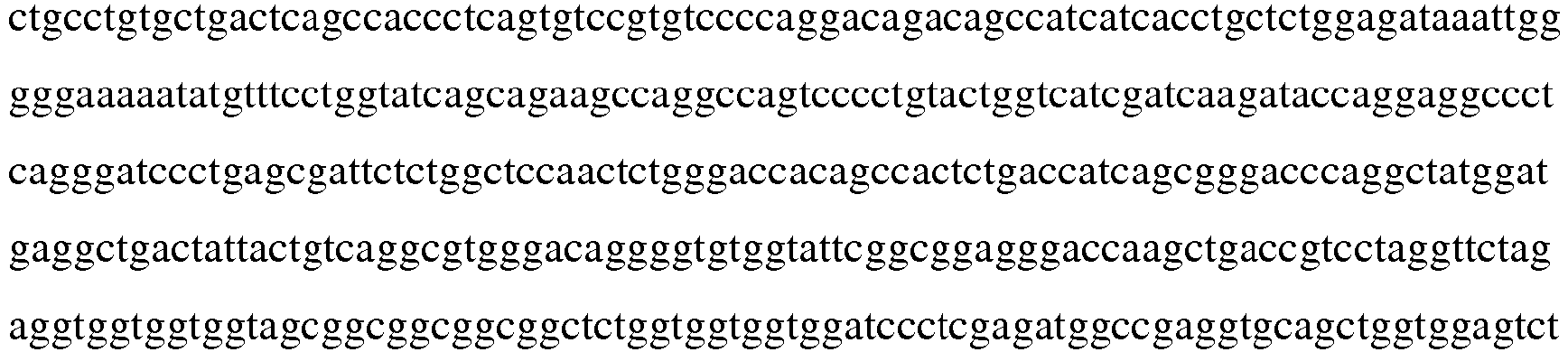

Amino Acid Sequence 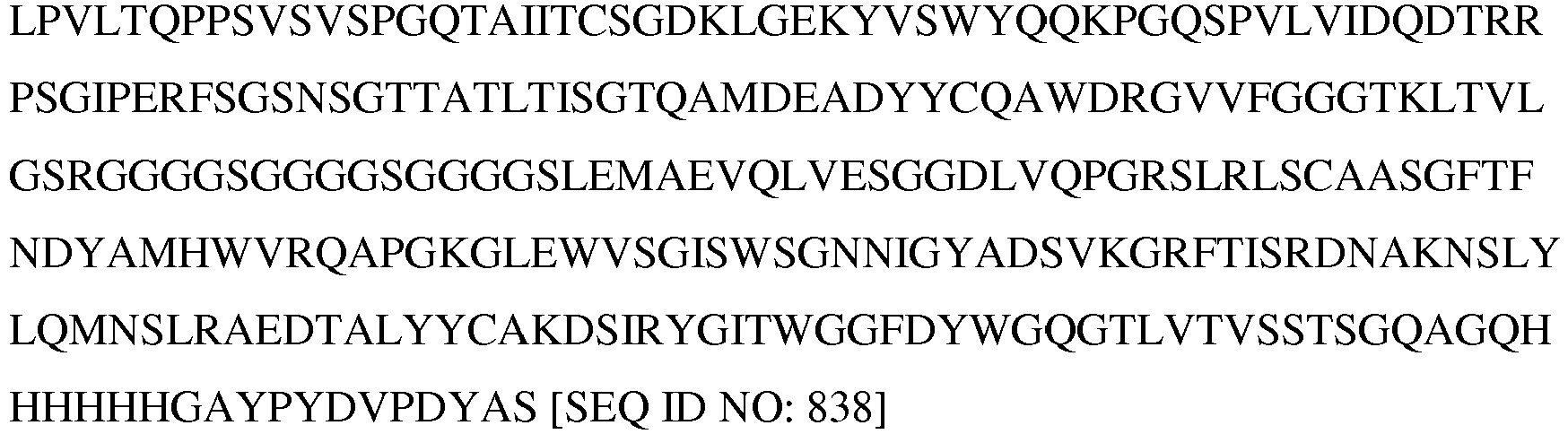
Table 200 ET200-098 DNA Sequence 
Amino Acid Sequence 

Table 201 ET200-099 DNA Sequence 
Amino Acid Sequence 
Table 202 ET200-100 DNA Sequence 

Amino Acid Sequence 
Table 203 ET200-101 DNA Sequence 
Amino Acid Sequence 

Table 204 ET200-102 DNA Sequence 
Amino Acid Sequence 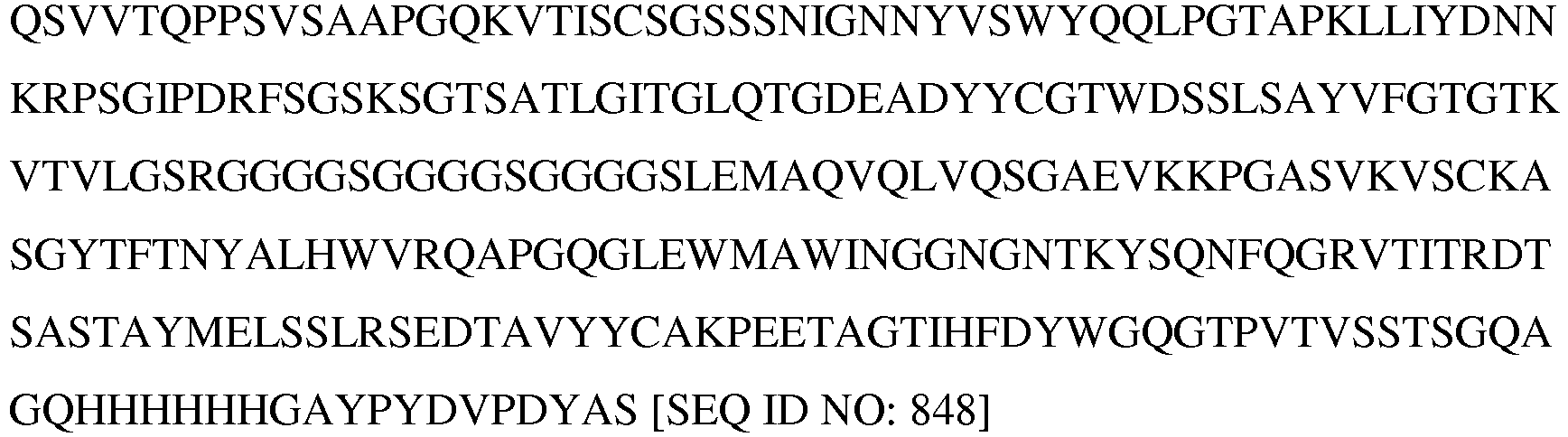
Table 205 ET200-103 DNA Sequence 

Amino Acid Sequence 
Table 206 ET200-104 DNA Sequence 
Amino Acid Sequence 
Table 207 ET200-105 DNA Sequence 
Amino Acid Sequence 
Table 208 ET200-106 DNA Sequence 
Amino Acid Sequence 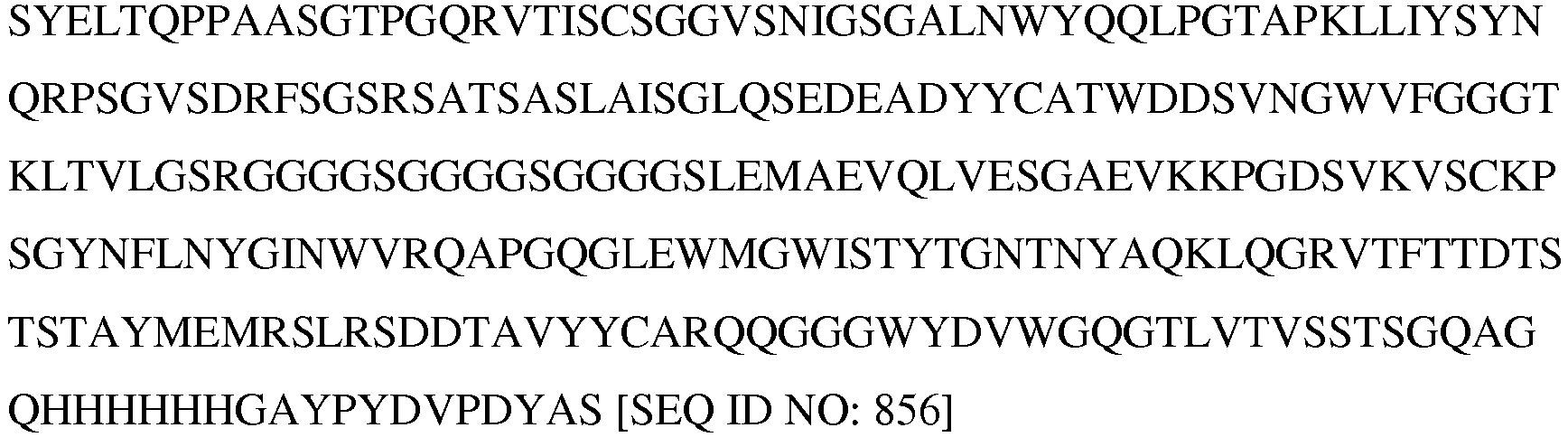
Table 209 ET200-107 DNA Sequence 

Amino Acid Sequence 
Table 210 ET200-108 DNA Sequence 
Amino Acid Sequence 
Table 211 ET200-109 DNA Sequence 
Amino Acid Sequence 
Table 212 ET200-110 DNA Sequence 

Amino Acid Sequence 
Table 213 ET200-111 DNA Sequence 
Amino Acid Sequence 

Table 214 ET200-112 DNA Sequence 
Amino Acid Sequence 
Table 215 ET200-113 DNA Sequence 

Amino Acid Sequence 


Table 216 ET200-114 DNA Sequence 
Amino Acid Sequence 

Table 217 ET200-115 DNA Sequence 
Amino Acid Sequence 
Table 218 ET200-116 DNA Sequence 

Amino Acid Sequence 
Table 219 ET200-117 DNA Sequence 
Amino Acid Sequence 
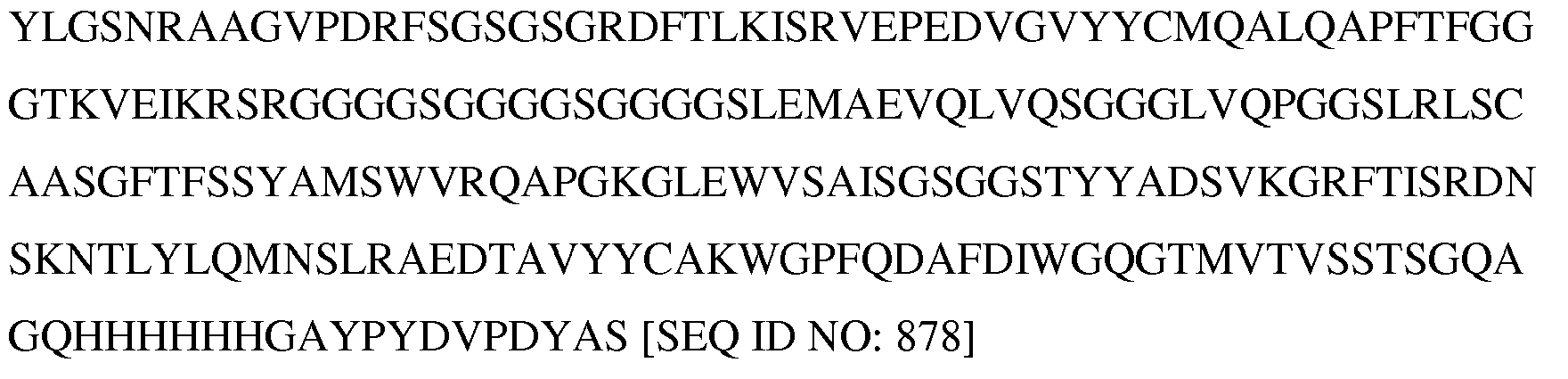
Table 220 ET200-118 DNA Sequence 
Amino Acid Sequence 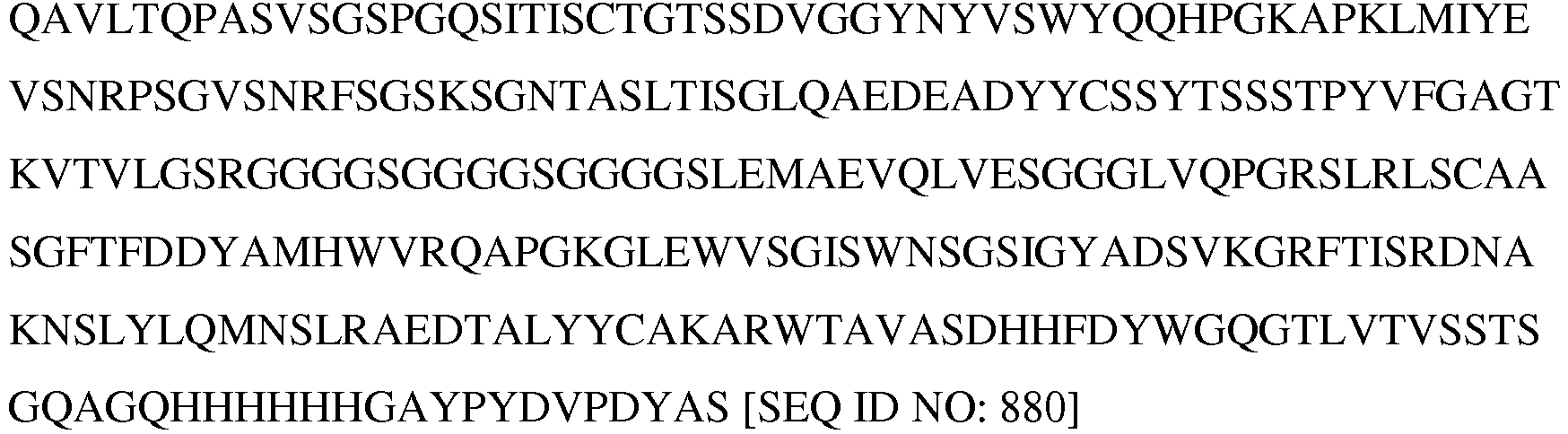
Table 221 ET200-119 DNA Sequence 

Amino Acid Sequence 
Table 222 ET200-120 DNA Sequence 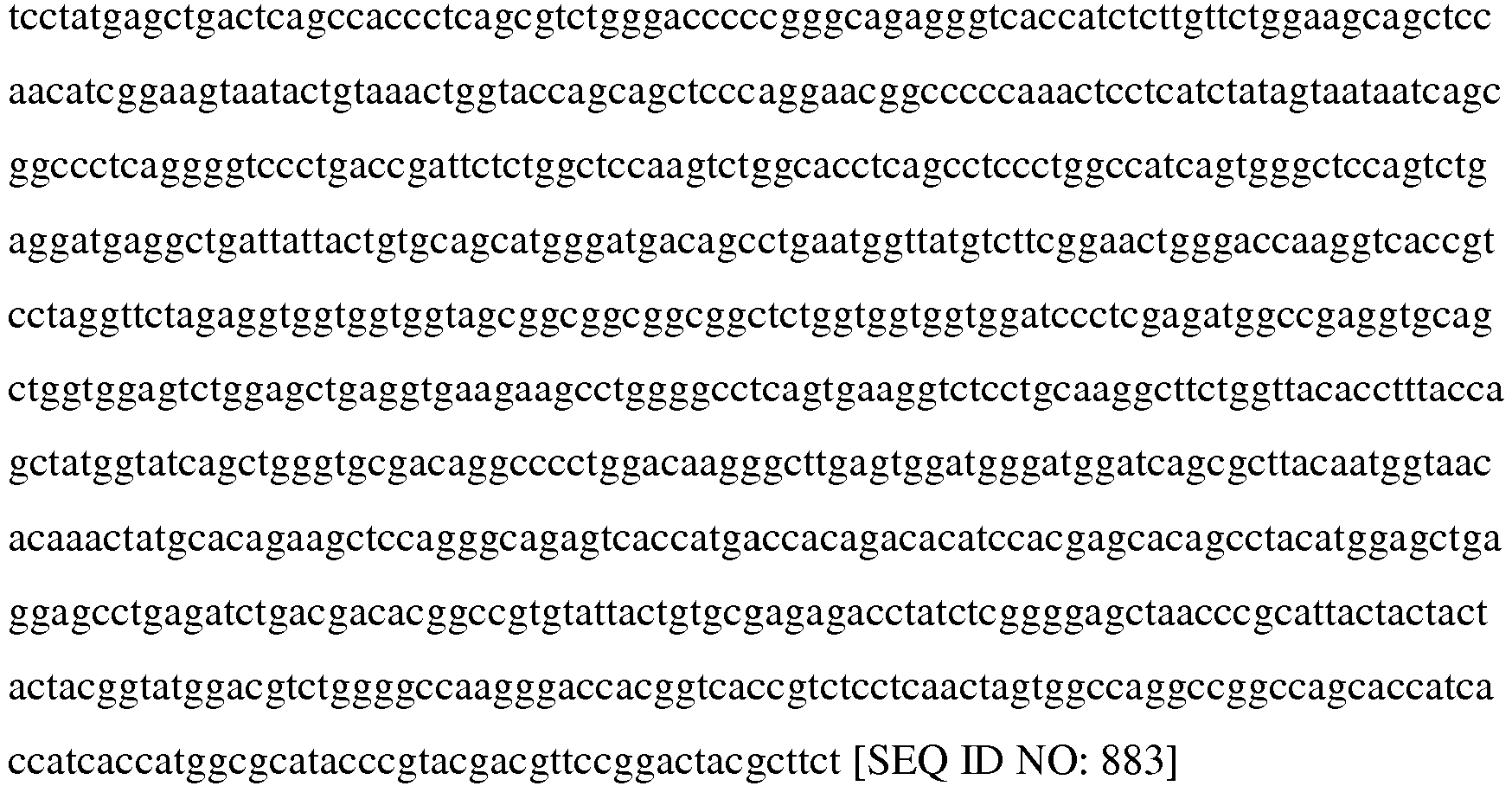
Amino Acid Sequence 
Table 223 ET200-121 DNA Sequence 
Amino Acid Sequence 
Table 224 ET200-122 DNA Sequence 
Amino Acid Sequence 
Table 225 ET200-123 DNA Sequence 

Amino Acid Sequence 
Table 226 ET200-125 DNA Sequence 
Amino Acid Sequence 
Table 227 ET200-005 DNA Sequence 
Amino Acid Sequence 
Table 228 ET200-124 DNA Sequence 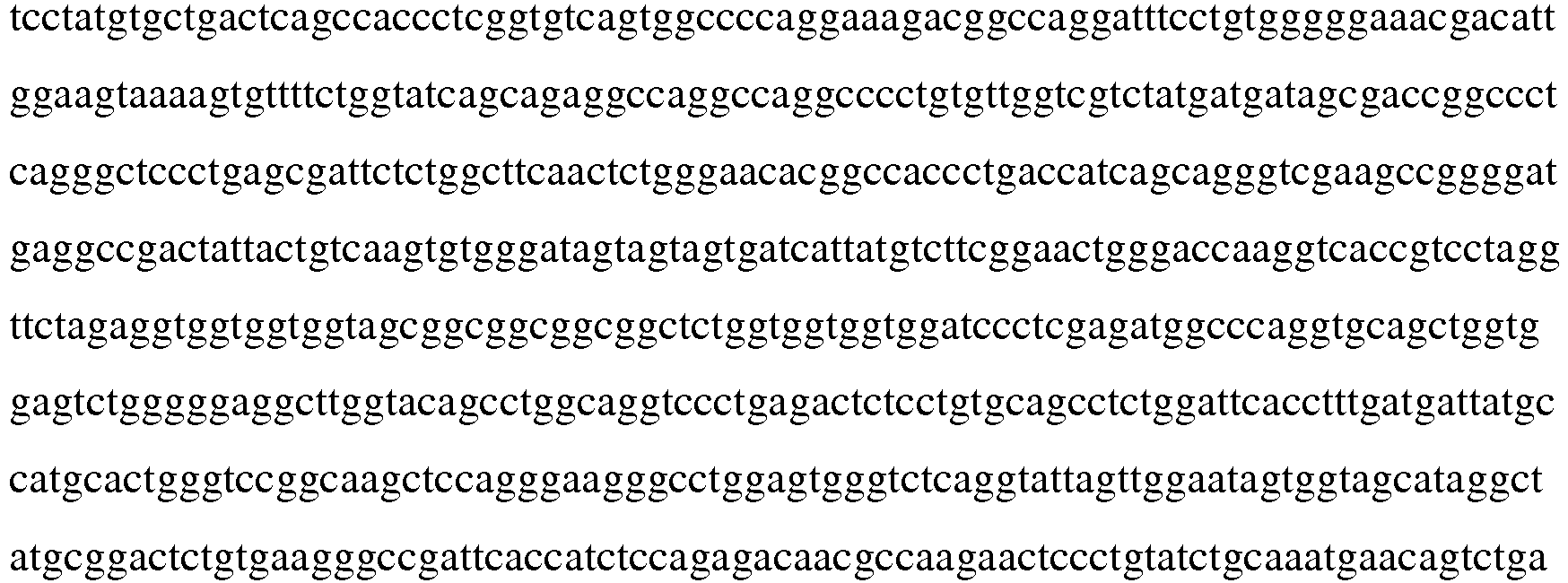

Amino Acid Sequence 
-


Table 230 CDR CDR SEQUENCE SEQ ID NO VHCDR1 IFGLH SEQ ID NO:923 VHCDR2 YISGDSNTIYYADTVKG SEQ ID NO:924 VHCDR3 NSYYALDY SEQ ID NO:925 VLCDR1 RASSSVSSSYLH SEQ ID NO:926 VLCDR2 STSNLAS SEQ ID NO:927 VLCDR3 QQYSGYPWT SEQ ID NO:928 VHCDR1 SFGMH SEQ ID NO:929 VHCDR2 YISSGSNNIYFADTVKG SEQ ID NO:930 VHCDR3 SEYYGSSHMDY SEQ ID NO:931 VLCDR1 KASQNVGTNVA SEQ ID NO:932 VLCDR2 SATYRNS SEQ ID NO:933 VLCDR3 QQYNRYPYT SEQ ID NO:934 - The practice of the present invention employs, unless otherwise indicated, conventional techniques of molecular biology (including recombinant techniques), microbiology, cell biology, biochemistry and immunology, which are well within the purview of the skilled artisan. Such techniques are explained fully in the literature, such as, "Molecular Cloning: A Laboratory Manual", second edition (Sambrook, 1989); "Oligonucleotide Synthesis" (Gait, 1984); "Animal Cell Culture" (Freshney, 1987); "Methods in Enzymology" "Handbook of Experimental Immunology" (Weir, 1996); "Gene Transfer Vectors for Mammalian Cells" (Miller and Calos, 1987); "Current Protocols in Molecular Biology" (Ausubel, 1987); "PCR: The Polymerase Chain Reaction", (Mullis, 1994); "Current Protocols in Immunology" (Coligan, 1991). These techniques are applicable to the production of the polynucleotides and polypeptides of the invention, and, as such, may be considered in making and practicing the invention. Particularly useful techniques for particular embodiments will be discussed in the sections that follow.
- The following examples are put forth so as to provide those of ordinary skill in the art with a complete disclosure and description of how to make and use the assay, screening, and therapeutic methods of the invention, and are not intended to limit the scope of what the inventors regard as their invention.
- The expression of human FcRL5 was assessed and evaluated in various tissues. As shown in
Figure 1 , human FcRL5 was highly expressed in lymphoma and multiple myeloma, but not in other tissues. Top panel ofFigure 1 shows differential expression of human FcRL5 in tumor cell lines from the Cancer Cell Line Encyclopedia (CCLE). The bottom panel ofFigure 1 shows differential expression of human FcRL5 in normal tissue from BioGPS. As shown inFigure 1 , human FcRL5 expression is limited to MM and lymphoma compared to other malignant cells. Normal expression appeared limited to B-cells and plasma cells. Potential FcRL5 targeted CAR T cell eradication of these normal cell types may not have significant adverse effects based on inventors' patient experience with CD 19 targeted CAR T cells. Any lack of physiologic antibody production can be addressed with intravenous immunoglobulin treatment. - Phage display selection against FcRL5 was conducted using a cell panning strategy with 31 human scFv naive and semi-synthetic phage sub-libraries. FcRL5 overexpressing 3T3 cells were used in positive panning, FcRL1, 2, 3, 4 and 6 overexpressing 3T3 cells (5 cell lines in total) were used in negative panning (
Figure 2 ). Bound clones were then eluted and used to infect E. Coli XL1-Blue. The scFv phage clones expressed in the bacteria were purified as previously described (Yasmina, et al. Probing the binding mechanism and affinity of tanezumab, a recombinant humanized anti-NGF monoclonal antibody, using a repertoire of biosensors. Protein Science 2008, 17(8): 1326-1335; Roberts, et al. Vaccination with CD20 peptides induces a biologically active, specific immune response in mice. Blood 2002, 99(10):3748-3755). Panning was performed for about 3 to about 4 cycles to enrich scFv phage clones that bind to FcRL5 specifically. Positive clones were determined by an ELISA method against His-tag FcRL5. - Positive clones were further tested for their binding to FcRL5 on live cell surfaces by flow cytometry, using FcRL5-overexpressing cell lines, 3T3 and Raji. The cells were then washed, and the staining was performed using the following steps: the cells can be first stained with purified scFv phage clones, and followed by staining with a mouse anti-M13 mAb, and finally the horse anti-mouse Ig's conjugate to PE. Each step of the staining was completed between 30-60 minutes on ice and the cells were washed twice between each step of the staining.
- 76 unique clones that were specific for FcRL5 were identifed and confirmed by screening (see Tables 1-229 and
Figure 2 ). - FcRL5 contains 9 extracellular immunoglobulin-like domains (domains 1-9) and can be present within a cell in a soluble isoform, a glycosyl-phosphotidyl inositol (GPI)-anchor type isoform and a transmembrane-type isoform (
Figure 3A ). As shown in Figure 2A, the transmembrane-type isoform of FcRL5 hasdomain 9; whereas, the soluble isoform and the GPI-anchor type isoform do not. - To test if the scFvs were specific to
domain 9 of FcRL5, the 76 clones were further screened on 3T3 cells overexpressing an vector encoding FcRL5 with adomain 9 deletion (FcRL5Δdom9) and further screened on Raji cells overexpressing full-length FcRL5 (Figure 4B-D). Some clones showed either reduced or diminished binding towards FcRLS-domain 9 deletion-overexpressing 3T3 cells compared to binding towards FcRE5-overexpressing 3T3 cells.Figure 4 ,5 ,6 ,7 and8 shows the specificity of ET200-39, ET200-104, ET200-105, ET200-109 and ET200-117 fordomain 9 of FcRL5, respectively. - For generation of a scFv targeting human FcRL5, two commercially available mouse hybridomas binding different extracellular epitopes on human FcRL5 (Franco (2013); Ise et al. (2005); Ise et al. (2006)) were obtained. From these hybridomas, two scFvs targeting human FcRL5 were obtained. One scFv was generated by synthesizing the heavy and light chain variable region of murine anti-human FcRL5 antibody F56 as described in Ise et al. (2005) with a G4S linker having the amino acid sequence of SEQ ID NO:897. A second scFv was generated by synthesizing the heavy and light chain variable region of murine anti-human FcRL5 antibody F119 as described in Ise et al. (2005) with a G4S linker having the amino acid sequence of SEQ ID NO:897.
- Two FcRL5 CARs were generated: F56 FcRL5-28z CAR and F119 FcRL5-28z CAR. F56 FcRL5-28z CAR and F119 FcRL5-28z CAR have similar structure, e.g., each has a transmembrance domain comprising a CD28 polypeptide, and an intracellular domain comprising a CD3ξ polypeptide and a co-stimulatory signaling region that comprises a CD28 polypeptide, as shown in
Figure 9A . F56 FcRL5-28z CAR comprises an scFv derived from antibody F56, and F119 FcRL5-28z CAR comprises an scFv derived from antibody F119. Each of F56 FcRL5-28z CAR and F119 FcRL5-28z CAR were cloned into a retroviral vector 293galv9. Human T cells (unselected (CD4 and CD8) human T cells from a healthy donor) were transduced with each of F56 FcRL5-28z CAR and F119 FcRL5-28z CAR such that the T cells expressed F56 FcRL5-28z CAR or F119 FcRL5-28z CAR. - This Example discloses the generation of CARs targeting human FcRL5 using the fully human scFvs described herein. ET200-31 scFv, ET200-39 scFv, ET200-69 scFv, ET200-104 scFv, ET200-105 scFv, ET200-109 scFv and ET200-117 scFvs were used to generate second generation FcRL5-targeted CARs designated as 31 FcRL5 BBz CAR, 39 FcRL5 BBz CAR, 69 FcRL5 BBz CAR, 104 FcRL5 BBz CAR, 105 FcRL5 BBz CAR, 109 FcRL5 BBz CAR and 117 FcRL5 BBz CAR with either a 4-1BB co-stimulatory domain and a CD3ξ polypeptide (see
Figures 9B-16 ). The FcRL5-targeted 4-1BB containing CARs have a similar structure, e.g., each has a CD8a polypeptide transmembrane domain, and an intracellular domain comprising co-stimulatory signaling region consisting of a CD3ξ polypeptide and a 4-1BB polypeptide, as shown inFigure 9B . Each of these FcRL5-targeted CARs were cloned into an SFG retroviral vector, as an example the 4-1BB containing CAR vectors are shown inFigures 10-16 . These viral vectors are then transduced into HEK 293galv9 viral packaging cells in order to generate a stable packaging line for generation of CAR+ T cells. - Human primary T cells were transduced using supernatant from retroviral galv9 HEK 293 packaging cells to express a FcRL5-targeted 4-1BBz CAR (generated using the anti-FcRL5 ET200-104 scFv). The cell surface expression of the FcRLS-targeted CAR was determined by binding to recombinant human FcRL5 which was modified to contain a His tag followed by the binding of a PE conjugated anti-HIS tag secondary antibody, as shown in
Figure 17 . Cell surface detection was validated by flow cytometry. As shown inFigure 17 , the FcRL5-targeted CAR was expressed on the transduced T cells. - The cytotoxic effects of the FcRL5-targeted 4-1BB CAR T cells were analyzed using Raji (a Burkett's lymphoma cell line) cells transduced to express luciferase and FcRL5 antigen or the control GPRCSD (an irrelevant antigen). T cells expressing the 4-1BB CAR generated using the anti-FcRL5 ET200-69 scFv were used in these experiments (referred to herein as "αFcRL5-69 BBz"). The number of live cells is determined after 36h co-culture by bioluminescent imaging (BLI). As shown in
Figure 18 , FcRL5-targeted CAR T cells specifically lysed Raji cells transduced to express luciferase and FcRL5 antigen (Figure 18A) but not control GPRCSD expressing Raji cells which are lysed by GPRC5D-targeted CAR T cells (Figure 18B). - This Example describes the cytokine secretion of FcRL5-targeted CAR T cells. T cells expressing the 4-1BB CAR generated using the anti-FcRL5 ET200-69 scFv were used in these experiments. IL-2, INFγ, and TNFα secretion after 24h co-culture of FcRL5 targeted CAR T cells on a monolayer of 3T3 cells transduced with either FcRL5 or CD19 was assessed by Luminex multiplex analysis. As shown in
Figure 19 , signaling through the CAR of FcRL5-targeted CAR T cells induced cytokine secretion consistent with T cell activation. - This Example describes the proliferation of FcRL5-targeted CAR T cells upon antigen stimulation. T cells expressing the 4-1BB CAR generated using the anti-FcRL5 ET200-69 scFv was used in these experiments. 500,000 FcRLS- or CD19-targeted CAR+ T cells/ml were placed on a monolayer of 3T3 cells that have been transduced with either FcRL5 or CD19 (3T3-FcRL; 3T3-CD19). After 4 days, CAR+ T cells were stained and counted by flow cytometry with the inclusion of a known concentration of counting microbeads. As shown in
Figure 20 , antigen stimulation of FcRL5-targeted CAR T cells induced proliferation. FcRL5-targeted CAR T cells co-cultured with 3T3-FcRL5 cells expanded to be 2.9 times greater then FcRL5-targeted CAR T cells co-cultured with 3T3-CD19 cells, while control CD19 targeted CAR T cells co-cultured with 3T3-CD19 cells similarly expanded to be 2.5 fold greater then CD19 targeted CAR T cells co-cultured with 3T3-FcRL5 cells (Figure 20 ). - Two anti-FcRL5 bispecific antibodies, ET200-104 and ET200-117, were analyzed by Pepscan to determine epitope specificity. See Table 239. The target protein is human FcRL5 comprising amino acids 1-851 of SEQ ID NO: 899.
Table 239 Name Origin Concentration Location ET200-104 bispecific scFV human 2.0 mg/ml +4°C/22 ET200-117 bispecific scFV human 1.6 mg/ml +4°C/22 - The principles of clips technology. CLIPS technology structurally fixes peptides into defined three-dimensional structures. This results in functional mimics of even the most complex binding sites. CLIPS technology is now routinely used to shape peptide libraries into single, double or triple looped structures as well as sheet- and helix-like folds (
Figure 21 ). - Combinatorial clips library screening in detail. CLIPS library screening starts with the conversion of the target protein into a library of up to 10,000 overlapping peptide constructs, using a combinatorial matrix design. On a solid carrier, a matrix of linear peptides is synthesized, which are subsequently shaped into spatially defined CLIPS constructs (
Figure 22 ). Constructs representing both parts of the discontinuous epitope in the correct conformation bind the antibody with high affinity, which is detected and quantified. Constructs presenting the incomplete epitope bind the antibody with lower affinity, whereas constructs not containing the epitope do not bind at all. Affinity information is used in iterative screens to define the sequence and conformation of epitopes in detail. - Heat map analysis. A heat map is a graphical representation of data where the values taken by a variable in a two-dimensional map are represented as colors. For double-looped CLIPS peptides, such a two-dimensional map can be derived from the independent sequences of the first and second loops. For example, the sequences of the 16 CLIPS peptides depicted in
Figure 24 are effectively permutations of 4 unique sub-sequences in loop 1 (colored in blue inFigure 23 ) and4 unique sub-sequences in loop 2 (colored in green inFigure 23 ). Thus, the observed ELISA data (colored in red inFigure 24A ) can be plotted in a 4x4 matrix, where each X coordinate corresponds to the sequence of the first loop, and each Y coordinate corresponds to the sequence of the second loop. For instance, the ELISA value observed for CLIPS peptide CLSSERERVEDLFEYECELLTSEPIFHCRQEDC (indicated with an arrow in Figure 23A) can be found at the third row, third column ofFigure 24B (indicated with an arrow and a red square). To further facilitate the visualization, ELISA values can be replaced with colors from a continuous gradient. In this case, extremely low values are colored in green, extremely high values are colored in red, and average values are colored in black (seeFigure 24C ). For the aforementioned example, the average value is 0.71. When this color map is applied to the data matrix depicted inFigure 24B , a color heat map is obtained (seeFigure 24D , the original data is still indicated for extra clarity). - Synthesis of peptides. To reconstruct epitopes of the target molecule a library of peptides was synthesized. An amino functionalized polypropylene support was obtained by grafting with a proprietary hydrophilic polymer formulation, followed by reaction with t-butyloxycarbonyl-hexamethylenediamine (BocHMDA) using dicyclohexylcarbodiimide (DCC) with Nhydroxybenzotriazole (HOBt) and subsequent cleavage of the Boc-groups using trifluoroacetic acid (TFA). Standard Fmoc-peptide synthesis was used to synthesize peptides on the amino-functionalized solid support by custom modified JANUS liquid handling stations (Perkin Elmer). Synthesis of structural mimics was done using Pepscan's proprietary Chemically Linked Peptides on Scaffolds (CLIPS) technology. CLIPS technology allows to structure peptides into single loops, doubleloops, triple loops, sheet-like folds, helix-like folds and combinations thereof. CLIPS templates are coupled to cysteine residues. The side-chains of multiple cysteines in the peptides were coupled to one or two CLIPS templates. For example, a 0.5 mM solution of the P2 CLIPS (2,6-bis(bromomethyl)pyridine) was dissolved in ammonium bicarbonate (20 mM, pH 7.8)/acetonitrile (1:3(v/v)). This solution was added onto the peptide arrays. The CLIPS template bound to side-chains of two cysteines as present in the solid-phase bound peptides of the peptide-arrays (455 wells plate with 3 µl wells). The peptide arrays were gently shaken in the solution for 30 to 60 minutes while completely covered in solution. Finally, the peptide arrays were washed extensively with excess of H2O and sonicated in disrupt-buffer containing 1 % SDS/0.1 % betamercaptoethanol in PBS (pH 7.2) at 70°C for 30 minutes, followed by sonication in H2O for another 45 minutes. The T3 CLIPS carrying peptides were made in a similar way but now with three cysteines.
- ELISA Screening. The binding of antibody to each of the synthesized peptides was tested in a PEPSCAN-based ELISA. The peptide arrays were incubated with primary antibody solution (overnight at 4°C). After washing, the peptide arrays were incubated with a 1/1000 dilution of an appropriate antibody peroxidase conjugate (SBA) for one hour at 25°C. After washing, the
peroxidase substrate 2,2'-azino-di-3-ethylbenzthiazoline sulfonate (ABTS) and 2 µl/ml of 3 percent H2O2 were added. After one hour, the color development was measured. The color development was quantified with a charge coupled device (CCD) - camera and an image processing system. - Data processing. The values obtained from the CCD camera ranged from 0 to 3000 mAU, similar to a standard 96-well plate ELISA-reader. The results were quantified and stored into the Peplab database. Occasionally a well contained an air-bubble resulting in a false-positive value, the cards were manually inspected and any values caused by an air-bubble were scored as 0.
- Synthesis quality control. To verify the quality of the synthesized peptides, a separate set of positive and negative control peptides was synthesized in parallel. These were screened with antibody 57.9 (ref. Posthumus et al., J. Virology, 1990, 64:3304-3309).
- Screening. Antibody binding depends on a combination of factors, including concentration of the antibody and the amounts and nature of competing proteins in the ELISA buffer. Also, the pre-coat conditions (the specific treatment of the peptide arrays prior to incubation with the experimental sample) affected binding. These details are summed up in Table 240. For the Pepscan Buffer and Preconditioning (SQ), the numbers indicate the relative amount of competing protein (a combination of horse serum and ovalbumin).
Table 240. Screening conditions Label Dilution Sample Buffer Pre-conditioning ET200-104 8 µg/ml PBS-Tween PBS-Tween ET200-117 3 µg/ml PBS-Tween 0.1% SQ - Antibodies ET200-104 and ET200-117 were coated at 1 µg/ml on a Nunc Maxisorp plate for ELISA and detected with Goat Anti-Human Ig-HRP (Southern Biotech; #2010/05), the same conjugate that is used in minicard screenings. For ET200-104 and ET200-117 signal >1 OD was obtained for some dilutions of the secondary Ab, indicating that the secondary antibody is well suited for detection of these mAbs.
- Herceptin was used as an internal negative control at high concentration in the absence of blocking buffer. Herceptin bound peptides with common sequences LRGSPLILYRF, LRGSSPILYWF and APRGSPPILYW (
Figure 25 ). Peptides containing aforementioned sequences were excluded from epitope candidates for test samples. - When tested under low stringency conditions and at a high concentration antibody ET200-104 binds multiple peptide motifs in all sets (
Figure 26 ). The majority of peptides bound were suspected to be the result of non-specific hydrophic interactions based on the results obtained for Herceptin (internal negative control). However, binding of peptides containing motif 657SRPILTFRAPR667 was proposed to be specific, and was uniquely attributed to sample ET200-104. - When tested under low stringency conditions antibody ET200-117 resulted in weak binding of multiple peptide motifs on all sets. Cumulative data analysis of data obtained for all sets suggests that the antibody uniquely recognizes a region containing peptide stretch 829RSETVTLYITGL840 in
domain 9 of Fc receptor-like protein 5 distinct from the Herceptin internal negative control and ET200-104. Again the majority of other peptides bound were suspected to be the result of unspecific hydrophic interactions that shared as the same binding pattern was recorded under low stringency conditions for antibody ET200-104. - Cumulative data analysis of results collected for ET200-104, and ET200-117 vs. Herceptin suggest that antibody ET200-104 targets residues 657SRPILTFRAPR667 within
domain 8 of Fc receptor-like protein 5 and antibody ET200-117 targets residues 829RSETVTLYITGL840 withindomain 9. Additionally, for both samples multiple signals were recorded with peptides non-specifically bound by Herceptin. The epitope candidate identified for ET200-104 was visualized using a publically available 3D model of Fc receptor-like protein 5 (Figure 27 ). The epitope candidate for ET200-117 lies within the non-modeled part of the target and therefore cannot be visualized. -
- 1. Franco, A., et al. Human Fc receptor-like 5 binds intact IgG via mechanisms distinct from those of Fc receptors. Journal of immunology 190, 5739-5746 (2013).
- 2. Dement-Brown, J., et al. Fc receptor-like 5 promotes B cell proliferation and drives the development of cells displaying switched isotypes. Journal of leukocyte biology 91, 59-67 (2012).
- 3. Ise, T., et al. Elevation of soluble CD307 (IRTA2/FcRH5) protein in the blood and expression on malignant cells of patients with multiple myeloma, chronic lymphocytic leukemia, and mantle cell lymphoma. Leukemia 21, 169-174 (2007).
- 4. Elkins, K., et al. FcRL5 as a target of antibody-drug conjugates for the treatment of multiple myeloma. Molecular cancer therapeutics 11, 2222-2232 (2012).
- 5. Hatzivassiliou, G., et al. IRTA1 and IRTA2, novel immunoglobulin superfamily receptors expressed in B cells and involved in chromosome 1q21 abnormalities in B cell malignancy. Immunity 14, 277-289 (2001).
- 6. An, G., et al. Chromosome 1q21 gains confer inferior outcomes in multiple myeloma treated with bortezomib but copy number variation and percentage of plasma cells involved have no additional prognostic value. Haematologica 99, 353-359 (2014).
- 7. Ise, T., et al. Immunoglobulin superfamily receptor translocation associated 2 protein on lymphoma cell lines and hairy cell leukemia cells detected by novel monoclonal antibodies. Clinical cancer research : an official journal of the American Association for Cancer Research 11, 87-96 (2005).
- 8. Ise, T., Kreitman, R.J., Pastan, I. & Nagata, S. Sandwich ELISAs for soluble immunoglobulin superfamily receptor translocation-associated 2 (IRTA2)/FcRH5 (CD307) proteins in human sera. Clinical chemistry and laboratory medicine : CCLM / FESCC 44, 594-602 (2006).
- 9. Brentjens, R.J., et al. Safety and persistence of adoptively transferred autologous CD19-targeted T cells in patients with relapsed or chemotherapy refractory B-cell leukemias. Blood 118, 4817-4828 (2011).
- 10. Brentjens, R.J., et al. Eradication of systemic B-cell tumors by genetically targeted human T lymphocytes co-stimulated by CD80 and interleukin-15. ).
- 11. Brentjens, R.J., et al. CD19-Targeted T Cells Rapidly Induce Molecular Remissions in Adults with Chemotherapy-Refractory Acute Lymphoblastic Leukemia. Science ).
- 12. Davila, M.L., et al. Efficacy and Toxicity Management of 19-28z CAR T Cell Therapy in B Cell Acute Lymphoblastic Leukemia. Science translational medicine 6, 224ra225 (2014).
- 13. Siegel, R., Naishadham, D. & Jemal, A. Cancer statistics, 2013. CA: a cancer journal for clinicians 63, 11-30 (2013).
- 14. Boyd, K.D., et al. The clinical impact and molecular biology of del(17p) in multiple myeloma treated with conventional or thalidomide-based therapy. Genes, chromosomes & ).
- 15. Shaughnessy, J.D., Jr., et al. A validated gene expression model of high-risk multiple myeloma is defined by deregulated expression of genes mapping to ).
- 16. Gahrton, G., et al. Allogeneic bone marrow transplantation in multiple myeloma. European Group for Bone Marrow Transplantation. The New England journal of medicine 325, 1267-1273 (1991).
- 17. Pegram, H.J., et al. Tumor-targeted T cells modified to secrete IL-12 eradicate systemic tumors without need for prior conditioning. Blood 119, 4133-4141 (2012).
- 18. Sabrina Bertilaccio, M.T., et al. Low-Dose Lenalidomide Improves CAR-Based Immunotherapy In CLL By Reverting T-Cell Defects In Vivo. Blood 122, 4171 (2013).
- 19. Bataille, R., et al. The phenotype of normal, reactive and malignant plasma cells. Identification of "many and multiple myelomas" and of new targets for myeloma therapy. Haematologica 91, 1234-1240 (2006).
- 20. Morgan, R.A., et al. Case report of a serious adverse event following the administration of T cells transduced with a chimeric antigen receptor recognizing ERBB2. Molecular therapy : the journal of the American Society of ).
- 21. Brentjens, R.J., et al. Safety and persistence of adoptively transferred autologous CD19-targeted T cells in patients with relapsed or chemotherapy refractory B-cell leukemias. Blood 118, 4817-4828 (2011).
- 22. Brentjens, R.J., et al. CD19-targeted T cells rapidly induce molecular remissions in adults with chemotherapy-refractory acute lymphoblastic leukemia. Science ).
- 23. Hunder, N.N., et al. Treatment of metastatic melanoma with autologous CD4+ T cells against NY-ESO-1. N.Engl.J.Med. 358, 2698-2703 (2008).
- 24. Rosenberg, S.A., Restifo, N.P., Yang, J.C., Morgan, R.A. & Dudley, M.E. Adoptive cell transfer: a clinical path to effective cancer immunotherapy. ).
- 25. Dudley, M.E., et al. Adoptive cell therapy for patients with metastatic melanoma: evaluation of intensive myeloablative chemoradiation preparative regimens. J Clin Oncol 26, 5233-5239 (2008).
- 26. Brentjens, R.J., et al. Genetically targeted T cells eradicate systemic acute lymphoblastic leukemia xenografts. Clin.Cancer Res. 13, 5426-5435 (2007).
- 27. Gade, T.P., et al. Targeted elimination of prostate cancer by genetically directed human T lymphocytes. Cancer Res. 65, 9080-9088 (2005).
- 28. Maher, J., Brentjens, R.J., Gunset, G., Riviere, I. & Sadelain, M. Human T-lymphocyte cytotoxicity and proliferation directed by a single chimeric TCRzeta /CD28 receptor. Nat.Biotechnol. 20, 70-75 (2002).
- 29. Kershaw, M.H., et al. Gene-engineered T cells as a superior adjuvant therapy for metastatic cancer. J Immunol 173, 2143-2150 (2004).
- 30. Sadelain, M., Brentjens, R. & Riviere, I. The promise and potential pitfalls of chimeric antigen receptors. Curr Opin Immunol (2009).
- 31. Hollyman, D., et al. Manufacturing validation of biologically functional T cells targeted to CD19 antigen for autologous adoptive cell therapy. J Immunother 32, 169-180 (2009).
- 32. Sadelain, M., Brentjens, R. & Riviere, I. The basic principles of chimeric antigen receptor design. ).
- 33. Riviere, I., Sadelain, M. & Brentjens, R.J. Novel strategies for cancer therapy: the potential of genetically modified T lymphocytes. ).
- 34. Stephan, M.T., et al. T cell-encoded CD80 and 4-1BBL induce auto- and transco-stimulation, resulting in potent tumor rejection. Nat.Med. 13, 1440-1449 (2007).
- 35. Krause, A., et al. Antigen-dependent CD28 signaling selectively enhances survival and proliferation in genetically modified activated human primary T lymphocytes. J Exp Med 188, 619-626 (1998).
- 36. Gong, M.C., et al. Cancer patient T cells genetically targeted to prostate-specific membrane antigen specifically lyse prostate cancer cells and release cytokines in response to prostate-specific membrane antigen. Neoplasia. 1, 123-127 (1999).
- 37. Lyddane, C., et al. Cutting Edge: CD28 controls dominant regulatory T cell activity during active immunization. J.Immunol. 176, 3306-3310 (2006).
- From the foregoing description, it will be apparent that variations and modifications may be made to the invention described herein to adopt it to various usages and conditions. Such embodiments are also within the scope of the following claims.
- All patents and publications and sequences referred to by accession or reference number mentioned in this specification are herein incorporated by reference to the same extent as if each independent patent and publication and sequence was specifically and individually indicated to be incorporated by reference.
Claims (15)
- An immunoresponsive cell comprising a chimeric antigen receptor (CAR), comprising an extracellular antigen-binding domain that binds to Fc Receptor-Like (FcRL5), a transmembrane domain, and an intracellular domain, wherein the extracellular antigen-binding domain comprises:(aa) a light chain variable region comprising a CDR1, a CDR2, and a CDR3 of the light chain variable region sequence set forth in SEQ ID NO:3, and a heavy chain variable region comprising a CDR1, a CDR2, and a CDR3 of the heavy chain variable region sequence set forth in SEQ ID NO:4;(ab) a light chain variable region comprising a CDR1, a CDR2, and a CDR3 of the light chain variable region sequence set forth in SEQ ID NO:7, and a heavy chain variable region comprising a CDR1, a CDR2, and a CDR3 of the heavy chain variable region sequence set forth in SEQ ID NO:8;(ac) a light chain variable region comprising a CDR1, a CDR2, and a CDR3 of the light chain variable region sequence set forth in SEQ ID NO:11, and a heavy chain variable region comprising a CDR1, a CDR2, and a CDR3 of the heavy chain variable region sequence set forth in SEQ ID NO:12;(ad) a light chain variable region comprising a CDR1, a CDR2, and a CDR3 of the light chain variable region sequence set forth in SEQ ID NO:299, and a heavy chain variable region comprising a CDR1, a CDR2, and a CDR3 of the heavy chain variable region sequence set forth in SEQ ID NO:300;(ae) a light chain variable region comprising a CDR1, a CDR2, and a CDR3 of the light chain variable region sequence set forth in SEQ ID NO:15, and a heavy chain variable region comprising a CDR1, a CDR2, and a CDR3 of the heavy chain variable region sequence set forth in SEQ ID NO:16;(af) a light chain variable region comprising a CDR1, a CDR2, and a CDR3 of the light chain variable region sequence set forth in SEQ ID NO:19, and a heavy chain variable region comprising a CDR1, a CDR2, and a CDR3 of the heavy chain variable region sequence set forth in SEQ ID NO:20;(ag) a light chain variable region comprising a CDR1, a CDR2, and a CDR3 of the light chain variable region sequence set forth in SEQ ID NO:23, and a heavy chain variable region comprising a CDR1, a CDR2, and a CDR3 of the heavy chain variable region sequence set forth in SEQ ID NO:24;(ah) a light chain variable region comprising a CDR1, a CDR2, and a CDR3 of the light chain variable region sequence set forth in SEQ ID NO:27, and a heavy chain variable region comprising a CDR1, a CDR2, and a CDR3 of the heavy chain variable region sequence set forth in SEQ ID NO:28;(ai) a light chain variable region comprising a CDR1, a CDR2, and a CDR3 of the light chain variable region sequence set forth in SEQ ID NO:31, and a heavy chain variable region comprising a CDR1, a CDR2, and a CDR3 of the heavy chain variable region sequence set forth in SEQ ID NO:32;(aj) a light chain variable region comprising a CDR1, a CDR2, and a CDR3 of the light chain variable region sequence set forth in SEQ ID NO:35, and a heavy chain variable region comprising a CDR1, a CDR2, and a CDR3 of the heavy chain variable region sequence set forth in SEQ ID NO:36;(ak) a light chain variable region comprising a CDR1, a CDR2, and a CDR3 of the light chain variable region sequence set forth in SEQ ID NO:39, and a heavy chain variable region comprising a CDR1, a CDR2, and a CDR3 of the heavy chain variable region sequence set forth in SEQ ID NO:40;(al) a light chain variable region comprising a CDR1, a CDR2, and a CDR3 of the light chain variable region sequence set forth in SEQ ID NO:43, and a heavy chain variable region comprising a CDR1, a CDR2, and a CDR3 of the heavy chain variable region sequence set forth in SEQ ID NO:44;(am) a light chain variable region comprising a CDR1, a CDR2, and a CDR3 of the light chain variable region sequence set forth in SEQ ID NO:47, and a heavy chain variable region comprising a CDR1, a CDR2, and a CDR3 of the heavy chain variable region sequence set forth in SEQ ID NO:48;(an) a light chain variable region comprising a CDR1, a CDR2, and a CDR3 of the light chain variable region sequence set forth in SEQ ID NO:51, and a heavy chain variable region comprising a CDR1, a CDR2, and a CDR3 of the heavy chain variable region sequence set forth in SEQ ID NO:52;(ao) a light chain variable region comprising a CDR1, a CDR2, and a CDR3 of the light chain variable region sequence set forth in SEQ ID NO:55, and a heavy chain variable region comprising a CDR1, a CDR2, and a CDR3 of the heavy chain variable region sequence set forth in SEQ ID NO:56;(ap) a light chain variable region comprising a CDR1, a CDR2, and a CDR3 of the light chain variable region sequence set forth in SEQ ID NO:59, and a heavy chain variable region comprising a CDR1, a CDR2, and a CDR3 of the heavy chain variable region sequence set forth in SEQ ID NO:60;(aq) a light chain variable region comprising a CDR1, a CDR2, and a CDR3 of the light chain variable region sequence set forth in SEQ ID NO:63, and a heavy chain variable region comprising a CDR1, a CDR2, and a CDR3 of the heavy chain variable region sequence set forth in SEQ ID NO:64;(ar) a light chain variable region comprising a CDR1, a CDR2, and a CDR3 of the light chain variable region sequence set forth in SEQ ID NO:67, and a heavy chain variable region comprising a CDR1, a CDR2, and a CDR3 of the heavy chain variable region sequence set forth in SEQ ID NO:68;(as) a light chain variable region comprising a CDR1, a CDR2, and a CDR3 of the light chain variable region sequence set forth in SEQ ID NO:71, and a heavy chain variable region comprising a CDR1, a CDR2, and a CDR3 of the heavy chain variable region sequence set forth in SEQ ID NO:72;(at) a light chain variable region comprising a CDR1, a CDR2, and a CDR3 of the light chain variable region sequence set forth in SEQ ID NO:75, and a heavy chain variable region comprising a CDR1, a CDR2, and a CDR3 of the heavy chain variable region sequence set forth in SEQ ID NO:76;(au) a light chain variable region comprising a CDR1, a CDR2, and a CDR3 of the light chain variable region sequence set forth in SEQ ID NO:79, and a heavy chain variable region comprising a CDR1, a CDR2, and a CDR3 of the heavy chain variable region sequence set forth in SEQ ID NO:80;(av) a light chain variable region comprising a CDR1, a CDR2, and a CDR3 of the light chain variable region sequence set forth in SEQ ID NO: 83, and a heavy chain variable region comprising a CDR1, a CDR2, and a CDR3 of the heavy chain variable region sequence set forth in SEQ ID NO:84;(aw) a light chain variable region comprising a CDR1, a CDR2, and a CDR3 of the light chain variable region sequence set forth in SEQ ID NO:87, and a heavy chain variable region comprising a CDR1, a CDR2, and a CDR3 of the heavy chain variable region sequence set forth in SEQ ID NO:88;(ax) a light chain variable region comprising a CDR1, a CDR2, and a CDR3 of the light chain variable region sequence set forth in SEQ ID NO:91, and a heavy chain variable region comprising a CDR1, a CDR2, and a CDR3 of the heavy chain variable region sequence set forth in SEQ ID NO:92;(ay) a light chain variable region comprising a CDR1, a CDR2, and a CDR3 of the light chain variable region sequence set forth in SEQ ID NO:95, and a heavy chain variable region comprising a CDR1, a CDR2, and a CDR3 of the heavy chain variable region sequence set forth in SEQ ID NO:96;(az) a light chain variable region comprising a CDR1, a CDR2, and a CDR3 of the light chain variable region sequence set forth in SEQ ID NO:99, and a heavy chain variable region comprising a CDR1, a CDR2, and a CDR3 of the heavy chain variable region sequence set forth in SEQ ID NO: 100;(ba) a light chain variable region comprising a CDR1, a CDR2, and a CDR3 of the light chain variable region sequence set forth in SEQ ID NO: 103, and a heavy chain variable region comprising a CDR1, a CDR2, and a CDR3 of the heavy chain variable region sequence set forth in SEQ ID NO: 104;(bb) a light chain variable region comprising a CDR1, a CDR2, and a CDR3 of the light chain variable region sequence set forth in SEQ ID NO: 107, and a heavy chain variable region comprising a CDR1, a CDR2, and a CDR3 of the heavy chain variable region sequence set forth in SEQ ID NO: 108;(bc) a light chain variable region comprising a CDR1, a CDR2, and a CDR3 of the light chain variable region sequence set forth in SEQ ID NO: 111, and a heavy chain variable region comprising a CDR1, a CDR2, and a CDR3 of the heavy chain variable region sequence set forth in SEQ ID NO: 112;(bd) a light chain variable region comprising a CDR1, a CDR2, and a CDR3 of the light chain variable region sequence set forth in SEQ ID NO: 115, and a heavy chain variable region comprising a CDR1, a CDR2, and a CDR3 of the heavy chain variable region sequence set forth in SEQ ID NO: 116;(be) a light chain variable region comprising a CDR1, a CDR2, and a CDR3 of the light chain variable region sequence set forth in SEQ ID NO: 119, and a heavy chain variable region comprising a CDR1, a CDR2, and a CDR3 of the heavy chain variable region sequence set forth in SEQ ID NO: 120;(bf) a light chain variable region comprising a CDR1, a CDR2, and a CDR3 of the light chain variable region sequence set forth in SEQ ID NO: 123, and a heavy chain variable region comprising a CDR1, a CDR2, and a CDR3 of the heavy chain variable region sequence set forth in SEQ ID NO: 124;(bg) a light chain variable region comprising a CDR1, a CDR2, and a CDR3 of the light chain variable region sequence set forth in SEQ ID NO: 127, and a heavy chain variable region comprising a CDR1, a CDR2, and a CDR3 of the heavy chain variable region sequence set forth in SEQ ID NO: 128;(bh) a light chain variable region comprising a CDR1, a CDR2, and a CDR3 of the light chain variable region sequence set forth in SEQ ID NO:131, and a heavy chain variable region comprising a CDR1, a CDR2, and a CDR3 of the heavy chain variable region sequence set forth in SEQ ID NO: 132;(bi) a light chain variable region comprising a CDR1, a CDR2, and a CDR3 of the light chain variable region sequence set forth in SEQ ID NO: 135, and a heavy chain variable region comprising a CDR1, a CDR2, and a CDR3 of the heavy chain variable region sequence set forth in SEQ ID NO: 136;(bj) a light chain variable region comprising a CDR1, a CDR2, and a CDR3 of the light chain variable region sequence set forth in SEQ ID NO: 139, and a heavy chain variable region comprising a CDR1, a CDR2, and a CDR3 of the heavy chain variable region sequence set forth in SEQ ID NO: 140;(bk) a light chain variable region comprising a CDR1, a CDR2, and a CDR3 of the light chain variable region sequence set forth in SEQ ID NO: 143, and a heavy chain variable region comprising a CDR1, a CDR2, and a CDR3 of the heavy chain variable region sequence set forth in SEQ ID NO: 144;(bl) a light chain variable region comprising a CDR1, a CDR2, and a CDR3 of the light chain variable region sequence set forth in SEQ ID NO: 147, and a heavy chain variable region comprising a CDR1, a CDR2, and a CDR3 of the heavy chain variable region sequence set forth in SEQ ID NO: 148;(bm) a light chain variable region comprising a CDR1, a CDR2, and a CDR3 of the light chain variable region sequence set forth in SEQ ID NO: 151, and a heavy chain variable region comprising a CDR1, a CDR2, and a CDR3 of the heavy chain variable region sequence set forth in SEQ ID NO: 152;(bn) a light chain variable region comprising a CDR1, a CDR2, and a CDR3 of the light chain variable region sequence set forth in SEQ ID NO:155, and a heavy chain variable region comprising a CDR1, a CDR2, and a CDR3 of the heavy chain variable region sequence set forth in SEQ ID NO: 156;(bo) a light chain variable region comprising a CDR1, a CDR2, and a CDR3 of the light chain variable region sequence set forth in SEQ ID NO: 159, and a heavy chain variable region comprising a CDR1, a CDR2, and a CDR3 of the heavy chain variable region sequence set forth in SEQ ID NO: 160;(bp) a light chain variable region comprising a CDR1, a CDR2, and a CDR3 of the light chain variable region sequence set forth in SEQ ID NO: 163, and a heavy chain variable region comprising a CDR1, a CDR2, and a CDR3 of the heavy chain variable region sequence set forth in SEQ ID NO: 164;(bq) a light chain variable region comprising a CDR1, a CDR2, and a CDR3 of the light chain variable region sequence set forth in SEQ ID NO: 167, and a heavy chain variable region comprising a CDR1, a CDR2, and a CDR3 of the heavy chain variable region sequence set forth in SEQ ID NO: 168;(bs) a light chain variable region comprising a CDR1, a CDR2, and a CDR3 of the light chain variable region sequence set forth in SEQ ID NO: 175, and a heavy chain variable region comprising a CDR1, a CDR2, and a CDR3 of the heavy chain variable region sequence set forth in SEQ ID NO: 176;(bt) a light chain variable region comprising a CDR1, a CDR2, and a CDR3 of the light chain variable region sequence set forth in SEQ ID NO: 179, and a heavy chain variable region comprising a CDR1, a CDR2, and a CDR3 of the heavy chain variable region sequence set forth in SEQ ID NO: 180;(bu) a light chain variable region comprising a CDR1, a CDR2, and a CDR3 of the light chain variable region sequence set forth in SEQ ID NO: 183, and a heavy chain variable region comprising a CDR1, a CDR2, and a CDR3 of the heavy chain variable region sequence set forth in SEQ ID NO: 184;(bv) a light chain variable region comprising a CDR1, a CDR2, and a CDR3 of the light chain variable region sequence set forth in SEQ ID NO: 187, and a heavy chain variable region comprising a CDR1, a CDR2, and a CDR3 of the heavy chain variable region sequence set forth in SEQ ID NO: 188;(bw) a light chain variable region comprising a CDR1, a CDR2, and a CDR3 of the light chain variable region sequence set forth in SEQ ID NO: 191, and a heavy chain variable region comprising a CDR1, a CDR2, and a CDR3 of the heavy chain variable region sequence set forth in SEQ ID NO: 192;(bx) a light chain variable region comprising a CDR1, a CDR2, and a CDR3 of the light chain variable region sequence set forth in SEQ ID NO: 195, and a heavy chain variable region comprising a CDR1, a CDR2, and a CDR3 of the heavy chain variable region sequence set forth in SEQ ID NO: 196;(by) a light chain variable region comprising a CDR1, a CDR2, and a CDR3 of the light chain variable region sequence set forth in SEQ ID NO: 199, and a heavy chain variable region comprising a CDR1, a CDR2, and a CDR3 of the heavy chain variable region sequence set forth in SEQ ID NO:200;(bz) a light chain variable region comprising a CDR1, a CDR2, and a CDR3 of the light chain variable region sequence set forth in SEQ ID NO:203, and a heavy chain variable region comprising a CDR1, a CDR2, and a CDR3 of the heavy chain variable region sequence set forth in SEQ ID NO:204;(ca) a light chain variable region comprising a CDR1, a CDR2, and a CDR3 of the light chain variable region sequence set forth in SEQ ID NO:207, and a heavy chain variable region comprising a CDR1, a CDR2, and a CDR3 of the heavy chain variable region sequence set forth in SEQ ID NO:208;(cb) a light chain variable region comprising a CDR1, a CDR2, and a CDR3 of the light chain variable region sequence set forth in SEQ ID NO:211, and a heavy chain variable region comprising a CDR1, a CDR2, and a CDR3 of the heavy chain variable region sequence set forth in SEQ ID NO:212;(cd) a light chain variable region comprising a CDR1, a CDR2, and a CDR3 of the light chain variable region sequence set forth in SEQ ID NO:219, and a heavy chain variable region comprising a CDR1, a CDR2, and a CDR3 of the heavy chain variable region sequence set forth in SEQ ID NO:220;(ce) a light chain variable region comprising a CDR1, a CDR2, and a CDR3 of the light chain variable region sequence set forth in SEQ ID NO:223, and a heavy chain variable region comprising a CDR1, a CDR2, and a CDR3 of the heavy chain variable region sequence set forth in SEQ ID NO:224;(cf) a light chain variable region comprising a CDR1, a CDR2, and a CDR3 of the light chain variable region sequence set forth in SEQ ID NO:227, and a heavy chain variable region comprising a CDR1, a CDR2, and a CDR3 of the heavy chain variable region sequence set forth in SEQ ID NO:228;(cg) a light chain variable region comprising a CDR1, a CDR2, and a CDR3 of the light chain variable region sequence set forth in SEQ ID NO:231, and a heavy chain variable region comprising a CDR1, a CDR2, and a CDR3 of the heavy chain variable region sequence set forth in SEQ ID NO:232;(ch) a light chain variable region comprising a CDR1, a CDR2, and a CDR3 of the light chain variable region sequence set forth in SEQ ID NO:235, and a heavy chain variable region comprising a CDR1, a CDR2, and a CDR3 of the heavy chain variable region sequence set forth in SEQ ID NO:236;(ci) a light chain variable region comprising a CDR1, a CDR2, and a CDR3 of the light chain variable region sequence set forth in SEQ ID NO:239, and a heavy chain variable region comprising a CDR1, a CDR2, and a CDR3 of the heavy chain variable region sequence set forth in SEQ ID NO:240;(cj) a light chain variable region comprising a CDR1, a CDR2, and a CDR3 of the light chain variable region sequence set forth in SEQ ID NO:243, and a heavy chain variable region comprising a CDR1, a CDR2, and a CDR3 of the heavy chain variable region sequence set forth in SEQ ID NO:244;(ck) a light chain variable region comprising a CDR1, a CDR2, and a CDR3 of the light chain variable region sequence set forth in SEQ ID NO:247, and a heavy chain variable region comprising a CDR1, a CDR2, and a CDR3 of the heavy chain variable region sequence set forth in SEQ ID NO:248;(cl) a light chain variable region comprising a CDR1, a CDR2, and a CDR3 of the light chain variable region sequence set forth in SEQ ID NO:251, and a heavy chain variable region comprising a CDR1, a CDR2, and a CDR3 of the heavy chain variable region sequence set forth in SEQ ID NO:252;(cm) a light chain variable region comprising a CDR1, a CDR2, and a CDR3 of the light chain variable region sequence set forth in SEQ ID NO:255, and a heavy chain variable region comprising a CDR1, a CDR2, and a CDR3 of the heavy chain variable region sequence set forth in SEQ ID NO:256;(cn) a light chain variable region comprising a CDR1, a CDR2, and a CDR3 of the light chain variable region sequence set forth in SEQ ID NO:259, and a heavy chain variable region comprising a CDR1, a CDR2, and a CDR3 of the heavy chain variable region sequence set forth in SEQ ID NO:260;(co) a light chain variable region comprising a CDR1, a CDR2, and a CDR3 of the light chain variable region sequence set forth in SEQ ID NO:263, and a heavy chain variable region comprising a CDR1, a CDR2, and a CDR3 of the heavy chain variable region sequence set forth in SEQ ID NO:264;(cp) a light chain variable region comprising a CDR1, a CDR2, and a CDR3 of the light chain variable region sequence set forth in SEQ ID NO:267, and a heavy chain variable region comprising a CDR1, a CDR2, and a CDR3 of the heavy chain variable region sequence set forth in SEQ ID NO:268;(cq) a light chain variable region comprising a CDR1, a CDR2, and a CDR3 of the light chain variable region sequence set forth in SEQ ID NO:271, and a heavy chain variable region comprising a CDR1, a CDR2, and a CDR3 of the heavy chain variable region sequence set forth in SEQ ID NO:272;(cr) a light chain variable region comprising a CDR1, a CDR2, and a CDR3 of the light chain variable region sequence set forth in SEQ ID NO:275, and a heavy chain variable region comprising a CDR1, a CDR2, and a CDR3 of the heavy chain variable region sequence set forth in SEQ ID NO:276;(cs) a light chain variable region comprising a CDR1, a CDR2, and a CDR3 of the light chain variable region sequence set forth in SEQ ID NO:279, and a heavy chain variable region comprising a CDR1, a CDR2, and a CDR3 of the heavy chain variable region sequence set forth in SEQ ID NO:280;(ct) a light chain variable region comprising a CDR1, a CDR2, and a CDR3 of the light chain variable region sequence set forth in SEQ ID NO:283, and a heavy chain variable region comprising a CDR1, a CDR2, and a CDR3 of the heavy chain variable region sequence set forth in SEQ ID NO:284;(cu) a light chain variable region comprising a CDR1, a CDR2, and a CDR3 of the light chain variable region sequence set forth in SEQ ID NO:287, and a heavy chain variable region comprising a CDR1, a CDR2, and a CDR3 of the heavy chain variable region sequence set forth in SEQ ID NO:288;(cv) a light chain variable region comprising a CDR1, a CDR2, and a CDR3 of the light chain variable region sequence set forth in SEQ ID NO:291, and a heavy chain variable region comprising a CDR1, a CDR2, and a CDR3 of the heavy chain variable region sequence set forth in SEQ ID NO:292;(cw) a light chain variable region comprising a CDR1, a CDR2, and a CDR3 of the light chain variable region sequence set forth in SEQ ID NO:303, and a heavy chain variable region comprising a CDR1, a CDR2, and a CDR3 of the heavy chain variable region sequence set forth in SEQ ID NO: 304;(cx) a light chain variable region comprising a CDR1, a CDR2, and a CDR3 of the light chain variable region sequence set forth in SEQ ID NO:295, and a heavy chain variable region comprising a CDR1, a CDR2, and a CDR3 of the heavy chain variable region sequence set forth in SEQ ID NO:296;(cy) a light chain variable region comprising a CDR1, a CDR2, and a CDR3 of the light chain variable region sequence set forth in SEQ ID NO:917, and a heavy chain variable region comprising a CDR1, a CDR2, and a CDR3 of the heavy chain variable region sequence set forth in SEQ ID NO:915; or(cz) a light chain variable region comprising a CDR1, a CDR2, and a CDR3 of the light chain variable region sequence set forth in SEQ ID NO:921, and a heavy chain variable region comprising a CDR1, a CDR2, and a CDR3 of the heavy chain variable region sequence set forth in SEQ ID NO:919
- The immunoresponsive cell of claim 1, wherein:(aa) a light chain variable region comprises a CDR1 comprising the amino acid sequence set forth in SEQ ID NO: 312, a CDR2 comprising the amino acid sequence set forth in SEQ ID NO:313, and a CDR3 comprising the amino acid sequence set forth in SEQ ID NO:314; and the heavy chain variable region comprises a CDR1 comprising the amino acid sequences set forth in SEQ ID NO:309, a CDR2 comprising the amino acid sequence set forth in SEQ ID NO:310, and a CDR3 comprising the amino acid sequence set forth in SEQ ID NO:311;(ab) the light chain variable region comprises a CDR1 comprising the amino acid sequence set forth in SEQ ID NO:318, a CDR2 comprising the amino acid sequence set forth in SEQ ID NO:319, and a CDR3 comprising the amino acid sequence set forth in SEQ ID NO:320; and the heavy chain variable region comprises a CDR1 comprising the amino acid sequence set forth in SEQ ID NO:315, a CDR2 comprising the amino acid sequence set forth in SEQ ID NO:316, and a CDR3 comprising the amino acid sequence set forth in SEQ ID NO:317;(ac) the light chain variable region comprises a CDR1 comprising the amino acid sequence set forth in SEQ ID NO:324, a CDR2 comprising the amino acid sequence set forth in SEQ ID NO:319, and a CDR3 comprising the amino acid sequence set forth in SEQ ID NO:325; and the heavy chain variable region comprises a CDR1 comprising the amino acid sequence set forth in SEQ ID NO:321, a CDR2 comprising the amino acid sequence set forth in SEQ ID NO:322, and a CDR3 comprising the amino acid sequence set forth in SEQ ID NO:323;(ad) the light chain variable region comprises a CDR1 comprising the amino acid sequence set forth in SEQ ID NO:329, a CDR2 comprising the amino acid sequence set forth in SEQ ID NO:330, and a CDR3 comprising the amino acid sequence set forth in SEQ ID NO:331; and the heavy chain variable region comprises a CDR1 comprising the amino acid sequence set forth in SEQ ID NO:326, a CDR2 comprising the amino acid sequence set forth in SEQ ID NO:327, and a CDR3 comprising the amino acid sequence set forth in SEQ ID NO:328;(ae) the light chain variable region comprises a CDR1 comprising the amino acid sequence set forth in SEQ ID NO:329, a CDR2 comprising the amino acid sequence set forth in SEQ ID NO:330, and a CDR3 comprising the amino acid sequence set forth in SEQ ID NO:331; and the heavy chain variable region comprises a CDR1 comprising the amino acid sequence set forth in SEQ ID NO:332, a CDR2 comprising the amino acid sequence set forth in SEQ ID NO:333, and a CDR3 comprising the amino acid sequence set forth in SEQ ID NO:334;(af) the light chain variable region comprises a CDR1 comprising the amino acid sequence set forth in SEQ ID NO:338, a CDR2 comprising the amino acid sequence set forth in SEQ ID NO:330, and a CDR3 comprising the amino acid sequence set forth in SEQ ID NO:339; and the heavy chain variable region comprises a CDR1 comprising the amino acid sequence set forth in SEQ ID NO:335, a CDR2 comprising the amino acid sequence set forth in SEQ ID NO:336, and a CDR3 comprising the amino acid sequence set forth in SEQ ID NO:337;(ag) the light chain variable region comprises a CDR1 comprising the amino acid sequence set forth in SEQ ID NO:343, a CDR2 comprising the amino acid sequence set forth in SEQ ID NO:344, and a CDR3 comprising the amino acid sequence set forth in SEQ ID NO:345; and the heavy chain variable region comprises a CDR1 comprising the amino acid sequence set forth in SEQ ID NO:340, a CDR2 comprising the amino acid sequence set forth in SEQ ID NO:341, and a CDR3 comprising the amino acid sequence set forth in SEQ ID NO:342;(ah) the light chain variable region comprises a CDR1 comprising the amino acid sequence set forth in SEQ ID NO:348, a CDR2 comprising the amino acid sequence set forth in SEQ ID NO:349, and a CDR3 comprising the amino acid sequence set forth in SEQ ID NO:350; and the heavy chain variable region comprises a CDR1 comprising the amino acid sequence set forth in SEQ ID NO:346, a CDR2 comprising the amino acid sequence set forth in SEQ ID NO:327, and a CDR3 comprising the amino acid sequence set forth in SEQ ID NO:347;(ai) the light chain variable region comprises a CDR1 comprising the amino acid sequence set forth in SEQ ID NO:352, a CDR2 comprising the amino acid sequence set forth in SEQ ID NO:344, and a CDR3 comprising the amino acid sequence set forth in SEQ ID NO:353; and the heavy chain variable region comprises a CDR1 comprising the amino acid sequence set forth in SEQ ID NO:346, a CDR2 comprising the amino acid sequence set forth in SEQ ID NO:327, and a CDR3 comprising the amino acid sequence set forth in SEQ ID NO:351;(aj) the light chain variable region comprises a CDR1 comprising the amino acid sequence set forth in SEQ ID NO:357, a CDR2 comprising the amino acid sequence set forth in SEQ ID NO:358, and a CDR3 comprising the amino acid sequence set forth in SEQ ID NO:359; and the heavy chain variable region comprises a CDR1 comprising the amino acid sequence set forth in SEQ ID NO:354, a CDR2 comprising the amino acid sequence set forth in SEQ ID NO:355, and a CDR3 comprising the amino acid sequence set forth in SEQ ID NO:356;(ak) the light chain variable region comprises a CDR1 comprising the amino acid sequence set forth in SEQ ID NO:363, a CDR2 comprising the amino acid sequence set forth in SEQ ID NO:364, and a CDR3 comprising the amino acid sequence set forth in SEQ ID NO:365; and the heavy chain variable region comprises a CDR1 comprising the amino acid sequence set forth in SEQ ID NO:360, a CDR2 comprising the amino acid sequence set forth in SEQ ID NO:361, and a CDR3 comprising the amino acid sequence set forth in SEQ ID NO:362;(al) the light chain variable region comprises a CDR1 comprising the amino acid sequence set forth in SEQ ID NO:369, a CDR2 comprising the amino acid sequence set forth in SEQ ID NO:370, and a CDR3 comprising the amino acid sequence set forth in SEQ ID NO:371; and the heavy chain variable region comprises a CDR1 comprising the amino acid sequence set forth in SEQ ID NO:366, a CDR2 comprising the amino acid sequence set forth in SEQ ID NO:367, and a CDR3 comprising the amino acid sequence set forth in SEQ ID NO:368;(am) the light chain variable region comprises a CDR1 comprising the amino acid sequence set forth in SEQ ID NO:329, a CDR2 comprising the amino acid sequence set forth in SEQ ID NO:330, and a CDR3 comprising the amino acid sequence set forth in SEQ ID NO:375; and the heavy chain variable region comprises a CDR1 comprising the amino acid sequence set forth in SEQ ID NO:372, a CDR2 comprising the amino acid sequence set forth in SEQ ID NO:373, and a CDR3 comprising the amino acid sequence set forth in SEQ ID NO:374;(an) the light chain variable region comprises a CDR1 comprising the amino acid sequence set forth in SEQ ID NO:329, a CDR2 comprising the amino acid sequence set forth in SEQ ID NO:330, and a CDR3 comprising the amino acid sequence set forth in SEQ ID NO:377; and the heavy chain variable region comprises a CDR1 comprising the amino acid sequence set forth in SEQ ID NO:346, a CDR2 comprising the amino acid sequence set forth in SEQ ID NO:327, and a CDR3 comprising the amino acid sequence set forth in SEQ ID NO:376;(ao) the light chain variable region comprises a CDR1 comprising the amino acid sequence set forth in SEQ ID NO:381, a CDR2 comprising the amino acid sequence set forth in SEQ ID NO:382, and a CDR3 comprising the amino acid sequence set forth in SEQ ID NO:383; and the heavy chain variable region comprises a CDR1 comprising the amino acid sequence set forth in SEQ ID NO:378, a CDR2 comprising the amino acid sequence set forth in SEQ ID NO:379, and a CDR3 comprising the amino acid sequence set forth in SEQ ID NO:380;(ap) the light chain variable region comprises a CDR1 comprising the amino acid sequence set forth in SEQ ID NO:329, a CDR2 comprising the amino acid sequence set forth in SEQ ID NO:385, and a CDR3 comprising the amino acid sequence set forth in SEQ ID NO:386; and the heavy chain variable region comprises a CDR1 comprising the amino acid sequence set forth in SEQ ID NO:309, a CDR2 comprising the amino acid sequence set forth in SEQ ID NO:310, and a CDR3 comprising the amino acid sequence set forth in SEQ ID NO:384;(aq) the light chain variable region comprises a CDR1 comprising the amino acid sequence set forth in SEQ ID NO:390, a CDR2 comprising the amino acid sequence set forth in SEQ ID NO:391, and a CDR3 comprising the amino acid sequence set forth in SEQ ID NO:392; and the heavy chain variable region comprises a CDR1 comprising the amino acid sequence set forth in SEQ ID NO:387, a CDR2 comprising the amino acid sequence set forth in SEQ ID NO:388, and a CDR3 comprising the amino acid sequence set forth in SEQ ID NO:389;(ar) the light chain variable region comprises a CDR1 comprising the amino acid sequence set forth in SEQ ID NO:318, a CDR2 comprising the amino acid sequence set forth in SEQ ID NO:319, and a CDR3 comprising the amino acid sequence set forth in SEQ ID NO:395; and the heavy chain variable region comprises a CDR1 comprising the amino acid sequence set forth in SEQ ID NO:393, a CDR2 comprising the amino acid sequence set forth in SEQ ID NO:355, and a CDR3 comprising the amino acid sequence set forth in SEQ ID NO:394;(as) the light chain variable region comprises a CDR1 comprising the amino acid sequence set forth in SEQ ID NO:397, a CDR2 comprising the amino acid sequence set forth in SEQ ID NO:398, and a CDR3 comprising the amino acid sequence set forth in SEQ ID NO:399; and the heavy chain variable region comprises a CDR1 comprising the amino acid sequence set forth in SEQ ID NO:346, a CDR2 comprising the amino acid sequence set forth in SEQ ID NO:327, and a CDR3 comprising the amino acid sequence set forth in SEQ ID NO:396;(at) the light chain variable region comprises a CDR1 comprising the amino acid sequence set forth in SEQ ID NO:401, a CDR2 comprising the amino acid sequence set forth in SEQ ID NO:398, and a CDR3 comprising the amino acid sequence set forth in SEQ ID NO:402; and the heavy chain variable region comprises a CDR1 comprising the amino acid sequence set forth in SEQ ID NO:346, a CDR2 comprising the amino acid sequence set forth in SEQ ID NO:327, and a CDR3 comprising the amino acid sequence set forth in SEQ ID NO:400;(au) the light chain variable region comprises a CDR1 comprising the amino acid sequence set forth in SEQ ID NO:406, a CDR2 comprising the amino acid sequence set forth in SEQ ID NO:398, and a CDR3 comprising the amino acid sequence set forth in SEQ ID NO:407; and the heavy chain variable region comprises a CDR1 comprising the amino acid sequence set forth in SEQ ID NO:403, a CDR2 comprising the amino acid sequence set forth in SEQ ID NO:404, and a CDR3 comprising the amino acid sequence set forth in SEQ ID NO:405;(av) the light chain variable region comprises a CDR1 comprising the amino acid sequence set forth in SEQ ID NO:329, a CDR2 comprising the amino acid sequence set forth in SEQ ID NO:409, and a CDR3 comprising the amino acid sequence set forth in SEQ ID NO:410; and the heavy chain variable region comprises a CDR1 comprising the amino acid sequence set forth in SEQ ID NO:346, a CDR2 comprising the amino acid sequence set forth in SEQ ID NO:327, and a CDR3 comprising the amino acid sequence set forth in SEQ ID NO:408;(aw) the light chain variable region comprises a CDR1 comprising the amino acid sequence set forth in SEQ ID NO:318, a CDR2 comprising the amino acid sequence set forth in SEQ ID NO:319, and a CDR3 comprising the amino acid sequence set forth in SEQ ID NO:414; and the heavy chain variable region comprises a CDR1 comprising the amino acid sequence set forth in SEQ ID NO:411, a CDR2 comprising the amino acid sequence set forth in SEQ ID NO:412, and a CDR3 comprising the amino acid sequence set forth in SEQ ID NO:413;(ax) the light chain variable region comprises a CDR1 comprising the amino acid sequence set forth in SEQ ID NO:416, a CDR2 comprising the amino acid sequence set forth in SEQ ID NO:417, and a CDR3 comprising the amino acid sequence set forth in SEQ ID NO:418; and the heavy chain variable region comprises a CDR1 comprising the amino acid sequence set forth in SEQ ID NO:411, a CDR2 comprising the amino acid sequence set forth in SEQ ID NO:412, and a CDR3 comprising the amino acid sequence set forth in SEQ ID NO:415;(ay) the light chain variable region comprises a CDR1 comprising the amino acid sequence set forth in SEQ ID NO:318, a CDR2 comprising the amino acid sequence set forth in SEQ ID NO:319, and a CDR3 comprising the amino acid sequence set forth in SEQ ID NO:419; and the heavy chain variable region comprises a CDR1 comprising the amino acid sequence set forth in SEQ ID NO:411, a CDR2 comprising the amino acid sequence set forth in SEQ ID NO:412, and a CDR3 comprising the amino acid sequence set forth in SEQ ID NO:349;(az) the light chain variable region comprises a CDR1 comprising the amino acid sequence set forth in SEQ ID NO:423, a CDR2 comprising the amino acid sequence set forth in SEQ ID NO:358, and a CDR3 comprising the amino acid sequence set forth in SEQ ID NO:424; and the heavy chain variable region comprises a CDR1 comprising the amino acid sequence set forth in SEQ ID NO:420, a CDR2 comprising the amino acid sequence set forth in SEQ ID NO:421, and a CDR3 comprising the amino acid sequence set forth in SEQ ID NO:422;(ba) the light chain variable region comprises a CDR1 comprising the amino acid sequence set forth in SEQ ID NO:428, a CDR2 comprising the amino acid sequence set forth in SEQ ID NO:429, and a CDR3 comprising the amino acid sequence set forth in SEQ ID NO:430; and the heavy chain variable region comprises a CDR1 comprising the amino acid sequence set forth in SEQ ID NO:425, a CDR2 comprising the amino acid sequence set forth in SEQ ID NO:426, and a CDR3 comprising the amino acid sequence set forth in SEQ ID NO:427;(bb) the light chain variable region comprises a CDR1 comprising the amino acid sequence set forth in SEQ ID NO:433, a CDR2 comprising the amino acid sequence set forth in SEQ ID NO:434, and a CDR3 comprising the amino acid sequence set forth in SEQ ID NO:435; and the heavy chain variable region comprises a CDR1 comprising the amino acid sequence set forth in SEQ ID NO:372, a CDR2 comprising the amino acid sequence set forth in SEQ ID NO:431, and a CDR3 comprising the amino acid sequence set forth in SEQ ID NO:432;(bc) the light chain variable region comprises a CDR1 comprising the amino acid sequence set forth in SEQ ID NO:423, a CDR2 comprising the amino acid sequence set forth in SEQ ID NO:438, and a CDR3 comprising the amino acid sequence set forth in SEQ ID NO:439; and the heavy chain variable region comprises a CDR1 comprising the amino acid sequence set forth in SEQ ID NO:436, a CDR2 comprising the amino acid sequence set forth in SEQ ID NO:388, and a CDR3 comprising the amino acid sequence set forth in SEQ ID NO:437;(bd) the light chain variable region comprises a CDR1 comprising the amino acid sequence set forth in SEQ ID NO:329, a CDR2 comprising the amino acid sequence set forth in SEQ ID NO:330, and a CDR3 comprising the amino acid sequence set forth in SEQ ID NO:443; and the heavy chain variable region comprises a CDR1 comprising the amino acid sequence set forth in SEQ ID NO:440, a CDR2 comprising the amino acid sequence set forth in SEQ ID NO:441, and a CDR3 comprising the amino acid sequence set forth in SEQ ID NO:442;(be) the light chain variable region comprises a CDR1 comprising the amino acid sequence set forth in SEQ ID NO:447, a CDR2 comprising the amino acid sequence set forth in SEQ ID NO:448, and a CDR3 comprising the amino acid sequence set forth in SEQ ID NO:449; and the heavy chain variable region comprises a CDR1 comprising the amino acid sequence set forth in SEQ ID NO:444, a CDR2 comprising the amino acid sequence set forth in SEQ ID NO:445, and a CDR3 comprising the amino acid sequence set forth in SEQ ID NO:446;(bf) the light chain variable region comprises a CDR1 comprising the amino acid sequence set forth in SEQ ID NO:318, a CDR2 comprising the amino acid sequence set forth in SEQ ID NO:319, and a CDR3 comprising the amino acid sequence set forth in SEQ ID NO:452; and the heavy chain variable region comprises a CDR1 comprising the amino acid sequence set forth in SEQ ID NO:309, a CDR2 comprising the amino acid sequence set forth in SEQ ID NO:450, and a CDR3 comprising the amino acid sequence set forth in SEQ ID NO:451;(bg) the light chain variable region comprises a CDR1 comprising the amino acid sequence set forth in SEQ ID NO:369, a CDR2 comprising the amino acid sequence set forth in SEQ ID NO:454, and a CDR3 comprising the amino acid sequence set forth in SEQ ID NO:455; and the heavy chain variable region comprises a CDR1 comprising the amino acid sequence set forth in SEQ ID NO:411, a CDR2 comprising the amino acid sequence set forth in SEQ ID NO:412, and a CDR3 comprising the amino acid sequence set forth in SEQ ID NO:453;(bh) the light chain variable region comprises a CDR1 comprising the amino acid sequence set forth in SEQ ID NO:318, a CDR2 comprising the amino acid sequence set forth in SEQ ID NO:319, and a CDR3 comprising the amino acid sequence set forth in SEQ ID NO:457; and the heavy chain variable region comprises a CDR1 comprising the amino acid sequence set forth in SEQ ID NO:411, a CDR2 comprising the amino acid sequence set forth in SEQ ID NO:412, and a CDR3 comprising the amino acid sequence set forth in SEQ ID NO:456;(bi) the light chain variable region comprises a CDR1 comprising the amino acid sequence set forth in SEQ ID NO:329, a CDR2 comprising the amino acid sequence set forth in SEQ ID NO:330, and a CDR3 comprising the amino acid sequence set forth in SEQ ID NO:331; and the heavy chain variable region comprises a CDR1 comprising the amino acid sequence set forth in SEQ ID NO:346, a CDR2 comprising the amino acid sequence set forth in SEQ ID NO:327, and a CDR3 comprising the amino acid sequence set forth in SEQ ID NO:458;(bj) the light chain variable region comprises a CDR1 comprising the amino acid sequence set forth in SEQ ID NO:460, a CDR2 comprising the amino acid sequence set forth in SEQ ID NO:461, and a CDR3 comprising the amino acid sequence set forth in SEQ ID NO:462; and the heavy chain variable region comprises a CDR1 comprising the amino acid sequence set forth in SEQ ID NO:411, a CDR2 comprising the amino acid sequence set forth in SEQ ID NO:412, and a CDR3 comprising the amino acid sequence set forth in SEQ ID NO:459;(bk) the light chain variable region comprises a CDR1 comprising the amino acid sequence set forth in SEQ ID NO:318, a CDR2 comprising the amino acid sequence set forth in SEQ ID NO:319, and a CDR3 comprising the amino acid sequence set forth in SEQ ID NO:419; and the heavy chain variable region comprises a CDR1 comprising the amino acid sequence set forth in SEQ ID NO:411, a CDR2 comprising the amino acid sequence set forth in SEQ ID NO:412, and a CDR3 comprising the amino acid sequence set forth in SEQ ID NO:453;(bl) the light chain variable region comprises a CDR1 comprising the amino acid sequence set forth in SEQ ID NO:423, a CDR2 comprising the amino acid sequence set forth in SEQ ID NO:438, and a CDR3 comprising the amino acid sequence set forth in SEQ ID NO:465; and the heavy chain variable region comprises a CDR1 comprising the amino acid sequence set forth in SEQ ID NO:436, a CDR2 comprising the amino acid sequence set forth in SEQ ID NO:388, and a CDR3 comprising the amino acid sequence set forth in SEQ ID NO:464;(bm) the light chain variable region comprises a CDR1 comprising the amino acid sequence set forth in SEQ ID NO:468, a CDR2 comprising the amino acid sequence set forth in SEQ ID NO:469, and a CDR3 comprising the amino acid sequence set forth in SEQ ID NO:470; and the heavy chain variable region comprises a CDR1 comprising the amino acid sequence set forth in SEQ ID NO:411, a CDR2 comprising the amino acid sequence set forth in SEQ ID NO:466, and a CDR3 comprising the amino acid sequence set forth in SEQ ID NO:467;(bn) the light chain variable region comprises a CDR1 comprising the amino acid sequence set forth in SEQ ID NO:474, a CDR2 comprising the amino acid sequence set forth in SEQ ID NO:358, and a CDR3 comprising the amino acid sequence set forth in SEQ ID NO:465; and the heavy chain variable region comprises a CDR1 comprising the amino acid sequence set forth in SEQ ID NO:471, a CDR2 comprising the amino acid sequence set forth in SEQ ID NO:472, and a CDR3 comprising the amino acid sequence set forth in SEQ ID NO:473;(bo) the light chain variable region comprises a CDR1 comprising the amino acid sequence set forth in SEQ ID NO:477, a CDR2 comprising the amino acid sequence set forth in SEQ ID NO:478, and a CDR3 comprising the amino acid sequence set forth in SEQ ID NO:479; and the heavy chain variable region comprises a CDR1 comprising the amino acid sequence set forth in SEQ ID NO:372, a CDR2 comprising the amino acid sequence set forth in SEQ ID NO:475, and a CDR3 comprising the amino acid sequence set forth in SEQ ID NO:476;(bp) the light chain variable region comprises a CDR1 comprising the amino acid sequence set forth in SEQ ID NO:483, a CDR2 comprising the amino acid sequence set forth in SEQ ID NO:484, and a CDR3 comprising the amino acid sequence set forth in SEQ ID NO:485; and the heavy chain variable region comprises a CDR1 comprising the amino acid sequence set forth in SEQ ID NO:480, a CDR2 comprising the amino acid sequence set forth in SEQ ID NO:481, and a CDR3 comprising the amino acid sequence set forth in SEQ ID NO:482;(bq) the light chain variable region comprises a CDR1 comprising the amino acid sequence set forth in SEQ ID NO:433, a CDR2 comprising the amino acid sequence set forth in SEQ ID NO:487, and a CDR3 comprising the amino acid sequence set forth in SEQ ID NO:488; and the heavy chain variable region comprises a CDR1 comprising the amino acid sequence set forth in SEQ ID NO:346, a CDR2 comprising the amino acid sequence set forth in SEQ ID NO:327, and a CDR3 comprising the amino acid sequence set forth in SEQ ID NO:486;(bs) the light chain variable region comprises a CDR1 comprising the amino acid sequence set forth in SEQ ID NO:312, a CDR2 comprising the amino acid sequence set forth in SEQ ID NO:313, and a CDR3 comprising the amino acid sequence set forth in SEQ ID NO:493; and the heavy chain variable region comprises a CDR1 comprising the amino acid sequence set forth in SEQ ID NO:309, a CDR2 comprising the amino acid sequence set forth in SEQ ID NO:310, and a CDR3 comprising the amino acid sequence set forth in SEQ ID NO:492;(bt) the light chain variable region comprises a CDR1 comprising the amino acid sequence set forth in SEQ ID NO:490, a CDR2 comprising the amino acid sequence set forth in SEQ ID NO:349, and a CDR3 comprising the amino acid sequence set forth in SEQ ID NO:495; and the heavy chain variable region comprises a CDR1 comprising the amino acid sequence set forth in SEQ ID NO:403, a CDR2 comprising the amino acid sequence set forth in SEQ ID NO:404, and a CDR3 comprising the amino acid sequence set forth in SEQ ID NO:494;(bu) the light chain variable region comprises a CDR1 comprising the amino acid sequence set forth in SEQ ID NO:498, a CDR2 comprising the amino acid sequence set forth in SEQ ID NO:344, and a CDR3 comprising the amino acid sequence set forth in SEQ ID NO:499; and the heavy chain variable region comprises a CDR1 comprising the amino acid sequence set forth in SEQ ID NO:403, a CDR2 comprising the amino acid sequence set forth in SEQ ID NO:496, and a CDR3 comprising the amino acid sequence set forth in SEQ ID NO:497;(bv) the light chain variable region comprises a CDR1 comprising the amino acid sequence set forth in SEQ ID NO:503, a CDR2 comprising the amino acid sequence set forth in SEQ ID NO:504, and a CDR3 comprising the amino acid sequence set forth in SEQ ID NO:505; and the heavy chain variable region comprises a CDR1 comprising the amino acid sequence set forth in SEQ ID NO:500, a CDR2 comprising the amino acid sequence set forth in SEQ ID NO:501, and a CDR3 comprising the amino acid sequence set forth in SEQ ID NO:502;(bw) the light chain variable region comprises a CDR1 comprising the amino acid sequence set forth in SEQ ID NO:508, a CDR2 comprising the amino acid sequence set forth in SEQ ID NO:349, and a CDR3 comprising the amino acid sequence set forth in SEQ ID NO:509; and the heavy chain variable region comprises a CDR1 comprising the amino acid sequence set forth in SEQ ID NO:403, a CDR2 comprising the amino acid sequence set forth in SEQ ID NO:506, and a CDR3 comprising the amino acid sequence set forth in SEQ ID NO:507;(bx) the light chain variable region comprises a CDR1 comprising the amino acid sequence set forth in SEQ ID NO:312, a CDR2 comprising the amino acid sequence set forth in SEQ ID NO:513, and a CDR3 comprising the amino acid sequence set forth in SEQ ID NO:514; and the heavy chain variable region comprises a CDR1 comprising the amino acid sequence set forth in SEQ ID NO:510, a CDR2 comprising the amino acid sequence set forth in SEQ ID NO:511, and a CDR3 comprising the amino acid sequence set forth in SEQ ID NO:512;(by) the light chain variable region comprises a CDR1 comprising the amino acid sequence set forth in SEQ ID NO:518, a CDR2 comprising the amino acid sequence set forth in SEQ ID NO:319, and a CDR3 comprising the amino acid sequence set forth in SEQ ID NO:519; and the heavy chain variable region comprises a CDR1 comprising the amino acid sequence set forth in SEQ ID NO: 515, a CDR2 comprising the amino acid sequence set forth in SEQ ID NO:516, and a CDR3 comprising the amino acid sequence set forth in SEQ ID NO:517;(bz) the light chain variable region comprises a CDR1 comprising the amino acid sequence set forth in SEQ ID NO:348, a CDR2 comprising the amino acid sequence set forth in SEQ ID NO:23, and a CDR3 comprising the amino acid sequence set forth in SEQ ID NO:524; and the heavy chain variable region comprises a CDR1 comprising the amino acid sequence set forth in SEQ ID NO:520, a CDR2 comprising the amino acid sequence set forth in SEQ ID NO:521, and a CDR3 comprising the amino acid sequence set forth in SEQ ID NO:522;(ca) the light chain variable region comprises a CDR1 comprising the amino acid sequence set forth in SEQ ID NO:406, a CDR2 comprising the amino acid sequence set forth in SEQ ID NO:398, and a CDR3 comprising the amino acid sequence set forth in SEQ ID NO:528; and the heavy chain variable region comprises a CDR1 comprising the amino acid sequence set forth in SEQ ID NO:525, a CDR2 comprising the amino acid sequence set forth in SEQ ID NO:526, and a CDR3 comprising the amino acid sequence set forth in SEQ ID NO:527;(cb) the light chain variable region comprises a CDR1 comprising the amino acid sequence set forth in SEQ ID NO:318, a CDR2 comprising the amino acid sequence set forth in SEQ ID NO:319, and a CDR3 comprising the amino acid sequence set forth in SEQ ID NO: 530; and the heavy chain variable region comprises a CDR1 comprising the amino acid sequence set forth in SEQ ID NO:411, a CDR2 comprising the amino acid sequence set forth in SEQ ID NO:412, and a CDR3 comprising the amino acid sequence set forth in SEQ ID NO:529;(cd) the light chain variable region comprises a CDR1 comprising the amino acid sequence set forth in SEQ ID NO:533, a CDR2 comprising the amino acid sequence set forth in SEQ ID NO:534, and a CDR3 comprising the amino acid sequence set forth in SEQ ID NO:535; and the heavy chain variable region comprises a CDR1 comprising the amino acid sequence set forth in SEQ ID NO:403, a CDR2 comprising the amino acid sequence set forth in SEQ ID NO:404, and a CDR3 comprising the amino acid sequence set forth in SEQ ID NO:532;(ce) the light chain variable region comprises a CDR1 comprising the amino acid sequence set forth in SEQ ID NO:428, a CDR2 comprising the amino acid sequence set forth in SEQ ID NO:429, and a CDR3 comprising the amino acid sequence set forth in SEQ ID NO:430; and the heavy chain variable region comprises a CDR1 comprising the amino acid sequence set forth in SEQ ID NO:425, a CDR2 comprising the amino acid sequence set forth in SEQ ID NO:426, and a CDR3 comprising the amino acid sequence set forth in SEQ ID NO:536;(cf) the light chain variable region comprises a CDR1 comprising the amino acid sequence set forth in SEQ ID NO:540, a CDR2 comprising the amino acid sequence set forth in SEQ ID NO:398, and a CDR3 comprising the amino acid sequence set forth in SEQ ID NO:541; and the heavy chain variable region comprises a CDR1 comprising the amino acid sequence set forth in SEQ ID NO:537, a CDR2 comprising the amino acid sequence set forth in SEQ ID NO:538, and a CDR3 comprising the amino acid sequence set forth in SEQ ID NO:539;(cg) the light chain variable region comprises a CDR1 comprising the amino acid sequence set forth in SEQ ID NO:406, a CDR2 comprising the amino acid sequence set forth in SEQ ID NO:398, and a CDR3 comprising the amino acid sequence set forth in SEQ ID NO:542; and the heavy chain variable region comprises a CDR1 comprising the amino acid sequence set forth in SEQ ID NO:537, a CDR2 comprising the amino acid sequence set forth in SEQ ID NO:538, and a CDR3 comprising the amino acid sequence set forth in SEQ ID NO:539;(ch) the light chain variable region comprises a CDR1 comprising the amino acid sequence set forth in SEQ ID NO:544, a CDR2 comprising the amino acid sequence set forth in SEQ ID NO:448, and a CDR3 comprising the amino acid sequence set forth in SEQ ID NO:542; and the heavy chain variable region comprises a CDR1 comprising the amino acid sequence set forth in SEQ ID NO:411, a CDR2 comprising the amino acid sequence set forth in SEQ ID NO:412, and a CDR3 comprising the amino acid sequence set forth in SEQ ID NO:543;(ci) the light chain variable region comprises a CDR1 comprising the amino acid sequence set forth in SEQ ID NO:547, a CDR2 comprising the amino acid sequence set forth in SEQ ID NO:548, and a CDR3 comprising the amino acid sequence set forth in SEQ ID NO:549; and the heavy chain variable region comprises a CDR1 comprising the amino acid sequence set forth in SEQ ID NO:411, a CDR2 comprising the amino acid sequence set forth in SEQ ID NO:412, and a CDR3 comprising the amino acid sequence set forth in SEQ ID NO:546;(cj) the light chain variable region comprises a CDR1 comprising the amino acid sequence set forth in SEQ ID NO:312, a CDR2 comprising the amino acid sequence set forth in SEQ ID NO:313, and a CDR3 comprising the amino acid sequence set forth in SEQ ID NO:314; and the heavy chain variable region comprises a CDR1 comprising the amino acid sequence set forth in SEQ ID NO:309, a CDR2 comprising the amino acid sequence set forth in SEQ ID NO:310, and a CDR3 comprising the amino acid sequence set forth in SEQ ID NO:550;(ck) the light chain variable region comprises a CDR1 comprising the amino acid sequence set forth in SEQ ID NO:312, a CDR2 comprising the amino acid sequence set forth in SEQ ID NO:513, and a CDR3 comprising the amino acid sequence set forth in SEQ ID NO:314; and the heavy chain variable region comprises a CDR1 comprising the amino acid sequence set forth in SEQ ID NO:309, a CDR2 comprising the amino acid sequence set forth in SEQ ID NO:310, and a CDR3 comprising the amino acid sequence set forth in SEQ ID NO:550;(cl) the light chain variable region comprises a CDR1 comprising the amino acid sequence set forth in SEQ ID NO:406, a CDR2 comprising the amino acid sequence set forth in SEQ ID NO:398, and a CDR3 comprising the amino acid sequence set forth in SEQ ID NO: 554; and the heavy chain variable region comprises a CDR1 comprising the amino acid sequence set forth in SEQ ID NO:551, a CDR2 comprising the amino acid sequence set forth in SEQ ID NO:552, and a CDR3 comprising the amino acid sequence set forth in SEQ ID NO:553;(cm) the light chain variable region comprises a CDR1 comprising the amino acid sequence set forth in SEQ ID NO:556, a CDR2 comprising the amino acid sequence set forth in SEQ ID NO:557, and a CDR3 comprising the amino acid sequence set forth in SEQ ID NO:558; and the heavy chain variable region comprises a CDR1 comprising the amino acid sequence set forth in SEQ ID NO:309, a CDR2 comprising the amino acid sequence set forth in SEQ ID NO:310, and a CDR3 comprising the amino acid sequence set forth in SEQ ID NO:555;(cn) the light chain variable region comprises a CDR1 comprising the amino acid sequence set forth in SEQ ID NO:562, a CDR2 comprising the amino acid sequence set forth in SEQ ID NO:563, and a CDR3 comprising the amino acid sequence set forth in SEQ ID NO:564; and the heavy chain variable region comprises a CDR1 comprising the amino acid sequence set forth in SEQ ID NO:559, a CDR2 comprising the amino acid sequence set forth in SEQ ID NO:560, and a CDR3 comprising the amino acid sequence set forth in SEQ ID NO:561;(co) the light chain variable region comprises a CDR1 comprising the amino acid sequence set forth in SEQ ID NO:568, a CDR2 comprising the amino acid sequence set forth in SEQ ID NO:504, and a CDR3 comprising the amino acid sequence set forth in SEQ ID NO:569; and the heavy chain variable region comprises a CDR1 comprising the amino acid sequence set forth in SEQ ID NO:565, a CDR2 comprising the amino acid sequence set forth in SEQ ID NO:566, and a CDR3 comprising the amino acid sequence set forth in SEQ ID NO:567;(cp) the light chain variable region comprises a CDR1 comprising the amino acid sequence set forth in SEQ ID NO:571, a CDR2 comprising the amino acid sequence set forth in SEQ ID NO:572, and a CDR3 comprising the amino acid sequence set forth in SEQ ID NO:573; and the heavy chain variable region comprises a CDR1 comprising the amino acid sequence set forth in SEQ ID NO:372 a CDR2 comprising the amino acid sequence set forth in SEQ ID NO:475, and a CDR3 comprising the amino acid sequence set forth in SEQ ID NO:570;(cq) the light chain variable region comprises a CDR1 comprising the amino acid sequence set forth in SEQ ID NO:343, a CDR2 comprising the amino acid sequence set forth in SEQ ID NO:575, and a CDR3 comprising the amino acid sequence set forth in SEQ ID NO:576; and the heavy chain variable region comprises a CDR1 comprising the amino acid sequence set forth in SEQ ID NO:403, a CDR2 comprising the amino acid sequence set forth in SEQ ID NO:404, and a CDR3 comprising the amino acid sequence set forth in SEQ ID NO:574;(cr) the light chain variable region comprises a CDR1 comprising the amino acid sequence set forth in SEQ ID NO:312, a CDR2 comprising the amino acid sequence set forth in SEQ ID NO:313, and a CDR3 comprising the amino acid sequence set forth in SEQ ID NO:314; and the heavy chain variable region comprises a CDR1 comprising the amino acid sequence set forth in SEQ ID NO:411, a CDR2 comprising the amino acid sequence set forth in SEQ ID NO:412, and a CDR3 comprising the amino acid sequence set forth in SEQ ID NO:577;(cs) the light chain variable region comprises a CDR1 comprising the amino acid sequence set forth in SEQ ID NO:312, a CDR2 comprising the amino acid sequence set forth in SEQ ID NO:313, and a CDR3 comprising the amino acid sequence set forth in SEQ ID NO:314; and the heavy chain variable region comprises a CDR1 comprising the amino acid sequence set forth in SEQ ID NO:346, a CDR2 comprising the amino acid sequence set forth in SEQ ID NO:327, and a CDR3 comprising the amino acid sequence set forth in SEQ ID NO:578;(ct) the light chain variable region comprises a CDR1 comprising the amino acid sequence set forth in SEQ ID NO:580, a CDR2 comprising the amino acid sequence set forth in SEQ ID NO:438, and a CDR3 comprising the amino acid sequence set forth in SEQ ID NO:581; and the heavy chain variable region comprises a CDR1 comprising the amino acid sequence set forth in SEQ ID NO:436, a CDR2 comprising the amino acid sequence set forth in SEQ ID NO:388, and a CDR3 comprising the amino acid sequence set forth in SEQ ID NO:579;(cu) the light chain variable region comprises a CDR1 comprising the amino acid sequence set forth in SEQ ID NO:585, a CDR2 comprising the amino acid sequence set forth in SEQ ID NO:313, and a CDR3 comprising the amino acid sequence set forth in SEQ ID NO:314; and the heavy chain variable region comprises a CDR1 comprising the amino acid sequence set forth in SEQ ID NO:582, a CDR2 comprising the amino acid sequence set forth in SEQ ID NO:583, and a CDR3 comprising the amino acid sequence set forth in SEQ ID NO:584;(cv) the light chain variable region comprises a CDR1 comprising the amino acid sequence set forth in SEQ ID NO:312, a CDR2 comprising the amino acid sequence set forth in SEQ ID NO: 586, and a CDR3 comprising the amino acid sequence set forth in SEQ ID NO:314; and the heavy chain variable region comprises a CDR1 comprising the amino acid sequence set forth in SEQ ID NO:346, a CDR2 comprising the amino acid sequence set forth in SEQ ID NO:327, and a CDR3 comprising the amino acid sequence set forth in SEQ ID NO:578;(cw) the light chain variable region comprises a CDR1 comprising the amino acid sequence set forth in SEQ ID NO:588, a CDR2 comprising the amino acid sequence set forth in SEQ ID NO:385, and a CDR3 comprising the amino acid sequence set forth in SEQ ID NO:375; and the heavy chain variable region comprises a CDR1 comprising the amino acid sequence set forth in SEQ ID NO:403, a CDR2 comprising the amino acid sequence set forth in SEQ ID NO:404, and a CDR3 comprising the amino acid sequence set forth in SEQ ID NO:587;(cx) the light chain variable region comprises a CDR1 comprising the amino acid sequence set forth in SEQ ID NO:318, a CDR2 comprising the amino acid sequence set forth in SEQ ID NO:319, and a CDR3 comprising the amino acid sequence set forth in SEQ ID NO:592; and the heavy chain variable region comprises a CDR1 comprising the amino acid sequence set forth in SEQ ID NO:589, a CDR2 comprising the amino acid sequence set forth in SEQ ID NO:590, and a CDR3 comprising the amino acid sequence set forth in SEQ ID NO:591;(cy) the light chain variable region comprises a CDR1 comprising the amino acid sequence set forth in SEQ ID NO:926, a CDR2 comprising the amino acid sequence set forth in SEQ ID NO:927, and a CDR3 comprising the amino acid sequence set forth in SEQ ID NO:928; and the heavy chain variable region comprises a CDR1 comprising the amino acid sequence set forth in SEQ ID NO:923, a CDR2 comprising the amino acid sequence set forth in SEQ ID NO:924, and a CDR3 comprising the amino acid sequence set forth in SEQ ID NO:925; or(cz) the light chain variable region comprises a CDR1 comprising the amino acid sequence set forth in SEQ ID NO:932, a CDR2 comprising the amino acid sequence set forth in SEQ ID NO:933, and a CDR3 comprising the amino acid sequence set forth in SEQ ID NO:934; and the heavy chain variable region comprises a CDR1 comprising the amino acid sequence set forth in SEQ ID NO:929, a CDR2 comprising the amino acid sequence set forth in SEQ ID NO:930, and a CDR3 comprising the amino acid sequence set forth in SEQ ID NO:931.
- The immunoresponsive cell of claim 1 or 2, wherein:(aa) the light chain variable region comprises the amino acid sequence set forth in SEQ ID NO:3, and the heavy chain variable region comprises the amino acid sequence set forth in SEQ ID NO:4;(ab) the light chain variable region comprises the amino acid sequence set forth in SEQ ID NO:7, and the heavy chain variable region comprises the amino acid sequence set forth in SEQ ID NO:8;(ac) the light chain variable region comprises the amino acid sequence set forth in SEQ ID NO: 11, and the heavy chain variable region comprises the amino acid sequence set forth in SEQ ID NO:12;(ad) the light chain variable region comprises the amino acid sequence set forth in SEQ ID NO:299, and the heavy chain variable region comprises the amino acid sequence set forth in SEQ ID NO:300;(ae) the light chain variable region comprises the amino acid sequence set forth in SEQ ID NO:15, and the heavy chain variable region comprises the amino acid sequence set forth in SEQ ID NO:16;(af) the light chain variable region comprises the amino acid sequence set forth in SEQ ID NO:19, and the heavy chain variable region comprises the amino acid sequence set forth in SEQ ID NO:20;(ag) the light chain variable region comprises the amino acid sequence set forth in SEQ ID NO:23, and the heavy chain variable region comprises the amino acid sequence set forth in SEQ ID NO:24;(ah) the light chain variable region comprises the amino acid sequence set forth in SEQ ID NO:27, and the heavy chain variable region comprises the amino acid sequence set forth in SEQ ID NO:28;(ai) the light chain variable region comprises the amino acid sequence set forth in SEQ ID NO:31, and the heavy chain variable region comprises the amino acid sequence set forth in SEQ ID NO:32;(aj) the light chain variable region comprises the amino acid sequence set forth in SEQ ID NO:35, and the heavy chain variable region comprises the amino acid sequence set forth in SEQ ID NO:36;(ak) the light chain variable region comprises the amino acid sequence set forth in SEQ ID NO:39, and the heavy chain variable region comprises the amino acid sequence set forth in SEQ ID NO:40;(al) the light chain variable region comprises the amino acid sequence set forth in SEQ ID NO:43, and the heavy chain variable region comprises the amino acid sequence set forth in SEQ ID NO:44;(am) the light chain variable region comprises the amino acid sequence set forth in SEQ ID NO:47, and the heavy chain variable region comprises the amino acid sequence set forth in SEQ ID NO:48;(an) the light chain variable region comprises the amino acid sequence set forth in SEQ ID NO:51, and the heavy chain variable region comprises the amino acid sequence set forth in SEQ ID NO:52;(ao) the light chain variable region comprises the amino acid sequence set forth in SEQ ID NO:55, and the heavy chain variable region comprises the amino acid sequence set forth in SEQ ID NO:56;(ap) the light chain variable region comprises the amino acid sequence set forth in SEQ ID NO:59, and the heavy chain variable region comprises the amino acid sequence set forth in SEQ ID NO:60;(aq) the light chain variable region comprises the amino acid sequence set forth in SEQ ID NO:63, and the heavy chain variable region comprises the amino acid sequence set forth in SEQ ID NO:64;(ar) the light chain variable region comprises the amino acid sequence set forth in SEQ ID NO:67, and the heavy chain variable region comprises the amino acid sequence set forth in SEQ ID NO:68;(as) the light chain variable region comprises the amino acid sequence set forth in SEQ ID NO:71, and the heavy chain variable region comprises the amino acid sequence set forth in SEQ ID NO:72;(at) the light chain variable region comprises the amino acid sequence set forth in SEQ ID NO:75, and the heavy chain variable region comprises the amino acid sequence set forth in SEQ ID NO:76;(au) the light chain variable region comprises the amino acid sequence set forth in SEQ ID NO:79, and the heavy chain variable region comprises the amino acid sequence set forth in SEQ ID NO:80;(av) the light chain variable region comprises the amino acid sequence set forth in SEQ ID NO:83, and the heavy chain variable region comprises the amino acid sequence set forth in SEQ ID NO:84;(aw) the light chain variable region comprises the amino acid sequence set forth in SEQ ID NO:87, and the heavy chain variable region comprises the amino acid sequence set forth in SEQ ID NO:88;(ax) the light chain variable region comprises the amino acid sequence set forth in SEQ ID NO:91, and the heavy chain variable region comprises the amino acid sequence set forth in SEQ ID NO:92;(ay) the light chain variable region comprises the amino acid sequence set forth in SEQ ID NO:95, and the heavy chain variable region comprises the amino acid sequence set forth in SEQ ID NO:96;(az) the light chain variable region comprises the amino acid sequence set forth in SEQ ID NO:99, and the heavy chain variable region comprises the amino acid sequence set forth in SEQ ID NO:100;(ba) the light chain variable region comprises the amino acid sequence set forth in SEQ ID NO:103, and the heavy chain variable region comprises the amino acid sequence set forth in SEQ ID NO:104;(bb) the light chain variable region comprises the amino acid sequence set forth in SEQ ID NO:107, and the heavy chain variable region comprises the amino acid sequence set forth in SEQ ID NO:108;(bc) the light chain variable region comprises the amino acid sequence set forth in SEQ ID NO:111, and the heavy chain variable region comprises the amino acid sequence set forth in SEQ ID NO:112;(bd) the light chain variable region comprises the amino acid sequence set forth in SEQ ID NO:115, and the heavy chain variable region comprises the amino acid sequence set forth in SEQ ID NO:116;(be) the light chain variable region comprises the amino acid sequence set forth in SEQ ID NO:119, and the heavy chain variable region comprises the amino acid sequence set forth in SEQ ID NO:120;(bf) the light chain variable region comprises the amino acid sequence set forth in SEQ ID NO:123, and the heavy chain variable region comprises the amino acid sequence set forth in SEQ ID NO:124;(bg) the light chain variable region comprises the amino acid sequence set forth in SEQ ID NO:127, and the heavy chain variable region comprises the amino acid sequence set forth in SEQ ID NO:128;(bh) the light chain variable region comprises the amino acid sequence set forth in SEQ ID NO: 131, and the heavy chain variable region comprises the amino acid sequence set forth in SEQ ID NO: 132;(bi) the light chain variable region comprises the amino acid sequence set forth in SEQ ID NO: 135, and the heavy chain variable region comprises the amino acid sequence set forth in SEQ ID NO: 136;(bj) the light chain variable region comprises the amino acid sequence set forth in SEQ ID NO: 139, and the heavy chain variable region comprises the amino acid sequence set forth in SEQ ID NO: 140;(bk) the light chain variable region comprises the amino acid sequence set forth in SEQ ID NO: 143, and the heavy chain variable region comprises the amino acid sequence set forth in SEQ ID NO: 144;(bl) the light chain variable region comprises the amino acid sequence set forth in SEQ ID NO: 147, and the heavy chain variable region comprises the amino acid sequence set forth in SEQ ID NO: 148;(bm) the light chain variable region comprises the amino acid sequence set forth in SEQ ID NO: 151, and the heavy chain variable region comprises the amino acid sequence set forth in SEQ ID NO: 152;(bn) the light chain variable region comprises the amino acid sequence set forth in SEQ ID NO: 155, and the heavy chain variable region comprises the amino acid sequence set forth in SEQ ID NO: 156;(bo) the light chain variable region comprises the amino acid sequence set forth in SEQ ID NO: 159, and the heavy chain variable region comprises the amino acid sequence set forth in SEQ ID NO:160;(bp) the light chain variable region comprises the amino acid sequence set forth in SEQ ID NO: 163, and the heavy chain variable region comprises the amino acid sequence set forth in SEQ ID NO: 164;(bq) the light chain variable region comprises the amino acid sequence set forth in SEQ ID NO: 167, and the heavy chain variable region comprises the amino acid sequence set forth in SEQ ID NO: 168;(bs) the light chain variable region comprises the amino acid sequence set forth in SEQ ID NO:175, and the heavy chain variable region comprises the amino acid sequence set forth in SEQ ID NO:176;(bt) the light chain variable region comprises the amino acid sequence set forth in SEQ ID NO:179, and the heavy chain variable region comprises the amino acid sequence set forth in SEQ ID NO:180;(bu) the light chain variable region comprises the amino acid sequence set forth in SEQ ID NO:183, and the heavy chain variable region comprises the amino acid sequence set forth in SEQ ID NO:184;(bv) the light chain variable region comprises the amino acid sequence set forth in SEQ ID NO:187, and the heavy chain variable region comprises the amino acid sequence set forth in SEQ ID NO:188;(bw) the light chain variable region comprises the amino acid sequence set forth in SEQ ID NO:191, and the heavy chain variable region comprises the amino acid sequence set forth in SEQ ID NO:192;(bx) the light chain variable region comprises the amino acid sequence set forth in SEQ ID NO:195, and the heavy chain variable region comprises the amino acid sequence set forth in SEQ ID NO:196;(by) the light chain variable region comprises the amino acid sequence set forth in SEQ ID NO:199, and the heavy chain variable region comprises the amino acid sequence set forth in SEQ ID NO:200;(bz) the light chain variable region comprises the amino acid sequence set forth in SEQ ID NO:203, and the heavy chain variable region comprises the amino acid sequence set forth in SEQ ID NO:204;(ca) the light chain variable region comprises the amino acid sequence set forth in SEQ ID NO:207, and the heavy chain variable region comprises the amino acid sequence set forth in SEQ ID NO:208;(cb) the light chain variable region comprises the amino acid sequence set forth in SEQ ID NO:211, and the heavy chain variable region comprises the amino acid sequence set forth in SEQ ID NO:212;(cd) the light chain variable region comprises the amino acid sequence set forth in SEQ ID NO:219, and the heavy chain variable region comprises the amino acid sequence set forth in SEQ ID NO:220;(ce) the light chain variable region comprises the amino acid sequence set forth in SEQ ID NO:223, and the heavy chain variable region comprises the amino acid sequence set forth in SEQ ID NO:224;(cf) the light chain variable region comprises the amino acid sequence set forth in SEQ ID NO:227, and the heavy chain variable region comprises the amino acid sequence set forth in SEQ ID NO:228;(cg) the light chain variable region comprises the amino acid sequence set forth in SEQ ID NO:231, and the heavy chain variable region comprises the amino acid sequence set forth in SEQ ID NO:232;(ch) the light chain variable region comprises the amino acid sequence set forth in SEQ ID NO:235, and the heavy chain variable region comprises the amino acid sequence set forth in SEQ ID NO:236;(ci) the light chain variable region comprises the amino acid sequence set forth in SEQ ID NO:239, and the heavy chain variable region comprises the amino acid sequence set forth in SEQ ID NO:240;(cj) the light chain variable region comprises the amino acid sequence set forth in SEQ ID NO:243, and the heavy chain variable region comprises the amino acid sequence set forth in SEQ ID NO:244;(ck) the light chain variable region comprises the amino acid sequence set forth in SEQ ID NO:247, and the heavy chain variable region comprises the amino acid sequence set forth in SEQ ID NO:248;(cl) the light chain variable region comprises the amino acid sequence set forth in SEQ ID NO:251, and the heavy chain variable region comprises the amino acid sequence set forth in SEQ ID NO:252;(cm) the light chain variable region comprises the amino acid sequence set forth in SEQ ID NO:255, and the heavy chain variable region comprises the amino acid sequence set forth in SEQ ID NO:256;(cn) the light chain variable region comprises the amino acid sequence set forth in SEQ ID NO:259, and the heavy chain variable region comprises the amino acid sequence set forth in SEQ ID NO:260;(co) the light chain variable region comprises the amino acid sequence set forth in SEQ ID NO:263, and the heavy chain variable region comprises the amino acid sequence set forth in SEQ ID NO:264;(cp) the light chain variable region comprises the amino acid sequence set forth in SEQ ID NO:267, and the heavy chain variable region comprises the amino acid sequence set forth in SEQ ID NO:268;(cq) the light chain variable region comprises the amino acid sequence set forth in SEQ ID NO:271, and the heavy chain variable region comprises the amino acid sequence set forth in SEQ ID NO:272;(cr) the light chain variable region comprises the amino acid sequence set forth in SEQ ID NO:275, and the heavy chain variable region comprises the amino acid sequence set forth in SEQ ID NO:276;(cs) the light chain variable region comprises the amino acid sequence set forth in SEQ ID NO:279, and the heavy chain variable region comprises the amino acid sequence set forth in SEQ ID NO:280;(ct) the light chain variable region comprises the amino acid sequence set forth in SEQ ID NO:283, and the heavy chain variable region comprises the amino acid sequence set forth in SEQ ID NO:284;(cu) the light chain variable region comprises the amino acid sequence set forth in SEQ ID NO:287, and the heavy chain variable region comprises the amino acid sequence set forth in SEQ ID NO:288;(cv) the light chain variable region comprises the amino acid sequence set forth in SEQ ID NO:291, and the heavy chain variable region comprises the amino acid sequence set forth in SEQ ID NO:292;(cw) the light chain variable region comprises the amino acid sequence set forth in SEQ ID NO:303, and the heavy chain variable region comprises the amino acid sequence set forth in SEQ ID NO:304;(cx) the light chain variable region comprises the amino acid sequence set forth in SEQ ID NO:295, and the heavy chain variable region comprises the amino acid sequence set forth in SEQ ID NO:296;(cy) the light chain variable region comprises the amino acid sequence set forth in SEQ ID NO:917, and the heavy chain variable region comprises the amino acid sequence set forth in SEQ ID NO:915; or(cz) the light chain variable region comprises the amino acid sequence set forth in SEQ ID NO:921, and the heavy chain variable region comprises the amino acid sequence set forth in SEQ ID NO:919.
- The immunoresponsive cell of any one of claims 1-3, wherein the extracellular antigen-binding domain is a single-chain variable fragment (scFv), optionally a human scFV, a Fab that is optionally crosslinked, or a F(ab)2, optionally wherein one or more of the scFv, Fab and F(ab)2 are comprised in a fusion protein with a heterologous sequence to form the extracellular antigen-binding domain.
- The immunoresponsive cell comprising of any one of claims 1-4, wherein the extracellular antigen-binding domain comprises:(a) the amino acid sequence set forth in SEQ ID NO: 650;(b) the amino acid sequence set forth in SEQ ID NO: 664;(c) the amino acid sequence set forth in SEQ ID NO: 702;(d) the amino acid sequence set forth in SEQ ID NO: 710; or(e) the amino acid sequence set forth in SEQ ID NO: 726.
- The immunoresponsive cell of any one of claims 1-5, wherein:the extracellular antigen-binding domain of the CAR binds to FcRL5 with a binding affinity (Kd) of from about 1 × 10⁻⁹ M to about 3 × 10⁻⁶ M; and/orthe extracellular antigen-binding domain of the CAR binds to domain 7, domain 8 or domain 9 of FcRL5 with a binding affinity (Kd) of from about 1 × 10⁻⁹ M to about 3 × 10⁻⁶ M.
- The immunoresponsive cell of any one of claims 1-6, wherein:the FcRL5 comprises the amino acid sequence set forth in SEQ ID NO:899; and/orthe extracellular antigen-binding domain binds to an epitope comprising the amino acid sequence set forth in SEQ ID NO:964 or SEQ ID NO:965.
- The immunoresponsive cell of any one of claims 1-7, wherein:a) the transmembrane domain comprises a CD8 polypeptide, a CD28 polypeptide, a CD3ζ polypeptide, a CD4 polypeptide, a 4-1BB polypeptide, an OX40 polypeptide, an ICOS polypeptide, a CTLA-4 polypeptide, a PD-1 polypeptide, a LAG-3 polypeptide, a 2B4 polypeptide, a BTLA polypeptide, a synthetic peptide, or a combination thereof, optionally a CD8 polypeptide or a CD28 polypeptide; and/orb) the intracellular domain comprises a CD3ζ polypeptide.
- The immunoresponsive cell of any one of claims 1-8, wherein the intracellular domain further comprises:(a) at least one signaling region, optionally wherein the at least one signaling region comprises a CD28 polypeptide, a 4-1BB polypeptide, an OX40 polypeptide, an ICOS polypeptide, a PD-1 polypeptide, a CTLA-4 polypeptide, a LAG-3 polypeptide, a 2B4 polypeptide, a BTLA polypeptide, a synthetic peptide, or a combination thereof; or(b) at least one signaling region, wherein the signaling region is a co-stimulatory signaling region, optionally wherein the co-stimulatory signaling region comprises a CD28 polypeptide, a 4-1BB polypeptide, an OX40 polypeptide, an ICOS polypeptide, a DAP-10 polypeptide, or a combination thereof.
- The immunoresponsive cell of claim 9, wherein the signaling region or the co-stimulatory signaling region comprises a CD28 polypeptide or a 4-1BB polypeptide.
- The immunoresponsive cell of claim 10, wherein:(a) the transmembrane domain comprises a CD28 polypeptide, the intracellular domain comprises a CD3ζ polypeptide, and the co-stimulatory signaling region comprises a CD28 polypeptide;(b) the transmembrane domain comprises a CD8 polypeptide, the intracellular domain comprises a CD3ζ polypeptide, and the co-stimulatory signaling region comprises a 4-1BB polypeptide; or(c) the transmembrane domain comprises a CD28 polypeptide, the intracellular domain comprises a CD3ζ polypeptide, and the co-stimulatory signaling domain comprises a 4-1BB polypeptide.
- The immunoresponsive cell of any one of claims 1-11, wherein the CAR is recombinantly expressed or expressed from a vector, and optionally wherein the vector is a retroviral, adenoviral, lentiviral, adeno-associated viral, vaccinia virus, bovine papilloma virus or herpes virus vector, optionally wherein the vector is a γ-retroviral vector.
- The immunoresponsive cell of any one of claims 1-12, wherein the immunoresponsive cell is a T cell, a Natural Killer (NK) cell, a cytotoxic T lymphocyte (CTL), a regulatory T cell, a non-human embryonic stem cell, a lymphoid progenitor cell, a T cell-precursor cell, or a pluripotent stem cell from which lymphoid cells may be differentiated, and optionally wherein the immunoresponsive cell is a T cell, optionally wherein the T cell is a CD4+ T cell or a CD8+ T cell.
- The immunoresponsive cell of any one of claims 1-13, wherein the immunoresponsive cell is transduced with a nucleic acid molecule encoding the CAR.
- The immunoresponsive cell of any one of claims 1-13, wherein(a) the CAR is constitutively expressed on the surface of the immunoresponsive cell;(b) the immunoresponsive cell is further transduced with a nucleic acid molecule encoding at least one co-stimulatory ligand such that the immunoresponsive cell expresses the at least one co-stimulatory ligand, optionally wherein the at least one co-stimulatory ligand is selected from the group consisting of 4-1BBL, CD80, CD86, CD70, OX40L, CD48, TNFRSF14, and combinations thereof; and/or(c) the immunoresponsive cell is further transduced with a nucleic acid molecule encoding at least one cytokine such that the immunoresponsive cell secretes the at least one cytokine, optionally wherein the at least one cytokine is selected from the group consisting of IL-2, IL-3, IL-6, IL-7, IL-11, IL-12, IL-15, IL-17, IL-21, and combinations thereof.
Applications Claiming Priority (3)
| Application Number | Priority Date | Filing Date | Title |
|---|---|---|---|
| US201462088164P | 2014-12-05 | 2014-12-05 | |
| EP15864773.5A EP3227436B1 (en) | 2014-12-05 | 2015-12-04 | Chimeric antigen receptors targeting fc receptor-like 5 and uses thereof |
| PCT/US2015/064134 WO2016090337A1 (en) | 2014-12-05 | 2015-12-04 | Chimeric antigen receptors targeting fc receptor-like 5 and uses thereof |
Related Parent Applications (1)
| Application Number | Title | Priority Date | Filing Date |
|---|---|---|---|
| EP15864773.5A Division EP3227436B1 (en) | 2014-12-05 | 2015-12-04 | Chimeric antigen receptors targeting fc receptor-like 5 and uses thereof |
Publications (2)
| Publication Number | Publication Date |
|---|---|
| EP4506036A2 true EP4506036A2 (en) | 2025-02-12 |
| EP4506036A3 EP4506036A3 (en) | 2025-05-21 |
Family
ID=56092578
Family Applications (2)
| Application Number | Title | Priority Date | Filing Date |
|---|---|---|---|
| EP15864773.5A Active EP3227436B1 (en) | 2014-12-05 | 2015-12-04 | Chimeric antigen receptors targeting fc receptor-like 5 and uses thereof |
| EP24206281.8A Pending EP4506036A3 (en) | 2014-12-05 | 2015-12-04 | Chimeric antigen receptors targeting fc receptor-like 5 and uses thereof |
Family Applications Before (1)
| Application Number | Title | Priority Date | Filing Date |
|---|---|---|---|
| EP15864773.5A Active EP3227436B1 (en) | 2014-12-05 | 2015-12-04 | Chimeric antigen receptors targeting fc receptor-like 5 and uses thereof |
Country Status (14)
| Country | Link |
|---|---|
| US (3) | US11059891B2 (en) |
| EP (2) | EP3227436B1 (en) |
| JP (3) | JP7174522B2 (en) |
| KR (1) | KR20170108946A (en) |
| CN (2) | CN116063565A (en) |
| AU (2) | AU2015357543B2 (en) |
| BR (1) | BR112017011936A8 (en) |
| IL (2) | IL252655B (en) |
| MX (1) | MX395028B (en) |
| MY (1) | MY192062A (en) |
| NZ (1) | NZ732570A (en) |
| PH (1) | PH12017501041A1 (en) |
| SG (2) | SG10202008076RA (en) |
| WO (1) | WO2016090337A1 (en) |
Families Citing this family (54)
| Publication number | Priority date | Publication date | Assignee | Title |
|---|---|---|---|---|
| WO2016090337A1 (en) | 2014-12-05 | 2016-06-09 | Memorial Sloan-Kettering Cancer Center | Chimeric antigen receptors targeting fc receptor-like 5 and uses thereof |
| WO2016210129A1 (en) * | 2015-06-23 | 2016-12-29 | Memorial Sloan-Kettering Cancer Center | Novel pd-1 immune modulating agents |
| CN109071654B (en) | 2015-12-04 | 2022-09-23 | 纪念斯隆-凯特琳癌症中心 | Antibodies targeting Fc receptor-like 5 and methods of use |
| US11542332B2 (en) | 2016-03-26 | 2023-01-03 | Bioatla, Inc. | Anti-CTLA4 antibodies, antibody fragments, their immunoconjugates and uses thereof |
| AU2018258045B2 (en) | 2017-04-26 | 2024-02-29 | Eureka Therapeutics, Inc. | Chimeric antibody/T-cell receptor constructs and uses thereof |
| US12065498B2 (en) | 2017-09-29 | 2024-08-20 | Cell Design Labs, Inc. | Methods of making bispecific anti-CD307E and anti-BCMA chimeric antigen receptors and uses of the same |
| WO2019084538A1 (en) * | 2017-10-27 | 2019-05-02 | Board Of Regents, The University Of Texas System | Tumor specific antibodies and t-cell receptors and methods of identifying the same |
| WO2019108900A1 (en) | 2017-11-30 | 2019-06-06 | Novartis Ag | Bcma-targeting chimeric antigen receptor, and uses thereof |
| CN118047873A (en) * | 2017-12-29 | 2024-05-17 | 圆祥生技股份有限公司 | Monospecific proteins that modulate immune checkpoints as cancer therapy |
| WO2019139987A1 (en) * | 2018-01-09 | 2019-07-18 | Elstar Therapeutics, Inc. | Calreticulin binding constructs and engineered t cells for the treatment of diseases |
| EP3758735B1 (en) | 2018-02-28 | 2023-12-13 | AP Biosciences, Inc. | Bifunctional proteins combining checkpoint blockade for targeted therapy |
| US12410234B2 (en) | 2018-04-26 | 2025-09-09 | The Trustees Of The University Of Pennsylvania | Compositions and methods for retrieving tumor-related antibodies and antigens |
| AU2019269118B2 (en) | 2018-05-15 | 2025-02-27 | Autolus Limited | Chimeric antigen receptor |
| AU2019277029C1 (en) | 2018-06-01 | 2024-01-04 | Novartis Ag | Binding molecules against BCMA and uses thereof |
| WO2020010250A2 (en) | 2018-07-03 | 2020-01-09 | Elstar Therapeutics, Inc. | Anti-tcr antibody molecules and uses thereof |
| FI3856775T3 (en) | 2018-09-27 | 2024-12-04 | Autolus Ltd | Chimeric antigen receptor |
| US12129305B2 (en) | 2018-10-25 | 2024-10-29 | The Medical College Of Wisconsin, Inc. | Targeting CLPTM1L for treatment and prevention of cancer |
| AU2020226893B2 (en) | 2019-02-21 | 2025-02-27 | Marengo Therapeutics, Inc. | Multifunctional molecules that bind to T cell related cancer cells and uses thereof |
| GB2597851B (en) | 2019-02-21 | 2024-05-29 | Marengo Therapeutics Inc | Antibody molecules that bind to NKP30 and uses thereof |
| CN113543792A (en) | 2019-03-08 | 2021-10-22 | 奥托路斯有限公司 | Compositions and methods comprising engineered chimeric antigen receptors and CAR modulators |
| GB201903237D0 (en) | 2019-03-08 | 2019-04-24 | Autolus Ltd | Method |
| CN112300279A (en) * | 2019-07-26 | 2021-02-02 | 上海复宏汉霖生物技术股份有限公司 | Methods and compositions directed to anti-CD 73 antibodies and variants |
| JP7802651B2 (en) | 2019-08-07 | 2026-01-20 | アクアラン セラピューティクス コーポレーション | Anti-NAMPT antibody and its uses |
| AU2020416273A1 (en) | 2020-01-03 | 2022-07-28 | Marengo Therapeutics, Inc. | Anti-TCR antibody molecules and uses thereof |
| WO2021242961A1 (en) * | 2020-05-27 | 2021-12-02 | Vanderbilt University | Human monoclonal antibodies to venezuelan equine encephalitis virus and uses therefor |
| CN113801228B (en) * | 2020-06-17 | 2023-01-17 | 常州费洛斯药业科技有限公司 | CD 38-targeted single-chain antibody, fully human chimeric antigen receptor, preparation method and application |
| WO2022098787A1 (en) | 2020-11-04 | 2022-05-12 | Juno Therapeutics, Inc. | Cells expressing a chimeric receptor from a modified invariant cd3 immunoglobulin superfamily chain locus and related polynucleotides and methods |
| JP2024500847A (en) | 2020-12-18 | 2024-01-10 | センチュリー セラピューティクス,インコーポレイテッド | Chimeric antigen receptor systems with compatible receptor specificities |
| WO2022187406A1 (en) | 2021-03-03 | 2022-09-09 | Juno Therapeutics, Inc. | Combination of a t cell therapy and a dgk inhibitor |
| JP2024517863A (en) | 2021-05-06 | 2024-04-23 | ジュノ・セラピューティクス・ゲゼルシャフト・ミット・ベシュレンクテル・ハフツング | Methods for stimulating and transducing cells |
| JP2024523316A (en) * | 2021-06-18 | 2024-06-28 | オートラス リミテッド | Anti-CD307E single domain antibodies in CAR T cells and for the treatment of diseases, their uses |
| JP2024528038A (en) | 2021-07-29 | 2024-07-26 | ソノマ バイオセラピューティクス, インコーポレイテッド | Synovial extracellular matrix-specific chimeric antigen receptor for targeting regulatory T cells to treat autoimmune diseases - Patent Application 20070123333 |
| WO2023200873A2 (en) * | 2022-04-12 | 2023-10-19 | Washington University | Chimeric antigen receptor compositions and methods of using the same |
| WO2023213969A1 (en) | 2022-05-05 | 2023-11-09 | Juno Therapeutics Gmbh | Viral-binding protein and related reagents, articles, and methods of use |
| KR20250011945A (en) | 2022-05-17 | 2025-01-22 | 우모자 바이오파마 인코포레이티드 | Production of virus particles |
| IL317532A (en) | 2022-06-10 | 2025-02-01 | Umoja Biopharma Inc | Engineered stem cells and uses thereof |
| CN120051297A (en) | 2022-06-30 | 2025-05-27 | 因达普塔治疗公司 | Combination of engineered Natural Killer (NK) cells and antibody therapies and related methods |
| PE20250839A1 (en) * | 2022-08-08 | 2025-03-21 | Lilly Co Eli | TRANSFERRIN RECEPTOR BINDING PROTEINS AND CONJUGATES |
| WO2024054944A1 (en) | 2022-09-08 | 2024-03-14 | Juno Therapeutics, Inc. | Combination of a t cell therapy and continuous or intermittent dgk inhibitor dosing |
| WO2024097992A2 (en) | 2022-11-04 | 2024-05-10 | Umoja Biopharma, Inc. | Particles displaying adhesion-molecule fusions |
| EP4615960A1 (en) | 2022-11-09 | 2025-09-17 | C3S2 GmbH | Methods for manufacturing engineered immune cells |
| WO2024102948A1 (en) * | 2022-11-11 | 2024-05-16 | Celgene Corporation | Fc receptor-homolog 5 (fcrh5) specific binding molecules and bispecific t-cell engaging antibodies including same and related methods |
| CN121002052A (en) | 2023-02-03 | 2025-11-21 | C3S2 有限公司 | Methods for engineered immune cells used in non-viral production |
| WO2025076113A1 (en) | 2023-10-05 | 2025-04-10 | Capstan Therapeutics, Inc. | Ionizable cationic lipids with conserved spacing and lipid nanoparticles |
| IL327045A (en) | 2023-10-05 | 2026-05-01 | Capstan Therapeutics Inc | Constrained ionizable cationic lipids and lipid nanoparticles |
| AU2024370741A1 (en) | 2023-11-02 | 2026-05-07 | Capstan Therapeutics, Inc. | Rna for in vivo transfection with increased expression |
| WO2025129084A1 (en) | 2023-12-13 | 2025-06-19 | Umoja Biopharma, Inc. | Engineered induced stem cell derived myeloid cells and methods of differentiating and using same |
| US20250332281A2 (en) | 2023-12-15 | 2025-10-30 | Capstan Therapeutics, Inc. | Humanized anti-cd8 antibodies and uses thereof |
| US20250302763A1 (en) | 2024-02-22 | 2025-10-02 | Capstan Therapeutics, Inc. | Immune engineering amplification |
| WO2025217454A2 (en) | 2024-04-11 | 2025-10-16 | Capstan Therapeutics, Inc. | Ionizable cationic lipids and lipid nanoparticles |
| WO2025217452A1 (en) | 2024-04-11 | 2025-10-16 | Capstan Therapeutics, Inc. | Constrained ionizable cationic lipids and lipid nanoparticles |
| WO2025231174A1 (en) | 2024-04-30 | 2025-11-06 | Umoja Biopharma, Inc. | Manufacturing viral particles |
| WO2025235604A1 (en) | 2024-05-08 | 2025-11-13 | Umoja Biopharma, Inc. | Fusion protein for use as immune cell engager |
| WO2026025092A1 (en) | 2024-07-26 | 2026-01-29 | Juno Therapeutics, Inc. | Synthetic promoters for t cell expression |
Citations (9)
| Publication number | Priority date | Publication date | Assignee | Title |
|---|---|---|---|---|
| US1975A (en) | 1841-02-12 | Manner of constructing corn-shellers | ||
| US4956778A (en) | 1987-07-02 | 1990-09-11 | Mitsubishi Denki Kabushiki Kaisha | Constant speed holding device |
| US5091513A (en) | 1987-05-21 | 1992-02-25 | Creative Biomolecules, Inc. | Biosynthetic antibody binding sites |
| US5132405A (en) | 1987-05-21 | 1992-07-21 | Creative Biomolecules, Inc. | Biosynthetic antibody binding sites |
| US5399346A (en) | 1989-06-14 | 1995-03-21 | The United States Of America As Represented By The Department Of Health And Human Services | Gene therapy |
| US20050196754A1 (en) | 2000-03-31 | 2005-09-08 | Drmanac Radoje T. | Novel nucleic acids and polypeptides |
| US7446190B2 (en) | 2002-05-28 | 2008-11-04 | Sloan-Kettering Institute For Cancer Research | Nucleic acids encoding chimeric T cell receptors |
| US8389282B2 (en) | 2007-03-30 | 2013-03-05 | Memorial Sloan-Kettering Cancer Center | Constitutive expression of costimulatory ligands on adoptively transferred T lymphocytes |
| WO2014087010A1 (en) | 2012-12-07 | 2014-06-12 | Ablynx N.V. | IMPROVED POLYPEPTIDES DIRECTED AGAINST IgE |
Family Cites Families (22)
| Publication number | Priority date | Publication date | Assignee | Title |
|---|---|---|---|---|
| FI960567L (en) | 1993-09-03 | 1996-02-07 | Chugai Pharmaceutical Co Ltd | Monoclonal antibody that induces apoptosis |
| EP1232392B2 (en) | 1999-10-12 | 2014-04-02 | Oxoid (Ely) Limited | Improved method for the detection of acid resistant bacteria of the genus helicobacter in stool |
| AU2001268427B2 (en) | 2000-06-16 | 2007-03-29 | Glaxosmithkline Intellectual Property Limited | Antibodies that immunospecifically bind to blys |
| US20090257994A1 (en) | 2001-04-30 | 2009-10-15 | City Of Hope | Chimeric immunoreceptor useful in treating human cancers |
| EP1485075A4 (en) | 2002-02-20 | 2006-04-26 | Dyax Corp | Mhc-peptide complex binding ligands |
| US7435596B2 (en) | 2004-11-04 | 2008-10-14 | St. Jude Children's Research Hospital, Inc. | Modified cell line and method for expansion of NK cell |
| ES2579805T3 (en) | 2004-09-23 | 2016-08-16 | Genentech, Inc. | Antibodies and conjugates engineered with cysteine |
| US7999077B2 (en) | 2004-09-30 | 2011-08-16 | The United States Of America As Represented By The Secretary Of The Department Of Health And Human Services | IRTA2 antibodies and methods of use |
| CA2594318A1 (en) * | 2005-01-12 | 2006-07-20 | Medarex, Inc. | Irta-2 antibodies and their uses |
| EP2065398A1 (en) | 2007-11-29 | 2009-06-03 | Cytos Biotechnology AG | Human monoclonal nicotine specific antibodies |
| CA2757382A1 (en) | 2009-04-01 | 2010-10-21 | Kristi Elkins | Anti-fcrh5 antibodies and immunoconjugates |
| BRPI1012560A2 (en) | 2009-04-01 | 2016-07-26 | Genentech Inc | anti-fcrh5 and immunoconjugate antibodies and methods of use |
| ES2717629T3 (en) | 2009-11-03 | 2019-06-24 | Hope City | Truncated epidermal growth factor receptor (EGFRt) for selection of transduced T cells |
| US20130280220A1 (en) * | 2012-04-20 | 2013-10-24 | Nabil Ahmed | Chimeric antigen receptor for bispecific activation and targeting of t lymphocytes |
| TWI682941B (en) | 2013-02-01 | 2020-01-21 | 美商再生元醫藥公司 | Antibodies comprising chimeric constant domains |
| BR112015020516A2 (en) * | 2013-02-26 | 2017-10-10 | Memorial Sloan Kettering Cancer Center | immunotherapy compositions and methods |
| DK3309248T3 (en) * | 2013-05-29 | 2021-08-02 | Cellectis | Method for manipulating T cells for immunotherapy using an RNA-guided CAS nuclease system |
| TWI725931B (en) | 2013-06-24 | 2021-05-01 | 美商建南德克公司 | Anti-fcrh5 antibodies |
| EP3593812A3 (en) * | 2014-03-15 | 2020-05-27 | Novartis AG | Treatment of cancer using chimeric antigen receptor |
| WO2016090337A1 (en) | 2014-12-05 | 2016-06-09 | Memorial Sloan-Kettering Cancer Center | Chimeric antigen receptors targeting fc receptor-like 5 and uses thereof |
| SG11201704549UA (en) * | 2014-12-05 | 2017-07-28 | Memorial Sloan Kettering Cancer Center | Chimeric antigen receptors targeting b-cell maturation antigen and uses thereof |
| CN109071654B (en) * | 2015-12-04 | 2022-09-23 | 纪念斯隆-凯特琳癌症中心 | Antibodies targeting Fc receptor-like 5 and methods of use |
-
2015
- 2015-12-04 WO PCT/US2015/064134 patent/WO2016090337A1/en not_active Ceased
- 2015-12-04 KR KR1020177018388A patent/KR20170108946A/en not_active Ceased
- 2015-12-04 MX MX2017007249A patent/MX395028B/en unknown
- 2015-12-04 CN CN202211233565.5A patent/CN116063565A/en active Pending
- 2015-12-04 NZ NZ732570A patent/NZ732570A/en not_active IP Right Cessation
- 2015-12-04 JP JP2017529750A patent/JP7174522B2/en active Active
- 2015-12-04 SG SG10202008076RA patent/SG10202008076RA/en unknown
- 2015-12-04 EP EP15864773.5A patent/EP3227436B1/en active Active
- 2015-12-04 MY MYPI2017000852A patent/MY192062A/en unknown
- 2015-12-04 AU AU2015357543A patent/AU2015357543B2/en active Active
- 2015-12-04 BR BR112017011936A patent/BR112017011936A8/en not_active IP Right Cessation
- 2015-12-04 SG SG11201704550XA patent/SG11201704550XA/en unknown
- 2015-12-04 CN CN201580075562.5A patent/CN109072199B/en active Active
- 2015-12-04 EP EP24206281.8A patent/EP4506036A3/en active Pending
-
2017
- 2017-06-04 IL IL252655A patent/IL252655B/en unknown
- 2017-06-05 PH PH12017501041A patent/PH12017501041A1/en unknown
- 2017-06-05 US US15/614,108 patent/US11059891B2/en active Active
-
2021
- 2021-05-27 US US17/332,853 patent/US12139538B2/en active Active
- 2021-11-04 IL IL287835A patent/IL287835A/en unknown
-
2022
- 2022-01-20 AU AU2022200381A patent/AU2022200381A1/en not_active Abandoned
- 2022-02-28 JP JP2022029515A patent/JP2022066290A/en not_active Withdrawn
-
2024
- 2024-02-13 JP JP2024019513A patent/JP2024040376A/en active Pending
- 2024-10-08 US US18/909,536 patent/US20250059283A1/en active Pending
Patent Citations (9)
| Publication number | Priority date | Publication date | Assignee | Title |
|---|---|---|---|---|
| US1975A (en) | 1841-02-12 | Manner of constructing corn-shellers | ||
| US5091513A (en) | 1987-05-21 | 1992-02-25 | Creative Biomolecules, Inc. | Biosynthetic antibody binding sites |
| US5132405A (en) | 1987-05-21 | 1992-07-21 | Creative Biomolecules, Inc. | Biosynthetic antibody binding sites |
| US4956778A (en) | 1987-07-02 | 1990-09-11 | Mitsubishi Denki Kabushiki Kaisha | Constant speed holding device |
| US5399346A (en) | 1989-06-14 | 1995-03-21 | The United States Of America As Represented By The Department Of Health And Human Services | Gene therapy |
| US20050196754A1 (en) | 2000-03-31 | 2005-09-08 | Drmanac Radoje T. | Novel nucleic acids and polypeptides |
| US7446190B2 (en) | 2002-05-28 | 2008-11-04 | Sloan-Kettering Institute For Cancer Research | Nucleic acids encoding chimeric T cell receptors |
| US8389282B2 (en) | 2007-03-30 | 2013-03-05 | Memorial Sloan-Kettering Cancer Center | Constitutive expression of costimulatory ligands on adoptively transferred T lymphocytes |
| WO2014087010A1 (en) | 2012-12-07 | 2014-06-12 | Ablynx N.V. | IMPROVED POLYPEPTIDES DIRECTED AGAINST IgE |
Non-Patent Citations (93)
| Title |
|---|
| "GenBank", Database accession no. NP 00 1182317. 1 |
| "NCBI", Database accession no. No: NP_036224 |
| "REMINGTON'S PHARMACEUTICAL SCIENCE", 1985 |
| "UniProtKB/Swiss-Prot", Database accession no. Q7Z6A9.3 |
| AN ET AL., HAEMATOLOGICA, vol. 99, 2014, pages 353 - 359 |
| ANDERSON, SCIENCE, vol. 226, 1984, pages 401 - 409 |
| BATAILLE ET AL., HAEMATOLOGICA, vol. 91, 2006, pages 1234 - 1240 |
| BENTONDAVIS: "Science", vol. 196, 1977, pages: 180 |
| BERTILACCIO ET AL., BLOOD, vol. 122, 2013, pages 4171 |
| BLOOMER ET AL., JOURNAL OF VIROLOGY, vol. 71, 1997, pages 6641 - 6649 |
| BOYD ET AL., GENES, CHROMOSOMES & CANCER, vol. 50, 2011, pages 765 - 774 |
| BREGNI ET AL., BLOOD, vol. 80, 1992, pages 1418 - 1422 |
| BRENTJENS ET AL., BLOOD, vol. 118, 2011, pages 4817 - 4828 |
| BRENTJENS ET AL., CLIN.CANCER RES., vol. 13, 2007, pages 5426 - 5435 |
| BRENTJENS ET AL., SCIENCE TRANSLATIONAL MEDICINE, vol. 5, 2013, pages 177 - 138 |
| BRIGHAM ET AL., AM. J. MED. SCI., vol. 298, 1989, pages 278 |
| BROCKS ET AL., IMMUNOTECHNOLOGY, vol. 3, no. 3, 1997, pages 173 - 84 |
| CAYOUETTE ET AL., HUMAN GENE THERAPY, vol. 8, 1997, pages 423 - 430 |
| CORNETTA ET AL., NUCLEIC ACID RESEARCH AND MOLECULAR BIOLOGY, vol. 36, 1987, pages 311 - 322 |
| DANOS ET AL., PROC. NATL. ACAD. SCI. USA, vol. 85, 1988, pages 6460 - 6464 |
| DAVILA ET AL., SCIENCE TRANSLATIONAL MEDICINE, vol. 6, 2014, pages 224 - 225 |
| DEMENT-BROWN ET AL., JOURNAL OF LEUKOCYTE BIOLOGY, vol. 91, 2012, pages 59 - 67 |
| DUDLEY ET AL., J CLIN ONCOL, vol. 26, 2008, pages 5233 - 5239 |
| DUPONT, J. ET AL., CANCER RES, vol. 65, 2005, pages 5417 - 5427 |
| EGLITIS ET AL., BIOTECHNIQUES, vol. 6, 1988, pages 608 - 614 |
| ELKINS ET AL., MOLECULAR CANCER THERAPEUTICS, vol. 11, 2012, pages 2222 - 2232 |
| FEIGNER ET AL.: "84", PROC. NAT'L. ACAD. SCI., 1987, pages 7413 |
| FIFE, J CLIN INVST, vol. 116, no. 8, 2006, pages 2252 - 61 |
| FRANCO ET AL., JOURNAL OF IMMUNOLOGY, vol. 190, 2013, pages 5739 - 5746 |
| FRIEDMAN, SCIENCE, vol. 244, 1989, pages 1275 - 1281 |
| GADE ET AL., CANCER RES., vol. 65, 2005, pages 9080 - 9088 |
| GAHRTON ET AL., THE NEW ENGLAND JOURNAL OF MEDICINE, vol. 325, 1991, pages 1267 - 1273 |
| GIOMARELLI ET AL., THROMB HAEMOST, vol. 97, no. 6, 2007, pages 955 - 63 |
| GONG ET AL., NEOPLASIA, vol. 1, 1999, pages 123 - 127 |
| HATZIVASSILIOU ET AL., IMMUNITY, vol. 14, 2001, pages 3961 - 289 |
| HO ET AL., BIOCHIM BIOPHYS ACTA, vol. 1638, no. 3, 2003, pages 257 - 66 |
| HOLLYMAN ET AL., J IMMUNOTHER, vol. 32, 2009, pages 169 - 180 |
| HUGHES ET AL., J. CLIN. INVEST., vol. 89, 1992, pages 1817 |
| HUNDER ET AL., N. ENGL.J.MED., vol. 358, 2008, pages 2698 - 2703 |
| HUSTON ET AL., PROC. NAT. ACAD. SCI. USA, vol. 85, 1988, pages 5879 - 5883 |
| ISE ET AL., CLINICAL CANCER RESEARCH: AN OFFICIAL FOURNAL OF THE AMERICAN ASSOCIATION FOR CANCER RESEARCH, vol. 11, 2005, pages 87 - 96 |
| ISE ET AL., CLINICAL CHEMISTRY AND LABORATORY MEDICINE: CCLM/FESCC, vol. 44, 2006, pages 594 - 602 |
| ISE ET AL., LEUKEMIA, vol. 21, 2007, pages 169 - 174 |
| JOHNSON, CHEST, vol. 107, 1995, pages 77S - 83S |
| KIDO ET AL., CURRENT EYE RESEARCH, vol. 15, 1996, pages 833 - 844 |
| KRAUSE ET AL., J EXP MED, vol. 188, 1998, pages 619 - 626 |
| LE GAL LA SALLE ET AL., SCIENCE, vol. 259, 1993, pages 988 - 990 |
| LEDBETTER ET AL., CRIT REV IMMUNOL, vol. 17, no. 5-6, 1997, pages 427 - 55 |
| LYDDANE ET AL., J.IMMUNOL., vol. 176, 2006, pages 3306 - 3310 |
| MAHER ET AL., NAT.BIOTECHNOL., vol. 20, 2002, pages 70 - 75 |
| MILLER ET AL., BIOTECHNOLOGY, vol. 7, 1989, pages 980 - 990 |
| MILLER ET AL., MOL. CELL. BIOL., vol. 5, 1985, pages 431 - 437 |
| MILLER ET AL., MOL. CELL. BIOL., vol. 6, 1986, pages 2895 - 2902 |
| MILLER, HUMAN GENE THERAPY, 1990, pages 15 - 14 |
| MIYOSHI ET AL., PROC. NATL. ACAD. SCI. U.S.A., vol. 94, 1997, pages 10319 |
| MOEN, BLOOD CELLS, vol. 17, 1991, pages 407 - 416 |
| MOOSMAYER ET AL., THER IMMUNOL, vol. 2, no. 10, 1995, pages 31 - 40 |
| MORGAN ET AL., MOLECULAR THERAPY: THE JOURNAL OF THE AMERICAN SOCIETY OF GENE THERAPY, vol. 18, 2010, pages 843 - 851 |
| MORGAN, R.A. ET AL., SCIENCE, vol. 314, 2006, pages 126 - 129 |
| NALDINI ET AL., SCIENCE, vol. 272, 1996, pages 263 - 267 |
| ONO ET AL., NEUROSCIENCE LETTERS, vol. 17, 1990, pages 259 |
| PANELLI, M.C. ET AL., J IMMUNOL, vol. 164, 2000, pages 495 - 504 |
| PANELLI, M.C. ET AL., J IMMUNOL, vol. 173, 2004, pages 2143 - 2150 |
| PAPANICOLAOU, G.A. ET AL., BLOOD, vol. 102, 2003, pages 2498 - 2505 |
| PEGRAM ET AL., BLOOD, vol. 119, 2012, pages 4133 - 4141 |
| PETER ET AL., J BIOI CHERN, vol. 25278, no. 38, 2003, pages 36740 - 7 |
| PETER ET AL., J CACHEXIA SARCOPENIA MUSCLE, 12 August 2012 (2012-08-12) |
| RIVIERE ET AL., CURR HEMATOL REP, vol. 3, 2004, pages 290 - 297 |
| ROSENBERG ET AL., N. ENGL. J. MED, vol. 323, 1990, pages 370 |
| ROSENBERG ET AL., NAT. REV. CANCER, vol. 8, 2008, pages 299 - 308 |
| SADELAIN ET AL., CANCER DISCOVERY, vol. 3, 2013, pages 388 - 398 |
| SADELAIN ET AL., CURR OPIN IMMUNOL, 2009 |
| SADELAIN, M. ET AL., NAT REV CANCER, vol. 3, 2003, pages 35 - 45 |
| SAMBROOKFRITSCHMANIATIS: "Molecular Cloning: A Laboratory Manual", 1989, CSH PRESS |
| SHARP, THE LANCET, vol. 337, 1991, pages 1277 - 1278 |
| SHAUGHNESSY ET AL., BLOOD, vol. 109, 2007, pages 2276 - 2284 |
| SHEN ET AL., ANAL. CHEM., vol. 80, no. 6, 2008, pages 1910 - 1917 |
| SHIEH ET AL., J IMUNOL, vol. 183, no. 4, 2009, pages 2277 - 85 |
| SIEGEL ET AL., CA:A CANCER JOURNAL FOR CLINICIANS, vol. 63, 2013, pages 11 - 30 |
| SINGLETON ET AL.: "Dictionary of Microbiology and Molecular Biology", 1994, article "The following references provide one of skill with a general definition of many of the terms used in this invention" |
| STAUBINGER ET AL., METHODS IN ENZYMOLOGY, vol. 101, 1983, pages 512 |
| STEPHAN ET AL., NAT. MED., vol. 13, 2007, pages 1440 - 1449 |
| TIMMERMAN ET AL., J. MOL. RECOGNIT., vol. 20, 2007, pages 283 - 29 |
| TOLSTOSHEV ET AL., CURRENT OPINION IN BIOTECHNOLOGY, vol. 1, 1990, pages 55 - 61 |
| WAHL ET AL., J. NUCL. MED., vol. 24, 1983, pages 316 - 325 |
| WAHL, G. M.S. L. BERGER, METHODS ENZYMOL., vol. 152, 1987, pages 507 |
| WEINTRAUB, B.: "Principles of Radioimmunoassays", March 1986, THE ENDOCRINE SOCIETY, article "Seventh Training Course on Radioligand Assay Techniques" |
| WOLFF ET AL., SCIENCE, vol. 247, 1990, pages 1465 |
| WU ET AL., JOURNAL OF BIOLOGICAL CHEMISTRY, vol. 263, 1988, pages 14621 |
| WU ET AL., JOURNAL OF BIOLOGICAL CHEMISTRY, vol. 264, 1989, pages 16985 |
| XIE ET AL., NAT BIOTECH, vol. 15, no. 8, 1997, pages 768 - 71 |
| XU ET AL., EXP. HEMAT., vol. 22, 1994, pages 223 - 230 |
| ZHAO ET AL., HYRBIDOMA (LARCHMT, vol. 27, no. 6, 2008, pages 455 - 51 |
Also Published As
Similar Documents
| Publication | Publication Date | Title |
|---|---|---|
| US20250059283A1 (en) | Chimeric antigen receptors targeting fc receptor-like 5 and uses thereof | |
| US20240294599A1 (en) | Chimeric antigen receptors targeting g-protein coupled receptor and uses thereof | |
| US11000549B2 (en) | Methods of using chimeric antigen receptors targeting B-cell maturation antigen and uses thereof | |
| CA2974434C (en) | Chimeric antigen receptors targeting fc receptor-like 5 and uses thereof | |
| HK40001773A (en) | Chimeric antigen receptors targeting fc receptor-like 5 and uses thereof | |
| HK40001773B (en) | Chimeric antigen receptors targeting fc receptor-like 5 and uses thereof |
Legal Events
| Date | Code | Title | Description |
|---|---|---|---|
| PUAI | Public reference made under article 153(3) epc to a published international application that has entered the european phase |
Free format text: ORIGINAL CODE: 0009012 |
|
| STAA | Information on the status of an ep patent application or granted ep patent |
Free format text: STATUS: THE APPLICATION HAS BEEN PUBLISHED |
|
| AC | Divisional application: reference to earlier application |
Ref document number: 3227436 Country of ref document: EP Kind code of ref document: P |
|
| AK | Designated contracting states |
Kind code of ref document: A2 Designated state(s): AL AT BE BG CH CY CZ DE DK EE ES FI FR GB GR HR HU IE IS IT LI LT LU LV MC MK MT NL NO PL PT RO RS SE SI SK SM TR |
|
| REG | Reference to a national code |
Ref country code: DE Ref legal event code: R079 Free format text: PREVIOUS MAIN CLASS: A61P0035020000 Ipc: C12N0005078300 |
|
| PUAL | Search report despatched |
Free format text: ORIGINAL CODE: 0009013 |
|
| AK | Designated contracting states |
Kind code of ref document: A3 Designated state(s): AL AT BE BG CH CY CZ DE DK EE ES FI FR GB GR HR HU IE IS IT LI LT LU LV MC MK MT NL NO PL PT RO RS SE SI SK SM TR |
|
| RIC1 | Information provided on ipc code assigned before grant |
Ipc: A61K 39/00 20060101ALN20250417BHEP Ipc: C12N 9/12 20060101ALI20250417BHEP Ipc: C07K 14/705 20060101ALI20250417BHEP Ipc: C07K 14/725 20060101ALI20250417BHEP Ipc: A61P 35/02 20060101ALI20250417BHEP Ipc: A61P 35/00 20060101ALI20250417BHEP Ipc: A61K 40/42 20250101ALI20250417BHEP Ipc: A61K 40/31 20250101ALI20250417BHEP Ipc: A61K 40/11 20250101ALI20250417BHEP Ipc: C07K 16/28 20060101ALI20250417BHEP Ipc: A61K 35/17 20250101ALI20250417BHEP Ipc: C12N 5/0783 20100101AFI20250417BHEP |
|
| STAA | Information on the status of an ep patent application or granted ep patent |
Free format text: STATUS: REQUEST FOR EXAMINATION WAS MADE |
|
| 17P | Request for examination filed |
Effective date: 20251121 |