EP4503709A1 - Verfahren und system zur behandlung einer störung einer mobilfunkverbindung in einem mobilfunknetz - Google Patents
Verfahren und system zur behandlung einer störung einer mobilfunkverbindung in einem mobilfunknetz Download PDFInfo
- Publication number
- EP4503709A1 EP4503709A1 EP23188599.7A EP23188599A EP4503709A1 EP 4503709 A1 EP4503709 A1 EP 4503709A1 EP 23188599 A EP23188599 A EP 23188599A EP 4503709 A1 EP4503709 A1 EP 4503709A1
- Authority
- EP
- European Patent Office
- Prior art keywords
- mobile
- communication device
- fault
- mobile radio
- connection
- Prior art date
- Legal status (The legal status is an assumption and is not a legal conclusion. Google has not performed a legal analysis and makes no representation as to the accuracy of the status listed.)
- Granted
Links
Images
Classifications
-
- H—ELECTRICITY
- H04—ELECTRIC COMMUNICATION TECHNIQUE
- H04W—WIRELESS COMMUNICATION NETWORKS
- H04W24/00—Supervisory, monitoring or testing arrangements
- H04W24/04—Arrangements for maintaining operational condition
-
- H—ELECTRICITY
- H04—ELECTRIC COMMUNICATION TECHNIQUE
- H04W—WIRELESS COMMUNICATION NETWORKS
- H04W24/00—Supervisory, monitoring or testing arrangements
- H04W24/08—Testing, supervising or monitoring using real traffic
Definitions
- the invention relates to a method for handling a fault in a mobile radio connection in a mobile radio network.
- the invention further relates to a telecommunications system with a mobile radio network for handling a fault in a mobile radio connection.
- a wireless telephone i.e. mobile phone
- cellular systems are divided into radio cells in which a base station communicates with the mobile phones located in each radio cell. All radio cells together form the coverage area of the cellular mobile radio system. If a mobile phone moves outside the coverage area, the wireless communication channel, i.e. the radio channel, between the mobile phone and the cellular network is lost and the telephone call established or conducted over the communication channel is dropped.
- an established telephone call in a cellular mobile radio system can be terminated.
- the telephone call is passed on from the base station serving the current radio cell to a base station serving the new radio cell.
- the base station serving the new radio cell may not have any other radio channels available for the telephone call to be passed on from the mobile phone at the time of the handover. In such a case, the established telephone call with the mobile phone is terminated.
- gaps in the mobile phone network coverage i.e. areas in the geographical coverage area that do not receive any signals from the mobile phone system (also referred to as dead spots). Such gaps in coverage can occur both indoors and outdoors. If a mobile phone moves into a dead spot where no signals can be received, the radio channel or radio connection with the respective base station is lost and the phone call is terminated.
- Unintentionally interrupted telephone conversations are very unpleasant for the communication partners. It is up to the communication partners to restore the telephone conversation. The situation of an interrupted telephone conversation is made worse by the fact that the participants or communication partners do not know the reason for the interrupted telephone conversation and are therefore unable to react accordingly, for example to resolve the problem. These interrupted telephone conversations often mean that the communication partners cannot fully communicate with each other.
- the invention is based on the object of providing an improved method and an improved telecommunications system for To provide a means of dealing with a disruption of a mobile radio connection in a mobile radio network.
- the invention relates to a method for handling a disturbance of a mobile radio connection in a mobile radio network between a mobile communication device and another communication device.
- the additional communication device does not necessarily have to be a mobile communication device. It can, for example, be a stationary communication device, such as an Internet server or similar. However, the additional communication device can also be another mobile communication device. In such a case, all references to "the mobile communication device" mentioned herein apply equally for the other mobile communication device(s).
- the method according to the invention provides that a fault is detected and, after the fault has been detected, a cause for the fault is determined and a message is sent to the mobile communication device in which the fault and the cause of the fault are communicated and this message is displayed by the mobile communication device.
- the message is compiled and sent automatically and without user intervention.
- the fault is detected by carrying out a timely evaluation (preferably in real time) of data from network infrastructure systems on the connection quality and connection status of the mobile connection.
- the message can be displayed visually (e.g. via a display) and/or acoustically (e.g. via voice output).
- the display is preferably automatic and without user intervention.
- the mobile radio connection within the meaning of the invention is not necessarily limited to a mobile radio connection that already exists between the communication devices.
- a mobile radio connection within the meaning of the invention also includes a connection setup that ends unsuccessfully in the event of an existing fault, i.e. the intended mobile radio connection does not come about between the communication devices.
- the invention improves the degree of use of mobile radio services of the mobile radio network, since a user of the mobile communication device now at least knows the cause of the disruption in the event of a disruption of the mobile radio connection. The user is thus able to take measures against the existing disruption if necessary and then continue the mobile radio connection between the communication devices, so that full communication between the communication partners is possible. If the disruption cannot be eliminated by the user alone, he can use Depending on the reason given, it may be possible to estimate a period of time until the mobile phone connection can be re-established, so that in this case too, communication between the communication partners can be continued and completed as soon as possible.
- the invention provides users with clarity and transparency and, if necessary, enables them to take action themselves to eliminate the disruption.
- the availability of mobile phone connections in the mobile phone network is increased.
- the mobile connection can be a voice connection (e.g. a telephone call or connection) or a data connection (e.g. an Internet connection).
- the voice connection can take place between the mobile communication device (e.g. mobile phone) and a stationary communication device (e.g. landline telephone) or another mobile communication device (e.g. mobile phone).
- the data connection can take place between the mobile communication device (e.g. smartphone, tablet, portable computer, etc.) and a stationary communication device (e.g. server) or also with another mobile communication device (e.g. smartphone, tablet, portable computer, etc.).
- the disruption can be a failure of the mobile radio connection between the communication devices, an interruption of an existing mobile radio connection between the communication devices and/or a signal quality of the mobile radio connection between the communication devices or between the respective communication devices and a corresponding radio cell involved in the mobile radio connection, where the signal quality is below a predeterminable limit value.
- a low signal quality is noticeable in voice connections, for example, through poor intelligibility of the communication partners, and in data connections through a low data rate and/or high error rate in data transmission.
- a low data rate can be caused, for example, by a mobile radio connection with a low signal quality due to the current location of the mobile communication device and/or by a high data load in the current radio cell.
- the disruption is detected by determining that the desired mobile phone connection cannot be established, that the existing mobile phone connection is interrupted and/or that the signal quality of the mobile phone connection is below the predetermined limit.
- the message is sent in the form of an SMS (Short Message Service).
- SMS Short Message Service
- This message format ensures secure and robust transmission of the message even under mobile radio conditions in which the mobile radio connection is already subject to a certain impairment, for example due to a weak signal strength.
- the short message service also has a transmission protocol with a low overhead, so that the data transmission or sending or transmitting of the SMS is completed in the shortest possible time due to a small amount of data.
- Another particularly advantageous feature is that no separate software needs to be installed on the mobile communication device, since the short message service is usually available on the communication devices that use the mobile radio network anyway.
- a possibility for eliminating the fault is determined and is additionally communicated in the message. This puts the user of the mobile communication device in an even better position to eliminate the fault themselves in order to restore the mobile connection as quickly as possible.
- a location of the mobile communication device that is the cause of the fault is determined and the possibility of remedying the fault is determined based on the determined location.
- the mobile communication device can be located on the network side within a radio cell of the mobile network using the so-called "Enhanced Observed Time Difference" (EOTD) method.
- EOTD Enhanced Observed Time Difference
- the determined location is, for example, in an area of insufficient signal quality
- the user of the mobile communication device can be informed in the message, that a higher signal quality can be achieved at a certain distance from the current location in order to eliminate the disruption to the mobile connection.
- the current location can be used to determine, for example, that a radio cell with a higher data transmission capacity (e.g. LTE) can be reached at a certain distance in order to eliminate the current disruption to the mobile connection (e.g. low data transmission rate).
- LTE data transmission capacity
- an expected duration of the disruption is determined, which is also communicated in the message. If the disruption cannot be eliminated by the user of the mobile communication device, he or she will learn in this way when the mobile connection can probably be re-established without disruption, so that communication between the communication devices can be continued as soon as possible.
- the speed of the mobile communication device can be determined, from which the expected duration of the interference (e.g. until the dead zone is left) can be determined.
- the expected duration of the interference caused by one of the two mobile communication devices e.g. entering a dead zone
- the speed can be determined from movement data of the mobile communication device, which was determined, for example, using "Enhanced Observed Time Difference" (EOTD) before the example entry into a dead zone.
- EOTD Enhanced Observed Time Difference
- the cause of the disturbance is determined based on at least one piece of information from a radio cell involved in the mobile radio connection, wherein the information contains a current signal quality the mobile radio connection between the radio cell and the mobile communications device, a current data load of the radio cell, a performance characteristic of the radio cell, a current location of the mobile communications device and/or a handover process of the mobile communications device.
- the current location of the mobile communications device can, for example, be in an edge area of the coverage area or outside the coverage area of the mobile network.
- a high data load of the radio cell can lead to overload, which in turn can result in the mobile radio connection being interrupted or a significantly reduced data transfer rate.
- a performance characteristic of the radio cell can, for example, relate to a mobile radio standard (e.g.
- a planned handover i.e. a planned transfer of the mobile radio connection to the other radio cell when the mobile communication device moves from one radio cell to another, can, for example, lead to the problem that the other radio cell that is supposed to take over the mobile radio connection does not currently have sufficient communication channels and therefore the planned handover cannot be carried out, so that the mobile radio connection has to be terminated for this reason.
- the fault is handled by a control unit assigned to a backbone of the mobile network.
- the handling of the fault is provided as a service in the backbone of the mobile network automatically and without user intervention. Additional provision and installation of special application software on the communication devices is not required.
- the information required for the inventive handling of the fault is also centrally available and easily accessible.
- the backbone of the mobile network can be understood as the central network connection of the entire mobile network.
- the control unit can be, for example, a server that centrally controls the network connections of the mobile network.
- the invention further relates to a telecommunications system with a mobile radio network, a mobile communication device and a further communication device and a control unit, wherein the control unit is set up to carry out a method according to one of the embodiments disclosed herein, that is to say to detect at least one fault in a mobile radio connection between the communication devices, to determine a cause for the fault and to send a message to at least one of the at least two communication devices in which the fault and the cause of the fault are communicated.
- control unit is assigned to a backbone of the mobile network. This means that the fault is handled automatically by the mobile network without user intervention.
- the backbone allows central access to all the information required to handle the fault.
- the further communication device is a further mobile communication device.
- the mobile radio connection relates to a mobile radio connection between at least two different mobile communication devices.
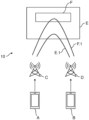
- FIG. 1 shows schematically a telecommunications system 10 according to an embodiment of the invention.
- This illustration also explains a method for dealing with a fault in a mobile radio connection in a mobile radio network according to an embodiment of the invention.
- Figure 1 shows two mobile communication devices A and B (in this case two mobile phones or smartphones), each of which is assigned to a user of the communication devices A or B (not shown).
- the invention is not necessarily limited to two mobile communication devices.
- One of the communication devices can be a mobile communication device, while another can be a stationary communication device (not shown).
- the communication device A is connected to a cell tower C of a first radio cell of the mobile network.
- the communication device B is connected to a cell tower D of a second radio cell of the mobile network.
- the first radio cell and the second radio cell can be different radio cells of the mobile network as shown here.
- the first cell tower C supplies the first radio cell and the second cell tower D supplies the second radio cell.
- the invention is not necessarily limited to two different radio cells, so that the communication devices between which a mobile connection exists can also be located in the same radio cell.
- a mobile radio connection E.1 between communication devices A and B is therefore, for example, a voice connection, but is not necessarily limited to voice connections.
- the mobile radio connection E.1 could also be a data connection between communication devices A and B.
- a backbone E of the mobile network establishes the mobile connection E.1 between the two mobile phone masts C and D or the two communication devices A and B, so that the users of the respective communication devices A and B can call each other.
- the signal quality or mobile radio connection of the communication device B with the radio cell assigned to it deteriorates or is temporarily interrupted.
- There is a disruption in the mobile radio connection E.1 between the communication devices A and B which is detected, for example, by the deteriorating signal quality, which is below a predetermined limit, and/or by the interruption of the mobile radio connection.
- This can have various reasons, e.g. an overload of the assigned radio cell or the communication device B is located in a peripheral area of the coverage area of the mobile radio area or the currently assigned radio cell.
- the backbone E of the mobile network is assigned a control unit F that is set up to carry out a method according to one of the embodiments disclosed herein.
- the control unit F provides an internal network service for handling a fault in the mobile connection E.1 in the mobile network between the mobile communication device A and the other mobile communication device B, which service is carried out on the backbone E of the mobile network.
- the poor mobile connection E.1 is detected in real time, for example with the aid of the EOTD method ("Enhanced Observed Time Difference").
- the cause of the fault is determined using available radio cell information, e.g. signal quality between the mobile communication device B and the assigned second radio cell, data load of the second radio cell, location of the mobile communication device B relative to the cell tower D, handover of the communication device B into or out of the second radio cell.
- the users of the respective communication devices A and B are informed by means of a message F.1 (in this case an SMS) in which at least the fault and the The cause of the fault can be communicated while the mobile phone connection is active to E.1. If the mobile phone connection E.1 is completely interrupted, only the mobile communication device A can be informed that the cause of the connection problem (ie the fault in the mobile phone connection) lies with the communication device B.
- F.1 in this case an SMS
- the communication device A or both communication devices A and B display the message F.1 received from the control unit F, preferably automatically, to the respective user, e.g. visually by means of a display and/or acoustically by means of an audio output, e.g. a loudspeaker.
Landscapes
- Engineering & Computer Science (AREA)
- Computer Networks & Wireless Communication (AREA)
- Signal Processing (AREA)
- Mobile Radio Communication Systems (AREA)
Abstract
Description
- Die Erfindung betrifft ein Verfahren zur Behandlung einer Störung einer Mobilfunkverbindung in einem Mobilfunknetz. Die Erfindung betrifft ferner ein Telekommunikationssystem mit einem Mobilfunknetz zur Behandlung einer Störung einer Mobilfunkverbindung.
- Obwohl heutige Telekommunikationssysteme im Allgemeinen sehr zuverlässig sind, kann es vorkommen, dass eine Mobilfunkverbindung, z. B. ein Telefongespräch, zwischen zwei Mobilgeräten, insbesondere Mobiltelefonen, vorzeitig abgebrochen wird.
- In einem drahtlosen Telekommunikationssystem, wie z. B. einem Mobilfunksystem, werden aufgebaute Telefongespräche etwas häufiger abgebrochen als in einem drahtgebundenen System. Ein Grund für unterbrochene Telefongespräche ist, dass ein an dem Telefongespräch beteiligtes drahtloses Telefon (d. h. Mobiltelefon) einen Versorgungsbereich des Mobilfunknetzes verlassen hat. Bekanntlich sind Mobilfunksysteme in Funkzellen unterteilt, in denen eine Basisstation mit den in einer jeweiligen Funkzelle befindlichen Mobiltelefonen kommuniziert. Alle Funkzellen bilden zusammen den Versorgungsbereich des zellularen Mobilfunksystems. Wenn sich ein Mobiltelefon außerhalb des Versorgungsbereichs bewegt, geht der drahtlose Kommunikationskanal, d. h. der Funkkanal, zwischen dem Mobiltelefon und dem Mobilfunknetz verloren und das über den Kommunikationskanal aufgebaute bzw. geführte Telefongespräch wird abgebrochen.
- Ein weiterer Grund, warum ein aufgebautes Telefongespräch in einem zellularen Mobilfunksystem abbrechen kann, ist das Weiterreichen (auch als Handover bezeichnet). Wenn ein Mobiltelefon von einer (augenblicklichen) Funkzelle in eine andere (neue) Funkzelle wechselt, wird das Telefongespräch von der Basisstation, die die augenblickliche Funkzelle bedient, an eine Basisstation, die die neue Funkzelle bedient, weitergereicht. In manchen Situationen kann es vorkommen, dass der Basisstation, die die neue Funkzelle bedient, zum Zeitpunkt der Weitergabe keine weiteren Funkkanäle für das weiterzureichende Telefongespräch des Mobiltelefons zur Verfügung stehen. In einem solchen Fall wird das aufgebaute Telefongespräch mit dem Mobiltelefon abgebrochen.
- Ein noch weiterer Grund für unterbrochene Telefongespräche in einem Mobilfunksystem sind Versorgungslücken im Mobilfunknetz, d. h. Bereiche im geografischen Versorgungsgebiet, die keine Signale vom Mobilfunksystem empfangen (hierin auch als Funkloch bezeichnet). Solche Versorgungslücken können sowohl in Innen- als auch Außenbereichen auftreten. Wenn sich ein Mobiltelefon in ein Funkloch bewegt, in dem kein Empfang von Signalen möglich ist, geht der Funkkanal bzw. die Funkverbindung mit der jeweiligen Basisstation verloren und das Telefongespräch wird abgebrochen.
- Unbeabsichtigt unterbrochene Telefongespräche sind für die Kommunikationspartner sehr unangenehm. Die Wiederherstellung des Telefongesprächs bleibt den Kommunikationspartnern überlassen. Die Situation des abgebrochenen Telefongesprächs wird dadurch verschlimmert, dass den Teilnehmern bzw. Kommunikationspartnern der Grund für das jeweils abgebrochene Telefongespräch nicht bekannt ist und sie deshalb auch nicht in entsprechender Weise reagieren können, um beispielsweise das Problem zu beheben. Diese abgebrochenen Telefongespräche führen häufig dazu, dass die Kommunikationspartner nicht vollständig miteinander kommunizieren können.
- Vor diesem Hintergrund liegt der Erfindung die Aufgabe zugrunde, ein verbessertes Verfahren sowie ein verbessertes Telekommunikationssystem für die Behandlung einer Störung einer Mobilfunkverbindung in einem Mobilfunknetz bereitzustellen.
- Diese Aufgabe wird durch ein Verfahren mit den Merkmalen des Anspruchs 1 sowie durch ein Telekommunikationssystem mit den Merkmalen des Anspruchs 11 gelöst. Weitere, besonders vorteilhafte Ausgestaltungen der Erfindung offenbaren die jeweiligen Unteransprüche.
- Es sei angemerkt, dass die in den Ansprüchen einzeln aufgeführten Merkmale in beliebiger, technisch sinnvoller Weise miteinander kombiniert werden können (auch über Kategoriegrenzen, beispielsweise zwischen Verfahren und Vorrichtung, hinweg) und weitere Ausgestaltungen der Erfindung aufzeigen. Die Beschreibung charakterisiert und spezifiziert die Erfindung insbesondere im Zusammenhang mit den Figuren zusätzlich.
- Es sei ferner angemerkt, dass eine hierin verwendete, zwischen zwei Merkmalen stehende und diese miteinander verknüpfende Konjunktion "und/oder" stets so auszulegen ist, dass in einer ersten Ausgestaltung des erfindungsgemäßen Gegenstands lediglich das erste Merkmal vorhanden sein kann, in einer zweiten Ausgestaltung lediglich das zweite Merkmal vorhanden sein kann und in einer dritten Ausgestaltung sowohl das erste als auch das zweite Merkmal vorhanden sein können.
- Gegenstand der Erfindung ist ein Verfahren zur Behandlung einer Störung einer Mobilfunkverbindung in einem Mobilfunknetz zwischen einem mobilen Kommunikationsgerät und einem weiteren Kommunikationsgerät.
- Das weitere Kommunikationsgerät muss nicht zwingend ein mobiles Kommunikationsgerät sein. Es kann zum Beispiel ein stationäres Kommunikationsgerät sein, wie beispielsweise ein Internet-Server o. ä. Das weitere Kommunikationsgerät kann jedoch auch ein weiteres mobiles Kommunikationsgerät sein. In einem solchen Fall gelten alle hierin genannten Bezüge auf "das mobile Kommunikationsgerät" gleichermaßen auch für das oder die weiteren mobilen Kommunikationsgeräte.
- Das erfindungsgemäße Verfahren sieht vor, dass eine Störung erkannt wird und nach dem Erkennen der Störung eine Ursache für die Störung ermittelt wird und dem mobilen Kommunikationsgerät eine Nachricht, in der die Störung und die Ursache der Störung mitgeteilt werden, gesendet wird und diese Nachricht von dem mobilen Kommunikationsgerät angezeigt wird. Insbesondere wird die Nachricht vorliegend automatisch und ohne Benutzereingriff zusammengestellt und versendet.
- Mit anderen Worten wird die Störung erkannt, indem eine zeitnahe Auswertung (vorzugsweise in Echtzeit) von Daten von Netzwerkinfrastruktursystemen zu einer Verbindungsqualität und einem Verbindungsstatus der Mobilfunkverbindung durchgeführt wird. Die Anzeige der Nachricht kann optisch (z. B. mittels eines Displays) und/oder akustisch (z. B. mittels Sprachausgabe) erfolgen. Die Anzeige erfolgt bevorzugt automatisch und ohne Benutzereingriff.
- Es ist zu verstehen, dass die Mobilfunkverbindung im Sinne der Erfindung nicht zwingend auf eine bereits zwischen den Kommunikationsgeräten bestehende Mobilfunkverbindung beschränkt ist. Als Mobilfunkverbindung im Sinne der Erfindung ist auch bereits ein Verbindungsaufbau zu verstehen, der bei einer vorhandenen Störung ohne Erfolg endet, d. h. die beabsichtigte Mobilfunkverbindung kommt zwischen den Kommunikationsgeräten nicht zustande.
- Die Erfindung verbessert den Nutzungsgrad von Mobilfunkdiensten des Mobilfunknetzes, da einem Nutzer des mobilen Kommunikationsgeräts im Falle einer Störung der Mobilfunkverbindung nun wenigstens die Ursache der Störung bekannt ist. Der Nutzer ist damit in der Lage, ggfs. Maßnahmen gegen die vorliegende Störung zu ergreifen und anschließend die Mobilfunkverbindung zwischen den Kommunikationsgeräten fortzusetzen, so dass eine vollständige Kommunikation zwischen den Kommunikationspartnern ermöglicht wird. Lässt sich die Störung durch den Nutzer nicht allein beseitigen, so kann er anhand der mitgeteilten Ursache möglicherweise einen Zeitraum abschätzen, bis die Mobilfunkverbindung erneut aufgebaut werden kann, so dass auch in diesem Fall die Kommunikation zwischen den Kommunikationspartnern so früh wie möglich fortgesetzt und vollständig durchgeführt werden kann.
- Die Erfindung schafft den Nutzern Klarheit, Transparenz und befähigt sie ggfs. zur Selbsthilfe, um die Störung zu beseitigen. Die Verfügbarkeit von Mobilfunkverbindungen im Mobilfunknetz wird erhöht.
- Die Mobilfunkverbindung kann eine Sprachverbindung (z. B. ein Telefongespräch bzw. -verbindung) oder eine Datenverbindung (z. B. eine Internet-Verbindung) sein. Die Sprachverbindung kann zwischen dem mobilen Kommunikationsgerät (z. B. Mobiltelefon) und einem stationären Kommunikationsgerät (z. B. Festnetztelefon) oder einem weiteren mobilen Kommunikationsgerät (z. B. Mobiltelefon) stattfinden. Die Datenverbindung kann zwischen dem mobilen Kommunikationsgerät (z. B. Smartphone, Tablet, tragbaren Computer u. dgl.) und einem stationären Kommunikationsgerät (z. B. Server) oder ebenfalls mit einem weiteren mobilen Kommunikationsgerät (z. B. Smartphone, Tablet, tragbaren Computer o. ä.) stattfinden.
- Die Störung kann ein Nichtzustandekommen der Mobilfunkverbindung zwischen den Kommunikationsgeräten, eine Unterbrechung einer bestehenden Mobilfunkverbindung zwischen den Kommunikationsgeräten und/oder eine Signalqualität der Mobilfunkverbindung zwischen den Kommunikationsgeräten bzw. zwischen den jeweiligen Kommunikationsgeräten und einer entsprechenden, an der Mobilfunkverbindung beteiligten Funkzelle sein, wobei die Signalqualität unterhalb eines vorbestimmbaren Grenzwerts liegt. Eine geringe Signalqualität macht sich bei Sprachverbindungen beispielsweise durch eine schlechte Verständlichkeit der Kommunikationspartner, bei Datenverbindungen durch eine niedrige Datenrate und/oder hohe Fehlerrate bei der Datenübertragung bemerkbar. Eine niedrige Datenrate kann beispielsweise durch eine Mobilfunkverbindung mit geringer Signalqualität aufgrund eines augenblicklichen Standorts des mobilen Kommunikationsgeräts und/oder durch eine hohe Datenlast in der aktuellen Funkzelle begründet sein. Die Störung wird erkannt, indem das Nichtzustandekommen der gewünschten Mobilfunkverbindung, die Unterbrechung der bestehenden Mobilfunkverbindung und/oder die unterhalb des vorbestimmten Grenzwerts liegende Signalqualität der Mobilfunkverbindung festgestellt wird.
- Gemäß einer bevorzugten Ausführungsform wird die Nachricht in Form einer SMS (Short Message Service bzw. Kurznachrichtendienst) gesendet. Dieses Nachrichtenformat gewährleistet eine sichere und robuste Übertragung der Nachricht selbst unter Mobilfunkbedingungen, bei denen die Mobilfunkverbindung z. B. aufgrund einer schwachen Signalstärke bereits einer gewissen Beeinträchtigung unterliegt. Der Kurznachrichtendienst weist außerdem ein Übertragungsprotokoll mit einem geringen Overhead auf, so dass die Datenübertragung bzw. das Senden bzw. Übertragen der SMS aufgrund einer geringen Datenmenge in kürzester Zeit abgeschlossen ist. Besonders vorteilhaft ist zusätzlich, dass auf dem mobilen Kommunikationsgerät keine separate Software installiert werden muss, da der Kurznachrichtendienst gewöhnlich auf den das Mobilfunknetz nutzenden Kommunikationsgeräten ohnehin verfügbar ist.
- In weiteren vorteilhaften Ausführungsformen wird eine Möglichkeit zur Behebung der Störung ermittelt, die zusätzlich in der Nachricht mitgeteilt wird. So wird der Nutzer des mobilen Kommunikationsgeräts noch besser in die Lage versetzt, die Störung selbst zu beseitigen, um die Mobilfunkverbindung so schnell wie möglich wieder herzustellen.
- Gemäß einer weiteren Ausführungsform werden ein Standort des mobilen Kommunikationsgeräts, der Ursache der Störung ist, ermittelt und die Möglichkeit zur Behebung der Störung basierend auf dem ermittelten Standort ermittelt. Beispielsweise kann das mobile Kommunikationsgerät mittels des so genannten Verfahrens "Enhanced Observed Time Difference" (EOTD) innerhalb einer Funkzelle des Mobilfunknetzes netzseitig geortet werden. Liegt der ermittelte Standort zum Beispiel in einem Bereich unzureichender Signalqualität, kann dem Nutzer des mobilen Kommunikationsgeräts in der Nachricht mitgeteilt werden, dass eine höhere Signalqualität in einer bestimmten Entfernung vom aktuellen Standort erreicht werden kann, um die Störung der Mobilfunkverbindung zu beseitigen. Bei einer Datenverbindung kann anhand des aktuellen Standorts beispielsweise festgestellt werden, dass eine Funkzelle mit einer höheren Datenübertragungskapazität (z. B. LTE) in einer bestimmten Entfernung erreichbar ist, um die augenblickliche Störung der Mobilfunkverbindung (z. B. geringe Datenübertragungsrate) zu beseitigen.
- Nach einer noch weiteren Ausführungsform wird eine voraussichtliche Dauer der Störung ermittelt, die zusätzlich in der Nachricht mitgeteilt wird. Kann die Störung nicht durch den Nutzer des mobilen Kommunikationsgeräts beseitigt werden, erfährt er auf diese Weise jedoch, ab wann voraussichtlich die Mobilfunkverbindung wieder ohne Störung hergestellt werden kann, so dass die Kommunikation zwischen den Kommunikationsgeräten so früh wie möglich fortgesetzt werden kann.
- Zum Beispiel kann bei einem Standort des mobilen Kommunikationsgeräts, der Ursache der Störung ist (z. B. wegen eines Funklochs), eine Geschwindigkeit des mobilen Kommunikationsgeräts ermittelt werden, aus der sich die voraussichtliche Dauer der Störung (z. B. bis zum Verlassen des Funklochs) ermitteln lässt. Bei einer Mobilfunkverbindung zwischen zwei mobilen Kommunikationsgeräten kann die voraussichtliche Dauer der Störung, die durch eines der beiden mobilen Kommunikationsgeräte bedingt ist (z. B. Eintritt in ein Funkloch), dem anderen mobilen Kommunikationsgerät mitgeteilt werden. Die Geschwindigkeit kann aus Bewegungsdaten des mobilen Kommunikationsgeräts bestimmt werden, die z. B. mittels "Enhanced Observed Time Difference" (EOTD) vor dem beispielhaften Eintritt in ein Funkloch ermittelt wurden. In einem solchen Fall kann das voraussichtliche Verlassen des Funklochs anhand der Geschwindigkeit vorherbestimmt werden.
- In weiteren Ausführungsformen wird die Ursache der Störung basierend auf wenigstens einer Information von einer an der Mobilfunkverbindung beteiligten Funkzelle ermittelt, wobei die Information eine augenblickliche Signalqualität der Mobilfunkverbindung zwischen der Funkzelle und dem mobilen Kommunikationsgerät, eine augenblickliche Datenlast der Funkzelle, eine Leistungseigenschaft der Funkzelle, ein augenblicklicher Standort des mobilen Kommunikationsgeräts und/oder ein Handover-Vorgang des mobilen Kommunikationsgeräts umfasst. Der aktuelle Standort des mobilen Kommunikationsgeräts kann beispielsweise in einem Randbereich des Versorgungsbereichs oder außerhalb des Versorgungsbereichs des Mobilfunknetzes liegen. Eine hohe Datenlast der Funkzelle kann zu einer Überlastung führen, die wiederum einen Abbruch der Mobilfunkverbindung oder eine erheblich reduzierte Datenübertragungsrate zur Folge haben kann. Eine Leistungseigenschaft der Funkzelle kann beispielsweise einen Mobilfunkstandard (z. B. 2G, 3G, 4G, 5G, LTE etc.) betreffen, durch den eine maximal mögliche Datenübertragungsrate einer Datenverbindung festgelegt ist. Ein geplantes Handover, das heißt eine geplante, bei einem Wechsel des mobilen Kommunikationsgeräts von einer Funkzelle in eine andere Funkzelle erfolgende Übergabe der Mobilfunkverbindung an die andere Funkzelle , kann beispielsweise zu dem Problem führen, dass die andere Funkzelle, die die Mobilfunkverbindung übernehmen soll, augenblicklich nicht über ausreichende Kommunikationskanäle verfügt und demnach das geplante Handover nicht ausgeführt werden kann, so dass die Mobilfunkverbindung aus diesem Grund abgebrochen werden muss.
- Gemäß einer weiteren Ausführungsform wird die Störung von einer einem Backbone des Mobilfunknetzes zugeordneten Steuereinheit behandelt. Mit anderen Worten wird die Behandlung der Störung als Dienst im Backbone des Mobilfunknetzes automatisch und ohne Benutzereingriff bereitgestellt. Eine zusätzliche Bereitstellung und Installation einer speziellen Anwendungssoftware auf den Kommunikationsgeräten ist nicht erforderlich. Im Backbone sind zudem die für die erfindungsgemäße Behandlung der Störung benötigten Informationen zentral verfügbar und leicht zugänglich. Der Backbone des Mobilfunknetzes kann als die zentrale Netzwerkverbindung des gesamten Mobilfunknetzes verstanden werden. Die Steuereinheit kann beispielsweise ein Server sein, der die Netzwerkverbindungen des Mobilfunknetzes zentral steuert.
- Ferner ist Gegenstand der Erfindung ein Telekommunikationssystem mit einem Mobilfunknetz, einem mobilen Kommunikationsgerät und einem weiteren Kommunikationsgerät und einer Steuereinheit, wobei die Steuereinheit eingerichtet ist, ein Verfahren nach einer der hierin offenbarten Ausführungsformen auszuführen, das heißt wenigstens eine Störung einer Mobilfunkverbindung zwischen den Kommunikationsgeräten zu erkennen, eine Ursache für die Störung zu ermitteln und zumindest einem der wenigstens zwei Kommunikationsgeräte eine Nachricht zu senden, in der die Störung und die Ursache der Störung mitgeteilt werden.
- Es ist zu verstehen, dass bezüglich systembezogener Begriffsdefinitionen sowie der Wirkungen und Vorteile systemgemäßer Merkmale vollumfänglich auf die Offenbarung sinngemäßer Definitionen, Wirkungen und Vorteile des erfindungsgemäßen Verfahrens zurückgegriffen werden kann und umgekehrt. Auf eine Wiederholung von Erläuterungen sinngemäß gleicher Merkmale, deren Wirkungen und Vorteile kann somit zugunsten einer kompakteren Beschreibung verzichtet werden, ohne dass derartige Auslassungen als Einschränkung für einen der offenbarten Erfindungsgegenstände auszulegen wären.
- Gemäß einer Ausführungsform ist die Steuereinheit einem Backbone des Mobilfunknetzes zugeordnet. Das heißt, die Störung wird ohne Benutzereingriff automatisch vom Mobilfunknetz behandelt. Der Backbone erlaubt einen zentralen Zugriff auf alle erforderlichen Informationen zur Behandlung der Störung.
- In weiteren Ausführungsformen ist das weitere Kommunikationsgerät ein weiteres mobiles Kommunikationsgerät. In diesem Fall betrifft die Mobilfunkverbindung eine Mobilfunkverbindung zwischen wenigstens zwei unterschiedlichen mobilen Kommunikationsgeräten.
- Weitere Merkmale und Vorteile der Erfindung ergeben sich aus der folgenden Beschreibung eines nicht einschränkend zu verstehenden Ausführungsbeispiels der Erfindung, das im Folgenden unter Bezugnahme auf die Zeichnung näher erläutert wird.
- In dieser Zeichnung zeigt die einzige Figur 1 schematisch ein Telekommunikationssystem 10 nach einer Ausführungsform der Erfindung. Anhand dieser Darstellung wird ebenfalls ein Verfahren zur Behandlung einer Störung einer Mobilfunkverbindung in einem Mobilfunknetz nach einer Ausführungsform der Erfindung erläutert.
- Figur 1 sind zwei mobile Kommunikationsgeräte A und B (vorliegend zwei Mobilfunktelefone oder Smartphones) zu entnehmen, die jeweils einem nicht dargestellten Nutzer der Kommunikationsgeräte A bzw. B zugeordnet sind. Die Erfindung ist jedoch nicht zwingend auf zwei mobile Kommunikationsgeräte beschränkt. Eines der Kommunikationsgeräte kann ein mobiles Kommunikationsgerät sein, ein anderes hingegen ein stationäres Kommunikationsgerät (nicht dargestellt).
- Das Kommunikationsgerät A ist mit einem Mobilfunkmast C einer ersten Funkzelle des Mobilfunknetzes verbunden. Das Kommunikationsgerät B ist mit einem Mobilfunkmast D einer zweiten Funkzelle des Mobilfunknetzes verbunden. Die erste Funkzelle und die zweite Funkzelle können unterschiedliche Funkzellen des Mobilfunknetzes sein wie vorliegend dargestellt. Der erste Mobilfunkmast C versorgt die erste Funkzelle und der zweite Mobilfunkmast D versorgt die zweite Funkzelle. Die Erfindung ist jedoch nicht zwingend auf zwei unterschiedliche Funkzellen beschränkt, so dass sich die Kommunikationsgeräte, zwischen denen eine Mobilfunkverbindung besteht, auch in derselben Funkzelle befinden können.
- Im vorliegend dargestellten Beispiel ruft der Nutzer des Kommunikationsgeräts A den Nutzer des Kommunikationsgeräts B an. Eine Mobilfunkverbindung E.1 zwischen den Kommunikationsgeräten A und B ist daher vorliegend beispielhaft eine Sprachverbindung, ohne jedoch zwingend auf Sprachverbindungen beschränkt zu sein. Die Mobilfunkverbindung E.1 könnte ebenso eine Datenverbindung zwischen den Kommunikationsgeräten A und B sein.
- Ein Backbone E des Mobilfunknetzes stellt die Mobilfunkverbindung E.1 zwischen den beiden Mobilfunkmasten C und D bzw. den beiden Kommunikationsgeräten A und B her, so dass die Nutzer der jeweiligen Kommunikationsgeräte A und B miteinander telefonieren können.
- Beispielhaft verschlechtert sich die Signalqualität bzw. Mobilfunkverbindung des Kommunikationsgeräts B mit der ihm zugeordneten Funkzelle oder bricht kurzzeitig ab. Eine Störung der Mobilfunkverbindung E.1 zwischen den Kommunikationsgeräten A und B liegt vor, die zum Beispiel anhand der sich verschlechternden Signalqualität, die unterhalb eines vorbestimmten Grenzwerts liegt, und/oder anhand der Unterbrechung der Mobilfunkverbindung erkannt wird. Diese kann verschiedene Gründe haben, z. B. eine Überlastung der zugeordneten Funkzelle oder das Kommunikationsgerät B befindet sich in einem Randbereich des Versorgungsbereichs des Mobilfunkbereichs bzw. der augenblicklich zugeordneten Funkzelle.
- Dem Backbone E des Mobilfunknetzes ist eine Steuereinheit F zugeordnet, die eingerichtet ist, ein Verfahren nach einer der hierin offenbarten Ausführungsformen auszuführen. Die Steuereinheit F stellt einen netzinternen Dienst zur Behandlung einer Störung der Mobilfunkverbindung E.1 in dem Mobilfunknetz zwischen dem mobilen Kommunikationsgerät A und dem weiteren mobilen Kommunikationsgerät B bereit, der auf dem Backbone E des Mobilfunknetzes ausgeführt wird. Im Backbone E wird in Echtzeit beispielsweise unter Zuhilfenahme des EOTD-Verfahrens ("Enhanced Observed Time Difference") die schlechte Mobilfunkverbindung E.1 erkannt. Anhand verfügbarer Funkzellen-Informationen, z. B. Signalqualität zwischen dem mobilen Kommunikationsgerät B und der zugeordneten zweiten Funkzelle, Datenlast der zweiten Funkzelle, Standort des mobilen Kommunikationsgeräts B relativ zum Mobilfunkmast D, Handover des Kommunikationsgeräts B in oder aus der zweiten Funkzelle, wird die Ursache der Störung ermittelt.
- Die Nutzer der jeweiligen Kommunikationsgeräte A und B werden mittels einer Nachricht F.1 (vorliegend eine SMS), in der wenigstens die Störung und die Ursache der Störung mitgeteilt werden, während der aktiven Mobilfunkverbindung E.1 informiert. Bei einem vollständigen Abbruch der Mobilfunkverbindung E.1 kann ausschließlich das mobile Kommunikationsgerät A informiert werden, dass die Ursache des Verbindungsproblems (d. h. die Störung der Mobilfunkverbindung) bei dem Kommunikationsgerät B liegt.
- In jedem Fall zeigt das Kommunikationsgerät A oder beide Kommunikationsgeräte A und B die von der Steuereinheit F erhaltene Nachricht F.1, vorzugsweise automatisch, dem jeweiligen Nutzer, bspw. mittels eines Displays optisch und/oder mittels eines Audioausgangs, bspw. eines Lautsprechers, akustisch an.
-
- 10
- Telekommunikationssystem
- A
- Mobiles Kommunikationsgerät
- B
- Mobiles Kommunikationsgerät
- C
- Mobilfunkmast
- D
- Mobilfunkmast
- E
- Backbone
- E.1
- Mobilfunkverbindung
- F
- Steuereinheit
- F.1
- Nachricht
Claims (13)
- Verfahren zur Behandlung einer Störung einer Mobilfunkverbindung (E.1) in einem Mobilfunknetz zwischen einem mobilen Kommunikationsgerät (A) und einem weiteren Kommunikationsgerät (B), wobei bei dem Verfahren die Störung erkannt wird und nach dem Erkennen der Störung eine Ursache für die Störung ermittelt wird und dem mobilen Kommunikationsgerät (A, B) eine Nachricht (F.1), in der die Störung und die Ursache der Störung mitgeteilt werden, gesendet wird und diese Nachricht (F.1) von dem mobilen Kommunikationsgerät (A, B) angezeigt wird.
- Verfahren nach Anspruch 1, bei dem die Nachricht (F.1) in Form einer SMS gesendet wird.
- Verfahren nach Anspruch 1 oder 2, bei dem die Mobilfunkverbindung (E.1) eine Sprachverbindung oder eine Datenverbindung ist.
- Verfahren nach einem der vorhergehenden Ansprüche, bei dem eine Möglichkeit zur Behebung der Störung ermittelt wird, die zusätzlich in der Nachricht (F.1) mitgeteilt wird.
- Verfahren nach Anspruch 4, bei dem ein Standort des mobilen Kommunikationsgeräts (A, B), der Ursache der Störung ist, ermittelt wird und die Möglichkeit zur Behebung der Störung basierend auf dem ermittelten Standort ermittelt wird.
- Verfahren nach einem der vorhergehenden Ansprüche, bei dem eine voraussichtliche Dauer der Störung ermittelt wird, die zusätzlich in der Nachricht (F.1) mitgeteilt wird.
- Verfahren nach Anspruch 6, bei dem eine Geschwindigkeit des mobilen Kommunikationsgeräts (A, B), dessen Standort Ursache der Störung ist, ermittelt wird und die voraussichtliche Dauer der Störung basierend auf der ermittelten Geschwindigkeit ermittelt wird.
- Verfahren nach einem der vorhergehenden Ansprüche, bei dem die Störung ein Nichtzustandekommen der Mobilfunkverbindung (E.1), eine Unterbrechung einer bestehenden Mobilfunkverbindung (E.1) und/oder eine Signalqualität der Mobilfunkverbindung (E.1) unterhalb eines vorbestimmbaren Grenzwerts ist.
- Verfahren einem der vorhergehenden Ansprüche, bei dem die Ursache der Störung basierend auf wenigstens einer Information von einer an der Mobilfunkverbindung (E.1) beteiligten Funkzelle ermittelt wird, wobei die Information eine augenblickliche Signalqualität der Mobilfunkverbindung (E.1) zwischen der Funkzelle und dem mobilen Kommunikationsgerät (A, B), eine augenblickliche Datenlast der Funkzelle, eine Leistungseigenschaft der Funkzelle, ein augenblicklicher Standort des mobilen Kommunikationsgeräts (A, B) und/oder ein Handover-Vorgang des mobilen Kommunikationsgeräts (A, B) umfasst.
- Verfahren nach einem der vorhergehenden Ansprüche, bei dem die Störung von einer einem Backbone (E) des Mobilfunknetzes zugeordneten Steuereinheit (F) behandelt wird.
- Telekommunikationssystem (10) mit einem Mobilfunknetz, einem mobilen Kommunikationsgerät (A) und einem weiteren Kommunikationsgerät (B) und einer Steuereinheit (F), wobei die Steuereinheit (F) eingerichtet ist, ein Verfahren nach einem der vorhergehenden Ansprüche auszuführen.
- Telekommunikationssystem nach Anspruch 11, bei dem die Steuereinheit (F) einem Backbone (E) des Mobilfunknetzes zugeordnet ist.
- Telekommunikationssystem nach Anspruch 11 oder 12, bei dem das weitere Kommunikationsgerät (B) ein weiteres mobiles Kommunikationsgerät ist.
Priority Applications (1)
| Application Number | Priority Date | Filing Date | Title |
|---|---|---|---|
| EP23188599.7A EP4503709B1 (de) | 2023-07-31 | 2023-07-31 | Verfahren und system zur behandlung einer störung einer mobilfunkverbindung in einem mobilfunknetz |
Applications Claiming Priority (1)
| Application Number | Priority Date | Filing Date | Title |
|---|---|---|---|
| EP23188599.7A EP4503709B1 (de) | 2023-07-31 | 2023-07-31 | Verfahren und system zur behandlung einer störung einer mobilfunkverbindung in einem mobilfunknetz |
Publications (2)
| Publication Number | Publication Date |
|---|---|
| EP4503709A1 true EP4503709A1 (de) | 2025-02-05 |
| EP4503709B1 EP4503709B1 (de) | 2026-04-29 |
Family
ID=87553509
Family Applications (1)
| Application Number | Title | Priority Date | Filing Date |
|---|---|---|---|
| EP23188599.7A Active EP4503709B1 (de) | 2023-07-31 | 2023-07-31 | Verfahren und system zur behandlung einer störung einer mobilfunkverbindung in einem mobilfunknetz |
Country Status (1)
| Country | Link |
|---|---|
| EP (1) | EP4503709B1 (de) |
Citations (4)
| Publication number | Priority date | Publication date | Assignee | Title |
|---|---|---|---|---|
| EP1931122A1 (de) * | 2006-12-05 | 2008-06-11 | Research In Motion Limited | Verfahren und Vorrichtung zur Verwendung bei der Steuerung der Abtastrate bei Abtastvorgängen einer mobilen Kommunikationsvorrichtung |
| US20100120414A1 (en) * | 2001-07-06 | 2010-05-13 | At&T Mobility Ii Llc | Enhanced communication service for predicting and handling communication interruption |
| US20100124172A1 (en) * | 2008-11-17 | 2010-05-20 | Qualcomm Incorporated | Declaring radio link failure based on target-specific threshold |
| US20110283151A1 (en) * | 2004-11-16 | 2011-11-17 | Panasonic Corporation | Internet server apparatus and program causing a server apparatus to implement functions of preparation processing for direct connection of an appliance in a private network and a mobile terminal outside the private network |
-
2023
- 2023-07-31 EP EP23188599.7A patent/EP4503709B1/de active Active
Patent Citations (4)
| Publication number | Priority date | Publication date | Assignee | Title |
|---|---|---|---|---|
| US20100120414A1 (en) * | 2001-07-06 | 2010-05-13 | At&T Mobility Ii Llc | Enhanced communication service for predicting and handling communication interruption |
| US20110283151A1 (en) * | 2004-11-16 | 2011-11-17 | Panasonic Corporation | Internet server apparatus and program causing a server apparatus to implement functions of preparation processing for direct connection of an appliance in a private network and a mobile terminal outside the private network |
| EP1931122A1 (de) * | 2006-12-05 | 2008-06-11 | Research In Motion Limited | Verfahren und Vorrichtung zur Verwendung bei der Steuerung der Abtastrate bei Abtastvorgängen einer mobilen Kommunikationsvorrichtung |
| US20100124172A1 (en) * | 2008-11-17 | 2010-05-20 | Qualcomm Incorporated | Declaring radio link failure based on target-specific threshold |
Also Published As
| Publication number | Publication date |
|---|---|
| EP4503709B1 (de) | 2026-04-29 |
Similar Documents
| Publication | Publication Date | Title |
|---|---|---|
| DE69831738T2 (de) | Zellular telefonsystem und verfahren zum sanften intersystemüberreichen | |
| DE69430620T2 (de) | Verfahren zur zuteilung von sprachteilen während eines gruppenrufes | |
| DE69214772T2 (de) | Verfahren zur durchschaltung eines ankommenden rufes für ein mobil-telefon in einem zellularen mobil-telefonnetz | |
| DE10197128T5 (de) | Paging in einem Mobiltelekommunikationsnetz | |
| DE19816935A1 (de) | Dezentral gesteuertes Handover mobiler Endeinrichtungen | |
| DE60008979T2 (de) | Verfahren zur Erhaltung einer Kommunikationsverbindung in drahtlosen Netzwerkgruppen | |
| WO2004107719A1 (de) | Verfahren und vorrichtung zum abhören von teilnehmern eines telekommunikationsnetzes bei der teilnahme an gruppenrufverbindungen | |
| DE19827916A1 (de) | Verfahren und Funk-Kommunikationssystem zur Datenübertragung | |
| EP4503709B1 (de) | Verfahren und system zur behandlung einer störung einer mobilfunkverbindung in einem mobilfunknetz | |
| EP0879543B1 (de) | Verfahren zur herstellung einer sprachverbindung in einem mobilfunknetz | |
| WO2004028189A2 (de) | Verfahren zur durchführung einer übergabeprozedur in einem funkkommunikationssystem für eine paketvermittelte verbindung und dafür angepasstes funkkommunikationssystem | |
| DE60037179T2 (de) | Rundfunkeinrichtung | |
| DE102004008711A1 (de) | Verfahren zur Herstellung einer Kommunikationsverbindung in einem Kommunikationsnetz | |
| EP1736022B1 (de) | Mobiles Endgerät zum Empfang paketorientierter Rundfunksignale | |
| DE102007015916A1 (de) | Verfahren und System zur Bereitstellung von Ortsdaten in einem medienunabhängigen Hand-over-System | |
| DE112005003293B4 (de) | Verfahren zur Erleichterung einer nicht vollständig vermaschten Kommunikationssystemnetzübergangsschnittstelle | |
| WO2003009626A1 (de) | Verfahren sowie vorrichtung zur positionsbestimmung von teilnehmergeräten eines funkkommunikationssystems mit hilfe von zusätzlichen positionselementen | |
| EP1917827B1 (de) | Verfahren zum betrieb eines mobilfunknetzes und mobilfunknetz | |
| DE602006000943T2 (de) | Verfahren zur Unterbrechung eines Sprechers durch einen Zuhörer während eines Gruppenanrufes | |
| EP1513361B1 (de) | Verfahren und System für ein Handover eines Mobilgeräts zwischen einem ersten und einem zweiten Funknetz | |
| DE60210171T2 (de) | Kommunikationssysteme und Mobilstationen und Installationen zur Verwendung darin | |
| DE19855142C1 (de) | Verfahren zur Identifizierung einer mobilen Station | |
| DE60318500T2 (de) | Kommunikations-steuerentität und deren steuerungsverfahren | |
| DE102005050850B4 (de) | Verfahren zur Übertragung von Daten unmittelbar nach einem erfolgten Sprecherwechsel an zumindest einen zuhörenden Teilnehmer eines bestehenden Gruppenanrufes | |
| EP1919226B1 (de) | Verfahren zum Mitteilen von Aktivierungsinformationen über primäre PDP-Kontexte, Verfahren zum Aktivieren von primären PDP-Kontexten, sowie Telekommunikationsnetzwerk und mobiles elektronisches Endgerät |
Legal Events
| Date | Code | Title | Description |
|---|---|---|---|
| PUAI | Public reference made under article 153(3) epc to a published international application that has entered the european phase |
Free format text: ORIGINAL CODE: 0009012 |
|
| STAA | Information on the status of an ep patent application or granted ep patent |
Free format text: STATUS: REQUEST FOR EXAMINATION WAS MADE |
|
| 17P | Request for examination filed |
Effective date: 20240516 |
|
| AK | Designated contracting states |
Kind code of ref document: A1 Designated state(s): AL AT BE BG CH CY CZ DE DK EE ES FI FR GB GR HR HU IE IS IT LI LT LU LV MC ME MK MT NL NO PL PT RO RS SE SI SK SM TR |
|
| GRAP | Despatch of communication of intention to grant a patent |
Free format text: ORIGINAL CODE: EPIDOSNIGR1 |
|
| STAA | Information on the status of an ep patent application or granted ep patent |
Free format text: STATUS: GRANT OF PATENT IS INTENDED |
|
| RIC1 | Information provided on ipc code assigned before grant |
Ipc: H04W 24/04 20090101AFI20251114BHEP Ipc: H04W 24/08 20090101ALI20251114BHEP |
|
| INTG | Intention to grant announced |
Effective date: 20251208 |
|
| GRAS | Grant fee paid |
Free format text: ORIGINAL CODE: EPIDOSNIGR3 |
|
| GRAA | (expected) grant |
Free format text: ORIGINAL CODE: 0009210 |
|
| STAA | Information on the status of an ep patent application or granted ep patent |
Free format text: STATUS: THE PATENT HAS BEEN GRANTED |
|
| AK | Designated contracting states |
Kind code of ref document: B1 Designated state(s): AL AT BE BG CH CY CZ DE DK EE ES FI FR GB GR HR HU IE IS IT LI LT LU LV MC ME MK MT NL NO PL PT RO RS SE SI SK SM TR |
|
| REG | Reference to a national code |
Ref country code: CH Ref legal event code: F10 Free format text: ST27 STATUS EVENT CODE: U-0-0-F10-F00 (AS PROVIDED BY THE NATIONAL OFFICE) Effective date: 20260429 Ref country code: GB Ref legal event code: FG4D Free format text: NOT ENGLISH |
|
| REG | Reference to a national code |
Ref country code: IE Ref legal event code: FG4D Free format text: LANGUAGE OF EP DOCUMENT: GERMAN |
|
| REG | Reference to a national code |
Ref country code: DE Ref legal event code: R096 Ref document number: 502023003889 Country of ref document: DE |