EP4501219A2 - Austauschbare sensorsysteme - Google Patents
Austauschbare sensorsysteme Download PDFInfo
- Publication number
- EP4501219A2 EP4501219A2 EP24205870.9A EP24205870A EP4501219A2 EP 4501219 A2 EP4501219 A2 EP 4501219A2 EP 24205870 A EP24205870 A EP 24205870A EP 4501219 A2 EP4501219 A2 EP 4501219A2
- Authority
- EP
- European Patent Office
- Prior art keywords
- sensor
- modular
- transmitter
- subject
- modular sensor
- Prior art date
- Legal status (The legal status is an assumption and is not a legal conclusion. Google has not performed a legal analysis and makes no representation as to the accuracy of the status listed.)
- Pending
Links
Images






Classifications
-
- A—HUMAN NECESSITIES
- A61—MEDICAL OR VETERINARY SCIENCE; HYGIENE
- A61B—DIAGNOSIS; SURGERY; IDENTIFICATION
- A61B5/00—Measuring for diagnostic purposes; Identification of persons
- A61B5/145—Measuring characteristics of blood in vivo, e.g. gas concentration or pH-value ; Measuring characteristics of body fluids or tissues, e.g. interstitial fluid or cerebral tissue
- A61B5/14507—Measuring characteristics of blood in vivo, e.g. gas concentration or pH-value ; Measuring characteristics of body fluids or tissues, e.g. interstitial fluid or cerebral tissue specially adapted for measuring characteristics of body fluids other than blood
-
- A—HUMAN NECESSITIES
- A61—MEDICAL OR VETERINARY SCIENCE; HYGIENE
- A61B—DIAGNOSIS; SURGERY; IDENTIFICATION
- A61B5/00—Measuring for diagnostic purposes; Identification of persons
- A61B5/0002—Remote monitoring of patients using telemetry, e.g. transmission of vital signals via a communication network
- A61B5/0015—Remote monitoring of patients using telemetry, e.g. transmission of vital signals via a communication network characterised by features of the telemetry system
- A61B5/0024—Remote monitoring of patients using telemetry, e.g. transmission of vital signals via a communication network characterised by features of the telemetry system for multiple sensor units attached to the patient, e.g. using a body or personal area network
-
- A—HUMAN NECESSITIES
- A61—MEDICAL OR VETERINARY SCIENCE; HYGIENE
- A61B—DIAGNOSIS; SURGERY; IDENTIFICATION
- A61B5/00—Measuring for diagnostic purposes; Identification of persons
- A61B5/08—Measuring devices for evaluating the respiratory organs
- A61B5/082—Evaluation by breath analysis, e.g. determination of the chemical composition of exhaled breath
-
- A—HUMAN NECESSITIES
- A61—MEDICAL OR VETERINARY SCIENCE; HYGIENE
- A61B—DIAGNOSIS; SURGERY; IDENTIFICATION
- A61B5/00—Measuring for diagnostic purposes; Identification of persons
- A61B5/145—Measuring characteristics of blood in vivo, e.g. gas concentration or pH-value ; Measuring characteristics of body fluids or tissues, e.g. interstitial fluid or cerebral tissue
- A61B5/14507—Measuring characteristics of blood in vivo, e.g. gas concentration or pH-value ; Measuring characteristics of body fluids or tissues, e.g. interstitial fluid or cerebral tissue specially adapted for measuring characteristics of body fluids other than blood
- A61B5/1451—Measuring characteristics of blood in vivo, e.g. gas concentration or pH-value ; Measuring characteristics of body fluids or tissues, e.g. interstitial fluid or cerebral tissue specially adapted for measuring characteristics of body fluids other than blood for interstitial fluid
-
- A—HUMAN NECESSITIES
- A61—MEDICAL OR VETERINARY SCIENCE; HYGIENE
- A61B—DIAGNOSIS; SURGERY; IDENTIFICATION
- A61B5/00—Measuring for diagnostic purposes; Identification of persons
- A61B5/145—Measuring characteristics of blood in vivo, e.g. gas concentration or pH-value ; Measuring characteristics of body fluids or tissues, e.g. interstitial fluid or cerebral tissue
- A61B5/14532—Measuring characteristics of blood in vivo, e.g. gas concentration or pH-value ; Measuring characteristics of body fluids or tissues, e.g. interstitial fluid or cerebral tissue for measuring glucose, e.g. by tissue impedance measurement
-
- A—HUMAN NECESSITIES
- A61—MEDICAL OR VETERINARY SCIENCE; HYGIENE
- A61B—DIAGNOSIS; SURGERY; IDENTIFICATION
- A61B5/00—Measuring for diagnostic purposes; Identification of persons
- A61B5/145—Measuring characteristics of blood in vivo, e.g. gas concentration or pH-value ; Measuring characteristics of body fluids or tissues, e.g. interstitial fluid or cerebral tissue
- A61B5/14546—Measuring characteristics of blood in vivo, e.g. gas concentration or pH-value ; Measuring characteristics of body fluids or tissues, e.g. interstitial fluid or cerebral tissue for measuring analytes not otherwise provided for, e.g. ions, cytochromes
-
- A—HUMAN NECESSITIES
- A61—MEDICAL OR VETERINARY SCIENCE; HYGIENE
- A61B—DIAGNOSIS; SURGERY; IDENTIFICATION
- A61B5/00—Measuring for diagnostic purposes; Identification of persons
- A61B5/24—Detecting, measuring or recording bioelectric or biomagnetic signals of the body or parts thereof
-
- A—HUMAN NECESSITIES
- A61—MEDICAL OR VETERINARY SCIENCE; HYGIENE
- A61B—DIAGNOSIS; SURGERY; IDENTIFICATION
- A61B5/00—Measuring for diagnostic purposes; Identification of persons
- A61B5/41—Detecting, measuring or recording for evaluating the immune or lymphatic systems
- A61B5/411—Detecting or monitoring allergy or intolerance reactions to an allergenic agent or substance
-
- A—HUMAN NECESSITIES
- A61—MEDICAL OR VETERINARY SCIENCE; HYGIENE
- A61B—DIAGNOSIS; SURGERY; IDENTIFICATION
- A61B5/00—Measuring for diagnostic purposes; Identification of persons
- A61B5/68—Arrangements of detecting, measuring or recording means, e.g. sensors, in relation to patient
- A61B5/6801—Arrangements of detecting, measuring or recording means, e.g. sensors, in relation to patient specially adapted to be attached to or worn on the body surface
- A61B5/6802—Sensor mounted on worn items
- A61B5/681—Wristwatch-type devices
-
- A—HUMAN NECESSITIES
- A61—MEDICAL OR VETERINARY SCIENCE; HYGIENE
- A61B—DIAGNOSIS; SURGERY; IDENTIFICATION
- A61B5/00—Measuring for diagnostic purposes; Identification of persons
- A61B5/68—Arrangements of detecting, measuring or recording means, e.g. sensors, in relation to patient
- A61B5/6801—Arrangements of detecting, measuring or recording means, e.g. sensors, in relation to patient specially adapted to be attached to or worn on the body surface
- A61B5/683—Means for maintaining contact with the body
- A61B5/6832—Means for maintaining contact with the body using adhesives
- A61B5/6833—Adhesive patches
-
- A—HUMAN NECESSITIES
- A61—MEDICAL OR VETERINARY SCIENCE; HYGIENE
- A61B—DIAGNOSIS; SURGERY; IDENTIFICATION
- A61B2560/00—Constructional details of operational features of apparatus; Accessories for medical measuring apparatus
- A61B2560/04—Constructional details of apparatus
- A61B2560/0443—Modular apparatus
-
- A—HUMAN NECESSITIES
- A61—MEDICAL OR VETERINARY SCIENCE; HYGIENE
- A61B—DIAGNOSIS; SURGERY; IDENTIFICATION
- A61B2562/00—Details of sensors; Constructional details of sensor housings or probes; Accessories for sensors
- A61B2562/02—Details of sensors specially adapted for in-vivo measurements
- A61B2562/0285—Nanoscale sensors
-
- A—HUMAN NECESSITIES
- A61—MEDICAL OR VETERINARY SCIENCE; HYGIENE
- A61B—DIAGNOSIS; SURGERY; IDENTIFICATION
- A61B2562/00—Details of sensors; Constructional details of sensor housings or probes; Accessories for sensors
- A61B2562/12—Manufacturing methods specially adapted for producing sensors for in-vivo measurements
-
- A—HUMAN NECESSITIES
- A61—MEDICAL OR VETERINARY SCIENCE; HYGIENE
- A61B—DIAGNOSIS; SURGERY; IDENTIFICATION
- A61B2562/00—Details of sensors; Constructional details of sensor housings or probes; Accessories for sensors
- A61B2562/16—Details of sensor housings or probes; Details of structural supports for sensors
- A61B2562/164—Details of sensor housings or probes; Details of structural supports for sensors the sensor is mounted in or on a conformable substrate or carrier
-
- A—HUMAN NECESSITIES
- A61—MEDICAL OR VETERINARY SCIENCE; HYGIENE
- A61B—DIAGNOSIS; SURGERY; IDENTIFICATION
- A61B5/00—Measuring for diagnostic purposes; Identification of persons
- A61B5/145—Measuring characteristics of blood in vivo, e.g. gas concentration or pH-value ; Measuring characteristics of body fluids or tissues, e.g. interstitial fluid or cerebral tissue
- A61B5/14507—Measuring characteristics of blood in vivo, e.g. gas concentration or pH-value ; Measuring characteristics of body fluids or tissues, e.g. interstitial fluid or cerebral tissue specially adapted for measuring characteristics of body fluids other than blood
- A61B5/14517—Measuring characteristics of blood in vivo, e.g. gas concentration or pH-value ; Measuring characteristics of body fluids or tissues, e.g. interstitial fluid or cerebral tissue specially adapted for measuring characteristics of body fluids other than blood for sweat
Definitions
- Non-invasive, quick, and convenient ways of sensing signals is increasingly becoming an area of interest for healthcare, in the clinical setting or for general consumer markets.
- conventional monitoring systems may lack the ability (e.g., sensitivity, specificity, etc) to detect diseases and/or body physiology, or the convenience demanded in today's world.
- invasive methods may be necessary, or blood or urine may be required for monitoring.
- Embodiments disclosed herein provide devices, systems, and methods for monitoring physiological signals.
- Disposable or replaceable sensors may be utilized in monitoring physiological signals with high sensitivity and/or specificity.
- Various physiological signals including glucose or lactic acid may be monitored conveniently, and in real time with no inconvenience to a user.
- a user may wear device (e.g., a patch or a small attachment such as a wrist strap) anywhere on their body (e.g., as a wrist band) and the device may monitor and detect sweat to screen for physiological signals.
- Small disposable or replaceable sensors may beneficially be provided that may be coupled and uncoupled from the device such that signals may be monitored accurately and conveniently.
- a modular sensor may comprise: a substrate; a plurality of contact electrodes provided on a surface of the substrate; and a plurality of sensing lines disposed between the plurality of contact electrodes to collectively form a plurality of sensor elements, wherein each sensor element comprises at least one sensing line extending longitudinally between a pair of contact electrodes, wherein the modular sensor is configured to be operably and releasably coupled to a device for use as a sensing apparatus.
- the modular sensor is configured to function as an active sensing unit when electronically coupled to the device. In some embodiments, the modular sensor is configured to fit within a recessed housing on the device. In some embodiments, the modular sensor is protected by the recessed housing. In some embodiments, the substrate comprises a ferrous metal or alloy, and the device comprises a magnetic material. In some embodiments, the modular sensor is configured to be coupled and held in place on the device via an attractive force between the magnetic material and the ferrous metal or alloy.
- At least one of the plurality of sensing lines comprises a nanoscale material. In some embodiments, at least one of the plurality of sensing lines comprises graphene. In some embodiments, the plurality of sensing lines each comprises graphene. In some embodiments, the plurality of sensor elements is configured to detect one or more markers in a fluid. In some embodiments, the plurality of sensor elements is configured to detect one or more biomarkers in a biological fluid of a subject. In some embodiments, the plurality of sensor elements is configured to detect a same biomarker.
- the biological fluid comprises sweat or interstitial fluid obtained via the surface of the skin. In some embodiments, the biological fluid comprises breath or lung originated water vapor obtained from exhaling on the device. In some embodiments, each of the plurality of sensor elements is configured to detect a different biomarker. In some embodiments, the plurality of sensor elements is configured operate in a multichannel multiplexed configuration.
- the one or more biomarkers comprises an electrolyte, glucose, lactic acid, IL6, a cytokine, HER2, Cortisol, ZAG, cholesterol, vitamins, a protein, a drug molecule, a metabolite, a peptide, an amino acid, a DNA, an RNA, an aptamer, an enzyme, a biomolecule, a chemical molecule, a synthetic molecule, or combinations thereof.
- the one or more biomarkers comprises an electrolyte, glucose, and lactic acid.
- the biological fluid sample comprises sweat, breath, saliva, earwax, urine, semen, blood plasma, a bio-fluid, a chemical fluid, an air sample, a gas sample, or a combination thereof.
- the biological fluid sample comprises sweat or breath.
- the plurality of sensor elements is configured to detect the one or more biomarkers when in contact with the biological fluid sample. In some embodiments, the plurality of sensor elements is capable of detecting the one or more biomarkers in a non-invasive manner, without requiring penetration of the subject's skin to extract the biological fluid sample.
- the plurality of sensor elements is configured to detect a presence and concentration of the one or more biomarkers substantially in real-time when the device is being worn on the subject or in proximity to the subject.
- data indicative of the presence and concentrations of the one or more biomarkers is collected and stored by the device.
- the data is collected and stored on the device over a time period that the device is being worn on the subject or in proximity to the subject.
- the modular sensor is configured to be operably and releasably coupled to the device without the use of tools. In some embodiments, the modular sensor is configured to be operably and releasably coupled to the device in less than 10 seconds.
- a sensing apparatus may comprise: a plurality of modular sensors configured to detect one or more biomarkers in a biological fluid sample of a subject when the device is being worn by the subject or in proximity to the subject; and a device configured to interchangeably and releasably couple to a modular sensor selected from the plurality of modular sensors, wherein the device is configured to receive,store, and send sensing signals from the modular sensor.
- the device comprises a transmitter configured to transmit the sensing signals over a network.
- the transmitter is configured to transmit the sensing signals to a mobile device that is associated with and in proximity to the subject.
- the device comprises a recessed housing configured to receive and support the modular sensor.
- the device is releasably coupled to the modular sensor via a magnetic attachment mechanism.
- the magnetic attachment mechanism comprises a magnetic material provided on at least one of the modular sensor and the device, and a ferrous metal or alloy provided on at least one of the modular sensor and the device.
- the device is configured to be releasably coupled to a strap or patch, wherein the strap or patch is configured to be worn on a portion of the subject's body.
- the plurality of modular sensors comprises at least one graphene-based sensor.
- the device may comprise: a processing module configured to operably couple to at least one sensor selected from a group consisting of a plurality of discrete biological or chemical sensors, wherein two or more different sensors for detecting two or more different target analytes are interchangeably and releasably attachable to the device, depending on a type(s) of target analytes to be detected from a sample of a subject collected on the device when the subject is wearing the device or in proximity to the device.
- a processing module configured to operably couple to at least one sensor selected from a group consisting of a plurality of discrete biological or chemical sensors, wherein two or more different sensors for detecting two or more different target analytes are interchangeably and releasably attachable to the device, depending on a type(s) of target analytes to be detected from a sample of a subject collected on the device when the subject is wearing the device or in proximity to the device.
- the sample comprises sweat, saliva, breath, blood, or other biological fluids of the subject.
- the different target analytes comprise different biomarkers and/or chemical agents.
- the biomarkers are selected from the group consisting of electrolytes, glucose, and lactic acid.
- at least one of the sensors is configured to measure a pH or ionic concentration of the sample.
- at least one of the sensors comprises a graphene-based sensor.
- the plurality of discrete sensors are heterogeneous sensors comprising (i) at least one graphene-based sensor and (ii) at least one non graphene-based sensor.
- the processing module is configured to detect and monitor levels of a first target analyte when a first sensor specific to the first target analyte is attached to the device. In some embodiments, the processing module is configured to switch to detection and monitoring of a second target analyte when the first sensor is detached from the device and replaced by a second sensor specific to the second target analyte. In some embodiments, the processing module is located onboard the device, and configured to process sensor data substantially in real-time as the data is being collected by the at least one sensor, in order to detect and monitor levels of one or more target analytes. In some embodiments, the device comprises a graphical display for displaying the detected levels of the one or more target analytes.
- the processing module is configured to transmit the processed sensor data to a remote device, server or third party entity.
- the processing module comprises a recommendation engine configured to prescribe certain corrective or mitigative actions to the subject, based on the detected levels of the one or more target analytes.
- a modular sensing kit may comprise (1) the device and (2) the plurality of discrete biological or chemical sensors of claim on any aspect or embodiment.
- a quick release mechanism provided on the device allows different discrete sensors to be manually attached and detached from the device without the use of tools.
- the plurality of discrete sensors are provided separately from the device.
- one or more of the discrete sensors is configured for a single use with the device, and discarded after each use encounter by the subject.
- one or more of the discrete sensors is configured for multiple uses with the device, and capable of being recycled and reused in multiple use encounters by the subject.
- the plurality of discrete sensors have different sensitivities to a same target analyte or different target analytes.
- the plurality of discrete sensors comprises a first sensor and a second sensor both configured to detect a target analyte, wherein the first sensor has a higher sensitivity than the second sensor.
- the first sensor is capable of detecting a substantially lower level or concentration of the target analyte compared to the second sensor.
- the device may comprise: a processing module operably coupled to three or more different discrete biological or chemical sensors, wherein the processing module is configured to selectively activate the three or more different discrete biological or chemical sensors in different multiplexed configurations depending on desired type(s) of sensing application of a subject.
- the different multiplexed configurations permit a plurality of different target analytes to be detected from a sample of the subject collected on the device when the subject is wearing the device or in proximity to the device. In some embodiments, the different multiplexed configurations enable increased sensitivity in the detection and monitoring of different target analytes. In some embodiments, the processing module is configured to selectively activate a fewer number of the biological or chemical sensors to reduce power consumption of the device. In some embodiments, the processing module is configured to selectively activate a greater number of the biological or chemical sensors to enhance sensitivity in the detection and monitoring of different target analytes.
- the three or more discrete sensors comprises a first sensor for detecting a first target analyte, a second sensor for detecting a second target analyte, and a third sensor for detecting a third target analyte.
- the processing module is configured to selectively activate at least two out of the first, second and third sensors. In some embodiments, the processing module is configured to selectively activate (1) the first and second sensors in a first multiplexed configuration, (2) the second and third sensors in a second multiplexed configuration, or (3) the first and third sensors in a third multiplexed configuration.
- the processing module is capable of detecting (1) the presence and (2) concentrations ranging from 1 fg/L and above of two or more different target analytes in a sample having a volume of less than 1 ⁇ L collected from the subject on the device when the subject is wearing the device or in proximity to the device.
- the device is capable of detecting the presence and concentrations of the two or more different target analytes in less than 1 second.
- the method may comprise: providing a sensor substrate comprising at least two electrodes disposed on a surface of the substrate; depositing a layer of graphene on the surface of the sensor substrate between the at least two electrodes; metallizing at least a portion of the layer of graphene at or near the at least two electrodes; passivating at least a portion of the layer of graphene with a passivation polymer; and optionally, functionalizing at least a portion of the layer of graphene, wherein functionalizing the layer of graphene with a receptor layer, wherein the receptor layer is sensitive to a target analyte.
- the receptor layer comprises a receptor selected from group consisting of pyrene boronic acid (PBA), pyrene N-hydroxysuccinimide ester (Pyrene-NHS), organic chemicals, aromatic molecules, cyclic molecules, enzymes, proteins, antibodies, viruses, single stranded DNAs (ssDNAs), aptamers, inorganic materials, synthetic molecules, and biological molecules.
- PBA pyrene boronic acid
- Pyrene-NHS pyrene N-hydroxysuccinimide ester
- organic chemicals aromatic molecules
- cyclic molecules enzymes, proteins, antibodies, viruses, single stranded DNAs (ssDNAs), aptamers, inorganic materials, synthetic molecules, and biological molecules.
- the target analyte comprises an electrolyte, glucose, lactic acid, IL6, a cytokine, HER2, Cortisol, ZAG, cholesterol, vitamins, a protein, a drug molecule, a metabolite, a peptides, an amino acid, a DNA, an RNA, an aptamer, an enzyme, a biomolecule, a chemical molecule, a synthetic molecule, or combinations thereof.
- the substrate comprises polyamide, Polyethylene terephthalate (PET), polydimethylsiloxane (PDMS), Poly(methyl methacrylate) (PMMA), other plastics, silicon dioxide, silicon, glass, aluminum oxide, sapphire, germanium, gallium arsenide, indium phosphide, an alloy of silicon and germanium, fabrics, textiles, silk, paper, cellulose based materials, insulator, metal, semiconductor, or a combination thereof.
- the substrate is flexible.
- the passivation polymer comprises Acrylic, PMMA, silicone, polysilicone, PDMS, rubber, hotmelt co-polymers, EVA co polymers, ethylene acrylate, PET, Polyamide, PTFE, fluoropolymer, thermoplastics, gels, hydrogels, polypropylene, polyethylene, Polyolefins, polyvinyl chloride, polyesters, polyurethanes, Styrene block copolymers, Polycaprolactone, Polycarbonates, Fluoropolymers, Silicone rubbers, Thermoplastic elastomers, Polypyrrole, or a combination thereof.
- the passivation polymer is polyurethane.
- the depositing the graphene layer comprises heating the substrate beyond a fusing temperature of a functional back polymer disposed between the graphene layer and the substrate.
- the method further comprises functionalizing a first portion of the substrate near the graphene layer with a hydrophilic material.
- a second portion of the substrate near the graphene layer is not functionalized with the hydrophilic material.
- the second portion of the substrate is functionalized with a hydrophobic material.
- a modular sensor may comprise a substrate; a plurality of contact electrodes provided on a surface of the substrate; and a plurality of sensing lines disposed between the plurality of contact electrodes to collectively form a plurality of sensor elements, wherein each sensor element comprises at least one sensing line extending longitudinally between a pair of contact electrodes, wherein the modular sensor is configured to be operably and releasably coupled to a device for use as a wearable sensing apparatus.
- the modular sensor is configured to function as an active sensing unit when electronically coupled to the device. In some embodiments, the modular sensor is configured to fit within a recessed housing on the device. In some embodiments, the modular sensor is protected by the recessed housing when the device is being worn by a subject.
- the substrate comprises a ferrous metal or alloy
- the device comprises a magnetic material. In some embodiments, the modular sensor is configured to be coupled and held in place on the device via an attractive force between the magnetic material and the ferrous metal or alloy.
- at least one of the plurality of sensing lines comprises graphene. In some embodiments, the plurality of sensing lines each comprises graphene.
- the plurality of sensor elements is configured to detect one or more biomarkers in a biological fluid sample of a subject when the device is being worn by the subject. In some embodiments, the plurality of sensor elements is configured to detect a same biomarker. In some embodiments, each of the plurality of sensor elements is configured to detect a different biomarker. In some embodiments, the plurality of sensor elements is configured operate in a multichannel multiplexed configuration.
- the one or more biomarkers comprises an electrolyte, glucose, lactic acid, IL6, a cytokine, HER2, Cortisol, ZAG, cholesterol, vitamins, a protein, a drug molecule, a metabolite, a peptide, an amino acid, a DNA, an RNA, an aptamer, an enzyme, a biomolecule, a chemical molecule, a synthetic molecule, or combinations thereof.
- the one or more biomarkers comprises an electrolyte, glucose, and lactic acid.
- the biological fluid sample comprises sweat, breath, saliva, earwax, urine, semen, blood plasma, a bio-fluid, a chemical fluid, an air sample, a gas sample, or a combination thereof.
- the biological fluid sample comprises sweat or breath.
- the plurality of sensor elements is configured to detect the one or more biomarkers when in contact with the biological fluid sample.
- the plurality of sensor elements is capable of detecting the one or more biomarkers in a non-invasive manner, without requiring penetration of the subject's skin to extract the biological fluid sample.
- the plurality of sensor elements is configured to detect a presence and concentration of the one or more biomarkers substantially in real-time when the device is being worn on the subject.
- data indicative of the presence and concentrations of the one or more biomarkers is collected and stored by the device.
- the data is collected and stored on the device over a time period that the device is being worn on the subject.
- the modular sensor is configured to be operably and releasably coupled to the device without the use of tools.
- the modular sensor is configured to be operably and releasably coupled to the device in less than 10 seconds.
- the wearable sensing apparatus may comprise a plurality of modular sensors configured to detect one or more biomarkers in a biological fluid sample of a subject when the device is being worn by the subject; and a device configured to interchangeably and releasably couple to a modular sensor selected from the plurality of modular sensors, wherein the device is configured to receive and store sensing signals from the modular sensor.
- the device comprises a transmitter configured to transmit the sensing signals over a network.
- the transmitter is configured to transmit the sensing signals to a mobile device that is associated with and in proximity to the subject.
- the device comprises a recessed housing configured to receive and support the modular sensor.
- the device is releasably coupled to the modular sensor via a magnetic attachment mechanism.
- the magnetic attachment mechanism comprises a magnetic material provided on at least one of the modular sensor and the device, and a ferrous metal or alloy provided on at least one of the modular sensor and the device.
- the device is configured to be releasably coupled to a strap, wherein the strap is configured to be worn on a portion of the subject's body.
- the plurality of modular sensors comprises at least one graphene-based sensor.
- the wearable device may comprise a processing module configured to operably couple to at least one sensor selected from a group consisting of a plurality of discrete biological or chemical sensors, wherein two or more different sensors for detecting two or more different target analytes are interchangeably and releasably attachable to the wearable device, depending on a type(s) of target analytes to be detected from a sample of a subject collected on the wearable device when the subject is wearing the device.
- the sample comprises sweat, saliva, breath, blood, or other biological fluids of the subject.
- the different target analytes comprise different biomarkers and/or chemical agents.
- the biomarkers are selected from the group consisting of electrolytes, glucose, and lactic acid.
- at least one of the sensors is configured to measure a pH or ionic concentration of the sample.
- at least one of the sensors comprises a graphene-based sensor.
- the plurality of discrete sensors are heterogeneous sensors comprising (i) at least one graphene-based sensor and (ii) at least one non graphene-based sensor.
- the processing module is configured to detect and monitor levels of a first target analyte when a first sensor specific to the first target analyte is attached to the wearable device. In some embodiments, the processing module is configured to switch to detection and monitoring of a second target analyte when the first sensor is detached from the wearable device and replaced by a second sensor specific to the second target analyte. In some embodiments, the processing module is located onboard the wearable device, and configured to process sensor data substantially in real-time as the data is being collected by the at least one sensor, in order to detect and monitor levels of one or more target analytes.
- the wearable device comprises a graphical display for displaying the detected levels of the one or more target analytes.
- the processing module is configured to transmit the processed sensor data to a remote device, server or third party entity.
- the processing module comprises a recommendation engine configured to prescribe certain corrective or mitigative actions to the subject, based on the detected levels of the one or more target analytes.
- the modular sensing kit may comprise (1) the wearable device and (2) the plurality of discrete biological or chemical sensors of any embodiment disclosed herein.
- a quick release mechanism provided on the wearable device allows different discrete sensors to be manually attached and detached from the wearable device without the use of tools.
- the plurality of discrete sensors are provided separately from the wearable device.
- one or more of the discrete sensors is configured for a single use with the wearable device, and discarded after each use encounter by the subject.
- one or more of the discrete sensors is configured for multiple uses with the wearable device, and capable of being recycled and reused in multiple use encounters by the subject.
- the plurality of discrete sensors have different sensitivities to a same target analyte or different target analytes.
- the plurality of discrete sensors comprises a first sensor and a second sensor both configured to detect a target analyte, wherein the first sensor has a higher sensitivity than the second sensor.
- the first sensor is capable of detecting a substantially lower level or concentration of the target analyte compared to the second sensor.
- the wearable device may comprise a processing module operably coupled to three or more different discrete biological or chemical sensors, wherein the processing module is configured to selectively activate the three or more different discrete biological or chemical sensors in different multiplexed configurations depending on desired type(s) of sensing application of a subject.
- the different multiplexed configurations permit a plurality of different target analytes to be detected from a sample of the subject collected on the wearable device when the subject is wearing the device.
- the different multiplexed configurations enable increased sensitivity in the detection and monitoring of different target analytes.
- the processing module is configured to selectively activate a fewer number of the biological or chemical sensors to reduce power consumption of the wearable device. In some embodiments, the processing module is configured to selectively activate a greater number of the biological or chemical sensors to enhance sensitivity in the detection and monitoring of different target analytes. In some embodiments, the three or more discrete sensors comprises a first sensor for detecting a first target analyte, a second sensor for detecting a second target analyte, and a third sensor for detecting a third target analyte.
- the processing module is configured to selectively activate at least two out of the first, second and third sensors. In some embodiments, the processing module is configured to selectively activate (1) the first and second sensors in a first multiplexed configuration, (2) the second and third sensors in a second multiplexed configuration, or (3) the first and third sensors in a third multiplexed configuration. In some embodiments, the processing module is capable of detecting (1) the presence and (2) concentrations ranging from 1 femtogram per liter (fg/L) and above of two or more different target analytes in a sample having a volume of less than 1 microliters ( ⁇ L) collected from the subject on the wearable device when the subject is wearing the device. In some embodiments, the wearable device is capable of detecting the presence and concentrations of the two or more different target analytes in less than 1 second.
- fg/L femtogram per liter
- ⁇ L microliters
- the method may comprise: providing a sensor substrate comprising at least two electrodes disposed on a surface of the substrate; depositing a layer of graphene on the surface of the sensor substrate between the at least two electrodes; metallizing at least a portion of the layer of graphene at or near the at least two electrodes; passivating at least a portion of the layer of graphene with a passivation polymer; and optionally, functionalizing at least a portion of the layer of graphene, wherein functionalizing the layer of graphene with a receptor layer, wherein the receptor layer is sensitive to a target analyte.
- the receptor layer comprises a receptor selected from group consisting of pyrene boronic acid (PBA), pyrene N-hydroxysuccinimide ester (Pyrene-NHS), organic chemicals, aromatic molecules, cyclic molecules, enzymes, proteins, antibodies, viruses, single stranded DNAs (ssDNAs), aptamers, inorganic materials, synthetic molecules, and biological molecules.
- PBA pyrene boronic acid
- Pyrene-NHS pyrene N-hydroxysuccinimide ester
- organic chemicals aromatic molecules
- cyclic molecules enzymes, proteins, antibodies, viruses, single stranded DNAs (ssDNAs), aptamers, inorganic materials, synthetic molecules, and biological molecules.
- the target analyte comprises an electrolyte, glucose, lactic acid, IL6, a cytokine, HER2, Cortisol, ZAG, cholesterol, vitamins, a protein, a drug molecule, a metabolite, a peptides, an amino acid, a DNA, an RNA, an aptamer, an enzyme, a biomolecule, a chemical molecule, a synthetic molecule, or combinations thereof.
- the substrate comprises polyamide, Polyethylene terephthalate (PET), polydimethylsiloxane (PDMS), Poly(methyl methacrylate) (PMMA), other plastics, silicon dioxide, silicon, glass, aluminum oxide, sapphire, germanium, gallium arsenide, indium phosphide, an alloy of silicon and germanium, fabrics, textiles, silk, paper, cellulose based materials, insulator, metal, semiconductor, or a combination thereof.
- the substrate is flexible.
- the passivation polymer comprises Acrylic, PMMA, silicone, polysilicone, PDMS, rubber, hotmelt co-polymers, EVA co polymers, ethylene acrylate, PET, Polyamide, PTFE, fluoropolymer, thermoplastics, gels, hydrogels, polypropylene, polyethylene, Polyolefins, polyvinyl chloride, polyesters, polyurethanes, Styrene block copolymers, Polycaprolactone, Polycarbonates, Fluoropolymers, Silicone rubbers, Thermoplastic elastomers, Polypyrrole, or a combination thereof.
- the passivation polymer is polyurethane.
- the depositing the graphene layer comprises heating the substrate beyond a fusing temperature of a functional back polymer disposed between the graphene layer and the substrate.
- the method further comprises functionalizing a first portion of the substrate near the graphene layer with a hydrophilic material.
- a second portion of the substrate near the graphene layer is not functionalized with the hydrophilic material.
- the second portion of the substrate is functionalized with a hydrophobic material.
- a disposable sensor may be provided.
- the disposable sensor may comprise: a substrate; two or more contact electrodes disposed on a surface of the substrate; and a sensor element disposed between the two or more contact electrodes, wherein the substrate comprises a volume equal to or less than about 5 cm 3 .
- the volume is equal to or less than about 0.5 cm 3 .
- the sensor element comprises graphene.
- the sensor is configured to detect glucose, lactic acid, or other biomarkers.
- the sensor is configured to contact sweat, saliva, or breath to screen for disease or micronutrient information.
- the sensor comprises a contact area configured to come into contact with a user's fingers.
- the sensor comprises magnets.
- a transmitter may be provided.
- the transmitter may comprise: a receiving port for receiving a disposable sensor, wherein the receiving port comprises a mechanism for coupling to the disposable sensor; a processor operably coupled to the receiving port; and an outer housing.
- the mechanism comprises magnets.
- the transmitter comprises a volume equal to or less than about 100 cm3. In some embodiments, the transmitter comprises a volume equal to or less than about 50 cm3. In some embodiments, the transmitter comprises a coupling mechanism for coupling with a strap. In some embodiments, the strap is a wrist strap.
- the processor is configured to receive signals from the disposable sensor and screen for disease or micronutrient information. In some embodiments, the processor is configured to screen for disease or micronutrient information in real time.
- a system for sensing signals may comprise: a disposable sensor; a transmitter comprising a sensor receiving portion for receiving the disposable sensor; and an attachment comprising a transmitter receiving portion for receiving the transmitter.
- Non-invasive, quick, and convenient ways of sensing signals may be desired.
- signals e.g., physiological signals
- the present disclosure provides devices, systems, and methods for monitoring for physiological signals non-invasively, quickly, and conveniently with high sensitivity and/or specificity.
- the systems or devices provided herein may sense biomarkers such as glucose level or body osmolality.
- the systems or devices may non-invasively measure glucose and/or electrolytes in real time from sweat, or other bodily fluids such as saliva.
- the biological fluid comprises a solution with polar molecules, a gas with polar molecules, a target sensing analyte, or combinations thereof.
- the biological fluid comprises sweat, breath, saliva, earwax, urine, semen, blood plasma, interstitial fluid, lung-originated water vapor, a bio-fluid, a chemical fluid, an air sample, a gas sample, or a combination thereof.
- the target analyte comprises an electrolyte, glucose, lactic acid, IL6, a cytokine, HER2, Cortisol, ZAG, cholesterol, vitamins, a protein, a drug molecule, a metabolite, a peptide, an amino acid, a DNA, an RNA, an aptamer, an enzyme, a biomolecule, a chemical molecule, a synthetic molecule, or combinations thereof.
- the systems or devices may further be worn unobtrusively (e.g., everyday) in convenient patch or strap form factors.
- the devices may be worn, synced (e.g., with a server), and be used to track in real time the health or general physical state of the user.
- the user may utilize the information provided by the devices to take further action as desired.
- the system may use Bluetooth to transmit data and may interact with a user, for example, with a screen or one or more light emitting diodes (LEDs).
- the transmitter module of the system may comprise a processing module and optionally an outer housing.
- the housing may house a sensor write/readout assembly, associated electronics, communications devices and/or magnets to facilitate attachment of a sensor to the transmitter.
- the sensor may be removably coupled to the transmitter.
- the sensor a sensor substrate, electrodes, and sensor elements such as graphene.
- the weight of the biosensing system may be negligible, for example, equal to or less than about 500g, 400g, 300g, 200g, 150g, 120g, 100g, 80g, 60g, 40g, 30g, 20g, 10g, 5g, 4g, 3g, 2g, or 1g.
- the sensor may be a disposable sensor.
- the sensor may be a replaceable sensor. For example, the sensor may be used, cleaned or processed, and be used again. While disposable sensors are primarily discussed herein, it is to be understood that details and/or descriptions discussed with respect to disposable sensors may be applicable to replaceable sensors.
- the systems, devices, and methods provide non-invasive, quick, and convenient ways of sensing signals. This may be provided by a number of factors, including, but not limited to one or more of: 1) a replaceable magnetic sensor substrate, 2) a flexible printed circuit material with embedded sensor electrodes and metal vias folded around a magnetic iron sheet, 3) a sensor substrate with alternate hydrophobic and hydrophilic regions to facilitate sweat localization/absorption, 4) a metal contact and passivation layer thickness and method of application, 5) a dual conduction layer strategy - graphene, conduction layer 1, cure, conduction layer 2 and then passivation, 6) a constant current 5 to 200 micro Amps, across sensor and voltage readout 8 bit or higher/or 7) a wearable mount: band and patch.
- a biosensor of the present disclosure may detect a biological fluid.
- the biological fluid comprises a solution with polar molecules, a gas with polar molecules, a target sensing analyte, or combinations thereof.
- the biological fluid comprises sweat, breath, saliva, earwax, urine, semen, blood plasma, interstitial fluid, lung-originated water vapor, a bio-fluid, a chemical fluid, an air sample, a gas sample, or a combination thereof.
- the target analyte comprises an electrolyte, glucose, lactic acid, IL6, a cytokine, HER2, Cortisol, ZAG, cholesterol, vitamins, a protein, a drug molecule, a metabolite, a peptide, an amino acid, a DNA, an RNA, an aptamer, an enzyme, a biomolecule, a chemical molecule, a synthetic molecule, or combinations thereof.
- a biosensor of the present disclosure may be portable. In some cases, a biosensor may be in proximity to subject. In some cases, a biosensor may be carried by a user. In some cases, a biosensor may be attached to a connected device, as disclosed elsewhere herein, which may be carried by a user. In some cases, the biosensor is a wearable device which may be coupled to a user.
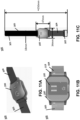
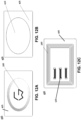
- FIG. 1A, FIG. 1B, and FIG. 1C illustrate coupling of the systems and devices of the present disclosure to a user and a connected device, in accordance with some embodiments.
- Systems and devices of the present disclosure may be biosensing systems.
- the biosensing system may be configured to monitor various physiological signals, such as glucose or lactic acid levels.
- the biosensing system may monitor electrolyte levels of a user.
- the biosensing system may monitor these signals by receiving bodily fluid such as sweat, breath, or saliva.
- the systems or devices referred herein may refer to a SweatSmart ® system.
- the SweatSmart ® system may collectively also be referred to as a SweatSmart ® device.
- the sensor may be disposable while the transmitter and the forearm attachment may not be.
- a wearable sensing apparatus may comprise a plurality of modular sensors configured to detect one or more biomarkers in a biological fluid sample of a subject when the device is being worn by the subject; and a device configured to interchangeably and releasably couple to a modular sensor selected from the plurality of modular sensors, wherein the device is configured to receive and store sensing signals from the modular sensor.
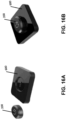
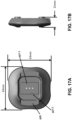
- a transmitter module 200 comprising a sensor 100 of the present disclosure may be integrated into a wearable attachment in the form of an armband 300.
- the band can be designed to be worn around the forearm, side arm, lower back, legs, etc, using a mechanism such as a Velcro or a strap mechanism.
- the bottom layer of the band can be embedded with a wavy silicone pattern to avoid slipping while on skin. Pores can be embedded into the band for breathability.
- a cavity, e.g. a hole, can be provided in the band for inserting the transmitter module 200 from the bottom side of the band.
- a transmitter module 200 comprising a sensor 100 of the present disclosure may be integrated into a wearable attachment in the form of a patch 400.
- the patch 400 may comprise an adhesive layer coupled to a mount.
- the mount may be provided with a cavity with an opening towards the skin.
- the transmitter module 200 (with the sensor 100 ) can be inserted onto the patch from the top side and fitted using mechanisms such as magnetic or mechanical mechanisms.
- the transmitter module can be snapped onto the sensor substrate (e.g., of the patch) using a combination of magnetic and mechanical forces.
- the adhesive protective film can be peeled and then placed on the skin for continuous disease monitoring from sweat. While a patch configured to receive a transmitter is described, it is to be understood that the patch may comprise an integrated transmitter as described elsewhere herein.
- the patch may be provided with a fully integrated transmitter that is not removable from the patch.
- biosensing systems utilizing a wrist strap form and a patch form are described herein, it is to be understood that the biosensing system may comprise any form.
- the biosensing system may be integrated into an arm band, a head band, a leg strap, a chest strap, an ankle band, etc.
- the biosensing system may be integrated into an article of clothing, for example, within a compression fit garment, such as a sock, a shirt, a pants, a sleeve, etc.
- the biosensing system may be utilized to monitor the skin in proximity to the ankles, calf muscles, knees, quadriceps, hamstrings, hips, obliques, ribs, intercostal muscles, sternum, clavicle, pectorals, deltoids, shoulders, latissimus dorsi, biceps, triceps, elbows, forearms, or wrists.
- the biosensor of the present disclosure may not be connected physically connected to a user.
- the biosensor may be a standalone device.
- the biosensor in some cases may be attached to a connected device, as disclosed elsewhere herein.
- a biosensor which may not be connected physically to a user may be a breath sensor.
- a biosensor which may not be connected physically to a user may be used to analyze a biological fluid which is drawn from a user (e.g. blood, amniotic fluid, etc.) and placed on a sensor such as a modular sensor.
- a biosensor may be in proximity to a user.
- a biosensor which may not be connected physically to a user may be an environmental sensor.
- transmitter module 200 with sensor 100 may be a standalone device.
- a patch system of the present disclosure may be used to attach a transmitter module 200 or an integrated transmitter module 200 to a connected device.
- a strap as disclosed herein may be utilized to attach a transmitter and sensor to a connected device.
- an attachment device of the present disclosure may be used sensor-side up in order to expose a sensor to an air-borne biological fluid, such as breath.
- a transmitter module 200 comprising a sensor of the present disclosure can be integrated with a patch 400 placed on the back of connected device 500, such as a mobile phone for breath sensing applications.
- a breath sensing system of the present disclosure may be integrated into a watch, may be independent and have clip for attachment onto a garment, may be worn on a lanyard or chain, etc.
- a modular sensor (e.g. sensor 100 ) is provided.
- the modular sensor may comprise a substrate; a plurality of contact electrodes provided on a surface of the substrate; and a plurality of sensing lines disposed between the plurality of contact electrodes to collectively form a plurality of sensor elements, wherein each sensor element comprises at least one sensing line extending longitudinally between a pair of contact electrodes, wherein the modular sensor is configured to be operably and releasably coupled to a device for use as a wearable sensing apparatus.
- the kit may comprise one or more of a wearable attachment, a sensor, and a transmitter module of the present disclosure.
- the modular sensing kit may comprise (1) the wearable device (e.g. an attachment mechanism) and (2) the plurality of discrete biological or chemical sensors (e.g. sensor 100 ) of any embodiment disclosed herein.
- a quick release mechanism provided on the wearable device allows different discrete sensors to be manually attached and detached from the wearable device without the use of tools.
- the plurality of discrete sensors are provided separately from the wearable device.
- one or more of the discrete sensors is configured for a single use with the wearable device, and discarded after each use encounter by the subject.
- one or more of the discrete sensors is configured for multiple uses with the wearable device, and capable of being recycled and reused in multiple use encounters by the subject.
- the plurality of discrete sensors have different sensitivities to a same target analyte or different target analytes.
- the plurality of discrete sensors comprises a first sensor and a second sensor both configured to detect a target analyte, wherein the first sensor has a higher sensitivity than the second sensor.
- the first sensor is capable of detecting a substantially lower level or concentration of the target analyte compared to the second sensor.
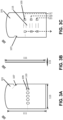
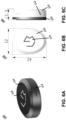
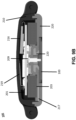
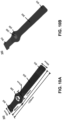
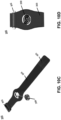
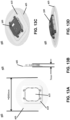
- FIG. 2 , FIG. 3A, FIG. 3B, FIG. 3C , FIG. 4A, FIG. 4B, FIG. 4C , FIG. 5A, and FIG. 5B illustrate a sensor 100, in accordance with some embodiments.
- sensor 100 is a modular sensor.
- a modular sensor may be configured to function as an active sensing unit when electronically coupled to the device.
- the modular sensor is configured to fit within a recessed housing on the device.
- the modular sensor is protected by the recessed housing when the device is being worn by a subject.
- the substrate comprises a ferrous metal or alloy
- the device comprises a magnetic material.
- the modular sensor is configured to be coupled and held in place on the device via an attractive force between the magnetic material and the ferrous metal or alloy.
- At least one of the plurality of sensing lines comprises a nanoscale material (e.g. graphene).
- the plurality of sensing lines each comprises a nanoscale material (e.g. graphene).
- the plurality of sensing lines may comprise graphene, carbon nanotubes, molybdenum sulfide, boron nitride, metal dichalcogenides, phosphorene, nanoparticles, quantum dots, fullerene, 2D nanoscale material, 3D nanoscale material, 0D nanoscale material, 1D nanoscale material, or any combination thereof.
- the plurality of sensor elements is configured to detect one or more biomarkers in a biological fluid sample of a subject when the device is being worn by the subject. In some embodiments, the plurality of sensor elements is configured to detect a same biomarker. In some embodiments, each of the plurality of sensor elements is configured to detect a different biomarker. In some embodiments, the biological fluid sample comprises sweat or breath. In some embodiments, the plurality of sensor elements is configured to detect the one or more biomarkers when in contact with the biological fluid sample.
- the plurality of sensor elements is capable of detecting the one or more biomarkers in a non-invasive manner, without requiring penetration of the subject's skin to extract the biological fluid sample.
- the plurality of sensor elements is configured to detect a presence and concentration of the one or more biomarkers substantially in real-time when the device is being worn on the subject.
- data indicative of the presence and concentrations of the one or more biomarkers is collected and stored by the device.
- the data is collected and stored on the device over a time period that the device is being worn on the subject.
- the modular sensor is configured to be operably and releasably coupled to the device without the use of tools.
- the modular sensor is configured to be operably and releasably coupled to the device in less than 10 seconds.
- the sensor may be removably coupled to the transmitter.
- the sensor a sensor substrate, electrodes, and sensor elements such as graphene.
- the weight of the biosensing system may be negligible, for example, equal to or less than about 500g, 400g, 300g, 200g, 150g, 120g, 100g, 80g, 60g, 40g, 30g, 20g, 10g, 5g, 4g, 3g, 2g, or 1g.
- the sensor may be a disposable sensor.
- the sensor may be a replaceable sensor. For example, the sensor may be used, cleaned or processed, and be used again. While disposable sensors are primarily discussed herein, it is to be understood that details and/or descriptions discussed with respect to disposable sensors may be applicable to replaceable sensors.
- FIG. 2 shows an isometric view of a sensor 100, in accordance with some embodiments.
- the sensor 100 may be configured to be removably coupled to a transmitter module 200.
- the sensor may comprise a sensor substrate 101, electrode contacts 103, sensor elements 105, and a notch 107.
- the sensor elements may comprise graphene.
- the sensor may be a non-invasive sensor and can be utilized to screen bodily fluids for disease and micronutrient information.
- the sensor can comprise a bio-chemical sensor element functionalized to detect glucose, lactic acid, electrolytes, and/or other biomarkers from sweat, breath, saliva etc.
- the sensor can comprise a minimal footprint and a small form factor.
- the senor can comprise a volume equal to or less than about 50 cm 3 , 40 cm 3 , 30 cm 3 , 20 cm 3 , 18 cm 3 , 16 cm 3 , 14 cm 3 , 12 cm 3 , 10 cm 3 , 9 cm 3 , 8 cm 3 , 7 cm 3 , 6 cm 3 , 5 cm 3 , 4 cm 3 , 3 cm 3 , 2 cm 3 , 1 cm 3 , or any volume therebetween.
- Sensor 100 may be replaceable.
- Sensor 100 may be disposable. In some instances, the sensor may be disposable while the transmitter module 200 and the wearable attachment 300 may not be.
- the sensor 100 may comprise a sensor substrate 101.
- a substrate 101 can be polyamide, Polyethylene terephthalate (PET), polydimethylsiloxane (PDMS), Poly(methyl methacrylate) (PMMA), other plastics, silicon dioxide, silicon, glass, aluminum oxide, sapphire, germanium, gallium arsenide, indium phosphide, an alloy of silicon and germanium, fabrics, textiles, silk, paper, cellulose based materials, insulator, metal, semiconductor, or any combination thereof.
- the substrate can be rigid, flexible or any combination thereof.
- the substrate can be a flexible substrate and the graphene layer can be deposited epitaxially, by exfoliation and deposition, etc.
- the sensor 100 may comprise a notch 107.
- the notch 107 may aid in the alignment of the sensor 100 with the transmitter module 200.
- the notch on the sensor substrate may aid in alignment of the sensor as it is placed into the transmitter module.
- the notch may specify a direction in which the sensor may be attached to the transmitter module, e.g., the biosensor element facing outward. Such a design can prevent any damage to the sensor element.
- FIG. 3A illustrates a top view of a sensor 100, in accordance with some embodiments.
- the sensor may comprise electrodes 109 that allow coupling with a transmitter module 200 described herein.
- the electrodes may be embedded in the substrate.
- the electrodes may comprise metal contacts.
- the electrodes of the sensor may be configured to couple to electrode contacts of a transmitter and allow electrical signals to be transmitted and/or received between the two.
- Metal contact areas can be embedded onto the back side of the substrate to allow for electrical connection to the transmitter module's sensor readout system.
- the surface area of the backside metal contacts can be fabricated larger than a pogo pin tip area on the transmitter module so as to ensure robust electrical connection between the sensor substrate and the transmitter.
- the sensor may comprise one or more magnetic components.
- the sensor substrate may itself be magnetic.
- sensor substrates may comprise embedded magnetic elements such as an embedded ferrous material.
- the substrate may comprise embedded sensor electrodes with metal vias.
- the electrodes 109 may be metal vias.
- the vias may be formed around iron or another ferrous material 110.
- the ferrous material may be a ferrous core.
- the vias may be formed around an iron sheet.
- Magnetic sensor substrates with embedded metal contacts can be formed by folding and adhesively bonding flexible printed circuits (FPC) substrates around thin iron sheets.
- FPC flexible printed circuits
- the senor may be coupled to the transmitter using one or more of the following attachment mechanisms: clips, latches, snaps, straps, tethers, tape, Velcro TM , hook and loop, tack features, screw fasteners, tabs, magnetic fasteners, or any other suitable connection mechanisms such as elastic bands and adhesives.
- the thickness, surface area and overall design of the substrate can be such that it accommodates for ease of user handling. In an example there may be additional contact surface area for picking up with fingers such that it may possible to pick up the sensor without contacting the biochemical sensor element area.
- the sensor may comprise a first dimension 111 and a second dimension 113.
- the first dimension may be between 25 millimeters (mm) and 35 mm and the second dimension may be between 15 mm and 20 mm.
- the first dimension may be between 10 millimeters (mm) and 50 mm and the second dimension may be between 5 mm and 40 mm.
- the first dimension may be between 3 millimeters (mm) and 60 mm and the second dimension may be between 1 mm and 30 mm.
- FIG. 3B illustrates a side view of a sensor 100, in accordance with some embodiments.
- Sensor 100 may comprise a first dimension 111 and a third dimension 115.
- the first dimension may be between 30 mm and 35 mm and the third dimension may be less than 1 mm.
- the first dimension may be between 10 mm and 50 mm and the third dimension may be less than 5 mm.
- FIG. 3C illustrates a bottom view of a sensor 100, in accordance with some embodiments.
- the bottom of the sensor 100 may be configured to contact a biological fluid of the present disclosure.
- sensor 100 comprises substrate 101, electrode contacts 103, and sensor element deposition areas 115.
- Sensor elements 105 may be deposited on sensor deposition areas 115.
- Sensor elements 105 may comprise embodiments, variations, and examples of a bio-sensor element as disclosed herein.
- Sensor elements 105 may comprise graphene.
- Electrode contacts 103 may allow electrical coupling between sensor elements 105 and electrodes 109, which then may allow electrical contact to transmitter 200.
- the electrode contacts 103 may be embedded in the substrate.
- the electrode contacts 103 may be metal contacts.
- the electrode contacts 103 of the sensor may be sufficiently conductive to couple to electrodes 109 and allow signals to be transmitted and/or received between the two.
- Metal contact areas can be embedded onto the substrate to allow for electrical connection to the transmitter module's sensor readout system.
- the electrode contacts one side each sensor element may be connected to a common ground.
- the common ground may be a virtual ground.
- each sensor element may be connected in parallel to individual electrodes 109 on the opposite side of the sensor. This arrangement may allow for each sensor element to be read in parallel.
- each sensor element may be multiplexed.
- three electrode contacts on a sensor 100 may comprise electrical leads 117, 119, and 121, which may each connect to three electrodes 109 on an opposing surface of the sensor.
- the ground may connect to a ground electrode on an opposing surface of the sensor.
- Each sensor element may in this fashion be connected via pogo pins to the analog to digital converter within a transmitter module 200.
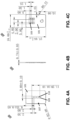
- FIG. 4A, FIG. 4B, and FIG. 4C illustrate an additional example of a sensor, in accordance with some embodiments.
- the electrodes 109 on the transmitter module facing side of the sensor may aligned perpendicularly to the long axis of the device.
- the electrode contacts and electrodes may be arranged in varying patterns and angles.
- the sensor 100 may be made smaller or larger, may be any shape, and may be of any aspect ratio.
- the sensor may be sufficient size that it may be handled by a user without touching the sensor elements 105.
- FIG. 5A and FIG. 5B illustrate an example of a sensor substrate 101 with a single sensor element 105 and an example of a sensor substrate 101 with multiplexed sensor elements 105-1, 105-2, and 105-3, in accordance with some embodiments.
- the sensor elements may be multiplexed.
- the different multiplexed configurations permit a plurality of different target analytes to be detected from a sample of the subject collected on the wearable device when the subject is wearing the device.
- the three or more discrete sensors comprises a first sensor for detecting a first target analyte, a second sensor for detecting a second target analyte, and a third sensor for detecting a third target analyte.
- Each sensor element may be configured to detect a particular target analyte.
- the sensor may detect two or more of electrolytes, glucose, lactic acid, IL6, a cytokine, HER2, Cortisol, ZAG, cholesterol, vitamins, ions, a protein, a drug molecule, a metabolite, a peptide, an amino acid, a DNA, an RNA, an aptamer, an enzyme, a biomolecule, a chemical molecule, or a synthetic molecule.
- the sensor may detect electrolytes, glucose, and lactic acid.
- the different multiplexed configurations enable increased sensitivity in the detection and monitoring of different target analytes.
- the wearable device may comprise a processing module operably coupled to three or more different discrete biological or chemical sensors.
- the processing module may be configured to selectively activate the three or more different discrete biological or chemical sensors in different multiplexed configurations depending on desired type(s) of sensing application of a subject.
- the processing module may be configured to selectively activate a fewer number of the biological or chemical sensors to reduce power consumption of the wearable device.
- the processing module may be configured to selectively activate a greater number of the biological or chemical sensors to enhance sensitivity in the detection and monitoring of different target analytes.
- the processing module is configured to selectively activate at least two out of the first, second and third sensors. In some embodiments, the processing module is configured to selectively activate (1) the first and second sensors in a first multiplexed configuration, (2) the second and third sensors in a second multiplexed configuration, or (3) the first and third sensors in a third multiplexed configuration. In some embodiments, the processing module is capable of detecting (1) the presence and (2) concentrations ranging from femtogram/liter 1 fg/L to 1,000 ng/L of two or more different target analytes in a sample having a volume of less than 100 ⁇ L collected from the subject on the wearable device when the subject is wearing the device.
- the processing module may be capable of detecting concentrations greater 1 femtogram/liter (fg/L).
- the processing module may be capable of detecting concentrations greater 250 femtogram/liter (fg/L).
- the processing module may be capable of detecting concentrations greater than 0.250 ng/L in a sample.
- the processing module may be capable of detecting concentrations greater than 0.100 ng/L in a sample.
- the processing module may be capable of detecting concentrations greater than 0.250 ng/L in a sample having a volume of less than 10 ⁇ L.
- the processing module may be capable of detecting concentrations greater than 1 fg/L in a sample having a volume of less than 1 ⁇ L.
- the processing module may be capable of detecting concentrations greater than 250 fg/L in a sample having a volume of less than 1 ⁇ L.
- the processing module may be capable of detecting concentrations greater than 0.250 ng/L in a sample having a volume of less than 1 ⁇ L.
- the processing module may be capable of detecting concentrations greater than 250 fg/L in a sample having a volume of less than 0.1 ⁇ L.
- the wearable device is capable of detecting the presence and concentrations of the two or more different target analytes in less than 1 second. In some embodiments, the wearable device is capable of detecting the presence and concentrations of the two or more different target analytes in less than 100 milliseconds. In some embodiments, the wearable device is capable of detecting the presence and concentrations of the two or more different target analytes in less than 1 millisecond.
- the sensor element (e.g., graphene or any nanoscale material layer) may be deposited on a sensor substrate.
- a sensor element of the present disclosure may comprise a field effect transistor comprising a drain electrode; a source electrode; an electrically insulating substrate; a nanoscale material layer arranged on the substrate; and a polar fluid induced gate terminal created by a polar fluid exposed to the nanoscale material layer.
- the nanoscale material layer may partially define an electrically conducting and chemically sensitive channel.
- the nanoscale material layer and the channel may extend between and be electrically connected to the drain electrode and source electrode.
- the polar fluid comprises the target analyte.
- the polar fluid has a charge concentration sufficient to induce a polar fluid gate voltage that optimizes the gate voltage versus channel current characteristics of the field effect transistor in response to the target analyte.
- a field effect transistor of the present disclosure may comprise a nanoscale material layer.
- the nanoscale material layer may comprise graphene, carbon nanotubes, molybdenum sulfide, boron nitride, metal dichalcogenides, phosphorene, nanoparticles, quantum dots, fullerene, 2D nanoscale material, 3D nanoscale material, 0D nanoscale material, 1D nanoscale material, or any combination thereof.
- a field effect transistor of the present disclosure may be a graphene field effect transistor. Any applicable method can be applied to fabricate a graphene field effect transistor, including, for example, the information disclosed in International Patent Publication No. WO2015/164,552 , which is hereby incorporated by reference in its entirety.
- Sensors of the present disclosure may comprise a gateless graphene field-effect transistor, such as those described in Published International Patent Application No. WO2017/216641 , which is incorporated herein by reference in its entirety.
- a graphene sensor electrode with a functional back-polymer can be created.
- the back-polymer material can be chosen to bond, fuse, or adhere to a target substrate, such a substrate of the present disclosure and/or a flexible printed circuit.
- the graphene/polymer composite can then bonded to a substrate 101 at a deposition area 115 between embedded metal contacts 103 by heating the substrate beyond the fusing temperature of the back polymer.
- Graphene sensors may be additionally deposited by adhesive, by mechanical fastener, by deposition followed by encapsulation, by heat curing, by gluing, etc.
- the sensor substrate with bonded graphene biosensors can then later functionalized with selective bio chemical molecules.
- the graphene layer may be functionalized with a receptor layer deposited on the nanoscale material (e.g. graphene) layer.
- the receptor layer may comprise receptors targeting a target analyte.
- the receptors may comprise pyrene boronic acid (PBA), pyrene N-hydroxysuccinimide ester (Pyrene-NHS), organic chemicals, aromatic molecules, cyclic molecules, enzymes, proteins, antibodies, viruses, single stranded DNAs (ssDNAs), aptamers, inorganic materials, synthetic molecules, biological molecules.
- the target analyte comprises an electrolyte, glucose, lactic acid, IL6, a cytokine, HER2, Cortisol, ZAG, cholesterol, vitamins, a protein, a drug molecule, a metabolite, a peptides, an amino acid, a DNA, an RNA, an aptamer, an enzyme, a biomolecule, a chemical molecule, a synthetic molecule, or combinations thereof.
- biosensors functionalized with PBA may exhibit a high sensitivity for D-glucose with a limit of detection (LOD) of 250 femtogram/liter.
- LOD limit of detection
- PBA forms a reversible boron-anion complex with D-glucose.
- biosensors may be functionalized with Lactate Oxidase (LOx) to the Graphene surface using an intermediate pyrene-NHS linking chemistry.
- the Lactate Oxidase may specifically bind to lactic acid molecules in the fluid.
- Biosensors functionalized with LOx may have a highly selective response (>94%) to Lactic concentrations in different control fluids.
- biosensors functionalized with Pyrene-NHS exhibited a high sensitivity for lactic acid with a limit of detection (LOD) of approximately 250 femtogram/liter; i.e., 2.78e-12 millimolar (mmol/L).
- LOD limit of detection
- the hydrophobicity of the graphene layer may lead to induced motion of the polar fluid over surface of biosensor.
- Increased hydrophobicity between graphene surface and the polar fluid may repel the polar fluid (like NaCl in DI water) from the graphene surface.
- the higher the concentration of the polar molecules (e.g., NaCl) in the fluid the more the repelling effect may occur.
- This effect may be used to functionalize the surface of the sensor substrate.
- a portion of the sensor substrate around the sensor deposition area may be functionalized with a hydrophilic material.
- the hydrophilic material may attract the biological fluid, e.g. sweat, toward the sensor element.
- a second portion of the sensor substrate near the sensor element may be not functionalized or may be functionalized with a hydrophobic material. The combination of these two functionalized portions may facilitate sweat localization on the sensor element and flow away from the sensor element.
- Metallization techniques can include creating metal contacts on a graphene surface using lithographic techniques including photolithography, e-beam lithography etc. However, certain metallization techniques can introduce defects, dopants, and irreversible contamination on the graphene sensors which could damage the material.
- the present disclosure provides methods to metallize graphene films to create electrical, optical or micro-electronic mechanical (MEMs) devices using printing techniques or dabbing/printing a liquid conduction paint.
- skin safe conductive paint can be first dabbed onto either edges of the graphene sensor to form a source drain structure.
- the conductive paint can be dabbed, printed, painted, or applied.
- the conductive paint may be in limited contact or no contact with the electrode to prevent contact damage.
- the conductive ink can be printed, dabbed, painted or applied such that part of the ink is disposed onto the graphene surface of sensor element 105 and part onto a metal contact layer 103 underneath the graphene surface, which may be optionally pre-embedded into the sensor substrate 101.
- the surface tension of the ink can allow it to spread over the metal contact surface underneath without leaking into the surrounding insulating flexible printed circuit area thus ensuring localization and limiting cross contamination.
- the thickness of the ink can be in the range 40 microns to 500 microns. The thickness may be adjusted depending on the required ruggedization of the sensor element for example to prevent damage to the sensor while it was in contact with the skin.
- the conduction ink thickness may be greater than 200 microns.
- the conductive ink thickness may be less than 200 microns.
- a passivation layer may be disposed on the ink.
- the ink can be then cured by baking at an elevated temperature.
- a conductive ink may be composed of a conductive material, and a binder.
- a binder may be a resin or adhesive blended with a conductive material such as gold, silver, copper, nickel or other metals or alloys.
- a conductive material may comprise a conductive particulate such as a metal particulate.
- the conductive material may comprise conductive metal nanoparticles (NPs), alloys of the conductive metals, core/shell systems, etc.
- a metal particulate may have an average size of from about 0.5 to about 10 microns and as aspect ratio of at least about 3 to 1.
- a resin or adhesive may be blended with a conductive material.
- a polymer thick film may be formed.
- a resin or adhesive may be thermosetting, such as an epoxy, an acrylic, a polyester, etc.
- the polymer may be a thermoplastic polymer, such as, polyimide siloxane, nylon, neoprene, rubber, polyvinylbutyral terpolymer, etc.
- the binder and the conductive material may be dissolved in a solvent, such as a glycol ether or similar high vapor pressure solvent configured to evaporate over time.
- a passivation polymer can be dabbed/ printed over the metal contact layer such that the disposition area of passivation polymer was more than the metal contact layer area to avoid any exposure of the metal edges.
- the thickness of the passivation polymer layer can be chosen so as to ensure a final thickness of the metal passivation layer to be at least 200 microns. Such a thickness may limit wear or damage to the graphene sensor element while the sensor is in contact with the skin.
- non-bleeding materials can be chosen as passivation polymers, e.g., Acrylic, PMMA, silicone, polysilicone, PDMS, rubber, hotmelt co-polymers, EVA co polymers, ethylene acrylate, PET, Polyamide, PTFE, fluoropolymer, thermoplastics, gels, hydrogels, polypropylene, polyethylene, Polyolefins, polyvinyl chloride, polyesters, polyurethanes, Styrene block copolymers, Polycaprolactone, Polycarbonates, Fluoropolymers, Silicone rubbers, Thermoplastic elastomers, Polypyrrole, etc.
- the passivation layer may be polyurethane.
- more than one passivation layer may be applied.
- a different passivation layer may be applied to the nanoscale material than is applied to the metalized region or the contact region.
- the passivation layer is polyurethane and PMMA. The passivation layer may additionally aid attachment of the graphene layer.
- the method may comprise: (a) providing a sensor substrate comprising at least two electrodes disposed on a surface of the substrate; (b) depositing a layer of graphene on the surface of the sensor substrate between the at least two electrodes; (c) metallizing at least a portion of the layer of graphene at or near the at least two electrodes; passivating at least a portion of the layer of graphene with a passivation polymer; and (d) optionally, functionalizing at least a portion of the layer of graphene, wherein functionalizing the layer of graphene with a receptor layer, wherein the receptor layer is sensitive to a target analyte.
- the depositing the graphene layer comprises heating the substrate beyond a fusing temperature of a functional back polymer disposed between the graphene layer and the substrate.
- the method further comprises functionalizing a first portion of the substrate near the graphene layer with a hydrophilic material.
- a second portion of the substrate near the graphene layer is not functionalized with the hydrophilic material.
- the second portion of the substrate is functionalized with a hydrophobic material.
- the transmitter module 200 may recognize sensor 100.
- the transmitter may recognize the sensor as having been reused.
- the transmitter may recognize the sensor as not being manufactured by an approved source.
- the transmitter may recognize the sensor electronically, such as by way of a "handshake".
- the transmitter may recognize the sensor by radiofrequency identification tag.
- the transmitter may recognize the sensor by physical indicia such as a pattern on the surface of the sensor.
- a wearable device may comprise a processing module configured to operably couple to at least one sensor selected from a group consisting of a plurality of discrete biological or chemical sensors, wherein two or more different sensors for detecting two or more different target analytes are interchangeably and releasably attachable to the wearable device, depending on a type(s) of target analytes to be detected from a sample of a subject collected on the wearable device when the subject is wearing the device.
- the processing module may comprise an embodiment, variation, or example of a transmitter module disclosed herein.
- the processing module is configured to detect and monitor levels of a first target analyte when a first sensor specific to the first target analyte is attached to the wearable device. In some embodiments, the processing module is configured to switch to detection and monitoring of a second target analyte when the first sensor is detached from the wearable device and replaced by a second sensor specific to the second target analyte. In some embodiments, the processing module is located onboard the wearable device, and configured to process sensor data substantially in real-time as the data is being collected by the at least one sensor, in order to detect and monitor levels of one or more target analytes.
- the wearable device comprises a graphical display for displaying the detected levels of the one or more target analytes.
- the processing module is configured to transmit the processed sensor data to a remote device, server or third party entity.
- the processing module comprises a recommendation engine configured to prescribe certain corrective or mitigative actions to the subject, based on the detected levels of the one or more target analytes.
- the device comprises a transmitter configured to transmit the sensing signals over a network.
- the transmitter is configured to transmit the sensing signals to a mobile device that is associated with and in proximity to the subject.
- the device comprises a recessed housing configured to receive and support the modular sensor.
- the device is releasably coupled to the modular sensor via a magnetic attachment mechanism.
- the magnetic attachment mechanism comprises a magnetic material provided on at least one of the modular sensor and the device, and a ferrous metal or alloy provided on at least one of the modular sensor and the device.
- the device is configured to be releasably coupled to a strap, wherein the strap is configured to be worn on a portion of the subject's body.
- the plurality of modular sensors comprises at least one graphene-based sensor.
- FIG. 6A illustrates a first example of a transmitter module 200, in accordance with embodiments.
- the transmitter may comprise a processor, or a processing module.
- the transmitter module 200 also referred to herein as a transmitter module or a processor module, may comprise an embedded sensor readout system.
- the transmitter module may have a top cover 210.
- the top cover 210 may have indentations 212 which may aid in the attachment of transmitter module 200 to a wearable attachment of the present disclosure.
- the transmitter module 200 may have decorative elements on the top cover.
- the top cover serves as a button 214.
- the button is a capacitive button.
- the top cover is compressible to provide user input to the device.
- FIG. 6B illustrates a top view of a transmitter module 200, in accordance with some embodiments.
- the overall dimensions of the transmitter may be small.
- the transmitter may comprise an overall volume equal to or less than about 500 cubic cm, 400 cubic cm, 300 cubic cm, 200 cubic cm, 150 cubic cm, 120 cubic cm, 100 cubic cm, 90 cubic cm, 80 cubic cm, 70 cubic cm, 60 cubic cm, 50 cubic cm, 40 cubic cm, 30 cubic cm, 20 cubic cm, 15 cubic cm, 10 cubic cm, 5 cubic cm, or any volume therebetween. While a transmitter having an oval shape is illustrated primarily herein, it is to be understood that the transmitter may comprise any shape, such as a circle, rectangle, etc.
- transmitter module 200 may comprise a first external dimension and second external dimension.
- the first external dimension may be 32 mm and the second external dimension may be 42 mm.
- the first external dimension may be within a range from 1 mm to 200 mm and the second external dimension may be within a range from 1mm to 200 mm.
- the first external dimension may be within a range from 5 mm to 50 mm and the second external dimension may be within a range from 10 mm to 100 mm.
- the transmitter may comprise a first exterior dimension 230, a second exterior dimension 232, and a third exterior dimension 234, shown elsewhere herein.
- FIG. 6C illustrates a side view of a transmitter module 200, in accordance with some embodiments.
- the transmitter 200 may comprise a third external dimension.
- the third external dimension may be 13.5 mm.
- the third external dimension may be less than 100 mm.
- the third external dimension may be less than 30 mm.
- the third external dimension may be within a range from 1 to 100 mm.
- FIG. 6D illustrates a bottom view of a transmitter module 200 without a sensor 100 mounted thereon, in accordance with some embodiments.
- FIG. 6E illustrates a bottom view of a transmitter 200 with a sensor module 100 mounted thereon, in accordance with some embodiments.
- the transmitter module may accommodate multiple magnets that produced sufficient force to attract the replaceable sensor substrate when brought within sufficient proximity.
- the transmitter may comprise a depression 221 on the bottom surface of the bottom cover 220 of the transmitter module. The depression may allow a sensor be attached such that a user facing surface of the sensor 100 is flush with the bottom surface of the bottom cover 220.
- the transmitter may comprise various components, such as magnets, which allow easy coupling and uncoupling with a sensor.
- the transmitter module may comprise an electrical feed through area 204, which may facilitate electrical contact between the sensor elements and a processing unit.
- FIG. 8A, FIG. 8B, and FIG. 8C illustrate a second example transmitter module 200, in accordance with some embodiments.
- FIG. 8A illustrates an example transmitter module in the form of a watch face, in accordance with some embodiments.
- Transmitter module 200 may be configured to couple with straps via strap mounts 218.
- An example, embodiment, or variation of a sensor 100 of the present disclosure may be removably coupled the transmitter module 200.
- the sensor 100 may be flush with a bottom surface 220 of the transmitter module 200. In some cases the sensor may not be flush or, for example, may be slightly above the bottom surface 220, which may aid in contact between the sensor elements and the skin.
- FIG. 8B illustrates a bottom view of a second example of a transmitter module, in accordance with some embodiments.
- the transmitter module 200 may comprise an electrical feed through portion 204 on the bottom surface 200 of the transmitter module.
- the electrical feed through portion may comprise apertures for pogopins to pass through.
- the transmitter module may comprise an electrical feed through area 204, which may facilitate electrical contact between the sensor elements and a processing unit.
- the transmitter may comprise a depression on the bottom surface of the bottom cover 220 of the transmitter module.
- FIG. 8C illustrates a top view of a second example of a transmitter module, in accordance with some embodiments.
- the size and scale of a second example of a transmitter module may substantially similar to other examples and embodiments described herein.
- the transmitter may comprise a first exterior dimension, a second exterior dimension, and a third exterior dimension, shown elsewhere herein.
- the first external dimension may be 34 mm and the second external dimension may be 37 mm.
- the first external dimension may be within a range from 1 mm to 200 mm and the second external dimension may be within a range from 1mm to 200 mm.
- the first external dimension may be within a range from 5 mm to 50 mm and the second external dimension may be within a range from 10 mm to 100 mm.
- the transmitter may comprise a third external dimension.
- the third external dimension may be 13.5 mm.
- the third external dimension may be less than 100 mm.
- the third external dimension may be less than 30 mm.
- the third external dimension may be within a range
- FIG. 7A illustrates an exploded view of the interior of a transmitter module 200, in accordance with some embodiments.
- the transmitter may comprise a top cover 210 and bottom cover 220, which together may house circuitry and other components which may used to power, control, or interface with a sensor 100 of the present disclosure.
- the top and bottom covers may be polycarbonate.
- the top and bottom covers may be plastic.
- the top and bottom covers may be colored or finished such that they are aesthetically pleasing.
- the transmitter 200 may comprise a dual battery scheme with power sharing mechanism, signal processing electronics, sensor interface electronics, ADC converters, integrated microprocessor unit (MCU) with embedded Bluetooth Low Energy (BLE) chip, antennae, and associated RF electronics.
- MCU integrated microprocessor unit
- BLE Bluetooth Low Energy
- the bottom cover 220 may comprise a seal ring 222 on an exterior surface, which may isolate electronics with the interior of the transmitter from biological fluids of the present disclosure.
- the seal ring may interface between an interior of the transmitter module and the exterior of the transmitter module via the feedthrough area 204.
- the seal ring may be made of thermoplastic polyurethane.
- the transmitter may comprise one or more magnetic elements 205 in an interior of the transmitter.
- the one or more magnetic elements may be disposed on an interior surface of the transmitter 200.
- the magnetic elements may be arranged to interface with a magnetic material on a sensor 100 of the present disclosure.
- the magnetic elements may comprise a ferrous material, such iron.
- the magnetic elements may comprise a permanent magnet.
- the magnetic material may comprise one or more of neodymium, samarium cobalt, alnico, ceramic, ferrite, iron, nickel, cobalt, or any other magnetic material.
- the magnetic material may be a permanent magnet.
- the magnetic material may be a rare Earth magnet.
- the magnetic element may be separated from one or more batteries by a spacer 211.
- the spacer may be a shock absorber.
- the spacer may comprise ethylene vinyl acetate.
- the interior of the transmitter may further comprise one or more batteries 203.
- the batteries may have a charged voltage between 2 and 4.5 Volts.
- the batteries may carry a charge between 10 and 1000 milliamp hours.
- the batteries may carry a charge greater than 10 milliamp hours.
- the batteries may be lithium ion batteries.
- the batteries may be lithium ion polymer batteries.
- transmitter 200 may comprise printed circuit board (PCB) 201.
- PCB 201 may comprise a microcontroller unit with on board CPU, memory, data storage unit, three axis accelerometer, analog to digital converter (DAC), Bluetooth radio, etc.
- the PCB 201 may be attached to the bottom cover 220 by screws 213.
- the transmitter 200 may be disassembled and reassembled.
- the transmitter 200 may not be disassembled without damage to one or more components, which may prevent tampering. While screws are provided in the illustrated embodiment, the device may be assembled using glues, solder, snaps, etc.
- FIG. 7B illustrates a side view of an interior of a transmitter 200 along a slice through the transmitter, in accordance with some embodiments.
- the various components are arranged within the housing via compact design.
- the bottom cover 220 may comprise apertures within the feedthrough area 204 sized and shaped to receive pogo pins 209.
- the pogo pins may be made of brass or another conductive material such as gold or copper.
- the pogo pins may be axially compressible.
- the pogo pins may comprise an internal spring to provide restoring force which may return the pogo pin to its original length after axial compression. Pogo pins may facilitate the absorption of excess kinetic energy of the sensor substrate as it snapped in. Pogo pins may facilitate consistent electrical connection between sensor 100 and printed circuit board 201.
- Pogo pin may comprise a long work cycle to facilitate robust electrical connections between the sensor substrate and transmitter module.
- a pogo pin system may reduce any damage to transmitter module's sensor readout assembly. As shown, the pogo pins may be disposed between the batteries 203 to facilitate compact transmitter design.
- FIG. 7C illustrates an isometric view of a transmitter 200 with a top housing removed, in accordance with some embodiments.
- PCB 201 is removed for illustrative purposes.
- the transmitter includes a display to send visual information to a user.
- the display may comprise one or more light emitting diodes (LEDs) 207.
- the one or more LEDs may display light which may provide a visual cue to a user through the top cover 210.
- the top cover 210 may comprise a transparent portion.
- the transparent portion is rectangular.
- the transparent portion is shaped like a logo.
- the one or more LED's may have one or more colors. For example, the LEDs may be blue, green, and red.
- the time duration and intensity of the LEDs may be varied to provide information to a user on the functioning or operation of the device. Multiple LEDs may be turned on at a single time in order to create a wide array of colors (e.g. a gamut).
- the LEDs may be electrically connected to PCB 201 via a serial AT attachment 215.
- FIG. 7D illustrates a top view of a transmitter 200 with a top housing removed, in accordance with some embodiments.
- FIG. 7E illustrates a side view of a transmitter 200 with top housing removed, in accordance with some embodiments.
- the transmitter 200 may comprise small dimensions.
- the transmitter may comprise a first exterior dimension 230, a second exterior dimension 232, and a third exterior dimension 234, as described elsewhere herein.
- the transmitter may have first interior dimension 231 and second interior dimension 233.
- the first interior dimension may be the length of PCB 201.
- the second interior dimension may be the width of LED 207.
- the first interior dimension may be between 30 mm and 35 mm, and the second interior dimension may be between 15 mm and 20 mm.
- the first interior dimension may be between 130 mm and 5 mm, and the second interior dimension may be between 115 mm and 2 mm.
- the first and second interior dimension may be less than the first and second exterior dimensions.
- PCB 201 includes a central processing unit (CPU, also "processor” and “computer processor” herein), which can be a single core or multi core processor, or a plurality of processors for parallel processing.
- PCB 201 also includes memory or memory location (e.g., random-access memory, read-only memory, flash memory).
- PCB 201 may include and electronic storage unit (e.g., hard disk or other non-volatile memory).
- PCB 201 may further comprise a communication interface disposed thereon (e.g., network adapter, a Bluetooth adapter, etc.) for communicating with one or more other systems, and peripheral devices.
- the memory, storage unit, communication interface and any other peripheral devices may be in communication with the CPU through a communication bus.
- the storage unit can be a data storage unit (or data repository) for storing data.
- the transmitter 200 can be operatively coupled to a computer network ("network") with the aid of the communication interface.
- the communication interface may comprise or be in communication with an onboard Bluetooth radio.
- the MCU may comprise an RF antenna.
- the network can be the Internet, an internet and/or extranet, or an intranet and/or extranet that is in communication with the Internet.
- the network in some cases is a telecommunication and/or data network.
- the network can include one or more computer servers, which can enable distributed computing, such as cloud computing.
- the network in some cases with the aid of the transmitter, can implement a peer-to-peer network, which may enable devices coupled to the device to behave as a client or a server.
- PCB 201 includes a digital to analog converter (DAC) disposed thereon.
- the DAC may convert analog data from the one or more sensor elements 105 to a digital signal.
- the DAC may receive a voltage from the one or more sensor elements.
- the DAC may digitize the voltage data with at least 8 bit resolution.
- the DAC may comprise one or more channels.
- each sensor element may be connected to a single channel on a DAC.
- each channel is read in sequence and digitized using a DAC with a single channel.
- the digitized data may compressed, down sampled, or otherwise reduced in size in order to facilitate ease of transfer.
- the control and/or operation of the DAC may be operated by way of instructions from the CPU.
- Data may be recorded continuously. In some cases, data may be recorded every 500 milliseconds (ms). In some cases, data may be recorded every 10 ms, every 20 ms, every 50 ms, every 100 ms, every 200 mx, every 500 ms, every second, ever 10 seconds, every minute, or more. Data may be recorded at interval within a range defined by any two of the preceding values. Data may be recorded for a period of time and then data collection may stop for a period of time. For instance, data may be collected for one minute, for one hour, for 2 hours, for 5 hours, for 1 day, for 5 days, for one year, or more. Data may be collected over a period of time within a range defined by any two of the preceding values. Data may be collected over a period time defined by one workout.
- PCB 201 includes a storage and/or memory device disposed thereon.
- the storage and/or memory device is one or more physical apparatuses used to store data or programs on a temporary or permanent basis.
- the device is volatile memory and requires power to maintain stored information.
- the device is non-volatile memory and retains stored information when the transmitter module is not powered.
- the non-volatile memory comprises flash memory.
- the non-volatile memory comprises dynamic random-access memory (DRAM).
- the non-volatile memory comprises ferroelectric random access memory (FRAM).
- the non-volatile memory comprises phase-change random access memory (PRAM).
- the storage and/or memory device is a combination of devices such as those disclosed herein.
- the CPU can execute a sequence of machine-readable instructions, which can be embodied in a program or software.
- the instructions may be stored in a memory location, such as the memory.
- the instructions can be directed to the CPU, which can subsequently program or otherwise configure the CPU to implement methods of the present disclosure. Examples of operations performed by the CPU can include fetch, decode, execute, and write back.
- the CPU can be part of a circuit, such as an integrated circuit.
- One or more other components disposed on PCB 201 can be included in the circuit.
- the circuit is an application specific integrated circuit (ASIC) or a field programmable gate array (FPGA).
- ASIC application specific integrated circuit
- FPGA field programmable gate array
- PCB 201 may comprise a storage unit.
- Storage unit can store files, such as drivers, libraries and saved programs.
- the storage unit can store user data, e.g., user preferences and user programs.
- the transmitter module 200 in some cases can include one or more additional data storage units that are external, such as located on a remote server that is in communication through an intranet or the Internet.
- the transmitter module 200 can communicate with one or more remote computer systems through the network, for example, via a Bluetooth connection.
- the transmitter 200 can communicate with a remote computer system of a user.
- remote computer systems include personal computers (e.g., portable PC), slate or tablet PCs (e.g., Apple ® iPad, Samsung ® Galaxy Tab), telephones, Smart phones (e.g., Apple ® iPhone, Android-enabled device, Blackberry ® ), or personal digital assistants.
- PCB 201 may comprise a three axis accelerometer disposed thereon.
- the accelerometer may be used to monitor motion of a user of the wearable device.
- a motion event detected by the accelerometer may turn on the device or start collection of data on the device. Lack of a motion event for a period of time may cause the device to enter a low power mode or turn off.
- Motion data may be logged with time to detect a correlation between the amount, type, or other quality of a biological fluid of the present disclosure with an amount or intensity of motion.
- the sensor data may be correlated with accelerometer data.
- PCB 201 may comprise a battery charging integrated circuit disposed thereon.
- the battery charging IC may monitor battery charging voltage.
- the battery charging IC may control battery charging voltage and/or current.
- the battery charging IC may prevent over charging.
- the battery charging IC may increase battery life.
- Input power control may further be controlled through the use of one or more voltage regulators, such as a low drop out regulator.
- the PCB 201 may be in connection with and configured to receive data from an input device.
- the transmitter module 200 may comprise an input device to receive information from a user.
- the input device may be a button on the exterior of the transmitter 200.
- the button may turn on the device.
- the button may start or stop measurement.
- the button may reset the device.
- the button may be configured to start data or stop data sync to an external device.
- the MCU may be configured to receive information from the user in the form of one or more of: whether or not a button was pressed, the length of the press, and the number of sequential presses.
- the PCB 201 may be in connection with and configured to control a display disposed within the transmitter 200.
- the transmitter includes a display to send visual information to a user.
- the display may comprise one or more LEDs 207.
- the one or more LEDs may display light which may visual to a user through the top cover 210.
- the top cover 210 may comprise a transparent portion.
- the transparent portion is rectangular.
- the transparent portion is shaped like a logo.
- the one or more LED's may have one or more colors. For example, the LED's may be blue, green, and red. The time duration and intensity of the LEDs may be varied to provide information to a user on the functioning or operation of the device.
- Table 1 Example MCU Specifications Technical Specifications CPU frequency 64MHz ROM 1MB RAM 256kB Frequency Band ⁇ 15KHz@2440MHz Bluetooth Bluetooth 5 DCIN (Input voltage range) DC 4.5V-6V DC power ripple ⁇ 50mV Input current ⁇ 110mA Programmable output power -20dBm ⁇ 3dBm ⁇ 8dBm ⁇ 3dBm Receive sensitivity ⁇ -90dBm Charging time ⁇ 1.5h LED RGB back-light
- FIG. 9A illustrates an exploded view of the interior of a second example of a transmitter module 200, in accordance with some embodiments.
- the transmitter may comprise a top cover 210 and bottom cover 220, which together may house circuitry and other components which may used to power, control, or interface with a sensor 100 of the present disclosure.
- the top and bottom covers may be polycarbonate.
- the top and bottom covers may be plastic.
- the top and bottom covers may be colored or finished such that they are aesthetically pleasing.
- the transmitter 200 may comprise a dual battery scheme with power sharing mechanism, signal processing electronics, sensor interface electronics, ADC converters, integrated microprocessor unit (MCU) with embedded Bluetooth Low Energy (BLE) chip, antennae, and associated RF electronics, as described elsewhere herein.
- MCU integrated microprocessor unit
- BLE Bluetooth Low Energy
- the bottom cover 220 may comprise a seal ring on an exterior surface, which may isolate electronics with the interior of the transmitter from biological fluids of the present disclosure.
- the seal ring may interface between an interior of the transmitter module and the exterior of the transmitter module via the feedthrough area 204.
- the seal ring may be made of thermoplastic polyurethane.
- the transmitter may comprise one or more magnetic elements 205 in an interior of the transmitter.
- the one or more magnetic elements may be disposed on an interior surface of the transmitter 200.
- the magnetic elements may be arranged to interface with a magnetic material on a sensor 100 of the present disclosure.
- the magnetic elements may comprise a ferrous material, such iron.
- the magnetic elements may comprise a permanent magnet.
- the magnetic material may comprise one or more of neodymium, samarium cobalt, alnico, ceramic, ferrite, iron, nickel, cobalt, or any other magnetic material.
- the magnetic material may be a permanent magnet.
- the magnetic material may be a rare Earth magnet.
- the magnetic element may be separated from one or more batteries by a spacer.
- the spacer may be a shock absorber.
- the spacer may comprise ethylene vinyl acetate.
- the interior of the transmitter may further comprise one or more batteries 203.
- the batteries may have a charged voltage between 2 and 4.5 Volts.
- the batteries may carry a charge between 10 and 1000 milliamp hours.
- the batteries may carry a charge greater than 10 milliamp hours.
- the batteries may be lithium ion batteries.
- the batteries may be lithium ion polymer batteries.
- transmitter 200 may comprise printed circuit board (PCB) 201.
- PCB 201 may comprise a microcontroller unit with on board CPU, memory, data storage unit, three axis accelerometer, analog to digital converter (DAC), Bluetooth radio, etc.
- the PCB 201 may be attached to the bottom cover 220 by screws 213.
- PCB 201 may be operatively coupled to a screen 219 may provide visual cues to a user.
- the screen may be an LCD.
- the screen may be an LED array.
- the display is a cathode ray tube (CRT).
- the display is a liquid crystal display (LCD).
- TFT-LCD thin film transistor liquid crystal display
- the display is an organic light emitting diode (OLED) display.
- OLED organic light emitting diode
- on OLED display is a passive-matrix OLED (PMOLED) or active-matrix OLED (AMOLED) display.
- PMOLED passive-matrix OLED
- AMOLED active-matrix OLED
- the display is a plasma display.
- the display is a video projector.
- the display is a combination of devices such as those disclosed herein.
- the transmitter 200 may be disassembled and reassembled. In other embodiments, the transmitter 200 may not be disassembled without damage to one or more components, which may prevent tampering. While screws are provided in the illustrated embodiment, the device may be assembled using glues, solder, snaps, etc.
- FIG. 9B illustrates a side view of an interior of a second example of a transmitter module 200 along a slice through the transmitter, in accordance with some embodiments.
- the various components are arranged within the housing via compact design.
- the bottom cover 220 may comprise apertures within the feedthrough area 204 sized and shaped to receive pogo pins 209.
- the pogo pins may be made of brass or another conductive material such as gold or copper.
- the pogo pins may be axially compressible.
- the pogo pins may comprise an internal spring to provide restoring force which may return the pogo pin to its original length after axial compression. Pogo pins may facilitate the absorption of excess kinetic energy of the sensor substrate as it snapped in.
- Pogo pins may facilitate consistent electrical connection between sensor 100 and printed circuit board 201.
- Pogo pin may comprise a long work cycle to facilitate robust electrical connections between the sensor substrate and transmitter module.
- a pogo pin system may reduce any damage to transmitter module's sensor readout assembly. As shown, the pogo pins may be disposed between the batteries 203 to facilitate compact transmitter design.
- the transmitter 200 may comprise user input mechanisms.
- the one or more user input mechanisms may comprise one or more buttons.
- the bottom cover 220 may comprise a button which is capacitive sensor 217.
- the top cover may comprise a second button which is a second capacitive sensor 219.
- the one or more buttons may be conventional switches or mechanical buttons.
- the one or more buttons may be a keyboard.
- the wearable device does not have a user input mechanism.
- the wearable device may be controlled by a connected device, for example, a mobile device or a remote processor as described herein.
- Methods as described herein can be implemented by way of machine (e.g., computer processor) executable code stored on an electronic storage location of the transmitter module 200 such as, for example, on the memory or electronic storage unit.
- the machine executable or machine readable code can be provided in the form of software.
- the code can be executed by the processor.
- the code can be retrieved from the storage unit and stored on the memory for ready access by the processor.
- the electronic storage unit can be precluded, and machine-executable instructions are stored on memory.
- the biosensor system has a screen.
- the screen may be on board a transmitter module 200.
- the screen may be associated with a connected device.
- an onboard screen 216 may comprise provide values of a quantity of one or more of electrolytes, glucose, or lactic acid in, for example, milligrams per deciliter to a user.
- the values may be provided in substantially real time.
- the values may be time averages, rolling averages, maxima within a measurement period, minima within a measurement period, etc.
- the transmitter may comprise a haptic feedback system.
- the transmitter may vibrate and/or blink in order to prompt a user that a value has dropped below a threshold or raised above a threshold.
- the transmitter may prompt a user to adjust a value of one or more of an electrolyte, glucose, or lactic acid.
- the transmitter may prompt a user to drink water.
- the transmitter may prompt a user to consume a dietary substance, such as sugar.
- the transmitter may prompt a user to temporarily discontinue physical activity, e.g. to rest.
- the transmitter may prompt a user to view data on a connected device.
- FIG. 10A, FIG. 10B , FIG. 10C, FIG. 10D , FIG. 11A, FIG. 11B, and FIG. 11C illustrate examples, embodiments, and variations of biosensor systems of the present disclosure.
- Such systems may comprise examples, embodiments, and variations of any of the transmitter modules 200 and sensors 100 described herein.
- a biosensor system of the present disclosure may be integrated into a wearable attachment.
- the wearable attachment may comprise an arm band.
- the wearable attachment may comprise a patch.
- biosensing systems utilizing a wrist strap form and a patch form are described herein, it is to be understood that the biosensing system may comprise any form.
- the biosensing system may be integrated into an arm band, a head band, a leg strap, a chest strap, an ankle band, etc.
- the biosensing system may be integrated into an article of clothing, for example, within a compression fit garment, such as a sock, a shirt, a pants, a sleeve, etc.
- the biosensing system may be utilized to monitor the skin in proximity to the ankles, calf muscles, knees, quadriceps, hamstrings, hips, obliques, ribs, intercostal muscles, sternum, clavicle, pectorals, deltoids, shoulders, latissimus dorsi, biceps, triceps, elbows, forearms, or wrists.
- FIG. 10A illustrates a transmitter module 200 comprising a sensor of the present disclosure integrated into a wearable arm band 300, in accordance with some embodiments.
- the system may comprise a transmitter 200, a strap 303, and a sensor (not shown).
- the biosensing system may comprise small dimensions such that it can be worn discretely.
- the biosensing system may be worn on a forearm, a wrist, or an upper arm of a user discretely.
- the strap 303 may comprise a buckle side 302 and a connecting side 301.
- the strap 303 may comprise a natural or synthetic material.
- the material of a strap may be comfortable to a user.
- the material of a strap may be fabric, cloth, canvas, leather, cotton, nylon, polypropylene, polyester, flax, Lycra, Dyneema, Kevlar, Nomex, etc.
- the bottom layer of the band can be embedded with a wavy silicone pattern to avoid slipping while on skin. Pores can be embedded into the band for breathability.
- a cavity e.g. a hole, can be provided in the band for inserting the transmitter module 200 from the bottom side of the band.
- the dimensions of an arm band system may be varied to fit the body part of a user being monitored.
- the length of a band may be long enough to attach circumferentially around an arm, a leg, an ankle, a chest, etc.
- the band may be provided in varying lengths to fit various patient dimensions.
- the band may comprise sufficient band material securely attach via a buckling mechanism as described elsewhere herein.
- the total length of the band may be approximately 250mm.
- the total length of the band may be within a range from 100 mm to 1000 mm.
- the total length of the band may between 200 mm and 400 mm.
- the largest width of the arm band may be between 20 mm and 100 mm.
- the largest width of the band may be between 1 mm and 200 mm.
- FIG. 10B illustrates a bottom view of a biosensing system, in accordance with some embodiments.
- the transmitter module 200 may house a sensor 100 which may be exposed on a bottom surface such that the sensor or a sensor element thereof may contact a user.
- the sensor element may come into contact with a biological fluid of a user as described elsewhere herein.
- FIG. 10C illustrates a transmitter module 200 of the present disclosure being removable from the wearable arm band 100, in accordance with some embodiments.
- the transmitter may be freely decoupled and coupled with the attachment.
- the attachment may comprise a mating surface that may allow easy coupling and uncoupling with the transmitter.
- the mating surface may be provided with magnets, hooks, notches, snap on mechanisms, etc that allow easy coupling and uncoupling with the transmitter.
- the transmitter and the forearm attachment may be configured to be used for weeks, months, or years while the sensor may be configured to be used for a shorter period of time, e.g., hours, days, weeks, months, or years.
- the sensor 100 may be disposable.
- the sensor 100 may be replaceable.
- FIG. 10D illustrates a wearable arm band with strap mechanism engaged, in accordance with some embodiments. While fabric hook and loop system with a buckle is shown, many possible clasping systems may be used.
- the wearable arm band may have a watch buckle and free side with holes to receive the watch buckle.
- the wearable arm band may have a hook and loop fastener, such as Velcro.
- the fabric hooks may be on the buckle side and the fabric loops may be on the connecting side.
- the fabric of the strap may be partially hooks and partially loops on the connecting side such that when the connecting side is fed through a buckle on the buckling side the hooked portion and the looped portion may be in contact.
- the strap 303 may be adjustable.
- the strap 303 may comprise any system which holds a sensor of the present disclosure in contact with a skin of a user.
- the buckled may comprise an end fittings (e.g. S-hooks, snap hooks, bolt/anchor plates, J-hooks, flat hooks, etc.), a fasteners (e.g. over-center, cam, ratchet, etc.), or buckles (e.g. slide buckles, snap buckles, etc.).
- the user can mix and combine these individual components and place them in any desired positions on the apparatus and platform.
- the individual components can have various connection mechanisms such as: hook and loop (Velcro), snaps, tack features, screw fasteners, tabs, or any other suitable connection mechanisms such as elastic bands and adhesives.
- FIG. 11A, FIG. 11B, and FIG. 11C illustrate a second example of a wearable arm band, in accordance with some embodiments.
- FIG. 11A illustrates a transmitter module 200 comprising a sensor of the present disclosure integrated into a wearable arm band 300, in accordance with some embodiments.
- the system may comprise a transmitter 200, a two part strap 304 and 305, and a sensor (not shown).
- the biosensing system may comprise small dimensions such that it can be worn discretely.
- the biosensing system may be worn on a forearm, a wrist, or an upper arm of a user discretely.
- the strap may comprise a first part 304 and a second part 305.
- the first part and the second part of the strap may comprise a natural or synthetic material.
- the material of a strap may be comfortable to a user.
- the material of a strap may be fabric, cloth, canvas, leather, cotton, nylon, polypropylene, polyester, flax, Lycra, Dyneema, Kevlar, Nomex, etc.
- the bottom layer of the band can be embedded with a wavy silicone pattern to avoid slipping while on skin. Pores can be embedded into the band for breathability.
- a cavity e.g. a hole, can be provided in the band for inserting the transmitter module 200 from the bottom side of the band.
- the first part and the second part may be removably couple to the transmitter module 200 from strap mounts 318.
- Transmitter module 200 may be configured to couple with straps via strap mounts 218.
- An example, embodiment, or variation of a sensor 100 of the present disclosure may be removably coupled the transmitter module 200. As shown each of the first part and the second part of the strap have releases to decouple the straps from the transmitter module 200.
- FIG. 11B illustrates a bottom view of a biosensing system, in accordance with some embodiments.
- the transmitter module 200 may house a sensor 100 which may be exposed on a bottom surface such that the sensor or a sensor element thereof may contact a user. The sensor element may come into contact with a biological fluid of a user as described elsewhere herein.
- the strap parts may be freely decoupled and coupled with the transmitter module.
- the transmitter module may comprise a mating surface that may allow easy coupling and uncoupling with the strap parts.
- the mating surface may be provided with magnets, hooks, notches, snap on mechanisms, etc that allow easy coupling and uncoupling with the transmitter module.
- the transmitter and the forearm attachment may be configured to be used for weeks, months, or years while the sensor may be configured to be used for a shorter period of time, e.g., hours, days, weeks, months, or years.
- the sensor 100 may be disposable.
- the sensor 100 may be replaceable.
- FIG. 11C illustrates a top view of an arm band system with example dimensions, in accordance with some embodiments.
- the dimensions of an arm band system may be varied to fit the body part of a user being monitored.
- the length of a band may be long enough to attach circumferentially around an arm, a leg, an ankle, a chest, etc.
- the band may be provided in varying lengths to fit various patient dimensions.
- the band may comprise sufficient band material securely attach via a buckling mechanism as described elsewhere herein.
- the total length of the band may be approximately 250mm.
- the total length of the band may be within a range from 100 mm to 1000 mm.
- the total length of the band may between 200 mm and 400 mm.
- the largest width of the arm band may be between 20 mm and 100 mm.
- the largest width of the band may be between 1 mm and 200 mm.
- the wearable arm band may have a watch buckle and free side with holes to receive the watch buckle.
- the wearable arm band may have a hook and loop fastener, such as Velcro.
- the fabric hooks may be on the buckle side and the fabric loops may be on the connecting side.
- the fabric of the strap may be partially hooks and partially loops on the connecting side such that when the connecting side is fed through a buckle on the buckling side the hooked portion and the looped portion may be in contact.
- the strap parts together may be adjustable.
- the strap parts may comprise any system which holds a sensor of the present disclosure in contact with a skin of a user.
- the buckled may comprise an end fittings (e.g.
- connection mechanisms such as: hook and loop (Velcro), snaps, tack features, screw fasteners, tabs, or any other suitable connection mechanisms such as elastic bands and adhesives.
- FIG. 12A, FIG. 12B, FIG. 12C , FIG. 13A, and FIG. 13B show patch mounts 400 which may receive a transmitter module 200 of the present disclosure.
- a patch system of the present disclosure may comprise a receiving area and a planar portion 405 and a receiving portion 410.
- the planar portion can include an annular ring-like shape.
- An adhesive (not shown) can be placed on the planar portion of the housing base to promote adhesion of the device to the subject's skin, and to create a seal after the device has been placed onto the skin
- FIG. 12A illustrates a top view of an example of a patch mount with a transmitter module mounted thereon, in accordance with some embodiments.
- FIG. 12B illustrates an example of a patch mount with a transmitter module decoupled from the patch mount, in accordance with some embodiments.
- the planar portion 405 of the housing base can be configured to be placed onto the skin (e.g., on the upper arm) of the subject.
- the planar portion can be provided surrounding a receiving portion 410.
- An adhesive (not shown) can be placed on the planar portion of the housing base. The adhesive can create a seal on the skin that prevents the device from being removed from the skin without intentional removal from a user.
- An appropriate biocompatible adhesive material or gasket material can be placed on the planar portion on the housing base, to promote adhesion of the device onto the subject's skin for improved contact.
- Any suitable adhesive can be used.
- the adhesive can be a hydrogel, an acrylic, a polyurethane gel, a hydrocolloid, or a silicone gel.
- the planar portion 405 may comprise a flexible base.
- the flexible base may conform to the shape of the skin of the user on which the patch mount is mounted.
- the flexible base may be a plastic, silicone, natural or synthetic rubber, thermoplastic polyurethane, nylon, and neoprene.
- the receiving portion 410 may comprise a sufficiently stiff material to hold a transmitter module disposed therein.
- the transmitter portion may be attached to the receiving portion by clips, latches, snaps, straps, tethers, Velcro TM , tape, hook and loop, tack features, screw fasteners, tabs, magnetic fasteners, or any other suitable connection mechanisms such as elastic bands and adhesives.
- the receiving portion may be sized and shaped to receive a transmitter module 200 of the present disclosure.
- the receiving portion may have an opening which may facilitate contact between a sensor disposed on the patient facing surface of a transmitter module with the skin.
- the receiving portion and the planar portion are disposable. In some cases, the receiving portion and the planar portion may be reused.
- the planar portion may comprise an adhesive on the bottom (patent facing) surface.
- the adhesive can be a hydrogel.
- the hydrogel can comprise a synthetic polymer, a natural polymer, a derivative thereof, or a combination thereof.
- synthetic polymers include, but are not limited to poly(acrylic acid), poly(vinyl alcohol) (PVA), poly(vinyl pyrrolidone) (PVP), poly (ethylene glycol) (PEG), and polyacrylamide.
- natural polymers include, but are not limited to alginate, cellulose, chitin, chitosan, dextran, hyaluronic acid, pectin, starch, xanthan gum, collagen, silk, keratin, elastin, resilin, gelatin, and agar.
- the adhesive can be pre-attached to the planar portion 405 on the on a skin facing side.
- the device can comprise a protective film or backing covering the adhesive on the planar portion.
- the protective film can be removed prior to use of the device and placement of the device on the subject's skin.
- an adhesive in the form of a gel, a hydrogel, a paste, or a cream can be applied to skin of the subject or to the planar portion on the housing base of the device, prior to placement of the device on the subject's skin.
- the adhesive can then be placed in contact with the subject's skin for a predetermined amount of time (e.g., on the order of several seconds to several minutes) in order to form an adhesion layer between the skin and device.
- the adhesive can be a pressure-sensitive adhesive or a heat-sensitive adhesive.
- the adhesive can be hypoallergenic.
- the adhesive can be a peelable adhesive, and can have a shape and size corresponding to the planar portion on the housing base of the device.
- the planar portion on the housing base can be in the shape of an annular ring, although any shape can be contemplated.
- the peelable adhesive can be provided as an annular ring corresponding to the planar portion on the housing base.
- the skin facing side of a transmitter module may be exposed to a patient skin via an annular opening in the planar portion.
- additional support may be placed between the planar portion and the adhesive.
- the planar portion may comprise a foam layer between the planar portion and the adhesive.
- FIG. 12C illustrates a view of an integrated sensor patch system, in accordance with some embodiments.
- a transmitter module 200 may be integrated with sensor 100 into a patch system of the present disclosure.
- An integrated sensor patch system may comprise integrated sensor and transmitter module 290.
- An integrated sensor and transmitter module may be mounted on a planar portion 405, which may comprise an adhesive also disposed thereon, as disclosed herein.
- FIG. 12C further illustrates a plurality of discrete sensor elements 105 which may be disposed on a top surface of an integrated sensor patch system.
- the illustrated embodiment may be attached to a connected device of the present disclosure, for example, as a breath sensing system.
- FIG. 13A, FIG. 13B, FIG. 13C, and FIG. 13D illustrate an example of a patch system which may be coupled to a transmitter module which is also coupleable to an arm band, in accordance with some embodiments.
- FIG. 13A illustrates a top view of an example of a patch system which may be coupled to a transmitter module which is also coupleable to an arm band, in accordance with some embodiments.
- the planar portion 405 of the housing base can be configured to be placed onto the skin (e.g., on the upper arm) of the subject.
- the planar portion can be provided surrounding a receiving portion 410.
- the patch system 400 may be smaller than the body part to be measured.
- the planar portion 405 may be circular, may be ellipsoid, may be rectangular, may be square, may be irregularly shaped, or may be any other shape.
- the planar portion may be cut to fit a shape which may allow movement of the tissue thereunder.
- the planar portion may be cut to a shape which may provide support to the tissue thereunder.
- the illustrated embodiment shows a circular planar portion with a diameter of 90 millimeters.
- the diameter of the planar portion may be less than 500 mm.
- the diameter of the planar portion may be less than 100 mm.
- the diameter of the planar portion may be less than 10 millimeters.
- the size of the planar portion may be sufficient to allow for coupling of a transmitter module of the present disclosure.
- FIG. 13B illustrates a side view of an example of a patch system which may be coupled to a transmitter module which is also coupleable to an arm band, in accordance with some embodiments.
- the patch system may comprise a total height (e.g. a distance from the patient skin to the top of the device) of less than 10 mm. In some examples, the total height is less than 30 mm. In some examples, the total height is less than 5 mm.
- the patch system comprises side wall which are high enough to clip the transmitter module within a patch system as disclosed herein.
- FIG. 13C and FIG. 13D illustrate an example of a patch system coupled to a transmitter module which is also coupleable to an arm band, in accordance with some embodiments.
- the receiving portion 410 may comprise a sufficiently stiff material to hold a transmitter module disposed therein.
- the transmitter portion may be attached to the receiving portion by clips, latches, snaps, straps, tethers, Velcro TM , tape, hook and loop, tack features, screw fasteners, tabs, magnetic fasteners, or any other suitable connection mechanisms such as elastic bands and adhesives.
- the receiving portion may be sized and shaped to receive a transmitter module 200 of the present disclosure.
- the receiving portion may have an opening 415 which may facilitate contact between a sensor disposed on the patient facing surface of a transmitter module with the skin.
- the receiving portion and the planar portion are disposable. In some cases, the receiving portion and the planar portion may be reused.
- FIG. 14 shows a wearable device of the present disclosure in connection with two connected devices, in accordance with some embodiments.
- transmitter module 200 may receive and/or transmit data to a first connected device which is smartphone or tablet 500.
- smartphone or tablet 500 may receive and/or transmit data to a second connected device which is a remote server 550.
- a remote server may not be necessary.
- a smartphone or tablet may not be necessary.
- the systems, devices, and methods described herein include one or more connected devices or use of the same.
- the connected device may be a digital processing device which may be connected wirelessly or by wired connection to devices and systems of the present disclosure.
- the connected device may be optionally connected to a computer network.
- the connected device is optionally connected to the Internet such that it accesses the World Wide Web.
- the connected device is optionally connected to a cloud computing infrastructure.
- the connected device is optionally connected to an intranet.
- the connected device is optionally connected to a data storage device.
- the connected device is connected to a cellular data network.
- the connected device is connected via Bluetooth.
- suitable connected devices include, by way of non-limiting examples, server computers, desktop computers, laptop computers, notebook computers, sub-notebook computers, netbook computers, netpad computers, set-top computers, media streaming devices, handheld computers, Internet appliances, mobile smartphones (e.g., Apple ® iPhone, Android-enabled device, Blackberry ® ), tablet computers (e.g., Apple ® iPad, Samsung ® Galaxy Tab), personal digital assistants, video game consoles, and vehicles.
- mobile smartphones e.g., Apple ® iPhone, Android-enabled device, Blackberry ®
- tablet computers e.g., Apple ® iPad, Samsung ® Galaxy Tab
- personal digital assistants e.g., video game consoles, and vehicles.
- Suitable tablet computers include those with booklet, slate, and convertible configurations, known to those of skill in the art.
- a connected device may be mobile device 500 such as a laptop, tablet, or smart phone. In some cases, the mobile device may be local to a user.
- a connected device that is a mobile device may be a mobile smartphone (e.g., Apple ® iPhone, Android-enabled device, Blackberry ® ), a tablet computer (e.g., Apple ® iPad, Samsung ® Galaxy Tab), a desktop computer, a laptop computer, etc.
- the mobile device may allow a user control over the device.
- the mobile device may allow the user to access all or part of the sensor data.
- the mobile device may comprise a user interface.
- the mobile device may comprise software stored thereon which may allow a user to control functionality of the device.
- the software may comprise a mobile app.
- the software may comprise a browser plug-in.
- the software may comprise a standalone application.
- the software may allow a user to control functionality such as turning the device on or off, calibration, firmware updates, alerts, sensitivity, the number of type of analytes, set the sensor type, etc.
- the mobile device may display to a user a value of one or more analytes of the present disclosure (e.g. a concentration of an analyte).
- the mobile device may display the value of the analyte in substantially real time.
- the mobile device may display an upper and/or a lower threshold of the one or more analytes. For example, a patient may be able to see if a level of the analyte is too high or too low.
- the user interface may prompt a user to change a behavior based on the data collected.
- a connected device may be a remote server 550.
- the remote server may be a cloud server.
- the remote server may store data.
- the remote server may store data which does not need to be immediately available to a user.
- the remote server may store data when there is insufficient space to store the data on the mobile device and/or the transmitter module itself.
- the remote server may analyze data.
- the remote server may store data which may be analyzed by a third party such as a doctor, a personal trainer, a coach, etc.
- the platforms, systems, media, and methods disclosed herein include at least one computer program, or use of the same.
- a computer program includes a sequence of instructions, executable in the connected device's CPU, written to perform a specified task.
- Computer readable instructions may be implemented as program modules, such as functions, objects, Application Programming Interfaces (APIs), data structures, and the like, that perform particular tasks or implement particular abstract data types.
- APIs Application Programming Interfaces
- a computer program may be written in various versions of various languages.
- a computer program comprises one sequence of instructions. In some embodiments, a computer program comprises a plurality of sequences of instructions. In some embodiments, a computer program is provided from one location. In other embodiments, a computer program is provided from a plurality of locations. In various embodiments, a computer program includes one or more software modules. In various embodiments, a computer program includes, in part or in whole, one or more web applications, one or more mobile applications, one or more standalone applications, one or more web browser plug-ins, extensions, add-ins, or add-ons, or combinations thereof.
- a computer program includes a mobile application provided to a mobile connected device.
- the mobile application is provided to a mobile connected device at the time it is manufactured.
- the mobile application is provided to a mobile connected device via the computer network described herein.
- a mobile application is created by techniques known to those of skill in the art using hardware, languages, and development environments known to the art. Those of skill in the art will recognize that mobile applications are written in several languages. Suitable programming languages include, by way of non-limiting examples, C, C++, C#, Objective-C, Java TM , Javascript, Pascal, Object Pascal, Python TM , Ruby, VB.NET, WML, and XHTML/HTML with or without CSS, or combinations thereof.
- Suitable mobile application development environments are available from several sources. Commercially available development environments include, by way of non-limiting examples, AirplaySDK, alcheMo, Appcelerator ® , Celsius, Bedrock, Flash Lite, .NET Compact Framework, Rhomobile, and WorkLight Mobile Platform. Other development environments are available without cost including, by way of non-limiting examples, Lazarus, MobiFlex, MoSync, and Phonegap. Also, mobile device manufacturers distribute software developer kits including, by way of non-limiting examples, iPhone and iPad (iOS) SDK, Android TM SDK, BlackBerry ® SDK, BREW SDK, Palm ® OS SDK, Symbian SDK, webOS SDK, and Windows ® Mobile SDK.
- iOS iPhone and iPad
- a computer program includes a web application.
- a web application in various embodiments, utilizes one or more software frameworks and one or more database systems.
- a web application is created upon a software framework such as Microsoft ® .NET or Ruby on Rails (RoR).
- a web application utilizes one or more database systems including, by way of non-limiting examples, relational, non-relational, object oriented, associative, and XML database systems.
- suitable relational database systems include, by way of non-limiting examples, Microsoft ® SQL Server, mySQL TM , and Oracle ® .
- a web application in various embodiments, is written in one or more versions of one or more languages.
- a web application may be written in one or more markup languages, presentation definition languages, client-side scripting languages, server-side coding languages, database query languages, or combinations thereof.
- a web application is written to some extent in a markup language such as Hypertext Markup Language (HTML), Extensible Hypertext Markup Language (XHTML), or extensible Markup Language (XML).
- a web application is written to some extent in a presentation definition language such as Cascading Style Sheets (CSS).
- CSS Cascading Style Sheets
- a web application is written to some extent in a client-side scripting language such as Asynchronous Javascript and XML (AJAX), Flash ® Actionscript, Javascript, or Silverlight ® .
- AJAX Asynchronous Javascript and XML
- Flash ® Actionscript Javascript
- Javascript or Silverlight ®
- a web application is written to some extent in a server-side coding language such as Active Server Pages (ASP), ColdFusion ® , Perl, Java TM , JavaServer Pages (JSP), Hypertext Preprocessor (PHP), Python TM , Ruby, Tcl, Smalltalk, WebDNA ® , or Groovy.
- a web application is written to some extent in a database query language such as Structured Query Language (SQL).
- SQL Structured Query Language
- a web application integrates enterprise server products such as IBM ® Lotus Domino ® .
- a web application includes a media player element.
- a media player element utilizes one or more of many suitable multimedia technologies including, by way of non-limiting examples, Adobe ® Flash ® , HTML 5, Apple ® QuickTime ® , Microsoft ® Silverlight ® , Java TM , and Unity ® .
- the computer program includes a web browser plug-in (e.g., extension, etc.).
- a plug-in is one or more software components that add specific functionality to a larger software application. Makers of software applications support plug-ins to enable third-party developers to create abilities which extend an application, to support easily adding new features, and to reduce the size of an application. When supported, plug-ins enable customizing the functionality of a software application. For example, plug-ins are commonly used in web browsers to play video, generate interactivity, scan for viruses, and display particular file types. Those of skill in the art will be familiar with several web browser plug-ins including, Adobe ® Flash ® Player, Microsoft ® Silverlight ® , and Apple ® QuickTime ® .
- the toolbar comprises one or more web browser extensions, add-ins, or add-ons. In some embodiments, the toolbar comprises one or more explorer bars, tool bands, or desk bands.
- plug-in frameworks are available that enable development of plug-ins in various programming languages, including, by way of non-limiting examples, C++, Delphi, Java TM , PHP, Python TM , and VB .NET, or combinations thereof.
- Web browsers are software applications, designed for use with network-connected devices, for retrieving, presenting, and traversing information resources on the World Wide Web. Suitable web browsers include, by way of non-limiting examples, Microsoft ® Internet Explorer ® , Mozilla ® Firefox ® , Google ® Chrome, Apple ® Safari ® , Opera Software ® Opera ® , and KDE Konqueror. In some embodiments, the web browser is a mobile web browser.
- Mobile web browsers are designed for use on mobile connected devices including, by way of non-limiting examples, handheld computers, tablet computers, netbook computers, subnotebook computers, smartphones, music players, personal digital assistants (PDAs), and handheld video game systems.
- Suitable mobile web browsers include, by way of non-limiting examples, Google ® Android ® browser, RIM BlackBerry ® Browser, Apple ® Safari ® , Palm ® Blazer, Palm ® WebOS ® Browser, Mozilla ® Firefox ® for mobile, Microsoft ® Internet Explorer ® Mobile, Amazon ® Kindle ® Basic Web, Nokia ® Browser, Opera Software ® Opera ® Mobile, and Sony ® PSP TM browser.
- a computer program includes a standalone application, which is a program that is run as an independent computer process, not an add-on to an existing process, e.g., not a plug-in.
- a compiler is a computer program(s) that transforms source code written in a programming language into binary object code such as assembly language or machine code. Suitable compiled programming languages include, by way of non-limiting examples, C, C++, Objective-C, COBOL, Delphi, Eiffel, Java TM , Lisp, Python TM , Visual Basic, and VB .NET, or combinations thereof. Compilation is often performed, at least in part, to create an executable program.
- a computer program includes one or more executable complied applications.
- the platforms, systems, media, and methods disclosed herein include software, server, and/or database modules, or use of the same.
- software modules are created by techniques known to those of skill in the art using machines, software, and languages known to the art.
- the software modules disclosed herein are implemented in a multitude of ways.
- a software module comprises a file, a section of code, a programming object, a programming structure, or combinations thereof.
- a software module comprises a plurality of files, a plurality of sections of code, a plurality of programming objects, a plurality of programming structures, or combinations thereof.
- the one or more software modules comprise, by way of non-limiting examples, a web application, a mobile application, and a standalone application.
- software modules are in one computer program or application. In other embodiments, software modules are in more than one computer program or application. In some embodiments, software modules are hosted on one machine. In other embodiments, software modules are hosted on more than one machine. In further embodiments, software modules are hosted on cloud computing platforms. In some embodiments, software modules are hosted on one or more machines in one location. In other embodiments, software modules are hosted on one or more machines in more than one location.
- FIG. 15 illustrates an example connected device 1501 programmed or otherwise configured to interface with a transmitter module 200, in accordance with some embodiments.
- the connected includes one or more hardware central processing units (CPUs), general purpose graphics processing units (GPGPUs), or field programmable gate arrays (FPGAs) that carry out the device's functions.
- the connected further comprises an operating system configured to perform executable instructions.
- the connected includes an operating system configured to perform executable instructions.
- the operating system is, for example, software, including programs and data, which manages the device's hardware and provides services for execution of applications.
- suitable server operating systems include, by way of non-limiting examples, FreeBSD, OpenBSD, NetBSD ® , Linux, Apple ® Mac OS X Server ® , Oracle ® Solaris ® , Windows Server ® , and Novell ® NetWare ® .
- suitable personal computer operating systems include, by way of non-limiting examples, Microsoft ® Windows ® , Apple ® Mac OS X ® , UNIX ® , and UNIX-like operating systems such as GNU/Linux ® .
- the operating system is provided by cloud computing.
- suitable mobile smart phone operating systems include, by way of non-limiting examples, Nokia ® Symbian ® OS, Apple ® iOS ® , Research In Motion ® BlackBerry OS ® , Google ® Android ® , Microsoft ® Windows Phone ® OS, Microsoft ® Windows Mobile ® OS, Linux ® , and Palm ® WebOS ® .
- suitable media streaming device operating systems include, by way of non-limiting examples, Apple TV ® , Roku ® , Boxee ® , Google TV ® , Google Chromecast ® , Amazon Fire ® , and Samsung ® HomeSync ® .
- suitable video game console operating systems include, by way of non-limiting examples, Sony ® PS3 ® , Sony ® PS4 ® , Microsoft ® Xbox 360 ® , Microsoft Xbox One, Nintendo ® Wii ® , Nintendo ® Wii U ® , Nintendo ® Switch ® , and Ouya ® .
- the device includes a storage and/or memory device.
- the storage and/or memory device is one or more physical apparatuses used to store data or programs on a temporary or permanent basis.
- the device is volatile memory and requires power to maintain stored information.
- the device is non-volatile memory and retains stored information when the connected is not powered.
- the non-volatile memory comprises flash memory.
- the non-volatile memory comprises dynamic random-access memory (DRAM).
- the non-volatile memory comprises ferroelectric random access memory (FRAM).
- the non-volatile memory comprises phase-change random access memory (PRAM).
- the device is a storage device including, by way of non-limiting examples, CD-ROMs, DVDs, flash memory devices, magnetic disk drives, magnetic tapes drives, optical disk drives, and cloud computing based storage.
- the storage and/or memory device is a combination of devices such as those disclosed herein.
- the connected includes a display to send visual information to a user.
- the display is a cathode ray tube (CRT).
- the display is a liquid crystal display (LCD).
- the display is a thin film transistor liquid crystal display (TFT-LCD).
- the display is an organic light emitting diode (OLED) display.
- OLED organic light emitting diode
- on OLED display is a passive-matrix OLED (PMOLED) or active-matrix OLED (AMOLED) display.
- the display is a plasma display.
- the display is a video projector.
- the display is a combination of devices such as those disclosed herein.
- the connected includes an input device to receive information from a user.
- the input device is a keyboard.
- the input device is a pointing device including, by way of non-limiting examples, a mouse, trackball, track pad, joystick, game controller, or stylus.
- the input device is a touch screen or a multi-touch screen.
- the input device is a microphone to capture voice or other sound input.
- the input device is a video camera or other sensor to capture motion or visual input.
- the input device is a Kinect, Leap Motion, or the like.
- the input device is a combination of devices such as those disclosed herein.
- an exemplary connected device 1501 is programmed or otherwise configured to connect to a transmitter module as described herein.
- the device 1501 can regulate various aspects of the transmitter module 200 of the present disclosure, such as, for example, performing processing data, storing data, turning the device on and off, syncing data to an external server, etc.
- the connected device 1501 includes a central processing unit (CPU, also "processor” and “computer processor” herein) 1505, which can be a single core or multi core processor, or a plurality of processors for parallel processing.
- the connected device 1501 also includes memory or memory location 1510 (e.g., random-access memory, read-only memory, flash memory), electronic storage unit 1515 (e.g., hard disk), communication interface 1520 (e.g., network adapter, Bluetooth radio, etc.) for communicating with one or more other systems, and peripheral devices 1525, such as cache, other memory, data storage and/or electronic display adapters.
- memory or memory location 1510 e.g., random-access memory, read-only memory, flash memory
- electronic storage unit 1515 e.g., hard disk
- communication interface 1520 e.g., network adapter, Bluetooth radio, etc.
- peripheral devices 1525 such as cache, other memory, data storage and/or electronic display adapters.
- the memory 1510, storage unit 1515, interface 1520 and peripheral devices 1525 are in communication with the CPU 1505 through a communication bus (solid lines), such as a motherboard.
- the storage unit 1515 can be a data storage unit (or data repository) for storing data.
- the connected device 1501 can be operatively coupled to a computer network (“network") 1530 with the aid of the communication interface 1520.
- the network 1530 can be the Internet, an internet and/or extranet, or an intranet and/or extranet that is in communication with the Internet.
- the network 1530 in some cases is a telecommunication and/or data network.
- the network 1530 can include one or more computer servers, which can enable distributed computing, such as cloud computing.
- the network 1530 in some cases with the aid of the device 1501, can implement a peer-to-peer network, which may enable devices coupled to the device 1501 to behave as a client or a server.
- the CPU 1505 can execute a sequence of machine-readable instructions, which can be embodied in a program or software.
- the instructions may be stored in a memory location, such as the memory 1510.
- the instructions can be directed to the CPU 1505, which can subsequently program or otherwise configure the CPU 1505 to implement methods of the present disclosure. Examples of operations performed by the CPU 1505 can include fetch, decode, execute, and write back.
- the CPU 1505 can be part of a circuit, such as an integrated circuit. One or more other components of the device 1501 can be included in the circuit. In some cases, the circuit is an application specific integrated circuit (ASIC) or a field programmable gate array (FPGA).
- ASIC application specific integrated circuit
- FPGA field programmable gate array
- the storage unit 1515 can store files, such as drivers, libraries and saved programs.
- the storage unit 1515 can store user data, e.g., user preferences and user programs.
- the connected device 1501 in some cases can include one or more additional data storage units that are external, such as located on a remote server that is in communication through an intranet or the Internet.
- the connected device 1501 can communicate with one or more remote computer systems through the network 1530.
- the device 1501 can communicate with a remote computer system of a user.
- remote computer systems include personal computers (e.g., portable PC), slate or tablet PCs (e.g., Apple ® iPad, Samsung ® Galaxy Tab), telephones, Smart phones (e.g., Apple ® iPhone, Android-enabled device, Blackberry ® ), or personal digital assistants.
- Methods as described herein can be implemented by way of machine (e.g., computer processor) executable code stored on an electronic storage location of the connected device 1501, such as, for example, on the memory 1510 or electronic storage unit 1515.
- the machine executable or machine readable code can be provided in the form of software.
- the code can be executed by the processor 1505.
- the code can be retrieved from the storage unit 1515 and stored on the memory 1510 for ready access by the processor 1505.
- the electronic storage unit 1515 can be precluded, and machine-executable instructions are stored on memory 1510.
- Non-transitory computer readable storage medium
- the platforms, systems, media, and methods disclosed herein include one or more non-transitory computer readable storage media encoded with a program including instructions executable by the operating system of an optionally networked connected device.
- a computer readable storage medium is a tangible component of a connected device.
- a computer readable storage medium is optionally removable from a connected device.
- a computer readable storage medium includes, by way of non-limiting examples, CD-ROMs, DVDs, flash memory devices, solid state memory, magnetic disk drives, magnetic tape drives, optical disk drives, cloud computing systems and services, and the like.
- the program and instructions are permanently, substantially permanently, semi-permanently, or non-transitorily encoded on the media.
- a tangible non-transitory machine-readable storage medium includes any mechanism that provides (i.e., stores) information in a form accessible by a machine (e.g., a computer, network device, personal digital assistant, manufacturing tool, any device with a set of one or more processors, etc.).
- a machine-readable storage medium includes recordable/non-recordable media (e.g., read only memory (ROM), random access memory (RAM), magnetic disk storage media, optical storage media, flash memory devices, etc.).
- FIG. 16A, FIG. 16B , FIG. 17A, and FIG. 17B illustrate a docking station 600, which may be coupled to a transmitter module 200, in accordance with some embodiments.
- the transmitter module may comprise an embodiment, variation, or example of a transmitter module 200 described elsewhere herein.
- FIG. 16A shows a transmitter module decoupled from a docking station, in accordance with some embodiments.
- FIG. 16B shows a transmitter module coupled from a docking station, in accordance with some embodiments.
- the transmitter may be freely uncoupled and coupled to a docking station, which may provide convenient ways of charging the transmitter.
- the transmitter may be charged via wires, or wirelessly.
- the docking station may also be utilized to provide an interface for coupling the transmitter to an external computer or to upload data of the transmitter to a database.
- the docking station may comprise one or more to connect the docking station to a wall socket.
- the docking station may comprise one or more ports to connect the docking station to a computer.
- the docking station may be charged and/or connected to an external device by USB.
- FIG. 17A shows a transmitter module decoupled from a docking station, in accordance with some embodiments.
- FIG. 17B shows a transmitter module coupled from a docking station, in accordance with some embodiments.
- the transmitter may be freely uncoupled and coupled to a docking station, which may provide convenient ways of charging the transmitter.
- the transmitter may be charged via wires, or wirelessly.
- the docking station may also be utilized to provide an interface for coupling the transmitter to an external computer or to upload data of the transmitter to a database.
- the docking station may comprise one or more to connect the docking station to a wall socket.
- the docking station may comprise one or more ports to connect the docking station to a computer.
- the docking station may be charged and/or connected to an external device by USB.
Landscapes
- Health & Medical Sciences (AREA)
- Life Sciences & Earth Sciences (AREA)
- Physics & Mathematics (AREA)
- Engineering & Computer Science (AREA)
- General Health & Medical Sciences (AREA)
- Pathology (AREA)
- Biomedical Technology (AREA)
- Heart & Thoracic Surgery (AREA)
- Medical Informatics (AREA)
- Molecular Biology (AREA)
- Surgery (AREA)
- Animal Behavior & Ethology (AREA)
- Biophysics (AREA)
- Public Health (AREA)
- Veterinary Medicine (AREA)
- Optics & Photonics (AREA)
- Physiology (AREA)
- Pulmonology (AREA)
- Immunology (AREA)
- Vascular Medicine (AREA)
- Emergency Medicine (AREA)
- Computer Networks & Wireless Communication (AREA)
- Investigating Or Analysing Biological Materials (AREA)
- Measurement Of The Respiration, Hearing Ability, Form, And Blood Characteristics Of Living Organisms (AREA)
- Measuring And Recording Apparatus For Diagnosis (AREA)
- Electrotherapy Devices (AREA)
Applications Claiming Priority (3)
| Application Number | Priority Date | Filing Date | Title |
|---|---|---|---|
| US201862645565P | 2018-03-20 | 2018-03-20 | |
| PCT/US2019/023255 WO2019183279A1 (en) | 2018-03-20 | 2019-03-20 | Replaceable sensor systems and methods |
| EP19771598.0A EP3768159B1 (de) | 2018-03-20 | 2019-03-20 | Austauschbare sensorsysteme |
Related Parent Applications (2)
| Application Number | Title | Priority Date | Filing Date |
|---|---|---|---|
| EP19771598.0A Division-Into EP3768159B1 (de) | 2018-03-20 | 2019-03-20 | Austauschbare sensorsysteme |
| EP19771598.0A Division EP3768159B1 (de) | 2018-03-20 | 2019-03-20 | Austauschbare sensorsysteme |
Publications (2)
| Publication Number | Publication Date |
|---|---|
| EP4501219A2 true EP4501219A2 (de) | 2025-02-05 |
| EP4501219A3 EP4501219A3 (de) | 2025-04-09 |
Family
ID=67986632
Family Applications (2)
| Application Number | Title | Priority Date | Filing Date |
|---|---|---|---|
| EP24205870.9A Pending EP4501219A3 (de) | 2018-03-20 | 2019-03-20 | Austauschbare sensorsysteme |
| EP19771598.0A Active EP3768159B1 (de) | 2018-03-20 | 2019-03-20 | Austauschbare sensorsysteme |
Family Applications After (1)
| Application Number | Title | Priority Date | Filing Date |
|---|---|---|---|
| EP19771598.0A Active EP3768159B1 (de) | 2018-03-20 | 2019-03-20 | Austauschbare sensorsysteme |
Country Status (7)
| Country | Link |
|---|---|
| US (1) | US20210212603A1 (de) |
| EP (2) | EP4501219A3 (de) |
| JP (2) | JP7402391B2 (de) |
| KR (1) | KR20200144550A (de) |
| CN (1) | CN112566548A (de) |
| ES (1) | ES3009755T3 (de) |
| WO (1) | WO2019183279A1 (de) |
Families Citing this family (22)
| Publication number | Priority date | Publication date | Assignee | Title |
|---|---|---|---|---|
| GB2591453A (en) * | 2020-01-21 | 2021-08-04 | Prevayl Ltd | Electronic device, a wearable article incorporating an electronic device and a system comprising an electronic device and a wearable article |
| US20210259564A1 (en) * | 2020-02-20 | 2021-08-26 | Stacey Watt | Health Monitoring Device |
| KR102604274B1 (ko) * | 2020-03-26 | 2023-11-24 | 한국전자통신연구원 | 전극 센서 및 그 제조방법 |
| GB2596051B (en) * | 2020-05-07 | 2024-05-29 | Prevayl Innovations Ltd | Wearable article and method |
| CN111812083B (zh) * | 2020-07-15 | 2022-11-01 | 京东方科技集团股份有限公司 | 一种用于体液的检测装置、检测系统以及检测方法 |
| CN114690914A (zh) * | 2020-12-25 | 2022-07-01 | 致伸科技股份有限公司 | 鼠标装置 |
| CN114680883A (zh) * | 2020-12-31 | 2022-07-01 | 中国科学院苏州纳米技术与纳米仿生研究所 | 单向透过式汗液传感器及其制作方法、可穿戴装置 |
| TW202245680A (zh) * | 2021-02-05 | 2022-12-01 | 美商派樂騰健康科技有限公司 | 心率監測系統及方法 |
| US12290334B2 (en) * | 2021-03-30 | 2025-05-06 | Ascensia Diabetes Care Holdings Ag | Continuous analyte monitoring devices and systems having a long-life reusable wireless transmitter unit and application methods therefor |
| EP4071929A1 (de) * | 2021-04-06 | 2022-10-12 | Koninklijke Philips N.V. | Wearable-vorrichtung |
| KR102550296B1 (ko) | 2021-06-17 | 2023-07-03 | 젠트리 주식회사 | 포고 핀을 이용한 호흡 진단 장치, 시스템 및 방법과 이를 위한 호흡 측정 장치 |
| US12455258B2 (en) | 2022-04-19 | 2025-10-28 | Lg Electronics Inc. | Biosensor chip and biosensor cartridges having the same |
| WO2024124276A1 (en) * | 2022-12-16 | 2024-06-20 | Nutromics Technology Pty Ltd | Methods for managing drug administration and information in a healthcare facility |
| US20240260902A1 (en) * | 2023-02-02 | 2024-08-08 | Nerv Technology Inc. | Modular sensor platform for inline biomarker monitoring |
| JPWO2024189979A1 (de) * | 2023-03-16 | 2024-09-19 | ||
| DE102023113156A1 (de) | 2023-05-18 | 2024-11-21 | Raphael Lang GbR (vertretungsberechtigter Gesellschafter: Raphael Patrick Manfred Lang, 72631 Aichtal) | Tragbare Vorrichtung |
| WO2025122908A1 (en) * | 2023-12-07 | 2025-06-12 | Weir Ferritin Reduction Process Llc | Magnetic system and method for removing excess iron-containing molecules intravenously |
| KR102827873B1 (ko) * | 2023-12-29 | 2025-07-01 | 주식회사 유니메딕스 | 혈중 이산화탄소 농도 측정장치 |
| WO2025184151A1 (en) * | 2024-02-27 | 2025-09-04 | Lume Health Technologies Inc. | Systems and methods for wearable sensing platform |
| CN118817806B (zh) * | 2024-07-10 | 2025-09-16 | 哈尔滨工业大学 | 一种皮质醇传感器及其制备方法、一种可穿戴设备及其制备方法和应用 |
| CN118476808A (zh) * | 2024-07-15 | 2024-08-13 | 歌尔股份有限公司 | 穿戴式血糖检测装置 |
| CN120000215B (zh) * | 2025-04-18 | 2025-07-11 | 上海交通大学医学院附属第九人民医院 | 一种近红外无创血糖检测装置 |
Citations (2)
| Publication number | Priority date | Publication date | Assignee | Title |
|---|---|---|---|---|
| WO2015164552A1 (en) | 2014-04-23 | 2015-10-29 | The Trustees Of The University Of Pennsylvania | Scalable, printable, patterned sheet of high mobility graphene on flexible substrates |
| WO2017216641A2 (en) | 2016-06-18 | 2017-12-21 | Graphwear Technologies Inc. | Polar fluid gated field effect devices |
Family Cites Families (23)
| Publication number | Priority date | Publication date | Assignee | Title |
|---|---|---|---|---|
| US6969166B2 (en) * | 2003-05-29 | 2005-11-29 | 3M Innovative Properties Company | Method for modifying the surface of a substrate |
| CA2600427C (en) * | 2005-03-09 | 2013-09-10 | Coloplast A/S | A three-dimensional adhesive device having a microelectronic system embedded therein |
| EP1903000B1 (de) * | 2006-09-25 | 2019-09-18 | Sorin CRM SAS | Implantierbares biokompatibles Bauteil, das ein aktives integriertes Element wie etwa einen Messfühler für einen physiologischen Parameter, ein elektromechanisches Mikrosystem oder einen elektronischen Schaltkreis umfasst |
| KR100758274B1 (ko) * | 2006-09-27 | 2007-09-12 | 한국전자통신연구원 | 챔버 내에서의 다중 미세 유체의 흐름을 균일화하기 위한미세 유체 소자, 및 그를 이용한 미세 유로 망 |
| US8652040B2 (en) * | 2006-12-19 | 2014-02-18 | Valencell, Inc. | Telemetric apparatus for health and environmental monitoring |
| DE102007018383A1 (de) * | 2007-04-17 | 2008-10-23 | Tesa Ag | Flächenförmiges Material mit hydrophilen und hydrophoben Bereichen und deren Herstellung |
| US9703751B2 (en) * | 2012-11-07 | 2017-07-11 | Nokia Technologies Oy | Apparatus and sensors for attachment to the apparatus |
| GB201311760D0 (en) * | 2013-07-01 | 2013-08-14 | Univ Swansea | Biosensor |
| US20150094559A1 (en) * | 2013-09-27 | 2015-04-02 | Covidien Lp | Modular physiological sensing patch |
| US10595754B2 (en) * | 2014-03-13 | 2020-03-24 | Sano Intelligence, Inc. | System for monitoring body chemistry |
| US9662498B1 (en) * | 2014-03-27 | 2017-05-30 | Hrl Laboratories, Llc | Scalable high-density wireless neuroelectric sensor and stimulator array |
| KR20170008216A (ko) * | 2014-05-23 | 2017-01-23 | 삼성전자주식회사 | 모듈형 센서 플랫폼을 가지는 조정 가능한 웨어러블 시스템 |
| US20170350882A1 (en) * | 2014-06-12 | 2017-12-07 | The Trustees Of Columbia University In The City Of New York | Graphene-based nanosensor for identifying target analytes |
| US20170181669A1 (en) * | 2014-06-12 | 2017-06-29 | The Trustees Of Columbia University In The City Of New York | Graphene-based nanosensor for identifying target analytes |
| WO2016161246A1 (en) * | 2015-04-03 | 2016-10-06 | President And Fellows Of Harvard College | Nanoscale wires with external layers for sensors and other applications |
| GB2539224A (en) * | 2015-06-09 | 2016-12-14 | Giuseppe Occhipinti Luigi | Method of forming a chemical sensor device and device |
| US11330984B2 (en) * | 2015-06-19 | 2022-05-17 | The Trustees Of The Stevens Institute Of Technology | Wearable graphene sensors |
| WO2017001470A1 (en) * | 2015-06-30 | 2017-01-05 | Sunstar Suisse Sa | Disposable adhesive substrate adapted to be arranged on a medical device |
| WO2017098518A1 (en) * | 2015-12-09 | 2017-06-15 | Ramot At Tel-Aviv University Ltd. | Method and system for sensing |
| GB201522323D0 (en) * | 2015-12-17 | 2016-02-03 | Vrije Universiteit Brussel And Katholieke Universiteit Leuven | Systems and methods for conducting electrochemical impedance spectroscopy |
| WO2017184187A1 (en) * | 2016-04-21 | 2017-10-26 | Hewlett-Packard Development Company, L.P. | Multimode microfluidic data routing |
| JP6857347B2 (ja) | 2016-06-24 | 2021-04-14 | アルバック成膜株式会社 | 溶液成分分析キット、溶液成分分析方法、及び溶液成分分析装置 |
| US9954309B2 (en) | 2016-07-20 | 2018-04-24 | Intel Corporation | Magnetic detachable electrical connections between circuits |
-
2019
- 2019-03-20 WO PCT/US2019/023255 patent/WO2019183279A1/en not_active Ceased
- 2019-03-20 JP JP2020550764A patent/JP7402391B2/ja active Active
- 2019-03-20 CN CN201980034251.2A patent/CN112566548A/zh active Pending
- 2019-03-20 EP EP24205870.9A patent/EP4501219A3/de active Pending
- 2019-03-20 ES ES19771598T patent/ES3009755T3/es active Active
- 2019-03-20 KR KR1020207030141A patent/KR20200144550A/ko active Pending
- 2019-03-20 EP EP19771598.0A patent/EP3768159B1/de active Active
-
2020
- 2020-09-18 US US17/025,817 patent/US20210212603A1/en active Pending
-
2023
- 2023-08-07 JP JP2023128454A patent/JP2023153974A/ja active Pending
Patent Citations (2)
| Publication number | Priority date | Publication date | Assignee | Title |
|---|---|---|---|---|
| WO2015164552A1 (en) | 2014-04-23 | 2015-10-29 | The Trustees Of The University Of Pennsylvania | Scalable, printable, patterned sheet of high mobility graphene on flexible substrates |
| WO2017216641A2 (en) | 2016-06-18 | 2017-12-21 | Graphwear Technologies Inc. | Polar fluid gated field effect devices |
Also Published As
| Publication number | Publication date |
|---|---|
| KR20200144550A (ko) | 2020-12-29 |
| JP2023153974A (ja) | 2023-10-18 |
| ES3009755T3 (en) | 2025-03-31 |
| CN112566548A (zh) | 2021-03-26 |
| EP3768159B1 (de) | 2025-01-01 |
| JP2021518547A (ja) | 2021-08-02 |
| EP4501219A3 (de) | 2025-04-09 |
| US20210212603A1 (en) | 2021-07-15 |
| EP3768159A4 (de) | 2021-12-01 |
| EP3768159A1 (de) | 2021-01-27 |
| WO2019183279A1 (en) | 2019-09-26 |
| JP7402391B2 (ja) | 2023-12-21 |
| EP3768159C0 (de) | 2025-01-01 |
Similar Documents
| Publication | Publication Date | Title |
|---|---|---|
| EP3768159B1 (de) | Austauschbare sensorsysteme | |
| Sharma et al. | Wearable biosensors: an alternative and practical approach in healthcare and disease monitoring | |
| Zhu et al. | Self-powered and self-functional cotton sock using piezoelectric and triboelectric hybrid mechanism for healthcare and sports monitoring | |
| US11457874B2 (en) | Display on a bandage-type monitoring device | |
| Choi et al. | Skin-interfaced systems for sweat collection and analytics | |
| US9445768B2 (en) | Personal biosensor accessory attachment | |
| Liang et al. | Wearable medical monitoring systems based on wireless networks: A review | |
| TWI708590B (zh) | 可再穿戴式無線裝置 | |
| US20240341685A1 (en) | Customizable patches | |
| KR20210021364A (ko) | 재착용 가능한 생리적 모니터링 디바이스 | |
| US11019005B2 (en) | Proximity triggered sampling | |
| US9954309B2 (en) | Magnetic detachable electrical connections between circuits | |
| CN111712191A (zh) | 包括可拆卸的测量模块和附接垫的电子设备 | |
| CN105850002A (zh) | 电池充电器 | |
| US11705748B2 (en) | Wearable gesture recognition device for medical screening and associated operation method and system | |
| Joshipura et al. | Stretchable bioelectronics—Current and future | |
| CN205125281U (zh) | 一种智能手环 | |
| US20210077011A1 (en) | Electrode System for Wearable Devices | |
| WO2016134374A1 (en) | System and method for health monitoring | |
| Pal | Design and Fabrication of Soft Biosensors and Actuators | |
| CN207897978U (zh) | 计步鞋及计步系统 | |
| Khan | Integration Strategy for Standalone Compliant Interactive Systems for Add-on Electronics | |
| KR20230098167A (ko) | 의복에 결합하기 위한 전자 디바이스 케이싱 |
Legal Events
| Date | Code | Title | Description |
|---|---|---|---|
| PUAI | Public reference made under article 153(3) epc to a published international application that has entered the european phase |
Free format text: ORIGINAL CODE: 0009012 |
|
| STAA | Information on the status of an ep patent application or granted ep patent |
Free format text: STATUS: THE APPLICATION HAS BEEN PUBLISHED |
|
| AC | Divisional application: reference to earlier application |
Ref document number: 3768159 Country of ref document: EP Kind code of ref document: P |
|
| AK | Designated contracting states |
Kind code of ref document: A2 Designated state(s): AL AT BE BG CH CY CZ DE DK EE ES FI FR GB GR HR HU IE IS IT LI LT LU LV MC MK MT NL NO PL PT RO RS SE SI SK SM TR |
|
| REG | Reference to a national code |
Ref country code: DE Ref legal event code: R079 Free format text: PREVIOUS MAIN CLASS: A61B0005000000 Ipc: A61B0005240000 |
|
| PUAL | Search report despatched |
Free format text: ORIGINAL CODE: 0009013 |
|
| AK | Designated contracting states |
Kind code of ref document: A3 Designated state(s): AL AT BE BG CH CY CZ DE DK EE ES FI FR GB GR HR HU IE IS IT LI LT LU LV MC MK MT NL NO PL PT RO RS SE SI SK SM TR |
|
| RIC1 | Information provided on ipc code assigned before grant |
Ipc: A61B 5/08 20060101ALN20250228BHEP Ipc: A61B 5/00 20060101ALI20250228BHEP Ipc: A61B 5/145 20060101ALI20250228BHEP Ipc: A61B 5/24 20210101AFI20250228BHEP |
|
| STAA | Information on the status of an ep patent application or granted ep patent |
Free format text: STATUS: REQUEST FOR EXAMINATION WAS MADE |
|
| 17P | Request for examination filed |
Effective date: 20251009 |