EP4498655A2 - Paketklassifizierer mit kommutierbarer übereinstimmungstupelfunktion - Google Patents
Paketklassifizierer mit kommutierbarer übereinstimmungstupelfunktion Download PDFInfo
- Publication number
- EP4498655A2 EP4498655A2 EP24184132.9A EP24184132A EP4498655A2 EP 4498655 A2 EP4498655 A2 EP 4498655A2 EP 24184132 A EP24184132 A EP 24184132A EP 4498655 A2 EP4498655 A2 EP 4498655A2
- Authority
- EP
- European Patent Office
- Prior art keywords
- packet
- logic
- commutable
- action
- crafting
- Prior art date
- Legal status (The legal status is an assumption and is not a legal conclusion. Google has not performed a legal analysis and makes no representation as to the accuracy of the status listed.)
- Pending
Links
Images



Classifications
-
- H—ELECTRICITY
- H04—ELECTRIC COMMUNICATION TECHNIQUE
- H04L—TRANSMISSION OF DIGITAL INFORMATION, e.g. TELEGRAPHIC COMMUNICATION
- H04L45/00—Routing or path finding of packets in data switching networks
- H04L45/74—Address processing for routing
- H04L45/745—Address table lookup; Address filtering
- H04L45/74591—Address table lookup; Address filtering using content-addressable memories [CAM]
-
- H—ELECTRICITY
- H04—ELECTRIC COMMUNICATION TECHNIQUE
- H04L—TRANSMISSION OF DIGITAL INFORMATION, e.g. TELEGRAPHIC COMMUNICATION
- H04L63/00—Network architectures or network communication protocols for network security
- H04L63/14—Network architectures or network communication protocols for network security for detecting or protecting against malicious traffic
- H04L63/1408—Network architectures or network communication protocols for network security for detecting or protecting against malicious traffic by monitoring network traffic
-
- H—ELECTRICITY
- H04—ELECTRIC COMMUNICATION TECHNIQUE
- H04L—TRANSMISSION OF DIGITAL INFORMATION, e.g. TELEGRAPHIC COMMUNICATION
- H04L69/00—Network arrangements, protocols or services independent of the application payload and not provided for in the other groups of this subclass
- H04L69/22—Parsing or analysis of headers
Definitions
- the embodiments described herein pertain generally to a packet classifier for packet classification in computer networking. More specifically, the embodiments described herein pertain to methods and systems for a packet classifier having a ternary content-addressable memory with a commutable matching tuple feature.
- packet classification may refer to a process of identifying network data packets based on the multiple fields of the packet headers and applying corresponding actions. Packet classification may provide a mechanism to differentiate data packets and enable differentiated functionalities such as access control list, quality of service, net flow, intrusion detection system or prevention intrusion system, firewall, and/or other network services.
- packet classifier a hardware functional block for packet classification, has recently become a crucial component of many networking hardware devices in modern data centers, including but not limited to network switches, routers, smart network interface card, security appliances, etc.
- packet classifiers may support either wildcard matching (e.g., longest-prefix matching, ternary matching, etc.) or exact matching via ternary content-addressable memory (TCAM). It is also to be understood that packet classifiers may support exact matching via hardware hashing modules. It is further to be understood that TCAM may be implemented on Application-Specific Integrated Circuits (ASIC), on Field-Programmable Gate Array (FPGA), or the like.
- ASIC Application-Specific Integrated Circuits
- FPGA Field-Programmable Gate Array
- TCAM a building block of a packet classifier
- TCAM may be expensive and/or may have limited capacity and excessive power consumption, despite its capability for fast lookup speed.
- Features in the embodiments disclosed herein may improve the utilization of scarce resources such as the TCAM in a packet classifier.
- Features in the embodiments disclosed herein may provide an enhanced hardware packet classifier to reduce memory usage and power consumption.
- Features in the embodiments disclosed herein may further provide a commutable matching tuple (e.g., a commutable matching tuple pair, a commutable matching tuple group, etc.) for the enhanced packet classifier to e.g., leverage an inherent symmetry of data packet flows to increase the TCAM utilization rate.
- a commutable matching tuple e.g., a commutable matching tuple pair, a commutable matching tuple group, etc.
- a packet classifier for packet classification in computer networking includes a packet parser, an extended key crafting logic, a match and action table, and a rule parser configured to parse predetermined rules and to identify at least one commutable matching tuple.
- the rule parser identifies the at least one commutable matching tuple in the predetermined rules
- the rule parser actuates the extended key crafting logic and programs the match and action table based on the identified commutable matching tuple.
- an extended key crafting logic includes at least a pair of inputs, a comparator and swapper, at least a pair of multiplexers, an actuator, and a key crafting logic.
- the comparator and swapper When the actuator is enabled, the comparator and swapper generates results based on the pair of inputs, and the key crafting logic receives the results that pass through the pair of multiplexers.
- a method for programming a ternary content-addressable memory includes paring a plurality of predetermined rules, identifying at least one commutable matching tuple in the predetermined rules, actuating an extended key crafting logic based on the identified at least one commutable matching tuple, and programming the TCAM based on the identified commutable matching tuple.
- a non-transitory computer-readable medium having computer-executable instructions stored thereon having computer-executable instructions stored thereon.
- the instructions upon execution, cause one or more processors to perform operations including paring a plurality of predetermined rules, identifying at least one commutable matching tuple in the predetermined rules, actuating an extended key crafting logic based on the identified at least one commutable matching tuple, and programming a ternary content-addressable memory (TCAM) based on the identified commutable matching tuple.
- TCAM ternary content-addressable memory
- computer networking or “computer network” is a term of art and may refer to interconnected computing devices that may exchange data and share resources with each other. It is to be understood that the networked devices may use a system of rules (e.g., communications protocols, etc.), to transmit information over wired or wireless technologies.
- rules e.g., communications protocols, etc.
- a "packet”, “data packet”, “network packet”, or “network data packet” in computer networking is a term of art and may refer to a formatted unit of data carried by a computer networking system. It is to be understood that a packet may include control information and user data. User data may refer to the "payload". Control information may provide information for delivering the payload (e.g., source and destination network addresses, error detection codes, sequencing information, etc.). It is also to be understood that control information typically may be stored in packet headers and/or trailers. It is further to be understood that control information may include metadata. Metadata in computer networking may refer to descriptive information about the user data, or "data about the data.” Metadata may carry individual traits pertaining to the structure of communications protocols and the packets.
- a "header" of a packet may refer to an initial portion of the packet. It is to be understood that a header may contain control information such as addressing, routing, protocol version, etc. The format of the header information may depend on the communications protocol being used.
- TCP/IP Transmission Control Protocol/Internet Protocol
- the Transmission Control Protocol/Internet Protocol (TCP/IP) model (the model used in the embodiments disclosed herein) may include a physical layer (L1), a data link layer (L2), an Internet layer (L3), a transport layer (L4), and an application layer (L5).
- the communications in a computer networking system may be split into different layers: a physical layer (L1), a data link layer (L2), a network layer (L3), a transport layer (L4), a session layer (L5), a presentation layer (L6), and an application layer (L7).
- L1 physical layer
- L2 data link layer
- L3 network layer
- L4 transport layer
- L5 session layer
- L6 presentation layer
- L7 application layer
- Each layer may have its own communications protocol.
- an L2 header may contain fields such as destination media access control (MAC) address, source MAC address, etc.
- MAC media access control
- packet classification in computer networking is a term of art and may refer to a process of identifying packets based on multiple fields of the packet headers and applying corresponding actions. It is to be understood that packet classification may provide a mechanism to differentiate data packets and enable differentiated functionalities such as access control list, quality of service, net flow, intrusion detection system or prevention intrusion system, firewall, and/or other network services.
- a "packet classifier” in computer networking may refer to a hardware block for packet classification. It is to be understood that the packet classifier may be a crucial component of many networking hardware devices in modern data centers, including but not limited to switches, routers, smart network interface card, security appliances, etc.
- a packet classification "rule” may refer to a set of information (including e.g., a combination of different header fields, etc.) to regulate the packet classification. It is to be understood that the packet classification rules may be predetermined (e.g., by a user, etc.). In the process of packet classification, a packet (e.g., an incoming packet, etc.) may be compared with each packet classification rule sequentially until a packet classification rule is found that matches all relevant fields of the packet. It is also to be understood that the packet classification rules may be arranged (e.g., in a match and action table including a ternary content-addressable memory and an action memory) in a priority order so that the best matching rule may be placed first in the table.
- Packet classification is to find the highest priority matching rules for every incoming packet. It is further to be understood that each packet classification rule may have an action associated with the rule, which may correspond to an operation to be performed on the incoming and matched packet. An action may include be accepting or dropping of packet (in the case of a firewall), forwarding the packet to a particular port (in the case of a router), providing differentiated service to the packet, and/or any other suitable action(s).
- a "traffic flow”, “packet flow” or “network flow” in computer networking may refer to a sequence of packets from a source computer or device to a destination computer or device, which may be another host, a multicast group, or a broadcast domain. It is to be understood that a traffic flow may include all packets in a specific transport connection and/or a media stream, and may include a set of packets passing an observation point in the network during a certain time interval.
- FIG. 1 is a schematic view of an example computer networking system 100 for packet classification, arranged in accordance with at least some embodiments described herein.
- the system 100 may include devices 105, 110, 115, 120, 130, 140, 150, a network 160, a router 170, and/or network switches 180 and 190. It is to be understood that FIG. 1 only shows illustrative numbers of the devices (105, 110, 115, 120, 130, 140, 150, 170, 180, and/or 190) and/or the network. The embodiments described herein are not limited to the number of the devices and/or the network described. That is, the number of devices and/or networks described herein are provided for descriptive purposes only and are not intended to be limiting.
- the devices 105, 110, 115, 120, 130, 140, and/or 150 may be various electronic devices.
- the various electronic devices may include but not be limited to a mobile device such as a smartphone, a tablet computer, an e-book reader, a laptop computer, a desktop computer, a server, and/or any other suitable electronic devices.
- the network 160 may be a medium used to provide a communications link among the devices 105, 110, 115, 120, 130, 140, 150, 170, 180, and/or 190.
- the network 160 may be the Internet, a local area network (LAN), a wide area network (WAN), a local interconnect network (LIN), a cloud, etc.
- the network 160 may be implemented by various types of connections, such as a wired communications link, a wireless communications link, an optical fiber cable, etc.
- one or more of the devices 105, 110, 115, 120, 130, 140, and/or 150 may be a server for providing various services to users using one or more of other devices.
- the server may be implemented by a distributed server cluster including multiple servers or may be implemented by a single server.
- a user may use one or more of the devices 105, 110, 115, 120, 130, 140, 150, 170, 180, and/or 190 to interact with each other via the network 160.
- Various applications or localized interfaces thereof such as social media applications, online shopping services, dataset operation services, machine learning services, or the like, may be installed on the devices 105, 110, 115, 120, 130, 140, and/or 150.
- software applications or services according to the embodiments described herein and/or according to the services provided by the service providers may be performed by the devices 105, 110, 115, 120, 130, 140, 150, 170, 180, and/or 190.
- the apparatus for the software applications and/or services may be arranged in the devices 105, 110, 115, 120, 130, 140, 150, 170, 180, and/or 190.
- the system 100 may not include the network 160, but include only the device 105, 110, 115, 120, 130, 140, 150, 170, 180, and/or 190.
- the devices 105, 110, 115, 120, 130, 140, 150, 170, 180, and/or 190 may each include one or more processors, a memory, and a storage device storing one or more programs.
- the devices 105, 110, 115, 120, 130, 140, 150, 170, 180, and/or 190 may also each include an Ethernet connector, a wireless fidelity receptor, etc.
- the one or more programs, when being executed by the one or more processors, may cause the one or more processors to perform the method(s) described in any embodiments described herein.
- a computer readable non-volatile medium may be provided according to the embodiments described herein.
- the computer readable medium stores computer programs.
- the computer programs are used to, when being executed by a processor, perform the method(s) described in any embodiments described herein.
- FIG. 2A is a schematic view of an example packet classifier 200 for packet classification, arranged in accordance with at least some embodiments described herein.
- the packet classifier 200 may be a hardware component or hardware block of a switch (e.g., 180 and/or 190 of FIG. 1 ), a router (e.g., 170 of FIG. 1 ), a smart network interface card (not shown), a security appliance (not shown), etc.
- the packet classifier 200 may include a packet parser 205, a buffer 210, a generative logic 260, a rule parser 220, a match and action table (230, 235, 240, and/or 245), and/or an action logic 250.
- the packet parser 205 may extract or parse various protocol headers (e.g., L2 header, L3 header, L4 header, and/or L5 header, etc.) and/or metadata of the packet and copy, save, and/or store the extracted or parsed headers and/or metadata in the buffer 210.
- the buffer 210 may be a temporary storage such as a section or portion of a memory, etc.
- the packet parser 205 may be a hardware component or block of the packet classifier 200.
- the packet parser 205 may generate a state 255 for the packet based on the information associated with the packet.
- the state 255 for the packet may include information such as the identification of the port (e.g., of the device such as the router, the switch, etc.) where the packet is received, the time when the packet arrives the port, the quality of service configuration of the packet, etc. It is to be understood that the state for the packet may exist for an entire lifetime of the packet in the device (e.g., the router, the switch, etc.), and may be passed to upcoming hardware blocks (e.g., the action logic 250, etc.) in the packet processing pipeline (to be described in detail below) of the packet classifier 200.
- the state for the packet may include the intermediate data or metadata during the packet parsing process or processes in the packet classification pipeline, such as the ingress physical interface index, the ingress logical interface index, the virtual extensible local area network identifier (VNI), the packet length, etc.
- VNI virtual extensible local area network identifier
- the packet parser 205 may be configured or reconfigured to recognize predetermined or customized protocols, e.g., where to extract a particular header in the packet, how many bytes of the header are to be extracted from the packet, etc.
- the traffic flow (or packet flow) through the packet classifier 200 may be bidirectional, e.g., from a source device to a destination device via the packet classifier 200 and/or from the destination device to the source device via the packet classifier 200, etc. That is, at the packet level, most traffic flows are bidirectional and thus symmetric or substantially symmetric. It is further to be understood that in some embodiments, failure to maintain the inherent traffic flow symmetry may be an indicator of security risks.
- the generative logic 260 may obtain, receive, or access the extracted or parsed headers and/or the metadata of the packet in the buffer 210 as input 262, and generate output 264 e.g., as a search key 215 for the packet.
- the generative logic 260 may be an extended key crafting logic that includes a key crafting logic 275 for generating e.g., search key(s) 215.
- FIG. 2A an enlarged view (see the dotted box 260) of the generative logic 260 is shown.
- the generative logic 260 includes a comparator and swapper logic 280, at least a pair of multiplexers (265, 270), and the key crafting logic 275.
- the rule parser 220 may be a hardware component or block of the packet classifier 200 configured to parse the predetermined or customized packet classification rules 222.
- the rule parser 220 may be implemented via e.g., an algorithm for parsing predetermined or customized packet classification rules.
- the classification rules may be inputted to the rule parser 220 via e.g., a command line interface of the device (e.g., the router, the switch, etc.), commands from Software-Defined Networking (SDN) controller(s), or any other suitable input mechanism(s).
- SDN Software-Defined Networking
- SDN a network deployment paradigm, may decouple the control plane (e.g., the networking logic, etc.) from the data plane (the forwarding logic, etc.) for network packets.
- SDN may support network packets in proprietary protocols specified by customers of protocols with programmable data plane devices whose packet parsing and forwarding policies can be defined in a human-readable high-level domain specific language such as programming protocol-independent packet processors.
- SDN may use hardware models such as programming protocol-independent packet processors and match and action table(s) (e.g., a match-action flow table(s), which are essentially the abstraction of packet classifications in various forms).
- a match and action table may include one or more match fields (e.g., in a ternary content-addressable memory (TCAM), etc.) and one or more action (and/or statistics) fields (in a static random-access memory (SRAM), etc.).
- a match and action table (230, 235, 240, and/or 245) may include entries generated with a same set of match fields and action fields.
- Match fields (230) may define how bits in the extracted headers and metadata from the packet are used for packet classification to identify a traffic flow.
- Action fields (235, 240, and/or 245) may specify the operations (235) such as forwarding decision, packet rewriting rules, etc. and statistics (240, 245).
- the match fields (230) may be a pattern that encodes a predicate on packet headers and may be implemented by using e.g., a ternary content-addressable memory (TCAM).
- TCAM ternary content-addressable memory
- the action fields including the actions (235) and/or the statistics (240, 245) may be implemented by using e.g., a static random-access memory (SRAM).
- a packet classification protocol may be predetermined and used by the components (e.g., 260, 220, etc.) of the packet classifier 200.
- the packet classification protocol may include information such as matching criteria, etc.
- a user command with the matching criteria e.g., to program a match-action flow table with an identification number 0
- the matching criteria e.g., a packet classification key
- the matching criteria may include the following eight fields: the Ethernet type ( eth_type ) in the L2 header, a destination MAC address ( dmac ) in the L2 header, a source MAC address ( smac ) in the L2 header, a destination IP
- the user command e.g., with the matching criteria may be inputted to the device (e.g., the router, the switch, etc.) via a command line interface of the device, via commands from the SDN controller(s), or via any other suitable input mechanism(s), and may be e.g., parsed by the rule parser 220.
- the packet classification protocol (including the matching criteria) is provided for descriptive purposes only and is not intended to be limiting.
- the generative logic 260 may obtain, receive, or access the above fields in the extracted or parsed headers and/or the metadata of the packet in the buffer 210 as input 262, and generate output 264 e.g., as a search key 215 for the packet, where the search key 215 may include tuples (from identification number 0 to N) corresponding to the above eight tuple key (e.g., tuple 0 corresponds to the Ethernet type of the packet, tuple 1 corresponds to the destination MAC address of the packet, ..., tuple 7 corresponds to the source port of the packet, etc.), with value or data from the packet.
- the generative logic 260 may be the key crafting logic 275 (without the components 265, 270, and 280).
- the rule parser 220 may parse the above two user command(s) with the predetermined packet classification rules, and/or to program the match and action table (230, 235, 240, and/or 245) to add the entries in the match and action table (e.g., to add the two entries with the eight tuple key to match fields 230, to add the actions (e.g., send-to-host ) to each of the corresponding action fields 235, etc.).
- TCAM match and action table
- a first entry "send-to-host” or the like and a second entry “send-to-host” or the like are programmed to the match and action table (230, 235, 240, and/or 245) corresponding to the action fields (235).
- the entries of the match fields 230 are for symmetrical traffic flows, and thus there might be data redundancy between the two traffic flow entries in the TCAM.
- the statistics field 245 may be optional.
- the first entry "7" packets or the like and a second entry "4" packets or the like are programmed to the match and action table (230, 235, 240, and/or 245) corresponding to the statistics field (240).
- a commutable matching tuple may be applied.
- the commutable matching tuple may be a commutable matching tuple pair or a commutable matching tuple group. It is to be understood that the commutable matching tuple(s) may be extended to more than commutable matching tuple pair(s) (e.g., commutable matching tuple group(s) where each group includes two or more elements).
- a n-tuple e.g., eight tuple in the above embodiment, etc.
- T[s] and T[t] are commutable matching tuple pairs
- the match-action flow table including the match fields 230 may be made more compact.
- the pair of tuples T[s] and T[t] are commutable matching tuple pairs if, after the T[s] and T[t] are exchanged (e.g., in position, by value, etc.), the actions in the corresponding packet classification rules (before and after T[s] and T[t] being exchanged) are the same.
- the close curly brackets may be added to mark the commutable matching tuple pairs (the sequence or order of the pair matters, assuming the values of the pair are in an ascendant sequence/order or an descendant sequence/order), which are dmac and smac, dst_ip and src_ip, and dst_port and src_port. It is also to be understood that unless otherwise specified, the first embodiment and the second embodiment may have a same process, configuration, arrangement, and/or structure.
- the match fields 230 may include the eight fields: eth_type, dmac, smac, dst_ip, src_ip, ip_proto, dst_port , and src_port.
- the comparator and swapper logic 280 and/or the at least a pair of multiplexers (265, 270) may be used to preprocess the predetermined or customized rules containing the commutable matching tuple (e.g., the commutable matching tuple pair) e.g., to sort the commutable matching tuple (e.g., the commutable matching tuple pair) in an ascendant or descendant order.
- the rule parser 220 may parse the predetermined or customized packet classification rules (such as e.g., inputs or commands of packet classification protocol including matching criteria, inputs or commands of packet classification rules for programming the match fields TCAM 230 and/or the action fields SRAM 235) e.g., to identify or determine the commutable matching tuple pairs.
- the predetermined or customized packet classification rules such as e.g., inputs or commands of packet classification protocol including matching criteria, inputs or commands of packet classification rules for programming the match fields TCAM 230 and/or the action fields SRAM 235
- the rule parser 220 may configure or actuate the generative logic 260 such that the output 264 (i.e., the generated corresponding search key 215) of the generative logic 260 may have a same format as the entry or entries of the match fields (TCAM) 230 of the match and action table.
- TCAM match fields
- the rule parser 220 may also program or write the match fields (TCAM) 230 and the action fields (SRAM) 235 based on the predetermined or customized packet classification rules, with the use of the commutable matching tuple (e.g., the commutable matching tuple pair, etc.) to remove data redundancies intrinsic to the commutable tuple pairs in the expensive traffic flow tables (including the match fields (TCAM) 230).
- TCAM match fields
- SRAM action fields
- TCAM match fields
- the generative logic 260 includes a comparator and swapper (CAS) circuits or hardware block or logic 280 or the like as preprocessing for bytes of commutable matching tuples.
- the total transistor count complexity of the hardware-based CAS logic 280 may be on the order of O(N), where N is the number of bits of the input A (and/or B), the number of the inputs A (and/or B), etc.
- the rule parser 220 may extract the designated or identified commutable matching tuple pairs, and instruct the hardware packet classifier 200 to configure or actuate the generative hardware logic 260, e.g., by setting the control signal en 225 to 1. If no commutable matching tuple (e.g., the commutable matching tuple pair, etc.) is identified, the rule parser 220 may set the control signal en 225 to 0.
- the actuator or control signal "en” 225 may also be configured as the select signal for the pair of multiplexers (265, 270).
- the control signal en 225 if the control signal en 225 is 1, inputs A and B may be sorted by the CAS logic 280 and then written into outputs X and Y, and then outputs X and Y may be selected as input to the key crafting logic 275. If the control signal en 225 is 0, inputs A and B (that bypass the CAS logic 280) may be selected as input to the key crafting logic 275.
- the packet parser 205 may parse or extract headers and/or metadata of the packet; copy, save, or store the parsed or extracted headers and/or metadata in the buffer 210; and generate the state 255 for the packet.
- the key crafting logic 275 may fetch, obtain or receive the required bits from the buffer 210 based on the predetermined packet classification rules to generate a search key 215 that has consistent width and format with those of the match fields 230 (TCAM).
- the match fields TCAM 230 may be used for wildcard and/or exact matches.
- the components of each valid TCAM entry such as the Value, Mask, and/or Result, may be programmed with the information provided by the predetermined or customized packet classification rules.
- VMR Value, Mask and Result
- VMR may refer to the format of entries in TCAM.
- VMR may refer to the pattern that is to be matched; examples include IP addresses, protocol ports, Differentiated Services Code Point (DSCP) values, etc.
- the "mask” may refer to the mask bits associated with the pattern and determine the prefix.
- the “result” may refer to the action that may occur in the case where a lookup of the TCAM returns a hit for the pattern and mask.
- the search key 215 when the search key 215 (framed based on the current packet in the pipeline) is generated, the search key 215 may be fed into the TCAM 230 to perform or conduct a matching between the search key 215 and the programed entries of the TCAM 230. If there is a match (between the search key 215 and the programed entries of the TCAM 230), an index of the matched entry (with the highest priority if there are multiple matches) of the TCAM 230 may be returned. If there is no match, a default catch-all entry of the TCAM 230 may be returned. The returned index may then be used to look up the associated action SRAM 235 for the corresponding actions (such as the final packet classification results, including rewriting logic, police, etc.).
- actions in the action fields (SRAM) 235 may include a "permit” or “deny”, values for quality of service policies, a pointer to an entry in the hardware adjacency table (e.g., the action logic 250) that contains e.g., the next-hop MAC rewrite information. That is, the action algorithms in the action logic 250 may be performed or conducted based on the actions in the SRAM 235 that correspond to the returned index.
- the statistics fields (240, 245) may be updated e.g., based on the info in the state 255 of the packet. It is to be understood that each of the statistics fields (240, 245) may include statistics of the packet such as a set of counters that keep track of the total number and total size of packets processed using the entry.
- the statistics fields (240, 245) may be implemented using e.g., SRAM.
- the statistics field 240 may be used to store the statistics (e.g., "4" packets, etc.
- the statistics field 245 may be used to store the statistics (e.g., "7" packets, etc. for the second direction) of the packet for a second direction that is the reversed direction of the first direction (for symmetric traffic flows).
- the state 255 of the packet may be updated based on the action results (e.g., from the action logic 250), before the state 255 flows further in the pipeline.
- match fields (TCAM) 230 and the action fields (SRAM) 235 may be programmed (or pre-programmed) based on the predetermined or customized packet classification rules, and that the statistics fields (SRAM) (240, 245) may be dynamically updated by hardware logic or block based on the matching (e.g., between the traffic flow and the entries in the match and action table).
- Each entry of the statistics fields (SRAM) (240, 245) may be updated to store the statistics of the traffic flow or packet flow such as the packet number (number of good or matched packets received), byte counter (number of good or matched bytes received), etc., for the corresponding traffic flow direction.
- the comparator and swapper logic 280 and the at least a pair of multiplexers (265, 270) may sort the commutable matching tuple (e.g., the commutable matching tuple pair, etc.) in the inputs 262 (in an ascendant or descendent order) based on the predetermined or customized packet classification rules that contain the commutable matching tuple (e.g., the commutable matching tuple pair, etc.).
- FIG. 2B is a schematic view of an example generative logic 260 of FIG. 2A , arranged in accordance with at least some embodiments described herein. It is to be understood that unless specified otherwise, the generative logic 260 may have a same process, configuration, arrangement, and/or structure of the generative logic 260 of FIG. 2A .
- the comparator and swapper logic may include a comparator 282, an "AND" logic gate 284, and a swap logic 290.
- the comparator 282 may be a digital comparator (e.g., that outputs 1 when A is greater than B).
- the output of the logic gate 284 is 0, and the inputs 262 including A and B may be selected to pass-through the multiplexers 265 and 270 (as an input to the key crafting logic 275).
- the output of the logic gate 284 When the actuator 225 is set to 1, and A is greater than B, the output of the logic gate 284 is 1, the inputs 262 including A and B may be swapped via the swap logic 290, and the swapped results from the swap logic 290 may be selected to pass-through the multiplexers 265 and 270.
- the output of the logic gate 284 When the actuator 225 is set to 1, and A is not greater than B, the output of the logic gate 284 is 0, and the inputs 262 including A and B may be selected to pass-through the multiplexers 265 and 270.
- statistics (240, 245) with finer granularity may be available if the traffic flow tables entries are aggregated with commutable matching tuple pairs, in which scenarios the statistics may be updated based on e.g., the intermediate A > B signal outputted by the digital comparator 282.
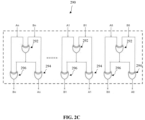
- FIG. 2C is a schematic view of an example swap logic 290 of FIG. 2B , arranged in accordance with at least some embodiments described herein. It is to be understood that unless specified otherwise, the swap logic 290 may have a same process, configuration, arrangement, and/or structure of the swap logic 290 of FIG. 2B .
- the swap logic 290 may be an exclusive OR (XOR) swap logic.
- the swap logic 290 may include at least two n-bit data inputs including A (A[n-1]...A[1]A[0]) and B (B[n-1]...B[1]B[0]).
- the swap logic 290 may implement the function that A and B are in an ascendant sequence or order.
- the swap logic 290 may implement the function that A and B are in a descendant sequence or order.
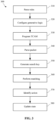
- FIG. 3 is a flow chart illustrating an example processing flow 300 of programming a ternary content-addressable memory, in accordance with at least some embodiments described herein.
- processing flow 300 disclosed herein can be conducted by one or more processors such as a local device management CPU of the device (e.g., the router, the switch, etc.), including e.g., the processor of one or more of the device 105, 110, 115, 120, 130, 140, 150, 170, 180, and/or 190 of FIG. 1 , the CPU 405 of FIG. 4 , and/or any other suitable processor, unless otherwise specified.
- a local device management CPU of the device e.g., the router, the switch, etc.
- the processor of one or more of the device 105, 110, 115, 120, 130, 140, 150, 170, 180, and/or 190 of FIG. 1 the CPU 405 of FIG. 4
- any other suitable processor unless otherwise specified.
- the processing flow 300 can include one or more operations, actions, or functions as illustrated by one or more of blocks 310, 320, 330, 340, 350, 360, 370, and 380. These various operations, functions, or actions may, for example, correspond to software, program code, or program instructions executable by a processor that causes the functions to be performed. Although illustrated as discrete blocks, obvious modifications may be made, e.g., two or more of the blocks may be re-ordered; further blocks may be added; and various blocks may be divided into additional blocks, combined into fewer blocks, or eliminated, depending on the desired implementation. It is to be understood that before the processing flow 300, operations including initializations or the like may be performed.
- processing flow 300 may begin at block 310.
- the processor may parse or analyze a plurality of predetermined packet classification rules (including e.g., a packet classification protocol having matching criteria) that may contain the commutable matching tuple (e.g., the commutable matching tuple pair, etc.).
- the processor may also identify at least one commutable matching tuple (e.g., the commutable matching tuple pair, etc.) in the predetermined packet classification rules. Processing may proceed from block 310 to block 320.
- the processor may configure and/or actuate the generative logic (e.g., an extended key crafting logic including a key crafting logic) based on the identified at least one commutable matching tuple (e.g., the commutable matching tuple pair, etc.). Processing may proceed from block 320 to block 330.
- the generative logic e.g., an extended key crafting logic including a key crafting logic
- the processor may program the TCAM based on the identified at least one commutable matching tuple (e.g., the commutable matching tuple pair, etc.) and/or the predetermined packet classification rules.
- the processor may also consolidate symmetric packet classification rules based on the identified commutable matching tuple (e.g., the commutable matching tuple pair, etc.). Processing may proceed from block 330 to block 340.
- the processor may parse a packet to extract headers and metadata from the packet.
- the processor may also copy, save, or store the extracted headers and metadata in a buffer.
- the processor may further generate a state for the packet. Processing may proceed from block 340 to block 350.
- the processor may generate a search key based on the extracted headers and metadata from the packet, based on the predetermined packet classification rules, and/or based on the identified commutable matching tuple (e.g., the commutable matching tuple pair, etc.). Processing may proceed from block 350 to block 360.
- the identified commutable matching tuple e.g., the commutable matching tuple pair, etc.
- the processor may feed the generated search key into the TCAM.
- the processor may also perform a matching between the search key and the entries of the TCAM. Processing may proceed from block 360 to block 370.
- the processor may identify an action in an action memory based on an identified entry during the matching between the search key and the entries of the TCAM.
- the processor may also perform the identified action in the action logic. Processing may proceed from block 370 to block 380.
- the processor may update the state for the packet based on the performed action.
- the processor may also update the statistics of the packet based on the state for the packet.
- features in the embodiments disclosed herein may reduce memory usage (e.g., the TCAM, the SRAM, etc.), reduce the power consumption of the device, increase and/or improve the TCAM utilization rate, and/or reduce the cost of the device.
- memory usage e.g., the TCAM, the SRAM, etc.
- FIG. 4 is a schematic structural diagram of an example computer system 400 applicable to implementing a device (for example, 105, 110, 115, 120, 130, 140, 150, 170, 180, and/or 190 of FIG. 1 ), arranged in accordance with at least some embodiments described herein. It is to be understood that the computer system shown in FIG. 4 is provided for illustration only instead of limiting the functions and applications of the embodiments described herein.
- the computer system 400 may include a central processing unit (CPU) 405.
- the CPU 405 may perform various operations and processing based on programs stored in a read-only memory (ROM) 410 or programs loaded from a storage device 440 to a random-access memory (RAM) 415.
- the RAM 415 may also store various data and programs required for operations of the system 400.
- the CPU 405, the ROM 410, and the RAM 415 may be connected to each other via a bus 420.
- An input/output (I/O) interface 425 may also be connected to the bus 420.
- the components connected to the I/O interface 425 may further include an input device 430 including a keyboard, a mouse, a digital pen, a drawing pad, or the like; an output device 435 including a display such as a liquid crystal display (LCD), a speaker, or the like; a storage device 440 including a hard disk or the like; and a communication device 445 including a network interface card such as a LAN card, a modem, or the like.
- the communication device 445 may perform communication processing via a network such as the Internet, a WAN, a LAN, a LIN, a cloud, etc.
- a driver 450 may also be connected to the I/O interface 425.
- a removable medium 455 such as a magnetic disk, an optical disk, a magneto-optical disk, a semiconductor memory, or the like may be mounted on the driver 450 as desired, such that a computer program read from the removable medium 455 may be installed in the storage device 440.
- the processes described with reference to the flowchart of FIG. 3 and/or the processes described in other figures may be implemented as computer software programs or in hardware.
- the computer program product may include a computer program stored in a computer readable non-volatile medium.
- the computer program includes program codes for performing the method shown in the flowcharts and/or GUIs.
- the computer program may be downloaded and installed from the network via the communication device 445, and/or may be installed from the removable medium 455.
- the computer program when being executed by the central processing unit (CPU) 405, can implement the above functions specified in the method in the embodiments disclosed herein.
- the disclosed and other solutions, examples, embodiments, modules and the functional operations described in this document can be implemented in digital electronic circuitry, or in computer software, firmware, or hardware, including the structures disclosed in this document and their structural equivalents, or in combinations of one or more of them.
- the disclosed and other embodiments can be implemented as one or more computer program products, i.e., one or more modules of computer program instructions encoded on a computer readable medium for execution by, or to control the operation of, data processing apparatus.
- the computer readable medium can be a machine-readable storage device, a machine-readable storage substrate, a memory device, a composition of matter effecting a machine-readable propagated signal, or a combination of one or more them.
- data processing apparatus encompasses all apparatus, devices, and machines for processing data, including by way of example a programmable processor, a computer, or multiple processors or computers.
- the apparatus can include, in addition to hardware, code that creates an execution environment for the computer program in question, e.g., code that constitutes processor firmware, a protocol stack, a database management system, an operating system, or a combination of one or more of them.
- a computer program (also known as a program, software, software application, script, or code) can be written in any form of programming language, including compiled or interpreted languages, and it can be deployed in any form, including as a stand-alone program or as a module, component, subroutine, or other unit suitable for use in a computing environment.
- a computer program does not necessarily correspond to a file in a file system.
- a program can be stored in a portion of a file that holds other programs or data (e.g., one or more scripts stored in a markup language document), in a single file dedicated to the program in question, or in multiple coordinated files (e.g., files that store one or more modules, sub programs, or portions of code).
- a computer program can be deployed to be executed on one computer or on multiple computers that are located at one site or distributed across multiple sites and interconnected by a communication network.
- the processes and logic flows described in this document can be performed by one or more programmable processors executing one or more computer programs to perform functions by operating on input data and generating output.
- the processes and logic flows can also be performed by, and apparatus can also be implemented as, special purpose logic circuitry, e.g., a field programmable gate array, an application specific integrated circuit, or the like.
- processors suitable for the execution of a computer program include, by way of example, both general and special purpose microprocessors, and any one or more processors of any kind of digital computer.
- a processor will receive instructions and data from a read only memory or a random-access memory or both.
- the essential elements of a computer are a processor for performing instructions and one or more memory devices for storing instructions and data.
- a computer will also include, or be operatively coupled to receive data from or transfer data to, or both, one or more mass storage devices for storing data, e.g., magnetic, magneto optical disks, or optical disks.
- mass storage devices for storing data, e.g., magnetic, magneto optical disks, or optical disks.
- a computer need not have such devices.
- Computer readable media suitable for storing computer program instructions and data include all forms of non-volatile memory, media and memory devices, including by way of example semiconductor memory devices, e.g., erasable programmable read-only memory, electrically erasable programmable read-only memory, and flash memory devices; magnetic disks, e.g., internal hard disks or removable disks; magneto optical disks; and compact disc read-only memory and digital video disc read-only memory disks.
- semiconductor memory devices e.g., erasable programmable read-only memory, electrically erasable programmable read-only memory, and flash memory devices
- magnetic disks e.g., internal hard disks or removable disks
- magneto optical disks magneto optical disks
- compact disc read-only memory and digital video disc read-only memory disks compact disc read-only memory and digital video disc read-only memory disks.
- the processor and the memory can be supplemented by, or incorporated in, special purpose logic circuitry.
Landscapes
- Engineering & Computer Science (AREA)
- Computer Networks & Wireless Communication (AREA)
- Signal Processing (AREA)
- Computer Security & Cryptography (AREA)
- Computer Hardware Design (AREA)
- Computing Systems (AREA)
- General Engineering & Computer Science (AREA)
- Data Exchanges In Wide-Area Networks (AREA)
Applications Claiming Priority (1)
| Application Number | Priority Date | Filing Date | Title |
|---|---|---|---|
| US18/346,524 US20230344923A1 (en) | 2023-07-03 | 2023-07-03 | Packet classifier with commutable matching tuple feature |
Publications (2)
| Publication Number | Publication Date |
|---|---|
| EP4498655A2 true EP4498655A2 (de) | 2025-01-29 |
| EP4498655A3 EP4498655A3 (de) | 2025-04-16 |
Family
ID=88414950
Family Applications (1)
| Application Number | Title | Priority Date | Filing Date |
|---|---|---|---|
| EP24184132.9A Pending EP4498655A3 (de) | 2023-07-03 | 2024-06-24 | Paketklassifizierer mit kommutierbarer übereinstimmungstupelfunktion |
Country Status (3)
| Country | Link |
|---|---|
| US (1) | US20230344923A1 (de) |
| EP (1) | EP4498655A3 (de) |
| CN (1) | CN118488126A (de) |
Families Citing this family (1)
| Publication number | Priority date | Publication date | Assignee | Title |
|---|---|---|---|---|
| CN119299371B (zh) * | 2024-12-11 | 2025-03-11 | 珠海星云智联科技有限公司 | 支持掩码匹配的流表卸载方法、计算机设备及介质 |
Family Cites Families (6)
| Publication number | Priority date | Publication date | Assignee | Title |
|---|---|---|---|---|
| KR100462480B1 (ko) * | 2002-12-17 | 2004-12-17 | 한국전자통신연구원 | 튜플 공간 검색 기반의 ip 패킷 분류장치 및 분류방법 |
| KR100705545B1 (ko) * | 2005-07-02 | 2007-04-09 | 충남대학교산학협력단 | 이중 tcam을 이용한 패킷의 분류방법 |
| US9712439B2 (en) * | 2013-02-28 | 2017-07-18 | Texas Instruments Incorporated | Packet processing match and action unit with configurable memory allocation |
| US9087585B2 (en) * | 2013-03-12 | 2015-07-21 | Texas Instruments Incorporated | TCAM with efficient range search capability |
| US20150242429A1 (en) * | 2014-02-25 | 2015-08-27 | Alcatel Lucent | Data matching based on hash table representations of hash tables |
| US12381709B2 (en) * | 2023-01-03 | 2025-08-05 | Pensando Systems Inc. | Systems and methods for flow configuration syncing between network infrastructure devices |
-
2023
- 2023-07-03 US US18/346,524 patent/US20230344923A1/en active Pending
-
2024
- 2024-06-14 CN CN202410771291.8A patent/CN118488126A/zh active Pending
- 2024-06-24 EP EP24184132.9A patent/EP4498655A3/de active Pending
Also Published As
| Publication number | Publication date |
|---|---|
| EP4498655A3 (de) | 2025-04-16 |
| US20230344923A1 (en) | 2023-10-26 |
| CN118488126A (zh) | 2024-08-13 |
Similar Documents
| Publication | Publication Date | Title |
|---|---|---|
| US11374858B2 (en) | Methods and systems for directing traffic flows based on traffic flow classifications | |
| US11818022B2 (en) | Methods and systems for classifying traffic flows based on packet processing metadata | |
| US6625150B1 (en) | Policy engine architecture | |
| US11038993B2 (en) | Flexible processing of network packets | |
| US7420976B2 (en) | System directing flow of packets by-passing policy-based application for processing by policy engine according to action specification in policy cache | |
| US8619766B2 (en) | Method and apparatus for classifying packets | |
| US7719980B2 (en) | Method and apparatus for flexible frame processing and classification engine | |
| US9344366B2 (en) | System and method for rule matching in a processor | |
| US7133400B1 (en) | System and method for filtering data | |
| US11258726B2 (en) | Low latency packet switch architecture | |
| US8964747B2 (en) | System and method for restricting network access using forwarding databases | |
| EP1729462B1 (de) | Richtlinienbasierte Leitweglenkung unter Verwendung eines Prozessors zur schnellen Filterung | |
| CN104509063B (zh) | 改善低延时高吞吐量网络中双向访问控制列表的硬件利用率的方法及装置 | |
| US9270605B2 (en) | Method and system of setting network traffic flow quality of service by modifying port numbers | |
| US10397116B1 (en) | Access control based on range-matching | |
| Cheng et al. | Machine learning based malicious payload identification in software-defined networking | |
| US8151339B2 (en) | Method and apparatus for implementing filter rules in a network element | |
| US20240097999A1 (en) | Methods and systems for distributed machine learning based anomaly detection in an environment composed of smartnics | |
| US8176242B1 (en) | Apparatus and method for improving CAM usage | |
| US6732228B1 (en) | Multi-protocol data classification using on-chip CAM | |
| US9647947B2 (en) | Block mask register key processing by compiling data structures to traverse rules and creating a new rule set | |
| EP4498655A2 (de) | Paketklassifizierer mit kommutierbarer übereinstimmungstupelfunktion | |
| US7554984B2 (en) | Fast filter processor metering and chaining | |
| US7787463B2 (en) | Content aware apparatus and method | |
| US20050262294A1 (en) | Method for policy matching using a hybrid TCAM and memory-based scheme |
Legal Events
| Date | Code | Title | Description |
|---|---|---|---|
| PUAI | Public reference made under article 153(3) epc to a published international application that has entered the european phase |
Free format text: ORIGINAL CODE: 0009012 |
|
| STAA | Information on the status of an ep patent application or granted ep patent |
Free format text: STATUS: REQUEST FOR EXAMINATION WAS MADE |
|
| 17P | Request for examination filed |
Effective date: 20240624 |
|
| AK | Designated contracting states |
Kind code of ref document: A2 Designated state(s): AL AT BE BG CH CY CZ DE DK EE ES FI FR GB GR HR HU IE IS IT LI LT LU LV MC ME MK MT NL NO PL PT RO RS SE SI SK SM TR |
|
| PUAL | Search report despatched |
Free format text: ORIGINAL CODE: 0009013 |
|
| AK | Designated contracting states |
Kind code of ref document: A3 Designated state(s): AL AT BE BG CH CY CZ DE DK EE ES FI FR GB GR HR HU IE IS IT LI LT LU LV MC ME MK MT NL NO PL PT RO RS SE SI SK SM TR |
|
| RIC1 | Information provided on ipc code assigned before grant |
Ipc: H04L 69/22 20220101ALI20250313BHEP Ipc: H04L 45/745 20220101AFI20250313BHEP |
|
| STAA | Information on the status of an ep patent application or granted ep patent |
Free format text: STATUS: EXAMINATION IS IN PROGRESS |
|
| 17Q | First examination report despatched |
Effective date: 20251104 |
|
| REG | Reference to a national code |
Ref country code: DE Ref legal event code: R079 Free format text: PREVIOUS MAIN CLASS: H04L0045745000 Ipc: H04L0069220000 |
|
| GRAP | Despatch of communication of intention to grant a patent |
Free format text: ORIGINAL CODE: EPIDOSNIGR1 |
|
| STAA | Information on the status of an ep patent application or granted ep patent |
Free format text: STATUS: GRANT OF PATENT IS INTENDED |
|
| RIC1 | Information provided on ipc code assigned before grant |
Ipc: H04L 69/22 20220101AFI20260320BHEP Ipc: H04L 45/745 20220101ALI20260320BHEP |