EP4497673A2 - Rettungsweste - Google Patents
Rettungsweste Download PDFInfo
- Publication number
- EP4497673A2 EP4497673A2 EP24275092.5A EP24275092A EP4497673A2 EP 4497673 A2 EP4497673 A2 EP 4497673A2 EP 24275092 A EP24275092 A EP 24275092A EP 4497673 A2 EP4497673 A2 EP 4497673A2
- Authority
- EP
- European Patent Office
- Prior art keywords
- lifejacket
- inflatable
- wearer
- lobe
- lobes
- Prior art date
- Legal status (The legal status is an assumption and is not a legal conclusion. Google has not performed a legal analysis and makes no representation as to the accuracy of the status listed.)
- Pending
Links
Images


Classifications
-
- B—PERFORMING OPERATIONS; TRANSPORTING
- B63—SHIPS OR OTHER WATERBORNE VESSELS; RELATED EQUIPMENT
- B63C—LAUNCHING, HAULING-OUT, OR DRY-DOCKING OF VESSELS; LIFE-SAVING IN WATER; EQUIPMENT FOR DWELLING OR WORKING UNDER WATER; MEANS FOR SALVAGING OR SEARCHING FOR UNDERWATER OBJECTS
- B63C9/00—Life-saving in water
- B63C9/08—Life-buoys, e.g. rings; Life-belts, jackets, suits, or the like
- B63C9/081—Life-buoys, e.g. rings; Life-belts, jackets, suits, or the like having compartments comprising elements which are filled with gas by deployment, e.g. sponge-like elements
-
- B—PERFORMING OPERATIONS; TRANSPORTING
- B63—SHIPS OR OTHER WATERBORNE VESSELS; RELATED EQUIPMENT
- B63C—LAUNCHING, HAULING-OUT, OR DRY-DOCKING OF VESSELS; LIFE-SAVING IN WATER; EQUIPMENT FOR DWELLING OR WORKING UNDER WATER; MEANS FOR SALVAGING OR SEARCHING FOR UNDERWATER OBJECTS
- B63C9/00—Life-saving in water
- B63C9/08—Life-buoys, e.g. rings; Life-belts, jackets, suits, or the like
- B63C9/11—Life-buoys, e.g. rings; Life-belts, jackets, suits, or the like covering the torso, e.g. harnesses
- B63C9/125—Life-buoys, e.g. rings; Life-belts, jackets, suits, or the like covering the torso, e.g. harnesses having gas-filled compartments
- B63C9/1255—Life-buoys, e.g. rings; Life-belts, jackets, suits, or the like covering the torso, e.g. harnesses having gas-filled compartments inflatable
Definitions
- the present invention relates to lifejackets. Particularly, but not exclusively, it relates to lifejackets having two lobes which extend from a connecting neck portion, the lobes lying upon either side of a wearer's chest in use.
- Lifejackets are well known in the art. Many conventional lifejackets are inflatable, being supplied in deflated form and inflatable at point of use, to allow easier stowing and reduced storage requirements.
- lifejackets have a 'twin-lobe' design, where the lifejacket comprises two lobes which extend from a connecting neck portion, the lobes being arranged to lie upon either side of the wearer's chest in use. These lifejackets typically have a fastening mechanism to attach the lobes to one another around the back of the wearer, to secure the lifejacket on the wearer.
- Some lifejackets such as those disclosed in GB2578110A and GB2480255A , are designed such that, when inflated, the lifejacket has at least one inflated portion arranged to support the wearer's chin. These chin supports act to lift the wearer's airways away from the water level, thereby reducing the chances of water entering the airways, and thus of the wearer drowning.
- an inflatable lifejacket comprising two lobes connected by a neck portion, the lobes being arranged, in use, to lie over a wearer's chest with opposed edges of the lobes abutting each other, wherein at least one lobe comprises a first, inflatable, portion towards a free end of the lobe and a second portion, wherein, when the lifejacket is inflated, the second portion is less thick than the first portion so that, in use, it creates a space below the wearer's chin, whilst forming a barrier to water.
- Both lobes of the lifejacket may comprise first and second portions.
- the or each second portion may be positioned between the first portion of the same lobe and the neck portion.
- the or each second portion may be inflatable.
- the or each second portion may be non-inflatable.
- the or each second portion may be less than half as thick than the first portion of the same lobe, or less than a third or a quarter as thick as the first portion of the same lobe.
- the or each second portion may be arranged to have a thickness between 40 mm and 45 mm, in the case of an inflatable second portion, when inflated.
- the or each first portion may have a thickness between 110 mm and 175 mm when inflated.
- the or each second portion may extend from the or each first portion and or from the neck portion.
- the or each second portion may be arranged such that, in use, the or each second portion and the neck portion of the lifejacket together encircle the wearer's neck with a close fit.
- the or each second portion may be arranged so that, in use, it extends across the wearer's chest towards the opposing lobe such that the or each second portion abuts the opposing lobe. Where each lobe has a second portion these may be arranged to abut each other in use.
- the second portions may be arranged so that, in use, they abut each other along a centre line of the lifejacket.
- the or each second portion may, together with the neck portion, form a neck opening between said second portion/s and the neck portion.
- both lobes of the lifejacket are substantially symmetrical.
- Each lobe may comprise one or more connecting strips arranged to control the shape of the lobe when inflated.
- the or each strip may be formed of a sheet material, and conveniently from the same type of sheet material as the remainder of the lifejacket.
- a connecting strip may be attached to the first and second portions of a lobe, so as to limit the distance between an edge of the second portion and an adjacent, inner, edge of the first portion.
- the connecting strip may also serve as a splash barrier by inhibiting the passage of water between adjacent edges of the first and second portions.
- a connecting strip may be attached to the first and second portions, so as to limit the distance between an edge of the second portion and an outer edge of the first portion. This ensures that the first portion of the lobe sits over the wearer's chest in use and also serves to arrange the second portion such that it is forced into contact with the wearer's clavicle and lies flat over the wearer's chest. This maximises the space beneath the wearer's chin, providing maximal comfort and range of motion to the wearer.
- both connecting strips may be connected to the same edge of the second portion.
- both lobes have first and second portions
- the second portions of each lobe may overlap with one another.
- the neck portion may comprise a head support.
- the head support may be inflatable.
- the head support may be positioned such that, in use, it supports the back of the wearer's head. This provides increased comfort to the wearer and reduces the likelihood of neck injury.
- the head support may be centrally located on the neck portion.
- the head support may be symmetrically located on the neck portion.
- the neck portion and both lobes comprising any inflatable second portion and head support, comprise a single, fluidly connected chamber such that all inflatable portions of the lifejacket inflate together.
- the lifejacket may be provided with an inflation device to enable inflation of the lifejacket.
- the inflation device may comprise an inflation tube, a manually operable or powered pump, and/or a compressed gas canister.
- the lifejacket may be provided with both a manually operated inflation device and an automatic inflation device.
- the lifejacket may comprise a harness. This may be arranged to secure the first portions of the lobes relative to one another and to the wearer.
- the harness may be a three point harness, being connected to the inside surface of each first portion and the inside surface of the neck portion.
- the harness may comprise a waist strap arranged to pass around the wearer's waist to ensure the wearer is retained between the lobes and waist strap.
- the harness may comprise a back strap connected to the waist strap and the neck portion to ensure the relative position of the neck portion and lobes is correct.
- the strap may have a conventional releasable fastener to allow easy connection in use.
- the strap and/or fastener may have a length adjustment mechanism to enable the wearer (or another person) to adjust the length of the strap to provide an optimal tightness of the strap.
- the lifejacket may be formed from two layers of sheet material, typically a plastics sheet material. Suitable materials include 210 Denier Polyurethane Coated Nylon or the like. Preferably, the lifejacket is formed from two layers of material which are sealed together, such as by welding, along an airtight seam, thereby defining an inflation chamber.
- a lifejacket 1 placed over a partial mannequin (shown in broken lines), to illustrate how the lifejacket 1 would lie over a wearer in use.
- the lifejacket 1 is formed from sheets 101,102 of 210 Denier Polyurethane Coated Nylon, which are sealed, e.g. by heat welding, together to form a single inflatable chamber.
- any relative terms (upper, lower, top, bottom etc.) refer to the lifejacket 1 shown as oriented in figure 1 .
- the terms inside surface and outside surface refer to the surface facing/contacting the wearer in use and the surface facing away from the wearer in use respectively.
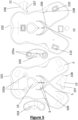
- the lifejacket 1 has a neck portion 2 and a pair of lobes 3 which each extend from each end of the neck portion 2 respectively. These are formed from two sheets of material 101,102 (shown in figure 5 ) welded together around their peripheries, with the welds being parallel to but spaced in from the edge of the sheets 101,102 to form a border of unwelded material with free edges. One sheet of material 101 forms the outside surface of the lifejacket 1 and the other sheet of material 102 forms the inside surface of the lifejacket 1.
- the neck portion 2 has an inflatable head support 4 positioned substantially centrally thereon. This is formed from two arcuate sheets of material 103,104 welded over each other to form an inflatable portion with the weld running close to the edge of each sheet 103,104 material leaving virtually no border.
- the inside sheet of material 104 adjacent the neck portion 2 comprises two generally circular apertures 105, one towards each edge of the sheet 104. These overlie corresponding apertures 105b in the neck portion 2 and the inside sheet 104 of the head support 4 is welded to the neck portion 2 around each aperture 105a forming a fluid connection between the neck portion 2 and head support 4.
- the head support 4 provides an inflatable pillow on the neck portion 2 which, in use, raises a wearer's head.
- the neck portion 2 and lobes 3 from a generally horseshoe shape lifejacket 1, with the lobes 3 extending downward from the neck portion 2, the lobes 3 each being arranged such that they tend towards and abut one another substantially at the line of symmetry of the lifejacket 1.
- Each lobe 3 has separate first 5 and second portions 6, each forming a distinct inflatable chamber.
- the first portion 5 of each lobe 3 extends from the neck portion 2 to a free end 7.
- the weld lines forming the inflatable chamber of the first portion 5 form a concave curve extending inwardly from the outer edges of the first portion 5 in the region where the first portion 5 extends from the neck portion 2 of the lifejacket 1.
- the opposite edge of the first portion 5 to this concave curve in the weld line forms a top edge to that portion.
- each lobe 3 also extends from the neck portion 2. It lies between the first portion 5 and the neck portion 2.
- each lobe 3 has an uppermost concave edge 8 which partially defines a neck opening 10 of the lifejacket 1 ('the top edge' 8) as a continuation of the concave inside edge of the neck portion 2.
- the adjacent free edge ('the abutting free edge' 9) is substantially straight, extends away from the neck opening 10 as is arranged to abut the abutting free edge 9 of the second portion 6 of the other lobe 3, generally along the line of symmetry of the lifejacket 1.
- the top 8 and abutting edges 9 are both free.
- each lobe 3 forms the neck opening 10 which, in use, encircles the wearer's neck in a close fit.
- each second portion 6 is connected to the first portion 5 of the same lobe by two connecting strips 12, 13 of sheet material.
- a first connecting strip 12 comprises a tapered strip of sheet material having a concave edge that matches the shape of the bottom edge 11 of the second portion 6, and an opposite generally straight edge that matches the shape of the top edge of the first portion 5, to which it is fastened by a line of stitching 106.
- the opposite edges of the connecting strip 12 are fastened to the matching edges of the borders of the first and second potions 5,6 by lines of stitching 107 connecting the edges of the first and second portions 5,6 together in way that allows relative movement whilst limiting their separation.
- the first connecting strips 12 form a splash barrier, as discussed further below.
- the neck portion 2 of the lifejacket 1 is arranged so that it inflates to a maximum thickness of about 90 mm.
- the first portions 5 of the lobes 3 of the lifejacket 2 are arranged to inflate to a maximum thickness of about 175 mm, in general to around double the thickness of the neck portion 2 as the first portions 5 of the lifejacket 1 contribute significantly to the buoyancy of the lifejacket 1.
- the second portions 6 of the lifejacket 1 are arranged to inflate to a maximum thickness of about 45 mm, in general about half the thickness of the neck portion 2. The second portions 6 inflate sufficiently to lend them some rigidity in use, and to create some buoyancy, but without impeding the space under a wearer's chin.
- a wearer In use, a wearer would insert their head through the neck opening 10 of a deflated lifejacket 1 and then inflate the lifejacket 1. All of the inflatable parts of the lifejacket 1 are connected to form a single inflation chamber, and so both portions of each lobe 3, neck portion 2 and head support 4 all inflate together.
- the lifejacket 1 a takes the form illustrated in figures 1-4 .
- the outside and inside sheets of material 101,102 forming the neck portion 2 and second portion 6 of each lobe 3 lie in generally parallel planes with the second portions 6 of each lobe 3 abutting each other.
- the additional thickness of the first portions 5 of each lobe 3, combined with the effects of the waist strap 15 and two connecting strips 12,13 causes the first portions 5 to twist slightly causing the lifejacket 1 to crease where the first portions 5 connect to the neck portion 2, and causing the first portions 5 to ride up against each other with their inside surfaces abutting.
- the first portions 5 effectively extend out of the plane in which the remainder of the lifejacket 1 lies (as best seen in figure 4 ).
- This, in turn, causes the first connecting strips 12 to extend out from the bottom edges 11 of the second portions 6 at an approximate right angle, with their free edges abutting or overlapping.
- both the second portions 6 of each lobe 3 and the first strips 12 of each lobe 3 form splash barriers serving to prevent water from passing up from beneath the lifejacket 1 towards a wearer's airways, or between the lobes 3 or between the first and second portions 5,6 of each lobe 3 towards a wearer's airways.
- the significantly reduced thickness of the second portions 6 of the lobes 3, as compared to the first portions 5, creates a space beneath the wearer's chin allowing freedom of movement.
- the first connecting strips 12 also serve to urge the second portions 6 of the lobes 3 into contact with the wearer's clavicle so that they lie flat over the wearer's chest, also ensuring that space is created under the wearer's chin.
- the connecting strips 12,13 Owing to the relative size of the connecting strips 12,13 (in relation to distance between the respective stitch lines 106,107,108 of the sheets 101,102), the connecting strips 12,13, in use, have the effect of contorting their respective lobes 3 such that the first portions 5 of each lobes 3 to achieve the shape of lifejacket 1 shown in figures 1-4.
- the double dashed lines extending around the peripheries of each sheet 101,102 and the sheets 103,104 that form the head support 4 are the weld lines, about which the sheets 101,102,103,104 are welded together, to form the life1jacket 1.
- the outside sheet of material 101 has an aperture 109 through which an inflation tube (including a one-way valve) is inserted, to allow the lifejacket 1 to be inflated.
- the inside sheet of material 102 has a pair of patches 110, which allow the fasteners of the harness 14 to be attached to the sheet 102.
- the patches 110 are each placed toward the free end of the first portion 5 of each lobe 3 such that, when inflated, the patches 110 and fasteners are positioned on either side of the waist of the wearer.
Landscapes
- Engineering & Computer Science (AREA)
- Mechanical Engineering (AREA)
- Ocean & Marine Engineering (AREA)
- Professional, Industrial, Or Sporting Protective Garments (AREA)
- Thermotherapy And Cooling Therapy Devices (AREA)
Applications Claiming Priority (1)
| Application Number | Priority Date | Filing Date | Title |
|---|---|---|---|
| GB2311593.4A GB2632170A (en) | 2023-07-27 | 2023-07-27 | Lifejacket |
Publications (2)
| Publication Number | Publication Date |
|---|---|
| EP4497673A2 true EP4497673A2 (de) | 2025-01-29 |
| EP4497673A3 EP4497673A3 (de) | 2025-02-19 |
Family
ID=87929726
Family Applications (1)
| Application Number | Title | Priority Date | Filing Date |
|---|---|---|---|
| EP24275092.5A Pending EP4497673A3 (de) | 2023-07-27 | 2024-07-25 | Rettungsweste |
Country Status (3)
| Country | Link |
|---|---|
| US (1) | US20250033748A1 (de) |
| EP (1) | EP4497673A3 (de) |
| GB (1) | GB2632170A (de) |
Citations (2)
| Publication number | Priority date | Publication date | Assignee | Title |
|---|---|---|---|---|
| GB2480255A (en) | 2010-05-10 | 2011-11-16 | Crewsaver Ltd | A lifejacket with an integral chin support |
| GB2578110A (en) | 2018-10-16 | 2020-04-22 | Survitec Group Ltd | Life preserver |
Family Cites Families (4)
| Publication number | Priority date | Publication date | Assignee | Title |
|---|---|---|---|---|
| GB1601947A (en) * | 1977-09-01 | 1981-11-04 | Beaufort Air Sea Equipment Ltd | Lifejacket |
| GB2198089B (en) * | 1986-11-07 | 1990-06-27 | Lifeguard Equip Ltd | Improvements in life jackets |
| GB9200851D0 (en) * | 1992-01-15 | 1992-03-11 | Air Safety Prod | Improvements relating to life jackets |
| WO2004007275A2 (en) * | 2002-07-11 | 2004-01-22 | Courtney William L | Variable displacement, external fabric cover and gusset-configured, hybrid life jacket with releaseable or nonreleasable bladder |
-
2023
- 2023-07-27 GB GB2311593.4A patent/GB2632170A/en active Pending
-
2024
- 2024-07-24 US US18/782,605 patent/US20250033748A1/en active Pending
- 2024-07-25 EP EP24275092.5A patent/EP4497673A3/de active Pending
Patent Citations (2)
| Publication number | Priority date | Publication date | Assignee | Title |
|---|---|---|---|---|
| GB2480255A (en) | 2010-05-10 | 2011-11-16 | Crewsaver Ltd | A lifejacket with an integral chin support |
| GB2578110A (en) | 2018-10-16 | 2020-04-22 | Survitec Group Ltd | Life preserver |
Also Published As
| Publication number | Publication date |
|---|---|
| GB202311593D0 (en) | 2023-09-13 |
| GB2632170A (en) | 2025-01-29 |
| EP4497673A3 (de) | 2025-02-19 |
| US20250033748A1 (en) | 2025-01-30 |
Similar Documents
| Publication | Publication Date | Title |
|---|---|---|
| US6659824B1 (en) | Animal life preservers | |
| US10793238B2 (en) | Personal flotation device | |
| US9067658B2 (en) | Inflatable swim vest | |
| EP0630336A1 (de) | Verbesserungen an schwimmwesten. | |
| US20250033748A1 (en) | Lifejacket | |
| US5348504A (en) | Inflatable lifesaving belt | |
| US4131974A (en) | Flotation stoles | |
| EP3429917A1 (de) | Schwimmweste | |
| EP1457418B1 (de) | Schwimmweste geeignet zum Sitzen | |
| US4753621A (en) | Inflatable lifejacket | |
| US11873068B2 (en) | Life preserver | |
| CN208393598U (zh) | 可充气救生衣 | |
| GB2480255A (en) | A lifejacket with an integral chin support | |
| CN108248796A (zh) | 可充气救生衣 | |
| CA3028060A1 (en) | Low profile tactical inflatable flotation device | |
| EP4097000B1 (de) | Rettungsgürtel | |
| US7169001B2 (en) | Life jacket | |
| US9950775B1 (en) | Inflatable life vest | |
| EP0825947B1 (de) | An einer rettungsweste montierter spritzwasserschirm | |
| US20230271684A1 (en) | Personal flotation device | |
| GB2465846A (en) | Lifejacket with chest buoyancy sections adapted to provide improved support in water | |
| WO2018197718A1 (en) | Lifejacket | |
| JP3086155U (ja) | マタニティーネットガード、ネットガード・ベスト | |
| JPH0554478B2 (de) |
Legal Events
| Date | Code | Title | Description |
|---|---|---|---|
| PUAI | Public reference made under article 153(3) epc to a published international application that has entered the european phase |
Free format text: ORIGINAL CODE: 0009012 |
|
| STAA | Information on the status of an ep patent application or granted ep patent |
Free format text: STATUS: THE APPLICATION HAS BEEN PUBLISHED |
|
| PUAL | Search report despatched |
Free format text: ORIGINAL CODE: 0009013 |
|
| AK | Designated contracting states |
Kind code of ref document: A2 Designated state(s): AL AT BE BG CH CY CZ DE DK EE ES FI FR GB GR HR HU IE IS IT LI LT LU LV MC ME MK MT NL NO PL PT RO RS SE SI SK SM TR |
|
| AK | Designated contracting states |
Kind code of ref document: A3 Designated state(s): AL AT BE BG CH CY CZ DE DK EE ES FI FR GB GR HR HU IE IS IT LI LT LU LV MC ME MK MT NL NO PL PT RO RS SE SI SK SM TR |
|
| RIC1 | Information provided on ipc code assigned before grant |
Ipc: B63C 9/125 20060101AFI20250113BHEP |
|
| STAA | Information on the status of an ep patent application or granted ep patent |
Free format text: STATUS: REQUEST FOR EXAMINATION WAS MADE |
|
| 17P | Request for examination filed |
Effective date: 20250819 |