EP4495295A1 - Positive electrode assembly for manufacture of copper foil - Google Patents
Positive electrode assembly for manufacture of copper foil Download PDFInfo
- Publication number
- EP4495295A1 EP4495295A1 EP24150179.0A EP24150179A EP4495295A1 EP 4495295 A1 EP4495295 A1 EP 4495295A1 EP 24150179 A EP24150179 A EP 24150179A EP 4495295 A1 EP4495295 A1 EP 4495295A1
- Authority
- EP
- European Patent Office
- Prior art keywords
- base
- electrodes
- fastening
- electrode
- positive electrode
- Prior art date
- Legal status (The legal status is an assumption and is not a legal conclusion. Google has not performed a legal analysis and makes no representation as to the accuracy of the status listed.)
- Pending
Links
Images



Classifications
-
- C—CHEMISTRY; METALLURGY
- C25—ELECTROLYTIC OR ELECTROPHORETIC PROCESSES; APPARATUS THEREFOR
- C25D—PROCESSES FOR THE ELECTROLYTIC OR ELECTROPHORETIC PRODUCTION OF COATINGS; ELECTROFORMING; APPARATUS THEREFOR
- C25D1/00—Electroforming
-
- H—ELECTRICITY
- H01—ELECTRIC ELEMENTS
- H01M—PROCESSES OR MEANS, e.g. BATTERIES, FOR THE DIRECT CONVERSION OF CHEMICAL ENERGY INTO ELECTRICAL ENERGY
- H01M4/00—Electrodes
- H01M4/02—Electrodes composed of, or comprising, active material
- H01M4/64—Carriers or collectors
- H01M4/66—Selection of materials
- H01M4/661—Metal or alloys, e.g. alloy coatings
-
- C—CHEMISTRY; METALLURGY
- C25—ELECTROLYTIC OR ELECTROPHORETIC PROCESSES; APPARATUS THEREFOR
- C25D—PROCESSES FOR THE ELECTROLYTIC OR ELECTROPHORETIC PRODUCTION OF COATINGS; ELECTROFORMING; APPARATUS THEREFOR
- C25D1/00—Electroforming
- C25D1/04—Wires; Strips; Foils
-
- H—ELECTRICITY
- H01—ELECTRIC ELEMENTS
- H01M—PROCESSES OR MEANS, e.g. BATTERIES, FOR THE DIRECT CONVERSION OF CHEMICAL ENERGY INTO ELECTRICAL ENERGY
- H01M10/00—Secondary cells; Manufacture thereof
- H01M10/05—Accumulators with non-aqueous electrolyte
- H01M10/058—Construction or manufacture
- H01M10/0587—Construction or manufacture of accumulators having only wound construction elements, i.e. wound positive electrodes, wound negative electrodes and wound separators
-
- H—ELECTRICITY
- H01—ELECTRIC ELEMENTS
- H01M—PROCESSES OR MEANS, e.g. BATTERIES, FOR THE DIRECT CONVERSION OF CHEMICAL ENERGY INTO ELECTRICAL ENERGY
- H01M4/00—Electrodes
- H01M4/02—Electrodes composed of, or comprising, active material
- H01M2004/025—Electrodes composed of, or comprising, active material with shapes other than plane or cylindrical
-
- Y—GENERAL TAGGING OF NEW TECHNOLOGICAL DEVELOPMENTS; GENERAL TAGGING OF CROSS-SECTIONAL TECHNOLOGIES SPANNING OVER SEVERAL SECTIONS OF THE IPC; TECHNICAL SUBJECTS COVERED BY FORMER USPC CROSS-REFERENCE ART COLLECTIONS [XRACs] AND DIGESTS
- Y02—TECHNOLOGIES OR APPLICATIONS FOR MITIGATION OR ADAPTATION AGAINST CLIMATE CHANGE
- Y02E—REDUCTION OF GREENHOUSE GAS [GHG] EMISSIONS, RELATED TO ENERGY GENERATION, TRANSMISSION OR DISTRIBUTION
- Y02E60/00—Enabling technologies; Technologies with a potential or indirect contribution to GHG emissions mitigation
- Y02E60/10—Energy storage using batteries
Definitions
- the present invention relates to a positive electrode constituting a manufacturing apparatus for manufacturing electrolytic copper foil, and more particularly to a positive electrode assembly for manufacture of copper foil configured to respond to high current to improve efficiency.
- an electrolytic copper foil manufacturing apparatus includes an insoluble positive electrode assembly 20 immersed in an electrolytic solution 12 of an electrolytic bath 10 and a rotary drum-type negative electrode assembly 30.
- the insoluble positive electrode assembly 20 is installed so as to face the drum-type negative electrode assembly 30, and has a concave and partially cylindrical shape corresponding to the outer shape of the drum-type negative electrode assembly 30.
- a metallic component may be grown on the surface of the drum-type negative electrode assembly 30.
- a front surface of the positive electrode assembly 20 corresponding to the negative electrode assembly 30 may be said to be a part for generating substantial electrolytic reaction.
- the positive electrode assembly 20 generally includes a positive electrode 22 installed so as to correspond to the negative electrode assembly 30 and a base 24 configured to support the positive electrode 22 at the rear thereof.
- a fastening element such as a bolt, is generally used to couple the positive electrode 22 and the base 24 to each other such that the positive electrode 22 can be fixed.
- the entirety of the positive electrode assembly 20 is formed as a single continuous plate, this is most desirable in terms of uniformity in current density, and therefore the quality of copper foil that is produced may be guaranteed.
- a plurality of positive electrodes 22 is provided, and each of the positive electrodes 22 is fixed to the base 24.
- the positive electrodes 22 must be spaced apart from the drum-type negative electrode assembly 30 by the same distance.
- the flat positive electrodes 22 are brought into tight contact with the concave base 24 using a plurality of bolts. That is, the flat positive electrodes 22 are formed as concave positive electrodes 22 that are radially concave and spaced apart from the negative electrode assembly 30 by the same distance.
- each of the flat positive electrodes so as to have a partial arc-shaped section using fastening force of the bolt, however, a plurality of bolts and great fastening force by the plurality of bolts are required. That is, the conventional positive electrode is physically deformed by the bolt, whereby residual stress is present in the positive electrode, which is undesirable.
- the thickness of the positive electrode is substantially limited in order to deform the positive electrode.
- positive electrodes that are currently used have a thickness of about 1 mm.
- this thickness is undesirable in terms of an increase in efficiency by high current, which has been widely adopted in recent years.
- a positive electrode assembly for manufacture of copper foil, the positive electrode assembly including a base having a concave arc-shaped section corresponding to a drum-type negative electrode and a plurality of electrodes arranged on the base in a circumferential direction.
- the electrodes are fastened to the base using fastening bolts.
- the plurality of electrodes is supported by the base in a state of not being deformed by fastening force of the fastening bolts and being maintained flat in shape, whereby it is possible to respond to high current through adjustment of the thickness of each electrode.
- the fastening bolts may fasten the electrodes to the base in a state of extending through fastening holes formed in the electrodes.
- a stud bolt fixed to the base may be coupled to a fastening nut in a coupling recess formed in an inner surface of the base.
- the electrode may have a thickness of 2 to 5 mm.
- a burred portion having a shape corresponding to a lower surface of the fastening bolt may be formed around the fastening hole.
- a positive electrode corresponds to a drum-type negative electrode, as mentioned above, and the positive electrode is formed so as to have a concave and partially cylindrical shape.
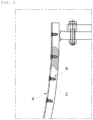
- FIG. 2 is a sectional view showing a positive electrode assembly according to an embodiment of the present invention
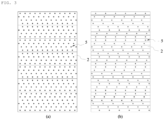
- FIG. 3 is a development view showing a conventional electrode and an electrode according to the present invention.
- a base 2 is formed in a concave arc-shape overall equally spaced apart from a cylindrical drum so as to correspond to the cylindrical drum, and a plurality of electrodes (positive electrodes) 4 is attached to a concave surface of the base 2.
- a plurality of, for example 55, electrodes (positive electrodes) 4 is attached in a circumferential direction, as shown in FIG. 3 , which is significantly greater than the number of conventional electrodes, which is 16. That the number of electrodes 4 significantly greater than the number of conventional electrodes is installed in the circumferential direction means that the circumferential length of the electrodes is significantly shorter than the circumferential length of the conventional electrodes, whereby each of the electrodes is formed so as to have an overall arc shape, and therefore contact between the electrodes and the base 2 may be further secured.
- the thickness of the electrode 4 according to the present invention is greater than the thickness of the conventional electrode (about 1 mm).
- productivity of electrolytic copper foil is of course greatly improved as the result of using high current.
- the basic idea of the present invention is to fix a plurality of electrodes 4 to the base 2 without changing the flat shape of each electrode. That the plurality of electrodes 4 is mounted in the state in which the flat shape of each electrode is maintained, as described above, means that it is possible to use electrodes 4 that are substantially thicker than the conventional electrodes, and therefore it is possible to use high current. In addition, electrodes 4 which are thick and each of which has a very short circumferential length are used, whereby the number of electrodes 4 is increased.
- the electrode 4 used in the positive electrode assembly according to the present invention may be characterized in that a thicker electrode is used, whereby it is possible to sufficiently respond to high current, and in that deformation of the electrode by fastening force is prevented when the electrode is attached to the base 4, whereby it is possible to improve assemblability and to use high current.
- the number of conventional electrodes is about 16, whereas the number of electrodes 4 according to the present invention is about 55, which means that the circumferential length of the electrode 4 is significantly shorter than the circumferential length of the conventional electrode.
- a fastening hole must be formed in the electrode 4 in advance, and a projection by which a head of the fastening bolt 6 is caught is formed in the fastening hole. Consequently, it is possible to ensure that the head of the fastening bolt 6 does not protrude beyond the electrode 4.
- FIG. 3 shows conventional electrode plates and bolt fastening holes, and (b) shows electrode plates according to the present invention and bolt fastening holes.
- FIG. 3 it can be seen that, in the electrode assembly of the present invention, the number of fastening holes 5 required to fasten the electrodes 4 to the base is significantly reduced. A significant reduction in the number of fastening holes 5 is equivalent to a significant reduction in the number of fastening bolts for assembly.
- the fastening holes 5 are formed so as not to overlap each other as much as possible in a vertical direction. This serves to maximally inhibit deterioration in quality of a product due to overlapping of the bolts in the vertical direction (the direction of rotation of the negative electrode).
- the fastening holes formed in the plurality of electrodes 4 are formed so as to be spaced apart from each other by a certain distance in the transverse direction (the axial direction of the negative electrode), compared to fastening holes thereabove or thereunder.
- this arrangement of fastening holes 5 is applied to an electrode set including a certain number of electrodes (for example, 7) and a plurality of electrode sets is repeatedly arranged to complete the overall fastening hole arrangement of the electrodes 4. It can be seen from FIG. 3 that the arrangement of the fastening holes 5 in the longitudinal direction is not overlapped, whereby it is possible to minimize problems with a product in response to high current. In FIG. 3(a) and 3(b) , the number of fastening holes and the degree of overlap of the fastening holes in the longitudinal direction may be clearly compared.
- the electrodes 4 of the present invention are not deformed in sectional shape by the fastening bolts 6 and maintain the flat shape thereof.
- the number of electrodes 4 is sufficiently increased such that the lateral or sectional shape formed by the plurality of electrodes is as close to an arc shape as possible.
- the contact area between the electrodes 4 and the base 2 becomes wider.
- each electrode is maintained in a state of being fastened to the base 2 may ultimately mean that only upper and lower end parts of each electrode 4 are in contact with the base 2 based on FIG. 3 or the drum-type negative electrode.
- This state may be expressed as the state in which the middle part of each electrode 4 is slightly spaced apart from the base 2.
- the thickness of the electrode 4 for high current is efficient in a range of 1.5 mm to 7 mm and that efficiency decreases at thicknesses greater than the above range.
- the experiments also show that the thickness of the electrode 4 is more preferably 2 to 5 mm.
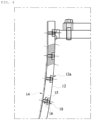
- the electrode 14 according to this embodiment is substantially identical in construction to the electrode according to the previous embodiment except for the structure for fixing the electrode 14 to the base 12. In the description of the embodiment of FIG. 4 , therefore, the description of the construction of the electrode 14 will be omitted, and only the structure for fixing the electrode 14 to the base 12 will be described.
- a stud bolt 16 is fixed to an inner surface of the electrode 14 by welding.
- the base 12 is provided with a through-hole 15 through which the stud bolt 16 extends.
- the stud bolt 6 is coupled to the base 12 in a state of extending through the through-hole 15.
- the stud bolt 16 has a length that does not protrude out of rear surface of the base 12. In the embodiment shown, the stud bolt 16 does not protrude outwardly from a coupling recess 12a formed in an inner surface of the base 12.
- a fastening nut 18 is screwed onto the stud bolt 16.
- the electrode 14 of the present invention is not deformed in sectional shape by the fastening bolt 16 and maintains the flat shape thereof, as mentioned above.
- the number of electrodes 14 is sufficiently increased such that the lateral or sectional shape formed by a plurality of electrodes is as close to an arc shape as possible.
- the burred portion 3 is also formed when the fastening hole 5 is formed by pressing using a punch and a die in order to sufficiently enlarge the area of contact with the fastening bolt 6.
- the shape of an upper surface of the burred portion 3 corresponds to the shape of a lower surface 6b of a head 6a of the fastening bolt 6. That is, when the head 6a of the fastening bolt 6 is inserted into the burred portion 3, the lower surface 6b of the head 6a comes into tight contact with the upper surface of the burred portion 3. As a result, the upper surface of the burred portion 3 and the lower surface 6b of the head 6a come into contact with each other over corresponding areas thereof, whereby energization is achieved therebetween. Consequently, it can be seen that the area of contact between the burred portion 3 and the fastening bolt 6 is sufficiently secured and a high current can flow through the area.
- burred portion 3 interferes with the base 4 when the electrode is fastened to the base via the fastening bolt 6, it is preferable to form an overall groove around the fastening hole of the base 4, to which the fastening bolt 6 is coupled.
- the bolt 6 that is fastened to the base 4 has only fastening force to such an extent that the electrode is not deformed, and therefore the electrode 2 may be formed so as to be sufficiently thick.
- a high current can stably flow between the electrode 2 and the bolt 6 through the burred portion 3.
- it can be said that it is possible to sufficiently respond to the trend of high current to improve productivity.
- a lower part of a threaded portion 6d of the bolt 6 is coupled to the base 2.
- assembly is basically performed in the state in which the electrodes are not deformed and the flat shape of each electrode is maintained, and therefore it is possible to minimize limitation on the thickness of the electrodes. That is, it is possible to use thicker electrodes, for example, electrodes each having a thickness of 2 to 7 mm, by applying the structure of the present invention. When such thicker electrodes are used, it is possible to correspond to high current, and therefore it is possible to substantially improve productivity.
- the electrodes are fixed to the base with bolt tightening force that does not cause deformation of the electrodes.
- easy assembly is achieved, whereby productivity is improved.
Landscapes
- Chemical & Material Sciences (AREA)
- Engineering & Computer Science (AREA)
- Chemical Kinetics & Catalysis (AREA)
- Electrochemistry (AREA)
- Materials Engineering (AREA)
- Metallurgy (AREA)
- Organic Chemistry (AREA)
- General Chemical & Material Sciences (AREA)
- Manufacturing & Machinery (AREA)
- Electrolytic Production Of Metals (AREA)
Abstract
Disclosed is a positive electrode assembly for manufacture of copper foil. The positive electrode assembly includes a base having a concave arc-shaped section corresponding to a drum-type negative electrode and a plurality of electrodes arranged on the base in a circumferential direction, the plurality of electrodes being fastened to the base using a plurality of fastening bolts. The plurality of electrodes is fastened to the base in a state of not being deformed by fastening force of the fastening bolts and being maintained flat in shape, thereby responding to high current through adjustment of the thickness of each electrode. Each electrode has a thickness of 2 to 7 mm.
Description
- The present invention relates to a positive electrode constituting a manufacturing apparatus for manufacturing electrolytic copper foil, and more particularly to a positive electrode assembly for manufacture of copper foil configured to respond to high current to improve efficiency.
- Technology for manufacturing copper foil using electrolytic reaction is disclosed in
Korean Patent Application Publication No. 10-2019-0038325 FIG. 1 , an electrolytic copper foil manufacturing apparatus includes an insolublepositive electrode assembly 20 immersed in anelectrolytic solution 12 of anelectrolytic bath 10 and a rotary drum-typenegative electrode assembly 30. - The insoluble
positive electrode assembly 20 is installed so as to face the drum-typenegative electrode assembly 30, and has a concave and partially cylindrical shape corresponding to the outer shape of the drum-typenegative electrode assembly 30. When energization is achieved between the insolublepositive electrode assembly 20 and the drum-typenegative electrode assembly 30, a metallic component may be grown on the surface of the drum-typenegative electrode assembly 30. - When the drum-type
negative electrode assembly 30 is rotated relative to the insolublepositive electrode assembly 20 in an energized state, therefore, copper foil is formed on the drum-typenegative electrode assembly 30 through electrolytic precipitation. The copper foil thus formed may be peeled off from the drum-typenegative electrode assembly 30, whereby the copper foil may be continuously obtained. A front surface of thepositive electrode assembly 20 corresponding to thenegative electrode assembly 30 may be said to be a part for generating substantial electrolytic reaction. - The
positive electrode assembly 20 generally includes apositive electrode 22 installed so as to correspond to thenegative electrode assembly 30 and a base 24 configured to support thepositive electrode 22 at the rear thereof. A fastening element, such as a bolt, is generally used to couple thepositive electrode 22 and the base 24 to each other such that thepositive electrode 22 can be fixed. Here, if the entirety of thepositive electrode assembly 20 is formed as a single continuous plate, this is most desirable in terms of uniformity in current density, and therefore the quality of copper foil that is produced may be guaranteed. In practice, however, a plurality ofpositive electrodes 22 is provided, and each of thepositive electrodes 22 is fixed to thebase 24. - In addition, as described above, the
positive electrodes 22 must be spaced apart from the drum-typenegative electrode assembly 30 by the same distance. When thepositive electrodes 22 are fixed to thetitanium base 24, therefore, the flatpositive electrodes 22 are brought into tight contact with theconcave base 24 using a plurality of bolts. That is, the flatpositive electrodes 22 are formed as concavepositive electrodes 22 that are radially concave and spaced apart from thenegative electrode assembly 30 by the same distance. - In order to deform each of the flat positive electrodes so as to have a partial arc-shaped section using fastening force of the bolt, however, a plurality of bolts and great fastening force by the plurality of bolts are required. That is, the conventional positive electrode is physically deformed by the bolt, whereby residual stress is present in the positive electrode, which is undesirable.
- In addition, the thickness of the positive electrode is substantially limited in order to deform the positive electrode. For example, positive electrodes that are currently used have a thickness of about 1 mm. However, this thickness is undesirable in terms of an increase in efficiency by high current, which has been widely adopted in recent years.
- It is an object of the present invention to provide a positive electrode for electrolysis configured such that the positive electrode is sufficiently thick, whereby high current for electrolytic reaction is used, and therefore productivity is improved.
- It is another object of the present invention to provide a positive electrode for electrolysis configured such that the positive electrode is not deformed by fastening force, whereby the positive electrode is fixed to a base with relatively low fastening force.
- It is a further object of the present invention to provide a positive electrode for electrolysis configured such that a smaller number of bolts is used, whereby a production process is simplified and a higher quality product is produced.
- In accordance with the present invention, the above and other objects can be accomplished by the provision of a positive electrode assembly for manufacture of copper foil, the positive electrode assembly including a base having a concave arc-shaped section corresponding to a drum-type negative electrode and a plurality of electrodes arranged on the base in a circumferential direction. The electrodes are fastened to the base using fastening bolts. Here, the plurality of electrodes is supported by the base in a state of not being deformed by fastening force of the fastening bolts and being maintained flat in shape, whereby it is possible to respond to high current through adjustment of the thickness of each electrode.
- In an embodiment, the fastening bolts may fasten the electrodes to the base in a state of extending through fastening holes formed in the electrodes.
- In another embodiment, a stud bolt fixed to the base may be coupled to a fastening nut in a coupling recess formed in an inner surface of the base.
- In an embodiment related to the thickness of each electrode, the electrode may have a thickness of 2 to 5 mm.
- A burred portion having a shape corresponding to a lower surface of the fastening bolt may be formed around the fastening hole.
- The above and other objects, features and other advantages of the present invention will be more clearly understood from the following detailed description taken in conjunction with the accompanying drawings, in which:
-
FIG. 1 is a view illustrating a conventional electrolytic copper foil manufacturing apparatus; -
FIG. 2 is a sectional view illustrating a positive electrode assembly according to an embodiment of the present invention; -
FIG. 3 is a view describing electrode arrangement according to the present invention and conventional electrode arrangement based on comparison therebetween; -
FIG. 4 is a sectional view illustrating a positive electrode assembly according to another embodiment of the present invention; -
FIG. 5 is a sectional view illustrating a positive electrode assembly according to a further embodiment of the present invention; and -
FIG. 6 is a sectional view illustrating an electrode of the embodiment shown inFIG. 5 . - The present invention will now be described in more detail with reference to embodiments shown in the drawings. In the present invention, a positive electrode corresponds to a drum-type negative electrode, as mentioned above, and the positive electrode is formed so as to have a concave and partially cylindrical shape.
-
FIG. 2 is a sectional view showing a positive electrode assembly according to an embodiment of the present invention, andFIG. 3 is a development view showing a conventional electrode and an electrode according to the present invention. As shown, abase 2 is formed in a concave arc-shape overall equally spaced apart from a cylindrical drum so as to correspond to the cylindrical drum, and a plurality of electrodes (positive electrodes) 4 is attached to a concave surface of thebase 2. - In the present invention, a plurality of, for example 55, electrodes (positive electrodes) 4 is attached in a circumferential direction, as shown in
FIG. 3 , which is significantly greater than the number of conventional electrodes, which is 16. That the number ofelectrodes 4 significantly greater than the number of conventional electrodes is installed in the circumferential direction means that the circumferential length of the electrodes is significantly shorter than the circumferential length of the conventional electrodes, whereby each of the electrodes is formed so as to have an overall arc shape, and therefore contact between the electrodes and thebase 2 may be further secured. - In addition, the thickness of the
electrode 4 according to the present invention is greater than the thickness of the conventional electrode (about 1 mm). When such athick electrode 4 is used, productivity of electrolytic copper foil is of course greatly improved as the result of using high current. - When the thickness of the
electrode 4 is increased, as described above, it is very difficult to deform theelectrode 4 so as to correspond to the arc shape of thebase 2. When a plurality ofelectrodes 4 is fastened to thebase 2 by fastening bolts, great force is required in order to deform the circumferential section of each electrode into an arc shape by fastening force. If such great force is applied to theelectrode 4, residual stress inelectrode 4 is significantly increased, causing difficulty in an assembly process as well as various disadvantages in follow-up management. - Therefore, the basic idea of the present invention is to fix a plurality of
electrodes 4 to thebase 2 without changing the flat shape of each electrode. That the plurality ofelectrodes 4 is mounted in the state in which the flat shape of each electrode is maintained, as described above, means that it is possible to useelectrodes 4 that are substantially thicker than the conventional electrodes, and therefore it is possible to use high current. In addition,electrodes 4 which are thick and each of which has a very short circumferential length are used, whereby the number ofelectrodes 4 is increased. - That electrodes thicker than the conventional electrodes can be used has the same meaning as that high current for electrolytic reaction can be used, which ultimately means that it is possible to further improve productivity and efficiency of electrolytic copper foil. Consequently, the
electrode 4 used in the positive electrode assembly according to the present invention may be characterized in that a thicker electrode is used, whereby it is possible to sufficiently respond to high current, and in that deformation of the electrode by fastening force is prevented when the electrode is attached to thebase 4, whereby it is possible to improve assemblability and to use high current. - Here, when the shape of the electrode is not changed by fastening force, there is the advantage that fastening of the
fastening bolt 6 is possible with the minimum fastening force required to fix the position of theelectrode 4. This feature will be described with reference toFIG. 3 . The transverse length of the electrode 4 (corresponding to the axial length of the cylindrical negative electrode) is substantially unchanged, whereas the longitudinal length of the electrode 4 (corresponding to the circumferential length of the cylindrical negative electrode) is significantly shorter than the conventional electrode. - For example, the number of conventional electrodes is about 16, whereas the number of
electrodes 4 according to the present invention is about 55, which means that the circumferential length of theelectrode 4 is significantly shorter than the circumferential length of the conventional electrode. Furthermore, in order to use thefastening bolt 6, a fastening hole must be formed in theelectrode 4 in advance, and a projection by which a head of the fasteningbolt 6 is caught is formed in the fastening hole. Consequently, it is possible to ensure that the head of the fasteningbolt 6 does not protrude beyond theelectrode 4. - In
FIG. 3, (a) shows conventional electrode plates and bolt fastening holes, and (b) shows electrode plates according to the present invention and bolt fastening holes. As can be seen fromFIG. 3 , it can be seen that, in the electrode assembly of the present invention, the number offastening holes 5 required to fasten theelectrodes 4 to the base is significantly reduced. A significant reduction in the number offastening holes 5 is equivalent to a significant reduction in the number of fastening bolts for assembly. - Referring to
FIG. 3 , it can be seen that the fastening holes 5 are formed so as not to overlap each other as much as possible in a vertical direction. This serves to maximally inhibit deterioration in quality of a product due to overlapping of the bolts in the vertical direction (the direction of rotation of the negative electrode). The fastening holes formed in the plurality ofelectrodes 4 are formed so as to be spaced apart from each other by a certain distance in the transverse direction (the axial direction of the negative electrode), compared to fastening holes thereabove or thereunder. - It can be seen that this arrangement of
fastening holes 5 is applied to an electrode set including a certain number of electrodes (for example, 7) and a plurality of electrode sets is repeatedly arranged to complete the overall fastening hole arrangement of theelectrodes 4. It can be seen fromFIG. 3 that the arrangement of the fastening holes 5 in the longitudinal direction is not overlapped, whereby it is possible to minimize problems with a product in response to high current. InFIG. 3(a) and 3(b) , the number of fastening holes and the degree of overlap of the fastening holes in the longitudinal direction may be clearly compared. - As mentioned above, the
electrodes 4 of the present invention are not deformed in sectional shape by thefastening bolts 6 and maintain the flat shape thereof. At the same time, the number ofelectrodes 4 is sufficiently increased such that the lateral or sectional shape formed by the plurality of electrodes is as close to an arc shape as possible. Of course, when the number ofelectrodes 4 is increased, the contact area between theelectrodes 4 and thebase 2 becomes wider. - Here, that the flat shape of each electrode is maintained in a state of being fastened to the
base 2 may ultimately mean that only upper and lower end parts of eachelectrode 4 are in contact with thebase 2 based onFIG. 3 or the drum-type negative electrode. This state may be expressed as the state in which the middle part of eachelectrode 4 is slightly spaced apart from thebase 2. - In the present invention, as described above, when the
electrodes 4 are fastened to thebase 2 by the plurality offastening bolts 6, assembly is performed in the state in which the electrodes are not deformed by fastening force and the flat shape of each electrode is maintained. As a result, it is possible to supply high current due to an increase in thickness of eachelectrode 4, thereby achieving high efficiency. - Experiments performed by inventors of the present application show that the thickness of the
electrode 4 for high current is efficient in a range of 1.5 mm to 7 mm and that efficiency decreases at thicknesses greater than the above range. The experiments also show that the thickness of theelectrode 4 is more preferably 2 to 5 mm. - Next, an embodiment shown in
FIG. 4 will be described. Theelectrode 14 according to this embodiment is substantially identical in construction to the electrode according to the previous embodiment except for the structure for fixing theelectrode 14 to thebase 12. In the description of the embodiment ofFIG. 4 , therefore, the description of the construction of theelectrode 14 will be omitted, and only the structure for fixing theelectrode 14 to the base 12 will be described. - As can be seen from
FIG. 4 , astud bolt 16 is fixed to an inner surface of theelectrode 14 by welding. Thebase 12 is provided with a through-hole 15 through which thestud bolt 16 extends. Thestud bolt 6 is coupled to the base 12 in a state of extending through the through-hole 15. Thestud bolt 16 has a length that does not protrude out of rear surface of thebase 12. In the embodiment shown, thestud bolt 16 does not protrude outwardly from acoupling recess 12a formed in an inner surface of thebase 12. - In the
coupling recess 12a, afastening nut 18 is screwed onto thestud bolt 16. Even in this embodiment, theelectrode 14 of the present invention is not deformed in sectional shape by thefastening bolt 16 and maintains the flat shape thereof, as mentioned above. At the same time, the number ofelectrodes 14 is sufficiently increased such that the lateral or sectional shape formed by a plurality of electrodes is as close to an arc shape as possible. - Even in this embodiment, when the
electrodes 14 are fastened to thebase 12 by the plurality offastening bolts 16, assembly is performed in the state in which the electrodes are not deformed by fastening force and the flat shape of each electrode is maintained. As a result, it is possible to supply high current due to an increase in thickness of eachelectrode 14, thereby improving productivity. - Next, a preferred embodiment for fastening an
electrode 4 to a base will be described in more detail with reference toFIGs. 5 and6 . Afastening hole 5, through which afastening bolt 6 extends, is formed in theelectrode 4, and a burredportion 3 is formed around thefastening hole 5. The burredportion 3 is also formed when thefastening hole 5 is formed by pressing using a punch and a die in order to sufficiently enlarge the area of contact with thefastening bolt 6. - The shape of an upper surface of the burred
portion 3 corresponds to the shape of a lower surface 6b of a head 6a of thefastening bolt 6. That is, when the head 6a of thefastening bolt 6 is inserted into the burredportion 3, the lower surface 6b of the head 6a comes into tight contact with the upper surface of the burredportion 3. As a result, the upper surface of the burredportion 3 and the lower surface 6b of the head 6a come into contact with each other over corresponding areas thereof, whereby energization is achieved therebetween. Consequently, it can be seen that the area of contact between the burredportion 3 and thefastening bolt 6 is sufficiently secured and a high current can flow through the area. - If the burred
portion 3 interferes with thebase 4 when the electrode is fastened to the base via thefastening bolt 6, it is preferable to form an overall groove around the fastening hole of thebase 4, to which thefastening bolt 6 is coupled. - In the present invention, as described above, the
bolt 6 that is fastened to thebase 4 has only fastening force to such an extent that the electrode is not deformed, and therefore theelectrode 2 may be formed so as to be sufficiently thick. In addition, it can be seen that a high current can stably flow between theelectrode 2 and thebolt 6 through the burredportion 3. In this respect, it can be said that it is possible to sufficiently respond to the trend of high current to improve productivity. Here, it is obvious that a lower part of a threaded portion 6d of thebolt 6 is coupled to thebase 2. - According to the present invention with the above configuration, assembly is basically performed in the state in which the electrodes are not deformed and the flat shape of each electrode is maintained, and therefore it is possible to minimize limitation on the thickness of the electrodes. That is, it is possible to use thicker electrodes, for example, electrodes each having a thickness of 2 to 7 mm, by applying the structure of the present invention. When such thicker electrodes are used, it is possible to correspond to high current, and therefore it is possible to substantially improve productivity.
- In addition, according to the present invention, the electrodes are fixed to the base with bolt tightening force that does not cause deformation of the electrodes. In a production process, therefore, easy assembly is achieved, whereby productivity is improved. Furthermore, it is possible to significantly reduce the number of fastening bolts necessary to fix the electrodes to the base, which is advantageous in the assembly process, and the quality of a product is improved due to a decrease in number of fastening bolts.
- Those skilled in the art to which the present invention pertains will appreciate that various modifications are possible within the scope of the basic technical idea of the invention as described above, and it is natural under the provisions of the Patent Act that the scope of protection of the present invention should be construed based on the description of the claims.
Claims (5)
- A positive electrode assembly for manufacture of copper foil, the positive electrode assembly comprising:a base having a concave arc-shaped section corresponding to a drum-type negative electrode;a plurality of electrodes arranged on the base in a circumferential direction; anda fastening means configured to fasten the electrodes to the base, whereinthe plurality of electrodes is supported by the base in a state of not being deformed by fastening force of the fastening means and being maintained flat in shape, thereby responding to high current through adjustment of a thickness of each electrode.
- The positive electrode assembly according to claim 1, wherein the fastening means comprises a fastening bolt configured to fasten each electrode to the base in a state of extending through a fastening hole formed in the electrode.
- The positive electrode assembly according to claim 1, wherein the fastening means comprises:a stud bolt fixed to an inner surface of the base by welding; anda fastening nut configured to be coupled to the stud bolt that has extended through the base in a coupling recess formed in the inner surface of the base.
- The positive electrode assembly according to claim 1, wherein each electrode has a thickness of 2 to 5 mm.
- The positive electrode assembly according to claim 2, wherein a burred portion having a shape corresponding to a lower surface of the fastening bolt is formed around the fastening hole.
Applications Claiming Priority (3)
| Application Number | Priority Date | Filing Date | Title |
|---|---|---|---|
| KR1020230092444A KR20250119675A (en) | 2023-07-17 | 2023-07-17 | Anode assembly for manufacturing electrolytic copper foil |
| KR1020230092443A KR20250119674A (en) | 2023-07-17 | 2023-07-17 | Anode assembly for manufacturing electrolytic copper foil |
| KR1020230136522A KR20250053381A (en) | 2023-10-13 | 2023-10-13 | Anode assembly for manufacturing electrolytic copper foil |
Publications (1)
| Publication Number | Publication Date |
|---|---|
| EP4495295A1 true EP4495295A1 (en) | 2025-01-22 |
Family
ID=89473922
Family Applications (1)
| Application Number | Title | Priority Date | Filing Date |
|---|---|---|---|
| EP24150179.0A Pending EP4495295A1 (en) | 2023-07-17 | 2024-01-03 | Positive electrode assembly for manufacture of copper foil |
Country Status (4)
| Country | Link |
|---|---|
| US (1) | US20250030005A1 (en) |
| EP (1) | EP4495295A1 (en) |
| CN (1) | CN119320966A (en) |
| CA (1) | CA3225666A1 (en) |
Citations (2)
| Publication number | Priority date | Publication date | Assignee | Title |
|---|---|---|---|---|
| JPH06346270A (en) * | 1993-06-10 | 1994-12-20 | Tdk Corp | Electroplating method and split insoluble electrode for electroplating |
| KR20190038325A (en) | 2017-09-29 | 2019-04-08 | 가부시키가이샤 오사카소다 | Electrode for plating and apparatus for manufacturing electrolytic metal foil |
-
2024
- 2024-01-03 EP EP24150179.0A patent/EP4495295A1/en active Pending
- 2024-01-09 CA CA3225666A patent/CA3225666A1/en active Pending
- 2024-01-12 CN CN202410051863.5A patent/CN119320966A/en active Pending
- 2024-01-30 US US18/427,481 patent/US20250030005A1/en active Pending
Patent Citations (3)
| Publication number | Priority date | Publication date | Assignee | Title |
|---|---|---|---|---|
| JPH06346270A (en) * | 1993-06-10 | 1994-12-20 | Tdk Corp | Electroplating method and split insoluble electrode for electroplating |
| KR20190038325A (en) | 2017-09-29 | 2019-04-08 | 가부시키가이샤 오사카소다 | Electrode for plating and apparatus for manufacturing electrolytic metal foil |
| JP2019065339A (en) * | 2017-09-29 | 2019-04-25 | 株式会社大阪ソーダ | Plating electrode and manufacturing apparatus of electrolytic metal foil |
Also Published As
| Publication number | Publication date |
|---|---|
| US20250030005A1 (en) | 2025-01-23 |
| CA3225666A1 (en) | 2025-07-07 |
| CN119320966A (en) | 2025-01-17 |
Similar Documents
| Publication | Publication Date | Title |
|---|---|---|
| EP0504939B1 (en) | Electrolytic cell anode | |
| US5783058A (en) | Anode electroplating cell and method | |
| CN109576739B (en) | Electrode for electroplating and apparatus for manufacturing electrolytic metal foil | |
| EP4495295A1 (en) | Positive electrode assembly for manufacture of copper foil | |
| JPH08209396A (en) | Composite electrode for electrolysis | |
| CN109072840A (en) | Combination unit and component including shell and flange | |
| JP5768995B2 (en) | Partial surface treatment equipment | |
| US5148966A (en) | Method for producing outer skin for electric deposition foil producing drum | |
| US6369959B1 (en) | Assembly comprising an optical element and a mount | |
| EP4610406A1 (en) | Positive electrode assembly for manufacturing copper foil | |
| AU623418B2 (en) | Securing element such as rivet, assembling method and assembly obtained | |
| US6357801B1 (en) | Flared connection structure of pipe end portion | |
| JP3051390B1 (en) | Fixing bolt and fixing method | |
| CN1570218A (en) | Method for manufacturing titanium cathode roller body | |
| TWI785154B (en) | Metal foil production apparatus and electrode plate mounting body | |
| KR102380080B1 (en) | Jig for electroplating | |
| KR102859199B1 (en) | Anode assembly for manufacturing electrolytic copper foil having wave segments | |
| CN210140621U (en) | Coating fixture | |
| CN114654052A (en) | Welding process for thin-wall metal plate welding large casing | |
| KR102699161B1 (en) | Titanium drum with prefabricated current supply module | |
| KR20220142106A (en) | An insoluble anode assembly for manufacturing an electrolytic metal foil | |
| US4370215A (en) | Renewable electrode assembly | |
| CN221177577U (en) | Briquetting subassembly and photovoltaic system are used in photovoltaic module installation | |
| CN120377553A (en) | Rivet-separated conducting ring and motor | |
| CN220774735U (en) | Double-cone type ceiling antenna |
Legal Events
| Date | Code | Title | Description |
|---|---|---|---|
| PUAI | Public reference made under article 153(3) epc to a published international application that has entered the european phase |
Free format text: ORIGINAL CODE: 0009012 |
|
| STAA | Information on the status of an ep patent application or granted ep patent |
Free format text: STATUS: REQUEST FOR EXAMINATION WAS MADE |
|
| 17P | Request for examination filed |
Effective date: 20240104 |
|
| AK | Designated contracting states |
Kind code of ref document: A1 Designated state(s): AL AT BE BG CH CY CZ DE DK EE ES FI FR GB GR HR HU IE IS IT LI LT LU LV MC ME MK MT NL NO PL PT RO RS SE SI SK SM TR |