EP4495211A1 - Verfahren zur wiederverwertung von altschmiermittel - Google Patents
Verfahren zur wiederverwertung von altschmiermittel Download PDFInfo
- Publication number
- EP4495211A1 EP4495211A1 EP24163169.6A EP24163169A EP4495211A1 EP 4495211 A1 EP4495211 A1 EP 4495211A1 EP 24163169 A EP24163169 A EP 24163169A EP 4495211 A1 EP4495211 A1 EP 4495211A1
- Authority
- EP
- European Patent Office
- Prior art keywords
- fraction
- waste lubricant
- oil
- derived
- oil fraction
- Prior art date
- Legal status (The legal status is an assumption and is not a legal conclusion. Google has not performed a legal analysis and makes no representation as to the accuracy of the status listed.)
- Pending
Links
Images

Classifications
-
- C—CHEMISTRY; METALLURGY
- C10—PETROLEUM, GAS OR COKE INDUSTRIES; TECHNICAL GASES CONTAINING CARBON MONOXIDE; FUELS; LUBRICANTS; PEAT
- C10L—FUELS NOT OTHERWISE PROVIDED FOR; NATURAL GAS; SYNTHETIC NATURAL GAS OBTAINED BY PROCESSES NOT COVERED BY SUBCLASSES C10G OR C10K; LIQUIFIED PETROLEUM GAS; USE OF ADDITIVES TO FUELS OR FIRES; FIRE-LIGHTERS
- C10L1/00—Liquid carbonaceous fuels
-
- C—CHEMISTRY; METALLURGY
- C10—PETROLEUM, GAS OR COKE INDUSTRIES; TECHNICAL GASES CONTAINING CARBON MONOXIDE; FUELS; LUBRICANTS; PEAT
- C10M—LUBRICATING COMPOSITIONS; USE OF CHEMICAL SUBSTANCES EITHER ALONE OR AS LUBRICATING INGREDIENTS IN A LUBRICATING COMPOSITION
- C10M175/00—Working-up used lubricants to recover useful products ; Cleaning
- C10M175/0025—Working-up used lubricants to recover useful products ; Cleaning by thermal processes
- C10M175/0041—Working-up used lubricants to recover useful products ; Cleaning by thermal processes by hydrogenation processes
-
- C—CHEMISTRY; METALLURGY
- C10—PETROLEUM, GAS OR COKE INDUSTRIES; TECHNICAL GASES CONTAINING CARBON MONOXIDE; FUELS; LUBRICANTS; PEAT
- C10G—CRACKING HYDROCARBON OILS; PRODUCTION OF LIQUID HYDROCARBON MIXTURES, e.g. BY DESTRUCTIVE HYDROGENATION, OLIGOMERISATION, POLYMERISATION; RECOVERY OF HYDROCARBON OILS FROM OIL-SHALE, OIL-SAND, OR GASES; REFINING MIXTURES MAINLY CONSISTING OF HYDROCARBONS; REFORMING OF NAPHTHA; MINERAL WAXES
- C10G21/00—Refining of hydrocarbon oils, in the absence of hydrogen, by extraction with selective solvents
- C10G21/06—Refining of hydrocarbon oils, in the absence of hydrogen, by extraction with selective solvents characterised by the solvent used
- C10G21/12—Organic compounds only
-
- C—CHEMISTRY; METALLURGY
- C10—PETROLEUM, GAS OR COKE INDUSTRIES; TECHNICAL GASES CONTAINING CARBON MONOXIDE; FUELS; LUBRICANTS; PEAT
- C10G—CRACKING HYDROCARBON OILS; PRODUCTION OF LIQUID HYDROCARBON MIXTURES, e.g. BY DESTRUCTIVE HYDROGENATION, OLIGOMERISATION, POLYMERISATION; RECOVERY OF HYDROCARBON OILS FROM OIL-SHALE, OIL-SAND, OR GASES; REFINING MIXTURES MAINLY CONSISTING OF HYDROCARBONS; REFORMING OF NAPHTHA; MINERAL WAXES
- C10G47/00—Cracking of hydrocarbon oils, in the presence of hydrogen or hydrogen- generating compounds, to obtain lower boiling fractions
-
- C—CHEMISTRY; METALLURGY
- C10—PETROLEUM, GAS OR COKE INDUSTRIES; TECHNICAL GASES CONTAINING CARBON MONOXIDE; FUELS; LUBRICANTS; PEAT
- C10G—CRACKING HYDROCARBON OILS; PRODUCTION OF LIQUID HYDROCARBON MIXTURES, e.g. BY DESTRUCTIVE HYDROGENATION, OLIGOMERISATION, POLYMERISATION; RECOVERY OF HYDROCARBON OILS FROM OIL-SHALE, OIL-SAND, OR GASES; REFINING MIXTURES MAINLY CONSISTING OF HYDROCARBONS; REFORMING OF NAPHTHA; MINERAL WAXES
- C10G65/00—Treatment of hydrocarbon oils by two or more hydrotreatment processes only
- C10G65/02—Treatment of hydrocarbon oils by two or more hydrotreatment processes only plural serial stages only
- C10G65/12—Treatment of hydrocarbon oils by two or more hydrotreatment processes only plural serial stages only including cracking steps and other hydrotreatment steps
-
- C—CHEMISTRY; METALLURGY
- C10—PETROLEUM, GAS OR COKE INDUSTRIES; TECHNICAL GASES CONTAINING CARBON MONOXIDE; FUELS; LUBRICANTS; PEAT
- C10G—CRACKING HYDROCARBON OILS; PRODUCTION OF LIQUID HYDROCARBON MIXTURES, e.g. BY DESTRUCTIVE HYDROGENATION, OLIGOMERISATION, POLYMERISATION; RECOVERY OF HYDROCARBON OILS FROM OIL-SHALE, OIL-SAND, OR GASES; REFINING MIXTURES MAINLY CONSISTING OF HYDROCARBONS; REFORMING OF NAPHTHA; MINERAL WAXES
- C10G67/00—Treatment of hydrocarbon oils by at least one hydrotreatment process and at least one process for refining in the absence of hydrogen only
- C10G67/02—Treatment of hydrocarbon oils by at least one hydrotreatment process and at least one process for refining in the absence of hydrogen only plural serial stages only
- C10G67/04—Treatment of hydrocarbon oils by at least one hydrotreatment process and at least one process for refining in the absence of hydrogen only plural serial stages only including solvent extraction as the refining step in the absence of hydrogen
-
- C—CHEMISTRY; METALLURGY
- C10—PETROLEUM, GAS OR COKE INDUSTRIES; TECHNICAL GASES CONTAINING CARBON MONOXIDE; FUELS; LUBRICANTS; PEAT
- C10G—CRACKING HYDROCARBON OILS; PRODUCTION OF LIQUID HYDROCARBON MIXTURES, e.g. BY DESTRUCTIVE HYDROGENATION, OLIGOMERISATION, POLYMERISATION; RECOVERY OF HYDROCARBON OILS FROM OIL-SHALE, OIL-SAND, OR GASES; REFINING MIXTURES MAINLY CONSISTING OF HYDROCARBONS; REFORMING OF NAPHTHA; MINERAL WAXES
- C10G71/00—Treatment by methods not otherwise provided for of hydrocarbon oils or fatty oils for lubricating purposes
-
- C—CHEMISTRY; METALLURGY
- C10—PETROLEUM, GAS OR COKE INDUSTRIES; TECHNICAL GASES CONTAINING CARBON MONOXIDE; FUELS; LUBRICANTS; PEAT
- C10G—CRACKING HYDROCARBON OILS; PRODUCTION OF LIQUID HYDROCARBON MIXTURES, e.g. BY DESTRUCTIVE HYDROGENATION, OLIGOMERISATION, POLYMERISATION; RECOVERY OF HYDROCARBON OILS FROM OIL-SHALE, OIL-SAND, OR GASES; REFINING MIXTURES MAINLY CONSISTING OF HYDROCARBONS; REFORMING OF NAPHTHA; MINERAL WAXES
- C10G73/00—Recovery or refining of mineral waxes, e.g. montan wax
- C10G73/02—Recovery of petroleum waxes from hydrocarbon oils; Dewaxing of hydrocarbon oils
-
- C—CHEMISTRY; METALLURGY
- C10—PETROLEUM, GAS OR COKE INDUSTRIES; TECHNICAL GASES CONTAINING CARBON MONOXIDE; FUELS; LUBRICANTS; PEAT
- C10M—LUBRICATING COMPOSITIONS; USE OF CHEMICAL SUBSTANCES EITHER ALONE OR AS LUBRICATING INGREDIENTS IN A LUBRICATING COMPOSITION
- C10M171/00—Lubricating compositions characterised by purely physical criteria, e.g. containing as base-material, thickener or additive, ingredients which are characterised exclusively by their numerically specified physical properties, i.e. containing ingredients which are physically well-defined but for which the chemical nature is either unspecified or only very vaguely indicated
- C10M171/02—Specified values of viscosity or viscosity index
-
- C—CHEMISTRY; METALLURGY
- C10—PETROLEUM, GAS OR COKE INDUSTRIES; TECHNICAL GASES CONTAINING CARBON MONOXIDE; FUELS; LUBRICANTS; PEAT
- C10M—LUBRICATING COMPOSITIONS; USE OF CHEMICAL SUBSTANCES EITHER ALONE OR AS LUBRICATING INGREDIENTS IN A LUBRICATING COMPOSITION
- C10M175/00—Working-up used lubricants to recover useful products ; Cleaning
- C10M175/005—Working-up used lubricants to recover useful products ; Cleaning using extraction processes; apparatus therefor
-
- C—CHEMISTRY; METALLURGY
- C10—PETROLEUM, GAS OR COKE INDUSTRIES; TECHNICAL GASES CONTAINING CARBON MONOXIDE; FUELS; LUBRICANTS; PEAT
- C10G—CRACKING HYDROCARBON OILS; PRODUCTION OF LIQUID HYDROCARBON MIXTURES, e.g. BY DESTRUCTIVE HYDROGENATION, OLIGOMERISATION, POLYMERISATION; RECOVERY OF HYDROCARBON OILS FROM OIL-SHALE, OIL-SAND, OR GASES; REFINING MIXTURES MAINLY CONSISTING OF HYDROCARBONS; REFORMING OF NAPHTHA; MINERAL WAXES
- C10G2300/00—Aspects relating to hydrocarbon processing covered by groups C10G1/00 - C10G99/00
- C10G2300/10—Feedstock materials
- C10G2300/1003—Waste materials
- C10G2300/1007—Used oils
-
- C—CHEMISTRY; METALLURGY
- C10—PETROLEUM, GAS OR COKE INDUSTRIES; TECHNICAL GASES CONTAINING CARBON MONOXIDE; FUELS; LUBRICANTS; PEAT
- C10G—CRACKING HYDROCARBON OILS; PRODUCTION OF LIQUID HYDROCARBON MIXTURES, e.g. BY DESTRUCTIVE HYDROGENATION, OLIGOMERISATION, POLYMERISATION; RECOVERY OF HYDROCARBON OILS FROM OIL-SHALE, OIL-SAND, OR GASES; REFINING MIXTURES MAINLY CONSISTING OF HYDROCARBONS; REFORMING OF NAPHTHA; MINERAL WAXES
- C10G2300/00—Aspects relating to hydrocarbon processing covered by groups C10G1/00 - C10G99/00
- C10G2300/20—Characteristics of the feedstock or the products
- C10G2300/30—Physical properties of feedstocks or products
- C10G2300/302—Viscosity
-
- C—CHEMISTRY; METALLURGY
- C10—PETROLEUM, GAS OR COKE INDUSTRIES; TECHNICAL GASES CONTAINING CARBON MONOXIDE; FUELS; LUBRICANTS; PEAT
- C10G—CRACKING HYDROCARBON OILS; PRODUCTION OF LIQUID HYDROCARBON MIXTURES, e.g. BY DESTRUCTIVE HYDROGENATION, OLIGOMERISATION, POLYMERISATION; RECOVERY OF HYDROCARBON OILS FROM OIL-SHALE, OIL-SAND, OR GASES; REFINING MIXTURES MAINLY CONSISTING OF HYDROCARBONS; REFORMING OF NAPHTHA; MINERAL WAXES
- C10G2400/00—Products obtained by processes covered by groups C10G9/00 - C10G69/14
- C10G2400/10—Lubricating oil
-
- C—CHEMISTRY; METALLURGY
- C10—PETROLEUM, GAS OR COKE INDUSTRIES; TECHNICAL GASES CONTAINING CARBON MONOXIDE; FUELS; LUBRICANTS; PEAT
- C10N—INDEXING SCHEME ASSOCIATED WITH SUBCLASS C10M RELATING TO LUBRICATING COMPOSITIONS
- C10N2020/00—Specified physical or chemical properties or characteristics, i.e. function, of component of lubricating compositions
- C10N2020/01—Physico-chemical properties
- C10N2020/02—Viscosity; Viscosity index
-
- C—CHEMISTRY; METALLURGY
- C10—PETROLEUM, GAS OR COKE INDUSTRIES; TECHNICAL GASES CONTAINING CARBON MONOXIDE; FUELS; LUBRICANTS; PEAT
- C10N—INDEXING SCHEME ASSOCIATED WITH SUBCLASS C10M RELATING TO LUBRICATING COMPOSITIONS
- C10N2020/00—Specified physical or chemical properties or characteristics, i.e. function, of component of lubricating compositions
- C10N2020/01—Physico-chemical properties
- C10N2020/065—Saturated Compounds
-
- C—CHEMISTRY; METALLURGY
- C10—PETROLEUM, GAS OR COKE INDUSTRIES; TECHNICAL GASES CONTAINING CARBON MONOXIDE; FUELS; LUBRICANTS; PEAT
- C10N—INDEXING SCHEME ASSOCIATED WITH SUBCLASS C10M RELATING TO LUBRICATING COMPOSITIONS
- C10N2030/00—Specified physical or chemical properties which is improved by the additive characterising the lubricating composition, e.g. multifunctional additives
- C10N2030/20—Colour, e.g. dyes
Definitions
- Waste lubricant undergoes a series of refining processes to obtain refined oil.
- the entire amount of the refined oil is used as fuel oil, while in other countries, a portion of the refined oil is used as fuel oil, and the remainder is used as low-grade regenerated base oil.
- the present invention provides a method of recycling waste lubricant into fuel oil or lube base oil.
- a method of the present invention includes: providing a waste lubricant-derived oil fraction ("WLDOF"); pretreating the waste lubricant-derived oil fraction; and hydrocracking the pretreated waste lubricant-derived oil fraction.
- WDOF waste lubricant-derived oil fraction
- the method may further include a first blending step of blending the waste lubricant-derived oil fraction with a hydrocarbon feedstock prior to the hydrocracking step to produce a first formulation.
- the first formulation may include 1% to 10% by volume of the waste lubricant-derived oil fraction with respect to the total volume thereof.
- the hydrocracking step may be performed at a reaction pressure of 25 to 320 atm, preferably 80 to 250 atm.
- the temperature during hydrocracking may be 200°C to 500°C, preferably 250°C to 400°C).
- a liquid hourly space velocity (LHSV) during hydrocracking may be 0.1 to 8 hr-1, preferably 0.5 to 5 hr-1
- the first fraction may have a boiling point in a boiling point range of fuel oil, i.e. lower than 400°C.
- the boiling point of the second fraction may be higher than the boiling point of the first fraction.
- the method may further include a second blending step of blending the second fraction with a separate waste lubricant-derived oil fraction to produce a second formulation.
- the amount of the separate waste lubricant-derived oil used in the second blending step may be 3% to 50%, preferably 5% to 35%, more preferably 7% to 20% by volume with respect to the volume of the second formulation.
- the separate waste lubricant-derived oil fraction may be obtained by providing a waste lubricant-derived oil fraction, which may be the same or a different waste lubricant-derived oil fraction relative to the waste lubricant-derived oil fraction provided to obtain the second fraction, and pretreating that waste lubricant-derived oil fraction, preferably as described above.
- that pretreated waste lubricant-derived oil fraction is not subjected to hydrocracking.
- the method may further include a step of hydrofinishing the catalytically dewaxed second formulation.
- the product of the hydrofinishing step may be recovered as a fuel oil or lube base oil.
- the invention further relates to a fuel oil or lube base oil made by a method as described above.
- the oil may have a viscosity index of 120 or more (ASTM D2270) and/ or a degree of saturation of 90% or more. Further, the oil may have a Saybolt color value of 27 or greater (ASTM D156). Yet further, the oil may exhibit a UV 260-350 nm absorbance of 2.5 or less and a UV 325 nm absorbance of 0.7 or less (ASTM D2008).Since waste lubricant can be reclaimed into fuel oil and advanced lube base oils, the present invention has the advantage of being economically beneficial, and an advantage that waste lubricant can be utilized as a feedstock for producing products for various applications.
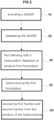
- a method of recycling waste lubricant including providing a waste lubricant-derived oil fraction 10; pretreating the waste lubricant-derived oil fraction 20; and hydrocracking the pretreated waste lubricant-derived oil fraction 30.
- the recycling waste lubricant in the broadest sense, means reclaiming waste lubricant as a feedstock for the manufacture of a usable oil, and in the context of this disclosure, it means reusing waste lubricant as a feedstock for the manufacture of fuel oils and lube base oils.
- waste lubricant-derived oil fraction refers to used lubricant.
- lubricant contains a lube base oil and various additives.
- the additives include large amounts of impurities that are not suitable for use in a lube base oil. For this reason, the waste lubricant contains large amounts of impurities.
- waste lubricant may contain 200 to 3000 ppm of sulfur, 200 to 2000 ppm of nitrogen, 20 to 2000 ppm of chlorine, and other metallic impurities that may be introduced during lubrication.
- the waste lubricant-derived oil fraction has a kinematic viscosity at 40°C in a range of 20 to 60 cSt and a pour point of lower than 0°C.
- the waste lubricant-derived oil fraction has a kinematic viscosity in a range of 25 to 50 cSt when measured at 40°C and a pour point of -5°C. More preferably, the waste lubricant-derived oil fraction has a kinematic viscosity in a range of 26 to 40 cSt measured at 40°C and a pour point in a range of -21°C to -6°C.
- the waste lubricant derived oil fraction may be a refined oil fraction.
- the term "refined oil fraction” refers to an oil component resulting from a process in which waste lubricant undergoes centrifugal separation, atmospheric distillation, vacuum distillation, or any combination thereof.
- the refined oil fraction has a reduced impurity content compared to the original waste lubricant.
- the refined oil fraction may have a sulfur content of less than 200 ppm, a nitrogen content of less than 100 ppm, and a chlorine content of less than 2000 ppm.
- the method includes a step of pretreating the waste lubricant-derived oil fraction.
- the pretreatment refers to the step of treating the waste lubricant-derived oil fraction prior to the hydrocracking process, to minimize the impact of impurities contained in the waste lubricant-derived oil fraction on the process and the catalyst.
- the pretreatment step may include a step of performing solvent extraction on the waste lubricant-derived oil fraction.
- the solvent extraction of the waste lubricant-derived refined oil fraction is a step of blending the refined oil fraction and a solvent in a blending tank, a step of maintaining the mixture in a stationary state to reach phase separation, thereby obtaining a phase in which oil is a main component, and a step of removing a phase containing a large amount of impurity.
- the solvent used for the solvent extraction is a solvent having a higher affinity to impurities than the oil component in the waste lubricant-derived refined oil fraction.
- NMP N-methyl-2-pyrrolidone
- sulfolane sulfolane
- DMSO furfural
- phenol phenol
- acetone acetone
- any solvent that has a high affinity to impurities and a low affinity to the waste lubricant-derived refined oil fraction so as to be phase-separated from the waste lubricant-derived refined oil fraction can be used.
- the solvent may exhibit a different volatility from the oil fraction in the subsequent solvent separation process.
- the solvent extraction of the waste lubricant-derived refined oil fraction is carried out at a temperature of about 30°C to 200°C, preferably about 40°C to 150°C, and more preferably about 60°C to 100°C, and at a pressure in a range of atmospheric pressure to 20 kg/cm 2 , preferably in a range of atmospheric pressure to 15 kg/cm 2 , more preferably in a range of atmospheric pressure to 10 kg/cm 2 .
- the volume ratio of a solvent used in the solvent extraction step of the waste lubricant-derived refined oil fraction with respect to the oil component contained in the waste lubricant-derived oil fraction is 1:1 to 10:1, preferably 2:1 to 8:1, 2:1 to 7:1,2:1 to 6:1, 2:1 to 5:1, 3:1 to 8:1, 3:1 to 7:1, 3:1 to 6:1, 4:1 to 8:1, 4:1 to 7:1, and 5:1 to 8:1.
- the volume ratio of the solvent used in the solvent extraction step of the refined oil fraction to the oil component contained in the refined oil fraction may most preferably be in a range of 1:1 to 1.5:1.
- the above volume ratio is preferable in terms of the balance between the level of impurity removal through the solvent extraction and the yield of the hydrocracking product produced from the pretreated waste lubricant-derived oil fraction.
- the waste lubricant-derived oil fraction has a specific gravity of 0.8 to 0.9, a kinematic viscosity at 100°C in a range of 4 to 6 cSt (ASTM D445 at 100°C), a viscosity index of 110 to 130 (ASTM D2270), a pour point of -18°C to -3°C (ASTM D97), a sulfur content of less than 150 ppm, a nitrogen content of less than 100 ppm, and a chlorine content of less than 20 ppm.
- the waste lubricant-derived oil fraction may have improved characteristics and a reduced impurity content, may exhibit a light brown color of about 2 to 4 (ASTM D1500), and may have a reduced sediment content compared to the original refined oil fraction which has not yet undergone the solvent extraction.
- the method includes a step of hydrocracking the pretreated waste lubricant-derived oil fraction.
- the hydrocracking is a process in which long-chain hydrocarbons in pretreated waste lubricant-derived oils are broken down into shorter-chain hydrocarbons by a catalyzed hydrogenation reaction.
- the hydrocracking step may be performed at a reaction pressure of about 25 to 320 atm (specifically about 80 to 250 atm) and in a temperature condition of about 200°C to 500°C (more specifically, about 250°C to 400°C).
- the hydrocracking step may be performed at a liquid hourly space velocity (LHSV) in a range of, for example, about 0.1 to 8 hr -1 and, more specifically, about 0.5 to 5 hr -1 .
- LHSV liquid hourly space velocity
- the method may further include a first blending step of blending the waste lubricant-derived oil fraction with a hydrocarbon feedstock prior to the hydrocracking step to produce a first formulation.
- the first blending step may be performed prior to the pretreatment step, or between the pretreatment step and the hydrocracking step.
- the first blending step may be performed prior to the pretreatment step.
- hydrocarbon feedstock refers to any material that may be an input for a refining, conversion, or other industrial process in which hydrocarbons are a major component.
- the hydrocarbon feedstock may be provided at a temperature above its pour point, so that the hydrocarbon feedstock may be in a liquid state.
- the hydrocarbon feedstock may contain a non-hydrocarbon component such as organic and inorganic materials containing heteroatoms (for example, S, N, O, P, and metals). Crude oil, refinery streams, chemical plant streams (for example, steam cracked tar), and recycling plant streams (for example, pyrolysis oil from tires or municipal solid waste) are examples of the hydrocarbon feedstock.
- the hydrocarbon feedstock may preferably be a feedstock fed to the hydrocracking step for the generation of a fraction having a boiling point within the boiling point range of fuel oils. Referring to FIG. 2 , the hydrocarbon feedstock as described above may be blended with waste lubricant-derived oil in the first blending step 40, after a pretreating step 20 and then introduced into the hydrocracking step 40.
- the pretreating step 20 may be performed after the first blending step 40.
- the hydrocarbon feedstock as described above may be blended with waste lubricant-derived oil in the first blending step 40, after a pretreating step 20 and then introduced into the hydrocracking step 40.
- the hydrocarbon feedstock may be blended with pretreated waste lubricant-derived oil after the waste lubricant pretreatment step and then be introduced into the hydrocracking step.
- oils having a more variety of carbon numbers and a more variety of saturation degrees can be obtained compared to when only oils derived from pretreated waste lubricant are introduced into the hydrocracking step.
- the first formulation may include 1% to 10% by volume of the waste lubricant-derived oil fraction with respect to the total volume thereof.
- the proportion of the high-carbon waste lubricant derived oils in the formulation may be relatively low, so that hydrocracking of the high-carbon waste lubricant-derived oil may not be easily performed.
- the feedstock introduced into the hydrocracking step may contain a high proportion of heavy oils containing catalyst deactivating impurities, resulting in increases in hydrocracking temperature and pressure conditions, and consequently, a strain on the hydrocracking catalyst.
- the first formulation may include the waste lubricant-derived oil fraction in an amount of 2% to 9% by volume and, more preferably, 4% to 8% by volume, with respect to the total volume thereof.
- the first formulation may include a hydrocarbon feedstock other than the waste lubricant-derived oil fraction.
- the method may further include recovering a plurality of fractions including a first fraction and a second fraction, from the product of the hydrocracking step 60.
- the hydrocracked waste lubricant-derived oil, or the hydrocracked first formulation is separated into components according to boiling point by separation distillation.
- the product of the hydrocracking step is separated by fractional distillation in the order of lower boiling point fractions to higher boiling point fractions.
- the plurality of fractions thus separated includes at least first and second fractions having different boiling points, which are recovered and used for appropriate purposes.
- the first fraction may have a boiling point in a boiling point range of fuel oils.
- fuel oils include liquefied petroleum gas (LPG), gasoline, kerosene, diesel, and heavy fuel oil that are in order of decreasing boiling point.
- LPG liquefied petroleum gas
- the first fraction may correspond to a fraction having a boiling point within the range of boiling points of fuel oils as described above, and may be further separated as necessary to include a specific fraction of the fuel oil.
- the first fraction may have a boiling point lower than 400°C.
- the second fraction may have a boiling point higher than the boiling point of the first fraction.
- the second fraction may have a boiling point of 450°C or higher.
- the product of the hydrocracking step also includes an uncracked oil fraction.
- Unconverted oil refers to heavy oil that remains from the hydrocracking step and which is not converted to fuel oil as described above.
- the unconverted oil (UCO) has a higher boiling point than fuel oil.
- the unconverted oil may be separated from the first fraction having a boiling point in the boiling point range of the fuel oil upon fractional distillation, and may be recovered.
- the second fraction may be a fraction including unconverted oil and may have a higher boiling point than the first fraction described above.
- the second fraction including the unconverted oil as described above may be recovered and introduced into the process steps for the preparation of the lube base oil.
- the second fraction may exhibit a high pour point of 30°C to 45°C due to the high wax content of the unconverted oil but may contain impurities such as sulfur and nitrogen in a low content of less than 10 ppm.
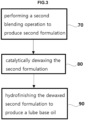
- the method may further include a second blending step 70 of blending the second fraction with a separate waste lubricant-derived oil fraction to produce a second formulation.
- the separate waste lubricant-derived oil fraction blended with the second fraction containing the unconverted oil is subjected to the pretreatment step for the removal of impurities but is not introduced into the hydrocracking step.
- the waste lubricant-derived oil fraction may be pretreated waste lubricant-derived oil.
- the second blending step may include a stirring step of blending the second fraction with the separate waste lubricant-derived oil fraction.
- the second formulation resulting from the second blending step can be further processed and reclaimed as a lube base oil through additional treatment.
- a lube base oil is generated from a blended formulation including unconverted oil after the hydrocracking stage of a waste lubricant-derived oil fraction and a separate waste lubricant-derived oil, the cost of manufacturing a lube base oil can be reduced. In addition, there are also environmental benefits because waste lubricant is not disposed of but is recycled.
- the amount of the separate waste lubricant-derived oil used in the second blending step may be 3% to 50% by volume with respect to the volume of the second formulation.
- the amount of the separate waste lubricant-derived oil fraction introduced into the second blending may be about 5% to 45%, about 5% to 40%, about 5% to 35%, about 5% to 30%, about 5% to 25%, about 5% to 20%, about 5% to 15%, about 5% to 10%, about 7% to 40%, about 7% to 35%, about 7% to 25%, about 7% to 20%, preferably about 7% to 15%, and more preferably about 7% to 10% of the volume of the second formulation.
- the pretreated waste lubricant-derived oil fraction contains almost no wax component.
- the pour point of the pretreated waste lubricant-derived oil fraction is as low as -18°C to -3°C.
- the pretreated waste lubricant-derived oil fraction is blended with the second formulation containing unconverted oil having a high pour point of about 42°C, the fluidity of the blended raw material is increased, so that the raw material can be easily transported even at low temperatures.
- the blending amount of the pretreated waste lubricant-derived oil fraction is lower than 3% by volume, the effect of increasing the fluidity is not significant, so that the blended raw material cannot be easily transported from one step to another.
- the blended raw material is not suitable as a raw material for producing a high-grade lube base oil due to impurities contained in the pretreated waste lubricant-derived oil fraction and a low viscosity index.
- the method may further include a step 80 of catalytically dewaxing the second formulation.
- the catalytic dewaxing selectively isomerizes the wax component contained in the second formulation to improve low-temperature properties (to ensure a low pour point) and to maintain a high viscosity index (VI).
- VI viscosity index
- it is intended to achieve improvement in efficiency and yield through improvement of the catalyst used in the catalytic dewaxing process.
- the main reaction of the catalytic dewaxing is to convert N-paraffine to isoparaffin through an isomerization reaction to improve low-temperature properties
- the catalyst used here is mainly a bi-functional catalyst.
- a bi-functional catalyst is composed of two active components: a metal active component (metal site) for hydrogenation/dehydrogenation reaction and a carrier (acid site) for skeletal isomerization using carbynium ions.
- a catalyst having a zeolite structure is generally composed of an aluminosilicate carrier and at least one metal selected from Group 8 metals and Group 6 metals.
- the dewaxing catalyst used includes a carrier having an acid site selected from molecular sieve, alumina, and silica-alumina, and one or more hydrogenating metals selected from elements of Groups 2, 6, 9 and 10 of the Periodic table.
- a carrier having an acid site selected from molecular sieve, alumina, and silica-alumina and one or more hydrogenating metals selected from elements of Groups 2, 6, 9 and 10 of the Periodic table.
- the metals in Group 9 and Group 10 i.e., Group VIII
- Co, Ni, Pt, and Pd are preferably used
- Mo and W are preferably used.
- the types of carriers having acid sites include molecular sieves, alumina, silica-alumina, and the like.
- the molecular sieves refer to crystalline aluminosilicates (zeolite), SAPO, ALPO, and the like.
- a medium pore molecular sieve with a 10-membered oxygen ring, such as SAPO-11, SAPO-41, ZSM-11, ZSM-22, ZSM-23, ZSM-35, and ZSM-48 is used, and a large pore molecular sieve with a 12-membered oxygen ring may be used.
- EU-2 zeolite having a controlled phase transition degree may be preferably used as the carrier.
- the synthesis conditions are likely to change, or the synthesized zeolite crystal is likely to gradually transition to a more stable phase if the synthesis continues over a predetermined period time. This phenomenon is referred to as phase transformation of zeolite. It was confirmed that isomerization selection performance was improved according to the degree of phase transformation of the zeolite, and excellent performance was also exhibited in the catalytic dewaxing reaction using the same.
- the method may further include a step 90 of hydrofinishing the catalytically dewaxed second formulation and a step of recovering the product of the hydrofinishing step as a lube base oil.
- the hydrofinishing 90 is a step of removing aromatics, olefins, and solvents from the blended raw material to improve the oxidative stability and UV stability of the second formulation.
- the catalytically dewaxed second formulation is hydrofinished in the presence of a hydrofinishing catalyst.
- the hydrofinishing catalyst has the function of saturating the unsaturated hydrocarbons contained in the catalytically dewaxed second formulation, thereby improving color and storage stability.
- the hydrofinishing catalyst may be the same as the dewaxing catalyst described above.
- the products of the hydrofinishing step can be separated according to their viscosity, and among the products, a lube base oil with the desired properties can be recovered.
- the lube base oil produced by the method described above may be a high-grade lube base oil in Group III or higher according to the API classification described above. More specifically, the lube base oil has a viscosity index of 120 or more, preferably 120 to 140, 120 to 135, 120 to 130, 120 to 125, 125 to 140, 125 to 135, 125 to 130, 130 to 140, or 130 to 135, and the degree of saturation is 90% or more, preferably 91% or more, 92% or more, 93% or more, 94% or more, 95% or more, 96% or more, 97% or more, 98% or more, or 99 % or more.
- the degree of saturation is 90% or more, preferably 91% or more, 92% or more, 93% or more, 94% or more, 95% or more, 96% or more, 97% or more, 98% or more, or 99 % or more.
- the lube base oil may contain almost no impurities since the content of each of the impurities such as sulfur, nitrogen, and chlorine is 1 ppm or less.
- the lube base oil may have a Saybolt color value of 27 or greater, when measured by ASTM D 156.
- this lube base oil is a lube base oil having stability corresponding to Water White grade.
- Water White grade lube base oils have a sulfur content of less than 1 ppm, a nitrogen content of less than 1 ppm, a saturation degree of 99% or more, and an aromatic content of less than 1%. These lube base oils are more stable than conventional API Group III lube base oils.
- the lube base oil may exhibit a UV 260-350 nm absorbance of 2.5 or less and a UV 325 nm absorbance of 0.7 or less, as measured by ASTM D 2008.
- the absorbance at a wavelength of 260 to 350 nm indicates that the test material contains a component having 3 or more aromatic rings
- the absorbance at a wavelength of 325 nm indicates that the test material contains a component having 3 to 7 aromatic rings.
- the lube base oil exhibits a low absorbance at these wavelengths. That is, the lube base oil has a low aromatic content, thereby having high stability.
- Waste lubricant having a sulfur content of about 2000 ppm, a nitrogen content of about 1500 ppm, and a chlorine content of about 1500 ppm was centrifuged at a speed of about 300 rpm, followed by atmospheric distillation and vacuum distillation, to obtain a refined oil fraction.
- the resulting refined oil fraction was hydrotreated and subjected to hydrocracking.
- hydrocracked refined oil fraction was introduced into fractional distillation to obtain fuel oil and unconverted oil with different boiling points.
- a separate waste lubricant-derived oil fraction having undergone atmospheric distillation and vacuum distillation was subj ected to hydrotreatment, and the hydrotreated oil was blended with the unconverted oil in a volume ratio of 25 (separate waste lubricant-derived oil fraction):75 (unconverted oil), and the blended oil was subjected to vacuum distillation, catalytic dewaxing, and hydrofinishing to produce a lube base oil.
- the atmospheric distillation was performed at a temperature of 50°C to 350°C and at atmospheric pressure.
- the process conditions of the vacuum distillation are shown in Table 2 below. [Table 2] Process conditions of vacuum distillation Temperature 100°C to 350°C Pressure 10 torr
- Process conditions of the hydrotreatment are shown in Table 3 below. [Table 3] Process conditions of hydrotreatment Temperature 350°C Pressure 150 kg/cm 2 Catalyst Ni-Mo catalyst
- the catalytic dewaxing is carried out at a temperature of 300°C and a pressure of 150 kg/cm 2 , in the presence of a hydrogenation catalyst with EU-2 zeolite as a carrier.
- the lube base oil prepared by the above-described production processes was measured for various properties, and as a result of the measurements, the lube base oil had a specific gravity of 0.84, a kinematic viscosity at 100°C of 7.3 cSt, a viscosity index (VI) of 129, a kinematic viscosity of -33°C, a sulfur content of less than 1 ppm, and a nitrogen content of less than 1 ppm, and contained almost no impurities except for unavoidable trace amounts of impurities.
- the lube base oil had a viscosity index of at least 120 and a saturation degree of at least 95%, indicating that the lube base oil satisfies the conditions required for Group III lube base oil shown in Table 1.
- the base oil had a bright and clean color when visually evaluated by eye.
- the color was a Saybolt color value of 27 or more, when measured according to ASTM D 156. That is, the lube base oil is a lube base oil having a water white grade, and the lube base oil has high thermal stability at high temperatures.
- the lube base oil exhibits a low absorbance of up to 3.0 (up to 1.0 at a wavelength of 325 nm) when measured according to ASTM D 2008 for UV having a wavelength of 260 to 350 nm, and especially for UV having a wavelength of 325 nm. It was confirmed that the lube base oil had high stability against UV.
- blending waste lubricant-derived oil with unconverted oil and using the blended oil as a feedstock for the production of lube base oil can increase the stability and yield of the final product lube base oil.
Landscapes
- Chemical & Material Sciences (AREA)
- Oil, Petroleum & Natural Gas (AREA)
- Chemical Kinetics & Catalysis (AREA)
- General Chemical & Material Sciences (AREA)
- Organic Chemistry (AREA)
- Engineering & Computer Science (AREA)
- Combustion & Propulsion (AREA)
- Physics & Mathematics (AREA)
- Thermal Sciences (AREA)
- Production Of Liquid Hydrocarbon Mixture For Refining Petroleum (AREA)
- Lubricants (AREA)
Applications Claiming Priority (1)
| Application Number | Priority Date | Filing Date | Title |
|---|---|---|---|
| KR1020230093263A KR20250012982A (ko) | 2023-07-18 | 2023-07-18 | 폐윤활유를 재활용하는 방법 |
Publications (1)
| Publication Number | Publication Date |
|---|---|
| EP4495211A1 true EP4495211A1 (de) | 2025-01-22 |
Family
ID=90365366
Family Applications (1)
| Application Number | Title | Priority Date | Filing Date |
|---|---|---|---|
| EP24163169.6A Pending EP4495211A1 (de) | 2023-07-18 | 2024-03-13 | Verfahren zur wiederverwertung von altschmiermittel |
Country Status (4)
| Country | Link |
|---|---|
| US (1) | US20250026996A1 (de) |
| EP (1) | EP4495211A1 (de) |
| JP (1) | JP2025015400A (de) |
| KR (1) | KR20250012982A (de) |
Citations (3)
| Publication number | Priority date | Publication date | Assignee | Title |
|---|---|---|---|---|
| US20180187092A1 (en) * | 2016-12-29 | 2018-07-05 | Exxonmobil Research And Engineering Company | Block processing for base stock production from deasphalted oil |
| US20230054666A1 (en) * | 2021-08-17 | 2023-02-23 | Sk Innovation Co., Ltd. | Process of producing high-quality lube base oil by using refined oil fraction of waste lubricant |
| US20230193145A1 (en) * | 2021-12-22 | 2023-06-22 | Saudi Arabian Oil Company | Process scheme for maximum heavy oil conversion with stage asphaltene rejection |
Family Cites Families (8)
| Publication number | Priority date | Publication date | Assignee | Title |
|---|---|---|---|---|
| DE1545260C3 (de) * | 1964-11-30 | 1974-09-19 | Chemokomplex Vegyipari-Gep Es Berendezes Export, Import Vallalat, Budapest | Verfahren zum Regenerieren von Altölen |
| US3328287A (en) * | 1966-06-02 | 1967-06-27 | Mobil Oil Corp | Production of lubricating oils from resin extracts |
| US3639229A (en) * | 1970-06-29 | 1972-02-01 | Exxon Research Engineering Co | Refining of used lubricating oils |
| US8366912B1 (en) | 2005-03-08 | 2013-02-05 | Ari Technologies, Llc | Method for producing base lubricating oil from waste oil |
| KR100934331B1 (ko) * | 2008-06-17 | 2009-12-29 | 에스케이루브리컨츠 주식회사 | 고급 나프텐계 베이스 오일의 제조방법 |
| WO2019014681A2 (en) * | 2017-07-14 | 2019-01-17 | Murray Extraction Technologies Llc | PRODUCTION OF HIGH QUALITY BASIC OILS |
| JP7546605B2 (ja) * | 2019-05-22 | 2024-09-06 | サビック グローバル テクノロジーズ ベスローテン フェンノートシャップ | 高価値の化学製品を製造するためのプラスチック由来のオイルと使用済みの潤滑油の混合物の処理および水蒸気分解 |
| KR20250012981A (ko) * | 2023-07-18 | 2025-01-31 | 에스케이이노베이션 주식회사 | 폐윤활유 정제 유분을 활용한 윤활기유 제조 공정 및 이에 의해 제조되는 윤활기유 |
-
2023
- 2023-07-18 KR KR1020230093263A patent/KR20250012982A/ko active Pending
-
2024
- 2024-03-13 EP EP24163169.6A patent/EP4495211A1/de active Pending
- 2024-03-14 JP JP2024040149A patent/JP2025015400A/ja active Pending
- 2024-03-21 US US18/611,694 patent/US20250026996A1/en active Pending
Patent Citations (3)
| Publication number | Priority date | Publication date | Assignee | Title |
|---|---|---|---|---|
| US20180187092A1 (en) * | 2016-12-29 | 2018-07-05 | Exxonmobil Research And Engineering Company | Block processing for base stock production from deasphalted oil |
| US20230054666A1 (en) * | 2021-08-17 | 2023-02-23 | Sk Innovation Co., Ltd. | Process of producing high-quality lube base oil by using refined oil fraction of waste lubricant |
| US20230193145A1 (en) * | 2021-12-22 | 2023-06-22 | Saudi Arabian Oil Company | Process scheme for maximum heavy oil conversion with stage asphaltene rejection |
Also Published As
| Publication number | Publication date |
|---|---|
| JP2025015400A (ja) | 2025-01-30 |
| KR20250012982A (ko) | 2025-01-31 |
| US20250026996A1 (en) | 2025-01-23 |
Similar Documents
| Publication | Publication Date | Title |
|---|---|---|
| US20230054666A1 (en) | Process of producing high-quality lube base oil by using refined oil fraction of waste lubricant | |
| EP2847302B1 (de) | Verfahren zur herstellung von schmierölen mit hohem viskositätsindex | |
| CN103328619B (zh) | 制备高粘度指数润滑基础油的方法 | |
| EP4495209A1 (de) | Verfahren zur herstellung von schmierbasisöl unter verwendung einer raffinierten ölfraktion von altschmierstoff und damit hergestelltes schmierbasisöl | |
| CN101768470B (zh) | 一种光亮油的制备方法 | |
| US11225616B2 (en) | Method of producing lubricating base oil from feedstock comprising diesel fraction, and lubricating base oil produced thereby | |
| EP4495213A1 (de) | Verfahren zur herstellung eines schmierstoff-grundöls umfassend eine raffinierte altölfraktion, und damit hergestelltes schmierstoff-grundöl | |
| KR20060130675A (ko) | 2 이상의 기유 등급 및 중질 증류물을 연속적으로 제공하기위한 공정 | |
| EP4495211A1 (de) | Verfahren zur wiederverwertung von altschmiermittel | |
| US11873455B2 (en) | Process having improved base oil yield | |
| WO2023202893A1 (en) | Method for preparing a naphthenic brightstock from a naphthenic feedstock based on naphthenic deasphalted oil | |
| EP4689011A1 (de) | Entfernung von aromatischen und polaren verbindungen in schmiermittelrohstoffen durch gegenstrom-flüssig-flüssigextraktion mit dihydrolevoglucosenon als lösungsmittel | |
| WO2022144740A1 (en) | Improved process to make finished base oils and white oils from dewaxed bulk base oils |
Legal Events
| Date | Code | Title | Description |
|---|---|---|---|
| PUAI | Public reference made under article 153(3) epc to a published international application that has entered the european phase |
Free format text: ORIGINAL CODE: 0009012 |
|
| STAA | Information on the status of an ep patent application or granted ep patent |
Free format text: STATUS: REQUEST FOR EXAMINATION WAS MADE |
|
| 17P | Request for examination filed |
Effective date: 20240313 |
|
| AK | Designated contracting states |
Kind code of ref document: A1 Designated state(s): AL AT BE BG CH CY CZ DE DK EE ES FI FR GB GR HR HU IE IS IT LI LT LU LV MC ME MK MT NL NO PL PT RO RS SE SI SK SM TR |