EP4495075A1 - Plattenwärmebehandlungsvorrichtung und hochdruckhärtungsreaktionsmodul - Google Patents
Plattenwärmebehandlungsvorrichtung und hochdruckhärtungsreaktionsmodul Download PDFInfo
- Publication number
- EP4495075A1 EP4495075A1 EP23187093.2A EP23187093A EP4495075A1 EP 4495075 A1 EP4495075 A1 EP 4495075A1 EP 23187093 A EP23187093 A EP 23187093A EP 4495075 A1 EP4495075 A1 EP 4495075A1
- Authority
- EP
- European Patent Office
- Prior art keywords
- heat treatment
- chamber
- wind speed
- speed adjustment
- airflow
- Prior art date
- Legal status (The legal status is an assumption and is not a legal conclusion. Google has not performed a legal analysis and makes no representation as to the accuracy of the status listed.)
- Pending
Links
Images





Classifications
-
- C—CHEMISTRY; METALLURGY
- C03—GLASS; MINERAL OR SLAG WOOL
- C03B—MANUFACTURE, SHAPING, OR SUPPLEMENTARY PROCESSES
- C03B27/00—Tempering or quenching glass products
- C03B27/04—Tempering or quenching glass products using gas
- C03B27/0404—Nozzles, blow heads, blowing units or their arrangements, specially adapted for flat or bent glass sheets
-
- C—CHEMISTRY; METALLURGY
- C03—GLASS; MINERAL OR SLAG WOOL
- C03B—MANUFACTURE, SHAPING, OR SUPPLEMENTARY PROCESSES
- C03B25/00—Annealing glass products
- C03B25/04—Annealing glass products in a continuous way
- C03B25/06—Annealing glass products in a continuous way with horizontal displacement of the glass products
- C03B25/08—Annealing glass products in a continuous way with horizontal displacement of the glass products of glass sheets
-
- C—CHEMISTRY; METALLURGY
- C03—GLASS; MINERAL OR SLAG WOOL
- C03B—MANUFACTURE, SHAPING, OR SUPPLEMENTARY PROCESSES
- C03B27/00—Tempering or quenching glass products
- C03B27/04—Tempering or quenching glass products using gas
- C03B27/044—Tempering or quenching glass products using gas for flat or bent glass sheets being in a horizontal position
-
- C—CHEMISTRY; METALLURGY
- C21—METALLURGY OF IRON
- C21D—MODIFYING THE PHYSICAL STRUCTURE OF FERROUS METALS; GENERAL DEVICES FOR HEAT TREATMENT OF FERROUS OR NON-FERROUS METALS OR ALLOYS; MAKING METAL MALLEABLE, e.g. BY DECARBURISATION OR TEMPERING
- C21D2241/00—Treatments in a special environment
- C21D2241/01—Treatments in a special environment under pressure
-
- C—CHEMISTRY; METALLURGY
- C21—METALLURGY OF IRON
- C21D—MODIFYING THE PHYSICAL STRUCTURE OF FERROUS METALS; GENERAL DEVICES FOR HEAT TREATMENT OF FERROUS OR NON-FERROUS METALS OR ALLOYS; MAKING METAL MALLEABLE, e.g. BY DECARBURISATION OR TEMPERING
- C21D9/00—Heat treatment, e.g. annealing, hardening, quenching or tempering, adapted for particular articles; Furnaces therefor
- C21D9/46—Heat treatment, e.g. annealing, hardening, quenching or tempering, adapted for particular articles; Furnaces therefor for sheet metals
Definitions
- the present disclosure relates to a technical field of a plate heat treatment device, and particularly to, a plate heat treatment device and a high-pressure hardening reaction module, both of which can change a volume of a chamber to change a flow speed of airflow, such that a wind pressure which the airflow impacts on the plate can be adjusted.
- Glass materials are widely used in daily life, for example, applied to building materials to serve as interior decoration glass or window glass, or applied to electronic devices to serve as panels of displays or protective glass of mobile phones.
- the annealing process is to slowly heat the glass to above the annealing temperature for a period, and then to gradually cool the glass to make the glass have a specific shape. Therefore, the stress of the glass can be eliminated to prevent the glass from breaking easily when it is impacted.
- the tempering process is to first heat the glass to 600 degrees Celsius, and then use high-pressure air to impact on the glass surface and rapidly cool the glass to 300 degrees Celsius for quenching, such that compressive stress is generated on the glass surface to increase the hardness of the glass surface and to strengthen the glass surface. Finally, the tempering process is to gradually cool the glass cool to room temperature.
- One objective of the present disclosure is to provide a plate heat treatment device and a high-pressure hardening reaction module, both of which solve the problem that the driving force of the airflow source needs to be changed when changing the wind pressure during the tempering process in the prior art, wherein the problem in the prior art leads to an increase in energy consumption.
- the present disclosure provides a high-pressure hardening reaction module, and the high-pressure hardening reaction module comprises a wind pressure adjustment device and multiple first heat treatment units.
- the wind pressure adjustment device comprises a first air source and a wind speed adjustment chamber.
- the first air source generates a first airflow with a predetermined flow.
- a volume of the wind speed adjustment chamber is variable, multiple pairs of the first heat treatment units are respectively communicative to the first air outlets of the wind speed adjustment chamber, each pair of the first heat treatment units comprises a first upper air outlet slot and a first lower air outlet slot, and the first upper air outlet slot and a first lower air outlet slot are opposite to each other and have the same configuration.
- Each pair of the first heat treatment units comprises a first upper heat treatment unit and a first lower heat treatment unit, both of which has a gap therebetween.
- the multiple pairs of the first heat treatment units are arranged in a row, and a plate is conveyed to pass through the gap between the first upper heat treatment unit and the first lower heat treatment unit of each pair of the first heat treatment units.
- the wind speed adjustment chamber comprises a chamber and multiple gates, the first air inlet and the first air outlets are disposed on the chamber, the gates are arranged in parallel, and line up in a row from the first air inlet to far, and each of the gates is configured to be able to move in the chamber to close a cross section, such that the volume of the chamber into which first airflow flows is variable.
- the wind speed adjustment chamber further comprises multiple guide frame units, the guide frame units are disposed in the chamber and corresponding to the gates, each of the guide frame units comprises a pair of guide frames, the paired guide frames have a spacing therebetween and are disposed in parallel, one of the gates is configured to move between the paired guide frames, and each of the guide frames has a hollow part.
- the wind speed adjustment chamber further comprises multiple airtight parts, the airtight parts are correspondingly disposed on the guide frames, and when each of the gates is move between the paired guide frames, the gate contacts the airtight parts disposed on the paired guide frames.
- the wind speed adjustment chamber further comprises multiple housings, the chamber has multiple entrances, the housings are disposed outside the chamber and corresponding to the entrances, and the gates are respectively disposed in the housings, and enter the chamber respectively through the entrances.
- the present disclosure provides a plate heat treatment device comprising the above high-pressure hardening reaction module and a low-pressure cooling module.
- the low-pressure cooling module comprises a second air source, an airflow chamber and multiple pairs of second heat treatment units.
- the second air source generates a second airflow with a predetermined flow second air source.
- the airflow chamber is connected to the wind speed adjustment chamber, and have a volume being variable. A volume variation of the airflow chamber is inversely proportional to a volume variation of the wind speed adjustment chamber.
- the airflow chamber comprises a second air inlet and multiple second air outlets, and the second air source is communicative to the second air inlet.
- the multiple pairs of second heat treatment units are respectively communicative to the second air outlets of the airflow chamber.
- Each pair of the second heat treatment units comprises an upper air outlet slot and a lower air outlet slot, both of which are arranged opposite to each other and have a same configuration, each pair of the second heat treatment units has a second upper heat treatment unit and a second lower heat treatment unit, both of which have a gap therebetween, the multiple pairs of the second heat treatment units are arranged in a row, and the plate is conveyed to pass through the gap between the second upper heat treatment unit and the second lower heat treatment unit of each pair of the second heat treatment units.
- the plate heat treatment device and the high-pressure hardening reaction module of the present disclosure can change the volume of the wind speed adjustment chamber to adjust the wind pressures of the first heat treatment units. Specifically, when changing the cross-sectional area of the wind speed adjustment chamber, the wind speeds of the first heat treatment units are changed, and the wind pressures of the first heat treatment units can be adjusted. Therefore, in case of fixing the flow of the airflow generated by the first air source, when changing the cross-sectional area of the wind speed adjustment chamber to adjust the wind pressure, the output (the flow of the airflow) of the first air source does not change, and it saves energy.
- the plate heat treatment device 1 comprises a high-pressure hardening reaction module 10 and a low-pressure cooling module 20. After the plate is heated to about 600 degrees Celsius, the plate passes through high-pressure hardening reaction module 10 and low-pressure cooling module 20 in sequence. The plate in the high-pressure hardening reaction module 10 is quickly cooled down to 300 degrees Celsius for quenching by using the high-pressure airflow, stress of a surface of the plate is thus enhanced to increase hardness of the plate, such that the strengthening effect on the plate is achieved. The plate after the quenching process is cooled down by using a low-pressure airflow in the low-pressure cooling module 20.
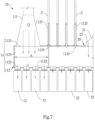
- the wind speed adjustment chamber 112 comprises a chamber 1123 and multiple gates 1124.
- the first air inlet 1121 and the first air outlet 1122 are disposed on the chamber 1123.
- the gates 1124 are arranged in parallel, and line up in a row from the first air inlet 1121 to far.
- Each of the gates 1124 can move into the chamber 1123 to close a cross section of the chamber 1123, such that the volume of the chamber 112 into which the first airflow flows can be variable.
- the cross-sectional area of the first air outlet 1122 corresponding to first airflow is variable.
- the cross-sectional area A of the first air outlet 1122 corresponding to first airflow is variable.
- the cross-sectional area A is inversely proportional to the flow speed v of the first airflow.
- the cross-sectional area A in FIG. 6 is larger than the cross-sectional area A in FIG. 7 , and thus the flow speed v of the first airflow in FIG. 6 is less than the flow speed v of the first airflow in FIG. 7 , such that the wind pressure which the first airflow impacts on the plate P can be adjusted.
- the first airflow enters the multiple pairs of the first heat treatment units 12 through the first air outlets 1122.
- the multiple pairs of the first heat treatment units 12 are respectively communicative to the first air outlets 1122 of the wind speed adjustment chamber 112.
- Each pair of the first heat treatment units 12 comprises an upper air outlet slot 121 and a lower air outlet slot 121, both of which are arranged opposite to each other and have a same configuration.
- each pair of the first heat treatment units 12 comprises a first upper heat treatment unit 12 and a first lower heat treatment unit 12.
- the first upper heat treatment unit 12 and the first lower heat treatment unit 12 have a gap G1 therebetween, and respectively has the upper air outlet slot 121 and the lower air outlet slot 121.
- the multiple pairs of the first heat treatment units 12 are arranged in a row.
- a plate P is conveyed to pass through the gap G1 between the first upper heat treatment unit 12 and the first lower heat treatment unit 12 of each pair of the first heat treatment units 12, and the plate P is supported and driven by the rollers R to move.
- the first airflow enters the wind speed adjustment chamber 112 from the first air inlet 1121, and by changing the volume of the wind speed adjustment chamber 112, a flow speed of the first airflow exiting outside from the first air outlets 1122 can be changed, thereby adjusting the wind pressure which the first airflow impacts on the plate P.
- the wind speed adjustment chamber 112 further comprises multiple housings 1125, and the housings 1125 are connected to the outer surface of the chamber 1123.
- the chamber 1123 is disposed with multiple entrances 1126, the gates 1124 can move into the chamber 1123 from the entrance 1126. When the gate 1124 moves away from the chamber 1123, the gates 1124 move to the housings 1125 and received in the housings 1125.
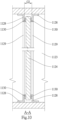
- the wind speed adjustment chamber 112 comprises multiple guide frame units 1127, each of the guide frame unit 1127 is formed by a pair of guide frames 1128, and the pair of guide frames 1128 comprises a left guide frame 1128 and a right guide frame 1128.
- the paired guide frames 1128 i.e., the left guide frame 1128 and the right guide frame 1128
- have a spacing G2 and when the gate 1124 moves into the chamber 1123, the gate 1124 passes through the spacing G2 between the paired guide frames 1128.
- Each of the guide frames 1128 has a hollow part 1129, and the hollow part 1129 makes interior of the chamber keep communicative when the gate 1124 does not move into the chamber 1123.
- the wind speed adjustment chamber 112 comprise multiple airtight parts 1130, and the airtight parts 1130 are disposed in the spacing G2 between the paired guide frames 1128.
- Each of the airtight parts 1130 corresponding to the paired guide frames 1128 are disposed opposite to each other, and when the gate 1124 passes through the spacing G2 between the paired guide frames 1128, the gate 1124 contacts the airtight parts 1130, such that the air in the chamber 1123 will not leak from the entrance 1126.
- the low-pressure cooling module 20 comprises a second air source 21, an airflow chamber 22 and multiple pairs of second heat treatment units 23.
- the second air source 21 generates a second airflow with a predetermined flow.
- the airflow chamber 22 is connected to the wind speed adjustment chamber 112, and has a volume being variable.
- a volume variation of the airflow chamber 22 is inversely proportional to a volume variation of the wind speed adjustment chamber 112. As shown in FIG. 2 , when one of the gates 1124 at various positions moves into the chamber 1123, the volume of wind speed adjustment chamber 112 will be reduced, and the volume of the airflow chamber 22 will be increased.
- the airflow chamber 22 further comprises a second air inlet 221 and multiple second air outlets 222, and the second air source 21 is communicative to the second air inlet 221.
- the second air source 21 is a blower.
- the multiple pairs of the second heat treatment unit 23 are respectively communicative to the second air outlets 222 of the airflow chamber 22.
- Each pair of the second heat treatment units 23 comprises an upper air outlet slot and a lower air outlet slot, both of which are arranged opposite to each other and have a same configuration.
- each pair of the second heat treatment units 23 has a second upper heat treatment unit 23 and a second lower heat treatment unit 23, and the second upper heat treatment unit 23 and the second lower heat treatment unit 23 respectively have the upper air outlet slot and the lower air outlet slot.
- the second upper heat treatment unit 23 and the second lower heat treatment unit 23 further have a gap therebetween.
- the multiple pairs of the second heat treatment units 23 are arranged in a row, and the plate P is conveyed to first pass through the gap G1 between the first upper heat treatment unit 12 and the first lower heat treatment unit 12 the of each pair of the first heat treatment units 12, and then through the gap between the second upper heat treatment unit 23 and the second lower heat treatment unit 23 of each pair of the second heat treatment units 23.
- the plate heat treatment device and the high-pressure hardening reaction module of the present disclosure can change the volume of the wind speed adjustment chamber to adjust the wind pressures of the first heat treatment units. Specifically, when changing the cross-sectional area of the wind speed adjustment chamber, the wind speeds of the first heat treatment units are changed, and the wind pressures of the first heat treatment units can be adjusted. Therefore, in case of fixing the flow of the airflow generated by the first air source, when changing the cross-sectional area of the wind speed adjustment chamber to adjust the wind pressure, the output (the flow of the airflow) of the first air source does not change, and it saves energy.
- the embodiment is described with a glass plate as an example, the present disclosure is not limited to the glass plate, and the heat treatment of steel or other metal plates is also applicable.
Landscapes
- Chemical & Material Sciences (AREA)
- Engineering & Computer Science (AREA)
- Materials Engineering (AREA)
- Organic Chemistry (AREA)
- Physics & Mathematics (AREA)
- Thermal Sciences (AREA)
- Re-Forming, After-Treatment, Cutting And Transporting Of Glass Products (AREA)
Priority Applications (1)
| Application Number | Priority Date | Filing Date | Title |
|---|---|---|---|
| EP23187093.2A EP4495075A1 (de) | 2023-07-21 | 2023-07-21 | Plattenwärmebehandlungsvorrichtung und hochdruckhärtungsreaktionsmodul |
Applications Claiming Priority (1)
| Application Number | Priority Date | Filing Date | Title |
|---|---|---|---|
| EP23187093.2A EP4495075A1 (de) | 2023-07-21 | 2023-07-21 | Plattenwärmebehandlungsvorrichtung und hochdruckhärtungsreaktionsmodul |
Publications (1)
| Publication Number | Publication Date |
|---|---|
| EP4495075A1 true EP4495075A1 (de) | 2025-01-22 |
Family
ID=87429304
Family Applications (1)
| Application Number | Title | Priority Date | Filing Date |
|---|---|---|---|
| EP23187093.2A Pending EP4495075A1 (de) | 2023-07-21 | 2023-07-21 | Plattenwärmebehandlungsvorrichtung und hochdruckhärtungsreaktionsmodul |
Country Status (1)
| Country | Link |
|---|---|
| EP (1) | EP4495075A1 (de) |
Citations (2)
| Publication number | Priority date | Publication date | Assignee | Title |
|---|---|---|---|---|
| WO1997044285A1 (en) * | 1996-05-22 | 1997-11-27 | Uniglass Engineering Oy | Adjusting cooling air in glass tempering machine |
| CN102503103A (zh) * | 2011-10-18 | 2012-06-20 | 玻石机械(天津)有限公司 | 一种热强化玻璃板的热处理方法和热处理设备 |
-
2023
- 2023-07-21 EP EP23187093.2A patent/EP4495075A1/de active Pending
Patent Citations (2)
| Publication number | Priority date | Publication date | Assignee | Title |
|---|---|---|---|---|
| WO1997044285A1 (en) * | 1996-05-22 | 1997-11-27 | Uniglass Engineering Oy | Adjusting cooling air in glass tempering machine |
| CN102503103A (zh) * | 2011-10-18 | 2012-06-20 | 玻石机械(天津)有限公司 | 一种热强化玻璃板的热处理方法和热处理设备 |
Similar Documents
| Publication | Publication Date | Title |
|---|---|---|
| US4682997A (en) | Process and apparatus for bending glass plates in a horizontal position | |
| EP3174835B1 (de) | Verfahren zur thermischen vorspannung von glas | |
| US9038416B2 (en) | Glass-substrate manufacturing method | |
| US10577271B2 (en) | Overpressure-assisted gravity bending method and device suitable therefor | |
| GB2631962A (en) | Plate heat treatment device and high-pressure hardening reaction module | |
| KR102053212B1 (ko) | 과압-보조 중력 벤딩 방법 및 그에 적합한 장치 | |
| US20180186676A1 (en) | Positive pressure-supported glass bending method and device suitable therefor | |
| KR20090089339A (ko) | 성형 유리 시트를 퀀칭하는 방법과 장치 | |
| EP4495075A1 (de) | Plattenwärmebehandlungsvorrichtung und hochdruckhärtungsreaktionsmodul | |
| US20250026682A1 (en) | Plate heat treatment device and high-pressure hardening reaction module | |
| US8480949B2 (en) | Gas-jet cooling apparatus for continuous annealing furnace | |
| CA1212236A (en) | Method and apparatus for supplying cooling air in a glass sheet quench | |
| CN107200467A (zh) | 一种风栅及采用该风栅钢化玻璃时的低压淬冷工艺 | |
| KR102193022B1 (ko) | 연속식 열간 가압 소결장치 | |
| EP3645473A1 (de) | Verfahren zur temperierung von glasscheiben | |
| CN220745704U (zh) | 板材热处理设备及其高压硬化反应模组 | |
| JP2005343720A (ja) | 彎曲ガラス板の製法とその装置 | |
| CN105621874B (zh) | 用于玻璃板回火的方法 | |
| US10927426B2 (en) | Cooling equipment for continuous annealing furnace | |
| TWM646402U (zh) | 板材熱處理設備及其高壓硬化反應模組 | |
| US9611166B2 (en) | Glass quench apparatus | |
| CN210193673U (zh) | 一种连续钢化炉传动装置 | |
| KR100640134B1 (ko) | 편평 제품과의 열교환용 장치 및 편평 제품용 냉각 장치 | |
| CN207793050U (zh) | 弯钢化设备及其加热结构 | |
| US4311507A (en) | Special entrance slit module and method for quenching glass sheets |
Legal Events
| Date | Code | Title | Description |
|---|---|---|---|
| PUAI | Public reference made under article 153(3) epc to a published international application that has entered the european phase |
Free format text: ORIGINAL CODE: 0009012 |
|
| STAA | Information on the status of an ep patent application or granted ep patent |
Free format text: STATUS: REQUEST FOR EXAMINATION WAS MADE |
|
| 17P | Request for examination filed |
Effective date: 20240326 |
|
| AK | Designated contracting states |
Kind code of ref document: A1 Designated state(s): AL AT BE BG CH CY CZ DE DK EE ES FI FR GB GR HR HU IE IS IT LI LT LU LV MC ME MK MT NL NO PL PT RO RS SE SI SK SM TR |
|
| GRAP | Despatch of communication of intention to grant a patent |
Free format text: ORIGINAL CODE: EPIDOSNIGR1 |
|
| STAA | Information on the status of an ep patent application or granted ep patent |
Free format text: STATUS: GRANT OF PATENT IS INTENDED |
|
| INTG | Intention to grant announced |
Effective date: 20250702 |
|
| RIN1 | Information on inventor provided before grant (corrected) |
Inventor name: TU, LI-JEN |