EP4492829A1 - Procédé et appareil de détermination de précision de modèle, et dispositif côté réseau - Google Patents
Procédé et appareil de détermination de précision de modèle, et dispositif côté réseau Download PDFInfo
- Publication number
- EP4492829A1 EP4492829A1 EP23765956.0A EP23765956A EP4492829A1 EP 4492829 A1 EP4492829 A1 EP 4492829A1 EP 23765956 A EP23765956 A EP 23765956A EP 4492829 A1 EP4492829 A1 EP 4492829A1
- Authority
- EP
- European Patent Office
- Prior art keywords
- model
- accuracy
- network element
- task
- information
- Prior art date
- Legal status (The legal status is an assumption and is not a legal conclusion. Google has not performed a legal analysis and makes no representation as to the accuracy of the status listed.)
- Pending
Links
Images




Classifications
-
- G—PHYSICS
- G06—COMPUTING OR CALCULATING; COUNTING
- G06N—COMPUTING ARRANGEMENTS BASED ON SPECIFIC COMPUTATIONAL MODELS
- G06N3/00—Computing arrangements based on biological models
- G06N3/02—Neural networks
- G06N3/08—Learning methods
-
- G—PHYSICS
- G06—COMPUTING OR CALCULATING; COUNTING
- G06N—COMPUTING ARRANGEMENTS BASED ON SPECIFIC COMPUTATIONAL MODELS
- G06N3/00—Computing arrangements based on biological models
- G06N3/02—Neural networks
- G06N3/04—Architecture, e.g. interconnection topology
- G06N3/045—Combinations of networks
-
- G—PHYSICS
- G06—COMPUTING OR CALCULATING; COUNTING
- G06N—COMPUTING ARRANGEMENTS BASED ON SPECIFIC COMPUTATIONAL MODELS
- G06N5/00—Computing arrangements using knowledge-based models
- G06N5/04—Inference or reasoning models
-
- G—PHYSICS
- G06—COMPUTING OR CALCULATING; COUNTING
- G06N—COMPUTING ARRANGEMENTS BASED ON SPECIFIC COMPUTATIONAL MODELS
- G06N5/00—Computing arrangements using knowledge-based models
- G06N5/04—Inference or reasoning models
- G06N5/043—Distributed expert systems; Blackboards
-
- H—ELECTRICITY
- H04—ELECTRIC COMMUNICATION TECHNIQUE
- H04L—TRANSMISSION OF DIGITAL INFORMATION, e.g. TELEGRAPHIC COMMUNICATION
- H04L41/00—Arrangements for maintenance, administration or management of data switching networks, e.g. of packet switching networks
- H04L41/14—Network analysis or design
-
- H—ELECTRICITY
- H04—ELECTRIC COMMUNICATION TECHNIQUE
- H04L—TRANSMISSION OF DIGITAL INFORMATION, e.g. TELEGRAPHIC COMMUNICATION
- H04L41/00—Arrangements for maintenance, administration or management of data switching networks, e.g. of packet switching networks
- H04L41/16—Arrangements for maintenance, administration or management of data switching networks, e.g. of packet switching networks using machine learning or artificial intelligence
-
- H—ELECTRICITY
- H04—ELECTRIC COMMUNICATION TECHNIQUE
- H04W—WIRELESS COMMUNICATION NETWORKS
- H04W24/00—Supervisory, monitoring or testing arrangements
- H04W24/04—Arrangements for maintaining operational condition
-
- H—ELECTRICITY
- H04—ELECTRIC COMMUNICATION TECHNIQUE
- H04W—WIRELESS COMMUNICATION NETWORKS
- H04W24/00—Supervisory, monitoring or testing arrangements
- H04W24/02—Arrangements for optimising operational condition
Definitions
- This application pertains to the field of mobile communication technologies, and specifically relates to a model accuracy determining method and apparatus, and a network-side device.
- a communication network some network elements have been introduced for performing intelligent data analysis and generating data analytics results (analytics) (also known as inference data results) of some tasks, where the data analytics results can assist intra- and inter-network devices in making policy decisions.
- data analytics results also known as inference data results
- AI artificial intelligence
- the network data analytics function can train AI or machine learning (Machine Learning, ML) models based on training data to obtain a model suitable for a specific AI task. Based on AI/ML models, inference is performed for inference input data of an AI task to obtain inference result data corresponding to the AI task.
- the policy control function Policy Control Function, PCF
- PCC Policy Control and Charging
- the access and mobility management function (Access and Mobility Management Function, AMF) performs intelligent mobility management operations based on inference result data of an AI task, for example, intelligently paging a user based on inference result data of user movement trajectory to improve the paging success rate.
- AMF Access and Mobility Management Function
- the intra- and inter-network devices make correct and optimized policy decisions based on AI data analytics results, but this requires accurate data analytics results as a basis. If the accuracy of the data analytics results is relatively low and incorrect information is provided to the intra- and inter-network devices for reference, the devices will eventually make incorrect policy decisions or perform inappropriate operations. Therefore, it is essential to ensure the accuracy of the data analytics results.
- Embodiments of this application provide a model accuracy determining method and apparatus, and a network-side device, so as to solve the problem of relatively low accuracy of inference result data obtained by the model.
- a model accuracy determining method applied to a first network element.
- the method includes:
- a model accuracy determining apparatus including:
- a model accuracy determining method applied to a second network element.
- the method includes:
- a model accuracy determining apparatus including:
- a network-side device includes a processor and a memory, where the memory stores a program or instructions capable of running on the processor, and when the program or instructions are executed by the processor, the steps of the method according to the first aspect are implemented, or the steps of the method according to the third aspect are implemented.
- a model accuracy determining system including a network-side device, where the network device includes a first network element and a second network element, the first network element may be used to perform the steps of the model accuracy determining method according to the first aspect, and the second network element may be used to perform the steps of the model accuracy determining method according to the third aspect.
- a readable storage medium where a program or instructions are stored in the readable storage medium, and when the program or instructions are executed by a processor, the steps of the method according to the first aspect are implemented, or the steps of the method according to the third aspect are implemented.
- a chip is provided, where the chip includes a processor and a communication interface, the communication interface is coupled to the processor, and the processor is configured to run a program or instructions to implement the steps of the method according to the first aspect or the steps of the method according to the third aspect.
- a computer program/program product is provided, where the computer program/program product is stored in a storage medium, and the computer program/program product is executed by at least one processor to implement the steps of the model accuracy determining method according to the first aspect, or the steps of the model accuracy determining method according to the third aspect.
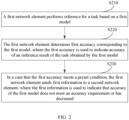
- the first network element performs inference for a task based on a first model, determines first accuracy corresponding to the first model, and in a case that the first accuracy meets a preset condition, sends first information to the second network element, where the first information is used to indicate that accuracy of the first model does not meet an accuracy requirement or has decreased.
- accuracy in use of the model can be monitored, and corresponding measures can be taken in a timely manner when the accuracy decreases, thereby preventing incorrect policy decisions or inappropriate operations.
- first, second, and the like in this specification and claims of this application are used to distinguish between similar objects rather than to describe a specific order or sequence. It should be understood that terms used in this way are interchangeable in appropriate circumstances so that the embodiments of this application can be implemented in other orders than the order illustrated or described herein.
- first and second are usually used to distinguish objects of a same type, and do not restrict a quantity of objects. For example, there may be one or a plurality of first objects.
- “and/or” in the specification and claims represents at least one of connected objects, and the character “/" generally indicates that the associated objects have an "or” relationship.
- technologies described in the embodiments of this application are not limited to a long term evolution (Long Term Evolution, LTE) or LTE-Advanced (LTE-Advanced, LTE-A) system, and may also be applied to other wireless communication systems, for example, code division multiple access (Code Division Multiple Access, CDMA), time division multiple access (Time Division Multiple Access, TDMA), frequency division multiple access (Frequency Division Multiple Access, FDMA), orthogonal frequency division multiple access (Orthogonal Frequency Division Multiple Access, OFDMA), single-carrier frequency division multiple access (Single-carrier Frequency Division Multiple Access, SC-FDMA), and other systems.
- code division multiple access Code Division Multiple Access
- TDMA time division multiple access
- FDMA frequency division multiple access
- OFDMA Orthogonal frequency division multiple access
- SC-FDMA single-carrier Frequency Division Multiple Access
- system and “network” in the embodiments of this application are often used interchangeably, and the technology described herein may be used in the above-mentioned systems and radio technologies as well as other systems and radio technologies.
- the following description describes a 5G system for illustrative purposes and uses 5G terminology in most of the following description, but these technologies can also be applied to applications beyond 5G systems, such as the 6th generation (6 th Generation, 6G) communication system.
- FIG. 1 is a block diagram of a wireless communication system to which an embodiment of this application is applicable.
- the wireless communication system includes a terminal 11 and a network-side device 12.
- the terminal 11 may be a terminal-side device such as a mobile phone, a tablet personal computer (Tablet Personal Computer), a laptop computer (Laptop Computer) or a notebook computer, a personal digital assistant (Personal Digital Assistant, PDA), a palmtop computer, a netbook, an ultra-mobile personal computer (Ultra-mobile Personal Computer, UMPC), a mobile internet device (Mobile Internet Device, MID), an augmented reality (Augmented Reality, AR)/virtual reality (Virtual Reality, VR) device, a robot, a wearable device (Wearable Device), vehicle user equipment (Vehicle User Equipment, VUE), pedestrian user equipment (Pedestrian User Equipment, PUE), smart household (home devices with wireless communication functions, such as refrigerators, televisions, washing machines, or furniture), a game console, a personal computer (Per
- the wearable device includes a smartwatch, a smart band, a smart earphone, smart glasses, smart jewelry (a smart bracelet, a smart hand chain, a smart ring, a smart necklace, a smart leglet, a smart anklet, and the like), a smart wristband, smart clothing, or the like.
- the terminal 11 is not limited to a specific type in the embodiments of this application.
- the network-side device 12 may include an access network device or a core network device.
- the access network device 12 may also be referred to as a radio access network device, a radio access network (Radio Access Network, RAN), a radio access network function, or a radio access network unit.
- RAN Radio Access Network
- the access network device 12 may include a base station, a wireless local area network (Wireless Local Area Network, WLAN) access point, a wireless fidelity (Wireless Fidelity, WiFi) node, or the like.
- the base station may be referred to as a NodeB, an evolved NodeB (eNB), an access point, a base transceiver station (Base Transceiver Station, BTS), a radio base station, a radio transceiver, a basic service set (Basic Service Set, BSS), an extended service set (Extended Service Set, ESS), a home NodeB, a home evolved NodeB, a transmitting receiving point (Transmitting Receiving Point, TRP), or other suitable terms in the field.
- the base station is not limited to specific technical terms. It should be noted that in the embodiments of this application, only the base station in a 5G system is taken as an example for description, and the specific type of the base station is not limited.
- the core network device may include but is not limited to at least one of the following: a core network node, a core network function, a mobility management entity (Mobility Management Entity, MME), an access and mobility management function (Access and Mobility Management Function, AMF), a session management function (Session Management Function, SMF), a user plane function (User Plane Function, UPF), a policy control function (Policy Control Function, PCF), a policy and charging rules function (Policy and Charging Rules Function, PCRF), an edge application server discovery function (EdgeApplicationServerDiscoveryFunction, EASDF), a unified data management (Unified Data Management, UDM) entity, a unified data repository (Unified Data Repository, UDR), a home subscriber server (Home Subscriber Server, HSS), a centralized network configuration (Centralized network configuration, CNC), a network repository function (Network Repository Function, NRF), a network exposure function (NetworkExposureFunction, NEF), a local N
- an embodiment of this application provides a model accuracy determining method.
- the method is executed by a first network element, where the first network element includes a model inference function network element.
- the method can be executed by software or hardware installed in the first network element.
- the method includes the following steps.
- the first network element performs inference for a task based on a first model.
- the first network element may be a network element that has both a model inference function and a model training function.
- the first network element is an NWDAF
- the NWDAF may include an analytics logical function (Analytics Logical Function, AnLF) and a model training logical function (Model Training Logical Function, MTLF).
- the first network element includes a network element having a model inference function
- the third network element includes a model training function network element.
- the first network element is an AnLF
- the third network element is an MTLF.
- the third network element and the first network element in the following embodiments can be a same network element, that is, the MTLF and the AnLF are combined into the NWDAF.
- the following embodiments are described by using an example in which the first network element is an AnLF and the third network element is an MTLF.
- the first model may be constructed and trained according to an actual need, for example, an AI/ML model.
- the MTLF collects training data and performs model training based on the training data. After the training is completed, the MTLF sends information of the trained first model to the AnLF.
- the AnLF After determining the triggered task, the AnLF performs inference for the task based on the first model to obtain inference result data.
- the task is a data analytics task for indicating a task type other than a single task.
- the AnLF can determine the first model corresponding to the task based on identity information (Analytics ID) of the task, and then perform inference for the task based on the corresponding first model to obtain the inference result data.
- identity information Analytics ID
- the AnLF can perform inference for the task based on the first model corresponding to the UE mobility.
- the obtained inference result data is the predicted terminal location (UE location) information.
- the AnLF can perform one or more inferences on the task based on the first model to obtain multiple pieces of inference result data or inference result data including multiple output result values.
- the AnLF performing inference for the task may be triggered by a task request message sent by the second network element, where the second network element is a network element that triggers the task, and the second network element includes a consumer network function (consumer Network Function, consumer NF); or the task may be actively triggered by the AnLF, for example, one validation and testing phase is set, and in this validation and testing phase, the task is actively simulated and triggered by the AnLF for testing the accuracy of the first model.
- consumer Network Function consumer NF
- the first network element determines first accuracy corresponding to the first model, where the first accuracy is used to indicate accuracy of an inference result of the task obtained by the first model.
- Step S220 includes:
- First accuracy number of correct results ⁇ total number; where the correct result can indicate that the inference result data is consistent with the label data or that a difference between the inference result data and the label data is within an allowable range.
- the first accuracy may be expressed in a variety of forms, not limited to a specific percentage value, such as 90%; or may be expressed in classification form, such as high, medium, or low; or may be normalized data, such as 0.9.
- the obtaining, by the first network element, label data corresponding to the inference result data includes:
- the source device of the label data can be determined by the AnLF based on type information of the output data of the first model, constraint condition information and object information of the task, and the like.
- the first network element sends first information to a second network element, where the first information is used to indicate that accuracy of the first model does not meet an accuracy requirement or has decreased.
- the AnLF determines, based on whether the first accuracy meets the preset condition, whether the accuracy of the first model meets the accuracy requirement or has decreased.
- the preset condition may include the first accuracy being less than a preset threshold or a degree of decrease having reached a specified extent.
- the AnLF sends the first information to the consumer NF to inform the consumer NF that the accuracy of the first model does not meet the accuracy requirement or has decreased, so that the consumer NF performs a corresponding operation based on the first information.
- the operation may include at least one of the following:
- the first network element performs inference for a task based on a first model, determines first accuracy corresponding to the first model, and in a case that the first accuracy meets a preset condition, sends first information to the second network element, where the first information is used to indicate that accuracy of the first model does not meet an accuracy requirement or has decreased.
- the first information is used to indicate that accuracy of the first model does not meet an accuracy requirement or has decreased.
- the method further includes: obtaining, by the first network element, the first model and second accuracy of the first model, where the second accuracy is used to indicate accuracy of a model output result presented by the first model during a training phase or a testing phase.
- the process of training the first model by the MTLF includes steps A1 and A2.
- Step A1 The MTLF collects training data from a training data source device.
- Step A2 The MTLF trains the first model based on the training data.
- the MTLF can perform step A5 of sending information of the trained first model to the AnLF.
- a message specifically carrying the information of the first model may be an Nnwdaf_MLModelProvision_Notify or Nnwdaf_MLModelInfo_Response message.
- step A5 the method further includes the following step.
- Step A4 The AnLF sends a model request message to the MTLF.
- step A2 during the training phase of the first model or the testing phase after training, the MTLF needs to evaluate the accuracy of the first model and calculate the second accuracy of the first model, that is, AiT.
- the second accuracy can be obtained using the same calculation formula as the first accuracy.
- the MTLF can set a validation data set to evaluate the second accuracy of the first model, where the validation data set includes input data for the first model and corresponding label data.
- the MTLF inputs the input data into the trained first model to obtain output data, then compares whether the output data is consistent with the label data, and calculates the second accuracy of the first model according to the above formula.
- the MTLF can also send the second accuracy of the first model when sending the information of the first model to the AnLF in step A5, or send the second accuracy of the first model to the AnLF through a separate message.
- the method before step S210, the method further includes the following step.
- Step A3 The first network element receives a task request message from the second network element, where the task request message is used to request to perform inference for the task, and the task request message contains description information of the task, that is, the consumer NF sends a task request message to the AnLF to trigger the AnLF to perform inference for the task based on the first model corresponding to the task.
- the description information of the task can be diverse and may include identity information of the task, constraint condition information (Analytics Filter Information) of the task, object information (Analytics Target) of the task, and the like. Through the description information of the task, the object, range, and the like involved in the task can be determined.
- the AnLF requests a model from the MTLF based on the task request message and obtains information of the first model and second accuracy of the first model from the MTLF.
- steps A1 to A2 may be after step A4, that is, after receiving the model request message sent by the AnLF, the MTLF trains the first model corresponding to the task and sends the message of the trained first model to the AnLF.
- step S210 includes the following step.
- Step A6 The AnLF determines at least one of the following related information based on the received task request message:
- the first model corresponding to the task can be determined based on a task type indicated by the analytics ID in the task request message, so as to determine the first model to be used for the task; or the first model corresponding to the task can be determined based on a mapping relationship between the analytics ID and the first model; where model identity information (model ID) can be used to represent the first model, for example, model 1.
- the type information of the input data of the first model can also be referred to as metadata (metadata) information of the model.
- the input data may include a terminal identity (UE ID), time, a current service status of the terminal, and the like.
- the type information of the output data of the first model includes data type (data type), for example, a tracking area (Tracking Area, TA) or a cell (cell) used for indicating a UE location.
- data type for example, a tracking area (Tracking Area, TA) or a cell (cell) used for indicating a UE location.
- TA Tracking Area
- cell cell
- the AnLF can determine, based on information in the task request message such as analytics filter information and analytics target, the object and range involved in the task, and then determine, based on the object, range, and metadata information, a network element capable of obtaining the inference input data corresponding to the task as the source device of the inference input data corresponding to the task.
- NF type network function type
- the AnLF finds, from the unified data management (Unified Data Management, UDM) or the network repository function (Network Repository Function, NRF), that the corresponding AMF instance is AMF 1, so the AnLF uses AMF 1 as the source device of the label data and subsequently obtains the label data of UE location from AMF 1.
- UDM Unified Data Management
- NRF Network Repository Function
- the source device of the input data and the source device of the label data may be a same source device or different source devices, or may be a collection of multiple source devices. In FIG. 3 , they are all expressed as an inference data source device.
- Step A7 The AnLF obtains the inference input data corresponding to the task. Specifically, the AnLF may send an inference input data request message to the source device of the inference input data of the task determined in step A6 to collect the inference input data corresponding to the task.
- Step A8 The AnLF performs inference for the inference input data corresponding to the task based on the obtained first model to obtain the inference result data.
- Step A9 The first network element sends the inference result data to the second network element, that is, the AnLF sends the inference result data obtained through inference to the consumer NF.
- the inference result data can be used to inform the consumer NF of the statistical or predicted value obtained through inference by the first model corresponding to the analytics ID, for assisting the consumer NF in making a corresponding policy decision.
- the statistical or predicted value corresponding to UE mobility can be used to assist the AMF in optimizing user paging.
- Step A10 The AnLF obtains the label data corresponding to the inference result data.
- a message specifically carrying the label data may be an Nnf_EventExposure_Subscribe message.
- the AnLF can send a request message for the label data to the source device of the label data, where the request message includes the type information of the label data, the object information and time information (such as a timestamp or a time period) corresponding to the label data, and the like, and is used to determine, with the source device of the label data, specific label data to be reported.
- the request message includes the type information of the label data, the object information and time information (such as a timestamp or a time period) corresponding to the label data, and the like, and is used to determine, with the source device of the label data, specific label data to be reported.
- the type information of the label data, object information and time information corresponding to the label data, and the like in the request message for the label data can be determined by the AnLF based on the type information of output data of the first model, the object information of the task, and the constraint condition information of the task.
- the AnLF determines, based on the type information of the output data of the first model, the type information of the label data that needs to be obtained; the AnLF determines, based on the object information of the task, the object information of the label data that needs to be obtained; and if the AnLF determines, based on the constraint condition information of the task, that the inference process of the task is a statistical calculation for a past time or a prediction for a future time, the AnLF also needs to obtain label data corresponding to the past time or the future time.
- LMF Location Management Function
- the AnLF obtains multiple pieces of inference result data by performing one or more inference processes in step A8, correspondingly, the AnLF needs to obtain multiple pieces of label data corresponding to the multiple inference result data.
- step S220 includes the following steps.
- Step A11 The AnLF calculates the first accuracy of the first model based on the inference result data and the label data.
- Step A12. The AnLF determines whether the first accuracy meets a preset condition, and performs step A13 in a case that the first accuracy meets the AnLF.
- the preset condition may be set according to an actual need.
- the preset condition includes at least one of the following conditions:
- step S230 includes the following step.
- Step A13 The AnLF sends first information to the consumer NF to notify the consumer NF that the accuracy of the first model does not meet the accuracy requirement or has decreased.
- the first information may specifically be sent through an Nnwdaf_ AnalyticsSubscription_Notify message.
- the first information includes at least one of the following:
- the recommended operation information includes at least one of the following operations:
- the consumer NF can perform step A14 to perform corresponding operations based on the first information.
- the consumer NF can perform at least one of the following operations based on the first information:
- the first network element performs inference for a task based on a first model, determines first accuracy corresponding to the first model, and in a case that the first accuracy meets a preset condition, sends first information to the second network element, where the first information is used to indicate that accuracy of the first model does not meet an accuracy requirement or has decreased.
- the first information is used to indicate that accuracy of the first model does not meet an accuracy requirement or has decreased.
- the method further includes the following steps.
- Step A15 The first network element requests to obtain a second model from a fourth network element, where the second model is a model provided by the fourth network element for the task.
- the fourth network element includes a model training function network element, that is, the fourth network element may be an MTLF other than the third network element.
- Step A16 The first network element performs inference for the task based on the second model to obtain new inference result data of the task.
- the task subjected to inference may be a task triggered by the task request message sent by the consumer NF in step A3, or may be a task triggered by a task request message resent by the consumer NF based on the first information in step A14.
- Step A17 The AnLF sends the new inference result data to the consumer NF.
- the first network element in a case that the first accuracy meets the preset condition, the first network element obtains the second model from the fourth network element and performs inference for the task to obtain the new inference result data.
- the accuracy of the model decreases, timely measures can be taken for adjustment to quickly restore the task inference accuracy, thereby preventing incorrect policy decisions or inappropriate operations.
- the method further includes: sending, by the first network element, second information to a third network element that provides the first model, where the second information is used to indicate that the accuracy of the first model does not meet the accuracy requirement or has decreased, that is, the AnLF informs, through the second information, the MTLF providing the first model that the accuracy of the first model does not meet the accuracy requirement or has decreased.
- the second information includes at least one of the following:
- the first data includes at least one of the following:
- the MTLF can enter a retraining process of the first model based on the first information.
- the specific retaining process is substantially the same as the training process in step A2, except that the training data can include the first data of the task.
- the method further includes: receiving, by the first network element, third information from the third network element, where the third information includes information of the retrained first model, that is, the MTLF sends the information of the retrained first model to the AnLF so that the AnLF resumes inference for the task.
- the third information further includes at least one of the following:
- the first network element in a case that the first accuracy meets the preset condition, the first network element sends the second information to the third network element to indicate that the accuracy of the first model does not meet the accuracy requirement or has decreased, so that the third network element retrains the first model and sends the information of the retrained first model to the first network element.
- the accuracy of the model decreases, timely measures can be taken for adjustment to quickly restore the accuracy of inference for the task, thereby preventing incorrect policy decisions or inappropriate operations.
- the model accuracy determining method provided in the embodiments of this application can be executed by a model accuracy determining apparatus.
- the model accuracy determining method being executed by a model accuracy determining apparatus is used as an example to illustrate a model accuracy determining apparatus provided in the embodiments of this application.
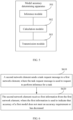
- the model accuracy determining apparatus includes an inference module 501, a calculation module 502, and a transmission module 503.
- the inference module 501 is configured to perform inference for a task based on a first model; the calculation module 502 is configured to determine first accuracy corresponding to the first model, where the first accuracy is used to indicate accuracy of an inference result of the task obtained by the first model; and the transmission module 503 is configured to, in a case that the first accuracy meets a preset condition, send first information to a second network element, where the first information is used to indicate that accuracy of the first model does not meet an accuracy requirement or has decreased; where the second network element is a network element that triggers the task.
- model accuracy determining apparatus includes a model inference function network element.
- the second network element includes a consumer network function.
- calculation module 502 is configured to perform:
- calculation module 502 is configured to perform:
- the first information includes at least one of the following:
- the recommended operation information includes at least one of the following operations:
- the transmission module is further configured to receive a task request message from the second network element, where the task request message is used to request to perform inference for the task, and the task request message contains description information of the task.
- the transmission module is further configured to send the inference result data to the second network element.
- the preset condition includes at least one of the following conditions:
- the transmission module is further configured to obtain the first model and the second accuracy of the first model.
- the transmission module is further configured to request to obtain a second model from a fourth network element, where the second model is a model provided by the fourth network element for the task; and the inference module is further configured to perform, for the first network element, inference for the task based on the second model to obtain new inference result data of the task.
- the fourth network element includes a model training function network element.
- the second model in a case that the first accuracy meets a preset condition, the second model is obtained from the fourth network element and inference is performed for the task to obtain new inference result data.
- the accuracy of the model decreases, timely measures can be taken for adjustment to quickly restore the task inference accuracy, thereby preventing incorrect policy decisions or inappropriate operations.
- the transmission module is further configured to send second information to a third network element that provides the first model, where the second information is used to indicate that the accuracy of the first model does not meet the accuracy requirement or has decreased.
- the second information includes at least one of the following:
- the first data includes at least one of the following:
- the transmission module is further configured to receive third information from the third network element, where the third information includes information of the retrained first model.
- the third information further includes at least one of the following:
- the third network element includes a model training function network element.
- the first network element in a case that the first accuracy meets the preset condition, the first network element sends the second information to the third network element to indicate that the accuracy of the first model does not meet the accuracy requirement or has decreased, so that the third network element retrains the first model and sends the information of the retrained first model to the first network element.
- the accuracy of the model decreases, timely measures can be taken for adjustment to quickly restore the accuracy of inference for the task, thereby preventing incorrect policy decisions or inappropriate operations.
- the model accuracy determining apparatus in the embodiment of this application may be an electronic device, such as an electronic device having an operating system, or may be a component in an electronic device, such as an integrated circuit or a chip.
- the electronic device may be a terminal or another device different from the terminal.
- the terminal may include but is not limited to the types of the terminal 11 listed above, and the another device may be a server, a network attached storage (Network Attached Storage, NAS), or the like, which are not specifically limited in the embodiments of this application.
- Network Attached Storage Network Attached Storage
- the model accuracy determining apparatus provided in the embodiments of this application can implement various processes implemented by the method embodiments shown in FIGs. 2 to 4 , with the same technical effects achieved. To avoid repetition, details are not described herein again.
- an embodiment of this application further provides another model accuracy determining method.
- the method is executed by a second network element, where the second network element includes a consumer network function.
- the method can be executed by software or hardware installed in the second network element.
- the method includes the following steps.
- the second network element sends a task request message to a first network element, where the task request message is used to request to perform inference for a task.
- the second network element receives first information from the first network element, where the first information is used to indicate that accuracy of a first model does not meet an accuracy requirement or has decreased; where the first model is a model used for performing inference for the task, and that the accuracy of the first model does not meet the accuracy requirement or has decreased is determined by the first network element.
- the first network element includes a model inference function network element.
- the second network element includes a consumer network function.
- Steps S610 and S620 can implement the method embodiment shown in FIG. 2 , with the same technical effects achieved. Repeated content is not described herein again.
- the second network element sends a task request message to the first network element, where the task request message is used to request to perform inference for a task; and the second network element receives first information from the first network element, where the first information is used to indicate that accuracy of a first model does not meet an accuracy requirement or has decreased.
- accuracy in use of the model can be monitored, and corresponding measures can be taken in a timely manner when the accuracy decreases, thereby preventing incorrect policy decisions or inappropriate operations.
- the method further includes: performing, by the second network element, at least one of the following operations based on the first information:
- the first information includes at least one of the following:
- the recommended operation information includes at least one of the following operations:
- the method further includes: receiving, by the second network element from the first network element, inference result data corresponding to the task.
- the fifth network element includes a model inference function network element.
- This embodiment of this application can implement the method embodiment shown in FIG. 3 , with the same technical effects achieved. Repeated content is not described herein again.
- the second network element receives first information from the first network element, where the first information is used to indicate that accuracy of a first model does not meet an accuracy requirement or has decreased, and an operation is performed based on the first information.
- the first information is used to indicate that accuracy of a first model does not meet an accuracy requirement or has decreased
- an operation is performed based on the first information.
- the model accuracy determining method provided in the embodiments of this application can be executed by a model accuracy determining apparatus.
- the model accuracy determining method being executed by a model accuracy determining apparatus is used as an example to illustrate a model accuracy determining apparatus provided in the embodiments of this application.
- the model accuracy determining apparatus includes a sending module 701 and a receiving module 702.
- the sending module 701 is configured to send a task request message to a first network element, where the task request message is used to request to perform inference for a task; and the receiving module 702 is configured to receive first information from the first network element, where the first information is used to indicate that accuracy of a first model does not meet an accuracy requirement or has decreased; where the first model is a model used for performing inference for the task, and that the accuracy of the first model does not meet the accuracy requirement or has decreased is determined by the first network element.
- the first network element includes a model inference function network element.
- model accuracy determining apparatus includes a consumer network function.
- a task request message is sent to the first network element, where the task request message is used to request to perform inference for a task; and first information is received from the first network element, where the first information is used to indicate that accuracy of a first model does not meet an accuracy requirement or has decreased.
- accuracy in use of the model can be monitored, and corresponding measures can be taken in a timely manner when the accuracy decreases, thereby preventing incorrect policy decisions or inappropriate operations.
- the receiving module is further configured to perform at least one of the following operations based on the first information:
- the first information includes at least one of the following:
- the recommended operation information includes at least one of the following operations:
- the receiving module is further configured to receive, from the first network element, the inference result data corresponding to the task.
- the fifth network element includes a model inference function network element.
- first information is received from the first network element, where the first information is used to indicate that accuracy of a first model does not meet an accuracy requirement or has decreased, and an operation is performed based on the first information.
- accuracy in use of the model can be monitored, and corresponding measures can be taken in a timely manner when the accuracy decreases, thereby preventing incorrect policy decisions or inappropriate operations.
- the model accuracy determining apparatus in the embodiment of this application may be an electronic device, such as an electronic device having an operating system, or may be a component in an electronic device, such as an integrated circuit or a chip.
- the electronic device may be a terminal or another device different from the terminal.
- the terminal may include but is not limited to the types of the terminal 11 listed above, and the another device may be a server, a network attached storage (Network Attached Storage, NAS), or the like, which are not specifically limited in the embodiments of this application.
- Network Attached Storage Network Attached Storage
- the model accuracy determining apparatus provided in the embodiment of this application can implement various processes implemented by the method embodiment shown in FIG. 6 , with the same technical effects achieved. To avoid repetition, details are not described herein again.
- an embodiment of this application further provides a communication device 800 including a processor 801 and a memory 802, where the memory 802 stores a program or instructions capable of running on the processor 801.
- the communication device 800 is a terminal, when the program or instructions are executed by the processor 801, the steps of the above model accuracy determining method embodiments are implemented, with the same technical effects achieved.
- the communication device 800 is a network-side device, when the program or instructions are executed by the processor 801, the steps of the above model accuracy determining method embodiments are implemented, with the same technical effects achieved. To avoid repetition, details are not described herein again.
- the network-side device 900 includes: a processor 901, a network interface 902, and a memory 903.
- the network interface 902 is, for example, a common public radio interface (Common Public Radio Interface, CPRI).
- CPRI Common Public Radio Interface
- the network-side device 900 in this embodiment of the present invention further includes: instructions or a program stored in the memory 903 and capable of running on the processor 901.
- the processor 901 invokes the instructions or program in the memory 903 to execute the method executed by the modules shown in FIG. 5 and FIG. 7 , with the same technical effects achieved. To avoid repetition, details are not described herein again.
- An embodiment of this application further provides a readable storage medium, where a program or instructions are stored on the readable storage medium.
- a program or instructions are stored on the readable storage medium.
- the processor is a processor in the terminal described in the foregoing embodiments.
- the readable storage medium includes a computer-readable storage medium, such as a computer read-only memory ROM, a random access memory RAM, a magnetic disk, or an optical disc.
- An embodiment of this application further provides a chip.
- the chip includes a processor and a communication interface.
- the communication interface is coupled to the processor.
- the processor is configured to run a program or instructions to implement various processes of the above model accuracy determining method embodiments, with the same technical effects achieved. To avoid repetition, details are not described herein again.
- the chip in the embodiment of this application may also be referred to as a system-level chip, a system chip, a chip system, a system on chip, or the like.
- An embodiment of this application further provides a computer program/program product, where the computer program/program product is stored in a storage medium, and the computer program/program product is executed by at least one processor to implement various processes of the above model accuracy determining method embodiments, with the same technical effects achieved. To avoid repetition, details are not described herein again.
- An embodiment of this application further provides a model accuracy determining system, including: a network-side device, where the network-side device includes a first network element and a second network element.
- the first network element can be configured to perform the steps of the model accuracy determining method as described above
- the second network element can be configured to perform the steps of the model accuracy determining method as described above.
- the method in the foregoing embodiments may be implemented by software in addition to a necessary universal hardware platform or by hardware only. In most cases, the former is a preferred implementation.
- the technical solutions of the present invention essentially or the part contributing to the prior art may be implemented in a form of a software product.
- the software product is stored in a storage medium (such as a ROM/RAM, a magnetic disk, or an optical disc), and includes several instructions for instructing a terminal (which may be a mobile phone, a computer, a server, an air conditioner, a network device, or the like) to perform the methods described in the embodiments of this application.
Landscapes
- Engineering & Computer Science (AREA)
- Theoretical Computer Science (AREA)
- Physics & Mathematics (AREA)
- Evolutionary Computation (AREA)
- Artificial Intelligence (AREA)
- Software Systems (AREA)
- Computing Systems (AREA)
- General Engineering & Computer Science (AREA)
- Mathematical Physics (AREA)
- General Physics & Mathematics (AREA)
- Data Mining & Analysis (AREA)
- Computational Linguistics (AREA)
- Signal Processing (AREA)
- Computer Networks & Wireless Communication (AREA)
- Health & Medical Sciences (AREA)
- Biomedical Technology (AREA)
- General Health & Medical Sciences (AREA)
- Molecular Biology (AREA)
- Life Sciences & Earth Sciences (AREA)
- Biophysics (AREA)
- Medical Informatics (AREA)
- Computer Vision & Pattern Recognition (AREA)
- Databases & Information Systems (AREA)
- Data Exchanges In Wide-Area Networks (AREA)
- Mobile Radio Communication Systems (AREA)
Applications Claiming Priority (2)
| Application Number | Priority Date | Filing Date | Title |
|---|---|---|---|
| CN202210224396.2A CN116776985A (zh) | 2022-03-07 | 2022-03-07 | 模型的准确度确定方法、装置及网络侧设备 |
| PCT/CN2023/079920 WO2023169378A1 (fr) | 2022-03-07 | 2023-03-06 | Procédé et appareil de détermination de précision de modèle, et dispositif côté réseau |
Publications (2)
| Publication Number | Publication Date |
|---|---|
| EP4492829A1 true EP4492829A1 (fr) | 2025-01-15 |
| EP4492829A4 EP4492829A4 (fr) | 2025-06-25 |
Family
ID=87935969
Family Applications (1)
| Application Number | Title | Priority Date | Filing Date |
|---|---|---|---|
| EP23765956.0A Pending EP4492829A4 (fr) | 2022-03-07 | 2023-03-06 | Procédé et appareil de détermination de précision de modèle, et dispositif côté réseau |
Country Status (4)
| Country | Link |
|---|---|
| US (1) | US20240428094A1 (fr) |
| EP (1) | EP4492829A4 (fr) |
| CN (1) | CN116776985A (fr) |
| WO (1) | WO2023169378A1 (fr) |
Family Cites Families (7)
| Publication number | Priority date | Publication date | Assignee | Title |
|---|---|---|---|---|
| CN110119808A (zh) * | 2018-02-06 | 2019-08-13 | 华为技术有限公司 | 一种基于机器学习的数据处理方法以及相关设备 |
| CN108898215B (zh) * | 2018-07-18 | 2022-06-14 | 北京工业大学 | 一种基于二型模糊神经网络的污泥膨胀智能辨识方法 |
| CN109448726A (zh) * | 2019-01-14 | 2019-03-08 | 李庆湧 | 一种语音控制准确率的调整方法及系统 |
| CN111629319B (zh) * | 2019-02-28 | 2022-05-31 | 中国移动通信有限公司研究院 | 一种位置预测方法及设备 |
| CN111083722B (zh) * | 2019-04-15 | 2024-06-07 | 中兴通讯股份有限公司 | 模型的推送、模型的请求方法及装置、存储介质 |
| CN110569288A (zh) * | 2019-09-11 | 2019-12-13 | 中兴通讯股份有限公司 | 一种数据分析方法、装置、设备和存储介质 |
| JP7481902B2 (ja) * | 2020-05-21 | 2024-05-13 | 株式会社日立製作所 | 管理計算機、管理プログラム、及び管理方法 |
-
2022
- 2022-03-07 CN CN202210224396.2A patent/CN116776985A/zh active Pending
-
2023
- 2023-03-06 WO PCT/CN2023/079920 patent/WO2023169378A1/fr not_active Ceased
- 2023-03-06 EP EP23765956.0A patent/EP4492829A4/fr active Pending
-
2024
- 2024-09-04 US US18/823,861 patent/US20240428094A1/en active Pending
Also Published As
| Publication number | Publication date |
|---|---|
| CN116776985A (zh) | 2023-09-19 |
| EP4492829A4 (fr) | 2025-06-25 |
| WO2023169378A1 (fr) | 2023-09-14 |
| US20240428094A1 (en) | 2024-12-26 |
Similar Documents
| Publication | Publication Date | Title |
|---|---|---|
| US20240428097A1 (en) | Method and Apparatus for Determining Model Accuracy, and Network-Side Device | |
| EP4502880A1 (fr) | Procédé et appareil de sélection de modèle, et dispositif côté réseau | |
| WO2023169392A1 (fr) | Procédé et appareil de détermination de précision de modèle, et dispositif côté réseau | |
| EP4521802A1 (fr) | Procédé d'acquisition de modèle et dispositif de communication | |
| EP4443831A1 (fr) | Procédé et appareil d'interaction d'informations, et dispositif de communication | |
| US20240428098A1 (en) | Data Processing Method in Communication Network, and Network-Side Device | |
| US20250240345A1 (en) | Model request method and apparatus, communication device, and readable storage medium | |
| EP4492829A1 (fr) | Procédé et appareil de détermination de précision de modèle, et dispositif côté réseau | |
| EP4593358A1 (fr) | Procédé, appareil et système d'acquisition de données, et dispositif | |
| CN116776989A (zh) | 模型的准确度确定方法、装置及网络侧设备 | |
| EP4488886A1 (fr) | Procédé et appareil de détermination de précision de modèle, et dispositif côté réseau | |
| CN116776988A (zh) | 通信网络中的数据处理方法及网络侧设备 | |
| US20250343740A1 (en) | Information transmission method and apparatus, and device | |
| EP4604479A1 (fr) | Procédé et appareil de traitement de supervision de modèle, périphérique côté réseau et support de stockage lisible | |
| US20260025317A1 (en) | Information processing method and apparatus, and network function | |
| EP4654638A1 (fr) | Procédé et appareil de transmission d'informations et dispositif de communication | |
| WO2024235043A1 (fr) | Procédé et appareil d'acquisition d'informations, et dispositif de communication | |
| CN117914720A (zh) | 模型监督处理方法、装置、网络侧设备及可读存储介质 | |
| CN120786409A (zh) | 无线链路失败rlf预测上报方法、装置及相关设备 |
Legal Events
| Date | Code | Title | Description |
|---|---|---|---|
| STAA | Information on the status of an ep patent application or granted ep patent |
Free format text: STATUS: THE INTERNATIONAL PUBLICATION HAS BEEN MADE |
|
| PUAI | Public reference made under article 153(3) epc to a published international application that has entered the european phase |
Free format text: ORIGINAL CODE: 0009012 |
|
| STAA | Information on the status of an ep patent application or granted ep patent |
Free format text: STATUS: REQUEST FOR EXAMINATION WAS MADE |
|
| 17P | Request for examination filed |
Effective date: 20240930 |
|
| AK | Designated contracting states |
Kind code of ref document: A1 Designated state(s): AL AT BE BG CH CY CZ DE DK EE ES FI FR GB GR HR HU IE IS IT LI LT LU LV MC ME MK MT NL NO PL PT RO RS SE SI SK SM TR |
|
| REG | Reference to a national code |
Ref country code: DE Ref legal event code: R079 Free format text: PREVIOUS MAIN CLASS: H04W0004020000 Ipc: H04L0041160000 |
|
| DAV | Request for validation of the european patent (deleted) | ||
| DAX | Request for extension of the european patent (deleted) | ||
| A4 | Supplementary search report drawn up and despatched |
Effective date: 20250523 |
|
| RIC1 | Information provided on ipc code assigned before grant |
Ipc: G06N 5/043 20230101ALI20250519BHEP Ipc: G06N 5/04 20230101ALI20250519BHEP Ipc: G06F 18/214 20230101ALI20250519BHEP Ipc: H04W 24/04 20090101ALI20250519BHEP Ipc: G06N 3/08 20230101ALI20250519BHEP Ipc: G06F 18/21 20230101ALI20250519BHEP Ipc: G06N 3/045 20230101ALI20250519BHEP Ipc: H04W 4/029 20180101ALI20250519BHEP Ipc: H04W 4/02 20180101ALI20250519BHEP Ipc: H04L 41/14 20220101ALI20250519BHEP Ipc: H04L 41/16 20220101AFI20250519BHEP |