EP4489417A1 - Vehicle camera - Google Patents
Vehicle camera Download PDFInfo
- Publication number
- EP4489417A1 EP4489417A1 EP23199737.0A EP23199737A EP4489417A1 EP 4489417 A1 EP4489417 A1 EP 4489417A1 EP 23199737 A EP23199737 A EP 23199737A EP 4489417 A1 EP4489417 A1 EP 4489417A1
- Authority
- EP
- European Patent Office
- Prior art keywords
- thermal insulation
- main body
- insulation components
- camera main
- camera
- Prior art date
- Legal status (The legal status is an assumption and is not a legal conclusion. Google has not performed a legal analysis and makes no representation as to the accuracy of the status listed.)
- Pending
Links
Images



Classifications
-
- H—ELECTRICITY
- H04—ELECTRIC COMMUNICATION TECHNIQUE
- H04N—PICTORIAL COMMUNICATION, e.g. TELEVISION
- H04N23/00—Cameras or camera modules comprising electronic image sensors; Control thereof
- H04N23/50—Constructional details
- H04N23/52—Elements optimising image sensor operation, e.g. for electromagnetic interference [EMI] protection or temperature control by heat transfer or cooling elements
-
- G—PHYSICS
- G03—PHOTOGRAPHY; CINEMATOGRAPHY; ANALOGOUS TECHNIQUES USING WAVES OTHER THAN OPTICAL WAVES; ELECTROGRAPHY; HOLOGRAPHY
- G03B—APPARATUS OR ARRANGEMENTS FOR TAKING PHOTOGRAPHS OR FOR PROJECTING OR VIEWING THEM; APPARATUS OR ARRANGEMENTS EMPLOYING ANALOGOUS TECHNIQUES USING WAVES OTHER THAN OPTICAL WAVES; ACCESSORIES THEREFOR
- G03B17/00—Details of cameras or camera bodies; Accessories therefor
- G03B17/55—Details of cameras or camera bodies; Accessories therefor with provision for heating or cooling, e.g. in aircraft
-
- G—PHYSICS
- G03—PHOTOGRAPHY; CINEMATOGRAPHY; ANALOGOUS TECHNIQUES USING WAVES OTHER THAN OPTICAL WAVES; ELECTROGRAPHY; HOLOGRAPHY
- G03B—APPARATUS OR ARRANGEMENTS FOR TAKING PHOTOGRAPHS OR FOR PROJECTING OR VIEWING THEM; APPARATUS OR ARRANGEMENTS EMPLOYING ANALOGOUS TECHNIQUES USING WAVES OTHER THAN OPTICAL WAVES; ACCESSORIES THEREFOR
- G03B17/00—Details of cameras or camera bodies; Accessories therefor
- G03B17/56—Accessories
- G03B17/561—Support related camera accessories
-
- H—ELECTRICITY
- H04—ELECTRIC COMMUNICATION TECHNIQUE
- H04N—PICTORIAL COMMUNICATION, e.g. TELEVISION
- H04N23/00—Cameras or camera modules comprising electronic image sensors; Control thereof
- H04N23/50—Constructional details
- H04N23/51—Housings
-
- H—ELECTRICITY
- H04—ELECTRIC COMMUNICATION TECHNIQUE
- H04N—PICTORIAL COMMUNICATION, e.g. TELEVISION
- H04N23/00—Cameras or camera modules comprising electronic image sensors; Control thereof
- H04N23/57—Mechanical or electrical details of cameras or camera modules specially adapted for being embedded in other devices
-
- B—PERFORMING OPERATIONS; TRANSPORTING
- B60—VEHICLES IN GENERAL
- B60R—VEHICLES, VEHICLE FITTINGS, OR VEHICLE PARTS, NOT OTHERWISE PROVIDED FOR
- B60R11/00—Arrangements for holding or mounting articles, not otherwise provided for
- B60R11/04—Mounting of cameras operative during drive; Arrangement of controls thereof relative to the vehicle
Definitions
- the disclosure relates to a vehicle camera, more particularly to a vehicle camera having thermal insulation components.
- a dashcam is provided in a vehicle (e.g., a car) to record views in front of the vehicle.
- a vehicle e.g., a car
- the driver may use one hand to rotate the dashcam to adjust the camera angle thereof.
- a casing of the dashcam is made of metal material for facilitating heat dissipation, but it may cause the casing of the dashcam to have high temperature during operation.
- the driver may feel uncomfortable. Accordingly, how to solve the aforementioned issue is one of the topics in this field.
- the disclosure provides a vehicle camera which is capable of preventing the driver from feeling uncomfortable when rotating the vehicle camera.
- the vehicle camera includes a camera main body and two thermal insulation components.
- the camera main body has two side surfaces facing away from each other.
- the two thermal insulation components are respectively disposed on the side surfaces of the camera main body facing away from each other. Thermal conductivities of the two thermal insulation components are smaller than a thermal conductivity of the camera main body.
- the thermal insulation components are respectively disposed on the side surfaces of the camera main body facing away from each other, and the thermal conductivities of the thermal insulation components are smaller than the thermal conductivity of the camera main body, such that heat generated by the camera main body is difficult to be conducted to the thermal insulation components, and thus the thermal insulation components have relative lower temperatures. Therefore, when a driver uses one hand to grip the thermal insulation components for rotating the vehicle camera, the relative lower temperatures of the thermal insulation components may not make the driver to feel uncomfortable.
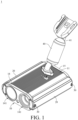
- FIG. 1 is a perspective view of a vehicle camera 1 according to one embodiment of the disclosure
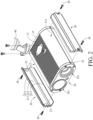
- FIG. 2 is an exploded view of the vehicle camera 1 in FIG. 1 .
- the vehicle camera 1 includes a camera main body 10 and two thermal insulation components 20.
- the vehicle camera 1 may further include a plurality of fasteners 30 and a support 40.
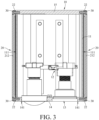
- FIG. 3 is a cross-sectional view of the vehicle camera 1 in FIG. 1
- FIG. 4 is another cross-sectional view of the vehicle camera 1 in FIG. 1 .
- the camera main body 10 may include a casing 11, an electronic assembly 12, a lens assembly 13, a front cap 14, and a rear cap 15.
- the casing 11 is, for example, made of a metal material, such as aluminum, and a thermal conductivity of the casing 11 is approximately 204 W/m-°C.
- the casing 11 has a fixed cross-sectional profile by pushing material through a die of the desired cross-section. In other words, the casing 11 is made by extrusion.
- the cross-section of the casing 11 is shaped like a fully rounded rectangle.
- the cross-section of the casing 11 has adjacent dimples along the length or straight part of the fully rounded rectangle.
- the electronic assembly 12 and the lens assembly 13 are accommodated in the casing 11.
- the electronic assembly 12 may generate heat, and the heat may be conducted to the casing 11.
- the front cap 14 and the rear cap 15 are made of metal.
- a front view of the front cap 14 is shaped like a fully rounded rectangle.
- the lens assembly 13 is exposed through two circular openings 141 of the front cap 14.
- the length of the fully rounded rectangle is longer than the combination of the diameters of the two circular openings 141.
- a rear view of the rear cap 15 shares the same shape as the front view of the front cap 14. Both the front cap 14 and the rear cap 15 are fixed to the cross-section of the casing through four screws.
- the casing 11 has two side surfaces 111 facing away from each other, and the side surfaces 111 are, for example, curved surfaces.
- a curved part of the fully rounded rectangle extends along an extrusion direction of the casing 11 to form the curved surfaces or the side surfaces 111.
- the two thermal insulation components 20 are, for example, curved plates.
- the thermal insulation components 20 are, for example, made of plastic material, such as polycarbonate, and thermal conductivities of the thermal insulation components 20 are smaller than or equal to 10W/m-°C.
- the two thermal insulation components 20 are respectively fixed on the front cap 14 and the rear cap 15 via the fasteners 30.
- the thickness of the front cap 14 and the thickness of the rear cap 15 are thicker than the diameter of a fastener or a screw head thereof.
- the two thermal insulation components 20 are fully or partially molded to or in contact with the two side surfaces 111 of the casing 11.
- the thermal insulation components 20 are the same in structure, and the thermal insulation components 20 are respectively fixed on the front cap 14 and the rear cap 15 via the same means, and thus the following paragraphs merely introduce one thermal insulation component 20 and how this thermal insulation component 20 is fixed to the front cap 14 and the rear cap 15.
- the thermal insulation component 20 may include a middle portion 21 and two mount portions 22 respectively connected to two opposite sides of the middle portion 21.
- the middle portion 21 may include two contact parts 211 and a connection part 212 located between and connected to the two contact parts 211.
- the contact parts 211 of the middle portion 21 and the mount portions 22 are in contact with the side surface 111 of the casing 11, and the connection part 212 of the middle portion 21 is spaced apart from the side surface 111 of the casing 11 by a distance G, where the distance G falls within a range from 1.08mm to 1.32mm.
- the height H2 of the thermal insulation component 20 is smaller than the height H1 of the camera main body 10, and the height H2 may be 90% of the height H1, but in some other embodiments, the height of the thermal insulation component may be 110% of the height of the camera main body; that is, the height of the thermal insulation component may fall within a range from 90% to 110% of the height of the camera main body, but the disclosure is not limited thereto, the relative height relationship between the thermal insulation component and the camera main body may be modified as actual requirements.
- the fasteners 30 are, for example, screws.
- the fasteners 30 are respectively disposed through the two mount portions 22 of the thermal insulation component 20 and screwed into the front cap 14 and the rear cap 15 of the camera main body 10.
- thermal insulation component 20 is not restricted to being fixed on rear cap 15 via the fasteners 30; in some other embodiment, the thermal insulation component may be fixed on the side surface of the casing via, for example, an adhesive or a snap-fit manner.
- the support 40 is assembled with the camera main body 10, and another end of the support 40 may be fixed to a roof or windshield of a vehicle (not shown).
- the support 40 may have a universal joint structure 41 (shown in FIG. 1 ) to enable the camera main body 10 to be rotated for adjusting the camera angle of the camera main body 10.
- the thermal insulation components 20 are respectively disposed on the side surfaces 111 of the camera main body 10 facing away from each other, and the thermal conductivities of the thermal insulation components 20 are smaller than the thermal conductivity of the camera main body 10, such that heat generated by the camera main body 10 is difficult to be conducted to the thermal insulation components 20, and thus the thermal insulation components 20 have relative lower temperatures.
- it is hard for the camera main body 10 to pass its heat through the thermal insulation components 20 and conduct its heat to a driver or user. Therefore, when a driver uses one hand to grip the thermal insulation components 20 for rotating the camera main body 10, the relative lower temperatures of the thermal insulation components 20 may not make the driver to feel uncomfortable.
- the surface temperature of the camera main body 10 may be approximately above 60 °C.
- a regulation restricts a surface of an object for being touched in a short period (e.g., > 1s and ⁇ 10s) to be 60 °C in maximum.
- the vehicle camera 1 is applied in the vehicle, and there is a resistance provided at the universal joint structure 41 of the support 40 in order to prevent the camera main body 10 from being rotated due to vibrations caused by an uneven road condition.
- two opposite sides of the camera main body 10 where the thermal insulation components 20 are disposed are the places where the hand of the driver can easily apply forces to rotate the camera main body 10. Therefore, when the driver desires to rotate the camera main body 10, the thermal insulation components 20 disposed at the two opposite sides of the camera main body 10 ensure the driver to comfortably rotate the camera main body 10 for adjusting the camera angle thereof.
- the aforementioned materials of the casing 11, the front cap 14, the rear cap 15, and the thermal insulation components 20 are merely exemplary and may be modified according to actual requirements.
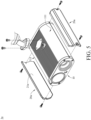
- FIG. 5 is an exploded view of a vehicle camera 1a according to another embodiment of the disclosure
- FIG. 6 is a cross-sectional view of the vehicle camera 1a in FIG. 5
- FIG. 7 is another cross-sectional view of the vehicle camera 1a in FIG. 5 .
- the vehicle camera 1a of this embodiment is similar to the vehicle camera 1 of the previous embodiment, and the difference between them is mainly the structures of the thermal insulation components, and thus the following paragraphs will merely introduce the structures of the thermal insulation components of the vehicle camera 1a, and the same parts between them will not be repeatedly introduced hereinafter.
- a middle portion 21a has no part spaced apart from the side surface 111 of the camera main body 10; that is, the middle portion 21a is entirely in contact with the side surface 111 of the camera main body 10.
- the thermal insulation components 20a also can have relative lower temperatures for the driver to be comfortably to grip thereon and rotate camera main body 10.
- the aforementioned side surfaces 111 of the camera main body 10 and the thermal insulation components 20 and 20a are not restricted to being in a curved shape; in some other embodiments, the aforementioned side surfaces of the camera main body and the thermal insulation components may be in a flat shape.
- the thermal insulation components are respectively disposed on the side surfaces of the camera main body facing away from each other, and the thermal conductivities of the thermal insulation components are smaller than the thermal conductivity of the camera main body, such that heat generated by the camera main body is difficult to be conducted to the thermal insulation components, and thus the thermal insulation components have relative lower temperatures. Therefore, when a driver uses one hand to grip the thermal insulation components for rotating the vehicle camera, the relative lower temperatures of the thermal insulation components may not make the driver to feel uncomfortable.
- the vehicle camera is applied in the vehicle, and there is a resistance provided at the universal joint structure of the support in order to prevent the camera main body from being rotated due to vibrations caused by an uneven road condition.
- two opposite sides of the camera main body where the thermal insulation components are disposed are the places where the hand of the driver can easily apply forces to rotate the camera main body. Therefore, when the driver desires to rotate the camera main body, the thermal insulation components disposed at the two opposite sides of the camera main body ensure the driver to comfortably rotate the camera main body for adjusting the camera angle thereof.
Landscapes
- Engineering & Computer Science (AREA)
- Physics & Mathematics (AREA)
- Multimedia (AREA)
- Signal Processing (AREA)
- Electromagnetism (AREA)
- General Physics & Mathematics (AREA)
- Aviation & Aerospace Engineering (AREA)
- Fittings On The Vehicle Exterior For Carrying Loads, And Devices For Holding Or Mounting Articles (AREA)
- Studio Devices (AREA)
- Accessories Of Cameras (AREA)
Abstract
The vehicle camera (1) includes a camera main body (10) and two thermal insulation components (20). The camera main body (10) has two side surfaces (111) facing away from each other. The two thermal insulation components (20) are respectively disposed on the side surfaces (111) of the camera main body (10) facing away from each other. Thermal conductivities of the two thermal insulation components (20) are smaller than a thermal conductivity of the camera main body (10).
Description
- The disclosure relates to a vehicle camera, more particularly to a vehicle camera having thermal insulation components.
- In general, a dashcam is provided in a vehicle (e.g., a car) to record views in front of the vehicle. When a driver drives the vehicle, the driver may use one hand to rotate the dashcam to adjust the camera angle thereof.
- However, a casing of the dashcam is made of metal material for facilitating heat dissipation, but it may cause the casing of the dashcam to have high temperature during operation. Thus, when the drive uses one hand to touch and rotate the dashcam, the driver may feel uncomfortable. Accordingly, how to solve the aforementioned issue is one of the topics in this field.
- The disclosure provides a vehicle camera which is capable of preventing the driver from feeling uncomfortable when rotating the vehicle camera.
- One embodiment of the disclosure provides a vehicle camera. The vehicle camera includes a camera main body and two thermal insulation components. The camera main body has two side surfaces facing away from each other. The two thermal insulation components are respectively disposed on the side surfaces of the camera main body facing away from each other. Thermal conductivities of the two thermal insulation components are smaller than a thermal conductivity of the camera main body.
- According to vehicle camera as discussed in the above embodiment, the thermal insulation components are respectively disposed on the side surfaces of the camera main body facing away from each other, and the thermal conductivities of the thermal insulation components are smaller than the thermal conductivity of the camera main body, such that heat generated by the camera main body is difficult to be conducted to the thermal insulation components, and thus the thermal insulation components have relative lower temperatures. Therefore, when a driver uses one hand to grip the thermal insulation components for rotating the vehicle camera, the relative lower temperatures of the thermal insulation components may not make the driver to feel uncomfortable.
- The present disclosure will become better understood from the detailed description given herein below and the accompanying drawings which are given by way of illustration only and thus are not intending to limit the present disclosure and wherein:
-
FIG. 1 is a perspective view of a vehicle camera according to one embodiment of the disclosure; -
FIG. 2 is an exploded view of the vehicle camera inFIG. 1 ; -
FIG. 3 is a cross-sectional view of the vehicle camera inFIG. 1 ; -
FIG. 4 is another cross-sectional view of the vehicle camera inFIG. 1 ; -
FIG. 5 is an exploded view of a vehicle camera according to another embodiment of the disclosure; -
FIG. 6 is a cross-sectional view of the vehicle camera inFIG. 5 ; and -
FIG. 7 is another cross-sectional view of the vehicle camera inFIG. 5 . - In the following detailed description, for purposes of explanation, numerous specific details are set forth in order to provide a thorough understanding of the disclosed embodiments. It will be apparent, however, that one or more embodiments may be practiced without these specific details. In other instances, well-known structures and devices are schematically shown in order to simplify the drawing.
- In addition, the terms used in the present disclosure, such as technical and scientific terms, have its own meanings and can be comprehended by those skilled in the art, unless the terms are additionally defined in the present disclosure. That is, the terms used in the following paragraphs should be read on the meaning commonly used in the related fields and will not be overly explained, unless the terms have a specific meaning in the present disclosure.
- Referring to
FIGS. 1 and2 ,FIG. 1 is a perspective view of avehicle camera 1 according to one embodiment of the disclosure, andFIG. 2 is an exploded view of thevehicle camera 1 inFIG. 1 . - In this embodiment, the
vehicle camera 1 includes a cameramain body 10 and twothermal insulation components 20. In addition, thevehicle camera 1 may further include a plurality offasteners 30 and asupport 40. - Then, referring to
FIGS. 2 to 4 ,FIG. 3 is a cross-sectional view of thevehicle camera 1 inFIG. 1 , andFIG. 4 is another cross-sectional view of thevehicle camera 1 inFIG. 1 . - The camera
main body 10 may include acasing 11, anelectronic assembly 12, alens assembly 13, afront cap 14, and arear cap 15. Thecasing 11 is, for example, made of a metal material, such as aluminum, and a thermal conductivity of thecasing 11 is approximately 204 W/m-°C. Thecasing 11 has a fixed cross-sectional profile by pushing material through a die of the desired cross-section. In other words, thecasing 11 is made by extrusion. The cross-section of thecasing 11 is shaped like a fully rounded rectangle. The cross-section of thecasing 11 has adjacent dimples along the length or straight part of the fully rounded rectangle. Theelectronic assembly 12 and thelens assembly 13 are accommodated in thecasing 11. During the operation of the cameramain body 10, theelectronic assembly 12 may generate heat, and the heat may be conducted to thecasing 11. Thefront cap 14 and therear cap 15 are made of metal. A front view of thefront cap 14 is shaped like a fully rounded rectangle. Thelens assembly 13 is exposed through twocircular openings 141 of thefront cap 14. The length of the fully rounded rectangle is longer than the combination of the diameters of the twocircular openings 141. A rear view of therear cap 15 shares the same shape as the front view of thefront cap 14. Both thefront cap 14 and therear cap 15 are fixed to the cross-section of the casing through four screws. - In this embodiment, the
casing 11 has twoside surfaces 111 facing away from each other, and theside surfaces 111 are, for example, curved surfaces. A curved part of the fully rounded rectangle extends along an extrusion direction of thecasing 11 to form the curved surfaces or theside surfaces 111. The twothermal insulation components 20 are, for example, curved plates. Thethermal insulation components 20 are, for example, made of plastic material, such as polycarbonate, and thermal conductivities of thethermal insulation components 20 are smaller than or equal to 10W/m-°C. The twothermal insulation components 20 are respectively fixed on thefront cap 14 and therear cap 15 via thefasteners 30. The thickness of thefront cap 14 and the thickness of therear cap 15 are thicker than the diameter of a fastener or a screw head thereof. As disclosed below, the twothermal insulation components 20 are fully or partially molded to or in contact with the twoside surfaces 111 of thecasing 11. In this embodiment, thethermal insulation components 20 are the same in structure, and thethermal insulation components 20 are respectively fixed on thefront cap 14 and therear cap 15 via the same means, and thus the following paragraphs merely introduce onethermal insulation component 20 and how thisthermal insulation component 20 is fixed to thefront cap 14 and therear cap 15. - The
thermal insulation component 20 may include amiddle portion 21 and twomount portions 22 respectively connected to two opposite sides of themiddle portion 21. Themiddle portion 21 may include twocontact parts 211 and aconnection part 212 located between and connected to the twocontact parts 211. Thecontact parts 211 of themiddle portion 21 and themount portions 22 are in contact with theside surface 111 of thecasing 11, and theconnection part 212 of themiddle portion 21 is spaced apart from theside surface 111 of thecasing 11 by a distance G, where the distance G falls within a range from 1.08mm to 1.32mm. In this embodiment, the height H2 of thethermal insulation component 20 is smaller than the height H1 of the cameramain body 10, and the height H2 may be 90% of the height H1, but in some other embodiments, the height of the thermal insulation component may be 110% of the height of the camera main body; that is, the height of the thermal insulation component may fall within a range from 90% to 110% of the height of the camera main body, but the disclosure is not limited thereto, the relative height relationship between the thermal insulation component and the camera main body may be modified as actual requirements. - The
fasteners 30 are, for example, screws. Thefasteners 30 are respectively disposed through the twomount portions 22 of thethermal insulation component 20 and screwed into thefront cap 14 and therear cap 15 of the cameramain body 10. - Note that the
thermal insulation component 20 is not restricted to being fixed onrear cap 15 via thefasteners 30; in some other embodiment, the thermal insulation component may be fixed on the side surface of the casing via, for example, an adhesive or a snap-fit manner. - One end of the
support 40 is assembled with the cameramain body 10, and another end of thesupport 40 may be fixed to a roof or windshield of a vehicle (not shown). Thesupport 40 may have a universal joint structure 41 (shown inFIG. 1 ) to enable the cameramain body 10 to be rotated for adjusting the camera angle of the cameramain body 10. - In this embodiment, the
thermal insulation components 20 are respectively disposed on the side surfaces 111 of the cameramain body 10 facing away from each other, and the thermal conductivities of thethermal insulation components 20 are smaller than the thermal conductivity of the cameramain body 10, such that heat generated by the cameramain body 10 is difficult to be conducted to thethermal insulation components 20, and thus thethermal insulation components 20 have relative lower temperatures. In other words, it is hard for the cameramain body 10 to pass its heat through thethermal insulation components 20 and conduct its heat to a driver or user. Therefore, when a driver uses one hand to grip thethermal insulation components 20 for rotating the cameramain body 10, the relative lower temperatures of thethermal insulation components 20 may not make the driver to feel uncomfortable. - Specifically, during the operation of the
vehicle camera 1, the surface temperature of the cameramain body 10 may be approximately above 60 °C. However, a regulation restricts a surface of an object for being touched in a short period (e.g., > 1s and < 10s) to be 60 °C in maximum. In this embodiment, there are twothermal insulation components 20 provided at the side surfaces 111 of the cameramain body 10 facing away from each other, and the temperatures of thethermal insulation components 20 are measured to be approximately 49.5 °C. As a result, even though the surface temperature of the cameramain body 10 is high, the driver is to grip thethermal insulation components 20 of relative lower temperature instead of the cameramain body 10, and thus the driver can comfortably rotate the cameramain body 10 for adjusting the camera angle thereof. - In this embodiment, the
vehicle camera 1 is applied in the vehicle, and there is a resistance provided at the universaljoint structure 41 of thesupport 40 in order to prevent the cameramain body 10 from being rotated due to vibrations caused by an uneven road condition. Also, two opposite sides of the cameramain body 10 where thethermal insulation components 20 are disposed are the places where the hand of the driver can easily apply forces to rotate the cameramain body 10. Therefore, when the driver desires to rotate the cameramain body 10, thethermal insulation components 20 disposed at the two opposite sides of the cameramain body 10 ensure the driver to comfortably rotate the cameramain body 10 for adjusting the camera angle thereof. - Note that the aforementioned materials of the
casing 11, thefront cap 14, therear cap 15, and thethermal insulation components 20 are merely exemplary and may be modified according to actual requirements. - Then, referring to
FIGS. 5 to 7 ,FIG. 5 is an exploded view of a vehicle camera 1a according to another embodiment of the disclosure,FIG. 6 is a cross-sectional view of the vehicle camera 1a inFIG. 5 , andFIG. 7 is another cross-sectional view of the vehicle camera 1a inFIG. 5 . - The vehicle camera 1a of this embodiment is similar to the
vehicle camera 1 of the previous embodiment, and the difference between them is mainly the structures of the thermal insulation components, and thus the following paragraphs will merely introduce the structures of the thermal insulation components of the vehicle camera 1a, and the same parts between them will not be repeatedly introduced hereinafter. - In this embodiment, in each of two
thermal insulation components 20a, amiddle portion 21a has no part spaced apart from theside surface 111 of the cameramain body 10; that is, themiddle portion 21a is entirely in contact with theside surface 111 of the cameramain body 10. In this configuration, thethermal insulation components 20a also can have relative lower temperatures for the driver to be comfortably to grip thereon and rotate cameramain body 10. - Note that the aforementioned side surfaces 111 of the camera
main body 10 and thethermal insulation components - According to vehicle cameras as discussed in the above embodiments, the thermal insulation components are respectively disposed on the side surfaces of the camera main body facing away from each other, and the thermal conductivities of the thermal insulation components are smaller than the thermal conductivity of the camera main body, such that heat generated by the camera main body is difficult to be conducted to the thermal insulation components, and thus the thermal insulation components have relative lower temperatures. Therefore, when a driver uses one hand to grip the thermal insulation components for rotating the vehicle camera, the relative lower temperatures of the thermal insulation components may not make the driver to feel uncomfortable.
- In addition, the vehicle camera is applied in the vehicle, and there is a resistance provided at the universal joint structure of the support in order to prevent the camera main body from being rotated due to vibrations caused by an uneven road condition. Also, two opposite sides of the camera main body where the thermal insulation components are disposed are the places where the hand of the driver can easily apply forces to rotate the camera main body. Therefore, when the driver desires to rotate the camera main body, the thermal insulation components disposed at the two opposite sides of the camera main body ensure the driver to comfortably rotate the camera main body for adjusting the camera angle thereof.
- It will be apparent to those skilled in the art that various modifications and variations can be made to the present disclosure. It is intended that the specification and examples be considered as exemplary embodiments only, with a scope of the disclosure being indicated by the following claims.
Claims (10)
- A vehicle camera (1), comprising:a camera main body (10), having two side surfaces (111) facing away from each other; andtwo thermal insulation components (20), respectively disposed on the two side surfaces (111) of the camera main body (10) facing away from each other;wherein thermal conductivities of the two thermal insulation components (20) are smaller than a thermal conductivity of the camera main body (10).
- The vehicle camera (1) according to claim 1, further comprising a plurality of fasteners (30), wherein the two thermal insulation components (20) are respectively fixed on the two side surfaces (111) of the camera main body (10) via the plurality of fasteners (30).
- The vehicle camera (1) according to claim 2, wherein each of the two thermal insulation components (20) comprises a middle portion (21) and two mount portions (22) respectively connected to two opposite sides of the middle portion, the four mount portions (22) of the two thermal insulation components (20) are fixed on the two side surfaces (111) of the camera main body (10) via the plurality of fasteners (30), and the two middle portions (21) of the two thermal insulation components (20) are respectively in contact with the two side surfaces (111) of the camera main body (10).
- The vehicle camera (1) according to claim 3, wherein the middle portion (21) of each of the two thermal insulation components (20) comprises two contact parts (211) and a connection part (212) located between and connected to the two contact parts (211), the four contact parts (211) of the two middle portions (21) of the two thermal insulation components (20) are in contact with the two side surfaces (111) of the camera main body (10), and the two connection parts (212) of the two middle portions (21) of the two thermal insulation components (20) are respectively spaced apart from the two side surfaces (111) of the camera main body (10) by a distance (G).
- The vehicle camera (1) according to claim 1, wherein heights (H2) of the two thermal insulation components (20) fall within a range from 90% to 110% of a height (H1) of the camera main body (10).
- The vehicle camera (1) according to claim 1, wherein a casing (11) of the camera main body (10) is made of metal material, and the two thermal insulation components (20) are made of plastic material.
- The vehicle camera (1) according to claim 1, wherein the two thermal insulation components (20) are plates.
- The vehicle camera (1) according to claim 1, further comprising a support (40), wherein the support (40) is disposed on the camera main body (10).
- The vehicle camera (1) according to claim 1, wherein the camera main body comprises a casing (11), a front cap (14), a rear cap (15), an electronic assembly (12) and a lens assembly (13), the two side surfaces (111) are located at the casing (11), the front cap (14) and the rear cap (15) are fixed to two opposite sides of the casing (11), the two thermal insulation components (20) are fixed on the front cap (14) and the rear cap (15), the electronic assembly (12) and the lens assembly (13) are located in the casing, the front cap (14) has an opening (141), and the lens assembly (13) is exposed through the opening (141).
- The vehicle camera (1) according to claim 1, wherein the thermal insulation components (20) are fully or partially in contact with the two side surfaces (111) of the camera main body (10).
Applications Claiming Priority (1)
| Application Number | Priority Date | Filing Date | Title |
|---|---|---|---|
| US18/217,659 US12413833B2 (en) | 2023-07-03 | 2023-07-03 | Vehicle camera |
Publications (1)
| Publication Number | Publication Date |
|---|---|
| EP4489417A1 true EP4489417A1 (en) | 2025-01-08 |
Family
ID=88204426
Family Applications (1)
| Application Number | Title | Priority Date | Filing Date |
|---|---|---|---|
| EP23199737.0A Pending EP4489417A1 (en) | 2023-07-03 | 2023-09-26 | Vehicle camera |
Country Status (3)
| Country | Link |
|---|---|
| US (1) | US12413833B2 (en) |
| EP (1) | EP4489417A1 (en) |
| AU (1) | AU2023237104B2 (en) |
Citations (5)
| Publication number | Priority date | Publication date | Assignee | Title |
|---|---|---|---|---|
| DE19637279A1 (en) * | 1996-09-13 | 1998-03-19 | Leica Camera Ag | camera |
| US20140104479A1 (en) * | 2012-10-15 | 2014-04-17 | Woodman Labs, Inc. | Heat Transfer Camera Ring |
| US20160174408A1 (en) * | 2014-12-16 | 2016-06-16 | Gopro, Inc. | Heat Sink for a Square Camera |
| US20160301819A1 (en) * | 2015-04-10 | 2016-10-13 | Blackmagic Design Pty Ltd | Digital video camera |
| CN114745482A (en) * | 2022-03-27 | 2022-07-12 | 深圳市圆周率软件科技有限责任公司 | Camera with camera lens |
Family Cites Families (12)
| Publication number | Priority date | Publication date | Assignee | Title |
|---|---|---|---|---|
| DE4400475C1 (en) * | 1994-01-11 | 1994-12-15 | Hartig E Videor Tech | Protective housing for optical appliances |
| DE10319176A1 (en) | 2003-04-29 | 2004-11-18 | Robert Bosch Gmbh | Device for cooling a camera |
| US8525924B2 (en) * | 2008-12-29 | 2013-09-03 | Red.Com, Inc. | Modular motion camera |
| CN106476716B (en) * | 2015-08-27 | 2019-04-19 | 日本电产艾莱希斯株式会社 | The manufacturing method of vehicle |
| CN106476714A (en) * | 2015-08-27 | 2017-03-08 | 日本电产艾莱希斯株式会社 | Vehicle-mounted camera and the manufacture method of vehicle-mounted camera |
| JP2019507996A (en) * | 2015-12-14 | 2019-03-22 | レッド.コム,エルエルシー | Modular digital camera and mobile phone |
| US10996544B2 (en) | 2018-11-15 | 2021-05-04 | Fico Adas, S.L.U. | Motor vehicle camera housing assembly and method for making it |
| GB2580439A (en) | 2019-01-07 | 2020-07-22 | Portable Multimedia Ltd | Housing and device |
| EP3751973B1 (en) * | 2019-04-28 | 2021-12-15 | SZ DJI Technology Co., Ltd. | Heat dissipation assembly and motion camera |
| JP7541844B2 (en) | 2020-03-24 | 2024-08-29 | 京セラ株式会社 | Imaging device and vehicle |
| CN216086772U (en) | 2021-07-14 | 2022-03-18 | 浙江舜宇智领技术有限公司 | Plastic housing vehicle-mounted camera module |
| EP4470839B1 (en) * | 2023-05-30 | 2025-04-23 | Axis AB | A camera arrangement comprising a holder configuration for a camera head and the holder configuration |
-
2023
- 2023-07-03 US US18/217,659 patent/US12413833B2/en active Active
- 2023-09-26 EP EP23199737.0A patent/EP4489417A1/en active Pending
- 2023-09-27 AU AU2023237104A patent/AU2023237104B2/en active Active
Patent Citations (5)
| Publication number | Priority date | Publication date | Assignee | Title |
|---|---|---|---|---|
| DE19637279A1 (en) * | 1996-09-13 | 1998-03-19 | Leica Camera Ag | camera |
| US20140104479A1 (en) * | 2012-10-15 | 2014-04-17 | Woodman Labs, Inc. | Heat Transfer Camera Ring |
| US20160174408A1 (en) * | 2014-12-16 | 2016-06-16 | Gopro, Inc. | Heat Sink for a Square Camera |
| US20160301819A1 (en) * | 2015-04-10 | 2016-10-13 | Blackmagic Design Pty Ltd | Digital video camera |
| CN114745482A (en) * | 2022-03-27 | 2022-07-12 | 深圳市圆周率软件科技有限责任公司 | Camera with camera lens |
Also Published As
| Publication number | Publication date |
|---|---|
| US20250016432A1 (en) | 2025-01-09 |
| AU2023237104B2 (en) | 2025-07-17 |
| US12413833B2 (en) | 2025-09-09 |
| AU2023237104A1 (en) | 2025-01-23 |
Similar Documents
| Publication | Publication Date | Title |
|---|---|---|
| JP3518242B2 (en) | Electronic equipment | |
| CN100499985C (en) | Thermally conductive member and cooling system using the same | |
| US6400571B1 (en) | Electronic equipment housing | |
| US11375639B2 (en) | Additive manufactured multi-layer thermally conductive parts | |
| EP4489417A1 (en) | Vehicle camera | |
| US20220400576A1 (en) | Thermal-control system of a media-streaming device and associated media-streaming devices | |
| JP4006795B2 (en) | Information processing apparatus having heat dissipation structure | |
| US20100065254A1 (en) | Heat Dissipation Device and Method | |
| US20080007915A1 (en) | Heat sink device for a heat generating element | |
| CN201142044Y (en) | Cooling seat of laptop | |
| KR102565037B1 (en) | PTC unit for Motor-vehicle, PTC heater comprising thereof and air conditioning system comprising thereof | |
| CN217936328U (en) | Shielding case cooling system and electronic equipment | |
| WO2024245129A1 (en) | Heat dissipation assembly, inverter, and energy storage power supply | |
| JP2007243051A (en) | Heat dissipation device | |
| JPH11101050A (en) | Hinge for electronic equipment | |
| JP5072869B2 (en) | Substrate holding device | |
| JP2000196249A (en) | Electronic equipment housing | |
| CN222167554U (en) | Heat radiation structure and industrial control equipment | |
| CN117016938B (en) | Heat conducting plate for straight hair and hair styling device | |
| CN119512336B (en) | A heat dissipation device and server | |
| CN218601770U (en) | Portable computer | |
| CN115243528B (en) | Heat dissipation back splint | |
| JP2002033425A (en) | Heat-radiating structure | |
| JP4882108B2 (en) | PCB heat dissipation structure | |
| KR20020069806A (en) | Cpu cooler assembly |
Legal Events
| Date | Code | Title | Description |
|---|---|---|---|
| PUAI | Public reference made under article 153(3) epc to a published international application that has entered the european phase |
Free format text: ORIGINAL CODE: 0009012 |
|
| STAA | Information on the status of an ep patent application or granted ep patent |
Free format text: STATUS: REQUEST FOR EXAMINATION WAS MADE |
|
| 17P | Request for examination filed |
Effective date: 20240813 |
|
| AK | Designated contracting states |
Kind code of ref document: A1 Designated state(s): AL AT BE BG CH CY CZ DE DK EE ES FI FR GB GR HR HU IE IS IT LI LT LU LV MC ME MK MT NL NO PL PT RO RS SE SI SK SM TR |
|
| STAA | Information on the status of an ep patent application or granted ep patent |
Free format text: STATUS: EXAMINATION IS IN PROGRESS |
|
| 17Q | First examination report despatched |
Effective date: 20250902 |