EP4489129A1 - Positivelektrodenaktivmaterial für eine sekundärbatterie mit wasserfreiem elektrolyt und sekundärbatterie mit wasserfreiem elektrolyt - Google Patents
Positivelektrodenaktivmaterial für eine sekundärbatterie mit wasserfreiem elektrolyt und sekundärbatterie mit wasserfreiem elektrolyt Download PDFInfo
- Publication number
- EP4489129A1 EP4489129A1 EP23759698.6A EP23759698A EP4489129A1 EP 4489129 A1 EP4489129 A1 EP 4489129A1 EP 23759698 A EP23759698 A EP 23759698A EP 4489129 A1 EP4489129 A1 EP 4489129A1
- Authority
- EP
- European Patent Office
- Prior art keywords
- positive electrode
- equal
- lithium
- active material
- aqueous electrolyte
- Prior art date
- Legal status (The legal status is an assumption and is not a legal conclusion. Google has not performed a legal analysis and makes no representation as to the accuracy of the status listed.)
- Pending
Links
Images





Classifications
-
- C—CHEMISTRY; METALLURGY
- C01—INORGANIC CHEMISTRY
- C01G—COMPOUNDS CONTAINING METALS NOT COVERED BY SUBCLASSES C01D OR C01F
- C01G53/00—Compounds of nickel
- C01G53/80—Compounds containing nickel, with or without oxygen or hydrogen, and containing one or more other elements
- C01G53/84—Hydroxides
-
- C—CHEMISTRY; METALLURGY
- C01—INORGANIC CHEMISTRY
- C01G—COMPOUNDS CONTAINING METALS NOT COVERED BY SUBCLASSES C01D OR C01F
- C01G53/00—Compounds of nickel
- C01G53/40—Complex oxides containing nickel and at least one other metal element
- C01G53/42—Complex oxides containing nickel and at least one other metal element containing alkali metals, e.g. LiNiO2
- C01G53/44—Complex oxides containing nickel and at least one other metal element containing alkali metals, e.g. LiNiO2 containing manganese
- C01G53/50—Complex oxides containing nickel and at least one other metal element containing alkali metals, e.g. LiNiO2 containing manganese of the type (MnO2)n-, e.g. Li(NixMn1-x)O2 or Li(MyNixMn1-x-y)O2
- C01G53/502—Complex oxides containing nickel and at least one other metal element containing alkali metals, e.g. LiNiO2 containing manganese of the type (MnO2)n-, e.g. Li(NixMn1-x)O2 or Li(MyNixMn1-x-y)O2 containing lithium and cobalt
- C01G53/504—Complex oxides containing nickel and at least one other metal element containing alkali metals, e.g. LiNiO2 containing manganese of the type (MnO2)n-, e.g. Li(NixMn1-x)O2 or Li(MyNixMn1-x-y)O2 containing lithium and cobalt with the molar ratio of nickel with respect to all the metals other than alkali metals higher than or equal to 0.5, e.g. Li(MzNixCoyMn1-x-y-z)O2 with x ≥ 0.5
- C01G53/506—Complex oxides containing nickel and at least one other metal element containing alkali metals, e.g. LiNiO2 containing manganese of the type (MnO2)n-, e.g. Li(NixMn1-x)O2 or Li(MyNixMn1-x-y)O2 containing lithium and cobalt with the molar ratio of nickel with respect to all the metals other than alkali metals higher than or equal to 0.5, e.g. Li(MzNixCoyMn1-x-y-z)O2 with x ≥ 0.5 with the molar ratio of nickel with respect to all the metals other than alkali metals higher than or equal to 0.8, e.g. Li(MzNixCoyMn1-x-y-z)O2 with x ≥ 0.8
-
- C—CHEMISTRY; METALLURGY
- C01—INORGANIC CHEMISTRY
- C01G—COMPOUNDS CONTAINING METALS NOT COVERED BY SUBCLASSES C01D OR C01F
- C01G53/00—Compounds of nickel
- C01G53/80—Compounds containing nickel, with or without oxygen or hydrogen, and containing one or more other elements
-
- H—ELECTRICITY
- H01—ELECTRIC ELEMENTS
- H01M—PROCESSES OR MEANS, e.g. BATTERIES, FOR THE DIRECT CONVERSION OF CHEMICAL ENERGY INTO ELECTRICAL ENERGY
- H01M10/00—Secondary cells; Manufacture thereof
- H01M10/05—Accumulators with non-aqueous electrolyte
- H01M10/052—Li-accumulators
- H01M10/0525—Rocking-chair batteries, i.e. batteries with lithium insertion or intercalation in both electrodes; Lithium-ion batteries
-
- H—ELECTRICITY
- H01—ELECTRIC ELEMENTS
- H01M—PROCESSES OR MEANS, e.g. BATTERIES, FOR THE DIRECT CONVERSION OF CHEMICAL ENERGY INTO ELECTRICAL ENERGY
- H01M10/00—Secondary cells; Manufacture thereof
- H01M10/42—Methods or arrangements for servicing or maintenance of secondary cells or secondary half-cells
- H01M10/4235—Safety or regulating additives or arrangements in electrodes, separators or electrolyte
-
- H—ELECTRICITY
- H01—ELECTRIC ELEMENTS
- H01M—PROCESSES OR MEANS, e.g. BATTERIES, FOR THE DIRECT CONVERSION OF CHEMICAL ENERGY INTO ELECTRICAL ENERGY
- H01M4/00—Electrodes
- H01M4/02—Electrodes composed of, or comprising, active material
- H01M4/13—Electrodes for accumulators with non-aqueous electrolyte, e.g. for lithium-accumulators; Processes of manufacture thereof
- H01M4/131—Electrodes based on mixed oxides or hydroxides, or on mixtures of oxides or hydroxides, e.g. LiCoOx
-
- H—ELECTRICITY
- H01—ELECTRIC ELEMENTS
- H01M—PROCESSES OR MEANS, e.g. BATTERIES, FOR THE DIRECT CONVERSION OF CHEMICAL ENERGY INTO ELECTRICAL ENERGY
- H01M4/00—Electrodes
- H01M4/02—Electrodes composed of, or comprising, active material
- H01M4/36—Selection of substances as active materials, active masses, active liquids
- H01M4/362—Composites
- H01M4/366—Composites as layered products
-
- H—ELECTRICITY
- H01—ELECTRIC ELEMENTS
- H01M—PROCESSES OR MEANS, e.g. BATTERIES, FOR THE DIRECT CONVERSION OF CHEMICAL ENERGY INTO ELECTRICAL ENERGY
- H01M4/00—Electrodes
- H01M4/02—Electrodes composed of, or comprising, active material
- H01M4/36—Selection of substances as active materials, active masses, active liquids
- H01M4/48—Selection of substances as active materials, active masses, active liquids of inorganic oxides or hydroxides
- H01M4/50—Selection of substances as active materials, active masses, active liquids of inorganic oxides or hydroxides of manganese
- H01M4/505—Selection of substances as active materials, active masses, active liquids of inorganic oxides or hydroxides of manganese of mixed oxides or hydroxides containing manganese for inserting or intercalating light metals, e.g. LiMn2O4 or LiMn2OxFy
-
- H—ELECTRICITY
- H01—ELECTRIC ELEMENTS
- H01M—PROCESSES OR MEANS, e.g. BATTERIES, FOR THE DIRECT CONVERSION OF CHEMICAL ENERGY INTO ELECTRICAL ENERGY
- H01M4/00—Electrodes
- H01M4/02—Electrodes composed of, or comprising, active material
- H01M4/36—Selection of substances as active materials, active masses, active liquids
- H01M4/48—Selection of substances as active materials, active masses, active liquids of inorganic oxides or hydroxides
- H01M4/52—Selection of substances as active materials, active masses, active liquids of inorganic oxides or hydroxides of nickel, cobalt or iron
- H01M4/525—Selection of substances as active materials, active masses, active liquids of inorganic oxides or hydroxides of nickel, cobalt or iron of mixed oxides or hydroxides containing iron, cobalt or nickel for inserting or intercalating light metals, e.g. LiNiO2, LiCoO2 or LiCoOxFy
-
- C—CHEMISTRY; METALLURGY
- C01—INORGANIC CHEMISTRY
- C01P—INDEXING SCHEME RELATING TO STRUCTURAL AND PHYSICAL ASPECTS OF SOLID INORGANIC COMPOUNDS
- C01P2002/00—Crystal-structural characteristics
- C01P2002/50—Solid solutions
- C01P2002/52—Solid solutions containing elements as dopants
-
- C—CHEMISTRY; METALLURGY
- C01—INORGANIC CHEMISTRY
- C01P—INDEXING SCHEME RELATING TO STRUCTURAL AND PHYSICAL ASPECTS OF SOLID INORGANIC COMPOUNDS
- C01P2002/00—Crystal-structural characteristics
- C01P2002/50—Solid solutions
- C01P2002/52—Solid solutions containing elements as dopants
- C01P2002/54—Solid solutions containing elements as dopants one element only
-
- C—CHEMISTRY; METALLURGY
- C01—INORGANIC CHEMISTRY
- C01P—INDEXING SCHEME RELATING TO STRUCTURAL AND PHYSICAL ASPECTS OF SOLID INORGANIC COMPOUNDS
- C01P2002/00—Crystal-structural characteristics
- C01P2002/80—Crystal-structural characteristics defined by measured data other than those specified in group C01P2002/70
- C01P2002/85—Crystal-structural characteristics defined by measured data other than those specified in group C01P2002/70 by XPS, EDX or EDAX data
-
- C—CHEMISTRY; METALLURGY
- C01—INORGANIC CHEMISTRY
- C01P—INDEXING SCHEME RELATING TO STRUCTURAL AND PHYSICAL ASPECTS OF SOLID INORGANIC COMPOUNDS
- C01P2004/00—Particle morphology
- C01P2004/01—Particle morphology depicted by an image
- C01P2004/03—Particle morphology depicted by an image obtained by SEM
-
- C—CHEMISTRY; METALLURGY
- C01—INORGANIC CHEMISTRY
- C01P—INDEXING SCHEME RELATING TO STRUCTURAL AND PHYSICAL ASPECTS OF SOLID INORGANIC COMPOUNDS
- C01P2004/00—Particle morphology
- C01P2004/30—Particle morphology extending in three dimensions
- C01P2004/45—Aggregated particles or particles with an intergrown morphology
-
- C—CHEMISTRY; METALLURGY
- C01—INORGANIC CHEMISTRY
- C01P—INDEXING SCHEME RELATING TO STRUCTURAL AND PHYSICAL ASPECTS OF SOLID INORGANIC COMPOUNDS
- C01P2004/00—Particle morphology
- C01P2004/51—Particles with a specific particle size distribution
-
- C—CHEMISTRY; METALLURGY
- C01—INORGANIC CHEMISTRY
- C01P—INDEXING SCHEME RELATING TO STRUCTURAL AND PHYSICAL ASPECTS OF SOLID INORGANIC COMPOUNDS
- C01P2004/00—Particle morphology
- C01P2004/60—Particles characterised by their size
- C01P2004/61—Micrometer sized, i.e. from 1-100 micrometer
-
- C—CHEMISTRY; METALLURGY
- C01—INORGANIC CHEMISTRY
- C01P—INDEXING SCHEME RELATING TO STRUCTURAL AND PHYSICAL ASPECTS OF SOLID INORGANIC COMPOUNDS
- C01P2004/00—Particle morphology
- C01P2004/60—Particles characterised by their size
- C01P2004/62—Submicrometer sized, i.e. from 0.1-1 micrometer
-
- C—CHEMISTRY; METALLURGY
- C01—INORGANIC CHEMISTRY
- C01P—INDEXING SCHEME RELATING TO STRUCTURAL AND PHYSICAL ASPECTS OF SOLID INORGANIC COMPOUNDS
- C01P2004/00—Particle morphology
- C01P2004/80—Particles consisting of a mixture of two or more inorganic phases
-
- C—CHEMISTRY; METALLURGY
- C01—INORGANIC CHEMISTRY
- C01P—INDEXING SCHEME RELATING TO STRUCTURAL AND PHYSICAL ASPECTS OF SOLID INORGANIC COMPOUNDS
- C01P2004/00—Particle morphology
- C01P2004/80—Particles consisting of a mixture of two or more inorganic phases
- C01P2004/82—Particles consisting of a mixture of two or more inorganic phases two phases having the same anion, e.g. both oxidic phases
-
- C—CHEMISTRY; METALLURGY
- C01—INORGANIC CHEMISTRY
- C01P—INDEXING SCHEME RELATING TO STRUCTURAL AND PHYSICAL ASPECTS OF SOLID INORGANIC COMPOUNDS
- C01P2004/00—Particle morphology
- C01P2004/80—Particles consisting of a mixture of two or more inorganic phases
- C01P2004/82—Particles consisting of a mixture of two or more inorganic phases two phases having the same anion, e.g. both oxidic phases
- C01P2004/84—Particles consisting of a mixture of two or more inorganic phases two phases having the same anion, e.g. both oxidic phases one phase coated with the other
-
- C—CHEMISTRY; METALLURGY
- C01—INORGANIC CHEMISTRY
- C01P—INDEXING SCHEME RELATING TO STRUCTURAL AND PHYSICAL ASPECTS OF SOLID INORGANIC COMPOUNDS
- C01P2006/00—Physical properties of inorganic compounds
- C01P2006/40—Electric properties
-
- H—ELECTRICITY
- H01—ELECTRIC ELEMENTS
- H01M—PROCESSES OR MEANS, e.g. BATTERIES, FOR THE DIRECT CONVERSION OF CHEMICAL ENERGY INTO ELECTRICAL ENERGY
- H01M4/00—Electrodes
- H01M4/02—Electrodes composed of, or comprising, active material
- H01M2004/021—Physical characteristics, e.g. porosity, surface area
-
- H—ELECTRICITY
- H01—ELECTRIC ELEMENTS
- H01M—PROCESSES OR MEANS, e.g. BATTERIES, FOR THE DIRECT CONVERSION OF CHEMICAL ENERGY INTO ELECTRICAL ENERGY
- H01M4/00—Electrodes
- H01M4/02—Electrodes composed of, or comprising, active material
- H01M2004/026—Electrodes composed of, or comprising, active material characterised by the polarity
- H01M2004/027—Negative electrodes
-
- H—ELECTRICITY
- H01—ELECTRIC ELEMENTS
- H01M—PROCESSES OR MEANS, e.g. BATTERIES, FOR THE DIRECT CONVERSION OF CHEMICAL ENERGY INTO ELECTRICAL ENERGY
- H01M4/00—Electrodes
- H01M4/02—Electrodes composed of, or comprising, active material
- H01M2004/026—Electrodes composed of, or comprising, active material characterised by the polarity
- H01M2004/028—Positive electrodes
-
- H—ELECTRICITY
- H01—ELECTRIC ELEMENTS
- H01M—PROCESSES OR MEANS, e.g. BATTERIES, FOR THE DIRECT CONVERSION OF CHEMICAL ENERGY INTO ELECTRICAL ENERGY
- H01M4/00—Electrodes
- H01M4/02—Electrodes composed of, or comprising, active material
- H01M4/13—Electrodes for accumulators with non-aqueous electrolyte, e.g. for lithium-accumulators; Processes of manufacture thereof
-
- Y—GENERAL TAGGING OF NEW TECHNOLOGICAL DEVELOPMENTS; GENERAL TAGGING OF CROSS-SECTIONAL TECHNOLOGIES SPANNING OVER SEVERAL SECTIONS OF THE IPC; TECHNICAL SUBJECTS COVERED BY FORMER USPC CROSS-REFERENCE ART COLLECTIONS [XRACs] AND DIGESTS
- Y02—TECHNOLOGIES OR APPLICATIONS FOR MITIGATION OR ADAPTATION AGAINST CLIMATE CHANGE
- Y02E—REDUCTION OF GREENHOUSE GAS [GHG] EMISSIONS, RELATED TO ENERGY GENERATION, TRANSMISSION OR DISTRIBUTION
- Y02E60/00—Enabling technologies; Technologies with a potential or indirect contribution to GHG emissions mitigation
- Y02E60/10—Energy storage using batteries
Definitions
- the present disclosure relates to a positive electrode active material for a non-aqueous electrolyte secondary battery, and a non-aqueous electrolyte secondary battery.
- Patent Literature 1 discloses a method of improving safety and storage characteristics at high temperature of the lithium-ion secondary battery by using: an NCM-based lithium-transition metal composite oxide being of large particles coated with a metal oxide; and an NCM-based lithium-transition metal composite oxide being of small particles coated with lithium triborate.
- PATENT LITERATURE 1 Japanese Patent No. 6862503
- the NCM-based oxide contains Co, which is expensive, and a challenge is cost reduction in the art described in Patent Literature 1.
- improvement of a battery capacity and charge-discharge efficiency has been desired in recent years, but the art described in Patent Literature 1 does not consider the battery capacity and the charge-discharge efficiency, and still has room for improvement.
- a positive electrode active material for a non-aqueous electrolyte secondary battery of an aspect of the present disclosure includes a lithium-transition metal composite oxide containing greater than or equal to 90 mol% of Ni and Mn relative to a total molar amount of metal elements excluding Li, wherein the lithium-transition metal composite oxide is constituted of at least one of the group consisting of single particles and secondary particles each formed by aggregation of greater than or equal to 2 and less than or equal to 1000 of the single particles, an average particle diameter of the single particles is greater than or equal to 0.5 ⁇ m and less than or equal to 5 ⁇ m, a surface-modifying layer including a boron compound is formed on a surface of the lithium-transition metal composite oxide, and a thickness of the surface-modifying layer is less than or equal to 100 nm.
- the single particles (which refer to primary particles with greater than or equal to 0.5 ⁇ m) exhibit good cycle characteristics even at a high potential of greater than or equal to 4.3 V (lithium-standard potential).
- 4.3 V lithium-standard potential
- a non-aqueous electrolyte secondary battery of an aspect of the present disclosure comprises: a positive electrode including the above positive electrode active material; a negative electrode; and a non-aqueous electrolyte.
- the non-aqueous electrolyte secondary battery having improved battery capacity and charge-discharge efficiency can be provided at a reduced cost.
- non-aqueous electrolyte secondary battery observed is a phenomenon that some Li ions transferred from a positive electrode to a negative electrode during charge remain absorbed in a negative electrode active material and not released from the negative electrode during discharge to deteriorate charge-discharge efficiency of the battery.
- improvement of the charge-discharge efficiency has been desired.
- cost reduction of the non-aqueous electrolyte secondary battery has also been desired, and a positive electrode active material preferably contains Ni and Mn, which are relatively inexpensive, as main components.
- the present inventors have made intensive investigation to solve the above problem, and consequently found that the charge-discharge efficiency of the battery is improved by setting constitution of the lithium-transition metal composite oxide containing Ni and Mn as main components to single particles with a predetermined average particle diameter or the like, and forming a surface-modifying layer including a boron compound on a surface of the lithium-transition metal composite oxide.
- the present inventors have made further investigation, and found that a too thick surface-modifying layer improves the charge-discharge efficiency but deteriorates both the charge capacity and the discharge capacity. When the thickness of the surface-modifying layer is within the predetermined range, both the battery capacity and the charge-discharge efficiency can be achieved.
- a cylindrical battery housing a wound electrode assembly in a cylindrical exterior will be exemplified, but the electrode assembly is not limited to the wound electrode assembly, and may be a stacked electrode assembly in which a plurality of positive electrodes and a plurality of negative electrodes are alternately stacked one by one with a separator interposed therebetween.
- the shape of the exterior is not limited to the cylindrical shape, and may be, for example, a rectangular shape, a coin shape, or the like.
- the exterior may be a pouch composed of laminated sheets including a metal layer and a resin layer.
- FIG. 1 is an axial sectional view of a cylindrical secondary battery 10 of an example of the embodiment.
- an electrode assembly 14 and a non-aqueous electrolyte (not illustrated) are housed in an exterior 15.
- the electrode assembly 14 has a wound structure in which a positive electrode 11 and a negative electrode 12 are wound with a separator 13 interposed therebetween.
- a sealing assembly 16 side will be described as the "upper side”
- the bottom side of the exterior 15 will be described as the "lower side”.
- An upper end of the exterior 15 is capped with the sealing assembly 16 to seal an inside of the secondary battery 10.
- Insulating plates 17 and 18 are provided on the upper and lower sides of the electrode assembly 14, respectively.
- a positive electrode lead 19 extends upward through a through hole of the insulating plate 17, and is welded to the lower face of a filter 22, which is a bottom plate of the sealing assembly 16.
- a negative electrode lead 20 extends through a through hole of the insulating plate 18 toward the bottom side of the exterior 15, and is welded to a bottom inner face of the exterior 15.
- the exterior 15 becomes a negative electrode terminal.
- the negative electrode lead 20 is provided on an outer end of winding, the negative electrode lead 20 extends through an outside of the insulating plate 18 toward the bottom side of the exterior 15, and welded with a bottom inner face of the exterior 15.
- the exterior 15 is, for example, a bottomed cylindrical metallic exterior housing can.
- a gasket 27 is provided between the exterior 15 and the sealing assembly 16 to achieve sealability inside the secondary battery 10.
- the exterior 15 has a grooved portion 21 formed by, for example, pressing the side wall thereof from the outside to support the sealing assembly 16.
- the grooved portion 21 is preferably formed in a circular shape along a circumferential direction of the exterior 15, and supports the sealing assembly 16 with the gasket 27 interposed therebetween and with the upper face of the grooved portion 21.
- the sealing assembly 16 has the filter 22, a lower vent member 23, an insulating member 24, an upper vent member 25, and the cap 26 that are stacked in this order from the electrode assembly 14 side.
- Each member constituting the sealing assembly 16 has, for example, a disk shape or a ring shape, and each member except for the insulating member 24 is electrically connected to each other.
- the lower vent member 23 and the upper vent member 25 are connected to each other at each of middle portions thereof, and the insulating member 24 is interposed between circumferences thereof. If the internal pressure of the battery increases due to abnormal heat generation, for example, the lower vent member 23 breaks and thereby the upper vent member 25 expands toward the cap 26 side to be separated from the lower vent member 23, resulting in cutting off of an electrical connection between both members. If the internal pressure further increases, the upper vent member 25 breaks, and gas is discharged through an opening 26a of the cap 26.
- the positive electrode 11, the negative electrode 12, the separator 13, and the non-aqueous electrolyte, which constitute the electrode assembly 14, particularly the positive electrode 11, will be described in detail.
- the positive electrode 11 has a positive electrode current collector and a positive electrode mixture layer formed on a surface of the positive electrode current collector.
- the positive electrode mixture layer is preferably formed on both surfaces of the positive electrode current collector.
- a foil of a metal stable within a potential range of the positive electrode 11, such as aluminum and an aluminum alloy, a film in which such a metal is disposed on a surface layer, or the like may be used.
- the positive electrode mixture layer includes, for example, a positive electrode active material, a conductive agent, a binder, and the like.
- a thickness of the positive electrode mixture layer is, for example, greater than or equal to 10 ⁇ m and less than or equal to 150 ⁇ m on one side of the positive electrode current collector.
- the positive electrode 11 is produced by, for example, applying a positive electrode mixture slurry including the positive electrode active material, the conductive agent, and the binder on the surface of the positive electrode current collector, and drying and then rolling the coating film to form the positive electrode mixture layer on both the surfaces of the positive electrode current collector.
- Examples of the conductive agent included in the positive electrode mixture layer may include carbon-based particles such as carbon black (CB), acetylene black (AB), Ketjenblack, carbon nanotube (CNT), graphene, and graphite. These may be used singly, or in combination of two or more.
- a content rate of the conductive agent is, for example, greater than or equal to 0.1 mass% and less than or equal to 5.0 mass% relative to 100 parts by mass of the positive electrode active material.
- binder included in the positive electrode mixture layer may include fluororesins such as polytetrafluoroethylene (PTFE) and polyvinylidene fluoride (PVdF), polyacrylonitrile (PAN), polyimides, acrylic resins, and polyolefins.
- fluororesins such as polytetrafluoroethylene (PTFE) and polyvinylidene fluoride (PVdF), polyacrylonitrile (PAN), polyimides, acrylic resins, and polyolefins.
- cellulose derivatives such as carboxymethylcellulose (CMC) or a salt thereof, polyethylene oxide (PEO), and the like may be used in combination.
- a content rate of the binder is, for example, greater than or equal to 0.1 mass% and less than or equal to 5.0 mass% relative to 100 parts by mass of the positive electrode active material.
- the positive electrode active material included in the positive electrode mixture layer includes a lithium-transition metal composite oxide.
- a surface-modifying layer including a boron compound is formed on the surface of the lithium-transition metal composite oxide. Forming the surface-modifying layer including the boron compound on the surface of the lithium-transition metal composite oxide having constitution described later remarkably improves the charge-discharge efficiency. It is presumed that the boron compound inhibits decomposition of the electrolyte liquid, and enhances exchange of Li ions between the non-aqueous electrolyte and the positive electrode active material on the surface of the lithium-transition metal composite oxide.
- the boron compound refers to a compound including B (boron).
- the positive electrode active material may contain LiF, Li 2 S, and the like in addition to the lithium-transition metal composite oxide.
- the lithium-transition metal composite oxide is constituted of at least one of the group consisting of single particles and secondary particles each formed by aggregation of greater than or equal to 2 and less than or equal to 1000 of the single particles.
- the lithium-transition metal composite oxide may include single particles, and partially, greater than or equal to 2 and less than or equal to 1000 of the single particles may aggregate to form a secondary particle.
- the single particle refers to a primary particle having no particle boundary inside the particle.
- a proportion of the single particles in the lithium-transition metal composite oxide is preferably greater than or equal to 20%, more preferably greater than or equal to 80%, particularly preferably greater than or equal to 90%, and may be substantially 100% at a mass proportion.
- the lithium-transition metal composite oxide may include secondary particles each formed by aggregation of more than 100 of the primary particles.
- an average particle diameter of the single particles is greater than or equal to 0.5 ⁇ m and less than or equal to 5 ⁇ m. That is, the lithium-transition metal composite oxide may include: single particles having an average particle diameter of greater than or equal to 0.5 ⁇ m and less than or equal to 5 ⁇ m; and secondary particles each formed by aggregation of greater than or equal to 2 and less than or equal to 1000 of the single particles having an average particle diameter of greater than or equal to 0.5 ⁇ m and less than or equal to 5 ⁇ m.
- the average particle diameter of the single particles is preferably greater than or equal to 0.8 ⁇ m and less than or equal to 3 ⁇ m.
- the average particle diameter herein means a median diameter (D50) on a volumetric basis.
- the D50 means a particle diameter at which a cumulative frequency is 50% from a smaller particle diameter side in a particle size distribution on a volumetric basis.
- the particle size distributions of the positive electrode active material may be measured by using a laser diffraction-type particle size distribution measuring device (for example, MT3000II, manufactured by MicrotracBEL Corp.) with water as a dispersion medium.
- the lithium-transition metal composite oxide contains greater than or equal to 90 mol% of Ni and Mn relative to the total molar amount of the metal elements excluding Li. This can yield a relatively inexpensive lithium-transition metal composite oxide having a high capacity.
- the lithium-transition metal composite oxide may be constituted of only Ni and Mn.
- Ni is preferably contained at the largest amount among the metal elements constituting the lithium-transition metal composite oxide excluding Li.
- a content rate of Ni in the lithium-transition metal composite oxide is preferably greater than or equal to 50 mol%, and more preferably greater than or equal to 70 mol% relative to the total molar amount of the metal elements excluding Li.
- An upper limit value of the Ni content rate may be 95 mol%, but preferably 90 mol%.
- Mn is preferably contained at the second largest amount next to Ni among the metal elements constituting the lithium-transition metal composite oxide excluding Li. Mn can stabilize a crystal structure of the lithium-transition metal composite oxide.
- a content rate of Mn in the lithium-transition metal composite oxide is, for example, greater than or equal to 5 mol% and less than or equal to 50 mol% relative to the total molar amount of the metal elements excluding Li.
- the lithium-transition metal composite oxide may further contain Fe.
- a content rate of Fe in the lithium-transition metal composite oxide is, for example, greater than or equal to 0 mol% and less than or equal to 10 mol% relative to the total molar amount of the metal elements excluding Li.
- a content rate of Co in the lithium-transition metal composite oxide is preferably less than 0.1 mol% relative to the total molar amount of the metal elements excluding Li. That is, Co is an expensive metal element, and thereby the lithium-transition metal composite oxide preferably contains substantially no Co.
- An example of a preferable lithium-transition metal composite oxide is a composite oxide represented by the composition formula Li ⁇ Ni x Mn y M z O 2 , wherein 0.9 ⁇ ⁇ ⁇ 1.2, 0.5 ⁇ x ⁇ 0.9, 0.05 ⁇ y ⁇ 0.5, 0 ⁇ z ⁇ 0.1, and M represents at least one metal element selected from Fe, Cu, Zr, Mg, Ca, W, Si, Cr, Sr, and Ti.
- the content rates of the metal elements contained in the lithium-transition metal composite oxide are measured by, for example, inductively coupled plasma (ICP) atomic emission spectrometry.
- ICP inductively coupled plasma
- a thickness of the surface-modifying layer formed on the surface of the lithium-transition metal composite oxide is less than or equal to 100 nm. If the thickness of the surface-modifying layer is greater than 100 nm, the battery capacity is deteriorated.
- the thickness of the surface-modifying layer is preferably less than or equal to 50 nm, and more preferably less than 30 nm. A lower limit of the thickness of the surface-modifying layer is, for example, 1 nm.
- the surface-modifying layer may be scatteringly present so as to coat at least a part of the surface of the lithium-transition metal composite oxide, or may be present so as to coat an entire surface of the lithium-transition metal composite oxide.
- a proportion of a boron atomic concentration is preferably less than or equal to 0.6, and more preferably less than or equal to 0.5 relative to a sum of atomic concentrations of transition metals contained in the lithium-transition metal composite oxide.
- the atomic concentration of each element may be measured by X-ray photoelectron spectrometry (XPS).
- the boron compound in the surface-modifying layer is not particularly limited as long as the compound includes B, and examples thereof include a boron oxide, a boron fluoride, a boron chloride, and a boron sulfide.
- the boron compound is preferably the boron oxide.
- the boron oxide is, for example, boric acid (H 3 BO 3 ), boron oxide (B 2 O 3 ), and lithium borate (LiBO 2 , LiB 3 O 5 , or Li 2 B 4 O 7 ).
- the boron compound present on the surface of the lithium-transition metal composite oxide can be confirmed with a low-acceleration SEM, TEM-EDX, or the like.
- An amount of the boron compound in the surface-modifying layer is preferably greater than or equal to 0.1 mol% and less than 7 mol% relative to the total molar amount of metal elements excluding Li in the lithium-transition metal composite oxide. Setting the amount of the boron compound to be greater than or equal to 0.1 mol% yields more remarkable effect by the boron compound. If the amount of the boron compound is greater than 7 mol%, resistance of the battery may increase.
- the positive electrode active material may include at least one metal element selected from the group consisting of Ca, Sr, Fe, Cu, Zr, Mg, Si, Cr, Ti, and W. These metal elements may be contained in the lithium-transition metal composite oxide, but preferably present on the surface of the lithium-transition metal composite oxide. This configuration can inhibit side reactions between the lithium-transition metal composite oxide and the electrolyte liquid to inhibit deterioration of the battery. These metal elements may be contained in the surface-modifying layer together with B.
- the positive electrode active material includes these metal elements at preferably greater than or equal to 0 mol% and less than or equal to 5 mol%, and more preferably greater than or equal to 0.01 mol% and less than or equal to 1 mol% relative to a total amount of Ni, Mn, and Fe.
- the positive electrode active material includes these metal elements at, for example, greater than or equal to 0.05 mol% and less than or equal to 0.2 mol% relative to the total amount of Ni, Mn, and Fe.
- the method for manufacturing the positive electrode active material includes, for example, a synthesizing step, a washing step, a drying step, and an adding step.
- a metal hydroxide containing greater than or equal to 90 mol% of Ni and Mn and a Li compound are mixed and calcined to obtain the lithium-transition metal composite oxide.
- the metal hydroxide may be obtained by, for example, with stirring a solution of metal salts including Ni, Mn, and optional metal elements (such as Fe), adding dropwise a solution of an alkali such as sodium hydroxide in order to adjust a pH on the alkaline side (for example, greater than or equal to 8.5 and less than or equal to 12.5) to precipitate (coprecipitate).
- a metal oxide obtained by thermally treating the metal hydroxide may be used. Since a smaller particle diameter of the metal hydroxide easily grows the primary particles, the particle diameter of the metal hydroxide is preferably less than or equal to 7 ⁇ m.
- Li compound examples include Li 2 CO 3 , LiOH, Li 2 O 2 , Li 2 O, LiNO 3 , LiNO 2 , Li 2 SO 4 , LiOH ⁇ H 2 O, LiH, and LiF.
- a mixing ratio between the metal hydroxide and the Li compound is preferably set so that the mole ratio of the metal elements excluding Li : Li is within a range of, for example, greater than or equal to 1:0.98 and less than or equal to 1:1.1 in terms of easily regulating the above parameters within the specified regions.
- a Ca compound, a Sr compound, a W compound, an Fe compound, a Cu compound, a Zr compound, a Mg compound, a Si compound, a Cr compound, a Ti compound, a S compound, a fluoride, and the like may be added.
- the Ca compound include CaO, Ca(OH) 2 , and CaCO 3 .
- the Sr compound include SrO, Sr(OH) 2 , and SrCO 3 .
- the W compound include WO 3 , Li 2 WO 4 , Li 4 WO 5 , and Li 6 W 2 O 9 .
- an oxide, a hydroxide, a sulfide, and a fluoride may be used.
- the alkali earth metals, W, and Zr have a high effect of reducing the resistance and are useful.
- the mixture of the metal hydroxide, the Li compound, and the like are calcined under an oxygen atmosphere (flowing gas with an oxygen concentration of greater than or equal to 80%), for example.
- the calcining conditions may be conditions such that a heating rate within greater than or equal to 450°C and less than or equal to 680°C is within a range of greater than 1.0 °C/min and less than or equal to 5.5 °C/min, and a highest reaching temperature is within a range of greater than or equal to 700°C and less than or equal to 850°C.
- a heating rate from greater than 680°C to the highest reaching temperature may be, for example, greater than or equal to 0.1 °C/min and less than or equal to 3.5 °C/min.
- a holding time at the highest reaching temperature may be greater than or equal to 1 hour and less than or equal to 30 hours.
- This calcining step may be a multistep calcination, and a plurality of the first heating rates and the second heating rates may be set in each temperature range as long as the first heating rates and the second heating rates are within the above determined ranges.
- Regulating the calcining conditions may regulate the particle diameter of the single particles. For example, raising the highest reaching temperature may increase the particle diameter of the single particles.
- the lithium-transition metal composite oxide obtained in the synthesizing step is washed with water, and dehydrated to obtain a cake-like composition.
- the washing with water and the dehydration may be performed by a known method under a known condition, and performed within a range so as not to deteriorate the battery characteristics due to elution of lithium from the lithium-transition metal composite oxide.
- a Ca compound, a Sr compound, a W compound, an Fe compound, a Cu compound, a Zr compound, a Mg compound, a Si compound, a Cr compound, a Ti compound, a S compound, a fluoride, and the like may be added.
- the cake-like composition obtained in the washing step is dried to obtain a powder composition.
- the drying step may be performed under a vacuum atmosphere.
- the drying conditions are, for example, greater than or equal to 150°C and less than or equal to 400°C for greater than or equal to 0.5 hours and less than or equal to 15 hours.
- a compound including boron such as, for example, boric acid (H 3 BO 3 ) is added to the powder composition obtained in the drying step, and the temperature is raised to greater than or equal to 200°C and less than or equal to 400°C.
- This may form the surface-modifying layer containing the boron compound on the surface of the lithium-transition metal composite oxide.
- the amount of the compound including boron added is, for example, greater than or equal to 0.1 mol% and less than or equal to 7 mol% relative to the total molar amount of the metal elements excluding Li in the lithium-transition metal composite oxide.
- the negative electrode 12 has a negative electrode current collector and a negative electrode mixture layer formed on a surface of the negative electrode current collector.
- the negative electrode mixture layer is preferably formed on both surfaces of the negative electrode current collector.
- a foil of a metal stable within a potential range of the negative electrode 12, such as copper, a film in which such a metal is disposed on a surface layer, or the like may be used.
- the negative electrode mixture layer includes, for example, a negative electrode active material, a binder, and the like.
- the negative electrode 12 may be produced by, for example, applying a negative electrode mixture slurry including the negative electrode active material and the binder on the surface of the negative electrode current collector, and drying and then rolling the coating film to form the negative electrode mixture layer on both the surfaces of the negative electrode current collector.
- the negative electrode 12 may include boron.
- a part of boron present on the surface of the positive electrode active material may transfer from the positive electrode 11 to the negative electrode 12. Even if the metal elements such as Ni precipitate on the negative electrode surface, containing B in combination can inhibit deterioration of the battery.
- the amount of boron included in the negative electrode is preferably greater than or equal to 50 ⁇ g, and more preferably greater than or equal to 400 ⁇ g and less than or equal to 1200 ⁇ g per gram of the positive electrode active material. For example, among the boron added to the positive electrode, greater than or equal to 35% of boron precipitates on the negative electrode, and less than or equal to 55% of boron remains in the positive electrode.
- Examples of the negative electrode active material contained in the negative electrode mixture layer include a carbon-based active material that reversibly occludes and releases lithium ions.
- a preferable carbon-based active material is graphite such as: a natural graphite such as flake graphite, massive graphite, and amorphous graphite; and an artificial graphite such as massive artificial graphite (MAG) and graphitized mesophase-carbon microbead (MCMB).
- a Si-based active material constituted of at least one of the group consisting of Si and a Si-containing compound may be used, and the carbon-based active material and the Si-based active material may be used in combination.
- the binder contained in the negative electrode mixture layer fluororesins, PAN, polyimides, acrylic resins, polyolefins, or the like may be used as in the case of the positive electrode 11, but styrene-butadiene rubber (SBR) is preferably used.
- the negative electrode mixture layer preferably further includes CMC or a salt thereof, polyacrylic acid (PAA) or a salt thereof, polyvinyl alcohol (PVA), or the like. Among these, SBR; and CMC or a salt thereof, or PAA or a salt thereof are preferably used in combination.
- the negative electrode mixture layer may include a conductive agent.
- a porous sheet having an ion permeation property and an insulation property is used.
- the porous sheet include a fine porous thin film, a woven fabric, and a nonwoven fabric.
- a polyolefin such as polyethylene or polypropylene, cellulose, or the like is preferable.
- the separator 13 may have a single-layered structure or a stacked structure.
- a resin layer having high heat resistance such as an aramid resin, and a filler layer including a filler of an inorganic compound may be provided.
- the non-aqueous electrolyte includes a non-aqueous solvent and an electrolyte salt dissolved in the non-aqueous solvent.
- a non-aqueous solvent any of esters, ethers, nitriles such as acetonitrile, and amides such as dimethylformamide, a mixed solvent of two or more thereof, or the like may be used, for example.
- the non-aqueous solvents may contain a halogen-substituted derivative in which the hydrogen atoms of these solvents are at least partially replaced with a halogen atom such as fluorine.
- halogen-substituted derivative examples include fluorinated cyclic carbonates such as fluoroethylene carbonate (FEC), fluorinated chain carbonates, and fluorinated chain carboxylates such as methyl fluoropropionate (FMP).
- FEC fluoroethylene carbonate
- FMP fluorinated chain carboxylates
- esters examples include: cyclic carbonates such as ethylene carbonate (EC), propylene carbonate (PC), and butylene carbonate; chain carbonates such as dimethyl carbonate (DMC), ethyl methyl carbonate (EMC), diethyl carbonate (DEC), methyl propyl carbonate, ethyl propyl carbonate, and methyl isopropyl carbonate; cyclic carboxylates such as ⁇ -butyrolactone (GBL) and ⁇ -valerolactone (GVL); and chain carboxylates such as methyl acetate, ethyl acetate, propyl acetate, methyl propionate (MP), and ethyl propionate.
- cyclic carbonates such as ethylene carbonate (EC), propylene carbonate (PC), and butylene carbonate
- chain carbonates such as dimethyl carbonate (DMC), ethyl methyl carbonate (EMC), diethyl carbonate (DEC), methyl propy
- ethers examples include: cyclic ethers such as 1,3-dioxolane, 4-methyl-1,3-dioxolane, tetrahydrofuran, 2-methyltetrahydrofuran, propylene oxide, 1,2-butylene oxide, 1,3-dioxane, 1,4-dioxane, 1,3,5-trioxane, furan, 2-methylfuran, 1,8-cineole, and a crown ether; and chain ethers such as 1,2-dimethoxyethane, diethyl ether, dipropyl ether, diisopropyl ether, dibutyl ether, dihexyl ether, ethyl vinyl ether, butyl vinyl ether, methyl phenyl ether, ethyl phenyl ether, butyl phenyl ether, pentyl phenyl ether, methoxytoluene, benzyl ethyl ether
- the electrolyte salt is preferably a lithium salt.
- the lithium salt include LiBF 4 , LiClO 4 , LiPF 6 , LiAsF 6 , LiSbF 6 , LiAlCl 4 , LiSCN, LiCF 3 SO 3 , LiCF 3 CO 2 , Li(P(C 2 O 4 )F 4 ), LiPF 6-x (C n F 2n+1 ) x (1 ⁇ x ⁇ 6, and n represents 1 or 2), LiB 10 Cl 10 , LiCl, LiBr, LiI, lithium chloroborane, a lithium lower aliphatic carboxylate, borate salts such as Li 2 B 4 O 7 and Li(B(C 2 O 4 )F 2 ), and imide salts such as LiN(SO 2 CF 3 ) 2 and LiN(C 1 F 2l+1 SO 2 )(C m F 2m+1 SO 2 ) ⁇ l and m represent integers of 0 or more ⁇ .
- lithium salts may be used singly, or as a mixture thereof.
- LiPF 6 is preferably used from the viewpoints of ion conductivity, electrochemical stability, and the like.
- a concentration of the lithium salt is preferably, for example, greater than or equal to 0.8 mol and less than or equal to 1.8 mol per litter of the non-aqueous solvent.
- LiOH and Ni 0.8 Mn 0.2 (OH) 2 powder obtained by a coprecipitation method and having an average particle diameter of 6 ⁇ m were mixed so that a mole ratio between Li and a total amount of Ni and Mn was 1.1:1 to obtain a mixture.
- an oxygen flow flow rate of greater than or equal to 0.15 L/min and less than or equal to 0.2 L/min relative to 1 L of a capacity of a furnace
- this mixture was calcined from room temperature to 650°C for 5 h, then calcined to 850°C for 2 h, and then retained for 9 hours to obtain a lithium-transition metal composite oxide (synthesizing step).
- a test cell illustrated in FIG. 2 was produced by the following procedure. First, the above positive electrode active material, acetylene black (conductive agent), and polyvinylidene fluoride (binder) were mixed at 80:10:10 at a weight ratio, and N-methyl-2-pyrrolidone was used for form a slurry. Then, this slurry was applied on an aluminum foil current collector, which was a positive electrode current collector, and dried in vacuo at 110°C to produce a working electrode 30 (positive electrode).
- acetylene black conductive agent
- polyvinylidene fluoride binder
- an electrode group in which a separator 34 was interposed between electrodes of the working electrode 30 to which an electrode tab 38 was attached, a counter electrode 31 (negative electrode), and a reference electrode 32 was housed in an exterior 35, then an electrolyte liquid 36 was injected into the exterior 35, and then the exterior 35 was sealed to produce a test cell being a non-aqueous electrolyte secondary battery. Details of each constituent were as follows.
- the above test cell Under an environment temperature at 25°C, the above test cell was charged at a constant current of 0.2 C until 4.5 V (reference to lithium), and then charged at a constant voltage of 4.5 V until 0.02 C. Thereafter, the test cell was discharged at a constant current of 0.1 C until 2.5 V. A charge capacity and a discharge capacity at this time were measured, and this discharge capacity was divided by this charge capacity to calculate charge-discharge efficiency.
- Capacity retention (Discharge capacity at 31st cycle / Discharge capacity at 1st cycle) ⁇ 100
- Test cells were produced and evaluated in the same manner as in Example 1 except that, in the production of the positive electrode active material, the mole ratio between Li and the total amount of Ni and Mn, the amount of boric acid added, the highest temperature in calcining, and the calcining time were changed as described in Table 1.
- the average particle diameter (D50) in Example 7 and Comparative Example 3 was 1.0 ⁇ m
- the average particle diameter (D50) in Example 8 and Comparative Example 4 was 1.8 ⁇ m.
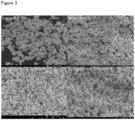
- SEM images of the positive electrode active materials of Examples 7 and 8 and Comparative Examples 3 and 4 indicate a single-particle shape having no particle boundary in the particle, as illustrated in FIG. 3 . An aggregate of the single particles was partially observed, and observed was tendency of aggregating the small particles in Example 7 with the boron treatment.
- Test cells were produced and evaluated in the same manner as in Example 1 except that, in the production of the positive electrode active material, the amount of boric acid added was changed as described in Table 1, and the water-washing step was emitted.
- Test cells were produced and evaluated in the same manner as in Example 1 except that, in the production of the positive electrode active material, the amount of boric acid added, the highest temperature in calcining, and the calcining time were changed as described in Table 1, and the water-washing step and the crushing step were omitted.
- Examples 10 and 11 and Comparative Examples 6 and 7 an aggregate of the single particles having an average particle diameter (D50) of 9.0 ⁇ m was obtained.
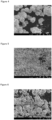
- An SEM image of the positive electrode active material of Example 10 indicates a shape of the secondary particles, not the single-particle shape, as indicated in FIG. 4 , but crushing the particles with a jet mill yields the shape in the SEM image of Example 1 ( FIG. 5 ), which includes large primary particles and has the feature of the single particles.
- the particle diameter of the primary particles is found by crushing the particles with a jet mill and measuring the average particle diameter.
- An SEM image of the positive electrode active material of Example 11 indicates a single-particle shape having no particle boundary in the particle, as illustrated in FIG. 6 , and the aggregation of the primary particles disappears even without crushing as largely growing of the particles.
- LiOH and Ni 0.85 Mn 0.15 (OH) 2 powder obtained by a coprecipitation method and having an average particle diameter of 5 ⁇ m were mixed so that a mole ratio between Li and a total amount of Ni and Mn was 1.1:1 to obtain a mixture (the mixing process).
- a mixture Under an oxygen flow (flow rate of greater than or equal to 0.15 L/min and less than or equal to 0.2 L/min relative to 1 L of a capacity of a furnace) with an oxygen concentration of greater than or equal to 90%, this mixture was calcined from room temperature to 650°C for 5 h, then calcined to 875°C for 2 h, and then retained for 12 hours to obtain a lithium-containing composite oxide (aggregate of single particles) (synthesizing step).
- Test cells were produced and evaluated in the same manner as in Example 1 except that, in the production of the positive electrode active material, an element addition species at an amount described in Table 2 relative to the total amount of Ni and Mn was mixed in the mixing process, and addition of boric acid, the highest temperature in calcining, and the calcining time were changed as described in Table 2.
- CuO was used as the Cu source
- ZrO 2 was used as the Zr source
- CuO was used as Cu
- Mg(OH) 2 was used as the Mg source
- Ca(OH) 2 was used as the Ca source
- WO 3 was used as the W source
- SiO was used as the Si source
- LiF was used as the F source
- Li 2 S was used as the S source. From the SEM image ( FIG. 8 ) of the positive electrode active materials of Examples A2, A3, and A4, it may be confirmed that the single-particle shape largely grows as raising the calcining temperature.
- LiOH and Ni 0.85 Co 0.05 Mn 0.10 (OH) 2 powder obtained by a coprecipitation method and having an average particle diameter of 6 ⁇ m were mixed so that a mole ratio between Li and a total amount of Ni, Co, and Mn was 1:1.05 to obtain a mixture.
- an oxygen flow flow rate of greater than or equal to 0.15 L/min and less than or equal to 0.2 L/min relative to 1 L of a capacity of a furnace
- this mixture was calcined from room temperature to 650°C for 5 h, then calcined to 750°C for 2 h, and then retained for 3 hours to obtain a lithium-containing composite oxide (synthesizing step).
- This lithium-containing composite oxide was of secondary particles each formed by aggregation of single particles, and this lithium-containing composite oxide was used as a positive electrode active material of Reference Example 1.
- a test cell was produced and evaluated in the same manner as in Example 1 except that this positive electrode active material was used.
- a test cell was produced and evaluated in the same manner as in Reference Example 1 except that, after the synthesizing step of the production of the positive electrode active material, boric acid (H 3 BO 3 ) powder was added to the secondary particles, and dried to obtain the positive electrode active material.
- the amount of the boric acid added was 1 mol% relative to the total molar amount of the metal elements excluding Li in the lithium-transition metal composite oxide.
- a test cell was produced and evaluated in the same manner as in Reference Example 1 except that, in the production of the positive electrode active material, the metal hydroxide being the raw material was changed to Ni 0.83 Co 0.12 Mn 0.05 (OH) 2 powder having an average particle diameter of 11 ⁇ m.
- a test cell was produced and evaluated in the same manner as in Reference Example 3 except that, after the synthesizing step of the production of the positive electrode active material, boric acid (H 3 BO 3 ) powder was added to the secondary particles, and dried to obtain the positive electrode active material.
- the amount of the boric acid added was 1 mol% relative to the total molar amount of the metal elements excluding Li in the lithium-transition metal composite oxide.
- a test cell was produced and evaluated in the same manner as in Reference Example 1 except that, in the production of the positive electrode active material, the metal hydroxide being the raw material was changed to Ni 0.85 Co 0.05 Mn 0.10 (OH) 2 powder having an average particle diameter of 12 ⁇ m.
- a test cell was produced and evaluated in the same manner as in Reference Example 5 except that, after the synthesizing step of the production of the positive electrode active material, boric acid (H 3 BO 3 ) powder was added to the secondary particles, and dried to obtain the positive electrode active material.
- the amount of the boric acid added was 1 mol% relative to the total molar amount of the metal elements excluding Li in the lithium-transition metal composite oxide.
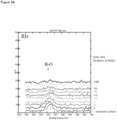
- Example 4A to FIG. 4D show the XPS spectra of Example 4, Example 5, Comparative Example 1, and Comparative Example 2, respectively.
- the measurement at each depth was performed by digging the positive electrode active material from the outermost surface using a focused ion beam apparatus (FIB).
- FIB focused ion beam apparatus
- the outermost surface was in a state where Ar ion sputtering was not performed.
- the atomic concentration was calculated from a signal intensity ratio by using a relative sensitivity coefficient of each element. Analysis: average information of 300 ⁇ 800 ⁇ m
- the above test cell was charged at a constant current of 0.2 C until 4.5 V (reference to lithium), and then charged at a constant voltage of 4.5 V until 0.02 C. Thereafter, the test cell was discharged at a constant current of 0.1 C until 2.5 V. A charge capacity and a discharge capacity at this time were measured, and this discharge capacity was divided by this charge capacity to calculate charge-discharge efficiency.
- Capacity retention (Discharge capacity at 31st cycle / Discharge capacity at 1st cycle) ⁇ 100
- the above test cell after the 11th cycle and the 31st cycle was charged at a constant current of 0.2 C until SOC 50%, and from this state, the test cell was discharged at a current value of each of 0.05 C, 0.1 C, and 0.2 C for 10 seconds.
- a voltage value after the discharge for 10 seconds relative to each of the current values was plotted, and an IV resistance was determined from a slope of linear approximation of the plot.
- the IV resistance after the 11th cycle was specified as an initial IV resistance
- the IV resistance after the 31st cycle was specified as an IV resistance after cycles.
- Tables 1 to 3 show the evaluation results of Examples, Comparative Examples, and Reference Examples.
- Composition of lithium-transition metal composite oxide [mol%] Amount of boric acid added [mol%] Highest temperature in calcining [°C] Calcining time [hr]] D50 [ ⁇ m] Charge capacity [mAh/g] Discharge capacity [mAh/g] Charge -discharge efficienc y [%] Thickness: 30 ⁇ m Capacity retention [%]
- Initial IV resistance [ ⁇ ] IV resistance after cycles [ ⁇ ] Ni Mn B Mn +Ni B/(Mn +Ni)
- Example 1 80 20 0.2 850 9 0.9 238 217 91 ⁇ 1 30 - 89 3 7
- Example 2 80 20 0.5 850 9 235 218 93 ⁇ 1 32 - 88 3 6
- Example 3 80 20 1 850 9 237 217 92 3 28 0.11 89 3 6
- the test cells of Examples yielded higher charge-discharge efficiency and capacity retention than those of the test cells of Comparative Examples. Accordingly, it is found that the battery at a low cost and having improved battery capacity and charge-discharge efficiency may be obtained by forming the surface-modifying layer including the boron compound at the predetermined thickness on the surface of the lithium-transition metal composite oxide having the predetermined composition. From the results of Examples 7 and 8 and Comparative Examples 3 and 4, it is found that decrease in the discharge capacity may be inhibited to improve the charge-discharge efficiency by performing the boron treatment even with enlarged primary particles.
Landscapes
- Chemical & Material Sciences (AREA)
- Chemical Kinetics & Catalysis (AREA)
- Electrochemistry (AREA)
- General Chemical & Material Sciences (AREA)
- Inorganic Chemistry (AREA)
- Organic Chemistry (AREA)
- Composite Materials (AREA)
- Engineering & Computer Science (AREA)
- Materials Engineering (AREA)
- Manufacturing & Machinery (AREA)
- Battery Electrode And Active Subsutance (AREA)
Applications Claiming Priority (2)
| Application Number | Priority Date | Filing Date | Title |
|---|---|---|---|
| JP2022030455 | 2022-02-28 | ||
| PCT/JP2023/004313 WO2023162694A1 (ja) | 2022-02-28 | 2023-02-09 | 非水電解質二次電池用正極活物質及び非水電解質二次電池 |
Publications (2)
| Publication Number | Publication Date |
|---|---|
| EP4489129A1 true EP4489129A1 (de) | 2025-01-08 |
| EP4489129A4 EP4489129A4 (de) | 2025-07-09 |
Family
ID=87765685
Family Applications (1)
| Application Number | Title | Priority Date | Filing Date |
|---|---|---|---|
| EP23759698.6A Pending EP4489129A4 (de) | 2022-02-28 | 2023-02-09 | Positivelektrodenaktivmaterial für eine sekundärbatterie mit wasserfreiem elektrolyt und sekundärbatterie mit wasserfreiem elektrolyt |
Country Status (5)
| Country | Link |
|---|---|
| US (1) | US20250183271A1 (de) |
| EP (1) | EP4489129A4 (de) |
| JP (1) | JPWO2023162694A1 (de) |
| CN (1) | CN118743055A (de) |
| WO (1) | WO2023162694A1 (de) |
Family Cites Families (6)
| Publication number | Priority date | Publication date | Assignee | Title |
|---|---|---|---|---|
| KR101761367B1 (ko) | 2014-12-19 | 2017-07-25 | 주식회사 엘지화학 | 혼합 양극활물질, 이를 포함하는 양극 및 이차전지 |
| JP7412264B2 (ja) * | 2019-10-11 | 2024-01-12 | 住友金属鉱山株式会社 | リチウムイオン二次電池用正極活物質およびその製造方法 |
| EP4099444B1 (de) * | 2020-01-31 | 2025-06-25 | SANYO Electric Co., Ltd. | Positivelektrodenaktivmaterial für sekundärbatterien mit wasserfreiem elektrolyt und sekundärbatterie mit wasserfreiem elektrolyt |
| KR102379561B1 (ko) * | 2020-03-05 | 2022-03-28 | 삼성에스디아이 주식회사 | 리튬이차전지용 복합양극활물질, 그 제조방법 및 이를 포함하는 양극을 함유한 리튬이차전지 |
| CN111599999B (zh) * | 2020-05-25 | 2022-04-08 | 蜂巢能源科技股份有限公司 | 无钴正极材料、其制备方法及锂离子电池 |
| CN115668543B (zh) * | 2020-05-29 | 2025-09-09 | 松下知识产权经营株式会社 | 非水电解质二次电池用正极活性物质和非水电解质二次电池 |
-
2023
- 2023-02-09 JP JP2024503004A patent/JPWO2023162694A1/ja active Pending
- 2023-02-09 US US18/838,766 patent/US20250183271A1/en active Pending
- 2023-02-09 EP EP23759698.6A patent/EP4489129A4/de active Pending
- 2023-02-09 WO PCT/JP2023/004313 patent/WO2023162694A1/ja not_active Ceased
- 2023-02-09 CN CN202380022203.8A patent/CN118743055A/zh active Pending
Also Published As
| Publication number | Publication date |
|---|---|
| JPWO2023162694A1 (de) | 2023-08-31 |
| CN118743055A (zh) | 2024-10-01 |
| EP4489129A4 (de) | 2025-07-09 |
| US20250183271A1 (en) | 2025-06-05 |
| WO2023162694A1 (ja) | 2023-08-31 |
Similar Documents
| Publication | Publication Date | Title |
|---|---|---|
| EP4067310A1 (de) | Positivelektroden-aktivmaterial für sekundärbatterie mit wasserfreiem elektrolyt, verfahren zur herstellung eines positivelektroden-aktivmaterials für sekundärbatterie mit wasserfreiem elektrolyt und sekundärbatterie mit wasserfreiem elektrolyt | |
| EP4098623A1 (de) | Positivelektroden-aktivmaterial für sekundärbatterien mit wasserfreiem elektrolyt, verfahren zur herstellung eines positivelektroden-aktivmaterials für sekundärbatterien mit wasserfreiem elektrolyt und sekundärbatterie mit wasserfreiem elektrolyt | |
| EP4159685A1 (de) | Positivelektrodenaktivmaterial für sekundärbatterien mit wasserfreiem elektrolyt und sekundärbatterie mit wasserfreiem elektrolyt | |
| US20250183296A1 (en) | Positive electrode active material for nonaqueous electrolyte secondary batteries, and nonaqueous electrolyte secondary battery | |
| EP4167322A1 (de) | Positivelektrodenaktivmaterial für eine sekundärbatterie mit wasserfreiem elektrolyt und sekundärbatterie mit wasserfreiem elektrolyt | |
| US20240038970A1 (en) | Non-aqueous electrolyte secondary battery positive electrode and non-aqueous electrolyte secondary battery | |
| EP4443562A1 (de) | Positivelektrodenaktivmaterial für eine sekundärbatterie, positivelektrode für eine sekundärbatterie und verfahren zur herstellung | |
| EP4224572A1 (de) | Positivelektrodenaktivmaterial für sekundärbatterien mit wasserfreiem elektrolyt und sekundärbatterie mit wasserfreiem elektrolyt | |
| JP2019040701A (ja) | 非水電解質二次電池 | |
| EP4485558A1 (de) | Positivelektrode für sekundärbatterien mit wasserfreiem elektrolyt und sekundärbatterie mit wasserfreiem elektrolyt | |
| EP4443561A1 (de) | Positivelektrodenaktivmaterial für eine sekundärbatterie, positivelektrode für eine sekundärbatterie und verfahren zur herstellung | |
| WO2024004709A1 (ja) | 非水電解質二次電池用正極活物質及び非水電解質二次電池 | |
| EP3933977B1 (de) | Positivelektrodenaktivmaterial für sekundärbatterien mit wasserfreiem elektrolyt und sekundärbatterie mit wasserfreiem elektrolyt | |
| EP4579808A1 (de) | Positivelektrodenaktivmaterial für sekundärbatterien mit wasserfreiem elektrolyt und sekundärbatterie mit wasserfreiem elektrolyt | |
| EP4485574A1 (de) | Positivelektrodenaktivmaterial für sekundärbatterien mit wasserfreiem elektrolyt und sekundärbatterie mit wasserfreiem elektrolyt | |
| EP4443560A1 (de) | Positivelektrodenaktivmaterial für sekundärbatterien mit wasserfreiem elektrolyt, positivelektrode für sekundärbatterien mit wasserfreiem elektrolyt und verfahren zur herstellung | |
| EP4270528A1 (de) | Positivelektrode für eine sekundärbatterie mit wasserfreiem elektrolyt und sekundärbatterie mit wasserfreiem elektrolyt | |
| EP4099441B1 (de) | Positivelektrodenaktivmaterial für sekundärbatterien mit wasserfreiem elektrolyt und sekundärbatterie mit wasserfreiem elektrolyt | |
| EP4207370A1 (de) | Positivelektrodenaktivmaterial für sekundärzelle mit wasserfreiem elektrolyt und sekundärzelle mit wasserfreiem elektrolyt | |
| EP4550461A1 (de) | Positivelektrodenaktivmaterial für eine sekundärbatterie mit wasserfreiem elektrolyt, verfahren zur herstellung des positivelektrodenaktivmaterials für eine sekundärbatterie mit wasserfreiem elektrolyt | |
| EP4567932A1 (de) | Positivelektrodenaktivmaterial für eine sekundärbatterie mit wasserfreiem elektrolyt und sekundärbatterie mit wasserfreiem elektrolyt | |
| EP4138157A1 (de) | Positivelektrodenaktivmaterial für sekundärbatterien mit wasserfreiem elektrolyt und sekundärbatterie mit wasserfreiem elektrolyt | |
| EP4489129A1 (de) | Positivelektrodenaktivmaterial für eine sekundärbatterie mit wasserfreiem elektrolyt und sekundärbatterie mit wasserfreiem elektrolyt | |
| CN116601786A (zh) | 非水电解质二次电池用正极活性物质和非水电解质二次电池 | |
| EP4459714A1 (de) | Positivelektrodenaktivmaterial für eine sekundärbatterie mit wasserfreiem elektrolyt und sekundärbatterie mit wasserfreiem elektrolyt |
Legal Events
| Date | Code | Title | Description |
|---|---|---|---|
| STAA | Information on the status of an ep patent application or granted ep patent |
Free format text: STATUS: THE INTERNATIONAL PUBLICATION HAS BEEN MADE |
|
| PUAI | Public reference made under article 153(3) epc to a published international application that has entered the european phase |
Free format text: ORIGINAL CODE: 0009012 |
|
| STAA | Information on the status of an ep patent application or granted ep patent |
Free format text: STATUS: REQUEST FOR EXAMINATION WAS MADE |
|
| 17P | Request for examination filed |
Effective date: 20240819 |
|
| AK | Designated contracting states |
Kind code of ref document: A1 Designated state(s): AL AT BE BG CH CY CZ DE DK EE ES FI FR GB GR HR HU IE IS IT LI LT LU LV MC ME MK MT NL NO PL PT RO RS SE SI SK SM TR |
|
| REG | Reference to a national code |
Ref country code: DE Ref legal event code: R079 Free format text: PREVIOUS MAIN CLASS: H01M0004525000 Ipc: C01G0053000000 |
|
| DAV | Request for validation of the european patent (deleted) | ||
| DAX | Request for extension of the european patent (deleted) | ||
| A4 | Supplementary search report drawn up and despatched |
Effective date: 20250605 |
|
| RIC1 | Information provided on ipc code assigned before grant |
Ipc: H01M 4/505 20100101ALI20250530BHEP Ipc: H01M 4/36 20060101ALI20250530BHEP Ipc: H01M 4/13 20100101ALI20250530BHEP Ipc: H01M 4/525 20100101ALI20250530BHEP Ipc: C01G 53/00 20250101AFI20250530BHEP |