EP4489016A1 - Verfahren zur verbesserung eines behandlungsplans für einen zahnausrichter - Google Patents
Verfahren zur verbesserung eines behandlungsplans für einen zahnausrichter Download PDFInfo
- Publication number
- EP4489016A1 EP4489016A1 EP23183363.3A EP23183363A EP4489016A1 EP 4489016 A1 EP4489016 A1 EP 4489016A1 EP 23183363 A EP23183363 A EP 23183363A EP 4489016 A1 EP4489016 A1 EP 4489016A1
- Authority
- EP
- European Patent Office
- Prior art keywords
- dental aligner
- updated
- stimulus
- control unit
- patient
- Prior art date
- Legal status (The legal status is an assumption and is not a legal conclusion. Google has not performed a legal analysis and makes no representation as to the accuracy of the status listed.)
- Pending
Links
Images


Classifications
-
- G—PHYSICS
- G16—INFORMATION AND COMMUNICATION TECHNOLOGY [ICT] SPECIALLY ADAPTED FOR SPECIFIC APPLICATION FIELDS
- G16H—HEALTHCARE INFORMATICS, i.e. INFORMATION AND COMMUNICATION TECHNOLOGY [ICT] SPECIALLY ADAPTED FOR THE HANDLING OR PROCESSING OF MEDICAL OR HEALTHCARE DATA
- G16H20/00—ICT specially adapted for therapies or health-improving plans, e.g. for handling prescriptions, for steering therapy or for monitoring patient compliance
- G16H20/40—ICT specially adapted for therapies or health-improving plans, e.g. for handling prescriptions, for steering therapy or for monitoring patient compliance relating to mechanical, radiation or invasive therapies, e.g. surgery, laser therapy, dialysis or acupuncture
-
- A—HUMAN NECESSITIES
- A61—MEDICAL OR VETERINARY SCIENCE; HYGIENE
- A61C—DENTISTRY; APPARATUS OR METHODS FOR ORAL OR DENTAL HYGIENE
- A61C7/00—Orthodontics, i.e. obtaining or maintaining the desired position of teeth, e.g. by straightening, evening, regulating, separating, or by correcting malocclusions
- A61C7/002—Orthodontic computer assisted systems
Definitions
- the invention relates to a method for improving a treatment plan for a dental aligner and to an assembly.
- Dental aligners can be used to correct misaligned teeth. They are aids that are used in the mouth or on the teeth. Dental aligners typically consist of a polymer or a combination of polymers or of a metal, or a combination or alloy of metals, that change shape in a precalculated manner under the influence of a stimulus, or they comprise such material. The treatment of misaligned teeth requires an incremental change of teeth positions. This incremental change must take place precisely.
- a method to calculate a stimulus of a medical aid that changes shape and therefore the position of a tooth from an actual position to a final target position is known, for example, from WO 2021/048318 A1 .
- a medical aid here a tooth correcting device, is designed that undergoes a first change of shape under the influence of a first stimulus and then effects a first change of the tooth position in a first correction step.
- a control unit calculates a stimulus that has to act on the medical aid to perform a second correction step, taking into account a deviation between the actual state and the target state of the tooth to be corrected.
- this does not yet allow for an optimal treatment for the patient.
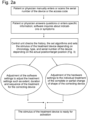
- the method according to the invention for improving a treatment plan for a dental aligner has the following steps:
- Gathering of the basic and/or updated basic and/or additional information regarding the treatment plan for a dental aligner can take place in an analog manner, for example with a questionnaire, preferably however, the basic information is gathered digitally, for example by receiving real-time data and/or by retrieving and analyzing stored data from a storage device, for example a database. Improving the treatment plan, especially the different correction steps, is preferably achieved by continuous biological optimization of the treatment plan.
- Basic and /or additional information preferably describe information that is known when the final target position is determined and/or the first or any other subsequent intermediate target positions and/or the first stimulus or any other following stimuli are calculated.
- the updated basic information and/or the additional information are preferably information that change throughout the treatment plan or were not known at the beginning of the treatment.
- additional information are different values of the basic information.
- additional information is already taken into account while determining the final and intermediate target positions. This for example allows the physician to account for planned holidays, scheduled flights or any other event which can be planned for in advance.
- Determining the initial position of the dental aligner can take place conventionally in an analog manner, for example with an impression of the dental aligner; preferably, however, the initial position is detected by digital measurement, for example by means of digital photography. Alternatively, however, the initial position of the dental aligner is detected by digitally measuring the initial position of the dental aligner, or by signals from a sensor that detects the initial position of the dental aligner. Preferably, determining the initial position of the dental aligner takes into account an actual position of a tooth to be corrected. The initial position of the dental aligner and/or the actual position of the tooth to be corrected can also be detected by a sensor that reports the current position of the dental aligner and/or the tooth to be corrected. In an advantageous embodiment of the invention, the sensor can be arranged on the dental aligner, but the sensor can also be arranged on a scanner, for example, a digital intraoral scanner.
- the analogically or digitally determined initial position of the dental aligner to be re-positioned is then entered into a control unit.
- the input can be done manually by entering the data into the control unit. If the data is present in digital form, the input can be carried out directly, preferably in an automated manner, for example, by upload-ing or transferring the data to the control unit.
- the input takes place at an input portal, in particular an input portal of the manufacturer of the dental aligner or an input portal of the attending physician, for example a screen or a reader that can record data for a three-dimensional position description of the dental aligner and/or a tooth.
- the input portal transmits the inputs to the control unit.
- the input portal can be displayed on a display, it can be displayed by means of application software (app) on a smartphone, but it can also be specially configured as a separate device with the sole purpose of making inputs about the initial position of the dental aligner and/or the actual position of the tooth to be corrected.
- the basic, updated basic and additional information comprise information and/or data about the person to be treated other than information about the position of the dental aligner and/or the position about the tooth to be corrected with the dental aligner.
- Including updated basic information and additional information about the patient in the calculation of the intermediate, updated intermediate or final target positions and the stimuli or updated stimuli allows additional and improved adaptation of the treatment plan and therefore an optimized individual treatment for each patient throughout the whole treatment.
- the basic and/or the updated basic and/or the additional information comprises patient's lifestyle data and/or patients' biological data.
- the basic information and/or the updated basic and /or the additional information can be entered into the input portal in order to incorporate the patient's lifestyle and/or the patient's biological data into the optimization of the treatment plan for the dental aligner.
- the patient's lifestyle data preferably includes at least one information or any combination of information from the group of the patient's wearing behavior with regard to the dental aligner, behavior patterns of the use of dental aligner by the patient, his willingness to follow the treatment rules, the treatment progress, shift working, working rhythm, sleep rhythm, rise and sleep time, lack of sleep, travel schedule, sports activities, exercise, exercise duration and intensity, holidays, speeches, flights, financial data, insurance data, alcohol or drug consumption, recreational or festive events, general feeling.
- the patient's biological data includes at least one information or any combination of information from the group of one or a plurality of information relating to vital signs, blood test results, information about saliva composition and quality and/or quantity, hormone status, or other analysis data, for example regarding excretions of the patient, medical procedures, medical history, heart function, heart rate, blood pressure, information about past, present and intended diagnoses, illness or medical treatment, sensitivity to pain [algesia], allergies, body mass index, weight, body fat, oxygen saturation, body temperature, growth, ECG readings, implants, medication, blood oxygen levels, sleep apnoea, snoring, periodic cycle for women, teeth grinding, bruxism, periods with increased or reduced bone activity, e.g. illnesses, accidents or therapy.
- the basic information, the updated basic information and/or the additional information is input into the input portal in the way that can be easily processed by an algorithm or software, for example in assessment levels such as "low” - “medium” - “high” or in an assessment according to ratings, i.e., 1 to 5. It is preferred that the input portal displays the assessment levels for these inputs, so that the patient or the attending physician can quickly and easily select and input. Data that is detected, for example, by sensors, for example relating to the time periods in which the patient wears or uses the dental aligner or relating to the manner in which the patient wears or uses the dental aligner, can also be gathered.
- Data relating to the patient's time schedules can also be captured and/or stored in the storage device. Capturing and/or storing of the data can be done randomly, in set time intervals or in real-time.
- the control unit is designed to process software or algorithms. For simplification, calculations that take place by means of software, or respectively the processing of algorithms in the control unit, are described below as activity or actuation of the control unit. Furthermore, the control unit is designed to store the basic, updated basic and/or the additional information in a storage device and to calculate the first intermediate, the updated second intermediate position and the final target position and the first and updated stimulus.
- a final target position for the dental aligner is determined based on the gathered basic information or a combination of one or more of the basic information, the updated basic information and/or the additional information, and the initial position of the dental aligner, said final target position being usually at a maximum deviation from the initial position of the dental aligner.
- the final target position may for example be determined in an analog manner, for example by a physician or in digital manner, for example by the control unit.
- the final target position of the dental aligner is then entered into the control unit and/or preferably stored in the storage device of the control unit. After the final target position of the dental aligner has been entered, the control unit calculates at least a first intermediate target position and at least a first stimulus to act on the dental aligner, said calculation taking into account the deviation between the initial position and final target position of the dental aligner.
- the position of the dental aligner is adapted by using the basic information regarding the patient, the updated basic information and/or the additional information regarding the patient, which has been entered into the control unit. Adapting the position of the dental aligner before reaching the first intermediate target position is for example necessary if the aligner does not adjust as planned, e.g., will achieve the first intermediate target position slower than expected.
- the control unit then calculates an updated second intermediate position and an updated second stimulus.
- the dental aligner is then submitted to the updated second stimulus.
- the updated second stimulus is preferably calculated by taking into account a comparison between the current actual position of the dental aligner and/or tooth to be corrected and the intermediate target position of the dental aligner and/or tooth to be corrected. Any deviation that is found between the actual intermediate position and the intermediate target position is captured by the control unit after the input.
- Preferably intermediate target positions and/or updated intermediate target positions for the dental aligner for individual correction steps of the treatment up to the final target position are saved in the control unit.
- the stimulus and/or updated stimulus is calculated that is necessary to cause the dental aligner to change shape in the manner necessary for the second correction step.
- it is calculated which sections of the dental aligner must be subjected to a stimulus in order to achieve a change of shape. In doing so, any deviation that is found between the actual intermediate position from the intermediate target position of the dental aligner is taken into account: If, for example, the dental aligner moves farther than originally intended or if the patient cannot tolerate the rapid movement of the dental aligner, the stimulus for the second correction step can be weaker or a different stimulus with a weaker effect can be selected because only a smaller correction movement is necessary. If the dental aligner moves less than originally intended or the patient signals that he desires a faster movement of the dental aligner, a stronger stimulus or a different stimulus with a stronger effect can be used.
- the well-being of the patient or the inputs regarding the condition of the patient are taken into account in the calculation of the stimulus for the next correction step.
- the time periods during which the patient wears the dental aligner can also be incorporated into the calculation of the stimulus.
- a change of shape of the dental aligner can also be brought about in each case by a combination of two or more stimuli.
- the basic information, the updated basic information and the additional information regarding the patient are preferably taken into account in the calculation of the updated stimulus for each subsequent correction step up to the final target position. For example, if the patient has to spent a specific time abroad, for example work related or on a holiday, the updated stimulus for the next correction step can be weaker or left out completely. In this manner, the correction of the tooth can be achieved efficiently, meaning quickly and with low stress on the patient.
- the dental aligner can be produced from any material. Preferably, it comprises exclusively dynamic synthetic material. However, it can also advantageously be a dental aligner that consists of a combination of dynamic synthetic material and conventional, static synthetic material, wherein the shape of the static synthetic material cannot be changed by a stimulus (with the exception of mechanical force).
- synthetic material meaning dynamic material or dynamic material in combination with static plastic material, can be used with another material, typically, for example, a plastic/metal combination.
- the synthetic material can be combined with natural or synthetic rubber. Preferably, all the materials used contribute to aligning the tooth, i.e., transferring it to the final target position.
- the method according to the invention is carried out with a dental aligner that is produced using a dynamic synthetic material that changes shape in a calculable manner under the influence of a stimulus.
- the change of shape of the dental aligner effects a movement of tooth from an actual position to a target position.
- Such a material typically a thermoplastic material, consists, for example, of two different polymers that abut one another, preferably abut one another in layers.
- the first polymer does not react to movement-inducing stimuli
- the second polymer reacts to movement-inducing stimulation, in particular by a shape and/or volume change.
- Movement-inducing stimuli can be contact with moisture or liquid, in particular water and water-containing liquids, temperature, in particular heat and/or radiation.
- Such plastics are also referred to as shape memory polymers (SMPs).
- SMAs shape memory alloys
- a stimulus is selected in particular from the group comprising the parameters time, temperature, pH value, current or respectively electrical voltage, radiation, in particular infrared radiation, sound, illumination and liquid, e.g., water or solvent.
- the stimulus is selected from a combination of these parameters, for example, temperature and pH value, water and temperature, or time and temperature.
- a stimulus can also be mechanical force which brings about a change of shape of the dental aligner.
- composition of the dynamic synthetic material or alternatively the amount of the second polymer and its absorption capacity for a stimulus is known, the magnitude of the form change of the synthetic material generated by the change of shape or volume can be calculated. The same applies to SMA.
- thermoplastic material is offered, for example, by the company Stratasys Inc. in conjunction with the 4D Printing Project, along with information about which form change the contact with a stimulus or with various stimuli effects.
- Stratasys Inc. hereby implements a printing method in practice that was developed by Skylar Tibbits of the Self-Assembly Lab at Massachusetts Institute of Technology MIT, Boston, USA, and for which Autodesk Inc. has developed the software with which synthetic material, in particular dynamic synthetic material, can be built by means of a 3D printer to form a product that changes its outer shape in a predictable manner under the influence of a movement-inducing and thus form-changing stimulus.
- the subsequent deformability of the dynamic synthetic material or an SMA that is induced by external stimuli can be used by producing a dental aligner at least partially out of SMP or SMA, which change shape in a precalculated manner when acted upon by a stimulation.
- the dental aligner preferably comprises a wall that abuts the surface of the tooth or teeth to be corrected. Due to the deformation, the wall of the dental aligner which deforms in a calculated manner, exerts force on the tooth which the wall abuts and moves the tooth as a result into the target position.
- the information about the effect of the stimulus, meaning of the various parameters of the dental aligner mentioned above, on the respective material of the dental aligner are each made known by the manufacturer and are thus known when producing the dental aligner. This information is saved in the control unit and is incorporated into the software, or respectively the algorithm, that is used to calculate the first stimulus and/or updated stimulus necessary for the second correction step.
- the control unit is preferably connected to a treatment device, which is designed to cause the calculated first stimulus and/or updated stimulus to act on the dental aligner.
- the calculated stimulus is output by the control unit and afterwards advantageously transmitted to the treatment device.
- the treatment device can be a device into which the dental aligner is inserted or that is placed onto or connected to the dental aligner.
- the treatment device is therefore, for example, configured as a container which - depending on the embodiment - can be tempered and/or filled with liquid and/or into which the radiation, for example, infrared radiation, can be introduced.
- the treatment device can also have a connector for connecting to the dental aligner and introduce a stimulus, in particular current or heat, into the dental aligner via the connection.
- the treatment device is optionally designed to subject parts of the dental aligner specified by the storage unit to a stimulus.
- the treatment device can also be designed to apply mechanical force in order to bring about a change of shape of the dental aligner, for example by bending or pressing individual sections of the dental aligner.
- the treatment device can alternatively be integrated into the dental aligner in order, for example, to use heat as a stimulus.
- the treatment device is designed to apply two or more stimuli in combination.
- the treatment device is characterized in that it triggers the stimulus according to the specification of the control unit, which stimulus effects a change of shape of the dental aligner.
- the stimulus usually acts on the dental aligner for a specified duration.
- the change of shape of the dental aligner thus takes place in sections between (updated) intermediate target positions until a maximum change of shape of the dental aligner has been achieved at the final target position.
- This process of shape change can typically be repeated as often as the dental aligner can still be deformed by a stimulus, or until the final target position of the dental aligner is reached.
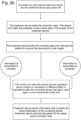
- control unit is linked to an information gathering unit.
- the control unit is preferably linked to one or more information gathering units of the group of a smart watch, a smart phone, a smart scale, a blood pressure monitor, medical measuring devices, a sleep analyzer or a notebook.
- the information gathering unit is preferably build that the patient is able to enter basic information and/or updated basic information and/or additional information.
- the information gathering unit is built to gather the information automatically, for example with at least one sensor, such as a heart rate sensor, a pulse sensor or a distance sensor.
- the information gathering unit can be linked to the control unit at specific times, for example before the calculation of an updated intermediate target position.
- the information gathering unit is linked to the control unit via a wireless connection, such as Bluetooth, WIFI or a mobile network, for example 5G.
- a wireless connection such as Bluetooth, WIFI or a mobile network, for example 5G.
- the information gathering unit advantageously enables the patient to share updated basic information and/or additional information with the physician in real time, so that the physician can easily adapt and/or improve the treatment plan for the dental aligner.
- control unit is used to calculate at least two intermediate target positions and at least two stimuli to act on the dental aligner, said calculation taking into account the deviation between the a prior intermediate target position and a subsequent intermediate target position of the dental aligner, wherein the position of the dental aligner is adapted upon achieving each intermediate target position by using the basic, updated basic and/or additional information regarding the patient to calculate the stimulus for the subsequent intermediate or final target positions.
- control unit stores the temporal progression of the intermediate target positions of the dental aligner and takes into account the temporal progression of the intermediate target positions when calculating the updated stimulus for the updated intermediate target positions.
- control unit calculates, emits and stores the duration to achieve the intermediate target positions and/or the updated intermediate target positions, the size of the next stimulus and/or the updated stimulus, and/or the parameters selected for the stimulation.
- the method according to the invention preferably comprises a separate data set for each dental aligner, which can be edited after entering an editing authorization in the input portal, for example, by entering a new actual position of the dental aligner and/or the tooth to be corrected. This ensures that, in each case, data is input about the associated dental aligner.
- the invention further comprises an assembly for improving a treatment plan for a dental aligner, comprising a control unit having means for calculating a stimulus and/or an updated stimulus and a storage device for data.
- the means for calculating are designed to calculate and, if applicable, select the stimulus and/or the updated stimulus for the next correction step, wherein data about the effect of at least one stimulus, preferably, however, about multiple stimuli, and data about the intermediate, updated intermediate or final target position of the dental aligner and the basic, updated basic and additional information are contained in the storage device for the initial position and for each individual correction step.
- the control unit is connected to an input portal for entering the initial position of the dental aligner and the final target position of the dental aligner.
- the control unit is linked to the afore-mentioned information gathering unit. This preferably allows the physician to easily receive updated information from the patient.
- the means for calculating comprise software that calculates the first stimulus for the first correction step from the initial position of the dental aligner and, if applicable, a deviation between the first intermediate target position and the actual intermediate position of the dental aligner and the effect of the respective at least one stimulus on the dental aligner.
- the software can switch or choose the updated stimulus or a combination of stimuli for the second and or subsequent correction step, depending on the magnitude of the change of shape of the dental aligner to be effected in the second correction step to move the tooth to be corrected.
- the software can determine the intensity of the stimulus, meaning, for example, the level of the temperature, the duration over which the stimulus must act. The stimulus can be chosen depending on a chosen treatment device so that it is ensured that the treatment device can also apply the calculated stimulus to the dental aligner.
- the calculated updated stimulus for the second correction step is then emitted.
- the updated stimulus is either printed or displayed on an output portal, for example, a screen.
- the calculated stimulus is transmitted to a treatment device and implemented there, i.e., the updated stimulus acts on the dental aligner.
- the input portal is connected to the control unit; further advantageously, the input portal also serves as an output portal.
- the input portal can only be opened for an input with an access authorization. It is further preferred if an input for a specific correcting device can only take place if the specific data set for this correcting device is opened by means of a code. This ensures that the upcoming change of shape of the dental aligner takes place correctly, because erroneous incorrect operation is precluded after the access code has been input.
- control unit and, if applicable, the treatment device are preset for the dental aligner such that, if parts of the control unit or software are missing or fail, the activation of the dental aligner by the stimulus takes place for a following correction step according to the original treatment plan, so that the treatment is not interrupted but can merely be resumed in a less optimized manner.
- a first step of the method according to the invention for improving a treatment plan for a dental aligner basic information regarding the patient is gathered. Then, the initial position of the dental aligner is determined and entered into a control unit of an assembly. A final target position is determined based on the gathered basic information and the initial position of the dental aligner and entered into the control unit as well.
- a treatment plan is created in which the path of the dental aligner from the initial position to the final target position is divided into at least two correction steps, often into a sequence of multiple correction steps.
- a dental aligner is created.
- the material of the dental aligner usually comprising SMP or SMA, changes its shape in a precalculated manner under the influence of a stimulus, typically from an intermediate target position to a subsequent updated intermediate target position.
- the type and intensity of the stimulus determine the magnitude of the change of shape.
- the necessary data required to determine the initial position, the final target position of the dental aligner, the intermediate target positions according to the individual correction steps, and the type and intensity of at least one stimulus, preferably multiple stimuli, are saved in a control unit.
- the control unit comprises a storage device for this purpose.
- the control unit is further equipped with a processor and with software that, after completion of a first correction step, calculates an updated stimulus for triggering a change of shape of the dental aligner for the second or any subsequent correction step.
- the control unit can be a separate device with an input portal, for example, a keyboard or a touchscreen mask, and advantageously with an output portal, for example, a screen display or a printer.
- the control unit is connected - as shown in Fig. 1 - to a computer, for example, in the form of a smartphone, a tablet, or a desktop computer.
- a connection to the input portal for example a separate application (app) can be downloaded, the input interface of which is connected to the input portal and the output interface of which is connected to the output portal of the control unit.
- the keyboard of the computer and the screen of the computer can be used for inputs into the input interface and thus into the input portal.
- Connecting the control unit to a computer has the advantage that the storage device and the software of the control unit can be kept constantly up to date through updates. Alternatively, a stand-alone control unit can be used.
- control unit Starting from a control unit connected to a computer, after switching on and optionally loading any available updates, this control unit is ready for data input, either for creating a new file for a new dental aligner or for the evaluation of a correction step that has taken place and the calculation of an updated stimulus for a following correction step.
- the control unit or respectively the input portal can be designed for use by the patient, the attending physician, or the manufacturer of the dental aligner depending on who creates a new file for a dental aligner or evaluates a correction step and calculates the stimulus for a further correction step.
- an access authorization is provided for each user of the control unit to ensure that only authorized persons and, if applicable, users trained to use the control unit make inputs. It is also recommended to create a separate file with a separate access code for each dental aligner to ensure that a user who, for example, is overseeing multiple correcting devices as the attending physician always makes inputs for the correct dental aligner.
- the change of shape of dental aligner and/or the tooth or teeth to be corrected that has been achieved so far is evaluated.
- the currently achieved actual intermediate position of the dental aligner and/or the actual position of the tooth to be corrected is detected, either manually, for example, through an impression and measuring the impression, or digitally by measuring and determining the actual intermediate position of the dental aligner and/or the actual position of the tooth to be corrected.
- the data obtained in this way is entered into the input portal of the control unit, either via a keyboard or by means of data transmission, for example, via a cable, Bluetooth, or a wireless network connection (WLAN, Wi-Fi).
- the input portal also asks the patient questions to gather basic, updated basic and/or additional information.
- the basic information, the updated basic information and the additional information comprise information about the patient's lifestyle and/or the patient's biological data and can be entered into the input portal in order to incorporate the patient's lifestyle and/or the patient's biological data into the optimization of the correcting tooth treatment by means of the dental aligner.
- the patient's lifestyle data preferably includes at least one information or any combination of information from the group of the patient's wearing behavior with regard to the dental aligner, behavior patterns of the use of dental aligner by the patient, the willingness of the patient to follow the treatment rules, the treatment progress, shift working, working rhythm, sleep rhythm, rise and sleep time, lack of sleep, travel schedule, sports activities, exercise, exercise duration and intensity, holidays, speech habits, flights, financial data, insurance data, alcohol or drug consumption, scheduled events, general feeling.
- the patient's biological data includes at least one information or any combination of information from the group of one or a a plurality of information relating to vital signs, blood test results, information about saliva composition and quality and/or quantity, hormone status, or other analysis data, for example regarding excretions of the patient, medical procedures, medical history, heart function, heart rate, blood pressure, information about past, present and intended diagnoses, illness or medical treatment, sensitivity to pain [algesia], allergies, body mass index, weight, body fat, oxygen saturation, body temperature, growth, ECG readings, implants, medication blood oxygen levels, sleep apnoea, snoring, periodic cycle for women, teeth grinding, bruxism, periods with bone activity, e.g. illnesses, accidents or therapy.
- standardized responses for example: good - moderate - poor; high - medium - low
- standardized responses for example: good - moderate - poor; high - medium - low
- control unit is linked to one or more information gathering units of the group comprising a smart watch, a smart phone, a smart scale, a blood pressure monitor, medical measuring devices, a sleep analyser, a desktop computer and a tablet.
- the information gathering unit is preferably built such that the patient is able to enter basic information, updated basic information and/or additional information.
- the information gathering unit is built to gather the information automatically, for example with at least one sensor, such as a heart rate sensor, a pulse sensor or a distance sensor.
- the information gathering unit can be linked to the control unit at specific times, for example before the calculation of the updated intermediate target position or the updated stimulus for the next correction step.
- the information gathering unit is linked to the control unit via a wireless connection.
- the information gathering unit advantageously enables the patient to share updated basic or additional information with the physician in real time, so that the physician can easily adapt and/or improve the treatment plan for the dental aligner.
- Data that is detected, for example, by sensors, e.g., from the information gathering unit, for example relating to the time periods in which the patient wears or uses the dental aligner or relating to the manner in which the patient wears or uses the dental aligner, can also be captured.
- Data relating to the patient's time schedules, such as a travel or sleep schedule, or specific events, for example a wedding or a party, can also be captured and/or stored in the storage device.
- the patient can for example use the information gathering unit to enter information, e.g., with mobile apps.
- an app tracking a woman's periodic cycle might be connected to an orthodontic treatment app which transmits the data to the control unit after receiving the approval of the patient.
- the data being conveyed to the orthodontic treatment app can be used to optimize the treatment plan and/or inform the dentist or orthodontist.
- the basic, updated basic and additional information are taken into account when adapting the position of the dental aligner upon achieving the first intermediate target position and determining the stimulus required to achieve the at least second intermediate target position. For example, if the patient has to spent a specific time abroad, i.e., work related or on a holiday, the updated stimulus for the next correction step can set be weaker or left out completely.
- the periodic cycle of women influences the effect on the natural tooth mobility due to fluctuations on the hormone levels and a corresponding modification of the bone metabolism.
- Updated basic or additional information about phases of the periodic cycle e.g., with varying degrees of pain sensitivity are taken into account when determining the stimulus.
- the updated stimulus for next correction step can be set lower.
- the updated stimulus for next correction step can be set with a higher force or longer duration to utilize the increased teeth mobility of the patient.
- the updated stimulus for the next correction step or steps can be set higher and for longer durations.
- the dental aligner can be changed faster with higher stimuli because the patient is taking pain killers and the bone metabolism is increased.
- a deviation is ascertained, for example, by means of measuring the dental aligner and/or tooth position with an intraoral scanner or by comparing digital photographs; it can, however, also take place by creating a current impression and comparing it to the previous impression that was taken before beginning the completed correction step.
- the responses to the questions of the control unit (if such questions have been asked) and data received from the information gathering unit are taken into account for the calculation of the stimulus and/or the updated stimulus needed to achieve the second or subsequent intermediate or final target position.
- the control unit or respectively the algorithm also takes into account the settings specified in the original treatment plan for the stimulus that should act on the dental aligner at the beginning of the following correction step.
- the specified settings are now recalculated, taking into account any deviations of the actual intermediate position from the intermediate target position as well as the patients' responses, for example, about tolerability or intensity of the treatment, in order to move the dental aligner and/or the tooth to be corrected into the final target position as quickly as possible with minimal stress to the patient.
- the control unit or respectively the algorithm chooses a different stimulus and/or a different intensity, for example, a switch from heat to liquid or to a combination of stimuli, for example heat and liquid, depending on the extent to which a change of shape of the dental aligner is necessary.
- the method according to the invention thus ensures that correcting the tooth position does not take place according to a rigid treatment plan specified at the beginning of the treatment, but rather that the correction is carried out in an optimized manner, taking into account the actual course of the correction. This results in a short correcting treatment that is gentle for the patient.
- the recalculation of the updated stimulus for the change of shape of the dental aligner is then emitted by the control unit via the output portal.
- the calculation of the stimulus is, for example, printed or displayed by the output portal and is manually transferred to a treatment device.
- the treatment device can be arranged directly on the dental aligner, for example, as a heat source.
- the treatment device is often configured as a container in which the dental aligner can be accommodated.
- the treatment device is further designed to allow at least one stimulus to act on the dental aligner; advantageously, two or more stimuli can act on the dental aligner, for example, temperature, liquid and radiation, each individually or in combination.
- control unit is connected to and controls the treatment device.
- the connection can take place by installation in the housing of the treatment device, but it can also be made by a wired or wireless connection, in that the control unit sends actuation signals to the treatment device.
- the new calculation triggers the activation of one or more stimuli according to the specifications of the previous calculation of the control unit.
- the control unit also causes the display of indicators in advance via the output portal, for example, the indicator to place the dental aligner into the treatment apparatus, or the indicator to switch on the treatment apparatus after placing the dental aligner and thus trigger the change of shape as a result of the action of the stimulus or the combined stimuli.
- the output portal displays the course of the action of the stimulus and the resulting change of shape of the dental aligner.
- the output portal optionally displays information about the subsequent correction step, for example, how long the subsequent correction step takes, how long the dental aligner is to be worn in each case in order to ensure optimal treatment success.
- the output portal shows the patient some questions that relate in particular to the oral fit of the dental aligner, the shape of which has been changed, as well as questions about the sensations (or paresthesia) while the dental aligner is worn or questions about the effect of the dental aligner on the teeth to be corrected or other teeth.
- the output portal shows the patient some questions that relate in particular to the oral fit of the dental aligner, the shape of which has been changed, as well as questions about the sensations (or paresthesia) while the dental aligner is worn or questions about the effect of the dental aligner on the teeth to be corrected or other teeth.
- the control unit stores the data used to calculate the stimulus and/or the updated stimulus so that all information - preferably including the basic, updated basic and additional information regarding the patient- about the treatment is available at the end of the treatment. If applicable, this information is transmitted to the attending physician and/or the manufacturer of the dental aligner. If the treatment with the dental aligner comprises more than two correction steps, all the information available from previous correction steps can be used to calculate the stimulus for a subsequent correction step.
- the calculation of the updated stimulus for the change of shape of the dental aligner takes place for the following correction step according to the original treatment plan or the updated stimulus is adapted by using the basic, the updated basic and the additional information only.
- the treatment plan is changed for the next correction step.
- a less intense updated stimulus or a different, less intense updated stimulus is selected (for example, liquid instead of radiation) by the control unit or respectively by the algorithm.
- the treatment plan is changed for the next correction step.
- a more intense updated stimulus or a different, more intense updated stimulus is selected (for example, a longer action of the stimulus) by the control unit or respectively by the algorithm.
- a combination of stimuli can also be used, always within the scope of the stimuli that the respective treatment device can cause to act on the dental aligner.
- ATMEL chips can be provided with an access code that limit access to the control unit to authorized persons, since the chip can no longer be opened without the correct control code.
- the access code can be created, for example, with AVR Studio software.
- an Espressif Systems Wi-Fi/BLESOC microchip for example, esp8266 WIFI/esp32 WIFI/BLE
- a 32-bit microcontroller that has a sufficient number of digital I/O access points to control all electronic peripheral devices and analog inputs for detecting sensor signals and that also has sufficient storage capacity to store the software codes.
- an is suitable for creating interactive software.
- the software is then transferred to a chip by means of a suitable printer.
- series-produced printed circuit boards PCBs
- PCBs printed circuit boards
- the control unit is installed in a treatment device, this can advantageously connect to a server on its own, for example, of the manufacturer and download updates.
- an input screen connected to the input portal and, if applicable, a display about the progress or status of the change of shape can be downloaded onto external computers such as smartphones, tablets, or desktop computers as an application (app).
- the chip or respectively the circuit board on which the software is stored can now control numerous processes, including Wi-Fi or Bluetooth connections for transferring data from computers such as smartphones, tablets, or desktop computers, the input and the output portals, which, if applicable, are displayed on these computers, the management of storage devices on which data about the patient and/or about the dental aligner or treatment plan is stored, and, if applicable, also the treatment device, by which a stimulus acts on the dental aligner to prepare a following correction step.
- the chip or respectively the circuit board controls, for example, the switching on and off of the respective stimulus, for example, a heating, a cooling, a radiation source or the addition of liquid, both individually and in combination.
- a change of shape of a dental aligner can require that first a specified amount of liquid, e.g., water, is let into a container containing the dental aligner. It must be indicated beforehand that the dental aligner has been correctly inserted into the container. This can be reported optically by a camera or by sensors or switches to the chip or the circuit board. Then, the water must first be heated and then cooled, wherein time specifications for the heating and the cooling must be complied with. Finally, it must be indicated that the change of shape is complete.
- a specified amount of liquid e.g., water
- the data about the change of shape, both the information about the actual intermediate position and the intermediate target positions as well as the inputs about the basic, updated basic and additional information of the patient and the calculation of the stimulus and/or updated stimulus must optionally be stored and, if applicable, transmitted to the physician and manufacturer of the dental aligner.
- the control unit or respectively the chip or the circuit board can be brought into connection with a server of the physician or manufacturer, which server can be reached via a static IP address with a domain name.
- the control unit can retrieve updates or also modifications of the treatment device from the server.
- a Raspberry Pi server for example, can be used, on which the operating system Raspbian, an Apache server, and contents programmed in PHP for web applications are installed.
- a patient wears a first dental aligner for a week.
- the dental aligner should go through two changes of shape, each after one week.
- the control unit or respectively software according to the invention is designed to first ask the patient which dental aligner he is wearing and since when he has been wearing the dental aligner.
- the updated stimulus necessary for the upcoming change of shape of the dental aligner is calculated.
- the updated stimulus for the second correction step meaning at the beginning of the second week, is to be calculated.
- the correct stimulus is therefore calculated without error and the treatment device is controlled accordingly by the control unit.
- the same procedure takes place, taking into account the updated timeline.
- the updated stimulus is calculated for the third correction step, meaning for the third week. If the patient erroneously attempts to trigger a change of shape of the dental aligner between the individual correction steps or after the completion of the correcting treatment, it is provided according to the present embodiment of the invention that the control unit displays that no change of shape is currently provided, or that the shape of the dental aligner is up to date. This prevents erroneously undesired changes of shape from being made to the dental aligner.
- the assembly for improving a treatment plan for a dental aligner comprises the control unit connected to the input portal and one or more information gathering units.
Landscapes
- Health & Medical Sciences (AREA)
- Epidemiology (AREA)
- Public Health (AREA)
- General Health & Medical Sciences (AREA)
- Engineering & Computer Science (AREA)
- Dentistry (AREA)
- Life Sciences & Earth Sciences (AREA)
- Animal Behavior & Ethology (AREA)
- Oral & Maxillofacial Surgery (AREA)
- General Engineering & Computer Science (AREA)
- Veterinary Medicine (AREA)
- Nuclear Medicine, Radiotherapy & Molecular Imaging (AREA)
- Surgery (AREA)
- Urology & Nephrology (AREA)
- Medical Informatics (AREA)
- Primary Health Care (AREA)
- Dental Tools And Instruments Or Auxiliary Dental Instruments (AREA)
Priority Applications (3)
| Application Number | Priority Date | Filing Date | Title |
|---|---|---|---|
| EP23183363.3A EP4489016A1 (de) | 2023-07-04 | 2023-07-04 | Verfahren zur verbesserung eines behandlungsplans für einen zahnausrichter |
| PCT/EP2024/068479 WO2025008300A1 (en) | 2023-07-04 | 2024-07-01 | Method for improving a treatment plan for a dental aligner |
| EP24745888.8A EP4728530A1 (de) | 2023-07-04 | 2024-07-01 | Verfahren zur verbesserung eines behandlungsplans für einen zahnausrichter |
Applications Claiming Priority (1)
| Application Number | Priority Date | Filing Date | Title |
|---|---|---|---|
| EP23183363.3A EP4489016A1 (de) | 2023-07-04 | 2023-07-04 | Verfahren zur verbesserung eines behandlungsplans für einen zahnausrichter |
Publications (1)
| Publication Number | Publication Date |
|---|---|
| EP4489016A1 true EP4489016A1 (de) | 2025-01-08 |
Family
ID=87136482
Family Applications (2)
| Application Number | Title | Priority Date | Filing Date |
|---|---|---|---|
| EP23183363.3A Pending EP4489016A1 (de) | 2023-07-04 | 2023-07-04 | Verfahren zur verbesserung eines behandlungsplans für einen zahnausrichter |
| EP24745888.8A Pending EP4728530A1 (de) | 2023-07-04 | 2024-07-01 | Verfahren zur verbesserung eines behandlungsplans für einen zahnausrichter |
Family Applications After (1)
| Application Number | Title | Priority Date | Filing Date |
|---|---|---|---|
| EP24745888.8A Pending EP4728530A1 (de) | 2023-07-04 | 2024-07-01 | Verfahren zur verbesserung eines behandlungsplans für einen zahnausrichter |
Country Status (2)
| Country | Link |
|---|---|
| EP (2) | EP4489016A1 (de) |
| WO (1) | WO2025008300A1 (de) |
Citations (4)
| Publication number | Priority date | Publication date | Assignee | Title |
|---|---|---|---|---|
| US20200261186A1 (en) * | 2019-02-20 | 2020-08-20 | SmileDirectClub LLC | Limited wear aligner and treatment methods |
| US20220194030A1 (en) * | 2019-04-12 | 2022-06-23 | K Line Europe Gmbh | Method for the repeated activation of an orthodontic correction device |
| US20220280266A1 (en) * | 2017-06-21 | 2022-09-08 | Sdc U.S. Smilepay Spv | Distributed system for fabricating dental aligners |
| US20230060377A1 (en) * | 2019-09-11 | 2023-03-02 | K Line Europe Gmbh | Method for calculating a stimulus for the change of shape of a medical aid |
-
2023
- 2023-07-04 EP EP23183363.3A patent/EP4489016A1/de active Pending
-
2024
- 2024-07-01 WO PCT/EP2024/068479 patent/WO2025008300A1/en not_active Ceased
- 2024-07-01 EP EP24745888.8A patent/EP4728530A1/de active Pending
Patent Citations (4)
| Publication number | Priority date | Publication date | Assignee | Title |
|---|---|---|---|---|
| US20220280266A1 (en) * | 2017-06-21 | 2022-09-08 | Sdc U.S. Smilepay Spv | Distributed system for fabricating dental aligners |
| US20200261186A1 (en) * | 2019-02-20 | 2020-08-20 | SmileDirectClub LLC | Limited wear aligner and treatment methods |
| US20220194030A1 (en) * | 2019-04-12 | 2022-06-23 | K Line Europe Gmbh | Method for the repeated activation of an orthodontic correction device |
| US20230060377A1 (en) * | 2019-09-11 | 2023-03-02 | K Line Europe Gmbh | Method for calculating a stimulus for the change of shape of a medical aid |
Also Published As
| Publication number | Publication date |
|---|---|
| WO2025008300A1 (en) | 2025-01-09 |
| EP4728530A1 (de) | 2026-04-22 |
Similar Documents
| Publication | Publication Date | Title |
|---|---|---|
| US20190019578A1 (en) | System for tracking patient recovery following an orthopedic procedure | |
| JP5409630B2 (ja) | 自己投与注射システム | |
| US9700292B2 (en) | Systems and methods for surgical and interventional planning, support, post-operative follow-up, and functional recovery tracking | |
| US6587828B1 (en) | Method and apparatus for automated generation of a patient treatment plan | |
| US20160220175A1 (en) | Apparatus and method for range of motion tracking with integrated reporting | |
| US7461005B2 (en) | Method and apparatus for automated generation of a patient treatment plan | |
| US20250201371A1 (en) | Remote administration of medical device treatment | |
| Khan et al. | Artificial intelligence and 3D printing technology in orthodontics: future and scope. | |
| CN112992342A (zh) | 一种基于互联网技术远程诊断的矫正方法及相关设备 | |
| JP2020077406A (ja) | 歯科もしくは歯科外科治療または診断システムのためのウェブベースのデータ転送方法およびそのような治療または診断システム | |
| US20160250470A1 (en) | Rehabilitation Monitor And Pain Treatment Assembly | |
| KR20180125790A (ko) | 인공 치아 시술 통합 솔루션 서비스를 제공하는 시스템, 이를 위한 서비스 장치 및 이를 이용한 인공 치아 시술 서비스 방법 | |
| EP4728530A1 (de) | Verfahren zur verbesserung eines behandlungsplans für einen zahnausrichter | |
| US20240194331A1 (en) | System and method for management and distribution of invisible dental braces containing pressure-sensitive sensors | |
| KR102749681B1 (ko) | 치과 교정 치료 관리 플랫폼 제공 방법, 장치 및 프로그램 | |
| US20230060377A1 (en) | Method for calculating a stimulus for the change of shape of a medical aid | |
| Li et al. | The optimal activation of plastic aligner for canine distal movement: a three-dimensional finite element analysis | |
| Lognay et al. | Artificial Intelligence Innovations in Orthodontics: Enhancing Precision and Patient Outcomes | |
| EP3008649B1 (de) | Verfahren und vorrichtung zur eigenschaftsüberwachung in verbindung mit einem modus für kontinuierlich gemessene blutzuckerwerte und computerprogrammprodukt | |
| Gargouri | Artificial intelligence and orthodontic: achievements, expectations and challenges | |
| CN118398248A (zh) | 一种监控护理任务的闭环管理方法及装置 | |
| JP2024019450A (ja) | 下顎前方固定デバイスのための装備品 | |
| Orhan et al. | AI in orthodontics | |
| Van Liedekerke et al. | AI-Enabled Innovations in Orthodontics: Improving Treatment Precision and Clinical Results | |
| Faizal et al. | Application of AI in Pedodontics |
Legal Events
| Date | Code | Title | Description |
|---|---|---|---|
| PUAI | Public reference made under article 153(3) epc to a published international application that has entered the european phase |
Free format text: ORIGINAL CODE: 0009012 |
|
| STAA | Information on the status of an ep patent application or granted ep patent |
Free format text: STATUS: THE APPLICATION HAS BEEN PUBLISHED |
|
| AK | Designated contracting states |
Kind code of ref document: A1 Designated state(s): AL AT BE BG CH CY CZ DE DK EE ES FI FR GB GR HR HU IE IS IT LI LT LU LV MC ME MK MT NL NO PL PT RO RS SE SI SK SM TR |
|
| STAA | Information on the status of an ep patent application or granted ep patent |
Free format text: STATUS: REQUEST FOR EXAMINATION WAS MADE |
|
| 17P | Request for examination filed |
Effective date: 20250613 |