EP4488251A1 - Method and apparatus for preparing isopropyl alcohol - Google Patents
Method and apparatus for preparing isopropyl alcohol Download PDFInfo
- Publication number
- EP4488251A1 EP4488251A1 EP23852689.1A EP23852689A EP4488251A1 EP 4488251 A1 EP4488251 A1 EP 4488251A1 EP 23852689 A EP23852689 A EP 23852689A EP 4488251 A1 EP4488251 A1 EP 4488251A1
- Authority
- EP
- European Patent Office
- Prior art keywords
- isopropyl alcohol
- reaction product
- phase reaction
- catalyst
- gas phase
- Prior art date
- Legal status (The legal status is an assumption and is not a legal conclusion. Google has not performed a legal analysis and makes no representation as to the accuracy of the status listed.)
- Pending
Links
Images

Classifications
-
- C—CHEMISTRY; METALLURGY
- C07—ORGANIC CHEMISTRY
- C07C—ACYCLIC OR CARBOCYCLIC COMPOUNDS
- C07C29/00—Preparation of compounds having hydroxy or O-metal groups bound to a carbon atom not belonging to a six-membered aromatic ring
- C07C29/03—Preparation of compounds having hydroxy or O-metal groups bound to a carbon atom not belonging to a six-membered aromatic ring by addition of hydroxy groups to unsaturated carbon-to-carbon bonds, e.g. with the aid of H2O2
- C07C29/04—Preparation of compounds having hydroxy or O-metal groups bound to a carbon atom not belonging to a six-membered aromatic ring by addition of hydroxy groups to unsaturated carbon-to-carbon bonds, e.g. with the aid of H2O2 by hydration of carbon-to-carbon double bonds
-
- B—PERFORMING OPERATIONS; TRANSPORTING
- B01—PHYSICAL OR CHEMICAL PROCESSES OR APPARATUS IN GENERAL
- B01J—CHEMICAL OR PHYSICAL PROCESSES, e.g. CATALYSIS OR COLLOID CHEMISTRY; THEIR RELEVANT APPARATUS
- B01J19/00—Chemical, physical or physico-chemical processes in general; Their relevant apparatus
- B01J19/0006—Controlling or regulating processes
-
- C—CHEMISTRY; METALLURGY
- C07—ORGANIC CHEMISTRY
- C07C—ACYCLIC OR CARBOCYCLIC COMPOUNDS
- C07C29/00—Preparation of compounds having hydroxy or O-metal groups bound to a carbon atom not belonging to a six-membered aromatic ring
- C07C29/74—Separation; Purification; Use of additives, e.g. for stabilisation
- C07C29/76—Separation; Purification; Use of additives, e.g. for stabilisation by physical treatment
Definitions
- the present invention relates to a method and an apparatus for preparing isopropyl alcohol, and more particularly, to a method and an apparatus for preparing isopropyl alcohol which may maintain reactor performance by estimating a catalyst loss and supplementing the catalyst in real time in a reactor.
- Isopropyl alcohol is used for various purposes including a solvent for cleaning agents, raw materials for industrial paints and reagents, paints, inks, and the like in the electronics industry such as manufacture of semiconductor or liquid crystal displays (LCD).
- Isopropyl alcohol may be prepared by reacting propylene and water.
- a propylene monomer and water are reacted in a gas phase under high pressure and high temperature conditions in the presence of an acid catalyst in a reactor, thereby obtaining a reaction product including isopropyl alcohol, an unreacted propylene monomer, and water; the gas phase reaction product moves to an absorption column through a heat exchanger; a gas phase stream including an unreacted propylene monomer is discharged in the upper portion and a mixture of isopropyl alcohol and water is separated in the lower portion of the absorption column; and then isopropyl alcohol may be obtained by purification from the mixture. Water separated from the mixture may be recycled as process water and used, and a portion thereof is discharged as wastewater.
- a phosphoric acid-based catalyst such as SiO 2 -supported H 3 PO 4 may be used, and as a portion of the phosphoric acid is introduced to a reaction product, phosphoric acid loss may occur in the reactor, and thus, reaction efficiency is deteriorated to decrease a final yield of isopropyl alcohol.
- FIG. 1 schematically shows a process of estimating a catalyst loss performed in a conventional process of preparing isopropyl alcohol, in which a portion of a stream is taken in a pipe between a heat exchanger and an absorption column and sampled to obtain a sample solution, of which the pH is measured, and a phosphoric acid loss in the reactor may be estimated from the result and supplemented.
- the present invention is to solve the problems mentioned in the Background Art, and an object of the present invention is to provide a method and an apparatus which may estimate and supplement a catalyst loss in real time for maintaining reaction efficiency of propylene and water during preparation of isopropyl alcohol.
- a method for preparing isopropyl alcohol includes:
- an apparatus for preparing isopropyl alcohol includes:
- the pH of the reaction product is measured on-line and the lost catalyst content is calculated from the result, thereby estimating and supplementing a catalyst loss in real time to maintain reaction efficiency to produce isopropyl alcohol.
- the term "stream" used herein may refer to a fluid flow in a process, or may refer to a fluid itself flowing in a pipe. Specifically, the stream may refer to both a fluid itself flowing in a pipe connecting each device and a fluid flow.
- the fluid may include any one or more components of gas, liquid, and solid.
- An exemplary embodiment of the present invention relates to a method for preparing isopropyl alcohol (IPA), and specifically, includes (S1) supplying a feed in the presence of a catalyst and reacting it, (S2) partially condensing and transferring the reaction product, (S3) measuring a pH of a liquid phase reaction product obtained by partially condensation on-line, and (S4) separating isopropyl alcohol from the reaction product.
- S1 supplying a feed in the presence of a catalyst and reacting it
- S2 partially condensing and transferring the reaction product
- S3 measuring a pH of a liquid phase reaction product obtained by partially condensation on-line
- S4 separating isopropyl alcohol from the reaction product.
- FIG. 2 schematically shows a process of preparing isopropyl alcohol including a step of measuring a pH of the reaction product according to an exemplary embodiment of the present invention on-line, and hereinafter, referring to FIG. 2 , the method for preparing isopropyl alcohol according to the present invention will be described step by step.
- a reactor is filled with a catalyst, and then a feed stream including a propylene monomer and water is supplied to the reactor and a gas phase reaction is performed, thereby obtaining a gas phase stream including isopropyl alcohol as a reaction product, an unreacted propylene monomer, unreacted water, the catalyst used in the reaction, and impurities (S1).
- a mole ratio of water to the propylene monomer may be 0.3 to 0.5, 0.35 to 0.5, or 0.35 to 0.45.
- a forward reaction of an equilibrium reaction is promoted and a reward reaction is prevented from progressing, thereby increasing a yield of isopropyl alcohol.
- the reactor may be operated under optimal conditions in which isopropyl alcohol may be efficiently prepared by the gas phase reaction of a propylene monomer and water.
- an operation pressure of the reactor may be 30 to 50 kg/cm 2 ⁇ g, 35 to 50 kg/cm 2 ⁇ g, or 35 to 45 kg/cm 2 ⁇ g, and an operation temperature thereof may be 180 to 220°C, 185 to 220°C, or 185 to 215°C.
- the catalyst is for promoting the reaction of propylene and water which are used as raw materials to improve a conversion rate from propylene to isopropyl alcohol and the final yield of isopropyl alcohol therefrom, and an acid catalyst, for example, a phosphorus acid-based catalyst may be used.
- a catalyst life should be increased, and to this end, a portion of phosphoric acid which is an effective component of the catalyst is introduced to the reaction product to cause a phosphoric acid loss in the reactor.
- a phosphoric acid component should be continuously or discontinuously supplemented, and the amount of further supplemented phosphoric acid may be determined by analyzing the pH of an effluent after the reaction.
- a gas phase reaction product obtained in the reactor is transferred to a heat exchanger and partially condensed, an uncondensed gas phase reaction product is transferred to an absorption column, and a portion of the condensed liquid phase reaction product is transferred to a pH measurement system connected on-line between the heat exchanger and the absorption column (S2).
- the reaction product obtained under high pressure and high temperature conditions of the reactor is partially condensed by heat exchange with the feed stream supplied to the reactor and may be in the form of a liquid phase or gas phase mixture. That is, gas-liquid separation of the reaction product is performed in the heat exchanger.
- the temperature of the feed stream before passing through the heat exchanger may be 90 to 130°C, 95 to 130°C, or 95 to 125°C
- a temperature of the feed stream after passing through the heat exchanger may be 160 to 210°C, 165 to 210°C, or 170 to 200°C
- the temperature of the stream condensed by passing through the heat exchanger may be 100 to 140°C, 110 to 140°C, or 110 to 130°C.
- the stream condensed by passing through the heat exchanger may be further condensed using a cooler.
- reaction product is heat exchanged with the feed stream, thereby being converted into a stream of a gas-liquid mixture, and also, the feed stream is preheated and supplied to the reactor, thereby reducing energy for heating the feed stream.
- the gas-liquid mixed phase obtained by partial condensation by the heat exchange may be separated into a gas phase and a liquid phase in the heat exchanger itself, or may be separated into a gas phase and a liquid phase after further installing a separator in the latter stage of the heat exchanger.
- the separated gas phase reaction product stream is transferred to an absorption column, and a portion of the liquid phase reaction product is transferred to a pH measurement system connected on-line between the heat exchanger and the absorption column to measure the pH, in order to figure out the phosphoric acid content of the introduced catalyst (S3).
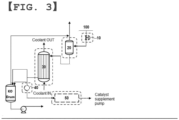
- FIG. 3 shows an example in which an on-line pH measurement system is applied in a process of measuring isopropyl alcohol according to an exemplary embodiment of the present invention
- the pH measurement system may include a depressurization unit 10, a gas removal unit 20, a cooling unit 30, a pH measurement unit 40, and an arithmetic unit 50.
- a separate sampling process which is conventionally performed in pH measurement of the reaction product may be omitted.
- a portion of a stream 100 of the liquid phase reaction product obtained by partial condensation by heat exchanger is transferred to a depressurization unit 10 of the pH measurement system connected by a line between the heat exchanger and the absorption column.
- the liquid phase reaction product may be transferred through pressure control using a valve means installed on a line.
- a portion of the liquid phase stream obtained by partial condensation in the heat exchanger is transferred at a flow rate of 15 to 100 L/h, and the pressure of the transferred stream in the depressurization unit included in the pH measurement system may be lowered to a range of 1/25 to 1/35 of the initial pressure, for example, 1 kg/cm 2 ⁇ g which is a normal pressure level.
- gas may be produced in the depressurization process of the liquid phase stream, and when the gas is introduced to the liquid phase stream, an error may occur in pH measurement, and thus, gas removal is needed.
- the depressurized liquid phase stream is passed through the gas removal unit 20 of the pH measurement system to remove gas, thereby preventing a gas component from being introduced to the liquid stream in the subsequent cooling process.
- the gas removal unit 20 may be in the form of a separator which separates a flowing fluid having two or more phases like a knock out drum, but is not limited thereto.
- the degassed liquid phase stream is transferred to a cooling unit 30 of the pH measurement system, and is supplied with a refrigerant (for example, coolant) in the lower portion of the cooling unit 30, transferred to the upper portion, and discharged, thereby lowering the temperature of the liquid phase stream to a range of 20 to 40°C.
- a refrigerant for example, coolant
- the pH of the cooled liquid phase stream is measured in the pH measurement unit 40, the loss of the phosphoric acid-based catalyst introduced to the reaction mixture is calculated from the result of pH measurement in a arithmetic unit, and the amount of the phosphoric acid-based catalyst corresponding to the calculated catalyst content is supplemented in the reactor, thereby increasing the life of the catalyst in the reactor to secure the final yield of isopropyl alcohol.
- catalyst supplement may be performed by controlling a pump flow rate of the catalyst supply line connected to the reactor.
- liquid phase stream which is passed through the cooling unit 3 and the pH measurement unit 40 may be transferred to a separate separator, for example, a knock out drum (KO drum), and a small amount of gas components remaining in the separate separator may be discharged with gas components removed in the gas removal unit 20.
- a separate separator for example, a knock out drum (KO drum)
- a small amount of gas components remaining in the separate separator may be discharged with gas components removed in the gas removal unit 20.
- the gas phase reaction product is transferred to the absorption column, isopropyl alcohol included in the reaction product is dissolved using absorbing water in the absorption column and separated to the lower portion, and a stream including an unreacted propylene monomer included in the reaction product may be separated to the upper portion (S4) .
- the absorption column may be operated under conditions in which the upper stream including the unreacted propylene monomer and the lower stream including isopropyl alcohol may be effectively separated, and for example, the operation pressure of the absorption column may be in a range of 20 to 40 kg/cm 2 ⁇ g, 25 to 40 kg/cm 2 ⁇ g, or 25 to 35 kg/cm 2 ⁇ g and the operation temperature may be 80 to 110°C, 90 to 110°C, or 90 to 100°C.
- the stream including isopropyl alcohol and water separated in the lower portion of the absorption column is supplied to a purification unit to separate water, thereby obtaining high-purity isopropyl alcohol.
- Water separated in the purification unit may be recovered as process water and reused, or discharged as wastewater.
- the stream including an unreacted propylene monomer separated in the upper portion of the absorption column may include impurities such as inert gas, and in order to use the unreacted propylene monomer in the preparation of isopropyl alcohol again, the stream may be passed through an inert gas removal column.
- a device such as a distillation column, a condenser, a reboiler, a valve, a pump, a separator, and a mixer may be further installed and used.
- the pH of the reaction product is measured on-line and the catalyst content is calculated from the result, thereby estimating and supplementing a catalyst loss in real time to maintain the yield of isopropyl alcohol.
- the method for preparing isopropyl alcohol of the present invention as described above may be performed using an apparatus including a pH measurement system connected on-line.
- the present invention further provides an apparatus for preparing isopropyl alcohol including: a reactor in which a propylene monomer and water are reacted in the presence of a catalyst; a heat exchanger which partially condenses a gas phase reaction product obtained from the reactor; an absorption column which separates isopropyl alcohol included in the gas phase reaction product transferred from the heat exchanger; and a pH measurement system which is connected on-line between the heat exchanger and the absorption column.
Landscapes
- Chemical & Material Sciences (AREA)
- Organic Chemistry (AREA)
- Chemical Kinetics & Catalysis (AREA)
- Organic Low-Molecular-Weight Compounds And Preparation Thereof (AREA)
- Low-Molecular Organic Synthesis Reactions Using Catalysts (AREA)
- Catalysts (AREA)
Abstract
Description
- The present application claims the benefit of priorities to
Korean Patent Application No. 10-2022-0100549, filed on August 11, 2022 Korean Patent Application No. 10-2022-0179081, filed on December 20, 2022 - The present invention relates to a method and an apparatus for preparing isopropyl alcohol, and more particularly, to a method and an apparatus for preparing isopropyl alcohol which may maintain reactor performance by estimating a catalyst loss and supplementing the catalyst in real time in a reactor.
- Isopropyl alcohol (IPA) is used for various purposes including a solvent for cleaning agents, raw materials for industrial paints and reagents, paints, inks, and the like in the electronics industry such as manufacture of semiconductor or liquid crystal displays (LCD).
- Isopropyl alcohol may be prepared by reacting propylene and water. For example, a propylene monomer and water are reacted in a gas phase under high pressure and high temperature conditions in the presence of an acid catalyst in a reactor, thereby obtaining a reaction product including isopropyl alcohol, an unreacted propylene monomer, and water; the gas phase reaction product moves to an absorption column through a heat exchanger; a gas phase stream including an unreacted propylene monomer is discharged in the upper portion and a mixture of isopropyl alcohol and water is separated in the lower portion of the absorption column; and then isopropyl alcohol may be obtained by purification from the mixture. Water separated from the mixture may be recycled as process water and used, and a portion thereof is discharged as wastewater.
- As the acid catalyst, a phosphoric acid-based catalyst such as SiO2-supported H3PO4 may be used, and as a portion of the phosphoric acid is introduced to a reaction product, phosphoric acid loss may occur in the reactor, and thus, reaction efficiency is deteriorated to decrease a final yield of isopropyl alcohol.
- Thus, a process of estimating a phosphoric acid loss in the reactor and supplementing phosphoric acid for maintaining reaction efficiency is needed.
-
FIG. 1 schematically shows a process of estimating a catalyst loss performed in a conventional process of preparing isopropyl alcohol, in which a portion of a stream is taken in a pipe between a heat exchanger and an absorption column and sampled to obtain a sample solution, of which the pH is measured, and a phosphoric acid loss in the reactor may be estimated from the result and supplemented. - In the conventional technology as described above, since a reaction product at a high pressure is sampled and the pH of the sample is measured off-line, environmental and safety difficulties such as steam generation follow in the sampling process.
- The present invention is to solve the problems mentioned in the Background Art, and an object of the present invention is to provide a method and an apparatus which may estimate and supplement a catalyst loss in real time for maintaining reaction efficiency of propylene and water during preparation of isopropyl alcohol.
- In one general aspect, a method for preparing isopropyl alcohol includes:
- (51) supplying a feed stream including a propylene monomer and water to a reactor in the presence of a catalyst to perform a gas phase reaction;
- (S2) partially condensing a reaction product obtained by the gas phase reaction in a heat exchanger, transferring an uncondensed gas phase reaction product to an absorption column, and transferring a portion of the condensed liquid phase reaction product to a pH measurement system connected on-line between the heat exchanger and the absorption column;
- (S3) measuring a pH of the liquid phase reaction product transferred to the pH measurement system to calculate a catalyst content, and supplementing an amount of the catalyst corresponding to the calculated content to the reactor; and
- (S4) dissolving isopropyl alcohol included in the gas phase reaction product in absorbing water and separating the isopropyl alcohol in the absorption column.
- In another general aspect, an apparatus for preparing isopropyl alcohol includes:
- a reactor in which a propylene monomer and water are reacted in the presence of a catalyst;
- a heat exchanger which partially condenses a gas phase reaction product obtained from the reactor;
- an absorption column which separates isopropyl alcohol included in the gas phase reaction product transferred from the heat exchanger; and
- a pH measurement system which is connected on-line between the heat exchanger and the absorption column.
- According to the present invention, in order to maintain reaction efficiency of propylene and water during preparation of isopropyl alcohol, the pH of the reaction product is measured on-line and the lost catalyst content is calculated from the result, thereby estimating and supplementing a catalyst loss in real time to maintain reaction efficiency to produce isopropyl alcohol.
- In addition, since the on-line pH measurement as such does not involve a separate sampling process as in a conventional off-line method, steam generation is suppressed, which is advantageous from the environmental and safety point of view.
-
-
FIG. 1 schematically shows a process of sampling a portion of a reaction product and then measuring a pH off-line during a conventional preparation process of isopropyl alcohol. -
FIG. 2 schematically shows a process of preparing isopropyl alcohol including a step of measuring a pH of the reaction product according to an exemplary embodiment of the present invention on-line. -
FIG. 3 shows an example in which an on-line pH measurement system is applied in a process of measuring isopropyl alcohol according to an exemplary embodiment of the present invention. - The terms and words used in the description and claims of the present invention are not to be construed limitedly as having general or dictionary meanings but are to be construed as having meanings and concepts meeting the technical ideas of the present invention, based on a principle that the inventors are able to appropriately define the concepts of terms in order to describe their own inventions in the best mode.
- The meaning of "comprising" or "containing" used herein embodies specific characteristics, domains, integers, steps, actions, elements, or components, and does not exclude the addition of other specific characteristics, domains, integers, steps, actions, elements, or components.
- The term "stream" used herein may refer to a fluid flow in a process, or may refer to a fluid itself flowing in a pipe. Specifically, the stream may refer to both a fluid itself flowing in a pipe connecting each device and a fluid flow. In addition, the fluid may include any one or more components of gas, liquid, and solid.
- An exemplary embodiment of the present invention relates to a method for preparing isopropyl alcohol (IPA), and specifically, includes (S1) supplying a feed in the presence of a catalyst and reacting it, (S2) partially condensing and transferring the reaction product, (S3) measuring a pH of a liquid phase reaction product obtained by partially condensation on-line, and (S4) separating isopropyl alcohol from the reaction product.
-
FIG. 2 schematically shows a process of preparing isopropyl alcohol including a step of measuring a pH of the reaction product according to an exemplary embodiment of the present invention on-line, and hereinafter, referring toFIG. 2 , the method for preparing isopropyl alcohol according to the present invention will be described step by step. - First, a reactor is filled with a catalyst, and then a feed stream including a propylene monomer and water is supplied to the reactor and a gas phase reaction is performed, thereby obtaining a gas phase stream including isopropyl alcohol as a reaction product, an unreacted propylene monomer, unreacted water, the catalyst used in the reaction, and impurities (S1).
- In the feed stream supplied to the reactor, a mole ratio of water to the propylene monomer may be 0.3 to 0.5, 0.35 to 0.5, or 0.35 to 0.45. When the mole ratio is satisfied, a forward reaction of an equilibrium reaction is promoted and a reward reaction is prevented from progressing, thereby increasing a yield of isopropyl alcohol.
- The reactor may be operated under optimal conditions in which isopropyl alcohol may be efficiently prepared by the gas phase reaction of a propylene monomer and water. For example, an operation pressure of the reactor may be 30 to 50 kg/cm2·g, 35 to 50 kg/cm2·g, or 35 to 45 kg/cm2·g, and an operation temperature thereof may be 180 to 220°C, 185 to 220°C, or 185 to 215°C.
- The catalyst is for promoting the reaction of propylene and water which are used as raw materials to improve a conversion rate from propylene to isopropyl alcohol and the final yield of isopropyl alcohol therefrom, and an acid catalyst, for example, a phosphorus acid-based catalyst may be used.
- In order to increase the gas phase reaction efficiency of propylene and water, a catalyst life should be increased, and to this end, a portion of phosphoric acid which is an effective component of the catalyst is introduced to the reaction product to cause a phosphoric acid loss in the reactor. In order to supplement the catalyst lost in the reactor, a phosphoric acid component should be continuously or discontinuously supplemented, and the amount of further supplemented phosphoric acid may be determined by analyzing the pH of an effluent after the reaction.
- To this end, in the method for preparing isopropyl alcohol according to the present invention, a gas phase reaction product obtained in the reactor is transferred to a heat exchanger and partially condensed, an uncondensed gas phase reaction product is transferred to an absorption column, and a portion of the condensed liquid phase reaction product is transferred to a pH measurement system connected on-line between the heat exchanger and the absorption column (S2).
- Specifically, the reaction product obtained under high pressure and high temperature conditions of the reactor is partially condensed by heat exchange with the feed stream supplied to the reactor and may be in the form of a liquid phase or gas phase mixture. That is, gas-liquid separation of the reaction product is performed in the heat exchanger.
- For example, the temperature of the feed stream before passing through the heat exchanger may be 90 to 130°C, 95 to 130°C, or 95 to 125°C, and a temperature of the feed stream after passing through the heat exchanger may be 160 to 210°C, 165 to 210°C, or 170 to 200°C. In addition, the temperature of the stream condensed by passing through the heat exchanger may be 100 to 140°C, 110 to 140°C, or 110 to 130°C.
- If necessary, the stream condensed by passing through the heat exchanger may be further condensed using a cooler.
- As such, the reaction product is heat exchanged with the feed stream, thereby being converted into a stream of a gas-liquid mixture, and also, the feed stream is preheated and supplied to the reactor, thereby reducing energy for heating the feed stream.
- The gas-liquid mixed phase obtained by partial condensation by the heat exchange may be separated into a gas phase and a liquid phase in the heat exchanger itself, or may be separated into a gas phase and a liquid phase after further installing a separator in the latter stage of the heat exchanger.
- Subsequently, the separated gas phase reaction product stream is transferred to an absorption column, and a portion of the liquid phase reaction product is transferred to a pH measurement system connected on-line between the heat exchanger and the absorption column to measure the pH, in order to figure out the phosphoric acid content of the introduced catalyst (S3).
-
FIG. 3 shows an example in which an on-line pH measurement system is applied in a process of measuring isopropyl alcohol according to an exemplary embodiment of the present invention, and the pH measurement system may include adepressurization unit 10, agas removal unit 20, acooling unit 30, apH measurement unit 40, and anarithmetic unit 50. When the on-line pH measurement system as such is used, a separate sampling process which is conventionally performed in pH measurement of the reaction product may be omitted. - Referring to
FIG. 3 , a portion of astream 100 of the liquid phase reaction product obtained by partial condensation by heat exchanger is transferred to adepressurization unit 10 of the pH measurement system connected by a line between the heat exchanger and the absorption column. Herein, the liquid phase reaction product may be transferred through pressure control using a valve means installed on a line. - In the
depressurization unit 10 of the pH measurement system, since the liquid phase reaction product is obtained by condensation in the heat exchanger in the latter stage of the reactor and a high-pressure stream of about 30 kg/cm2·g which is the pressure of the latter stage of the reactor is shown, depressurization for adjusting the pressure of the liquid reaction product to a pressure range required in the pH measurement system is performed. - For example, a portion of the liquid phase stream obtained by partial condensation in the heat exchanger is transferred at a flow rate of 15 to 100 L/h, and the pressure of the transferred stream in the depressurization unit included in the pH measurement system may be lowered to a range of 1/25 to 1/35 of the initial pressure, for example, 1 kg/cm2·g which is a normal pressure level.
- Meanwhile, gas may be produced in the depressurization process of the liquid phase stream, and when the gas is introduced to the liquid phase stream, an error may occur in pH measurement, and thus, gas removal is needed.
- Therefore, the depressurized liquid phase stream is passed through the
gas removal unit 20 of the pH measurement system to remove gas, thereby preventing a gas component from being introduced to the liquid stream in the subsequent cooling process. Thegas removal unit 20 may be in the form of a separator which separates a flowing fluid having two or more phases like a knock out drum, but is not limited thereto. - The degassed liquid phase stream is transferred to a
cooling unit 30 of the pH measurement system, and is supplied with a refrigerant (for example, coolant) in the lower portion of the coolingunit 30, transferred to the upper portion, and discharged, thereby lowering the temperature of the liquid phase stream to a range of 20 to 40°C. - The pH of the cooled liquid phase stream is measured in the
pH measurement unit 40, the loss of the phosphoric acid-based catalyst introduced to the reaction mixture is calculated from the result of pH measurement in a arithmetic unit, and the amount of the phosphoric acid-based catalyst corresponding to the calculated catalyst content is supplemented in the reactor, thereby increasing the life of the catalyst in the reactor to secure the final yield of isopropyl alcohol. Herein, catalyst supplement may be performed by controlling a pump flow rate of the catalyst supply line connected to the reactor. - In addition, the liquid phase stream which is passed through the cooling unit 3 and the
pH measurement unit 40 may be transferred to a separate separator, for example, a knock out drum (KO drum), and a small amount of gas components remaining in the separate separator may be discharged with gas components removed in thegas removal unit 20. - Meanwhile, after gas-liquid separation in the heat exchanger, the gas phase reaction product is transferred to the absorption column, isopropyl alcohol included in the reaction product is dissolved using absorbing water in the absorption column and separated to the lower portion, and a stream including an unreacted propylene monomer included in the reaction product may be separated to the upper portion (S4) .
- In an exemplary embodiment, the absorption column may be operated under conditions in which the upper stream including the unreacted propylene monomer and the lower stream including isopropyl alcohol may be effectively separated, and for example, the operation pressure of the absorption column may be in a range of 20 to 40 kg/cm2·g, 25 to 40 kg/cm2·g, or 25 to 35 kg/cm2·g and the operation temperature may be 80 to 110°C, 90 to 110°C, or 90 to 100°C.
- The stream including isopropyl alcohol and water separated in the lower portion of the absorption column is supplied to a purification unit to separate water, thereby obtaining high-purity isopropyl alcohol. Water separated in the purification unit may be recovered as process water and reused, or discharged as wastewater.
- Meanwhile, the stream including an unreacted propylene monomer separated in the upper portion of the absorption column may include impurities such as inert gas, and in order to use the unreacted propylene monomer in the preparation of isopropyl alcohol again, the stream may be passed through an inert gas removal column.
- If necessary, in the method for preparing isopropyl alcohol according to the present invention, a device such as a distillation column, a condenser, a reboiler, a valve, a pump, a separator, and a mixer may be further installed and used.
- According to the present invention, in order to maintain reaction efficiency of propylene and water during preparation of isopropyl alcohol, the pH of the reaction product is measured on-line and the catalyst content is calculated from the result, thereby estimating and supplementing a catalyst loss in real time to maintain the yield of isopropyl alcohol.
- In addition, since the on-line pH measurement as such does not involve a separate sampling process as in a conventional off-line method, steam generation is suppressed, which is advantageous from the environmental and safety point of view.
- The method for preparing isopropyl alcohol of the present invention as described above may be performed using an apparatus including a pH measurement system connected on-line.
- Therefore, the present invention further provides an apparatus for preparing isopropyl alcohol including: a reactor in which a propylene monomer and water are reacted in the presence of a catalyst; a heat exchanger which partially condenses a gas phase reaction product obtained from the reactor; an absorption column which separates isopropyl alcohol included in the gas phase reaction product transferred from the heat exchanger; and a pH measurement system which is connected on-line between the heat exchanger and the absorption column.
- In the preparation apparatus, descriptions for the constituents overlapping those in the preparation method are the same.
Claims (11)
- A method for preparing isopropyl alcohol, including:(S1) supplying a feed stream including a propylene monomer and water to a reactor in the presence of a catalyst to perform a gas phase reaction;(S2) partially condensing a reaction product obtained by the gas phase reaction in a heat exchanger, transferring an uncondensed gas phase reaction product to an absorption column, and transferring a portion of the condensed liquid phase reaction product to a pH measurement system connected on-line between the heat exchanger and the absorption column;(S3) measuring a pH of the liquid phase reaction product transferred to the pH measurement system to calculate a catalyst content, and supplementing an amount of the catalyst corresponding to the calculated catalyst content to the reactor; and(S4) dissolving isopropyl alcohol included in the gas phase reaction product in absorbing water and separating the isopropyl alcohol in the absorption column.
- The method for preparing isopropyl alcohol of claim 1, wherein the gas phase reaction product is a gas phase stream including isopropyl alcohol, an unreacted propylene monomer, unreacted water, a catalyst used in the reaction, and impurities.
- The method for preparing isopropyl alcohol of claim 1, wherein the catalyst includes a phosphoric acid-based catalyst.
- The method for preparing isopropyl alcohol of claim 1, wherein the gas phase reaction product is condensed to 100 to 140°C by heat exchange in the heat exchanger with the feed stream being supplied to the reactor.
- The method for preparing isopropyl alcohol of claim 1, wherein the portion of the condenced liquid phase reaction product obtained by condensation in the heat exchanger is transferred to the pH measurement system connected on-line by pressure control.
- The method for preparing isopropyl alcohol of claim 1, wherein the pH of the liquid phase reaction product transferred to the pH measurement system is measured after depressurization, gas removal, and cooling processes thereof.
- The method for preparing isopropyl alcohol of claim 6, wherein the depressurization of the liquid phase reaction product is performed to a pressure of 1/25 to 1/35 of initial pressure when transferred to the pH measurement system.
- The method for preparing isopropyl alcohol of claim 6, wherein the gas removal of the liquid phase reaction product is to remove gas produced in the depressurization.
- The method for preparing isopropyl alcohol of claim 6, wherein the cooling of the liquid reaction product is performed to a temperature of 20 to 40°C using a coolant.
- An apparatus for preparing isopropyl alcohol comprising:a reactor in which a propylene monomer and water are reacted in the presence of a catalyst;a heat exchanger which partially condenses a gas phase reaction product obtained from the reactor;an absorption column which separates isopropyl alcohol included in the gas phase reaction product transferred from the heat exchanger; anda pH measurement system which is connected on-line between the heat exchanger and the absorption column.
- The apparatus for preparing isopropyl alcohol of claim 10, wherein the pH measurement system includes a depressurization unit, a gas removal unit, a cooling unit, a pH measurement unit, and an arithmetic unit.
Applications Claiming Priority (3)
| Application Number | Priority Date | Filing Date | Title |
|---|---|---|---|
| KR20220100549 | 2022-08-11 | ||
| KR1020220179081A KR20240022391A (en) | 2022-08-11 | 2022-12-20 | Method and apparatus for preparing isopropyl alcohol |
| PCT/KR2023/007150 WO2024034794A1 (en) | 2022-08-11 | 2023-05-25 | Method and apparatus for preparing isopropyl alcohol |
Publications (2)
| Publication Number | Publication Date |
|---|---|
| EP4488251A1 true EP4488251A1 (en) | 2025-01-08 |
| EP4488251A4 EP4488251A4 (en) | 2026-02-25 |
Family
ID=89851905
Family Applications (1)
| Application Number | Title | Priority Date | Filing Date |
|---|---|---|---|
| EP23852689.1A Pending EP4488251A4 (en) | 2022-08-11 | 2023-05-25 | METHOD AND APPARATUS FOR THE PRODUCE OF ISOPROPYL ALCOHOL |
Country Status (4)
| Country | Link |
|---|---|
| EP (1) | EP4488251A4 (en) |
| JP (1) | JP2025526528A (en) |
| CA (1) | CA3237786A1 (en) |
| WO (1) | WO2024034794A1 (en) |
Family Cites Families (6)
| Publication number | Priority date | Publication date | Assignee | Title |
|---|---|---|---|---|
| DE2658946C2 (en) * | 1976-12-24 | 1984-06-07 | Chemische Werke Hüls AG, 4370 Marl | Process for the production of alcohols with 2-3 carbon atoms |
| DE2759237A1 (en) * | 1977-12-31 | 1979-07-12 | Huels Chemische Werke Ag | PROCESS FOR THE PRODUCTION OF ALCOHOLS WITH 2 - 4 C-ATOMS BY CATALYTIC HYDRATION OF OLEFINS |
| KR100515586B1 (en) * | 2002-10-14 | 2005-09-16 | 주식회사 엘지화학 | Method for preparing isopropylalcohol using phosphoric acid catalyst having superior catalyst activity |
| EP2939995A1 (en) * | 2014-04-30 | 2015-11-04 | Sasol Solvents Germany GmbH | Improved water management for the production of isopropyl alcohol by gas phase propylene hydration |
| KR102313108B1 (en) * | 2016-06-17 | 2021-10-15 | 가부시키가이샤 도쿠야마 | Method for producing isopropyl alcohol and isopropyl alcohol with reduced impurities |
| KR102586512B1 (en) * | 2020-06-23 | 2023-10-06 | 주식회사 엘지화학 | Method for preraring isopropyl alcohol |
-
2023
- 2023-05-25 CA CA3237786A patent/CA3237786A1/en active Pending
- 2023-05-25 EP EP23852689.1A patent/EP4488251A4/en active Pending
- 2023-05-25 WO PCT/KR2023/007150 patent/WO2024034794A1/en not_active Ceased
- 2023-05-25 JP JP2024524479A patent/JP2025526528A/en active Pending
Also Published As
| Publication number | Publication date |
|---|---|
| CA3237786A1 (en) | 2024-02-15 |
| EP4488251A4 (en) | 2026-02-25 |
| WO2024034794A1 (en) | 2024-02-15 |
| JP2025526528A (en) | 2025-08-15 |
Similar Documents
| Publication | Publication Date | Title |
|---|---|---|
| JP2022554215A (en) | Gas-liquid bubbling bed reactor, reaction system, and method for synthesizing carbonate esters | |
| EP3611162B1 (en) | Method for distilling dimethylsulfoxide and multistage distillation column | |
| US20200216388A1 (en) | Process for the manufacturing of methane sulfonic acid | |
| CN102923664B (en) | Method for producing hydrogen fluoride by virtue of gas-solid-liquid associative reaction method | |
| CN114173895B (en) | The preparation method of isopropanol | |
| CN118119590A (en) | Method for preparing acrylic acid | |
| CN108463455A (en) | The method for reprocessing alkanesulfonic acid | |
| CN115697949B (en) | Process for the preparation of isopropanol | |
| CN115697950B (en) | Process for the preparation of isopropanol | |
| JP2004149421A (en) | Method and apparatus for separating dimethylamide compound and carboxylic acid by distillation | |
| CN114470826A (en) | Purification device and method of bis (trifluoromethanesulfonyl) imide | |
| KR20240022391A (en) | Method and apparatus for preparing isopropyl alcohol | |
| JP2025526528A (en) | Isopropyl alcohol manufacturing method and manufacturing apparatus | |
| CN115589781B (en) | Method for preparing isopropanol | |
| CN118201897A (en) | Method and device for preparing isopropanol | |
| EP4038051A1 (en) | Process for manufacturing alkanesulfonic acids | |
| KR102855132B1 (en) | Method for preparing acrylic acid | |
| EP4368608B1 (en) | Method for preparing acrylic acid | |
| US20220388949A1 (en) | A process for working up water containing 4,4'-dichlorodiphenyl sulfoxide and/or 4,4'-dichlorodiphenyl sulfone as impurities | |
| CN113769683A (en) | A kind of short-flow continuous preparation system and method of laurolactam | |
| KR20210155485A (en) | Apparatus for distillation and distillation method | |
| JP3711504B2 (en) | Method for acid decomposition of industrial cumene hydroperoxide to phenol, acetone and α-methylstyrene | |
| EP4365160B1 (en) | Method for preparing acrylic acid | |
| EP4585583A1 (en) | Method of preparing isopropyl alcohol | |
| KR20120010625A (en) | Silicon tetrafluoride manufacturing method and manufacturing apparatus used therefor |
Legal Events
| Date | Code | Title | Description |
|---|---|---|---|
| STAA | Information on the status of an ep patent application or granted ep patent |
Free format text: STATUS: THE INTERNATIONAL PUBLICATION HAS BEEN MADE |
|
| PUAI | Public reference made under article 153(3) epc to a published international application that has entered the european phase |
Free format text: ORIGINAL CODE: 0009012 |
|
| STAA | Information on the status of an ep patent application or granted ep patent |
Free format text: STATUS: REQUEST FOR EXAMINATION WAS MADE |
|
| 17P | Request for examination filed |
Effective date: 20240919 |
|
| AK | Designated contracting states |
Kind code of ref document: A1 Designated state(s): AL AT BE BG CH CY CZ DE DK EE ES FI FR GB GR HR HU IE IS IT LI LT LU LV MC ME MK MT NL NO PL PT RO RS SE SI SK SM TR |
|
| DAV | Request for validation of the european patent (deleted) | ||
| DAX | Request for extension of the european patent (deleted) | ||
| REG | Reference to a national code |
Ref country code: DE Ref legal event code: R079 Free format text: PREVIOUS MAIN CLASS: C07C0029030000 Ipc: C07C0029040000 |
|
| A4 | Supplementary search report drawn up and despatched |
Effective date: 20260126 |
|
| RIC1 | Information provided on ipc code assigned before grant |
Ipc: C07C 29/04 20060101AFI20260120BHEP Ipc: C07C 29/76 20060101ALI20260120BHEP Ipc: C07C 31/10 20060101ALI20260120BHEP Ipc: B01J 19/00 20060101ALI20260120BHEP |