EP4485690A1 - Elektronische vorrichtung mit antennenstruktur mit beweglichem gehäuse - Google Patents
Elektronische vorrichtung mit antennenstruktur mit beweglichem gehäuse Download PDFInfo
- Publication number
- EP4485690A1 EP4485690A1 EP23781257.3A EP23781257A EP4485690A1 EP 4485690 A1 EP4485690 A1 EP 4485690A1 EP 23781257 A EP23781257 A EP 23781257A EP 4485690 A1 EP4485690 A1 EP 4485690A1
- Authority
- EP
- European Patent Office
- Prior art keywords
- plate
- electronic device
- housing
- state
- printed circuit
- Prior art date
- Legal status (The legal status is an assumption and is not a legal conclusion. Google has not performed a legal analysis and makes no representation as to the accuracy of the status listed.)
- Pending
Links
Images













Classifications
-
- H—ELECTRICITY
- H01—ELECTRIC ELEMENTS
- H01Q—ANTENNAS, i.e. RADIO AERIALS
- H01Q1/00—Details of, or arrangements associated with, antennas
- H01Q1/12—Supports; Mounting means
- H01Q1/22—Supports; Mounting means by structural association with other equipment or articles
- H01Q1/2258—Supports; Mounting means by structural association with other equipment or articles used with computer equipment
- H01Q1/2266—Supports; Mounting means by structural association with other equipment or articles used with computer equipment disposed inside the computer
-
- H—ELECTRICITY
- H04—ELECTRIC COMMUNICATION TECHNIQUE
- H04M—TELEPHONIC COMMUNICATION
- H04M1/00—Substation equipment, e.g. for use by subscribers
- H04M1/02—Constructional features of telephone sets
- H04M1/0202—Portable telephone sets, e.g. cordless phones, mobile phones or bar type handsets
- H04M1/026—Details of the structure or mounting of specific components
-
- H—ELECTRICITY
- H01—ELECTRIC ELEMENTS
- H01Q—ANTENNAS, i.e. RADIO AERIALS
- H01Q1/00—Details of, or arrangements associated with, antennas
- H01Q1/12—Supports; Mounting means
- H01Q1/22—Supports; Mounting means by structural association with other equipment or articles
- H01Q1/24—Supports; Mounting means by structural association with other equipment or articles with receiving set
-
- H—ELECTRICITY
- H01—ELECTRIC ELEMENTS
- H01Q—ANTENNAS, i.e. RADIO AERIALS
- H01Q1/00—Details of, or arrangements associated with, antennas
- H01Q1/12—Supports; Mounting means
- H01Q1/22—Supports; Mounting means by structural association with other equipment or articles
- H01Q1/24—Supports; Mounting means by structural association with other equipment or articles with receiving set
- H01Q1/241—Supports; Mounting means by structural association with other equipment or articles with receiving set used in mobile communications, e.g. GSM
- H01Q1/242—Supports; Mounting means by structural association with other equipment or articles with receiving set used in mobile communications, e.g. GSM specially adapted for hand-held use
- H01Q1/243—Supports; Mounting means by structural association with other equipment or articles with receiving set used in mobile communications, e.g. GSM specially adapted for hand-held use with built-in antennas
-
- H—ELECTRICITY
- H01—ELECTRIC ELEMENTS
- H01Q—ANTENNAS, i.e. RADIO AERIALS
- H01Q13/00—Waveguide horns or mouths; Slot antennas; Leaky-waveguide antennas; Equivalent structures causing radiation along the transmission path of a guided wave
- H01Q13/10—Resonant slot antennas
-
- H—ELECTRICITY
- H01—ELECTRIC ELEMENTS
- H01Q—ANTENNAS, i.e. RADIO AERIALS
- H01Q13/00—Waveguide horns or mouths; Slot antennas; Leaky-waveguide antennas; Equivalent structures causing radiation along the transmission path of a guided wave
- H01Q13/10—Resonant slot antennas
- H01Q13/106—Microstrip slot antennas
-
- H—ELECTRICITY
- H01—ELECTRIC ELEMENTS
- H01Q—ANTENNAS, i.e. RADIO AERIALS
- H01Q9/00—Electrically-short antennas having dimensions not more than twice the operating wavelength and consisting of conductive active radiating elements
- H01Q9/04—Resonant antennas
-
- H—ELECTRICITY
- H04—ELECTRIC COMMUNICATION TECHNIQUE
- H04M—TELEPHONIC COMMUNICATION
- H04M1/00—Substation equipment, e.g. for use by subscribers
- H04M1/02—Constructional features of telephone sets
- H04M1/0202—Portable telephone sets, e.g. cordless phones, mobile phones or bar type handsets
- H04M1/0206—Portable telephones comprising a plurality of mechanically joined movable body parts, e.g. hinged housings
- H04M1/0208—Portable telephones comprising a plurality of mechanically joined movable body parts, e.g. hinged housings characterized by the relative motions of the body parts
- H04M1/0235—Slidable or telescopic telephones, i.e. with a relative translation movement of the body parts; Telephones using a combination of translation and other relative motions of the body parts
- H04M1/0237—Sliding mechanism with one degree of freedom
-
- H—ELECTRICITY
- H04—ELECTRIC COMMUNICATION TECHNIQUE
- H04M—TELEPHONIC COMMUNICATION
- H04M1/00—Substation equipment, e.g. for use by subscribers
- H04M1/02—Constructional features of telephone sets
- H04M1/0202—Portable telephone sets, e.g. cordless phones, mobile phones or bar type handsets
- H04M1/026—Details of the structure or mounting of specific components
- H04M1/0277—Details of the structure or mounting of specific components for a printed circuit board assembly
Definitions
- Various embodiments of the present invention relate to an electronic device including an antenna structure using a movable housing.
- An electronic device may communicate with an external electronic device using an antenna for wireless communication.
- the electronic device such as a smart phone, a tablet, or a notebook computer may include a plurality of antennas for various types of communication with an external electronic device.
- the electronic device may provide a structure that increases space efficiency for a disposition of the plurality of antennas.
- the electronic device 101 may include a processor 120, memory 130, an input module 150, a sound output module 155, a display module 160, an audio module 170, a sensor module 176, an interface 177, a connecting terminal 178, a haptic module 179, a camera module 180, a power management module 188, a battery 189, a communication module 190, a subscriber identification module(SIM) 196, or an antenna module 197.
- at least one of the components e.g., the connecting terminal 178) may be omitted from the electronic device 101, or one or more other components may be added in the electronic device 101.
- some of the components e.g., the sensor module 176, the camera module 180, or the antenna module 197) may be implemented as a single component (e.g., the display module 160).
- the processor 120 may execute, for example, software (e.g., a program 140) to control at least one other component (e.g., a hardware or software component) of the electronic device 101 coupled with the processor 120, and may perform various data processing or computation.
- the processor 120 may store a command or data received from another component (e.g., the sensor module 176 or the communication module 190) in volatile memory 132, process the command or the data stored in the volatile memory 132, and store resulting data in non-volatile memory 134.
- the artificial neural network may be a deep neural network (DNN), a convolutional neural network (CNN), a recurrent neural network (RNN), a restricted boltzmann machine (RBM), a deep belief network (DBN), a bidirectional recurrent deep neural network (BRDNN), deep Q-network or a combination of two or more thereof but is not limited thereto.
- the artificial intelligence model may, additionally or alternatively, include a software structure other than the hardware structure.
- the memory 130 may store various data used by at least one component (e.g., the processor 120 or the sensor module 176) of the electronic device 101.
- the various data may include, for example, software (e.g., the program 140) and input data or output data for a command related thereto.
- the memory 130 may include the volatile memory 132 or the non-volatile memory 134.
- the program 140 may be stored in the memory 130 as software, and may include, for example, an operating system (OS) 142, middleware 144, or an application 146.
- OS operating system
- middleware middleware
- application application
- the input module 150 may receive a command or data to be used by another component (e.g., the processor 120) of the electronic device 101, from the outside (e.g., a user) of the electronic device 101.
- the input module 150 may include, for example, a microphone, a mouse, a keyboard, a key (e.g., a button), or a digital pen (e.g., a stylus pen).
- the sound output module 155 may output sound signals to the outside of the electronic device 101.
- the sound output module 155 may include, for example, a speaker or a receiver.
- the speaker may be used for general purposes, such as playing multimedia or playing record.
- the receiver may be used for receiving incoming calls. According to an embodiment, the receiver may be implemented as separate from, or as part of the speaker.
- the display module 160 may visually provide information to the outside (e.g., a user) of the electronic device 101.
- the display module 160 may include, for example, a display, a hologram device, or a projector and control circuitry to control a corresponding one of the display, hologram device, and projector.
- the display module 160 may include a touch sensor adapted to detect a touch, or a pressure sensor adapted to measure the intensity of force incurred by the touch.
- the audio module 170 may convert a sound into an electrical signal and vice versa. According to an embodiment, the audio module 170 may obtain the sound via the input module 150, or output the sound via the sound output module 155 or a headphone of an external electronic device (e.g., an electronic device 102) directly (e.g., wiredly) or wirelessly coupled with the electronic device 101.
- an external electronic device e.g., an electronic device 102
- directly e.g., wiredly
- wirelessly e.g., wirelessly
- the sensor module 176 may detect an operational state (e.g., power or temperature) of the electronic device 101 or an environmental state (e.g., a state of a user) external to the electronic device 101, and then generate an electrical signal or data value corresponding to the detected state.
- the sensor module 176 may include, for example, a gesture sensor, a gyro sensor, an atmospheric pressure sensor, a magnetic sensor, an acceleration sensor, a grip sensor, a proximity sensor, a color sensor, an infrared (IR) sensor, a biometric sensor, a temperature sensor, a humidity sensor, or an illuminance sensor.
- the interface 177 may support one or more specified protocols to be used for the electronic device 101 to be coupled with the external electronic device (e.g., the electronic device 102) directly (e.g., wiredly) or wirelessly.
- the interface 177 may include, for example, a high definition multimedia interface (HDMI), a universal serial bus (USB) interface, a secure digital (SD) card interface, or an audio interface.
- HDMI high definition multimedia interface
- USB universal serial bus
- SD secure digital
- a connecting terminal 178 may include a connector via which the electronic device 101 may be physically connected with the external electronic device (e.g., the electronic device 102).
- the connecting terminal 178 may include, for example, an HDMI connector, a USB connector, a SD card connector, or an audio connector (e.g., a headphone connector).
- the haptic module 179 may convert an electrical signal into a mechanical stimulus (e.g., a vibration or a movement) or electrical stimulus which may be recognized by a user via his tactile sensation or kinesthetic sensation.
- the haptic module 179 may include, for example, a motor, a piezoelectric element, or an electric stimulator.
- the camera module 180 may capture a still image or moving images.
- the camera module 180 may include one or more lenses, image sensors, image signal processors, or flashes.
- the power management module 188 may manage power supplied to the electronic device 101.
- the power management module 188 may be implemented as at least part of, for example, a power management integrated circuit (PMIC).
- PMIC power management integrated circuit
- the battery 189 may supply power to at least one component of the electronic device 101.
- the battery 189 may include, for example, a primary cell which is not rechargeable, a secondary cell which is rechargeable, or a fuel cell.
- the communication module 190 may support establishing a direct (e.g., wired) communication channel or a wireless communication channel between the electronic device 101 and the external electronic device (e.g., the electronic device 102, the electronic device 104, or the server 108) and performing communication via the established communication channel.
- the communication module 190 may include one or more communication processors that are operable independently from the processor 120 (e.g., the application processor (AP)) and supports a direct (e.g., wired) communication or a wireless communication.
- AP application processor
- the communication module 190 may include a wireless communication module 192 (e.g., a cellular communication module, a short-range wireless communication module, or a global navigation satellite system (GNSS) communication module) or a wired communication module 194 (e.g., a local area network (LAN) communication module or a power line communication (PLC) module).
- a wireless communication module 192 e.g., a cellular communication module, a short-range wireless communication module, or a global navigation satellite system (GNSS) communication module
- GNSS global navigation satellite system
- wired communication module 194 e.g., a local area network (LAN) communication module or a power line communication (PLC) module.
- LAN local area network
- PLC power line communication
- a corresponding one of these communication modules may communicate with the external electronic device via the first network 198 (e.g., a short-range communication network, such as Bluetooth TM , wireless-fidelity (Wi-Fi) direct, or infrared data association (IrDA)) or the second network 199 (e.g., a long-range communication network, such as a legacy cellular network, a 5G network, a next-generation communication network, the Internet, or a computer network (e.g., LAN or wide area network (WAN)).
- first network 198 e.g., a short-range communication network, such as Bluetooth TM , wireless-fidelity (Wi-Fi) direct, or infrared data association (IrDA)
- the second network 199 e.g., a long-range communication network, such as a legacy cellular network, a 5G network, a next-generation communication network, the Internet, or a computer network (e.g., LAN or wide area network (WAN)).
- the wireless communication module 192 may identify and authenticate the electronic device 101 in a communication network, such as the first network 198 or the second network 199, using subscriber information (e.g., international mobile subscriber identity (IMSI)) stored in the subscriber identification module 196.
- subscriber information e.g., international mobile subscriber identity (IMSI)
- the wireless communication module 192 may support a 5G network, after a 4G network, and next-generation communication technology, e.g., new radio (NR) access technology.
- the NR access technology may support enhanced mobile broadband (eMBB), massive machine type communications (mMTC), or ultra-reliable and low-latency communications (URLLC).
- eMBB enhanced mobile broadband
- mMTC massive machine type communications
- URLLC ultra-reliable and low-latency communications
- the wireless communication module 192 may support a high-frequency band (e.g., the mmWave band) to achieve, e.g., a high data transmission rate.
- the wireless communication module 192 may support various technologies for securing performance on a high-frequency band, such as, e.g., beamforming, massive multiple-input and multiple-output (massive MIMO), full dimensional MIMO (FD-MIMO), array antenna, analog beam-forming, or large scale antenna.
- the wireless communication module 192 may support various requirements specified in the electronic device 101, an external electronic device (e.g., the electronic device 104), or a network system (e.g., the second network 199).
- the wireless communication module 192 may support a peak data rate (e.g., 20Gbps or more) for implementing eMBB, loss coverage (e.g., 164dB or less) for implementing mMTC, or U-plane latency (e.g., 0.5ms or less for each of downlink (DL) and uplink (UL), or a round trip of 1ms or less) for implementing URLLC.
- a peak data rate e.g., 20Gbps or more
- loss coverage e.g., 164dB or less
- U-plane latency e.g., 0.5ms or less for each of downlink (DL) and uplink (UL), or a round trip of 1ms or less
- the antenna module 197 may transmit or receive a signal or power to or from the outside (e.g., the external electronic device) of the electronic device 101.
- the antenna module 197 may include an antenna including a radiating element composed of a conductive material or a conductive pattern formed in or on a substrate (e.g., a printed circuit board (PCB)).
- the antenna module 197 may include a plurality of antennas (e.g., array antennas). In such a case, at least one antenna appropriate for a communication scheme used in the communication network, such as the first network 198 or the second network 199, may be selected, for example, by the communication module 190 (e.g., the wireless communication module 192) from the plurality of antennas.
- the signal or the power may then be transmitted or received between the communication module 190 and the external electronic device via the selected at least one antenna.
- another component e.g., a radio frequency integrated circuit (RFIC)
- RFIC radio frequency integrated circuit
- the antenna module 197 may form a mmWave antenna module.
- the mmWave antenna module may include a printed circuit board, an RFIC disposed on a first surface (e.g., the bottom surface) of the printed circuit board, or adjacent to the first surface and capable of supporting a designated high-frequency band (e.g., the mmWave band), and a plurality of antennas (e.g., array antennas) disposed on a second surface (e.g., the top or a side surface) of the printed circuit board, or adjacent to the second surface and capable of transmitting or receiving signals of the designated high-frequency band.
- a designated high-frequency band e.g., the mmWave band
- a plurality of antennas e.g., array antennas
- At least some of the above-described components may be coupled mutually and communicate signals (e.g., commands or data) therebetween via an inter-peripheral communication scheme (e.g., a bus, general purpose input and output (GPIO), serial peripheral interface (SPI), or mobile industry processor interface (MIPI)).
- an inter-peripheral communication scheme e.g., a bus, general purpose input and output (GPIO), serial peripheral interface (SPI), or mobile industry processor interface (MIPI)
- commands or data may be transmitted or received between the electronic device 101 and the external electronic device 104 via the server 108 coupled with the second network 199.
- Each of the electronic devices 102 or 104 may be a device of a same type as, or a different type, from the electronic device 101.
- all or some of operations to be executed at the electronic device 101 may be executed at one or more of the external electronic devices 102, 104, or 108. For example, if the electronic device 101 should perform a function or a service automatically, or in response to a request from a user or another device, the electronic device 101, instead of, or in addition to, executing the function or the service, may request the one or more external electronic devices to perform at least part of the function or the service.
- the one or more external electronic devices receiving the request may perform the at least part of the function or the service requested, or an additional function or an additional service related to the request, and transfer an outcome of the performing to the electronic device 101.
- the electronic device 101 may provide the outcome, with or without further processing of the outcome, as at least part of a reply to the request.
- a cloud computing, distributed computing, mobile edge computing (MEC), or client-server computing technology may be used, for example.
- the electronic device 101 may provide ultra low-latency services using, e.g., distributed computing or mobile edge computing.
- the external electronic device 104 may include an internet-of-things (IoT) device.
- the server 108 may be an intelligent server using machine learning and/or a neural network.
- the external electronic device 104 or the server 108 may be included in the second network 199.
- the electronic device 101 may be applied to intelligent services (e.g., smart home, smart city, smart car, or healthcare) based on 5G communication technology or IoT-related technology.
- FIG. 2 is a block diagram 200 of the electronic device 101 for supporting legacy network communication and 5G network communication, according to various embodiments.
- the electronic device 101 may include a first communication processor 212, a second communication processor 214, a first radio frequency integrated circuit (RFIC) 222, a second RFIC 224, and a third RFIC 226, a fourth RFIC 228, a first radio frequency front end (RFFE) 232, a second RFFE 234, a first antenna module 242, a second antenna module 244, and an antenna 248.
- the electronic device 101 may further include the processor 120 and the memory 130.
- the second network 199 may include a first cellular network 292 and a second cellular network 294. According to another embodiment, the electronic device 101 may further include at least one of the components illustrated in FIG. 1 , and the second network 199 may further include at least one other network.
- the first communication processor 212, the second communication processor 214, the first RFIC 222, the second RFIC 224, the fourth RFIC 228, the first RFFE 232, and the second RFFE 234 may constitute at least a part of a wireless communication module 192.
- the fourth RFIC 228 may be omitted or may be included as a part of the third RFIC 226.
- the first communication processor 212 may support the establishment of a communication channel of a band to be used for wireless communication with the first cellular network 292 and legacy network communication through the established communication channel.
- the first cellular network 292 may be a legacy network including a 2nd generation (2G), 3rd generation (3G), 4th generation (4G), and/or long-term evolution (LTE) network.
- the second communication processor 214 may support the establishment of a communication channel corresponding to a specified band (e.g., approximately 6 GHz to 60 GHz) among bands to be used for wireless communication with the second cellular network 294, and 5G network communication through the established communication channel.
- the second cellular network 294 may be a 5G network defined by 3GPP.
- the first communication processor 212 or the second communication processor 214 may support the establishment of a communication channel corresponding to another specified band (e.g., approximately 6 GHz or less) among bands to be used for wireless communication with the second cellular network 294, and 5G network communication through the established communication channel.
- the first communication processor 212 and the second communication processor 214 may be implemented in a single chip or a single package.
- the first communication processor 212 or the second communication processor 214 may be formed with the processor 120, the coprocessor 123 of FIG. 1 , or the communication module 190 in a single chip or a single package.
- the first RFIC 222 may convert a baseband signal generated by the first communication processor 212 into a radio frequency (RF) signal of approximately 700 MHz to approximately 3 GHz used in the first cellular network 292 (e.g., a legacy network).
- RF radio frequency
- an RF signal may be obtained from the first cellular network 292 (e.g., a legacy network) through an antenna (e.g., the first antenna module 242), and may be preprocessed through an RFFE (e.g., the first RFFE 232).
- the first RFIC 222 may convert the preprocessed RF signal into a baseband signal so as to be processed by the first communication processor 212.
- the third RFIC 226 may convert a baseband signal generated by the second communication processor 214 into an RF signal (hereinafter, referred to as a 5G Above6 RF signal) of the 5G Above6 band (e.g., approximately 6 GHz to approximately 60 GHz) to be used in the second cellular network 294 (e.g., the 5G network).
- a 5G Above6 RF signal may be obtained from the second cellular network 294 (e.g., the 5G network) through an antenna (e.g., the antenna 248), and may be preprocessed through the third RFFE 236.
- the third RFFE 236 may perform preprocessing of the signal by using a phase shifter 238.
- the electronic device 101 may include the fourth RFIC 228 separately from or at least as a part of the third RFIC 226.
- the fourth RFIC 228 may convert the baseband signal generated by the second communication processor 214 into an RF signal (hereinafter, referred to as an intermediate frequency (IF) signal) of an intermediate frequency band (e.g., approximately 9 GHz to approximately 11 GHz), and then transmit the IF signal to the third RFIC 226.
- the third RFIC 226 may convert the IF signal into a 5G Above6 RF signal.
- a 5G Above6 RF signal may be received from the second cellular network 294 (e.g., the 5G network) through an antenna (e.g., the antenna 248), and may be converted into an IF signal by the third RFIC 226.
- the fourth RFIC 228 may convert the IF signal into the baseband signal so as to be processed by the second communication processor 214.
- the first RFIC 222 and the second RFIC 224 may be implemented as a single chip or at least a part of a single package.
- the first RFFE 232 and the second RFFE 234 may be implemented as a single chip or at least a part of a single package.
- at least one of the first antenna module 242 or the second antenna module 244 may be omitted or combined with another antenna module to process RF signals of a plurality of corresponding bands.
- the third RFIC 226 and the antenna 248 may be disposed on the same substrate to form a third antenna module 246.
- the wireless communication module 192 or the processor 120 may be disposed on a first substrate (e.g., a main PCB).
- the third RFIC 226 may be disposed in a partial region (e.g., the lower surface) of a second substrate (e.g., a sub PCB) separate from the first substrate, and the antenna 248 may be disposed in another partial region (e.g., the upper surface) to form the third antenna module 246.
- the antenna 248 may include, for example, an antenna array that may be used for beamforming.
- the third RFIC 226 and the antenna 248 By disposing the third RFIC 226 and the antenna 248 on the same substrate, it is possible to reduce the length of the transmission line therebetween. This, for example, may reduce the loss (e.g., attenuation) of a signal in a high frequency band (e.g., approximately 6 GHz to approximately 60 GHz) used for 5G network communication by the transmission line. Accordingly, the electronic device 101 may improve the quality or speed of communication with the second cellular network 294 (e.g., the 5G network).
- the second cellular network 294 e.g., the 5G network
- the second cellular network 294 (e.g., the 5G network) may be operated independently of (e.g., Stand-Alone (SA)) or operated to be connected to (e.g., Non-Stand Alone (NSA)) the first cellular network 292 (e.g., the legacy network).
- SA Stand-Alone
- NSA Non-Stand Alone
- the first cellular network 292 e.g., the legacy network.
- RAN radio access network
- NG RAN next-generation RAN
- NGC next-generation core
- the electronic device 101 may access an external network (e.g., the Internet) under the control of a core network (e.g., evolved packed core (EPC)) of the legacy network.
- EPC evolved packed core
- Protocol information for communication with the legacy network e.g., LTE protocol information
- protocol information for communication with the 5G network e.g., New Radio (NR) protocol information
- NR New Radio
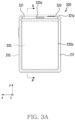
- FIG. 3A is a front view of a first state of an electronic device according to an embodiment
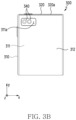
- FIG. 3B is a rear view of a first state of an electronic device according to an embodiment
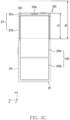
- FIG. 3C is a front view of a second state of an electronic device according to an embodiment
- FIG. 3D is a rear view of a second state of an electronic device according to an embodiment.
- the second housing 320 When the second housing 320 moves in the first direction, a distance between a side surface 320a of the second housing 320 facing the first direction and the first housing 310 may increase. For another example, the second housing 320 may move within a range of a designated distance with respect to the first housing 310 along a second direction (e.g., -y direction) opposite to the first direction. When the second housing 320 moves in the second direction, a distance between the side surface 320a of the second housing 320 facing the first direction and the first housing 310 may decrease. According to an embodiment, the second housing 320 may linearly reciprocate with respect to the first housing 310 by sliding relatively with respect to the first housing 310. For example, at least a portion of the second housing 320 may be inserted into the first housing 310 or may be extracted from the first housing 310.
- the electronic device 300 may be referred to as a "slidable electronic device” as the second housing 320 is designed to be slidable with respect to the first housing 310.
- the electronic device 300 may be referred to as a "rollable electronic device” as at least a portion of the display 330 is designed to be wound inside the second housing 320 (or the first housing 310) based on a slide movement of the second housing 320.
- the first state of the electronic device 300 may be defined as a state in which the second housing 320 moves in a second direction (e.g., a contracted state or a slide-in state).
- a second direction e.g., a contracted state or a slide-in state
- a distance between the side surface 320a of the second housing 320 and the first housing 310 may not be reduced.
- a portion of the second housing 320 may not be insertable.
- the first state of the electronic device 300 may be a state in which a second area 330b of the display 330 is not visually exposed outside the electronic device 300.
- the second area 330b of the display 330 may be located inside an inner space (not illustrated) of the electronic device 300 formed by the first housing 310 and/or the second housing 320, and may not be visible outside the electronic device 300.
- the second state of the electronic device 300 may be defined as a state in which the second housing 320 moves in a first direction (e.g., a extraction state or a slide-out state).
- the second housing 320 may not be substantially movable in the first direction.
- a distance between the side surface 320a of the second housing 320 and the first housing 310 may not increase.
- a portion of the second housing 320 may not be extractable from the first housing 310.
- the second state of the electronic device 300 may be a state in which the second area 330b of the display 330 is visually exposed to the outside of the electronic device 300.
- the second area 330b of the display 330 may be extracted from the inner space of the electronic device 300, and be visible outside the electronic device 300.
- the second housing 320 when the second housing 320 moves from the first housing 310 in the first direction, at least a portion of the second housing 320 and/or the second area 330b of the display 330 may be extracted from the first housing 310 by an extraction length d1 corresponding to a moving distance of the second housing 320.
- the second housing 320 may reciprocate within a designated distance d2.
- the extraction length d1 may have a size of about 0 to a designated distance d2.
- a state of the electronic device 300 may be convertible between the second state and/or the first state, by a manual operation by a user or an automatic operation by a driving module (not illustrated) disposed inside the first housing 310 or the second housing 320.
- an operation of the driving module may be triggered based on a user input.
- the user input for triggering the operation of the driving module may include a touch input, a force touch input, and/or a gesture input through the display 330.
- the user input for triggering the operation of the driving module may include a sound input (voice input) or an input of a physical button exposed to the outside of the first housing 310 or the second housing 320.
- the driving module may be driven in a semi-automatic manner in which an operation is triggered when a manual operation by an external force of a user is detected.
- the first state of the electronic device 300 may be referred to as a first shape
- the second state of the electronic device 300 may be referred to as a second shape
- the first shape may include a normal state, a reduced state, or a closed state
- the second shape may include an opened state.
- the electronic device 300 may form a third state (e.g., an intermediate state), which is a state between the first state and the second state.
- the third state may be referred to as a third shape, and the third shape may include a free-stop state.
- the display 330 may be visible (or viewable) from the outside through a front direction (e.g., -z direction) of the electronic device 300 to display visual information to the user.
- the display 330 may include a flexible display.
- at least a portion of the display 330 may be disposed in the second housing 320, and may be extracted from an inner space (not illustrated) of the electronic device 300 or inserted into the inner space of the electronic device 300 according to the movement of the second housing 320.
- the inner space of the electronic device 300 may mean a space within the first housing 310 and the second housing 320 formed by coupling of the first housing 310 and the second housing 320.
- the display 330 may be inserted by being rolled into the inner space of the electronic device 300.
- the second housing 320 moves in the first direction in a state that at least a portion of the display 330 is inserted into the inner space of the electronic device 300, at least a portion of the display 330 may be extracted from the inner space of the electronic device 300.
- the second housing 320 moves in the second direction, at least a portion of the display 330 may be inserted into the inner space of the electronic device 300 by being rolled inside the electronic device 300.
- an area of the display 330 visible outside the electronic device 300 may be expanded or contracted.
- the display 330 may include the first area 330a and/or the second area 330b.
- the first area 330a of the display 330 may mean an area of the display 330 fixedly visible outside the electronic device 300, regardless of whether the electronic device 300 is in the second state or the first state.
- the first area 330a may mean a partial area of the display 330 that is not rolled into the inner space of the electronic device 300.
- the first area 330a when the second housing 320 moves, the first area 330a may move together with the second housing 320.
- the first area 330a may move along the first direction or the second direction on the front of the electronic device 300, together with the second housing 320.
- the second area 330b of the display 330 may be inserted into the inner space of the electronic device 300 or extracted from the inner space of the electronic device 300 according to the movement of the second housing 320.
- at least a portion of the second area 330b of the display 330 may be a state of being inserted into the inner space of the electronic device 300 in a rolled state, in the first state of the electronic device 300.
- the second area 330b of the display 330 may be inserted into the inner space of the electronic device 300 in the first state of the electronic device 300, and may not be visible outside.
- the second area 330b of the display 330 may be a state extracted from the inner space of the electronic device 300, in the second state of the electronic device 300.
- the second area 330b of the display 330 may be visible to the outside of the electronic device 300 in the second state.
- an area of the display 330 visible from the outside of the electronic device 300 may include only the first area 330a of the display 330.
- the area of the display 330 visible from the outside of the electronic device 300 in the second state of the electronic device 300 may include at least a portion of the first area 330a and the second area 330b of the display 330.
- the first housing 310 of the electronic device 300 may include a first support member 311 surrounding the inner space of the first housing 310, a rear plate 312 covering a rear surface of the first support member 311, and a first side member 314 covering at least a portion of a periphery of the first support member 311.
- the first support member 311 may be integrally formed with the first side member 314.
- the first support member 311 may be extended inside the electronic device 300 from at least a portion of a surface of the first side member 314 facing the inside of the electronic device 300.
- the first support member 311 and the first side member 314 may be integrally formed or formed of the same material.
- the second housing 320 of the electronic device 300 may include a second support member 321 and a second side member 329 covering the inner space of the electronic device 300.
- the second side member 329 may form at least a portion of a side surface of the second housing 320.
- the second support member 321 may support an electronic device (e.g., the camera 340 and/or the printed circuit board 324) disposed in the second housing 320.
- the second side member 329 may cover at least a portion of the second support member 321.
- the second support member 321 may be integrally formed with the second side member 329.
- the second support member 321 may be extended from at least a portion of a surface of the second side member 324 facing the inside of the second housing 320 inside the second housing 320.
- the second support member 321 and the second side member 329 may be integrally formed or formed of the same material.
- the second support member 321 may include a first cover area 321a of the second support member 321 that is not inserted into the first housing 310 and a second cover area 321b that is inserted into or extracted from the first housing 310.
- the first cover area 321a of the second support member 321 may always be visible, regardless of whether the electronic device 300 is in the second state and the first state.
- at least a portion of the first cover area 321a of the second support member 321 may form the side surface 320a of the second housing 320.
- the second cover area 321b of the second housing 320 may not be visible in the first state, but may be visible in the second state.
- the camera 340 may obtain an image of a subject, based on receiving light from the outside of the electronic device 300.
- the camera 340 may include one or more lenses, an image sensor, and/or an image signal processor.
- the camera 340 may be disposed on the second housing 320 to face a rear surface of the electronic device 300 opposite to the front surface of the electronic device 300 in which the first area 330a of the display 330 is disposed.
- the camera 340 may be disposed on the second support member 321 of the second housing 320, and may be visible from the outside of the electronic device 300 through an opening 311a formed in the first support member 311 when the electronic device 300 is in the first state.
- the camera 340 may be disposed on the second support member 321 of the second housing 320 and when the electronic device 300 is in the first state, not be visible outside the electronic device 300 by being covered by the first support member 311 and/or the rear plate 312.
- the camera 340 may include a plurality of cameras.
- the camera 340 may include a wide-angle camera, an ultra-wide-angle camera, a telephoto camera, a proximity camera, and/or a depth camera.
- the camera 340 is not necessarily limited to including a plurality of cameras, and may include one camera.
- the camera 340 may further include a camera (not illustrated) directing the front of the electronic device 300 in which the first area 330a of the display 330 is disposed.
- the camera 340 may be an under display camera (UDC) disposed below the display 330 (e.g., in the +z direction from the display 330), but is not limited thereto.
- UDC under display camera
- the electronic device 300 may include a sensor module (not illustrated) and/or a camera module (not illustrated) disposed below the display 330.
- the sensor module may detect an external environment based on information (e.g., light) received by penetrating the display 330.
- the sensor module may include at least one of a receiver, a proximity sensor, an ultrasonic sensor, a gesture sensor, a gyro sensor, a barometric sensor, a magnetic sensor, an acceleration sensor, a grip sensor, a color sensor, an infrared (IR )sensor, a biometric sensor, a temperature sensor, a humidity sensor, a motor encoder, or an indicator.
- the electronic device 300 may detect an extraction length (e.g., a length d1) using a sensor module.
- the electronic device 300 may generate extraction information on a degree of extraction detected by the sensor.
- the electronic device 300 may detect and/or check the degree of extraction of the second housing 320 using extraction information.
- the extraction information may include information on the extraction length of the second housing 320.
- a coupling form of the first housing 310 and the second housing 320 is not limited to the shape and coupling illustrated in FIGS. 3A , 3B , 3C , and 3D , and may be implemented by a combination and/or coupling of other shapes or components.
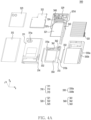
- FIG. 4A is an exploded perspective view of an electronic device according to an embodiment
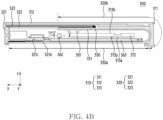
- FIG. 4B is a cross-sectional view illustrating an example of an electronic device according to an embodiment cut along line A-A' of FIG. 3A .
- an electronic device 300 may include a first housing 310, a second housing 320, a display 330, a camera 340, a battery 350 (e.g., the battery 189 of FIG. 1 ) and/or a driving unit 360.
- the first housing 310 and the second housing 320 may be coupled to each other to form an inner space 301 of the electronic device 300.
- a second area 330b of the display 330 may be accommodated in the inner space 301.
- the first housing 310 may include a first support member 311, a rear plate 312, and/or a third support member 313.
- the first support member 311, the rear plate 312, and the third support member 313 included in the first housing 310 may be coupled with each other and may not move when the second housing 320 moves with respect to the first housing 310.
- the first support member 311 may form at least a portion of an outer surface of the electronic device 300.
- the first support member 311 may form at least a portion of a side surface of the electronic device 300 and may form at least a portion of a rear surface of the electronic device 300.
- the first support member 311 may provide a surface on which the rear plate 312 is mounted.
- the rear plate 312 may be mounted on a surface of the first support member 311.
- the third support member 313 may support internal components of the electronic device 300.
- the third support member 313 may accommodate the battery 350 and a motor 361 of the driving unit 360.
- the battery 350 and the motor 361 may be accommodated in at least one of a recess or a hole included in the third support member 313.
- the third support member 313 may be surrounded by the first support member 311.
- a surface 313a of the third support member 313 on which the battery 350 is disposed may face the first support member 311 and/or the second area 330b of the display 330.
- another surface 313b of the third support member 313 facing a direction opposite to the surface 313a of the third support member 313 may face the first area 330a of the display 330 or the second support member 321.
- the third support member 313 may include aluminum as a material, but is not limited thereto.
- the second housing 320 may include a second support member 321, a rear cover 322, and/or a slide cover 323.
- the second support member 321, the rear cover 322, and the slide cover 323 may be coupled with each other, and may move together with the second housing 320 when the second housing 320 moves relative to the first housing 310.
- the second support member 321 may support internal components of the electronic device 300.
- the printed circuit board 324 and/or the camera 340 on which electronic components (e.g., the processor 120 of FIG. 1 ) of the electronic device 300 are disposed may be disposed on a surface 321c of the second support member 321 facing the inner space 301.
- the rear cover 322 may be coupled to the second support member 321 to protect components of the electronic device 300 disposed on the second support member 321.
- the rear cover 322 may cover a portion of the surface 321c of the second support member 321.
- the slide cover 323 may be disposed on the rear cover 322 to form an outer surface of the electronic device 300 together with the rear plate 312 and the first support member 311. The slide cover 323 may be coupled to a surface of the rear cover 322 or the second support member 321 to protect the rear cover 322 and/or the second support member 321.
- the display 330 when the electronic device 300 is in the first state, the display 330 may be bent by being rolled into the inner space 301 at least partially. According to an embodiment, the display 330 may cover at least a portion of the third support member 313 and at least a portion of the second support member 321. For example, when the electronic device 300 is in the first state, the display 330 may cover the other surface 321d of the second support member 321, pass between the second support member 321 and the first support member 311, and extend toward the inner space 301. At least a portion of the display 330 may surround at least a portion of the third support member 313 after passing between the second support member 321 and the first support member 311.
- the display 330 may cover the surface 313a of the third support member 313 within the inner space 301. According to an embodiment, when the second housing 320 moves in the first direction, the second area 330b of the display 330 may be extracted from the inner space 301. For example, as the second housing 320 moves in the second direction, the display 330 may extracted from the inner space 301 by passing between the second support member 321 and the first support member 311.
- the electronic device 300 may include a support bar 331 supporting the display 330 and a guide rail 332.
- the support bar 331 may include a plurality of bars coupled to each other, and may be manufactured in a shape corresponding to the shape of the second area 330b of the display 330.
- the support bar 331 may move together with the display 330.
- the support bar 331 in a first state in which the second area 330b of the display 330 is wound within the inner space 301, the support bar 331 may be wound within the inner space 301 together with the second area 330b of the display 330.
- the support bar 331 may move together with the second area 330b of the display 330.
- the guide rail 332 may guide the movement of the support bar 331.
- the support bar 331 may move along the guide rail 332 coupled to the third support member 313.
- the guide rail 332 may be coupled to the third support member 313 or the first support member 311.
- the guide rail 332 may include a plurality of guide rails 332 that are spaced apart from each other at both peripheries of the third support member 313 that are spaced apart from each other along a third direction (e.g., +x direction) perpendicular to the first direction.
- the driving unit 360 may provide a driving force to the second housing 320 so that the second housing 320 may move relative to the first housing 310.
- the driving unit 360 may include a motor 361, a pinion gear 362, and/or a rack gear 363.
- the motor 361 may receive power from the battery 350 and provide driving power to the second housing 320.
- the motor 361 may be disposed in the first housing 310 and may not move when the second housing 320 moves with respect to the first housing 310.
- the motor 361 may be disposed in a recess formed in the third support member 313.
- the pinion gear 362 may be coupled to the motor 361 and may rotate by a driving force provided from the motor 361.
- the rack gear 363 be engaged with the pinion gear 362 and may move according to a rotation of the pinion gear 362.
- the rack gear 363 may linearly reciprocate in the first direction or the second direction according to the rotation of the pinion gear 362.
- the rack gear 363 may be disposed in the second housing 320.
- the rack gear 363 may be coupled to the second support member 321 included in the second housing 320.
- the rack gear 363 may be movable inside an operating space 313p formed in the third support member 313.
- the rack gear 363 when the pinion gear 362 rotates along a first rotation direction (e.g., clockwise in FIG. 4B ), the rack gear 363 may move in a first direction (e.g., +y direction).
- the rack gear 363 moves along the first direction
- the second housing 320 coupled to the rack gear 363 may move along the first direction.
- an area of the display 330 visible from the outside of the electronic device 300 may be expanded.
- the rack gear 363 When the pinion gear 362 rotates along a second rotation direction (e.g., counterclockwise in FIG. 4B ), the rack gear 363 may move in a second direction (e.g., -y direction).
- the rack gear 363 moves along the second direction
- the second housing 320 coupled to the rack gear 363 may move along the second direction.
- an area of the display 330 visible from the outside of the electronic device 300 may be reduced.
- the motor 361 and the pinion gear 362 are disposed in the first housing 310, and the rack gear 363 is disposed in the second housing 320, but embodiments may not be limited thereto. According to embodiments, the motor 361 and the pinion gear 362 may be disposed in the second housing 320, and the rack gear 363 may be disposed in the first housing 310.
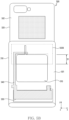
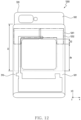
- FIG. 5A illustrates a first state in which a rear plate of an electronic device is omitted according to an embodiment.
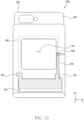
- FIG. 5B illustrates a second state in which a rear plate of an electronic device is omitted according to an embodiment.
- the electronic device 300 may include a first housing 310 and a second housing 320.
- the first housing 310 may be a fixed housing of the electronic device 300, and may accommodate a portion of the second housing 320.
- the first housing 310 may be referred to as an outer housing.
- the second housing 320 may be referred to as an inner housing.
- the second housing 320 may linearly reciprocate with respect to the first housing 310.
- the second housing 320 may be coupled to the first housing 310 to be movable along a first direction (+y direction) or a second direction (-y direction) opposite to the first direction (+y direction) with respect to the first housing 310.
- the inside of the first housing 310 and the inside of the second housing 320 may be connected to each other. As the second housing 320 moves, a space formed by the first housing 310 and the second housing 320 may change.
- the components of the electronic device 300 may be disposed in the space formed by the first housing 310 and the second housing 320.
- the components may include a portion (e.g., the second area 330b of FIG. 3C ) of the display 330 (e.g., the display 330 of FIG. 3A ), a battery, a driving unit (e.g., the driving unit 360 of FIG. 4A ), or printed circuit boards 324 and 530.
- a first printed circuit board 324 may be disposed in the second housing 320.
- a second printed circuit board 530 may be disposed in the first housing 310.
- the first housing 310 may include a first support member 311.
- the first housing 310 may include a first plate 501 having an opening 510 formed on a surface of the first support member 311.
- the opening 510 may overlap a wireless charging circuit 590 disposed in the first housing 310 or the second housing 320.
- the wireless charging circuit 590 may be disposed on a second plate 502 of the second housing 320 to overlap the opening 510 in the first state.
- the wireless charging circuit 590 may be disposed on a dielectric filling the opening 510 formed in the first plate 501.
- the second housing 320 may have the second plate 502 parallel to the first plate 501.
- the first plate 501 and the second plate 502 may include a conductive member.
- the first plate 501 and the second plate 502 may be a conductive plate.
- the first plate 501 and the second plate 502 may operate as an antenna through interaction.
- the second plate 502 may be electrically coupled to the first plate 501 by a current applied to the first plate 501.
- the first plate 501 and the second plate 502 operating as an antenna may be electrically connected to a wireless communication circuit.
- the first printed circuit board 324 may be electrically connected to the second printed circuit board 530.
- the second printed circuit board 530 may include an extension portion 540 extending toward the slit 520.
- the second printed circuit board 530 may be electrically connected to the slit 520 formed in the first plate 501 through the extension portion 540.
- the extension portion 540 may include a portion of signal lines of the second printed circuit board 530.
- the extension part 540 may be a flexible printed circuit board extending from the second printed circuit board 530.
- the extension portion 540 may be formed separately from the second printed circuit board 530 and coupled to the second printed circuit board 530.
- a portion of the conductive member included in the extension part 540 may be at least partially removed from a power supply area 546.
- another conductive member such as a ground layer other than a signal line inside the extension area 540 may be removed from the power supply area 546 of the extension area 540.
- the slit 520 of the first plate 501 has been described as feeding power in the power supply area 546 through the extension portion 540 extending from the second printed circuit board 530, but is not limited thereto.
- the slit 520 may be fed from a cable electrically connecting the first printed circuit board 324 and the second printed circuit board 530 or another printed circuit board.
- the slit 520 may not be formed in the first plate 501, but may be formed in the second plate 502. Power may be supplied to a slit formed in the second plate 502. The slit may be fed from a cable electrically connecting the first printed circuit board 324 and the second printed circuit board 530 or another printed circuit board.
- the second printed circuit board 530 may be disposed on the first plate 501 of the first housing 310.
- the second printed circuit board 530 may be disposed between the first plate 501 and the rear plate 312.
- the second printed circuit board 530 may be disposed adjacent to a lower portion of the electronic device 300.
- the second printed circuit board 530 may be disposed adjacent to a periphery of the first housing 310.
- the first housing 310 may include a first periphery 310a parallel to a direction in which the second housing 320 moves, a second periphery 310b facing the first periphery 310a, a third periphery 310c extending from an end of the first periphery 310a to an end of the second periphery 310b in a direction perpendicular to the first periphery 310a, and a fourth periphery 310d extending from another end of the first periphery 310a to another end of the second periphery 310b.
- the second printed circuit board 530 may be disposed closer to the fourth periphery 310d than the third periphery 310c of the first housing 310.
- the second printed circuit board 530 may be connected to the first printed circuit board 324 through an additional board or cable.
- the second printed circuit board 530 may supply power to the slit 520 through the extension portion 540 spaced apart from the first periphery 310a on the first plate 501 and extending along the first periphery 310a to the power supply area 546.
- the extension portion 540 may extend along a periphery of the opening 510 formed in the first plate 501 and supply power through a portion overlapping the slit 520.
- the slit 520 may extend along the first direction from a periphery of the opening 510 facing the first direction.
- the slit 520 may extend along the first direction from a periphery of the opening 510 parallel to the third periphery 3 10c.
- a length or width of the slit 520 may be changed based on a supported frequency band.
- the first plate 501 including the conductive member may include the opening 510 and the slit 520.
- the first plate 501 may fed through the slit 520.
- the first plate 501 overlapping the second plate 502 may be coupled to the second plate 502 by feeding through the slit 520.
- the first plate 501 and the second plate 502 coupled to each other may operate as an antenna radiator.
- the first plate 501 and the second plate 502 may be spaced apart parallel to each other and may operate similarly to a cavity antenna in an overlapping area 550A.
- an overlapping area 550A of the first plate 501 and the second plate 502 may operate as an antenna and may have a wider radiation volume than the second state.
- at least one processor e.g., the processor 120 of FIG. 1 , the first communication processor 212 or the second communication processor 214 of FIG. 2
- an overlapping area 550B of the first plate 501 and the second plate 502 may operate as an antenna, and may have a narrower radiation volume than the first state.
- at least one processor e.g., the processor 120 of FIG. 1 , the first communication processor 212 or the second communication processor 214 of FIG. 2
- the electronic device 300 may reduce antenna module components by providing an antenna using overlapping housings. By reducing components mounted on the electronic device 300, it is possible to increase the utilization of an inner space.
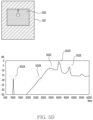
- FIG. 5C illustrates antenna performance in case that a plate including an opening of an electronic device operates as an antenna, according to an embodiment.
- FIG. 5D illustrates antenna performance in case that overlapping plates of an electronic device operate as an antenna, according to an embodiment.
- the first plate 501 including the opening 510 operates as an antenna.
- the first plate 501 may operate as a slot antenna.
- the first plate 501 may be fed power in a form of crossing the opening 510 of the first plate 501.
- the antenna may include a first resonance frequency 501A and a second resonance frequency 501B.
- the first resonance frequency 501A may be approximately 1800 MHz
- the second resonance frequency 501B may be approximately 3800 MHz.
- the first plate 501 and the second plate 502 when the first plate 501 and the second plate 502 overlap each other, it is assumed that the first plate 501 and the second plate 502 operate as an antenna.
- the first plate 501 and the second plate 502 may operate as a cavity antenna.
- the first plate 501 may operate as a slot antenna by an opening formed in the first plate 501.
- the antenna may include a plurality of resonant frequencies 502A, 502B, 502C, 502D, and 502E.
- the first resonance frequency 502A may be approximately 1000 MHz
- the second resonance frequency 502B may be approximately 2800 MHz
- the third resonance frequency 502C may be approximately 3700 MHz
- the fourth resonance frequency 502D may be approximately 4000 MHz
- the fifth resonance frequency 502E may be approximately 4700 MHz.
- the first resonance frequency 502A, the second resonance frequency 502B, the fourth resonance frequency 502D, and the fifth resonance frequency 502E may be determined by a cavity resonance generated by the first plate 501 and the second plate 502 being disposed parallel to each other.
- the third resonance frequency 502D may be determined by a slot resonance generated by an opening of the first plate 501.
- the third resonance frequency 502D of FIG. 5D may be substantially the same as the second resonance frequency 501B of FIG. 5C .
- FIG. 6 is a cross-sectional view of the electronic device of FIG. 5A cut along line B-B', according to an embodiment.
- a connecting member 580 connecting a first plate 501 and a second plate 502 may be included.
- the connecting member 580 may adjust a ground position of the first plate 501 and the second plate 502.
- the connecting member 580 connected to a ground portion of the electronic device 300 may be disposed in a second housing 320 movable with respect to a first housing 310.
- the connecting member 580 may reduce the influence of the antenna located at a lower end (e.g., the second direction) of the electronic device 300.
- the connecting member 580 since the connecting member 580 may be connected to the ground portion, current flow may not occur in an area located around the first plate 501, the second plate 502 and the connecting member 580.
- a parasitic resonance that may occur in the first plate 501 and the second plate may be reduced.
- the connecting member 580 of the electronic device 300 may be a ground portion of the first plate 501 and the second plate 502. According to a position of the connecting member 580, an electrical length of the first plate 501 and the second plate 502 operating as an antenna may be adjusted. According to an embodiment, the connecting member 580 may be disposed in an area including peripheries perpendicular to a periphery of the opening 510 in which the slit 520 is formed. The connecting member 580 may be plural and may include a first connecting member and a second connecting member.
- the connecting member 580 may include a first connecting member disposed between the first plate and the second plate within an area including a second periphery among peripheries perpendicular to a periphery of the opening in which the slit is formed, and a second connecting member disposed between the first plate and the second plate within an area including a third periphery facing the second periphery.
- the electronic device 300 may reduce the influence caused by an antenna disposed at the bottom of the electronic device 300, by disposing the connecting member 580 between the first plate 501 and the second plate 502.
- the connecting member 580 may adjust a resonance frequency, by adjusting the electrical length of the first plate 501 and the second plate 502.
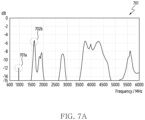
- FIG. 7A is a graph illustrating a gain of an antenna using a first plate and a second plate when an electronic device is in a first state, according to an embodiment.
- FIG. 7B illustrates a magnetic field distribution of an antenna using a first plate and a second plate in a first frequency band when an electronic device is in a first state, according to an embodiment.
- FIG. 7C illustrates a current distribution of an antenna using a first plate and a second plate in a second frequency band when an electronic device is in a first state, according to an embodiment.
- the graph 701 illustrates a gain of an antenna using an overlapping area 550A of a first plate 501 and a second plate 502, in a first state in which a second housing 320 is inserted into a first housing 310.
- the overlapping area 550A may have a first resonance frequency 701a and a second resonance frequency 701b.
- the first resonance frequency 701a may be approximately 1000 MHz
- the second resonance frequency 701b may be approximately 1600 MHz.
- a magnetic field distribution when the overlapping area 550A operates as an antenna at the first resonance frequency 701a is illustrated.
- a magnetic field may be distributed in a first area 710 extending downward along a first periphery 310a along a left side of the third periphery 310c with respect to the slit 520, and a second area 720 extending downward along a right side of the third periphery 310c along the second periphery 310b with respect to the slit 520.
- the contrast between the first area 710 and the second area 720 may mean the intensity of the magnetic field.
- the intensity of the magnetic field in the first area 710 may be smaller than the intensity of the magnetic field flowing in the second area 720.
- the second area 720 may be an antenna operating at the first resonance frequency 701a.
- an area in which the actual magnetic field is highly distributed may mean an area operating as an antenna.
- the second area 720 in which the magnetic field is highly distributed may be an area operating as an antenna.
- the second area 720 in which the magnetic field is highly distributed may be an area through which a large amount of surface current flows during power supply.
- a magnetic field distributed in the first area 710 may be greater than a magnetic field distributed in the second area 720.
- the first area 710 may be an antenna operating at the second resonance frequency 701b.
- the first area 710 in which the magnetic field is highly distributed may be an area through which a large amount of surface current flows during power supply.
- the overlapping area 550A may be divided into left and right areas with respect to the slit 520 and operated.
- the first area 710 of the overlapping area 550A may have an area narrower than that of the second area 720.
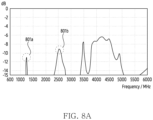
- FIG. 8A is a graph illustrating a gain of an antenna using a first plate and a second plate when an electronic device is in a second state, according to an embodiment.
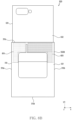
- FIG. 8B illustrates a magnetic field distribution of an antenna using a first plate and a second plate in a third frequency band when an electronic device is in a second state, according to an embodiment.
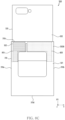
- FIG. 8C illustrates a current distribution of an antenna using a first plate and a second plate in a fourth frequency band when an electronic device is in a second state, according to an embodiment.
- the graph 801 illustrates a gain of an antenna using an overlapping area 550B of a first plate 501 and a second plate 502 in a second state in which a second housing 320 is extracted to the first housing 310.
- the overlapping area 550B may have a third resonance frequency 801a and a fourth resonance frequency 801b.
- the third resonance frequency 801a may be approximately 1200 MHz
- the fourth resonance frequency 801b may be approximately 2500 MHz.
- a current may flow in a third area 810 extending along a left side of the third periphery 3 10c and extending downward along the first periphery 310a, with respect to the slit 520, and may flow in the fourth area 820 extending along a right side of the third periphery 310c and extending downward along the second periphery 310b, with respect to the slit 520.
- the contrast between the third area 810 and the fourth area 820 may mean the intensity of the magnetic field.
- the intensity of the magnetic field distributed in the third area 810 may be smaller than the intensity of the magnetic field distributed in the fourth area 820.
- the fourth area 820 may be an antenna operating at the third resonance frequency 801a.
- the intensity of the magnetic field distributed in the third area 810 may be greater than the intensity of the magnetic field distributed in the fourth area 820.
- the third area 810 may be an antenna operating at the fourth resonance frequency 801b.
- the overlapping area 550A may be divided into left and right areas with respect to the slit 520 and operated.
- the third area 810 among the overlapping area 550B may have an area narrower than that of the fourth area 820. Since the radiation volume of the fourth area 820 is greater than that of the third area 810, the third resonance frequency 801a at which the fourth area 820 operates as an antenna may be lower than the fourth resonance frequency 801b at which the third area 810 operates as an antenna.
- a band of resonant frequencies may be changed.
- a frequency band including the second resonant frequency 701b in the first state of the electronic device 300 may overlap a frequency band including the third resonant frequency 801a in the second state of the electronic device 300.
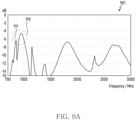
- FIG. 9A illustrates a gain of an antenna operated by a portion of a conductive portion included in a housing when an electronic device does not include a connecting member according to an embodiment.
- FIG. 9B illustrates a gain of an antenna operated by a portion of a conductive portion included in a housing when an electronic device includes a connecting member according to an embodiment.
- the graph 901 of FIG. 9A and the graph 902 of FIG. 9B indicate the influence caused by an overlapping area of a first plate 501 and a second plate 502 when an antenna using a conductive portion included in a side surface of a housing (e.g., the first housing 310 of FIG. 5A ) of the electronic device (e.g., the electronic device 300 of FIG. 5A ) operates.
- the antenna may be an antenna using a conductive portion included in a side surface located at a fourth periphery (e.g., the fourth periphery 310d of FIG. 8B ) among side surfaces of the first housing 310.
- the antenna may be referred to as a lower antenna.
- the graph 901 indicates a gain of the antenna when a connecting member 580 disposed between a first plate (e.g., the first plate 501 of FIG. 6 ) and a second plate (e.g., the second plate 502 of FIG. 6 ) does not exist.
- an additional parasitic resonance 911 occurs in a first area 910 having a resonance frequency.
- the parasitic resonance 911 may be generated by an interaction between an overlapping area 550A or 550B and the lower antenna.
- the connecting member 580 of FIG. 6 may be disposed close to a periphery (e.g., the fourth periphery 310d) on which the lower antenna is located among peripheries of the first housing 310.
- the connecting member 580 may block the parasitic resonance generated between the first plate 501 and the second plate 502.
- a resonance length of the overlapping area 550A or 550B between the first plate 501 and the second plate 502 may be determined based on a position of the connecting member 580.
- the graph 902 indicates a gain of the lower antenna when a connecting member 580 disposed between the first plate 501 and the second plate 502 exists.
- the connecting member 580 may connect an area connected to the connecting member 580 of the first plate 501 and the second plate 502 and a ground area. In the area connected to the connecting member 580 connected to the ground area, a potential difference between the first plate 501 and the second plate 502 is reduced, and thus a current flow may be reduced.
- the first plate 501 and the second plate 502 in the area connected to the connecting member 580 in which the flow of current is reduced may reduce interaction with the lower antenna. By the reduced interaction, the parasitic resonance generated in the lower antenna may be reduced.
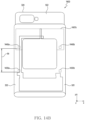
- FIG. 10 illustrates transmission lines disposed inside an electronic device.
- FIG. 11 is a drawing of an extension portion cut along line C-C' of FIG. 5A .
- an electronic device 300 may include a first printed circuit board 324, a second printed circuit board 530, and/or a third printed circuit board 1010.
- the first printed circuit board 324 may be disposed in a second housing 320.
- the second printed circuit board 530 and the third printed circuit board 1010 may be disposed in a first housing 310.
- the electronic device 300 may include flexible printed circuit boards or cables electrically connecting the first printed circuit board 324, the second printed circuit board 530, and the third printed circuit board 1010.
- the electronic device 300 may include a flexible printed circuit board 1020, extension portions 540 and 1030 (e.g., the extension portion 540 of FIG. 5A ) forming a conductive path.
- the extension portions 540 and 1030 may be referred to as flexible printed circuit boards.
- the extension portions 540 and 1030 may include a portion of signal lines of the second printed circuit board 530.
- the extension portions 540 and 1030 may be flexible printed circuit boards extending from the second printed circuit board 530.
- the extension part 540 may provide a conductive path extending from the second printed circuit board 530 to the slit 520.
- the extension portion 1030 may provide a conductive path extending from the second printed circuit board 530 to the third printed circuit board 1010.
- the extension portions 540 and 1030 may be formed separately from the second printed circuit board 530 and coupled to the second printed circuit board 530.
- the second housing 320 may move in a first direction (+y direction) or a second direction (-y direction).
- a distance between the second printed circuit board 530 and the third printed circuit board 1010 disposed in the first housing 310 and the first printed circuit board 324 disposed in the second housing 320 may be changed according to the movement of the second housing 320.
- a flexible printed circuit board for connecting the first printed circuit board 324 disposed in the second housing 320 and the second printed circuit board 530 and/or the third printed circuit board 1010 disposed in the first housing 310 may be disposed.
- the flexible printed circuit board 1020 may connect the first printed circuit board 324 and the third printed circuit board 1010.
- an end of the flexible printed circuit board 1020 may be connected to the first printed circuit board 324, and another end of the flexible printed circuit board 1020 may be connected to the third printed circuit board 1010.
- the flexible printed circuit board 1020 may be disposed in a folded state between the first printed circuit board 324 and the third printed circuit board 1010, in the first state as shown in FIG. 10 .
- the flexible printed circuit board 1020 may be disposed in an unfolded state between the first printed circuit board 324 and the third printed circuit board 1010 when the electronic device 300 is in the second state.
- the second extension portion 1030 may electrically connect the second printed circuit board 530 and the third printed circuit board 1010.
- the first extension portion 540 may extend from the second printed circuit board 530 along the first periphery 310a, extend in a direction parallel to the third periphery 3 10c, and extend to the slit 520.
- the second printed circuit board 530 may be electrically connected to an antenna disposed at the fourth periphery 310d of the first housing 310.
- the second printed circuit board 530 may be disposed at a lower end (e.g., an area facing the fourth periphery 310d) of the first housing 310, for signal transmission to the lower antenna using the conductive portion of the fourth periphery 3 lOd as an antenna.
- the third printed circuit board 1010 may be connected to the second extension portion 1030 to electrically connect an electrical material positioned in the first housing 310 and an electrical material positioned in the second housing 320.
- the slit 520 may be power supplied through the first extension portion 540.
- the slit 520 may be electrically connected to the second printed circuit board 530 through the first extension portion 540.
- the second printed circuit board 530 may be electrically connected to the third printed circuit board 1010 through the second extension portion 1030.
- the third printed circuit board 1010 may be electrically connected to the first printed circuit board 324 through the flexible printed circuit board 1020.
- a wireless communication signal may supply power to the slit 520 from the first printed circuit board 324 on which a wireless communication circuit including at least one processor (e.g., the processor 120 of FIG. 1 , the communication processor 212 or the second communication processor 214 of FIG. 2 ) is disposed through the flexible printed circuit board 1020, the third printed circuit board 1010, the second extension portion 1030, the second printed circuit board 530, and the first extension portion 540.
- the slit 520 is formed in the first housing 310, but are not limited thereto.
- the slit 520 may be formed in the second metal plate 502 of the second housing 320 to fed power from the first printed circuit board 324.
- a slit formed in a conductive portion (e.g., the second plate 502) of the second housing 320 may be fed power by a conductive path extending from the first printed circuit board 324.
- the second plate 502 may be fed power from the first printed circuit board 324 and coupled to the first plate 501 so that an overlapping area between the first plate 501 and the second plate 502 may be used as an antenna radiator.
- a conductive path extending from the first printed circuit board 324 may be electrically connected to the second plate 502 and may transmit a data signal from a wireless communication circuit included in the first printed circuit board 324 to the second plate.
- the extension portion 540 may include a layer 1120 including a signal line 1101 and a ground layer 1110.
- the extension portion 540 may further include non-conductive layers 1130 and 1140 disposed in the layer 1120 including the signal line 1101 and the ground layer 1110.
- the non-conductive layers 1130 and 1140 may include a first non-conductive layer 1130 and a second non-conductive layer 1140.
- the first non-conductive layer 1130 may be disposed on the layer 1120 including the signal line 1101 disposed in the second non-conductive layer 1140.
- the ground layer 1110 may be disposed on the first non-conductive layer 1130.
- the ground layer 1110 and the signal line 1101 may include a conductive material.
- the conductive material may be a metal such as copper, gold, or silver.
- the first non-conductive layer 1130 and/or a portion 1111 of the ground layer 1110 may be removed.
- the portion 1111 of the ground layer 1110 may be removed in order to supply power to the slit 520 through the signal line 1101.
- other conductive members such as the ground layer 1110 other than the layer 1120 including the signal line 1101 inside the extension area 540 may be removed from an area 1190 corresponding to the slit 520.
- the extension portion 540 may be fixed and grounded in the power supply area 546 in which the slit 520 is disposed, by an adhesive member 1180.
- the adhesive member 1180 may be a conductive tape including a conductive material.
- FIG. 12 is an example of deforming an overlapping area between a first plate and a second plate.
- FIG. 13 is an example of adjusting a position of a slit formed on a first plate.
- FIGS. 14A and 14B are an example of adjusting a position of a contact disposed between a first plate and a second plate.
- the electronic device may include a first housing 310 and a second housing 320 movably coupled to the first housing 310.
- the first plate 501 of the first housing 310 and the second plate 502 of the second housing 320 may overlap each other.
- An overlapping area 1201 of the first plate 501 and the second plate 502 in the first state may be different from an overlapping area 1202 between the first plate 501 and the second plate 502 in the second state.
- the second housing 320 may move by a designated distance da, with respect to the first housing 310.
- the designated distance da may be a maximum distance that the second housing 320 can move.
- the designated distance da may be a distance when the second housing 320 moves from the first state to the second state.
- the overlapping area 1201 in the first state and the overlapping area 1202 in the second state may be determined by the designated distance da.
- the overlapping area 1201 in the first state may be determined by a width or a length of the second plate 502 of the second housing 320.
- a length l2 of the second plate 502 of the second housing 320 overlapping the first plate 501 is long, an area of the overlapping area 1201 in the first state may increase, and when the length l2 of the second plate 502 of the second housing 320 overlapping the first plate 501 is short, the area of the overlapping area 1201 in the first state may decrease.
- the overlapping area 1202 in the second state may be determined by a width or a length of the second plate 502 of the second housing 320.
- the length 12 of the second plate 502 of the second housing 320 overlapping the first plate 501 is long, an area of the overlapping area 1202 in the second state may increase, and when the length l2 of the second plate 502 of the second housing 320 overlapping the first plate 501 is short, the area of the overlapping area 1202 in the second state may decrease.
- the effect on the resonance frequency by the length l2 of the second plate 502 may be relatively small.
- the length 1 of FIG. 5A may be longer than the length l2 of FIG. 12 .
- An electrical length of the antenna may be determined according to an overlapping length S2 between an opening (e.g., the opening 510 of FIG. 5A ) and the second plate 502 in the second state.
- An overlapping area S1 between the opening 510 and the second plate 502 of FIG. 5B may be relatively wider than an overlapping area S2 between the opening 510 and the second plate 502 of FIG. 12 .
- the second plate 502 of FIG. 5B having a relatively wide overlapping area S1 may have an antenna gain higher than the second plate 502 of FIG. 12 , and may ensure an electrical length for a resonance frequency.
- one of resonance frequencies of the overlapping area 1201 in the first state may be matched to one of resonance frequencies of the overlapping area 1202 in the second state.
- the electronic device 1300 may include a first housing 310 and a second housing 320.
- the first plate 501 of the first housing 310 may include a first opening 510 and a slit 1320.
- the slit 1320 may be a slit for feeding power to an overlapping area when the overlapping area of the first plate 501 and the second plate 502 is operated as an antenna.
- resonance frequencies in the first state and the resonance frequencies in the second state may be adjusted.
- the slit 1320 whose position has been adjusted may be fed power through an extension portion 1331 or 1332 extending from the second printed circuit board 530 (e.g., the second printed circuit board 530 of FIG. 5B ).
- the extension portion 1331 or 1332 may extend to the slit 1320 along a periphery of the opening 510.
- one of resonant frequencies in the overlapping area in the first state may be matched with one of resonant frequencies in the overlapping area in the second state.
- an electronic device 1400 may include a first housing 310 and a second housing 320.
- a position of connecting members e.g., the connecting member 580 of FIG. 6
- the radiation volume of the antenna may be adjusted in the overlapping area in the second state.
- the electronic device 1400 may include a connecting member 580 disposed at each of first positions 1410a and 1410b in the first state.
- the connecting member 580 may be disposed between the first plate 501 and the second plate 502. When the second housing 320 moves to the second state, the connecting member 580 may be located in each of second positions 1420a and 1420b.
- the electronic device 1400 may have a first radiation area 1401a by a connecting member 580 disposed at each of the second positions 1420a and 1420b in the second state.
- the first radiation area 1401a may be an area capable of radiating electromagnetic waves to the outside when the electronic device is in the second state and an overlapping space of the first plate 501 and the second plate 502 is used as an antenna radiator.
- the electronic device 1400 may include a connecting member 580 disposed at each of third positions 1430a and 1430b in the first state.
- the connecting member 580 may be disposed between the first plate 501 and the second plate 502.
- the connecting member 580 may be located in each of the fourth positions 1440a and 1440b.
- the electronic device 1400 may have a second radiation area 1401b by the connecting member 580 disposed at each of the fourth positions 1440a and 1440b in the second state.
- the second radiation area 1401b may have a wider radiation volume than the first radiation area 1401a.
- a resonance frequency generated by the first radiation area 1401a having a narrower radiation volume than the second radiation area 1401b may be higher.
- the electronic device 1400 may adjust a position of the connecting member 580 in order to adjust the radiation volume.
- the electronic devices 1200, 1300, and 1400 may adjust the resonance frequency of the overlapping area by adjusting a position of the slit, the overlapping area between the first plate 501 and the second plate 502, or the position of the connecting member 580. Through the adjusted resonant frequency, the electronic devices 1200, 1300, and 1400 may provide an antenna having a constant frequency despite a change in the state of the electronic device.
- FIGS. 15 , 16 , and 17 are graphs for describing an example of adjusting a resonance frequency of an antenna of an electronic device, according to an embodiment.
- FIGS. 15 , 16 , and 17 illustrate an example of adjusting a frequency of the electronic device in the second state.
- the electronic device may adjust a resonance frequency by adjusting an overlapping area of a first plate (e.g., the first plate 501 of FIG. 5A ) and a second plate (e.g., the second plate 502 of FIG. 5A ).
- the electronic device 300 may adjust a resonance frequency by adjusting a position of a slit (e.g., the slit 520 of FIG. 5A ) for power supply.
- the electronic device 300 may adjust a resonance frequency by adjusting a position of a connecting member (e.g., the connecting member 580 of FIG. 6 ) disposed between the first plate 501 and the second plate 502.
- the graph 1500 of FIG. 15 illustrates a gain when an area in which the first plate 501 and the second plate 502 overlap in the first state operates as an antenna.
- an area in which the first plate 501 and the second plate 502 overlap may include a first resonance frequency 1510, a second resonance frequency 1520, and a third resonance frequency 1530.
- the graph 1600 of FIG. 16 illustrates a gain when an area in which the first plate 501 and the second plate 502 overlap in the second state operates as an antenna.
- an area in which the first plate 501 and the second plate 502 overlap may include a fourth resonance frequency 1610 and a fifth resonance frequency 1620.
- the first plate 501 and the second plate 502 disposed to overlap may be a cavity antenna that operates through interaction.
- An antenna operated by the interaction between the first plate 501 and the second plate 502 may have a plurality of resonance frequencies.
- a resonance frequency may move according to conversion of the first state and the second state.
- the first resonance frequency 1510 in the first state may be lower than the fourth resonance frequency 1610 in the second state.
- the first resonance frequency 1510 in the first state may be lower than the fourth resonance frequency 1610 in the second state.
- the second resonance frequency 1520 in the first state may at least partially overlap the fourth resonance frequency 1610 in the second state.
- the second resonance frequency 1520 in the first state may be adjusted to at least partially overlap the fourth resonance frequency 1610 in the second state.
- the second resonance frequency 1520 in the first state and the fourth resonance frequency 1610 in the second state may be set to approximately 1600 MHz, which is a first target resonance frequency 1710.
- the third resonance frequency 1530 in the first state may at least partially overlap the fifth resonance frequency 1520 in the second state.
- the third resonance frequency 1530 in the first state may be adjusted to at least partially overlap the fifth resonance frequency 1620 in the second state.
- the third resonance frequency 1530 in the first state and the fifth resonance frequency 1620 in the second state may be set to approximately 3000 MHz, which is a second target resonance frequency 1720.
- the size of the overlapping area between the first plate 501 and the second plate 502 by adjusting the size of the overlapping area between the first plate 501 and the second plate 502, adjusting the position of the slit 520, or adjusting the position of the connecting member 580 between the first plate 501 and the second plate 502, at least one of the resonance frequencies in the first state and at least one of the resonance frequencies in the second state may be adjusted to overlap. Since the first plate 501 and the second plate 502 operate as an antenna in a band including a resonant frequency overlapping each other regardless of the state of the electronic device 1200, 1300, or 1400, the electronic device 1200, 1300, or 1400 may communicate with an external electronic device in a designated band regardless of the state.
- the electronic device may provide an antenna capable of operating in the same frequency band regardless of the state of the electronic device.
- the electronic device may provide an antenna without having a separate antenna module, by utilizing the overlapping first plate and the second plate as an antenna. By reducing the number of antenna modules, the electronic device can mount another electronic component in a secured internal space and improve the utilization of the internal space.
- an electronic device may comprise a first housing (e.g., the first housing 310 of FIG. 5A ) including a first plate (e.g., the first plate 501 of FIG. 5A ) including an opening (e.g., the opening 510 of FIG. 5A ), a second housing (e.g., the second housing 320 of FIG. 5A ) including a second plate (e.g., the second plate 502 of FIG.
- a first housing e.g., the first housing 310 of FIG. 5A
- a first plate e.g., the first plate 501 of FIG. 5A
- an opening e.g., the opening 510 of FIG. 5A
- a second housing e.g., the second housing 320 of FIG. 5A
- a second plate e.g., the second plate 502 of FIG.
- the second housing may include an opening formed in the second plate and a slit (e.g., the slit 520 of FIG. 5A ) formed along a surface of the second plate from a periphery of the opening, an overlapping area (e.g., the area 550A of FIG. 5A ) of the second plate and the first plate, in a first state movable in the first direction among the first direction and the second direction may be wider than an overlapping area (e.g., the area 550B of FIG. 5A ) of the second plate and the first plate, in a second state movable in the second direction among the first direction and the second direction, and the wireless communication circuit may communicate with an external electronic device in a designated frequency band through the first plate and the second plate.
- a slit e.g., the slit 520 of FIG. 5A
- the second plate may interact with the first plate by a current applied to the first plate.
- the wireless communication circuit may be mounted on a printed circuit board in the second housing.
- the electronic device may further include an extension portion (e.g., the extension portion 540 of FIG. 5A ) extending along a periphery of the opening formed in the first plate and feeding through an end connected to the slit.
- an extension portion e.g., the extension portion 540 of FIG. 5A
- the extension portion may include a transmission line electrically connected to the first plate and transmitting a data signal from the wireless communication circuit to the first plate, and a conductive layer electrically connected to the first plate and connected to a ground portion of the electronic device.
- the transmission line may face the slit at the end.
- the conductive layer may be segmented in the area corresponding to the slit.
- the conductive layer may be removed in the area corresponding to the slit.
- the slit may extend from a periphery facing the first direction and along the first direction.
- the slit may extend from a periphery perpendicular to the first direction and along a direction perpendicular to the first direction.
- it may further comprise a first connecting member disposed between the first plate and the second plate within an area including a second periphery among peripheries perpendicular to a first periphery of the opening in which the slit is formed, and a second connecting member disposed between the first plate and the second plate within an area including a third periphery facing the second periphery.
- the designated frequency band may be determined based on an electrical path connected from the slit to the first connecting member along the first periphery and the second periphery, in the overlapping area of the first plate and the second plate, in the second state, when the first housing is viewed from above.
- the designated frequency band may be determined based on an electrical path extending from the slit to the second connecting member along the first periphery and the third periphery, in the overlapping area of the first plate and the second plate, in the first state, when the first housing is viewed from above.
- the electronic device may further comprise a second printed circuit board (e.g., the first printed circuit board 324 of FIG. 10 ), on which the wireless communication circuit is disposed, disposed in the second housing, a third printed circuit board (e.g., the third printed circuit board 1010 of FIG. 10 ) in the first housing, a first flexible printed circuit board (e.g., the first flexible printed circuit board 1020 of FIG. 10 ) electrically connecting the first printed circuit board and the third printed circuit board, and a second flexible printed circuit board (e.g., the second extension portion 1030) electrically connecting the second printed circuit board and the third printed circuit board.
- a second printed circuit board e.g., the first printed circuit board 324 of FIG. 10
- the wireless communication circuit is disposed, disposed in the second housing
- a third printed circuit board e.g., the third printed circuit board 1010 of FIG. 10
- a first flexible printed circuit board e.g., the first flexible printed circuit board 1020 of FIG. 10
- the wireless communication circuit may transmit a data signal to the slit through the first printed circuit board, the first flexible printed circuit board, the third printed circuit board, the second flexible printed circuit board and the second printed circuit board.
- the first plate and the second plate may have a first resonance frequency in a first frequency band and a second resonance frequency in a second frequency band higher than the first resonance frequency band, in the first state.
- the first plate and the second plate may have a third resonance frequency in a third frequency band and a fourth resonance frequency in a fourth frequency band higher than the third frequency band, in the second state.
- the designated frequency band may be a frequency band in which the second frequency band and the third frequency band overlap.
- the electronic device may further comprise a wireless charging circuit (e.g., the wireless charging circuit 590 of FIG. 5A ) on the second plate exposed to the outside of the first housing through the opening, in the first state.
- a wireless charging circuit e.g., the wireless charging circuit 590 of FIG. 5A
- an electronic device may comprise a first housing (e.g., the first housing 310 of FIG. 5A ) including a first plate (e.g., the first plate 501 of FIG. 5A ) including an opening (e.g., the opening 510 of FIG. 5A ), a second housing (e.g., the second housing 320 of FIG. 5A ) including a second plate (e.g., the second plate 502 of FIG.
- a first housing e.g., the first housing 310 of FIG. 5A
- a first plate e.g., the first plate 501 of FIG. 5A
- an opening e.g., the opening 510 of FIG. 5A
- a second housing e.g., the second housing 320 of FIG. 5A
- a second plate e.g., the second plate 502 of FIG.
- the first housing may include an opening formed in the second plate and a slit (e.g., the slit 520 of FIG. 5A ) formed along a surface of the second plate from a position corresponding to a periphery of the opening.
- a slit e.g., the slit 520 of FIG. 5A
- An overlapping area of the second plate and the first plate, in a first state movable in the first direction among the first direction and the second direction may be wider than an overlapping area of the second plate and the first plate, in a second state movable in the second direction among the first direction and the second direction.
- the wireless communication circuit may communicate with an external electronic device in a designated frequency band through the first plate and the second plate.
- the first plate may be electrically connected to the second plate by power applied to the second plate through the slit.
- it may further comprise a wireless charging circuit on the second plate exposed to the outside of the first housing through the opening, in the first state.
- the wireless communication circuit may be disposed on a printed circuit board in the second housing.
- it may further comprise an extension portion in the second housing feeding through an end connected to the slit.
- the extension portion may include a transmission line electrically connected to the second plate and transmitting a data signal from the wireless communication circuit to the second plate, and a conductive layer electrically connected to the second plate.
- the transmission line may be exposed toward the slit at the end.
- the conductive layer is segmented in an area corresponding to the slit.
- it may further comprise a first connecting member disposed between the first plate and the second plate within an area including a second periphery among peripheries perpendicular to a first periphery of the opening in which the slit is formed, and a second connecting member disposed between the first plate and the second plate within an area including a third periphery facing the second periphery.
- the electronic device may be one of various types of electronic devices.
- the electronic devices may include, for example, a portable communication device (e.g., a smartphone), a computer device, a portable multimedia device, a portable medical device, a camera, a wearable device, or a home appliance. According to an embodiment of the disclosure, the electronic devices are not limited to those described above.
- each of such phrases as “A or B,” “at least one of A and B,” “at least one of A or B,” “A, B, or C,” “at least one of A, B, and C,” and “at least one of A, B, or C,” may include any one of or all possible combinations of the items enumerated together in a corresponding one of the phrases.
- such terms as “1st” and “2nd,” or “first” and “second” may be used to simply distinguish a corresponding component from another, and does not limit the components in other aspect (e.g., importance or order).
- an element e.g., a first element
- operatively or “communicatively”, as “coupled with,” or “connected with” another element
- the element may be coupled with the other element directly (e.g., wiredly), wirelessly, or via a third element.
- each component e.g., a module or a program of the above-described components may include a single entity or multiple entities, and some of the multiple entities may be separately disposed in different components. According to various embodiments, one or more of the above-described components may be omitted, or one or more other components may be added. Alternatively or additionally, a plurality of components (e.g., modules or programs) may be integrated into a single component. In such a case, according to various embodiments, the integrated component may still perform one or more functions of each of the plurality of components in the same or similar manner as they are performed by a corresponding one of the plurality of components before the integration.
- operations performed by the module, the program, or another component may be carried out sequentially, in parallel, repeatedly, or heuristically, or one or more of the operations may be executed in a different order or omitted, or one or more other operations may be added.
Landscapes
- Engineering & Computer Science (AREA)
- Signal Processing (AREA)
- Computer Hardware Design (AREA)
- Computer Networks & Wireless Communication (AREA)
- General Engineering & Computer Science (AREA)
- Telephone Set Structure (AREA)
- Transceivers (AREA)
Applications Claiming Priority (3)
| Application Number | Priority Date | Filing Date | Title |
|---|---|---|---|
| KR20220038320 | 2022-03-28 | ||
| KR1020220055777A KR20230139736A (ko) | 2022-03-28 | 2022-05-04 | 이동 가능한 하우징을 이용한 안테나 구조를 포함하는 전자 장치 |
| PCT/KR2023/003968 WO2023191401A1 (ko) | 2022-03-28 | 2023-03-24 | 이동 가능한 하우징을 이용한 안테나 구조를 포함하는 전자 장치 |
Publications (2)
| Publication Number | Publication Date |
|---|---|
| EP4485690A1 true EP4485690A1 (de) | 2025-01-01 |
| EP4485690A4 EP4485690A4 (de) | 2025-07-02 |
Family
ID=88202577
Family Applications (1)
| Application Number | Title | Priority Date | Filing Date |
|---|---|---|---|
| EP23781257.3A Pending EP4485690A4 (de) | 2022-03-28 | 2023-03-24 | Elektronische vorrichtung mit antennenstruktur mit beweglichem gehäuse |
Country Status (4)
| Country | Link |
|---|---|
| US (1) | US20250023225A1 (de) |
| EP (1) | EP4485690A4 (de) |
| CN (1) | CN119213629A (de) |
| WO (1) | WO2023191401A1 (de) |
Families Citing this family (1)
| Publication number | Priority date | Publication date | Assignee | Title |
|---|---|---|---|---|
| KR102887677B1 (ko) * | 2020-11-30 | 2025-11-19 | 삼성전자 주식회사 | 안테나를 포함하는 전자 장치 |
Family Cites Families (7)
| Publication number | Priority date | Publication date | Assignee | Title |
|---|---|---|---|---|
| KR102573516B1 (ko) * | 2016-11-28 | 2023-09-01 | 삼성전자 주식회사 | 안테나를 포함하는 전자 장치 |
| KR102486663B1 (ko) * | 2018-06-19 | 2023-01-11 | 삼성전자 주식회사 | 플렉서블 디스플레이 및 안테나를 포함하는 전자 장치 |
| KR20210058732A (ko) * | 2019-11-14 | 2021-05-24 | 삼성전자주식회사 | 안테나를 포함하는 전자 장치 |
| WO2021100939A1 (ko) * | 2019-11-22 | 2021-05-27 | 엘지전자 주식회사 | 이동 단말기 |
| KR102711619B1 (ko) * | 2020-04-27 | 2024-10-02 | 현대자동차주식회사 | 안테나 장치 및 차량 |
| KR102753142B1 (ko) * | 2020-06-23 | 2025-01-14 | 삼성전자주식회사 | 안테나 및 이를 포함하는 전자 장치 |
| KR102863848B1 (ko) * | 2020-07-22 | 2025-09-25 | 삼성전자 주식회사 | 플렉서블 디스플레이 및 안테나를 포함하는 전자 장치 |
-
2023
- 2023-03-24 CN CN202380040517.0A patent/CN119213629A/zh active Pending
- 2023-03-24 EP EP23781257.3A patent/EP4485690A4/de active Pending
- 2023-03-24 WO PCT/KR2023/003968 patent/WO2023191401A1/ko not_active Ceased
-
2024
- 2024-09-26 US US18/897,761 patent/US20250023225A1/en active Pending
Also Published As
| Publication number | Publication date |
|---|---|
| WO2023191401A1 (ko) | 2023-10-05 |
| EP4485690A4 (de) | 2025-07-02 |
| CN119213629A (zh) | 2024-12-27 |
| US20250023225A1 (en) | 2025-01-16 |
Similar Documents
| Publication | Publication Date | Title |
|---|---|---|
| US12362459B2 (en) | Electronic device comprising antenna | |
| US12548886B2 (en) | Electronic device comprising antenna | |
| US20250004504A1 (en) | Electronic device including contact structure using magnet | |
| US12573748B2 (en) | Electronic device comprising antenna | |
| US20240113441A1 (en) | Electronic device including antenna | |
| US20260051650A1 (en) | Electronic device comprising antenna | |
| EP4485690A1 (de) | Elektronische vorrichtung mit antennenstruktur mit beweglichem gehäuse | |
| EP4372909A1 (de) | Elektronische vorrichtung mit antenne | |
| US12266856B2 (en) | Electronic device including antenna | |
| US11687128B2 (en) | Electronic device including flexible display and antenna | |
| US20250016947A1 (en) | Electronic device including antenna structure using housing | |
| US20250023228A1 (en) | Electronic device comprising antenna maintaining frequency band | |
| US12294140B2 (en) | Electronic device comprising antenna | |
| US12451592B2 (en) | Antenna power feeding structure comprising flexible printed circuit board, and electronic device comprising same | |
| CN116802932A (zh) | 包括导电层的天线结构以及包括该天线结构的电子装置 | |
| US12386393B2 (en) | Electronic device comprising rollable display | |
| EP4485693A1 (de) | Elektronische vorrichtung mit antennenelement | |
| US20250015480A1 (en) | Electronic device comprising antenna structure | |
| KR20230139736A (ko) | 이동 가능한 하우징을 이용한 안테나 구조를 포함하는 전자 장치 | |
| US20250167433A1 (en) | Electronic device including antenna | |
| US20250216902A1 (en) | Electronic device comprising connection structure used as signal transmission path | |
| EP4645591A1 (de) | Elektronische vorrichtung mit seitlicher antennenstruktur | |
| US20250227170A1 (en) | Electronic device including driving motor | |
| US20250219293A1 (en) | Electronic device comprising antenna | |
| KR20240026046A (ko) | 분절 안테나를 포함하는 폴더블 전자 장치 |
Legal Events
| Date | Code | Title | Description |
|---|---|---|---|
| STAA | Information on the status of an ep patent application or granted ep patent |
Free format text: STATUS: THE INTERNATIONAL PUBLICATION HAS BEEN MADE |
|
| PUAI | Public reference made under article 153(3) epc to a published international application that has entered the european phase |
Free format text: ORIGINAL CODE: 0009012 |
|
| STAA | Information on the status of an ep patent application or granted ep patent |
Free format text: STATUS: REQUEST FOR EXAMINATION WAS MADE |
|
| 17P | Request for examination filed |
Effective date: 20240926 |
|
| AK | Designated contracting states |
Kind code of ref document: A1 Designated state(s): AL AT BE BG CH CY CZ DE DK EE ES FI FR GB GR HR HU IE IS IT LI LT LU LV MC ME MK MT NL NO PL PT RO RS SE SI SK SM TR |
|
| REG | Reference to a national code |
Ref country code: DE Ref legal event code: R079 Free format text: PREVIOUS MAIN CLASS: H01Q0001240000 Ipc: H01Q0001380000 |
|
| A4 | Supplementary search report drawn up and despatched |
Effective date: 20250602 |
|
| DAV | Request for validation of the european patent (deleted) | ||
| DAX | Request for extension of the european patent (deleted) | ||
| RIC1 | Information provided on ipc code assigned before grant |
Ipc: H01Q 9/04 20060101ALI20250526BHEP Ipc: H01Q 1/24 20060101ALI20250526BHEP Ipc: H01Q 13/10 20060101ALI20250526BHEP Ipc: H04M 1/02 20060101ALI20250526BHEP Ipc: H01Q 1/38 20060101AFI20250526BHEP |