EP4484519A1 - Neue anwendungen für kühlmittel - Google Patents
Neue anwendungen für kühlmittel Download PDFInfo
- Publication number
- EP4484519A1 EP4484519A1 EP23181958.2A EP23181958A EP4484519A1 EP 4484519 A1 EP4484519 A1 EP 4484519A1 EP 23181958 A EP23181958 A EP 23181958A EP 4484519 A1 EP4484519 A1 EP 4484519A1
- Authority
- EP
- European Patent Office
- Prior art keywords
- acid
- coolant
- silicates
- optionally
- group
- Prior art date
- Legal status (The legal status is an assumption and is not a legal conclusion. Google has not performed a legal analysis and makes no representation as to the accuracy of the status listed.)
- Withdrawn
Links
Classifications
-
- C—CHEMISTRY; METALLURGY
- C09—DYES; PAINTS; POLISHES; NATURAL RESINS; ADHESIVES; COMPOSITIONS NOT OTHERWISE PROVIDED FOR; APPLICATIONS OF MATERIALS NOT OTHERWISE PROVIDED FOR
- C09K—MATERIALS FOR MISCELLANEOUS APPLICATIONS, NOT PROVIDED FOR ELSEWHERE
- C09K5/00—Heat-transfer, heat-exchange or heat-storage materials, e.g. refrigerants; Materials for the production of heat or cold by chemical reactions other than by combustion
- C09K5/08—Materials not undergoing a change of physical state when used
- C09K5/10—Liquid materials
-
- C—CHEMISTRY; METALLURGY
- C23—COATING METALLIC MATERIAL; COATING MATERIAL WITH METALLIC MATERIAL; CHEMICAL SURFACE TREATMENT; DIFFUSION TREATMENT OF METALLIC MATERIAL; COATING BY VACUUM EVAPORATION, BY SPUTTERING, BY ION IMPLANTATION OR BY CHEMICAL VAPOUR DEPOSITION, IN GENERAL; INHIBITING CORROSION OF METALLIC MATERIAL OR INCRUSTATION IN GENERAL
- C23F—NON-MECHANICAL REMOVAL OF METALLIC MATERIAL FROM SURFACE; INHIBITING CORROSION OF METALLIC MATERIAL OR INCRUSTATION IN GENERAL; MULTI-STEP PROCESSES FOR SURFACE TREATMENT OF METALLIC MATERIAL INVOLVING AT LEAST ONE PROCESS PROVIDED FOR IN CLASS C23 AND AT LEAST ONE PROCESS COVERED BY SUBCLASS C21D OR C22F OR CLASS C25
- C23F11/00—Inhibiting corrosion of metallic material by applying inhibitors to the surface in danger of corrosion or adding them to the corrosive agent
- C23F11/08—Inhibiting corrosion of metallic material by applying inhibitors to the surface in danger of corrosion or adding them to the corrosive agent in other liquids
-
- C—CHEMISTRY; METALLURGY
- C23—COATING METALLIC MATERIAL; COATING MATERIAL WITH METALLIC MATERIAL; CHEMICAL SURFACE TREATMENT; DIFFUSION TREATMENT OF METALLIC MATERIAL; COATING BY VACUUM EVAPORATION, BY SPUTTERING, BY ION IMPLANTATION OR BY CHEMICAL VAPOUR DEPOSITION, IN GENERAL; INHIBITING CORROSION OF METALLIC MATERIAL OR INCRUSTATION IN GENERAL
- C23F—NON-MECHANICAL REMOVAL OF METALLIC MATERIAL FROM SURFACE; INHIBITING CORROSION OF METALLIC MATERIAL OR INCRUSTATION IN GENERAL; MULTI-STEP PROCESSES FOR SURFACE TREATMENT OF METALLIC MATERIAL INVOLVING AT LEAST ONE PROCESS PROVIDED FOR IN CLASS C23 AND AT LEAST ONE PROCESS COVERED BY SUBCLASS C21D OR C22F OR CLASS C25
- C23F11/00—Inhibiting corrosion of metallic material by applying inhibitors to the surface in danger of corrosion or adding them to the corrosive agent
- C23F11/08—Inhibiting corrosion of metallic material by applying inhibitors to the surface in danger of corrosion or adding them to the corrosive agent in other liquids
- C23F11/10—Inhibiting corrosion of metallic material by applying inhibitors to the surface in danger of corrosion or adding them to the corrosive agent in other liquids using organic inhibitors
- C23F11/12—Oxygen-containing compounds
- C23F11/124—Carboxylic acids
- C23F11/126—Aliphatic acids
-
- C—CHEMISTRY; METALLURGY
- C23—COATING METALLIC MATERIAL; COATING MATERIAL WITH METALLIC MATERIAL; CHEMICAL SURFACE TREATMENT; DIFFUSION TREATMENT OF METALLIC MATERIAL; COATING BY VACUUM EVAPORATION, BY SPUTTERING, BY ION IMPLANTATION OR BY CHEMICAL VAPOUR DEPOSITION, IN GENERAL; INHIBITING CORROSION OF METALLIC MATERIAL OR INCRUSTATION IN GENERAL
- C23F—NON-MECHANICAL REMOVAL OF METALLIC MATERIAL FROM SURFACE; INHIBITING CORROSION OF METALLIC MATERIAL OR INCRUSTATION IN GENERAL; MULTI-STEP PROCESSES FOR SURFACE TREATMENT OF METALLIC MATERIAL INVOLVING AT LEAST ONE PROCESS PROVIDED FOR IN CLASS C23 AND AT LEAST ONE PROCESS COVERED BY SUBCLASS C21D OR C22F OR CLASS C25
- C23F11/00—Inhibiting corrosion of metallic material by applying inhibitors to the surface in danger of corrosion or adding them to the corrosive agent
- C23F11/08—Inhibiting corrosion of metallic material by applying inhibitors to the surface in danger of corrosion or adding them to the corrosive agent in other liquids
- C23F11/10—Inhibiting corrosion of metallic material by applying inhibitors to the surface in danger of corrosion or adding them to the corrosive agent in other liquids using organic inhibitors
- C23F11/14—Nitrogen-containing compounds
- C23F11/149—Heterocyclic compounds containing nitrogen as hetero atom
-
- C—CHEMISTRY; METALLURGY
- C23—COATING METALLIC MATERIAL; COATING MATERIAL WITH METALLIC MATERIAL; CHEMICAL SURFACE TREATMENT; DIFFUSION TREATMENT OF METALLIC MATERIAL; COATING BY VACUUM EVAPORATION, BY SPUTTERING, BY ION IMPLANTATION OR BY CHEMICAL VAPOUR DEPOSITION, IN GENERAL; INHIBITING CORROSION OF METALLIC MATERIAL OR INCRUSTATION IN GENERAL
- C23F—NON-MECHANICAL REMOVAL OF METALLIC MATERIAL FROM SURFACE; INHIBITING CORROSION OF METALLIC MATERIAL OR INCRUSTATION IN GENERAL; MULTI-STEP PROCESSES FOR SURFACE TREATMENT OF METALLIC MATERIAL INVOLVING AT LEAST ONE PROCESS PROVIDED FOR IN CLASS C23 AND AT LEAST ONE PROCESS COVERED BY SUBCLASS C21D OR C22F OR CLASS C25
- C23F11/00—Inhibiting corrosion of metallic material by applying inhibitors to the surface in danger of corrosion or adding them to the corrosive agent
- C23F11/08—Inhibiting corrosion of metallic material by applying inhibitors to the surface in danger of corrosion or adding them to the corrosive agent in other liquids
- C23F11/18—Inhibiting corrosion of metallic material by applying inhibitors to the surface in danger of corrosion or adding them to the corrosive agent in other liquids using inorganic inhibitors
- C23F11/185—Refractory metal-containing compounds
-
- F—MECHANICAL ENGINEERING; LIGHTING; HEATING; WEAPONS; BLASTING
- F03—MACHINES OR ENGINES FOR LIQUIDS; WIND, SPRING, OR WEIGHT MOTORS; PRODUCING MECHANICAL POWER OR A REACTIVE PROPULSIVE THRUST, NOT OTHERWISE PROVIDED FOR
- F03D—WIND MOTORS
- F03D80/00—Details, components or accessories not provided for in groups F03D1/00 - F03D17/00
- F03D80/60—Cooling or heating of wind motors
- F03D80/602—Heat transfer circuits; Refrigeration circuits
-
- F—MECHANICAL ENGINEERING; LIGHTING; HEATING; WEAPONS; BLASTING
- F05—INDEXING SCHEMES RELATING TO ENGINES OR PUMPS IN VARIOUS SUBCLASSES OF CLASSES F01-F04
- F05B—INDEXING SCHEME RELATING TO WIND, SPRING, WEIGHT, INERTIA OR LIKE MOTORS, TO MACHINES OR ENGINES FOR LIQUIDS COVERED BY SUBCLASSES F03B, F03D AND F03G
- F05B2260/00—Function
- F05B2260/20—Heat transfer, e.g. cooling
- F05B2260/232—Heat transfer, e.g. cooling characterised by the cooling medium
-
- Y—GENERAL TAGGING OF NEW TECHNOLOGICAL DEVELOPMENTS; GENERAL TAGGING OF CROSS-SECTIONAL TECHNOLOGIES SPANNING OVER SEVERAL SECTIONS OF THE IPC; TECHNICAL SUBJECTS COVERED BY FORMER USPC CROSS-REFERENCE ART COLLECTIONS [XRACs] AND DIGESTS
- Y02—TECHNOLOGIES OR APPLICATIONS FOR MITIGATION OR ADAPTATION AGAINST CLIMATE CHANGE
- Y02E—REDUCTION OF GREENHOUSE GAS [GHG] EMISSIONS, RELATED TO ENERGY GENERATION, TRANSMISSION OR DISTRIBUTION
- Y02E10/00—Energy generation through renewable energy sources
- Y02E10/70—Wind energy
- Y02E10/72—Wind turbines with rotation axis in wind direction
Definitions
- the present invention relates to preferred coolants in cooling systems of wind turbines.
- Coolants for motor vehicles have been known for a long time and are used to dissipate heat, particularly from combustion engines. In wind turbines, heat is also released during operation and must be dissipated in order to protect mechanical or electrical systems such as generators, gearboxes, bearings, converters and control systems from overheating. Compared to motor vehicles, service and maintenance work on wind turbines is much more complicated and time-consuming, particularly in offshore wind turbines, so that an extension of the service intervals is particularly desirable. In addition, different requirements are placed on coolants in wind turbines than in motor vehicles, as different materials are used in their cooling systems and the operating conditions are different from those of a motor vehicle. For example, coolants in motor vehicle combustion engines are exposed to higher wall temperatures and thus higher thermal stress, whereas in wind turbines, a high level of corrosion inhibition of the materials used and maintenance intervals of at least 5 years are required.
- the object of the present invention was therefore to provide coolants that meet the special requirements of wind turbines and the special features of their operation.
- a high level of corrosion inhibition of aluminum is particularly required, as aluminum is a material widely used in the cooling systems of wind turbines.
- This component causes the main freezing point depression in the coolants.
- These are monomeric to tetrameric 1,2-ethylene glycols, 1,2-propylene glycols or, more rarely, 1,3-propylene glycols, preferably monomeric to trimeric 1,2-ethylene glycols or 1,2-propylene glycols, particularly preferably monomeric or dimeric 1,2-ethylene glycols, very particularly preferably monomeric 1,2-ethylene glycol (monoethylene glycol), and mixtures thereof.
- the alkylene glycol monoalkyl ethers are the mono-C 1 -C 4 alkyl ethers of the above-mentioned alkylene glycols, preferably the mono methyl, ethyl or n-butyl ethers, particularly preferably the mono methyl or n-butyl ethers and very particularly preferably the mono methyl ethers.
- glycerol or glycerol oligomers are possible freezing point lowering components.
- Preferred alkylene glycol components or derivatives are in particular monoethylene glycol, diethylene glycol, triethylene glycol, tetraethylene glycol and mixtures thereof, but also monopropylene glycol, dipropylene glycol and mixtures thereof, polyglycols, glycol ethers, for example monoethylene glycol monomethyl ether, diethylene glycol monomethyl ether, triethylene glycol monomethyl ether, tetraethylene glycol monomethyl ether, monoethylene glycol monoethyl ether, diethylene glycol monoethyl ether, triethylene glycol monoethyl ether, tetraethylene glycol monoethyl ether, monoethylene glycol mono-n-butyl ether, diethylene glycol mono-n-butyl ether, triethylene glycol mono-n-butyl ether and tetraethylene glycol mono-n-butyl ether, or glycerin, each used alone or as mixtures thereof.
- glycol ethers for example monoethylene glycol mono
- monoethylene glycol alone or mixtures of monoethylene glycol as the main component i.e. with a content in the mixture of more than 50% by weight, in particular more than 80% by weight, especially more than 95% by weight, with other alkylene glycols or derivatives of alkylene glycols.
- monoethylene glycol contains minor amounts of the higher homologues, particularly diethylene glycol, triethylene glycol and tetraethylene glycol. As a rule, their total content is up to 10% by weight, preferably up to 7.5% by weight and most preferably up to 5% by weight. The proportion generally decreases with increasing molecular weight of the homologues.
- the organic mono- and dicarboxylic acids can be aromatic or aliphatic carboxylic acids, preference being given to aromatic monocarboxylic acids and aliphatic mono- and dicarboxylic acids; particular preference being given to aliphatic mono- and dicarboxylic acids.
- benzoic acid is preferred, which can be used as a free acid or particularly preferably in the form of its alkali metal salt, most preferably as sodium benzoate.
- Typical such monocarboxylic acids are pentanoic acid, 2,2-dimethylpropanoic acid, hexanoic acid, 2,2-dimethylbutanoic acid, octanoic acid, 2-ethylhexanoic acid, nonanoic acid, isononanoic acid, decanoic acid, undecanoic acid and dodecanoic acid, as well as their isomer mixtures, in particular 2-ethylhexanoic acid and isononanoic acid isomer mixtures.
- a mixture of at least two aliphatic dicarboxylic acids is used without 2-ethylhexanoic acid, for example a mixture of adipic acid and sebacic acid.
- a mixture of 2-ethylhexanoic acid with at least one inorganic salt selected from the group consisting of molybdates, borates, phosphates, silicates and nitrates very particularly preferred is a mixture of 2-ethylhexanoic acid with at least one inorganic salt selected from the group consisting of molybdates, phosphates and silicates.
- neoalkanecarboxylic acids containing 8 to 13 carbon atoms can be mixtures of isomers and not necessarily pure isomers.
- the aliphatic dicarboxylic acids are selected from the group consisting of succinic acid, maleic acid, fumaric acid, glutaric acid, adipic acid, pimelic acid (heptanedioic acid), azelaic acid (nonanedioic acid), sebacic acid (decanedioic acid), undecanedioic acid, dodecanedioic acid, as well as alkyl and alkenyl succinic acids and glutaric acids such as 2-methylbutanedioic acid, 2-ethyl-3-methylbutanedioic acid, 2-ethylpentanedioic acid, 2-dodecylbutanedioic acid, 2-dodecenylbutanedioic acid, 2-phenylbutanedioic acid, 2-(p-methyl phenyl)butanedioic acid, 2,2-dimethylbutanedioic acid, 2,
- dicarboxylic acids having 6 to 12 carbon atoms particularly preferred among these are the alkanedicarboxylic acids having 6 to 12 carbon atoms, very particularly preferred are the linear alkanedicarboxylic acids having 6 to 12 carbon atoms.
- Particularly preferred aliphatic dicarboxylic acids are adipic acid, sebacic acid, azelaic acid and dodecanedicarboxylic acid, especially adipic acid, sebacic acid and dodecanedioic acid, and most preferred are adipic acid and sebacic acid.
- the inorganic salts are often used as corrosion inhibitors against the corrosion of iron and/or aluminum-containing materials as well as solder.
- the at least one inorganic salt is selected from the group consisting of molybdates, borates, phosphates, silicates, nitrites and nitrates, preferably selected from the group consisting of borates, phosphates, silicates, nitrites and nitrates, particularly preferably selected from the group consisting of phosphates, silicates and nitrates.
- the phosphates are used as free acid (H 3 PO 4 ), as hydrogen phosphate, dihydrogen phosphate or phosphate, especially as alkali metal salts, particularly preferably as sodium or potassium salts.
- the acidic protons in the phosphates can be partially or completely replaced by alkali metal salts.
- the preferred form is free acid (H 3 PO 4 ), disodium hydrogen phosphate or trisodium phosphate.
- the inorganic silicates mainly act as inhibitors of the corrosion of aluminum and aluminum-containing materials as well as solder and are mostly used as alkali metal salts or, more rarely, as magnesium, calcium or aluminum salts, preferably as sodium or potassium salts.
- the silicates are preferably selected from the group consisting of orthosilicates (SiO 4 4- ), metasilicates (SiO 3 2- ) and pyrosilicates (Si 2 O 7 6- ), particularly preferably they are metasilicates (SiO 3 2- ), very particularly preferably sodium metasilicate (Na 2 SiO 3 ) or potassium metasilicate (K 2 SiO 3 ), in particular sodium metasilicate (Na 2 SiO 3 ).
- Nitrites are all inorganic salts of the nitrite anion (NO 2 - ) and nitric acid (HNO 2 ). Nitrite is typically used in the form of sodium nitrite or potassium nitrite in coolants or is converted into these by inorganic bases, preferably sodium hydroxide or potassium hydroxide.
- the coolants do not contain nitrite for health reasons.
- the nitrates are used as alkali or alkaline earth metal nitrates, preferably as sodium nitrate, potassium nitrate or magnesium nitrate, preferably as sodium nitrate or potassium nitrate, particularly preferably as sodium nitrate.
- Preferred inorganic salts are selected from the group consisting of molybdates, borates, phosphates, silicates and nitrates, particularly preferably selected from the group consisting of molybdates, borates, phosphates and silicates, very particularly preferably selected from the group consisting of molybdates, phosphates and silicates.
- the azole compounds act particularly as corrosion inhibitors against the corrosion of non-ferrous metals, such as brass or copper.
- azole compounds or azole derivatives are defined as five-membered heterocyclic compounds with 2 or 3 heteroatoms from the group nitrogen and sulfur, which contain no or a maximum of one sulfur atom incorporated into the ring and which can optionally carry an aromatic or saturated six-membered anellant.
- These five-membered heterocyclic compounds usually contain two N atoms and no S atom, three N atoms and no S atom, or one N atom and one S atom as heteroatoms.
- variable R is hydrogen or a C 1 to C 10 alkyl radical, in particular methyl or ethyl
- the variable X is a nitrogen atom or the group CH.
- Benzimidazole, benzotriazole, tolutriazole, hydrogenated tolutriazole or mixtures thereof, in particular benzotriazole or tolutriazole, especially tolutriazole, are very particularly preferred as azole derivatives for the present invention.
- azole derivatives mentioned are commercially available or can be prepared using conventional methods.
- Hydrogenated benzotriazoles such as hydrogenated tolutriazole are also available according to DE-A 1 948 794 accessible and also commercially available.
- the azoles are selected from the group consisting of benzotriazole, tolutriazole, (2-benzothiazylthio)acetic acid, 3-(2-benzothiazylthio)propionic acid and 2-mercaptobenzothiazole.
- the water used in the present invention should be neutral with a pH value of around 7. It can be demineralized or distilled water, but this is not absolutely necessary.
- at least one hard water stabilizer can be added to the coolant composition.
- the water used can contain alkaline earth metal ions, for example magnesium, calcium, strontium or barium ions, the latter usually being present in trace amounts at most.
- alkaline earth metal ions for example magnesium, calcium, strontium or barium ions, the latter usually being present in trace amounts at most.
- magnesium and/or calcium ions are present as hardness-forming agents.
- the water used is preferably soft water with a water hardness of not more than 8.4 °dH, particularly preferably not more than 10 and most particularly preferably not more than 12 °dH.
- a hard water stabilizer is usually required.
- the water used in the coolant is, via the hardness formers, the usual source of any carbonate and/or sulfate that may be contained in the coolant.
- the coolants can also contain organic ortho-silicic acid esters of the general formula Si(OR) 4 , in which each R independently of the other is C 1 -C 4 alkyl, preferably methyl, ethyl or n-butyl, particularly preferably methyl or ethyl or mixtures of methyl and ethyl.
- the ortho-silicic acid esters mainly act as inhibitors of the corrosion of aluminum or aluminum-containing materials as well as solder.
- composition contains at least one inorganic silicate, in a preferred embodiment at least one silicophosphonate is added in addition to the silicate, as described in European patent application EP 4015596 .
- the silicophosphonates can be used as free acid or as alkali metal salt, preferably as sodium or potassium salt and particularly preferably as sodium salt.
- the coolants may optionally contain defoamers in small amounts (usually in amounts of 0.003 to 0.008% by weight in the diluted coolant) as well as bitter substances (e.g. of the denatonium benzoate type) and colorants for reasons of hygiene and safety in case of ingestion.
- defoamers in small amounts (usually in amounts of 0.003 to 0.008% by weight in the diluted coolant) as well as bitter substances (e.g. of the denatonium benzoate type) and colorants for reasons of hygiene and safety in case of ingestion.
- the composition can also contain one or more hard water stabilizers based on polyacrylic acid, polymaleic acid, acrylic acid-maleic acid copolymers, polyvinylpyrrolidone, polyvinylimidazole, vinylpyrrolidone-vinylimidazole copolymers and/or copolymers of unsaturated carboxylic acids and olefins.
- the proportion in the composition is selected so that after appropriate dilution the amount in the finished diluted coolant is up to 1% by weight.
- it is a hard water stabilizer as described in the WO 2022/200155 .
- An advantage of using hard water stabilizers is that the use of demineralized or distilled water is not necessary to reduce or prevent the precipitation of alkaline earth metal compounds.
- the azole compounds are preferably benzotriazole or tolutriazole.
- the non-aliphatic organic monocarboxylic acids are preferably benzoic acid.
- the aliphatic monocarboxylic acids are preferably selected from the group consisting of 2-ethylhexanoic acid and isononanoic acid, particularly preferably isononanoic acid.
- the aliphatic dicarboxylic acids are preferably selected from the group consisting of adipic acid, sebacic acid and dodecanedioic acid.
- the inorganic salts are preferably selected from the group consisting of molybdates, borates, phosphates and silicates, particularly preferably selected from the group consisting of molybdates, phosphates and silicates, very particularly preferably selected from the group consisting of phosphates and silicates.
- the coolant should not exceed a kinematic viscosity according to ASTM D445 of 7.5 mm 2 /s, preferably not more than 7, more preferably not more than 6 mm 2 /s, most preferably not more than 5.5 and in particular not more than 5 mm 2 /s.
- the coolant should not exceed a kinematic viscosity according to ASTM D445 of 1 mm 2 /s, preferably not more than 0.9, more preferably not more than 0.8 mm 2 /s, most preferably not more than 0.7 and in particular not more than 0.6 mm 2 /s.
- concentrates are usually sold in which the water content is omitted or greatly reduced.
- the coolants are then made from the concentrates by adding water before filling the wind turbine.
- These concentrates are usually diluted with water in a volume ratio of 1:1 to 1:3 (vol/vol), preferably 1:1 to 1:2, depending on the prevailing temperature on site and the requirements for antifreeze protection.
- the concentrates are composed like the coolants mentioned above, but with a reduced water content depending on the dilution ratio.
- the water content in the concentrate is not more than 15, preferably not more than 10 and particularly preferably not more than 5% by weight.
- the pH value of the coolants at the end user is usually in the range of 4 to 11.5, preferably 5 to 10, especially 6 to 9.
- Preferred inorganic bases are alkali metal hydroxides, particularly preferably solid lithium, sodium or potassium hydroxide, optionally also in the form of aqueous lithium, sodium hydroxide or potassium hydroxide solution.
- carbonates or hydrogen carbonates of lithium, sodium or potassium are less preferred.
- Preferred alkali metals are sodium and potassium.
- the coolants are usually produced at a first location, e.g. at a formulator, by mixing the concentrates with water in the desired dilution ratio, the coolant diluted with water is then transported to the wind turbine at a second location, where the cooling system of the wind turbine is filled with the ready-mixed coolant.
- this second location is usually the assembly location for the nacelle.
- the second location is the site of the wind turbine, i.e. at sea for offshore turbines or on land for onshore turbines.
- a low viscosity is desirable, as this requires lower pump output and can lead to cavitation in high-speed pumps, for example.
- the viscosity of the coolant is too high for pumping, it may be useful to heat the coolant slightly to reduce the viscosity and then transport the heated coolant to the wind turbine in an insulated or thermostatted container.
- a coolant temperature of up to 25 °C above the ambient temperature is sufficient for this, preferably up to 20, particularly preferably up to 15 and most particularly preferably up to 10 °C.
- the coolant can be transported in a suitable container by crane or elevator to the level of the wind turbine's coolant tank and replaced there. This is particularly preferred if the coolant is too viscous to pump or if a suitable pump is not available.
- the used coolant is collected after replacement and can be disposed of or recovered via sewage treatment plants, for example.
- the components of wind turbines to be cooled usually include at least one selected from the group consisting of generator, gearbox, bearing, converter and control system.
- the low speed of the rotor is translated into a high speed for the generator, which means that smaller generators can be used.
- the gearbox is not necessarily present in every wind turbine.
- the rotor With the mostly hydraulic control system, the rotor is usually automatically turned into the wind by the control system of the wind turbine to optimize power generation (wind tracking). This includes both the alignment of the hub to the wind direction and the angle of attack of the rotor blades in the wind. If the wind speed is too high, the rotor can also be turned out of the wind or the rotor blades can be turned into the so-called sail position to protect the system.
- a preferred embodiment is to cool the gearbox (if present) and/or the control system of the wind turbine and to dissipate the heat generated there via the coolant.
- the gearbox and control system are cooled in a common cooling circuit.
- the rotor is set in rotation by the kinetic energy of the wind and drives a generator inside the nacelle, which in turn converts the mechanical energy into electrical energy.
- the electricity generated by the generator can then be fed into the power grid.
- a converter ensures that the electricity fed in has the frequency required for the national or regional power grid, usually 50 to 60 hertz.
- a preferred embodiment is to cool the generator and/or converter of the wind turbine and to dissipate the heat generated there via the coolant.
- the generator and converter are cooled in a common cooling circuit.
- the higher temperature is preferably the wall temperature of the respective component of the wind turbine during normal operation of the wind turbine.
- the lower temperature is preferably the ambient temperature with which the heated coolant is brought into contact in the second heat exchanger.
- the lower temperature is that of seawater at the location of the wind turbine.
- the lower temperature is 0 to 30 °C, preferably 1 to 25, more preferably 2 to 20 and most preferably 3 to 15 °C.
- coolants described in this document are that the wind turbines can generally be operated with these coolants for at least 5, preferably at least 7, particularly preferably at least 8 and very particularly preferably at least 10 years without the need to change the coolant. It is even conceivable that the coolant does not need to be replaced during the entire operating life of the wind turbine, i.e. up to 25, preferably up to 30 years.
- All heat exchangers can be components that are known per se and are familiar to the expert for these purposes.
- Viscosity data in this publication refer to ASTM D445 at 20 °C, unless otherwise stated.
- a coolant 1 according to the invention based on ethylene glycol with a mixture of adipic acid, sebacic acid and tolutriazole as inhibitor components as described in the examples of WO 02/90462 A1 a corrosion test according to ASTM D 1384 (Glassware Corrosion Test, 336 hours at 88 °C, 33% solutions). Negative values mean an increase in the weight of the test specimen.
- a coolant 2 based on ethylene glycol with a mixture of molybdate, 2-ethylhexanoic acids and tolutriazole was subjected to a corrosion test according to ASTM D 1384.
- ASTM D 1384 a corrosion test according to ASTM D 1384.
- three metal plates of each sample were used in the test and the results of the weight loss were rounded to one significant figure without a decimal place.
- coolant 0 * coolant 1 coolant 2 removal removal removal limit according to ASTM D 3306 mg/test specimen mg/test specimen mg/test specimen copper 1.9 -0.8 1 10 max soft solder 0.1 -1.2 -1 30 max Brass 1.6 -0.9 2 10 max Steel -0.5 0.1 0 10 max gray cast iron -1.4 1.3 1 10 max cast aluminum 4.6 -4.0 2 30 max *)
- the values according to the corrosion test according to ASTM D1384 are taken from the product information.
- coolants 1 and especially 2 show better corrosion results than coolant 0, especially with regard to aluminum corrosion and are therefore better suited for cooling systems with aluminum components.
Landscapes
- Chemical & Material Sciences (AREA)
- Engineering & Computer Science (AREA)
- Organic Chemistry (AREA)
- Materials Engineering (AREA)
- Mechanical Engineering (AREA)
- Metallurgy (AREA)
- Combustion & Propulsion (AREA)
- Physics & Mathematics (AREA)
- Thermal Sciences (AREA)
- Sustainable Energy (AREA)
- Sustainable Development (AREA)
- General Engineering & Computer Science (AREA)
- Inorganic Chemistry (AREA)
- Life Sciences & Earth Sciences (AREA)
- Chemical Kinetics & Catalysis (AREA)
- Preventing Corrosion Or Incrustation Of Metals (AREA)
- Engine Equipment That Uses Special Cycles (AREA)
- Turbine Rotor Nozzle Sealing (AREA)
Abstract
Die vorliegende Erfindung betrifft neue Anwendungen für Kühlmittel in Kühlsystemen von Windkraftanlagen.
Description
- Die vorliegende Erfindung betrifft bevorzugte Kühlmittel in Kühlsystemen von Windkraftanlagen.
- Kühlmittel für Kraftfahrzeuge sind bereits seit langem bekannt und werden dort zur Abfuhr von Wärme besonders von Verbrennungsmotoren eingesetzt. In Windkraftanlagen wird im Betrieb ebenfalls Wärme freigesetzt und muss abgeführt werden, um dort mechanische oder elektrische Systeme, wie z.B. Generator, Getriebe, Lager, Umrichter und Stellsystem vor Überhitzung zu schützen. Gegenüber Kraftfahrzeugen sind Service- und Wartungsarbeiten bei Windkraftanlagen wesentlich komplizierter und aufwendiger, insbesondere bei offshore Windkraftanlagen, so dass besonders eine Verlängerung der Serviceintervalle anzustreben ist. Außerdem werden andere Anforderungen an Kühlmittel bei Windkraftanlagen gestellt als bei Kraftfahrzeugen, da andere Materialien in deren Kühlsystemen eingesetzt werden und die Betriebsbedingungen sich von denen eines Kraftfahrzeugs unterscheiden. So sind Kühlmittel in Verbrennungsmotoren eines Kraftfahrzeugs höheren Wandtemperaturen und somit höherer thermischer Belastung ausgesetzt, wohingegen in Windkraftanlagen eine hohe Korrosionsinhibierung der eingesetzten Werkstoffe und Wartungsintervalle von mindestens 5 Jahren gefordert werden.
- Aufgabe der vorliegenden Erfindung war es also, Kühlmittel zur Verfügung zu stellen, die das besondere Anforderungsprofil von Windkraftanlagen und die Besonderheiten in deren Betrieb erfüllen.
- Die Aufgabe wurde gelöst durch die Verwendung eines Kühlmittels, enthaltend
- mindestens ein Alkylenglykol, Alkylenglykolmonoalkylether oder Glycerin, bevorzugt Monoethylenglykol,
- optional mindestens eine organische Mono- oder Dicarbonsäure, bevorzugt aliphatische Mono- oder Dicarbonsäure,
- optional mindestens ein anorganisches Salz ausgewählt aus der Gruppe bestehend aus Molybdaten, Boraten, Phosphaten, Silikaten, Nitriten und Nitraten,
- mindestens eine Azolverbindung,
- Wasser,
- optional mindestens einen Kieselsäureester,
- optional mindestens ein Silikophosphonat, sofern Silikate anwesend sind, und
- optional weitere Inhibitoren und kühlmitteltypische Bestandteile,
- in einem Kühlsystem von Windkraftanlagen, bevorzugt in einem Kühlsystem zum Wärmemanagement mindestens eines Bestandteils einer Windkraftanlage ausgewählt aus der Gruppe bestehend aus
- Generator,
- Getriebe,
- Lager,
- Umrichter und
- Stellsystem.
- Diese Kühlmittel und besonders die weiter unten aufgeführten Ausführungsformen erfüllen die Anforderungen und weisen eine ausreichend korrosionsinhibierende Wirkung für die eingesetzten Kühlsysteme als auch eine ausreichende Stabilität der enthaltenen Komponenten des Kühlmittels auf, so dass die Haltbarkeit des Kühlmittels erhöht und somit die Wartungsintervalle verlängert sind.
- Besonders wird eine hohe Inhibierung der Korrosion von Aluminium gefordert, da Aluminium ein vielfach verbauter Werkstoff in den Kühlsystemen von Windkraftanlagen ist.
- Die Komponenten des Kühlmittels seien im folgenden beschrieben:
- Diese Komponente bewirkt in den Kühlmitteln die hauptsächliche Gefrierpunktserniedrigung. Dabei handelt es sich um monomere bis tetramere 1,2-Ethylenglykole, 1,2-Propylenglykole oder seltener um 1,3-Propylenglykole, bevorzugt um monomere bis trimere 1,2-Ethylenglykole oder 1,2-Propylenglykole, besonders bevorzugt um monomere oder dimere 1,2-Ethylenglykole, ganz besonders bevorzugt um monomeres 1,2-Ethylenglykol (Monoethylenglykol), sowie jeweils die Gemische davon.
- Bei den Alkylenglykolmonoalkylethern handelt es sich um die Mono-C1-C4-alkylether der oben genannten Alkylenglykole, bevorzugt die Mono Methyl-, Ethyl- oder n-Butyl ether, besonders bevorzugt die Mono Methyl- oder n-Butyl ether und ganz besonders bevorzugt die Mono Methylether.
- Ferner sind Glycerin oder Glycerinoligomere mögliche gefrierpunktserniedrigende Komponenten.
- Bevorzugte Alkylenglykol-Komponenten bzw. Derivate sind insbesondere Monoethylenglykol, Diethylenglykol, Triethylenglykol, Tetraethylenglykol und deren Gemische, daneben aber auch Monopropylenglykol, Dipropylenglykol und deren Gemische, Polyglykole, Glykolether, beispielsweise Monoethylenglykol monomethylether, Diethylenglykol monomethylether, Triethylenglykol monomethylether, Tetraethylenglykol monomethylether, Monoethylenglykol monoethylether, Diethylenglykol monoethylether, Triethylenglykol monoethylether, Tetraethylenglykol monoethylether, Monoethylenglykol mono-n-butylether, Diethylenglykol mono-n-butylether, Triethylenglykol mono-n-butylether und Tetraethylenglykol mono-n-butylether, oder Glycerin jeweils allein oder als Mischungen hieraus verwendet werden.
- Besonders bevorzugt werden Monoethylenglykol allein oder Mischungen von Monoethylenglykol als Hauptkomponente, d.h. mit einem Gehalt in der Mischung von mehr als 50 Gew.-%, insbesondere von mehr als 80 Gew.-%, vor allem von mehr als 95 Gew.-%, mit anderen Alkylenglykolen oder Derivaten von Alkylenglykolen.
- Monoethylenglykol enthält herstellungsbedingt untergeordnete Mengen der höheren Homologen, besonders Diethylenglykol, Triethylenglykol und Tetraethylenglykol. In der Regel beträgt deren Gehalt in Summe bis zu 10 Gew%, bevorzugt bis zu 7,5 Gew% und ganz besonders bevorzugt bis zu 5 Gew%. Dabei nimmt der Anteil mit zunehmendem Molgewicht der Homologen in der Regel ab.
- Die organischen Carbonsäuren werden häufig als Korrosionsinhibitoren gegen die Korrosion von Eisenwerkstoffen eingesetzt. Eisenwerkstoffe sind beispielsweise Stahl, Schmiede- oder Gusseisen.
- Bei den organischen Mono- und Dicarbonsäuren kann es sich um aromatische oder aliphatische Carbonsäuren handeln, bevorzugt sind aromatische Monocarbonsäuren und aliphatische Mono- und Dicarbonsäuren; besonders bevorzugt aliphatische Mono- und Dicarbonsäuren.
- Als aromatische Monocarbonsäuren ist Benzoesäure bevorzugt, die als freie Säure oder besonders bevorzugt in Form ihres Alkalimetallsalzes eingesetzt werden kann, ganz besonders bevorzugt als Natriumbenzoat.
- Bevorzugte Monocarbonsäuren sind organische aliphatische Alkan- oder Alkencarbonsäuren. Diese werden, ausreichende Wasserlöslichkeit vorausgesetzt, in Kühlmitteln häufig als Korrosionsinhibitoren gegen die Korrosion von Eisenwerkstoffen eingesetzt.
- Typische derartige Monocarbonsäuren sind Pentansäure, 2,2-Dimethylpropansäure, Hexansäure, 2,2-Dimethylbutansäure, Octansäure, 2-Ethylhexansäure, Nonansäure, Isononansäure, Decansäure, Undecansäure und Dodecansäure, sowie deren Isomerengemische, insbesondere 2-Ethylhexansäure und Isononansäure-Isomerengemische.
- Beispiele für verzweigte aliphatische Monocarbonsäuren sind 2-Ethylhexansäure, 2,2-Dimethylhexansäure (Neooctansäure, Versatic Acid 8), 2,2-Dimethylheptansäure (Neononansäure, Versatic Acid 9), Isononansäure, 2-Propyl heptansäure, 2,2-Dimethyloctansäure (Neodecansäure, Versatic Acid 10), Neoundecansäure (Versatic Acid 11), Neododecansäure, und Neotridecansäure (Versatic Acid 13).
- Der Einsatz von 2-Ethylhexansäure kann aus gesundheitlichen Gründen weniger bevorzugt sein. Bevorzugt beträgt der Gehalt an 2-Ethylhexansäure im Kühlmittel weniger als 3 %, besonders bevorzugt weniger als 0,3 %, ganz besonders bevorzugt enthalten die Kühlmittel keine 2-Ethylhexansäure.
- Um den Gehalt an 2-Ethylhexansäure im Kühlmittel zu verringern oder zu vermeiden wird diese in einer Ausführungsform ganz oder teilweise, bevorzugt vollständig ersetzt durch mindestens eine andere der oben genannten aliphatischen Monocarbonsäuren, die nicht 2-Ethylhexansäure ist, besonders durch Isononansäure.
- In einer bevorzugten Ausführungsform kann 2-Ethylhexansäure auch teilweise ersetzt werden durch eine Kombination von 2-Ethylhexansäure mit Benzoesäure.
- In einer bevorzugten Ausführungsform kann 2-Ethylhexansäure auch ganz oder teilweise ersetzt werden durch eine Kombination von 2-Ethylhexansäure mit mindestens einer der oben genannten aliphatischen Dicarbonsäuren, besonders bevorzugt einer Kombination aus von 2-Ethylhexansäure mit Adipinsäure oder 2-Ethylhexansäure mit Sebacinsäure.
- Besonders bevorzugt wird ein Gemisch aus mindestens zwei aliphatischen Dicarbonsäuren eingesetzt unter Verzicht auf oder 2-Ethylhexansäure, beispielsweise ein Gemisch aus Adipinsäure und Sebacinsäure.
- Ebenfalls besonders bevorzugt ist ein Gemisch aus 2-Ethylhexansäure mit mindestens einem anorganischen Salz ausgewählt aus der Gruppe bestehend aus Molybdaten, Boraten, Phosphaten, Silikaten und Nitraten, ganz besonders bevorzugt ein Gemisch aus 2-Ethylhexansäure mit mindestens einem anorganischen Salz ausgewählt aus der Gruppe bestehend aus Molybdaten, Phosphaten und Silikaten.
- Bei den 8 bis 13 Kohlenstoffatome aufweisenden Neoalkancarbonsäuren kann es sich um Isomerengemische handeln und nicht notwendigerweise um reine Isomere.
- So ist beispielsweise Neodecansäure ein Gemisch von Carbonsäuren (CAS 26896-20-8) enthaltend 2,2,3,5-Tetramethylhexansäure, 2,4-Dimethyl-2-isopropylpentansäure, 2,5-Dimethyl-2-ethylhexansäure, 2,2-Dimethyloctansäure und/oder 2,2-Diethylhexansäure.
- In einer bevorzugten Ausführungsform handelt es sich bei der aliphatischen Carbonsäure um Isononansäure. Im Rahmen dieser Schrift bezieht sich dies auf eine oder mehrere verwzeigte aliphatische Carbonsäuren mit 9 Kohlenstoffatomen. Ausführungsform von Isononansäure können 7-Methyloctansäure (z.B. CAS Nr. 693-19-6 und 26896-18-4), 6,6-Dimethylheptansäure (z.B. CAS Nr. 15898-92-7), 3,5,5-Trimethylhexansäure (z.B. CAS Nr. 3302-10-1), 3,4,5-Trimethylhexansäure, 2,5,5-Trimethylhexansäure, 2,2,4,4-Tetramethylpentansäure (z.B. CAS Nr. 3302-12-3) und Gemische daraus umfassen. In einer bevorzugten Ausführungsform enthält Isononansäure als Hauptkomponenten von mehr als 90% (in Summe) mindestens eine Carbonsäure ausgewählt aus der Gruppe bestehend aus 7-Methyloctansäure, 6,6-Dimethylheptansäure, 3,5,5-Trimethylhexansäure, 3,4,5-Trimethylhexansäure, 2,5,5-Trimethylhexansäure und 2,2,4,4-Tetramethylpentansäure auf. Der zu 100% fehlende Anteil kann andere Carbonsäuren mit 9 Kohlenstoffatomen umfassen und geringe Anteil von Nebenprodukten. In einer bevorzugten Ausführungsform enthält Isononansäure als Hauptkomponente zu mindestens 90%, bevorzugt zu mindestens 95% 3,5,5-Trimethylhexansäure.
- Bei den 4 bis 20 Kohlenstoffatome aufweisenden organischen Dicarbonsäuren handelt es sich um lineare oder verzweigte Alkandicarbonsäuren, bevorzugt lineare Alkan- oder Alkendicarbonsäuren, besonders bevorzugt Alkandicarbonsäuren, besonders bevorzugt mit 5 bis 14 und ganz besonders bevorzugt mit 6 bis 12 Kohlenstoffatomen.
- Bevorzugt sind die aliphatischen Dicarbonsäuren ausgewählt aus der Gruppe bestehend aus Bernsteinsäure, Maleinsäure, Fumarsäure, Glutarsäure, Adipinsäure, Pimelinsäure (Heptandisäure), Azelainsäure (Nonandisäure), Sebacinsäure (Dekandisäure), Undekandisäure, Dodekandisäure, sowie Alkyl- und Alkenylbernsteinsäuren und -glutarsäuren wie 2-Methylbutandisäure, 2-ethyl-3-methylbutandisäure, 2-Ethylpentandisäure, 2-Dodecylbutandisäure, 2-Dodecenylbutandisäure, 2-Phenylbutandisäure, 2-(p-Methyl phenyl) butandisäure, 2,2-Dimethylbutandisäure, 2,3,4-Trimethylpentandisäure, 2,2,3-Trimethylpentandisäure, Glutaconsäure (Pent-2-endisäure), Itaconsäure, Hex-2-endisäure, Hex-3-endisäure, 5-Methyl-hex-2-endisäure und 2,3-Diemethyl-pent-2-endisäure.
- Unter diesen sind die Dicarbonsäuren bevorzugt, die 6 bis 12 Kohlenstoffatome aufweisen, besonders bevorzugt unter diesen die Alkandicarbonsäuren, die 6 bis 12 Kohlenstoffatome aufweisen, ganz besonders bevorzugt die linearen Alkandicarbonsäuren, die 6 bis 12 Kohlenstoffatome aufweisen.
- Insbesondere bevorzugt sind als aliphatische Dicarbonsäuren Adipinsäure, Sebacinsäure, Azelainsäure und Dodecandicarbonsäure, speziell Adipinsäure, Sebacinsäure und Dodekandisäure, und am meisten Adipinsäure und Sebacinsäure.
- Die anorganischen Salze werden häufig als Korrosionsinhibitoren gegen die Korrosion von Eisen- und/oder Aluminium-haltigen Werkstoffen sowie Lot eingesetzt.
- Das mindestens eine anorganische Salz ist ausgewählt aus der Gruppe bestehend aus Molybdaten, Boraten, Phosphaten, Silikaten, Nitriten und Nitraten, bevorzugt ausgewählt aus der Gruppe bestehend aus Boraten, Phosphaten, Silikaten, Nitriten und Nitraten, besonders bevorzugt ausgewählt aus der Gruppe bestehend aus Phosphaten, Silikaten, und Nitraten.
- Bei den anorganischen Inhibitoren handelt es sich um Phosphate, Silikate, Borate, Nitriten, Nitrate oder Molybdate, oder deren Mischungen in Form ihrer freien Säuren oder ihrer Salze, besonders ihrer Alkalimetallsalze, besonders bevorzugt ihrer Natrium- oder Kaliumsalze. In welcher Form (protoniert oder als Salz) sie in den Zusammensetzungen, Superkonzentraten, Konzentraten oder Kühlmitteln vorliegen hängt von dem jeweiligen pKs-Wert der Verbindung und der Zusammensetzung sowie dem pH des jeweiligen Milieus ab, der sich durch die Menge an Base einstellt.
- Die Molybdate werden als freie Säure (H2MoO4), als Hydrogenmolybdat oder bevorzugt als Molybdat eingesetzt, besonders als Alkalimetallsalze, besonders bevorzugt als Natrium- oder Kaliumsalze und ganz besonders bevorzugt als Natriumsalze. Dabei können die aciden Protonen in den Molybdaten teilweise oder vollständig durch Alkalimetallsalze ersetzt sein. Bevorzugt ist der Einsatz von Natriummolybdat, meist in Form des Dihydrates.
- Die Borate werden bevorzugt als Natriumtetraborat (Borax) oder als Kaliumtetraborat eingesetzt, besonders bevorzugt als Natriumtetraborat.
- Die Phosphate werden als freie Säure (H3PO4), als Hydrogenphosphat, Dihydrogenphosphat oder Phosphat eingesetzt, besonders als Alkalimetallsalze, besonders bevorzugt als Natrium-oder Kaliumsalze. Dabei können die aciden Protonen in den Phosphaten teilweise oder vollständig durch Alkalimetallsalze ersetzt sein.
- Denkbar ist auch der Einsatz der entsprechenden Diphosphate, Triphosphate oder Oligophosphate, auch in Mischungen mit Monophosphaten, bevorzugt werden sie jedoch als monomere Phosphate eingesetzt.
- Bevorzugt ist der Einsatz als freie Säure (H3PO4), Dinatriumhydrogenphosphat oder Trinatriumphosphat.
- Die anorganischen Silikate wirken überwiegend als Inhibitor der Korrosion von Aluminium und Aluminium-haltigen Werkstoffen sowie Lot und werden meist als Alkalimetallsalze oder seltener als Magnesium-, Calcium- oder Aluminiumsalze eingesetzt, bevorzugt als Natrium- oder Kaliumsalze.
- Die Silikate sind bevorzugt ausgewählt aus der Gruppe bestehend aus Orthosilikaten (SiO4 4-), Metasilikaten (SiO3 2-). and Pyrosilikaten (Si2O7 6-), besonders bevorzugt handelt es sich um Metasilikate (SiO3 2-), ganz besonders bevorzugt um Natriummetasilikat (Na2SiO3) oder Kaliummetasilikat (K2SiO3), insbesondere um Natriummetasilikat (Na2SiO3).
- Bei den Nitriten handelt es sich um sämtliche anorganische Salze des Nitritanions (NO2 -) sowie Salpetrigsäure (HNO2). Typischerweise wird Nitrit in Form von Natriumnitrit oder Kaliumnitrit in Kühlmitteln eingesetzt oder wird durch die anorganischen Basen, bevorzugt Natriumhydroxid oder Kaliumhydroxid, in diese überführt.
- In einer bevorzugten Ausführungsform enthalten die Kühlmittel aus gesundheitlichen Gründen kein Nitrit.
- Die Nitrate werden als Alkali- oder Erdalkalimetallnitrate eingesetzt, bevorzugt als Natriumnitrat, Kaliumnitrat oder Magnesiumnitrat, bevorzugt als Natriumnitrat oder Kaliumnitrat, besonders bevorzugt als Natriumnitrat.
- Bevorzugte anorganische Salze sind ausgewählt aus der Gruppe bestehend aus Molybdaten, Boraten, Phosphaten, Silikaten und Nitraten, besonders bevorzugt ausgewählt aus der Gruppe bestehend aus Molybdaten, Boraten, Phosphaten und Silikaten, ganz besonders bevorzugt ausgewählt aus der Gruppe bestehend aus Molybdaten, Phosphaten und Silikaten.
- Die Azolverbindungen wirken besonders als Korrosionsinhibitor gegen die Korrosion von Buntmetallen, beispielsweise Messing oder Kupfer.
- Unter Azolverbindungen oder Azolderivaten werden im Rahmen dieser Schrift fünfgliedrige heterocyclische Verbindungen mit 2 oder 3 Heteroatomen aus der Gruppe Stickstoff und Schwefel, welche kein oder maximal ein Schwefelatom in den Ring eingebaut enthalten und welche optional einen aromatischen oder gesättigten sechsgliedrigen Anellanten tragen können.
- Diese fünfgliedrigen heterocyclischen Verbindungen (Azolderivate) enthalten als Heteroatome üblicherweise zwei N-Atome und kein S-Atom, 3 N-Atome und kein S-Atom oder ein N-Atom und ein S-Atom.
- Bevorzugte Gruppen der genannten Azolderivate sind anellierte Imidazole und anellierte 1,2,3-Triazole der allgemeinen Formel


- in denen die Variable
R Wasserstoff oder einen C1- bis C10-Alkylrest, insbesondere Methyl oder Ethyl, bedeutet und die Variable X ein Stickstoffatom oder die Gruppierung C-H bezeichnet. - Typische und bevorzugte Beispiele für Azolderivate der allgemeinen Formel (III) sind Benzimidazol (X = C-H, R = H), Benzotriazol (X = N, R = H) und Tolutriazol (Tolyltriazol) (X = N, R = CH3). Ein typisches Beispiel für ein Azolderivat der allgemeinen Formel (IV) ist hydriertes 1,2,3-Tolutriazol (Tolyltriazol) (X = N, R = CH3).
- Eine weitere bevorzugte Gruppe der genannten Azolderivate sind Benzthiazole der allgemeinen Formel (V)

- die Variable R die oben genannte Bedeutung hat und
- die Variable R' Wasserstoff, einen C1- bis C10-Alkylrest, insbesondere Methyl oder Ethyl, oder insbesondere eine Mercaptogruppe (-SH) bezeichnet. Denkbar, wenn auch weniger bevorzugt kann R' auch ein Carboxyalkylrest der Formel -(CmH2m)-COOR" sein, wobei m für eine Zahl von 1 bis 4 steht und R" Wasserstoff oder C1- bis C10-Alkyl, insbesondere Methyl oder Ethyl, oder C6- bis C12-Aryl bedeutet. Beispiele dafür sind (2-Benzothiazylthio)-essigsäure, (2-Benzothiazylthio)-essigsäure ester, 3-(2-Benzothiazylthio)-propionsäure oder 3-(2-Benzothiazylthio)-propionsäure ester. Für den Fall, dass diese Verbindungen als Säure eingesetzt werden, so zählen sie nicht zu den erfindungsgemäß ausgeschlossenen Carbonsäuren. Ein typisches Beispiel für ein Azolderivat der allgemeinen Formel (V) ist 2-Mercaptobenzthiazol.
- Weiterhin werden nicht-anellierte Azolderivate der allgemeinen Formel (VI)
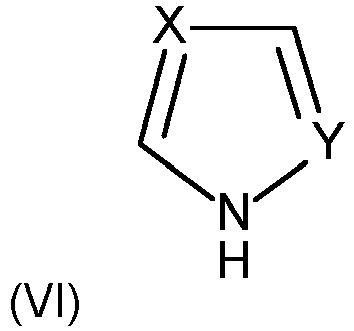
- X und Y zusammen zwei Stickstoffatome oder
- ein Stickstoffatom und eine Gruppierung C-H bezeichnen,
- beispielsweise 1H-1,2,4-Triazol (X = Y = N) oder bevorzugt Imidazol (X = N, Y = C-H).
- Ganz besonders bevorzugt werden für die vorliegende Erfindung als Azolderivate Benzimidazol, Benzotriazol, Tolutriazol, hydriertes Tolutriazol oder Mischungen hieraus, insbesondere Benzotriazol oder Tolutriazol, speziell Tolutriazol.
- Die genannten Azolderivate sind kommerziell verfügbar oder nach gängigen Methoden herstellbar. Hydrierte Benzotriazole wie hydriertes Tolutriazol sind ebenfalls gemäß
DE-A 1 948 794 zugänglich und auch kommerziell verfügbar. - Bevorzugt sind die Azole ausgewählt aus der Gruppe bestehend aus Benzotriazol, Tolutriazol, (2-Benzothiazylthio)-essigsäure, 3-(2-Benzothiazylthio)-propionsäure und 2-Mercaptobenzthiazol.
- Das im Rahmen der vorliegenden Erfindung eingesetzte Wasser sollte neutral mit einem pH-Wert um 7 sein, dabei kann es sich um demineralisiertes oder destilliertes Wasser handeln, was jedoch nicht zwingend erforderlich ist. Um den Einsatz auch harten Wassers zu ermöglichen, kann der Kühlmittelzusammensetzung mindestens ein Hartwasserstabilisator zugesetzt werden.
- Das eingesetzte Wasser kann Erdalkalimetallionen enthalten, beispielsweise Magnesium-, Calcium-, Strontium- oder Bariumionen, wobei letztere üblicherweise höchstens in Spuren enthalten sind. Bevorzugt sind als Härtebildner im wesentlichen lediglich Magnesium- und/oder Calciumionen enthalten.
- Bei dem eingesetzten Wasser handelt es sich bevorzugt um weiches Wasser mit einer Wasserhärte von nicht mehr als 8,4 °dH, besonders bevorzugt von nicht mehr als 10 und ganz besonders bevorzugt nicht mehr als 12 °dH.
- Bei Einsatz von Wasser mit einer Wasserhärte von bis zu 14 °dH, bevorzugt bis zu 17, besonders bevorzugt bis zu 20 und sogar bis zu 25 °dH ist in der Regel ein Hartwasserstabilisator erforderlich.
- Das im Kühlmittel eingesetzte Wasser ist über die Härtebildner die übliche Quelle für eventuell in dem Kühlmittel enthaltenes Carbonat und/oder Sulfat.
- Anstelle oder zusätzlich zu den genannten anorganischen Silikaten können die Kühlmittel auch organische ortho-Kieselsäureester der allgemeinen Formel Si(OR)4 enthalten, worin jedes R unabhängig voneinander C1-C4-Alkyl, bevorzugt Methyl, Ethyl oder n-Butyl, besonders bevorzugt Methyl oder Ethyl oder Gemische aus Methyl und Ethyl bedeuten.
- Die ortho-Kieselsäureester wirken überwiegend als Inhibitor der Korrosion von Aluminium oder Aluminium-haltigen Werkstoffen sowie Lot.
- Wenn die Zusammensetzung mindestens ein anorganisches Silikat enthält, so wird in einer bevorzugten Ausführungsform zusätzlich zu dem Silikat mindestens ein Silicophosphonat zudosiert, wie es beschrieben ist in der Europäischen Patentanmeldung
EP 4015596 . - Bevorzugt handelt es sich bei dem Silicophosphonat um eine Verbindung der allgemeinen Formel

- R5 ein zweibindiger organischer Rest ist, bevorzugt eine 1,ω-Alkylen Gruppe mit 1 bis 6, bevorzugt 1 bis 4 Kohlenstoffatomen, besonders bevorzugt Methylen, 1,2-Ethylen, 1,2-Propylen, 1,3-Propylen oder 1,4-Butylen, ganz besonders bevorzugt 1,2-Ethylen oder 1,3-Propylen und insbesondere 1,2-Ethylen,
- R6 unabhängig voneinander Wasserstoff, C1- bis C4-Alkyl oder Hydroxy-C2- bis C4-Alkyl, bevorzugt Wasserstoff, Methyl, Ethyl, n-Propyl, iso-Propyl, n-Butyl, iso-Butyl, sec-Butyl oder tert-Butyl, 2-Hydroxyethyl oder 2-Hydroxypropyl, besonders bevorzugt Wasserstoff, Methyl, Ethyl oder Propyl,
- und R7 ist C1- bis C4-Alkyl, bevorzugt Methyl, Ethyl, n-Propyl oder n-Butyl, besonders bevorzugt Methyl, Ethyl oder n-Butyl, ganz besonders bevorzugt Methyl oder Ethyl und insbesondere Methyl.
- Die Silicophosphonate können als freie Säure oder als Alkalimetallsalz eingesetzt werden, bevorzugt als Natrium- oder Kaliumsalz und besonders bevorzugt als Natriumsalz.
- Als weitere übliche Hilfsmittel können die Kühlmitte optional in üblichen geringen Mengen noch Entschäumer (in der Regel in Mengen von 0,003 bis 0,008 Gew.-% in dem fertig verdünnten Kühlmittel) sowie aus Gründen der Hygiene und der Sicherheit im Falle eines Verschluckens Bitterstoffe (z. B. vom Typ Denatoniumbenzoat) und Farbstoffe enthalten.
- Ferner können die Zusammensetzung einen oder mehrere Hartwasserstabilisatoren auf Basis von Polyacrylsäure, Polymaleinsäure, Acrylsäure-Maleinsäure-Copolymeren, Polyvinylpyrrolidon, Polyvinylimidazol, Vinylpyrrolidon-Vinylimidazol-Copolymeren und/oder Copolymeren aus ungesättigten Carbonsäuren und Olefinen enthalten. Der Anteil in der Zusammensetzung werden so gewählt, dass nach entsprechender Verdünnung die Menge in dem fertig verdünnten Kühlmittel bis zu 1 Gew.-% beträgt.
- In einer bevorzugten Ausführungsform handelt es sich um einen Hartwasserstabilisator wie beschrieben in der
WO 2022/200155 . - Es stellt einen Vorteil des Einsatzes von Hartwasserstabilisatoren dar, dass die Verwendung von demineralisiertem oder destilliertem Wasser nicht erforderlich ist, um die Ausfällungen von Erdalkalimetallverbindungen zu verringern oder zu verhindern.
- Die in den Windkraftanlagen einsatzbereiten Kühlmittel werden bevorzugt durch Verdünnung von Konzentraten (siehe unten) mit Wasser hergestellt und sind beispielsweise zusammengesetzt wie folgt:
- 40 bis 75 Gew% Wasser, bevorzugt 45 bis 70, besonders bevorzugt 50 bis 70, ganz besonders bevorzugt 55 bis 67,5 und insbesondere 60 bis 65 Gew%,
- 20 bis 55 Gew% Alkylenglykol, Alkylenglykolmonoalkylether und Glycerin, bevorzugt 25 bis 50, besonders bevorzugt 25 bis 45, ganz besonders bevorzugt 30 bis 50 und insbesondere mindestens 32,5 bis 35 Gew%,
- in Summe 0,1 bis 5 Gew%, bevorzugt 0,25 bis 4,5, ganz besonders bevorzugt 0,5 bis 4 und insbesondere 1 bis 4 Gew% der folgenden Komponenten:
- -- optional mindestens eine organische Mono- oder Dicarbonsäure, bevorzugt aliphatische Mono- oder Dicarbonsäure,
- -- optional mindestens ein anorganisches Salz ausgewählt aus der Gruppe bestehend aus Molybdaten, Boraten, Phosphaten, Silikaten, Nitriten und Nitraten,
- -- mindestens eine Azolverbindung
- -- optional mindestens einen Kieselsäureester,
- -- optional mindestens ein Silikophosphonat, sofern Silikate anwesend sind, sowie
- optional 0 bis zu 1 Gew%, bevorzugt 0 bis zu 0,75, besonders bevorzugt 0,05 bis 0,5, ganz besonders bevorzugt 0,1 bis 0,4 und insbesondere 0,2 bis 0,3 Gew% weitere Inhibitoren und kühlmitteltypische Bestandteile,
- mit der Maßgabe, dass mindestens eine Mono- oder Dicarbonsäure und/oder mindestens ein anorganisches Salz in dem Kühlmittel anwesend sind,
- mit der Maßgabe, dass die Summe aller Komponenten stets 100 Gew% ergibt.
- In einer bevorzugten Ausführungsform enthält das Kühlmittel
- mindestens ein Alkylenglykol, Alkylenglykolmonoalkylether oder Glycerin, bevorzugt Monoethylenglykol
- mindestens eine aromatische organische Monocarbonsäure,
- mindestens ein anorganisches Salz ausgewählt aus der Gruppe bestehend aus Molybdaten, Boraten, Phosphaten, Silikaten, Nitriten und Nitraten,
- mindestens eine Azolverbindung
- Wasser
- optional mindestens ein Silikophosphonat, sofern Silikate anwesend sind, bevorzugt mindestens ein Silikophosphonat, sofern Silikate anwesend sind, und
- optional Hartwasserstabilisator, Bitterstoff, Entschäumer und/oder Farbstoff.
- In einer gleichermaßen bevorzugten Ausführungsform enthält das Kühlmittel
- mindestens ein Alkylenglykol, Alkylenglykolmonoalkylether oder Glycerin, bevorzugt Monoethylenglykol
- mindestens eine organische Mono- oder Dicarbonsäure, bevorzugt aliphatische Mono- oder Dicarbonsäure, besonders bevorzugt mindestens eine aliphatische Monocarbonsäure und mindestens eine aliphatische Dicarbonsäure oder besonders bevorzugt mindestens zwei aliphatische Dicarbonsäuren, insbesondere mindestens zwei aliphatische Dicarbonsäuren unter Verzicht auf 2-Ethylhexansäure, und speziell mindestens zwei aliphatische Dicarbonsäuren unter Verzicht auf Monocarbonsäuren,
- mindestens eine Azolverbindung
- Wasser
- optional Hartwasserstabilisator, Bitterstoff, Entschäumer und/oder Farbstoff,
- In einer gleichermaßen bevorzugten Ausführungsform enthält das Kühlmittel
- mindestens ein Alkylenglykol, Alkylenglykolmonoalkylether oder Glycerin, bevorzugt Monoethylenglykol
- mindestens eine organische Mono- oder Dicarbonsäure, bevorzugt aliphatische Mono- oder Dicarbonsäure, besonders bevorzugt mindestens eine aliphatische Monocarbonsäure und mindestens eine aliphatische Dicarbonsäure,
- mindestens ein anorganisches Salz ausgewählt aus der Gruppe bestehend aus Boraten, Phosphaten, Silikaten, Nitriten und Nitraten,
- mindestens eine Azolverbindung
- Wasser
- optional Hartwasserstabilisator, Bitterstoff, Entschäumer und/oder Farbstoff.
- In einer gleichermaßen bevorzugten Ausführungsform enthält das Kühlmittel
- mindestens ein Alkylenglykol, Alkylenglykolmonoalkylether oder Glycerin, bevorzugt Monoethylenglykol
- mindestens eine organische Mono- oder Dicarbonsäure, bevorzugt aliphatische Mono- oder Dicarbonsäure, besonders bevorzugt mindestens eine aliphatische Monocarbonsäure und mindestens eine aliphatische Dicarbonsäure oder besonders bevorzugt mindestens zwei aliphatische Dicarbonsäuren,
- mindestens ein anorganisches Salz ausgewählt aus der Gruppe bestehend aus Molybdaten, Boraten, Phosphaten, Silikaten und Nitraten, bevorzugt ausgewählt aus der Gruppe bestehend aus Phosphaten und Silikaten,
- mindestens eine Azolverbindung
- Wasser
- optional mindestens ein Silikophosphonat, sofern Silikate anwesend sind, bevorzugt mindestens ein Silikophosphonat, sofern Silikate anwesend sind, und
- optional Hartwasserstabilisator, Bitterstoff, Entschäumer und/oder Farbstoff.
- In diesen genannten Ausführungsformen handelt es sich bei den Azolverbindungen bevorzugt um Benzotriazol oder Tolutriazol.
- Bei den nicht-aliphatischen organischen Monocarbonsäuren handelt es sich bevorzugt um Benzoesäure.
- Die aliphatischen Monocarbonsäuren sind bevorzugt ausgewählt aus der Gruppe bestehend aus 2-Ethylhexansäure und Isononansäure, besonders bevorzugt Isononansäure.
- Die aliphatischen Dicarbonsäuren sind bevorzugt ausgewählt aus der Gruppe bestehend aus Adipinsäure, Sebacinsäure und Dodekandisäure.
- Die anorganischen Salze sind bevorzugt ausgewählt aus der Gruppe bestehend aus Molybdaten, Boraten, Phosphaten und Silikaten, besonders bevorzugt ausgewählt aus der Gruppe bestehend aus Molybdaten, Phosphaten und Silikaten, ganz besonders bevorzugt ausgewählt aus der Gruppe bestehend aus Phosphaten und Silikaten.
- Das Kühlmittel sollte bei einer Temperatur von 20°C eine kinematische Viskosität gemäß ASTM D445 von 3 mm2/s nicht überschreiten, bevorzugt nicht mehr als 2,5, besonders bevorzugt nicht mehr als 2 mm2/s, ganz besonders bevorzugt nicht mehr als 1.5 und insbesondere nicht mehr als 1 mm2/s.
- Bei einer Temperatur von 0 °C sollte das Kühlmittel eine kinematische Viskosität gemäß ASTM D445 von 7,5 mm2/s nicht überschreiten, bevorzugt nicht mehr als 7, besonders bevorzugt nicht mehr als 6 mm2/s, ganz besonders bevorzugt nicht mehr als 5,5 und insbesondere nicht mehr als 5 mm2/s.
- Bei einer Temperatur von 80 °C sollte das Kühlmittel eine kinematische Viskosität gemäß ASTM D445 von 1 mm2/s nicht überschreiten, bevorzugt nicht mehr als 0,9, besonders bevorzugt nicht mehr als 0,8 mm2/s, ganz besonders bevorzugt nicht mehr als 0,7 und insbesondere nicht mehr als 0,6 mm2/s.
- Um die zu transportierenden Volumina zu verringern, werden zumeist Konzentrate vertrieben, in denen der Wasseranteil weggelassen oder stark reduziert wird. Die Kühlmittel werden dann vor Befüllen der Windkraftanlage aus den Konzentraten durch Wasserzugabe hergestellt. Üblicherweise werden diese Konzentrate im Volumenverhältnis 1 : 1 bis 1 : 3 (Vol/Vol), bevorzugt 1 : 1 bis 1 : 2 mit Wasser verdünnt, je nach der herrschenden Temperatur vor Ort und Anforderungen an den Gefrierschutz.
- Die Konzentrate sind dementsprechend zusammengesetzt wie die oben angeführten Kühlmittel, jedoch mit einem je nach Verdünnungsverhältnis verringerten Wasseranteil. In der Regel beträgt der Wasseranteil im Konzentrat nicht mehr als 15, bevorzugt nicht mehr als 10 und besonders bevorzugt nicht mehr als 5 Gew%.
- Beispielsweise sind die Konzentrate zusammengesetzt wie folgt:
- 0,1 bis 15 Gew% Wasser
- 50 bis 95 Gew% Alkylenglykol, Alkylenglykolmonoalkylether und Glycerin,
- in Summe 0,5 bis 15 Gew% der folgenden Komponenten:
- -- optional mindestens eine organische Mono- oder Dicarbonsäure, bevorzugt aliphatische Mono- oder Dicarbonsäure,
- -- optional mindestens ein anorganisches Salz ausgewählt aus der Gruppe bestehend aus Molybdaten, Boraten, Phosphaten, Silikaten, Nitriten und Nitraten,
- -- mindestens eine Azolverbindung
- -- optional mindestens einen Kieselsäureester,
- -- optional mindestens ein Silikophosphonat, sofern Silikate anwesend sind, sowie
- optional 0 bis zu 3 Gew% weitere Inhibitoren und kühlmitteltypische Bestandteile,
- mit der Maßgabe, dass mindestens eine Mono- oder Dicarbonsäure und/oder mindestens ein anorganisches Salz in dem Kühlmittel anwesend sind,
- mit der Maßgabe, dass die Summe aller Komponenten stets 100 Gew% ergibt.
- Der pH-Wert der Kühlmittel beim Endanwender liegt üblicherweise im Bereich von 4 bis 11,5, vorzugsweise 5 bis 10, insbesondere 6 bis 9.
- Um diesen pH-Wert einzustellen werden bei dem Herstellungsverfahren der Kühlmittel aus einer konzentrierten Vorstufe auf einer beliebigen Stufe mindestens eine anorganische Base zugegeben. Dabei kann die mindestens eine anorganische Base im Kühlmittel oder im Konzentrat enthalten sein oder bei der Herstellung des Kühlmittels aus dem Konzentrat durch Vermischen mit Wasser zugegeben werden.
- Bevorzugte anorganische Basen sind Alkalimetallhydroxide, besonders bevorzugt festes Lithium-, Natrium- oder Kaliumhydroxid, gegebenenfalls auch in Form von wässriger Lithium-, Natron- oder Kalilauge.
- Weniger bevorzugt sind Carbonate oder Hydrogencarbonate des Lithium, Natrium oder Kalium.
- Bevorzugte Alkalimetalle sind Natrium und Kalium.
- Es ist denkbar, das Kühlmittel durch Verdünnen der Konzentrate mit Wasser in dem gewünschten Verdünnungsverhältnis direkt beim Betanken der Windkraftanlage herzustellen. Dies hat jedoch den Nachteil, dass sowohl Wasser als auch Konzentrat zur Windkraftanlage transportiert und dort z.B. über Pumpen oder statische Mischer im korrekten Verhältnis vermischt werden müssen. Die Vermischung des Konzentrats mit Wasser erfolgt in der Regel durch Energieeintrag durch Scherenergie. Dies kann beispielsweise in dynamischen Mischapparaten, d.h. durch Vermischen mittels Rührer oder durch Umpumpen (Naturumlauf oder Zwangsumlauf) bzw. Umpumpen mit statischen Mischorganen wie statischen Mischern oder Düsen im Umpumpkreis, durch statische Mischapparate wie statische Mischer, Düsen, Blenden, Y- oder T-Stücke im Zulauf des Ansatzbehälters, oder durch dynamische Mischapparate wie Mischpumpen oder Rührkessel erfolgen.
- Daher werden üblicherweise die Kühlmittel an einem ersten Ort, z.B. bei einem Formulierer durch Vermischen der Konzentrate mit Wasser in dem gewünschten Verdünnungsverhältnis hergestellt, das mit Wasser verdünnte Kühlmittel dann zur Windkraftanlage an einen zweiten Ort transportiert und dort das Kühlsystem der Windkraftanlage mit dem fertig abgemischten Kühlmittel betankt.
- Bei neu zu errichtenden Windkraftanlagen ist dieser zweite Ort zumeist der Montageort für die Gondel.
- Bei bestehenden Windkraftanlagen ist der zweite Ort der Standort der Windkraftanlage, also bei offshore-Anlagen auf See bzw. bei onshore-Anlagen an Land.
- Die Befüllung von bestehenden Windkraftanlagen erfolgt bei Umgebungstemperatur, bevorzugt bei einer Temperatur von 15 bis 35 °C. Eine Temperatur von -10 °C sollte nicht unterschritten werden. Da das Kühlmittel in der Regel auf die Höhe der Gondel der Windkraftanlage gefördert werden muss, wo sich das Kühlsystem befindet, und sich diese Gondel auf einer Höhe von 50 bis 150 m befindet, Planungen reichen sogar bis zu 200 m, sollte die Temperatur des Kühlmittels beim Befüllen des Kühlsystems der Windkraftanlage so beschaffen sein, dass die Viskosität des Kühlmittels bei der Fördertemperatur 3 mm2/s nicht überschreitet, bevorzugt nicht mehr als 2,5, besonders bevorzugt nicht mehr als 2 mm2/s, ganz besonders bevorzugt nicht mehr als 1.5 und insbesondere nicht mehr als 1 mm2/s, da ansonsten das Kühlmittel nur schwer auf diese Höhe pumpbar ist. Eine niedrige Viskosität ist anzustreben, da dies eine geringere Pumpenleistung erforderlich macht und bei schnelllaufenden Pumpen beispielsweise zu Kavitation führen kann. Sollte die Viskosität des Kühlmittels für die Förderung per Pumpe zu hoch sein, so kann es sinnvoll sein, das Kühlmittel leicht zu erwärmen, um die Viskosität zu senken und das so erwärmte Kühlmittel dann in einem isolierten oder thermostatierten Behälter zur Windkraftanlage zu transportieren. In der Regel ist dafür eine Temperatur des Kühlmittels bis zu 25 °C über der Umgebungstemperatur ausreichend, bevorzugt bis zu 20, besonders bevorzugt bis zu 15 und ganz besonders bevorzugt bis zu 10 °C.
- Alternativ kann das Kühlmittel auch in einem geeigneten Behälter per Kran oder Aufzug auf die Höhe des Kühlmitteltanks der Windkraftanlage transportiert und dort ausgetauscht werden. Dies ist besonders dann bevorzugt, wenn das Kühlmittel zum Pumpen zu hochviskos ist oder eine entsprechende Pumpe nicht verfügbar ist.
- Das gebrauchte Kühlmittel wird nach dem Austausch gesammelt und kann beispielsweise über Kläranlagen entsorgt oder wiedergewonnen werden.
- Die zu kühlenden Bestandteile von Windkraftanlagen umfassen in der Regel zumindest einen ausgewählt aus der Gruppe bestehend aus Generator, Getriebe, Lager, Umrichter und Stellsystem.
- Im Getriebe wird die niedrige Drehzahl des Rotors in eine hohe Drehzahl für den Generator übersetzt mit der Folge, dass kleinere Generatoren eingesetzt werden können. Es ist jedoch auch möglich, eine Windkraftanlage ohne Getriebe zu betreiben. In diesem Fall ist der Generator direkt an den Rotor gekoppelt und dreht sich mit der gleichen Drehzahl wie der Rotor. Dies ist konstruktiv einfacher, da auf das Getriebe verzichtet werden kann, jedoch müssen die Generatoren in getriebelosen Windkraftanlagen deutlich größer ausgelegt werden.
- Somit ist das Getriebe nicht notwendigerweise bei jeder Windkraftanlage vorhanden.
- Mit dem zumeist hydraulischen Stellsystem wird der Rotor durch die Steuerung der Windkraftanlage in der Regel automatisch zur Optimierung der Stromerzeugung in den Wind gedreht (Windnachführung). Dies umfasst sowohl die Ausrichtung der Nabe zur Windrichtung als auch den Anstellwinkel der Rotorblätter in den Wind. Bei zu hohen Windstärken kann der Rotor zum Schutz der Anlage auch aus dem Wind bzw. die Rotorblätter in sogenannte Segelstellung gedreht werden.
- Es stellt eine bevorzugte Ausführungsform dar, Getriebe (sofern vorhanden) und/oder Stellsystem der Windkraftanlage zu kühlen und die dort erzeugte Wärme über das Kühlmittel abzuführen. In einer besonders bevorzugten Ausführungsform werden Getriebe und Stellsystem in einem gemeinsamen Kühlkreislauf gekühlt.
- Der Rotor wird durch die kinetische Energie des Windes in eine Drehbewegung versetzt und treibt einen Generator im Inneren der Gondel an, der wiederum die mechanische Energie in elektrische Energie umwandelt. Der durch den Generator erzeugte Strom kann nun in das Stromnetz eingespeist werden. Bei den meisten Anlagen sorgt ein Umrichter dafür, dass der eingespeiste Strom die für das nationale bzw. regionale Stromnetz erforderliche Frequenz von zumeist 50 bis 60 Hertz hat.
- Es stellt eine bevorzugte Ausführungsform dar, Generator und/oder Umrichter der Windkraftanlage zu kühlen und die dort erzeugte Wärme über das Kühlmittel abzuführen. In einer besonders bevorzugten Ausführungsform werden Generator und Umrichter in einem gemeinsamen Kühlkreislauf gekühlt.
- Ein weiterer Gegenstand der vorliegenden Erfindung ist ein Verfahren zum Wärmemanagement von Bestandteilen von Windkraftanlagen, in dem Wärme von mindestens einem Bestandteil einer Windkraftanlage ausgewählt aus der Gruppe bestehend aus
- Generator,
- Getriebe,
- Lager,
- Umrichter und
- Stellsystem
- als Kühlmittel eine Zusammensetzung wie oben beschrieben eingesetzt wird,
- die höhere Temperatur von 20 bis 100 °C, bevorzugt 25 bis 80, besonders bevorzugt 30 bis 60 °C beträgt,
- die niedrigere Temperatur von minus 50 bis 40 °C, bevorzugt minus 40 bis 40, besonders bevorzugt minus 30 bis 35 °C beträgt und
- die niedrigere Temperatur mindestens 5 °C, bevorzugt mindestens 10, besonders bevorzugt mindestens 15 und ganz besonders bevorzugt mindestens 20 °C niedriger liegt als die höhere Temperatur.
- Dabei handelt es sich bei der höheren Temperatur bevorzugt um die Wandtemperaturen des jeweiligen Bestandteils der Windkraftanlage während des üblichen Betriebes der Windkraftanlage.
- Die niedrigere Temperatur ist dabei bevorzugt die Umgebungstemperatur, mit der das erwärmte Kühlmittel im zweiten Wärmetauscher in Kontakt gebracht wird.
- Es ist möglich, wenn auch weniger bevorzugt, dass bei offshore Windkraftanlagen die niedrigere Temperatur diejenige von Meerwasser am Standort der Windkraftanlage ist. In diesem Fall liegt die niedrigere Temperatur bei 0 bis 30 °C, bevorzugt 1 bis 25, besonders bevorzugt 2 bis 20 und ganz besonders bevorzugt 3 bis 15 °C.
- Es stellt einen Vorteil der in dieser Schrift beschriebenen Kühlmittel dar, dass die Windkraftanlagen mit diesen Kühlmitteln in der Regel mindestens 5, bevorzugt mindestens 7, besonders bevorzugt mindestens 8 und ganz besonders bevorzugt mindestens 10 Jahre betrieben werden können, ohne dass ein Wechsel des Kühlmittels erforderlich ist. Es ist sogar denkbar, dass das Kühlmittel während der gesamten Betriebsdauer der Windkraftanlage nicht ausgetauscht werden muss, also bis zu 25, bevorzugt bis zu 30 Jahren.
- Bei allen Wärmetauschern kann es sich um an sich bekannte Bauteile handeln, die dem Fachmann für diese Zwecke bekannt sind.
- Angaben zu Prozent, ppm oder Teilen in dieser Schrift beziehen sich auf Gew%, Gew.ppm oder Gewichtsteile, sofern nicht anders angegeben.
- Viskositätsangaben in dieser Schrift beziehen sich auf ASTM D445 bei 20 °C, sofern nicht anders angegeben.
- Ein erfindungsgemäßes Kühlmittel 1 basierend auf Ethylenglykol mit einer Mischung aus Adipinsäure, Sebacinsäure und Tolutriazol als Inhibitorkomponenten wie beschrieben in den Beispielen der
WO 02/90462 A1 - Des weiteren wurde ein Kühlmittel 2, basierend auf Ethylenglykol mit einer Mischung von Molybdat, 2-Ethylhexansäuren und Tolutriazol einem Korrosionstest gemäß ASTM D 1384 unterzogen. Bei dieser Untersuchung wurden jeweils drei Metallplättchen jeder Probe in den Test eingesetzt und die Ergebnisse des Wägeverlustes auf eine signifikante Stelle ohne Nachkommastelle gerundet.
- Als weniger bevorzugtes Kühlmittel 0 wurde ein kommerziell verfügbares Produkt herangezogen, das mit einer Schutzwirkung von 6 Jahren in stationären Anlagen beworben wird. Windkraftanlagen werden nicht erwähnt. Dieses Produkt enthält laut Sicherheitsdatenblatt 2-Ethylhexansäure als Inhibitorkomponente und ist laut den zugehörigen Produktinformationen frei von Nitrit, Aminen, Phosphat, Borat und Silikat. Ferner enthält dieses Kühlmittel vermutlich noch Sebacinsäure.
Kühlmittel 0 *) Kühlmittel 1 Kühlmittel 2 Abtrag Abtrag Abtrag Grenze gemäß ASTM D 3306 mg/Prüfkörper mg/Prüfkörper mg/Prüfkörper mg/Prüfkörper Kupfer 1,9 -0,8 1 10 max Weichlot 0,1 -1,2 -1 30 max Messing 1,6 -0,9 2 10 max Stahl -0,5 0,1 0 10 max Grauguss -1,4 1,3 1 10 max Gussaluminium 4,6 -4,0 2 30 max *) Die Werte gemäß dem Korrosionstest gemäß ASTM D1384 sind den Produktinformationen entnommen. - Man sieht, dass die Kühlmittel 1 und besonders 2 bessere Korrosionsergebnisse zeigen, als Kühlmittel 0, besonders in Bezug auf die Aluminiumkorrosion und somit für Kühlsysteme mit Aluminiumbauteilen besser geeignet sind.
Claims (15)
- Verwendung eines Kühlmittels, enthaltend- mindestens ein Alkylenglykol, Alkylenglykolmonoalkylether oder Glycerin, bevorzugt Monoethylenglykol,- optional mindestens eine organische Mono- oder Dicarbonsäure, bevorzugt aliphatische Mono- oder Dicarbonsäure,- optional mindestens ein anorganisches Salz ausgewählt aus der Gruppe bestehend aus Molybdaten, Boraten, Phosphaten, Silikaten, Nitriten und Nitraten,- mindestens eine Azolverbindung,- Wasser,- optional mindestens einen Kieselsäureester,- optional mindestens ein Silikophosphonat, sofern Silikate anwesend sind, und- optional weitere Inhibitoren und kühlmitteltypische Bestandteile,mit der Maßgabe, dass mindestens eine Mono- oder Dicarbonsäure und/oder mindestens ein anorganisches Salz in dem Kühlmittel anwesend sind,in einem Kühlsystem von Windkraftanlagen, bevorzugt in einem Kühlsystem zum Wärmemanagement mindestens eines Bestandteils einer Windkraftanlage ausgewählt aus der Gruppe bestehend aus- Generator,- Getriebe,- Lager,- Umrichter und- Stellsystem.
- Verwendung gemäß Anspruch 1, dadurch gekennzeichnet, dass das Kühlmittel- mindestens ein Alkylenglykol, Alkylenglykolmonoalkylether oder Glycerin, bevorzugt Monoethylenglykol- mindestens ein anorganisches Salz ausgewählt aus der Gruppe bestehend aus Molybdaten, Boraten, Phosphaten, Silikaten, Nitriten und Nitraten,- mindestens eine Azolverbindung- Wasser- optional mindestens ein Silikophosphonat, sofern Silikate anwesend sind, bevorzugt mindestens ein Silikophosphonat, sofern Silikate anwesend sind, und- optional Hartwasserstabilisator, Bitterstoff, Entschäumer und/oder Farbstoff enthält,mit der Maßgabe, dass keine Mono- oder Dicarbonsäuren in dem Kühlmittel anwesend sind.
- Verwendung gemäß Anspruch 1, dadurch gekennzeichnet, dass das Kühlmittel- mindestens ein Alkylenglykol, Alkylenglykolmonoalkylether oder Glycerin, bevorzugt Monoethylenglykol- mindestens eine organische Mono- oder Dicarbonsäure, bevorzugt aliphatische Mono-oder Dicarbonsäure, besonders bevorzugt mindestens eine aliphatische Monocarbonsäure und mindestens eine aliphatische Dicarbonsäure oder besonders bevorzugt mindestens zwei aliphatische Dicarbonsäuren, insbesondere mindestens zwei aliphatische Dicarbonsäuren unter Verzicht auf 2-Ethylhexansäure, und speziell mindestens zwei aliphatische Dicarbonsäuren unter Verzicht auf Monocarbonsäuren,- mindestens eine Azolverbindung- Wasser- optional Hartwasserstabilisator, Bitterstoff, Entschäumer und/oder Farbstoff. enthält,mit der Maßgabe, dass keine anorganisches Salz ausgewählt aus der Gruppe bestehend aus Molybdaten, Boraten, Phosphaten, Silikaten, Nitriten und Nitraten in dem Kühlmittel anwesend sind.
- Verwendung gemäß Anspruch 1, dadurch gekennzeichnet, dass das Kühlmittel- mindestens ein Alkylenglykol, Alkylenglykolmonoalkylether oder Glycerin, bevorzugt Monoethylenglykol- mindestens eine aromatische organische Monocarbonsäure,- mindestens ein anorganisches Salz ausgewählt aus der Gruppe bestehend aus Molybdaten, Boraten, Phosphaten, Silikaten, Nitriten und Nitraten,- mindestens eine Azolverbindung- Wasser- optional mindestens ein Silikophosphonat, sofern Silikate anwesend sind, bevorzugt mindestens ein Silikophosphonat, sofern Silikate anwesend sind, und- optional Hartwasserstabilisator, Bitterstoff, Entschäumer und/oder Farbstoff enthält.
- Verwendung gemäß Anspruch 1, dadurch gekennzeichnet, dass das Kühlmittel- mindestens ein Alkylenglykol, Alkylenglykolmonoalkylether oder Glycerin, bevorzugt Monoethylenglykol- mindestens eine organische Mono- oder Dicarbonsäure, bevorzugt aliphatische Mono-oder Dicarbonsäure,- mindestens ein anorganisches Salz ausgewählt aus der Gruppe bestehend aus Molybdaten, Boraten, Phosphaten, Silikaten und Nitraten, bevorzugt ausgewählt aus der Gruppe bestehend aus Phosphaten und Silikaten,- mindestens eine Azolverbindung- Wasser- optional mindestens ein Silikophosphonat, sofern Silikate anwesend sind, bevorzugt mindestens ein Silikophosphonat, sofern Silikate anwesend sind, und- optional Hartwasserstabilisator, Bitterstoff, Entschäumer und/oder Farbstoff.enthält.
- Verwendung gemäß einem der vorstehenden Ansprüche, dadurch gekennzeichnet, dass das Kühlmittel eine Viskosität bei 20 °C gemäß ASTM D445 von nicht mehr als 3 mm2/s aufweist.
- Verwendung gemäß einem der vorstehenden Ansprüche, dadurch gekennzeichnet, dass die Azolverbindung ausgewählt ist aus der Gruppe bestehend aus Benzotriazol und Tolutriazol.
- Verwendung gemäß einem der Ansprüche 1 oder 3 bis 7, dadurch gekennzeichnet, dass die organische Monocarbonsäure Benzoesäure umfasst.
- Verwendung gemäß einem der Ansprüche 1, 3 oder 5 bis 8, dadurch gekennzeichnet, dass die organische Monocarbonsäure 2-Ethylhexansäure oder Isononansäure, besonders bevorzugt Isononansäure umfasst.
- Verwendung gemäß einem der Ansprüche 1 oder 3 bis 8, dadurch gekennzeichnet, dass die organische Dicarbonsäure ausgewählt ist aus der Gruppe bestehend aus Adipinsäure, Sebacinsäure und Dodekandisäure, bevorzugt aus der Gruppe bestehend aus Adipinsäure und Sebacinsäure.
- Verwendung gemäß einem der vorstehenden Ansprüche, dadurch gekennzeichnet, dass das Kühlmittel zum Wärmemanagement von Generator und/oder Umrichter eingesetzt wird.
- Verwendung gemäß einem der Ansprüche 1 bis 10, dadurch gekennzeichnet, dass das Kühlmittel zum Wärmemanagement von Getriebe und/oder Stellsystem eingesetzt wird.
- Verfahren zum Befüllen des Kühlsystems einer Windkraftanlage mit einem Kühlmittel, in dem man an einem ersten Ort ein Konzentrat, enthaltend- 0,1 bis 15 Gew% Wasser- 50 bis 95 Gew% Alkylenglykol, Alkylenglykolmonoalkylether und Glycerin,- in Summe 0,5 bis 15 Gew% der folgenden Komponenten:-- optional mindestens eine organische Mono- oder Dicarbonsäure, bevorzugt aliphatische Mono- oder Dicarbonsäure,-- optional mindestens ein anorganisches Salz ausgewählt aus der Gruppe bestehend aus Molybdaten, Boraten, Phosphaten, Silikaten, Nitriten und Nitraten,-- mindestens eine Azolverbindung-- optional mindestens einen Kieselsäureester,-- optional mindestens ein Silikophosphonat, sofern Silikate anwesend sind, sowie- optional 0 bis zu 3 Gew% weitere Inhibitoren und kühlmitteltypische Bestandteile,mit der Maßgabe, dass die Summe aller Komponenten stets 100 Gew% ergibt,mit der Maßgabe, dass mindestens eine Mono- oder Dicarbonsäure und/oder mindestens ein anorganisches Salz in dem Kühlmittel anwesend sind,in einem Volumenverhältnis 1 : 1 bis 1 : 3 mit Wasser vermischt,zur Windkraftanlage an einen zweiten Ort transportiert und dort das Kühlsystem der Windkraftanlage befüllt.
- Verfahren gemäß Anspruch 13, dadurch gekennzeichnet, dass das Befüllen der Windkraftanlage bei einer Temperatur erfolgt, bei der das Kühlmittel eine Viskosität gemäß ASTM D445 von nicht mehr als 3 mm2/s aufweist.
- Verfahren zum Wärmemanagement von Bestandteilen von Windkraftanlagen, in dem Wärme von mindestens einem Bestandteil einer Windkraftanlage ausgewählt aus der Gruppe bestehend aus- Generator,- Getriebe,- Lager,- Umrichter und- Stellsystembei einer höheren Temperatur über mindestens einen ersten Wärmetauscher auf ein Kühlmittel übertragen wird, dieses Kühlmittel in einem Kühlkreislauf zu mindestens einem zweiten Wärmetauscher geführt wird und dort bei einer niedrigeren Temperatur Wärme vom Kühlmittel abgeführt wird, in dem- als Kühlmittel eine Zusammensetzung wie in einem der Ansprüche 1 bis 9 eingesetzt wird,- die höhere Temperatur von 20 bis 100 °C, bevorzugt 25 bis 80, besonders bevorzugt 30 bis 60 °C beträgt,- die niedrigere Temperatur von minus 50 bis 40 °C, bevorzugt minus 40 bis 40, besonders bevorzugt minus 30 bis 35 °C beträgt und- die niedrigere Temperatur mindestens 5 °C, bevorzugt mindestens 10, besonders bevorzugt mindestens 15 und ganz besonders bevorzugt mindestens 20 °C niedriger liegt als die höhere Temperatur.
Priority Applications (7)
| Application Number | Priority Date | Filing Date | Title |
|---|---|---|---|
| EP23181958.2A EP4484519A1 (de) | 2023-06-28 | 2023-06-28 | Neue anwendungen für kühlmittel |
| PCT/EP2024/067257 WO2025002978A1 (de) | 2023-06-28 | 2024-06-20 | Neue anwendungen für kühlmittel |
| AU2024310129A AU2024310129A1 (en) | 2023-06-28 | 2024-06-20 | New uses for coolants |
| EP24735947.4A EP4735555A1 (de) | 2023-06-28 | 2024-06-20 | Neue anwendungen für kühlmittel |
| KR1020257042851A KR20260026498A (ko) | 2023-06-28 | 2024-06-20 | 냉각제의 신규한 용도 |
| CN202480043254.3A CN121399228A (zh) | 2023-06-28 | 2024-06-20 | 冷却剂的新应用 |
| MX2025015716A MX2025015716A (es) | 2023-06-28 | 2025-12-19 | Nuevos usos para refrigerantes |
Applications Claiming Priority (1)
| Application Number | Priority Date | Filing Date | Title |
|---|---|---|---|
| EP23181958.2A EP4484519A1 (de) | 2023-06-28 | 2023-06-28 | Neue anwendungen für kühlmittel |
Publications (1)
| Publication Number | Publication Date |
|---|---|
| EP4484519A1 true EP4484519A1 (de) | 2025-01-01 |
Family
ID=87036614
Family Applications (2)
| Application Number | Title | Priority Date | Filing Date |
|---|---|---|---|
| EP23181958.2A Withdrawn EP4484519A1 (de) | 2023-06-28 | 2023-06-28 | Neue anwendungen für kühlmittel |
| EP24735947.4A Pending EP4735555A1 (de) | 2023-06-28 | 2024-06-20 | Neue anwendungen für kühlmittel |
Family Applications After (1)
| Application Number | Title | Priority Date | Filing Date |
|---|---|---|---|
| EP24735947.4A Pending EP4735555A1 (de) | 2023-06-28 | 2024-06-20 | Neue anwendungen für kühlmittel |
Country Status (6)
| Country | Link |
|---|---|
| EP (2) | EP4484519A1 (de) |
| KR (1) | KR20260026498A (de) |
| CN (1) | CN121399228A (de) |
| AU (1) | AU2024310129A1 (de) |
| MX (1) | MX2025015716A (de) |
| WO (1) | WO2025002978A1 (de) |
Citations (10)
| Publication number | Priority date | Publication date | Assignee | Title |
|---|---|---|---|---|
| DE1948794A1 (de) | 1969-09-26 | 1971-04-01 | Rhein Chemie Rheinau Gmbh | 4,5,6,7-Tetrahydrobenzotriazole,Verfahren zu ihrer Herstellung und ihre Verwendung als Korrosionsinhibitoren |
| WO2002090462A1 (de) | 2001-05-10 | 2002-11-14 | Basf Aktiengesellschaft | Gefrierschutzmittelkonzentrate enthaltend den farbstoff c.i. reactive violet 5 |
| CN107090276A (zh) * | 2017-04-26 | 2017-08-25 | 句容市江电电器机械有限公司 | 一种耐腐蚀防冻液 |
| CN110699048A (zh) * | 2019-09-06 | 2020-01-17 | 华电电力科学研究院有限公司 | 一种风电机组变频器冷却液及其制备方法 |
| CN109837071B (zh) * | 2017-11-24 | 2021-03-23 | 北京蓝星清洗有限公司 | 一种用于风力发电机组的冷却液及其制备方法 |
| EP3828411A1 (de) * | 2019-11-27 | 2021-06-02 | Siemens Gamesa Renewable Energy A/S | Windturbine und verfahren zum betrieb der windturbine |
| CN113969143A (zh) * | 2021-09-29 | 2022-01-25 | 华电电力科学研究院有限公司 | 一种具有螯合作用的风电机组冷却液及其制备方法 |
| EP4015596A1 (de) | 2020-12-15 | 2022-06-22 | Basf Se | Neuartige kühlmittel mit verbesserter lagerstabilität |
| CN114907821A (zh) * | 2022-05-30 | 2022-08-16 | 湖南车瑞科技股份有限公司 | 一种风电专用冷却液及其制备方法 |
| WO2022200155A1 (de) | 2021-03-23 | 2022-09-29 | Basf Se | Kühlmittel mit verbesserter temperaturstabilität |
-
2023
- 2023-06-28 EP EP23181958.2A patent/EP4484519A1/de not_active Withdrawn
-
2024
- 2024-06-20 WO PCT/EP2024/067257 patent/WO2025002978A1/de not_active Ceased
- 2024-06-20 CN CN202480043254.3A patent/CN121399228A/zh active Pending
- 2024-06-20 EP EP24735947.4A patent/EP4735555A1/de active Pending
- 2024-06-20 KR KR1020257042851A patent/KR20260026498A/ko active Pending
- 2024-06-20 AU AU2024310129A patent/AU2024310129A1/en active Pending
-
2025
- 2025-12-19 MX MX2025015716A patent/MX2025015716A/es unknown
Patent Citations (10)
| Publication number | Priority date | Publication date | Assignee | Title |
|---|---|---|---|---|
| DE1948794A1 (de) | 1969-09-26 | 1971-04-01 | Rhein Chemie Rheinau Gmbh | 4,5,6,7-Tetrahydrobenzotriazole,Verfahren zu ihrer Herstellung und ihre Verwendung als Korrosionsinhibitoren |
| WO2002090462A1 (de) | 2001-05-10 | 2002-11-14 | Basf Aktiengesellschaft | Gefrierschutzmittelkonzentrate enthaltend den farbstoff c.i. reactive violet 5 |
| CN107090276A (zh) * | 2017-04-26 | 2017-08-25 | 句容市江电电器机械有限公司 | 一种耐腐蚀防冻液 |
| CN109837071B (zh) * | 2017-11-24 | 2021-03-23 | 北京蓝星清洗有限公司 | 一种用于风力发电机组的冷却液及其制备方法 |
| CN110699048A (zh) * | 2019-09-06 | 2020-01-17 | 华电电力科学研究院有限公司 | 一种风电机组变频器冷却液及其制备方法 |
| EP3828411A1 (de) * | 2019-11-27 | 2021-06-02 | Siemens Gamesa Renewable Energy A/S | Windturbine und verfahren zum betrieb der windturbine |
| EP4015596A1 (de) | 2020-12-15 | 2022-06-22 | Basf Se | Neuartige kühlmittel mit verbesserter lagerstabilität |
| WO2022200155A1 (de) | 2021-03-23 | 2022-09-29 | Basf Se | Kühlmittel mit verbesserter temperaturstabilität |
| CN113969143A (zh) * | 2021-09-29 | 2022-01-25 | 华电电力科学研究院有限公司 | 一种具有螯合作用的风电机组冷却液及其制备方法 |
| CN114907821A (zh) * | 2022-05-30 | 2022-08-16 | 湖南车瑞科技股份有限公司 | 一种风电专用冷却液及其制备方法 |
Non-Patent Citations (1)
| Title |
|---|
| CAS , no. 15898-92-7 |
Also Published As
| Publication number | Publication date |
|---|---|
| KR20260026498A (ko) | 2026-02-26 |
| AU2024310129A1 (en) | 2025-12-18 |
| MX2025015716A (es) | 2026-02-03 |
| WO2025002978A1 (de) | 2025-01-02 |
| EP4735555A1 (de) | 2026-05-06 |
| CN121399228A (zh) | 2026-01-23 |
Similar Documents
| Publication | Publication Date | Title |
|---|---|---|
| EP1230317B1 (de) | Gefrierschutzmittelkonzentrate auf basis von dicarbonsäuren, molybdat und triazolen und diese umfassende kühlmittelzusammensetzungen | |
| EP3374463B1 (de) | Silikathaltiges kühlmittelkonzentrat | |
| EP0816467B1 (de) | Silikat-, borat- und nitratfreie Gefrierschutzmittelkonzentrate und diese umfassende Kühlmittelzusammensetzungen | |
| EP0880566B1 (de) | Verwendung von quaternierten imidazolen als buntmetall-korrosionsinhibitoren und diese enthaltende gefrierschutzmittelkonzentrate und kühlmittelzusammensetzungen | |
| EP4015596B1 (de) | Neuartige kühlmittel mit verbesserter lagerstabilität | |
| US10160895B2 (en) | Coolant composition, method of operating internal combustion engine using the same, and use of the same | |
| CN104845595B (zh) | 一种汽车发动机用无水冷却液组合物 | |
| US9193897B2 (en) | Composition for antifreeze liquid or coolant having superior cavitation erosion- and gap corrosion-resistance effect | |
| EP4484519A1 (de) | Neue anwendungen für kühlmittel | |
| EP0863960B1 (de) | Gefrierschutzmittel | |
| DE102004039149B4 (de) | Silikatfreie Kühlflüssigkeiten auf Basis organischer Säuren und Carbamaten mit verbesserten Korrosionseigenschaften | |
| EP1594937B1 (de) | Wärmeträgerflüssigkeiten mit glaskorrosionsschutz insbesondere für solaranlagen | |
| WO2025016801A1 (en) | New coolant compositions | |
| WO2017175052A1 (en) | Coolant composition and method of operating internal combustion engine using the same | |
| DE19745461A1 (de) | Kühlflüssigkeit zur Verwendung in Bauteilen aus Magnesium | |
| HUE035797T2 (en) | Engine Coolant Additive | |
| EP4354558A1 (de) | Kühlflüssigkeitszusammensetzung für brennstoffzelle | |
| CN114269878A (zh) | 包含有机羧酸或其盐的基于二醇的传热流体、其制备方法及其用途 | |
| US12180413B2 (en) | Solid coolant concentrates and production thereof | |
| CN120624106B (zh) | 一种环保型的镁合金加工液及其制备方法 | |
| DE19955704A1 (de) | Gefrierschutzmittelkonzentrate auf Basis von Dicarbonsäuren, Molybdat und Triazolen oder Thiazolen und diese umfassende Kühlmittelzusammensetzungen | |
| JPWO2005103193A1 (ja) | 熱媒体組成物 | |
| EP3440149A1 (de) | Kühlmittelzusammensetzung und verfahren zum betrieb eines verbrennungsmotors mit verwendung davon | |
| DE19952482A1 (de) | Gefrierschutzmittelkonzentrate auf Basis von Dicarbonsäuren, Monolybdat und Thiazolen und diese umfassende Kühlmittelzusammensetzungen | |
| DE3436821A1 (de) | Ethoxylierte aromatische nitrocarbonsaeuren, ihre herstellung und verwendung als korrosionsinhibitoren und diese enthaltende korrosionsschutzmittel |
Legal Events
| Date | Code | Title | Description |
|---|---|---|---|
| PUAI | Public reference made under article 153(3) epc to a published international application that has entered the european phase |
Free format text: ORIGINAL CODE: 0009012 |
|
| STAA | Information on the status of an ep patent application or granted ep patent |
Free format text: STATUS: THE APPLICATION HAS BEEN PUBLISHED |
|
| AK | Designated contracting states |
Kind code of ref document: A1 Designated state(s): AL AT BE BG CH CY CZ DE DK EE ES FI FR GB GR HR HU IE IS IT LI LT LU LV MC ME MK MT NL NO PL PT RO RS SE SI SK SM TR |
|
| STAA | Information on the status of an ep patent application or granted ep patent |
Free format text: STATUS: THE APPLICATION HAS BEEN WITHDRAWN |
|
| 18W | Application withdrawn |
Effective date: 20250106 |