EP4481981A1 - Ladeverfahren und -vorrichtung mit mehreren ladepumpen sowie endgerät - Google Patents
Ladeverfahren und -vorrichtung mit mehreren ladepumpen sowie endgerät Download PDFInfo
- Publication number
- EP4481981A1 EP4481981A1 EP23210038.8A EP23210038A EP4481981A1 EP 4481981 A1 EP4481981 A1 EP 4481981A1 EP 23210038 A EP23210038 A EP 23210038A EP 4481981 A1 EP4481981 A1 EP 4481981A1
- Authority
- EP
- European Patent Office
- Prior art keywords
- maximum
- charging
- charge pump
- charging current
- charge
- Prior art date
- Legal status (The legal status is an assumption and is not a legal conclusion. Google has not performed a legal analysis and makes no representation as to the accuracy of the status listed.)
- Pending
Links
Images



Classifications
-
- H—ELECTRICITY
- H02—GENERATION; CONVERSION OR DISTRIBUTION OF ELECTRIC POWER
- H02J—ELECTRIC POWER NETWORKS; CIRCUIT ARRANGEMENTS OR SYSTEMS FOR SUPPLYING OR DISTRIBUTING ELECTRIC POWER; SYSTEMS FOR STORING ELECTRIC ENERGY
- H02J7/00—Circuit arrangements for charging or discharging batteries or for supplying loads from batteries
- H02J7/90—Regulation of charging or discharging current or voltage
- H02J7/971—Regulation of charging or discharging current or voltage the charge cycle being controlled or terminated in response to non-electric parameters
- H02J7/975—Regulation of charging or discharging current or voltage the charge cycle being controlled or terminated in response to non-electric parameters in response to temperature
-
- H—ELECTRICITY
- H02—GENERATION; CONVERSION OR DISTRIBUTION OF ELECTRIC POWER
- H02J—ELECTRIC POWER NETWORKS; CIRCUIT ARRANGEMENTS OR SYSTEMS FOR SUPPLYING OR DISTRIBUTING ELECTRIC POWER; SYSTEMS FOR STORING ELECTRIC ENERGY
- H02J7/00—Circuit arrangements for charging or discharging batteries or for supplying loads from batteries
- H02J7/90—Regulation of charging or discharging current or voltage
- H02J7/971—Regulation of charging or discharging current or voltage the charge cycle being controlled or terminated in response to non-electric parameters
- H02J7/975—Regulation of charging or discharging current or voltage the charge cycle being controlled or terminated in response to non-electric parameters in response to temperature
- H02J7/977—Regulation of charging or discharging current or voltage the charge cycle being controlled or terminated in response to non-electric parameters in response to temperature of the battery
-
- H—ELECTRICITY
- H01—ELECTRIC ELEMENTS
- H01M—PROCESSES OR MEANS, e.g. BATTERIES, FOR THE DIRECT CONVERSION OF CHEMICAL ENERGY INTO ELECTRICAL ENERGY
- H01M10/00—Secondary cells; Manufacture thereof
- H01M10/42—Methods or arrangements for servicing or maintenance of secondary cells or secondary half-cells
- H01M10/44—Methods for charging or discharging
- H01M10/443—Methods for charging or discharging in response to temperature
-
- H—ELECTRICITY
- H02—GENERATION; CONVERSION OR DISTRIBUTION OF ELECTRIC POWER
- H02J—ELECTRIC POWER NETWORKS; CIRCUIT ARRANGEMENTS OR SYSTEMS FOR SUPPLYING OR DISTRIBUTING ELECTRIC POWER; SYSTEMS FOR STORING ELECTRIC ENERGY
- H02J50/00—Circuit arrangements or systems for wireless supply or distribution of electric power
- H02J50/80—Circuit arrangements or systems for wireless supply or distribution of electric power involving the exchange of data, concerning supply or distribution of electric power, between transmitting devices and receiving devices
-
- H—ELECTRICITY
- H02—GENERATION; CONVERSION OR DISTRIBUTION OF ELECTRIC POWER
- H02J—ELECTRIC POWER NETWORKS; CIRCUIT ARRANGEMENTS OR SYSTEMS FOR SUPPLYING OR DISTRIBUTING ELECTRIC POWER; SYSTEMS FOR STORING ELECTRIC ENERGY
- H02J7/00—Circuit arrangements for charging or discharging batteries or for supplying loads from batteries
- H02J7/40—Circuit arrangements for charging or discharging batteries or for supplying loads from batteries characterised by the exchange of charge or discharge related data
- H02J7/443—Circuit arrangements for charging or discharging batteries or for supplying loads from batteries characterised by the exchange of charge or discharge related data using passive battery identification means, e.g. resistors or capacitors
- H02J7/445—Circuit arrangements for charging or discharging batteries or for supplying loads from batteries characterised by the exchange of charge or discharge related data using passive battery identification means, e.g. resistors or capacitors in response to measured battery parameters, e.g. voltage, current or temperature profile
-
- H—ELECTRICITY
- H02—GENERATION; CONVERSION OR DISTRIBUTION OF ELECTRIC POWER
- H02J—ELECTRIC POWER NETWORKS; CIRCUIT ARRANGEMENTS OR SYSTEMS FOR SUPPLYING OR DISTRIBUTING ELECTRIC POWER; SYSTEMS FOR STORING ELECTRIC ENERGY
- H02J7/00—Circuit arrangements for charging or discharging batteries or for supplying loads from batteries
- H02J7/50—Circuit arrangements for charging or discharging batteries or for supplying loads from batteries acting upon multiple batteries simultaneously or sequentially
-
- H—ELECTRICITY
- H02—GENERATION; CONVERSION OR DISTRIBUTION OF ELECTRIC POWER
- H02J—ELECTRIC POWER NETWORKS; CIRCUIT ARRANGEMENTS OR SYSTEMS FOR SUPPLYING OR DISTRIBUTING ELECTRIC POWER; SYSTEMS FOR STORING ELECTRIC ENERGY
- H02J7/00—Circuit arrangements for charging or discharging batteries or for supplying loads from batteries
- H02J7/60—Circuit arrangements for charging or discharging batteries or for supplying loads from batteries including safety or protection arrangements
- H02J7/65—Circuit arrangements for charging or discharging batteries or for supplying loads from batteries including safety or protection arrangements against overtemperature
-
- H—ELECTRICITY
- H02—GENERATION; CONVERSION OR DISTRIBUTION OF ELECTRIC POWER
- H02J—ELECTRIC POWER NETWORKS; CIRCUIT ARRANGEMENTS OR SYSTEMS FOR SUPPLYING OR DISTRIBUTING ELECTRIC POWER; SYSTEMS FOR STORING ELECTRIC ENERGY
- H02J7/00—Circuit arrangements for charging or discharging batteries or for supplying loads from batteries
- H02J7/90—Regulation of charging or discharging current or voltage
- H02J7/92—Regulation of charging or discharging current or voltage with prioritisation of loads or sources
-
- H—ELECTRICITY
- H02—GENERATION; CONVERSION OR DISTRIBUTION OF ELECTRIC POWER
- H02J—ELECTRIC POWER NETWORKS; CIRCUIT ARRANGEMENTS OR SYSTEMS FOR SUPPLYING OR DISTRIBUTING ELECTRIC POWER; SYSTEMS FOR STORING ELECTRIC ENERGY
- H02J2105/00—Networks for supplying or distributing electric power characterised by their spatial reach or by the load
- H02J2105/40—Networks for supplying or distributing electric power characterised by their spatial reach or by the load characterised by the loads connecting to the networks or being supplied by the networks
- H02J2105/44—Portable electronic devices
-
- Y—GENERAL TAGGING OF NEW TECHNOLOGICAL DEVELOPMENTS; GENERAL TAGGING OF CROSS-SECTIONAL TECHNOLOGIES SPANNING OVER SEVERAL SECTIONS OF THE IPC; TECHNICAL SUBJECTS COVERED BY FORMER USPC CROSS-REFERENCE ART COLLECTIONS [XRACs] AND DIGESTS
- Y02—TECHNOLOGIES OR APPLICATIONS FOR MITIGATION OR ADAPTATION AGAINST CLIMATE CHANGE
- Y02E—REDUCTION OF GREENHOUSE GAS [GHG] EMISSIONS, RELATED TO ENERGY GENERATION, TRANSMISSION OR DISTRIBUTION
- Y02E60/00—Enabling technologies; Technologies with a potential or indirect contribution to GHG emissions mitigation
- Y02E60/10—Energy storage using batteries
Definitions
- the present disclosure relates to the field of charging technology, and in particular relates to a multi-charge-pump charging method and apparatus, and a terminal.
- the charging power of terminals such as mobile phones, tablets, and smart bracelets is gradually increasing, and the charging speed is getting faster and faster.
- the known charging power ranges from 18W to 240W.
- high-power fast charging schemes on the market are basically based on charge pumps.
- the number of the charge pumps in the terminal is increasing. For example, when a terminal uses one charge pump, the charging power can reach 30W, and when the terminal uses two charge pumps, the charging power can reach 120W.
- the increase in the charging power also causes an increase in the degree of heat generation of the terminal, which makes the speed of charging often limited by the terminal's heat dissipation and shell temperature experience.
- the present disclosure provides a multi-charge-pump charging method and apparatus, and a terminal, which can effectively utilize the charging performance of the charge pump in the terminal, improve the charging efficiency, and enhance the fast-charging experience.
- a multi-charge-pump charging method is provided.
- the method includes obtaining a temperature of each one of temperature zones in a terminal, where each one of the temperature zones includes a charging associated device, and the charging associated device is a charge pump or a battery, determining for each one of the temperature zones, based on the temperature of the temperature zone, a maximum charging current allowed by the charging associated device in the temperature zone, and determining from multiple charge pumps of the terminal, based on the maximum charging current allowed by each one of charging associated devices, a target charge pump to be used, and configuring the target charge pump for charging.
- the determining for each one of the temperature zones, based on the temperature of the temperature zone, the maximum charging current allowed by the charging associated device in the temperature zone includes determining for each one of the temperature zones, based on the temperature of the temperature zone and a working state of a heating device in the temperature zone, the maximum charging current allowed by the charging associated device in the temperature zone, where the heating device is a device that generates heat in the working state.
- the heating device includes at least one of:
- the determining from the multiple charge pumps of the terminal, based on the maximum charging current allowed by each one of the charging associated devices, the target charge pump to be used, and configuring the target charge pump for charging includes, when the maximum charging current allowed by the battery is not less than a charge pump turning on threshold, calculating, based on the maximum charging current allowed by each one of the charge pumps, maximum theoretical currents of turning on different numbers of charge pumps respectively, where the maximum theoretical current is a maximum value, when the different numbers of charge pumps are turned on, of a total current of all charge pumps that are turned on for charging the battery, comparing the maximum charging current allowed by the battery with the maximum theoretical currents of turning on the different numbers of charge pumps, determining, in response to a presence of a maximum theoretical current being greater than the maximum charging current allowed by the battery, a maximum value of a number of charge pumps, for being turned on, corresponding to the maximum theoretical current greater than the maximum charging current allowed by the battery as a target number, and configuring the target charge
- the comparing the maximum charging current allowed by the battery with the maximum theoretical currents of turning on the different numbers of charge pumps includes comparing, based on numbers of charge pumps for being turned on, from highest to lowest, the maximum charging current allowed by the battery with the maximum theoretical currents of turning on the different numbers of charge pumps, the determining, in response to the presence of a maximum theoretical current being greater than the maximum charging current allowed by the battery, the maximum value of the number of charge pumps, for being turned on, corresponding to the maximum theoretical current greater than the maximum charging current allowed by the battery as the target number includes, in response to the presence of a maximum theoretical current being greater than the maximum charging current allowed by the battery, terminating the comparing, and determining the number of charge pumps, for being turned on, corresponding to the maximum theoretical current greater than the maximum charging current allowed by the battery as the target number.
- the method further includes, in response to the maximum theoretical currents of turning on the different numbers of charge pumps being less than the maximum charging current allowed by the battery, selecting a maximum value among the maximum theoretical currents of turning on the different numbers of charge pumps, and determining a number of charge pumps, for being turned on, corresponding to the maximum value as the target number.
- the charging associated device further includes a power management chip, and the determining from the multiple charge pumps of the terminal, based on the maximum charging current allowed by each one of charging associated devices, the target charge pump to be used, and configuring the target charge pump for charging further includes, when the maximum charging current allowed by the battery is less than a charge pump turning on threshold, not turning on the charge pump, and configuring the power management chip for charging.
- a multi-charge-pump charging apparatus includes a temperature obtaining module, configured to obtain a temperature of each one of temperature zones in a terminal, where each one of the temperature zones includes a charging associated device, and the charging associated device is a charge pump or a battery, a current calculating module, configured to determine for each one of the temperature zones, based on the temperature of the temperature zone, a maximum charging current allowed by the charging associated device in the temperature zone, and a charge pump configuring module, configured to: determine from multiple charge pumps of the terminal, based on the maximum charging current allowed by each one of charging associated devices, a target charge pump to be used, and configure the target charge pump for charging.
- a non-transitory computer-readable storage medium stores a computer program.
- the computer program when executed by a processor, implements steps of any one of the multi-charge-pump charging methods described in the first aspect.
- a terminal is provided.
- the terminal includes a processor and a memory that is configured to store an executable instruction executable by the processor.
- the processor is configured to execute the executable instruction to implement steps of any one of the multi-charge-pump charging methods described in the first aspect.
- the terminal For a terminal provided with multiple charge pumps, the terminal is divided, according to a hardware layout in the terminal, into multiple temperature zones containing the charging associated device. Based on the temperature of each one of the temperature zones, the maximum charging current allowed by the charging associated device in the corresponding temperature zone is calculated.
- the charge pumps are controlled to turn on and off and are enabled for charging in accordance with the above.
- the charging strategy of the balanced temperature control for multiple temperature zones is achieved, which can avoid charging in areas with high temperatures, and can perform charging in areas with low temperatures, equalizing the heat generation of the terminal during the charging process, maximizing the performance of the charging hardware and enhancing the charging speed while maintaining the shell temperature experience of the terminal.
- first, second, third, etc. may be used in the present disclosure to describe various types of information, such information should not be limited to these terms. These terms are only used to distinguish the same type of information from one another.
- first information may also be referred to as the second information, and similarly, the second information may also be referred to as the first information.
- phrase “if' may be interpreted as "at ising", "when ising” or "in response to determining”.
- the restricted overall charging current may be relatively small. And in fact, due to the lower temperature of zone A, the charge pump in zone A can still charge with high power. It can be seen that this method does not give full play to the performance of the charging hardware, and the user charging experience is not good.
- the present disclosure provides a multi-charge-pump charging method and apparatus, and a terminal, which can effectively utilize the charging performance of the charge pump in the terminal, improve the charging efficiency, and enhance the fast-charging experience.
- At least one embodiment of the present disclosure proposes a multi-charge-pump charging method, which is able to give fuller play to the charging performance of the terminal hardware, and extremely control the shell temperature to improve the user experience.
- FIG. 1 is a flowchart of a multi-charge-pump charging method illustrated according to at least one embodiment of the present disclosure, which may be applied to a terminal provided with multiple charge pumps such as a cell phone and a tablet.
- the method includes the following steps 102 to 106.
- step S102 a temperature of each one of temperature zones in a terminal is obtained.
- each one of the temperature zones includes a charging associated device, and the charging associated device is a charge pump or a battery.
- the charge pump charges the battery when the charge pump is in a charging working state.
- the temperature zones are obtained by pre-dividing the terminal according to the distribution of hardware devices in the terminal. For example, the terminal is divided according to the location of the charge-associated devices, and each charge-associated device is separately assigned to a temperature zone.
- the temperature zones may be separated by the presence of gaps, or may be immediately adj acent to each other without gaps.
- the temperature zones adjacent to the temperature zone in which the battery is located may contain a portion of the battery area, in order to enable the calculation of temperatures of these temperature zones to take the heating influence of the battery into account as well, and make the temperature calculation of the temperature zones be more accurate.
- the fitted maximum shell temperature of the entire machine is no longer obtained, and the temperatures of the fitted maximum shell temperatures of the individual temperature zones are obtained separately.
- the temperature of at least one sampling point in the temperature zone is collected, and if there is one sampling point corresponding to the temperature zone, the temperature of the sampling point is determined as the temperature of its corresponding temperature zone, and if there are multiple sampling points corresponding to the temperature zone, the temperature of the temperature zone may be determined based on the result of weighted summation of the temperatures of the multiple sampling points, where the weights may be determined comprehensively by the locations of the sampling points and the experimental data.
- a compensation coefficient may be added to the temperature of the temperature zone determined above to make the fitted temperature of the temperature zone closer to the actual temperature of the temperature zone.
- a maximum charging current allowed by the charging associated device in the temperature zone is determined based on the temperature of the temperature zone.
- the temperature increase of the temperature zone is mainly caused by the heat generation of the charging associated device therein, and the degree of the heat generation of the charging associated device is positively correlated with the charging current of the charging associated device. Therefore, the charging current of the charging associated device may be restricted according to the current temperature of the temperature zone to avoid the temperature of the temperature zone from rising to a maximum shell temperature.
- the maximum charging current allowed by the charging associated device is the maximum charging current after the charging associated device is restricted in order to keep the temperature of the temperature zone below the maximum shell temperature.
- the temperature of the temperature zone in which the charging associated device is located will exceed the maximum shell temperature, and the temperature zone will generate heat significantly, which will bring a bad experience for the user.
- a mapping relationship between different temperatures of the temperature zone and the maximum charging current allowed by the charging associated device in the temperature zone may be obtained through experimental debugging in advance.
- the maximum charging current allowed by the charging associated device in the temperature zone may be obtained, according to the mapping relationship, by matching the current temperature of the temperature zone.
- the maximum charging current allowed by the charging-associated device in the temperature zone may also be calculated from the current temperature of the temperature zone by constructing a mathematical model or a neural network model.
- a target charge pump to be used is determined from multiple charge pumps of the terminal based on the maximum charging current allowed by each one of charging associated devices, and the target charge pump is configured for charging.
- the target charge pump to be used may be determined from the multiple charge pumps based on the maximum charging current allowed by each one of the charge pumps and the maximum charging current allowed by the battery. This embodiment does not limit the manner in which the target charge pump is determined.
- the one or some charge pumps are not to be used, and other charge pumps are determined as the target charge pump for charging. For example, if there are three parallel charge pumps in the terminal and one battery, with the threshold of 1A, and among the maximum charging currents allowed by the three charge pumps, there is one temperature zone where the maximum charging current allowed by the charge pump is only 0.5A, while the maximum charging current allowed by the charge pump in the other temperature zones is 2A and the maximum charging current allowed by the battery is 5A, then the two charge pumps with the maximum charging current of 2A are determined as the target charge pumps, and the charge pump with the maximum charging current of only 0.5A is not to be used to ensure high current charging for the battery without overheating the temperature zone.
- maximum theoretical charging currents corresponding to turning on different numbers of charge pumps may be calculated and compared with the maximum charging current allowed by the battery.
- the charge pump, whose number is the number of charge pumps that are turned on corresponding to the maximum theoretical current that is capable of matching the maximum charging current allowed by the battery is determined as the target charge pump, so as to allow the battery to be charged at the maximum charging current without causing the temperature zone to overheat.
- the terminal is divided, according to a hardware layout in the terminal, into multiple temperature zones containing the charging associated device. Based on the temperature of each one of the temperature zones, the maximum charging current allowed by the charging associated device in the corresponding temperature zone is calculated.
- the charge pumps are controlled to turn on and off and are enabled for charging in accordance with the above.
- the charging strategy of the balanced temperature control for multiple temperature zones is achieved, which can avoid charging in areas with high temperatures, and can perform charging in areas with low temperatures, equalizing the heat generation of the terminal during the charging process, maximizing the performance of the charging hardware and enhancing the charging speed while maintaining the shell temperature experience of the terminal.
- FIG. 2 is a flowchart of another multi-charge-pump charging method illustrated according to at least one embodiment of the present disclosure, which may include the following steps 202 to 212.
- a temperature of each one of the temperature zones in the terminal is obtained.
- the temperature zones are obtained by pre-dividing the terminal according to the distribution of hardware devices in the terminal.
- the hardware devices include, in addition to the charging associated devices, a heating device.
- the heating device is a device that generates heat in the working state other than the charging associated devices.
- the heating device may be a sensor, a communication module, a chip of various functions, etc., in the terminal.
- FIG. 3 illustrates a schematic diagram of a temperature zone division based on the distribution of the main hardware printed circuit board (PCB) of a cell phone.
- the PCB includes a main board above and a small board below, and is divided into a total of seven temperature zones.
- the temperature zone 1 mainly contains a charge pump 1 and a camera module; the temperature zone 2 mainly contains a charge pump 2 and a wireless network communication (Wi-Fi) chip; the temperature zone 3 mainly contains a central processing unit (CPU) chip, a power management IC (PMIC) and a little bit area of the upper left half portion of the battery; the temperature zone 4 mainly contains a charge pump 3 and a little bit area of the upper right half portion of the battery; the temperature zone 5 mainly contains a central area of the battery; the temperature zone 6 mainly contains a little bit area of the lower left portion of the battery and a charge pump 4 in the small board; the temperature zone 7 mainly contains a little bit area of the lower right portion of the battery and a charge pump 5 in the small board.
- Wi-Fi wireless network communication
- the temperature zone 3 mainly contains a central processing unit (CPU) chip, a power management IC (PMIC) and a little bit area of the upper left half portion of the battery
- the temperature zone 4 mainly
- the circles in FIG. 3 are temperature sampling points.
- the charging associated devices are the charge pump, the battery, and the PMIC.
- the maximum temperature of the shell temperature of each temperature zone is fitted respectively to obtain the temperature of each one of the temperature zones.
- the maximum temperature of the shell temperature of each temperature zone may be equal to the comprehensive weighting of the temperature of each temperature sampling point, where the weighting coefficient A and the compensation coefficient B are obtained by fitting according to the actual experimental data combined with the location of the temperature sampling points. It is shown as follows:
- the maximum charging current allowed by the charging associated device in the temperature zone is determined based on the temperature of the temperature zone and a working state of a heating device in the temperature zone.
- the temperature increase of the temperature zone is mainly caused by the heat generation of the charging associated device and the heating device therein, the degree of the heat generation of the charging associated device is positively correlated with the charging current of the charging associated device, and the heat generation of the heating device is correlated with the operating state of the terminal or the working state of the heating device. Therefore, the charging current of the charging associated device may be restricted according to the current temperature of the temperature zone and the working state of the heating device in the temperature zone, so as to avoid the temperature of the temperature zone from rising to the maximum shell temperature.
- the influence of the heating device with a larger degree of heat generation on the temperature of the temperature zones may be considered, and the heating device with a larger degree of heat generation in each temperature zone may include any one of the following: a camera, a CPU, or a Wi-Fi chip.
- the relationship among the temperature of each temperature zone, the charging current of the charging associated device and the working state of the heating device may be analyzed, debugged, tested, and fed back in advance based on the PCB layout of the terminal.
- the temperature T1 of the temperature zone 1 is influenced by the following factors: the working mode or working state of the camera, and the charging current of the charge pump 1.
- the temperature T2 of the temperature zone 2 is influenced by the following factors: the working state of the Wi-Fi chip, and the charging current of the charge pump 2.
- the temperature T3 of the temperature zone 3 is influenced by the following factors: the working state of the CPU, the charging current of the PMIC, and the charging current of the battery.
- the temperature T4 of the temperature zone 4 is influenced by the following factors: the charging current of the charge pump 3, and the charging current of the battery.
- the temperature T5 of the temperature zone 5 is influenced by the following factor: the charging current of the battery.
- the temperature T6 of the temperature zone 6 is influenced by the following factors: the charging current of the charge pump 4, and the charging current of the battery.
- the temperature T7 of the temperature zone 7 is influenced by the following factors: the charging current of the charge pump 5, and the charging current of the battery.
- mapping relationship among different temperatures of the temperature zone, the maximum charging current allowed by the charging associated device in the temperature zone and the working state of the heating device may be obtained through experimental debugging in advance. It is shown as follows:
- the specific debugging of the function may be carried out according to the actual characteristics of each temperature zone, and the following Table 1 shows the mapping relationship, in equation function1, among the temperature T1 of the temperature zone 1, the maximum charging current allowed by the charge pump 1, and the working state of the camera, where the camera module is defined to have three kinds of working states: S0 is the turned off state, S1 is the photo-taking state, and S2 is the photographic state.
- the maximum charging current allowed by the charge-associated device in the temperature zone can be obtained by matching the current temperature of the temperature zone and the working state of the heating device according to the mapping relationship.
- the maximum charging current for the operation of the charge pump 1 may be matched to 9A according to Table 1.
- step 206 when the maximum charging current allowed by the battery is not less than a charge pump turning on threshold, maximum theoretical currents of turning on different numbers of charge pumps are calculated respectively based on the maximum charging current allowed by each one of the charge pumps.
- the determination of the target charge pump is started in the case that the maximum charging current allowed by the battery is not less than the charge pump turning on threshold.
- the charge pump when the maximum charging current allowed by the battery is less than the charge pump turning on threshold, the charge pump is not to be turned on, and the power management chip is configured for charging.
- the charge pump turning on threshold may be 2A, and when I bat is less than 2A, the charge pump cannot be turned on, and the battery is charged by the PMIC with a small current.
- the PMIC may be configured to charge the battery according to the smallest value among I bat and I pmic . When I bat is greater than 2A, the subsequent judgment is continued.
- the maximum theoretical current is a maximum value, when the different numbers of charge pumps are turned on, of a total current of all charge pumps that are turned on for charging the battery.
- the maximum theoretical current is the maximum current value that can be provided to the battery when a plurality of charge pumps are turned on for charging at the same time. In other words, it is the highest value that can be achieved out of the total currents generated during the charging of the battery by all the charge pumps that have been turned on.
- an architecture of multiple charge pumps in parallel is used, and the charging current of each of the charge pumps that have been turned on when charging the battery is ideally the same.
- the maximum theoretical current of turning on a different number of charge pumps is the product of the same charging current of each of the turned-on charge pumps and the number of the turned-on charge pumps, and a charge pump that has been turned on may be referred to as a turned-on charge pump.
- the same charging current is the lowest value of the maximum charging currents allowed by the turned-on charge pumps corresponding to the number of the turned-on charge pumps, so that the turned-on charge pumps are all able to charge by using that same charging current without overheating the temperature zone.
- the turned-on charge pumps are the charge pumps, with a number being the number of the turned-on charge pumps, corresponding to the largest maximum charging currents among the maximum charging currents allowed by the charge pumps described above.
- the maximum charging currents with a number being the number of the turned-on charge pumps are selected, from a plurality of the maximum charging currents based on the current values of the maximum charging currents from the highest to the lowest, and the charge pumps corresponding to the selected maximum charging currents are determined as the turned-on charge pumps.
- the manner of calculating the maximum theoretical currents of turning on different numbers of charge pumps respectively is explained below in connection with the example of FIG. 3 .
- the maximum theoretical current I o5 5* (the minimum value of I cp1 , I cp2 , I cp3 , I cp4 , I cp5 ) when all five charge pumps are turned on.
- the maximum theoretical current I o4 4* (the second smallest value of I cp1 , I cp2 , I cp3 , I cp4 , I cp5 ) when four charge pumps are turned on.
- the maximum theoretical current I o3 3* (the middle value of I cp1 , I cp2 , I cp3 , I cp4 , I cp5 ) when three charge pumps are turned on.
- the maximum theoretical current I o2 2* (the second largest value of I cp1 , I cp2 , I cp3 , I cp4 , I cp5 ) when two charge pumps are turned on.
- the maximum theoretical current I o1 1*(the maximum value of I cp1 , I cp2 , I cp3 , I cp4 , I cp5 ) when one charge pump is turned on.
- the embodiments of the present disclosure are illustrated with an example of one battery to be charged in the terminal. In other examples, there may be a plurality of batteries to be charged in the terminal, and each battery corresponds to multiple charge pumps. For each of the batteries, the configuring of the target charge pump of the battery may be carried out in the manner of the embodiments of the present disclosure.
- the maximum charging current allowed by the battery is compared with the maximum theoretical currents of turning on the different numbers of charge pumps.
- a maximum value of a number of charge pumps, that are turned on, corresponding to the maximum theoretical current greater than the maximum charging current allowed by the battery is determined as a target number.
- the maximum charging current at which the battery operates may be compared with each of the maximum theoretical currents of turning on the different numbers of charge pumps. When there is one maximum theoretical current greater than the maximum charging current allowed by the battery, the number of charge pumps that are turned on corresponding to that maximum theoretical current is determined as the target number.
- the maximum value is selected from numbers of charge pumps, that are turned on, corresponding to those maximum theoretical currents, and the selected maximum value is determined as the target number, causing that the number of charge pumps to be used for charging is as large as possible and the charging current is as large as possible to equalize the temperature of each temperature zone.
- the magnitudes of I o5 , I o4 , I o3 , I o2 , I o1 are compared with I bat sequentially. If a value greater than I bat occurs, the comparing is terminated and the charge pumps with a target number corresponding to that value are configured for charging, e.g., if I o5 is greater than or equal to I bat , five charge pumps are configured for charging.
- the comparing is conducted based on numbers of charge pumps that are turned on from highest to lowest, when the presence of a maximum theoretical current greater than the maximum charging current allowed by the battery is found in the comparing, the number of charge pumps that are turned on corresponding to that maximum theoretical current is the largest number.
- the target charge pump of the target number is configured for charging.
- the target charge pump is the charge pump corresponding to a maximum charging current of the target number that is the largest among the maximum charging currents allowed by the multiple charge pumps.
- the process continues with determining the target charge pump corresponding to the target number. For example, when the target number is 3, the target charge pumps are the three charge pumps corresponding to the largest three maximum charging currents among the maximum charging currents allowed by the multiple charge pumps.
- the charging current used by the target charge pump is not the maximum theoretical current because the maximum theoretical current is a value greater than the maximum charging current allowed by the battery, and the comparison using the maximum theoretical current is to find the maximum target number of charge pumps that can be used to configure charging, causing that the target charge pumps used to share the charging current are as many as possible, reducing the temperature increase tendency of the temperature zone in which each target charge pump is located.
- the charging current of the target charge pump needs to be calculated separately based on the current charging situation of the battery. For example, the charging current of the target charge pump may be obtained by dividing the maximum charging current allowed by the battery by the target number.
- a maximum value is selected among the maximum theoretical currents of turning on the different numbers of charge pumps, and a number of charge pumps, that are turned on, corresponding to the maximum value is determined as the target number.
- the maximum theoretical currents are all less than the maximum charging current allowed by the battery, it is indicated that at this point there is no possibility of being able to charge in accordance with the maximum charging current allowed by the charge pump.
- the maximum value is selected among the maximum theoretical currents of turning on the different numbers of charge pumps, and a number of charge pumps, that are turned on, corresponding to the maximum value is determined as the target number.
- I o5 , I o4 , I o3 , I o2 , and I o1 are all less than I bat , the maximum value of I o5 , I o4 , I o3 , I o2 , and I o1 is selected, for example, the maximum value is I o3 , and three charge pumps allowing for the maximum charging current are configured to charge.
- the charging current of the battery may be restricted to be less than 2A and fast charging may be terminated.
- charge pumps 2, 3, 4, and 5 can continue to be used for charging and fast charging.
- the terminal is divided into multiple temperature zones according to the distribution of the charging power devices and the heating devices in the terminal; for each one of the temperature zones, the maximum charging current allowed by the charging associated device in the corresponding temperature zone is calculated based on the temperature of the temperature zone and the working state of the heating device, and accordingly, the target number of charge pumps used for charging is determined, and the target charge pumps used for charging are controlled.
- the charging strategy of the balanced temperature control for multiple temperature zones is achieved, which can avoid charging in areas with high temperatures, and can perform charging in areas with low temperatures, equalizing the heat generation of the terminal during the charging process, extremely controlling the shell temperature, and maximizing the charge pumps for charging as many as possible, maximizing the charging current as much as possible, maximizing the performance of the charging hardware, optimizing the charging performance, and enhancing the charging speed while maintaining the shell temperature experience of the terminal.
- the number of charge pumps used for charging in the current fast charging project is limited, generally less than or equal to 2, and individually 3.
- the individual charge pumps are turned on and off sequentially during charging. When there are 3 charge pumps, it is ensured that the charge pumps are turned on sequentially, and there will not be a situation in which the front charge pump is turned on and the back charge pump is turned off.
- the charging configuration is optimized according to the temperature of each temperature zone, achieving adaptive configuration of the number of charge pumps that are turned on during charging. Therefore, more charge pumps can be set up in the terminal, breaking through the limitation on the number of charge pumps in the current technology, and the charging power can be further enhanced.
- the present disclosure also provides embodiments of application function realization apparatus and corresponding terminals.
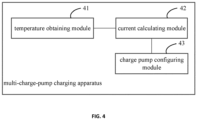
- the apparatus includes a temperature obtaining module 41, configured to obtain a temperature of each one of temperature zones in a terminal, where each one of the temperature zones includes a charging associated device, and the charging associated device is a charge pump or a battery.
- the apparatus can further include a current calculating module 42, configured to determine for each one of the temperature zones, based on the temperature of the temperature zone, a maximum charging current allowed by the charging associated device in the temperature zone, and a charge pump configuring module 43, configured to: determine from multiple charge pumps of the terminal, based on the maximum charging current allowed by each one of charging associated devices, a target charge pump to be used, and configure the target charge pump for charging.
- a current calculating module 42 configured to determine for each one of the temperature zones, based on the temperature of the temperature zone, a maximum charging current allowed by the charging associated device in the temperature zone
- a charge pump configuring module 43 configured to: determine from multiple charge pumps of the terminal, based on the maximum charging current allowed by each one of charging associated devices, a target charge pump to be used, and configure the target charge pump for charging.
- the current calculating module 42 is specifically configured to determine for each one of the temperature zones, based on the temperature of the temperature zone and a working state of a heating device in the temperature zone, the maximum charging current allowed by the charging associated device in the temperature zone, where the heating device is a device that generates heat in the working state.
- the heating device includes at least one of:
- the charge pump configuring module 43 is specifically configured to, when the maximum charging current allowed by the battery is not less than a charge pump turning on threshold, calculate, based on the maximum charging current allowed by each one of the charge pumps, maximum theoretical currents of turning on different numbers of charge pumps respectively, where the maximum theoretical current is a maximum value, when the different numbers of charge pumps are turned on, of a total current of all charge pumps that are turned on for charging the battery, and compare the maximum charging current allowed by the battery with the maximum theoretical currents of turning on the different numbers of charge pumps.
- the charge pump configuring module 43 can further be configured to determine, in response to a presence of a maximum theoretical current being greater than the maximum charging current allowed by the battery, a maximum value of a number of charge pumps, that are turned on, corresponding to the maximum theoretical current greater than the maximum charging current allowed by the battery as a target number and configure the target charge pump of the target number for charging, where the target charge pump is a charge pump corresponding to a maximum charging current of the target number that is the largest among the maximum charging currents allowed by the multiple charge pumps.
- the charge pump configuring module 43 is specifically configured to compare, based on numbers of charge pumps that are turned on, from highest to lowest, the maximum charging current allowed by the battery with the maximum theoretical currents of turning on the different numbers of charge pumps, and, in response to the presence of a maximum theoretical current being greater than the maximum charging current allowed by the battery, terminate the comparing, and determine the number of charge pumps, that are turned on, corresponding to the maximum theoretical current greater than the maximum charging current allowed by the battery as the target number.
- the charge pump configuring module 43 is further configured to, in response to the maximum theoretical currents of turning on the different numbers of charge pumps being less than the maximum charging current allowed by the battery, select a maximum value among the maximum theoretical currents of turning on the different numbers of charge pumps, and determine a number of charge pumps, that are turned on, corresponding to the maximum value as the target number.
- the charging associated device further includes a power management chip
- the charge pump configuring module 43 is further configured to: when the maximum charging current allowed by the battery is less than a charge pump turning on threshold, not turn on the charge pump, and configure the power management chip for charging.
- a terminal including a processor and a memory configured to store an executable instruction executable by the processor.
- the processor is configured to execute the executable instruction to implement any one of the multi-charge-pump charging methods described above.
- FIG. 5 is a schematic structural diagram of a terminal 500 illustrated according to an embodiment.
- the terminal 500 may be a user device, which may be specifically a cell phone, a computer, a digital broadcasting terminal, a message transceiver device, a gaming console, a tablet device, a medical device, a fitness device, a personal digital assistant, a wearable device such as a smartwatch, smart glasses, a smart bracelet, a smart running shoe, and the like.
- the terminal 500 may include one or more of the following components: a processing component 502, a memory 504, a power supply component 506, a multimedia component 508, an audio component 510, an input/output (I/O) interface 512, a sensor component 514, and a communication component 516.
- the processing component 502 generally controls the overall operation of the terminal 500, such as operations associated with display, telephone calls, data communication, camera operations, and recording operations.
- the processing component 502 may include one or more processors 520 to execute an instruction to complete all or some of the steps of the methods described above.
- the processing component 502 may include one or more modules that facilitate interaction between the processing component 502 and other components.
- the processing component 502 may include a multimedia module to facilitate interaction between the multimedia component 508 and the processing component 502.
- the memory 504 is configured to store various types of data to support the operations at the terminal 500. Examples of such data include the following for any application or method to operate on the terminal 500: instructions, contact data, phonebook data, messages, pictures, videos, etc.
- the memory 504 may be implemented by any type of volatile or non-volatile storage device or a combination thereof, such as a static random access memory (SRAM), electrically erasable programmable read-only memory (EEPROM), erasable programmable read-only memory (EPROM), programmable read-only memory (PROM), read-only memory (ROM), magnetic memory, flash memory, disk or CD-ROM.
- SRAM static random access memory
- EEPROM electrically erasable programmable read-only memory
- EPROM erasable programmable read-only memory
- PROM programmable read-only memory
- ROM read-only memory
- magnetic memory magnetic memory
- flash memory disk or CD-ROM.
- the power supply component 506 supplies power to various components of the terminal 500.
- the power supply component 506 may include a power supply management system, one or more power supplies, and other components associated with generating, managing, and distributing power for the terminal 500.
- the multimedia component 508 includes a screen that provides an output interface between the terminal 500 and a user.
- the screen may include a liquid crystal display (LCD) and a touch panel (TP). If the screen includes a touch panel, the screen may be implemented as a touch screen to receive input signals from the user.
- the touch panel includes one or more touch sensors to sense touches, swipes, and gestures on the touch panel. The touch sensor may not only sense the boundaries of the touch or swipe action, but also detect the duration and pressure associated with the touch or swipe action.
- the multimedia component 508 includes a front-facing camera and/or a rear-facing camera.
- the front-facing camera and/or the rear-facing camera may receive external multimedia data when the terminal 500 is in an operating mode, such as a shooting mode or a video mode.
- an operating mode such as a shooting mode or a video mode.
- Each of the front-facing camera and the rear-facing camera may be a fixed optical lens system or have a focal length and optical zoom capability.
- the audio component 510 is configured to output and/or input audio signals.
- the audio component 510 includes a microphone (MIC), configured to receive external audio signals when the terminal 500 is in an operating mode, such as a calling mode, a recording mode, and a voice recognition mode.
- the received audio signals may be further stored in the memory 504 or sent via the communication component 516.
- the audio component 510 further includes a speaker for outputting the audio signals.
- the I/O interface 512 provides an interface between the processing component 502 and a peripheral interface module, and the peripheral interface module may be a keypad, a click wheel, a button, etc. These buttons may include, but are not limited to, a home button, a volume button, a start button, and a lock button.
- the sensor component 514 includes one or more sensors, configured to provide a status assessment of various aspects of the terminal 500.
- the sensor component 514 may detect an open/closed state of the terminal 500, relative positioning of the components, for example, the components are the display and keypad of the terminal 500, the sensor component 514 may also detect a change in the position of the terminal 500 or a change in the position of one component of the terminal 500, the presence or absence of user contact with the terminal 500, the orientation or acceleration/deceleration of the terminal 500, and temperature changes of the terminal 500.
- the sensor component 514 may include a proximity sensor, configured to detect the presence of nearby objects in the absence of any physical contact.
- the sensor component 514 may also include a light sensor, such as a CMOS or CCD image sensor, for use in imaging applications.
- the sensor component 514 may also include an accelerometer sensor, a gyroscope sensor, a magnetic sensor, a pressure sensor, or a temperature sensor.
- the communication component 516 is configured to facilitate the communication between the terminal 500 and other devices by wired or wireless means.
- the terminal 500 may access a wireless network based on any communication standard, such as Wi-Fi, 2G, 3G, 4G LTE, 5G NR or a combination thereof.
- the communication component 516 receives broadcast signals or broadcast-related information from an external broadcast management system via a broadcast channel.
- the communication component 516 further includes a near-field communication (NFC) module to facilitate short-range communication.
- the NFC module may be implemented based on a radio frequency identification (RFID) technology, infrared data association (IrDA) technology, ultra-wideband (UWB) technology, bluetooth (BT) technology, and the like.
- RFID radio frequency identification
- IrDA infrared data association
- UWB ultra-wideband
- BT bluetooth
- the terminal 500 may be implemented by one or more of: an application-specific integrated circuit (ASIC), a digital signal processor (DSP), a digital signal processing device (DSPD), a programmable logic device (PLD), a field-programmable gate array (FPGA), a controller, a microcontroller, a microprocessor, or other electronic element, to perform the above methods.
- ASIC application-specific integrated circuit
- DSP digital signal processor
- DSPD digital signal processing device
- PLD programmable logic device
- FPGA field-programmable gate array
- controller a microcontroller, a microprocessor, or other electronic element, to perform the above methods.
- a non-transitory computer-readable storage medium such as a memory 504 including an instruction.
- the instruction in the storage medium when executed by the processor 520 of the terminal 500, enables the terminal 500 to perform any one of the multi-charge-pump charging methods described above.
- the non-transitory computer-readable storage medium may be a ROM, a random access memory (RAM), a CD-ROM, a magnetic tape, a floppy disk, an optical data storage device, etc.
Landscapes
- Engineering & Computer Science (AREA)
- Power Engineering (AREA)
- Computer Networks & Wireless Communication (AREA)
- Manufacturing & Machinery (AREA)
- Chemical & Material Sciences (AREA)
- Chemical Kinetics & Catalysis (AREA)
- Electrochemistry (AREA)
- General Chemical & Material Sciences (AREA)
- Charge And Discharge Circuits For Batteries Or The Like (AREA)
Applications Claiming Priority (1)
| Application Number | Priority Date | Filing Date | Title |
|---|---|---|---|
| CN202310749505.7A CN119182192A (zh) | 2023-06-21 | 2023-06-21 | 一种多电荷泵充电方法及装置、终端 |
Publications (1)
| Publication Number | Publication Date |
|---|---|
| EP4481981A1 true EP4481981A1 (de) | 2024-12-25 |
Family
ID=88837389
Family Applications (1)
| Application Number | Title | Priority Date | Filing Date |
|---|---|---|---|
| EP23210038.8A Pending EP4481981A1 (de) | 2023-06-21 | 2023-11-15 | Ladeverfahren und -vorrichtung mit mehreren ladepumpen sowie endgerät |
Country Status (3)
| Country | Link |
|---|---|
| US (1) | US20240429731A1 (de) |
| EP (1) | EP4481981A1 (de) |
| CN (1) | CN119182192A (de) |
Citations (2)
| Publication number | Priority date | Publication date | Assignee | Title |
|---|---|---|---|---|
| US20190260093A1 (en) * | 2016-09-29 | 2019-08-22 | Shenzhen Royole Technologies Co. Ltd. | Method for controlling fast charging, system for controlling fast charging, and terminal device |
| US20210288513A1 (en) * | 2020-03-13 | 2021-09-16 | Beijing Xiaomi Mobile Software Co.. Ltd. | Charging control method and apparatus |
-
2023
- 2023-06-21 CN CN202310749505.7A patent/CN119182192A/zh active Pending
- 2023-11-03 US US18/501,749 patent/US20240429731A1/en active Pending
- 2023-11-15 EP EP23210038.8A patent/EP4481981A1/de active Pending
Patent Citations (2)
| Publication number | Priority date | Publication date | Assignee | Title |
|---|---|---|---|---|
| US20190260093A1 (en) * | 2016-09-29 | 2019-08-22 | Shenzhen Royole Technologies Co. Ltd. | Method for controlling fast charging, system for controlling fast charging, and terminal device |
| US20210288513A1 (en) * | 2020-03-13 | 2021-09-16 | Beijing Xiaomi Mobile Software Co.. Ltd. | Charging control method and apparatus |
Also Published As
| Publication number | Publication date |
|---|---|
| CN119182192A (zh) | 2024-12-24 |
| US20240429731A1 (en) | 2024-12-26 |
Similar Documents
| Publication | Publication Date | Title |
|---|---|---|
| JP6239154B2 (ja) | 端末機器の充電制御方法及び装置、プログラム及び記録媒体 | |
| CN108365657B (zh) | 充电电流的控制方法、装置和存储介质 | |
| KR102471940B1 (ko) | 배터리 충전 방법, 배터리 충전 장치 및 저장 매체 | |
| US11264813B2 (en) | Charging circuit, terminal and charging method | |
| CN112909364B (zh) | 充电方法及装置、终端设备、存储介质 | |
| CN113224822B (zh) | 一种充电控制方法、装置以及存储介质 | |
| CN113725954B (zh) | 充电方法、装置、设备及存储介质 | |
| CN105162193A (zh) | 终端的充电方法、装置及终端 | |
| CN105068632A (zh) | 终端的充电方法、装置及终端 | |
| CN114594869B (zh) | 触控屏的报点方法及装置 | |
| EP4481981A1 (de) | Ladeverfahren und -vorrichtung mit mehreren ladepumpen sowie endgerät | |
| US12334746B2 (en) | Power supply method and apparatus, electronic device and storage medium | |
| CN114069744A (zh) | 一种智能充电方法、装置及存储介质 | |
| EP3961492B1 (de) | Anzeigemodul, berührungsverfahren und endgerät | |
| CN111509789B (zh) | 充电方法及装置 | |
| CN112909366B (zh) | 充电方法及装置、终端设备、存储介质 | |
| US20230244287A1 (en) | Method and apparatus of temperature control, and storage medium | |
| US12444968B2 (en) | Charging method and device, terminal device and computer readable storage medium | |
| CN115882533B (zh) | 充电控制的方法、装置和存储介质 | |
| CN113138036B (zh) | 温度检测方法及装置、电子设备 | |
| CN120342007A (zh) | 充电方法、装置、电子设备及存储介质 | |
| CN116247753A (zh) | 充电方法、装置、终端及存储介质 | |
| CN114362294A (zh) | 充电控制参数确定方法及装置、电子设备及存储介质 | |
| CN105162194A (zh) | 终端的充电方法、装置及终端 | |
| CN117013629A (zh) | 充电方法、装置、电子设备及可读储存介质 |
Legal Events
| Date | Code | Title | Description |
|---|---|---|---|
| PUAI | Public reference made under article 153(3) epc to a published international application that has entered the european phase |
Free format text: ORIGINAL CODE: 0009012 |
|
| STAA | Information on the status of an ep patent application or granted ep patent |
Free format text: STATUS: THE APPLICATION HAS BEEN PUBLISHED |
|
| STAA | Information on the status of an ep patent application or granted ep patent |
Free format text: STATUS: REQUEST FOR EXAMINATION WAS MADE |
|
| AK | Designated contracting states |
Kind code of ref document: A1 Designated state(s): AL AT BE BG CH CY CZ DE DK EE ES FI FR GB GR HR HU IE IS IT LI LT LU LV MC ME MK MT NL NO PL PT RO RS SE SI SK SM TR |
|
| 17P | Request for examination filed |
Effective date: 20241126 |
|
| RBV | Designated contracting states (corrected) |
Designated state(s): AL AT BE BG CH CY CZ DE DK EE ES FI FR GB GR HR HU IE IS IT LI LT LU LV MC ME MK MT NL NO PL PT RO RS SE SI SK SM TR |