EP4480950A1 - Nitrogen-containing heterocyclic compound having oxime group, agricultural/horticultural herbicide containing said compound, and use of both of foregoing - Google Patents
Nitrogen-containing heterocyclic compound having oxime group, agricultural/horticultural herbicide containing said compound, and use of both of foregoing Download PDFInfo
- Publication number
- EP4480950A1 EP4480950A1 EP23796527.2A EP23796527A EP4480950A1 EP 4480950 A1 EP4480950 A1 EP 4480950A1 EP 23796527 A EP23796527 A EP 23796527A EP 4480950 A1 EP4480950 A1 EP 4480950A1
- Authority
- EP
- European Patent Office
- Prior art keywords
- group
- substituents
- halo
- ring
- nhme
- Prior art date
- Legal status (The legal status is an assumption and is not a legal conclusion. Google has not performed a legal analysis and makes no representation as to the accuracy of the status listed.)
- Pending
Links
Classifications
-
- A—HUMAN NECESSITIES
- A01—AGRICULTURE; FORESTRY; ANIMAL HUSBANDRY; HUNTING; TRAPPING; FISHING
- A01N—PRESERVATION OF BODIES OF HUMANS OR ANIMALS OR PLANTS OR PARTS THEREOF; BIOCIDES, e.g. AS DISINFECTANTS, AS PESTICIDES OR AS HERBICIDES; PEST REPELLANTS OR ATTRACTANTS; PLANT GROWTH REGULATORS
- A01N43/00—Biocides, pest repellants or attractants, or plant growth regulators containing heterocyclic compounds
- A01N43/64—Biocides, pest repellants or attractants, or plant growth regulators containing heterocyclic compounds having rings with three nitrogen atoms as the only ring hetero atoms
- A01N43/647—Triazoles; Hydrogenated triazoles
- A01N43/653—1,2,4-Triazoles; Hydrogenated 1,2,4-triazoles
-
- A—HUMAN NECESSITIES
- A01—AGRICULTURE; FORESTRY; ANIMAL HUSBANDRY; HUNTING; TRAPPING; FISHING
- A01N—PRESERVATION OF BODIES OF HUMANS OR ANIMALS OR PLANTS OR PARTS THEREOF; BIOCIDES, e.g. AS DISINFECTANTS, AS PESTICIDES OR AS HERBICIDES; PEST REPELLANTS OR ATTRACTANTS; PLANT GROWTH REGULATORS
- A01N43/00—Biocides, pest repellants or attractants, or plant growth regulators containing heterocyclic compounds
- A01N43/34—Biocides, pest repellants or attractants, or plant growth regulators containing heterocyclic compounds having rings with one nitrogen atom as the only ring hetero atom
- A01N43/40—Biocides, pest repellants or attractants, or plant growth regulators containing heterocyclic compounds having rings with one nitrogen atom as the only ring hetero atom six-membered rings
-
- A—HUMAN NECESSITIES
- A01—AGRICULTURE; FORESTRY; ANIMAL HUSBANDRY; HUNTING; TRAPPING; FISHING
- A01N—PRESERVATION OF BODIES OF HUMANS OR ANIMALS OR PLANTS OR PARTS THEREOF; BIOCIDES, e.g. AS DISINFECTANTS, AS PESTICIDES OR AS HERBICIDES; PEST REPELLANTS OR ATTRACTANTS; PLANT GROWTH REGULATORS
- A01N43/00—Biocides, pest repellants or attractants, or plant growth regulators containing heterocyclic compounds
- A01N43/48—Biocides, pest repellants or attractants, or plant growth regulators containing heterocyclic compounds having rings with two nitrogen atoms as the only ring hetero atoms
- A01N43/50—1,3-Diazoles; Hydrogenated 1,3-diazoles
-
- A—HUMAN NECESSITIES
- A01—AGRICULTURE; FORESTRY; ANIMAL HUSBANDRY; HUNTING; TRAPPING; FISHING
- A01N—PRESERVATION OF BODIES OF HUMANS OR ANIMALS OR PLANTS OR PARTS THEREOF; BIOCIDES, e.g. AS DISINFECTANTS, AS PESTICIDES OR AS HERBICIDES; PEST REPELLANTS OR ATTRACTANTS; PLANT GROWTH REGULATORS
- A01N43/00—Biocides, pest repellants or attractants, or plant growth regulators containing heterocyclic compounds
- A01N43/48—Biocides, pest repellants or attractants, or plant growth regulators containing heterocyclic compounds having rings with two nitrogen atoms as the only ring hetero atoms
- A01N43/56—1,2-Diazoles; Hydrogenated 1,2-diazoles
-
- A—HUMAN NECESSITIES
- A01—AGRICULTURE; FORESTRY; ANIMAL HUSBANDRY; HUNTING; TRAPPING; FISHING
- A01N—PRESERVATION OF BODIES OF HUMANS OR ANIMALS OR PLANTS OR PARTS THEREOF; BIOCIDES, e.g. AS DISINFECTANTS, AS PESTICIDES OR AS HERBICIDES; PEST REPELLANTS OR ATTRACTANTS; PLANT GROWTH REGULATORS
- A01N43/00—Biocides, pest repellants or attractants, or plant growth regulators containing heterocyclic compounds
- A01N43/64—Biocides, pest repellants or attractants, or plant growth regulators containing heterocyclic compounds having rings with three nitrogen atoms as the only ring hetero atoms
- A01N43/647—Triazoles; Hydrogenated triazoles
-
- A—HUMAN NECESSITIES
- A01—AGRICULTURE; FORESTRY; ANIMAL HUSBANDRY; HUNTING; TRAPPING; FISHING
- A01N—PRESERVATION OF BODIES OF HUMANS OR ANIMALS OR PLANTS OR PARTS THEREOF; BIOCIDES, e.g. AS DISINFECTANTS, AS PESTICIDES OR AS HERBICIDES; PEST REPELLANTS OR ATTRACTANTS; PLANT GROWTH REGULATORS
- A01N43/00—Biocides, pest repellants or attractants, or plant growth regulators containing heterocyclic compounds
- A01N43/64—Biocides, pest repellants or attractants, or plant growth regulators containing heterocyclic compounds having rings with three nitrogen atoms as the only ring hetero atoms
- A01N43/707—1,2,3- or 1,2,4-triazines; Hydrogenated 1,2,3- or 1,2,4-triazines
-
- A—HUMAN NECESSITIES
- A01—AGRICULTURE; FORESTRY; ANIMAL HUSBANDRY; HUNTING; TRAPPING; FISHING
- A01N—PRESERVATION OF BODIES OF HUMANS OR ANIMALS OR PLANTS OR PARTS THEREOF; BIOCIDES, e.g. AS DISINFECTANTS, AS PESTICIDES OR AS HERBICIDES; PEST REPELLANTS OR ATTRACTANTS; PLANT GROWTH REGULATORS
- A01N43/00—Biocides, pest repellants or attractants, or plant growth regulators containing heterocyclic compounds
- A01N43/72—Biocides, pest repellants or attractants, or plant growth regulators containing heterocyclic compounds having rings with nitrogen atoms and oxygen or sulfur atoms as ring hetero atoms
- A01N43/74—Biocides, pest repellants or attractants, or plant growth regulators containing heterocyclic compounds having rings with nitrogen atoms and oxygen or sulfur atoms as ring hetero atoms five-membered rings with one nitrogen atom and either one oxygen atom or one sulfur atom in positions 1,3
- A01N43/78—1,3-Thiazoles; Hydrogenated 1,3-thiazoles
-
- A—HUMAN NECESSITIES
- A01—AGRICULTURE; FORESTRY; ANIMAL HUSBANDRY; HUNTING; TRAPPING; FISHING
- A01P—BIOCIDAL, PEST REPELLANT, PEST ATTRACTANT OR PLANT GROWTH REGULATORY ACTIVITY OF CHEMICAL COMPOUNDS OR PREPARATIONS
- A01P13/00—Herbicides; Algicides
-
- C—CHEMISTRY; METALLURGY
- C07—ORGANIC CHEMISTRY
- C07D—HETEROCYCLIC COMPOUNDS
- C07D231/00—Heterocyclic compounds containing 1,2-diazole or hydrogenated 1,2-diazole rings
- C07D231/02—Heterocyclic compounds containing 1,2-diazole or hydrogenated 1,2-diazole rings not condensed with other rings
- C07D231/10—Heterocyclic compounds containing 1,2-diazole or hydrogenated 1,2-diazole rings not condensed with other rings having two or three double bonds between ring members or between ring members and non-ring members
- C07D231/12—Heterocyclic compounds containing 1,2-diazole or hydrogenated 1,2-diazole rings not condensed with other rings having two or three double bonds between ring members or between ring members and non-ring members with only hydrogen atoms, hydrocarbon or substituted hydrocarbon radicals, directly attached to ring carbon atoms
-
- C—CHEMISTRY; METALLURGY
- C07—ORGANIC CHEMISTRY
- C07D—HETEROCYCLIC COMPOUNDS
- C07D249/00—Heterocyclic compounds containing five-membered rings having three nitrogen atoms as the only ring hetero atoms
- C07D249/02—Heterocyclic compounds containing five-membered rings having three nitrogen atoms as the only ring hetero atoms not condensed with other rings
- C07D249/08—1,2,4-Triazoles; Hydrogenated 1,2,4-triazoles
-
- C—CHEMISTRY; METALLURGY
- C07—ORGANIC CHEMISTRY
- C07D—HETEROCYCLIC COMPOUNDS
- C07D277/00—Heterocyclic compounds containing 1,3-thiazole or hydrogenated 1,3-thiazole rings
- C07D277/02—Heterocyclic compounds containing 1,3-thiazole or hydrogenated 1,3-thiazole rings not condensed with other rings
- C07D277/20—Heterocyclic compounds containing 1,3-thiazole or hydrogenated 1,3-thiazole rings not condensed with other rings having two or three double bonds between ring members or between ring members and non-ring members
- C07D277/22—Heterocyclic compounds containing 1,3-thiazole or hydrogenated 1,3-thiazole rings not condensed with other rings having two or three double bonds between ring members or between ring members and non-ring members with only hydrogen atoms, hydrocarbon or substituted hydrocarbon radicals, directly attached to ring carbon atoms
- C07D277/30—Radicals substituted by carbon atoms having three bonds to hetero atoms with at the most one bond to halogen, e.g. ester or nitrile radicals
-
- C—CHEMISTRY; METALLURGY
- C07—ORGANIC CHEMISTRY
- C07D—HETEROCYCLIC COMPOUNDS
- C07D401/00—Heterocyclic compounds containing two or more hetero rings, having nitrogen atoms as the only ring hetero atoms, at least one ring being a six-membered ring with only one nitrogen atom
- C07D401/02—Heterocyclic compounds containing two or more hetero rings, having nitrogen atoms as the only ring hetero atoms, at least one ring being a six-membered ring with only one nitrogen atom containing two hetero rings
- C07D401/04—Heterocyclic compounds containing two or more hetero rings, having nitrogen atoms as the only ring hetero atoms, at least one ring being a six-membered ring with only one nitrogen atom containing two hetero rings directly linked by a ring-member-to-ring-member bond
-
- C—CHEMISTRY; METALLURGY
- C07—ORGANIC CHEMISTRY
- C07D—HETEROCYCLIC COMPOUNDS
- C07D401/00—Heterocyclic compounds containing two or more hetero rings, having nitrogen atoms as the only ring hetero atoms, at least one ring being a six-membered ring with only one nitrogen atom
- C07D401/14—Heterocyclic compounds containing two or more hetero rings, having nitrogen atoms as the only ring hetero atoms, at least one ring being a six-membered ring with only one nitrogen atom containing three or more hetero rings
-
- C—CHEMISTRY; METALLURGY
- C07—ORGANIC CHEMISTRY
- C07D—HETEROCYCLIC COMPOUNDS
- C07D403/00—Heterocyclic compounds containing two or more hetero rings, having nitrogen atoms as the only ring hetero atoms, not provided for by group C07D401/00
- C07D403/02—Heterocyclic compounds containing two or more hetero rings, having nitrogen atoms as the only ring hetero atoms, not provided for by group C07D401/00 containing two hetero rings
- C07D403/04—Heterocyclic compounds containing two or more hetero rings, having nitrogen atoms as the only ring hetero atoms, not provided for by group C07D401/00 containing two hetero rings directly linked by a ring-member-to-ring-member bond
-
- C—CHEMISTRY; METALLURGY
- C07—ORGANIC CHEMISTRY
- C07D—HETEROCYCLIC COMPOUNDS
- C07D405/00—Heterocyclic compounds containing both one or more hetero rings having oxygen atoms as the only ring hetero atoms, and one or more rings having nitrogen as the only ring hetero atom
- C07D405/14—Heterocyclic compounds containing both one or more hetero rings having oxygen atoms as the only ring hetero atoms, and one or more rings having nitrogen as the only ring hetero atom containing three or more hetero rings
-
- C—CHEMISTRY; METALLURGY
- C07—ORGANIC CHEMISTRY
- C07D—HETEROCYCLIC COMPOUNDS
- C07D409/00—Heterocyclic compounds containing two or more hetero rings, at least one ring having sulfur atoms as the only ring hetero atoms
- C07D409/02—Heterocyclic compounds containing two or more hetero rings, at least one ring having sulfur atoms as the only ring hetero atoms containing two hetero rings
- C07D409/04—Heterocyclic compounds containing two or more hetero rings, at least one ring having sulfur atoms as the only ring hetero atoms containing two hetero rings directly linked by a ring-member-to-ring-member bond
-
- C—CHEMISTRY; METALLURGY
- C07—ORGANIC CHEMISTRY
- C07D—HETEROCYCLIC COMPOUNDS
- C07D409/00—Heterocyclic compounds containing two or more hetero rings, at least one ring having sulfur atoms as the only ring hetero atoms
- C07D409/14—Heterocyclic compounds containing two or more hetero rings, at least one ring having sulfur atoms as the only ring hetero atoms containing three or more hetero rings
-
- C—CHEMISTRY; METALLURGY
- C07—ORGANIC CHEMISTRY
- C07D—HETEROCYCLIC COMPOUNDS
- C07D413/00—Heterocyclic compounds containing two or more hetero rings, at least one ring having nitrogen and oxygen atoms as the only ring hetero atoms
- C07D413/02—Heterocyclic compounds containing two or more hetero rings, at least one ring having nitrogen and oxygen atoms as the only ring hetero atoms containing two hetero rings
- C07D413/04—Heterocyclic compounds containing two or more hetero rings, at least one ring having nitrogen and oxygen atoms as the only ring hetero atoms containing two hetero rings directly linked by a ring-member-to-ring-member bond
-
- C—CHEMISTRY; METALLURGY
- C07—ORGANIC CHEMISTRY
- C07D—HETEROCYCLIC COMPOUNDS
- C07D413/00—Heterocyclic compounds containing two or more hetero rings, at least one ring having nitrogen and oxygen atoms as the only ring hetero atoms
- C07D413/14—Heterocyclic compounds containing two or more hetero rings, at least one ring having nitrogen and oxygen atoms as the only ring hetero atoms containing three or more hetero rings
-
- C—CHEMISTRY; METALLURGY
- C07—ORGANIC CHEMISTRY
- C07D—HETEROCYCLIC COMPOUNDS
- C07D417/00—Heterocyclic compounds containing two or more hetero rings, at least one ring having nitrogen and sulfur atoms as the only ring hetero atoms, not provided for by group C07D415/00
- C07D417/02—Heterocyclic compounds containing two or more hetero rings, at least one ring having nitrogen and sulfur atoms as the only ring hetero atoms, not provided for by group C07D415/00 containing two hetero rings
- C07D417/04—Heterocyclic compounds containing two or more hetero rings, at least one ring having nitrogen and sulfur atoms as the only ring hetero atoms, not provided for by group C07D415/00 containing two hetero rings directly linked by a ring-member-to-ring-member bond
-
- C—CHEMISTRY; METALLURGY
- C07—ORGANIC CHEMISTRY
- C07D—HETEROCYCLIC COMPOUNDS
- C07D417/00—Heterocyclic compounds containing two or more hetero rings, at least one ring having nitrogen and sulfur atoms as the only ring hetero atoms, not provided for by group C07D415/00
- C07D417/14—Heterocyclic compounds containing two or more hetero rings, at least one ring having nitrogen and sulfur atoms as the only ring hetero atoms, not provided for by group C07D415/00 containing three or more hetero rings
Definitions
- the present invention relates to a nitrogen-containing heterocyclic compound having an oxime group and a salt thereof, an agricultural or horticultural herbicide comprising the compound or the salt thereof as an active ingredient, and a method for using the compound or the salt thereof or the herbicide.
- Patent literature 1 describes certain kinds of nitrogen-containing condensed heterocyclic compounds having an oxime group that have insecticidal activity. However, the literature does not describe the specific structure of the compound of the present invention, nor does it disclose or suggest any compounds useful as herbicides.
- Patent Literature 1 WO 2017/065183
- a stable and secure food supply is essential to resolve the food crisis that is anticipated to come in the near future due to global population growth.
- the stable and secure food supply requires economical and efficient elimination or control of weeds that interfere with crop cultivation and harvest. Therefore, it is becoming increasingly important to develop new herbicides and plant growth regulators that can provide solutions to this problem.
- the present invention is intended to provide a novel herbicide having both high safety for crops and excellent herbicidal activity against weeds.
- the present inventors After conducting extensive research to develop a novel agricultural or horticultural herbicide, the present inventors found that the nitrogen-containing heterocyclic compound having an oxime group represented by the general formula (1) of the present invention or a salt thereof is useful as an agricultural or horticultural herbicide. Based on this finding, the present inventors completed the present invention.
- the present invention includes the following.
- the nitrogen-containing heterocyclic compound having an oxime group of the present invention or a salt thereof is a highly effective agricultural or horticultural herbicide.
- halo means "halogen atom” and is usually exemplified by a chlorine atom, a bromine atom, an iodine atom, or a fluorine atom.
- (C 1 -C 6 ) alkyl group refers to a straight-chain or branched-chain alkyl group of 1 to 6 carbon atoms, for example, a methyl group, an ethyl group, a n-propyl group, an isopropyl group, a n-butyl group, an isobutyl group, a sec-butyl group, a tert-butyl group, a n-pentyl group, an isopentyl group, a tert-pentyl group, a neopentyl group, a 2,3-dimethylpropyl group, an 1-ethylpropyl group, a 1-methylbutyl group, a 2-methylbutyl group, a n-hexyl group, an isohexyl group, a 2-hexyl group, a 3-hexyl group, a 2-methylpentyl group, a 3-methylpentyl group
- (C 2 -C 6 ) alkenyl group refers to a straight-chain or branched-chain alkenyl group of 2 to 6 carbon atoms, for example, a vinyl group, an allyl group, an isopropenyl group, a 1-butenyl group, a 2-butenyl group, a 2-methyl-2-propenyl group, a 1-methyl-2-propenyl group, a 2-methyl-1-propenyl group, a pentenyl group, a 1-hexenyl group, a 3,3-dimethyl-1-butenyl group or the like.
- (C 2 -C 6 ) alkynyl group refers to a straight-chain or branched-chain alkynyl group of 2 to 6 carbon atoms, for example, an ethynyl group, a 1-propynyl group, a 2-propynyl group, a 1-butynyl group, a 2-butynyl group, a 3-butynyl group, a 3-methyl-1-propynyl group, a 2-methyl-3-propynyl group, a pentynyl group, a 1-hexynyl group, a 3-methyl-1-butynyl group, a 3,3-dimethyl-1-butynyl group or the like.
- (C 3 -C 6 ) cycloalkyl group refers to a cyclic alkyl group of 3 to 6 carbon atoms, for example, a cyclopropyl group, a cyclobutyl group, a cyclopentyl group, a cyclohexyl group or the like.
- (C 1 -C 6 ) alkoxy group refers to a straight-chain or branched-chain alkoxy group of 1 to 6 carbon atoms, for example, a methoxy group, an ethoxy group, a n-propoxy group, an isopropoxy group, a n-butoxy group, a sec-butoxy group, a tert-butoxy group, a n-pentyloxy group, an isopentyloxy group, a tert-pentyloxy group, a neopentyloxy group, a 2,3-dimethylpropyloxy group, an 1-ethylpropyloxy group, a 1-methylbutyloxy group, a n-hexyloxy group, an isohexyloxy group, a 1,1,2-trimethylpropyloxy group or the like.
- (C 2 -C 6 ) alkenyloxy group refers to a straight-chain or branched-chain alkenyloxy group of 2 to 6 carbon atoms, for example, a propenyloxy group, a butenyloxy group, a pentenyloxy group, a hexenyloxy group or the like.
- the "(C 2 -C 6 ) alkynyloxy group” refers to a straight-chain or branched-chain alkynyloxy group of 2 to 6 carbon atoms, for example, a propynyloxy group, a butynyloxy group, a pentynyloxy group, a hexynyloxy group or the like.
- (C 1 -C 6 ) alkylsulfanyl group refers to a straight-chain or branched-chain alkylsulfanyl group of 1 to 6 carbon atoms, for example, a methylthio group, an ethylthio group, a n-propylthio group, an isopropylthio group, a n-butylthio group, a sec-butylthio group, a tert-butylthio group, a n-pentylthio group, an isopentylthio group, a tert-pentylthio group, a neopentylthio group, a 2,3-dimethylpropylthio group, an 1-ethylpropylthio group, a 1-methylbutylthio group, a n-hexylthio group, an isohexylthio group, a 1,1,2-trimethylpropyl
- (C 1 -C 6 ) alkylsulfinyl group refers to a straight-chain or branched-chain alkylsulfinyl group of 1 to 6 carbon atoms, for example, a methylsulfinyl group, an ethylsulfinyl group, a n-propylsulfinyl group, an isopropylsulfinyl group, a n-butylsulfinyl group, a sec-butylsulfinyl group, a tert-butylsulfinyl group, a n-pentylsulfinyl group, an isopentylsulfinyl group, a tert-pentylsulfinyl group, a neopentylsulfinyl group, a 2,3-dimethylpropylsulfinyl group, an 1-ethylpropyl group
- (C 1 -C 6 ) alkylsulfonyl group refers to a straight-chain or branched-chain alkylsulfonyl group of 1 to 6 carbon atoms, for example, a methylsulfonyl group, an ethylsulfonyl group, a n-propylsulfonyl group, an isopropylsulfonyl group, a n-butylsulfonyl group, a sec-butylsulfonyl group, a tert-butylsulfonyl group, a n-pentylsulfonyl group, an isopentylsulfonyl group, a tert-pentylsulfonyl group, a neopentylsulfonyl group, a 2,3-dimethylpropylsulfonyl group, an 1-ethylpropyl group
- (C 1 -C 6 ) alkylcarbonyl group refers to an alkylcarbonyl group of 2 to 7 carbon atoms, for example, an alkylcarbonyl group in which the alkyl group is a (C 1 -C 6 ) alkyl group as defined above, such as an acetyl group, a propanoyl group, a butanoyl group, a 2-methylpropanoyl group, a pentanoyl group, a 2-methylbutanoyl group, a 3-methylbutanoyl group, a pivaloyl group, a hexanoyl group, or the like.
- (C 1 -C 6 ) alkylcarbonyloxy group refers to an alkylcarbonyloxy group of 2 to 7 carbon atoms, for example, an alkylcarbonyloxy group in which the alkyl group is a (C 1 -C 6 ) alkyl group as defined above, such as an acetyloxy group, a propanoyloxy group, a butanoyloxy group, a 2-methylpropanoyloxy group, a pentanoyloxy group, a 2-methylbutanoyloxy group, a 3-methylbutanoyloxy group, a pivaloyloxy group, a hexanoyloxy group, or the like.
- N-(C 1 -C 6 ) alkylaminocarbonyl group refers to an alkylaminocarbonyl group of 2 to 7 carbon atoms in which the alkyl group is a straight-chain or branched-chain alkyl group of 1 to 6 carbon atoms, for example, an N-methylaminocarbonyl group, an N-ethylaminocarbonyl group, an N-n-propylaminocarbonyl group, an N-isopropylaminocarbonyl group, an N-n-butylaminocarbonyl group, an N-isobutylaminocarbonyl group, an N-sec-butylaminocarbonyl group, an N-tert-butylaminocarbonyl group, an N-n-pentylaminocarbonyl group, an N-isopentylaminocarbonyl group, an N-tert-pentylaminocarbonyl group, an N-neopentylaminocarbony
- N,N-di-(C 1 -C 6 ) alkylaminocarbonyl group refers to an dialkylaminocarbonyl group of 3 to 13 carbon atoms in which the alkyl groups are straight-chain or branched-chain alkyl groups of 1 to 6 carbon atoms, for example, N,N-dimethylaminocarbonyl group, N,N-diethylaminocarbonyl group, N,N-di-n-propylaminocarbonyl group, N,N-diisopropylaminocarbonyl group, N,N-di-n-butylaminocarbonyl group, N,N-di-sec-butylaminocarbonyl group, N,N-di-tert-butylaminocarbonyl group, N-methyl-N-ethylaminocarbonyl group, N-methyl-N-n-propylaminocarbonyl group, N-methyl-N-isopropylamino
- (C 1 -C 6 ) alkoxycarbonyl group refers to an alkoxycarbonyl group of 2 to 7 carbon atoms, for example, an alkoxycarbonyl group in which the alkoxy group is a (C 1 -C 6 ) alkoxy group as defined above, such as a methoxycarbonyl group, an ethoxycarbonyl group, a n-propoxycarbonyl group, an isopropoxycarbonyl group, a n-butoxycarbonyl group, an isobutoxycarbonyl group, a sec-butoxycarbonyl group, a tert-butoxycarbonyl group, a pentyloxycarbonyl group, or the like.
- the expressions "(C 1 -C 6 )”, “(C 2 -C 6 )”, “(C 3 -C 6 )”, etc. each represent the range of the number of carbon atoms in each group.
- the same definition holds true for groups in which two or more of the above-mentioned groups are coupled together, and for example, the "(C 1 -C 6 ) alkoxy (C 1 -C 6 ) alkyl group” means that a straight-chain or branched-chain alkoxy group of 1 to 6 carbon atoms is bound to a straight-chain or branched-chain alkyl group of 1 to 6 carbon atoms.
- Examples of the salt of the compound represented by the general formula (1) of the present invention include inorganic acid salts, such as hydrochlorides, sulfates, nitrates and phosphates; organic acid salts, such as acetates, fumarates, maleates, oxalates, methanesulfonates, benzenesulfonates and p-toluenesulfonates; and salts with an inorganic or organic base such as a sodium ion, a potassium ion, a calcium ion and a trimethylammonium ion.
- inorganic acid salts such as hydrochlorides, sulfates, nitrates and phosphates
- organic acid salts such as acetates, fumarates, maleates, oxalates, methanesulfonates, benzenesulfonates and p-toluenesulfonates
- the compound represented by the general formula (1) of the present invention and a salt thereof can have one or more chiral centers in the structural formula and can exist as two or more kinds of optical isomers or diastereomers. All the optical isomers and mixtures of the isomers at any ratio are also included in the present invention. Further, the compound represented by the general formula (1) of the present invention and a salt thereof can exist as two kinds of geometric isomers due to a carbon-carbon double bond and a carbon-nitrogen double bond in the structural formula. All the geometric isomers and mixtures of the isomers at any ratio are also included in the present invention. In other words, the oxime group in the compound represented by the general formula (1) of the present invention may be in the form of an E (enthafen) isomer, a Z (zusammen) isomer, or a mixture of these isomers.
- Q is preferably Q1, Q2, Q3, Q4, Q5, Q6, Q7, Q8, Q9, or Q10, and more preferably Q1, Q2, Q3, Q4, Q5, Q6, Q7, Q8, or Q10.
- the set Y of substituents preferably consists of
- the set Y of substituents more preferably consists of
- R 4 is preferably
- R 5 is preferably
- A is preferably
- D is preferably D1 or D2, and more preferably D1.
- R 6a and R 6b preferably represent
- R 6a and R 6b may be the same or different.
- the compounds of the present invention can be produced according to, for example, the production methods described below, which are non-limiting examples.
- the compounds represented by the general formulae (1a) and (1a-1) of the present invention can be produced from the compound represented by the general formula (2a) through the steps [a], [b], and [c] described below.
- A, D, Q, and R 5 are the same as above;
- L represents a leaving group such as chlorine, bromine, iodine, or a (C 1 -C 6 ) alkylcarbonyloxy group;
- R 4' and R 4" represent a (C 1 -C 6 ) alkyl group, a (C 1 -C 6 ) alkylcarbonyl group, a halo (C 1 -C 6 ) alkylcarbonyl group, or a (C 1 -C 6 ) alkoxycarbonyl group, and R 4' and R 4" may be the same or different.
- the compound represented by the general formula (2a') can be produced by reacting the compound represented by the general formula (2a) with the compound represented by the general formula (3) or a salt thereof in the presence of a base and an inert solvent.
- Examples of the base that can be used in this reaction include inorganic bases such as sodium hydroxide, potassium hydroxide, sodium carbonate, potassium carbonate, sodium hydrogen carbonate and potassium hydrogen carbonate; acetates such as sodium acetate and potassium acetate; alkali metal alkoxides such as potassium tert-butoxide, sodium methoxide and sodium ethoxide; and organic bases including tertiary amines such as triethylamine, N,N-diisopropylethylamine and 1,8-diazabicyclo[5.4.0]undec-7-ene (DBU), and nitrogen-containing aromatic compounds such as pyridine and N,N-dimethyl-4-aminopyridine.
- the amount of the base used is usually in the range of a 1- to 10-fold molar amount relative to the compound represented by the general formula (2a).
- the inert solvent used in this reaction may be any solvent that does not markedly inhibit the progress of the reaction, and examples include chain or cyclic saturated hydrocarbons such as pentane, hexane, and cyclohexane; aromatic hydrocarbons such as benzene, toluene, and xylene; halogenated hydrocarbons such as methylene chloride, chloroform, and carbon tetrachloride; halogenated aromatic hydrocarbons such as chlorobenzene and dichlorobenzene; chain or cyclic ethers such as diethyl ether, methyl tert-butyl ether, dioxane, and tetrahydrofuran; nitriles such as acetonitrile and propionitrile; esters such as methyl acetate; ketones such as acetone and methyl ethyl ketone; aprotic polar solvents such as N,N-dimethylformamide, N,N-dimethyl
- inert solvents may be used alone, and also two or more of them may be used as a mixture.
- the amount of the inert solvent used is usually selected as appropriate from the range of 0.1 to 100 L relative to 1 mol of the compound represented by the general formula (2a).
- reaction temperature in this reaction is usually in the range of room temperature to the boiling point of the solvent used.
- reaction time varies with the reaction scale, the reaction temperature and the like and is not the same in every case, but is usually selected as appropriate from the range of a few minutes to 48 hours.
- the compound of interest is isolated from the post-reaction mixture by the usual method. As needed, recrystallization, column chromatography, etc. can be employed for the purification of the compound of interest. Alternatively, the post-reaction mixture may be directly used in the next step without isolation of the compound of interest.
- the compound represented by the general formula (1a) can be produced by reacting the compound represented by the general formula (2a') with the compound represented by the general formula (4) in the presence of an inert solvent and a base.
- Examples of the base that can be used in this reaction include inorganic bases such as sodium hydroxide, potassium hydroxide, sodium carbonate, potassium carbonate, cesium carbonate, sodium hydrogen carbonate, potassium hydrogen carbonate and sodium hydride; acetates such as sodium acetate and potassium acetate; alkali metal alkoxides such as potassium tert-butoxide, sodium methoxide and sodium ethoxide; tertiary amines such as triethylamine, N,N-diisopropylethylamine and DBU; and nitrogen-containing aromatic compounds such as pyridine and N,N-dimethyl-4-aminopyridine.
- the amount of the base used is usually in the range of a 1- to 10-fold molar amount relative to the compound represented by the general formula (2a').
- the inert solvent used in this reaction may be any solvent that does not markedly inhibit the progress of the reaction, and examples include aromatic hydrocarbons such as benzene, toluene and xylene; halogenated hydrocarbons such as methylene chloride, chloroform and carbon tetrachloride; halogenated aromatic hydrocarbons such as chlorobenzene and dichlorobenzene; chain or cyclic ethers such as diethyl ether, methyl tert-butyl ether, dioxane and tetrahydrofuran; esters such as ethyl acetate; amides such as N,N-dimethylformamide and N,N-dimethylacetamide; ketones such as acetone and methyl ethyl ketone; and polar solvents such as dimethyl sulfoxide and 1,3-dimethyl-2-imidazolidinone.
- aromatic hydrocarbons such as benzene, toluene and x
- inert solvents may be used alone, and also two or more of them may be used as a mixture.
- the amount of the inert solvent used is not particularly limited as long as it is sufficient to dissolve the reaction reagents, and is usually selected as appropriate from the range of 0.5 L to 100 L relative to 1 mole of the compound represented by the general formula (2a').
- reaction temperature in this reaction is usually in the range of room temperature to the boiling point of the solvent used.
- reaction time varies with the reaction scale, the reaction temperature and the like and is not the same in every case, but is usually selected as appropriate from the range of a few minutes to 48 hours.
- the compound of interest is isolated from the post-reaction mixture by the usual method. As needed, recrystallization, column chromatography, etc. can be employed for the purification of the compound of interest.
- the compound represented by the general formula (1a-1) can be produced by reacting the compound represented by the general formula (1a) with the compound represented by the general formula (5) and/or (5') in the presence of an inert solvent and a base.
- Examples of the base that can be used in this reaction include alkyllithiums such as methyllithium, n-butyllithium, sec-butyllithium and tert-butyllithium; organometallic compounds such as lithium hexamethyldisilazane and sodium hexamethyldisilazane; hydroxides such as lithium hydroxide, sodium hydroxide, potassium hydroxide and calcium hydroxide; carbonates such as lithium carbonate, lithium hydrogen carbonate, sodium carbonate, sodium hydrogen carbonate, potassium carbonate, cesium carbonate, potassium hydrogen carbonate, calcium carbonate and magnesium carbonate; acetates such as lithium acetate, sodium acetate and potassium acetate; alkoxides such as sodium methoxide, sodium ethoxide, sodium tert-butoxide and potassium tert-butoxide; metal hydrides such as sodium hydride and potassium hydride; and organic bases such as pyridine, picoline, lutidine, triethylamine,
- the inert solvent used in this reaction may be any solvent that does not markedly inhibit the progress of the reaction, and examples include aromatic hydrocarbons such as benzene, toluene and xylene; halogenated hydrocarbons such as methylene chloride, chloroform and carbon tetrachloride; halogenated aromatic hydrocarbons such as chlorobenzene and dichlorobenzene; chain or cyclic ethers such as diethyl ether, methyl tert-butyl ether, dioxane and tetrahydrofuran; esters such as ethyl acetate; amides such as N,N-dimethylformamide and N,N-dimethylacetamide; ketones such as acetone and methyl ethyl ketone; and polar solvents such as dimethyl sulfoxide and 1,3-dimethyl-2-imidazolidinone.
- aromatic hydrocarbons such as benzene, toluene and x
- inert solvents may be used alone, and also two or more of them may be used as a mixture.
- the amount of the inert solvent used is not particularly limited as long as it is sufficient to dissolve the reaction reagents, and is usually selected as appropriate from the range of 0.5 L to 100 L relative to 1 mole of the compound represented by the general formula (1a).
- reaction temperature in this reaction is usually in the range of room temperature to the boiling point of the solvent used.
- reaction time varies with the reaction scale, the reaction temperature and the like and is not the same in every case, but is usually selected as appropriate from the range of a few minutes to 48 hours.
- the compound of interest is isolated from the post-reaction mixture by the usual method. As needed, recrystallization, column chromatography, etc. can be employed for the purification of the compound of interest.
- the compound represented by the general formula (1a) can be produced from the compound represented by the general formula (2a) through the step [a'] described below.
- the compound represented by the general formula (1a) can be produced by reacting the compound represented by the general formula (2a) with the compound represented by the general formula (3') or a salt thereof in the presence of a base and an inert solvent.
- Examples of the base that can be used in this reaction include inorganic bases such as sodium hydroxide, potassium hydroxide, sodium carbonate, potassium carbonate, cesium carbonate, sodium hydrogen carbonate and potassium hydrogen carbonate; acetates such as sodium acetate and potassium acetate; alkali metal alkoxides such as potassium tert-butoxide, sodium methoxide and sodium ethoxide; and organic bases including tertiary amines such as triethylamine, N,N-diisopropylethylamine and DBU, and nitrogen-containing aromatic compounds such as pyridine and N,N-dimethyl-4-aminopyridine.
- the amount of the base used is usually in the range of a 1- to 10-fold molar amount relative to the compound represented by the general formula (2a).
- the inert solvent used in this reaction may be any solvent that does not markedly inhibit the progress of the reaction, and examples include chain or cyclic saturated hydrocarbons such as pentane, hexane, and cyclohexane; aromatic hydrocarbons such as benzene, toluene, and xylene; halogenated hydrocarbons such as methylene chloride, chloroform, and carbon tetrachloride; halogenated aromatic hydrocarbons such as chlorobenzene and dichlorobenzene; chain or cyclic ethers such as diethyl ether, methyl tert-butyl ether, dioxane, and tetrahydrofuran; nitriles such as acetonitrile and propionitrile; esters such as methyl acetate; ketones such as acetone and methyl ethyl ketone; aprotic polar solvents such as N,N-dimethylformamide, N,N-dimethyl
- inert solvents may be used alone, and also two or more of them may be used as a mixture.
- the amount of the inert solvent used is usually selected as appropriate from the range of 0.1 to 100 L relative to 1 mol of the compound represented by the general formula (2a).
- reaction temperature in this reaction is usually in the range of room temperature to the boiling point of the solvent used.
- reaction time varies with the reaction scale, the reaction temperature and the like and is not the same in every case, but is usually selected as appropriate from the range of a few minutes to 48 hours.
- the compound of interest is isolated from the post-reaction mixture by the usual method. As needed, recrystallization, column chromatography, etc. can be employed for the purification of the compound of interest.
- the compound represented by the general formula (1a) can be produced from the compound represented by the general formula (2b) through the step [d] or [e] described below.
- A, D, Q, R 4 , and R 5 are the same as above; and X represents a leaving group such as chlorine, bromine, or iodine.
- the compound represented by the general formula (1a) can be produced by reacting the compound represented by the general formula (2b) with the compound represented by the general formula (6) in the presence of a base and an inert solvent.
- Examples of the base that can be used in this reaction include inorganic bases such as sodium hydroxide, potassium hydroxide, sodium carbonate, potassium carbonate, cesium carbonate, sodium hydrogen carbonate, potassium hydrogen carbonate and sodium hydride; acetates such as sodium acetate and potassium acetate; alkali metal alkoxides such as potassium tert-butoxide, sodium methoxide and sodium ethoxide; organic bases including tertiary amines such as triethylamine, N,N-diisopropylethylamine and DBU, and nitrogen-containing aromatic compounds such as pyridine and N,N-dimethyl-4-aminopyridine; alkyllithiums such as methyllithium, n-butyllithium, sec-butyllithium and tert-butyllithium; and organometallic compounds such as lithium hexamethyldisilazane and sodium hexamethyldisilazane.
- the amount of the base used is
- the inert solvent used in this reaction may be any solvent that does not markedly inhibit the progress of the reaction, and examples include chain or cyclic saturated hydrocarbons such as pentane, hexane, and cyclohexane; aromatic hydrocarbons such as benzene, toluene, and xylene; halogenated hydrocarbons such as methylene chloride, chloroform, and carbon tetrachloride; halogenated aromatic hydrocarbons such as chlorobenzene and dichlorobenzene; chain or cyclic ethers such as diethyl ether, methyl tert-butyl ether, dioxane, and tetrahydrofuran; nitriles such as acetonitrile and propionitrile; esters such as methyl acetate; ketones such as acetone and methyl ethyl ketone; aprotic polar solvents such as N,N-dimethylformamide, N,N-dimethyl
- inert solvents may be used alone, and also two or more of them may be used as a mixture.
- the amount of the inert solvent used is usually selected as appropriate from the range of 0.1 to 100 L relative to 1 mol of the compound represented by the general formula (2b).
- reaction temperature in this reaction is usually in the range of 0°C to the boiling point of the solvent used.
- reaction time varies with the reaction scale, the reaction temperature and the like and is not the same in every case, but is usually selected as appropriate from the range of a few minutes to 48 hours.
- the compound represented by the general formula (1a) can be produced by reacting the compound represented by the general formula (2b) with the compound represented by the general formula (6) in the presence of a metal catalyst and an inert solvent.
- Examples of the metal catalyst that can be used in this reaction include a palladium catalyst, a nickel catalyst, an iron catalyst, a ruthenium catalyst, a platinum catalyst, a rhodium catalyst and an iridium catalyst.
- a metal catalyst can be used in the form of a metal; a supported metal; a metal salt such as a metal chloride, a metal bromide, a metal iodide, a metal nitrate, a metal sulfate, a metal carbonate, a metal oxalate, a metal acetate and a metal oxide; or a complex compound such as an olefin complex, a phosphine complex, an amine complex, an ammine complex and an acetylacetonate complex.
- palladium catalysts are particularly preferred.
- the palladium catalyst include palladium metals such as palladium black and palladium sponge; supported palladium metals such as palladium/alumina, palladium/carbon, palladium/silica and palladium/type Y zeolite; palladium metal salts such as palladium chloride, palladium bromide, palladium iodide and palladium acetate; and palladium complex compounds such as ⁇ -allylpalladium chloride dimer, palladium acetylacetonate, dichlorobis(acetonitrile)palladium, dichlorobis(benzonitrile)palladium, bis(dibenzylideneacetone)palladium, tris(dibenzylideneacetone)dipalladium, tris(dibenzylideneacetone)dipalladium (chloroform adduct), dichlorodiamine palladium, dichlorobis(triamine palladium,
- These palladium catalysts may be used alone or in combination with a tertiary phosphine.
- tertiary phosphine examples include triphenylphosphine, trimethylphosphine, triethylphosphine, tributylphosphine, tri(tert-butyl)phosphine, tricyclohexylphosphine, tri-o-tolylphosphine, trioctylphosphine, 9,9-dimethyl-4,5-bis(diphenylphosphino)xanthene, 2-(di-tert-butylphosphino)biphenyl, 2-(dicyclohexylphosphino)biphenyl, 1,2-bis(diphenylphosphino)ethane, 1,3-bis(diphenylphosphino)propane, 1,4-bis(diphenylphosphino)butan
- the inert solvent used in this reaction may be any solvent that does not markedly inhibit the reaction, and examples include alcohols such as methanol, ethanol, propanol, butanol and 2-propanol; chain or cyclic ethers such as diethyl ether, tetrahydrofuran, dioxane and 1,2-dimethoxyethane (DME); aromatic hydrocarbons such as benzene, toluene and xylene; halogenated hydrocarbons such as methylene chloride, chloroform and carbon tetrachloride; halogenated aromatic hydrocarbons such as chlorobenzene and dichlorobenzene; nitriles such as acetonitrile; esters such as ethyl acetate; polar solvents such as N,N-dimethylformamide, N,N-dimethylacetamide, dimethyl sulfoxide and 1,3-dimethyl-2-imidazolidinone; and water.
- alcohols
- inert solvents may be used alone, and also two or more of them may be used as a mixture.
- the amount of the inert solvent used is not particularly limited as long as it is sufficient to dissolve the reaction reagents, and is usually selected as appropriate from the range of 0.5 L to 100 L relative to 1 mole of the compound represented by the general formula (2b).
- reaction temperature in this reaction is usually in the range of room temperature to the boiling point of the solvent used.
- reaction time varies with the reaction scale, the reaction temperature and the like, but is basically selected as appropriate from the range of a few minutes to 48 hours.
- This reaction may be conducted under the atmosphere of an inert gas such as nitrogen gas and argon gas.
- the compound of interest is isolated from the post-reaction mixture by the usual method. As needed, recrystallization, column chromatography, etc. can be employed for the purification of the compound of interest.
- the compound represented by the general formula (1b) can be produced from the compound represented by the general formula (1a-2) through the steps [l] and [f] described below.
- D, Q, R 4 , R 5 , R 9 , and R 10 are the same as above; and R represents a (C 1 -C 4 ) alkyl group such as a tert-butyl group or a hydrogen atom.
- the compound represented by the general formula (2c) can be produced by reacting the compound represented by the general formula (1a-2) with the thiol compound represented by the general formula (15) in the presence of a base and an inert solvent.
- Examples of the base that can be used in this reaction include inorganic bases such as sodium hydroxide, potassium hydroxide, sodium carbonate, potassium carbonate, cesium carbonate, sodium hydrogen carbonate and potassium hydrogen carbonate; acetates such as sodium acetate and potassium acetate; alkali metal alkoxides such as potassium tert-butoxide, sodium methoxide and sodium ethoxide; tertiary amines such as triethylamine, N,N-diisopropylethylamine and DBU; and nitrogen-containing aromatic compounds such as pyridine and N,N-dimethyl-4-aminopyridine.
- inorganic bases such as sodium hydroxide, potassium hydroxide, sodium carbonate, potassium carbonate, cesium carbonate, sodium hydrogen carbonate and potassium hydrogen carbonate
- acetates such as sodium acetate and potassium acetate
- alkali metal alkoxides such as potassium tert-butoxide, sodium methoxide and sodium ethoxide
- the amount of the base used is usually in the range of a 1- to 10-fold molar amount relative to the compound represented by the general formula (1a-2). In the case where an alkali salt of the compound represented by the general formula (15) is used, it is not necessary to use a base.
- the inert solvent used in this reaction may be any solvent that does not markedly inhibit the progress of the reaction, and examples include aromatic hydrocarbons such as benzene, toluene and xylene; halogenated hydrocarbons such as methylene chloride, chloroform and carbon tetrachloride; halogenated aromatic hydrocarbons such as chlorobenzene and dichlorobenzene; chain or cyclic ethers such as diethyl ether, methyl tert-butyl ether, dioxane and tetrahydrofuran; esters such as ethyl acetate; amides such as N,N-dimethylformamide and N,N-dimethylacetamide; ketones such as acetone and methyl ethyl ketone; and polar solvents such as dimethyl sulfoxide and 1,3-dimethyl-2-imidazolidinone.
- aromatic hydrocarbons such as benzene, toluene and x
- inert solvents may be used alone, and also two or more of them may be used as a mixture.
- the amount of the inert solvent used is not particularly limited as long as it is sufficient to dissolve the reaction reagents, and is usually selected as appropriate from the range of 0.5 L to 100 L relative to 1 mole of the compound represented by the general formula (1a-2).
- this reaction is an equimolar reaction of the compounds, they are basically used in equimolar amounts, but either of them may be used in an excess amount.
- the reaction temperature in this reaction is usually in the range of -20°C to the boiling point of the solvent used.
- the reaction time varies with the reaction scale and the reaction temperature, but is basically in the range of a few minutes to 48 hours.
- the compound of interest is isolated from the post-reaction mixture by the usual method. As needed, recrystallization, column chromatography, etc. can be employed for the purification of the compound of interest. Alternatively, the post-reaction mixture may be directly used in the next step without isolation of the compound of interest.
- the compound represented by the general formula (1b) of the present invention can be produced by chlorosulfonylation of the compound represented by the general formula (2c) with a halogenating agent in the presence of an inert solvent, followed by amination with the compound represented by the general formula (7) in the presence of an inert solvent with or without a base.
- halogenating agent examples include thionyl chloride, chlorine, sulfuryl chloride, 1,3-dichloro-5,5-dimethylhydantoin, and N-chlorosuccinimide.
- the amount of the halogenating agent used is usually selected as appropriate from the range of a 0.5- to 5-fold molar amount relative to the compound represented by the general formula (2c).
- the inert solvent used in the chlorosulfonylation may be any solvent that does not markedly inhibit the progress of the reaction, and examples include halogenated hydrocarbons such as methylene chloride, chloroform and carbon tetrachloride; halogenated aromatic hydrocarbons such as chlorobenzene and dichlorobenzene; nitriles such as acetonitrile and propionitrile; organic acids such as propionic acid; and water.
- halogenated hydrocarbons such as methylene chloride, chloroform and carbon tetrachloride
- halogenated aromatic hydrocarbons such as chlorobenzene and dichlorobenzene
- nitriles such as acetonitrile and propionitrile
- organic acids such as propionic acid
- water water.
- One of these inert solvents may be used alone, and also two or more of them may be used as a mixture.
- the amount of the inert solvent used is not particularly limited as long as it
- the chlorosulfonylation is an equimolar reaction of the reactants, they are basically used in equimolar amounts, but either of them may be used in an excess amount.
- the reaction temperature in this reaction is usually in the range of room temperature to the boiling point of the solvent used.
- the reaction time varies with the reaction scale and the reaction temperature, but is basically in the range of a few minutes to 48 hours.
- Examples of the base that can be used in the amination include inorganic bases such as sodium hydroxide, potassium hydroxide, sodium carbonate, potassium carbonate, cesium carbonate, sodium hydrogen carbonate and potassium hydrogen carbonate; acetates such as sodium acetate and potassium acetate; alkali metal alkoxides such as potassium tert-butoxide, sodium methoxide and sodium ethoxide; tertiary amines such as triethylamine, N,N-diisopropylethylamine and DBU; and nitrogen-containing aromatic compounds such as pyridine and N,N-dimethyl-4-aminopyridine.
- the amount of the base used is usually in the range of a 1- to 10-fold molar amount relative to the compound represented by the general formula (2c).
- the inert solvent used in the amination may be any solvent that does not markedly inhibit the progress of the reaction, and examples include aromatic hydrocarbons such as benzene, toluene, and xylene; halogenated hydrocarbons such as methylene chloride, chloroform, and carbon tetrachloride; halogenated aromatic hydrocarbons such as chlorobenzene and dichlorobenzene; chain or cyclic ethers such as diethyl ether, methyl tert-butyl ether, dioxane, and tetrahydrofuran; alcohols such as methanol, ethanol, propanol, and isopropyl alcohol; amides such as N,N-dimethylformamide and N,N-dimethylacetamide; and polar solvents such as dimethyl sulfoxide and 1,3-dimethyl-2-imidazolidinone.
- aromatic hydrocarbons such as benzene, toluene, and xylene
- inert solvents may be used alone, and also two or more of them may be used as a mixture.
- the amount of the inert solvent used is not particularly limited as long as it is sufficient to dissolve the reaction reagents, and is usually selected as appropriate from the range of 0.5 L to 100 L relative to 1 mole of the compound represented by the general formula (2c).
- the amination is an equimolar reaction of the compounds, they are basically used in equimolar amounts, but either of them may be used in an excess amount.
- the reaction temperature in this reaction is usually in the range of 0°C to the boiling point of the solvent used.
- the reaction time varies with the reaction scale and the reaction temperature, but is basically in the range of a few minutes to 48 hours.
- the compound of interest is isolated from the post-reaction mixture by the usual method. As needed, recrystallization, column chromatography, etc. can be employed for the purification of the compound of interest.
- the compounds represented by the general formulae (1c) and (1c-1) wherein Q is the above-defined Q7 can be produced from the compound represented by the general formula (2b) through the steps [g], [h], and [i] described below.
- A, D, R 1 , R 4 , and R 5 are the same as above;
- R 3' represents a halogen atom;
- X represents a leaving group such as chlorine, bromine, or iodine; and
- X 1 represents a halogen atom such as chlorine, bromine, or iodine.
- the compound represented by the general formula (8) can be produced by reacting the compound represented by the general formula (2b) with tributyl(1-ethoxyvinyl)tin in the presence of a palladium catalyst and an inert solvent, followed by acid treatment.
- Examples of the palladium catalyst that can be used in this reaction include bis(triphenylphosphine)palladium(II) chloride, palladium(II) acetate, palladium(II) chloride, tetrakis(triphenylphosphine)palladium(0), and bis(tri-tert-butylphosphine)palladium(0).
- the amount of the palladium catalyst used is in the range of a 0.001- to 0.5-fold molar amount relative to the compound represented by the general formula (2b).
- the inert solvent used in this reaction may be any solvent that does not markedly inhibit the progress of the reaction, and examples include aromatic hydrocarbons such as benzene, toluene, and xylene; halogenated hydrocarbons such as methylene chloride, chloroform, and carbon tetrachloride; halogenated aromatic hydrocarbons such as chlorobenzene and dichlorobenzene; chain or cyclic ethers such as diethyl ether, methyl tert-butyl ether, dioxane, and tetrahydrofuran; esters such as ethyl acetate; amides such as N,N-dimethylformamide and N,N-dimethylacetamide; ketones such as acetone and methyl ethyl ketone; alcohols such as methanol, ethanol, propanol, butanol, and 2-propanol; and polar solvents such as dimethyl sulfoxide and 1,3-di
- inert solvents may be used alone, and also two or more of them may be used as a mixture.
- the amount of the inert solvent used is not particularly limited as long as it is sufficient to dissolve the reaction reagents, and is usually selected as appropriate from the range of 0.5 L to 100 L relative to 1 mole of the compound represented by the general formula (2b).
- Examples of the acid that can be used in this reaction include inorganic acids such as hydrochloric acid, sulfuric acid and nitric acid; organic acids such as formic acid, acetic acid, propionic acid, trifluoroacetic acid and benzoic acid; and sulfonic acids such as methanesulfonic acid and trifluoromethanesulfonic acid.
- the amount of the acid used is usually in the range of a 1- to 10-fold molar amount relative to the compound represented by the general formula (2b).
- reaction temperature in this reaction is usually in the range of 0°C to the boiling point of the solvent used.
- reaction time varies with the reaction scale, the reaction temperature and the like and is not the same in every case, but is usually selected as appropriate from the range of a few minutes to 48 hours.
- the compound represented by the general formula (9) can be produced by halogenating the compound represented by the general formula (8) with a halogenating agent in the presence of an inert solvent.
- the compound represented by the general formula (1c-1) can be produced by halogenating the compound represented by the general formula (1c) with a halogenating agent in the presence of an inert solvent.
- halogenating agent examples include halogen molecules such as chlorine, bromine, and iodine; ammonium halide salts formed of halogen molecules; halogenated succinimides such as N-chlorocosuccinimide and N-bromocosuccinimide; halogenated hydantoins such as diiodohydantoin; and sulfuryl chloride.
- the amount of the halogenating agent used is usually in the range of a 0.5- to 10-fold molar amount relative to the compound represented by the general formula (8) or (1c-1).
- the inert solvent used in this reaction may be any solvent that does not markedly inhibit the reaction, and examples include alcohols such as methanol, ethanol, propanol, butanol and 2-propanol; chain or cyclic ethers such as diethyl ether, tetrahydrofuran and dioxane; aromatic hydrocarbons such as benzene, toluene and xylene; esters such as ethyl acetate; and polar solvents such as N,N-dimethylformamide, N,N-dimethylacetamide, 1,3-dimethyl-2-imidazolidinone, water and acetic acid.
- alcohols such as methanol, ethanol, propanol, butanol and 2-propanol
- chain or cyclic ethers such as diethyl ether, tetrahydrofuran and dioxane
- aromatic hydrocarbons such as benzene, toluene and xylene
- inert solvents may be used alone, and also two or more of them may be used as a mixture.
- the amount of the inert solvent used is not particularly limited as long as it is sufficient to dissolve the reaction reagents, and is usually selected as appropriate from the range of 0.5 L to 100 L relative to 1 mole of the compound represented by the general formula (8) or (1c-1).
- the reaction temperature in this reaction is usually in the range of -30°C to the boiling point of the solvent used.
- the reaction time varies with the reaction scale, the reaction temperature and the like and is not the same in every case, but is usually selected as appropriate from the range of a few minutes to 48 hours.
- the compound of interest is isolated from the post-reaction mixture by the usual method. As needed, recrystallization, column chromatography, etc. can be employed for the purification of the compound of interest. Alternatively, the post-reaction mixture may be directly used in the next step without isolation of the compound of interest.
- the compound represented by the general formula (1c) can be produced by reacting the compound represented by the general formula (9) with the compound represented by the general formula (10) in the presence of an inert solvent with or without a base.
- the base used in this reaction may be an inorganic base or an organic base.
- the inorganic base include alkali metal hydroxides such as sodium hydroxide and potassium hydroxide; alkali metal hydrides such as sodium hydride and potassium hydride; alkali metal alkoxides such as sodium ethoxide and potassium tert-butoxide; and carbonates such as sodium carbonate, potassium carbonate, cesium carbonate, and sodium hydrogen carbonate.
- the organic base include triethylamine, pyridine, and DBU.
- the amount of the base used is usually in the range of a 0.01- to 10-fold molar amount relative to the compound represented by the general formula (9).
- the inert solvent used in this reaction may be any solvent that does not markedly inhibit the progress of the reaction, and examples include alcohols such as methanol, ethanol, propanol, butanol and 2-propanol; aromatic hydrocarbons such as benzene, toluene and xylene; halogenated hydrocarbons such as methylene chloride, chloroform and carbon tetrachloride; halogenated aromatic hydrocarbons such as chlorobenzene and dichlorobenzene; chain or cyclic ethers such as diethyl ether, methyl tert-butyl ether, dioxane and tetrahydrofuran; and polar solvents such as dimethyl sulfoxide and 1,3-dimethyl-2-imidazolidinone.
- alcohols such as methanol, ethanol, propanol, butanol and 2-propanol
- aromatic hydrocarbons such as benzene, toluene and xylene
- inert solvents may be used alone, and also two or more of them may be used as a mixture.
- the amount of the inert solvent used is not particularly limited as long as it is sufficient to dissolve the reaction reagents, and is usually selected as appropriate from the range of 0.5 L to 100 L relative to 1 mole of the compound represented by the general formula (9).
- reaction temperature in this reaction is usually in the range of room temperature to the boiling point of the solvent used.
- reaction time varies with the reaction scale and the reaction temperature, but is basically selected as appropriate from the range of a few minutes to 48 hours.
- the compounds represented by the general formulae (1c') and (1c'-1) wherein Q is the above-defined Q12 can be produced from the compound represented by the general formula (9) through the steps [i] and [h] described below.
- the reaction conditions for the steps [i] and [h] are the same as described above.
- A, D, R 1 , R 4 , and R 5 are the same as above; R 3' represents a halogen atom; and X 1 represents a halogen atom such as chlorine, bromine, or iodine.
- the compound represented by the general formula (1d) wherein Q is the above-defined Q8 can be produced from the compound represented by the general formula (2d) through the steps [j], [k], and [i] described below.
- the reaction conditions for the step [i] are the same as described above.
- A, D, R 1 , R 2 , R 4 , and R 5 are the same as above;
- R' represents a (C 1 -C 6 ) alkyl group such as a methyl group or an ethyl group;
- L represents a leaving group such as chlorine, bromine, iodine, or a (C 1 -C 6 ) alkylcarbonyloxy group.
- the compound represented by the general formula (11) can be produced by reacting the compound represented by the general formula (2d) with ammonia in the presence of an inert solvent with or without a base.
- the amount of the ammonia used in this reaction is usually in the range of an about 1- to 10-fold molar amount relative to the compound represented by the general formula (2d).
- the base used in this reaction may be an inorganic base or an organic base.
- the inorganic base include alkali metal hydroxides such as sodium hydroxide and potassium hydroxide; alkali metal hydrides such as sodium hydride and potassium hydride; alkali metal alkoxides such as sodium ethoxide and potassium tert-butoxide; and carbonates such as sodium carbonate, potassium carbonate, cesium carbonate, and sodium hydrogen carbonate.
- the organic base include triethylamine, pyridine, and DBU.
- the amount of the base used is usually in the range of a 0.01- to 10-fold molar amount relative to the compound represented by the general formula (2d).
- the inert solvent used in this reaction may be any solvent that does not markedly inhibit the progress of the reaction, and examples include aromatic hydrocarbons such as benzene, toluene, and xylene; halogenated aliphatic hydrocarbons such as methylene chloride, chloroform, and carbon tetrachloride; halogenated aromatic hydrocarbons such as chlorobenzene and dichlorobenzene; chain or cyclic ethers such as diethyl ether, dioxane, and tetrahydrofuran; esters such as ethyl acetate; amides such as N,N-dimethylformamide and N,N-dimethylacetamide; and other inert solvents such as dimethyl sulfoxide, 1,3-dimethyl-2-imidazolidinone, acetone, methyl ethyl ketone, and water.
- aromatic hydrocarbons such as benzene, toluene, and xylene
- inert solvents may be used alone, and also two or more of them may be used as a mixture.
- the amount of the inert solvent used is not particularly limited as long as it is sufficient to dissolve the reaction reagents, and is usually selected as appropriate from the range of 0.5 L to 100 L relative to 1 mole of the compound represented by the general formula (2d).
- the reaction temperature in this reaction is usually in the range of 0°C to the boiling point of the solvent used.
- the reaction time varies with the reaction scale, the reaction temperature and the like and is not the same in every case, but is usually selected as appropriate from the range of a few minutes to 48 hours.
- the compound of interest is isolated from the post-reaction mixture by the usual method. As needed, recrystallization, column chromatography, etc. can be employed for the purification of the compound of interest. Alternatively, the post-reaction mixture is directly used in the next reaction without purification.
- the compound represented by the general formula (12) can be produced by reacting the compound represented by the general formula (11) with a sulfurizing agent in the presence of an inert solvent.
- sulfurizing agent examples include Lawesson's reagent and diphosphorus pentasulfide.
- the amount of the sulfurizing agent used is usually in the range of a 1.0- to 10-fold molar amount relative to the compound represented by the general formula (11).
- the reaction may be conducted with or without a solvent.
- the solvent used in this reaction may be any solvent that does not markedly inhibit the progress of the reaction, and examples include chain or cyclic saturated hydrocarbons such as pentane, hexane, and cyclohexane; aromatic hydrocarbons such as benzene, toluene, and xylene; halogenated aromatic hydrocarbons such as chlorobenzene and dichlorobenzene; chain or cyclic ethers such as diethyl ether, methyl tert-butyl ether, dioxane, and tetrahydrofuran; nitriles such as acetonitrile and propionitrile; aprotic polar solvents such as N,N-dimethylformamide, N,N-dimethylacetamide, dimethyl sulfoxide, and 1,3-dimethyl-2-imidazolidinone; and alcohols such as methanol, ethanol, propanol, butan
- the reaction temperature in this reaction is usually in the range of about 0°C to the boiling point of the solvent used.
- the reaction time varies with the reaction scale, the reaction temperature and the like and is not the same in every case, but is usually selected as appropriate from the range of a few minutes to 48 hours.
- the compound of interest is isolated from the post-reaction mixture by the usual method. As needed, recrystallization, column chromatography, etc. can be employed for the purification of the compound of interest.
- the compound represented by the general formulae (1e) wherein Q is the above-defined Q10 can be produced from the compound represented by the general formula (2e) through the step [c'] described below.
- A, D, R 1 , R 3 , R 4 , and R 5 are the same as above; and L represents a leaving group such as chlorine, bromine, iodine, or a (C 1 -C 6 ) alkylcarbonyloxy group.
- the compound represented by the general formula (1e) can be produced by reacting the compound represented by the general formula (2e) with the compound represented by the general formula (66) in the presence of an inert solvent and a base with or without copper acetate.
- the copper acetate used in this reaction may be a hydrate.
- the amount of the copper acetate used is usually in the range of 0.1- to 1-fold molar amount relative to the compound represented by the general formula (2e).
- Examples of the base that can be used in this reaction include alkyllithiums such as methyllithium, n-butyllithium, sec-butyllithium and tert-butyllithium; organometallic compounds such as lithium hexamethyldisilazane and sodium hexamethyldisilazane; hydroxides such as lithium hydroxide, sodium hydroxide, potassium hydroxide and calcium hydroxide; carbonates such as lithium carbonate, lithium hydrogen carbonate, sodium carbonate, sodium hydrogen carbonate, potassium carbonate, cesium carbonate, potassium hydrogen carbonate, calcium carbonate and magnesium carbonate; acetates such as lithium acetate, sodium acetate and potassium acetate; alkoxides such as sodium methoxide, sodium ethoxide, sodium tert-butoxide and potassium tert-butoxide; metal hydrides such as sodium hydride and potassium hydride; and organic bases such as pyridine, picoline, lutidine, triethylamine,
- the inert solvent used in this reaction may be any solvent that does not markedly inhibit the progress of the reaction, and examples include aromatic hydrocarbons such as benzene, toluene and xylene; halogenated hydrocarbons such as methylene chloride, chloroform and carbon tetrachloride; halogenated aromatic hydrocarbons such as chlorobenzene and dichlorobenzene; chain or cyclic ethers such as diethyl ether, methyl tert-butyl ether, dioxane and tetrahydrofuran; esters such as ethyl acetate; amides such as N,N-dimethylformamide and N,N-dimethylacetamide; ketones such as acetone and methyl ethyl ketone; and polar solvents such as dimethyl sulfoxide and 1,3-dimethyl-2-imidazolidinone.
- aromatic hydrocarbons such as benzene, toluene and x
- inert solvents may be used alone, and also two or more of them may be used as a mixture.
- the amount of the inert solvent used is not particularly limited as long as it is sufficient to dissolve the reaction reagents, and is usually selected as appropriate from the range of 0.5 L to 100 L relative to 1 mole of the compound represented by the general formula (2e).
- reaction temperature in this reaction is usually in the range of room temperature to the boiling point of the solvent used.
- reaction time varies with the reaction scale, the reaction temperature and the like and is not the same in every case, but is usually selected as appropriate from the range of a few minutes to 48 hours.
- the compound of interest is isolated from the post-reaction mixture by the usual method. As needed, recrystallization, column chromatography, etc. can be employed for the purification of the compound of interest.
- the compound represented by the general formula (1f) wherein Q is the above-defined Q18 can be produced from the compound represented by the general formula (11) through the step [i] described below.
- the reaction conditions for the step [i] are the same as described above.
- A, D, R 1 , R 2 , R 4 , and R 5 are the same as above; and L represents a leaving group such as chlorine, bromine, iodine, or a (C 1 -C 6 ) alkylcarbonyloxy group.
- the compound represented by the general formula (1g) wherein Q is the above-defined Q1 1 can be produced from the compound represented by the general formula (2f) through the step [c'] described below.
- the reaction conditions for the step [c'] are the same as described above.
- A, D, R 1 , R 3 , R 4 , and R 5 are the same as above; and L represents a leaving group such as chlorine, bromine, iodine, or a (C 1 -C 6 ) alkylcarbonyloxy group.
- the compound represented by the general formula (2a) as the starting compound for Production Methods 1 and 2, the compound represented by the general formula (2a-1) wherein Q is the above-defined Q1 and A is the above-defined SO 2 N(R 9 )R 10 can be produced from the compound represented by the general formula (14) through the steps [l], [m], [n], [o], [f], and [p] described below.
- the reaction conditions for the steps [l] and [f] are the same as described above.
- R represents a (C 1 -C 4 ) alkyl group such as a tert-butyl group or a hydrogen atom
- R' and R" represent a (C 1 -C 6 ) alkyl group such as a methyl group or an ethyl group
- X represents a leaving group such as chlorine, bromine, or iodine.
- the compound represented by the general formula (17) can be produced by hydrolyzing the compound represented by the general formula (16) in the presence of a base, water, and an inert solvent.
- Examples of the base that can be used in this reaction include organic bases such as lithium hydroxide, sodium hydroxide, potassium hydroxide, calcium hydroxide and other hydroxides.
- the amount of the base used is usually in the range of a 1- to 10-fold molar amount relative to the compound represented by the general formula (16).
- the inert solvent used in this reaction may be any solvent that does not markedly inhibit the reaction, and examples include chain or cyclic saturated hydrocarbons such as pentane, hexane, and cyclohexane; chain or cyclic ethers such as diethyl ether, tetrahydrofuran (THF), and dioxane; and nonpolar solvents including aromatic hydrocarbons such as benzene, toluene, and xylene.
- chain or cyclic saturated hydrocarbons such as pentane, hexane, and cyclohexane
- chain or cyclic ethers such as diethyl ether, tetrahydrofuran (THF), and dioxane
- nonpolar solvents including aromatic hydrocarbons such as benzene, toluene, and xylene.
- One of these inert solvents may be used alone, and also two or more of them may be used as a mixture.
- the reaction temperature in this reaction is usually in the range of 0°C to the boiling point of the solvent used.
- the reaction time varies with the reaction scale, the reaction temperature and the like and is not the same in every case, but is basically selected as appropriate from the range of a few minutes to 48 hours.
- the compound of interest is isolated from the post-reaction mixture by the usual method. As needed, recrystallization, column chromatography, etc. can be employed for the purification of the compound of interest. Alternatively, the post-reaction mixture may be directly used in the next step without isolation of the compound of interest.
- the compound represented by the general formula (19) can be produced by reacting the compound represented by the general formula (17) with the compound represented by the general formula (18) in the presence of a base, a condensing agent, and an inert solvent.
- condensing agent examples include acid-activating reagents such as phosgene, phosphorus trichloride, phosphorus oxychloride, oxalyl chloride, and thionyl chloride; carbodiimides such as N,N'-dicyclohexylcarbodiimide (DCC) and 1-(3-dimethylaminopropyl)-3-ethylcarbodiimide (EDCI); and other reagents such as phosphorus pentoxide, polyphosphoric acid, N,N'-carbonyldiimidazole, 2-chloropyridine-1-methoiodide (Mukaiyama reagent), 2-ethoxy-N-ethoxycarbonyl-1,2-dihydroquinoline (EEDQ), triphenylphosphine/carbon tetrachloride, bromotripyrrolidinophosphonium hexafluorophosphate (BR)
- One of these condensing agents may be used alone, and also two or more of them may be used as a mixture.
- the amount of the condensing agent used is usually selected as appropriate from the range of a 0.5- to 5-fold molar amount relative to the compound represented by the general formula (17).
- Examples of the base that can be used in the condensation include carbonates such as lithium carbonate, lithium hydrogen carbonate, sodium carbonate, sodium hydrogen carbonate, potassium carbonate, cesium carbonate, potassium hydrogen carbonate, calcium carbonate and magnesium carbonate; acetates such as lithium acetate, sodium acetate and potassium acetate; and organic bases such as pyridine, picoline, lutidine, triethylamine, tributylamine and N,N-diisopropylethylamine.
- the amount of the base used is usually selected as appropriate from the range of a 0.5- to 5-fold molar amount relative to the compound represented by the general formula (17). In some cases, the base can be used as the solvent as well.
- the inert solvent used in the condensation may be any solvent that does not markedly inhibit the reaction, and examples include chain or cyclic saturated hydrocarbons such as pentane, hexane, and cyclohexane; chain or cyclic ethers such as diethyl ether, THF, and dioxane; aromatic hydrocarbons such as benzene, toluene, and xylene; halogenated hydrocarbons such as methylene chloride, chloroform, and carbon tetrachloride; nitriles such as acetonitrile and isopropylnitrile; and polar solvents such as N,N-dimethylformamide, N,N-dimethylacetamide, dimethyl sulfoxide, and 1,3-dimethyl-2-imidazolidinone.
- chain or cyclic saturated hydrocarbons such as pentane, hexane, and cyclohexane
- chain or cyclic ethers such as
- inert solvents may be used alone, and also two or more of them may be used as a mixture.
- the amount of the inert solvent used is not particularly limited as long as it is sufficient to dissolve the reaction reagents, and is usually selected as appropriate from the range of 0.5 L to 100 L relative to 1 mole of the compound represented by the general formula (17). In the case where the base is used also as the solvent, it is not necessary to use another solvent.
- the condensation is an equimolar reaction of the compounds, they are basically used in equimolar amounts, but either of them may be used in an excess amount.
- the reaction temperature in this reaction is usually in the range of 0°C to the boiling point of the solvent used.
- the reaction time varies with the reaction scale, the reaction temperature and the like and is not the same in every case, but is usually selected as appropriate from the range of a few minutes to 48 hours.
- the compound of interest is isolated from the post-reaction mixture by the usual method. As needed, recrystallization, column chromatography, etc. can be employed for the purification of the compound of interest. Alternatively, the post-reaction mixture may be directly used in the next step without isolation of the compound of interest.
- the compound represented by the general formula (21) can be produced by reacting the compound represented by the general formula (19) with the compound represented by the general formula (20) or a salt thereof in the presence of an inert solvent with or without a base.
- Examples of the base that can be used in this reaction include inorganic bases such as sodium hydroxide, potassium hydroxide, sodium carbonate, potassium carbonate, cesium carbonate, sodium hydrogen carbonate and potassium hydrogen carbonate; acetates such as sodium acetate and potassium acetate; alkali metal alkoxides such as potassium tert-butoxide, sodium methoxide and sodium ethoxide; tertiary amines such as triethylamine, N,N-diisopropylethylamine and DBU; and nitrogen-containing aromatic compounds such as pyridine and N,N-dimethyl-4-aminopyridine.
- the amount of the base used is usually in the range of a 1- to 10-fold molar amount relative to the compound represented by the general formula (19).
- the inert solvent used in this reaction may be any solvent that does not markedly inhibit the progress of the reaction, and examples include aromatic hydrocarbons such as benzene, toluene, and xylene; halogenated hydrocarbons such as methylene chloride, chloroform, and carbon tetrachloride; halogenated aromatic hydrocarbons such as chlorobenzene and dichlorobenzene; chain or cyclic ethers such as diethyl ether, methyl tert-butyl ether, dioxane, and tetrahydrofuran; alcohols such as methanol, ethanol, propanol, and isopropyl alcohol; esters such as ethyl acetate; amides such as N,N-dimethylformamide and N,N-dimethylacetamide; ketones such as acetone and methyl ethyl ketone; and polar solvents such as dimethyl sulfoxide and 1,3-dimethyl-2-imi
- inert solvents may be used alone, and also two or more of them may be used as a mixture.
- the amount of the inert solvent used is not particularly limited as long as it is sufficient to dissolve the reaction reagents, and is usually selected as appropriate from the range of 0.5 L to 100 L relative to 1 mole of the compound represented by the general formula (19).
- reaction temperature in this reaction is usually in the range of room temperature to the boiling point of the solvent used.
- reaction time varies with the reaction scale and the reaction temperature, but is basically in the range of a few minutes to 48 hours.
- the compound of interest is isolated from the post-reaction mixture by the usual method. As needed, recrystallization, column chromatography, etc. can be employed for the purification of the compound of interest. Alternatively, the post-reaction mixture may be directly used in the next step without isolation of the compound of interest.
- the compound represented by the general formula (2a-1) can be produced by reacting the compound represented by the general formula (22) with a cyanizing agent in the presence of a base and an inert solvent with or without a metal catalyst.
- Examples of the cyanizing agent that can be used in this reaction include sodium cyanide, potassium cyanide, trimethylsilyl cyanide, and zinc cyanide.
- the amount of the cyanizing agent used is usually in the range of a 1- to 10-fold molar amount relative to the compound represented by the general formula (22).
- Examples of the base that can be used in this reaction include carbonates such as lithium carbonate, lithium hydrogen carbonate, sodium carbonate, sodium hydrogen carbonate, potassium carbonate, cesium carbonate, potassium hydrogen carbonate, calcium carbonate, and magnesium carbonate; acetates such as lithium acetate, sodium acetate, and potassium acetate; and organic bases such as pyridine, picoline, lutidine, triethylamine, tributylamine, N,N-diisopropylethylamine, and 1,4-diazabicyclo[2.2.2]octane.
- the amount of the base used is usually in the range of a 1- to 5-fold molar amount relative to the compound represented by the general formula (22).
- Examples of the metal catalyst that can be used in this reaction include a palladium catalyst, a nickel catalyst, an iron catalyst, a ruthenium catalyst, a platinum catalyst, a rhodium catalyst and an iridium catalyst.
- a metal catalyst can be used in the form of a metal; a supported metal; a metal salt such as a metal chloride, a metal bromide, a metal iodide, a metal nitrate, a metal sulfate, a metal carbonate, a metal oxalate, a metal acetate and a metal oxide; or a complex compound such as an olefin complex, a phosphine complex, an amine complex, an ammine complex and an acetylacetonate complex.
- palladium catalysts are particularly preferred.
- the palladium catalyst include palladium metals such as palladium black and palladium sponge; and supported palladium metals such as palladium/alumina, palladium/carbon, palladium/silica and palladium/type Y zeolite.
- palladium metal salts such as palladium chloride, palladium bromide, palladium iodide and palladium acetate.
- palladium catalyst examples include palladium complex compounds such as ⁇ -allylpalladium chloride dimer, palladium acetylacetonate, dichlorobis(acetonitrile)palladium, dichlorobis(benzonitrile)palladium, bis(dibenzylideneacetone)palladium, tris(dibenzylideneacetone)dipalladium, tris(dibenzylideneacetone)dipalladium (chloroform adduct), dichlorodiamine palladium, dichlorobis(triphenylphosphine)palladium, dichlorobis(tricyclohexylphosphine)palladium, tetrakis(triphenylphosphine)palladium, dichloro[1,2-bis(diphenylphosphino)ethane]palladium, dichloro[1,3-bis(diphenylphosphino)propane]palladium, dichloro [1,4
- These palladium catalysts may be used alone or in combination with a tertiary phosphine.
- tertiary phosphine examples include triphenylphosphine, trimethylphosphine, triethylphosphine, tributylphosphine, tri(tert-butyl)phosphine, tricyclohexylphosphine, tri-o-tolylphosphine, trioctylphosphine, 9,9-dimethyl-4,5-bis(diphenylphosphino)xanthene, 2-(di-tert-butylphosphino)biphenyl, 2-(dicyclohexylphosphino)biphenyl, 1,2-bis(diphenylphosphino)ethane, 1,3-bis(diphenylphosphino)propane, 1,4-bis(diphenylphosphino)butan
- the inert solvent used in this reaction may be any solvent that does not markedly inhibit the reaction, and examples include alcohols such as methanol, ethanol, propanol, butanol, and 2-propanol; chain or cyclic saturated hydrocarbons such as pentane, hexane, and cyclohexane; aromatic hydrocarbons such as benzene, toluene, and xylene; halogenated hydrocarbons such as methylene chloride, chloroform, and carbon tetrachloride; halogenated aromatic hydrocarbons such as chlorobenzene and dichlorobenzene; chain or cyclic ethers such as diethyl ether, methyl tert-butyl ether, dioxane, tetrahydrofuran, and cyclopentyl methyl ether; esters such as ethyl acetate; nitriles such as acetonitrile and propionitrile; amides such as N,
- inert solvents may be used alone, and also two or more of them may be used as a mixture.
- the amount of the inert solvent used is not particularly limited as long as it is sufficient to dissolve the reaction reagents, and is usually selected as appropriate from the range of 0.5 L to 100 L relative to 1 mole of the compound represented by the general formula (22).
- the reaction temperature in this reaction is usually in the range of 0°C to the boiling point of the solvent used.
- the reaction time varies with the reaction scale, the reaction temperature and the like and is not the same in every case, but is basically selected as appropriate from the range of a few minutes to 48 hours.
- the compound of interest is isolated from the post-reaction mixture by the usual method. As needed, recrystallization, column chromatography, etc. can be employed for the purification of the compound of interest. Alternatively, the post-reaction mixture may be directly used in the next reaction without isolation of the compound of interest.
- the compound represented by the general formula (2a) as the starting compound for Production Methods 1 and 2
- the compound represented by the general formula (2a-2) wherein Q is the above-defined Q2 and A is the above-defined SO 2 N(R 9 )R 10 can be produced from the compound represented by the general formula (17) through the steps [q], [r], [s], [f], and [p] described below.
- the reaction conditions for the steps [f] and [p] are the same as described above.
- D, R 1 , R 2 , R 3 , R 9 , and R 10 are the same as above;
- R represents a (C 1 -C 4 ) alkyl group such as a tert-butyl group or a hydrogen atom;
- X represents a leaving group such as chlorine, bromine, or iodine;
- L represents a leaving group such as chlorine, bromine, iodine, or a (C 1 -C 6 ) alkylcarbonyloxy group.
- the compound represented by the general formula (23) can be produced by reacting the compound represented by the general formula (17) with the compound represented by the general formula (13) in the presence of a base and an inert solvent.
- Examples of the base that can be used in this reaction include inorganic bases such as sodium hydroxide, potassium hydroxide, sodium carbonate, potassium carbonate, cesium carbonate, sodium hydrogen carbonate and potassium hydrogen carbonate; acetates such as sodium acetate and potassium acetate; alkali metal alkoxides such as potassium tert-butoxide, sodium methoxide and sodium ethoxide; tertiary amines such as triethylamine, N,N-diisopropylethylamine and DBU; and nitrogen-containing aromatic compounds such as pyridine and N,N-dimethyl-4-aminopyridine.
- the amount of the base used is usually in the range of a 1- to 10-fold molar amount relative to the compound represented by the general formula (17).
- the inert solvent used in this reaction may be any solvent that does not markedly inhibit the progress of the reaction, and examples include aromatic hydrocarbons such as benzene, toluene and xylene; halogenated hydrocarbons such as methylene chloride, chloroform and carbon tetrachloride; halogenated aromatic hydrocarbons such as chlorobenzene and dichlorobenzene; chain or cyclic ethers such as diethyl ether, methyl tert-butyl ether, dioxane and tetrahydrofuran; esters such as ethyl acetate; amides such as N,N-dimethylformamide and N,N-dimethylacetamide; ketones such as acetone and methyl ethyl ketone; and polar solvents such as dimethyl sulfoxide and 1,3-dimethyl-2-imidazolidinone.
- aromatic hydrocarbons such as benzene, toluene and x
- inert solvents may be used alone, and also two or more of them may be used as a mixture.
- the amount of the inert solvent used is not particularly limited as long as it is sufficient to dissolve the reaction reagents, and is usually selected as appropriate from the range of 0.5 L to 100 L relative to 1 mole of the compound represented by the general formula (17).
- reaction temperature in this reaction is usually in the range of room temperature to the boiling point of the solvent used.
- reaction time varies with the reaction scale and the reaction temperature, but is basically in the range of a few minutes to 48 hours.
- the compound of interest is isolated from the post-reaction mixture by the usual method. As needed, recrystallization, column chromatography, etc. can be employed for the purification of the compound of interest. Alternatively, the post-reaction mixture may be directly used in the next step without isolation of the compound of interest.
- the compound represented by the general formula (24) can be produced by reacting the compound represented by the general formula (23) with a nitrogen source in the presence of an acid and an inert solvent.
- Examples of the nitrogen source that can be used in this reaction include ammonia, ammonium carbamate, ammonium acetate, and ammonium carbonate.
- the amount of the nitrogen source used is usually selected as appropriate from the range of a 1- to 20-fold molar amount relative to the compound represented by the general formula (23).
- Examples of the acid that can be used in this reaction include inorganic acids such as hydrochloric acid, sulfuric acid and nitric acid; organic acids such as formic acid, acetic acid, propionic acid, trifluoroacetic acid and benzoic acid; sulfonic acids such as methanesulfonic acid, trifluoromethanesulfonic acid and p-toluenesulfonic acid; and phosphoric acid.
- the amount of the acid used is usually selected as appropriate from the range of a 0.01- to 10-fold molar amount relative to the compound represented by the general formula (23). In some cases, the acid can be used as the solvent as well.
- the inert solvent used in the dehydration may be any solvent that does not markedly inhibit the progress of the reaction, and examples include aromatic hydrocarbons such as benzene, toluene and xylene; halogenated hydrocarbons such as methylene chloride, chloroform and carbon tetrachloride; halogenated aromatic hydrocarbons such as chlorobenzene and dichlorobenzene; chain or cyclic ethers such as diethyl ether, methyl tert-butyl ether, dioxane and tetrahydrofuran; esters such as ethyl acetate; amides such as N,N-dimethylformamide and N,N-dimethylacetamide; ketones such as acetone and methyl ethyl ketone; and polar solvents such as dimethyl sulfoxide and 1,3-dimethyl-2-imidazolidinone.
- aromatic hydrocarbons such as benzene, toluene and
- inert solvents may be used alone, and also two or more of them may be used as a mixture.
- the amount of the inert solvent used is not particularly limited as long as it is sufficient to dissolve the reaction reagents, and is usually selected as appropriate from the range of 0.5 L to 100 L relative to 1 mole of the compound represented by the general formula (23) obtained by the condensation. In the case where the acid is used also as the solvent, it is not necessary to use another solvent.
- the reaction temperature in the dehydration is usually in the range of room temperature to the boiling point of the solvent used.
- the reaction time varies with the reaction scale and the reaction temperature, but is basically selected as appropriate from the range of a few minutes to 48 hours.
- the compound of interest is isolated from the post-reaction mixture by the usual method. As needed, recrystallization, column chromatography, etc. can be employed for the purification of the compound of interest. Alternatively, the post-reaction mixture may be directly used in the next step without isolation of the compound of interest.
- the compound represented by the general formula (26) can be produced by reacting the compound represented by the general formula (24) with the compound represented by the general formula (25) in the presence of an inert solvent and a base.
- Examples of the base that can be used in this reaction include inorganic bases such as sodium hydroxide, potassium hydroxide, sodium carbonate, potassium carbonate, cesium carbonate, sodium hydrogen carbonate, potassium hydrogen carbonate and sodium hydride; acetates such as sodium acetate and potassium acetate; alkali metal alkoxides such as potassium tert-butoxide, sodium methoxide and sodium ethoxide; tertiary amines such as triethylamine, N,N-diisopropylethylamine and DBU; and nitrogen-containing aromatic compounds such as pyridine and N,N-dimethyl-4-aminopyridine.
- the amount of the base used is usually in the range of a 1- to 10-fold molar amount relative to the compound represented by the general formula (24).
- the inert solvent used in this reaction may be any solvent that does not markedly inhibit the progress of the reaction, and examples include aromatic hydrocarbons such as benzene, toluene and xylene; halogenated hydrocarbons such as methylene chloride, chloroform and carbon tetrachloride; halogenated aromatic hydrocarbons such as chlorobenzene and dichlorobenzene; chain or cyclic ethers such as diethyl ether, methyl tert-butyl ether, dioxane and tetrahydrofuran; esters such as ethyl acetate; amides such as N,N-dimethylformamide and N,N-dimethylacetamide; ketones such as acetone and methyl ethyl ketone; and polar solvents such as dimethyl sulfoxide and 1,3-dimethyl-2-imidazolidinone.
- aromatic hydrocarbons such as benzene, toluene and x
- inert solvents may be used alone, and also two or more of them may be used as a mixture.
- the amount of the inert solvent used is not particularly limited as long as it is sufficient to dissolve the reaction reagents, and is usually selected as appropriate from the range of 0.5 L to 100 L relative to 1 mole of the compound represented by the general formula (24).
- reaction temperature in this reaction is usually in the range of room temperature to the boiling point of the solvent used.
- reaction time varies with the reaction scale, the reaction temperature and the like and is not the same in every case, but is usually selected as appropriate from the range of a few minutes to 48 hours.
- the compound of interest is isolated from the post-reaction mixture by the usual method. As needed, recrystallization, column chromatography, etc. can be employed for the purification of the compound of interest.
- the compound represented by the general formula (2a) as the starting compound for Production Methods 1 and 2 the compound represented by the general formula (2a-3) wherein Q is the above-defined Q5 and A is the above-defined CO 2 R 7 can be produced from the compound represented by the general formula (28) through the steps [t], [u], [v], [w], [x], [j], and [y] described below.
- the reaction conditions for the step [j] are the same as described above.
- D, R 1 , R 3 , and R 7 are the same as above;
- X represents a leaving group such as chlorine, bromine, or iodine;
- X 1 represents a halogen atom such as chlorine, bromine, or iodine;
- L' represents a leaving group such as chlorine, bromine, iodine, a halo (C 1 -C 6 ) alkoxy group, or an imidazolyl group.
- the compound represented by the general formula (30) can be produced by reacting the compound represented by the general formula (28) with the compound represented by the general formula (29) in the presence of an inert solvent with or without an acid.
- Examples of the acid that can be used in this reaction include inorganic acids such as hydrochloric acid, sulfuric acid and nitric acid; organic acids such as formic acid, acetic acid, propionic acid, trifluoroacetic acid and benzoic acid; sulfonic acids such as methanesulfonic acid, trifluoromethanesulfonic acid and p-toluenesulfonic acid; and phosphoric acid.
- the amount of the acid used is usually in the range of a 0.01- to 10-fold molar amount relative to the compound represented by the general formula (28).
- the inert solvent used in this reaction may be any solvent that does not markedly inhibit the progress of the reaction, and examples include alcohols such as methanol, ethanol, propanol, butanol and 2-propanol; aromatic hydrocarbons such as benzene, toluene and xylene; halogenated hydrocarbons such as methylene chloride, chloroform and carbon tetrachloride; halogenated aromatic hydrocarbons such as chlorobenzene and dichlorobenzene; chain or cyclic ethers such as diethyl ether, methyl tert-butyl ether, dioxane and tetrahydrofuran; and polar solvents such as dimethyl sulfoxide and 1,3-dimethyl-2-imidazolidinone.
- alcohols such as methanol, ethanol, propanol, butanol and 2-propanol
- aromatic hydrocarbons such as benzene, toluene and xylene
- inert solvents may be used alone, and also two or more of them may be used as a mixture.
- the amount of the inert solvent used is not particularly limited as long as it is sufficient to dissolve the reaction reagents, and is usually selected as appropriate from the range of 0.5 L to 100 L relative to 1 mole of the compound represented by the general formula (28) obtained by the condensation.
- reaction temperature in this reaction is usually in the range of room temperature to the boiling point of the solvent used.
- reaction time varies with the reaction scale and the reaction temperature, but is basically selected as appropriate from the range of a few minutes to 48 hours.
- the compound of interest is isolated from the post-reaction mixture by the usual method. As needed, recrystallization, column chromatography, etc. can be employed for the purification of the compound of interest. Alternatively, the post-reaction mixture may be directly used in the next step without isolation of the compound of interest.
- the compound represented by the general formula (31) can be produced by reacting the compound represented by the general formula (30) with a halogenating agent in the presence of an inert solvent with or without a base.
- halogenating agent examples include N-halosuccinimides such as N-chlorosuccinimide and N-bromosuccinimide; hypohalogenous alkali metal salts such as sodium hypochlorite; hypohalogenous acid esters such as tert-butyl hypochlorite; simple halogens such as chlorine gas; phosphorus pentachloride; and sulfuryl chloride.
- the amount of the halogenating agent used is usually in the range of a 1- to 10-fold molar amount relative to the compound represented by the general formula (30).
- Examples of the base that can be used in this reaction include alkali metal hydrides such as sodium hydride; alkali metal hydroxides such as sodium hydroxide and potassium hydroxide; alkali metal carbonates such as sodium carbonate, potassium carbonate, and cesium carbonate; inorganic salts; and organic bases such as pyridine, DBU, and triethylamine.
- the amount of the base used is usually in the range of a 1- to 10-fold molar amount relative to the compound represented by the general formula (30).
- the inert solvent used in this reaction may be any solvent that does not markedly inhibit the reaction, and examples include aromatic hydrocarbons such as benzene, toluene, and xylene; halogenated hydrocarbons such as chloroform and dichloromethane; esters such as ethyl acetate and methyl acetate; chain or cyclic ethers such as tetrahydrofuran, diethyl ether, methyl tert-butyl ether, 1,2-dimethoxyethane, and dioxane; nitriles such as acetonitrile; and polar solvents such as N,N-dimethylformamide, N,N-dimethylacetamide, N-methylpyrrolidone, dimethyl sulfoxide, and water.
- aromatic hydrocarbons such as benzene, toluene, and xylene
- halogenated hydrocarbons such as chloroform and dichloromethane
- esters such as
- inert solvents may be used alone, and also two or more of them may be used as a mixture.
- the amount of the inert solvent used is not particularly limited as long as it is sufficient to dissolve the reaction reagents, and is usually selected as appropriate from the range of 0.5 L to 100 L relative to 1 mole of the compound represented by the general formula (30).
- the reaction temperature in this reaction is usually selected as appropriate from the range of -50°C to the boiling point of the inert solvent used.
- the reaction time varies with the reaction scale and the reaction temperature, but is basically in the range of a few minutes to 48 hours.
- the compound represented by the general formula (33) can be produced by aminating the compound represented by the general formula (31) with the compound represented by the general formula (32) in the presence of an inert solvent with or without a base.
- Examples of the base that can be used in this reaction include inorganic bases such as sodium hydroxide, potassium hydroxide, sodium carbonate, potassium carbonate, cesium carbonate, sodium hydrogen carbonate and potassium hydrogen carbonate; acetates such as sodium acetate and potassium acetate; alkali metal alkoxides such as potassium tert-butoxide, sodium methoxide and sodium ethoxide; tertiary amines such as triethylamine, N,N-diisopropylethylamine and DBU; and nitrogen-containing aromatic compounds such as pyridine and N,N-dimethyl-4-aminopyridine.
- the amount of the base used is usually in the range of a 1- to 10-fold molar amount relative to the compound represented by the general formula (31).
- the inert solvent that can be used in this reaction may be any solvent that does not markedly inhibit the progress of the reaction, and examples include aromatic hydrocarbons such as benzene, toluene, and xylene; halogenated hydrocarbons such as methylene chloride, chloroform, and carbon tetrachloride; halogenated aromatic hydrocarbons such as chlorobenzene and dichlorobenzene; chain or cyclic ethers such as diethyl ether, methyl tert-butyl ether, dioxane, and tetrahydrofuran; alcohols such as methanol, ethanol, propanol, and isopropyl alcohol; amides such as N,N-dimethylformamide and N,N-dimethylacetamide; and polar solvents such as dimethyl sulfoxide and 1,3-dimethyl-2-imidazolidinone.
- aromatic hydrocarbons such as benzene, toluene, and xy
- inert solvents may be used alone, and also two or more of them may be used as a mixture.
- the amount of the inert solvent used is not particularly limited as long as it is sufficient to dissolve the reaction reagents, and is usually selected as appropriate from the range of 0.5 L to 100 L relative to 1 mole of the compound represented by the general formula (31).
- reaction temperature in this reaction is usually in the range of room temperature to the boiling point of the solvent used.
- reaction time varies with the reaction scale and the reaction temperature, but is basically in the range of a few minutes to 48 hours.
- the compound of interest is isolated from the post-reaction mixture by the usual method. As needed, recrystallization, column chromatography, etc. can be employed for the purification of the compound of interest. Alternatively, the post-reaction mixture may be directly used in the next step without isolation of the compound of interest.
- the compound represented by the general formula (35) can be produced by reacting the compound represented by the general formula (33) with the compound represented by the general formula (34) in the presence of a base and an inert solvent.
- Examples of the base that can be used in this reaction include inorganic bases including alkali metal hydroxides such as sodium hydroxide and potassium hydroxide; alkali metal hydrides such as sodium hydride and potassium hydride; alkali metal alkoxides such as sodium ethoxide and potassium tert-butoxide; and carbonates such as sodium carbonate, potassium carbonate, cesium carbonate and sodium hydrogen carbonate; and organic bases such as triethylamine, pyridine, N,N-dimethyl-4-aminopyridine and DBU.
- the amount of the base used is usually selected as appropriate from the range of a 1- to 10-fold molar amount relative to the compound represented by the general formula (33). In some cases, the base can be used as the solvent as well.
- the inert solvent used in this reaction may be any solvent that does not markedly inhibit the progress of the reaction, and examples include chain or cyclic saturated hydrocarbons such as pentane, hexane, and cyclohexane; aromatic hydrocarbons such as benzene, toluene, and xylene; halogenated hydrocarbons such as methylene chloride, chloroform, and carbon tetrachloride; halogenated aromatic hydrocarbons such as chlorobenzene and dichlorobenzene; chain or cyclic ethers such as diethyl ether, methyl tert-butyl ether, dioxane, and tetrahydrofuran; nitriles such as acetonitrile and propionitrile; esters such as methyl acetate; ketones such as acetone and methyl ethyl ketone; aprotic polar solvents such as N,N-dimethylformamide, N,N-dimethyl
- inert solvents may be used alone, and also two or more of them may be used as a mixture.
- the amount of the inert solvent used is usually selected as appropriate from the range of 0.1 to 100 L relative to 1 mol of the compound represented by the general formula (33). In the case where the base is used also as the solvent, it is not necessary to use another solvent.
- reaction temperature in this reaction is usually in the range of 0°C to the boiling point of the solvent used.
- reaction time varies with the reaction scale, the reaction temperature and the like and is not the same in every case, but is usually selected as appropriate from the range of a few minutes to 48 hours.
- the compound of interest is isolated from the post-reaction mixture by the usual method. As needed, recrystallization, column chromatography, etc. can be employed for the purification of the compound of interest. Alternatively, the post-reaction mixture may be directly used in the next step without isolation of the compound of interest.
- the compound represented by the general formula (36), which has ester groups introduced at C-3 and C-6 positions, can be synthesized from the compound represented by the general formula (35) according to the method described in JP 2005-272338 (Heck reaction). After the reaction is completed, the compound of interest is isolated from the post-reaction mixture by the usual method. As needed, recrystallization, column chromatography, etc. can be employed for the purification of the compound of interest. Alternatively, the post-reaction mixture may be directly used in the next step without isolation of the compound of interest.
- the compound represented by the general formula (2a-3) can be produced by reacting the compound represented by the general formula (37) with a dehydrating agent in the presence of an inert solvent with or without a base.
- Examples of the dehydrating agent used in this reaction include trifluoroacetic anhydride, phosphorus oxychloride, and phosphorus pentoxide.
- the amount of the dehydrating agent used is usually in the range of a 1- to 10-fold molar amount relative to the compound represented by the general formula (37).
- the base used in this reaction may be an inorganic base or an organic base.
- the inorganic base include alkali metal hydroxides such as sodium hydroxide and potassium hydroxide; alkali metal hydrides such as sodium hydride and potassium hydride; alkali metal alkoxides such as sodium ethoxide and potassium tert-butoxide; and carbonates such as sodium carbonate, potassium carbonate, cesium carbonate, and sodium hydrogen carbonate.
- the organic base include triethylamine, pyridine, and DBU.
- the amount of the base used is usually selected as appropriate from the range of a 0.01- to 10-fold molar amount relative to the compound represented by the general formula (37).
- the inert solvent used in this reaction may be any solvent that does not markedly inhibit the progress of the reaction, and examples include aromatic hydrocarbons such as benzene, toluene and xylene; halogenated aliphatic hydrocarbons such as methylene chloride, chloroform and carbon tetrachloride; halogenated aromatic hydrocarbons such as chlorobenzene and dichlorobenzene; chain or cyclic ethers such as diethyl ether, dioxane and tetrahydrofuran; esters such as ethyl acetate; amides such as N,N-dimethylformamide and N,N-dimethylacetamide; and other inert solvents such as dimethyl sulfoxide, 1,3-dimethyl-2-imidazolidinone, acetone and methyl ethyl ketone.
- aromatic hydrocarbons such as benzene, toluene and xylene
- inert solvents may be used alone, and also two or more of them may be used as a mixture.
- the amount of the inert solvent used is not particularly limited as long as it is sufficient to dissolve the reaction reagents, and is usually selected as appropriate from the range of 0.5 L to 100 L relative to 1 mole of the compound represented by the general formula (37).
- the reaction temperature in this reaction is usually in the range of 0°C to the boiling point of the solvent used.
- the reaction time varies with the reaction scale, the reaction temperature and the like and is not the same in every case, but is usually selected as appropriate from the range of a few minutes to 48 hours.
- the compound of interest is isolated from the post-reaction mixture by the usual method. As needed, recrystallization, column chromatography, etc. can be employed for the purification of the compound of interest. Alternatively, the post-reaction mixture is directly used in the next reaction without purification.
- the compound represented by the general formula (2a) as the starting compound for Production Methods 1 and 2 the compound represented by the general formula (2a-4) wherein Q is the above-defined Q7 or Q12 and A is the above-defined CO 2 R 7 can be produced from the compound represented by the general formula (38) through the steps [z], [aa], [h], [i], [x], [j], and [y] described below.
- the reaction conditions for the steps [h], [i], [x], [j], and [y] are the same as described above.
- D, R 1 , R 3 , and R 7 are the same as above;
- Z represents an oxygen atom or a sulfur atom;
- X represents a leaving group such as chlorine, bromine, or iodine; and
- X 1 and X 2 represent a halogen atom such as chlorine, bromine, or iodine.
- the compound represented by the general formula (40) can be produced by reacting the compound represented by the general formula (38) with a halogenating agent in the presence of an inert solvent to form an acid halide and then reacting the acid halide with the compound represented by the formula (39) in the presence of an inert solvent with or without a base.
- halogenating agent examples include oxalyl chloride, thionyl chloride, phosphorus trichloride, phosphorus tribromide, phosphorus pentachloride, and phosphorus oxychloride.
- the amount of the halogenating agent used is usually in the range of a 1- to 10-fold molar amount relative to the compound represented by the general formula (38).
- the inert solvent used in this hydrogenation may be any solvent that does not markedly inhibit the reaction, and examples include aromatic hydrocarbons such as benzene, toluene, and xylene; halogenated hydrocarbons such as chloroform and dichloromethane; esters such as ethyl acetate and methyl acetate; chain or cyclic ethers such as tetrahydrofuran, diethyl ether, methyl tert-butyl ether, 1,2-dimethoxyethane, and dioxane; nitriles such as acetonitrile; and polar solvents such as N,N-dimethylformamide, N,N-dimethylacetamide, N-methylpyrrolidone, and dimethyl sulfoxide.
- aromatic hydrocarbons such as benzene, toluene, and xylene
- halogenated hydrocarbons such as chloroform and dichloromethane
- esters such as e
- inert solvents may be used alone, and also two or more of them may be used as a mixture.
- the amount of the inert solvent used is not particularly limited as long as it is sufficient to dissolve the reaction reagents, and is usually selected as appropriate from the range of 0.5 L to 100 L relative to 1 mole of the compound represented by the general formula (38).
- the reaction temperature in the hydrogenation is usually in the range of room temperature to the boiling point of the solvent used.
- the reaction time varies with the reaction scale and the reaction temperature, but is basically in the range of a few minutes to 48 hours.
- the compound of interest is isolated from the post-reaction mixture by the usual method. Alternatively, the post-reaction mixture is directly used in the next reaction without purification.
- Examples of the base that can be used in the amidation include inorganic bases such as sodium hydroxide, potassium hydroxide, sodium carbonate, potassium carbonate, cesium carbonate, sodium hydrogen carbonate and potassium hydrogen carbonate; acetates such as sodium acetate and potassium acetate; alkali metal alkoxides such as potassium tert-butoxide, sodium methoxide and sodium ethoxide; tertiary amines such as triethylamine, N,N-diisopropylethylamine and DBU; and nitrogen-containing aromatic compounds such as pyridine and N,N-dimethyl-4-aminopyridine.
- the amount of the base used is usually in the range of a 1- to 10-fold molar amount relative to the compound represented by the general formula (38).
- the inert solvent used in the amidation may be any solvent that does not markedly inhibit the progress of the reaction, and examples include aromatic hydrocarbons such as benzene, toluene, and xylene; halogenated hydrocarbons such as methylene chloride, chloroform, and carbon tetrachloride; halogenated aromatic hydrocarbons such as chlorobenzene and dichlorobenzene; chain or cyclic ethers such as diethyl ether, methyl tert-butyl ether, dioxane, and tetrahydrofuran; alcohols such as methanol, ethanol, propanol, and isopropyl alcohol; amides such as N,N-dimethylformamide and N,N-dimethylacetamide; and polar solvents such as dimethyl sulfoxide and 1,3-dimethyl-2-imidazolidinone.
- aromatic hydrocarbons such as benzene, toluene, and xylene
- inert solvents may be used alone, and also two or more of them may be used as a mixture.
- the amount of the inert solvent used is not particularly limited as long as it is sufficient to dissolve the reaction reagents, and is usually selected as appropriate from the range of 0.5 L to 100 L relative to 1 mole of the compound represented by the general formula (38).
- the amidation is an equimolar reaction of the compounds, they are basically used in equimolar amounts, but either of them may be used in an excess amount.
- the reaction temperature in this reaction is usually in the range of room temperature to the boiling point of the solvent used.
- the reaction time varies with the reaction scale and the reaction temperature, but is basically in the range of a few minutes to 48 hours.
- the compound of interest is isolated from the post-reaction mixture by the usual method. As needed, recrystallization, column chromatography, etc. can be employed for the purification of the compound of interest. Alternatively, the post-reaction mixture is directly used in the next reaction without purification.
- the compound represented by the general formula (42) can be produced by reacting the compound represented by the general formula (40) with an organomagnesium compound represented by the general formula (41) in the presence of an inert solvent.
- the inert solvent used in this reaction may be any solvent that does not markedly inhibit the reaction, and examples include aromatic hydrocarbons such as benzene, toluene, and xylene; halogenated hydrocarbons such as chloroform and dichloromethane; and polar solvents including chain or cyclic ethers such as tetrahydrofuran, diethyl ether, methyl tert-butyl ether, 1,2-dimethoxyethane, and dioxane.
- aromatic hydrocarbons such as benzene, toluene, and xylene
- halogenated hydrocarbons such as chloroform and dichloromethane
- polar solvents including chain or cyclic ethers such as tetrahydrofuran, diethyl ether, methyl tert-butyl ether, 1,2-dimethoxyethane, and dioxane.
- One of these inert solvents may be used alone, and also two or more
- this reaction is an equimolar reaction of the compounds, they are basically used in equimolar amounts, but either of them may be used in an excess amount.
- the reaction temperature in this reaction is usually in the range of -78°C to the boiling point of the solvent used.
- the reaction time varies with the reaction scale and the reaction temperature, but is basically in the range of a few minutes to 48 hours.
- the compound of interest is isolated from the post-reaction mixture by the usual method. As needed, recrystallization, column chromatography, etc. can be employed for the purification of the compound of interest. Alternatively, the post-reaction mixture is directly used in the next reaction without purification.
- the compound represented by the general formula (2b) as the starting compound for Production Method 3 can be produced from the compound represented by the general formula (48) through the steps [ab], [ac], [p], and [a'] described below.
- the reaction conditions for the steps [p] and [a'] are the same as described above.
- D, R 5 , R 9 , and R 10 are the same as above; and X represents a leaving group such as chlorine, bromine, or iodine.
- the compound represented by the general formula (49) can be produced through chlorosulfonylation of the compound represented by the general formula (48) according to the method described in Organic Process Research & Development, 2009, 13, 875-879 or WO 2020/041169 .
- the compound of interest is isolated from the post-reaction mixture by the usual method. As needed, recrystallization, column chromatography, etc. can be employed for the purification of the compound of interest. Alternatively, the post-reaction mixture may be directly used in the next step without isolation of the compound of interest.
- the compound represented by the general formula (50) can be produced by reacting the compound represented by the general formula (49) with the compound represented by the general formula (7) in the presence of an inert solvent with or without a base.
- Examples of the base that can be used in this reaction include inorganic bases such as sodium hydroxide, potassium hydroxide, sodium carbonate, potassium carbonate, cesium carbonate, sodium hydrogen carbonate and potassium hydrogen carbonate; acetates such as sodium acetate and potassium acetate; alkali metal alkoxides such as potassium tert-butoxide, sodium methoxide and sodium ethoxide; tertiary amines such as triethylamine, N,N-diisopropylethylamine and DBU; and nitrogen-containing aromatic compounds such as pyridine and N,N-dimethyl-4-aminopyridine.
- the amount of the base used is usually in the range of a 1- to 10-fold molar amount relative to the compound represented by the general formula (49).
- the inert solvent that can be used in this reaction may be any solvent that does not markedly inhibit the progress of the reaction, and examples include aromatic hydrocarbons such as benzene, toluene, and xylene; halogenated hydrocarbons such as methylene chloride, chloroform, and carbon tetrachloride; halogenated aromatic hydrocarbons such as chlorobenzene and dichlorobenzene; chain or cyclic ethers such as diethyl ether, methyl tert-butyl ether, dioxane, and tetrahydrofuran; alcohols such as methanol, ethanol, propanol, and isopropyl alcohol; amides such as N,N-dimethylformamide and N,N-dimethylacetamide; and polar solvents such as dimethyl sulfoxide and 1,3-dimethyl-2-imidazolidinone.
- aromatic hydrocarbons such as benzene, toluene, and xy
- inert solvents may be used alone, and also two or more of them may be used as a mixture.
- the amount of the inert solvent used is not particularly limited as long as it is sufficient to dissolve the reaction reagents, and is usually selected as appropriate from the range of 0.5 L to 100 L relative to 1 mole of the compound represented by the general formula (49).
- this reaction is an equimolar reaction of the compounds, they are basically used in equimolar amounts, but either of them may be used in an excess amount.
- the reaction temperature in this reaction is usually in the range of 0°C to the boiling point of the solvent used.
- the reaction time varies with the reaction scale and the reaction temperature, but is basically in the range of a few minutes to 48 hours.
- the compound of interest is isolated from the post-reaction mixture by the usual method. As needed, recrystallization, column chromatography, etc. can be employed for the purification of the compound of interest. Alternatively, the post-reaction mixture may be directly used in the next step without isolation of the compound of interest.
- the compound represented by the general formula (2d) as the starting compound for Production Method 7 the compound represented by the general formula (2d-1) wherein A is the above-defined SO 2 R 8 can be produced from the compound represented by the general formula (14) through the steps [l], [ad], [p], and [a'] described below.
- the compound represented by the general formula (2b) as the starting compound for Production Method 3 the compound represented by the general formula (2b-2) wherein A is the above-defined SO 2 R 8 can be produced from the compound represented by the general formula (2d-1) through the steps [m], [ae], and [af] described below.
- the reaction conditions for the steps [l], [p], [a'], and [m] are the same as described above.
- D, R 5 , and R 8 are the same as above;
- X represents a leaving group such as chlorine, bromine, or iodine; and
- R' represents a (C 1 -C 6 ) alkyl group such as a methyl group or an ethyl group.
- the compound represented by the general formula (54) can be produced by reacting the compound represented by the general formula (53) with an oxidizing agent in the presence of an inert solvent.
- oxidizing agent examples include peroxides such as a hydrogen peroxide solution, peroxybenzoic acid and m-chloroperoxybenzoic acid.
- peroxides such as a hydrogen peroxide solution, peroxybenzoic acid and m-chloroperoxybenzoic acid.
- the amount of the oxidizing agent used is usually in the range of a 1- to 5-fold molar amount relative to the compound represented by the general formula (53).
- the inert solvent that can be used in this reaction may be any solvent that does not markedly inhibit the reaction, and examples include chain or cyclic ethers such as diethyl ether, tetrahydrofuran and dioxane; aromatic hydrocarbons such as benzene, toluene and xylene; halogenated hydrocarbons such as methylene chloride, chloroform and carbon tetrachloride; halogenated aromatic hydrocarbons such as chlorobenzene and dichlorobenzene; nitriles such as acetonitrile; esters such as ethyl acetate; organic acids such as formic acid and acetic acid; and polar solvents such as N,N-dimethylformamide, N,N-dimethylacetamide, 1,3-dimethyl-2-imidazolidinone and water.
- chain or cyclic ethers such as diethyl ether, tetrahydrofuran and dioxane
- inert solvents may be used alone, and also two or more of them may be used as a mixture.
- the amount of the inert solvent used is not particularly limited as long as it is sufficient to dissolve the reaction reagents, and is usually selected as appropriate from the range of 0.5 L to 100 L relative to 1 mole of the compound represented by the general formula (53).
- the reaction temperature in this reaction is usually in the range of -10°C to the boiling point of the solvent used.
- the reaction time varies with the reaction scale, the reaction temperature and the like and is not the same in every case, but is usually selected as appropriate from the range of a few minutes to 48 hours.
- the compound of interest is isolated from the post-reaction mixture by the usual method. As needed, recrystallization, column chromatography, etc. can be employed for the purification of the compound of interest. Alternatively, the post-reaction mixture may be directly used in the next step without isolation of the compound of interest.
- the compound represented by the general formula (57) can be produced by reacting the compound represented by the general formula (56) with azide diphenyl phosphate in the presence of tert-butyl alcohol according to the Curtius rearrangement, that is, the method described in J. A. Chem. Soc. 1972, 94, 6203-6205 , followed by treatment with an acid and an inert solvent.
- Examples of the acid that can be used in this reaction include inorganic acids such as hydrochloric acid, sulfuric acid and nitric acid; organic acids such as formic acid, acetic acid, propionic acid, trifluoroacetic acid and benzoic acid; and sulfonic acids such as methanesulfonic acid and trifluoromethanesulfonic acid.
- the amount of the acid used is usually selected as appropriate from the range of a 1- to 10-fold molar amount relative to the compound represented by the general formula (56). In some cases, the acid can be used as the solvent as well.
- the inert solvent used in this reaction may be any solvent that does not markedly inhibit the progress of the reaction, and examples include aromatic hydrocarbons such as benzene, toluene and xylene; halogenated hydrocarbons such as methylene chloride, chloroform and carbon tetrachloride; halogenated aromatic hydrocarbons such as chlorobenzene and dichlorobenzene; chain or cyclic ethers such as diethyl ether, methyl tert-butyl ether, dioxane and tetrahydrofuran; esters such as ethyl acetate; amides such as N,N-dimethylformamide and N,N-dimethylacetamide; ketones such as acetone and methyl ethyl ketone; and polar solvents such as dimethyl sulfoxide and 1,3-dimethyl-2-imidazolidinone.
- aromatic hydrocarbons such as benzene, toluene and x
- inert solvents may be used alone, and also two or more of them may be used as a mixture.
- the amount of the inert solvent used is not particularly limited as long as it is sufficient to dissolve the reaction reagents, and is usually selected as appropriate from the range of 0.5 L to 100 L relative to 1 mole of the compound represented by the general formula (56).
- the reaction temperature in this reaction is usually in the range of -10°C to the boiling point of the solvent used.
- the reaction time varies with the reaction scale and the reaction temperature, but is usually in the range of a few minutes to 48 hours.
- the compound of interest is isolated from the post-reaction mixture by the usual method. As needed, recrystallization, column chromatography, etc. can be employed for the purification of the compound of interest. Alternatively, the post-reaction mixture may be directly used in the next step without isolation of the compound of interest.
- the compound represented by the general formula (2b-2) can be produced by conversion of the amino group of the compound represented by the general formula (57) to a halogen atom according to the method described in Chem. Rev. 1988, 88, 765 , i.e., the Sandmeyer reaction.
- the compound of interest is isolated from the post-reaction mixture by the usual method. As needed, recrystallization, column chromatography, etc. can be employed for the purification of the compound of interest.
- the compound represented by the general formula (2c) as the starting compound for Production Method 4 can be produced from the compound represented by the general formula (38) through the steps [ag], [p], [l], [a], and [b] described below.
- the reaction conditions for the steps [p], [l], [a], and [b] are the same as described above.
- the compound represented by the general formula (58) can be produced by the method described in Chem. Ber., 1982, 115, 2807-2818 or WO 2018/160845 , or its modified method.
- D, R 1 , R 3 , and R 5 are the same as above;
- L represents a leaving group such as chlorine, bromine, iodine, or a (C 1 -C 6 ) alkylcarbonyloxy group;
- R represents a (C 1 -C 4 ) alkyl group such as a tert-butyl group or a hydrogen atom;
- X represents a leaving group such as chlorine, bromine, or iodine.
- the compound represented by the general formula (59) can be produced by condensation of the compound represented by the general formula (38) with the compound represented by the general formula (58) in the presence of a base, a condensing agent and an inert solvent to form an amide compound, followed by dehydration in the presence of an acid and an inert solvent.
- condensing agent examples include acid-activating reagents such as phosgene, phosphorus trichloride, phosphorus oxychloride, oxalyl chloride, and thionyl chloride; carbodiimides such as N,N'-dicyclohexylcarbodiimide (DCC) and 1-(3-dimethylaminopropyl)-3-ethylcarbodiimide (EDCI); and other reagents such as phosphorus pentoxide, polyphosphoric acid, N,N'-carbonyldiimidazole, 2-chloropyridine-1-methoiodide (Mukaiyama reagent), 2-ethoxy-N-ethoxycarbonyl-1,2-dihydroquinoline (EEDQ), triphenylphosphine/carbon tetrachloride, bromotripyrrolidinophosphonium hexafluorophosphate (BR)
- One of these condensing agents may be used alone, and also two or more of them may be used as a mixture.
- the amount of the condensing agent used is usually in the range of a 0.5- to 5-fold molar amount relative to the compound represented by the general formula (38).
- Examples of the base that can be used in the condensation include carbonates such as lithium carbonate, lithium hydrogen carbonate, sodium carbonate, sodium hydrogen carbonate, potassium carbonate, cesium carbonate, potassium hydrogen carbonate, calcium carbonate and magnesium carbonate; acetates such as lithium acetate, sodium acetate and potassium acetate; and organic bases such as pyridine, picoline, lutidine, triethylamine, tributylamine and N,N-diisopropylethylamine.
- the amount of the base used is usually selected as appropriate from the range of a 0.5- to 5-fold molar amount relative to the compound represented by the general formula (38). In some cases, the base can be used as the solvent as well.
- the inert solvent used in the condensation may be any solvent that does not markedly inhibit the reaction, and examples include chain or cyclic saturated hydrocarbons such as pentane, hexane, and cyclohexane; chain or cyclic ethers such as diethyl ether, THF, and dioxane; aromatic hydrocarbons such as benzene, toluene, and xylene; halogenated hydrocarbons such as methylene chloride, chloroform, and carbon tetrachloride; nitriles such as acetonitrile and isopropylnitrile; and polar solvents such as N,N-dimethylformamide, N,N-dimethylacetamide, dimethyl sulfoxide, and 1,3-dimethyl-2-imidazolidinone.
- chain or cyclic saturated hydrocarbons such as pentane, hexane, and cyclohexane
- chain or cyclic ethers such as
- inert solvents may be used alone, and also two or more of them may be used as a mixture.
- the amount of the inert solvent used is not particularly limited as long as it is sufficient to dissolve the reaction reagents, and is usually selected as appropriate from the range of 0.5 L to 100 L relative to 1 mole of the compound represented by the general formula (38). In the case where the base is used also as the solvent, it is not necessary to use another solvent.
- the condensation is an equimolar reaction of the compounds, they are basically used in equimolar amounts, but either of them may be used in an excess amount.
- the reaction temperature in the condensation is usually in the range of 0°C to the boiling point of the solvent used.
- the reaction time varies with the reaction scale, the reaction temperature and the like and is not the same in every case, but is usually selected as appropriate from the range of a few minutes to 48 hours.
- the compound of interest is isolated from the post-reaction mixture by the usual method. As needed, recrystallization, column chromatography, etc. can be employed for the purification of the compound of interest. Alternatively, the post-reaction mixture may be directly used in the next dehydration without isolation of the compound of interest.
- Examples of the acid that can be used in the dehydration include inorganic acids such as hydrochloric acid, sulfuric acid and nitric acid; organic acids such as formic acid, acetic acid, propionic acid, trifluoroacetic acid and benzoic acid; sulfonic acids such as methanesulfonic acid, trifluoromethanesulfonic acid and p-toluenesulfonic acid; and phosphoric acid.
- the amount of the acid used is usually selected as appropriate from the range of a 0.01- to 10-fold molar amount relative to the amide compound. In some cases, the acid can be used as the solvent as well.
- the inert solvent used in the dehydration may be any solvent that does not markedly inhibit the progress of the reaction, and examples include aromatic hydrocarbons such as benzene, toluene and xylene; halogenated hydrocarbons such as methylene chloride, chloroform and carbon tetrachloride; halogenated aromatic hydrocarbons such as chlorobenzene and dichlorobenzene; chain or cyclic ethers such as diethyl ether, methyl tert-butyl ether, dioxane and tetrahydrofuran; esters such as ethyl acetate; amides such as N,N-dimethylformamide and N,N-dimethylacetamide; ketones such as acetone and methyl ethyl ketone; and polar solvents such as dimethyl sulfoxide and 1,3-dimethyl-2-imidazolidinone.
- aromatic hydrocarbons such as benzene, toluene and
- inert solvents may be used alone, and also two or more of them may be used as a mixture.
- the amount of the inert solvent used is not particularly limited as long as it is sufficient to dissolve the reaction reagents, and is usually selected as appropriate from the range of 0.5 L to 100 L relative to 1 mole of the amide compound obtained by the condensation. In the case where the acid is used also as the solvent, it is not necessary to use another solvent.
- the reaction temperature in the dehydration is usually in the range of room temperature to the boiling point of the solvent used.
- the reaction time varies with the reaction scale and the reaction temperature, but is basically selected as appropriate from the range of a few minutes to 48 hours.
- the compound of interest is isolated from the post-reaction mixture by the usual method. As needed, recrystallization, column chromatography, etc. can be employed for the purification of the compound of interest. Alternatively, the post-reaction mixture may be directly used in the next step without isolation of the compound of interest.
- the compound represented by the general formula (2a) as the starting compound for Production Methods 1 and 2, the compound represented by the general formula (2a-5) wherein Q is the above-defined Q5 and A is the above-defined SO 2 N(R 9 )R 10 can be produced from the compound represented by the general formula (16) through the steps [ah], [ai], [c'], [f], and [p] described below.
- the reaction conditions for the steps [c'], [f], and [p] are the same as described above.
- D, R 1 , R 3 , R 9 , and R 10 are the same as above;
- R' represents a (C 1 -C 6 ) alkyl group such as a methyl group or an ethyl group;
- X represents a leaving group such as chlorine, bromine, or iodine;
- L represents a leaving group such as chlorine, bromine, iodine, or a (C 1 -C 6 ) alkylcarbonyloxy group.
- the compound represented by the general formula (63) can be produced by reacting the compound represented by the general formula (16) with hydrazine in the presence of an inert solvent with or without a base.
- the hydrazine used in this reaction can be in the form of a salt such as hydrochloride or a hydrate.
- the amount of the hydrazine used is usually in the range of a 1- to 10-fold molar amount relative to the compound represented by the general formula (16).
- the base used in this reaction may be an inorganic base or an organic base.
- the inorganic base include alkali metal hydroxides such as sodium hydroxide and potassium hydroxide; alkali metal hydrides such as sodium hydride and potassium hydride; alkali metal alkoxides such as sodium ethoxide and potassium tert-butoxide; and carbonates such as sodium carbonate, potassium carbonate, cesium carbonate, and sodium hydrogen carbonate.
- the organic base include triethylamine, pyridine, and DBU.
- the amount of the base used is usually in the range of a 0.01- to 10-fold molar amount relative to the compound represented by the general formula (16).
- the inert solvent used in this reaction may be any solvent that does not markedly inhibit the progress of the reaction, and examples include aromatic hydrocarbons such as benzene, toluene, and xylene; halogenated aliphatic hydrocarbons such as methylene chloride, chloroform, and carbon tetrachloride; halogenated aromatic hydrocarbons such as chlorobenzene and dichlorobenzene; chain or cyclic ethers such as diethyl ether, dioxane, and tetrahydrofuran; esters such as ethyl acetate; amides such as N,N-dimethylformamide and N,N-dimethylacetamide; and other inert solvents such as dimethyl sulfoxide, 1,3-dimethyl-2-imidazolidinone, acetone, methyl ethyl ketone, and water.
- aromatic hydrocarbons such as benzene, toluene, and xylene
- inert solvents may be used alone, and also two or more of them may be used as a mixture.
- the amount of the inert solvent used is not particularly limited as long as it is sufficient to dissolve the reaction reagents, and is usually selected as appropriate from the range of 0.5 L to 100 L relative to 1 mole of the compound represented by the general formula (16).
- the reaction temperature in this reaction is usually in the range of 0°C to the boiling point of the solvent used.
- the reaction time varies with the reaction scale, the reaction temperature and the like and is not the same in every case, but is usually selected as appropriate from the range of a few minutes to 48 hours.
- the compound of interest is isolated from the post-reaction mixture by the usual method. As needed, recrystallization, column chromatography, etc. can be employed for the purification of the compound of interest. Alternatively, the post-reaction mixture is directly used in the next reaction without purification.
- the compound represented by the general formula (65) can be produced by reacting the compound represented by the general formula (63) with the compound represented by the general formula (64) in the presence of a base and an inert solvent.
- Examples of the base that can be used in this reaction include inorganic bases including alkali metal hydroxides such as sodium hydroxide and potassium hydroxide; alkali metal hydrides such as sodium hydride and potassium hydride; alkali metal alkoxides such as sodium ethoxide and potassium tert-butoxide; and carbonates such as sodium carbonate, potassium carbonate, cesium carbonate and sodium hydrogen carbonate; and organic bases such as triethylamine, pyridine, N,N-dimethyl-4-aminopyridine and DBU.
- the amount of the base used is usually selected as appropriate from the range of a 1- to 10-fold molar amount relative to the compound represented by the general formula (63). In some cases, the base can be used as the solvent as well.
- the inert solvent used in this reaction may be any solvent that does not markedly inhibit the progress of the reaction, and examples include chain or cyclic saturated hydrocarbons such as pentane, hexane, and cyclohexane; aromatic hydrocarbons such as benzene, toluene, and xylene; halogenated hydrocarbons such as methylene chloride, chloroform, and carbon tetrachloride; halogenated aromatic hydrocarbons such as chlorobenzene and dichlorobenzene; chain or cyclic ethers such as diethyl ether, methyl tert-butyl ether, dioxane, and tetrahydrofuran; nitriles such as acetonitrile and propionitrile; esters such as methyl acetate; ketones such as acetone and methyl ethyl ketone; aprotic polar solvents such as N,N-dimethylformamide, N,N-dimethyl
- inert solvents may be used alone, and also two or more of them may be used as a mixture.
- the amount of the inert solvent used is usually selected as appropriate from the range of 0.1 to 100 L relative to 1 mol of the compound represented by the general formula (63). In the case where the base is used also as the solvent, it is not necessary to use another solvent.
- reaction temperature in this reaction is usually in the range of 0°C to the boiling point of the solvent used.
- reaction time varies with the reaction scale, the reaction temperature and the like and is not the same in every case, but is usually selected as appropriate from the range of a few minutes to 48 hours.
- the compound of interest is isolated from the post-reaction mixture by the usual method. As needed, recrystallization, column chromatography, etc. can be employed for the purification of the compound of interest. Alternatively, the post-reaction mixture may be directly used in the next step without isolation of the compound of interest.
- the compound represented by the general formula (2c) as the starting compound for Production Method 4 the compound represented by the general formula (2c-2) wherein Q is the above-defined Q8 can be produced from the compound represented by the general formula (1d-1) wherein A is the above-defined SO 2 R 8 as an example of the compound represented by the general formula (1d) through the step [l] described below.
- the reaction conditions for the step [l] are the same as described above.
- R 1 , R 2 , R 5 , and R 8 are the same as above; and R represents a (C 1 -C 4 ) alkyl group such as a tert-butyl group or a hydrogen atom.
- the compound represented by the general formula (2e) as the starting compound for Production Method 8 can be produced from the compound represented by the general formula (69) through the steps [z], [aa], [aj], [ad], [p], and [a'] described below.
- the reaction conditions for the steps [z], [aa], [ad], [p], and [a'] are the same as described above.
- D, R 3 , R 5 , and R 8 are the same as above;
- X represents a leaving group such as chlorine, bromine, or iodine; and
- X 2 represents a halogen atom such as chlorine, bromine, or iodine.
- the compound represented by the general formula (72) can be produced by reacting the compound represented by the general formula (71) with a homologation agent and hydrazine in the presence of an inert solvent with or without a base.
- homologation agent used in this reaction examples include N,N-dimethylformamide dimethyl acetal, N,N-dimethylformamide di-tert-butyl acetal, tert-butoxybis(dimethylamino)methane, trimethyl orthoformate, methyl formate, and ethyl formate.
- the amount of the homologation agent used is usually in the range of a 1- to 20-fold molar amount relative to the compound represented by the general formula (71).
- the hydrazine used in this reaction can be in the form of a salt such as hydrochloride or a hydrate.
- the amount of the hydrazine used is usually in the range of a 1- to 10-fold molar amount relative to the compound represented by the general formula (71).
- Examples of the base that can be used in this reaction include inorganic bases including alkali metal hydroxides such as sodium hydroxide and potassium hydroxide; alkali metal hydrides such as sodium hydride and potassium hydride; alkali metal alkoxides such as sodium ethoxide and potassium tert-butoxide; and carbonates such as sodium carbonate, potassium carbonate, cesium carbonate and sodium hydrogen carbonate; and organic bases such as triethylamine, pyridine, N,N-dimethyl-4-aminopyridine and DBU.
- the amount of the base used is usually in the range of a 1- to 10-fold molar amount relative to the compound represented by the general formula (71).
- the inert solvent used in this reaction may be any solvent that does not markedly inhibit the progress of the reaction, and examples include aromatic hydrocarbons such as benzene, toluene, and xylene; halogenated aliphatic hydrocarbons such as methylene chloride, chloroform, and carbon tetrachloride; halogenated aromatic hydrocarbons such as chlorobenzene and dichlorobenzene; chain or cyclic ethers such as diethyl ether, dioxane, and tetrahydrofuran; esters such as ethyl acetate; amides such as N,N-dimethylformamide and N,N-dimethylacetamide; and other inert solvents such as dimethyl sulfoxide, 1,3-dimethyl-2-imidazolidinone, acetone, methyl ethyl ketone, and water.
- aromatic hydrocarbons such as benzene, toluene, and xylene
- inert solvents may be used alone, and also two or more of them may be used as a mixture.
- the amount of the inert solvent used is not particularly limited as long as it is sufficient to dissolve the reaction reagents, and is usually selected as appropriate from the range of 0.5 L to 100 L relative to 1 mole of the compound represented by the general formula (71).
- the reaction temperature in this reaction is usually in the range of 0°C to the boiling point of the solvent used.
- the reaction time varies with the reaction scale, the reaction temperature and the like and is not the same in every case, but is usually selected as appropriate from the range of a few minutes to 48 hours.
- the compound of interest is isolated from the post-reaction mixture by the usual method. As needed, recrystallization, column chromatography, etc. can be employed for the purification of the compound of interest. Alternatively, the post-reaction mixture is directly used in the next reaction without purification.
- the compound represented by the general formula (2c) as the starting compound for Production Method 4 can be produced from the compound represented by the general formula (1e-1) wherein A is the above-defined SO 2 R 8 as an example of the compound represented by the general formula (1e) through the step [l] described below.
- the reaction conditions for the step [l] are the same as described above.
- R 1 , R 3 , R 4 , R 5 , and R 8 are the same as above; and R represents a (C 1 -C 4 ) alkyl group such as a tert-butyl group or a hydrogen atom.
- the compound represented by the general formula (2b) as the starting compound for Production Method 4 can be produced from the compound represented by the general formula (54) through the steps [g], [a'], [m], [ae], and [at] described below.
- the reaction conditions for the steps [g], [a'], [m], [ae], and [af] are the same as described above.
- D, R 5 , and R 8 are the same as above;
- R' represents a (C 1 -C 6 ) alkyl group such as a methyl group or an ethyl group;
- X represents a leaving group such as chlorine, bromine, or iodine.
- the compound represented by the general formula (2f) as the starting compound for Production Method 10 can be produced from the compound represented by the general formula (2b-2) through the steps [ak] and [al] described below.
- D, R 3 , R 5 , and R 8 are the same as above; and X represents a leaving group such as chlorine, bromine, or iodine.
- the compound represented by the general formula (80) can be produced by reacting the compound represented by the general formula (2b-2) with the compound represented by the general formula (79) in the presence of a palladium catalyst, copper iodide, a base and an inert solvent.
- palladium metal salts such as palladium chloride, palladium bromide, palladium iodide and palladium acetate
- palladium complex compounds such as ⁇ -allylpalladium chloride dimer, palladium acetylacetonate, dichlorobis(acetonitrile)palladium, dichlorobis(benzonitrile)palladium, bis(dibenzylideneacetone)palladium, tris(dibenzylideneacetone)dipalladium, tris(dibenzylideneacetone)dipalladium (chloroform adduct), dichlorodiamine palladium, dichlorobis(triphenylphosphine)palladium, dichlorobis(tricyclohexylphosphine)palladium, tetrakis(triphenylphosphine)palladium, dichloro[1,2-bis(diphenylphosphino
- These palladium catalysts may be used alone or in combination with a tertiary phosphine.
- tertiary phosphine examples include triphenylphosphine, trimethylphosphine, triethylphosphine, tributylphosphine, tri(tert-butyl)phosphine, tricyclohexylphosphine, tri-o-tolylphosphine, trioctylphosphine, 9,9-dimethyl-4,5-bis(diphenylphosphino)xanthene, 2-(di-tert-butylphosphino)biphenyl, 2-(dicyclohexylphosphino)biphenyl, 1,2-bis(diphenylphosphino)ethane, 1,3-bis(diphenylphosphino)propane, 1,4-bis(diphenylphosphino)butan
- the amount of the copper iodide used in this reaction is usually in the range of a 0.01- to 0.5-fold molar amount relative to the compound represented by the general formula (2b-2).
- Examples of the base that can be used in this reaction include inorganic bases including carbonates such as sodium carbonate, potassium carbonate, cesium carbonate and sodium hydrogen carbonate; and organic bases such as triethylamine, pyridine, N,N-dimethyl-4-aminopyridine and DBU.
- the amount of the base used is usually selected as appropriate from the range of a 1- to 10-fold molar amount relative to the compound represented by the general formula (2b-2). In some cases, the base can be used as the solvent as well.
- the inert solvent used in this reaction may be any solvent that does not markedly inhibit the reaction, and examples include alcohols such as methanol, ethanol, propanol, butanol, and 2-propanol; chain or cyclic ethers such as diethyl ether, tetrahydrofuran, dioxane, and 1,2-dimethoxyethane (DME); aromatic hydrocarbons such as benzene, toluene, and xylene; halogenated hydrocarbons such as methylene chloride, chloroform, and carbon tetrachloride; halogenated aromatic hydrocarbons such as chlorobenzene and dichlorobenzene; nitriles such as acetonitrile; esters such as ethyl acetate; polar solvents such as N,N-dimethylformamide, N,N-dimethylacetamide, dimethyl sulfoxide, and 1,3-dimethyl-2-imidazolidinone; and water
- inert solvents may be used alone, and also two or more of them may be used as a mixture.
- the amount of the inert solvent used is not particularly limited as long as it is sufficient to dissolve the reaction reagents, and is usually selected as appropriate from the range of 0.5 L to 100 L relative to 1 mole of the compound represented by the general formula (2b-2). In the case where the base is used also as the solvent, it is not necessary to use another solvent.
- reaction temperature in this reaction is usually in the range of room temperature to the boiling point of the solvent used.
- reaction time varies with the reaction scale, the reaction temperature and the like, but is basically selected as appropriate from the range of a few minutes to 48 hours.
- This reaction may be conducted under the atmosphere of an inert gas such as nitrogen gas and argon gas.
- the compound of interest is isolated from the post-reaction mixture by the usual method. As needed, recrystallization, column chromatography, etc. can be employed for the purification of the compound of interest.
- the post-reaction mixture may be directly used in the next reaction without isolation of the compound of interest.
- the compound represented by the general formula (2f-1) can be produced by reacting the compound represented by the general formula (80) with sodium azide (81) in the presence of diacetoxy iodobenzene and an inert solvent.
- the amount of the diacetoxy iodobenzene used in this reaction is usually in the range of an about 1- to 10-fold molar amount relative to the compound represented by the general formula (80).
- the inert solvent used in this reaction may be any solvent that does not markedly inhibit the reaction, and examples include alcohols such as methanol, ethanol, propanol, butanol, and 2-propanol; chain or cyclic ethers such as diethyl ether, tetrahydrofuran, dioxane, and 1,2-dimethoxyethane (DME); aromatic hydrocarbons such as benzene, toluene, and xylene; halogenated hydrocarbons such as methylene chloride, chloroform, and carbon tetrachloride; halogenated aromatic hydrocarbons such as chlorobenzene and dichlorobenzene; nitriles such as acetonitrile; esters such as ethyl acetate; polar solvents such as N,N-dimethylformamide, N,N-dimethylacetamide, dimethyl sulfoxide, and 1,3-dimethyl-2-imidazolidinone; and water
- inert solvents may be used alone, and also two or more of them may be used as a mixture.
- the amount of the inert solvent used is not particularly limited as long as it is sufficient to dissolve the reaction reagents, and is usually selected as appropriate from the range of 0.5 L to 100 L relative to 1 mole of the compound represented by the general formula (80). In the case where the base is used also as the solvent, it is not necessary to use another solvent.
- reaction temperature in this reaction is usually in the range of room temperature to the boiling point of the solvent used.
- reaction time varies with the reaction scale, the reaction temperature and the like, but is basically selected as appropriate from the range of a few minutes to 48 hours.
- the compound of interest is isolated from the post-reaction mixture by the usual method. As needed, recrystallization, column chromatography, etc. can be employed for the purification of the compound of interest.
- the post-reaction mixture may be directly used in the next reaction without isolation of the compound of interest.
- the compound Q-H represented by the general formula (6) in Production Method 3 can be produced by any of the methods described below or their modified methods.
- the production method for Q1-H is, for example, described in Organic Letters, 2015, 17, 2894-2897 .
- the production method for Q2-H is, for example, described in Bioorganic & Medicinal Chemistry Letters, 2012, 22, 7036-7040 .
- the production method for Q3-H is, for example, described in Heterocycles, 1983, 20, 1243-1246 .
- the production method for Q4-H is, for example, described in Organic Process Research & Development, 2004, 8, 28-32 .
- the production method for Q5-H is, for example, described in Bioorganic & Medicinal Chemistry Letters, 2021, 41, 127984 .
- the production method for Q6-H is, for example, described in U.S. Patent No. 5449784 .
- the production method for Q7-H is, for example, described in Journal of the American Chemical Society, 2015, 137, 2738-2747 .
- the production method for Q8-H is, for example, described in U.S. Patent No. 4282364 .
- the production method for Q9-H is, for example, described in Organic Letters, 2007, 9, 4009-4012 .
- the production method for Q10-H is, for example, described in Chem. Ber., 1960, 93, 1208-11 .
- the production method for Q11-H is, for example, described in Organic Letters, 2020, 22, 1396-1401 .
- the production method for Q12-H is, for example, described in Synlett, (1999), (10), 1642-1644 .
- the production method for Q13-H is, for example, described in Journal of the American Chemical Society, 1937, 59, 2262-2264 .
- the production method for Q14-H is, for example, described in Tetrahedron Letters, 1994, 35, 1585-1586 .
- the production method for Q15-H is, for example, described in Journal of Chemical and Pharmaceutical Research, 2012, 4, 1772-1781 .
- the production method for Q16-H is, for example, described in Journal of Medicinal Chemistry, 2016, 59, 8398-8411 .
- the production method for Q17-H is, for example, described in Chemistry-A European Journal, 2016, 22(3), 911-915 .
- the production method for Q18-H is, for example, described in Journal of Organic Chemistry, 1990, 55(3), 929-35 .
- Me stands for a methyl group
- Et stands for an ethyl group
- i-Pr stands for an isopropyl group
- n-Pr stands for a n-propyl group
- c-Pr stands for a cyclopropyl group
- i-Bu stands for an isobutyl group
- n-Br stands for a n-butyl group
- c-Bu stands for a cyclobutyl group
- t-Bu stands for a tert-butyl group
- c-Pen stands for a cyclopentyl group
- i-pen stands for an isopentyl group
- c-Hex stands for a cyclohexyl group
- Ac stands for an acetyl group
- Ph stands for a phenyl group
- Bn stands for a benzyl group
- Bz stands for a benzoyl group
- i-allyl stands for an an
- R 1 R 3 R 4 R 5 A Physical Property value 1-31 2-Cl-Ph Me NH 2 Et SO 2 NMe 2 140-141 1-32 Ph Me NH 2 Et SO 2 NMe 2 NMR 1-33 2,4-F 2 -Ph Me NH 2 Me SO 2 NHMe 196-197 1-34 2,4-F 2 -Ph Me NH 2 Et SO 2 NHMe 156-157 1-35 2,5-F 2 -Ph Me NH 2 Me SO 2 NHMe 190-191 1-36 2,5-F 2 -Ph Me NH 2 Et SO 2 NHMe 155-156 1-37 2-Cl-6-F-Ph Me NH 2 Me SO 2 NHMe 154-155 1-38 2-Cl-6-F-Ph Me NH 2 Et SO 2 NHMe NMR 1-39 2-F-Ph Me NH 2 Et SO 2 NHMe NMR 1-40 4-Cl-Ph Me NH 2 Et SO 2 NHMe NMR 1-41 3-F-Ph Me NH 2 i-Pr SO
- R 1 R 3 R 4 R 5 A Physical Property value 1-61 2,3-F 2 -Ph Me NH 2 Et SO 2 NHMe 1-62 2,3-F 2 -Ph Me NH 2 i-Pr SO 2 NHMe 1-63 2,4,6-F 3 -Ph Me NH 2 Me SO 2 NHMe 1-64 2,4,6-F 3 -Ph Me NH 2 Et SO 2 NHMe 1-65 2,4,6-F 3 -Ph Me NH 2 i-Pr SO 2 NHMe 1-66 2-SMe-Ph Me NH 2 Me SO 2 NHMe 1-67 2-SMe-Ph Me NH 2 Et SO 2 NHMe 1-68 2-SMe-Ph Me NH 2 i-Pr SO 2 NHMe 1-69 2-SOMe-Ph Me NH 2 Me SO 2 NHMe 1-70 2-SOMe-Ph Me NH 2 Et SO 2 NHMe 1-71 2-SOMe-Ph Me NH 2 i-Pr SO 2 NHMe 1-72 2-SO 2 Me-
- R 1 R 3 R 4 R 5 A Physical Property value 1-121 2,6-F 2 -Ph Me NH 2 Et SO 2 N(CO 2 Me)Me 1-122 2,6-F 2 -Ph Me NH 2 i-Pr SO 2 N(CO 2 Me)Me 1-123 2,5-F 2 -Ph Me NH 2 Me SO 2 N(Ac)Me 1-124 2,5-F 2 -Ph Me NH 2 Et SO 2 N(Ac)Me 1-125 2,5-F 2 -Ph Me NH 2 i-Pr SO 2 N(Ac)Me 1-126 2,5-F 2 -Ph Me NH 2 Me SO 2 N(CO 2 Me)Me 1-127 2,5-F 2 -Ph Me NH 2 Et SO 2 N(CO 2 Me)Me 1-128 2,5-F 2 -Ph Me NH 2 i-Pr SO 2 N(CO 2 Me)Me 1-129 2,4-F 2 -Ph Me NH 2 Me SO 2 N(Ac)M
- R 1 R 3 R 4 R 5 A Physical Property value 1-151 c-Bu Me NH 2 Et SO 2 NHMe 1-152 c-Bu Me NH 2 i-Pr SO 2 NHMe 1-153 c-Pr Me NH 2 Me SO 2 NHMe 156-157 1-154 c-Pr Me NH 2 Et SO 2 NHMe 164-165 1-155 c-Pr Me NH 2 i-Pr SO 2 NHMe 1-156 3,4-dihydro-2H-pyran-6-yl Me NH 2 Me SO 2 NHMe 1-157 3,4-dihydro-2H-pyran-6-yl Me NH 2 Et SO 2 NHMe 1-158 3,4-dihydro-2H-pyran-6-yl Me NH 2 i-Pr SO 2 NHMe 1-159 tetrahydropyran-2-yl Me NH 2 Me SO 2 NHMe 1-160 tetrahydropyran-2-yl Me NH 2 Et SO 2 NHMe 1-161 tetra
- R 1 R 3 R 4 R 5 A Physical Property value 1-181 1,3-dioxolan-2-yl Me NH 2 Et SO 2 NHMe 1-182 1,3-dioxolan-2-yl Me NH 2 i-Pr SO 2 NHMe 1-183 1,3-dioxepan-2-yl Me NH 2 Me SO 2 NHMe 1-184 1,3-dioxepan-2-yl Me NH 2 Et SO 2 NHMe 1-185 1,3-dioxepan-2-yl Me NH 2 i-Pr SO 2 NHMe 1-186 pyrimidin-2-yl Me NH 2 Et SO 2 NHMe 241-242 1-187 pyrimidin-2-yl Me NH 2 i-Pr SO 2 NHMe 1-188 thiazol-5-yl Me NH 2 Me SO 2 NHMe NMR 1-189 thiazol-5-yl Me NH 2 Et SO 2 NHMe NMR 1-190 thiazol-5-yl Me NH 2 i
- R 1 R 3 R 4 R 5 A Physical Property value 1-206 thiazol-2-yl Me NH 2 Me SO 2 NHMe NMR 1-207 thiazol-2-yl Me NH 2 Et SO 2 NHMe NMR 1-208 thiazol-2-yl Me NH 2 i-Pr SO 2 NHMe 1-209 pyridin-4-yl Me NH 2 Et SO 2 NHMe 168-169 1-210 2,6-F 2 -Ph Me NH 2 Et SO 2 N(Boc)Me 187-188 1-211 3-CF 3 -pyridin-2-yl Me NH 2 Me SO 2 NHMe NMR 1-212 3-CF 3 -pyridin-2-yl Me NH 2 Et SO 2 NHMe NMR 1-213 CH 2 SMe Me NH 2 Me SO 2 NHMe NMR 1-214 CH 2 SMe Me NH 2 Et SO 2 NHMe NMR 1-215 CH 2 SO 2 Me Me Me NH 2 Me SO 2 NHMe NMR 1-216
- R 1 R 3 R 4 R 5 A Physical Property value 1-236 n-Pr Me NH 2 Me SO 2 NHMe NMR 1-237 n-Pr Me NH 2 Et SO 2 NHMe NMR 1-238 n-Pr Me NH 2 i-Pr SO 2 NHMe 1-239 thiazol-5-yl Et NH 2 Me SO 2 NHMe 1-240 thiazol-5-yl Et NH 2 Et SO 2 NHMe 1-241 thiazol-5-yl Et NH 2 i-Pr SO 2 NHMe 1-242 thiazol-4-yl Et NH 2 Me SO 2 NHMe 1-243 thiazol-4-yl Et NH 2 Et SO 2 NHMe 1-244 thiazol-4-yl Et NH 2 i-Pr SO 2 NHMe 1-245 thiazol-2-yl Et NH 2 Me SO 2 NHMe 1-246 thiazol-2-yl Et NH 2 Et SO 2 NHMe 1-247 thia
- R 1 R 3 R 4 R 5 A Physical Property value 1-266 pyrimidin-5-yl Et NH 2 Me SO 2 NHMe 1-267 pyrimidin-5-yl Et NH 2 Et SO 2 NHMe 1-268 pyrimidin-5-yl Et NH 2 i-Pr SO 2 NHMe 1-269 Ph Et NH 2 Me SO 2 NHMe NMR 1-270 Ph Et NH 2 Et SO 2 NHMe NMR 1-271 Ph Et NH 2 i-Pr SO 2 NHMe 1-272 2-F-Ph Et NH 2 Me SO 2 NHMe 1-273 2-F-Ph Et NH 2 Et SO 2 NHMe 1-274 2-F-Ph Et NH 2 i-Pr SO 2 NHMe 1-275 3-F-Ph Et NH 2 Me SO 2 NHMe 1-276 3-F-Ph Et NH 2 Et SO 2 NHMe 1-277 3-F-Ph Et NH 2 i-Pr SO 2 NHMe 1-278 4-F-Ph Et
- R 1 R 3 R 4 R 5 A Physical Property value 1-296 thiophen-2-yl Me NH 2 Et SO 2 NHEt 185-186 1-297 thiophen-2-yl Me NH 2 Me CO 2 t-Bu 1-298 thiophen-2-yl Me NH 2 Et CO 2 t-Bu 1-299 i-Pr Et NH 2 i-Pr SO 2 NHMe NMR 1-300 BnO Me NH 2 Et SO 2 NHMe 1-301 CF 3 CH 2 O Me NH 2 Me SO 2 NHMe 1-302 CF 3 CH 2 O Me NH 2 Et SO 2 NHMe 1-303 CF 3 CH 2 O Me NH 2 i-Pr SO 2 NHMe 1-304 CHF 2 CH 2 O Me NH 2 Me SO 2 NHMe 1-305 CHF 2 CH 2 O Me NH 2 Et SO 2 NHMe 1-306 CHF 2 CH 2 O Me NH 2 i-Pr SO 2 NHMe 1-307 MeO Me NH 2 Et SO 2 NHMe
- R 1 R 3 R 4 R 5 A Physical Property value 1-327 2,6-F 2 -Ph Me NH 2 Me SO 2 NHEt 1-328 2,6-F 2 -Ph Me NH 2 Et SO 2 NHEt 1-329 2,6-F 2 -Ph Me NH 2 i-Pr SO 2 NHEt 1-330 thiazol-5-yl Me NH 2 Me SO 2 NHEt 1-331 thiazol-5-yl Me NH 2 Et SO 2 NHEt 1-332 thiazol-5-yl Me NH 2 i-Pr SO 2 NHEt 1-333 thiazol-4-yl Me NH 2 Me SO 2 NHEt 1-334 thiazol-4-yl Me NH 2 Et SO 2 NHEt 1-335 thiazol-4-yl Me NH 2 i-Pr SO 2 NHEt 1-336 thiazol-2-yl Me NH 2 Me SO 2 NHEt 1-337 thiazol-2-yl Me NH 2 Et SO 2 NHE
- R 1 R 2 R 3 R 4 R 5 A Physical Property value 2-1 2,6-F 2 -Ph H Me NH 2 Et CO 2 Et 120-121 2-2 2-Cl-Ph H Me NH 2 Et CO 2 Et 117-118 2-3 2-Me-Ph H Me NH 2 Et CO 2 Et 115-116 2-4 3-Me-Ph H Me NH 2 Et CO 2 Et NMR 2-5 4-Me-Ph H Me NH 2 Et CO 2 Et 77-78 2-6 2-CF 3 -Ph H Me NH 2 Et CO 2 Et NMR 2-7 3-CF 3 -Ph H Me NH 2 Et CO 2 Et 124-125 2-8 4-CF 3 -Ph H Me NH 2 Et CO 2 Et NMR 2-9 2-OMe-Ph H Me NH 2 Et CO 2 Et 107-108 2-10 3-OMe-Ph H Me NH 2 Et CO 2 Et 51-52 2-11 4-OMe-Ph H Me NH 2 Et CO 2 Et 132-133 2-12 2-F-Ph H Me NH 2
- R 1 R 2 R 3 R 4 R 5 A Physical Property value 2-31 2-Cl-Ph H Me NH 2 Et SO 2 Me 116-117 2-32 2-Cl-Ph H Me Me Et SO 2 Me NMR 2-33 Ph H Me NH 2 Et SO 2 NHMe 237-238 2-34 pyridin-3-yl H Me NH 2 Et CO 2 Et 57-58 2-35 1-Me-pyrazol-5-yl H Me NH 2 Et CO 2 Et 122-123 2-36 c-Pr H Me NH 2 Et CO 2 Et 107-108 2-37 3,4-dihydro-2H-pyran-6-yl H Me NH 2 Et CO 2 Et NMR 2-38 thiophen-3-yl H Me NH 2 Et CO 2 Me 52-53 [Table 2-3] Compound No.
- R 1 R 2 R 3 R 4 R 5 A Physical Property value 2-39 thiazol-5-yl H Me NH 2 Me SO 2 NHMe 2-40 thiazol-5-yl H Me NH 2 Et SO 2 NHMe 2-41 thiazol-5-yl H Me NH 2 i-Pr SO 2 NHMe 2-42 thiazol-4-yl H Me NH 2 Me SO 2 NHMe 2-43 thiazol-4-yl H Me NH 2 Et SO 2 NHMe 2-44 thiazol-4-yl H Me NH 2 i-Pr SO 2 NHMe 2-45 thiazol-2-yl H Me NH 2 Me SO 2 NHMe 2-46 thiazol-2-yl H Me NH 2 Et SO 2 NHMe 2-47 thiazol-2-yl H Me NH 2 i-Pr SO 2 NHMe 2-48 thiophen-2-yl H Me NH 2 Me SO 2 NHMe 2-49 thiophen-2-yl H Me NH 2 Et SO 2
- R 1 R 2 R 3 R 4 R 5 A Physical Property value 2-69 thiazol-5-yl H Et NH 2 Me SO 2 NHMe 2-70 thiazol-5-yl H Et NH 2 Et SO 2 NHMe 2-71 thiazol-5-yl H Et NH 2 i-Pr SO 2 NHMe 2-72 thiazol-4-yl H Et NH 2 Me SO 2 NHMe 2-73 thiazol-4-yl H Et NH 2 Et SO 2 NHMe 2-74 thiazol-4-yl H Et NH 2 i-Pr SO 2 NHMe 2-75 thiazol-2-yl H Et NH 2 Me SO 2 NHMe 2-76 thiazol-2-yl H Et NH 2 Et SO 2 NHMe 2-77 thiazol-2-yl H Et NH 2 i-Pr SO 2 NHMe 2-78 thiophen-2-yl H Et NH 2 Me SO 2 NHMe 2-79 thiophen-2-yl H Et NH 2 Et SO 2
- R 1 R 2 R 3 R 4 R 5 A Physical Property value 2-99 Ph H Et NH 2 Me SO 2 NHMe 2-100 Ph H Et NH 2 Et SO 2 NHMe 2-101 Ph H Et NH 2 i-Pr SO 2 NHMe 2-102 2-F-Ph H Et NH 2 Me SO 2 NHMe 2-103 2-F-Ph H Et NH 2 Et SO 2 NHMe 2-104 2-F-Ph H Et NH 2 i-Pr SO 2 NHMe 2-105 3-F-Ph H Et NH 2 Me SO 2 NHMe 2-106 3-F-Ph H Et NH 2 Et SO 2 NHMe 2-107 3-F-Ph H Et NH 2 i-Pr SO 2 NHMe 2-108 4-F-Ph H Et NH 2 Me SO 2 NHMe 2-109 4-F-Ph H Et NH 2 Me SO 2 NHMe 2-110 4-F-Ph H Et NH 2 i-Pr SO 2 NHMe 2-111 2,6-F 2 -Ph H Et NH 2 Me SO 2 N
- R 1 R 2 R 3 R 4 R 5 A Physical Property value 2-129 4-F-Ph H Me NH 2 Me SO 2 NHEt 2-130 4-F-Ph H Me NH 2 Et SO 2 NHEt 2-131 4-F-Ph H Me NH 2 i-Pr SO 2 NHEt 2-132 2,6-F 2 -Ph H Me NH 2 Me SO 2 NHEt 2-133 2,6-F 2 -Ph H Me NH 2 Et SO 2 NHEt 2-134 2,6-F 2 -Ph H Me NH 2 i-Pr SO 2 NHEt 2-135 thiazol-5-yl H Me NH 2 Me SO 2 NHEt 2-136 thiazol-5-yl H Me NH 2 Et SO 2 NHEt 2-137 thiazol-5-yl H Me NH 2 i-Pr SO 2 NHEt 2-138 thiazol-4-yl H Me NH 2 Me SO 2 NHEt 2-139 thiazol-4-yl H Me NH 2 Et SO 2 NHEt 2-140
- R 1 R 2 R 3 R 4 R 5 A Physical Property value 2-159 pyrimidin-4-yl H Me NH 2 Me SO 2 NHEt 2-160 pyrimidin-4-yl H Me NH 2 Et SO 2 NHEt 2-161 pyrimidin-4-yl H Me NH 2 i-Pr SO 2 NHEt 2-162 pyrimidin-5-yl H Me NH 2 Me SO 2 NHEt 2-163 pyrimidin-5-yl H Me NH 2 Et SO 2 NHEt 2-164 pyrimidin-5-yl H Me NH 2 i-Pr SO 2 NHEt
- R 1 R 3 R 4 R 5 A Physical Property value 3-31 4-F-Ph Me NH 2 i-Pr SO 2 NHMe 3-32 2,5-F 2 -Ph Me NH 2 Me SO 2 NHMe 3-33 2,5-F 2 -Ph Me NH 2 Et SO 2 NHMe 3-34 2,5-F 2 -Ph Me NH 2 i-Pr SO 2 NHMe 3-35 2,4-F 2 -Ph Me NH 2 Me SO 2 NHMe 3-36 2,4-F 2 -Ph Me NH 2 i-Pr SO 2 NHMe 3-37 2,3-F 2 -Ph Me NH 2 Me SO 2 NHMe 3-38 2,3-F 2 -Ph Me NH 2 i-Pr SO 2 NHMe 3-39 2,4,6-F 3 -Ph Me NH 2 Me SO 2 NHMe 3-40 2,4,6-F 3 -Ph Me NH 2 i-Pr SO 2 NHMe 3-41 2-SMe-Ph Me NH 2 Me SO
- R 1 R 3 R 4 R 5 A Physical Property value 3-61 2-NHAc-Ph Me NH 2 Me SO 2 NHMe 3-62 2-NHAc-Ph Me NH 2 i-Pr SO 2 NHMe 3-63 2-P(OMe) 2 -Ph Me NH 2 Me SO 2 NHMe 3-64 2-P(OMe) 2 -Ph Me NH 2 Et SO 2 NHMe 3-65 2-P(OMe) 2 -Ph Me NH 2 i-Pr SO 2 NHMe 3-66 Ph Me NH 2 Me SO 2 N(Ac)Me 3-67 Ph Me NH 2 Et SO 2 N(Ac)Me 3-68 Ph Me NH 2 i-Pr SO 2 N(Ac)Me 3-69 Ph Me NH 2 Me SO 2 N(CO 2 Me)Me 3-70 Ph Me NH 2 Et SO 2 N(CO 2 Me)Me 3-71 Ph Me NH 2 i-Pr SO 2 N(CO 2 Me)Me 3-72 2-F-Ph Me NH 2 Me SO 2
- R 1 R 3 R 4 R 5 A Physical Property value 3-91 2,6-F 2 -Ph Me NH 2 Et SO 2 N(Ac)Me 3-92 2,6-F 2 -Ph Me NH 2 i-Pr SO 2 N(Ac)Me 3-93 2,6-F 2 -Ph Me NH 2 Me SO 2 N(CO 2 Me)Me 3-94 2,6-F 2 -Ph Me NH 2 Et SO 2 N(CO 2 Me)Me 3-95 2,6-F 2 -Ph Me NH 2 i-Pr SO 2 N(CO 2 Me)Me 3-96 2,5-F 2 -Ph Me NH 2 Me SO 2 N(Ac)Me 3-97 2,5-F 2 -Ph Me NH 2 Et SO 2 N(Ac)Me 3-98 2,5-F 2 -Ph Me NH 2 i-Pr SO 2 N(Ac)Me 3-99 2,5-F 2 -Ph Me NH 2 Me SO 2 N(CO 2 Me)Me 3-
- R 1 R 3 R 4 R 5 A Physical Property value 3-121 pyridin-2-yl Me NH 2 Et SO 2 NHMe 127-128 3-122 pyridin-4-yl Me NH 2 Et SO 2 NHMe NMR 3-123 pyridin-3-yl Me NH 2 Et SO 2 NHMe NMR 3-124 3-Cl-pyridin-2-yl Me NH 2 Et SO 2 NHMe NMR 3-125 3-Cl-pyridin-2-yl Me NH 2 Me SO 2 NHMe NMR 3-126 c-Hex Me NH 2 Me SO 2 NHMe 185-186 3-127 c-Hex Me NH 2 i-Pr SO 2 NHMe NMR 3-128 c-Pen Me NH 2 Me SO 2 NHMe 3-129 c-Pen Me NH 2 Et SO 2 NHMe NMR 3-130 c-Pen Me NH 2 i-Pr SO 2 NHMe NMR 3-131 c-Bu Me NH 2 Me SO 2 NHMe 3-132 c
- R 1 R 3 R 4 R 5 A Physical Property value 3-154 tetrahydrothiopyran-4-yl Me NH 2 i-Pr SO 2 NHMe 3-155 1-Ac-piperidin-4-yl Me NH 2 Me SO 2 NHMe 3-156 1-Ac-piperidin-4-yl Me NH 2 Et SO 2 NHMe 3-157 1-Ac-piperidin-4-yl Me NH 2 i-Pr SO 2 NHMe 3-158 piperidin-1-yl Me NH 2 Me SO 2 NHMe 3-159 piperidin-1-yl Me NH 2 Et SO 2 NHMe 3-160 piperidin-1-yl Me NH 2 i-Pr SO 2 NHMe 3-161 1,3-dioxolan-2-yl Me NH 2 Me SO 2 NHMe 3-162 1,3-dioxolan-2-yl Me NH 2 Et SO 2 NHMe 3-163 1,3-dioxolan-2-yl Me NH 2 i-Pr SO
- R 1 R 3 R 4 R 5 A Physical Property value 3-187 thiazol-2-yl Me NH 2 Me SO 2 NHMe 3-188 thiazol-2-yl Me NH 2 Et SO 2 NHMe 3-189 thiazol-2-yl Me NH 2 i-Pr SO 2 NHMe 3-190 n-Pr Me NH 2 Et SO 2 NHMe NMR 3-191 thiophen-2-yl Me NH 2 Et SO 2 Me NMR 3-192 3-Me-thiophen-2-yl Me NH 2 Et SO 2 NHMe NMR 3-193 3-Cl-thiophen-2-yl Me NH 2 Et SO 2 NHMe NMR 3-194 4-OMe-thiophen-3-yl Me NH 2 Et SO 2 NHMe NMR 3-195 3,5-Cl 2 -thiophen-2-yl Me NH 2 Me SO 2 NHMe NMR 3-196 3-Cl-5-Br-thiophen-2-yl Me NH 2 Me SO 2 NHMe NMR 3-197 3-F
- R 1 R 3 R 4 R 5 A Physical Property value 3-217 pyrimidin-5-yl Me NH 2 Me SO 2 NHMe 3-218 pyrimidin-5-yl Me NH 2 Et SO 2 NHMe 3-219 pyrimidin-5-yl Me NH 2 i-Pr SO 2 NHMe 3-220 thiazol-5-yl Et NH 2 Me SO 2 NHMe 3-221 thiazol-5-yl Et NH 2 Et SO 2 NHMe 3-222 thiazol-5-yl Et NH 2 i-Pr SO 2 NHMe 3-223 thiazol-4-yl Et NH 2 Me SO 2 NHMe 3-224 thiazol-4-yl Et NH 2 Et SO 2 NHMe 3-225 thiazol-4-yl Et NH 2 i-Pr SO 2 NHMe 3-226 thiazol-2-yl Et NH 2 Me SO 2 NHMe 3-227 thiazol-2-yl Et NH 2 Et SO 2 NHMe 3-2
- R 1 R 3 R 4 R 5 A Physical Property value 3-247 pyrimidin-5-yl Et NH 2 Me SO 2 NHMe 3-248 pyrimidin-5-yl Et NH 2 Et SO 2 NHMe 3-249 pyrimidin-5-yl Et NH 2 i-Pr SO 2 NHMe 3-250 Ph Et NH 2 Me SO 2 NHMe NMR 3-251 Ph Et NH 2 Et SO 2 NHMe NMR 3-252 Ph Et NH 2 i-Pr SO 2 NHMe 3-253 2-F-Ph Et NH 2 Me SO 2 NHMe 3-254 2-F-Ph Et NH 2 Et SO 2 NHMe 3-255 2-F-Ph Et NH 2 i-Pr SO 2 NHMe 3-256 3-F-Ph Et NH 2 Me SO 2 NHMe 3-257 3-F-Ph Et NH 2 Et SO 2 NHMe 3-258 3-F-Ph Et NH 2 i-Pr SO 2 NHMe 3-259 4-F-Ph Et NH 2
- R 1 R 3 R 4 R 5 A Physical Property value 3-307 thiophen-2-yl OMe NH 2 Me SO 2 NHMe 3-308 thiophen-2-yl OMe NH 2 Et SO 2 NHMe 3-309 thiophen-2-yl OMe NH 2 Et SO 2 Me 3-310 thiophen-2-yl OH NH 2 Me SO 2 NHMe 3-311 thiophen-2-yl OH NH 2 Et SO 2 NHMe 3-312 thiophen-2-yl OH NH 2 Et SO 2 Me 3-313 thiophen-2-yl SMe NH 2 Me SO 2 NHMe 3-314 thiophen-2-yl SMe NH 2 Et SO 2 NHMe 3-315 thiophen-2-yl SMe NH 2 Et SO 2 Me 106-107 3-316 thiophen-2-yl SOMe NH 2 Me SO 2 NHMe 3-317 thiophen-2-yl SOMe NH 2 Et SO
- R 1 R 3 R 4 R 5 A Physical Property value 3-337 2-F-Ph Me NH 2 i-Pr SO 2 NHEt 3-338 3-F-Ph Me NH 2 Me SO 2 NHEt 3-339 3-F-Ph Me NH 2 Et SO 2 NHEt 3-340 3-F-Ph Me NH 2 i-Pr SO 2 NHEt 3-341 4-F-Ph Me NH 2 Me SO 2 NHEt 3-342 4-F-Ph Me NH 2 Et SO 2 NHEt 3-343 4-F-Ph Me NH 2 i-Pr SO 2 NHEt 3-344 2,6-F 2 -Ph Me NH 2 Me SO 2 NHEt 3-345 2,6-F 2 -Ph Me NH 2 Et SO 2 NHEt 3-346 2,6-F 2 -Ph Me NH 2 i-Pr SO 2 NHEt 3-347 thiazol-5-yl Me NH 2 Me SO 2 NHEt 3-348 thiazol-5-yl Me NH
- R 1 R 3 R 4 R 5 A Physical Property value 3-367 pyrazin-2-yl Me NH 2 i-Pr SO 2 NHEt 3-368 pyrimidin-2-yl Me NH 2 Me SO 2 NHEt 3-369 pyrimidin-2-yl Me NH 2 Et SO 2 NHEt 3-370 pyrimidin-2-yl Me NH 2 i-Pr SO 2 NHEt 3-371 pyrimidin-4-yl Me NH 2 Me SO 2 NHEt 3-372 pyrimidin-4-yl Me NH 2 Et SO 2 NHEt 3-373 pyrimidin-4-yl Me NH 2 i-Pr SO 2 NHEt 3-374 pyrimidin-5-yl Me NH 2 Me SO 2 NHEt 3-375 pyrimidin-5-yl Me NH 2 Et SO 2 NHEt 3-376 pyrimidin-5-yl Me NH 2 i-Pr SO 2 NHEt 3-377 thiophen-2-yl Et NH 2 Et SO 2
- R 1 R 2 R 3 R 4 R 5 A Physical Property value 4-31 3-F-Ph H Me NH 2 Et SO 2 NHMe 4-32 3-F-Ph H Me NH 2 i-Pr SO 2 NHMe 4-33 4-F-Ph H Me NH 2 Me SO 2 NHMe 4-34 4-F-Ph H Me NH 2 Et SO 2 NHMe 4-35 4-F-Ph H Me NH 2 i-Pr SO 2 NHMe 4-36 2,6-F 2 -Ph H Me NH 2 Me SO 2 NHMe 4-37 2,6-F 2 -Ph H Me NH 2 Et SO 2 NHMe 4-38 2,6-F 2 -Ph H Me NH 2 i-Pr SO 2 NHMe 4-39 2,5-F 2 -Ph H Me NH 2 Me SO 2 NHMe 4-40 2,5-F 2 -Ph H Me NH 2 Et SO 2 NHMe 4-41 2,5-F 2 -Ph H Me NH 2 i-Pr SO 2 NHMe 4-42
- R 1 R 2 R 3 R 4 R 5 A Physical Property value 4-61 2-CN-Ph H Me NH 2 i-Pr SO 2 NHMe 4-62 2-OCHF 2 -Ph H Me NH 2 Me SO 2 NHMe 4-63 2-OCHF 2 -Ph H Me NH 2 Et SO 2 NHMe 4-64 2-OCHF 2 -Ph H Me NH 2 i-Pr SO 2 NHMe 4-65 2-c-Pr-Ph H Me NH 2 Me SO 2 NHMe 4-66 2-c-Pr-Ph H Me NH 2 Et SO 2 NHMe 4-67 2-c-Pr-Ph H Me NH 2 i-Pr SO 2 NHMe 4-68 2-CHF 2 -Ph H Me NH 2 Me SO 2 NHMe 4-69 2-CHF 2 -Ph H Me NH 2 Et SO 2 NHMe 4-70 2-CHF 2 -Ph H Me NH 2 i-Pr SO 2 NHMe 4-71 2-NHAc-Ph H Me NH 2 Me SO 2
- R 1 R 2 R 3 R 4 R 5 A Physical Property value 4-91 c-Pr H Me NH 2 i-Pr SO 2 NHMe 4-92 3,4-dihydro-2H-pyran-6-yl H Me NH 2 Me SO 2 NHMe 4-93 3,4-dihydro-2H-pyran-6-yl H Me NH 2 Et SO 2 NHMe 4-94 3,4-dihydro-2H-pyran-6-yl H Me NH 2 i-Pr SO 2 NHMe 4-95 tetrahydropyran-2-yl H Me NH 2 Me SO 2 NHMe 4-96 tetrahydropyran-2-yl H Me NH 2 Et SO 2 NHMe 4-97 tetrahydropyran-2-yl H Me NH 2 i-Pr SO 2 NHMe 4-98 1,3-dioxan-2-yl H Me NH 2 Me SO 2 NHMe 4-99 1,3-dioxan-2-yl H Me NH 2 Et SO 2 N
- R 1 R 2 R 3 R 4 R 5 A Physical Property value 4-121 1,3-dioxepan-2-yl H Me NH 2 i-Pr SO 2 NHMe 4-122 thiazol-5-yl H Me NH 2 Me SO 2 NHMe 4-123 thiazol-5-yl H Me NH 2 Et SO 2 NHMe 4-124 thiazol-5-yl H Me NH 2 i-Pr SO 2 NHMe 4-125 thiazol-4-yl H Me NH 2 Me SO 2 NHMe 4-126 thiazol-4-yl H Me NH 2 Et SO 2 NHMe 4-127 thiazol-4-yl H Me NH 2 i-Pr SO 2 NHMe 4-128 1,2,3-thiadiazol-5-yl H Me NH 2 Me SO 2 NHMe 4-129 1,2,3-thiadiazol-5-yl H Me NH 2 Et SO 2 NHMe 4-130 1,2,3-thiadiazol-5-yl H Me NH 2 i-Pr SO 2 NHM
- R 1 R 2 R 3 R 4 R 5 A Physical Property value 4-146 thiazol-2-yl H Me NH 2 Me SO 2 NHMe 4-147 thiazol-2-yl H Me NH 2 Et SO 2 NHMe 4-148 thiazol-2-yl H Me NH 2 i-Pr SO 2 NHMe 4-149 Ac H Me NH 2 Et SO 2 NHMe NMR 4-150 CO 2 Et H Me NH 2 Et SO 2 Me NMR 4-151 I H Me NH 2 i-Pr SO 2 NHMe NMR 4-152 I H Me NH 2 Me SO 2 NHMe NMR 4-153 CO 2 Et H Me NH 2 i-Pr SO 2 NHMe NMR 4-154 CO 2 H H Me NH 2 i-Pr SO 2 NHMe 73-74 4-155 4-NMe 2 -Ph H Me NH 2 Et SO 2 NHMe NMR 4-156 1,3-benzodioxol-5-yl H Me NH 2 Et SO 2 NHMe NMR 4-157 2-F-4-
- R 1 R 2 R 3 R 4 R 5 A Physical Property value 4-176 4-Cl-Ph H CF 3 NH 2 Et SO 2 NHMe NMR 4-177 4-CN-Ph Br Me NH 2 Et SO 2 NHMe NMR 4-178 4-Cl-Ph Br Me NH 2 Et SO 2 NHMe NMR 4-179 4-SMe-Ph H Me NH 2 Et SO 2 NHMe NMR 4-180 2-Me-1,3-dioxolan-2-yl H Me NH 2 Et SO 2 NHMe NMR 4-181 2-Me-1,3-dioxan-2-yl H Me NH 2 Et SO 2 NHMe NMR 4-182 3-Me-thiophen-2-yl H Me NH 2 Et SO 2 NHMe NMR 4-183 2-Me-pyrazol-3-yl H Me NH 2 Et SO 2 NHMe NMR 4-184 4-CF 3 -Ph H Me NH 2 Et SO 2 NHMe NMR 4-185 2-OMe-Ph H Me NH 2 Et SO 2
- R 1 R 2 R 3 R 4 R 5 A Physical Property value 4-206 thiophen-3-yl H Et NH 2 i-Pr SO 2 NHMe 4-207 pyridazin-3-yl H Et NH 2 Me SO 2 NHMe 4-208 pyridazin-3-yl H Et NH 2 Et SO 2 NHMe 4-209 pyridazin-3-yl H Et NH 2 i-Pr SO 2 NHMe 4-210 pyrazin-2-yl H Et NH 2 Me SO 2 NHMe 4-211 pyrazin-2-yl H Et NH 2 Et SO 2 NHMe 4-212 pyrazin-2-yl H Et NH 2 i-Pr SO 2 NHMe 4-213 pyrimidin-2-yl H Et NH 2 Me SO 2 NHMe 4-214 pyrimidin-2-yl H Et NH 2 Et SO 2 NHMe 4-215 pyrimidin-2-yl H Et NH 2 i-Pr SO 2 NHMe 4-216 pyrimi
- R 1 R 2 R 3 R 4 R 5 A Physical Property value 4-236 2,6-F 2 -Ph H Et NH 2 i-Pr SO 2 NHMe 4-237 vinyl H Me NH 2 Et SO 2 NHMe NMR 4-238 Et H Me NH 2 Et SO 2 NHMe NMR 4-239 2-oxopyridin-1-yl H Me NH 2 Et SO 2 NHMe NMR 4-240 furan-2-yl H Me NH 2 Et SO 2 NHMe 118-119 4-241 cyclopenten-1-yl H Me NH 2 Et SO 2 NHMe 170-171 4-242 (E)-prop-1-enyl H Me NH 2 Et SO 2 NHMe 113-114 4-243 pyrazol-1-yl H Me NH 2 Et SO 2 NHMe NMR 4-244 2-Cl-ethyl carbamate H Me NH 2 Et SO 2 NHMe 4-245 2-oxo-1,3-oxazolidin-3-yl H Me NH 2 Et SO
- R 1 R 2 R 3 R 4 R 5 A Physical Property value 4-296 pyrimidin-2-yl H Me NH 2 i-Pr SO 2 NHEt 4-297 pyrimidin-4-yl H Me NH 2 Me SO 2 NHEt 4-298 pyrimidin-4-yl H Me NH 2 Et SO 2 NHEt 4-299 pyrimidin-4-yl H Me NH 2 i-Pr SO 2 NHEt 4-300 pyrimidin-5-yl H Me NH 2 Me SO 2 NHEt 4-301 pyrimidin-5-yl H Me NH 2 Et SO 2 NHEt 4-302 pyrimidin-5-yl H Me NH 2 i-Pr SO 2 NHEt 4-303 Et H Et NH 2 Me SO 2 NHMe NMR 4-304 OEt H Me NH 2 Et SO 2 NHMe NMR 4-305 OCH 2 CH 2 OMe H Me NH 2 Et SO 2 NHMe NMR 4-306 (tetrahydro-3-furanyl)methoxy H
- R 1 R 3 R 4 R 5 A Physical Property value 5-22 thiazol-5-yl Me NH 2 Me SO 2 NHMe 5-23 thiazol-5-yl Me NH 2 Et SO 2 NHMe 5-24 thiazol-5-yl Me NH 2 i-Pr SO 2 NHMe 5-25 thiazol-4-yl Me NH 2 Me SO 2 NHMe 5-26 thiazol-4-yl Me NH 2 Et SO 2 NHMe 5-27 thiazol-4-yl Me NH 2 i-Pr SO 2 NHMe 5-28 thiazol-2-yl Me NH 2 Me SO 2 NHMe 5-29 thiazol-2-yl Me NH 2 Et SO 2 NHMe 5-30 thiazol-2-yl Me NH 2 i-Pr SO 2 NHMe 5-31 thiophen-2-yl Me NH 2 Me SO 2 NHMe 5-32 thiophen-2-yl Me NH 2 Et SO 2 NHMe 5-33 thiophen-2-yl
- R 1 R 3 R 4 R 5 A Physical Property value 5-52 thiazol-5-yl Et NH 2 Me SO 2 NHMe 5-53 thiazol-5-yl Et NH 2 Et SO 2 NHMe 5-54 thiazol-5-yl Et NH 2 i-Pr SO 2 NHMe 5-55 thiazol-4-yl Et NH 2 Me SO 2 NHMe 5-56 thiazol-4-yl Et NH 2 Et SO 2 NHMe 5-57 thiazol-4-yl Et NH 2 i-Pr SO 2 NHMe 5-58 thiazol-2-yl Et NH 2 Me SO 2 NHMe 5-59 thiazol-2-yl Et NH 2 Et SO 2 NHMe 5-60 thiazol-2-yl Et NH 2 i-Pr SO 2 NHMe 5-61 thiophen-2-yl Et NH 2 Me SO 2 NHMe 5-62 thiophen-2-yl Et NH 2 Et SO 2 NHMe 5-63 thiophen-2-yl
- R 1 R 3 R 4 R 5 A Physical Property value 5-82 Ph Et NH 2 Me SO 2 NHMe 5-83 Ph Et NH 2 Et SO 2 NHMe 5-84 Ph Et NH 2 i-Pr SO 2 NHMe 5-85 2-F-Ph Et NH 2 Me SO 2 NHMe 5-86 2-F-Ph Et NH 2 Et SO 2 NHMe 5-87 2-F-Ph Et NH 2 i-Pr SO 2 NHMe 5-88 3-F-Ph Et NH 2 Me SO 2 NHMe 5-89 3-F-Ph Et NH 2 Et SO 2 NHMe 5-90 3-F-Ph Et NH 2 i-Pr SO 2 NHMe 5-91 4-F-Ph Et NH 2 Me SO 2 NHMe 5-92 4-F-Ph Et NH 2 Et SO 2 NHMe 5-93 4-F-Ph Et NH 2 i-Pr SO 2 NHMe 5-94 2,6-F 2 -Ph Et NH 2 Me SO 2 NHMe 5-95 2,6-F 2 -Ph Et
- R 1 R 3 R 4 R 5 A Physical Property value 5-112 2-F-Ph Me NH 2 Me SO 2 NHEt 5-113 2-F-Ph Me NH 2 Et SO 2 NHEt 5-114 2-F-Ph Me NH 2 i-Pr SO 2 NHEt 5-115 3-F-Ph Me NH 2 Me SO 2 NHEt 5-116 3-F-Ph Me NH 2 Et SO 2 NHEt 5-117 3-F-Ph Me NH 2 i-Pr SO 2 NHEt 5-118 4-F-Ph Me NH 2 Me SO 2 NHEt 5-119 4-F-Ph Me NH 2 Et SO 2 NHEt 5-120 4-F-Ph Me NH 2 i-Pr SO 2 NHEt 5-121 2,6-F 2 -Ph Me NH 2 Me SO 2 NHEt 5-122 2,6-F 2 -Ph Me NH 2 Et SO 2 NHEt 5-123 2,6-F 2 -Ph Me NH 2 i-Pr SO 2 NHEt 5-124 thiazol-5-y
- R 1 R 3 R 4 R 5 A Physical Property value 5-142 pyrazin-2-yl Me NH 2 Me SO 2 NHEt 5-143 pyrazin-2-yl Me NH 2 Et SO 2 NHEt 5-144 pyrazin-2-yl Me NH 2 i-Pr SO 2 NHEt 5-145 pyrimidin-2-yl Me NH 2 Me SO 2 NHEt 5-146 pyrimidin-2-yl Me NH 2 Et SO 2 NHEt 5-147 pyrimidin-2-yl Me NH 2 i-Pr SO 2 NHEt 5-148 pyrimidin-4-yl Me NH 2 Me SO 2 NHEt 5-149 pyrimidin-4-yl Me NH 2 Et SO 2 NHEt 5-150 pyrimidin-4-yl Me NH 2 i-Pr SO 2 NHEt 5-151 pyrimidin-5-yl Me NH 2 Me SO 2 NHEt 5-152 pyrimidin-5-yl Me NH 2 Et SO 2 NHEt 5-153 pyrimidin-5-yl
- R 1 R 3 R 4 R 5 A Physical Property value 6-17 thiazol-5-yl Me NH 2 Me SO 2 NHMe 6-18 thiazol-5-yl Me NH 2 Et SO 2 NHMe 6-19 thiazol-5-yl Me NH 2 i-Pr SO 2 NHMe 6-20 thiazol-4-yl Me NH 2 Me SO 2 NHMe 6-21 thiazol-4-vl Me NH 2 Et SO 2 NHMe 6-22 thiazol-4-yl Me NH 2 i-Pr SO 2 NHMe 6-23 thiazol-2-yl Me NH 2 Me SO 2 NHMe 6-24 thiazol-2-yl Me NH 2 Et SO 2 NHMe 6-25 thiazol-2-yl Me NH 2 i-Pr SO 2 NHMe 6-26 thiophen-2-yl Me NH 2 Me SO 2 NHMe 6-27 thiophen-2-yl Me NH 2 Et SO 2 NHMe 6-28 thiophen-2-yl
- R 1 R 3 R 4 R 5 A Physical Property value 6-47 thiazol-5-yl Et NH 2 Me SO 2 NHMe 6-48 thiazol-5-yl Et NH 2 Et SO 2 NHMe 6-49 thiazol-5-yl Et NH 2 i-Pr SO 2 NHMe 6-50 thiazol-4-yl Et NH 2 Me SO 2 NHMe 6-51 thiazol-4-yl Et NH 2 Et SO 2 NHMe 6-52 thiazol-4-yl Et NH 2 i-Pr SO 2 NHMe 6-53 thiazol-2-yl Et NH 2 Me SO 2 NHMe 6-54 thiazol-2-yl Et NH 2 Et SO 2 NHMe 6-55 thiazol-2-yl Et NH 2 i-Pr SO 2 NHMe 6-56 thiophen-2-yl Et NH 2 Me SO 2 NHMe 6-57 thiophen-2-yl Et NH 2 Et SO 2 NHMe 6-58 thiophen-2-yl
- R 1 R 3 R 4 R 5 A Physical Property value 6-77 Ph Et NH 2 Me SO 2 NHMe 6-78 Ph Et NH 2 Et SO 2 NHMe 6-79 Ph Et NH 2 i-Pr SO 2 NHMe 6-80 2-F-Ph Et NH 2 Me SO 2 NHMe 6-81 2-F-Ph Et NH 2 Et SO 2 NHMe 6-82 2-F-Ph Et NH 2 i-Pr SO 2 NHMe 6-83 3-F-Ph Et NH 2 Me SO 2 NHMe 6-84 3-F-Ph Et NH 2 Et SO 2 NHMe 6-85 3-F-Ph Et NH 2 i-Pr SO 2 NHMe 6-86 4-F-Ph Et NH 2 Me SO 2 NHMe 6-87 4-F-Ph Et NH 2 Et SO 2 NHMe 6-88 4-F-Ph Et NH 2 i-Pr SO 2 NHMe 6-89 2,6-F 2 -Ph Et NH 2 Me SO 2 NHMe 6-90 2,6-F 2 -Ph Et
- R 1 R 3 R 4 R 5 A Physical Property value 6-107 thiazol-5-yl Me NH 2 Me SO 2 NHEt 6-108 thiazol-5-yl Me NH 2 Et SO 2 NHEt 6-109 thiazol-5-yl Me NH 2 i-Pr SO 2 NHEt 6-110 thiazol-4-yl Me NH 2 Me SO 2 NHEt 6-111 thiazol-4-yl Me NH 2 Et SO 2 NHEt 6-112 thiazol-4-yl Me NH 2 i-Pr SO 2 NHEt 6-113 thiazol-2-yl Me NH 2 Me SO 2 NHEt 6-114 thiazol-2-yl Me NH 2 Et SO 2 NHEt 6-115 thiazol-2-yl Me NH 2 i-Pr SO 2 NHEt 6-116 thiophen-2-yl Me NH 2 Me SO 2 NHEt 6-117 thiophen-2-yl Me NH 2 Et SO 2 NHEt 6-118 thiophen-2-y
- R 1 R 3 R 4 R 5 A Physical Property value 7-20 Ph Me NH 2 Et SO 2 Me 144-146 7-21 Ph Me NH 2 Et SO 2 NHMe 187-188 7-22 Ph Me NH 2 Et SO 2 NMe 2 58-59 7-23 CONHPh H NH 2 Et SO 2 NHMe 161-163 7-24 thiazol-5-yl Me NH 2 Me SO 2 NHMe 7-25 thiazol-5-yl Me NH 2 Et SO 2 NHMe 7-26 thiazol-5-yl Me NH 2 i-Pr SO 2 NHMe 7-27 thiazol-4-yl Me NH 2 Me SO 2 NHMe 7-28 thiazol-4-yl Me NH 2 Et SO 2 NHMe 7-29 thiazol-4-yl Me NH 2 i-Pr SO 2 NHMe 7-30 thiazol-2-yl Me NH 2 Me SO 2 NHMe 7-31 thiazol-2-yl Me NH 2 Et SO 2 NHM
- R 1 R 3 R 4 R 5 A Physical Property value 7-50 pyrimidin-4-yl Me NH 2 i-Pr SO 2 NHMe 7-51 pyrimidin-5-yl Me NH 2 Me SO 2 NHMe 7-52 pyrimidin-5-yl Me NH 2 Et SO 2 NHMe 7-53 pyrimidin-5-yl Me NH 2 i-Pr SO 2 NHMe 7-54 thiazol-5-yl Et NH 2 Me SO 2 NHMe 7-55 thiazol-5-yl Et NH 2 Et SO 2 NHMe 7-56 thiazol-5-yl Et NH 2 i-Pr SO 2 NHMe 7-57 thiazol-4-yl Et NH 2 Me SO 2 NHMe 7-58 thiazol-4-vl Et NH 2 Et SO 2 NHMe 7-59 thiazol-4-yl Et NH 2 i-Pr SO 2 NHMe 7-60 thiazol-2-yl Et NH 2 Me SO 2
- R 1 R 3 R 4 R 5 A Physical Property value 7-80 pyrimidin-4-yl Et NH 2 i-Pr SO 2 NHMe 7-81 pyrimidin-5-yl Et NH 2 Me SO 2 NHMe 7-82 pyrimidin-5-yl Et NH 2 Et SO 2 NHMe 7-83 pyrimidin-5-yl Et NH 2 i-Pr SO 2 NHMe 7-84 Ph Et NH 2 Me SO 2 NHMe 7-85 Ph Et NH 2 Et SO 2 NHMe 7-86 Ph Et NH 2 i-Pr SO 2 NHMe 7-87 2-F-Ph Et NH 2 Me SO 2 NHMe 7-88 2-F-Ph Et NH 2 Et SO 2 NHMe 7-89 2-F-Ph Et NH 2 i-Pr SO 2 NHMe 7-90 3-F-Ph Et NH 2 Me SO 2 NHMe 7-91 3-F-Ph Et NH 2 Et SO 2 NHMe 7-92 3-F-Ph Et
- R 1 R 3 R 4 R 5 A Physical Property value 7-110 4-F-Ph Me NH 2 i-Pr SO 2 NHEt 7-111 2,6-F2-Ph Me NH 2 Me SO 2 NHEt 7-112 2,6-F2-Ph Me NH 2 Et SO 2 NHEt 7-113 2,6-F2-Ph Me NH 2 i-Pr SO 2 NHEt 7-114 thiazol-5-yl Me NH 2 Me SO 2 NHEt 7-115 thiazol-5-yl Me NH 2 Et SO 2 NHEt 7-116 thiazol-5-vl Me NH 2 i-Pr SO 2 NHEt 7-117 thiazol-4-yl Me NH 2 Me SO 2 NHEt 7-118 thiazol-4-yl Me NH 2 Et SO 2 NHEt 7-119 thiazol-4-yl Me NH 2 i-Pr SO 2 NHEt 7-120 thiazol-2-yl Me NH 2 Me SO 2 NHEt 7
- R 1 R 3 R 4 R 5 A Physical Property value 7-140 pyrimidin-4-yl Me NH 2 i-Pr SO 2 NHEt 7-141 pyrimidin-5-yl Me NH 2 Me SO 2 NHEt 7-142 pyrimidin-5-yl Me NH 2 Et SO 2 NHEt 7-143 pyrimidin-5-yl Me NH 2 i-Pr SO 2 NHEt
- Table 8 (In Table 8, R 6a and R 6b represent hydrogen atoms. In Table 8-1, R 2 represents a hydrogen atom.) [Table 8-1] Compound No. R 1 R 4 R 5 A Physical Property value 8-1 Ph NH 2 Me SO 2 NHMe 190-191 8-2 Ph NH 2 Et SO 2 NHMe 157-158 8-3 Ph NH 2 i-Pr SO 2 NHMe 8-4 2-F-Ph NH 2 Me SO 2 NHMe 208-210 8-5 2-F-Ph NH 2 Et SO 2 NHMe 150-151 8-6 2-F-Ph NH 2 i-Pr SO 2 NHMe 8-7 3-F-Ph NH 2 Me SO 2 NHMe 8-8 3-F-Ph NH 2 Et SO 2 NHMe 8-9 3-F-Ph NH 2 i-Pr SO 2 NHMe 8-10 4-F-Ph NH 2 Me SO 2 NHMe 8-11 4-F-Ph NH 2 Et SO 2 NHMe 8-12 4-F-Ph NH 2
- R 1 R 2 R 4 R 5 A Physical Property value 8-22 Ph Me NH 2 Me SO 2 Me 226-228 8-23 Ph Me NH 2 Et SO 2 Me 179-180 8-24 pyridin-2-yl H NH 2 Me SO 2 Me 230-232 8-25 pyridin-2-yl H NH 2 Et SO 2 Me 204-205 8-26 pyridin-2-yl H NH 2 Me SO 2 NHMe 234-236 8-27 pyridin-2-yl H NH 2 Et SO 2 NHMe 222-223 8-28 Ph Me NH 2 Et SO 2 NHMe 184-185 8-29 Ph Cl NH 2 Me SO 2 NHMe 232-233 8-30 thiazol-5-yl Me NH 2 Me SO 2 NHMe 8-31 thiazol-5-yl Me NH 2 Et SO 2 NHMe 8-32 thiazol-5-yl Me NH 2 i-Pr SO 2 NHMe 8-33 thiazol-4-yl Me NH 2 Me SO
- R 1 R 2 R 4 R 5 A Physical Property value 8-52 pyrimidin-2-yl Me NH 2 Et SO 2 NHMe 8-53 pyrimidin-2-yl Me NH 2 i-Pr SO 2 NHMe 8-54 pyrimidin-4-yl Me NH 2 Me SO 2 NHMe 8-55 pyrimidin-4-yl Me NH 2 Et SO 2 NHMe 8-56 pyrimidin-4-yl Me NH 2 i-Pr SO 2 NHMe 8-57 pyrimidin-5-yl Me NH 2 Me SO 2 NHMe 8-58 pyrimidin-5-yl Me NH 2 Et SO 2 NHMe 8-59 pyrimidin-5-yl Me NH 2 i-Pr SO 2 NHMe 8-60 Ph Me NH 2 Me SO 2 NHEt 8-61 Ph Me NH 2 Et SO 2 NHEt 8-62 Ph Me NH 2 i-Pr SO 2 NHEt 8-63 2-F-Ph Me NH 2 Me SO 2 NHE
- R 1 R 2 R 4 R 5 A Physical Property value 8-82 thiazol-2-yl Me NH 2 Et SO 2 NHEt 8-83 thiazol-2-yl Me NH 2 i-Pr SO 2 NHEt 8-84 thiophen-2-yl Me NH 2 Me SO 2 NHEt 8-85 thiophen-2-yl Me NH 2 Et SO 2 NHEt 8-86 thiophen-2-yl Me NH 2 i-Pr SO 2 NHEt 8-87 thiophen-3-yl Me NH 2 Me SO 2 NHEt 8-88 thiophen-3-yl Me NH 2 Et SO 2 NHEt 8-89 thiophen-3-yl Me NH 2 i-Pr SO 2 NHEt 8-90 pyridazin-3-yl Me NH 2 Me SO 2 NHEt 8-91 pyridazin-3-yl Me NH 2 Et SO 2 NHEt 8-92 pyridazin-3-yl Me NH
- R 1 R 3 R 4 R 5 A Physical Property value 9-16 thiazol-5-yl Me NH 2 Me SO 2 NHMe 9-17 thiazol-5-yl Me NH 2 Et SO 2 NHMe 9-18 thiazol-5-yl Me NH 2 i-Pr SO 2 NHMe 9-19 thiazol-4-yl Me NH 2 Me SO 2 NHMe 9-20 thiazol-4-yl Me NH 2 Et SO 2 NHMe 9-21 thiazol-4-yl Me NH 2 i-Pr SO 2 NHMe 9-22 thiazol-2-yl Me NH 2 Me SO 2 NHMe 9-23 thiazol-2-yl Me NH 2 Et SO 2 NHMe 9-24 thiazol-2-yl Me NH 2 i-Pr SO 2 NHMe 9-25 thiophen-2-yl Me NH 2 Me SO 2 NHMe 9-26 thiophen-2-yl Me NH 2 Et SO 2 NHMe 9-27 thiophen-2
- R 1 R 3 R 4 R 5 A Physical Property value 9-46 thiazol-5-yl Et NH 2 Me SO 2 NHMe 9-47 thiazol-5-yl Et NH 2 Et SO 2 NHMe 9-48 thiazol-5-yl Et NH 2 i-Pr SO 2 NHMe 9-49 thiazol-4-yl Et NH 2 Me SO 2 NHMe 9-50 thiazol-4-yl Et NH 2 Et SO 2 NHMe 9-51 thiazol-4-yl Et NH 2 i-Pr SO 2 NHMe 9-52 thiazol-2-yl Et NH 2 Me SO 2 NHMe 9-53 thiazol-2-yl Et NH 2 Et SO 2 NHMe 9-54 thiazol-2-yl Et NH 2 i-Pr SO 2 NHMe 9-55 thiophen-2-yl Et NH 2 Me SO 2 NHMe 9-56 thiophen-2-yl Et NH 2 Et SO 2 NHMe
- R 1 R 3 R 4 R 5 A Physical Property value 9-106 thiazol-5-yl Me NH 2 Me SO 2 NHEt 9-107 thiazol-5-yl Me NH 2 Et SO 2 NHEt 9-108 thiazol-5-yl Me NH 2 i-Pr SO 2 NHEt 9-109 thiazol-4-yl Me NH 2 Me SO 2 NHEt 9-110 thiazol-4-yl Me NH 2 Et SO 2 NHEt 9-111 thiazol-4-yl Me NH 2 i-Pr SO 2 NHEt 9-112 thiazol-2-yl Me NH 2 Me SO 2 NHEt 9-113 thiazol-2-yl Me NH 2 Et SO 2 NHEt 9-114 thiazol-2-yl Me NH 2 i-Pr SO 2 NHEt 9-115 thiophen-2-yl Me NH 2 Me SO 2 NHEt 9-116 thiophen-2-yl Me NH 2 Et SO 2 NHE
- R 1 R 2 R 3 R 4 R 5 A Physical Property value 10-17 Bn H Me NH 2 Et SO 2 Me NMR 10-18 2-F-Ph H Me NH 2 Et SO 2 Me NMR 10-19 Bz H Me NH 2 Et SO 2 Me NMR 10-20 Ph H Me NH 2 Et SO 2 NMe 2 NMR 10-21 thiazol-5-yl H Me NH 2 Me SO 2 NHMe 10-22 thiazol-5-yl H Me NH 2 Et SO 2 NHMe 10-23 thiazol-5-yl H Me NH 2 i-Pr SO 2 NHMe 10-24 thiazol-4-yl H Me NH 2 Me SO 2 NHMe 10-25 thiazol-4-yl H Me NH 2 Et SO 2 NHMe 10-26 thiazol-4-yl H Me NH 2 i-Pr SO 2 NHMe 10-27 thiazol-2-yl H Me NH 2 Me SO 2 NHMe 10-28 thiazol-2-yl H Me NH 2 Et SO 2 NHM
- R 1 R 2 R 3 R 4 R 5 A Physical Property value 10-47 pyrimidin-4-yl H Me NH 2 i-Pr SO 2 NHMe 10-48 pyrimidin-5-yl H Me NH 2 Me SO 2 NHMe 10-49 pyrimidin-5-yl H Me NH 2 Et SO 2 NHMe 10-50 pyrimidin-5-yl H Me NH 2 i-Pr SO 2 NHMe 10-51 thiazol-5-yl H Et NH 2 Me SO 2 NHMe 10-52 thiazol-5-yl H Et NH 2 Et SO 2 NHMe 10-53 thiazol-5-yl H Et NH 2 i-Pr SO 2 NHMe 10-54 thiazol-4-yl H Et NH 2 Me SO 2 NHMe 10-55 thiazol-4-yl H Et NH 2 Et SO 2 NHMe 10-56 thiazol-4-yl H Et NH 2 i-Pr SO 2 NHMe 10-57 thiazol-2-yl H Et NH
- R 1 R 2 R 3 R 4 R 5 A Physical Property value 10-77 pyrimidin-4-yl H Et NH 2 i-Pr SO 2 NHMe 10-78 pyrimidin-5-yl H Et NH 2 Me SO 2 NHMe 10-79 pyrimidin-5-yl H Et NH 2 Et SO 2 NHMe 10-80 pyrimidin-5-yl H Et NH 2 i-Pr SO 2 NHMe 10-81 Ph H Et NH 2 Me SO 2 NHMe 10-82 Ph H Et NH 2 Et SO 2 NHMe 10-83 Ph H Et NH 2 i-Pr SO 2 NHMe 10-84 2-F-Ph H Et NH 2 Me SO 2 NHMe 10-85 2-F-Ph H Et NH 2 Et SO 2 NHMe 10-86 2-F-Ph H Et NH 2 i-Pr SO 2 NHMe 10-87 3-F-Ph H Et NH 2 Me SO 2 NHMe 10-88 3-F-Ph H Et NH 2 Me SO 2 NHMe 10-89 3-F-Ph H
- R 1 R 2 R 3 R 4 R 5 A Physical Property value 10-107 4-F-Ph H Me NH 2 i-Pr SO 2 NHEt 10-108 2,6-F 2 -Ph H Me NH 2 Me SO 2 NHEt 10-109 2,6-F 2 -Ph H Me NH 2 Et SO 2 NHEt 10-110 2,6-F 2 -Ph H Me NH 2 i-Pr SO 2 NHEt 10-111 thiazol-5-yl H Me NH 2 Me SO 2 NHEt 10-112 thiazol-5-yl H Me NH 2 Et SO 2 NHEt 10-113 thiazol-5-yl H Me NH 2 i-Pr SO 2 NHEt 10-114 thiazol-4-yl H Me NH 2 Me SO 2 NHEt 10-115 thiazol-4-yl H Me NH 2 Et SO 2 NHEt 10-116 thiazol-4-yl H Me NH 2 i-Pr SO 2 NHEt 10-117 thiazol-2-yl H Me
- R 1 R 2 R 3 R 4 R 5 A Physical Property value 10-137 pyrimidin-4-yl H Me NH 2 i-Pr SO 2 NHEt 10-138 pyrimidin-5-yl H Me NH 2 Me SO 2 NHEt 10-139 pyrimidin-5-yl H Me NH 2 Et SO 2 NHEt 10-140 pyrimidin-5-yl H Me NH 2 i-Pr SO 2 NHEt
- R 1 R 3 R 4 R 5 A Physical Property value 11-16 thiazol-5-yl Me NH 2 Me SO 2 NHMe 11-17 thiazol-5-yl Me NH 2 Et SO 2 NHMe 11-18 thiazol-5-yl Me NH 2 i-Pr SO 2 NHMe 11-19 thiazol-4-yl Me NH 2 Me SO 2 NHMe 11-20 thiazol-4-yl Me NH 2 Et SO 2 NHMe 11-21 thiazol-4-yl Me NH 2 i-Pr SO 2 NHMe 11-22 thiazol-2-yl Me NH 2 Me SO 2 NHMe 11-23 thiazol-2-yl Me NH 2 Et SO 2 NHMe 11-24 thiazol-2-yl Me NH 2 i-Pr SO 2 NHMe 11-25 thiophen-2-yl Me NH 2 Me SO 2 NHMe 11-26 thiophen-2-yl Me NH 2 Et SO 2 NHMe 11-27 thiophen-2
- R 1 R 3 R 4 R 5 A Physical Property value 11-46 thiazol-5-yl Et NH 2 Me SO 2 NHMe 11-47 thiazol-5-yl Et NH 2 Et SO 2 NHMe 11-48 thiazol-5-yl Et NH 2 i-Pr SO 2 NHMe 11-49 thiazol-4-yl Et NH 2 Me SO 2 NHMe 11-50 thiazol-4-yl Et NH 2 Et SO 2 NHMe 11-51 thiazol-4-yl Et NH 2 i-Pr SO 2 NHMe 11-52 thiazol-2-yl Et NH 2 Me SO 2 NHMe 11-53 thiazol-2-yl Et NH 2 Et SO 2 NHMe 11-54 thiazol-2-yl Et NH 2 i-Pr SO 2 NHMe 11-55 thiophen-2-yl Et NH 2 Me SO 2 NHMe 11-56 thiophen-2-yl Et NH 2 Et SO 2 NHMe
- R 1 R 3 R 4 R 5 A Physical Property value 11-106 2-NH 2 -Ph Et NH 2 Me SO 2 Me 11-107 2-NH 2 -Ph Et NH 2 Et SO 2 Me 11-108 2-NH 2 -Ph Et NH 2 Me SO 2 NHMe 11-109 2-NH 2 -Ph Et NH 2 Et SO 2 NHMe 11-110 2-F-Ph Me NH 2 Me SO 2 Me 11-111 2-F-Ph Et NH 2 Me SO 2 Me 11-112 2-F-Ph Me NH 2 Et SO 2 Me 11-113 3-F-pyridin-2-yl Me NH 2 Me SO 2 Me 11-114 3-F-pyridin-2-yl Me NH 2 Et SO 2 Me 11-115 3-F-pyridin-2-yl Me NH 2 Me SO 2 NHMe 11-116 3-F-pyridin-2-yl Me NH 2 Et SO 2 NHMe 11-117 3-F-pyridin-2-yl Et NH 2 Me SO 2 Me 11-118 3-F-pyridin
- R 1 R 3 R 4 R 5 A Physical Property value 11-197 thiophen-3-yl Me NH 2 Et SO 2 NHEt 11-198 thiophen-3-yl Me NH 2 i-Pr SO 2 NHEt 11-199 pyridazin-3-yl Me NH 2 Me SO 2 NHEt 11-200 pyridazin-3-yl Me NH 2 Et SO 2 NHEt 11-201 pyridazin-3-yl Me NH 2 i-Pr SO 2 NHEt 11-202 pyrazin-2-yl Me NH 2 Me SO 2 NHEt 11-203 pyrazin-2-yl Me NH 2 Et SO 2 NHEt 11-204 pyrazin-2-yl Me NH 2 i-Pr SO 2 NHEt 11-205 pyrimidin-2-yl Me NH 2 Me SO 2 NHEt 11-206 pyrimidin-2-yl Me NH 2 Et SO 2 NHEt 11-207 pyrimidin-2-yl Me NH
- R 1 R 3 R 4 R 5 A Physical Property value 12-16 thiazol-5-yl Me NH 2 Me SO 2 NHMe 12-17 thiazol-5-yl Me NH 2 Et SO 2 NHMe 12-18 thiazol-5-yl Me NH 2 i-Pr SO 2 NHMe 12-19 thiazol-4-yl Me NH 2 Me SO 2 NHMe 12-20 thiazol-4-yl Me NH 2 Et SO 2 NHMe 12-21 thiazol-4-yl Me NH 2 i-Pr SO 2 NHMe 12-22 thiazol-2-yl Me NH 2 Me SO 2 NHMe 12-23 thiazol-2-yl Me NH 2 Et SO 2 NHMe 12-24 thiazol-2-yl Me NH 2 i-Pr SO 2 NHMe 12-25 thiophen-2-yl Me NH 2 Me SO 2 NHMe 12-26 thiophen-2-yl Me NH 2 Et SO 2 NHMe 12-27 thiophen-2-yl
- R 1 R 3 R 4 R 5 A Physical Property value 12-46 thiazol-5-yl Et NH 2 Me SO 2 NHMe 12-47 thiazol-5-yl Et NH 2 Et SO 2 NHMe 12-48 thiazol-5-yl Et NH 2 i-Pr SO 2 NHMe 12-49 thiazol-4-yl Et NH 2 Me SO 2 NHMe 12-50 thiazol-4-yl Et NH 2 Et SO 2 NHMe 12-51 thiazol-4-yl Et NH 2 i-Pr SO 2 NHMe 12-52 thiazol-2-yl Et NH 2 Me SO 2 NHMe 12-53 thiazol-2-yl Et NH 2 Et SO 2 NHMe 12-54 thiazol-2-yl Et NH 2 i-Pr SO 2 NHMe 12-55 thiophen-2-yl Et NH 2 Me SO 2 NHMe 12-56 thiophen-2-yl Et NH 2 Et SO 2 NHMe 12-57 thiophen-2-yl
- R 1 R 3 R 4 R 5 A Physical Property value 12-76 Ph Et NH 2 Me SO 2 NHMe 12-77 Ph Et NH 2 Et SO 2 NHMe 12-78 Ph Et NH 2 i-Pr SO 2 NHMe 12-79 2-F-Ph Et NH 2 Me SO 2 NHMe 12-80 2-F-Ph Et NH 2 Et SO 2 NHMe 12-81 2-F-Ph Et NH 2 i-Pr SO 2 NHMe 12-82 3-F-Ph Et NH 2 Me SO 2 NHMe 12-83 3-F-Ph Et NH 2 Et SO 2 NHMe 12-84 3-F-Ph Et NH 2 i-Pr SO 2 NHMe 12-85 4-F-Ph Et NH 2 Me SO 2 NHMe 12-86 4-F-Ph Et NH 2 Et SO 2 NHMe 12-87 4-F-Ph Et NH 2 i-Pr SO 2 NHMe 12-88 2,6-F 2 -Ph Et NH 2 Me SO 2 NHMe 12-89 2,6-F 2 -Ph Et
- R 1 R 3 R 4 R 5 A Physical Property value 12-106 thiazol-5-yl Me NH 2 Me SO 2 NHEt 12-107 thiazol-5-yl Me NH 2 Et SO 2 NHEt 12-108 thiazol-5-yl Me NH 2 i-Pr SO 2 NHEt 12-109 thiazol-4-yl Me NH 2 Me SO 2 NHEt 12-110 thiazol-4-yl Me NH 2 Et SO 2 NHEt 12-111 thiazol-4-yl Me NH 2 i-Pr SO 2 NHEt 12-112 thiazol-2-yl Me NH 2 Me SO 2 NHEt 12-113 thiazol-2-yl Me NH 2 Et SO 2 NHEt 12-114 thiazol-2-yl Me NH 2 i-Pr SO 2 NHEt 12-115 thiophen-2-yl Me NH 2 Me SO 2 NHEt 12-116 thiophen-2-yl Me NH 2 Et SO 2 NHEt 12-117 thiophen-2-y
- Table 13 (In Table 13, R 6a and R 6b represent hydrogen atoms.) [Table 13-1] Compound No. R 1 R 3 R 4 R 5 A Physical Property value 13-1 Ph Me NH 2 Me SO 2 NHMe 13-2 Ph Me NH 2 Et SO 2 NHMe 13-3 Ph Me NH 2 i-Pr SO 2 NHMe 13-4 2-F-Ph Me NH 2 Me SO 2 NHMe 13-5 2-F-Ph Me NH 2 Et SO 2 NHMe 13-6 2-F-Ph Me NH 2 i-Pr SO 2 NHMe 13-7 3-F-Ph Me NH 2 Me SO 2 NHMe 13-8 3-F-Ph Me NH 2 Et SO 2 NHMe 13-9 3-F-Ph Me NH 2 i-Pr SO 2 NHMe 13-10 4-F-Ph Me NH 2 Me SO 2 NHMe 13-11 4-F-Ph Me NH 2 Et SO 2 NHMe 13-12 4-F-Ph Me NH 2 i-Pr SO 2 NHMe 13-13 2,6-
- R 1 R 3 R 4 R 5 A Physical Property value 13-16 thiazol-5-yl Me NH 2 Me SO 2 NHMe 13-17 thiazol-5-yl Me NH 2 Et SO 2 NHMe 13-18 thiazol-5-yl Me NH 2 i-Pr SO 2 NHMe 13-19 thiazol-4-yl Me NH 2 Me SO 2 NHMe 13-20 thiazol-4-yl Me NH 2 Et SO 2 NHMe 13-21 thiazol-4-yl Me NH 2 i-Pr SO 2 NHMe 13-22 thiazol-2-yl Me NH 2 Me SO 2 NHMe 13-23 thiazol-2-yl Me NH 2 Et SO 2 NHMe 13-24 thiazol-2-yl Me NH 2 i-Pr SO 2 NHMe 13-25 thiophen-2-yl Me NH 2 Me SO 2 NHMe 13-26 thiophen-2-yl Me NH 2 Et SO 2 NHMe 13-27 thiophen-2
- R 1 R 3 R 4 R 5 A Physical Property value 13-46 thiazol-5-yl Et NH 2 Me SO 2 NHMe 13-47 thiazol-5-yl Et NH 2 Et SO 2 NHMe 13-48 thiazol-5-yl Et NH 2 i-Pr SO 2 NHMe 13-49 thiazol-4-yl Et NH 2 Me SO 2 NHMe 13-50 thiazol-4-yl Et NH 2 Et SO 2 NHMe 13-51 thiazol-4-yl Et NH 2 i-Pr SO 2 NHMe 13-52 thiazol-2-yl Et NH 2 Me SO 2 NHMe 13-53 thiazol-2-yl Et NH 2 Et SO 2 NHMe 13-54 thiazol-2-yl Et NH 2 i-Pr SO 2 NHMe 13-55 thiophen-2-yl Et NH 2 Me SO 2 NHMe 13-56 thiophen-2-yl Et NH 2 Et SO 2 NHMe
- R 1 R 3 R 4 R 5 A Physical Property value 13-76 Ph Et NH 2 Me SO 2 NHMe 13-77 Ph Et NH 2 Et SO 2 NHMe 13-78 Ph Et NH 2 i-Pr SO 2 NHMe 13-79 2-F-Ph Et NH 2 Me SO 2 NHMe 13-80 2-F-Ph Et NH 2 Et SO 2 NHMe 13-81 2-F-Ph Et NH 2 i-Pr SO 2 NHMe 13-82 3-F-Ph Et NH 2 Me SO 2 NHMe 13-83 3-F-Ph Et NH 2 Et SO 2 NHMe 13-84 3-F-Ph Et NH 2 i-Pr SO 2 NHMe 13-85 4-F-Ph Et NH 2 Me SO 2 NHMe 13-86 4-F-Ph Et NH 2 Et SO 2 NHMe 13-87 4-F-Ph Et NH 2 i-Pr SO 2 NHMe 13-88 2,6-F 2 -Ph Et NH 2 Me SO 2 NHMe
- R 1 R 3 R 4 R 5 A Physical Property value 13-106 thiazol-5-yl Me NH 2 Me SO 2 NHEt 13-107 thiazol-5-yl Me NH 2 Et SO 2 NHEt 13-108 thiazol-5-yl Me NH 2 i-Pr SO 2 NHEt 13-109 thiazol-4-yl Me NH 2 Me SO 2 NHEt 13-110 thiazol-4-yl Me NH 2 Et SO 2 NHEt 13-111 thiazol-4-yl Me NH 2 i-Pr SO 2 NHEt 13-112 thiazol-2-yl Me NH 2 Me SO 2 NHEt 13-113 thiazol-2-yl Me NH 2 Et SO 2 NHEt 13-114 thiazol-2-yl Me NH 2 i-Pr SO 2 NHEt 13-115 thiophen-2-yl Me NH 2 Me SO 2 NHEt 13-116 thiophen-2-yl Me NH 2 Et SO 2 NHE
- Table 14 (In Table 14, R 2 , R 6a , and R 6b represent hydrogen atoms.) [Table 14-1] Compound No. R 1 R 3 R 4 R 5 A Physical Property value 14-1 Ph Me NH 2 Me SO 2 NHMe 14-2 Ph Me NH 2 Et SO 2 NHMe 14-3 Ph Me NH 2 i-Pr SO 2 NHMe 14-4 2-F-Ph Me NH 2 Me SO 2 NHMe 14-5 2-F-Ph Me NH 2 Et SO 2 NHMe 14-6 2-F-Ph Me NH 2 i-Pr SO 2 NHMe 14-7 3-F-Ph Me NH 2 Me SO 2 NHMe 14-8 3-F-Ph Me NH 2 Et SO 2 NHMe 14-9 3-F-Ph Me NH 2 i-Pr SO 2 NHMe 14-10 4-F-Ph Me NH 2 Me SO 2 NHMe 14-11 4-F-Ph Me NH 2 Et SO 2 NHMe 14-12 4-F-Ph Me NH 2 i-Pr SO 2 NHM
- R 1 R 2 R 3 R 4 R 5 A Physical Property value 14-16 thiazol-5-yl H Me NH 2 Me SO 2 NHMe 14-17 thiazol-5-yl H Me NH 2 Et SO 2 NHMe 14-18 thiazol-5-yl H Me NH 2 i-Pr SO 2 NHMe 14-19 thiazol-4-yl H Me NH 2 Me SO 2 NHMe 14-20 thiazol-4-yl H Me NH 2 Et SO 2 NHMe 14-21 thiazol-4-yl H Me NH 2 i-Pr SO 2 NHMe 14-22 thiazol-2-yl H Me NH 2 Me SO 2 NHMe 14-23 thiazol-2-yl H Me NH 2 Et SO 2 NHMe 14-24 thiazol-2-yl H Me NH 2 i-Pr SO 2 NHMe 14-25 thiophen-2-yl H Me NH 2 Me SO 2 NHMe 14-26 thiophen-2-yl H Me NH 2 Et
- R 1 R 2 R 3 R 4 R 5 A Physical Property value 14-46 thiazol-5-yl H Et NH 2 Me SO 2 NHMe 14-47 thiazol-5-yl H Et NH 2 Et SO 2 NHMe 14-48 thiazol-5-yl H Et NH 2 i-Pr SO 2 NHMe 14-49 thiazol-4-yl H Et NH 2 Me SO 2 NHMe 14-50 thiazol-4-yl H Et NH 2 Et SO 2 NHMe 14-51 thiazol-4-yl H Et NH 2 i-Pr SO 2 NHMe 14-52 thiazol-2-yl H Et NH 2 Me SO 2 NHMe 14-53 thiazol-2-yl H Et NH 2 Et SO 2 NHMe 14-54 thiazol-2-yl H Et NH 2 i-Pr SO 2 NHMe 14-55 thiophen-2-yl H Et NH 2 Me SO 2 NHMe 14-56 thiophen-2-
- R 1 R 2 R 3 R 4 R 5 A Physical Property value 14-76 Ph H Et NH 2 Me SO 2 NHMe 14-77 Ph H Et NH 2 Et SO 2 NHMe 14-78 Ph H Et NH 2 i-Pr SO 2 NHMe 14-79 2-F-Ph H Et NH 2 Me SO 2 NHMe 14-80 2-F-Ph H Et NH 2 Et SO 2 NHMe 14-81 2-F-Ph H Et NH 2 i-Pr SO 2 NHMe 14-82 3-F-Ph H Et NH 2 Me SO 2 NHMe 14-83 3-F-Ph H Et NH 2 Et SO 2 NHMe 14-84 3-F-Ph H Et NH 2 i-Pr SO 2 NHMe 14-85 4-F-Ph H Et NH 2 Me SO 2 NHMe 14-86 4-F-Ph H Et NH 2 Et SO 2 NHMe 14-87 4-F-Ph H Et NH 2 i-Pr SO 2 NHMe 14-88 2,6-F 2
- R 1 R 2 R 3 R 4 R 5 A Physical Property value 14-106 thiazol-5-yl H Me NH 2 Me SO 2 NHEt 14-107 thiazol-5-yl H Me NH 2 Et SO 2 NHEt 14-108 thiazol-5-yl H Me NH 2 i-Pr SO 2 NHEt 14-109 thiazol-4-yl H Me NH 2 Me SO 2 NHEt 14-110 thiazol-4-yl H Me NH 2 Et SO 2 NHEt 14-111 thiazol-4-yl H Me NH 2 i-Pr SO 2 NHEt 14-112 thiazol-2-yl H Me NH 2 Me SO 2 NHEt 14-113 thiazol-2-yl H Me NH 2 Et SO 2 NHEt 14-114 thiazol-2-yl H Me NH 2 i-Pr SO 2 NHEt 14-115 thiophen-2-yl H Me NH 2 Me SO 2 NHEt 14-116 thiophen-2
- Table 15 (In Table 15, R 2 , R 6a , and R 6b represent hydrogen atoms.) [Table 15-1] Compound No. R 1 R 3 R 4 R 5 A Physical Property value 15-1 Ph Me NH 2 Me SO 2 NHMe 15-2 Ph Me NH 2 Et SO 2 NHMe 15-3 Ph Me NH 2 i-Pr SO 2 NHMe 15-4 2-F-Ph Me NH 2 Me SO 2 NHMe 15-5 2-F-Ph Me NH 2 Et SO 2 NHMe 15-6 2-F-Ph Me NH 2 i-Pr SO 2 NHMe 15-7 3-F-Ph Me NH 2 Me SO 2 NHMe 15-8 3-F-Ph Me NH 2 Et SO 2 NHMe 15-9 3-F-Ph Me NH 2 i-Pr SO 2 NHMe 15-10 4-F-Ph Me NH 2 Me SO 2 NHMe 15-11 4-F-Ph Me NH 2 Et SO 2 NHMe 15-12 4-F-Ph Me NH 2 i-Pr SO 2 NHM
- R 1 R 2 R 3 R 4 R 5 A Physical Property value 15-16 thiazol-5-yl H Me NH 2 Me SO 2 NHMe 15-17 thiazol-5-yl H Me NH 2 Et SO 2 NHMe 15-18 thiazol-5-yl H Me NH 2 i-Pr SO 2 NHMe 15-19 thiazol-4-yl H Me NH 2 Me SO 2 NHMe 15-20 thiazol-4-yl H Me NH 2 Et SO 2 NHMe 15-21 thiazol-4-yl H Me NH 2 i-Pr SO 2 NHMe 15-22 thiazol-2-yl H Me NH 2 Me SO 2 NHMe 15-23 thiazol-2-yl H Me NH 2 Et SO 2 NHMe 15-24 thiazol-2-yl H Me NH 2 i-Pr SO 2 NHMe 15-25 thiophen-2-yl H Me NH 2 Me SO 2 NHMe 15-26 thiophen-2-yl H Me NH 2 Et SO
- R 1 R 2 R 3 R 4 R 5 A Physical Property value 15-46 thiazol-5-yl H Et NH 2 Me SO 2 NHMe 15-47 thiazol-5-yl H Et NH 2 Et SO 2 NHMe 15-48 thiazol-5-yl H Et NH 2 i-Pr SO 2 NHMe 15-49 thiazol-4-yl H Et NH 2 Me SO 2 NHMe 15-50 thiazol-4-yl H Et NH 2 Et SO 2 NHMe 15-51 thiazol-4-yl H Et NH 2 i-Pr SO 2 NHMe 15-52 thiazol-2-yl H Et NH 2 Me SO 2 NHMe 15-53 thiazol-2-yl H Et NH 2 Et SO 2 NHMe 15-54 thiazol-2-yl H Et NH 2 i-Pr SO 2 NHMe 15-55 thiophen-2-yl H Et NH 2 Me SO 2 NHMe 15-56 thiophen-2-
- R 1 R 2 R 3 R 4 R 5 A Physical Property value 15-76 Ph H Et NH 2 Me SO 2 NHMe 15-77 Ph H Et NH 2 Et SO 2 NHMe 15-78 Ph H Et NH 2 i-Pr SO 2 NHMe 15-79 2-F-Ph H Et NH 2 Me SO 2 NHMe 15-80 2-F-Ph H Et NH 2 Et SO 2 NHMe 15-81 2-F-Ph H Et NH 2 i-Pr SO 2 NHMe 15-82 3-F-Ph H Et NH 2 Me SO 2 NHMe 15-83 3-F-Ph H Et NH 2 Et SO 2 NHMe 15-84 3-F-Ph H Et NH 2 i-Pr SO 2 NHMe 15-85 4-F-Ph H Et NH 2 Me SO 2 NHMe 15-86 4-F-Ph H Et NH 2 Et SO 2 NHMe 15-87 4-F-Ph H Et NH 2 i-Pr SO 2 NHMe 15-88 2,6-F 2
- R 1 R 2 R 3 R 4 R 5 A Physical Property value 15-106 thiazol-5-yl H Me NH 2 Me SO 2 NHEt 15-107 thiazol-5-yl H Me NH 2 Et SO 2 NHEt 15-108 thiazol-5-yl H Me NH 2 i-Pr SO 2 NHEt 15-109 thiazol-4-yl H Me NH 2 Me SO 2 NHEt 15-110 thiazol-4-yl H Me NH 2 Et SO 2 NHEt 15-111 thiazol-4-yl H Me NH 2 i-Pr SO 2 NHEt 15-112 thiazol-2-yl H Me NH 2 Me SO 2 NHEt 15-113 thiazol-2-yl H Me NH 2 Et SO 2 NHEt 15-114 thiazol-2-yl H Me NH 2 i-Pr SO 2 NHEt 15-115 thiophen-2-yl H Me NH 2 Me SO 2 NHEt 15-116 thiophen-2
- R 1 R 2 R 2a R 3 R 3a R 4 R 5 A Physical Property value 16-31 thiazol-5-yl H H Me H NH 2 Me SO 2 NHMe 16-32 thiazol-5-yl H H Me H NH 2 Et SO 2 NHMe 16-33 thiazol-5-yl H H Me H NH 2 i-Pr SO 2 NHMe 16-34 thiazol-4-yl H H Me H NH 2 Me SO 2 NHMe 16-35 thiazol-4-yl H H Me H NH 2 Et SO 2 NHMe 16-36 thiazol-4-yl H H Me H NH 2 i-Pr SO 2 NHMe 16-37 thiazol-2-yl H H Me H NH 2 Me SO 2 NHMe 16-38 thiazol-2-yl H H Me H NH 2 Et SO 2 NHMe 16-39 thiazol-2-yl H H Me H NH 2 i-Pr SO 2 NHMe 16-40 thiophen
- R 1 R 2 R 2a R 3 R 3a R 4 R 5 A Physical Property value 16-61 thiazol-5-yl H H Me Me Me NH 2 Me SO 2 NHMe 16-62 thiazol-5-yl H H Me Me Me NH 2 Et SO 2 NHMe 16-63 thiazol-5-yl H H Me Me Me NH 2 i-Pr SO 2 NHMe 16-64 thiazol-4-yl H H Me Me Me NH 2 Me SO 2 NHMe 16-65 thiazol-4-yl H H Me Me Me NH 2 Et SO 2 NHMe 16-66 thiazol-4-yl H H Me Me Me NH 2 i-Pr SO 2 NHMe 16-67 thiazol-2-yl H H Me Me Me NH 2 Me SO 2 NHMe 16-68 thiazol-2-yl H H Me Me Me Me NH 2 Et SO 2 NHMe 16-69 thiazol-2-yl H H Me Me Me Me NH 2 i-Pr
- R 1 R 2 R 2a R 3 R 3a R 4 R 5 A Physical Property value 16-121 pyrazin-2-yl H H Me H NH 2 Me SO 2 NHEt 16-122 pyrazin-2-yl H H Me H NH 2 Et SO 2 NHEt 16-123 pyrazin-2-yl H H Me H NH 2 i-Pr SO 2 NHEt 16-124 pyrimidin-2-yl H H Me H NH 2 Me SO 2 NHEt 16-125 pyrimidin-2-yl H H Me H NH 2 Et SO 2 NHEt 16-126 pyrimidin-2-yl H H Me H NH 2 i-Pr SO 2 NHEt 16-127 pyrimidin-4-yl H H Me H NH 2 Me SO 2 NHEt 16-128 pyrimidin-4-yl H H Me H NH 2 Et SO 2 NHEt 16-129 pyrimidin-4-yl H H Me H Me H NH 2 i-Pr SO 2 NHEt 16-130
- R 1 R 2 R 2a R 3 R 3a R 4 R 5 A Physical Property value 16-151 pyrazin-2-yl H H Me Me Me NH 2 Me SO 2 NHEt 16-152 pyrazin-2-yl H H Me Me Me NH 2 Et SO 2 NHEt 16-153 pyrazin-2-yl H H Me Me Me NH 2 i-Pr SO 2 NHEt 16-154 pyrimidin-2-yl H H Me Me Me NH 2 Me SO 2 NHEt 16-155 pyrimidin-2-yl H H Me Me Me NH 2 Et SO 2 NHEt 16-156 pyrimidin-2-yl H H Me Me Me NH 2 i-Pr SO 2 NHEt 16-157 pyrimidin-4-yl H H Me Me Me NH 2 Me SO 2 NHEt 16-158 pyrimidin-4-yl H H Me Me Me NH 2 Et SO 2 NHEt 16-159 pyrimidin-4-yl H H Me Me Me NH 2 i-Pr SO 2
- Table 17 (In Table 17, R 6a and R 6b represent hydrogen atoms, and each solid circle represents a binding position.)
- Table 17-1 Compound No. Q a R 4 R 5 A Physical Property value 17-1 NH 2 Me SO 2 NHMe 182-183 17-2 NH 2 Et SO 2 NHMe 167-168 17-3 NH 2 i-Pr SO 2 NHMe 199-200 17-4 NH 2 Et CO 2 Me NMR 17-5 NH 2 Et CO 2 Me NMR 17-6 NH 2 Et CO 2 Et NMR 17-7 NH 2 Me SO 2 NHMe [Table 17-2] Compound No.
- Table 18 (In Table 18, R 6a represents a hydrogen atom, and each solid circle represents a binding position.) [Table 18-1] Compound No. Q a R 4 R 5 A Physical Property value 18-1 NH 2 Me SO 2 NHMe 18-2 NH 2 Et SO 2 NHMe 18-3 NH 2 i-Pr SO 2 NHMe 18-4 NH 2 Me SO 2 NHMe 18-5 NH 2 Et SO 2 NHMe 18-6 NH 2 i-Pr SO 2 NHMe 18-7 NH 2 Me SO 2 NHMe [Table 18-2] Compound No.
- Table 19 (In Table 19, R 6b represents a hydrogen atom, and each solid circle represents a binding position.)
- [Table 19-1] Compound No. Q a R 4 R 5 A Physical Property value 19-1 NH 2 Me SO 2 NHMe 19-2 NH 2 Et SO 2 NHMe 19-3 NH 2 i-Pr SO 2 NHMe 19-4 NH 2 Me SO 2 NHMe 19-5 NH 2 Et SO 2 NHMe 19-6 NH 2 i-Pr SO 2 NHMe [Table 19-2] Compound No.
- Table 20 (In Table 20, R 6a and R 6b represent hydrogen atoms.) [Table 20-1] Compound No. R 1 R 2 R 4 R 5 A Physical Property value 20-1 Ph H NH 2 Me SO 2 NHMe 20-2 Ph H NH 2 Et SO 2 NHMe 38-40 20-3 Ph H NH 2 i-Pr SO 2 NHMe 20-4 2-F-Ph H NH 2 Me SO 2 NHMe 20-5 2-F-Ph H NH 2 Et SO 2 NHMe 20-6 2-F-Ph H NH 2 i-Pr SO 2 NHMe 20-7 3-F-Ph H NH 2 Me SO 2 NHMe 20-8 3-F-Ph H NH 2 Et SO 2 NHMe 20-9 3-F-Ph H NH 2 i-Pr SO 2 NHMe 20-10 4-F-Ph H NH 2 Me SO 2 NHMe 20-11 4-F-Ph H NH 2 Et SO 2 NHMe 20-12 4-F-Ph H NH 2 i-Pr SO 2 NHMe 20-13 2,
- R 1 R 2 R 4 R 5 A Physical Property value 20-31 thiazol-5-yl Me NH 2 Me SO 2 NHMe 20-32 thiazol-5-yl Me NH 2 Et SO 2 NHMe 20-33 thiazol-5-yl Me NH 2 i-Pr SO 2 NHMe 20-34 thiazol-4-yl Me NH 2 Me SO 2 NHMe 20-35 thiazol-4-yl Me NH 2 Et SO 2 NHMe 20-36 thiazol-4-yl Me NH 2 i-Pr SO 2 NHMe 20-37 thiazol-2-yl Me NH 2 Me SO 2 NHMe 20-38 thiazol-2-yl Me NH 2 Et SO 2 NHMe 20-39 thiazol-2-yl Me NH 2 i-Pr SO 2 NHMe 20-40 thiophen-2-yl Me NH 2 Me SO 2 NHMe 20-41 thiophen-2-yl Me NH 2 Et SO 2 NHMe
- R 1 R 2 R 4 R 5 A Physical Property value 20-61 pyridin-2-yl H NH 2 Et SO 2 NHMe 75-80 20-62 2-F-Ph Me NH 2 Et SO 2 Me 59-64 20-63 2,6-F 2 -Ph Me NH 2 Et SO 2 Me 50-55 20-64 3-Cl-pyrimidin-2-yl Me NH 2 Et SO 2 Me 20-65 3-Cl-pyrimidin-2-yl Me NH 2 Et SO 2 NHMe 20-66 3-Cl-pyridin-2-yl H NH 2 Et SO 2 NHMe 52-57
- Table 21 (In Table 21, R 6a and R 6b represent hydrogen atoms.) [Table 21-1] Compound No. R 1 R 2 R 4 R 5 A Physical Property value 21-1 Ph H NH 2 Me SO 2 NHMe 21-2 Ph H NH 2 Et SO 2 NHMe 165-166 21-3 Ph H NH 2 i-Pr SO 2 NHMe 21-4 2-F-Ph H NH 2 Me SO 2 NHMe 21-5 2-F-Ph H NH 2 Et SO 2 NHMe 21-6 2-F-Ph H NH 2 i-Pr SO 2 NHMe 21-7 3-F-Ph H NH 2 Me SO 2 NHMe 21-8 3-F-Ph H NH 2 Et SO 2 NHMe 21-9 3-F-Ph H NH 2 i-Pr SO 2 NHMe 21-10 4-F-Ph H NH 2 Me SO 2 NHMe 21-11 4-F-Ph H NH 2 Et SO 2 NHMe 21-12 4-F-Ph H NH 2 i-Pr SO 2 NHMe 21
- R 1 R 2 R 4 R 5 A Physical Property value 21-31 thiazol-5-yl Me NH 2 Me SO 2 NHMe 21-32 thiazol-5-yl Me NH 2 Et SO 2 NHMe 21-33 thiazol-5-yl Me NH 2 i-Pr SO 2 NHMe 21-34 thiazol-4-yl Me NH 2 Me SO 2 NHMe 21-35 thiazol-4-yl Me NH 2 Et SO 2 NHMe 21-36 thiazol-4-yl Me NH 2 i-Pr SO 2 NHMe 21-37 thiophen-2-yl Me NH 2 Me SO 2 NHMe 21-38 thiophen-2-yl Me NH 2 Et SO 2 NHMe 21-39 thiophen-2-yl Me NH 2 i-Pr SO 2 NHMe 21-40 thiophen-3-yl Me NH 2 Me SO 2 NHMe 21-41 thiophen-3-yl Me NH 2 Et SO 2 NHMe
- R 1 R 2 R 4 R 5 A Physical Property value 21-61 thiazol-4-yl H NH 2 Me SO 2 NHMe 21-62 thiazol-4-yl H NH 2 Et SO 2 NHMe 21-63 thiazol-4-yl H NH 2 i-Pr SO 2 NHMe 21-64 thiophen-2-yl H NH 2 Me SO 2 NHMe 21-65 thiophen-2-yl H NH 2 Et SO 2 NHMe 21-66 thiophen-2-yl H NH 2 i-Pr SO 2 NHMe 21-67 thiophen-3-yl H NH 2 Me SO 2 NHMe 21-68 thiophen-3-yl H NH 2 Et SO 2 NHMe 21-69 thiophen-3-yl H NH 2 i-Pr SO 2 NHMe 21-70 pyridazin-3-yl H NH 2 Me SO 2 NHMe 21-71 pyridazin-3-yl H NH 2 Et
- Examples of useful plants for which the nitrogen-containing heterocyclic compound of the present invention or a salt thereof can be used include, but are not particularly limited to, cereals (e.g., rice, barley, wheat, rye, oats, corn, etc.), legumes (e.g., soybeans, azuki beans, broad beans, green peas, kidney beans, peanuts, etc.), fruit trees and fruits (e.g., apples, citrus fruits, pears, grapes, peaches, plums, cherries, walnuts, chestnuts, almonds, bananas, etc.), leaf and fruit vegetables (e.g., cabbages, tomatoes, spinach, broccoli, lettuce, onions, green onions (chives and Welsh onions), green peppers, eggplants, strawberries, pepper crops, okra, Chinese chives, etc.), root vegetables (e.g., carrots, potatoes, sweet potatoes, taros, Japanese radishes, turnips, lotus roots, burdock roots, garlic, Chinese scallions, etc.), crops for processing
- plants also include plants provided with herbicide tolerance by a classical breeding technique or a gene recombination technique.
- herbicide tolerance include tolerance to HPPD inhibitors, such as isoxaflutole; ALS inhibitors, such as imazethapyr and thifensulfuron-methyl; EPSP synthase inhibitors, such as glyphosate; glutamine synthetase inhibitors, such as glufosinate; acetyl-CoA carboxylase inhibitors, such as sethoxydim; or other herbicides, such as bromoxynil, dicamba and 2,4-D.
- HPPD inhibitors such as isoxaflutole
- ALS inhibitors such as imazethapyr and thifensulfuron-methyl
- EPSP synthase inhibitors such as glyphosate
- glutamine synthetase inhibitors such as glufosinate
- acetyl-CoA carboxylase inhibitors such as sethoxyd
- Examples of the plants provided with herbicide tolerance by a classical breeding technique include varieties of rapeseed, wheat, sunflower and rice tolerant to the imidazolinone family of ALS-inhibiting herbicides such as imazethapyr. Such a rice variety is sold under the trade name of Clearfield (registered trademark). Also included is a variety of soybean provided with tolerance to the sulfonyl urea family of ALS-inhibiting herbicides such as thifensulfuron-methyl by a classical breeding technique, and this is sold under the trade name of STS soybean.
- plants provided with tolerance to acetyl-CoA carboxylase inhibitors such as trione oxime herbicides and aryloxy phenoxy propionic acid herbicides by a classical breeding technique, for example, SR corn and the like. Plants provided with tolerance to acetyl-CoA carboxylase inhibitors are described in Proc. Natl. Acad. Sci. USA, 87, 7175-7179 (1990 ), and the like.
- acetyl-CoA carboxylase mutants resistant to acetyl-CoA carboxylase inhibitors are reported in Weed Science, 53, 728-746 (2005 ), and the like, and by introducing the gene of such an acetyl-CoA carboxylase mutant into plants by a gene recombination technique, or introducing a resistance-conferring mutation into acetyl-CoA carboxylase of plants, plants tolerant to acetyl-CoA carboxylase inhibitors can be engineered.
- a nucleic acid causing base substitution mutation into plant cells
- chimeraplasty technique a typical example of this technique is chimeraplasty technique ( Gura T. 1999. Repairing the Genome's Spelling Mistakes.
- Examples of the weed that can be controlled by the nitrogen-containing heterocyclic compound of the present invention or a salt thereof include dicotyledonous genera such as Ipomoea, Lindernia, Sesbania, Abutilon, Matricaria, Rorippa, Urtica, Lamium, Xanthium, Sinapis, Rotala, Veronica, Papaver, Chenopodium, Trifolium, Portulaca, Viola, Pharbitis, Galeopsis, Datura, Solanum, Capsella, Cirsium, Sonchus, Galinsoga, Stellaria, Senecio, Amaranthus, Ambrosia, Kochia, Lamium, Leipidium, Polygonum, Galium, Centaurea, and Artemisia.
- dicotyledonous genera such as Ipomoea, Lindernia, Sesbania, Abutilon, Matricaria, Rorippa, Urtica, Lamium, Xanthium, Sinapis, Rotala, Veronica
- Examples of the weed that can be controlled by the nitrogen-containing heterocyclic compound of the present invention or a salt thereof include monocotyledonous genera such as Poa, Bolboschoenus, Festuca, Setaria, Eleusine, Sagittaria, Agropyron, Ischaemum, Cyperus, Avena, Bromus, Panicum, Cynodon, Monochoria, Alopecurus, Paspalum, Commelina, Fimbristylis, Lolium, Brachiaria, Agrostis, Eleocharis, Echinochloa esculenta, Scirpus, Schoenoplectus, Digitaria, and Sorghum.
- monocotyledonous genera such as Poa, Bolboschoenus, Festuca, Setaria, Eleusine, Sagittaria, Agropyron, Ischaemum, Cyperus, Avena, Bromus, Panicum, Cynodon, Monochoria, Alopecurus, Paspalum, Commelina, Fimbr
- the nitrogen-containing heterocyclic compound of the present invention or a salt thereof is commonly formulated into a convenient form for application, which is prepared by the usual method for preparing agrochemical formulations. That is, the compound represented by the general formula (1) of the present invention or a salt thereof and an appropriate inactive carrier, and if needed an adjuvant, are blended at an appropriate ratio, and through the step of dissolution, separation, suspension, mixing, impregnation, adsorption and/or adhesion, are formulated into an appropriate form for application, such as a suspension concentrate, an emulsifiable concentrate, a soluble concentrate, a wettable powder, a water-dispersible granule, a granule, a dust, a tablet and a pack.
- a suspension concentrate an emulsifiable concentrate, a soluble concentrate, a wettable powder, a water-dispersible granule, a granule, a dust, a tablet and a pack.
- composition (agricultural or horticultural herbicide) of the present invention can optionally contain an additive usually used for agrochemical formulations or agricultural or horticultural herbicides in addition to the active ingredient.
- the additive include carriers such as solid or liquid carriers, surfactants, dispersants, wetting agents, binders, tackifiers, thickeners, colorants, spreaders, sticking/spreading agents, antifreezing agents, anti-caking agents, disintegrants and stabilizing agents. If needed, preservatives, plant fragments, etc. may also be used as the additive.
- One of these additives may be used alone, and also two or more of them may be used in combination.
- the solid carrier examples include natural minerals, such as quartz, clay, kaolinite, pyrophyllite, sericite, talc, bentonite, acid clay, attapulgite, zeolite and diatomite; inorganic salts, such as calcium carbonate, ammonium sulfate, sodium sulfate and potassium chloride; organic solid carriers, such as synthetic silicic acid, synthetic silicates, starch, cellulose and plant powders (for example, sawdust, coconut shell, corn cob, tobacco stalk, etc.); plastics carriers, such as polyethylene, polypropylene and polyvinylidene chloride; urea; hollow inorganic materials; hollow plastic materials; and fumed silica (white carbon).
- natural minerals such as quartz, clay, kaolinite, pyrophyllite, sericite, talc, bentonite, acid clay, attapulgite, zeolite and diatomite
- inorganic salts such as calcium carbonate, ammonium
- liquid carrier examples include alcohols including monohydric alcohols, such as methanol, ethanol, propanol, isopropanol and butanol, and polyhydric alcohols, such as ethylene glycol, diethylene glycol, propylene glycol, hexylene glycol, polyethylene glycol, polypropylene glycol and glycerin; polyol compounds, such as propylene glycol ether; ketones, such as acetone, methyl ethyl ketone, methyl isobutyl ketone, diisobutyl ketone and cyclohexanone; ethers, such as ethyl ether, dioxane, ethylene glycol monoethyl ether, dipropyl ether and tetrahydrofuran; aliphatic hydrocarbons, such as normal paraffin, naphthene, isoparaffin, kerosene and mineral oil; aromatic hydrocarbons, such as benzene, toluene,
- Exemplary surfactants used as a dispersant, a wetting agent, a spreader, a sticking/spreading agent, etc. include nonionic surfactants, such as sorbitan fatty acid ester, polyoxyethylene sorbitan fatty acid ester, sucrose fatty acid ester, polyoxyethylene fatty acid ester, polyoxyethylene resin acid ester, polyoxyethylene fatty acid diester, polyoxyethylene alkyl ether, polyoxyethylene alkyl aryl ether, polyoxyethylene alkyl phenyl ether, polyoxyethylene dialkyl phenyl ether, polyoxyethylene alkyl phenyl ether-formaldehyde condensates, polyoxyethylene-polyoxypropylene block copolymers, polystyrene-polyoxyethylene block polymers, alkyl polyoxyethylene-polypropylene block copolymer ether, polyoxyethylene alkylamine, polyoxyethylene fatty acid amide, polyoxyethylene fatty acid bis(phenyl ether
- binder or the tackifier examples include carboxymethyl cellulose or salts thereof, dextrin, soluble starch, xanthan gum, guar gum, sucrose, polyvinyl pyrrolidone, gum arabic, polyvinyl alcohol, polyvinyl acetate, sodium polyacrylate, polyethylene glycols with an average molecular weight of 6,000 to 20,000, polyethylene oxides with an average molecular weight of 100,000 to 5,000,000, phospholipids (for example, cephalin, lecithin, etc.), cellulose powder, dextrin, modified starch, polyaminocarboxylic acid chelating compounds, cross-linked polyvinyl pyrrolidone, maleic acid-styrene copolymers, (meth)acrylic acid copolymers, half esters of polyhydric alcohol polymer and dicarboxylic anhydride, water soluble polystyrene sulfonates, paraffin, terpene, polyamide resins, polyacrylates
- thickener examples include water soluble polymers, such as xanthan gum, guar gum, diutan gum, carboxymethyl cellulose, polyvinyl pyrrolidone, carboxyvinyl polymers, acrylic polymers, starch compounds and polysaccharides; and inorganic fine powders, such as high grade bentonite and fumed silica (white carbon).
- water soluble polymers such as xanthan gum, guar gum, diutan gum, carboxymethyl cellulose, polyvinyl pyrrolidone, carboxyvinyl polymers, acrylic polymers, starch compounds and polysaccharides
- inorganic fine powders such as high grade bentonite and fumed silica (white carbon).
- the colorant examples include inorganic pigments, such as iron oxide, titanium oxide and Prussian blue; and organic dyes, such as alizarin dyes, azo dyes and metal phthalocyanine dyes.
- antifreezing agent examples include polyhydric alcohols, such as ethylene glycol, diethylene glycol, propylene glycol and glycerin.
- the adjuvant serving to prevent caking or facilitate disintegration examples include polysaccharides (starch, alginic acid, mannose, galactose, etc.), polyvinyl pyrrolidone, fumed silica (white carbon), ester gum, petroleum resin, sodium tripolyphosphate, sodium hexametaphosphate, metal stearates, cellulose powder, dextrin, methacrylate copolymers, polyvinyl pyrrolidone, polyaminocarboxylic acid chelating compounds, sulfonated styrene-isobutylene-maleic anhydride copolymers and starch-polyacrylonitrile graft copolymers.
- the stabilizing agent examples include desiccants, such as zeolite, quicklime and magnesium oxide; antioxidants, such as phenolic compounds, amine compounds, sulfur compounds and phosphoric acid compounds; and ultraviolet absorbers, such as salicylic acid compounds and benzophenone compounds.
- desiccants such as zeolite, quicklime and magnesium oxide
- antioxidants such as phenolic compounds, amine compounds, sulfur compounds and phosphoric acid compounds
- ultraviolet absorbers such as salicylic acid compounds and benzophenone compounds.
- preservative examples include potassium sorbate and 1,2-benzothiazolin-3-one.
- adjuvants including functional spreading agents, activity enhancers such as metabolic inhibitors (piperonyl butoxide etc.), antifreezing agents (propylene glycol etc.), antioxidants (BHT etc.) and ultraviolet absorbers can also be used if needed.
- the amount of the active ingredient compound in the agricultural or horticultural herbicide of the present invention can be adjusted as needed, and basically, the amount of the active ingredient compound is appropriately selected from the range of 0.01 to 90 parts by weight in 100 parts by weight of the agricultural or horticultural herbicide.
- the agricultural or horticultural herbicide is a dust, a granule, an emulsifiable concentrate or a wettable powder
- the amount of the active ingredient compound is 0.01 to 50% by weight relative to the total weight of the agricultural or horticultural herbicide.
- the application rate of the nitrogen-containing heterocyclic compound of the present invention or a salt thereof may vary with various factors, for example, the purpose, the target weed, the growing conditions of crops, the tendency of weed infestation, the weather, the environmental conditions, the formulation, the application method, the application site, the application timing, etc., but basically, the application rate of the active ingredient compound is appropriately selected from the range of 0.001 g to 10 kg, and preferably 0.01 g to 1 kg per 10 ares depending on the purpose.
- the agricultural or horticultural herbicide comprising the nitrogen-containing heterocyclic compound of the present invention or a salt thereof as an active ingredient, with or without appropriate dilution or suspension in water etc., is applied directly to the foliage of weeds in an amount effective for the control of the weeds.
- seed treatment for useful plants such as dipping, dust coating and calcium peroxide coating, can be performed.
- treatment of soil or growing media may also be performed, and examples of such treatment include whole soil incorporation, planting row treatment, bed soil incorporation, plug seedling treatment, planting hole treatment, plant foot treatment, top-dressing, treatment of nursery boxes for paddy rice, and submerged application.
- Exemplary methods of seed treatment for useful plants include dipping of seeds in a diluted or undiluted fluid of a liquid or solid formulation for the permeation of agrochemicals into the seeds; mixing or dust coating of seeds with a solid or liquid formulation for the adherence of the formulation onto the surfaces of the seeds; coating of seeds with a mixture of a solid or liquid formulation and an adhesive carrier such as resins and polymers; and application of a solid or liquid formulation to the vicinity of seeds at the same time as seeding.
- seed in the seed treatment refers to a plant body which is in the early stages of cultivation and used for useful plant propagation.
- the examples include, in addition to a so-called seed, a plant body for vegetative propagation, such as a bulb, a tuber, a seed potato, a bulbil, a propagule, a discoid stem and a stem used for cuttage.
- a plant body for vegetative propagation such as a bulb, a tuber, a seed potato, a bulbil, a propagule, a discoid stem and a stem used for cuttage.
- soil or “growing medium” in the method of the present invention for using an agricultural or horticultural herbicide refers to a support medium for crop cultivation, in particular a support medium which allows crop plants to spread their roots therein, and the materials are not particularly limited as long as they allow useful plants to grow.
- the support medium include what is called soils, seedling mats and water, and specific examples of the materials include sand, pumice, vermiculite, diatomite, agar, gelatinous substances, high-molecular-weight substances, rock wool, glass wool, wood chip and bark.
- the type of the formulation may vary depending on whether the application is performed at the time of seeding, in the greening period, at the time of transplanting, or the like.
- a dust, a water-dispersible granule, a granule, or the like may be used.
- Such a formulation can be applied by incorporation into nursery soil.
- a dust, a water-dispersible granule, a granule, or the like may be incorporated into bed soil, covering soil, or the whole nursery soil. Simply, nursery soil and such a formulation may be alternately layered.
- a solid formulation such as a jumbo, a pack, a granule and a water-dispersible granule, or a liquid formulation, such as a flowable and an emulsifiable concentrate
- a suitable formulation as it is or after mixed with a fertilizer, may be applied onto soil or injected into soil.
- an emulsifiable concentrate, a flowable or the like may be applied to the source of water supply for paddy fields, such as a water inlet and an irrigation device. In this case, treatment can be accomplished with the supply of water and thus achieved in a labor-saving manner.
- spraying equipment it can be any equipment that is usually used, and examples include tractor mounted boom sprayers, manned helicopters, radio-controlled helicopters, radio-controlled boats, drones, one-shot sprayers, power (manual or automatic) sprayers, carry power sprayers, backpack power sprayers, and hand operated sprayers.
- the nitrogen-containing heterocyclic compound of the present invention or a salt thereof can be used after mixed with other herbicides, plant growth regulators, phytotoxicity reducers (safeners), soil conditioners, fertilizers, and/or the like. Further, the compound of the present invention or a salt thereof can be used after mixed with agricultural or horticultural insecticides, acaricides, nematicides, microbicides, biopesticides and/or the like depending on the situation. Non-limiting examples of typical compounds are described below.
- herbicides used for the same purposes as above include 1-naphthylacetamide, 2,4-PA, 2,3,6-TBA, 2,4,5-T, 2,4,5-TB, 2,4-D, 2,4-DB, 2,4-DEB, 2,4-DEP, 3,4-DA, 3,4-DB, 3,4-DP, 4-CPA, 4-CPB, 4-CPP, MCP, MCPA, MCPA-thioethyl, MCPB, ioxynil, icafolin, aclonifen, azafenidin, acifluorfen, aziprotryne, azimsulfuron, asulam, acetochlor, atrazine, atraton, anisuron, anilofos, aviglycine, abscisic acid, amicarbazone, amidosulfuron, amitrole, aminocyclopyrachlor, aminopyralid, amibuzin, amiprophos-methyl, ametridione, ametryn, 4-
- phytotoxicity reducer examples include 1,8-naphthalic anhydride, isoxadifen-ethyl, furilazole, cyprosulfamide, cyometrinil, dichlormid, dimepiperate, thiencarbazone-methyl, fenchlorazone-ethyl, fenclorim, fluxofenim, flurazole, benoxacor, metcamifen, and mefenpyr-diethyl.
- biopesticide examples include natural predators such as Encarsia formosa, Aphidius colemani, Aphidoletes aphidimyza, Diglyphus isaea, Dacnusa sibirica, Phytoseiulus persimilis, Amblyseius cucumeris, and Orius sauteri; microbial pesticides such as Beauveria brongniartii; and pheromones such as (Z)-10-tetradecenyl acetate, (E,Z)-4,10-tetradecadienyl acetate, (Z)-8-dodecenyl acetate, (Z)-11-tetradecenyl acetate, (Z)-13-icosen-10-one, and 14-methyl-1-octadecene.
- natural predators such as Encarsia formosa, Aphidius colemani, Aphidoletes aphidimy
- Phosphorus pentachloride (4.1 g, 20 mmol) was added to a solution of (E)-3,6-dichloro-2-((2-phenylhydrazono)methyl)pyridine (3.5 g, 13 mmol) in chloroform (65 mL) at room temperature, and the mixture was stirred at 80°C for 3 hours. Water was added to the reaction mixture, and chloroform extraction was performed. The organic layer was dried over anhydrous magnesium sulfate and then concentrated in vacuo. The residue was dissolved in tetrahydrofuran (65 mL), a 40% methylamine solution (6.6 mL, 65 mmol) was added, and the mixture was stirred for 1 hour.
- the reaction mixture was filtered, and the filtrate was concentrated in vacuo.
- the residue was purified by silica gel column chromatography. A 4% ammonia-ethanol solution (50 mL) was added to the resulting solid, and the mixture was stirred at room temperature overnight. Water was added to the reaction mixture, and ethyl acetate extraction was performed. The organic layer was dried over anhydrous magnesium sulfate and then concentrated in vacuo.
- N,N-dimethylformamide (0.4 mL, 5.3 mmol) and oxalyl chloride (5.0 mL, 57 mmol) were added to a solution of 3,6-dichloropicolinic acid (10 g, 52 mmol) in tetrahydrofuran (0.10 L) at room temperature, and the mixture was stirred at room temperature for 0.5 hour.
- the reaction mixture was concentrated in vacuo, and chloroform (0.10 L), triethylamine (28 mL, 0.21 mol), and N-methoxy-N-methylamine hydrochloride (6.1 g, 62 mmol) were added to the residue. The mixture was stirred at room temperature overnight.
- Benzothioamide (1.1 g, 3.6 mmol) was added to a solution of 2-bromo-1-(3,6-dichloropyridin-2-yl)propan-1-one (0.51 g, 3.6 mmol) in ethanol (7.0 mL), and the mixture was stirred at 80°C for 2.5 hours. After the completion of the reaction, the reaction mixture was concentrated in vacuo. A saturated aqueous sodium hydrogen carbonate solution was added to the residue, and ethyl acetate extraction was performed. The organic layer was dried over anhydrous magnesium sulfate and then concentrated in vacuo. The residue was purified by silica gel column chromatography to give 4-(3,6-dichloropyridin-2-yl)-5-methyl-2-phenylthiazole (0.95 g, 3.0 mmol). Yield: 75%
- reaction mixture was added dropwise to a methylamine-methanol solution (9.8 mol/L, 20 mL) with cooling in an ice bath, and the mixture was stirred for 30 minutes. A saturated aqueous ammonium chloride solution was further added, and ethyl acetate extraction was performed. The organic layer was concentrated, and the residue was purified by silica gel column chromatography to give 6-chloro-N-methyl-2-(1-methyl-3-phenyl-1H-1,2,4-triazol-5-yl)pyridine-3-sulfonamide (0.70 g, 1.9 mmol).
- reaction mixture was added dropwise to a methylamine-methanol solution (30 mL) with cooling in an ice bath, and the mixture was stirred for 30 minutes. A saturated aqueous ammonium chloride solution was added, and ethyl acetate extraction was performed. The organic layer was concentrated, and the residue was purified by silica gel column chromatography to give 6-chloro-N-methyl-2-(1-methyl-4-phenyl-1H-imidazol-2-yl)pyridine-3-sulfonamide (0.51 mg, 1.4 mmol).
- N,N-dimethylformamide dimethyl acetal (3.0 mL, 22 mmol) was added to 1-(6-chloro-3-(methylthio)pyridin-2-yl)propan-1-one (2.3 g, 11 mmol) at room temperature, and the mixture was stirred at 60°C for 2 hours. After the completion of the reaction, the reaction mixture was concentrated in vacuo. N,N-dimethylacetamide (10 mL) and hydrazine monohydrate (0.63 mL, 13 mmol) were added to the residue at room temperature, and the mixture was stirred at 120°C for 2 hours. After the completion of the reaction, water was added to the reaction mixture, and ethyl acetate extraction was performed.
- Compound of the present invention 10 parts Xylene 70 parts N-methylpyrrolidone 10 parts Mixture of polyoxyethylene nonylphenyl ether and calcium alkylbenzene sulfonate 10 parts
- the above ingredients are uniformly mixed and then pulverized to give a dust formulation.
- the above ingredients are uniformly mixed. After addition of an appropriate volume of water, the mixture is kneaded, granulated and dried to give a granular formulation.
- the above ingredients are uniformly mixed and then pulverized to give a wettable powder formulation.
- barnyard grass Echinochloa crus-galli
- Agrochemical formulations containing the compounds of the present invention as active ingredients prepared according to Formulation Example 1 were separately diluted with water so that the concentration of the active ingredient would be a predetermined concentration and used for drop treatment of the barnyard grass.
- the barnyard grass was grown in the artificial climate chamber at 30°C under full light conditions.
- the nitrogen-containing heterocyclic compound of the present invention or a salt thereof is a highly effective agricultural or horticultural herbicide.
Landscapes
- Chemical & Material Sciences (AREA)
- Organic Chemistry (AREA)
- Life Sciences & Earth Sciences (AREA)
- Environmental Sciences (AREA)
- Wood Science & Technology (AREA)
- Plant Pathology (AREA)
- Zoology (AREA)
- Engineering & Computer Science (AREA)
- Pest Control & Pesticides (AREA)
- General Health & Medical Sciences (AREA)
- Dentistry (AREA)
- Health & Medical Sciences (AREA)
- Agronomy & Crop Science (AREA)
- Chemical Kinetics & Catalysis (AREA)
- General Chemical & Material Sciences (AREA)
- Plural Heterocyclic Compounds (AREA)
- Agricultural Chemicals And Associated Chemicals (AREA)
- Pharmaceuticals Containing Other Organic And Inorganic Compounds (AREA)
- Nitrogen Condensed Heterocyclic Rings (AREA)
Abstract
Description
- The present invention relates to a nitrogen-containing heterocyclic compound having an oxime group and a salt thereof, an agricultural or horticultural herbicide comprising the compound or the salt thereof as an active ingredient, and a method for using the compound or the salt thereof or the herbicide.
- Patent literature 1 describes certain kinds of nitrogen-containing condensed heterocyclic compounds having an oxime group that have insecticidal activity. However, the literature does not describe the specific structure of the compound of the present invention, nor does it disclose or suggest any compounds useful as herbicides.
- Patent Literature 1:
WO 2017/065183 - A stable and secure food supply is essential to resolve the food crisis that is anticipated to come in the near future due to global population growth. The stable and secure food supply requires economical and efficient elimination or control of weeds that interfere with crop cultivation and harvest. Therefore, it is becoming increasingly important to develop new herbicides and plant growth regulators that can provide solutions to this problem. In order to respond to such social demands, the present invention is intended to provide a novel herbicide having both high safety for crops and excellent herbicidal activity against weeds. In addition, in view of aging of farmers, there is a demand for various kinds of labor-saving application methods and for the creation of agricultural or horticultural herbicides suitable for such application methods.
- After conducting extensive research to develop a novel agricultural or horticultural herbicide, the present inventors found that the nitrogen-containing heterocyclic compound having an oxime group represented by the general formula (1) of the present invention or a salt thereof is useful as an agricultural or horticultural herbicide. Based on this finding, the present inventors completed the present invention.
- That is, the present invention includes the following.
- [1] A compound represented by the general formula (1):


- (a1) a halogen atom;
- (a2) a (C1-C6) alkyl group;
- (a3) a (C2-C6) alkenyl group;
- (a4) a (C2-C6) alkynyl group;
- (a5) a (C3-C6) cycloalkyl group;
- (a6) a halo (C1-C6) alkyl group;
- (a7) a halo (C2-C6) alkenyl group;
- (a8) a halo (C2-C6) alkynyl group;
- (a9) a halo (C3-C6) cycloalkyl group;
- (a10) a dioxolanyl group;
- (a11) a dioxanyl group;
- (a12) a dioxepanyl group;
- (a13) a dihydropyranyl group;
- (a14) a tetrahydropyranyl group;
- (a15) a tetrahydrothiopyranyl group;
- (a16) a piperidinyl group;
- (a17) a substituted piperidinyl group having 1 to 3 substituents on the ring, each independently selected from the group consisting of a (C1-C6) alkyl group, a (C1-C6) alkylcarbonyl group, and a (C1-C6) alkoxycarbonyl group;
- (a18) a thienyl group;
- (a19) a substituted thienyl group having 1 to 3 substituents on the ring, each independently selected from a set Y of substituents;
- (a20) a thiazolyl group;
- (a21) a substituted thiazolyl group having 1 or 2 substituents on the ring, each independently selected from the set Y of substituents;
- (a22) a thiadiazolyl group;
- (a23) a substituted thiadiazolyl group having one substituent on the ring, selected from the set Y of substituents;
- (a24) a pyrazolyl group;
- (a25) a substituted pyrazolyl group having 1 to 3 substituents on the ring, each independently selected from the set Y of substituents;
- (a26) a phenyl group;
- (a27) a substituted phenyl group having 1 to 5 substituents on the ring, each independently selected from the set Y of substituents;
- (a28) a pyridyl group;
- (a29) a substituted pyridyl group having 1 to 4 substituents on the ring, each independently selected from the set Y of substituents;
- (a30) a pyridazinyl group;
- (a31) a substituted pyridazinyl group having 1 to 3 substituents on the ring, each independently selected from the set Y of substituents;
- (a32) a pyrimidinyl group;
- (a33) a substituted pyrimidinyl group having 1 to 3 substituents on the ring, each independently selected from the set Y of substituents;
- (a34) a pyrazinyl group;
- (a35) a substituted pyrazinyl group having 1 to 3 substituents on the ring, each independently selected from the set Y of substituents;
- (a36) an amino group;
- (a37) a carboxyl group;
- (a38) a (C1-C6) alkoxy group;
- (a39) a halo (C1-C6) alkoxy group;
- (a40) a (C1-C6) alkylsulfanyl group;
- (a41) a (C1-C6) alkylsulfinyl group;
- (a42) a (C1-C6) alkylsulfonyl group;
- (a43) a (C3-C6) cycloalkenyl group;
- (a44) a (C1-C6) alkoxy (C1-C6) alkyl group;
- (a45) a (C1-C6) alkylsulfanyl (C1-C6) alkyl group;
- (a46) a (C1-C6) alkylsulfinyl (C1-C6) alkyl group;
- (a47) a (C1-C6) alkylsulfonyl (C1-C6) alkyl group;
- (a48) a (C1-C6) alkylcarbonyl group;
- (a49) a (C1-C6) alkoxycarbonyl group;
- (a50) a halo (C1-C6) alkylcarbonyl group;
- (a51) a halo (C1-C6) alkoxycarbonyl group;
- (a52) a phenylcarbonyl group;
- (a53) a substituted phenylcarbonyl group having 1 to 5 substituents on the ring, each independently selected from the set Y of substituents;
- (a54) a phenylaminocarbonyl group;
- (a55) a substituted phenylaminocarbonyl group having 1 to 5 substituents on the ring, each independently selected from the set Y of substituents;
- (a56) a benzhydrylidene amino group;
- (a57) an oxopyrrolidinyl group;
- (a58) an oxopyridyl group;
- (a59) a substituted dioxolanyl group having 1 to 4 substituents on the ring, each independently selected from the group consisting of a halogen atom and a (C1-C6) alkyl group;
- (a60) a substituted dioxanyl group having 1 to 4 substituents on the ring, each independently selected from the group consisting of a halogen atom and a (C1-C6) alkyl group;
- (a61) a furanyl group;
- (a62) a substituted furanyl group having 1 to 3 substituents on the ring, each independently selected from the set Y of substituents;
- (a63) an isothiazolyl group;
- (a64) a substituted isothiazolyl group having 1 or 2 substituents on the ring, each independently selected from the set Y of substituents;
- (a65) an oxazolyl group;
- (a66) a substituted oxazolyl group having 1 or 2 substituents on the ring, each independently selected from the set Y of substituents;
- (a67) an isoxazolyl group;
- (a68) a substituted isoxazolyl group having 1 or 2 substituents on the ring, each independently selected from the set Y of substituents;
- (a69) a quinolinyl group;
- (a70) a substituted quinolinyl group having 1 to 6 substituents on the ring, each independently selected from the set Y of substituents;
- (a71) a benzothienyl group;
- (a72) a substituted benzothienyl group having 1 to 5 substituents on the ring, each independently selected from the set Y of substituents;
- (a73) a phenoxy group;
- (a74) a substituted phenoxy group having 1 to 5 substituents on the ring, each independently selected from the set Y of substituents;
- (a75) a phenyl (C1-C6) alkyl group;
- (a76) a substituted phenyl (C1-C6) alkyl group having 1 to 5 substituents on the ring, each independently selected from the set Y of substituents;
- (a77) a phenyl (C1-C6) alkoxy group;
- (a78) a substituted phenyl (C1-C6) alkoxy group having 1 to 5 substituents on the ring, each independently selected from the set Y of substituents;
- (a79) a (C1-C6) alkylamino group;
- (a80) a halo (C1-C6) alkoxycarbonylamino group;
- (a81) an oxazolidinonyl group;
- (a82) a (C1-C6) alkoxy (C1-C6) alkoxy group;
- (a83) a tetrahydrofuranyl (C1-C6) alkoxy group; or
- (a84) a (C3-C6) cycloalkyl (C1-C6) alkoxy group,
- R2 represents
- (b1) a hydrogen atom;
- (b2) a halogen atom; or
- (b3) a (C1-C6) alkyl group,
- R2a represents
- (b1') a hydrogen atom; or
- (b2') a (C1-C6) alkyl group,
- R3 represents
- (c1) a hydrogen atom;
- (c2) a halogen atom;
- (c3) a hydroxy group;
- (c4) a (C1-C6) alkyl group;
- (c5) a (C2-C6) alkenyl group;
- (c6) a (C2-C6) alkynyl group;
- (c7) a (C3-C6) cycloalkyl group;
- (c8) a halo (C1-C6) alkyl group;
- (c9) a halo (C2-C6) alkenyl group;
- (c10) a halo (C2-C6) alkynyl group;
- (c11) a halo (C3-C6) cycloalkyl group;
- (c12) a (C1-C6) alkoxy group;
- (c13) a (C1-C6) alkylsulfanyl group;
- (c14) a (C1-C6) alkylsulfinyl group;
- (c15) a (C1-C6) alkylsulfonyl group;
- (c16) a halo (C1-C6) alkoxy group;
- (c17) a halo (C1-C6) alkylsulfanyl group;
- (c18) a halo (C1-C6) alkylsulfinyl group;
- (c19) a halo (C1-C6) alkylsulfonyl group;
- (c20) a (C1-C6) alkoxycarbonyl group; or
- (c21) a (C1-C6) alkylamino group, or
- R2 and R3 may be bound to each other to form a 5- or 6-membered ring,
- R3a represents
- (c1') a hydrogen atom; or
- (c2') a (C1-C6) alkyl group,
- the set Y of substituents consists of
- (d1) a halogen atom;
- (d2) a cyano group;
- (d3) a nitro group;
- (d4) an amino group;
- (d5) a (C1-C6) alkyl group;
- (d6) a (C2-C6) alkenyl group;
- (d7) a (C2-C6) alkynyl group;
- (d8) a (C3-C6) cycloalkyl group;
- (d9) a halo (C1-C6) alkyl group;
- (d10) a halo (C2-C6) alkenyl group;
- (d11) a halo (C2-C6) alkynyl group;
- (d12) a halo (C3-C6) cycloalkyl group;
- (d13) a (C1-C6) alkoxy group;
- (d14) a (C1-C6) alkylsulfanyl group;
- (d15) a (C1-C6) alkylsulfinyl group;
- (d16) a (C1-C6) alkylsulfonyl group;
- (d17) a halo (C1-C6) alkoxy group;
- (d18) a halo (C1-C6) alkylsulfanyl group;
- (d19) a halo (C1-C6) alkylsulfinyl group;
- (d20) a halo (C1-C6) alkylsulfonyl group;
- (d21) an N-((C1-C6) alkylcarbonyl)amino group;
- (d22) an N,N-di-((C1-C6) alkylcarbonyl)amino group wherein the (C1-C6) alkylcarbonyl groups may be the same or different;
- (d23) a di-(C1-C6) alkoxyphosphanyl group wherein the (C1-C6) alkoxy groups may be the same or different;
- (d24) an imidazolyl group;
- (d25) an imidazolyl group having 1 to 3 substituents on the ring, each independently selected from the group consisting of a halogen atom and a (C1-C6) alkyl group;
- (d26) a phenyl group;
- (d27) a phenyl group having 1 to 5 substituents on the ring, each independently selected from the group consisting of a halogen atom and a (C1-C6) alkyl group;
- (d28) a pyridyl group;
- (d29) a pyridyl group having 1 to 4 substituents on the ring, each independently selected from the group consisting of a halogen atom and a (C1-C6) alkyl group;
- (d30) a di-(C1-C6) alkylamino group;
- (d31) a (C1-C6) alkoxycarbonyl group; and
- (d32) a methylenedioxy group which is formed from two substituents from the set Y adjacently bound to each other and may be substituted by 1 or 2 substituents selected from the group consisting of a halogen atom, a phenyl group, and a (C1-C6) alkyl group, and
- each solid circle represents the position of binding to D),
- R4 represents
- (e1) a hydrogen atom;
- (e2) an amino group;
- (e3) a (C1-C6) alkyl group;
- (e4) an N-(C1-C6) alkylamino group;
- (e5) an N,N-di-(C1-C6) alkylamino group wherein the (C1-C6) alkyl groups may be the same or different;
- (e6) an N-((C1-C6) alkylcarbonyl)amino group;
- (e7) an N,N-di-((C1-C6) alkylcarbonyl)amino group wherein the (C1-C6) alkylcarbonyl groups may be the same or different;
- (e8) an N-(halo (C1-C6) alkylcarbonyl)amino group;
- (e9) an N-((C1-C6) alkoxycarbonyl)amino group; or
- (e10) an N-(C1-C6) alkyl-N-((C1-C6) alkylcarbonyl)amino group,
- R5 represents
- (f1) a (C1-C6) alkyl group;
- (f2) a (C2-C6) alkenyl group;
- (f3) a (C2-C6) alkynyl group;
- (f4) a (C3-C6) cycloalkyl group;
- (f5) a halo (C1-C6) alkyl group;
- (f6) a halo (C2-C6) alkenyl group;
- (f7) a halo (C2-C6) alkynyl group;
- (f8) a halo (C3-C6) cycloalkyl group;
- (f9) a (C3-C6) cycloalkyl (C1-C6) alkyl group;
- (f10) a (C1-C6) alkoxy (C1-C6) alkyl group;
- (f11) a (C1-C6) alkylsulfanyl (C1-C6) alkyl group;
- (f12) a (C1-C6) alkylsulfinyl (C1-C6) alkyl group;
- (f13) a (C1-C6) alkylsulfonyl (C1-C6) alkyl group; or
- (f14) a phenyl (C1-C6) alkyl group,
- A represents
- (g1) a (C1-C6) alkoxy group;
- (g2) a halo (C1-C6) alkoxy group;
- (g3) an N-(C1-C6) alkylaminocarbonyl group;
- (g4) an N,N-di-(C1-C6) alkylaminocarbonyl group wherein the (C1-C6) alkylcarbonyl groups may be the same or different;
- (g5) CO2R7 wherein R7 represents
- (h1) a hydrogen atom,
- (h2) a (C1-C6) alkyl group,
- (h3) a (C2-C6) alkenyl group,
- (h4) a (C2-C6) alkynyl group,
- (h5) a (C3-C6) cycloalkyl group,
- (h6) a halo (C1-C6) alkyl group,
- (h7) a halo (C2-C6) alkenyl group,
- (h8) a halo (C2-C6) alkynyl group,
- (h9) a halo (C3-C6) cycloalkyl group, or
- (h10) a phenyl (C1-C6) alkyl group;
- (g6) SOnR8 wherein R8 represents
- (i1) a (C1-C6) alkyl group,
- (i2) a (C2-C6) alkenyl group,
- (i3) a (C2-C6) alkynyl group,
- (i4) a (C3-C6) cycloalkyl group,
- (i5) a halo (C1-C6) alkyl group,
- (i6) a halo (C2-C6) alkenyl group,
- (i7) a halo (C2-C6) alkynyl group,
- (i8) a halo (C3-C6) cycloalkyl group, or
- (i9) a (C1-C6) alkylcarbonyl (C1-C6) alkyl group, and
- n represents 0, 1, or 2; or
- (g7) SO2N(R9)R10 wherein R9 and R10 represent
- (j 1) a hydrogen atom,
- (j2) a (C1-C6) alkyl group,
- (j3) a (C2-C6) alkenyl group,
- (j4) a (C2-C6) alkynyl group,
- (j5) a (C3-C6) cycloalkyl group,
- (j6) a halo (C1-C6) alkyl group,
- (j7) a halo (C2-C6) alkenyl group,
- (j8) a halo (C2-C6) alkynyl group,
- (j9) a halo (C3-C6) cycloalkyl group,
- (j10) a phenyl (C1-C6) alkyl group
- (j 11) a (C1-C6) alkylcarbonyl group,
- (j12) a (C1-C6) alkoxycarbonyl group,
- (j13) a halo (C1-C6) alkylcarbonyl group, or
- (j14) a halo (C1-C6) alkoxycarbonyl group, and
- R9 and R10 may be the same or different, and
- D substituted with A, Q, and C(R4)=N~OR5 represents a ring represented by the following D1, D2, D3, or D4:

- (k1) a hydrogen atom;
- (k2) a halogen atom; or
- (k3) a (C1-C6) alkyl group, and
- R6a and R6b may be the same or different}, or
- [2] The compound or the salt thereof according to the above [1], wherein
Q and D are as defined in the above [1],- R1 is
- (a1) a halogen atom;
- (a2) a (C1-C6) alkyl group;
- (a3) a (C2-C6) alkenyl group;
- (a5) a (C3-C6) cycloalkyl group;
- (a9) a halo (C3-C6) cycloalkyl group;
- (a10) a dioxolanyl group;
- (a11) a dioxanyl group;
- (a12) a dioxepanyl group;
- (a13) a dihydropyranyl group;
- (a14) a tetrahydropyranyl group;
- (a15) a tetrahydrothiopyranyl group;
- (a16) a piperidinyl group;
- (a17) a substituted piperidinyl group having 1 to 3 substituents on the ring, each independently selected from the group consisting of a (C1-C6) alkyl group, a (C1-C6) alkylcarbonyl group, and a (C1-C6) alkoxycarbonyl group;
- (a18) a thienyl group;
- (a19) a substituted thienyl group having 1 to 3 substituents on the ring, each independently selected from a set Y of substituents;
- (a20) a thiazolyl group;
- (a21) a substituted thiazolyl group having 1 or 2 substituents on the ring, each independently selected from the set Y of substituents;
- (a22) a thiadiazolyl group;
- (a23) a substituted thiadiazolyl group having one substituent on the ring, selected from the set Y of substituents;
- (a24) a pyrazolyl group;
- (a25) a substituted pyrazolyl group having 1 to 3 substituents on the ring, each independently selected from the set Y of substituents;
- (a26) a phenyl group;
- (a27) a substituted phenyl group having 1 to 5 substituents on the ring, each independently selected from the set Y of substituents;
- (a28) a pyridyl group;
- (a29) a substituted pyridyl group having 1 to 4 substituents on the ring, each independently selected from the set Y of substituents;
- (a30) a pyridazinyl group;
- (a31) a substituted pyridazinyl group having 1 to 3 substituents on the ring, each independently selected from the set Y of substituents;
- (a32) a pyrimidinyl group;
- (a33) a substituted pyrimidinyl group having 1 to 3 substituents on the ring, each independently selected from the set Y of substituents;
- (a34) a pyrazinyl group;
- (a35) a substituted pyrazinyl group having 1 to 3 substituents on the ring, each independently selected from the set Y of substituents;
- (a36) an amino group;
- (a37) a carboxyl group;
- (a38) a (C1-C6) alkoxy group;
- (a39) a halo (C1-C6) alkoxy group;
- (a40) a (C1-C6) alkylsulfanyl group;
- (a41) a (C1-C6) alkylsulfinyl group;
- (a42) a (C1-C6) alkylsulfonyl group;
- (a43) a (C3-C6) cycloalkenyl group;
- (a44) a (C1-C6) alkoxy (C1-C6) alkyl group;
- (a45) a (C1-C6) alkylsulfanyl (C1-C6) alkyl group;
- (a46) a (C1-C6) alkylsulfinyl (C1-C6) alkyl group;
- (a47) a (C1-C6) alkylsulfonyl (C1-C6) alkyl group;
- (a48) a (C1-C6) alkylcarbonyl group;
- (a49) a (C1-C6) alkoxycarbonyl group;
- (a50) a halo (C1-C6) alkylcarbonyl group;
- (a51) a halo (C1-C6) alkoxycarbonyl group;
- (a52) a phenylcarbonyl group;
- (a53) a substituted phenylcarbonyl group having 1 to 5 substituents on the ring, each independently selected from the set Y of substituents;
- (a54) a phenylaminocarbonyl group;
- (a55) a substituted phenylaminocarbonyl group having 1 to 5 substituents on the ring, each independently selected from the set Y of substituents;
- (a56) a benzhydrylidene amino group;
- (a57) an oxopyrrolidinyl group;
- (a58) an oxopyridyl group;
- (a59) a substituted dioxolanyl group having 1 to 4 substituents on the ring, each independently selected from the group consisting of a halogen atom and a (C1-C6) alkyl group;
- (a60) a substituted dioxanyl group having 1 to 4 substituents on the ring, each independently selected from the group consisting of a halogen atom and a (C1-C6) alkyl group;
- (a61) a furanyl group;
- (a62) a substituted furanyl group having 1 to 3 substituents on the ring, each independently selected from the set Y of substituents;
- (a63) an isothiazolyl group;
- (a64) a substituted isothiazolyl group having 1 or 2 substituents on the ring, each independently selected from the set Y of substituents;
- (a69) a quinolinyl group;
- (a70) a substituted quinolinyl group having 1 to 6 substituents on the ring, each independently selected from the set Y of substituents;
- (a71) a benzothienyl group;
- (a72) a substituted benzothienyl group having 1 to 5 substituents on the ring, each independently selected from the set Y of substituents;
- (a73) a phenoxy group;
- (a74) a substituted phenoxy group having 1 to 5 substituents on the ring, each independently selected from the set Y of substituents;
- (a75) a phenyl (C1-C6) alkyl group;
- (a76) a substituted phenyl (C1-C6) alkyl group having 1 to 5 substituents on the ring, each independently selected from the set Y of substituents;
- (a77) a phenyl (C1-C6) alkoxy group;
- (a78) a substituted phenyl (C1-C6) alkoxy group having 1 to 5 substituents on the ring, each independently selected from the set Y of substituents;
- (a79) a (C1-C6) alkylamino group;
- (a80) a halo (C1-C6) alkoxycarbonylamino group;
- (a81) an oxazolidinonyl group;
- (a82) a (C1-C6) alkoxy (C1-C6) alkoxy group;
- (a83) a tetrahydrofuranyl (C1-C6) alkoxy group; or
- (a84) a (C3-C6) cycloalkyl (C1-C6) alkoxy group,
- R2 is
- (b1) a hydrogen atom;
- (b2) a halogen atom; or
- (b3) a (C1-C6) alkyl group,
- R2a is
- (b1') a hydrogen atom; or
- (b2') a (C1-C6) alkyl group,
- R3 is
- (c1) a hydrogen atom;
- (c2) a halogen atom;
- (c3) a hydroxy group;
- (c4) a (C1-C6) alkyl group;
- (c5) a (C2-C6) alkenyl group;
- (c6) a (C2-C6) alkynyl group;
- (c7) a (C3-C6) cycloalkyl group;
- (c8) a halo (C1-C6) alkyl group;
- (c12) a (C1-C6) alkoxy group;
- (c13) a (C1-C6) alkylsulfanyl group;
- (c14) a (C1-C6) alkylsulfinyl group;
- (c15) a (C1-C6) alkylsulfonyl group;
- (c16) a halo (C1-C6) alkoxy group;
- (c17) a halo (C1-C6) alkylsulfanyl group;
- (c18) a halo (C1-C6) alkylsulfinyl group;
- (c19) a halo (C1-C6) alkylsulfonyl group;
- (c20) a (C1-C6) alkoxycarbonyl group; or
- (c21) a (C1-C6) alkylamino group, or
- R2 and R3 may be bound to each other to form a 5- or 6-membered ring,
- R3a is
- (c1') a hydrogen atom; or
- (c2') a (C1-C6) alkyl group,
- the set Y of substituents consists of
- (d1) a halogen atom;
- (d2) a cyano group;
- (d3) a nitro group;
- (d4) an amino group;
- (d5) a (C1-C6) alkyl group;
- (d8) a (C3-C6) cycloalkyl group;
- (d9) a halo (C1-C6) alkyl group;
- (d13) a (C1-C6) alkoxy group;
- (d14) a (C1-C6) alkylsulfanyl group;
- (d15) a (C1-C6) alkylsulfinyl group;
- (d16) a (C1-C6) alkylsulfonyl group;
- (d17) a halo (C1-C6) alkoxy group;
- (d18) a halo (C1-C6) alkylsulfanyl group;
- (d19) a halo (C1-C6) alkylsulfinyl group;
- (d20) a halo (C1-C6) alkylsulfonyl group;
- (d21) an N-((C1-C6) alkylcarbonyl)amino group;
- (d22) an N,N-di-((C1-C6) alkylcarbonyl)amino group wherein the (C1-C6) alkylcarbonyl groups may be the same or different;
- (d23) a di-(C1-C6) alkoxyphosphanyl group wherein the (C1-C6) alkoxy groups may be the same or different;
- (d24) an imidazolyl group;
- (d25) an imidazolyl group having 1 to 3 substituents on the ring, each independently selected from the group consisting of a halogen atom and a (C1-C6) alkyl group;
- (d26) a phenyl group;
- (d27) a phenyl group having 1 to 5 substituents on the ring, each independently selected from the group consisting of a halogen atom and a (C1-C6) alkyl group;
- (d28) a pyridyl group;
- (d29) a pyridyl group having 1 to 4 substituents on the ring, each independently selected from the group consisting of a halogen atom and a (C1-C6) alkyl group;
- (d30) a di-(C1-C6) alkylamino group;
- (d31) a (C1-C6) alkoxycarbonyl group; and
- (d32) a methylenedioxy group which is formed from two substituents from the set Y adjacently bound to each other and may be substituted by 1 or 2 substituents selected from the group consisting of a halogen atom, a phenyl group, and a (C1-C6) alkyl group,
- R4 is
- (e1) a hydrogen atom;
- (e2) an amino group;
- (e3) a (C1-C6) alkyl group;
- (e4) an N-(C1-C6) alkylamino group;
- (e5) an N,N-di-(C1-C6) alkylamino group wherein the (C1-C6) alkyl groups may be the same or different;
- (e6) an N-((C1-C6) alkylcarbonyl)amino group;
- (e7) an N,N-di-((C1-C6) alkylcarbonyl)amino group wherein the (C1-C6) alkylcarbonyl groups may be the same or different; or
- (e8) an N-(halo (C1-C6) alkylcarbonyl)amino group,
- R5 is
- (f1) a (C1-C6) alkyl group;
- (f2) a (C2-C6) alkenyl group;
- (f3) a (C2-C6) alkynyl group;
- (f4) a (C3-C6) cycloalkyl group;
- (f5) a halo (C1-C6) alkyl group;
- (f9) a (C3-C6) cycloalkyl (C1-C6) alkyl group;
- (f10) a (C1-C6) alkoxy (C1-C6) alkyl group;
- (f11) a (C1-C6) alkylsulfanyl (C1-C6) alkyl group;
- (f12) a (C1-C6) alkylsulfinyl (C1-C6) alkyl group; or
- (f13) a (C1-C6) alkylsulfonyl (C1-C6) alkyl group,
- A is
- (g1) a (C1-C6) alkoxy group;
- (g3) an N-(C1-C6) alkylaminocarbonyl group;
- (g4) an N,N-di-(C1-C6) alkylaminocarbonyl group wherein the (C1-C6) alkylcarbonyl groups may be the same or different;
- (g5') CO2R7 wherein R7 represents
- (h1) a hydrogen atom,
- (h2) a (C1-C6) alkyl group,
- (h3) a (C2-C6) alkenyl group,
- (h4) a (C2-C6) alkynyl group,
- (h5) a (C3-C6) cycloalkyl group,
- (h6) a halo (C1-C6) alkyl group, or
- (h10) a phenyl (C1-C6) alkyl group;
- (g6') SOnR8 wherein R8 represents
- (i1) a (C1-C6) alkyl group,
- (i2) a (C2-C6) alkenyl group,
- (i3) a (C2-C6) alkynyl group,
- (i4) a (C3-C6) cycloalkyl group,
- (i5) a halo (C1-C6) alkyl group, or
- (i9) a (C1-C6) alkylcarbonyl (C1-C6) alkyl group, and
- n represents 0, 1, or 2; or
- (g7') SO2N(R9)R10 wherein R9 and R10 represent
- (j 1) a hydrogen atom,
- (j2) a (C1-C6) alkyl group,
- (j3) a (C2-C6) alkenyl group,
- (j4) a (C2-C6) alkynyl group,
- (j5) a (C3-C6) cycloalkyl group,
- (j 11) a (C1-C6) alkylcarbonyl group,
- (j12) a (C1-C6) alkoxycarbonyl group,
- (j13) a halo (C1-C6) alkylcarbonyl group, or
- (j14) a halo (C1-C6) alkoxycarbonyl group, and
- R9 and R10 may be the same or different, and
- R6a and R6b are each
- (k1) a hydrogen atom;
- (k2) a halogen atom; or
- (k3) a (C1-C6) alkyl group, and
- R6a and R6b may be the same or different.
- R1 is
- [3] The compound or the salt thereof according to the above [1], wherein
- Q and D are as defined in the above [1],
- R1 is
- (a1) a halogen atom;
- (a2) a (C1-C6) alkyl group;
- (a3) a (C2-C6) alkenyl group;
- (a5) a (C3-C6) cycloalkyl group;
- (a13) a dihydropyranyl group;
- (a14) a tetrahydropyranyl group;
- (a16) a piperidinyl group;
- (a18) a thienyl group;
- (a19) a substituted thienyl group having 1 to 3 substituents on the ring, each independently selected from a set Y of substituents;
- (a20) a thiazolyl group;
- (a21) a substituted thiazolyl group having 1 or 2 substituents on the ring, each independently selected from the set Y of substituents;
- (a22) a thiadiazolyl group;
- (a23) a substituted thiadiazolyl group having one substituent on the ring, selected from the set Y of substituents;
- (a24) a pyrazolyl group;
- (a25) a substituted pyrazolyl group having 1 to 3 substituents on the ring, each independently selected from a set Y of substituents;
- (a26) a phenyl group;
- (a27) a substituted phenyl group having 1 to 5 substituents on the ring, each independently selected from the set Y of substituents;
- (a28) a pyridyl group;
- (a29) a substituted pyridyl group having 1 to 4 substituents on the ring, each independently selected from the set Y of substituents;
- (a32) a pyrimidinyl group;
- (a34) a pyrazinyl group;
- (a36) an amino group;
- (a37) a carboxyl group;
- (a38) a (C1-C6) alkoxy group;
- (a39) a halo (C1-C6) alkoxy group;
- (a40) a (C1-C6) alkylsulfanyl group;
- (a42) a (C1-C6) alkylsulfonyl group;
- (a43) a (C3-C6) cycloalkenyl group;
- (a44) a (C1-C6) alkoxy (C1-C6) alkyl group;
- (a45) a (C1-C6) alkylsulfanyl (C1-C6) alkyl group;
- (a46) a (C1-C6) alkylsulfinyl (C1-C6) alkyl group;
- (a47) a (C1-C6) alkylsulfonyl (C1-C6) alkyl group;
- (a48) a (C1-C6) alkylcarbonyl group;
- (a49) a (C1-C6) alkoxycarbonyl group;
- (a52) a phenylcarbonyl group;
- (a54) a phenylaminocarbonyl group;
- (a56) a benzhydrylidene amino group;
- (a57) an oxopyrrolidinyl group;
- (a58) an oxopyridyl group;
- (a59) a substituted dioxolanyl group having 1 to 4 substituents on the ring, each independently selected from the group consisting of a halogen atom and a (C1-C6) alkyl group;
- (a60) a substituted dioxanyl group having 1 to 4 substituents on the ring, each independently selected from the group consisting of a halogen atom and a (C1-C6) alkyl group;
- (a61) a furanyl group;
- (a63) an isothiazolyl group;
- (a64) a substituted isothiazolyl group having 1 or 2 substituents on the ring, each independently selected from the set Y of substituents;
- (a69) a quinolinyl group;
- (a71) a benzothienyl group;
- (a74) a substituted phenoxy group having 1 to 5 substituents on the ring, each independently selected from the set Y of substituents;
- (a75) a phenyl (C1-C6) alkyl group;
- (a82) a (C1-C6) alkoxy (C1-C6) alkoxy group;
- (a83) a tetrahydrofuranyl (C1-C6) alkoxy group; or
- (a84) a (C3-C6) cycloalkyl (C1-C6) alkoxy group,
- R2 is
- (b1) a hydrogen atom;
- (b2) a halogen atom; or
- (b3) a (C1-C6) alkyl group,
- R2a is
(b1') a hydrogen atom, - R3 is
- (c1) a hydrogen atom;
- (c2) a halogen atom;
- (c3) a hydroxy group;
- (c4) a (C1-C6) alkyl group;
- (c5) a (C2-C6) alkenyl group;
- (c8) a halo (C1-C6) alkyl group;
- (c12) a (C1-C6) alkoxy group;
- (c13) a (C1-C6) alkylsulfanyl group;
- (c14) a (C1-C6) alkylsulfinyl group;
- (c15) a (C1-C6) alkylsulfonyl group; or
- (c20) a (C1-C6) alkoxycarbonyl group, or
- R2 and R3 may be bound to each other to form a 5- or 6-membered ring,
- R3a is
(c1') a hydrogen atom, - the set Y of substituents consists of
- (d1) a halogen atom;
- (d2) a cyano group;
- (d3) a nitro group;
- (d4) an amino group;
- (d5) a (C1-C6) alkyl group;
- (d8) a (C3-C6) cycloalkyl group;
- (d9) a halo (C1-C6) alkyl group;
- (d13) a (C1-C6) alkoxy group;
- (d14) a (C1-C6) alkylsulfanyl group;
- (d17) a halo (C1-C6) alkoxy group;
- (d21) an N-((C1-C6) alkylcarbonyl)amino group;
- (d24) an imidazolyl group;
- (d26) a phenyl group;
- (d28) a pyridyl group;
- (d30) a di-(C1-C6) alkylamino group;
- (d31) a (C1-C6) alkoxycarbonyl group; and
- (d32) a methylenedioxy group which is formed from two substituents from the set Y adjacently bound to each other and may be substituted by 1 or 2 substituents selected from the group consisting of a halogen atom, a phenyl group, and a (C1-C6) alkyl group,
- R4 is
- (e2) an amino group;
- (e3) a (C1-C6) alkyl group;
- (e6) an N-((C1-C6) alkylcarbonyl)amino group;
- (e7) an N,N-di-((C1-C6) alkylcarbonyl)amino group wherein the (C1-C6) alkylcarbonyl groups may be the same or different; or
- (e8) an N-(halo (C1-C6) alkylcarbonyl)amino group,
- R5 is
- (f1) a (C1-C6) alkyl group;
- (f5) a halo (C1-C6) alkyl group; or
- (f10) a (C1-C6) alkoxy (C1-C6) alkyl group,
- A is
- (g1) a (C1-C6) alkoxy group;
- (g4) an N,N-di-(C1-C6) alkylaminocarbonyl group wherein the (C1-C6) alkylcarbonyl groups may be the same or different;
- (g5") CO2R7 wherein R7 represents
- (h1) a hydrogen atom, or
- (h2) a (C1-C6) alkyl group;
- (g6") SOnR8 wherein R8 represents
- (i1) a (C1-C6) alkyl group, or
- (i9) a (C1-C6) alkylcarbonyl (C1-C6) alkyl group, and
- n represents 2; or
- (g7") SO2N(R9)R10 wherein R9 and R10 represent
- (j 1) a hydrogen atom,
- (j2) a (C1-C6) alkyl group,
- (j 11) a (C1-C6) alkylcarbonyl group, or
- (j12) a (C1-C6) alkoxycarbonyl group, and
- R9 and R10 may be the same or different, and
- R6a and R6b are each
- (k1) a hydrogen atom.
- [4] The compound or the salt thereof according to the above [1], wherein
- R1, R2, R3, R4, R5, R6a, R6b, A, and the set Y of substituents are as defined in the above [1],
- Q is Q1, Q2, Q3, Q4, Q5, Q6, Q7, Q8, Q9, or Q10, and
- D is D1 or D2.
- [5] The compound or the salt thereof according to the above [1], wherein
- R1, R2, R3, R4, R5, R6a, R6b, A, and the set Y of substituents are as defined in the above [1],
- Q is Q1, Q2, Q3, Q4, Q5, Q6, Q7, Q8, or Q10, and
- D is D1.
- [6] The compound or the salt thereof according to the above [2], wherein
- R1, R2, R3, R4, R5, R6a, R6b, A, and the set Y of substituents are as defined in the above [2],
- Q is Q1, Q2, Q3, Q4, Q5, Q6, Q7, Q8, Q9, or Q10, and
- D is D1 or D2.
- [7] The compound or the salt thereof according to the above [2], wherein
- R1, R2, R3, R4, R5, R6a, R6b, A, and the set Y of substituents are as defined in the above [2],
- Q is Q1, Q2, Q3, Q4, Q5, Q6, Q7, Q8, or Q10, and
- D is D1.
- [8] The compound or the salt thereof according to the above [3], wherein
- R1, R2, R3, R4, R5, R6a, R6b, A, and the set Y of substituents are as defined in the above [3],
- Q is Q1, Q2, Q3, Q4, Q5, Q6, Q7, Q8, Q9, or Q10, and
- D is D1 or D2.
- [9] The compound or the salt thereof according to the above [3], wherein
- R1, R2, R3, R4, R5, R6a, R6b, A, and the set Y of substituents are as defined in the above [3],
- Q is Q1, Q2, Q3, Q4, Q5, Q6, Q7, Q8, or Q10, and
- D is D1.
- [10] An agricultural or horticultural herbicide comprising the compound or the salt thereof according to any one of the above [1] to [9] as an active ingredient.
- [11] A method for using an agricultural or horticultural herbicide, comprising treating weeds, soil, paddy fields, or growing media with an effective amount of the agricultural or horticultural herbicide according to the above [10].
- [12] A method for controlling weeds, comprising treating weeds, soil, paddy fields, or growing media with an effective amount of the agricultural or horticultural herbicide according to the above [10].
- The nitrogen-containing heterocyclic compound having an oxime group of the present invention or a salt thereof is a highly effective agricultural or horticultural herbicide.
- In the definitions of the general formula (1) representing the compound of the present invention, "halo" means "halogen atom" and is usually exemplified by a chlorine atom, a bromine atom, an iodine atom, or a fluorine atom.
- The "(C1-C6) alkyl group" refers to a straight-chain or branched-chain alkyl group of 1 to 6 carbon atoms, for example, a methyl group, an ethyl group, a n-propyl group, an isopropyl group, a n-butyl group, an isobutyl group, a sec-butyl group, a tert-butyl group, a n-pentyl group, an isopentyl group, a tert-pentyl group, a neopentyl group, a 2,3-dimethylpropyl group, an 1-ethylpropyl group, a 1-methylbutyl group, a 2-methylbutyl group, a n-hexyl group, an isohexyl group, a 2-hexyl group, a 3-hexyl group, a 2-methylpentyl group, a 3-methylpentyl group, a 1,1,2-trimethyl propyl group, a 3,3-dimethylbutyl group or the like.
- The "(C2-C6) alkenyl group" refers to a straight-chain or branched-chain alkenyl group of 2 to 6 carbon atoms, for example, a vinyl group, an allyl group, an isopropenyl group, a 1-butenyl group, a 2-butenyl group, a 2-methyl-2-propenyl group, a 1-methyl-2-propenyl group, a 2-methyl-1-propenyl group, a pentenyl group, a 1-hexenyl group, a 3,3-dimethyl-1-butenyl group or the like. The "(C2-C6) alkynyl group" refers to a straight-chain or branched-chain alkynyl group of 2 to 6 carbon atoms, for example, an ethynyl group, a 1-propynyl group, a 2-propynyl group, a 1-butynyl group, a 2-butynyl group, a 3-butynyl group, a 3-methyl-1-propynyl group, a 2-methyl-3-propynyl group, a pentynyl group, a 1-hexynyl group, a 3-methyl-1-butynyl group, a 3,3-dimethyl-1-butynyl group or the like.
- The "(C3-C6) cycloalkyl group" refers to a cyclic alkyl group of 3 to 6 carbon atoms, for example, a cyclopropyl group, a cyclobutyl group, a cyclopentyl group, a cyclohexyl group or the like. The "(C1-C6) alkoxy group" refers to a straight-chain or branched-chain alkoxy group of 1 to 6 carbon atoms, for example, a methoxy group, an ethoxy group, a n-propoxy group, an isopropoxy group, a n-butoxy group, a sec-butoxy group, a tert-butoxy group, a n-pentyloxy group, an isopentyloxy group, a tert-pentyloxy group, a neopentyloxy group, a 2,3-dimethylpropyloxy group, an 1-ethylpropyloxy group, a 1-methylbutyloxy group, a n-hexyloxy group, an isohexyloxy group, a 1,1,2-trimethylpropyloxy group or the like. The "(C2-C6) alkenyloxy group" refers to a straight-chain or branched-chain alkenyloxy group of 2 to 6 carbon atoms, for example, a propenyloxy group, a butenyloxy group, a pentenyloxy group, a hexenyloxy group or the like. The "(C2-C6) alkynyloxy group" refers to a straight-chain or branched-chain alkynyloxy group of 2 to 6 carbon atoms, for example, a propynyloxy group, a butynyloxy group, a pentynyloxy group, a hexynyloxy group or the like.
- The "(C1-C6) alkylsulfanyl group" refers to a straight-chain or branched-chain alkylsulfanyl group of 1 to 6 carbon atoms, for example, a methylthio group, an ethylthio group, a n-propylthio group, an isopropylthio group, a n-butylthio group, a sec-butylthio group, a tert-butylthio group, a n-pentylthio group, an isopentylthio group, a tert-pentylthio group, a neopentylthio group, a 2,3-dimethylpropylthio group, an 1-ethylpropylthio group, a 1-methylbutylthio group, a n-hexylthio group, an isohexylthio group, a 1,1,2-trimethylpropylthio group or the like.
- The "(C1-C6) alkylsulfinyl group" refers to a straight-chain or branched-chain alkylsulfinyl group of 1 to 6 carbon atoms, for example, a methylsulfinyl group, an ethylsulfinyl group, a n-propylsulfinyl group, an isopropylsulfinyl group, a n-butylsulfinyl group, a sec-butylsulfinyl group, a tert-butylsulfinyl group, a n-pentylsulfinyl group, an isopentylsulfinyl group, a tert-pentylsulfinyl group, a neopentylsulfinyl group, a 2,3-dimethylpropylsulfinyl group, an 1-ethylpropylsulfinyl group, a 1-methylbutylsulfinyl group, a n-hexylsulfinyl group, an isohexylsulfinyl group, a 1,1,2-trimethylpropylsulfinyl group or the like.
- The "(C1-C6) alkylsulfonyl group" refers to a straight-chain or branched-chain alkylsulfonyl group of 1 to 6 carbon atoms, for example, a methylsulfonyl group, an ethylsulfonyl group, a n-propylsulfonyl group, an isopropylsulfonyl group, a n-butylsulfonyl group, a sec-butylsulfonyl group, a tert-butylsulfonyl group, a n-pentylsulfonyl group, an isopentylsulfonyl group, a tert-pentylsulfonyl group, a neopentylsulfonyl group, a 2,3-dimethylpropylsulfonyl group, an 1-ethylpropylsulfonyl group, a 1-methylbutylsulfonyl group, a n-hexylsulfonyl group, an isohexylsulfonyl group, a 1,1,2-trimethylpropylsulfonyl group or the like.
- The "(C1-C6) alkylcarbonyl group" refers to an alkylcarbonyl group of 2 to 7 carbon atoms, for example, an alkylcarbonyl group in which the alkyl group is a (C1-C6) alkyl group as defined above, such as an acetyl group, a propanoyl group, a butanoyl group, a 2-methylpropanoyl group, a pentanoyl group, a 2-methylbutanoyl group, a 3-methylbutanoyl group, a pivaloyl group, a hexanoyl group, or the like.
- The "(C1-C6) alkylcarbonyloxy group" refers to an alkylcarbonyloxy group of 2 to 7 carbon atoms, for example, an alkylcarbonyloxy group in which the alkyl group is a (C1-C6) alkyl group as defined above, such as an acetyloxy group, a propanoyloxy group, a butanoyloxy group, a 2-methylpropanoyloxy group, a pentanoyloxy group, a 2-methylbutanoyloxy group, a 3-methylbutanoyloxy group, a pivaloyloxy group, a hexanoyloxy group, or the like.
- The "N-(C1-C6) alkylaminocarbonyl group" refers to an alkylaminocarbonyl group of 2 to 7 carbon atoms in which the alkyl group is a straight-chain or branched-chain alkyl group of 1 to 6 carbon atoms, for example, an N-methylaminocarbonyl group, an N-ethylaminocarbonyl group, an N-n-propylaminocarbonyl group, an N-isopropylaminocarbonyl group, an N-n-butylaminocarbonyl group, an N-isobutylaminocarbonyl group, an N-sec-butylaminocarbonyl group, an N-tert-butylaminocarbonyl group, an N-n-pentylaminocarbonyl group, an N-isopentylaminocarbonyl group, an N-tert-pentylaminocarbonyl group, an N-neopentylaminocarbonyl group, an N-n-hexylaminocarbonyl group, an N-isohexylaminocarbonyl group, or the like.
- The "N,N-di-(C1-C6) alkylaminocarbonyl group" refers to an dialkylaminocarbonyl group of 3 to 13 carbon atoms in which the alkyl groups are straight-chain or branched-chain alkyl groups of 1 to 6 carbon atoms, for example, N,N-dimethylaminocarbonyl group, N,N-diethylaminocarbonyl group, N,N-di-n-propylaminocarbonyl group, N,N-diisopropylaminocarbonyl group, N,N-di-n-butylaminocarbonyl group, N,N-di-sec-butylaminocarbonyl group, N,N-di-tert-butylaminocarbonyl group, N-methyl-N-ethylaminocarbonyl group, N-methyl-N-n-propylaminocarbonyl group, N-methyl-N-isopropylaminocarbonyl group, N-methyl-N-n-butylaminocarbonyl group, N-methyl-N-sec-butylaminocarbonyl group, N-methyl-N-tert-butylaminocarbonyl group, N-methyl-N-n-pentylaminocarbonyl group, N-methyl-N-isopentylaminocarbonyl group, N-methyl-N-tert-pentylaminocarbonyl group, N-methyl-N-neopentylaminocarbonyl group, N-methyl-N-(2,3-dimethylpropyl)aminocarbonyl group, N-methyl-N-(1-ethylpropyl)aminocarbonyl group, N-methyl-N-(1-methylbutyl)aminocarbonyl group, N-methyl-N-n-hexylaminocarbonyl group, N-methyl-N-isohexylaminocarbonyl group, N-methyl-N-(1,1,2-trimethylpropyl)aminocarbonyl group, or the like.
- The "(C1-C6) alkoxycarbonyl group" refers to an alkoxycarbonyl group of 2 to 7 carbon atoms, for example, an alkoxycarbonyl group in which the alkoxy group is a (C1-C6) alkoxy group as defined above, such as a methoxycarbonyl group, an ethoxycarbonyl group, a n-propoxycarbonyl group, an isopropoxycarbonyl group, a n-butoxycarbonyl group, an isobutoxycarbonyl group, a sec-butoxycarbonyl group, a tert-butoxycarbonyl group, a pentyloxycarbonyl group, or the like.
- The above-mentioned "(C1-C6) alkyl group", "(C2-C6) alkenyl group", "(C2-C6) alkynyl group", "(C1-C6) alkoxy group", "(C1-C6) alkylsulfanyl group", "(C1-C6) alkylsulfinyl group", "(C1-C6) alkylsulfonyl group", "(C3-C6) cycloalkyl group", "(C1-C6) alkylcarbonyl group", "(C1-C6) alkoxycarbonyl group", "(C1-C6) alkylcarbonyloxy group", etc. may be substituted with one or more halogen atoms at a substitutable position(s), and in the case where any of the above-listed groups is substituted with two or more halogen atoms, the halogen atoms may be the same or different.
- The above-mentioned groups substituted with one or more halogen atoms are expressed as a "halo (C1-C6) alkyl group", a "halo (C2-C6) alkenyl group", a "halo (C2-C6) alkynyl group", a "halo (C1-C6) alkoxy group", a "halo (C1-C6) alkylsulfanyl group", a "halo (C1-C6) alkylsulfinyl group", a "halo (C1-C6) alkylsulfonyl group", a "halo (C3-C6) cycloalkyl group", a "halo (C1-C6) alkylcarbonyl group", a "halo (C1-C6) alkoxycarbonyl group", a "halo (C1-C6) alkylcarbonyloxy group", etc.
- In the present invention, the expressions "(C1-C6)", "(C2-C6)", "(C3-C6)", etc. each represent the range of the number of carbon atoms in each group. The same definition holds true for groups in which two or more of the above-mentioned groups are coupled together, and for example, the "(C1-C6) alkoxy (C1-C6) alkyl group" means that a straight-chain or branched-chain alkoxy group of 1 to 6 carbon atoms is bound to a straight-chain or branched-chain alkyl group of 1 to 6 carbon atoms.
- Examples of the salt of the compound represented by the general formula (1) of the present invention include inorganic acid salts, such as hydrochlorides, sulfates, nitrates and phosphates; organic acid salts, such as acetates, fumarates, maleates, oxalates, methanesulfonates, benzenesulfonates and p-toluenesulfonates; and salts with an inorganic or organic base such as a sodium ion, a potassium ion, a calcium ion and a trimethylammonium ion.
- The compound represented by the general formula (1) of the present invention and a salt thereof can have one or more chiral centers in the structural formula and can exist as two or more kinds of optical isomers or diastereomers. All the optical isomers and mixtures of the isomers at any ratio are also included in the present invention. Further, the compound represented by the general formula (1) of the present invention and a salt thereof can exist as two kinds of geometric isomers due to a carbon-carbon double bond and a carbon-nitrogen double bond in the structural formula. All the geometric isomers and mixtures of the isomers at any ratio are also included in the present invention. In other words, the oxime group in the compound represented by the general formula (1) of the present invention may be in the form of an E (entgegen) isomer, a Z (zusammen) isomer, or a mixture of these isomers.
- Preferable embodiments of the compound represented by the general formula (1) of the present invention are shown below.
Q is preferably Q1, Q2, Q3, Q4, Q5, Q6, Q7, Q8, Q9, or Q10, and more preferably Q1, Q2, Q3, Q4, Q5, Q6, Q7, Q8, or Q10. - R1 is preferably
- (a1) a halogen atom;
- (a2) a (C1-C6) alkyl group;
- (a3) a (C2-C6) alkenyl group;
- (a5) a (C3-C6) cycloalkyl group;
- (a9) a halo (C3-C6) cycloalkyl group;
- (a10) a dioxolanyl group;
- (a11) a dioxanyl group;
- (a12) a dioxepanyl group;
- (a13) a dihydropyranyl group;
- (a14) a tetrahydropyranyl group;
- (a15) a tetrahydrothiopyranyl group;
- (a16) a piperidinyl group;
- (a17) a substituted piperidinyl group having 1 to 3 substituents on the ring, each independently selected from the group consisting of a (C1-C6) alkyl group, a (C1-C6) alkylcarbonyl group, and a (C1-C6) alkoxycarbonyl group;
- (a18) a thienyl group;
- (a19) a substituted thienyl group having 1 to 3 substituents on the ring, each independently selected from a set Y of substituents;
- (a20) a thiazolyl group;
- (a21) a substituted thiazolyl group having 1 or 2 substituents on the ring, each independently selected from the set Y of substituents;
- (a22) a thiadiazolyl group;
- (a23) a substituted thiadiazolyl group having one substituent on the ring, selected from the set Y of substituents;
- (a24) a pyrazolyl group;
- (a25) a substituted pyrazolyl group having 1 to 3 substituents on the ring, each independently selected from the set Y of substituents;
- (a26) a phenyl group;
- (a27) a substituted phenyl group having 1 to 5 substituents on the ring, each independently selected from the set Y of substituents;
- (a28) a pyridyl group;
- (a29) a substituted pyridyl group having 1 to 4 substituents on the ring, each independently selected from the set Y of substituents;
- (a30) a pyridazinyl group;
- (a31) a substituted pyridazinyl group having 1 to 3 substituents on the ring, each independently selected from the set Y of substituents;
- (a32) a pyrimidinyl group;
- (a33) a substituted pyrimidinyl group having 1 to 3 substituents on the ring, each independently selected from the set Y of substituents;
- (a34) a pyrazinyl group;
- (a35) a substituted pyrazinyl group having 1 to 3 substituents on the ring, each independently selected from the set Y of substituents;
- (a36) an amino group;
- (a37) a carboxyl group;
- (a38) a (C1-C6) alkoxy group;
- (a39) a halo (C1-C6) alkoxy group;
- (a40) a (C1-C6) alkylsulfanyl group;
- (a41) a (C1-C6) alkylsulfinyl group;
- (a42) a (C1-C6) alkylsulfonyl group;
- (a43) a (C3-C6) cycloalkenyl group;
- (a44) a (C1-C6) alkoxy (C1-C6) alkyl group;
- (a45) a (C1-C6) alkylsulfanyl (C1-C6) alkyl group;
- (a46) a (C1-C6) alkylsulfinyl (C1-C6) alkyl group;
- (a47) a (C1-C6) alkylsulfonyl (C1-C6) alkyl group;
- (a48) a (C1-C6) alkylcarbonyl group;
- (a49) a (C1-C6) alkoxycarbonyl group;
- (a50) a halo (C1-C6) alkylcarbonyl group;
- (a51) a halo (C1-C6) alkoxycarbonyl group;
- (a52) a phenylcarbonyl group;
- (a53) a substituted phenylcarbonyl group having 1 to 5 substituents on the ring, each independently selected from the set Y of substituents;
- (a54) a phenylaminocarbonyl group;
- (a55) a substituted phenylaminocarbonyl group having 1 to 5 substituents on the ring, each independently selected from the set Y of substituents;
- (a56) a benzhydrylidene amino group;
- (a57) an oxopyrrolidinyl group;
- (a58) an oxopyridyl group;
- (a59) a substituted dioxolanyl group having 1 to 4 substituents on the ring, each independently selected from the group consisting of a halogen atom and a (C1-C6) alkyl group;
- (a60) a substituted dioxanyl group having 1 to 4 substituents on the ring, each independently selected from the group consisting of a halogen atom and a (C1-C6) alkyl group;
- (a61) a furanyl group;
- (a62) a substituted furanyl group having 1 to 3 substituents on the ring, each independently selected from the set Y of substituents;
- (a63) an isothiazolyl group;
- (a64) a substituted isothiazolyl group having 1 or 2 substituents on the ring, each independently selected from the set Y of substituents;
- (a69) a quinolinyl group;
- (a70) a substituted quinolinyl group having 1 to 6 substituents on the ring, each independently selected from the set Y of substituents;
- (a71) a benzothienyl group;
- (a72) a substituted benzothienyl group having 1 to 5 substituents on the ring, each independently selected from the set Y of substituents;
- (a73) a phenoxy group;
- (a74) a substituted phenoxy group having 1 to 5 substituents on the ring, each independently selected from the set Y of substituents;
- (a75) a phenyl (C1-C6) alkyl group;
- (a76) a substituted phenyl (C1-C6) alkyl group having 1 to 5 substituents on the ring, each independently selected from the set Y of substituents;
- (a77) a phenyl (C1-C6) alkoxy group;
- (a78) a substituted phenyl (C1-C6) alkoxy group having 1 to 5 substituents on the ring, each independently selected from the set Y of substituents;
- (a79) a (C1-C6) alkylamino group;
- (a80) a halo (C1-C6) alkoxycarbonylamino group;
- (a81) an oxazolidinonyl group;
- (a82) a (C1-C6) alkoxy (C1-C6) alkoxy group;
- (a83) a tetrahydrofuranyl (C1-C6) alkoxy group; or
- (a84) a (C3-C6) cycloalkyl (C1-C6) alkoxy group.
- R1 is more preferably
- (a1) a halogen atom;
- (a2) a (C1-C6) alkyl group;
- (a3) a (C2-C6) alkenyl group;
- (a5) a (C3-C6) cycloalkyl group;
- (a13) a dihydropyranyl group;
- (a14) a tetrahydropyranyl group;
- (a16) a piperidinyl group;
- (a18) a thienyl group;
- (a19) a substituted thienyl group having 1 to 3 substituents on the ring, each independently selected from a set Y of substituents;
- (a20) a thiazolyl group;
- (a21) a substituted thiazolyl group having 1 or 2 substituents on the ring, each independently selected from the set Y of substituents;
- (a22) a thiadiazolyl group;
- (a23) a substituted thiadiazolyl group having one substituent on the ring, selected from the set Y of substituents;
- (a24) a pyrazolyl group;
- (a25) a substituted pyrazolyl group having 1 to 3 substituents on the ring, each independently selected from a set Y of substituents;
- (a26) a phenyl group;
- (a27) a substituted phenyl group having 1 to 5 substituents on the ring, each independently selected from the set Y of substituents;
- (a28) a pyridyl group;
- (a29) a substituted pyridyl group having 1 to 4 substituents on the ring, each independently selected from the set Y of substituents;
- (a32) a pyrimidinyl group;
- (a34) a pyrazinyl group;
- (a36) an amino group;
- (a37) a carboxyl group;
- (a38) a (C1-C6) alkoxy group;
- (a39) a halo (C1-C6) alkoxy group;
- (a40) a (C1-C6) alkylsulfanyl group;
- (a42) a (C1-C6) alkylsulfonyl group;
- (a43) a (C3-C6) cycloalkenyl group;
- (a44) a (C1-C6) alkoxy (C1-C6) alkyl group;
- (a45) a (C1-C6) alkylsulfanyl (C1-C6) alkyl group;
- (a46) a (C1-C6) alkylsulfinyl (C1-C6) alkyl group;
- (a47) a (C1-C6) alkylsulfonyl (C1-C6) alkyl group;
- (a48) a (C1-C6) alkylcarbonyl group;
- (a49) a (C1-C6) alkoxycarbonyl group;
- (a52) a phenylcarbonyl group;
- (a54) a phenylaminocarbonyl group;
- (a56) a benzhydrylidene amino group;
- (a57) an oxopyrrolidinyl group;
- (a58) an oxopyridyl group;
- (a59) a substituted dioxolanyl group having 1 to 4 substituents on the ring, each independently selected from the group consisting of a halogen atom and a (C1-C6) alkyl group;
- (a60) a substituted dioxanyl group having 1 to 4 substituents on the ring, each independently selected from the group consisting of a halogen atom and a (C1-C6) alkyl group;
- (a61) a furanyl group;
- (a63) an isothiazolyl group;
- (a64) a substituted isothiazolyl group having 1 or 2 substituents on the ring, each independently selected from the set Y of substituents;
- (a69) a quinolinyl group;
- (a71) a benzothienyl group;
- (a74) a substituted phenoxy group having 1 to 5 substituents on the ring, each independently selected from the set Y of substituents;
- (a75) a phenyl (C1-C6) alkyl group;
- (a82) a (C1-C6) alkoxy (C1-C6) alkoxy group;
- (a83) a tetrahydrofuranyl (C1-C6) alkoxy group; or
- (a84) a (C3-C6) cycloalkyl (C1-C6) alkoxy group.
- R2 is preferably
- (b1) a hydrogen atom;
- (b2) a halogen atom; or
- (b3) a (C1-C6) alkyl group.
- R2 is more preferably
- (b1) a hydrogen atom; or
- (b2) a halogen atom.
- R2a is preferably
- (b1') a hydrogen atom; or
- (b2') a (C1-C6) alkyl group.
- R2a is more preferably
(b1') a hydrogen atom. - R3 is preferably
- (c1) a hydrogen atom;
- (c2) a halogen atom;
- (c3) a hydroxy group;
- (c4) a (C1-C6) alkyl group;
- (c5) a (C2-C6) alkenyl group;
- (c6) a (C2-C6) alkynyl group;
- (c7) a (C3-C6) cycloalkyl group;
- (c8) a halo (C1-C6) alkyl group;
- (c12) a (C1-C6) alkoxy group;
- (c13) a (C1-C6) alkylsulfanyl group;
- (c14) a (C1-C6) alkylsulfinyl group;
- (c15) a (C1-C6) alkylsulfonyl group;
- (c16) a halo (C1-C6) alkoxy group;
- (c17) a halo (C1-C6) alkylsulfanyl group;
- (c18) a halo (C1-C6) alkylsulfinyl group;
- (c19) a halo (C1-C6) alkylsulfonyl group;
- (c20) a (C1-C6) alkoxycarbonyl group; or
- (c21) a (C1-C6) alkylamino group, or
- R2 and R3 may be bound to each other to form a 5- or 6-membered ring.
- R3 is more preferably
- (c1) a hydrogen atom;
- (c2) a halogen atom;
- (c3) a hydroxy group;
- (c4) a (C1-C6) alkyl group;
- (c5) a (C2-C6) alkenyl group;
- (c8) a halo (C1-C6) alkyl group;
- (c12) a (C1-C6) alkoxy group;
- (c13) a (C1-C6) alkylsulfanyl group;
- (c14) a (C1-C6) alkylsulfinyl group;
- (c15) a (C1-C6) alkylsulfonyl group; or
- (c20) a (C1-C6) alkoxycarbonyl group, or
- R2 and R3 may be bound to each other to form a 5- or 6-membered ring.
- R3a is preferably
- (c1') a hydrogen atom; or
- (c2') a (C1-C6) alkyl group.
- R3a is more preferably
- The set Y of substituents preferably consists of
- (d1) a halogen atom;
- (d2) a cyano group;
- (d3) a nitro group;
- (d4) an amino group;
- (d5) a (C1-C6) alkyl group;
- (d8) a (C3-C6) cycloalkyl group;
- (d9) a halo (C1-C6) alkyl group;
- (d13) a (C1-C6) alkoxy group;
- (d14) a (C1-C6) alkylsulfanyl group;
- (d15) a (C1-C6) alkylsulfinyl group;
- (d16) a (C1-C6) alkylsulfonyl group;
- (d17) a halo (C1-C6) alkoxy group;
- (d18) a halo (C1-C6) alkylsulfanyl group;
- (d19) a halo (C1-C6) alkylsulfinyl group;
- (d20) a halo (C1-C6) alkylsulfonyl group;
- (d21) an N-((C1-C6) alkylcarbonyl)amino group;
- (d22) an N,N-di-((C1-C6) alkylcarbonyl)amino group wherein the (C1-C6) alkylcarbonyl groups may be the same or different;
- (d23) a di-(C1-C6) alkoxyphosphanyl group wherein the (C1-C6) alkoxy groups may be the same or different;
- (d24) an imidazolyl group;
- (d25) an imidazolyl group having 1 to 3 substituents on the ring, each independently selected from the group consisting of a halogen atom and a (C1-C6) alkyl group;
- (d26) a phenyl group;
- (d27) a phenyl group having 1 to 5 substituents on the ring, each independently selected from the group consisting of a halogen atom and a (C1-C6) alkyl group;
- (d28) a pyridyl group;
- (d29) a pyridyl group having 1 to 4 substituents on the ring, each independently selected from the group consisting of a halogen atom and a (C1-C6) alkyl group;
- (d30) a di-(C1-C6) alkylamino group;
- (d31) a (C1-C6) alkoxycarbonyl group; and
- (d32) a methylenedioxy group which is formed from two substituents from the set Y adjacently bound to each other and may be substituted by 1 or 2 substituents selected from the group consisting of a halogen atom, a phenyl group, and a (C1-C6) alkyl group.
- The set Y of substituents more preferably consists of
- (d1) a halogen atom;
- (d2) a cyano group;
- (d3) a nitro group;
- (d4) an amino group;
- (d5) a (C1-C6) alkyl group;
- (d8) a (C3-C6) cycloalkyl group;
- (d9) a halo (C1-C6) alkyl group;
- (d13) a (C1-C6) alkoxy group;
- (d14) a (C1-C6) alkylsulfanyl group;
- (d17) a halo (C1-C6) alkoxy group;
- (d21) an N-((C1-C6) alkylcarbonyl)amino group;
- (d24) an imidazolyl group;
- (d26) a phenyl group;
- (d28) a pyridyl group;
- (d30) a di-(C1-C6) alkylamino group;
- (d31) a (C1-C6) alkoxycarbonyl group; and
- (d32) a methylenedioxy group which is formed from two substituents from the set Y adjacently bound to each other and may be substituted by 1 or 2 substituents selected from the group consisting of a halogen atom, a phenyl group, and a (C1-C6) alkyl group.
- R4 is preferably
- (e1) a hydrogen atom;
- (e2) an amino group;
- (e3) a (C1-C6) alkyl group;
- (e4) an N-(C1-C6) alkylamino group;
- (e5) an N,N-di-(C1-C6) alkylamino group wherein the (C1-C6) alkyl groups may be the same or different;
- (e6) an N-((C1-C6) alkylcarbonyl)amino group;
- (e7) an N,N-di-((C1-C6) alkylcarbonyl)amino group wherein the (C1-C6) alkylcarbonyl groups may be the same or different; or
- (e8) an N-(halo (C1-C6) alkylcarbonyl)amino group.
- (e2) an amino group;
- (e3) a (C1-C6) alkyl group;
- (e6) an N-((C1-C6) alkylcarbonyl)amino group;
- (e7) an N,N-di-((C1-C6) alkylcarbonyl)amino group wherein the (C1-C6) alkylcarbonyl groups may be the same or different; or
- (e8) an N-(halo (C1-C6) alkylcarbonyl)amino group.
- R5 is preferably
- (f1) a (C1-C6) alkyl group;
- (f2) a (C2-C6) alkenyl group;
- (f3) a (C2-C6) alkynyl group;
- (f4) a (C3-C6) cycloalkyl group;
- (f5) a halo (C1-C6) alkyl group;
- (f9) a (C3-C6) cycloalkyl (C1-C6) alkyl group;
- (f10) a (C1-C6) alkoxy (C1-C6) alkyl group;
- (f11) a (C1-C6) alkylsulfanyl (C1-C6) alkyl group;
- (f12) a (C1-C6) alkylsulfinyl (C1-C6) alkyl group; or
- (f13) a (C1-C6) alkylsulfonyl (C1-C6) alkyl group.
- (f1) a (C1-C6) alkyl group;
- (f5) a halo (C1-C6) alkyl group; or
- (f10) a (C1-C6) alkoxy (C1-C6) alkyl group.
- A is preferably
- (g1) a (C1-C6) alkoxy group;
- (g3) an N-(C1-C6) alkylaminocarbonyl group;
- (g4) an N,N-di-(C1-C6) alkylaminocarbonyl group wherein the (C1-C6) alkylcarbonyl groups may be the same or different;
- (g5') CO2R7 wherein R7 represents
- (h1) a hydrogen atom,
- (h2) a (C1-C6) alkyl group,
- (h3) a (C2-C6) alkenyl group,
- (h4) a (C2-C6) alkynyl group,
- (h5) a (C3-C6) cycloalkyl group,
- (h6) a halo (C1-C6) alkyl group, or
- (h10) a phenyl (C1-C6) alkyl group;
- (g6') SOnR8 wherein R8 represents
- (i1) a (C1-C6) alkyl group,
- (i2) a (C2-C6) alkenyl group,
- (i3) a (C2-C6) alkynyl group,
- (i4) a (C3-C6) cycloalkyl group,
- (i5) a halo (C1-C6) alkyl group, or
- (i9) a (C1-C6) alkylcarbonyl (C1-C6) alkyl group, and
- n represents 0, 1, or 2; or
- (g7') SO2N(R9)R10 wherein R9 and R10 represent
- (j 1) a hydrogen atom,
- (j2) a (C1-C6) alkyl group,
- (j3) a (C2-C6) alkenyl group,
- (j4) a (C2-C6) alkynyl group,
- (j5) a (C3-C6) cycloalkyl group,
- (j 11) a (C1-C6) alkylcarbonyl group,
- (j12) a (C1-C6) alkoxycarbonyl group,
- (j13) a halo (C1-C6) alkylcarbonyl group, or
- (j14) a halo (C1-C6) alkoxycarbonyl group, and
- R9 and R10 may be the same or different.
- A is more preferably
- (g1) a (C1-C6) alkoxy group;
- (g4) an N,N-di-(C1-C6) alkylaminocarbonyl group wherein the (C1-C6) alkylcarbonyl groups may be the same or different;
- (g5") CO2R7 wherein R7 represents
- (h1) a hydrogen atom, or
- (h2) a (C1-C6) alkyl group;
- (g6") SOnR8 wherein R8 represents
- (i1) a (C1-C6) alkyl group, or
- (i9) a (C1-C6) alkylcarbonyl (C1-C6) alkyl group, and
- n represents 2; or
- (g7") SO2N(R9)R10 wherein R9 and R10 represent
- (j 1) a hydrogen atom,
- (j2) a (C1-C6) alkyl group,
- (j 11) a (C1-C6) alkylcarbonyl group, or
- (j 12) a (C1-C6) alkoxycarbonyl group, and
- R9 and R10 may be the same or different.
- D is preferably D1 or D2, and more preferably D1.
- R6a and R6b preferably represent
- (k1) a hydrogen atom;
- (k2) a halogen atom; or
- (k3) a (C1-C6) alkyl group.
R6a and R6b more preferably represent - (k1) a hydrogen atom.
- R6a and R6b may be the same or different.
- The compounds of the present invention can be produced according to, for example, the production methods described below, which are non-limiting examples.
- The compounds represented by the general formulae (1a) and (1a-1) of the present invention can be produced from the compound represented by the general formula (2a) through the steps [a], [b], and [c] described below.


- In the formula, A, D, Q, and R5 are the same as above; L represents a leaving group such as chlorine, bromine, iodine, or a (C1-C6) alkylcarbonyloxy group; and R4' and R4" represent a (C1-C6) alkyl group, a (C1-C6) alkylcarbonyl group, a halo (C1-C6) alkylcarbonyl group, or a (C1-C6) alkoxycarbonyl group, and R4' and R4" may be the same or different.
- The compound represented by the general formula (2a') can be produced by reacting the compound represented by the general formula (2a) with the compound represented by the general formula (3) or a salt thereof in the presence of a base and an inert solvent.
- Examples of the base that can be used in this reaction include inorganic bases such as sodium hydroxide, potassium hydroxide, sodium carbonate, potassium carbonate, sodium hydrogen carbonate and potassium hydrogen carbonate; acetates such as sodium acetate and potassium acetate; alkali metal alkoxides such as potassium tert-butoxide, sodium methoxide and sodium ethoxide; and organic bases including tertiary amines such as triethylamine, N,N-diisopropylethylamine and 1,8-diazabicyclo[5.4.0]undec-7-ene (DBU), and nitrogen-containing aromatic compounds such as pyridine and N,N-dimethyl-4-aminopyridine. The amount of the base used is usually in the range of a 1- to 10-fold molar amount relative to the compound represented by the general formula (2a).
- The inert solvent used in this reaction may be any solvent that does not markedly inhibit the progress of the reaction, and examples include chain or cyclic saturated hydrocarbons such as pentane, hexane, and cyclohexane; aromatic hydrocarbons such as benzene, toluene, and xylene; halogenated hydrocarbons such as methylene chloride, chloroform, and carbon tetrachloride; halogenated aromatic hydrocarbons such as chlorobenzene and dichlorobenzene; chain or cyclic ethers such as diethyl ether, methyl tert-butyl ether, dioxane, and tetrahydrofuran; nitriles such as acetonitrile and propionitrile; esters such as methyl acetate; ketones such as acetone and methyl ethyl ketone; aprotic polar solvents such as N,N-dimethylformamide, N,N-dimethylacetamide, dimethyl sulfoxide, and 1,3-dimethyl-2-imidazolidinone; and alcohols such as methanol, ethanol, propanol, butanol, and 2-propanol. One of these inert solvents may be used alone, and also two or more of them may be used as a mixture. The amount of the inert solvent used is usually selected as appropriate from the range of 0.1 to 100 L relative to 1 mol of the compound represented by the general formula (2a).
- Since this reaction is an equimolar reaction of the compounds, they are basically used in equimolar amounts, but either of them may be used in an excess amount. The reaction temperature in this reaction is usually in the range of room temperature to the boiling point of the solvent used. The reaction time varies with the reaction scale, the reaction temperature and the like and is not the same in every case, but is usually selected as appropriate from the range of a few minutes to 48 hours. After the reaction is completed, the compound of interest is isolated from the post-reaction mixture by the usual method. As needed, recrystallization, column chromatography, etc. can be employed for the purification of the compound of interest. Alternatively, the post-reaction mixture may be directly used in the next step without isolation of the compound of interest.
- The compound represented by the general formula (1a) can be produced by reacting the compound represented by the general formula (2a') with the compound represented by the general formula (4) in the presence of an inert solvent and a base.
- Examples of the base that can be used in this reaction include inorganic bases such as sodium hydroxide, potassium hydroxide, sodium carbonate, potassium carbonate, cesium carbonate, sodium hydrogen carbonate, potassium hydrogen carbonate and sodium hydride; acetates such as sodium acetate and potassium acetate; alkali metal alkoxides such as potassium tert-butoxide, sodium methoxide and sodium ethoxide; tertiary amines such as triethylamine, N,N-diisopropylethylamine and DBU; and nitrogen-containing aromatic compounds such as pyridine and N,N-dimethyl-4-aminopyridine. The amount of the base used is usually in the range of a 1- to 10-fold molar amount relative to the compound represented by the general formula (2a').
- The inert solvent used in this reaction may be any solvent that does not markedly inhibit the progress of the reaction, and examples include aromatic hydrocarbons such as benzene, toluene and xylene; halogenated hydrocarbons such as methylene chloride, chloroform and carbon tetrachloride; halogenated aromatic hydrocarbons such as chlorobenzene and dichlorobenzene; chain or cyclic ethers such as diethyl ether, methyl tert-butyl ether, dioxane and tetrahydrofuran; esters such as ethyl acetate; amides such as N,N-dimethylformamide and N,N-dimethylacetamide; ketones such as acetone and methyl ethyl ketone; and polar solvents such as dimethyl sulfoxide and 1,3-dimethyl-2-imidazolidinone. One of these inert solvents may be used alone, and also two or more of them may be used as a mixture. The amount of the inert solvent used is not particularly limited as long as it is sufficient to dissolve the reaction reagents, and is usually selected as appropriate from the range of 0.5 L to 100 L relative to 1 mole of the compound represented by the general formula (2a').
- Since this reaction is an equimolar reaction of the compounds, they are basically used in equimolar amounts, but either of them may be used in an excess amount. The reaction temperature in this reaction is usually in the range of room temperature to the boiling point of the solvent used. The reaction time varies with the reaction scale, the reaction temperature and the like and is not the same in every case, but is usually selected as appropriate from the range of a few minutes to 48 hours. After the reaction is completed, the compound of interest is isolated from the post-reaction mixture by the usual method. As needed, recrystallization, column chromatography, etc. can be employed for the purification of the compound of interest.
- The compound represented by the general formula (1a-1) can be produced by reacting the compound represented by the general formula (1a) with the compound represented by the general formula (5) and/or (5') in the presence of an inert solvent and a base.
- Examples of the base that can be used in this reaction include alkyllithiums such as methyllithium, n-butyllithium, sec-butyllithium and tert-butyllithium; organometallic compounds such as lithium hexamethyldisilazane and sodium hexamethyldisilazane; hydroxides such as lithium hydroxide, sodium hydroxide, potassium hydroxide and calcium hydroxide; carbonates such as lithium carbonate, lithium hydrogen carbonate, sodium carbonate, sodium hydrogen carbonate, potassium carbonate, cesium carbonate, potassium hydrogen carbonate, calcium carbonate and magnesium carbonate; acetates such as lithium acetate, sodium acetate and potassium acetate; alkoxides such as sodium methoxide, sodium ethoxide, sodium tert-butoxide and potassium tert-butoxide; metal hydrides such as sodium hydride and potassium hydride; and organic bases such as pyridine, picoline, lutidine, triethylamine, tributylamine and N,N-diisopropylethylamine. The amount of the base used is usually in the range of a 1- to 10-fold molar amount relative to the compound represented by the general formula (1a).
- The inert solvent used in this reaction may be any solvent that does not markedly inhibit the progress of the reaction, and examples include aromatic hydrocarbons such as benzene, toluene and xylene; halogenated hydrocarbons such as methylene chloride, chloroform and carbon tetrachloride; halogenated aromatic hydrocarbons such as chlorobenzene and dichlorobenzene; chain or cyclic ethers such as diethyl ether, methyl tert-butyl ether, dioxane and tetrahydrofuran; esters such as ethyl acetate; amides such as N,N-dimethylformamide and N,N-dimethylacetamide; ketones such as acetone and methyl ethyl ketone; and polar solvents such as dimethyl sulfoxide and 1,3-dimethyl-2-imidazolidinone. One of these inert solvents may be used alone, and also two or more of them may be used as a mixture. The amount of the inert solvent used is not particularly limited as long as it is sufficient to dissolve the reaction reagents, and is usually selected as appropriate from the range of 0.5 L to 100 L relative to 1 mole of the compound represented by the general formula (1a).
- Since this reaction is an equimolar reaction of the compounds, they are basically used in equimolar amounts, but either of them may be used in an excess amount. The reaction temperature in this reaction is usually in the range of room temperature to the boiling point of the solvent used. The reaction time varies with the reaction scale, the reaction temperature and the like and is not the same in every case, but is usually selected as appropriate from the range of a few minutes to 48 hours. After the reaction is completed, the compound of interest is isolated from the post-reaction mixture by the usual method. As needed, recrystallization, column chromatography, etc. can be employed for the purification of the compound of interest.
- The compound represented by the general formula (1a) can be produced from the compound represented by the general formula (2a) through the step [a'] described below.

- In the formula, A, D, Q, and R5 are the same as above.
- The compound represented by the general formula (1a) can be produced by reacting the compound represented by the general formula (2a) with the compound represented by the general formula (3') or a salt thereof in the presence of a base and an inert solvent.
- Examples of the base that can be used in this reaction include inorganic bases such as sodium hydroxide, potassium hydroxide, sodium carbonate, potassium carbonate, cesium carbonate, sodium hydrogen carbonate and potassium hydrogen carbonate; acetates such as sodium acetate and potassium acetate; alkali metal alkoxides such as potassium tert-butoxide, sodium methoxide and sodium ethoxide; and organic bases including tertiary amines such as triethylamine, N,N-diisopropylethylamine and DBU, and nitrogen-containing aromatic compounds such as pyridine and N,N-dimethyl-4-aminopyridine. The amount of the base used is usually in the range of a 1- to 10-fold molar amount relative to the compound represented by the general formula (2a).
- The inert solvent used in this reaction may be any solvent that does not markedly inhibit the progress of the reaction, and examples include chain or cyclic saturated hydrocarbons such as pentane, hexane, and cyclohexane; aromatic hydrocarbons such as benzene, toluene, and xylene; halogenated hydrocarbons such as methylene chloride, chloroform, and carbon tetrachloride; halogenated aromatic hydrocarbons such as chlorobenzene and dichlorobenzene; chain or cyclic ethers such as diethyl ether, methyl tert-butyl ether, dioxane, and tetrahydrofuran; nitriles such as acetonitrile and propionitrile; esters such as methyl acetate; ketones such as acetone and methyl ethyl ketone; aprotic polar solvents such as N,N-dimethylformamide, N,N-dimethylacetamide, dimethyl sulfoxide, and 1,3-dimethyl-2-imidazolidinone; and alcohols such as methanol, ethanol, propanol, butanol, and 2-propanol. One of these inert solvents may be used alone, and also two or more of them may be used as a mixture. The amount of the inert solvent used is usually selected as appropriate from the range of 0.1 to 100 L relative to 1 mol of the compound represented by the general formula (2a).
- Since this reaction is an equimolar reaction of the compounds, they are basically used in equimolar amounts, but either of them may be used in an excess amount. The reaction temperature in this reaction is usually in the range of room temperature to the boiling point of the solvent used. The reaction time varies with the reaction scale, the reaction temperature and the like and is not the same in every case, but is usually selected as appropriate from the range of a few minutes to 48 hours. After the reaction is completed, the compound of interest is isolated from the post-reaction mixture by the usual method. As needed, recrystallization, column chromatography, etc. can be employed for the purification of the compound of interest.
- The compound represented by the general formula (1a) can be produced from the compound represented by the general formula (2b) through the step [d] or [e] described below.

- In the formula, A, D, Q, R4, and R5 are the same as above; and X represents a leaving group such as chlorine, bromine, or iodine.
- The compound represented by the general formula (1a) can be produced by reacting the compound represented by the general formula (2b) with the compound represented by the general formula (6) in the presence of a base and an inert solvent.
- Examples of the base that can be used in this reaction include inorganic bases such as sodium hydroxide, potassium hydroxide, sodium carbonate, potassium carbonate, cesium carbonate, sodium hydrogen carbonate, potassium hydrogen carbonate and sodium hydride; acetates such as sodium acetate and potassium acetate; alkali metal alkoxides such as potassium tert-butoxide, sodium methoxide and sodium ethoxide; organic bases including tertiary amines such as triethylamine, N,N-diisopropylethylamine and DBU, and nitrogen-containing aromatic compounds such as pyridine and N,N-dimethyl-4-aminopyridine; alkyllithiums such as methyllithium, n-butyllithium, sec-butyllithium and tert-butyllithium; and organometallic compounds such as lithium hexamethyldisilazane and sodium hexamethyldisilazane. The amount of the base used is usually in the range of a 1- to 10-fold molar amount relative to the compound represented by the general formula (2b).
- The inert solvent used in this reaction may be any solvent that does not markedly inhibit the progress of the reaction, and examples include chain or cyclic saturated hydrocarbons such as pentane, hexane, and cyclohexane; aromatic hydrocarbons such as benzene, toluene, and xylene; halogenated hydrocarbons such as methylene chloride, chloroform, and carbon tetrachloride; halogenated aromatic hydrocarbons such as chlorobenzene and dichlorobenzene; chain or cyclic ethers such as diethyl ether, methyl tert-butyl ether, dioxane, and tetrahydrofuran; nitriles such as acetonitrile and propionitrile; esters such as methyl acetate; ketones such as acetone and methyl ethyl ketone; aprotic polar solvents such as N,N-dimethylformamide, N,N-dimethylacetamide, dimethyl sulfoxide, and 1,3-dimethyl-2-imidazolidinone; and alcohols such as methanol, ethanol, propanol, butanol, and 2-propanol. One of these inert solvents may be used alone, and also two or more of them may be used as a mixture. The amount of the inert solvent used is usually selected as appropriate from the range of 0.1 to 100 L relative to 1 mol of the compound represented by the general formula (2b).
- Since this reaction is an equimolar reaction of the compounds, they are basically used in equimolar amounts, but either of them may be used in an excess amount. The reaction temperature in this reaction is usually in the range of 0°C to the boiling point of the solvent used. The reaction time varies with the reaction scale, the reaction temperature and the like and is not the same in every case, but is usually selected as appropriate from the range of a few minutes to 48 hours. After the reaction is completed, the compound of interest is isolated from the post-reaction mixture by the usual method. As needed, recrystallization, column chromatography, etc. can be employed for the purification of the compound of interest.
- The compound represented by the general formula (1a) can be produced by reacting the compound represented by the general formula (2b) with the compound represented by the general formula (6) in the presence of a metal catalyst and an inert solvent.
- Examples of the metal catalyst that can be used in this reaction include a palladium catalyst, a nickel catalyst, an iron catalyst, a ruthenium catalyst, a platinum catalyst, a rhodium catalyst and an iridium catalyst. Such a metal catalyst can be used in the form of a metal; a supported metal; a metal salt such as a metal chloride, a metal bromide, a metal iodide, a metal nitrate, a metal sulfate, a metal carbonate, a metal oxalate, a metal acetate and a metal oxide; or a complex compound such as an olefin complex, a phosphine complex, an amine complex, an ammine complex and an acetylacetonate complex.
- Among these metal catalysts, palladium catalysts are particularly preferred. Examples of the palladium catalyst include palladium metals such as palladium black and palladium sponge; supported palladium metals such as palladium/alumina, palladium/carbon, palladium/silica and palladium/type Y zeolite; palladium metal salts such as palladium chloride, palladium bromide, palladium iodide and palladium acetate; and palladium complex compounds such as π-allylpalladium chloride dimer, palladium acetylacetonate, dichlorobis(acetonitrile)palladium, dichlorobis(benzonitrile)palladium, bis(dibenzylideneacetone)palladium, tris(dibenzylideneacetone)dipalladium, tris(dibenzylideneacetone)dipalladium (chloroform adduct), dichlorodiamine palladium, dichlorobis(triphenylphosphine)palladium, dichlorobis(tricyclohexylphosphine)palladium, tetrakis(triphenylphosphine)palladium, dichloro[1,2-bis(diphenylphosphino)ethane]palladium, dichloro[1,3-bis(diphenylphosphino)propane]palladium, dichloro [1,4-bis(diphenylphosphino)butane]palladium, dichloro[1,1'-bis(diphenylphosphino)ferrocene]palladium and a [(diphenylphosphino)ferrocene]dichloropalladium-dichloromethane complex. The amount of the metal catalyst used is usually selected as appropriate from the range of a 0.001- to 0.5-fold molar amount relative to the compound represented by the general formula (2b).
- These palladium catalysts may be used alone or in combination with a tertiary phosphine. Examples of the tertiary phosphine that can be used in combination with the palladium catalyst include triphenylphosphine, trimethylphosphine, triethylphosphine, tributylphosphine, tri(tert-butyl)phosphine, tricyclohexylphosphine, tri-o-tolylphosphine, trioctylphosphine, 9,9-dimethyl-4,5-bis(diphenylphosphino)xanthene, 2-(di-tert-butylphosphino)biphenyl, 2-(dicyclohexylphosphino)biphenyl, 1,2-bis(diphenylphosphino)ethane, 1,3-bis(diphenylphosphino)propane, 1,4-bis(diphenylphosphino)butane, 1,1'-bis(diphenylphosphino)ferrocene, (R)-(+)-2,2'-bis(diphenylphosphino)-1,1'-binaphthyl, (S)-(-)-2,2'-bis(diphenylphosphino)-1,1'-binaphthyl and (+)-2,2'-bis(diphenylphosphino)-1,1'-binaphthyl. The amount of the tertiary phosphine used is usually selected as appropriate from the range of a 0.5- to 10-fold molar amount relative to the metal catalyst.
- The inert solvent used in this reaction may be any solvent that does not markedly inhibit the reaction, and examples include alcohols such as methanol, ethanol, propanol, butanol and 2-propanol; chain or cyclic ethers such as diethyl ether, tetrahydrofuran, dioxane and 1,2-dimethoxyethane (DME); aromatic hydrocarbons such as benzene, toluene and xylene; halogenated hydrocarbons such as methylene chloride, chloroform and carbon tetrachloride; halogenated aromatic hydrocarbons such as chlorobenzene and dichlorobenzene; nitriles such as acetonitrile; esters such as ethyl acetate; polar solvents such as N,N-dimethylformamide, N,N-dimethylacetamide, dimethyl sulfoxide and 1,3-dimethyl-2-imidazolidinone; and water. One of these inert solvents may be used alone, and also two or more of them may be used as a mixture. The amount of the inert solvent used is not particularly limited as long as it is sufficient to dissolve the reaction reagents, and is usually selected as appropriate from the range of 0.5 L to 100 L relative to 1 mole of the compound represented by the general formula (2b).
- Since this reaction is an equimolar reaction of the compounds, they are basically used in equimolar amounts, but either of them may be used in an excess amount. The reaction temperature in this reaction is usually in the range of room temperature to the boiling point of the solvent used. The reaction time varies with the reaction scale, the reaction temperature and the like, but is basically selected as appropriate from the range of a few minutes to 48 hours. This reaction may be conducted under the atmosphere of an inert gas such as nitrogen gas and argon gas. After the reaction is completed, the compound of interest is isolated from the post-reaction mixture by the usual method. As needed, recrystallization, column chromatography, etc. can be employed for the purification of the compound of interest.
- The compound represented by the general formula (1b) can be produced from the compound represented by the general formula (1a-2) through the steps [l] and [f] described below.

- In the formula, D, Q, R4, R5, R9, and R10 are the same as above; and R represents a (C1-C4) alkyl group such as a tert-butyl group or a hydrogen atom.
- The compound represented by the general formula (2c) can be produced by reacting the compound represented by the general formula (1a-2) with the thiol compound represented by the general formula (15) in the presence of a base and an inert solvent.
- Examples of the base that can be used in this reaction include inorganic bases such as sodium hydroxide, potassium hydroxide, sodium carbonate, potassium carbonate, cesium carbonate, sodium hydrogen carbonate and potassium hydrogen carbonate; acetates such as sodium acetate and potassium acetate; alkali metal alkoxides such as potassium tert-butoxide, sodium methoxide and sodium ethoxide; tertiary amines such as triethylamine, N,N-diisopropylethylamine and DBU; and nitrogen-containing aromatic compounds such as pyridine and N,N-dimethyl-4-aminopyridine. The amount of the base used is usually in the range of a 1- to 10-fold molar amount relative to the compound represented by the general formula (1a-2). In the case where an alkali salt of the compound represented by the general formula (15) is used, it is not necessary to use a base.
- The inert solvent used in this reaction may be any solvent that does not markedly inhibit the progress of the reaction, and examples include aromatic hydrocarbons such as benzene, toluene and xylene; halogenated hydrocarbons such as methylene chloride, chloroform and carbon tetrachloride; halogenated aromatic hydrocarbons such as chlorobenzene and dichlorobenzene; chain or cyclic ethers such as diethyl ether, methyl tert-butyl ether, dioxane and tetrahydrofuran; esters such as ethyl acetate; amides such as N,N-dimethylformamide and N,N-dimethylacetamide; ketones such as acetone and methyl ethyl ketone; and polar solvents such as dimethyl sulfoxide and 1,3-dimethyl-2-imidazolidinone. One of these inert solvents may be used alone, and also two or more of them may be used as a mixture. The amount of the inert solvent used is not particularly limited as long as it is sufficient to dissolve the reaction reagents, and is usually selected as appropriate from the range of 0.5 L to 100 L relative to 1 mole of the compound represented by the general formula (1a-2).
- Since this reaction is an equimolar reaction of the compounds, they are basically used in equimolar amounts, but either of them may be used in an excess amount. The reaction temperature in this reaction is usually in the range of -20°C to the boiling point of the solvent used. The reaction time varies with the reaction scale and the reaction temperature, but is basically in the range of a few minutes to 48 hours. After the reaction is completed, the compound of interest is isolated from the post-reaction mixture by the usual method. As needed, recrystallization, column chromatography, etc. can be employed for the purification of the compound of interest. Alternatively, the post-reaction mixture may be directly used in the next step without isolation of the compound of interest.
- The compound represented by the general formula (1b) of the present invention can be produced by chlorosulfonylation of the compound represented by the general formula (2c) with a halogenating agent in the presence of an inert solvent, followed by amination with the compound represented by the general formula (7) in the presence of an inert solvent with or without a base.
- Examples of the halogenating agent that can be used in the chlorosulfonylation include thionyl chloride, chlorine, sulfuryl chloride, 1,3-dichloro-5,5-dimethylhydantoin, and N-chlorosuccinimide. The amount of the halogenating agent used is usually selected as appropriate from the range of a 0.5- to 5-fold molar amount relative to the compound represented by the general formula (2c).
- The inert solvent used in the chlorosulfonylation may be any solvent that does not markedly inhibit the progress of the reaction, and examples include halogenated hydrocarbons such as methylene chloride, chloroform and carbon tetrachloride; halogenated aromatic hydrocarbons such as chlorobenzene and dichlorobenzene; nitriles such as acetonitrile and propionitrile; organic acids such as propionic acid; and water. One of these inert solvents may be used alone, and also two or more of them may be used as a mixture. The amount of the inert solvent used is not particularly limited as long as it is sufficient to dissolve the reaction reagents, and is usually selected as appropriate from the range of 0.5 L to 100 L relative to 1 mole of the compound represented by the general formula (2c).
- Since the chlorosulfonylation is an equimolar reaction of the reactants, they are basically used in equimolar amounts, but either of them may be used in an excess amount. The reaction temperature in this reaction is usually in the range of room temperature to the boiling point of the solvent used. The reaction time varies with the reaction scale and the reaction temperature, but is basically in the range of a few minutes to 48 hours. After the reaction is completed, when the chlorosulfonylated product is stable, the product is isolated from the post-reaction mixture by the usual method. As needed, recrystallization, column chromatography, etc. can be employed for the purification of the product. When the chlorosulfonylated product is unstable, the post-reaction mixture is directly used in the next reaction without purification.
- Examples of the base that can be used in the amination include inorganic bases such as sodium hydroxide, potassium hydroxide, sodium carbonate, potassium carbonate, cesium carbonate, sodium hydrogen carbonate and potassium hydrogen carbonate; acetates such as sodium acetate and potassium acetate; alkali metal alkoxides such as potassium tert-butoxide, sodium methoxide and sodium ethoxide; tertiary amines such as triethylamine, N,N-diisopropylethylamine and DBU; and nitrogen-containing aromatic compounds such as pyridine and N,N-dimethyl-4-aminopyridine. The amount of the base used is usually in the range of a 1- to 10-fold molar amount relative to the compound represented by the general formula (2c).
- The inert solvent used in the amination may be any solvent that does not markedly inhibit the progress of the reaction, and examples include aromatic hydrocarbons such as benzene, toluene, and xylene; halogenated hydrocarbons such as methylene chloride, chloroform, and carbon tetrachloride; halogenated aromatic hydrocarbons such as chlorobenzene and dichlorobenzene; chain or cyclic ethers such as diethyl ether, methyl tert-butyl ether, dioxane, and tetrahydrofuran; alcohols such as methanol, ethanol, propanol, and isopropyl alcohol; amides such as N,N-dimethylformamide and N,N-dimethylacetamide; and polar solvents such as dimethyl sulfoxide and 1,3-dimethyl-2-imidazolidinone. One of these inert solvents may be used alone, and also two or more of them may be used as a mixture. The amount of the inert solvent used is not particularly limited as long as it is sufficient to dissolve the reaction reagents, and is usually selected as appropriate from the range of 0.5 L to 100 L relative to 1 mole of the compound represented by the general formula (2c).
- Since the amination is an equimolar reaction of the compounds, they are basically used in equimolar amounts, but either of them may be used in an excess amount. The reaction temperature in this reaction is usually in the range of 0°C to the boiling point of the solvent used. The reaction time varies with the reaction scale and the reaction temperature, but is basically in the range of a few minutes to 48 hours. After the reaction is completed, the compound of interest is isolated from the post-reaction mixture by the usual method. As needed, recrystallization, column chromatography, etc. can be employed for the purification of the compound of interest.
- Among examples of the compound represented by the general formula (1), the compounds represented by the general formulae (1c) and (1c-1) wherein Q is the above-defined Q7 can be produced from the compound represented by the general formula (2b) through the steps [g], [h], and [i] described below.
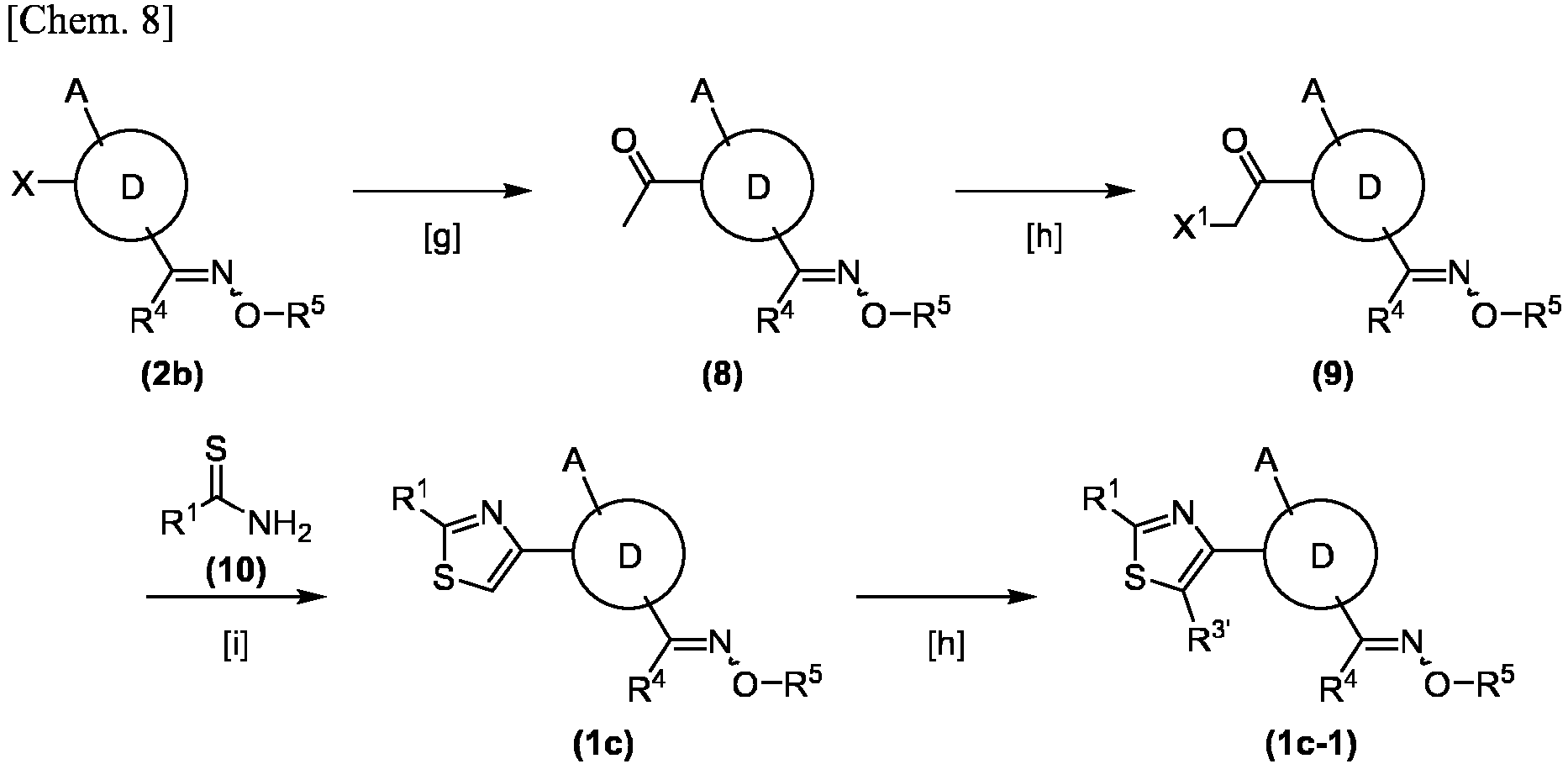
- In the formula, A, D, R1, R4, and R5 are the same as above; R3' represents a halogen atom; X represents a leaving group such as chlorine, bromine, or iodine; and X1 represents a halogen atom such as chlorine, bromine, or iodine.
- The compound represented by the general formula (8) can be produced by reacting the compound represented by the general formula (2b) with tributyl(1-ethoxyvinyl)tin in the presence of a palladium catalyst and an inert solvent, followed by acid treatment.
- Examples of the palladium catalyst that can be used in this reaction include bis(triphenylphosphine)palladium(II) chloride, palladium(II) acetate, palladium(II) chloride, tetrakis(triphenylphosphine)palladium(0), and bis(tri-tert-butylphosphine)palladium(0). The amount of the palladium catalyst used is in the range of a 0.001- to 0.5-fold molar amount relative to the compound represented by the general formula (2b).
- The inert solvent used in this reaction may be any solvent that does not markedly inhibit the progress of the reaction, and examples include aromatic hydrocarbons such as benzene, toluene, and xylene; halogenated hydrocarbons such as methylene chloride, chloroform, and carbon tetrachloride; halogenated aromatic hydrocarbons such as chlorobenzene and dichlorobenzene; chain or cyclic ethers such as diethyl ether, methyl tert-butyl ether, dioxane, and tetrahydrofuran; esters such as ethyl acetate; amides such as N,N-dimethylformamide and N,N-dimethylacetamide; ketones such as acetone and methyl ethyl ketone; alcohols such as methanol, ethanol, propanol, butanol, and 2-propanol; and polar solvents such as dimethyl sulfoxide and 1,3-dimethyl-2-imidazolidinone. One of these inert solvents may be used alone, and also two or more of them may be used as a mixture. The amount of the inert solvent used is not particularly limited as long as it is sufficient to dissolve the reaction reagents, and is usually selected as appropriate from the range of 0.5 L to 100 L relative to 1 mole of the compound represented by the general formula (2b).
- Examples of the acid that can be used in this reaction include inorganic acids such as hydrochloric acid, sulfuric acid and nitric acid; organic acids such as formic acid, acetic acid, propionic acid, trifluoroacetic acid and benzoic acid; and sulfonic acids such as methanesulfonic acid and trifluoromethanesulfonic acid. The amount of the acid used is usually in the range of a 1- to 10-fold molar amount relative to the compound represented by the general formula (2b).
- Since this reaction is an equimolar reaction of the compounds, they are basically used in equimolar amounts, but either of them may be used in an excess amount. The reaction temperature in this reaction is usually in the range of 0°C to the boiling point of the solvent used. The reaction time varies with the reaction scale, the reaction temperature and the like and is not the same in every case, but is usually selected as appropriate from the range of a few minutes to 48 hours. After the reaction is completed, the compound of interest is isolated from the post-reaction mixture by the usual method. As needed, recrystallization, column chromatography, etc. can be employed for the purification of the compound of interest.
- The compound represented by the general formula (9) can be produced by halogenating the compound represented by the general formula (8) with a halogenating agent in the presence of an inert solvent. The compound represented by the general formula (1c-1) can be produced by halogenating the compound represented by the general formula (1c) with a halogenating agent in the presence of an inert solvent.
- Examples of the halogenating agent include halogen molecules such as chlorine, bromine, and iodine; ammonium halide salts formed of halogen molecules; halogenated succinimides such as N-chlorocosuccinimide and N-bromocosuccinimide; halogenated hydantoins such as diiodohydantoin; and sulfuryl chloride. The amount of the halogenating agent used is usually in the range of a 0.5- to 10-fold molar amount relative to the compound represented by the general formula (8) or (1c-1).
- The inert solvent used in this reaction may be any solvent that does not markedly inhibit the reaction, and examples include alcohols such as methanol, ethanol, propanol, butanol and 2-propanol; chain or cyclic ethers such as diethyl ether, tetrahydrofuran and dioxane; aromatic hydrocarbons such as benzene, toluene and xylene; esters such as ethyl acetate; and polar solvents such as N,N-dimethylformamide, N,N-dimethylacetamide, 1,3-dimethyl-2-imidazolidinone, water and acetic acid. One of these inert solvents may be used alone, and also two or more of them may be used as a mixture. The amount of the inert solvent used is not particularly limited as long as it is sufficient to dissolve the reaction reagents, and is usually selected as appropriate from the range of 0.5 L to 100 L relative to 1 mole of the compound represented by the general formula (8) or (1c-1).
- The reaction temperature in this reaction is usually in the range of -30°C to the boiling point of the solvent used. The reaction time varies with the reaction scale, the reaction temperature and the like and is not the same in every case, but is usually selected as appropriate from the range of a few minutes to 48 hours. After the reaction is completed, the compound of interest is isolated from the post-reaction mixture by the usual method. As needed, recrystallization, column chromatography, etc. can be employed for the purification of the compound of interest. Alternatively, the post-reaction mixture may be directly used in the next step without isolation of the compound of interest.
- The compound represented by the general formula (1c) can be produced by reacting the compound represented by the general formula (9) with the compound represented by the general formula (10) in the presence of an inert solvent with or without a base.
- The base used in this reaction may be an inorganic base or an organic base. Examples of the inorganic base include alkali metal hydroxides such as sodium hydroxide and potassium hydroxide; alkali metal hydrides such as sodium hydride and potassium hydride; alkali metal alkoxides such as sodium ethoxide and potassium tert-butoxide; and carbonates such as sodium carbonate, potassium carbonate, cesium carbonate, and sodium hydrogen carbonate. Examples of the organic base include triethylamine, pyridine, and DBU. The amount of the base used is usually in the range of a 0.01- to 10-fold molar amount relative to the compound represented by the general formula (9).
- The inert solvent used in this reaction may be any solvent that does not markedly inhibit the progress of the reaction, and examples include alcohols such as methanol, ethanol, propanol, butanol and 2-propanol; aromatic hydrocarbons such as benzene, toluene and xylene; halogenated hydrocarbons such as methylene chloride, chloroform and carbon tetrachloride; halogenated aromatic hydrocarbons such as chlorobenzene and dichlorobenzene; chain or cyclic ethers such as diethyl ether, methyl tert-butyl ether, dioxane and tetrahydrofuran; and polar solvents such as dimethyl sulfoxide and 1,3-dimethyl-2-imidazolidinone. One of these inert solvents may be used alone, and also two or more of them may be used as a mixture. The amount of the inert solvent used is not particularly limited as long as it is sufficient to dissolve the reaction reagents, and is usually selected as appropriate from the range of 0.5 L to 100 L relative to 1 mole of the compound represented by the general formula (9).
- Since this reaction is an equimolar reaction of the compounds, they are basically used in equimolar amounts, but either of them may be used in an excess amount. The reaction temperature in this reaction is usually in the range of room temperature to the boiling point of the solvent used. The reaction time varies with the reaction scale and the reaction temperature, but is basically selected as appropriate from the range of a few minutes to 48 hours. After the reaction is completed, the compound of interest is isolated from the post-reaction mixture by the usual method. As needed, recrystallization, column chromatography, etc. can be employed for the purification of the compound of interest.
- Among examples of the compound represented by the general formula (1), the compounds represented by the general formulae (1c') and (1c'-1) wherein Q is the above-defined Q12 can be produced from the compound represented by the general formula (9) through the steps [i] and [h] described below. The reaction conditions for the steps [i] and [h] are the same as described above.

- In the formula, A, D, R1, R4, and R5 are the same as above; R3' represents a halogen atom; and X1 represents a halogen atom such as chlorine, bromine, or iodine.
- Among examples of the compound represented by the general formula (1), the compound represented by the general formula (1d) wherein Q is the above-defined Q8 can be produced from the compound represented by the general formula (2d) through the steps [j], [k], and [i] described below. The reaction conditions for the step [i] are the same as described above.


- In the formula, A, D, R1, R2, R4, and R5 are the same as above; R' represents a (C1-C6) alkyl group such as a methyl group or an ethyl group; and L represents a leaving group such as chlorine, bromine, iodine, or a (C1-C6) alkylcarbonyloxy group.
- The compound represented by the general formula (11) can be produced by reacting the compound represented by the general formula (2d) with ammonia in the presence of an inert solvent with or without a base.
- The amount of the ammonia used in this reaction is usually in the range of an about 1- to 10-fold molar amount relative to the compound represented by the general formula (2d).
- The base used in this reaction may be an inorganic base or an organic base. Examples of the inorganic base include alkali metal hydroxides such as sodium hydroxide and potassium hydroxide; alkali metal hydrides such as sodium hydride and potassium hydride; alkali metal alkoxides such as sodium ethoxide and potassium tert-butoxide; and carbonates such as sodium carbonate, potassium carbonate, cesium carbonate, and sodium hydrogen carbonate. Examples of the organic base include triethylamine, pyridine, and DBU. The amount of the base used is usually in the range of a 0.01- to 10-fold molar amount relative to the compound represented by the general formula (2d).
- The inert solvent used in this reaction may be any solvent that does not markedly inhibit the progress of the reaction, and examples include aromatic hydrocarbons such as benzene, toluene, and xylene; halogenated aliphatic hydrocarbons such as methylene chloride, chloroform, and carbon tetrachloride; halogenated aromatic hydrocarbons such as chlorobenzene and dichlorobenzene; chain or cyclic ethers such as diethyl ether, dioxane, and tetrahydrofuran; esters such as ethyl acetate; amides such as N,N-dimethylformamide and N,N-dimethylacetamide; and other inert solvents such as dimethyl sulfoxide, 1,3-dimethyl-2-imidazolidinone, acetone, methyl ethyl ketone, and water. One of these inert solvents may be used alone, and also two or more of them may be used as a mixture. The amount of the inert solvent used is not particularly limited as long as it is sufficient to dissolve the reaction reagents, and is usually selected as appropriate from the range of 0.5 L to 100 L relative to 1 mole of the compound represented by the general formula (2d).
- The reaction temperature in this reaction is usually in the range of 0°C to the boiling point of the solvent used. The reaction time varies with the reaction scale, the reaction temperature and the like and is not the same in every case, but is usually selected as appropriate from the range of a few minutes to 48 hours. After the reaction is completed, the compound of interest is isolated from the post-reaction mixture by the usual method. As needed, recrystallization, column chromatography, etc. can be employed for the purification of the compound of interest. Alternatively, the post-reaction mixture is directly used in the next reaction without purification.
- The compound represented by the general formula (12) can be produced by reacting the compound represented by the general formula (11) with a sulfurizing agent in the presence of an inert solvent.
- Examples of the sulfurizing agent that can be used in this reaction include Lawesson's reagent and diphosphorus pentasulfide. The amount of the sulfurizing agent used is usually in the range of a 1.0- to 10-fold molar amount relative to the compound represented by the general formula (11).
- This reaction may be conducted with or without a solvent. The solvent used in this reaction may be any solvent that does not markedly inhibit the progress of the reaction, and examples include chain or cyclic saturated hydrocarbons such as pentane, hexane, and cyclohexane; aromatic hydrocarbons such as benzene, toluene, and xylene; halogenated aromatic hydrocarbons such as chlorobenzene and dichlorobenzene; chain or cyclic ethers such as diethyl ether, methyl tert-butyl ether, dioxane, and tetrahydrofuran; nitriles such as acetonitrile and propionitrile; aprotic polar solvents such as N,N-dimethylformamide, N,N-dimethylacetamide, dimethyl sulfoxide, and 1,3-dimethyl-2-imidazolidinone; and alcohols such as methanol, ethanol, propanol, butanol, and 2-propanol. One of these inert solvents may be used alone, and also two or more of them may be used as a mixture. The amount of the solvent used is usually selected as appropriate from the range of 0.1 to 100 L relative to 1 mol of the compound represented by the general formula (11).
- The reaction temperature in this reaction is usually in the range of about 0°C to the boiling point of the solvent used. The reaction time varies with the reaction scale, the reaction temperature and the like and is not the same in every case, but is usually selected as appropriate from the range of a few minutes to 48 hours. After the reaction is completed, the compound of interest is isolated from the post-reaction mixture by the usual method. As needed, recrystallization, column chromatography, etc. can be employed for the purification of the compound of interest.
- Among examples of the compound represented by the general formula (1), the compound represented by the general formulae (1e) wherein Q is the above-defined Q10 can be produced from the compound represented by the general formula (2e) through the step [c'] described below.

- In the formula, A, D, R1, R3, R4, and R5 are the same as above; and L represents a leaving group such as chlorine, bromine, iodine, or a (C1-C6) alkylcarbonyloxy group.
- The compound represented by the general formula (1e) can be produced by reacting the compound represented by the general formula (2e) with the compound represented by the general formula (66) in the presence of an inert solvent and a base with or without copper acetate.
- The copper acetate used in this reaction may be a hydrate. The amount of the copper acetate used is usually in the range of 0.1- to 1-fold molar amount relative to the compound represented by the general formula (2e).
- Examples of the base that can be used in this reaction include alkyllithiums such as methyllithium, n-butyllithium, sec-butyllithium and tert-butyllithium; organometallic compounds such as lithium hexamethyldisilazane and sodium hexamethyldisilazane; hydroxides such as lithium hydroxide, sodium hydroxide, potassium hydroxide and calcium hydroxide; carbonates such as lithium carbonate, lithium hydrogen carbonate, sodium carbonate, sodium hydrogen carbonate, potassium carbonate, cesium carbonate, potassium hydrogen carbonate, calcium carbonate and magnesium carbonate; acetates such as lithium acetate, sodium acetate and potassium acetate; alkoxides such as sodium methoxide, sodium ethoxide, sodium tert-butoxide and potassium tert-butoxide; metal hydrides such as sodium hydride and potassium hydride; and organic bases such as pyridine, picoline, lutidine, triethylamine, tributylamine and N,N-diisopropylethylamine. The amount of the base used is usually in the range of a 1- to 10-fold molar amount relative to the compound represented by the general formula (2e).
- The inert solvent used in this reaction may be any solvent that does not markedly inhibit the progress of the reaction, and examples include aromatic hydrocarbons such as benzene, toluene and xylene; halogenated hydrocarbons such as methylene chloride, chloroform and carbon tetrachloride; halogenated aromatic hydrocarbons such as chlorobenzene and dichlorobenzene; chain or cyclic ethers such as diethyl ether, methyl tert-butyl ether, dioxane and tetrahydrofuran; esters such as ethyl acetate; amides such as N,N-dimethylformamide and N,N-dimethylacetamide; ketones such as acetone and methyl ethyl ketone; and polar solvents such as dimethyl sulfoxide and 1,3-dimethyl-2-imidazolidinone. One of these inert solvents may be used alone, and also two or more of them may be used as a mixture. The amount of the inert solvent used is not particularly limited as long as it is sufficient to dissolve the reaction reagents, and is usually selected as appropriate from the range of 0.5 L to 100 L relative to 1 mole of the compound represented by the general formula (2e).
- Since this reaction is an equimolar reaction of the compounds, they are basically used in equimolar amounts, but either of them may be used in an excess amount. The reaction temperature in this reaction is usually in the range of room temperature to the boiling point of the solvent used. The reaction time varies with the reaction scale, the reaction temperature and the like and is not the same in every case, but is usually selected as appropriate from the range of a few minutes to 48 hours. After the reaction is completed, the compound of interest is isolated from the post-reaction mixture by the usual method. As needed, recrystallization, column chromatography, etc. can be employed for the purification of the compound of interest.
- Among examples of the compound represented by the general formula (1), the compound represented by the general formula (1f) wherein Q is the above-defined Q18 can be produced from the compound represented by the general formula (11) through the step [i] described below. The reaction conditions for the step [i] are the same as described above.

- In the formula, A, D, R1, R2, R4, and R5 are the same as above; and L represents a leaving group such as chlorine, bromine, iodine, or a (C1-C6) alkylcarbonyloxy group.
- Among examples of the compound represented by the general formula (1), the compound represented by the general formula (1g) wherein Q is the above-defined Q1 1 can be produced from the compound represented by the general formula (2f) through the step [c'] described below. The reaction conditions for the step [c'] are the same as described above.


- In the formula, A, D, R1, R3, R4, and R5 are the same as above; and L represents a leaving group such as chlorine, bromine, iodine, or a (C1-C6) alkylcarbonyloxy group.
- Among examples of the compound represented by the general formula (2a) as the starting compound for Production Methods 1 and 2, the compound represented by the general formula (2a-1) wherein Q is the above-defined Q1 and A is the above-defined SO2N(R9)R10 can be produced from the compound represented by the general formula (14) through the steps [l], [m], [n], [o], [f], and [p] described below. The reaction conditions for the steps [l] and [f] are the same as described above.


- In the formula, D, R1, R3, R9, and R10 are the same as above; R represents a (C1-C4) alkyl group such as a tert-butyl group or a hydrogen atom; R' and R" represent a (C1-C6) alkyl group such as a methyl group or an ethyl group; and X represents a leaving group such as chlorine, bromine, or iodine.
- The compound represented by the general formula (17) can be produced by hydrolyzing the compound represented by the general formula (16) in the presence of a base, water, and an inert solvent.
- Examples of the base that can be used in this reaction include organic bases such as lithium hydroxide, sodium hydroxide, potassium hydroxide, calcium hydroxide and other hydroxides. The amount of the base used is usually in the range of a 1- to 10-fold molar amount relative to the compound represented by the general formula (16).
- The inert solvent used in this reaction may be any solvent that does not markedly inhibit the reaction, and examples include chain or cyclic saturated hydrocarbons such as pentane, hexane, and cyclohexane; chain or cyclic ethers such as diethyl ether, tetrahydrofuran (THF), and dioxane; and nonpolar solvents including aromatic hydrocarbons such as benzene, toluene, and xylene. One of these inert solvents may be used alone, and also two or more of them may be used as a mixture. The amount of the inert solvent used is not particularly limited as long as it is sufficient to dissolve the reaction reagents, and is usually selected as appropriate from the range of 0.5 L to 100 L relative to 1 mole of the compound represented by the general formula (16).
- The reaction temperature in this reaction is usually in the range of 0°C to the boiling point of the solvent used. The reaction time varies with the reaction scale, the reaction temperature and the like and is not the same in every case, but is basically selected as appropriate from the range of a few minutes to 48 hours. After the reaction is completed, the compound of interest is isolated from the post-reaction mixture by the usual method. As needed, recrystallization, column chromatography, etc. can be employed for the purification of the compound of interest. Alternatively, the post-reaction mixture may be directly used in the next step without isolation of the compound of interest.
- The compound represented by the general formula (19) can be produced by reacting the compound represented by the general formula (17) with the compound represented by the general formula (18) in the presence of a base, a condensing agent, and an inert solvent.
- Examples of the condensing agent that can be used in this condensation include acid-activating reagents such as phosgene, phosphorus trichloride, phosphorus oxychloride, oxalyl chloride, and thionyl chloride; carbodiimides such as N,N'-dicyclohexylcarbodiimide (DCC) and 1-(3-dimethylaminopropyl)-3-ethylcarbodiimide (EDCI); and other reagents such as phosphorus pentoxide, polyphosphoric acid, N,N'-carbonyldiimidazole, 2-chloropyridine-1-methoiodide (Mukaiyama reagent), 2-ethoxy-N-ethoxycarbonyl-1,2-dihydroquinoline (EEDQ), triphenylphosphine/carbon tetrachloride, bromotripyrrolidinophosphonium hexafluorophosphate (BROP), O-(1H-benzotriazol-1-yloxy)tris(dimethylamino)phosphonium hexafluorophosphate (BOP), N,N,N',N'-bis(tetramethylene)chlorouronium tetrafluoroborate, O-(1H-benzotriazol-1-yl)-N,N,N',N'-tetramethyluronium hexafluorophosphate (HBTU), O-(1H-benzotriazol-1 -yl)-N,N,N',N'-bis(tetramethylene)uronium hexafluorophosphate, O-(1H-benzotriazol-1-yl)-N,N,N',N'-tetramethyluronium tetrafluoroborate (TBTU), O-(1H-benzotriazol-1-yl)-N,N,N',N'-bis(tetramethylene)uronium tetrafluoroborate, O-(7-azabenzotriazol-1-yl)-N,N,N',N'-tetramethyluronium hexafluorophosphate (HATU), 1-hydroxybenzotriazole (HOBt), propylphosphonic anhydride (T3P), and 4-(4,6-dimethoxy-1,3,5-triazin-2-yl)-4-methylmorpholinium salt (DMT-MM). One of these condensing agents may be used alone, and also two or more of them may be used as a mixture. The amount of the condensing agent used is usually selected as appropriate from the range of a 0.5- to 5-fold molar amount relative to the compound represented by the general formula (17).
- Examples of the base that can be used in the condensation include carbonates such as lithium carbonate, lithium hydrogen carbonate, sodium carbonate, sodium hydrogen carbonate, potassium carbonate, cesium carbonate, potassium hydrogen carbonate, calcium carbonate and magnesium carbonate; acetates such as lithium acetate, sodium acetate and potassium acetate; and organic bases such as pyridine, picoline, lutidine, triethylamine, tributylamine and N,N-diisopropylethylamine. The amount of the base used is usually selected as appropriate from the range of a 0.5- to 5-fold molar amount relative to the compound represented by the general formula (17). In some cases, the base can be used as the solvent as well.
- The inert solvent used in the condensation may be any solvent that does not markedly inhibit the reaction, and examples include chain or cyclic saturated hydrocarbons such as pentane, hexane, and cyclohexane; chain or cyclic ethers such as diethyl ether, THF, and dioxane; aromatic hydrocarbons such as benzene, toluene, and xylene; halogenated hydrocarbons such as methylene chloride, chloroform, and carbon tetrachloride; nitriles such as acetonitrile and isopropylnitrile; and polar solvents such as N,N-dimethylformamide, N,N-dimethylacetamide, dimethyl sulfoxide, and 1,3-dimethyl-2-imidazolidinone. One of these inert solvents may be used alone, and also two or more of them may be used as a mixture. The amount of the inert solvent used is not particularly limited as long as it is sufficient to dissolve the reaction reagents, and is usually selected as appropriate from the range of 0.5 L to 100 L relative to 1 mole of the compound represented by the general formula (17). In the case where the base is used also as the solvent, it is not necessary to use another solvent.
- Since the condensation is an equimolar reaction of the compounds, they are basically used in equimolar amounts, but either of them may be used in an excess amount. The reaction temperature in this reaction is usually in the range of 0°C to the boiling point of the solvent used. The reaction time varies with the reaction scale, the reaction temperature and the like and is not the same in every case, but is usually selected as appropriate from the range of a few minutes to 48 hours. After the reaction is completed, the compound of interest is isolated from the post-reaction mixture by the usual method. As needed, recrystallization, column chromatography, etc. can be employed for the purification of the compound of interest. Alternatively, the post-reaction mixture may be directly used in the next step without isolation of the compound of interest.
- The compound represented by the general formula (21) can be produced by reacting the compound represented by the general formula (19) with the compound represented by the general formula (20) or a salt thereof in the presence of an inert solvent with or without a base.
- Examples of the base that can be used in this reaction include inorganic bases such as sodium hydroxide, potassium hydroxide, sodium carbonate, potassium carbonate, cesium carbonate, sodium hydrogen carbonate and potassium hydrogen carbonate; acetates such as sodium acetate and potassium acetate; alkali metal alkoxides such as potassium tert-butoxide, sodium methoxide and sodium ethoxide; tertiary amines such as triethylamine, N,N-diisopropylethylamine and DBU; and nitrogen-containing aromatic compounds such as pyridine and N,N-dimethyl-4-aminopyridine. The amount of the base used is usually in the range of a 1- to 10-fold molar amount relative to the compound represented by the general formula (19).
- The inert solvent used in this reaction may be any solvent that does not markedly inhibit the progress of the reaction, and examples include aromatic hydrocarbons such as benzene, toluene, and xylene; halogenated hydrocarbons such as methylene chloride, chloroform, and carbon tetrachloride; halogenated aromatic hydrocarbons such as chlorobenzene and dichlorobenzene; chain or cyclic ethers such as diethyl ether, methyl tert-butyl ether, dioxane, and tetrahydrofuran; alcohols such as methanol, ethanol, propanol, and isopropyl alcohol; esters such as ethyl acetate; amides such as N,N-dimethylformamide and N,N-dimethylacetamide; ketones such as acetone and methyl ethyl ketone; and polar solvents such as dimethyl sulfoxide and 1,3-dimethyl-2-imidazolidinone. One of these inert solvents may be used alone, and also two or more of them may be used as a mixture. The amount of the inert solvent used is not particularly limited as long as it is sufficient to dissolve the reaction reagents, and is usually selected as appropriate from the range of 0.5 L to 100 L relative to 1 mole of the compound represented by the general formula (19).
- Since this reaction is an equimolar reaction of the compounds, they are basically used in equimolar amounts, but either of them may be used in an excess amount. The reaction temperature in this reaction is usually in the range of room temperature to the boiling point of the solvent used. The reaction time varies with the reaction scale and the reaction temperature, but is basically in the range of a few minutes to 48 hours. After the reaction is completed, the compound of interest is isolated from the post-reaction mixture by the usual method. As needed, recrystallization, column chromatography, etc. can be employed for the purification of the compound of interest. Alternatively, the post-reaction mixture may be directly used in the next step without isolation of the compound of interest.
- The compound represented by the general formula (2a-1) can be produced by reacting the compound represented by the general formula (22) with a cyanizing agent in the presence of a base and an inert solvent with or without a metal catalyst.
- Examples of the cyanizing agent that can be used in this reaction include sodium cyanide, potassium cyanide, trimethylsilyl cyanide, and zinc cyanide. The amount of the cyanizing agent used is usually in the range of a 1- to 10-fold molar amount relative to the compound represented by the general formula (22).
- Examples of the base that can be used in this reaction include carbonates such as lithium carbonate, lithium hydrogen carbonate, sodium carbonate, sodium hydrogen carbonate, potassium carbonate, cesium carbonate, potassium hydrogen carbonate, calcium carbonate, and magnesium carbonate; acetates such as lithium acetate, sodium acetate, and potassium acetate; and organic bases such as pyridine, picoline, lutidine, triethylamine, tributylamine, N,N-diisopropylethylamine, and 1,4-diazabicyclo[2.2.2]octane. The amount of the base used is usually in the range of a 1- to 5-fold molar amount relative to the compound represented by the general formula (22).
- Examples of the metal catalyst that can be used in this reaction include a palladium catalyst, a nickel catalyst, an iron catalyst, a ruthenium catalyst, a platinum catalyst, a rhodium catalyst and an iridium catalyst. Such a metal catalyst can be used in the form of a metal; a supported metal; a metal salt such as a metal chloride, a metal bromide, a metal iodide, a metal nitrate, a metal sulfate, a metal carbonate, a metal oxalate, a metal acetate and a metal oxide; or a complex compound such as an olefin complex, a phosphine complex, an amine complex, an ammine complex and an acetylacetonate complex.
- Among these metal catalysts, palladium catalysts are particularly preferred. Examples of the palladium catalyst include palladium metals such as palladium black and palladium sponge; and supported palladium metals such as palladium/alumina, palladium/carbon, palladium/silica and palladium/type Y zeolite. Also included are palladium metal salts such as palladium chloride, palladium bromide, palladium iodide and palladium acetate. Other examples of the palladium catalyst include palladium complex compounds such as π-allylpalladium chloride dimer, palladium acetylacetonate, dichlorobis(acetonitrile)palladium, dichlorobis(benzonitrile)palladium, bis(dibenzylideneacetone)palladium, tris(dibenzylideneacetone)dipalladium, tris(dibenzylideneacetone)dipalladium (chloroform adduct), dichlorodiamine palladium, dichlorobis(triphenylphosphine)palladium, dichlorobis(tricyclohexylphosphine)palladium, tetrakis(triphenylphosphine)palladium, dichloro[1,2-bis(diphenylphosphino)ethane]palladium, dichloro[1,3-bis(diphenylphosphino)propane]palladium, dichloro [1,4-bis(diphenylphosphino)butane]palladium, dichloro[1,1'-bis(diphenylphosphino)ferrocene]palladium and a [(diphenylphosphino)ferrocene]dichloropalladium-dichloromethane complex. The amount of the metal catalyst used is usually selected as appropriate from the range of a 0.001- to 0.5-fold molar amount relative to the compound represented by the general formula (22).
- These palladium catalysts may be used alone or in combination with a tertiary phosphine. Examples of the tertiary phosphine that can be used in combination with the palladium catalyst include triphenylphosphine, trimethylphosphine, triethylphosphine, tributylphosphine, tri(tert-butyl)phosphine, tricyclohexylphosphine, tri-o-tolylphosphine, trioctylphosphine, 9,9-dimethyl-4,5-bis(diphenylphosphino)xanthene, 2-(di-tert-butylphosphino)biphenyl, 2-(dicyclohexylphosphino)biphenyl, 1,2-bis(diphenylphosphino)ethane, 1,3-bis(diphenylphosphino)propane, 1,4-bis(diphenylphosphino)butane, 1,1'-bis(diphenylphosphino)ferrocene, (R)-(+)-2,2'-bis(diphenylphosphino)-1,1'-binaphthyl, (S)-(-)-2,2'-bis(diphenylphosphino)-1,1'-binaphthyl and (±)-2,2'-bis(diphenylphosphino)-1,1'-binaphthyl. The amount of the tertiary phosphine used is usually selected as appropriate from the range of a 0.5- to 10-fold molar amount relative to the metal catalyst.
- The inert solvent used in this reaction may be any solvent that does not markedly inhibit the reaction, and examples include alcohols such as methanol, ethanol, propanol, butanol, and 2-propanol; chain or cyclic saturated hydrocarbons such as pentane, hexane, and cyclohexane; aromatic hydrocarbons such as benzene, toluene, and xylene; halogenated hydrocarbons such as methylene chloride, chloroform, and carbon tetrachloride; halogenated aromatic hydrocarbons such as chlorobenzene and dichlorobenzene; chain or cyclic ethers such as diethyl ether, methyl tert-butyl ether, dioxane, tetrahydrofuran, and cyclopentyl methyl ether; esters such as ethyl acetate; nitriles such as acetonitrile and propionitrile; amides such as N,N-dimethylformamide and N,N-dimethylacetamide; ketones such as acetone and methyl ethyl ketone; polar solvents such as dimethyl sulfoxide and 1,3-dimethyl-2-imidazolidinone; and water. One of these inert solvents may be used alone, and also two or more of them may be used as a mixture. The amount of the inert solvent used is not particularly limited as long as it is sufficient to dissolve the reaction reagents, and is usually selected as appropriate from the range of 0.5 L to 100 L relative to 1 mole of the compound represented by the general formula (22).
- The reaction temperature in this reaction is usually in the range of 0°C to the boiling point of the solvent used. The reaction time varies with the reaction scale, the reaction temperature and the like and is not the same in every case, but is basically selected as appropriate from the range of a few minutes to 48 hours. After the reaction is completed, the compound of interest is isolated from the post-reaction mixture by the usual method. As needed, recrystallization, column chromatography, etc. can be employed for the purification of the compound of interest. Alternatively, the post-reaction mixture may be directly used in the next reaction without isolation of the compound of interest.
- Among examples of the compound represented by the general formula (2a) as the starting compound for Production Methods 1 and 2, the compound represented by the general formula (2a-2) wherein Q is the above-defined Q2 and A is the above-defined SO2N(R9)R10 can be produced from the compound represented by the general formula (17) through the steps [q], [r], [s], [f], and [p] described below. The reaction conditions for the steps [f] and [p] are the same as described above.


- In the formula, D, R1, R2, R3, R9, and R10 are the same as above; R represents a (C1-C4) alkyl group such as a tert-butyl group or a hydrogen atom; X represents a leaving group such as chlorine, bromine, or iodine; and L represents a leaving group such as chlorine, bromine, iodine, or a (C1-C6) alkylcarbonyloxy group.
- The compound represented by the general formula (23) can be produced by reacting the compound represented by the general formula (17) with the compound represented by the general formula (13) in the presence of a base and an inert solvent.
- Examples of the base that can be used in this reaction include inorganic bases such as sodium hydroxide, potassium hydroxide, sodium carbonate, potassium carbonate, cesium carbonate, sodium hydrogen carbonate and potassium hydrogen carbonate; acetates such as sodium acetate and potassium acetate; alkali metal alkoxides such as potassium tert-butoxide, sodium methoxide and sodium ethoxide; tertiary amines such as triethylamine, N,N-diisopropylethylamine and DBU; and nitrogen-containing aromatic compounds such as pyridine and N,N-dimethyl-4-aminopyridine. The amount of the base used is usually in the range of a 1- to 10-fold molar amount relative to the compound represented by the general formula (17).
- The inert solvent used in this reaction may be any solvent that does not markedly inhibit the progress of the reaction, and examples include aromatic hydrocarbons such as benzene, toluene and xylene; halogenated hydrocarbons such as methylene chloride, chloroform and carbon tetrachloride; halogenated aromatic hydrocarbons such as chlorobenzene and dichlorobenzene; chain or cyclic ethers such as diethyl ether, methyl tert-butyl ether, dioxane and tetrahydrofuran; esters such as ethyl acetate; amides such as N,N-dimethylformamide and N,N-dimethylacetamide; ketones such as acetone and methyl ethyl ketone; and polar solvents such as dimethyl sulfoxide and 1,3-dimethyl-2-imidazolidinone. One of these inert solvents may be used alone, and also two or more of them may be used as a mixture. The amount of the inert solvent used is not particularly limited as long as it is sufficient to dissolve the reaction reagents, and is usually selected as appropriate from the range of 0.5 L to 100 L relative to 1 mole of the compound represented by the general formula (17).
- Since this reaction is an equimolar reaction of the compounds, they are basically used in equimolar amounts, but either of them may be used in an excess amount. The reaction temperature in this reaction is usually in the range of room temperature to the boiling point of the solvent used. The reaction time varies with the reaction scale and the reaction temperature, but is basically in the range of a few minutes to 48 hours. After the reaction is completed, the compound of interest is isolated from the post-reaction mixture by the usual method. As needed, recrystallization, column chromatography, etc. can be employed for the purification of the compound of interest. Alternatively, the post-reaction mixture may be directly used in the next step without isolation of the compound of interest.
- The compound represented by the general formula (24) can be produced by reacting the compound represented by the general formula (23) with a nitrogen source in the presence of an acid and an inert solvent.
- Examples of the nitrogen source that can be used in this reaction include ammonia, ammonium carbamate, ammonium acetate, and ammonium carbonate. The amount of the nitrogen source used is usually selected as appropriate from the range of a 1- to 20-fold molar amount relative to the compound represented by the general formula (23).
- Examples of the acid that can be used in this reaction include inorganic acids such as hydrochloric acid, sulfuric acid and nitric acid; organic acids such as formic acid, acetic acid, propionic acid, trifluoroacetic acid and benzoic acid; sulfonic acids such as methanesulfonic acid, trifluoromethanesulfonic acid and p-toluenesulfonic acid; and phosphoric acid. The amount of the acid used is usually selected as appropriate from the range of a 0.01- to 10-fold molar amount relative to the compound represented by the general formula (23). In some cases, the acid can be used as the solvent as well.
- The inert solvent used in the dehydration may be any solvent that does not markedly inhibit the progress of the reaction, and examples include aromatic hydrocarbons such as benzene, toluene and xylene; halogenated hydrocarbons such as methylene chloride, chloroform and carbon tetrachloride; halogenated aromatic hydrocarbons such as chlorobenzene and dichlorobenzene; chain or cyclic ethers such as diethyl ether, methyl tert-butyl ether, dioxane and tetrahydrofuran; esters such as ethyl acetate; amides such as N,N-dimethylformamide and N,N-dimethylacetamide; ketones such as acetone and methyl ethyl ketone; and polar solvents such as dimethyl sulfoxide and 1,3-dimethyl-2-imidazolidinone. One of these inert solvents may be used alone, and also two or more of them may be used as a mixture. The amount of the inert solvent used is not particularly limited as long as it is sufficient to dissolve the reaction reagents, and is usually selected as appropriate from the range of 0.5 L to 100 L relative to 1 mole of the compound represented by the general formula (23) obtained by the condensation. In the case where the acid is used also as the solvent, it is not necessary to use another solvent.
- The reaction temperature in the dehydration is usually in the range of room temperature to the boiling point of the solvent used. The reaction time varies with the reaction scale and the reaction temperature, but is basically selected as appropriate from the range of a few minutes to 48 hours. After the reaction is completed, the compound of interest is isolated from the post-reaction mixture by the usual method. As needed, recrystallization, column chromatography, etc. can be employed for the purification of the compound of interest. Alternatively, the post-reaction mixture may be directly used in the next step without isolation of the compound of interest.
- The compound represented by the general formula (26) can be produced by reacting the compound represented by the general formula (24) with the compound represented by the general formula (25) in the presence of an inert solvent and a base.
- Examples of the base that can be used in this reaction include inorganic bases such as sodium hydroxide, potassium hydroxide, sodium carbonate, potassium carbonate, cesium carbonate, sodium hydrogen carbonate, potassium hydrogen carbonate and sodium hydride; acetates such as sodium acetate and potassium acetate; alkali metal alkoxides such as potassium tert-butoxide, sodium methoxide and sodium ethoxide; tertiary amines such as triethylamine, N,N-diisopropylethylamine and DBU; and nitrogen-containing aromatic compounds such as pyridine and N,N-dimethyl-4-aminopyridine. The amount of the base used is usually in the range of a 1- to 10-fold molar amount relative to the compound represented by the general formula (24).
- The inert solvent used in this reaction may be any solvent that does not markedly inhibit the progress of the reaction, and examples include aromatic hydrocarbons such as benzene, toluene and xylene; halogenated hydrocarbons such as methylene chloride, chloroform and carbon tetrachloride; halogenated aromatic hydrocarbons such as chlorobenzene and dichlorobenzene; chain or cyclic ethers such as diethyl ether, methyl tert-butyl ether, dioxane and tetrahydrofuran; esters such as ethyl acetate; amides such as N,N-dimethylformamide and N,N-dimethylacetamide; ketones such as acetone and methyl ethyl ketone; and polar solvents such as dimethyl sulfoxide and 1,3-dimethyl-2-imidazolidinone. One of these inert solvents may be used alone, and also two or more of them may be used as a mixture. The amount of the inert solvent used is not particularly limited as long as it is sufficient to dissolve the reaction reagents, and is usually selected as appropriate from the range of 0.5 L to 100 L relative to 1 mole of the compound represented by the general formula (24).
- Since this reaction is an equimolar reaction of the compounds, they are basically used in equimolar amounts, but either of them may be used in an excess amount. The reaction temperature in this reaction is usually in the range of room temperature to the boiling point of the solvent used. The reaction time varies with the reaction scale, the reaction temperature and the like and is not the same in every case, but is usually selected as appropriate from the range of a few minutes to 48 hours. After the reaction is completed, the compound of interest is isolated from the post-reaction mixture by the usual method. As needed, recrystallization, column chromatography, etc. can be employed for the purification of the compound of interest.
- Among examples of the compound represented by the general formula (2a) as the starting compound for Production Methods 1 and 2, the compound represented by the general formula (2a-3) wherein Q is the above-defined Q5 and A is the above-defined CO2R7 can be produced from the compound represented by the general formula (28) through the steps [t], [u], [v], [w], [x], [j], and [y] described below. The reaction conditions for the step [j] are the same as described above.

- In the formula, D, R1, R3, and R7 are the same as above; X represents a leaving group such as chlorine, bromine, or iodine; X1 represents a halogen atom such as chlorine, bromine, or iodine; and L' represents a leaving group such as chlorine, bromine, iodine, a halo (C1-C6) alkoxy group, or an imidazolyl group.
- The compound represented by the general formula (30) can be produced by reacting the compound represented by the general formula (28) with the compound represented by the general formula (29) in the presence of an inert solvent with or without an acid.
- Examples of the acid that can be used in this reaction include inorganic acids such as hydrochloric acid, sulfuric acid and nitric acid; organic acids such as formic acid, acetic acid, propionic acid, trifluoroacetic acid and benzoic acid; sulfonic acids such as methanesulfonic acid, trifluoromethanesulfonic acid and p-toluenesulfonic acid; and phosphoric acid. The amount of the acid used is usually in the range of a 0.01- to 10-fold molar amount relative to the compound represented by the general formula (28).
- The inert solvent used in this reaction may be any solvent that does not markedly inhibit the progress of the reaction, and examples include alcohols such as methanol, ethanol, propanol, butanol and 2-propanol; aromatic hydrocarbons such as benzene, toluene and xylene; halogenated hydrocarbons such as methylene chloride, chloroform and carbon tetrachloride; halogenated aromatic hydrocarbons such as chlorobenzene and dichlorobenzene; chain or cyclic ethers such as diethyl ether, methyl tert-butyl ether, dioxane and tetrahydrofuran; and polar solvents such as dimethyl sulfoxide and 1,3-dimethyl-2-imidazolidinone. One of these inert solvents may be used alone, and also two or more of them may be used as a mixture. The amount of the inert solvent used is not particularly limited as long as it is sufficient to dissolve the reaction reagents, and is usually selected as appropriate from the range of 0.5 L to 100 L relative to 1 mole of the compound represented by the general formula (28) obtained by the condensation.
- Since this reaction is an equimolar reaction of the compounds, they are basically used in equimolar amounts, but either of them may be used in an excess amount. The reaction temperature in this reaction is usually in the range of room temperature to the boiling point of the solvent used. The reaction time varies with the reaction scale and the reaction temperature, but is basically selected as appropriate from the range of a few minutes to 48 hours. After the reaction is completed, the compound of interest is isolated from the post-reaction mixture by the usual method. As needed, recrystallization, column chromatography, etc. can be employed for the purification of the compound of interest. Alternatively, the post-reaction mixture may be directly used in the next step without isolation of the compound of interest.
- The compound represented by the general formula (31) can be produced by reacting the compound represented by the general formula (30) with a halogenating agent in the presence of an inert solvent with or without a base.
- Examples of the halogenating agent that can be used in this reaction include N-halosuccinimides such as N-chlorosuccinimide and N-bromosuccinimide; hypohalogenous alkali metal salts such as sodium hypochlorite; hypohalogenous acid esters such as tert-butyl hypochlorite; simple halogens such as chlorine gas; phosphorus pentachloride; and sulfuryl chloride. The amount of the halogenating agent used is usually in the range of a 1- to 10-fold molar amount relative to the compound represented by the general formula (30).
- Examples of the base that can be used in this reaction include alkali metal hydrides such as sodium hydride; alkali metal hydroxides such as sodium hydroxide and potassium hydroxide; alkali metal carbonates such as sodium carbonate, potassium carbonate, and cesium carbonate; inorganic salts; and organic bases such as pyridine, DBU, and triethylamine. The amount of the base used is usually in the range of a 1- to 10-fold molar amount relative to the compound represented by the general formula (30).
- The inert solvent used in this reaction may be any solvent that does not markedly inhibit the reaction, and examples include aromatic hydrocarbons such as benzene, toluene, and xylene; halogenated hydrocarbons such as chloroform and dichloromethane; esters such as ethyl acetate and methyl acetate; chain or cyclic ethers such as tetrahydrofuran, diethyl ether, methyl tert-butyl ether, 1,2-dimethoxyethane, and dioxane; nitriles such as acetonitrile; and polar solvents such as N,N-dimethylformamide, N,N-dimethylacetamide, N-methylpyrrolidone, dimethyl sulfoxide, and water. One of these inert solvents may be used alone, and also two or more of them may be used as a mixture. The amount of the inert solvent used is not particularly limited as long as it is sufficient to dissolve the reaction reagents, and is usually selected as appropriate from the range of 0.5 L to 100 L relative to 1 mole of the compound represented by the general formula (30).
- The reaction temperature in this reaction is usually selected as appropriate from the range of -50°C to the boiling point of the inert solvent used. The reaction time varies with the reaction scale and the reaction temperature, but is basically in the range of a few minutes to 48 hours. After the reaction is completed, when the compound represented by the general formula (31) is stable, the compound of interest is isolated from the post-reaction mixture by the usual method. As needed, recrystallization, column chromatography, etc. can be employed for the purification of the compound of interest. Alternatively, the post-reaction mixture may be directly used in the next reaction without isolation of the compound of interest. When the compound represented by the general formula (31) is unstable, the post-reaction mixture is directly used in the next step without purification.
- The compound represented by the general formula (33) can be produced by aminating the compound represented by the general formula (31) with the compound represented by the general formula (32) in the presence of an inert solvent with or without a base.
- Examples of the base that can be used in this reaction include inorganic bases such as sodium hydroxide, potassium hydroxide, sodium carbonate, potassium carbonate, cesium carbonate, sodium hydrogen carbonate and potassium hydrogen carbonate; acetates such as sodium acetate and potassium acetate; alkali metal alkoxides such as potassium tert-butoxide, sodium methoxide and sodium ethoxide; tertiary amines such as triethylamine, N,N-diisopropylethylamine and DBU; and nitrogen-containing aromatic compounds such as pyridine and N,N-dimethyl-4-aminopyridine. The amount of the base used is usually in the range of a 1- to 10-fold molar amount relative to the compound represented by the general formula (31).
- The inert solvent that can be used in this reaction may be any solvent that does not markedly inhibit the progress of the reaction, and examples include aromatic hydrocarbons such as benzene, toluene, and xylene; halogenated hydrocarbons such as methylene chloride, chloroform, and carbon tetrachloride; halogenated aromatic hydrocarbons such as chlorobenzene and dichlorobenzene; chain or cyclic ethers such as diethyl ether, methyl tert-butyl ether, dioxane, and tetrahydrofuran; alcohols such as methanol, ethanol, propanol, and isopropyl alcohol; amides such as N,N-dimethylformamide and N,N-dimethylacetamide; and polar solvents such as dimethyl sulfoxide and 1,3-dimethyl-2-imidazolidinone. One of these inert solvents may be used alone, and also two or more of them may be used as a mixture. The amount of the inert solvent used is not particularly limited as long as it is sufficient to dissolve the reaction reagents, and is usually selected as appropriate from the range of 0.5 L to 100 L relative to 1 mole of the compound represented by the general formula (31).
- Since this reaction is an equimolar reaction of the compounds, they are basically used in equimolar amounts, but either of them may be used in an excess amount. The reaction temperature in this reaction is usually in the range of room temperature to the boiling point of the solvent used. The reaction time varies with the reaction scale and the reaction temperature, but is basically in the range of a few minutes to 48 hours. After the reaction is completed, the compound of interest is isolated from the post-reaction mixture by the usual method. As needed, recrystallization, column chromatography, etc. can be employed for the purification of the compound of interest. Alternatively, the post-reaction mixture may be directly used in the next step without isolation of the compound of interest.
- The compound represented by the general formula (35) can be produced by reacting the compound represented by the general formula (33) with the compound represented by the general formula (34) in the presence of a base and an inert solvent.
- Examples of the base that can be used in this reaction include inorganic bases including alkali metal hydroxides such as sodium hydroxide and potassium hydroxide; alkali metal hydrides such as sodium hydride and potassium hydride; alkali metal alkoxides such as sodium ethoxide and potassium tert-butoxide; and carbonates such as sodium carbonate, potassium carbonate, cesium carbonate and sodium hydrogen carbonate; and organic bases such as triethylamine, pyridine, N,N-dimethyl-4-aminopyridine and DBU. The amount of the base used is usually selected as appropriate from the range of a 1- to 10-fold molar amount relative to the compound represented by the general formula (33). In some cases, the base can be used as the solvent as well.
- The inert solvent used in this reaction may be any solvent that does not markedly inhibit the progress of the reaction, and examples include chain or cyclic saturated hydrocarbons such as pentane, hexane, and cyclohexane; aromatic hydrocarbons such as benzene, toluene, and xylene; halogenated hydrocarbons such as methylene chloride, chloroform, and carbon tetrachloride; halogenated aromatic hydrocarbons such as chlorobenzene and dichlorobenzene; chain or cyclic ethers such as diethyl ether, methyl tert-butyl ether, dioxane, and tetrahydrofuran; nitriles such as acetonitrile and propionitrile; esters such as methyl acetate; ketones such as acetone and methyl ethyl ketone; aprotic polar solvents such as N,N-dimethylformamide, N,N-dimethylacetamide, dimethyl sulfoxide, and 1,3-dimethyl-2-imidazolidinone; and alcohols such as methanol, ethanol, propanol, butanol, and 2-propanol. One of these inert solvents may be used alone, and also two or more of them may be used as a mixture. The amount of the inert solvent used is usually selected as appropriate from the range of 0.1 to 100 L relative to 1 mol of the compound represented by the general formula (33). In the case where the base is used also as the solvent, it is not necessary to use another solvent.
- Since this reaction is an equimolar reaction of the compounds, they are basically used in equimolar amounts, but either of them may be used in an excess amount. The reaction temperature in this reaction is usually in the range of 0°C to the boiling point of the solvent used. The reaction time varies with the reaction scale, the reaction temperature and the like and is not the same in every case, but is usually selected as appropriate from the range of a few minutes to 48 hours. After the reaction is completed, the compound of interest is isolated from the post-reaction mixture by the usual method. As needed, recrystallization, column chromatography, etc. can be employed for the purification of the compound of interest. Alternatively, the post-reaction mixture may be directly used in the next step without isolation of the compound of interest.
- The compound represented by the general formula (36), which has ester groups introduced at C-3 and C-6 positions, can be synthesized from the compound represented by the general formula (35) according to the method described in
JP 2005-272338 - The compound represented by the general formula (2a-3) can be produced by reacting the compound represented by the general formula (37) with a dehydrating agent in the presence of an inert solvent with or without a base.
- Examples of the dehydrating agent used in this reaction include trifluoroacetic anhydride, phosphorus oxychloride, and phosphorus pentoxide. The amount of the dehydrating agent used is usually in the range of a 1- to 10-fold molar amount relative to the compound represented by the general formula (37).
- The base used in this reaction may be an inorganic base or an organic base. Examples of the inorganic base include alkali metal hydroxides such as sodium hydroxide and potassium hydroxide; alkali metal hydrides such as sodium hydride and potassium hydride; alkali metal alkoxides such as sodium ethoxide and potassium tert-butoxide; and carbonates such as sodium carbonate, potassium carbonate, cesium carbonate, and sodium hydrogen carbonate. Examples of the organic base include triethylamine, pyridine, and DBU. The amount of the base used is usually selected as appropriate from the range of a 0.01- to 10-fold molar amount relative to the compound represented by the general formula (37).
- The inert solvent used in this reaction may be any solvent that does not markedly inhibit the progress of the reaction, and examples include aromatic hydrocarbons such as benzene, toluene and xylene; halogenated aliphatic hydrocarbons such as methylene chloride, chloroform and carbon tetrachloride; halogenated aromatic hydrocarbons such as chlorobenzene and dichlorobenzene; chain or cyclic ethers such as diethyl ether, dioxane and tetrahydrofuran; esters such as ethyl acetate; amides such as N,N-dimethylformamide and N,N-dimethylacetamide; and other inert solvents such as dimethyl sulfoxide, 1,3-dimethyl-2-imidazolidinone, acetone and methyl ethyl ketone. One of these inert solvents may be used alone, and also two or more of them may be used as a mixture. The amount of the inert solvent used is not particularly limited as long as it is sufficient to dissolve the reaction reagents, and is usually selected as appropriate from the range of 0.5 L to 100 L relative to 1 mole of the compound represented by the general formula (37).
- The reaction temperature in this reaction is usually in the range of 0°C to the boiling point of the solvent used. The reaction time varies with the reaction scale, the reaction temperature and the like and is not the same in every case, but is usually selected as appropriate from the range of a few minutes to 48 hours. After the reaction is completed, the compound of interest is isolated from the post-reaction mixture by the usual method. As needed, recrystallization, column chromatography, etc. can be employed for the purification of the compound of interest. Alternatively, the post-reaction mixture is directly used in the next reaction without purification.
- Among examples of the compound represented by the general formula (2a) as the starting compound for Production Methods 1 and 2, the compound represented by the general formula (2a-4) wherein Q is the above-defined Q7 or Q12 and A is the above-defined CO2R7 can be produced from the compound represented by the general formula (38) through the steps [z], [aa], [h], [i], [x], [j], and [y] described below. The reaction conditions for the steps [h], [i], [x], [j], and [y] are the same as described above.


- In the formula, D, R1, R3, and R7 are the same as above; Z represents an oxygen atom or a sulfur atom; X represents a leaving group such as chlorine, bromine, or iodine; and X1 and X2 represent a halogen atom such as chlorine, bromine, or iodine.
- The compound represented by the general formula (40) can be produced by reacting the compound represented by the general formula (38) with a halogenating agent in the presence of an inert solvent to form an acid halide and then reacting the acid halide with the compound represented by the formula (39) in the presence of an inert solvent with or without a base.
- Examples of the halogenating agent that can be used in this hydrogenation include oxalyl chloride, thionyl chloride, phosphorus trichloride, phosphorus tribromide, phosphorus pentachloride, and phosphorus oxychloride. The amount of the halogenating agent used is usually in the range of a 1- to 10-fold molar amount relative to the compound represented by the general formula (38).
- The inert solvent used in this hydrogenation may be any solvent that does not markedly inhibit the reaction, and examples include aromatic hydrocarbons such as benzene, toluene, and xylene; halogenated hydrocarbons such as chloroform and dichloromethane; esters such as ethyl acetate and methyl acetate; chain or cyclic ethers such as tetrahydrofuran, diethyl ether, methyl tert-butyl ether, 1,2-dimethoxyethane, and dioxane; nitriles such as acetonitrile; and polar solvents such as N,N-dimethylformamide, N,N-dimethylacetamide, N-methylpyrrolidone, and dimethyl sulfoxide. One of these inert solvents may be used alone, and also two or more of them may be used as a mixture. The amount of the inert solvent used is not particularly limited as long as it is sufficient to dissolve the reaction reagents, and is usually selected as appropriate from the range of 0.5 L to 100 L relative to 1 mole of the compound represented by the general formula (38).
- The reaction temperature in the hydrogenation is usually in the range of room temperature to the boiling point of the solvent used. The reaction time varies with the reaction scale and the reaction temperature, but is basically in the range of a few minutes to 48 hours. After the reaction is completed, the compound of interest is isolated from the post-reaction mixture by the usual method. Alternatively, the post-reaction mixture is directly used in the next reaction without purification.
- Examples of the base that can be used in the amidation include inorganic bases such as sodium hydroxide, potassium hydroxide, sodium carbonate, potassium carbonate, cesium carbonate, sodium hydrogen carbonate and potassium hydrogen carbonate; acetates such as sodium acetate and potassium acetate; alkali metal alkoxides such as potassium tert-butoxide, sodium methoxide and sodium ethoxide; tertiary amines such as triethylamine, N,N-diisopropylethylamine and DBU; and nitrogen-containing aromatic compounds such as pyridine and N,N-dimethyl-4-aminopyridine. The amount of the base used is usually in the range of a 1- to 10-fold molar amount relative to the compound represented by the general formula (38).
- The inert solvent used in the amidation may be any solvent that does not markedly inhibit the progress of the reaction, and examples include aromatic hydrocarbons such as benzene, toluene, and xylene; halogenated hydrocarbons such as methylene chloride, chloroform, and carbon tetrachloride; halogenated aromatic hydrocarbons such as chlorobenzene and dichlorobenzene; chain or cyclic ethers such as diethyl ether, methyl tert-butyl ether, dioxane, and tetrahydrofuran; alcohols such as methanol, ethanol, propanol, and isopropyl alcohol; amides such as N,N-dimethylformamide and N,N-dimethylacetamide; and polar solvents such as dimethyl sulfoxide and 1,3-dimethyl-2-imidazolidinone. One of these inert solvents may be used alone, and also two or more of them may be used as a mixture. The amount of the inert solvent used is not particularly limited as long as it is sufficient to dissolve the reaction reagents, and is usually selected as appropriate from the range of 0.5 L to 100 L relative to 1 mole of the compound represented by the general formula (38).
- Since the amidation is an equimolar reaction of the compounds, they are basically used in equimolar amounts, but either of them may be used in an excess amount. The reaction temperature in this reaction is usually in the range of room temperature to the boiling point of the solvent used. The reaction time varies with the reaction scale and the reaction temperature, but is basically in the range of a few minutes to 48 hours. After the reaction is completed, the compound of interest is isolated from the post-reaction mixture by the usual method. As needed, recrystallization, column chromatography, etc. can be employed for the purification of the compound of interest. Alternatively, the post-reaction mixture is directly used in the next reaction without purification.
- The compound represented by the general formula (42) can be produced by reacting the compound represented by the general formula (40) with an organomagnesium compound represented by the general formula (41) in the presence of an inert solvent.
- The inert solvent used in this reaction may be any solvent that does not markedly inhibit the reaction, and examples include aromatic hydrocarbons such as benzene, toluene, and xylene; halogenated hydrocarbons such as chloroform and dichloromethane; and polar solvents including chain or cyclic ethers such as tetrahydrofuran, diethyl ether, methyl tert-butyl ether, 1,2-dimethoxyethane, and dioxane. One of these inert solvents may be used alone, and also two or more of them may be used as a mixture. The amount of the inert solvent used is not particularly limited as long as it is sufficient to dissolve the reaction reagents, and is usually selected as appropriate from the range of 0.5 L to 100 L relative to 1 mole of the compound represented by the general formula (40).
- Since this reaction is an equimolar reaction of the compounds, they are basically used in equimolar amounts, but either of them may be used in an excess amount. The reaction temperature in this reaction is usually in the range of -78°C to the boiling point of the solvent used. The reaction time varies with the reaction scale and the reaction temperature, but is basically in the range of a few minutes to 48 hours. After the reaction is completed, the compound of interest is isolated from the post-reaction mixture by the usual method. As needed, recrystallization, column chromatography, etc. can be employed for the purification of the compound of interest. Alternatively, the post-reaction mixture is directly used in the next reaction without purification.
- Among examples of the compound represented by the general formula (2b) as the starting compound for Production Method 3, the compound represented by the general formula (2b-1) wherein A is the above-defined SO2N(R9)R10 can be produced from the compound represented by the general formula (48) through the steps [ab], [ac], [p], and [a'] described below. The reaction conditions for the steps [p] and [a'] are the same as described above.

- In the formula, D, R5, R9, and R10 are the same as above; and X represents a leaving group such as chlorine, bromine, or iodine.
- The compound represented by the general formula (49) can be produced through chlorosulfonylation of the compound represented by the general formula (48) according to the method described in Organic Process Research & Development, 2009, 13, 875-879 or
WO 2020/041169 . - After the reaction is completed, the compound of interest is isolated from the post-reaction mixture by the usual method. As needed, recrystallization, column chromatography, etc. can be employed for the purification of the compound of interest. Alternatively, the post-reaction mixture may be directly used in the next step without isolation of the compound of interest.
- The compound represented by the general formula (50) can be produced by reacting the compound represented by the general formula (49) with the compound represented by the general formula (7) in the presence of an inert solvent with or without a base.
- Examples of the base that can be used in this reaction include inorganic bases such as sodium hydroxide, potassium hydroxide, sodium carbonate, potassium carbonate, cesium carbonate, sodium hydrogen carbonate and potassium hydrogen carbonate; acetates such as sodium acetate and potassium acetate; alkali metal alkoxides such as potassium tert-butoxide, sodium methoxide and sodium ethoxide; tertiary amines such as triethylamine, N,N-diisopropylethylamine and DBU; and nitrogen-containing aromatic compounds such as pyridine and N,N-dimethyl-4-aminopyridine. The amount of the base used is usually in the range of a 1- to 10-fold molar amount relative to the compound represented by the general formula (49).
- The inert solvent that can be used in this reaction may be any solvent that does not markedly inhibit the progress of the reaction, and examples include aromatic hydrocarbons such as benzene, toluene, and xylene; halogenated hydrocarbons such as methylene chloride, chloroform, and carbon tetrachloride; halogenated aromatic hydrocarbons such as chlorobenzene and dichlorobenzene; chain or cyclic ethers such as diethyl ether, methyl tert-butyl ether, dioxane, and tetrahydrofuran; alcohols such as methanol, ethanol, propanol, and isopropyl alcohol; amides such as N,N-dimethylformamide and N,N-dimethylacetamide; and polar solvents such as dimethyl sulfoxide and 1,3-dimethyl-2-imidazolidinone. One of these inert solvents may be used alone, and also two or more of them may be used as a mixture. The amount of the inert solvent used is not particularly limited as long as it is sufficient to dissolve the reaction reagents, and is usually selected as appropriate from the range of 0.5 L to 100 L relative to 1 mole of the compound represented by the general formula (49).
- Since this reaction is an equimolar reaction of the compounds, they are basically used in equimolar amounts, but either of them may be used in an excess amount. The reaction temperature in this reaction is usually in the range of 0°C to the boiling point of the solvent used. The reaction time varies with the reaction scale and the reaction temperature, but is basically in the range of a few minutes to 48 hours. After the reaction is completed, the compound of interest is isolated from the post-reaction mixture by the usual method. As needed, recrystallization, column chromatography, etc. can be employed for the purification of the compound of interest. Alternatively, the post-reaction mixture may be directly used in the next step without isolation of the compound of interest.
- Among examples of the compound represented by the general formula (2d) as the starting compound for Production Method 7, the compound represented by the general formula (2d-1) wherein A is the above-defined SO2R8 can be produced from the compound represented by the general formula (14) through the steps [l], [ad], [p], and [a'] described below. Among examples of the compound represented by the general formula (2b) as the starting compound for Production Method 3, the compound represented by the general formula (2b-2) wherein A is the above-defined SO2R8 can be produced from the compound represented by the general formula (2d-1) through the steps [m], [ae], and [af] described below. The reaction conditions for the steps [l], [p], [a'], and [m] are the same as described above.

- In the formula, D, R5, and R8 are the same as above; X represents a leaving group such as chlorine, bromine, or iodine; and R' represents a (C1-C6) alkyl group such as a methyl group or an ethyl group.
- The compound represented by the general formula (54) can be produced by reacting the compound represented by the general formula (53) with an oxidizing agent in the presence of an inert solvent.
- Examples of the oxidizing agent that can be used in this reaction include peroxides such as a hydrogen peroxide solution, peroxybenzoic acid and m-chloroperoxybenzoic acid. The amount of the oxidizing agent used is usually in the range of a 1- to 5-fold molar amount relative to the compound represented by the general formula (53).
- The inert solvent that can be used in this reaction may be any solvent that does not markedly inhibit the reaction, and examples include chain or cyclic ethers such as diethyl ether, tetrahydrofuran and dioxane; aromatic hydrocarbons such as benzene, toluene and xylene; halogenated hydrocarbons such as methylene chloride, chloroform and carbon tetrachloride; halogenated aromatic hydrocarbons such as chlorobenzene and dichlorobenzene; nitriles such as acetonitrile; esters such as ethyl acetate; organic acids such as formic acid and acetic acid; and polar solvents such as N,N-dimethylformamide, N,N-dimethylacetamide, 1,3-dimethyl-2-imidazolidinone and water. One of these inert solvents may be used alone, and also two or more of them may be used as a mixture. The amount of the inert solvent used is not particularly limited as long as it is sufficient to dissolve the reaction reagents, and is usually selected as appropriate from the range of 0.5 L to 100 L relative to 1 mole of the compound represented by the general formula (53).
- The reaction temperature in this reaction is usually in the range of -10°C to the boiling point of the solvent used. The reaction time varies with the reaction scale, the reaction temperature and the like and is not the same in every case, but is usually selected as appropriate from the range of a few minutes to 48 hours. After the reaction is completed, the compound of interest is isolated from the post-reaction mixture by the usual method. As needed, recrystallization, column chromatography, etc. can be employed for the purification of the compound of interest. Alternatively, the post-reaction mixture may be directly used in the next step without isolation of the compound of interest.
- The compound represented by the general formula (57) can be produced by reacting the compound represented by the general formula (56) with azide diphenyl phosphate in the presence of tert-butyl alcohol according to the Curtius rearrangement, that is, the method described in J. A. Chem. Soc. 1972, 94, 6203-6205, followed by treatment with an acid and an inert solvent.
- Examples of the acid that can be used in this reaction include inorganic acids such as hydrochloric acid, sulfuric acid and nitric acid; organic acids such as formic acid, acetic acid, propionic acid, trifluoroacetic acid and benzoic acid; and sulfonic acids such as methanesulfonic acid and trifluoromethanesulfonic acid. The amount of the acid used is usually selected as appropriate from the range of a 1- to 10-fold molar amount relative to the compound represented by the general formula (56). In some cases, the acid can be used as the solvent as well.
- The inert solvent used in this reaction may be any solvent that does not markedly inhibit the progress of the reaction, and examples include aromatic hydrocarbons such as benzene, toluene and xylene; halogenated hydrocarbons such as methylene chloride, chloroform and carbon tetrachloride; halogenated aromatic hydrocarbons such as chlorobenzene and dichlorobenzene; chain or cyclic ethers such as diethyl ether, methyl tert-butyl ether, dioxane and tetrahydrofuran; esters such as ethyl acetate; amides such as N,N-dimethylformamide and N,N-dimethylacetamide; ketones such as acetone and methyl ethyl ketone; and polar solvents such as dimethyl sulfoxide and 1,3-dimethyl-2-imidazolidinone. One of these inert solvents may be used alone, and also two or more of them may be used as a mixture. The amount of the inert solvent used is not particularly limited as long as it is sufficient to dissolve the reaction reagents, and is usually selected as appropriate from the range of 0.5 L to 100 L relative to 1 mole of the compound represented by the general formula (56).
- The reaction temperature in this reaction is usually in the range of -10°C to the boiling point of the solvent used. The reaction time varies with the reaction scale and the reaction temperature, but is usually in the range of a few minutes to 48 hours. After the reaction is completed, the compound of interest is isolated from the post-reaction mixture by the usual method. As needed, recrystallization, column chromatography, etc. can be employed for the purification of the compound of interest. Alternatively, the post-reaction mixture may be directly used in the next step without isolation of the compound of interest.
- The compound represented by the general formula (2b-2) can be produced by conversion of the amino group of the compound represented by the general formula (57) to a halogen atom according to the method described in Chem. Rev. 1988, 88, 765, i.e., the Sandmeyer reaction.
- After the reaction is completed, the compound of interest is isolated from the post-reaction mixture by the usual method. As needed, recrystallization, column chromatography, etc. can be employed for the purification of the compound of interest.
- Among examples of the compound represented by the general formula (2c) as the starting compound for Production Method 4, the compound represented by the general formula (2c-1) wherein Q is the above-defined Q1 can be produced from the compound represented by the general formula (38) through the steps [ag], [p], [l], [a], and [b] described below. The reaction conditions for the steps [p], [l], [a], and [b] are the same as described above. The compound represented by the general formula (58) can be produced by the method described in Chem. Ber., 1982, 115, 2807-2818 or
WO 2018/160845 , or its modified method.
- In the formula, D, R1, R3, and R5 are the same as above; L represents a leaving group such as chlorine, bromine, iodine, or a (C1-C6) alkylcarbonyloxy group; R represents a (C1-C4) alkyl group such as a tert-butyl group or a hydrogen atom; and X represents a leaving group such as chlorine, bromine, or iodine.
- The compound represented by the general formula (59) can be produced by condensation of the compound represented by the general formula (38) with the compound represented by the general formula (58) in the presence of a base, a condensing agent and an inert solvent to form an amide compound, followed by dehydration in the presence of an acid and an inert solvent.
- Examples of the condensing agent that can be used in this condensation include acid-activating reagents such as phosgene, phosphorus trichloride, phosphorus oxychloride, oxalyl chloride, and thionyl chloride; carbodiimides such as N,N'-dicyclohexylcarbodiimide (DCC) and 1-(3-dimethylaminopropyl)-3-ethylcarbodiimide (EDCI); and other reagents such as phosphorus pentoxide, polyphosphoric acid, N,N'-carbonyldiimidazole, 2-chloropyridine-1-methoiodide (Mukaiyama reagent), 2-ethoxy-N-ethoxycarbonyl-1,2-dihydroquinoline (EEDQ), triphenylphosphine/carbon tetrachloride, bromotripyrrolidinophosphonium hexafluorophosphate (BROP), O-(1H-benzotriazol-1-yloxy)tris(dimethylamino)phosphonium hexafluorophosphate (BOP), N,N,N',N'-bis(tetramethylene)chlorouronium tetrafluoroborate, O-(1H-benzotriazol-1-yl)-N,N,N',N'-tetramethyluronium hexafluorophosphate (HBTU), O-(1H-benzotriazol-1 -yl)-N,N,N',N'-bis(tetramethylene)uronium hexafluorophosphate, O-(1H-benzotriazol-1-yl)-N,N,N',N'-tetramethyluronium tetrafluoroborate (TBTU), O-(1H-benzotriazol-1-yl)-N,N,N',N'-bis(tetramethylene)uronium tetrafluoroborate, O-(7-azabenzotriazol-1-yl)-N,N,N',N'-tetramethyluronium hexafluorophosphate (HATU), 1-hydroxybenzotriazole (HOBt), propylphosphonic anhydride (T3P), and 4-(4,6-dimethoxy-1,3,5-triazin-2-yl)-4-methylmorpholinium salt (DMT-MM). One of these condensing agents may be used alone, and also two or more of them may be used as a mixture. The amount of the condensing agent used is usually in the range of a 0.5- to 5-fold molar amount relative to the compound represented by the general formula (38).
- Examples of the base that can be used in the condensation include carbonates such as lithium carbonate, lithium hydrogen carbonate, sodium carbonate, sodium hydrogen carbonate, potassium carbonate, cesium carbonate, potassium hydrogen carbonate, calcium carbonate and magnesium carbonate; acetates such as lithium acetate, sodium acetate and potassium acetate; and organic bases such as pyridine, picoline, lutidine, triethylamine, tributylamine and N,N-diisopropylethylamine. The amount of the base used is usually selected as appropriate from the range of a 0.5- to 5-fold molar amount relative to the compound represented by the general formula (38). In some cases, the base can be used as the solvent as well.
- The inert solvent used in the condensation may be any solvent that does not markedly inhibit the reaction, and examples include chain or cyclic saturated hydrocarbons such as pentane, hexane, and cyclohexane; chain or cyclic ethers such as diethyl ether, THF, and dioxane; aromatic hydrocarbons such as benzene, toluene, and xylene; halogenated hydrocarbons such as methylene chloride, chloroform, and carbon tetrachloride; nitriles such as acetonitrile and isopropylnitrile; and polar solvents such as N,N-dimethylformamide, N,N-dimethylacetamide, dimethyl sulfoxide, and 1,3-dimethyl-2-imidazolidinone. One of these inert solvents may be used alone, and also two or more of them may be used as a mixture. The amount of the inert solvent used is not particularly limited as long as it is sufficient to dissolve the reaction reagents, and is usually selected as appropriate from the range of 0.5 L to 100 L relative to 1 mole of the compound represented by the general formula (38). In the case where the base is used also as the solvent, it is not necessary to use another solvent.
- Since the condensation is an equimolar reaction of the compounds, they are basically used in equimolar amounts, but either of them may be used in an excess amount. The reaction temperature in the condensation is usually in the range of 0°C to the boiling point of the solvent used. The reaction time varies with the reaction scale, the reaction temperature and the like and is not the same in every case, but is usually selected as appropriate from the range of a few minutes to 48 hours. After the reaction is completed, the compound of interest is isolated from the post-reaction mixture by the usual method. As needed, recrystallization, column chromatography, etc. can be employed for the purification of the compound of interest. Alternatively, the post-reaction mixture may be directly used in the next dehydration without isolation of the compound of interest.
- Examples of the acid that can be used in the dehydration include inorganic acids such as hydrochloric acid, sulfuric acid and nitric acid; organic acids such as formic acid, acetic acid, propionic acid, trifluoroacetic acid and benzoic acid; sulfonic acids such as methanesulfonic acid, trifluoromethanesulfonic acid and p-toluenesulfonic acid; and phosphoric acid. The amount of the acid used is usually selected as appropriate from the range of a 0.01- to 10-fold molar amount relative to the amide compound. In some cases, the acid can be used as the solvent as well.
- The inert solvent used in the dehydration may be any solvent that does not markedly inhibit the progress of the reaction, and examples include aromatic hydrocarbons such as benzene, toluene and xylene; halogenated hydrocarbons such as methylene chloride, chloroform and carbon tetrachloride; halogenated aromatic hydrocarbons such as chlorobenzene and dichlorobenzene; chain or cyclic ethers such as diethyl ether, methyl tert-butyl ether, dioxane and tetrahydrofuran; esters such as ethyl acetate; amides such as N,N-dimethylformamide and N,N-dimethylacetamide; ketones such as acetone and methyl ethyl ketone; and polar solvents such as dimethyl sulfoxide and 1,3-dimethyl-2-imidazolidinone. One of these inert solvents may be used alone, and also two or more of them may be used as a mixture. The amount of the inert solvent used is not particularly limited as long as it is sufficient to dissolve the reaction reagents, and is usually selected as appropriate from the range of 0.5 L to 100 L relative to 1 mole of the amide compound obtained by the condensation. In the case where the acid is used also as the solvent, it is not necessary to use another solvent.
- The reaction temperature in the dehydration is usually in the range of room temperature to the boiling point of the solvent used. The reaction time varies with the reaction scale and the reaction temperature, but is basically selected as appropriate from the range of a few minutes to 48 hours. After the reaction is completed, the compound of interest is isolated from the post-reaction mixture by the usual method. As needed, recrystallization, column chromatography, etc. can be employed for the purification of the compound of interest. Alternatively, the post-reaction mixture may be directly used in the next step without isolation of the compound of interest.
- Among examples of the compound represented by the general formula (2a) as the starting compound for Production Methods 1 and 2, the compound represented by the general formula (2a-5) wherein Q is the above-defined Q5 and A is the above-defined SO2N(R9)R10 can be produced from the compound represented by the general formula (16) through the steps [ah], [ai], [c'], [f], and [p] described below. The reaction conditions for the steps [c'], [f], and [p] are the same as described above.

- In the formula, D, R1, R3, R9, and R10 are the same as above; R' represents a (C1-C6) alkyl group such as a methyl group or an ethyl group; X represents a leaving group such as chlorine, bromine, or iodine; and L represents a leaving group such as chlorine, bromine, iodine, or a (C1-C6) alkylcarbonyloxy group.
- The compound represented by the general formula (63) can be produced by reacting the compound represented by the general formula (16) with hydrazine in the presence of an inert solvent with or without a base.
- The hydrazine used in this reaction can be in the form of a salt such as hydrochloride or a hydrate. The amount of the hydrazine used is usually in the range of a 1- to 10-fold molar amount relative to the compound represented by the general formula (16).
- The base used in this reaction may be an inorganic base or an organic base. Examples of the inorganic base include alkali metal hydroxides such as sodium hydroxide and potassium hydroxide; alkali metal hydrides such as sodium hydride and potassium hydride; alkali metal alkoxides such as sodium ethoxide and potassium tert-butoxide; and carbonates such as sodium carbonate, potassium carbonate, cesium carbonate, and sodium hydrogen carbonate. Examples of the organic base include triethylamine, pyridine, and DBU. The amount of the base used is usually in the range of a 0.01- to 10-fold molar amount relative to the compound represented by the general formula (16).
- The inert solvent used in this reaction may be any solvent that does not markedly inhibit the progress of the reaction, and examples include aromatic hydrocarbons such as benzene, toluene, and xylene; halogenated aliphatic hydrocarbons such as methylene chloride, chloroform, and carbon tetrachloride; halogenated aromatic hydrocarbons such as chlorobenzene and dichlorobenzene; chain or cyclic ethers such as diethyl ether, dioxane, and tetrahydrofuran; esters such as ethyl acetate; amides such as N,N-dimethylformamide and N,N-dimethylacetamide; and other inert solvents such as dimethyl sulfoxide, 1,3-dimethyl-2-imidazolidinone, acetone, methyl ethyl ketone, and water. One of these inert solvents may be used alone, and also two or more of them may be used as a mixture. The amount of the inert solvent used is not particularly limited as long as it is sufficient to dissolve the reaction reagents, and is usually selected as appropriate from the range of 0.5 L to 100 L relative to 1 mole of the compound represented by the general formula (16).
- The reaction temperature in this reaction is usually in the range of 0°C to the boiling point of the solvent used. The reaction time varies with the reaction scale, the reaction temperature and the like and is not the same in every case, but is usually selected as appropriate from the range of a few minutes to 48 hours. After the reaction is completed, the compound of interest is isolated from the post-reaction mixture by the usual method. As needed, recrystallization, column chromatography, etc. can be employed for the purification of the compound of interest. Alternatively, the post-reaction mixture is directly used in the next reaction without purification.
- The compound represented by the general formula (65) can be produced by reacting the compound represented by the general formula (63) with the compound represented by the general formula (64) in the presence of a base and an inert solvent.
- Examples of the base that can be used in this reaction include inorganic bases including alkali metal hydroxides such as sodium hydroxide and potassium hydroxide; alkali metal hydrides such as sodium hydride and potassium hydride; alkali metal alkoxides such as sodium ethoxide and potassium tert-butoxide; and carbonates such as sodium carbonate, potassium carbonate, cesium carbonate and sodium hydrogen carbonate; and organic bases such as triethylamine, pyridine, N,N-dimethyl-4-aminopyridine and DBU. The amount of the base used is usually selected as appropriate from the range of a 1- to 10-fold molar amount relative to the compound represented by the general formula (63). In some cases, the base can be used as the solvent as well.
- The inert solvent used in this reaction may be any solvent that does not markedly inhibit the progress of the reaction, and examples include chain or cyclic saturated hydrocarbons such as pentane, hexane, and cyclohexane; aromatic hydrocarbons such as benzene, toluene, and xylene; halogenated hydrocarbons such as methylene chloride, chloroform, and carbon tetrachloride; halogenated aromatic hydrocarbons such as chlorobenzene and dichlorobenzene; chain or cyclic ethers such as diethyl ether, methyl tert-butyl ether, dioxane, and tetrahydrofuran; nitriles such as acetonitrile and propionitrile; esters such as methyl acetate; ketones such as acetone and methyl ethyl ketone; aprotic polar solvents such as N,N-dimethylformamide, N,N-dimethylacetamide, dimethyl sulfoxide, and 1,3-dimethyl-2-imidazolidinone; and alcohols such as methanol, ethanol, propanol, butanol, and 2-propanol. One of these inert solvents may be used alone, and also two or more of them may be used as a mixture. The amount of the inert solvent used is usually selected as appropriate from the range of 0.1 to 100 L relative to 1 mol of the compound represented by the general formula (63). In the case where the base is used also as the solvent, it is not necessary to use another solvent.
- Since this reaction is an equimolar reaction of the compounds, they are basically used in equimolar amounts, but either of them may be used in an excess amount. The reaction temperature in this reaction is usually in the range of 0°C to the boiling point of the solvent used. The reaction time varies with the reaction scale, the reaction temperature and the like and is not the same in every case, but is usually selected as appropriate from the range of a few minutes to 48 hours. After the reaction is completed, the compound of interest is isolated from the post-reaction mixture by the usual method. As needed, recrystallization, column chromatography, etc. can be employed for the purification of the compound of interest. Alternatively, the post-reaction mixture may be directly used in the next step without isolation of the compound of interest.
- Among examples of the compound represented by the general formula (2c) as the starting compound for Production Method 4, the compound represented by the general formula (2c-2) wherein Q is the above-defined Q8 can be produced from the compound represented by the general formula (1d-1) wherein A is the above-defined SO2R8 as an example of the compound represented by the general formula (1d) through the step [l] described below. The reaction conditions for the step [l] are the same as described above.

- In the formula, D, R1, R2, R5, and R8 are the same as above; and R represents a (C1-C4) alkyl group such as a tert-butyl group or a hydrogen atom.
- Among examples of the compound represented by the general formula (2e) as the starting compound for Production Method 8, the compound represented by the general formula (2e-1) wherein A is the above-defined SO2R8 can be produced from the compound represented by the general formula (69) through the steps [z], [aa], [aj], [ad], [p], and [a'] described below. The reaction conditions for the steps [z], [aa], [ad], [p], and [a'] are the same as described above.

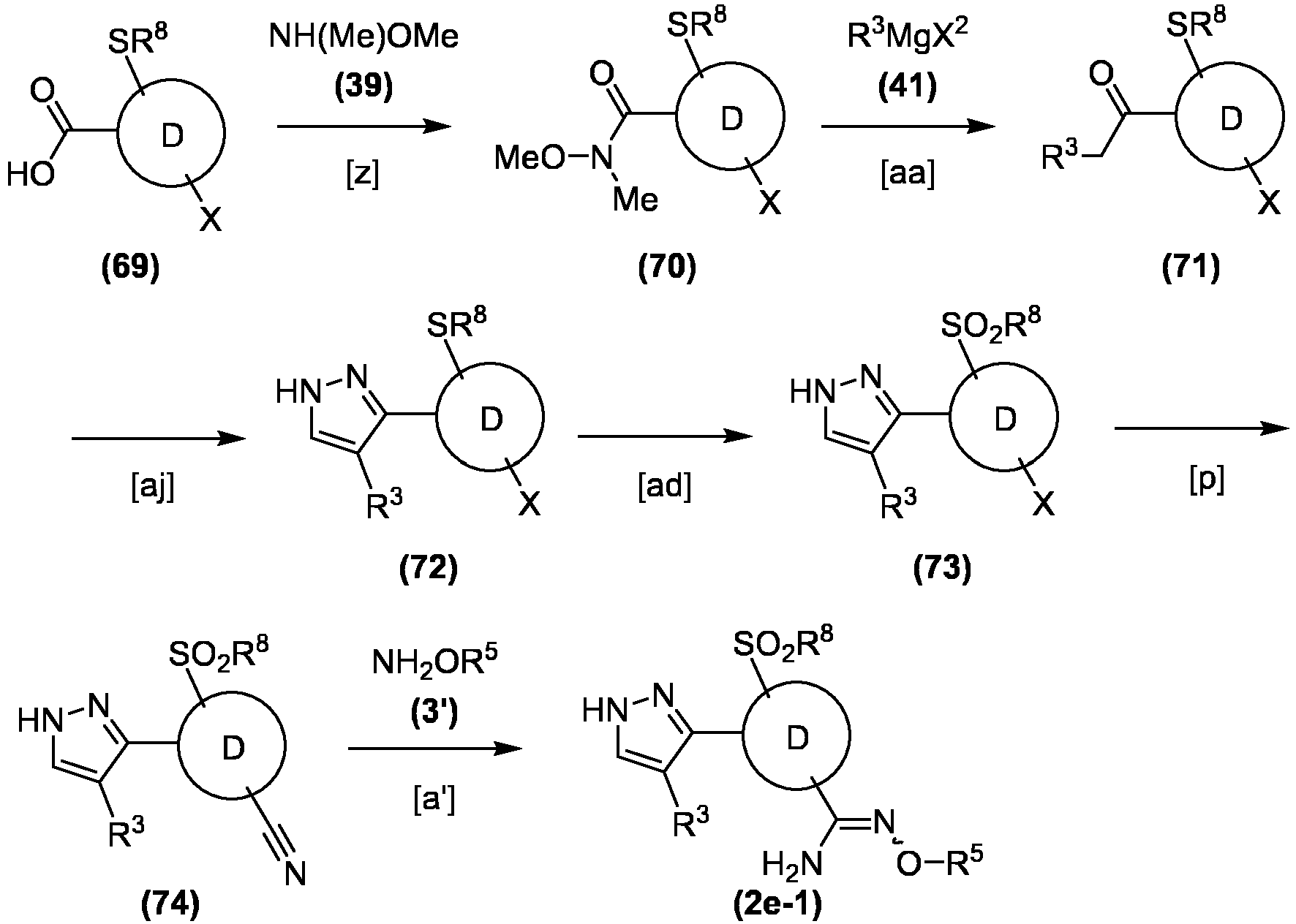
- In the formula, D, R3, R5, and R8 are the same as above; X represents a leaving group such as chlorine, bromine, or iodine; and X2 represents a halogen atom such as chlorine, bromine, or iodine.
- The compound represented by the general formula (72) can be produced by reacting the compound represented by the general formula (71) with a homologation agent and hydrazine in the presence of an inert solvent with or without a base.
- Examples of the homologation agent used in this reaction include N,N-dimethylformamide dimethyl acetal, N,N-dimethylformamide di-tert-butyl acetal, tert-butoxybis(dimethylamino)methane, trimethyl orthoformate, methyl formate, and ethyl formate. The amount of the homologation agent used is usually in the range of a 1- to 20-fold molar amount relative to the compound represented by the general formula (71).
- The hydrazine used in this reaction can be in the form of a salt such as hydrochloride or a hydrate. The amount of the hydrazine used is usually in the range of a 1- to 10-fold molar amount relative to the compound represented by the general formula (71).
- Examples of the base that can be used in this reaction include inorganic bases including alkali metal hydroxides such as sodium hydroxide and potassium hydroxide; alkali metal hydrides such as sodium hydride and potassium hydride; alkali metal alkoxides such as sodium ethoxide and potassium tert-butoxide; and carbonates such as sodium carbonate, potassium carbonate, cesium carbonate and sodium hydrogen carbonate; and organic bases such as triethylamine, pyridine, N,N-dimethyl-4-aminopyridine and DBU. The amount of the base used is usually in the range of a 1- to 10-fold molar amount relative to the compound represented by the general formula (71).
- The inert solvent used in this reaction may be any solvent that does not markedly inhibit the progress of the reaction, and examples include aromatic hydrocarbons such as benzene, toluene, and xylene; halogenated aliphatic hydrocarbons such as methylene chloride, chloroform, and carbon tetrachloride; halogenated aromatic hydrocarbons such as chlorobenzene and dichlorobenzene; chain or cyclic ethers such as diethyl ether, dioxane, and tetrahydrofuran; esters such as ethyl acetate; amides such as N,N-dimethylformamide and N,N-dimethylacetamide; and other inert solvents such as dimethyl sulfoxide, 1,3-dimethyl-2-imidazolidinone, acetone, methyl ethyl ketone, and water. One of these inert solvents may be used alone, and also two or more of them may be used as a mixture. The amount of the inert solvent used is not particularly limited as long as it is sufficient to dissolve the reaction reagents, and is usually selected as appropriate from the range of 0.5 L to 100 L relative to 1 mole of the compound represented by the general formula (71).
- The reaction temperature in this reaction is usually in the range of 0°C to the boiling point of the solvent used. The reaction time varies with the reaction scale, the reaction temperature and the like and is not the same in every case, but is usually selected as appropriate from the range of a few minutes to 48 hours. After the reaction is completed, the compound of interest is isolated from the post-reaction mixture by the usual method. As needed, recrystallization, column chromatography, etc. can be employed for the purification of the compound of interest. Alternatively, the post-reaction mixture is directly used in the next reaction without purification.
- Among examples of the compound represented by the general formula (2c) as the starting compound for Production Method 4, the compound represented by the general formula (2c-3) wherein Q is the above-defined Q10 can be produced from the compound represented by the general formula (1e-1) wherein A is the above-defined SO2R8 as an example of the compound represented by the general formula (1e) through the step [l] described below. The reaction conditions for the step [l] are the same as described above.

- In the formula, D, R1, R3, R4, R5, and R8 are the same as above; and R represents a (C1-C4) alkyl group such as a tert-butyl group or a hydrogen atom.
- Among examples of the compound represented by the general formula (2b) as the starting compound for Production Method 4, the compound represented by the general formula (2b-3) wherein A is the above-defined SO2R8 can be produced from the compound represented by the general formula (54) through the steps [g], [a'], [m], [ae], and [at] described below. The reaction conditions for the steps [g], [a'], [m], [ae], and [af] are the same as described above.

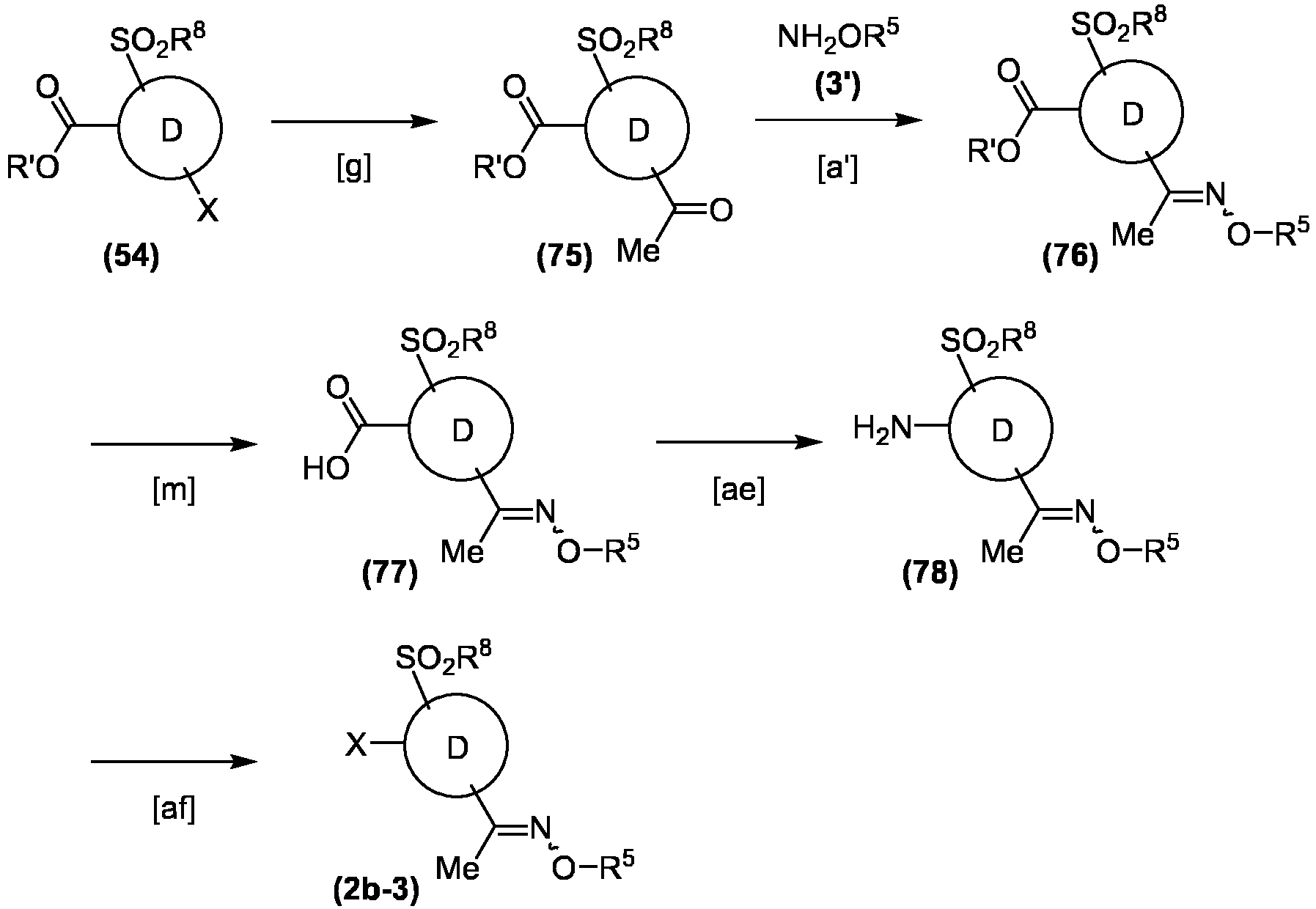
- In the formula, D, R5, and R8 are the same as above; R' represents a (C1-C6) alkyl group such as a methyl group or an ethyl group; and X represents a leaving group such as chlorine, bromine, or iodine.
- Among examples of the compound represented by the general formula (f) as the starting compound for Production Method 10, the compound represented by the general formula (2f-1) wherein A is the above-defined SO2R8 can be produced from the compound represented by the general formula (2b-2) through the steps [ak] and [al] described below.

- In the formula, D, R3, R5, and R8 are the same as above; and X represents a leaving group such as chlorine, bromine, or iodine.
- The compound represented by the general formula (80) can be produced by reacting the compound represented by the general formula (2b-2) with the compound represented by the general formula (79) in the presence of a palladium catalyst, copper iodide, a base and an inert solvent.
- Examples of the palladium catalyst used in this reaction include palladium metal salts such as palladium chloride, palladium bromide, palladium iodide and palladium acetate; and palladium complex compounds such as π-allylpalladium chloride dimer, palladium acetylacetonate, dichlorobis(acetonitrile)palladium, dichlorobis(benzonitrile)palladium, bis(dibenzylideneacetone)palladium, tris(dibenzylideneacetone)dipalladium, tris(dibenzylideneacetone)dipalladium (chloroform adduct), dichlorodiamine palladium, dichlorobis(triphenylphosphine)palladium, dichlorobis(tricyclohexylphosphine)palladium, tetrakis(triphenylphosphine)palladium, dichloro[1,2-bis(diphenylphosphino)ethane]palladium, dichloro[1,3-bis(diphenylphosphino)propane]palladium, dichloro [1,4-bis(diphenylphosphino)butane]palladium, dichloro[1,1'-bis(diphenylphosphino)ferrocene]palladium and a [(diphenylphosphino)ferrocene]dichloropalladium-dichloromethane complex. The amount of the metal catalyst used is usually selected as appropriate from the range of a 0.001- to 0.5-fold molar amount relative to the compound represented by the general formula (2b-2).
- These palladium catalysts may be used alone or in combination with a tertiary phosphine. Examples of the tertiary phosphine that can be used in combination with the palladium catalyst include triphenylphosphine, trimethylphosphine, triethylphosphine, tributylphosphine, tri(tert-butyl)phosphine, tricyclohexylphosphine, tri-o-tolylphosphine, trioctylphosphine, 9,9-dimethyl-4,5-bis(diphenylphosphino)xanthene, 2-(di-tert-butylphosphino)biphenyl, 2-(dicyclohexylphosphino)biphenyl, 1,2-bis(diphenylphosphino)ethane, 1,3-bis(diphenylphosphino)propane, 1,4-bis(diphenylphosphino)butane, 1,1'-bis(diphenylphosphino)ferrocene, (R)-(+)-2,2'-bis(diphenylphosphino)-1,1'-binaphthyl, (S)-(-)-2,2'-bis(diphenylphosphino)-1,1'-binaphthyl and (±)-2,2'-bis(diphenylphosphino)-1,1'-binaphthyl. The amount of the tertiary phosphine used is usually selected as appropriate from the range of a 0.5- to 10-fold molar amount relative to the palladium catalyst.
- The amount of the copper iodide used in this reaction is usually in the range of a 0.01- to 0.5-fold molar amount relative to the compound represented by the general formula (2b-2).
- Examples of the base that can be used in this reaction include inorganic bases including carbonates such as sodium carbonate, potassium carbonate, cesium carbonate and sodium hydrogen carbonate; and organic bases such as triethylamine, pyridine, N,N-dimethyl-4-aminopyridine and DBU. The amount of the base used is usually selected as appropriate from the range of a 1- to 10-fold molar amount relative to the compound represented by the general formula (2b-2). In some cases, the base can be used as the solvent as well.
- The inert solvent used in this reaction may be any solvent that does not markedly inhibit the reaction, and examples include alcohols such as methanol, ethanol, propanol, butanol, and 2-propanol; chain or cyclic ethers such as diethyl ether, tetrahydrofuran, dioxane, and 1,2-dimethoxyethane (DME); aromatic hydrocarbons such as benzene, toluene, and xylene; halogenated hydrocarbons such as methylene chloride, chloroform, and carbon tetrachloride; halogenated aromatic hydrocarbons such as chlorobenzene and dichlorobenzene; nitriles such as acetonitrile; esters such as ethyl acetate; polar solvents such as N,N-dimethylformamide, N,N-dimethylacetamide, dimethyl sulfoxide, and 1,3-dimethyl-2-imidazolidinone; and water. One of these inert solvents may be used alone, and also two or more of them may be used as a mixture. The amount of the inert solvent used is not particularly limited as long as it is sufficient to dissolve the reaction reagents, and is usually selected as appropriate from the range of 0.5 L to 100 L relative to 1 mole of the compound represented by the general formula (2b-2). In the case where the base is used also as the solvent, it is not necessary to use another solvent.
- Since this reaction is an equimolar reaction of the compounds, they are basically used in equimolar amounts, but either of them may be used in an excess amount. The reaction temperature in this reaction is usually in the range of room temperature to the boiling point of the solvent used. The reaction time varies with the reaction scale, the reaction temperature and the like, but is basically selected as appropriate from the range of a few minutes to 48 hours. This reaction may be conducted under the atmosphere of an inert gas such as nitrogen gas and argon gas. After the reaction is completed, the compound of interest is isolated from the post-reaction mixture by the usual method. As needed, recrystallization, column chromatography, etc. can be employed for the purification of the compound of interest. The post-reaction mixture may be directly used in the next reaction without isolation of the compound of interest.
- The compound represented by the general formula (2f-1) can be produced by reacting the compound represented by the general formula (80) with sodium azide (81) in the presence of diacetoxy iodobenzene and an inert solvent.
- The amount of the diacetoxy iodobenzene used in this reaction is usually in the range of an about 1- to 10-fold molar amount relative to the compound represented by the general formula (80).
- The inert solvent used in this reaction may be any solvent that does not markedly inhibit the reaction, and examples include alcohols such as methanol, ethanol, propanol, butanol, and 2-propanol; chain or cyclic ethers such as diethyl ether, tetrahydrofuran, dioxane, and 1,2-dimethoxyethane (DME); aromatic hydrocarbons such as benzene, toluene, and xylene; halogenated hydrocarbons such as methylene chloride, chloroform, and carbon tetrachloride; halogenated aromatic hydrocarbons such as chlorobenzene and dichlorobenzene; nitriles such as acetonitrile; esters such as ethyl acetate; polar solvents such as N,N-dimethylformamide, N,N-dimethylacetamide, dimethyl sulfoxide, and 1,3-dimethyl-2-imidazolidinone; and water. One of these inert solvents may be used alone, and also two or more of them may be used as a mixture. The amount of the inert solvent used is not particularly limited as long as it is sufficient to dissolve the reaction reagents, and is usually selected as appropriate from the range of 0.5 L to 100 L relative to 1 mole of the compound represented by the general formula (80). In the case where the base is used also as the solvent, it is not necessary to use another solvent.
- Since this reaction is an equimolar reaction of the compounds, they are basically used in equimolar amounts, but either of them may be used in an excess amount. The reaction temperature in this reaction is usually in the range of room temperature to the boiling point of the solvent used. The reaction time varies with the reaction scale, the reaction temperature and the like, but is basically selected as appropriate from the range of a few minutes to 48 hours. After the reaction is completed, the compound of interest is isolated from the post-reaction mixture by the usual method. As needed, recrystallization, column chromatography, etc. can be employed for the purification of the compound of interest. The post-reaction mixture may be directly used in the next reaction without isolation of the compound of interest.
- The compound Q-H represented by the general formula (6) in Production Method 3 can be produced by any of the methods described below or their modified methods. The production method for Q1-H is, for example, described in Organic Letters, 2015, 17, 2894-2897. The production method for Q2-H is, for example, described in Bioorganic & Medicinal Chemistry Letters, 2012, 22, 7036-7040. The production method for Q3-H is, for example, described in Heterocycles, 1983, 20, 1243-1246. The production method for Q4-H is, for example, described in Organic Process Research & Development, 2004, 8, 28-32. The production method for Q5-H is, for example, described in Bioorganic & Medicinal Chemistry Letters, 2021, 41, 127984. The production method for Q6-H is, for example, described in
U.S. Patent No. 5449784 . The production method for Q7-H is, for example, described in Journal of the American Chemical Society, 2015, 137, 2738-2747. The production method for Q8-H is, for example, described inU.S. Patent No. 4282364 . The production method for Q9-H is, for example, described in Organic Letters, 2007, 9, 4009-4012. The production method for Q10-H is, for example, described in Chem. Ber., 1960, 93, 1208-11. The production method for Q11-H is, for example, described in Organic Letters, 2020, 22, 1396-1401. The production method for Q12-H is, for example, described in Synlett, (1999), (10), 1642-1644. The production method for Q13-H is, for example, described in Journal of the American Chemical Society, 1937, 59, 2262-2264. The production method for Q14-H is, for example, described in Tetrahedron Letters, 1994, 35, 1585-1586. The production method for Q15-H is, for example, described in Journal of Chemical and Pharmaceutical Research, 2012, 4, 1772-1781. The production method for Q16-H is, for example, described in Journal of Medicinal Chemistry, 2016, 59, 8398-8411. The production method for Q17-H is, for example, described in Chemistry-A European Journal, 2016, 22(3), 911-915. The production method for Q18-H is, for example, described in Journal of Organic Chemistry, 1990, 55(3), 929-35. - Representative examples of the compound represented by the general formula (1) of the present invention are shown in Tables 1 to 21, but the present invention is not limited thereto. In Tables 1 to 21, some descriptions for R1 may be descriptions for both R1 and a substituent from the set Y on R1.
- Specific examples of the compound of the present invention are shown below. In the tables below, Me stands for a methyl group, Et stands for an ethyl group, i-Pr stands for an isopropyl group, n-Pr stands for a n-propyl group, c-Pr stands for a cyclopropyl group, i-Bu stands for an isobutyl group, n-Br stands for a n-butyl group, c-Bu stands for a cyclobutyl group, t-Bu stands for a tert-butyl group, c-Pen stands for a cyclopentyl group, i-pen stands for an isopentyl group, c-Hex stands for a cyclohexyl group, Ac stands for an acetyl group, Ph stands for a phenyl group, Bn stands for a benzyl group, Bz stands for a benzoyl group, and i-allyl stands for an isoallyl group. Shown in the column of "Physical property value" is a melting point (°C), a refractive index (nD), or "1H-NMR". The number in the parentheses for the refractive index represents measurement temperature (°C). 1H-NMR data are shown in Table 22.

Table 1 (In Table 1, R6a and R6b represent hydrogen atoms.) [Table 1-1] Compound No. R1 R3 R4 R5 A Physical Property value 1-1 2-Cl-Ph Me NH2 Et SO2NHMe NMR 1-2 Ph Me NHAc Et CO2Et NMR 1-3 Ph Me NHCOCF3 Et CO2Et 176-177 1-4 Ph Me NH2 Et SO2NHMe NMR 1-5 2-Cl-Ph Me NH2 Et SO2Me 197-198 1-6 Ph Me Me Et SO2Me 202-203 1-7 Ph Me NH2 Et SO2Me 208-209 1-8 Ph Me NH2 Et CO2Et NMR 1-9 2,6-F2-Ph Me NH2 Et SO2NHMe 161-162 1-10 3-(pyridin-3-yl)-Ph Me NH2 Me SO2NHMe 174-175 1-11 3-F-Ph Me NH2 Me SO2NMe2 113-114 1-12 2-Cl-Ph Me NAc2 Et SO2N(Ac)Me NMR 1-13 Ph Me NH2 Me SO2NMe2 160-161 1-14 3,5-F2-Ph Me NH2 Me SO2NHMe 199-200 1-15 3,5-F2-Ph Me NH2 Et SO2NHMe 155-156 1-16 3-CHF2-Ph Me NH2 Me SO2NHMe 193-194 1-17 3-CHF2-Ph Me NH2 Et SO2NHMe 158-159 1-18 Ph Me NH2 i-Pr SO2NMe2 NMR 1-19 2-Cl-Ph Me NH2 Me SO2NMe2 122-123 1-20 2-Cl-Ph Me NH2 i-Pr SO2NMe2 NMR 1-21 2-OMe-Ph Me NH2 Me SO2NHMe NMR 1-22 2-OMe-Ph Me NH2 Et SO2NHMe NMR 1-23 2,3-Cl2-Ph Me NH2 Me SO2NHMe 225-226 1-24 2,3-Cl2-Ph Me NH2 Et SO2NHMe 181-182 1-25 2,3-Cl2-Ph Me NH2 i-Pr SO2NHMe 82-83 1-26 3-Cl-Ph Me NH2 Et SO2NHMe 123-124 1-27 3-Cl-Ph Me NH2 Me SO2NHMe 151-152 1-28 Ph Me NH2 i-Pr SO2NHMe NMR 1-29 2-Cl-Ph Me NH2 Me SO2NHMe 178-179 1-30 2-Cl-Ph Me NH2 i-Pr SO2NHMe 113-114 [Table 1-2] Compound No. R1 R3 R4 R5 A Physical Property value 1-31 2-Cl-Ph Me NH2 Et SO2NMe2 140-141 1-32 Ph Me NH2 Et SO2NMe2 NMR 1-33 2,4-F2-Ph Me NH2 Me SO2NHMe 196-197 1-34 2,4-F2-Ph Me NH2 Et SO2NHMe 156-157 1-35 2,5-F2-Ph Me NH2 Me SO2NHMe 190-191 1-36 2,5-F2-Ph Me NH2 Et SO2NHMe 155-156 1-37 2-Cl-6-F-Ph Me NH2 Me SO2NHMe 154-155 1-38 2-Cl-6-F-Ph Me NH2 Et SO2NHMe NMR 1-39 2-F-Ph Me NH2 Et SO2NHMe NMR 1-40 4-Cl-Ph Me NH2 Et SO2NHMe NMR 1-41 3-F-Ph Me NH2 i-Pr SO2NMe2 NMR 1-42 2,6-F2-Ph Me NH2 Et SO2NMe2 NMR 1-43 3-Br-Ph Me NH2 Me SO2NHMe 161-162 1-44 3-Br-Ph Me NH2 Et SO2NHMe 171-172 1-45 3-F-Ph Me NH2 Et SO2NHMe 138-139 1-46 3-F-Ph Me NH2 Me SO2NHMe 153-154 1-47 3-F-Ph Me NH2 i-Pr SO2NHMe 143-144 1-48 Ph Me NH2 Me SO2NHMe 223-224 1-49 2,6-F2-Ph Me NH2 Me SO2NHMe 199-200 1-50 3-Me-Ph Me NH2 Me SO2NHMe 184-185 1-51 3-Me-Ph Me NH2 Et SO2NHMe 126-127 1-52 3-Me-Ph Me NH2 C(Me)2OMe SO2NHMe 180-181 1-53 2-Me-Ph Me NH2 Et SO2NHMe NMR 1-54 2,6-F2-Ph Me NH2 i-Pr SO2NHMe 1-55 2,5-F2-Ph Me NH2 i-Pr SO2NHMe 1-56 2,4-F2-Ph Me NH2 i-Pr SO2NHMe 1-57 4-F-Ph Me NH2 Me SO2NHMe 1-58 4-F-Ph Me NH2 Et SO2NHMe 1-59 4-F-Ph Me NH2 i-Pr SO2NHMe 1-60 2,3-F2-Ph Me NH2 Me SO2NHMe [Table 1-3] Compound No. R1 R3 R4 R5 A Physical Property value 1-61 2,3-F2-Ph Me NH2 Et SO2NHMe 1-62 2,3-F2-Ph Me NH2 i-Pr SO2NHMe 1-63 2,4,6-F3-Ph Me NH2 Me SO2NHMe 1-64 2,4,6-F3-Ph Me NH2 Et SO2NHMe 1-65 2,4,6-F3-Ph Me NH2 i-Pr SO2NHMe 1-66 2-SMe-Ph Me NH2 Me SO2NHMe 1-67 2-SMe-Ph Me NH2 Et SO2NHMe 1-68 2-SMe-Ph Me NH2 i-Pr SO2NHMe 1-69 2-SOMe-Ph Me NH2 Me SO2NHMe 1-70 2-SOMe-Ph Me NH2 Et SO2NHMe 1-71 2-SOMe-Ph Me NH2 i-Pr SO2NHMe 1-72 2-SO2Me-Ph Me NH2 Me SO2NHMe 1-73 2-SO2Me-Ph Me NH2 Et SO2NHMe 1-74 2-SO2Me-Ph Me NH2 i-Pr SO2NHMe 1-75 2-CN-Ph Me NH2 Me SO2NHMe 1-76 2-CN-Ph Me NH2 Et SO2NHMe 1-77 2-CN-Ph Me NH2 i-Pr SO2NHMe 1-78 2-OCHF2-Ph Me NH2 Me SO2NHMe 1-79 2-OCHF2-Ph Me NH2 Et SO2NHMe 1-80 2-OCHF2-Ph Me NH2 i-Pr SO2NHMe 1-81 2-c-Pr-Ph Me NH2 Me SO2NHMe 1-82 2-c-Pr-Ph Me NH2 Et SO2NHMe 1-83 2-c-Pr-Ph Me NH2 i-Pr SO2NHMe 1-84 2-CHF2-Ph Me NH2 Me SO2NHMe 1-85 2-CHF2-Ph Me NH2 Et SO2NHMe 1-86 2-CHF2-Ph Me NH2 i-Pr SO2NHMe 1-87 2-NHAc-Ph Me NH2 Me SO2NHMe 1-88 2-NHAc-Ph Me NH2 Et SO2NHMe 1-89 2-NHAc-Ph Me NH2 i-Pr SO2NHMe 1-90 2-P(OMe)2-Ph Me NH2 Me SO2NHMe [Table 1-4] Compound No. R1 R3 R4 R5 A Physical Property value 1-91 2-P(OMe)2-Ph Me NH2 Et SO2NHMe 1-92 2-P(OMe)2-Ph Me NH2 i-Pr SO2NHMe 1-93 Ph Me NH2 Me SO2N(Ac)Me 1-94 Ph Me NH2 Et SO2N(Ac)Me 1-95 Ph Me NH2 i-Pr SO2N(Ac)Me 1-96 Ph Me NH2 Me SO2N(CO2Me)Me 1-97 Ph Me NH2 Et SO2N(CO2Me)Me 1-98 Ph Me NH2 i-Pr SO2N(CO2Me)Me 1-99 2-F-Ph Me NH2 Me SO2N(Ac)Me 1-100 2-F-Ph Me NH2 Et SO2N(Ac)Me 1-101 2-F-Ph Me NH2 i-Pr SO2N(Ac)Me 1-102 2-F-Ph Me NH2 Me SO2N(CO2Me)Me 1-103 2-F-Ph Me NH2 Et SO2N(CO2Me)Me 1-104 2-F-Ph Me NH2 i-Pr SO2N(CO2Me)Me 1-105 3-F-Ph Me NH2 Me SO2N(Ac)Me 1-106 3-F-Ph Me NH2 Et SO2N(Ac)Me 1-107 3-F-Ph Me NH2 i-Pr SO2N(Ac)Me 1-108 3-F-Ph Me NH2 Me SO2N(CO2Me)Me 1-109 3-F-Ph Me NH2 Et SO2N(CO2Me)Me 1-110 3-F-Ph Me NH2 i-Pr SO2N(CO2Me)Me 1-111 4-F-Ph Me NH2 Me SO2N(Ac)Me 1-112 4-F-Ph Me NH2 Et SO2N(Ac)Me 1-113 4-F-Ph Me NH2 i-Pr SO2N(Ac)Me 1-114 4-F-Ph Me NH2 Me SO2N(CO2Me)Me 1-115 4-F-Ph Me NH2 Et SO2N(CO2Me)Me 1-116 4-F-Ph Me NH2 i-Pr SO2N(CO2Me)Me 1-117 2,6-F2-Ph Me NH2 Me SO2N(Ac)Me 1-118 2,6-F2-Ph Me NH2 Et SO2N(Ac)Me 1-119 2,6-F2-Ph Me NH2 i-Pr SO2N(Ac)Me 1-120 2,6-F2-Ph Me NH2 Me SO2N(CO2Me)Me [Table 1-5] Compound No. R1 R3 R4 R5 A Physical Property value 1-121 2,6-F2-Ph Me NH2 Et SO2N(CO2Me)Me 1-122 2,6-F2-Ph Me NH2 i-Pr SO2N(CO2Me)Me 1-123 2,5-F2-Ph Me NH2 Me SO2N(Ac)Me 1-124 2,5-F2-Ph Me NH2 Et SO2N(Ac)Me 1-125 2,5-F2-Ph Me NH2 i-Pr SO2N(Ac)Me 1-126 2,5-F2-Ph Me NH2 Me SO2N(CO2Me)Me 1-127 2,5-F2-Ph Me NH2 Et SO2N(CO2Me)Me 1-128 2,5-F2-Ph Me NH2 i-Pr SO2N(CO2Me)Me 1-129 2,4-F2-Ph Me NH2 Me SO2N(Ac)Me 1-130 2,4-F2-Ph Me NH2 Et SO2N(Ac)Me 1-131 2,4-F2-Ph Me NH2 i-Pr SO2N(Ac)Me 1-132 2,4-F2-Ph Me NH2 Me SO2N(CO2Me)Me 1-133 2,4-F2-Ph Me NH2 Et SO2N(CO2Me)Me 1-134 2,4-F2-Ph Me NH2 i-Pr SO2N(CO2Me)Me 1-135 2,3-F2-Ph Me NH2 Me SO2N(Ac)Me 1-136 2,3-F2-Ph Me NH2 Et SO2N(Ac)Me 1-137 2,3-F2-Ph Me NH2 i-Pr SO2N(Ac)Me 1-138 2,3-F2-Ph Me NH2 Me SO2N(CO2Me)Me 1-139 2,3-F2-Ph Me NH2 Et SO2N(CO2Me)Me 1-140 2,3-F2-Ph Me NH2 i-Pr SO2N(CO2Me)Me 1-141 3-Ph-Ph Me NH2 Me SO2NHMe 96-97 1-142 pyridin-2-yl Me NH2 Et SO2NHMe 199-200 1-143 pyrazin-2-yl Me NH2 i-Pr SO2NHMe 211-212 1-144 c-Hex Me NH2 Me SO2NHMe 162-163 1-145 c-Hex Me NH2 Et SO2NHMe 177-178 1-146 c-Hex Me NH2 i-Pr SO2NHMe 1-147 c-Pen Me NH2 Me SO2NHMe 1-148 c-Pen Me NH2 Et SO2NHMe 1-149 c-Pen Me NH2 i-Pr SO2NHMe 1-150 c-Bu Me NH2 Me SO2NHMe [Table 1-6] Compound No. R1 R3 R4 R5 A Physical Property value 1-151 c-Bu Me NH2 Et SO2NHMe 1-152 c-Bu Me NH2 i-Pr SO2NHMe 1-153 c-Pr Me NH2 Me SO2NHMe 156-157 1-154 c-Pr Me NH2 Et SO2NHMe 164-165 1-155 c-Pr Me NH2 i-Pr SO2NHMe 1-156 3,4-dihydro-2H-pyran-6-yl Me NH2 Me SO2NHMe 1-157 3,4-dihydro-2H-pyran-6-yl Me NH2 Et SO2NHMe 1-158 3,4-dihydro-2H-pyran-6-yl Me NH2 i-Pr SO2NHMe 1-159 tetrahydropyran-2-yl Me NH2 Me SO2NHMe 1-160 tetrahydropyran-2-yl Me NH2 Et SO2NHMe 1-161 tetrahydropyran-2-yl Me NH2 i-Pr SO2NHMe 1-162 1,3-dioxan-2-yl Me NH2 Me SO2NHMe 1-163 1,3-dioxan-2-yl Me NH2 Et SO2NHMe 1-164 1,3-dioxan-2-yl Me NH2 i-Pr SO2NHMe 1-165 tetrahydropyran-3-yl Me NH2 Me SO2NHMe 1-166 tetrahydropyran-3-yl Me NH2 Et SO2NHMe 1-167 tetrahydropyran-3-yl Me NH2 i-Pr SO2NHMe 1-168 tetrahydropyran-4-yl Me NH2 Me SO2NHMe 1-169 tetrahydropyran-4-yl Me NH2 Et SO2NHMe 1-170 tetrahydropyran-4-yl Me NH2 i-Pr SO2NHMe 1-171 tetrahydrothiopyran-4-yl Me NH2 Me SO2NHMe 1-172 tetrahydrothiopyran-4-yl Me NH2 Et SO2NHMe 1-173 tetrahydrothiopyran-4-yl Me NH2 i-Pr SO2NHMe 1-174 1-Ac-piperidin-4-yl Me NH2 Me SO2NHMe 1-175 1-Ac-piperidin-4-yl Me NH2 Et SO2NHMe 1-176 1-Ac-piperidin-4-yl Me NH2 i-Pr SO2NHMe 1-177 piperidin-1-yl Me NH2 Me SO2NHMe 1-178 piperidin-1-yl Me NH2 Et SO2NHMe 1-179 piperidin-1-yl Me NH2 i-Pr SO2NHMe 1-180 1,3-dioxolan-2-yl Me NH2 Me SO2NHMe [Table 1-7] Compound No. R1 R3 R4 R5 A Physical Property value 1-181 1,3-dioxolan-2-yl Me NH2 Et SO2NHMe 1-182 1,3-dioxolan-2-yl Me NH2 i-Pr SO2NHMe 1-183 1,3-dioxepan-2-yl Me NH2 Me SO2NHMe 1-184 1,3-dioxepan-2-yl Me NH2 Et SO2NHMe 1-185 1,3-dioxepan-2-yl Me NH2 i-Pr SO2NHMe 1-186 pyrimidin-2-yl Me NH2 Et SO2NHMe 241-242 1-187 pyrimidin-2-yl Me NH2 i-Pr SO2NHMe 1-188 thiazol-5-yl Me NH2 Me SO2NHMe NMR 1-189 thiazol-5-yl Me NH2 Et SO2NHMe NMR 1-190 thiazol-5-yl Me NH2 i-Pr SO2NHMe 1-191 thiazol-4-yl Me NH2 Me SO2NHMe 1-192 thiazol-4-yl Me NH2 Et SO2NHMe 86-89 1-193 thiazol-4-yl Me NH2 i-Pr SO2NHMe 1-194 1,2,3-thiadiazol-5-yl Me NH2 Me SO2NHMe 1-195 1,2,3-thiadiazol-5-yl Me NH2 Et SO2NHMe 1-196 1,2,3-thiadiazol-5-yl Me NH2 i-Pr SO2NHMe 1-197 thiophen-2-yl Me NH2 Me SO2NHMe 181-182 1-198 thiophen-2-yl Me NH2 Et SO2NHMe 129-130 1-199 thiophen-2-yl Me NH2 i-Pr SO2NHMe 1-200 thiophen-3-yl Me NH2 Me SO2NHMe NMR 1-201 thiophen-3-yl Me NH2 Et SO2NHMe NMR 1-202 thiophen-3-yl Me NH2 i-Pr SO2NHMe 1-203 pyridazin-3-yl Me NH2 Me SO2NHMe 1-204 pyridazin-3-yl Me NH2 Et SO2NHMe 1-205 pyridazin-3-yl Me NH2 i-Pr SO2NHMe [Table 1-8] Compound No. R1 R3 R4 R5 A Physical Property value 1-206 thiazol-2-yl Me NH2 Me SO2NHMe NMR 1-207 thiazol-2-yl Me NH2 Et SO2NHMe NMR 1-208 thiazol-2-yl Me NH2 i-Pr SO2NHMe 1-209 pyridin-4-yl Me NH2 Et SO2NHMe 168-169 1-210 2,6-F2-Ph Me NH2 Et SO2N(Boc)Me 187-188 1-211 3-CF3-pyridin-2-yl Me NH2 Me SO2NHMe NMR 1-212 3-CF3-pyridin-2-yl Me NH2 Et SO2NHMe NMR 1-213 CH2SMe Me NH2 Me SO2NHMe NMR 1-214 CH2SMe Me NH2 Et SO2NHMe NMR 1-215 CH2SO2Me Me NH2 Me SO2NHMe NMR 1-216 CH2SOMe Me NH2 Et SO2NHMe NMR 1-217 CH2SO2Me Me NH2 Et SO2NHMe NMR 1-218 i-pen Me NH2 Me SO2NHMe NMR 1-219 i-Pr Me NH2 Me SO2NHMe NMR 1-220 i-Pr Me NH2 Et SO2NHMe NMR 1-221 CH2CH2OMe Me NH2 Me SO2NHMe NMR 1-222 CH2CH2OMe Me NH2 Et SO2NHMe NMR 1-223 CH2OMe Me NH2 Et SO2NHMe NMR 1-224 CH2OMe Me NH2 iPr SO2NHMe NMR 1-225 furan-2-yl Me NH2 Me SO2NHMe 216-217 1-226 furan-2-yl Me NH2 Et SO2NHMe 153-154 1-227 5-Me-pyridin-2-yl Me NH2 Et SO2NHMe NMR 1-228 5-Me-pyridin-2-yl Me NH2 Me SO2NHMe NMR 1-229 pyridin-2-yl Me NH2 Me SO2NHMe NMR 1-230 quinolin-2-yl Me NH2 Et SO2NHMe 83-88 1-231 2,6-F2-Ph Me Me Et SO2NHMe 164-165 1-232 2,6-F2-Ph Me Me Me SO2NHMe 189-190 1-233 5-Cl-thiophen-2-yl Me NH2 Me SO2NHMe 187-188 1-234 5-Cl-thiophen-2-yl Me NH2 Et SO2NHMe NMR 1-235 5-Cl-pyridin-2-yl Me NH2 Et SO2NHMe 226-230 [Table 1-9] Compound No. R1 R3 R4 R5 A Physical Property value 1-236 n-Pr Me NH2 Me SO2NHMe NMR 1-237 n-Pr Me NH2 Et SO2NHMe NMR 1-238 n-Pr Me NH2 i-Pr SO2NHMe 1-239 thiazol-5-yl Et NH2 Me SO2NHMe 1-240 thiazol-5-yl Et NH2 Et SO2NHMe 1-241 thiazol-5-yl Et NH2 i-Pr SO2NHMe 1-242 thiazol-4-yl Et NH2 Me SO2NHMe 1-243 thiazol-4-yl Et NH2 Et SO2NHMe 1-244 thiazol-4-yl Et NH2 i-Pr SO2NHMe 1-245 thiazol-2-yl Et NH2 Me SO2NHMe 1-246 thiazol-2-yl Et NH2 Et SO2NHMe 1-247 thiazol-2-yl Et NH2 i-Pr SO2NHMe 1-248 thiophen-2-yl Et NH2 Me SO2NHMe NMR 1-249 thiophen-2-yl Et NH2 Et SO2NHMe NMR 1-250 thiophen-2-yl Et NH2 i-Pr SO2NHMe 1-251 thiophen-3-yl Et NH2 Me SO2NHMe 1-252 thiophen-3-yl Et NH2 Et SO2NHMe 1-253 thiophen-3-yl Et NH2 i-Pr SO2NHMe 1-254 pyridazin-3-yl Et NH2 Me SO2NHMe 1-255 pyridazin-3-yl Et NH2 Et SO2NHMe 1-256 pyridazin-3-yl Et NH2 i-Pr SO2NHMe 1-257 pyrazin-2-yl Et NH2 Me SO2NHMe 1-258 pyrazin-2-yl Et NH2 Et SO2NHMe 1-259 pyrazin-2-yl Et NH2 i-Pr SO2NHMe 1-260 pyrimidin-2-yl Et NH2 Me SO2NHMe 1-261 pyrimidin-2-yl Et NH2 Et SO2NHMe 1-262 pyrimidin-2-yl Et NH2 i-Pr SO2NHMe 1-263 pyrimidin-4-yl Et NH2 Me SO2NHMe 1-264 pyrimidin-4-yl Et NH2 Et SO2NHMe 1-265 pyrimidin-4-yl Et NH2 i-Pr SO2NHMe [Table 1-10] Compound No. R1 R3 R4 R5 A Physical Property value 1-266 pyrimidin-5-yl Et NH2 Me SO2NHMe 1-267 pyrimidin-5-yl Et NH2 Et SO2NHMe 1-268 pyrimidin-5-yl Et NH2 i-Pr SO2NHMe 1-269 Ph Et NH2 Me SO2NHMe NMR 1-270 Ph Et NH2 Et SO2NHMe NMR 1-271 Ph Et NH2 i-Pr SO2NHMe 1-272 2-F-Ph Et NH2 Me SO2NHMe 1-273 2-F-Ph Et NH2 Et SO2NHMe 1-274 2-F-Ph Et NH2 i-Pr SO2NHMe 1-275 3-F-Ph Et NH2 Me SO2NHMe 1-276 3-F-Ph Et NH2 Et SO2NHMe 1-277 3-F-Ph Et NH2 i-Pr SO2NHMe 1-278 4-F-Ph Et NH2 Me SO2NHMe 1-279 4-F-Ph Et NH2 Et SO2NHMe 1-280 4-F-Ph Et NH2 i-Pr SO2NHMe 1-281 2,6-F2-Ph Et NH2 Me SO2NHMe 1-282 2,6-F2-Ph Et NH2 Et SO2NHMe 1-283 2,6-F2-Ph Et NH2 i-Pr SO2NHMe 1-284 n-Bu Me NH2 Me SO2NHMe NMR 1-285 n-Bu Me NH2 Et SO2NHMe NMR 1-286 n-Bu Me NH2 i-Pr SO2NHMe 1-287 5-Cl-thiazol-2-yl Me NH2 Me SO2NHMe NMR 1-288 4-Me-thiazol-5-yl Me NH2 Me SO2NHMe NMR 1-289 4-Me-thiazol-5-yl Me NH2 Et SO2NHMe NMR 1-290 4-Me-thiazol-5-yl Me NH2 i-Pr SO2NHMe NMR 1-291 i-Pr Et NH2 Me SO2NHMe 103-104 1-292 i-Pr Et NH2 Et SO2NHMe 95-96 1-293 i-Bu Me NH2 Me SO2NHMe 148-149 1-294 i-Bu Me NH2 Et SO2NHMe 101-102 1-295 thiophen-2-yl Me NH2 Me SO2NHEt 211-212 [Table 1-11] Compound No. R1 R3 R4 R5 A Physical Property value 1-296 thiophen-2-yl Me NH2 Et SO2NHEt 185-186 1-297 thiophen-2-yl Me NH2 Me CO2t-Bu 1-298 thiophen-2-yl Me NH2 Et CO2t-Bu 1-299 i-Pr Et NH2 i-Pr SO2NHMe NMR 1-300 BnO Me NH2 Et SO2NHMe 1-301 CF3CH2O Me NH2 Me SO2NHMe 1-302 CF3CH2O Me NH2 Et SO2NHMe 1-303 CF3CH2O Me NH2 i-Pr SO2NHMe 1-304 CHF2CH2O Me NH2 Me SO2NHMe 1-305 CHF2CH2O Me NH2 Et SO2NHMe 1-306 CHF2CH2O Me NH2 i-Pr SO2NHMe 1-307 MeO Me NH2 Et SO2NHMe 1-308 BuO Me NH2 Me SO2NHMe 1-309 BuO Me NH2 Et SO2NHMe 1-310 BuO Me NH2 i-Pr SO2NHMe 1-311 PhO Me NH2 Et SO2NHMe 1-312 2-Cl-PhO Me NH2 Et SO2NHMe 1-313 2-OMe-PhO Me NH2 Et SO2NHMe 1-314 pyridine-2-yl CF3CH2 NH2 Et SO2NHMe 1-315 Ph Me NH2 Me SO2NHEt 1-316 Ph Me NH2 Et SO2NHEt 1-317 Ph Me NH2 i-Pr SO2NHEt 1-318 2-F-Ph Me NH2 Me SO2NHEt 1-319 2-F-Ph Me NH2 Et SO2NHEt 1-320 2-F-Ph Me NH2 i-Pr SO2NHEt 1-321 3-F-Ph Me NH2 Me SO2NHEt 1-322 3-F-Ph Me NH2 Et SO2NHEt 1-323 3-F-Ph Me NH2 i-Pr SO2NHEt 1-324 4-F-Ph Me NH2 Me SO2NHEt 1-325 4-F-Ph Me NH2 Et SO2NHEt 1-326 4-F-Ph Me NH2 i-Pr SO2NHEt [Table 1-12] Compound No. R1 R3 R4 R5 A Physical Property value 1-327 2,6-F2-Ph Me NH2 Me SO2NHEt 1-328 2,6-F2-Ph Me NH2 Et SO2NHEt 1-329 2,6-F2-Ph Me NH2 i-Pr SO2NHEt 1-330 thiazol-5-yl Me NH2 Me SO2NHEt 1-331 thiazol-5-yl Me NH2 Et SO2NHEt 1-332 thiazol-5-yl Me NH2 i-Pr SO2NHEt 1-333 thiazol-4-yl Me NH2 Me SO2NHEt 1-334 thiazol-4-yl Me NH2 Et SO2NHEt 1-335 thiazol-4-yl Me NH2 i-Pr SO2NHEt 1-336 thiazol-2-yl Me NH2 Me SO2NHEt 1-337 thiazol-2-yl Me NH2 Et SO2NHEt 1-338 thiazol-2-yl Me NH2 i-Pr SO2NHEt 1-339 thiophen-2-yl Me NH2 i-Pr SO2NHEt 1-340 thiophen-3-yl Me NH2 Me SO2NHEt 1-341 thiophen-3-yl Me NH2 Et SO2NHEt 1-342 thiophen-3-yl Me NH2 i-Pr SO2NHEt 1-343 pyridazin-3-yl Me NH2 Me SO2NHEt 1-344 pyridazin-3-yl Me NH2 Et SO2NHEt 1-345 pyridazin-3-yl Me NH2 i-Pr SO2NHEt 1-346 pyrazin-2-yl Me NH2 Me SO2NHEt 1-347 pyrazin-2-yl Me NH2 Et SO2NHEt 1-348 pyrazin-2-yl Me NH2 i-Pr SO2NHEt 1-349 pyrimidin-2-yl Me NH2 Me SO2NHEt 1-350 pyrimidin-2-yl Me NH2 Et SO2NHEt 1-351 pyrimidin-2-yl Me NH2 i-Pr SO2NHEt 1-352 pyrimidin-4-yl Me NH2 Me SO2NHEt 1-353 pyrimidin-4-yl Me NH2 Et SO2NHEt 1-354 pyrimidin-4-yl Me NH2 i-Pr SO2NHEt 1-355 pyrimidin-5-yl Me NH2 Me SO2NHEt 1-356 pyrimidin-5-yl Me NH2 Et SO2NHEt 1-357 pyrimidin-5-yl Me NH2 i-Pr SO2NHEt 1-358 t-Bu Me NH2 Me SO2NHMe NMR 1-359 t-Bu Me NH2 Et SO2NHMe NMR 
Table 2 (In Table 2, R6a and R6b represent hydrogen atoms.) [Table 2-1] Compound No. R1 R2 R3 R4 R5 A Physical Property value 2-1 2,6-F2-Ph H Me NH2 Et CO2Et 120-121 2-2 2-Cl-Ph H Me NH2 Et CO2Et 117-118 2-3 2-Me-Ph H Me NH2 Et CO2Et 115-116 2-4 3-Me-Ph H Me NH2 Et CO2Et NMR 2-5 4-Me-Ph H Me NH2 Et CO2Et 77-78 2-6 2-CF3-Ph H Me NH2 Et CO2Et NMR 2-7 3-CF3-Ph H Me NH2 Et CO2Et 124-125 2-8 4-CF3-Ph H Me NH2 Et CO2Et NMR 2-9 2-OMe-Ph H Me NH2 Et CO2Et 107-108 2-10 3-OMe-Ph H Me NH2 Et CO2Et 51-52 2-11 4-OMe-Ph H Me NH2 Et CO2Et 132-133 2-12 2-F-Ph H Me NH2 Et CO2Et 117-118 2-13 3-F-Ph H Me NH2 Et CO2Et 59-60 2-14 4-F-Ph H Me NH2 Et CO2Et 70-71 2-15 2-Cl-Ph H Me Me Et SO2CH2Ac NMR 2-16 2-Cl-Ph H Me Me Et OMe 154-155 2-17 2-Cl-Ph H Me Me Et OEt NMR 2-18 2-Cl-Ph Cl Me Me Et SO2Me 143-144 2-19 Ph H Me NH2 Et CO2Et 62-63 2-20 Ph H Me NH2 Et CO2H 220-221 2-21 Ph H Me NH2 Et CO2Me 146-147 2-22 Ph H Me NH2 CH2CF3 CO2Me NMR 2-23 Ph Br Me NH2 Et CO2Me 113-114 2-24 Ph Cl Me NH2 Et CO2Me 101-102 2-25 3-CF3-Ph H Me NH2 Et CO2Me 56-58 2-26 2,3-F2-Ph H Me NH2 Et CO2Et 134-135 2-27 2,4-F2-Ph H Me NH2 Et CO2Et 100-101 2-28 2,5-F2-Ph H Me NH2 Et CO2Et 122-123 2-29 2-CN-Ph H Me NH2 Et CO2Et 103-104 2-30 2,4,6-F3-Ph H Me NH2 Et CO2Et [Table 2-2] Compound No. R1 R2 R3 R4 R5 A Physical Property value 2-31 2-Cl-Ph H Me NH2 Et SO2Me 116-117 2-32 2-Cl-Ph H Me Me Et SO2Me NMR 2-33 Ph H Me NH2 Et SO2NHMe 237-238 2-34 pyridin-3-yl H Me NH2 Et CO2Et 57-58 2-35 1-Me-pyrazol-5-yl H Me NH2 Et CO2Et 122-123 2-36 c-Pr H Me NH2 Et CO2Et 107-108 2-37 3,4-dihydro-2H-pyran-6-yl H Me NH2 Et CO2Et NMR 2-38 thiophen-3-yl H Me NH2 Et CO2Me 52-53 [Table 2-3] Compound No. R1 R2 R3 R4 R5 A Physical Property value 2-39 thiazol-5-yl H Me NH2 Me SO2NHMe 2-40 thiazol-5-yl H Me NH2 Et SO2NHMe 2-41 thiazol-5-yl H Me NH2 i-Pr SO2NHMe 2-42 thiazol-4-yl H Me NH2 Me SO2NHMe 2-43 thiazol-4-yl H Me NH2 Et SO2NHMe 2-44 thiazol-4-yl H Me NH2 i-Pr SO2NHMe 2-45 thiazol-2-yl H Me NH2 Me SO2NHMe 2-46 thiazol-2-yl H Me NH2 Et SO2NHMe 2-47 thiazol-2-yl H Me NH2 i-Pr SO2NHMe 2-48 thiophen-2-yl H Me NH2 Me SO2NHMe 2-49 thiophen-2-yl H Me NH2 Et SO2NHMe 2-50 thiophen-2-yl H Me NH2 i-Pr SO2NHMe 2-51 thiophen-3-yl H Me NH2 Me SO2NHMe 2-52 thiophen-3-yl H Me NH2 Et SO2NHMe 2-53 thiophen-3-yl H Me NH2 i-Pr SO2NHMe 2-54 pyridazin-3-yl H Me NH2 Me SO2NHMe 2-55 pyridazin-3-yl H Me NH2 Et SO2NHMe 2-56 pyridazin-3-yl H Me NH2 i-Pr SO2NHMe 2-57 pyrazin-2-yl H Me NH2 Me SO2NHMe 2-58 pyrazin-2-yl H Me NH2 Et SO2NHMe 2-59 pyrazin-2-yl H Me NH2 i-Pr SO2NHMe 2-60 pyrimidin-2-yl H Me NH2 Me SO2NHMe 2-61 pyrimidin-2-yl H Me NH2 Et SO2NHMe 2-62 pyrimidin-2-yl H Me NH2 i-Pr SO2NHMe 2-63 pyrimidin-4-yl H Me NH2 Me SO2NHMe 2-64 pyrimidin-4-yl H Me NH2 Et SO2NHMe 2-65 pyrimidin-4-yl H Me NH2 i-Pr SO2NHMe 2-66 pyrimidin-5-yl H Me NH2 Me SO2NHMe 2-67 pyrimidin-5-yl H Me NH2 Et SO2NHMe 2-68 pyrimidin-5-yl H Me NH2 i-Pr SO2NHMe [Table 2-4] Compound No. R1 R2 R3 R4 R5 A Physical Property value 2-69 thiazol-5-yl H Et NH2 Me SO2NHMe 2-70 thiazol-5-yl H Et NH2 Et SO2NHMe 2-71 thiazol-5-yl H Et NH2 i-Pr SO2NHMe 2-72 thiazol-4-yl H Et NH2 Me SO2NHMe 2-73 thiazol-4-yl H Et NH2 Et SO2NHMe 2-74 thiazol-4-yl H Et NH2 i-Pr SO2NHMe 2-75 thiazol-2-yl H Et NH2 Me SO2NHMe 2-76 thiazol-2-yl H Et NH2 Et SO2NHMe 2-77 thiazol-2-yl H Et NH2 i-Pr SO2NHMe 2-78 thiophen-2-yl H Et NH2 Me SO2NHMe 2-79 thiophen-2-yl H Et NH2 Et SO2NHMe 2-80 thiophen-2-yl H Et NH2 i-Pr SO2NHMe 2-81 thiophen-3-yl H Et NH2 Me SO2NHMe 2-82 thiophen-3-yl H Et NH2 Et SO2NHMe 2-83 thiophen-3-yl H Et NH2 i-Pr SO2NHMe 2-84 pyridazin-3-yl H Et NH2 Me SO2NHMe 2-85 pyridazin-3-yl H Et NH2 Et SO2NHMe 2-86 pyridazin-3-yl H Et NH2 i-Pr SO2NHMe 2-87 pyrazin-2-yl H Et NH2 Me SO2NHMe 2-88 pyrazin-2-yl H Et NH2 Et SO2NHMe 2-89 pyrazin-2-yl H Et NH2 i-Pr SO2NHMe 2-90 pyrimidin-2-yl H Et NH2 Me SO2NHMe 2-91 pyrimidin-2-yl H Et NH2 Et SO2NHMe 2-92 pyrimidin-2-yl H Et NH2 i-Pr SO2NHMe 2-93 pyrimidin-4-yl H Et NH2 Me SO2NHMe 2-94 pyrimidin-4-yl H Et NH2 Et SO2NHMe 2-95 pyrimidin-4-yl H Et NH2 i-Pr SO2NHMe 2-96 pyrimidin-5-yl H Et NH2 Me SO2NHMe 2-97 pyrimidin-5-yl H Et NH2 Et SO2NHMe 2-98 pyrimidin-5-yl H Et NH2 i-Pr SO2NHMe [Table 2-5] Compound No. R1 R2 R3 R4 R5 A Physical Property value 2-99 Ph H Et NH2 Me SO2NHMe 2-100 Ph H Et NH2 Et SO2NHMe 2-101 Ph H Et NH2 i-Pr SO2NHMe 2-102 2-F-Ph H Et NH2 Me SO2NHMe 2-103 2-F-Ph H Et NH2 Et SO2NHMe 2-104 2-F-Ph H Et NH2 i-Pr SO2NHMe 2-105 3-F-Ph H Et NH2 Me SO2NHMe 2-106 3-F-Ph H Et NH2 Et SO2NHMe 2-107 3-F-Ph H Et NH2 i-Pr SO2NHMe 2-108 4-F-Ph H Et NH2 Me SO2NHMe 2-109 4-F-Ph H Et NH2 Et SO2NHMe 2-110 4-F-Ph H Et NH2 i-Pr SO2NHMe 2-111 2,6-F2-Ph H Et NH2 Me SO2NHMe 2-112 2,6-F2-Ph H Et NH2 Et SO2NHMe 2-113 2,6-F2-Ph H Et NH2 i-Pr SO2NHMe 2-114 c-Pr H Me NH2 Me SO2NHMe 2-115 c-Pr H Me NH2 Et SO2NHMe 2-116 c-Pr H Me NH2 i-Pr SO2NHMe 2-117 c-Pr Cl Me NH2 Me SO2NHMe 2-118 c-Pr Cl Me NH2 Et SO2NHMe 2-119 c-Pr Cl Me NH2 i-Pr SO2NHMe 2-120 Ph H Me NH2 Me SO2NHEt 2-121 Ph H Me NH2 Et SO2NHEt 2-122 Ph H Me NH2 i-Pr SO2NHEt 2-123 2-F-Ph H Me NH2 Me SO2NHEt 2-124 2-F-Ph H Me NH2 Et SO2NHEt 2-125 2-F-Ph H Me NH2 i-Pr SO2NHEt 2-126 3-F-Ph H Me NH2 Me SO2NHEt 2-127 3-F-Ph H Me NH2 Et SO2NHEt 2-128 3-F-Ph H Me NH2 i-Pr SO2NHEt [Table 2-6] Compound No. R1 R2 R3 R4 R5 A Physical Property value 2-129 4-F-Ph H Me NH2 Me SO2NHEt 2-130 4-F-Ph H Me NH2 Et SO2NHEt 2-131 4-F-Ph H Me NH2 i-Pr SO2NHEt 2-132 2,6-F2-Ph H Me NH2 Me SO2NHEt 2-133 2,6-F2-Ph H Me NH2 Et SO2NHEt 2-134 2,6-F2-Ph H Me NH2 i-Pr SO2NHEt 2-135 thiazol-5-yl H Me NH2 Me SO2NHEt 2-136 thiazol-5-yl H Me NH2 Et SO2NHEt 2-137 thiazol-5-yl H Me NH2 i-Pr SO2NHEt 2-138 thiazol-4-yl H Me NH2 Me SO2NHEt 2-139 thiazol-4-yl H Me NH2 Et SO2NHEt 2-140 thiazol-4-yl H Me NH2 i-Pr SO2NHEt 2-141 thiazol-2-yl H Me NH2 Me SO2NHEt 2-142 thiazol-2-yl H Me NH2 Et SO2NHEt 2-143 thiazol-2-yl H Me NH2 i-Pr SO2NHEt 2-144 thiophen-2-yl H Me NH2 Me SO2NHEt 2-145 thiophen-2-yl H Me NH2 Et SO2NHEt 2-146 thiophen-2-yl H Me NH2 i-Pr SO2NHEt 2-147 thiophen-3-yl H Me NH2 Me SO2NHEt 2-148 thiophen-3-yl H Me NH2 Et SO2NHEt 2-149 thiophen-3-yl H Me NH2 i-Pr SO2NHEt 2-150 pyridazin-3-yl H Me NH2 Me SO2NHEt 2-151 pyridazin-3-yl H Me NH2 Et SO2NHEt 2-152 pyridazin-3-yl H Me NH2 i-Pr SO2NHEt 2-153 pyrazin-2-yl H Me NH2 Me SO2NHEt 2-154 pyrazin-2-yl H Me NH2 Et SO2NHEt 2-155 pyrazin-2-yl H Me NH2 i-Pr SO2NHEt 2-156 pyrimidin-2-yl H Me NH2 Me SO2NHEt 2-157 pyrimidin-2-yl H Me NH2 Et SO2NHEt 2-158 pyrimidin-2-yl H Me NH2 i-Pr SO2NHEt [Table 2-7] Compound No. R1 R2 R3 R4 R5 A Physical Property value 2-159 pyrimidin-4-yl H Me NH2 Me SO2NHEt 2-160 pyrimidin-4-yl H Me NH2 Et SO2NHEt 2-161 pyrimidin-4-yl H Me NH2 i-Pr SO2NHEt 2-162 pyrimidin-5-yl H Me NH2 Me SO2NHEt 2-163 pyrimidin-5-yl H Me NH2 Et SO2NHEt 2-164 pyrimidin-5-yl H Me NH2 i-Pr SO2NHEt 
- Table 3 (In Table 3, R6a and R6b represent hydrogen atoms.)
[Table 3-1] Compound No. R1 R3 R4 R5 A Physical Property value 3-1 2,3-F2-Ph Me NH2 Et SO2NHMe NMR 3-2 2-Cl-3-F-Ph Me NH2 Et SO2NHMe 194-195 3-3 Ph Me NH2 Et SO2NHMe NMR 3-4 2-Cl-Ph Me NH2 Et SO2NHMe NMR 3-5 2-Br-Ph Me NH2 Et SO2NHMe 175-176 3-6 2-Cl-4-F-Ph Me NH2 Et SO2NHMe NMR 3-7 3-F-Ph Me NH2 Me SO2NHMe 202-203 3-8 2,6-F2-Ph Me NH2 Me SO2NHMe NMR 3-9 Ph Me NH2 Et SO2Me NMR 3-10 2-NHAc-Ph Me NH2 Et SO2NHMe 196-197 3-11 2,6-F2-Ph Me NH2 Et SO2NHMe 144-145 3-12 2-F-Ph Me NH2 Et SO2NHMe NMR 3-13 2-Cl-6-F-Ph Me NH2 Et SO2NHMe NMR 3-14 2,4,6-F3-Ph Me NH2 Et SO2NHMe NMR 3-15 2,4-F2-Ph Me NH2 Et SO2NHMe 136-137 3-16 2-NO2-Ph Me NH2 Et SO2NHMe 187-188 3-17 2-Cl-Ph Me NH2 Me SO2NHMe NMR 3-18 2-OMe-Ph Me NH2 Et SO2NHMe NMR 3-19 2-CN-Ph Me NH2 Et SO2NHMe 237 3-20 3-Cl-Ph Me NH2 Me SO2NHMe 164-165 3-21 Ph Me NH2 Me SO2NHMe 202-203 3-22 2,6-F2-Ph Me NH2 i-Pr SO2NHMe 3-23 2-Cl-6-F-Ph Me NH2 Me SO2NHMe 3-24 2-Cl-6-F-Ph Me NH2 i-Pr SO2NHMe 3-25 2-F-Ph Me NH2 Me SO2NHMe 3-26 2-F-Ph Me NH2 i-Pr SO2NHMe 3-27 3-F-Ph Me NH2 Et SO2NHMe 3-28 3-F-Ph Me NH2 i-Pr SO2NHMe 3-29 4-F-Ph Me NH2 Me SO2NHMe 3-30 4-F-Ph Me NH2 Et SO2NHMe [Table 3-2] Compound No. R1 R3 R4 R5 A Physical Property value 3-31 4-F-Ph Me NH2 i-Pr SO2NHMe 3-32 2,5-F2-Ph Me NH2 Me SO2NHMe 3-33 2,5-F2-Ph Me NH2 Et SO2NHMe 3-34 2,5-F2-Ph Me NH2 i-Pr SO2NHMe 3-35 2,4-F2-Ph Me NH2 Me SO2NHMe 3-36 2,4-F2-Ph Me NH2 i-Pr SO2NHMe 3-37 2,3-F2-Ph Me NH2 Me SO2NHMe 3-38 2,3-F2-Ph Me NH2 i-Pr SO2NHMe 3-39 2,4,6-F3-Ph Me NH2 Me SO2NHMe 3-40 2,4,6-F3-Ph Me NH2 i-Pr SO2NHMe 3-41 2-SMe-Ph Me NH2 Me SO2NHMe 3-42 2-SMe-Ph Me NH2 Et SO2NHMe 3-43 2-SMe-Ph Me NH2 i-Pr SO2NHMe 3-44 2-SOMe-Ph Me NH2 Me SO2NHMe 3-45 2-SOMe-Ph Me NH2 Et SO2NHMe 3-46 2-SOMe-Ph Me NH2 i-Pr SO2NHMe 3-47 2-SO2Me-Ph Me NH2 Me SO2NHMe 3-48 2-SO2Me-Ph Me NH2 Et SO2NHMe 3-49 2-SO2Me-Ph Me NH2 i-Pr SO2NHMe 3-50 2-CN-Ph Me NH2 Me SO2NHMe 3-51 2-CN-Ph Me NH2 i-Pr SO2NHMe 3-52 2-OCHF2-Ph Me NH2 Me SO2NHMe 3-53 2-OCHF2-Ph Me NH2 Et SO2NHMe 3-54 2-OCHF2-Ph Me NH2 i-Pr SO2NHMe 3-55 2-c-Pr-Ph Me NH2 Me SO2NHMe 3-56 2-c-Pr-Ph Me NH2 Et SO2NHMe 3-57 2-c-Pr-Ph Me NH2 i-Pr SO2NHMe 3-58 2-CHF2-Ph Me NH2 Me SO2NHMe 3-59 2-CHF2-Ph Me NH2 Et SO2NHMe 3-60 2-CHF2-Ph Me NH2 i-Pr SO2NHMe [Table 3-3] Compound No. R1 R3 R4 R5 A Physical Property value 3-61 2-NHAc-Ph Me NH2 Me SO2NHMe 3-62 2-NHAc-Ph Me NH2 i-Pr SO2NHMe 3-63 2-P(OMe)2-Ph Me NH2 Me SO2NHMe 3-64 2-P(OMe)2-Ph Me NH2 Et SO2NHMe 3-65 2-P(OMe)2-Ph Me NH2 i-Pr SO2NHMe 3-66 Ph Me NH2 Me SO2N(Ac)Me 3-67 Ph Me NH2 Et SO2N(Ac)Me 3-68 Ph Me NH2 i-Pr SO2N(Ac)Me 3-69 Ph Me NH2 Me SO2N(CO2Me)Me 3-70 Ph Me NH2 Et SO2N(CO2Me)Me 3-71 Ph Me NH2 i-Pr SO2N(CO2Me)Me 3-72 2-F-Ph Me NH2 Me SO2N(Ac)Me 3-73 2-F-Ph Me NH2 Et SO2N(Ac)Me 3-74 2-F-Ph Me NH2 i-Pr SO2N(Ac)Me 3-75 2-F-Ph Me NH2 Me SO2N(CO2Me)Me 3-76 2-F-Ph Me NH2 Et SO2N(CO2Me)Me 3-77 2-F-Ph Me NH2 i-Pr SO2N(CO2Me)Me 3-78 3-F-Ph Me NH2 Me SO2N(Ac)Me 3-79 3-F-Ph Me NH2 Et SO2N(Ac)Me 3-80 3-F-Ph Me NH2 i-Pr SO2N(Ac)Me 3-81 3-F-Ph Me NH2 Me SO2N(CO2Me)Me 3-82 3-F-Ph Me NH2 Et SO2N(CO2Me)Me 3-83 3-F-Ph Me NH2 i-Pr SO2N(CO2Me)Me 3-84 4-F-Ph Me NH2 Me SO2N(Ac)Me 3-85 4-F-Ph Me NH2 Et SO2N(Ac)Me 3-86 4-F-Ph Me NH2 i-Pr SO2N(Ac)Me 3-87 4-F-Ph Me NH2 Me SO2N(CO2Me)Me 3-88 4-F-Ph Me NH2 Et SO2N(CO2Me)Me 3-89 4-F-Ph Me NH2 i-Pr SO2N(CO2Me)Me 3-90 2,6-F2-Ph Me NH2 Me SO2N(Ac)Me [Table 3-4] Compound No. R1 R3 R4 R5 A Physical Property value 3-91 2,6-F2-Ph Me NH2 Et SO2N(Ac)Me 3-92 2,6-F2-Ph Me NH2 i-Pr SO2N(Ac)Me 3-93 2,6-F2-Ph Me NH2 Me SO2N(CO2Me)Me 3-94 2,6-F2-Ph Me NH2 Et SO2N(CO2Me)Me 3-95 2,6-F2-Ph Me NH2 i-Pr SO2N(CO2Me)Me 3-96 2,5-F2-Ph Me NH2 Me SO2N(Ac)Me 3-97 2,5-F2-Ph Me NH2 Et SO2N(Ac)Me 3-98 2,5-F2-Ph Me NH2 i-Pr SO2N(Ac)Me 3-99 2,5-F2-Ph Me NH2 Me SO2N(CO2Me)Me 3-100 2,5-F2-Ph Me NH2 Et SO2N(CO2Me)Me 3-101 2,5-F2-Ph Me NH2 i-Pr SO2N(CO2Me)Me 3-102 2,4-F2-Ph Me NH2 Me SO2N(Ac)Me 3-103 2,4-F2-Ph Me NH2 Et SO2N(Ac)Me 3-104 2,4-F2-Ph Me NH2 i-Pr SO2N(Ac)Me 3-105 2,4-F2-Ph Me NH2 Me SO2N(CO2Me)Me 3-106 2,4-F2-Ph Me NH2 Et SO2N(CO2Me)Me 3-107 2,4-F2-Ph Me NH2 i-Pr SO2N(CO2Me)Me 3-108 2,3-F2-Ph Me NH2 Me SO2N(Ac)Me 3-109 2,3-F2-Ph Me NH2 Et SO2N(Ac)Me 3-110 2,3-F2-Ph Me NH2 i-Pr SO2N(Ac)Me 3-111 2,3-F2-Ph Me NH2 Me SO2N(CO2Me)Me 3-112 2,3-F2-Ph Me NH2 Et SO2N(CO2Me)Me 3-113 2,3-F2-Ph Me NH2 i-Pr SO2N(CO2Me)Me 3-114 c-Hex Me NH2 Et SO2NHMe NMR 3-115 pyridin-2-yl Me NH2 Me SO2NHMe NMR 3-116 3-Cl-pyridin-4-yl Me NH2 Me SO2NHMe 193-194 3-117 3-Cl-pyridin-4-yl Me NH2 Et SO2NHMe 188-189 3-118 3-Cl-pyridin-4-yl Me NH2 i-Pr SO2NHMe NMR 3-119 2-Cl-pyridin-3-yl Me NH2 Et SO2NHMe 212-213 3-120 2-Cl-pyridin-3-yl Me NH2 i-Pr SO2NHMe 221-222 [Table 3-5] Compound No. R1 R3 R4 R5 A Physical Property value 3-121 pyridin-2-yl Me NH2 Et SO2NHMe 127-128 3-122 pyridin-4-yl Me NH2 Et SO2NHMe NMR 3-123 pyridin-3-yl Me NH2 Et SO2NHMe NMR 3-124 3-Cl-pyridin-2-yl Me NH2 Et SO2NHMe NMR 3-125 3-Cl-pyridin-2-yl Me NH2 Me SO2NHMe NMR 3-126 c-Hex Me NH2 Me SO2NHMe 185-186 3-127 c-Hex Me NH2 i-Pr SO2NHMe NMR 3-128 c-Pen Me NH2 Me SO2NHMe 3-129 c-Pen Me NH2 Et SO2NHMe NMR 3-130 c-Pen Me NH2 i-Pr SO2NHMe NMR 3-131 c-Bu Me NH2 Me SO2NHMe 3-132 c-Bu Me NH2 Et SO2NHMe 3-133 c-Bu Me NH2 i-Pr SO2NHMe 3-134 c-Pr Me NH2 Me SO2NHMe 3-135 c-Pr Me NH2 Et SO2NHMe 3-136 c-Pr Me NH2 i-Pr SO2NHMe 3-137 3,4-dihydro-2H-pyran-6-yl Me NH2 Me SO2NHMe 3-138 3,4-dihydro-2H-pyran-6-yl Me NH2 Et SO2NHMe 3-139 3,4-dihydro-2H-pyran-6-yl Me NH2 i-Pr SO2NHMe 3-140 tetrahydropyran-2-yl Me NH2 Me SO2NHMe 3-141 tetrahydropyran-2-yl Me NH2 Et SO2NHMe 3-142 tetrahydropyran-2-yl Me NH2 i-Pr SO2NHMe 3-143 1,3-dioxan-2-yl Me NH2 Me SO2NHMe 3-144 1,3-dioxan-2-yl Me NH2 Et SO2NHMe 3-145 1,3-dioxan-2-yl Me NH2 i-Pr SO2NHMe 3-146 tetrahydropyran-3-yl Me NH2 Me SO2NHMe 3-147 tetrahydropyran-3-yl Me NH2 Et SO2NHMe 3-148 tetrahydropyran-3-yl Me NH2 i-Pr SO2NHMe 3-149 tetrahydropyran-4-yl Me NH2 Me SO2NHMe 3-150 tetrahydropyran-4-yl Me NH2 Et SO2NHMe 3-151 tetrahydropyran-4-yl Me NH2 i-Pr SO2NHMe NMR 3-152 tetrahydrothiopyran-4-yl Me NH2 Me SO2NHMe 3-153 tetrahydrothiopyran-4-yl Me NH2 Et SO2NHMe [Table 3-6] Compound No. R1 R3 R4 R5 A Physical Property value 3-154 tetrahydrothiopyran-4-yl Me NH2 i-Pr SO2NHMe 3-155 1-Ac-piperidin-4-yl Me NH2 Me SO2NHMe 3-156 1-Ac-piperidin-4-yl Me NH2 Et SO2NHMe 3-157 1-Ac-piperidin-4-yl Me NH2 i-Pr SO2NHMe 3-158 piperidin-1-yl Me NH2 Me SO2NHMe 3-159 piperidin-1-yl Me NH2 Et SO2NHMe 3-160 piperidin-1-yl Me NH2 i-Pr SO2NHMe 3-161 1,3-dioxolan-2-yl Me NH2 Me SO2NHMe 3-162 1,3-dioxolan-2-yl Me NH2 Et SO2NHMe 3-163 1,3-dioxolan-2-yl Me NH2 i-Pr SO2NHMe 3-164 1,3-dioxepan-2-yl Me NH2 Me SO2NHMe 3-165 1,3-dioxepan-2-yl Me NH2 Et SO2NHMe 3-166 1,3-dioxepan-2-yl Me NH2 i-Pr SO2NHMe 3-167 thiazol-5-yl Me NH2 Me SO2NHMe 3-168 thiazol-5-yl Me NH2 Et SO2NHMe NMR 3-169 thiazol-5-yl Me NH2 i-Pr SO2NHMe 3-170 thiazol-4-yl Me NH2 Me SO2NHMe 3-171 thiazol-4-yl Me NH2 Et SO2NHMe NMR 3-172 thiazol-4-yl Me NH2 i-Pr SO2NHMe 3-173 1,2,3-thiadiazol-5-yl Me NH2 Me SO2NHMe 3-174 1,2,3-thiadiazol-5-yl Me NH2 Et SO2NHMe NMR 3-175 1,2,3-thiadiazol-5-yl Me NH2 i-Pr SO2NHMe 3-176 thiophen-2-yl Me NH2 Me SO2NHMe NMR 3-177 thiophen-2-yl Me NH2 Et SO2NHMe NMR 3-178 thiophen-2-yl Me NH2 i-Pr SO2NHMe 3-179 thiophen-3-yl Me NH2 Me SO2NHMe NMR 3-180 thiophen-3-yl Me NH2 Et SO2NHMe NMR 3-181 thiophen-3-yl Me NH2 i-Pr SO2NHMe 3-182 pyridazin-3-yl Me NH2 Me SO2NHMe 3-183 pyridazin-3-yl Me NH2 Et SO2NHMe 3-184 pyridazin-3-yl Me NH2 i-Pr SO2NHMe 3-185 pyrimidin-2-yl Me NH2 Et SO2NHMe 3-186 pyrimidin-2-yl Me NH2 i-Pr SO2NHMe [Table 3-7] Compound No. R1 R3 R4 R5 A Physical Property value 3-187 thiazol-2-yl Me NH2 Me SO2NHMe 3-188 thiazol-2-yl Me NH2 Et SO2NHMe 3-189 thiazol-2-yl Me NH2 i-Pr SO2NHMe 3-190 n-Pr Me NH2 Et SO2NHMe NMR 3-191 thiophen-2-yl Me NH2 Et SO2Me NMR 3-192 3-Me-thiophen-2-yl Me NH2 Et SO2NHMe NMR 3-193 3-Cl-thiophen-2-yl Me NH2 Et SO2NHMe NMR 3-194 4-OMe-thiophen-3-yl Me NH2 Et SO2NHMe NMR 3-195 3,5-Cl2-thiophen-2-yl Me NH2 Me SO2NHMe NMR 3-196 3-Cl-5-Br-thiophen-2-yl Me NH2 Me SO2NHMe NMR 3-197 3-F-thiophen-2-yl Me NH2 Et SO2NHMe NMR 3-198 n-Bu Me NH2 Et SO2NHMe 108-109 3-199 Me n-Bu NH2 Et SO2NHMe 110-111 3-200 i-allyl Me NH2 Et SO2NHMe 129-130 3-201 3-CI-thiophen-2-yl Me NH2 Me SO2NHMe NMR 3-202 n-Pr Me NH2 Et SO2NMe2 148-149 3-203 i-Bu Me NH2 Et SO2NHMe 125-126 3-204 i-Pen Me NH2 Et SO2NHMe NMR 3-205 c-Pr Me NH2 Et SO2NHMe 136-137 3-206 Me i-allyl NH2 Et SO2NHMe 191-192 3-207 Me Me NH2 Et SO2NHMe NMR 3-208 n-propylsulfanyl Me NH2 Et SO2NHMe 111-112 3-209 ethylsulfanyl Me NH2 Et SO2NHMe 99-100 3-210 n-propylsulfonyl Me NH2 Et SO2NHMe 129-130 3-211 pyrazin-2-yl Me NH2 Me SO2NHMe 3-212 pyrazin-2-yl Me NH2 Et SO2NHMe 3-213 pyrazin-2-yl Me NH2 i-Pr SO2NHMe 3-214 pyrimidin-4-yl Me NH2 Me SO2NHMe 3-215 pyrimidin-4-yl Me NH2 Et SO2NHMe 3-216 pyrimidin-4-yl Me NH2 i-Pr SO2NHMe [Table 3-8] Compound No. R1 R3 R4 R5 A Physical Property value 3-217 pyrimidin-5-yl Me NH2 Me SO2NHMe 3-218 pyrimidin-5-yl Me NH2 Et SO2NHMe 3-219 pyrimidin-5-yl Me NH2 i-Pr SO2NHMe 3-220 thiazol-5-yl Et NH2 Me SO2NHMe 3-221 thiazol-5-yl Et NH2 Et SO2NHMe 3-222 thiazol-5-yl Et NH2 i-Pr SO2NHMe 3-223 thiazol-4-yl Et NH2 Me SO2NHMe 3-224 thiazol-4-yl Et NH2 Et SO2NHMe 3-225 thiazol-4-yl Et NH2 i-Pr SO2NHMe 3-226 thiazol-2-yl Et NH2 Me SO2NHMe 3-227 thiazol-2-yl Et NH2 Et SO2NHMe 3-228 thiazol-2-yl Et NH2 i-Pr SO2NHMe 3-229 thiophen-2-yl Et NH2 Me SO2NHMe NMR 3-230 thiophen-2-yl Et NH2 Et SO2NHMe NMR 3-231 thiophen-2-yl Et NH2 i-Pr SO2NHMe 3-232 thiophen-3-yl Et NH2 Me SO2NHMe 3-233 thiophen-3-yl Et NH2 Et SO2NHMe 3-234 thiophen-3-yl Et NH2 i-Pr SO2NHMe 3-235 pyridazin-3-yl Et NH2 Me SO2NHMe 3-236 pyridazin-3-yl Et NH2 Et SO2NHMe 3-237 pyridazin-3-yl Et NH2 i-Pr SO2NHMe 3-238 pyrazin-2-yl Et NH2 Me SO2NHMe 3-239 pyrazin-2-yl Et NH2 Et SO2NHMe 3-240 pyrazin-2-yl Et NH2 i-Pr SO2NHMe 3-241 pyrimidin-2-yl Et NH2 Me SO2NHMe 3-242 pyrimidin-2-yl Et NH2 Et SO2NHMe 3-243 pyrimidin-2-yl Et NH2 i-Pr SO2NHMe 3-244 pyrimidin-4-yl Et NH2 Me SO2NHMe 3-245 pyrimidin-4-yl Et NH2 Et SO2NHMe 3-246 pyrimidin-4-yl Et NH2 i-Pr SO2NHMe [Table 3-9] Compound No. R1 R3 R4 R5 A Physical Property value 3-247 pyrimidin-5-yl Et NH2 Me SO2NHMe 3-248 pyrimidin-5-yl Et NH2 Et SO2NHMe 3-249 pyrimidin-5-yl Et NH2 i-Pr SO2NHMe 3-250 Ph Et NH2 Me SO2NHMe NMR 3-251 Ph Et NH2 Et SO2NHMe NMR 3-252 Ph Et NH2 i-Pr SO2NHMe 3-253 2-F-Ph Et NH2 Me SO2NHMe 3-254 2-F-Ph Et NH2 Et SO2NHMe 3-255 2-F-Ph Et NH2 i-Pr SO2NHMe 3-256 3-F-Ph Et NH2 Me SO2NHMe 3-257 3-F-Ph Et NH2 Et SO2NHMe 3-258 3-F-Ph Et NH2 i-Pr SO2NHMe 3-259 4-F-Ph Et NH2 Me SO2NHMe 3-260 4-F-Ph Et NH2 Et SO2NHMe 3-261 4-F-Ph Et NH2 i-Pr SO2NHMe 3-262 2,6-F2-Ph Et NH2 Me SO2NHMe 3-263 2,6-F2-Ph Et NH2 Et SO2NHMe 3-264 2,6-F2-Ph Et NH2 i-Pr SO2NHMe 3-265 3-Me-isothiazol-5-yl Me NH2 Et SO2NHMe NMR 3-266 ethylsulfonyl Me NH2 Et SO2NHMe 146-147 3-267 3-Br-thiophen-2-yl Me NH2 Et SO2NHMe NMR 3-268 3-F-5-Cl-thiophen-2-yl Me NH2 Et SO2NHMe NMR 3-269 3-F-5-Br-thiophen-2-yl Me NH2 Et SO2NHMe NMR 3-270 4-Me-thiadiazol-5-yl Me NH2 Et SO2NHMe NMR 3-271 5-Me-1,2,3-thiadiazol-4-yl Me NH2 Et SO2NHMe NMR 3-272 furan-3-yl Me NH2 Et SO2NHMe NMR 3-273 isothiazol-5-yl Me NH2 Et SO2NHMe NMR 3-274 furan-2-yl Me NH2 Et SO2NHMe NMR 3-275 I Me NH2 Et SO2NHMe 3-276 vinyl Me NH2 Et SO2NHMe [Table 3-10] Compound No. R1 R3 R4 R5 A Physical Property value 3-277 Et Me NH2 Et SO2NHMe 3-278 Et Et NH2 Et SO2NHMe 125-126 3-279 1-Me-pyrazol-5-yl Me NH2 Et SO2NHMe NMR 3-280 OEt Me NH2 Et SO2NHMe 3-281 NHEt Me NH2 Et SO2NHMe 3-282 Ph OMe NH2 Me SO2NHMe 3-283 Ph OMe NH2 Et SO2NHMe 3-284 Ph OMe NH2 Et SO2Me 3-285 Ph OH NH2 Me SO2NHMe 3-286 Ph OH NH2 Et SO2NHMe NMR 3-287 Ph OH NH2 Et SO2Me 259-260 3-288 Ph SMe NH2 Me SO2NHMe 3-289 Ph SMe NH2 Et SO2NHMe 3-290 Ph SMe NH2 Et SO2Me 3-291 Ph SOMe NH2 Me SO2NHMe 3-292 Ph SOMe NH2 Et SO2NHMe 3-293 Ph SOMe NH2 Et SO2Me 3-294 Ph SO2Me NH2 Me SO2NHMe 3-295 Ph SO2Me NH2 Et SO2NHMe 3-296 Ph SO2Me NH2 Et SO2Me 3-297 Ph vinyl NH2 Me SO2NHMe 3-298 Ph vinyl NH2 Et SO2NHMe 3-299 Ph vinyl NH2 Et SO2Me 3-300 Ph NHMe NH2 Me SO2NHMe 3-301 Ph NHMe NH2 Et SO2NHMe 3-302 Ph NHMe NH2 Et SO2Me 3-303 Ph CF3 NH2 Me SO2NHMe 3-304 Ph CF3 NH2 Et SO2NHMe 3-305 Ph CHF2 NH2 Me SO2NHMe 3-306 Ph CHF2 NH2 Et SO2NHMe [Table 3-11] Compound No. R1 R3 R4 R5 A Physical Property value 3-307 thiophen-2-yl OMe NH2 Me SO2NHMe 3-308 thiophen-2-yl OMe NH2 Et SO2NHMe 3-309 thiophen-2-yl OMe NH2 Et SO2Me 3-310 thiophen-2-yl OH NH2 Me SO2NHMe 3-311 thiophen-2-yl OH NH2 Et SO2NHMe 3-312 thiophen-2-yl OH NH2 Et SO2Me 3-313 thiophen-2-yl SMe NH2 Me SO2NHMe 3-314 thiophen-2-yl SMe NH2 Et SO2NHMe 3-315 thiophen-2-yl SMe NH2 Et SO2Me 106-107 3-316 thiophen-2-yl SOMe NH2 Me SO2NHMe 3-317 thiophen-2-yl SOMe NH2 Et SO2NHMe 3-318 thiophen-2-yl SOMe NH2 Et SO2Me NMR 3-319 thiophen-2-yl SO2Me NH2 Me SO2NHMe 3-320 thiophen-2-yl SO2Me NH2 Et SO2NHMe 3-321 thiophen-2-yl SO2Me NH2 Et SO2Me NMR 3-322 thiophen-2-yl vinyl NH2 Me SO2NHMe 3-323 thiophen-2-yl vinyl NH2 Et SO2NHMe 3-324 thiophen-2-yl vinyl NH2 Et SO2Me NMR 3-325 thiophen-2-yl NHMe NH2 Me SO2NHMe 3-326 thiophen-2-yl NHMe NH2 Et SO2NHMe 3-327 thiophen-2-yl NHMe NH2 Et SO2Me 3-328 thiophen-2-yl CF3 NH2 Me SO2NHMe 3-329 thiophen-2-yl CF3 NH2 Et SO2NHMe 3-330 thiophen-2-yl CHF2 NH2 Me SO2NHMe 3-331 thiophen-2-yl CHF2 NH2 Et SO2NHMe 3-332 Ph Me NH2 Me SO2NHEt 3-333 Ph Me NH2 Et SO2NHEt 3-334 Ph Me NH2 i-Pr SO2NHEt 3-335 2-F-Ph Me NH2 Me SO2NHEt 3-336 2-F-Ph Me NH2 Et SO2NHEt [Table 3-12] Compound No. R1 R3 R4 R5 A Physical Property value 3-337 2-F-Ph Me NH2 i-Pr SO2NHEt 3-338 3-F-Ph Me NH2 Me SO2NHEt 3-339 3-F-Ph Me NH2 Et SO2NHEt 3-340 3-F-Ph Me NH2 i-Pr SO2NHEt 3-341 4-F-Ph Me NH2 Me SO2NHEt 3-342 4-F-Ph Me NH2 Et SO2NHEt 3-343 4-F-Ph Me NH2 i-Pr SO2NHEt 3-344 2,6-F2-Ph Me NH2 Me SO2NHEt 3-345 2,6-F2-Ph Me NH2 Et SO2NHEt 3-346 2,6-F2-Ph Me NH2 i-Pr SO2NHEt 3-347 thiazol-5-yl Me NH2 Me SO2NHEt 3-348 thiazol-5-yl Me NH2 Et SO2NHEt 3-349 thiazol-5-yl Me NH2 i-Pr SO2NHEt 3-350 thiazol-4-yl Me NH2 Me SO2NHEt 3-351 thiazol-4-yl Me NH2 Et SO2NHEt 3-352 thiazol-4-yl Me NH2 i-Pr SO2NHEt 3-353 thiazol-2-yl Me NH2 Me SO2NHEt 3-354 thiazol-2-yl Me NH2 Et SO2NHEt 3-355 thiazol-2-yl Me NH2 i-Pr SO2NHEt 3-356 thiophen-2-yl Me NH2 Me SO2NHEt 3-357 thiophen-2-yl Me NH2 Et SO2NHEt 3-358 thiophen-2-yl Me NH2 i-Pr SO2NHEt 3-359 thiophen-3-yl Me NH2 Me SO2NHEt 3-360 thiophen-3-yl Me NH2 Et SO2NHEt 3-361 thiophen-3-yl Me NH2 i-Pr SO2NHEt 3-362 pyridazin-3-yl Me NH2 Me SO2NHEt 3-363 pyridazin-3-yl Me NH2 Et SO2NHEt 3-364 pyridazin-3-yl Me NH2 i-Pr SO2NHEt 3-365 pyrazin-2-yl Me NH2 Me SO2NHEt 3-366 pyrazin-2-yl Me NH2 Et SO2NHEt [Table 3-13] Compound No. R1 R3 R4 R5 A Physical Property value 3-367 pyrazin-2-yl Me NH2 i-Pr SO2NHEt 3-368 pyrimidin-2-yl Me NH2 Me SO2NHEt 3-369 pyrimidin-2-yl Me NH2 Et SO2NHEt 3-370 pyrimidin-2-yl Me NH2 i-Pr SO2NHEt 3-371 pyrimidin-4-yl Me NH2 Me SO2NHEt 3-372 pyrimidin-4-yl Me NH2 Et SO2NHEt 3-373 pyrimidin-4-yl Me NH2 i-Pr SO2NHEt 3-374 pyrimidin-5-yl Me NH2 Me SO2NHEt 3-375 pyrimidin-5-yl Me NH2 Et SO2NHEt 3-376 pyrimidin-5-yl Me NH2 i-Pr SO2NHEt 3-377 thiophen-2-yl Et NH2 Et SO2Me NMR 3-378 thiophen-2-yl CHF2 NH2 Et SO2Me NMR 3-379 thiophen-2-yl CF3 NH2 Et SO2Me NMR 
- Table 4 (In Table 4, R6a and R6b represent hydrogen atoms.)
[Table 4-1] Compound No. R1 R2 R3 R4 R5 A Physical Property value 4-1 Ph H Me NH2 Et SO2Me NMR 4-2 2-Cl-Ph H Me NH2 Et SO2Me NMR 4-3 4-CN-Ph H Me NH2 Et SO2NHMe 170-171 4-4 4-(imidazol-1-yl)-Ph H Me NH2 Et SO2NHMe 217-218 4-5 2-Cl-Ph H Me NH2 Et SO2NHMe NMR 4-6 Ph H Me NH2 Et SO2NHMe NMR 4-7 2,4-Cl2-Ph H Me NH2 Et SO2NHMe NMR 4-8 4-OMe-Ph H Me NH2 Et SO2NHMe NMR 4-9 2-Br-Ph H Me NH2 Me SO2NHMe 153-155 4-10 2-CN-Ph H Me NH2 Me SO2NHMe NMR 4-11 4-Cl-Ph H Et NH2 Et SO2NHMe NMR 4-12 Ph H Me NH2 Me SO2NHMe 206-207 4-13 2-Cl-Ph H Me NH2 Me SO2NHMe 181-182 4-14 4-Cl-Ph H Me NH2 Et SO2NHMe NMR 4-15 2-Me-Ph H Me NH2 Et SO2NHMe NMR 4-16 3-Cl-Ph H Me NH2 Et SO2NHMe NMR 4-17 2-Cl-Ph H Me NH2 Et SO2NMe2 100-101 4-18 Ph H OEt NH2 Et SO2Me NMR 4-19 Ph H OMe NH2 Et SO2Me NMR 4-20 Ph H OH NH2 Et SO2Me NMR 4-21 2-Cl-Ph H OH NH2 Et SO2NHMe NMR 4-22 Ph H OH NH2 Et SO2NHMe NMR 4-23 4-Cl-Ph H SMe NH2 Et SO2NHMe NMR 4-24 4-Cl-Ph H SOMe NH2 Et SO2NHMe NMR 4-25 4-Cl-Ph H SO2Me NH2 Et SO2NHMe NMR 4-26 2-F-Ph H OH NH2 Et SO2NHMe NMR 4-27 2-F-Ph H Me NH2 Me SO2NHMe 4-28 2-F-Ph H Me NH2 Et SO2NHMe 4-29 2-F-Ph H Me NH2 i-Pr SO2NHMe 4-30 3-F-Ph H Me NH2 Me SO2NHMe [Table 4-2] Compound No. R1 R2 R3 R4 R5 A Physical Property value 4-31 3-F-Ph H Me NH2 Et SO2NHMe 4-32 3-F-Ph H Me NH2 i-Pr SO2NHMe 4-33 4-F-Ph H Me NH2 Me SO2NHMe 4-34 4-F-Ph H Me NH2 Et SO2NHMe 4-35 4-F-Ph H Me NH2 i-Pr SO2NHMe 4-36 2,6-F2-Ph H Me NH2 Me SO2NHMe 4-37 2,6-F2-Ph H Me NH2 Et SO2NHMe 4-38 2,6-F2-Ph H Me NH2 i-Pr SO2NHMe 4-39 2,5-F2-Ph H Me NH2 Me SO2NHMe 4-40 2,5-F2-Ph H Me NH2 Et SO2NHMe 4-41 2,5-F2-Ph H Me NH2 i-Pr SO2NHMe 4-42 2,4-F2-Ph H Me NH2 Me SO2NHMe 4-43 2,4-F2-Ph H Me NH2 Et SO2NHMe 4-44 2,4-F2-Ph H Me NH2 i-Pr SO2NHMe 4-45 2,3-F2-Ph H Me NH2 Me SO2NHMe 4-46 2,3-F2-Ph H Me NH2 Et SO2NHMe 4-47 2,3-F2-Ph H Me NH2 i-Pr SO2NHMe 4-48 2,3-F2-Ph H Me NH2 Me SO2NHMe 4-49 2,3-F2-Ph H Me NH2 Et SO2NHMe 4-50 2,3-F2-Ph H Me NH2 i-Pr SO2NHMe 4-51 2-SMe-Ph H Me NH2 Me SO2NHMe 4-52 2-SMe-Ph H Me NH2 Et SO2NHMe NMR 4-53 2-SMe-Ph H Me NH2 i-Pr SO2NHMe 4-54 2-SOMe-Ph H Me NH2 Me SO2NHMe 4-55 2-SOMe-Ph H Me NH2 Et SO2NHMe 4-56 2-SOMe-Ph H Me NH2 i-Pr SO2NHMe 4-57 2-SO2Me-Ph H Me NH2 Me SO2NHMe 4-58 2-SO2Me-Ph H Me NH2 Et SO2NHMe 4-59 2-SO2Me-Ph H Me NH2 i-Pr SO2NHMe 4-60 2-CN-Ph H Me NH2 Et SO2NHMe [Table 4-3] Compound No. R1 R2 R3 R4 R5 A Physical Property value 4-61 2-CN-Ph H Me NH2 i-Pr SO2NHMe 4-62 2-OCHF2-Ph H Me NH2 Me SO2NHMe 4-63 2-OCHF2-Ph H Me NH2 Et SO2NHMe 4-64 2-OCHF2-Ph H Me NH2 i-Pr SO2NHMe 4-65 2-c-Pr-Ph H Me NH2 Me SO2NHMe 4-66 2-c-Pr-Ph H Me NH2 Et SO2NHMe 4-67 2-c-Pr-Ph H Me NH2 i-Pr SO2NHMe 4-68 2-CHF2-Ph H Me NH2 Me SO2NHMe 4-69 2-CHF2-Ph H Me NH2 Et SO2NHMe 4-70 2-CHF2-Ph H Me NH2 i-Pr SO2NHMe 4-71 2-NHAc-Ph H Me NH2 Me SO2NHMe 4-72 2-NHAc-Ph H Me NH2 Et SO2NHMe 4-73 2-NHAc-Ph H Me NH2 i-Pr SO2NHMe 4-74 2-P(OMe)2-Ph H Me NH2 Me SO2NHMe 4-75 2-P(OMe)2-Ph H Me NH2 Et SO2NHMe 4-76 2-P(OMe)2-Ph H Me NH2 i-Pr SO2NHMe 4-77 pyridin-2-yl H Me NH2 Et SO2NHMe NMR 4-78 3-Cl-pyridin-2-yl H Me NH2 Me SO2NHMe 153-154 4-79 3-Cl-pyridin-2-yl H Me NH2 Et SO2NHMe 136-137 4-80 c-Hex H Me NH2 Me SO2NHMe 4-81 c-Hex H Me NH2 Et SO2NHMe 4-82 c-Hex H Me NH2 i-Pr SO2NHMe 4-83 c-Pen H Me NH2 Me SO2NHMe 4-84 c-Pen H Me NH2 Et SO2NHMe 4-85 c-Pen H Me NH2 i-Pr SO2NHMe 4-86 c-Bu H Me NH2 Me SO2NHMe 4-87 c-Bu H Me NH2 Et SO2NHMe 4-88 c-Bu H Me NH2 i-Pr SO2NHMe 4-89 c-Pr H Me NH2 Me SO2NHMe 4-90 c-Pr H Me NH2 Et SO2NHMe [Table 4-4] Compound No. R1 R2 R3 R4 R5 A Physical Property value 4-91 c-Pr H Me NH2 i-Pr SO2NHMe 4-92 3,4-dihydro-2H-pyran-6-yl H Me NH2 Me SO2NHMe 4-93 3,4-dihydro-2H-pyran-6-yl H Me NH2 Et SO2NHMe 4-94 3,4-dihydro-2H-pyran-6-yl H Me NH2 i-Pr SO2NHMe 4-95 tetrahydropyran-2-yl H Me NH2 Me SO2NHMe 4-96 tetrahydropyran-2-yl H Me NH2 Et SO2NHMe 4-97 tetrahydropyran-2-yl H Me NH2 i-Pr SO2NHMe 4-98 1,3-dioxan-2-yl H Me NH2 Me SO2NHMe 4-99 1,3-dioxan-2-yl H Me NH2 Et SO2NHMe 4-100 1,3-dioxan-2-yl H Me NH2 i-Pr SO2NHMe 4-101 tetrahydropyran-3-yl H Me NH2 Me SO2NHMe 4-102 tetrahydropyran-3-yl H Me NH2 Et SO2NHMe 4-103 tetrahydropyran-3-yl H Me NH2 i-Pr SO2NHMe 4-104 tetrahydropyran-4-yl H Me NH2 Me SO2NHMe 4-105 tetrahydropyran-4-yl H Me NH2 Et SO2NHMe 4-106 tetrahydropyran-4-yl H Me NH2 i-Pr SO2NHMe 4-107 tetrahydrothiopyran-4-yl H Me NH2 Me SO2NHMe 4-108 tetrahydrothiopyran-4-yl H Me NH2 Et SO2NHMe 4-109 tetrahydrothiopyran-4-yl H Me NH2 i-Pr SO2NHMe 4-110 1-Ac-piperidin-4-yl H Me NH2 Me SO2NHMe 4-111 1-Ac-piperidin-4-yl H Me NH2 Et SO2NHMe 4-112 1-Ac-piperidin-4-yl H Me NH2 i-Pr SO2NHMe 4-113 piperidin-1-yl H Me NH2 Me SO2NHMe 4-114 piperidin-1-yl H Me NH2 Et SO2NHMe 4-115 piperidin-1-yl H Me NH2 i-Pr SO2NHMe NMR 4-116 1,3-dioxolan-2-yl H Me NH2 Me SO2NHMe 4-117 1,3-dioxolan-2-yl H Me NH2 Et SO2NHMe 4-118 1,3-dioxolan-2-yl H Me NH2 i-Pr SO2NHMe 4-119 1,3-dioxepan-2-yl H Me NH2 Me SO2NHMe 4-120 1,3-dioxepan-2-yl H Me NH2 Et SO2NHMe [Table 4-5] Compound No. R1 R2 R3 R4 R5 A Physical Property value 4-121 1,3-dioxepan-2-yl H Me NH2 i-Pr SO2NHMe 4-122 thiazol-5-yl H Me NH2 Me SO2NHMe 4-123 thiazol-5-yl H Me NH2 Et SO2NHMe 4-124 thiazol-5-yl H Me NH2 i-Pr SO2NHMe 4-125 thiazol-4-yl H Me NH2 Me SO2NHMe 4-126 thiazol-4-yl H Me NH2 Et SO2NHMe 4-127 thiazol-4-yl H Me NH2 i-Pr SO2NHMe 4-128 1,2,3-thiadiazol-5-yl H Me NH2 Me SO2NHMe 4-129 1,2,3-thiadiazol-5-yl H Me NH2 Et SO2NHMe 4-130 1,2,3-thiadiazol-5-yl H Me NH2 i-Pr SO2NHMe 4-131 thiophen-2-yl H Me NH2 Me SO2NHMe 194-195 4-132 thiophen-2-yl H Me NH2 Et SO2NHMe 179-180 4-133 thiophen-2-yl H Me NH2 i-Pr SO2NHMe 4-134 thiophen-3-yl H Me NH2 Me SO2NHMe 194-195 4-135 thiophen-3-yl H Me NH2 Et SO2NHMe NMR 4-136 thiophen-3-yl H Me NH2 i-Pr SO2NHMe 4-137 pyridazin-3-yl H Me NH2 Me SO2NHMe 4-138 pyridazin-3-yl H Me NH2 Et SO2NHMe 4-139 pyridazin-3-yl H Me NH2 i-Pr SO2NHMe 4-140 pyrimidin-2-yl H Me NH2 Me SO2NHMe 4-141 pyrimidin-2-yl H Me NH2 Et SO2NHMe 4-142 pyrimidin-2-yl H Me NH2 i-Pr SO2NHMe 4-143 pyrazin-2-yl H Me NH2 Me SO2NHMe 4-144 pyrazin-2-yl H Me NH2 Et SO2NHMe 4-145 pyrazin-2-yl H Me NH2 i-Pr SO2NHMe [Table 4-6] Compound No. R1 R2 R3 R4 R5 A Physical Property value 4-146 thiazol-2-yl H Me NH2 Me SO2NHMe 4-147 thiazol-2-yl H Me NH2 Et SO2NHMe 4-148 thiazol-2-yl H Me NH2 i-Pr SO2NHMe 4-149 Ac H Me NH2 Et SO2NHMe NMR 4-150 CO2Et H Me NH2 Et SO2Me NMR 4-151 I H Me NH2 i-Pr SO2NHMe NMR 4-152 I H Me NH2 Me SO2NHMe NMR 4-153 CO2Et H Me NH2 i-Pr SO2NHMe NMR 4-154 CO2H H Me NH2 i-Pr SO2NHMe 73-74 4-155 4-NMe2-Ph H Me NH2 Et SO2NHMe NMR 4-156 1,3-benzodioxol-5-yl H Me NH2 Et SO2NHMe NMR 4-157 2-F-4-Cl-Ph H Me NH2 Et SO2NHMe NMR 4-158 2-fluoro-pyridin-3-yl H Me NH2 Et SO2NHMe NMR 4-159 3-CN-Ph H Me NH2 Et SO2NHMe NMR 4-160 6-Cl-pyridin-3-yl H Me NH2 Et SO2NHMe NMR 4-161 quinolin-3-yl H Me NH2 Et SO2NHMe NMR 4-162 benzothiophen-2-yl H Me NH2 Et SO2NHMe NMR 4-163 4-CO2Me-Ph H Me NH2 Et SO2NHMe NMR 4-164 2,2-difluoro-1,3-benzodioxol-4-yl H Me NH2 Et SO2NHMe NMR 4-165 Me Me CO2Et NH2 Et SO2NHMe NMR 4-166 OMe H CO2Et NH2 Et SO2NHMe NMR 4-167 4-CN-Ph Et Me NH2 Et SO2NHMe NMR 4-168 2-oxopyrrolidin-1-yl H Me NH2 Et SO2NHMe NMR 4-169 2-oxopyrrolidin-1-yl Cl Me NH2 Et SO2NHMe NMR 4-170 4-Cl-Ph Et Me NH2 Et SO2NHMe NMR 4-171 Me I Me NH2 Et SO2NHMe NMR 4-172 4-Cl-Ph Cl Me NH2 Et SO2NHMe NMR 4-173 4-Cl-Ph (-CH2)4 NH2 Et SO2NHMe NMR 4-174 4-Cl-Ph i-Pr Me NH2 Et SO2NHMe NMR 4-175 4-c-Hex-Ph H Me NH2 Et SO2NHMe NMR [Table 4-7] Compound No. R1 R2 R3 R4 R5 A Physical Property value 4-176 4-Cl-Ph H CF3 NH2 Et SO2NHMe NMR 4-177 4-CN-Ph Br Me NH2 Et SO2NHMe NMR 4-178 4-Cl-Ph Br Me NH2 Et SO2NHMe NMR 4-179 4-SMe-Ph H Me NH2 Et SO2NHMe NMR 4-180 2-Me-1,3-dioxolan-2-yl H Me NH2 Et SO2NHMe NMR 4-181 2-Me-1,3-dioxan-2-yl H Me NH2 Et SO2NHMe NMR 4-182 3-Me-thiophen-2-yl H Me NH2 Et SO2NHMe NMR 4-183 2-Me-pyrazol-3-yl H Me NH2 Et SO2NHMe NMR 4-184 4-CF3-Ph H Me NH2 Et SO2NHMe NMR 4-185 2-OMe-Ph H Me NH2 Et SO2NHMe NMR 4-186 3,5-OMe2-Ph H Me NH2 Et SO2NHMe NMR 4-187 3-OMe-Ph H Me NH2 Et SO2NHMe NMR 4-188 2,4-F2-Ph H Me NH2 Et SO2NHMe NMR 4-189 Me Br Me NH2 Et SO2NHMe 86-87 4-190 pyridin-3-yl H Me NH2 Et SO2NHMe 36-41 4-191 CO2H H Me NH2 Et SO2Me 202-203 4-192 thiazol-5-yl H Et NH2 Me SO2NHMe 4-193 thiazol-5-yl H Et NH2 Et SO2NHMe 4-194 thiazol-5-yl H Et NH2 i-Pr SO2NHMe 4-195 thiazol-4-yl H Et NH2 Me SO2NHMe 4-196 thiazol-4-yl H Et NH2 Et SO2NHMe 4-197 thiazol-4-yl H Et NH2 i-Pr SO2NHMe 4-198 thiazol-2-yl H Et NH2 Me SO2NHMe 4-199 thiazol-2-yl H Et NH2 Et SO2NHMe 4-200 thiazol-2-yl H Et NH2 i-Pr SO2NHMe 4-201 thiophen-2-yl H Et NH2 Me SO2NHMe 4-202 thiophen-2-yl H Et NH2 Et SO2NHMe 4-203 thiophen-2-yl H Et NH2 i-Pr SO2NHMe 4-204 thiophen-3-yl H Et NH2 Me SO2NHMe 4-205 thiophen-3-yl H Et NH2 Et SO2NHMe [Table 4-8] Compound No. R1 R2 R3 R4 R5 A Physical Property value 4-206 thiophen-3-yl H Et NH2 i-Pr SO2NHMe 4-207 pyridazin-3-yl H Et NH2 Me SO2NHMe 4-208 pyridazin-3-yl H Et NH2 Et SO2NHMe 4-209 pyridazin-3-yl H Et NH2 i-Pr SO2NHMe 4-210 pyrazin-2-yl H Et NH2 Me SO2NHMe 4-211 pyrazin-2-yl H Et NH2 Et SO2NHMe 4-212 pyrazin-2-yl H Et NH2 i-Pr SO2NHMe 4-213 pyrimidin-2-yl H Et NH2 Me SO2NHMe 4-214 pyrimidin-2-yl H Et NH2 Et SO2NHMe 4-215 pyrimidin-2-yl H Et NH2 i-Pr SO2NHMe 4-216 pyrimidin-4-yl H Et NH2 Me SO2NHMe 4-217 pyrimidin-4-yl H Et NH2 Et SO2NHMe 4-218 pyrimidin-4-yl H Et NH2 i-Pr SO2NHMe 4-219 pyrimidin-5-yl H Et NH2 Me SO2NHMe 4-220 pyrimidin-5-yl H Et NH2 Et SO2NHMe 4-221 pyrimidin-5-yl H Et NH2 i-Pr SO2NHMe 4-222 Ph H Et NH2 Me SO2NHMe 4-223 Ph H Et NH2 Et SO2NHMe 4-224 Ph H Et NH2 i-Pr SO2NHMe 4-225 2-F-Ph H Et NH2 Me SO2NHMe 4-226 2-F-Ph H Et NH2 Et SO2NHMe 4-227 2-F-Ph H Et NH2 i-Pr SO2NHMe 4-228 3-F-Ph H Et NH2 Me SO2NHMe 4-229 3-F-Ph H Et NH2 Et SO2NHMe 4-230 3-F-Ph H Et NH2 i-Pr SO2NHMe 4-231 4-F-Ph H Et NH2 Me SO2NHMe 4-232 4-F-Ph H Et NH2 Et SO2NHMe 4-233 4-F-Ph H Et NH2 i-Pr SO2NHMe 4-234 2,6-F2-Ph H Et NH2 Me SO2NHMe 4-235 2,6-F2-Ph H Et NH2 Et SO2NHMe [Table 4-9] Compound No. R1 R2 R3 R4 R5 A Physical Property value 4-236 2,6-F2-Ph H Et NH2 i-Pr SO2NHMe 4-237 vinyl H Me NH2 Et SO2NHMe NMR 4-238 Et H Me NH2 Et SO2NHMe NMR 4-239 2-oxopyridin-1-yl H Me NH2 Et SO2NHMe NMR 4-240 furan-2-yl H Me NH2 Et SO2NHMe 118-119 4-241 cyclopenten-1-yl H Me NH2 Et SO2NHMe 170-171 4-242 (E)-prop-1-enyl H Me NH2 Et SO2NHMe 113-114 4-243 pyrazol-1-yl H Me NH2 Et SO2NHMe NMR 4-244 2-Cl-ethyl carbamate H Me NH2 Et SO2NHMe 4-245 2-oxo-1,3-oxazolidin-3-yl H Me NH2 Et SO2NHMe 4-246 NH2 H Me NH2 Et SO2NHMe 59-61 4-247 benzhydrylideneamino H Me NH2 Et SO2NHMe NMR 4-248 Me H Me NH2 Et SO2NHMe 110-111 4-249 Et H Et NH2 Et SO2NHMe NMR 4-250 n-Pr H Me NH2 Et SO2NHMe 97-98 4-251 4-OCF3-Ph H Me NH2 Et SO2NHMe NMR 4-252 i-Pr H Me NH2 Et SO2NHMe 4-253 isopropenyl H Me NH2 Et SO2NHMe 4-254 Et H Me NH2 Me SO2NHMe 109-110 4-255 vinyl H Me NH2 Me SO2NHMe 4-256 i-Pr H Me NH2 Me SO2NHMe 4-257 n-Pr H Me NH2 Me SO2NHMe 4-258 Ph H Me NH2 Me SO2NHEt 4-259 Ph H Me NH2 Et SO2NHEt 4-260 Ph H Me NH2 i-Pr SO2NHEt 4-261 2-F-Ph H Me NH2 Me SO2NHEt 4-262 2-F-Ph H Me NH2 Et SO2NHEt 4-263 2-F-Ph H Me NH2 i-Pr SO2NHEt 4-264 3-F-Ph H Me NH2 Me SO2NHEt 4-265 3-F-Ph H Me NH2 Et SO2NHEt [Table 4-10] Compound No. R1 R2 R3 R4 R5 A Physical Property value 4-266 3-F-Ph H Me NH2 i-Pr SO2NHEt 4-267 4-F-Ph H Me NH2 Me SO2NHEt 4-268 4-F-Ph H Me NH2 Et SO2NHEt 4-269 4-F-Ph H Me NH2 i-Pr SO2NHEt 4-270 2,6-F2-Ph H Me NH2 Me SO2NHEt 4-271 2,6-F2-Ph H Me NH2 Et SO2NHEt 4-272 2,6-F2-Ph H Me NH2 i-Pr SO2NHEt 4-273 thiazol-5-yl H Me NH2 Me SO2NHEt 4-274 thiazol-5-yl H Me NH2 Et SO2NHEt 4-275 thiazol-5-yl H Me NH2 i-Pr SO2NHEt 4-276 thiazol-4-yl H Me NH2 Me SO2NHEt 4-277 thiazol-4-yl H Me NH2 Et SO2NHEt 4-278 thiazol-4-yl H Me NH2 i-Pr SO2NHEt 4-279 thiazol-2-yl H Me NH2 Me SO2NHEt 4-280 thiazol-2-yl H Me NH2 Et SO2NHEt 4-281 thiazol-2-yl H Me NH2 i-Pr SO2NHEt 4-282 thiophen-2-yl H Me NH2 Me SO2NHEt 211-212 4-283 thiophen-2-yl H Me NH2 Et SO2NHEt 185-186 4-284 thiophen-2-yl H Me NH2 i-Pr SO2NHEt 4-285 thiophen-3-yl H Me NH2 Me SO2NHEt 4-286 thiophen-3-yl H Me NH2 Et SO2NHEt 4-287 thiophen-3-yl H Me NH2 i-Pr SO2NHEt 4-288 pyridazin-3-yl H Me NH2 Me SO2NHEt 4-289 pyridazin-3-yl H Me NH2 Et SO2NHEt 4-290 pyridazin-3-yl H Me NH2 i-Pr SO2NHEt 4-291 pyrazin-2-yl H Me NH2 Me SO2NHEt 4-292 pyrazin-2-yl H Me NH2 Et SO2NHEt 4-293 pyrazin-2-yl H Me NH2 i-Pr SO2NHEt 4-294 pyrimidin-2-yl H Me NH2 Me SO2NHEt 4-295 pyrimidin-2-yl H Me NH2 Et SO2NHEt [Table 4-11] Compound No. R1 R2 R3 R4 R5 A Physical Property value 4-296 pyrimidin-2-yl H Me NH2 i-Pr SO2NHEt 4-297 pyrimidin-4-yl H Me NH2 Me SO2NHEt 4-298 pyrimidin-4-yl H Me NH2 Et SO2NHEt 4-299 pyrimidin-4-yl H Me NH2 i-Pr SO2NHEt 4-300 pyrimidin-5-yl H Me NH2 Me SO2NHEt 4-301 pyrimidin-5-yl H Me NH2 Et SO2NHEt 4-302 pyrimidin-5-yl H Me NH2 i-Pr SO2NHEt 4-303 Et H Et NH2 Me SO2NHMe NMR 4-304 OEt H Me NH2 Et SO2NHMe NMR 4-305 OCH2CH2OMe H Me NH2 Et SO2NHMe NMR 4-306 (tetrahydro-3-furanyl)methoxy H Me NH2 Et SO2NHMe NMR 4-307 (tetrahydro-2-furanyl)methoxy H Me NH2 Et SO2NHMe NMR 4-308 OCH2c-Pr H Me NH2 Et SO2NHMe NMR 4-309 OCH2CHF2 H Me NH2 Et SO2NHMe NMR 4-310 4-NO2-PhO H Me NH2 Et SO2NHMe NMR 
- Table 5 (In Table 5, R6a and R6b represent hydrogen atoms.)
[Table 5-1] Compound No. R1 R3 R4 R5 A Physical Property value 5-1 Ph Me NH2 Et CONMe2 NMR 5-2 Ph Me NH2 Et CO2H 227-228 5-3 Ph Me NH2 Et CO2Et 1.4692(20.1) 5-4 Ph Me NH2 Me SO2NHMe 5-5 Ph Me NH2 Et SO2NHMe 5-6 Ph Me NH2 i-Pr SO2NHMe 5-7 2-F-Ph Me NH2 Me SO2NHMe 5-8 2-F-Ph Me NH2 Et SO2NHMe 5-9 2-F-Ph Me NH2 i-Pr SO2NHMe 5-10 3-F-Ph Me NH2 Me SO2NHMe 5-11 3-F-Ph Me NH2 Et SO2NHMe 5-12 3-F-Ph Me NH2 i-Pr SO2NHMe 5-13 4-F-Ph Me NH2 Me SO2NHMe 5-14 4-F-Ph Me NH2 Et SO2NHMe 5-15 4-F-Ph Me NH2 i-Pr SO2NHMe 5-16 2,6-F2-Ph Me NH2 Me SO2NHMe 5-17 2,6-F2-Ph Me NH2 Et SO2NHMe 5-18 2,6-F2-Ph Me NH2 i-Pr SO2NHMe 5-19 2-NO2-Ph Me NH2 Et SO2NHMe NMR 5-20 2-NH2-Ph Me NH2 Et SO2NHMe 135-136 5-21 2-Cl-Ph Me NH2 Et SO2NHMe 160-161 [Table 5-2] Compound No. R1 R3 R4 R5 A Physical Property value 5-22 thiazol-5-yl Me NH2 Me SO2NHMe 5-23 thiazol-5-yl Me NH2 Et SO2NHMe 5-24 thiazol-5-yl Me NH2 i-Pr SO2NHMe 5-25 thiazol-4-yl Me NH2 Me SO2NHMe 5-26 thiazol-4-yl Me NH2 Et SO2NHMe 5-27 thiazol-4-yl Me NH2 i-Pr SO2NHMe 5-28 thiazol-2-yl Me NH2 Me SO2NHMe 5-29 thiazol-2-yl Me NH2 Et SO2NHMe 5-30 thiazol-2-yl Me NH2 i-Pr SO2NHMe 5-31 thiophen-2-yl Me NH2 Me SO2NHMe 5-32 thiophen-2-yl Me NH2 Et SO2NHMe 5-33 thiophen-2-yl Me NH2 i-Pr SO2NHMe 5-34 thiophen-3-yl Me NH2 Me SO2NHMe 5-35 thiophen-3-yl Me NH2 Et SO2NHMe 5-36 thiophen-3-yl Me NH2 i-Pr SO2NHMe 5-37 pyridazin-3-yl Me NH2 Me SO2NHMe 5-38 pyridazin-3-yl Me NH2 Et SO2NHMe 5-39 pyridazin-3-yl Me NH2 i-Pr SO2NHMe 5-40 pyrazin-2-yl Me NH2 Me SO2NHMe 5-41 pyrazin-2-yl Me NH2 Et SO2NHMe 5-42 pyrazin-2-yl Me NH2 i-Pr SO2NHMe 5-43 pyrimidin-2-yl Me NH2 Me SO2NHMe 5-44 pyrimidin-2-yl Me NH2 Et SO2NHMe 5-45 pyrimidin-2-yl Me NH2 i-Pr SO2NHMe 5-46 pyrimidin-4-yl Me NH2 Me SO2NHMe 5-47 pyrimidin-4-yl Me NH2 Et SO2NHMe 5-48 pyrimidin-4-yl Me NH2 i-Pr SO2NHMe 5-49 pyrimidin-5-yl Me NH2 Me SO2NHMe 5-50 pyrimidin-5-yl Me NH2 Et SO2NHMe 5-51 pyrimidin-5-yl Me NH2 i-Pr SO2NHMe [Table 5-3] Compound No. R1 R3 R4 R5 A Physical Property value 5-52 thiazol-5-yl Et NH2 Me SO2NHMe 5-53 thiazol-5-yl Et NH2 Et SO2NHMe 5-54 thiazol-5-yl Et NH2 i-Pr SO2NHMe 5-55 thiazol-4-yl Et NH2 Me SO2NHMe 5-56 thiazol-4-yl Et NH2 Et SO2NHMe 5-57 thiazol-4-yl Et NH2 i-Pr SO2NHMe 5-58 thiazol-2-yl Et NH2 Me SO2NHMe 5-59 thiazol-2-yl Et NH2 Et SO2NHMe 5-60 thiazol-2-yl Et NH2 i-Pr SO2NHMe 5-61 thiophen-2-yl Et NH2 Me SO2NHMe 5-62 thiophen-2-yl Et NH2 Et SO2NHMe 5-63 thiophen-2-yl Et NH2 i-Pr SO2NHMe 5-64 thiophen-3-yl Et NH2 Me SO2NHMe 5-65 thiophen-3-yl Et NH2 Et SO2NHMe 5-66 thiophen-3-yl Et NH2 i-Pr SO2NHMe 5-67 pyridazin-3-yl Et NH2 Me SO2NHMe 5-68 pyridazin-3-yl Et NH2 Et SO2NHMe 5-69 pyridazin-3-yl Et NH2 i-Pr SO2NHMe 5-70 pyrazin-2-yl Et NH2 Me SO2NHMe 5-71 pyrazin-2-yl Et NH2 Et SO2NHMe 5-72 pyrazin-2-yl Et NH2 i-Pr SO2NHMe 5-73 pyrimidin-2-yl Et NH2 Me SO2NHMe 5-74 pyrimidin-2-yl Et NH2 Et SO2NHMe 5-75 pyrimidin-2-yl Et NH2 i-Pr SO2NHMe 5-76 pyrimidin-4-yl Et NH2 Me SO2NHMe 5-77 pyrimidin-4-yl Et NH2 Et SO2NHMe 5-78 pyrimidin-4-yl Et NH2 i-Pr SO2NHMe 5-79 pyrimidin-5-yl Et NH2 Me SO2NHMe 5-80 pyrimidin-5-yl Et NH2 Et SO2NHMe 5-81 pyrimidin-5-yl Et NH2 i-Pr SO2NHMe [Table 5-4] Compound No. R1 R3 R4 R5 A Physical Property value 5-82 Ph Et NH2 Me SO2NHMe 5-83 Ph Et NH2 Et SO2NHMe 5-84 Ph Et NH2 i-Pr SO2NHMe 5-85 2-F-Ph Et NH2 Me SO2NHMe 5-86 2-F-Ph Et NH2 Et SO2NHMe 5-87 2-F-Ph Et NH2 i-Pr SO2NHMe 5-88 3-F-Ph Et NH2 Me SO2NHMe 5-89 3-F-Ph Et NH2 Et SO2NHMe 5-90 3-F-Ph Et NH2 i-Pr SO2NHMe 5-91 4-F-Ph Et NH2 Me SO2NHMe 5-92 4-F-Ph Et NH2 Et SO2NHMe 5-93 4-F-Ph Et NH2 i-Pr SO2NHMe 5-94 2,6-F2-Ph Et NH2 Me SO2NHMe 5-95 2,6-F2-Ph Et NH2 Et SO2NHMe 5-96 2,6-F2-Ph Et NH2 i-Pr SO2NHMe 5-97 2,4-Cl2-Ph Me NH2 Me SO2NHMe 5-98 2,4-Cl2-Ph Me NH2 Et SO2NHMe 5-99 2,4-Cl2-Ph Me NH2 i-Pr SO2NHMe 5-100 2,5-Cl2-Ph Me NH2 Me SO2NHMe 5-101 2,5-Cl2-Ph Me NH2 Et SO2NHMe 5-102 2,5-Cl2-Ph Me NH2 i-Pr SO2NHMe 5-103 2,6-Cl2-Ph Me NH2 Me SO2NHMe 5-104 2,6-Cl2-Ph Me NH2 Et SO2NHMe 5-105 2,6-Cl2-Ph Me NH2 i-Pr SO2NHMe 5-106 c-Hex Me NH2 Et SO2NHMe 5-107 n-Bu Me NH2 Et SO2NHMe 5-108 t-Bu Me NH2 Et SO2NHMe 5-109 Ph Me NH2 Me SO2NHEt 5-110 Ph Me NH2 Et SO2NHEt 5-111 Ph Me NH2 i-Pr SO2NHEt [Table 5-5] Compound No. R1 R3 R4 R5 A Physical Property value 5-112 2-F-Ph Me NH2 Me SO2NHEt 5-113 2-F-Ph Me NH2 Et SO2NHEt 5-114 2-F-Ph Me NH2 i-Pr SO2NHEt 5-115 3-F-Ph Me NH2 Me SO2NHEt 5-116 3-F-Ph Me NH2 Et SO2NHEt 5-117 3-F-Ph Me NH2 i-Pr SO2NHEt 5-118 4-F-Ph Me NH2 Me SO2NHEt 5-119 4-F-Ph Me NH2 Et SO2NHEt 5-120 4-F-Ph Me NH2 i-Pr SO2NHEt 5-121 2,6-F2-Ph Me NH2 Me SO2NHEt 5-122 2,6-F2-Ph Me NH2 Et SO2NHEt 5-123 2,6-F2-Ph Me NH2 i-Pr SO2NHEt 5-124 thiazol-5-yl Me NH2 Me SO2NHEt 5-125 thiazol-5-yl Me NH2 Et SO2NHEt 5-126 thiazol-5-yl Me NH2 i-Pr SO2NHEt 5-127 thiazol-4-yl Me NH2 Me SO2NHEt 5-128 thiazol-4-yl Me NH2 Et SO2NHEt 5-129 thiazol-4-yl Me NH2 i-Pr SO2NHEt 5-130 thiazol-2-yl Me NH2 Me SO2NHEt 5-131 thiazol-2-yl Me NH2 Et SO2NHEt 5-132 thiazol-2-yl Me NH2 i-Pr SO2NHEt 5-133 thiophen-2-yl Me NH2 Me SO2NHEt 5-134 thiophen-2-yl Me NH2 Et SO2NHEt 5-135 thiophen-2-yl Me NH2 i-Pr SO2NHEt 5-136 thiophen-3-yl Me NH2 Me SO2NHEt 5-137 thiophen-3-yl Me NH2 Et SO2NHEt 5-138 thiophen-3-yl Me NH2 i-Pr SO2NHEt 5-139 pyridazin-3-yl Me NH2 Me SO2NHEt 5-140 pyridazin-3-yl Me NH2 Et SO2NHEt 5-141 pyridazin-3-yl Me NH2 i-Pr SO2NHEt [Table 5-6] Compound No. R1 R3 R4 R5 A Physical Property value 5-142 pyrazin-2-yl Me NH2 Me SO2NHEt 5-143 pyrazin-2-yl Me NH2 Et SO2NHEt 5-144 pyrazin-2-yl Me NH2 i-Pr SO2NHEt 5-145 pyrimidin-2-yl Me NH2 Me SO2NHEt 5-146 pyrimidin-2-yl Me NH2 Et SO2NHEt 5-147 pyrimidin-2-yl Me NH2 i-Pr SO2NHEt 5-148 pyrimidin-4-yl Me NH2 Me SO2NHEt 5-149 pyrimidin-4-yl Me NH2 Et SO2NHEt 5-150 pyrimidin-4-yl Me NH2 i-Pr SO2NHEt 5-151 pyrimidin-5-yl Me NH2 Me SO2NHEt 5-152 pyrimidin-5-yl Me NH2 Et SO2NHEt 5-153 pyrimidin-5-yl Me NH2 i-Pr SO2NHEt 
- Table 6 (In Table 6, R6a and R6b represent hydrogen atoms.)
[Table 6-1] Compound No. R1 R3 R4 R5 A Physical Property value 6-1 Ph Me Me Et SO2Me NMR 6-2 Ph Me NH2 Me SO2NHMe 6-3 Ph Me NH2 Et SO2NHMe 6-4 Ph Me NH2 i-Pr SO2NHMe 6-5 2-F-Ph Me NH2 Me SO2NHMe 6-6 2-F-Ph Me NH2 Et SO2NHMe 6-7 2-F-Ph Me NH2 i-Pr SO2NHMe 6-8 3-F-Ph Me NH2 Me SO2NHMe 6-9 3-F-Ph Me NH2 Et SO2NHMe 6-10 3-F-Ph Me NH2 i-Pr SO2NHMe 6-11 4-F-Ph Me NH2 Me SO2NHMe 6-12 4-F-Ph Me NH2 Et SO2NHMe 6-13 4-F-Ph Me NH2 i-Pr SO2NHMe 6-14 2,6-F2-Ph Me NH2 Me SO2NHMe 6-15 2,6-F2-Ph Me NH2 Et SO2NHMe 6-16 2,6-F2-Ph Me NH2 i-Pr SO2NHMe [Table 6-2] Compound No. R1 R3 R4 R5 A Physical Property value 6-17 thiazol-5-yl Me NH2 Me SO2NHMe 6-18 thiazol-5-yl Me NH2 Et SO2NHMe 6-19 thiazol-5-yl Me NH2 i-Pr SO2NHMe 6-20 thiazol-4-yl Me NH2 Me SO2NHMe 6-21 thiazol-4-vl Me NH2 Et SO2NHMe 6-22 thiazol-4-yl Me NH2 i-Pr SO2NHMe 6-23 thiazol-2-yl Me NH2 Me SO2NHMe 6-24 thiazol-2-yl Me NH2 Et SO2NHMe 6-25 thiazol-2-yl Me NH2 i-Pr SO2NHMe 6-26 thiophen-2-yl Me NH2 Me SO2NHMe 6-27 thiophen-2-yl Me NH2 Et SO2NHMe 6-28 thiophen-2-yl Me NH2 i-Pr SO2NHMe 6-29 thiophen-3-yl Me NH2 Me SO2NHMe 6-30 thiophen-3-yl Me NH2 Et SO2NHMe 6-31 thiophen-3-yl Me NH2 i-Pr SO2NHMe 6-32 pyridazin-3-yl Me NH2 Me SO2NHMe 6-33 pyridazin-3-yl Me NH2 Et SO2NHMe 6-34 pyridazin-3-yl Me NH2 i-Pr SO2NHMe 6-35 pyrazin-2-yl Me NH2 Me SO2NHMe 6-36 pyrazin-2-yl Me NH2 Et SO2NHMe 6-37 pyrazin-2-yl Me NH2 i-Pr SO2NHMe 6-38 pyrimidin-2-yl Me NH2 Me SO2NHMe 6-39 pyrimidin-2-yl Me NH2 Et SO2NHMe 6-40 pyrimidin-2-yl Me NH2 i-Pr SO2NHMe 6-41 pyrimidin-4-yl Me NH2 Me SO2NHMe 6-42 pyrimidin-4-yl Me NH2 Et SO2NHMe 6-43 pyrimidin-4-yl Me NH2 i-Pr SO2NHMe 6-44 pyrimidin-5-yl Me NH2 Me SO2NHMe 6-45 pyrimidin-5-yl Me NH2 Et SO2NHMe 6-46 pyrimidin-5-yl Me NH2 i-Pr SO2NHMe [Table 6-3] Compound No. R1 R3 R4 R5 A Physical Property value 6-47 thiazol-5-yl Et NH2 Me SO2NHMe 6-48 thiazol-5-yl Et NH2 Et SO2NHMe 6-49 thiazol-5-yl Et NH2 i-Pr SO2NHMe 6-50 thiazol-4-yl Et NH2 Me SO2NHMe 6-51 thiazol-4-yl Et NH2 Et SO2NHMe 6-52 thiazol-4-yl Et NH2 i-Pr SO2NHMe 6-53 thiazol-2-yl Et NH2 Me SO2NHMe 6-54 thiazol-2-yl Et NH2 Et SO2NHMe 6-55 thiazol-2-yl Et NH2 i-Pr SO2NHMe 6-56 thiophen-2-yl Et NH2 Me SO2NHMe 6-57 thiophen-2-yl Et NH2 Et SO2NHMe 6-58 thiophen-2-yl Et NH2 i-Pr SO2NHMe 6-59 thiophen-3-yl Et NH2 Me SO2NHMe 6-60 thiophen-3-yl Et NH2 Et SO2NHMe 6-61 thiophen-3-yl Et NH2 i-Pr SO2NHMe 6-62 pyridazin-3-yl Et NH2 Me SO2NHMe 6-63 pyridazin-3-yl Et NH2 Et SO2NHMe 6-64 pyridazin-3-yl Et NH2 i-Pr SO2NHMe 6-65 pyrazin-2-yl Et NH2 Me SO2NHMe 6-66 pyrazin-2-yl Et NH2 Et SO2NHMe 6-67 pyrazin-2-yl Et NH2 i-Pr SO2NHMe 6-68 pyrimidin-2-yl Et NH2 Me SO2NHMe 6-69 pyrimidin-2-yl Et NH2 Et SO2NHMe 6-70 pyrimidin-2-yl Et NH2 i-Pr SO2NHMe 6-71 pyrimidin-4-yl Et NH2 Me SO2NHMe 6-72 pyrimidin-4-yl Et NH2 Et SO2NHMe 6-73 pyrimidin-4-yl Et NH2 i-Pr SO2NHMe 6-74 pyrimidin-5-yl Et NH2 Me SO2NHMe 6-75 pyrimidin-5-yl Et NH2 Et SO2NHMe 6-76 pyrimidin-5-yl Et NH2 i-Pr SO2NHMe [Table 6-4] Compound No. R1 R3 R4 R5 A Physical Property value 6-77 Ph Et NH2 Me SO2NHMe 6-78 Ph Et NH2 Et SO2NHMe 6-79 Ph Et NH2 i-Pr SO2NHMe 6-80 2-F-Ph Et NH2 Me SO2NHMe 6-81 2-F-Ph Et NH2 Et SO2NHMe 6-82 2-F-Ph Et NH2 i-Pr SO2NHMe 6-83 3-F-Ph Et NH2 Me SO2NHMe 6-84 3-F-Ph Et NH2 Et SO2NHMe 6-85 3-F-Ph Et NH2 i-Pr SO2NHMe 6-86 4-F-Ph Et NH2 Me SO2NHMe 6-87 4-F-Ph Et NH2 Et SO2NHMe 6-88 4-F-Ph Et NH2 i-Pr SO2NHMe 6-89 2,6-F2-Ph Et NH2 Me SO2NHMe 6-90 2,6-F2-Ph Et NH2 Et SO2NHMe 6-91 2,6-F2-Ph Et NH2 i-Pr SO2NHMe 6-92 Ph Me NH2 Me SO2NHEt 6-93 Ph Me NH2 Et SO2NHEt 6-94 Ph Me NH2 i-Pr SO2NHEt 6-95 2-F-Ph Me NH2 Me SO2NHEt 6-96 2-F-Ph Me NH2 Et SO2NHEt 6-97 2-F-Ph Me NH2 i-Pr SO2NHEt 6-98 3-F-Ph Me NH2 Me SO2NHEt 6-99 3-F-Ph Me NH2 Et SO2NHEt 6-100 3-F-Ph Me NH2 i-Pr SO2NHEt 6-101 4-F-Ph Me NH2 Me SO2NHEt 6-102 4-F-Ph Me NH2 Et SO2NHEt 6-103 4-F-Ph Me NH2 i-Pr SO2NHEt 6-104 2,6-F2-Ph Me NH2 Me SO2NHEt 6-105 2,6-F2-Ph Me NH2 Et SO2NHEt 6-106 2,6-F2-Ph Me NH2 i-Pr SO2NHEt [Table 6-5] Compound No. R1 R3 R4 R5 A Physical Property value 6-107 thiazol-5-yl Me NH2 Me SO2NHEt 6-108 thiazol-5-yl Me NH2 Et SO2NHEt 6-109 thiazol-5-yl Me NH2 i-Pr SO2NHEt 6-110 thiazol-4-yl Me NH2 Me SO2NHEt 6-111 thiazol-4-yl Me NH2 Et SO2NHEt 6-112 thiazol-4-yl Me NH2 i-Pr SO2NHEt 6-113 thiazol-2-yl Me NH2 Me SO2NHEt 6-114 thiazol-2-yl Me NH2 Et SO2NHEt 6-115 thiazol-2-yl Me NH2 i-Pr SO2NHEt 6-116 thiophen-2-yl Me NH2 Me SO2NHEt 6-117 thiophen-2-yl Me NH2 Et SO2NHEt 6-118 thiophen-2-yl Me NH2 i-Pr SO2NHEt 6-119 thiophen-3-yl Me NH2 Me SO2NHEt 6-120 thiophen-3-yl Me NH2 Et SO2NHEt 6-121 thiophen-3-yl Me NH2 i-Pr SO2NHEt 6-122 pyridazin-3-yl Me NH2 Me SO2NHEt 6-123 pyridazin-3-yl Me NH2 Et SO2NHEt 6-124 pyridazin-3-yl Me NH2 i-Pr SO2NHEt 6-125 pyrazin-2-yl Me NH2 Me SO2NHEt 6-126 pyrazin-2-yl Me NH2 Et SO2NHEt 6-127 pyrazin-2-yl Me NH2 i-Pr SO2NHEt 6-128 pyrimidin-2-yl Me NH2 Me SO2NHEt 6-129 pyrimidin-2-yl Me NH2 Et SO2NHEt 6-130 pyrimidin-2-yl Me NH2 i-Pr SO2NHEt 6-131 pyrimidin-4-yl Me NH2 Me SO2NHEt 6-132 pyrimidin-4-yl Me NH2 Et SO2NHEt 6-133 pyrimidin-4-yl Me NH2 i-Pr SO2NHEt 6-134 pyrimidin-5-yl Me NH2 Me SO2NHEt 6-135 pyrimidin-5-yl Me NH2 Et SO2NHEt 6-136 pyrimidin-5-yl Me NH2 i-Pr SO2NHEt 
- Table 7 (In Table 7, R6a and R6b represent hydrogen atoms.)
[Table 7-1] Compound No. R1 R3 R4 R5 A Physical Property value 7-1 Ph Me NH2 Et CO2Et NMR 7-2 Ph Me NH2 Et CO2Me 7-3 Ph Me NH2 Me SO2NHMe 7-4 Ph Me NH2 Et SO2NHMe 7-5 Ph Me NH2 i-Pr SO2NHMe 7-6 2-F-Ph Me NH2 Me SO2NHMe 7-7 2-F-Ph Me NH2 Et SO2NHMe 7-8 2-F-Ph Me NH2 i-Pr SO2NHMe 7-9 3-F-Ph Me NH2 Me SO2NHMe 7-10 3-F-Ph Me NH2 Et SO2NHMe 7-11 3-F-Ph Me NH2 i-Pr SO2NHMe 7-12 4-F-Ph Me NH2 Me SO2NHMe 7-13 4-F-Ph Me NH2 Et SO2NHMe 7-14 4-F-Ph Me NH2 i-Pr SO2NHMe 7-15 2,6-F2-Ph Me NH2 Me SO2NHMe 7-16 2,6-F2-Ph Me NH2 Et SO2NHMe 7-17 2,6-F2-Ph Me NH2 i-Pr SO2NHMe 7-18 Ph H NH2 Et SO2NHMe 189-190 7-19 Ph Br NH2 Et SO2NHMe 159-160 [Table 7-2] Compound No. R1 R3 R4 R5 A Physical Property value 7-20 Ph Me NH2 Et SO2Me 144-146 7-21 Ph Me NH2 Et SO2NHMe 187-188 7-22 Ph Me NH2 Et SO2NMe2 58-59 7-23 CONHPh H NH2 Et SO2NHMe 161-163 7-24 thiazol-5-yl Me NH2 Me SO2NHMe 7-25 thiazol-5-yl Me NH2 Et SO2NHMe 7-26 thiazol-5-yl Me NH2 i-Pr SO2NHMe 7-27 thiazol-4-yl Me NH2 Me SO2NHMe 7-28 thiazol-4-yl Me NH2 Et SO2NHMe 7-29 thiazol-4-yl Me NH2 i-Pr SO2NHMe 7-30 thiazol-2-yl Me NH2 Me SO2NHMe 7-31 thiazol-2-yl Me NH2 Et SO2NHMe 7-32 thiazol-2-yl Me NH2 i-Pr SO2NHMe 7-33 thiophen-2-yl Me NH2 Me SO2NHMe 7-34 thiophen-2-yl Me NH2 Et SO2NHMe 7-35 thiophen-2-yl Me NH2 i-Pr SO2NHMe 7-36 thiophen-3-yl Me NH2 Me SO2NHMe 7-37 thiophen-3-yl Me NH2 Et SO2NHMe 7-38 thiophen-3-yl Me NH2 i-Pr SO2NHMe 7-39 pyridazin-3-yl Me NH2 Me SO2NHMe 7-40 pyridazin-3-yl Me NH2 Et SO2NHMe 7-41 pyridazin-3-yl Me NH2 i-Pr SO2NHMe 7-42 pyrazin-2-yl Me NH2 Me SO2NHMe 7-43 pyrazin-2-yl Me NH2 Et SO2NHMe 7-44 pyrazin-2-yl Me NH2 i-Pr SO2NHMe 7-45 pyrimidin-2-yl Me NH2 Me SO2NHMe 7-46 pyrimidin-2-yl Me NH2 Et SO2NHMe 7-47 pyrimidin-2-yl Me NH2 i-Pr SO2NHMe 7-48 pyrimidin-4-yl Me NH2 Me SO2NHMe 7-49 pyrimidin-4-yl Me NH2 Et SO2NHMe [Table 7-3] Compound No. R1 R3 R4 R5 A Physical Property value 7-50 pyrimidin-4-yl Me NH2 i-Pr SO2NHMe 7-51 pyrimidin-5-yl Me NH2 Me SO2NHMe 7-52 pyrimidin-5-yl Me NH2 Et SO2NHMe 7-53 pyrimidin-5-yl Me NH2 i-Pr SO2NHMe 7-54 thiazol-5-yl Et NH2 Me SO2NHMe 7-55 thiazol-5-yl Et NH2 Et SO2NHMe 7-56 thiazol-5-yl Et NH2 i-Pr SO2NHMe 7-57 thiazol-4-yl Et NH2 Me SO2NHMe 7-58 thiazol-4-vl Et NH2 Et SO2NHMe 7-59 thiazol-4-yl Et NH2 i-Pr SO2NHMe 7-60 thiazol-2-yl Et NH2 Me SO2NHMe 7-61 thiazol-2-yl Et NH2 Et SO2NHMe 7-62 thiazol-2-yl Et NH2 i-Pr SO2NHMe 7-63 thiophen-2-yl Et NH2 Me SO2NHMe 7-64 thiophen-2-yl Et NH2 Et SO2NHMe 7-65 thiophen-2-yl Et NH2 i-Pr SO2NHMe 7-66 thiophen-3-yl Et NH2 Me SO2NHMe 7-67 thiophen-3-yl Et NH2 Et SO2NHMe 7-68 thiophen-3-yl Et NH2 i-Pr SO2NHMe 7-69 pyridazin-3-yl Et NH2 Me SO2NHMe 7-70 pyridazin-3-yl Et NH2 Et SO2NHMe 7-71 pyridazin-3-yl Et NH2 i-Pr SO2NHMe 7-72 pyrazin-2-yl Et NH2 Me SO2NHMe 7-73 pyrazin-2-yl Et NH2 Et SO2NHMe 7-74 pyrazin-2-yl Et NH2 i-Pr SO2NHMe 7-75 pyrimidin-2-yl Et NH2 Me SO2NHMe 7-76 pyrimidin-2-yl Et NH2 Et SO2NHMe 7-77 pyrimidin-2-yl Et NH2 i-Pr SO2NHMe 7-78 pyrimidin-4-yl Et NH2 Me SO2NHMe 7-79 pyrimidin-4-yl Et NH2 Et SO2NHMe [Table 7-4] Compound No. R1 R3 R4 R5 A Physical Property value 7-80 pyrimidin-4-yl Et NH2 i-Pr SO2NHMe 7-81 pyrimidin-5-yl Et NH2 Me SO2NHMe 7-82 pyrimidin-5-yl Et NH2 Et SO2NHMe 7-83 pyrimidin-5-yl Et NH2 i-Pr SO2NHMe 7-84 Ph Et NH2 Me SO2NHMe 7-85 Ph Et NH2 Et SO2NHMe 7-86 Ph Et NH2 i-Pr SO2NHMe 7-87 2-F-Ph Et NH2 Me SO2NHMe 7-88 2-F-Ph Et NH2 Et SO2NHMe 7-89 2-F-Ph Et NH2 i-Pr SO2NHMe 7-90 3-F-Ph Et NH2 Me SO2NHMe 7-91 3-F-Ph Et NH2 Et SO2NHMe 7-92 3-F-Ph Et NH2 i-Pr SO2NHMe 7-93 4-F-Ph Et NH2 Me SO2NHMe 7-94 4-F-Ph Et NH2 Et SO2NHMe 7-95 4-F-Ph Et NH2 i-Pr SO2NHMe 7-96 2,6-F2-Ph Et NH2 Me SO2NHMe 7-97 2,6-F2-Ph Et NH2 Et SO2NHMe 7-98 2,6-F2-Ph Et NH2 i-Pr SO2NHMe 7-99 Ph Me NH2 Me SO2NHEt 7-100 Ph Me NH2 Et SO2NHEt 7-101 Ph Me NH2 i-Pr SO2NHEt 7-102 2-F-Ph Me NH2 Me SO2NHEt 7-103 2-F-Ph Me NH2 Et SO2NHEt 7-104 2-F-Ph Me NH2 i-Pr SO2NHEt 7-105 3-F-Ph Me NH2 Me SO2NHEt 7-106 3-F-Ph Me NH2 Et SO2NHEt 7-107 3-F-Ph Me NH2 i-Pr SO2NHEt 7-108 4-F-Ph Me NH2 Me SO2NHEt 7-109 4-F-Ph Me NH2 Et SO2NHEt [Table 7-5] Compound No. R1 R3 R4 R5 A Physical Property value 7-110 4-F-Ph Me NH2 i-Pr SO2NHEt 7-111 2,6-F2-Ph Me NH2 Me SO2NHEt 7-112 2,6-F2-Ph Me NH2 Et SO2NHEt 7-113 2,6-F2-Ph Me NH2 i-Pr SO2NHEt 7-114 thiazol-5-yl Me NH2 Me SO2NHEt 7-115 thiazol-5-yl Me NH2 Et SO2NHEt 7-116 thiazol-5-vl Me NH2 i-Pr SO2NHEt 7-117 thiazol-4-yl Me NH2 Me SO2NHEt 7-118 thiazol-4-yl Me NH2 Et SO2NHEt 7-119 thiazol-4-yl Me NH2 i-Pr SO2NHEt 7-120 thiazol-2-yl Me NH2 Me SO2NHEt 7-121 thiazol-2-vl Me NH2 Et SO2NHEt 7-122 thiazol-2-yl Me NH2 i-Pr SO2NHEt 7-123 thiophen-2-yl Me NH2 Me SO2NHEt 7-124 thiophen-2-yl Me NH2 Et SO2NHEt 7-125 thiophen-2-yl Me NH2 i-Pr SO2NHEt 7-126 thiophen-3-yl Me NH2 Me SO2NHEt 7-127 thiophen-3-yl Me NH2 Et SO2NHEt 7-128 thiophen-3-yl Me NH2 i-Pr SO2NHEt 7-129 pyridazin-3-yl Me NH2 Me SO2NHEt 7-130 pyridazin-3-yl Me NH2 Et SO2NHEt 7-131 pyridazin-3-yl Me NH2 i-Pr SO2NHEt 7-132 pyrazin-2-yl Me NH2 Me SO2NHEt 7-133 pyrazin-2-yl Me NH2 Et SO2NHEt 7-134 pyrazin-2-yl Me NH2 i-Pr SO2NHEt 7-135 pyrimidin-2-yl Me NH2 Me SO2NHEt 7-136 pyrimidin-2-yl Me NH2 Et SO2NHEt 7-137 pyrimidin-2-yl Me NH2 i-Pr SO2NHEt 7-138 pyrimidin-4-yl Me NH2 Me SO2NHEt 7-139 pyrimidin-4-yl Me NH2 Et SO2NHEt [Table 7-6] Compound No. R1 R3 R4 R5 A Physical Property value 7-140 pyrimidin-4-yl Me NH2 i-Pr SO2NHEt 7-141 pyrimidin-5-yl Me NH2 Me SO2NHEt 7-142 pyrimidin-5-yl Me NH2 Et SO2NHEt 7-143 pyrimidin-5-yl Me NH2 i-Pr SO2NHEt 
- Table 8 (In Table 8, R6a and R6b represent hydrogen atoms. In Table 8-1, R2 represents a hydrogen atom.)
[Table 8-1] Compound No. R1 R4 R5 A Physical Property value 8-1 Ph NH2 Me SO2NHMe 190-191 8-2 Ph NH2 Et SO2NHMe 157-158 8-3 Ph NH2 i-Pr SO2NHMe 8-4 2-F-Ph NH2 Me SO2NHMe 208-210 8-5 2-F-Ph NH2 Et SO2NHMe 150-151 8-6 2-F-Ph NH2 i-Pr SO2NHMe 8-7 3-F-Ph NH2 Me SO2NHMe 8-8 3-F-Ph NH2 Et SO2NHMe 8-9 3-F-Ph NH2 i-Pr SO2NHMe 8-10 4-F-Ph NH2 Me SO2NHMe 8-11 4-F-Ph NH2 Et SO2NHMe 8-12 4-F-Ph NH2 i-Pr SO2NHMe 8-13 2,6-F2-Ph NH2 Me SO2NHMe 8-14 2,6-F2-Ph NH2 Et SO2NHMe 8-15 2,6-F2-Ph NH2 i-Pr SO2NHMe 8-16 Ph NH2 Me SO2Me 236-237 8-17 Ph NH2 Et SO2Me 177-179 8-18 Ph NH2 i-Pr SO2Me 8-19 2-F-Ph NH2 Me SO2Me 8-20 2-F-Ph NH2 Et SO2Me 8-21 2-F-Ph NH2 i-Pr SO2Me [Table 8-2] Compound No. R1 R2 R4 R5 A Physical Property value 8-22 Ph Me NH2 Me SO2Me 226-228 8-23 Ph Me NH2 Et SO2Me 179-180 8-24 pyridin-2-yl H NH2 Me SO2Me 230-232 8-25 pyridin-2-yl H NH2 Et SO2Me 204-205 8-26 pyridin-2-yl H NH2 Me SO2NHMe 234-236 8-27 pyridin-2-yl H NH2 Et SO2NHMe 222-223 8-28 Ph Me NH2 Et SO2NHMe 184-185 8-29 Ph Cl NH2 Me SO2NHMe 232-233 8-30 thiazol-5-yl Me NH2 Me SO2NHMe 8-31 thiazol-5-yl Me NH2 Et SO2NHMe 8-32 thiazol-5-yl Me NH2 i-Pr SO2NHMe 8-33 thiazol-4-yl Me NH2 Me SO2NHMe 8-34 thiazol-4-yl Me NH2 Et SO2NHMe 8-35 thiazol-4-yl Me NH2 i-Pr SO2NHMe 8-36 thiazol-2-yl Me NH2 Me SO2NHMe 8-37 thiazol-2-yl Me NH2 Et SO2NHMe 8-38 thiazol-2-yl Me NH2 i-Pr SO2NHMe 8-39 thiophen-2-yl Me NH2 Me SO2NHMe 8-40 thiophen-2-yl Me NH2 Et SO2NHMe 8-41 thiophen-2-yl Me NH2 i-Pr SO2NHMe 8-42 thiophen-3-yl Me NH2 Me SO2NHMe 8-43 thiophen-3-yl Me NH2 Et SO2NHMe 8-44 thiophen-3-yl Me NH2 i-Pr SO2NHMe 8-45 pyridazin-3-yl Me NH2 Me SO2NHMe 8-46 pyridazin-3-yl Me NH2 Et SO2NHMe 8-47 pyridazin-3-yl Me NH2 i-Pr SO2NHMe 8-48 pyrazin-2-yl Me NH2 Me SO2NHMe 8-49 pyrazin-2-yl Me NH2 Et SO2NHMe 8-50 pyrazin-2-yl Me NH2 i-Pr SO2NHMe 8-51 pyrimidin-2-yl Me NH2 Me SO2NHMe [Table 8-3] Compound No. R1 R2 R4 R5 A Physical Property value 8-52 pyrimidin-2-yl Me NH2 Et SO2NHMe 8-53 pyrimidin-2-yl Me NH2 i-Pr SO2NHMe 8-54 pyrimidin-4-yl Me NH2 Me SO2NHMe 8-55 pyrimidin-4-yl Me NH2 Et SO2NHMe 8-56 pyrimidin-4-yl Me NH2 i-Pr SO2NHMe 8-57 pyrimidin-5-yl Me NH2 Me SO2NHMe 8-58 pyrimidin-5-yl Me NH2 Et SO2NHMe 8-59 pyrimidin-5-yl Me NH2 i-Pr SO2NHMe 8-60 Ph Me NH2 Me SO2NHEt 8-61 Ph Me NH2 Et SO2NHEt 8-62 Ph Me NH2 i-Pr SO2NHEt 8-63 2-F-Ph Me NH2 Me SO2NHEt 8-64 2-F-Ph Me NH2 Et SO2NHEt 8-65 2-F-Ph Me NH2 i-Pr SO2NHEt 8-66 3-F-Ph Me NH2 Me SO2NHEt 8-67 3-F-Ph Me NH2 Et SO2NHEt 8-68 3-F-Ph Me NH2 i-Pr SO2NHEt 8-69 4-F-Ph Me NH2 Me SO2NHEt 8-70 4-F-Ph Me NH2 Et SO2NHEt 8-71 4-F-Ph Me NH2 i-Pr SO2NHEt 8-72 2,6-F2-Ph Me NH2 Me SO2NHEt 8-73 2,6-F2-Ph Me NH2 Et SO2NHEt 8-74 2,6-F2-Ph Me NH2 i-Pr SO2NHEt 8-75 thiazol-5-yl Me NH2 Me SO2NHEt 8-76 thiazol-5-yl Me NH2 Et SO2NHEt 8-77 thiazol-5-yl Me NH2 i-Pr SO2NHEt 8-78 thiazol-4-yl Me NH2 Me SO2NHEt 8-79 thiazol-4-yl Me NH2 Et SO2NHEt 8-80 thiazol-4-yl Me NH2 i-Pr SO2NHEt 8-81 thiazol-2-yl Me NH2 Me SO2NHEt [Table 8-4] Compound No. R1 R2 R4 R5 A Physical Property value 8-82 thiazol-2-yl Me NH2 Et SO2NHEt 8-83 thiazol-2-yl Me NH2 i-Pr SO2NHEt 8-84 thiophen-2-yl Me NH2 Me SO2NHEt 8-85 thiophen-2-yl Me NH2 Et SO2NHEt 8-86 thiophen-2-yl Me NH2 i-Pr SO2NHEt 8-87 thiophen-3-yl Me NH2 Me SO2NHEt 8-88 thiophen-3-yl Me NH2 Et SO2NHEt 8-89 thiophen-3-yl Me NH2 i-Pr SO2NHEt 8-90 pyridazin-3-yl Me NH2 Me SO2NHEt 8-91 pyridazin-3-yl Me NH2 Et SO2NHEt 8-92 pyridazin-3-yl Me NH2 i-Pr SO2NHEt 8-93 pyrazin-2-yl Me NH2 Me SO2NHEt 8-94 pyrazin-2-yl Me NH2 Et SO2NHEt 8-95 pyrazin-2-yl Me NH2 i-Pr SO2NHEt 8-96 pyrimidin-2-yl Me NH2 Me SO2NHEt 8-97 pyrimidin-2-yl Me NH2 Et SO2NHEt 8-98 pyrimidin-2-yl Me NH2 i-Pr SO2NHEt 8-99 pyrimidin-4-yl Me NH2 Me SO2NHEt 8-100 pyrimidin-4-yl Me NH2 Et SO2NHEt 8-101 pyrimidin-4-yl Me NH2 i-Pr SO2NHEt 8-102 pyrimidin-5-yl Me NH2 Me SO2NHEt 8-103 pyrimidin-5-yl Me NH2 Et SO2NHEt 8-104 pyrimidin-5-yl Me NH2 i-Pr SO2NHEt 
- Table 9 (In Table 9, R6a and R6b represent hydrogen atoms.)
[Table 9-1] Compound No. R1 R3 R4 R5 A Physical Property value 9-1 Ph Me NH2 Me SO2NHMe 9-2 Ph Me NH2 Et SO2NHMe 9-3 Ph Me NH2 i-Pr SO2NHMe 9-4 2-F-Ph Me NH2 Me SO2NHMe 9-5 2-F-Ph Me NH2 Et SO2NHMe 9-6 2-F-Ph Me NH2 i-Pr SO2NHMe 9-7 3-F-Ph Me NH2 Me SO2NHMe 9-8 3-F-Ph Me NH2 Et SO2NHMe 9-9 3-F-Ph Me NH2 i-Pr SO2NHMe 9-10 4-F-Ph Me NH2 Me SO2NHMe 9-11 4-F-Ph Me NH2 Et SO2NHMe 9-12 4-F-Ph Me NH2 i-Pr SO2NHMe 9-13 2,6-F2-Ph Me NH2 Me SO2NHMe 9-14 2,6-F2-Ph Me NH2 Et SO2NHMe 9-15 2,6-F2-Ph Me NH2 i-Pr SO2NHMe [Table 9-2] Compound No. R1 R3 R4 R5 A Physical Property value 9-16 thiazol-5-yl Me NH2 Me SO2NHMe 9-17 thiazol-5-yl Me NH2 Et SO2NHMe 9-18 thiazol-5-yl Me NH2 i-Pr SO2NHMe 9-19 thiazol-4-yl Me NH2 Me SO2NHMe 9-20 thiazol-4-yl Me NH2 Et SO2NHMe 9-21 thiazol-4-yl Me NH2 i-Pr SO2NHMe 9-22 thiazol-2-yl Me NH2 Me SO2NHMe 9-23 thiazol-2-yl Me NH2 Et SO2NHMe 9-24 thiazol-2-yl Me NH2 i-Pr SO2NHMe 9-25 thiophen-2-yl Me NH2 Me SO2NHMe 9-26 thiophen-2-yl Me NH2 Et SO2NHMe 9-27 thiophen-2-yl Me NH2 i-Pr SO2NHMe 9-28 thiophen-3-yl Me NH2 Me SO2NHMe 9-29 thiophen-3-yl Me NH2 Et SO2NHMe 9-30 thiophen-3-yl Me NH2 i-Pr SO2NHMe 9-31 pyridazin-3-yl Me NH2 Me SO2NHMe 9-32 pyridazin-3-yl Me NH2 Et SO2NHMe 9-33 pyridazin-3-yl Me NH2 i-Pr SO2NHMe 9-34 pyrazin-2-yl Me NH2 Me SO2NHMe 9-35 pyrazin-2-yl Me NH2 Et SO2NHMe 9-36 pyrazin-2-yl Me NH2 i-Pr SO2NHMe 9-37 pyrimidin-2-yl Me NH2 Me SO2NHMe 9-38 pyrimidin-2-yl Me NH2 Et SO2NHMe 9-39 pyrimidin-2-yl Me NH2 i-Pr SO2NHMe 9-40 pyrimidin-4-yl Me NH2 Me SO2NHMe 9-41 pyrimidin-4-yl Me NH2 Et SO2NHMe 9-42 pyrimidin-4-yl Me NH2 i-Pr SO2NHMe 9-43 pyrimidin-5-yl Me NH2 Me SO2NHMe 9-44 pyrimidin-5-yl Me NH2 Et SO2NHMe 9-45 pyrimidin-5-yl Me NH2 i-Pr SO2NHMe [Table 9-3] Compound No. R1 R3 R4 R5 A Physical Property value 9-46 thiazol-5-yl Et NH2 Me SO2NHMe 9-47 thiazol-5-yl Et NH2 Et SO2NHMe 9-48 thiazol-5-yl Et NH2 i-Pr SO2NHMe 9-49 thiazol-4-yl Et NH2 Me SO2NHMe 9-50 thiazol-4-yl Et NH2 Et SO2NHMe 9-51 thiazol-4-yl Et NH2 i-Pr SO2NHMe 9-52 thiazol-2-yl Et NH2 Me SO2NHMe 9-53 thiazol-2-yl Et NH2 Et SO2NHMe 9-54 thiazol-2-yl Et NH2 i-Pr SO2NHMe 9-55 thiophen-2-yl Et NH2 Me SO2NHMe 9-56 thiophen-2-yl Et NH2 Et SO2NHMe 9-57 thiophen-2-yl Et NH2 i-Pr SO2NHMe 9-58 thiophen-3-yl Et NH2 Me SO2NHMe 9-59 thiophen-3-yl Et NH2 Et SO2NHMe 9-60 thiophen-3-yl Et NH2 i-Pr SO2NHMe 9-61 pyridazin-3-yl Et NH2 Me SO2NHMe 9-62 pyridazin-3-yl Et NH2 Et SO2NHMe 9-63 pyridazin-3-yl Et NH2 i-Pr SO2NHMe 9-64 pyrazin-2-yl Et NH2 Me SO2NHMe 9-65 pyrazin-2-yl Et NH2 Et SO2NHMe 9-66 pyrazin-2-yl Et NH2 i-Pr SO2NHMe 9-67 pyrimidin-2-yl Et NH2 Me SO2NHMe 9-68 pyrimidin-2-yl Et NH2 Et SO2NHMe 9-69 pyrimidin-2-yl Et NH2 i-Pr SO2NHMe 9-70 pyrimidin-4-yl Et NH2 Me SO2NHMe 9-71 pyrimidin-4-yl Et NH2 Et SO2NHMe 9-72 pyrimidin-4-yl Et NH2 i-Pr SO2NHMe 9-73 pyrimidin-5-yl Et NH2 Me SO2NHMe 9-74 pyrimidin-5-yl Et NH2 Et SO2NHMe 9-75 pyrimidin-5-yl Et NH2 i-Pr SO2NHMe [Table 9-4] Compound No. R1 R3 R4 R5 A Physical Property value 9-76 Ph Et NH2 Me SO2NHMe 9-77 Ph Et NH2 Et SO2NHMe 9-78 Ph Et NH2 i-Pr SO2NHMe 9-79 2-F-Ph Et NH2 Me SO2NHMe 9-80 2-F-Ph Et NH2 Et SO2NHMe 9-81 2-F-Ph Et NH2 i-Pr SO2NHMe 9-82 3-F-Ph Et NH2 Me SO2NHMe 9-83 3-F-Ph Et NH2 Et SO2NHMe 9-84 3-F-Ph Et NH2 i-Pr SO2NHMe 9-85 4-F-Ph Et NH2 Me SO2NHMe 9-86 4-F-Ph Et NH2 Et SO2NHMe 9-87 4-F-Ph Et NH2 i-Pr SO2NHMe 9-88 2,6-F2-Ph Et NH2 Me SO2NHMe 9-89 2,6-F2-Ph Et NH2 Et SO2NHMe 9-90 2,6-F2-Ph Et NH2 i-Pr SO2NHMe 9-91 Ph Me NH2 Me SO2NHEt 9-92 Ph Me NH2 Et SO2NHEt 9-93 Ph Me NH2 i-Pr SO2NHEt 9-94 2-F-Ph Me NH2 Me SO2NHEt 9-95 2-F-Ph Me NH2 Et SO2NHEt 9-96 2-F-Ph Me NH2 i-Pr SO2NHEt 9-97 3-F-Ph Me NH2 Me SO2NHEt 9-98 3-F-Ph Me NH2 Et SO2NHEt 9-99 3-F-Ph Me NH2 i-Pr SO2NHEt 9-100 4-F-Ph Me NH2 Me SO2NHEt 9-101 4-F-Ph Me NH2 Et SO2NHEt 9-102 4-F-Ph Me NH2 i-Pr SO2NHEt 9-103 2,6-F2-Ph Me NH2 Me SO2NHEt 9-104 2,6-F2-Ph Me NH2 Et SO2NHEt 9-105 2,6-F2-Ph Me NH2 i-Pr SO2NHEt [Table 9-5] Compound No. R1 R3 R4 R5 A Physical Property value 9-106 thiazol-5-yl Me NH2 Me SO2NHEt 9-107 thiazol-5-yl Me NH2 Et SO2NHEt 9-108 thiazol-5-yl Me NH2 i-Pr SO2NHEt 9-109 thiazol-4-yl Me NH2 Me SO2NHEt 9-110 thiazol-4-yl Me NH2 Et SO2NHEt 9-111 thiazol-4-yl Me NH2 i-Pr SO2NHEt 9-112 thiazol-2-yl Me NH2 Me SO2NHEt 9-113 thiazol-2-yl Me NH2 Et SO2NHEt 9-114 thiazol-2-yl Me NH2 i-Pr SO2NHEt 9-115 thiophen-2-yl Me NH2 Me SO2NHEt 9-116 thiophen-2-yl Me NH2 Et SO2NHEt 9-117 thiophen-2-yl Me NH2 i-Pr SO2NHEt 9-118 thiophen-3-yl Me NH2 Me SO2NHEt 9-119 thiophen-3-yl Me NH2 Et SO2NHEt 9-120 thiophen-3-yl Me NH2 i-Pr SO2NHEt 9-121 pyridazin-3-yl Me NH2 Me SO2NHEt 9-122 pyridazin-3-yl Me NH2 Et SO2NHEt 9-123 pyridazin-3-yl Me NH2 i-Pr SO2NHEt 9-124 pyrazin-2-yl Me NH2 Me SO2NHEt 9-125 pyrazin-2-yl Me NH2 Et SO2NHEt 9-126 pyrazin-2-yl Me NH2 i-Pr SO2NHEt 9-127 pyrimidin-2-yl Me NH2 Me SO2NHEt 9-128 pyrimidin-2-yl Me NH2 Et SO2NHEt 9-129 pyrimidin-2-yl Me NH2 i-Pr SO2NHEt 9-130 pyrimidin-4-yl Me NH2 Me SO2NHEt 9-131 pyrimidin-4-yl Me NH2 Et SO2NHEt 9-132 pyrimidin-4-yl Me NH2 i-Pr SO2NHEt 9-133 pyrimidin-5-yl Me NH2 Me SO2NHEt 9-134 pyrimidin-5-yl Me NH2 Et SO2NHEt 9-135 pyrimidin-5-yl Me NH2 i-Pr SO2NHEt 
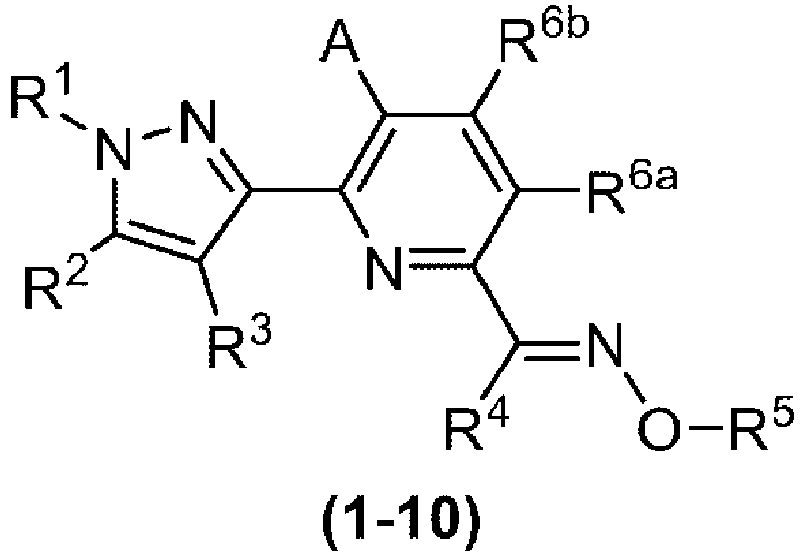
- Table 10 (In Table 10, R6a and R6b represent hydrogen atoms.)
[Table 10-1] Compound No. R1 R2 R3 R4 R5 A Physical Property value 10-1 Ph H Me NH2 Me SO2NHMe 10-2 Ph H Me NH2 Et SO2NHMe 130-131 10-3 Ph H Me NH2 i-Pr SO2NHMe 10-4 2-F-Ph H Me NH2 Me SO2NHMe 10-5 2-F-Ph H Me NH2 Et SO2NHMe 10-6 2-F-Ph H Me NH2 i-Pr SO2NHMe 10-7 3-F-Ph H Me NH2 Me SO2NHMe 10-8 3-F-Ph H Me NH2 Et SO2NHMe 10-9 3-F-Ph H Me NH2 i-Pr SO2NHMe 10-10 4-F-Ph H Me NH2 Me SO2NHMe 10-11 4-F-Ph H Me NH2 Et SO2NHMe 10-12 4-F-Ph H Me NH2 i-Pr SO2NHMe 10-13 2,6-F2-Ph H Me NH2 Me SO2NHMe 10-14 2,6-F2-Ph H Me NH2 Et SO2NHMe 10-15 2,6-F2-Ph H Me NH2 i-Pr SO2NHMe 10-16 Ph H Me NH2 Et SO2Me 150-151 [Table 10-2] Compound No. R1 R2 R3 R4 R5 A Physical Property value 10-17 Bn H Me NH2 Et SO2Me NMR 10-18 2-F-Ph H Me NH2 Et SO2Me NMR 10-19 Bz H Me NH2 Et SO2Me NMR 10-20 Ph H Me NH2 Et SO2NMe2 NMR 10-21 thiazol-5-yl H Me NH2 Me SO2NHMe 10-22 thiazol-5-yl H Me NH2 Et SO2NHMe 10-23 thiazol-5-yl H Me NH2 i-Pr SO2NHMe 10-24 thiazol-4-yl H Me NH2 Me SO2NHMe 10-25 thiazol-4-yl H Me NH2 Et SO2NHMe 10-26 thiazol-4-yl H Me NH2 i-Pr SO2NHMe 10-27 thiazol-2-yl H Me NH2 Me SO2NHMe 10-28 thiazol-2-yl H Me NH2 Et SO2NHMe 10-29 thiazol-2-yl H Me NH2 i-Pr SO2NHMe 10-30 thiophen-2-yl H Me NH2 Me SO2NHMe 10-31 thiophen-2-yl H Me NH2 Et SO2NHMe 10-32 thiophen-2-yl H Me NH2 i-Pr SO2NHMe 10-33 thiophen-3-yl H Me NH2 Me SO2NHMe 10-34 thiophen-3-yl H Me NH2 Et SO2NHMe 10-35 thiophen-3-yl H Me NH2 i-Pr SO2NHMe 10-36 pyridazin-3-yl H Me NH2 Me SO2NHMe 10-37 pyridazin-3-yl H Me NH2 Et SO2NHMe 10-38 pyridazin-3-yl H Me NH2 i-Pr SO2NHMe 10-39 pyrazin-2-yl H Me NH2 Me SO2NHMe 10-40 pyrazin-2-yl H Me NH2 Et SO2NHMe 10-41 pyrazin-2-yl H Me NH2 i-Pr SO2NHMe 10-42 pyrimidin-2-yl H Me NH2 Me SO2NHMe 10-43 pyrimidin-2-yl H Me NH2 Et SO2NHMe 10-44 pyrimidin-2-yl H Me NH2 i-Pr SO2NHMe 10-45 pyrimidin-4-yl H Me NH2 Me SO2NHMe 10-46 pyrimidin-4-yl H Me NH2 Et SO2NHMe [Table 10-3] Compound No. R1 R2 R3 R4 R5 A Physical Property value 10-47 pyrimidin-4-yl H Me NH2 i-Pr SO2NHMe 10-48 pyrimidin-5-yl H Me NH2 Me SO2NHMe 10-49 pyrimidin-5-yl H Me NH2 Et SO2NHMe 10-50 pyrimidin-5-yl H Me NH2 i-Pr SO2NHMe 10-51 thiazol-5-yl H Et NH2 Me SO2NHMe 10-52 thiazol-5-yl H Et NH2 Et SO2NHMe 10-53 thiazol-5-yl H Et NH2 i-Pr SO2NHMe 10-54 thiazol-4-yl H Et NH2 Me SO2NHMe 10-55 thiazol-4-yl H Et NH2 Et SO2NHMe 10-56 thiazol-4-yl H Et NH2 i-Pr SO2NHMe 10-57 thiazol-2-yl H Et NH2 Me SO2NHMe 10-58 thiazol-2-yl H Et NH2 Et SO2NHMe 10-59 thiazol-2-yl H Et NH2 i-Pr SO2NHMe 10-60 thiophen-2-yl H Et NH2 Me SO2NHMe 10-61 thiophen-2-yl H Et NH2 Et SO2NHMe 10-62 thiophen-2-yl H Et NH2 i-Pr SO2NHMe 10-63 thiophen-3-yl H Et NH2 Me SO2NHMe 10-64 thiophen-3-yl H Et NH2 Et SO2NHMe 10-65 thiophen-3-yl H Et NH2 i-Pr SO2NHMe 10-66 pyridazin-3-yl H Et NH2 Me SO2NHMe 10-67 pyridazin-3-yl H Et NH2 Et SO2NHMe 10-68 pyridazin-3-yl H Et NH2 i-Pr SO2NHMe 10-69 pyrazin-2-yl H Et NH2 Me SO2NHMe 10-70 pyrazin-2-yl H Et NH2 Et SO2NHMe 10-71 pyrazin-2-yl H Et NH2 i-Pr SO2NHMe 10-72 pyrimidin-2-yl H Et NH2 Me SO2NHMe 10-73 pyrimidin-2-yl H Et NH2 Et SO2NHMe 10-74 pyrimidin-2-yl H Et NH2 i-Pr SO2NHMe 10-75 pyrimidin-4-yl H Et NH2 Me SO2NHMe 10-76 pyrimidin-4-yl H Et NH2 Et SO2NHMe [Table 10-4] Compound No. R1 R2 R3 R4 R5 A Physical Property value 10-77 pyrimidin-4-yl H Et NH2 i-Pr SO2NHMe 10-78 pyrimidin-5-yl H Et NH2 Me SO2NHMe 10-79 pyrimidin-5-yl H Et NH2 Et SO2NHMe 10-80 pyrimidin-5-yl H Et NH2 i-Pr SO2NHMe 10-81 Ph H Et NH2 Me SO2NHMe 10-82 Ph H Et NH2 Et SO2NHMe 10-83 Ph H Et NH2 i-Pr SO2NHMe 10-84 2-F-Ph H Et NH2 Me SO2NHMe 10-85 2-F-Ph H Et NH2 Et SO2NHMe 10-86 2-F-Ph H Et NH2 i-Pr SO2NHMe 10-87 3-F-Ph H Et NH2 Me SO2NHMe 10-88 3-F-Ph H Et NH2 Et SO2NHMe 10-89 3-F-Ph H Et NH2 i-Pr SO2NHMe 10-90 4-F-Ph H Et NH2 Me SO2NHMe 10-91 4-F-Ph H Et NH2 Et SO2NHMe 10-92 4-F-Ph H Et NH2 i-Pr SO2NHMe 10-93 2,6-F2-Ph H Et NH2 Me SO2NHMe 10-94 2,6-F2-Ph H Et NH2 Et SO2NHMe 10-95 2,6-F2-Ph H Et NH2 i-Pr SO2NHMe 10-96 Ph H Me NH2 Me SO2NHEt 10-97 Ph H Me NH2 Et SO2NHEt 10-98 Ph H Me NH2 i-Pr SO2NHEt 10-99 2-F-Ph H Me NH2 Me SO2NHEt 10-100 2-F-Ph H Me NH2 Et SO2NHEt 10-101 2-F-Ph H Me NH2 i-Pr SO2NHEt 10-102 3-F-Ph H Me NH2 Me SO2NHEt 10-103 3-F-Ph H Me NH2 Et SO2NHEt 10-104 3-F-Ph H Me NH2 i-Pr SO2NHEt 10-105 4-F-Ph H Me NH2 Me SO2NHEt 10-106 4-F-Ph H Me NH2 Et SO2NHEt [Table 10-5] Compound No. R1 R2 R3 R4 R5 A Physical Property value 10-107 4-F-Ph H Me NH2 i-Pr SO2NHEt 10-108 2,6-F2-Ph H Me NH2 Me SO2NHEt 10-109 2,6-F2-Ph H Me NH2 Et SO2NHEt 10-110 2,6-F2-Ph H Me NH2 i-Pr SO2NHEt 10-111 thiazol-5-yl H Me NH2 Me SO2NHEt 10-112 thiazol-5-yl H Me NH2 Et SO2NHEt 10-113 thiazol-5-yl H Me NH2 i-Pr SO2NHEt 10-114 thiazol-4-yl H Me NH2 Me SO2NHEt 10-115 thiazol-4-yl H Me NH2 Et SO2NHEt 10-116 thiazol-4-yl H Me NH2 i-Pr SO2NHEt 10-117 thiazol-2-yl H Me NH2 Me SO2NHEt 10-118 thiazol-2-yl H Me NH2 Et SO2NHEt 10-119 thiazol-2-yl H Me NH2 i-Pr SO2NHEt 10-120 thiophen-2-yl H Me NH2 Me SO2NHEt 10-121 thiophen-2-yl H Me NH2 Et SO2NHEt 10-122 thiophen-2-yl H Me NH2 i-Pr SO2NHEt 10-123 thiophen-3-yl H Me NH2 Me SO2NHEt 10-124 thiophen-3-yl H Me NH2 Et SO2NHEt 10-125 thiophen-3-yl H Me NH2 i-Pr SO2NHEt 10-126 pyridazin-3-yl H Me NH2 Me SO2NHEt 10-127 pyridazin-3-yl H Me NH2 Et SO2NHEt 10-128 pyridazin-3-yl H Me NH2 i-Pr SO2NHEt 10-129 pyrazin-2-yl H Me NH2 Me SO2NHEt 10-130 pyrazin-2-yl H Me NH2 Et SO2NHEt 10-131 pyrazin-2-yl H Me NH2 i-Pr SO2NHEt 10-132 pyrimidin-2-yl H Me NH2 Me SO2NHEt 10-133 pyrimidin-2-yl H Me NH2 Et SO2NHEt 10-134 pyrimidin-2-yl H Me NH2 i-Pr SO2NHEt 10-135 pyrimidin-4-yl H Me NH2 Me SO2NHEt 10-136 pyrimidin-4-yl H Me NH2 Et SO2NHEt [Table 10-6] Compound No. R1 R2 R3 R4 R5 A Physical Property value 10-137 pyrimidin-4-yl H Me NH2 i-Pr SO2NHEt 10-138 pyrimidin-5-yl H Me NH2 Me SO2NHEt 10-139 pyrimidin-5-yl H Me NH2 Et SO2NHEt 10-140 pyrimidin-5-yl H Me NH2 i-Pr SO2NHEt 
- Table 11 (In Table 11, R6a and R6b represent hydrogen atoms.)
[Table 11-1] Compound No. R1 R3 R4 R5 A Physical Property value 11-1 Ph Me NH2 Me SO2NHMe 11-2 Ph Me NH2 Et SO2NHMe NMR 11-3 Ph Me NH2 i-Pr SO2NHMe 11-4 2-F-Ph Me NH2 Me SO2NHMe 11-5 2-F-Ph Me NH2 Et SO2NHMe 11-6 2-F-Ph Me NH2 i-Pr SO2NHMe 11-7 3-F-Ph Me NH2 Me SO2NHMe 11-8 3-F-Ph Me NH2 Et SO2NHMe 11-9 3-F-Ph Me NH2 i-Pr SO2NHMe 11-10 4-F-Ph Me NH2 Me SO2NHMe 11-11 4-F-Ph Me NH2 Et SO2NHMe 11-12 4-F-Ph Me NH2 i-Pr SO2NHMe 11-13 2,6-F2-Ph Me NH2 Me SO2NHMe 11-14 2,6-F2-Ph Me NH2 Et SO2NHMe 11-15 2,6-F2-Ph Me NH2 i-Pr SO2NHMe [Table 11-2] Compound No. R1 R3 R4 R5 A Physical Property value 11-16 thiazol-5-yl Me NH2 Me SO2NHMe 11-17 thiazol-5-yl Me NH2 Et SO2NHMe 11-18 thiazol-5-yl Me NH2 i-Pr SO2NHMe 11-19 thiazol-4-yl Me NH2 Me SO2NHMe 11-20 thiazol-4-yl Me NH2 Et SO2NHMe 11-21 thiazol-4-yl Me NH2 i-Pr SO2NHMe 11-22 thiazol-2-yl Me NH2 Me SO2NHMe 11-23 thiazol-2-yl Me NH2 Et SO2NHMe 11-24 thiazol-2-yl Me NH2 i-Pr SO2NHMe 11-25 thiophen-2-yl Me NH2 Me SO2NHMe 11-26 thiophen-2-yl Me NH2 Et SO2NHMe 11-27 thiophen-2-yl Me NH2 i-Pr SO2NHMe 11-28 thiophen-3-yl Me NH2 Me SO2NHMe 11-29 thiophen-3-yl Me NH2 Et SO2NHMe 11-30 thiophen-3-yl Me NH2 i-Pr SO2NHMe 11-31 pyridazin-3-yl Me NH2 Me SO2NHMe 11-32 pyridazin-3-yl Me NH2 Et SO2NHMe 11-33 pyridazin-3-yl Me NH2 i-Pr SO2NHMe 11-34 pyrazin-2-yl Me NH2 Me SO2NHMe 11-35 pyrazin-2-yl Me NH2 Et SO2NHMe 11-36 pyrazin-2-yl Me NH2 i-Pr SO2NHMe 11-37 pyrimidin-2-yl Me NH2 Me SO2NHMe 11-38 pyrimidin-2-yl Me NH2 Et SO2NHMe 11-39 pyrimidin-2-yl Me NH2 i-Pr SO2NHMe 11-40 pyrimidin-4-yl Me NH2 Me SO2NHMe 11-41 pyrimidin-4-yl Me NH2 Et SO2NHMe 11-42 pyrimidin-4-yl Me NH2 i-Pr SO2NHMe 11-43 pyrimidin-5-yl Me NH2 Me SO2NHMe 11-44 pyrimidin-5-yl Me NH2 Et SO2NHMe 11-45 pyrimidin-5-yl Me NH2 i-Pr SO2NHMe [Table 11-3] Compound No. R1 R3 R4 R5 A Physical Property value 11-46 thiazol-5-yl Et NH2 Me SO2NHMe 11-47 thiazol-5-yl Et NH2 Et SO2NHMe 11-48 thiazol-5-yl Et NH2 i-Pr SO2NHMe 11-49 thiazol-4-yl Et NH2 Me SO2NHMe 11-50 thiazol-4-yl Et NH2 Et SO2NHMe 11-51 thiazol-4-yl Et NH2 i-Pr SO2NHMe 11-52 thiazol-2-yl Et NH2 Me SO2NHMe 11-53 thiazol-2-yl Et NH2 Et SO2NHMe 11-54 thiazol-2-yl Et NH2 i-Pr SO2NHMe 11-55 thiophen-2-yl Et NH2 Me SO2NHMe 11-56 thiophen-2-yl Et NH2 Et SO2NHMe 11-57 thiophen-2-yl Et NH2 i-Pr SO2NHMe 11-58 thiophen-3-yl Et NH2 Me SO2NHMe 11-59 thiophen-3-yl Et NH2 Et SO2NHMe 11-60 thiophen-3-yl Et NH2 i-Pr SO2NHMe 11-61 pyridazin-3-yl Et NH2 Me SO2NHMe 11-62 pyridazin-3-yl Et NH2 Et SO2NHMe 11-63 pyridazin-3-yl Et NH2 i-Pr SO2NHMe 11-64 pyrazin-2-yl Et NH2 Me SO2NHMe 11-65 pyrazin-2-yl Et NH2 Et SO2NHMe 11-66 pyrazin-2-yl Et NH2 i-Pr SO2NHMe 11-67 pyrimidin-2-yl Et NH2 Me SO2NHMe 11-68 pyrimidin-2-yl Et NH2 Et SO2NHMe 11-69 pyrimidin-2-yl Et NH2 i-Pr SO2NHMe 11-70 pyrimidin-4-yl Et NH2 Me SO2NHMe 11-71 pyrimidin-4-yl Et NH2 Et SO2NHMe 11-72 pyrimidin-4-yl Et NH2 i-Pr SO2NHMe 11-73 pyrimidin-5-yl Et NH2 Me SO2NHMe 11-74 pyrimidin-5-yl Et NH2 Et SO2NHMe 11-75 pyrimidin-5-yl Et NH2 i-Pr SO2NHMe [Table 11-4] Compound No. R1 R3 R4 R5 A Physical Property value 11-76 Ph Et NH2 Me SO2NHMe 11-77 Ph Et NH2 Et SO2NHMe 11-78 Ph Et NH2 i-Pr SO2NHMe 11-79 2-F-Ph Et NH2 Me SO2NHMe 11-80 2-F-Ph Et NH2 Et SO2NHMe 11-81 2-F-Ph Et NH2 i-Pr SO2NHMe 11-82 3-F-Ph Et NH2 Me SO2NHMe 11-83 3-F-Ph Et NH2 Et SO2NHMe 11-84 3-F-Ph Et NH2 i-Pr SO2NHMe 11-85 4-F-Ph Et NH2 Me SO2NHMe 11-86 4-F-Ph Et NH2 Et SO2NHMe 11-87 4-F-Ph Et NH2 i-Pr SO2NHMe 11-88 2,6-F2-Ph Et NH2 Me SO2NHMe 11-89 2,6-F2-Ph Et NH2 Et SO2NHMe 11-90 2,6-F2-Ph Et NH2 i-Pr SO2NHMe 11-91 pyrimidin-2-yl Me NH2 Me SO2Me 11-92 pyrimidin-2-yl Et NH2 Me SO2Me 11-93 pyrimidin-2-yl Me NH2 Et SO2Me 241-246 11-94 2-NO2-Ph Me NH2 Me SO2Me 11-95 2-NO2-Ph Me NH2 Et SO2Me 179-184 11-96 2-NO2-Ph Me NH2 Me SO2NHMe 11-97 2-NO2-Ph Me NH2 Et SO2NHMe 11-98 2-NO2-Ph Et NH2 Me SO2Me 11-99 2-NO2-Ph Et NH2 Et SO2Me 11-100 2-NO2-Ph Et NH2 Me SO2NHMe 11-101 2-NO2-Ph Et NH2 Et SO2NHMe 11-102 2-NH2-Ph Me NH2 Me SO2Me 11-103 2-NH2-Ph Me NH2 Et SO2Me 38-43 11-104 2-NH2-Ph Me NH2 Me SO2NHMe 11-105 2-NH2-Ph Me NH2 Et SO2NHMe [Table 11-5] Compound No. R1 R3 R4 R5 A Physical Property value 11-106 2-NH2-Ph Et NH2 Me SO2Me 11-107 2-NH2-Ph Et NH2 Et SO2Me 11-108 2-NH2-Ph Et NH2 Me SO2NHMe 11-109 2-NH2-Ph Et NH2 Et SO2NHMe 11-110 2-F-Ph Me NH2 Me SO2Me 11-111 2-F-Ph Et NH2 Me SO2Me 11-112 2-F-Ph Me NH2 Et SO2Me 11-113 3-F-pyridin-2-yl Me NH2 Me SO2Me 11-114 3-F-pyridin-2-yl Me NH2 Et SO2Me 11-115 3-F-pyridin-2-yl Me NH2 Me SO2NHMe 11-116 3-F-pyridin-2-yl Me NH2 Et SO2NHMe 11-117 3-F-pyridin-2-yl Et NH2 Me SO2Me 11-118 3-F-pyridin-2-yl Et NH2 Et SO2Me 11-119 3-F-pyridin-2-yl Et NH2 Me SO2NHMe 11-120 3-F-pyridin-2-yl Et NH2 Et SO2NHMe 11-121 3-NO2-pyridin-2-yl Me NH2 Me SO2Me 11-122 3-NO2-pyridin-2-yl Me NH2 Et SO2Me NMR 11-123 3-NO2-pyridin-2-yl Me NH2 Me SO2NHMe 11-124 3-NO2-pyridin-2-yl Me NH2 Et SO2NHMe 11-125 3-NO2-pyridin-2-yl Et NH2 Me SO2Me 11-126 3-NO2-pyridin-2-yl Et NH2 Et SO2Me 11-127 3-NO2-pyridin-2-yl Et NH2 Me SO2NHMe 11-128 3-NO2-pyridin-2-yl Et NH2 Et SO2NHMe 11-129 3-NH2-pyridin-2-yl Me NH2 Me SO2Me 11-130 3-NH2-pyridin-2-yl Me NH2 Et SO2Me 193-198 11-131 3-NH2-pyridin-2-yl Me NH2 Me SO2NHMe 11-132 3-NH2-pyridin-2-yl Me NH2 Et SO2NHMe 11-133 3-NH2-pyridin-2-yl Et NH2 Me SO2Me 11-134 3-NH2-pyridin-2-yl Et NH2 Et SO2Me 11-135 3-NH2-pyridin-2-yl Et NH2 Me SO2NHMe [Table 11-6] Compound No. R1 R3 R4 R5 A Physical Property value 11-136 3-NH2-pyridin-2-yl Et NH2 Et SO2NHMe 11-137 Me Me NH2 Me SO2Me 11-138 Me Me NH2 Et SO2Me 11-139 Me Me NH2 Me SO2NHMe 11-140 Me Me NH2 Et SO2NHMe 11-141 Me Et NH2 Me SO2Me 11-142 Me Et NH2 Et SO2Me 11-143 Me Et NH2 Me SO2NHMe 11-144 Me Et NH2 Et SO2NHMe 11-145 Et Me NH2 Me SO2Me 11-146 Et Me NH2 Et SO2Me 11-147 Et Me NH2 Me SO2NHMe 11-148 Et Me NH2 Et SO2NHMe 11-149 Et Et NH2 Me SO2Me 11-150 Et Et NH2 Et SO2Me 11-151 Et Et NH2 Me SO2NHMe 11-152 Et Et NH2 Et SO2NHMe 11-153 n-Pr Me NH2 Me SO2Me 11-154 n-Pr Me NH2 Et SO2Me 11-155 n-Pr Me NH2 Me SO2NHMe 11-156 n-Pr Me NH2 Et SO2NHMe 11-157 n-Pr Et NH2 Me SO2Me 11-158 n-Pr Et NH2 Et SO2Me 11-159 n-Pr Et NH2 Me SO2NHMe 11-160 n-Pr Et NH2 Et SO2NHMe 11-161 n-Bu Me NH2 Me SO2Me 11-162 n-Bu Me NH2 Et SO2Me 11-163 n-Bu Me NH2 Me SO2NHMe 11-164 n-Bu Me NH2 Et SO2NHMe 11-165 n-Bu Et NH2 Me SO2Me [Table 11-7] Compound No. R1 R3 R4 R5 A Physical Property value 11-166 n-Bu Et NH2 Et SO2Me 11-167 n-Bu Et NH2 Me SO2NHMe 11-168 n-Bu Et NH2 Et SO2NHMe 11-169 Ph Me NH2 Me SO2NHEt 11-170 Ph Me NH2 Et SO2NHEt 11-171 Ph Me NH2 i-Pr SO2NHEt 11-172 2-F-Ph Me NH2 Me SO2NHEt 11-173 2-F-Ph Me NH2 Et SO2NHEt 11-174 2-F-Ph Me NH2 i-Pr SO2NHEt 11-175 3-F-Ph Me NH2 Me SO2NHEt 11-176 3-F-Ph Me NH2 Et SO2NHEt 11-177 3-F-Ph Me NH2 i-Pr SO2NHEt 11-178 4-F-Ph Me NH2 Me SO2NHEt 11-179 4-F-Ph Me NH2 Et SO2NHEt 11-180 4-F-Ph Me NH2 i-Pr SO2NHEt 11-181 2,6-F2-Ph Me NH2 Me SO2NHEt 11-182 2,6-F2-Ph Me NH2 Et SO2NHEt 11-183 2,6-F2-Ph Me NH2 i-Pr SO2NHEt 11-184 thiazol-5-yl Me NH2 Me SO2NHEt 11-185 thiazol-5-yl Me NH2 Et SO2NHEt 11-186 thiazol-5-yl Me NH2 i-Pr SO2NHEt 11-187 thiazol-4-yl Me NH2 Me SO2NHEt 11-188 thiazol-4-yl Me NH2 Et SO2NHEt 11-189 thiazol-4-yl Me NH2 i-Pr SO2NHEt 11-190 thiazol-2-yl Me NH2 Me SO2NHEt 11-191 thiazol-2-yl Me NH2 Et SO2NHEt 11-192 thiazol-2-yl Me NH2 i-Pr SO2NHEt 11-193 thiophen-2-yl Me NH2 Me SO2NHEt 11-194 thiophen-2-yl Me NH2 Et SO2NHEt 11-195 thiophen-2-yl Me NH2 i-Pr SO2NHEt 11-196 thiophen-3-yl Me NH2 Me SO2NHEt [Table 11-8] Compound No. R1 R3 R4 R5 A Physical Property value 11-197 thiophen-3-yl Me NH2 Et SO2NHEt 11-198 thiophen-3-yl Me NH2 i-Pr SO2NHEt 11-199 pyridazin-3-yl Me NH2 Me SO2NHEt 11-200 pyridazin-3-yl Me NH2 Et SO2NHEt 11-201 pyridazin-3-yl Me NH2 i-Pr SO2NHEt 11-202 pyrazin-2-yl Me NH2 Me SO2NHEt 11-203 pyrazin-2-yl Me NH2 Et SO2NHEt 11-204 pyrazin-2-yl Me NH2 i-Pr SO2NHEt 11-205 pyrimidin-2-yl Me NH2 Me SO2NHEt 11-206 pyrimidin-2-yl Me NH2 Et SO2NHEt 11-207 pyrimidin-2-yl Me NH2 i-Pr SO2NHEt 11-208 pyrimidin-4-yl Me NH2 Me SO2NHEt 11-209 pyrimidin-4-yl Me NH2 Et SO2NHEt 11-210 pyrimidin-4-yl Me NH2 i-Pr SO2NHEt 11-211 pyrimidin-5-yl Me NH2 Me SO2NHEt 11-212 pyrimidin-5-yl Me NH2 Et SO2NHEt 11-213 pyrimidin-5-yl Me NH2 i-Pr SO2NHEt 11-214 Ph Me NH2 Et SO2Me 36-41 11-215 i-Bu Me NH2 Et SO2Me 54-59 
- Table 12 (In Table 12, R6a and R6b represent hydrogen atoms.)
[Table 12-1] Compound No. R1 R3 R4 R5 A Physical Property value 12-1 Ph Me NH2 Me SO2NHMe 12-2 Ph Me NH2 Et SO2NHMe 163-164 12-3 Ph Me NH2 i-Pr SO2NHMe 12-4 2-F-Ph Me NH2 Me SO2NHMe 12-5 2-F-Ph Me NH2 Et SO2NHMe 12-6 2-F-Ph Me NH2 i-Pr SO2NHMe 12-7 3-F-Ph Me NH2 Me SO2NHMe 12-8 3-F-Ph Me NH2 Et SO2NHMe 12-9 3-F-Ph Me NH2 i-Pr SO2NHMe 12-10 4-F-Ph Me NH2 Me SO2NHMe 12-11 4-F-Ph Me NH2 Et SO2NHMe 12-12 4-F-Ph Me NH2 i-Pr SO2NHMe 12-13 2,6-F2-Ph Me NH2 Me SO2NHMe 12-14 2,6-F2-Ph Me NH2 Et SO2NHMe 12-15 2,6-F2-Ph Me NH2 i-Pr SO2NHMe [Table 12-2] Compound No. R1 R3 R4 R5 A Physical Property value 12-16 thiazol-5-yl Me NH2 Me SO2NHMe 12-17 thiazol-5-yl Me NH2 Et SO2NHMe 12-18 thiazol-5-yl Me NH2 i-Pr SO2NHMe 12-19 thiazol-4-yl Me NH2 Me SO2NHMe 12-20 thiazol-4-yl Me NH2 Et SO2NHMe 12-21 thiazol-4-yl Me NH2 i-Pr SO2NHMe 12-22 thiazol-2-yl Me NH2 Me SO2NHMe 12-23 thiazol-2-yl Me NH2 Et SO2NHMe 12-24 thiazol-2-yl Me NH2 i-Pr SO2NHMe 12-25 thiophen-2-yl Me NH2 Me SO2NHMe 12-26 thiophen-2-yl Me NH2 Et SO2NHMe 12-27 thiophen-2-yl Me NH2 i-Pr SO2NHMe 12-28 thiophen-3-yl Me NH2 Me SO2NHMe 12-29 thiophen-3-yl Me NH2 Et SO2NHMe 12-30 thiophen-3-yl Me NH2 i-Pr SO2NHMe 12-31 pyridazin-3-yl Me NH2 Me SO2NHMe 12-32 pyridazin-3-yl Me NH2 Et SO2NHMe 12-33 pyridazin-3-yl Me NH2 i-Pr SO2NHMe 12-34 pyrazin-2-yl Me NH2 Me SO2NHMe 12-35 pyrazin-2-yl Me NH2 Et SO2NHMe 12-36 pyrazin-2-yl Me NH2 i-Pr SO2NHMe 12-37 pyrimidin-2-yl Me NH2 Me SO2NHMe 12-38 pyrimidin-2-yl Me NH2 Et SO2NHMe 12-39 pyrimidin-2-yl Me NH2 i-Pr SO2NHMe 12-40 pyrimidin-4-yl Me NH2 Me SO2NHMe 12-41 pyrimidin-4-yl Me NH2 Et SO2NHMe 12-42 pyrimidin-4-yl Me NH2 i-Pr SO2NHMe 12-43 pyrimidin-5-yl Me NH2 Me SO2NHMe 12-44 pyrimidin-5-yl Me NH2 Et SO2NHMe 12-45 pyrimidin-5-yl Me NH2 i-Pr SO2NHMe [Table 12-3] Compound No. R1 R3 R4 R5 A Physical Property value 12-46 thiazol-5-yl Et NH2 Me SO2NHMe 12-47 thiazol-5-yl Et NH2 Et SO2NHMe 12-48 thiazol-5-yl Et NH2 i-Pr SO2NHMe 12-49 thiazol-4-yl Et NH2 Me SO2NHMe 12-50 thiazol-4-yl Et NH2 Et SO2NHMe 12-51 thiazol-4-yl Et NH2 i-Pr SO2NHMe 12-52 thiazol-2-yl Et NH2 Me SO2NHMe 12-53 thiazol-2-yl Et NH2 Et SO2NHMe 12-54 thiazol-2-yl Et NH2 i-Pr SO2NHMe 12-55 thiophen-2-yl Et NH2 Me SO2NHMe 12-56 thiophen-2-yl Et NH2 Et SO2NHMe 12-57 thiophen-2-yl Et NH2 i-Pr SO2NHMe 12-58 thiophen-3-yl Et NH2 Me SO2NHMe 12-59 thiophen-3-yl Et NH2 Et SO2NHMe 12-60 thiophen-3-yl Et NH2 i-Pr SO2NHMe 12-61 pyridazin-3-yl Et NH2 Me SO2NHMe 12-62 pyridazin-3-yl Et NH2 Et SO2NHMe 12-63 pyridazin-3-yl Et NH2 i-Pr SO2NHMe 12-64 pyrazin-2-yl Et NH2 Me SO2NHMe 12-65 pyrazin-2-yl Et NH2 Et SO2NHMe 12-66 pyrazin-2-yl Et NH2 i-Pr SO2NHMe 12-67 pyrimidin-2-yl Et NH2 Me SO2NHMe 12-68 pyrimidin-2-yl Et NH2 Et SO2NHMe 12-69 pyrimidin-2-yl Et NH2 i-Pr SO2NHMe 12-70 pyrimidin-4-yl Et NH2 Me SO2NHMe 12-71 pyrimidin-4-yl Et NH2 Et SO2NHMe 12-72 pyrimidin-4-yl Et NH2 i-Pr SO2NHMe 12-73 pyrimidin-5-yl Et NH2 Me SO2NHMe 12-74 pyrimidin-5-yl Et NH2 Et SO2NHMe 12-75 pyrimidin-5-yl Et NH2 i-Pr SO2NHMe [Table 12-4] Compound No. R1 R3 R4 R5 A Physical Property value 12-76 Ph Et NH2 Me SO2NHMe 12-77 Ph Et NH2 Et SO2NHMe 12-78 Ph Et NH2 i-Pr SO2NHMe 12-79 2-F-Ph Et NH2 Me SO2NHMe 12-80 2-F-Ph Et NH2 Et SO2NHMe 12-81 2-F-Ph Et NH2 i-Pr SO2NHMe 12-82 3-F-Ph Et NH2 Me SO2NHMe 12-83 3-F-Ph Et NH2 Et SO2NHMe 12-84 3-F-Ph Et NH2 i-Pr SO2NHMe 12-85 4-F-Ph Et NH2 Me SO2NHMe 12-86 4-F-Ph Et NH2 Et SO2NHMe 12-87 4-F-Ph Et NH2 i-Pr SO2NHMe 12-88 2,6-F2-Ph Et NH2 Me SO2NHMe 12-89 2,6-F2-Ph Et NH2 Et SO2NHMe 12-90 2,6-F2-Ph Et NH2 i-Pr SO2NHMe 12-91 Ph Me NH2 Me SO2NHEt 12-92 Ph Me NH2 Et SO2NHEt 12-93 Ph Me NH2 i-Pr SO2NHEt 12-94 2-F-Ph Me NH2 Me SO2NHEt 12-95 2-F-Ph Me NH2 Et SO2NHEt 12-96 2-F-Ph Me NH2 i-Pr SO2NHEt 12-97 3-F-Ph Me NH2 Me SO2NHEt 12-98 3-F-Ph Me NH2 Et SO2NHEt 12-99 3-F-Ph Me NH2 i-Pr SO2NHEt 12-100 4-F-Ph Me NH2 Me SO2NHEt 12-101 4-F-Ph Me NH2 Et SO2NHEt 12-102 4-F-Ph Me NH2 i-Pr SO2NHEt 12-103 2,6-F2-Ph Me NH2 Me SO2NHEt 12-104 2,6-F2-Ph Me NH2 Et SO2NHEt 12-105 2,6-F2-Ph Me NH2 i-Pr SO2NHEt [Table 12-5] Compound No. R1 R3 R4 R5 A Physical Property value 12-106 thiazol-5-yl Me NH2 Me SO2NHEt 12-107 thiazol-5-yl Me NH2 Et SO2NHEt 12-108 thiazol-5-yl Me NH2 i-Pr SO2NHEt 12-109 thiazol-4-yl Me NH2 Me SO2NHEt 12-110 thiazol-4-yl Me NH2 Et SO2NHEt 12-111 thiazol-4-yl Me NH2 i-Pr SO2NHEt 12-112 thiazol-2-yl Me NH2 Me SO2NHEt 12-113 thiazol-2-yl Me NH2 Et SO2NHEt 12-114 thiazol-2-yl Me NH2 i-Pr SO2NHEt 12-115 thiophen-2-yl Me NH2 Me SO2NHEt 12-116 thiophen-2-yl Me NH2 Et SO2NHEt 12-117 thiophen-2-yl Me NH2 i-Pr SO2NHEt 12-118 thiophen-3-yl Me NH2 Me SO2NHEt 12-119 thiophen-3-yl Me NH2 Et SO2NHEt 12-120 thiophen-3-yl Me NH2 i-Pr SO2NHEt 12-121 pyridazin-3-yl Me NH2 Me SO2NHEt 12-122 pyridazin-3-yl Me NH2 Et SO2NHEt 12-123 pyridazin-3-yl Me NH2 i-Pr SO2NHEt 12-124 pyrazin-2-yl Me NH2 Me SO2NHEt 12-125 pyrazin-2-yl Me NH2 Et SO2NHEt 12-126 pyrazin-2-yl Me NH2 i-Pr SO2NHEt 12-127 pyrimidin-2-yl Me NH2 Me SO2NHEt 12-128 pyrimidin-2-yl Me NH2 Et SO2NHEt 12-129 pyrimidin-2-yl Me NH2 i-Pr SO2NHEt 12-130 pyrimidin-4-yl Me NH2 Me SO2NHEt 12-131 pyrimidin-4-yl Me NH2 Et SO2NHEt 12-132 pyrimidin-4-yl Me NH2 i-Pr SO2NHEt 12-133 pyrimidin-5-yl Me NH2 Me SO2NHEt 12-134 pyrimidin-5-yl Me NH2 Et SO2NHEt 12-135 pyrimidin-5-yl Me NH2 i-Pr SO2NHEt 
- Table 13 (In Table 13, R6a and R6b represent hydrogen atoms.)
[Table 13-1] Compound No. R1 R3 R4 R5 A Physical Property value 13-1 Ph Me NH2 Me SO2NHMe 13-2 Ph Me NH2 Et SO2NHMe 13-3 Ph Me NH2 i-Pr SO2NHMe 13-4 2-F-Ph Me NH2 Me SO2NHMe 13-5 2-F-Ph Me NH2 Et SO2NHMe 13-6 2-F-Ph Me NH2 i-Pr SO2NHMe 13-7 3-F-Ph Me NH2 Me SO2NHMe 13-8 3-F-Ph Me NH2 Et SO2NHMe 13-9 3-F-Ph Me NH2 i-Pr SO2NHMe 13-10 4-F-Ph Me NH2 Me SO2NHMe 13-11 4-F-Ph Me NH2 Et SO2NHMe 13-12 4-F-Ph Me NH2 i-Pr SO2NHMe 13-13 2,6-F2-Ph Me NH2 Me SO2NHMe 13-14 2,6-F2-Ph Me NH2 Et SO2NHMe 13-15 2,6-F2-Ph Me NH2 i-Pr SO2NHMe [Table 13-2] Compound No. R1 R3 R4 R5 A Physical Property value 13-16 thiazol-5-yl Me NH2 Me SO2NHMe 13-17 thiazol-5-yl Me NH2 Et SO2NHMe 13-18 thiazol-5-yl Me NH2 i-Pr SO2NHMe 13-19 thiazol-4-yl Me NH2 Me SO2NHMe 13-20 thiazol-4-yl Me NH2 Et SO2NHMe 13-21 thiazol-4-yl Me NH2 i-Pr SO2NHMe 13-22 thiazol-2-yl Me NH2 Me SO2NHMe 13-23 thiazol-2-yl Me NH2 Et SO2NHMe 13-24 thiazol-2-yl Me NH2 i-Pr SO2NHMe 13-25 thiophen-2-yl Me NH2 Me SO2NHMe 13-26 thiophen-2-yl Me NH2 Et SO2NHMe 13-27 thiophen-2-yl Me NH2 i-Pr SO2NHMe 13-28 thiophen-3-yl Me NH2 Me SO2NHMe 13-29 thiophen-3-yl Me NH2 Et SO2NHMe 13-30 thiophen-3-yl Me NH2 i-Pr SO2NHMe 13-31 pyridazin-3-yl Me NH2 Me SO2NHMe 13-32 pyridazin-3-yl Me NH2 Et SO2NHMe 13-33 pyridazin-3-yl Me NH2 i-Pr SO2NHMe 13-34 pyrazin-2-yl Me NH2 Me SO2NHMe 13-35 pyrazin-2-yl Me NH2 Et SO2NHMe 13-36 pyrazin-2-yl Me NH2 i-Pr SO2NHMe 13-37 pyrimidin-2-yl Me NH2 Me SO2NHMe 13-38 pyrimidin-2-yl Me NH2 Et SO2NHMe 13-39 pyrimidin-2-yl Me NH2 i-Pr SO2NHMe 13-40 pyrimidin-4-yl Me NH2 Me SO2NHMe 13-41 pyrimidin-4-yl Me NH2 Et SO2NHMe 13-42 pyrimidin-4-yl Me NH2 i-Pr SO2NHMe 13-43 pyrimidin-5-yl Me NH2 Me SO2NHMe 13-44 pyrimidin-5-yl Me NH2 Et SO2NHMe 13-45 pyrimidin-5-yl Me NH2 i-Pr SO2NHMe [Table 13-3] Compound No. R1 R3 R4 R5 A Physical Property value 13-46 thiazol-5-yl Et NH2 Me SO2NHMe 13-47 thiazol-5-yl Et NH2 Et SO2NHMe 13-48 thiazol-5-yl Et NH2 i-Pr SO2NHMe 13-49 thiazol-4-yl Et NH2 Me SO2NHMe 13-50 thiazol-4-yl Et NH2 Et SO2NHMe 13-51 thiazol-4-yl Et NH2 i-Pr SO2NHMe 13-52 thiazol-2-yl Et NH2 Me SO2NHMe 13-53 thiazol-2-yl Et NH2 Et SO2NHMe 13-54 thiazol-2-yl Et NH2 i-Pr SO2NHMe 13-55 thiophen-2-yl Et NH2 Me SO2NHMe 13-56 thiophen-2-yl Et NH2 Et SO2NHMe 13-57 thiophen-2-yl Et NH2 i-Pr SO2NHMe 13-58 thiophen-3-yl Et NH2 Me SO2NHMe 13-59 thiophen-3-yl Et NH2 Et SO2NHMe 13-60 thiophen-3-yl Et NH2 i-Pr SO2NHMe 13-61 pyridazin-3-yl Et NH2 Me SO2NHMe 13-62 pyridazin-3-yl Et NH2 Et SO2NHMe 13-63 pyridazin-3-yl Et NH2 i-Pr SO2NHMe 13-64 pyrazin-2-yl Et NH2 Me SO2NHMe 13-65 pyrazin-2-yl Et NH2 Et SO2NHMe 13-66 pyrazin-2-yl Et NH2 i-Pr SO2NHMe 13-67 pyrimidin-2-yl Et NH2 Me SO2NHMe 13-68 pyrimidin-2-yl Et NH2 Et SO2NHMe 13-69 pyrimidin-2-yl Et NH2 i-Pr SO2NHMe 13-70 pyrimidin-4-yl Et NH2 Me SO2NHMe 13-71 pyrimidin-4-yl Et NH2 Et SO2NHMe 13-72 pyrimidin-4-yl Et NH2 i-Pr SO2NHMe 13-73 pyrimidin-5-yl Et NH2 Me SO2NHMe 13-74 pyrimidin-5-yl Et NH2 Et SO2NHMe 13-75 pyrimidin-5-yl Et NH2 i-Pr SO2NHMe [Table 13-4] Compound No. R1 R3 R4 R5 A Physical Property value 13-76 Ph Et NH2 Me SO2NHMe 13-77 Ph Et NH2 Et SO2NHMe 13-78 Ph Et NH2 i-Pr SO2NHMe 13-79 2-F-Ph Et NH2 Me SO2NHMe 13-80 2-F-Ph Et NH2 Et SO2NHMe 13-81 2-F-Ph Et NH2 i-Pr SO2NHMe 13-82 3-F-Ph Et NH2 Me SO2NHMe 13-83 3-F-Ph Et NH2 Et SO2NHMe 13-84 3-F-Ph Et NH2 i-Pr SO2NHMe 13-85 4-F-Ph Et NH2 Me SO2NHMe 13-86 4-F-Ph Et NH2 Et SO2NHMe 13-87 4-F-Ph Et NH2 i-Pr SO2NHMe 13-88 2,6-F2-Ph Et NH2 Me SO2NHMe 13-89 2,6-F2-Ph Et NH2 Et SO2NHMe 13-90 2,6-F2-Ph Et NH2 i-Pr SO2NHMe 13-91 Ph Me NH2 Me SO2NHEt 13-92 Ph Me NH2 Et SO2NHEt 13-93 Ph Me NH2 i-Pr SO2NHEt 13-94 2-F-Ph Me NH2 Me SO2NHEt 13-95 2-F-Ph Me NH2 Et SO2NHEt 13-96 2-F-Ph Me NH2 i-Pr SO2NHEt 13-97 3-F-Ph Me NH2 Me SO2NHEt 13-98 3-F-Ph Me NH2 Et SO2NHEt 13-99 3-F-Ph Me NH2 i-Pr SO2NHEt 13-100 4-F-Ph Me NH2 Me SO2NHEt 13-101 4-F-Ph Me NH2 Et SO2NHEt 13-102 4-F-Ph Me NH2 i-Pr SO2NHEt 13-103 2,6-F2-Ph Me NH2 Me SO2NHEt 13-104 2,6-F2-Ph Me NH2 Et SO2NHEt 13-105 2,6-F2-Ph Me NH2 i-Pr SO2NHEt [Table 13-5] Compound No. R1 R3 R4 R5 A Physical Property value 13-106 thiazol-5-yl Me NH2 Me SO2NHEt 13-107 thiazol-5-yl Me NH2 Et SO2NHEt 13-108 thiazol-5-yl Me NH2 i-Pr SO2NHEt 13-109 thiazol-4-yl Me NH2 Me SO2NHEt 13-110 thiazol-4-yl Me NH2 Et SO2NHEt 13-111 thiazol-4-yl Me NH2 i-Pr SO2NHEt 13-112 thiazol-2-yl Me NH2 Me SO2NHEt 13-113 thiazol-2-yl Me NH2 Et SO2NHEt 13-114 thiazol-2-yl Me NH2 i-Pr SO2NHEt 13-115 thiophen-2-yl Me NH2 Me SO2NHEt 13-116 thiophen-2-yl Me NH2 Et SO2NHEt 13-117 thiophen-2-yl Me NH2 i-Pr SO2NHEt 13-118 thiophen-3-yl Me NH2 Me SO2NHEt 13-119 thiophen-3-yl Me NH2 Et SO2NHEt 13-120 thiophen-3-yl Me NH2 i-Pr SO2NHEt 13-121 pyridazin-3-yl Me NH2 Me SO2NHEt 13-122 pyridazin-3-yl Me NH2 Et SO2NHEt 13-123 pyridazin-3-yl Me NH2 i-Pr SO2NHEt 13-124 pyrazin-2-yl Me NH2 Me SO2NHEt 13-125 pyrazin-2-yl Me NH2 Et SO2NHEt 13-126 pyrazin-2-yl Me NH2 i-Pr SO2NHEt 13-127 pyrimidin-2-yl Me NH2 Me SO2NHEt 13-128 pyrimidin-2-yl Me NH2 Et SO2NHEt 13-129 pyrimidin-2-yl Me NH2 i-Pr SO2NHEt 13-130 pyrimidin-4-yl Me NH2 Me SO2NHEt 13-131 pyrimidin-4-yl Me NH2 Et SO2NHEt 13-132 pyrimidin-4-yl Me NH2 i-Pr SO2NHEt 13-133 pyrimidin-5-yl Me NH2 Me SO2NHEt 13-134 pyrimidin-5-yl Me NH2 Et SO2NHEt 13-135 pyrimidin-5-yl Me NH2 i-Pr SO2NHEt 

- Table 14 (In Table 14, R2, R6a, and R6b represent hydrogen atoms.)
[Table 14-1] Compound No. R1 R3 R4 R5 A Physical Property value 14-1 Ph Me NH2 Me SO2NHMe 14-2 Ph Me NH2 Et SO2NHMe 14-3 Ph Me NH2 i-Pr SO2NHMe 14-4 2-F-Ph Me NH2 Me SO2NHMe 14-5 2-F-Ph Me NH2 Et SO2NHMe 14-6 2-F-Ph Me NH2 i-Pr SO2NHMe 14-7 3-F-Ph Me NH2 Me SO2NHMe 14-8 3-F-Ph Me NH2 Et SO2NHMe 14-9 3-F-Ph Me NH2 i-Pr SO2NHMe 14-10 4-F-Ph Me NH2 Me SO2NHMe 14-11 4-F-Ph Me NH2 Et SO2NHMe 14-12 4-F-Ph Me NH2 i-Pr SO2NHMe 14-13 2,6-F2-Ph Me NH2 Me SO2NHMe 14-14 2,6-F2-Ph Me NH2 Et SO2NHMe 14-15 2,6-F2-Ph Me NH2 i-Pr SO2NHMe [Table 14-2] Compound No. R1 R2 R3 R4 R5 A Physical Property value 14-16 thiazol-5-yl H Me NH2 Me SO2NHMe 14-17 thiazol-5-yl H Me NH2 Et SO2NHMe 14-18 thiazol-5-yl H Me NH2 i-Pr SO2NHMe 14-19 thiazol-4-yl H Me NH2 Me SO2NHMe 14-20 thiazol-4-yl H Me NH2 Et SO2NHMe 14-21 thiazol-4-yl H Me NH2 i-Pr SO2NHMe 14-22 thiazol-2-yl H Me NH2 Me SO2NHMe 14-23 thiazol-2-yl H Me NH2 Et SO2NHMe 14-24 thiazol-2-yl H Me NH2 i-Pr SO2NHMe 14-25 thiophen-2-yl H Me NH2 Me SO2NHMe 14-26 thiophen-2-yl H Me NH2 Et SO2NHMe 14-27 thiophen-2-yl H Me NH2 i-Pr SO2NHMe 14-28 thiophen-3-yl H Me NH2 Me SO2NHMe 14-29 thiophen-3-yl H Me NH2 Et SO2NHMe 14-30 thiophen-3-yl H Me NH2 i-Pr SO2NHMe 14-31 pyridazin-3-yl H Me NH2 Me SO2NHMe 14-32 pyridazin-3-yl H Me NH2 Et SO2NHMe 14-33 pyridazin-3-yl H Me NH2 i-Pr SO2NHMe 14-34 pyrazin-2-yl H Me NH2 Me SO2NHMe 14-35 pyrazin-2-yl H Me NH2 Et SO2NHMe 14-36 pyrazin-2-yl H Me NH2 i-Pr SO2NHMe 14-37 pyrimidin-2-yl H Me NH2 Me SO2NHMe 14-38 pyrimidin-2-yl H Me NH2 Et SO2NHMe 14-39 pyrimidin-2-yl H Me NH2 i-Pr SO2NHMe 14-40 pyrimidin-4-yl H Me NH2 Me SO2NHMe 14-41 pyrimidin-4-yl H Me NH2 Et SO2NHMe 14-42 pyrimidin-4-yl H Me NH2 i-Pr SO2NHMe 14-43 pyrimidin-5-yl H Me NH2 Me SO2NHMe 14-44 pyrimidin-5-yl H Me NH2 Et SO2NHMe 14-45 pyrimidin-5-yl H Me NH2 i-Pr SO2NHMe [Table 14-3] Compound No. R1 R2 R3 R4 R5 A Physical Property value 14-46 thiazol-5-yl H Et NH2 Me SO2NHMe 14-47 thiazol-5-yl H Et NH2 Et SO2NHMe 14-48 thiazol-5-yl H Et NH2 i-Pr SO2NHMe 14-49 thiazol-4-yl H Et NH2 Me SO2NHMe 14-50 thiazol-4-yl H Et NH2 Et SO2NHMe 14-51 thiazol-4-yl H Et NH2 i-Pr SO2NHMe 14-52 thiazol-2-yl H Et NH2 Me SO2NHMe 14-53 thiazol-2-yl H Et NH2 Et SO2NHMe 14-54 thiazol-2-yl H Et NH2 i-Pr SO2NHMe 14-55 thiophen-2-yl H Et NH2 Me SO2NHMe 14-56 thiophen-2-yl H Et NH2 Et SO2NHMe 14-57 thiophen-2-yl H Et NH2 i-Pr SO2NHMe 14-58 thiophen-3-yl H Et NH2 Me SO2NHMe 14-59 thiophen-3-yl H Et NH2 Et SO2NHMe 14-60 thiophen-3-yl H Et NH2 i-Pr SO2NHMe 14-61 pyridazin-3-yl H Et NH2 Me SO2NHMe 14-62 pyridazin-3-yl H Et NH2 Et SO2NHMe 14-63 pyridazin-3-yl H Et NH2 i-Pr SO2NHMe 14-64 pyrazin-2-yl H Et NH2 Me SO2NHMe 14-65 pyrazin-2-yl H Et NH2 Et SO2NHMe 14-66 pyrazin-2-yl H Et NH2 i-Pr SO2NHMe 14-67 pyrimidin-2-yl H Et NH2 Me SO2NHMe 14-68 pyrimidin-2-yl H Et NH2 Et SO2NHMe 14-69 pyrimidin-2-yl H Et NH2 i-Pr SO2NHMe 14-70 pyrimidin-4-yl H Et NH2 Me SO2NHMe 14-71 pyrimidin-4-yl H Et NH2 Et SO2NHMe 14-72 pyrimidin-4-yl H Et NH2 i-Pr SO2NHMe 14-73 pyrimidin-5-yl H Et NH2 Me SO2NHMe 14-74 pyrimidin-5-yl H Et NH2 Et SO2NHMe 14-75 pyrimidin-5-yl H Et NH2 i-Pr SO2NHMe [Table 14-4] Compound No. R1 R2 R3 R4 R5 A Physical Property value 14-76 Ph H Et NH2 Me SO2NHMe 14-77 Ph H Et NH2 Et SO2NHMe 14-78 Ph H Et NH2 i-Pr SO2NHMe 14-79 2-F-Ph H Et NH2 Me SO2NHMe 14-80 2-F-Ph H Et NH2 Et SO2NHMe 14-81 2-F-Ph H Et NH2 i-Pr SO2NHMe 14-82 3-F-Ph H Et NH2 Me SO2NHMe 14-83 3-F-Ph H Et NH2 Et SO2NHMe 14-84 3-F-Ph H Et NH2 i-Pr SO2NHMe 14-85 4-F-Ph H Et NH2 Me SO2NHMe 14-86 4-F-Ph H Et NH2 Et SO2NHMe 14-87 4-F-Ph H Et NH2 i-Pr SO2NHMe 14-88 2,6-F2-Ph H Et NH2 Me SO2NHMe 14-89 2,6-F2-Ph H Et NH2 Et SO2NHMe 14-90 2,6-F2-Ph H Et NH2 i-Pr SO2NHMe 14-91 Ph H Me NH2 Me SO2NHEt 14-92 Ph H Me NH2 Et SO2NHEt 14-93 Ph H Me NH2 i-Pr SO2NHEt 14-94 2-F-Ph H Me NH2 Me SO2NHEt 14-95 2-F-Ph H Me NH2 Et SO2NHEt 14-96 2-F-Ph H Me NH2 i-Pr SO2NHEt 14-97 3-F-Ph H Me NH2 Me SO2NHEt 14-98 3-F-Ph H Me NH2 Et SO2NHEt 14-99 3-F-Ph H Me NH2 i-Pr SO2NHEt 14-100 4-F-Ph H Me NH2 Me SO2NHEt 14-101 4-F-Ph H Me NH2 Et SO2NHEt 14-102 4-F-Ph H Me NH2 i-Pr SO2NHEt 14-103 2,6-F2-Ph H Me NH2 Me SO2NHEt 14-104 2,6-F2-Ph H Me NH2 Et SO2NHEt 14-105 2,6-F2-Ph H Me NH2 i-Pr SO2NHEt [Table 14-5] Compound No. R1 R2 R3 R4 R5 A Physical Property value 14-106 thiazol-5-yl H Me NH2 Me SO2NHEt 14-107 thiazol-5-yl H Me NH2 Et SO2NHEt 14-108 thiazol-5-yl H Me NH2 i-Pr SO2NHEt 14-109 thiazol-4-yl H Me NH2 Me SO2NHEt 14-110 thiazol-4-yl H Me NH2 Et SO2NHEt 14-111 thiazol-4-yl H Me NH2 i-Pr SO2NHEt 14-112 thiazol-2-yl H Me NH2 Me SO2NHEt 14-113 thiazol-2-yl H Me NH2 Et SO2NHEt 14-114 thiazol-2-yl H Me NH2 i-Pr SO2NHEt 14-115 thiophen-2-yl H Me NH2 Me SO2NHEt 14-116 thiophen-2-yl H Me NH2 Et SO2NHEt 14-117 thiophen-2-yl H Me NH2 i-Pr SO2NHEt 14-118 thiophen-3-yl H Me NH2 Me SO2NHEt 14-119 thiophen-3-yl H Me NH2 Et SO2NHEt 14-120 thiophen-3-yl H Me NH2 i-Pr SO2NHEt 14-121 pyridazin-3-yl H Me NH2 Me SO2NHEt 14-122 pyridazin-3-yl H Me NH2 Et SO2NHEt 14-123 pyridazin-3-yl H Me NH2 i-Pr SO2NHEt 14-124 pyrazin-2-yl H Me NH2 Me SO2NHEt 14-125 pyrazin-2-yl H Me NH2 Et SO2NHEt 14-126 pyrazin-2-yl H Me NH2 i-Pr SO2NHEt 14-127 pyrimidin-2-yl H Me NH2 Me SO2NHEt 14-128 pyrimidin-2-yl H Me NH2 Et SO2NHEt 14-129 pyrimidin-2-yl H Me NH2 i-Pr SO2NHEt 14-130 pyrimidin-4-yl H Me NH2 Me SO2NHEt 14-131 pyrimidin-4-yl H Me NH2 Et SO2NHEt 14-132 pyrimidin-4-yl H Me NH2 i-Pr SO2NHEt 14-133 pyrimidin-5-yl H Me NH2 Me SO2NHEt 14-134 pyrimidin-5-yl H Me NH2 Et SO2NHEt 14-135 pyrimidin-5-yl H Me NH2 i-Pr SO2NHEt 
- Table 15 (In Table 15, R2, R6a, and R6b represent hydrogen atoms.)
[Table 15-1] Compound No. R1 R3 R4 R5 A Physical Property value 15-1 Ph Me NH2 Me SO2NHMe 15-2 Ph Me NH2 Et SO2NHMe 15-3 Ph Me NH2 i-Pr SO2NHMe 15-4 2-F-Ph Me NH2 Me SO2NHMe 15-5 2-F-Ph Me NH2 Et SO2NHMe 15-6 2-F-Ph Me NH2 i-Pr SO2NHMe 15-7 3-F-Ph Me NH2 Me SO2NHMe 15-8 3-F-Ph Me NH2 Et SO2NHMe 15-9 3-F-Ph Me NH2 i-Pr SO2NHMe 15-10 4-F-Ph Me NH2 Me SO2NHMe 15-11 4-F-Ph Me NH2 Et SO2NHMe 15-12 4-F-Ph Me NH2 i-Pr SO2NHMe 15-13 2,6-F2-Ph Me NH2 Me SO2NHMe 15-14 2,6-F2-Ph Me NH2 Et SO2NHMe 15-15 2,6-F2-Ph Me NH2 i-Pr SO2NHMe [Table 15-2] Compound No. R1 R2 R3 R4 R5 A Physical Property value 15-16 thiazol-5-yl H Me NH2 Me SO2NHMe 15-17 thiazol-5-yl H Me NH2 Et SO2NHMe 15-18 thiazol-5-yl H Me NH2 i-Pr SO2NHMe 15-19 thiazol-4-yl H Me NH2 Me SO2NHMe 15-20 thiazol-4-yl H Me NH2 Et SO2NHMe 15-21 thiazol-4-yl H Me NH2 i-Pr SO2NHMe 15-22 thiazol-2-yl H Me NH2 Me SO2NHMe 15-23 thiazol-2-yl H Me NH2 Et SO2NHMe 15-24 thiazol-2-yl H Me NH2 i-Pr SO2NHMe 15-25 thiophen-2-yl H Me NH2 Me SO2NHMe 15-26 thiophen-2-yl H Me NH2 Et SO2NHMe 15-27 thiophen-2-yl H Me NH2 i-Pr SO2NHMe 15-28 thiophen-3-yl H Me NH2 Me SO2NHMe 15-29 thiophen-3-yl H Me NH2 Et SO2NHMe 15-30 thiophen-3-yl H Me NH2 i-Pr SO2NHMe 15-31 pyridazin-3-yl H Me NH2 Me SO2NHMe 15-32 pyridazin-3-yl H Me NH2 Et SO2NHMe 15-33 pyridazin-3-yl H Me NH2 i-Pr SO2NHMe 15-34 pyrazin-2-yl H Me NH2 Me SO2NHMe 15-35 pyrazin-2-yl H Me NH2 Et SO2NHMe 15-36 pyrazin-2-yl H Me NH2 i-Pr SO2NHMe 15-37 pyrimidin-2-yl H Me NH2 Me SO2NHMe 15-38 pyrimidin-2-yl H Me NH2 Et SO2NHMe 15-39 pyrimidin-2-yl H Me NH2 i-Pr SO2NHMe 15-40 pyrimidin-4-yl H Me NH2 Me SO2NHMe 15-41 pyrimidin-4-yl H Me NH2 Et SO2NHMe 15-42 pyrimidin-4-yl H Me NH2 i-Pr SO2NHMe 15-43 pyrimidin-5-yl H Me NH2 Me SO2NHMe 15-44 pyrimidin-5-yl H Me NH2 Et SO2NHMe 15-45 pyrimidin-5-yl H Me NH2 i-Pr SO2NHMe [Table 15-3] Compound No. R1 R2 R3 R4 R5 A Physical Property value 15-46 thiazol-5-yl H Et NH2 Me SO2NHMe 15-47 thiazol-5-yl H Et NH2 Et SO2NHMe 15-48 thiazol-5-yl H Et NH2 i-Pr SO2NHMe 15-49 thiazol-4-yl H Et NH2 Me SO2NHMe 15-50 thiazol-4-yl H Et NH2 Et SO2NHMe 15-51 thiazol-4-yl H Et NH2 i-Pr SO2NHMe 15-52 thiazol-2-yl H Et NH2 Me SO2NHMe 15-53 thiazol-2-yl H Et NH2 Et SO2NHMe 15-54 thiazol-2-yl H Et NH2 i-Pr SO2NHMe 15-55 thiophen-2-yl H Et NH2 Me SO2NHMe 15-56 thiophen-2-yl H Et NH2 Et SO2NHMe 15-57 thiophen-2-yl H Et NH2 i-Pr SO2NHMe 15-58 thiophen-3-yl H Et NH2 Me SO2NHMe 15-59 thiophen-3-yl H Et NH2 Et SO2NHMe 15-60 thiophen-3-yl H Et NH2 i-Pr SO2NHMe 15-61 pyridazin-3-yl H Et NH2 Me SO2NHMe 15-62 pyridazin-3-yl H Et NH2 Et SO2NHMe 15-63 pyridazin-3-yl H Et NH2 i-Pr SO2NHMe 15-64 pyrazin-2-yl H Et NH2 Me SO2NHMe 15-65 pyrazin-2-yl H Et NH2 Et SO2NHMe 15-66 pyrazin-2-yl H Et NH2 i-Pr SO2NHMe 15-67 pyrimidin-2-yl H Et NH2 Me SO2NHMe 15-68 pyrimidin-2-yl H Et NH2 Et SO2NHMe 15-69 pyrimidin-2-yl H Et NH2 i-Pr SO2NHMe 15-70 pyrimidin-4-yl H Et NH2 Me SO2NHMe 15-71 pyrimidin-4-yl H Et NH2 Et SO2NHMe 15-72 pyrimidin-4-yl H Et NH2 i-Pr SO2NHMe 15-73 pyrimidin-5-yl H Et NH2 Me SO2NHMe 15-74 pyrimidin-5-yl H Et NH2 Et SO2NHMe 15-75 pyrimidin-5-yl H Et NH2 i-Pr SO2NHMe [Table 15-4] Compound No. R1 R2 R3 R4 R5 A Physical Property value 15-76 Ph H Et NH2 Me SO2NHMe 15-77 Ph H Et NH2 Et SO2NHMe 15-78 Ph H Et NH2 i-Pr SO2NHMe 15-79 2-F-Ph H Et NH2 Me SO2NHMe 15-80 2-F-Ph H Et NH2 Et SO2NHMe 15-81 2-F-Ph H Et NH2 i-Pr SO2NHMe 15-82 3-F-Ph H Et NH2 Me SO2NHMe 15-83 3-F-Ph H Et NH2 Et SO2NHMe 15-84 3-F-Ph H Et NH2 i-Pr SO2NHMe 15-85 4-F-Ph H Et NH2 Me SO2NHMe 15-86 4-F-Ph H Et NH2 Et SO2NHMe 15-87 4-F-Ph H Et NH2 i-Pr SO2NHMe 15-88 2,6-F2-Ph H Et NH2 Me SO2NHMe 15-89 2,6-F2-Ph H Et NH2 Et SO2NHMe 15-90 2,6-F2-Ph H Et NH2 i-Pr SO2NHMe 15-91 Ph H Me NH2 Me SO2NHEt 15-92 Ph H Me NH2 Et SO2NHEt 15-93 Ph H Me NH2 i-Pr SO2NHEt 15-94 2-F-Ph H Me NH2 Me SO2NHEt 15-95 2-F-Ph H Me NH2 Et SO2NHEt 15-96 2-F-Ph H Me NH2 i-Pr SO2NHEt 15-97 3-F-Ph H Me NH2 Me SO2NHEt 15-98 3-F-Ph H Me NH2 Et SO2NHEt 15-99 3-F-Ph H Me NH2 i-Pr SO2NHEt 15-100 4-F-Ph H Me NH2 Me SO2NHEt 15-101 4-F-Ph H Me NH2 Et SO2NHEt 15-102 4-F-Ph H Me NH2 i-Pr SO2NHEt 15-103 2,6-F2-Ph H Me NH2 Me SO2NHEt 15-104 2,6-F2-Ph H Me NH2 Et SO2NHEt 15-105 2,6-F2-Ph H Me NH2 i-Pr SO2NHEt [Table 15-5] Compound No. R1 R2 R3 R4 R5 A Physical Property value 15-106 thiazol-5-yl H Me NH2 Me SO2NHEt 15-107 thiazol-5-yl H Me NH2 Et SO2NHEt 15-108 thiazol-5-yl H Me NH2 i-Pr SO2NHEt 15-109 thiazol-4-yl H Me NH2 Me SO2NHEt 15-110 thiazol-4-yl H Me NH2 Et SO2NHEt 15-111 thiazol-4-yl H Me NH2 i-Pr SO2NHEt 15-112 thiazol-2-yl H Me NH2 Me SO2NHEt 15-113 thiazol-2-yl H Me NH2 Et SO2NHEt 15-114 thiazol-2-yl H Me NH2 i-Pr SO2NHEt 15-115 thiophen-2-yl H Me NH2 Me SO2NHEt 15-116 thiophen-2-yl H Me NH2 Et SO2NHEt 15-117 thiophen-2-yl H Me NH2 i-Pr SO2NHEt 15-118 thiophen-3-yl H Me NH2 Me SO2NHEt 15-119 thiophen-3-yl H Me NH2 Et SO2NHEt 15-120 thiophen-3-yl H Me NH2 i-Pr SO2NHEt 15-121 pyridazin-3-yl H Me NH2 Me SO2NHEt 15-122 pyridazin-3-yl H Me NH2 Et SO2NHEt 15-123 pyridazin-3-yl H Me NH2 i-Pr SO2NHEt 15-124 pyrazin-2-yl H Me NH2 Me SO2NHEt 15-125 pyrazin-2-yl H Me NH2 Et SO2NHEt 15-126 pyrazin-2-yl H Me NH2 i-Pr SO2NHEt 15-127 pyrimidin-2-yl H Me NH2 Me SO2NHEt 15-128 pyrimidin-2-yl H Me NH2 Et SO2NHEt 15-129 pyrimidin-2-yl H Me NH2 i-Pr SO2NHEt 15-130 pyrimidin-4-yl H Me NH2 Me SO2NHEt 15-131 pyrimidin-4-yl H Me NH2 Et SO2NHEt 15-132 pyrimidin-4-yl H Me NH2 i-Pr SO2NHEt 15-133 pyrimidin-5-yl H Me NH2 Me SO2NHEt 15-134 pyrimidin-5-yl H Me NH2 Et SO2NHEt 15-135 pyrimidin-5-yl H Me NH2 i-Pr SO2NHEt 
- Table 16 (In Table 16, R2, R2a, R6a, and R6b represent hydrogen atoms.)
[Table 16-1] Compound No. R1 R3 R3a R4 R5 A Physical Property value 16-1 Ph Me H NH2 Me SO2NHMe 16-2 Ph Me H NH2 Et SO2NHMe 16-3 Ph Me H NH2 i-Pr SO2NHMe 16-4 2-F-Ph Me H NH2 Me SO2NHMe 16-5 2-F-Ph Me H NH2 Et SO2NHMe 16-6 2-F-Ph Me H NH2 i-Pr SO2NHMe 16-7 3-F-Ph Me H NH2 Me SO2NHMe 16-8 3-F-Ph Me H NH2 Et SO2NHMe 16-9 3-F-Ph Me H NH2 i-Pr SO2NHMe 16-10 4-F-Ph Me H NH2 Me SO2NHMe 16-11 4-F-Ph Me H NH2 Et SO2NHMe 16-12 4-F-Ph Me H NH2 i-Pr SO2NHMe 16-13 2,6-F2-Ph Me H NH2 Me SO2NHMe 16-14 2,6-F2-Ph Me H NH2 Et SO2NHMe 16-15 2,6-F2-Ph Me H NH2 i-Pr SO2NHMe 16-16 Ph Me Me NH2 Me SO2NHMe 16-17 Ph Me Me NH2 Et SO2NHMe 16-18 Ph Me Me NH2 i-Pr SO2NHMe 16-19 2-F-Ph Me Me NH2 Me SO2NHMe 16-20 2-F-Ph Me Me NH2 Et SO2NHMe 16-21 2-F-Ph Me Me NH2 i-Pr SO2NHMe 16-22 3-F-Ph Me Me NH2 Me SO2NHMe 16-23 3-F-Ph Me Me NH2 Et SO2NHMe 16-24 3-F-Ph Me Me NH2 i-Pr SO2NHMe 16-25 4-F-Ph Me Me NH2 Me SO2NHMe 16-26 4-F-Ph Me Me NH2 Et SO2NHMe 16-27 4-F-Ph Me Me NH2 i-Pr SO2NHMe 16-28 2,6-F2-Ph Me Me NH2 Me SO2NHMe 16-29 2,6-F2-Ph Me Me NH2 Et SO2NHMe 16-30 2,6-F2-Ph Me Me NH2 i-Pr SO2NHMe [Table 16-2] Compound No. R1 R2 R2a R3 R3a R4 R5 A Physical Property value 16-31 thiazol-5-yl H H Me H NH2 Me SO2NHMe 16-32 thiazol-5-yl H H Me H NH2 Et SO2NHMe 16-33 thiazol-5-yl H H Me H NH2 i-Pr SO2NHMe 16-34 thiazol-4-yl H H Me H NH2 Me SO2NHMe 16-35 thiazol-4-yl H H Me H NH2 Et SO2NHMe 16-36 thiazol-4-yl H H Me H NH2 i-Pr SO2NHMe 16-37 thiazol-2-yl H H Me H NH2 Me SO2NHMe 16-38 thiazol-2-yl H H Me H NH2 Et SO2NHMe 16-39 thiazol-2-yl H H Me H NH2 i-Pr SO2NHMe 16-40 thiophen-2-yl H H Me H NH2 Me SO2NHMe 16-41 thiophen-2-yl H H Me H NH2 Et SO2NHMe 16-42 thiophen-2-yl H H Me H NH2 i-Pr SO2NHMe 16-43 thiophen-3-yl H H Me H NH2 Me SO2NHMe 16-44 thiophen-3-yl H H Me H NH2 Et SO2NHMe 16-45 thiophen-3-yl H H Me H NH2 i-Pr SO2NHMe 16-46 pyridazin-3-yl H H Me H NH2 Me SO2NHMe 16-47 pyridazin-3-yl H H Me H NH2 Et SO2NHMe 16-48 pyridazin-3-yl H H Me H NH2 i-Pr SO2NHMe 16-49 pyrazin-2-yl H H Me H NH2 Me SO2NHMe 16-50 pyrazin-2-yl H H Me H NH2 Et SO2NHMe 16-51 pyrazin-2-yl H H Me H NH2 i-Pr SO2NHMe 16-52 pyrimidin-2-yl H H Me H NH2 Me SO2NHMe 16-53 pyrimidin-2-yl H H Me H NH2 Et SO2NHMe 16-54 pyrimidin-2-yl H H Me H NH2 i-Pr SO2NHMe 16-55 pyrimidin-4-yl H H Me H NH2 Me SO2NHMe 16-56 pyrimidin-4-yl H H Me H NH2 Et SO2NHMe 16-57 pyrimidin-4-yl H H Me H NH2 i-Pr SO2NHMe 16-58 pyrimidin-5-yl H H Me H NH2 Me SO2NHMe 16-59 pyrimidin-5-yl H H Me H NH2 Et SO2NHMe 16-60 pyrimidin-5-yl H H Me H NH2 i-Pr SO2NHMe [Table 16-3] Compound No. R1 R2 R2a R3 R3a R4 R5 A Physical Property value 16-61 thiazol-5-yl H H Me Me NH2 Me SO2NHMe 16-62 thiazol-5-yl H H Me Me NH2 Et SO2NHMe 16-63 thiazol-5-yl H H Me Me NH2 i-Pr SO2NHMe 16-64 thiazol-4-yl H H Me Me NH2 Me SO2NHMe 16-65 thiazol-4-yl H H Me Me NH2 Et SO2NHMe 16-66 thiazol-4-yl H H Me Me NH2 i-Pr SO2NHMe 16-67 thiazol-2-yl H H Me Me NH2 Me SO2NHMe 16-68 thiazol-2-yl H H Me Me NH2 Et SO2NHMe 16-69 thiazol-2-yl H H Me Me NH2 i-Pr SO2NHMe 16-70 thiophen-2-yl H H Me Me NH2 Me SO2NHMe 16-71 thiophen-2-yl H H Me Me NH2 Et SO2NHMe 16-72 thiophen-2-yl H H Me Me NH2 i-Pr SO2NHMe 16-73 thiophen-3-yl H H Me Me NH2 Me SO2NHMe 16-74 thiophen-3-yl H H Me Me NH2 Et SO2NHMe 16-75 thiophen-3-yl H H Me Me NH2 i-Pr SO2NHMe 16-76 pyridazin-3-yl H H Me Me NH2 Me SO2NHMe 16-77 pyridazin-3-yl H H Me Me NH2 Et SO2NHMe 16-78 pyridazin-3-yl H H Me Me NH2 i-Pr SO2NHMe 16-79 pyrazin-2-yl H H Me Me NH2 Me SO2NHMe 16-80 pyrazin-2-yl H H Me Me NH2 Et SO2NHMe 16-81 pyrazin-2-yl H H Me Me NH2 i-Pr SO2NHMe 16-82 pyrimidin-2-yl H H Me Me NH2 Me SO2NHMe 16-83 pyrimidin-2-yl H H Me Me NH2 Et SO2NHMe 16-84 pyrimidin-2-yl H H Me Me NH2 i-Pr SO2NHMe 16-85 pyrimidin-4-yl H H Me Me NH2 Me SO2NHMe 16-86 pyrimidin-4-yl H H Me Me NH2 Et SO2NHMe 16-87 pyrimidin-4-yl H H Me Me NH2 i-Pr SO2NHMe 16-88 pyrimidin-5-yl H H Me Me NH2 Me SO2NHMe 16-89 pyrimidin-5-yl H H Me Me NH2 Et SO2NHMe 16-90 pyrimidin-5-yl H H Me Me NH2 i-Pr SO2NHMe [Table 16-4] Compound No. R1 R2 R2a R3 R3a R4 R5 A Physical Property value 16-91 Ph H H H H NH2 Me SO2NHMe 16-92 Ph H H H H NH2 Et SO2NHMe 16-93 Ph H H H H NH2 i-Pr SO2NHMe 16-94 2,6-F2-Ph H H H H NH2 Me SO2NHMe 16-95 2,6-F2-Ph H H H H NH2 Et SO2NHMe 16-96 2,6-F2-Ph H H H H NH2 i-Pr SO2NHMe 16-97 thiophen-2-yl H H H H NH2 Me SO2NHMe 16-98 thiophen-2-yl H H H H NH2 Et SO2NHMe 16-99 thiophen-2-yl H H H H NH2 i-Pr SO2NHMe 16-100 thiophen-3-yl H H H H NH2 Me SO2NHMe 16-101 thiophen-3-yl H H H H NH2 Et SO2NHMe 16-102 thiophen-3-yl H H H H NH2 i-Pr SO2NHMe 16-103 thiazol-5-yl H H Me H NH2 Me SO2NHEt 16-104 thiazol-5-yl H H Me H NH2 Et SO2NHEt 16-105 thiazol-5-yl H H Me H NH2 i-Pr SO2NHEt 16-106 thiazol-4-yl H H Me H NH2 Me SO2NHEt 16-107 thiazol-4-yl H H Me H NH2 Et SO2NHEt 16-108 thiazol-4-yl H H Me H NH2 i-Pr SO2NHEt 16-109 thiazol-2-yl H H Me H NH2 Me SO2NHEt 16-110 thiazol-2-yl H H Me H NH2 Et SO2NHEt 16-111 thiazol-2-yl H H Me H NH2 i-Pr SO2NHEt 16-112 thiophen-2-yl H H Me H NH2 Me SO2NHEt 16-113 thiophen-2-yl H H Me H NH2 Et SO2NHEt 16-114 thiophen-2-yl H H Me H NH2 i-Pr SO2NHEt 16-115 thiophen-3-yl H H Me H NH2 Me SO2NHEt 16-116 thiophen-3-yl H H Me H NH2 Et SO2NHEt 16-117 thiophen-3-yl H H Me H NH2 i-Pr SO2NHEt 16-118 pyridazin-3-yl H H Me H NH2 Me SO2NHEt 16-119 pyridazin-3-yl H H Me H NH2 Et SO2NHEt 16-120 pyridazin-3-yl H H Me H NH2 i-Pr SO2NHEt [Table 16-5] Compound No. R1 R2 R2a R3 R3a R4 R5 A Physical Property value 16-121 pyrazin-2-yl H H Me H NH2 Me SO2NHEt 16-122 pyrazin-2-yl H H Me H NH2 Et SO2NHEt 16-123 pyrazin-2-yl H H Me H NH2 i-Pr SO2NHEt 16-124 pyrimidin-2-yl H H Me H NH2 Me SO2NHEt 16-125 pyrimidin-2-yl H H Me H NH2 Et SO2NHEt 16-126 pyrimidin-2-yl H H Me H NH2 i-Pr SO2NHEt 16-127 pyrimidin-4-yl H H Me H NH2 Me SO2NHEt 16-128 pyrimidin-4-yl H H Me H NH2 Et SO2NHEt 16-129 pyrimidin-4-yl H H Me H NH2 i-Pr SO2NHEt 16-130 pyrimidin-5-yl H H Me H NH2 Me SO2NHEt 16-131 pyrimidin-5-yl H H Me H NH2 Et SO2NHEt 16-132 pyrimidin-5-yl H H Me H NH2 i-Pr SO2NHEt 16-133 thiazol-5-yl H H Me Me NH2 Me SO2NHEt 16-134 thiazol-5-yl H H Me Me NH2 Et SO2NHEt 16-135 thiazol-5-yl H H Me Me NH2 i-Pr SO2NHEt 16-136 thiazol-4-yl H H Me Me NH2 Me SO2NHEt 16-137 thiazol-4-yl H H Me Me NH2 Et SO2NHEt 16-138 thiazol-4-yl H H Me Me NH2 i-Pr SO2NHEt 16-139 thiazol-2-yl H H Me Me NH2 Me SO2NHEt 16-140 thiazol-2-yl H H Me Me NH2 Et SO2NHEt 16-141 thiazol-2-yl H H Me Me NH2 i-Pr SO2NHEt 16-142 thiophen-2-yl H H Me Me NH2 Me SO2NHEt 16-143 thiophen-2-yl H H Me Me NH2 Et SO2NHEt 16-144 thiophen-2-yl H H Me Me NH2 i-Pr SO2NHEt 16-145 thiophen-3-yl H H Me Me NH2 Me SO2NHEt 16-146 thiophen-3-yl H H Me Me NH2 Et SO2NHEt 16-147 thiophen-3-yl H H Me Me NH2 i-Pr SO2NHEt 16-148 pyridazin-3-yl H H Me Me NH2 Me SO2NHEt 16-149 pyridazin-3-yl H H Me Me NH2 Et SO2NHEt 16-150 pyridazin-3-yl H H Me Me NH2 i-Pr SO2NHEt [Table 16-6] Compound No. R1 R2 R2a R3 R3a R4 R5 A Physical Property value 16-151 pyrazin-2-yl H H Me Me NH2 Me SO2NHEt 16-152 pyrazin-2-yl H H Me Me NH2 Et SO2NHEt 16-153 pyrazin-2-yl H H Me Me NH2 i-Pr SO2NHEt 16-154 pyrimidin-2-yl H H Me Me NH2 Me SO2NHEt 16-155 pyrimidin-2-yl H H Me Me NH2 Et SO2NHEt 16-156 pyrimidin-2-yl H H Me Me NH2 i-Pr SO2NHEt 16-157 pyrimidin-4-yl H H Me Me NH2 Me SO2NHEt 16-158 pyrimidin-4-yl H H Me Me NH2 Et SO2NHEt 16-159 pyrimidin-4-yl H H Me Me NH2 i-Pr SO2NHEt 16-160 pyrimidin-5-yl H H Me Me NH2 Me SO2NHEt 16-161 pyrimidin-5-yl H H Me Me NH2 Et SO2NHEt 16-162 pyrimidin-5-yl H H Me Me NH2 i-Pr SO2NHEt 16-163 Ph H H H H NH2 Me SO2NHEt 16-164 Ph H H H H NH2 Et SO2NHEt 16-165 Ph H H H H NH2 i-Pr SO2NHEt 16-166 2,6-F2-Ph H H H H NH2 Me SO2NHEt 16-167 2,6-F2-Ph H H H H NH2 Et SO2NHEt 16-168 2,6-F2-Ph H H H H NH2 i-Pr SO2NHEt 16-169 thiophen-2-yl H H H H NH2 Me SO2NHEt 16-170 thiophen-2-yl H H H H NH2 Et SO2NHEt 16-171 thiophen-2-yl H H H H NH2 i-Pr SO2NHEt 16-172 thiophen-3-yl H H H H NH2 Me SO2NHEt 16-173 thiophen-3-yl H H H H NH2 Et SO2NHEt 16-174 thiophen-3-yl H H H H NH2 i-Pr SO2NHEt 
- Table 17 (In Table 17, R6a and R6b represent hydrogen atoms, and each solid circle represents a binding position.)
[Table 17-1] Compound No. Qa R4 R5 A Physical Property value 17-1 
NH2 Me SO2NHMe 182-183 17-2 
NH2 Et SO2NHMe 167-168 17-3 
NH2 i-Pr SO2NHMe 199-200 17-4 
NH2 Et CO2Me NMR 17-5 
NH2 Et CO2Me NMR 17-6 
NH2 Et CO2Et NMR 17-7 
NH2 Me SO2NHMe [Table 17-2] Compound No. Qa R4 R5 A Physical Property value 17-8 
NH2 Et SO2NHMe 17-9 
NH2 i-Pr SO2NHMe 17-10 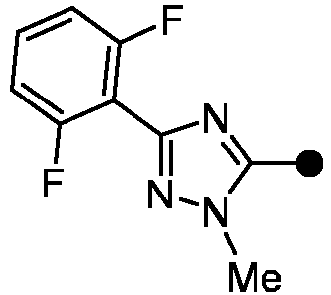
NH2 Me SO2NHMe 17-11 
NH2 Et SO2NHMe 17-12 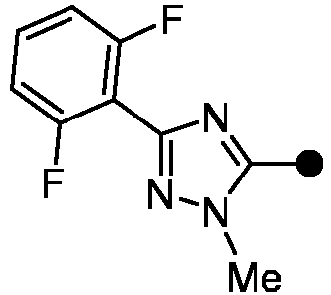
NH2 i-Pr SO2NHMe 17-13 
NH2 Me SO2NHMe 17-14 
NH2 Et SO2NHMe [Table 17-3] Compound No. Qa R4 R5 A Physical Property value 17-15 
NH2 i-Pr SO2NHMe 17-16 
NH2 Me SO2NHMe 17-17 
NH2 Et SO2NHMe 17-18 
NH2 i-Pr SO2NHMe 17-19 
NH2 Me SO2NHMe 17-20 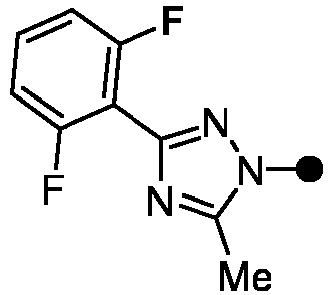
NH2 Et SO2NHMe 17-21 
NH2 i-Pr SO2NHMe [Table 17-4] Compound No. Qa R4 R5 A Physical Property value 17-22 
NH2 Me SO2NHMe 17-23 
NH2 Et SO2NHMe 17-24 
NH2 i-Pr SO2NHMe 17-25 
NH2 Me SO2NHMe 17-26 
NH2 Et SO2NHMe 17-27 
NH2 i-Pr SO2NHMe 17-28 
NH2 Me SO2NHMe [Table 17-5] Compound No. Qa R4 R5 A Physical Property value 17-29 
NH2 Et SO2NHMe 17-30 
NH2 i-Pr SO2NHMe 17-31 
NH2 Me SO2NHMe 17-32 
NH2 Et SO2NHMe 17-33 
NH2 i-Pr SO2NHMe [Table 17-6] Compound No. Qa R4 R5 A Physical Property value 17-34 
NH2 Et SO2NHMe 17-35 
NH2 Et SO2Me 17-36 
NH2 Et SO2NHMe 17-37 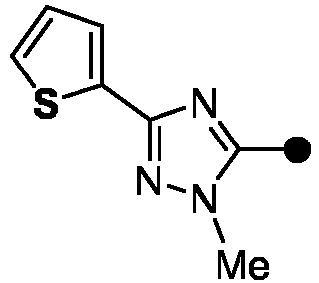
NH2 Et SO2Me 17-38 
NH2 Et SO2NHMe 17-39 
NH2 Et SO2Me 17-40 
NH2 Et SO2NHMe 17-41 
NH2 Et SO2NHMe 
- Table 18 (In Table 18, R6a represents a hydrogen atom, and each solid circle represents a binding position.)
[Table 18-1] Compound No. Qa R4 R5 A Physical Property value 18-1 
NH2 Me SO2NHMe 18-2 
NH2 Et SO2NHMe 18-3 
NH2 i-Pr SO2NHMe 18-4 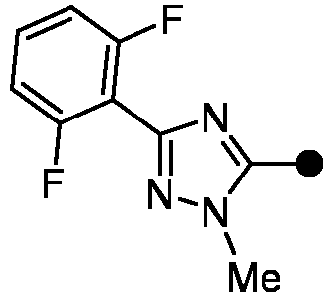
NH2 Me SO2NHMe 18-5 
NH2 Et SO2NHMe 18-6 
NH2 i-Pr SO2NHMe 18-7 
NH2 Me SO2NHMe [Table 18-2] Compound No. Qa R4 R5 A Physical Property value 18-8 
NH2 Et SO2NHMe 18-9 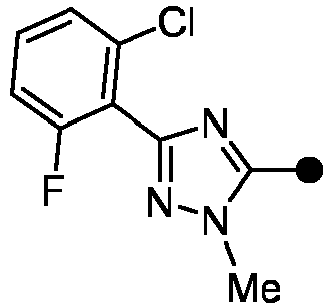
NH2 i-Pr SO2NHMe 18-10 
NH2 Me SO2NHMe 18-11 
NH2 Et SO2NHMe 18-12 
NH2 i-Pr SO2NHMe 18-13 
NH2 Me SO2NHMe 18-14 
NH2 Et SO2NHMe [Table 18-3] Compound No. Qa R4 R5 A Physical Property value 18-15 
NH2 i-Pr SO2NHMe 18-16 
NH2 Me SO2NHMe 18-17 
NH2 Et SO2NHMe 18-18 
NH2 i-Pr SO2NHMe 18-19 
NH2 Me SO2NHMe 18-20 
NH2 Et SO2NHMe 18-21 
NH2 i-Pr SO2NHMe [Table 18-4] Compound No. Qa R4 R5 A Physical Property value 18-22 
NH2 Me SO2NHMe 18-23 
NH2 Et SO2NHMe 18-24 
NH2 i-Pr SO2NHMe 18-25 
NH2 Me SO2NHMe 18-26 
NH2 Et SO2NHMe 18-27 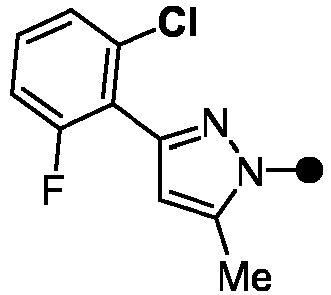
NH2 i-Pr SO2NHMe [Table 18-5] Compound No. Qa R4 R5 A Physical Property value 18-28 
NH2 Et SO2NHMe 18-29 
NH2 Et SO2Me 18-30 
NH2 Et SO2NHMe 18-31 
NH2 Et SO2Me 18-32 
NH2 Et SO2NHMe 18-33 
NH2 Et SO2Me 18-34 
NH2 Et SO2NHMe 18-35 
NH2 Et SO2NHMe 
- Table 19 (In Table 19, R6b represents a hydrogen atom, and each solid circle represents a binding position.)
[Table 19-1] Compound No. Qa R4 R5 A Physical Property value 19-1 
NH2 Me SO2NHMe 19-2 
NH2 Et SO2NHMe 19-3 
NH2 i-Pr SO2NHMe 19-4 
NH2 Me SO2NHMe 19-5 
NH2 Et SO2NHMe 19-6 
NH2 i-Pr SO2NHMe [Table 19-2] Compound No. Qa R4 R5 A Physical Property value 19-7 
NH2 Me SO2NHMe 19-8 
NH2 Et SO2NHMe 19-9 
NH2 i-Pr SO2NHMe 19-10 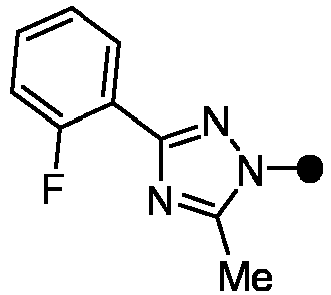
NH2 Me SO2NHMe 19-11 
NH2 Et SO2NHMe 19-12 
NH2 i-Pr SO2NHMe 19-13 
NH2 Me SO2NHMe [Table 19-3] Compound No. Qa R4 R5 A Physical Property value 19-14 
NH2 Et SO2NHMe 19-15 
NH2 i-Pr SO2NHMe 19-16 
NH2 Me SO2NHMe 19-17 
NH2 Et SO2NHMe 19-18 
NH2 i-Pr SO2NHMe 19-19 
NH2 Me SO2NHMe 19-20 
NH2 Et SO2NHMe [Table 19-4] Compound No. Qa R4 R5 A Physical Property value 19-21 
NH2 i-Pr SO2NHMe 19-22 
NH2 Me SO2NHMe 19-23 
NH2 Et SO2NHMe 19-24 
NH2 i-Pr SO2NHMe 19-25 
NH2 Me SO2NHMe 19-26 
NH2 Et SO2NHMe 19-27 
NH2 i-Pr SO2NHMe [Table 19-5] Compound No. Qa R4 R5 A Physical Property value 19-28 
NH2 Et SO2Me NMR 19-29 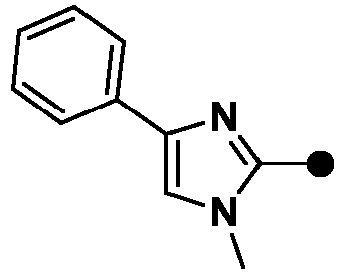
NH2 Et SO2Me NMR 19-30 
NH2 Et SO2Me NMR 19-31 
NH2 Et SO2NHMe 19-32 
NH2 Et SO2Me 19-33 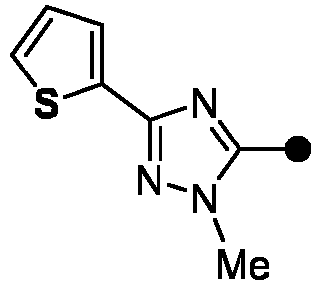
NH2 Et SO2NHMe 19-34 
NH2 Et SO2Me [Table 19-6] Compound No. Qa R4 R5 A Physical Property value 19-35 
NH2 Et SO2NHMe 19-36 
NH2 Et SO2Me 19-37 
NH2 Et SO2NHMe 19-38 
NH2 Et SO2NHMe 
- Table 20 (In Table 20, R6a and R6b represent hydrogen atoms.)
[Table 20-1] Compound No. R1 R2 R4 R5 A Physical Property value 20-1 Ph H NH2 Me SO2NHMe 20-2 Ph H NH2 Et SO2NHMe 38-40 20-3 Ph H NH2 i-Pr SO2NHMe 20-4 2-F-Ph H NH2 Me SO2NHMe 20-5 2-F-Ph H NH2 Et SO2NHMe 20-6 2-F-Ph H NH2 i-Pr SO2NHMe 20-7 3-F-Ph H NH2 Me SO2NHMe 20-8 3-F-Ph H NH2 Et SO2NHMe 20-9 3-F-Ph H NH2 i-Pr SO2NHMe 20-10 4-F-Ph H NH2 Me SO2NHMe 20-11 4-F-Ph H NH2 Et SO2NHMe 20-12 4-F-Ph H NH2 i-Pr SO2NHMe 20-13 2,6-F2-Ph H NH2 Me SO2NHMe 20-14 2,6-F2-Ph H NH2 Et SO2NHMe 20-15 2,6-F2-Ph H NH2 i-Pr SO2NHMe 20-16 Ph Me NH2 Me SO2NHMe 20-17 Ph Me NH2 Et SO2NHMe 72-77 20-18 Ph Me NH2 i-Pr SO2NHMe 20-19 2-F-Ph Me NH2 Me SO2NHMe 20-20 2-F-Ph Me NH2 Et SO2NHMe NMR 20-21 2-F-Ph Me NH2 i-Pr SO2NHMe 20-22 3-F-Ph Me NH2 Me SO2NHMe 20-23 3-F-Ph Me NH2 Et SO2NHMe 20-24 3-F-Ph Me NH2 i-Pr SO2NHMe 20-25 4-F-Ph Me NH2 Me SO2NHMe 20-26 4-F-Ph Me NH2 Et SO2NHMe 20-27 4-F-Ph Me NH2 i-Pr SO2NHMe 20-28 2,6-F2-Ph Me NH2 Me SO2NHMe 20-29 2,6-F2-Ph Me NH2 Et SO2NHMe 38-43 20-30 2,6-F2-Ph Me NH2 i-Pr SO2NHMe [Table 20-2] Compound No. R1 R2 R4 R5 A Physical Property value 20-31 thiazol-5-yl Me NH2 Me SO2NHMe 20-32 thiazol-5-yl Me NH2 Et SO2NHMe 20-33 thiazol-5-yl Me NH2 i-Pr SO2NHMe 20-34 thiazol-4-yl Me NH2 Me SO2NHMe 20-35 thiazol-4-yl Me NH2 Et SO2NHMe 20-36 thiazol-4-yl Me NH2 i-Pr SO2NHMe 20-37 thiazol-2-yl Me NH2 Me SO2NHMe 20-38 thiazol-2-yl Me NH2 Et SO2NHMe 20-39 thiazol-2-yl Me NH2 i-Pr SO2NHMe 20-40 thiophen-2-yl Me NH2 Me SO2NHMe 20-41 thiophen-2-yl Me NH2 Et SO2NHMe 20-42 thiophen-2-yl Me NH2 i-Pr SO2NHMe 20-43 thiophen-3-yl Me NH2 Me SO2NHMe 20-44 thiophen-3-yl Me NH2 Et SO2NHMe 20-45 thiophen-3-yl Me NH2 i-Pr SO2NHMe 20-46 pyridazin-3-yl Me NH2 Me SO2NHMe 20-47 pyridazin-3-yl Me NH2 Et SO2NHMe 20-48 pyridazin-3-yl Me NH2 i-Pr SO2NHMe 20-49 pyrazin-2-yl Me NH2 Me SO2NHMe 20-50 pyrazin-2-yl Me NH2 Et SO2NHMe 20-51 pyrazin-2-yl Me NH2 i-Pr SO2NHMe 20-52 pyrimidin-2-yl Me NH2 Me SO2NHMe 20-53 pyrimidin-2-yl Me NH2 Et SO2NHMe 20-54 pyrimidin-2-yl Me NH2 i-Pr SO2NHMe 20-55 pyrimidin-4-yl Me NH2 Me SO2NHMe 20-56 pyrimidin-4-yl Me NH2 Et SO2NHMe 20-57 pyrimidin-4-yl Me NH2 i-Pr SO2NHMe 20-58 pyrimidin-5-yl Me NH2 Me SO2NHMe 20-59 pyrimidin-5-yl Me NH2 Et SO2NHMe 20-60 pyrimidin-5-yl Me NH2 i-Pr SO2NHMe [Table 20-3] Compound No. R1 R2 R4 R5 A Physical Property value 20-61 pyridin-2-yl H NH2 Et SO2NHMe 75-80 20-62 2-F-Ph Me NH2 Et SO2Me 59-64 20-63 2,6-F2-Ph Me NH2 Et SO2Me 50-55 20-64 3-Cl-pyrimidin-2-yl Me NH2 Et SO2Me 20-65 3-Cl-pyrimidin-2-yl Me NH2 Et SO2NHMe 20-66 3-Cl-pyridin-2-yl H NH2 Et SO2NHMe 52-57 
- Table 21 (In Table 21, R6a and R6b represent hydrogen atoms.)
[Table 21-1] Compound No. R1 R2 R4 R5 A Physical Property value 21-1 Ph H NH2 Me SO2NHMe 21-2 Ph H NH2 Et SO2NHMe 165-166 21-3 Ph H NH2 i-Pr SO2NHMe 21-4 2-F-Ph H NH2 Me SO2NHMe 21-5 2-F-Ph H NH2 Et SO2NHMe 21-6 2-F-Ph H NH2 i-Pr SO2NHMe 21-7 3-F-Ph H NH2 Me SO2NHMe 21-8 3-F-Ph H NH2 Et SO2NHMe 21-9 3-F-Ph H NH2 i-Pr SO2NHMe 21-10 4-F-Ph H NH2 Me SO2NHMe 21-11 4-F-Ph H NH2 Et SO2NHMe 21-12 4-F-Ph H NH2 i-Pr SO2NHMe 21-13 2,6-F2-Ph H NH2 Me SO2NHMe 21-14 2,6-F2-Ph H NH2 Et SO2NHMe 21-15 2,6-F2-Ph H NH2 i-Pr SO2NHMe 21-16 Ph Me NH2 Me SO2NHMe 21-17 Ph Me NH2 Et SO2NHMe 21-18 Ph Me NH2 i-Pr SO2NHMe 21-19 2-F-Ph Me NH2 Me SO2NHMe 21-20 2-F-Ph Me NH2 Et SO2NHMe 21-21 2-F-Ph Me NH2 i-Pr SO2NHMe 21-22 3-F-Ph Me NH2 Me SO2NHMe 21-23 3-F-Ph Me NH2 Et SO2NHMe 21-24 3-F-Ph Me NH2 i-Pr SO2NHMe 21-25 4-F-Ph Me NH2 Me SO2NHMe 21-26 4-F-Ph Me NH2 Et SO2NHMe 21-27 4-F-Ph Me NH2 i-Pr SO2NHMe 21-28 2,6-F2-Ph Me NH2 Me SO2NHMe 21-29 2,6-F2-Ph Me NH2 Et SO2NHMe 21-30 2,6-F2-Ph Me NH2 i-Pr SO2NHMe [Table 21-2] Compound No. R1 R2 R4 R5 A Physical Property value 21-31 thiazol-5-yl Me NH2 Me SO2NHMe 21-32 thiazol-5-yl Me NH2 Et SO2NHMe 21-33 thiazol-5-yl Me NH2 i-Pr SO2NHMe 21-34 thiazol-4-yl Me NH2 Me SO2NHMe 21-35 thiazol-4-yl Me NH2 Et SO2NHMe 21-36 thiazol-4-yl Me NH2 i-Pr SO2NHMe 21-37 thiophen-2-yl Me NH2 Me SO2NHMe 21-38 thiophen-2-yl Me NH2 Et SO2NHMe 21-39 thiophen-2-yl Me NH2 i-Pr SO2NHMe 21-40 thiophen-3-yl Me NH2 Me SO2NHMe 21-41 thiophen-3-yl Me NH2 Et SO2NHMe 21-42 thiophen-3-yl Me NH2 i-Pr SO2NHMe 21-43 pyridazin-3-yl Me NH2 Me SO2NHMe 21-44 pyridazin-3-yl Me NH2 Et SO2NHMe 21-45 pyridazin-3-yl Me NH2 i-Pr SO2NHMe 21-46 pyrazin-2-yl Me NH2 Me SO2NHMe 21-47 pyrazin-2-yl Me NH2 Et SO2NHMe 21-48 pyrazin-2-yl Me NH2 i-Pr SO2NHMe 21-49 pyrimidin-2-yl Me NH2 Me SO2NHMe 21-50 pyrimidin-2-yl Me NH2 Et SO2NHMe 21-51 pyrimidin-2-yl Me NH2 i-Pr SO2NHMe 21-52 pyrimidin-4-yl Me NH2 Me SO2NHMe 21-53 pyrimidin-4-yl Me NH2 Et SO2NHMe 21-54 pyrimidin-4-yl Me NH2 i-Pr SO2NHMe 21-55 pyrimidin-5-yl Me NH2 Me SO2NHMe 21-56 pyrimidin-5-yl Me NH2 Et SO2NHMe 21-57 pyrimidin-5-yl Me NH2 i-Pr SO2NHMe 21-58 thiazol-5-yl H NH2 Me SO2NHMe 21-59 thiazol-5-yl H NH2 Et SO2NHMe 21-60 thiazol-5-yl H NH2 i-Pr SO2NHMe [Table 21-3] Compound No. R1 R2 R4 R5 A Physical Property value 21-61 thiazol-4-yl H NH2 Me SO2NHMe 21-62 thiazol-4-yl H NH2 Et SO2NHMe 21-63 thiazol-4-yl H NH2 i-Pr SO2NHMe 21-64 thiophen-2-yl H NH2 Me SO2NHMe 21-65 thiophen-2-yl H NH2 Et SO2NHMe 21-66 thiophen-2-yl H NH2 i-Pr SO2NHMe 21-67 thiophen-3-yl H NH2 Me SO2NHMe 21-68 thiophen-3-yl H NH2 Et SO2NHMe 21-69 thiophen-3-yl H NH2 i-Pr SO2NHMe 21-70 pyridazin-3-yl H NH2 Me SO2NHMe 21-71 pyridazin-3-yl H NH2 Et SO2NHMe 21-72 pyridazin-3-yl H NH2 i-Pr SO2NHMe 21-73 pyrazin-2-yl H NH2 Me SO2NHMe 21-74 pyrazin-2-yl H NH2 Et SO2NHMe 21-75 pyrazin-2-yl H NH2 i-Pr SO2NHMe 21-76 pyrimidin-2-yl H NH2 Me SO2NHMe 21-77 pyrimidin-2-yl H NH2 Et SO2NHMe 21-78 pyrimidin-2-yl H NH2 i-Pr SO2NHMe 21-79 pyrimidin-4-yl H NH2 Me SO2NHMe 21-80 pyrimidin-4-yl H NH2 Et SO2NHMe 21-81 pyrimidin-4-yl H NH2 i-Pr SO2NHMe 21-82 pyrimidin-5-yl H NH2 Me SO2NHMe 21-83 pyrimidin-5-yl H NH2 Et SO2NHMe 21-84 pyrimidin-5-yl H NH2 i-Pr SO2NHMe 21-85 Ph H NH2 Me SO2NHEt 21-86 Ph H NH2 Et SO2NHEt 21-87 Ph H NH2 i-Pr SO2NHEt 21-88 2,6-F2-Ph H NH2 Me SO2NHEt 21-89 2,6-F2-Ph H NH2 Et SO2NHEt 21-90 2,6-F2-Ph H NH2 i-Pr SO2NHEt - Table 22 (In Table 22, * indicates 1H-NMR data in DMSO-d6.)
[Table 22-1] Compound No. 1H-NMR Data (CDCl3/TMS, ppm) 1-1 δ 8.47(d, 1H), 8.27(d, 1H), 7.94-7.89(m, 1H), 7.86-7.80(m, 1H), 7.54-7.50(m, 1H), 7.40-7.36(m, 2H), 5.47(s, 2H), 4.25(q, 2H), 4.16(s, 3H), 2.74(d, 3H), 1.37(t, 3H) 1-2 δ 8.27(d, 1H), 8.13-8.06(m, 2H), 7.90(s, 1H), 7.81 (d, 1H), 7.47-7.34(m, 3H), 4.32-4.26(q, 2H), 4.25-4.18(q, 2H), 3.99(s, 3H), 2.18(s, 3H), 1.37(t, 3H), 1.10(t, 3H) 1-4 δ 8.46(d, 1H), 8.26(d, 1H), 8.03-7.99(m, 2H), 7.79-7.73(m, 1H), 7.51-7.43(m, 3H), 5.44(s, 2H), 4.24(q, 2H), 4.10(s, 1H), 2.79(d, 3H), 1.37(t, 3H) 1-8 δ 8.26(d, 1H), 8.20(d, 1H), 8.13-8.10(m, 2H), 7.47-7.39(m, 3H), 5.49(s, 2H), 4.29-4.16(m, 4H), 3.98(s, 3H), 1.36(t, 3H), 1.13(t, 3H) 1-12 δ 8.79(d, 1H), 8.34(d, 1H), 7.93-7.90(m, 1H), 7.53-7.50(m, 1H), 7.38-7.35(m, 2H), 4.44(q, 2H), 3.85(s, 3H), 3.05(s, 3H), 2.32(s, 9H), 2.16(s, 3H), 1.40(t, 3H) 1-18 δ 8.37-8.24(m, 2H), 8.15-8.06(m, 2H), 7.49-7.34(m, 4H), 5.43(s, 2H), 4.47-4.35(m, 1H), 3.77(s, 3H), 2.75(s, 6H), 1.33(d, 6H) 1-20 δ 8.33-8.32(m, 2H), 7.95-7.91 (m, 1H), 7.52-7.49(m, 1H), 7.36-7.32(m, 2H), 5.45(s, 2H), 4.47-4.37(m, 1H), 3.82(s, 3H), 2.75(s, 6H), 1.33(d, 3H) 1-21 δ 8.49(d, 1H), 8.28-8.21 (m, 2H), 7.91 (d, 1H), 7.45-7.39(m, 1H), 7.08-7.04(m, 2H), 5.48(s, 2H), 4.14(s, 3H), 3.96(s, 3H), 3.94(s, 3H), 2.76(d, 3H) 1-22 δ 8.49(d, 1H), 8.27-8.22(m, 2H), 7.91(dd, 1H), 7.45-7.40(m, 1H), 7.08-7.04(m, 2H), 5.45(s, 2H), 4.24(q, 2H), 4.14(s, 3H), 3.96(s, 3H), 2.76(d, 3H), 1.37(t, 3H) 1-28 δ 8.46(d, 1H), 8.27(d, 1H), 8.03-7.99(m, 2H), 7.75(q, 1H), 7.49-7.44(m, 3H), 5.41(s, 2H), 4.49-4.39(m, 1H), 4.10(s, 3H), 2.79(d, 3H), 1.35(d, 6H) 1-32 δ 8.37-8.28(m, 2H), 8.13-8.09(m, 1H), 7.47-7.39(m, 2H), 5.47(s, 2H), 4.23(m, 2H), 3.79(s, 3H), 2.75(s, 6H), 1.36(t, 3H) 1-38 δ 8.46(d, 1H), 8.27(d, 1H), 7.44-7.28(m, 4H), 7.18-7.12(m, 1H), 5.47(s, 2H), 4.28-4.22(m, 2H), 4.14(s, 3H), 2.71(d, 3H), 1.37(t, 3H) 1-39 δ 8.46(d, 1H), 8.27(d, 1H), 7.96-7.93(m, 2H), 7.56(q, 1H), 7.46-7.43(m, 2H), 5.44(s, 2H), 4.28-4.21(q, 2H), 4.08(s, 3H), 2.79(d, 3H), 1.37(t, 3H) [Table 22-2] Compound No. 1H-NMR Data (CDCl3/TMS, ppm) 1-40 δ 8.46(d, 1H), 8.27(d, 1H), 7.96-7.93(m, 2H), 7.56(q, 1H), 7.46-7.43(m, 2H), 5.44(s, 2H), 4.28-4.21(q, 2H), 4.08(s, 3H), 2.79(d, 3H), 1.37(t, 3H) 1-41 δ 8.36-8.30(m, 2H), 7.91(d, 1H), 7.82(d, 1H), 7.44-7.36(m, 1H), 7.13-7.06(m, 1H), 5.43(s, 2H), 4.47-4.38(m, 1H), 3.79(s, 3H), 2.78(s, 6H), 1.33(d, 6H) 1-42 δ 8.33(q, 2H), 7.42-7.33(m, 1H), 7.05-6.99(m, 2H), 5.48(s, 2H), 4.22(q, 2H), 3.84(s, 3H), 2.75(s, 6H), 1.36(t, 3H) 1-53 δ 8.46(d, 1H), 8.26(d, 1H), 7.85-7.77(m, 2H), 5.46(s, 2H), 4.28-4.22(m, 2H),4.13(s, 3H), 2.72(d, 3H), 2.62(s, 3H), 1.37(t, 3H) 1-188 δ 8.85(s, 1H), 8.47-8.40(m, 2H), 8.29-8.26(m, 1H), 7.24-7.17(m, 1H).5.42(brs, 2H), 4.07(s, 1H), 4.01(s, 3H), 2.79(d, 3H) 1-189 δ 8.85(s, 1H), 8.47-8.40(m, 2H), 8.30-8.27(m, 1H), 7.24-7.18(m, 1H), 5.42(brs, 2H), 4.24(q, Hz, 2H), 4.07(s, 3H), 2.79(d, 3H), 1.37(t, 3H) 1-200 δ 8.47-8.44(m, 1H), 8.27-8.24(m, 1H), 7.85(dd, 1H), 7.68(q, 1H), 7.60(dd, 1H), 7.41(dd, 1H), 5.43(brs, 2H), 4.06(s, 3H), 4.00(s, 3H), 2.78(d, 3H) 1-201 δ 8.47-8.42(m, 1H), 8.27-8.23(m, 1H), 7.85(dd, 1H), 7.71-7.59(m, 2H), 7.42-7.38(m, 1H), 5.43(brs, 2H), 4.28-4.21(m, 2H), 4.07-4.05(s, 3H), 2.79-2.75(m, 3H), 1.39-1.33(m, 3H) 1-206 δ 8.48-8.45(m, 1H), 8.29-8.26(m, 1H), 7.97(d, 1H), 7.45(d, 1H), 7.26-7.22(m, 1H), 5.43(brs, 1H), 4.12(s, 3H), 4.01(s, 3H), 2.81(d, 3H) 1-207 δ 8.48-8.45(m, 1H), 8.30-8.27(m, 1H), 7.98-7.97(m, 1H), 7.46-7.45(m, 1H), 7.26-7.23(m, 1H), 5.43(brs, 2H), 4.25(q, 2H), 4.12(s, 3H), 2.82-2.80(m, 3H), 1.37(t, 3H) 1-211 δ 8.96-8.93(m, 1H), 8.50-8.45(m, 1H), 8.28-8.15(m, 2H), 7.63-7.53(m, 1H), 7.26-7.18(m, 1H), 5.45(brs, 2H), 4.16(s, 3H), 4.00(s, 3H), 2.73(dd, 3H) 1-212 δ 8.97-8.91(m, 1H), 8.47-8.44(m, 1H), 8.29-8.15(m, 2H), 7.61-7.53(m, 1H), 7.26-7.18(m, 1H), 5.47-5.43(brs, 2H), 4.25(q, 2H), 4.17(s, 3H), 2.73(d, 3H), 1.37(t, 3H) 1-213 δ 8.43(d, 1H), 8.23(d, 1H), 7.53-7.47(m, 1H), 5.43(brs, 2H), 4.00-3.99(m, 6H), 3.77(s, 2H), 2.74(d, 3H), 2.14(s, 3H) 1-214 δ 8.44-8.41(d, 1H), 8.26-8.23(d, 1H), 7.53-7.43(m, 1H), 5.43(brs, 2H), 4.24(q, 2H), 4.00(s, 3H), 3.77(s, 2H), 2.75-2.73(d, 3H), 2.15(s, 3H), 1.37(t, 3H) [Table 22-3] Compound No. 1H-NMR Data (CDCl3/TMS, ppm) 1-215 δ 8.44-8.41(d, 1H), 8.28-8.26(d, 1H), 6.81-6.75(m, 1H), 5.44-5.40(brs, 2H), 4.45(s, 2H), 4.00-3.99(m, 6H), 2.95(s, 3H), 2.75(d, 3H) 1-216 δ 8.43-8.40(d, 1H), 8.27-8.24(d, 1H), 7.18(q, 2H), 5.42(brs, 2H), 4.27-4.20(m, 2H), 4.05(s, 2H), 3.98(s, 3H), 2.72(d, 3H), 2.63(s, 1H), 1.36(t, 3H) 1-217 δ 8.43-8.41(d, 1H), 8.29-8.26(d, 1H), 6.79(q, 1H), 5.42(brs, 2H), 4.45(s, 2H), 4.24(q, 2H), 4.00-3.99(s, 3H), 2.95(s, 3H), 2.75(d, 3H), 1.37(t, 3H) 1-218 δ 8.43(d, 1H), 8.22(d, 1H), 7.83(q, 1H), 5.42(brs, 2H), 4.00-3.98(m, 6H), 2.80-2.71(m, 5H), 1.66(m, 3H), 0.97-0.95(m, 6H) 1-219 δ 8.42(d, 1H), 8.21(d, 1H), 7.94(q, 1H), 5.42(brs, 2H), 4.00-3.99(m, 6H), 3.16-3.08(m, 1H), 2.74-2.72(m, 3H), 1.37(d, 6H) 1-220 δ 8.42(d, 1H), 8.22(d, 1H), 7.94(q, 1H), 5.42(brs, 2H), 4.23(q, 2H), 4.00(s, 3H), 3.16-3.08(m, 1H), 2.74-2.71(m, 3H), 1.38-1.34(m, 9H) 1-221 δ 8.42(d, 1H), 8.21(d, 1H), 7.65(q, 1H), 5.42(brs, 2H), 3.99(m, 6H), 3.78(t, 2H), 3.40(d, 3H), 3.05(t, 2H), 2.72(d, 3H) 1-222 δ 8.42(d, 1H), 8.22(d, 1H), 7.66(q, 1H), 5.42-5.39(brs, 2H), 4.23(q, 2H), 3.99(s, 3H), 3.78(t, 2H), 3.40-3.39(s, 3H), 3.05(t, 2H), 2.72(d, 3H), 1.36(t, 3H) 1-223 δ 8.42(d, 1H), 8.24(d, 1H), 7.44(q, 1H), 5.42(brs, 2H), 4.58(s, 2H), 4.27-4.21(m, 2H), 4.02(s, 3H), 3.46(s, 3H), 2.7(d, 3H), 1.39-1.34(t, 3H) 1-224 δ 8.42(d, 1H), 8.25(d, 1H), 7.44(q, 1H), 5.38(brs, 2H), 4.58(s, 2H), 4.48-4.38(m, 1H), 4.03-4.02(s, 3H), 3.46(s, 3H), 2.73(d, 3H), 1.34(d, 6H) 1-227 δ 8.57(s, 1H), 8.47-8.45(m, 1H), 8.28-8.25(m, 1H), 7.92-7.88(m, 1H), 7.66-7.61(m, 2H), 5.44(s, 2H), 4.24(q, 2H), 4.13(s, 3H), 2.81(d, 3H), 2.41(s, 3H), 1.37(t, 3H) 1-228* δ 8.56-8.54(m, 1H), 8.46-8.43(m, 1H), 8.24-8.21(m, 1H), 8.01-7.98(m, 1H), 7.91-7.86(m, 1H), 7.78(dd, 1H), 6.34(brs, 2H), 4.02(s, 3H), 3.87(s, 3H), 2.63(d, 3H), 2.37(s, 3H) 1-229 δ 8.77-8.74(m, 1H), 8.49-8.46(m, 1H), 8.28-8.25(m, 1H), 8.05-8.00(m, 1H), 7.86-7.79(m, 1H), 7.60(q, 1H), 7.40-7.34(m, 1H), 5.44(brs, 2H), 4.14(s, 3H), 4.00(s, 3H), 2.82(d, 3H) 1-234 δ 8.45(dd, 1H), 8.26(dd, 1H), 7.64(dd, 1H), 7.41-7.37(m, 1H), 7.13(dd, 1H), 6.95-6.93(m, 1H), 5.45-5.40(brs, 2H), 4.24(q, 2H), 4.06(m, 3H), 2.80-2.77(m, 3H), 1.37(t, 3H) 1-236 δ 8.44-8.42(m, 1H), 8.23-8.20(m, 1H), 7.87(q, 1H), 5.43(brs, 2H), 4.00-3.99(m, 6H), 2.77-2.71(m, 5H), 1.83-1.76(m, 2H), 1.02(t, 3H) [Table 22-4] Compound No. 1H-NMR Data (CDCl3/TMS, ppm) 1-237 δ 8.44-8.41(m, 1H), 8.24-8.21(m, 1H), 7.87(q, 1H), 5.43(brs, 2H), 4.23(q, 2H), 4.00(s, 3H), 2.77-2.71(m, 5H), 1.83-1.77(m, 2H), 1.36(t, 3H), 1.02(t, 3H) 1-248 δ 8.47-8.43(m, 1H), 8.27-8.24(m, 1H), 7.64(d, 1H), 7.39-7.36(m, 2H), 7.14-7.10(m, 1H), 5.43(brs, 2H), 4.37(q, 2H), 4.00(s, 3H), 2.79(d, 3H), 1.51(t, 3H) 1-249 δ 8.46-8.43(m, 1H), 8.28-8.25(m, 1H), 7.65-7.63(m, 1H), 7.39-7.36(m, 2H), 7.12(dd, 1H), 5.42(brs, 2H), 4.37(q, 2H), 4.24(q, 2H), 2.79(d, 3H), 1.51(t, 3H), 1.37(t, 3H) 1-269 δ 8.47-8.44(m, 1H), 8.27-8.24(m, 1H), 8.02(d, 2H), 7.59(q, 1H), 7.50-7.43(m, 3H), 5.44(brs, 2H), 4.43-4.36(m, 2H), 4.00(s, 3H), 2.80(d, 3H), 1.53(t, 3H) 1-270 δ 8.47-8.44(m, 1H), 8.28-8.25(m, 1H), 8.04-8.00(m, 2H), 7.60(q, 1H), 7.49-7.42(m, 3H), 5.44(brs, 2H), 4.40(q, 2H), 4.24(q, 2H), 2.79(d, 3H), 1.57(t, 3H), 1.37(t, 3H) 1-284 δ 8.44-8.41(m, 1H), 8.23-8.20(m, 1H), 7.84(q, 1H), 5.42(brs, 2H), 4.00-3.98(m, 6H), 2.79-2.71(m, 5H), 1.79-1.70(m, 2H), 1.48-1.38(m, 2H), 0.96(t, 3H) 1-285 δ 8.43-8.41(m, 1H), 8.23-8.21(m, 1H), 7.85(q, 1H), 5.43(brs, 2H), 4.23(q, 2H), 3.98(s, 3H), 2.79-2.71(m, 5H), 1.80-1.70(m, 2H), 1.39-1.34(m, 5H), 0.96(t, 3H) 1-287 δ 8.48-8.45(m, 1H), 8.30-8.27(m, 1H), 7.75(s, 1H), 7.09-6.99(m, 1H), 5.42(brs, 2H), 4.10(s, 3H), 4.00(s, 3H), 2.81-2.79(m, 3H) 1-288 δ 8.72(s, 1H), 8.48-8.45(m, 1H), 8.28-8.25(m, 1H), 7.35(q, 1H), 5.43(brs, 2H), 4.08(s, 3H), 4.01(s, 3H), 2.82-2.76(m, 6H) 1-289 δ 8.72(s, 1H), 8.47-8.44(m, 1H), 8.29-8.26(m, 1H), 7.38-7.32(m, 1H), 5.43(brs, 2H), 4.24(q, 2H), 4.08(s, 3H), 2.83-2.76(m, 6H), 1.40-1.34(t, 3H) 1-290 δ 8.72(s, 1H), 8.46-8.43(m, 1H), 8.30-8.27(m, 1H), 7.38-7.33(m, 1H), 5.48(brs, 2H), 4.49-4.39(m, 1H), 4.09(s, 3H), 2.83-2.76(m, 6H), 1.36-1.33(d, 6H) 1-299 δ 8.41(d, 1H), 8.23(d, 1H), 7.81(q, 1H), 5.40(brs, 2H), 4.47-4.38(m, 1H), 4.31(q, 2H), 3.19-3.07(m, 1H), 2.73(d, 3H), 1.45-1.44(t, 3H), 1.35(m, 12H) 1-358 δ 8.43 (d, 1H), 8.21 (d, 1H), 8.04 (q, 1H), 5.43 (brs, 2H), 4.00 - 3.99 (m, 6H), 2.73 (d, 3H), 1.41 (s, 9H). 1-359 δ 8.42 (d, 1H), 8.21 (d, 1H), 8.04 (q, 1H), 5.43 (brs, 2H), 4.23 (q, 2H), 4.00 (s, 3H), 2.72 (d, 3H), 1.42 - 1.34 (m, 12H). [Table 22-5] Compound No. 1H-NMR Data (CDCl3/TMS, ppm) 2-4 δ 8.13-8.05(m, 2H), 7.63(s, 1H), 7.58-7.54(m, 1H), 7.30(s, 1H), 7.24(d, 1H), 7.07-7.03(m, 1H), 5.49(s, 2H), 4.28-4.18(m, 4H), 3.85(s, 3H), 2.37(s, 3H), 1.36(t, 3H), 1.15(t, 3H) 2-6 δ 8.14-8.06(m, 2H), 8.03-7.96(m, 1H), 7.74-7.68(m, 1H), 7.59-7.52(m,1H), 7.40-7.30(m,2H), 5.50(s, 2H), 4.27-4.16(m, 4H), 1.36(t, 3H), 1.15(t, 3H) 2-8 δ 8.12-8.06(m, 1H), 7.81-7.75(m, 2H), 7.58-7.52(m, 1H), 7.34-7.30(m, 1H), 5.39(s, 2H), 4.23-4.14(m, 4H), 3.70(s, 3H), 1.35(t, 3H), 1.17(t, 3H) 2-15 δ 8.45(d, 1H), 8.18(d, 1H), 8.02(dt, 1H), 7.81(s, 1H), 7.45(dd, 1H), 7.34-7.27(m, 1H), 7.22-7.17(m, 1H), 5.32(s, 2H), 4.65(q, 2H), 3.85(s, 3H), 2.32(s, 3H), 2.30(s, 3H), 1.38(t, 3H) 2-17 δ 8.27-8.19(m, 2H), 7.86(d, 1H), 7.65(s, 1H), 7.40(d, 1H), 7.23-7.15(m, 2H), 4.45(q, 2H), 4.27(q, 2H), 4.06(s, 3H), 2.50(s, 3H), 1.45(t, 3H), 1.10(t, 3H) 2-22 δ 8.07(d, 1H), 8.01(d, 1H), 7.80-7.76(m, 2H), 7.40-7.34(m, 2H), 7.32(s, 1H), 7.25-7.22(m, 1H), 5.59(s, 2H), 4.51(q, 2H), 3.94(s, 3H), 3.80(s, 3H) 2-32* δ 8.46(d, 1H), 8.17(d, 1H), 8.09-8.04(m, 1H), 7.44-7.39(m, 1H), 7.30-7.25(m, 1H), 7.19-7.13(m, 1H), 4.34(q, 2H), 3.77(s, 3H), 3.70(s, 3H), 2.32(s, 3H), 1.37(t, 3H) 2-37 δ 8.13-8.02(m, 2H), 7.02(s, 1H), 5.65-5.42(m, 3H), 4.29-4.17(m, 4H), 4.15-4.10(m, 2H), 3.75(s, 3H), 2.20-2.14(m, 2H), 1.93-1.86(m, 2H), 1.35(t, 3H), 1.20(t, 3H) 3-1 δ 8.49(d, 1H), 8.27(d, 1H), 8.02-7.98(m, 1H), 7.29-7.19(m, 2H), 6.72-6.67(m, 1H), 5.37(brs, 2H), 4.24(q, 2H), 2.81(d, 3H), 2.67(s, 3H), 1.37(t, 3H) 3-3 δ 8.48(d, 1H), 8.28(d, 1H), 8.04-8.01(m, 2H), 7.49-7.45(m, 3H), 6.34(q, 1H), 5.39(brs, 2H), 4.24(q, 2H), 2.79(d, 3H), 2.61(s, 3H), 1.37(t, 3H) 3-4 δ 8.48(d, 1H), 8.27(d, 1H), 8.18(dd, 1H), 7.50(dd, 1H) 7.42-7.35(m, 2H), 6.74(q, 1H), 5.41(brs, 2H), 4.24(q, 2H), 2.75(d, 3H), 2.65(s, 3H), 1.36(t, 3H) 3-6 δ 8.48(d, 1H), 8.28(d, 1H), 8.20-8.17(m, 1H), 7.26-7.23(m, 1H), 7.15-7.10(m, 1H), 6.65(q, 1H), 5.40(brs, 2H), 4.24(q, 2H), 2.74(d, 3H), 2.64(s, 3H), 1.36(t, 3H) 3-8 δ 8.49(d, 1H), 8.28(d, 1H), 7.46-7.38(m, 1H), 7.10-7.03(m, 2H), 6.32-6.28(m, 1H), 5.41(brs, 2H), 4.00(s, 3H), 2.76(d, 3H), 2.65(s, 3H) 3-9 δ 8.54(d, 1H), 8.34(d, 1H), 8.10-8.07(m, 2H), 7.46-7.41(m, 3H), 5.45(br.s, 2H), 4.23(q, 2H), 3.46(s, 3H), 2.52(s, 3H), 1.34(t, 3H) [Table 22-6] Compound No. 1H-NMR Data (CDCl3/TMS, ppm) 3-12 δ 8.49(d, 1H), 8.25(d, 1H), 8.26-8.21(m, 1H), 7.46-7.40(m, 1H), 7.31-7.27(m, 1H) 7.22-7.16(m, 1H), 6.90-6.85(m, 1H), 5.38(brs, 2H), 4.24(q, 2H), 2.80(d, 3H), 2.68(s, 3H), 1.36(t, 3H) 3-13 δ 8.48(d, 1H), 8.30(d, 1H), 7.43-7.32(m, 2H), 7.17-7.12(m, 1H), 6.04(q, 1H), 5.43(brs, 2H), 4.24(q, 2H), 2.71(d, 3H), 2.63(s, 3H), 1.37(s, 3H) 3-14 δ 8.48(d, 1H), 8.30(d, 1H), 6.87-6.80(m, 1H), 6.23-6.19(m, 1H), 5.40(brs, 2H), 4.24(q, 2H), 2.75(d, 3H), 2.63(s, 3H), 1.36(s, 3H) 3-17 δ 8.49(d, 1H), 8.27(d, 1H), 8.19-8.17(m, 1H), 7.51-7.49(m, 1H), 7.43-7.36(m, 2H), 6.74(q, 1H), 5.40(brs, 2H), 4.00(s, 3H), 2.75(d, 3H), 2.65(s, 3H) 3-18 δ 8.49(d, 1H), 8.22(d, 1H), 8.15(d, 1H), 7.53(q, 1H),7.4-7.39(m, 1H), 7.12-7.04(m, 2H), 5.40(brs, 2H), 4.23(q, 2H), 3.95(s, 3H), 2.79(d, 3H), 2.68(s, 3H), 1.36(t, 3H) 3-114 δ 8.43(d, 1H), 8.22(d, 1H), 6.70(q, 1H), 5.37(brs, 2H), 4.23(q, 2H), 2.78(tt, 1H) 2.73(d, 3H), 2.54(s, 3H), 2.13-2.09(m, 2H), 1.85(dt, 2H), 1.77-1.72(m, 1H), 1.59-1.49(m, 2H), 1.46-1.36(m, 2H), 1.34-1.26(m, 1H) 3-115 δ 8.69(d, 1H), 8.50(d, 1H), 8.25(d, 1H), 7.85-7.81(m, 1H), 7.38-7.35(m, 1H), 6.90(q, 1H), 5.44(brs, 2H), 4.00(s, 3H), 2.84(d, 3H), 2.68(s, 3H) 3-118 δ 8.73(s, 1H), 8.63(d, 1H), 8.48(d, 1H), 8.32(d, 1H), 8.16(d, 1H), 6.47(q, 1H), 5.35(brs, 2H), 4.48-4.39(m, 1H), 2.76(d, 3H), 2.64(s, 3H), 1.34(d, 6H) 3-122 δ 8.74(brs, 2H), 8.49(d, 1H), 8.33(d, 1H), 7.90(d, 2H), 6.00(q, 1H), 5.40(brs, 2H), 4.25(q, 2H), 2.80(d, 3H), 2.60(s, 3H), 1.37(t, 3H) 3-123 δ 9.25(s, 1H), 8.69(dd, 1H), 8.48(d, 1H), 8.33(dt, 1H), 8.31(d, 1H), 7.44-7.41(m, 1H), 6.09(q, 1H), 5.39(brs, 2H), 4.24(q, 2H), 2.79(d, 3H), 2.61(s, 3H), 1.37(t, 3H) 3-124 δ 8.69(dd, 1H), 8.49(d, 1H), 8.28(d, 1H), 7.87(dd, 1H), 7.37-7.33(m, 1H), 6.75(q, 1H), 5.39(brs, 2H), 4.24(q, 2H), 2.77(d, 3H), 2.69(s, 3H), 1.36(t, 3H) 3-125 δ 8.69(brs, 1H), 8.50(d, 1H), 8.27(d, 1H), 7.87-7.85(m, 1H), 7.37-7.33(m, 1H), 6.76(q, 1H), 5.40(brs, 2H), 4.00(s, 3H), 2.78(d, 3H), 2.69(s, 3H) 3-127 δ 8.42(d, 1H), 8.23(d, 1H), 6.69(q, 1H), 5.34(brs, 2H), 4.45-4.43(m, 1H), 2.78(tt, 1H), 2.73(d, 3H), 2.54(s, 3H), 2.13-2.09(m, 2H), 1.85(dt, 2H), 1.76-1.71(m, 1H), 1.59-1.49(m, 2H), 1.46-1.36(m, 2H), 1.33(d, 6H), 1.33-1.26(m, 1H) [Table 22-7] Compound No. 1H-NMR Data (CDCl3/TMS, ppm) 3-129 δ 8.43(d, 1H), 8.22(d, 1H), 6.65(q, 1H), 5.37(brs, 2H), 4.23(q, 2H), 3.22(tt, 1H), 2.73(d, 3H), 2.54(s, 3H), 2.16-2.07(m, 2H), 1.91-1.68(m, 6H), 1.36(t, 3H) 3-130 δ 8.42(d, 1H), 8.23(d, 1H), 6.65(q, 1H), 5.34(brs, 2H), 4.47-4.37(m, 1H), 3.22(tt, 1H), 2.73(d, 3H), 2.54(s, 3H), 2.16-2.08(m, 2H), 1.91-1.68(m, 6H), 1.33(d, 6H) 3-151 δ 8.43(d, 1H), 8.25(d, 1H), 6.53(q, 1H), 5.35(brs, 2H), 4.42(quin, 1H), 4.10-4.05(m, 2H), 3.56(dt, 2H), 3.01-3.09(m, 1H), 2.74(d, 3H), 2.55(s, 3H), 2.03-2.00(m, 2H), 1.95-1.85(m, 2H), 1.33(d, 6H) 3-168 δ 8.86(s, 1H), 8.47(s, 1H), 8.47(d, 1H), 8.30(d, 1H), 6.00(q, 1H), 5.37(brs, 2H), 4.24(q, 2H), 2.79(d, 3H), 2.59(s, 3H), 1.36(t, 3H) 3-171 δ 8.89(d, 1H), 8.48(d, 1H), 8.25(d, 1H), 8.07(d, 1H), 6.79(q, 1H), 5.41(s, 3H), 5.35(brs, 2H), 4.24(q, 2H), 2.82(d, 3H), 2.67(s, 3H), 1.36(t, 3H) 3-174 δ 9.19(s, 1H), 8.47(d, 1H), 8.35(d, 1H), 5.58(q, 1H), 5.37(brs, 2H), 4.24(q, 2H), 2.80(d, 3H), 2.59(s, 3H), 1.36(t, 3H) 3-176 δ 8.47(d, 1H), 8.26(d, 1H), 7.70(d, 1H), 7.39(d, 1H), 7.13(t, 1H)6.27(q, 1H), 5.38(brs, 2H), 4.00(s, 3H), 2.80(d, 3H), 2.60(s, 3H) 3-177 δ 8.46(d, 1H), 8.27(d, 1H), 7.70(dd, 1H), 7.39(dd, 1H), 7.13(dd, 1H)6.27(q, 1H), 5.37(brs, 2H), 4.24(q, 2H), 2.80(d, 3H), 2.60(s, 3H), 1.36(t, 3H) 3-179 δ 8.47(d, 1H), 8.27(d, 1H), 7.96(dd, 1H), 7.54(dd, 1H), 7.41(dd, 1H)6.32(q, 1H), 5.38(brs, 2H), 4.00(s, 3H), 2.78(d, 3H), 2.59(s, 3H) 3-180 δ 8.46(d, 1H), 8.27(d, 1H), 7.96(dd, 1H), 7.54(dd, 1H), 7.41(dd, 1H)6.32(q, 1H), 5.38(brs, 2H), 4.24(q, 2H), 2.78(d, 3H), 2.59(s, 3H), 1.36(t, 3H) 3-190 δ 8.43(d, 1H), 8.23(d, 1H), 6.60(q, 1H), 5.37(bs, 2H), 4.23(q, 2H), 2.75(s, 3H), 2.74(q, 2H), 2.54(s, 3H), 1.82(m, 2H), 1.36(t, 3H), 1.03(t, 3H) 3-191 δ 8.53(d, 1H), 8.33(d, 1H), 7.72(d, 1H), 7.37(dd, 1H), 7.12(dd, 1H)5.41(brs, 1H), 4.24(q, 2H), 3.47(s, 3H), 2.53(s, 3H), 1.36(t, 3H) 3-192 δ 8.47(d, 1H), 8.27(d, 1H), 7.28(d, 1H), 6.93(d, 1H), 6.41(q, 1H), 5.37(brs, 2H), 4.24(q, 2H), 2.76(d, 3H), 2.59(s, 3H), 1.36(t, 3H) 3-193 δ 8.47(d, 1H), 8.27(d, 1H), 7.39(d, 1H), 7.03(d, 1H), 6.78(q, 1H), 5.36(brs, 2H), 4.24(q, 2H), 2.77(d, 3H), 2.61(s, 3H), 1.36(t, 3H) 3-194 δ 8.48(d, 1H), 8.20(d, 1H), 8.00(d, 1H), 7.45(q, 1H), 6.39(d, 1H)5.36(brs, 2H), 4.23(q, 2H), 3.94(s, 3H), 2.80(d, 3H), 2.67(s, 3H), 1.36(t, 3H) 3-195 δ 8.47(d, 1H), 8.27(d, 1H), 6.89(s, 1H), 6.64(q, 1H), 5.36(brs, 2H), 4.00(s, 3H), 2.76(d, 3H), 2.59(s, 3H) [Table 22-8] Compound No. 1H-NMR Data (CDCl3/TMS, ppm) 3-196 δ 8.46(d, 1H), 8.27(d, 1H), 7.01(s, 1H), 6.64(q, 1H), 5.36(brs, 2H), 4.00(s, 3H), 2.76(d, 3H), 2.59(s, 3H) 3-197 δ 8.48(d, 1H), 8.25(d, 1H), 7.29(dd, 1H), 6.91(d, 1H), 6.72(q, 1H), 5.36(brs, 2H), 4.24(q, 2H), 2.79(d, 3H), 2.65(s, 3H), 1.36(t, 3H) 3-201 δ 8.48(d, 1H), 8.26(d, 1H), 7.39(d, 1H), 7.03(d, 1H), 6.78(q, 1H), 5.37(brs, 2H), 4.00(s, 3H), 2.77(d, 3H), 2.61(s, 3H) 3-204 δ 8.43(d, 1H), 8.22(d, 1H), 6.58(q, 1H), 5.37(bs, 2H), 4.23(q, 2H), 2.76(t, 2H), 2.74(d, 3H), 2.54(s, 3H), 1.77(m, 2H), 1.44(m, 2H), 1.36(t, 3H), 0.97(t, 3H) 3-207 δ 8.43(d, 1H), 8.24(d, 1H), 6.48(q, 1H), 5.36(brs, 2H), 4.23(q, 2H), 2.74(d, 3H), 2.52(s, 3H), 2.44(s, 3H), 1.36(t, 3H) 3-229 δ 8.47(d, 1H), 8.26(d, 1H), 7.72(d, 1H), 7.38(d, 1H), 7.13(dd, 1H), 6.25(q, 1H), 5.39(brs, 2H), 4.00(s, 3H), 2.91(q, 2H), 2.79(d, 3H), 1.33(t, 3H) 3-230 δ 8.46(d, 1H), 8.27(d, 1H), 7.72(dd, 1H), 7.38(dd, 1H), 7.13(dd, 1H), 6.25(q, 1H), 5.38(brs, 2H), 4.24(q, 2H), 2.91(q, 2H), 2.79(d, 3H), 1.36(t, 3H), 1.33(t, 3H) 3-250 δ 8.48(d, 1H), 8.28(d, 1H), 8.05-8.02(m, 2H), 7.49-7.43(m, 3H), 6.31(q, 1H), 5.40(brs, 2H), 4.00(s, 3H), 2.91(q, 2H), 2.78(d, 3H), 1.35(t, 3H) 3-251 δ 8.47(d, 1H), 8.28(d, 1H), 8.05-8.03(m, 2H), 7.49-7.43(m, 3H), 6.31(q, 1H), 5.40(brs, 2H), 4.24(q, 3H), 2.91(q, 2H), 2.78(d, 3H), 1.36(t, 3H), 1.35(t, 3H) 3-265 δ 8.46(d, 1H), 8.30(d, 1H), 7.51(s, 1H), 5.88(q, 1H), 5.38(brs, 2H), 4.24(q, 2H), 2.79(d, 3H), 2.57(s, 3H), 1.36(t, 3H) 3-267 δ 8.47(d, 1H), 8.28(d, 1H), 7.38(d, 1H), 7.09(d, 1H), 6.74(q, 1H), 5.36(brs, 2H), 4.24(q, 2H), 2.77(d, 3H), 2.60(s, 3H), 1.36(t, 3H) 3-268 δ 8.86(d, 1H), 8.47(d, 1H), 8.47(d, 1H), 8.30(d, 1H), 6.00(q, 1H), 5.37(brs, 2H), 4.24(q, 2H), 2.79(d, 3H), 2.59(s, 3H), 1.36(t, 3H) 3-269 δ 8.47(d, 1H), 8.25(d, 1H), 6.81(dd, 1H), 6.56(s, 1H), 6.32(q, 1H), 5.35(brs, 2H), 4.23(q, 2H), 2.78(d, 3H), 2.62(s, 3H), 1.36(t, 3H) 3-270 δ 8.47(d, 1H), 8.34(d, 1H), 5.74(q, 1H), 5.38(brs, 2H), 4.24(q, 2H), 3.03(s, 3H), 2.78(d, 3H), 2.59(s, 3H), 1.36(t, 3H) 3-271 δ 8.50(d, 1H), 8.28(d, 1H), 6.62(q, 1H), 5.39(brs, 2H), 4.24(q, 3H), 3.02(s, 3H), 2.82(d, 3H), 2.69(s, 3H), 1.37(t, 3H) 3-272 δ 8.46(d, 1H), 8.27(d, 1H), 8.06(dd, 1H), 7.51(dd, 1H), 6.78(dd, 1H), 6.28(q, 1H), 5.38(brs, 2H), 4.24(q, 2H), 2.77(d, 3H), 2.57(s, 3H), 1.36(t, 3H) [Table 22-9] Compound No. 1H-NMR Data (CDCl3/TMS, ppm) 3-273 δ 8.54(d, 1H), 8.47(d, 1H), 8.32(d, 1H), 7.75(d, 1H), 5.86(q, 1H), 5.40(brs, 2H), 4.24(q, 2H), 2.79(d, 3H), 2.60(s, 3H), 1.36(t, 3H) 3-274 δ 8.47(d, 1H), 8.26(d, 1H), 7.54(dd, 1H), 7.04(dd, 1H), 6.54(dd, 1H), 6.47(q, 1H), 5.37(brs, 2H), 4.24(q, 2H), 2.80(d, 3H), 2.62(s, 3H), 1.36(t, 3H) 3-279 δ 8.47(d, 1H), 8.31(d, 1H), 7.53(d, 1H), 6.75(d, 1H), 5.99(q, 1H), 5.38(brs, 2H), 4.24(s, 3H), 4.24(q, 2H), 2.75(d, 3H), 2.58(s, 3H), 1.36(t, 3H) 3-286 δ 11.36(s, 1H), 8.38(d, 1H), 8.22(d, 1H), 7.76(dd, 2H),7.49-7.40(m, 3H), 6.61(q, 1H), 5.49(brs, 2H), 4.22(q, 2H), 2.75(d, 3H), 1.36(t, 3H) 3-318 δ 8.56(d, 1H), 8.31(d, 1H), 7.80(dd, 1H), 7.44(dd, 1H), 7.15(dd, 1H), 6.02(brs, 2H), 4.23(q, 2H), 3.67(s, 3H), 3.27(s, 3H), 1.36(t, 3H) 3-321 δ 8.50(d, 1H), 8.36(d, 1H), 7.79(dd, 1H), 7.45(dd, 1H), 7.15(dd, 1H), 5.58(brs, 2H), 4.22(q, 2H), 3.47(s, 3H), 3.45(s, 3H), 1.35(t, 3H) 3-324 δ 8.55(d, 1H), 8.32(d, 1H), 7.78(d, 1H), 7.38(d, 1H), 7.13(t, 1H), 6.55(dd, 1H), 6.53(dd, 1H), 5.70(dd, 1H), 5.40(brs, 2H), 4.24(q, 2H), 3.52(s, 3H), 1.36(t, 3H) 3-377 δ 8.53(d, 1H), 8.33(d, 1H), 7.73(m, 1H), 7.35(m, 1H), 7.11(m, 1H), 5.40(brs, 2H), 4.23(q, 2H), 3.47(s, 3H), 2.83(q, 2H), 1.35(t, 3H), 1.32(t, 3H) 3-378 δ 8.54(d, 1H), 8.36(d, 1H), 7.79(d, 1H), 7.43(d, 1H), 7.15(dd, 1H), 6.92(t, 1H), 5.44(brs, 2H), 4.24(q, 2H), 3.50(s, 3H), 1.36(t, 3H) 3-379 δ 8.56(d, 1H), 8.34(d, 1H), 7.82(dd, 1H), 7.39(dd, 1H), 7.14(dd, 1H), 5.34(brs, 2H), 4.23(q, 2H), 3.42(s, 3H), 1.35(t, 3H) 4-1 δ 8.54(d, 1H), 8.26(d, 1H), 7.80-7.77(m, 2H), 7.42-7.38(m, 2H), 7.35-7.33(m, 1H), 6.61(s, 1H), 5.43(br.s, 2H), 4.23(q, 2H), 3.80(s, 3H), 2.36(s, 3H), 1.36(t, 3H) 4-2 δ 8.54(d, 1H), 8.26(d, 1H), 7.74-7.72(m, 1H), 7.48-7.46(m, 1H), 7.30-7.28(m, 2H), 6.77(s, 1H), 5.44(br.s, 2H), 4.23(q, 2H), 3.46(s, 3H), 2.39(s, 3H), 1.36(t, 3H) 4-5 δ 8.46(d, 1H), 8.18(d, 1H), 7.67-7.65(m, 1H), 7.49-7.47(m, 1H), 7.36-7.29(m, 2H), 6.91(q, 1H), 6.69(s, 1H), 5.42(brs, 2H), 4.23(q, 2H), 2.70(d, 3H), 2.47(s, 3H), 1.36(t, 3H) 4-6 δ 8.46(d, 1H), 8.20(d, 1H), 7.72-7.69(m, 1H), 7.45-7.40(m, 2H), 7.38-7.34(m, 1H), 6.79(q, 1H), 6.60(s, 1H), 5.41(brs, 2H), 4.23(q, 2H), 2.77(d, 3H), 2.43(s, 3H), 1.37(t, 3H) [Table 22-10] Compound No. 1H-NMR Data (CDCl3/TMS, ppm) 4-7 δ 8.46(d, 1H), 8.19(d, 1H), 7.60(d, 1H), 7.50(d, 1H), 7.32(dd, 1H), 6.77(q, 1H), 6.67(s, 1H), 5.41(brs, 2H), 4.23(q, 2H), 2.70(d, 3H), 2.46(s, 3H), 1.37(t, 3H) 4-8 δ 8.46(d, 1H), 8.18(d, 1H), 7.64(d, 2H), 6.96(d, 2H), 6.88(q, 1H), 6.53(s, 1H), 5.40(brs, 2H), 4.23(q, 2H), 3.86(s, 3H), 2.77(d, 3H), 2.42(s, 3H), 1.36(t, 3H) 4-10 δ 8.47(d, 1H), 8.22(d, 1H), 7.81(d, 1H), 7.77(d, 1H), 7.68-7.64(m, 1H), 7.48-7.37(m, 1H), 6.78(s, 1H), 6.65(q, 1H), 5.41(brs, 2H), 4.00(s, 3H), 2.77(d, 2H), 2.43(s, 2H) 4-11 δ 8.45(d, 1H), 8.21(d, 1H), 7.66(d, 2H), 7.40(d, 2H), 6.60(s, 1H), 6.57(q, 1H), 5.40(brs, 2H), 4.23(q, 2H), 2.77(q, 2H), 2.76(d, 3H), 1.36(t, 3H), 1.26(t, 3H) 4-14 δ 8.46(d, 1H), 8.21(d, 1H), 7.65-7.62(m, 2H), 7.41-7.38(m, 2H), 6.61(q, 1H), 6.58(s, 1H), 5.40(brs, 2H), 4.23(q, 2H), 2.76(d, 3H), 2.41(s, 3H), 1.36(t, 3H) 4-15 δ 8.45(d, 1H), 8.17(d, 1H), 7.51(d, 1H), 7.32-7.25(m, 3H), 6.94(q, 1H), 6.42(s, 1H), 5.43(brs, 2H), 4.24(q, 2H), 2.68(d, 3H), 2.47(s, 3H), 2.46(s, 3H), 1.36(t, 3H) 4-16 δ 8.46(d, 1H), 8.22(d, 1H), 7.70-7.69(m, 1H), 7.60-7.58(m, 1H), 7.38-7.31(m, 2H), 6.60(s, 1H), 6.56(q, 1H), 5.41(brs, 2H), 4.23(q, 2H), 2.78(d, 3H), 2.41(s, 3H), 1.36(t, 3H) 4-18 δ 8.38(d, 1H), 7.96(d, 1H), 7.80-7.78(m, 2H), 7.42-7.39(m, 2H), 7.34-7.30(m, 1H), 6.41(s, 1H), 5.15(br.s, 2H), 4.18(q, 4H), 3.34(s, 3H), 1.47(t, 3H), 1.32(t, 3H) 4-19 δ 8.49(d, 1H), 8.23(d, 1H), 7.79-7.76(m, 2H), 7.68-7.65(m, 1H), 7.34-7.30(m, 2H), 6.05(s, 1H), 5.46(br.s, 2H), 4.18(q, 2H), 3.94(s, 3H), 3.36(s, 3H), 1.32(t, 3H) 4-20 δ 12.0(br.s, 1H), 8.26(d, 1H), 7.81(d, 1H), 7.55-7.52(m, 2H), 7.32-7.27(m, 3H), 6.34(s, 1H), 5.16(br.s, 2H), 4.14(q, 2H), 3.21(s, 3H), 1.27(t, 3H) 4-21 δ 8.30(d, 1H), 7.87(d, 1H), 7.55-7.50(m, 2H), 7.39-7.34(m, 2H), 6.54(s, 1H), 5.63(q, 1H), 5.19(brs, 2H), 4.17(q, 2H), 2.73(d, 3H), 1.31(t, 3H) 4-22 δ 8.30(d, 1H), 7.86(d, 1H), 7.54(d, 2H), 7.47-7.36(m, 3H), 6.35(s, 1H), 6.12(brd, 1H), 5.16(brs, 2H), 4.16(q, 2H), 2.70(d, 3H), 1.30(t, 3H) 4-23 δ 8.48(d, 1H), 8.11(d, 1H), 7.64(d, 2H), 7.42(d, 2H), 7.12(q, 1H), 6.58(s, 1H), 5.54(brs, 2H), 4.23(q, 2H), 2.77(d, 3H), 2.53(s, 3H), 1.36(t, 3H) [Table 22-11] Compound No. 1H-NMR Data (CDCl3/TMS, ppm) 4-24 δ 8.53(d, 1H), 8.18(d, 1H), 7.68(d, 2H), 7.48(d, 2H), 7.34(s, 1H), 6.91(q, 1H), 5.89(brs, 2H), 4.23(q, 2H), 2.99(s, 3H), 2.80(d, 3H), 1.36(t, 3H) 4-25 δ 8.45(d, 1H), 8.29(d, 1H), 7.68(d, 2H), 7.45(d, 2H), 7.39(s, 1H), 5.60(q, 1H), 5.51(brs, 2H), 4.23(q, 2H), 3.19(s, 3H), 2.76(d, 3H), 1.36(t, 3H) 4-26 δ 8.30(d, 1H), 7.87(d, 1H), 7.62-7.58(m, 1H), 7.41-7.35(m, 1H), 7.27-7.19(m, 2H), 6.54(s, 1H), 5.50(q, 1H), 5.16(brs, 2H), 4.17(q, 2H), 2.74(d, 3H), 1.31(t, 3H) 4-52 δ 8.43(d, 1H), 8.24(d, 1H), 7.60-7.55(m, 1H), 7.38-7.21(m, 3H), 6.61(m, 1H), 6.48(q, 1H), 5.36(brs, 2H), 4.23(q, 2H), 2.74(d, 3H), 2.52(m, 3H), 2.44(m, 3H), 1.36(t, 3H) 4-77 δ 8.66-8.64(m, 1H), 8.49(d, 1H), 8.17(d, 1H), 7.78-7.73(m, 1H), 7.70-7.68(m, 1H), 7.31(q, 1H), 7.28-7.24(m, 1H), 6.80(s, 1H), 5.41(brs, 2H), 4.23(q, 2H), 2.84(d, 3H), 2.51(s, 3H), 1.36(t, 3H) 4-115 δ 8.37(d, 1H), 8.06(d, 1H), 7.58(q, 1H), 5.78(s, 1H), 5.34(brs, 2H), 4.40(quin, 2H), 3.18(t, 4H), 2.69(d, 3H), 2.33(s, 3H), 1.70-1.56(m, 6H), 1.32(d, 6H) 4-135 δ 8.45(d, 1H), 8.19(d, 1H), 7.55(t, 1H), 7.39-7.38(m, 2H), 6.83(q, 1H), 6.51(s, 1H), 5.40(brs, 2H), 4.26-4.20(m, 2H), 3.21(s, 3H), 2.77(d, 3H), 2.41(s, 3H), 1.38-1.34(m, 3H) 4-149 δ 8.48-8.45(m, 1H), 8.28-8.25(m, 1H), 6.76(d, 1H), 6.31-6.24(m, 1H), 5.38(brs, 2H), 4.27-4.20(m, 2H), 2.80-2.77(m, 3H), 2.55(s, 3H), 1.39-1.34(m, 3H) 4-150 δ 8.52(d, 1H), 8.29(d, 1H), 6.78(s, 1H), 5.39(brs, 2H), 4.39(q, 2H), 4.24(q, 2H), 3.51(s, 3H), 2.36(s, 3H), 2.59(s, 3H), 1.38(t, 3H), 1.36(t, 3H) 4-151 δ 8.42(d, 1H), 8.21(d, 1H), 6.44(s, 1H), 6.17(q, 1H), 5.33(brs, 2H), 4.42(quin, 2H), 2.75(d, 3H), 2.35(s, 3H), 1.33(d, 6H) 4-152 δ 8.43(d, 1H), 8.19(d, 1H), 6.44(s, 1H), 6.17(q, 1H), 5.33(brs, 2H), 3.99(s, 3H), 2.75(d, 3H), 2.35(s, 3H) 4-153 δ 8.46(d, 1H), 8.22(d, 1H), 6.76(s, 1H), 6.68(q, 1H), 5.34(brs, 2H), 4.42(quin, 1H), 4.38(q, 2H), 2.79(d, 3H), 2.46(s, 3H), 1.39(t, 3H), 1.34(d, 6H) 4-155 δ 8.45(d, 1H), 8.17-8.14(m, 1H), 7.58(q, 2H), 7.09-6.99(m, 1H), 6.77-6.74(m, 2H), 6.51(s, 1H), 5.45(brs, 2H), 4.26-4.18(m, 2H), 3.01-3.00(m, 3H), 2.78-2.76(m, 3H), 2.69-2.67(m, 3H), 2.42(m, 3H), 1.37(d, 3H) 4-156 δ 8.47-8.44(m, 1H), 8.21-8.18(m, 1H), 7.23-7.17(m, 2H), 6.88-6.85(m, 1H), 6.76(q, 1H), 6.51(s, 1H), 6.01(s, 2H), 5.40(brs, 2H), 4.26-4.19(m, 2H), 2.77(d, 3H), 2.41(s, 3H), 1.36(t, 8H) [Table 22-12] Compound No. 1H-NMR Data (CDCl3/TMS, ppm) 4-157 δ 8.48-8.41(m, 2H), 8.21(dd, 1H), 7.66(t, 1H), 7.24-7.19(m, 1H), 6.70-6.67(m, 1H), 6.18(q, 1H), 5.40-5.35(brs, 2H), 4.27-4.20(m, 2H), 2.77-2.74(m, 3H), 2.43(s, 3H), 1.39-1.33(t, 3H) 4-158 δ 8.49-8.46(m, 1H), 8.24-8.13(m, 3H), 7.32-7.26(m, 1H), 6.75(m, 1H), 6.66-6.61(m, 1H), 5.39(brs, 2H), 4.24(q, 2H), 2.78(d, 3H), 2.44(s, 3H), 1.37(t, 3H) 4-159 δ 8.48-8.45(m, 1H), 8.26-8.24(m, 1H), 8.00-7.92(m, 2H), 7.67-7.63(m, 1H), 7.57-7.52(m, 1H), 6.62(s, 1H), 6.35(q, 1H), 5.42-5.39(m, 2H), 4.27-4.20(m, 2H), 2.78(d, 3H), 2.41(s, 3H), 1.39-1.34(m, 3H) 4-160 δ 8.77(d, 1H), 8.48-8.45(m, 1H), 8.26-8.23(m, 1H), 7.95(dd, 1H), 7.42-7.39(m, 1H), 6.62(d, 1H), 6.34(q, 1H), 5.40(brs, 2H), 4.24(q, 2H), 2.76(d, 3H), 2.41-2.41(m, 3H), 1.36(t, 3H) 4-161 δ 9.33(d, 1H), 8.50-8.42(m, 2H), 8.27-8.24(m, 1H), 8.16-8.08(m, 1H), 7.90-7.87(m, 1H), 7.78-7.71(m, 1H), 7.63-7.56(m, 1H), 6.79-6.78(m, 1H), 6.52(q, 1H), 5.42(brs, 2H), 4.25(q, 2H), 2.81-2.79(m, 3H), 2.46(s, 3H), 1.37(t, 3H) 4-162 δ 8.49-8.46(m, 1H), 8.22-8.19(m, 1H), 7.83-7.77(m, 2H), 7.58(s, 1H), 7.39-7.32(m, 2H), 6.67-6.66(m, 1H), 6.63-6.60(m, 1H), 5.42-5.38(m, 2H), 4.27-4.19(m, 2H), 2.85(d, 3H), 2.45(s, 3H), 1.39-1.34(m, 3H) 4-163 δ 8.48-8.45(m, 1H), 8.24-8.22(m, 1H), 8.10(d, 2H), 7.80-7.77(m, 2H), 6.67(s, 1H), 6.55(q, 1H), 5.45(brs, 2H), 4.25-4.18(m, 2H), 3.95-3.94(m, 3H), 2.78(d, 3H), 1.37-1.32(m, 3H) 4-164 δ 8.47(d, 1H), 8.23-8.20(m, 1H), 7.43-7.40(m, 1H), 7.18-7.13(m, 1H), 7.06(dd, 1H), 6.91(q, 1H), 6.72(s, 1H), 5.42-5.36(m, 2H), 4.27-4.19(m, 2H), 2.81(d, 3H), 2.45(s, 3H), 1.39-1.34(m, 3H) 4-165 δ 8.47(d, 1H), 8.18(d, 1H), 6.91-6.86(m, 1H), 5.37(brs, 2H), 4.38(q, 2H), 4.26-4.20(m, 2H), 2.79(d, 3H), 2.37(s, 3H), 2.30(s, 3H), 1.42-1.34(m, 6H) 4-166 δ 8.29(d, 1H), 7.87(d, 1H), 6.67(s, 1H), 5.12(brs, 2H), 4.40-4.33(m, 2H), 4.19-4.14(m, 5H), 2.74-2.72(m, 3H), 1.40-1.30(m, 6H) 4-167 δ 8.48-8.40(m, 1H), 8.22-8.18(m, 1H), 7.77-7.70(m, 4H), 6.72(q, 1H), 5.52(brs, 2H), 4.25-4.19(m, 4H), 3.23(s, 3H), 2.71-2.69(m, 3H), 1.39-1.32(m, 6H) 4-168 δ 8.43(d, 1H), 8.12(d, 1H), 7.67(q, 1H), 6.40(s, 1H), 5.40(brs, 2H), 4.22(q, 2H), 3.85(t, 3H), 2.77(d, 3H), 2.60(t, 2H), 2.43(s, 3H), 2.21(quin, 2H), 1.35(t, 3H) 4-169 δ 8.45(d, 1H), 8.18(d, 1H), 7.59(q, 1H), 5.37(brs, 2H), 4.22(q, 2H), 4.09(t, 2H), 2.75(d, 3H), 2.57(t, 2H), 2.22(quin, 2H), 1.36(t, 3H) [Table 22-13] Compound No. 1H-NMR Data (CDCl3/TMS, ppm) 4-170 δ 8.46-8.43(m, 1H), 8.17-8.14(m, 1H), 7.54-7.51(m, 2H), 7.45-7.41(m, 2H), 7.00-6.96(m, 1H), 5.41(brs, 2H), 4.23(q, 2H), 2.70(d, 3H), 2.60(q, 2H), 2.38(s, 3H), 1.39-1.34(m, 3H), 1.19-1.14(m, 3H) 4-171 δ 8.43-8.40(m, 1H), 8.18-8.15(m, 1H), 6.65(q, 1H), 5.36(brs, 2H), 4.25-4.19(m, 2H), 2.73(d, 3H), 2.38(s, 3H), 2.31(s, 3H), 1.36(t, 3H) 4-172 δ 8.48-8.45(m, 1H), 8.24-8.21(m, 1H), 7.80-7.75(m, 2H), 7.47-7.43(m, 2H), 6.42(q, 1H), 5.38(brs, 2H), 4.24(q, 2H), 2.73(d, 3H), 2.43(s, 3H), 1.36(t, 3H) 4-173 δ 8.47-8.44(m, 1H), 8.13-8.10(m, 1H), 7.62-7.59(m, 2H), 7.44-7.41(m, 2H), 7.17(d, 1H), 5.38(brs, 2H), 4.23(q, 2H), 2.85(m, 2H), 2.74(m, 5H), 1.90-1.84(m, 4H), 1.36(t, 3H) 4-174 δ 8.44-8.42(m, 1H), 8.17-8.15(m, 1H), 7.43(m, 4H), 6.85(s, 1H), 5.42(brs, 2H), 4.23(q, 2H), 3.07-2.99(m, 1H), 2.65(d, 3H), 2.42(s, 3H), 1.37(t, 3H), 1.27(d, 6H) 4-175 δ 8.47-8.44(m, 1H), 8.20-8.17(m, 1H), 7.64-7.61(m, 2H), 7.29-7.25(m, 2H), 6.88-6.85(m, 1H), 6.57(s, 1H), 5.43-5.38(m, 2H), 4.23(q, 2H), 2.77(d, 3H), 2.57-2.50(m, 1H), 2.43-2.42(m, 3H), 1.94-1.82(m, 4H), 1.78-1.73(m, 1H), 1.39-1.34(m, 8H) 4-176 δ 8.45-8.43(m, 1H), 8.16-8.14(m, 1H), 7.32-7.19(m, 4H), 6.84-6.83(m, 1H), 5.98(q, 1H), 4.84(brs, 2H), 4.16(q, 2H), 2.82-2.80(m, 3H), 1.33-1.29(m, 3H) 4-177 δ 8.48-8.45(m, 1H), 8.27-8.25(m, 1H), 7.99-7.96(m, 2H), 7.78-7.75(m, 2H), 6.19(q, 1H), 5.38(brs, 2H), 4.27-4.21(m, 2H), 2.73(d, 3H), 2.44(s, 3H), 1.37(t, 3H) 4-178 δ 8.47-8.45(m, 1H), 8.24-8.21(m, 1H), 7.78-7.75(m, 2H), 7.48-7.43(m, 2H), 6.44(q, 1H), 5.48(brs, 2H), 4.27-4.21(m, 2H), 2.72(d, 3H), 2.44(s, 3H), 1.39-1.34(m, 3H) 4-179 δ 8.47-8.44(m, 1H), 8.21-8.18(m, 1H), 7.64-7.61(m, 2H), 7.32-7.28(m, 2H), 6.75(m, 1H), 6.58(s, 1H), 5.45(brs, 2H), 4.25-4.18(m, 2H), 2.78-2.75(m, 3H), 2.52(s, 3H), 2.4(s, 3H), 1.38-1.32(m, 3H) 4-180 δ 8.45-8.42(m, 1H), 8.15-8.12(m, 1H), 7.17(q, 1H), 6.26(s, 1H), 5.40(brs, 2H), 4.26-4.19(m, 2H), 4.09-3.96(m, 4H), 2.75(d, 3H), 2.42(d, 3H), 1.38-1.33(m, 3H) 4-181 δ 8.45(d, 1H), 8.13(d, 1H), 6.77(d, 1H), 6.28-6.25(m, 1H), 5.36(s, 2H), 4.27-4.20(m, 2H), 4.13-4.05(m, 2H), 3.96-3.90(m, 2H), 2.79-2.77(m, 2H), 2.56-2.54(m, 3H), 2.51-2.49(m, 3H), 2.41-2.38(m, 3H), 1.39-1.34(m, 3H) [Table 22-14] Compound No. 1H-NMR Data (CDCl3/TMS, ppm) 4-182 δ 8.46-8.44(m, 1H), 8.19-8.16(m, 1H), 7.15(d, 1H), 6.85(d, 1H), 6.70(q, 1H), 6.49(s, 1H), 5.40(brs, 2H), 4.23(q, 2H), 2.81-2.79(m, 3H), 2.42(s, 3H), 2.29(s, 3H), 1.38-1.34(m, 3H) 4-183 δ 8.47-8.44(m, 1H), 8.25-8.22(m, 1H), 7.52(d, 1H), 6.51-6.48(m, 2H), 6.37(q, 1H), 5.41(brs, 2H), 4.24(q, 2H), 4.06(s, 3H), 2.72(d, 3H), 2.42(s, 3H), 1.37(t, 3H) 4-184 δ 8.48-8.45(m, 1H), 8.25-8.22(m, 1H), 7.85-7.81(m, 2H), 7.71-7.67(m, 2H), 6.66(s, 1H), 6.51(q, 1H), 5.41(brs, 2H), 4.24(q, 2H), 2.77(d, 3H), 2.42(s, 3H), 1.36(t, 3H) 4-185 δ 8.48-8.45(m, 1H), 8.17-8.14(m, 1H), 7.61(dd, 1H), 7.39-7.28(m, 2H), 7.06-6.99(m, 2H), 6.63(s, 1H), 5.40(brs, 2H), 4.23(q, 2H), 3.92(s, 3H), 2.74(d, 3H), 2.45(s, 3H), 1.36(t, 3H) 4-186 δ 8.48-8.45(m, 1H), 8.21-8.18(m, 1H), 6.88-6.86(m, 2H), 6.84-6.75(m, 1H), 6.58-6.57(m, 1H), 6.48(t, 1H), 5.42(brs, 2H), 4.23(q, 2H), 3.84-3.82(m, 6H), 2.76(d, 3H), 2.43(s, 3H), 1.36(t, 3H) 4-187 δ 8.48-8.45(m, 1H), 8.21-8.18(m, 1H), 7.40-7.28(m, 3H), 6.94-6.90(m, 1H), 6.80(q, 1H), 6.60(s, 1H), 5.40(brs, 2H), 4.23(q, 2H), 3.85(s, 3H), 2.77(d, 3H), 2.43(s, 3H), 1.39-1.34(m, 3H) 4-188 δ 8.48-8.45(m, 1H), 8.22-8.19(m, 1H), 7.74-7.66(m, 1H), 6.98-6.90(m, 2H), 6.75(t, 1H), 6.65(s, 1H), 5.40(brs, 2H), 4.23(q, 2H), 2.76(d, 3H), 2.43(s, 3H), 1.36(t, 3H) 4-237 δ 8.42(d, 1H), 8.16(d, 1H), 6.72(q, 1H), 6.66(dd, 1H), 6.41(s, 1H), 5.78(dd, 1H), 5.41(dd, 1H), 5.38(bs, 2H), 4.23(q, 2H), 2.73(s, 3H), 2.37(s, 3H), 1.36(t, 3H) 4-238 δ 8.41(d, 1H), 8.13(d, 1H), 7.10(q, 1H), 6.11(s, 1H), 5.39(bs, 2H), 4.22(q, 2H), 2.72(d, 3H), 2.69(q, 2H), 2.36(s, 3H), 1.36(t, 3H), 1.28(t, 3H) 4-239 δ 8.47(d, 1H), 8.22(d, 1H), 7.50(m, 1H), 7.41(m, 1H), 7.21(m, 1H), 6.66(d, 1H), 6.42(s, 1H), 6.28(dt, 1H), 5.41(brs, 2H), 4.23(q, 2H), 2.70(d, 3H), 2.39(s, 3H), 1.36(t, 3H) 4-243 δ 8.45(d, 1H), 8.18(d, 1H), 7.87(d, 1H), 7.71(d, 1H), 6.78(q, 1H), 6.48(s, 1H), 6.44(t, 1H), 5.41(brs, 2H), 4.21(q, 3H), 2.78(d, 3H), 2.44(s, 3H), 1.35(t, 3H) 4-247 δ 8.41(d, 1H), 8.19(d, 1H), 7.57-7.55(m, 4H), 7.48-7.38(m, 6H), 6.41(s, 1H), 6.20(q, 1H), 5.38(brs, 2H), 4.21(q, 3H), 2.72(d, 3H), 2.34(s, 3H), 1.36(t, 3H) [Table 22-15] Compound No. 1H-NMR Data (CDCl3/TMS, ppm) 4-249 δ 8.41(d, 1H), 8.14(d, 1H), 7.06(q, 1H), 6.14(s, 1H), 5.38(bs, 2H), 4.22(q, 2H), 2.73(q, 2H), 2.69(q, 2H), 1.36(t, 3H), 1.29(t, 3H), 1.19(t, 3H) 4-251 δ 8.46(d, 1H), 8.22(d, 1H), 7.74(d, 2H), 7.28(d, 2H), 6.60(q, 1H), 6.59(s, 1H), 5.40(bs, 2H), 4.23(q, 2H), 2.77(d, 3H), 2.42(s, 3H), 1.36(t, 3H) 4-303 δ 8.41(d,1H), 8.13(d,1H), 7.06(q, 1H), 6.14(s, 1H), 5.38(bs, 2H), 3.98(s, 3H), 2.73(q,2H), 2.71(s,3H), 2.69(q, 2H), 1.29(t,3H), 1.19(t, 3H) 4-304 δ 8.40 (d, 1H), 8.10 (d, 1H), 7.08 (q, 1H), 5.76 (s, 1H), 5.46 (brs, 2H), 4.25-4.12 (m, 4H), 2.71 (d, 3H), 2.34 (s, 3H), 1.45-1.33 (m, 6H). 4-305 δ 8.41 (d, 1H), 8.12 (d, 1H), 6.93 (q, 1H), 5.80 (s, 1H), 5.37 (brs, 2H), 4.32-4.27 (m, 2H), 4.25-4.18 (m, 2H), 3.75 - 3.70 (m, 2H), 3.43 (s, 3H), 2.70 (d, 3H), 2.33 (s, 3H), 1.35 (t, 3H). 4-306 δ 8.40 (d, 1H), 8.12 (d, 1H), 6.96 (q, 1H), 5.78 (s, 1H), 5.37 (brs, 2H), 4.26-4.19 (m, 2H), 4.09-3.99 (m, 2H), 3.94-3.85 (m, 2H), 3.80 - 3.66 (m, 2H), 2.79 - 2.69 (m, 4H), 2.34 (s, 3H), 2.16-2.04 (m, 1H), 1.76-1.65 (m, 1H), 1.36 (t, 3H). 4-307 δ 8.41 (d,1H), 8.11 (d, 1H), 6.95 (q, 1H), 5.79 (s, 1H), 5.37 (brs, 2H), 4.27-4.16 (m, 4H), 4.13-4.07 (m, 1H), 3.96-3.88 (m, 1H), 3.84-3.76 (m, 1H), 2.70(d, 3H), 2.33 (d, 3H), 2.12-1.88 (m, 3H), 1.81-1.70 (m, 1H), 1.35 (t, 3H). 4-308 δ 8.40 (d, 1H), 8.11 (d, 1H), 7.04 (q, 1H), 5.79 (s, 1H), 5.37 (brs, 2H), 4.22 (q, 2H), 3.93 (d, 2H), 2.71 (d, 3H), 2.34 (s, 3H), 1.36 (t, 3H), 0.68 - 0.62 (m, 2H), 0.39 - 0.32 (m, 2H). 4-309 δ 8.42 (d, 1H), 8.16 (d, 1H), 6.52 (q, 1H), 6.24 - 5.94 (m, 1H), 5.82 (s, 1H), 5.37 (brs, 2H), 4.37 - 4.28 (m, 2H), 4.23 (q, 2H), 2.72 (d, 3H), 2.32 (s, 3H), 1.35 (t, 3H). 4-310 8.43-8.38 (m, 1H), 8.30-8.24 (m, 2H), 8.20-8.17(d, 1H), 7.34-7.29(m, 2H), 6.16(q, 1H), 5.99(s, 1H), 5.39(brs, 2H), 4.24(q, 2H), 2.59(d, 3H), 2.42(s, 3H), 1.37(t, 3H) 5-1 δ 8.17-8.12 (m, 1H), 8.00-7.92 (m, 2H), 7.76-7.70 (m, 1H), 7.47-7.40 (m, 2H), 7.26-7.21 (m, 1H), 5.42 (s, 2H), 4.22 (q, 2H), 3.66 (s, 3H), 3.14 (s, 3H), 2.95 (s, 3H), 1.36 (t, 3H) 5-19 δ 8.43(d, 1H), 8.29(d, 1H), 7.96-7.90(m, 2H), 7.78-7.72(m, 1H), 7.56-7.50(m, 1H), 5.84(q, 1H), 5.45(s, 2H), 4.24(q, 2H), 3.42(s, 3H), 2.71(d, 3H), 1.37(t, 3H) 6-1 δ 8.44 (d, 1H), 8.24 (d, 1H), 8.02-7.95 (m, 2H), 7.49-7.40 (m, 2H), 7.26-7.21 (m, 1H), 4.36 (q, 2H), 3.40 (s, 3H), 2.29 (s, 3H), 2.21 (s, 3H), 1.38 (t, 3H) 7-1 δ 8.06 (d, 1H), 8.01(d, 1H), 7.91-7.81 (m, 2H), 7.44-7.38 (m, 3H), 5.53 (s, 2H), 4.21 (q, 2H), 4.18 (q, 2H), 2.73 (s, 3H), 1.35 (t, 3H), 1.08 (t, 3H) [Table 22-16] Compound No. 1H-NMR Data (CDCl3/TMS, ppm) 10-17 δ 8.43(d, 1H), 8.11(d, 1H), 7.41-7.27(m, 6H), 5.52(bs, 2H), 5.30(s, 2H), 4.22(q, 2H), 3.28(s, 3H), 2.12(s, 3H), 1.35(t, 3H) 10-18 δ 8.50(d, 1H), 8.17(d, 1H), 7.91(s, 1H), 7.80(t, 1H), 7.32-7.20(m, 3H), 5.54(bs, 2H), 4.23(q, 2H), 3.55(s, 3H), 2.23(s, 3H), 1.37(t, 3H) 10-19 δ 8.46(d, 1H), 8.30(s, 1H), 8.19(d, 1H), 8.01(d, 2H), 7.59(t, 1H), 7.47(t, 2H), 5.50(bs, 2H), 4.23(q, 2H), 3.15(s, 3H), 2.22(s, 3H), 1.36(t, 3H) 10-20 δ 8.37(d, 1H), 8.15(d, 1H), 7.83(s, 1H), 7.70(d, 2H), 7.44(t, 2H), 7.26(t, 1H), 5.52(bs, 2H), 4.22(q, 2H), 2.63(s, 6H), 2.10(s, 3H), 1.35(t, 3H) 11-2 δ 8.47(d, 1H), 8.15(d, 1H), 8.08-8.06(m, 3H), 7.95-7.92(m, 2H), 6.72(q, 1H), 5.50(brs, 2H), 4.24(q, 2H), 2.77(d, 3H), 2.63(s, 3H), 1.42(t, 3H) 11-122 δ 8.78-8.77(m, 1H), 8.49(d, 1H), 8.25(d, 1H), 8.20-8.18(m, 1H), 7.57-7.54(m, 1H), 5.51(brs, 2H), 4.23(q, 2H), 3.40(s, 3H), 2.50(s, 3H), 1.36(t, 3H) 17-4 δ 7.98(d, 1H),7.96-7.92(m, 2H), 7.75(dd, 1H), 7.71(d, 1H), 7.47-7.41(m, 3H), 4.83(brs, 2H), 4.19(q, 2H), 3.75(s, 3H), 2.27(s, 3H), 1.33(t, 2H) 17-5 δ 7.99-7.95(m, 2H),7.88(d, 1H), 7.79(dd, 1H), 7.76(s, 1H), 7.73(dd, 1H),7.49-7.43(m, 3H), 4.83(brs, 2H), 4.19(q, 2H), 3.79(s, 3H), 1.33(t, 2H) 17-6 δ 7.98-7.92(m, 3H), 7.83-7.79(m, 2H), 7.59(s, 1H), 7.46-7.40(m, 2H), 7.35(dd, 1H), 4.85(brs, 2H), 4.21(q, 2H),4.20(q, 2H), 1.35(t, 3H), 1.09(t, 3H) 19-28 δ 9.44(s, 1H), 7.08(s, 1H), 5.54(brs, 2H), 4.33(q, 2H), 3.93(s, 3H), 3.78(s, 3H), 1.39-1.34(m, 3H) 19-29 δ 9.48(s, 1H), 7.76-7.71(m, 3H), 7.45-7.37(m, 3H), 5.56(brs, 2H), 4.34(q, 2H), 4.01(s, 3H), 3.93(s, 3H), 1.38(t, 3H) 19-30 δ 9.47(s, 1H), 8.03-8.00(m, 1H), 7.72(s, 1H), 7.30-7.27(m, 1H), 7.06-6.98(m, 2H), 5.54(brs, 2H), 4.35(q, 2H), 4.02-3.93(m, 9H), 1.38(t, 3H) 20-20 δ 8.49(d, 1H), 8.20(d, 1H), 7.64(ddd, 1H), 7.50-7.45(m, 1H), 7.32-7.20(m, 2H), 6.66(q, 1H), 5.54(brs, 2H), 4.23(q, 2H), 2.78(d, 3H), 2.52(d, 3H), 1.36(t, 3H) - Examples of useful plants for which the nitrogen-containing heterocyclic compound of the present invention or a salt thereof can be used include, but are not particularly limited to, cereals (e.g., rice, barley, wheat, rye, oats, corn, etc.), legumes (e.g., soybeans, azuki beans, broad beans, green peas, kidney beans, peanuts, etc.), fruit trees and fruits (e.g., apples, citrus fruits, pears, grapes, peaches, plums, cherries, walnuts, chestnuts, almonds, bananas, etc.), leaf and fruit vegetables (e.g., cabbages, tomatoes, spinach, broccoli, lettuce, onions, green onions (chives and Welsh onions), green peppers, eggplants, strawberries, pepper crops, okra, Chinese chives, etc.), root vegetables (e.g., carrots, potatoes, sweet potatoes, taros, Japanese radishes, turnips, lotus roots, burdock roots, garlic, Chinese scallions, etc.), crops for processing (e.g., cotton, hemp, beet, hops, sugarcane, sugar beet, olives, rubber, coffee, tobacco, tea, etc.), gourds (e.g., Japanese pumpkins, cucumbers, watermelons, oriental sweet melons, melons, etc.), pasture grass (e.g., orchardgrass, sorghum, timothy, clover, alfalfa, etc.), lawn grass (e.g., Korean lawn grass, bent grass, etc.), spice and aromatic crops and ornamental crops (e.g., lavender, rosemary, thyme, parsley, pepper, ginger, etc.), ornamental flowering plants (e.g., chrysanthemum, rose, carnation, orchid, tulip, lily, etc.), garden trees (e.g., ginkgo trees, cherry trees, Japanese aucuba, etc.) and forest trees (e.g., Abies sachalinensis, Picea jezoensis, pine, yellow cedar, Japanese cedar, hinoki cypress, eucalyptus, etc.).
- The above-mentioned "plants" also include plants provided with herbicide tolerance by a classical breeding technique or a gene recombination technique. Examples of such herbicide tolerance include tolerance to HPPD inhibitors, such as isoxaflutole; ALS inhibitors, such as imazethapyr and thifensulfuron-methyl; EPSP synthase inhibitors, such as glyphosate; glutamine synthetase inhibitors, such as glufosinate; acetyl-CoA carboxylase inhibitors, such as sethoxydim; or other herbicides, such as bromoxynil, dicamba and 2,4-D.
- Examples of the plants provided with herbicide tolerance by a classical breeding technique include varieties of rapeseed, wheat, sunflower and rice tolerant to the imidazolinone family of ALS-inhibiting herbicides such as imazethapyr. Such a rice variety is sold under the trade name of Clearfield (registered trademark). Also included is a variety of soybean provided with tolerance to the sulfonyl urea family of ALS-inhibiting herbicides such as thifensulfuron-methyl by a classical breeding technique, and this is sold under the trade name of STS soybean. Also included are plants provided with tolerance to acetyl-CoA carboxylase inhibitors such as trione oxime herbicides and aryloxy phenoxy propionic acid herbicides by a classical breeding technique, for example, SR corn and the like.
Plants provided with tolerance to acetyl-CoA carboxylase inhibitors are described in Proc. Natl. Acad. Sci. USA, 87, 7175-7179 (1990), and the like. Further, acetyl-CoA carboxylase mutants resistant to acetyl-CoA carboxylase inhibitors are reported in Weed Science, 53, 728-746 (2005), and the like, and by introducing the gene of such an acetyl-CoA carboxylase mutant into plants by a gene recombination technique, or introducing a resistance-conferring mutation into acetyl-CoA carboxylase of plants, plants tolerant to acetyl-CoA carboxylase inhibitors can be engineered. Alternatively, by introducing a nucleic acid causing base substitution mutation into plant cells (a typical example of this technique is chimeraplasty technique (Gura T. 1999. Repairing the Genome's Spelling Mistakes. Science 285: 316-318.)) to allow site-specific substitution mutation in the amino acids encoded by an acetyl-CoA carboxylase gene, an ALS gene or the like of plants, plants tolerant to acetyl-CoA carboxylase inhibitors, ALS inhibitors or the like can be engineered. The nitrogen-containing heterocyclic compound of the present invention or a salt thereof can be used for these plants as well. The compound of the present invention does not do damage to these useful plants. - Examples of the weed that can be controlled by the nitrogen-containing heterocyclic compound of the present invention or a salt thereof include dicotyledonous genera such as Ipomoea, Lindernia, Sesbania, Abutilon, Matricaria, Rorippa, Urtica, Lamium, Xanthium, Sinapis, Rotala, Veronica, Papaver, Chenopodium, Trifolium, Portulaca, Viola, Pharbitis, Galeopsis, Datura, Solanum, Capsella, Cirsium, Sonchus, Galinsoga, Stellaria, Senecio, Amaranthus, Ambrosia, Kochia, Lamium, Leipidium, Polygonum, Galium, Centaurea, and Artemisia.
- Examples of the weed that can be controlled by the nitrogen-containing heterocyclic compound of the present invention or a salt thereof include monocotyledonous genera such as Poa, Bolboschoenus, Festuca, Setaria, Eleusine, Sagittaria, Agropyron, Ischaemum, Cyperus, Avena, Bromus, Panicum, Cynodon, Monochoria, Alopecurus, Paspalum, Commelina, Fimbristylis, Lolium, Brachiaria, Agrostis, Eleocharis, Echinochloa esculenta, Scirpus, Schoenoplectus, Digitaria, and Sorghum.
- Other examples of the weed that can be controlled by the nitrogen-containing heterocyclic compound of the present invention or a salt thereof include Spirogyra sp., Amaranthus retroflexus, Amaranthus viridis, Setaria faberi, Leersia japonica, Leptochloa chinensis, Lindernia angustifolia, Lindernia procumbens, Dopatrium junceum, Ipomoea hederacea, Lindernia dubia, Sida spinosa, Polygonum pensylvanicum, Sesbania exaltata, Geranium carolinense, Chenopodium ambrosioides, Conyza bonariensis, Setaria italica, Amaranthus powellii, Polygonum cuspidatum, Abutilon theophrasti, Matricaria perforata, Polygonum longisetum, Veronica polita, Echinochloa crus-galli, Amaranthus lividus, Solanum nigrum, Schoenoplectus juncoides (Roxb.) Palla, Bromus catharticus, Murdannia keisak, Bolboschoenus fluviatilis, Scirpus maritimus, Bromus tectorum, Sagittaria pygmaea Miq, Rumex obtusifolius, Leersia oryzoides (L.) Sw., Setaria viridis, Cassia obtusifolia, Conyza sumatrensis, Veronica persica, Spirodela polyrhiza, Xanthium canadens, Coreopsis lanceolata, Panicum dichotomiflorum, Asclepias syriaca, Euphorbia maculata, Plantago asiatica, Rudbeckia laciniata, Amaranthus palmeri, Avena sativa, Xanthium strumarium, Avena sterilis, Eleusine indica, Sagittaria trifolia, Erodium cicutarium, Cerastium glomeratum, Matricaria matricarioides, Matricaria chamomilla, Vicia angustifolia, Bromus secalinus, Avena fatua, Rotala indica Koehne, Rumex japonicus, Paspalum distichum, Bromus remotiflorus, Cyperus esculentus, Galium kinuta, Setaria glauca, Pueraria lobata, Eleocharis kuroguwai Ohwi, Sagittaria trifolia Caerulea, Ambrosia trifida, Hydrilla verticillata, Bolboschoenus maritimus (L.) Palla, Chrysanthemum segetum, Cyperus iria, Monochoria vaginalis, Echinochloa colona, Alisma plantago-aquatica, Oryza sativa, Polygonum lapathifolium, Eleusine coracana, Schoenoplectus nipponicus, Cyperus malaccensis, Agropyron repens, Sorghum vulgare, Apera spica-venti, Chenopodium album, Trifolium repens, Datura stramonium, Equisetum arvense, Poa annua, Bromus japonicus, Alopecurus aequalis, Portulaca oleracea, Solidago altissima, Sorghum halepense, Brassica juncea, Taraxacum officinale, Convolvulus arvensis, Oenanthe javanica, Polygonum convolvulus, Echinochloa oryzicola Vasing, Ischaemum rugosum, Veronica arvensis, Cyperus difformis L., Amaranthus rudis, Phleum pratense, Ludwigia prostrata Roxburgh, Commelina communis, Panicum texanum, Euphorbia helioscopia, Festuca parvigluma, Rumex crispus, Capsella bursa-pastoris, Euphorbia pseudochamaesyce, Brachiaria plantaginea, Lolium multiflorum, Cirsium japonicum, Alopecurus myosuroides, Sinapis arvensis, Senecio vulgaris, Galinsoga ciliata, Amaranthus tricolor, Stellaria media, Cyperus papyrus, Cyperus rotundus, Amaranthus spinosus, Polygonum persicaria, Senecio cannabifolius, Cyperus flaccidus, Papaver rhoeas, Helianthus annuus, Lamium purpureum, Kyllinga gracillima, Ammannia multiflora, Erigeron canadensis, Potamogeton distinctus A. Benn, Amaranthus tuberculatus, Viola arvensis, Cirsium purpuratum, Ambrosia artemisiifolia, Schoenoplectus tabernaemontani, Veronica hederaefolia, Alopecurus myosuroides, Desmodium tortuosum, Plantago lanceolata, Kochia scoparia, Lolium rigidum, Ammannia coccinea, Lolium perenne, Scirpus juncoides Roxburgh, Lamium amplexicaule, Najas graminea, Amaranthus hybridus, Eleocharis acicularis L., Portulaca grandiflora, Ipomoea lacunosa, Ipomoea purpurea, Ipomoea hederacea var. integriuscula, Commelina bengharensis, Monochoria korsakowii, Cyperus serotinus Rottboel, Elatine triandra Schk, Digitaria ciliaris, Digitaria sanguinalis, Sorghum bicolor, Galium aparine, Artemisia princeps, Viola tricolor, Raphanus raphanistrum, Myosotis arvensis, and Alisma canaliculatum. The nitrogen-containing heterocyclic compound of the present invention or a salt thereof inhibits growth of these weeds.
- When the nitrogen-containing heterocyclic compound of the present invention or a salt thereof is used, it is commonly formulated into a convenient form for application, which is prepared by the usual method for preparing agrochemical formulations.
That is, the compound represented by the general formula (1) of the present invention or a salt thereof and an appropriate inactive carrier, and if needed an adjuvant, are blended at an appropriate ratio, and through the step of dissolution, separation, suspension, mixing, impregnation, adsorption and/or adhesion, are formulated into an appropriate form for application, such as a suspension concentrate, an emulsifiable concentrate, a soluble concentrate, a wettable powder, a water-dispersible granule, a granule, a dust, a tablet and a pack. - The composition (agricultural or horticultural herbicide) of the present invention can optionally contain an additive usually used for agrochemical formulations or agricultural or horticultural herbicides in addition to the active ingredient. Examples of the additive include carriers such as solid or liquid carriers, surfactants, dispersants, wetting agents, binders, tackifiers, thickeners, colorants, spreaders, sticking/spreading agents, antifreezing agents, anti-caking agents, disintegrants and stabilizing agents. If needed, preservatives, plant fragments, etc. may also be used as the additive. One of these additives may be used alone, and also two or more of them may be used in combination.
- Examples of the solid carrier include natural minerals, such as quartz, clay, kaolinite, pyrophyllite, sericite, talc, bentonite, acid clay, attapulgite, zeolite and diatomite; inorganic salts, such as calcium carbonate, ammonium sulfate, sodium sulfate and potassium chloride; organic solid carriers, such as synthetic silicic acid, synthetic silicates, starch, cellulose and plant powders (for example, sawdust, coconut shell, corn cob, tobacco stalk, etc.); plastics carriers, such as polyethylene, polypropylene and polyvinylidene chloride; urea; hollow inorganic materials; hollow plastic materials; and fumed silica (white carbon). One of these may be used alone, and also two or more of them may be used in combination.
- Examples of the liquid carrier include alcohols including monohydric alcohols, such as methanol, ethanol, propanol, isopropanol and butanol, and polyhydric alcohols, such as ethylene glycol, diethylene glycol, propylene glycol, hexylene glycol, polyethylene glycol, polypropylene glycol and glycerin; polyol compounds, such as propylene glycol ether; ketones, such as acetone, methyl ethyl ketone, methyl isobutyl ketone, diisobutyl ketone and cyclohexanone; ethers, such as ethyl ether, dioxane, ethylene glycol monoethyl ether, dipropyl ether and tetrahydrofuran; aliphatic hydrocarbons, such as normal paraffin, naphthene, isoparaffin, kerosene and mineral oil; aromatic hydrocarbons, such as benzene, toluene, xylene, solvent naphtha and alkyl naphthalene; halogenated hydrocarbons, such as dichloromethane, chloroform and carbon tetrachloride; esters, such as ethyl acetate, diisopropyl phthalate, dibutyl phthalate, dioctyl phthalate and dimethyl adipate; lactones, such as gamma-butyrolactone; amides, such as N,N-dimethylformamide, N,N-diethylformamide, N,N-dimethylacetamide and N-alkyl pyrrolidinone; nitriles, such as acetonitrile; sulfur compounds, such as dimethyl sulfoxide; vegetable oils, such as soybean oil, rapeseed oil, cotton seed oil and castor oil; and water. One of these may be used alone, and also two or more of them may be used in combination.
- Exemplary surfactants used as a dispersant, a wetting agent, a spreader, a sticking/spreading agent, etc. include nonionic surfactants, such as sorbitan fatty acid ester, polyoxyethylene sorbitan fatty acid ester, sucrose fatty acid ester, polyoxyethylene fatty acid ester, polyoxyethylene resin acid ester, polyoxyethylene fatty acid diester, polyoxyethylene alkyl ether, polyoxyethylene alkyl aryl ether, polyoxyethylene alkyl phenyl ether, polyoxyethylene dialkyl phenyl ether, polyoxyethylene alkyl phenyl ether-formaldehyde condensates, polyoxyethylene-polyoxypropylene block copolymers, polystyrene-polyoxyethylene block polymers, alkyl polyoxyethylene-polypropylene block copolymer ether, polyoxyethylene alkylamine, polyoxyethylene fatty acid amide, polyoxyethylene fatty acid bis(phenyl ether), polyalkylene benzyl phenyl ether, polyoxyalkylene styryl phenyl ether, acetylene diol, polyoxyalkylene-added acetylene diol, polyoxyethylene ether-type silicone, ester-type silicone, fluorosurfactants, polyoxyethylene castor oil and polyoxyethylene hydrogenated castor oil; anionic surfactants, such as alkyl sulfates, polyoxyethylene alkyl ether sulfates, polyoxyethylene alkyl phenyl ether sulfates, polyoxyethylene styryl phenyl ether sulfates, alkylbenzene sulfonates, alkylaryl sulfonates, lignosulfonates, alkyl sulfosuccinates, naphthalene sulfonates, alkylnaphthalene sulfonates, salts of naphthalenesulfonic acid-formaldehyde condensates, salts of alkylnaphthalenesulfonic acid-formaldehyde condensates, fatty acid salts, polycarboxylic acid salts, polyacrylates, N-methyl-fatty acid sarcosinates, resinates, polyoxyethylene alkyl ether phosphates and polyoxyethylene alkyl phenyl ether phosphates; cationic surfactants including alkyl amine salts, such as lauryl amine hydrochloride, stearyl amine hydrochloride, oleyl amine hydrochloride, stearyl amine acetate, stearyl aminopropyl amine acetate, alkyl trimethyl ammonium chloride and alkyl dimethyl benzalkonium chloride; and amphoteric surfactants, such as amino acid-type or betaine-type amphoteric surfactants. One of these surfactants may be used alone, and also two or more of them may be used in combination.
- Examples of the binder or the tackifier include carboxymethyl cellulose or salts thereof, dextrin, soluble starch, xanthan gum, guar gum, sucrose, polyvinyl pyrrolidone, gum arabic, polyvinyl alcohol, polyvinyl acetate, sodium polyacrylate, polyethylene glycols with an average molecular weight of 6,000 to 20,000, polyethylene oxides with an average molecular weight of 100,000 to 5,000,000, phospholipids (for example, cephalin, lecithin, etc.), cellulose powder, dextrin, modified starch, polyaminocarboxylic acid chelating compounds, cross-linked polyvinyl pyrrolidone, maleic acid-styrene copolymers, (meth)acrylic acid copolymers, half esters of polyhydric alcohol polymer and dicarboxylic anhydride, water soluble polystyrene sulfonates, paraffin, terpene, polyamide resins, polyacrylates, polyoxyethylene, waxes, polyvinyl alkyl ether, alkylphenol-formaldehyde condensates and synthetic resin emulsions.
- Examples of the thickener include water soluble polymers, such as xanthan gum, guar gum, diutan gum, carboxymethyl cellulose, polyvinyl pyrrolidone, carboxyvinyl polymers, acrylic polymers, starch compounds and polysaccharides; and inorganic fine powders, such as high grade bentonite and fumed silica (white carbon).
- Examples of the colorant include inorganic pigments, such as iron oxide, titanium oxide and Prussian blue; and organic dyes, such as alizarin dyes, azo dyes and metal phthalocyanine dyes.
- Examples of the antifreezing agent include polyhydric alcohols, such as ethylene glycol, diethylene glycol, propylene glycol and glycerin.
- Examples of the adjuvant serving to prevent caking or facilitate disintegration include polysaccharides (starch, alginic acid, mannose, galactose, etc.), polyvinyl pyrrolidone, fumed silica (white carbon), ester gum, petroleum resin, sodium tripolyphosphate, sodium hexametaphosphate, metal stearates, cellulose powder, dextrin, methacrylate copolymers, polyvinyl pyrrolidone, polyaminocarboxylic acid chelating compounds, sulfonated styrene-isobutylene-maleic anhydride copolymers and starch-polyacrylonitrile graft copolymers.
- Examples of the stabilizing agent include desiccants, such as zeolite, quicklime and magnesium oxide; antioxidants, such as phenolic compounds, amine compounds, sulfur compounds and phosphoric acid compounds; and ultraviolet absorbers, such as salicylic acid compounds and benzophenone compounds.
- Examples of the preservative include potassium sorbate and 1,2-benzothiazolin-3-one.
Further, other adjuvants including functional spreading agents, activity enhancers such as metabolic inhibitors (piperonyl butoxide etc.), antifreezing agents (propylene glycol etc.), antioxidants (BHT etc.) and ultraviolet absorbers can also be used if needed. - The amount of the active ingredient compound in the agricultural or horticultural herbicide of the present invention can be adjusted as needed, and basically, the amount of the active ingredient compound is appropriately selected from the range of 0.01 to 90 parts by weight in 100 parts by weight of the agricultural or horticultural herbicide. For example, in the case where the agricultural or horticultural herbicide is a dust, a granule, an emulsifiable concentrate or a wettable powder, it is suitable that the amount of the active ingredient compound is 0.01 to 50% by weight relative to the total weight of the agricultural or horticultural herbicide.
- The application rate of the nitrogen-containing heterocyclic compound of the present invention or a salt thereof may vary with various factors, for example, the purpose, the target weed, the growing conditions of crops, the tendency of weed infestation, the weather, the environmental conditions, the formulation, the application method, the application site, the application timing, etc., but basically, the application rate of the active ingredient compound is appropriately selected from the range of 0.001 g to 10 kg, and preferably 0.01 g to 1 kg per 10 ares depending on the purpose.
- In order to control weeds, the agricultural or horticultural herbicide comprising the nitrogen-containing heterocyclic compound of the present invention or a salt thereof as an active ingredient, with or without appropriate dilution or suspension in water etc., is applied directly to the foliage of weeds in an amount effective for the control of the weeds. In addition to foliar application, seed treatment for useful plants, such as dipping, dust coating and calcium peroxide coating, can be performed. Further, treatment of soil or growing media may also be performed, and examples of such treatment include whole soil incorporation, planting row treatment, bed soil incorporation, plug seedling treatment, planting hole treatment, plant foot treatment, top-dressing, treatment of nursery boxes for paddy rice, and submerged application.
- Exemplary methods of seed treatment for useful plants include dipping of seeds in a diluted or undiluted fluid of a liquid or solid formulation for the permeation of agrochemicals into the seeds; mixing or dust coating of seeds with a solid or liquid formulation for the adherence of the formulation onto the surfaces of the seeds; coating of seeds with a mixture of a solid or liquid formulation and an adhesive carrier such as resins and polymers; and application of a solid or liquid formulation to the vicinity of seeds at the same time as seeding.
The term "seed" in the seed treatment refers to a plant body which is in the early stages of cultivation and used for useful plant propagation. The examples include, in addition to a so-called seed, a plant body for vegetative propagation, such as a bulb, a tuber, a seed potato, a bulbil, a propagule, a discoid stem and a stem used for cuttage. - The term "soil" or "growing medium" in the method of the present invention for using an agricultural or horticultural herbicide refers to a support medium for crop cultivation, in particular a support medium which allows crop plants to spread their roots therein, and the materials are not particularly limited as long as they allow useful plants to grow. Examples of the support medium include what is called soils, seedling mats and water, and specific examples of the materials include sand, pumice, vermiculite, diatomite, agar, gelatinous substances, high-molecular-weight substances, rock wool, glass wool, wood chip and bark.
- In the case of the application to nursery boxes for paddy rice, the type of the formulation may vary depending on whether the application is performed at the time of seeding, in the greening period, at the time of transplanting, or the like. For example, a dust, a water-dispersible granule, a granule, or the like may be used. Such a formulation can be applied by incorporation into nursery soil. For example, a dust, a water-dispersible granule, a granule, or the like may be incorporated into bed soil, covering soil, or the whole nursery soil. Simply, nursery soil and such a formulation may be alternately layered.
- In the application to paddy fields, a solid formulation, such as a jumbo, a pack, a granule and a water-dispersible granule, or a liquid formulation, such as a flowable and an emulsifiable concentrate, is applied usually to flooded paddy fields. In a rice planting period, a suitable formulation, as it is or after mixed with a fertilizer, may be applied onto soil or injected into soil. In addition, an emulsifiable concentrate, a flowable or the like may be applied to the source of water supply for paddy fields, such as a water inlet and an irrigation device.
In this case, treatment can be accomplished with the supply of water and thus achieved in a labor-saving manner. In the case of using spraying equipment, it can be any equipment that is usually used, and examples include tractor mounted boom sprayers, manned helicopters, radio-controlled helicopters, radio-controlled boats, drones, one-shot sprayers, power (manual or automatic) sprayers, carry power sprayers, backpack power sprayers, and hand operated sprayers. - For the expansion of the range of target weeds and the appropriate time for weed control, or for dose reduction, the nitrogen-containing heterocyclic compound of the present invention or a salt thereof can be used after mixed with other herbicides, plant growth regulators, phytotoxicity reducers (safeners), soil conditioners, fertilizers, and/or the like. Further, the compound of the present invention or a salt thereof can be used after mixed with agricultural or horticultural insecticides, acaricides, nematicides, microbicides, biopesticides and/or the like depending on the situation. Non-limiting examples of typical compounds are described below.
- Exemplary herbicides used for the same purposes as above include 1-naphthylacetamide, 2,4-PA, 2,3,6-TBA, 2,4,5-T, 2,4,5-TB, 2,4-D, 2,4-DB, 2,4-DEB, 2,4-DEP, 3,4-DA, 3,4-DB, 3,4-DP, 4-CPA, 4-CPB, 4-CPP, MCP, MCPA, MCPA-thioethyl, MCPB, ioxynil, icafolin, aclonifen, azafenidin, acifluorfen, aziprotryne, azimsulfuron, asulam, acetochlor, atrazine, atraton, anisuron, anilofos, aviglycine, abscisic acid, amicarbazone, amidosulfuron, amitrole, aminocyclopyrachlor, aminopyralid, amibuzin, amiprophos-methyl, ametridione, ametryn, alachlor, allidochlor, alloxydim, alorac, iofensulfuron, isouron, isocarbamid, isoxachlortole, isoxapyrifop, isoxaflutole, isoxaben, isocil, isonoruron, isoproturon, isopropalin, isopolinate, isomethiozin, inabenfide, ipazine, iptriazopyrid, ipfencarbazone, iprymidam, imazaquin, imazapic, imazapyr, imazamethapyr, imazamethabenz, imazamethabenz-methyl, imazamox, imazethapyr, imazosulfuron, indaziflam, indanofan, indolauxipyr, indolauxipyr-cyanomethyl, indolebutyric acid, uniconazole-P, eglinazine, esprocarb, ethametsulfuron, ethametsulfuron-methyl, ethalfluralin, ethiolate, ethychlozate-ethyl, ethidimuron, etinofen, ethephon, ethoxysulfuron, ethoxyfen, etnipromid, ethofumesate, etobenzanid, epyrifenacil, epronaz, erbon, endothal, oxadiazon, oxadiargyl, oxaziclomefone, oxasulfuron, oxapyrazon, oxyfluorfen, oryzalin, orthosulfamuron, orbencarb, cafenstrole, cambendichlor, carbasulam, carfentrazone, carfentrazone-ethyl, karbutilate, carbetamide, carboxazole, quizalofop, quizalofop-P, quizalofop-ethyl, xylachlor, quinoclamine, quinonamid, quinclorac, quinmerac, cumyluron, clacyfos, cliodinate, glyphosate, glufosinate, glufosinate-P, credazine, clethodim, cloxyfonac, clodinafop, clodinafop-propargyl, chlorotoluron, clopyralid, cloproxydim, cloprop, chlorbromuron, clofop, clomazone, chlomethoxynil, chlomethoxyfen, clomeprop, chlorazifop, chlorazine, cloransulam, chloranocryl, chloramben, cloransulam-methyl, chloridazon, chlorimuron, chlorimuron-ethyl, chlorsulfuron, chlorthal, chlorthiamid, chlornitrofen, chlorfenac, chlorfenprop, chlorbufam, chlorflurazole, chlorflurenol, chlorprocarb, chlorpropham, chlormequat, chloreturon, chloroxynil, chloroxuron, chloropon, saflufenacil, cyanazine, cyanatryn, di-allate, diuron, diethamquat, dioxopyritrione, dicamba, cycluron, cycloate, cycloxydim, diclosulam, cyclosulfamuron, cyclopyranil, cyclopyrimorate, dichlorprop, dichlorprop-P, dichlobenil, diclofop, diclofop-methyl, dichlormate, dichloralurea, diquat, cisanilide, disul, siduron, dithiopyr, dinitramine, cinidon-ethyl, dinosam, cinosulfuron, dinoseb, dinoterb, dinofenate, dinoprop, cyhalofop-butyl, cypyrafluone, diphenamid, difenoxuron, difenopenten, difenzoquat, cybutryne, cyprazine, cyprazole, diflufenican, diflufenzopyr, dipropetryn, cypromid, cyperquat, gibberellin, simazine, dimexano, dimesulfazet, dimethachlor, dimidazon, dimethametryn, dimethenamid, simetryn, simeton, dimepiperate, dimefuron, cinmethylin, swep, sulglycapin, sulcotrione, sulfallate, sulfentrazone, sulfosulfuron, sulfometuron, sulfometuron-methyl, secbumeton, sethoxydim, sebuthylazine, terbacil, daimuron, dazomet, dalapon, thiazafluron, thiazopyr, tiafenacil, thiencarbazone, thiencarbazone-methyl, tiocarbazil, tioclorim, thiobencarb, thidiazimin, thidiazuron, thifensulfuron, thifensulfuron-methyl, desmedipham, desmetryn, tetflupyrolimet, tetrafluron, thenylchlor, tebutam, tebuthiuron, terbumeton, tepraloxydim, tefuryltrione, tembotrione, delachlor, terbacil, terbucarb, terbuchlor, terbuthylazine, terbutryn, topramezone, tralkoxydim, triaziflam, triasulfuron, triafamone, tri-allate, trietazine, tricamba, triclopyr, tridiphane, tritac, tritosulfuron, tripyrasulfone, trifludimoxazin, triflusulfuron, triflusulfuron-methyl, trifluralin, trifloxysulfuron, tripropindan, tribenuron-methyl, tribenuron, trifop, trifopsime, trimeturon, tolpyralate, naptalam, naproanilide, napropamide, nicosulfuron, nitralin, nitrofen, nitrofluorfen, nipyraclofen, neburon, norflurazon, noruron, barban, paclobutrazol, paraquat, parafluron, haloxydine, halauxifen, haloxyfop, haloxyfop-P, haloxyfop-methyl, halosafen, halosulfuron, halosulfuron-methyl, bixlozone, picloram, picolinafen, bicyclopyrone, bispyribac, bispyribac-sodium, pydanon, pinoxaden, bipyrazone, bifenox, piperophos, hymexazol, pyraquinate, pyraclonil, pyrasulfotole, pyrazoxyfen, pyrazosulfuron, pyrazosulfuron-ethyl, pyrazolate, bilanafos, pyraflufenethyl, pyriclor, pyridafol, pyrithiobac, pyrithiobac-sodium, pyridate, pyriftalid, pyributicarb, pyriflubenzoxim, pyribenzoxim, pyrimisulfan, primisulfuron, pyriminobac-methyl, flusulfinam, broclozone, pyroxasulfone, pyroxsulam, fenasulam, phenisopham, fenuron, fenoxasulfone, fenoxaprop, fenoxaprop-P, fenoxaprop-ethyl, phenothiol, fenoprop, phenobenzuron, fenquinotrione, fenthiaprop, fenteracol, fentrazamide, fenpyrazone, phenmedipham, phenmedipham-ethyl, butachlor, butafenacil, butamifos, buthiuron, buthidazole, butylate, buturon, butenachlor, butroxydim, butralin, flazasulfuron, flamprop, furyloxyfen, prynachlor, primisulfuronmethyl, fluazifop, fluazifop-P, fluazifop-butyl, fluazolate, fluchloraminopyr, fluchloraminopyr-tefuryl, fluroxypyr, fluothiuron, fluometuron, fluoroglycofen, flurochloridone, fluorodifen, fluoronitrofen, fluoromidine, flucarbazone, flucarbazonesodium, fluchloralin, flucetosulfuron, fluthiacet, fluthiacet-methyl, flupyrsulfuron, flufenacet, flufenoximacil, flufenican, flufenpyr, flupropacil, flupropanate, flupoxam, flumioxazin, flumiclorac, flumiclorac-pentyl, flumipropyn, flumezin, fluometuron, flumetsulam, fluridone, flurtamone, fluroxypyr, pretilachlor, proxan, proglinazine, procyazine, prodiamine, prosulfalin, prosulfuron, prosulfocarb, propaquizafop, propachlor, propazine, propanil, propyzamide, propisochlor, prohydrojasmon, propyrisulfuron, propham, profluazol, profluralin, prohexadione-calcium, propoxycarbazone, propoxycarbazone-sodium, profoxydim, bromacil, brompyrazon, prometryn, prometon, bromoxynil, bromofenoxim, bromobutide, bromobonil, florasulam, florpyrauxifen, hexachloroacetone, hexazinone, pethoxamid, benazolin, penoxsulam, pebulate, beflubutamid, beflubutamid-M, vernolate, perfluidone, bencarbazone, benquitrione, benzadox, benzipram, benzylaminopurine, benzthiazuron, benzfendizone, bensulide, bensulfuron-methyl, benzoylprop, benzobicyclon, benzofenap, benzofluor, bentazone, pentanochlor, benthiocarb, pendimethalin, pentoxazone, benfluralin, benfuresate, fosamine, fomesafen, foramsulfuron, forchlorfenuron, maleic hydrazide, mecoprop, mecoprop-P, medinoterb, mesosulfuron, mesosulfuron-methyl, mesotrione, mesoprazine, methoprotryne, metazachlor, methazole, metazosulfuron, methabenzthiazuron, metamitron, metamifop, metam, methalpropalin, methiuron, methiozolin, methiobencarb, methyldymron, metoxuron, metosulam, metsulfuron, metsulfuron-methyl, metflurazon, metobromuron, metobenzuron, methometon, metolachlor, metribuzin, mepiquat-chloride, mefenacet, mefluidide, monalide, monisouron, monuron, monochloroacetic acid, monolinuron, molinate, morfamquat, iodosulfuron, iodosulfuron-methyl-sodium, iodobonil, iodomethane, lactofen, lancotrione, linuron, rimisoxafen, rimsulfuron, lenacil, rhodethanil, calcium peroxide and methyl bromide. Biopesticides available as herbicides, such as Xanthomonas campestris, can also be used after mixed with the compound of the present invention or a salt thereof.
- Examples of the phytotoxicity reducer (safener) include 1,8-naphthalic anhydride, isoxadifen-ethyl, furilazole, cyprosulfamide, cyometrinil, dichlormid, dimepiperate, thiencarbazone-methyl, fenchlorazone-ethyl, fenclorim, fluxofenim, flurazole, benoxacor, metcamifen, and mefenpyr-diethyl.
- Other examples of the biopesticide include natural predators such as Encarsia formosa, Aphidius colemani, Aphidoletes aphidimyza, Diglyphus isaea, Dacnusa sibirica, Phytoseiulus persimilis, Amblyseius cucumeris, and Orius sauteri; microbial pesticides such as Beauveria brongniartii; and pheromones such as (Z)-10-tetradecenyl acetate, (E,Z)-4,10-tetradecadienyl acetate, (Z)-8-dodecenyl acetate, (Z)-11-tetradecenyl acetate, (Z)-13-icosen-10-one, and 14-methyl-1-octadecene.
- Hereinafter, representative Examples in relation to the present invention are shown, but the present invention is not limited thereto.
- Production of (Z)-ethyl 6-(N'-ethoxycarbamimidoyl)-2-(4-methyl-5-oxo-1-phenyl-4,5-dihydro-1H-1,2,4-triazol-3-yl)nicotinate (Compound No. 5-3)
- Production of (Z)-ethyl 6-(N'-hydroxycarbamimidoyl)-2-(4-methyl-5-oxo-1-phenyl-4,5-dihydro-1H-1 ,2,4-triazol-3-yl)nicotinate

- To a solution of ethyl 6-cyano-2-(4-methyl-5-oxo-1-phenyl-4,5-dihydro-1H-1,2,4-triazol-3-yl)nicotinate (0.73 g, 2.1 mmol) in ethanol (21 mL), hydroxylamine hydrochloride (0.22 g, 3.2 mmol) and sodium acetate (0.26 g, 3.2 mmol) were added, and the mixture was stirred and heated under reflux for 2 hours. The reaction mixture was concentrated in vacuo. A saturated aqueous sodium hydrogen carbonate solution was added to the residue, and ethyl acetate extraction was performed. The organic layer was dried over anhydrous magnesium sulfate and then concentrated in vacuo. The residue was purified by silica gel column chromatography to give (Z)-ethyl 6-(N'-hydroxycarbamimidoyl)-2-(4-methyl-5-oxo-1-phenyl-4,5-dihydro-1H-1,2,4-triazol-3-yl)nicotinate (0.72 g, 1.6 mmol).
- Yield: 89%
- Physical property: Melting point: 127 to 128°C
- Production of (Z)-ethyl 6-(N'-ethoxycarbamimidoyl)-2-(4-methyl-5-oxo-1-phenyl-4,5-dihydro-1H-1,2,4-triazol-3-yl)nicotinate (Compound No. 5-3)

- To a solution of (Z)-ethyl 6-(N'-hydroxycarbamimidoyl)-2-(4-methyl-5-oxo-1-phenyl-4,5-dihydro-1H-1,2,4-triazol-3-yl)nicotinate (0.30 g, 0.78 mmol) in N,N-dimethylformamide (8.0 mL), cesium carbonate (0.51 g, 1.6 mmol) and ethyl iodide (0.13 mL, 1.6 mmol) were added at room temperature, and the mixture was stirred at room temperature. A saturated aqueous ammonium chloride solution was added to the reaction mixture, and ethyl acetate extraction was performed. The organic layer was dried over anhydrous magnesium sulfate and then concentrated in vacuo. The residue was purified by silica gel column chromatography to give (Z)-ethyl 6-(N'-ethoxycarbamimidoyl)-2-(4-methyl-5-oxo-1-phenyl-4,5-dihydro-1H-1,2,4-triazol-3-yl)nicotinate (0.35 mg, 0.78 mmol).
- Yield: 100%
- Physical property: Refractive index: 1.4692 (20.1°C)
- Production of (Z)-ethyl 6-(N'-ethoxycarbamimidoyl)-2-(5-methyl-2-phenylthiazol-4-yl)nicotinate (Compound No. 7-1)
- Production of (Z)-ethyl 6-(N'-hydroxycarbamimidoyl)-2-(5-methyl-2-phenylthiazol-4-yl)nicotinate

- To a solution of ethyl 6-cyano-2-(5-methyl-2-phenylthiazol-4-yl)nicotinate (63 mg, 0.18 mmol) in ethanol (1.0 mL), hydroxylamine hydrochloride (20 mg, 0.27 mmol) and sodium acetate (23 mg, 0.27 mmol) were added at room temperature, and the mixture was stirred and heated under reflux for 3 hours. After the completion of the reaction, the reaction mixture was concentrated in vacuo. A saturated aqueous sodium hydrogen carbonate solution was added to the residue, and ethyl acetate extraction was performed. The organic layer was dried over anhydrous magnesium sulfate and then concentrated in vacuo to give (Z)-ethyl 6-(N'-hydroxycarbamimidoyl)-2-(5-methyl-2-phenylthiazol-4-yl)nicotinate (51 mg, 0.13 mmol).
Yield: 74% - Production of (Z)-ethyl 6-(N'-ethoxycarbamimidoyl)-2-(5-methyl-2-phenylthiazol-4-yl)nicotinate (Compound No. 7-1)

- To a solution of (Z)-ethyl 6-(N'-hydroxycarbamimidoyl)-2-(5-methyl-2-phenylthiazol-4-yl)nicotinate (40 mg, 0.11 mmol) in N,N-dimethylformamide (8.0 mL), cesium carbonate (70 mg, 0.21 mmol) and ethyl iodide (20 µL, 0.21 mmol) were added at room temperature, and the mixture was stirred at room temperature for 2 hours. After the completion of the reaction, a saturated aqueous ammonium chloride solution was added to the reaction mixture, and ethyl acetate extraction was performed. The organic layer was dried over anhydrous magnesium sulfate and then concentrated in vacuo. The residue was purified by silica gel column chromatography to give (Z)-ethyl 6-(N'-ethoxycarbamimidoyl)-2-(5-methyl-2-phenylthiazol-4-yl)nicotinate (36 mg, 0.088 mmol).
- Yield: 83%
- Physical property: 1H-NMR (CDCl3): δ 8.06 (d, 1H), 8.01 (d, 1H), 7.91-7.81 (m, 2H), 7.44-7.38 (m, 3H), 5.53 (s, 2H), 4.21 (q, 2H), 4.18 (q, 2H), 2.73 (s, 3H), 1.35 (t, 3H), 1.08 (t, 3H)
- Production of (Z)-N'-ethoxy-6-(1-methyl-3-phenyl-1H-1,2,4-triazol-5-yl)-5-(N-methylsulfamoyl)picolinimidamide (Compound No. 1-4)

- To a solution of 6-cyano-N-methyl-2-(1-methyl-3-phenyl-1H-1,2,4-triazol-5-yl)pyridine-3-sulfonamide (0.16 g, 0.45 mmol) in methanol (2.0 mL), a methanol solution of sodium methoxide (28 wt%, 0.10 mL, 0.45 mmol) was added, and the mixture was stirred at room temperature for 30 minutes. After the disappearance of the starting compound was confirmed, O-ethylhydroxylamine hydrochloride (67 mg, 0.69 mmol) was added to the reaction mixture, and the mixture was stirred at room temperature for 30 minutes. A saturated aqueous ammonium chloride solution was added, and ethyl acetate extraction was performed. The organic layer was concentrated in vacuo, and the residue was purified by silica gel column chromatography to give (Z)-N'-ethoxy-6-(1-methyl-3-phenyl-1H-1,2,4-triazol-5-yl)-5-(N-methylsulfamoyl)picolinimidamide (89.1 mg, 0.21 mmol).
- Yield: 47%
- Physical property: 1H-NMR (CDCl3): δ 8.46 (d, 1H), 8.26 (d, 1H), 8.03-7.99 (m, 2H), 7.79-7.73 (m, 1H), 7.51-7.43 (m, 3H), 5.44 (s, 2H), 4.24 (q, 2H), 4.10 (s, 1H), 2.79 (d, 3H), 1.37 (t, 3H)
- Production of (Z)-N'-ethoxy-6-(1-methyl-4-phenyl-1H-imidazol-2-yl)-5-(N-methylsulfamoyl)picolinimidamide (Compound No. 2-33)

- To a solution of 6-cyano-N-methyl-2-(1-methyl-4-phenyl-1H-imidazol-2-yl)pyridine-3-sulfonamide (0.10 g, 0.28 mmol) in methanol (1.0 mL), a methanol solution of sodium methoxide (28 wt%, 0.050 mL, 0.77 mmol) was added, and the mixture was stirred at room temperature for 30 minutes. After the disappearance of the starting compound was confirmed, O-ethylhydroxylamine hydrochloride (42 mg, 0.42 mmol) was added, and the mixture was stirred at room temperature for 30 minutes. A saturated aqueous ammonium chloride solution was added to the reaction mixture, and ethyl acetate extraction was performed. The organic layer was concentrated, and the residue was purified by silica gel column chromatography to give the desired product (83 mg, 0.20 mmol).
- Yield: 72%
- Physical property: Melting point: 237 to 238°C
- Production of (Z)-N'-ethoxy-6-(5-methyl-3-phenyl-1H-1,2,4-triazol-1-yl)-5-(N-methylsulfamoyl)picolinimidamide (Compound No. 3-3)


- To a solution of (Z)-6-chloro-N'-ethoxy-5-(N-methylsulfamoyl)picolinimidamide (80 mg, 0.27 mmol) in N,N-dimethylacetamide (1.5 mL), potassium carbonate (0.13 g, 0.96 mmol) and 5-methyl-3-phenyl-1H-1,2,4-triazole (53 mg, 0.27 mmol) were added, and the mixture was stirred at 130°C for 4 hours. After the completion of the reaction, water and ethyl acetate were added for extraction. The organic layer was dried over anhydrous sodium sulfate and then concentrated in vacuo. The residue was purified by silica gel column chromatography to give (Z)-N'-ethoxy-6-(5-methyl-3-phenyl-1H-1,2,4-triazol-1-yl)-5-(N-methylsulfamoyl)picolinimidamide (84 mg, 0.19 mmol).
- Yield: 68%
- Physical property: 1H-NMR (CDCl3): δ 8.48 (d, 1H), 8.28 (d, 1H), 8.04-8.01 (m, 2H), 7.49-7.45 (m, 3H), 6.34 (q, 1H), 5.39 (brs, 2H), 4.24 (q, 2H), 2.79 (d, 3H), 2.61 (s, 3H), 1.37 (t, 3H)
- Production of (Z)-N'-ethoxy-6-(5-methyl-3-phenyl-1H-pyrazol-1-yl)-5-(N-methylsulfamoyl)picolinimidamide (Compound No. 4-6)
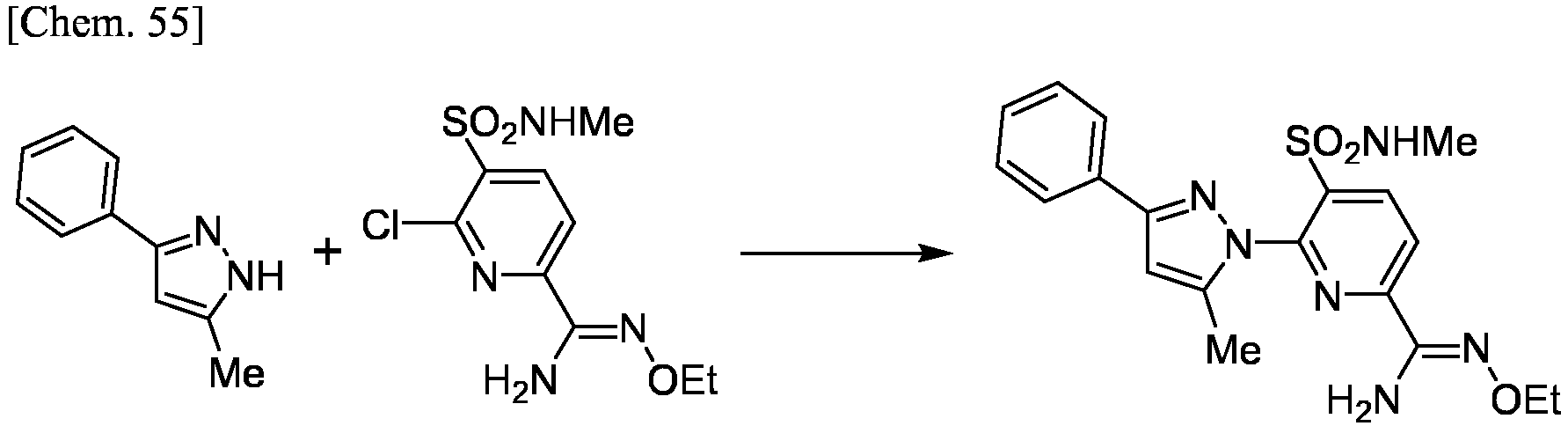
- To a solution of (Z)-6-chloro-N'-ethoxy-5-(N-methylsulfamoyl)picolinimidamide (70 mg, 0.25 mmol) in N,N-dimethylacetamide (1.4 mL), potassium carbonate (0.12 g, 0.87 mmol) and 5-methyl-3-phenyl-1H-pyrazole (40 mg, 0.25 mmol) were added, and the mixture was stirred at 130°C for 5 hours. After the completion of the reaction, water and ethyl acetate were added to the reaction mixture for extraction. The organic layer was dried over anhydrous sodium sulfate and then concentrated in vacuo. The residue was purified by silica gel column chromatography to give (Z)-N'-ethoxy-6-(5-methyl-3-phenyl-1H-pyrazol-1-yl)-5-(N-methylsulfamoyl)picolinimidamide (28 mg, 0.070 mmol).
- Yield: 28%
- Physical property: 1H-NMR (CDCl3): δ 8.46 (d, 1H), 8.20 (d, 1H), 7.72-7.69 (m, 1H), 7.45-7.40 (m, 2H), 7.38-7.34 (m, 1H), 6.79 (q, 1H), 6.60 (s, 1H), 5.41 (brs, 2H), 4.23 (q, 2H), 2.77 (d, 3H), 2.43 (s, 3H), 1.37 (t, 3H)
- Production of (E)-4-(6-(1-(ethoxyimino)ethyl)-3-(methylsulfonyl)pyridin-2-yl)-3-methyl-1-phenyl-1H-1,2,4-triazol-5(4H)-one (Compound No. 6-1)

- To an N,N-dimethylformamide solution (1.0 mL) of (E)-1-(6-chloro-5-(methylsulfonyl)pyridin-2-yl)ethanone O-ethyl oxime (60 mg, 0.22 mmol), 3-methyl-1-phenyl-1H-1,2,4-triazol-5(4H)-one (76 mg, 0.43 mmol), 4,5'-bis(diphenylphosphino)-9,9'-dimethyl xanthene (25 mg, 0.043 mmol), and tris(dibenzylideneacetone)dipalladium(0) (20 mg, 0.022 mmol) were added, and the mixture was stirred at 120°C for 3 hours. A saturated aqueous ammonium chloride solution was added to the reaction mixture, and ethyl acetate extraction was performed, followed by washing with saturated brine. The organic layer was dried over anhydrous magnesium sulfate and then concentrated in vacuo. The residue was purified by silica gel column chromatography to give (E)-4-(6-(1-(ethoxyimino)ethyl)-3-(methylsulfonyl)pyridin-2-yl)-3-methyl-1-phenyl-1H-1,2,4-triazol-5(4H)-one (4.0 mg, 0.0084 mmol).
- Yield: 4%
- Physical property: 1H-NMR (CDCl3): δ 8.44 (d, 1H), 8.24 (d, 1H), 8.02-7.95 (m, 2H), 7.49-7.40 (m, 2H), 7.26-7.21 (m, 1H), 4.36 (q, 2H), 3.40 (s, 3H), 2.29 (s, 3H), 2.21 (s, 3H), 1.38 (t, 3H)
- Production of (Z)-3-(3-(2-chlorophenyl)-1-methyl-1H-1,2,4-triazol-5-yl)-N'-ethoxy-4-(N-methylsulfamoyl)benzimidamide (Compound No. 17-2)

- To a solution of (Z)-4-((4-(tert-butyl)benzyl)thio)-3-(3-(2-chlorophenyl)-1-methyl-1H-1,2,4-triazol-5-yl)-N'-ethoxybenzimidamide (0.23 g, 0.42 mmol) in chloroform (4.2 mL), 1,3-dichloro-5,5-dimethylhydantoin (0.25 g, 1.3 mmol), acetic acid (75 µL, 1.3 mmol), and water (45 µL, 2.5 mmol) were added at 0°C, and the mixture was stirred at the same temperature for 10 minutes. A methanol solution of methylamine (9.8 M, 0.43 mL, 4.2 mmol) was added, and the mixture was stirred for 10 minutes. Water was added to the reaction mixture, and chloroform extraction was performed. The organic layer was dried over anhydrous magnesium sulfate and then concentrated in vacuo. The residue was purified by silica gel column chromatography to give (Z)-3-(3-(2-chlorophenyl)-1-methyl-1H-1,2,4-triazol-5-yl)-N'-ethoxy-4-(N-methylsulfamoyl)benzimidamide (72 mg, 0.16 mmol).
- Yield: 37%
- Physical property: Melting point: 167 to 168°C
- Production of (Z)-3-(3-(2-chlorophenyl)-1-methyl-1H-1,2,4-triazol-5-yl)-N'-ethoxy-4-(N-methylsulfamoyl)benzimidamide (Compound No. 1-12)

- To a solution of (Z)-6-(3-(2-chlorophenyl)-1-methyl-1H-1,2,4-triazol-5-yl)-N'-ethoxy-5-(N-methylsulfanyl)picolinimidamide (0.10 g, 0.22 mmol) in N,N-dimethylacetamide (2 mL), acetic anhydride (0.067 g, 0.33 mmol) and cesium carbonate (0.22 g, 0.33 mmol) were added at room temperature, and the mixture was stirred at 50°C for 10 minutes. A methanol solution of methylamine (9.8 M, 0.43 mL, 4.2 mmol) was added, and the mixture was stirred for 10 minutes. Water was added to the reaction mixture, and chloroform extraction was performed. The organic layer was dried over anhydrous magnesium sulfate and then concentrated in vacuo. The residue was purified by silica gel column chromatography to give (Z)-N-acetyl-N-((5-(N-acetyl-N-methylsulfamoyl)-6-(3-(2-chlorophenyl)-1-methyl-1H-1,2,4-triazol-5-yl)pyridin-2-yl)(ethoxyimino)methyl)acetamide (62 mg, 0.11 mmol).
- Yield: 50%
- Physical property: 1H-NMR (CDCl3): δ 8.79 (d, 1H), 8.34 (d, 1H), 7.93-7.90 (m, 1H), 7.53-7.50 (m, 1H), 7.38-7.35 (m, 2H), 4.44 (q, 2H), 3.85 (s, 3H), 3.05 (s, 3H), 2.32 (s, 9H), 2.16 (s, 3H), 1.40 (t, 3H)
- Production of (Z)-N'-ethoxy-6-(4-methyl-1-(2-nitrophenyl)-5-oxo-4,5-dihydro-1H-1,2,4-triazol-3-yl)-5-(N-methylsulfamoyl)picolinimidamide (Compound No. 5-19)

- To a solution of 6-cyano-N-methyl-2-(4-methyl-1-(2-nitrophenyl)-5-oxo-4,5-dihydro-1H-1,2,4-triazol-3-yl)pyridine-3-sulfonamide (1.0 g, 2.4 mmol) in methanol (10 mL), a methanol solution of sodium methoxide (28 wt%, 0.55 mL, 2.4 mmol) was added, and the mixture was stirred at room temperature for 30 minutes. After the disappearance of the starting compound was confirmed, O-ethylhydroxylamine hydrochloride (0.36 g, 3.7 mmol) was added to the reaction mixture, and the mixture was stirred at room temperature for 30 minutes. A saturated aqueous ammonium chloride solution was added to the reaction mixture, and ethyl acetate extraction was performed. The organic layer was concentrated in vacuo, and the residue was purified by silica gel column chromatography to give (Z)-N'-ethoxy-6-(4-methyl-1-(2-nitrophenyl)-5-oxo-4,5-dihydro-1H-1,2,4-triazol-3-yl)-5-(N-methylsulfamoyl)picolinimidamide (0.92 g, 1.9 mmol).
- Yield: 79%
- Physical property: 1H-NMR (CDCl3): δ 8.43 (d, 1H), 8.29 (d, 1H), 7.96-7.90 (m, 2H), 7.78-7.72 (m, 1H), 7.56-7.50 (m, 1H), 5.84 (q, 1H), 5.45 (s, 2H), 4.24 (q, 2H), 3.42 (s, 3H), 2.71 (d, 3H), 1.37 (t, 3H)
- Production of (Z)-N'-ethoxy-5-(N-methylsulfamoyl)-6-(2-phenylthiazol-4-yl)picolinimidamide (Compound No. 7-18) and (Z)-6-(5-bromo-2-phenylthiazol-4-yl)-N'-ethoxy-5-(N-methylsulfamoyl)picolinimidamide (Compound No. 7-19)
- Production of (Z)-6-acetyl-N'-ethoxy-5-(N-methylsulfamoyl)picolinimidamide

- To a solution of (Z)-6-chloro-N'-ethoxy-5-(N-methylsulfamoyl)picolinimidamide (1.0 g, 3.4 mmol) in dimethoxyethane (20 mL), tetrakis(triphenylphosphine)palladium(0) (0.40 g, 0.34 mmol) and tributyl(1-ethoxyvinyl)tin (1.7 mL, 5.1 mmol) were added, and the mixture was stirred under an argon atmosphere at 110°C for 5 hours. After the completion of the reaction, tetrahydrofuran (10 mL) and 1 N hydrochloric acid (10 mL) were added to the reaction mixture, and the mixture was stirred overnight at room temperature. Water and ethyl acetate were added for extraction. The organic layer was dried over anhydrous sodium sulfate and then concentrated in vacuo. The residue was purified by silica gel column chromatography to give (Z)-6-acetyl-N'-ethoxy-5-(N-methylsulfamoyl)picolinimidamide (0.55 g, 1.8 mmol).
- Yield: 54%
- Physical property: Melting point: 100 to 101°C
- Production of (Z)-6-(2-bromoacetyl)-N'-ethoxy-5-(N-methylsulfamoyl)picolinimidamide

- To a solution of (Z)-6-acetyl-N'-ethoxy-5-(N-methylsulfamoyl)picolinimidamide (0.50 g, 1.7 mmol) in tetrahydrofuran (10 mL), phenyltrimethylammonium tribromide (0.62 g, 1.7 mmol) was added, and the mixture was stirred at room temperature for 2 hours. After the completion of the reaction, water and ethyl acetate were added to the reaction mixture for extraction. The organic layer was dried over anhydrous sodium sulfate and then concentrated in vacuo to give (Z)-6-(2-bromoacetyl)-N'-ethoxy-5-(N-methylsulfamoyl)picolinimidamide (0.71 g, 1.8 mmol).
- Yield: 100%
- Physical property: 1H-NMR (CDCl3): δ 8.31-8.27 (m, 1H), 8.11-8.09 (m, 1H), 5.51 (brs, 2H), 4.23 (q, 2H), 3.00 (s, 2H), 1.36 (t, 3H)
- Production of (Z)-N'-ethoxy-5-(N-methylsulfamoyl)-6-(2-phenylthiazol-4-yl)picolinimidamide (Compound No. 7-18)

- To a solution of (Z)-6-(2-bromoacetyl)-N'-ethoxy-5-(N-methylsulfamoyl)picolinimidamide (0.71 g, 1.8 mmol) in ethanol (10 mL), thiobenzamide (0.21 g, 1.5 mmol) was added, and the mixture was stirred and heated under reflux for 2 hours. After the completion of the reaction, the reaction mixture was concentrated in vacuo. A saturated aqueous sodium hydrogen carbonate solution and ethyl acetate were added to the residue for extraction. The organic layer was dried over anhydrous sodium sulfate and then concentrated in vacuo. The residue was purified by silica gel column chromatography to give (Z)-N'-ethoxy-5-(N-methylsulfamoyl)-6-(2-phenylthiazol-4-yl)picolinimidamide (0.28 g, 0.68 mmol).
- Yield: 36%
- Physical property: Melting point: 189 to 190°C
- Production of (Z)-6-(5-bromo-2-phenylthiazol-4-yl)-N'-ethoxy-5-(N-methylsulfamoyl)picolinimidamide (Compound No. 7-19)

- To a solution of (Z)-N'-ethoxy-5-(N-methylsulfamoyl)-6-(2-phenylthiazol-4-yl)picolinimidamide (0.24 g, 0.58 mmol) in chloroform (5.0 mL), N-bromosuccinimide (0.13 g, 0.70 mmol) was added, and the mixture was stirred at 50°C for 7 hours and then at room temperature overnight. After the completion of the reaction, water was added to the reaction mixture, and chloroform extraction was performed. The organic layer was dried over anhydrous sodium sulfate and then concentrated in vacuo. The residue was purified by silica gel column chromatography to give (Z)-6-(5-bromo-2-phenylthiazol-4-yl)-N'-ethoxy-5-(N-methylsulfamoyl)picolinimidamide (0.23 g, 0.46 mmol).
- Yield: 79%
- Physical property: Melting point: 159 to 160°C
- Production of (Z)-N'-ethoxy-5-(methylsulfonyl)-6-(4-phenylthiazol-2-yl)picolinimidamide (Compound No. 8-17) and (Z)-N'-ethoxy-5-(N-methylsulfamoyl)-6-(4-phenylthiazol-2-yl)picolinimidamide (Compound No. 8-2)
- Production of (Z)-6-(N'-ethoxycarbamimidoyl)-3-(methylsulfonyl)picolinamide

- (Z)-Methyl 6-(N'-ethoxycarbamimidoyl)-3-(methylsulfonyl)picolinate (1.4 g, 4.5 mmol) was added to a methanol solution of ammonia (2 mol/L, 10 mL), and the mixture was stirred at room temperature overnight. After the completion of the reaction, the reaction mixture was concentrated in vacuo. Water and ethyl acetate were added to the residue for extraction. The organic layer was dried over anhydrous sodium sulfate and then concentrated in vacuo. The residue was purified by silica gel column chromatography to give (Z)-6-(N'-ethoxycarbamimidoyl)-3-(methylsulfonyl)picolinamide (0.32 g, 1.1 mmol).
- Yield: 24%
- Physical property: 1H-NMR (CDCl3): δ 8.49 (d, 1H), 8.28 (d, 1H), 6.79 (brs, 1H), 5.81 (brs, 1H), 5.43 (brs, 2H), 4.23 (q, 2H), 3.56 (s, 3H), 1.36 (t, 3H)
- Production of (Z)-6-(N'-ethoxycarbamimidoyl)-3-(methylsulfonyl)pyridine-2-carbothioamide

- To a solution of (Z)-6-(N'-ethoxycarbamimidoyl)-3-(methylsulfonyl)picolinamide (0.32 g, 1.1 mmol) in toluene (5.0 mL), Lawesson's reagent (0.45 g, 1.1 mmol) was added, and the mixture was stirred at 90°C for 3 hours. After the completion of the reaction, the reaction mixture was concentrated in vacuo. The residue was purified by silica gel column chromatography to give (Z)-6-(N'-ethoxycarbamimidoyl)-3-(methylsulfonyl)pyridine-2-carbothioamide (0.27 g, 0.90 mmol).
- Yield: 82%
- Physical property: Melting point: 243 to 245°C
- Production of (Z)-N'-ethoxy-5-(methylsulfonyl)-6-(4-phenylthiazol-2-yl)picolinimidamide (Compound No. 8-17)

- To a solution of (Z)-6-(N'-ethoxycarbamimidoyl)-3-(methylsulfonyl)pyridine-2-carbothioamide (0.23 g, 0.77 mmol) in ethanol (2.5 mL), phenacyl bromide (0.17 g, 0.84 mmol) was added, and the mixture was stirred and heated under reflux for 2 hours. After the completion of the reaction, the reaction mixture was concentrated in vacuo. A saturated aqueous sodium hydrogen carbonate solution and ethyl acetate were added to the residue for extraction. The organic layer was dried over anhydrous sodium sulfate and then concentrated in vacuo. The residue was purified by silica gel column chromatography to give (Z)-N'-ethoxy-5-(methylsulfonyl)-6-(4-phenylthiazol-2-yl)picolinimidamide (0.27 g, 0.67 mmol).
- Yield: 87%
- Physical property: Melting point: 177 to 179°C
- Production of (Z)-5-((4-(tert-butyl)benzyl)thio)-N'-ethoxy-6-(4-phenylthiazol-2-yl)picolinimidamide


- To a solution of (Z)-N'-ethoxy-5-(methylsulfonyl)-6-(4-phenylthiazol-2-yl)picolinimidamide (0.23 g, 0.58 mmol) in N,N-dimethylacetamide (3.0 mL), cesium carbonate (0.38 g, 1.2 mmol) and (4-(tert-butyl)phenyl)methanethiol (0.16 mL, 0.87 mmol) were added, and the mixture was stirred at 60°C for 1 hour. After the completion of the reaction, water and ethyl acetate were added to the reaction mixture for extraction. The organic layer was dried over anhydrous sodium sulfate and then concentrated in vacuo. The residue was purified by silica gel column chromatography to give (Z)-5-((4-(tert-butyl)benzyl)thio)-N'-ethoxy-6-(4-phenylthiazol-2-yl)picolinimidamide (0.23 g, 0.46 mmol).
- Yield: 80%
- Physical property: Melting point: 204 to 206°C
- Production of (Z)-N'-ethoxy-5-(N-methylsulfamoyl)-6-(4-phenylthiazol-2-yl)picolinimidamide (Compound No. 8-2)

- To a solution of (Z)-5-((4-(tert-butyl)benzyl)thio)-N'-ethoxy-6-(4-phenylthiazol-2-yl)picolinimidamide (0.11 g, 0.22 mmol) in chloroform (5.0 mL), acetic acid (0.038 mL, 0.66 mmol) and water (0.024 mL, 1.3 mmol) were added, and 1,3-dichloro-5,5-dimethylhydantoin (0.13 g, 0.66 mmol) was added with cooling in an ice bath. After stirring for 5 minutes, the reaction mixture was added dropwise to a methanol solution of methylamine (9.8 mol/L, 5.0 mL), and the mixture was stirred for 5 minutes. After the completion of the reaction, water was added to the reaction mixture, and chloroform extraction was performed. The organic layer was dried over anhydrous sodium sulfate and then concentrated in vacuo. The residue was purified by silica gel column chromatography to give (Z)-N'-ethoxy-5-(N-methylsulfamoyl)-6-(4-phenylthiazol-2-yl)picolinimidamide (44 mg, 0.11 mmol).
- Yield: 48%
- Physical property: Melting point: 157 to 158°C
- Production of (Z)-N'-ethoxy-6-(4-methyl-1-phenyl-1H-pyrazol-3-yl)-5-(methylsulfonyl)picolinimidamide (Compound No. 10-16) and (Z)-N'-ethoxy-6-(4-methyl-1-phenyl-1H-pyrazol-3-yl)-5-(N-methylsulfamoyl)picolinimidamide (Compound No. 10-2)
- Production of (Z)-N'-ethoxy-6-(4-methyl-1-phenyl-1H-pyrazol-3-yl)-5-(methylsulfonyl)picolinimidamide (Compound No. 10-16)

- To a solution of (Z)-N'-ethoxy-6-(4-methyl-1H-pyrazol-3-yl)-5-(methylsulfonyl)picolinimidamide (0.58 g, 1.8 mmol) in N,N-dimethylacetamide (10 mL), iodobenzene (0.20 mL, 1.8 mmol), cesium carbonate (1.2 g, 3.7 mmol), and copper(II) acetate monohydrate (38 mg, 0.19 mmol) were added, and the mixture was stirred at 140°C for 3 hours. After the completion of the reaction, a saturated aqueous ammonium chloride solution was added to the reaction mixture, and ethyl acetate extraction was performed. The organic layer was dried over anhydrous magnesium sulfate and then concentrated in vacuo. The residue was purified by silica gel column chromatography to give (Z)-N'-ethoxy-6-(4-methyl-1-phenyl-1H-pyrazol-3-yl)-5-(methylsulfonyl)picolinimidamide (0.15 g, 0.37 mmol).
- Yield: 21%
- Physical property: Melting point: 150 to 151°C
- Production of (Z)-5-((4-(tert-butyl)benzyl)thio)-N'-ethoxy-6-(4-methyl-1-phenyl-1H-pyrazol-3 -yl)picolinimidamide

- To a solution of (Z)-N'-ethoxy-6-(4-methyl-1-phenyl-1H-pyrazol-3-yl)-5-(methylsulfonyl)picolinimidamide (0.15 g, 0.42 mmol) in N,N-dimethylacetamide (2.0 mL), cesium carbonate (0.41 g, 1.3 mmol) and (4-(tert-butyl)phenyl)methanethiol (0.15 mL, 0.82 mmol) were added at room temperature, and the mixture was stirred at room temperature for 2 hours. After the completion of the reaction, a saturated aqueous ammonium chloride solution was added to the reaction mixture, and ethyl acetate extraction was performed. The organic layer was dried over anhydrous magnesium sulfate and then concentrated in vacuo. The residue was purified by silica gel column chromatography to give (Z)-5-((4-(tert-butyl)benzyl)thio)-N'-ethoxy-6-(4-methyl-1-phenyl-1H-pyrazol-3-yl)picolinimidamide (0.10 g, 0.21 mmol).
Yield: 50% - Production of (Z)-N'-ethoxy-6-(4-methyl-1-phenyl-1H-pyrazol-3-yl)-5-(N-methylsulfamoyl)picolinimidamide (Compound No. 10-2)

- To a solution of (Z)-5-((4-(tert-butyl)benzyl)thio)-N'-ethoxy-6-(4-methyl-1-phenyl-1H-pyrazol-3-yl)picolinimidamide (0.10 g, 0.21 mmol) in chloroform (2.0 mL), 1,3-dichloro-5,5-dimethylhydantoin (0.12 g, 0.62 mmol), acetic acid (40 µL, 0.63 mmol), and water (25 µL, 1.2 mmol) were added at 0°C, and the mixture was stirred at the same temperature for 10 minutes. After the completion of the reaction, methylamine (40% solution in methanol, 0.21 mL, 2.1 mmol) was added to the reaction mixture, and the mixture was further stirred for 10 minutes. After the completion of the reaction, water was added to the reaction mixture, and chloroform extraction was performed. The organic layer was dried over anhydrous magnesium sulfate and then concentrated in vacuo. The residue was purified by silica gel column chromatography to give (Z)-N'-ethoxy-6-(4-methyl-1-phenyl-1H-pyrazol-3-yl)-5-(N-methylsulfamoyl)picolinimidamide (67 mg, 0.16 mmol).
- Yield: 76%
- Physical property: Melting point: 130 to 131°C
- Production of (Z)-N'-ethoxy-6-(4-methyl-5-phenyl-2H-1,2,3-triazol-2-yl)-5-(N-methylsulfamoyl)picolinimidamide (Compound No. 20-17)

- To a solution of (Z)-6-chloro-N'-ethoxy-5-(N-methylsulfamoyl)picolinimidamide (0.12 g, 0.41 mmol) in N,N-dimethylacetamide (2.0 mL), potassium carbonate (87 mg, 0.87 mmol) and 4-methyl-5-phenyl-2H-1,2,3-triazole (66 mg, 0.41 mmol) were added, and the mixture was stirred at 130°C for 17 hours. After the completion of the reaction, water and ethyl acetate were added to the reaction mixture for extraction. The extract was concentrated in vacuo, and the residue was purified by silica gel column chromatography to give (Z)-N'-ethoxy-6-(4-methyl-5-phenyl-2H-1,2,3-triazol-2-yl)-5-(N-methylsulfamoyl)picolinimidamide (28 mg, 0.067 mmol).
- Yield: 16%
- Physical property: Melting point: 72 to 77°C
- Production of (Z)-N'-ethoxy-6-(5-methyl-2-(2-nitrophenyl)-2H-1,2,3-triazol-4-yl)-5-(methylsulfonyl)picolinimidamide (0.21 g, 0.47 mmol) (Compound No. 11-95)

- To a solution of (Z)-N'-ethoxy-6-(5-methyl-2H-1,2,3-triazol-4-yl)-5-(methylsulfonyl)picolinimidamide (0.18 g, 0.56 mmol) in N,N-dimethylacetamide (3 mL), potassium carbonate (0.17 g, 0.85 mmol) and 2-fluoronitrobenzene (0.059 mL, 0.56 mmol) were added, and the mixture was stirred at 130°C for 7 hours. The reaction mixture was cooled to room temperature, and ethyl acetate and water were added for extraction. The organic layer was concentrated in vacuo, and the residue was purified by silica gel chromatography to give (Z)-N'-ethoxy-6-(5-methyl-2-(2-nitrophenyl)-2H-1,2,3-triazol-4-yl)-5-(methylsulfonyl)picolinimidamide (0.21 g, 0.47 mmol).
- Yield: 83%
- Physical property: Melting point: 179 to 184°C
- Production of ethyl 6-cyano-2-(4-methyl-5-oxo-1-phenyl-4,5-dihydro-1H-1,2,4-triazol-3-yl)nicotinate (starting compound for Production Example 1-1)
- Production of (E)-3,6-dichloro-2-((2-phenylhydrazono)methyl)pyridine

- Phenylhydrazine (1.7 mL, 31 mmol) was added to an ethanol solution (60 mL) of 3,6-dichloropicolinaldehyde (3.0 g, 17 mmol), and the mixture was stirred for 3 hours. The resulting solid was collected by filtration, washed with ethanol, and dried to give the desired product (4.3 g, 16 mmol).
Yield: 96% - Production of 3-(3,6-dichloropyridin-2-yl)-4-methyl-1-phenyl-1H-1,2,4-triazol-5(4H)-one

- Phosphorus pentachloride (4.1 g, 20 mmol) was added to a solution of (E)-3,6-dichloro-2-((2-phenylhydrazono)methyl)pyridine (3.5 g, 13 mmol) in chloroform (65 mL) at room temperature, and the mixture was stirred at 80°C for 3 hours. Water was added to the reaction mixture, and chloroform extraction was performed. The organic layer was dried over anhydrous magnesium sulfate and then concentrated in vacuo. The residue was dissolved in tetrahydrofuran (65 mL), a 40% methylamine solution (6.6 mL, 65 mmol) was added, and the mixture was stirred for 1 hour. Water was further added to the reaction mixture, and ethyl acetate extraction was performed. The organic layer was dried over anhydrous magnesium sulfate and then concentrated in vacuo. The residue was dissolved in chloroform (130 mL), pyridine (2.6 mL, 33 mol) and triphosgene (5.8 g, 20 mmol) were added, and the mixture was stirred for 1 hour. Water was added to the reaction mixture, and chloroform extraction was performed. The organic layer was dried over anhydrous magnesium sulfate and then concentrated in vacuo. The residue was purified by silica gel column chromatography to give 3-(3,6-dichloropyridin-2-yl)-4-methyl-1-phenyl-1H-1,2,4-triazol-5(4H)-one (1.5 g, 4.7 mmol).
Yield: 36% - Production of ethyl 6-carbamoyl-2-(4-methyl-5-oxo-1-phenyl-4,5-dihydro-1H-1,2,4-triazol-3-yl)nicotinate


- To a solution of 3-(3,6-dichloropyridin-2-yl)-4-methyl-1-phenyl-1H-1,2,4-triazol-5(4H)-one (1.5 g, 4.8 mmol) in ethanol (47 mL), 1,4-bis(diphenylphosphino)butane (tetramethylenebis(diphenylphosphine)) (72 mg, 0.0020 mmol), bis(triphenylphosphine)palladium(II) dichloride (67 mg, 0.0010 mmol), and triethylamine (2.0 mL, 1.4 mmol) were added, and the mixture was stirred under a carbon monoxide atmosphere of 4 MPa at 130°C for 3 hours. The reaction mixture was filtered, and the filtrate was concentrated in vacuo. The residue was purified by silica gel column chromatography. A 4% ammonia-ethanol solution (50 mL) was added to the resulting solid, and the mixture was stirred at room temperature overnight. Water was added to the reaction mixture, and ethyl acetate extraction was performed. The organic layer was dried over anhydrous magnesium sulfate and then concentrated in vacuo. The residue was purified by silica gel column chromatography to give ethyl 6-carbamoyl-2-(4-methyl-5-oxo-1-phenyl-4,5-dihydro-1H-1,2,4-triazol-3-yl)nicotinate (0.78 g, 2.1 mmol).
- Yield: 45%
- Physical property: Melting point: 137 to 138°C
- Production of ethyl 6-cyano-2-(4-methyl-5-oxo-1-phenyl-4,5-dihydro-1H-1,2,4-triazol-3 -yl)nicotinate

- To a solution of ethyl 6-carbamoyl-2-(4-methyl-5-oxo-1-phenyl-4,5-dihydro-1H-1,2,4-triazol-3-yl)nicotinate (0.78 g, 2.1 mmol) in N,N-dimethylformamide (21 mL), phosphoryl chloride (0.79 mL, 8.5 mmol) was added at room temperature, and the mixture was stirred for 1 hour. A saturated aqueous sodium hydrogen carbonate solution was added to the reaction mixture, and ethyl acetate extraction was performed. The organic layer was dried over anhydrous magnesium sulfate and then concentrated in vacuo to give ethyl 6-cyano-2-(4-methyl-5-oxo-1-phenyl-4,5-dihydro-1H-1,2,4-triazol-3-yl)nicotinate (0.73 g, 2.1 mmol).
- Yield: 100%
- Physical property: Melting point: 138 to 139°C
- Production of ethyl 6-cyano-2-(5-methyl-2-phenylthiazol-4-yl)nicotinate (starting compound for Production Example 2)
- Production of 3,6-dichloro-N-methoxy-N-methylpicolinamide

- N,N-dimethylformamide (0.4 mL, 5.3 mmol) and oxalyl chloride (5.0 mL, 57 mmol) were added to a solution of 3,6-dichloropicolinic acid (10 g, 52 mmol) in tetrahydrofuran (0.10 L) at room temperature, and the mixture was stirred at room temperature for 0.5 hour. The reaction mixture was concentrated in vacuo, and chloroform (0.10 L), triethylamine (28 mL, 0.21 mol), and N-methoxy-N-methylamine hydrochloride (6.1 g, 62 mmol) were added to the residue. The mixture was stirred at room temperature overnight. After the completion of the reaction, water was added to the reaction mixture, and ethyl acetate extraction was performed. The organic layer was dried over anhydrous magnesium sulfate and then concentrated in vacuo. The residue was purified by silica gel column chromatography to give 3,6-dichloro-N-methoxy-N-methylpicolinamide (12 g, 52 mmol).
- Yield: 100%
- Physical property: 1H-NMR (CDCl3): δ 7.70 (d, 1H), 7.33 (d, 1H), 3.61 (s, 3H), 3.39 (s, 3H)
- Production of 1-(3,6-dichloropyridin-2-yl)propan-1-one

- To a solution of 3,6-dichloro-N-methoxy-N-methylpicolinamide (5.0 g, 21 mmol) in tetrahydrofuran (0.10 L), a diethyl ether solution of ethylmagnesium bromide (27 mL, 81 mmol) was added at 0°C, and the mixture was stirred for 2 hours. After the completion of the reaction, a saturated aqueous ammonium chloride solution was added to the reaction mixture, and ethyl acetate extraction was performed. The organic layer was dried over anhydrous magnesium sulfate and then concentrated in vacuo. The residue was purified by silica gel column chromatography to give 1-(3,6-dichloropyridin-2-yl)propan-1-one (1.8 g, 8.7 mmol).
- Yield: 41%
- Physical property: 1H-NMR (CDCl3): δ 7.74 (d, 1H), 7.39 (d, 1H), 3.10 (q, 2H), 1.20 (t, 3H)
- Production of 2-bromo-1-(3,6-dichloropyridin-2-yl)propan-1-one
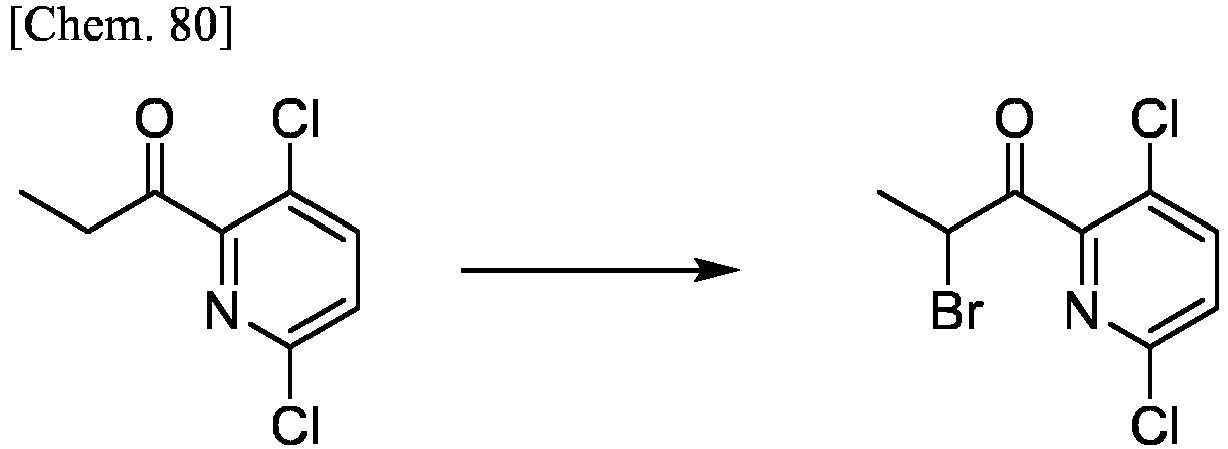
- Bromine (0.30 mL, 5.6 mmol) was added to a solution of 1-(3,6-dichloropyridin-2-yl)propan-1-one (1.1 g, 5.2 mmol) in acetic acid (17 mL), and the mixture was stirred at 120°C for 2 hours. After the completion of the reaction, the reaction mixture was concentrated in vacuo. Water was added to the residue, and ethyl acetate extraction was performed. The organic layer was dried over anhydrous magnesium sulfate and then concentrated in vacuo. The residue was purified by silica gel column chromatography to give 2-bromo-1-(3,6-dichloropyridin-2-yl)propan-1-one (1.2 g, 4.3 mmol).
Yield: 85% - Production of 4-(3,6-dichloropyridin-2-yl)-5-methyl-2-phenylthiazole

- Benzothioamide (1.1 g, 3.6 mmol) was added to a solution of 2-bromo-1-(3,6-dichloropyridin-2-yl)propan-1-one (0.51 g, 3.6 mmol) in ethanol (7.0 mL), and the mixture was stirred at 80°C for 2.5 hours. After the completion of the reaction, the reaction mixture was concentrated in vacuo. A saturated aqueous sodium hydrogen carbonate solution was added to the residue, and ethyl acetate extraction was performed. The organic layer was dried over anhydrous magnesium sulfate and then concentrated in vacuo. The residue was purified by silica gel column chromatography to give 4-(3,6-dichloropyridin-2-yl)-5-methyl-2-phenylthiazole (0.95 g, 3.0 mmol).
Yield: 75% - Production of diethyl 6-(5-methyl-2-phenylthiazol-4-yl)pyridine-2,5-dicarboxylate

- Into an autoclave reaction vessel, 4-(3,6-dichloropyridin-2-yl)-5-methyl-2-phenylthiazole (0.95 g, 3.0 mmol), dichlorobis(triphenylphosphine)palladium (42 mg, 0.060 mmol), bis(diphenylphosphino)butane (51 mg, 0.12 mmol), triethylamine (1.0 mL, 7.4 mmol), and ethanol (10 mL) were placed, and the mixture was stirred under an atmosphere of carbon monoxide (4.0 MPa) at 130°C for 3 hours. The reaction mixture was concentrated in vacuo, a saturated aqueous sodium hydrogen carbonate solution was added to the residue, and ethyl acetate extraction was performed. The organic layer was dried over anhydrous magnesium sulfate and then concentrated in vacuo to give diethyl 6-(5-methyl-2-phenylthiazol-4-yl)pyridine-2,5-dicarboxylate (0.82 g, 2.1 mmol).
- Yield: 70%
- Physical property: Melting point: 69 to 70°C
- Production of ethyl 6-carbamoyl-2-(5-methyl-2-phenylthiazol-4-yl)nicotinate
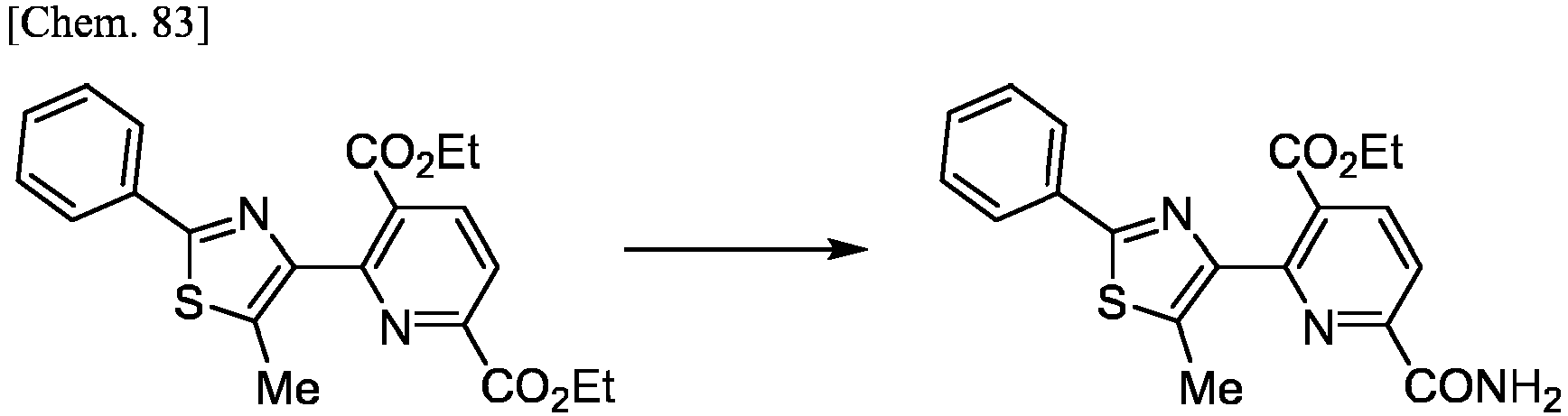
- To a solution of diethyl 6-(5-methyl-2-phenylthiazol-4-yl)pyridine-2,5-dicarboxylate (0.80 g, 2.0 mmol) in ethanol (10 mL), ammonia (28% solution in water, 10 mL) was added at room temperature, and the mixture was stirred at room temperature overnight. The reaction mixture was filtered, and the residue was washed with ethanol to give ethyl 6-carbamoyl-2-(5-methyl-2-phenylthiazol-4-yl)nicotinate (0.74 g, 2.0 mmol).
- Yield: 100% (in 3 steps)
- Physical property: Melting point: 147 to 148°C
- Production of ethyl 6-cyano-2-(5-methyl-2-phenylthiazol-4-yl)nicotinate

- To a solution of ethyl 6-carbamoyl-2-(5-methyl-2-phenylthiazol-4-yl)nicotinate (0.50 g, 1.4 mmol) in N,N-dimethylformamide (6.8 mL), phosphoryl chloride (0.5 mL, 5.4 mmol) was added at 0°C, and the mixture was stirred at room temperature for 30 minutes. After the completion of the reaction, a saturated aqueous sodium hydrogen carbonate solution was added to the reaction mixture at 0°C, and ethyl acetate extraction was performed. The organic layer was dried over anhydrous magnesium sulfate and then concentrated in vacuo to give ethyl 6-cyano-2-(5-methyl-2-phenylthiazol-4-yl)nicotinate (0.48 g, 1.4 mmol).
Yield: 100% - Production of 6-cyano-N-methyl-2-(1-methyl-3-phenyl-1H-1,2,4-triazol-5-yl)pyridine-3-sulfonamide (starting compound for Production Example 3)
- Production of methyl 3-((4-(tert-butyl)benzyl)thio)-6-chloropicolinate

- Sodium hydride (60 wt%, 4.70 g, 0.12 mol) was added to a solution of methyl 3,6-dichloropicolinate (20 g, 97 mmol) in tetrahydrofuran (0.50 L) with cooling in an ice bath, and the mixture was stirred for 15 minutes. 4-(Tert-butyl)phenyl)methanethiol (18 mL, 0.10 mol) was added dropwise, and the mixture was stirred at room temperature for 3 hours. A saturated aqueous ammonium chloride solution was added to the reaction mixture with cooling in an ice bath, and ethyl acetate extraction was performed. The organic layer was dried over anhydrous sodium sulfate and then concentrated. The residue was washed with hexane to give methyl 3-((4-(tert-butyl)benzyl)thio)-6-chloropicolinate (30 g, 86 mmol).
- Yield: 88%
- Physical property: 1H-NMR (CDCl3): δ 7.66-7.63 (m, 1H), 7.37-7.28 (m, 5H), 4.12 (s, 2H), 3.98 (s, 3H), 1.31 (s, 9H)
- Production of 3-((4-(tert-butyl)benzyl)thio)-6-chloropicolinic acid


- To a solution of methyl 3-((4-(tert-butyl)benzyl)thio)-6-chloropicolinate (30 g, 86 mmol) in methanol (200 mL) and tetrahydrofuran (50 mL), lithium hydroxide (4.3 g, 0.10 mol) was added, and the mixture was stirred at room temperature for 6 hours. The reaction mixture was concentrated in vacuo, and 2 M hydrochloric acid was added to the residue. The resulting solid was collected by filtration and washed with hexane to give 3-((4-(tert-butyl)benzyl)thio)-6-chloropicolinic acid (30 g, 85 mmol).
Yield: 100% - Production of 3-((4-(tert-butyl)benzyl)thio)-6-chloro-2-(1-methyl-3-phenyl-1H-1,2,4-triazol-5-yl)pyridine
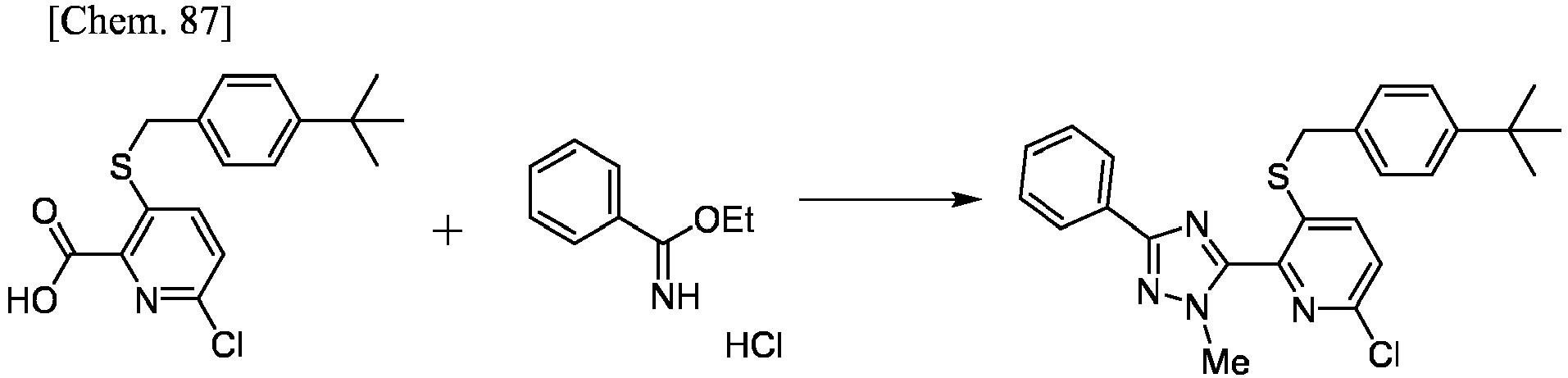
- To a solution of 3-((4-(tert-butyl)benzyl)thio)-6-chloropicolinic acid (10 g, 30 mmol) and ethyl benzimidate hydrochloride (5.6 g, 30 mmol) in N,N-dimethylformamide (60 mL), N,N-diisopropylethylamine (15 mL, 90 mmol) and 1-[bis(dimethylamino)methylene]-lH-benzotriazolium 3-oxide hexafluorophosphate (17 g, 45 mmol) were added, and the mixture was stirred at room temperature overnight. Water was added to the reaction mixture, and chloroform extraction was performed. The organic layer was washed with saturated brine, dried over anhydrous sodium sulfate, and concentrated in vacuo. The residue was dissolved in ethanol (60 mL), methylhydrazine (2.4 mL, 45 mmol) was added, and the mixture was heated under reflux for 2 hours. The reaction mixture was concentrated in vacuo, and the residue was purified by silica gel column chromatography to give 3-((4-(tert-butyl)benzyl)thio)-6-chloro-2-(1-methyl-3-phenyl-1H-1,2,4-triazol-5-yl)pyridine (2.1 g, 4.6 mmol).
Yield: 5% - Production of 6-chloro-N-methyl-2-(1-methyl-3-phenyl-1H-1,2,4-triazol-5-yl)pyridine-3-sulfonamide

- To a solution of 3-((4-(tert-butyl)benzyl)thio)-6-chloro-2-(1-methyl-3-phenyl-1H-1,2,4-triazol-5-yl)pyridine (2.1 g, 4.6 mmol) in chloroform (50 mL), water (0.50 mL, 27 mmol) and acetic acid (0.80 mL, 14 mmol) were added, and 1,3-dichloro-5,5-dimethylhydantoin (2.7 g, 14 mmol) was added with cooling in an ice bath. After the disappearance of the starting compound was confirmed, the reaction mixture was added dropwise to a methylamine-methanol solution (9.8 mol/L, 20 mL) with cooling in an ice bath, and the mixture was stirred for 30 minutes. A saturated aqueous ammonium chloride solution was further added, and ethyl acetate extraction was performed. The organic layer was concentrated, and the residue was purified by silica gel column chromatography to give 6-chloro-N-methyl-2-(1-methyl-3-phenyl-1H-1,2,4-triazol-5-yl)pyridine-3-sulfonamide (0.70 g, 1.9 mmol).
- Yield: 42%
- Physical property: 1H-NMR (CDCl3): δ 8.46 (d, 1H), 8.14 (q, 1H), 8.00-7.95 (m, 2H), 7.59 (d, 1H), 7.50-7.41 (m, 3H), 4.18 (s, 3H), 2.80 (s, 3H)
- Production of 6-cyano-N-methyl-2-(1-methyl-3-phenyl-1H-1,2,4-triazol-5-yl)pyridine-3-sulfonamide


- To a solution of 6-chloro-N-methyl-2-(1-methyl-3-phenyl-1H-1,2,4-triazol-5-yl)pyridine-3-sulfonamide (0.30 g, 0.83 mmol) in dimethyl sulfoxide (2.0 mL), sodium cyanide (61 mg, 1.2 mmol) and 1,4-diazabicyclo[2.2.2]octane (47 mg, 0.4 mmol) were added, and the mixture was stirred at 40°C for 2 hours. Saturated brine was added, and ethyl acetate extraction was performed. The organic layer was concentrated in vacuo, and the residue was purified by silica gel column chromatography to give 6-cyano-N-methyl-2-(1-methyl-3-phenyl-1H-1,2,4-triazol-5-yl)pyridine-3-sulfonamide (0.16 g, 0.45 mmol).
Yield: 55% - Production of 6-cyano-N-methyl-2-(1-methyl-4-phenyl-1H-imidazol-2-yl)pyridine-3-sulfonamide (starting compound for Production Example 4)
- Production of 2-oxo-2-phenylethyl 3-((4-(tert-butyl)benzyl)thio)-6-chloropicolinate

- To a solution of 3-((4-(tert-butyl)benzyl)thio)-6-chloropicolinic acid (6.6 g, 20 mmol) in N,N-dimethylformamide (28 mL), phenacyl chloride (3.0 g, 20 mmol) and N,N-diisopropylethylamine (8.3 mL, 49 mmol) were added under ice cooling, and the mixture was stirred at room temperature overnight. After the completion of the reaction, water and ethyl acetate were added for extraction. The organic layer was dried over anhydrous sodium sulfate and then concentrated in vacuo to give 2-oxo-2-phenylethyl 3-((4-(tert-butyl)benzyl)thio)-6-chloropicolinate (7.8 g, 17 mmol) as a crude product.
Yield: 88% - Production of 3-((4-(tert-butyl)benzyl)thio)-6-chloro-2-(4-phenyl-1H-imidazol-2-yl)pyridine

- To a solution of 2-oxo-2-phenylethyl 3-((4-(tert-butyl)benzyl)thio)-6-chloropicolinate (7.8 g, 17 mmol) in acetic acid (86 mL), ammonium acetate (27 g, 0.34 mol) was added, and the mixture was stirred and heated under reflux. The reaction mixture was concentrated in vacuo. A saturated aqueous sodium hydrogen carbonate solution and ethyl acetate were added to the residue for extraction. The organic layer was dried over anhydrous sodium sulfate and then concentrated in vacuo. The residue was purified by silica gel column chromatography to give 3-((4-(tert-butyl)benzyl)thio)-6-chloro-2-(4-phenyl-1H-imidazol-2-yl)pyridine (7.4 g, 17 mmol).
Yield: 99% - Production of 3-((4-(tert-butyl)benzyl)thio)-6-chloro-2-(1-methyl-4-phenyl-1H-imidazol-2-yl)pyridine

- To a solution of 3-((4-(tert-butyl)benzyl)thio)-6-chloro-2-(4-phenyl-1H-imidazol-2-yl)pyridine (7.4 g, 17 mmol) in tetrahydrofuran (90 mL), potassium tert-butoxide (2.1 g, 18.8 mmol) and iodomethane (1.2 mL, 19 mmol) were added under ice cooling, and the mixture was stirred at room temperature for 2 hours. A saturated aqueous ammonium chloride solution and ethyl acetate were added for extraction. The organic layer was dried over sodium sulfate and then concentrated. The residue was purified by silica gel column chromatography to give 3-((4-(tert-butyl)benzyl)thio)-6-chloro-2-(1-methyl-4-phenyl-1H-imidazol-2-yl)pyridine (4.6 g, 10 mmol).
Yield: 59% - Production of 6-chloro-N-methyl-2-(1-methyl-4-phenyl-1H-imidazol-2-yl)pyridine-3-sulfonamide

- To a solution of 3-((4-(tert-butyl)benzyl)thio)-6-chloro-2-(1-methyl-4-phenyl-1H-imidazol-2-yl)pyridine (2.0 g, 4.5 mmol) in chloroform (50 mL), water (0.50 mL, 27 mmol) and acetic acid (0.77 mL, 13 mmol) were added, and 1,3-dichloro-5,5-dimethylhydantoin (2.6 g, 13 mmol) was added with cooling in an ice bath. After the disappearance of the starting compound was confirmed, the reaction mixture was added dropwise to a methylamine-methanol solution (30 mL) with cooling in an ice bath, and the mixture was stirred for 30 minutes. A saturated aqueous ammonium chloride solution was added, and ethyl acetate extraction was performed. The organic layer was concentrated, and the residue was purified by silica gel column chromatography to give 6-chloro-N-methyl-2-(1-methyl-4-phenyl-1H-imidazol-2-yl)pyridine-3-sulfonamide (0.51 mg, 1.4 mmol).
- Yield: 31%
- Physical property: 1H-NMR (CDCl3): δ 8.95 (q, 1H), 8.42 (d, 1H), 7.67-7.63 (m, 2H), 7.48-7.38 (m, 3H), 7.33-7.29 (m, 2H), 3.97 (s, 3H), 2.78 (d, 3H)
- Production of 6-cyano-N-methyl-2-(1-methyl-4-phenyl-1H-imidazol-2-yl)pyridine-3-sulfonamide

- To a solution of 6-chloro-N-methyl-2-(1-methyl-4-phenyl-1H-imidazol-2-yl)pyridine-3-sulfonamide (0.43 g, 1.2 mmol) in dimethyl sulfoxide (10 mL), sodium cyanide (70 mg, 1.4 mmol) and 1,4-diazabicyclo[2.2.2]octane (67 mg, 0.60 mmol) were added, and the mixture was stirred at 40°C for 2 hours. Saturated brine was added, and ethyl acetate extraction was performed. The organic layer was concentrated in vacuo, and the residue was purified by silica gel column chromatography to give 6-cyano-N-methyl-2-(1-methyl-4-phenyl-1H-imidazol-2-yl)pyridine-3-sulfonamide (0.10 g, 0.28 mmol).
Yield: 24% - Production of (Z)-6-chloro-N'-ethoxy-5-(N-methylsulfamoyl)picolinimidamide (starting compound for Production Examples 5 and 6)
- Production of 2,6-dichloro-N-methylpyridine-3-sulfonamide

- To a solution of 2,6-dichloropyridine-3-sulfonyl chloride in tetrahydrofuran (0.20 L), a 7.0% tetrahydrofuran solution of methylamine (31 mL, 61 mmol) was added under ice cooling, and the mixture was stirred at room temperature for 1 hour. After the completion of the reaction, a saturated aqueous ammonium chloride solution and ethyl acetate were added to the reaction mixture for extraction. The organic layer was dried over anhydrous sodium sulfate and then concentrated in vacuo. The residue was purified by silica gel column chromatography to give 2,6-dichloro-N-methylpyridine-3-sulfonamide (6.4 g, 27 mmol).
- Yield: 44%
- Physical property: 1H-NMR (CDCl3): δ 8.35 (d, 1H), 7.46 (d, 1H), 5.10 (br.s, 1H), 2.71 (d, 3H)
- Production of 2-chloro-6-cyano-N-methylpyridine-3-sulfonamide

- To a solution of 2,6-dichloro-N-methylpyridine-3-sulfonamide (9.8 g, 40 mmol) and 1,4-diazabicyclo[2.2.2]octane (0.81 g, 7.2 mmol) in dimethyl sulfoxide (0.10 L), a solution of sodium cyanide (2.3 g, 47 mmol) in water (10 mL) was added dropwise, and the mixture was stirred at room temperature. After the completion of the reaction, water and ethyl acetate were added to the reaction mixture for extraction. The organic layer was dried over anhydrous sodium sulfate and then concentrated in vacuo. The residue was purified by silica gel column chromatography to give 2-chloro-6-cyano-N-methylpyridine-3-sulfonamide (7.7 g, 33 mmol).
- Yield: 82%
- Physical property: 1H-NMR (CDCl3): δ 8.56 (d, 1H), 7.82 (d, 1H), 5.07 (q, 1H), 2.74 (d, 3H)
- Production of (Z)-6-chloro-N'-ethoxy-5-(N-methylsulfamoyl)picolinimidamide

- To a solution of 2-chloro-6-cyano-N-methylpyridine-3-sulfonamide (1.1 g, 2.9 mmol) in methanol (20 mL), a 28 wt% methanol solution of sodium methoxide (0.59 mL, 2.9 mmol) was added, and the mixture was stirred at room temperature. After the disappearance of the starting compound was confirmed, O-ethylhydroxylamine hydrochloride (0.37 g, 3.8 mmol) was added, and the mixture was stirred at room temperature. After the completion of the reaction, water and ethyl acetate were added for extraction. The organic layer was dried over anhydrous sodium sulfate and then concentrated in vacuo to give (Z)-6-chloro-N'-ethoxy-5-(N-methylsulfamoyl)picolinimidamide (1.2 g, 2.9 mmol).
- Yield: 100%
- Physical property: 1H-NMR (CDCl3): δ 8.35 (d, 1H), 8.07 (d, 1H), 5.45 (br.s, 2H), 5.05 (q, 1H), 4.20 (q, 2H), 2.68 (d, 3H), 1.34 (t, 3H)
- Production of (E)-1-(6-chloro-5-(methylsulfonyl)pyridin-2-yl)ethanone O-ethyl oxime (starting compound for Production Example 7)
- Production of methyl 6-chloro-3-(methylsulfanyl)picolinate

- To a solution of methyl 3,6-dichloropicolinate (21 g, 0.10 mol) in N,N-dimethylformamide (0.20 L), sodium methanethiolate (8.2 g, 0.11 mol) was slowly added at 0°C, and the mixture was stirred at 0°C for 2 hours. After the completion of the reaction, water was added to the reaction mixture. The precipitated solid was collected by filtration, washed with ethanol, and dried to give methyl 6-chloro-3-(methylsulfanyl)picolinate (18 g, 80 mmol).
Yield: 80% - Production of methyl 6-chloro-3-(methylsulfonyl)picolinate


- m-Chloroperbenzoic acid (22 g, 82 mmol) was added to a chloroform solution (160 mL) of methyl 6-chloro-3-(methylsulfanyl)picolinate (7.2 g, 33 mmol), and the mixture was stirred at room temperature for 2 hours. After the completion of the reaction, a saturated aqueous sodium hydrogen carbonate solution and a saturated aqueous sodium thiosulfate solution were added to the reaction mixture, and chloroform extraction was performed. The organic layer was dried over anhydrous magnesium sulfate and then concentrated in vacuo to give methyl 6-chloro-3-(methylsulfonyl)picolinate (8.1 g, 33 mmol).
Yield: 99% - Production of (E)-methyl 6-(1 -(ethoxyimino)ethyl)-3-(methylsulfonyl)picolinate

- To a 1,2-dimethoxyethane solution (0.20 L) of methyl 6-chloro-3-(methylsulfonyl)picolinate (11 g, 41 mmol), tributyl(1-ethoxyvinyl)tin (17 mL, 49 mmol) and tetrakis(triphenylphosphine)palladium(0) (2.5 g, 2.2 mmol) were added under an argon atmosphere at room temperature, and the mixture was stirred at 110°C for 3 hours. After the reaction mixture was allowed to come to room temperature, tetrahydrofuran (0.10 L) and 2 N hydrochloric acid (0.10 L) were added, and the mixture was stirred at 50°C for 3 hours. After the completion of the reaction, ethyl acetate and water were added to the reaction mixture for extraction. The organic layer was dried over anhydrous magnesium sulfate and then concentrated in vacuo. The residue was purified by silica gel column chromatography to give methyl 6-acetyl-3-(methylsulfonyl)picolinate. The obtained methyl 6-acetyl-3-(methylsulfonyl)picolinate was dissolved in chloroform (0.20 L), and pyridine (60 mL) and O-ethylhydroxylamine hydrochloride (5.94 g, 60.9 mmol) were added. The mixture was stirred at room temperature overnight. 1 N Hydrochloric acid was added to the reaction mixture, and chloroform extraction was performed. The organic layer was dried over anhydrous magnesium sulfate and then concentrated in vacuo to give (E)-methyl 6-(1-(ethoxyimino)ethyl)-3-(methylsulfonyl)picolinate as a crude product. This crude product was used in the next step without further purification.
- Production of (E)-6-(1-(ethoxyimino)ethyl)-3-(methylsulfonyl)picolinic acid

- To a methanol solution (0.15 L) of (E)-methyl 6-(1-(ethoxyimino)ethyl)-3-(methylsulfonyl)picolinate, a 4 M aqueous lithium hydroxide solution (16 mL) was added at room temperature, and the mixture was stirred for 1 hour. 2 N Hydrochloric acid and chloroform were added to the reaction mixture for extraction. A 2 N aqueous sodium hydroxide solution was added, and the aqueous layer was separated. A 2 N aqueous hydrochloric acid solution was added to the aqueous layer, and ethyl acetate extraction was performed under acidic conditions. The organic layer was dried over anhydrous magnesium sulfate and then concentrated in vacuo. Methyl tert-butyl ether and hexane were added to the residue, and the precipitated solid was collected by filtration to give (E)-6-(1-(ethoxyimino)ethyl)-3-(methylsulfonyl)picolinic acid (8.4 g, 32 mmol).
Yield: 80% (in 3 steps) - Production of (E)-1-(6-amino-5-(methylsulfonyl)pyridin-2-yl)ethanone O-ethyl oxime


- To a tert-butyl alcohol solution (20 mL) of (E)-6-(1-(ethoxyimino)ethyl)-3-(methylsulfonyl)picolinic acid (1.0 g, 3.5 mmol), triethylamine (0.73 mL, 5.2 mmol) and diphenylphosphoryl azide (1.2 mL, 5.2 mmol) were added, and the mixture was stirred at 100°C for 2 hours. The reaction mixture was concentrated in vacuo. Water was added to the residue, and ethyl acetate extraction was performed. The organic layer was dried over anhydrous magnesium sulfate and then concentrated in vacuo. Trifluoroacetic acid (10 mL) was added to the residue, and the mixture was stirred at room temperature for 2 hours. After the completion of the reaction, the reaction mixture was concentrated in vacuo. A saturated aqueous sodium hydrogen carbonate solution was added to the residue, and ethyl acetate extraction was performed. The organic layer was dried over anhydrous magnesium sulfate and then concentrated in vacuo. The residue was purified by silica gel column chromatography to give (E)-1-(6-amino-5-(methylsulfonyl)pyridin-2-yl)ethanone O-ethyl oxime (0.68 g, 2.6 mmol).
Yield: 75% - Production of (E)-1-(6-chloro-5-(methylsulfonyl)pyridin-2-yl)ethanone O-ethyl oxime

- To a tetrahydrofuran solution (4.0 mL) of (E)-1-(6-amino-5-(methylsulfonyl)pyridin-2-yl)ethanone O-ethyl oxime (0.22 g, 0.84 mmol), copper(II) chloride (0.17 g, 1.3 mmol) and tert-butyl nitrite (0.20 mL, 1.7 mmol) were added at room temperature, and the mixture was stirred at 60°C for 1 hour. A saturated aqueous ammonium chloride solution was added, and ethyl acetate extraction was performed, followed by washing with saturated brine. The organic layer was dried over anhydrous magnesium sulfate and then concentrated in vacuo. The residue was purified by silica gel column chromatography to give (E)-1-(6-chloro-5-(methylsulfonyl)pyridin-2-yl)ethanone O-ethyl oxime (0.14 g, 0.51 mmol).
- Yield: 60%
- Physical property: 1H-NMR (CDCl3): δ 8.37 (d, 1H), 8.08 (d, 1H), 4.33 (q, 2H), 3.32 (s, 3H), 2.31 (s, 3H), 1.36 (t, 3H)
- Production of (Z)-4-((4-(tert-butyl)benzyl)thio)-3-(3-(2-chlorophenyl)-1-methyl-1H-1,2,4-triazol-5-yl)-N'-ethoxybenzimidamide (starting compound for Production Example 8)
- Production of 3-(2-chlorophenyl)-5-(2-fluoro-5-iodophenyl)-1-methyl-1H-1,2,4-triazole

- To a solution of 2-chloro-N'-methylbenzimidohydrazide dihydrochloride (3.5 g, 19 mmol) and 2-fluoro-5-iodobenzoic acid (5.1 g, 19 mmol) in pyridine (50 mL), N,N-dimethyl-4-aminopyridine (2.4 g, 19 mmol) and 1-(3-dimethylaminopropyl)-3-ethylcarbodiimide hydrochloride (4.1 g, 21 mmol) were added, and the mixture was stirred at room temperature overnight. After the completion of the reaction, the reaction mixture was concentrated in vacuo. 0.5 N Hydrochloric acid was added to the residue, and ethyl acetate extraction was performed. The organic layer was dried over anhydrous magnesium sulfate and then concentrated in vacuo. Acetic acid (50 mL) was added to the residue, and the mixture was stirred and heated under reflux for 1 hour. After the completion of the reaction, the reaction mixture was concentrated in vacuo. A saturated aqueous sodium hydrogen carbonate solution was added to the residue, and ethyl acetate extraction was performed. The organic layer was dried over anhydrous magnesium sulfate and then concentrated in vacuo. The residue was purified by silica gel column chromatography to give 3-(2-chlorophenyl)-5-(2-fluoro-5-iodophenyl)-1-methyl-1H-1,2,4-triazole (1.8 g, 4.4 mmol).
- Yield: 23%
- Physical property: 1H-NMR (CDCl3): δ 8.03 (dd, 1H), 7.91 (dd, 1H), 7.83 (ddd, 1H), 7.51 (dd, 1H), 7.38-7.33 (m, 2H), 7.03 (dd, 1H), 3.96 (s, 3H)
- Production of 3-(3-(2-chlorophenyl)-1-methyl-1H-1,2,4-triazol-5-yl)-4-fluorobenzonitrile

- To a solution of 3-(2-chlorophenyl)-5-(2-fluoro-5-iodophenyl)-1-methyl-1H-1,2,4-triazole (1.6 g, 3.9 mmol) in N,N-dimethylacetamide (45 mL), triethylamine (0.81 mL, 5.9 mmol), tetrakis(triphenylphosphine)palladium(0) (0.45 g, 0.39 mmol), and zinc cyanide (0.70 g, 5.9 mmol) were added at room temperature, and the mixture was stirred at 110°C for 2 hours. After the completion of the reaction, the reaction mixture was filtered through Celite, followed by washing with ethyl acetate. The filtrate was concentrated in vacuo, and the residue was purified by silica gel column chromatography to give 3-(3-(2-chlorophenyl)-1-methyl-1H-1,2,4-triazol-5-yl)-4-fluorobenzonitrile (1.1 g, 3.5 mmol).
- Yield: 90%
- Physical property: 1H-NMR (CDCl3): δ 8.09 (dd, 1H), 7.92 (dd, 1H), 7.87 (ddd, 1H), 7.52 (dd, 1H), 7.41 (dd, 1H), 7.39-7.34 (m, 2H), 3.97 (s, 3H)
- Production of 4-((4-(tert-butyl)benzyl)thio)-3 -(3 -(2-chlorophenyl)-1 -methyl-1H-1,2,4-triazol-5-yl)benzonitrile


- To a solution of 3-(3-(2-chlorophenyl)-1-methyl-1H-1,2,4-triazol-5-yl)-4-fluorobenzonitrile (0.50 g, 1.6 mmol) in N,N-dimethylacetamide (5.5 mL), cesium carbonate (0.78 g, 2.4 mmol) and (4-(tert-butyl)phenyl)methanethiol (0.35 mL, 1.9 mmol) were added at room temperature, and the mixture was stirred at the same temperature for 2 hours. After the completion of the reaction, a saturated aqueous ammonium chloride solution was added to the reaction mixture, and ethyl acetate extraction was performed. The organic layer was dried over anhydrous magnesium sulfate and then concentrated in vacuo. The residue was purified by silica gel column chromatography to give 4-((4-(tert-butyl)benzyl)thio)-3-(3-(2-chlorophenyl)-1-methyl-1H-1,2,4-triazol-5-yl)benzonitrile (0.78 g, 1.6 mmol).
- Yield: 100%
- Physical property: 1H-NMR (CDCl3): δ 7.95 (dd, 1H), 7.71-7.67 (m, 2H), 7.52-7.48 (m, 2H), 7.36-7.31 (m, 4H), 7.24 (d, 2H), 4.15 (s, 2H), 3.80 (s, 3H), 1.29 (s, 9H)
- Production of (Z)-4-((4-(tert-butyl)benzyl)thio)-3-(3-(2-chlorophenyl)-1-methyl-1H-1,2,4-triazol-5-yl)-N'-hydroxybenzimidamide

- To a solution of 4-((4-(tert-butyl)benzyl)thio)-3-(3-(2-chlorophenyl)-1-methyl-1H-1,2,4-triazol-5-yl)benzonitrile (0.78 g, 1.6 mmol) in ethanol (8.2 mL), sodium acetate (0.21 g, 2.5 mmol) and hydroxylamine hydrochloride (0.17 g, 2.5 mmol) were added at room temperature, and the mixture was stirred at 80°C for 2 hours. After the completion of the reaction, water was added to the reaction mixture, and ethyl acetate extraction was performed. The organic layer was dried over anhydrous magnesium sulfate and then concentrated in vacuo to give (Z)-4-((4-(tert-butyl)benzyl)thio)-3-(3-(2-chlorophenyl)-1-methyl-1H-1,2,4-triazol-5-yl)-N'-hydroxybenzimidamide (0.72 g, 1.4 mmol).
Yield: 86% - Production of (Z)-4-((4-(tert-butyl)benzyl)thio)-3-(3-(2-chlorophenyl)-1-methyl-1H -1,2,4-triazol-5-yl)-N'-ethoxybenzimidamide

- To a solution of (Z)-4-((4-(tert-butyl)benzyl)thio)-3-(3-(2-chlorophenyl)-1-methyl-1H-1,2,4-triazol-5-yl)-N'-hydroxybenzimidamide (0.28 g, 0.54 mmol) in N,N-dimethylformamide (3.0 mL), cesium carbonate (0.27 g, 0.82 mmol) and ethyl iodide (55 µL, 0.66 mmol) were added at room temperature, and the mixture was stirred at the same temperature for 2 hours. After the completion of the reaction, a saturated aqueous ammonium chloride solution was added to the reaction mixture, and ethyl acetate extraction was performed. The organic layer was dried over anhydrous magnesium sulfate and then concentrated in vacuo. The residue was purified by silica gel column chromatography to give (Z)-4-((4-(tert-butyl)benzyl)thio)-3-(3-(2-chlorophenyl)-1-methyl-1H-1,2,4-triazol-5-yl)-N'-ethoxybenzimidamide (0.23 g, 0.43 mmol).
Yield: 78% - Production of 6-cyano-N-methyl-2-(4-methyl-1-(2-nitrophenyl)-5-oxo-4,5-dihydro-1H-1,2,4-triazol-3-yl)pyridine-3-sulfonamide (starting compound for Production Example 10-1)
- Production of 3-((4-(tert-butyl)benzyl)thio)-6-chloropicolinohydrazide


- To a solution of methyl 3-((4-(tert-butyl)thio)-6-chloropicolinate (11 g, 30 mmol) in methanol (30 mL) and tetrahydrofuran (86 mL), hydrazine monohydrate (2.2 mL, 45 mmol) was added at room temperature, and the mixture was stirred overnight. The reaction mixture was concentrated in vacuo. The resulting solid was collected by filtration and washed with hexane to give 3-((4-(tert-butyl)benzyl)thio)-6-chloropicolinohydrazide (11 g, 30 mmol).
Yield: 100% - Production of 3-(3-((4-(tert-butyl)benzyl)thio)-6-chloropyridin-2-yl)-4-methyl-1H-1,2,4-triazol-5(4H)-one

- To a pyridine solution (30 mL) of 3-((4-(tert-butyl)benzyl)thio)-6-chloropicolinohydrazide (11 g, 30 mmol), methylcarbamoyl chloride (3.4 g, 36 mmol) was added with cooling in an ice bath, and the mixture was stirred at room temperature overnight. The reaction mixture was concentrated in vacuo, and water was added to the residue. The resulting solid was collected by filtration. This was dissolved in a 1 N aqueous sodium hydroxide solution (36 mL) and heated under reflux for 24 hours. 2 M Hydrochloric acid was added to the reaction mixture, and the resulting solid was collected by filtration and washed with methyl tert-butyl ether and hexane to give 3-(3-((4-(tert-butyl)benzyl)thio)-6-chloropyridin-2-yl)-4-methyl-1H-1,2,4-triazol-5(4H)-one (12 g, 30 mmol).
Yield: 100% - Production of 3-(3-((4-(tert-butyl)benzyl)thio)-6-chloropyridin-2-yl)-4-methyl-1-(2-nitrophenol)-1H-1,2,4-triazol-5 (4H)-one

- To a solution of 3-(3-((4-(tert-butyl)benzyl)thio)-6-chloropyridin-2-yl)-4-methyl-1H-1,2,4-triazol-5(4H)-one (5.6 g, 14.6 mmol) in dimethyl sulfoxide (70 mL), potassium carbonate (6.0 g, 44 mmol) and 2-fluoronitrobenzene (3.1 g, 22 mmol) were added, and the mixture was stirred at 80°C for 4 hours. Water was added to the reaction mixture, and ethyl acetate extraction was performed, followed by washing with saturated brine. The organic layer was concentrated in vacuo, and the residue was purified by silica gel column chromatography to give 3-(3-((4-(tert-butyl)benzyl)thio)-6-chloropyridin-2-yl)-4-methyl-1-(2-nitrophenol)-1H-1,2,4-triazol-5(4H)-one (2.8 g, 5.4 mmol).
- Yield: 37%
- Physical property: 1H-NMR (CDCl3): δ 7.99-7.94 (m, 1H), 7.83-7.79 (m, 1H), 7.72-7.66 (m, 2H), 7.51-7.45 (m, 1H), 7.36-7.25 (m, 5H), 4.13 (s, 2H), 3.47 (s, 3H), 1.30 (s, 9H)
- Production of 6-chloro-N-methyl-2-(4-methyl-1-(2-nitrophenyl)-5-oxo-4,5-dihydro-1H-1,2,4-triazol-3-yl)pyridine-3-sulfonamide

- To a solution of 3-(3-((4-(tert-butyl)benzyl)thio)-6-chloropyridin-2-yl)-4-methyl-1-(2-nitrophenol)-1H-1,2,4-triazol-5(4H)-one (2.8 g, 5.4 mmol) in chloroform (20 mL), water (0.60 mL, 33 mmol) and acetic acid (1.0 mL, 16 mmol) were added, and 1,3-dichloro-5,5-dimethylhydantoin (3.2 g, 16 mmol) was added with cooling in an ice bath. After the disappearance of the starting compound was confirmed, the reaction mixture was added dropwise to a methanol solution of methylamine (9.8 mol/L, 20 mL) with cooling in an ice bath, and the mixture was stirred for 30 minutes. A saturated aqueous ammonium chloride solution was added, and ethyl acetate extraction was performed. The organic layer was concentrated, and the residue was purified by silica gel column chromatography to give 6-chloro-N-methyl-2-(4-methyl-1-(2-nitrophenyl)-5-oxo-4,5-dihydro-1H-1,2,4-triazol-3-yl)pyridine-3-sulfonamide (1.2 g, 2.8 mmol).
Yield: 53% - Production of 6-cyano-N-methyl-2-(4-methyl-1-(2-nitrophenyl)-5-oxo-4,5-dihydro-1H-1,2,4-triazol-3-yl)pyridine-3-sulfonamide

- To a solution of 6-chloro-N-methyl-2-(4-methyl-1-(2-nitrophenyl)-5-oxo-4,5-dihydro-1H-1,2,4-triazol-3-yl)pyridine-3-sulfonamide (1.2 g, 2.8 mmol) in dimethyl sulfoxide (10 mL), sodium cyanide (0.17 g, 3.5 mmol) and 1,4-diazabicyclo[2.2.2]octane (0.16 g, 1.4 mmol) were added, and the mixture was stirred at 40°C for 2 hours. After the completion of the reaction, saturated brine was added to the reaction mixture, and ethyl acetate extraction was performed. The organic layer was concentrated in vacuo, and the residue was purified by silica gel column chromatography to give 6-cyano-N-methyl-2-(4-methyl-1-(2-nitrophenyl)-5-oxo-4,5-dihydro-1H-1,2,4-triazol-3-yl)pyridine-3-sulfonamide (1.0 g, 2.5 mmol).
- Yield: 86%
- Physical property: 1H-NMR (CDCl3): δ 8.66 (d, 1H), 8.00 (d, 1H), 7.94-7.90 (m, 2H), 7.79-7.73 (m, 1H), 6.06 (q, 1H), 3.51 (s, 3H), 2.75 (d, 3H)
- Production of (Z)-N'-ethoxy-6-(4-methyl-1H-pyrazol-3-yl)-5-(methylsulfonyl)picolinimidamide (starting compound for Production Example 13-1)
- Production of 6-chloro-N-methoxy-N-methyl-3-(methylthio)picolinamide

- To a solution of 6-chloro-3-(methylthio)picolinic acid (16 g, 79 mmol) in THF (80 mL), N,N-dimethylformamide (0.6 mL, 7.8 mmol) and oxalyl chloride (7.4 mL, 86 mmol) were added at room temperature, and the mixture was stirred at room temperature for 30 minutes. After the completion of the reaction, the reaction mixture was concentrated in vacuo. Chloroform (80 mL), triethylamine (44 mL, 0.31 mol), and N-methoxy-N-methylamine hydrochloride (9.2 g, 94 mmol) were added to the residue at 0°C, and the mixture was stirred at room temperature for 2 hours. After the completion of the reaction, water was added to the reaction mixture, and ethyl acetate extraction was performed. The organic layer was dried over anhydrous magnesium sulfate and then concentrated in vacuo to give 6-chloro-N-methoxy-N-methyl-3-(methylthio)picolinamide (11 g, 44 mmol).
- Yield: 56%
- Physical property: 1H-NMR (CDCl3): δ 7.65 (d, 1H), 7.32 (d, 1H), 3.63 (s, 3H), 3.38 (s, 3H), 2.46 (s, 3H)
- Production of 1 -(6-chloro-3 -(methylthio)pyridin-2-yl)propan-1 -one

- To a solution of 6-chloro-N-methoxy-N-methyl-3-(methylthio)picolinamide (10 g, 41 mmol) in THF (25 mL), ethylmagnesium bromide (solution in diethyl ether, 50 mL, 53 mmol) was added at 0°C, and the mixture was stirred for 2 hours. After the completion of the reaction, a saturated aqueous ammonium chloride solution was added to the reaction mixture, and ethyl acetate extraction was performed. The organic layer was dried over anhydrous magnesium sulfate and then concentrated in vacuo. The residue was purified by silica gel column chromatography to give 1-(6-chloro-3-(methylthio)pyridin-2-yl)propan-1-one (3.7 g, 17 mmol).
- Yield: 41%
- Physical property: 1H-NMR (CDCl3): δ 7.62 (d, 1H), 7.41 (d, 1H), 3.21 (q, 2H), 2.43 (s, 3H), 1.20 (t, 3H)
- Production of 6-chloro-2-(4-methyl-1H-pyrazol-3-yl)-3-(methylthio)pyridine

- N,N-dimethylformamide dimethyl acetal (3.0 mL, 22 mmol) was added to 1-(6-chloro-3-(methylthio)pyridin-2-yl)propan-1-one (2.3 g, 11 mmol) at room temperature, and the mixture was stirred at 60°C for 2 hours. After the completion of the reaction, the reaction mixture was concentrated in vacuo. N,N-dimethylacetamide (10 mL) and hydrazine monohydrate (0.63 mL, 13 mmol) were added to the residue at room temperature, and the mixture was stirred at 120°C for 2 hours. After the completion of the reaction, water was added to the reaction mixture, and ethyl acetate extraction was performed. The organic layer was dried over anhydrous magnesium sulfate and then concentrated in vacuo. The residue was purified by silica gel column chromatography to give 6-chloro-2-(4-methyl-1H-pyrazol-3-yl)-3-(methylthio)pyridine (1.4 g, 5.6 mmol). Yield: 51%
- Production of 6-chloro-2-(4-methyl-1H-pyrazol-3-yl)-3-(methylsulfonyl)pyridine


- To a solution of 6-chloro-2-(4-methyl-1H-pyrazol-3-yl)-3-(methylthio)pyridine (1.1 g, 4.6 mmol) in ethyl acetate (4.0 mL), m-chloroperbenzoic acid (0.44 g, 14 mmol) was added, and the mixture was stirred at room temperature for 3 hours. After the completion of the reaction, a saturated aqueous sodium hydrogen carbonate solution and a saturated aqueous sodium thiosulfate solution were added to the reaction mixture, and ethyl acetate extraction was performed. The organic layer was dried over anhydrous magnesium sulfate and then concentrated in vacuo. The residue was purified by silica gel column chromatography to give 6-chloro-2-(4-methyl-1H-pyrazol-3-yl)-3-(methylsulfonyl)pyridine (1.2 g, 4.4 mmol).
Yield: 97% - Production of 6-(4-methyl-1H-pyrazol-3-yl)-5-(methylsulfonyl)picolinonitrile

- To a solution of 6-chloro-2-(4-methyl-1H-pyrazol-3-yl)-3-(methylsulfonyl)pyridine (1.4 g, 5.0 mmol) in dimethyl sulfoxide (25 mL), 1,4-diazabicyclo[2.2.2]octane (0.13 g, 1.1 mmol) was added at room temperature. Sodium cyanide (0.30 g, 6.0 mmol) dissolved in water (2.5 mL) was added gradually at room temperature, and the mixture was stirred at room temperature for 2 hours. After the completion of the reaction, water was added, and ethyl acetate extraction was performed. The organic layer was dried over anhydrous magnesium sulfate and then concentrated in vacuo. The residue was purified by silica gel column chromatography to give 6-(4-methyl-1H-pyrazol-3-yl)-5-(methylsulfonyl)picolinonitrile (0.68 g, 2.6 mmol).
- Yield: 52%
- Physical property: 1H-NMR (CDCl3): δ 8.70 (d, 1H), 7.86 (d, 1H), 7.52 (s, 1H), 3.47 (s, 3H), 2.23 (s, 3H)
- Production of (Z)-N'-ethoxy-6-(4-methyl-1H-pyrazol-3-yl)-5-(methylsulfonyl)picolinimidamide

- To a solution of 6-(4-methyl-1H-pyrazol-3-yl)-5-(methylsulfonyl)picolinonitrile (0.30 g, 1.1 mmol) in methanol (6.0 mL), sodium methoxide (40% solution in methanol, 0.14 mL, 1.4 mmol) was added, and the mixture was stirred at room temperature for 30 minutes. O-ethylhydroxylamine hydrochloride (0.14 g, 1.4 mmol) was added, and the mixture was stirred for 1 hour. After the completion of the reaction, water was added to the reaction mixture, and ethyl acetate extraction was performed. The organic layer was dried over anhydrous magnesium sulfate and then concentrated in vacuo. The residue was purified by silica gel column chromatography to give (Z)-N'-ethoxy-6-(4-methyl-1H-pyrazol-3-yl)-5-(methylsulfonyl)picolinimidamide (0.36 g, 1.1 mmol).
- Yield: 98%
- Physical property: 1H-NMR (CDCl3): δ 8.49 (d, 1H), 8.15 (d, 1H), 7.54 (s, 1H), 5.51 (s, 2H), 4.23 (q, 2H), 3.24 (s, 3H), 2.20 (s, 3H), 1.35 (t, 3H)
- Production of (Z)-N'-ethoxy-6-(5-methyl-2H-1,2,3-triazol-4-yl)-5-(methylsulfonyl)picolinimidamide (starting compound for Production Example 15)
- Production of (Z)-N'-ethoxy-5-(N-methylsulfonyl)-6-(prop-1-yn-1-yl)picolinimidamide


- To a solution of (Z)-6-bromo-N'-ethoxy-5-(N-methylsulfonyl)picolinimidamide (0.40 g, 1.3 mmol) in triethyl (6.0 mL), a 5% N,N-dimethylacetamide solution (5.0 mL) of propine, dichlorobis(triphenylphosphine)palladium (44 mg, 0.063 mmol), and copper iodide (9.5 mg, 0.025 mmol) were added, and the mixture was stirred under an argon atmosphere at 75°C for 7 hours. After the disappearance of the starting compound was confirmed, the reaction mixture was cooled to room temperature, and ethyl acetate and water were added for extraction. The organic layer was concentrated in vacuo, and the residue was purified by silica gel chromatography to give (Z)-N'-ethoxy-5-(N-methylsulfonyl)-6-(prop-1-yn-1-yl)picolinimidamide (0.35 g, 1.2 mmol).
- Yield: 99%
- Physical property: 1H-NMR (CDCl3): δ 8.30 (d, 1H), 8.07 (d, 1H), 5.53 (brs, 2H), 4.20 (q, 2H), 3.32 (s, 3H), 2.24 (s, 3H), 1.34 (t, 3H)
- Production of (Z)-N'-ethoxy-6-(5-methyl-2H-1,2,3-triazol-4-yl)-5-(methylsulfonyl)picolinimidamide

- To a solution of (Z)-N'-ethoxy-5-(N-methylsulfonyl)-6-(prop-1-yn-1-yl)picolinimidamide (1.9 g, 6.6 mmol) in N,N-dimethylacetamide (67 mL), sodium azide (0.48 g, 7.4 mmol) and diacetoxy iodobenzene (2.6 g, 8.1 mmol) were added, and the mixture was stirred at 75°C for 5 hours. The reaction mixture was concentrated in vacuo, and the residue was purified by silica gel chromatography to give (Z)-N'-ethoxy-6-(5-methyl-2H-1,2,3-triazol-4-yl)-5-(methylsulfonyl)picolinimidamide (0.87 g, 2.7 mmol).
- Yield: 40%
- Physical property: Melting point: 126 to 130°C
- Hereinafter, examples of formulations containing the compound of the present invention are shown, but the present invention is not limited thereto. In the formulation examples, "part" means part by weight.
-
Compound of the present invention 10 parts Xylene 70 parts N-methylpyrrolidone 10 parts Mixture of polyoxyethylene nonylphenyl ether and calcium alkylbenzene sulfonate 10 parts - The above ingredients are uniformly mixed for dissolution to give an emulsifiable concentrate formulation.
-
Compound of the present invention 3 parts Clay powder 82 parts Diatomite powder 15 parts - The above ingredients are uniformly mixed and then pulverized to give a dust formulation.
-
Compound of the present invention 5 parts Mixture of bentonite powder and clay powder 90 parts Calcium lignosulfonate 5 parts - The above ingredients are uniformly mixed. After addition of an appropriate volume of water, the mixture is kneaded, granulated and dried to give a granular formulation.
-
Compound of the present invention 20 parts Kaolin and synthetic high-dispersion silicic acid 75 parts Mixture of polyoxyethylene nonylphenyl ether and calcium alkylbenzene sulfonate 5 parts - The above ingredients are uniformly mixed and then pulverized to give a wettable powder formulation.
- Barnyard grass (Echinochloa crus-galli) was seeded and grown in test tubes containing hydroponic medium in an artificial climate chamber or a phytotron. Agrochemical formulations containing the compounds of the present invention as active ingredients prepared according to Formulation Example 1 were separately diluted with water so that the concentration of the active ingredient would be a predetermined concentration and used for drop treatment of the barnyard grass. The barnyard grass was grown in the artificial climate chamber at 30°C under full light conditions. Six days after agrochemical treatment, the herbicidal effect was evaluated as compared to the non-treatment group according to the following criteria.
-
Score 4 90% to 100% herbicidal effect Score 3 70% to 89% herbicidal effect Score 2 40% to 69% herbicidal effect Score 1 1% to 39% herbicidal effect Score 0 0% herbicidal effect - As a result of Test Example 1, among the compounds represented by the general formula (1) of the present invention, compounds numbered 1-1, 1-2, 1-3, 1-4, 1-5, 1-6, 1-7, 1-8, 1-9, 1-11, 1-13, 1-14, 1-15, 1-17, 1-18, 1-19, 1-20, 1-21, 1-22, 1-23, 1-24, 1-26, 1-27, 1-28, 1-29, 1-30, 1-31, 1-32, 1-33, 1-34, 1-35, 1-36, 1-37, 1-38, 1-39, 1-40, 1-41, 1-42, 1-43, 1-44, 1-45, 1-46, 1-47, 1-48, 1-49, 1-50, 1-51, 1-53, 1-142, 1-143, 1-144, 1-145, 1-154, 1-186, 1-188, 1-189, 1-192, 1-197, 1-198, 1-200, 1-201, 1-206, 1-207, 1-209, 1-210, 1-211, 1-212, 1-220, 1-224, 1-225, 1-226, 1-227, 1-228, 1-229, 1-230, 1-233, 1-234, 1-237, 1-248, 1-249, 1-269, 1-270, 1-284, 1-285, 1-287, 1-288, 1-289, 1-290, 1-292, 1-293, 1-294, 1-295, 1-296, 1-299, 1-358, 1-359, 2-1, 2-2, 2-3, 2-4, 2-5, 2-6, 2-9, 2-10, 2-11, 2-12, 2-13, 2-14, 2-15, 2-18, 2-19, 2-21, 2-22, 2-23, 2-24, 2-26, 2-27, 2-28, 2-29, 2-31, 2-32, 2-33, 2-35, 2-38, 3-1, 3-2, 3-3, 3-4, 3-5, 3-6, 3-7, 3-8, 3-9, 3-10, 3-11, 3-12, 3-14, 3-15, 3-16, 3-17, 3-18, 3-19, 3-20, 3-21, 3-114, 3-115, 3-116, 3-117, 3-118, 3-119, 3-120, 3-121, 3-123, 3-124, 3-125, 3-168, 3-171, 3-176, 3-177, 3-179, 3-180, 3-191, 3-192, 3-193, 3-195, 3-197, 3-198, 3-200, 3-201, 3-203, 3-204, 3-205, 3-206, 3-208, 3-209, 3-229, 3-230, 3-250, 3-251, 3-265, 3-267, 3-268, 3-269, 3-270, 3-271, 3-272, 3-273, 3-274, 3-278, 3-279, 3-324, 3-377, 3-378, 4-1, 4-2, 4-3, 4-5, 4-6, 4-8, 4-9, 4-10, 4-12, 4-13, 4-14, 4-15, 4-16, 4-17, 4-19, 4-24, 4-52, 4-77, 4-78, 4-115, 4-131, 4-132, 4-134, 4-135, 4-149, 4-151, 4-152, 4-157, 4-158, 4-159, 4-160, 4-161, 4-162, 4-165, 4-168, 4-169, 4-171, 4-180, 4-181, 4-182, 4-183, 4-185, 4-187, 4-188, 4-189, 4-237, 4-238, 4-239, 4-240, 4-241, 4-242, 4-243, 4-247, 4-248, 4-249, 4-250, 4-254, 4-282, 4-283, 4-303, 4-304, 4-305, 4-306, 4-307, 4-308, 4-309, 5-1, 5-3, 5-21, 6-1, 7-1, 7-18, 7-20, 7-21, 7-22, 8-2, 8-17, 10-2, 10-16, 10-17, 10-18, 10-20, 11-95, 11-214, 12-2, 17-1, 17-2, 17-3, 17-6, 19-29, 20-17, 20-20, 20-62, 20-66, and 21-2 showed herbicidal effect against barnyard grass in score 3 or higher according to the above criteria when applied at an active ingredient concentration of 10 ppm.
- The nitrogen-containing heterocyclic compound of the present invention or a salt thereof is a highly effective agricultural or horticultural herbicide.
Claims (12)
- A compound represented by the general formula (1):

Q represents a group represented by the following Q1, Q2, Q3, Q4, Q5, Q6, Q7, Q8, Q9, Q10, Q11, Q12, Q13, Q14, Q15, Q16, Q17, or Q18:
 R1 represents(a1) a halogen atom;(a2) a (C1-C6) alkyl group;(a3) a (C2-C6) alkenyl group;(a4) a (C2-C6) alkynyl group;(a5) a (C3-C6) cycloalkyl group;(a6) a halo (C1-C6) alkyl group;(a7) a halo (C2-C6) alkenyl group;(a8) a halo (C2-C6) alkynyl group;(a9) a halo (C3-C6) cycloalkyl group;(a10) a dioxolanyl group;(a11) a dioxanyl group;(a12) a dioxepanyl group;(a13) a dihydropyranyl group;(a14) a tetrahydropyranyl group;(a15) a tetrahydrothiopyranyl group;(a16) a piperidinyl group;(a17) a substituted piperidinyl group having 1 to 3 substituents on the ring, each independently selected from the group consisting of a (C1-C6) alkyl group, a (C1-C6) alkylcarbonyl group, and a (C1-C6) alkoxycarbonyl group;(a18) a thienyl group;(a19) a substituted thienyl group having 1 to 3 substituents on the ring, each independently selected from a set Y of substituents;(a20) a thiazolyl group;(a21) a substituted thiazolyl group having 1 or 2 substituents on the ring, each independently selected from the set Y of substituents;(a22) a thiadiazolyl group;(a23) a substituted thiadiazolyl group having one substituent on the ring, selected from the set Y of substituents;(a24) a pyrazolyl group;(a25) a substituted pyrazolyl group having 1 to 3 substituents on the ring, each independently selected from the set Y of substituents;(a26) a phenyl group;(a27) a substituted phenyl group having 1 to 5 substituents on the ring, each independently selected from the set Y of substituents;(a28) a pyridyl group;(a29) a substituted pyridyl group having 1 to 4 substituents on the ring, each independently selected from the set Y of substituents;(a30) a pyridazinyl group;(a31) a substituted pyridazinyl group having 1 to 3 substituents on the ring, each independently selected from the set Y of substituents;(a32) a pyrimidinyl group;(a33) a substituted pyrimidinyl group having 1 to 3 substituents on the ring, each independently selected from the set Y of substituents;(a34) a pyrazinyl group;(a35) a substituted pyrazinyl group having 1 to 3 substituents on the ring, each independently selected from the set Y of substituents;(a36) an amino group;(a37) a carboxyl group;(a38) a (C1-C6) alkoxy group;(a39) a halo (C1-C6) alkoxy group;(a40) a (C1-C6) alkylsulfanyl group;(a41) a (C1-C6) alkylsulfinyl group;(a42) a (C1-C6) alkylsulfonyl group;(a43) a (C3-C6) cycloalkenyl group;(a44) a (C1-C6) alkoxy (C1-C6) alkyl group;(a45) a (C1-C6) alkylsulfanyl (C1-C6) alkyl group;(a46) a (C1-C6) alkylsulfinyl (C1-C6) alkyl group;(a47) a (C1-C6) alkylsulfonyl (C1-C6) alkyl group;(a48) a (C1-C6) alkylcarbonyl group;(a49) a (C1-C6) alkoxycarbonyl group;(a50) a halo (C1-C6) alkylcarbonyl group;(a51) a halo (C1-C6) alkoxycarbonyl group;(a52) a phenylcarbonyl group;(a53) a substituted phenylcarbonyl group having 1 to 5 substituents on the ring, each independently selected from the set Y of substituents;(a54) a phenylaminocarbonyl group;(a55) a substituted phenylaminocarbonyl group having 1 to 5 substituents on the ring, each independently selected from the set Y of substituents;(a56) a benzhydrylidene amino group;(a57) an oxopyrrolidinyl group;(a58) an oxopyridyl group;(a59) a substituted dioxolanyl group having 1 to 4 substituents on the ring, each independently selected from the group consisting of a halogen atom and a (C1-C6) alkyl group;(a60) a substituted dioxanyl group having 1 to 4 substituents on the ring, each independently selected from the group consisting of a halogen atom and a (C1-C6) alkyl group;(a61) a furanyl group;(a62) a substituted furanyl group having 1 to 3 substituents on the ring, each independently selected from the set Y of substituents;(a63) an isothiazolyl group;(a64) a substituted isothiazolyl group having 1 or 2 substituents on the ring, each independently selected from the set Y of substituents;(a65) an oxazolyl group;(a66) a substituted oxazolyl group having 1 or 2 substituents on the ring, each independently selected from the set Y of substituents;(a67) an isoxazolyl group;(a68) a substituted isoxazolyl group having 1 or 2 substituents on the ring, each independently selected from the set Y of substituents;(a69) a quinolinyl group;(a70) a substituted quinolinyl group having 1 to 6 substituents on the ring, each independently selected from the set Y of substituents;(a71) a benzothienyl group;(a72) a substituted benzothienyl group having 1 to 5 substituents on the ring, each independently selected from the set Y of substituents;(a73) a phenoxy group;(a74) a substituted phenoxy group having 1 to 5 substituents on the ring, each independently selected from the set Y of substituents;(a75) a phenyl (C1-C6) alkyl group;(a76) a substituted phenyl (C1-C6) alkyl group having 1 to 5 substituents on the ring, each independently selected from the set Y of substituents;(a77) a phenyl (C1-C6) alkoxy group;(a78) a substituted phenyl (C1-C6) alkoxy group having 1 to 5 substituents on the ring, each independently selected from the set Y of substituents;(a79) a (C1-C6) alkylamino group;(a80) a halo (C1-C6) alkoxycarbonylamino group;(a81) an oxazolidinonyl group;(a82) a (C1-C6) alkoxy (C1-C6) alkoxy group;(a83) a tetrahydrofuranyl (C1-C6) alkoxy group; or(a84) a (C3-C6) cycloalkyl (C1-C6) alkoxy group,R2 represents(b1) a hydrogen atom;(b2) a halogen atom; or(b3) a (C1-C6) alkyl group,R2a represents(b1') a hydrogen atom; or(b2') a (C1-C6) alkyl group,R3 represents(c1) a hydrogen atom;(c2) a halogen atom;(c3) a hydroxy group;(c4) a (C1-C6) alkyl group;(c5) a (C2-C6) alkenyl group;(c6) a (C2-C6) alkynyl group;(c7) a (C3-C6) cycloalkyl group;(c8) a halo (C1-C6) alkyl group;(c9) a halo (C2-C6) alkenyl group;(c10) a halo (C2-C6) alkynyl group;(c11) a halo (C3-C6) cycloalkyl group;(c12) a (C1-C6) alkoxy group;(c13) a (C1-C6) alkylsulfanyl group;(c14) a (C1-C6) alkylsulfinyl group;(c15) a (C1-C6) alkylsulfonyl group;(c16) a halo (C1-C6) alkoxy group;(c17) a halo (C1-C6) alkylsulfanyl group;(c18) a halo (C1-C6) alkylsulfinyl group;(c19) a halo (C1-C6) alkylsulfonyl group;(c20) a (C1-C6) alkoxycarbonyl group; or(c21) a (C1-C6) alkylamino group, orR2 and R3 may be bound to each other to form a 5- or 6-membered ring,R3a represents(c1') a hydrogen atom; or(c2') a (C1-C6) alkyl group,the set Y of substituents consists of(d1) a halogen atom;(d2) a cyano group;(d3) a nitro group;(d4) an amino group;(d5) a (C1-C6) alkyl group;(d6) a (C2-C6) alkenyl group;(d7) a (C2-C6) alkynyl group;(d8) a (C3-C6) cycloalkyl group;(d9) a halo (C1-C6) alkyl group;(d10) a halo (C2-C6) alkenyl group;(d11) a halo (C2-C6) alkynyl group;(d12) a halo (C3-C6) cycloalkyl group;(d13) a (C1-C6) alkoxy group;(d14) a (C1-C6) alkylsulfanyl group;(d15) a (C1-C6) alkylsulfinyl group;(d16) a (C1-C6) alkylsulfonyl group;(d17) a halo (C1-C6) alkoxy group;(d18) a halo (C1-C6) alkylsulfanyl group;(d19) a halo (C1-C6) alkylsulfinyl group;(d20) a halo (C1-C6) alkylsulfonyl group;(d21) an N-((C1-C6) alkylcarbonyl)amino group;(d22) an N,N-di-((C1-C6) alkylcarbonyl)amino group wherein the (C1-C6) alkylcarbonyl groups may be the same or different;(d23) a di-(C1-C6) alkoxyphosphanyl group wherein the (C1-C6) alkoxy groups may be the same or different;(d24) an imidazolyl group;(d25) an imidazolyl group having 1 to 3 substituents on the ring, each independently selected from the group consisting of a halogen atom and a (C1-C6) alkyl group;(d26) a phenyl group;(d27) a phenyl group having 1 to 5 substituents on the ring, each independently selected from the group consisting of a halogen atom and a (C1-C6) alkyl group;(d28) a pyridyl group;(d29) a pyridyl group having 1 to 4 substituents on the ring, each independently selected from the group consisting of a halogen atom and a (C1-C6) alkyl group;(d30) a di-(C1-C6) alkylamino group;(d31) a (C1-C6) alkoxycarbonyl group; and(d32) a methylenedioxy group which is formed from two substituents from the set Y adjacently bound to each other and may be substituted by 1 or 2 substituents selected from the group consisting of a halogen atom, a phenyl group, and a (C1-C6) alkyl group, andeach solid circle represents the position of binding to D),R4 represents(e1) a hydrogen atom;(e2) an amino group;(e3) a (C1-C6) alkyl group;(e4) an N-(C1-C6) alkylamino group;(e5) an N,N-di-(C1-C6) alkylamino group wherein the (C1-C6) alkyl groups may be the same or different;(e6) an N-((C1-C6) alkylcarbonyl)amino group;(e7) an N,N-di-((C1-C6) alkylcarbonyl)amino group wherein the (C1-C6) alkylcarbonyl groups may be the same or different;(e8) an N-(halo (C1-C6) alkylcarbonyl)amino group;(e9) an N-((C1-C6) alkoxycarbonyl)amino group; or(e10) an N-(C1-C6) alkyl-N-((C1-C6) alkylcarbonyl)amino group,R5 represents(f1) a (C1-C6) alkyl group;(f2) a (C2-C6) alkenyl group;(f3) a (C2-C6) alkynyl group;(f4) a (C3-C6) cycloalkyl group;(f5) a halo (C1-C6) alkyl group;(f6) a halo (C2-C6) alkenyl group;(f7) a halo (C2-C6) alkynyl group;(f8) a halo (C3-C6) cycloalkyl group;(f9) a (C3-C6) cycloalkyl (C1-C6) alkyl group;(f10) a (C1-C6) alkoxy (C1-C6) alkyl group;(f11) a (C1-C6) alkylsulfanyl (C1-C6) alkyl group;(f12) a (C1-C6) alkylsulfinyl (C1-C6) alkyl group;(f13) a (C1-C6) alkylsulfonyl (C1-C6) alkyl group; or(f14) a phenyl (C1-C6) alkyl group,A representsa salt thereof.(g1) a (C1-C6) alkoxy group;(g2) a halo (C1-C6) alkoxy group;(g3) an N-(C1-C6) alkylaminocarbonyl group;(g4) an N,N-di-(C1-C6) alkylaminocarbonyl group wherein the (C1-C6) alkylcarbonyl groups may be the same or different;(g5) CO2R7 wherein R7 represents(h1) a hydrogen atom,(h2) a (C1-C6) alkyl group,(h3) a (C2-C6) alkenyl group,(h4) a (C2-C6) alkynyl group,(h5) a (C3-C6) cycloalkyl group,(h6) a halo (C1-C6) alkyl group,(h7) a halo (C2-C6) alkenyl group,(h8) a halo (C2-C6) alkynyl group,(h9) a halo (C3-C6) cycloalkyl group, or(h10) a phenyl (C1-C6) alkyl group;(g6) SOnR8 wherein R8 represents(i1) a (C1-C6) alkyl group,(i2) a (C2-C6) alkenyl group,(i3) a (C2-C6) alkynyl group,(i4) a (C3-C6) cycloalkyl group,(i5) a halo (C1-C6) alkyl group,(i6) a halo (C2-C6) alkenyl group,(i7) a halo (C2-C6) alkynyl group,(i8) a halo (C3-C6) cycloalkyl group, or(i9) a (C1-C6) alkylcarbonyl (C1-C6) alkyl group, andn represents 0, 1, or 2; or(g7) SO2N(R9)R10 wherein R9 and R10 represent(j 1) a hydrogen atom,(j2) a (C1-C6) alkyl group,(j3) a (C2-C6) alkenyl group,(j4) a (C2-C6) alkynyl group,(j5) a (C3-C6) cycloalkyl group,(j6) a halo (C1-C6) alkyl group,(j7) a halo (C2-C6) alkenyl group,(j8) a halo (C2-C6) alkynyl group,(j9) a halo (C3-C6) cycloalkyl group,(j10) a phenyl (C1-C6) alkyl group(j 11) a (C1-C6) alkylcarbonyl group,(j12) a (C1-C6) alkoxycarbonyl group,(j13) a halo (C1-C6) alkylcarbonyl group, or(j14) a halo (C1-C6) alkoxycarbonyl group, andR9 and R10 may be the same or different, andD substituted with A, Q, and C(R4)=N~OR5 represents a ring represented by the following D1, D2, D3, or D4:
 (k1) a hydrogen atom;(k2) a halogen atom; or(k3) a (C1-C6) alkyl group, andR6a and R6b may be the same or different}, or
 - The compound or the salt thereof according to claim 1, whereinQ and D are as defined in claim 1,R1 is(a1) a halogen atom;(a2) a (C1-C6) alkyl group;(a3) a (C2-C6) alkenyl group;(a5) a (C3-C6) cycloalkyl group;(a9) a halo (C3-C6) cycloalkyl group;(a10) a dioxolanyl group;(a11) a dioxanyl group;(a12) a dioxepanyl group;(a13) a dihydropyranyl group;(a14) a tetrahydropyranyl group;(a15) a tetrahydrothiopyranyl group;(a16) a piperidinyl group;(a17) a substituted piperidinyl group having 1 to 3 substituents on the ring, each independently selected from the group consisting of a (C1-C6) alkyl group, a (C1-C6) alkylcarbonyl group, and a (C1-C6) alkoxycarbonyl group;(a18) a thienyl group;(a19) a substituted thienyl group having 1 to 3 substituents on the ring, each independently selected from a set Y of substituents;(a20) a thiazolyl group;(a21) a substituted thiazolyl group having 1 or 2 substituents on the ring, each independently selected from the set Y of substituents;(a22) a thiadiazolyl group;(a23) a substituted thiadiazolyl group having one substituent on the ring, selected from the set Y of substituents;(a24) a pyrazolyl group;(a25) a substituted pyrazolyl group having 1 to 3 substituents on the ring, each independently selected from the set Y of substituents;(a26) a phenyl group;(a27) a substituted phenyl group having 1 to 5 substituents on the ring, each independently selected from the set Y of substituents;(a28) a pyridyl group;(a29) a substituted pyridyl group having 1 to 4 substituents on the ring, each independently selected from the set Y of substituents;(a30) a pyridazinyl group;(a31) a substituted pyridazinyl group having 1 to 3 substituents on the ring, each independently selected from the set Y of substituents;(a32) a pyrimidinyl group;(a33) a substituted pyrimidinyl group having 1 to 3 substituents on the ring, each independently selected from the set Y of substituents;(a34) a pyrazinyl group;(a35) a substituted pyrazinyl group having 1 to 3 substituents on the ring, each independently selected from the set Y of substituents;(a36) an amino group;(a37) a carboxyl group;(a38) a (C1-C6) alkoxy group;(a39) a halo (C1-C6) alkoxy group;(a40) a (C1-C6) alkylsulfanyl group;(a41) a (C1-C6) alkylsulfinyl group;(a42) a (C1-C6) alkylsulfonyl group;(a43) a (C3-C6) cycloalkenyl group;(a44) a (C1-C6) alkoxy (C1-C6) alkyl group;(a45) a (C1-C6) alkylsulfanyl (C1-C6) alkyl group;(a46) a (C1-C6) alkylsulfinyl (C1-C6) alkyl group;(a47) a (C1-C6) alkylsulfonyl (C1-C6) alkyl group;(a48) a (C1-C6) alkylcarbonyl group;(a49) a (C1-C6) alkoxycarbonyl group;(a50) a halo (C1-C6) alkylcarbonyl group;(a51) a halo (C1-C6) alkoxycarbonyl group;(a52) a phenylcarbonyl group;(a53) a substituted phenylcarbonyl group having 1 to 5 substituents on the ring, each independently selected from the set Y of substituents;(a54) a phenylaminocarbonyl group;(a55) a substituted phenylaminocarbonyl group having 1 to 5 substituents on the ring, each independently selected from the set Y of substituents;(a56) a benzhydrylidene amino group;(a57) an oxopyrrolidinyl group;(a58) an oxopyridyl group;(a59) a substituted dioxolanyl group having 1 to 4 substituents on the ring, each independently selected from the group consisting of a halogen atom and a (C1-C6) alkyl group;(a60) a substituted dioxanyl group having 1 to 4 substituents on the ring, each independently selected from the group consisting of a halogen atom and a (C1-C6) alkyl group;(a61) a furanyl group;(a62) a substituted furanyl group having 1 to 3 substituents on the ring, each independently selected from the set Y of substituents;(a63) an isothiazolyl group;(a64) a substituted isothiazolyl group having 1 or 2 substituents on the ring, each independently selected from the set Y of substituents;(a69) a quinolinyl group;(a70) a substituted quinolinyl group having 1 to 6 substituents on the ring, each independently selected from the set Y of substituents;(a71) a benzothienyl group;(a72) a substituted benzothienyl group having 1 to 5 substituents on the ring, each independently selected from the set Y of substituents;(a73) a phenoxy group;(a74) a substituted phenoxy group having 1 to 5 substituents on the ring, each independently selected from the set Y of substituents;(a75) a phenyl (C1-C6) alkyl group;(a76) a substituted phenyl (C1-C6) alkyl group having 1 to 5 substituents on the ring, each independently selected from the set Y of substituents;(a77) a phenyl (C1-C6) alkoxy group;(a78) a substituted phenyl (C1-C6) alkoxy group having 1 to 5 substituents on the ring, each independently selected from the set Y of substituents;(a79) a (C1-C6) alkylamino group;(a80) a halo (C1-C6) alkoxycarbonylamino group;(a81) an oxazolidinonyl group;(a82) a (C1-C6) alkoxy (C1-C6) alkoxy group;(a83) a tetrahydrofuranyl (C1-C6) alkoxy group; or(a84) a (C3-C6) cycloalkyl (C1-C6) alkoxy group,R2 is(b1) a hydrogen atom;(b2) a halogen atom; or(b3) a (C1-C6) alkyl group,R2a is(b1') a hydrogen atom; or(b2') a (C1-C6) alkyl group,R3 is(c1) a hydrogen atom;(c2) a halogen atom;(c3) a hydroxy group;(c4) a (C1-C6) alkyl group;(c5) a (C2-C6) alkenyl group;(c6) a (C2-C6) alkynyl group;(c7) a (C3-C6) cycloalkyl group;(c8) a halo (C1-C6) alkyl group;(c12) a (C1-C6) alkoxy group;(c13) a (C1-C6) alkylsulfanyl group;(c14) a (C1-C6) alkylsulfinyl group;(c15) a (C1-C6) alkylsulfonyl group;(c16) a halo (C1-C6) alkoxy group;(c17) a halo (C1-C6) alkylsulfanyl group;(c18) a halo (C1-C6) alkylsulfinyl group;(c19) a halo (C1-C6) alkylsulfonyl group;(c20) a (C1-C6) alkoxycarbonyl group; or(c21) a (C1-C6) alkylamino group, orR2 and R3 may be bound to each other to form a 5- or 6-membered ring,R3a is(c1') a hydrogen atom; or(c2') a (C1-C6) alkyl group,the set Y of substituents consists of(d1) a halogen atom;(d2) a cyano group;(d3) a nitro group;(d4) an amino group;(d5) a (C1-C6) alkyl group;(d8) a (C3-C6) cycloalkyl group;(d9) a halo (C1-C6) alkyl group;(d13) a (C1-C6) alkoxy group;(d14) a (C1-C6) alkylsulfanyl group;(d15) a (C1-C6) alkylsulfinyl group;(d16) a (C1-C6) alkylsulfonyl group;(d17) a halo (C1-C6) alkoxy group;(d18) a halo (C1-C6) alkylsulfanyl group;(d19) a halo (C1-C6) alkylsulfinyl group;(d20) a halo (C1-C6) alkylsulfonyl group;(d21) an N-((C1-C6) alkylcarbonyl)amino group;(d22) an N,N-di-((C1-C6) alkylcarbonyl)amino group wherein the (C1-C6) alkylcarbonyl groups may be the same or different;(d23) a di-(C1-C6) alkoxyphosphanyl group wherein the (C1-C6) alkoxy groups may be the same or different;(d24) an imidazolyl group;(d25) an imidazolyl group having 1 to 3 substituents on the ring, each independently selected from the group consisting of a halogen atom and a (C1-C6) alkyl group;(d26) a phenyl group;(d27) a phenyl group having 1 to 5 substituents on the ring, each independently selected from the group consisting of a halogen atom and a (C1-C6) alkyl group;(d28) a pyridyl group;(d29) a pyridyl group having 1 to 4 substituents on the ring, each independently selected from the group consisting of a halogen atom and a (C1-C6) alkyl group;(d30) a di-(C1-C6) alkylamino group;(d31) a (C1-C6) alkoxycarbonyl group; and(d32) a methylenedioxy group which is formed from two substituents from the set Y adjacently bound to each other and may be substituted by 1 or 2 substituents selected from the group consisting of a halogen atom, a phenyl group, and a (C1-C6) alkyl group,R4 is(e1) a hydrogen atom;(e2) an amino group;(e3) a (C1-C6) alkyl group;(e4) an N-(C1-C6) alkylamino group;(e5) an N,N-di-(C1-C6) alkylamino group wherein the (C1-C6) alkyl groups may be the same or different;(e6) an N-((C1-C6) alkylcarbonyl)amino group;(e7) an N,N-di-((C1-C6) alkylcarbonyl)amino group wherein the (C1-C6) alkylcarbonyl groups may be the same or different; or(e8) an N-(halo (C1-C6) alkylcarbonyl)amino group,R5 is(f1) a (C1-C6) alkyl group;(f2) a (C2-C6) alkenyl group;(f3) a (C2-C6) alkynyl group;(f4) a (C3-C6) cycloalkyl group;(f5) a halo (C1-C6) alkyl group;(f9) a (C3-C6) cycloalkyl (C1-C6) alkyl group;(f10) a (C1-C6) alkoxy (C1-C6) alkyl group;(f11) a (C1-C6) alkylsulfanyl (C1-C6) alkyl group;(f12) a (C1-C6) alkylsulfinyl (C1-C6) alkyl group; or(f13) a (C1-C6) alkylsulfonyl (C1-C6) alkyl group,A is(g1) a (C1-C6) alkoxy group;(g3) an N-(C1-C6) alkylaminocarbonyl group;(g4) an N,N-di-(C1-C6) alkylaminocarbonyl group wherein the (C1-C6) alkylcarbonyl groups may be the same or different;(g5') CO2R7 wherein R7 represents(h1) a hydrogen atom,(h2) a (C1-C6) alkyl group,(h3) a (C2-C6) alkenyl group,(h4) a (C2-C6) alkynyl group,(h5) a (C3-C6) cycloalkyl group,(h6) a halo (C1-C6) alkyl group, or(h10) a phenyl (C1-C6) alkyl group;(g6') SOnR8 wherein R8 represents(i1) a (C1-C6) alkyl group,(i2) a (C2-C6) alkenyl group,(i3) a (C2-C6) alkynyl group,(i4) a (C3-C6) cycloalkyl group,(i5) a halo (C1-C6) alkyl group, or(i9) a (C1-C6) alkylcarbonyl (C1-C6) alkyl group, andn represents 0, 1, or 2; or(g7') SO2N(R9)R10 wherein R9 and R10 represent(j 1) a hydrogen atom,(j2) a (C1-C6) alkyl group,(j3) a (C2-C6) alkenyl group,(j4) a (C2-C6) alkynyl group,(j5) a (C3-C6) cycloalkyl group,(j 11) a (C1-C6) alkylcarbonyl group,(j12) a (C1-C6) alkoxycarbonyl group,(j13) a halo (C1-C6) alkylcarbonyl group, or(j14) a halo (C1-C6) alkoxycarbonyl group, andR9 and R10 may be the same or different, andR6a and R6b are each(k1) a hydrogen atom;(k2) a halogen atom; or(k3) a (C1-C6) alkyl group, andR6a and R6b may be the same or different.
- The compound or the salt thereof according to claim 1, whereinQ and D are as defined in claim 1,R1 is(a1) a halogen atom;(a2) a (C1-C6) alkyl group;(a3) a (C2-C6) alkenyl group;(a5) a (C3-C6) cycloalkyl group;(a13) a dihydropyranyl group;(a14) a tetrahydropyranyl group;(a16) a piperidinyl group;(a18) a thienyl group;(a19) a substituted thienyl group having 1 to 3 substituents on the ring, each independently selected from a set Y of substituents;(a20) a thiazolyl group;(a21) a substituted thiazolyl group having 1 or 2 substituents on the ring, each independently selected from the set Y of substituents;(a22) a thiadiazolyl group;(a23) a substituted thiadiazolyl group having one substituent on the ring, selected from the set Y of substituents;(a24) a pyrazolyl group;(a25) a substituted pyrazolyl group having 1 to 3 substituents on the ring, each independently selected from a set Y of substituents;(a26) a phenyl group;(a27) a substituted phenyl group having 1 to 5 substituents on the ring, each independently selected from the set Y of substituents;(a28) a pyridyl group;(a29) a substituted pyridyl group having 1 to 4 substituents on the ring, each independently selected from the set Y of substituents;(a32) a pyrimidinyl group;(a34) a pyrazinyl group;(a36) an amino group;(a37) a carboxyl group;(a38) a (C1-C6) alkoxy group;(a39) a halo (C1-C6) alkoxy group;(a40) a (C1-C6) alkylsulfanyl group;(a42) a (C1-C6) alkylsulfonyl group;(a43) a (C3-C6) cycloalkenyl group;(a44) a (C1-C6) alkoxy (C1-C6) alkyl group;(a45) a (C1-C6) alkylsulfanyl (C1-C6) alkyl group;(a46) a (C1-C6) alkylsulfinyl (C1-C6) alkyl group;(a47) a (C1-C6) alkylsulfonyl (C1-C6) alkyl group;(a48) a (C1-C6) alkylcarbonyl group;(a49) a (C1-C6) alkoxycarbonyl group;(a52) a phenylcarbonyl group;(a54) a phenylaminocarbonyl group;(a56) a benzhydrylidene amino group;(a57) an oxopyrrolidinyl group;(a58) an oxopyridyl group;(a59) a substituted dioxolanyl group having 1 to 4 substituents on the ring, each independently selected from the group consisting of a halogen atom and a (C1-C6) alkyl group;(a60) a substituted dioxanyl group having 1 to 4 substituents on the ring, each independently selected from the group consisting of a halogen atom and a (C1-C6) alkyl group;(a61) a furanyl group;(a63) an isothiazolyl group;(a64) a substituted isothiazolyl group having 1 or 2 substituents on the ring, each independently selected from the set Y of substituents;(a69) a quinolinyl group;(a71) a benzothienyl group;(a74) a substituted phenoxy group having 1 to 5 substituents on the ring, each independently selected from the set Y of substituents;(a75) a phenyl (C1-C6) alkyl group;(a82) a (C1-C6) alkoxy (C1-C6) alkoxy group;(a83) a tetrahydrofuranyl (C1-C6) alkoxy group; or(a84) a (C3-C6) cycloalkyl (C1-C6) alkoxy group,R2 is(b1) a hydrogen atom;(b2) a halogen atom; or(b3) a (C1-C6) alkyl group,R2a is
(b1') a hydrogen atom,R3 is(c1) a hydrogen atom;(c2) a halogen atom;(c3) a hydroxy group;(c4) a (C1-C6) alkyl group;(c5) a (C2-C6) alkenyl group;(c8) a halo (C1-C6) alkyl group;(c12) a (C1-C6) alkoxy group;(c13) a (C1-C6) alkylsulfanyl group;(c14) a (C1-C6) alkylsulfinyl group;(c15) a (C1-C6) alkylsulfonyl group; or(c20) a (C1-C6) alkoxycarbonyl group, orR2 and R3 may be bound to each other to form a 5- or 6-membered ring,R3a is
(c1') a hydrogen atom,the set Y of substituents consists of(d1) a halogen atom;(d2) a cyano group;(d3) a nitro group;(d4) an amino group;(d5) a (C1-C6) alkyl group;(d8) a (C3-C6) cycloalkyl group;(d9) a halo (C1-C6) alkyl group;(d13) a (C1-C6) alkoxy group;(d14) a (C1-C6) alkylsulfanyl group;(d17) a halo (C1-C6) alkoxy group;(d21) an N-((C1-C6) alkylcarbonyl)amino group;(d24) an imidazolyl group;(d26) a phenyl group;(d28) a pyridyl group;(d30) a di-(C1-C6) alkylamino group;(d31) a (C1-C6) alkoxycarbonyl group; and(d32) a methylenedioxy group which is formed from two substituents from the set Y adjacently bound to each other and may be substituted by 1 or 2 substituents selected from the group consisting of a halogen atom, a phenyl group, and a (C1-C6) alkyl group,R4 is(e2) an amino group;(e3) a (C1-C6) alkyl group;(e6) an N-((C1-C6) alkylcarbonyl)amino group;(e7) an N,N-di-((C1-C6) alkylcarbonyl)amino group wherein the (C1-C6) alkylcarbonyl groups may be the same or different; or(e8) an N-(halo (C1-C6) alkylcarbonyl)amino group,R5 is(f1) a (C1-C6) alkyl group;(f5) a halo (C1-C6) alkyl group; or(f10) a (C1-C6) alkoxy (C1-C6) alkyl group,A is(g1) a (C1-C6) alkoxy group;(g4) an N,N-di-(C1-C6) alkylaminocarbonyl group wherein the (C1-C6) alkylcarbonyl groups may be the same or different;(g5") CO2R7 wherein R7 represents(h1) a hydrogen atom, or(h2) a (C1-C6) alkyl group;(g6") SOnR8 wherein R8 represents(i1) a (C1-C6) alkyl group, or(i9) a (C1-C6) alkylcarbonyl (C1-C6) alkyl group, andn represents 2; or(g7") SO2N(R9)R10 wherein R9 and R10 represent(j 1) a hydrogen atom,(j2) a (C1-C6) alkyl group,(j 11) a (C1-C6) alkylcarbonyl group, or(j12) a (C1-C6) alkoxycarbonyl group, andR9 and R10 may be the same or different, andR6a and R6b are each(k1) a hydrogen atom. - The compound or the salt thereof according to claim 1, whereinR1, R2, R3, R4, R5, R6a, R6b, A, and the set Y of substituents are as defined in claim 1,Q is Q1, Q2, Q3, Q4, Q5, Q6, Q7, Q8, Q9, or Q10, andD is D1 or D2.
- The compound or the salt thereof according to claim 1, whereinR1, R2, R3, R4, R5, R6a, R6b, A, and the set Y of substituents are as defined in claim 1,Q is Q1, Q2, Q3, Q4, Q5, Q6, Q7, Q8, or Q10, andD is D1.
- The compound or the salt thereof according to claim 2, whereinR1, R2, R3, R4, R5, R6a, R6b, A, and the set Y of substituents are as defined in claim 2,Q is Q1, Q2, Q3, Q4, Q5, Q6, Q7, Q8, Q9, or Q10, andD is D1 or D2.
- The compound or the salt thereof according to claim 2, whereinR1, R2, R3, R4, R5, R6a, R6b, A, and the set Y of substituents are as defined in claim 2,Q is Q1, Q2, Q3, Q4, Q5, Q6, Q7, Q8, or Q10, andD is D1.
- The compound or the salt thereof according to claim 3, whereinR1, R2, R3, R4, R5, R6a, R6b, A, and the set Y of substituents are as defined in claim 3,Q is Q1, Q2, Q3, Q4, Q5, Q6, Q7, Q8, Q9, or Q10, andD is D1 or D2.
- The compound or the salt thereof according to claim 3, whereinR1, R2, R3, R4, R5, R6a, R6b, A, and the set Y of substituents are as defined in claim 3,Q is Q1, Q2, Q3, Q4, Q5, Q6, Q7, Q8, or Q10, andD is D1.
- An agricultural or horticultural herbicide comprising the compound or the salt thereof according to any one of claims 1 to 9 as an active ingredient.
- A method for using an agricultural or horticultural herbicide, comprising treating weeds, soil, paddy fields, or growing media with an effective amount of the agricultural or horticultural herbicide according to claim 10.
- A method for controlling weeds, comprising treating weeds, soil, paddy fields, or growing media with an effective amount of the agricultural or horticultural herbicide according to claim 10.
Applications Claiming Priority (2)
| Application Number | Priority Date | Filing Date | Title |
|---|---|---|---|
| JP2022075388 | 2022-04-28 | ||
| PCT/JP2023/016778 WO2023210792A1 (en) | 2022-04-28 | 2023-04-27 | Nitrogen-containing heterocyclic compound having oxime group, agricultural/horticultural herbicide containing said compound, and use of both of foregoing |
Publications (2)
| Publication Number | Publication Date |
|---|---|
| EP4480950A1 true EP4480950A1 (en) | 2024-12-25 |
| EP4480950A4 EP4480950A4 (en) | 2026-02-18 |
Family
ID=88518878
Family Applications (1)
| Application Number | Title | Priority Date | Filing Date |
|---|---|---|---|
| EP23796527.2A Pending EP4480950A4 (en) | 2022-04-28 | 2023-04-27 | Nitrogen-containing heterocyclic compound with oxiform group, herbicide for agriculture/horticulture containing this compound and use thereof |
Country Status (8)
| Country | Link |
|---|---|
| US (1) | US20250331521A1 (en) |
| EP (1) | EP4480950A4 (en) |
| JP (1) | JP7733225B2 (en) |
| KR (1) | KR20250005365A (en) |
| CN (1) | CN118891254A (en) |
| CO (1) | CO2024016034A2 (en) |
| TW (1) | TWI870837B (en) |
| WO (1) | WO2023210792A1 (en) |
Families Citing this family (1)
| Publication number | Priority date | Publication date | Assignee | Title |
|---|---|---|---|---|
| EP4680028A1 (en) | 2023-03-14 | 2026-01-21 | Syngenta Crop Protection AG | Control of pests resistant to insecticides |
Family Cites Families (17)
| Publication number | Priority date | Publication date | Assignee | Title |
|---|---|---|---|---|
| US4282364A (en) | 1980-05-22 | 1981-08-04 | Merck & Co., Inc. | Process for the preparation of thiazoles |
| JPH07611B2 (en) * | 1986-01-24 | 1995-01-11 | 日産化学工業株式会社 | Pyridine derivative, method for producing the same, and herbicide |
| US5215568A (en) * | 1991-10-31 | 1993-06-01 | American Cyanamid Company | Oxime derivatives of formylpyridyl imidazolinones, the herbicidal use and methods for the preparation thereof |
| US5449784A (en) | 1994-06-22 | 1995-09-12 | Fmc Corporation | Method of preparing aryl triazolinones with trialkyl orthoacetates |
| DE19545212A1 (en) * | 1995-12-05 | 1997-06-12 | Basf Ag | Cyclohexenone oxime ether metal salts |
| WO1999024409A1 (en) * | 1997-11-12 | 1999-05-20 | Novartis Ag | Isoxazole derivatives and their use as herbicides |
| WO1999028305A1 (en) * | 1997-12-01 | 1999-06-10 | E.I. Du Pont De Nemours And Company | Fungicidal cyclic amides |
| TW508216B (en) * | 1998-11-21 | 2002-11-01 | Hoechst Schering Agrevo Gmbh | Herbicide/safener combinations |
| CN100409748C (en) * | 2002-09-28 | 2008-08-13 | 王正权 | Substituted phenyl-isoxazole herbicide |
| JP2005272338A (en) | 2004-03-24 | 2005-10-06 | Nippon Nohyaku Co Ltd | Method for producing pyridine derivative |
| JP5743418B2 (en) * | 2010-04-09 | 2015-07-01 | Oatアグリオ株式会社 | Novel pyrazole compound, its production method and pest control agent |
| JP6578865B2 (en) | 2015-09-30 | 2019-09-25 | ブラザー工業株式会社 | Inkjet recording device |
| ES2956011T3 (en) | 2015-10-13 | 2023-12-11 | Nihon Nohyaku Co Ltd | Condensed heterocyclic compound containing an oxime group or salts thereof and agricultural and horticultural insecticide containing said compound and method for the use thereof |
| EP3609504A4 (en) | 2017-03-01 | 2021-03-03 | Anacor Pharmaceuticals, Inc. | NOVEL OXABOROL ANALOGA AND USES THEREOF |
| JP2019006772A (en) * | 2017-06-27 | 2019-01-17 | 日本曹達株式会社 | Diarylazole compound and pest control agent |
| MX2020012792A (en) * | 2018-05-29 | 2021-02-26 | Kumiai Chemical Industry Co | Pyrazole derivative and harmful organism-controlling agent. |
| AU2019326368B2 (en) | 2018-08-20 | 2021-11-11 | Janssen Pharmaceutica Nv | Inhibitors of KEAP1-Nrf2 protein-protein interaction |
-
2023
- 2023-04-27 KR KR1020247038872A patent/KR20250005365A/en active Pending
- 2023-04-27 US US18/859,850 patent/US20250331521A1/en active Pending
- 2023-04-27 TW TW112115699A patent/TWI870837B/en active
- 2023-04-27 EP EP23796527.2A patent/EP4480950A4/en active Pending
- 2023-04-27 JP JP2024518061A patent/JP7733225B2/en active Active
- 2023-04-27 WO PCT/JP2023/016778 patent/WO2023210792A1/en not_active Ceased
- 2023-04-27 CN CN202380024586.2A patent/CN118891254A/en active Pending
-
2024
- 2024-11-26 CO CONC2024/0016034A patent/CO2024016034A2/en unknown
Also Published As
| Publication number | Publication date |
|---|---|
| TWI870837B (en) | 2025-01-21 |
| TW202400017A (en) | 2024-01-01 |
| KR20250005365A (en) | 2025-01-09 |
| EP4480950A4 (en) | 2026-02-18 |
| WO2023210792A1 (en) | 2023-11-02 |
| JPWO2023210792A1 (en) | 2023-11-02 |
| US20250331521A1 (en) | 2025-10-30 |
| CN118891254A (en) | 2024-11-01 |
| JP7733225B2 (en) | 2025-09-02 |
| CO2024016034A2 (en) | 2024-12-09 |
Similar Documents
| Publication | Publication Date | Title |
|---|---|---|
| CA3000803C (en) | Oxime group-containing condensed heterocyclic compound or salt thereof, agricultural and horticultural insecticide comprising the compound, and method for using the insecticide | |
| US8298994B2 (en) | Substituted 1-(diazinyl)pyrazol-4-ylacetic acids, processes for their preparation and their use as herbicides and plant growth regulators | |
| ES2428104T3 (en) | N- (1,2,5-oxadiazol-3-yl) benzamides and their use as herbicides | |
| US20110071141A1 (en) | Pesticidial Condensed-Ring Aryl Compounds | |
| EP2817296B1 (en) | Herbicidally active 3-(sulfin-/sulfonimidoyl)-benzamides | |
| US11304418B2 (en) | Substituted n-(-1,3,4-oxadiazole-2-yl)aryl carboxamides and the use thereof as herbicides | |
| TWI870837B (en) | Nitrogen-containing heterocyclic compound having an oxime group, agricultural or horticultural herbicide comprising the compound, and method for using the compound or the herbicide | |
| CN116529240B (en) | Nitrogen-containing condensed heterocyclic compound having oxime group, agrohorticultural herbicide containing the same and method of using the same | |
| US10377754B2 (en) | Hydrazonyl group-containing condensed heterocyclic compound or salt thereof, agricultural and horticultural insecticide comprising the compound, and method for using the insecticide | |
| EP2816896B1 (en) | Herbicidally active sulfinimidoyl- and sulfonimidoylbenzoyl derivatives | |
| RU2860285C2 (en) | Aryltetrahydropyridazine derivative or salt thereof, and insecticidal agent containing compound, and method for use thereof | |
| EP4458811A1 (en) | Aryl tetrahydropyridazine derivative or salt thereof, pesticide containing said compound, and method for using same | |
| JP2001316362A (en) | N-substituted dihydropyrrole derivative | |
| EA040923B1 (en) | SUBSTITUTED N-(1,3,4-OXADIAZOL-2-YL)ARYLCARBOXAMIDES AND THEIR USE AS HERBICIDES | |
| JP2002145706A (en) | Insecticide comprising n-substituted dihydropyrrole derivative |
Legal Events
| Date | Code | Title | Description |
|---|---|---|---|
| STAA | Information on the status of an ep patent application or granted ep patent |
Free format text: STATUS: THE INTERNATIONAL PUBLICATION HAS BEEN MADE |
|
| PUAI | Public reference made under article 153(3) epc to a published international application that has entered the european phase |
Free format text: ORIGINAL CODE: 0009012 |
|
| STAA | Information on the status of an ep patent application or granted ep patent |
Free format text: STATUS: REQUEST FOR EXAMINATION WAS MADE |
|
| 17P | Request for examination filed |
Effective date: 20240916 |
|
| AK | Designated contracting states |
Kind code of ref document: A1 Designated state(s): AL AT BE BG CH CY CZ DE DK EE ES FI FR GB GR HR HU IE IS IT LI LT LU LV MC ME MK MT NL NO PL PT RO RS SE SI SK SM TR |
|
| DAV | Request for validation of the european patent (deleted) | ||
| DAX | Request for extension of the european patent (deleted) | ||
| REG | Reference to a national code |
Ref country code: DE Ref legal event code: R079 Free format text: PREVIOUS MAIN CLASS: C07D0401040000 Ipc: C07D0277300000 |
|
| A4 | Supplementary search report drawn up and despatched |
Effective date: 20260119 |
|
| RIC1 | Information provided on ipc code assigned before grant |
Ipc: C07D 277/30 20060101AFI20260113BHEP Ipc: C07D 231/12 20060101ALI20260113BHEP Ipc: C07D 401/14 20060101ALI20260113BHEP Ipc: C07D 401/04 20060101ALI20260113BHEP Ipc: C07D 249/08 20060101ALI20260113BHEP Ipc: C07D 417/04 20060101ALI20260113BHEP Ipc: A01N 43/50 20060101ALI20260113BHEP Ipc: A01N 43/56 20060101ALI20260113BHEP Ipc: A01N 43/653 20060101ALI20260113BHEP Ipc: A01N 43/78 20060101ALI20260113BHEP Ipc: A01P 13/00 20060101ALI20260113BHEP |