EP4480667A1 - Simulationsvorrichtung, simulationsverfahren und simulationsprogramm - Google Patents
Simulationsvorrichtung, simulationsverfahren und simulationsprogramm Download PDFInfo
- Publication number
- EP4480667A1 EP4480667A1 EP22927275.2A EP22927275A EP4480667A1 EP 4480667 A1 EP4480667 A1 EP 4480667A1 EP 22927275 A EP22927275 A EP 22927275A EP 4480667 A1 EP4480667 A1 EP 4480667A1
- Authority
- EP
- European Patent Office
- Prior art keywords
- amount
- extruder
- raw material
- region
- decomposed
- Prior art date
- Legal status (The legal status is an assumption and is not a legal conclusion. Google has not performed a legal analysis and makes no representation as to the accuracy of the status listed.)
- Pending
Links
Images



Classifications
-
- B—PERFORMING OPERATIONS; TRANSPORTING
- B29—WORKING OF PLASTICS; WORKING OF SUBSTANCES IN A PLASTIC STATE IN GENERAL
- B29C—SHAPING OR JOINING OF PLASTICS; SHAPING OF MATERIAL IN A PLASTIC STATE, NOT OTHERWISE PROVIDED FOR; AFTER-TREATMENT OF THE SHAPED PRODUCTS, e.g. REPAIRING
- B29C48/00—Extrusion moulding, i.e. expressing the moulding material through a die or nozzle which imparts the desired form; Apparatus therefor
- B29C48/25—Component parts, details or accessories; Auxiliary operations
- B29C48/36—Means for plasticising or homogenising the moulding material or forcing it through the nozzle or die
- B29C48/395—Means for plasticising or homogenising the moulding material or forcing it through the nozzle or die using screws surrounded by a cooperating barrel, e.g. single screw extruders
-
- G—PHYSICS
- G05—CONTROLLING; REGULATING
- G05B—CONTROL OR REGULATING SYSTEMS IN GENERAL; FUNCTIONAL ELEMENTS OF SUCH SYSTEMS; MONITORING OR TESTING ARRANGEMENTS FOR SUCH SYSTEMS OR ELEMENTS
- G05B17/00—Systems involving the use of models or simulators of said systems
- G05B17/02—Systems involving the use of models or simulators of said systems electric
-
- B—PERFORMING OPERATIONS; TRANSPORTING
- B29—WORKING OF PLASTICS; WORKING OF SUBSTANCES IN A PLASTIC STATE IN GENERAL
- B29C—SHAPING OR JOINING OF PLASTICS; SHAPING OF MATERIAL IN A PLASTIC STATE, NOT OTHERWISE PROVIDED FOR; AFTER-TREATMENT OF THE SHAPED PRODUCTS, e.g. REPAIRING
- B29C48/00—Extrusion moulding, i.e. expressing the moulding material through a die or nozzle which imparts the desired form; Apparatus therefor
- B29C48/25—Component parts, details or accessories; Auxiliary operations
- B29C48/36—Means for plasticising or homogenising the moulding material or forcing it through the nozzle or die
- B29C48/50—Details of extruders
- B29C48/76—Venting, drying means; Degassing means
-
- B—PERFORMING OPERATIONS; TRANSPORTING
- B29—WORKING OF PLASTICS; WORKING OF SUBSTANCES IN A PLASTIC STATE IN GENERAL
- B29C—SHAPING OR JOINING OF PLASTICS; SHAPING OF MATERIAL IN A PLASTIC STATE, NOT OTHERWISE PROVIDED FOR; AFTER-TREATMENT OF THE SHAPED PRODUCTS, e.g. REPAIRING
- B29C48/00—Extrusion moulding, i.e. expressing the moulding material through a die or nozzle which imparts the desired form; Apparatus therefor
- B29C48/25—Component parts, details or accessories; Auxiliary operations
- B29C48/78—Thermal treatment of the extrusion moulding material or of preformed parts or layers, e.g. by heating or cooling
- B29C48/80—Thermal treatment of the extrusion moulding material or of preformed parts or layers, e.g. by heating or cooling at the plasticising zone, e.g. by heating cylinders
-
- B—PERFORMING OPERATIONS; TRANSPORTING
- B29—WORKING OF PLASTICS; WORKING OF SUBSTANCES IN A PLASTIC STATE IN GENERAL
- B29C—SHAPING OR JOINING OF PLASTICS; SHAPING OF MATERIAL IN A PLASTIC STATE, NOT OTHERWISE PROVIDED FOR; AFTER-TREATMENT OF THE SHAPED PRODUCTS, e.g. REPAIRING
- B29C48/00—Extrusion moulding, i.e. expressing the moulding material through a die or nozzle which imparts the desired form; Apparatus therefor
- B29C48/25—Component parts, details or accessories; Auxiliary operations
- B29C48/92—Measuring, controlling or regulating
-
- B—PERFORMING OPERATIONS; TRANSPORTING
- B29—WORKING OF PLASTICS; WORKING OF SUBSTANCES IN A PLASTIC STATE IN GENERAL
- B29K—INDEXING SCHEME ASSOCIATED WITH SUBCLASSES B29B, B29C OR B29D, RELATING TO MOULDING MATERIALS OR TO MATERIALS FOR MOULDS, REINFORCEMENTS, FILLERS OR PREFORMED PARTS, e.g. INSERTS
- B29K2105/00—Condition, form or state of moulded material or of the material to be shaped
- B29K2105/26—Scrap or recycled material
-
- Y—GENERAL TAGGING OF NEW TECHNOLOGICAL DEVELOPMENTS; GENERAL TAGGING OF CROSS-SECTIONAL TECHNOLOGIES SPANNING OVER SEVERAL SECTIONS OF THE IPC; TECHNICAL SUBJECTS COVERED BY FORMER USPC CROSS-REFERENCE ART COLLECTIONS [XRACs] AND DIGESTS
- Y02—TECHNOLOGIES OR APPLICATIONS FOR MITIGATION OR ADAPTATION AGAINST CLIMATE CHANGE
- Y02W—CLIMATE CHANGE MITIGATION TECHNOLOGIES RELATED TO WASTEWATER TREATMENT OR WASTE MANAGEMENT
- Y02W30/00—Technologies for solid waste management
- Y02W30/20—Waste processing or separation
-
- Y—GENERAL TAGGING OF NEW TECHNOLOGICAL DEVELOPMENTS; GENERAL TAGGING OF CROSS-SECTIONAL TECHNOLOGIES SPANNING OVER SEVERAL SECTIONS OF THE IPC; TECHNICAL SUBJECTS COVERED BY FORMER USPC CROSS-REFERENCE ART COLLECTIONS [XRACs] AND DIGESTS
- Y02—TECHNOLOGIES OR APPLICATIONS FOR MITIGATION OR ADAPTATION AGAINST CLIMATE CHANGE
- Y02W—CLIMATE CHANGE MITIGATION TECHNOLOGIES RELATED TO WASTEWATER TREATMENT OR WASTE MANAGEMENT
- Y02W30/00—Technologies for solid waste management
- Y02W30/50—Reuse, recycling or recovery technologies
- Y02W30/62—Plastics recycling; Rubber recycling
Definitions
- the present disclosure relates to a simulation device, a simulation method and a simulation program that calculate predetermined physical quantities for an extruder.
- a simulation device has been presented that predicts the pressure inside an extruder at regions in the axial direction and the filling rate, the temperature and the like of a resin as a raw material.
- the simulation device calculates the filling rate, pressure, temperature and the like inside the extruder based on a resin viscosity model, resin physical property data, an extrusion condition and data on a screw construction.
- Patent Literature 1 discloses a technique of simulating a devolatilization process in which a volatile solvent contained in the resin is volatilized and removed in the extruder, resulting in decreased concentration of the volatile solvent.
- Patent Literature 1 Japanese Patent Application Laid-Open Publication No. 2007-261080
- a recycling process using an extruder that reuses waste plastics has been increasing in recent years, including a process of decomposing and removing chlorine from chlorine containing plastics such as polyvinyl chloride or the like discharged from household wastes and of decomposing waste plastics and returning it to monomers.
- An object of the present disclosure is to provide a simulation device, a simulation method and a simulation program that are capable of simulating how a raw material is decomposed in an extrusion process using an extruder.
- a simulation device comprises an acquisition unit that acquires an initial concentration of a to-be-decomposed component contained in a raw material to be fed into an extruder or an initial; and a processing unit that calculates a concentration of a to-be-decomposed component of a raw material or a concentration of decomposed substance, or an amount of substance or an amount of decomposed substance for each region in an axial direction of the extruder based on an acquired initial concentration or initial amount of substance.
- a simulation method comprises acquiring an initial concentration of a to-be-decomposed component contained in the raw material to be fed into an extruder or an initial amount of substance; and calculating a concentration of a to-be-decomposed component of a raw material or a concentration of decomposed substance, or an amount of substance or an amount of decomposed substance for each region in an axial direction of the extruder based on an acquired initial concentration or initial amount of substance.
- a simulation program causes a computer to execute processing of acquiring an initial concentration of a to-be-decomposed component contained in a raw material to be fed into an extruder or an initial amount of substance; and calculating a concentration of a to-be-decomposed component of a raw material or a concentration of decomposed substance, or an amount of substance or an amount of decomposed substance for each region in an axial direction of the extruder based on an acquired initial concentration or initial amount of substance.
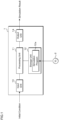
- FIG. 1 is a block diagram illustrating an example of the configuration of a simulation device according to the present embodiment.
- the simulation device 1 according to the present embodiment which is a computer simulating a decomposition process of a raw resin, is provided with a processing unit 11, a storage unit 12, an input unit 13 and an output unit 14.
- the following describes a case where a raw resin is a chlorine-containing resin that generates chlorine-based gas by being thermally decomposed.
- the simulation device 1 simulates a situation in which chlorine-based gas is generated when a raw resin is thermally decomposed in an extrusion process.
- the processing unit 11 has an arithmetic circuit such as a CPU (Central Processing Unit), an MPU (Micro-Processing Unit), an ASIC (Application Specific Integrated Circuit), a FPGA (Field-Programmable Gate Array) or the like, an internal storage device such as a ROM (Read Only Memory), a RAM (Random Access Memory) and an I/O terminal or the like.
- the processing unit 11 reads and executes a simulation program (program product) 12a stored in the storage unit 12 to perform processing of calculating a predetermined physical quantity in a twin-screw extruder.
- each functional part of the simulation device 1 may be realized in software, or some or all of the functional parts thereof may be realized in hardware.
- the storage unit 12 is a storage device such as a hard disk, an EEPROM (Electrically Erasable Programmable ROM), a flash memory or the like.
- the storage unit 12 stores various programs to be executed by the processing unit 11 and various data necessary for the processing by the processing unit 11.
- the storage unit 12 at least stores a simulation program 12a to be executed by the processing unit 11.
- the simulation program 12a may be written into the storage unit 12 at the manufacturing stage of the simulation device 1.
- the simulation program 12a may be delivered from another information processing apparatus over the network.
- the simulation device 1 obtains the simulation program 12a through communication and writes it into the storage unit 12.
- the simulation program 12a may be readably recorded in a recording medium 2 including a semiconductor memory such as a flash memory, an optical disk, a magneto-optical disk and a magnetic disk.
- the simulation device 1 reads the simulation program 12a and stores it in the storage unit 12.
- the input unit 13 is an interface through which data is taken from the outside.
- the input unit 13, which is, for example, a keyboard or a mouse, acquires data related to an initial condition.
- the data related to the initial condition is data on the physical properties of a resin as a raw material, the extrusion conditions of the extruder, the screw construction and the like. The details of the initial condition will be described later.
- the input unit 13 may be configured to read the data on the initial condition from a storage device (not illustrated) or to receive it from another computer.
- the output unit 14 is a display device such as a liquid crystal display panel, an organic EL display panel or the like.
- the predetermined physical quantity includes, for example, the chlorine content in a raw resin, the amount of decomposed chlorine and the amount of chlorine-based gas remaining in the cylinder 3 and the like.
- the output unit 14 displays the distributions of the chlorine content in a raw resin, the amount of decomposed chlorine and the amount of chlorine-based gas remaining in the cylinder 3 (see FIG. 9 ).
- the measurement method and expression manner for the amount of chlorine, decomposed chlorine and chlorine-based gas may be represented by an amount of substance or a concentration, not limited to a particular one.
- the unit is also not limited to a particular one.
- the aforementioned simulation device 1 may be a multi-computer configured by including multiple computers, and may be a virtual machine virtually constructed by software.
- the simulation device 1 may be constructed as a cloud server.
- FIG. 2 is a schematic view illustrating an example of the configuration of the extruder according to the present embodiment.
- the extruder to be simulated is provided with a screw 4 that melts and kneads a raw resin and a cylinder 3 into which the screw 4 is rotatably inserted.
- the cylinder 3 is provided with a hopper 31 from which a raw material is fed and one or more vents 32.
- the hopper 31 is located more toward the root (left side in FIG. 2 ).
- the vent 32 is a vacuum vent, for example, and exhausts chlorine-based gas inside the cylinder 3 by vacuum suction. The exhausted chlorine-based gas is processed in an external gas treatment facility.
- the screw 4 is configured to be a bar of screw 4 by combining multiple types of screw pieces integrated together.
- a flight screw-shaped forward flight piece that carries a raw material in a forward direction a reverse flight piece that carries a raw material in a reverse direction, a kneading piece that kneads the raw material and the like are combined in an order and at positions according to the characteristics of the raw material, to form the screw 4.
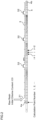
- FIGs. 3 and 4 illustrate a flowchart illustrating a simulation method according to the present embodiment.
- the processing unit 11 of the simulation device 1 first performs initial setting (step S11).
- the processing unit 11 further acquires resin physical property data indicating a viscosity model of a raw resin to be fed into the extruder, the density, the thermal conductivity and the specific heat in a solid, the density, the thermal conductivity and the specific heat in a melt, a molten heat amount, a melting point, the initial chlorine content, a decomposition rate constant and the like of a raw resin.
- the processing unit 11 acquires volatile component physical property data.
- FIG. 5 is a resin property data input screen.
- FIG. 6 is a shear viscosity data input screen.
- FIG. 7 is a volatile component physical property data input screen.
- the processing unit 11 displays the resin property data input screen illustrated in FIG. 5 to accept input of physical property data.
- the processing unit 11 accepts, on the resin property data input screen, the density, the thermal conductivity and the specific heat when the raw resin is a solid, the density, the thermal conductivity and the specific heat when the raw resin is a melt, the molten heat amount, the melting point, the initial chlorine content and the decomposition rate constant of a raw resin and stores the accepted data in the storage unit 12.
- the decomposition rate constant has temperature dependence.
- the decomposition rate constant data is array data in which multiple resin temperatures and decomposition rate constants at the respective temperatures are associated with each other.
- the processing unit 11 displays the shear viscosity data input screen illustrated in FIG. 6 to accept data related to a viscosity model. If the molten resin is a pseudoplastic non-Newtonian fluid whose shear viscosity decreases with increasing shear rate, the Cross model with temperature dependence can be used as a constitutive equation to express the viscosity of the fluid.
- the processing unit 11 accepts the relationship between a shear rate, a temperature and a viscosity on the shear viscosity data input screen, and stores the received shear viscosity data in the storage unit 12.
- the processing unit 11 displays the volatile component physical property data input screen illustrated in FIG. 9 to accept volatile component physical property data.
- the processing unit 11 accepts, on the volatile component physical property data input screen, a model equation representing a property related to vapor pressure, a molecular weight, a boiling point, a specific heat and a density at a given temperature, a latent heat of vaporization, a critical temperature, a critical pressure, a critical density, a mutual interference coefficient and the like of chlorine-based gas regarded as a volatile component, and stores the accepted data in the storage unit 12.
- the processing unit 11 acquires extrusion condition data such as an extrusion output of a raw resin, a screw rotational speed, a raw resin temperature, a tip resin pressure, a cylinder temperature and the like.
- the processing unit 11 acquires screw construction data indicating the positions and the alignment of multiple types of screw pieces, the screw diameter, the cylinder diameter, the position of the hopper 31 in the longitudinal direction of the screw 4 and the like.
- the screw construction data is data defining the construction of the extruder illustrated in FIG. 2 .
- the processing unit 11 acquires data indicating a viscous heating value defined by the construction of the screw 4.
- the processing unit 11 or the input unit 13 that executes the processing at step S11 functions as an acquisition unit that acquires an initial amount of the chlorine component contained in the raw resin.
- the processing unit 11 substitutes the variable i with a numerical value indicating the position of a screw tip node 4b (step S12).
- the positions in the longitudinal direction of the screw 4 can be denoted by calculation point numbers. Specifically, a calculation point number is assigned to each of partitioned regions formed by partitioning the space inside the cylinder 3 into multiple regions along the axial direction of the extruder. The calculation point number is expressed as the variable i.
- the value of the variable i increases from a screw root node 4a toward the screw tip node 4b.
- the screw root node 4a is the node at the root of the screw 4 on the left in FIG. 2 while the screw tip node 4b is the node at the tip of the screw 4 on the right in FIG. 2 .
- the processing unit 11 calculates the pressure, filling rate and residence time based on the screw characteristic formula and the extrusion condition (step S13).
- the pressure loss ⁇ P and the known tip resin pressure P0 are used to calculate the pressure P at the position denoted by the variable i.
- the processing unit 11 can sequentially calculate the pressure loss ⁇ P from the downstream side to the upstream side (step S14 and step S15) to thereby evaluate the pressure in each of the partitioned regions.
- the filling rate is expressed by formula (2) below.
- Fill Q ⁇ / ⁇
- the processing unit 11 determines whether or not the variable i is a value representing the screw root node 4a (step S 14). If determining that the variable i is not the value representing the screw root node 4a (step S14: NO), the processing unit 11 decrements the variable i by one (step S15) and returns the processing to step S13.
- step S14 If determining that the variable i is the value representing the screw root node 4a (step S14: YES), the processing unit 11 substitutes the variable i with the numerical value representing the position of the screw root node 4a (step S 16). Note that the processing at step S16 is not necessarily performed.
- the processing unit 11 uses an energy balance formula to calculate the resin temperature, solid phase rate, motive power, torque, ESP, dispersion, distribution and the like (step S17).
- the resin temperature particularly related to calculation of the amount of decomposed chlorine will be described.
- the energy balance formula is expressed by formula (4) below. Note that the contact area between the resin material and the cylinder 3 is obtained by multiplying the area of the cylinder at the partitioned region by the filling rate.
- Q ⁇ ⁇ ⁇ Cp ⁇ T out ⁇ Q ⁇ ⁇ ⁇ Cp ⁇ T in h ⁇ T ⁇ A ⁇ h ⁇ Tb ⁇ A + Ev
- the processing unit 11 having completed the processing at step S17, calculates the amount of decomposed chlorine and the like (step S18).
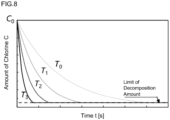
- FIG. 8 is a graph representing time variation of the chlorine content in a resin raw material.
- the horizontal axis indicates the time while the vertical axis indicates the chlorine content in the raw resin.
- the chlorine content in the raw resin exponentially decreases with time by thermal decomposition.
- the decreasing rate is determined by a decomposition rate constant.
- the decomposition rate constant k (T) has temperature dependence as illustrated in FIG. 8 .
- the decomposition rate constant k (T) is experimentally determined.
- the processing unit 11 accepts the decomposition rate constant k (T) at step S11 and stores it in the storage unit 12.
- the processing unit 11 can calculate the chlorine content in the raw resin for each partitioned region based on the initial chlorine content and the decomposition rate constant data acquired at step S11, the residence time calculated at step S13 and the resin temperature calculated at step S17.
- the chlorine content in the raw resin is expressed by formula (7) below, for example.
- the decomposition rate constant k is a constant with temperature dependence and is defined based on the resin temperature calculated at step S17.
- the processing unit 11 can sequentially calculate the chlorine content in the raw resin from the downstream side to the upstream side (step S21 and step S22) to thereby evaluate the chlorine content in the raw resin for each of the partitioned regions.
- the chlorine content is the amount of chlorine contained in the raw resin as the chlorine component not being subjected to thermal decomposition.
- the processing unit 11 subtracts the chlorine content obtained by formula (7) above from the initial chlorine content to thereby calculate the amount of decomposed chlorine generated by the thermal decomposition of the raw resin.
- the processing unit 11 determines whether or not each partitioned region indicated by the variable i is an unfilled region (step S19). For example, the processing unit 11 determines whether or not the filling rate calculated at step S13 is less than a predetermined threshold. If determining that the partitioned region is the unfilled region (step S 19: YES), the processing unit 11 calculates the amount of chlorine-based gas present in the partitioned region indicated by the variable i (step S20). Specifically, the processing unit 11 calculates the amount of chlorine-based gas, regarding the release of chlorine-based gas generated by the thermal decomposition of the raw resin as a devolatilization phenomenon.
- the release of chlorine-based gas from a raw resin by the thermal decomposition of the raw resin is regarded as a devolatilization phenomenon in which the chlorine-based gas component dissolved in the raw material resin is changed in phase into a gas (gas bubble) under reduced pressure, and the chlorine-based gas is degassed on the free surface of the raw resin.
- the devolatilization diffusion coefficient K' is a parameter that is greatly affected by the physical properties of the raw resin and the shape of the screw.
- the concentration of the outflow volatile portions Cout that is, the chlorine concentration of the chlorine-based gas contained in the devolatilized raw resin can be obtained by formulas (10) and (11) below.
- step S19: NO the processing unit 11 determines whether or not the variable i is a value representing the screw tip node 4b (step S21). If determining that the variable i is not the value representing the screw tip node 4b (step S21: NO), the processing unit 11 increments the variable i by one (step S22) and returns the processing to step S17.
- step S21 determines whether or not the simulation result has converged. If determining that the simulation result has not converged (step S23: NO), the processing unit 11 returns the processing to step S12 to repeat the processing through steps S12 to S21.
- step S23 If determining that the simulation result has converged (step S23: YES), the processing unit 11 outputs the analysis result via the output unit 14 (step S24) and ends the processing.
- FIG. 9 is a schematic view illustrating a simulation result.
- the horizontal axis of the graphs in FIGs. 9A to 9C represents the variable i, that is, the position in the longitudinal direction of the screw 4.
- the vertical axis in FIG. 9A represents the chlorine content in the raw resin
- the vertical axis in FIG. 9B represents the amount of decomposed chlorine
- the vertical axis in FIG. 9C represents the amount of chlorine-based gas present in the cylinder 3 of the extruder.
- the raw resin fed into the hopper 31 is progressively subject to thermal decomposition during the course of being transferred from the upstream side to the downstream side (from the root to the tip of the screw 4).
- the amount of decomposed chlorine illustrated in FIG. 9B is the total amount of chlorine-based gas generated by the thermal decomposition from the raw resins present in the partitioned regions in the axial direction of the extruder.
- the total amount of chlorine-based gas refers to a total sum of chlorine-based gas generated in the course of the raw resin being transferred from the upstream side to the downstream side (from the root to the tip of the screw 4).
- the raw resin is thermally decomposed in the course of being transferred from the upstream side to the downstream side (from the root to the tip of the screw 4), which increases the amount of chlorine-based gas inside the cylinder 3.
- the amount of chlorine-based gas that is present in each partitioned region in the axial direction of the extruder is exhausted as chlorine-based gas in the unfilled region and thus reduced.
- the chlorine-based gas is not exhausted and thus not reduced.
- the raw resin is transferred to the tip end while repeating such exhaust of chlorine-based gas in a partitioned region with a short residence time.
- the processing unit 11 can output and display simulation results as illustrated in FIGs. 9A to 9C .
- the user of the simulation device 1 can grasp the situation of a chlorine containing resin being thermally decomposed, the amount of chlorine-based gas inside the cylinder 3 and the situation of the chlorine-based gas having been thermally decomposed being exhausted.
- the simulation device 1 thus constructed makes it possible to simulate the manner in which a raw resin is decomposed in the extrusion process with the extruder.
- the processing unit 11 can calculate in details the chlorine content and the amount of decomposed chlorine in the raw resin in each of the partitioned regions.
- the processing unit 11 can calculate in details the chlorine content and the amount of decomposed chlorine in the raw resin in each of the partitioned regions.
- the processing unit 11 can output data representing the distributions of the amount of chlorine and the amount of decomposed chlorine in the axial direction of the extruder and display the image representing the distributions.
- the processing unit 11 can calculate the amount of chlorine-based gas remaining inside the cylinder 3.
- the processing unit 11 can output data indicating the distributions of the amount of chlorine-based gas remaining inside the cylinder 3 in the axial direction of the extruder and display the image indicating the distributions.
- the type of the raw resin is not limited to a particular one.
- the gas generated by decomposition is also not limited to chlorine-based gas.
- the substance produced by decomposition is not limited to gas.
- the decomposition situation may be simulated regarding the substance to be decomposed as a polymer contained in the raw resin and the decomposed substance as monomers.
- the decomposition method in the extrusion process is exemplified by the thermal decomposition though not limited thereto.
- the simulation device 1 according to Embodiment 1 can simulate the decomposition process of any raw material that decomposes in the extrusion process to generate gas.
- the graphs to be output and displayed are exemplified by the chlorine content in the raw resin, the amount of decomposed chlorine and the amount of chlorine-based gas remaining in the cylinder 3, they may output data indicating the distributions of other physical properties obtained by using formula (7) above.
Landscapes
- Engineering & Computer Science (AREA)
- Mechanical Engineering (AREA)
- Physics & Mathematics (AREA)
- Thermal Sciences (AREA)
- General Physics & Mathematics (AREA)
- Automation & Control Theory (AREA)
- Extrusion Moulding Of Plastics Or The Like (AREA)
Applications Claiming Priority (2)
| Application Number | Priority Date | Filing Date | Title |
|---|---|---|---|
| JP2022024059A JP7805813B2 (ja) | 2022-02-18 | 2022-02-18 | シミュレーション装置、シミュレーション方法及びシミュレーションプログラム |
| PCT/JP2022/039456 WO2023157381A1 (ja) | 2022-02-18 | 2022-10-24 | シミュレーション装置、シミュレーション方法及びシミュレーションプログラム |
Publications (2)
| Publication Number | Publication Date |
|---|---|
| EP4480667A1 true EP4480667A1 (de) | 2024-12-25 |
| EP4480667A4 EP4480667A4 (de) | 2026-02-18 |
Family
ID=87577910
Family Applications (1)
| Application Number | Title | Priority Date | Filing Date |
|---|---|---|---|
| EP22927275.2A Pending EP4480667A4 (de) | 2022-02-18 | 2022-10-24 | Simulationsvorrichtung, simulationsverfahren und simulationsprogramm |
Country Status (7)
| Country | Link |
|---|---|
| US (1) | US20250155860A1 (de) |
| EP (1) | EP4480667A4 (de) |
| JP (1) | JP7805813B2 (de) |
| KR (1) | KR20240152839A (de) |
| CN (1) | CN118715109A (de) |
| TW (1) | TW202334813A (de) |
| WO (1) | WO2023157381A1 (de) |
Family Cites Families (2)
| Publication number | Priority date | Publication date | Assignee | Title |
|---|---|---|---|---|
| JP4414408B2 (ja) * | 2006-03-28 | 2010-02-10 | 株式会社日本製鋼所 | スクリュ式押出機の脱揮シミュレーション装置、およびスクリュ式押出機の脱揮シミュレーションプログラム |
| JP5086383B2 (ja) * | 2010-02-23 | 2012-11-28 | 株式会社日本製鋼所 | スクリュ式押出機のシミュレーション装置、およびスクリュ式押出機のシミュレーションプログラム |
-
2022
- 2022-02-18 JP JP2022024059A patent/JP7805813B2/ja active Active
- 2022-10-24 KR KR1020247026863A patent/KR20240152839A/ko active Pending
- 2022-10-24 US US18/839,019 patent/US20250155860A1/en active Pending
- 2022-10-24 EP EP22927275.2A patent/EP4480667A4/de active Pending
- 2022-10-24 WO PCT/JP2022/039456 patent/WO2023157381A1/ja not_active Ceased
- 2022-10-24 CN CN202280091588.9A patent/CN118715109A/zh active Pending
- 2022-10-28 TW TW111141115A patent/TW202334813A/zh unknown
Also Published As
| Publication number | Publication date |
|---|---|
| JP2023120916A (ja) | 2023-08-30 |
| KR20240152839A (ko) | 2024-10-22 |
| WO2023157381A1 (ja) | 2023-08-24 |
| EP4480667A4 (de) | 2026-02-18 |
| JP7805813B2 (ja) | 2026-01-26 |
| TW202334813A (zh) | 2023-09-01 |
| US20250155860A1 (en) | 2025-05-15 |
| CN118715109A (zh) | 2024-09-27 |
Similar Documents
| Publication | Publication Date | Title |
|---|---|---|
| CN103488862B (zh) | 用于模拟高粘度流体的方法 | |
| EP2000283B1 (de) | Simulationsvorrichtung und schneckenextruder-verflüchtigung und simulationsprogramm für die schneckenextruder-verflüchtigung | |
| Serdeczny et al. | Viscoelastic simulation and optimisation of the polymer flow through the hot-end during filament-based material extrusion additive manufacturing | |
| Park et al. | Stochastic simulation of entangled polymeric liquids in fast flows: Microstructure modification | |
| JP5086383B2 (ja) | スクリュ式押出機のシミュレーション装置、およびスクリュ式押出機のシミュレーションプログラム | |
| EP4480667A1 (de) | Simulationsvorrichtung, simulationsverfahren und simulationsprogramm | |
| Saadat et al. | Molecular based prediction of the extensional rheology of high molecular weight polystyrene dilute solutions: A hi-fidelity Brownian dynamics approach | |
| Robertson et al. | Polymer extrudate-swell: From monodisperse melts to polydispersity and flow-induced reduction in monomer friction | |
| Olofsson et al. | A CFD model with free surface tracking: predicting fill level and residence time in a starve-fed single-screw extruder | |
| Béreaux et al. | A simple model of throughput and pressure development for single screw | |
| CN113139246B (zh) | 旋转机械的模态分析方法、装置、设备及存储介质 | |
| Velghe et al. | Modeling Thermal, Mechanical, and Hydrolytic Degradation of PLA During Single‐Screw Extrusion | |
| EP2065161A1 (de) | Vorrichtung zum schätzen von verflüchtigungsleistung und verfahren zum schätzen von verflüchtigungsleistung | |
| JP7411509B2 (ja) | シミュレーション装置、シミュレーション方法及びシミュレーションプログラム | |
| Wong et al. | Numerical Modeling of the Blend Morphology Evolution in Twin‐Screw Extruders | |
| EP4501582A1 (de) | Simulationsvorrichtung, simulationsverfahren und simulationsprogramm | |
| JP2020138448A (ja) | フィラー分散状態解析方法及び混練物生成方法 | |
| Chen et al. | Simulation of dispersed phase evolution for immiscible polymer blends in injection molding | |
| JP2026029196A (ja) | 情報処理装置および情報処理方法 | |
| Luna et al. | Dynamic modeling and simulation of mass, momentum, and energy transport in a single-screw plastic extrusion process | |
| Jafari et al. | Estimation of Date Syrup Viscosity using Machine Vision and Artificial Neural Network | |
| Feigl et al. | Calculation of the die entry flow of a concentrated polymer solution using micro-macro simulations |
Legal Events
| Date | Code | Title | Description |
|---|---|---|---|
| STAA | Information on the status of an ep patent application or granted ep patent |
Free format text: STATUS: THE INTERNATIONAL PUBLICATION HAS BEEN MADE |
|
| PUAI | Public reference made under article 153(3) epc to a published international application that has entered the european phase |
Free format text: ORIGINAL CODE: 0009012 |
|
| STAA | Information on the status of an ep patent application or granted ep patent |
Free format text: STATUS: REQUEST FOR EXAMINATION WAS MADE |
|
| 17P | Request for examination filed |
Effective date: 20240828 |
|
| AK | Designated contracting states |
Kind code of ref document: A1 Designated state(s): AL AT BE BG CH CY CZ DE DK EE ES FI FR GB GR HR HU IE IS IT LI LT LU LV MC ME MK MT NL NO PL PT RO RS SE SI SK SM TR |
|
| DAV | Request for validation of the european patent (deleted) | ||
| DAX | Request for extension of the european patent (deleted) | ||
| A4 | Supplementary search report drawn up and despatched |
Effective date: 20260119 |
|
| RIC1 | Information provided on ipc code assigned before grant |
Ipc: B29C 48/395 20190101AFI20260113BHEP Ipc: B29C 48/76 20190101ALI20260113BHEP Ipc: B29C 48/80 20190101ALI20260113BHEP Ipc: B29C 48/92 20190101ALI20260113BHEP |