EP4477936A2 - Verwendung eines mineralwolleproduktes - Google Patents
Verwendung eines mineralwolleproduktes Download PDFInfo
- Publication number
- EP4477936A2 EP4477936A2 EP24210741.5A EP24210741A EP4477936A2 EP 4477936 A2 EP4477936 A2 EP 4477936A2 EP 24210741 A EP24210741 A EP 24210741A EP 4477936 A2 EP4477936 A2 EP 4477936A2
- Authority
- EP
- European Patent Office
- Prior art keywords
- weight
- percent
- hydrophobic agent
- mineral wool
- amount
- Prior art date
- Legal status (The legal status is an assumption and is not a legal conclusion. Google has not performed a legal analysis and makes no representation as to the accuracy of the status listed.)
- Pending
Links
Images


Classifications
-
- C—CHEMISTRY; METALLURGY
- C09—DYES; PAINTS; POLISHES; NATURAL RESINS; ADHESIVES; COMPOSITIONS NOT OTHERWISE PROVIDED FOR; APPLICATIONS OF MATERIALS NOT OTHERWISE PROVIDED FOR
- C09D—COATING COMPOSITIONS, e.g. PAINTS, VARNISHES OR LACQUERS; FILLING PASTES; CHEMICAL PAINT OR INK REMOVERS; INKS; CORRECTING FLUIDS; WOODSTAINS; PASTES OR SOLIDS FOR COLOURING OR PRINTING; USE OF MATERIALS THEREFOR
- C09D183/00—Coating compositions based on macromolecular compounds obtained by reactions forming in the main chain of the macromolecule a linkage containing silicon, with or without sulfur, nitrogen, oxygen, or carbon only; Coating compositions based on derivatives of such polymers
- C09D183/04—Polysiloxanes
-
- D—TEXTILES; PAPER
- D04—BRAIDING; LACE-MAKING; KNITTING; TRIMMINGS; NON-WOVEN FABRICS
- D04H—MAKING TEXTILE FABRICS, e.g. FROM FIBRES OR FILAMENTARY MATERIAL; FABRICS MADE BY SUCH PROCESSES OR APPARATUS, e.g. FELTS, NON-WOVEN FABRICS; COTTON-WOOL; WADDING ; NON-WOVEN FABRICS FROM STAPLE FIBRES, FILAMENTS OR YARNS, BONDED WITH AT LEAST ONE WEB-LIKE MATERIAL DURING THEIR CONSOLIDATION
- D04H1/00—Non-woven fabrics formed wholly or mainly of staple fibres or like relatively short fibres
- D04H1/40—Non-woven fabrics formed wholly or mainly of staple fibres or like relatively short fibres from fleeces or layers composed of fibres without existing or potential cohesive properties
- D04H1/42—Non-woven fabrics formed wholly or mainly of staple fibres or like relatively short fibres from fleeces or layers composed of fibres without existing or potential cohesive properties characterised by the use of certain kinds of fibres insofar as this use has no preponderant influence on the consolidation of the fleece
- D04H1/4209—Inorganic fibres
-
- D—TEXTILES; PAPER
- D04—BRAIDING; LACE-MAKING; KNITTING; TRIMMINGS; NON-WOVEN FABRICS
- D04H—MAKING TEXTILE FABRICS, e.g. FROM FIBRES OR FILAMENTARY MATERIAL; FABRICS MADE BY SUCH PROCESSES OR APPARATUS, e.g. FELTS, NON-WOVEN FABRICS; COTTON-WOOL; WADDING ; NON-WOVEN FABRICS FROM STAPLE FIBRES, FILAMENTS OR YARNS, BONDED WITH AT LEAST ONE WEB-LIKE MATERIAL DURING THEIR CONSOLIDATION
- D04H1/00—Non-woven fabrics formed wholly or mainly of staple fibres or like relatively short fibres
- D04H1/40—Non-woven fabrics formed wholly or mainly of staple fibres or like relatively short fibres from fleeces or layers composed of fibres without existing or potential cohesive properties
- D04H1/42—Non-woven fabrics formed wholly or mainly of staple fibres or like relatively short fibres from fleeces or layers composed of fibres without existing or potential cohesive properties characterised by the use of certain kinds of fibres insofar as this use has no preponderant influence on the consolidation of the fleece
- D04H1/4209—Inorganic fibres
- D04H1/4218—Glass fibres
-
- D—TEXTILES; PAPER
- D04—BRAIDING; LACE-MAKING; KNITTING; TRIMMINGS; NON-WOVEN FABRICS
- D04H—MAKING TEXTILE FABRICS, e.g. FROM FIBRES OR FILAMENTARY MATERIAL; FABRICS MADE BY SUCH PROCESSES OR APPARATUS, e.g. FELTS, NON-WOVEN FABRICS; COTTON-WOOL; WADDING ; NON-WOVEN FABRICS FROM STAPLE FIBRES, FILAMENTS OR YARNS, BONDED WITH AT LEAST ONE WEB-LIKE MATERIAL DURING THEIR CONSOLIDATION
- D04H1/00—Non-woven fabrics formed wholly or mainly of staple fibres or like relatively short fibres
- D04H1/40—Non-woven fabrics formed wholly or mainly of staple fibres or like relatively short fibres from fleeces or layers composed of fibres without existing or potential cohesive properties
- D04H1/58—Non-woven fabrics formed wholly or mainly of staple fibres or like relatively short fibres from fleeces or layers composed of fibres without existing or potential cohesive properties by applying, incorporating or activating chemical or thermoplastic bonding agents, e.g. adhesives
- D04H1/64—Non-woven fabrics formed wholly or mainly of staple fibres or like relatively short fibres from fleeces or layers composed of fibres without existing or potential cohesive properties by applying, incorporating or activating chemical or thermoplastic bonding agents, e.g. adhesives the bonding agent being applied in wet state, e.g. chemical agents in dispersions or solutions
-
- D—TEXTILES; PAPER
- D04—BRAIDING; LACE-MAKING; KNITTING; TRIMMINGS; NON-WOVEN FABRICS
- D04H—MAKING TEXTILE FABRICS, e.g. FROM FIBRES OR FILAMENTARY MATERIAL; FABRICS MADE BY SUCH PROCESSES OR APPARATUS, e.g. FELTS, NON-WOVEN FABRICS; COTTON-WOOL; WADDING ; NON-WOVEN FABRICS FROM STAPLE FIBRES, FILAMENTS OR YARNS, BONDED WITH AT LEAST ONE WEB-LIKE MATERIAL DURING THEIR CONSOLIDATION
- D04H1/00—Non-woven fabrics formed wholly or mainly of staple fibres or like relatively short fibres
- D04H1/40—Non-woven fabrics formed wholly or mainly of staple fibres or like relatively short fibres from fleeces or layers composed of fibres without existing or potential cohesive properties
- D04H1/58—Non-woven fabrics formed wholly or mainly of staple fibres or like relatively short fibres from fleeces or layers composed of fibres without existing or potential cohesive properties by applying, incorporating or activating chemical or thermoplastic bonding agents, e.g. adhesives
- D04H1/64—Non-woven fabrics formed wholly or mainly of staple fibres or like relatively short fibres from fleeces or layers composed of fibres without existing or potential cohesive properties by applying, incorporating or activating chemical or thermoplastic bonding agents, e.g. adhesives the bonding agent being applied in wet state, e.g. chemical agents in dispersions or solutions
- D04H1/641—Non-woven fabrics formed wholly or mainly of staple fibres or like relatively short fibres from fleeces or layers composed of fibres without existing or potential cohesive properties by applying, incorporating or activating chemical or thermoplastic bonding agents, e.g. adhesives the bonding agent being applied in wet state, e.g. chemical agents in dispersions or solutions characterised by the chemical composition of the bonding agent
-
- D—TEXTILES; PAPER
- D04—BRAIDING; LACE-MAKING; KNITTING; TRIMMINGS; NON-WOVEN FABRICS
- D04H—MAKING TEXTILE FABRICS, e.g. FROM FIBRES OR FILAMENTARY MATERIAL; FABRICS MADE BY SUCH PROCESSES OR APPARATUS, e.g. FELTS, NON-WOVEN FABRICS; COTTON-WOOL; WADDING ; NON-WOVEN FABRICS FROM STAPLE FIBRES, FILAMENTS OR YARNS, BONDED WITH AT LEAST ONE WEB-LIKE MATERIAL DURING THEIR CONSOLIDATION
- D04H3/00—Non-woven fabrics formed wholly or mainly of yarns or like filamentary material of substantial length
- D04H3/002—Inorganic yarns or filaments
-
- D—TEXTILES; PAPER
- D04—BRAIDING; LACE-MAKING; KNITTING; TRIMMINGS; NON-WOVEN FABRICS
- D04H—MAKING TEXTILE FABRICS, e.g. FROM FIBRES OR FILAMENTARY MATERIAL; FABRICS MADE BY SUCH PROCESSES OR APPARATUS, e.g. FELTS, NON-WOVEN FABRICS; COTTON-WOOL; WADDING ; NON-WOVEN FABRICS FROM STAPLE FIBRES, FILAMENTS OR YARNS, BONDED WITH AT LEAST ONE WEB-LIKE MATERIAL DURING THEIR CONSOLIDATION
- D04H3/00—Non-woven fabrics formed wholly or mainly of yarns or like filamentary material of substantial length
- D04H3/002—Inorganic yarns or filaments
- D04H3/004—Glass yarns or filaments
-
- F—MECHANICAL ENGINEERING; LIGHTING; HEATING; WEAPONS; BLASTING
- F16—ENGINEERING ELEMENTS AND UNITS; GENERAL MEASURES FOR PRODUCING AND MAINTAINING EFFECTIVE FUNCTIONING OF MACHINES OR INSTALLATIONS; THERMAL INSULATION IN GENERAL
- F16L—PIPES; JOINTS OR FITTINGS FOR PIPES; SUPPORTS FOR PIPES, CABLES OR PROTECTIVE TUBING; MEANS FOR THERMAL INSULATION IN GENERAL
- F16L58/00—Protection of pipes or pipe fittings against corrosion or incrustation
- F16L58/02—Protection of pipes or pipe fittings against corrosion or incrustation by means of internal or external coatings
- F16L58/04—Coatings characterised by the materials used
-
- F—MECHANICAL ENGINEERING; LIGHTING; HEATING; WEAPONS; BLASTING
- F16—ENGINEERING ELEMENTS AND UNITS; GENERAL MEASURES FOR PRODUCING AND MAINTAINING EFFECTIVE FUNCTIONING OF MACHINES OR INSTALLATIONS; THERMAL INSULATION IN GENERAL
- F16L—PIPES; JOINTS OR FITTINGS FOR PIPES; SUPPORTS FOR PIPES, CABLES OR PROTECTIVE TUBING; MEANS FOR THERMAL INSULATION IN GENERAL
- F16L59/00—Thermal insulation in general
- F16L59/14—Arrangements for the insulation of pipes or pipe systems
Definitions
- the present invention relates to the use of a mineral wool product comprising mineral fibers bound by a binder resulting from the curing of a binder composition comprising a hydrophobic agent comprising at least one silicone compound at least one hardener and at least one emulsifier, as insulation of a metallic structure.
- the present invention is also directed to a binder composition for mineral fibers comprising such a hydrophobic agent, a mineral wool product comprising mineral fibers bound by a binder resulting from the curing of such a binder composition and a method for producing a mineral wool product which comprises the steps of contacting mineral fibers with such a binder composition.
- Corrosion is the deterioration of a metal as result of a chemical reaction between it and the surrounding environment. Corrosion involves the conversion of the metal to a more chemically stable form, such as oxide, hydroxide or sulfide.
- Corrosion of steel occurs in the presence of water and oxygen. Corrosion of steel parts is a major economic problem which often times makes up a major part of the maintenance and renewal costs of steel structures.
- CUI corrosion under insulation
- CUI CUI-in-operability for corrosion
- CUI CUI-in-operability for corrosion
- ETT external stress corrosion tracking
- austenitic stainless steel which is a specific type of corrosion mainly caused by the action of water-soluble chloride from rain water or if the insulation is not meeting the appropriate requirements. Since the corroded surface is mostly hidden by the insulation system and will not be observed until the insulation is removed for inspection or in the event of metal failure leading to incidents, it is very important to control CUI as much as possible.
- the insulated steel structures are often covered by an additional cladding which is to prevent the entering of water.
- experience shows that water often enters via fault or damages in the cladding system or via humid air in structures which undergo cyclic temperature changes. Water may also come into contact with the steel structure internally from non-tight fittings or externally from events like flooding.
- a mineral wool product comprising mineral fibers bound by a binder resulting from the curing of a binder composition comprising a phenol-formaldehyde-based resin, and/or a carbohydrate containing component, a hydrophobic agent comprising (i) at least one silicone compound, such as silicone resin, such as a reactive silicone resin, such as a reactive silicone resin chosen from the group of polyalkylethoxysiloxane, polymethylethoxysiloxane, polyphenylethoxysiloxane, polyphenylsiloxane, polyphenylmethylsiloxane, (ii) at least one hardener, such as silane, such as alkyltriethoxysilane, such as octyltriethoxysilane, (iii) at least one emulsifier, as insulation of a metallic structure, said structure having an operating temperature between 0-650 °C,
- a binder composition for mineral fibers comprising a phenol-formaldehyde-based resin, and/or a carbohydrate-containing component, and a hydrophobic agent comprising (i) at least one silicone compound, such as silicone resin, such as a reactive silicone resin, such as a reactive silicone resin chosen from the group of polyalkylethoxysiloxane, polymethylethoxysiloxane, polyphenylethoxysiloxane, polyphenylsiloxane, polyphenylmethylsiloxane, (ii) at least one hardener, such as silane, such as alkyltriethoxysilane, such as octyltriethoxysilane, (iii) at least one emulsifier.
- silicone resin such as a reactive silicone resin, such as a reactive silicone resin chosen from the group of polyalkylethoxysiloxane, polymethylethoxysiloxane, polyphenylethoxysiloxane
- a mineral wool product comprising mineral fibers bound by a binder resulting from the curing of a binder composition comprising a phenol-formaldehyde-based resin, and/or a carbohydrate-containing component, a hydrophobic agent comprising (i) at least one silicone compound, such as silicone resin, such as a reactive silicone resin, such as a reactive silicone resin chosen from the group of polyalkylethoxysiloxane, polymethylethoxysiloxane, polyphenyl-ethoxysiloxane, polyphenylsiloxane, polyphenylmethylsiloxane, (ii) at least one hardener, such as silane, such as alkyltriethoxysilane, such as octyltriethoxysilane, (iii) at least one emulsifier.
- silicone resin such as a reactive silicone resin, such as a reactive silicone resin chosen from the group of polyalkylethoxysiloxane, polymethyl
- a method for producing a mineral wool product which comprises the steps of contacting mineral fibers with a binder composition comprising a phenol-formaldehyde-based resin, and/or a carbohydrate-containing component, and a hydrophobic agent comprising (i) at least one silicone compound, such as silicone resin, such as a reactive silicone resin, such as a reactive silicone resin chosen from the group of polyalkylethoxysiloxane, polymethylethoxysiloxane, polyphenylethoxysiloxane, polyphenylsiloxane, polyphenylmethylsiloxane, (ii) at least one hardener, such as silane, such as alkyltriethoxysilane, such as octyltriethoxysilane, (iii) at least one emulsifier.
- silicone resin such as a reactive silicone resin, such as a reactive silicone resin chosen from the group of polyalkylethoxysiloxane, polymethylethoxy
- a very specific hydrophobic agent can impart properties to a mineral wool binder which allow the use of a mineral wool product prepared from mineral fibers bound by such a binder as an insulation of a metallic structure and at the same time avoid problems with corrosion under insulation, associated with previously-known insulation products.
- the present invention is directed to a use of a mineral wool product comprising mineral fibers bound by a binder resulting from the curing of a binder composition comprising a phenol-formaldehyde-based resin, and/or a carbohydrate containing component, a hydrophobic agent comprising (i) at least one silicone compound, such as silicone resin, such as a reactive silicone resin, such as a reactive silicone resin chosen from the group of polyalkylethox-ysiloxane, polymethylethoxysiloxane, polyphenylethoxy-siloxane, polyphenyl-siloxane, polyphenylmethylsiloxane, (ii) at least one hardener, such as silane, such as alkyltriethoxysilane, such as octyltriethoxysilane, (iii) at least one emulsifier, as insulation of a metallic structure, said structure having an operating temperature between 0-650 °C, such as between
- the present inventors have surprisingly found that by the use of the very specific hydrophobic agent described herein, corrosion problems in form of corrosion under insulation can be avoided.
- the corrosion problems associated with the previously-known use of insulation elements for metal structures are connected to the so-called wicking-effect of such insulation products.
- This wicking effect of the insulation products causes moisture, once it has entered the system, to be retained for a prolonged period of time at the surface of the metal structure. Accordingly, such insulation materials prolong the time during which the surface of the metal structure is kept in contact with water which contributes to an increased rate of corrosion, in particular at higher temperatures
- the hydrophobic agent comprises (i) in an amount of 20 to 90 percent by weight, in particular 30 to 60 percent by weight, based on the weight of the hydrophobic agent.
- the hydrophobic agent comprises (i) in form of polymethylethoxysiloxane.
- the hydrophobic agent comprises (ii) in an amount of 0.5 to 10 percent by weight, in particular 1 to 5 percent by weight, based on the total weight of the hydrophobic agent.
- the hydrophobic agent comprises (ii) in form of octyltriethoxysilane.
- the silicone compound component (i) also serves as the hardener component (ii) of the hydrophobic agent.
- the hydrophobic agent comprises at least one silicone compound, such as silicone resin, such as a reactive silicone resin, such as a reactive silicone resin chosen from the group of polyalkylethoxysiloxane, polymethylethoxysiloxane, polyphenylethoxysiloxane, polyphenylsiloxane, polyphenylmethylsiloxane, and at least one emulsifier.
- the hardener is another compound than the silicone compound.
- the hardener is comprised in the silicone compound as a curable system.
- the hardener may be the feature that is effected by an intra-molecular hardening of the silicone compound.
- the hydrophobic agent comprises (i) in an amount of 30 to 60 percent by weight, (ii) in an amount of 1 to 5 percent by weight, based on the total weight of the hydrophobic agent, the remainder being (iii) and optionally other components and trace amounts of ethanol.
- the hydrophobic agent comprises polymethylethoxysiloxane in an amount of 30 to 60 percent by weight, octyltriethoxysilane in an amount of 1 to 5 percent by weight, based on the total weight of the hydrophobic agent, the remainder being (iii) and optionally other components and trace amounts of ethanol.
- the binder composition comprises the hydrophobic agent in an amount of 0.05 to 2 percent by weight, such as 0.10 to 1 percent by weight, such as 0.15 to 0.8 percent by weight, based on the weight of the aqueous binder composition mineral wool product.
- the binder composition comprises a carbohydrate-containing binder component, wherein the binder component further comprises (a) a polycarboxylic acid component or any salt thereof and/or an inorganic acid or any salt thereof, and/or (b) a component selected from the group consisting of amine compounds, ammonia; and optionally, and/or (c) a reaction product of a polycarboxylic acid component or anhydride thereof and an alkanolamine component.
- the mineral wool product is a pipe section or a mat or wired mat.
- the present invention is also directed to a binder composition for mineral fibers comprising: a phenol-formaldehyde-based resin, and/or a carbohydrate-containing component; and a hydrophobic agent comprising: (i) at least one silicone compound, such as silicone resin, such as a reactive silicone resin, such as a reactive silicone resin chosen from the group of polyalkylethoxysiloxane, polymethylethoxysiloxane, polyphenylethoxysiloxane, polyphenylsiloxane, polyphenylmethylsiloxane, (ii) at least one hardener, such as silane, such as alkyltriethoxysilane, such as octyltriethoxysilane, (iii) at least one emulsifier.
- silicone resin such as a reactive silicone resin, such as a reactive silicone resin chosen from the group of polyalkylethoxysiloxane, polymethylethoxysiloxane, polyphen
- This binder composition which comprises a specific hydrophobic agent, allows the production of mineral wool products which can be used as insulation of a metallic structure having very good insulation characteristics and at the same time allows the inhibition of corrosion under insulation.
- the hydrophobic agent comprises (i) in an amount of 20 to 90 percent by weight, in particular 30 to 60 percent by weight, based on the weight of the hydrophobic agent.
- the hydrophobic agent comprises (i) in form of polymethylethoxysiloxane.
- the hydrophobic agent comprises (ii) in an amount of 0.5 to 10 percent by weight, in particular 1 to 5 percent by weight, based on the total weight of the hydrophobic agent.
- the hydrophobic agent comprises (ii) in form of octyltriethoxysilane.
- the silicone compound component (i) also serves as the hardener component (ii) of the hydrophobic agent.
- the hydrophobic agent comprises at least one silicone compound, such as silicone resin, such as a reactive silicone resin, such as a reactive silicone resin chosen from the group of polyalkylethoxysiloxane, polymethylethoxysiloxane, polyphenylethoxysiloxane, polyphenylsiloxane, polyphenylmethylsiloxane, and at least one emulsifier.
- the hardener is another compound than the silicone compound.
- the hardener is comprised in the silicone compound as a curable system.
- the hardener may be the feature that is effected by an intra-molecular hardening of the silicone compound.
- the hydrophobic agent comprises (i) in an amount of 30 to 60 percent by weight, (ii) in an amount of 1 to 5 percent by weight, based on the total weight of the hydrophobic agent, the remainder being (iii) and optionally other components and trace amounts of ethanol.
- the hydrophobic agent comprises polymethylethoxysiloxane in an amount of 30 to 60 percent by weight, octyltriethoxysilane in an amount of 1 to 5 percent by weight, based on the total weight of the hydrophobic agent, the remainder being (iii) and optionally other components and trace amounts of ethanol.
- the mineral fibres employed for the production of the mineral wool products may be any of man-made vitreous fibres (MMVF), glass fibres, ceramic fibres, basalt fibres, slag fibres, stone fibres and others. These fibres may be present as a wool product, e.g. like a stone wool product.
- MMVF man-made vitreous fibres
- glass fibres ceramic fibres
- basalt fibres basalt fibres
- slag fibres slag fibres
- stone fibres and others.
- These fibres may be present as a wool product, e.g. like a stone wool product.
- the present invention is directed to a mineral wool product comprising mineral fibers bound by a binder resulting from the curing of a binder composition comprising a phenol-formaldehyde-based resin, and/or a carbohydrate-containing component, a hydrophobic agent comprising: (i) at least one silicone compound, such as silicone resin, such as a reactive silicone resin, such as a reactive silicone resin chosen from the group of polyalkylethoxysiloxane, polymethylethoxysiloxane, polyphenylethoxysiloxane, polyphenylsiloxane, polyphenylmethylsiloxane, (ii) at least one hardener, such as silane, such as alkyltriethoxysilane, such as octyltriethoxysilane, (iii) at least one emulsifier.
- silicone resin such as a reactive silicone resin, such as a reactive silicone resin chosen from the group of polyalkylethoxysilox
- the hydrophobic agent comprises (i) in an amount of 20 to 90 percent by weight, in particular 30 to 60 percent by weight, based on the weight of the hydrophobic agent.
- the hydrophobic agent comprises (i) in form of polymethylethoxysiloxane.
- the hydrophobic agent comprises (ii) in an amount of 0.5 to 10 percent by weight, in particular 1 to 5 percent by weight, based on the total weight of the hydrophobic agent.
- the hydrophobic agent comprises (ii) in form of octyltriethoxysilane.
- the silicone compound component (i) also serves as the hardener component (ii) of the hydrophobic agent.
- the hydrophobic agent comprises at least one silicone compound, such as silicone resin, such as a reactive silicone resin, such as a reactive silicone resin chosen from the group of polyalkylethoxysiloxane, polymethylethoxysiloxane, polyphenylethoxysiloxane, polyphenylsiloxane, polyphenylmethylsiloxane, and at least one emulsifier.
- the hydrophobic agent comprises (i) in an amount of 30 to 60 percent by weight, (ii) in an amount of 1 to 5 percent by weight, based on the total weight of the hydrophobic agent, the remainder being (iii) and optionally other components and trace amounts of ethanol.
- the binder composition comprises a carbohydrate-containing binder component, wherein the binder composition further comprises (a) a polycarboxylic acid component or any salt thereof and/or an inorganic acid or any salt thereof, and/or (b) a component selected from the group consisting of amine compounds, ammonia; and optionally, and/or (c) a reaction product of a polycarboxylic acid component or anhydride thereof and an alkanolamine component.
- the mineral wool product is in form of a pipe section or a mat or wired mat.
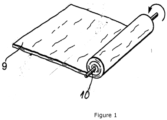
- a mandrel wound pipe section is a pre-formed, full-round cylindrical pipe insulation product which is produced by wrapping an uncured mineral wool blanket around a mandrel in spiral manner for forming and subsequent curing.
- the cylindrical pipe sections are split and hinged for easy snap-on assembly.
- Mandrel wound pipe sections can be both faced and un-faced with aluminum foil.
- Figure 1 shows how such a mandrel wound pipe section is typically produced.
- the pipe section is wound from a thin web 9 of mineral wool, preferably stone wool.
- the web 9 is wound around a perforated mandrel 10 as it is known when producing wound pipe sections. After winding hot air is conventionally blown from inside the mandrel and through the wound pipe section for curing of the thermoset binder.
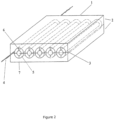
- Figures 2 illustrates a block (1) bonded mineral wool and a cutting string (4) by means of which pipe sections (5) having a tongue/groove-joint (6) and a T-shaped hinge slit (7) are cut out of the block in the transverse direction of the block and parallel to the main surface planes of the block. After cutting out each pipe section 5 is removed from the block.
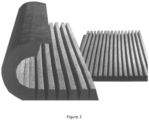
- FIG. 3 shows a further embodiment of a pipe insulation which shows a mat of mineral wool provided with transversally extending V-grooves. Due to the V-grooves the mat can be wrapped around a pipe on site as indicated in the version shown at the front in figure 3 .
- Figure 4 illustrates in perspective view such a wired mat according to the invention where an insulation layer 1 in terms of a mineral fibre web is provided with a chicken wire 10 which is fastened to the insulating layer 1 by means of an iron thread 14 stitched through the insulating layer.
- a fixation means 5 in terms of a galvanised iron wire may be in zigzag configuration and placed under the chicken wire 10. In an alternative embodiment, no such fixation means are included.
- mats are used without any wiring.
- the mineral wool product is in form of a mineral wool mat - sometimes also called a slab.
- Figure 5 shows how a wired mat according to figure 4 is mounted on a pipe as insulation material.
- Figure 5 illustrates an embodiment of the insulating product according to the invention mounted on a pipe 16, where the product comprising insulating layer 1 is adapted to fit the circumference of pipe 16 and fixation means 5a and 5b extending around the mounted product secures the product on the pipe 16 by knots 15a and 15b.
- the fixation means 5c has not yet been extended to protrude beyond the adjoining end surfaces of the product to enable the fixation thereby.
- the mineral wool product has a water absorption according to ASTM C1763-16 of less than 4.0 vol.%, such as less than 2.0 vol.%, such as less than 1.5 vol.%.
- the mineral wool product has a water absorption according to EN13472 of less than 1.0 kg/m2, such as less than 0.8 kg/m2, such as less than 0.5 kg/m2, such as less than 0.3 kg/m2.
- the mineral wool product has water absorption according to EN13472 of less than 1.0 kg/m2, such as less than 0.8 kg/m2, such as less than 0.5 kg/m2, such as less than 0.3 kg/m2, following storage of the mineral wool product at 250°C for 24 hours.
- the mineral wool product according to the present invention has a density of 20 to 150 kg/m 3 , such as 40 to 130 kg/m 3 , such as 60-120 kg/m 3 .
- the present invention is also directed to a method for producing a mineral wool product which comprises the steps of contacting mineral fibers with a binder composition comprising a phenol-formaldehyde-based resin, and/or a carbohydrate-containing component, and a hydrophobic agent comprising (i) at least one silicone compound, such as silicone resin, such as a reactive silicone resin, such as a reactive silicone resin chosen from the group of polyalkylethoxysiloxane, polymethylethoxysiloxane, polyphenylethoxysiloxane, polyphenylsiloxane, polyphenylmethylsiloxane, (ii) at least one hardener, such as silane, such as alkyltriethoxysilane, such as octyltriethoxysilane, (iii) at least one emulsifier.
- silicone resin such as a reactive silicone resin, such as a reactive silicone resin chosen from the group of polyalkylethoxysiloxan
- the hydrophobic agent comprises (ii) in form of octyltriethoxysilane.
- the silicone compound component (i) also serves as the hardener component (ii) of the hydrophobic agent.
- the hydrophobic agent comprises at least one silicone compound, such as silicone resin, such as a reactive silicone resin, such as a reactive silicone resin chosen from the group of polyalkylethoxysiloxane, polymethylethoxysiloxane, polyphenylethoxysiloxane, polyphenylsiloxane, polyphenylmethylsiloxane, and at least one emulsifier.
- the hardener is another compound than the silicone compound.
- the hardener is comprised in the silicone compound as a curable system.
- the hardener may be the feature that is effected by an intra-molecular hardening of the silicone compound.
- the hydrophobic agent comprises (i) in an amount of 30 to 60 percent by weight, (ii) in an amount of 1 to 5 percent by weight, based on the total weight of the hydrophobic agent, the remainder being (iii) and optionally other components and trace amounts of ethanol.
- the hydrophobic agent comprises polymethylethoxysiloxane in an amount of 30 to 60 percent by weight, octyltriethoxysilane in an amount of 1 to 5 percent by weight, based on the total weight of the hydrophobic agent, the remainder being (iii) and optionally other components and trace amounts of ethanol.
- the mineral wool product comprises the hydrophobic agent in an amount of 0.05 to 2 percent by weight, such as 0.10 to 1 percent by weight, such as 0.15 to 0.8 percent by weight, based on the weight of the mineral wool product.
- the binder composition comprises a carbohydrate-containing binder component, wherein the binder composition further comprises (a) a polycarboxylic acid component or any salt thereof and/or an inorganic acid or any salt thereof, and/or (b) a component selected from the group consisting of amine compounds, ammonia, and optionally, and/or (c) a reaction product of a polycarboxylic acid component or anhydride thereof and an alkanolamine component.
- the method is a method for producing a mineral wool product in form of an insulation product for thermal insulation of metallic surfaces structures.
- the method is a method for producing a mineral wool product in form of a pipe section or a mat or wired mat.
- Pipe sections were tested with regard to water absorption properties according to the standard EN13472.
- the pipe sections were manufactured as a mandrel wound pipe section and are from the ProRox product series and the tested specimen had a thickness of 50 mm.
- the invention is also directed to the following items:
Landscapes
- Engineering & Computer Science (AREA)
- Chemical & Material Sciences (AREA)
- Textile Engineering (AREA)
- Inorganic Chemistry (AREA)
- General Engineering & Computer Science (AREA)
- Chemical Kinetics & Catalysis (AREA)
- General Chemical & Material Sciences (AREA)
- Mechanical Engineering (AREA)
- Dispersion Chemistry (AREA)
- Life Sciences & Earth Sciences (AREA)
- Materials Engineering (AREA)
- Wood Science & Technology (AREA)
- Organic Chemistry (AREA)
- Treatments For Attaching Organic Compounds To Fibrous Goods (AREA)
- Compositions Of Macromolecular Compounds (AREA)
- Thermal Insulation (AREA)
Applications Claiming Priority (3)
| Application Number | Priority Date | Filing Date | Title |
|---|---|---|---|
| EP17188636 | 2017-08-30 | ||
| EP18759117.7A EP3676434B1 (de) | 2017-08-30 | 2018-08-29 | Verwendung von mineralwollprodukt |
| PCT/EP2018/073273 WO2019043078A1 (en) | 2017-08-30 | 2018-08-29 | USE OF A MINERAL WOOL PRODUCT |
Related Parent Applications (2)
| Application Number | Title | Priority Date | Filing Date |
|---|---|---|---|
| EP18759117.7A Division EP3676434B1 (de) | 2017-08-30 | 2018-08-29 | Verwendung von mineralwollprodukt |
| EP18759117.7A Division-Into EP3676434B1 (de) | 2017-08-30 | 2018-08-29 | Verwendung von mineralwollprodukt |
Publications (2)
| Publication Number | Publication Date |
|---|---|
| EP4477936A2 true EP4477936A2 (de) | 2024-12-18 |
| EP4477936A3 EP4477936A3 (de) | 2025-03-12 |
Family
ID=59901336
Family Applications (2)
| Application Number | Title | Priority Date | Filing Date |
|---|---|---|---|
| EP18759117.7A Active EP3676434B1 (de) | 2017-08-30 | 2018-08-29 | Verwendung von mineralwollprodukt |
| EP24210741.5A Pending EP4477936A3 (de) | 2017-08-30 | 2018-08-29 | Verwendung eines mineralwolleproduktes |
Family Applications Before (1)
| Application Number | Title | Priority Date | Filing Date |
|---|---|---|---|
| EP18759117.7A Active EP3676434B1 (de) | 2017-08-30 | 2018-08-29 | Verwendung von mineralwollprodukt |
Country Status (10)
| Country | Link |
|---|---|
| US (1) | US20210163783A1 (de) |
| EP (2) | EP3676434B1 (de) |
| CN (2) | CN111247278B (de) |
| CA (1) | CA3073841A1 (de) |
| EA (1) | EA202090538A1 (de) |
| ES (1) | ES3008273T3 (de) |
| PL (1) | PL3676434T3 (de) |
| RS (1) | RS66440B1 (de) |
| SA (1) | SA520411425B1 (de) |
| WO (1) | WO2019043078A1 (de) |
Families Citing this family (6)
| Publication number | Priority date | Publication date | Assignee | Title |
|---|---|---|---|---|
| CN111247278B (zh) | 2017-08-30 | 2022-10-28 | 洛克沃国际公司 | 矿棉产品的用途 |
| US10920920B2 (en) | 2017-08-30 | 2021-02-16 | Rockwool International A/S | Use of a mineral wool product |
| EP4073186B1 (de) | 2019-12-11 | 2023-04-19 | Wacker Chemie AG | Hydrophobe mineralische dämmstoffe |
| PL4127068T3 (pl) | 2020-04-03 | 2024-03-18 | Rockwool A/S | Wyrób z wełny mineralnej o niskiej zawartości chlorków |
| CA3186508A1 (en) * | 2020-07-22 | 2022-01-27 | Rockwool A/S | Thermally insulated pipe system, thermally insulating pipe section and method for producing a thermally insulating pipe section |
| PL4314387T3 (pl) | 2021-03-25 | 2025-11-03 | Rockwool A/S | Kompozycja antykorozyjna |
Family Cites Families (22)
| Publication number | Priority date | Publication date | Assignee | Title |
|---|---|---|---|---|
| GB801580A (en) | 1955-10-24 | 1958-09-17 | Shawinigan Chem Ltd | Polyvinyl acetate emulsions with positively charged particles |
| US3092604A (en) * | 1961-08-14 | 1963-06-04 | Narmco Ind Inc | Curable resin system, cured epoxy resin, and process of forming the same |
| US4251590A (en) | 1979-06-18 | 1981-02-17 | Johns-Manville Corporation | High temperature pipe insulation |
| NL1008041C2 (nl) * | 1998-01-16 | 1999-07-19 | Tidis B V I O | Toepassing van een wateroplosbaar bindmiddelsysteem voor de productie van glas- of steenwol. |
| JP4246293B2 (ja) | 1998-08-04 | 2009-04-02 | Jfeスチール株式会社 | 鉱物繊維シート |
| GB0223471D0 (en) * | 2002-10-10 | 2002-11-13 | Kalantar Ali | Heat insulation coatings used in the prevention of corrosion under insulation |
| EP2574641A3 (de) * | 2005-07-26 | 2016-06-15 | Knauf Insulation GmbH | Bindemittel und damit hergestellte Materialien |
| EP2137223B1 (de) * | 2007-04-13 | 2019-02-27 | Knauf Insulation GmbH | Maillard-resol-verbundstoffbinder |
| DE102008040986A1 (de) * | 2008-08-05 | 2010-02-11 | Evonik Goldschmidt Gmbh | Hydrophobierung von Bauelementen aus Mineralfasern |
| FR2946352B1 (fr) * | 2009-06-04 | 2012-11-09 | Saint Gobain Isover | Composition d'encollage pour laine minerale comprenant un saccharide, un acide organique polycarboxylique et un silicone reactif, et produits isolants obtenus |
| US20110223364A1 (en) * | 2009-10-09 | 2011-09-15 | Hawkins Christopher M | Insulative products having bio-based binders |
| US20130140481A1 (en) * | 2010-07-23 | 2013-06-06 | Lars Naerum | Bonded mineral fibre product having high fire and punking resistance |
| US9127163B2 (en) * | 2010-11-29 | 2015-09-08 | Huntsman International Llc | Polyisocyanate-based binder |
| US20120168054A1 (en) * | 2011-01-04 | 2012-07-05 | Owens Corning Intellectual Capital, Llc | Use of silicones to improve fiberglass insulation products |
| US20140186635A1 (en) * | 2011-05-07 | 2014-07-03 | Knauf Insulation | Liquid high solids binder composition |
| EP2549006A1 (de) * | 2011-07-22 | 2013-01-23 | Rockwool International A/S | Harnstoff-modifiziertes Bindemittel für Mineralfasern |
| RU2545284C2 (ru) * | 2013-07-17 | 2015-03-27 | Сергей Константинович Есаулов | Огнестойкий композиционный материал и способ его получения |
| FR3021651A1 (fr) | 2014-05-28 | 2015-12-04 | Saint Gobain Isover | Composition de liant pour laine minerale |
| CN105060737B (zh) | 2015-07-21 | 2018-05-15 | 江苏科幸新材料股份有限公司 | 憎水剂、其制备方法及其应用 |
| US10920920B2 (en) * | 2017-08-30 | 2021-02-16 | Rockwool International A/S | Use of a mineral wool product |
| CN111247279B (zh) * | 2017-08-30 | 2023-07-21 | 洛科威有限公司 | 矿棉产品的用途 |
| CN111247278B (zh) | 2017-08-30 | 2022-10-28 | 洛克沃国际公司 | 矿棉产品的用途 |
-
2018
- 2018-08-29 CN CN201880068266.6A patent/CN111247278B/zh active Active
- 2018-08-29 US US16/641,482 patent/US20210163783A1/en not_active Abandoned
- 2018-08-29 EP EP18759117.7A patent/EP3676434B1/de active Active
- 2018-08-29 CN CN202211390752.4A patent/CN115637531A/zh active Pending
- 2018-08-29 CA CA3073841A patent/CA3073841A1/en active Pending
- 2018-08-29 WO PCT/EP2018/073273 patent/WO2019043078A1/en not_active Ceased
- 2018-08-29 EA EA202090538A patent/EA202090538A1/ru unknown
- 2018-08-29 ES ES18759117T patent/ES3008273T3/es active Active
- 2018-08-29 RS RS20250092A patent/RS66440B1/sr unknown
- 2018-08-29 PL PL18759117.7T patent/PL3676434T3/pl unknown
- 2018-08-29 EP EP24210741.5A patent/EP4477936A3/de active Pending
-
2020
- 2020-02-27 SA SA520411425A patent/SA520411425B1/ar unknown
Also Published As
| Publication number | Publication date |
|---|---|
| RS66440B1 (sr) | 2025-02-28 |
| PL3676434T3 (pl) | 2025-03-24 |
| CN111247278A (zh) | 2020-06-05 |
| US20210163783A1 (en) | 2021-06-03 |
| CA3073841A1 (en) | 2019-03-07 |
| CN111247278B (zh) | 2022-10-28 |
| EP3676434A1 (de) | 2020-07-08 |
| EA202090538A1 (ru) | 2020-06-22 |
| EP4477936A3 (de) | 2025-03-12 |
| EP3676434C0 (de) | 2024-12-18 |
| EP3676434B1 (de) | 2024-12-18 |
| WO2019043078A1 (en) | 2019-03-07 |
| ES3008273T3 (en) | 2025-03-21 |
| SA520411425B1 (ar) | 2023-10-04 |
| CN115637531A (zh) | 2023-01-24 |
Similar Documents
| Publication | Publication Date | Title |
|---|---|---|
| EP3676434B1 (de) | Verwendung von mineralwollprodukt | |
| US20240077167A1 (en) | Use of a mineral wool product | |
| US20090042156A1 (en) | Device for protecting metallic surfaces from high-temperature condensates of corrosive media in technical installations | |
| WO2008089850A1 (en) | Mineral fibre board | |
| EP3676433B1 (de) | Verwendung von mineralwollprodukt | |
| EP3736123A1 (de) | Isoliermatte mit einem abgeschiedenen passivator für industrielle isolieranwendungen | |
| EA047216B1 (ru) | Применение изделия из минеральной ваты | |
| HK40097735A (zh) | 矿棉产品的用途 | |
| HK40086107A (zh) | 矿棉产品的用途 | |
| HK40097734A (zh) | 矿棉产品的用途 | |
| EA042848B1 (ru) | Использование продукции из минеральной ваты | |
| EA050283B1 (ru) | Изделие из минеральной ваты, способ его производства и применение | |
| Hansen et al. | Improving mineral wool CUI performance–next generation | |
| Wilds | Performance of Next Generation CUI Mitigation Systems | |
| Putra et al. | Analysis of Temperature Variations, Types of Insulation and Coating on Corrosion Under Insulation on ASTM A53 Pipes | |
| Shong | Reconsidering Calcium Silicate Pipe and Block Industrial Insulation | |
| Topchy et al. | The potential for implementation of liquid thermal insulation in organizational and technological solutions | |
| Schiessl et al. | Coated reinforcing steels development and applications in Europe | |
| MOHAMMAD SAIF | EVALUATION OF EFFECT OF INSULATION MATERIALS TO CORROSION RATE FOR CORROSION UNDER INSULATION (CUI) | |
| Delucchi et al. | Laboratory testing of intumescent coatings for steel protection | |
| EP2711599A2 (de) | Wärmegedämmte Rohrleitung |
Legal Events
| Date | Code | Title | Description |
|---|---|---|---|
| PUAI | Public reference made under article 153(3) epc to a published international application that has entered the european phase |
Free format text: ORIGINAL CODE: 0009012 |
|
| STAA | Information on the status of an ep patent application or granted ep patent |
Free format text: STATUS: THE APPLICATION HAS BEEN PUBLISHED |
|
| AC | Divisional application: reference to earlier application |
Ref document number: 3676434 Country of ref document: EP Kind code of ref document: P |
|
| AK | Designated contracting states |
Kind code of ref document: A2 Designated state(s): AL AT BE BG CH CY CZ DE DK EE ES FI FR GB GR HR HU IE IS IT LI LT LU LV MC MK MT NL NO PL PT RO RS SE SI SK SM TR |
|
| REG | Reference to a national code |
Ref country code: DE Ref legal event code: R079 Free format text: PREVIOUS MAIN CLASS: F16L0059140000 Ipc: D04H0001420900 |
|
| PUAL | Search report despatched |
Free format text: ORIGINAL CODE: 0009013 |
|
| AK | Designated contracting states |
Kind code of ref document: A3 Designated state(s): AL AT BE BG CH CY CZ DE DK EE ES FI FR GB GR HR HU IE IS IT LI LT LU LV MC MK MT NL NO PL PT RO RS SE SI SK SM TR |
|
| RIC1 | Information provided on ipc code assigned before grant |
Ipc: F16L 58/04 20060101ALI20250205BHEP Ipc: F16L 59/14 20060101ALI20250205BHEP Ipc: D04H 3/004 20120101ALI20250205BHEP Ipc: D04H 3/002 20120101ALI20250205BHEP Ipc: D04H 1/64 20120101ALI20250205BHEP Ipc: D04H 1/4218 20120101ALI20250205BHEP Ipc: C09D 183/04 20060101ALI20250205BHEP Ipc: D04H 1/4209 20120101AFI20250205BHEP |
|
| STAA | Information on the status of an ep patent application or granted ep patent |
Free format text: STATUS: REQUEST FOR EXAMINATION WAS MADE |
|
| 17P | Request for examination filed |
Effective date: 20250902 |