EP4477413A1 - Mit partikeln verbesserter keramikmatrix-verbundwerkstoff ohne partikel auf oberflächenschichten - Google Patents
Mit partikeln verbesserter keramikmatrix-verbundwerkstoff ohne partikel auf oberflächenschichten Download PDFInfo
- Publication number
- EP4477413A1 EP4477413A1 EP24178082.4A EP24178082A EP4477413A1 EP 4477413 A1 EP4477413 A1 EP 4477413A1 EP 24178082 A EP24178082 A EP 24178082A EP 4477413 A1 EP4477413 A1 EP 4477413A1
- Authority
- EP
- European Patent Office
- Prior art keywords
- zone
- plies
- zones
- preform
- subset
- Prior art date
- Legal status (The legal status is an assumption and is not a legal conclusion. Google has not performed a legal analysis and makes no representation as to the accuracy of the status listed.)
- Pending
Links
Images

Classifications
-
- C—CHEMISTRY; METALLURGY
- C04—CEMENTS; CONCRETE; ARTIFICIAL STONE; CERAMICS; REFRACTORIES
- C04B—LIME, MAGNESIA; SLAG; CEMENTS; COMPOSITIONS THEREOF, e.g. MORTARS, CONCRETE OR LIKE BUILDING MATERIALS; ARTIFICIAL STONE; CERAMICS; REFRACTORIES; TREATMENT OF NATURAL STONE
- C04B35/00—Shaped ceramic products characterised by their composition; Ceramics compositions; Processing powders of inorganic compounds preparatory to the manufacturing of ceramic products
- C04B35/71—Ceramic products containing macroscopic reinforcing agents
- C04B35/78—Ceramic products containing macroscopic reinforcing agents containing non-metallic materials
- C04B35/80—Fibres, filaments, whiskers, platelets, or the like
-
- C—CHEMISTRY; METALLURGY
- C04—CEMENTS; CONCRETE; ARTIFICIAL STONE; CERAMICS; REFRACTORIES
- C04B—LIME, MAGNESIA; SLAG; CEMENTS; COMPOSITIONS THEREOF, e.g. MORTARS, CONCRETE OR LIKE BUILDING MATERIALS; ARTIFICIAL STONE; CERAMICS; REFRACTORIES; TREATMENT OF NATURAL STONE
- C04B41/00—After-treatment of mortars, concrete, artificial stone or ceramics; Treatment of natural stone
- C04B41/80—After-treatment of mortars, concrete, artificial stone or ceramics; Treatment of natural stone of only ceramics
- C04B41/81—Coating or impregnation
- C04B41/85—Coating or impregnation with inorganic materials
- C04B41/87—Ceramics
-
- B—PERFORMING OPERATIONS; TRANSPORTING
- B32—LAYERED PRODUCTS
- B32B—LAYERED PRODUCTS, i.e. PRODUCTS BUILT-UP OF STRATA OF FLAT OR NON-FLAT, e.g. CELLULAR OR HONEYCOMB, FORM
- B32B18/00—Layered products essentially comprising ceramics, e.g. refractory products
-
- C—CHEMISTRY; METALLURGY
- C04—CEMENTS; CONCRETE; ARTIFICIAL STONE; CERAMICS; REFRACTORIES
- C04B—LIME, MAGNESIA; SLAG; CEMENTS; COMPOSITIONS THEREOF, e.g. MORTARS, CONCRETE OR LIKE BUILDING MATERIALS; ARTIFICIAL STONE; CERAMICS; REFRACTORIES; TREATMENT OF NATURAL STONE
- C04B35/00—Shaped ceramic products characterised by their composition; Ceramics compositions; Processing powders of inorganic compounds preparatory to the manufacturing of ceramic products
- C04B35/622—Forming processes; Processing powders of inorganic compounds preparatory to the manufacturing of ceramic products
- C04B35/62227—Forming processes; Processing powders of inorganic compounds preparatory to the manufacturing of ceramic products obtaining fibres
- C04B35/62272—Forming processes; Processing powders of inorganic compounds preparatory to the manufacturing of ceramic products obtaining fibres based on non-oxide ceramics
- C04B35/62277—Fibres based on carbides
- C04B35/62281—Fibres based on carbides based on silicon carbide
-
- C—CHEMISTRY; METALLURGY
- C04—CEMENTS; CONCRETE; ARTIFICIAL STONE; CERAMICS; REFRACTORIES
- C04B—LIME, MAGNESIA; SLAG; CEMENTS; COMPOSITIONS THEREOF, e.g. MORTARS, CONCRETE OR LIKE BUILDING MATERIALS; ARTIFICIAL STONE; CERAMICS; REFRACTORIES; TREATMENT OF NATURAL STONE
- C04B41/00—After-treatment of mortars, concrete, artificial stone or ceramics; Treatment of natural stone
- C04B41/45—Coating or impregnating, e.g. injection in masonry, partial coating of green or fired ceramics, organic coating compositions for adhering together two concrete elements
- C04B41/4505—Coating or impregnating, e.g. injection in masonry, partial coating of green or fired ceramics, organic coating compositions for adhering together two concrete elements characterised by the method of application
- C04B41/4535—Coating or impregnating, e.g. injection in masonry, partial coating of green or fired ceramics, organic coating compositions for adhering together two concrete elements characterised by the method of application applied as a solution, emulsion, dispersion or suspension
-
- C—CHEMISTRY; METALLURGY
- C04—CEMENTS; CONCRETE; ARTIFICIAL STONE; CERAMICS; REFRACTORIES
- C04B—LIME, MAGNESIA; SLAG; CEMENTS; COMPOSITIONS THEREOF, e.g. MORTARS, CONCRETE OR LIKE BUILDING MATERIALS; ARTIFICIAL STONE; CERAMICS; REFRACTORIES; TREATMENT OF NATURAL STONE
- C04B41/00—After-treatment of mortars, concrete, artificial stone or ceramics; Treatment of natural stone
- C04B41/45—Coating or impregnating, e.g. injection in masonry, partial coating of green or fired ceramics, organic coating compositions for adhering together two concrete elements
- C04B41/50—Coating or impregnating, e.g. injection in masonry, partial coating of green or fired ceramics, organic coating compositions for adhering together two concrete elements with inorganic materials
-
- C—CHEMISTRY; METALLURGY
- C04—CEMENTS; CONCRETE; ARTIFICIAL STONE; CERAMICS; REFRACTORIES
- C04B—LIME, MAGNESIA; SLAG; CEMENTS; COMPOSITIONS THEREOF, e.g. MORTARS, CONCRETE OR LIKE BUILDING MATERIALS; ARTIFICIAL STONE; CERAMICS; REFRACTORIES; TREATMENT OF NATURAL STONE
- C04B2235/00—Aspects relating to ceramic starting mixtures or sintered ceramic products
- C04B2235/02—Composition of constituents of the starting material or of secondary phases of the final product
- C04B2235/30—Constituents and secondary phases not being of a fibrous nature
- C04B2235/32—Metal oxides, mixed metal oxides, or oxide-forming salts thereof, e.g. carbonates, nitrates, (oxy)hydroxides, chlorides
- C04B2235/3217—Aluminum oxide or oxide forming salts thereof, e.g. bauxite, alpha-alumina
-
- C—CHEMISTRY; METALLURGY
- C04—CEMENTS; CONCRETE; ARTIFICIAL STONE; CERAMICS; REFRACTORIES
- C04B—LIME, MAGNESIA; SLAG; CEMENTS; COMPOSITIONS THEREOF, e.g. MORTARS, CONCRETE OR LIKE BUILDING MATERIALS; ARTIFICIAL STONE; CERAMICS; REFRACTORIES; TREATMENT OF NATURAL STONE
- C04B2235/00—Aspects relating to ceramic starting mixtures or sintered ceramic products
- C04B2235/02—Composition of constituents of the starting material or of secondary phases of the final product
- C04B2235/30—Constituents and secondary phases not being of a fibrous nature
- C04B2235/32—Metal oxides, mixed metal oxides, or oxide-forming salts thereof, e.g. carbonates, nitrates, (oxy)hydroxides, chlorides
- C04B2235/3224—Rare earth oxide or oxide forming salts thereof, e.g. scandium oxide
-
- C—CHEMISTRY; METALLURGY
- C04—CEMENTS; CONCRETE; ARTIFICIAL STONE; CERAMICS; REFRACTORIES
- C04B—LIME, MAGNESIA; SLAG; CEMENTS; COMPOSITIONS THEREOF, e.g. MORTARS, CONCRETE OR LIKE BUILDING MATERIALS; ARTIFICIAL STONE; CERAMICS; REFRACTORIES; TREATMENT OF NATURAL STONE
- C04B2235/00—Aspects relating to ceramic starting mixtures or sintered ceramic products
- C04B2235/02—Composition of constituents of the starting material or of secondary phases of the final product
- C04B2235/30—Constituents and secondary phases not being of a fibrous nature
- C04B2235/32—Metal oxides, mixed metal oxides, or oxide-forming salts thereof, e.g. carbonates, nitrates, (oxy)hydroxides, chlorides
- C04B2235/3231—Refractory metal oxides, their mixed metal oxides, or oxide-forming salts thereof
- C04B2235/3244—Zirconium oxides, zirconates, hafnium oxides, hafnates, or oxide-forming salts thereof
-
- C—CHEMISTRY; METALLURGY
- C04—CEMENTS; CONCRETE; ARTIFICIAL STONE; CERAMICS; REFRACTORIES
- C04B—LIME, MAGNESIA; SLAG; CEMENTS; COMPOSITIONS THEREOF, e.g. MORTARS, CONCRETE OR LIKE BUILDING MATERIALS; ARTIFICIAL STONE; CERAMICS; REFRACTORIES; TREATMENT OF NATURAL STONE
- C04B2235/00—Aspects relating to ceramic starting mixtures or sintered ceramic products
- C04B2235/02—Composition of constituents of the starting material or of secondary phases of the final product
- C04B2235/30—Constituents and secondary phases not being of a fibrous nature
- C04B2235/38—Non-oxide ceramic constituents or additives
- C04B2235/3804—Borides
- C04B2235/3813—Refractory metal borides
-
- C—CHEMISTRY; METALLURGY
- C04—CEMENTS; CONCRETE; ARTIFICIAL STONE; CERAMICS; REFRACTORIES
- C04B—LIME, MAGNESIA; SLAG; CEMENTS; COMPOSITIONS THEREOF, e.g. MORTARS, CONCRETE OR LIKE BUILDING MATERIALS; ARTIFICIAL STONE; CERAMICS; REFRACTORIES; TREATMENT OF NATURAL STONE
- C04B2235/00—Aspects relating to ceramic starting mixtures or sintered ceramic products
- C04B2235/02—Composition of constituents of the starting material or of secondary phases of the final product
- C04B2235/30—Constituents and secondary phases not being of a fibrous nature
- C04B2235/38—Non-oxide ceramic constituents or additives
- C04B2235/3817—Carbides
- C04B2235/3821—Boron carbides
-
- C—CHEMISTRY; METALLURGY
- C04—CEMENTS; CONCRETE; ARTIFICIAL STONE; CERAMICS; REFRACTORIES
- C04B—LIME, MAGNESIA; SLAG; CEMENTS; COMPOSITIONS THEREOF, e.g. MORTARS, CONCRETE OR LIKE BUILDING MATERIALS; ARTIFICIAL STONE; CERAMICS; REFRACTORIES; TREATMENT OF NATURAL STONE
- C04B2235/00—Aspects relating to ceramic starting mixtures or sintered ceramic products
- C04B2235/02—Composition of constituents of the starting material or of secondary phases of the final product
- C04B2235/30—Constituents and secondary phases not being of a fibrous nature
- C04B2235/38—Non-oxide ceramic constituents or additives
- C04B2235/3817—Carbides
- C04B2235/3826—Silicon carbides
-
- C—CHEMISTRY; METALLURGY
- C04—CEMENTS; CONCRETE; ARTIFICIAL STONE; CERAMICS; REFRACTORIES
- C04B—LIME, MAGNESIA; SLAG; CEMENTS; COMPOSITIONS THEREOF, e.g. MORTARS, CONCRETE OR LIKE BUILDING MATERIALS; ARTIFICIAL STONE; CERAMICS; REFRACTORIES; TREATMENT OF NATURAL STONE
- C04B2235/00—Aspects relating to ceramic starting mixtures or sintered ceramic products
- C04B2235/02—Composition of constituents of the starting material or of secondary phases of the final product
- C04B2235/50—Constituents or additives of the starting mixture chosen for their shape or used because of their shape or their physical appearance
- C04B2235/52—Constituents or additives characterised by their shapes
- C04B2235/5208—Fibers
- C04B2235/5216—Inorganic
- C04B2235/524—Non-oxidic, e.g. borides, carbides, silicides or nitrides
- C04B2235/5244—Silicon carbide
-
- C—CHEMISTRY; METALLURGY
- C04—CEMENTS; CONCRETE; ARTIFICIAL STONE; CERAMICS; REFRACTORIES
- C04B—LIME, MAGNESIA; SLAG; CEMENTS; COMPOSITIONS THEREOF, e.g. MORTARS, CONCRETE OR LIKE BUILDING MATERIALS; ARTIFICIAL STONE; CERAMICS; REFRACTORIES; TREATMENT OF NATURAL STONE
- C04B2235/00—Aspects relating to ceramic starting mixtures or sintered ceramic products
- C04B2235/02—Composition of constituents of the starting material or of secondary phases of the final product
- C04B2235/50—Constituents or additives of the starting mixture chosen for their shape or used because of their shape or their physical appearance
- C04B2235/52—Constituents or additives characterised by their shapes
- C04B2235/5208—Fibers
- C04B2235/5252—Fibers having a specific pre-form
-
- C—CHEMISTRY; METALLURGY
- C04—CEMENTS; CONCRETE; ARTIFICIAL STONE; CERAMICS; REFRACTORIES
- C04B—LIME, MAGNESIA; SLAG; CEMENTS; COMPOSITIONS THEREOF, e.g. MORTARS, CONCRETE OR LIKE BUILDING MATERIALS; ARTIFICIAL STONE; CERAMICS; REFRACTORIES; TREATMENT OF NATURAL STONE
- C04B2235/00—Aspects relating to ceramic starting mixtures or sintered ceramic products
- C04B2235/02—Composition of constituents of the starting material or of secondary phases of the final product
- C04B2235/50—Constituents or additives of the starting mixture chosen for their shape or used because of their shape or their physical appearance
- C04B2235/52—Constituents or additives characterised by their shapes
- C04B2235/5208—Fibers
- C04B2235/5268—Orientation of the fibers
-
- C—CHEMISTRY; METALLURGY
- C04—CEMENTS; CONCRETE; ARTIFICIAL STONE; CERAMICS; REFRACTORIES
- C04B—LIME, MAGNESIA; SLAG; CEMENTS; COMPOSITIONS THEREOF, e.g. MORTARS, CONCRETE OR LIKE BUILDING MATERIALS; ARTIFICIAL STONE; CERAMICS; REFRACTORIES; TREATMENT OF NATURAL STONE
- C04B2235/00—Aspects relating to ceramic starting mixtures or sintered ceramic products
- C04B2235/02—Composition of constituents of the starting material or of secondary phases of the final product
- C04B2235/50—Constituents or additives of the starting mixture chosen for their shape or used because of their shape or their physical appearance
- C04B2235/54—Particle size related information
- C04B2235/5418—Particle size related information expressed by the size of the particles or aggregates thereof
- C04B2235/5436—Particle size related information expressed by the size of the particles or aggregates thereof micrometer sized, i.e. from 1 to 100 micron
-
- C—CHEMISTRY; METALLURGY
- C04—CEMENTS; CONCRETE; ARTIFICIAL STONE; CERAMICS; REFRACTORIES
- C04B—LIME, MAGNESIA; SLAG; CEMENTS; COMPOSITIONS THEREOF, e.g. MORTARS, CONCRETE OR LIKE BUILDING MATERIALS; ARTIFICIAL STONE; CERAMICS; REFRACTORIES; TREATMENT OF NATURAL STONE
- C04B2235/00—Aspects relating to ceramic starting mixtures or sintered ceramic products
- C04B2235/02—Composition of constituents of the starting material or of secondary phases of the final product
- C04B2235/50—Constituents or additives of the starting mixture chosen for their shape or used because of their shape or their physical appearance
- C04B2235/54—Particle size related information
- C04B2235/5418—Particle size related information expressed by the size of the particles or aggregates thereof
- C04B2235/5445—Particle size related information expressed by the size of the particles or aggregates thereof submicron sized, i.e. from 0,1 to 1 micron
-
- C—CHEMISTRY; METALLURGY
- C04—CEMENTS; CONCRETE; ARTIFICIAL STONE; CERAMICS; REFRACTORIES
- C04B—LIME, MAGNESIA; SLAG; CEMENTS; COMPOSITIONS THEREOF, e.g. MORTARS, CONCRETE OR LIKE BUILDING MATERIALS; ARTIFICIAL STONE; CERAMICS; REFRACTORIES; TREATMENT OF NATURAL STONE
- C04B2235/00—Aspects relating to ceramic starting mixtures or sintered ceramic products
- C04B2235/60—Aspects relating to the preparation, properties or mechanical treatment of green bodies or pre-forms
- C04B2235/614—Gas infiltration of green bodies or pre-forms
-
- C—CHEMISTRY; METALLURGY
- C04—CEMENTS; CONCRETE; ARTIFICIAL STONE; CERAMICS; REFRACTORIES
- C04B—LIME, MAGNESIA; SLAG; CEMENTS; COMPOSITIONS THEREOF, e.g. MORTARS, CONCRETE OR LIKE BUILDING MATERIALS; ARTIFICIAL STONE; CERAMICS; REFRACTORIES; TREATMENT OF NATURAL STONE
- C04B2235/00—Aspects relating to ceramic starting mixtures or sintered ceramic products
- C04B2235/60—Aspects relating to the preparation, properties or mechanical treatment of green bodies or pre-forms
- C04B2235/616—Liquid infiltration of green bodies or pre-forms
-
- C—CHEMISTRY; METALLURGY
- C04—CEMENTS; CONCRETE; ARTIFICIAL STONE; CERAMICS; REFRACTORIES
- C04B—LIME, MAGNESIA; SLAG; CEMENTS; COMPOSITIONS THEREOF, e.g. MORTARS, CONCRETE OR LIKE BUILDING MATERIALS; ARTIFICIAL STONE; CERAMICS; REFRACTORIES; TREATMENT OF NATURAL STONE
- C04B2237/00—Aspects relating to ceramic laminates or to joining of ceramic articles with other articles by heating
- C04B2237/30—Composition of layers of ceramic laminates or of ceramic or metallic articles to be joined by heating, e.g. Si substrates
- C04B2237/32—Ceramic
- C04B2237/34—Oxidic
-
- C—CHEMISTRY; METALLURGY
- C04—CEMENTS; CONCRETE; ARTIFICIAL STONE; CERAMICS; REFRACTORIES
- C04B—LIME, MAGNESIA; SLAG; CEMENTS; COMPOSITIONS THEREOF, e.g. MORTARS, CONCRETE OR LIKE BUILDING MATERIALS; ARTIFICIAL STONE; CERAMICS; REFRACTORIES; TREATMENT OF NATURAL STONE
- C04B2237/00—Aspects relating to ceramic laminates or to joining of ceramic articles with other articles by heating
- C04B2237/30—Composition of layers of ceramic laminates or of ceramic or metallic articles to be joined by heating, e.g. Si substrates
- C04B2237/32—Ceramic
- C04B2237/34—Oxidic
- C04B2237/343—Alumina or aluminates
-
- C—CHEMISTRY; METALLURGY
- C04—CEMENTS; CONCRETE; ARTIFICIAL STONE; CERAMICS; REFRACTORIES
- C04B—LIME, MAGNESIA; SLAG; CEMENTS; COMPOSITIONS THEREOF, e.g. MORTARS, CONCRETE OR LIKE BUILDING MATERIALS; ARTIFICIAL STONE; CERAMICS; REFRACTORIES; TREATMENT OF NATURAL STONE
- C04B2237/00—Aspects relating to ceramic laminates or to joining of ceramic articles with other articles by heating
- C04B2237/30—Composition of layers of ceramic laminates or of ceramic or metallic articles to be joined by heating, e.g. Si substrates
- C04B2237/32—Ceramic
- C04B2237/34—Oxidic
- C04B2237/345—Refractory metal oxides
- C04B2237/348—Zirconia, hafnia, zirconates or hafnates
-
- C—CHEMISTRY; METALLURGY
- C04—CEMENTS; CONCRETE; ARTIFICIAL STONE; CERAMICS; REFRACTORIES
- C04B—LIME, MAGNESIA; SLAG; CEMENTS; COMPOSITIONS THEREOF, e.g. MORTARS, CONCRETE OR LIKE BUILDING MATERIALS; ARTIFICIAL STONE; CERAMICS; REFRACTORIES; TREATMENT OF NATURAL STONE
- C04B2237/00—Aspects relating to ceramic laminates or to joining of ceramic articles with other articles by heating
- C04B2237/30—Composition of layers of ceramic laminates or of ceramic or metallic articles to be joined by heating, e.g. Si substrates
- C04B2237/32—Ceramic
- C04B2237/36—Non-oxidic
-
- C—CHEMISTRY; METALLURGY
- C04—CEMENTS; CONCRETE; ARTIFICIAL STONE; CERAMICS; REFRACTORIES
- C04B—LIME, MAGNESIA; SLAG; CEMENTS; COMPOSITIONS THEREOF, e.g. MORTARS, CONCRETE OR LIKE BUILDING MATERIALS; ARTIFICIAL STONE; CERAMICS; REFRACTORIES; TREATMENT OF NATURAL STONE
- C04B2237/00—Aspects relating to ceramic laminates or to joining of ceramic articles with other articles by heating
- C04B2237/30—Composition of layers of ceramic laminates or of ceramic or metallic articles to be joined by heating, e.g. Si substrates
- C04B2237/32—Ceramic
- C04B2237/36—Non-oxidic
- C04B2237/365—Silicon carbide
-
- C—CHEMISTRY; METALLURGY
- C04—CEMENTS; CONCRETE; ARTIFICIAL STONE; CERAMICS; REFRACTORIES
- C04B—LIME, MAGNESIA; SLAG; CEMENTS; COMPOSITIONS THEREOF, e.g. MORTARS, CONCRETE OR LIKE BUILDING MATERIALS; ARTIFICIAL STONE; CERAMICS; REFRACTORIES; TREATMENT OF NATURAL STONE
- C04B2237/00—Aspects relating to ceramic laminates or to joining of ceramic articles with other articles by heating
- C04B2237/30—Composition of layers of ceramic laminates or of ceramic or metallic articles to be joined by heating, e.g. Si substrates
- C04B2237/32—Ceramic
- C04B2237/38—Fiber or whisker reinforced
-
- C—CHEMISTRY; METALLURGY
- C04—CEMENTS; CONCRETE; ARTIFICIAL STONE; CERAMICS; REFRACTORIES
- C04B—LIME, MAGNESIA; SLAG; CEMENTS; COMPOSITIONS THEREOF, e.g. MORTARS, CONCRETE OR LIKE BUILDING MATERIALS; ARTIFICIAL STONE; CERAMICS; REFRACTORIES; TREATMENT OF NATURAL STONE
- C04B2237/00—Aspects relating to ceramic laminates or to joining of ceramic articles with other articles by heating
- C04B2237/50—Processing aspects relating to ceramic laminates or to the joining of ceramic articles with other articles by heating
- C04B2237/58—Forming a gradient in composition or in properties across the laminate or the joined articles
-
- C—CHEMISTRY; METALLURGY
- C04—CEMENTS; CONCRETE; ARTIFICIAL STONE; CERAMICS; REFRACTORIES
- C04B—LIME, MAGNESIA; SLAG; CEMENTS; COMPOSITIONS THEREOF, e.g. MORTARS, CONCRETE OR LIKE BUILDING MATERIALS; ARTIFICIAL STONE; CERAMICS; REFRACTORIES; TREATMENT OF NATURAL STONE
- C04B2237/00—Aspects relating to ceramic laminates or to joining of ceramic articles with other articles by heating
- C04B2237/50—Processing aspects relating to ceramic laminates or to the joining of ceramic articles with other articles by heating
- C04B2237/58—Forming a gradient in composition or in properties across the laminate or the joined articles
- C04B2237/586—Forming a gradient in composition or in properties across the laminate or the joined articles by joining layers or articles of the same composition but having different densities
-
- C—CHEMISTRY; METALLURGY
- C04—CEMENTS; CONCRETE; ARTIFICIAL STONE; CERAMICS; REFRACTORIES
- C04B—LIME, MAGNESIA; SLAG; CEMENTS; COMPOSITIONS THEREOF, e.g. MORTARS, CONCRETE OR LIKE BUILDING MATERIALS; ARTIFICIAL STONE; CERAMICS; REFRACTORIES; TREATMENT OF NATURAL STONE
- C04B35/00—Shaped ceramic products characterised by their composition; Ceramics compositions; Processing powders of inorganic compounds preparatory to the manufacturing of ceramic products
- C04B35/622—Forming processes; Processing powders of inorganic compounds preparatory to the manufacturing of ceramic products
- C04B35/626—Preparing or treating the powders individually or as batches ; preparing or treating macroscopic reinforcing agents for ceramic products, e.g. fibres; mechanical aspects section B
- C04B35/63—Preparing or treating the powders individually or as batches ; preparing or treating macroscopic reinforcing agents for ceramic products, e.g. fibres; mechanical aspects section B using additives specially adapted for forming the products, e.g.. binder binders
- C04B35/632—Organic additives
- C04B35/634—Polymers
- C04B35/63404—Polymers obtained by reactions only involving carbon-to-carbon unsaturated bonds
- C04B35/63416—Polyvinylalcohols [PVA]; Polyvinylacetates
-
- C—CHEMISTRY; METALLURGY
- C04—CEMENTS; CONCRETE; ARTIFICIAL STONE; CERAMICS; REFRACTORIES
- C04B—LIME, MAGNESIA; SLAG; CEMENTS; COMPOSITIONS THEREOF, e.g. MORTARS, CONCRETE OR LIKE BUILDING MATERIALS; ARTIFICIAL STONE; CERAMICS; REFRACTORIES; TREATMENT OF NATURAL STONE
- C04B35/00—Shaped ceramic products characterised by their composition; Ceramics compositions; Processing powders of inorganic compounds preparatory to the manufacturing of ceramic products
- C04B35/622—Forming processes; Processing powders of inorganic compounds preparatory to the manufacturing of ceramic products
- C04B35/626—Preparing or treating the powders individually or as batches ; preparing or treating macroscopic reinforcing agents for ceramic products, e.g. fibres; mechanical aspects section B
- C04B35/63—Preparing or treating the powders individually or as batches ; preparing or treating macroscopic reinforcing agents for ceramic products, e.g. fibres; mechanical aspects section B using additives specially adapted for forming the products, e.g.. binder binders
- C04B35/632—Organic additives
- C04B35/634—Polymers
- C04B35/63404—Polymers obtained by reactions only involving carbon-to-carbon unsaturated bonds
- C04B35/6342—Polyvinylacetals, e.g. polyvinylbutyral [PVB]
Definitions
- the present invention relates to ceramic matrix composites (CMCs), and more particularly, to the preparation of ceramic materials for use in ceramic matrix composites.
- a method of forming a ceramic matrix composite includes preparing a plurality of fibrous ceramic plies by applying a binder solution loaded with ceramic particles to each of a first subset of plies, and applying the binder solution without ceramic particles to each of a second subset of plies.
- the method further includes arranging the plurality of plies to form a preform with a gradient along a thickness direction of the preform by stacking the first subset of plies to form a first zone of the preform, and stacking individual ones of the second subset of the plies on both sides of the first zone to form a second zone on each side of the first zone. Loading of the ceramic particles is higher in the first zone than in the second zones.
- the method further includes densifying the preform with a ceramic matrix.
- a gradient preform includes a stacking arrangement of fibrous ceramic plies including a first zone having a first subset of plies, and a second zone disposed on each side of the first zone, each second zone having a second subset of plies.
- the preform further includes ceramic particles dispersed throughout the first zone such that loading of the ceramic particles is higher in the first zone than in the second zones.
- This disclosure presents a particle-loaded preform used to form a CMC component (e.g., for a gas turbine engine). More specifically, a gradient approach to particle loading creates the highest particle loading concentration at the midplane region of the preform and transitions to a particle-free surface (i.e., outer) region to allow for a more uniform infiltration of reactant vapors during chemical vapor infiltration (CVI). The resulting CMC component can have a more uniformly deposited matrix.
- CVI chemical vapor infiltration
- FIG. 1 is a simplified illustration of ceramic ply 10.
- ply 10 is a woven fabric formed from perpendicular warp and weft tows 12 extending along the x and y-axis, respectively.
- Tows 12 can be formed from bundled fibers of silicon carbide or other suitable ceramic material.
- Ply 10 can have a harness-satin (e.g., 3, 5, 8, etc.) woven architecture, as shown in FIG. 1 , but plain and twill woven architectures, as well as braided (e.g., biaxial or triaxial) structures and unidirectional tapes are also contemplated herein.
- harness-satin e.g., 3, 5, 8, etc.
- braided e.g., biaxial or triaxial
- the particular spacing between adjacent warp or weft tows 12 can be generally uniform along the length of the respective tows 12, or can vary along the length of the respective tows 12. Variances typically arise from manufacturing imperfections. Spaces between adjacent pairs of warp and weft tows 12 define inter-tow pores 14.
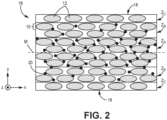
- FIG. 2 is a simplified cross-sectional illustration of preform 16 formed from ten plies 10 stacked along the z-axis (i.e., thickness direction of preform 16). Weft tows 12 are visible in the cross-sectional plane shown.
- Preform 16 includes oppositely disposed outer surfaces 18 with midplane M halfway therebetween. It can be desirable to deposit inorganic (e.g., ceramic) particles 20 within individual plies 10 and stack them such that particle loading is greatest (i.e., porosity is lowest) near midplane M, and lessens moving toward each outer surface 18. This creates a gradient microstructure along the thickness direction of preform 16 forming a gradient preform.
- inorganic particles 20 e.g., ceramic
- Particles 20 can be formed from one or more of silicon carbide, boron carbide, hafnium oxide, hafnium boride, aluminum oxide, ytterbium oxide, or zirconium boride, to name a few non-limiting examples.
- Particles 20 can be a homogeneous or heterogenous mixture of generally spherical, elongate, or otherwise irregularly shaped particles (e.g., short ceramic fibers).
- Particle size for an individual particle 20 can range from 0.5 microns to 100 microns, and particles 20 can further be a homogeneous or heterogenous mixture of such particle sizes. The number and/or size of particles 20 can be used to control particle loading throughout preform 16.
- Preform 16 can be divided into a plurality of zones (collectively "zones Z") defining the gradient microstructure.
- Particle loading can be highest at midplane zone Z A , which, as shown in FIG. 2 , includes at least four plies 10.
- Particle loading can range from 5 wt% to 15 wt% in midplane zone Z A , with the wt% being a function of the fiber content (i.e., of tows 12) and particles 20.
- Intermediate zones Z B can be in direct contact with and disposed on either side of midplane zone Z A .
- Each intermediate zone Z B can include at least two plies 10. The particle loading in each midplane zone Z B can be less than the particle loading of midplane zone Z A .
- surface zones Zc are in direct contact with intermediate zones Z B and are the outermost zones of preform 16.
- Each surface zone Zc can include a single ply 10.
- Each surface zone Zc is free from particles 20, that is, no particles 20 are deposited on the outermost plies 10 prior to layup. A small number of particles 20 from other zones Z may migrate into either surface zone Zc during processing. Being generally free from particles 20, particle loading of surface zones Zc is lower than in intermediate zones Z B . Accordingly, surface zones Zc can have a higher porosity than intermediate zones Z B , which can have a higher porosity than midplane zone Z A . Particle loading in each surface zone Zc can be less than 5 wt%.
- any zone Z can include more or fewer plies 10 than depicted in FIG. 2 .
- Each surface zone Zc can include two plies 10.
- Midplane and/or intermediate zones can also have a greater number of plies 10, or fewer plies 10 depending on the total number of plies 10 in the preform.
- Additional (e.g., intermediate) zones Z can be included by including additional plies 10, or by the redistribution of zones Z among the ten plies 10 depicted in FIG. 2 .
- preform 16 can include only two types of zones-particle-free surfaces zones surrounding a single particle-loaded (e.g., midplane) zone.
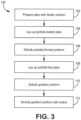
- FIG. 3 is a flowchart illustrating steps 102-112 of method 100 for forming a CMC component from a gradient preform (e.g., preform 16).
- individual plies e.g., plies 10
- Step 102 includes the application of a binder solution with particles (e.g., particles 20) to the plies intended for non-surface zones, and a binder-only solution for the plies intended for surface zones.
- a slurry spray process can be used.
- a solution containing a polymer binder e.g., polyvinyl alcohol - PVA, or polyvinyl butyral - PVB
- a suitable solvent e.g., water for PVA or an alcohol for PVB
- an optional dispersant can be loaded with particles and sprayed onto individual plies.
- Surface zone plies can be sprayed with a solution of binder and solvent.
- a pipetting process is used in which droplets of a solution of binder and solvent can be loaded with particles and applied to the surfaces of the plies. Similar to the previous examples, surface zone plies receive droplets of a binder solution only.
- plies can be impregnated with a binder solution loaded with particles to form pre-preg plies. Similar to the previous two examples, surface zone plies can be impregnated with the binder solution only.
- the wt% of binder in solution can be higher in the third example than in the first or second examples.
- distinct binder solutions with different particle concentrations can be used on the midplane zone and intermediate zone plies to achieve higher midplane zone particle loading, or the same binder can be applied in different quantities to achieve a similar effect.
- particle-loaded plies can be laid up to form the midplane and intermediate zones. More specifically, plies with the highest particle loading can be stacked in the midplane zone. Plies with relative lower particle loading can be stacked and disposed on either side of the midplane zone to form intermediate zones.
- the partially formed preform can be debulked/consolidated using one or a combination of mechanical and vacuum compressive force along with heat. This can nominally reduce the thickness of the preform and also remove at least some of the solvent from the binder solution.
- plies prepared with only the binder solution i.e., particle-free plies
- Laying up particle-free plies after step 106 helps reduce the migration of particles from the intermediate and/or midplane zones into the surface zones.
- debulking can be repeated on the entire gradient preform. Any loosely-adhered particles that migrate to the surface zones (i.e., migrant particles) between steps 106 and 110 can be optionally removed using a light brushing technique, the application of a lightly pressurized stream of air, etc.
- the plies can be laid up in a different order, such as from one surface zone to the other. More specifically, a subset of particle-free plies intended for the inner surface of the preform can be laid up first. Layup can proceed with the plies of first intermediate zone, the midplane zone, the second intermediate zone, and finally, the outer surface zone plies. Debulking can occur repeatedly and at various stages in such an embodiment, such that steps 104-110 are differently ordered and some may be repeated. Such a layup can be necessary for nonplanar preforms with inner plies becoming inaccessible during preforming, such as airfoils.
- all plies laid up can come from a stock of particle-loaded plies, which can be more economical with fewer manufacturing errors as it simplifies ply preparation.
- surface plies can be treated with brushing and/or pressurized air to remove at least a majority of the particles. Such removal techniques should be carried out more robustly/extensively than for the optional removal of migrant particles discussed above.
- the gradient preform can be densified with a matrix using CVI to form a CMC component.
- the plies are infiltrated by reactant vapors, and a gaseous precursor deposits on the ceramic tows.
- the matrix material can be silicon carbide or other suitable ceramic material. Densification is carried out until the resulting CMC has reached the desired residual porosity. Interface coating(s) (e.g., of boron nitride) can be deposited prior to the matrix to ensure that the composite fails in a non-brittle manner.
- densification can additionally and/or alternatively include other methodologies such as, but not limited to, melt infiltration (MI) and polymer infiltration and pyrolysis (PIP).
- the matrix can deposit in an inside-out manner, referring directionally from the midplane to each outer surface 18, in a uniform manner.
- the increasing porosity from the midplane out prevents "canning off' of the preform region near the midplane, where the matrix deposits too quickly near the outer surface of the preform and prevents reactant vapors from accessing the midplane region. This can lead to asymmetrical densification with an undesirably porous midplane region compared to sufficiently densified outer surfaces.
- the inclusion of inorganic particles also provides additional surface area upon which the matrix deposits.
- the use of particle-free plies at the preform outer surfaces can be more cost effective than depositing particles throughout the preform thickness because fewer materials are needed to prepare surface plies.
- additional particles e.g., particles 20
- additional particles can be applied to the outer surface of the CMC component in an optional smoothing step.
- Such a step can be carried out using a seal coating process suitable for ceramic substrates.
- a CMC component formed from the disclosed gradient preform can be incorporated into aerospace, maritime, or industrial equipment, to name a few, non-limiting examples.
- a method of forming a ceramic matrix composite includes preparing a plurality of fibrous ceramic plies by applying a binder solution loaded with ceramic particles to each of a first subset of plies, and applying the binder solution without ceramic particles to each of a second subset of plies.
- the method further includes arranging the plurality of plies to form a preform with a gradient along a thickness direction of the preform by stacking the first subset of plies to form a first zone of the preform, and stacking individual ones of the second subset of the plies on both sides of the first zone to form a second zone on each side of the first zone. Loading of the ceramic particles is higher in the first zone than in the second zones.
- the method further includes densifying the preform with a ceramic matrix.
- the method of the preceding paragraph can optionally include, additionally and/or alternatively, any one or more of the following features, configurations and/or additional steps:
- the above method can further include applying the binder solution with the ceramic particles to a third subset of plies, and stacking individual ones of the third subset of plies on both sides of the first zone and between the first and second zones to form third zones on each side of the first zone.
- arranging the preform can include forming the first zone, subsequently, forming the third zones, and debulking the first zone and the third zones.
- Any of the above methods can further include subsequently, forming the second zones, and debulking the first zone, the second zones, and the third zones.
- arranging the preform can include forming one of the second zones, subsequently, forming one of the third zones, subsequently, forming the first zone, subsequently, forming an other of the third zones, and subsequently, forming an other of the second zones.
- Any of the above methods can further include debulking the first zone, the second zones, and the third zones.
- Any of the above methods can further include removing migrant ceramic particles from the second zones using one of a brushing and blowing technique.
- the step of densifying the preform with a ceramic matrix can include one or a combination of chemical vapor infiltration, melt infiltration, and polymer infiltration and pyrolysis.
- the binder solution can include a solvent, a dispersant, and one of polyvinyl alcohol and polyvinyl butyral.
- the ceramic particles can include one or a combination of silicon carbide, boron carbide, hafnium oxide, hafnium boride, aluminum oxide, ytterbium oxide, or zirconium boride.
- the step of applying the binder solution to each of the first subset and the second subset of plies can include one of a spraying and pipetting technique.
- each of the first subset and the second subset of plies can be impregnated with the binder solution.
- a gradient preform includes a stacking arrangement of fibrous ceramic plies including a first zone having a first subset of plies, and a second zone disposed on each side of the first zone, each second zone having a second subset of plies.
- the preform further includes ceramic particles dispersed throughout the first zone such that loading of the ceramic particles is higher in the first zone than in the second zones.
- the plies can be formed from tows of silicon carbide.
- a tow architecture of each of the plies can be one of harness-satin, plain, twill, braid, and unidirectional.
- the ceramic particles can include one or a combination of silicon carbide, boron carbide, hafnium oxide, hafnium boride, aluminum oxide, ytterbium oxide, or zirconium boride.
- a size of the ceramic particles can range from 0.5 microns to 100 microns.
- a particle loading of the first zone can range from 5 wt% to 15 wt%.
- a particle loading of each of the second zones can be less than 5 wt%.
- any of the above preforms can further include a third zone disposed on both sides of the first zone and between the first zone and each of the second zone, each of the third zones having a third subset of plies.
Landscapes
- Chemical & Material Sciences (AREA)
- Engineering & Computer Science (AREA)
- Ceramic Engineering (AREA)
- Materials Engineering (AREA)
- Structural Engineering (AREA)
- Organic Chemistry (AREA)
- Inorganic Chemistry (AREA)
- Manufacturing & Machinery (AREA)
- Dispersion Chemistry (AREA)
- Nanotechnology (AREA)
- Chemical Kinetics & Catalysis (AREA)
- Ceramic Products (AREA)
Applications Claiming Priority (1)
| Application Number | Priority Date | Filing Date | Title |
|---|---|---|---|
| US18/205,079 US20240400467A1 (en) | 2023-06-02 | 2023-06-02 | Particle enhanced ceramic matrix composite with no particles on surface plies |
Publications (1)
| Publication Number | Publication Date |
|---|---|
| EP4477413A1 true EP4477413A1 (de) | 2024-12-18 |
Family
ID=91247024
Family Applications (1)
| Application Number | Title | Priority Date | Filing Date |
|---|---|---|---|
| EP24178082.4A Pending EP4477413A1 (de) | 2023-06-02 | 2024-05-24 | Mit partikeln verbesserter keramikmatrix-verbundwerkstoff ohne partikel auf oberflächenschichten |
Country Status (2)
| Country | Link |
|---|---|
| US (1) | US20240400467A1 (de) |
| EP (1) | EP4477413A1 (de) |
Citations (3)
| Publication number | Priority date | Publication date | Assignee | Title |
|---|---|---|---|---|
| EP3106752B1 (de) * | 2014-02-12 | 2020-01-08 | Mitsubishi Chemical Corporation | Brennerstein, brenner und ofen |
| EP3650424A1 (de) * | 2018-11-09 | 2020-05-13 | United Technologies Corporation | Beschleunigte cvi-verdichtung von cmc durch infiltration |
| US20210238101A1 (en) * | 2015-02-27 | 2021-08-05 | General Electric Company | Ceramic matrix composite structures with controlled microstructures fabricated using chemical vapor infiltration (cvi) |
Family Cites Families (4)
| Publication number | Priority date | Publication date | Assignee | Title |
|---|---|---|---|---|
| JP3624388B2 (ja) * | 1995-09-22 | 2005-03-02 | 財団法人石油産業活性化センター | 傾斜ポア複合材プリフォームの製造方法 |
| US7708851B2 (en) * | 2005-10-25 | 2010-05-04 | General Electric Company | Process of producing a ceramic matrix composite article and article formed thereby |
| US10443386B2 (en) * | 2016-05-04 | 2019-10-15 | General Electric Company | Automated ceramic matrix composite ply layup |
| WO2020209848A1 (en) * | 2019-04-10 | 2020-10-15 | Siemens Aktiengesellschaft | Method for manufacturing a three-dimensional, reinforced composite matrix component |
-
2023
- 2023-06-02 US US18/205,079 patent/US20240400467A1/en active Pending
-
2024
- 2024-05-24 EP EP24178082.4A patent/EP4477413A1/de active Pending
Patent Citations (3)
| Publication number | Priority date | Publication date | Assignee | Title |
|---|---|---|---|---|
| EP3106752B1 (de) * | 2014-02-12 | 2020-01-08 | Mitsubishi Chemical Corporation | Brennerstein, brenner und ofen |
| US20210238101A1 (en) * | 2015-02-27 | 2021-08-05 | General Electric Company | Ceramic matrix composite structures with controlled microstructures fabricated using chemical vapor infiltration (cvi) |
| EP3650424A1 (de) * | 2018-11-09 | 2020-05-13 | United Technologies Corporation | Beschleunigte cvi-verdichtung von cmc durch infiltration |
Also Published As
| Publication number | Publication date |
|---|---|
| US20240400467A1 (en) | 2024-12-05 |
Similar Documents
| Publication | Publication Date | Title |
|---|---|---|
| US10995039B1 (en) | Methods of forming ceramic matrix composites using sacrificial fibers and non-wetting coating | |
| US11097983B2 (en) | Methods of forming ceramic matrix composites using sacrificial fibers and related products | |
| EP2943448B1 (de) | Verfahren zur herstellung von keramikmatrizenverbundstrukturen | |
| US12017379B2 (en) | Ribbonized tows for optimized improved composite performance | |
| US20230192561A1 (en) | Controlled gradient of porosity in cmc | |
| EP4119709B1 (de) | Homogene verbundmikrostruktur | |
| US20250320640A1 (en) | Pressurized stabilization of plies for improved interlaminar properties | |
| CN102712546A (zh) | 低厚度热结构复合材料部件和制造方法 | |
| US20250289765A1 (en) | Cvd functionalized particles for cmc applications | |
| CA3162330C (en) | System and method for coating ceramic fiber | |
| US10821681B2 (en) | Liquid infusion molded ceramic matrix composites and methods of forming the same | |
| EP4477413A1 (de) | Mit partikeln verbesserter keramikmatrix-verbundwerkstoff ohne partikel auf oberflächenschichten | |
| EP4512789A1 (de) | Polymer-towpreg für keramikmatrix-verbundwerkstoffe | |
| EP4119318B1 (de) | Elektrostatische filamentdispergierung für cmc-anwendungen | |
| EP4292995A2 (de) | Mit partikeln eingebettetes servinggarn für cmc-anwendungen | |
| EP4201915A1 (de) | Einführung von metallischen teilchen zur herstellung von metallischen karbiden in einer matrix | |
| US20240308927A1 (en) | Three-dimensional weave with sacrificial z-fibers for improved ceramic matrix composite microstructure | |
| EP4538251A1 (de) | Dispersion von filamenten | |
| EP4600232A1 (de) | Schnittstellenbeschichtungsverfahren |
Legal Events
| Date | Code | Title | Description |
|---|---|---|---|
| PUAI | Public reference made under article 153(3) epc to a published international application that has entered the european phase |
Free format text: ORIGINAL CODE: 0009012 |
|
| STAA | Information on the status of an ep patent application or granted ep patent |
Free format text: STATUS: THE APPLICATION HAS BEEN PUBLISHED |
|
| AK | Designated contracting states |
Kind code of ref document: A1 Designated state(s): AL AT BE BG CH CY CZ DE DK EE ES FI FR GB GR HR HU IE IS IT LI LT LU LV MC ME MK MT NL NO PL PT RO RS SE SI SK SM TR |
|
| STAA | Information on the status of an ep patent application or granted ep patent |
Free format text: STATUS: REQUEST FOR EXAMINATION WAS MADE |
|
| 17P | Request for examination filed |
Effective date: 20250616 |