EP4475232A1 - Elektrolyt für eine wiederaufladbare lithiumbatterie und wiederaufladbare lithiumbatterie damit - Google Patents
Elektrolyt für eine wiederaufladbare lithiumbatterie und wiederaufladbare lithiumbatterie damit Download PDFInfo
- Publication number
- EP4475232A1 EP4475232A1 EP24165458.1A EP24165458A EP4475232A1 EP 4475232 A1 EP4475232 A1 EP 4475232A1 EP 24165458 A EP24165458 A EP 24165458A EP 4475232 A1 EP4475232 A1 EP 4475232A1
- Authority
- EP
- European Patent Office
- Prior art keywords
- compound
- electrolyte
- crown
- lithium battery
- rechargeable lithium
- Prior art date
- Legal status (The legal status is an assumption and is not a legal conclusion. Google has not performed a legal analysis and makes no representation as to the accuracy of the status listed.)
- Withdrawn
Links
Images
Classifications
-
- H—ELECTRICITY
- H01—ELECTRIC ELEMENTS
- H01M—PROCESSES OR MEANS, e.g. BATTERIES, FOR THE DIRECT CONVERSION OF CHEMICAL ENERGY INTO ELECTRICAL ENERGY
- H01M10/00—Secondary cells; Manufacture thereof
- H01M10/05—Accumulators with non-aqueous electrolyte
- H01M10/056—Accumulators with non-aqueous electrolyte characterised by the materials used as electrolytes, e.g. mixed inorganic/organic electrolytes
- H01M10/0564—Accumulators with non-aqueous electrolyte characterised by the materials used as electrolytes, e.g. mixed inorganic/organic electrolytes the electrolyte being constituted of organic materials only
- H01M10/0566—Liquid materials
-
- H—ELECTRICITY
- H01—ELECTRIC ELEMENTS
- H01M—PROCESSES OR MEANS, e.g. BATTERIES, FOR THE DIRECT CONVERSION OF CHEMICAL ENERGY INTO ELECTRICAL ENERGY
- H01M10/00—Secondary cells; Manufacture thereof
- H01M10/05—Accumulators with non-aqueous electrolyte
- H01M10/052—Li-accumulators
-
- H—ELECTRICITY
- H01—ELECTRIC ELEMENTS
- H01M—PROCESSES OR MEANS, e.g. BATTERIES, FOR THE DIRECT CONVERSION OF CHEMICAL ENERGY INTO ELECTRICAL ENERGY
- H01M10/00—Secondary cells; Manufacture thereof
- H01M10/05—Accumulators with non-aqueous electrolyte
- H01M10/052—Li-accumulators
- H01M10/0525—Rocking-chair batteries, i.e. batteries with lithium insertion or intercalation in both electrodes; Lithium-ion batteries
-
- H—ELECTRICITY
- H01—ELECTRIC ELEMENTS
- H01M—PROCESSES OR MEANS, e.g. BATTERIES, FOR THE DIRECT CONVERSION OF CHEMICAL ENERGY INTO ELECTRICAL ENERGY
- H01M10/00—Secondary cells; Manufacture thereof
- H01M10/05—Accumulators with non-aqueous electrolyte
- H01M10/056—Accumulators with non-aqueous electrolyte characterised by the materials used as electrolytes, e.g. mixed inorganic/organic electrolytes
- H01M10/0564—Accumulators with non-aqueous electrolyte characterised by the materials used as electrolytes, e.g. mixed inorganic/organic electrolytes the electrolyte being constituted of organic materials only
- H01M10/0566—Liquid materials
- H01M10/0567—Liquid materials characterised by the additives
-
- H—ELECTRICITY
- H01—ELECTRIC ELEMENTS
- H01M—PROCESSES OR MEANS, e.g. BATTERIES, FOR THE DIRECT CONVERSION OF CHEMICAL ENERGY INTO ELECTRICAL ENERGY
- H01M10/00—Secondary cells; Manufacture thereof
- H01M10/05—Accumulators with non-aqueous electrolyte
- H01M10/056—Accumulators with non-aqueous electrolyte characterised by the materials used as electrolytes, e.g. mixed inorganic/organic electrolytes
- H01M10/0564—Accumulators with non-aqueous electrolyte characterised by the materials used as electrolytes, e.g. mixed inorganic/organic electrolytes the electrolyte being constituted of organic materials only
- H01M10/0566—Liquid materials
- H01M10/0568—Liquid materials characterised by the solutes
-
- H—ELECTRICITY
- H01—ELECTRIC ELEMENTS
- H01M—PROCESSES OR MEANS, e.g. BATTERIES, FOR THE DIRECT CONVERSION OF CHEMICAL ENERGY INTO ELECTRICAL ENERGY
- H01M10/00—Secondary cells; Manufacture thereof
- H01M10/05—Accumulators with non-aqueous electrolyte
- H01M10/056—Accumulators with non-aqueous electrolyte characterised by the materials used as electrolytes, e.g. mixed inorganic/organic electrolytes
- H01M10/0564—Accumulators with non-aqueous electrolyte characterised by the materials used as electrolytes, e.g. mixed inorganic/organic electrolytes the electrolyte being constituted of organic materials only
- H01M10/0566—Liquid materials
- H01M10/0569—Liquid materials characterised by the solvents
-
- H—ELECTRICITY
- H01—ELECTRIC ELEMENTS
- H01M—PROCESSES OR MEANS, e.g. BATTERIES, FOR THE DIRECT CONVERSION OF CHEMICAL ENERGY INTO ELECTRICAL ENERGY
- H01M4/00—Electrodes
- H01M4/02—Electrodes composed of, or comprising, active material
- H01M4/36—Selection of substances as active materials, active masses, active liquids
- H01M4/362—Composites
- H01M4/364—Composites as mixtures
-
- H—ELECTRICITY
- H01—ELECTRIC ELEMENTS
- H01M—PROCESSES OR MEANS, e.g. BATTERIES, FOR THE DIRECT CONVERSION OF CHEMICAL ENERGY INTO ELECTRICAL ENERGY
- H01M4/00—Electrodes
- H01M4/02—Electrodes composed of, or comprising, active material
- H01M4/36—Selection of substances as active materials, active masses, active liquids
- H01M4/362—Composites
- H01M4/366—Composites as layered products
-
- H—ELECTRICITY
- H01—ELECTRIC ELEMENTS
- H01M—PROCESSES OR MEANS, e.g. BATTERIES, FOR THE DIRECT CONVERSION OF CHEMICAL ENERGY INTO ELECTRICAL ENERGY
- H01M4/00—Electrodes
- H01M4/02—Electrodes composed of, or comprising, active material
- H01M4/36—Selection of substances as active materials, active masses, active liquids
- H01M4/38—Selection of substances as active materials, active masses, active liquids of elements or alloys
- H01M4/386—Silicon or alloys based on silicon
-
- H—ELECTRICITY
- H01—ELECTRIC ELEMENTS
- H01M—PROCESSES OR MEANS, e.g. BATTERIES, FOR THE DIRECT CONVERSION OF CHEMICAL ENERGY INTO ELECTRICAL ENERGY
- H01M4/00—Electrodes
- H01M4/02—Electrodes composed of, or comprising, active material
- H01M4/36—Selection of substances as active materials, active masses, active liquids
- H01M4/48—Selection of substances as active materials, active masses, active liquids of inorganic oxides or hydroxides
- H01M4/52—Selection of substances as active materials, active masses, active liquids of inorganic oxides or hydroxides of nickel, cobalt or iron
- H01M4/525—Selection of substances as active materials, active masses, active liquids of inorganic oxides or hydroxides of nickel, cobalt or iron of mixed oxides or hydroxides containing iron, cobalt or nickel for inserting or intercalating light metals, e.g. LiNiO2, LiCoO2 or LiCoOxFy
-
- H—ELECTRICITY
- H01—ELECTRIC ELEMENTS
- H01M—PROCESSES OR MEANS, e.g. BATTERIES, FOR THE DIRECT CONVERSION OF CHEMICAL ENERGY INTO ELECTRICAL ENERGY
- H01M4/00—Electrodes
- H01M4/02—Electrodes composed of, or comprising, active material
- H01M4/36—Selection of substances as active materials, active masses, active liquids
- H01M4/58—Selection of substances as active materials, active masses, active liquids of inorganic compounds other than oxides or hydroxides, e.g. sulfides, selenides, tellurides, halogenides or LiCoFy; of polyanionic structures, e.g. phosphates, silicates or borates
- H01M4/583—Carbonaceous material, e.g. graphite-intercalation compounds or CFx
- H01M4/587—Carbonaceous material, e.g. graphite-intercalation compounds or CFx for inserting or intercalating light metals
-
- H—ELECTRICITY
- H01—ELECTRIC ELEMENTS
- H01M—PROCESSES OR MEANS, e.g. BATTERIES, FOR THE DIRECT CONVERSION OF CHEMICAL ENERGY INTO ELECTRICAL ENERGY
- H01M4/00—Electrodes
- H01M4/02—Electrodes composed of, or comprising, active material
- H01M4/62—Selection of inactive substances as ingredients for active masses, e.g. binders, fillers
- H01M4/624—Electric conductive fillers
- H01M4/625—Carbon or graphite
-
- H—ELECTRICITY
- H01—ELECTRIC ELEMENTS
- H01M—PROCESSES OR MEANS, e.g. BATTERIES, FOR THE DIRECT CONVERSION OF CHEMICAL ENERGY INTO ELECTRICAL ENERGY
- H01M2300/00—Electrolytes
- H01M2300/0017—Non-aqueous electrolytes
- H01M2300/0025—Organic electrolyte
- H01M2300/0028—Organic electrolyte characterised by the solvent
- H01M2300/0037—Mixture of solvents
- H01M2300/004—Three solvents
-
- Y—GENERAL TAGGING OF NEW TECHNOLOGICAL DEVELOPMENTS; GENERAL TAGGING OF CROSS-SECTIONAL TECHNOLOGIES SPANNING OVER SEVERAL SECTIONS OF THE IPC; TECHNICAL SUBJECTS COVERED BY FORMER USPC CROSS-REFERENCE ART COLLECTIONS [XRACs] AND DIGESTS
- Y02—TECHNOLOGIES OR APPLICATIONS FOR MITIGATION OR ADAPTATION AGAINST CLIMATE CHANGE
- Y02E—REDUCTION OF GREENHOUSE GAS [GHG] EMISSIONS, RELATED TO ENERGY GENERATION, TRANSMISSION OR DISTRIBUTION
- Y02E60/00—Enabling technologies; Technologies with a potential or indirect contribution to GHG emissions mitigation
- Y02E60/10—Energy storage using batteries
Definitions
- One or more aspects of embodiments of the present disclosure relate to an electrolyte for a rechargeable lithium battery and a rechargeable lithium battery including the same.
- a rechargeable lithium battery may be recharged and may have three or more times higher (i.e., has at least three times more) energy density per unit of weight than a comparable lead storage battery, nickel-cadmium battery, nickel hydrogen battery, nickel zinc battery and/or the like. It may be also charged at a relatively high rate and thus, may be commercially manufactured for a laptop, a cell phone, an electric tool, an electric bike, and/or the like. Research on further improvement of additional energy density has been actively made and/or pursued.
- a rechargeable lithium battery may be manufactured by injecting an electrolyte into a battery cell, which includes a positive electrode including a positive electrode active material capable of intercalating/deintercalating lithium ions and a negative electrode including a negative electrode active material capable of intercalating/deintercalating lithium ions.
- One or more aspects of embodiments of the present disclosure are directed toward a rechargeable lithium battery that can attain improved cycle-life characteristics even during rapid charging by applying the electrolyte.
- One or more embodiments of the present invention provide for an electrolyte for a rechargeable lithium battery including a non-aqueous organic solvent, a lithium salt, and an additive, wherein the additive includes a composition including a first compound and a second compound, the first compound is an imide cesium salt compound represented by Chemical Formula 1 and the second compound is a crown ether compound represented by Chemical Formula 2, and for a rechargeable lithium battery including the electrolyte:
- the rapid charging performance of a rechargeable lithium battery can be further improved and desirable or suitable cycle-life characteristics can be secured even during rapid charging.
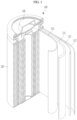
- the drawing is a schematic view illustrating a rechargeable lithium battery according to some example embodiments.
- substituted refers to replacement of at least one hydrogen of a substituent or a compound by deuterium, a halogen, a hydroxyl group, an amino group, a substituted or unsubstituted C1 to C30 amine group, a nitro group, a substituted or unsubstituted C1 to C40 silyl group, a C1 to C30 alkyl group, a C1 to C10 alkylsilyl group, a C6 to C30 arylsilyl group, a C3 to C30 cycloalkyl group, a C3 to C30 heterocycloalkyl group, a C6 to C30 aryl group, a C2 to C30 heteroaryl group, a C1 to C20 alkoxy group, a C1 to C10 fluoroalkyl group, a cyano group, or a combination thereof.
- substituted may refer to replacement of at least one hydrogen of a substituent or a compound by deuterium, a halogen, a C1 to C30 alkyl group, a C1 to C10 alkylsilyl group, a C6 to C30 arylsilyl group, a C3 to C30 cycloalkyl group, a C3 to C30 heterocycloalkyl group, a C6 to C30 aryl group, a C2 to C30 heteroaryl group, a C1 to C10 fluoroalkyl group, or a cyano group.
- substituted refers to replacement of at least one hydrogen of a substituent or a compound by deuterium, a halogen group, a C1 to C20 alkyl group, a C6 to C30 aryl group, a C1 to C10 fluoroalkyl group, or a cyano group. In some embodiments, “substituted” refers to replacement of at least one hydrogen of a substituent or a compound by deuterium, a halogen, a C1 to C5 alkyl group, a C6 to C18 aryl group, a C1 to C5 fluoroalkyl group, or a cyano group.
- substituted refers to replacement of at least one hydrogen of a substituent or a compound by deuterium, a cyano group, a halogen, a methyl group, an ethyl group, a propyl group, a butyl group, a phenyl group, a biphenyl group, a terphenyl group, a trifluoromethyl group, or a naphthyl group.
- a rechargeable lithium battery may be classified into a lithium ion battery, a lithium ion polymer battery, and/or a lithium polymer battery depending on kinds of a separator and/or an electrolyte. It also may be classified to be cylindrical, prismatic, coin-type or kind, pouch-type or kind, and/or the like depending on its shape. In some embodiments, it may be bulk type or kind and/or thin film type or kind depending on its size. Structures and manufacturing methods for the batteries pertaining to this disclosure should be well understood by those of ordinary skill in the art.
- a rechargeable lithium battery 100 includes a battery cell including a positive electrode 114; a negative electrode 112 facing the positive electrode 114, a separator 113 between the positive electrode 114 and the negative electrode 112, and an electrolyte impregnating the positive electrode 114, the negative electrode 112, and the separator 113; a battery case 120 housing the battery cell, and a sealing member 140 sealing the battery case 120.
- a rechargeable lithium battery includes an electrolyte, a positive electrode, and a negative electrode.
- the electrolyte includes a non-aqueous organic solvent, a lithium salt, and an additive.
- the additive may be a composition including a first compound and a second compound, wherein the first compound is an imide cesium salt compound represented by Chemical Formula 1 and the second compound is a crown ether compound represented by Chemical Formula 2.
- R 1 and R 2 are each independently fluorine or a C1 to C3 fluoroalkyl group substituted with at least one fluorine; provided that at least one of R 1 or R 2 is a fluorine;
- Z is O or NH; x and y each independently an integer of 0 or 1; and m and n ate each independently one of integers of 1 to 3.
- the first compound which an imide cesium salt compound represented by Chemical Formula 1
- SEI solid electrolyte interface
- the first compound is present in the form of a salt and thus exhibits sharply or relatively deteriorated solubility at a set or certain concentration in the electrolyte, somewhat deteriorating or reducing the effect of improving high temperature characteristics.
- the second compound is a crown ether compound represented by Chemical Formula 2 and if utilized with the first compound, may contribute to improving the solubility of the first compound and resultantly, may activate a mechanism that (e.g., a reaction by which) the first compound is reduced and decomposed to form the SEI film on the negative electrode and thereby, secure suitable cycle-life characteristics of the rechargeable lithium battery even during the rapid charging.
- composition of the present embodiments includes the first compound, and the second compound at a weight ratio of 1:4 to 1:10.
- the first compound may not be suitably dissolved, and if the second compound is included in an excessive amount above (e.g., outside) the above range, the first compound may then be included in a rather (relatively) small amount, and thus rapid charging characteristics may not be suitably or sufficiently exhibited.
- the composition may include the first compound and the second compound at a weight ratio of 1:4 to 1:10, 1:4 to 1:9, or 1:4 to 1:8. Within any of these ranges, a degree of improvement in rapid charging characteristics due to the synergistic effect of the combination of the first compound and the second compound can be maximized or increased.
- a more stable negative electrode SEI can be formed. Accordingly, a side reaction between the lithium ions intercalated in the negative electrode and the electrolyte may be effectively or suitably suppressed or reduced even in a rapid charging situation, thereby improving the rapid charging performance of the rechargeable lithium battery and ensuring suitable cycle-life characteristics even during rapid charging.
- the fluoro group directly linked to the sulfone forms a stable SEI film, and thus the effect of improving rapid charging characteristics can be significantly improved.
- R 1 may be fluorine
- R 2 may be a fluorine, a C1 fluoroalkyl group substituted with three fluorine, a C2 fluoroalkyl group substituted with five fluorine, or a C3 fluoroalkyl group substituted with seven fluorine.
- CsFSI cesium bis(fluorosulfonyl) imide
- the fluorine atoms are directly linked to the sulfone and are present on both sides (e.g., both sulfone groups), and thus an effect of improving rapid charging characteristics may be more excellently expressed (e.g., rapid charging characteristics may be further improved).
- the second compound acts as a cation receptor for the first compound and contributes to improving solubility.
- the solubility of the first compound can be more effectively or suitably improved. If the second compound includes less than 5 ether groups, the solubility of the first compound cannot be effectively or suitable improved, and therefore the desired rapid charging improvement may not be achieved.
- the second compound may be a crown ether compound represented by any one of Chemical Formulae 2-1 to 2-3:
- n and n may each independently be one of integers of 1 to 3.
- the second compound may be at least one selected from among 15-crown-5, 18-crown-6, 21-crown-7, 24-crown-8, dibenzo-15-crown-5, dibenzo-18-crown-6, dibenzo-21-crown-7, dibenzo-24-crown-8, 1-aza-15-crown-5, 1-aza-18-crown-6, 1-aza-21-crown-7, and 1-aza-24-crown-8.
- a size of the crown is suitable for trapping the cation of the first compound, so that the first compound may be dissolved more effectively or suitably.
- the first compound may be included in an amount of 0.1 to 2.0 wt%, for example, 0.5 to 2.0 wt%, 0.5 to 1.5 wt%, 0.7 to 2.0 wt%, or 0.7 to 1.0 wt% based on 100 wt% of the electrolyte for a rechargeable lithium battery.
- the second compound may be included in an amount of 0.1 to less than 10 wt%, for example 0.1 to 8.0 wt%, 0.5 to 8.0 wt%, 1.0 to 8.0 wt%, 2.8 to 8 wt%, or 4.0 to 8.0 wt% based on 100 wt% of the electrolyte for a rechargeable lithium battery.
- composition including the first compound and the second compound may be included in an amount of 0.5 to less than 10 wt%, for example 1.0 to less than 10 wt%, 2.0 to less than 10 wt%, or 2.5 to less than 10 wt% based on 100 wt% of the electrolyte for a rechargeable lithium battery.
- the composition includes the first compound and the second compound in a weight ratio of 1:4 to 1:10, and within the above range, the first compound may be included in an amount of 0.7 to 2.0 wt% based on 100 wt% of the electrolyte for a rechargeable lithium battery, and the second compound may be included in an amount of 2.8 to 8 wt% based on 100 wt% of the electrolyte for a rechargeable lithium battery.
- the composition may include the first compound and the second compound in a weight ratio of 1:4 to 1:18, and within the above range, the first compound may be included in an amount of 0.7 to 1.0 wt% based on 100 wt% of the electrolyte for a rechargeable lithium battery, and the second compound may be included in an amount of 4 to 8 wt% based on 100 wt% of the electrolyte for a rechargeable lithium battery
- a rechargeable lithium battery with improved resistance characteristics if stored at high temperature may be implemented.
- the lithium salt dissolved in the non-aqueous organic solvent facilitates the supply of lithium ions in a battery, enables a basic operation of a rechargeable lithium battery, and improves transportation of the lithium ions between positive and negative electrodes.
- the lithium salt include at least one selected from among LiPF 6 , LiBF 4 , LiDFOP, LiDFOB, LiPO 2 F 2 , LiSbF 6 , LiAsF 6 , LiN(SO 2 C 2 F 5 ) 2 , Li(CF 3 SO 2 ) 2 N, LiN(SO 3 C 2 F 5 ) 2 , Li(FSO 2 ) 2 N (lithium bis(fluorosulfonyl)imide: LiFSI), LiC 4 F 9 SO 3 , LiClO 4 , LiAlO 2 , LiAlCl 4 , LiN(C p F 2p+1 SO 2 )(C q F 2q+1 SO 2 ), wherein, p and q may each independently be an integer of 1 to 20, LiC
- the lithium salt may be utilized in a concentration in a range of 0.1 M to 2.0 M. If the lithium salt is included at the above concentration range, an electrolyte may have excellent or suitable performance and/or lithium ion mobility due to optimal or suitable electrolyte conductivity and viscosity.
- the non-aqueous organic solvent serves as a medium for transmitting ions taking part in the electrochemical reaction of a battery.
- the ester-based solvent may include methyl acetate, ethyl acetate, n-propyl acetate, t-butyl acetate, methylpropionate, ethylpropionate, propylpropionate, decanolide, mevalonolactone, caprolactone, and/or the like.
- the ether-based solvent may include dibutyl ether, tetraglyme, diglyme, dimethoxyethane, 2-methyltetrahydrofuran, tetrahydrofuran, and/or the like.
- the ketone-based solvent may include cyclohexanone and/or the like.
- the alcohol-based solvent may include ethyl alcohol, isopropyl alcohol, and/or the like, and examples of the aprotic solvent include nitriles (such as R-CN (wherein R is a C2 to C20 linear, branched, or cyclic hydrocarbon group, a double bond, an aromatic ring, or an ether bond)), amides (such as dimethylformamide), dioxolanes (such as 1,3-dioxolane), sulfolanes, and/or the like.
- nitriles such as R-CN (wherein R is a C2 to C20 linear, branched, or cyclic hydrocarbon group, a double bond, an aromatic ring, or an ether bond
- amides such as dimethylformamide
- dioxolanes such as 1,3-dioxolane
- sulfolanes and/or the like.
- the non-aqueous organic solvent may be utilized alone or in combination with one or more of them, and if utilized in combination with one or more, a mixing ratio may be appropriately or suitably adjusted according to the desired or suitable battery performance, which should be well understood by those skilled in the art.
- the carbonate-based solvent is prepared by mixing a cyclic carbonate and a chain carbonate.
- the cyclic carbonate and chain carbonate are mixed together in a volume ratio of 5:95 to 50:50. If the mixture is utilized as an electrolyte, it may have enhanced performance.
- the non-aqueous organic solvent may include a carbonate-based solvent in which ethylene carbonate (EC), ethylmethyl carbonate (EMC), and dimethyl carbonate (DMC) are mixed.
- the non-aqueous organic solvent may further include an aromatic hydrocarbon-based solvent as well as the carbonate-based solvent.
- the carbonate-based solvent and aromatic hydrocarbon-based solvent may be mixed together in a volume ratio of 1:1 to 30:1.
- R 201 to R 206 may each independently be the same or different and may be selected from among hydrogen, a halogen, a C1 to C10 alkyl group, a haloalkyl group, and combinations thereof.
- aromatic hydrocarbon-based solvent examples include benzene, fluorobenzene, 1,2-difluorobenzene, 1,3-difluorobenzene, 1,4-difluorobenzene, 1,2,3-trifluorobenzene, 1,2,4-trifluorobenzene, chlorobenzene, 1,2-dichlorobenzene, 1,3-dichlorobenzene, 1,4-dichlorobenzene, 1,2,3-trichlorobenzene, 1,2,4-trichlorobenzene, iodobenzene, 1,2-diiodobenzene, 1,3-diiodobenzene, 1,4-diiodobenzene, 1,2,3-triiodobenzene, 1,2,4-triiodobenzene, toluene, fluorotoluene, 2,3-difluorotoluene, 2,4-difluorobenzene
- the electrolyte may further include vinylene carbonate, vinyl ethylene carbonate, and/or an ethylene-based carbonate-based compound of Chemical Formula 4 to further improve cycle-life of a battery as an additive for improving a cycle-life.
- R 207 and R 208 may each independently be the same or different and may be selected from among hydrogen, a halogen, a cyano group (CN), a nitro group (NO 2 ), and a C1 to C5 fluoroalkyl group, provided that at least one of R 207 or R 208 is a halogen, a cyano group (CN), a nitro group (NO 2 ), or a C1 to C5 fluoroalkyl group, and R 207 and R 208 are not concurrently (e.g., simultaneously) hydrogen.
- Examples of the ethylene carbonate-based compound may include difluoro ethylenecarbonate, chloroethylene carbonate, dichloroethylene carbonate, bromoethylene carbonate, dibromoethylene carbonate, nitroethylene carbonate, cyanoethylene carbonate, and fluoroethylene carbonate.
- the amount of the additive for improving cycle-life may be utilized within an appropriate or suitable range.
- Some example embodiments provide a rechargeable lithium battery including a positive electrode including a positive electrode active material; a negative electrode containing a negative electrode active material; and the electrolyte according to the present embodiments.
- the positive electrode includes a positive electrode current collector and a positive electrode active material layer on the positive electrode current collector, and the positive electrode active material layer includes a positive electrode active material.
- the positive electrode active material may include lithiated intercalation compounds that reversibly intercalate and deintercalate lithium ions.
- the composite oxide having a coating layer on the surface thereof may be utilized, or a mixture of the composite oxide and the composite oxide having a coating layer may be utilized.
- the coating layer may include a coating element compound selected from among oxide of a coating element, hydroxide of a coating element, oxyhydroxide of a coating element, oxycarbonate of a coating element, or hydroxycarbonate of a coating element.
- the compound for the coating layer may be either amorphous or crystalline.
- the coating element included in the coating layer may be Mg, Al, Co, K, Na, Ca, Si, Ti, V, Sn, Ge, Ga, B, As, Zr, or a mixture thereof.
- the coating process may include any suitable processes as long as it does not cause any side effects (e.g., any substantial side effects) on the properties of the positive electrode active material.
- the coating process may be spray coating, dipping, etc., which should be well understood by persons having ordinary skill in this art, and thus a detailed description thereof is not provided.
- the positive electrode active material may include lithium cobalt oxide.
- the lithium cobalt oxide has lower wettability compared to other positive electrode active materials and may impair storage characteristics of a rechargeable lithium battery including the same at a high temperature.
- the electrolyte additive and the positive electrode conductive material of the present embodiments even if lithium cobalt oxide is utilized as the positive electrode active material, the high temperature storage characteristics of the rechargeable lithium battery are improved, and the initial resistance and the increase in resistance during high-temperature storage can be more effectively or suitably suppressed or reduced.
- the positive electrode active material may include lithium cobalt oxide, represented by Chemical Formula 3: Chemical Formula 3 Li a11 CO x11 M 11 y11 O 2 .
- M 11 is selected from among Al, B, Ce, Cr, F, Mg, Mn, Mo, Nb, P, S, Si, Sr, Ti, V, W, Zr, and combinations thereof.
- the positive electrode active material may be LiCoO 2 .
- a content (e.g., amount) of the positive electrode active material may be 50 wt% to 99 wt%, 60 wt% to 99 wt%, 70 wt% to 99 wt%, 80 wt% to 99 wt%, or 90 wt% to 99 wt% based on a total weight of the positive electrode active material layer.
- the positive electrode active material layer may optionally include a conductive material and a binder.
- content (e.g., amount) of the conductive material and the binder may each independently be 1.0 wt% to 5.0 wt%, based on a total weight of the positive electrode active material layer.
- the conductive material is utilized to impart conductivity to the negative electrode, and any suitable electrically conductive material may be utilized as a conductive material so long as it does not cause a substantial chemical change in a battery.
- the conductive material may include a carbon-based material (such as natural graphite, artificial graphite, carbon black, acetylene black, Ketjen black, carbon fiber, and/or the like); a metal-based material of a metal powder and/or a metal fiber including copper, nickel, aluminum, silver, and/or the like; a conductive polymer (such as a polyphenylene derivative); or a mixture thereof.
- the binder improves binding properties of positive electrode active material particles with one another and with a current collector and examples thereof may include polyvinyl alcohol, carboxymethyl cellulose, hydroxypropyl cellulose, diacetyl cellulose, polyvinylchloride, carboxylated polyvinylchloride, polyvinylfluoride, an ethylene oxide-containing polymer, polyvinylpyrrolidone, polyurethane, polytetrafluoroethylene, polyvinylidene fluoride, polyethylene, polypropylene, a styrene-butadiene rubber, an acrylated styrene-butadiene rubber, an epoxy resin, nylon, and/or the like, but are not limited thereto.
- the positive electrode current collector may include Al, but is not limited thereto.
- the negative electrode includes a negative electrode current collector and a negative electrode active material layer including the negative electrode active material on the negative electrode current collector.
- the negative electrode active material may be a material that can reversibly intercalate/deintercalate lithium ions, a lithium metal, a lithium metal alloy, a material capable of doping and dedoping lithium, and/or a transition metal oxide.
- the material that reversibly intercalates/deintercalates lithium ions may include carbon materials.
- the carbon material may be any suitable carbon-based negative electrode active material in a rechargeable lithium battery.
- Examples of the carbon material may include crystalline carbon, amorphous carbon, and a combination thereof.
- the crystalline carbon may be non-shaped, or may be sheet, flake, spherical, and/or fiber shaped natural graphite and/or artificial graphite.
- the amorphous carbon may be a soft carbon, a hard carbon, a mesophase pitch carbonized product, fired coke, and/or the like.
- the lithium metal alloy may include lithium and a metal selected from among Na, K, Rb, Cs, Fr, Be, Mg, Ca, Sr, Si, Sb, Pb, In, Zn, Ba, Ra, Ge, Al, and Sn.
- the material capable of doping and dedoping lithium may include Si, SiO x (0 ⁇ x ⁇ 2), a Si-Q alloy (wherein Q is selected from among an alkali metal, an alkaline-earth metal, a Group 13 element, a Group 14 element, a Group 15 element, a Group 16 element, a transition metal, a rare earth element, and combinations thereof, and is not Si), Sn, SnO 2 , a Sn-R alloy (wherein R is an alkali metal, an alkaline-earth metal, a Group 13 element, a Group 14 element, a Group 15 element, a Group 16 element, a transition element, a rare earth element, or a combination thereof, and is not Sn), and/or the like. At least one of them may be mixed with SiO 2 .
- the elements Q and R may be selected from among Mg, Ca, Sr, Ba, Ra, Sc, Y, Ti, Zr, Hf, Rf, V, Nb, Ta, Db, Cr, Mo, W, Sg, Tc, Re, Bh, Fe, Pb, Ru, Os, Hs, Rh, Ir, Pd, Pt, Cu, Ag, Au, Zn, Cd, B, Al, Ga, Sn, In, Tl, Ge, P, As, Sb, Bi, S, Se, Te, Po, and combinations thereof.
- the transition metal oxide may be a vanadium oxide, a lithium vanadium oxide, and/or the like.
- the negative electrode active material may include at least one of graphite or a Si composite.
- the Si composite may include a core including Si-containing particles and amorphous carbon, and for example, the Si-containing particles may include at least one of Si-C composite, SiO x (0 ⁇ x ⁇ 2), or an Si alloy.
- the Si-C composite may include a core including Si particles and amorphous carbon.
- the central portion of the core may include pores, and the radius of the central portion may correspond to 30% to 50% of the radius of the Si-C composite.
- the Si particles may have an average particle diameter of 10 nm to 200 nm.
- the average particle diameter (D50) may be a particle size (e.g., diameter of particles) at a volume ratio of 50% in a cumulative size-distribution curve.
- the average particle size D50 may be measured by a suitable technique, e.g., using a particle size analyzer, transmission electron microscope photography, and/or scanning electron microscope photography. Another method may be performed by using a measuring device with dynamic light scattering, analyzing data to count a number of particles relative to each particle size, and then calculating to obtain an average particle diameter D50.
- a suitable technique e.g., using a particle size analyzer, transmission electron microscope photography, and/or scanning electron microscope photography.
- Another method may be performed by using a measuring device with dynamic light scattering, analyzing data to count a number of particles relative to each particle size, and then calculating to obtain an average particle diameter D50.
- the average particle diameter D50 indicates a major axis length.
- the average particle diameter of the Si particle is within the above range, volume expansion occurring during charging and discharging may be suppressed or reduced, and a disconnection of a conductive path due to particle crushing during charging and discharging may be prevented or reduced.
- the Si particle may be included in an amount of 1 wt% to 60 wt%, for example, 3 wt% to 60 wt%, based on a total weight of the Si-C composite.
- the central portion may not include (e.g., may exclude) amorphous carbon, but the amorphous carbon may be present on the surface portion (e.g., only on the surface portion) of the negative electrode active material.
- the surface portion indicates a region from the central portion of the negative electrode active material to the outermost surface of the negative electrode active material.
- the Si particles are substantially uniformly included over the negative electrode active material, for example, are present at a substantially uniform concentration in the central portion and the surface portion thereof.
- the amorphous carbon may be (e.g., may include) soft carbon, hard carbon, mesophase pitch carbonized product, calcined coke, or a combination thereof.
- the negative electrode active material may further include crystalline carbon.
- the Si-C composite and crystalline carbon may be included in the form of a mixture, and in this case, the Si-C composite and crystalline carbon may be included in a weight ratio of 1:99 to 50:50.
- the Si-C composite and crystalline carbon may be included in a weight ratio of 3 : 97 to 20 : 80, or 5 : 95 to 20 : 80.
- the crystalline carbon may be, for example, graphite, and may be natural graphite, artificial graphite, or a mixture thereof.
- the crystalline carbon may have an average particle diameter of 5 ⁇ m to 30 ⁇ m.
- the amorphous carbon precursor may include a coal-based pitch, mesophase pitch, petroleum-based pitch, coal-based oil, petroleum-based heavy oil, and/or a polymer resin such as a phenol resin, a furan resin, and/or a polyimide resin.
- the negative electrode active material may be included in an amount of 95 wt% to 99 wt% based on a total weight of the negative electrode active material layer.
- the negative electrode active material layer may include a binder, and optionally, a conductive material.
- the amount of the binder may be 1 wt% to 5 wt% based on a total weight of the negative electrode active material layer.
- the negative electrode active material layer further includes the conductive material, it may include 90 wt% to 98 wt% of the negative electrode active material, 1 wt% to 5 wt% of the binder, and 1 wt% to 5 wt% of the conductive material.
- the binder improves binding properties of negative electrode active material particles with one another and with a current collector.
- the binder may be (e.g., may include) a non-water-soluble binder, a water-soluble binder, or a combination thereof.
- the non-water-soluble binder may be (e.g., may include) polyvinylchloride, carboxylated polyvinylchloride, polyvinylfluoride, polyurethane, polytetrafluoroethylene, polyvinylidene fluoride, polyethylene, polypropylene, polyamideimide, polyimide, or a combination thereof.
- the water-soluble binder may be (e.g., may include) a rubber-based binder and/or a polymer resin binder.
- the rubber-based binder may be selected from among a styrene-butadiene rubber, an acrylated styrene-butadiene rubber (SBR), an acrylonitrile-butadiene rubber, an acrylic rubber, a butyl rubber, a fluorine rubber, and combinations thereof.
- the polymer resin binder may be selected from among polytetrafluoroethylene, ethylenepropylene copolymer, polyethyleneoxide, polyvinylpyrrolidone, polyepichlorohydrin, polyphosphazene, polyacrylonitrile, polystyrene, an ethylene propylenediene copolymer, polyvinylpyridine, chlorosulfonatedpolyethylene, latex, a polyester resin, an acrylic resin, a phenolic resin, an epoxy resin, polyvinylalcohol, and combinations thereof.
- a cellulose-based compound may be further utilized to provide viscosity as a thickener.
- the cellulose-based compound includes one or more of carboxymethyl cellulose, hydroxypropylmethyl cellulose, methyl cellulose, or alkali metal salts thereof.
- the alkali metal may be Na, K, and/or Li.
- the thickener may be included in an amount of 0.1 to 3 wt% based on 100 wt% of the negative electrode active material.
- the negative electrode current collector may be selected from among a copper foil, a nickel foil, a stainless steel foil, a titanium foil, a nickel foam, a copper foam, a polymer substrate coated with a conductive metal, and combinations thereof.
- the rechargeable lithium battery may further include a separator between the negative electrode and the positive electrode, depending on a type or kind of the rechargeable lithium battery.
- the separator may be (e.g., may include) a porous substrate; or it may be a composite porous substrate.
- the porous substrate may be (e.g., may include) a substrate including pores, and lithium ions may move through the pores.
- the porous substrate may be (for example may include) polyethylene, polypropylene, polyvinylidene fluoride, and/or multi-layers thereof such as a polyethylene/polypropylene double-layered separator, a polyethylene/polypropylene/polyethylene triple-layered separator, and/or a polypropylene/polyethylene/polypropylene triple-layered separator.
- the composite porous substrate may have a form including a porous substrate and a functional layer on the porous substrate.
- the functional layer may be, for example, at least one of a heat-resistant layer or an adhesive layer, from the viewpoint of enabling additional function.
- the heat-resistant layer may include a heat-resistant resin and, optionally, a filler.
- a rechargeable lithium battery 100 includes a battery cell including a negative electrode 112, a positive electrode 114 facing the negative electrode 112, a separator 113 provided between the negative electrode 112 and the positive electrode 114, and an electrolyte immersed in the negative electrode 112, positive electrode 114 and separator 113; a battery case 120 housing the battery cell, and a sealing member 140 sealing the battery case 120.
- composition including the first compound and the second compound in a weight ratio of 1:4 was included in an amount of 3.5 wt% based on 100 wt% of an electrolyte for a rechargeable lithium battery.
- An electrolyte was prepared in substantially the same manner as in Example 1 except that the composition including the first compound and the second compound in a weight ratio of 1:4 was utilized in the amount of 5 wt% based on 100 wt% of the electrolyte for a rechargeable lithium battery.
- An electrolyte was prepared in substantially the same manner as in Example 1 except that the composition including the first compound and the second compound in a weight ratio of 1:4 was utilized in the amount of 10 wt% based on 100 wt% of the electrolyte for a rechargeable lithium battery.
- An electrolyte was prepared in substantially the same manner as in Example 1 except that the composition including the first compound and the second compound in a weight ratio of 1:8 was utilized in the amount of 9 wt% based on 100 wt% of the electrolyte for a rechargeable lithium battery.
- An electrolyte was prepared in substantially the same manner as in Example 1 except that the composition including the first compound and the second compound in a weight ratio of 1:10 was utilized in the amount of 7.7 wt% based on 100 wt% of the electrolyte for a rechargeable lithium battery.
- An electrolyte was prepared in substantially the same manner as in Example 1 except that the first compound and the second compound were not utilized at all.
- An electrolyte was prepared in substantially the same manner as in Example 1 except that the first compound alone was utilized in an amount of 0.5 wt% based on 100 wt% of the electrolyte for a rechargeable lithium battery.
- An electrolyte was prepared in substantially the same manner as in Example 1 except that the first compound alone was utilized in an amount of 0.7 wt% based on 100 wt% of the electrolyte for a rechargeable lithium battery.
- An electrolyte was prepared in substantially the same manner as in Example 1 except that the second compound alone was utilized in an amount of 10 wt% based on 100 wt% of the electrolyte for a rechargeable lithium battery.
- An electrolyte was prepared in substantially the same manner as in Example 1 except that the composition including the first compound and the second compound in a weight ratio of 1:3 was utilized in an amount of 4 wt% based on 100 wt% of the electrolyte for a rechargeable lithium battery.
- An electrolyte was prepared in substantially the same manner as in Example 1 except that the composition including the first compound and the second compound in a weight ratio of 1:15 was utilized in an amount of 11.2 wt% based on 100 wt% of the electrolyte for a rechargeable lithium battery.
- An electrolyte was prepared in substantially the same manner as in Example 1 except that cesium bis(trifluoromethanesulfonyl) imide (CsTFSI: Cs + (CF 3 SO 2 ) 2 N - ) was utilized as the first compound.
- CsTFSI cesium bis(trifluoromethanesulfonyl) imide
- Comparative Examples 2 to 5 For example, looking at Comparative Examples 2 to 5, if either only the first compound or only the second compound is utilized, it should be utilized in a suitably small amount to be dissolved in the electrolyte. For example, Comparative Example 3, in which the additives were not all dissolved, had a larger amount of the first compound than Comparative Example 2, in which the additives were dissolved. And Comparative Example 5, in which the additives were not all dissolved, had a larger amount of the second compound than Comparative Example 4, in which the additives were dissolved.
- LiCoO 2 as a positive electrode active material, polyvinylidene fluoride as a binder, and Ketjen black as a conductive material were mixed respectively in a weight ratio of 97:2:1, and then, dispersed in N-methyl pyrrolidone to prepare positive electrode active material slurry.
- the positive electrode active material slurry was coated on a 15 ⁇ m-thick Al foil, dried at 110 °C, and pressed to manufacture a positive electrode.
- a mixture of artificial graphite and a Si-C composite in a weight ratio of 93:7 was prepared as a negative electrode active material, and the negative electrode active material, a styrene-butadiene rubber as a binder, and carboxymethyl cellulose as thickener in a weight ratio of 97:1:2 were dispersed in distilled water to prepare negative electrode active material slurry.
- the Si-C composite includes a core including artificial graphite and silicon particles, and a coal pitch coated on the surface of the core.
- An electrode assembly was manufactured by assembling the manufactured positive electrode and negative electrode and a 25 ⁇ m-thick polyethylene separator, and the rechargeable lithium battery cells were manufactured by injecting the electrolytes of Examples 1 to 5, and Comparative Examples 1, 2, and 4, respectively.
- the cells were 200 times charged discharged under the charge condition of CC-CV 3.0 C/4.5 V and 1.0 C cut-off and the discharge condition of CV 1.0 C and 3.0 V cut-off in a constant temperature chamber at 25 °C to measure capacity retention.
- Example 2 88 % Example 3 91 %
- Example 5 83 % Comparative Example 1 73 % Comparative Example 2 81 % Comparative Example 4 79 %
- the rechargeable lithium battery cells of Examples 1 to 5 secured suitable or improved cycle-life characteristics even during the rapid charging, as compared with Comparative Examples 1, 2, and 4, as well as improved the rapid charging performance by, among other things, combining the first compound that improves rapid charging characteristics; and the second compound that increases solubility of the first compound in a set specific weight ratio.
- not including a or any 'component' refers to that the "component” not being added, selected, or utilized as a component in the composition, but the "component” of less than a suitable amount may still be included due to other impurities and/or external factors.
- diameter indicates a particle diameter or an average particle diameter
- the “diameter” indicates a major axis length or an average major axis length
- “at least one selected from among a, b and c”, “at least one of a, b or c”, and “at least one of a, b and/or c” may indicate only a, only b, only c, both (e.g., simultaneously) a and b, both (e.g., simultaneously) a and c, both (e.g., simultaneously) b and c, all of a, b, and c, or variations thereof.
- spatially relative terms such as “beneath,” “below,” “lower,” “above,” “upper,” “bottom,” “top” and the like, may be used herein for ease of description to describe one element or feature's relationship to another element(s) or feature(s) as illustrated in the figures. It will be understood that the spatially relative terms are intended to encompass different orientations of the device in use or operation in addition to the orientation depicted in the figures. For example, if the device in the figures is turned over, elements described as “below” or “beneath” other elements or features would then be oriented “above” or “over” the other elements or features. Thus, the term “below” may encompass both an orientation of above and below. The device may be otherwise oriented (rotated 90 degrees or at other orientations), and the spatially relative descriptors used herein should be interpreted accordingly.
- any numerical range recited herein is intended to include all sub-ranges of the same numerical precision subsumed within the recited range.
- a range of "1.0 to 10.0" is intended to include all subranges between (and including) the recited minimum value of 1.0 and the recited maximum value of 10.0, that is, having a minimum value equal to or greater than 1.0 and a maximum value equal to or less than 10.0, such as, for example, 2.4 to 7.6.
- Any maximum numerical limitation recited herein is intended to include all lower numerical limitations subsumed therein and any minimum numerical limitation recited in this specification is intended to include all higher numerical limitations subsumed therein. Accordingly, Applicant reserves the right to amend this specification, including the claims, to expressly recite any sub-range subsumed within the ranges expressly recited herein.
Landscapes
- Chemical & Material Sciences (AREA)
- Chemical Kinetics & Catalysis (AREA)
- Electrochemistry (AREA)
- General Chemical & Material Sciences (AREA)
- Engineering & Computer Science (AREA)
- Manufacturing & Machinery (AREA)
- Inorganic Chemistry (AREA)
- Condensed Matter Physics & Semiconductors (AREA)
- General Physics & Mathematics (AREA)
- Physics & Mathematics (AREA)
- Composite Materials (AREA)
- Materials Engineering (AREA)
- Secondary Cells (AREA)
Applications Claiming Priority (1)
| Application Number | Priority Date | Filing Date | Title |
|---|---|---|---|
| KR1020230073471A KR20240174263A (ko) | 2023-06-08 | 2023-06-08 | 리튬 이차 전지용 전해액 및 이를 포함하는 리튬 이차 전지 |
Publications (1)
| Publication Number | Publication Date |
|---|---|
| EP4475232A1 true EP4475232A1 (de) | 2024-12-11 |
Family
ID=91248578
Family Applications (1)
| Application Number | Title | Priority Date | Filing Date |
|---|---|---|---|
| EP24165458.1A Withdrawn EP4475232A1 (de) | 2023-06-08 | 2024-03-22 | Elektrolyt für eine wiederaufladbare lithiumbatterie und wiederaufladbare lithiumbatterie damit |
Country Status (4)
| Country | Link |
|---|---|
| US (1) | US20240413396A1 (de) |
| EP (1) | EP4475232A1 (de) |
| KR (1) | KR20240174263A (de) |
| CN (1) | CN119108625A (de) |
Families Citing this family (1)
| Publication number | Priority date | Publication date | Assignee | Title |
|---|---|---|---|---|
| CN121460712A (zh) * | 2026-01-06 | 2026-02-03 | 杭州师范大学 | 基于冠醚的多功能电解液添加剂分子在锂金属电池中的应用 |
Citations (4)
| Publication number | Priority date | Publication date | Assignee | Title |
|---|---|---|---|---|
| JP2017117592A (ja) * | 2015-12-22 | 2017-06-29 | 国立大学法人京都大学 | 二次電池用電解液 |
| KR20180027996A (ko) * | 2016-09-07 | 2018-03-15 | 솔브레인 주식회사 | 전해액 첨가제 및 이를 포함하는 리튬 이차 전지 |
| KR20210119143A (ko) * | 2020-03-24 | 2021-10-05 | 삼성에스디아이 주식회사 | 리튬 이차 전지의 전해질용 첨가제, 리튬 이차 전지용 전해질 및 이를 포함하는 리튬 이차 전지 |
| EP4239747A1 (de) * | 2022-01-18 | 2023-09-06 | Samsung SDI Co., Ltd. | Elektrolyt für eine wiederaufladbare lithiumbatterie und wiederaufladbare lithiumbatterie damit |
-
2023
- 2023-06-08 KR KR1020230073471A patent/KR20240174263A/ko active Pending
- 2023-10-17 US US18/488,835 patent/US20240413396A1/en active Pending
-
2024
- 2024-03-21 CN CN202410325174.9A patent/CN119108625A/zh active Pending
- 2024-03-22 EP EP24165458.1A patent/EP4475232A1/de not_active Withdrawn
Patent Citations (4)
| Publication number | Priority date | Publication date | Assignee | Title |
|---|---|---|---|---|
| JP2017117592A (ja) * | 2015-12-22 | 2017-06-29 | 国立大学法人京都大学 | 二次電池用電解液 |
| KR20180027996A (ko) * | 2016-09-07 | 2018-03-15 | 솔브레인 주식회사 | 전해액 첨가제 및 이를 포함하는 리튬 이차 전지 |
| KR20210119143A (ko) * | 2020-03-24 | 2021-10-05 | 삼성에스디아이 주식회사 | 리튬 이차 전지의 전해질용 첨가제, 리튬 이차 전지용 전해질 및 이를 포함하는 리튬 이차 전지 |
| EP4239747A1 (de) * | 2022-01-18 | 2023-09-06 | Samsung SDI Co., Ltd. | Elektrolyt für eine wiederaufladbare lithiumbatterie und wiederaufladbare lithiumbatterie damit |
Also Published As
| Publication number | Publication date |
|---|---|
| US20240413396A1 (en) | 2024-12-12 |
| KR20240174263A (ko) | 2024-12-17 |
| CN119108625A (zh) | 2024-12-10 |
Similar Documents
| Publication | Publication Date | Title |
|---|---|---|
| EP3734705B1 (de) | Wiederaufladbare lithiumbatterie | |
| EP3739673A1 (de) | Wiederaufladbare lithiumbatterie | |
| EP3734704A1 (de) | Wiederaufladbare lithiumbatterie | |
| EP3591737A1 (de) | Wiederaufladbare lithiumbatterie | |
| US12525648B2 (en) | Additive, electrolyte comprising same for rechargeable lithium battery, and rechargeable lithium battery | |
| US20230253621A1 (en) | Electrolyte for rechargeable lithium battery and rechargeable lithium battery including same | |
| EP4220803A1 (de) | Elektrolyt für eine wiederaufladbare lithiumbatterie und wiederaufladbare lithiumbatterie damit | |
| US8802300B2 (en) | Rechargeable lithium battery | |
| EP4283734A1 (de) | Elektrolyt für eine wiederaufladbare lithiumbatterie und wiederaufladbare lithiumbatterie damit | |
| US11784347B2 (en) | Electrolyte for rechargeable lithium battery and rechargeable lithium battery including same | |
| KR20150087457A (ko) | 리튬 이차 전지용 전해액 및 이를 포함하는 리튬 이차 전지 | |
| US20240047671A1 (en) | Positive electrode, and rechargeable lithium battery including the same | |
| EP4475232A1 (de) | Elektrolyt für eine wiederaufladbare lithiumbatterie und wiederaufladbare lithiumbatterie damit | |
| EP4475231A1 (de) | Wiederaufladbare lithiumbatterie | |
| KR20150091712A (ko) | 리튬 이차 전지용 전해액 및 이를 포함하는 리튬 이차 전지 | |
| US20240079650A1 (en) | Additive for electrolyte, and electrolyte for rechargeable lithium battery and rechargeable lithium battery including the same | |
| US20240128509A1 (en) | Electrolyte for rechargeable lithium battery and rechargeable lithium battery including the same | |
| EP4415095A1 (de) | Elektrolyt für eine wiederaufladbare lithiumbatterie und wiederaufladbare lithiumbatterie damit | |
| EP4372847A1 (de) | Wiederaufladbare lithiumbatterie | |
| EP4421937A1 (de) | Wiederaufladbare lithiumbatterie | |
| EP4468437A1 (de) | Elektrolyt für eine wiederaufladbare lithiumbatterie und wiederaufladbare lithiumbatterie damit | |
| US20240405278A1 (en) | Rechargeable lithium battery | |
| EP4435886A1 (de) | Elektrolyt für eine wiederaufladbare lithiumbatterie und wiederaufladbare lithiumbatterie damit | |
| EP4607645A1 (de) | Additiv für eine wiederaufladbare lithiumbatterie, elektrolyt für eine wiederaufladbare lithiumbatterie damit und wiederaufladbare lithiumbatterie | |
| EP4354578A1 (de) | Wiederaufladbare lithiumbatterie |
Legal Events
| Date | Code | Title | Description |
|---|---|---|---|
| PUAI | Public reference made under article 153(3) epc to a published international application that has entered the european phase |
Free format text: ORIGINAL CODE: 0009012 |
|
| STAA | Information on the status of an ep patent application or granted ep patent |
Free format text: STATUS: REQUEST FOR EXAMINATION WAS MADE |
|
| 17P | Request for examination filed |
Effective date: 20240322 |
|
| AK | Designated contracting states |
Kind code of ref document: A1 Designated state(s): AL AT BE BG CH CY CZ DE DK EE ES FI FR GB GR HR HU IE IS IT LI LT LU LV MC ME MK MT NL NO PL PT RO RS SE SI SK SM TR |
|
| STAA | Information on the status of an ep patent application or granted ep patent |
Free format text: STATUS: THE APPLICATION IS DEEMED TO BE WITHDRAWN |
|
| 18D | Application deemed to be withdrawn |
Effective date: 20250612 |