EP4475210A2 - Kathode und sekundärbatterie damit - Google Patents
Kathode und sekundärbatterie damit Download PDFInfo
- Publication number
- EP4475210A2 EP4475210A2 EP24180623.1A EP24180623A EP4475210A2 EP 4475210 A2 EP4475210 A2 EP 4475210A2 EP 24180623 A EP24180623 A EP 24180623A EP 4475210 A2 EP4475210 A2 EP 4475210A2
- Authority
- EP
- European Patent Office
- Prior art keywords
- cathode
- active material
- cathode active
- formula
- weight ratio
- Prior art date
- Legal status (The legal status is an assumption and is not a legal conclusion. Google has not performed a legal analysis and makes no representation as to the accuracy of the status listed.)
- Pending
Links
Images


Classifications
-
- H—ELECTRICITY
- H01—ELECTRIC ELEMENTS
- H01M—PROCESSES OR MEANS, e.g. BATTERIES, FOR THE DIRECT CONVERSION OF CHEMICAL ENERGY INTO ELECTRICAL ENERGY
- H01M4/00—Electrodes
- H01M4/02—Electrodes composed of, or comprising, active material
- H01M4/13—Electrodes for accumulators with non-aqueous electrolyte, e.g. for lithium-accumulators; Processes of manufacture thereof
-
- H—ELECTRICITY
- H01—ELECTRIC ELEMENTS
- H01M—PROCESSES OR MEANS, e.g. BATTERIES, FOR THE DIRECT CONVERSION OF CHEMICAL ENERGY INTO ELECTRICAL ENERGY
- H01M4/00—Electrodes
- H01M4/02—Electrodes composed of, or comprising, active material
- H01M4/36—Selection of substances as active materials, active masses, active liquids
- H01M4/362—Composites
- H01M4/366—Composites as layered products
-
- H—ELECTRICITY
- H01—ELECTRIC ELEMENTS
- H01M—PROCESSES OR MEANS, e.g. BATTERIES, FOR THE DIRECT CONVERSION OF CHEMICAL ENERGY INTO ELECTRICAL ENERGY
- H01M10/00—Secondary cells; Manufacture thereof
- H01M10/05—Accumulators with non-aqueous electrolyte
- H01M10/052—Li-accumulators
-
- H—ELECTRICITY
- H01—ELECTRIC ELEMENTS
- H01M—PROCESSES OR MEANS, e.g. BATTERIES, FOR THE DIRECT CONVERSION OF CHEMICAL ENERGY INTO ELECTRICAL ENERGY
- H01M10/00—Secondary cells; Manufacture thereof
- H01M10/05—Accumulators with non-aqueous electrolyte
- H01M10/052—Li-accumulators
- H01M10/0525—Rocking-chair batteries, i.e. batteries with lithium insertion or intercalation in both electrodes; Lithium-ion batteries
-
- H—ELECTRICITY
- H01—ELECTRIC ELEMENTS
- H01M—PROCESSES OR MEANS, e.g. BATTERIES, FOR THE DIRECT CONVERSION OF CHEMICAL ENERGY INTO ELECTRICAL ENERGY
- H01M4/00—Electrodes
- H01M4/02—Electrodes composed of, or comprising, active material
- H01M4/13—Electrodes for accumulators with non-aqueous electrolyte, e.g. for lithium-accumulators; Processes of manufacture thereof
- H01M4/131—Electrodes based on mixed oxides or hydroxides, or on mixtures of oxides or hydroxides, e.g. LiCoOx
-
- H—ELECTRICITY
- H01—ELECTRIC ELEMENTS
- H01M—PROCESSES OR MEANS, e.g. BATTERIES, FOR THE DIRECT CONVERSION OF CHEMICAL ENERGY INTO ELECTRICAL ENERGY
- H01M4/00—Electrodes
- H01M4/02—Electrodes composed of, or comprising, active material
- H01M4/13—Electrodes for accumulators with non-aqueous electrolyte, e.g. for lithium-accumulators; Processes of manufacture thereof
- H01M4/136—Electrodes based on inorganic compounds other than oxides or hydroxides, e.g. sulfides, selenides, tellurides, halogenides or LiCoFy
-
- H—ELECTRICITY
- H01—ELECTRIC ELEMENTS
- H01M—PROCESSES OR MEANS, e.g. BATTERIES, FOR THE DIRECT CONVERSION OF CHEMICAL ENERGY INTO ELECTRICAL ENERGY
- H01M4/00—Electrodes
- H01M4/02—Electrodes composed of, or comprising, active material
- H01M4/36—Selection of substances as active materials, active masses, active liquids
-
- H—ELECTRICITY
- H01—ELECTRIC ELEMENTS
- H01M—PROCESSES OR MEANS, e.g. BATTERIES, FOR THE DIRECT CONVERSION OF CHEMICAL ENERGY INTO ELECTRICAL ENERGY
- H01M4/00—Electrodes
- H01M4/02—Electrodes composed of, or comprising, active material
- H01M4/36—Selection of substances as active materials, active masses, active liquids
- H01M4/362—Composites
- H01M4/364—Composites as mixtures
-
- H—ELECTRICITY
- H01—ELECTRIC ELEMENTS
- H01M—PROCESSES OR MEANS, e.g. BATTERIES, FOR THE DIRECT CONVERSION OF CHEMICAL ENERGY INTO ELECTRICAL ENERGY
- H01M4/00—Electrodes
- H01M4/02—Electrodes composed of, or comprising, active material
- H01M4/36—Selection of substances as active materials, active masses, active liquids
- H01M4/48—Selection of substances as active materials, active masses, active liquids of inorganic oxides or hydroxides
- H01M4/50—Selection of substances as active materials, active masses, active liquids of inorganic oxides or hydroxides of manganese
- H01M4/505—Selection of substances as active materials, active masses, active liquids of inorganic oxides or hydroxides of manganese of mixed oxides or hydroxides containing manganese for inserting or intercalating light metals, e.g. LiMn2O4 or LiMn2OxFy
-
- H—ELECTRICITY
- H01—ELECTRIC ELEMENTS
- H01M—PROCESSES OR MEANS, e.g. BATTERIES, FOR THE DIRECT CONVERSION OF CHEMICAL ENERGY INTO ELECTRICAL ENERGY
- H01M4/00—Electrodes
- H01M4/02—Electrodes composed of, or comprising, active material
- H01M4/36—Selection of substances as active materials, active masses, active liquids
- H01M4/48—Selection of substances as active materials, active masses, active liquids of inorganic oxides or hydroxides
- H01M4/52—Selection of substances as active materials, active masses, active liquids of inorganic oxides or hydroxides of nickel, cobalt or iron
- H01M4/525—Selection of substances as active materials, active masses, active liquids of inorganic oxides or hydroxides of nickel, cobalt or iron of mixed oxides or hydroxides containing iron, cobalt or nickel for inserting or intercalating light metals, e.g. LiNiO2, LiCoO2 or LiCoOxFy
-
- H—ELECTRICITY
- H01—ELECTRIC ELEMENTS
- H01M—PROCESSES OR MEANS, e.g. BATTERIES, FOR THE DIRECT CONVERSION OF CHEMICAL ENERGY INTO ELECTRICAL ENERGY
- H01M4/00—Electrodes
- H01M4/02—Electrodes composed of, or comprising, active material
- H01M4/36—Selection of substances as active materials, active masses, active liquids
- H01M4/58—Selection of substances as active materials, active masses, active liquids of inorganic compounds other than oxides or hydroxides, e.g. sulfides, selenides, tellurides, halogenides or LiCoFy; of polyanionic structures, e.g. phosphates, silicates or borates
- H01M4/5825—Oxygenated metallic salts or polyanionic structures, e.g. borates, phosphates, silicates, olivines
-
- H—ELECTRICITY
- H01—ELECTRIC ELEMENTS
- H01M—PROCESSES OR MEANS, e.g. BATTERIES, FOR THE DIRECT CONVERSION OF CHEMICAL ENERGY INTO ELECTRICAL ENERGY
- H01M4/00—Electrodes
- H01M4/02—Electrodes composed of, or comprising, active material
- H01M2004/026—Electrodes composed of, or comprising, active material characterised by the polarity
- H01M2004/028—Positive electrodes
-
- Y—GENERAL TAGGING OF NEW TECHNOLOGICAL DEVELOPMENTS; GENERAL TAGGING OF CROSS-SECTIONAL TECHNOLOGIES SPANNING OVER SEVERAL SECTIONS OF THE IPC; TECHNICAL SUBJECTS COVERED BY FORMER USPC CROSS-REFERENCE ART COLLECTIONS [XRACs] AND DIGESTS
- Y02—TECHNOLOGIES OR APPLICATIONS FOR MITIGATION OR ADAPTATION AGAINST CLIMATE CHANGE
- Y02E—REDUCTION OF GREENHOUSE GAS [GHG] EMISSIONS, RELATED TO ENERGY GENERATION, TRANSMISSION OR DISTRIBUTION
- Y02E60/00—Enabling technologies; Technologies with a potential or indirect contribution to GHG emissions mitigation
- Y02E60/10—Energy storage using batteries
Definitions
- the present disclosure relates to a cathode and a secondary battery comprising the same.
- Lithium secondary batteries exhibit high energy density and are most appropriately used as batteries for electric vehicles.
- LiCoO 2 is a major cause of cell explosion due to its structural instability.
- LiMnO 2 with a layered structure and LiMn 2 O 4 with a spinel structure have been considered, and recently, research has been conducted on the use of ternary metal oxides of Ni, Co, and Mn with a layered structure.
- Ternary metal oxides of Ni, Co, and Mn with a layered structure exhibit high output in a high state of charge (SOC) section, but a problem occurred in which the output rapidly decreases in a low SOC (SOC 30% or less) section.
- the present disclosure provides a cathode that minimizes a sudden voltage drop and improves the amount of resistance increase at the point of a voltage drop, and a secondary battery including the same.
- the present disclosure can be widely applied in the field of electric vehicles, battery charging stations, energy storage system (ESS), and green technology such as photovoltaics and wind power generation using batteries.
- the present disclosure can be used in eco-friendly mobility, including electric vehicles and hybrid vehicles, to prevent climate change by suppressing air pollution and greenhouse gas emissions.
- a cathode may include a cathode current collector including a first surface and a second surface; a first cathode material formed on the first surface of the cathode current collector; and a second cathode material formed on the second surface of the cathode current collector.
- Each of the first cathode material and the second cathode material may include a first cathode active material and a second cathode active material.
- the first cathode active material and the second cathode active material have different operating voltage ranges.
- the weight ratio of the first cathode active material and the second cathode active material included in the first cathode material and the weight ratio of the first cathode active material and the second cathode active material included in the second cathode material may be different.
- the first cathode active material may include a lithium transition metal oxide with a layered structure
- the second cathode active material may include a lithium phosphate compound with an olivine structure
- the lithium transition metal oxide with the layered structure may be represented by the following Formula 1: [Formula 1] Li 1+a Ni x Mn y Co 1-x-y O 2
- the oxide represented by Formula 1 may be LiNi 0.8 Co 0.1 Mn 0.1 O 2 .
- the lithium phosphate compound with the olivine structure may be represented by the following Formula 2: [Formula 2] LiMPO 4
- M is one or more elements selected from the group consisting of Fe, Mn, Ni, Co, and V.
- the compound represented by Formula 2 may be LiFePO 4 .
- the first cathode active material may include a lithium nickel manganese-based oxide with a spinel structure
- the second cathode active material may include a lithium iron phosphate compound with an olivine structure
- the lithium nickel manganese-based oxide with the spinel structure may be represented by the following Formula 3: [Formula 3] Li x Ni y Mn 2-y O 4
- the oxide represented by Formula 3 may be LiNi 0.5 Mn 1.5 O 4 .
- each of the first cathode material and the second cathode material may further include a cathode active material different from the first cathode active material and the second cathode active material.
- the weight ratio of the first cathode active material and the second cathode active material contained in the first cathode material and the second cathode material may be 9:1 to 1:9.
- the weight ratio of the first cathode active material and the second cathode active material contained in the first cathode material may be 1:9 to 6:4, and the weight ratio of the first cathode active material and the second cathode active material contained in the second cathode material may be 1:9 to 6:4.
- each of the first cathode material and the second cathode material may further include a conductive material and a binder.
- a secondary battery according an embodiment of the present disclosure may include a cathode, an anode; and a separator interposed between the cathode and the anode.
- a cathode according to an embodiment of the present disclosure includes cathode active materials having different operating voltage ranges, resulting in the effect of improving the output of a secondary battery in a low SOC range.
- a cathode includes cathode active materials having different operating voltage ranges, and at the same time, the content ratios (e.g., weight ratio, percent by weight) of the cathode active materials on different surfaces of a cathode current collector are different, and as a result, a voltage drop section of a secondary battery is generated in different SOC sections, and the overall voltage profile exhibits an average value of the voltage on different surfaces of the cathode current collector, thereby providing an effect of improving the amount of resistance increase at the time of the voltage drop and improving the performance of a secondary battery.
- the content ratios e.g., weight ratio, percent by weight
- the present disclosure can be widely applied in the field of electric vehicles, battery charging stations, energy storage system (ESS), and green technology such as photovoltaics and wind power generation using batteries.
- the present disclosure can be used in eco-friendly mobility, including electric vehicles and hybrid vehicles, to prevent climate change by suppressing air pollution and greenhouse gas emissions.
- a cathode may include a cathode current collector including a first surface and a second surface; a first cathode material formed on the first surface of the cathode current collector; and a second cathode material formed on the second surface of the cathode current collector.
- Each of the first cathode material and the second cathode material may include a first cathode active material and a second cathode active material.
- the first cathode active material and the second cathode active material have different operating voltage ranges.
- the weight ratio of the first cathode active material and the second cathode active material included in the first cathode material and the weight ratio of the first cathode active material and the second cathode active material included in the second cathode material may be different.
- a cathode current collector may include a first surface and a second surface.
- a first surface and a second surface may be different surfaces of a cathode current collector.
- a first surface may be one surface (or front surface) of a cathode current collector
- a second surface may be the other surface (or back surface) of the cathode current collector.
- a cathode according to an embodiment of the present disclosure may include a first cathode material formed on a first surface of a cathode current collector and a second cathode material formed on a second surface of a cathode current collector.
- a first cathode material and a second cathode material may each be formed on different surfaces of a cathode current collector.
- each of a first cathode material and a second cathode material may include the same two or more types of cathode active materials.
- each of a first cathode material and a second cathode material may include a first cathode active material and a second cathode active material.
- a first cathode active material and a second cathode active material may have different operating voltage ranges.
- the content ratio (e.g., weight ratio) of a cathode active material and a second cathode active material included in a first cathode material and the content ratio (e.g., weight ratio) of a first cathode active material and a second cathode active material included in a second cathode material may be different.
- a cathode includes a cathode current collector.
- a cathode current collector may include a known conductive material as long as it does not cause a chemical reaction within a secondary battery.
- a current collector may include any one of stainless steel, nickel (Ni), aluminum (Al), titanium (Ti), copper (Cu), and alloys thereof, and may be provided in various forms such as film, sheet, and foil.
- each of a first cathode material and a second cathode material may include a first cathode active material and a second cathode active material having different operating voltage ranges, and thus a high output may be exhibited due to a cathode active material having a high operating voltage range in a relatively high state of charge (SOC) section, and rapid decrease in output caused by the increase in resistance may be compensated for due to a cathode active material having a relatively low operating voltage range in a relatively low SOC section.
- SOC state of charge
- the weight ratio of a first cathode active material and a second cathode active material included in a first cathode material and the weight ratio of a first cathode active material and a second cathode active material included in a second cathode material may be different.
- a sudden voltage drop may occur in a transient region due to the operating voltage difference between the two materials and the resistance may be increased, and as a result, there may be a risk that the output of a secondary battery decreases.
- the present disclosure defines the content ratio (e.g., weight ratio) of a first cathode active material and a second cathode material on each of a first surface and a second surface of a cathode current collector to be different.
- a voltage drop section may be generated in different SOC sections, and the overall voltage profile exhibits an average value of the voltage on different surfaces of the cathode current collector, thereby providing an effect of improving the amount of resistance increase at the time of the voltage drop and ultimately improving the performance of a secondary battery.
- a first cathode active material and a second cathode active material may form different structures.
- a first cathode active material may include a lithium transition metal oxide with a layered structure
- a second cathode active material may include a lithium phosphate compound with an olivine structure.
- constituting elements of a cathode active material are positioned in a layered structure so that lithium ions may be stored between the crystal lattice layers when charging a secondary battery.
- a lithium transition metal oxide with a layered structure may be a ternary transition metal oxide.
- a cathode active material may further include an additional active material in addition to the examples described above.
- a cathode active material may be a transition metal oxide containing four or more types of elements.
- a lithium phosphate compound with an olivine structure may have a hexahedral shape and are characterized by higher structural stability compared to a layered structure.
- a lithium phosphate compound with an olivine structure may be lithium iron phosphate (LFP).
- a first cathode active material may include one or more selected from the group consisting of lithium cobalt oxide, lithium nickel oxide, lithium manganese oxide, lithium cobalt-nickel oxide, lithium cobalt-manganese oxide, lithium manganese-nickel oxide, and lithium cobalt-nickel-manganese oxide with a layered structure.
- a lithium transition metal oxide with a layered structure may be represented by the following Formula 1: [Formula 1] Li 1+a Ni x Mn y Co 1-x-y O 2
- the oxide represented by Formula 1 may be LiNi 0.8 Co 0.1 Mn 0.1 O 2 .
- a second cathode active material may be a lithium oxide with an Fe-based olivine structure in which a part of Fe is substituted with different element(s).
- a lithium phosphate compound with an olivine structure may be represented by the following Formula 2: [Formula 2] LiMPO 4
- M may be one or more elements selected from the group consisting of Fe, Mn, Ni, Co, and V.
- the compound represented by Formula 2 may be LiFePO 4 .
- a first cathode active material may include a lithium nickel manganese-based oxide with a spinel structure
- a second cathode active material may include a lithium iron phosphate compound with an olivine structure.
- a lithium nickel manganese-based oxide with a spinel structure has a three-dimensional lattice structure and thus has excellent stability.
- a lithium nickel manganese-based oxide with a spinel structure may be represented by the following Formula 3: [Formula 3] Li x Ni y Mn 2-y O 4
- the compound represented by Formula 3 may be LiNi 0.5 Mn 1.5 O 4 .
- a cathode active material having a low operating voltage range and a cathode active material having a relatively high operating voltage range are blended, and at the same time, different content ratios (e.g., weight ratio) of the cathode active materials having different operating voltage ranges are define on each of the different surfaces (e.g., first surface and second surface) of a cathode current collector, rapid decrease in output caused by the increase in resistance in a low SOC section may be compensated for, and the overall voltage profile exhibits an average value of the voltage on different surfaces of the cathode current collector, thereby providing a technical effect of improving the amount of resistance increase at the time of the voltage drop and ultimately improving the performance of a secondary battery.
- different content ratios e.g., weight ratio
- each of a first cathode material and a second cathode material may further include a cathode active material different from a first cathode active material and a second cathode active material.
- a cathode active material different from a first cathode active material and a second cathode active material may include at least one selected from the group consisting of a lithium transition metal oxide with a layered structure, a lithium nickel manganese-based oxide with a spinel structure, and a lithium phosphate compound with an olivine structure.
- a content ratio (e.g., weight ratio) of a first cathode active material and a second cathode active material included in each of a first cathode material and a second cathode material may satisfy a numerical range, and accordingly, technical effects of improving the stability of secondary batteries and improving the output in a low SOC range may both be achieved.
- the content ratio of a first cathode active material and a second cathode active material included in a first cathode material and a second cathode material may be 9:1 to 1:9.
- the content ratio may be based on the weight of a first cathode active material and a second cathode active material included in each of a first cathode material and a second cathode material.
- the weight ratio of a first cathode active material and a second cathode active material in a first cathode material when the weight ratio of a first cathode active material and a second cathode active material in a first cathode material is 5:5, the weight ratio of the first cathode active material and the second cathode active material in a second cathode material may be in a range from 9:1 to 1:9 excluding 5:5.
- the weight ratio of a first cathode active material and a second cathode active material in a first cathode material when the weight ratio of a first cathode active material and a second cathode active material in a first cathode material is 7:3, the weight ratio of the first cathode active material and the second cathode active material in a second cathode material may be in a range from 9:1 to 1:9 excluding 7:3.
- the weight ratio of a first cathode active material and a second cathode active material included in a first cathode material may be 1:9 to 6:4, and the weight ratio of a first cathode active material and a second cathode active material included in a second cathode material may be 1:9 to 6:4.
- the weight ratio of a first cathode active material and a second cathode active material included in a first cathode material may be 1:9 to 5:5, and the weight ratio of a first cathode active material and a second cathode active material included in a second cathode material may be 2:8 to 6:4.
- the weight ratio of a first cathode active material and a second cathode active material included in a first cathode material may be 1:9 to 4:6, and the weight ratio of a first cathode active material and a second cathode active material included in a second cathode material may be 3:7 to 6:4.
- the weight ratio of a first cathode active material and a second cathode active material included in a first cathode material may be 1:9 to 3:7, and the weight ratio of a first cathode active material and a second cathode active material included in a second cathode material may be 4:6 to 6:4.
- the weight ratio of a first cathode active material and a second cathode active material included in a first cathode material may be 1:9 to 2:8, and the weight ratio of a first cathode active material and a second cathode active material included in a second cathode material may be 5:5 to 6:4.
- the weight ratio of a first cathode active material and a second cathode active material included in a first cathode material may be 2:8, and the weight ratio of a first cathode active material and a second cathode active material included in a second cathode material may be 6:4.
- the content of a first cathode active material in a first cathode material may be 10wt% or more, or 60wt% or less, 50wt% or less, 40wt% or less, 30wt% or less, or 20wt% or less based on the total weight of the first cathode material.
- the content of a first cathode active material may be included within a range set by appropriately selecting the upper and lower limits described above.
- the content of a second cathode active material in a first cathode material may be 40wt% or more, 50wt% or more, 60wt% or more, 70wt% or more, or 80wt% or more, or 90wt% or less based on the total weight of the first cathode material.
- the content of a second cathode active material may be included within a range set by appropriately selecting the upper and lower limits described above.
- the content of a first cathode active material in a second cathode material may be 10wt% or more, 20wt% or more, 30wt% or more, 40wt% or more, or 50wt% or more, or 60wt% or less based on the total weight of the second cathode material.
- the content of a first cathode active material may be included within a range set by appropriately selecting the upper and lower limits described above.
- the content of a second cathode active material in a second cathode material may be 40wt% or more, or 90wt% or less, 80wt% or less, 70wt% or less, 60wt% or less, or 50wt% or less based on the total weight of the second cathode material.
- the content of a second cathode active material may be included within a range set by appropriately selecting the upper and lower limits described above.
- high capacity and high energy of a secondary battery may be achieved, as a voltage drop section is generated in different SOC sections, the amount of resistance increase at the time of voltage drop may be improved, ultimately providing an effect of improving the performance of a secondary battery.
- each of a first cathode material and a second cathode material may further include a conductive material and a binder.
- a binder may improve mechanical stability by mediating the bond between a cathode current collector and cathode materials.
- a binder may be an organic binder or an aqueous binder.
- an organic binder may be any one of poly(vinylidene fluoride-co-hexafluoropropylene (PVDF-co-HFP), polyvinylidene fluoride (PVDF), polyacrylonitrile, and poly(methyl methacrylate), and an aqueous binder may be styrene-butadiene rubber (SBR), but is not limited thereto.
- PVDF-co-HFP poly(vinylidene fluoride-co-hexafluoropropylene
- PVDF polyvinylidene fluoride
- SBR styrene-butadiene rubber
- a conductive material may improve the electrical conductivity of a secondary battery.
- a conductive material may include a metal-based material.
- a conductive material may include a typical carbon-based conductive material.
- the conductive material may include any one of graphite, carbon black, graphene, and carbon nanotubes, and may include carbon nanotubes depending on an embodiment.
- a secondary battery according to an embodiment of the present disclosure may include a cathode capable of improving the performance of the secondary battery described above, and may further include an anode and a separator disposed between the cathode and the anode.
- a secondary battery may be manufactured according to a known method. For example, it may be manufactured by placing a porous separator between a cathode and an anode and adding an electrolyte solution.
- an anode may include an anode current collector and an anode material.
- An anode current collector may include any one of stainless steel, nickel (Ni), aluminum (Al), titanium (Ti), copper (Cu), and alloys thereof, and may be provided in various forms such as film or sheet.
- An anode material may include an anode active material.
- An anode active material may be a material which lithium ions may be inserted to and extracted from.
- an anode active material may be any one of a carbon-based material such as crystalline carbon, amorphous carbon, carbon composite, and carbon fiber, a lithium alloy, silicon (Si), and tin (Sn).
- an anode active material may be natural graphite or artificial graphite, but is not limited thereto.
- an anode material may further include a binder and a conductive material, and the applicable types of binder and conductive material are the same as those previously described for a cathode material.
- an electrolyte solution may be a non-aqueous electrolyte solution.
- An electrolyte solution may include a lithium salt and an organic solvent.
- an organic solvent may include one or more selected from the group consisting of propylene carbonate (PC), ethylene carbonate (EC), diethyl carbonate (DEC), dimethyl carbonate (DMC), ethylmethyl carbonate (EMC), methylpropyl carbonate (MPC), dipropyl carbonate (DPC), vinylene carbonate (VC), dimethyl sulfoxide, acetonitrile, dimethoxyethane, diethoxyethane, sulfolane, gamma-butyrolactone, propylene sulfide, and tetrahydrofuran.
- PC propylene carbonate
- EC ethylene carbonate
- DEC diethyl carbonate
- DMC dimethyl carbonate
- EMC ethylmethyl carbonate
- EMC ethylmethyl
- a separator may be disposed between a cathode and an anode.
- a separator may be formed to prevent electrical short circuit between a cathode and an anode and to generate a flow of ions.
- a separator may include a porous polymer film or a porous non-woven fabric.
- a porous polymer film may be formed to be a single layer or multiple layers including a polyolefin-based polymer such as an ethylene polymer, a propylene polymer, an ethylene/butene copolymer, an ethylene/hexene copolymer, and an ethylene/methacrylate copolymer.
- a porous nonwoven fabric may include glass fibers with a high melting point and polyethylene terephthalate fibers. However, it is not limited thereto, and depending on an embodiment, it may be a highly heat-resistant separator containing ceramic (ceramic coated separator).
- a plurality of secondary batteries may be provided and formed within a case by winding, lamination, folding, or zigzag stacking.
- a module may include a secondary battery as a unit cell, and a device may include a module as a power source.
- a first cathode material was prepared by mixing 97% by weight of a mixture of a first cathode active material and a second cathode active material (20% by weight of LiNi 0.8 Co 0.1 Mn 0.1 O 2 and 80% by weight of LiFePO 4 , 1% by weight of carbon nanotubes, and 2% by weight of PVDF with N-methyl-2-pyrrolidone.
- a second cathode material was prepared by mixing 97% by weight of a mixture of a first cathode active material and a second cathode active material (60% by weight LiNi 0.8 Co 0.1 Mn 0.1 O 2 and 40% by weight LiFePO 4 ), 1% by weight carbon nanotubes, and 2% by weight of PVDF with N-methyl-2-pyrrolidone.
- the first cathode material and the second cathode material were applied to different surfaces of a 12 ⁇ m-thick aluminum current collector and then dried.
- the completely dried first cathode material and second cathode material were rolled to manufacture a cathode.
- a cathode was manufactured by the same process as Manufacturing Example 1 except that 10% by weight of LiNi 0.8 Co 0.1 Mn 0.1 O 2 and 90% by weight of LiFePO 4 were blended as a first cathode material, instead of blending 20% by weight of LiNi 0.8 Co 0.1 Mn 0.1 O 2 and 80% by weight of LiFePO 4 as a first cathode material as in Manufacturing Example 1, and 50% by weight LiNi 0.8 Co 0.1 Mn 0.1 O 2 and 50% by weight LiFePO 4 were blended as a second cathode material, instead of blending 60% by weight LiNi 0.8 Co 0.1 Mn 0.1 O 2 and 40% by weight LiFePO 4 as a second cathode material as in Manufacturing Example 1.
- a cathode was manufactured by the same process as Manufacturing Example 1 except that a first cathode material was applied to different surfaces of a 12 ⁇ m-thick aluminum current collector and then dried and a second cathode material was not prepared, instead of applying a first cathode material and a second cathode material on different surfaces of a 12 ⁇ m-thick aluminum current collector and drying as in Manufacturing Example 1.
- a cathode was manufactured by the same process as Manufacturing Example 2 except that a first cathode material was applied to different surfaces of a 12 ⁇ m-thick aluminum current collector and then dried and a second cathode material was not prepared, instead of applying a first cathode material and a second cathode material on different surfaces of a 12 ⁇ m-thick aluminum current collector and drying as in Manufacturing Example 2.
- An anode material was prepared by mixing 25% by weight of natural graphite, 70% by weight of artificial graphite, 4% by weight of SBR, and 1% by weight of carbon nanotubes in distilled water. The anode material was applied on an 8 ⁇ m-thick copper current collector and then dried. The completely dried anode material was rolled to manufacture an anode.
- a 13 ⁇ m-thick polyethylene separator was interposed between the anode manufactured as above and the cathode of Manufacturing Example 1. Afterwards, a secondary battery was manufactured by injecting an electrolyte solution containing 1 M LiPF 6 dissolved in a solvent prepared by mixing 25% by volume of ethylene carbonate and 75% by volume of diethyl carbonate.
- a secondary battery was manufactured by the same process as Example 1 except that the cathode of Manufacturing Example 2 was used in Example 1 instead of the cathode of Manufacturing Example 1.
- a secondary battery was manufactured by the same process as Example 1 except that the cathode of Manufacturing Example 3 was used in Example 1 instead of the cathode of Manufacturing Example 1.
- a secondary battery was manufactured by the same process as Example 1 except that the cathode of Manufacturing Example 4 was used in Example 1 instead of the cathode of Manufacturing Example 1.
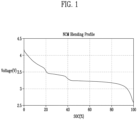
- FIG. 1 shows a graph illustrating voltage change according to SOC of a secondary battery in Example 1.
- FIG. 2 shows a graph illustrating voltage change according to SOC of a secondary battery in Comparative Example 1.
- FIG. 1 shows the measurement results of Example 1
- FIG. 2 shows the measurement results of Comparative Example 1.
- FIG. 3 shows a graph illustrating voltage change according to charging capacity of a secondary battery in Example 1.
- FIG. 4 shows a graph illustrating voltage change according to charging capacity of a secondary battery in Comparative Example 1.
- Example 1 The secondary batteries manufactured in Example 1 and Comparative Example 1 were charged under constant current (CC) conditions in a voltage range of 4.5V to 2.5V based on the cathode potential, and the voltage drop depending on the charging capacity was measured.
- FIG. 3 shows the measurement results of Example 1
- FIG. 4 shows the measurement results of Comparative Example 1.
- the graph indicated by the dotted line represents the intensity of the voltage drop of the secondary battery when charged under a CC condition of 1/3 C
- the graph indicated by a solid line represents the intensity of the voltage drop of the secondary battery when charged under a CC condition of 2.0 C.
- Example 1 the section where a voltage drop occurs is divided into two parts, and the intensity of the voltage drop is halved compared to Comparative Example 1, and the slope at the time of the voltage drop becomes gentle.
- the content ratio e.g., weight ratio
- the section where the voltage drop occurs may be divided. Accordingly, the overall voltage profile exhibits an average value of the voltage on different surfaces of the cathode current collector, thereby providing an effect of improving the amount of resistance increase at the time of the voltage drop and ultimately improving the performance of a secondary battery.
Landscapes
- Chemical & Material Sciences (AREA)
- Chemical Kinetics & Catalysis (AREA)
- Electrochemistry (AREA)
- General Chemical & Material Sciences (AREA)
- Inorganic Chemistry (AREA)
- Engineering & Computer Science (AREA)
- Composite Materials (AREA)
- Materials Engineering (AREA)
- Crystallography & Structural Chemistry (AREA)
- Manufacturing & Machinery (AREA)
- Battery Electrode And Active Subsutance (AREA)
Applications Claiming Priority (2)
| Application Number | Priority Date | Filing Date | Title |
|---|---|---|---|
| KR20230072789 | 2023-06-07 | ||
| KR1020240073844A KR20240174060A (ko) | 2023-06-07 | 2024-06-05 | 양극 및 이를 포함하는 이차전지 |
Publications (2)
| Publication Number | Publication Date |
|---|---|
| EP4475210A2 true EP4475210A2 (de) | 2024-12-11 |
| EP4475210A3 EP4475210A3 (de) | 2025-01-08 |
Family
ID=91465161
Family Applications (1)
| Application Number | Title | Priority Date | Filing Date |
|---|---|---|---|
| EP24180623.1A Pending EP4475210A3 (de) | 2023-06-07 | 2024-06-06 | Kathode und sekundärbatterie damit |
Country Status (3)
| Country | Link |
|---|---|
| US (1) | US20240413314A1 (de) |
| EP (1) | EP4475210A3 (de) |
| CN (1) | CN119108503A (de) |
Family Cites Families (5)
| Publication number | Priority date | Publication date | Assignee | Title |
|---|---|---|---|---|
| WO2013129182A1 (ja) * | 2012-02-29 | 2013-09-06 | 新神戸電機株式会社 | リチウムイオン電池 |
| WO2015024127A1 (en) * | 2013-08-21 | 2015-02-26 | HYDRO-QUéBEC | Positive electrode material for lithium secondary battery |
| JP6352421B2 (ja) * | 2013-09-02 | 2018-07-04 | エルジー・ケム・リミテッド | 二次電池用正極及びそれを含む二次電池 |
| JP6287707B2 (ja) * | 2014-09-08 | 2018-03-07 | トヨタ自動車株式会社 | 非水電解質二次電池 |
| CN105789596B (zh) * | 2016-04-28 | 2018-12-25 | 北京大学深圳研究生院 | 一种超容量锂离子电池正极材料及其制备方法和应用 |
-
2024
- 2024-06-05 US US18/734,309 patent/US20240413314A1/en active Pending
- 2024-06-06 EP EP24180623.1A patent/EP4475210A3/de active Pending
- 2024-06-07 CN CN202410736475.0A patent/CN119108503A/zh active Pending
Also Published As
| Publication number | Publication date |
|---|---|
| US20240413314A1 (en) | 2024-12-12 |
| CN119108503A (zh) | 2024-12-10 |
| EP4475210A3 (de) | 2025-01-08 |
Similar Documents
| Publication | Publication Date | Title |
|---|---|---|
| KR102397827B1 (ko) | 리튬 이차 전지 | |
| US9240592B2 (en) | Positive-electrode active material for elevation of output and lithium secondary battery including the same | |
| JP3866740B2 (ja) | 非水電解質二次電池、組電池及び電池パック | |
| US9786916B2 (en) | Electrode and secondary battery including the same | |
| US9012081B2 (en) | Anode active material and secondary battery comprising the same | |
| US8974962B2 (en) | Anode active material and secondary battery comprising the same | |
| US8974961B2 (en) | Anode active material and secondary battery comprising the same | |
| DE102019111559A1 (de) | Silizium-anodenmaterialien | |
| KR102929835B1 (ko) | 리튬 메탈 복합체 및 이의 제조방법, 이를 포함하는 이차전지 | |
| US8962184B2 (en) | Anode active material and secondary battery comprising the same | |
| EP4636892A1 (de) | Elektrolyt für lithiumsekundärbatterie und lithiumsekundärbatterie damit | |
| US9564635B2 (en) | Lithium secondary battery with excellent performance | |
| JP2009218112A (ja) | 非水電解質二次電池及びその製造方法 | |
| JP7636095B2 (ja) | リチウム二次電池用非水電解液およびそれを含むリチウム二次電池 | |
| KR102494419B1 (ko) | 리튬 이차전지용 비수전해액 첨가제, 이를 포함하는 리튬 이차전지용 비수전해액 및 리튬 이차전지 | |
| DE102022126197A1 (de) | Schutzbeschichtungen für lithiummetallelektroden und verfahren zu ihrer herstellung | |
| US20230187618A1 (en) | Cathode active material for lithium secondary battery, method of manufacturing the same and lithium secondary battery including the same | |
| JP2007080583A (ja) | 二次電池用電極と二次電池 | |
| EP4475210A2 (de) | Kathode und sekundärbatterie damit | |
| US9276264B2 (en) | Cathode active material for secondary batteries | |
| KR20240174060A (ko) | 양극 및 이를 포함하는 이차전지 | |
| US20250210689A1 (en) | Lithium Secondary Battery and Method of Manufacturing the Same | |
| US20240429382A1 (en) | Positive Electrode and Lithium Secondary Battery Including the Same | |
| KR20190143706A (ko) | 리튬 이차전지 | |
| KR20240153689A (ko) | 이차전지 및 이의 제조방법 |
Legal Events
| Date | Code | Title | Description |
|---|---|---|---|
| PUAI | Public reference made under article 153(3) epc to a published international application that has entered the european phase |
Free format text: ORIGINAL CODE: 0009012 |
|
| STAA | Information on the status of an ep patent application or granted ep patent |
Free format text: STATUS: REQUEST FOR EXAMINATION WAS MADE |
|
| PUAL | Search report despatched |
Free format text: ORIGINAL CODE: 0009013 |
|
| 17P | Request for examination filed |
Effective date: 20240606 |
|
| AK | Designated contracting states |
Kind code of ref document: A2 Designated state(s): AL AT BE BG CH CY CZ DE DK EE ES FI FR GB GR HR HU IE IS IT LI LT LU LV MC ME MK MT NL NO PL PT RO RS SE SI SK SM TR |
|
| AK | Designated contracting states |
Kind code of ref document: A3 Designated state(s): AL AT BE BG CH CY CZ DE DK EE ES FI FR GB GR HR HU IE IS IT LI LT LU LV MC ME MK MT NL NO PL PT RO RS SE SI SK SM TR |
|
| RIC1 | Information provided on ipc code assigned before grant |
Ipc: H01M 10/0525 20100101ALI20241203BHEP Ipc: H01M 4/58 20100101ALI20241203BHEP Ipc: H01M 4/525 20100101ALI20241203BHEP Ipc: H01M 4/505 20100101ALI20241203BHEP Ipc: H01M 4/36 20060101ALI20241203BHEP Ipc: H01M 4/131 20100101AFI20241203BHEP |