EP4475119A2 - Spracherkennungsverfahren, verfahren zum training eines modells für vielschichtiges lernen zur spracherkennung, vorrichtung und gerät - Google Patents
Spracherkennungsverfahren, verfahren zum training eines modells für vielschichtiges lernen zur spracherkennung, vorrichtung und gerät Download PDFInfo
- Publication number
- EP4475119A2 EP4475119A2 EP24197317.1A EP24197317A EP4475119A2 EP 4475119 A2 EP4475119 A2 EP 4475119A2 EP 24197317 A EP24197317 A EP 24197317A EP 4475119 A2 EP4475119 A2 EP 4475119A2
- Authority
- EP
- European Patent Office
- Prior art keywords
- speech
- feature
- sample
- decoding
- decoder
- Prior art date
- Legal status (The legal status is an assumption and is not a legal conclusion. Google has not performed a legal analysis and makes no representation as to the accuracy of the status listed.)
- Granted
Links
Images





Classifications
-
- G—PHYSICS
- G10—MUSICAL INSTRUMENTS; ACOUSTICS
- G10L—SPEECH ANALYSIS TECHNIQUES OR SPEECH SYNTHESIS; SPEECH RECOGNITION; SPEECH OR VOICE PROCESSING TECHNIQUES; SPEECH OR AUDIO CODING OR DECODING
- G10L15/00—Speech recognition
- G10L15/08—Speech classification or search
- G10L15/16—Speech classification or search using artificial neural networks
-
- G—PHYSICS
- G10—MUSICAL INSTRUMENTS; ACOUSTICS
- G10L—SPEECH ANALYSIS TECHNIQUES OR SPEECH SYNTHESIS; SPEECH RECOGNITION; SPEECH OR VOICE PROCESSING TECHNIQUES; SPEECH OR AUDIO CODING OR DECODING
- G10L15/00—Speech recognition
- G10L15/28—Constructional details of speech recognition systems
- G10L15/32—Multiple recognisers used in sequence or in parallel; Score combination systems therefor, e.g. voting systems
-
- G—PHYSICS
- G10—MUSICAL INSTRUMENTS; ACOUSTICS
- G10L—SPEECH ANALYSIS TECHNIQUES OR SPEECH SYNTHESIS; SPEECH RECOGNITION; SPEECH OR VOICE PROCESSING TECHNIQUES; SPEECH OR AUDIO CODING OR DECODING
- G10L15/00—Speech recognition
- G10L15/02—Feature extraction for speech recognition; Selection of recognition unit
-
- G—PHYSICS
- G10—MUSICAL INSTRUMENTS; ACOUSTICS
- G10L—SPEECH ANALYSIS TECHNIQUES OR SPEECH SYNTHESIS; SPEECH RECOGNITION; SPEECH OR VOICE PROCESSING TECHNIQUES; SPEECH OR AUDIO CODING OR DECODING
- G10L15/00—Speech recognition
- G10L15/04—Segmentation; Word boundary detection
-
- G—PHYSICS
- G10—MUSICAL INSTRUMENTS; ACOUSTICS
- G10L—SPEECH ANALYSIS TECHNIQUES OR SPEECH SYNTHESIS; SPEECH RECOGNITION; SPEECH OR VOICE PROCESSING TECHNIQUES; SPEECH OR AUDIO CODING OR DECODING
- G10L15/00—Speech recognition
- G10L15/06—Creation of reference templates; Training of speech recognition systems, e.g. adaptation to the characteristics of the speaker's voice
- G10L15/063—Training
-
- G—PHYSICS
- G10—MUSICAL INSTRUMENTS; ACOUSTICS
- G10L—SPEECH ANALYSIS TECHNIQUES OR SPEECH SYNTHESIS; SPEECH RECOGNITION; SPEECH OR VOICE PROCESSING TECHNIQUES; SPEECH OR AUDIO CODING OR DECODING
- G10L15/00—Speech recognition
- G10L15/08—Speech classification or search
- G10L15/18—Speech classification or search using natural language modelling
- G10L15/183—Speech classification or search using natural language modelling using context dependencies, e.g. language models
-
- G—PHYSICS
- G10—MUSICAL INSTRUMENTS; ACOUSTICS
- G10L—SPEECH ANALYSIS TECHNIQUES OR SPEECH SYNTHESIS; SPEECH RECOGNITION; SPEECH OR VOICE PROCESSING TECHNIQUES; SPEECH OR AUDIO CODING OR DECODING
- G10L17/00—Speaker identification or verification techniques
- G10L17/04—Training, enrolment or model building
-
- G—PHYSICS
- G10—MUSICAL INSTRUMENTS; ACOUSTICS
- G10L—SPEECH ANALYSIS TECHNIQUES OR SPEECH SYNTHESIS; SPEECH RECOGNITION; SPEECH OR VOICE PROCESSING TECHNIQUES; SPEECH OR AUDIO CODING OR DECODING
- G10L19/00—Speech or audio signals analysis-synthesis techniques for redundancy reduction, e.g. in vocoders; Coding or decoding of speech or audio signals, using source filter models or psychoacoustic analysis
- G10L19/0018—Speech coding using phonetic or linguistical decoding of the source; Reconstruction using text-to-speech synthesis
-
- G—PHYSICS
- G10—MUSICAL INSTRUMENTS; ACOUSTICS
- G10L—SPEECH ANALYSIS TECHNIQUES OR SPEECH SYNTHESIS; SPEECH RECOGNITION; SPEECH OR VOICE PROCESSING TECHNIQUES; SPEECH OR AUDIO CODING OR DECODING
- G10L19/00—Speech or audio signals analysis-synthesis techniques for redundancy reduction, e.g. in vocoders; Coding or decoding of speech or audio signals, using source filter models or psychoacoustic analysis
- G10L19/008—Multichannel audio signal coding or decoding using interchannel correlation to reduce redundancy, e.g. joint-stereo, intensity-coding or matrixing
Definitions
- the present disclosure relates to the technical field of artificial intelligence, in particular to the technical field of speech recognition and deep learning etc., and specifically relates to a speech recognition method, a training method for a deep learning model for speech recognition, a speech recognition apparatus, a training apparatus for a deep learning model for speech recognition, an electronic device, a computer-readable storage medium, and a computer program product.
- Artificial intelligence is the discipline of studying how computers can simulate certain thinking processes and intelligent behaviors of a human being (such as learning, reasoning, thinking, planning, etc.), and there are both hardware-level and software-level technologies.
- the artificial intelligence hardware technologies generally include technologies such as sensors, special artificial intelligence chips, cloud computing, distributed storage, big data processing, etc.
- the artificial intelligence software technologies mainly include computer vision technology, speech recognition technology, natural language processing technology, machine learning/deep learning, big data processing technology, knowledge graph technology and other major technological directions.
- ASR Automatic speech recognition
- the present disclosure provides a speech recognition method, a training method for a deep learning model for speech recognition, a speech recognition apparatus, a training apparatus for a deep learning model for speech recognition, an electronic device, a computer-readable storage medium, and a computer program product.
- a computer-implemented speech recognition method comprising: obtaining a first speech feature of a speech to-be-recognized, where the first speech feature comprises a plurality of speech segment features corresponding to a plurality of speech segments in the speech to-be-recognized; decoding the first speech feature using a first decoder to obtain a plurality of first decoding results corresponding to a plurality of words in the speech to-be-recognized, where each first decoding result of the plurality of first decoding results indicates a first recognition result of a word corresponding to the first decoding result; extracting a second speech feature from the first speech feature based on first a priori information, where first a priori information comprises the plurality of first decoding results, and the second speech feature comprises a plurality of first word-level audio features corresponding to the plurality of words; and decoding the second speech feature using a second decoder to obtain a plurality of second decoding results
- a computer-implemented method for training a deep learning model for speech recognition where the deep learning model comprises a first decoder and a second decoder, and the training method comprises: obtaining a sample speech and ground truth recognition results of a plurality of words in the sample speech; obtaining a first sample speech feature of the sample speech, where the first sample speech feature comprises a plurality of sample speech segment features corresponding to a plurality of sample speech segments in the sample speech; decoding the first sample speech feature using the first decoder to obtain a plurality of first sample decoding results corresponding to the plurality of words in the sample speech, where each first sample decoding result of the plurality of first sample decoding results indicates a first recognition result of a word corresponding to the first sample decoding result; extracting a second sample speech feature from the first sample speech feature based on first sample a priori information, where the first sample a priori information comprises the plurality of first sample decoding results, and the second sample speech feature comprises a pluralit
- a speech recognition apparatus comprising: a speech feature encoding module configured to obtain a first speech feature of a speech to-be-recognized, where the first speech feature comprises a plurality of speech segment features corresponding to a plurality of speech segments in the speech to-be-recognized; a first decoder configured to decode the first speech feature to obtain a plurality of first decoding results corresponding to a plurality of words in the speech to-be-recognized, where each first decoding result of the plurality of first decoding results indicates a first recognition result of a word corresponding to the first decoding result; a word-level feature extraction module configured to extract a second speech feature from the first speech feature based on first a priori information, where the first a priori information comprises the plurality of first decoding results, and the second speech feature comprises a plurality of first word-level audio features corresponding to the plurality of words; and a second decoder configured to decode
- an apparatus for training a deep learning model for speech recognition where the deep learning model comprises a first decoder and a second decoder, and the training apparatus comprises: an obtaining module configured to obtain a sample speech and ground truth recognition results of a plurality of words in the sample speech; a speech feature encoding module configured to obtain a first sample speech feature of the sample speech, where the first sample speech feature comprises a plurality of sample speech segment features corresponding to a plurality of sample speech segments in the sample speech; a first decoder configured to decode the first sample speech feature to obtain a plurality of first sample decoding results corresponding to the plurality of words in the sample speech, where each first sample decoding result of the plurality of first sample decoding results indicates a first recognition result of a word corresponding to the first sample decoding result; a word-level feature extraction module configured to extract a second sample speech feature from the first sample speech feature based on first sample a priori information, where the first sample a priori information comprises the
- an electronic device comprising: at least one processor; and a memory communicatively connected to the at least one processor; wherein the memory stores instructions executable by the at least one processor, and the instructions are executed by the at least one processor to enable the at least one processor to execute the method described above.
- a non-transitory computer-readable storage medium that stores computer instructions, wherein the computer instructions enable the computer to execute the method described above.
- a computer program product including a computer program, wherein the computer program implements the method described above when executed by a processor.
- the present disclosure obtains a first speech feature that includes a plurality of speech segment features of a speech to-be-recognized, and decodes the first speech feature to obtain a preliminary recognition result of the speech to-be-recognized, and then extract word-level audio features from the first speech feature using the preliminary recognition result, and then decodes the word-level audio features to obtain a final recognition result.
- the word-level equal-length uniform audio feature representation is extracted from the unequal-length speech feature information in the frame-level audio information, and the word-level audio feature is decoded to obtain the final recognition result, by which the problem of inconsistent feature representation lengths of traditional speech subframes is solved, the precision of speech recognition is improved, and the computational efficiency is improved.
- first and second elements are used to describe various elements and are not intended to limit the positional relationship, timing relationship, or importance relationship of these elements, and such terms are only used to distinguish one element from another.
- first element and the second element may refer to the same instance of the element, while in some cases they may also refer to different instances based on the description of the context.
- some speech recognition methods use a framed speech feature to learn the representation of audio feature.
- this kind of feature representation method may cause inconsistent representation lengths of the framed speech feature, and affect the accuracy of speech recognition, and there are a large number of redundant features in the feature representation, thus resulting in low computational efficiency.
- the present disclosure obtains a first speech feature that includes a plurality of speech segment features of a speech to-be-recognized, and decodes the first speech feature to obtain a preliminary recognition result of the speech to-be-recognized, and then extract word-level audio features from the first speech feature using the preliminary recognition result, and then decodes the word-level audio features to obtain a final recognition result.
- the word-level equal-length uniform audio feature representation is extracted from the unequal-length speech feature information in the frame-level audio information, and the word-level audio feature is decoded to obtain the final recognition result, by which the problem of inconsistent feature representation lengths of traditional speech subframes is solved, the precision of speech recognition is improved, and the computational efficiency is improved.
- FIG. 1 illustrates a schematic diagram of an exemplary system 100 in which various methods and apparatuses described herein may be implemented in accordance with embodiments of the present disclosure.
- the system 100 includes one or more client devices 101, 102, 103, 104, 105, and 106, a server 120, and one or more communication networks 110 that couple the one or more client devices to the server 120.
- the client devices 101, 102, 103, 104, 105, and 106 may be configured to execute one or more applications.
- the server 120 may run one or more services or software applications that enable the execution of the speech recognition method and/or the training method for a deep learning model for speech recognition according to the present disclosure.
- a complete speech recognition system or some components of the speech recognition system may be deployed on the server, for example a large speech model.
- the server 120 may further provide other services or software applications, which may include non-virtual environments and virtual environments.
- these services may be provided as web-based services or cloud services, such as to users of the client devices 101, 102, 103, 104, 105, and/or 106 under a Software as a Service (SaaS) model.
- SaaS Software as a Service
- the server 120 may include one or more components that implement functions performed by the server 120. These components may include software components, hardware components, or a combination thereof that are executable by one or more processors. A user operating the client devices 101, 102, 103, 104, 105, and/or 106 may sequentially utilize one or more client applications to interact with the server 120 to utilize the services provided by these components. It should be understood that a variety of different system configurations are possible, which may be different from the system 100. Therefore, FIG. 1 is an example of a system for implementing the various methods described herein and is not intended to be limiting.
- the client devices 101, 102, 103, 104, 105, and/or 106 may provide interfaces that enable the user of the client devices to interact with the client devices.
- the client devices may also output information to the user via the interface.
- FIG. 1 depicts only six client devices, those skilled in the art will understand that the present disclosure may support any number of client devices.
- the client devices 101, 102, 103, 104, 105, and/or 106 may include various types of computer devices, such as portable handheld devices, general-purpose computers (such as personal computers and laptop computers), workstation computers, wearable devices, smart screen devices, self-service terminal devices, service robots, in-vehicle devices, gaming systems, thin clients, various messaging devices, sensors or other sensing devices, and the like.
- These computer devices may run various types and versions of software applications and operating systems, such as Microsoft Windows, Apple iOS, Unix-like operating systems, Linux or Linux-like operating systems; or include various mobile operating systems, such as Microsoft Windows Mobile OS, iOS, Windows Phone, Android.
- the portable handheld devices may include cellular telephones, smart phones, tablet computers, personal digital assistants (PDA), and the like.
- the wearable devices may include head-mounted displays (such as smart glasses) and other devices.
- the gaming systems may include various handheld gaming devices, Internet-enabled gaming devices, and the like.
- the client devices can execute various different applications, such as various Internet related applications, communication applications (e.g., e-mail applications), Short Message Service (SMS) applications, and may use various communication protocols.
- various Internet related applications such as e.g., e-mail applications), Short Message Service (SMS) applications, and may use various communication protocols.
- communication applications e.g., e-mail applications
- SMS Short Message Service
- the network 110 may be any type of network well known to those skilled in the art, which may support data communication using any of a variety of available protocols (including but not limited to TCP/IP, SNA, IPX, etc.).
- one or more networks 110 may be a local area network (LAN), an Ethernet-based network, a token ring, a wide area network (WAN), an Internet, a virtual network, a virtual private network (VPN), an intranet, an external network, a blockchain network, a public switched telephone network (PSTN), an infrared network, a wireless network (including, for example, Bluetooth, WiFi), and/or any combination of these and/or other networks.
- the server 120 may include one or more general-purpose computers, a dedicated server computer (e.g., a PC (personal computer) server, a UNIX server, a mid-end server), a blade server, a mainframe computer, a server cluster, or any other suitable arrangement and/or combination.
- the server 120 may include one or more virtual machines running a virtual operating system, or other computing architectures involving virtualization (e.g., one or more flexible pools of a logical storage device that may be virtualized to maintain virtual storage devices of a server).
- the server 120 may run one or more services or software applications that provide the functions described below.
- the computing unit in the server 120 may run one or more operating systems including any of the operating systems described above and any commercially available server operating system.
- the server 120 may also run any of a variety of additional server applications and/or intermediate layer applications, including a HTTP server, an FTP server, a CGI server, a Java server, a database server, etc.
- the server 120 may include one or more applications to analyze and merge data feeds and/or event updates received from the user of the client devices 101, 102, 103, 104, 105, and/or 106.
- the server 120 may also include one or more applications to display the data feeds and/or the real-time events via one or more display devices of the client devices 101, 102, 103, 104, 105, and/or 106.
- the server 120 may be a server of a distributed system, or a server incorporating a blockchain.
- the server 120 may also be a cloud server, or an intelligent cloud computing server or an intelligent cloud host with an artificial intelligence technology.
- the cloud server is a host product in the cloud computing service system used to overcome the defects of management difficulty and weak service expansibility which exist in the conventional physical host and Virtual Private Server (VPS) service.
- VPN Virtual Private Server
- the system 100 may also include one or more databases 130.
- these databases may be used to store data and other information.
- one or more of the databases 130 may be used to store information such as audio files and video files.
- the data repositories 130 may reside in various locations.
- the data repository used by the server 120 may be local to the server 120, or may be remote from the server 120 and may communicate with the server 120 via a network-based or dedicated connection.
- the data repository 130 may be of a different type.
- the database used by the server 120 may be, for example, a relational database.
- One or more of these databases may store, update, and retrieve data to and from the database in response to a command.
- one or more of the databases 130 may also be used by an application to store application data.
- the database used by an application may be a different type of database, such as a key-value repository, an object repository, or a conventional repository supported by a file system.
- the system 100 of FIG. 1 may be configured and operated in various ways to enable application of various methods and devices described according to the present disclosure.
- the speech recognition method comprises: Step S201, obtaining a first speech feature of a speech to-be-recognized, and the first speech feature comprises a plurality of speech segment features corresponding to a plurality of speech segments in the speech to-be-recognized; Step S202, decoding the first speech feature using a first decoder to obtain a plurality of first decoding results corresponding to a plurality of words in the speech to-be-recognized, and the first decoding result indicates the first recognition result of the corresponding word; Step S203, extracting a second speech feature from the first speech feature based on first a priori information, the first a priori information comprises the plurality of first decoding results, and the second speech feature comprises a plurality of first word-level audio features corresponding to the plurality of words; and Step S204, decoding the second speech feature using a second decoder to obtain a plurality
- the word-level equal-length uniform audio feature representation is extracted from the unequal-length speech feature information in the frame-level audio information, and the word-level audio feature is decoded to obtain the final recognition result, by which the problem of inconsistent feature representation lengths of traditional speech subframes is solved, the precision of speech recognition is improved, and the computational efficiency is improved.
- the speech to-be-recognized in the embodiments of the present disclosure comprises speech content corresponding to a plurality of words.
- the first speech feature of the speech to-be-recognized can be obtained by using various types of existing speech feature extraction methods.
- the plurality of speech segments may be obtained by truncating the speech to-be-recognized with a fixed length, or may be obtained by using other truncation methods; the plurality of speech segment features may be in a one-to-one correspondence with the plurality of speech segments, or the same speech segment may correspond to the plurality of speech segment features (as will be described below), which are not limited herein.
- step S201 obtaining the first speech feature of the speech to-be-recognized may comprise: step S301, obtaining an original speech feature of the speech to-be-recognized; step S302, determining a plurality of spikes in the speech to-be-recognized based on the original speech feature; and step S303, truncating the original speech feature to obtain the plurality of speech segment features in a one-to-one correspondence with the plurality of spikes.
- spike signals generally have correspondence with each word in the speech to-be-recognized
- the first decoder can decode the first speech feature driven by the spike information, thereby obtaining an accurate preliminary recognition result.
- step S301 speech feature extraction may be performed on a plurality of speech frames included in the speech to-be-recognized to obtain the original speech feature that includes the plurality of speech frame features.
- the original speech feature may be processed using a binary CTC (Connectionist Temporal Classification) module that is modeled based on a Causal Conformer to obtain CTC spike information, thereby determining the plurality of spikes in the speech to-be-recognized.
- CTC Connectionist Temporal Classification
- the plurality of spikes in the speech to-be-recognized may also be determined in other ways, which is not limited herein.
- truncating the original speech feature may be to truncate the plurality of speech frame features corresponding to the plurality of speech frames into a plurality of groups of speech frame features, and each group of speech frames/speech frame features form a speech segment/speech segment feature.
- truncating the original speech feature to obtain the plurality of speech segment features in a one-to-one correspondence with the plurality of spikes may comprise: truncating the original speech feature based on a predetermined time length, and using the speech segment feature of the speech segment where each spike of the plurality of spikes is located as the speech segment feature corresponding to the spike. Therefore, in this way, the speech segment features corresponding to each spike have the same length. It should be noted that, in this manner, if more than one spike are included in a speech segment, the speech segment feature of the speech segment will be used as the speech segment corresponding to each spike of these spikes at the same time.
- the predetermined time length may be set based on requirements.
- the predetermined time length d is five speech frames.
- truncating the original speech feature to obtain the plurality of speech segment features in one-to-one correspondence with the plurality of spikes may comprise: truncating the original speech feature based on the plurality of spikes, and using the feature of the speech segment between every two adjacent spikes as the speech segment feature corresponding to one of the spikes.
- the speech segment feature corresponding to each spike includes complete speech information of the speech segment that is formed between two adjacent spikes.
- down-sampling e.g., convolutional down-sampling
- CTC module or the preliminary speech recognition
- the plurality of speech segment features can be sequentially obtained by performing streaming truncation on the original speech feature.
- decoding the first speech feature using the first decoder may comprise: sequentially performing streaming decoding on the plurality of speech segment features using the first decoder. Therefore, the preliminary recognition result of the speech to-be-recognized can be quickly obtained by performing streaming truncation on the original speech feature and performing streaming decoding on the first speech feature.
- the speech segment feature may be further encoded using a manner that is based on historical feature abstraction to enhance the description capability of the speech segment feature, thereby improving the accuracy of the preliminary recognition result obtained after decoding the speech segment feature.
- obtaining the first speech feature of the speech to-be-recognized may further comprise: step S304, for the currently obtained speech segment feature, obtaining corresponding historical feature abstract information, and the historical feature abstract information is obtained by performing attention modeling on the prior speech segment feature using the first decoding result corresponding to the prior speech segment feature; and step S 305, encoding the currently obtained speech segment feature using the first encoder combined with the historical feature abstract information to obtain a corresponding enhanced speech segment feature.
- the historical feature abstraction information corresponding to the currently obtained speech segment feature includes a plurality of historical feature abstraction information corresponding to each prior speech segment feature, and each historical feature abstraction information of the prior speech segment feature is obtained by performing attention modeling on the prior speech segment feature using the first decoding result corresponding to the prior speech segment feature.
- an attention mechanism calculation may be performed by using the first decoding result as the query feature Q and using the prior speech segment feature as the key feature K and the value feature V to obtain the historical feature abstract information of the prior speech segment feature.
- encoding the currently obtained speech segment feature using the first encoder combined with the historical feature abstract information to obtain the corresponding enhanced speech segment feature may comprise: using the currently obtained speech segment feature as the query feature Q of the first encoder, and using the concatenation result of the historical feature abstract information and the currently obtained speech segment feature as the key feature K and value feature V of the first encoder to obtain the corresponding enhanced speech segment feature output by the first encoder.
- the first encoder and the first decoder may together form a Conformer Streaming Multi-Layer Truncated Attention (SMLTA) model that is based on historical feature abstraction.
- SMLTA Conformer Streaming Multi-Layer Truncated Attention
- the Conformer SMLTA model 400 mainly comprises two parts, one is the Streaming Truncated Conformer encoder 402, i.e., the first encoder, and the other is the Transformer decoder 404, i.e., the first decoder.
- the Streaming Truncated Conformer encoder comprises N stacked Conformer modules, and each Conformer module comprises a feedforward module 406, a multi-head self-attention module 408, a convolution module 410, and a feedforward module 412.
- the Conformer modules encode the speech segment feature layer-by-layer to obtain a corresponding implicit feature (i.e., the enhanced speech segment feature).
- the Transformer decoder comprises M stacked Transformer modules, and filters the implicit feature output by the encoder using a streaming attention mechanism and outputs the first decoding result indicating the preliminary recognition result.
- FIG. 4 also illustrates the principle of Conformer SMLTA which is based on historical feature abstraction.
- the input original speech feature 414 is first segmented into speech segment features with the same length, and then the streaming Conformer encoder performs feature encoding on each speech segment feature.
- the Transformer decoder counts the number of spikes included in each audio segment based on the spike information 416 of the binary CTC model, and decodes and outputs the recognition result of the current segment based on the number of spikes.
- correlation attention modeling is performed on the implicit feature of each layer of the Conformer encoder based on the decoding result of the current segment to obtain a historical feature abstraction contained in the corresponding speech segment, and the historical feature abstraction information, obtained from each layer of abstraction, and the currently obtained speech segment feature are concatenated together for the computation of the next segment.
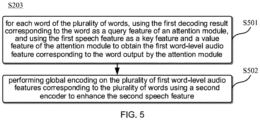
- step S203 extracting the second speech feature from the first speech feature based on the first a priori information may comprise: step S501, for each of the plurality of words, using the first decoding result corresponding to the word as the query feature Q of the attention module, and using the first speech feature as the key feature K and the value feature V of the attention module to obtain the first word-level audio feature corresponding to the word output by the attention module.
- the preliminary recognition result of the speech to-be-recognized can be effectively used as the prior information to obtain the word level audio features corresponding to each word.
- the first word level audio feature output by the attention module may be calculated by substituting corresponding Q, K, and V into the formula of the attention mechanism described above.
- step S203 extracting the second speech feature from the first speech feature based on the first a priori information may comprise: step S502, performing global encoding on the plurality of first word-level audio features corresponding to the plurality of words using the second encoder to obtain an enhanced second speech feature.
- the deficiency that the first encoder cannot encode the global feature information due to the fact that streaming recognition needs to be met is effectively compensated, and the description capability of the equal-length uniform feature representation is significantly improved.
- the second encoder may be a Conformer encoder and may include an N-layer stacked Conformer module. Since the Conformer module fuses the attention model and the convolution model at the same time, the long-distance relationship and the local relationship in the audio feature can be effectively modeled at the same time, thereby greatly improving the description capability of the model.
- extracting the second speech feature from the first speech feature based on the first a priori information may also be implemented in a manner other than the attention mechanism and the Conformer encoder, which is not limited herein.
- decoding the second speech feature using the second decoder to obtain the plurality of second decoding results corresponding to the plurality of words may comprise: for each of the plurality of words, using the first decoding result corresponding to the word as the query feature Q of the second decoder, and using the second speech feature as the key feature K and the value feature V of the second decoder to obtain the second decoding result corresponding to the word output by the second decoder.
- the preliminary recognition result of the speech to-be-recognized can be effectively used as the prior information to obtain the second decoding results corresponding to each word.
- the conventional Encoder-Decoder structure or Decoder-Only structure encounters the problem of cache loading during decoding.
- the GPU's computational speed has been significantly improved at present, limited by the development of computer hardware resources, the speed of the decoder loading model parameters into the Cache during computation has not been significantly increased, which seriously limits the decoding efficiency of speech recognition models.
- both the Encoder-Decoder structure and the Decoder-Only structure need to rely on the decoding result of the previous moment to perform the calculation of the next moment during decoding, and the recursive calculation method requires the model to be repeatedly loaded into the Cache, which results in a certain calculation delay.
- the problem of calculation delay caused by cache loading is more prominent, and the requirement of real-time decoding for online decoding cannot be met.
- the final recognition result can be obtained with only one parallel calculation, thereby the cache loading problem encountered by large models can be effectively solved.
- the second decoder may comprise a forward decoder and a backward decoder, each of which may be configured to, for each of the plurality of words, use the first decoding result of the word as the input query feature Q, and use the second speech feature as an the input key feature K and the value feature V, the forward decoder may be configured to apply a left-to-right temporal mask to input features, and the backward decoder may be configured to apply a right-to-left temporal mask to input features.
- the forward decoder may also be referred to as a Left-Right Transformer decoder
- the backward decoder may also be referred to as a Right-Left Transformer decoder.
- Both the forward decoder and the backward decoder may include a Transformer module with K stacked time masks.
- using the first decoding result of the word as the query feature Q of the second decoder and using the second speech feature as the key feature K and the value feature V of the second decoder to obtain the second decoding result corresponding to the word output by the second decoder may comprise: fusing a plurality of forward decoding features corresponding to the plurality of words output by the forward decoder and a plurality of backward decoding features corresponding to the plurality of words output by the backward decoder to obtain a plurality of fusion features corresponding to the plurality of words; and obtaining the plurality of second decoding results based on the plurality of fusion features.
- the forward decoding feature and the backward decoding feature may be directly added to obtain the corresponding fusion feature.
- Processing such as Softmax and the like may be performed on the fusion feature to obtain the final recognition result.
- the second decoding result can be reused as the a prior information of the recognition result to re-extract the word-level audio feature, or to re-decode using the second decoder.
- the speech recognition method may further comprise: step S605, for each of the plurality of words, using the N th decoding result of the word as the query feature Q of the second decoder, and using the second speech feature as the key feature K and the value feature V of the second decoder to obtain the N +1 th decoding result corresponding to the word output by the second decoder, wherein N is an integer greater than or equal to 2. It can be understood that the operations in steps S601- S604 in FIG. 6 are similar to those in steps S201-S204 in FIG. 2 , and details are not described herein.
- the accuracy of speech recognition can be improved by performing multiple iterative decoding using the second decoder.
- the speech recognition method may further comprise: step S705, extracting a third speech feature from the first speech feature based on second a prior information, the second a prior information comprises the plurality of second decoding results, and the third speech feature comprises a plurality of second word-level audio features corresponding to the plurality of words; and step S706, decoding the third speech feature using the second decoder to obtain a plurality of third decoding results corresponding to the plurality of words, and the third decoding result indicates the third recognition result of the corresponding word.
- the accuracy of speech recognition can be further improved by re-using the second decoding result as priori of the recognition result to re-extract word-level audio features and then decoding the new word-level audio features using the second decoder.
- steps S701-S704 in FIG. 7 are similar to those in steps S201-S204 in FIG. 2 , and details are not described herein.
- the second decoder may be a large speech model or a large audio model.
- the model scale of the second decoder can reach hundreds of billion parameters, by which the language information contained in the speech can be fully explored and the modeling capability of the model can be greatly improved.
- the number of parameters of the large speech model or the large audio model as the second decoder may be 2B, or may be others that are more than billion levels.
- the model scale of the first encoder (or the model formed by the first encoder and the first decoder) may be, for example, a few hundred megabits. Since its function is to streaming output the preliminary recognition result of the speech to-be-recognized, large-scale parameters are not needed.
- the first encoder 810 (SMLTA2 Encoder), the first decoder 820 (SMLTA2 Decoder), the attention module 830 (Attention Module), the second encoder 840 (Conformer Encoder), and the second decoder 850 (including the forward Decoder 860 (Left-Right Transformer Decoder) and the backward Decoder 870 (Right-Left Transformer Decoder)) may collectively form the end-to-end large speech model 800.
- a training method for a deep learning model for speech recognition comprises a first decoder and a second decoder.
- the training method comprises: step S901, obtaining a sample speech and ground truth recognition results of a plurality of words in the sample speech; step S902, obtaining a first sample speech feature of the sample speech, and the first sample speech feature comprises a plurality of sample speech segment features corresponding to a plurality of sample speech segments in the sample speech; step S903, decoding the first sample speech feature using the first decoder to obtain a plurality of first sample decoding results corresponding to the plurality of words in the sample speech, and the first sample decoding result indicates the first recognition result of the corresponding word; step S904, extracting a second sample speech feature from the first sample speech feature based on first sample a priori information, the first sample a priori information comprises the plurality of first sample decoding results, and the second sample speech feature comprises a plurality of
- the trained deep learning model can use the preliminary recognition result of the speech to-be-recognized as a priori, and extract the word-level equal-length uniform audio feature representation from the unequal-length speech feature information in the frame-level audio information, and decode the word-level audio feature to obtain the final recognition result, by which the problem of inconsistent feature representation lengths of traditional speech subframes is solved, the precision of speech recognition is improved, and the computational efficiency is improved.
- the deep learning model may further include other modules involved in the speech recognition method described above, such as a first encoder, a second encoder, an attention module, and the like.
- the operation of each module in the deep learning model may also refer to the operation of the corresponding module in the speech recognition method described above.
- a first loss value may be determined based on the real recognition result and the second recognition result, and the parameters of the deep learning model are adjusted based on the first loss value.
- a second loss value may also be determined based on the real recognition result and the first recognition result, and the parameters of the deep learning model are adjusted based on the first loss value and the second loss value.
- the second loss value may be used to adjust the parameters of the first decoder (and the first encoder)
- the first loss value may be used to adjust the parameters of the second decoder (and the attention module, the second encoder)
- some of the modules in the deep learning model may be individually trained or pre-trained in advance. It can be understood that other manners can also be used to adjust the parameters of the deep learning model, which is not limited herein.
- the speech recognition method described above may be executed using a deep learning model obtained by training according to the above training method.
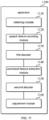
- the apparatus 1000 comprises: a speech feature encoding module 1010 configured to obtain a first speech feature of a speech to-be-recognized, and the first speech feature comprises a plurality of speech segment features corresponding to a plurality of speech segments in the speech to-be-recognized; a first decoder 1020 configured to decode the first speech feature to obtain a plurality of first decoding results corresponding to a plurality of words in the speech to-be-recognized, and the first decoding result indicates the first recognition result of the corresponding word; a word-level feature extraction module 1030 configured to extract a second speech feature from the first speech feature based on first a priori information, the first a priori information comprises the plurality of first decoding results, and the second speech feature comprises a plurality of first word-level audio features corresponding to the plurality of words; and a second decoder 1040 configured to de
- the speech feature encoding module 1010 may be configured: to obtain an original speech feature of the speech to-be-recognized; to determine a plurality of spikes in the speech to-be-recognized based on the original speech feature; and to truncate the original speech feature to obtain the plurality of speech segment features in a one-to-one correspondence with the plurality of spikes.
- truncating the original speech feature to obtain the plurality of speech segment features in a one-to-one correspondence with the plurality of spikes may comprise: truncating the original speech feature based on a predetermined time length, and using the speech segment feature of the speech segment where each spike of the plurality of spikes is located as the speech segment feature corresponding to the spike.
- truncating the original speech feature to obtain the plurality of speech segment features in a one-to-one correspondence with the plurality of spikes may comprise: truncating the original speech feature based on the plurality of spikes, and using the feature of the speech segment between every two adjacent spikes as the speech segment feature corresponding to one of the spikes.
- the plurality of speech segment features may be sequentially obtained by performing streaming truncation on the original speech feature.
- the speech feature encoding module may be configured: for the currently obtained speech segment feature, to obtain corresponding historical feature abstract information, and the historical feature abstract information is obtained by performing attention modeling on the prior speech segment feature using the first decoding result corresponding to the prior speech segment feature.
- the speech feature encoding module may comprise: a first encoder configured to encode the currently obtained speech segment feature combined with the historical feature abstract information and output a corresponding enhanced speech segment feature.
- the first encoder may be configured: to use the currently obtained speech segment feature as the query feature of the first encoder and use the concatenation result of the historical feature abstract information and the currently obtained speech segment feature as the key feature and the value feature of the first encoder to output the corresponding enhanced speech segment feature.
- the word-level feature extraction module may comprise: an attention module configured to, for each of the plurality of words, use the first decoding result corresponding to the word as the query feature of the attention module and use the first speech feature as the key feature and the value feature of the attention module to output the first word-level audio feature corresponding to the word.
- the word-level feature extraction module may comprise: a second encoder configured to perform global encoding on the plurality of first word-level audio features corresponding to the plurality of words to output the enhanced second speech feature.
- the second decoder may be configured to, for each of the plurality of words, use the first decoding result corresponding to the word as the query feature of the second decoder and use the second speech feature as the key feature and the value feature of the second decoder to output the second decoding result corresponding to the word.
- the second decoder may comprise a forward decoder and a backward decoder, both the forward decoder and the backward decoder are configured to, for each of the plurality of words, use the first decoding result of the word as the input query feature, and use the second speech feature as an the input key feature and the value feature, the forward decoder is configured to perform time masking on the input feature from the left to the right, and the backward decoder is configured to perform time masking on the input feature from the right to the left.
- the second decoder may be configured: to fuse the plurality of forward decoding features corresponding to the plurality of words output by the forward decoder and the plurality of backward decoding features corresponding to the plurality of words output by the backward decoder to obtain a plurality of fusion features corresponding to the plurality of words; and to obtain the plurality of second decoding results based on the plurality of fusion features.
- the second decoder may be configured to: for each of the plurality of words, use the N th decoding result of the word as the query feature of the second decoder, and use the second speech feature as the key feature and the value feature of the second decoder to output the N +1 th decoding result corresponding to the word, wherein N is an integer greater than or equal to 2.
- the word-level feature extraction module is configured to extract a third speech feature from the first speech feature based on second a prior information, the second a prior information comprises the plurality of second decoding results, and the third speech feature comprises a plurality of second word-level audio features corresponding to the plurality of words.
- the second decoder may be configured to decode the third speech feature to obtain a plurality of third decoding results corresponding to the plurality of words, and the third decoding result indicates the third recognition result of the corresponding word.
- the second decoder could be a large speech model.
- a training apparatus for a deep learning model for speech recognition comprises a first decoder and a second decoder.
- the training apparatus comprises: an obtaining module 1110 configured to obtain a sample speech and ground truth recognition results of a plurality of words in the sample speech; a speech feature encoding module 1120 configured to obtain a first sample speech feature of the sample speech, and the first sample speech feature comprises a plurality of sample speech segment features corresponding to a plurality of sample speech segments in the sample speech; a first decoder 1130 configured to decode the first sample speech feature to obtain a plurality of first sample decoding results corresponding to the plurality of words in the sample speech, and the first sample decoding result indicates the first recognition result of the corresponding word; a word-level feature extraction module 1140 configured to extract a second sample speech feature from the first sample speech feature based on first sample a priori information, the first sample a priori information comprises the plurality of first
- the obtaining, storage, usage, processing, transmission, provision and disclosure of users' personal information involved in the technical solutions of the present disclosure are in compliance with relevant laws and regulations and do not violate public order and morals.
- an electronical device a readable storage medium and a computer program product.
- FIG. 12 a structural block diagram of an electronic device 1200 that may be a server or client of the present disclosure is now described, which is an example of a hardware device that may be applied to aspects of the present disclosure.
- Electronic devices are intended to represent various forms of digital electronic computer devices, such as laptop computers, desktop computers, workstations, personal digital assistants, servers, blade servers, mainframe computers, and other suitable computers.
- the electronic devices may also represent various forms of mobile devices, such as personal digital processing, cellular telephones, smart phones, wearable devices, and other similar computing devices.
- the components shown herein, their connections and relationships, and their functions are merely as examples, and are not intended to limit the implementations of the disclosure described and/or claimed herein.
- the electronic device 1200 includes a computing unit 1201, which may perform various appropriate actions and processing according to a computer program stored in a read-only memory (ROM) 1202 or a computer program loaded into a random access memory (RAM) 1203 from a storage unit 1208.
- ROM read-only memory
- RAM random access memory
- various programs and data required by the operation of the electronic device 1200 may also be stored.
- the computing unit 1201, the ROM 1202, and the RAM 1203 are connected to each other through a bus 1204.
- Input/output (I/O) interface 1205 is also connected to the bus 1204.
- a plurality of components in the electronic device 1200 are connected to a I/O interface 1205, including: an input unit 1206, an output unit 1207, a storage unit 1208, and a communication unit 1209.
- the input unit 1206 may be any type of device capable of inputting information to the electronic device 1200, the input unit 1206 may receive input digital or character information and generate a key signal input related to user setting and/or function control of the electronic device, and may include, but is not limited to, a mouse, a keyboard, a touch screen, a track pad, a trackball, a joystick, a microphone, and/or a remote control.
- the output unit 1207 may be any type of device capable of presenting information, and may include, but are not limited to, a display, a speaker, a video/audio output terminal, a vibrator, and/or a printer.
- the storage unit 1208 may include, but is not limited to, a magnetic disk and an optical disk.
- the communication unit 1209 allows the electronic device 1200 to exchange information/data with other devices over a computer network, such as the Internet, and/or various telecommunication networks, and may include, but is not limited to, a modem, a network card, an infrared communication device, a wireless communication transceiver and/or a chipset, such as a Bluetooth device, a 802.11 device, a WiFi device, a WiMAX device, a cellular communication device, and/or the like.
- the computing unit 1201 may be a variety of general and/or special purpose processing components with processing and computing capabilities. Some examples of the computing unit 1201 include, but are not limited to, a central processing unit (CPU), a graphics processing unit (GPU), various dedicated artificial intelligence (Al) computing chips, various computing units running machine learning model algorithms, a digital signal processor (DSP), and any suitable processor, controller, microcontroller, etc.
- the computing unit 1201 performs the various methods and processes described above, such as the speech recognition method and/or the training method for deep learning model for speech recognition.
- the speech recognition method and/or the training method for deep learning model for speech recognition may be implemented as a computer software program tangibly contained in a machine-readable medium, such as the storage unit 1208.
- part or all of the computer program may be loaded and/or installed onto the electronic device 1200 via the ROM 1202 and/or the communication unit 1209.
- the computer program is loaded to the RAM 1203 and executed by the computing unit 1201, one or more steps of the speech recognition method and/or the training method for deep learning model for speech recognition described above may be performed.
- the computing unit 1201 may be configured to perform the speech recognition method and/or the training method for deep learning model for speech recognition by any other suitable means (e.g., with the aid of firmware).
- Various embodiments of the systems and techniques described above herein may be implemented in a digital electronic circuit system, an integrated circuit system, a field programmable gate array (FPGA), an application specific integrated circuit (ASIC), a dedicated standard product (ASSP), a system of system on a chip system (SoC), a complex programmable logic device (CPLD), computer hardware, firmware, software, and/or combinations thereof.
- FPGA field programmable gate array
- ASIC application specific integrated circuit
- ASSP dedicated standard product
- SoC system of system on a chip system
- CPLD complex programmable logic device
- These various embodiments may include: implementation in one or more computer programs that may be executed and/or interpreted on a programmable system including at least one programmable processor, where the programmable processor may be a dedicated or universal programmable processor that may receive data and instructions from a storage system, at least one input device, and at least one output device, and transmit data and instructions to the storage system, the at least one input device, and the at least one output device.
- the programmable processor may be a dedicated or universal programmable processor that may receive data and instructions from a storage system, at least one input device, and at least one output device, and transmit data and instructions to the storage system, the at least one input device, and the at least one output device.
- the program code for implementing the method of the present disclosure may be written in any combination of one or more programming languages. These program code may be provided to a processor or controller of a general-purpose computer, a special purpose computer, or other programmable data processing device such that the program code, when executed by the processor or controller, causes the functions/operations specified in the flowchart and/or block diagram to be implemented.
- the program code may be executed entirely on the machine, partly on the machine, partly on the machine as a stand-alone software package and partly on the remote machine or entirely on the remote machine or server.
- a machine-readable medium may be a tangible medium, which may contain or store a program for use by or in connection with an instruction execution system, device, or device.
- the machine-readable medium may be a machine-readable signal medium or a machine-readable storage medium.
- the machine-readable medium may include, but is not limited to, electronic, magnetic, optical, electromagnetic, infrared, or semiconductor systems, apparatus, or devices, or any suitable combination of the foregoing.
- a machine-readable storage media may include an electrical connection based on one or more wires, a portable computer disk, a hard disk, a random access memory (RAM), a read-only memory (ROM), an erasable programmable read-only memory (EPROM or flash memory), an optical fiber, a portable compact disk read-only memory (CD-ROM), an optical storage device, a magnetic storage device, or any suitable combination of the foregoing.
- RAM random access memory
- ROM read-only memory
- EPROM or flash memory erasable programmable read-only memory
- CD-ROM portable compact disk read-only memory
- CD-ROM compact disk read-only memory
- magnetic storage device or any suitable combination of the foregoing.
- the systems and techniques described herein may be implemented on a computer having: a display device (e.g., a CRT (cathode ray tube) or an LCD (liquid crystal display) monitor) for displaying information to a user; and a keyboard and pointing device (e.g., a mouse or trackball) by which a user may provide input to the computer.
- a display device e.g., a CRT (cathode ray tube) or an LCD (liquid crystal display) monitor
- a keyboard and pointing device e.g., a mouse or trackball
- Other types of devices may also be used to provide interaction with a user; for example, the feedback provided to the user may be any form of perception feedback (e.g., visual feedback, auditory feedback, or tactile feedback); and the input from the user may be received in any form, including acoustic input, voice input, or haptic input.
- the systems and techniques described herein may be implemented in a computing system including a back-end component(e.g., as a data server), or a computing system including a middleware component (e.g., an application server), or a computing system including a front-end component (e.g., a user computer with a graphical user interface or a web browser, the user may interact with implementations of the systems and techniques described herein through the graphical user interface or the web browser), or in a computing system including any combination of such back-end components, middleware components, or front-end components.
- the components of the system may be interconnected by digital data communication (e.g., a communications network) in any form or medium. Examples of communication networks include a local area network (LAN), a wide area network (WAN), the Internet, and a blockchain network.
- LAN local area network
- WAN wide area network
- the Internet and a blockchain network.
- the computer system may include a client and a server.
- Clients and servers are generally remote from each other and typically interact through a communication network.
- the relationship between clients and servers is generated by computer programs running on respective computers and having a client-server relationship to each other.
- the server may be a cloud server, or may be a server of a distributed system, or a server incorporating a blockchain.
Landscapes
- Engineering & Computer Science (AREA)
- Physics & Mathematics (AREA)
- Multimedia (AREA)
- Health & Medical Sciences (AREA)
- Audiology, Speech & Language Pathology (AREA)
- Human Computer Interaction (AREA)
- Acoustics & Sound (AREA)
- Computational Linguistics (AREA)
- Artificial Intelligence (AREA)
- Signal Processing (AREA)
- Computer Vision & Pattern Recognition (AREA)
- Mathematical Physics (AREA)
- Evolutionary Computation (AREA)
- Machine Translation (AREA)
- Telephonic Communication Services (AREA)
- Information Retrieval, Db Structures And Fs Structures Therefor (AREA)
Applications Claiming Priority (1)
| Application Number | Priority Date | Filing Date | Title |
|---|---|---|---|
| CN202311104070.7A CN117059070B (zh) | 2023-08-29 | 2023-08-29 | 语音识别方法、深度学习模型的训练方法、装置和设备 |
Publications (3)
| Publication Number | Publication Date |
|---|---|
| EP4475119A2 true EP4475119A2 (de) | 2024-12-11 |
| EP4475119A3 EP4475119A3 (de) | 2025-01-22 |
| EP4475119B1 EP4475119B1 (de) | 2026-04-29 |
Family
ID=88666211
Family Applications (1)
| Application Number | Title | Priority Date | Filing Date |
|---|---|---|---|
| EP24197317.1A Active EP4475119B1 (de) | 2023-08-29 | 2024-08-29 | Spracherkennungsverfahren, verfahren zum training eines modells für vielschichtiges lernen zur spracherkennung, vorrichtung und gerät |
Country Status (5)
| Country | Link |
|---|---|
| US (1) | US20250078839A1 (de) |
| EP (1) | EP4475119B1 (de) |
| JP (1) | JP7809174B2 (de) |
| KR (1) | KR20240137507A (de) |
| CN (1) | CN117059070B (de) |
Family Cites Families (15)
| Publication number | Priority date | Publication date | Assignee | Title |
|---|---|---|---|---|
| US10229672B1 (en) * | 2015-12-31 | 2019-03-12 | Google Llc | Training acoustic models using connectionist temporal classification |
| US20210157312A1 (en) * | 2016-05-09 | 2021-05-27 | Strong Force Iot Portfolio 2016, Llc | Intelligent vibration digital twin systems and methods for industrial environments |
| US10679643B2 (en) * | 2016-08-31 | 2020-06-09 | Gregory Frederick Diamos | Automatic audio captioning |
| US10672388B2 (en) * | 2017-12-15 | 2020-06-02 | Mitsubishi Electric Research Laboratories, Inc. | Method and apparatus for open-vocabulary end-to-end speech recognition |
| US11100920B2 (en) | 2019-03-25 | 2021-08-24 | Mitsubishi Electric Research Laboratories, Inc. | System and method for end-to-end speech recognition with triggered attention |
| KR102390940B1 (ko) * | 2019-06-19 | 2022-04-26 | 구글 엘엘씨 | 음성 인식을 위한 컨텍스트 바이어싱 |
| CN110335592B (zh) * | 2019-06-28 | 2022-06-03 | 腾讯科技(深圳)有限公司 | 语音音素识别方法和装置、存储介质及电子装置 |
| CN110992974B (zh) * | 2019-11-25 | 2021-08-24 | 百度在线网络技术(北京)有限公司 | 语音识别方法、装置、设备以及计算机可读存储介质 |
| US11373639B2 (en) * | 2019-12-12 | 2022-06-28 | Mitsubishi Electric Research Laboratories, Inc. | System and method for streaming end-to-end speech recognition with asynchronous decoders pruning prefixes using a joint label and frame information in transcribing technique |
| EP4062400B1 (de) | 2020-01-21 | 2024-07-17 | Google LLC | Deliberationsmodell-basierte end-to-end-spracherkennung in zwei durchgängen |
| US11580956B2 (en) * | 2020-05-07 | 2023-02-14 | Google Llc | Emitting word timings with end-to-end models |
| CN113327603B (zh) * | 2021-06-08 | 2024-05-17 | 广州虎牙科技有限公司 | 语音识别方法、装置、电子设备和计算机可读存储介质 |
| CN113889076B (zh) | 2021-09-13 | 2022-11-01 | 北京百度网讯科技有限公司 | 语音识别及编解码方法、装置、电子设备及存储介质 |
| US12322383B2 (en) | 2021-10-05 | 2025-06-03 | Google Llc | Predicting word boundaries for on-device batching of end-to-end speech recognition models |
| US20250104717A9 (en) * | 2021-10-27 | 2025-03-27 | Mitsubishi Electric Research Laboratories, Inc. | End-to-End Speech Recognition Adapted for Multi-Speaker Applications |
-
2023
- 2023-08-29 CN CN202311104070.7A patent/CN117059070B/zh active Active
-
2024
- 2024-08-29 US US18/819,018 patent/US20250078839A1/en active Pending
- 2024-08-29 EP EP24197317.1A patent/EP4475119B1/de active Active
- 2024-08-29 JP JP2024148016A patent/JP7809174B2/ja active Active
- 2024-08-29 KR KR1020240117069A patent/KR20240137507A/ko active Pending
Also Published As
| Publication number | Publication date |
|---|---|
| JP2024167341A (ja) | 2024-12-03 |
| CN117059070B (zh) | 2024-06-28 |
| US20250078839A1 (en) | 2025-03-06 |
| EP4475119B1 (de) | 2026-04-29 |
| KR20240137507A (ko) | 2024-09-20 |
| CN117059070A (zh) | 2023-11-14 |
| JP7809174B2 (ja) | 2026-01-30 |
| EP4475119A3 (de) | 2025-01-22 |
Similar Documents
| Publication | Publication Date | Title |
|---|---|---|
| US12333795B2 (en) | Multimodal data processing | |
| CN114612749B (zh) | 神经网络模型训练方法及装置、电子设备和介质 | |
| CN116821684B (zh) | 大语言模型的训练方法、装置、设备和介质 | |
| CN116541536A (zh) | 知识增强的内容生成系统、数据生成方法、设备和介质 | |
| CN114219046B (zh) | 模型训练方法、匹配方法、装置、系统、电子设备和介质 | |
| CN113642740B (zh) | 模型训练方法及装置、电子设备和介质 | |
| CN113590782A (zh) | 推理模型的训练方法、推理方法及装置 | |
| CN116127035A (zh) | 对话方法、对话模型的训练方法及装置 | |
| CN114443989A (zh) | 排序方法、排序模型的训练方法、装置、电子设备及介质 | |
| CN115438214A (zh) | 处理文本图像的方法、神经网络及其训练方法 | |
| CN115577081A (zh) | 对话方法及装置、设备和介质 | |
| CN115170887A (zh) | 目标检测模型训练方法、目标检测方法及其装置 | |
| CN115862031B (zh) | 文本处理方法、神经网络的训练方法、装置和设备 | |
| JP7518927B2 (ja) | ソーティング方法、ソーティングモデルのトレーニング方法、装置、電子機器及び記憶媒体 | |
| US20250094722A1 (en) | Annotation method for large language model | |
| CN115964462A (zh) | 对话内容处理方法、对话理解模型的训练方法和装置 | |
| CN116310556A (zh) | 视频分类方法、视频分类模型的训练方法及装置 | |
| EP4475119B1 (de) | Spracherkennungsverfahren, verfahren zum training eines modells für vielschichtiges lernen zur spracherkennung, vorrichtung und gerät | |
| US20250004771A1 (en) | Generating instruction data | |
| CN115713071A (zh) | 用于处理文本的神经网络的训练方法和处理文本的方法 | |
| CN115578501A (zh) | 图像处理方法、装置、电子设备和存储介质 | |
| CN115797660A (zh) | 图像检测方法、装置、电子设备和存储介质 | |
| CN115617968A (zh) | 对话方法及装置、设备和介质 | |
| US20250061311A1 (en) | Data generation | |
| CN119760091B (zh) | 大模型的训练方法、文本生成方法、装置、设备和介质 |
Legal Events
| Date | Code | Title | Description |
|---|---|---|---|
| PUAI | Public reference made under article 153(3) epc to a published international application that has entered the european phase |
Free format text: ORIGINAL CODE: 0009012 |
|
| STAA | Information on the status of an ep patent application or granted ep patent |
Free format text: STATUS: REQUEST FOR EXAMINATION WAS MADE |
|
| 17P | Request for examination filed |
Effective date: 20240829 |
|
| AK | Designated contracting states |
Kind code of ref document: A2 Designated state(s): AL AT BE BG CH CY CZ DE DK EE ES FI FR GB GR HR HU IE IS IT LI LT LU LV MC ME MK MT NL NO PL PT RO RS SE SI SK SM TR |
|
| PUAL | Search report despatched |
Free format text: ORIGINAL CODE: 0009013 |
|
| AK | Designated contracting states |
Kind code of ref document: A3 Designated state(s): AL AT BE BG CH CY CZ DE DK EE ES FI FR GB GR HR HU IE IS IT LI LT LU LV MC ME MK MT NL NO PL PT RO RS SE SI SK SM TR |
|
| RIC1 | Information provided on ipc code assigned before grant |
Ipc: G10L 15/32 20130101ALN20241218BHEP Ipc: G10L 15/02 20060101ALN20241218BHEP Ipc: G10L 15/16 20060101AFI20241218BHEP |
|
| GRAP | Despatch of communication of intention to grant a patent |
Free format text: ORIGINAL CODE: EPIDOSNIGR1 |
|
| STAA | Information on the status of an ep patent application or granted ep patent |
Free format text: STATUS: GRANT OF PATENT IS INTENDED |
|
| RIC1 | Information provided on ipc code assigned before grant |
Ipc: G10L 15/16 20060101AFI20251028BHEP Ipc: G10L 15/02 20060101ALN20251028BHEP Ipc: G10L 15/32 20130101ALN20251028BHEP |
|
| RIC1 | Information provided on ipc code assigned before grant |
Ipc: G10L 15/16 20060101AFI20251031BHEP Ipc: G10L 15/02 20060101ALN20251031BHEP Ipc: G10L 15/32 20130101ALN20251031BHEP |
|
| INTG | Intention to grant announced |
Effective date: 20251125 |
|
| GRAS | Grant fee paid |
Free format text: ORIGINAL CODE: EPIDOSNIGR3 |
|
| GRAA | (expected) grant |
Free format text: ORIGINAL CODE: 0009210 |
|
| STAA | Information on the status of an ep patent application or granted ep patent |
Free format text: STATUS: THE PATENT HAS BEEN GRANTED |
|
| AK | Designated contracting states |
Kind code of ref document: B1 Designated state(s): AL AT BE BG CH CY CZ DE DK EE ES FI FR GB GR HR HU IE IS IT LI LT LU LV MC ME MK MT NL NO PL PT RO RS SE SI SK SM TR |
|
| REG | Reference to a national code |
Ref country code: CH Ref legal event code: F10 Free format text: ST27 STATUS EVENT CODE: U-0-0-F10-F00 (AS PROVIDED BY THE NATIONAL OFFICE) Effective date: 20260429 |