EP4475040A1 - System and method of modulating transition frequency of superconducting quantum bit - Google Patents
System and method of modulating transition frequency of superconducting quantum bit Download PDFInfo
- Publication number
- EP4475040A1 EP4475040A1 EP24180724.7A EP24180724A EP4475040A1 EP 4475040 A1 EP4475040 A1 EP 4475040A1 EP 24180724 A EP24180724 A EP 24180724A EP 4475040 A1 EP4475040 A1 EP 4475040A1
- Authority
- EP
- European Patent Office
- Prior art keywords
- superconducting quantum
- radio frequency
- interference device
- quantum interference
- magnetic flux
- Prior art date
- Legal status (The legal status is an assumption and is not a legal conclusion. Google has not performed a legal analysis and makes no representation as to the accuracy of the status listed.)
- Pending
Links
Images

Classifications
-
- G—PHYSICS
- G06—COMPUTING OR CALCULATING; COUNTING
- G06N—COMPUTING ARRANGEMENTS BASED ON SPECIFIC COMPUTATIONAL MODELS
- G06N10/00—Quantum computing, i.e. information processing based on quantum-mechanical phenomena
- G06N10/40—Physical realisations or architectures of quantum processors or components for manipulating qubits, e.g. qubit coupling or qubit control
-
- H—ELECTRICITY
- H03—ELECTRONIC CIRCUITRY
- H03K—PULSE TECHNIQUE
- H03K5/00—Manipulating of pulses not covered by one of the other main groups of this subclass
- H03K5/00006—Changing the frequency
-
- G—PHYSICS
- G06—COMPUTING OR CALCULATING; COUNTING
- G06N—COMPUTING ARRANGEMENTS BASED ON SPECIFIC COMPUTATIONAL MODELS
- G06N10/00—Quantum computing, i.e. information processing based on quantum-mechanical phenomena
- G06N10/60—Quantum algorithms, e.g. based on quantum optimisation, quantum Fourier or Hadamard transforms
-
- G—PHYSICS
- G06—COMPUTING OR CALCULATING; COUNTING
- G06N—COMPUTING ARRANGEMENTS BASED ON SPECIFIC COMPUTATIONAL MODELS
- G06N10/00—Quantum computing, i.e. information processing based on quantum-mechanical phenomena
- G06N10/70—Quantum error correction, detection or prevention, e.g. surface codes or magic state distillation
Definitions
- the present disclosure relates to a field of superconducting quantum computing, and in particular to a system and a method of modulating a transition frequency of a superconducting quantum bit.
- Quantum computing is expected to solve problems that cannot be solved by current classical computing in many fields, such as multi-body physics simulation, encryption algorithm design, chemical reaction simulation, and prediction of biological microscopic behavior.
- Superconducting quantum computers based on superconductor materials are important platforms for achieving quantum computing.
- An important technical means for implementing quantum logic gates, quantum state measurement, quantum algorithms and general quantum computing in superconducting quantum computers is to regulate a transition frequency of a superconducting quantum bit.
- the related art involves placing an on-chip microwave transmission line near the superconducting quantum bit. Such a transmission line is integrated with the quantum bit on the same chip.
- An electrical signal (including current signal and voltage signal) in the transmission line may be converted into a magnetic flux signal through a mutual inductance between the transmission line and the quantum bit.
- the magnetic flux signal may be input into the quantum bit to change the transition frequency of the quantum bit.
- the related art has problems such as high power consumption and poor scalability.
- the present disclosure provides a system and a method of modulating a transition frequency of a superconducting quantum bit.
- a system of modulating a transition frequency of a superconducting quantum bit including: at least one bias line for a radio frequency superconducting quantum interference device, configured to transmit an electrical signal for adjusting a state of the radio frequency superconducting quantum interference device; at least one radio frequency superconducting quantum interference device located on a chip and placed near the superconducting quantum bit, where a hysteresis parameter of the radio frequency superconducting quantum interference device is greater than 1; and at least one superconducting quantum bit, where the transition frequency of the superconducting quantum bit is modulated by applying an external magnetic flux; where the system of modulating the transition frequency of the superconducting quantum bit is operable in an extremely low temperature environment of an order of 10 mK of a dilution refrigerator.
- the bias line for the radio frequency superconducting quantum interference device is coupled with the radio frequency superconducting quantum interference device through a mutual inductance; the bias line for the radio frequency superconducting quantum interference device is located on the chip and is connected to a signal source in a room temperature environment through a coaxial cable in the dilution refrigerator; the bias line for the radio frequency superconducting quantum interference device is configured to convert the electrical signal into a magnetic flux signal through the mutual inductance between the bias line and the radio frequency superconducting quantum interference device and input the magnetic flux signal into the radio frequency superconducting quantum interference device; a bandwidth of the bias line of the radio frequency superconducting quantum interference device covers at least a frequency range from a frequency of DC signal to 5 GHz; and the state of the radio frequency superconducting quantum interference device is modulated by an electrical signal with a specific direction and a specific amplitude inputted to the bias line for the radio frequency superconducting quantum interference device.
- the radio frequency superconducting quantum interference device is a closed loop including a superconducting ring made of a superconducting material and at least one Josephson junction connected with the superconducting ring end to end.
- a mutual inductance coupling is formed between the superconducting quantum bit and the radio frequency superconducting quantum interference device.
- the bias line for the radio frequency superconducting quantum interference device is configured to convert an input electrical signal into a magnetic flux signal through a mutual inductance and input the magnetic flux signal into the radio frequency superconducting quantum interference device, and the input electrical signal is a current signal or a voltage signal.
- a superconducting ring current in the radio frequency superconducting quantum interference device is converted into a magnetic flux signal through a mutual inductance and input into the superconducting quantum bit to modulate the transition frequency of the superconducting quantum bit.
- a change relationship between a total magnetic flux of the radio frequency superconducting quantum interference device and the external magnetic flux exhibits a behavior of a hysteresis curve
- an external magnetic flux signal in form of pulse is applied to modulate the state of the radio frequency superconducting quantum interference device
- the state of the radio frequency superconducting quantum interference device includes a direction and a magnitude of a superconducting ring current in the radio frequency superconducting quantum interference device.
- the state of the radio frequency superconducting quantum interference device is allowed to be maintained in a changed state for a long time after being changed by a pulse signal input; and the direction and the magnitude of the superconducting ring current in the radio frequency superconducting quantum interference device is allowed to be kept constant for a long time.
- a method of modulating a transition frequency of a superconducting quantum bit is provided, which is applied to a system of modulating a transition frequency of a superconducting quantum bit, where the method includes: inputting the electrical signal in form of single pulse from a signal source into the bias line for the radio frequency superconducting quantum interference device, where the electrical signal in form of single pulse is a current signal or a voltage signal; converting the electrical signal in form of single pulse into a magnetic flux signal in form of pulse through a mutual inductance between the bias line for the radio frequency superconducting quantum interference device and the radio frequency superconducting quantum interference device; inputting the magnetic flux signal in form of pulse into the radio frequency superconducting quantum interference device to change a state of the radio frequency superconducting quantum interference device so that the radio frequency superconducting quantum interference device in a changed state modulates the transition frequency of the superconducting quantum bit through a mutual inductance between the radio frequency superconducting quantum interference device and the super
- the inputting the magnetic flux signal in form of pulse into the radio frequency superconducting quantum interference device to change a state of the radio frequency superconducting quantum interference device so that the radio frequency superconducting quantum interference device in a changed state modulates the transition frequency of the superconducting quantum bit through a mutual inductance between the radio frequency superconducting quantum interference device and the superconducting quantum bit includes: converting, by using the bias line, the electrical signal in form of single pulse with a specific direction and a specific amplitude into an external magnetic flux signal in form of single pulse through a mutual inductance between the bias line and the radio frequency superconducting quantum interference device according to a hysteresis loop relationship between the external magnetic flux and the total magnetic flux of the radio frequency superconducting quantum interference device, and inputting the external magnetic flux signal in form of single pulse into the radio frequency superconducting quantum interference device to change the state of the radio frequency superconducting quantum interference device, where the state of the radio frequency superconducting quantum interference
- an on-chip microwave transmission line is placed near a superconducting quantum bit, and the transmission line is integrated with the quantum bit on the same chip.
- An electrical signal in the transmission line may be converted into a magnetic flux signal through a mutual inductance between the transmission line and the quantum bit, and the magnetic flux signal may be input into the quantum bit to change a transition frequency of the quantum bit.
- the electrical signal needs to be continuously input from a signal source at a room temperature to a superconducting quantum processor in a low-temperature environment of a refrigerator.
- the continuously input electrical signal may generate heat when passing through various attenuators on a low-temperature coaxial cable in the refrigerator. Long-term heating may make it difficult to maintain the low-temperature environment in the refrigerator, and a thermal radiation generated by the heating may also affect a performance of the quantum processor.
- a demand for the number of coaxial transmission lines in the refrigerator may also increase exponentially, which requires a larger physical space inside the refrigerator and puts higher requirements on cooling power of the refrigerator, and thus limits a scalability of the superconducting quantum processor.
- the present disclosure provides a system and a method of modulating a transition frequency of a superconducting quantum bit to achieve the solution of modulating the transition frequency of the superconducting quantum bit, so as to solve the problems of high energy consumption and non-scalability in the related art.
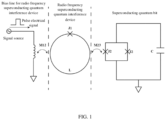
- FIG. 1 shows a schematic structural diagram of a system of modulating a transition frequency of a superconducting quantum bit according to embodiments of the present disclosure.
- the system of modulating the transition frequency of the superconducting quantum bit includes: at least one bias line for a radio frequency superconducting quantum interference device, which is used to transmit an electrical signal for adjusting a state of the radio frequency superconducting quantum interference device; at least one radio frequency superconducting quantum interference device located on a chip and placed near the superconducting quantum bit, where a hysteresis parameter of the radio frequency superconducting quantum interference device is greater than 1; at least one superconducting quantum bit, where the transition frequency of the superconducting quantum bit is modulated by applying an external magnetic flux; where the system used to modulate the transition frequency of the superconducting quantum bit operates in an extremely low temperature environment of an order of 10 mK in a dilution refrigerator.
- Equation (1) The hysteresis parameter of the above-mentioned radio frequency superconducting quantum interference device is expressed by Equation (1).
- ⁇ e 2 ⁇ I c L ⁇ 0
- I c represents a critical Josephson current in the radio frequency superconducting quantum interference device
- L represents a self-inductance of the radio frequency superconducting quantum interference device
- ⁇ 0 represents a magnetic flux quantum.
- ⁇ 0 is expressed by Equation (2).
- ⁇ 0 2.07 ⁇ 10 ⁇ 15 V ⁇ s
- transmon qubit is taken as an example in FIG. 1 , but the above-mentioned system provided by the present disclosure is not limited to the transmon qubit.
- the above-mentioned radio frequency superconducting quantum interference device (RF-SQUID) is based on a superconducting Josephson effect and a magnetic flux quantization, and is generally used to measure a weak magnetic signal.
- the radio frequency superconducting quantum interference device is placed in a range of 0.1 microns to 20 microns of the superconducting quantum bit.
- M12 represents a mutual inductance between the bias line for the radio frequency superconducting quantum interference device and the radio frequency superconducting quantum interference device
- M23 represents a mutual inductance between the radio frequency superconducting quantum interference device and the superconducting quantum bit (that is, superconducting quantum bit circuit)
- C represents a capacitance
- J1 represents a Josephson junction of the radio frequency superconducting quantum interference device
- J2 represents a Josephson junction in the superconducting quantum bit
- L represents a self-inductance coil of the radio frequency superconducting quantum interference device.
- the system provided by the present disclosure may be implemented to modulate a transition frequency of a superconducting quantum bit based on a radio frequency superconducting quantum interference device.
- the electrical signal used in the system may modulate the transition frequency of the superconducting quantum bit for a long time using a limited number of pulse signal inputs with an extremely low energy consumption.
- the radio frequency superconducting quantum interference device is integrated on the chip for easy expansion, which may help provide a scalable transition frequency modulation solution for a future superconducting quantum computer with thousands of superconducting quantum bits.
- the bias line for the radio frequency superconducting quantum interference device is coupled with the radio frequency superconducting quantum interference device through a mutual inductance.
- the bias line for the radio frequency superconducting quantum interference device is located on the chip, and is connected to a signal source in a room temperature environment through a coaxial cable in a dilution refrigerator.
- the bias line for the radio frequency superconducting quantum interference device may convert an electrical signal into a magnetic flux signal through the mutual inductance between the bias line and the radio frequency superconducting quantum interference device, and input the magnetic flux signal into the radio frequency superconducting quantum interference device.
- a bandwidth of the bias line for the radio frequency superconducting quantum interference device may cover at least a frequency range from a frequency of DC signal to 5 GHz.
- the state of the radio frequency superconducting quantum interference device may be modulated by an electrical signal with a specific direction and a specific amplitude inputted to the bias line for the radio frequency superconducting quantum interference device.
- the radio frequency superconducting quantum interference device is a closed loop including a superconducting ring made of a superconducting material and at least one Josephson junction connected with the superconducting ring end to end.
- a mutual inductance coupling is formed between the superconducting quantum bit and the radio frequency superconducting quantum interference device.
- the bias line for the radio frequency superconducting quantum interference device may convert an input electrical signal into a magnetic flux signal through a mutual inductance and input the magnetic flux signal into the radio frequency superconducting quantum interference device.
- the input electrical signal is a current signal or a voltage signal.
- a superconducting ring current in the radio frequency superconducting quantum interference device may be converted into a magnetic flux signal through a mutual inductance and input into the superconducting quantum bit, so as to modulate the transition frequency of the superconducting quantum bit.
- a relationship between a total magnetic flux of the radio frequency superconducting quantum interference device and the external magnetic flux exhibits a behavior of a hysteresis curve, and an external magnetic flux signal in form of pulse may be applied to modulate the state of the radio frequency superconducting quantum interference device.
- the state of the radio frequency superconducting quantum interference device includes a direction and a magnitude of the superconducting ring current in the radio frequency superconducting quantum interference device.
- the state of the radio frequency superconducting quantum interference device may be maintained in a changed state for a long time after being changed by a pulse signal input; and the direction and the magnitude of the superconducting ring current in the radio frequency superconducting quantum interference device may be kept constant for a long time.
- the state of the radio frequency superconducting quantum interference device may be maintained for a very long time after being changed by a pulse signal input. For example, for a radio frequency superconducting quantum interference device with a critical Josephson current of 100 microamperes at a stable ambient temperature of 20 mK, the state of the radio frequency superconducting quantum interference device may be maintained for 10 14 seconds, i.e., three million years.
- FIG. 2 shows a flowchart of a method of modulating a transition frequency of a superconducting quantum bit according to embodiments of the present disclosure.
- the method of modulating the transition frequency of the superconducting quantum bit may be applied to a system of modulating a transition frequency of a superconducting quantum bit, and may include operation S210 to operation S230.
- an electrical signal in form of single pulse is input from a signal source into a bias line for a radio frequency superconducting quantum interference device, where the single pulse electrical signal may be a current signal or a voltage signal.
- the electrical signal in form of single pulse is converted into a magnetic flux signal in form of pulse through a mutual inductance between the bias line for the radio frequency superconducting quantum interference device and the radio frequency superconducting quantum interference device.
- the magnetic flux signal in form of pulse is input into the radio frequency superconducting quantum interference device to change a state of the radio frequency superconducting quantum interference device so that the radio frequency superconducting quantum interference device in a changed state modulates the transition frequency of the superconducting quantum bit through a mutual inductance between the radio frequency superconducting quantum interference device and the superconducting quantum bit, where a hysteresis parameter of the radio frequency superconducting quantum interference device is greater than 1.
- inputting the magnetic flux signal in form of pulse into the radio frequency superconducting quantum interference device to change a state of the radio frequency superconducting quantum interference device so that the radio frequency superconducting quantum interference device in a changed state modulates the transition frequency of the superconducting quantum bit through a mutual inductance between the radio frequency superconducting quantum interference device and the superconducting quantum bit may include: converting, by using the bias line, the electrical signal in form of single pulse with a specific direction and a specific amplitude into an external magnetic flux signal in form of single pulse through a mutual inductance between the bias line and the radio frequency superconducting quantum interference device according to a hysteresis loop relationship between the external magnetic flux and the total magnetic flux of the radio frequency superconducting quantum interference device, and inputting the external magnetic flux signal in form of single pulse into the radio frequency superconducting quantum interference device to change the state of the radio frequency superconducting quantum interference device, where the state of the radio frequency superconducting quantum interference
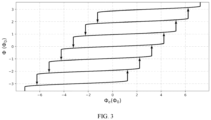
- FIG. 3 shows a schematic diagram of a hysteresis loop relationship between a total magnetic flux ⁇ and an external magnetic flux ⁇ e of a radio frequency superconducting quantum interference device according to embodiments of the present disclosure.
- an electrical signal in form of single pulse (which may be a current signal or a voltage signal) is input from a signal source into a bias line for an RF-SQUID, and is converted into a magnetic flux signal in form of pulse through a mutual inductance M12 between the bias line for the RF-SQUID and the RF-SQUID and input into the RF-SQUID. Since the hysteresis parameter of the RF-SQUID is greater than 1, a relationship between a total magnetic flux and an external magnetic flux of the RF-SQUID may exhibit a hysteresis loop relationship, as shown in FIG. 3 . An amplitude of the pulse electrical signal applied by the signal source is adjusted.
- the relationship between the total magnetic flux and the external magnetic flux of the RF-SQUID may jump from a relationship indicated by a previous curve to a relationship indicated by a next curve corresponding to the critical point.
- a specific jumping direction depends on whether a changing direction of the external magnetic flux is positive or negative, as shown by upward and downward arrows in FIG. 3 .
- the state of the RF-SQUID is described by a parameter of total magnetic flux, and a state change behavior of the RF-SQUID after a jump may follow the relationship described by the curve after the jump.
- the total magnetic flux of the RF-SQUID may also gradually decrease along a curve path after the jump.
- the state of the RF-SQUID stays at the intercept position of the y-axis of the curve and may remain stable in the state corresponding to that position for a long time. In the state corresponding to the intercept position, the total magnetic flux of the RF-SQUID is non-zero.
- a superconducting ring current with a specific direction and a specific magnitude exists in the RF-SQUID.
- Such superconducting ring current may be converted into a magnetic flux signal through a mutual inductance M23 between the RF-SQUID and the superconducting quantum bit, and input into a transmon qubit (the transmon qubit is taken as an example here, but the above-mentioned method provided by the present disclosure is not limited to the transmon qubit) to modulate a transition frequency of the transmon qubit.
- the RF-SQUID may be maintained at the state corresponding to the intercept position of the curve for a very long time, the superconducting current in the RF-SQUID is very stable, which ensures that the modulation of the transition frequency of the superconducting quantum bit is also very stable.
- the state of the RF-SQUID may also be reversely modulated according to the hysteresis loop relationship between the total magnetic flux and the external magnetic flux of the RF-SQUID, so that the RF-SQUID is modulated from a superconducting ring current state of non-zero to a state of zero or even a superconducting ring current state with a reverse current direction. In this way, the transition frequency of the superconducting quantum bit may be modulated by inputting forward and reverse magnetic fluxes from the perspective of the quantum bit.
- the transition frequency of the superconducting quantum bit may be modulated to be stable for a long time by inputting just an electrical signal in form of pulse.
- inputting an electrical signal in form of pulse may significantly reduce an energy consumption of an entire modulation process, which makes it possible to simultaneously modulate the transition frequency of all superconducting quantum bits in a superconducting quantum processor with thousands of quantum bits in the future.
Landscapes
- Engineering & Computer Science (AREA)
- Physics & Mathematics (AREA)
- General Physics & Mathematics (AREA)
- Theoretical Computer Science (AREA)
- Mathematical Analysis (AREA)
- Computing Systems (AREA)
- Evolutionary Computation (AREA)
- Condensed Matter Physics & Semiconductors (AREA)
- Computational Mathematics (AREA)
- Mathematical Optimization (AREA)
- Pure & Applied Mathematics (AREA)
- Data Mining & Analysis (AREA)
- General Engineering & Computer Science (AREA)
- Mathematical Physics (AREA)
- Software Systems (AREA)
- Artificial Intelligence (AREA)
- Nonlinear Science (AREA)
- Superconductor Devices And Manufacturing Methods Thereof (AREA)
Abstract
The present disclosure provides a system of modulating a transition frequency of a superconducting quantum bit. The system includes: at least one bias line for a radio frequency superconducting quantum interference device, configured to transmit an electrical signal for adjusting a state of the radio frequency superconducting quantum interference device; at least one radio frequency superconducting quantum interference device located on a chip and placed near the superconducting quantum bit, where a hysteresis parameter of the radio frequency superconducting quantum interference device is greater than 1; and at least one superconducting quantum bit, where the transition frequency of the superconducting quantum bit is modulated by applying an external magnetic flux. The present disclosure further provides a method of modulating a transition frequency of a superconducting quantum bit.
Description
- The present disclosure relates to a field of superconducting quantum computing, and in particular to a system and a method of modulating a transition frequency of a superconducting quantum bit.
- Quantum computing is expected to solve problems that cannot be solved by current classical computing in many fields, such as multi-body physics simulation, encryption algorithm design, chemical reaction simulation, and prediction of biological microscopic behavior. Superconducting quantum computers based on superconductor materials are important platforms for achieving quantum computing. An important technical means for implementing quantum logic gates, quantum state measurement, quantum algorithms and general quantum computing in superconducting quantum computers is to regulate a transition frequency of a superconducting quantum bit. The related art involves placing an on-chip microwave transmission line near the superconducting quantum bit. Such a transmission line is integrated with the quantum bit on the same chip. An electrical signal (including current signal and voltage signal) in the transmission line may be converted into a magnetic flux signal through a mutual inductance between the transmission line and the quantum bit. The magnetic flux signal may be input into the quantum bit to change the transition frequency of the quantum bit. However, the related art has problems such as high power consumption and poor scalability.
- The present disclosure provides a system and a method of modulating a transition frequency of a superconducting quantum bit.
- According to a first aspect of the present disclosure, a system of modulating a transition frequency of a superconducting quantum bit is provided, including: at least one bias line for a radio frequency superconducting quantum interference device, configured to transmit an electrical signal for adjusting a state of the radio frequency superconducting quantum interference device; at least one radio frequency superconducting quantum interference device located on a chip and placed near the superconducting quantum bit, where a hysteresis parameter of the radio frequency superconducting quantum interference device is greater than 1; and at least one superconducting quantum bit, where the transition frequency of the superconducting quantum bit is modulated by applying an external magnetic flux; where the system of modulating the transition frequency of the superconducting quantum bit is operable in an extremely low temperature environment of an order of 10 mK of a dilution refrigerator.
- According to embodiments of the present disclosure, the bias line for the radio frequency superconducting quantum interference device is coupled with the radio frequency superconducting quantum interference device through a mutual inductance; the bias line for the radio frequency superconducting quantum interference device is located on the chip and is connected to a signal source in a room temperature environment through a coaxial cable in the dilution refrigerator; the bias line for the radio frequency superconducting quantum interference device is configured to convert the electrical signal into a magnetic flux signal through the mutual inductance between the bias line and the radio frequency superconducting quantum interference device and input the magnetic flux signal into the radio frequency superconducting quantum interference device; a bandwidth of the bias line of the radio frequency superconducting quantum interference device covers at least a frequency range from a frequency of DC signal to 5 GHz; and the state of the radio frequency superconducting quantum interference device is modulated by an electrical signal with a specific direction and a specific amplitude inputted to the bias line for the radio frequency superconducting quantum interference device.
- According to embodiments of the present disclosure, the radio frequency superconducting quantum interference device is a closed loop including a superconducting ring made of a superconducting material and at least one Josephson junction connected with the superconducting ring end to end.
- According to embodiments of the present disclosure, a mutual inductance coupling is formed between the superconducting quantum bit and the radio frequency superconducting quantum interference device.
- According to embodiments of the present disclosure, the bias line for the radio frequency superconducting quantum interference device is configured to convert an input electrical signal into a magnetic flux signal through a mutual inductance and input the magnetic flux signal into the radio frequency superconducting quantum interference device, and the input electrical signal is a current signal or a voltage signal.
- According to embodiments of the present disclosure, a superconducting ring current in the radio frequency superconducting quantum interference device is converted into a magnetic flux signal through a mutual inductance and input into the superconducting quantum bit to modulate the transition frequency of the superconducting quantum bit.
- According to embodiments of the present disclosure, a change relationship between a total magnetic flux of the radio frequency superconducting quantum interference device and the external magnetic flux exhibits a behavior of a hysteresis curve, an external magnetic flux signal in form of pulse is applied to modulate the state of the radio frequency superconducting quantum interference device, and the state of the radio frequency superconducting quantum interference device includes a direction and a magnitude of a superconducting ring current in the radio frequency superconducting quantum interference device.
- According to embodiments of the present disclosure, the state of the radio frequency superconducting quantum interference device is allowed to be maintained in a changed state for a long time after being changed by a pulse signal input; and the direction and the magnitude of the superconducting ring current in the radio frequency superconducting quantum interference device is allowed to be kept constant for a long time.
- According to a second aspect of the present disclosure, a method of modulating a transition frequency of a superconducting quantum bit is provided, which is applied to a system of modulating a transition frequency of a superconducting quantum bit, where the method includes: inputting the electrical signal in form of single pulse from a signal source into the bias line for the radio frequency superconducting quantum interference device, where the electrical signal in form of single pulse is a current signal or a voltage signal; converting the electrical signal in form of single pulse into a magnetic flux signal in form of pulse through a mutual inductance between the bias line for the radio frequency superconducting quantum interference device and the radio frequency superconducting quantum interference device; inputting the magnetic flux signal in form of pulse into the radio frequency superconducting quantum interference device to change a state of the radio frequency superconducting quantum interference device so that the radio frequency superconducting quantum interference device in a changed state modulates the transition frequency of the superconducting quantum bit through a mutual inductance between the radio frequency superconducting quantum interference device and the superconducting quantum bit, where a hysteresis parameter of the radio frequency superconducting quantum interference device is greater than 1.
- According to embodiments of the present disclosure, the inputting the magnetic flux signal in form of pulse into the radio frequency superconducting quantum interference device to change a state of the radio frequency superconducting quantum interference device so that the radio frequency superconducting quantum interference device in a changed state modulates the transition frequency of the superconducting quantum bit through a mutual inductance between the radio frequency superconducting quantum interference device and the superconducting quantum bit includes: converting, by using the bias line, the electrical signal in form of single pulse with a specific direction and a specific amplitude into an external magnetic flux signal in form of single pulse through a mutual inductance between the bias line and the radio frequency superconducting quantum interference device according to a hysteresis loop relationship between the external magnetic flux and the total magnetic flux of the radio frequency superconducting quantum interference device, and inputting the external magnetic flux signal in form of single pulse into the radio frequency superconducting quantum interference device to change the state of the radio frequency superconducting quantum interference device, where the state of the radio frequency superconducting quantum interference device includes a direction and a magnitude of a superconducting ring current in the radio frequency superconducting quantum interference device; and modulating, by using the superconducting ring current, the transition frequency of the superconducting quantum bit through a mutual inductance between the radio frequency superconducting quantum interference device and the superconducting quantum bit; where the direction of the superconducting ring current in the radio frequency superconducting quantum interference device is related to a direction of the external magnetic flux signal in form of single pulse inputted the radio frequency superconducting quantum interference device; and where the magnitude of the superconducting ring current in the radio frequency superconducting quantum interference device is related to an amplitude of the external magnetic flux signal in form of single pulse inputted the radio frequency superconducting quantum interference device.
- The above contents and other objectives, features and advantages of the present disclosure will become more apparent through the following description of the embodiments of the present disclosure with reference to the accompanying drawings. In the accompanying drawings:
-
FIG. 1 shows a schematic structural diagram of a system of modulating a transition frequency of a superconducting quantum bit according to embodiments of the present disclosure; -
FIG. 2 shows a flowchart of a method of modulating a transition frequency of a superconducting quantum bit according to embodiments of the present disclosure; and -
FIG. 3 shows a schematic diagram of a hysteresis loop relationship between a total magnetic flux Φ and an external magnetic flux Φe of a radio frequency superconducting quantum interference device according to embodiments of the present disclosure. - In order to make objectives, technical solutions and advantages of the present disclosure more clearly understood, the present disclosure will be further described in detail below in conjunction with specific embodiments and with reference to the accompanying drawings.
- It should be noted that the figures provided in the embodiments of the present disclosure are just used to illustrate the basic concept of the present disclosure in a schematic manner. The figures only show components related to the present disclosure and are not drawn according to the number, shape and size of components in actual implementation. The type, quantity and proportion of each component may be changed arbitrarily in actual implementation, and a layout of components may be more complicated.
- In a superconducting quantum computer in the related art, an on-chip microwave transmission line is placed near a superconducting quantum bit, and the transmission line is integrated with the quantum bit on the same chip. An electrical signal in the transmission line may be converted into a magnetic flux signal through a mutual inductance between the transmission line and the quantum bit, and the magnetic flux signal may be input into the quantum bit to change a transition frequency of the quantum bit.
- However, the solutions in the related art have the following disadvantages. First, the electrical signal needs to be continuously input from a signal source at a room temperature to a superconducting quantum processor in a low-temperature environment of a refrigerator. The continuously input electrical signal may generate heat when passing through various attenuators on a low-temperature coaxial cable in the refrigerator. Long-term heating may make it difficult to maintain the low-temperature environment in the refrigerator, and a thermal radiation generated by the heating may also affect a performance of the quantum processor. Secondly, with an increase in the number of quantum bits, a demand for the number of coaxial transmission lines in the refrigerator may also increase exponentially, which requires a larger physical space inside the refrigerator and puts higher requirements on cooling power of the refrigerator, and thus limits a scalability of the superconducting quantum processor.
- Therefore, it is important and urgent to achieve a low-power scalable solution for modulating a transition frequency of a quantum bit on a future superconducting processor with thousands of quantum bits.
- In view of the above, the present disclosure provides a system and a method of modulating a transition frequency of a superconducting quantum bit to achieve the solution of modulating the transition frequency of the superconducting quantum bit, so as to solve the problems of high energy consumption and non-scalability in the related art.
-
FIG. 1 shows a schematic structural diagram of a system of modulating a transition frequency of a superconducting quantum bit according to embodiments of the present disclosure. - As shown in
FIG. 1 , the system of modulating the transition frequency of the superconducting quantum bit includes: at least one bias line for a radio frequency superconducting quantum interference device, which is used to transmit an electrical signal for adjusting a state of the radio frequency superconducting quantum interference device; at least one radio frequency superconducting quantum interference device located on a chip and placed near the superconducting quantum bit, where a hysteresis parameter of the radio frequency superconducting quantum interference device is greater than 1; at least one superconducting quantum bit, where the transition frequency of the superconducting quantum bit is modulated by applying an external magnetic flux; where the system used to modulate the transition frequency of the superconducting quantum bit operates in an extremely low temperature environment of an order of 10 mK in a dilution refrigerator. - The hysteresis parameter of the above-mentioned radio frequency superconducting quantum interference device is expressed by Equation (1).


- It should be clear to those skilled in the art that a transmon qubit is taken as an example in
FIG. 1 , but the above-mentioned system provided by the present disclosure is not limited to the transmon qubit. - The above-mentioned radio frequency superconducting quantum interference device (RF-SQUID) is based on a superconducting Josephson effect and a magnetic flux quantization, and is generally used to measure a weak magnetic signal.
- Optionally, the radio frequency superconducting quantum interference device is placed in a range of 0.1 microns to 20 microns of the superconducting quantum bit.
- As shown in
FIG. 1 , M12 represents a mutual inductance between the bias line for the radio frequency superconducting quantum interference device and the radio frequency superconducting quantum interference device, M23 represents a mutual inductance between the radio frequency superconducting quantum interference device and the superconducting quantum bit (that is, superconducting quantum bit circuit), C represents a capacitance, J1 represents a Josephson junction of the radio frequency superconducting quantum interference device, J2 represents a Josephson junction in the superconducting quantum bit, and L represents a self-inductance coil of the radio frequency superconducting quantum interference device. - The system provided by the present disclosure may be implemented to modulate a transition frequency of a superconducting quantum bit based on a radio frequency superconducting quantum interference device. The electrical signal used in the system may modulate the transition frequency of the superconducting quantum bit for a long time using a limited number of pulse signal inputs with an extremely low energy consumption. Moreover, the radio frequency superconducting quantum interference device is integrated on the chip for easy expansion, which may help provide a scalable transition frequency modulation solution for a future superconducting quantum computer with thousands of superconducting quantum bits.
- According to embodiments of the present disclosure, the bias line for the radio frequency superconducting quantum interference device is coupled with the radio frequency superconducting quantum interference device through a mutual inductance. The bias line for the radio frequency superconducting quantum interference device is located on the chip, and is connected to a signal source in a room temperature environment through a coaxial cable in a dilution refrigerator. The bias line for the radio frequency superconducting quantum interference device may convert an electrical signal into a magnetic flux signal through the mutual inductance between the bias line and the radio frequency superconducting quantum interference device, and input the magnetic flux signal into the radio frequency superconducting quantum interference device. A bandwidth of the bias line for the radio frequency superconducting quantum interference device may cover at least a frequency range from a frequency of DC signal to 5 GHz. The state of the radio frequency superconducting quantum interference device may be modulated by an electrical signal with a specific direction and a specific amplitude inputted to the bias line for the radio frequency superconducting quantum interference device.
- According to embodiments of the present disclosure, the radio frequency superconducting quantum interference device is a closed loop including a superconducting ring made of a superconducting material and at least one Josephson junction connected with the superconducting ring end to end.
- According to embodiments of the present disclosure, a mutual inductance coupling is formed between the superconducting quantum bit and the radio frequency superconducting quantum interference device.
- According to embodiments of the present disclosure, the bias line for the radio frequency superconducting quantum interference device may convert an input electrical signal into a magnetic flux signal through a mutual inductance and input the magnetic flux signal into the radio frequency superconducting quantum interference device. The input electrical signal is a current signal or a voltage signal.
- According to embodiments of the present disclosure, a superconducting ring current in the radio frequency superconducting quantum interference device may be converted into a magnetic flux signal through a mutual inductance and input into the superconducting quantum bit, so as to modulate the transition frequency of the superconducting quantum bit.
- According to embodiments of the present disclosure, a relationship between a total magnetic flux of the radio frequency superconducting quantum interference device and the external magnetic flux exhibits a behavior of a hysteresis curve, and an external magnetic flux signal in form of pulse may be applied to modulate the state of the radio frequency superconducting quantum interference device. The state of the radio frequency superconducting quantum interference device includes a direction and a magnitude of the superconducting ring current in the radio frequency superconducting quantum interference device.
- According to embodiments of the present disclosure, the state of the radio frequency superconducting quantum interference device may be maintained in a changed state for a long time after being changed by a pulse signal input; and the direction and the magnitude of the superconducting ring current in the radio frequency superconducting quantum interference device may be kept constant for a long time.
- The state of the radio frequency superconducting quantum interference device may be maintained for a very long time after being changed by a pulse signal input. For example, for a radio frequency superconducting quantum interference device with a critical Josephson current of 100 microamperes at a stable ambient temperature of 20 mK, the state of the radio frequency superconducting quantum interference device may be maintained for 1014 seconds, i.e., three million years.
-
FIG. 2 shows a flowchart of a method of modulating a transition frequency of a superconducting quantum bit according to embodiments of the present disclosure. - As shown in
FIG. 2 , the method of modulating the transition frequency of the superconducting quantum bit may be applied to a system of modulating a transition frequency of a superconducting quantum bit, and may include operation S210 to operation S230. - In operation S210, an electrical signal in form of single pulse is input from a signal source into a bias line for a radio frequency superconducting quantum interference device, where the single pulse electrical signal may be a current signal or a voltage signal.
- In operation S220, the electrical signal in form of single pulse is converted into a magnetic flux signal in form of pulse through a mutual inductance between the bias line for the radio frequency superconducting quantum interference device and the radio frequency superconducting quantum interference device.
- In operation S230, the magnetic flux signal in form of pulse is input into the radio frequency superconducting quantum interference device to change a state of the radio frequency superconducting quantum interference device so that the radio frequency superconducting quantum interference device in a changed state modulates the transition frequency of the superconducting quantum bit through a mutual inductance between the radio frequency superconducting quantum interference device and the superconducting quantum bit, where a hysteresis parameter of the radio frequency superconducting quantum interference device is greater than 1.
- According to embodiments of the present disclosure, inputting the magnetic flux signal in form of pulse into the radio frequency superconducting quantum interference device to change a state of the radio frequency superconducting quantum interference device so that the radio frequency superconducting quantum interference device in a changed state modulates the transition frequency of the superconducting quantum bit through a mutual inductance between the radio frequency superconducting quantum interference device and the superconducting quantum bit may include: converting, by using the bias line, the electrical signal in form of single pulse with a specific direction and a specific amplitude into an external magnetic flux signal in form of single pulse through a mutual inductance between the bias line and the radio frequency superconducting quantum interference device according to a hysteresis loop relationship between the external magnetic flux and the total magnetic flux of the radio frequency superconducting quantum interference device, and inputting the external magnetic flux signal in form of single pulse into the radio frequency superconducting quantum interference device to change the state of the radio frequency superconducting quantum interference device, where the state of the radio frequency superconducting quantum interference device includes a direction and a magnitude of a superconducting ring current in the radio frequency superconducting quantum interference device; and modulating, by using the superconducting ring current, the transition frequency of the superconducting quantum bit through a mutual inductance between the radio frequency superconducting quantum interference device and the superconducting quantum bit; where the direction of the superconducting ring current in the radio frequency superconducting quantum interference device is related to a direction of the external magnetic flux signal in form of single pulse inputted the radio frequency superconducting quantum interference device; and the magnitude of the superconducting ring current in the radio frequency superconducting quantum interference device is related to an amplitude of the single pulse external magnetic flux signal in form of single pulse inputted the radio frequency superconducting quantum interference device.
- In order to better illustrate the advantages of the above-mentioned method, the above-mentioned method will be further described in detail in the present disclosure with reference to
FIG. 3 and specific embodiments. -
FIG. 3 shows a schematic diagram of a hysteresis loop relationship between a total magnetic flux Φ and an external magnetic flux Φe of a radio frequency superconducting quantum interference device according to embodiments of the present disclosure. - Specifically, in such embodiments, an electrical signal in form of single pulse (which may be a current signal or a voltage signal) is input from a signal source into a bias line for an RF-SQUID, and is converted into a magnetic flux signal in form of pulse through a mutual inductance M12 between the bias line for the RF-SQUID and the RF-SQUID and input into the RF-SQUID. Since the hysteresis parameter of the RF-SQUID is greater than 1, a relationship between a total magnetic flux and an external magnetic flux of the RF-SQUID may exhibit a hysteresis loop relationship, as shown in
FIG. 3 . An amplitude of the pulse electrical signal applied by the signal source is adjusted. When an amplitude of the converted magnetic flux signal reaches a value at a critical point (a magnitude of the external magnetic flux corresponding to a starting position of each arrow inFIG. 3 ) of the external magnetic flux in the hysteresis loop relationship between the total magnetic flux and the external magnetic flux of the RF-SQUID, the relationship between the total magnetic flux and the external magnetic flux of the RF-SQUID may jump from a relationship indicated by a previous curve to a relationship indicated by a next curve corresponding to the critical point. A specific jumping direction depends on whether a changing direction of the external magnetic flux is positive or negative, as shown by upward and downward arrows inFIG. 3 . Here, the state of the RF-SQUID is described by a parameter of total magnetic flux, and a state change behavior of the RF-SQUID after a jump may follow the relationship described by the curve after the jump. At this time, if the external magnetic flux gradually decreases to 0, the total magnetic flux of the RF-SQUID may also gradually decrease along a curve path after the jump. Finally, the state of the RF-SQUID stays at the intercept position of the y-axis of the curve and may remain stable in the state corresponding to that position for a long time. In the state corresponding to the intercept position, the total magnetic flux of the RF-SQUID is non-zero. In other words, a superconducting ring current with a specific direction and a specific magnitude exists in the RF-SQUID. Such superconducting ring current may be converted into a magnetic flux signal through a mutual inductance M23 between the RF-SQUID and the superconducting quantum bit, and input into a transmon qubit (the transmon qubit is taken as an example here, but the above-mentioned method provided by the present disclosure is not limited to the transmon qubit) to modulate a transition frequency of the transmon qubit. Since the RF-SQUID may be maintained at the state corresponding to the intercept position of the curve for a very long time, the superconducting current in the RF-SQUID is very stable, which ensures that the modulation of the transition frequency of the superconducting quantum bit is also very stable. Similarly, the state of the RF-SQUID may also be reversely modulated according to the hysteresis loop relationship between the total magnetic flux and the external magnetic flux of the RF-SQUID, so that the RF-SQUID is modulated from a superconducting ring current state of non-zero to a state of zero or even a superconducting ring current state with a reverse current direction. In this way, the transition frequency of the superconducting quantum bit may be modulated by inputting forward and reverse magnetic fluxes from the perspective of the quantum bit. - In summary, with the method of modulating the transition frequency of the superconducting quantum bit based on the RF-SQUID according to the present disclosure, the transition frequency of the superconducting quantum bit may be modulated to be stable for a long time by inputting just an electrical signal in form of pulse. Compared with the current solution of on-chip microwave transmission line which requires inputting a continuous electrical signal, inputting an electrical signal in form of pulse may significantly reduce an energy consumption of an entire modulation process, which makes it possible to simultaneously modulate the transition frequency of all superconducting quantum bits in a superconducting quantum processor with thousands of quantum bits in the future.
- The above specific embodiments further describe the objectives, technical solutions and beneficial effects of the present disclosure in detail. It should be understood that the above are just specific embodiments of the present disclosure and are not intended to limit the present disclosure. Any modifications, equivalent substitutions, improvements, etc. made within the spirit and principles of the present disclosure should be contained in the protection scope of the present disclosure.
Claims (10)
- A system of modulating a transition frequency of a superconducting quantum bit, comprising:at least one bias line for a radio frequency superconducting quantum interference device, configured to transmit an electrical signal for adjusting a state of the radio frequency superconducting quantum interference device;at least one radio frequency superconducting quantum interference device located on a chip and placed near the superconducting quantum bit, wherein a hysteresis parameter of the radio frequency superconducting quantum interference device is greater than 1; andat least one superconducting quantum bit, wherein the transition frequency of the superconducting quantum bit is modulated by applying an external magnetic flux;wherein the system of modulating the transition frequency of the superconducting quantum bit is operable in an extremely low temperature environment of an order of 10 mK of a dilution refrigerator.
- The system according to claim 1, wherein the bias line for the radio frequency superconducting quantum interference device is coupled with the radio frequency superconducting quantum interference device through a mutual inductance;wherein the bias line for the radio frequency superconducting quantum interference device is located on the chip and is connected to a signal source in a room temperature environment through a coaxial cable in the dilution refrigerator;wherein the bias line for the radio frequency superconducting quantum interference device is configured to convert the electrical signal into a magnetic flux signal through the mutual inductance between the bias line and the radio frequency superconducting quantum interference device and input the magnetic flux signal into the radio frequency superconducting quantum interference device;wherein a bandwidth of the bias line of the radio frequency superconducting quantum interference device covers at least a frequency range from a frequency of DC signal to 5 GHz; andwherein the state of the radio frequency superconducting quantum interference device is modulated by an electrical signal with a specific direction and a specific amplitude inputted to the bias line for the radio frequency superconducting quantum interference device.
- The system according to claim 1 or 2, wherein the radio frequency superconducting quantum interference device is a closed loop comprising a superconducting ring made of a superconducting material and at least one Josephson junction connected with the superconducting ring end to end.
- The system according to any one of the preceding claims, wherein a mutual inductance coupling is formed between the superconducting quantum bit and the radio frequency superconducting quantum interference device.
- The system according to any one of the preceding claims, wherein the bias line for the radio frequency superconducting quantum interference device is configured to convert an input electrical signal into a magnetic flux signal through a mutual inductance and input the magnetic flux signal into the radio frequency superconducting quantum interference device, and the input electrical signal is a current signal or a voltage signal.
- The system according to any one of the preceding claims, wherein a superconducting ring current in the radio frequency superconducting quantum interference device is converted into a magnetic flux signal through a mutual inductance and input into the superconducting quantum bit to modulate the transition frequency of the superconducting quantum bit.
- The system according to any one of the preceding claims, wherein a relationship between a total magnetic flux of the radio frequency superconducting quantum interference device and the external magnetic flux exhibits a behavior of a hysteresis curve, an external magnetic flux signal in form of pulse is applied to modulate the state of the radio frequency superconducting quantum interference device, and the state of the radio frequency superconducting quantum interference device comprises a direction and a magnitude of a superconducting ring current in the radio frequency superconducting quantum interference device.
- The system according to any one of the preceding claims, wherein the state of the radio frequency superconducting quantum interference device is allowed to be maintained in a changed state for a long time after being changed by a pulse signal input; and
wherein the direction and the magnitude of the superconducting ring current in the radio frequency superconducting quantum interference device is allowed to be kept constant for a long time. - A method of modulating a transition frequency of a superconducting quantum bit, applied to the system according to any one of claims 1 to 8, wherein the method comprises:inputting (S210) the electrical signal in form of single pulse from a signal source into the bias line for the radio frequency superconducting quantum interference device, wherein the electrical signal in form of single pulse is a current signal or a voltage signal;converting (S220) the electrical signal in form of single pulse into a magnetic flux signal in form of pulse through a mutual inductance between the bias line for the radio frequency superconducting quantum interference device and the radio frequency superconducting quantum interference device;inputting (S230) the magnetic flux signal in form of pulse into the radio frequency superconducting quantum interference device to change a state of the radio frequency superconducting quantum interference device, so that the radio frequency superconducting quantum interference device in a changed state modulates the transition frequency of the superconducting quantum bit through a mutual inductance between the radio frequency superconducting quantum interference device and the superconducting quantum bit, wherein a hysteresis parameter of the radio frequency superconducting quantum interference device is greater than 1.
- The method according to claim 9, wherein the inputting the magnetic flux signal in form of pulse into the radio frequency superconducting quantum interference device to change a state of the radio frequency superconducting quantum interference device so that the radio frequency superconducting quantum interference device in a changed state modulates the transition frequency of the superconducting quantum bit through a mutual inductance between the radio frequency superconducting quantum interference device and the superconducting quantum bit comprises:converting, by using the bias line, the electrical signal in form of single pulse with a specific direction and a specific amplitude into an external magnetic flux signal in form of single pulse through a mutual inductance between the bias line and the radio frequency superconducting quantum interference device according to a hysteresis loop relationship between the external magnetic flux and the total magnetic flux of the radio frequency superconducting quantum interference device, and inputting the external magnetic flux signal in form of single pulse into the radio frequency superconducting quantum interference device to change the state of the radio frequency superconducting quantum interference device, wherein the state of the radio frequency superconducting quantum interference device comprises a direction and a magnitude of a superconducting ring current in the radio frequency superconducting quantum interference device; andmodulating, by using the superconducting ring current, the transition frequency of the superconducting quantum bit through a mutual inductance between the radio frequency superconducting quantum interference device and the superconducting quantum bit;wherein the direction of the superconducting ring current in the radio frequency superconducting quantum interference device is related to a direction of the external magnetic flux signal in form of single pulse inputted the radio frequency superconducting quantum interference device; andwherein the magnitude of the superconducting ring current in the radio frequency superconducting quantum interference device is related to an amplitude of the external magnetic flux signal in form of single pulse inputted the radio frequency superconducting quantum interference device.
Applications Claiming Priority (1)
| Application Number | Priority Date | Filing Date | Title |
|---|---|---|---|
| CN202310680483.3A CN116415675B (en) | 2023-06-09 | 2023-06-09 | A system and method for modulating the transition frequency of superconducting qubits |
Publications (1)
| Publication Number | Publication Date |
|---|---|
| EP4475040A1 true EP4475040A1 (en) | 2024-12-11 |
Family
ID=87054661
Family Applications (1)
| Application Number | Title | Priority Date | Filing Date |
|---|---|---|---|
| EP24180724.7A Pending EP4475040A1 (en) | 2023-06-09 | 2024-06-07 | System and method of modulating transition frequency of superconducting quantum bit |
Country Status (3)
| Country | Link |
|---|---|
| US (1) | US20250379563A1 (en) |
| EP (1) | EP4475040A1 (en) |
| CN (1) | CN116415675B (en) |
Families Citing this family (2)
| Publication number | Priority date | Publication date | Assignee | Title |
|---|---|---|---|---|
| CN117977240B (en) * | 2024-02-27 | 2024-11-19 | 中国计量科学研究院 | Device and method for connecting superconducting quantum interference device and superconducting capture coil |
| CN119730705B (en) * | 2024-11-22 | 2025-09-23 | 北京量子信息科学研究院 | Frequency modulation apparatus and method for superconducting qubit device, electronic device, and storage medium |
Family Cites Families (9)
| Publication number | Priority date | Publication date | Assignee | Title |
|---|---|---|---|---|
| JP2002148322A (en) * | 2000-11-09 | 2002-05-22 | Seiko Instruments Inc | Signal detector using superconducting quantum interference device and measuring method thereof |
| JP3525145B2 (en) * | 2001-04-17 | 2004-05-10 | 独立行政法人 科学技術振興機構 | Multi-phase high frequency flux driven superconducting quantum interference device |
| JP2003209299A (en) * | 2002-01-11 | 2003-07-25 | Seiko Instruments Inc | Current amplification means and current detector using superconducting quantum interference device |
| CN100399594C (en) * | 2004-11-29 | 2008-07-02 | 中国科学院物理研究所 | A method for increasing the sensitivity of superconducting quantum interference devices |
| CN106199465B (en) * | 2015-05-05 | 2018-12-14 | 中国科学院上海微系统与信息技术研究所 | A kind of twin-stage superconducting quantum interference device amplifying device, method and SQUID Magnetic Sensor |
| WO2022140674A1 (en) * | 2020-12-23 | 2022-06-30 | Rigetti & Co, Llc | Applying two-qubit quantum logic gates in a superconducting quantum processing unit |
| CN115050886B (en) * | 2021-03-09 | 2024-08-16 | 本源量子计算科技(合肥)股份有限公司 | Quantum chip and preparation method thereof |
| CN113705050B (en) * | 2021-08-26 | 2023-10-27 | 哈尔滨工程大学 | A virtual experimental platform for superconducting quantum interferometer teaching |
| CN116187461A (en) * | 2023-02-16 | 2023-05-30 | 合肥本源量子计算科技有限责任公司 | Bit structure, quantum chip, manufacturing method of quantum chip and quantum computer |
-
2023
- 2023-06-09 CN CN202310680483.3A patent/CN116415675B/en active Active
-
2024
- 2024-06-06 US US18/736,102 patent/US20250379563A1/en active Pending
- 2024-06-07 EP EP24180724.7A patent/EP4475040A1/en active Pending
Non-Patent Citations (5)
| Title |
|---|
| ALLMAN M. S. ET AL: "rf-SQUID-Mediated Coherent Tunable Coupling between a Superconducting Phase Qubit and a Lumped-Element Resonator", PHYSICAL REVIEW LETTERS, vol. 104, no. 17, 1 April 2010 (2010-04-01), US, XP093216946, ISSN: 0031-9007, DOI: 10.1103/PhysRevLett.104.177004 * |
| ALLMAN M. S. ET AL: "Tunable Resonant and Nonresonant Interactions between a Phase Qubitand LC Resonator", PHYSICAL REVIEW LETTERS, vol. 112, no. 12, 1 March 2014 (2014-03-01), US, XP093216945, ISSN: 0031-9007, DOI: 10.1103/PhysRevLett.112.123601 * |
| BERKLEY A J ET AL: "A scalable readout system for a superconducting adiabatic quantum optimization system", ARXIV.ORG, CORNELL UNIVERSITY LIBRARY, 201 OLIN LIBRARY CORNELL UNIVERSITY ITHACA, NY 14853, 6 May 2009 (2009-05-06), XP080323018, DOI: 10.1088/0953-2048/23/10/105014 * |
| LEI JIANG ET AL: "In situ Qubit Frequency Tuning Circuit for Scalable Superconducting Quantum Computing: Scheme and Experiment", ARXIV.ORG, CORNELL UNIVERSITY LIBRARY, 201 OLIN LIBRARY CORNELL UNIVERSITY ITHACA, NY 14853, 31 July 2024 (2024-07-31), XP091836031 * |
| POLETTO S ET AL: "A tunable rf SQUID manipulated as flux and phase qubit", ARXIV.ORG, CORNELL UNIVERSITY LIBRARY, 201 OLIN LIBRARY CORNELL UNIVERSITY ITHACA, NY 14853, 23 October 2009 (2009-10-23), XP080373626, DOI: 10.1088/0031-8949/2009/T137/014011 * |
Also Published As
| Publication number | Publication date |
|---|---|
| US20250379563A1 (en) | 2025-12-11 |
| CN116415675A (en) | 2023-07-11 |
| CN116415675B (en) | 2023-09-22 |
Similar Documents
| Publication | Publication Date | Title |
|---|---|---|
| US20250379563A1 (en) | System and method of modulating transition frequency of superconducting quantum bit | |
| Strambini et al. | A Josephson phase battery | |
| Guo et al. | Strong on-chip microwave photon–magnon coupling using ultralow-damping epitaxial Y3Fe5O12 films at 2 K | |
| Guarcello et al. | Phase-coherent solitonic Josephson heat oscillator | |
| Nefedkin et al. | Dark‐State Induced Quantum Nonreciprocity | |
| Brennan et al. | Classical interfaces for controlling cryogenic quantum computing technologies | |
| Rehák et al. | Parametric amplification by coupled flux qubits | |
| Hidki et al. | Asymmetric EPR steering in a cavity–magnon system generated by a squeezed vacuum field and an optical parametric amplifier | |
| Pankratov et al. | Oscillations in Josephson transmission line stimulated by load in the presence of noise | |
| Uhl et al. | A flux-tunable YBa2Cu3O7 quantum interference microwave circuit | |
| Khabipov et al. | Superconducting microwave resonators with non-centrosymmetric nonlinearity | |
| Liu et al. | Ultra-slow spin waves propagation based on skyrmion breathing | |
| Cai et al. | High-temperature superconductor quantum flux parametron for energy efficient logic | |
| Sohail et al. | Phase-sensitive enhanced absorption and slow light in a cross-cavity magnomechanical system | |
| Shahverdiev | Modulated time delays, synchronized Josephson junctions in high-temperature superconductors and chaotic terahertz waves | |
| Weng et al. | Low power single flux quantum qubit control circuit without high-frequency input | |
| Yang et al. | Controlling coupled magnons with pumps | |
| Koura et al. | Linear regression using quantum annealing with continuous variables | |
| CN215186652U (en) | Tunable Dissipative Circuits for Cryogenic Frequency Shifters | |
| Mukaiyama et al. | Design and demonstration of an on-chip AC power source for adiabatic quantum-flux-parametron logic | |
| Alipour Bonab et al. | Physics-constrained deep learning framework for accurate AC loss prediction of high-temperature superconductors: impact of data scarcity and extrapolation beyond the range of experimental measurements | |
| Tan et al. | Theoretical research of single ferrite tuner systems with magnetic field modulation in the ion cyclotron range of frequency | |
| Lahbibi et al. | Critical characteristics of spin− 1/2 four-leg nanotube: Monte Carlo Simulation | |
| Sosso et al. | Tests of SNIS Josephson arrays cryocooler operation | |
| Lakshmi Bhai et al. | Mitigation of noise in Josephson parametric oscillator by injection locking |
Legal Events
| Date | Code | Title | Description |
|---|---|---|---|
| PUAI | Public reference made under article 153(3) epc to a published international application that has entered the european phase |
Free format text: ORIGINAL CODE: 0009012 |
|
| STAA | Information on the status of an ep patent application or granted ep patent |
Free format text: STATUS: REQUEST FOR EXAMINATION WAS MADE |
|
| 17P | Request for examination filed |
Effective date: 20240607 |
|
| AK | Designated contracting states |
Kind code of ref document: A1 Designated state(s): AL AT BE BG CH CY CZ DE DK EE ES FI FR GB GR HR HU IE IS IT LI LT LU LV MC ME MK MT NL NO PL PT RO RS SE SI SK SM TR |
|
| STAA | Information on the status of an ep patent application or granted ep patent |
Free format text: STATUS: EXAMINATION IS IN PROGRESS |
|
| 17Q | First examination report despatched |
Effective date: 20251029 |