EP4472306A1 - Positionierungsverfahren auf basis eines modells der künstlichen intelligenz (ki) und kommunikationsvorrichtung - Google Patents
Positionierungsverfahren auf basis eines modells der künstlichen intelligenz (ki) und kommunikationsvorrichtung Download PDFInfo
- Publication number
- EP4472306A1 EP4472306A1 EP23746449.0A EP23746449A EP4472306A1 EP 4472306 A1 EP4472306 A1 EP 4472306A1 EP 23746449 A EP23746449 A EP 23746449A EP 4472306 A1 EP4472306 A1 EP 4472306A1
- Authority
- EP
- European Patent Office
- Prior art keywords
- information
- model
- measurement
- parameter
- positioning method
- Prior art date
- Legal status (The legal status is an assumption and is not a legal conclusion. Google has not performed a legal analysis and makes no representation as to the accuracy of the status listed.)
- Pending
Links
Images






Classifications
-
- H—ELECTRICITY
- H04—ELECTRIC COMMUNICATION TECHNIQUE
- H04W—WIRELESS COMMUNICATION NETWORKS
- H04W64/00—Locating users or terminals or network equipment for network management purposes, e.g. mobility management
-
- H—ELECTRICITY
- H04—ELECTRIC COMMUNICATION TECHNIQUE
- H04W—WIRELESS COMMUNICATION NETWORKS
- H04W4/00—Services specially adapted for wireless communication networks; Facilities therefor
- H04W4/02—Services making use of location information
- H04W4/029—Location-based management or tracking services
-
- G—PHYSICS
- G01—MEASURING; TESTING
- G01S—RADIO DIRECTION-FINDING; RADIO NAVIGATION; DETERMINING DISTANCE OR VELOCITY BY USE OF RADIO WAVES; LOCATING OR PRESENCE-DETECTING BY USE OF THE REFLECTION OR RERADIATION OF RADIO WAVES; ANALOGOUS ARRANGEMENTS USING OTHER WAVES
- G01S5/00—Position-fixing by co-ordinating two or more direction or position line determinations; Position-fixing by co-ordinating two or more distance determinations
- G01S5/02—Position-fixing by co-ordinating two or more direction or position line determinations; Position-fixing by co-ordinating two or more distance determinations using radio waves
- G01S5/0278—Position-fixing by co-ordinating two or more direction or position line determinations; Position-fixing by co-ordinating two or more distance determinations using radio waves involving statistical or probabilistic considerations
-
- G—PHYSICS
- G06—COMPUTING OR CALCULATING; COUNTING
- G06N—COMPUTING ARRANGEMENTS BASED ON SPECIFIC COMPUTATIONAL MODELS
- G06N20/00—Machine learning
-
- G—PHYSICS
- G06—COMPUTING OR CALCULATING; COUNTING
- G06N—COMPUTING ARRANGEMENTS BASED ON SPECIFIC COMPUTATIONAL MODELS
- G06N3/00—Computing arrangements based on biological models
- G06N3/02—Neural networks
- G06N3/08—Learning methods
-
- H—ELECTRICITY
- H04—ELECTRIC COMMUNICATION TECHNIQUE
- H04L—TRANSMISSION OF DIGITAL INFORMATION, e.g. TELEGRAPHIC COMMUNICATION
- H04L41/00—Arrangements for maintenance, administration or management of data switching networks, e.g. of packet switching networks
- H04L41/08—Configuration management of networks or network elements
- H04L41/0866—Checking the configuration
-
- H—ELECTRICITY
- H04—ELECTRIC COMMUNICATION TECHNIQUE
- H04L—TRANSMISSION OF DIGITAL INFORMATION, e.g. TELEGRAPHIC COMMUNICATION
- H04L41/00—Arrangements for maintenance, administration or management of data switching networks, e.g. of packet switching networks
- H04L41/14—Network analysis or design
- H04L41/145—Network analysis or design involving simulating, designing, planning or modelling of a network
-
- H—ELECTRICITY
- H04—ELECTRIC COMMUNICATION TECHNIQUE
- H04L—TRANSMISSION OF DIGITAL INFORMATION, e.g. TELEGRAPHIC COMMUNICATION
- H04L41/00—Arrangements for maintenance, administration or management of data switching networks, e.g. of packet switching networks
- H04L41/16—Arrangements for maintenance, administration or management of data switching networks, e.g. of packet switching networks using machine learning or artificial intelligence
-
- H—ELECTRICITY
- H04—ELECTRIC COMMUNICATION TECHNIQUE
- H04W—WIRELESS COMMUNICATION NETWORKS
- H04W4/00—Services specially adapted for wireless communication networks; Facilities therefor
- H04W4/02—Services making use of location information
-
- H—ELECTRICITY
- H04—ELECTRIC COMMUNICATION TECHNIQUE
- H04L—TRANSMISSION OF DIGITAL INFORMATION, e.g. TELEGRAPHIC COMMUNICATION
- H04L41/00—Arrangements for maintenance, administration or management of data switching networks, e.g. of packet switching networks
- H04L41/08—Configuration management of networks or network elements
- H04L41/0803—Configuration setting
- H04L41/0813—Configuration setting characterised by the conditions triggering a change of settings
- H04L41/082—Configuration setting characterised by the conditions triggering a change of settings the condition being updates or upgrades of network functionality
-
- H—ELECTRICITY
- H04—ELECTRIC COMMUNICATION TECHNIQUE
- H04L—TRANSMISSION OF DIGITAL INFORMATION, e.g. TELEGRAPHIC COMMUNICATION
- H04L41/00—Arrangements for maintenance, administration or management of data switching networks, e.g. of packet switching networks
- H04L41/08—Configuration management of networks or network elements
- H04L41/0803—Configuration setting
- H04L41/0823—Configuration setting characterised by the purposes of a change of settings, e.g. optimising configuration for enhancing reliability
Definitions
- This application belongs to the field of communication technology, and specifically relates to a positioning method based on artificial intelligence AI model and a communication device.
- an artificial Intelligence (Artificial Intelligence, AI) model may be employed to obtain positioning data.
- AI Artificial Intelligence
- measurement data and a requirement for positioning are subject to change over time.
- the AI model used may not meet a requirement of an actual scenario over time, and consequently, a positioning result does not meet the requirement of the actual scenario. Therefore, for a person skilled in the art, there is an urgent need to implement a positioning solution based on an AI model that meets a requirement of an actual scenario.
- a positioning result based on an AI model does not meet a requirement of an actual scenario.
- a positioning method based on an artificial intelligence AI model is provided and is applied to a first communication device.
- the method includes:
- the first communication device obtains first information associated with AI model-related information
- a positioning method based on an AI model is provided and is applied to a second communication device.
- the method includes:
- the second communication device receives target information sent by a first communication device, where the target information includes at least one of the following: a target AI model, validity information of the AI model-related information, or feedback information obtained by performing positioning based on the target AI model; and the target information is determined based on first information associated with the AI model-related information, the first information indicates a valid application range of the AI model-related information, and the AI model-related information includes at least one of the following: the AI model, an AI model parameter, an input of the AI model, and an output of the AI model.
- a positioning apparatus based on an AI model including:
- a positioning apparatus based on an AI model including:
- a first communication device includes a processor and a memory.
- the memory stores a program or instructions that can be run on the processor, and when the program or the instructions are executed by the processor, steps of the method according to the first aspect are implemented.
- a first communication device including a processor and a communication interface.
- the communication interface is configured to obtain first information associated with AI model-related information; and the processor is configured to determine target information based on the first information, where the target information includes at least one of the following: a target AI model, validity information of the AI model-related information, or feedback information obtained by performing positioning based on the target AI model; and the first information indicates a valid application range of the AI model-related information, and the AI model-related information includes at least one of the following: the AI model, an AI model parameter, an input of the AI model, and an output of the AI model.
- a second communication device includes a processor and a memory.
- the memory stores a program or instructions that can be run on the processor, and when the program or the instructions are executed by the processor, steps of the method according to the second aspect are implemented.
- a second communication device including a processor and a communication interface.
- the communication interface is configured to receive target information sent by a first communication device, where the target information includes at least one of the following: a target AI model, validity information of the AI model-related information, or feedback information obtained by performing positioning based on the target AI model; and the target information is determined based on first information associated with the AI model-related information, the first information indicates a valid application range of the AI model-related information, and the AI model-related information includes at least one of the following: the AI model, an AI model parameter, an input of the AI model, and an output of the AI model.
- a communication system including: a first communication device and a second communication device, where the first communication device may be configured to perform steps of the positioning method based on an AI model according to the first aspect, and the second communication device may be configured to perform steps of the positioning method based on an AI model according to the second aspect.
- a readable storage medium stores a program or instructions, and when the program or the instructions are executed by a processor, steps of the method according to the first aspect are implemented, or steps of the method according to the second aspect are implemented.
- a chip includes a processor and a communication interface.
- the communication interface is coupled to the processor, and the processor is configured to run a program or instructions, to implement the method according to the first aspect or the method according to the second aspect.
- a computer program/program product is provided.
- the computer program/program product is stored in a storage medium.
- the computer program/program product is executed by at least one processor, to implement steps of the positioning method based on an AI model according to the first aspect or the second aspect.
- the first communication device obtains the first information associated with the AI model-related information.
- the first communication device determines the target information based on the first information, where the target information includes at least one of the following: the target AI model, the validity information of the AI model-related information, or the feedback information obtained by performing positioning based on the target AI model. Because the first information indicates the valid application range of the AI model-related information, the target information is determined based on the first information, so that the AI model used for positioning better meets the requirement of the actual scenario, and the AI model and/or the AI model parameter can be updated based on the determined target information, so that the positioning result obtained based on the updated AI model is more accurate.
- first, second, and the like are intended to distinguish similar objects, but are unnecessarily used for describing a specific order or sequence. It should be understood that terms used in such a way are interchangeable in proper circumstances, so that embodiments of this application described herein can be implemented in an order different from the order illustrated or described herein.
- the objects distinguished by “first” and “second” are usually one category, and a quantity of objects is not limited.
- the first object may be one or more.
- “and/or” used in this specification and the claims indicates at least one of connected objects. The character “/" usually indicates an "or" relationship between associated objects.
- the technology described in embodiments of this application is not limited to being used in a long-term evolution (Long-Term Evolution, LTE)/LTE-advanced (LTE-Advanced, LTE-A) system, but may be used in another wireless communication system, for example, a code division multiple access (Code Division Multiple Access, CDMA) system, a time division multiple access (Time Division Multiple Access, TDMA) system, a frequency division multiple access (Frequency Division Multiple Access, FDMA) system, an orthogonal frequency-division multiple access (Orthogonal Frequency-Division Multiple Access, OFDMA) system, a single carrier-frequency division multiple access (Single Carrier-Frequency Division Multiple Access, SC-FDMA) system, and another system.
- a code division multiple access Code Division Multiple Access, CDMA
- Time Division Multiple Access Time Division Multiple Access
- FDMA frequency division multiple access
- OFDMA Orthogonal Frequency-Division Multiple Access
- SC-FDMA single carrier-frequency division
- system and “network” are often interchangeably used in embodiments of this application, and the technology described may be used for both the system and radio technology mentioned above, and used for another system and radio technology.
- the following descriptions describe a new radio (New Radio, NR) system for purposes of examples, and the term of NR is used in most of the descriptions below, but these technologies are also applicable to an application beyond an NR system application, for example, a 6 th generation (6 th Generation, 6G) communication system.
- NR New Radio
- FIG. 1 is a block diagram of a wireless communication system to which an embodiment of this application is applicable.
- the wireless communication system includes a terminal 11 and a network-side device 12.
- the terminal 11 may be a mobile phone, a tablet computer (Tablet Personal Computer), a laptop computer (Laptop Computer) or a notebook computer, a personal digital assistant (Personal Digital Assistant, PDA), a palmtop computer, a netbook, an ultra-mobile personal computer (ultra-mobile personal computer, UMPC), a mobile internet device (Mobile Internet Device, MID), an augmented reality (augmented reality, AR)/virtual reality (virtual reality, VR) device, a robot, a wearable device (Wearable Device), an in-vehicle device (VUE), a pedestrian terminal (PUE), a smart home (home devices with a wireless communication function, such as a refrigerator, a television, a washing machine, or furniture), a game console, a personal computers (personal computer, PC), a teller machine, a self
- the wearable device includes: a smart watch, a smart band, smart headphones, smart glasses, smart jewelry (a smart bangle, a smart bracelet, a smart ring, a smart necklace, a smart ankle bracelet, a smart anklet, and the like), a smart wristband, smart clothing, and the like.
- the network-side device 12 may include an access network device or a core network device.
- the access network device 12 may alternatively be referred to as a radio access network device, a radio access network (Radio Access Network, RAN), a radio access network function, or a radio access network element.
- RAN Radio Access Network
- the access network device 12 may include a base station, a WLAN access point, a Wi-Fi node, and the like.
- the base station may be referred to as a NodeB, an evolved NodeB (eNB), an access point, a base transceiver station (Base Transceiver Station, BTS), a radio base station, a radio transceiver, a basic service set (Basic Service Set, BSS), an extended service set (Extended Service Set, ESS), a home NodeB, a home evolved NodeB, a transmission reception point (Transmission Reception Point, TRP), or another proper term in the art.
- the base station is not limited to a specific technical vocabulary.
- the core network device may include, but is not limited to, at least one of the following: a core network node, a core network function, a mobility management entity (Mobility Management Entity, MME), an access and mobility management function (Access and Mobility Management Function, AMF), a session management function (Session Management Function, SMF), a user plane function (User Plane Function, UPF), a policy control function (Policy Control Function, PCF), a policy and charging rules function (Policy and Charging Rules Function, PCRF), an edge application server discovery function (Edge Application Server Discovery Function, EASDF), unified data management (Unified Data Management, UDM), unified data repository (Unified Data Repository, UDR), a home subscriber server (Home Subscriber Server, HSS), a centralized network configuration (Centralized network configuration, CNC), a network repository function (Net).
- MME mobility management entity
- AMF Access and Mobility Management Function
- SMF Session Management Function
- SMF Session Management Function
- UPF User Plan
- AI is currently gaining wide application in various fields.
- an AI model for example, a neural network, a decision tree, a support vector machine, a Bayes classifier, and the like.
- a neural network is used as an example for descriptions in embodiments of this application, and a specific type of AI model is not limited.
- the neural network includes neurons, where ai, a 2 , ..., and a K are inputs, w is a weight (multiplicative coefficient), b is a bias (additive coefficient), and ⁇ (.) is an activation function.
- Common activation functions include sigmoid, tanh, a rectified linear unit (Rectified Linear Unit, ReLU), and the like.
- a parameter of the neural network is optimized by using an optimization algorithm.
- the optimization algorithm is an algorithm that allows to minimize or maximize an objective function (sometimes referred to as a loss function).
- the objective function is often a mathematical combination of model parameters and data. For example, given data x and a label Y corresponding to x, a neural network model f (.) is constructed. According to the model, a predicted output f (x) can be obtained based on the input x, and a gap (f(x)-Y) between a predicted value and an actual value, that is, the loss function, can be calculated. A proper w needs to be found, to ensure that b minimizes a value of the foregoing loss function. A smaller loss value indicates that the model is closer to a model in an actual case.
- error Back Propagation BP
- a basic idea of the BP algorithm is that a learning process includes two processes, signal forward propagation and error back propagation.
- the forward propagation an input sample is transmitted from an input layer, processed layer by layer through each hidden layer, and then transmitted to an output layer. If an actual output of the output layer does not match a desired output, an error back propagation stage is entered.
- an output error is back propagated in a specific form layer by layer to an input layer through a hidden layer, and the error is apportioned to all units at each layer, to obtain an error signal of the units at each layer.
- the error signal is used as a basis for correcting a weight of each unit.
- the weight adjustment process of signal forward propagation and error back propagation at each layer is performed on a recurring basis.
- the constant weight adjustment process is a learning training process of a network. The process proceeds until the output error of the network is reduced to an acceptable level, or until a preset quantity of learning times are reached.
- the optimization algorithms in error back propagation obtain a gradient and pass the gradient to an upper layer based on an error/a loss obtained from the loss function, taking derivatives/bias of a current neuron, and adding effects of the learning rate, previous gradient/derivative/bias, and the like.
- the method in this embodiment of this application may be used in a positioning scenario. For example, positioning is performed based on an AI model. Because a measurement environment and a requirement are subject to change over time, a positioning result obtained by the AI model may not meet a current requirement over time. Therefore, the method in this embodiment of this application may determine, depending on an actual case, whether or not a current AI model is valid, and update the AI model and/or the AI model parameter based on the determination, to ensure that the AI positioning result satisfies a performance indicator.
- FIG. 2 and FIG. 3 are block diagrams of principles of an AI model application.
- the AI model application (AI inference) is a process of obtaining an output based on an AI model and an AI model parameter and current input data.
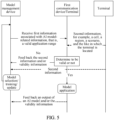
- FIG. 4 is a schematic flowchart of a positioning method based on an AI model according to an embodiment of this application. As shown in FIG. 4 , the method provided in this embodiment includes the following steps.
- Step 101 A first communication device obtains first information associated with AI model-related information.
- the first information indicates a valid application range of the AI model-related information
- the AI model-related information includes at least one of the following: the AI model, an AI model parameter, an input of the AI model, and an output of the AI model.
- the first information is associated with the AI model-related information, and the first information indicates the valid application range of the AI model-related information, for example, an input valid range, an output valid range, a validity condition, and the like.
- the AI model-related information is only used for ensuring that the selected and specific AI model can be understood and confirmed by the first communication device and another communication devices.
- a specific transmission format and transmission mode is not limited herein.
- the AI model-related information is also a corresponding characteristic for protecting the AI model.
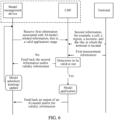
- the first communication device may obtain the AI model-related information and the first information associated with the AI model-related information from a second communication device (for example, a model management device, a network-side device (for example, an NWDAF), a positioning server (for example, an LMF or an E-SMLC), and the like).
- a second communication device for example, a model management device, a network-side device (for example, an NWDAF), a positioning server (for example, an LMF or an E-SMLC), and the like).
- the first information may be included in the AI model-related information for transmitting, may be transmitted with the AI model-related information, or may be independent of the AI-model-related information for transmitting but associated by the identification information of the AI model and the first information.
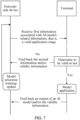
- Step 102 The first communication device determines target information based on the first information, where the target information includes at least one of the following: a target AI model, validity information of the AI model-related information, or feedback information obtained by performing positioning based on the target AI model.
- the target information may be determined based on a valid application range of a parameter in the first information.
- the first information associated with the AI-model-related information may determine the valid application range of the AI-model-related information, and it indicates that the AI-model-related information is valid in a specific scenario or in a specific region.
- the output of the AI model falls within the valid application range of the parameter in the first information, it indicates that the output of the AI model is valid.
- the input of the AI model falls within the valid application range of the parameter in the first information, it indicates that the input/output of the AI model is valid or that the AI model is valid.
- one or more AI models in the plurality of AI models are determined as the target AI models based on the first information.
- the feedback information may include the validity information, the target AI model, the input of the AI model, the output of the AI model, measurement information of the terminal, and the like.
- the feedback information has a mapping relationship with the first information.
- the first communication device may send the feedback information to the second communication device, and the second communication device may update the AI model and/or the AI model parameter based on the feedback information.
- the first communication device includes at least one of the following: a location management function (Location Management Function, LMF) network element and an evolved device of the LMF network element;
- LMF Location Management Function
- the another network-side device includes, for example, an access network device, a device other than the foregoing core network element, and the like.
- the first communication device obtains the first information associated with the AI model-related information.
- the first communication device determines the target information based on the first information, where the target information includes at least one of the following: the target AI model, the validity information of the AI model-related information, or the feedback information obtained by performing positioning based on the target AI model. Because the first information indicates the valid application range of the AI model-related information, the target information is determined based on the first information, so that the AI model used for positioning better meets a requirement of an actual scenario, and the AI model and/or the AI model parameter can be updated based on the determined target information, so that a positioning result obtained based on the updated AI model is more accurate.
- the validity information includes at least one of the following:
- the validity indication information may be indicated by at least one bit, for example, 0 means invalid and 1 means valid.
- the reliability indication information is similar to the validity indication information.
- the validity degree may be indicated by at least one bit, for example, a validity degree between 0 to 1.
- the input of the AI model and/or the output of the AI model include/includes at least one of the following: positioning signal measurement information of the terminal; position information of the terminal; error information; a channel impulse response CIR; a power of a first path; a delay of a first path; a time of arrival TOA of a first path; a reference signal time difference RSTD of a first path; an angle of arrival of a first path; an antenna subcarrier phase difference of a first path; a power of a multipath; a delay of a multipath; a TOA of a multipath; an RSTD of a multipath; an angle of arrival of a multipath; an antenna subcarrier phase difference of a multipath; an average excess delay; a root-mean-square delay spread; and a coherence bandwidth.
- the error information includes at least one of the following: a position error value, a measurement error value, an AI model error value, or an AI model parameter error value.
- the method further includes: obtaining, by the first communication device, second information of a target terminal, where the second information indicates positioning-related information obtained by the target terminal.
- Step 102 may be implemented in the following manner.
- the first communication device determines the target information based on the first information and the second information.
- the first information indicates the valid application range of the AI model-related information
- the second information indicates the positioning-related information obtained by the target terminal, for example, the measurement information of the terminal, the position information of the terminal, and the like.
- the target terminal may be a terminal that needs to be positioned.
- the first communication device determines, based on the first information and the second information, at least one of the target AI model, the validity information of the AI model-related information, or the feedback information obtained by performing positioning based on the target AI model.
- the first communication device obtains the second information of the target terminal.
- the first communication device determines the target information based on the first information and the second information, where the target information includes at least one of the following: the target AI model, the validity information of the AI model-related information, or the feedback information obtained by performing positioning based on the target AI model. Because the first information indicates the valid application range of the AI model-related information, the second information indicates the positioning-related information obtained by the target terminal.
- the target information is determined based on the first information and the second information, so that the AI model used for positioning better meets a requirement of an actual scenario, and the AI model and/or the AI model parameter can be updated based on the determined target information, so that a positioning result obtained based on the updated AI model is more accurate.
- the above step of "the first communication device determines the target information based on the first information and the second information" may include:
- the first communication device determines the target information based on a value of a parameter in the second information and a range of a corresponding parameter in the first information.
- the first communication device determines the target information based on the first information, for example, determines the validity information, and feeds back the information to a model management device, and the model management device performs model training and update based on the information fed back by the first communication device.
- the second communication device may be a model management device, a data management device, or a validity function verification module (for example, an actor).
- the second communication device is at least one of the following: a model management device, an LMF, an NWDAF, or a validity function verification module (for example, an actor).
- the LMF and the model management device may be one device or different devices.
- the LMF and a model application module are on one device or on different devices.
- the terminal performs positioning based on an AI model and determines validity information.
- the first information includes at least one of the following: cell information; region information; valid time information; scenario information; and a signal-to-interference-plus-noise ratio SINR range.
- the cell information includes at least one of the following:
- the region information includes at least one of the following: region identification information; distance range information; and reference point information corresponding to the distance range.
- the valid time information includes at least one of the following:
- the scenario information includes at least one of the following: a line of sight LOS scenario; a non-line-of-sight NLOS scenario; a complex scenario; an indoor scenario; and an outdoor scenario.
- the complex scenario is, for example, a hybrid scenario of a plurality of scenarios, and the NLOS scenario may also include an NLOS bad scenario.
- the distance range information is valid within a specific distance from a specific reference point, for example, within 500 m.
- the second information includes at least one of the following: position information of the target terminal, cell information, region information, timer information, scenario information, and an SINR measured by the target terminal.
- the cell information is at least one piece of information of a serving cell of the target terminal, a reference cell, or a cell with the strongest reference signal received power RSRP, and the at least one piece of information includes: identification information and frequency-domain information.
- the region information is region identification information of the target terminal.
- the scenario information is information of a scenario in which the target terminal is located.
- the position information is obtained in at least one of the following manners, and the at least one manner includes: an observed time difference of arrival (Observed Time Difference of Arrival, OTDOA) positioning method, a global navigation satellite system (Global Navigation Satellite System, GNSS), a downlink time difference of arrival, an uplink time difference of arrival, an uplink Bluetooth angle of arrival (Angle of Arrival, AoA), a Bluetooth angle of departure (Angle of Departure, AoD), a Bluetooth, a sensor, or wireless fidelity Wi-Fi.
- OTDOA observed Time Difference of Arrival
- GNSS Global Navigation Satellite System
- Angle of Arrival AoA
- Angle of Departure AoD
- Bluetooth Bluetooth
- a sensor or wireless fidelity Wi-Fi.
- the first communication device receives the first information and the AI model-related information, and the first information indicates the valid application range of the AI model-related information, for example, a valid cell, a valid region, a valid time, a valid scenario, and/or a valid SINR range of the AI model-related information.
- the second information may be at least one of the position information of the target terminal, the cell information, the region information, the timer information, the scenario information, and the SINR measured by the target terminal.
- the target information is determined based on the value of the parameter in the second information and the range of the corresponding parameter in the first information. For example, the value of each parameter in the second information is compared with the range of the corresponding parameter in the first information. If the value of the parameter in the second information falls within the range of the corresponding parameter in the first information, the AI model-related information is valid. It may alternatively be considered that the AI model-related information is valid if all of the parameters in the second information fall within the range of the corresponding parameter in the first information, or values of most of the parameters fall within the range of the corresponding parameter in the first information, or values of some parameters fall outside the range of the corresponding parameter in the first information but do not deviate much from the range.
- that the validity information is determined includes at least one of the following cases.
- the AI model-related information is valid.
- the AI model-related information is invalid.
- the AI model-related information is invalid or expires.
- the AI model-related information is invalid.
- the AI model-related information is invalid.
- the AI model-related information is valid; and in a case that the value of the parameter in the second information falls outside the range of the corresponding parameter in the first information, the AI model-related information is invalid.
- the following cases are included.
- the AI model-related information is invalid.
- the AI model-related information is invalid.
- the AI model-related information is invalid or expires.
- the AI model-related information is invalid.
- the AI model-related information is invalid.
- the AI model-related information is invalid.
- the timer of the target terminal satisfies at least one of the following cases:
- the feedback information is determined based on the validity information includes the following several cases:
- content included in the feedback information may be determined based on the validity information.
- the feedback information when the AI model-related information is valid, the feedback information at least includes the output of the AI model; or when the AI model-related information is invalid, the feedback information may include at least one of the following: a cause of error; the second information; the validity information; an AI model request; an AI model update request; and a data collection request, used for training, selection, and update of the AI model.
- the feedback information includes at least one of the following cases:
- the feedback information includes the cell information of the target terminal.
- the feedback information includes the region information of the target terminal.
- the feedback information includes the scenario information of the target terminal.
- the feedback information includes the position information of the target terminal.
- the feedback information includes the SINR measured by the target terminal.
- the feedback information includes the timer information of the target terminal, including, for example, the timer duration, the start time, and the like.
- the target AI model is an AI model corresponding to the first range of the first information.
- the feedback information includes: the target AI model.
- different valid application ranges may correspond to different AI models and/or AI model parameters.
- the target AI model may be an AI model corresponding to the first range.
- the method further includes: receiving, by the first communication device, a plurality of pre-configured AI models and/or AI model parameters, and first information corresponding to the AI models and/or the AI model parameters.
- the method further includes: obtaining, by the first communication device based on the first range of the first information, the AI model corresponding to the first range of the first information from the plurality of pre-configured AI models.
- the feedback information includes at least one of the following: the validity information, the second information, first measurement information, and the output of the AI model.
- the first measurement information includes at least one of the following: signal measurement information; position information; an error value; channel impulse response (Channel Impulse Response, CIR) information; and power delay profile (Power Delay Profile, PDP) information.
- the error information includes at least one of the following: a position error value and a measurement error value.
- the CIR information includes, for example, time-domain or frequency-domain impulse response information, processing information (for example, truncation information) of the time-domain or frequency-domain impulse response information, or the like.
- the CIR information may include single-antenna or multi-antenna CIR information.
- the first communication device determines the target information based on the first information and the second information, where the target information includes at least one of the following: the target AI model, the validity information of the AI model-related information, or the feedback information obtained by performing positioning based on the target AI model.
- the target information is determined based on the value of the parameter in the second information and the range of the corresponding parameter in the first information, so that the AI model used for positioning better meets a requirement of an actual scenario, and the AI model and/or the AI model parameter can be updated based on the determined target information, so that a positioning result obtained based on the updated AI model is more accurate.
- the second information includes second measurement information obtained by the target terminal
- the step of "the first communication device determines the target information based on the first information and the second information" may be further implemented in the following step: in a case that the second measurement information is measurement information obtained through one measurement, the first communication device determines the target information based on a value of a parameter in the second measurement information and a range of a corresponding parameter in the first information.
- the one measurement may be understood as a smooth result of M (where M may be at least one of 1, 2, 3, or 4) measurement instances.
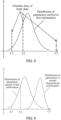
- the first communication device determines the target information based on a consistency of a distribution of parameters in the second measurement information with a distribution of corresponding parameters in the first information.
- the first communication device receives the first information and the AI model-related information, and the first information indicates the valid application range of the AI model-related information.
- the valid application range may specifically indicate a valid application range in which input data of the AI model-related information is obtained, for example, an SINR range, a noise mean and variance, an absolute time (absolute time) mean and variance, a delay spread mean and variance, an angle spread mean and variance, and the like.
- the AI model-related information is valid only for the input data in the above valid application range.
- the valid application range may specifically indicate a valid application range in which output data of the AI model-related information is obtained, for example, an SINR range, a noise mean and variance, an absolute time (absolute time) mean and variance, a delay spread mean and variance, an angle spread mean and variance, and the like.
- the valid application range may be a range of the measurement information and the position information.
- the AI model-related information is valid only for the output data in the above valid application range. For example, if the output measurement information and position information are out of the valid application range, the AI model-related information is invalid.
- the second information may be second measurement information measured by the target terminal, including at least one of a signal-to-interference-plus-noise ratio SINR range, a noise value, an NLOS-introduced absolute time value, a delay spread value, an angle spread value, an SINR mean and variance, a noise mean and variance, an NLOS-introduced absolute time mean and variance, a delay spread mean and variance, and an angle spread mean and variance.
- the first communication device determines the target information based on a value of a parameter in the second measurement information and a range of a corresponding parameter in the first information. For example, the value of each parameter in the second measurement information is compared with the range of the corresponding parameter in the first information. If the value of the parameter in the second measurement information falls within the range of the corresponding parameter in the first information, the AI model-related information is valid.
- the AI model-related information is valid if all of the parameters in the second measurement information fall within the range of the corresponding parameter in the first information, or values of most of the parameters fall within the range of the corresponding parameter in the first information, or values of some parameters fall outside the range of the corresponding parameter in the first information but do not deviate much from the range.
- the invalidity can be understood as descriptions of the validity degree.
- a degree of deviation of C2 from the first information may be expressed as the validity information.
- the degree of deviation of C2 from the first information may be expressed as C2-mean/validity range.
- the first communication device determines the target information based on a consistency of a distribution of parameters in the second measurement information with a distribution of corresponding parameters in the first information. For example, the distribution of each parameter in the second measurement information is compared with the distribution of the corresponding parameter in the first information. If the distribution of the parameter in the second measurement information is consistent with the distribution of the corresponding parameter in the first information, the AI model-related information is valid.
- the AI model-related information is valid if the distribution of all parameters in the second measurement information is consistent with the distribution of the corresponding parameter in the first information, or the distribution of most of the parameters is consistent with the distribution of the corresponding parameter in the first information, or the distribution of some parameters is not consistent with the distribution of the corresponding parameter in the first information but does not deviate much from the distribution of the corresponding parameter in the first information.
- a distribution of a specific parameter in the second measurement information differs too much from the distribution of the corresponding parameter in the first information and only has a small portion of intersection, so that the AI model-related information may be considered to be invalid.
- the invalidity can be understood as descriptions of the validity degree.
- a degree of deviation of the distribution of a specific parameter in the second measurement information from the first information may be expressed as the validity information.
- the target information is determined based on the value of the parameter in the second measurement information and the range of the corresponding parameter in the first information, and/or the target information is determined based on the distribution of the parameter in the second measurement information and the distribution of the corresponding parameter in the first information, so that the AI model used for positioning better meets a requirement of an actual scenario, and the AI model and/or the AI model parameter can be updated based on the determined target information, so that a positioning result obtained based on the updated AI model is more accurate.
- the first communication device determines the target information based on the first information and the second measurement information, for example, determines the validity information, and feeds back the information to a model management device (for example, the network-side device), and the model management device performs model training and update based on the information fed back by the first communication device.
- a model management device for example, the network-side device
- the first communication device may be an LMF
- the model management device and the LMF may be one device or different devices.
- the LMF and a model application module may be on one device or on different devices.
- the first information includes at least one of the following:
- the NLOS-introduced absolute time is obtained by subtracting time information obtained by a non-AI model from time information obtained by the AI model; and the delay spread, the angle spread, and the noise distribution are characteristic information obtained based on the first measurement information or the output of the AI model.
- the time information includes, for example, an RSTD, a TOA, an Rx-Tx, timer information, and the like.
- the second measurement information includes at least one of the following: a signal-to-interference-plus-noise ratio SINR range, a noise value, an NLOS-introduced absolute time value, a delay spread value, an angle spread value, an SINR mean and variance, a noise mean and variance, an NLOS-introduced absolute time mean and variance, a delay spread mean and variance, and an angle spread mean and variance.
- SINR range a signal-to-interference-plus-noise ratio
- the SINR range and the SINR mean and variance are derived from an SINR of at least one piece of information.
- the noise value and the noise mean and variance are derived from a noise value of at least one piece of information.
- the at least one piece of information includes: a measurement channel, a measurement signal, or first measurement information.
- the first measurement information includes at least one of the following: signal measurement information; position information; an error value; channel impulse response CIR information; and power delay profile PDP information.
- the error information includes at least one of the following: a position error value and a measurement error value.
- the signal measurement information includes at least one of the following: a reference signal time difference (Reference Signal Time Difference, RSTD) measurement result, a round trip delay measurement result, an angle of arrival AOA measurement result, an angle of departure AOD measurement result, a reference signal received power (Reference Signal Received Power, RSRP), multipath measurement information, and line of sight LOS indication information.
- RSTD Reference Signal Time Difference
- RSRP Reference Signal Received Power
- the multipath measurement information includes at least one of the following: a power of a first path, a time delay of a first path, a time of arrival TOA of a first path, a reference signal time difference RSTD of a first path, an antenna subcarrier phase difference of a first path, an antenna subcarrier phase of a first path, a power of a multipath, a time delay of a multipath, a TOA of a multipath, an RSTD of a multipath, an antenna subcarrier phase difference of a multipath, and an antenna subcarrier phase of a multipath.
- that the validity information is determined includes at least one of the following cases:
- the AI model-related information In a case that a distribution of a parameter in the second measurement information is consistent with a distribution of a corresponding parameter in the first information, the AI model-related information is valid; or in a case that a distribution of at least one parameter in the second measurement information is not consistent with a distribution of a corresponding parameter in the first information, the AI model-related information is invalid.
- the value of the parameter in the second measurement information is compared with the range of the corresponding parameter in the first information. If the value of the parameter in the second measurement information falls within the range of the corresponding parameter in the first information, the AI model-related information is valid. It may alternatively be considered that the AI model-related information is valid if all of the parameters in the second measurement information fall within the range of the corresponding parameter in the first information, or values of most of the parameters fall within the range of the corresponding parameter in the first information, or values of some parameters fall outside the range of the corresponding parameter in the first information but do not deviate much from the range.
- the AI model-related information is invalid.
- the distribution of each parameter in the second measurement information is compared with the distribution of the corresponding parameter in the first information. If the distribution of the parameter in the second measurement information is consistent with the distribution of the corresponding parameter in the first information, the AI model-related information is valid. It may alternatively be considered that the AI model-related information is valid if the distribution of all parameters in the second measurement information is consistent with the distribution of the corresponding parameter in the first information, or the distribution of most of the parameters is consistent with the distribution of the corresponding parameter in the first information, or the distribution of some parameters is not consistent with the distribution of the corresponding parameter in the first information but does not deviate much from the distribution of the corresponding parameter in the first information.
- the AI model-related information is invalid.
- the AI model-related information is invalid.
- condition threshold information includes at least one of the following:
- a probability that a value is distributed in ( ⁇ - ⁇ , ⁇ + ⁇ ) is 0.6526.
- a probability that a value is distributed in ( ⁇ -2 ⁇ , ⁇ +2 ⁇ ) is 0.9544.
- a probability that a value is distributed in ( ⁇ -3 ⁇ , ⁇ +3 ⁇ ) is 0.9974.
- ⁇ indicates the standard deviation and ⁇ indicates the mean.
- the feedback information includes at least one of the following: the validity information, the second measurement information, the input of the AI model, the output of the AI model, AI model identification information, and an AI model update request.
- the AI model update request includes at least one of the following: an identifier ID of the AI model, an AI model and/or an AI model parameter that satisfy/satisfies the distribution of the second measurement information, and the AI model and/or the AI model parameter.
- that the first information is obtained based on a test set and a validation set of the AI model includes at least one of the following cases:
- the test set may be the second information and the validation set may be the first information.
- the second measurement information is characteristic information obtained based on the first measurement information; or the second measurement information is characteristic information obtained based on the output of the AI model.
- the second measurement information is characteristic information obtained based on the first measurement information and the output of the AI model.
- the first communication device may send the target information to the second communication device, for example, send the feedback information to the second communication device, and the second communication device may update the AI model and/or the AI model parameter based on the feedback information.
- the method further includes: receiving, by the first communication device, an updated AI model and/or AI model parameter, and first information corresponding to the AI model and/or the AI model parameter.
- the AI model includes at least one of the following:
- the AI model type includes, for example: a CNN, unsupervised, semi-supervised, supervised, an RNN, an LSTM, and that the first communication device performs positioning based on AI or the first communication device only needs to perform a part of operations when performing positioning based on AI, and the like.
- the AI model structure includes, for example:
- the network structure of the AI model may alternatively be a combination of a plurality of small networks, for example, a fully connected network + a convolutional network, a convolutional network + a residual network, and the like.
- the network structure of the AI model may further include: a quantity of layers of hidden layers; a connection manner of an input layer and a hidden layer, a connection manner between a plurality of hidden layers, a connection manner of a hidden layer and an output layer, a quantity of neurons at each layer, and the like.
- the AI model includes at least one of the following:
- the hyperparameter information is, for example, a parameter external to the AI model, for example, a pooling size (size), a batch size (indicating a quantity of samples chosen for one training), an iteration manner, and a learning rate, optimization function selection, loss function selection, and other information.
- a parameter external to the AI model for example, a pooling size (size), a batch size (indicating a quantity of samples chosen for one training), an iteration manner, and a learning rate, optimization function selection, loss function selection, and other information.
- the AI parameter includes at least one of the following:
- the AI model description parameter information is, for example, an input format of the AI model parameter, an output format of AI model parameter, and the like.
- the initial parameter of the AI model is an initial parameter used for iterating related information about the target AI model.
- FIG. 12 is a second diagram of an interaction procedure of a positioning method based on an AI model according to an embodiment of this application. As shown in FIG. 12 , the method provided in this embodiment includes the following steps.
- Step 201 A second communication device receives target information sent by a first communication device, where the target information includes at least one of the following: a target AI model, validity information of the AI model-related information, or feedback information obtained by performing positioning based on the target AI model; and
- the target information is determined based on first information associated with the AI model-related information, the first information indicates a valid application range of the AI model-related information, and the AI model-related information includes at least one of the following: the AI model, an AI model parameter, an input of the AI model, and an output of the AI model.
- the method further includes: sending, by the second communication device to the first communication device, the AI model-related information and the first information associated with the AI model-related information.
- the method further includes: sending, by the second communication device to the first communication device, a plurality of pre-configured AI models and/or AI model parameters, and first information corresponding to the AI models and/or the AI model parameters.
- the method further includes: sending, by the second communication device, second information to the first communication device, where the second information indicates positioning-related information obtained by the terminal.
- the first information includes at least one of the following: cell information; region information; valid time information; scenario information; and a signal-to-interference-plus-noise ratio SINR range.
- the cell information includes at least one of the following:
- the region information includes at least one of the following: region identification information; distance range information; and reference point information corresponding to the distance range.
- the valid time information includes at least one of the following:
- the scenario information includes at least one of the following: a line of sight LOS scenario; a non-line-of-sight NLOS scenario; a complex scenario; an indoor scenario; and an outdoor scenario.
- the second information includes at least one of the following: position information of the target terminal, cell information, region information, timer information, scenario information, and an SINR measured by the target terminal.
- the cell information is at least one piece of information of a serving cell of the target terminal, a reference cell, or a cell with the strongest reference signal received power RSRP, and the at least one piece of information includes: identification information and frequency-domain information.
- the region information is region identification information of the target terminal.
- the scenario information is information of a scenario in which the target terminal is located.
- the AI model-related information is valid.
- the AI model-related information is invalid.
- the feedback information includes at least one of the following: the validity information, the second information, first measurement information, and the output of the AI model.
- the first measurement information includes at least one of the following: signal measurement information; position information; an error value; channel impulse response CIR information; and power delay profile PDP information.
- the second information includes second measurement information obtained by the target terminal, and in a case that a value of a parameter in the second measurement information falls within a range of a corresponding parameter in the first information, the AI model-related information is valid; and/or in a case that a value of at least one parameter in the second measurement information falls outside the range of the corresponding parameter in the first information, the AI model-related information is invalid.
- the second information includes second measurement information obtained by the target terminal, and in a case that a distribution of a parameter in the second measurement information is consistent with a distribution of a corresponding parameter in the first information, the AI model-related information is valid; and/or in a case that a distribution of at least one parameter in the second measurement information is not consistent with a distribution of a corresponding parameter in the first information, the AI model-related information is invalid.
- that the AI model-related information is invalid includes: in a case that the distribution of the parameter in the second measurement information and the distribution of the corresponding parameter in the first information do not satisfy condition threshold information, the AI model-related information is invalid.
- condition threshold information includes at least one of the following:
- the second measurement information includes at least one of the following: a signal-to-interference-plus-noise ratio SINR range, a noise value, an NLOS-introduced absolute time value, a delay spread value, an angle spread value, an SINR mean and variance, a noise mean and variance, an NLOS-introduced absolute time mean and variance, a delay spread mean and variance, and an angle spread mean and variance.
- SINR range a signal-to-interference-plus-noise ratio
- the SINR range and the SINR mean and variance are derived from an SINR of at least one piece of information.
- the noise value and the noise mean and variance are derived from a noise value of at least one piece of information.
- the at least one piece of information includes: a measurement channel, a measurement signal, or first measurement information.
- the first measurement information includes at least one of the following: signal measurement information; position information; an error value; channel impulse response CIR information; and power delay profile PDP information.
- the feedback information includes at least one of the following: the validity information, the second measurement information, the input of the AI model, the output of the AI model, AI model identification information, and an AI model update request.
- the input of the AI model may be a current input of the AI model or may be an input or a distribution of inputs determined based on a plurality of inputs, to expect a peer end to provide an AI model and parameter that satisfy the inputs.
- the output of the AI model may be a current output of the AI model or may be an output or a distribution of outputs determined based on a plurality of outputs, to expect a peer end to provide an AI model and parameter that satisfy the outputs.
- the input and output of the AI model may be a current input and output of the AI model or may be an input and output or a distribution of inputs and outputs determined based on a plurality of inputs and outputs, to expect a peer end to provide an AI model and parameter that satisfy the inputs and outputs.
- the second measurement information may be obtained through one measurement or may be a distribution of second measurement information determined by a plurality of inputs.
- the first information includes at least one of the following:
- the second communication device includes at least one of the following:
- the positioning method based on an AI model provided in this embodiment of this application may be performed by a positioning apparatus based on an AI model.
- the positioning apparatus based on an AI model provided in this embodiment of this application is described by using an example in which the positioning apparatus based on an AI model performs the positioning method based on an AI model in this embodiment of this application.
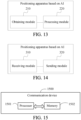
- FIG. 13 is a first diagram of a structure of a positioning apparatus based on an AI model according to this application.
- the positioning apparatus based on an AI model provided in this embodiment includes:
- the obtaining module 210 is further configured to: obtain second information of a target terminal, where the second information indicates positioning-related information obtained by the target terminal.
- the processing module 220 is specifically configured to: determine the target information based on the first information and the second information.
- the first information includes at least one of the following: cell information; region information; valid time information; scenario information; and a signal-to-interference-plus-noise ratio SINR range.
- the cell information includes at least one of the following:
- the region information includes at least one of the following: region identification information; distance range information; and reference point information corresponding to the distance range.
- the valid time information includes at least one of the following:
- the scenario information includes at least one of the following: a line of sight LOS scenario; a non-line-of-sight NLOS scenario; a complex scenario; an indoor scenario; and an outdoor scenario.
- the second information includes at least one of the following: position information of the target terminal, cell information, region information, timer information, scenario information, and an SINR measured by the target terminal.
- the cell information is at least one piece of information of a serving cell of the target terminal, a reference cell, or a cell with the strongest reference signal received power RSRP, and the at least one piece of information includes: identification information and frequency-domain information.
- the region information is region identification information of the target terminal.
- the scenario information is information of a scenario in which the target terminal is located.
- the processing module 220 is specifically configured to: determine, by the first communication device, the target information based on a value of a parameter in the second information and a range of a corresponding parameter in the first information.
- the AI model-related information is valid.
- the feedback information includes the second information; or in a case that the value of the parameter in the second information does not fall within the range of the corresponding parameter in the first information, the feedback information includes the second information.
- the AI model-related information is invalid.
- the feedback information includes the cell information of the target terminal.
- the AI model-related information is invalid or expires.
- the timer satisfies at least one of the following cases:
- the AI model-related information is invalid.
- the AI model-related information is invalid.
- the target AI model is an AI model corresponding to the first range of the first information.
- the obtaining module 210 is further configured to: receive a plurality of pre-configured AI models and/or AI model parameters, and first information corresponding to the AI models and/or the AI model parameters.
- the obtaining module 210 is further configured to: obtain, by the first communication device based on the first range of the first information, the AI model corresponding to the first range of the first information from the plurality of pre-configured AI models.
- the feedback information includes: the target AI model.
- the feedback information is determined based on the validity information includes:
- the feedback information includes at least one of the following: the validity information, the second information, first measurement information, and the output of the AI model.
- the first measurement information includes at least one of the following: signal measurement information; position information; an error value; channel impulse response CIR information; and power delay profile PDP information.
- the second information includes second measurement information obtained by the target terminal, and the processing module 220 is specifically configured to:
- the AI model-related information is valid; or in a case that a value of at least one parameter in the second measurement information falls outside the range of the corresponding parameter in the first information, the AI model-related information is invalid.
- the AI model-related information is valid; or in a case that a distribution of at least one parameter in the second measurement information is not consistent with a distribution of a corresponding parameter in the first information, the AI model-related information is invalid.
- that the AI model-related information is invalid includes: in a case that the distribution of the parameter in the second measurement information and the distribution of the corresponding parameter in the first information do not satisfy condition threshold information, the AI model-related information is invalid.
- condition threshold information includes at least one of the following:
- the second measurement information includes at least one of the following: a signal-to-interference-plus-noise ratio SINR range, a noise value, an NLOS-introduced absolute time value, a delay spread value, an angle spread value, an SINR mean and variance, a noise mean and variance, an NLOS-introduced absolute time mean and variance, a delay spread mean and variance, and an angle spread mean and variance.
- SINR range a signal-to-interference-plus-noise ratio
- the SINR range and the SINR mean and variance are derived from an SINR of at least one piece of information.
- the noise value and the noise mean and variance are derived from a noise value of at least one piece of information.
- the at least one piece of information includes: a measurement channel, a measurement signal, or first measurement information.
- the first measurement information includes at least one of the following: signal measurement information; position information; an error value; channel impulse response CIR information; and power delay profile PDP information.
- the signal measurement information includes at least one of the following: a reference signal time difference RSTD measurement result, a round trip delay measurement result, an angle of arrival AOA measurement result, an angle of departure AOD measurement result, a reference signal received power RSRP, multipath measurement information, and line of sight LOS indication information.
- the multipath measurement information includes at least one of the following: a power of a first path, a time delay of a first path, a time of arrival TOA of a first path, a reference signal time difference RSTD of a first path, an antenna subcarrier phase difference of a first path, an antenna subcarrier phase of a first path, a power of a multipath, a time delay of a multipath, a TOA of a multipath, an RSTD of a multipath, an antenna subcarrier phase difference of a multipath, and an antenna subcarrier phase of a multipath.
- the second measurement information further includes the first measurement information.
- the feedback information includes at least one of the following: the validity information, the second measurement information, the input of the AI model, the output of the AI model, AI model identification information, and an AI model update request.
- the first information includes at least one of the following:
- the first information is obtained based on a test set and a validation set of the AI model includes at least one of the following cases:
- the second measurement information is characteristic information obtained based on the first measurement information; and/or the second measurement information is characteristic information obtained based on the output of the AI model.
- the NLOS-introduced absolute time is obtained by subtracting time information obtained by a non-AI model from time information obtained by the AI model; and the delay spread, the angle spread, and the noise distribution are characteristic information obtained based on the first measurement information or the output of the AI model.
- the input of the AI model and/or the output of the AI model include/includes at least one of the following: positioning signal measurement information of the target terminal; position information of the target terminal; error information; a channel impulse response CIR; a power of a first path; a delay of a first path; a time of arrival TOA of a first path; a reference signal time difference RSTD of a first path; an angle of arrival of a first path; an antenna subcarrier phase difference of a first path; a power of a multipath; a delay of a multipath; a TOA of a multipath; an RSTD of a multipath; an angle of arrival of a multipath; an antenna subcarrier phase difference of a multipath; an average excess delay; a root-mean-square delay spread; and a coherence bandwidth.
- the error information includes at least one of the following: a position error value, a measurement error value, an AI model error value, or an AI model parameter error value.
- the AI model update request includes at least one of the following: an identifier ID of the AI model, an AI model and/or an AI model parameter that satisfy/satisfies the distribution of the second measurement information, and the AI model and/or the AI model parameter.
- the AI model includes at least one of the following:
- the AI model includes at least one of the following:
- the AI parameter includes at least one of the following:
- the validity information includes at least one of the following:
- the obtaining module 210 is further configured to: receive an updated AI model and/or AI model parameter, and first information corresponding to the AI model and/or the AI model parameter.
- the position information is obtained in at least one of the following manners, and the at least one manner includes: an observed time difference of arrival OTDOA positioning method, a global navigation satellite system GNSS, a downlink time difference of arrival, an uplink time difference of arrival, an uplink Bluetooth angle of arrival AoA, a Bluetooth angle of departure AoD, a Bluetooth, a sensor, or wireless fidelity Wi-Fi.
- the first communication device includes at least one of the following:
- the apparatus provided in this embodiment may be configured to perform the method in any one of the foregoing terminal-side method embodiments. Specific implementation processes and technical effects thereof are similar to those in the terminal-side method embodiment. For details, refer to detailed descriptions of the terminal-side method embodiment. Details are not described herein again.
- FIG. 14 is a second diagram of a structure of a positioning apparatus based on an AI model according to this application.
- the positioning apparatus based on an AI model provided in this embodiment includes:
- the positioning apparatus further includes: a sending module 320, configured to send, to the first communication device, the AI model-related information and the first information associated with the AI model-related information.
- a sending module 320 configured to send, to the first communication device, the AI model-related information and the first information associated with the AI model-related information.
- the sending module 320 is further configured to: send, to the first communication device, a plurality of pre-configured AI models and/or AI model parameters, and first information corresponding to the AI models and/or the AI model parameters.
- the sending module 320 is further configured to: send second information to the first communication device, where the second information indicates positioning-related information obtained by the terminal.
- the first information includes at least one of the following: cell information; region information; valid time information; scenario information; and a signal-to-interference-plus-noise ratio SINR range.
- the cell information includes at least one of the following:
- the region information includes at least one of the following: region identification information; distance range information; and reference point information corresponding to the distance range.
- the valid time information includes at least one of the following:
- the scenario information includes at least one of the following: a line of sight LOS scenario; a non-line-of-sight NLOS scenario; a complex scenario; an indoor scenario; and an outdoor scenario.
- the second information includes at least one of the following: position information of the target terminal, cell information, region information, timer information, scenario information, and an SINR measured by the target terminal.
- the cell information is at least one piece of information of a serving cell of the target terminal, a reference cell, or a cell with the strongest reference signal received power RSRP, and the at least one piece of information includes: identification information and frequency-domain information.
- the region information is region identification information of the target terminal.
- the scenario information is information of a scenario in which the target terminal is located.
- the AI model-related information is valid.
- the AI model-related information is invalid.
- the feedback information includes at least one of the following: the validity information, the second information, first measurement information, and the output of the AI model.
- the first measurement information includes at least one of the following: signal measurement information; position information; an error value; channel impulse response CIR information; and power delay profile PDP information.
- the second information includes second measurement information obtained by the target terminal, and in a case that a value of a parameter in the second measurement information falls within a range of a corresponding parameter in the first information, the AI model-related information is valid; and/or in a case that a value of at least one parameter in the second measurement information falls outside the range of the corresponding parameter in the first information, the AI model-related information is invalid.
- the second information includes second measurement information obtained by the target terminal, and in a case that a distribution of a parameter in the second measurement information is consistent with a distribution of a corresponding parameter in the first information, the AI model-related information is valid; and/or in a case that a distribution of at least one parameter in the second measurement information is not consistent with a distribution of a corresponding parameter in the first information, the AI model-related information is invalid.
- that the AI model-related information is invalid includes: in a case that the distribution of the parameter in the second measurement information and the distribution of the corresponding parameter in the first information do not satisfy condition threshold information, the AI model-related information is invalid.
- condition threshold information includes at least one of the following:
- the second measurement information includes at least one of the following: a signal-to-interference-plus-noise ratio SINR range, a noise value, an NLOS-introduced absolute time value, a delay spread value, an angle spread value, an SINR mean and variance, a noise mean and variance, an NLOS-introduced absolute time mean and variance, a delay spread mean and variance, and an angle spread mean and variance.
- SINR range a signal-to-interference-plus-noise ratio
- the SINR range and the SINR mean and variance are derived from an SINR of at least one piece of information.
- the noise value and the noise mean and variance are derived from a noise value of at least one piece of information.
- the at least one piece of information includes: a measurement channel, a measurement signal, or first measurement information.
- the first measurement information includes at least one of the following: signal measurement information; position information; an error value; channel impulse response CIR information; and power delay profile PDP information.
- the feedback information includes at least one of the following: the validity information, the second measurement information, the input of the AI model, the output of the AI model, AI model identification information, and an AI model update request.
- the first information includes at least one of the following:
- the second communication device includes at least one of the following:
- the apparatus provided in this embodiment may be configured to perform the method in any one of the foregoing network-side method embodiments. Specific implementation processes and technical effects thereof are similar to those in the network-side method embodiment. For details, refer to detailed descriptions of the network-side method embodiment. Details are not described herein again.
- the positioning apparatus based on an AI model in this embodiment of this application may be an electronic device, for example, an electronic device with an operating system, or a component in an electronic device, for example, an integrated circuit or a chip.
- the electronic device may be a terminal or another device other than a terminal.
- the terminal may include, but is not limited to, the type of terminal 11 listed above, and the another device may be a server, a network attached storage (Network Attached Storage, NAS) device, or the like. This is not specifically limited in this embodiment of this application.
- the positioning apparatus based on an AI model provided in this embodiment of this application can implement each process implemented in the method embodiments shown in FIG. 2 to FIG. 12 and achieve same technical effects. Details are not described herein again to avoid repetition.
- an embodiment of this application further provides a communication device 1500, including a processor 1501 and a memory 1502.
- the memory 1502 stores a program or instructions that can be run on the processor 1501.
- the communication device 1500 is a terminal, and when the program or the instructions are executed by the processor 1501, each step of the positioning method based on an AI model in method embodiments is implemented, and same technical effects can be achieved.
- the communication device 1500 is a network-side device, and when the program or the instructions are executed by the processor 1501, each step of the positioning method based on an AI model in method embodiments is implemented, and same technical effects can be achieved. Details are not described herein again to avoid repetition.
- An embodiment of this application further provides a terminal, including a processor and a communication interface.
- the communication interface is configured to obtain first information associated with AI model-related information; and the processor is configured to determine target information based on the first information, where the target information includes at least one of the following: a target AI model, validity information of the AI model-related information, or feedback information obtained by performing positioning based on the target AI model; and the first information indicates a valid application range of the AI model-related information, and the AI model-related information includes at least one of the following: the AI model, an AI model parameter, an input of the AI model, and an output of the AI model.
- FIG. 16 is a diagram of a hardware structure of a terminal according to an embodiment of this application.
- the terminal 1000 includes, but is not limited to: at least some components of a radio frequency unit 1001, a network module 1002, an audio output unit 1003, an input unit 1004, a sensor 1005, a display unit 1006, a user input unit 1007, an interface unit 1008, a memory 1009, a processor 1010, and the like.
- the terminal 1000 may further include a power supply (for example, a battery) for supplying power to the components.
- the power supply may be logically connected to the processor 1010 by using a power management system, to implement functions such as charging, discharging, and power consumption management by using the power management system.
- the structure of the terminal shown in FIG. 16 constitutes no limitation on the terminal.
- the terminal may include more or fewer components than those shown in the figure, or combine some components, or have different component arrangements. Details are not described herein again.
- the input unit 1004 may include a graphics processing unit (Graphics Processing Unit, GPU) 10041 and a microphone 10042.
- the graphics processing unit 10041 performs processing on image data of a static image or a video that is obtained by an image capture device (for example, a camera) in a video capture mode or an image capture mode.
- the display unit 1006 may include a display panel 10061, and the display panel 10061 may be configured in a form of a liquid crystal display, an organic light-emitting diode, or the like.
- the user input unit 1007 includes at least one of a touch panel 10071 and another input device 10072.
- the touch panel 10071 is also referred to as a touchscreen.
- the touch panel 10071 may include two parts: a touch detection apparatus and a touch controller.
- the another input device 10072 may include, but is not limited to, a physical keyboard, a function button (such as a volume control button or a power button), a trackball, a mouse, and a joystick. Details are not described herein again.
- the radio frequency unit 1001 receives downlink data received from a network-side device, and may transmit the downlink data to the processor 1010 for processing. In addition, the radio frequency unit 1001 may transmit uplink data to the network-side device.
- the radio frequency unit 1001 includes, but is not limited to, an antenna, at least one amplifier, a transceiver, a coupler, a low noise amplifier, a duplexer, and the like.
- the memory 1009 may be configured to store a software program or instructions and various data.
- the memory 1009 may mainly include a first storage area for storing the program and the instructions and a second storage area for storing the data.
- the first storage area for storing the program and the instructions may store an operating system, an application or instructions required by at least one function (for example, a sound playback function and an image display function), and the like.
- the memory 1009 may include a volatile memory or a non-volatile memory, or the memory 1009 may include both a volatile memory and a non-volatile memory.
- a high-speed random access memory is included, and a non-volatile memory may further be included.
- the non-volatile memory may be a read-only memory (Read-Only Memory, ROM), a programmable read-only memory (Programmable ROM, PROM), an erasable programmable read-only memory (Erasable PROM, EPROM), an electrically erasable programmable read-only memory (Electrically EPROM, EPROM), or a flash memory.
- ROM Read-Only Memory
- PROM programmable read-only memory
- Erasable PROM Erasable PROM
- EPROM electrically erasable programmable read-only memory
- the volatile memory may be a random access memory (Random Access Memory, RAM), a static random access memory (Static RAM, SRAM), a dynamic random access memory (Dynamic RAM, DRAM), a synchronous dynamic random access memory (Synchronous DRAM, SDRAM), a double data rate synchronous dynamic random access memory (Double Data Rate SDRAM, DDR SDRAM), an enhanced synchronous dynamic random access memory (Enhanced SDRAM, ESDRAM), a synchlink dynamic random access memory (Synchlink DRAM, SLDRAM), and a direct rambus random access memory (Direct Rambus RAM, DR RAM).
- the memory 1009 in this embodiment of this application includes, but is not limited to, these memories and any memory of another proper type, for example, at least one magnetic disk storage component, a flash memory component, or another non-volatile solid-state storage component.
- the processor 1010 may include one or more processing units.
- the processor 1010 may integrate an application processor and a modem processor.
- the application processor mainly processes an operation related to an operating system, a user interface, an application or instructions, and the like
- the modem processor mainly processes a wireless communication signal, for example, a baseband processor. It may be understood that, the foregoing modem processor may not be integrated into the processor 1010.
- the radio frequency unit 1001 is configured to obtain first information associated with AI model-related information.
- the processor 1010 is configured to determine target information based on the first information, where the target information includes at least one of the following: a target AI model, validity information of the AI model-related information, or feedback information obtained by performing positioning based on the target AI model; and
- the first information indicates a valid application range of the AI model-related information
- the AI model-related information includes at least one of the following: the AI model, an AI model parameter, an input of the AI model, and an output of the AI model.
- the radio frequency unit obtains the first information associated with the AI model-related information.
- the processor determines the target information based on the first information, where the target information includes at least one of the following: the target AI model, the validity information of the AI model-related information, or the feedback information obtained by performing positioning based on the target AI model. Because the first information indicates the valid application range of the AI model-related information, the target information is determined based on the first information, so that the AI model used for positioning better meets a requirement of an actual scenario, and the AI model and/or the AI model parameter can be updated based on the determined target information, so that a positioning result obtained based on the updated AI model is more accurate.
- the radio frequency unit 1001 is further configured to: obtain second information of a target terminal, where the second information indicates positioning-related information obtained by the target terminal.
- the processor 1010 is specifically configured to: determine the target information based on the first information and the second information.
- the first information includes at least one of the following: cell information; region information; valid time information; scenario information; and a signal-to-interference-plus-noise ratio SINR range.
- the cell information includes at least one of the following:
- the region information includes at least one of the following: region identification information; distance range information; and reference point information corresponding to the distance range.
- the valid time information includes at least one of the following:
- the scenario information includes at least one of the following: a line of sight LOS scenario; a non-line-of-sight NLOS scenario; a complex scenario; an indoor scenario; and an outdoor scenario.
- the second information includes at least one of the following: position information of the target terminal, cell information, region information, timer information, scenario information, and an SINR measured by the target terminal.
- the cell information is at least one piece of information of a serving cell of the target terminal, a reference cell, or a cell with the strongest reference signal received power RSRP, and the at least one piece of information includes: identification information and frequency-domain information.
- the region information is region identification information of the target terminal.
- the scenario information is information of a scenario in which the target terminal is located.
- the processor 1010 is specifically configured to: determine, by the first communication device, the target information based on a value of a parameter in the second information and a range of a corresponding parameter in the first information.
- the AI model-related information is valid.
- the feedback information includes the second information; or in a case that the value of the parameter in the second information does not fall within the range of the corresponding parameter in the first information, the feedback information includes the second information.
- the AI model-related information is invalid.
- the feedback information includes the cell information of the target terminal.
- the AI model-related information is invalid or expires.
- the timer satisfies at least one of the following cases:
- the AI model-related information is invalid.
- the AI model-related information is invalid.
- the target AI model is an AI model corresponding to the first range of the first information.
- the radio frequency unit 1001 is further configured to: receive a plurality of pre-configured AI models and/or AI model parameters, and first information corresponding to the AI models and/or the AI model parameters.
- the radio frequency unit 1001 is further configured to: obtain, by the first communication device based on the first range of the first information, the AI model corresponding to the first range of the first information from the plurality of pre-configured AI models.
- the feedback information includes: the target AI model.
- the feedback information is determined based on the validity information includes:
- the feedback information includes at least one of the following: the validity information, the second information, first measurement information, and the output of the AI model.
- the first measurement information includes at least one of the following: signal measurement information; position information; an error value; channel impulse response CIR information; and power delay profile PDP information.
- the second information includes second measurement information obtained by the target terminal, and the processor 1010 is specifically configured to:
- the AI model-related information is valid; or in a case that a value of at least one parameter in the second measurement information falls outside the range of the corresponding parameter in the first information, the AI model-related information is invalid.
- the AI model-related information is valid; or in a case that a distribution of at least one parameter in the second measurement information is not consistent with a distribution of a corresponding parameter in the first information, the AI model-related information is invalid.
- that the AI model-related information is invalid includes: in a case that the distribution of the parameter in the second measurement information and the distribution of the corresponding parameter in the first information do not satisfy condition threshold information, the AI model-related information is invalid.
- condition threshold information includes at least one of the following:
- the second measurement information includes at least one of the following: a signal-to-interference-plus-noise ratio SINK range, a noise value, an NLOS-introduced absolute time value, a delay spread value, an angle spread value, an SINK mean and variance, a noise mean and variance, an NLOS-introduced absolute time mean and variance, a delay spread mean and variance, and an angle spread mean and variance.
- SINK range a signal-to-interference-plus-noise ratio
- the SINR range and the SINR mean and variance are derived from an SINK of at least one piece of information.
- the noise value and the noise mean and variance are derived from a noise value of at least one piece of information.
- the at least one piece of information includes: a measurement channel, a measurement signal, or first measurement information.
- the first measurement information includes at least one of the following: signal measurement information; position information; an error value; channel impulse response CIR information; and power delay profile PDP information.
- the signal measurement information includes at least one of the following: a reference signal time difference RSTD measurement result, a round trip delay measurement result, an angle of arrival AOA measurement result, an angle of departure AOD measurement result, a reference signal received power RSRP, multipath measurement information, and line of sight LOS indication information.
- the multipath measurement information includes at least one of the following: a power of a first path, a time delay of a first path, a time of arrival TOA of a first path, a reference signal time difference RSTD of a first path, an antenna subcarrier phase difference of a first path, an antenna subcarrier phase of a first path, a power of a multipath, a time delay of a multipath, a TOA of a multipath, an RSTD of a multipath, an antenna subcarrier phase difference of a multipath, and an antenna subcarrier phase of a multipath.
- the second measurement information further includes the first measurement information.
- the feedback information includes at least one of the following: the validity information, the second measurement information, the input of the AI model, the output of the AI model, AI model identification information, and an AI model update request.
- the first information includes at least one of the following:
- the first information is obtained based on a test set and a validation set of the AI model includes at least one of the following cases:
- the second measurement information is characteristic information obtained based on the first measurement information; and/or the second measurement information is characteristic information obtained based on the output of the AI model.
- the NLOS-introduced absolute time is obtained by subtracting time information obtained by a non-AI model from time information obtained by the AI model; and the delay spread, the angle spread, and the noise distribution are characteristic information obtained based on the first measurement information or the output of the AI model.
- the input of the AI model and/or the output of the AI model include/includes at least one of the following: positioning signal measurement information of the target terminal; position information of the target terminal; error information; a channel impulse response CIR; a power of a first path; a delay of a first path; a time of arrival TOA of a first path; a reference signal time difference RSTD of a first path; an angle of arrival of a first path; an antenna subcarrier phase difference of a first path; a power of a multipath; a delay of a multipath; a TOA of a multipath; an RSTD of a multipath; an angle of arrival of a multipath; an antenna subcarrier phase difference of a multipath; an average excess delay; a root-mean-square delay spread; and a coherence bandwidth.
- the error information includes at least one of the following: a position error value, a measurement error value, an AI model error value, or an AI model parameter error value.
- the AI model update request includes at least one of the following: an identifier ID of the AI model, an AI model and/or an AI model parameter that satisfy/satisfies the distribution of the second measurement information, and the AI model and/or the AI model parameter.
- the AI model includes at least one of the following:
- the AI model includes at least one of the following:
- the AI parameter includes at least one of the following:
- the validity information includes at least one of the following:
- the radio frequency unit 1001 is further configured to: receive an updated AI model and/or AI model parameter, and first information corresponding to the AI model and/or the AI model parameter.
- the position information is obtained in at least one of the following manners, and the at least one manner includes: an observed time difference of arrival OTDOA positioning method, a global navigation satellite system GNSS, a downlink time difference of arrival, an uplink time difference of arrival, an uplink Bluetooth angle of arrival AoA, a Bluetooth angle of departure AoD, a Bluetooth, a sensor, or wireless fidelity Wi-Fi.
- the first communication device includes at least one of the following:
- An embodiment of this application further provides a network-side device, including a processor and a communication interface.
- the communication interface is configured to obtain first information associated with AI model-related information; and the processor is configured to determine target information based on the first information, where the target information includes at least one of the following: a target AI model, validity information of the AI model-related information, or feedback information obtained by performing positioning based on the target AI model; and the first information indicates a valid application range of the AI model-related information, and the AI model-related information includes at least one of the following: the AI model, an AI model parameter, an input of the AI model, and an output of the AI model.
- the network-side device embodiment corresponds to the foregoing first communication device-side method embodiment or the foregoing second communication device-side method embodiment, and each implementation process and implementation of the foregoing method embodiment may be used in the network-side device embodiment, and the same technical effect can be achieved.
- the network-side device 700 includes: an antenna 71, a radio frequency apparatus 72, a baseband apparatus 73, a processor 74, and a memory 75.
- the antenna 71 is connected to the radio frequency apparatus 72.
- the radio frequency apparatus 72 receives information through the antenna 71 and sends the received information to the baseband apparatus 73 for processing.
- the baseband apparatus 73 processes to-be-sent information and sends the information to the radio frequency apparatus 72, and the radio frequency apparatus 72 processes the received information and sends the information through the antenna 71.
- the foregoing band processing apparatus may be located in the baseband apparatus 73, and the method performed by the network-side device in the foregoing embodiment may be implemented in the baseband apparatus 73.
- the baseband apparatus 73 includes a baseband processor 74 and a memory 75.
- the baseband apparatus 73 may include, for example, at least one baseband board, and a plurality of chips are disposed on the baseband board. As shown in FIG. 17 , one of the chips is, for example, the baseband processor 74, connected to the memory 75 through a bus interface, to invoke a program in the memory 75, to perform an operation performed by the network device shown in the foregoing method embodiment.
- the baseband apparatus 73 in the network-side device may further include a network interface 76, configured to exchange information with the radio frequency apparatus 72.
- the interface is, for example, a common public radio interface (common public radio interface, CPRI for short).
- the network-side device 700 in this embodiment of the present invention further includes: instructions or a program stored in the memory 75 and run on the processor 74.
- the processor 74 invokes the instructions or the program in the memory 75, to perform the methods performed by the modules shown in FIG. 13 or FIG. 14 , and same technical effects are achieved. Details are not described herein again to avoid repetition.
- the network-side device 700 includes: a processor 701, a network interface 702, and a memory 703.
- the network interface 702 is, for example, a common public radio interface (common public radio interface, CPRI).
- the network-side device 700 in this embodiment of this application further includes: instructions or a program stored in the memory 703 and run on the processor 701.
- the processor 701 invokes the instructions or the program in the memory 703, to perform the methods performed by the modules shown in FIG. 13 or FIG. 14 , and same technical effects are achieved. Details are not described herein again to avoid repetition.
- a first communication device and/or a second communication device may be implemented by using the foregoing network-side device embodiment.
- An embodiment of this application further provides a readable storage medium.
- the readable storage medium stores a program or instructions.
- the program or the instructions are executed by a processor, each process of the positioning method based on an AI model in method embodiments is implemented, and same technical effects can be achieved. Details are not described herein again to avoid repetition.
- the processor is the processor in the terminal described in the foregoing embodiment.
- the readable storage medium includes a computer-readable storage medium, for example, a computer read only memory (ROM), a random access memory (RAM), a magnetic or optical disk, and the like.
- An embodiment of this application further provides a chip.
- the chip includes a processor and a communication interface.
- the communication interface is coupled to the processor, and the processor is configured to run a program or instructions, to implement each process of the positioning method based on an AI model in method embodiments, and same technical effects can be achieved. Details are not described herein again to avoid repetition.
- the chip in this embodiment of this application may alternatively be referred to as a system-level chip, a system chip, a chip system, a system-on-chip, or the like.
- An embodiment of this application further provides a computer program/program product.
- the computer program/program product is stored in a storage medium.
- the computer program/program product is executed by at least one processor, to implement each process of the positioning method based on an AI model in method embodiments, and same technical effects can be achieved. Details are not described herein again to avoid repetition.
- An embodiment of this application further provides a communication system, including: a terminal and a network-side device, where the terminal may be configured to perform steps of the foregoing positioning method based on an AI model, and the network-side device may be configured to perform steps of the foregoing positioning method based on an AI model.
- the terms “include”, “comprise”, or any other variation thereof in this specification is intended to cover a non-exclusive inclusion, so that a process, a method, an article, or an apparatus that includes a list of elements not only includes those elements but also includes other elements that are not expressly listed, or further includes elements inherent to such a process, a method, an article, or an apparatus.
- An element preceded by “includes a” does not, without more constraints, preclude the presence of additional identical elements in the process, the method, the article, or the apparatus that includes the element.
- scopes of the method and the apparatus in the implementations of this application are not limited to performing functions in an order shown or discussed, but may include performing functions in a substantially concurrent manner or in reverse order depending on functionality involved.
- the methods described may be performed in an order different from that described, and various steps may alternatively be added, omitted, or combined.
- characteristics described with reference to some examples may alternatively be combined in other examples.
- the method according to the foregoing embodiment may be implemented by software in addition to necessary universal hardware platform, or by using hardware. In many cases, the former is a better implementation.
- the technical solutions of this application essentially, or the part contributing to the conventional technology, may be presented in a form of a computer software product.
- the computer software product is stored in a storage medium (for example, a ROM/RAM, a magnetic disk, or an optical disc) including several instructions to enable a terminal (which may be a mobile phone, a computer, a server, an air conditioner, a network device, or the like) to perform the methods described in embodiments of this application.
Landscapes
- Engineering & Computer Science (AREA)
- Signal Processing (AREA)
- Computer Networks & Wireless Communication (AREA)
- Theoretical Computer Science (AREA)
- Software Systems (AREA)
- Physics & Mathematics (AREA)
- General Physics & Mathematics (AREA)
- Evolutionary Computation (AREA)
- Artificial Intelligence (AREA)
- Computing Systems (AREA)
- Mathematical Physics (AREA)
- Medical Informatics (AREA)
- Computer Vision & Pattern Recognition (AREA)
- General Engineering & Computer Science (AREA)
- Data Mining & Analysis (AREA)
- Probability & Statistics with Applications (AREA)
- Biomedical Technology (AREA)
- Biophysics (AREA)
- General Health & Medical Sciences (AREA)
- Radar, Positioning & Navigation (AREA)
- Remote Sensing (AREA)
- Life Sciences & Earth Sciences (AREA)
- Health & Medical Sciences (AREA)
- Computational Linguistics (AREA)
- Databases & Information Systems (AREA)
- Molecular Biology (AREA)
- Mobile Radio Communication Systems (AREA)
- Position Fixing By Use Of Radio Waves (AREA)
Applications Claiming Priority (2)
| Application Number | Priority Date | Filing Date | Title |
|---|---|---|---|
| CN202210113101.4A CN116567806B (zh) | 2022-01-29 | 2022-01-29 | 基于人工智能ai模型的定位方法及通信设备 |
| PCT/CN2023/073715 WO2023143572A1 (zh) | 2022-01-29 | 2023-01-29 | 基于人工智能ai模型的定位方法及通信设备 |
Publications (2)
| Publication Number | Publication Date |
|---|---|
| EP4472306A1 true EP4472306A1 (de) | 2024-12-04 |
| EP4472306A4 EP4472306A4 (de) | 2025-06-11 |
Family
ID=87470718
Family Applications (1)
| Application Number | Title | Priority Date | Filing Date |
|---|---|---|---|
| EP23746449.0A Pending EP4472306A4 (de) | 2022-01-29 | 2023-01-29 | Positionierungsverfahren auf basis eines modells der künstlichen intelligenz (ki) und kommunikationsvorrichtung |
Country Status (4)
| Country | Link |
|---|---|
| US (1) | US20240388875A1 (de) |
| EP (1) | EP4472306A4 (de) |
| CN (1) | CN116567806B (de) |
| WO (1) | WO2023143572A1 (de) |
Cited By (1)
| Publication number | Priority date | Publication date | Assignee | Title |
|---|---|---|---|---|
| WO2025209951A1 (en) * | 2024-04-04 | 2025-10-09 | Telefonaktiebolaget Lm Ericsson (Publ) | Methods, devices and medium for requesting ai/ml positioning |
Families Citing this family (25)
| Publication number | Priority date | Publication date | Assignee | Title |
|---|---|---|---|---|
| CN119923813A (zh) * | 2023-08-10 | 2025-05-02 | 北京小米移动软件有限公司 | 通信管理方法、装置、通信设备、存储介质及通信系统 |
| CN119485458A (zh) * | 2023-08-10 | 2025-02-18 | 华为技术有限公司 | 通信方法和通信装置 |
| CN119485358A (zh) * | 2023-08-10 | 2025-02-18 | 维沃移动通信有限公司 | 基于参考模型的通信方法及设备 |
| WO2025035255A1 (en) * | 2023-08-11 | 2025-02-20 | Nokia Shanghai Bell Co., Ltd. | Trp selection for ai/ml positioning |
| CN119485270A (zh) * | 2023-08-11 | 2025-02-18 | 维沃移动通信有限公司 | 信息上报方法、信息接收方法及设备 |
| CN117397323A (zh) * | 2023-08-31 | 2024-01-12 | 北京小米移动软件有限公司 | 模型选择方法、节点及系统 |
| WO2025091351A1 (zh) * | 2023-11-01 | 2025-05-08 | Oppo广东移动通信有限公司 | 用于无线通信的方法、通信设备和装置 |
| CN119946807A (zh) * | 2023-11-03 | 2025-05-06 | 维沃移动通信有限公司 | 信息传输方法、装置及设备 |
| CN120021208A (zh) * | 2023-11-20 | 2025-05-20 | 维沃移动通信有限公司 | 模型确定方法、装置及通信设备 |
| CN120034820A (zh) * | 2023-11-23 | 2025-05-23 | 维沃移动通信有限公司 | 基于ai模型的定位方法、装置、设备及可读存储介质 |
| CN120185664A (zh) * | 2023-12-20 | 2025-06-20 | 大唐移动通信设备有限公司 | 信息处理方法、装置、终端侧设备及网络侧设备 |
| CN120238814A (zh) * | 2023-12-29 | 2025-07-01 | 维沃移动通信有限公司 | 信息上报方法、装置及相关产品 |
| CN121264075A (zh) * | 2023-12-29 | 2026-01-02 | 北京小米移动软件有限公司 | 管理方法及装置、通信设备、通信系统、存储介质 |
| CN117580073B (zh) * | 2024-01-12 | 2024-05-07 | 北京小米移动软件有限公司 | 通信方法、设备和存储介质 |
| US20250240765A1 (en) * | 2024-01-19 | 2025-07-24 | Qualcomm Incorporated | Validation of positioning models |
| WO2025166827A1 (en) * | 2024-02-09 | 2025-08-14 | Nokia Shanghai Bell Co., Ltd. | Artificial intelligence or machine learning positioning |
| WO2025172485A1 (en) * | 2024-02-14 | 2025-08-21 | Telefonaktiebolaget Lm Ericsson (Publ) | Network assisted ai/ml model validation for positioning |
| WO2025172939A1 (en) * | 2024-02-16 | 2025-08-21 | Telefonaktiebolaget Lm Ericsson (Publ) | Signaling assistance for artifical intelligence/machine learning model validation |
| CN120512758A (zh) * | 2024-02-19 | 2025-08-19 | 中国移动通信有限公司研究院 | 一种ai模型监控方法、终端设备、网络侧网元及产品 |
| WO2025179599A1 (zh) * | 2024-03-01 | 2025-09-04 | 北京小米移动软件有限公司 | 通信方法、终端、网络设备、通信系统及存储介质 |
| CN120782006A (zh) * | 2024-04-03 | 2025-10-14 | 中信科智联科技有限公司 | 数据处理方法、装置、设备、存储介质及程序产品 |
| WO2025208595A1 (zh) * | 2024-04-05 | 2025-10-09 | 深圳Tcl新技术有限公司 | 人工智能定位的方法和无线通信设备 |
| CN120803834A (zh) * | 2024-04-08 | 2025-10-17 | 维沃移动通信有限公司 | 用于定位的人工智能ai模型的测试或监控方法及终端 |
| CN121463064A (zh) * | 2024-08-01 | 2026-02-03 | 中国移动通信有限公司研究院 | 一种配置方法及网络设备、终端、存储介质、计算机程序产品 |
| CN120568464B (zh) * | 2025-07-30 | 2025-12-26 | 荣耀终端股份有限公司 | 通信方法及装置 |
Family Cites Families (13)
| Publication number | Priority date | Publication date | Assignee | Title |
|---|---|---|---|---|
| CN106658420A (zh) * | 2016-11-21 | 2017-05-10 | 北京金坤科创技术有限公司 | 基于环境感知的定位终端设计 |
| CA3028274C (en) * | 2018-09-18 | 2021-02-09 | Beijing Didi Infinity Technology And Development Co., Ltd. | Artificial intelligent systems and methods for predicting traffic accident locations |
| EP3843356B1 (de) * | 2018-11-01 | 2024-08-21 | Huawei Technologies Co., Ltd. | Verwaltungsverfahren für modelldateien, endgerätevorrichtung und computerlesbares speichermedium |
| US11425531B2 (en) * | 2019-11-06 | 2022-08-23 | Huawei Technologies Co., Ltd. | Connectivity-based positioning determination in wireless communication networks |
| CN112787780B (zh) * | 2019-11-07 | 2022-07-01 | 维沃移动通信有限公司 | Srs发射设置方法、信息配置方法、定位方法和相关设备 |
| US11445465B2 (en) * | 2019-11-21 | 2022-09-13 | Qualcomm Incorporated | UE-based positioning |
| US11438886B2 (en) * | 2020-02-27 | 2022-09-06 | Psj International Ltd. | System for establishing positioning map data and method for the same |
| DE102020203703A1 (de) * | 2020-03-23 | 2021-09-23 | Robert Bosch Gesellschaft mit beschränkter Haftung | Verfahren und Vorrichtung zur Lokalisierung mobiler Teilnehmer eines Drahtlosnetzwerks |
| CN113543305A (zh) * | 2020-04-22 | 2021-10-22 | 维沃移动通信有限公司 | 定位方法、通信设备和网络设备 |
| CN113766528B (zh) * | 2020-06-01 | 2025-01-14 | 维沃移动通信有限公司 | 定位处理方法、终端及网络侧设备 |
| CN113839797B (zh) * | 2020-06-23 | 2022-11-25 | 华为技术有限公司 | 数据处理方法和装置 |
| CN113923730B (zh) * | 2020-07-07 | 2023-04-07 | 展讯通信(上海)有限公司 | 小区重选方法及装置 |
| CN113984055A (zh) * | 2021-09-24 | 2022-01-28 | 北京奕斯伟计算技术有限公司 | 室内导航定位方法和相关装置 |
-
2022
- 2022-01-29 CN CN202210113101.4A patent/CN116567806B/zh active Active
-
2023
- 2023-01-29 WO PCT/CN2023/073715 patent/WO2023143572A1/zh not_active Ceased
- 2023-01-29 EP EP23746449.0A patent/EP4472306A4/de active Pending
-
2024
- 2024-07-29 US US18/787,374 patent/US20240388875A1/en active Pending
Cited By (1)
| Publication number | Priority date | Publication date | Assignee | Title |
|---|---|---|---|---|
| WO2025209951A1 (en) * | 2024-04-04 | 2025-10-09 | Telefonaktiebolaget Lm Ericsson (Publ) | Methods, devices and medium for requesting ai/ml positioning |
Also Published As
| Publication number | Publication date |
|---|---|
| EP4472306A4 (de) | 2025-06-11 |
| US20240388875A1 (en) | 2024-11-21 |
| CN116567806B (zh) | 2025-11-21 |
| CN116567806A (zh) | 2023-08-08 |
| WO2023143572A1 (zh) | 2023-08-03 |
Similar Documents
| Publication | Publication Date | Title |
|---|---|---|
| EP4472306A1 (de) | Positionierungsverfahren auf basis eines modells der künstlichen intelligenz (ki) und kommunikationsvorrichtung | |
| EP4443993A1 (de) | Positionierungsverfahren und kommunikationsvorrichtung | |
| US20240323902A1 (en) | Location method and communication device | |
| US20240406761A1 (en) | Information Processing Method and Communication Device | |
| US20240323741A1 (en) | Measurement method and apparatus, device, and storage medium | |
| US20250193833A1 (en) | Data collection method and apparatus | |
| WO2023185865A1 (zh) | 模型有效性反馈方法、装置、终端及网络侧设备 | |
| CN116847456A (zh) | 定位方法、装置、终端及网络侧设备 | |
| WO2024083004A1 (zh) | Ai模型配置方法、终端及网络侧设备 | |
| US12192719B2 (en) | Audio level adjustment based on UWB | |
| US20260025790A1 (en) | Information transmission method, information processing method, apparatus, terminal, and network-side device | |
| CN119946807A (zh) | 信息传输方法、装置及设备 | |
| CN120614686A (zh) | 信息传输方法、装置及相关设备 | |
| WO2025108195A1 (zh) | 模型确定方法、装置及通信设备 | |
| CN121367991A (zh) | 定位辅助数据请求、发送方法、装置、终端、网络侧设备、介质及计算机程序产品 | |
| WO2025214259A1 (zh) | 用于定位的人工智能ai模型的测试或监控方法及终端 | |
| CN120935752A (zh) | 定位方法、装置、终端及网络侧设备 | |
| CN120224265A (zh) | 信息上报方法及装置 | |
| CN120935750A (zh) | 定位参考单元的确定方法、装置及设备 | |
| WO2024208167A1 (zh) | 信息处理方法、信息处理装置、终端及网络侧设备 | |
| CN119485270A (zh) | 信息上报方法、信息接收方法及设备 | |
| WO2025108390A1 (zh) | 基于ai模型的定位方法、装置、设备及可读存储介质 | |
| CN120456101A (zh) | 信息上报方法、装置及设备 | |
| CN119938459A (zh) | 模型性能监督方法、装置及设备 | |
| CN121367874A (zh) | 信息上报方法、定位方法及相关装置 |
Legal Events
| Date | Code | Title | Description |
|---|---|---|---|
| STAA | Information on the status of an ep patent application or granted ep patent |
Free format text: STATUS: THE INTERNATIONAL PUBLICATION HAS BEEN MADE |
|
| PUAI | Public reference made under article 153(3) epc to a published international application that has entered the european phase |
Free format text: ORIGINAL CODE: 0009012 |
|
| STAA | Information on the status of an ep patent application or granted ep patent |
Free format text: STATUS: REQUEST FOR EXAMINATION WAS MADE |
|
| 17P | Request for examination filed |
Effective date: 20240828 |
|
| AK | Designated contracting states |
Kind code of ref document: A1 Designated state(s): AL AT BE BG CH CY CZ DE DK EE ES FI FR GB GR HR HU IE IS IT LI LT LU LV MC ME MK MT NL NO PL PT RO RS SE SI SK SM TR |
|
| REG | Reference to a national code |
Ref country code: DE Ref legal event code: R079 Free format text: PREVIOUS MAIN CLASS: H04W0064000000 Ipc: H04W0004020000 |
|
| DAV | Request for validation of the european patent (deleted) | ||
| DAX | Request for extension of the european patent (deleted) | ||
| A4 | Supplementary search report drawn up and despatched |
Effective date: 20250509 |
|
| RIC1 | Information provided on ipc code assigned before grant |
Ipc: H04L 41/0823 20220101ALN20250502BHEP Ipc: H04L 41/082 20220101ALN20250502BHEP Ipc: H04L 41/16 20220101ALI20250502BHEP Ipc: H04L 41/14 20220101ALI20250502BHEP Ipc: H04L 41/0866 20220101ALI20250502BHEP Ipc: G06N 20/00 20190101ALI20250502BHEP Ipc: G01S 5/00 20060101ALI20250502BHEP Ipc: H04W 64/00 20090101ALI20250502BHEP Ipc: H04W 4/029 20180101ALI20250502BHEP Ipc: H04W 4/02 20180101AFI20250502BHEP |