EP4472121A1 - Kommunikationsverfahren, netzwerkvorrichtung und endgerätevorrichtung - Google Patents
Kommunikationsverfahren, netzwerkvorrichtung und endgerätevorrichtung Download PDFInfo
- Publication number
- EP4472121A1 EP4472121A1 EP23759280.3A EP23759280A EP4472121A1 EP 4472121 A1 EP4472121 A1 EP 4472121A1 EP 23759280 A EP23759280 A EP 23759280A EP 4472121 A1 EP4472121 A1 EP 4472121A1
- Authority
- EP
- European Patent Office
- Prior art keywords
- downlink common
- data frame
- common signals
- indication information
- time window
- Prior art date
- Legal status (The legal status is an assumption and is not a legal conclusion. Google has not performed a legal analysis and makes no representation as to the accuracy of the status listed.)
- Pending
Links
Images




Classifications
-
- H—ELECTRICITY
- H04—ELECTRIC COMMUNICATION TECHNIQUE
- H04W—WIRELESS COMMUNICATION NETWORKS
- H04W4/00—Services specially adapted for wireless communication networks; Facilities therefor
- H04W4/06—Selective distribution of broadcast services, e.g. multimedia broadcast multicast service [MBMS]; Services to user groups; One-way selective calling services
-
- H—ELECTRICITY
- H04—ELECTRIC COMMUNICATION TECHNIQUE
- H04W—WIRELESS COMMUNICATION NETWORKS
- H04W48/00—Access restriction; Network selection; Access point selection
- H04W48/08—Access restriction or access information delivery, e.g. discovery data delivery
- H04W48/10—Access restriction or access information delivery, e.g. discovery data delivery using broadcasted information
-
- H—ELECTRICITY
- H04—ELECTRIC COMMUNICATION TECHNIQUE
- H04L—TRANSMISSION OF DIGITAL INFORMATION, e.g. TELEGRAPHIC COMMUNICATION
- H04L5/00—Arrangements affording multiple use of the transmission path
- H04L5/003—Arrangements for allocating sub-channels of the transmission path
- H04L5/0048—Allocation of pilot signals, i.e. of signals known to the receiver
- H04L5/005—Allocation of pilot signals, i.e. of signals known to the receiver of common pilots, i.e. pilots destined for multiple users or terminals
-
- H—ELECTRICITY
- H04—ELECTRIC COMMUNICATION TECHNIQUE
- H04L—TRANSMISSION OF DIGITAL INFORMATION, e.g. TELEGRAPHIC COMMUNICATION
- H04L5/00—Arrangements affording multiple use of the transmission path
- H04L5/003—Arrangements for allocating sub-channels of the transmission path
- H04L5/0078—Timing of allocation
-
- H—ELECTRICITY
- H04—ELECTRIC COMMUNICATION TECHNIQUE
- H04W—WIRELESS COMMUNICATION NETWORKS
- H04W16/00—Network planning, e.g. coverage or traffic planning tools; Network deployment, e.g. resource partitioning or cells structures
- H04W16/24—Cell structures
- H04W16/28—Cell structures using beam steering
-
- H—ELECTRICITY
- H04—ELECTRIC COMMUNICATION TECHNIQUE
- H04W—WIRELESS COMMUNICATION NETWORKS
- H04W4/00—Services specially adapted for wireless communication networks; Facilities therefor
- H04W4/80—Services using short range communication, e.g. near-field communication [NFC], radio-frequency identification [RFID] or low energy communication
-
- H—ELECTRICITY
- H04—ELECTRIC COMMUNICATION TECHNIQUE
- H04W—WIRELESS COMMUNICATION NETWORKS
- H04W48/00—Access restriction; Network selection; Access point selection
- H04W48/20—Selecting an access point
-
- H—ELECTRICITY
- H04—ELECTRIC COMMUNICATION TECHNIQUE
- H04W—WIRELESS COMMUNICATION NETWORKS
- H04W52/00—Power management, e.g. Transmission Power Control [TPC] or power classes
- H04W52/02—Power saving arrangements
- H04W52/0203—Power saving arrangements in the radio access network or backbone network of wireless communication networks
- H04W52/0206—Power saving arrangements in the radio access network or backbone network of wireless communication networks in access points, e.g. base stations
Definitions
- This application relates to the communication field, and more specifically, to a communication method for transmitting a common signal, a network device, and a terminal device.
- Synchronization signal and physical broadcast channel blocks are important common signals in a new radio (new radio, NR) communication system.
- a periodicity of an SSB can be prolonged during light load or no load, to save energy.
- a plurality of SSBs are carried on beams in different directions for sending. If a cell-level adjustment is performed on periodicities of the SSBs, that is, the periodicities of the SSBs carried on the beams in the different directions remain the same, when the periodicity is adjusted to be greater than default 20 ms, access of a terminal device fails.
- the terminal device may alternatively miss SSBs carried on other beams. This may not be conducive to beam application in some scenarios. For example, this may result in an incorrect cell signal quality estimation, affecting a result of cell selection or reselection. If a default search periodicity of the terminal device is directly prolonged, cell search efficiency is affected.
- Embodiments of the present disclosure provide an improved communication solution, to resolve the foregoing and other potential problems.
- a beam-level adjustment performed on periodicities of SSBs is considered, that is, the SSBs carried on beams in different directions have different periodicities.
- the periodicities of the SSBs can be adjusted at a finer granularity, so that SSB overheads are reduced and a probability of symbol power saving is increased, thereby saving energy.
- periodicities of SSBs carried on some beams may be less than a default search periodicity, so that a terminal device can discover a cell.
- the system information may further include a first parameter set, the first parameter set indicates a condition for adjusting a first time window, and the first time window is used by a terminal device to receive the downlink common signals from the first network device at a frequency in a first frequency set. In this way, it can be convenient to adjust the first time window.
- a communication method includes: A first network device generates system information, where the system information includes a second indication, the second indication indicates different periodicities of a plurality of groups of downlink common signals from a second network device, and all groups of the plurality of groups of downlink common signals have the different periodicities.
- the first network device broadcasts the system information. In this way, the periodicities of the plurality of groups of downlink common signals from a neighboring cell may be notified, to facilitate receiving of the downlink common signals with the different periodicities from the neighboring cell.
- the system information may further include a second parameter set, the second parameter set indicates a condition for adjusting a second time window, and the second time window is used by a terminal device to receive the downlink common signals from the second network device at a frequency in a second frequency set. In this way, it can be convenient to adjust the second time window.
- a communication method includes: A terminal device receives system information from a first network device, where the system information includes a first indication, the first indication indicates periodicities of a plurality of groups of downlink common signals from the first network device, and all groups of the plurality of groups of downlink common signals have different periodicities.
- the terminal device determines the periodicities of the plurality of groups of downlink common signals from the first network device based on the first indication. In this way, the periodicities of the plurality of groups of downlink common signals from a current cell may be determined, to facilitate receiving of the downlink common signals with the different periodicities.
- a communication method includes: A terminal device receives at least one of first system information from a first network device and second system information from a second network device, where the first system information includes a second indication, the second system information includes a third indication, each of the second indication and the third indication indicates periodicities of a plurality of groups of downlink common signals from the second network device, and all groups of the plurality of groups of downlink common signals have different periodicities.
- the terminal device determines the periodicities of the plurality of groups of downlink common signals from the second network device based on at least one of the second indication and the third indication. In this way, the periodicities of the plurality of groups of downlink common signals from a neighboring cell may be determined, to facilitate receiving of the downlink common signals with the different periodicities from the neighboring cell.
- the method may further include: In response to receiving the one or more groups of downlink common signals, the terminal device stops receiving the downlink common signals from the second network device at the second frequency. In this way, overheads for receiving the downlink common signals from the neighboring cell can be reduced, and communication efficiency can be improved.
- the system information may further include a second parameter set, the second parameter set indicates a condition for adjusting a second time window, and the second time window is used by a terminal device to receive the downlink common signals from the second network device at a frequency in a second frequency set. In this way, it can be convenient to adjust the second time window.
- the processor may be configured to adjust the first time window by setting the first time window for the first frequency to a maximum value in the periodicities of the plurality of groups of downlink common signals. In this way, it can be ensured that the plurality of groups of downlink common signals from the current cell are received.
- the processor may be configured to in response to receiving the one or more groups of downlink common signals, stop receiving the downlink common signals from the first network device at the first frequency. In this way, overheads for receiving the downlink common signals can be reduced, and communication efficiency can be improved.
- the processor may be configured to: measure the plurality of groups of received downlink common signals; and perform cell selection based on a result of the measurement. In this way, the cell selection can be efficiently and correctly implemented.
- the receiver may be further configured to receive the downlink common signals from the first network device at the frequency in the first frequency set by using the first time window.
- the processor may be further configured to: in response to receiving the downlink common signals from the first network device at the first frequency in the first frequency set, determine, for the terminal device, whether to adjust the first time window. In this way, whether to adjust the first time window is determined only at the first frequency at which the first network device sends the downlink common signals, so that impact of the adjustment of the first time window on a latency (for example, a latency of cell measurement) of application of the downlink common signals is improved.
- a latency for example, a latency of cell measurement
- the system information may further include a first parameter set, and the first parameter set indicates a condition for adjusting the first time window.
- the processor may be configured to: determine, based on the first parameter set, whether the condition for adjusting the first time window is met; and if the condition for adjusting the first time window is met, determine to adjust the first time window. In this way, impact of the adjustment of the first time window on a latency (for example, a latency of cell measurement) of application of the downlink common signals can be further improved.
- a terminal device includes: a receiver, configured to receive at least one of first system information from a first network device and second system information from a second network device, where the first system information includes a second indication, the second system information includes a third indication, each of the second indication and the third indication indicates periodicities of a plurality of groups of downlink common signals from the second network device, and all groups of the plurality of groups of downlink common signals have different periodicities; and a processor, configured to determine the periodicities of the plurality of groups of downlink common signals from the second network device based on at least one of the second indication and the third indication. In this way, the periodicities of the plurality of groups of downlink common signals from a neighboring cell may be determined.
- the processor may be further configured to initialize, for the terminal device, a second time window to a minimum value in the periodicities of the plurality of groups of downlink common signals based on the second indication, where the second time window is used by the terminal device to receive the downlink common signals from the second network device at a frequency in a second frequency set.
- the receiver may be further configured to receive the downlink common signals from the second network device at the frequency in the second frequency set by using the initialized second time window. In this way, the downlink common signals with the different periodicities from the neighboring cell can be efficiently received.
- a computer-readable storage medium includes machine-executable instructions.
- the machine-executable instructions When executed by a device, the device is enabled to perform the method according to the first aspect or the second aspect.
- first and second may be used herein to describe various elements, these elements should not be limited by these terms. These terms are only used to distinguish one element from another. For example, a first element may be referred to as a second element, and similarly the second element may be referred to as the first element without departing from the scope of the embodiments.
- the term “and/or” includes any and all combinations of one or more of the listed terms.
- communication may be performed according to a currently known communication protocol or a communication protocol in any generation to be developed in the future.
- Examples of the communication protocol include but are not limited to first generation (first generation, 1G), second generation (second generation, 2G), 2.5G, 2.75G, third generation (third generation, 3G), fourth generation (fourth generation, 4G), 4.5G, fifth generation (fifth generation, 5G), or sixth generation (sixth generation, 6G) communication protocol.
- a beam-level adjustment can be performed on the periodicities of the SSBs.
- periodicities of SSBs carried on beams corresponding to locations at which there is no terminal device or a small quantity of terminal devices may be prolonged based on information such as load statuses and fine locations reported by the terminal devices.
- FIG. 2C is a diagram 200C of an example beam-level adjustment performed on periodicities of SSBs in the scenario in FIG. 2A . As shown in FIG. 2C , the periodicities of the SSBs carried on the beams 1, 4, 5, 6, 7, and 8 may be prolonged, and the periodicities of the SSBs carried on the beams 2 and 3 remain unchanged.
- FIG. 2D is a diagram 200D of another example beam-level adjustment performed on periodicities of SSBs in the scenario in FIG. 2A .
- a periodicity of the SSB carried on the beam 1 may be shortened in advance based on mobile information reported by the terminal devices A and B.
- periodicities of SSBs carried on some beams may be less than a default search periodicity, so that the terminal device can discover a cell.
- the terminal device may alternatively miss SSBs carried on other beams.
- embodiments of the present disclosure provide a communication solution for transmitting a downlink common signal (for example, an SSB).
- system information indicates different periodicities associated with a plurality of groups of downlink common signals.
- it can be convenient to determine the different periodicities of the plurality of groups of downlink common signals, so that the plurality of groups of downlink common signals can be efficiently received.
- FIG. 3 and FIG. 4 the following provides detailed descriptions with reference to FIG. 3 and FIG. 4 .
- the network device 110 generates 301 system information.
- the system information may include a system information block (system information block, SIB).
- SIB system information block
- the system information may include a SIB 1, a SIB3, a SIB4, and the like.
- the system information may include a master information block (master information block, MIB).
- MIB master information block
- the system information may include a first indication, indicating periodicities of a plurality of groups of downlink common signals from a current cell (namely, the network device 110). All groups of the plurality of groups of downlink common signals have different periodicities. Each group of downlink common signals may include one or more downlink common signals. The downlink common signals in each group of downlink common signals have a same periodicity.
- the first indication may include an index set of the downlink common signals in each group of the plurality of groups of downlink common signals and a periodicity corresponding to the index set. In some alternative embodiments, the first indication may include only a set of values of the periodicities.
- the following describes, with reference to FIG. 2C , an example in which an SSB is used as the downlink common signal.
- the SSBs carried on the beams 1, 4, 5, 6, 7, and 8 form a group of downlink common signals, and all have a same periodicity, for example, 80 ms.
- the downlink common signals carried on the beams 2 and 3 form another group of downlink common signals, and both have a same another periodicity, for example, 20 ms.
- the first indication may indicate broadcast periodicities of the SSB beams with different indexes in the current cell.
- a field may be added to the SIB1 message to indicate that broadcast periodicities of the SSB beams whose indexes are 1, 4, 5, 6, 7, and 8 are 80 ms, and broadcast periodicities of the SSB beams whose indexes are 2 and 3 are 20 ms.
- the periodicity may be any proper value, and is not limited to the example herein.
- the system information may include a second indication, indicating periodicities of a plurality of groups of downlink common signals from a neighboring cell (for example, the network device 120). All groups of the plurality of groups of downlink common signals have different periodicities. Each group of downlink common signals may include one or more downlink common signals. The downlink common signals in each group of downlink common signals have a same periodicity.
- the second indication may include an index set of the downlink common signals in each group of the plurality of groups of downlink common signals and a periodicity corresponding to the index set. In some alternative embodiments, the second indication may include only a set of values of the periodicities.
- the second parameter set may include an RSRP threshold for extending the second time window. In some embodiments, the second parameter set may include an RSRQ threshold for extending the second time window. It should be understood that any other proper parameter is also feasible.
- the system information may include the first indication and the first parameter set. In some embodiments, the system information may include the second indication and the second parameter set. In some embodiments, the system information may include both the first indication and the second indication. In some embodiments, the system information may include the first indication, the first parameter set, the second indication, and the second parameter set. It should be understood that embodiments of the present disclosure are not limited thereto.
- the system information according to embodiments of the present disclosure may include any one or any combination of the first indication, the first parameter set, the second indication, and the second parameter set. In addition, the system information may further include any other proper information, for example, access information of the current cell.
- the network device 110 broadcasts 302 the system information.
- the terminal device 130 may receive the system information.
- the terminal device 130 may stay for 20 ms at each frequency at which an SSB may exist in each frequency band, and a next frequency is then switched until an SSB signal is detected.
- the terminal device 130 may obtain a location of system information of a cell based on the detected SSB signal, to obtain the system information.
- the system information includes a first indication.
- the terminal device 130 may determine 303, based on the first indication, periodicities of a plurality of groups of downlink common signals from the network device 110.
- the terminal device 130 may learn, by using the periodicities, that a beam-level adjustment is performed on the periodicities of the downlink common signals from the network device 110.
- the terminal device 130 may receive 304 the downlink common signals from the network device 110 at a frequency in a first frequency set by using a first time window. If receiving the downlink common signals from the network device 110 at a frequency (also referred to as a first frequency in this specification for convenience) in the first frequency set, the terminal device 130 may determine 305 whether to adjust the first time window.
- a frequency also referred to as a first frequency in this specification for convenience
- the system information may further include a first parameter set.
- the terminal device 130 may determine, based on the first parameter set, whether a condition for adjusting the first time window is met. If the condition for adjusting the first time window is met, the terminal device 130 may determine to adjust the first time window. For example, in an embodiment in which the first parameter set includes an RSRP threshold, the terminal device 130 may measure a downlink common signal that is on one or more SSB beams and that is received within 20 ms, to obtain corresponding RSRP. If the RSRP of the received downlink common signal is less than the RSRP threshold, the terminal device 130 may determine to adjust the first time window.
- the first parameter set includes an RSRP threshold
- the terminal device 130 may determine not to adjust the first time window. In some embodiments, if the RSRP of the received downlink common signal is equal to the RSRP threshold, the terminal device 130 may determine to adjust the first time window. In some alternative embodiments, if the RSRP of the received downlink common signal is equal to the RSRP threshold, the terminal device 130 may determine not to adjust the first time window. It should be understood that these are merely examples, and embodiments of the present disclosure are not limited thereto.
- the terminal device 130 may determine 308 whether the one or more groups of downlink common signals that are not received are received. If receiving the one or more groups of downlink common signals, the terminal device 130 may stop 309 receiving the downlink common signals from the network device 110 at the first frequency. In this way, an unnecessary operation of receiving the downlink common signals can be avoided.
- FIG. 4 is a diagram of another example communication process 400 according to an embodiment of the present disclosure.
- FIG. 4 is described herein with reference to the example in FIG. 1 .
- the network devices 110 and 120 and the terminal device 130 may be used in the process 400. It should be understood that the process in FIG. 4 may include other additional steps that are not shown, or some shown steps may be omitted. The scope of the present disclosure is not limited thereto. It is assumed that the terminal device 130 is currently served by the network device 110, and the network device 120 provides a neighboring cell.
- the first system information from the network device 110 may include a second indication, indicating periodicities of a plurality of groups of downlink common signals from the neighboring cell (for example, the network device 120).
- the second system information from the network device 120 may include a third indication, indicating periodicities of a plurality of groups of downlink common signals from a current cell (namely, the network device 120).
- the third time window is used to receive the downlink common signals from the neighboring cell (for example, the network device 110) at the frequency in the first frequency set.
- the first system information and the second system information may alternatively include any other proper information. This is not limited in embodiments of the present disclosure.
- the terminal device 130 may receive the first system information and the second system information.
- the first system information includes the second indication
- the second system information includes the third indication.
- the terminal device 130 may determine 405, based on at least one of the second indication and the third indication, the periodicities of the plurality of groups of downlink common signals from the neighboring cell (for example, the network device 120).
- the terminal device 130 may learn, by using the periodicities, that a beam-level adjustment is performed on the periodicities of the downlink common signals from the network device 120.
- the terminal device 130 may adjust (for example, extend) 409 the second time window based on the determined periodicities, and continue receiving 410, at the second frequency by using the adjusted second time window, one or more groups of downlink common signals that are not received in the plurality of groups of downlink common signals. For example, the terminal device 130 may set the second time window for the second frequency to a maximum value in the periodicities of the plurality of groups of downlink common signals. It should be understood that embodiments of the present disclosure are not limited thereto, and the second time window may alternatively be prolonged based on another periodicity value, to ensure that the needed downlink common signals in the plurality of groups of downlink common signals are received.
- the system information may further include a second parameter set, and the second parameter set indicates a condition for adjusting a second time window.
- the second time window may be used by the terminal device to receive the downlink common signals from the neighboring cell (for example, the network device 120) at a frequency in a second frequency set. In this way, receiving time is adjusted, so that it can be ensured that the needed downlink common signals from the neighboring cell are received.
- the network device 110 broadcasts the system information.
- FIG. 6 is a flowchart of another example communication method 600 implemented at a network device according to an embodiment of the present disclosure.
- the method 600 may be implemented at the network device 110 or 120 in FIG. 1 .
- FIG. 6 is described herein with reference to the network device 110 in FIG. 1 . It should be understood that the method in FIG. 6 may include other additional steps that are not shown, or some shown steps may be omitted. The scope of the present disclosure is not limited thereto.
- the system information may further include a second parameter set, and the second parameter set indicates a condition for adjusting a second time window.
- the second time window may be used by a terminal device to receive the downlink common signals from the neighboring cell (for example, the network device 120) at a frequency in a second frequency set. In this way, receiving time is adjusted, so that it can be ensured that the needed downlink common signals from the neighboring cell are received.
- the network device 110 broadcasts the system information.
- the terminal device 130 in response to receiving the one or more groups of downlink common signals, may stop receiving the downlink common signals from the network device 110 at the first frequency. In this way, overheads for receiving the downlink common signals are reduced, and communication efficiency is improved.
- the terminal device 130 may measure the plurality of groups of received downlink common signals, and perform cell selection based on a result of the measurement. In this way, the cell selection is efficiently and correctly implemented.
- the downlink common signal may include at least one of the following: a PSS, an SSS, a PBCH signal, or a DMRS for a PBCH.
- the downlink common signal may include an SSB.
- the terminal device 130 receives at least one of first system information from a first network device (for example, the network device 110) and second system information from a second network device (for example, the network device 120).
- the first system information includes a second indication
- the second system information includes a third indication
- the second indication and the third indication each indicate periodicities of a plurality of groups of downlink common signals from the network device 120. All groups of the plurality of groups of downlink common signals have different periodicities.
- the terminal device 130 determines the periodicities of the plurality of groups of downlink common signals from the network device 120 based on at least one of the second indication and the third indication. In this way, the terminal device 130 may learn that a beam-level adjustment is performed on the periodicities of the downlink common signals from a neighboring cell.
- the terminal device 130 may determine whether to adjust the second time window.
- the first system information may further include a second parameter set, and the second parameter set indicates a condition for adjusting the second time window.
- the terminal device 130 may determine, based on the second parameter set, whether the condition for adjusting the second time window is met. If the condition for adjusting the second time window is met, the terminal device 130 may determine to adjust the second time window. In this way, the receiving of the downlink common signals from the neighboring cell may be adjusted based on the information from the current cell.
- the second system information may further include a third parameter set, and the third parameter set indicates a condition for adjusting the second time window.
- the terminal device 130 may determine, based on the third parameter set, whether the condition for adjusting the second time window is met. If the condition for adjusting the second time window is met, the terminal device 130 may determine to adjust the second time window. In this way, the receiving of the downlink common signals from the neighboring cell may be adjusted based on the information from the neighboring cell.
- the terminal device 130 may stop receiving the downlink common signals from the network device 120 at the second frequency. In this way, overheads for receiving the downlink common signals from the neighboring cell can be reduced.
- the terminal device 130 may measure the plurality of groups of received downlink common signals, and perform cell reselection based on a result of the measurement. In this way, the cell reselection can be efficiently and accurately implemented.
- the downlink common signal may include at least one of the following: a PSS, an SSS, a PBCH signal, or a DMRS for a PBCH.
- the downlink common signal may include an SSB.
- FIG. 7 and FIG. 8 may be implemented separately, or may be implemented in any proper combination. This is not limited in embodiments of the present disclosure.
- embodiments of the present disclosure further provide a terminal device and a network device that can implement these methods.
- FIG. 9 is a block diagram of an example network device 900 according to an embodiment of the present disclosure. It should be understood that the block diagram of FIG. 9 is merely intended for the purpose of description, and is not intended to be limiting. A device in FIG. 9 may further include any other suitable additional component.
- the network device 900 may include a processor 910 and a transmitter 920.
- the processor 910 may be configured to generate system information, where the system information includes a first indication, the first indication indicates periodicities of a plurality of groups of downlink common signals from the network device, and all groups of the plurality of groups of downlink common signals have different periodicities.
- the transmitter may be configured to broadcast the system information. In this way, the periodicities of the plurality of groups of downlink common signals from a current cell may be notified.
- the system information may further include a first parameter set, the first parameter set indicates a condition for adjusting a first time window, and the first time window is used by a terminal device to receive the downlink common signals from the first network device at a frequency in a first frequency set. In this way, it can be convenient to adjust the first time window.
- FIG. 10 is a block diagram of another example network device 1000 according to an embodiment of the present disclosure. It should be understood that the block diagram of FIG. 10 is merely intended for the purpose of description, and is not intended to be limiting. A device in FIG. 10 may further include any other suitable additional component.
- the network device 1000 may include a processor 1010 and a transmitter 1020.
- the processor 1010 may be configured to generate system information, where the system information includes a second indication, the second indication indicates periodicities of a plurality of groups of downlink common signals from another network device, and all groups of the plurality of groups of downlink common signals have different periodicities.
- the transmitter may be configured to broadcast the system information. In this way, the periodicities of the plurality of groups of downlink common signals from a neighboring cell may be notified.
- the system information may further include a second parameter set, the second parameter set indicates a condition for adjusting a second time window, and the second time window is used by a terminal device to receive the downlink common signals from the second network device at a frequency in a second frequency set. In this way, it can be convenient to adjust the second time window.
- FIG. 11 is a block diagram of an example terminal device 1100 according to an embodiment of the present disclosure. It should be understood that the block diagram of FIG. 11 is merely intended for the purpose of description, and is not intended to be limiting. A device in FIG. 11 may further include any other suitable additional component.
- the terminal device 1100 may include a receiver 1110 and a processor 1120.
- the receiver 1110 may be configured to receive system information from a network device, where the system information includes a first indication, the first indication indicates periodicities of a plurality of groups of downlink common signals from the network device, and all groups of the plurality of groups of downlink common signals have different periodicities.
- the processor 1120 may be configured to determine the periodicities of the plurality of groups of downlink common signals from the network device based on the first indication. In this way, the periodicities of the plurality of groups of downlink common signals from a current cell may be determined.
- the processor 1120 may be further configured to adjust a first time window based on the determined periodicities, where the first time window is used to receive the downlink common signals from the first network device at a frequency in a first frequency set.
- the receiver 1110 may be further configured to receive, at a first frequency by using the adjusted first time window, one or more groups of downlink common signals that are not received by the terminal device in the plurality of groups of downlink common signals. In this way, the downlink common signals with the different periodicities from the current cell can be received.
- the processor 1120 may be configured to adjust the first time window by setting the first time window for the first frequency to a maximum value in the periodicities of the plurality of groups of downlink common signals. In this way, it can be ensured that the plurality of groups of downlink common signals from the current cell are received.
- the processor 1120 may be configured to: in response to receiving the one or more groups of downlink common signals, stop receiving the downlink common signals from the first network device at the first frequency. In this way, overheads for receiving the downlink common signals can be reduced, and communication efficiency can be improved.
- the processor 1120 may be configured to: measure the plurality of groups of received downlink common signals; and perform cell selection based on a result of the measurement. In this way, the cell selection can be efficiently and correctly implemented.
- the receiver 1110 may be further configured to receive the downlink common signals from the first network device at the frequency in the first frequency set by using the first time window.
- the processor 1120 may be further configured to: in response to receiving the downlink common signals from the first network device at the first frequency in the first frequency set, determine, for the terminal device, whether to adjust the first time window. In this way, whether to adjust the first time window is determined only at the first frequency at which the first network device sends the downlink common signals, so that impact of the adjustment of the first time window on a latency (for example, a latency of cell measurement) of application of the downlink common signals is improved.
- a latency for example, a latency of cell measurement
- the system information may further include a first parameter set, and the first parameter set indicates a condition for adjusting the first time window.
- the processor 1120 may be configured to: determine, based on the first parameter set, whether the condition for adjusting the first time window is met; and if the condition for adjusting the first time window is met, determine to adjust the first time window. In this way, impact of the adjustment of the first time window on a latency (for example, a latency of cell measurement) of application of the downlink common signals can be further improved.
- FIG. 12 is a block diagram of an example terminal device 1200 according to an embodiment of the present disclosure. It should be understood that the block diagram of FIG. 12 is merely intended for the purpose of description, and is not intended to be limiting. A device in FIG. 12 may further include any other suitable additional component.
- the terminal device 1200 may include a receiver 1210 and a processor 1220.
- the receiver 1210 may be configured to receive at least one of first system information from a first network device and second system information from a second network device, where the first system information includes a second indication, the second system information includes a third indication, each of the second indication and the third indication indicates periodicities of a plurality of groups of downlink common signals from the second network device, and all groups of the plurality of groups of downlink common signals have different periodicities.
- the processor 1220 may be configured to determine the periodicities of the plurality of groups of downlink common signals from the second network device based on at least one of the second indication and the third indication. In this way, the periodicities of the plurality of groups of downlink common signals from a neighboring cell may be determined.
- the processor 1220 may be further configured to initialize a second time window to a minimum value in the periodicities of the plurality of groups of downlink common signals based on the second indication, where the second time window is used by the terminal device to receive the downlink common signals from the second network device at a frequency in a second frequency set.
- the receiver 1210 may be further configured to receive the downlink common signals from the second network device at the frequency in the second frequency set by using the initialized second time window. In this way, the downlink common signals from the neighboring cell can be efficiently received.
- the processor 1220 may be further configured to adjust, for the terminal device, a second time window based on the determined periodicities, where the second time window is used by the terminal device to receive the downlink common signals from the second network device at the frequency in the second frequency set.
- the receiver 1210 may be further configured to receive, at a second frequency by using the adjusted second time window, one or more groups of downlink common signals that are not received by the terminal device in the plurality of groups of downlink common signals. In this way, the downlink common signals with the different periodicities from the neighboring cell can be received.
- the receiver 1210 may be further configured to receive the downlink common signals from the second network device at the frequency in the second frequency set by using the second time window.
- the processor 1220 may be further configured to: in response to receiving the downlink common signals from the second network device at the second frequency in the second frequency set, determine whether to adjust the second time window. In this way, whether to adjust the second time window is determined only at the second frequency at which the second network device sends the downlink common signals, so that impact of the adjustment of the second time window on a latency (for example, a latency of cell measurement) of application of the downlink common signals is improved.
- a latency for example, a latency of cell measurement
- the first system information may further include a second parameter set, and the second parameter set indicates a condition for adjusting the second time window.
- the processor 1220 may be configured to: determine, based on the second parameter set, whether the condition for adjusting the second time window is met; and if the condition for adjusting the second time window is met, determine to adjust the second time window. In this way, impact of the adjustment of the second time window on a latency (for example, a latency of cell measurement) of application of the downlink common signals can be further improved.
- the second system information may further include a third parameter set, and the third parameter set indicates a condition for adjusting the second time window.
- the processor 1220 may be configured to: determine, based on the third parameter set, whether the condition for adjusting the second time window is met; and if the condition for adjusting the second time window is met, determine to adjust the second time window. In this way, impact of the adjustment of the second time window on a latency (for example, a latency of cell measurement) of application of the downlink common signals can be further improved.
- the processor 1220 may be configured to adjust the second time window by setting the second time window for the second frequency to a maximum value in the periodicities of the plurality of groups of downlink common signals. In this way, it can be ensured that the plurality of groups of downlink common signals from the neighboring cell are received.
- the processor 1220 may be further configured to: in response to receiving the one or more groups of downlink common signals, stop receiving the downlink common signals from the second network device at the second frequency. In this way, overheads for receiving the downlink common signals from the neighboring cell can be reduced, and communication efficiency can be improved.
- the processor 1220 may be further configured to: measure the plurality of groups of received downlink common signals; and perform cell reselection based on a result of the measurement. In this way, cell selection can be efficiently and correctly implemented.
- the downlink common signal may include at least one of the following: a primary synchronization signal, a secondary synchronization signal, a physical broadcast channel signal, or a demodulation reference signal for a physical broadcast channel.
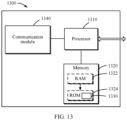
- FIG. 13 is a simplified block diagram of a device 1300 suitable for implementing embodiments of the present disclosure.
- the device 1300 may be provided to implement a network device or a terminal device, for example, any one of the network devices 110 and 120 and the terminal device 130 shown in FIG. 1 .
- the device 1300 includes one or more processors 1310, one or more memories 1320 coupled to the processor 1310, and one or more communication modules 1340 coupled to the processor 1310.
- the communication module 1340 is configured to perform bidirectional communication.
- the communication module 1340 has a communication interface for the communication.
- the communication interface may be any interface necessary to communicate with another network element.
- the processor 1310 may be any type suitable for a native technology network, and as a limiting example, may include one or more of the following: a general-purpose computer, a dedicated computer, a microprocessor, a digital signal processor, and a processor that is based on a multi-core processor architecture.
- the device 1300 may have a plurality of processors, such as an application-specific integrated circuit chip, which in time belongs to a clock synchronized with a main processor.
- the memory 1320 may include one or more nonvolatile memories and one or more volatile memories.
- the nonvolatile memory include but are not limited to a read-only memory (ROM) 1324, an electrically programmable read-only memory (EPROM), a flash memory, a hard disk, an optical disc (CD), a digital video disk (DVD), and another magnetic storage and/or optical storage apparatus.
- ROM read-only memory
- EPROM electrically programmable read-only memory
- flash memory a hard disk
- CD optical disc
- DVD digital video disk
- the volatile memory include but are not limited to a random access memory (RAM) 1322 and another volatile memory that does not persist during power-off duration.
- RAM random access memory
- a computer program 1330 includes computer-executable instructions performed by the associated processor 1310.
- the program 1330 may be stored in the ROM 1320.
- the processor 1310 may perform any suitable action and processing by loading the program 1330 into the RAM 1320.
- Embodiments of the present disclosure may be implemented by using the program 1330, so that the device 1300 performs the processing in the present disclosure as discussed with reference to FIG. 3 to FIG. 8 .
- the device 1300 may be corresponding to the network device 1100 or the terminal device 1200, and a functional module in the network device 1100 or the terminal device 1200 may be implemented by using software of the device 1300.
- a functional module included in the network device 1100 or the terminal device 1200 is generated after the processor 1310 of the device 1300 reads program code stored in the memory 1320.
- Embodiments of the present disclosure may alternatively be implemented by using hardware or a combination of software and hardware.
- the program 1330 may be tangibly included in a computer-readable medium, and the computer-readable medium may be included in the device 1300 (for example, in the memory 1320) or another storage device that is accessible by the device 1300.
- the program 1330 may be loaded from the computer-readable medium to the RAM 1322 for execution.
- the computer-readable medium may include any type of tangible nonvolatile memory, for example, a ROM, an EPROM, a flash memory, a hard disk, a CD, or a DVD.
- the various example embodiments of the present disclosure may be implemented in hardware or dedicated circuits, software, logic, or any combination thereof. Some aspects may be implemented in hardware, while other aspects may be implemented in firmware or software that may be executed by a controller, a microprocessor, or another computing device.
- firmware or software may be executed by a controller, a microprocessor, or another computing device.
- Examples of a hardware device that may be used to implement embodiments of the present disclosure include but are not limited to a field programmable gate array (FPGA), an application-specific integrated circuit (ASIC), an application-specific standard product (ASSP), a system-on-chip (SoC), and a complex programmable logic device (CPLD).
- FPGA field programmable gate array
- ASIC application-specific integrated circuit
- ASSP application-specific standard product
- SoC system-on-chip
- CPLD complex programmable logic device
- embodiments of the present disclosure may be described in the context of machine-executable instructions.
- the machine-executable instructions are included in a program module executed in a device on a target real or virtual processor.
- the program module includes a routine, a program, a library, an object, a class, a component, a data structure, and the like, and executes a specific task or implements a specific abstract data structure.
- functions of program modules may be combined or split between the described program modules.
- the machine-executable instructions for the program module may be executed locally or within a distributed device. In the distributed device, the program module may be located in both a local storage medium and a remote storage medium.
- Computer program code used for implementing the method in the present disclosure may be written in one or more programming languages.
- the computer program code may be provided for a processor of a general-purpose computer, a dedicated computer, or another programmable data processing apparatus, so that when the program code is executed by the computer or the another programmable data processing apparatus, functions/operations specified in the flowcharts and/or block diagrams are implemented.
- the program code may be executed entirely on a computer, executed partially on a computer, executed as a standalone software package, executed partially on a computer and partially on a remote computer, or executed entirely on a remote computer or a server.
- the computer program code or related data may be carried in any proper carrier, so that the device, the apparatus, or the processor can perform various processing and operations described above.
- the carrier include a signal, a computer-readable medium, and the like.
- Examples of the signal may include an electrical signal, an optical signal, a radio signal, a voice signal, or other forms of propagated signals, such as a carrier wave and an infrared signal.
- a machine-readable medium may be any tangible medium that includes or stores programs used for or related to an instruction execution system, apparatus, or device.
- the machine-readable medium may be a machine-readable signal medium or a machine-readable storage medium.
- the machine-readable medium may include but is not limited to an electronic, magnetic, optical, electromagnetic, infrared, or semiconductor system, apparatus, or device, or any proper combination thereof.
- a more detailed example of the machine-readable storage medium includes an electrical connection with one or more wires, a portable computer disk, a hard disk, a random access memory (RAM), a read-only memory (ROM), an erasable programmable read-only memory (EPROM or flash memory), an optical storage device, a magnetic storage device, or any proper combination thereof.
Landscapes
- Engineering & Computer Science (AREA)
- Signal Processing (AREA)
- Computer Networks & Wireless Communication (AREA)
- Computer Security & Cryptography (AREA)
- Multimedia (AREA)
- Mobile Radio Communication Systems (AREA)
Applications Claiming Priority (2)
| Application Number | Priority Date | Filing Date | Title |
|---|---|---|---|
| CN202210175768.7A CN116707727A (zh) | 2022-02-25 | 2022-02-25 | 通信方法、网络设备和终端设备 |
| PCT/CN2023/078202 WO2023160658A1 (zh) | 2022-02-25 | 2023-02-24 | 通信方法、网络设备和终端设备 |
Publications (2)
| Publication Number | Publication Date |
|---|---|
| EP4472121A1 true EP4472121A1 (de) | 2024-12-04 |
| EP4472121A4 EP4472121A4 (de) | 2025-04-23 |
Family
ID=87764847
Family Applications (1)
| Application Number | Title | Priority Date | Filing Date |
|---|---|---|---|
| EP23759280.3A Pending EP4472121A4 (de) | 2022-02-25 | 2023-02-24 | Kommunikationsverfahren, netzwerkvorrichtung und endgerätevorrichtung |
Country Status (4)
| Country | Link |
|---|---|
| US (1) | US20240414634A1 (de) |
| EP (1) | EP4472121A4 (de) |
| CN (1) | CN116707727A (de) |
| WO (1) | WO2023160658A1 (de) |
Families Citing this family (2)
| Publication number | Priority date | Publication date | Assignee | Title |
|---|---|---|---|---|
| US12376012B2 (en) * | 2022-04-12 | 2025-07-29 | Qualcomm Incorporated | Configuring one or more types of initial access or cell reselection |
| CN120456243A (zh) * | 2024-02-08 | 2025-08-08 | 大唐移动通信设备有限公司 | 信息处理方法、终端设备、基站、装置及介质 |
Family Cites Families (7)
| Publication number | Priority date | Publication date | Assignee | Title |
|---|---|---|---|---|
| US11445460B2 (en) * | 2018-12-20 | 2022-09-13 | Qualcomm Incorporated | Flexible configuration of synchronization signal block time locations |
| WO2021062578A1 (zh) * | 2019-09-30 | 2021-04-08 | Oppo广东移动通信有限公司 | 无线通信方法、网络设备和终端设备 |
| US12389347B2 (en) * | 2019-10-10 | 2025-08-12 | Qualcomm Incorporated | Indication of synchronization signal and physical broadcasting channel block transmission beam adjustment |
| US12021598B2 (en) * | 2020-04-24 | 2024-06-25 | Qualcomm Incorporated | Modification of SSB burst pattern |
| CN113766648B (zh) * | 2020-06-05 | 2023-06-23 | 大唐移动通信设备有限公司 | 一种ssb传输方法和装置及设备 |
| CN113810978B (zh) * | 2020-06-15 | 2022-11-11 | 华为技术有限公司 | 一种信息指示方法及装置 |
| CN113873528B (zh) * | 2020-06-30 | 2026-01-13 | 华为技术有限公司 | 一种覆盖增强方法和装置 |
-
2022
- 2022-02-25 CN CN202210175768.7A patent/CN116707727A/zh active Pending
-
2023
- 2023-02-24 EP EP23759280.3A patent/EP4472121A4/de active Pending
- 2023-02-24 WO PCT/CN2023/078202 patent/WO2023160658A1/zh not_active Ceased
-
2024
- 2024-08-23 US US18/813,267 patent/US20240414634A1/en active Pending
Also Published As
| Publication number | Publication date |
|---|---|
| WO2023160658A1 (zh) | 2023-08-31 |
| US20240414634A1 (en) | 2024-12-12 |
| CN116707727A (zh) | 2023-09-05 |
| WO2023160658A9 (zh) | 2024-05-02 |
| EP4472121A4 (de) | 2025-04-23 |
Similar Documents
| Publication | Publication Date | Title |
|---|---|---|
| US20230048775A1 (en) | Signal transmission method, signal detection method and apparatuses thereof and communication system | |
| US20240414634A1 (en) | Communication method, network device, and terminal device | |
| US11184931B2 (en) | Methods and apparatuses for timing advance adjustment | |
| US12167397B2 (en) | Signal reception apparatus and method and communications system | |
| EP4093112B1 (de) | Referenzsignalkonfigurationsverfahren, netzwerkvorrichtung und endgerät | |
| US20240260013A1 (en) | Resource indication method and apparatus and communication system | |
| US20190313418A1 (en) | Transmission Apparatus and Method Based on Dynamic Time Division Duplex and Communication System | |
| WO2022067714A1 (en) | Method, device and computer readable medium for communications | |
| WO2021207944A1 (en) | Method for communication, terminal device, and computer readable media | |
| WO2022116011A1 (en) | Methods for communication, device, and computer readable media | |
| US20240015702A1 (en) | Method for reselecting sidelink resource and apparatus for the same | |
| EP4044654B1 (de) | Verfahren und vorrichtung für den zugriff auf eine netzwerkvorrichtung | |
| US20240015841A1 (en) | Method for selecting sidelink resource and apparatus for the same | |
| US12016033B2 (en) | Multi-TRP transmission | |
| US20240015770A1 (en) | Methods for sidelink communication, terminal device, and computer readable media | |
| KR20240052758A (ko) | 신호를 송수신하기 위한 방법 및 장치, 및 통신 시스템 | |
| US20240188044A1 (en) | Methods for communication, terminal devices, and computer readable media | |
| WO2021258398A1 (en) | Method for communications, terminal device, and computer readable medium | |
| US12549269B2 (en) | Random access method and apparatus, and communication device | |
| WO2025251641A1 (zh) | 随机接入方法、通信装置、存储介质以及程序产品 | |
| US12439273B2 (en) | Wireless communication method and device | |
| WO2022104541A1 (en) | Method, device and computer readable medium for communications | |
| CN114071667A (zh) | 通信的方法、通信装置及系统 | |
| WO2025024991A1 (en) | Using non-cell defining synchronization signal block | |
| WO2025208343A1 (en) | Devices and methods of communication |
Legal Events
| Date | Code | Title | Description |
|---|---|---|---|
| STAA | Information on the status of an ep patent application or granted ep patent |
Free format text: STATUS: THE INTERNATIONAL PUBLICATION HAS BEEN MADE |
|
| PUAI | Public reference made under article 153(3) epc to a published international application that has entered the european phase |
Free format text: ORIGINAL CODE: 0009012 |
|
| STAA | Information on the status of an ep patent application or granted ep patent |
Free format text: STATUS: REQUEST FOR EXAMINATION WAS MADE |
|
| 17P | Request for examination filed |
Effective date: 20240829 |
|
| AK | Designated contracting states |
Kind code of ref document: A1 Designated state(s): AL AT BE BG CH CY CZ DE DK EE ES FI FR GB GR HR HU IE IS IT LI LT LU LV MC ME MK MT NL NO PL PT RO RS SE SI SK SM TR |
|
| A4 | Supplementary search report drawn up and despatched |
Effective date: 20250320 |
|
| RIC1 | Information provided on ipc code assigned before grant |
Ipc: H04W 16/28 20090101ALI20250314BHEP Ipc: H04W 4/80 20180101ALI20250314BHEP Ipc: H04W 4/06 20090101ALI20250314BHEP Ipc: H04L 5/00 20060101AFI20250314BHEP |
|
| DAV | Request for validation of the european patent (deleted) | ||
| DAX | Request for extension of the european patent (deleted) |