EP4470731A1 - Schätzvorrichtung, schätzverfahren und steuergerät - Google Patents
Schätzvorrichtung, schätzverfahren und steuergerät Download PDFInfo
- Publication number
- EP4470731A1 EP4470731A1 EP23747111.5A EP23747111A EP4470731A1 EP 4470731 A1 EP4470731 A1 EP 4470731A1 EP 23747111 A EP23747111 A EP 23747111A EP 4470731 A1 EP4470731 A1 EP 4470731A1
- Authority
- EP
- European Patent Office
- Prior art keywords
- target object
- information
- holding
- holding target
- controller
- Prior art date
- Legal status (The legal status is an assumption and is not a legal conclusion. Google has not performed a legal analysis and makes no representation as to the accuracy of the status listed.)
- Pending
Links
Images

Classifications
-
- B—PERFORMING OPERATIONS; TRANSPORTING
- B25—HAND TOOLS; PORTABLE POWER-DRIVEN TOOLS; MANIPULATORS
- B25J—MANIPULATORS; CHAMBERS PROVIDED WITH MANIPULATION DEVICES
- B25J13/00—Controls for manipulators
- B25J13/08—Controls for manipulators by means of sensing devices, e.g. viewing or touching devices
-
- B—PERFORMING OPERATIONS; TRANSPORTING
- B25—HAND TOOLS; PORTABLE POWER-DRIVEN TOOLS; MANIPULATORS
- B25J—MANIPULATORS; CHAMBERS PROVIDED WITH MANIPULATION DEVICES
- B25J9/00—Program-controlled manipulators
- B25J9/16—Program controls
- B25J9/1628—Program controls characterised by the control loop
- B25J9/163—Program controls characterised by the control loop learning, adaptive, model based, rule based expert control
-
- B—PERFORMING OPERATIONS; TRANSPORTING
- B25—HAND TOOLS; PORTABLE POWER-DRIVEN TOOLS; MANIPULATORS
- B25J—MANIPULATORS; CHAMBERS PROVIDED WITH MANIPULATION DEVICES
- B25J9/00—Program-controlled manipulators
- B25J9/16—Program controls
- B25J9/1694—Program controls characterised by use of sensors other than normal servo-feedback from position, speed or acceleration sensors, perception control, multi-sensor controlled systems, sensor fusion
- B25J9/1697—Vision controlled systems
-
- G—PHYSICS
- G06—COMPUTING OR CALCULATING; COUNTING
- G06T—IMAGE DATA PROCESSING OR GENERATION, IN GENERAL
- G06T11/00—Two-dimensional [2D] image generation
-
- G—PHYSICS
- G06—COMPUTING OR CALCULATING; COUNTING
- G06T—IMAGE DATA PROCESSING OR GENERATION, IN GENERAL
- G06T11/00—Two-dimensional [2D] image generation
- G06T11/60—Creating or editing images; Combining images with text
-
- G—PHYSICS
- G06—COMPUTING OR CALCULATING; COUNTING
- G06T—IMAGE DATA PROCESSING OR GENERATION, IN GENERAL
- G06T7/00—Image analysis
- G06T7/70—Determining position or orientation of objects or cameras
-
- G—PHYSICS
- G05—CONTROLLING; REGULATING
- G05B—CONTROL OR REGULATING SYSTEMS IN GENERAL; FUNCTIONAL ELEMENTS OF SUCH SYSTEMS; MONITORING OR TESTING ARRANGEMENTS FOR SUCH SYSTEMS OR ELEMENTS
- G05B2219/00—Program-control systems
- G05B2219/30—Nc systems
- G05B2219/39—Robotics, robotics to robotics hand
- G05B2219/39484—Locate, reach and grasp, visual guided grasping
-
- G—PHYSICS
- G05—CONTROLLING; REGULATING
- G05B—CONTROL OR REGULATING SYSTEMS IN GENERAL; FUNCTIONAL ELEMENTS OF SUCH SYSTEMS; MONITORING OR TESTING ARRANGEMENTS FOR SUCH SYSTEMS OR ELEMENTS
- G05B2219/00—Program-control systems
- G05B2219/30—Nc systems
- G05B2219/39—Robotics, robotics to robotics hand
- G05B2219/39536—Planning of hand motion, grasping
-
- G—PHYSICS
- G06—COMPUTING OR CALCULATING; COUNTING
- G06T—IMAGE DATA PROCESSING OR GENERATION, IN GENERAL
- G06T2207/00—Indexing scheme for image analysis or image enhancement
- G06T2207/20—Special algorithmic details
- G06T2207/20084—Artificial neural networks [ANN]
Definitions
- the present disclosure relates to an estimation device, an estimation method, and a control device.
- a known neural network infers a gripping position by using an image as an input (see, for example, Non Patent Literature 1).
- Non Patent Literature 1 " Grasping Detection using Deep Convolutional Neural Network with Graspability", Journal of the Robotics Society of Japan Vol.36 No.8, pp.559-566, 2018
- an estimation device includes an acquirer and a controller.
- the acquirer is configured to acquire information on a holding target object to be held by a holder.
- the controller is configured to estimate a holding position at which the holder is caused to hold the holding target object, based on the information on the holding target object in consideration of an acquisition point of the information on the holding target object.
- an estimation device includes an acquirer and a controller.
- the acquirer is configured to acquire information on a holding target object to be held by a holder.
- the controller is configured to estimate a holding position at which the holder is caused to hold the holding target object, based on the information on the holding target object.
- the controller is configured to calculate, as a directional deviation, a difference between a direction from an acquisition point of the information on the holding target object toward the holding target object and a direction in which the holder holds the holding target object.
- the controller is configured to estimate the holding position at which the holder is caused to hold the holding target object, based on the information on the holding target object if the directional deviation satisfies a predetermined condition.
- the controller is configured to estimate the holding position at which the holder is caused to hold the holding target object, based on the acquisition point and the information on the holding target object if the directional deviation does not satisfy the predetermined condition.
- an estimation method includes acquiring information on a holding target object to be held by a holder.
- the estimation method includes estimating a holding position at which the holder is caused to hold the holding target object, based on the information on the holding target object in consideration of an acquisition point of the information on the holding target object.
- an estimation method includes acquiring information on a holding target object to be held by a holder.
- the estimation method includes calculating, as a directional deviation, a difference between a direction from an acquisition point of the information on the holding target object toward the holding target object and a direction in which the holder holds the holding target object.
- the estimation method includes estimating the holding position at which the holder is caused to hold the holding target object, based on the information on the holding target object if the directional deviation satisfies a predetermined condition.
- the estimation method includes estimating the holding position at which the holder is caused to hold the holding target object, based on the acquisition point and the information on the holding target object if the directional deviation does not satisfy the predetermined condition.
- a control device causes a holder to hold a holding target object at a holding position estimated by the estimation device or at a holding position estimated by executing the estimation method.
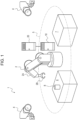
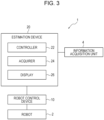
- a robot control system 1 includes a robot 2, an information acquisition unit 4, a control device 10, and an estimation device 20.
- the control device 10 controls the robot 2.
- the estimation device 20 estimates a holding position 82 at which a holding target object 8 is to be held by the robot 2, and outputs the holding position 82 to the control device 10.
- the robot 2 holds the holding target object 8 at a work start table 6. That is, the control device 10 controls the robot 2 to hold the holding target object 8 at the work start table 6. The robot 2 may move the holding target object 8 from the work start table 6 to a work target table 7. The robot 2 operates inside an operation range 5.
- the robot 2 includes an arm 2A and a holder 2B.
- the arm 2A may be, for example, a six-axis or seven-axis vertical articulated robot.
- the arm 2A may be a three-axis or four-axis horizontal articulated robot or a SCARA (selective compliance assembly robot arm) robot.
- the arm 2A may be a two-axis or three-axis Cartesian robot.
- the arm 2A may be a parallel link robot or the like.
- the number of axes of the arm 2A is not limited to the exemplified numbers.
- the robot 2 includes the arm 2A connected by multiple joints, and operates as result of driving of the joints.
- the holder 2B may be, for example, a hand or a suction part.
- the holder 2B is a hand 2B.
- the holder 2B is not limited to the hand, and may be, for example, a suction part including a suction nozzle that sucks the holding target object 8.
- gripping holding the holding target object 8 with the hand 2B
- the holding target object 8 may be referred to as a gripping target object 8.
- "gripping" used in the description below may be read and interpreted as "holding”.
- "gripping position 82" used in the description below may be interpreted as "holding position 82".
- the hand 2B may include, for example, a gripper capable of gripping the gripping target object 8.
- the gripper may include at least one finger 2C.
- the finger 2C of the gripper may include one or more joints.
- the finger 2C of the gripper may include a suction part that grips the gripping target object 8 by suction.
- the hand 2B may be configured as a single finger 2C including a suction part.
- the hand 2B may be configured as two or more fingers 2C that grip the gripping target object 8 therebetween.
- the hand 2B is not limited to these examples, and may be capable of performing other various operations.
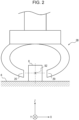
- the hand 2B includes a gripper including two fingers 2C.
- the hand 2B grips the gripping target object 8 with the two fingers 2C.
- a position at which the gripping target object 8 is to be gripped is illustrated as the gripping position 82.
- the gripping position 82 corresponds to a midpoint (an intersection point of one-dot-chain lines in horizontal and vertical directions in FIG. 2 ) of a line connecting points at which the two fingers 2C come into contact with the gripping target object 8 (a line represented as the one-dot-chain line in the horizontal direction in FIG. 2 ).
- the control device 10 causes the arm 2A of the robot 2 to operate, and thus can control the position of the hand 2B.
- the hand 2B may include a shaft serving as a reference of a direction in which the hand 2B acts on the gripping target object 8.
- the control device 10 causes the arm 2A to operate, and thus can control the direction of the shaft of the hand 2B.
- the control device 10 controls the start and the end of an operation of the hand 2B on the gripping target object 8.
- the control device 10 controls the operation of the hand 2B while controlling the position of the hand 2B or the direction of the shaft of the hand 2B, and thus can move or process the gripping target object 8. In the configuration illustrated in FIG.
- the control device 10 controls the robot 2 to cause the hand 2B to grip the gripping target object 8 at the work start table 6 and cause the hand 2B to move to the work target table 7.
- the control device 10 controls the robot 2 to cause the hand 2B to release the gripping target object 8 at the work target table 7. In this way, the control device 10 can cause the robot 2 to move the gripping target object 8 from the work start table 6 to the work target table 7.
- the control device 10 may include at least one processor.
- the processor may execute a program for implementing various functions of the control device 10.
- the processor may be implemented as a single integrated circuit.
- the integrated circuit is also referred to as an IC.
- the processor may be implemented as multiple integrated circuits and discrete circuits connected to be able to perform communication.
- the processor may be implemented based on various other known technologies.
- the control device 10 may include a storage.
- the storage may include an electromagnetic storage medium such as a magnetic disk, or may include a memory such as a semiconductor memory or a magnetic memory.
- the storage stores various kinds of information.
- the storage stores a program or the like to be executed by the control device 10.
- the storage may be a non-transitory readable medium.
- the storage may function as a work memory of the control device 10. At least part of the storage may be a storage separate from the control device 10.
- the estimation device 20 includes a controller 22, an acquirer 24, and a display 26.
- the acquirer 24 acquires information on the gripping target object 8.
- the controller 22 estimates a position at which the hand 2B is caused to grip the gripping target object 8, based on the information on the gripping target object 8, and outputs the estimated position to the control device 10.
- the display 26 may display the estimated result of the gripping position 82 of the gripping target object 8.
- the acquirer 24 may receive an input for correcting the gripping position 82 from a user who has viewed the estimated result of the gripping position 82.
- the controller 22 may correct the gripping position 82, based on the input from the user, and output the corrected gripping position 82 to the control device 10.
- the controller 22 may estimate the gripping position 82 by using an inference model.
- the inference model may be a trained model 30.
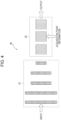
- the trained model 30 can be represented as a model in which a first model 31 and a second model 32 are connected to each other.
- the first model 31 outputs a result obtained by extracting a feature quantity of input information.
- the feature quantity represents, for example, an appearance feature such as an edge or a pattern of the gripping target object 8.
- the first model 31 may include a CNN (Convolution Neural Network) including multiple layers.
- the first model 31 may include, for example, convolution and pooling.
- the second model 32 makes a predetermined determination on the input information, based on the output of the first model 31. Specifically, the second model 32 may output the estimated result of the gripping position 82 of the gripping target object 8 included in the input information, based on the feature quantity output by the first model 31.
- the second model 32 may include a fully connected layer that processes the extracted result of the feature quantity obtained by the first model 31.
- the inference model may include a convolution layer that receives an input of the information on the gripping target object 8, and a fully connected layer that processes an output of the convolution layer and outputs an inferred result of the gripping position 82.
- the fully connected layer may include a layer that takes acquisition point information into consideration.
- the controller 22 may include at least one processor.
- the processor may execute a program for implementing the various functions of the controller 22.
- the processor may be implemented as a single integrated circuit.
- the integrated circuit is also referred to as an IC.
- the processor may be implemented as multiple integrated circuits and discrete circuits connected to be able to perform communication.
- the processor may be implemented based on various other known technologies.
- the controller 22 may include a storage.
- the storage may include an electromagnetic storage medium such as a magnetic disk, or may include a memory such as a semiconductor memory or a magnetic memory.
- the storage stores various kinds of information.
- the storage stores a program or the like to be executed by the controller 22.
- the storage may be a non-transitory readable medium.
- the storage may function as a work memory of the controller 22. At least part of the storage may be a storage separate from the controller 22.
- the acquirer 24 may include a communication device that can perform wired or wireless communication.
- the communication device can perform communication in accordance with communication schemes based on various communication standards.
- the communication device may be based on a known communication technique.
- the acquirer 24 may include an input device that receives an input of information, data, or the like from a user.
- the input device may include, for example, a touch panel or a touch sensor, or a pointing device such as a mouse.
- the input device may include a physical key.
- the input device may include an audio input device such as a microphone.
- the display 26 includes a display device that displays information, data, or the like to a user.
- the display device outputs, for example, visual information such as an image, a text, or a figure.
- the display device may include, for example, an LCD (Liquid Crystal Display), an organic EL (Electro-Luminescence) display or an inorganic EL display, or a PDP (Plasma Display Panel).
- the display device is not limited to these displays, and may include displays of various other types.
- the display device may include a light-emitting device such as an LED (Light Emission Diode) or an LD (Laser Diode).
- the display device may include various other devices.
- the information acquisition unit 4 acquires information on the gripping target object 8.
- the information acquisition unit 4 may include a camera.
- the camera serving as the information acquisition unit 4 captures an image of the gripping target object 8, as information on the gripping target object 8.
- the information acquisition unit 4 may include a depth sensor.
- the depth sensor serving as the information acquisition unit 4 acquires depth data of the gripping target object 8. The depth data may be transformed into point cloud information of the gripping target object 8.
- the control device 10 controls the operation of the robot 2.
- the estimation device 20 estimates a position at which the hand 2B is caused to grip the gripping target object 8 when the hand 2B of the robot 2 operates to grip the gripping target object 8.
- the control device 10 determines the position at which the hand 2B is caused to grip the gripping target object 8, based on the estimated result obtained by the estimation device 20, and controls the arm 2A or the hand 2B of the robot 2 so that the hand 2B grips the gripping target object 8 at the determined position.
- An operation example of the estimation device 20 is described below.
- the acquirer 24 of the estimation device 20 acquires information on the gripping target object 8 to be gripped by the hand 2B from the information acquisition unit 4.
- the information on the gripping target object 8 is also referred to as target information.
- the information on the gripping target object 8 includes an image of the gripping target object 8 captured from the information acquisition unit 4, distance data from the information acquisition unit 4 to the gripping target object 8, or the like.
- the acquirer 24 outputs the information on the gripping target object 8 (target information) acquired from the information acquisition unit 4, to the controller 22 of the estimation device 20. In other words, the controller 22 acquires, via the acquirer 24, the information on the gripping target object 8 (target information).
- the controller 22 estimates the position (gripping position 82) at which the hand 2B is caused to grip the gripping target object 8, based on the information on the gripping target object 8 (target information) in consideration of the position at which the information on the gripping target object 8 (target information) is acquired.
- the controller 22 may input the information on the gripping target object 8 (target information) to, for example, an inference model such as the trained model 30, and estimate, as the gripping position 82, an inferred result output from the inference model.
- the gripping position 82 may be represented by coordinates of each of the two fingers 2C.
- the gripping position 82 may be represented by coordinates of a midpoint of the two fingers 2C and a rotation angle of the hand 2B. Even when the hand 2B includes three or more fingers 2C, the gripping position 82 may be represented by coordinates of each of the fingers 2C, or may be represented by average coordinates of the coordinates of the fingers 2C and a rotation angle of the hand 2B.
- the gripping position 82 may be represented as coordinates in a plane on which the information is mapped.
- the gripping position 82 may be represented as three-dimensional coordinates.
- the position at which the information on the gripping target object 8 (target information) is acquired is also referred to as an acquisition point.
- Information on the acquisition point is also referred to as acquisition point information.
- the acquisition point information may include information on a direction in which the acquisition point is located when the acquisition point is viewed from the gripping target object 8.
- the direction in which the acquisition point is located when the acquisition point is viewed from the gripping target object 8 is also referred to as an acquisition direction.
- the acquisition point information may include information on a direction in which the hand 2B grips the gripping target object 8 (a direction or posture of the hand 2B when the hand 2B grips the gripping target object 8).
- the direction in which the hand 2B grips the gripping target object 8 is also referred to as a gripping direction.
- the gripping direction may just be set in advance to, for example, a direction of weight or a direction perpendicular to a work surface of a work table such as the work start table 6 or the work target table 7.
- Each of the acquisition direction and the gripping direction may be represented by two types of angles in a polar coordinate system or may be represented as a unit vector in a three-dimensional space.
- the acquisition point information may include information representing a relative relationship between the acquisition direction and the gripping direction. Specifically, the relative relationship between the acquisition direction and the grasping direction can be represented as a difference between respective angles representing the acquisition direction and the grasping direction.
- the controller 22 may acquire the acquisition point information from the information acquisition unit 4.
- the acquisition point information may be information for specifying a predefined acquisition point.
- the acquisition point information may be information representing the direction (acquisition direction) in which the information on the gripping target object 8 is acquired by roll, pitch, and yaw or by quaternions with respect to the position of the gripping target object 8 serving as an origin.
- the quaternions are a format representing a posture rotated by a predetermined angle about a direction vector serving as a rotation axis.
- the controller 22 may generate the acquisition point information based on the target information, and thus acquire the acquisition point information.
- the acquisition point information may be generated using a P3P algorithm, which is a type of Perspective-n-Point algorithm, using a marker whose position on the three-dimensional coordinates is known.
- the acquisition point information may be generated by imaging a reference marker together with the gripping target object 8 and comparing a shape of the reference marker in the image with a shape of the reference marker obtained when the reference marker faces the camera serving as the information acquisition unit 4.
- the acquisition point information may be generated by, for example, defining a reference posture of the gripping target object 8 and comparing an outer shape of the gripping target object 8 in the image serving as the target information, distance data from the information acquisition unit 4 to the gripping target object 8, or the like with information obtained when the gripping target object 8 is in the reference posture.
- the difference between the acquisition direction and the gripping direction is also referred to as a directional deviation.
- the controller 22 may calculate the difference between the acquisition direction and the gripping direction as a value representing the directional deviation.
- the controller 22 may calculate a difference between the angles as the value representing the directional deviation.
- the controller 22 may calculate an angle formed by the unit vectors of the acquisition direction and the gripping direction, or may calculate an inner product or an outer product of the unit vectors of the acquisition direction and the gripping direction, as the value representing the directional deviation.
- the controller 22 may estimate the gripping position 82 at which the hand 2B is caused to grip the gripping target object 8, based on the information on the gripping target object 8 (target information). If the directional deviation does not satisfy the predetermined condition, the controller 22 may estimate the gripping position 82 at which the hand 2B is caused to grip the gripping target object 8, based on the acquisition point and the information on the gripping target object 8 (target information).
- the predetermined condition may include a condition that the value representing the directional deviation (the difference between the acquisition direction and the gripping direction) is within a predetermined range. Specifically, the predetermined condition may include a condition that an angle difference calculated as the directional deviation is smaller than an angle threshold.
- the angle threshold may be set to, for example, 10 degrees.
- the predetermined condition may include a condition that an absolute value of the outer product of the unit vectors that is calculated as the directional deviation is smaller than an outer product threshold.
- the predetermined condition may include a condition that the inner product of the unit vectors that is calculated as the directional deviation is greater than an inner product threshold.
- the controller 22 can estimate the gripping position 82 by using the trained model 30 as the inference model.
- the second model 32 may output the estimated result of the gripping position 82 in consideration of the acquisition point information.
- the second model 32 may receive an input of the acquisition point information.
- the second model 32 may process the feature quantity output from the first model 31 in three steps.
- the second model 32 may include a layer that performs preprocessing as processing of a first step.
- the second model 32 may include a layer that performs connection processing as processing of a second step.
- the second model 32 may include a layer that performs output processing as processing of a third step.
- the second model 32 may receive an input of the acquisition point information in the layer that performs the connection processing as the processing of the second step. That is, as the processing of the second step of the second model 32, processing of connecting the feature quantity of the gripping target object 8 and the acquisition point information may be performed. In this case, the feature quantity of the gripping target object 8 output from the first model 31 is processed so that the acquisition point information can be connected in the connection processing of the second step.
- the processing of the second model 32 is divided into three steps. However, the processing may be divided into four or more steps, may be divided into two steps, or need not be divided into multiple steps.
- the gripping position 82 may be represented by the coordinates of the midpoint of the two fingers 2C in the image serving as the target information.
- the gripping position 82 may be represented by information specifying that the two fingers 2C of the hand 2B are aligned in a line in a Y-axis direction.
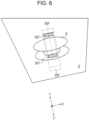
- the gripping target object 8 is inclined in the image.
- estimated gripping positions 50F represented by two-dot-chain lines are estimated as the gripping position 82.
- the hand 2B grips the gripping target object 8 from the actual gripping direction, the hand 2B fails to grip or has difficulty in gripping the gripping target object 8 at the estimated gripping positions 50F.
- estimated gripping positions 50T are estimated as the gripping position 82.
- the estimated gripping positions 50T appear to deviate from the gripping target object 8 in the image.
- the controller 22 estimates the gripping position 82 in consideration of the acquisition point, and thus can make a success rate of the hand 2B gripping the gripping target object 8 higher than when the controller 22 estimates the gripping position 82 without consideration of the acquisition point.
- a computation load of the inference model when outputting the estimated result of the gripping position 82 in consideration of the acquisition point is larger than a computation load of the inference model when outputting the estimated result of the gripping position 82 without consideration of the acquisition point.
- the acquisition point need not be taken into consideration.
- the estimation accuracy of the gripping position 82 decreases unless the acquisition point is taken into consideration as illustrated in FIG. 6
- the acquisition point may be taken into consideration. Taking the acquisition point into consideration when needed may reduce the computation load of the inference model.
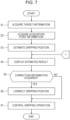
- the controller 22 of the estimation device 20 may execute an estimation method including a procedure of a flowchart illustrated in FIG. 7 .
- the estimation method may be implemented as an estimation program to be executed by a processor included in the controller 22.
- the estimation program may be stored in a non-transitory computer-readable medium.
- the controller 22 acquires the target information from the information acquisition unit 4 (step S1).
- the controller 22 may acquire, as the target information, an image of the gripping target object 8.
- the controller 22 acquires the acquisition point information (step S2).
- the controller 22 may acquire the acquisition point information from the information acquisition unit 4.
- the controller 22 may generate the acquisition point information, based on the target information, and thus acquire the acquisition point information.
- the controller 22 estimates the gripping position 82, based on the target information (step S3).
- the controller 22 inputs the target information to the inference model and acquires the estimated result of the gripping position 82 output from the inference model, and thus estimates the gripping position 82.
- the controller 22 may also input the acquisition point information to the inference model, and thus cause the inference model to output the estimated result of the gripping position 82 in consideration of the acquisition point information.
- the controller 22 may set a parameter for instructing the inference model to perform estimation in consideration of the acquisition point information, and thus cause the inference model to output the estimated result of the gripping position 82 in consideration of the acquisition point information.
- the controller 22 causes the display 26 to display the estimated result of the gripping position 82 (step S4).
- the controller 22 determines whether correction information for the estimated result of the gripping position 82 is acquired (step S5). Specifically, when the acquirer 24 receives an input of the correction information from a user who has viewed the estimated result of the gripping position 82, the controller 22 may determine that the correction information is acquired. If the correction information is not acquired (step S5: NO), the controller 22 proceeds to a procedure of step S7. If the correction information is acquired (step S5: YES), the controller 22 corrects the gripping position 82 based on the correction information (step S6).
- the controller 22 controls the gripping operation of the robot 2 such that the hand 2B is caused to grip the gripping target object 8 at the estimated gripping position 82 or the corrected gripping position 82 (step S7). After executing the procedure of step S7, the controller 22 ends the execution of the flowchart of FIG. 7 .
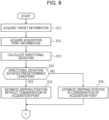
- the controller 22 may execute an estimation method including a procedure of a flowchart illustrated in FIG. 8 .
- the controller 22 acquires the target information from the information acquisition unit 4 (step S11).
- the controller 22 acquires the acquisition point information (step S12).
- the procedures of steps S11 and S12 may be executed as procedures identical or similar to the procedures of steps S1 and S2 of FIG. 7 .
- the controller 22 calculates the directional deviation (step S13). Specifically, the controller 22 calculates, as the directional deviation, a difference between the direction from the acquisition point toward the gripping target object 8 and the direction in which the hand 2B grips the gripping target object 8. The controller 22 determines whether the directional deviation satisfies a predetermined condition (step S14).
- step S14 If the directional deviation satisfies the predetermined condition (step S14: YES), the controller 22 estimates the gripping position 82 without consideration of the acquisition point (step S15). Specifically, the controller 22 acquires the estimated result of the gripping position 82 output from the inference model by inputting the target information to the inference model but not inputting the acquisition point information. After executing the procedure of step S15, the controller 22 proceeds to the procedure of step S4 of FIG. 7 .
- step S16 the controller 22 estimates the gripping position 82 in consideration of the acquisition point (step S16). Specifically, the controller 22 acquires the estimated result of the gripping position 82 output from the inference model by inputting the acquisition point information to the inference model together with the target information. After executing the procedure of step S16, the controller 22 proceeds to the procedure of step S4 of FIG. 7 .
- the estimation device 20 and the estimation method according to the present embodiment can increase the estimation accuracy of the gripping position 82 even when the gripping direction and the acquisition direction do not coincide with each other. This can consequently increase the gripping stability.
- the control device 10 or the estimation device 20 may be a server device.
- the server device may include at least one computer.
- the server device may cause multiple computers to preform parallel processing.
- the server device need not include a physical housing, and may be based on a virtualization technology such as a virtual machine or a container orchestration system.
- the server device may be configured using a cloud service.
- the server device can be configured by using a managed service in combination. That is, the functions of the control device 10 can be implemented as a cloud service.
- the server device may include at least one server group.
- the server group functions as the controller 22.
- the number of server groups may be one or may be two or more. When the number of server groups is one, functions implemented by the one server group include functions implemented by each server group.
- the server groups are connected to be able to perform wired or wireless communication with each other.
- the control device 10 or the estimation device 20 is depicted as one configuration in each of FIGs. 1 and 2 but may be operated with the multiple configurations being regarded as one system as needed. That is, the control device 10 or the estimation device 20 is a platform of a variable capacity. As a result of using the multiple configurations as the control device 10 or the estimation device 20, even when one configuration is unable to be operated upon the occurrence of an unexpected situation such as a natural disaster, the operation of the system is continued by using the other configurations. In this case, the multiple components are connected to each other via a wired or wireless line to be able to communicate with each other.
- the multiple configurations may be constructed across a cloud service and an on-premise environment.
- the control device 10 or the estimation device 20 is connected to the robot 2 by, for example, a wired or wireless communication line.
- the control device 10, the estimation device 20, or the robot 2 mutually includes a communication device using a standard protocol, and can perform bidirectional communication.
- the control device 10 may control the robot 2 to cause the hand 2B to grip the gripping target object 8 at the gripping position 82 estimated by the estimation device 20.
- the control device 10 may control the robot 2 to cause the hand 2B to grip the gripping target object 8 at the gripping position 82 estimated by executing the estimation method.
- the control device 10 and the estimation device 20 may be integrated together.
- the controller 22 inputs the target information to the inference model and estimates the gripping position 82.
- the controller 22 may further process the target information with a rule-based algorithm, and thus calculate the gripping position 82.
- the rule-based algorithm may include, for example, template matching or may include processing using a map.
- the controller 22 may generate, for example, a map for identifying the state of the hand 2B (such as an interval between the fingers 2C, or a thickness or width of the fingers 2C).
- the controller 22 may generate a rule map representing a suitability of each portion of the gripping target object 8 as the gripping position 82.
- the rule map may include, for example, a surrounding environment map representing a surrounding environment of the gripping target object 8, an object map representing the characteristics (such as a shape, a center of gravity, or a material) of the gripping target object 8, and a contact map representing a rule based on a relationship between the hand 2B and the state of the surface of the gripping target object 8.
- the controller 22 may compare the gripping position 82 calculated with the rule-based algorithm, with the gripping position 82 estimated with the inference model.
- the controller 22 may inspect whether the estimation accuracy of the estimated result of the gripping position 82 exceeds a predetermined accuracy, based on a result of the comparison.
- the controller 22 may correct the estimated result of the gripping position 82, based on the result of the comparison, and determine the corrected estimated result as the gripping position 82.
- the controller 22 may inspect or correct the estimated result of the gripping position 82 obtained with the inference model, based on a result obtained by processing the information on the gripping target object 8 (target information) with the rule-based algorithm.
- the use of the result obtained with the rule-based algorithm can increase the accuracy of the gripping position 82. This can consequently increase the gripping stability.
- the controller 22 may cause the display 26 to display the estimated result of the gripping position 82 of the gripping target object 8.
- the controller 22 may cause the display 26 to display a superimposition image in which an image representing the estimated result of the gripping position 82 of the gripping target object 8 is superimposed on an image representing the information on the gripping target object 8. The user visually recognizes the superimposition image, and thus can determine how to correct the gripping position 82.
- the controller 22 may transform an image of the gripping target object 8 captured from the acquisition point into an image captured if the gripping target object 8 is imaged from the gripping direction, and cause the display 26 to display the transformed image. That is, the controller 22 may transform an image representing the information on the gripping target object 8 into an image obtained if the information on the gripping target object 8 is acquired from the direction in which the hand 2B grips the gripping target object 8.
- the controller 22 may transform the image by perspective projection transformation.
- the controller 22 may transform the image by coordinate transformation of the point cloud information obtained by imaging the gripping target object 8 using an RGB-D camera.
- the RGB-D camera acquires a color image (or a grayscale image) and depth data together. Transforming an image and displaying the transformed image make it easier for the user to determine how to correct the gripping position 82.
- the controller 22 may receive, via the acquirer 24, a user input for correcting the gripping position 82 based on the superimposition image.
- the controller 22 may correct the gripping position 82, based on the user input. In this way, the accuracy of the gripping position 82 can be increased. This can consequently increase the gripping stability.
- the controller 22 may retrain the inference model, based on the input for correcting the gripping position 82.
- the controller 22 may accumulate inputs for correcting the gripping position 82, and collectively use the accumulated correction inputs in retraining of the inference model upon the number of accumulated correction inputs being equal to or greater than a predetermined number.
- the controller 22 may process, with a correction filter, the estimated result of the gripping position 82 output from the inference model, and thus correct the gripping position 82.
- the controller 22 may update the correction filter, based on the input for correcting the gripping position 82.
- the controller 22 may accumulate inputs for correcting the gripping position 82, and collectively use the accumulated correction inputs in update of the correction filter upon the number of accumulated correction inputs being equal to or greater than a predetermined number.
- control device 10 may be implemented as, in addition to a method or a program for implementing the device, a storage medium (for example, an optical disk, a magneto-optical disk, a CD-ROM (Compact Disc Read-Only Memory), a CD-R (Compact Disc Recordable), a CD-RW (Compact Disc Rewritable), a magnetic tape, a hard disk, or a memory card) in which the program is recorded.
- a storage medium for example, an optical disk, a magneto-optical disk, a CD-ROM (Compact Disc Read-Only Memory), a CD-R (Compact Disc Recordable), a CD-RW (Compact Disc Rewritable), a magnetic tape, a hard disk, or a memory card
- a storage medium for example, an optical disk, a magneto-optical disk, a CD-ROM (Compact Disc Read-Only Memory), a CD-R (Compact Disc Record
- the implementation of the program is not limited to an application program such as object code compiled by a compiler or program code executed by an interpreter, and can also take any form such as a program module incorporated into an operating system.
- the program may or may not be configured so that all processing is performed only in a CPU on a control board.
- the program may be executed entirely or partially by another processing unit mounted on an expansion board or expansion unit added to the board as necessary.
- the embodiments according to the present disclosure are not limited to any of the specific configurations of the embodiments described above.
- the embodiments according to the present disclosure can be extended to all novel features, or combinations thereof, described in the present disclosure, or all novel methods, or processing steps, or combinations thereof, described in the present disclosure.
Landscapes
- Engineering & Computer Science (AREA)
- Physics & Mathematics (AREA)
- General Physics & Mathematics (AREA)
- Theoretical Computer Science (AREA)
- Robotics (AREA)
- Mechanical Engineering (AREA)
- Computer Vision & Pattern Recognition (AREA)
- Human Computer Interaction (AREA)
- Manipulator (AREA)
Applications Claiming Priority (2)
| Application Number | Priority Date | Filing Date | Title |
|---|---|---|---|
| JP2022011202 | 2022-01-27 | ||
| PCT/JP2023/002712 WO2023145901A1 (ja) | 2022-01-27 | 2023-01-27 | 推定装置、推定方法、及び制御装置 |
Publications (2)
| Publication Number | Publication Date |
|---|---|
| EP4470731A1 true EP4470731A1 (de) | 2024-12-04 |
| EP4470731A4 EP4470731A4 (de) | 2025-12-24 |
Family
ID=87471749
Family Applications (1)
| Application Number | Title | Priority Date | Filing Date |
|---|---|---|---|
| EP23747111.5A Pending EP4470731A4 (de) | 2022-01-27 | 2023-01-27 | Schätzvorrichtung, schätzverfahren und steuergerät |
Country Status (5)
| Country | Link |
|---|---|
| US (1) | US20240383151A1 (de) |
| EP (1) | EP4470731A4 (de) |
| JP (1) | JPWO2023145901A1 (de) |
| CN (1) | CN118591442A (de) |
| WO (1) | WO2023145901A1 (de) |
Families Citing this family (1)
| Publication number | Priority date | Publication date | Assignee | Title |
|---|---|---|---|---|
| JP2024065744A (ja) * | 2022-10-31 | 2024-05-15 | 株式会社東芝 | ハンド、搬送ロボット、制御装置、制御方法、プログラム、及び記憶媒体 |
Family Cites Families (19)
| Publication number | Priority date | Publication date | Assignee | Title |
|---|---|---|---|---|
| JP5616478B1 (ja) * | 2013-04-18 | 2014-10-29 | ファナック株式会社 | ワークを搬送するロボットを備えるロボットシステム |
| JP2015073798A (ja) * | 2013-10-10 | 2015-04-20 | 株式会社東芝 | 医用画像診断装置、画像処理装置およびプログラム |
| JP6711591B2 (ja) * | 2015-11-06 | 2020-06-17 | キヤノン株式会社 | ロボット制御装置およびロボット制御方法 |
| ES2929729T3 (es) * | 2015-11-13 | 2022-12-01 | Berkshire Grey Operating Company Inc | Sistemas de clasificación para proporcionar clasificación de una variedad de objetos |
| JP6822929B2 (ja) * | 2017-09-19 | 2021-01-27 | 株式会社東芝 | 情報処理装置、画像認識方法および画像認識プログラム |
| JP2019063984A (ja) * | 2017-10-02 | 2019-04-25 | キヤノン株式会社 | 情報処理装置、方法及びロボットシステム |
| US11833681B2 (en) * | 2018-08-24 | 2023-12-05 | Nvidia Corporation | Robotic control system |
| DE102019122790B4 (de) * | 2018-08-24 | 2021-03-25 | Nvidia Corp. | Robotersteuerungssystem |
| JP6856590B2 (ja) * | 2018-08-31 | 2021-04-07 | ファナック株式会社 | センシングシステム、作業システム、拡張現実画像の表示方法、およびプログラム |
| JP7384898B2 (ja) * | 2019-03-13 | 2023-11-21 | 日本電気株式会社 | 情報処理装置、駆動制御方法およびコンピュータプログラム |
| WO2020212776A1 (en) * | 2019-04-18 | 2020-10-22 | Alma Mater Studiorum - Universita' Di Bologna | Creating training data variability in machine learning for object labelling from images |
| JP2021010970A (ja) * | 2019-07-05 | 2021-02-04 | 京セラドキュメントソリューションズ株式会社 | ロボットシステム及びロボット制御方法 |
| JP7263987B2 (ja) * | 2019-08-22 | 2023-04-25 | オムロン株式会社 | 制御装置、制御方法、及び制御プログラム |
| CN114080304B (zh) * | 2019-08-22 | 2024-05-14 | 欧姆龙株式会社 | 控制装置、控制方法及控制程序 |
| US11724401B2 (en) * | 2019-11-13 | 2023-08-15 | Nvidia Corporation | Grasp determination for an object in clutter |
| JP7794641B2 (ja) * | 2020-01-09 | 2026-01-06 | ファナック株式会社 | ワーク搬送システム |
| JP2021131652A (ja) * | 2020-02-19 | 2021-09-09 | 株式会社トプコン | データ構造、記録媒体、プログラム、及びシステム |
| US12240713B2 (en) * | 2021-03-18 | 2025-03-04 | Dexterity, Inc. | Robotic palletization system with variable conveyor height |
| JP7822205B2 (ja) * | 2022-03-08 | 2026-03-02 | 本田技研工業株式会社 | 遠隔操作システム |
-
2023
- 2023-01-27 JP JP2023577043A patent/JPWO2023145901A1/ja active Pending
- 2023-01-27 CN CN202380018610.1A patent/CN118591442A/zh active Pending
- 2023-01-27 WO PCT/JP2023/002712 patent/WO2023145901A1/ja not_active Ceased
- 2023-01-27 EP EP23747111.5A patent/EP4470731A4/de active Pending
- 2023-01-27 US US18/833,790 patent/US20240383151A1/en active Pending
Also Published As
| Publication number | Publication date |
|---|---|
| EP4470731A4 (de) | 2025-12-24 |
| WO2023145901A1 (ja) | 2023-08-03 |
| JPWO2023145901A1 (de) | 2023-08-03 |
| CN118591442A (zh) | 2024-09-03 |
| US20240383151A1 (en) | 2024-11-21 |
Similar Documents
| Publication | Publication Date | Title |
|---|---|---|
| JP5835926B2 (ja) | 情報処理装置、情報処理装置の制御方法、およびプログラム | |
| CN111745640B (zh) | 物体检测方法、物体检测装置以及机器人系统 | |
| Du et al. | Human–manipulator interface based on multisensory process via Kalman filters | |
| US12377535B2 (en) | Robot control apparatus, robot control method, and program | |
| CN114494426A (zh) | 用于控制机器人来在不同的方位拿起对象的装置和方法 | |
| CN114670189B (zh) | 存储介质、以及生成机器人的控制程序的方法及系统 | |
| US20170277167A1 (en) | Robot system, robot control device, and robot | |
| WO2019069361A1 (ja) | 把持位置姿勢教示装置、把持位置姿勢教示方法及びロボットシステム | |
| CN110539299A (zh) | 机器手作业方法、控制器以及机器手系统 | |
| CN116635194A (zh) | 干扰确定装置、机器人控制系统以及干扰确定方法 | |
| CN116472551A (zh) | 调整参数的装置、机器人系统、方法以及计算机程序 | |
| US20240383151A1 (en) | Estimation device, estimation method, and control device | |
| CN117794709A (zh) | 握持参数估计设备和握持参数估计方法 | |
| EP4389367A1 (de) | Haltemodusbestimmungsvorrichtung für roboter, haltemodusbestimmungsverfahren und robotersteuerungssystem | |
| CN115082554A (zh) | 用于控制机器人来拿起对象的装置和方法 | |
| US20240262635A1 (en) | Conveyance system for moving object based on image obtained by image capturing device | |
| EP4393660A1 (de) | Verfahren zur erzeugung trainierter modelle, vorrichtung zur erzeugung trainierter modelle, trainiertes modell und vorrichtung zur schätzung des wartungszustands | |
| US20250065501A1 (en) | Robot control device and robot control method | |
| JP7651691B2 (ja) | 保持位置決定装置、及び保持位置決定方法 | |
| US20240246237A1 (en) | Robot control device, robot control system, and robot control method | |
| US20220092290A1 (en) | Image Recognition Method And Robot System | |
| JP2024120216A (ja) | ハンドリング装置、ハンドリング方法及びプログラム | |
| CN117769483A (zh) | 机器人控制设备、机器人控制系统以及机器人控制方法 | |
| KR20240081551A (ko) | 로봇 제어를 위한 데이터셋 획득 시스템 및 방법 | |
| TW202303183A (zh) | 適應性移動操作設備及方法 |
Legal Events
| Date | Code | Title | Description |
|---|---|---|---|
| STAA | Information on the status of an ep patent application or granted ep patent |
Free format text: STATUS: THE INTERNATIONAL PUBLICATION HAS BEEN MADE |
|
| PUAI | Public reference made under article 153(3) epc to a published international application that has entered the european phase |
Free format text: ORIGINAL CODE: 0009012 |
|
| STAA | Information on the status of an ep patent application or granted ep patent |
Free format text: STATUS: REQUEST FOR EXAMINATION WAS MADE |
|
| 17P | Request for examination filed |
Effective date: 20240731 |
|
| AK | Designated contracting states |
Kind code of ref document: A1 Designated state(s): AL AT BE BG CH CY CZ DE DK EE ES FI FR GB GR HR HU IE IS IT LI LT LU LV MC ME MK MT NL NO PL PT RO RS SE SI SK SM TR |
|
| DAV | Request for validation of the european patent (deleted) | ||
| DAX | Request for extension of the european patent (deleted) | ||
| A4 | Supplementary search report drawn up and despatched |
Effective date: 20251125 |
|
| RIC1 | Information provided on ipc code assigned before grant |
Ipc: B25J 13/08 20060101AFI20251119BHEP Ipc: B25J 9/16 20060101ALI20251119BHEP |