EP4470677A1 - Verfahren und vorrichtung zum aufbringen von partikelbeschränkten flüssigkeitsschichten auf gewalzte bleche mit unterschiedlichen geometrien - Google Patents
Verfahren und vorrichtung zum aufbringen von partikelbeschränkten flüssigkeitsschichten auf gewalzte bleche mit unterschiedlichen geometrien Download PDFInfo
- Publication number
- EP4470677A1 EP4470677A1 EP23710080.5A EP23710080A EP4470677A1 EP 4470677 A1 EP4470677 A1 EP 4470677A1 EP 23710080 A EP23710080 A EP 23710080A EP 4470677 A1 EP4470677 A1 EP 4470677A1
- Authority
- EP
- European Patent Office
- Prior art keywords
- coating
- particle size
- particle
- suspended
- generating chamber
- Prior art date
- Legal status (The legal status is an assumption and is not a legal conclusion. Google has not performed a legal analysis and makes no representation as to the accuracy of the status listed.)
- Pending
Links
Images


Classifications
-
- B—PERFORMING OPERATIONS; TRANSPORTING
- B05—SPRAYING OR ATOMISING IN GENERAL; APPLYING FLUENT MATERIALS TO SURFACES, IN GENERAL
- B05B—SPRAYING APPARATUS; ATOMISING APPARATUS; NOZZLES
- B05B12/00—Arrangements for controlling delivery; Arrangements for controlling the spray area
- B05B12/08—Arrangements for controlling delivery; Arrangements for controlling the spray area responsive to condition of liquid or other fluent material to be discharged, of ambient medium or of target ; responsive to condition of spray devices or of supply means, e.g. pipes, pumps or their drive means
- B05B12/082—Arrangements for controlling delivery; Arrangements for controlling the spray area responsive to condition of liquid or other fluent material to be discharged, of ambient medium or of target ; responsive to condition of spray devices or of supply means, e.g. pipes, pumps or their drive means responsive to a condition of the discharged jet or spray, e.g. to jet shape, spray pattern or droplet size
-
- B—PERFORMING OPERATIONS; TRANSPORTING
- B05—SPRAYING OR ATOMISING IN GENERAL; APPLYING FLUENT MATERIALS TO SURFACES, IN GENERAL
- B05B—SPRAYING APPARATUS; ATOMISING APPARATUS; NOZZLES
- B05B12/00—Arrangements for controlling delivery; Arrangements for controlling the spray area
- B05B12/16—Arrangements for controlling delivery; Arrangements for controlling the spray area for controlling the spray area
- B05B12/20—Masking elements, i.e. elements defining uncoated areas on an object to be coated
-
- B—PERFORMING OPERATIONS; TRANSPORTING
- B05—SPRAYING OR ATOMISING IN GENERAL; APPLYING FLUENT MATERIALS TO SURFACES, IN GENERAL
- B05B—SPRAYING APPARATUS; ATOMISING APPARATUS; NOZZLES
- B05B13/00—Machines or plants for applying liquids or other fluent materials to surfaces of objects or other work by spraying, not covered by groups B05B1/00 - B05B11/00
- B05B13/02—Means for supporting work; Arrangement or mounting of spray heads; Adaptation or arrangement of means for feeding work
-
- B—PERFORMING OPERATIONS; TRANSPORTING
- B05—SPRAYING OR ATOMISING IN GENERAL; APPLYING FLUENT MATERIALS TO SURFACES, IN GENERAL
- B05B—SPRAYING APPARATUS; ATOMISING APPARATUS; NOZZLES
- B05B13/00—Machines or plants for applying liquids or other fluent materials to surfaces of objects or other work by spraying, not covered by groups B05B1/00 - B05B11/00
- B05B13/02—Means for supporting work; Arrangement or mounting of spray heads; Adaptation or arrangement of means for feeding work
- B05B13/04—Means for supporting work; Arrangement or mounting of spray heads; Adaptation or arrangement of means for feeding work the spray heads being moved during spraying operation
- B05B13/0405—Means for supporting work; Arrangement or mounting of spray heads; Adaptation or arrangement of means for feeding work the spray heads being moved during spraying operation with reciprocating or oscillating spray heads
- B05B13/041—Means for supporting work; Arrangement or mounting of spray heads; Adaptation or arrangement of means for feeding work the spray heads being moved during spraying operation with reciprocating or oscillating spray heads with spray heads reciprocating along a straight line
-
- B—PERFORMING OPERATIONS; TRANSPORTING
- B05—SPRAYING OR ATOMISING IN GENERAL; APPLYING FLUENT MATERIALS TO SURFACES, IN GENERAL
- B05B—SPRAYING APPARATUS; ATOMISING APPARATUS; NOZZLES
- B05B14/00—Arrangements for collecting, re-using or eliminating excess spraying material
- B05B14/30—Arrangements for collecting, re-using or eliminating excess spraying material comprising enclosures close to, or in contact with, the object to be sprayed and surrounding or confining the discharged spray or jet but not the object to be sprayed
-
- B—PERFORMING OPERATIONS; TRANSPORTING
- B26—HAND CUTTING TOOLS; CUTTING; SEVERING
- B26F—PERFORATING; PUNCHING; CUTTING-OUT; STAMPING-OUT; SEVERING BY MEANS OTHER THAN CUTTING
- B26F1/00—Perforating; Punching; Cutting-out; Stamping-out; Apparatus therefor
- B26F1/38—Cutting-out; Stamping-out
- B26F1/40—Cutting-out; Stamping-out using a press, e.g. of the ram type
-
- B—PERFORMING OPERATIONS; TRANSPORTING
- B26—HAND CUTTING TOOLS; CUTTING; SEVERING
- B26F—PERFORATING; PUNCHING; CUTTING-OUT; STAMPING-OUT; SEVERING BY MEANS OTHER THAN CUTTING
- B26F1/00—Perforating; Punching; Cutting-out; Stamping-out; Apparatus therefor
- B26F1/38—Cutting-out; Stamping-out
- B26F1/44—Cutters therefor; Dies therefor
-
- H—ELECTRICITY
- H02—GENERATION; CONVERSION OR DISTRIBUTION OF ELECTRIC POWER
- H02K—DYNAMO-ELECTRIC MACHINES
- H02K1/00—Details of the magnetic circuit
- H02K1/06—Details of the magnetic circuit characterised by the shape, form or construction
- H02K1/12—Stationary parts of the magnetic circuit
- H02K1/16—Stator cores with slots for windings
-
- H—ELECTRICITY
- H02—GENERATION; CONVERSION OR DISTRIBUTION OF ELECTRIC POWER
- H02K—DYNAMO-ELECTRIC MACHINES
- H02K15/00—Processes or apparatus specially adapted for manufacturing, assembling, maintaining or repairing of dynamo-electric machines
- H02K15/02—Processes or apparatus specially adapted for manufacturing, assembling, maintaining or repairing of dynamo-electric machines of stator or rotor bodies
- H02K15/021—Magnetic cores
- H02K15/0273—Laminating the cores
-
- H—ELECTRICITY
- H02—GENERATION; CONVERSION OR DISTRIBUTION OF ELECTRIC POWER
- H02K—DYNAMO-ELECTRIC MACHINES
- H02K15/00—Processes or apparatus specially adapted for manufacturing, assembling, maintaining or repairing of dynamo-electric machines
- H02K15/12—Impregnating, moulding insulation, heating or drying of windings, stators, rotors or machines
Definitions
- the present invention relates to the field of manufacturing laminated cores for electric motors, specifically a method and apparatus for applying particle size-controlled liquid coatings, such as adhesives, accelerators, insulators or thermal barriers, onto laminated sheets of varying geometries, which are stacked and compacted.
- particle size-controlled liquid coatings such as adhesives, accelerators, insulators or thermal barriers
- the present method and apparatus relates to the manufacture of laminated cores for electric motors, which are formed from laminated magnetic sheets and stacked in a cylinder or ring shape to form the rotors and stators. Said laminated sheets must be bonded together, for example by using adhesive coatings, so that the magnetic properties of the material are preserved, while increasing the insulation between sheets and the strength of the core.
- Said adhesive coatings are applied to one or both surfaces of the laminated sheets and take up space within the stack of laminated sheets.
- the stacking factor is the ratio of the effective cross-sectional area of the rotor or stator core, to the total physical cross-sectional area of the core, taking into account that the adhesive covers a finite space, so that the effective area occupied by the flux is smaller than the total physical area of the core.
- the stacking factor is indicative of the ability of the laminated motor core to carry the electric flux. This depends to a large extent on the manufacturing process of the core, e.g. the pressure applied to the laminates, their thickness, as well as the method used to join them and prevent the laminates from coming into contact with each other. It can be calculated from the weight, volume and density of the laminated stack material.
- Laminated cores always have a stacking factor of less than one, as a stacking factor of 1 implies that there are no laminates at all.
- Stator cores usually have stacking factors close to 0.95, but cores made of amorphous metal have factors of around 0.8, whereas the stacking factor of silicon steel is usually 0.96, but it also depends on the other core components. It is possible to reduce the space taken up by the adhesive coatings that bind the laminates of the electrical cores together, but this may weaken the bond strength between the laminates, if the amount of adhesive coating used is reduced too much.
- the measurement of the amount of coating used in these processes is based on the knowledge of the material used and the number of parts processed.
- the quantity of material used is commonly divided by the number of coated parts to obtain the quantity used per part.
- this method is inaccurate.
- the present method and apparatus solves these problems.
- the adhesive for forming the laminated core packs is often applied during the die-cutting process, as is the case in patents JP3822020 B2 , CN101673986 B and JP4648765 B2 , among others.
- Patent MX375091B (also published as US9531223B2 ) describes a method for producing stacks of laminates with a controlled height, by applying adhesive and primer, on one or both sides of laminated sheets, in the form of small dots, drops or sprays, which are applied directly onto the laminates by means of application heads, dies, rollers, cylinders or pads, over a partial or total surface area, by means of a driver, based on the die-cutting stroke.
- Said method takes into account the total height of the laminate package, based on the number of sheets being compacted, but has no effect on the stacking rate, nor does it have the means to control the volume of glue used in each application.
- application US20160067728A1 describes a method for forming a layer of glue coating on a workpiece, which obtains data on the amount of glue used by measuring the weight of glue on the workpiece, allowing it to adjust the amount of glue sprayed in real time Said measurement also allows the thickness of the glue layer to be estimated. Said method measures the sprayed glue directly, once it is fixed on the part where it is applied.
- Patent US 20050001869A1 uses a calibration surface to weigh the glue dots before applying them to a substrate at a given speed.
- Patent US4361110A describes an apparatus and system for applying glue to a work surface that measures the light reflected from said work surface to determine the percentage of coating deposited. It measures light reflection on the coated surface and controls the amount of coating used.
- Patent DE10048749A1 describes a robotic arrangement for applying glue to work surfaces, which obtains information by means of an image evaluation unit with several digital cameras aimed at the coated surface, configured as infrared cameras. Said unit produces information to compare the result in relation to a theoretical value, to regulate the amount of glue sprayed directly on the workpiece. Evaluate images of the sprayed surface.
- Some adhesive coatings are used in combination with accelerators or thinners, in order to modify their behaviour, or combine two or more adhesives with different cure times and bond strengths.
- the present invention proposes a different way of measuring the glue used.
- the present invention consists of a method and apparatus for the application of particle size-controlled liquid coatings, such as adhesives, accelerators, insulators or barriers, on laminated sheets of varying geometries, which are stacked and compacted.
- This method and apparatus allows the size of the particles in the coating suspension to be measured for each application, in order to control the quantity used and measure the efficiency. It can measure and control the amount of coating used, with fluids with viscosities anywhere between 100 and 3,500 centipoises.
- the method for applying particle size-controlled liquid coatings on laminated sheets of variable geometries comprises the following steps: using as the supply material (1.1) continuous laminated strips, and/or single laminated sheets of variable geometries, and/or stacked laminated sheet packs of variable geometries (1); selecting and placing at least one coating pattern delimiting mask (2.1) according to the geometry of the parts to be obtained, or the geometry of the supply material (2); setting the operating parameters associated with the selected coating pattern delimiting mask (2.1) (3); locating the supply material (1.1) in a predetermined position to receive the coating (4); locating at least one particle generating chamber (6.1) in an application position (5); pressurising the particle generating chamber (6); generating a particle size of the suspended liquid coating (7); measuring the particle size of the suspended liquid coating (8); determining whether the particle size of the suspended liquid coating is within a set range (9); modifying the set particle size generation parameters of the suspended liquid coating, if necessary (10); releasing the pressure of the particle generating chamber to deposit this volume of suspended
- the supply material (1.1) can be provided (1) in the form of at least one continuous laminated strip, and/or as single laminated sheets of varying geometries, and/or as bundles of stacked laminated sheets. This can be done manually or automatically.
- the coating pattern delimiting mask (2.1) consists of a flat or volumetric part, which limits the area on which the liquid coating in suspension will be deposited on the surface of the supply material (1.1).
- Said coating pattern delimiting mask (2.1) may be selected (2) from a number of different shaped masks, each suitable for one or more geometries of the parts to be obtained or of the supply material.
- Said coating pattern delimiting mask (2.1) is placed at the end of the particle generating chamber (6.1) which will come into contact with the surface of the supply material to be coated by the suspended particles.
- Both the selection and the positioning of the coating pattern delimiting mask (2.1) can be done manually or automatically.
- the selection and positioning of such a delimiting mask is carried out each time the geometry of the parts to be obtained, or the geometry of the supply material, changes.
- the predetermined operating parameters that can be set (3) are: a) the internal pressure of the particle generating chamber, b) the pressure at which the liquid coating is inside the particle generating device (6.2), c) the ambient temperature; d) the opening time of the particle generating device (6.2), and e) a minimum and maximum range of the particle size in suspension, which is indicated as appropriate.
- the operating parameters suitable for each geometry of the supply material (1.1), and which are associated with at least one coating pattern delimiting mask, are known on the basis of pre-production performance tests. Said parameters can be set manually or automatically and are stored in a control device (3.1).
- the supply material (1.1) in the form of at least one continuous laminated strip, or as single laminated sheets or as bundles of laminated sheets, can be placed in the predetermined position to receive the coating (4) manually or automatically, by any means.
- the particle generating chamber (6.1) is an enclosed space of any geometry and is pressurised to contain the coating particles suspended in air until they are applied.
- the location of the particle generating chamber (6.1) in an application position can be accomplished by any means, manually or automatically, and corresponds to any location that allows the mask to be in contact with the surface of the supply material (1.1) to be coated.
- Pressurisation of the particle generating chamber (6.1) is accomplished by means of one or more pressurisation valves (6.3), which inject pressurised air into the particle generating chamber (6.1).
- the pressure reached inside the particle generating chamber (6.1) is preferably between 3 and 12 bar, and has the function of expelling the particle size of the liquid coating suspended in the air inside the particle generating chamber (6.1), to transfer and deposit them on any surface of the supply material (1.1). Said pressure is released through at least one application damper (6.4).
- the particle generation of the suspended liquid coating (7) is carried out inside at least one particle generating chamber (6.1), by means of at least one valve (6.2), using set operating parameters, which can be automatically adjusted, if necessary, based on the measurement of the size of the suspended particles of the generated liquid coating (8).
- the measurement of the airborne particle size of the generated liquid coating (8) is carried out inside the particle generation chamber (6.1) and is performed by at least one measuring device (8.1).
- Said measuring device estimates the equivalent average size of airborne particles by means of a laser light emitting lamp (8.2) which is directed towards a CCD sensor (8.3) that measures the scattering of the laser light reflected by the particles of the suspended liquid coating.
- Said measurement is carried out at intervals and transmitted to a control device (8.1).
- Said measurement serves as a basis for determining whether the particle size generated is within a set range (9), which corresponds to a minimum and a maximum suspended particle size that is indicated as acceptable.
- a control device (3.1) adjusts the set operating parameters (3). Said adjustment is done automatically, according to pre-determined operations and selections.
- a control device (3.1) opens the application flap (6.4).
- the application of the generated particles (11) is performed on a surface restricted by the selected coating pattern delimiting mask (2.1) and corresponds to any surface of the supply material.
- the suspended liquid coating particles pass through the application hatch (6.4) as well as through the coating pattern delimiting mask (2.1) and are deposited on the exposed surface of the delivery material (1.1) in such a way that the rest of the surface of the delivery material (1.1) is not coated.
- the particle generation chamber is placed in a position (12) that allows the displacement of the delivery material (13).
- the generation and application of suspended particles is performed indirectly and comprises: pressurising the particle generating chamber (6); generating particles from the suspended liquid coating (7) by releasing pressure from the particle generating chamber (11); measuring the particle size of the suspended liquid coating (8); and transferring and depositing the cloud of suspended micro particles onto the supply material (1.1) by contact or other means.
- the described method may include one or more stages of particle generation and application, using the same type of coatings or different types of coatings, for example by adding more particle generating chambers.
- the apparatus for particle size-controlled application of liquid coatings on laminated sheets of variable geometries comprises: at least one particle generation chamber (6.1), at least one coating pattern delimiting mask (2.1), at least one particle generating device (6.2), at least one particle size measurement device (8.1), at least one particle generating chamber pressure regulating valve (6.3), at least one application hatch (6.4), and at least one control device (3.1).
- the particle generating chamber (6.1) comprises a confined space, of any geometry, which is at a pressure greater than atmospheric pressure, preferably between 3 and 12 bar, within which the liquid coating particles are held suspended in air. Said pressure is provided by at least one pressure regulating valve of the particle generating chamber (6.3), which injects pressurised air prior to particle generation.
- At least one particle generating device (6.2), a particle measuring device (8.1) and at least one application hatch (6.4) are located.
- the particle generating device (6.2) is operated by a control valve (8.1) which determines the opening time. Said control valve (8.1) also regulates the pressure of the liquid coating inside the particle generating device (6.2) by means of a pump.
- Said particle generating device (6.2) may be a pneumatic, ultrasonic or any other type of arrangement capable of handling fluids with viscosities in any range from 100 to 3,500 centipoises.
- the combination of the opening time of the particle generating device and the pressure of the liquid coating allows the generation of specific particle sizes of the liquid coating inside the chamber (6.1), which remain suspended in the air.
- At least one suspended particle size measuring device consisting of a laser light emitting lamp (8.2) which is directed towards a CCD sensor (8.3) that measures the scattering of the laser light which is reflected at certain angles depending on the particle size of the suspended liquid coating.
- Said particle size measurement device (8.1) generates a signal which is sent to the control device (3.1) to compare the received measurement with the set operating parameters, specifically with a minimum and maximum range of the particle size in suspension, which is indicated as suitable for the application.
- a particle size in suspension larger than the set size causes waste of the liquid coating and increases the space it occupies within the stack of rolled sheets. Less than the stated amount of suspended particles decreases the bond strength of an adhesive coating.
- At least one application flap (6.4) opens, releasing the pressure and allowing the suspended liquid coating particles to pass through and move towards the coating pattern delimiting mask (2.1). Said application hatch (6.4) remains closed at all times and is opened only for particulate application (11).
- the measurement of the suspended particle size makes it possible to keep the application of suspended particles within the set operating range and to adjust the operating parameters immediately by means of the control device (8.1).
- the coating pattern delimiting mask (2.1) exposes the area where the coating particles are to be applied, according to the specific geometry of the delivery material (1.1). The size and shape of the uncovered area of the coating pattern delimiting mask (2.1) influence the operating parameters.
- the coating pattern delimiting mask (2.1) must be in contact with the surface of the supply material (1.1) to be coated, in order to deposit on the surface (1.1) the particle size of the coating in suspension in the chamber (6.1).
- the generation and application of the liquid coating is done indirectly: it starts inside the pressurised particle generator chamber that keeps the particles momentarily suspended in the air (6.1), passes through the application hatch (6.4) and the coating pattern is defined by the delimiting mask (2.1) on the supply material (1.1).
- the particle generating chamber (6.1) is placed in a position that allows the delivery material to move.
- the location of the particle generating chamber (6.1) in a position that allows the delivery material (1.1) to be moved to a position other than the application position can be accomplished by any means, manually or automatically, and corresponds to any location that allows the delivery material (1.1) to be moved to a position other than the application position.
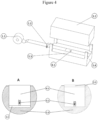
- the method and apparatus of the present invention can be used in combination with a die-cutting press (5.4), as shown in Figure 4 .
- a continuous strip of laminated magnetic material is used as the supply material (1.1) and fed into the die-cutting press.
- the particle generating chamber (6.1) is housed inside the die on the punch side when the application is from top to bottom (5.2) or on the die side when the application is from bottom to top (5.3).
- At least one coating pattern delimiting mask (2.1) is selected and positioned according to the geometry of the parts to be die-cut (2).
- the coating pattern delimiting mask (2.1) is positioned at the same level as the surface of the punch (5.2) or die (5.3) and comes into contact with the supply material (1.1) at the same time as the punch (5.2) or die (5.3).
- the operating parameters associated with the selected coating pattern delimiting mask (2.1) are set (3).
- the operating parameters are set (3) are: a) an internal pressure of the particle generating chamber preferably from 3 to 12 bar, b) a pressure at which the liquid coating is inside the particle generating device (6.2) preferably from 3 to 12 bar, c) the ambient temperature, d) the opening time of the particle generating device (6.2), and e) a minimum and maximum range of the suspended particle size.
- the latter two will depend on the geometry of the parts to be die-cut. The control system will compensate for extreme temperature changes.
- the supply material (1.1) is placed in the predetermined position to receive the coating (4) automatically, by means of the rollers (1.2) which align the laminated strip inside the die cutting press and advance it to different positions.
- the press is responsible for shaping the lamination and locates at least one particle generating chamber (6.1) at the application position (5) and in a position that allows for the displacement of the supplied material (12).
- the movement to position the chamber is small and is performed within the matrix (5.3) itself, as shown in Figure 4 A and B , where a space (5.5) below the particle generating chamber (6.1) when in an application position (5), and a space (5.5) above the particle generating chamber (6.1) when in a position that allows the displacement (12) of the supplied material (1.1).
- the movement to position the particle generating chamber (6.1) is provided by the press, as part of the upward and downward movement of the punch (5.2), which contacts the supply material (1.1), in an application position, when descending, and is positioned to allow movement (12) of the supply material (1.1) when ascending.
- the speed of the press is related to the speed of particle generation and application, which comprises pressurising the particle generating chamber (6); generating a particle size of the suspended liquid coating (7); measuring the particle size of the suspended liquid coating (8); and transferring the cloud of suspended micro particles onto the supply material (1.1) by releasing the pressure from the particle generating chamber (11).
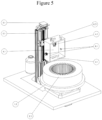
- the method and apparatus of the present invention can also be used to form manual, semi-manual or automatic workstations, such as the one shown in Figure 5 .
- single laminated sheets of variable geometries and/or stacked laminated sheet packs of variable geometries (1) are used as the supply material (1.1).
- the particle generating chamber (6.1) is positioned above the supply material (1.1) by means of a support (5.1) and a linear actuator that allows it to be raised or lowered.
- At least one coating pattern delimiting mask (2.1) is selected and positioned (2) according to the geometry of the loose laminated sheets and/or stacked laminated sheet packs (1.1). In this method, the coating pattern delimiting mask (2.1) is placed in the lower part of the particle generating chamber (6.1). The operating parameters associated with the selected coating pattern delimiting mask (2.1) are set (3).
- the operating parameters to be set (3) are: a) an internal pressure of the particle generating chamber preferably from 3 to 12 bar, b) a pressure at which the liquid coating is located inside the particle generating device (6.2), preferably from 3 to 12 bar, c) the ambient temperature, d) the opening time of the particle generating device (6.2), and e) a minimum and maximum range of particle size, depending on the geometry of the parts to be die-cut.
- the control system will compensate for extreme temperature changes.
- the supply material (1.1) is positioned manually or automatically (4), on an alignment device (1.3) where single laminated sheets and/or bundles of laminated sheets are stacked.
- This alignment device (1.3) determines the position for receiving the coating (4).
- the particle generating chamber is lowered to an application position (5), where the coating pattern delimiting mask (2.1) is in contact with the opposite surface of the particle generating chamber of the supply material (1.1).
- Particle generation and application comprises pressurising the particle generating chamber (6); generating a particle size of the suspended liquid coating (7); measuring the particle size of the suspended liquid coating (8); and transferring the suspended microparticle cloud onto the supply material (1.1) by releasing the pressure in the particle generating chamber (11), opening the application hatch (6.4).
- control system (3.1) automatically modifies the set parameters (10).
- the particle generating chamber (6.1) rises to a position that allows displacement of the supply material (12) and then moves the coated supply material (1.1) (13). This displacement can be carried out by any means, manually or automatically.
Landscapes
- Engineering & Computer Science (AREA)
- Power Engineering (AREA)
- Manufacturing & Machinery (AREA)
- Life Sciences & Earth Sciences (AREA)
- Forests & Forestry (AREA)
- Mechanical Engineering (AREA)
- Coating Apparatus (AREA)
- Application Of Or Painting With Fluid Materials (AREA)
- Manufacture Of Motors, Generators (AREA)
- Adhesives Or Adhesive Processes (AREA)
Applications Claiming Priority (2)
| Application Number | Priority Date | Filing Date | Title |
|---|---|---|---|
| MX2022000979 | 2022-01-24 | ||
| PCT/IB2023/050572 WO2023139561A1 (es) | 2022-01-24 | 2023-01-24 | Método y aparato para aplicación de partículas con tamaños controlados de recubrimientos líquidos sobre chapas laminadas de geometrías variables |
Publications (1)
| Publication Number | Publication Date |
|---|---|
| EP4470677A1 true EP4470677A1 (de) | 2024-12-04 |
Family
ID=85556374
Family Applications (1)
| Application Number | Title | Priority Date | Filing Date |
|---|---|---|---|
| EP23710080.5A Pending EP4470677A1 (de) | 2022-01-24 | 2023-01-24 | Verfahren und vorrichtung zum aufbringen von partikelbeschränkten flüssigkeitsschichten auf gewalzte bleche mit unterschiedlichen geometrien |
Country Status (7)
| Country | Link |
|---|---|
| US (1) | US20250205722A1 (de) |
| EP (1) | EP4470677A1 (de) |
| JP (1) | JP2025506069A (de) |
| KR (1) | KR20240152326A (de) |
| CN (1) | CN118871210A (de) |
| MX (1) | MX2024009067A (de) |
| WO (1) | WO2023139561A1 (de) |
Family Cites Families (22)
| Publication number | Priority date | Publication date | Assignee | Title |
|---|---|---|---|---|
| GB690478A (en) * | 1948-11-12 | 1953-04-22 | Ward Blenkinsop & Co Ltd | Improvements in or relating to electrical resistors |
| US4361110A (en) | 1980-10-27 | 1982-11-30 | Oregon Graduate Center For Study And Research | Apparatus for monitoring and controlling the distribution of droplets on a surface |
| US6301773B1 (en) | 1997-11-10 | 2001-10-16 | General Electric Company | Method of manufacturing a motor core |
| JP3822020B2 (ja) | 2000-05-16 | 2006-09-13 | 株式会社コアテック | 積層コアの製造装置 |
| JP4548912B2 (ja) | 2000-08-11 | 2010-09-22 | パナソニック株式会社 | 透明液体検査装置、および透明液体塗布装置、および透明液体検査方法、および透明液体塗布方法 |
| DE10048749A1 (de) | 2000-09-29 | 2002-04-11 | Josef Schucker | Anordnung zum Aufbringen von Klebstoff auf ein Werkstück |
| US6811806B2 (en) * | 2002-09-23 | 2004-11-02 | Michael Droski | Apparatus and method for spray coating sheet material |
| US20050001869A1 (en) | 2003-05-23 | 2005-01-06 | Nordson Corporation | Viscous material noncontact jetting system |
| US7483767B2 (en) * | 2004-10-14 | 2009-01-27 | The George Washington University | Feedback mechanism for smart nozzles and nebulizers |
| JP4648765B2 (ja) | 2005-06-03 | 2011-03-09 | 黒田精工株式会社 | 金属薄板積層体の製造方法 |
| MX2007002769A (es) | 2006-03-10 | 2008-11-14 | Kienle & Spiess Stanz & Druck | Método y aparato para producir pilas de láminas, y paquete de láminas. |
| CN101673986B (zh) | 2009-10-22 | 2012-06-27 | 湘潭电机股份有限公司 | 一种电机胶粘式铁芯的制造方法 |
| DE102012005795A1 (de) | 2012-03-14 | 2013-09-19 | Kienle + Spiess Gmbh | Lamellenpaket und Verfahren zu seiner Herstellung |
| KR101618141B1 (ko) * | 2012-04-17 | 2016-05-04 | 고쿠리츠다이가쿠호진 사이타마 다이가쿠 | 일렉트릿 구조체 및 그 제조 방법 및 정전 유도형 변환 소자 |
| TW201434535A (zh) | 2013-03-05 | 2014-09-16 | Genesis Photonics Inc | 噴塗裝置 |
| US8988681B2 (en) * | 2013-05-28 | 2015-03-24 | Nasser Ashgriz | Spray droplet sizer |
| DE102014011474A1 (de) | 2014-07-30 | 2016-02-04 | Kienle + Spiess Gmbh | Lamellenpaket sowie Verfahren zu dessen Herstellung |
| DE102014017149A1 (de) | 2014-11-17 | 2016-05-19 | Kienle + Spiess Gmbh | Verfahren zur Herstellung von Lamellenpaketen und Anlage zur Durchführung des Verfahrens |
| US9682402B2 (en) * | 2015-07-14 | 2017-06-20 | Northrop Grumman Systems Corporation | Apparatus and method for restricting spray coating deposition |
| FR3042923B1 (fr) * | 2015-10-23 | 2017-12-29 | R Bourgeois | Paquet de toles fixees entre elles par collage, procede et installation de fabrication d'un tel paquet de toles |
| FR3058284B1 (fr) | 2016-11-03 | 2021-04-02 | R Bourgeois | Paquet de toles fixees entre elles par adherence, procede et installation de fabrication d'un tel paquet de toles |
| DE102018003345A1 (de) | 2018-04-23 | 2019-10-24 | Kienle + Spiess Gmbh | Verfahren zur Herstellung von Lamellenpaketen sowie Auftrageinrichtung für ein Klebemittel zur Durchführung des Verfahrens |
-
2023
- 2023-01-24 EP EP23710080.5A patent/EP4470677A1/de active Pending
- 2023-01-24 JP JP2024565254A patent/JP2025506069A/ja active Pending
- 2023-01-24 WO PCT/IB2023/050572 patent/WO2023139561A1/es not_active Ceased
- 2023-01-24 KR KR1020247028520A patent/KR20240152326A/ko active Pending
- 2023-01-24 US US18/729,723 patent/US20250205722A1/en active Pending
- 2023-01-24 CN CN202380017214.7A patent/CN118871210A/zh active Pending
-
2024
- 2024-07-22 MX MX2024009067A patent/MX2024009067A/es unknown
Also Published As
| Publication number | Publication date |
|---|---|
| KR20240152326A (ko) | 2024-10-21 |
| WO2023139561A1 (es) | 2023-07-27 |
| MX2024009067A (es) | 2024-12-06 |
| CN118871210A (zh) | 2024-10-29 |
| US20250205722A1 (en) | 2025-06-26 |
| JP2025506069A (ja) | 2025-03-05 |
Similar Documents
| Publication | Publication Date | Title |
|---|---|---|
| US7402219B2 (en) | Method and device for the production of a multi-layered three-dimensional component | |
| US20200198232A1 (en) | Three-dimensional forming apparatus and three-dimensional forming method | |
| JP2023145643A (ja) | 2つ以上の材料からなる構造物を製造するための方法 | |
| CN118023550A (zh) | 用于生产增材制造的金属基复合材料的装置和方法及其制品 | |
| CN109843591B (zh) | 形成3d物体的方法 | |
| US20190168443A1 (en) | Device for producing at least one three-dimensional laminate for the construction industry | |
| EP4470677A1 (de) | Verfahren und vorrichtung zum aufbringen von partikelbeschränkten flüssigkeitsschichten auf gewalzte bleche mit unterschiedlichen geometrien | |
| WO2019167803A1 (ja) | 接着剤塗布装置、積層鉄心の製造装置及び積層鉄心の製造方法 | |
| US20250296150A1 (en) | Recoater for additive manufacturing | |
| EP1066158A1 (de) | Verfahren und vorrichtung zur herstellung deidimensionaler gegenstände | |
| JP2017216873A (ja) | 積層鉄心の製造装置 | |
| JP2015058475A (ja) | リアルタイム可変ニードルピーンフォーミングのための制御フィードバックループ | |
| US20250373129A1 (en) | Method and device for producing laminated cores from laminations | |
| US20220001450A1 (en) | Three-dimensional fabrication apparatus | |
| EP3718662A1 (de) | Vorrichtung und verfahren zur generativen fertigung von mindestens einer komponente | |
| KR101843493B1 (ko) | 분말 밀도 측정부를 구비한 3d 프린터 및 이를 이용한 3d 프린팅 방법 | |
| WO2017109150A1 (en) | An adhesive dispensing device | |
| KR20230112230A (ko) | 모터의 적층 코어 제조 장치 | |
| US20240372446A1 (en) | Apparatus and method for manufacturing laminated core of motor | |
| KR102691823B1 (ko) | 모터의 적층 코어 제조 장치 | |
| KR102691827B1 (ko) | Sb 강판 적층에 의해 로터 코어와 스테이터 코어를 동시에 제조할 수 있는 모터의 적층 코어 제조 장치 | |
| CN100557755C (zh) | 采用粒子束处理材料的方法和如此处理的材料 | |
| WO2020222303A1 (ja) | 積層面材の製造方法および装置 | |
| CN102390160B (zh) | 基底载体的胶合 | |
| HK1189193B (en) | Application method of liquid material and application device |
Legal Events
| Date | Code | Title | Description |
|---|---|---|---|
| STAA | Information on the status of an ep patent application or granted ep patent |
Free format text: STATUS: UNKNOWN |
|
| STAA | Information on the status of an ep patent application or granted ep patent |
Free format text: STATUS: THE INTERNATIONAL PUBLICATION HAS BEEN MADE |
|
| PUAI | Public reference made under article 153(3) epc to a published international application that has entered the european phase |
Free format text: ORIGINAL CODE: 0009012 |
|
| STAA | Information on the status of an ep patent application or granted ep patent |
Free format text: STATUS: REQUEST FOR EXAMINATION WAS MADE |
|
| 17P | Request for examination filed |
Effective date: 20240711 |
|
| AK | Designated contracting states |
Kind code of ref document: A1 Designated state(s): AL AT BE BG CH CY CZ DE DK EE ES FI FR GB GR HR HU IE IS IT LI LT LU LV MC ME MK MT NL NO PL PT RO RS SE SI SK SM TR |
|
| DAV | Request for validation of the european patent (deleted) | ||
| DAX | Request for extension of the european patent (deleted) | ||
| STAA | Information on the status of an ep patent application or granted ep patent |
Free format text: STATUS: EXAMINATION IS IN PROGRESS |
|
| 17Q | First examination report despatched |
Effective date: 20251118 |