EP4470490A2 - Distale endfunktion eines korbkatheters - Google Patents
Distale endfunktion eines korbkatheters Download PDFInfo
- Publication number
- EP4470490A2 EP4470490A2 EP24179164.9A EP24179164A EP4470490A2 EP 4470490 A2 EP4470490 A2 EP 4470490A2 EP 24179164 A EP24179164 A EP 24179164A EP 4470490 A2 EP4470490 A2 EP 4470490A2
- Authority
- EP
- European Patent Office
- Prior art keywords
- spines
- end effector
- spine
- distal
- central region
- Prior art date
- Legal status (The legal status is an assumption and is not a legal conclusion. Google has not performed a legal analysis and makes no representation as to the accuracy of the status listed.)
- Pending
Links
Images



Classifications
-
- A—HUMAN NECESSITIES
- A61—MEDICAL OR VETERINARY SCIENCE; HYGIENE
- A61B—DIAGNOSIS; SURGERY; IDENTIFICATION
- A61B5/00—Measuring for diagnostic purposes; Identification of persons
- A61B5/24—Detecting, measuring or recording bioelectric or biomagnetic signals of the body or parts thereof
- A61B5/316—Modalities, i.e. specific diagnostic methods
- A61B5/318—Heart-related electrical modalities, e.g. electrocardiography [ECG]
-
- A—HUMAN NECESSITIES
- A61—MEDICAL OR VETERINARY SCIENCE; HYGIENE
- A61B—DIAGNOSIS; SURGERY; IDENTIFICATION
- A61B18/00—Surgical instruments, devices or methods for transferring non-mechanical forms of energy to or from the body
- A61B18/04—Surgical instruments, devices or methods for transferring non-mechanical forms of energy to or from the body by heating
- A61B18/12—Surgical instruments, devices or methods for transferring non-mechanical forms of energy to or from the body by heating by passing a current through the tissue to be heated, e.g. high-frequency current
-
- A—HUMAN NECESSITIES
- A61—MEDICAL OR VETERINARY SCIENCE; HYGIENE
- A61B—DIAGNOSIS; SURGERY; IDENTIFICATION
- A61B18/00—Surgical instruments, devices or methods for transferring non-mechanical forms of energy to or from the body
- A61B18/04—Surgical instruments, devices or methods for transferring non-mechanical forms of energy to or from the body by heating
- A61B18/12—Surgical instruments, devices or methods for transferring non-mechanical forms of energy to or from the body by heating by passing a current through the tissue to be heated, e.g. high-frequency current
- A61B18/1206—Generators therefor
-
- A—HUMAN NECESSITIES
- A61—MEDICAL OR VETERINARY SCIENCE; HYGIENE
- A61B—DIAGNOSIS; SURGERY; IDENTIFICATION
- A61B18/00—Surgical instruments, devices or methods for transferring non-mechanical forms of energy to or from the body
- A61B18/04—Surgical instruments, devices or methods for transferring non-mechanical forms of energy to or from the body by heating
- A61B18/12—Surgical instruments, devices or methods for transferring non-mechanical forms of energy to or from the body by heating by passing a current through the tissue to be heated, e.g. high-frequency current
- A61B18/14—Probes or electrodes therefor
- A61B18/1492—Probes or electrodes therefor having a flexible, catheter-like structure, e.g. for heart ablation
-
- A—HUMAN NECESSITIES
- A61—MEDICAL OR VETERINARY SCIENCE; HYGIENE
- A61B—DIAGNOSIS; SURGERY; IDENTIFICATION
- A61B5/00—Measuring for diagnostic purposes; Identification of persons
- A61B5/24—Detecting, measuring or recording bioelectric or biomagnetic signals of the body or parts thereof
- A61B5/25—Bioelectric electrodes therefor
- A61B5/279—Bioelectric electrodes therefor specially adapted for particular uses
- A61B5/28—Bioelectric electrodes therefor specially adapted for particular uses for electrocardiography [ECG]
- A61B5/283—Invasive
-
- A—HUMAN NECESSITIES
- A61—MEDICAL OR VETERINARY SCIENCE; HYGIENE
- A61B—DIAGNOSIS; SURGERY; IDENTIFICATION
- A61B5/00—Measuring for diagnostic purposes; Identification of persons
- A61B5/24—Detecting, measuring or recording bioelectric or biomagnetic signals of the body or parts thereof
- A61B5/316—Modalities, i.e. specific diagnostic methods
- A61B5/318—Heart-related electrical modalities, e.g. electrocardiography [ECG]
- A61B5/333—Recording apparatus specially adapted therefor
-
- A—HUMAN NECESSITIES
- A61—MEDICAL OR VETERINARY SCIENCE; HYGIENE
- A61B—DIAGNOSIS; SURGERY; IDENTIFICATION
- A61B5/00—Measuring for diagnostic purposes; Identification of persons
- A61B5/24—Detecting, measuring or recording bioelectric or biomagnetic signals of the body or parts thereof
- A61B5/316—Modalities, i.e. specific diagnostic methods
- A61B5/318—Heart-related electrical modalities, e.g. electrocardiography [ECG]
- A61B5/367—Electrophysiological study [EPS], e.g. electrical activation mapping or electro-anatomical mapping
-
- A—HUMAN NECESSITIES
- A61—MEDICAL OR VETERINARY SCIENCE; HYGIENE
- A61B—DIAGNOSIS; SURGERY; IDENTIFICATION
- A61B5/00—Measuring for diagnostic purposes; Identification of persons
- A61B5/68—Arrangements of detecting, measuring or recording means, e.g. sensors, in relation to patient
- A61B5/6846—Arrangements of detecting, measuring or recording means, e.g. sensors, in relation to patient specially adapted to be brought in contact with an internal body part, i.e. invasive
- A61B5/6847—Arrangements of detecting, measuring or recording means, e.g. sensors, in relation to patient specially adapted to be brought in contact with an internal body part, i.e. invasive mounted on an invasive device
- A61B5/6852—Catheters
- A61B5/6858—Catheters with a distal basket, e.g. expandable basket
-
- A—HUMAN NECESSITIES
- A61—MEDICAL OR VETERINARY SCIENCE; HYGIENE
- A61N—ELECTROTHERAPY; MAGNETOTHERAPY; RADIATION THERAPY; ULTRASOUND THERAPY
- A61N1/00—Electrotherapy; Circuits therefor
- A61N1/18—Applying electric currents by contact electrodes
- A61N1/32—Applying electric currents by contact electrodes alternating or intermittent currents
- A61N1/36—Applying electric currents by contact electrodes alternating or intermittent currents for stimulation
- A61N1/362—Heart stimulators
- A61N1/3629—Heart stimulators in combination with non-electric therapy
-
- A—HUMAN NECESSITIES
- A61—MEDICAL OR VETERINARY SCIENCE; HYGIENE
- A61B—DIAGNOSIS; SURGERY; IDENTIFICATION
- A61B17/00—Surgical instruments, devices or methods
- A61B2017/00017—Electrical control of surgical instruments
- A61B2017/00022—Sensing or detecting at the treatment site
- A61B2017/00039—Electric or electromagnetic phenomena other than conductivity, e.g. capacity, inductivity, Hall effect
-
- A—HUMAN NECESSITIES
- A61—MEDICAL OR VETERINARY SCIENCE; HYGIENE
- A61B—DIAGNOSIS; SURGERY; IDENTIFICATION
- A61B17/00—Surgical instruments, devices or methods
- A61B2017/00017—Electrical control of surgical instruments
- A61B2017/00022—Sensing or detecting at the treatment site
- A61B2017/00039—Electric or electromagnetic phenomena other than conductivity, e.g. capacity, inductivity, Hall effect
- A61B2017/00044—Sensing electrocardiography, i.e. ECG
- A61B2017/00048—Spectral analysis
- A61B2017/00053—Mapping
-
- A—HUMAN NECESSITIES
- A61—MEDICAL OR VETERINARY SCIENCE; HYGIENE
- A61B—DIAGNOSIS; SURGERY; IDENTIFICATION
- A61B18/00—Surgical instruments, devices or methods for transferring non-mechanical forms of energy to or from the body
- A61B2018/00053—Mechanical features of the instrument of device
- A61B2018/0016—Energy applicators arranged in a two- or three dimensional array
-
- A—HUMAN NECESSITIES
- A61—MEDICAL OR VETERINARY SCIENCE; HYGIENE
- A61B—DIAGNOSIS; SURGERY; IDENTIFICATION
- A61B18/00—Surgical instruments, devices or methods for transferring non-mechanical forms of energy to or from the body
- A61B2018/00053—Mechanical features of the instrument of device
- A61B2018/00172—Connectors and adapters therefor
-
- A—HUMAN NECESSITIES
- A61—MEDICAL OR VETERINARY SCIENCE; HYGIENE
- A61B—DIAGNOSIS; SURGERY; IDENTIFICATION
- A61B18/00—Surgical instruments, devices or methods for transferring non-mechanical forms of energy to or from the body
- A61B2018/00053—Mechanical features of the instrument of device
- A61B2018/00214—Expandable means emitting energy, e.g. by elements carried thereon
-
- A—HUMAN NECESSITIES
- A61—MEDICAL OR VETERINARY SCIENCE; HYGIENE
- A61B—DIAGNOSIS; SURGERY; IDENTIFICATION
- A61B18/00—Surgical instruments, devices or methods for transferring non-mechanical forms of energy to or from the body
- A61B2018/00053—Mechanical features of the instrument of device
- A61B2018/00214—Expandable means emitting energy, e.g. by elements carried thereon
- A61B2018/0022—Balloons
-
- A—HUMAN NECESSITIES
- A61—MEDICAL OR VETERINARY SCIENCE; HYGIENE
- A61B—DIAGNOSIS; SURGERY; IDENTIFICATION
- A61B18/00—Surgical instruments, devices or methods for transferring non-mechanical forms of energy to or from the body
- A61B2018/00053—Mechanical features of the instrument of device
- A61B2018/00214—Expandable means emitting energy, e.g. by elements carried thereon
- A61B2018/00267—Expandable means emitting energy, e.g. by elements carried thereon having a basket shaped structure
-
- A—HUMAN NECESSITIES
- A61—MEDICAL OR VETERINARY SCIENCE; HYGIENE
- A61B—DIAGNOSIS; SURGERY; IDENTIFICATION
- A61B18/00—Surgical instruments, devices or methods for transferring non-mechanical forms of energy to or from the body
- A61B2018/00053—Mechanical features of the instrument of device
- A61B2018/00273—Anchoring means for temporary attachment of a device to tissue
- A61B2018/00279—Anchoring means for temporary attachment of a device to tissue deployable
-
- A—HUMAN NECESSITIES
- A61—MEDICAL OR VETERINARY SCIENCE; HYGIENE
- A61B—DIAGNOSIS; SURGERY; IDENTIFICATION
- A61B18/00—Surgical instruments, devices or methods for transferring non-mechanical forms of energy to or from the body
- A61B2018/00315—Surgical instruments, devices or methods for transferring non-mechanical forms of energy to or from the body for treatment of particular body parts
- A61B2018/00345—Vascular system
- A61B2018/00351—Heart
-
- A—HUMAN NECESSITIES
- A61—MEDICAL OR VETERINARY SCIENCE; HYGIENE
- A61B—DIAGNOSIS; SURGERY; IDENTIFICATION
- A61B18/00—Surgical instruments, devices or methods for transferring non-mechanical forms of energy to or from the body
- A61B2018/00571—Surgical instruments, devices or methods for transferring non-mechanical forms of energy to or from the body for achieving a particular surgical effect
- A61B2018/00577—Ablation
-
- A—HUMAN NECESSITIES
- A61—MEDICAL OR VETERINARY SCIENCE; HYGIENE
- A61B—DIAGNOSIS; SURGERY; IDENTIFICATION
- A61B18/00—Surgical instruments, devices or methods for transferring non-mechanical forms of energy to or from the body
- A61B2018/00571—Surgical instruments, devices or methods for transferring non-mechanical forms of energy to or from the body for achieving a particular surgical effect
- A61B2018/00613—Irreversible electroporation
-
- A—HUMAN NECESSITIES
- A61—MEDICAL OR VETERINARY SCIENCE; HYGIENE
- A61B—DIAGNOSIS; SURGERY; IDENTIFICATION
- A61B18/00—Surgical instruments, devices or methods for transferring non-mechanical forms of energy to or from the body
- A61B2018/00636—Sensing and controlling the application of energy
- A61B2018/00773—Sensed parameters
- A61B2018/00839—Bioelectrical parameters, e.g. ECG, EEG
-
- A—HUMAN NECESSITIES
- A61—MEDICAL OR VETERINARY SCIENCE; HYGIENE
- A61B—DIAGNOSIS; SURGERY; IDENTIFICATION
- A61B18/00—Surgical instruments, devices or methods for transferring non-mechanical forms of energy to or from the body
- A61B18/04—Surgical instruments, devices or methods for transferring non-mechanical forms of energy to or from the body by heating
- A61B18/12—Surgical instruments, devices or methods for transferring non-mechanical forms of energy to or from the body by heating by passing a current through the tissue to be heated, e.g. high-frequency current
- A61B18/14—Probes or electrodes therefor
- A61B2018/1405—Electrodes having a specific shape
- A61B2018/1407—Loop
-
- A—HUMAN NECESSITIES
- A61—MEDICAL OR VETERINARY SCIENCE; HYGIENE
- A61B—DIAGNOSIS; SURGERY; IDENTIFICATION
- A61B18/00—Surgical instruments, devices or methods for transferring non-mechanical forms of energy to or from the body
- A61B18/04—Surgical instruments, devices or methods for transferring non-mechanical forms of energy to or from the body by heating
- A61B18/12—Surgical instruments, devices or methods for transferring non-mechanical forms of energy to or from the body by heating by passing a current through the tissue to be heated, e.g. high-frequency current
- A61B18/14—Probes or electrodes therefor
- A61B2018/1405—Electrodes having a specific shape
- A61B2018/1407—Loop
- A61B2018/141—Snare
-
- A—HUMAN NECESSITIES
- A61—MEDICAL OR VETERINARY SCIENCE; HYGIENE
- A61B—DIAGNOSIS; SURGERY; IDENTIFICATION
- A61B18/00—Surgical instruments, devices or methods for transferring non-mechanical forms of energy to or from the body
- A61B18/04—Surgical instruments, devices or methods for transferring non-mechanical forms of energy to or from the body by heating
- A61B18/12—Surgical instruments, devices or methods for transferring non-mechanical forms of energy to or from the body by heating by passing a current through the tissue to be heated, e.g. high-frequency current
- A61B18/14—Probes or electrodes therefor
- A61B2018/1467—Probes or electrodes therefor using more than two electrodes on a single probe
-
- A—HUMAN NECESSITIES
- A61—MEDICAL OR VETERINARY SCIENCE; HYGIENE
- A61B—DIAGNOSIS; SURGERY; IDENTIFICATION
- A61B18/00—Surgical instruments, devices or methods for transferring non-mechanical forms of energy to or from the body
- A61B18/04—Surgical instruments, devices or methods for transferring non-mechanical forms of energy to or from the body by heating
- A61B18/12—Surgical instruments, devices or methods for transferring non-mechanical forms of energy to or from the body by heating by passing a current through the tissue to be heated, e.g. high-frequency current
- A61B18/14—Probes or electrodes therefor
- A61B2018/1475—Electrodes retractable in or deployable from a housing
Definitions
- Cardiac arrhythmias such as atrial fibrillation (AF) occur when regions of cardiac tissue abnormally conduct electric signals to adjacent tissue. This disrupts the normal cardiac cycle and causes asynchronous rhythm.
- Certain procedures exist for treating arrhythmia which are surgical, or catheter based and aimed at disrupting the origin of the signals causing the arrhythmia and disrupting the conducting pathway for such signals. This work is directed to catheter-based cardiac ablation medical devices, and in particular catheters having a basket shaped end effector with electrodes.
- RF ablation can have certain rare drawbacks due to operator's skill, such as heightened risk of thermal cell injury which can lead to tissue charring, burning, steam pop, phrenic nerve palsy, pulmonary vein stenosis, and esophageal fistula.
- Cryoablation is an alternative approach to RF ablation that can reduce some thermal risks associated with RF ablation but may present tissue damage due to the extremely low temperature nature of such devices. Maneuvering cryoablation devices and selectively applying cryoablation is generally more challenging compared to RF ablation; therefore, cryoablation is not viable in certain anatomical geometries which may be reached by electrical ablation devices.
- Ablation by irreversible electroporation (IRE) is a more recent nonthermal ablation method. To achieve IRE, short pulses of high voltage electrical signals are delivered to tissues and the electrical signals generate an unrecoverable permeabilization of cell membranes.
- the same or different catheter can be used to perform ablation.
- One category of end effectors referred to herein as a basket catheter, includes a plurality of resilient spines joined at a distal end and a proximal end that expand to form a spheroid or ovate spheroid shape.
- the spines carry and/or include electrodes that can be configured for sensing and/or ablation.
- a catheter having an end effector with multiple spines forming a basket shape is disclosed herein.
- a distal portion of the end effector includes structures to provide an atraumatic surface, join the spines, and/or provide a location sensor.
- An exemplary end effector of a medical probe can include a plurality of spines, a first loop member, a second loop member, and one or more electrodes.
- the plurality of spines can extend along a longitudinal axis and can be configured to expand away from the longitudinal axis to form a basket shape.
- the first loop member can include a first pair of spines of the plurality of spines and a first central region disposed approximate a distal end of the end effector.
- the second loop member can include a second pair of spines of the plurality of spines and a second central region disposed approximate the distal end of the end effector, the second central region comprising a portion disposed over a distal surface of the first central region and at least one extension disposed under a proximal surface of the first central region.
- the one or more electrodes can be coupled to each spine of the plurality of spines.
- Another exemplary end effector of a medical probe can include a plurality of spines, a plurality of inflatable members, and one or more electrodes.
- the plurality of spines can extend along a longitudinal axis and can be configured to expand away from the longitudinal axis to form a basket shape.
- the plurality of inflatable members can each be coupled to a respective spine of the plurality of spines approximate a distal end of the end effector.
- the plurality of inflatable members can be configured to collapse for delivery through a sheath.
- the plurality of inflatable members can be configured to inflate in a deployed configuration. In the deployed configuration, the plurality of inflatable members can prevent a distal end of the basket shape of the plurality of spines from contacting tissue.
- the one or more electrodes can be coupled to each spine of the plurality of spines.
- Another exemplary end effector of a medical probe can include a plurality of spines, a structural support member, a spiral inductor, and one or more electrodes.
- the plurality of spines can extend along a longitudinal axis and can be configured to expand away from the longitudinal axis to form a basket shape.
- the structural support member can extend through a spine of the plurality of spines.
- the spiral inductor can be disposed approximate a distal end of the end effector.
- the spiral inductor can have a central axis along the longitudinal axis.
- the spiral inductor can be electrically coupled to the structural support member so that the structural support member is configured to transmit electrical signals from the spiral inductor along the spine.
- the one or more electrodes can be coupled to each spine of the plurality of spines.
- Another exemplary end effector of a medical probe can include a support frame, an atraumatic structure, and one or more electrodes.
- the support frame can be movable between a delivery configuration and a basket configuration.
- the support frame can include a plurality of spines configured to self-expand away from a longitudinal axis from a proximal portion to a distal spine portion to form a basket shape in the basket configuration.
- the distal spine portion can define a cloverleaf structure disposed around the longitudinal axis.
- the cloverleaf structure can define a central cutout with a central area disposed about the longitudinal axis.
- the terms “about” or “approximately” for any numerical values or ranges indicate a suitable dimensional tolerance that allows the part or collection of components to function for its intended purpose as described herein. More specifically, “about” or “approximately” may refer to the range of values ⁇ 10% of the recited value, e.g., “about 90%” may refer to the range of values from 81% to 99%.
- the terms "patient,” “host,” “user,” and “subject” refer to any human or animal subject and are not intended to limit the systems or methods to human use, although use of the subject invention in a human patient represents a preferred embodiment.
- proximal indicates a location closer to the operator whereas “distal” indicates a location further away to the operator or physician.
- tubular and tube are to be construed broadly and are not limited to a structure that is a right cylinder or strictly circumferential in cross-section or of a uniform cross-section throughout its length.
- the tubular structure or system is generally illustrated as a substantially right cylindrical structure.
- the tubular system may have a tapered or curved outer surface without departing from the scope of the present invention.
- proximal indicates a location closer to the operator or physician whereas “distal” indicates a location further away to the operator or physician.
- a magnetic based position sensor 29 may be operated together with a location pad 25 including a plurality of magnetic coils 32 configured to generate magnetic fields in a predefined working volume. Real time position of a distal tip 28 of the catheter 14 may be tracked based on magnetic fields generated with a location pad 25 and sensed by a magnetic based position sensor 29. Details of the magnetic based position sensing technology are described in U.S. Patent Nos. 5,391,199 ; 5,443,489 ; 5,558,091 ; 6,172,499 ; 6,239,724 ; 6,332,089 ; 6,484,118 ; 6,618,612 ; 6,690,963 ; 6,788,967 ; 6,892,091 incorporated by reference herein.
- the system 10 includes one or more electrode patches 38 positioned for skin contact on the patient 23 to establish location reference for location pad 25 as well as impedance-based tracking of electrodes 140.
- impedance-based tracking electrical current is directed toward electrodes 140 and sensed at electrode skin patches 38 so that the location of each electrode can be triangulated via the electrode patches 38. Details of the impedance-based location tracking technology are described in US Patent Nos. 7,536,218 ; 7,756,576 ; 7,848,787 ; 7,869,865 ; and 8,456,182 incorporated by reference herein.
- the magnetic based position sensor 29 can be used to calibrate impedance-based tracking of the electrodes 40.
- the workstation 55 can be configured to locate the distal tip 28 of the catheter 14 based on the magnetic sensor 29 and a plurality of reference electromagnetic (EM) sensors.
- the reference EM sensors can be configured to define an EM coordinate system and a body coordinate system.
- a recorder 11 displays electrograms 21 captured with body surface ECG electrodes 18 and intracardiac electrograms (IEGM) captured with electrodes 140 of the catheter 14.
- the recorder 11 may include pacing capability for pacing the heart rhythm and/or may be electrically connected to a standalone pacer.
- the system 10 can include an ablation energy generator 50 that is adapted to conduct ablative energy to one or more of electrodes at a distal tip of a catheter configured for ablating.
- Energy produced by the ablation energy generator 50 may include, but is not limited to, radiofrequency (RF) energy or pulsed-field ablation (PFA) energy, including monopolar or bipolar high-voltage DC pulses as may be used to effect irreversible electroporation (IRE), or combinations thereof.
- RF radiofrequency
- PFA pulsed-field ablation
- IRE irreversible electroporation
- the workstation 55 includes memory, processor unit with memory or storage with appropriate operating software loaded therein, and user interface capability.
- the workstation 55 can be configured to provide multiple functions, optionally including (1) modeling the endocardial anatomy in three-dimensions (3D) and rendering the model or an anatomical map 20 for display on a display device 27; (2) displaying on the display device 27 activation sequences (or other data) compiled from recorded electrograms 21 in representative visual indicia or imagery superimposed on the rendered anatomical map 20; (3) displaying real-time location and orientation of multiple catheters within the heart chamber; and (4) displaying on the display device 27 sites of interest such as places where ablation energy has been applied.
- One commercial product embodying elements of the system 10 is available as the CARTO TM 3 System, available from Biosense Webster, Inc., 31A Technology Drive, Irvine, CA 92618.
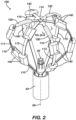
- FIG 2 is an illustration of aspects of a distal portion of a basket catheter usable with the system illustrated in Figure 1 .
- the catheter 14 illustrated in Figure 1 can be modified to include features of an end effector 100 of the basket catheter illustrated in Figure 2 .
- the basket catheter includes a shaft 84 defining a longitudinal axis 90.
- the end effector 100 includes spines 110 that extend along the longitudinal axis 90 and are configured to expand away from the longitudinal axis to form a basket shape as illustrated in Figure 2 .
- the spines 110 are further configured to collapse toward the longitudinal axis so that the end effector 100 can be retracted through a delivery sheath of the system 10 illustrated in Figure 1 .
- medical professional 24 can deploy the end effector 100 by extending the shaft 84 distally through a guide sheath (not illustrated) so that it exits the distal end of the guide sheath and expands to the basket shape.
- the end effector 100 can be collapsed again when the end effector is retracted proximally into the distal end of the sheath.
- the spines 110 may have an elliptical (e.g., circular), rectangular shape, and/or flat cross-sectional shape.
- the spines 110 can include a support structure, strut, and/or frame that includes a flexible, resilient material e.g., a shape-memory alloy such as nickel-titanium, also known as Nitinol.
- the end effector 100 includes electrodes 140 that are coupled to the spines 110.
- the electrodes 140 can have a lumen through which proximal ends of the spines 110 are inserted during assembly of the catheter.
- the electrodes 140 can otherwise be coupled to the spines 110 by a suitable means as understood by a person skilled in the pertinent art.
- the catheter 14 can include a hub 82 that can be configured to retain proximal ends of the spines 110 in the shaft 84.
- the hub 82 can further be configured to provide an irrigation flow to the end effector 100.
- the end effector 100 can include loop members 111, 112, 113 that each include a pair of spines 110 and a central region overlapping at a central spine intersection 114 approximate a distal end of the end effector 100.
- the loop members 111, 112, 113 can be formed by cutting a planar sheet of flexible resilient material or by cutting a tubular material. Forming the loop members 111, 112, 113 from a planar sheet is preferred over a tubular material due to comparatively lower cost and ease of manufacturing of the planar sheet.
- the electrodes 140 positioned on the spines 110 can be configured to deliver ablation energy (RF and/or IRE) to tissue in the heart 12. Additionally, or alternatively, the electrodes 140 can also be used to determine the location of basket assembly 100 and/or to measure a physiological property such as local surface electrical potentials at respective locations on tissue in heart 12. The electrodes 140 can be biased such that a greater portion of the one or more electrodes 140 face outwardly from basket assembly 100 such that the one or more electrodes 140 deliver a greater amount of electrical energy outwardly away from the basket assembly 100 (i.e., toward the heart 12 tissue) than inwardly.
- ablation energy RF and/or IRE
- Electrodes 140 examples include gold, platinum, and palladium (and their respective alloys). These materials also have high thermal conductivity which allows the minimal heat generated on the tissue (i.e., by the ablation energy delivered to the tissue) to be conducted through the electrodes to the back side of the electrodes (i.e., the portions of the electrodes on the inner sides of the spines), and then to the blood pool in heart 12.
- the basket assembly 100 further includes inflatable members 130 discussed in greater detail in relation to Figures 6A and 6B .
- the basket assembly 100 can further include an atraumatic structure 420 ( Figures 10 and 11 ) covering the central regions of the loop members 111, 112, 113 to provide an atraumatic surface to shield the central regions of the loop members 111, 112, 113 from contacting tissue.
- an atraumatic structure 420 ( Figures 10 and 11 ) covering the central regions of the loop members 111, 112, 113 to provide an atraumatic surface to shield the central regions of the loop members 111, 112, 113 from contacting tissue.
- Figure 3 is a magnified view of a distal end of an end effector of the basket catheter as indicated in Figure 2 .
- a first loop member 111, a second loop member 112, and a third loop member 113 each respectively have a central portion across the central spine intersection 114.
- the end effector 100 can include two, four, five, or six loop members. As illustrated, the three loop members are positioned at an angle to each other such that there is an acute angle ⁇ 1 and an obtuse angle ⁇ 2 between any set of two loop members.
- a third loop member bisects the obtuse angle ⁇ 2.
- the acute angle ⁇ 1 measures about 60° and the obtuse angle ⁇ 2 measures about 120° so that the spines 110 are spaced equally around a circumference of the basket assembly.
- an end effector 100 having two, four, five, or six loop members preferably has spines that are spaced equally around a circumference of the basket assembly.
- FIG 4 is an illustration of central regions of disassembled loop member segments from the distal end of the end effector 100 illustrated in Figure 3 .
- the central region of the first loop member 111 has a substantially uniform width and does not include extensions.
- the central region of the second loop member 112 includes two extensions 115.
- the central region of the third loop member 113 includes four extensions 115.
- Each loop member 111, 112, 113 has a respective middle portion 119 that crosses the longitudinal axis 90.
- the central regions of the loop members 111, 112, 113 are stacked at the central spine intersection 114 in an inner-to-outer order such that the loop members are ordered: first loop member 111, second loop member 112, and third loop member 113 in the inner-to-outer order.
- Central regions of the second loop member 112 and third loop member 113 include extensions 115 that are configured to overlap the first loop member 111 out of order from the inner-to-outer order. For instance, where the extensions 115 of the second loop member 112 and third loop member 113 overlap the first loop member 111, the order of loop members is: third loop member 113, second loop member 112, and first loop member 111.
- the central portion of the first loop member 111 is distal of extensions 115 of both the second loop member 112 and the third loop member 113. Extensions 115 of the third loop member 113 also overlap the second loop member 112 out of order from the inner-to-outer order.
- the middle portion 119 of the first loop member 111 is proximal of both middle portions 119 of the second and third loop members 112, 113.
- the middle portion 119 of the second loop member 112 is disposed over a distal surface of the middle portion 119 of the first loop member 111.
- Extensions 115 of the second loop member 112 is disposed under a proximal surface of the first loop member 111.
- the extensions 115 from the second loop member 112 extend through the acute angle ⁇ 1 between the first loop member 111 and the second loop member 112 on either side of central spine intersection 114.
- the middle portion 119 of the third loop member 113 is disposed over a distal surface of the middle portion 119 of the second loop member 112.
- the central region of the third loop member includes extensions 115 that extend under a proximal surface of the central region of the second loop member 112 and extensions 115 that extend under a proximal surface of the central region of the first loop member 111.
- the central regions of the loop members 111, 112, 113 are overlapped to couple the loop members 111, 112, 113 together at the distal end of the end effector.
- the central regions of the loop members 111, 112, 113 are configured to interlock to maintain connection between the loop members approximate the distal end of the end effector 100.
- the loop members 111, 112, 113 are configured to maintain consistent angles ⁇ 1, ⁇ 2 between the spines 110 during use of the catheter 14.
- the loop members 111, 112, 113 fit together similar to cardboard box flaps that are folded over and under each other to close the box.
- Figure 5A is an illustration of two interlocked central regions of another example first loop member 111a and second loop member 112a.
- the central region of the first loop member 111a is modified to include a notch 118 into which the central region of the second loop member 112a is received.
- One or more of the loop members 111, 112, 113 illustrated in Figures 2 through 4 can be modified to include a notch 118 as illustrated in Figure 5A .
- Figures 5B and 5C are illustration of central regions of the two loop members 111a, 1112a of Figure 5A disassembled from each other.
- the first loop member 111a includes notches 118 into which the second loop member 112a is received.
- the second loop member 112a can include similar notches 118 into which the first loop member 111a and/or the third loop member can be received.
- the notches 118 are positioned to receive a central region of a loop member to engage with an extension 115 to inhibit movement of the central regions of the loop members in relation to each other.
- Figures 6A and 6B are illustrations of a cross-section of an inflatable member 130 coupled to a spine as indicated in Figure 2 .
- Figure 6A illustrates the inflatable member 130 in a deflated state
- Figure 6B illustrates the inflatable member in an inflated state.
- the central spine intersection 114 can be prevented from pressing into tissue with a force that causes tissue damage.
- the inflatable members 130 can be deflated so that the end effector 100 is sized to translate through a guide sheath.
- the inflatable members 130 can be inflated to inhibit the distal end of the basket assembly (i.e., approximate the central spine intersection 114) from impinging on tissue and/or prevent the distal end of the basket assembly from contacting tissue.
- the end effector 100 can include three inflatable members 130 spaced equally around the central spine intersection 114 and equally around the longitudinal axis 90.
- the end effector 100 may alternatively include one, two, four, five, or six inflatable members 130.
- the illustrated end effector 100 has six spines 110. Electrodes 140 are positioned more distally on half of the spines 110 and more proximately on half of the spines 110 in an alternating fashion so that electrodes 140 nest next to each other when the basket assembly is collapsed.
- the spines 110 having more proximally spaced electrodes 140 include the inflatable members 130 positioned distal of the electrodes 140.
- a similar configuration can be achieved with a basket catheter having eight or ten spines, wherein electrodes 140 are positioned more distally on half of the spines 110 and more proximately on half of the spines 110 in an alternating fashion so that electrodes 140 nest next to each other when the basket assembly is collapsed and inflatable members 130 are positioned on spines with proximally positioned electrodes 140.
- a basket catheter with eight spines may therefore have four inflatable members 130, and a basket catheter with ten spines may therefore have five inflatable members 130.
- the spine 110 can include a frame strut 116 extending through a jacket 117.
- the jacket 117 can electrically insulate the frame of the basket assembly from the electrodes 140.
- the inflatable member 130 is coupled to the strut 110.
- the inflatable member includes a resilient membrane 131 with an inflatable chamber 132 that can be inflated and deflated to cause a distal surface 133 of the inflatable member 130 to move a distance 134. Inflation can be by irrigation fluid (not illustrated) or other media entering the chamber 132, and then the inflation media can be removed to deflate the chamber 132.
- FIG 7 is an illustration of a second exemplary basket assembly 200.
- the catheter 14 illustrated in Figure 1 can be modified to include features of the second exemplary basket assembly 200. Further, compatible features of the second exemplary basket assembly 200 can be combined with features of the basket assembly illustrated in Figures 1 through 6A and 6B .
- the end effector 200 includes loop members, each with a pair of spines 210.
- the spines 210 extend along the longitudinal axis 90. As illustrated, the spines 210 are expanded away from the longitudinal axis 90 to form a basket shape in a deployed configuration.
- the spines 210 can collapse toward the longitudinal axis 90 in a collapsed configuration.
- a proximal end 250 of the end effector 200 is connected to a distal end 252 of a shaft 225 of the catheter.
- the end effector 200 includes a spine hub 220 disposed approximate a distal end of the end effector 200.
- the end effector 200 includes loop members having spines 210 and electrodes 240 coupled to the spines.
- the electrodes 240 can be coupled to the spines 210 as disclosed elsewhere herein.
- the end effector 200 can further include irrigation outlets 256.
- the end effector 200 can include a puller 246 that can be manipulated to move the end effector between a collapsed configuration and a deployed configuration.
- the end effector 200 can further include compatible features disclosed in U.S. Patent Publication No. 2022/0361942 , incorporated herein by reference and attached in the Appendix of parent priority application No. 63/505,978 .
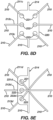
- Figures 8A , 8B , 8C , 8D, and 8E illustrate variations of the spine hub 220 at the distal end of the end effector of the basket catheter as indicated in Figure 7 .
- Figures 8A through 8D depict a spine hub 220 with six openings 221, 222, 223 and a support spine loop 214.
- Figure 8E depicts a spine hub 220 with three openings 221, 222, 223 and a support spine loop 214.
- Each of the spine hubs 220 is couple three additional spine loops approximate the distal end of the end effector 200.
- the spine hub 220 including the support spine loop 214 can be cut from a single planar sheet.
- the end effector 200 can be otherwise configured so that one of the loop members of the end effector includes the spine hub 220.
- the end effector 200 includes eight spines and four spine loops: one spine loop including the support spine loop 214 and the spine hub 220; and three additional spine loops that extend through openings of the spine hub 220.
- the spine hub 220 need not include the support spine loop 214.
- the spine hub 220 can also be configured with more or fewer holes to coupled more or fewer spine loops.
- Figure 8A depicts a first spine loop 211a that extends through a first pair of openings 221 and has a first distal portion 231a across a distal surface of the spine hub 220; a second spine loop 212a that extends through a second pair of openings 222 and has a second distal portion 232a across a distal surface of the spine hub 220; and a third spine loop 213a that extends through a third pair of openings 223 and has a third distal portion 233a across a distal surface of the spine hub 220.
- the distal portions 231a, 232a, 233a are approximately parallel to each other.
- Figure 8B depicts the spine hub 220 and spine loops 211a, 212a, 213a configured similar to Figure 8A .
- the end effector 200 further includes an atraumatic cover 224 over the distal portions 231a, 232a, 233a of the spine loops 211a, 212a, 213a to provide an atraumatic surface at the distal end of the end effector 200.
- Figure 8C depicts spine loops 211b, 212b, 213b having distal portions 231b, 232b, 233b that cross over a distal surface of the spine hub 220 so that the distal portions 231b, 232b, 233b cross-over each other to overlap at a central intersection.
- Figure 8D depicts a first spine loop 211c that extends through a first pair of openings 221 and has a first distal portion (not illustrated) across a proximal surface of the spine hub 220; a second spine loop 212c that extends through a second pair of openings 222 and has a second distal portion (not illustrated) across a proximal surface of the spine hub 220; and a third spine loop 213c that extends through a third pair of openings 223 and has a third distal portion (not illustrated) across a proximal surface of the spine hub 220.
- the distal portions are approximately parallel to each other.
- the distal portions 231b, 232b, 233b can cross-over each other across a proximal surface of the spine hub 220.
- Figure 8E depicts a spine hub 220 in which the spine loops 211d, 212d, 213d each respectively extend through only one opening 221, 222, 223.
- Distal portions 231d, 232d, 233d of the spine loops 211d, 212d, 213d cross over each other across a distal surface of the spine hub 220.
- the distal portions 231d, 232d, 233d can cross a proximal surface of the spine hub 220.
- the distal portions 231d, 232d, 233d can be substantially parallel to each other.
- the end effector 200 can be modified to include one or more inflatable members 130 ( Figures 2 , 6A, and 6B ) coupled to one or more spines 210 approximate a distal end of the end effector 200.
- the inflatable members 130 can be inflated in a deployed configuration to inhibit the spine hub 220 and/or distal segments of the loop members from impinging on tissue.
- the inflatable members 130 can be inflated in a deployed configuration to prevent the spine hub 220 and/or distal segments of the loop members from contacting tissue.
- the inflatable members 130 can be deflated to collapse for delivery through a sheath.
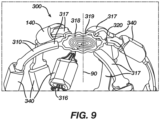
- FIG. 9 is an illustration of a distal portion of a third exemplary end effector 300.
- the basket catheter 14 can be modified to include a spiral sensor 318 (spiral inductor, inductive sensor) electrically connected to a support structure 316 of a spine 310 of the basket assembly.
- the end effector 300 includes spines 310 that extend along the longitudinal axis and are configured to collapse toward the longitudinal axis 90 in a collapsed configuration and expand away from the longitudinal axis 90 to form a basket shape in a deployed configuration.
- the end effector can include one or more support members 316, 320 extending through the spines 310 and providing structural support to the basket assembly 300 to facilitate expansion of the basket assembly 300 to the deployed configuration.
- the support members 316, 320 may be formed of a flexible, resilient material e.g., a shape-memory alloy such as nickel-titanium, also known as Nitinol.
- the end effector 300 can include a spiral inductor 318 disposed approximate a distal end of the end effector 300.
- the spiral inductor 318 is wound about a central axis along the longitudinal axis 90.
- the spiral inductor 318 is electrically coupled to a structural support member 316 extending through one of the spines 310. As illustrated, the structural support member 316 is separate from the structural support member 320 extending through the remaining spines 310.
- the structural support member 316 that is electrically coupled to the spiral inductor 318 is configured to transmit electrical signals from the spiral inductor 318 along the respective spine 310 to the workstation 55 ( Figure 1 ).
- multiple support members, or the entire frame of the basket assembly may be electrically coupled to the spiral inductor 318.
- the spiral inductor 318 and support member 316 can be formed from a common sheet or tube of material and may include a flexible, resilient material e.g., a shape-memory alloy such as nickel-titanium, also known as Nitinol.
- the end effector 300 further includes electrodes 340 coupled to the spines 310.
- the electrodes 340 can be configured similarly to electrodes 140, 240 disclosed elsewhere herein.
- the electrodes 340 can be coupled to the spines 310 as disclosed elsewhere herein.
- the spines 310 can include an insulative jacket 317 over the support members 316, 320 to electrically insulate the support member(s) 316 from the electrodes 140.
- the spiral inductor 318 may be electrically isolated from the electrodes 140 by insulative jacket(s) 317.
- the insulative jacket is omitted in Figure 9 on the support member 316 that is electrically coupled to the spiral inductor 318 for the sake of illustration.
- the support member 316 can otherwise be referred to as a strut.
- the illustrated end effector 300 further includes a sinusoidal member 319 connecting to distal ends of struts extending through the remaining spines 310 of the end effector 300.
- the sinusoidal member 319 may be covered by the
- the end effector 300 can be modified to include one or more inflatable members 130 ( Figures 2 , 6A, and 6B ) coupled to one or more spines 310 approximate the distal end of the end effector 300 such that the inflatable member(s) 130 is/are configured to collapse for delivery through a sheath and is/are configured to inflate in a deployed configuration, and such that the inflatable member(s) in the deployed configuration prevent the distal end of the basket assembly 300 from contacting tissue.
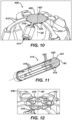
- FIG 10 is an illustration of the basket catheter 14 illustrated in Figure 1 modified to include another exemplary end effector 400 having a distal atraumatic structure 420 at the distal end of the end effector 400.
- the end effector 400 includes spines 410 and electrodes 440 that can be configured similarly to spines 110, 210, 310 and electrodes 140, 240, 340 disclosed elsewhere herein.
- the electrodes 440 are coupled to the spines 410 as disclosed elsewhere herein.
- the spines 410 include a support frame 414 that may include a flexible, resilient material e.g., a shape-memory alloy such as nickel-titanium, also known as Nitinol.
- the support frame 414 is movable between a delivery configuration and a basket configuration and includes struts 416 that extend through the spines 410 so that the spines 410 are configured to self-expand away from the longitudinal axis 90 from a proximal portion to a distal spine portion to form a basket shape in the basket configuration.
- the atraumatic structure 420 includes a circular central portion 421 and radial extensions 422 each extending along a respective spine 410.
- the circular central portion 421 is configured to provide an atraumatic surface configured to shield the underlying distal portion of the support frame 414 from contacting tissue.
- the radial extensions 422 are configured to slide along the respective spine 410 as the support frame 414 moves between the delivery configuration and the basket configuration.
- Figure 11 is an illustration of the support frame 414 of the end effector 400 of Figure 10 in a tubular configuration and including the atraumatic structure 420.
- the proximal ends of struts 416 can be joined as illustrated, or the proximal ends of struts 416 can be free so that electrodes 430 can be slid onto spine proximal ends during assembly.
- the atraumatic structure 420 is positioned at a distal end of the support frame 414.
- the radial extensions 422 are translated distally along the struts 416 and spines 410 as the support frame 414 moves from the deployed configuration illustrated in Figure 10 to the collapsed configuration illustrated in Figure 11 .
- the end effector 400 may include a spring coupler that couples the radial extensions 422 to the spines 410 in a spring-loaded fashion to facilitate translation of the radial extensions 422 along the spines 410 as the end effector 400 moves between the deployed and collapsed configurations.
- Figure 12 is an illustration of the distal end of the end effector 400 of Figure 10 with the distal atraumatic cover removed for the sake of illustration.
- the distal portion of the support frame 414 defining a cloverleaf structure 419 disposed around the longitudinal axis 90.
- the cloverleaf structure 419 defines a central cutout with a central area disposed about the longitudinal axis 90.
- the cloverleaf structure 419 is aligned cylindrically about the longitudinal axis 90 in the delivery configuration and angled radially from the longitudinal axis 90 in the basket configuration.
- the circular central portion 421 of the atraumatic structure 420 covers a portion of the cloverleaf structure 419.
- the support frame 414 can be modified to include the spiral inductor 318 illustrated in Figure 9 .
- the center of the cloverleaf structure moves outward and distally as the cloverleaf structure 419 transitions from a shape that substantially extends radially from the longitudinal axis 90 ( Figures 10 and 12 ) to a shape that substantially extends along the longitudinal axis 90 ( Figure 11 ).
- the atraumatic structure 420 preferably covers a majority of the cloverleaf structure 419. In the collapsed configuration, the atraumatic structure 420 covers only distal tips of the cloverleaf structure 419.
- the end effector 400 can be modified to include one or more inflatable members 130 ( Figures 2 , 6A, and 6B ) coupled to one or more spines 410 approximate the distal end of the end effector 400 such that the inflatable member(s) 130 is/are configured to collapse for delivery through a sheath and is/are configured to inflate in a deployed configuration, and such that the inflatable member(s) in the deployed configuration prevent the distal end of the basket assembly 400 from contacting tissue.
- the inflatable members 130 may be sufficient to inhibit the cloverleaf structure 419 from impending on tissue or prevent the cloverleaf structure 419 from contacting tissue so that the atraumatic structure 420 can be omitted.
- the support frame 414 can be modified to include one or more loop members 111, 112, 113 each having a pair of spines 111 and interlocking central regions at a central spine intersection 114 ( Figures 2-5 ).
- the circular central portion 421 can be positioned distally over the central regions of the loop members to shield the distal end of the basket assembly from contacting tissue.
Landscapes
- Health & Medical Sciences (AREA)
- Life Sciences & Earth Sciences (AREA)
- Engineering & Computer Science (AREA)
- Surgery (AREA)
- Public Health (AREA)
- Heart & Thoracic Surgery (AREA)
- Biomedical Technology (AREA)
- Veterinary Medicine (AREA)
- Animal Behavior & Ethology (AREA)
- General Health & Medical Sciences (AREA)
- Medical Informatics (AREA)
- Physics & Mathematics (AREA)
- Molecular Biology (AREA)
- Cardiology (AREA)
- Nuclear Medicine, Radiotherapy & Molecular Imaging (AREA)
- Plasma & Fusion (AREA)
- Otolaryngology (AREA)
- Biophysics (AREA)
- Pathology (AREA)
- Radiology & Medical Imaging (AREA)
- Physiology (AREA)
- Surgical Instruments (AREA)
- Prostheses (AREA)
Applications Claiming Priority (2)
| Application Number | Priority Date | Filing Date | Title |
|---|---|---|---|
| US202363505978P | 2023-06-02 | 2023-06-02 | |
| US18/650,737 US20240398468A1 (en) | 2023-06-02 | 2024-04-30 | Basket catheter distal end feature |
Publications (2)
| Publication Number | Publication Date |
|---|---|
| EP4470490A2 true EP4470490A2 (de) | 2024-12-04 |
| EP4470490A3 EP4470490A3 (de) | 2025-02-12 |
Family
ID=91374936
Family Applications (1)
| Application Number | Title | Priority Date | Filing Date |
|---|---|---|---|
| EP24179164.9A Pending EP4470490A3 (de) | 2023-06-02 | 2024-05-31 | Distale endfunktion eines korbkatheters |
Country Status (5)
| Country | Link |
|---|---|
| US (1) | US20240398468A1 (de) |
| EP (1) | EP4470490A3 (de) |
| JP (1) | JP2024173826A (de) |
| CN (1) | CN119055245A (de) |
| IL (1) | IL312951A (de) |
Citations (15)
| Publication number | Priority date | Publication date | Assignee | Title |
|---|---|---|---|---|
| US5391199A (en) | 1993-07-20 | 1995-02-21 | Biosense, Inc. | Apparatus and method for treating cardiac arrhythmias |
| US5558091A (en) | 1993-10-06 | 1996-09-24 | Biosense, Inc. | Magnetic determination of position and orientation |
| US6172499B1 (en) | 1999-10-29 | 2001-01-09 | Ascension Technology Corporation | Eddy current error-reduced AC magnetic position measurement system |
| US6239724B1 (en) | 1997-12-30 | 2001-05-29 | Remon Medical Technologies, Ltd. | System and method for telemetrically providing intrabody spatial position |
| US6332089B1 (en) | 1996-02-15 | 2001-12-18 | Biosense, Inc. | Medical procedures and apparatus using intrabody probes |
| US6484118B1 (en) | 2000-07-20 | 2002-11-19 | Biosense, Inc. | Electromagnetic position single axis system |
| US6618612B1 (en) | 1996-02-15 | 2003-09-09 | Biosense, Inc. | Independently positionable transducers for location system |
| US6690963B2 (en) | 1995-01-24 | 2004-02-10 | Biosense, Inc. | System for determining the location and orientation of an invasive medical instrument |
| US6892091B1 (en) | 2000-02-18 | 2005-05-10 | Biosense, Inc. | Catheter, method and apparatus for generating an electrical map of a chamber of the heart |
| US7536218B2 (en) | 2005-07-15 | 2009-05-19 | Biosense Webster, Inc. | Hybrid magnetic-based and impedance-based position sensing |
| US7756576B2 (en) | 2005-08-26 | 2010-07-13 | Biosense Webster, Inc. | Position sensing and detection of skin impedance |
| US7848787B2 (en) | 2005-07-08 | 2010-12-07 | Biosense Webster, Inc. | Relative impedance measurement |
| US7869865B2 (en) | 2005-01-07 | 2011-01-11 | Biosense Webster, Inc. | Current-based position sensing |
| US8456182B2 (en) | 2008-09-30 | 2013-06-04 | Biosense Webster, Inc. | Current localization tracker |
| US20220361942A1 (en) | 2021-05-13 | 2022-11-17 | Biosense Webster (Israel) Ltd. | Distal Assembly for Catheter with Lumens Running Along Spines |
Family Cites Families (10)
| Publication number | Priority date | Publication date | Assignee | Title |
|---|---|---|---|---|
| US5800482A (en) * | 1996-03-06 | 1998-09-01 | Cardiac Pathways Corporation | Apparatus and method for linear lesion ablation |
| US5782840A (en) * | 1997-02-14 | 1998-07-21 | Wilk & Nakao Medical Technology, Inc. | Snare cauterization surgical instrument assembly and method of manufacture |
| KR100500743B1 (ko) * | 1997-02-24 | 2005-07-12 | 쿡 유로러지컬 인코포레이티드 | 팁없는 바스켓을 포함하는 의료 장치 |
| US7785323B2 (en) * | 2000-12-04 | 2010-08-31 | Boston Scientific Scimed, Inc. | Loop structure including inflatable therapeutic device |
| FR2844446B1 (fr) * | 2002-09-17 | 2004-11-26 | Porges Sa | Extracteur chirurgical pour l'extraction de corps etrangers a travers des voies naturelles ou chirurgicales |
| EP2699153B1 (de) * | 2011-04-22 | 2015-12-16 | Topera, Inc. | Flexible elektrodenanordnung zum einsetzen in körperlumen oder organe |
| US8825130B2 (en) * | 2011-12-30 | 2014-09-02 | St. Jude Medical, Atrial Fibrillation Division, Inc. | Electrode support structure assemblies |
| US11246534B2 (en) * | 2017-01-23 | 2022-02-15 | Biosense Webster (Israel) Ltd. | Basket catheter made from flexible circuit board with mechanical strengthening |
| US20210369132A1 (en) * | 2020-05-29 | 2021-12-02 | Biosense Webster (Israel) Ltd. | Intraluminal reference electrode for cardiovascular treatment apparatus |
| US20240216048A1 (en) * | 2022-12-29 | 2024-07-04 | Biosense Webster (Israel) Ltd. | Basket catheter with combination of spine structures |
-
2024
- 2024-04-30 US US18/650,737 patent/US20240398468A1/en active Pending
- 2024-05-19 IL IL312951A patent/IL312951A/en unknown
- 2024-05-30 CN CN202410686223.1A patent/CN119055245A/zh active Pending
- 2024-05-31 EP EP24179164.9A patent/EP4470490A3/de active Pending
- 2024-05-31 JP JP2024088905A patent/JP2024173826A/ja active Pending
Patent Citations (17)
| Publication number | Priority date | Publication date | Assignee | Title |
|---|---|---|---|---|
| US5443489A (en) | 1993-07-20 | 1995-08-22 | Biosense, Inc. | Apparatus and method for ablation |
| US5391199A (en) | 1993-07-20 | 1995-02-21 | Biosense, Inc. | Apparatus and method for treating cardiac arrhythmias |
| US5558091A (en) | 1993-10-06 | 1996-09-24 | Biosense, Inc. | Magnetic determination of position and orientation |
| US6690963B2 (en) | 1995-01-24 | 2004-02-10 | Biosense, Inc. | System for determining the location and orientation of an invasive medical instrument |
| US6618612B1 (en) | 1996-02-15 | 2003-09-09 | Biosense, Inc. | Independently positionable transducers for location system |
| US6332089B1 (en) | 1996-02-15 | 2001-12-18 | Biosense, Inc. | Medical procedures and apparatus using intrabody probes |
| US6788967B2 (en) | 1997-05-14 | 2004-09-07 | Biosense, Inc. | Medical diagnosis, treatment and imaging systems |
| US6239724B1 (en) | 1997-12-30 | 2001-05-29 | Remon Medical Technologies, Ltd. | System and method for telemetrically providing intrabody spatial position |
| US6172499B1 (en) | 1999-10-29 | 2001-01-09 | Ascension Technology Corporation | Eddy current error-reduced AC magnetic position measurement system |
| US6892091B1 (en) | 2000-02-18 | 2005-05-10 | Biosense, Inc. | Catheter, method and apparatus for generating an electrical map of a chamber of the heart |
| US6484118B1 (en) | 2000-07-20 | 2002-11-19 | Biosense, Inc. | Electromagnetic position single axis system |
| US7869865B2 (en) | 2005-01-07 | 2011-01-11 | Biosense Webster, Inc. | Current-based position sensing |
| US7848787B2 (en) | 2005-07-08 | 2010-12-07 | Biosense Webster, Inc. | Relative impedance measurement |
| US7536218B2 (en) | 2005-07-15 | 2009-05-19 | Biosense Webster, Inc. | Hybrid magnetic-based and impedance-based position sensing |
| US7756576B2 (en) | 2005-08-26 | 2010-07-13 | Biosense Webster, Inc. | Position sensing and detection of skin impedance |
| US8456182B2 (en) | 2008-09-30 | 2013-06-04 | Biosense Webster, Inc. | Current localization tracker |
| US20220361942A1 (en) | 2021-05-13 | 2022-11-17 | Biosense Webster (Israel) Ltd. | Distal Assembly for Catheter with Lumens Running Along Spines |
Also Published As
| Publication number | Publication date |
|---|---|
| EP4470490A3 (de) | 2025-02-12 |
| CN119055245A (zh) | 2024-12-03 |
| JP2024173826A (ja) | 2024-12-12 |
| IL312951A (en) | 2025-01-01 |
| US20240398468A1 (en) | 2024-12-05 |
Similar Documents
| Publication | Publication Date | Title |
|---|---|---|
| US12533185B2 (en) | Basket end effector with distal position sensor | |
| EP4268752A1 (de) | Korbkatheter mit kleeblattstruktur zur verhinderung des knickens und der haltefunktion für elektroden | |
| EP4268748A2 (de) | Spülnabe für einen ablationskatheter | |
| EP4389036A1 (de) | Multielektrodenkorbendeffektor eines katheters | |
| EP4467092A1 (de) | Endeffektor mit länglichem trägerelement mit gekrümmtem elektrodenlandebereich | |
| EP4393432A2 (de) | Ablationskatheter mit einem ausweitbaren gewebe mit elektrisch leitenden strängen | |
| EP4393434A1 (de) | Korbkatheter mit einer kombination aus wirbelsäulenstrukturen | |
| EP4470490A2 (de) | Distale endfunktion eines korbkatheters | |
| CN220213060U (zh) | 导管的端部执行器 | |
| EP4393425A1 (de) | Verformter wirbelsäulenelektrodenkorb und verfahren dafür | |
| EP4574070A1 (de) | Medizinische sonde mit wirbelsäulen zur lungenvenenisolierung | |
| EP4527333A1 (de) | Medizinische vorrichtung mit einem bewässerungsverteiler | |
| EP4473927A1 (de) | Endeffektor für medizinische sonde mit scharnieren | |
| EP4393426A2 (de) | Multielektrodenkatheter mit verschachteltem substrat | |
| US20250099160A1 (en) | Medical device with an end effector including connecting hubs and an electrode array | |
| EP4464270A1 (de) | Elektroden und elektrodenkonfigurationen für einen korbkatheter | |
| EP4382060A1 (de) | Elektroden für korbkatheter | |
| EP4527332A1 (de) | Medizinische vorrichtung mit monolithischem wirbelsäulenrahmen | |
| IL309727A (en) | Irrigation Hub for an Ablation Catheter | |
| CN120168087A (zh) | 标测和消融导管 | |
| CN118216996A (zh) | 导管的多电极篮式端部执行器 | |
| CN118252589A (zh) | 变形的脊电极篮及其方法 |
Legal Events
| Date | Code | Title | Description |
|---|---|---|---|
| PUAI | Public reference made under article 153(3) epc to a published international application that has entered the european phase |
Free format text: ORIGINAL CODE: 0009012 |
|
| STAA | Information on the status of an ep patent application or granted ep patent |
Free format text: STATUS: THE APPLICATION HAS BEEN PUBLISHED |
|
| AK | Designated contracting states |
Kind code of ref document: A2 Designated state(s): AL AT BE BG CH CY CZ DE DK EE ES FI FR GB GR HR HU IE IS IT LI LT LU LV MC ME MK MT NL NO PL PT RO RS SE SI SK SM TR |
|
| PUAL | Search report despatched |
Free format text: ORIGINAL CODE: 0009013 |
|
| AK | Designated contracting states |
Kind code of ref document: A3 Designated state(s): AL AT BE BG CH CY CZ DE DK EE ES FI FR GB GR HR HU IE IS IT LI LT LU LV MC ME MK MT NL NO PL PT RO RS SE SI SK SM TR |
|
| RIC1 | Information provided on ipc code assigned before grant |
Ipc: A61B 17/00 20060101ALN20250107BHEP Ipc: A61B 18/14 20060101ALN20250107BHEP Ipc: A61B 18/00 20060101ALI20250107BHEP Ipc: A61B 18/12 20060101AFI20250107BHEP |
|
| STAA | Information on the status of an ep patent application or granted ep patent |
Free format text: STATUS: REQUEST FOR EXAMINATION WAS MADE |
|
| 17P | Request for examination filed |
Effective date: 20250609 |