EP4468656B1 - Kommunikationsgateway mit verbesserter filterung, flugzeug, filterungsverfahren und computerprogramm dafür - Google Patents
Kommunikationsgateway mit verbesserter filterung, flugzeug, filterungsverfahren und computerprogramm dafür Download PDFInfo
- Publication number
- EP4468656B1 EP4468656B1 EP24177839.8A EP24177839A EP4468656B1 EP 4468656 B1 EP4468656 B1 EP 4468656B1 EP 24177839 A EP24177839 A EP 24177839A EP 4468656 B1 EP4468656 B1 EP 4468656B1
- Authority
- EP
- European Patent Office
- Prior art keywords
- message
- auxiliary table
- domain
- tml
- avionics
- Prior art date
- Legal status (The legal status is an assumption and is not a legal conclusion. Google has not performed a legal analysis and makes no representation as to the accuracy of the status listed.)
- Active
Links
Images


Classifications
-
- H—ELECTRICITY
- H04—ELECTRIC COMMUNICATION TECHNIQUE
- H04L—TRANSMISSION OF DIGITAL INFORMATION, e.g. TELEGRAPHIC COMMUNICATION
- H04L63/00—Network architectures or network communication protocols for network security
- H04L63/02—Network architectures or network communication protocols for network security for separating internal from external traffic, e.g. firewalls
-
- H—ELECTRICITY
- H04—ELECTRIC COMMUNICATION TECHNIQUE
- H04B—TRANSMISSION
- H04B7/00—Radio transmission systems, i.e. using radiation field
- H04B7/14—Relay systems
- H04B7/15—Active relay systems
- H04B7/185—Space-based or airborne stations; Stations for satellite systems
- H04B7/18502—Airborne stations
- H04B7/18506—Communications with or from aircraft, i.e. aeronautical mobile service
-
- H—ELECTRICITY
- H04—ELECTRIC COMMUNICATION TECHNIQUE
- H04L—TRANSMISSION OF DIGITAL INFORMATION, e.g. TELEGRAPHIC COMMUNICATION
- H04L63/00—Network architectures or network communication protocols for network security
- H04L63/02—Network architectures or network communication protocols for network security for separating internal from external traffic, e.g. firewalls
- H04L63/0227—Filtering policies
-
- H—ELECTRICITY
- H04—ELECTRIC COMMUNICATION TECHNIQUE
- H04W—WIRELESS COMMUNICATION NETWORKS
- H04W12/00—Security arrangements; Authentication; Protecting privacy or anonymity
- H04W12/08—Access security
- H04W12/088—Access security using filters or firewalls
Definitions
- the present invention relates to an electronic communications gateway intended to be installed on board an aircraft.
- the invention also relates to an aircraft comprising such a communications gateway.
- the present invention also relates to a method for filtering data message(s) within an avionics communication installation intended to be carried on board an aircraft, the filtering method being implemented by such a communication gateway.
- the invention also relates to a computer program comprising software instructions which, when executed by a computer, implement such a filtering method.
- the invention relates more particularly to an airplane, while being applicable to any type of aircraft, such as a helicopter or a drone.
- the invention relates in particular to the field of cyber security in an avionics context.
- An aircraft typically includes avionics systems to assist in piloting the aircraft, such as a flight management system, or FMS (from the English Flight Management System ); a guidance system, or FG (from the English Flight Guidance ); a flight control system, or FCS (from the English Flight Control System ); etc.
- avionics systems exchange information with each other through an aircraft communication network, which are part of a communication installation within the aircraft, generally including systems other than the avionics systems.
- the communication installation includes in particular systems implementing functions relating to the airline operating the aircraft, such as a maintenance system, or CMS (from the English Centralized Maintenance System ); or a passenger cabin management system.
- Avionics systems are grouped into a domain, called the avionics domain, which corresponds to a required security level (from the English "security level "), the highest of the aircraft's communication installation in order to guarantee that the operation of the functions implemented by the avionics systems does not risk being disturbed by communications with equipment outside the avionics domain.
- the security level security required for other equipment is lower than the security level required for the avionics domain.
- the communication installation is for example compliant with the ARINC 811 standard which defines different domains having different security levels in an aircraft communication installation, in particular: an ACD domain (from the English Aircraft Control Domain ) corresponding to the aforementioned avionics domain; an AISD domain (from the English Airline Information Services Domain ) comprising equipment implementing functions relating to the airline (maintenance, cabin management, etc.); and a PIESD domain (from the English Passenger Information and Entertainment Services Domain ) relating to passenger entertainment and information.
- ACD domain from the English Aircraft Control Domain
- AISD domain from the English Airline Information Services Domain
- PIESD domain from the English Passenger Information and Entertainment Services Domain relating to passenger entertainment and information.
- the ACD domain safety level corresponds to the highest safety level of the aircraft communication system because the functions implemented by the ACD domain equipment may be essential for the control of the aircraft's flight.
- the AISD domain safety level is lower than that of the ACD domain, because the functions implemented in the AISD domain are less essential, at least in the short term, for the control of the aircraft's flight.
- the PIESD domain safety level is lower than the AISD domain safety level.
- the invention then relates to the provision of information in the certified avionics domain, such as the ACD domain, from the non-certified open domain, in particular from the AISD domain.
- the exchange of information from a domain with a lower security level to a domain with a higher security level is very strongly restricted so as not to compromise the security of the domain with the higher security level.
- the transfer of information from a domain, called an open domain and corresponding to the outside of the ACD domain, to the ACD domain is very strongly restricted so as not to compromise the security of the ACD domain.
- the aim of the invention is then to propose an electronic communication gateway intended to be installed on board an aircraft, making it possible to reduce the processing time necessary for carrying out the filtering, in particular to be more effective with regard to a risk of cyberattack aimed at causing a malfunction of the avionics systems.
- the use of at least one auxiliary table for the implementation of filtering criterion(s) then makes it possible to determine much more quickly where the field or the value to which the filtering criterion is to be applied is located. Indeed, each filtering criterion is implemented by accessing this field or this value directly via the at least one auxiliary table, rather than having to fully browse the message being filtered each time.
- a flight plan forming a single message can typically have a size of up to 64 kilobytes.
- the gain in processing time also increases with the number of filtering criteria to be applied to the same message.
- the first auxiliary table allows to detect more efficiently the presence or absence of a given predefined value in the message, and if such a value is present first furthermore the number of occurrences of this value.
- the second auxiliary table allows you to more efficiently apply a filter on a particular pattern of fields in the message.
- the third auxiliary table allows for more efficient filtering of variable values in the message.
- the invention also relates to an aircraft comprising a communication installation compartmentalized into an avionics domain and an open domain external to the avionics domain; the communication installation comprising several avionics systems belonging to the avionics domain, one or more electronic devices belonging to the open domain, and an electronic communication gateway connected between the electronic device(s) and the avionics systems, the communication gateway being as defined above.
- the invention also relates to a computer program comprising software instructions which, when executed by a computer, implement a filtering method as defined above.
- an aircraft 5 comprises a communication installation 10 compartmentalized into an avionics domain 15 and an open domain 18, external to the avionics domain 15.
- the communication installation 10 comprises several avionics systems 20 belonging to the avionics domain 15; as well as one or more electronic devices 25, external to the avionics domain 15 and belonging to the open domain 18; and an electronic communication gateway 30 connected between the electronic device(s) 25 and the avionics systems 20.
- the communication installation 10 comprises several electronic devices 25, each belonging to the open domain 18.
- the communication installation 10 further comprises a communication server 35 communicating via a communication link 38 with at least one electronic device 40, external to the aircraft 5.
- the avionics domain 15 is a domain corresponding to a highest level of security on board the aircraft 5, in particular the highest required level of security of the communication installation 10 of the aircraft 5.
- the avionics domain 15 is then a domain for limiting a risk of disruption - by at least one communication with an electronic device or apparatus external to the avionics domain 15 - of function(s) implemented by the at least one avionics system 25 of the avionics domain 15.
- the avionics domain 15 includes the avionics system(s) 25.
- Avionics domain 15 is typically the ACD domain according to the ARINC 811 standard of December 20, 2005.
- Open domain 18 is a domain to which a lower security level corresponds than the security level of avionics domain 15. Open domain 18 includes the electronic device(s) 25.
- Each avionics system 20 is on board the aircraft 5 and belongs to the avionics domain 15.
- Each avionics system 20 is known per se, also called an avionics computer, and is configured to implement one or more respective avionics functions.
- Each avionics system 20 is for example chosen from the group consisting of: a flight management system, also called FMS ( Flight Management System ); a guidance system, or FG ( Flight Guidance ); a flight control system, or FCS ( Flight Control System ); a GNSS ( Global Navigation Satellite System ) satellite positioning system, such as a GPS ( Global Positioning System ); an inertial reference system, also called IRS ( Inertial Reference System ); an ILS ( Instrument Landing System ) landing aid system or an MLS ( Microwave Landing System ) landing aid system; an active runway excursion prevention system, also called ROPS ( Runway Overrun Prevention System ); and a radio altimeter, also noted RA ( RadioAltimeter).
- FMS Flight Management System
- FG Flight Guidance
- FCS Flight Control System
- GNSS Global Navigation Satellite System
- GPS Global Positioning System
- IRS Inertial Reference System
- ILS Instrument Landing System
- MLS Microwave Landing System
- ROPS Runway Overrun Prevention System
- Each electronic device 25 belonging to the open domain 18 does not implement a respective avionics function, and therefore generally does not require specific certification.
- the electronic communication gateway 30, hereinafter called the communication gateway 30 or gateway 30, is an interface between the open domain 18 and the avionics domain 15.
- the communication gateway 30 is also called a security gateway, and is configured to perform at least one filtering of a data message intended for a respective avionics system 20.
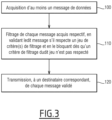
- the communication gateway 30 comprises a module 42 for acquiring at least one data message; a module 44 for filtering each respective acquired message, validating said message if it meets a set of filtering criteria and blocking it as soon as that a filtering criterion of said set is not respected, the filtering module 44 being connected to the output of the acquisition module 42; and a module 45 for transmitting, to a corresponding recipient, each message validated by the filtering module 44, the transmission module 45 being connected to the output of the filtering module 44.
- a set of filtering criteria is understood as a group of filtering criteria, or a batch of filtering criteria, i.e. a set of one or more filtering criteria.
- the filtering module 44 comprises a unit 46 for generating a main table for each acquired message and a unit 48 for calculating, for each acquired message, a dictionary table TD and at least one auxiliary table TAL, TML, TAV from among a first auxiliary table TAL, a second auxiliary table TML and a third auxiliary table TAV.
- communication gateway 30 comprises a module (not shown) for obtaining a set of filtering parameter(s) associated with the set of filtering criteria.
- a set of filtering parameter(s) is understood as a group of filtering parameter(s), or even a batch of filtering parameter(s), i.e. a set of one or more filtering parameters.
- the communication gateway 30 comprises for example an information processing unit 50 typically formed of a memory 52 and a processor 54 associated with the memory 52.
- the acquisition module 42, the filtering module 44 and the transmission module 45, as well as, as an optional addition, the obtaining module are each produced in the form of software, or a software brick, executable by the processor 54.
- the memory 52 of the communication gateway 30 is then capable of storing software for acquiring at least one data message; software for filtering each respective acquired message; and software for transmitting, to a corresponding recipient, each message validated by the filtering software.
- the memory 52 of the communication gateway 30 is capable of storing software for obtaining the set of filtering parameters associated with the set of filtering criteria.
- the processor 54 of the communication gateway 30 is then capable of executing each of the software among the acquisition software, the filtering software and the transmission software, as well as, as an optional addition, the obtaining software.
- the acquisition module 42, the filtering module 44 and the transmission module 45, as well as the optional addition of the obtaining module are each produced in the form of a programmable logic component, such as an FPGA ( Field Programmable Gate Array ), or an integrated circuit, such as an ASIC ( Application Specific Integrated Circuit ).
- a programmable logic component such as an FPGA ( Field Programmable Gate Array ), or an integrated circuit, such as an ASIC ( Application Specific Integrated Circuit ).
- the communication gateway 30 When the communication gateway 30 is produced in the form of one or more software programs, that is to say in the form of a computer program, also called a computer program product, it is also capable of being recorded on a medium, not shown, that is readable by a computer.
- the computer-readable medium is, for example, a medium capable of storing electronic instructions and of being coupled to a bus of a computer system.
- the readable medium is an optical disk, a magneto-optical disk, a ROM memory, a RAM memory, any type of non-volatile memory (for example EPROM, EEPROM, FLASH, NVRAM), a magnetic card or an optical card.
- a computer program comprising software instructions is then stored on the readable medium.
- the communication server 35 is configured to communicate via the communication link 38 with the at least one external electronic device 40, said at least one external electronic device 40 being for example a ground station, or even cloud computing equipment.
- the communication server 35 is preferably connected to the communication gateway 30.
- the communication server 35 typically belongs to the open domain 18.
- the communication server 35 is known per se, and notably comprises a transceiver, not shown, compatible with the communication link 38.
- the communication link 38 is typically a radio link, i.e. a radio wave link, such as a satellite link.
- the transceiver is then a radio transceiver.
- the external electronic equipment 40 is typically connected to a computer infrastructure of an operational control center, also called OCC (from the English Operational Control Center ).
- OCC operational control center
- the external electronic equipment 40 is then advantageously configured to transmit data, such as for example a flight plan of the aircraft 5 and information relating to the aircraft 5, such as its mass, its configuration, its balancing, or even its identifier.
- the acquisition module 42 is for example configured to acquire each message according to a respective avionics communication protocol.
- the avionics communication protocol is for example chosen from the group consisting of: a protocol compliant with the ARINC 702 standard; a protocol compliant with the ARINC 739 standard; a protocol compliant with the ARINC 619 standard; a protocol compliant with the ARINC 429 standard; and a protocol compliant with the FANS ( Future Air Navigation System ) A standard associated with EUROCAE ED-100.
- Each acquired data message comprises a header and a useful part, also called payload , containing the useful data of the message, i.e. the data to be transmitted to the corresponding recipient, such as a corresponding avionics system 20.
- the header typically comprises a preamble used for synchronizing the message, and further comprising, for example, a delimiter to signal the start of the message information; an indication relating to the destination, such as a destination address, i.e. an address or identifier of the avionics system 20 receiving the message; an indication relating to the source, such as a source address, i.e. an address or identifier of the sender of the message; and a control code, such as a cyclic redundancy check code or CRC (from the English Cyclic Redundancy Check).
- a delimiter to signal the start of the message information
- an indication relating to the destination such as a destination address, i.e. an address or identifier of the avionics system 20 receiving the message
- an indication relating to the source such as a source address, i.e. an address or identifier of the sender of the message
- a control code such as a cyclic redundancy check code or CRC (from
- the useful part of the message comprises a plurality of successive fields, the useful part being divided, i.e. broken down into several successive portions, each portion of the useful part forming a respective field.
- the filtering module 44 is configured to filter each respective acquired message, by validating said message if it meets a set of filtering criteria and by blocking it as soon as a filtering criterion of said set is not met.
- the communication gateway 30 fulfills a cyber security functionality. In other words, the communication gateway 30 then forms a security barrier between the open domain 18 and the avionics domain 15. In other words, the entry of message(s) into the avionics domain 15 is secured via the filtering carried out by the communication gateway 30, in particular by the filtering module 44.
- the generation unit 46 is configured to generate the main table TP for each acquired message.
- the main table TP represents an AM tree of the fields of the useful part of said message according to a set of levels N1, N2, N3, N4, N5 associated with the communication protocol.
- the set of levels N1, N2, N3, N4, N5 comprises for example a maximum level N1, a minimum level N5 and one or more intermediate levels N2, N3, N4 between the minimum level N5 and the maximum level N1.
- the useful part typically includes a root field of maximum level N1, one or more leaf fields of minimum level N5, and several intermediate fields of a respective intermediate level N2, N3, N4, each intermediate field having a single higher level parent field and one or more lower level child fields.
- the useful part preferably includes a single maximum level root field N1.
- the set of levels N1, N2, N3, N4, N5 is typically a set of levels associated with the communication protocol, and the levels N1, N2, N3, N4, N5 are then also called protocol levels.
- the set of levels comprises five levels, namely a first level N1 corresponding to the maximum level, second N2, third N3 and fourth N4 levels corresponding to several respective intermediate levels, and a fifth level N5 corresponding to the minimum level.
- the AM tree has one or more branches, each one extending from the root field to a respective leaf field, for example.
- the AM tree allows you to represent a chain of fields in the useful part.
- chain we mean a set of one or more chains, each chain corresponding to a branch.
- Each branch represents a respective chain of fields, for example, from the root field to the respective leaf field.
- the generation unit 46 is typically configured to associate a respective identifier with each of the fields, then to determine the identifiers of the child field(s) of the root field, the identifiers of the parent field and of the child field(s) of each of the intermediate fields, and the identifier of the parent field of each leaf field, and to store the determined identifiers in the main table TP.
- the association of a respective identifier with each of the fields is for example carried out via a numbering of the fields in monotonic order, that is to say in ascending or descending order, and preferably in ascending order.
- the calculation unit 48 is configured to calculate, for each acquired message, the dictionary table TD and at least one auxiliary table TAL, TML, TAV among the first auxiliary table TAL, the second auxiliary table TML and the third auxiliary table TAV.
- the filtering module 44 is then configured to use at least one auxiliary table TAL, TML, TAV for the implementation of filtering criterion(s), i.e. the implementation of at least one filtering criterion.
- the filtering module 44 is configured to use at least two distinct auxiliary tables TAL, TML, TAV among the first auxiliary table TAL, the second auxiliary table TML and the third auxiliary table TAV for the implementation of filtering criterion(s).
- the filtering module 44 is preferably configured to use the first auxiliary table TAL, the second auxiliary table TML and the third auxiliary table TAV for the implementation of filtering criterion(s).
- the dictionary table TD also called lexical table, contains, for each of the levels N1, N2, N3, N4, N5, a list of fixed value(s) contained in said message, each fixed value belonging to a set of predefined values associated with the communication protocol.
- the dictionary table TD contains, for example, for each fixed value, an identifier of said fixed value.
- the dictionary table TD contains for each level of the AM tree an encoding associated with the values that can be found in the message corresponding to this AM tree.
- the first auxiliary table TAL contains, for each of the levels N1, N2, N3, N4, N5 and each fixed value of the dictionary table TD, an identifier of each of the fields containing said fixed value.
- the first auxiliary table TAL also called lexical access table, then offers, for each level, for each value of the dictionary table TD, direct access to the field(s) of the main table TP containing this value of the dictionary table TD, thus allowing rapid and direct access to the elements of the message having this value of the dictionary table TD.
- This access is typically materialized by a pointer to the field of the main table TP.
- the value 'EMPTY' is entered in the first auxiliary table TAL for said fixed value of the dictionary table TD.
- the second TML auxiliary table contains, for each branch of the message, a list of fixed values contained in the fields of said branch. Said list of fixed values is for example ordered from the root field to the respective leaf field.
- the list of fixed values is stored for example in the form of a list of the identifiers of said fixed values.
- the second auxiliary table TML then represents a description of each branch of the AM tree, this description being done using the fixed values of the dictionary table TD.
- the second TML auxiliary table is preferably sorted in ascending order of the identifiers of the fixed values, as illustrated for example with table 3 below.
- the third auxiliary table TAV comprises, for each of the levels N1, N2, N3, N4, N5, a list of value(s) representative of variable value(s) contained in said message.
- Each variable value is distinct from the set of predefined values associated with the communication protocol. In other words, each variable value does not belong to the set of predefined values associated with the corresponding communication protocol. In other words, each variable value is a value which is not fixed by the corresponding communication protocol, but must nevertheless generally respect a certain syntax. This is for example the case of the name of an airport in a flight plan according to the ARINC 702 protocol.
- fields with variable values correspond to light boxes
- fields with fixed values correspond to dark boxes.
- the third auxiliary table TAV also includes, for example, for each value representing variable value(s), the identifier of each of the fields containing a variable value represented by said representative value.
- the third auxiliary table TAV also called the variable access table, then provides access to the variable values of the main table TP.
- the representative value of the variable value is not the variable value itself, but a value calculated to represent said variable value, this calculated value also being called a fingerprint.
- a fingerprint a value calculated to represent said variable value
- This search is further improved by having fingerprints of fixed and sorted sizes, which allows, for example, to carry out searches by dichotomy.
- the representative value of the variable value is the variable value itself.
- the calculation unit 48 is for example configured to calculate each value representative of a variable value by applying an EXCLUSIVE-OR operation, also noted XOR, to said variable value.
- the XOR operation is for example applied to 32-bit words to construct a fingerprint called XORrec.
- This XORrec fingerprint is made up of the XORs of successive parts of 32-bit words of the variable value. Even if several variable values can have the same XORrec fingerprint, two distinct variable values generally rarely have the same XORrec fingerprint.
- the XORec fingerprint for the variable value LFPO is then this variable value LFPO since its size is less than or equal to 32 bits.
- the XORec fingerprint for the variable value AMB010-CDN170 is obtained by applying the XOR operations in the following manner: AMB0 XOR 10-C XOR DN17 XOR 0.
- the third auxiliary table TAV is sorted in monotonic order, and preferably in ascending order, of the calculated representative values.
- the filtering module 44 is configured to, after identifying the field corresponding to the representative value of a searched variable value, access the field identified in the main table TP in order to verify that the identified field indeed corresponds to the searched variable value, and therefore that the representative value indeed represented this searched variable value.
- the filtering module 44 searches for the representative value XORec(LM4GB) in the fourth level N4 of the third auxiliary table TAV.
- the transmission module 45 is configured to transmit, to the corresponding recipient, such as the corresponding avionics system 20, each message validated by the filtering module 44.
- the transmission module 45 is typically configured to transmit each validated message to the corresponding recipient, according to the respective avionics communication protocol, i.e. the avionics communication protocol corresponding to that according to which the message was previously acquired by the acquisition module 42.
- the get module is configured to get the set of filtering parameter(s) associated with the set of filtering criteria(s).
- the filtering module 44 is then configured to filter each message according to the set of filtering criteria configured via the set of filtering parameters which was obtained by the obtaining module.
- the obtaining module is for example configured to obtain said set of filtering parameter(s) from an electronic device 60 external to the gateway 30.
- the obtaining module is configured to verify an authentication certificate and/or an integrity certificate for each set of filtering parameter(s), and to then validate a respective set of filtering parameter(s) only if its authentication certificate and/or its integrity certificate are valid.
- the authentication certificate verifies that the respective set of filter parameters is a genuine set issued from a trusted source, and not a malicious set issued from an attacking source.
- the authentication certificate is, for example, a 4096-bit RSA type.
- the integrity certificate makes it possible to verify that the respective set of filtering parameter(s) is an intact set which has not been corrupted during its transmission from the electronic device 60.
- the integrity certificate is for example of the SHA-2 type (from the English Secure Hash Algorithm ).
- the electronic device 60 is connected to the communication gateway 30.
- the electronic device 60 is typically included in the open domain 18, and easily accessible by a user, to be able to store in a memory (not shown) of said device 60 new sets of filtering parameter(s) and/or modify one or more sets of filtering parameter(s) already stored in this memory.
- the user is typically a member of the crew of the aircraft 5, such as the pilot of the aircraft 5, or even an operator configuring the aircraft 5 prior to the flight.
- RP/RI/RA IEIs also contain Flight Plan Element Identifiers (FPEIs), which are special markers identifying different types of Flight Plan Elements (FPEs) , with values such as CR, DA, F, WS, etc.
- FPEIs Flight Plan Element Identifiers
- Each FPEI is immediately followed by a colon (":") and then the flight plan element data. The colon is also placed at the end of the flight plan element data if another FPEI follows.
- the first level N1 is then the level corresponding to the IMI
- the second level N2 is that corresponding to the IEI
- the third level N3 is that corresponding to the FPEI.
- the fixed values likely to be contained in the dictionary table TD are then in particular “FPN”, “PER”, “LDI”, “POS” for the first level N1; “FN”, “RP”, “RW” for the second level N2; and “CR”, “DA”, “F”, “WS” for the third level N3.
- the fixed values likely to be contained in the dictionary table TD are then notably “Version”, “Community”, “Request” for the first level N1; “Private”, “PDU_Type”, “ID”, “Error” “Object List” for the second level N2; and “GetReq”, “Object_ID”, “Value” for the third level N3.
- the fixed values likely to be contained in the dictionary table TD are then notably “Line text”, for the first level N1; “Initial_charac_pos”, “Line_number”, “Function”, “Color” “Charac” for the second level N2; and “Underscore”, “Reverse”, “Flashing”, “Black”, “0”, “Cyan”, “Yellow”, “Green”, “Magenta”, “Amber”, “White” for the third level N3.
- the calculation unit 48 then calculates the dictionary table TD corresponding to the following table 1, where the fixed values associated with each level N1, N2, N3 and N4 are listed vertically by level.
- the calculation unit 48 calculates the first auxiliary table TAL corresponding to the following table 2, where the field identifiers are indicated in parentheses and listed vertically by level.
- N1 N2 N3 N4 1 (0) 1 (27) 1 (6) (25) 1 (12) 2 (20) 2 (2) (21) 3 (1) 3 (10) 4 (4) (23) 5 (14) 6 (8) 7 (16) (18) 8 EMPTY
- the person skilled in the art will then observe that, for the third level N3, the value 4 of the dictionary table TD, which is associated with the fixed value “:DA:” according to table 1 above, points to fields 4 and 23 of the main table TP, corresponding to the two circled fields of the tree AM of the Figure 2 .
- the value 2 of the dictionary table TD which is associated with the fixed value "RA" according to table 1 above, points to field 20 of the main table TP.
- field identifiers are indicated to the left of the fields, and the values indicated to the right of certain fields represent the address of a memory cell containing a respective field, each value indicated to the right forming in other words a pointer to the memory cell containing the respective field.
- the calculation unit 48 then calculates the second auxiliary table TML corresponding to the following table 3, where the sequences corresponding to the different branches of the AM tree are listed one after the other. [Table 3] 1 1 1 2 1 1 2 2 1 2 4 1 3 1 1 3 2 1 3 3 1 3 3 1 1 3 4 1 3 5 1 3 6 1 3 7
- the sequence “1 2 4” represents the branch “FPN RA:DA:” of the AM tree of the Figure 2 .
- the number 1 being in the first position in the sequence, corresponds to the first level N1.
- This number 1 represents the identifier value 1 of the first level N1 of the dictionary table TD, i.e. the fixed value "FPN” according to table 1 above.
- the number 2, in the second position in this sequence corresponds to the second level N2, and therefore represents the identifier value 2 of the second level N2 of the dictionary table TD, i.e. the fixed value "RA” according to table 1.
- the number 4, in the third position in the sequence corresponds to the third level N3, and consequently represents the identifier value 4 of the third level N3 of the dictionary table TD, i.e. the fixed value ":DA:” according to table 1.
- the calculation unit 48 finally calculates the third auxiliary table TAV corresponding to the following table 4, where the values representative of variable values are listed vertically by level, and the field identifier(s) associated with each representative value are indicated in parentheses and opposite the associated representative value.
- the representative value LFPO which represents the variable value LFPO (of size less than or equal to 32 bits) points to field 28 of the main table TP for the third level N3, and to fields 5 and 26 of the main table TP for the fourth level N4.
- the communication gateway 30 acquires, via its acquisition module 42 and typically from a respective electronic device 25 belonging to the open domain 18, at least one data message intended for a recipient, such as a respective avionics system 20 belonging to the avionics domain 15.
- the communication gateway 30 then moves on to the filtering step 110 during which it filters, via its filtering module 44, each respective acquired message by validating said message if it meets a set of filtering criteria and by blocking it as soon as a filtering criterion of said set is not met.
- the generation unit 46 For each acquired message, the generation unit 46 generates the main table TP, then the calculation unit 48 calculates the dictionary table TD and the at least one auxiliary table TAL, TML, TAV among the first auxiliary table TAL, the second auxiliary table TML and the third auxiliary table TAV.
- the calculation unit 48 preferably calculates the dictionary table TD, the first auxiliary table TAL, the second auxiliary table TML and the third auxiliary table TAV for each acquired message.
- the filtering module 44 uses at least one auxiliary table TAL, TML, TAV for the implementation of at least one filtering criterion.
- the filtering module 44 uses at least two distinct auxiliary tables TAL, TML, TAV among the first auxiliary table TAL, the second auxiliary table TML and the third auxiliary table TAV for the implementation of filtering criterion(s).
- the filtering module 44 preferably uses the first auxiliary table TAL, the second auxiliary table TML and the third auxiliary table TAV for implementing the set of filtering criteria overall.
- the three auxiliary tables TAL, TML, TAV are not necessarily all used at the same time for each filtering criterion, and that the first auxiliary table TAL is for example used for a first filtering criterion, the second auxiliary table TML is for example used for a second filtering criterion distinct from the first, the third auxiliary table TAV being for example used for a third filtering criterion distinct from the first and second filtering criteria.
- several auxiliary tables among the first auxiliary table TAL, the second auxiliary table TML and the third auxiliary table TAV may be used.
- the communication gateway 30 transmits, via its transmission module 45 and to the recipient, the message acquired during the acquisition step 100 if it was subsequently validated during the filtering step 110, that is to say if said message complied with the set of filtering criteria.
- the first auxiliary table TAL, the second auxiliary table TML and/or the third auxiliary table TAV allow message filtering to be carried out with a controlled execution time. Indeed, instead of scanning the message for each filtering criterion to be applied, resulting in a variable execution time depending on the size of the message and the position of the fields sought in the message, the filtering module 44 directly uses the first auxiliary table TAL, the second auxiliary table TML and/or the third auxiliary table TAV to carry out the filtering criterion concerned.
- These auxiliary tables TAL, TML, TAV are executed in a much more deterministic time, because they are less sensitive to the size of the message or to the location of the fields in the message (whether they are at the beginning or at the end).
- the filtering module 44 uses the value corresponding to 'Direct to Waypoint' in the dictionary table TD, i.e. the value "..” of identifier 7 of the third level N3 in the dictionary table TD. From there, it is sufficient for the filtering module 44 to determine the number of fields contained corresponding to identifier 7 for the third level N3 in the first auxiliary table TAL, then checks that this number is less than the fixed limit.
- auxiliary table TAL is used to check whether this filtering criterion is respected or not, and this verification is particularly simple since it is enough to count a number of elements in this first auxiliary table TAL, then compare this number to a threshold.
- the first auxiliary TAL table then makes it possible to detect more efficiently the presence or absence of a given predefined value in the message, and if such a value is present first in addition the number of occurrences of this value.
- filtering As another example of filtering, to know if a particular combination of fields is present in the message, it is sufficient to see if the pattern associated with this combination is present in the second TML auxiliary table. For example, to check if the sequence "FPN RA:DA:" is present or not in the message, it is sufficient for the filtering module 44 to determine if the sequence "1 2 4" is present in the second TML auxiliary table. In this example, among the three auxiliary tables TAL, TML, TAV, only the second TML auxiliary table is used to check if this filtering criterion is respected or not, and this verification is also simple since it is sufficient to determine if a given sequence is present or not in this second TML auxiliary table.
- the second TML auxiliary table therefore makes it possible to more efficiently apply a filter on a particular pattern of fields in the message.
- the third auxiliary table TAV allows rapid access to the variable values of the fourth level N4 associated with the names of the airports having the same representative value XORrec.
- the filtering module 44 then just checks, by accessing the main table TP, to verify that the name of the airport is exactly the one sought (several names may have the same representative value XORrec).
- auxiliary table TAV is used to verify whether this filtering criterion is respected or not, and this verification is again simple since it is sufficient to determine whether a representative value is present or not in this third auxiliary table TAV, then to carry out an additional verification in the main table TP.
- the third auxiliary table TAV therefore makes it possible to filter variable values in the message more effectively.
- auxiliary table TAL, TML, TAV for the implementation of filtering criteria then makes it possible to determine much more quickly where the field or the value on which the filtering criterion is to be applied is located. Indeed, each filtering criterion is implemented by accessing this field or this value directly via at least one auxiliary table TAL, TML, TAV, as is evident in particular from the previous examples, rather than having to fully browse the message being filtered each time.
- the gain in processing time is all the more significant as the message is long, as in the avionics field, where a single message can be several kilobytes in size.
- the gain in processing time also increases with the number of filtering criteria to be applied to the same message.
- the communication gateway 30 therefore makes it possible to reduce the processing time necessary for carrying out the filtering, in particular to be more effective with regard to a risk of cyberattack aimed at causing a malfunction of the avionics systems 20.
Landscapes
- Engineering & Computer Science (AREA)
- Computer Security & Cryptography (AREA)
- Computer Networks & Wireless Communication (AREA)
- Signal Processing (AREA)
- Computing Systems (AREA)
- Computer Hardware Design (AREA)
- General Engineering & Computer Science (AREA)
- Astronomy & Astrophysics (AREA)
- Aviation & Aerospace Engineering (AREA)
- General Physics & Mathematics (AREA)
- Physics & Mathematics (AREA)
- Small-Scale Networks (AREA)
- Data Exchanges In Wide-Area Networks (AREA)
- Computer And Data Communications (AREA)
- Communication Control (AREA)
Claims (10)
- Elektronisches Kommunikationsgateway (30) zum Mitführen an Bord eines Flugzeugs (5), wobei das Gateway (30) umfasst:- ein Erfassungsmodul (42), das so konfiguriert ist, dass es mindestens eine Datennachricht erfasst; wobei jede Nachricht einem Kommunikationsprotokoll entspricht und einen Kopfteil und einen Nutzteil mit mehreren aufeinanderfolgenden Feldern umfasst;- ein Filtermodul (44), das am Ausgang des Erfassungsmoduls (42) angeschlossen und so konfiguriert ist, dass es jede jeweilige erfasste Nachricht filtert, indem es die Nachricht freigibt, wenn sie einen Satz von Filterkriterien erfüllt, und sie blockiert, sobald ein Filterkriterium des Satzes nicht erfüllt wird;- ein Übertragungsmodul (45), das am Ausgang des Filtermoduls (44) angeschlossen und so konfiguriert ist, dass es jede durch das Filtermodul (44) bestätigte Nachricht an einen entsprechenden Empfänger (20) überträgt;dadurch gekennzeichnet, dass das Filtermodul (44) Folgendes umfasst:- eine Erzeugungseinheit (46), die so konfiguriert ist, dass sie eine Haupttabelle (TP) für jede erfasste Nachricht erzeugt; die Haupttabelle (TP) repräsentiert einen Baum (AM) der Felder des Nutzteils der Nachricht gemäß einer Gruppe von Ebenen (N1, N2, N3, N4, N5) darstellt, die dem Kommunikationsprotokoll zugeordnet sind, wobei der Baum (AM) einen oder mehrere Zweige umfasst;- eine Recheneinheit (48), die konfiguriert ist, um für jede erfasste Nachricht eine Wörterbuchtabelle (TD) und mindestens eine Hilfstabelle (TAL, TML, TAV) aus einer ersten Hilfstabelle (TAL), einer zweiten Hilfstabelle (TML) und einer dritten Hilfstabelle (TAV) zu berechnen;die Wörterbuchtabelle (TD) für jede der Ebenen (N1, N2, N3, N4, N5) eine Liste von in der Nachricht enthaltenen festen Wert(en) umfasst, wobei jeder feste Wert zu einem Satz vordefinierter Werte gehört, die dem Kommunikationsprotokoll zugeordnet sind;die erste Hilfstabelle (TAL) für jede der Ebenen (N1, N2, N3, N4, N5) und jeden festen Wert der Wörterbuchtabelle (TD) eine Kennung für jedes des Feldes oder der Felder, die den festen Wert enthalten, umfasst;die zweite Hilfstabelle (TML), die für jeden Zweig der Nachricht eine Liste der festen Werte enthält, die in den Feldern dieses Zweigs enthalten sind; unddie dritte Hilfstabelle (TAV), die für jede der Ebenen (N1, N2, N3, N4, N5) eine Liste von Wert(en) enthält, die für in der Nachricht enthaltene variable Werte repräsentativ sind, wobei sich jeder variable Wert von dem Satz vordefinierter Werte unterscheidet, der dem Kommunikationsprotokoll zugeordnet ist; unddass das Filtermodul (44) so konfiguriert ist, dass es die mindestens eine Hilfstabelle (TAL, TML, TAV) für die Implementierung des(der) Filterkriteriums(Filterkriterien) verwendet.
- Gateway (30) nach Anspruch 1, wobei das Filtermodul (44) so konfiguriert ist, dass es mindestens zwei verschiedene Hilfstabellen (TAL, TML, TAV) aus der ersten Hilfstabelle (TAL), der zweiten Hilfstabelle (TML) und der dritten Hilfstabelle (TAV) für die Implementierung des(der) Filterkriteriums(Filterkriterien) verwendet;
wobei das Filtermodul (44) vorzugsweise konfiguriert ist, um jede der Hilfstabellen (TAL, TML, TAV) aus der ersten Hilfstabelle (TAL), der zweiten Hilfstabelle (TML) und der dritten Hilfstabelle (TAV) für die Implementierung des(der) Filterkriteriums(Filterkriterien) zu verwenden. - Gateway (30) nach Anspruch 1 oder 2, wobei die Recheneinheit (48) zusätzlich so konfiguriert ist, dass sie die Listen der festen Werte der zweiten Hilfstabelle (TML) in einer monotonen Reihenfolge anordnet, indem sie zunächst den ersten festen Wert jeder der Listen vergleicht und dann nacheinander zu den nächsten Werten der Listen übergeht.
- Gateway (30) nach einem der vorhergehenden Ansprüche, wobei die Wörterbuchtabelle (TD) für jeden festen Wert eine Kennung des festen Werts enthält; und in der zweiten Hilfstabelle (TML) für jeden Zweig der Nachricht die Liste der festen Werte als eine Liste der Kennungen der festen Werte gespeichert ist.
- Gateway (30) nach einem der vorhergehenden Ansprüche, wobei die Recheneinheit (48) zusätzlich so konfiguriert ist, dass sie jeden repräsentativen Wert eines variablen Werts berechnet, indem sie eine EXKLUSIV-ODER-Operation (XOR) auf den variablen Wert anwendet.
- Gateway (30) nach einem der vorhergehenden Ansprüche, wobei die dritte Hilfstabelle (TAV) außerdem für jeden repräsentativen Wert für einen oder mehrere variable Werte die Kennung jedes der Felder enthält, die einen variablen Wert enthalten, der durch den repräsentativen Wert dargestellt wird.
- Gateway (30) nach einem der vorhergehenden Ansprüche, wobei das Flugzeug (5) eine Kommunikationsanlage (10) umfasst, die in einen Avionikbereich (15) und einen offenen Bereich (18) außerhalb des Avionikbereichs (15) unterteilt ist, wobei die Kommunikationsanlage (10) mehrere Avioniksysteme (20) umfasst, die zu dem Avionikbereich (15) gehören, ein oder mehrere elektronische Geräte (25), die zu dem offenen Bereich (18) gehören, wobei das Gateway (30) geeignet ist, zwischen dem oder den elektronischen Geräten (25) und den Avioniksystemen (20) verbunden zu werden,der Avionikbereich (15) ein Bereich ist, der einem höchsten Sicherheitsniveau an Bord des Flugzeugs (5) entspricht;wobei der Avionikbereich (15) vorzugsweise der ACD-Bereich gemäß der Norm ARINC 811 vom 20. Dezember 2005 ist.
- Flugzeug (5) mit einer Kommunikationsanlage (10), die in einen Avionikbereich (15) und einen offenen Bereich (18) außerhalb des Avionikbereichs (15) unterteilt ist, wobei die Kommunikationsanlage (10) eine Vielzahl von Systemen (20) umfasst, die zum Avionikbereich (15) gehören, ein oder mehrere elektronische Geräte (25), die zu dem offenen Bereich (18) gehören, und ein elektronisches Kommunikationsgateway (30), das zwischen dem oder den elektronischen Geräten (25) und den Avioniksystemen (20) angeschlossen ist, umfasst,
dadurch gekennzeichnet, dass das Kommunikationsgateway (30) gemäß einem der vorherigen Ansprüche ist. - Verfahren zum Filtern von Datennachricht(en) innerhalb einer Avionik-Kommunikationsanlage (10), die dazu bestimmt ist, an Bord eines Flugzeuges (5) zu sein, wobei das Filterverfahren von einem elektronischen Kommunikationsgateway (30) durchgeführt wird und die folgenden Schritte umfasst:- Erfassen (100) mindestens einer Datennachricht; wobei jede Nachricht einem Kommunikationsprotokoll entspricht und einen Kopfteil und einen Nutzteil mit mehreren aufeinanderfolgenden Feldern umfasst;- Filtern (110) jeder jeweiligen erfassten Nachricht, indem die Nachricht freigegeben wird, wenn sie einen Satz von Filterkriterien erfüllt, und blockiert wird, sobald ein Filterkriterium des Satzes nicht erfüllt ist;- Übertragen (120) jeder bestätigten Nachricht an einen entsprechenden Empfänger (20);dadurch gekennzeichnet, dass der Filterschritt (110) die folgenden Teilschritte umfasst:- Generierung einer Haupttabelle (TP) für jede erfasste Nachricht; wobei die Haupttabelle (TP) einen Baum (AM) der Felder des Nutzteils der Nachricht gemäß einer Gruppe von Ebenen (N1, N2, N3, N4, N5) darstellt, die dem Kommunikationsprotokoll zugeordnet sind, wobei der Baum (AM) einen oder mehrere Zweige umfasst;- Berechnen, für jede erfasste Nachricht, einer Wörterbuchtabelle (TD) und mindestens einer Hilfstabelle (TAL, TML, TAV) aus einer ersten Hilfstabelle (TAL), einer zweiten Hilfstabelle (TML) und einer dritten Hilfstabelle (TAV);die Wörterbuchtabelle (TD) für jede der Ebenen (N1, N2, N3, N4, N5) eine Liste von in der Nachricht enthaltenen festen Wert(en) umfasst, wobei jeder feste Wert zu einem Satz vordefinierter Werte gehört, die dem Kommunikationsprotokoll zugeordnet sind;die erste Hilfstabelle (TAL) für jede der Ebenen (N1, N2, N3, N4, N5) und jeden festen Wert der Wörterbuchtabelle (TD) die Kennung jedes des Feldes oder der Felder, die den festen Wert enthalten, enthält;die zweite Hilfstabelle (TML), die für jeden Zweig der Nachricht eine Liste der festen Werte enthält, die in den Feldern dieses Zweigs enthalten sind; unddie dritte Hilfstabelle (TAV), die für jede der Ebenen (N1, N2, N3, N4, N5) eine Liste von Wert(en) enthält, die für in der Nachricht enthaltene variable Werte repräsentativ sind, wobei sich jeder variable Wert von dem Satz vordefinierter Werte unterscheidet, der dem Kommunikationsprotokoll zugeordnet ist; unddass die mindestens eine Hilfstabelle (TAL, TML, TAV) für die Implementierung des(der) Filterkriteriums(Filterkriterien) verwendet wird.
- Computerprogramm, umfassend Softwareanweisungen, die, wenn sie von einem Computer ausgeführt werden, ein Verfahren nach dem vorherigen Anspruch implementieren.
Applications Claiming Priority (1)
| Application Number | Priority Date | Filing Date | Title |
|---|---|---|---|
| FR2305192A FR3149157B1 (fr) | 2023-05-25 | 2023-05-25 | Passerelle de communication avec filtrage amélioré, aéronef, procédé de filtrage et programme d’ordinateur associés |
Publications (2)
| Publication Number | Publication Date |
|---|---|
| EP4468656A1 EP4468656A1 (de) | 2024-11-27 |
| EP4468656B1 true EP4468656B1 (de) | 2025-05-07 |
Family
ID=89767373
Family Applications (1)
| Application Number | Title | Priority Date | Filing Date |
|---|---|---|---|
| EP24177839.8A Active EP4468656B1 (de) | 2023-05-25 | 2024-05-24 | Kommunikationsgateway mit verbesserter filterung, flugzeug, filterungsverfahren und computerprogramm dafür |
Country Status (3)
| Country | Link |
|---|---|
| US (1) | US20240396620A1 (de) |
| EP (1) | EP4468656B1 (de) |
| FR (1) | FR3149157B1 (de) |
Family Cites Families (4)
| Publication number | Priority date | Publication date | Assignee | Title |
|---|---|---|---|---|
| FR2917206B1 (fr) * | 2007-06-06 | 2009-12-25 | Airbus France | Systeme embarque de controle d'acces pour une communication du domaine ouvert vers le domaine avionique. |
| FR2952257B1 (fr) * | 2009-11-05 | 2011-11-11 | Airbus Operations Sas | Procede et dispositif de configuration d'un systeme d'information de maintenance embarque dans un aeronef |
| US10721259B2 (en) * | 2016-03-31 | 2020-07-21 | The Boeing Company | System and method for automatic generation of filter rules |
| FR3082691A1 (fr) | 2018-06-19 | 2019-12-20 | Airbus Operations (S.A.S.) | Systeme et procede de communication d'un aeronef |
-
2023
- 2023-05-25 FR FR2305192A patent/FR3149157B1/fr active Active
-
2024
- 2024-05-22 US US18/671,106 patent/US20240396620A1/en active Pending
- 2024-05-24 EP EP24177839.8A patent/EP4468656B1/de active Active
Also Published As
| Publication number | Publication date |
|---|---|
| EP4468656A1 (de) | 2024-11-27 |
| FR3149157B1 (fr) | 2025-06-06 |
| US20240396620A1 (en) | 2024-11-28 |
| FR3149157A1 (fr) | 2024-11-29 |
Similar Documents
| Publication | Publication Date | Title |
|---|---|---|
| EP3008872B1 (de) | Verfahren zur authentifizierung eines endgeräts durch ein gateway eines internen netzes mit schutz durch eine einheit zur bereitstellung von sicherem zugang | |
| FR2926692A1 (fr) | Procedes et dispositifs pour ameliorer la fiabilite de communication entre un aeronef et un systeme distant | |
| EP2679466B1 (de) | Sicheres Verfahren zu Bestimmung der Zusammenstellung eines Zugs | |
| EP2954648A1 (de) | Datenroutingverfahren, computerprogramm, netzwerksteuerung und netzwerk damit | |
| CA2778847A1 (fr) | Identification par controle de donnees biometriques d'utilisateur | |
| EP3585030A1 (de) | Kommunikationssystem und -verfahren eines luftfahrzeugs | |
| EP1994679B1 (de) | Verfahren und vorrichtungen zum senden und empfangen von nachrichten zwischen einem flugzeug und einem bodensystem, und damit ausgestattetes flugzeug | |
| EP3433991A1 (de) | Verfahren zur verwaltung und wartung eines flugzeug mit einem bereich mit hohem sicherheitsgrad | |
| EP4468656B1 (de) | Kommunikationsgateway mit verbesserter filterung, flugzeug, filterungsverfahren und computerprogramm dafür | |
| EP2750354B1 (de) | Verfahren zur Definition eines Filtermoduls, und entsprechendes Filtermodul | |
| EP4270874B1 (de) | Bordinternes netzwerksicherheitsgateway zur verbindung von niedrig- und hochsicherheitsdomänen einer avionik-computing-infrastruktur | |
| FR3058290A1 (fr) | Equipement avionique avec signature a usage unique d'un message emis, systeme avionique, procede de transmission et programme d'ordinateur associes | |
| FR3113963A1 (fr) | Chaine de confiance avancee en aeronautique domaine de l'invention | |
| FR3057122A1 (fr) | Procede et dispositif de detection d'intrusions sur un reseau utilisant un algorithme de chiffrement homomorphe | |
| EP2380328B1 (de) | Microkernel-gateway-server | |
| EP3084666B1 (de) | Vorrichtung zur verbindung von kommunikationsnetzen mit kontrollierter sicherheit | |
| EP4430538A1 (de) | Verfahren zur überwachung der konfiguration eines flugzeugmotors und zugehöriges system | |
| WO2018104557A1 (fr) | Procédé d'émission d'un message, procédé de réception, dispositif d'émission, dispositif de réception et système de communication associés | |
| WO2022053751A1 (fr) | Procede et pare-feu configures pour controler des messages transitant entre deux elements de communication. | |
| EP4488856A1 (de) | Kommunikationsgateway mit konfigurierbare filterung zwischen offenen und avionik-domänen, verwandtes flugzeug, filterverfahren und computerprogramm | |
| EP3706020A1 (de) | Berechnung der signatur und überprüfung der integrität von digitalen daten | |
| FR3091441A1 (fr) | Procédé de configuration d’un réseau avionique, produit programme d’ordinateur et module de configuration associés | |
| EP3748935A1 (de) | Verfahren zum speichern von digitalen dateien, das von einem deterministischen avioniknetz angewandt wird und über ein vorbestimmtes routing funktioniert, und entsprechendes avionik-kommunikationssystem | |
| FR3017508A1 (fr) | Systeme et procede d'echange de donnees | |
| FR3121565A1 (fr) | Procédé et dispositif électronique de téléchargement d’un fichier de données vers un équipement avionique, programme d’ordinateur associé |
Legal Events
| Date | Code | Title | Description |
|---|---|---|---|
| PUAI | Public reference made under article 153(3) epc to a published international application that has entered the european phase |
Free format text: ORIGINAL CODE: 0009012 |
|
| STAA | Information on the status of an ep patent application or granted ep patent |
Free format text: STATUS: THE APPLICATION HAS BEEN PUBLISHED |
|
| AK | Designated contracting states |
Kind code of ref document: A1 Designated state(s): AL AT BE BG CH CY CZ DE DK EE ES FI FR GB GR HR HU IE IS IT LI LT LU LV MC ME MK MT NL NO PL PT RO RS SE SI SK SM TR |
|
| STAA | Information on the status of an ep patent application or granted ep patent |
Free format text: STATUS: REQUEST FOR EXAMINATION WAS MADE |
|
| 17P | Request for examination filed |
Effective date: 20241127 |
|
| RBV | Designated contracting states (corrected) |
Designated state(s): AL AT BE BG CH CY CZ DE DK EE ES FI FR GB GR HR HU IE IS IT LI LT LU LV MC ME MK MT NL NO PL PT RO RS SE SI SK SM TR |
|
| P01 | Opt-out of the competence of the unified patent court (upc) registered |
Free format text: CASE NUMBER: APP_66610/2024 Effective date: 20241217 |
|
| GRAP | Despatch of communication of intention to grant a patent |
Free format text: ORIGINAL CODE: EPIDOSNIGR1 |
|
| STAA | Information on the status of an ep patent application or granted ep patent |
Free format text: STATUS: GRANT OF PATENT IS INTENDED |
|
| GRAS | Grant fee paid |
Free format text: ORIGINAL CODE: EPIDOSNIGR3 |
|
| INTG | Intention to grant announced |
Effective date: 20250228 |
|
| GRAA | (expected) grant |
Free format text: ORIGINAL CODE: 0009210 |
|
| STAA | Information on the status of an ep patent application or granted ep patent |
Free format text: STATUS: THE PATENT HAS BEEN GRANTED |
|
| AK | Designated contracting states |
Kind code of ref document: B1 Designated state(s): AL AT BE BG CH CY CZ DE DK EE ES FI FR GB GR HR HU IE IS IT LI LT LU LV MC ME MK MT NL NO PL PT RO RS SE SI SK SM TR |
|
| REG | Reference to a national code |
Ref country code: GB Ref legal event code: FG4D Free format text: NOT ENGLISH |
|
| REG | Reference to a national code |
Ref country code: CH Ref legal event code: EP |
|
| REG | Reference to a national code |
Ref country code: DE Ref legal event code: R096 Ref document number: 602024000111 Country of ref document: DE |
|
| REG | Reference to a national code |
Ref country code: IE Ref legal event code: FG4D Free format text: LANGUAGE OF EP DOCUMENT: FRENCH |
|
| PGFP | Annual fee paid to national office [announced via postgrant information from national office to epo] |
Ref country code: FR Payment date: 20250530 Year of fee payment: 2 |
|
| REG | Reference to a national code |
Ref country code: NL Ref legal event code: MP Effective date: 20250507 |
|
| PG25 | Lapsed in a contracting state [announced via postgrant information from national office to epo] |
Ref country code: FI Free format text: LAPSE BECAUSE OF FAILURE TO SUBMIT A TRANSLATION OF THE DESCRIPTION OR TO PAY THE FEE WITHIN THE PRESCRIBED TIME-LIMIT Effective date: 20250507 Ref country code: PT Free format text: LAPSE BECAUSE OF FAILURE TO SUBMIT A TRANSLATION OF THE DESCRIPTION OR TO PAY THE FEE WITHIN THE PRESCRIBED TIME-LIMIT Effective date: 20250908 Ref country code: ES Free format text: LAPSE BECAUSE OF FAILURE TO SUBMIT A TRANSLATION OF THE DESCRIPTION OR TO PAY THE FEE WITHIN THE PRESCRIBED TIME-LIMIT Effective date: 20250507 |
|
| REG | Reference to a national code |
Ref country code: LT Ref legal event code: MG9D |
|
| PG25 | Lapsed in a contracting state [announced via postgrant information from national office to epo] |
Ref country code: NO Free format text: LAPSE BECAUSE OF FAILURE TO SUBMIT A TRANSLATION OF THE DESCRIPTION OR TO PAY THE FEE WITHIN THE PRESCRIBED TIME-LIMIT Effective date: 20250807 Ref country code: GR Free format text: LAPSE BECAUSE OF FAILURE TO SUBMIT A TRANSLATION OF THE DESCRIPTION OR TO PAY THE FEE WITHIN THE PRESCRIBED TIME-LIMIT Effective date: 20250808 |
|
| PG25 | Lapsed in a contracting state [announced via postgrant information from national office to epo] |
Ref country code: NL Free format text: LAPSE BECAUSE OF FAILURE TO SUBMIT A TRANSLATION OF THE DESCRIPTION OR TO PAY THE FEE WITHIN THE PRESCRIBED TIME-LIMIT Effective date: 20250507 Ref country code: PL Free format text: LAPSE BECAUSE OF FAILURE TO SUBMIT A TRANSLATION OF THE DESCRIPTION OR TO PAY THE FEE WITHIN THE PRESCRIBED TIME-LIMIT Effective date: 20250507 |
|
| REG | Reference to a national code |
Ref country code: AT Ref legal event code: MK05 Ref document number: 1793697 Country of ref document: AT Kind code of ref document: T Effective date: 20250507 |
|
| PG25 | Lapsed in a contracting state [announced via postgrant information from national office to epo] |
Ref country code: BG Free format text: LAPSE BECAUSE OF FAILURE TO SUBMIT A TRANSLATION OF THE DESCRIPTION OR TO PAY THE FEE WITHIN THE PRESCRIBED TIME-LIMIT Effective date: 20250507 |
|
| PG25 | Lapsed in a contracting state [announced via postgrant information from national office to epo] |
Ref country code: HR Free format text: LAPSE BECAUSE OF FAILURE TO SUBMIT A TRANSLATION OF THE DESCRIPTION OR TO PAY THE FEE WITHIN THE PRESCRIBED TIME-LIMIT Effective date: 20250507 |
|
| PG25 | Lapsed in a contracting state [announced via postgrant information from national office to epo] |
Ref country code: AT Free format text: LAPSE BECAUSE OF FAILURE TO SUBMIT A TRANSLATION OF THE DESCRIPTION OR TO PAY THE FEE WITHIN THE PRESCRIBED TIME-LIMIT Effective date: 20250507 |
|
| PG25 | Lapsed in a contracting state [announced via postgrant information from national office to epo] |
Ref country code: RS Free format text: LAPSE BECAUSE OF FAILURE TO SUBMIT A TRANSLATION OF THE DESCRIPTION OR TO PAY THE FEE WITHIN THE PRESCRIBED TIME-LIMIT Effective date: 20250807 |
|
| PG25 | Lapsed in a contracting state [announced via postgrant information from national office to epo] |
Ref country code: IS Free format text: LAPSE BECAUSE OF FAILURE TO SUBMIT A TRANSLATION OF THE DESCRIPTION OR TO PAY THE FEE WITHIN THE PRESCRIBED TIME-LIMIT Effective date: 20250907 |
|
| PG25 | Lapsed in a contracting state [announced via postgrant information from national office to epo] |
Ref country code: LV Free format text: LAPSE BECAUSE OF FAILURE TO SUBMIT A TRANSLATION OF THE DESCRIPTION OR TO PAY THE FEE WITHIN THE PRESCRIBED TIME-LIMIT Effective date: 20250507 |
|
| PG25 | Lapsed in a contracting state [announced via postgrant information from national office to epo] |
Ref country code: DK Free format text: LAPSE BECAUSE OF FAILURE TO SUBMIT A TRANSLATION OF THE DESCRIPTION OR TO PAY THE FEE WITHIN THE PRESCRIBED TIME-LIMIT Effective date: 20250507 Ref country code: SM Free format text: LAPSE BECAUSE OF FAILURE TO SUBMIT A TRANSLATION OF THE DESCRIPTION OR TO PAY THE FEE WITHIN THE PRESCRIBED TIME-LIMIT Effective date: 20250507 |
|
| PG25 | Lapsed in a contracting state [announced via postgrant information from national office to epo] |
Ref country code: CZ Free format text: LAPSE BECAUSE OF FAILURE TO SUBMIT A TRANSLATION OF THE DESCRIPTION OR TO PAY THE FEE WITHIN THE PRESCRIBED TIME-LIMIT Effective date: 20250507 |
|
| PG25 | Lapsed in a contracting state [announced via postgrant information from national office to epo] |
Ref country code: EE Free format text: LAPSE BECAUSE OF FAILURE TO SUBMIT A TRANSLATION OF THE DESCRIPTION OR TO PAY THE FEE WITHIN THE PRESCRIBED TIME-LIMIT Effective date: 20250507 |
|
| PG25 | Lapsed in a contracting state [announced via postgrant information from national office to epo] |
Ref country code: SK Free format text: LAPSE BECAUSE OF FAILURE TO SUBMIT A TRANSLATION OF THE DESCRIPTION OR TO PAY THE FEE WITHIN THE PRESCRIBED TIME-LIMIT Effective date: 20250507 |
|
| PG25 | Lapsed in a contracting state [announced via postgrant information from national office to epo] |
Ref country code: IT Free format text: LAPSE BECAUSE OF FAILURE TO SUBMIT A TRANSLATION OF THE DESCRIPTION OR TO PAY THE FEE WITHIN THE PRESCRIBED TIME-LIMIT Effective date: 20250507 |
|
| REG | Reference to a national code |
Ref country code: DE Ref legal event code: R097 Ref document number: 602024000111 Country of ref document: DE |
|
| PG25 | Lapsed in a contracting state [announced via postgrant information from national office to epo] |
Ref country code: MC Free format text: LAPSE BECAUSE OF FAILURE TO SUBMIT A TRANSLATION OF THE DESCRIPTION OR TO PAY THE FEE WITHIN THE PRESCRIBED TIME-LIMIT Effective date: 20250507 |
|
| PLBE | No opposition filed within time limit |
Free format text: ORIGINAL CODE: 0009261 |
|
| STAA | Information on the status of an ep patent application or granted ep patent |
Free format text: STATUS: NO OPPOSITION FILED WITHIN TIME LIMIT |
|
| REG | Reference to a national code |
Ref country code: CH Ref legal event code: L10 Free format text: ST27 STATUS EVENT CODE: U-0-0-L10-L00 (AS PROVIDED BY THE NATIONAL OFFICE) Effective date: 20260318 |
|
| 26N | No opposition filed |
Effective date: 20260210 |