EP4270874B1 - Bordinternes netzwerksicherheitsgateway zur verbindung von niedrig- und hochsicherheitsdomänen einer avionik-computing-infrastruktur - Google Patents
Bordinternes netzwerksicherheitsgateway zur verbindung von niedrig- und hochsicherheitsdomänen einer avionik-computing-infrastruktur Download PDFInfo
- Publication number
- EP4270874B1 EP4270874B1 EP23170235.8A EP23170235A EP4270874B1 EP 4270874 B1 EP4270874 B1 EP 4270874B1 EP 23170235 A EP23170235 A EP 23170235A EP 4270874 B1 EP4270874 B1 EP 4270874B1
- Authority
- EP
- European Patent Office
- Prior art keywords
- data processing
- node
- processing node
- network security
- trust domain
- Prior art date
- Legal status (The legal status is an assumption and is not a legal conclusion. Google has not performed a legal analysis and makes no representation as to the accuracy of the status listed.)
- Active
Links
Images

Classifications
-
- H—ELECTRICITY
- H04—ELECTRIC COMMUNICATION TECHNIQUE
- H04L—TRANSMISSION OF DIGITAL INFORMATION, e.g. TELEGRAPHIC COMMUNICATION
- H04L63/00—Network architectures or network communication protocols for network security
- H04L63/02—Network architectures or network communication protocols for network security for separating internal from external traffic, e.g. firewalls
- H04L63/0227—Filtering policies
- H04L63/0236—Filtering by address, protocol, port number or service, e.g. IP-address or URL
-
- H—ELECTRICITY
- H04—ELECTRIC COMMUNICATION TECHNIQUE
- H04L—TRANSMISSION OF DIGITAL INFORMATION, e.g. TELEGRAPHIC COMMUNICATION
- H04L45/00—Routing or path finding of packets in data switching networks
- H04L45/42—Centralised routing
-
- H—ELECTRICITY
- H04—ELECTRIC COMMUNICATION TECHNIQUE
- H04L—TRANSMISSION OF DIGITAL INFORMATION, e.g. TELEGRAPHIC COMMUNICATION
- H04L63/00—Network architectures or network communication protocols for network security
- H04L63/02—Network architectures or network communication protocols for network security for separating internal from external traffic, e.g. firewalls
- H04L63/0209—Architectural arrangements, e.g. perimeter networks or demilitarized zones
-
- H—ELECTRICITY
- H04—ELECTRIC COMMUNICATION TECHNIQUE
- H04L—TRANSMISSION OF DIGITAL INFORMATION, e.g. TELEGRAPHIC COMMUNICATION
- H04L63/00—Network architectures or network communication protocols for network security
- H04L63/02—Network architectures or network communication protocols for network security for separating internal from external traffic, e.g. firewalls
- H04L63/0227—Filtering policies
- H04L63/0245—Filtering by information in the payload
-
- H—ELECTRICITY
- H04—ELECTRIC COMMUNICATION TECHNIQUE
- H04L—TRANSMISSION OF DIGITAL INFORMATION, e.g. TELEGRAPHIC COMMUNICATION
- H04L63/00—Network architectures or network communication protocols for network security
- H04L63/02—Network architectures or network communication protocols for network security for separating internal from external traffic, e.g. firewalls
- H04L63/0227—Filtering policies
- H04L63/0254—Stateful filtering
-
- H—ELECTRICITY
- H04—ELECTRIC COMMUNICATION TECHNIQUE
- H04L—TRANSMISSION OF DIGITAL INFORMATION, e.g. TELEGRAPHIC COMMUNICATION
- H04L63/00—Network architectures or network communication protocols for network security
- H04L63/10—Network architectures or network communication protocols for network security for controlling access to devices or network resources
- H04L63/105—Multiple levels of security
-
- H—ELECTRICITY
- H04—ELECTRIC COMMUNICATION TECHNIQUE
- H04L—TRANSMISSION OF DIGITAL INFORMATION, e.g. TELEGRAPHIC COMMUNICATION
- H04L67/00—Network arrangements or protocols for supporting network services or applications
- H04L67/01—Protocols
- H04L67/12—Protocols specially adapted for proprietary or special-purpose networking environments, e.g. medical networks, sensor networks, networks in vehicles or remote metering networks
Definitions
- the present invention relates to network security gateways intended to be installed on board civil or military aircraft.
- a network security gateway enables an interconnection between two IT domains that are characterized by different levels of criticality, in particular between a low-trust domain and a safety-critical domain of the aircraft, such as the aircraft control domain - ACD.
- This interconnection may be permanent, for example in the case of two aircraft networks used during a flight phase, or temporary, for example in the case of maintenance equipment connected to the aircraft during a ground maintenance phase.
- the gateway protects the higher criticality domain by filtering data flows from the lower criticality domain, rejecting data flows that are not compatible with the higher criticality level, including data flows corresponding to malicious computer attacks.
- the document FR 2 922 705 A1 discloses a gateway performing a thorough data control to limit the risk of corruption of the high security level network.
- Different controls are envisaged such as label verification, a cryptographic test, the implementation of a firewall...
- the document EP 3 068 101 B1 discloses a filtering system for the secure exchange of data between domains of different confidentiality levels. It comprises, upstream, a transport envelope removal module, a firewall-type protection module and a protocol break module. Symmetrically, downstream, it comprises a reverse protocol break module, a protection module and a transport envelope addition module.
- Such a gateway must be developed with the highest level of development for security (level “SAL 3” in the framework defined by the ED-203A standard) while ensuring good cyber-security properties, in particular the inability for an attacker to bypass the filtering functions implemented by the gateway.
- the aim of the present invention is to propose a gateway architecture making it possible to address these problems.
- the invention relates to a security gateway according to the appended claims.
- the architecture of the gateway according to the invention will be presented.
- the bidirectional links are in solid lines while the unidirectional links are in dotted lines.
- the network security gateway 10 is embedded on board an aircraft. It is placed at the interface between a low trust domain 12, or “LTD” domain, and a high trust domain 13, or “HTD” domain, of an avionics IT infrastructure.
- domain 13 corresponds to the aircraft control domain
- domain 12 corresponds to another domain on board the aircraft or temporarily connected to the aircraft.
- the gateway 10 has the function of ensuring secure transfer of data at least from the low trust domain 12 to the high trust domain 13. To do this, the gateway 10 filters the data flows, while being robust to computer attacks seeking to bypass this filtering.
- the gateway 10 is an Ethernet/Ethernet gateway.
- it is an ARINC 429/ARINC 429 gateway.
- it is an Ethernet and/or ARINC 429 and/or ARINC 664 (preferably ARINC 664 P3 or P7) gateway on the low trust domain side and Ethernet and/or ARINC 429 and/or ARINC 664 (preferably ARINC 664 P3 or P7) on the high trust domain side.
- the architecture of the gateway 10 is preferably based on a single electronic card 11 carrying several data processing nodes (or “Data Processing Nodes” in English), each node being dedicated to carrying out one or more specific security functions. It is therefore a distributed architecture.
- a node can be any type of device with its own computing resources, memory, and communication port.
- it is a microcontroller, since such a component has low power consumption, which therefore limits heat dissipation problems, a critical issue in the avionics field.
- it is a programmable logic circuit, such as an FPGA ("Field-Programmable Gate Array").
- Master node 1 performs the filtering function as such.
- the card 11 also carries several slave nodes.
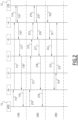
- four slave nodes are provided, numbered 2, 4, 5 and 6. They perform security, firewall, formatting and reverse formatting functions respectively.
- the card 11 also carries a plurality of conversion devices. In the embodiment of the figure 1 , three conversion devices are provided, numbered 3, 7 and 8.
- the firewall data processing nodes 4, formatter 5, master 1, and reverse protocol termination 6 are connected in series to form a data flow filtering chain.
- Security data processing node 2 is connected to each of the data processing nodes in the filtering chain.
- Master node 1 is thus “buried” in the heart of card 11, in the sense that it does not present any direct interface with either of domains 12 and 13.
- the architecture of the gateway is such that a data stream from the low trust domain 12 is constrained to pass successively through the firewall nodes 4, formatter 5 and master 1. This constraint is physically achieved by means of the communication links between these nodes: the single operational communication channel leaving node 4 (out of the interface to the low trust domain) leads to node 5 and the single operational communication channel leaving node 5 (out of the interface to node 4) leads to node 1.
- nodes 4, 5 and 1 On the low trust level side of the gateway (i.e. nodes 4, 5 and 1), there are indeed communication channels between each of nodes 4, 5 and 1 on the one hand and the node 2 on the other hand, but these channels, along links U42, U52 and U12, only allow the sending of operating information generated by a node to a log file (log file) stored by node 2.
- log file log file
- the upstream query communications are received by the node 1 then transmitted after filtering to the node 2 via the link B12, and the downstream response communications are transmitted by the node 2 either to the node 1 via the link B12 (for example, in the case of contextual filtering implemented by the node 1), or directly to the node 4 via the link U24 (to communicate directly and therefore more quickly with the domain 12).
- Firewall node 4 is positioned in front of low trust domain 12 where computer attacks can originate.
- the first module 3 is itself directly connected to domain 12 by a bidirectional link B3, for example made up of two unidirectional links to ensure bidirectionality.
- Firewall node 4 also has an input/output port for establishing a bi-directional B45 link with deformatter node 5.
- Firewall node 4 has an output port U42 for establishing a one-way link with service node 2.
- Firewall node 4 has an ingress port for establishing a one-way U24 link with service node 2.
- Firewall node 4 has an ingress port for establishing a one-way U64 link with reformatting node 6.
- This first node 4 in the data filtering chain ensures a first level of firewall-type filtering. It executes different security verification rules on the data flows received from domain 12.
- node 4 If the flow is rejected, node 4 generates log information and forwards it to service node 2.
- module 4 rejects a frame from the flow
- the header information of this frame is sent to service module 2.
- An aggregation of the header information is advantageously carried out by module 4 when too many frames are rejected.
- Node 5 is positioned between node 4 and master node 1 in the data filtering chain.
- It has an input/output port for establishing the bidirectional B45 link with node 4 and an input/output port for establishing a bidirectional B51 link with master node 1.
- Node 5 has an output port for establishing a one-way U52 link to service node 2.
- Node 5 provides a second level of filtering by modifying the format of the flows.
- module 5 performs a protocol break. It determines the nature of the incident flow, i.e. its format. For example, the data stream is related to a flight plan or to a software download. Node 5 then converts this incident stream into a neutral format. If the protocol break is successful (in the sense that the message contained in the incident data stream is coherent, without syntax errors), the stream is retransmitted, in this neutral format, to master node 1. On the other hand, if the incident stream is rejected, node 5 generates new log entries and transmits them to service node 2 via link U52.
- module 5 For a data stream from the high trust domain, module 5 performs a reverse protocol break. It receives a data stream in the neutral format from master node 1. It converts this stream into the required format before forwarding it to firewall node 4.
- the neutral format is not standardized and is implementation dependent.
- master node 1 is positioned between deformatter node 5 and reformat node 6.
- It has one input/output port for establishing a bidirectional B51 link with node 5 and one input/output port for establishing a bidirectional B16 link with node 6.
- Master node 1 performs various filtering.
- the master node performs a usage domain type filtering, where each data presented in the neutral format of the protocol break is filtered with respect to the value it is supposed to represent. For example: filter a text type field by eliminating certain special characters; filter a speed field with respect to the values potentially reached by the aircraft; prohibit flows of a certain nature according to the phases of the aircraft (flight, taxiing, ground maintenance, etc.), where such and such data has no reason to exist.
- master node 1 applies fast filtering or slow filtering so as to respect a latency time adapted to the nature of the incident flow, as identified by node 5. This makes it possible to limit the crossing time of certain so-called critical flows. Master node 1 thus prioritizes critical flows by ensuring processing in a dedicated task, the other, non-critical flows being processed in a general task.
- master node 1 applies contextual filtering. For example, if a first request message flows from domain 13 to domain 12, master node 1 expects to have to filter the corresponding response message that domain 13 will address node 12. Master node 1 thus applies a consistency verification process for exchanges between the two domains.
- the master node 1 advantageously performs tests to monitor the proper functioning of the electronic card 11 and its components.
- the execution of a test is for example triggered in a ground maintenance phase.
- the master node 1 advantageously performs a filtering of the requests for passage in download, in particular on the good format of such requests, the download then consisting in importing information for the operation of the gateway (configuration value of the firewall, software update to carry out the protocol break from a data format to the neutral format, etc.)
- maintenance equipment is connected to the gateway 10 to update software in the firewall module 4.
- This equipment transmits a download request, which is therefore filtered by the firewall module 4, which retransmits it to the protocol break module 5, which itself retransmits it to the master module 1.
- the master node 1 checks a whole series of conditions. Among these conditions there is for example the fact that a piece of equipment is actually connected to the gateway, that the operating phase of the aircraft corresponds to a ground maintenance phase, etc. In the event of a positive verification, the node 1 is able to modify the operating mode of the gateway to switch from a maintenance mode for example to a download mode.
- Node 1 is capable of generating an interrupt signal leading to the restart of the gateway, i.e. the restart of each of the nodes.
- Master node 1 runs a HIDS (Host-based Intrusion Detection System) intrusion detection application on all the flows it filters.
- HIDS HyperText-based Intrusion Detection System
- the intrusion detection application needs environmental data from all the nodes and centralized by service node 2. Hence the presence of the bidirectional communication link B12 between master node 1 and service node 2 for the exchange of this data.
- the detection information generated by this application constitutes entries in the log maintained by service node 2. This information is sent by node 1 to node 2 via the U12 link.
- master node 1 sends it back to reformatting node 6.
- node 6 performs an inverse protocol break to switch from the neutral format to a format expected by the high trust domain 13.
- node 6 performs a protocol break.
- master node 1 On the other side of master node 1, it will be up to node 5 to perform the reverse protocol break to switch from the neutral format to a format expected by the firewall node or low trust domain.
- node 6 has an input/output port for establishing the bidirectional B16 link with master node 1.
- It has an input/output port for establishing a bidirectional B67 connection with the second conversion module 7.
- It has an input/output port for establishing a bidirectional B68 connection with the third conversion module 8.
- Node 6 also has an output port for establishing a one-way U62 link to service node 2.
- Node 6 has an output port for establishing the one-way U64 handshake to firewall node 4.
- node 6 If the flow is rejected, node 6 generates log information and forwards it to service node 2.
- the second conversion module 7 makes it possible to convert a data stream coming from the node 6 into a data stream in the format required by the domain 13.
- the second module 7 is connected directly to the domain 13 by a bidirectional B7 link, preferably ARINC 664 P3 or ARINC 664 P7, at 100 Mbit/s or possibly more.
- the third conversion module 8 makes it possible to convert a data stream coming from the node 6 into a data stream in the format required by the domain 13.
- the third conversion module 8 is connected directly to the domain 13 by a bidirectional B8 link, preferably ARINC 429.
- a flow coming from a high trust domain must be transmitted by the reverse formatting node 6 either by the master node 1 or directly to the firewall node 4.
- the condition for routing a flow by node 6 results from a configuration of the latter. For example, the routing condition depends on the data format of the flow to be processed.
- Node 2 performs various security functions.
- It has one input/output port for establishing the bidirectional B12 link with master node 1, and one input/output port for establishing the bidirectional B62 link with node 6.
- Service Node 2 ensures the saving of security events and their emissions in a log file (log file).
- log file For example, the log file is saved in SYSLOG format.
- the service node 2 ensures the backup and transmission of data associated with the proper functioning of the gateway. This function is for example known to those skilled in the art under the name “BITE” (“Built In Test Equipment”). It involves performing cyclically or as a function of triggering events, suitable tests on the various components of the gateway.
- BITE Busilt In Test Equipment
- the service node 2 is responsible for download exchanges with external equipment, once the switch to download has been validated by the master node 1. To respond to a request to download the log file sent by an application in the low trust domain 12 and validated by node 1, node 2 can transmit the data via the B12 link, or when there is a simple query, via the U24 link directly to the firewall node 4. The U24 link is thus used to respond efficiently to simple download requests.
- the use of the Gigabit Ethernet protocol along the filter chain ensures limited traversal times between domains 12 and 13 so as to obtain traversal times of less than 50ms, in accordance with avionics requirements. Indeed, the Ethernet protocol allows a flow to be resent very quickly after receiving the last fragment of a message. Without rapid retransmission to the next node, the gateway traversal time would be significantly impacted, particularly for long fragmented messages, because the protocol break can only be made on a complete message and not a fragment of the latter.
- the internal links along the filter chain therefore have a higher bandwidth than the connections connecting the gateway to the high and low trust domains.
- the gateway crossing time is optimized by taking into account the time of the processing carried out independently by each of the nodes arranged in series along the filtering chain.
- the master node 1 performs a simple filtering of the data flows circulating from the low trust domain 12 to the high trust domain 13.
- a request message is sent from domain 13 to a server in domain 12.
- Gateway 10 which is the cut-off point between the two domains, receives the request message.
- the request message is first received (step 110) by node 6, which forwards it (112) directly and without format modification to firewall node 4 via U64 link. Node 4 in turn forwards it (114) to domain 12.
- the request message is routed to the recipient server, which constructs a suitable response message.
- the response message is sent back from low trust domain 12 to high trust domain 13.
- the response message therefore passes through gateway 10.
- the response message is received (115) by the firewall node 4. After positive verification, the node 4 forwards it (116) to the formatting node 5.
- master node 1 Upon receiving the response message, master node 1 applies appropriate filtering treatments.
- the response message is transmitted (118) by the master node 1 to the reverse formatting node 6.
- the latter converts the response message according to the required format and retransmits it (119) on high trust domain 13.
- the master node 1 performs contextual filtering, in this case a consistency check between request and response messages.
- a request message is sent from the high trust domain 13 to a server in the low trust domain 12.
- the gateway 10 which is the cut-off point between the two domains, receives the request message.
- This request message is received (step 210) by the reverse formatting node 6. Taking into account for example the value of a field of the header of the request message, the node 6 applies a protocol break on the request message and retransmits (211) the request message in the neutral format to the master node 1.
- master node 1 memorizes, for example, the identifier of this request to subsequently perform the consistency check.
- Master node 1 retransmits (step 212) the request message to formatting node 5, which applies a reverse protocol break and retransmits (213) the request message in the adapted format to node 4.
- the request message is routed to the recipient server, which constructs a suitable response message.
- the response message is sent back from the low trust domain to the high trust domain.
- the response message therefore passes through gateway 10.
- the response message is sent back from low trust domain 12 to high trust domain 13.
- the response message therefore passes through gateway 10.
- the response message is received (215) by the firewall node 4, which forwards it (216), after verification, to the formatting node 5.
- master node 1 Upon receiving the response message, master node 1 applies the appropriate filtering processes as well as the consistency check. To do this, it checks whether the identifier contained in the response message matches the identifier contained in the request message previously processed by master node 1.
- the response message is retransmitted (step 218) by the master node 1 to the node 6, which, after reverse protocol rupture, sends it back (219) to the high trust domain 13.
- the low trust domain 12 applies to the gateway a download request message, for example with a view to downloading a software update for the firewall node 4.
- a download request message is received (step 310) from low trust domain 12 by firewall node 4.
- firewall node 4 forwards it (311) to formatting node 5.
- Node 5 performs the protocol break and retransmits (312) a neutral format download request message to master node 1.
- Master node 1 analyzes the download request message. In particular, it checks that the current operation of the aircraft is compatible with a switch to a gateway download mode. Indeed, for example, if the aircraft is in flight, master node 1 rejects the download request because it may affect the overall operational safety of the aircraft.
- master node 1 switches the gateway to a download operating mode.
- node 6 routes (314) the control message to node 2 along link B62.
- service module 2 Upon receipt of the command message, service module 2 handles the download.
- the file is downloaded from domain 12 to node 2 via nodes 4, 5, 1, and 6.
- node 2 saves (315) the downloaded file to a flash memory of firewall node 4.
- node 2 After the download is complete, node 2 notifies master node 1 that the operation is complete.
- the master node 1 then commands a restart of the gateway 10, during which the firewall node 4 resets the contents of its random access memory - RAM with the information contained in the flash memory associated with it, and consequently with the update file which has just been downloaded.
- the gateway just presented achieves the security levels required for the avionics domain, which would not be the case with simple software segregation.
- the gateway architecture based on different physically independent nodes, makes it possible to simplify the proofs of a good development of the security functions.
- the master nodes 1 and protocol break 5 are advantageously developed according to the highest level, SAL3; the firewall node 4 according to the intermediate level, SAL2; and the service nodes 2 and reverse protocol break 6 according to the lowest level, SAL 1.
- protocol break must be developed in SAL3 to be able to achieve a good level of filtering with the highest level of cybersecurity quality assurance.
- the service node often presents a high complexity. It would be complicated and expensive to develop it according to the SAL2 level.
- the invention therefore makes it possible to relax the development constraints on this component, while ensuring that it cannot be used to bypass the filtering of flows, which always return to the master node.
- the architecture therefore allows tasks to be isolated according to their criticality and their associated quality assurance levels, while ensuring a passage point for the different flows to ensure systematic filtering.
- the gateway allows high-quality filtering to be carried out using different technologies depending on the flows.
- the proposed solution ensures that all data flows from the low security domain pass through the master node. This architecture ensures that the filtering function is not bypassed.
- the master node is not in direct relation with the low trust domain: it only receives flows that have passed through two filters, that carried out by the firewall and that carried out by the protocol break.
- the various data processing nodes are integrated on a single electronic card, which leads to a solution having a reduced form factor, which is advantageous since volume constraints are strong constraints in the avionics field.
- the processing nodes are implanted on several electronic cards connected to each other in a suitable manner.
- the modular aspect facilitates the development, certification, maintenance, and updating of the gateway.
- this gateway only has one per fire, placed at the input connected to the low-trust network domain.
- the gateway is configurable, which allows the various filtering functions to be configured according to common threats.
Landscapes
- Engineering & Computer Science (AREA)
- Computer Networks & Wireless Communication (AREA)
- Signal Processing (AREA)
- Computer Hardware Design (AREA)
- Computer Security & Cryptography (AREA)
- Computing Systems (AREA)
- General Engineering & Computer Science (AREA)
- Data Exchanges In Wide-Area Networks (AREA)
- Computer And Data Communications (AREA)
Claims (11)
- Netzwerksicherheits-Gateway (10), das dazu bestimmt ist, an Bord eines Flugzeugs eingebaut zu sein, um eine Niedrigsicherheitsdomain (12) und eine Hochsicherheitsdomain (13) einer Avionik-Computing-Infrastruktur zu verbinden, wobei das Gateway eine Vielzahl von Sicherheitsfunktionen bietet, wobei jede Funktion durch einen Datenverarbeitungsknoten realisiert wird, wobei das Gateway, in Reihe geschaltet entlang einer Filterkette eines von der Niedrigsicherheitsdomain empfangenen Datenstroms, umfasst:- einen Firewall-Datenverarbeitungsknoten (4);- einen Protokollunterbrechungs-Datenverarbeitungsknoten (5);- einen Master-Datenverarbeitungsknoten (1); und- einen inversen Protokollunterbrechungs-Datenverarbeitungsknoten (6),wobei das Gateway ferner einen Sicherheits-Datenverarbeitungsknoten (2) umfasst, der mit jedem der Datenverarbeitungsknoten der Filterkette verbunden ist, wobei die verschiedenen Datenverarbeitungsknoten physisch segregiert sind,wobei der Master-Datenverarbeitungsknoten (1) eine Intrusion Detection Anwendung ausführt und die von der Anwendung erzeugten Detection-Informationen an den Sicherheits-Datenverarbeitungsknoten(2) als Einträge in einer Protokolldatei adressiert werden.
- Gateway nach Anspruch 1, wobei die Knoten der Filterkette über bidirektionale Verbindungen, vorzugsweise im Ethernet-Format, weiter vorzugsweise im Ethernet-Format 1 Gbit/s, verbunden sind, die eine höhere Bandbreite aufweisen als die Verbindungen, die erlauben, das Gateway mit der Niedrigsicherheits- und Hochsicherheitsdomain zu verbinden.
- Gateway nach einem der Ansprüche 1 bis 2, wobei der Sicherheits-Datenverarbeitungsknoten
(2) mit der Vielzahl von Knoten der Filterkette durch unidirektionale Verbindungen, vorzugsweise im seriellen Format, weiter vorzugsweise im synchronisierten seriellen Format, verbunden ist. - Gateway nach einem der Ansprüche 1 bis 3, wobei das Gateway eine Ethernet- und/oder ARINC 429- und/oder ARINC 664-Schnittstelle mit der Hochsicherheitsdomain (13) und eine Ethernet- und/oder ARINC 429- und/oder ARINC 664-Schnittstelle mit der Niedrigsicherheitsdomain (12) bildet.
- Gateway nach einem der Ansprüche 1 bis 4, wobei der Firewall-Datenverarbeitungsknoten (4) durch ein erstes Konvertierungsmodul (3), das eine Konvertierung eines Formats eines Datenstroms aus der Niedrigsicherheitsdomain (12), vorzugsweise des ARINC 429-Formats, in ein von dem Firewall-Datenverarbeitungsknoten (4) erwartetes Datenformat durchführt, mit der Niedrigsicherheitsdomain (12) verbunden ist.
- Gateway nach einem der Ansprüche 1 bis 5, wobei der eine inverse Protokollunterbrechungs-Verarbeitungsknoten (6) mit der Hochsicherheitsdomain (13) durch ein zweites Konvertierungsmodul (7) verbunden ist, das eine Konvertierung eines Formats eines von dem inversen Protokollunterbrechungs-Verarbeitungsknoten (6) gelieferten Datenstroms, vorzugsweise des 100 Mbit/s Ethernet-Formats, in ein von der Niedrigsicherheitsdomain (12) erwartetes Format, vorzugsweise das ARINC 664-Format, weiter bevorzugt ARINC 664 P3 oder P7, durchführt.
- Gateway nach einem der Ansprüche 1 bis 6, wobei der Master-Datenverarbeitungsknoten (1) einen Datenstrom in Abhängigkeit von einem Kontext oder in Abhängigkeit von einer Prioritätsstufe filtert.
- Gateway nach einem der Ansprüche 1 bis 7, wobei jeder Datenstrom aus der Niedrigsicherheitsdomain (12) den Master-Datenverarbeitungsknoten (1) durchquert, sofern er nicht vom Firewall-Datenverarbeitungsknoten (4) oder vom Protokollunterbrechungs-Datenverarbeitungsknoten (5) abgelehnt wurde.
- Gateway nach einem der Ansprüche 1 bis 8, wobei der Firewall-Datenverarbeitungsknoten (4) neben seiner Schnittstelle mit der Niedrigsicherheitsdomain (12) nur einen Ausgangsport aufweist, der die Beförderung jedes operativen Datenstroms von der Niedrigsicherheitsdomain (12) zum Protokollunterbrechungs-Datenverarbeitungsknoten (5) erzwingt, und wobei der Firewall-Datenverarbeitungsknoten (4) neben seiner Schnittstelle mit dem Protokollunterbrechungs-Datenverarbeitungsknoten (5) nur einen Ausgangsport aufweist, der die Beförderung jedes operativen Datenstroms von der Niedrigsicherheitsdomain (12) zum Master-Datenverarbeitungsknoten (1) erzwingt.
- Gateway nach einem der Ansprüche 1 bis 9, wobei jeder Datenstrom von der Hochsicherheitsdomain (13) und an die Niedrigsicherheitsdomain (12) und der nicht durch den Master-Datenverarbeitungsknoten (1) verläuft, über mindestens eine unidirektionale Verbindung durch das Gateway geleitet wird.
- Gateway nach einem der Ansprüche 1 bis 10, das nur einen einzigen Firewall-Datenverarbeitungsknoten (4) aufweist, der sich am Eingang der Filterkette auf der Seite der Niedrigsicherheitsdomain (12) befindet.
Applications Claiming Priority (1)
| Application Number | Priority Date | Filing Date | Title |
|---|---|---|---|
| FR2204073A FR3135062B1 (fr) | 2022-04-29 | 2022-04-29 | Passerelle de sécurité réseau embarquée à bord d’un aéronef pour connecter des domaines de confiance basse et haute d’une infrastructure informatique avionique. |
Publications (2)
| Publication Number | Publication Date |
|---|---|
| EP4270874A1 EP4270874A1 (de) | 2023-11-01 |
| EP4270874B1 true EP4270874B1 (de) | 2025-02-12 |
Family
ID=83355529
Family Applications (1)
| Application Number | Title | Priority Date | Filing Date |
|---|---|---|---|
| EP23170235.8A Active EP4270874B1 (de) | 2022-04-29 | 2023-04-27 | Bordinternes netzwerksicherheitsgateway zur verbindung von niedrig- und hochsicherheitsdomänen einer avionik-computing-infrastruktur |
Country Status (4)
| Country | Link |
|---|---|
| US (1) | US12580886B2 (de) |
| EP (1) | EP4270874B1 (de) |
| ES (1) | ES3029335T3 (de) |
| FR (1) | FR3135062B1 (de) |
Families Citing this family (1)
| Publication number | Priority date | Publication date | Assignee | Title |
|---|---|---|---|---|
| EP4564739A1 (de) * | 2023-11-29 | 2025-06-04 | Airbus Operations GmbH | Filtervorrichtung und verfahren zur kommunikation zwischen einer vertrauenswürdigen domäne und einer unsicheren domäne sowie computersystem |
Family Cites Families (9)
| Publication number | Priority date | Publication date | Assignee | Title |
|---|---|---|---|---|
| WO2005114947A1 (en) * | 2004-05-20 | 2005-12-01 | Qinetiq Limited | Firewall system |
| US8161529B1 (en) * | 2006-03-02 | 2012-04-17 | Rockwell Collins, Inc. | High-assurance architecture for routing of information between networks of differing security level |
| US8291495B1 (en) * | 2007-08-08 | 2012-10-16 | Juniper Networks, Inc. | Identifying applications for intrusion detection systems |
| FR2922705B1 (fr) * | 2007-10-23 | 2011-12-09 | Sagem Defense Securite | Passerelle bidirectionnelle a niveau de securite renforce |
| FR3033658B1 (fr) * | 2015-03-12 | 2017-04-07 | Thales-Raytheon Systems Company Sas | Systeme electronique de reemission securisee de messages, procede de reemission et produit programme d'ordinateur associes |
| US11063886B2 (en) * | 2016-12-08 | 2021-07-13 | Vado Security Technologies Ltd | System and method for directing data packets by a virtual switch over a unidirectional medium |
| US10771345B1 (en) * | 2016-12-28 | 2020-09-08 | Amazon Technologies, Inc. | Network monitoring service |
| US11310201B2 (en) * | 2018-10-23 | 2022-04-19 | Akamai Technologies, Inc. | Network security system with enhanced traffic analysis based on feedback loop |
| US11509675B2 (en) * | 2020-09-25 | 2022-11-22 | Honeywell International Inc. | Systems and methods for cyber monitoring and alerting for connected aircraft |
-
2022
- 2022-04-29 FR FR2204073A patent/FR3135062B1/fr active Active
-
2023
- 2023-04-26 US US18/307,500 patent/US12580886B2/en active Active
- 2023-04-27 EP EP23170235.8A patent/EP4270874B1/de active Active
- 2023-04-27 ES ES23170235T patent/ES3029335T3/es active Active
Also Published As
| Publication number | Publication date |
|---|---|
| FR3135062A1 (fr) | 2023-11-03 |
| ES3029335T3 (en) | 2025-06-24 |
| US12580886B2 (en) | 2026-03-17 |
| US20230353536A1 (en) | 2023-11-02 |
| FR3135062B1 (fr) | 2024-12-20 |
| EP4270874A1 (de) | 2023-11-01 |
Similar Documents
| Publication | Publication Date | Title |
|---|---|---|
| EP2204034B1 (de) | Bidirektionaler gateway mit erhöhter sicherheit | |
| EP1309130A1 (de) | Geschaltetes vollduplex-Ethernet Kommunikationsnetz und Verfahren dafür | |
| US10587521B2 (en) | Hierarchical orchestration of a computer network | |
| CN112235266B (zh) | 一种数据处理方法、装置、设备及存储介质 | |
| US11677668B1 (en) | Transparent application-layer/os deeper packet inspector | |
| EP3346663B1 (de) | Vorrichtung, system und verfahren zur beschleunigung von sicherheitsinspektionen mit inline-musterabgleich | |
| EP4270874B1 (de) | Bordinternes netzwerksicherheitsgateway zur verbindung von niedrig- und hochsicherheitsdomänen einer avionik-computing-infrastruktur | |
| CN118101459B (zh) | 基于fttr的数据管控方法和装置、网关设备及介质 | |
| JP2007538444A (ja) | ファイアウォール・システム | |
| US12021658B2 (en) | Switch device, in-vehicle communication system, and communication method | |
| FR3045256A1 (fr) | Reseau de communication embarque d'un vehicule et abonne d'un tel reseau de communication | |
| CN116614242B (zh) | 在sdwan架构中针对云管理的ipsec密钥绕过ike防火墙 | |
| FR3030162A1 (fr) | Procede d'echange de trames de donnees numeriques et systeme de communication associe | |
| WO2011157704A2 (fr) | Système et méthode de gestion de flux sécurisés entre plusieurs sites distants | |
| EP2783485A1 (de) | Datenübertragungsnetzwek und programmierbarer netzwerkknoten | |
| CN117223250A (zh) | 基于云的外出过滤系统 | |
| EP3637645B1 (de) | Elektronische vorrichtung und verfahren zum datenempfang über ein redundantes kommunikationsnetz, entsprechendes kommunikationssystem und computerprogramm | |
| CA2949332A1 (fr) | Commutateur de trames numeriques | |
| EP3122005A1 (de) | Routing-system, das eine datenfilterung zur integration und überprüfung der betriebsausrüstungen ermöglicht | |
| EP4468656B1 (de) | Kommunikationsgateway mit verbesserter filterung, flugzeug, filterungsverfahren und computerprogramm dafür | |
| EP3675438A1 (de) | Konfigurationsverfahren eines avionik-netzes, entsprechendes computerprogrammprodukt und konfigurationsmodul | |
| WO2026046567A1 (fr) | Passerelle multi-protocole | |
| US20250322084A1 (en) | Enforcing trusted and untrusted postures on data traffic and transports | |
| AU2019343504B2 (en) | A method and device for transferring electronic information | |
| EP2667574B1 (de) | Sicherungsverfahren und -vorrichtung für den Austausch von Mitteilungen, die über ein Verbundnetz übertragen werden |
Legal Events
| Date | Code | Title | Description |
|---|---|---|---|
| PUAI | Public reference made under article 153(3) epc to a published international application that has entered the european phase |
Free format text: ORIGINAL CODE: 0009012 |
|
| STAA | Information on the status of an ep patent application or granted ep patent |
Free format text: STATUS: THE APPLICATION HAS BEEN PUBLISHED |
|
| STAA | Information on the status of an ep patent application or granted ep patent |
Free format text: STATUS: REQUEST FOR EXAMINATION WAS MADE |
|
| AK | Designated contracting states |
Kind code of ref document: A1 Designated state(s): AL AT BE BG CH CY CZ DE DK EE ES FI FR GB GR HR HU IE IS IT LI LT LU LV MC ME MK MT NL NO PL PT RO RS SE SI SK SM TR |
|
| 17P | Request for examination filed |
Effective date: 20231023 |
|
| RBV | Designated contracting states (corrected) |
Designated state(s): AL AT BE BG CH CY CZ DE DK EE ES FI FR GB GR HR HU IE IS IT LI LT LU LV MC ME MK MT NL NO PL PT RO RS SE SI SK SM TR |
|
| P01 | Opt-out of the competence of the unified patent court (upc) registered |
Effective date: 20231108 |
|
| GRAP | Despatch of communication of intention to grant a patent |
Free format text: ORIGINAL CODE: EPIDOSNIGR1 |
|
| STAA | Information on the status of an ep patent application or granted ep patent |
Free format text: STATUS: GRANT OF PATENT IS INTENDED |
|
| GRAS | Grant fee paid |
Free format text: ORIGINAL CODE: EPIDOSNIGR3 |
|
| GRAA | (expected) grant |
Free format text: ORIGINAL CODE: 0009210 |
|
| STAA | Information on the status of an ep patent application or granted ep patent |
Free format text: STATUS: THE PATENT HAS BEEN GRANTED |
|
| INTG | Intention to grant announced |
Effective date: 20241212 |
|
| AK | Designated contracting states |
Kind code of ref document: B1 Designated state(s): AL AT BE BG CH CY CZ DE DK EE ES FI FR GB GR HR HU IE IS IT LI LT LU LV MC ME MK MT NL NO PL PT RO RS SE SI SK SM TR |
|
| REG | Reference to a national code |
Ref country code: GB Ref legal event code: FG4D Free format text: NOT ENGLISH |
|
| REG | Reference to a national code |
Ref country code: CH Ref legal event code: EP |
|
| REG | Reference to a national code |
Ref country code: DE Ref legal event code: R096 Ref document number: 602023001974 Country of ref document: DE |
|
| REG | Reference to a national code |
Ref country code: IE Ref legal event code: FG4D Free format text: LANGUAGE OF EP DOCUMENT: FRENCH |
|
| REG | Reference to a national code |
Ref country code: NL Ref legal event code: MP Effective date: 20250212 |
|
| REG | Reference to a national code |
Ref country code: ES Ref legal event code: FG2A Ref document number: 3029335 Country of ref document: ES Kind code of ref document: T3 Effective date: 20250624 |
|
| PG25 | Lapsed in a contracting state [announced via postgrant information from national office to epo] |
Ref country code: RS Free format text: LAPSE BECAUSE OF FAILURE TO SUBMIT A TRANSLATION OF THE DESCRIPTION OR TO PAY THE FEE WITHIN THE PRESCRIBED TIME-LIMIT Effective date: 20250512 |
|
| PG25 | Lapsed in a contracting state [announced via postgrant information from national office to epo] |
Ref country code: FI Free format text: LAPSE BECAUSE OF FAILURE TO SUBMIT A TRANSLATION OF THE DESCRIPTION OR TO PAY THE FEE WITHIN THE PRESCRIBED TIME-LIMIT Effective date: 20250212 |
|
| PG25 | Lapsed in a contracting state [announced via postgrant information from national office to epo] |
Ref country code: PL Free format text: LAPSE BECAUSE OF FAILURE TO SUBMIT A TRANSLATION OF THE DESCRIPTION OR TO PAY THE FEE WITHIN THE PRESCRIBED TIME-LIMIT Effective date: 20250212 |
|
| PGFP | Annual fee paid to national office [announced via postgrant information from national office to epo] |
Ref country code: DE Payment date: 20250411 Year of fee payment: 3 |
|
| PGFP | Annual fee paid to national office [announced via postgrant information from national office to epo] |
Ref country code: ES Payment date: 20250512 Year of fee payment: 3 |
|
| REG | Reference to a national code |
Ref country code: LT Ref legal event code: MG9D |
|
| PG25 | Lapsed in a contracting state [announced via postgrant information from national office to epo] |
Ref country code: IS Free format text: LAPSE BECAUSE OF FAILURE TO SUBMIT A TRANSLATION OF THE DESCRIPTION OR TO PAY THE FEE WITHIN THE PRESCRIBED TIME-LIMIT Effective date: 20250612 Ref country code: NO Free format text: LAPSE BECAUSE OF FAILURE TO SUBMIT A TRANSLATION OF THE DESCRIPTION OR TO PAY THE FEE WITHIN THE PRESCRIBED TIME-LIMIT Effective date: 20250512 |
|
| PG25 | Lapsed in a contracting state [announced via postgrant information from national office to epo] |
Ref country code: NL Free format text: LAPSE BECAUSE OF FAILURE TO SUBMIT A TRANSLATION OF THE DESCRIPTION OR TO PAY THE FEE WITHIN THE PRESCRIBED TIME-LIMIT Effective date: 20250212 |
|
| PGFP | Annual fee paid to national office [announced via postgrant information from national office to epo] |
Ref country code: BE Payment date: 20250423 Year of fee payment: 3 |
|
| PG25 | Lapsed in a contracting state [announced via postgrant information from national office to epo] |
Ref country code: HR Free format text: LAPSE BECAUSE OF FAILURE TO SUBMIT A TRANSLATION OF THE DESCRIPTION OR TO PAY THE FEE WITHIN THE PRESCRIBED TIME-LIMIT Effective date: 20250212 |
|
| PG25 | Lapsed in a contracting state [announced via postgrant information from national office to epo] |
Ref country code: PT Free format text: LAPSE BECAUSE OF FAILURE TO SUBMIT A TRANSLATION OF THE DESCRIPTION OR TO PAY THE FEE WITHIN THE PRESCRIBED TIME-LIMIT Effective date: 20250612 Ref country code: LV Free format text: LAPSE BECAUSE OF FAILURE TO SUBMIT A TRANSLATION OF THE DESCRIPTION OR TO PAY THE FEE WITHIN THE PRESCRIBED TIME-LIMIT Effective date: 20250212 |
|
| PGFP | Annual fee paid to national office [announced via postgrant information from national office to epo] |
Ref country code: FR Payment date: 20250429 Year of fee payment: 3 |
|
| PG25 | Lapsed in a contracting state [announced via postgrant information from national office to epo] |
Ref country code: GR Free format text: LAPSE BECAUSE OF FAILURE TO SUBMIT A TRANSLATION OF THE DESCRIPTION OR TO PAY THE FEE WITHIN THE PRESCRIBED TIME-LIMIT Effective date: 20250513 Ref country code: BG Free format text: LAPSE BECAUSE OF FAILURE TO SUBMIT A TRANSLATION OF THE DESCRIPTION OR TO PAY THE FEE WITHIN THE PRESCRIBED TIME-LIMIT Effective date: 20250212 |
|
| REG | Reference to a national code |
Ref country code: AT Ref legal event code: MK05 Ref document number: 1767151 Country of ref document: AT Kind code of ref document: T Effective date: 20250212 |
|
| PG25 | Lapsed in a contracting state [announced via postgrant information from national office to epo] |
Ref country code: SE Free format text: LAPSE BECAUSE OF FAILURE TO SUBMIT A TRANSLATION OF THE DESCRIPTION OR TO PAY THE FEE WITHIN THE PRESCRIBED TIME-LIMIT Effective date: 20250212 |
|
| PG25 | Lapsed in a contracting state [announced via postgrant information from national office to epo] |
Ref country code: SM Free format text: LAPSE BECAUSE OF FAILURE TO SUBMIT A TRANSLATION OF THE DESCRIPTION OR TO PAY THE FEE WITHIN THE PRESCRIBED TIME-LIMIT Effective date: 20250212 |
|
| PG25 | Lapsed in a contracting state [announced via postgrant information from national office to epo] |
Ref country code: DK Free format text: LAPSE BECAUSE OF FAILURE TO SUBMIT A TRANSLATION OF THE DESCRIPTION OR TO PAY THE FEE WITHIN THE PRESCRIBED TIME-LIMIT Effective date: 20250212 |
|
| PG25 | Lapsed in a contracting state [announced via postgrant information from national office to epo] |
Ref country code: IT Free format text: LAPSE BECAUSE OF FAILURE TO SUBMIT A TRANSLATION OF THE DESCRIPTION OR TO PAY THE FEE WITHIN THE PRESCRIBED TIME-LIMIT Effective date: 20250212 |
|
| PG25 | Lapsed in a contracting state [announced via postgrant information from national office to epo] |
Ref country code: AT Free format text: LAPSE BECAUSE OF FAILURE TO SUBMIT A TRANSLATION OF THE DESCRIPTION OR TO PAY THE FEE WITHIN THE PRESCRIBED TIME-LIMIT Effective date: 20250212 |
|
| PG25 | Lapsed in a contracting state [announced via postgrant information from national office to epo] |
Ref country code: CZ Free format text: LAPSE BECAUSE OF FAILURE TO SUBMIT A TRANSLATION OF THE DESCRIPTION OR TO PAY THE FEE WITHIN THE PRESCRIBED TIME-LIMIT Effective date: 20250212 Ref country code: EE Free format text: LAPSE BECAUSE OF FAILURE TO SUBMIT A TRANSLATION OF THE DESCRIPTION OR TO PAY THE FEE WITHIN THE PRESCRIBED TIME-LIMIT Effective date: 20250212 |
|
| PG25 | Lapsed in a contracting state [announced via postgrant information from national office to epo] |
Ref country code: RO Free format text: LAPSE BECAUSE OF FAILURE TO SUBMIT A TRANSLATION OF THE DESCRIPTION OR TO PAY THE FEE WITHIN THE PRESCRIBED TIME-LIMIT Effective date: 20250212 |
|
| PG25 | Lapsed in a contracting state [announced via postgrant information from national office to epo] |
Ref country code: SK Free format text: LAPSE BECAUSE OF FAILURE TO SUBMIT A TRANSLATION OF THE DESCRIPTION OR TO PAY THE FEE WITHIN THE PRESCRIBED TIME-LIMIT Effective date: 20250212 |
|
| REG | Reference to a national code |
Ref country code: DE Ref legal event code: R097 Ref document number: 602023001974 Country of ref document: DE |
|
| PG25 | Lapsed in a contracting state [announced via postgrant information from national office to epo] |
Ref country code: LU Free format text: LAPSE BECAUSE OF NON-PAYMENT OF DUE FEES Effective date: 20250427 |
|
| PLBE | No opposition filed within time limit |
Free format text: ORIGINAL CODE: 0009261 |
|
| STAA | Information on the status of an ep patent application or granted ep patent |
Free format text: STATUS: NO OPPOSITION FILED WITHIN TIME LIMIT |
|
| PG25 | Lapsed in a contracting state [announced via postgrant information from national office to epo] |
Ref country code: MC Free format text: LAPSE BECAUSE OF FAILURE TO SUBMIT A TRANSLATION OF THE DESCRIPTION OR TO PAY THE FEE WITHIN THE PRESCRIBED TIME-LIMIT Effective date: 20250212 |
|
| 26N | No opposition filed |
Effective date: 20251113 |
|
| PG25 | Lapsed in a contracting state [announced via postgrant information from national office to epo] |
Ref country code: IE Free format text: LAPSE BECAUSE OF NON-PAYMENT OF DUE FEES Effective date: 20250427 |