EP4468461A1 - Cooling pipe for electric vehicle battery - Google Patents
Cooling pipe for electric vehicle battery Download PDFInfo
- Publication number
- EP4468461A1 EP4468461A1 EP23733190.5A EP23733190A EP4468461A1 EP 4468461 A1 EP4468461 A1 EP 4468461A1 EP 23733190 A EP23733190 A EP 23733190A EP 4468461 A1 EP4468461 A1 EP 4468461A1
- Authority
- EP
- European Patent Office
- Prior art keywords
- pipe
- cooling
- electric vehicle
- vehicle battery
- inlet
- Prior art date
- Legal status (The legal status is an assumption and is not a legal conclusion. Google has not performed a legal analysis and makes no representation as to the accuracy of the status listed.)
- Pending
Links
Images




Classifications
-
- H—ELECTRICITY
- H01—ELECTRIC ELEMENTS
- H01M—PROCESSES OR MEANS, e.g. BATTERIES, FOR THE DIRECT CONVERSION OF CHEMICAL ENERGY INTO ELECTRICAL ENERGY
- H01M10/00—Secondary cells; Manufacture thereof
- H01M10/60—Heating or cooling; Temperature control
- H01M10/65—Means for temperature control structurally associated with the cells
- H01M10/655—Solid structures for heat exchange or heat conduction
- H01M10/6556—Solid parts with flow channel passages or pipes for heat exchange
-
- F—MECHANICAL ENGINEERING; LIGHTING; HEATING; WEAPONS; BLASTING
- F28—HEAT EXCHANGE IN GENERAL
- F28F—DETAILS OF HEAT-EXCHANGE AND HEAT-TRANSFER APPARATUS, OF GENERAL APPLICATION
- F28F1/00—Tubular elements; Assemblies of tubular elements
- F28F1/08—Tubular elements crimped or corrugated in longitudinal section
-
- F—MECHANICAL ENGINEERING; LIGHTING; HEATING; WEAPONS; BLASTING
- F16—ENGINEERING ELEMENTS AND UNITS; GENERAL MEASURES FOR PRODUCING AND MAINTAINING EFFECTIVE FUNCTIONING OF MACHINES OR INSTALLATIONS; THERMAL INSULATION IN GENERAL
- F16L—PIPES; JOINTS OR FITTINGS FOR PIPES; SUPPORTS FOR PIPES, CABLES OR PROTECTIVE TUBING; MEANS FOR THERMAL INSULATION IN GENERAL
- F16L53/00—Heating of pipes or pipe systems; Cooling of pipes or pipe systems
- F16L53/70—Cooling of pipes or pipe systems
-
- F—MECHANICAL ENGINEERING; LIGHTING; HEATING; WEAPONS; BLASTING
- F28—HEAT EXCHANGE IN GENERAL
- F28D—HEAT-EXCHANGE APPARATUS, NOT PROVIDED FOR IN ANOTHER SUBCLASS, IN WHICH THE HEAT-EXCHANGE MEDIA DO NOT COME INTO DIRECT CONTACT
- F28D1/00—Heat-exchange apparatus having stationary conduit assemblies for one heat-exchange medium only, the media being in contact with different sides of the conduit wall, in which the other heat-exchange medium is a large body of fluid, e.g. domestic or motor car radiators
- F28D1/02—Heat-exchange apparatus having stationary conduit assemblies for one heat-exchange medium only, the media being in contact with different sides of the conduit wall, in which the other heat-exchange medium is a large body of fluid, e.g. domestic or motor car radiators with heat-exchange conduits immersed in the body of fluid
- F28D1/04—Heat-exchange apparatus having stationary conduit assemblies for one heat-exchange medium only, the media being in contact with different sides of the conduit wall, in which the other heat-exchange medium is a large body of fluid, e.g. domestic or motor car radiators with heat-exchange conduits immersed in the body of fluid with tubular conduits
- F28D1/047—Heat-exchange apparatus having stationary conduit assemblies for one heat-exchange medium only, the media being in contact with different sides of the conduit wall, in which the other heat-exchange medium is a large body of fluid, e.g. domestic or motor car radiators with heat-exchange conduits immersed in the body of fluid with tubular conduits the conduits being bent, e.g. in a serpentine or zig-zag
- F28D1/0477—Heat-exchange apparatus having stationary conduit assemblies for one heat-exchange medium only, the media being in contact with different sides of the conduit wall, in which the other heat-exchange medium is a large body of fluid, e.g. domestic or motor car radiators with heat-exchange conduits immersed in the body of fluid with tubular conduits the conduits being bent, e.g. in a serpentine or zig-zag the conduits being bent in a serpentine or zig-zag
-
- F—MECHANICAL ENGINEERING; LIGHTING; HEATING; WEAPONS; BLASTING
- F28—HEAT EXCHANGE IN GENERAL
- F28F—DETAILS OF HEAT-EXCHANGE AND HEAT-TRANSFER APPARATUS, OF GENERAL APPLICATION
- F28F13/00—Arrangements for modifying heat-transfer, e.g. increasing, decreasing
- F28F13/06—Arrangements for modifying heat-transfer, e.g. increasing, decreasing by affecting the pattern of flow of the heat-exchange media
- F28F13/08—Arrangements for modifying heat-transfer, e.g. increasing, decreasing by affecting the pattern of flow of the heat-exchange media by varying the cross-section of the flow channels
-
- F—MECHANICAL ENGINEERING; LIGHTING; HEATING; WEAPONS; BLASTING
- F28—HEAT EXCHANGE IN GENERAL
- F28F—DETAILS OF HEAT-EXCHANGE AND HEAT-TRANSFER APPARATUS, OF GENERAL APPLICATION
- F28F13/00—Arrangements for modifying heat-transfer, e.g. increasing, decreasing
- F28F13/06—Arrangements for modifying heat-transfer, e.g. increasing, decreasing by affecting the pattern of flow of the heat-exchange media
- F28F13/12—Arrangements for modifying heat-transfer, e.g. increasing, decreasing by affecting the pattern of flow of the heat-exchange media by creating turbulence, e.g. by stirring, by increasing the force of circulation
-
- H—ELECTRICITY
- H01—ELECTRIC ELEMENTS
- H01M—PROCESSES OR MEANS, e.g. BATTERIES, FOR THE DIRECT CONVERSION OF CHEMICAL ENERGY INTO ELECTRICAL ENERGY
- H01M10/00—Secondary cells; Manufacture thereof
- H01M10/60—Heating or cooling; Temperature control
- H01M10/61—Types of temperature control
- H01M10/613—Cooling or keeping cold
-
- H—ELECTRICITY
- H01—ELECTRIC ELEMENTS
- H01M—PROCESSES OR MEANS, e.g. BATTERIES, FOR THE DIRECT CONVERSION OF CHEMICAL ENERGY INTO ELECTRICAL ENERGY
- H01M10/00—Secondary cells; Manufacture thereof
- H01M10/60—Heating or cooling; Temperature control
- H01M10/62—Heating or cooling; Temperature control specially adapted for specific applications
- H01M10/625—Vehicles
-
- H—ELECTRICITY
- H01—ELECTRIC ELEMENTS
- H01M—PROCESSES OR MEANS, e.g. BATTERIES, FOR THE DIRECT CONVERSION OF CHEMICAL ENERGY INTO ELECTRICAL ENERGY
- H01M10/00—Secondary cells; Manufacture thereof
- H01M10/60—Heating or cooling; Temperature control
- H01M10/65—Means for temperature control structurally associated with the cells
- H01M10/655—Solid structures for heat exchange or heat conduction
- H01M10/6556—Solid parts with flow channel passages or pipes for heat exchange
- H01M10/6557—Solid parts with flow channel passages or pipes for heat exchange arranged between the cells
-
- H—ELECTRICITY
- H01—ELECTRIC ELEMENTS
- H01M—PROCESSES OR MEANS, e.g. BATTERIES, FOR THE DIRECT CONVERSION OF CHEMICAL ENERGY INTO ELECTRICAL ENERGY
- H01M10/00—Secondary cells; Manufacture thereof
- H01M10/60—Heating or cooling; Temperature control
- H01M10/66—Heat-exchange relationships between the cells and other systems, e.g. central heating systems or fuel cells
-
- F—MECHANICAL ENGINEERING; LIGHTING; HEATING; WEAPONS; BLASTING
- F16—ENGINEERING ELEMENTS AND UNITS; GENERAL MEASURES FOR PRODUCING AND MAINTAINING EFFECTIVE FUNCTIONING OF MACHINES OR INSTALLATIONS; THERMAL INSULATION IN GENERAL
- F16L—PIPES; JOINTS OR FITTINGS FOR PIPES; SUPPORTS FOR PIPES, CABLES OR PROTECTIVE TUBING; MEANS FOR THERMAL INSULATION IN GENERAL
- F16L11/00—Hoses, i.e. flexible pipes
- F16L11/14—Hoses, i.e. flexible pipes made of rigid material, e.g. metal or hard plastics
- F16L11/15—Hoses, i.e. flexible pipes made of rigid material, e.g. metal or hard plastics corrugated
-
- F—MECHANICAL ENGINEERING; LIGHTING; HEATING; WEAPONS; BLASTING
- F16—ENGINEERING ELEMENTS AND UNITS; GENERAL MEASURES FOR PRODUCING AND MAINTAINING EFFECTIVE FUNCTIONING OF MACHINES OR INSTALLATIONS; THERMAL INSULATION IN GENERAL
- F16L—PIPES; JOINTS OR FITTINGS FOR PIPES; SUPPORTS FOR PIPES, CABLES OR PROTECTIVE TUBING; MEANS FOR THERMAL INSULATION IN GENERAL
- F16L57/00—Protection of pipes or objects of similar shape against external or internal damage or wear
- F16L57/02—Protection of pipes or objects of similar shape against external or internal damage or wear against cracking or buckling
-
- F—MECHANICAL ENGINEERING; LIGHTING; HEATING; WEAPONS; BLASTING
- F28—HEAT EXCHANGE IN GENERAL
- F28D—HEAT-EXCHANGE APPARATUS, NOT PROVIDED FOR IN ANOTHER SUBCLASS, IN WHICH THE HEAT-EXCHANGE MEDIA DO NOT COME INTO DIRECT CONTACT
- F28D21/00—Heat-exchange apparatus not covered by any of the groups F28D1/00 - F28D20/00
- F28D2021/0019—Other heat exchangers for particular applications; Heat exchange systems not otherwise provided for
- F28D2021/0028—Other heat exchangers for particular applications; Heat exchange systems not otherwise provided for for cooling heat generating elements, e.g. for cooling electronic components or electric devices
-
- H—ELECTRICITY
- H01—ELECTRIC ELEMENTS
- H01M—PROCESSES OR MEANS, e.g. BATTERIES, FOR THE DIRECT CONVERSION OF CHEMICAL ENERGY INTO ELECTRICAL ENERGY
- H01M10/00—Secondary cells; Manufacture thereof
- H01M10/60—Heating or cooling; Temperature control
- H01M10/65—Means for temperature control structurally associated with the cells
- H01M10/656—Means for temperature control structurally associated with the cells characterised by the type of heat-exchange fluid
- H01M10/6567—Liquids
- H01M10/6568—Liquids characterised by flow circuits, e.g. loops, located externally to the cells or cell casings
-
- H—ELECTRICITY
- H01—ELECTRIC ELEMENTS
- H01M—PROCESSES OR MEANS, e.g. BATTERIES, FOR THE DIRECT CONVERSION OF CHEMICAL ENERGY INTO ELECTRICAL ENERGY
- H01M2220/00—Batteries for particular applications
- H01M2220/20—Batteries in motive systems, e.g. vehicle, ship, plane
-
- Y—GENERAL TAGGING OF NEW TECHNOLOGICAL DEVELOPMENTS; GENERAL TAGGING OF CROSS-SECTIONAL TECHNOLOGIES SPANNING OVER SEVERAL SECTIONS OF THE IPC; TECHNICAL SUBJECTS COVERED BY FORMER USPC CROSS-REFERENCE ART COLLECTIONS [XRACs] AND DIGESTS
- Y02—TECHNOLOGIES OR APPLICATIONS FOR MITIGATION OR ADAPTATION AGAINST CLIMATE CHANGE
- Y02E—REDUCTION OF GREENHOUSE GAS [GHG] EMISSIONS, RELATED TO ENERGY GENERATION, TRANSMISSION OR DISTRIBUTION
- Y02E60/00—Enabling technologies; Technologies with a potential or indirect contribution to GHG emissions mitigation
- Y02E60/10—Energy storage using batteries
Definitions
- the present disclosure relates to a cooling pipe of an electric vehicle battery, and, more particularly, to a cooling pipe of an electric vehicle battery that has a corrugated pipe generating vortexes and thus is more excellent in cooling the electric vehicle battery.
- High-voltage, high-capacity batteries for electric or hybrid vehicles generally consist of a plurality of battery modules that are each made of a plurality of battery cells, and a battery pack consists of the plurality of battery modules.
- the plurality of battery modules are installed together in a narrow space, generating high-temperature heat, which may act as a factor adversely affecting the lifespan of the battery as a whole.
- a cooling system for controlling high-temperature heat generated by a high-voltage, high-capacity battery must be built in an electric or hybrid vehicle.
- the methods of cooling the high-voltage, high-capacity batteries are classified into air-cooling and water-cooling, and each can be further classified into an indirect cooling method and a direct cooling method.
- the indirect air-cooling or water-cooling which is mainly used in the conventional technology, is a method in which a separate heat sink is brought into contact with the surface of a battery module to conduct heat and the battery module is cooled by a heat sink fin placed on one side of the heat sink for heat exchange.
- the direct air-cooling or water-cooling for the conventional technology is a method of cooling a battery module by directly sending air to the surface of the battery module.
- Patent Literature 1 Patent Publication No. 10-2269221 under the title of "Electric Vehicle Battery Cooling System"
- the present disclosure provides a cooling pipe of an electric vehicle battery in which a corrugated pipe may be formed on the cooling pipe to generate vortexes of a cooling fluid flowing from a radiator to the cooling pipe and the velocity of the cooling fluid may be reduced due to the shape of the corrugated pipe so as to improve the capability of cooling a battery module.
- a cooling pipe of an electric vehicle battery that may be coupled to one side and the other side of a radiator, pass between battery modules of which a battery pack consists, and cool the battery modules, including: a body pipe that may be formed in a pipe shape so that a flow path through which a cooling fluid flows may be formed therein and have an inlet on one side and an outlet on the other side, in which the inlet may be coupled to one side of the radiator and the outlet may be coupled to the other side thereof; and a corrugated pipe that may be integrally formed with the body pipe and formed in the form of one or more corrugations between the inlet and the outlet.
- the corrugated pipe may include: a plurality of expansion tubes whose circumference may be wider than the circumference of the body pipe; and one or more spacers that may be arranged between the plurality of expansion tubes to form a gap therebetween and formed to have a circumference smaller than or equal to the circumference of the body pipe, and the plurality of expansion tubes and the one or more spacers may be alternately arranged with their constant widths in a longitudinal direction of the body pipe.
- cooling fluid flowing into the inlet through the radiator may collide with the inner diameter of the plurality of expansion tubes and move along the inner diameter thereof, vortexes may be generated in the corrugated pipe so as to slow down the cooling fluid.
- the velocity at which a cooling fluid flows in the plurality of expansion tubes may be lower than the velocity at which a cooling fluid flows in the body pipe.
- the cooling pipe may be made of aluminum.
- the present disclosure provides a cooling pipe of an electric vehicle battery in which a corrugated pipe may be formed on the cooling pipe to generate vortexes of a cooling fluid flowing from a radiator to the cooling pipe and the velocity of the cooling fluid may be reduced due to the shape of the corrugated pipe so as to improve the capability of cooling a battery module.
- FIG. 1 is a view showing a cooling pipe of an electric vehicle battery according to an embodiment of the present disclosure
- FIG. 2 is a view showing how a corrugated pipe is formed on a body pipe of the cooling pipe of an electric vehicle battery according to an embodiment of the present disclosure
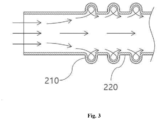
- FIG. 3 is a view showing how vortexes are generated by the corrugated pipe of the cooling pipe of an electric vehicle battery according to an embodiment of the present disclosure.
- the body pipe 100 and the corrugated pipe 200 may be included in the cooling pipe of an electric vehicle battery that may be coupled to one side and the other side of a radiator, pass between battery modules B of which a battery pack consists, and cool the battery modules B.
- the body pipe 100 may be formed in a pipe shape so that a flow path through which a cooling fluid flows may be formed therein.
- An inlet 110 may be formed on one side of the body pipe 100, and an outlet 120 may be formed on the other side thereof.
- the inlet 110 may be coupled to one side of the radiator, and the outlet 120 may be coupled to the other side of the radiator.
- the body pipe 100 may be formed in various shapes such as a straight line, a bend, and a curve.
- the radiator may be a device for dissipating heat generated in the battery module and absorbed in cooling water. Since this is a well-known technology, a detailed description thereof will not be provided.
- the corrugated pipe 200 may be integrally formed with the body pipe 100, and may be formed in the form of one or more corrugations between the inlet 110 and the outlet 120.
- the corrugated pipe 200 may include a plurality of expansion tubes 210 and one or more spacers 220.
- the circumference of the plurality of expansion tubes 210 may be larger than the circumference of the body pipe 100.
- the one or more spacers 220 may be arranged between the plurality of expansion tubes 210 to form a gap therebetween, and may be formed to have a circumference less than or equal to the circumference of the body pipe 100. That is, the one or more spacers 220 may have a circumference of the same size as the circumference of the body pipe 100 as shown in FIG. 3 . However, this is only an example, and the one or more spacers 220 may have a smaller circumference than the circumference of the body pipe 100.
- the plurality of expansion tubes 210 and the one or more spacers 220 may be alternately arranged with their constant widths in a longitudinal direction of the body pipe 100.
- cooling fluid flowing into the inlet 110 through the radiator may collide with the inner diameter of the plurality of expansion tubes 210 and move along the inner diameter thereof, vortexes may be generated in the corrugated pipe 200 so as to slow down the cooling fluid.
- a cooling fluid flowing into the inlet 110 may move in the longitudinal direction of the body pipe 100 to the expansion tube 210, which extends beyond the circumference of the body pipe 100, and collide with the inner diameter of the expansion tube 210, so that the moving direction of the cooling fluid may be changed, resulting in the formation of the vortexes.
- the cooling fluid flowing into the inlet 110 may flow at the constant velocity, but the velocity may decrease as the cross-sectional area (the area in which water flows) of the expansion tube 210 expands.
- the cross-sectional area of the plurality of expansion tubes 210 may be wider than that of the body pipe 100, the velocity at which the cooling fluid flows in the plurality of expansion tubes 210 may be lower than the velocity at which the cooling fluid flows in the body pipe 100.
- the one or more corrugated pipes 200 may be formed with a predetermined distance therebetween.
- the cooling pipe of an electric vehicle battery may be made of aluminum.
- the thermal conductivity is increased when the cooling pipe is made of aluminum; aluminum is cheaper than stainless steel; it is light and thus can be easily moved; and it is easy to process so that the cooling pipe can be made in a variety of designs.
- FIG. 4 is a view showing an expansion preventing part tightly coupled to a cooling pipe of an electric vehicle battery according to another embodiment of the present disclosure
- FIG. 5 is a view showing the expansion preventing part of the cooling pipe of an electric vehicle battery according to another embodiment of the present disclosure.
- the cooling pipe of an electric vehicle battery according to another embodiment of the present disclosure may further include the expansion preventing part 300 tightly coupled to a corrugated pipe 200 and may include other components in the same manner.
- the expansion preventing part 300 may be tightly coupled to the corrugated pipe 200.
- the expansion preventing part 300 may be made of rubber and may prevent the expansion of the corrugated pipe 200 by physically applying pressure to the corrugated pipe 200.
- the expansion preventing part 300 may prevent the dispersion of debris, etc. generated during the expansion of the corrugated pipe 200 that is damaged or not able to function properly.
- one or more cross protrusions 310 may be formed on the expansion preventing part 300 to be alternately arranged in a vertical direction in order to maintain and protect the distance between a plurality of expansion tubes 210 and the one or more spacers 220 when the corrugated pipe 200 is inflated.
- the one or more cross protrusions 310 may be formed in a downward direction on any one of the plurality of expansion tubes 210, and the one or more cross protrusions 310 may be formed in an upward direction on another one of the plurality of expansion tubes 210.
- the upward and downward directions were based on FIG. 4
- the one or more cross protrusions 310 may be formed in left and right directions based on the positions of the corrugated pipe 200 and the expansion preventing part 300 in an actual product.
- the vertexes thereof may be formed in a straight line so as to correspond to the upper and lower surfaces of the expansion tube 210, respectively.
- a predetermined incision groove 320 may be formed vertically at the expansion preventing part 300.
- the corrugated pipe 200 may be widened by an external force (e.g., force applied by a user) along the incision groove 320, the expansion preventing part 300 may be fitted and coupled to the corrugated pipe 200.
Landscapes
- Engineering & Computer Science (AREA)
- General Chemical & Material Sciences (AREA)
- Electrochemistry (AREA)
- Chemical Kinetics & Catalysis (AREA)
- Chemical & Material Sciences (AREA)
- Manufacturing & Machinery (AREA)
- General Engineering & Computer Science (AREA)
- Mechanical Engineering (AREA)
- Physics & Mathematics (AREA)
- Thermal Sciences (AREA)
- Geometry (AREA)
- Secondary Cells (AREA)
- Cooling, Air Intake And Gas Exhaust, And Fuel Tank Arrangements In Propulsion Units (AREA)
- Arrangement Or Mounting Of Propulsion Units For Vehicles (AREA)
- Battery Mounting, Suspending (AREA)
Abstract
Description
- The present disclosure relates to a cooling pipe of an electric vehicle battery, and, more particularly, to a cooling pipe of an electric vehicle battery that has a corrugated pipe generating vortexes and thus is more excellent in cooling the electric vehicle battery.
- Recently, due to the popularization of electric or hybrid vehicles, the importance of batteries has been increasingly highlighted.
- Not only is interest in battery capacity growing, but interest in the factors that affect battery efficiency, lifespan, etc. is also growing.
- High-voltage, high-capacity batteries for electric or hybrid vehicles generally consist of a plurality of battery modules that are each made of a plurality of battery cells, and a battery pack consists of the plurality of battery modules.
- The plurality of battery modules are installed together in a narrow space, generating high-temperature heat, which may act as a factor adversely affecting the lifespan of the battery as a whole.
- Therefore, a cooling system for controlling high-temperature heat generated by a high-voltage, high-capacity battery must be built in an electric or hybrid vehicle.
- In general, the methods of cooling the high-voltage, high-capacity batteries are classified into air-cooling and water-cooling, and each can be further classified into an indirect cooling method and a direct cooling method.
- The indirect air-cooling or water-cooling, which is mainly used in the conventional technology, is a method in which a separate heat sink is brought into contact with the surface of a battery module to conduct heat and the battery module is cooled by a heat sink fin placed on one side of the heat sink for heat exchange.
- In addition, the direct air-cooling or water-cooling for the conventional technology is a method of cooling a battery module by directly sending air to the surface of the battery module.
- However, in the case of the conventional indirect methods, since a heat sink fin needs to be applied between battery modules, the volume of batteries for electric or hybrid vehicles increases and the number of parts increases, resulting in a cost rise, and, in the case of the conventional direct methods, the overall volume of the batteries increases because a passage gap for cooling needs to be secured between battery modules.
- Patent Literature 1: Patent Publication No.
10-2269221 - To resolve the aforementioned problems, the present disclosure provides a cooling pipe of an electric vehicle battery in which a corrugated pipe may be formed on the cooling pipe to generate vortexes of a cooling fluid flowing from a radiator to the cooling pipe and the velocity of the cooling fluid may be reduced due to the shape of the corrugated pipe so as to improve the capability of cooling a battery module.
- The problems to be solved by the present disclosure are not limited to the above-mentioned problems, and other problems not mentioned above will be clearly understood by a person having ordinary skills in the art from the description below.
- To solve the above-mentioned problems, the present disclosure provides a cooling pipe of an electric vehicle battery that may be coupled to one side and the other side of a radiator, pass between battery modules of which a battery pack consists, and cool the battery modules, including: a body pipe that may be formed in a pipe shape so that a flow path through which a cooling fluid flows may be formed therein and have an inlet on one side and an outlet on the other side, in which the inlet may be coupled to one side of the radiator and the outlet may be coupled to the other side thereof; and a corrugated pipe that may be integrally formed with the body pipe and formed in the form of one or more corrugations between the inlet and the outlet.
- The corrugated pipe may include: a plurality of expansion tubes whose circumference may be wider than the circumference of the body pipe; and one or more spacers that may be arranged between the plurality of expansion tubes to form a gap therebetween and formed to have a circumference smaller than or equal to the circumference of the body pipe, and the plurality of expansion tubes and the one or more spacers may be alternately arranged with their constant widths in a longitudinal direction of the body pipe.
- As a cooling fluid flowing into the inlet through the radiator may collide with the inner diameter of the plurality of expansion tubes and move along the inner diameter thereof, vortexes may be generated in the corrugated pipe so as to slow down the cooling fluid.
- Since the cross-sectional area of the plurality of expansion tubes may be wider than that of the body pipe, the velocity at which a cooling fluid flows in the plurality of expansion tubes may be lower than the velocity at which a cooling fluid flows in the body pipe.
- The cooling pipe may be made of aluminum.
- As such, the present disclosure provides a cooling pipe of an electric vehicle battery in which a corrugated pipe may be formed on the cooling pipe to generate vortexes of a cooling fluid flowing from a radiator to the cooling pipe and the velocity of the cooling fluid may be reduced due to the shape of the corrugated pipe so as to improve the capability of cooling a battery module.
- The effects of the present disclosure are not limited to the above-mentioned effects, and other effects not mentioned above will be clearly understood by a person having ordinary skills in the art from the description below.
-
-
FIG. 1 is a view illustrating a cooling pipe of an electric vehicle battery according to an embodiment of the present disclosure. -
FIG. 2 is a view showing how a corrugated pipe is formed on a body pipe of the cooling pipe of an electric vehicle battery according to an embodiment of the present disclosure. -
FIG. 3 is a view showing how vortexes are generated by the corrugated pipe of the cooling pipe of an electric vehicle battery according to an embodiment of the present disclosure. -
FIG. 4 is a view showing an expansion preventing part tightly coupled to a cooling pipe of an electric vehicle battery according to another embodiment of the present disclosure. -
FIG. 5 is a view showing the expansion preventing part of the cooling pipe of an electric vehicle battery according to another embodiment of the present disclosure. - Since various changes may be made to the present disclosure, resulting in a range of embodiments of the present disclosure, specific embodiments are illustrated in the drawings to be described in detail.
- However, this is not intended to limit the present disclosure to specific embodiments, and it should be understood that all changes, equivalents, and substitutes included in the technology and scope of the present disclosure are included in the present disclosure. Similar reference numerals are used for similar components in the description of each figure.
- When a component is referred to as "connected" to another component, it should be understood that it may be directly connected to the other component or there may be other components therebetween. On the other hand, when a component is referred to as "directly connected" to another component, it should be understood that no other component exists therebetween.
- Terms used in the present disclosure are only used to describe specific embodiments, and are not intended to limit the present disclosure. Expressions in the singular form include the meaning of the plural form unless they clearly mean otherwise in the context. In the present disclosure, expressions such as "include" or "have" are only for indicating the existence of a feature, number, step, operation, component, part, or combination thereof described in the present disclosure, and are not intended to exclude in advance the existence or the possibility of the addition of one or more other features, numbers, steps, operations, components, parts, or combinations thereof.
- Hereinafter, the embodiments of the present disclosure will be described with reference to the accompanying drawings. The same reference numbers in each figure indicate the same components. In the description of the present disclosure, detailed descriptions of functions or features well-known in the art will not be provided not to obscure the gist of the present disclosure.
-
FIG. 1 is a view showing a cooling pipe of an electric vehicle battery according to an embodiment of the present disclosure,FIG. 2 is a view showing how a corrugated pipe is formed on a body pipe of the cooling pipe of an electric vehicle battery according to an embodiment of the present disclosure, andFIG. 3 is a view showing how vortexes are generated by the corrugated pipe of the cooling pipe of an electric vehicle battery according to an embodiment of the present disclosure. - Referring to
FIGS. 1 to 3 , thebody pipe 100 and thecorrugated pipe 200 may be included in the cooling pipe of an electric vehicle battery that may be coupled to one side and the other side of a radiator, pass between battery modules B of which a battery pack consists, and cool the battery modules B. - The
body pipe 100 may be formed in a pipe shape so that a flow path through which a cooling fluid flows may be formed therein. Aninlet 110 may be formed on one side of thebody pipe 100, and anoutlet 120 may be formed on the other side thereof. - Here, the
inlet 110 may be coupled to one side of the radiator, and theoutlet 120 may be coupled to the other side of the radiator. - In addition, the
body pipe 100 may be formed in various shapes such as a straight line, a bend, and a curve. - Meantime, the radiator may be a device for dissipating heat generated in the battery module and absorbed in cooling water. Since this is a well-known technology, a detailed description thereof will not be provided.
- The
corrugated pipe 200 may be integrally formed with thebody pipe 100, and may be formed in the form of one or more corrugations between theinlet 110 and theoutlet 120. - In addition, the
corrugated pipe 200 may include a plurality ofexpansion tubes 210 and one ormore spacers 220. - The circumference of the plurality of
expansion tubes 210 may be larger than the circumference of thebody pipe 100. Furthermore, the one ormore spacers 220 may be arranged between the plurality ofexpansion tubes 210 to form a gap therebetween, and may be formed to have a circumference less than or equal to the circumference of thebody pipe 100. That is, the one ormore spacers 220 may have a circumference of the same size as the circumference of thebody pipe 100 as shown inFIG. 3 . However, this is only an example, and the one ormore spacers 220 may have a smaller circumference than the circumference of thebody pipe 100. - In addition, the plurality of
expansion tubes 210 and the one ormore spacers 220 may be alternately arranged with their constant widths in a longitudinal direction of thebody pipe 100. - With reference to
FIG. 3 , as a cooling fluid flowing into theinlet 110 through the radiator may collide with the inner diameter of the plurality ofexpansion tubes 210 and move along the inner diameter thereof, vortexes may be generated in thecorrugated pipe 200 so as to slow down the cooling fluid. - To describe in detail the process in which vortexes are generated, a cooling fluid flowing into the
inlet 110 may move in the longitudinal direction of thebody pipe 100 to theexpansion tube 210, which extends beyond the circumference of thebody pipe 100, and collide with the inner diameter of theexpansion tube 210, so that the moving direction of the cooling fluid may be changed, resulting in the formation of the vortexes. - Moreover, the cooling fluid flowing into the
inlet 110 may flow at the constant velocity, but the velocity may decrease as the cross-sectional area (the area in which water flows) of theexpansion tube 210 expands. - In other words, since the cross-sectional area of the plurality of
expansion tubes 210 may be wider than that of thebody pipe 100, the velocity at which the cooling fluid flows in the plurality ofexpansion tubes 210 may be lower than the velocity at which the cooling fluid flows in thebody pipe 100. - In addition, when the
body pipe 100 corresponds to a straight section corresponding to the straight length of the battery module B, the one or morecorrugated pipes 200 may be formed with a predetermined distance therebetween. - Meanwhile, the cooling pipe of an electric vehicle battery may be made of aluminum. The thermal conductivity is increased when the cooling pipe is made of aluminum; aluminum is cheaper than stainless steel; it is light and thus can be easily moved; and it is easy to process so that the cooling pipe can be made in a variety of designs.
-
FIG. 4 is a view showing an expansion preventing part tightly coupled to a cooling pipe of an electric vehicle battery according to another embodiment of the present disclosure, andFIG. 5 is a view showing the expansion preventing part of the cooling pipe of an electric vehicle battery according to another embodiment of the present disclosure. - Referring to
FIGS. 4 and5 , compared to the cooling pipe of an electric vehicle battery according to one embodiment of the present disclosure, the cooling pipe of an electric vehicle battery according to another embodiment of the present disclosure may further include theexpansion preventing part 300 tightly coupled to acorrugated pipe 200 and may include other components in the same manner. - Therefore, the same descriptions will not be repeated.
- Specifically, in the case of the cooling pipe of an electric vehicle battery according to another embodiment of the present disclosure, to prevent problems of the damage caused by expansion of the volume of a cooling fluid due to heat (temperature), etc., the
expansion preventing part 300 may be tightly coupled to thecorrugated pipe 200. - The
expansion preventing part 300 may be made of rubber and may prevent the expansion of thecorrugated pipe 200 by physically applying pressure to thecorrugated pipe 200. - In addition, the
expansion preventing part 300 may prevent the dispersion of debris, etc. generated during the expansion of thecorrugated pipe 200 that is damaged or not able to function properly. - Furthermore, one or more
cross protrusions 310 may be formed on theexpansion preventing part 300 to be alternately arranged in a vertical direction in order to maintain and protect the distance between a plurality ofexpansion tubes 210 and the one ormore spacers 220 when thecorrugated pipe 200 is inflated. - That is, referring to
FIGS. 4 and5 , the one or morecross protrusions 310 may be formed in a downward direction on any one of the plurality ofexpansion tubes 210, and the one or morecross protrusions 310 may be formed in an upward direction on another one of the plurality ofexpansion tubes 210. - Here, the upward and downward directions were based on
FIG. 4 , and the one or morecross protrusions 310 may be formed in left and right directions based on the positions of thecorrugated pipe 200 and theexpansion preventing part 300 in an actual product. - In addition, when the one or more
cross protrusions 310 are formed in the upward or downward direction, the vertexes thereof may be formed in a straight line so as to correspond to the upper and lower surfaces of theexpansion tube 210, respectively. - Furthermore, referring to
FIGS. 4 and5 , apredetermined incision groove 320 may be formed vertically at theexpansion preventing part 300. As thecorrugated pipe 200 may be widened by an external force (e.g., force applied by a user) along theincision groove 320, theexpansion preventing part 300 may be fitted and coupled to thecorrugated pipe 200. - The optimal embodiments of the present disclosure have been disclosed in the drawings and description. Although the specific terms have been used herein, they have been only used to describe the present disclosure and have not been used to limit the meaning or scope of the present disclosure described in the claims. Therefore, a person having ordinary skills in the art will understand that various modifications and equivalent other embodiments are possible therefrom. Thus, the true technical scope of the present disclosure should be determined based on the technology in the appended claims.
Claims (5)
- A cooling pipe of an electric vehicle battery that is coupled to one side and the other side of a radiator, passes between battery modules of which a battery pack consists, and cools the battery modules, comprising:a body pipe that is formed in a pipe shape so that a flow path through which a cooling fluid flows is formed therein and has an inlet on one side and an outlet on the other side, wherein the inlet is coupled to one side of the radiator and the outlet is coupled to the other side thereof; anda corrugated pipe that is integrally formed with the body pipe and is formed in the form of one or more corrugations between the inlet and the outlet.
- The cooling pipe of an electric vehicle battery of claim 1,
wherein the corrugated pipe includes:a plurality of expansion tubes whose circumference is wider than the circumference of the body pipe; andone or more spacers that are arranged between the plurality of expansion tubes to form a gap therebetween and are formed to have a circumference smaller than or equal to the circumference of the body pipe, andthe plurality of expansion tubes and the one or more spacers are alternately arranged with their constant widths in a longitudinal direction of the body pipe. - The cooling pipe of an electric vehicle battery of claim 2,
wherein, as a cooling fluid flowing into the inlet through the radiator collides with the inner diameter of the plurality of expansion tubes and moves along the inner diameter thereof, vortexes are generated in the corrugated pipe so as to slow down the cooling fluid. - The cooling pipe of an electric vehicle battery of claim 2,
wherein, since the cross-sectional area of the plurality of expansion tubes is wider than that of the body pipe, the velocity at which a cooling fluid flows in the plurality of expansion tubes is lower than the velocity at which a cooling fluid flows in the body pipe. - The cooling pipe of an electric vehicle battery of claim 1, wherein the cooling pipe is made of aluminum.
Applications Claiming Priority (2)
| Application Number | Priority Date | Filing Date | Title |
|---|---|---|---|
| KR1020230044051A KR102545847B1 (en) | 2023-04-04 | 2023-04-04 | Cooling pipe of electric vehicle battery |
| PCT/KR2023/006060 WO2024210254A1 (en) | 2023-04-04 | 2023-05-03 | Cooling pipe for electric vehicle battery |
Publications (2)
| Publication Number | Publication Date |
|---|---|
| EP4468461A1 true EP4468461A1 (en) | 2024-11-27 |
| EP4468461A4 EP4468461A4 (en) | 2025-05-07 |
Family
ID=86989474
Family Applications (1)
| Application Number | Title | Priority Date | Filing Date |
|---|---|---|---|
| EP23733190.5A Pending EP4468461A4 (en) | 2023-04-04 | 2023-05-03 | Cooling pipe for electric vehicle battery |
Country Status (6)
| Country | Link |
|---|---|
| US (1) | US12609374B2 (en) |
| EP (1) | EP4468461A4 (en) |
| JP (1) | JP7806045B2 (en) |
| KR (6) | KR102545847B1 (en) |
| CA (1) | CA3204863A1 (en) |
| WO (1) | WO2024210254A1 (en) |
Family Cites Families (39)
| Publication number | Priority date | Publication date | Assignee | Title |
|---|---|---|---|---|
| US2913011A (en) * | 1956-10-01 | 1959-11-17 | Dayton Rubber Company | Flexible conduit |
| SE9604705L (en) * | 1996-12-20 | 1998-06-21 | Ericsson Telefon Ab L M | Method and means for arranging heat transfer |
| US6354332B1 (en) * | 1999-04-30 | 2002-03-12 | Witzenmann Gmbh, Metallschlauch-Fabrik Pforzheim | Coolant line for air conditioning systems |
| JP2004060672A (en) * | 2002-07-24 | 2004-02-26 | Tokai Rubber Ind Ltd | Hose connection structure with bellows metal tube |
| US20080245434A1 (en) * | 2005-03-28 | 2008-10-09 | Motoshige Hibino | Composite Hose with a Corrugated Metal Tube and Method for Making the Same |
| DE102006008033A1 (en) | 2006-02-21 | 2007-09-06 | Siemens Ag Österreich | Heat sink with coolant flowing through the pipe |
| DE102007021309A1 (en) * | 2007-05-07 | 2008-11-13 | Valeo Klimasysteme Gmbh | Drive battery assembly of an electric, fuel cell or hybrid vehicle |
| US7846573B2 (en) * | 2007-06-01 | 2010-12-07 | Cobasys, Llc | Coolant manifold |
| DE102007050400A1 (en) * | 2007-10-19 | 2009-04-23 | Behr Gmbh & Co. Kg | Device for electronic energy storage |
| US8409743B2 (en) * | 2007-11-28 | 2013-04-02 | Sanyo Electric Co., Ltd. | Battery system with battery cells arranged in array alignment |
| KR100921117B1 (en) * | 2007-12-06 | 2009-10-12 | 주식회사 한국쿨러 | Oil cooler |
| KR101205181B1 (en) * | 2010-05-18 | 2012-11-27 | 주식회사 엘지화학 | Cooling Member of Novel Structure and Battery Module Employed with the Same |
| DE102010021922A1 (en) * | 2010-05-28 | 2011-12-01 | Li-Tec Battery Gmbh | Cooling element and method for producing the same; electrochemical energy storage device with cooling element |
| WO2011163654A1 (en) * | 2010-06-25 | 2011-12-29 | Arcelormittal Investigacion Y Desarrollo, S.L. | Nickel-base radiant tube and method for making the same |
| CN103443953B (en) * | 2011-03-18 | 2016-04-06 | 达纳加拿大公司 | Battery unit cooler |
| JP5695988B2 (en) * | 2011-07-04 | 2015-04-08 | 日立オートモティブシステムズ株式会社 | Battery module and power supply |
| EP2608309A1 (en) | 2011-12-21 | 2013-06-26 | Fortu Intellectual Property AG | Battery module with battery module housing and battery cells |
| KR101446956B1 (en) * | 2012-12-13 | 2014-11-04 | 대한칼소닉주식회사 | Battery heat sink having structure stacked fluid path |
| US10062936B2 (en) * | 2015-06-19 | 2018-08-28 | Ford Global Technologies, Llc | Flex tubing for vehicle assemblies |
| KR102044426B1 (en) * | 2015-12-04 | 2019-11-13 | 주식회사 엘지화학 | Indirect Cooling System Capable of Equally Cooling Battery Modules and Battery Pack Including the Same |
| DE102017204194B4 (en) * | 2017-03-14 | 2020-08-27 | Bayerische Motoren Werke Aktiengesellschaft | Energy storage device with cooling device and motor vehicle with an energy storage device |
| CN107069142B (en) * | 2017-06-12 | 2023-03-07 | 华霆(合肥)动力技术有限公司 | Pipeline heat management device and system |
| DE102017216785B4 (en) * | 2017-09-22 | 2021-06-10 | Volkswagen Aktiengesellschaft | Housing and battery with such a housing |
| CN208028103U (en) * | 2017-09-30 | 2018-10-30 | 比亚迪股份有限公司 | Battery pack and battery thermal management system and vehicle |
| CN110277603A (en) * | 2018-03-16 | 2019-09-24 | 重庆金康新能源汽车有限公司 | The heat-exchanger rig and battery system of battery system |
| KR102663657B1 (en) * | 2018-06-12 | 2024-05-03 | 현대자동차주식회사 | Battery cooling system for vehicle |
| JP7107119B2 (en) | 2018-09-13 | 2022-07-27 | 株式会社デンソー | battery unit |
| WO2020102235A1 (en) * | 2018-11-12 | 2020-05-22 | Inno Tm Usa, Inc. | Smart battery pack |
| JP6830980B2 (en) * | 2019-05-16 | 2021-02-17 | 本田技研工業株式会社 | Cooling structure of vehicle battery unit |
| US11254236B2 (en) | 2019-10-25 | 2022-02-22 | Hanon Systems | High performance uniform temperature cold plate |
| KR102629360B1 (en) * | 2019-12-11 | 2024-01-24 | 상하이 중위안 퓨얼 레일 매뉴팩처 컴퍼니 리미티드 | Flexible and rigid tube connection systems used in high pressure systems |
| KR102334216B1 (en) * | 2020-04-29 | 2021-12-02 | 주식회사 디에이치지 | Cooling water channel structure of heat management apparatus for improve the cooling water folw of the battery for electric vehicle |
| KR102176097B1 (en) * | 2020-05-07 | 2020-11-10 | 김태균 | Energy storage system with colling apparatus |
| KR102481964B1 (en) * | 2020-11-04 | 2022-12-27 | 주식회사 성우하이텍 | Cooling assembly of battery module for electric vehicle |
| JP2022075353A (en) | 2020-11-06 | 2022-05-18 | 一般財団法人電力中央研究所 | Battery device |
| KR102269221B1 (en) | 2021-01-20 | 2021-06-24 | 황채익 | Electric vehicle battery cooling system |
| CN115842189B (en) * | 2021-11-05 | 2023-12-15 | 宁德时代新能源科技股份有限公司 | Battery cooling structure, battery and power utilization device |
| WO2023224330A1 (en) * | 2022-05-16 | 2023-11-23 | 주식회사 엘지에너지솔루션 | Battery pack |
| DE102022128806A1 (en) * | 2022-10-31 | 2024-05-02 | Audi Aktiengesellschaft | Energy storage device with cooling device for indirect cooling of module connectors and method for cooling cell groups of an energy storage device |
-
2023
- 2023-04-04 KR KR1020230044051A patent/KR102545847B1/en active Active
- 2023-05-03 WO PCT/KR2023/006060 patent/WO2024210254A1/en not_active Ceased
- 2023-05-03 CA CA3204863A patent/CA3204863A1/en active Pending
- 2023-05-03 US US18/037,046 patent/US12609374B2/en active Active
- 2023-05-03 EP EP23733190.5A patent/EP4468461A4/en active Pending
- 2023-05-03 JP JP2023528381A patent/JP7806045B2/en active Active
- 2023-06-14 KR KR1020230075938A patent/KR102554998B1/en active Active
- 2023-06-14 KR KR1020230075940A patent/KR102555000B1/en active Active
- 2023-06-14 KR KR1020230075939A patent/KR102554999B1/en active Active
- 2023-06-14 KR KR1020230075942A patent/KR102555002B1/en active Active
- 2023-06-14 KR KR1020230075941A patent/KR102555001B1/en active Active
Also Published As
| Publication number | Publication date |
|---|---|
| US20250079562A1 (en) | 2025-03-06 |
| KR102554998B1 (en) | 2023-07-17 |
| JP7806045B2 (en) | 2026-01-26 |
| KR102555001B1 (en) | 2023-07-17 |
| WO2024210254A1 (en) | 2024-10-10 |
| KR102555002B1 (en) | 2023-07-18 |
| KR102545847B1 (en) | 2023-06-21 |
| JP2025519266A (en) | 2025-06-25 |
| KR102555000B1 (en) | 2023-07-17 |
| EP4468461A4 (en) | 2025-05-07 |
| CA3204863A1 (en) | 2025-02-03 |
| US12609374B2 (en) | 2026-04-21 |
| KR102554999B1 (en) | 2023-07-17 |
Similar Documents
| Publication | Publication Date | Title |
|---|---|---|
| JP5129497B2 (en) | Battery module cooling or heating device structure | |
| JP4985382B2 (en) | Semiconductor cooling structure | |
| CN109982543B (en) | Liquid cooling radiator | |
| CN109982544B (en) | Liquid cooling radiator | |
| KR20150043388A (en) | Heat exchanger insert | |
| JP4041437B2 (en) | Semiconductor device cooling device | |
| US20210123690A1 (en) | Heat Exchange Tube, Heat Exchange Tube Manufacturing Method, and Heat Exchanger | |
| CN117989895A (en) | Heat exchange tube, battery and electricity utilization device | |
| JP2008016872A (en) | Semiconductor device cooling device | |
| CN221598465U (en) | Liquid cooling assembly and liquid cooling domain controller | |
| EP4468461A1 (en) | Cooling pipe for electric vehicle battery | |
| CN204718449U (en) | A kind of full aluminium electric automobile water-filled radiator | |
| CN209993697U (en) | Power battery cooling plate and power battery cooling system | |
| KR101742242B1 (en) | Cooling module | |
| KR102529048B1 (en) | Cooling plate of battery module | |
| CN213124557U (en) | Cooling device, battery pack and automobile with battery pack | |
| JP4415712B2 (en) | Heat exchanger | |
| CN112240714B (en) | Evaporator | |
| CN104697364A (en) | Pipe type heat exchanger | |
| CN107747576B (en) | Radiator with novel heat radiation structure | |
| CN114278928A (en) | Air inlet flow guide structure and method for realizing uniform flow distribution from center to periphery of rectangle | |
| CN221807500U (en) | Domain controller with integrated water cooling | |
| CN107787161B (en) | Walking air-cooled heat exchanger | |
| CN223781657U (en) | Dry screw vacuum pump | |
| CN120363703A (en) | Symmetrical vehicle heat dissipation system and method based on lattice turbulence and W-shaped flow channel |
Legal Events
| Date | Code | Title | Description |
|---|---|---|---|
| STAA | Information on the status of an ep patent application or granted ep patent |
Free format text: STATUS: UNKNOWN |
|
| STAA | Information on the status of an ep patent application or granted ep patent |
Free format text: STATUS: THE INTERNATIONAL PUBLICATION HAS BEEN MADE |
|
| PUAI | Public reference made under article 153(3) epc to a published international application that has entered the european phase |
Free format text: ORIGINAL CODE: 0009012 |
|
| STAA | Information on the status of an ep patent application or granted ep patent |
Free format text: STATUS: REQUEST FOR EXAMINATION WAS MADE |
|
| 17P | Request for examination filed |
Effective date: 20230630 |
|
| AK | Designated contracting states |
Kind code of ref document: A1 Designated state(s): AL AT BE BG CH CY CZ DE DK EE ES FI FR GB GR HR HU IE IS IT LI LT LU LV MC ME MK MT NL NO PL PT RO RS SE SI SK SM TR |
|
| REG | Reference to a national code |
Ref country code: DE Ref legal event code: R079 Free format text: PREVIOUS MAIN CLASS: H01M0010655200 Ipc: F28D0001047000 |
|
| A4 | Supplementary search report drawn up and despatched |
Effective date: 20250408 |
|
| RIC1 | Information provided on ipc code assigned before grant |
Ipc: F28D 21/00 20060101ALI20250402BHEP Ipc: F28F 13/08 20060101ALI20250402BHEP Ipc: F28F 13/12 20060101ALI20250402BHEP Ipc: F16L 53/70 20180101ALI20250402BHEP Ipc: F16L 57/02 20060101ALI20250402BHEP Ipc: F16L 11/15 20060101ALI20250402BHEP Ipc: H01M 10/6557 20140101ALI20250402BHEP Ipc: H01M 10/625 20140101ALI20250402BHEP Ipc: H01M 10/6556 20140101ALI20250402BHEP Ipc: H01M 10/613 20140101ALI20250402BHEP Ipc: H01M 10/6568 20140101ALI20250402BHEP Ipc: H01M 10/6566 20140101ALI20250402BHEP Ipc: F28F 1/08 20060101ALI20250402BHEP Ipc: H01M 10/6552 20140101ALI20250402BHEP Ipc: F28D 1/047 20060101AFI20250402BHEP |
|
| STAA | Information on the status of an ep patent application or granted ep patent |
Free format text: STATUS: EXAMINATION IS IN PROGRESS |
|
| 17Q | First examination report despatched |
Effective date: 20251006 |