EP4468415A1 - Lithiumhaltiges nickel-mangan-mischoxid, herstellungsverfahren dafür und positivpolteil, sekundärbatterie und elektrische vorrichtung damit - Google Patents
Lithiumhaltiges nickel-mangan-mischoxid, herstellungsverfahren dafür und positivpolteil, sekundärbatterie und elektrische vorrichtung damit Download PDFInfo
- Publication number
- EP4468415A1 EP4468415A1 EP22957730.9A EP22957730A EP4468415A1 EP 4468415 A1 EP4468415 A1 EP 4468415A1 EP 22957730 A EP22957730 A EP 22957730A EP 4468415 A1 EP4468415 A1 EP 4468415A1
- Authority
- EP
- European Patent Office
- Prior art keywords
- composite oxide
- lithium nickel
- containing composite
- nickel manganese
- optionally
- Prior art date
- Legal status (The legal status is an assumption and is not a legal conclusion. Google has not performed a legal analysis and makes no representation as to the accuracy of the status listed.)
- Granted
Links
Images


Classifications
-
- C—CHEMISTRY; METALLURGY
- C01—INORGANIC CHEMISTRY
- C01B—NON-METALLIC ELEMENTS; COMPOUNDS THEREOF; METALLOIDS OR COMPOUNDS THEREOF NOT COVERED BY SUBCLASS C01C
- C01B25/00—Phosphorus; Compounds thereof
- C01B25/16—Oxyacids of phosphorus; Salts thereof
- C01B25/26—Phosphates
- C01B25/30—Alkali metal phosphates
- C01B25/305—Preparation from phosphorus-containing compounds by alkaline treatment
- C01B25/306—Preparation from phosphorus-containing compounds by alkaline treatment from phosphates
-
- H—ELECTRICITY
- H01—ELECTRIC ELEMENTS
- H01M—PROCESSES OR MEANS, e.g. BATTERIES, FOR THE DIRECT CONVERSION OF CHEMICAL ENERGY INTO ELECTRICAL ENERGY
- H01M4/00—Electrodes
- H01M4/02—Electrodes composed of, or comprising, active material
- H01M4/36—Selection of substances as active materials, active masses, active liquids
- H01M4/48—Selection of substances as active materials, active masses, active liquids of inorganic oxides or hydroxides
- H01M4/52—Selection of substances as active materials, active masses, active liquids of inorganic oxides or hydroxides of nickel, cobalt or iron
- H01M4/525—Selection of substances as active materials, active masses, active liquids of inorganic oxides or hydroxides of nickel, cobalt or iron of mixed oxides or hydroxides containing iron, cobalt or nickel for inserting or intercalating light metals, e.g. LiNiO2, LiCoO2 or LiCoOxFy
-
- C—CHEMISTRY; METALLURGY
- C01—INORGANIC CHEMISTRY
- C01G—COMPOUNDS CONTAINING METALS NOT COVERED BY SUBCLASSES C01D OR C01F
- C01G45/00—Compounds of manganese
- C01G45/12—Complex oxides containing manganese and at least one other metal element
- C01G45/1207—Permanganates ([MnO4)-] or manganates ([MnO4)2-]
- C01G45/1214—Permanganates ([MnO4)-] or manganates ([MnO4)2-] containing alkali metals
-
- C—CHEMISTRY; METALLURGY
- C01—INORGANIC CHEMISTRY
- C01G—COMPOUNDS CONTAINING METALS NOT COVERED BY SUBCLASSES C01D OR C01F
- C01G53/00—Compounds of nickel
- C01G53/40—Complex oxides containing nickel and at least one other metal element
- C01G53/42—Complex oxides containing nickel and at least one other metal element containing alkali metals, e.g. LiNiO2
- C01G53/44—Complex oxides containing nickel and at least one other metal element containing alkali metals, e.g. LiNiO2 containing manganese
- C01G53/54—Complex oxides containing nickel and at least one other metal element containing alkali metals, e.g. LiNiO2 containing manganese of the type (Mn2O4)-, e.g. Li(NixMn2-x)O4 or Li(MyNixMn2-x-y)O4
-
- H—ELECTRICITY
- H01—ELECTRIC ELEMENTS
- H01M—PROCESSES OR MEANS, e.g. BATTERIES, FOR THE DIRECT CONVERSION OF CHEMICAL ENERGY INTO ELECTRICAL ENERGY
- H01M10/00—Secondary cells; Manufacture thereof
- H01M10/05—Accumulators with non-aqueous electrolyte
- H01M10/052—Li-accumulators
- H01M10/0525—Rocking-chair batteries, i.e. batteries with lithium insertion or intercalation in both electrodes; Lithium-ion batteries
-
- H—ELECTRICITY
- H01—ELECTRIC ELEMENTS
- H01M—PROCESSES OR MEANS, e.g. BATTERIES, FOR THE DIRECT CONVERSION OF CHEMICAL ENERGY INTO ELECTRICAL ENERGY
- H01M4/00—Electrodes
- H01M4/02—Electrodes composed of, or comprising, active material
- H01M4/36—Selection of substances as active materials, active masses, active liquids
- H01M4/48—Selection of substances as active materials, active masses, active liquids of inorganic oxides or hydroxides
- H01M4/50—Selection of substances as active materials, active masses, active liquids of inorganic oxides or hydroxides of manganese
- H01M4/505—Selection of substances as active materials, active masses, active liquids of inorganic oxides or hydroxides of manganese of mixed oxides or hydroxides containing manganese for inserting or intercalating light metals, e.g. LiMn2O4 or LiMn2OxFy
-
- C—CHEMISTRY; METALLURGY
- C01—INORGANIC CHEMISTRY
- C01P—INDEXING SCHEME RELATING TO STRUCTURAL AND PHYSICAL ASPECTS OF SOLID INORGANIC COMPOUNDS
- C01P2002/00—Crystal-structural characteristics
- C01P2002/30—Three-dimensional structures
- C01P2002/32—Three-dimensional structures spinel-type (AB2O4)
-
- C—CHEMISTRY; METALLURGY
- C01—INORGANIC CHEMISTRY
- C01P—INDEXING SCHEME RELATING TO STRUCTURAL AND PHYSICAL ASPECTS OF SOLID INORGANIC COMPOUNDS
- C01P2002/00—Crystal-structural characteristics
- C01P2002/50—Solid solutions
- C01P2002/52—Solid solutions containing elements as dopants
-
- C—CHEMISTRY; METALLURGY
- C01—INORGANIC CHEMISTRY
- C01P—INDEXING SCHEME RELATING TO STRUCTURAL AND PHYSICAL ASPECTS OF SOLID INORGANIC COMPOUNDS
- C01P2002/00—Crystal-structural characteristics
- C01P2002/50—Solid solutions
- C01P2002/52—Solid solutions containing elements as dopants
- C01P2002/54—Solid solutions containing elements as dopants one element only
-
- C—CHEMISTRY; METALLURGY
- C01—INORGANIC CHEMISTRY
- C01P—INDEXING SCHEME RELATING TO STRUCTURAL AND PHYSICAL ASPECTS OF SOLID INORGANIC COMPOUNDS
- C01P2004/00—Particle morphology
- C01P2004/01—Particle morphology depicted by an image
- C01P2004/03—Particle morphology depicted by an image obtained by SEM
-
- C—CHEMISTRY; METALLURGY
- C01—INORGANIC CHEMISTRY
- C01P—INDEXING SCHEME RELATING TO STRUCTURAL AND PHYSICAL ASPECTS OF SOLID INORGANIC COMPOUNDS
- C01P2004/00—Particle morphology
- C01P2004/30—Particle morphology extending in three dimensions
- C01P2004/32—Spheres
-
- C—CHEMISTRY; METALLURGY
- C01—INORGANIC CHEMISTRY
- C01P—INDEXING SCHEME RELATING TO STRUCTURAL AND PHYSICAL ASPECTS OF SOLID INORGANIC COMPOUNDS
- C01P2004/00—Particle morphology
- C01P2004/51—Particles with a specific particle size distribution
-
- C—CHEMISTRY; METALLURGY
- C01—INORGANIC CHEMISTRY
- C01P—INDEXING SCHEME RELATING TO STRUCTURAL AND PHYSICAL ASPECTS OF SOLID INORGANIC COMPOUNDS
- C01P2004/00—Particle morphology
- C01P2004/54—Particles characterised by their aspect ratio, i.e. the ratio of sizes in the longest to the shortest dimension
-
- C—CHEMISTRY; METALLURGY
- C01—INORGANIC CHEMISTRY
- C01P—INDEXING SCHEME RELATING TO STRUCTURAL AND PHYSICAL ASPECTS OF SOLID INORGANIC COMPOUNDS
- C01P2004/00—Particle morphology
- C01P2004/60—Particles characterised by their size
- C01P2004/61—Micrometer sized, i.e. from 1-100 micrometer
-
- C—CHEMISTRY; METALLURGY
- C01—INORGANIC CHEMISTRY
- C01P—INDEXING SCHEME RELATING TO STRUCTURAL AND PHYSICAL ASPECTS OF SOLID INORGANIC COMPOUNDS
- C01P2006/00—Physical properties of inorganic compounds
- C01P2006/11—Powder tap density
-
- C—CHEMISTRY; METALLURGY
- C01—INORGANIC CHEMISTRY
- C01P—INDEXING SCHEME RELATING TO STRUCTURAL AND PHYSICAL ASPECTS OF SOLID INORGANIC COMPOUNDS
- C01P2006/00—Physical properties of inorganic compounds
- C01P2006/12—Surface area
-
- C—CHEMISTRY; METALLURGY
- C01—INORGANIC CHEMISTRY
- C01P—INDEXING SCHEME RELATING TO STRUCTURAL AND PHYSICAL ASPECTS OF SOLID INORGANIC COMPOUNDS
- C01P2006/00—Physical properties of inorganic compounds
- C01P2006/40—Electric properties
-
- H—ELECTRICITY
- H01—ELECTRIC ELEMENTS
- H01M—PROCESSES OR MEANS, e.g. BATTERIES, FOR THE DIRECT CONVERSION OF CHEMICAL ENERGY INTO ELECTRICAL ENERGY
- H01M4/00—Electrodes
- H01M4/02—Electrodes composed of, or comprising, active material
- H01M2004/026—Electrodes composed of, or comprising, active material characterised by the polarity
- H01M2004/028—Positive electrodes
-
- Y—GENERAL TAGGING OF NEW TECHNOLOGICAL DEVELOPMENTS; GENERAL TAGGING OF CROSS-SECTIONAL TECHNOLOGIES SPANNING OVER SEVERAL SECTIONS OF THE IPC; TECHNICAL SUBJECTS COVERED BY FORMER USPC CROSS-REFERENCE ART COLLECTIONS [XRACs] AND DIGESTS
- Y02—TECHNOLOGIES OR APPLICATIONS FOR MITIGATION OR ADAPTATION AGAINST CLIMATE CHANGE
- Y02E—REDUCTION OF GREENHOUSE GAS [GHG] EMISSIONS, RELATED TO ENERGY GENERATION, TRANSMISSION OR DISTRIBUTION
- Y02E60/00—Enabling technologies; Technologies with a potential or indirect contribution to GHG emissions mitigation
- Y02E60/10—Energy storage using batteries
Definitions
- the present application belongs to the technical field of batteries, specifically a lithium nickel manganese-containing composite oxide, a method for the preparation thereof, a positive electrode plate, a secondary battery and an electrical device.
- An object of the present application is to provide a lithium nickel manganese-containing composite oxide, a preparation method thereof, and a positive electrode plate, a secondary battery and an electrical device, which may improve the capacity exertion, energy density and cycling life of the secondary battery.
- a first aspect of the present application provides a lithium nickel manganese-containing composite oxide, wherein the lithium nickel manganese-containing composite oxide is a particle with a monocrystal morphology or a quasi-monocrystal morphology, the lithium nickel manganese-containing composite oxide has a spherical or spherical-like grain shape, and the lithium nickel manganese-containing composite oxide has a general formula of Li 1+x Ni 0.5+y M z Mn 1.5-x-y-z-a A a O 4-k , - 0.2 ⁇ x ⁇ 0.5, -0.2 ⁇ y ⁇ 0.2, 0 ⁇ z ⁇ 0.2, 0 ⁇ a ⁇ 0.2, 0 ⁇ k ⁇ 0.2, A comprises one or more selected from Si, P and S, M comprises one or more selected from a metal-doping element, optionally one or more selected from Ti, Cr, Mo, Nb, Ru, Te, Ta, W, Ce, Y and
- the lithium nickel manganese-containing composite oxide provided in the present application may achieve the maximum reductions of a corrosion of an electrolytic solution, a side reaction at the interface between a positive electrode and an electrolytic solution, and an impedance of the interface between a positive electrode and an electrolytic solution, so that the lithium nickel manganese-containing composite oxide provided in the present application may have good entire performance such as higher specific capacity and cycling stability, and the secondary battery may have improved capacity exertion, energy density and cycling life.
- a ratio of long diameter L to short diameter S of the lithium nickel manganese-containing composite oxide grain satisfies 1.0 ⁇ L/S ⁇ 1.25, optionally, 1.0 ⁇ L/S ⁇ 1.15.
- the lithium nickel manganese-containing composite oxide may have a smaller rate of stress corrosion.
- M comprises one or more selected from Mo, Nb, Ru, Te, Ta, Ce and Yb, optionally two or more selected from Mo, Nb, Ru, Te, Ta, Ce, and Yb.
- these doping elements M may also form strong bonds with oxygen, and therefore, it may enhance the structural stability and reduce oxygen defects of lithium nickel manganese-containing composite oxide, and further enable the lithium nickel manganese-containing composite oxide and secondary battery to have better electrochemical performance.
- 0.01 ⁇ a ⁇ 0.2 optionally, 0.01 ⁇ a ⁇ 0.1. If the doping element A is present in a content within a suitable range, it is favorable for the secondary battery to have good dynamic performance and long service life.
- 0 ⁇ z ⁇ 0.2 optionally, 0.005 ⁇ z ⁇ 0.1. If the doping element M is present in a content within a suitable range, it is favorable for the secondary battery to have good dynamic performance and long service life.
- 0 ⁇ z ⁇ 0.2 and 1 ⁇ a/z ⁇ 5 optionally, 0 ⁇ z ⁇ 0.2 and 2 ⁇ a/z ⁇ 4. If the ratio of the doping element A to the doping element M is in a suitable range, it may achieve the maximum reductions of a corrosion of an electrolytic solution, and enable the lithium nickel manganese-containing composite oxide and secondary battery to have better electrochemical performance.
- the lithium nickel manganese-containing composite oxide has a 4V plateau charging capacity ratio R satisfying 0 ⁇ R ⁇ 0.125, optionally, 0.03 ⁇ R ⁇ 0.105.
- the 4V plateau charging capacity ratio R of the lithium nickel manganese-containing composite oxide is measured as follows: assembling a button battery with an electrode plate comprising the lithium nickel manganese-containing composite oxide as a positive electrode and a lithium plate as a negative electrode, charging the battery to 4.95V at a current of 0.1C, and then charging to a current of 0.05C at the constant voltage, using a ratio of the charging capacity in the range of 3.5V to 4.4V to the total charging capacity of the button battery as the 4V plateau charging capacity ratio R of the lithium nickel manganese-containing composite oxide.
- the lithium nickel manganese-containing composite oxide provided in the present application may be applied to systems with a high voltage of above 4.5V, and its charging capacity is lower at low voltage (e.g., 3.5V - 4.4V) and higher at high voltage, so it can give full play to its advantages of large capacity at high voltage, and make the secondary battery to have high energy density.
- the lithium nickel manganese-containing composite oxide has a volume particle size Dv50 satisfying 3 ⁇ m ⁇ Dv50 ⁇ 16 ⁇ m, optionally, 5 ⁇ m ⁇ Dv50 ⁇ 13 ⁇ m. As a result, it is favorable for the secondary battery to have good dynamic performance and long service life.
- the lithium nickel manganese-containing composite oxide has a BET specific surface area S0 of ⁇ 0.8m 2 /g, optionally, 0.1 m 2 /g ⁇ S0 ⁇ 0.5 m 2 /g. As a result, it is favorable for the secondary battery to have good dynamic performance and long service life.
- the lithium nickel manganese-containing composite oxide has a tap density TD satisfying 1.5 g/cm 3 ⁇ TD ⁇ 3.0 g/cm 3 , optionally, 1.7 g/cm 3 ⁇ TD ⁇ 2.3 g/cm 3 .
- the lithium nickel manganese-containing composite oxide further has a cladding layer on the surface. It may further improve the structural stability of the lithium nickel manganese-containing composite oxide, reduce the direct contact between the lithium nickel manganese-containing composite oxide and the electrolytic solution, and reduce the leaching out of manganese ions, so as to be favorable for the secondary battery to have a longer service life.
- the cladding layer comprises one or more selected from a conductive carbon material, a metal oxides, a metal fluoride and a polyanionic material.
- the conductive carbon material comprises one or more selected from soft carbon, hard carbon, graphene and graphene oxide.
- the metal oxide comprises one or more selected from Al 2 O 3 , B 2 O 3 , TiO 2 , ZrO 2 , WO 3 , MoO 3 , Y 2 O 3 , Ta 2 O 5 , TeO 2 , and Nb 2 O 5 .
- the metal fluoride comprises one or more selected from LiF, AlF 3 , and GaF 3 .
- the polyanionic material comprises one or more selected from orthophosphates and fluoro-orthophosphates of at least one element of Li, Ni, Co, Mn, Fe, Nb, Mo, W, Ta and Te, more optionally one or more of LiNiPO 4 , LiPO 2 F 2 and Li 2 PO 3 F.
- a second aspect of the present application provides a preparation method of a lithium nickel manganese-containing composite oxide comprising the following steps: S1: providing a raw material obtained by mixing a source of element Li, a source of element Ni, a source of element Mn, a source of element A, and an optional source of element M in a predetermined proportion; S2: heating the raw material obtained in S1 to a first temperature T1 under an oxygen-containing atmosphere, maintaining at the first temperature T1 for a first time t1, cooling to room temperature, after which a intermediate product is obtained, 850°C ⁇ T1 ⁇ 1100°C; and S3: heating the intermediate product obtained in S2 to a second temperature T2 under an oxygen-containing atmosphere, maintaining at the second temperature T2 for a second time t2, after which a lithium nickel manganese-containing composite oxide is obtained, 0°C ⁇ T1-T2 ⁇ 200°C, and T2 > 800°C, wherein the lithium nickel manganese-containing composite oxide is a particle with a
- the first temperature T1 during the first sintering satisfies 850°C ⁇ T1 ⁇ 1100°C, thus ensuring that the grain grows to the target size and the grain structure is complete.
- the temperature T2 during the second sintering it promotes the micro-powders in the intermediate products obtained after the first sintering to recrystallize while avoiding the recrystallization of large grains, thus ensuring that the grain of the lithium nickel manganese-containing composite oxide to be rounded spherical or spherical-like shape.
- 900°C ⁇ T1 ⁇ 1100°C optionally, 950°C ⁇ T1 ⁇ 1100°C.
- 0 °C ⁇ T1-T2 ⁇ 100 °C, and 850 °C ⁇ T2 ⁇ 1000 °C optionally 0 °C ⁇ T1-T2 ⁇ 100 °C, and 850 °C ⁇ T2 ⁇ 1000 °C.
- the lithium nickel manganese-containing composite oxide it is beneficial for the lithium nickel manganese-containing composite oxide to have higher degree of roundness and sphericity of the grain shape, so that the oxide is more resistant to strong acid corrosion in the electrolytic solution and stress corrosion at high voltage.
- t2 ⁇ t1 optionally, t2 ⁇ t1.
- the lithium nickel manganese-containing composite oxide it is beneficial for the lithium nickel manganese-containing composite oxide to have higher degree of roundness and sphericity of the grain shape, so that it is more resistant to strong acid corrosion in the electrolytic solution and stress corrosion at high voltage, and avoides the re-crystallization of large grains in the intermediate products obtained after the first sintering.
- the method further comprises a step S4: annealing the product obtained in S3 to obtain a lithium nickel manganese-containing composite oxide, thereby further reducing the oxygen deficit.
- the annealing temperature is 500 °C to 800 °C.
- the annealing time is 5h-50h.
- the method further comprises steps: after mixing the lithium nickel manganese-containing composite oxide obtained in S4 with a cladding agent, sintering under a protective gas atmosphere to obtain a lithium nickel manganese-containing composite oxide with cladding layer.
- the cladding agent is a precursor compound for forming one or more of a conductive carbon material, a metal oxide, a metal fluoride, and a polyanionic material.
- the method further comprises steps: after mixing the lithium nickel manganese-containing composite oxide obtained in S3 with a cladding agent, sintering under a protective gas atmosphere to obtain a lithium nickel manganese-containing composite oxide with cladding layer.
- the cladding agent is a precursor compound for forming one or more of a conductive carbon material, a metal oxide, a metal fluoride, and a polyanionic material.
- a third aspect of the present application provides a positive electrode plate comprising a positive electrode current collector and a positive electrode film layer provided on at least one surface of the positive electrode current collector, wherein the positive electrode film layer comprises the lithium nickel manganese-containing composite oxide of the first aspect of the present application or the lithium nickel manganese-containing composite oxide prepared by the preparation method of the second aspect of the present application, and the lithium nickel manganese-containing composite oxide is present in the positive electrode film layer in a content of 1 wt% to 99 wt%, optionally 85 wt% to 99 wt%, based on total weight of the positive electrode film layer.
- a fourth aspect of the present application provides a secondary battery comprising a positive electrode plate of the third aspect of the present application.
- a fifth aspect of the present application provides an electrical device comprising the secondary battery of the fourth aspect of the present application.
- the lithium nickel manganese-containing composite oxide provided in the present application may achieve the maximum reduction of a corrosion of an electrolytic solution, so that the lithium nickel manganese-containing composite oxide provided in the present application may have good entire performance, and the secondary battery may have improved capacity exertion, energy density and cycling life.
- the electrical device of the present application comprises a secondary battery provided in the present application and thus has at least the same advantages as the secondary battery.
- ranges are defined in the form of lower and upper limits, and a given range is defined by selection of a lower limit and an upper limit that define boundary of the particular range. Ranges defined in this manner may or may not be inclusive of the endpoints, and may be arbitrarily combined. That is, any lower limit may be combined with any upper limit to form a range. For example, if the ranges of 60-120 and 80-110 are listed for a particular parameter, it is to be understood that the ranges of 60-110 and 80-120 are also contemplated.
- the numerical range "a-b" represents an abbreviated representation of any combination of real numbers between a and b, where both a and b are real numbers.
- the numerical range "0-5" means that all real numbers between "0-5" have been listed herein, and the range "0-5" is just an abbreviated representation of the combination of these numerical values.
- a parameter is expressed as an integer greater than or equal to 2, it is equivalent to disclose that the parameter is, for example, an integer of 2, 3, 4, 5, 6, 7, 8, 9, 10, 11, 12, and the like.
- the method includes steps (a) and (b), indicating that the method may include steps (a) and (b) performed in sequence, or that the method may include steps (b) and (a) performed in sequence.
- step (c) indicates that step (c) may be added to the method in any order.
- the method may comprises steps (a), (b) and (c), steps (a), (c) and (b), or steps (c), (a) and (b), and the like.
- transition phases “comprise”, “comprising”, “contain” and “containing” mentioned in the present application mean that it is drafted in an open mode, or it may also mean a close mode.
- the transition phases “comprise”, “comprising”, “contain” and “containing” may mean that other components not listed may also be included or contained, or only the listed components may be included or contained.
- the term "or” is inclusive.
- the phrase “A or B” means “A, B, or both A and B”. More specifically, any of the following conditions meets “A or B”: A is true (or present) and B is false (or absent); A is false (or absent) and B is true (or present); or both A and B are true (or present).
- Spinel type LiMn 2 O 4 is a positive electrode active material with three-dimensional lithium ion transport channels, having advantages of low price and good safety performance, but it has a low working voltage (about 4.0V), so as to result in the poor capacity exertion of secondary batteries.
- There is also a serious Jahn-Teller effect in the process of charge and discharge of spinel type LiMn 2 O 4 which leads to the crystal structure transition of the positive electrode active material from cubic structure to tetrahedral structure, so that the secondary battery has a rapidly decaying capacity and poor cycle stability.
- spinel type LiNi 0.5 Mn 1.5 O 4 the manganese ion has a valence of +4 in principle, which makes it less affected by lattice distortion than LiMn 2 O 4 , so during the de-intercalation and intercalation of Li + , there is almost no redox of Mn 3+ /Mn 4+ , but redox of Ni 2+ /Ni 4+ and Ni 2+ /Ni 3+ , and thus there is almost no Jahn-Teller effect and thus no crystal structure transition.
- spinel type LiNi 0.5 Mn 1.5 O 4 has a voltage platform of 4.7V, and a significantly improved energy density.
- the high working voltage of spinel type LiNi 0.5 Mn 1.5 O 4 also leads to a strong acidity of the electrolytic solution, thereby producing a large number of strong acids including HF, seriously corroding the surface of the positive electrode active material, leading to the leaching out of a large number of transition metal ions (especially manganese ions), which will seriously deteriorate the electrochemical performance of the secondary battery.
- the currently prepared spinel type LiNi 0.5 Mn 1.5 O 4 is mostly octahedral or truncated octahedral in grain shape. Due to the sharp edges on its surface, these edges are prone to stress corrosion, which will further deteriorate the entire performance of the secondary battery.
- the inventors of the present application have provided, after extensive research, a lithium nickel manganese-containing composite oxide with a rounded spherical or spherical-like grain shape.
- a first aspect of embodiments of the present application provides a lithium nickel manganese-containing composite oxide, wherein the lithium nickel manganese-containing composite oxide is a particle with a monocrystal morphology or a quasi-monocrystal morphology, the lithium nickel manganese-containing composite oxide has a spherical or spherical-like grain shape, and the lithium nickel manganese-containing composite oxide has a general formula of Li 1+x Ni 0.5+y M z Mn 1.5-x-y-z-a A a O 4-k , -0.2 ⁇ x ⁇ 0.5, -0.2 ⁇ y ⁇ 0.2, 0 ⁇ z ⁇ 0.2, 0 ⁇ a ⁇ 0.2, 0 ⁇ k ⁇ 0.2, A comprises one or more selected from Si, P and S, M comprises one or more selected from a metal-doping element.
- the lithium nickel manganese-containing composite oxide provided in this application has a rounded spherical or spherical-like grain shape.
- “Rounded” means that in the microscopic view, in the micrometer level field of view, the surface of the grain has no sharp edges or vertices directly intersecting planes, and the flat sides of the surface are connected by curved surfaces, or the whole surface is curved.
- the inventors of the present application were surprised to find, after a large number of experiments, that the above-mentioned doping element A may promote the degree of roundness of grain shape of lithium nickel manganese-containing composite oxide to make its grain shape become rounded spherical or spherical-like, and also help to obtain a particle with a monocrystal morphology or a quasi-monocrystal morphology, so that the rate of stress corrosion of the lithium nickel manganese-containing composite oxide at high voltage can be significantly reduced, and the electrochemical performance of the secondary battery can be improved.
- above-mentioned doping element A may also be applied to systems with a high voltage of above 4.5V, may capture strong acids such as HF in the electrolytic solution, and form on the surface of the lithium nickel manganese-containing composite oxide a composite oxide containing elements such as Li, A, O, F, which composite oxide can further reduce the corrosive effect of the strong acids in the electrolytic solution, thereby reducing the leaching-out of manganese ions.
- the lithium nickel manganese-containing composite oxide provided in the present application may achieve the maximum reductions of a corrosion of an electrolytic solution, a side reaction at the interface between a positive electrode and an electrolytic solution, and an impedance of the interface between a positive electrode and an electrolytic solution, so that the lithium nickel manganese-containing composite oxide provided in the present application may have good entire performance such as higher specific capacity and cycling stability, and the secondary battery may have improved capacity exertion, energy density and cycling life.
- a grain is a region of a crystalline material that is completely ordered internally, has a regular arrangement of atoms at the boundaries (grain boundaries), and undergoes an entire change.
- a particle in the present application refers to an agglomerate that cannot be re-dispersed by ultrasonic dispersion or the like, and which may be composed of an aggregate of one or more grains. When the particle is composed of one grain, the particle is monocrystal; and when the particle is composed of an aggregate of a plurality of grains, the particle is polycrystalline.
- quadsi-monocrystal refers to a particle composed of an aggregate of a few or a dozen grains.
- the lithium nickel manganese-containing composite oxide provided herein is a particle with a monocrystal morphology or a quasi-monocrystal morphology, optionally a particle with a monocrystal morphology.
- a polycrystalline particle has a large number of grain boundaries, which are prone to cracking under stress during the preparation and use of the secondary battery, exposing unstable surfaces and reducing the degree of roundness of the grains.
- the particle with a monocrystal morphology does not contain grain boundaries, and the particle with a quasi-monocrystal morphology is composed of an aggregate of several or a dozen of grains, with very a few grain boundaries inside the particle.
- the probability of exposure of the unstable surface in the lithium nickel manganese-containing composite oxide provided in the present application is smaller, whereby the degree of roundness of the grain is better maintained, and thus the lithium nickel manganese-containing composite oxide provided herein can has high resistance to corrosion of the electrolytic solution, resulting in better capacity exertion, higher energy density, and longer cycle life of the secondary battery.
- the present application provides the lithium nickel manganese-containing composite oxide having a rounded spherical or spherical-like grain shape.
- the term "spherical-like” refers to a shape that is substantially spherical or has a ratio of long diameter to short diameter close to 1, such as no greater than 1.3, optionally no greater than 1.2.
- a ratio of long diameter L to short diameter S of the lithium nickel manganese-containing composite oxide grain satisfies 1.0 ⁇ L/S ⁇ 1.25, optionally, 1.0 ⁇ L/S ⁇ 1.15.
- the lithium nickel manganese-containing composite oxide of the present application has a rounded spherical or spherical-like grain shape, which has a higher degree of roundness and sphericity, and thereby having a smaller rate of stress corrosion.
- M is a transition metal element, optionally including one or more selected from Ti, Cr, Mo, Nb, Ru, Te, Ta, W, Ce, Y, and Yb.
- the above-mentioned doping element M may promote the degree of roundness of grain shape of lithium nickel manganese-containing composite oxide, make its grain shape become rounded spherical or spherical-like, and also help to obtain a particle with a monocrystal morphology or a quasi-monocrystal morphology, so that the rate of stress corrosion of the lithium nickel manganese-containing composite oxide at high voltage can be significantly reduced, and the electrochemical performance of the secondary battery can be improved.
- M comprises one or more selected from Mo, Nb, Ru, Te, Ta, Ce, and Yb, optionally, M comprises two or more selected from Mo, Nb, Ru, Te, Ta, Ce, and Yb. Optionally, M comprises two and more selected from Nb, Te, Ta, and Ce. For example, M is a combination of Te and Ta, a combination of Nb and Te, a combination of Nb and Ce, and the like.
- these doping elements M may also form strong bonds with oxygen, and therefore, it may enhance the structural stability and reduce oxygen defects of lithium nickel manganese-containing composite oxide, and further enable the lithium nickel manganese-containing composite oxide and secondary battery to have better electrochemical performance.
- z is 0.
- 0 ⁇ z ⁇ 0.2 optionally, 0.005 ⁇ z ⁇ 0.1, 0.005 ⁇ z ⁇ 0.09, 0.005 ⁇ z ⁇ 0.08, 0.005 ⁇ z ⁇ 0.07, 0.005 ⁇ z ⁇ 0.06, and 0.005 ⁇ z ⁇ 0.05. If the doping element M is present in a content within a suitable range, it is favorable for the secondary battery to have good dynamic performance and long service life.
- 0.01 ⁇ z+a ⁇ 0.2 optionally, 0.01 ⁇ z+a ⁇ 0.175, 0.01 ⁇ z+a ⁇ 0.15, 0.01 ⁇ z+a ⁇ 0.125, and 0.01 ⁇ z+a ⁇ 0.1. If the total amount of the doping element A and the doping element M are in a suitable range, it is favorable for the lithium nickel manganese-containing composite oxide and the secondary battery to have better electrochemical performance. The following can be effectively avoided: if the total amount of the doping element A and the doping element M is too high, it may significantly reduce the specific capacity of the lithium nickel manganese-containing composite oxide and reduce the energy density of the secondary battery.
- the doping element A is more suitable for systems with a high voltage of above 4.5V, which may capture strong acids in the electrolytic solution, reduce the corrosive effect of the strong acid in the electrolytic solution, and reduce the leaching out of manganese ions; the doping element M helps to enhance the structural stability of lithium nickel manganese-containing composite oxide. Therefore, if the ratio of the doping element A to the doping element M is in the suitable range, the maximum reduction of corrosion of an electrolytic solution may be achieved, enabling the lithium nickel manganese-containing composite oxide and secondary battery to have better electrochemical performance.
- the lithium nickel manganese-containing composite oxide has a 4V plateau charging capacity ratio R satisfying 0 ⁇ R ⁇ 0.125, optionally, 0.03 ⁇ R ⁇ 0.115, 0.03 ⁇ R ⁇ 0.105, 0.03 ⁇ R ⁇ 0.95, and 0.03 ⁇ R ⁇ 0.85.
- the 4V plateau charging capacity ratio R of the lithium nickel manganese-containing composite oxide is measured as follows: assembling a button battery with a electrode plate comprising the lithium nickel manganese-containing composite oxide as a positive electrode and a lithium plate as a negative electrode, charging the battery to 4.95V at a current of 0.1C, and then charging to a current of 0.05C at the constant voltage, using a ratio of the charging capacity in the range of 3.5V to 4.4V to the total charging capacity of the button battery as the 4V plateau charging capacity ratio R of the lithium nickel manganese-containing composite oxide.
- the lithium nickel manganese-containing composite oxide provided in the present application may be applied to systems with a high voltage of above 4.5V, and its charging capacity is lower at low voltage (e.g., 3.5V - 4.4V) and higher at high voltage, so it can give full play to its advantages of large capacity at high voltage, and make the secondary battery to have high energy density.
- the lithium nickel manganese-containing composite oxide has a volume particle size Dv50 satisfying 3 ⁇ m ⁇ Dv50 ⁇ 16 ⁇ m, optionally, 5 ⁇ m ⁇ Dv50 ⁇ 13 ⁇ m. If the lithium nickel manganese-containing composite oxide has a volume particle size Dv50 within a suitable range, it may have good ionic transport capability as well as high compaction density, and thus is favorable for the secondary battery to have good dynamic performance and long service life.
- the lithium nickel manganese-containing composite oxide has a BET specific surface area S0 of ⁇ 0.8 m 2 /g, optionally, 0.1 m 2 /g ⁇ S0 ⁇ 0.5 m 2 /g. If the lithium nickel manganese-containing composite oxide has the BET specific surface area within a suitable range, it may reduce the side reaction of electrolytic solution on its surface and reduce the leaching out of manganese ions, and thus is favorable for the secondary battery to have good dynamic performance and long service life.
- the lithium nickel manganese-containing composite oxide has a tap density TD satisfying 1.5 g/cm 3 ⁇ TD ⁇ 3.0 g/cm 3 , optionally, 1.7 g/cm 3 ⁇ TD ⁇ 2.3 g/cm 3 . If the lithium nickel manganese-containing composite oxide has a tap density TD within a suitable range, it is favorable for the secondary battery to have a higher energy density.
- the lithium nickel manganese-containing composite oxide further has a cladding layer on the surface. It may further improve the structural stability of the lithium nickel manganese-containing composite oxide, reduce the direct contact between the lithium nickel manganese-containing composite oxide and the electrolytic solution, and reduce the leaching out of manganese ions, so as to be favorable for the secondary battery to have a longer service life.
- the cladding layer comprises one or more selected from a conductive carbon material, a metal oxides, a metal fluoride and a polyanionic material.
- the conductive carbon material comprises one or more selected from soft carbon, hard carbon, graphene and graphene oxide.
- the metal oxide comprises one or more selected from Al 2 O 3 , B 2 O 3 , TiO 2 , ZrO 2 , WO 3 , MoO 3 , Y 2 O 3 , Ta 2 O 5 , TeO 2 , and Nb 2 O 5 .
- the metal fluoride comprises one or more selected from LiF, AlF 3 , and GaF 3 .
- the polyanionic material comprises one or more selected from orthophosphates and fluoro-orthophosphates containing at least one element of Li, Ni, Co, Mn, Fe, Nb, Mo, W, Ta and Te, more optionally one or more of LiNiPO 4 , LiPO 2 F 2 and Li 2 PO 3 F.
- a second aspect of embodiments of the present application provides a preparation method of a lithium nickel manganese-containing composite oxide, which may prepare the lithium nickel manganese-containing composite oxide according to the first aspect of embodiments of the present application.
- the preparation method comprises the following steps: S1: providing a raw material obtained by mixing a source of element Li, a source of element Ni, a source of element Mn, a source of element A, and an optional source of element M in a predetermined proportion; S2: heating the raw material obtained in S1 to a first temperature T1 under an oxygen-containing atmosphere, maintaining at the first temperature T1 for a first time t1, cooling to room temperature, after which a intermediate product is obtained, 850°C ⁇ T1 ⁇ 1100°C; and S3: heating the intermediate product obtained in S2 to a second temperature T2 under an oxygen-containing atmosphere, maintaining at the second temperature T2 for a second time t2, after which a lithium nickel manganese-containing composite oxide is obtained, 0°C ⁇ T1-T2 ⁇ 200°C, and T2 > 800°C, wherein the lithium nickel manganese-containing composite oxide is a particle with a monocrystal morphology or quasi-monocrystal morphology, the lithium nickel
- discontinuous sintering process means that a cooling treatment needs to be carried out after the previous sintering process is completed, and then the temperature is raised for the next sintering process.
- the first temperature T1 during the first sintering satisfies 850°C ⁇ T1 ⁇ 1100°C, thus ensuring that the grain grows to the target size and the grain structure is complete.
- 900°C ⁇ T1 ⁇ 1100°C, 950°C ⁇ T1 ⁇ 1100°C is beneficial for the lithium nickel manganese-containing composite oxide grain to grow to the target size, and have a suitable particle size and specific surface area, and is beneficial for the lithium nickel manganese-containing composite oxide to have an intact grain structure, so that the secondary battery may have better cycling performance.
- the second temperature T2 during the second sintering satisfies 0°C ⁇ T1-T2 ⁇ 200°C, and T2 > 800°C.
- the temperature T2 during the second sintering By controlling the temperature T2 during the second sintering to be less than or equal to the temperature T1 during the first sintering, it promotes the micro-powders in the intermediate products obtained after the first sintering to recrystallize while avoiding the recrystallization of large grains, thus ensuring that the grain of the lithium nickel manganese-containing composite oxide to be rounded spherical or spherical-like shape.
- the large grains in the intermediate products obtained after the first sintering will also recrystallize, so that the sphericity of the obtained lithium nickel manganese-containing composite oxide grain is worse, and it is not conducive to the control of its particle size and specific surface area.
- T1-T2 is greater than 200 °C or T2 is less than 800 °C, the temperature T2 during the second sintering is too low, and thus the obtained lithium nickel manganese-containing composite oxide is octahedral (or truncated octahedral) or rounded octahedral (or truncated octahedral) in grain shape, has high stress corrosion at high voltage, and high amount of leaching out of manganese ion, thereby shortening the service life of the secondary battery.
- the lithium nickel manganese-containing composite oxide it is beneficial for the lithium nickel manganese-containing composite oxide to have higher degree of roundness and sphericity of the grain shape, so that it is more resistant to strong acid corrosion in the electrolytic solution and stress corrosion at high voltage.
- lithium nickel manganese-containing composite oxide in some embodiments, optionally, 850 °C ⁇ T2 ⁇ 1000 °C.
- the lithium nickel manganese-containing composite oxide it is beneficial for the lithium nickel manganese-containing composite oxide to have higher degree of roundness and sphericity of the grain shape, so that it is more resistant to strong acid corrosion in the electrolytic solution and stress corrosion at high voltage.
- 0 °C ⁇ T1-T2 ⁇ 100 °C, and 850 °C ⁇ T2 ⁇ 1000 °C optionally 0 °C ⁇ T1-T2 ⁇ 100 °C, and 850 °C ⁇ T2 ⁇ 1000 °C.
- the heating rates in S2 and S3 are independently 1 °C/min to 10 °C/min, optionally 1 °C/min to 5 °C/min.
- the first time t1 and the second time t2 satisfy t2 ⁇ t1, optionally, t2 ⁇ t1.
- t2 ⁇ t1 it is beneficial for the lithium nickel manganese-containing composite oxide to have higher degree of roundness and sphericity of the grain shape, so that it is more resistant to strong acid corrosion in the electrolytic solution and stress corrosion at high voltage, and avoides the re-crystallization of large grains in the intermediate products obtained after the first sintering.
- 2h ⁇ t1 ⁇ 50h.
- the sintering atmosphere in S2 and S3 is an oxygen-containing atmosphere.
- the partial pressure of oxygen in an oxygen-containing atmosphere may be from 20% to 100%, and the oxygen-containing atmosphere may also contain inert gases, such as one or more of nitrogen, helium, and argon.
- the oxygen-containing atmosphere in S2 and S3 is an air atmosphere. This helps to reduce production costs.
- the sintering pressure in S2 and S3 is a slightly positive pressure, for example, a positive pressure of 0.03 ⁇ 0.03 MPa relative to atmospheric pressure.
- the source of each element may be a compound known in the art that can be used to prepare lithium nickel manganese-containing composite oxide.
- the source of element Li may include one selected from lithium carbonate, lithium hydroxide, lithium phosphate, lithium dihydrogen phosphate, or a combination thereof
- the source of element Ni may include one selected from elemental nickel, nickel oxide, nickel phosphate, nickel oxalate, nickel carbonate, and nickel sulfate, or a combination thereof
- the source of element Mn may include one selected from elemental manganese, manganese oxide, manganese phosphate, manganese oxalate, manganese carbonate, and manganese sulfate, or a combination thereof
- the source of element A may include one selected from element A as a monomer, oxide, oxide, manganese-containing compound, combinations
- the source of element A may comprise one selected from elemental substance, oxides, silicates, phosphates, and sulfates of element A,
- the source of each element is added in an amount consistent with the stoichiometric ratio.
- the added amount of the source of the element Li may be slightly excessive, for example, it may be 100% to 110% of the theoretical weight.
- the theoretical weight refers to the weight of the source of the element Li calculated according to the stoichiometric ratio of lithium nickel manganese-containing composite oxide.
- the method further comprises a step S4: annealing the product obtained in S3 to obtain a lithium nickel manganese-containing composite oxide, thereby further reducing the oxygen deficit.
- the annealing temperature is 500 °C to 800 °C.
- the annealing time is 5h-50h.
- the method further comprises steps: after mixing the lithium nickel manganese-containing composite oxide obtained in S3 with a cladding agent, sintering under a protective gas atmosphere to obtain a lithium nickel manganese-containing composite oxide with cladding layer.
- the cladding agent is a precursor compound for forming one or more of a conductive carbon material, a metal oxide, a metal fluoride, and a polyanionic material.
- the method further comprises steps: after mixing the lithium nickel manganese-containing composite oxide obtained in S4 with a cladding agent, sintering under a protective gas atmosphere to obtain a lithium nickel manganese-containing composite oxide with cladding layer.
- the cladding agent is a precursor compound for forming one or more of a conductive carbon material, a metal oxide, a metal fluoride, and a polyanionic material.
- the protective gas may be nitrogen, helium, argon, or a combination thereof.
- lithium nickel manganese-containing composite oxide in the second aspect of the present application, some of the involved parameters of the lithium nickel manganese-containing composite oxide (such as the type of doping element and its content) may be referred to the lithium nickel manganese-containing composite oxide in the first aspect of the present application, and will not be repeated here.
- each of the raw materials used in the preparation method of the second aspect of the present application may be commercially available.
- a third aspect of the embodiments of the present application provides a positive electrode plate comprising a positive electrode current collector and a positive electrode film layer provided on at least one surface of the positive electrode current collector, wherein the positive electrode film layer comprises the lithium nickel manganese-containing composite oxide of the first aspect of the present application or the lithium nickel manganese-containing composite oxide prepared by the preparation method of the second aspect of the present application, and the lithium nickel manganese-containing composite oxide is present in the positive electrode film layer in a content of 1 wt% to 99 wt%, optionally 85 wt% to 99 wt%, based on the total weight of the positive electrode film layer.
- the positive electrode current collector has two surfaces opposite to each other in the direction of its own thickness, and the positive electrode film layer is provided on either or both of two opposite surfaces of the positive electrode current collector.
- the positive electrode film layer may also comprise other positive electrode active materials for secondary batteries, known in the art.
- the other positive electrode active material may include one or more of lithium transition metal oxides, lithium-containing phosphates with an olivine structure, and modified compounds thereof.
- lithium transition metal oxides may include one or more of lithium cobalt oxide, lithium nickel oxide, lithium manganese oxide, lithium nickel cobalt oxide, lithium manganese cobalt oxide, lithium nickel manganese oxide, lithium nickel cobalt manganese oxide, lithium nickel cobalt aluminum oxide, and modified compounds thereof.
- lithium-containing phosphates with an olivine structure may include one or more of lithium iron phosphate, lithium iron phosphate composite with carbon, lithium manganese phosphate, lithium manganese phosphate composite with carbon, lithium manganese iron phosphate, lithium manganese iron phosphate composite with carbon, and modified compounds thereof.
- the modified compound of each of the above positive electrode active materials may be a doping modification and/or a surface cladding modification of the positive electrode active material.
- the positive electrode film layer may further optionally comprise a positive conductive agent.
- the type of the positive conductive agent is not particularly limited.
- the positive conductive agent comprises one or more of superconducting carbon, conductive graphite, acetylene black, carbon black, Ketjen black, carbon dots, carbon nanotubes, graphene, and carbon nanofibers.
- the positive electrode film layer may further optionally comprise a positive electrode binder.
- the type of the positive electrode binder is not particularly limited.
- the positive electrode binder may comprise one or more of polyvinylidene fluoride (PVDF), polytetrafluoroethylene (PTFE), vinylidene fluoride-tetrafluoroethylene-propylene terpolymer, vinylidene fluoride-hexafluoropropylene-tetrafluoroethylene terpolymer, tetrafluoroethylene-hexafluoropropylene copolymer, and fluorinated acrylate resin.
- PVDF polyvinylidene fluoride
- PTFE polytetrafluoroethylene
- PTFE polytetrafluoroethylene
- vinylidene fluoride-hexafluoropropylene-tetrafluoroethylene terpolymer vinylidene fluoride-hexafluoropropylene-tetrafluor
- the positive electrode current collector may be a metal foil or a composite current collector.
- a metal foil an aluminum foil may be used.
- the composite current collector may comprise a polymer base layer and a metallic material layer formed on at least one surface of the polymer base layer.
- the metallic material may comprise one or more of aluminum, aluminum alloy, nickel, nickel alloy, titanium, titanium alloy, silver, and silver alloy.
- the polymer base layer may comprise one or more of polypropylene (PP), polyethylene terephthalate (PET), polybutylene terephthalate (PBT), polystyrene (PS), polyethylene (PE), etc.
- the positive electrode film layer is usually made by applying a positive electrode slurry to the positive electrode current collector followed by drying and cold pressing.
- the positive electrode slurry is usually formed by dispersing the positive electrode active material, an optional conductive agent, an optional binder, and any other components in a solvent and stirring uniformly.
- the solvent may be N-methylpyrrolidone (NMP), but is not limited thereto.
- a fourth aspect of embodiments of the present application provides a secondary battery comprising the positive electrode plate of the third aspect of the present application.
- a secondary battery also known as a rechargeable battery or accumulator, is a battery that can continue to be used by activating its active material by means of charging after the battery has been discharged.
- a secondary battery includes an electrode assembly and an electrolyte, and the electrode assembly includes a positive electrode plate, a negative electrode plate, and a separator.
- lithium ions are de-intercalated and intercalated back and forth between the positive electrode plate and the negative electrode plate.
- the separator is disposed between the positive electrode plate and the negative electrode plate, which mainly functions as preventing short circuit of the positive and negative electrodes and at the same time allowing lithium ions to pass through.
- the electrolyte functions as conducting lithium ions between the positive electrode plate and the negative electrode plate.
- a positive electrode plate used in the secondary battery of this application is the positive electrode plate described in any one of embodiments of the third aspect of this application.
- the negative electrode plate comprises a negative electrode current collector and a negative electrode film layer provided on at least one surface of the negative electrode current collector and comprising a negative electrode active material.
- the negative electrode current collector has two surfaces opposite to each other in the direction of its own thickness, and the negative electrode film layer is provided on either or both of two opposite surfaces of the negative electrode current collector.
- the negative electrode active material may be a negative electrode active material known in the art for use in the secondary battery.
- the negative electrode active material includes, but is not limited to, one or more of natural graphite, artificial graphite, soft carbon, hard carbon, silicon-based material, tin-based material, and lithium titanate.
- the silicon-based material may include one or more of elemental silicon, a silicon oxide, a silicon carbon composite, a silicon nitrogen composite, a silicon alloy material.
- the tin-based materials may include one or more of elemental tin, a tin oxide, and a tin alloy material.
- the present application is not limited to these materials, and other conventionally known materials that can be used as negative electrode active materials for the secondary battery may also be used. These negative electrode active materials can be used alone, or in combination of two or more materials.
- the negative electrode film layer may also optionally comprise a negative electrode conductive agent.
- the type of the negative electrode conductive agent is not particularly limited and, as an example, the negative electrode conductive agent may include one or more of superconducting carbon, conductive graphite, acetylene black, carbon black, Ketjen black, carbon dots, carbon nanotubes, graphene, and carbon nanofibers.
- the negative electrode film layer may further optionally comprise a negative electrode binder.
- the type of the negative electrode binder is not particularly limited and, as an example, the negative electrode binder may include one or more of styrene-butadiene rubber (SBR), water-soluble unsaturated resin SR-1B, aqueous acrylic resins (e.g., polyacrylic acid PAA, polymethacrylic acid PMAA, polyacrylic acid sodium salt PAAS), polyacrylamide (PAM), polyvinyl alcohol (PVA), sodium alginate (SA), and carboxymethyl chitosan (CMCS).
- SBR styrene-butadiene rubber
- SR-1B water-soluble unsaturated resins
- aqueous acrylic resins e.g., polyacrylic acid PAA, polymethacrylic acid PMAA, polyacrylic acid sodium salt PAAS
- PAM polyacrylamide
- PVA polyvinyl alcohol
- SA sodium alginate
- CMCS carboxymethyl chitos
- the negative electrode film layer may optionally also include other additives.
- the other additives may include thickeners, e.g., sodium carboxymethyl cellulose (CMC-Na), and PTC thermistor material, etc.
- the negative electrode current collector may be a metal foil or a composite current collector.
- a metal foil a copper foil may be used.
- the composite current collector may include a polymeric material base layer and a metallic material layer formed on at least one surface of the polymeric material base layer.
- the metallic material may include one or more of copper, copper alloy, nickel, nickel alloy, titanium, titanium alloy, silver, and silver alloy.
- the polymer material base layer may include one or more of polypropylene (PP), polyethylene terephthalate (PET), polybutylene terephthalate (PBT), polystyrene (PS), polyethylene (PE), etc.
- the negative electrode film layer is usually made by applying a negative electrode slurry to the negative electrode current collector followed by drying and cold pressing.
- the negative electrode slurry is usually formed by dispersing the negative active material, an optional conductive agent, an optional binder, and any other optional additives in a solvent and stirring uniformly.
- the solvent may be N-methylpyrrolidone (NMP) or deionized water, but is not limited thereto.
- the negative electrode plate described in the present application further comprises a conductive primer (e.g. being composed of a conductive agent and a binder) sandwiched between the negative electrode current collector and the negative electrode film layer and disposed on the surface of the negative electrode current collector.
- the negative electrode plate described in this application further comprises a protective layer cladding the surface of the negative electrode film layer.
- the type of electrolyte is not specifically restricted in the present application, and can be selected by those skilled in the art according to actual requirements.
- the electrolyte may include at least one selected from a solid electrolyte and a liquid electrolyte (i.e., an electrolytic solution).
- an electrolytic solution is used as the electrolyte.
- the electrolytic solution includes an electrolyte salt and a solvent.
- the electrolyte salt may comprise one or more of lithium hexafluorophosphate (LiPF6), lithium tetrafluoroborate (LiBF4), lithium perchlorate (LiClO4), lithium hexafluoroarsenate (LiAsF6), lithium bisfluorosulfonimide (LiFSI), lithium bis(trifluoromethane sulfonimide) (LiTFSI), lithium trifluoromethane sulfonate (LiTFS), lithium difluorooxalate borate (LiDFOB), lithium dioxalate borate (LiBOB), lithium difluorophosphate (LiPO2F2), lithium difluorodioxalate phosphate (LiDFOP) and lithium tetrafluorooxalate phosphat
- LiPF6 lithium hexafluorophosphate
- LiBF4 lithium tetrafluoroborate
- LiClO4 lithium perchlor
- the solvent may comprise one or more of ethylene carbonate (EC), propylene carbonate (PC), ethyl methyl carbonate (EMC), diethyl carbonate (DEC), dimethyl carbonate (DMC), dipropyl carbonate (DPC), methyl propyl carbonate (MPC), ethyl propyl carbonate (EPC), butylene carbonate (BC), fluoroethylene carbonate (FEC), methyl formate (MF), methyl acetate (MA), ethyl acetate (EA), propyl acetate (PA), methyl propionate (MP), ethyl propionate (EP), propyl propionate (PP), methyl butyrate (MB), ethyl butyrate (EB), 1,4-butyrolactone (GBL), sulfolane (SF), dimethyl sulfone (MSM),
- EC ethylene carbonate
- PC propylene carbonate
- EMC diethyl carbonate
- DMC dimethyl
- the electrolytic solution may also optionally include additives.
- the additives may include negative electrode film-forming additives, and may include positive electrode film-forming additives, and yet may include additives that can improve certain performances of battery, for example, additives that improve battery overcharge performance, additives that improve high-temperature performance of a battery, and additives that improve low-temperature performance of a battery.
- a separator may be further included.
- the separator is arranged between the positive electrode plate and the negative electrode plate, and mainly functions to prevent short circuit of the positive and negative electrodes while allowing lithium ions to pass through.
- any well-known porous-structure separator with good chemical stability and mechanical stability may be used.
- materials of the separator may be one or more of glass fibers, nonwoven fabrics, polyethylene, polypropylene and polyvinylidene fluoride.
- the separator may be a single-layer film or a multi-layer composite film. When the separator is a multi-layer composite film, materials of each layer may be the same or different.
- the positive electrode plate, the separator, and the negative electrode plate may be made into an electrode assembly by a winding process or a stacking process.
- the secondary battery may include an outer package.
- the outer package may be used to encapsulate the electrode assembly and electrolyte.
- the outer package of the secondary battery may be a hard case, such as a hard plastic case, an aluminum case, a steel case, and the like.
- the outer package of the secondary battery may also be a soft package, such as a pouch-type soft package.
- the material of the soft bag can be plastic, such as at least one of polypropylene (PP), polybutylene terephthalate (PBT), and polybutylene succinate (PBS).
- the present application does not have particular limitation to the shape of the secondary battery.
- the secondary battery may be cylindrical, cuboid, or in other arbitrary shape.
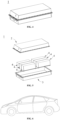
- Fig. 1 shows a secondary battery 5 with a cuboid structure as an example.
- the outer package may include a housing 51 and a cover plate 53.
- the housing 51 may include a bottom plate and side plates connected to the bottom plate, and the bottom plate and the side plates enclose a receiving cavity.
- the housing 51 has an opening communicated with the receiving cavity, and the cover plate 53 can cover the opening to close the receiving cavity.
- the positive electrode plate, the negative electrode plate and the separator may be wound or laminated to form an electrode assembly 52, which is encapsulated in the receiving cavity.
- a non-aqueous electrolytic solution is infiltrated into the electrode assembly 52.
- the number of electrode assemblies 52 contained in the secondary battery 5 may be one or more, which may be adjusted according to the demand.
- a positive electrode plate, a separator, a negative electrode plate, and a non-aqueous electrolytic solution may be assembled to form a secondary battery.
- a positive electrode plate, a separator, and a negative electrode plate can be made into an electrode assembly by a winding process or a stacking process, and the electrode assembly can be placed in an outer package and is subjected to drying, to which an electrolytic solution is injected. After vacuum encapsulation, resting, chemical formation, and shaping process, a secondary battery can be obtained.
- the secondary battery according to the present application can be assembled into a battery module, and the number of secondary battery contained in the battery modules can be more than one, and the specific number can be adjusted according to application and capacity of the battery module.
- Fig. 3 is a schematic diagram of the battery module 4 as an example.
- a plurality of secondary batteries 5 may be arranged in sequence along the longitudinal direction of the battery module 4. Certainly, they can also be arranged in any other manner. Furthermore, a plurality of secondary batteries 5 can be fixed with fasteners.
- the battery module 4 may further include a housing having an accommodating space in which a plurality of secondary batteries 5 are accommodated.
- the above-mentioned battery modules can also be assembled into a battery pack, and the number of battery modules included in the battery pack can be adjusted according to the application and capacity of the battery pack.
- Figs. 4 and 5 are schematic diagrams of the battery pack 1 as an example.
- the battery pack 1 may include a battery case and a plurality of battery modules 4 provided in the battery case.
- the battery box includes an upper case body 2 and a lower case body 3, and the upper case body 2 is used to cover the lower case body 3 to form a closed space for accommodating the battery modules 4.
- a plurality of battery modules 4 may be arranged in the battery case in any manner.
- a fifth aspect of embodiments of the present application provides an electrical device comprising at least one of the secondary battery, battery module, or battery pack of the present application.
- the secondary battery, battery module or battery pack can be used as a power source of the electrical device, and can also be used as an energy storage unit of the electrical device.
- the electrical device can be, but is not limited to, a mobile device (e.g., a mobile phone, a notebook computer, and the like), an electric vehicle (e.g., a pure electric vehicle, a hybrid electric vehicle, a plug-in hybrid electric vehicle, an electric bicycle, an electric scooter, an electric golf vehicle, an electric truck and the like), an electric train, a ship, a satellite, an energy storage system, and the like.
- the electrical device can select a secondary battery, a battery module or a battery pack according to its usage requirements.
- Fig. 6 is a schematic diagrams of an electrical device as an example.
- the electrical device is a pure electric vehicle, a hybrid electric vehicle, or a plug-in hybrid electric vehicle.
- a battery pack or a battery module can be used.
- the electrical device may be a mobile phone, a tablet computer, a notebook computer, and the like.
- the electric device is generally required to be light and thin, and a secondary battery can be used as a power source.
- Li 2 CO 3 (as a source of element Li), Ni 0.5 Mn 1.35 (OH) 3.7 (as a source of elements Ni, and Mn), NH 4 H 2 PO 4 (as a source of element A) and TeO 2 (as a source of element M) were weighed according to corresponding stoichiometric ratios of the target composition LiNi 0.5 Mn 1.35 Te 0.05 P 0.1 O 4 and mixed thoroughly to obtain the raw material mixture powder.
- the above raw material mixture powder was heated up to 950 °C (as a first temperature T1) at 5 °C/min in an air atmosphere for 20 hours (as a first time t1) and then cooled to room temperature to obtain an intermediate product.
- the above intermediate product was heated up to 850 °C (as a second temperature T2) at 5 °C/min for 10 hours (as a second time t2) in a positive pressure of 0.03 ⁇ 0.03 MPa relative to atmospheric pressure, and air atmosphere to obtain a lithium nickel manganese-containing composite oxide.
- the content of elements may be detected by inductively coupled plasma emission spectroscopy (ICP) with reference to EPA 6010D-2014.
- the prepared lithium nickel manganese-containing composite oxide (as a positive electrode active material), conductive carbon black and polyvinylidene fluoride were mixed at the weight ratio of 90:5:5, and a suitable amount of solvent NMP was added, and stirred uniformly to obtain a positive electrode slurry.
- the positive electrode slurry was coated on the aluminum foil of the positive electrode current collector, and the positive electrode plate was obtained after drying.
- the loading amount of lithium nickel manganese-containing composite oxide on the positive electrode plate was 0.015 g/cm 2 .
- Lithium plate was used as a counter electrode, 1 mol/L solution of LiPF 6 in ethylene carbonate (EC), diethyl carbonate (DEC) and dimethyl carbonate (DMC) at volume ratio of 1:1:1 was used as an electrolytic solution, a polypropylene film ( ⁇ 16mm) with a thickness of 12 ⁇ m was used as a separator, and they were assembled together with the above prepared positive electrode plate in a button battery box to form a CR2030 button battery, rested for 24 hours to obtain a half battery.
- EC ethylene carbonate
- DEC diethyl carbonate
- DMC dimethyl carbonate
- the prepared lithium nickel manganese-containing composite oxide (as a positive electrode active material), conductive carbon black and polyvinylidene fluoride were mixed at the weight ratio of 96:2.5:1.5, and a suitable amount of solvent NMP was added, and stirred uniformly to obtain a positive electrode slurry.
- the positive electrode slurry was coated on the two surfaces of the aluminum foil of the positive electrode current collector, and the positive electrode plate was obtained after drying and cold pressing.
- the loading amount of lithium nickel manganese-containing composite oxide on one side of the positive electrode current collector was 0.02 g/cm 2 .
- the artificial graphite as a negative electrode active material, carbon black (Super P) as a conductive agent, styrene-butadiene rubber as a binder, and sodium carboxymethyl cellulose as a thickener at a weight ratio of 96:1:1:2 were mixed under stirring thoroughly in a suitable amount of the deionized water as a solvent to form a negative electrode slurry.
- the negative electrode slurry was coated on the two surfaces of the copper foil of the negative electrode current collector, and the negative electrode plate was obtained after drying and cold pressing.
- the loading amount of negative electrode active material on one side of the negative electrode current collector was 0.008 g/cm 2 .
- a polypropylene film ( ⁇ 16 mm) with a thickness of 12 ⁇ m was used as a separator, which was placed in sequence with the prepared positive electrode plate and the negative electrode plate, so that the separator was between the positive electrode plate and the negative electrode plate to play a role of isolation, and the electrode assembly is obtained after winding; the electrode assembly was placed in an outer aluminum-plastic bag, dried and injected with the same electrolytic solution as that of the prepared button battery, and after vacuum encapsulation, resting, chemical formation, and capacity grading process, a secondary battery was obtained.
- Example 2 The preparations of a button battery and a secondary battery were the same as those in Example 1 with the exception that the preparation of lithium nickel manganese-containing composite oxide is different. The differences in the preparation of lithium nickel manganese-containing composite oxide were detailed in Table 1. In addition, an additional annealing treatment step was added to Example 30 with an annealing temperature of 680 °C and an annealing time of 10 hours.
- the prepared lithium nickel manganese-containing composite oxide was tested with a scanning electron microscope, and then tested with reference to JY/T010-1996, and the sample morphology was observed.
- the testing instrument may be ZEISS sigma 300.
- the prepared lithium nickel manganese-containing composite oxide was tested with a scanning electron microscope, and the average ratio of the long diameter L of the circumscribed ellipse of the grain to the short diameter S of the inscribed ellipse of the grain was counted in any field of view from 5 ⁇ Dv50 to 10 ⁇ Dv50 containing at least 50 visible grains, as the ratio of long diameter/short diameter (L/S) of the lithium nickel manganese-containing composite oxide grain.
- the testing apparatus may be a ZEISS sigma 300.
- the volume particle size Dv50 of the lithium nickel manganese-containing composite oxide has the meaning commonly known in the art, which indicates the particle size corresponding to 50% of the cumulative volume distribution of the material and can be measured by an instrument and method known in the art. For example, it may be conveniently determined using a laser particle size analyzer with reference to GB/T 19077-2016.
- the testing instrument may be a Mastersizer 2000E laser particle size analyzer from Malvern Instruments Ltd. in the United Kingdom.
- the BET specific surface area of lithium nickel manganese-containing composite oxide has the meaning known in the art, and can be determined by an instrument and a method known in the art. For example, it can be tested with reference to GB/T 19587-2017 using nitrogen adsorption specific surface area analysis test method and calculated by the BET method.
- the testing instrument may be a Tri-Star 3020 specific surface area pore size analysis tester from Micromeritics, USA.
- the tap density of lithium nickel manganese-containing composite oxide has the meaning known in the art, and can be determined by an instrument and a method known in the art. For example, it may be determined by a powder tap density tester with reference to GB/T 5162-2006.
- the testing instrument may be a Dandong Baxter BT-301.
- the prepared button battery was charged at a constant current of 0.1 C to a voltage of 4.95 V, and then charged at a constant voltage of 4.95 V to a current of 0.05 C at 25 °C.
- the charging capacity in the range of voltages of 3.5 V - 4.4 V (denoted as C1) and the total charging capacity in the range of voltages of 3.5 V - 4.95 V (with 3.5 V as the lower cut-off voltage) (denoted as C2) were extracted from the raw charging data obtained.
- the prepared secondary battery was charged to a voltage of 4.9V with a constant current of 0.3C, further charged to a current of 0.05C at a constant voltage of 4.9V, and after a 5-minute rest, discharged to a voltage of 3.5V at a constant current of 0.33C, at which time, the discharging capacity obtained is the initial discharging capacity of the secondary battery.
- the prepared secondary battery was charged to a voltage of 4.9V with constant current of 0.3C, and further charged to a current of 0.05C with constant voltage 4.9V, allowed for standing for 5 minutes, charged to a voltage of 3.5V with a constant current of 0.33C. This was a cyclic charge-discharge process, at which time the discharging capacity was recorded as the discharging capacity of the first cycle.
- the secondary battery was subjected to the cyclic charge-discharge processes as described above until the discharging capacity decreased to 80% of the discharging capacity of the first cycle, at which time the number of cycles of the secondary battery was recorded.
- the grain shape of the lithium nickel manganese-containing composite oxide obtained by the preparation method of the present application is rounded spherical or spherical-like, the lithium nickel manganese-containing composite oxide particle has a monocrystal morphology or a quasi-monocrystal morphology, which can minimize a corrosion of an electrolytic solution, such as strong acid corrosion and stress corrosion at high voltage, thereby improving the capacity exertion, energy density and cycling life of the secondary battery.
- lithium nickel manganese-containing composite oxide in Comparative Example 3 In the preparation of lithium nickel manganese-containing composite oxide in Comparative Example 3, two discontinuous sintering processes are used, but the temperature of the second sintering is less than 800 °C, and the prepared lithium nickel manganese-containing composite oxide has a single crystal particle morphology and an octahedral grain shape. In the preparation of lithium nickel manganese-containing composite oxide in Comparative Example 4, two discontinuous sintering processes are used, but the temperature of the second sintering is higher than that of the first sintering, and the prepared lithium nickel manganese-containing composite oxide has a single crystal particle morphology and an octahedral grain shape.
- lithium nickel manganese-containing composite oxide in Comparative Example 5, two discontinuous sintering processes are used, but the difference between the first sintering temperature and the second sintering temperature is greater than 200 °C. As shown in Fig. 9 , and the prepared lithium nickel manganese-containing composite oxide has a single crystal particle morphology and a rounded octahedral grain shape
- Lithium nickel manganese-containing composite oxide Source of elemen t Li Source of elements Ni and Mn Source of elemen tM Source of element A First temperature T1 (°C) First time t1 (h) Second temperat ure T2 (°C) Second time t2 (h) T1-T2 (°C) z+a a/ z
- Example 1 LiNi 0.5 Mn 1.35 Te 0.05 P 0.1 O 4 Li 2 CO 3 Ni 0.5 Mn 1.35 (OH) 3 .7 TeO 2 NH 4 H 2 PO 4 950 20 850 10 100 0.15 2
- Example 3 LiNi 0.5 Mn 1.35 Te 0.05 P 0.1 O 4 Li 2 CO 3 Nio.sMm.ss(OH) 3 .7 TeO 2 NH
Landscapes
- Chemical & Material Sciences (AREA)
- Organic Chemistry (AREA)
- Inorganic Chemistry (AREA)
- Chemical Kinetics & Catalysis (AREA)
- Electrochemistry (AREA)
- General Chemical & Material Sciences (AREA)
- Engineering & Computer Science (AREA)
- Materials Engineering (AREA)
- Manufacturing & Machinery (AREA)
- Battery Electrode And Active Subsutance (AREA)
- Secondary Cells (AREA)
Applications Claiming Priority (1)
| Application Number | Priority Date | Filing Date | Title |
|---|---|---|---|
| PCT/CN2022/117827 WO2024050758A1 (zh) | 2022-09-08 | 2022-09-08 | 含锂镍锰复合氧化物、其制备方法以及包含其的正极极片、二次电池及用电装置 |
Publications (3)
| Publication Number | Publication Date |
|---|---|
| EP4468415A1 true EP4468415A1 (de) | 2024-11-27 |
| EP4468415A4 EP4468415A4 (de) | 2025-05-14 |
| EP4468415B1 EP4468415B1 (de) | 2026-02-25 |
Family
ID=90192710
Family Applications (1)
| Application Number | Title | Priority Date | Filing Date |
|---|---|---|---|
| EP22957730.9A Active EP4468415B1 (de) | 2022-09-08 | 2022-09-08 | Lithiumhaltiges nickel-mangan-mischoxid, herstellungsverfahren dafür und positivpolteil, sekundärbatterie und elektrische vorrichtung damit |
Country Status (4)
| Country | Link |
|---|---|
| US (1) | US20250011172A1 (de) |
| EP (1) | EP4468415B1 (de) |
| CN (1) | CN118661290B (de) |
| WO (1) | WO2024050758A1 (de) |
Families Citing this family (2)
| Publication number | Priority date | Publication date | Assignee | Title |
|---|---|---|---|---|
| CN119833709A (zh) * | 2024-11-28 | 2025-04-15 | 宁德时代新能源科技股份有限公司 | 锂离子二次电池、正极活性材料及制备方法和用电设备 |
| CN121215860A (zh) * | 2025-11-27 | 2025-12-26 | 宁德时代新能源科技股份有限公司 | 锂离子二次电池、正极活性材料、制备方法及用电设备 |
Family Cites Families (9)
| Publication number | Priority date | Publication date | Assignee | Title |
|---|---|---|---|---|
| CN101841018B (zh) * | 2010-06-22 | 2012-03-21 | 湖南杉杉新材料有限公司 | 锂离子电池用单晶锂锰氧化物及其制备方法 |
| CN102800840B (zh) * | 2011-05-23 | 2015-06-10 | 中国科学院宁波材料技术与工程研究所 | 锂离子电池正极材料、其制备方法及锂离子电池 |
| JP2014197552A (ja) * | 2014-06-18 | 2014-10-16 | 三菱化学株式会社 | 層状リチウムニッケルマンガン複合酸化物 |
| CN112142124B (zh) * | 2015-09-17 | 2023-04-07 | 三井金属矿业株式会社 | 尖晶石型含锂镍锰的复合氧化物 |
| CN106450282A (zh) * | 2016-11-19 | 2017-02-22 | 合肥国轩高科动力能源有限公司 | 一种大单晶镍锰酸锂正极材料及其制备方法 |
| CN106784795B (zh) * | 2017-01-16 | 2020-04-24 | 湖南瑞翔新材料股份有限公司 | 一种单晶类球形锰酸锂材料及其制备方法、正极材料 |
| JP6754891B2 (ja) * | 2017-03-14 | 2020-09-16 | 三井金属鉱業株式会社 | スピネル型リチウムニッケルマンガン含有複合酸化物 |
| JP7271945B2 (ja) * | 2018-12-25 | 2023-05-12 | 住友金属鉱山株式会社 | リチウムイオン二次電池用正極活物質とその製造方法、およびリチウムイオン二次電池 |
| CN113285068A (zh) * | 2021-05-13 | 2021-08-20 | 南通瑞翔新材料有限公司 | 一种单晶锰酸锂正极材料及其制备方法 |
-
2022
- 2022-09-08 EP EP22957730.9A patent/EP4468415B1/de active Active
- 2022-09-08 WO PCT/CN2022/117827 patent/WO2024050758A1/zh not_active Ceased
- 2022-09-08 CN CN202280091291.2A patent/CN118661290B/zh active Active
-
2024
- 2024-09-18 US US18/888,176 patent/US20250011172A1/en active Pending
Also Published As
| Publication number | Publication date |
|---|---|
| WO2024050758A1 (zh) | 2024-03-14 |
| EP4468415A4 (de) | 2025-05-14 |
| EP4468415B1 (de) | 2026-02-25 |
| CN118661290B (zh) | 2026-01-13 |
| US20250011172A1 (en) | 2025-01-09 |
| CN118661290A (zh) | 2024-09-17 |
Similar Documents
| Publication | Publication Date | Title |
|---|---|---|
| JP7165271B2 (ja) | 正極活性材料、正極シート、電気化学エネルギー貯蔵装置及び装置 | |
| US20250011172A1 (en) | Lithium nickel manganese-containing composite oxide, method for preparation thereof, positive electrode plate, secondary battery and electrical device | |
| CN118738374B (zh) | 正极活性材料及其制备方法、正极极片、二次电池和用电装置 | |
| CN118613932B (zh) | 正极活性材料及其制备方法、正极极片、二次电池、电池模块、电池包和用电装置 | |
| EP4611056A1 (de) | Negativelektrodenfolie und elektrodenanordnung damit, batteriezelle, batterie und elektrische vorrichtung | |
| JP7833029B2 (ja) | 改質正極材料、その製造方法、正極シート、二次電池、電池モジュール、電池パック及び電力消費装置 | |
| EP4318662A1 (de) | Spinel-lithium-nickel-manganoxid-material und herstellungsverfahren dafür | |
| WO2023184512A1 (zh) | 正极活性材料、其制备方法以及包含其的正极极片、二次电池及用电装置 | |
| EP4280301A1 (de) | Positivelektrodenfolie, sekundärbatterie, batteriemodul, batteriepack und elektrische vorrichtung | |
| CN117096339A (zh) | 正极活性材料及其制备方法、正极极片、二次电池和用电装置 | |
| US20240413308A1 (en) | Lithium-nickel-manganese-containing composite oxide, preparation method thereof, and positive electrode plate, secondary battery, and electric apparatus containing same | |
| EP4228029A1 (de) | Positivelektrodenmaterial, herstellungsverfahren dafür und sekundärbatterie damit | |
| EP4618184A1 (de) | Positivelektrodenmaterialzusammensetzung, sekundärbatterie und elektrische vorrichtung | |
| US20240372076A1 (en) | Positive electrode active material and preparation method thereof, positive electrode plate, secondary battery, battery module, battery pack, and electric apparatus | |
| US20230420751A1 (en) | Secondary battery, and battery module, battery pack, and electrical device comprising the same | |
| US20240262711A1 (en) | Lithium Nickel Manganese Oxide Positive Electrode Active Material, Preparation Method Threof, and Secondary Battery Using Same | |
| CN118486792B (zh) | 正极活性材料及其制备方法、正极极片、二次电池和用电装置 | |
| EP4682979A1 (de) | Verfahren zur herstellung eines positivelektrodenmaterials, positivelektrodenmaterial, positivelektrodenfolie, batterie und elektrische vorrichtung | |
| EP4723239A1 (de) | Positivelektrodenaktivmaterial und herstellungsverfahren dafür, positivelektrodenfolie, batterie und elektrische vorrichtung | |
| CN119908043A (zh) | 正极活性材料及其制备方法、包含其的正极极片、电池和用电装置 | |
| WO2023184511A1 (zh) | 正极活性材料、其制备方法以及包含其的正极极片、二次电池及用电装置 | |
| WO2024065213A1 (zh) | 正极活性材料、其制备方法以及包含其的正极极片、二次电池及用电装置 | |
| CN118696435A (zh) | 正极活性材料及其制备方法、正极极片、二次电池和用电装置 | |
| JP7554421B2 (ja) | スピネル型のニッケルマンガンリチウム含有複合酸化物、その製造方法及びそれを含有する二次電池と電力消費装置 | |
| JP7852030B2 (ja) | 正極活物質、二次電池、電池モジュール、電池パック及び電力消費装置 |
Legal Events
| Date | Code | Title | Description |
|---|---|---|---|
| STAA | Information on the status of an ep patent application or granted ep patent |
Free format text: STATUS: THE INTERNATIONAL PUBLICATION HAS BEEN MADE |
|
| PUAI | Public reference made under article 153(3) epc to a published international application that has entered the european phase |
Free format text: ORIGINAL CODE: 0009012 |
|
| STAA | Information on the status of an ep patent application or granted ep patent |
Free format text: STATUS: REQUEST FOR EXAMINATION WAS MADE |
|
| 17P | Request for examination filed |
Effective date: 20240821 |
|
| AK | Designated contracting states |
Kind code of ref document: A1 Designated state(s): AL AT BE BG CH CY CZ DE DK EE ES FI FR GB GR HR HU IE IS IT LI LT LU LV MC MK MT NL NO PL PT RO RS SE SI SK SM TR |
|
| RAP1 | Party data changed (applicant data changed or rights of an application transferred) |
Owner name: CONTEMPORARY AMPEREX TECHNOLOGY(HONG KONG) LIMITED |
|
| A4 | Supplementary search report drawn up and despatched |
Effective date: 20250410 |
|
| RIC1 | Information provided on ipc code assigned before grant |
Ipc: C01G 53/54 20250101ALI20250404BHEP Ipc: H01M 4/131 20100101ALI20250404BHEP Ipc: H01M 4/505 20100101AFI20250404BHEP |
|
| GRAP | Despatch of communication of intention to grant a patent |
Free format text: ORIGINAL CODE: EPIDOSNIGR1 |
|
| STAA | Information on the status of an ep patent application or granted ep patent |
Free format text: STATUS: GRANT OF PATENT IS INTENDED |
|
| RIC1 | Information provided on ipc code assigned before grant |
Ipc: H01M 4/505 20100101AFI20251030BHEP Ipc: H01M 4/131 20100101ALI20251030BHEP Ipc: C01G 53/54 20250101ALI20251030BHEP |
|
| DAV | Request for validation of the european patent (deleted) | ||
| DAX | Request for extension of the european patent (deleted) | ||
| INTG | Intention to grant announced |
Effective date: 20251202 |
|
| GRAS | Grant fee paid |
Free format text: ORIGINAL CODE: EPIDOSNIGR3 |
|
| GRAA | (expected) grant |
Free format text: ORIGINAL CODE: 0009210 |
|
| STAA | Information on the status of an ep patent application or granted ep patent |
Free format text: STATUS: THE PATENT HAS BEEN GRANTED |
|
| AK | Designated contracting states |
Kind code of ref document: B1 Designated state(s): AL AT BE BG CH CY CZ DE DK EE ES FI FR GB GR HR HU IE IS IT LI LT LU LV MC MK MT NL NO PL PT RO RS SE SI SK SM TR |
|
| REG | Reference to a national code |
Ref country code: CH Ref legal event code: F10 Free format text: ST27 STATUS EVENT CODE: U-0-0-F10-F00 (AS PROVIDED BY THE NATIONAL OFFICE) Effective date: 20260225 Ref country code: GB Ref legal event code: FG4D |
|
| REG | Reference to a national code |
Ref country code: DE Ref legal event code: R096 Ref document number: 602022031410 Country of ref document: DE |
|
| REG | Reference to a national code |
Ref country code: IE Ref legal event code: FG4D |