EP4467971A1 - Gas sensor for detecting volatile organic compounds and method for manufacturing same - Google Patents
Gas sensor for detecting volatile organic compounds and method for manufacturing same Download PDFInfo
- Publication number
- EP4467971A1 EP4467971A1 EP23175381.5A EP23175381A EP4467971A1 EP 4467971 A1 EP4467971 A1 EP 4467971A1 EP 23175381 A EP23175381 A EP 23175381A EP 4467971 A1 EP4467971 A1 EP 4467971A1
- Authority
- EP
- European Patent Office
- Prior art keywords
- electrode
- sensing layer
- gas sensor
- substrate
- formaldehyde
- Prior art date
- Legal status (The legal status is an assumption and is not a legal conclusion. Google has not performed a legal analysis and makes no representation as to the accuracy of the status listed.)
- Pending
Links
- 239000012855 volatile organic compound Substances 0.000 title claims abstract description 43
- 238000004519 manufacturing process Methods 0.000 title claims description 9
- 238000000034 method Methods 0.000 title claims description 7
- 239000000758 substrate Substances 0.000 claims description 44
- XOLBLPGZBRYERU-UHFFFAOYSA-N tin dioxide Chemical compound O=[Sn]=O XOLBLPGZBRYERU-UHFFFAOYSA-N 0.000 claims description 28
- 150000001875 compounds Chemical class 0.000 claims description 11
- AMGQUBHHOARCQH-UHFFFAOYSA-N indium;oxotin Chemical compound [In].[Sn]=O AMGQUBHHOARCQH-UHFFFAOYSA-N 0.000 claims description 8
- 229910000272 alkali metal oxide Inorganic materials 0.000 claims description 7
- 229910000287 alkaline earth metal oxide Inorganic materials 0.000 claims description 7
- PEDCQBHIVMGVHV-UHFFFAOYSA-N Glycerine Chemical compound OCC(O)CO PEDCQBHIVMGVHV-UHFFFAOYSA-N 0.000 claims description 6
- 239000004020 conductor Substances 0.000 claims description 6
- 239000011259 mixed solution Substances 0.000 claims description 5
- 239000012811 non-conductive material Substances 0.000 claims description 5
- XLYOFNOQVPJJNP-UHFFFAOYSA-N water Substances O XLYOFNOQVPJJNP-UHFFFAOYSA-N 0.000 claims description 5
- 235000011187 glycerol Nutrition 0.000 claims description 3
- 238000010438 heat treatment Methods 0.000 claims description 2
- WSFSSNUMVMOOMR-UHFFFAOYSA-N Formaldehyde Chemical compound O=C WSFSSNUMVMOOMR-UHFFFAOYSA-N 0.000 abstract description 264
- 229910052783 alkali metal Inorganic materials 0.000 abstract description 11
- 150000001340 alkali metals Chemical class 0.000 abstract description 11
- 229910052784 alkaline earth metal Inorganic materials 0.000 abstract description 10
- 150000001342 alkaline earth metals Chemical class 0.000 abstract description 10
- 230000008859 change Effects 0.000 abstract description 9
- 239000011540 sensing material Substances 0.000 abstract description 7
- 239000007789 gas Substances 0.000 description 97
- LFQSCWFLJHTTHZ-UHFFFAOYSA-N Ethanol Chemical compound CCO LFQSCWFLJHTTHZ-UHFFFAOYSA-N 0.000 description 52
- 230000035945 sensitivity Effects 0.000 description 42
- YXFVVABEGXRONW-UHFFFAOYSA-N Toluene Chemical compound CC1=CC=CC=C1 YXFVVABEGXRONW-UHFFFAOYSA-N 0.000 description 27
- 239000000463 material Substances 0.000 description 20
- PXHVJJICTQNCMI-UHFFFAOYSA-N Nickel Chemical compound [Ni] PXHVJJICTQNCMI-UHFFFAOYSA-N 0.000 description 10
- 239000010931 gold Substances 0.000 description 9
- WSFSSNUMVMOOMR-NJFSPNSNSA-N methanone Chemical compound O=[14CH2] WSFSSNUMVMOOMR-NJFSPNSNSA-N 0.000 description 9
- BASFCYQUMIYNBI-UHFFFAOYSA-N platinum Substances [Pt] BASFCYQUMIYNBI-UHFFFAOYSA-N 0.000 description 9
- 238000001514 detection method Methods 0.000 description 8
- VYPSYNLAJGMNEJ-UHFFFAOYSA-N Silicium dioxide Chemical compound O=[Si]=O VYPSYNLAJGMNEJ-UHFFFAOYSA-N 0.000 description 6
- 230000000694 effects Effects 0.000 description 6
- 239000011777 magnesium Substances 0.000 description 6
- PCHJSUWPFVWCPO-UHFFFAOYSA-N gold Chemical compound [Au] PCHJSUWPFVWCPO-UHFFFAOYSA-N 0.000 description 5
- 229910052737 gold Inorganic materials 0.000 description 5
- 229910052759 nickel Inorganic materials 0.000 description 5
- 229910052749 magnesium Inorganic materials 0.000 description 4
- 239000000203 mixture Substances 0.000 description 4
- 229910001887 tin oxide Inorganic materials 0.000 description 4
- 229910052788 barium Inorganic materials 0.000 description 3
- 229910052790 beryllium Inorganic materials 0.000 description 3
- 229910052792 caesium Inorganic materials 0.000 description 3
- 229910052791 calcium Inorganic materials 0.000 description 3
- 229910052730 francium Inorganic materials 0.000 description 3
- WABPQHHGFIMREM-UHFFFAOYSA-N lead(0) Chemical compound [Pb] WABPQHHGFIMREM-UHFFFAOYSA-N 0.000 description 3
- 229910052744 lithium Inorganic materials 0.000 description 3
- 229910052751 metal Inorganic materials 0.000 description 3
- 229910044991 metal oxide Inorganic materials 0.000 description 3
- 229910052697 platinum Inorganic materials 0.000 description 3
- 229910052700 potassium Inorganic materials 0.000 description 3
- 229910052705 radium Inorganic materials 0.000 description 3
- 238000006479 redox reaction Methods 0.000 description 3
- 229910052701 rubidium Inorganic materials 0.000 description 3
- 239000000377 silicon dioxide Substances 0.000 description 3
- 229910052708 sodium Inorganic materials 0.000 description 3
- 229910052712 strontium Inorganic materials 0.000 description 3
- CSNNHWWHGAXBCP-UHFFFAOYSA-L Magnesium sulfate Chemical compound [Mg+2].[O-][S+2]([O-])([O-])[O-] CSNNHWWHGAXBCP-UHFFFAOYSA-L 0.000 description 2
- 239000007864 aqueous solution Substances 0.000 description 2
- 239000012153 distilled water Substances 0.000 description 2
- 230000007613 environmental effect Effects 0.000 description 2
- 125000000524 functional group Chemical group 0.000 description 2
- 230000014509 gene expression Effects 0.000 description 2
- 230000036541 health Effects 0.000 description 2
- 150000002500 ions Chemical class 0.000 description 2
- 229910021645 metal ion Inorganic materials 0.000 description 2
- 150000004706 metal oxides Chemical class 0.000 description 2
- 229910000480 nickel oxide Inorganic materials 0.000 description 2
- 230000008520 organization Effects 0.000 description 2
- GNRSAWUEBMWBQH-UHFFFAOYSA-N oxonickel Chemical class [Ni]=O GNRSAWUEBMWBQH-UHFFFAOYSA-N 0.000 description 2
- 239000002244 precipitate Substances 0.000 description 2
- 230000009257 reactivity Effects 0.000 description 2
- 230000004044 response Effects 0.000 description 2
- 229910052718 tin Inorganic materials 0.000 description 2
- VHUUQVKOLVNVRT-UHFFFAOYSA-N Ammonium hydroxide Chemical compound [NH4+].[OH-] VHUUQVKOLVNVRT-UHFFFAOYSA-N 0.000 description 1
- 206010012438 Dermatitis atopic Diseases 0.000 description 1
- 206010014561 Emphysema Diseases 0.000 description 1
- 206010015946 Eye irritation Diseases 0.000 description 1
- 206010015958 Eye pain Diseases 0.000 description 1
- 229910052688 Gadolinium Inorganic materials 0.000 description 1
- 206010019233 Headaches Diseases 0.000 description 1
- 206010020751 Hypersensitivity Diseases 0.000 description 1
- 229910052779 Neodymium Inorganic materials 0.000 description 1
- 208000002193 Pain Diseases 0.000 description 1
- 208000004756 Respiratory Insufficiency Diseases 0.000 description 1
- 231100000597 Sick building syndrome Toxicity 0.000 description 1
- 231100000570 acute poisoning Toxicity 0.000 description 1
- 239000000853 adhesive Substances 0.000 description 1
- 230000001070 adhesive effect Effects 0.000 description 1
- 230000002411 adverse Effects 0.000 description 1
- 230000007815 allergy Effects 0.000 description 1
- PNEYBMLMFCGWSK-UHFFFAOYSA-N aluminium oxide Inorganic materials [O-2].[O-2].[O-2].[Al+3].[Al+3] PNEYBMLMFCGWSK-UHFFFAOYSA-N 0.000 description 1
- QGZKDVFQNNGYKY-UHFFFAOYSA-N ammonia Natural products N QGZKDVFQNNGYKY-UHFFFAOYSA-N 0.000 description 1
- 201000008937 atopic dermatitis Diseases 0.000 description 1
- 230000015572 biosynthetic process Effects 0.000 description 1
- 230000005587 bubbling Effects 0.000 description 1
- 238000001354 calcination Methods 0.000 description 1
- 238000010276 construction Methods 0.000 description 1
- 230000007547 defect Effects 0.000 description 1
- 230000001419 dependent effect Effects 0.000 description 1
- 238000010790 dilution Methods 0.000 description 1
- 239000012895 dilution Substances 0.000 description 1
- 238000001035 drying Methods 0.000 description 1
- 238000005516 engineering process Methods 0.000 description 1
- 238000002474 experimental method Methods 0.000 description 1
- 231100000013 eye irritation Toxicity 0.000 description 1
- 238000009408 flooring Methods 0.000 description 1
- 239000011521 glass Substances 0.000 description 1
- 231100000869 headache Toxicity 0.000 description 1
- 229910052738 indium Inorganic materials 0.000 description 1
- 229910052746 lanthanum Inorganic materials 0.000 description 1
- 229910052943 magnesium sulfate Inorganic materials 0.000 description 1
- 235000019341 magnesium sulphate Nutrition 0.000 description 1
- 238000012423 maintenance Methods 0.000 description 1
- 230000007246 mechanism Effects 0.000 description 1
- 239000002184 metal Substances 0.000 description 1
- 150000002816 nickel compounds Chemical class 0.000 description 1
- 229910052755 nonmetal Inorganic materials 0.000 description 1
- 150000002894 organic compounds Chemical class 0.000 description 1
- 229910052763 palladium Inorganic materials 0.000 description 1
- 239000002245 particle Substances 0.000 description 1
- 208000024335 physical disease Diseases 0.000 description 1
- 239000011120 plywood Substances 0.000 description 1
- 239000000843 powder Substances 0.000 description 1
- -1 primarily Substances 0.000 description 1
- 230000008569 process Effects 0.000 description 1
- 238000009418 renovation Methods 0.000 description 1
- 239000011347 resin Substances 0.000 description 1
- 229920005989 resin Polymers 0.000 description 1
- 201000004193 respiratory failure Diseases 0.000 description 1
- 230000029058 respiratory gaseous exchange Effects 0.000 description 1
- 230000004043 responsiveness Effects 0.000 description 1
- 208000008842 sick building syndrome Diseases 0.000 description 1
- 235000012239 silicon dioxide Nutrition 0.000 description 1
- 208000021792 sore eyes Diseases 0.000 description 1
- 230000000638 stimulation Effects 0.000 description 1
- HPGGPRDJHPYFRM-UHFFFAOYSA-J tin(iv) chloride Chemical compound Cl[Sn](Cl)(Cl)Cl HPGGPRDJHPYFRM-UHFFFAOYSA-J 0.000 description 1
- 229910052719 titanium Inorganic materials 0.000 description 1
- 231100000331 toxic Toxicity 0.000 description 1
- 230000002588 toxic effect Effects 0.000 description 1
- 238000005406 washing Methods 0.000 description 1
- 229910052725 zinc Inorganic materials 0.000 description 1
Images


Classifications
-
- G—PHYSICS
- G01—MEASURING; TESTING
- G01N—INVESTIGATING OR ANALYSING MATERIALS BY DETERMINING THEIR CHEMICAL OR PHYSICAL PROPERTIES
- G01N27/00—Investigating or analysing materials by the use of electric, electrochemical, or magnetic means
- G01N27/02—Investigating or analysing materials by the use of electric, electrochemical, or magnetic means by investigating impedance
- G01N27/04—Investigating or analysing materials by the use of electric, electrochemical, or magnetic means by investigating impedance by investigating resistance
- G01N27/12—Investigating or analysing materials by the use of electric, electrochemical, or magnetic means by investigating impedance by investigating resistance of a solid body in dependence upon absorption of a fluid; of a solid body in dependence upon reaction with a fluid, for detecting components in the fluid
- G01N27/125—Composition of the body, e.g. the composition of its sensitive layer
-
- G—PHYSICS
- G01—MEASURING; TESTING
- G01N—INVESTIGATING OR ANALYSING MATERIALS BY DETERMINING THEIR CHEMICAL OR PHYSICAL PROPERTIES
- G01N33/00—Investigating or analysing materials by specific methods not covered by groups G01N1/00 - G01N31/00
- G01N33/0004—Gaseous mixtures, e.g. polluted air
- G01N33/0009—General constructional details of gas analysers, e.g. portable test equipment
- G01N33/0027—General constructional details of gas analysers, e.g. portable test equipment concerning the detector
- G01N33/0036—General constructional details of gas analysers, e.g. portable test equipment concerning the detector specially adapted to detect a particular component
- G01N33/0047—Organic compounds
Definitions
- the present disclosure relates generally to a gas sensor for detecting volatile organic compounds. More particularly, the present disclosure relates to a gas sensor capable of specifically detecting formaldehyde among volatile organic compounds and a method for manufacturing the same.
- VOC volatile organic compounds
- concentration of formaldehyde in the air when concentration of formaldehyde in the air is about 0.04ppm, nervous tissues begin to be stimulated, and sensitive children may develop atopic dermatitis.
- concentration of formaldehyde When the concentration of formaldehyde is 0.05 to 1.0ppm, it can be smelled, and the level of the concentration is an indoor standard in Canada and California.
- concentration of formaldehyde in the air is 0.2ppm, eye irritation begins, and when the concentration is 0.25 to 0.33ppm, a respiratory failure may occur.
- concentration of 0.5 ppm is the lowest level at which stimulation of the throat begins and is the highest level allowed by the Korean Society of Industrial Hygiene.
- concentration When the concentration is 2.0 to 3.0ppm, pain in the eyes begins, and when the concentration is 4.0ppm, tearing may occur. When the concentration is 10.0 to 20.0ppm, intense tearing and difficulty in breathing may occur, and when the concentration is 30.0 ppm or more, acute poisoning may occur within minutes and death may occur from toxic emphysema.
- the concentration of formaldehyde in the air is 0.08ppm.
- VOC volatile organic compound
- a general gas sensor has similar sensitivity to most volatile organic compounds, and such an example can be seen in Japanese Patent No. 3854358 .
- electrodes made of gold (Au) are formed on a substrate, and tin oxide (SnO 2 ) to which at least one element of Ga, Y, La, and Nd is added is used as a sensing material between the electrodes.
- such a gas sensor of a prior art has similar sensitivity to most volatile organic compounds.
- the sensitivity S of the gas sensor to 0.1ppm of formaldehyde is 20%, but the sensitivity S of the gas sensor to 1 ppm of volatile organic compounds also is 25%.
- the sensitivity is obtained by converting the percentage of a resistance change. Accordingly, the gas sensor of the prior art detects both formaldehyde and volatile organic compounds with high sensitivity, but cannot selectively detect only formaldehyde.
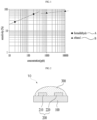
- FIG. 1 illustrates the responsiveness of the gas sensor of the prior art. This is disposed in a paper titled " Study on a micro-gas sensor with SnO2-NiO sensitive film for indoor formaldehyde detection”(Sensors and Actuators B vol 132, (2008) p74 ⁇ 80 ).
- the gas sensor is a MEMS structure using SnO 2 -NiO as a sensing material and using Pt in making an electrode to detect formaldehyde.
- the gas sensor in this paper has a sensitivity S of 0.06ppm of formaldehyde which is 1.6% and a sensitivity S of 1ppm of ethanol which is 0.1% or less. Furthermore, the sensitivity ratio of formaldehyde to ethanol is greater than 10, and the interference of the ethanol gas is suppressed. However, the sensitivity S of formaldehyde is 1.6%, which is very low.
- the gas sensor is more sensitive to formaldehyde than volatile organic compounds including alcohol, but has a fundamental limitation in that the gas sensor cannot selectively detect formaldehyde.
- the gas sensor of the prior art detects the presence of volatile organic compounds, but has a problem in that the gas sensor cannot provide information on whether formaldehyde is included in the volatile organic compounds and if included, how much formaldehyde is included therein.
- An object of the present invention is to provide a gas sensor with the highest sensitivity to formaldehyde among volatile organic compounds.
- Another object of the present invention is to provide a gas sensor capable of detecting the presence or concentration of formaldehyde among volatile organic compounds.
- Still another object of the present invention is to provide a gas sensor that maintains both high sensitivity and high selectivity.
- a gas sensor made of a novel combination of sensing materials including an alkali metal element or an alkaline earth metal element and having high sensitivity and high selectivity.
- formaldehyde may be detected by forming a sensing layer by using a compound of a SnO 2 with an alkali metal oxide or an alkaline earth metal oxide.
- the gas sensor is configured to have an electrode made of an indium tin oxide (ITO).
- ITO indium tin oxide
- the gas sensor of the present invention is defined in claim 1 and includes: a substrate made of a non-conductive material; the electrode located on the substrate and formed of a conductive material; and the sensing layer configured to be in contact with at least a portion of the electrode or to cover the electrode, the sensing layer reacting to gas, wherein the sensing layer may include a compound of SnO 2 with an alkali metal oxide or an alkaline earth metal oxide.
- the alkali metal oxide may include at least one element of Li, Na, K, Rb, Cs, and Fr.
- the alkaline earth metal oxide may include at least one element of Be, Mg, Ca, Sr, Ba, and Ra.
- the electrode may be formed of an indium tin oxide (ITO).
- ITO indium tin oxide
- the electrode may include a first electrode formed on the substrate, and a second electrode formed on the substrate by being spaced apart from the first electrode.
- the sensing layer may be disposed to connect the first electrode with the second electrode.
- the sensing layer may be configured to expose at least a portion of each of the first electrode and the second electrode to the air.
- a heater may be provided on the substrate.
- the heater may be located on a surface of the substrate on which the electrode is located or on a surface opposite to the surface of the substrate on which the electrode is located.
- the gas sensor of another embodiment of the present invention includes a substrate made of a non-conductive material; a sensing layer located on the substrate; and an electrode made of a conductive material and configured to detect electron movement and capacitance inside the sensing layer, wherein the electrode may include the first electrode formed of a conductive material, and the second electrode configured to supply an electric current to the first electrode or to receive an electric current from the first electrode, and the sensing layer may connect the first electrode with the second electrode and may be configured to expose at least a portion of each of the first electrode and the second electrode to the air.
- the sensing layer may be disposed between the substrate and the electrode.
- the first electrode and the second electrode may be provided on an outer surface of the sensing layer.
- the sensing layer may shield a portion of the first electrode and a portion of the second electrode.
- the heater may be provided on the substrate.
- the heater may be located on the surface of the substrate on which the electrode is located or on the surface opposite to the surface of the substrate on which the electrode is located.
- a method for manufacturing a gas sensor for detecting volatile organic compounds includes forming the electrodes by using an indium tin oxide (ITO), and forming the sensing layer by using the compound of SnO 2 with an alkali metal oxide or an alkaline earth metal oxide.
- ITO indium tin oxide
- the alkali metal oxide may include at least one element of Li, Na, K, Rb, Cs, and Fr, and the alkaline earth metal oxide may include at least one element of Be, Mg, Ca, Sr, Ba, and Ra.
- the sensing layer may be formed by dispersing and applying Mg-SnO 2 onto a mixed solution of pure water and glycerin and heating the mixed solution, onto which the Mg-SnO 2 is applied, to a predetermined temperature.
- the gas sensor of the present disclosure may have at least one of the following effects.
- formaldehyde gas at a low concentration of 10 ppb may be detected.
- the interference of other gases with formaldehyde may be avoided. Accordingly, only formaldehyde may be effectively detected.
- 1ppm of ethanol gas which is a representative volatile organic compound, has sensitivity corresponding to 10ppb of formaldehyde or less. Accordingly, the gas sensor of the present disclosure may detect formaldehyde better than other volatile organic compounds, thereby having high selectivity to formaldehyde.
- FIG. 2 schematically illustrates the structure of the gas sensor according to an embodiment of the present disclosure.
- the gas sensor 10 according to the embodiment of the present disclosure has a substrate 100 constituting a frame thereof. Electrodes 200 re located on the substrate 100. A sensing layer 300 is provided to connect each of the electrodes 200 to each other.
- the substrate 100 may be made of a non-conductive material such as silicon dioxide (SiO 2 ).
- the substrate 100 made of a resin-based material serves to support the electrode 200 and the sensing layer 300.
- the substrate 100 may be a plate having a predetermined shape.
- a glass substrate or an alumina substrate may be used as the substrate 100.
- the electrode 200 may include at least one pair of a first electrode 210 and a second electrode 220.
- the first electrode 210 and the second electrode 220 may be electrically connected to the outside.
- the first electrode 210 and the second electrode 220 may be formed at a predetermined interval on the substrate 100, and an electric current may be transmitted between the first electrode 210 and the second electrode 220 through the sensing layer 300.
- the gas sensor 10 of the present disclosure may detect formaldehyde by detecting an electric current flowing between the first electrode 210 and the second electrode 220, change in the electric current, or a change in electrical resistance or capacitance of the electrode 200.
- the sensing layer 300 may be formed to cover the first electrode 210 and the second electrode 220.
- the sensing layer 300 may change the intensity of an electric current flowing between the first electrode 210 and the second electrode 220, or the capacitance or electrical resistance of the electrode 200. That is, a material forming the sensing layer 300 has inherent resistance, but the sensing layer 300 may have electrical properties changed when the sensing layer 300 contacts or is combined with formaldehyde.
- the material when a material of which the sensing layer 300 is formed comes into contact with or is combined with formaldehyde, the material may transfer electrons to the electrode 200 or receive electrons from the electrode 200 while causing an oxidation-reduction reaction with the formaldehyde.
- the molecular arrangement structure of the sensing layer 300 may be changed due to the permeation of the formaldehyde, and thus the total charge capacity of the sensing layer 300 may be changed.
- the sensing layer 300 may not react to other volatile organic compounds other than formaldehyde or may have a very low reactivity thereto compared to formaldehyde.
- the gas sensor 10 of the present disclosure specifically detects formaldehyde. This is because the sensing layer 300 does not react or has very low reactivity to volatile organic compounds other than formaldehyde even when the formaldehyde exists along with the volatile organic compounds in the air or indoors.
- materials of the electrode 200 and the sensing layer 300 are specified. That is, the materials of the electrode 200 and the sensing layer 300 are required to react specifically to formaldehyde or have a significantly greater sensitivity to formaldehyde than other volatile organic compounds.
- the sensing layer 300 of the present disclosure is a compound of a tin oxide (SnO 2 ) with an oxide of an alkali metal element or an oxide of an alkaline earth metal element, the sensing layer 300 has a significantly greater sensitivity to formaldehyde than to other volatile organic compounds, or reacts specifically only to the formaldehyde.
- the compound of a tin oxide (SnO 2 ) with the oxide of an alkali metal element or the oxide of an alkaline earth metal element may be selected.
- the alkali metal element may include at least one element of Li, Na, K, Rb, Cs, and Fr.
- the alkaline earth metal element may include at least one element of Be, Mg, Ca, Sr, Ba, and Ra.
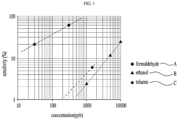
- the sensitivity of the sensing layer 300 to ethanol, toluene, and formaldehyde is shown graphically in FIG. 3 .
- the sensing layer 300 has a much higher sensitivity to formaldehyde A than to ethanol B and toluene C, which react most competitively with formaldehyde A among volatile organic compounds.
- the sensitivity of the gas sensor 10 of the present disclosure to formaldehyde A is between 20% and 70%, and ethanol B and toluene C are less than 10% or only exceed 10% in most concentrations.
- the sensitivity of the gas sensor 10 of the present disclosure is 20% or more even when the concentration of formaldehyde A is less than 100 ppb, but the sensitivity of the gas sensor 10 does not exceed 20% even when the concentration of each of ethanol B and toluene C is 1000 ppb or more.
- the sensitivity of the gas sensor 10 to formaldehyde A is 20 to 60% when the concentration of the formaldehyde A is 0.03ppm to 0.30ppm.
- the sensitivity of the gas sensor 10 of the present disclosure to a concentration of ethanol B of 1 ppm is 2.3%, which is very low.
- the sensitivity corresponds to the sensitivity of the gas sensor 10 to formaldehyde of 0.01 ppm or less.
- the sensitivity of the gas sensor 10 of the present disclosure to the concentration of toluene C of 1.5ppm is measured to be 6.8%, but the sensitivity corresponds to the concentration of formaldehyde of 0.01ppm or less.
- the gas sensor 10 of the present disclosure may detect, for example, formaldehyde A of a concentration near the concentration of 0.08ppm, which is the environmental standard of the International Health Organization, with high sensitivity.
- the gas sensor 10 of the present disclosure measures a volatile organic compound including ethanol B or toluene C with sensitivity to the concentration of 0.01ppm or less based on formaldehyde, and has selectivity to formaldehyde.
- the sensing layer 300 may be made of the compound of SnO 2 with an oxide of an alkali metal element or an oxide of an alkaline earth metal element and may specifically detect formaldehyde A.
- the gas sensor 10 of the present disclosure other metal elements may not be applied to make the sensing layer 300. This is because it is a well-known fact that the gas sensors of a prior art apply several different metal elements as a sensing material, and thus do not have the effect of specifically detecting formaldehyde, but only detect the presence of most volatile organic compounds as a whole and concentration thereof.
- the sensing layer 300 specifically reacts only to formaldehyde or has a higher sensitivity to formaldehyde than ethanol or toluene as illustrated in FIG. 3 .
- the gas sensor 10 of the present disclosure may exclude nickel and nickel oxides from the alkali metal element.
- a compound of NiO and SnO 2 is used as a material for the sensing layer.
- SnO 2 -NiO is used as a material of the sensing layer
- gold (Au) is used as a material of the electrode.
- the sensitivity of the detection sensor of the prior art to the formaldehyde is 26 to 61%.
- the detection sensor of the prior art has a sensitivity of 68% to the concentration of 1ppm of ethanol, which is rather higher than the sensitivity to the formaldehyde.
- the detection sensor of the prior art has a greater response or sensitivity to ethanol when a nickel compound is included in a sensing material, so it can be seen that when formaldehyde and ethanol are present in the air or indoors, the sensing layer cannot distinguish the formaldehyde and the ethanol from each other. It may be understood that this is because, in the case of nickel, the molecular structures of an oxide and the diameter of an atom do not specifically react only to formaldehyde, but react more strongly to gases composed of organic compounds having other functional groups.
- nickel reacts more easily, strongly, and rapidly to ethanol than to formaldehyde. Accordingly, when an oxide of an alkali metal element or an oxide of an alkaline earth metal element is used in the sensing layer 300 of the gas sensor 10 of the present disclosure, nickel and a nickel oxide may be excluded.
- FIGS. 4a and 4b illustrate a mechanism by which the gas sensor 10 of the present disclosure specifically reacts to formaldehyde.
- metal oxides metal ions and non-metal ions combine to form a non-stoichiometric composition from a stoichiometric composition.
- Lattice defects accompanied in a process in which metal ions and oxide ions form a non-stoichiometric composition from a stoichiometric composition act as a donor or an acceptor.
- the formaldehyde or a formaldehyde reactor may be introduced into the lattice structure of the sensing layer 300.
- Volatile organic compounds including formaldehyde A may exist indoors or in the air.
- formaldehyde A and the ethanol B may coexist indoors or in the air.
- FIG. 4b illustrates that formaldehyde A is accommodated in the lattice structure of the sensing layer 300.
- the capacitance or electrical resistance of the entire sensing layer 300 may be changed.
- formaldehyde A accommodated in the sensing layer 300 may generate the movement of a large amount of electrons while strongly generating oxidation-reduction reactions with alkali metals or alkaline earth metals. Accordingly, the movement of a large amount of electrons generated inside the sensing layer 300 may be amplified and the electrons may be transferred to the electrode 200, and this may change the capacitance or electrical resistance of the electrode 200.
- the gas sensor 10 of the present invention detects even small amounts of formaldehyde A with high sensitivity.
- volatile organic compounds having large molecular structures or other functional groups such as the ethanol B or toluene (C) other than formaldehyde A cannot be introduced into the lattice structure of the sensing layer 300.
- ethanol B may contact the sensing layer 300, the ethanol B cannot be introduced into the lattice structure of the inside of the sensing layer 300. Furthermore, the ethanol B cannot cause a strong redox reaction with the sensing layer 300.
- a volatile organic compound such as ethanol B cannot generate the movement of a large amount of electrons in the sensing layer 300 and cannot change the capacitance or electrical resistance of the sensing layer 300.
- the gas sensor 10 of the present disclosure may not respond or have a very low sensitivity to volatile organic compounds except for formaldehyde. Accordingly, the gas sensor 10 of the present disclosure may secure high sensitivity and detection specificity to formaldehyde A.
- the gas sensor 10 of the present disclosure requires that the electrode 200 be made of an indium tin oxide (ITO) so that the above-mentioned effect appears or becomes larger.
- ITO indium tin oxide
- the electrode 200 is made of a general compound of gold (Au) or platinum (Pt) so that the reception sensitivity of the specific capacitance change or electron movement occurring in the sensing layer 300 may be reduced.
- the electrode 200 may be made of a metal oxide including at least one element of Ti, Zn, In, and Sn, and may not include gold (Au) or platinum (Pt).
- the sensing layer 300 may be formed to completely cover the electrode 200. In this way, the first electrode 210 and the second electrode 220 may be securely connected to each other by the sensing layer 300.
- the sensing layer 300 may further improve the performance of detecting formaldehyde by maximizing an area of the sensing layer 300 exposed to atmospheric or indoor air.
- FIG. 5 illustrates another embodiment of the gas sensor 10' of the present disclosure.
- the sensing layer 300 has a property that reacts specifically to formaldehyde, so the sensing layer 300 may not be required to cover the entirety of the electrode 200.
- a portion I of a surface area of the electrode 200 may be exposed to the outside, and a remaining area II thereof may be covered by the sensing layer 300.
- the exposed part of the electrode 200 may be referred to as the exposed area I, and the area covered by the sensing layer 300 may be referred to as the blocked area II.
- the sensing layer 300 may function properly as long as the sensing layer 300 can contact formaldehyde in the air or indoors while connecting the first electrode 210 and the second electrode 220 to each other. In this way, since the sensing layer 300 can be formed in a relatively narrow area, the amount of a material of which the sensing layer 300 is formed may be minimized.
- the exposed area I it is possible to easily check whether the electrode 200 is properly installed and whether the electrode 200 is operating normally.
- the exposed area I may be used as a part to which a lead wire for connection to the outside is connected, so the size of the gas sensor 10' may be miniaturized.
- FIG. 6 illustrates still another embodiment of the gas sensor 10" of the present disclosure.
- the sensing layer 300 has a property that reacts specifically to formaldehyde A, and thus as long as the electrodes of the electrode 200 can be connected to each other by the sensing layer 300, the sensing layer 300 may function properly at any place at which the sensing layer 300 is located.
- the sensing layer 300 may be formed on the substrate 100, and the electrode 200 may be formed on the sensing layer 300.
- the electrode 200 may be formed as one pair of the first electrode 210 and the second electrode 220 spaced apart from each other by a predetermined distance t.
- each of the first electrode 210 and the second electrode 220 may be connected to the outside by a separate lead wire (not shown).
- the electrode 200 does not react to formaldehyde A or volatile organic compounds, so the electrode 200 may be exposed indoors or to the atmosphere. In consideration of this point, the electrode 200 may be formed on the sensing layer 300.
- the sensing layer 300 may be first formed on the substrate 100, and the electrode 200 may be formed on the sensing layer 300. That is, the sensing layer 300 may be located between the substrate 100 and the electrode 200, and the first electrode 210 and the second electrode 220 may be formed on the surface of the sensing layer 300. Accordingly, the first electrode 210 and the second electrode 220 may be formed on the sensing layer 300, and thus it may be guaranteed that the first electrode 210 and the second electrode 220 are connected to each other by the sensing layer 300.
- all outer surfaces of the first electrode 210 and the second electrode 220 may be exposed to the outside. Accordingly, it may be easier to connect a lead wire for electrical connection with the outside.
- the formation of the first electrode 210 and the second electrode 220 may be relatively easy in a manufacturing process thereof, and, after the manufacturing, maintenance thereof may be relatively easy.
- FIG. 7 illustrates that a heater 400 is added in the embodiment illustrated in FIG. 2 .
- the same reference numerals as in the embodiment illustrated in FIG. 2 are used, and the heater 400 is added.
- the heater 400 provides heat to the gas sensor 10 so that the gas sensor 10 can operate at a specific temperature.
- the heater 400 may be made of gold or platinum. As illustrated in FIG. 7 , the heater 400 may be located on a surface opposite to the surface of the substrate 100 on which the electrode 200 is located. However, heaters 400 may be located around the electrode 200 on the surface on which the electrode 200 is located so as to surround the electrode 200.
- an indium tin oxide ITO
- a tin oxide including Mg Mg-SnO 2
- Mg-SnO 2 Mg-SnO 2
- Tin chloride (SnCh) is reacted with an aqueous solution of magnesium sulfate.
- a precipitate may be obtained by dropping aqueous ammonia into this aqueous solution.
- This precipitate may be washed with distilled water and then dried. The drying may be done in the air.
- Mg-SnO 2 may be obtained by calcining the dried powder at 600 to 800°C.
- the electrode 200 made of an indium tin oxide (ITO) may be formed on the surface of the substrate 100.
- the sensing layer 300 may be formed.
- the sensing layer 300 may use the above-described Mg-SnO 2 as a material.
- the sensing layer 300 may be formed by dispersing and applying Mg-SnO 2 onto a mixed solution of pure water and glycerin to connect the first electrode 210 and the second electrode 220 to each other.
- the sensing layer 300 may be heated at 500°C.
- the gas sensor 10 may be installed in a gas introduction container and exposed to gas whose concentration is adjusted. In this state, the sensitivity of the gas sensor 10 to the gas may be measured by detecting the change of a resistance value between the first electrode 210 and the second electrode 220.
- concentration-adjusted gas may be generated by a permeator and a flow rate thereof may be adjusted by a mass flow controller so that the gas can be introduced into the gas introduction container.
- Humidity may be generated by bubbling distilled water.
- Relative humidity obtained as the result of FIG. 3 may be preset to be 54%.
- a resistance value may be obtained by applying voltage through wiring installed in the sensor element of an electrometer and measuring an electric current.
- the gas sensor 10 of the present disclosure may be used in a variety of home appliances.
- the gas sensor 10 may be installed in an air conditioner, an air purifier, a washing machine, a dryer, and a clothing management device to detect whether formaldehyde is generated and to perform necessary operations accordingly.
Landscapes
- Chemical & Material Sciences (AREA)
- Chemical Kinetics & Catalysis (AREA)
- Electrochemistry (AREA)
- Physics & Mathematics (AREA)
- Health & Medical Sciences (AREA)
- Life Sciences & Earth Sciences (AREA)
- Analytical Chemistry (AREA)
- Biochemistry (AREA)
- General Health & Medical Sciences (AREA)
- General Physics & Mathematics (AREA)
- Immunology (AREA)
- Pathology (AREA)
- Investigating Or Analyzing Materials By The Use Of Fluid Adsorption Or Reactions (AREA)
Abstract
Proposed is a gas sensor (10) having a sensing layer (300) formed by using a sensing material including alkali metal or alkaline earth metal to specifically react to formaldehyde among volatile organic compounds. When the sensing layer (300) detects formaldehyde by connecting electrodes (200) to each other, the sensing layer (300) can detect the formaldehyde by checking a change in physical quantity.
Description
- The present disclosure relates generally to a gas sensor for detecting volatile organic compounds. More particularly, the present disclosure relates to a gas sensor capable of specifically detecting formaldehyde among volatile organic compounds and a method for manufacturing the same.
- Physical disorders such as sore eyes, headaches, and allergies may occur indoors immediately after new construction or renovation. This is called a sick building syndrome, and the cause is known to be volatile organic compounds (VOC), primarily, formaldehyde.
- Among volatile organic compounds, formaldehyde is contained in various adhesives, flooring materials, and particle board or plywood, and is released when these are used in indoor spaces, causing problems. It is impossible to completely avoid use of these things, and when volatile organic compounds including formaldehyde are generated therefrom, the volatile organic compounds have many adverse effects on indoor residents.
- Looking at the effect of formaldehyde on the human body, when concentration of formaldehyde in the air is about 0.04ppm, nervous tissues begin to be stimulated, and sensitive children may develop atopic dermatitis. When the concentration of formaldehyde is 0.05 to 1.0ppm, it can be smelled, and the level of the concentration is an indoor standard in Canada and California. When concentration of formaldehyde in the air is 0.2ppm, eye irritation begins, and when the concentration is 0.25 to 0.33ppm, a respiratory failure may occur. The concentration of 0.5 ppm is the lowest level at which stimulation of the throat begins and is the highest level allowed by the Korean Society of Industrial Hygiene. When the concentration is 2.0 to 3.0ppm, pain in the eyes begins, and when the concentration is 4.0ppm, tearing may occur. When the concentration is 10.0 to 20.0ppm, intense tearing and difficulty in breathing may occur, and when the concentration is 30.0 ppm or more, acute poisoning may occur within minutes and death may occur from toxic emphysema.
- For reference, in the indoor environmental standards set by the World Health Organization (WHO) and Japan, the concentration of formaldehyde in the air is 0.08ppm. In accordance with these standards, it is necessary to detect the concentration of formaldehyde in the air by using a gas sensor.
- However, when formaldehyde is generated, other volatile organic compound (VOC) gases such as alcohol may exist. However, since general volatile organic compounds and formaldehyde have different effects on the human body, the specific and selective sensitivity of the gas sensor to formaldehyde is required.
- A general gas sensor has similar sensitivity to most volatile organic compounds, and such an example can be seen in
Japanese Patent No. 3854358 - However, such a gas sensor of a prior art has similar sensitivity to most volatile organic compounds. For example, when using a sensing material in which Pd or Gd is added to SiO2, the sensitivity S of the gas sensor to 0.1ppm of formaldehyde is 20%, but the sensitivity S of the gas sensor to 1 ppm of volatile organic compounds also is 25%. The sensitivity is obtained by converting the percentage of a resistance change. Accordingly, the gas sensor of the prior art detects both formaldehyde and volatile organic compounds with high sensitivity, but cannot selectively detect only formaldehyde.
-
FIG. 1 illustrates the responsiveness of the gas sensor of the prior art. This is disposed in a paper titled "Study on a micro-gas sensor with SnO2-NiO sensitive film for indoor formaldehyde detection"(Sensors and Actuators B vol 132, (2008) p74~80). Here, the gas sensor is a MEMS structure using SnO2-NiO as a sensing material and using Pt in making an electrode to detect formaldehyde. - However, the gas sensor in this paper has a sensitivity S of 0.06ppm of formaldehyde which is 1.6% and a sensitivity S of 1ppm of ethanol which is 0.1% or less. Furthermore, the sensitivity ratio of formaldehyde to ethanol is greater than 10, and the interference of the ethanol gas is suppressed. However, the sensitivity S of formaldehyde is 1.6%, which is very low.
- In other words, the gas sensor is more sensitive to formaldehyde than volatile organic compounds including alcohol, but has a fundamental limitation in that the gas sensor cannot selectively detect formaldehyde.
- Accordingly, the gas sensor of the prior art detects the presence of volatile organic compounds, but has a problem in that the gas sensor cannot provide information on whether formaldehyde is included in the volatile organic compounds and if included, how much formaldehyde is included therein.
- An object of the present invention is to provide a gas sensor with the highest sensitivity to formaldehyde among volatile organic compounds.
- Another object of the present invention is to provide a gas sensor capable of detecting the presence or concentration of formaldehyde among volatile organic compounds.
- Still another object of the present invention is to provide a gas sensor that maintains both high sensitivity and high selectivity.
- These objects are achieved with the subject-matter of the independent claims. Preferred aspects are defined in the dependent claims.
- According to the present invention, there is provided a gas sensor made of a novel combination of sensing materials including an alkali metal element or an alkaline earth metal element and having high sensitivity and high selectivity.
- According to the present invention, formaldehyde may be detected by forming a sensing layer by using a compound of a SnO2 with an alkali metal oxide or an alkaline earth metal oxide.
- According to the present invention, the gas sensor is configured to have an electrode made of an indium tin oxide (ITO).
- The gas sensor of the present invention is defined in
claim 1 and includes: a substrate made of a non-conductive material; the electrode located on the substrate and formed of a conductive material; and the sensing layer configured to be in contact with at least a portion of the electrode or to cover the electrode, the sensing layer reacting to gas, wherein the sensing layer may include a compound of SnO2 with an alkali metal oxide or an alkaline earth metal oxide. - The alkali metal oxide may include at least one element of Li, Na, K, Rb, Cs, and Fr.
- The alkaline earth metal oxide may include at least one element of Be, Mg, Ca, Sr, Ba, and Ra.
- The electrode may be formed of an indium tin oxide (ITO).
- The electrode may include a first electrode formed on the substrate, and a second electrode formed on the substrate by being spaced apart from the first electrode.
- The sensing layer may be disposed to connect the first electrode with the second electrode.
- The sensing layer may be configured to expose at least a portion of each of the first electrode and the second electrode to the air.
- A heater may be provided on the substrate. The heater may be located on a surface of the substrate on which the electrode is located or on a surface opposite to the surface of the substrate on which the electrode is located.
- The gas sensor of another embodiment of the present invention includes a substrate made of a non-conductive material; a sensing layer located on the substrate; and an electrode made of a conductive material and configured to detect electron movement and capacitance inside the sensing layer, wherein the electrode may include the first electrode formed of a conductive material, and the second electrode configured to supply an electric current to the first electrode or to receive an electric current from the first electrode, and the sensing layer may connect the first electrode with the second electrode and may be configured to expose at least a portion of each of the first electrode and the second electrode to the air.
- The sensing layer may be disposed between the substrate and the electrode.
- The first electrode and the second electrode may be provided on an outer surface of the sensing layer.
- The sensing layer may shield a portion of the first electrode and a portion of the second electrode.
- The heater may be provided on the substrate. The heater may be located on the surface of the substrate on which the electrode is located or on the surface opposite to the surface of the substrate on which the electrode is located.
- According to another aspect of the present invention, a method for manufacturing a gas sensor for detecting volatile organic compounds, with the gas sensor having the sensing layer configured to connect electrodes to each other formed on a substrate, includes forming the electrodes by using an indium tin oxide (ITO), and forming the sensing layer by using the compound of SnO2 with an alkali metal oxide or an alkaline earth metal oxide.
- The alkali metal oxide may include at least one element of Li, Na, K, Rb, Cs, and Fr, and the alkaline earth metal oxide may include at least one element of Be, Mg, Ca, Sr, Ba, and Ra.
- The sensing layer may be formed by dispersing and applying Mg-SnO2 onto a mixed solution of pure water and glycerin and heating the mixed solution, onto which the Mg-SnO2 is applied, to a predetermined temperature.
- The gas sensor of the present disclosure may have at least one of the following effects.
- According to the present disclosure, formaldehyde gas at a low concentration of 10 ppb may be detected.
- According to the present disclosure, the interference of other gases with formaldehyde may be avoided. Accordingly, only formaldehyde may be effectively detected.
- In the gas sensor of the present disclosure, 1ppm of ethanol gas, which is a representative volatile organic compound, has sensitivity corresponding to 10ppb of formaldehyde or less. Accordingly, the gas sensor of the present disclosure may detect formaldehyde better than other volatile organic compounds, thereby having high selectivity to formaldehyde.
-
-
FIG. 1 is a graph illustrating that the selectivity of formaldehyde is lower than that of ethanol in a gas sensor of a prior art; -
FIG. 2 is a schematic cross-sectional view illustrating the structure of a gas sensor of the present disclosure according to an embodiment; -
FIG. 3 is a graph illustrating the sensitivity of the gas sensor of the present disclosure to formaldehyde, ethanol, and toluene; -
FIGS. 4a and 4b are views illustrating gas detection performed by the gas sensor of the present disclosure; -
FIG. 5 is a schematic cross-sectional view illustrating another embodiment of the gas sensor of the present disclosure; -
FIG. 6 is a schematic cross-sectional view illustrating still another embodiment of the gas sensor of the present disclosure; and -
FIG. 7 is a schematic cross-sectional view illustrating that a heater is added to the gas sensor in the embodiment illustrated inFIG. 2 . - Hereinafter, embodiments disclosed in this specification will be described in detail with reference to the accompanying drawings. In this specification, the same or similar reference numerals are given to the same or similar components even in different embodiments, and the description thereof is replaced with the first description. Singular expressions used in this specification include plural expressions unless the context clearly dictates otherwise. In addition, in describing the embodiments disclosed in this specification, when it is determined that a detailed description of related known technologies may obscure the gist of the embodiments disclosed in this specification, the detailed description thereof will be omitted. In addition, it should be noted that the accompanying drawings are only for easy understanding of the embodiments disclosed in this specification, and should not be construed as limiting the technical idea disclosed in this specification by the accompanying drawings.
-
FIG. 2 schematically illustrates the structure of the gas sensor according to an embodiment of the present disclosure. Thegas sensor 10 according to the embodiment of the present disclosure has asubstrate 100 constituting a frame thereof.Electrodes 200 re located on thesubstrate 100. Asensing layer 300 is provided to connect each of theelectrodes 200 to each other. - The
substrate 100 may be made of a non-conductive material such as silicon dioxide (SiO2). Thesubstrate 100 made of a resin-based material serves to support theelectrode 200 and thesensing layer 300. Thesubstrate 100 may be a plate having a predetermined shape. A glass substrate or an alumina substrate may be used as thesubstrate 100. - The
electrode 200 may include at least one pair of afirst electrode 210 and asecond electrode 220. Thefirst electrode 210 and thesecond electrode 220 may be electrically connected to the outside. Thefirst electrode 210 and thesecond electrode 220 may be formed at a predetermined interval on thesubstrate 100, and an electric current may be transmitted between thefirst electrode 210 and thesecond electrode 220 through thesensing layer 300. - The
gas sensor 10 of the present disclosure may detect formaldehyde by detecting an electric current flowing between thefirst electrode 210 and thesecond electrode 220, change in the electric current, or a change in electrical resistance or capacitance of theelectrode 200. - The
sensing layer 300 may be formed to cover thefirst electrode 210 and thesecond electrode 220. Thesensing layer 300 may change the intensity of an electric current flowing between thefirst electrode 210 and thesecond electrode 220, or the capacitance or electrical resistance of theelectrode 200. That is, a material forming thesensing layer 300 has inherent resistance, but thesensing layer 300 may have electrical properties changed when thesensing layer 300 contacts or is combined with formaldehyde. - For example, when a material of which the
sensing layer 300 is formed comes into contact with or is combined with formaldehyde, the material may transfer electrons to theelectrode 200 or receive electrons from theelectrode 200 while causing an oxidation-reduction reaction with the formaldehyde. Alternatively, when a material of which thesensing layer 300 is formed comes into contact with or is combined with formaldehyde, the molecular arrangement structure of thesensing layer 300 may be changed due to the permeation of the formaldehyde, and thus the total charge capacity of thesensing layer 300 may be changed. - However, the
sensing layer 300 may not react to other volatile organic compounds other than formaldehyde or may have a very low reactivity thereto compared to formaldehyde. - According to these characteristics, the
gas sensor 10 of the present disclosure specifically detects formaldehyde. This is because thesensing layer 300 does not react or has very low reactivity to volatile organic compounds other than formaldehyde even when the formaldehyde exists along with the volatile organic compounds in the air or indoors. - The
gas sensor 10 of the present disclosure specifically reacts to formaldehyde to detect formaldehyde, and may not react to other volatile organic compounds. Accordingly, hereinafter, the characteristics of thegas sensor 10 of the present disclosure not detecting other volatile organic compounds or having a low sensitivity to the other volatile organic compounds will be described. - In the
gas sensor 10 of the present invention, materials of theelectrode 200 and thesensing layer 300 are specified. That is, the materials of theelectrode 200 and thesensing layer 300 are required to react specifically to formaldehyde or have a significantly greater sensitivity to formaldehyde than other volatile organic compounds. - A study found that when the material of the
sensing layer 300 of the present disclosure is a compound of a tin oxide (SnO2) with an oxide of an alkali metal element or an oxide of an alkaline earth metal element, thesensing layer 300 has a significantly greater sensitivity to formaldehyde than to other volatile organic compounds, or reacts specifically only to the formaldehyde. - Accordingly, as the material of the
sensing layer 300 of thegas sensor 10 of the present disclosure, the compound of a tin oxide (SnO2) with the oxide of an alkali metal element or the oxide of an alkaline earth metal element may be selected. - The alkali metal element may include at least one element of Li, Na, K, Rb, Cs, and Fr. In addition, the alkaline earth metal element may include at least one element of Be, Mg, Ca, Sr, Ba, and Ra.
- When Mg-SnO2 is used as the material of the
sensing layer 300 of the present disclosure, the sensitivity of thesensing layer 300 to ethanol, toluene, and formaldehyde is shown graphically inFIG. 3 . Referring toFIG. 3 , it can be seen that thesensing layer 300 has a much higher sensitivity to formaldehyde A than to ethanol B and toluene C, which react most competitively with formaldehyde A among volatile organic compounds. - That is, it can be seen that the sensitivity of the
gas sensor 10 of the present disclosure to formaldehyde A is between 20% and 70%, and ethanol B and toluene C are less than 10% or only exceed 10% in most concentrations. - In addition, it can be seen that the sensitivity of the
gas sensor 10 of the present disclosure is 20% or more even when the concentration of formaldehyde A is less than 100 ppb, but the sensitivity of thegas sensor 10 does not exceed 20% even when the concentration of each of ethanol B and toluene C is 1000 ppb or more. - When the
sensing layer 300 is made of Mg-SnO2 and theelectrode 200 is made of ITO, which will be described later, the sensitivity of thegas sensor 10 to formaldehyde A is 20 to 60% when the concentration of the formaldehyde A is 0.03ppm to 0.30ppm. - However, the sensitivity of the
gas sensor 10 of the present disclosure to a concentration of ethanol B of 1 ppm is 2.3%, which is very low. The sensitivity corresponds to the sensitivity of thegas sensor 10 to formaldehyde of 0.01 ppm or less. - The sensitivity of the
gas sensor 10 of the present disclosure to the concentration of toluene C of 1.5ppm is measured to be 6.8%, but the sensitivity corresponds to the concentration of formaldehyde of 0.01ppm or less. - As a result, the
gas sensor 10 of the present disclosure may detect, for example, formaldehyde A of a concentration near the concentration of 0.08ppm, which is the environmental standard of the International Health Organization, with high sensitivity. In addition, it can be seen that thegas sensor 10 of the present disclosure measures a volatile organic compound including ethanol B or toluene C with sensitivity to the concentration of 0.01ppm or less based on formaldehyde, and has selectivity to formaldehyde. - In the
gas sensor 10 of the present disclosure, thesensing layer 300 may be made of the compound of SnO2 with an oxide of an alkali metal element or an oxide of an alkaline earth metal element and may specifically detect formaldehyde A. - Meanwhile, in the
gas sensor 10 of the present disclosure, other metal elements may not be applied to make thesensing layer 300. This is because it is a well-known fact that the gas sensors of a prior art apply several different metal elements as a sensing material, and thus do not have the effect of specifically detecting formaldehyde, but only detect the presence of most volatile organic compounds as a whole and concentration thereof. - Additionally, when a metal other than alkali metals or alkaline earth metals is experimentally used as a material for the
sensing layer 300, it is not possible to obtain an experimental result that thesensing layer 300 specifically reacts only to formaldehyde or has a higher sensitivity to formaldehyde than ethanol or toluene as illustrated inFIG. 3 . - In addition, the
gas sensor 10 of the present disclosure may exclude nickel and nickel oxides from the alkali metal element. In the detection sensor of the prior art used inFIG. 1 , a compound of NiO and SnO2 is used as a material for the sensing layer. Specifically, in the detection sensor of the prior art, SnO2-NiO is used as a material of the sensing layer, and gold (Au) is used as a material of the electrode. As illustrated inFIG. 1 , when formaldehyde is 0.03ppm to 0.20ppm, the sensitivity of the detection sensor of the prior art to the formaldehyde is 26 to 61%. However, the detection sensor of the prior art has a sensitivity of 68% to the concentration of 1ppm of ethanol, which is rather higher than the sensitivity to the formaldehyde. - As a result, the detection sensor of the prior art has a greater response or sensitivity to ethanol when a nickel compound is included in a sensing material, so it can be seen that when formaldehyde and ethanol are present in the air or indoors, the sensing layer cannot distinguish the formaldehyde and the ethanol from each other. It may be understood that this is because, in the case of nickel, the molecular structures of an oxide and the diameter of an atom do not specifically react only to formaldehyde, but react more strongly to gases composed of organic compounds having other functional groups.
- That is, it may be understood that nickel reacts more easily, strongly, and rapidly to ethanol than to formaldehyde. Accordingly, when an oxide of an alkali metal element or an oxide of an alkaline earth metal element is used in the
sensing layer 300 of thegas sensor 10 of the present disclosure, nickel and a nickel oxide may be excluded. -
FIGS. 4a and 4b illustrate a mechanism by which thegas sensor 10 of the present disclosure specifically reacts to formaldehyde. In metal oxides, metal ions and non-metal ions combine to form a non-stoichiometric composition from a stoichiometric composition. Lattice defects accompanied in a process in which metal ions and oxide ions form a non-stoichiometric composition from a stoichiometric composition act as a donor or an acceptor. - When a material of which the
sensing layer 300 of thegas sensor 10 of the present disclosure is made is the compound of SnO2 with an oxide of an alkali metal or alkaline earth metal other than nickel, the formaldehyde or a formaldehyde reactor may be introduced into the lattice structure of thesensing layer 300. - The following description will be made with reference to
FIG. 4a . Volatile organic compounds including formaldehyde A may exist indoors or in the air. For example, formaldehyde A and the ethanol B may coexist indoors or in the air. -
FIG. 4b illustrates that formaldehyde A is accommodated in the lattice structure of thesensing layer 300. In this way, when formaldehyde A is accommodated in the lattice structure of thesensing layer 300, the capacitance or electrical resistance of theentire sensing layer 300 may be changed. - In addition, formaldehyde A accommodated in the
sensing layer 300 may generate the movement of a large amount of electrons while strongly generating oxidation-reduction reactions with alkali metals or alkaline earth metals. Accordingly, the movement of a large amount of electrons generated inside thesensing layer 300 may be amplified and the electrons may be transferred to theelectrode 200, and this may change the capacitance or electrical resistance of theelectrode 200. - Accordingly, the
gas sensor 10 of the present invention detects even small amounts of formaldehyde A with high sensitivity. However, volatile organic compounds having large molecular structures or other functional groups such as the ethanol B or toluene (C) other than formaldehyde A cannot be introduced into the lattice structure of thesensing layer 300. - In other words, although ethanol B may contact the
sensing layer 300, the ethanol B cannot be introduced into the lattice structure of the inside of thesensing layer 300. Furthermore, the ethanol B cannot cause a strong redox reaction with thesensing layer 300. - Accordingly, a volatile organic compound such as ethanol B cannot generate the movement of a large amount of electrons in the
sensing layer 300 and cannot change the capacitance or electrical resistance of thesensing layer 300. - As a result, the
gas sensor 10 of the present disclosure may not respond or have a very low sensitivity to volatile organic compounds except for formaldehyde. Accordingly, thegas sensor 10 of the present disclosure may secure high sensitivity and detection specificity to formaldehyde A. - Meanwhile, as a result of an experiment, it can be seen that the
gas sensor 10 of the present disclosure requires that theelectrode 200 be made of an indium tin oxide (ITO) so that the above-mentioned effect appears or becomes larger. This means that when theelectrode 200 is made of a general compound of gold (Au) or platinum (Pt), the reception sensitivity of the specific capacitance change or electron movement occurring in thesensing layer 300 may be reduced. - Specifically, the
electrode 200 may be made of a metal oxide including at least one element of Ti, Zn, In, and Sn, and may not include gold (Au) or platinum (Pt). - The
sensing layer 300 may be formed to completely cover theelectrode 200. In this way, thefirst electrode 210 and thesecond electrode 220 may be securely connected to each other by thesensing layer 300. - In addition, the
sensing layer 300 may further improve the performance of detecting formaldehyde by maximizing an area of thesensing layer 300 exposed to atmospheric or indoor air. -
FIG. 5 illustrates another embodiment of the gas sensor 10' of the present disclosure. In the gas sensor 10' according to the embodiment, thesensing layer 300 has a property that reacts specifically to formaldehyde, so thesensing layer 300 may not be required to cover the entirety of theelectrode 200. - Accordingly, in the gas sensor 10' according to the embodiment, a portion I of a surface area of the
electrode 200 may be exposed to the outside, and a remaining area II thereof may be covered by thesensing layer 300. The exposed part of theelectrode 200 may be referred to as the exposed area I, and the area covered by thesensing layer 300 may be referred to as the blocked area II. - In this embodiment, it is considered that the
sensing layer 300 may function properly as long as thesensing layer 300 can contact formaldehyde in the air or indoors while connecting thefirst electrode 210 and thesecond electrode 220 to each other. In this way, since thesensing layer 300 can be formed in a relatively narrow area, the amount of a material of which thesensing layer 300 is formed may be minimized. - In addition, by placing the exposed area I, it is possible to easily check whether the
electrode 200 is properly installed and whether theelectrode 200 is operating normally. For reference, as in this embodiment, when theelectrode 200 has the exposed area I, the exposed area I may be used as a part to which a lead wire for connection to the outside is connected, so the size of the gas sensor 10' may be miniaturized. -
FIG. 6 illustrates still another embodiment of thegas sensor 10" of the present disclosure. In thegas sensor 10" according to the embodiment, thesensing layer 300 has a property that reacts specifically to formaldehyde A, and thus as long as the electrodes of theelectrode 200 can be connected to each other by thesensing layer 300, thesensing layer 300 may function properly at any place at which thesensing layer 300 is located. - In the embodiment, the
sensing layer 300 may be formed on thesubstrate 100, and theelectrode 200 may be formed on thesensing layer 300. Theelectrode 200 may be formed as one pair of thefirst electrode 210 and thesecond electrode 220 spaced apart from each other by a predetermined distance t. Here, each of thefirst electrode 210 and thesecond electrode 220 may be connected to the outside by a separate lead wire (not shown). - In addition, the
electrode 200 does not react to formaldehyde A or volatile organic compounds, so theelectrode 200 may be exposed indoors or to the atmosphere. In consideration of this point, theelectrode 200 may be formed on thesensing layer 300. - In the embodiment, the
sensing layer 300 may be first formed on thesubstrate 100, and theelectrode 200 may be formed on thesensing layer 300. That is, thesensing layer 300 may be located between thesubstrate 100 and theelectrode 200, and thefirst electrode 210 and thesecond electrode 220 may be formed on the surface of thesensing layer 300. Accordingly, thefirst electrode 210 and thesecond electrode 220 may be formed on thesensing layer 300, and thus it may be guaranteed that thefirst electrode 210 and thesecond electrode 220 are connected to each other by thesensing layer 300. - In the embodiment, except for surfaces on which the
first electrode 210 and thesecond electrode 220 are seated on thesensing layer 300, all outer surfaces of thefirst electrode 210 and thesecond electrode 220 may be exposed to the outside. Accordingly, it may be easier to connect a lead wire for electrical connection with the outside. Particularly, the formation of thefirst electrode 210 and thesecond electrode 220 may be relatively easy in a manufacturing process thereof, and, after the manufacturing, maintenance thereof may be relatively easy. - Next,
FIG. 7 illustrates that aheater 400 is added in the embodiment illustrated inFIG. 2 . Here, for convenience of explanation, the same reference numerals as in the embodiment illustrated inFIG. 2 are used, and theheater 400 is added. - The
heater 400 provides heat to thegas sensor 10 so that thegas sensor 10 can operate at a specific temperature. Theheater 400 may be made of gold or platinum. As illustrated inFIG. 7 , theheater 400 may be located on a surface opposite to the surface of thesubstrate 100 on which theelectrode 200 is located. However,heaters 400 may be located around theelectrode 200 on the surface on which theelectrode 200 is located so as to surround theelectrode 200. - Hereinafter, one embodiment of the manufacturing method of the
gas sensor 10 of the present disclosure will be described. For convenience of explanation, the manufacturing method will be described based on thegas sensor 10 illustrated inFIG. 2 . - In the
gas sensor 10 of the present disclosure, as the material of theelectrode 200, an indium tin oxide (ITO) may be used. As the material of thesensing layer 300, a tin oxide including Mg (Mg-SnO2) may be used. - The manufacturing of Mg-SnO2 will be described. Tin chloride (SnCh) is reacted with an aqueous solution of magnesium sulfate. Here, the ratio of the contents of Sn and Mg may be preset to be Sn:Mg = 20:1 in terms of a molar ratio. A precipitate may be obtained by dropping aqueous ammonia into this aqueous solution.
- This precipitate may be washed with distilled water and then dried. The drying may be done in the air. Mg-SnO2 may be obtained by calcining the dried powder at 600 to 800°C.
- The
electrode 200 made of an indium tin oxide (ITO) may be formed on the surface of thesubstrate 100. After forming thefirst electrode 210 and thesecond electrode 220 of theelectrode 200 on thesubstrate 100, thesensing layer 300 may be formed. Thesensing layer 300 may use the above-described Mg-SnO2 as a material. Thesensing layer 300 may be formed by dispersing and applying Mg-SnO2 onto a mixed solution of pure water and glycerin to connect thefirst electrode 210 and thesecond electrode 220 to each other. - After forming the
sensing layer 300, thesensing layer 300 may be heated at 500°C. - The measuring of response to gas by using the
gas sensor 10 of the present disclosure will be described. Thegas sensor 10 may be installed in a gas introduction container and exposed to gas whose concentration is adjusted. In this state, the sensitivity of thegas sensor 10 to the gas may be measured by detecting the change of a resistance value between thefirst electrode 210 and thesecond electrode 220. - By using pure air as a dilution gas, concentration-adjusted gas may be generated by a permeator and a flow rate thereof may be adjusted by a mass flow controller so that the gas can be introduced into the gas introduction container. Humidity may be generated by bubbling distilled water. Relative humidity obtained as the result of
FIG. 3 may be preset to be 54%. - In the
gas sensor 10, a resistance value may be obtained by applying voltage through wiring installed in the sensor element of an electrometer and measuring an electric current. - The
gas sensor 10 of the present disclosure may be used in a variety of home appliances. For example, thegas sensor 10 may be installed in an air conditioner, an air purifier, a washing machine, a dryer, and a clothing management device to detect whether formaldehyde is generated and to perform necessary operations accordingly.
Claims (12)
- A gas sensor (10) for detecting volatile organic compounds, characterized in that the gas sensor (10) comprises:a substrate (100) made of a non-conductive material;an electrode (200) located on the substrate (100) and formed of a conductive material; anda sensing layer (300) configured to be in contact with at least a portion of the electrode (200) or to cover the electrode (200), the sensing layer (300) reacting to gas,wherein the sensing layer (300) comprises a compound of SnO2 with an alkali metal oxide or an alkaline earth metal oxide.
- The gas sensor (10) of claim 1, characterized in that the electrode (200) is formed of an indium tin oxide (ITO).
- The gas sensor (10) of any one of claims 1 to 2, characterized in that the electrode (200) comprises a first electrode (210) formed on the substrate (100), and a second electrode (220) formed on the substrate (100) by being spaced apart from the first electrode (210), and
the sensing layer (300) is disposed to connect the first electrode (210) with the second electrode (220). - The gas sensor (10) of claim 3, characterized in that the sensing layer (300) is configured to expose at least a portion of each of the first electrode (210) and the second electrode (220) to the air.
- The gas sensor (10) of any one of claims 1 to 4, characterized in that a heater (400) is provided on the substrate (100), the heater (400) being located on a surface of the substrate (100) on which the electrode (200) is located or on a surface opposite to the surface of the substrate (100) on which the electrode (200) is located.
- A gas sensor (10) for detecting volatile organic compounds, characterized in that the gas sensor (10) comprises:a substrate (100) made of a non-conductive material;a sensing layer (300) located on the substrate (100); andan electrode (200) made of a conductive material and configured to detect electron movement and capacitance inside the sensing layer (300),wherein the electrode (200) comprises a first electrode (210) formed of a conductive material, and a second electrode (220) configured to supply an electric current to the first electrode (210) or to receive an electric current from the first electrode (210), andthe sensing layer (300) connects the first electrode (210) with the second electrode (220) and is configured to expose at least a portion of each of the first electrode (210) and the second electrode (220) to the air.
- The gas sensor (10) of claim 6, characterized in that the sensing layer (300) is disposed between the substrate (100) and the electrode (200).
- The gas sensor (10) of claim 7, characterized in that the first electrode (210) and the second electrode (220) are provided on an outer surface of the sensing layer (300).
- The gas sensor (10) of claim 6, 7, or 8, characterized in that the sensing layer (300) shields a portion of the first electrode (210) and a portion of the second electrode (220).
- The gas sensor (10) of any one of claims 6 to 9, characterized in that a heater (400) is provided on the substrate (100), the heater (400) being located on a surface of the substrate (100) on which the electrode (200) is located or on a surface opposite to the surface of the substrate (100) on which the electrode (200) is located.
- A method for manufacturing a gas sensor (10) for detecting volatile organic compounds, with the gas sensor (10) having a sensing layer (300) configured to connect electrodes (200) to each other formed on a substrate (100), characterized in that the method comprises:forming the electrodes (200) by using an indium tin oxide (ITO), andforming the sensing layer (300) by using a compound of SnO2 with an alkali metal oxide or an alkaline earth metal oxide.
- The method of claim 11, characterized in that the sensing layer (300) is formed by dispersing and applying Mg-SnO2 onto a mixed solution of pure water and glycerin and heating the mixed solution, onto which the Mg-SnO2 is applied, to a predetermined temperature.
Priority Applications (1)
| Application Number | Priority Date | Filing Date | Title |
|---|---|---|---|
| EP23175381.5A EP4467971A1 (en) | 2023-05-25 | 2023-05-25 | Gas sensor for detecting volatile organic compounds and method for manufacturing same |
Applications Claiming Priority (1)
| Application Number | Priority Date | Filing Date | Title |
|---|---|---|---|
| EP23175381.5A EP4467971A1 (en) | 2023-05-25 | 2023-05-25 | Gas sensor for detecting volatile organic compounds and method for manufacturing same |
Publications (1)
| Publication Number | Publication Date |
|---|---|
| EP4467971A1 true EP4467971A1 (en) | 2024-11-27 |
Family
ID=86603704
Family Applications (1)
| Application Number | Title | Priority Date | Filing Date |
|---|---|---|---|
| EP23175381.5A Pending EP4467971A1 (en) | 2023-05-25 | 2023-05-25 | Gas sensor for detecting volatile organic compounds and method for manufacturing same |
Country Status (1)
| Country | Link |
|---|---|
| EP (1) | EP4467971A1 (en) |
Citations (4)
| Publication number | Priority date | Publication date | Assignee | Title |
|---|---|---|---|---|
| JP3854358B2 (en) | 1997-03-04 | 2006-12-06 | エフアイエス株式会社 | Gas sensor material |
| JP2007139669A (en) * | 2005-11-21 | 2007-06-07 | Ngk Spark Plug Co Ltd | Gas sensor |
| CN102680540B (en) * | 2012-06-07 | 2014-06-18 | 惠州市富济电子材料有限公司 | Formaldehyde gas-sensing material, corresponding formaldehyde gas-sensing element and preparation method of element |
| KR102181598B1 (en) * | 2019-01-28 | 2020-11-20 | 한국광기술원 | Gas Sensor Package Having Scattering Portion and Method for Manufacturing Thereof |
-
2023
- 2023-05-25 EP EP23175381.5A patent/EP4467971A1/en active Pending
Patent Citations (4)
| Publication number | Priority date | Publication date | Assignee | Title |
|---|---|---|---|---|
| JP3854358B2 (en) | 1997-03-04 | 2006-12-06 | エフアイエス株式会社 | Gas sensor material |
| JP2007139669A (en) * | 2005-11-21 | 2007-06-07 | Ngk Spark Plug Co Ltd | Gas sensor |
| CN102680540B (en) * | 2012-06-07 | 2014-06-18 | 惠州市富济电子材料有限公司 | Formaldehyde gas-sensing material, corresponding formaldehyde gas-sensing element and preparation method of element |
| KR102181598B1 (en) * | 2019-01-28 | 2020-11-20 | 한국광기술원 | Gas Sensor Package Having Scattering Portion and Method for Manufacturing Thereof |
Non-Patent Citations (2)
| Title |
|---|
| LING T R ET AL: "Influence of nano-scale dopants of Pt, CaO and SiO"2, on the alcohol sensing of SnO"2 thin films", SENSORS AND ACTUATORS B: CHEMICAL, ELSEVIER BV, NL, vol. 119, no. 2, 7 December 2006 (2006-12-07), pages 497 - 503, XP027971712, ISSN: 0925-4005, [retrieved on 20061207] * |
| MIN B K ET AL: "Undoped and 0.1wt.% Ca-doped Pt-catalyzed SnO"2 sensors for CH"4 detection", SENSORS AND ACTUATORS B: CHEMICAL, ELSEVIER BV, NL, vol. 108, no. 1-2, 22 July 2005 (2005-07-22), pages 119 - 124, XP004928440, ISSN: 0925-4005, DOI: 10.1016/J.SNB.2004.12.112 * |
Similar Documents
| Publication | Publication Date | Title |
|---|---|---|
| Coles et al. | Selectivity studies on tin oxide-based semiconductor gas sensors | |
| TW587165B (en) | Gas sensor and the manufacturing method thereof | |
| JP6239668B2 (en) | Double-layer photocatalytic formaldehyde sensor and manufacturing method thereof | |
| CN105606656B (en) | Hot wire type methane sensor with silicon resistance and sulfur poisoning resistance | |
| EP0197629B1 (en) | Alcohol selective gas sensor | |
| Shimizu et al. | Desorption behavior of ammonia from TiO2-based specimens—ammonia sensing mechanism of double-layer sensors with TiO2-based catalyst layers | |
| Kim et al. | Sensitivity enhancement for CO gas detection using a SnO2–CeO2–PdOx system | |
| JP2766853B2 (en) | Gas sensor | |
| EP4467971A1 (en) | Gas sensor for detecting volatile organic compounds and method for manufacturing same | |
| US20240393306A1 (en) | Gas sensor for detecting volatile organic compounds and method for manufacturing same | |
| CN115290706B (en) | Porous hollow sphere PrFeO3Gas-sensitive material and application thereof | |
| Aroutiounian et al. | Study of hydrogen peroxide vapors sensor made of nanostructured co-doped SnO2 film | |
| JP7634595B2 (en) | Gas sensor for sensing volatile organic compounds and method for manufacturing said gas sensor | |
| TW201916383A (en) | Miniature gas sensor structure | |
| JP2020173225A (en) | Semiconductor type gas detection element | |
| JPH10246714A (en) | Gas sensor material | |
| JP7438030B2 (en) | Gas-sensitive material, method for producing gas-sensitive material, and gas concentration measuring device | |
| KR20240162926A (en) | A gas sensor and a method for manufacturing the gas sensor | |
| KR20230132227A (en) | A gas sensor for detecting volatile organic compounds and a method for manufacturing the gas sensor | |
| KR20160149456A (en) | Gas Sensor for Benzene | |
| JP2021096190A (en) | Semiconductor gas detection element | |
| US20080135406A1 (en) | Gas Sensor | |
| JP2001074681A (en) | Semiconductor gas sensor | |
| JP3919306B2 (en) | Hydrocarbon gas detector | |
| JPH063309A (en) | Semiconductor malodorous gas sensor |
Legal Events
| Date | Code | Title | Description |
|---|---|---|---|
| PUAI | Public reference made under article 153(3) epc to a published international application that has entered the european phase |
Free format text: ORIGINAL CODE: 0009012 |
|
| STAA | Information on the status of an ep patent application or granted ep patent |
Free format text: STATUS: REQUEST FOR EXAMINATION WAS MADE |
|
| 17P | Request for examination filed |
Effective date: 20230625 |
|
| AK | Designated contracting states |
Kind code of ref document: A1 Designated state(s): AL AT BE BG CH CY CZ DE DK EE ES FI FR GB GR HR HU IE IS IT LI LT LU LV MC ME MK MT NL NO PL PT RO RS SE SI SK SM TR |