EP4467970A2 - Paste multielectrode body for simultaneous averaging measurements - Google Patents
Paste multielectrode body for simultaneous averaging measurements Download PDFInfo
- Publication number
- EP4467970A2 EP4467970A2 EP24175808.5A EP24175808A EP4467970A2 EP 4467970 A2 EP4467970 A2 EP 4467970A2 EP 24175808 A EP24175808 A EP 24175808A EP 4467970 A2 EP4467970 A2 EP 4467970A2
- Authority
- EP
- European Patent Office
- Prior art keywords
- electrode carrier
- conductive electrode
- roller
- stainless steel
- diameter
- Prior art date
- Legal status (The legal status is an assumption and is not a legal conclusion. Google has not performed a legal analysis and makes no representation as to the accuracy of the status listed.)
- Granted
Links
Images





Classifications
-
- G—PHYSICS
- G01—MEASURING; TESTING
- G01N—INVESTIGATING OR ANALYSING MATERIALS BY DETERMINING THEIR CHEMICAL OR PHYSICAL PROPERTIES
- G01N27/00—Investigating or analysing materials by the use of electric, electrochemical, or magnetic means
- G01N27/02—Investigating or analysing materials by the use of electric, electrochemical, or magnetic means by investigating impedance
- G01N27/04—Investigating or analysing materials by the use of electric, electrochemical, or magnetic means by investigating impedance by investigating resistance
- G01N27/06—Investigating or analysing materials by the use of electric, electrochemical, or magnetic means by investigating impedance by investigating resistance of a liquid
- G01N27/07—Construction of measuring vessels; Electrodes therefor
-
- G—PHYSICS
- G01—MEASURING; TESTING
- G01N—INVESTIGATING OR ANALYSING MATERIALS BY DETERMINING THEIR CHEMICAL OR PHYSICAL PROPERTIES
- G01N27/00—Investigating or analysing materials by the use of electric, electrochemical, or magnetic means
- G01N27/26—Investigating or analysing materials by the use of electric, electrochemical, or magnetic means by investigating electrochemical variables; by using electrolysis or electrophoresis
- G01N27/28—Electrolytic cell components
- G01N27/30—Electrodes, e.g. test electrodes; Half-cells
Definitions
- the subject matter of an invention is a paste multielectrode body for averaged simultaneous measurements having a high-precision surface renewal mechanism applicable to electrochemical measurements.
- a three-electrode measuring system is used. Its most important element is the working electrode, which controls the measurement process with its small size, i.e., it limits the amount of charge or the current flow intensity or the number of electrons exchanged during measurements.
- the working electrode which controls the measurement process with its small size, i.e., it limits the amount of charge or the current flow intensity or the number of electrons exchanged during measurements.
- One of the working electrode types used is the paste electrode. Its common feature is that, on one side, an electrical contact is made for connections in an electrical circuit with other elements of the measuring system and its control elements. On the other side, through the surface of the working material (in this case the paste), contact occurs with a conductive solution, the electrolyte, which constitutes another element of the measuring system and guarantees the continuity of the electrical circuit through the contact with the other electrodes.
- working electrode bodies containing a portion of conductive paste are used, organized in such a way that only a single contact surface with the electrolyte solution is allowed.
- the composition of the paste can be varied, adjusted to the requirements of the particular analysis, but it must always be well conductive and not react with the tested analyte and insoluble in the basic electrolyte solution.
- the conductive paste is made of carbon, e.g. graphite, and a binder, e.g. paraffin oil, silicone oil, etc.
- the paste components are mixed together for a given time unit and then placed in the electrode body.
- the electrode described serves for electrochemical measurements of physicochemical phenomena occurring in the close vicinity of its surface. After each measurement, the paste surface requires refreshing. The refreshing procedure depends on the type of electrode body used.
- the Czech patent application No. CZ20023939A3 describes a body in which the paste is renewed by squeezing a specified portion of it using a micrometric screw, removing the excess and smoothing the surface, e.g. on wet filter paper.
- the renewal procedure involves mechanical actions, and its effectiveness and repeatability depend primarily on the experience and level of the manual skills of the preparer. This makes achieving statistically consistent measurement results relatively difficult.
- An electrode that is considered to be perfectly reproducible is the mercury electrode with its smooth surface, where the measurement is performed on an almost always perfectly repeatable and reproducible mercury drops, especially under conditions of electromechanical generation.
- the repeatability of the measurement can be problematic. This is due to the standard measurement error accompanied by the above-mentioned issue of mechanical refreshing and reproducing the ideally identical surface (also in a microscopic cross-section) while considering the real electroactive surface.
- GLP Good Laboratory Practice
- the variability of the obtained measurement results is particularly problematic when examining parabolic dependencies (e.g. optimization of the pH value of the base electrolyte environment for testing real samples). Loading the measurement points with a significant error resulting from a different electroactive surface may lead to drawing erroneous conclusions regarding the actual position of the maximum for such relationships, as well as for any other findings obtained during the research.
- the most common solution is to perform several measurements under identical conditions, after each renewal of the working electrode surface, e.g. 3 or 5 times, and then average the measurement result based on them.
- the essence of the paste multielectrode body according to the invention is its composition. It includes a conductive electrode carrier in the shape of a disc made of stainless steel, a conductive electrode carrier in the shape of a roller made of stainless steel and a conductive electrode carrier in the shape of a cylinder made of stainless steel, and rods of the conductive electrode carrier in the shape of a cylinder with one threaded end, also made of stainless steel. Additionally, it contains a tube made of stainless steel, and a housing of the entire paste electrode body made of a chemically resistant material. The elements ensuring chemical inertness and electrical insulation are two upper and lower sleeves, both made of a chemically resistant material.
- the lower insulating sleeve has a scale applied on its surface enabling precise refreshing and an opening adapted to the diameter of the conductive carrier in the shape of a disc
- the upper one has a marker applied on its surface enabling precise refreshing.
- On one side it has a hole adapted to the diameter of the contact with the cylindrical electrode carrier, on the other side, an opening adapted in diameter to the central part of the cylindrical electrode carrier.
- the disc-shaped electrode carrier has a central hole at the outlet part and on the underside it has n-threaded holes in which the conductive carrier rods are placed.
- the cylindrical electrode carrier is turned in a way enabling the tapering the both ends of it.
- the upper end being the narrowest one, is adapted in diameter to the upper insulating sleeve, constituting an electrical contact connecting the electrode with the potentiostat/electrical circuit.
- the central part of the cylindrical conductive carrier has the largest diameter matched to the upper insulating sleeve, and its lower part is additionally threaded.
- the cylindrical electrode carrier has a threaded hole in its upper part matched to the cylindrical electrode carrier, while its lower part is threaded and matched in diameter to the cylinder made of stainless steel.
- This cylinder in turn, has a threaded hole at the top, into which the cylindrical electrode carrier is screwed with its threaded end.
- the cylinder itself is matched in diameter to the central hole of the housing of the paste electrode body into which it is screwed.
- the housing of the body also includes outlet holes perfectly matched in size to the diameter of the conductive carrier rods.
- the main advantage of the body according to the invention is that it allows to obtain averaged results from a single measurement. Due to the use of a multiplied surface of the working electrode, it is possible to obtain n measurement results during a single measurement, provided that n paste electrodes are used. This allows to obtain more consistent and repeatable results, burdened with a smaller measurement error. This also results in reduced consumption of reagents and consumables, electrical energy and time.
- An additional advantage is the simultaneous operation of renewing all working surfaces, which additionally prevents the occurrence of random errors that determine the quality of the electrochemical measurements performed.
- the solution presents an alternative, environmental-friendly approach to conduct multiple measurements, particularly crucial for optimization studies or analytical purposes.
- the usage of the presented electrode body for electrochemical measurements helps to achieve a high degree of accuracy by using a precise scale with a graduation ensuring increased repeatability of generating a new electrode surface.
- it ensures the optimization of the amount of conductive paste removed from the electrode, which is particularly important if the physicochemical processes being studied favour the adsorption processes of substrates or products of the electrode reaction.
- the proposed invention enables simultaneous refreshing of the surface in a manner that is not only repeatable, but also mechanically identical for each of the n surfaces of the conductive paste of the working electrode. Such a solution has not been available so far.
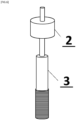
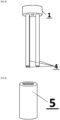
- the body of the paste multielectrode for averaged simultaneous measurements consists of a disc-shaped conductive electrode carrier 1 made of stainless steel, a roller-shaped conductive electrode carrier 2 made of stainless steel, a cylindrical conductive electrode carrier 3 made of stainless steel, roller-shaped conductive electrode carrier rods 4 with one threaded end made of stainless steel, a roller 5 made of stainless steel, a housing 6 made of a chemically resistant material, a lower insulating sleeve 7 made of a chemically resistant material and an upper insulating sleeve 8 made of a chemically resistant material.
- the electrode carrier 1 has an outlet hole in its central part and three holes on its bottom side in which the electrode rods 4 are placed.
- roller-shaped electrode carrier 2 is turned in such a way that both its ends are tapered, the upper end being the narrowest, matched in diameter to the upper insulating sleeve 8, which constitutes an electrical contact connecting the electrode with the potentiostat/electrical circuit.
- the central part has the largest diameter adapted to the upper insulating sleeve 8.
- the electrode carrier 3 in the shape of a cylinder has a threaded hole in its upper part adapted to the carrier 2.
- the diameter of the roller 5 is adapted to the central hole of the housing 6, which additionally has a threaded hole adapted to the threaded part of the carrier 3.
- the housing 6 has outlet holes corresponding to the diameter and distribution of the rods 4 and one central non-outlet hole, corresponding to the length of the roller 5.
- the lower insulating sleeve 7, which ensures chemical inertness and electrical insulation, has a scale applied to its surface, enabling precise refreshing, and an opening adapted to the diameter of the carrier 1.
- the upper insulating sleeve 8, which also ensures chemical inertness and electrical insulation during operation, has a marker applied to its surface, enabling precise refreshing, but on one side it has an opening adapted to the diameter of the contact with the carrier 2, and on the other side the hole adapted to the diameter of the central part carrier 2.
- the principle of operation of the paste multielectrode body according to the invention is as follows. Three electrode rods 4 are mounted in threaded positions of the electrode carrier 1. Then, an electrode carrier 2 is applied from above, so that the narrower end of the electrode carrier 2 forms a contact and its central part rests on the electrode carrier 1. An electrode carrier 3 is mounted to the lower part of the electrode carrier 2, which has passed through the electrode carrier 1. The carriers 1 and 2 are protected with a chemically resistant material, using sleeves 7 and 8, respectively. The electrode carrier 3 is connected to the roller 5 by slight use of a threaded connection in order to connect the individual elements of the structure into a whole. At this time, three rods 4 are inserted into three holes in the housing 6.
- each of the working surfaces acts as a separate sensor. These differences occur on a macro scale unaffected by the electrolytic processes taking place on the other working surfaces. Therefore, the measurement result is obtained in the form of a current intensity that is the sum of the current intensity from independent working surfaces, or, alternatively, obtained in subsequent measurement series. The obtained measurement result is divided by the number of working surfaces used and an average value is obtained, which is the final output data from the measuring system.
- the carrier 3 is screwed into the housing 6 by a distance determined using the scales on the sleeves 8 and 7. This causes the rods 4 to move inside the housing 6 and pushes out the excess used conductive paste below the housing 6. The ejected paste is removed and the surfaces of all electrodes are smoothed again on wet filter paper.
- the sleeve 8 is rotated by a part of a turn clockwise, depending on the scale used, by three marks on the sleeve 7 in the case of electrode processes without adsorption, and by six marks when analyte adsorption occurs or is suspected.
- the renewal procedure can be repeated many times.
Landscapes
- Chemical & Material Sciences (AREA)
- Life Sciences & Earth Sciences (AREA)
- Health & Medical Sciences (AREA)
- Physics & Mathematics (AREA)
- Chemical Kinetics & Catalysis (AREA)
- Electrochemistry (AREA)
- Analytical Chemistry (AREA)
- Biochemistry (AREA)
- General Health & Medical Sciences (AREA)
- General Physics & Mathematics (AREA)
- Immunology (AREA)
- Pathology (AREA)
- Molecular Biology (AREA)
- Investigating Or Analyzing Materials By The Use Of Electric Means (AREA)
Abstract
Description
- The subject matter of an invention is a paste multielectrode body for averaged simultaneous measurements having a high-precision surface renewal mechanism applicable to electrochemical measurements.
- In modern electrochemical measurements, especially polarographic, amperometric and voltammetric measurements, a three-electrode measuring system is used. Its most important element is the working electrode, which controls the measurement process with its small size, i.e., it limits the amount of charge or the current flow intensity or the number of electrons exchanged during measurements. One of the working electrode types used is the paste electrode. Its common feature is that, on one side, an electrical contact is made for connections in an electrical circuit with other elements of the measuring system and its control elements. On the other side, through the surface of the working material (in this case the paste), contact occurs with a conductive solution, the electrolyte, which constitutes another element of the measuring system and guarantees the continuity of the electrical circuit through the contact with the other electrodes.
- In measurements, working electrode bodies containing a portion of conductive paste are used, organized in such a way that only a single contact surface with the electrolyte solution is allowed. The composition of the paste can be varied, adjusted to the requirements of the particular analysis, but it must always be well conductive and not react with the tested analyte and insoluble in the basic electrolyte solution. Typically, the conductive paste is made of carbon, e.g. graphite, and a binder, e.g. paraffin oil, silicone oil, etc. The paste components are mixed together for a given time unit and then placed in the electrode body. The electrode described serves for electrochemical measurements of physicochemical phenomena occurring in the close vicinity of its surface. After each measurement, the paste surface requires refreshing. The refreshing procedure depends on the type of electrode body used.
- The Czech patent application No.
CZ20023939A3 - An electrode that is considered to be perfectly reproducible is the mercury electrode with its smooth surface, where the measurement is performed on an almost always perfectly repeatable and reproducible mercury drops, especially under conditions of electromechanical generation. For other electrodes, such as disk electrodes with a working material made of solids like precious metals or various types of carbon, including paste electrodes, the repeatability of the measurement can be problematic. This is due to the standard measurement error accompanied by the above-mentioned issue of mechanical refreshing and reproducing the ideally identical surface (also in a microscopic cross-section) while considering the real electroactive surface. Even with well-conducted measurements in accordance with Good Laboratory Practice (GLP), in case of paste electrodes, the measurement error can be around 10-15%. The variability of the obtained measurement results is particularly problematic when examining parabolic dependencies (e.g. optimization of the pH value of the base electrolyte environment for testing real samples). Loading the measurement points with a significant error resulting from a different electroactive surface may lead to drawing erroneous conclusions regarding the actual position of the maximum for such relationships, as well as for any other findings obtained during the research. The most common solution is to perform several measurements under identical conditions, after each renewal of the working electrode surface, e.g. 3 or 5 times, and then average the measurement result based on them.
- The essence of the paste multielectrode body according to the invention is its composition. It includes a conductive electrode carrier in the shape of a disc made of stainless steel, a conductive electrode carrier in the shape of a roller made of stainless steel and a conductive electrode carrier in the shape of a cylinder made of stainless steel, and rods of the conductive electrode carrier in the shape of a cylinder with one threaded end, also made of stainless steel. Additionally, it contains a tube made of stainless steel, and a housing of the entire paste electrode body made of a chemically resistant material. The elements ensuring chemical inertness and electrical insulation are two upper and lower sleeves, both made of a chemically resistant material. While the lower insulating sleeve has a scale applied on its surface enabling precise refreshing and an opening adapted to the diameter of the conductive carrier in the shape of a disc, the upper one has a marker applied on its surface enabling precise refreshing. On one side, it has a hole adapted to the diameter of the contact with the cylindrical electrode carrier, on the other side, an opening adapted in diameter to the central part of the cylindrical electrode carrier. The disc-shaped electrode carrier has a central hole at the outlet part and on the underside it has n-threaded holes in which the conductive carrier rods are placed. In addition, the cylindrical electrode carrier is turned in a way enabling the tapering the both ends of it. The upper end, being the narrowest one, is adapted in diameter to the upper insulating sleeve, constituting an electrical contact connecting the electrode with the potentiostat/electrical circuit. The central part of the cylindrical conductive carrier has the largest diameter matched to the upper insulating sleeve, and its lower part is additionally threaded. The cylindrical electrode carrier has a threaded hole in its upper part matched to the cylindrical electrode carrier, while its lower part is threaded and matched in diameter to the cylinder made of stainless steel. This cylinder, in turn, has a threaded hole at the top, into which the cylindrical electrode carrier is screwed with its threaded end. In addition, the cylinder itself is matched in diameter to the central hole of the housing of the paste electrode body into which it is screwed. The housing of the body also includes outlet holes perfectly matched in size to the diameter of the conductive carrier rods.
- The main advantage of the body according to the invention is that it allows to obtain averaged results from a single measurement. Due to the use of a multiplied surface of the working electrode, it is possible to obtain n measurement results during a single measurement, provided that n paste electrodes are used. This allows to obtain more consistent and repeatable results, burdened with a smaller measurement error. This also results in reduced consumption of reagents and consumables, electrical energy and time.
- An additional advantage is the simultaneous operation of renewing all working surfaces, which additionally prevents the occurrence of random errors that determine the quality of the electrochemical measurements performed. The solution presents an alternative, environmental-friendly approach to conduct multiple measurements, particularly crucial for optimization studies or analytical purposes. In addition, the usage of the presented electrode body for electrochemical measurements helps to achieve a high degree of accuracy by using a precise scale with a graduation ensuring increased repeatability of generating a new electrode surface. Thus, it ensures the optimization of the amount of conductive paste removed from the electrode, which is particularly important if the physicochemical processes being studied favour the adsorption processes of substrates or products of the electrode reaction.
- Moreover, the proposed invention enables simultaneous refreshing of the surface in a manner that is not only repeatable, but also mechanically identical for each of the n surfaces of the conductive paste of the working electrode. Such a solution has not been available so far.
- The invention is illustrated in embodiment example and figures, where:
- [
Fig. 1 ] shows a side view of the complete, assembled body of the paste multielectrode; - [
Fig. 2 ] shows a side view of a complete paste multielectrode body disassembled into parts; - [
Fig. 3 ] shows a conductive electrode carrier in the shape of a disc; - [
Fig. 4 ] shows a conductive electrode carrier in the shape of a roller; - [
Fig. 5 ] shows a conductive electrode carrier in the shape of a tube; - [
Fig. 6 ] shows a roller-shaped carrier after being screwed together with a cylinder-shaped carrier; - [
Fig. 7 ] shows a single conductive rod of the electrode carrier; - [
Fig. 8 ] shows a disc-shaped electrode carrier with conductive rods mounted therein; - [
Fig. 9 ] shows a roller that is not an electrode carrier; - [
Fig. 10 ] shows the housing of the body; - [
Fig. 11 ] shows the body casing with the marked connection point to the roller; - [
Fig. 12 ] shows the lower insulating sleeve; - [
Fig. 13 ] shows the upper insulating sleeve. - The body of the paste multielectrode for averaged simultaneous measurements consists of a disc-shaped
conductive electrode carrier 1 made of stainless steel, a roller-shapedconductive electrode carrier 2 made of stainless steel, a cylindricalconductive electrode carrier 3 made of stainless steel, roller-shaped conductiveelectrode carrier rods 4 with one threaded end made of stainless steel, aroller 5 made of stainless steel, ahousing 6 made of a chemically resistant material, a lowerinsulating sleeve 7 made of a chemically resistant material and an upperinsulating sleeve 8 made of a chemically resistant material. Theelectrode carrier 1 has an outlet hole in its central part and three holes on its bottom side in which theelectrode rods 4 are placed. In addition, the roller-shapedelectrode carrier 2 is turned in such a way that both its ends are tapered, the upper end being the narrowest, matched in diameter to the upper insulatingsleeve 8, which constitutes an electrical contact connecting the electrode with the potentiostat/electrical circuit. The central part has the largest diameter adapted to the upper insulatingsleeve 8. Theelectrode carrier 3 in the shape of a cylinder has a threaded hole in its upper part adapted to thecarrier 2. The diameter of theroller 5 is adapted to the central hole of thehousing 6, which additionally has a threaded hole adapted to the threaded part of thecarrier 3. Thehousing 6 has outlet holes corresponding to the diameter and distribution of therods 4 and one central non-outlet hole, corresponding to the length of theroller 5. The lowerinsulating sleeve 7, which ensures chemical inertness and electrical insulation, has a scale applied to its surface, enabling precise refreshing, and an opening adapted to the diameter of thecarrier 1. The upperinsulating sleeve 8, which also ensures chemical inertness and electrical insulation during operation, has a marker applied to its surface, enabling precise refreshing, but on one side it has an opening adapted to the diameter of the contact with thecarrier 2, and on the other side the hole adapted to the diameter of thecentral part carrier 2. - The principle of operation of the paste multielectrode body according to the invention is as follows. Three
electrode rods 4 are mounted in threaded positions of theelectrode carrier 1. Then, anelectrode carrier 2 is applied from above, so that the narrower end of theelectrode carrier 2 forms a contact and its central part rests on theelectrode carrier 1. Anelectrode carrier 3 is mounted to the lower part of theelectrode carrier 2, which has passed through theelectrode carrier 1. Thecarriers sleeves electrode carrier 3 is connected to theroller 5 by slight use of a threaded connection in order to connect the individual elements of the structure into a whole. At this time, threerods 4 are inserted into three holes in thehousing 6. At this stage of the connection, three free spaces in the shape of a roller remain in thehousing 6, intended for the insertion of theelectrode rods 4 after further screwing in thesleeve 7. A conductive paste of a composition selected by the user is placed in these empty spaces. The paste fills this free space and must be in contact with the ends of therods 4. Before measurement, the surfaces of all pastes are smoothed at the same time by moving the lower part of thehousing 6 over the surface of wet filter paper. At the moment of connection, through the contact of theelectrode carrier 2, to the potentiostat and placing in a vessel with electrolyte containing the test object, the measurement is carried out simultaneously on all working surfaces of the conductive paste located on the bottom of thehousing 6 and in contact with the electrolyte solution. - Due to individual differences in the structure of conductive materials, each of the working surfaces acts as a separate sensor. These differences occur on a macro scale unaffected by the electrolytic processes taking place on the other working surfaces. Therefore, the measurement result is obtained in the form of a current intensity that is the sum of the current intensity from independent working surfaces, or, alternatively, obtained in subsequent measurement series. The obtained measurement result is divided by the number of working surfaces used and an average value is obtained, which is the final output data from the measuring system.
- After measurement, in order to reproducibly and simultaneously renew all accessible 3 working surfaces of the conductive paste, the
carrier 3 is screwed into thehousing 6 by a distance determined using the scales on thesleeves rods 4 to move inside thehousing 6 and pushes out the excess used conductive paste below thehousing 6. The ejected paste is removed and the surfaces of all electrodes are smoothed again on wet filter paper. Using the marker and the scale, respectively on thesleeve 8 andsleeve 7, thesleeve 8 is rotated by a part of a turn clockwise, depending on the scale used, by three marks on thesleeve 7 in the case of electrode processes without adsorption, and by six marks when analyte adsorption occurs or is suspected. The renewal procedure can be repeated many times.
Claims (1)
- A paste multielectrode body for averaged simultaneous measurements, characterized in that it consists of a conductive electrode carrier (1) in the shape of a disc made of stainless steel, a conductive electrode carrier (2) in the roller-shape with a threaded one end made of stainless steel, a conductive electrode carrier (3) in the shape of a cylinder with a threaded one end made of stainless steel, rods of the conductive electrode carrier (4) in the roller-shape, with a threaded one end, made of stainless steel, a roller (5) made of stainless steel, a housing (6) made of a chemically resistant material, a lower insulating sleeve (7) made of a chemically resistant material, an upper insulating sleeve (8) made of a chemically resistant material, wherein the conductive electrode carrier (1) in the shape of a disc has an outlet hole in its central part and n-threaded holes on the bottom side in which the rods of the conductive electrode carrier (4) are placed, and in addition, the conductive electrode carrier (2) in the roller-shape is turned in such a way that both of its ends are tapered, the upper end is the narrowest, adjusted in diameter to the upper insulating sleeve (8) constituting an electrical contact connecting the electrode with the potentiostat/electric circuit, and the central part has the largest diameter adjusted to the upper insulating sleeve (8), in turn, the conductive electrode carrier (3) in the shape of a cylinder has in its upper part a threaded hole adjusted to the electrode carrier (2), while its lower threaded part is adjusted in diameter to the roller (5), which in turn has from the top a threaded hole into which the conductive electrode carrier (3) in the shape of a cylinder is screwed, wherein the roller (5) itself is adjusted in diameter to the central hole of the housing (6) into which it is screwed, and the housing (6) itself has additionally outlet holes ideally matched in size to the diameter of the conductive carrier rods (4), and additionally, the lower insulating sleeve (7), which ensures chemical inertness and electrical insulation, has a scale applied on its surface to enable precise refreshing and a hole adjusted to the diameter of the conductive electrode carrier (1), while the upper insulating sleeve (8), which also ensures chemical inertness and electrical insulation during operation, has a marker applied on its surface to enable precise refreshing, but on one side it has an opening adjusted to the diameter of the contact with the conductive electrode carrier (2), and on the other side it has a hole adjusted in diameter to the central part of the conductive electrode carrier (2).
Applications Claiming Priority (1)
| Application Number | Priority Date | Filing Date | Title |
|---|---|---|---|
| PL444974A PL444974A1 (en) | 2023-05-24 | 2023-05-24 | Paste multi-electrode body for simultaneous averaged measurements |
Publications (4)
| Publication Number | Publication Date |
|---|---|
| EP4467970A2 true EP4467970A2 (en) | 2024-11-27 |
| EP4467970A3 EP4467970A3 (en) | 2024-12-04 |
| EP4467970C0 EP4467970C0 (en) | 2025-04-23 |
| EP4467970B1 EP4467970B1 (en) | 2025-04-23 |
Family
ID=91759326
Family Applications (1)
| Application Number | Title | Priority Date | Filing Date |
|---|---|---|---|
| EP24175808.5A Active EP4467970B1 (en) | 2023-05-24 | 2024-05-14 | Paste multielectrode body for simultaneous averaging measurements |
Country Status (2)
| Country | Link |
|---|---|
| EP (1) | EP4467970B1 (en) |
| PL (2) | PL444974A1 (en) |
Citations (1)
| Publication number | Priority date | Publication date | Assignee | Title |
|---|---|---|---|---|
| CZ20023939A3 (en) | 2002-12-02 | 2004-07-14 | Ivan Doc. Dr. Ing. Švancara | Casing for carbon paste for electrochemical measurements |
Family Cites Families (3)
| Publication number | Priority date | Publication date | Assignee | Title |
|---|---|---|---|---|
| GB0820817D0 (en) * | 2008-11-13 | 2008-12-24 | Wireless Biodevices Ltd | Electrode, electrochemical sensor and apparatus, and methods for operating the same |
| TWI399537B (en) * | 2009-11-16 | 2013-06-21 | Univ Nat Yunlin Sci & Tech | Multi-electrode measuring system |
| KR20240031401A (en) * | 2021-07-15 | 2024-03-07 | 지토세 라보라토리 코퍼레이션 | Dynamic inference system for measurement target system using redox potential |
-
2023
- 2023-05-24 PL PL444974A patent/PL444974A1/en unknown
-
2024
- 2024-05-14 PL PL24175808.5T patent/PL4467970T3/en unknown
- 2024-05-14 EP EP24175808.5A patent/EP4467970B1/en active Active
Patent Citations (1)
| Publication number | Priority date | Publication date | Assignee | Title |
|---|---|---|---|---|
| CZ20023939A3 (en) | 2002-12-02 | 2004-07-14 | Ivan Doc. Dr. Ing. Švancara | Casing for carbon paste for electrochemical measurements |
Also Published As
| Publication number | Publication date |
|---|---|
| EP4467970A3 (en) | 2024-12-04 |
| EP4467970C0 (en) | 2025-04-23 |
| PL4467970T3 (en) | 2025-06-16 |
| EP4467970B1 (en) | 2025-04-23 |
| PL444974A1 (en) | 2024-11-25 |
Similar Documents
| Publication | Publication Date | Title |
|---|---|---|
| EP0142226A2 (en) | Ion measuring device with self-contained storage of standardization solution | |
| JP3108096B2 (en) | Method for determining hardness of metallic samples | |
| PL1725881T3 (en) | Test element analysis system with contact surfaces coated with hard material | |
| Lindner et al. | Switched wall jet for dynamic response measurements | |
| CN104237201A (en) | Electrochemical cell based on in-situ EC-SERS (electrochemical-surface enhanced raman scattering) spectrum chip and detection method of electrochemical cell | |
| EP4467970B1 (en) | Paste multielectrode body for simultaneous averaging measurements | |
| WO2017217999A1 (en) | Chlorine, oxidation - reduction potential (orp), and ph measurement | |
| US20060180479A1 (en) | Method, system and device for obtaining electrochemical measurements | |
| CN104215624A (en) | In-situ electrochemical-surface enhanced raman spectroscopy (EC-SERS) detection system and detection method thereof | |
| US8747749B2 (en) | Methods for testing impurity content in a precious metal | |
| EP4467973A2 (en) | Renewable paste electrode body for simultaneous averaging measurements | |
| CN104569104A (en) | Tin (II) ion-selective electrode and preparation method thereof and method for measuring tin (II) ion concentration | |
| WO2024209287A1 (en) | A multiple disc electrode holder | |
| EP4293348B1 (en) | Systems for rapid testing of a working electrode | |
| KR0130943B1 (en) | Portable device for analyzing metal ions and its analysis method | |
| US20250283945A1 (en) | Systems and methods for rapid testing of a working electrode | |
| RU2315990C1 (en) | Method for electrochemical identification of type and quantity of oxide, sulfide and carbon inclusions of metal-composite systems | |
| RU2239825C1 (en) | Solion | |
| US12429446B2 (en) | High-throughput electrochemical characterization apparatus and system and methods for using the same | |
| Mai | Development of multi-channel software platform capabilities for single-channel potentiostats using Matlab programming | |
| WO2025063935A1 (en) | 3d printed gold-coated working electrode production method | |
| SU934345A1 (en) | Electrolytic capillary tube for electrochemical investigations of crack resistance of materials | |
| Gębicki et al. | Impedance investigations of amperometric gas sensor containing aprotic solvent | |
| US20040045825A1 (en) | Cartridge for electrophoresis detection device and manufacturing method thereof | |
| Fatima et al. | A Brief Review on Fundamentals of Analytical Chemistry |
Legal Events
| Date | Code | Title | Description |
|---|---|---|---|
| PUAI | Public reference made under article 153(3) epc to a published international application that has entered the european phase |
Free format text: ORIGINAL CODE: 0009012 |
|
| STAA | Information on the status of an ep patent application or granted ep patent |
Free format text: STATUS: REQUEST FOR EXAMINATION WAS MADE |
|
| PUAL | Search report despatched |
Free format text: ORIGINAL CODE: 0009013 |
|
| 17P | Request for examination filed |
Effective date: 20240612 |
|
| AK | Designated contracting states |
Kind code of ref document: A2 Designated state(s): AL AT BE BG CH CY CZ DE DK EE ES FI FR GB GR HR HU IE IS IT LI LT LU LV MC ME MK MT NL NO PL PT RO RS SE SI SK SM TR |
|
| AK | Designated contracting states |
Kind code of ref document: A3 Designated state(s): AL AT BE BG CH CY CZ DE DK EE ES FI FR GB GR HR HU IE IS IT LI LT LU LV MC ME MK MT NL NO PL PT RO RS SE SI SK SM TR |
|
| RIC1 | Information provided on ipc code assigned before grant |
Ipc: G01N 27/30 20060101ALI20241030BHEP Ipc: G01N 27/07 20060101AFI20241030BHEP |
|
| GRAP | Despatch of communication of intention to grant a patent |
Free format text: ORIGINAL CODE: EPIDOSNIGR1 |
|
| STAA | Information on the status of an ep patent application or granted ep patent |
Free format text: STATUS: GRANT OF PATENT IS INTENDED |
|
| GRAS | Grant fee paid |
Free format text: ORIGINAL CODE: EPIDOSNIGR3 |
|
| INTG | Intention to grant announced |
Effective date: 20250212 |
|
| GRAA | (expected) grant |
Free format text: ORIGINAL CODE: 0009210 |
|
| STAA | Information on the status of an ep patent application or granted ep patent |
Free format text: STATUS: THE PATENT HAS BEEN GRANTED |
|
| AK | Designated contracting states |
Kind code of ref document: B1 Designated state(s): AL AT BE BG CH CY CZ DE DK EE ES FI FR GB GR HR HU IE IS IT LI LT LU LV MC ME MK MT NL NO PL PT RO RS SE SI SK SM TR |
|
| REG | Reference to a national code |
Ref country code: GB Ref legal event code: FG4D |
|
| REG | Reference to a national code |
Ref country code: CH Ref legal event code: EP |
|
| REG | Reference to a national code |
Ref country code: DE Ref legal event code: R096 Ref document number: 602024000075 Country of ref document: DE |
|
| REG | Reference to a national code |
Ref country code: IE Ref legal event code: FG4D |
|
| U01 | Request for unitary effect filed |
Effective date: 20250508 |
|
| U07 | Unitary effect registered |
Designated state(s): AT BE BG DE DK EE FI FR IT LT LU LV MT NL PT RO SE SI Effective date: 20250515 |
|
| U20 | Renewal fee for the european patent with unitary effect paid |
Year of fee payment: 2 Effective date: 20250527 |
|
| PG25 | Lapsed in a contracting state [announced via postgrant information from national office to epo] |
Ref country code: ES Free format text: LAPSE BECAUSE OF FAILURE TO SUBMIT A TRANSLATION OF THE DESCRIPTION OR TO PAY THE FEE WITHIN THE PRESCRIBED TIME-LIMIT Effective date: 20250423 |
|
| PG25 | Lapsed in a contracting state [announced via postgrant information from national office to epo] |
Ref country code: GR Free format text: LAPSE BECAUSE OF FAILURE TO SUBMIT A TRANSLATION OF THE DESCRIPTION OR TO PAY THE FEE WITHIN THE PRESCRIBED TIME-LIMIT Effective date: 20250724 Ref country code: NO Free format text: LAPSE BECAUSE OF FAILURE TO SUBMIT A TRANSLATION OF THE DESCRIPTION OR TO PAY THE FEE WITHIN THE PRESCRIBED TIME-LIMIT Effective date: 20250723 |
|
| PG25 | Lapsed in a contracting state [announced via postgrant information from national office to epo] |
Ref country code: HR Free format text: LAPSE BECAUSE OF FAILURE TO SUBMIT A TRANSLATION OF THE DESCRIPTION OR TO PAY THE FEE WITHIN THE PRESCRIBED TIME-LIMIT Effective date: 20250423 |
|
| PG25 | Lapsed in a contracting state [announced via postgrant information from national office to epo] |
Ref country code: RS Free format text: LAPSE BECAUSE OF FAILURE TO SUBMIT A TRANSLATION OF THE DESCRIPTION OR TO PAY THE FEE WITHIN THE PRESCRIBED TIME-LIMIT Effective date: 20250723 |
|
| PG25 | Lapsed in a contracting state [announced via postgrant information from national office to epo] |
Ref country code: IS Free format text: LAPSE BECAUSE OF FAILURE TO SUBMIT A TRANSLATION OF THE DESCRIPTION OR TO PAY THE FEE WITHIN THE PRESCRIBED TIME-LIMIT Effective date: 20250823 |
|
| PG25 | Lapsed in a contracting state [announced via postgrant information from national office to epo] |
Ref country code: SM Free format text: LAPSE BECAUSE OF FAILURE TO SUBMIT A TRANSLATION OF THE DESCRIPTION OR TO PAY THE FEE WITHIN THE PRESCRIBED TIME-LIMIT Effective date: 20250423 |
|
| PG25 | Lapsed in a contracting state [announced via postgrant information from national office to epo] |
Ref country code: CZ Free format text: LAPSE BECAUSE OF FAILURE TO SUBMIT A TRANSLATION OF THE DESCRIPTION OR TO PAY THE FEE WITHIN THE PRESCRIBED TIME-LIMIT Effective date: 20250423 |
|
| PG25 | Lapsed in a contracting state [announced via postgrant information from national office to epo] |
Ref country code: SK Free format text: LAPSE BECAUSE OF FAILURE TO SUBMIT A TRANSLATION OF THE DESCRIPTION OR TO PAY THE FEE WITHIN THE PRESCRIBED TIME-LIMIT Effective date: 20250423 |
|
| PG25 | Lapsed in a contracting state [announced via postgrant information from national office to epo] |
Ref country code: MC Free format text: LAPSE BECAUSE OF FAILURE TO SUBMIT A TRANSLATION OF THE DESCRIPTION OR TO PAY THE FEE WITHIN THE PRESCRIBED TIME-LIMIT Effective date: 20250423 |
|
| PLBE | No opposition filed within time limit |
Free format text: ORIGINAL CODE: 0009261 |
|
| STAA | Information on the status of an ep patent application or granted ep patent |
Free format text: STATUS: NO OPPOSITION FILED WITHIN TIME LIMIT |
|
| REG | Reference to a national code |
Ref country code: CH Ref legal event code: L10 Free format text: ST27 STATUS EVENT CODE: U-0-0-L10-L00 (AS PROVIDED BY THE NATIONAL OFFICE) Effective date: 20260304 |
|
| 26N | No opposition filed |
Effective date: 20260126 |
|
| PGFP | Annual fee paid to national office [announced via postgrant information from national office to epo] |
Ref country code: PL Payment date: 20260319 Year of fee payment: 3 |
|
| U20 | Renewal fee for the european patent with unitary effect paid |
Year of fee payment: 3 Effective date: 20260320 |