EP4467529A1 - Isolation method - Google Patents
Isolation method Download PDFInfo
- Publication number
- EP4467529A1 EP4467529A1 EP23756506.4A EP23756506A EP4467529A1 EP 4467529 A1 EP4467529 A1 EP 4467529A1 EP 23756506 A EP23756506 A EP 23756506A EP 4467529 A1 EP4467529 A1 EP 4467529A1
- Authority
- EP
- European Patent Office
- Prior art keywords
- fluorocarbon
- carbon atoms
- mixture
- acid
- less
- Prior art date
- Legal status (The legal status is an assumption and is not a legal conclusion. Google has not performed a legal analysis and makes no representation as to the accuracy of the status listed.)
- Pending
Links
Images

Classifications
-
- C—CHEMISTRY; METALLURGY
- C07—ORGANIC CHEMISTRY
- C07C—ACYCLIC OR CARBOCYCLIC COMPOUNDS
- C07C17/00—Preparation of halogenated hydrocarbons
- C07C17/38—Separation; Purification; Stabilisation; Use of additives
- C07C17/389—Separation; Purification; Stabilisation; Use of additives by adsorption on solids
-
- B—PERFORMING OPERATIONS; TRANSPORTING
- B01—PHYSICAL OR CHEMICAL PROCESSES OR APPARATUS IN GENERAL
- B01D—SEPARATION
- B01D53/00—Separation of gases or vapours; Recovering vapours of volatile solvents from gases; Chemical or biological purification of waste gases, e.g. engine exhaust gases, smoke, fumes, flue gases, aerosols
- B01D53/02—Separation of gases or vapours; Recovering vapours of volatile solvents from gases; Chemical or biological purification of waste gases, e.g. engine exhaust gases, smoke, fumes, flue gases, aerosols by adsorption, e.g. preparative gas chromatography
- B01D53/04—Separation of gases or vapours; Recovering vapours of volatile solvents from gases; Chemical or biological purification of waste gases, e.g. engine exhaust gases, smoke, fumes, flue gases, aerosols by adsorption, e.g. preparative gas chromatography with stationary adsorbents
-
- B—PERFORMING OPERATIONS; TRANSPORTING
- B01—PHYSICAL OR CHEMICAL PROCESSES OR APPARATUS IN GENERAL
- B01D—SEPARATION
- B01D53/00—Separation of gases or vapours; Recovering vapours of volatile solvents from gases; Chemical or biological purification of waste gases, e.g. engine exhaust gases, smoke, fumes, flue gases, aerosols
- B01D53/02—Separation of gases or vapours; Recovering vapours of volatile solvents from gases; Chemical or biological purification of waste gases, e.g. engine exhaust gases, smoke, fumes, flue gases, aerosols by adsorption, e.g. preparative gas chromatography
-
- B—PERFORMING OPERATIONS; TRANSPORTING
- B01—PHYSICAL OR CHEMICAL PROCESSES OR APPARATUS IN GENERAL
- B01J—CHEMICAL OR PHYSICAL PROCESSES, e.g. CATALYSIS OR COLLOID CHEMISTRY; THEIR RELEVANT APPARATUS
- B01J20/00—Solid sorbent compositions or filter aid compositions; Sorbents for chromatography; Processes for preparing, regenerating or reactivating thereof
- B01J20/22—Solid sorbent compositions or filter aid compositions; Sorbents for chromatography; Processes for preparing, regenerating or reactivating thereof comprising organic material
-
- B—PERFORMING OPERATIONS; TRANSPORTING
- B01—PHYSICAL OR CHEMICAL PROCESSES OR APPARATUS IN GENERAL
- B01J—CHEMICAL OR PHYSICAL PROCESSES, e.g. CATALYSIS OR COLLOID CHEMISTRY; THEIR RELEVANT APPARATUS
- B01J20/00—Solid sorbent compositions or filter aid compositions; Sorbents for chromatography; Processes for preparing, regenerating or reactivating thereof
- B01J20/22—Solid sorbent compositions or filter aid compositions; Sorbents for chromatography; Processes for preparing, regenerating or reactivating thereof comprising organic material
- B01J20/223—Solid sorbent compositions or filter aid compositions; Sorbents for chromatography; Processes for preparing, regenerating or reactivating thereof comprising organic material containing metals, e.g. organo-metallic compounds, coordination complexes
- B01J20/226—Coordination polymers, e.g. metal-organic frameworks [MOF], zeolitic imidazolate frameworks [ZIF]
-
- B—PERFORMING OPERATIONS; TRANSPORTING
- B01—PHYSICAL OR CHEMICAL PROCESSES OR APPARATUS IN GENERAL
- B01J—CHEMICAL OR PHYSICAL PROCESSES, e.g. CATALYSIS OR COLLOID CHEMISTRY; THEIR RELEVANT APPARATUS
- B01J20/00—Solid sorbent compositions or filter aid compositions; Sorbents for chromatography; Processes for preparing, regenerating or reactivating thereof
- B01J20/22—Solid sorbent compositions or filter aid compositions; Sorbents for chromatography; Processes for preparing, regenerating or reactivating thereof comprising organic material
- B01J20/26—Synthetic macromolecular compounds
-
- B—PERFORMING OPERATIONS; TRANSPORTING
- B01—PHYSICAL OR CHEMICAL PROCESSES OR APPARATUS IN GENERAL
- B01J—CHEMICAL OR PHYSICAL PROCESSES, e.g. CATALYSIS OR COLLOID CHEMISTRY; THEIR RELEVANT APPARATUS
- B01J20/00—Solid sorbent compositions or filter aid compositions; Sorbents for chromatography; Processes for preparing, regenerating or reactivating thereof
- B01J20/28—Solid sorbent compositions or filter aid compositions; Sorbents for chromatography; Processes for preparing, regenerating or reactivating thereof characterised by their form or physical properties
-
- C—CHEMISTRY; METALLURGY
- C07—ORGANIC CHEMISTRY
- C07C—ACYCLIC OR CARBOCYCLIC COMPOUNDS
- C07C19/00—Acyclic saturated compounds containing halogen atoms
- C07C19/08—Acyclic saturated compounds containing halogen atoms containing fluorine
-
- C—CHEMISTRY; METALLURGY
- C07—ORGANIC CHEMISTRY
- C07C—ACYCLIC OR CARBOCYCLIC COMPOUNDS
- C07C19/00—Acyclic saturated compounds containing halogen atoms
- C07C19/08—Acyclic saturated compounds containing halogen atoms containing fluorine
- C07C19/10—Acyclic saturated compounds containing halogen atoms containing fluorine and chlorine
-
- B—PERFORMING OPERATIONS; TRANSPORTING
- B01—PHYSICAL OR CHEMICAL PROCESSES OR APPARATUS IN GENERAL
- B01D—SEPARATION
- B01D2253/00—Adsorbents used in seperation treatment of gases and vapours
- B01D2253/20—Organic adsorbents
- B01D2253/204—Metal organic frameworks (MOF's)
-
- B—PERFORMING OPERATIONS; TRANSPORTING
- B01—PHYSICAL OR CHEMICAL PROCESSES OR APPARATUS IN GENERAL
- B01D—SEPARATION
- B01D2253/00—Adsorbents used in seperation treatment of gases and vapours
- B01D2253/30—Physical properties of adsorbents
- B01D2253/302—Dimensions
- B01D2253/308—Pore size
-
- B—PERFORMING OPERATIONS; TRANSPORTING
- B01—PHYSICAL OR CHEMICAL PROCESSES OR APPARATUS IN GENERAL
- B01D—SEPARATION
- B01D2253/00—Adsorbents used in seperation treatment of gases and vapours
- B01D2253/30—Physical properties of adsorbents
- B01D2253/34—Specific shapes
-
- B—PERFORMING OPERATIONS; TRANSPORTING
- B01—PHYSICAL OR CHEMICAL PROCESSES OR APPARATUS IN GENERAL
- B01D—SEPARATION
- B01D2257/00—Components to be removed
- B01D2257/20—Halogens or halogen compounds
- B01D2257/206—Organic halogen compounds
- B01D2257/2064—Chlorine
-
- B—PERFORMING OPERATIONS; TRANSPORTING
- B01—PHYSICAL OR CHEMICAL PROCESSES OR APPARATUS IN GENERAL
- B01D—SEPARATION
- B01D2257/00—Components to be removed
- B01D2257/20—Halogens or halogen compounds
- B01D2257/206—Organic halogen compounds
- B01D2257/2066—Fluorine
-
- C—CHEMISTRY; METALLURGY
- C07—ORGANIC CHEMISTRY
- C07C—ACYCLIC OR CARBOCYCLIC COMPOUNDS
- C07C55/00—Saturated compounds having more than one carboxyl group bound to acyclic carbon atoms
- C07C55/02—Dicarboxylic acids
- C07C55/06—Oxalic acid
-
- C—CHEMISTRY; METALLURGY
- C07—ORGANIC CHEMISTRY
- C07F—ACYCLIC, CARBOCYCLIC OR HETEROCYCLIC COMPOUNDS CONTAINING ELEMENTS OTHER THAN CARBON, HYDROGEN, HALOGEN, OXYGEN, NITROGEN, SULFUR, SELENIUM OR TELLURIUM
- C07F1/00—Compounds containing elements of Groups 1 or 11 of the Periodic Table
- C07F1/08—Copper compounds
-
- C—CHEMISTRY; METALLURGY
- C07—ORGANIC CHEMISTRY
- C07F—ACYCLIC, CARBOCYCLIC OR HETEROCYCLIC COMPOUNDS CONTAINING ELEMENTS OTHER THAN CARBON, HYDROGEN, HALOGEN, OXYGEN, NITROGEN, SULFUR, SELENIUM OR TELLURIUM
- C07F3/00—Compounds containing elements of Groups 2 or 12 of the Periodic Table
- C07F3/003—Compounds containing elements of Groups 2 or 12 of the Periodic Table without C-Metal linkages
-
- C—CHEMISTRY; METALLURGY
- C07—ORGANIC CHEMISTRY
- C07F—ACYCLIC, CARBOCYCLIC OR HETEROCYCLIC COMPOUNDS CONTAINING ELEMENTS OTHER THAN CARBON, HYDROGEN, HALOGEN, OXYGEN, NITROGEN, SULFUR, SELENIUM OR TELLURIUM
- C07F3/00—Compounds containing elements of Groups 2 or 12 of the Periodic Table
- C07F3/06—Zinc compounds
-
- C—CHEMISTRY; METALLURGY
- C07—ORGANIC CHEMISTRY
- C07F—ACYCLIC, CARBOCYCLIC OR HETEROCYCLIC COMPOUNDS CONTAINING ELEMENTS OTHER THAN CARBON, HYDROGEN, HALOGEN, OXYGEN, NITROGEN, SULFUR, SELENIUM OR TELLURIUM
- C07F5/00—Compounds containing elements of Groups 3 or 13 of the Periodic Table
- C07F5/06—Aluminium compounds
Definitions
- the present disclosure relates to a separation method.
- Patent Literature 1 describes obtaining a mixture for extraction from a mixture containing 2,3,3,3-tetrafluoropropene and hexafluoropropene; and an extraction solvent, and distilling the mixture for extraction to obtain a distillate containing hexafluoropropene as a main component, and a bottom containing 2,3,3,3 -tetrafluoropropene.
- Patent Literature 1 JP2018-002602A
- Patent Literature 1 In a distillation method as described in Patent Literature 1, it has been found that the separation of compounds having similar boiling points or azeotropic compounds is difficult, and that disadvantageously, separation of a fluorocarbon, for example, a fluorocarbon having one carbon atom, may be achieved insufficiently.
- a fluorocarbon for example, a fluorocarbon having one carbon atom
- the present disclosure is to provide a method for separating a fluorocarbon having a specific number of carbon atoms and is to provide, for example, a method for separating a fluorocarbon having one carbon atom.
- the present disclosure comprises the following aspects.
- a method for separating a fluorocarbon comprising:
- a fluorocarbon having a specific number of carbon atoms for example, a fluorocarbon having one carbon atom, can be separated from a mixture comprising two or more fluorocarbons.
- a separation method of the present disclosure may comprise separating a specific fluorocarbon from a mixture comprising two or more fluorocarbons, and the specific fluorocarbon can be separated by bringing the mixture and an adsorbent into contact with each other.
- a separation method in one embodiment of the present disclosure comprises;
- the fluorocarbon having n carbon atoms is adsorbed to the adsorbent, whereby the fluorocarbon having n carbon atoms can be separated from the mixture.
- the mixture in a gas state is brought into contact with such an adsorbent.
- such a separation method may comprise;
- such a separation method may comprise;
- such a separation method may comprise;
- the mixture comprises a fluorocarbon having n carbon atoms.
- n is an integer of 1 or more and preferably 1 or more and 2 or less.
- the molecular diameter of the fluorocarbon having n carbon atoms is, for example, 0.30 nm or more and 0.430 nm or less and preferably 0.320 nm or more and 0.420 nm or less.
- the molecular diameter of the fluorocarbon having n carbon atoms is, for example, 0.300 nm or more and preferably 0.320 nm or more and is, for example, 0.430 nm or less and preferably 0.420 nm or less.
- the molecular diameter of the fluorocarbon having n carbon atoms is, for example, 0.300 nm or more and 0.460 nm or less and preferably 0.320 nm or more and 0.440 nm or less.
- the molecular diameter of the fluorocarbon having n carbon atoms is, for example, 0.300 nm or more and preferably 0.320 nm or more and is, for example, 0.460 nm or less and preferably 0.440 nm or less.
- the molecular diameter of the fluorocarbon having n carbon atoms is, for example, 0.480 nm or more and 1.0 nm or less and preferably 0.490 nm or more and 0.980 nm or less.
- the molecular diameter of the fluorocarbon having n carbon atoms is, for example, 0.480 nm or more and preferably 0.490 nm or more and is, for example, 1.0 nm or less and preferably 0.800 nm or less.
- the boiling point of the fluorocarbon having n carbon atoms may be, for example, -80°C or higher and -20°C or lower and, furthermore, may be -60°C or higher and -30°C or lower.
- the fluorocarbon having n carbon atoms is present in the form of a gas in the mixture.
- fluorocarbon having n carbon atoms comprise hydrochlorofluorocarbon and hydrofluorocarbon.
- hydrochlorofluorocarbon comprise chlorodifluoromethane
- hydrofluorocarbon comprise difluoromethane.
- the fluorocarbon having n carbon atoms is also referred to as an adsorbate.
- the fluorocarbon having n carbon atoms may comprise one or more compounds.
- each compound preferably has a molecular diameter and a boiling point within the respective ranges described above.
- the content of the fluorocarbon having n carbon atoms in the mixture may be, for example, 0.1 mol% or more and 50 mol% or less and, furthermore, may be 0.5 mol% or more and 20 mol% or less, based on the entire mixture.
- the mixture comprises a fluorocarbon having n + m carbon atoms.
- m is an integer of 1 or more, preferably 1 or more and 3 or less and more preferably 1 or more and 2 or less.
- the content of a fluorocarbon having 2 or 3 carbon atoms in the fluorocarbon having n + m or more carbon atoms may be, for example, 50 mol% or more and 100 mol% or less and may be 80 mol% or more and 100 mol% or less.
- the molecular diameter of the fluorocarbon having n + m or more carbon atoms is, for example, more than 0.430 nm, may be 0.440 nm or more and 2.00 nm or less or may be 0.440 nm or more and 1.00 nm or less.
- the molecular diameter of the fluorocarbon having n + m or more carbon atoms is, for example, more than 0.430 nm and preferably 0.440 nm or more and is, for example, 2.00 nm or less and preferably 1.00 nm or less.
- the molecular diameter of the fluorocarbon having n + m or more carbon atoms is, for example, more than 0.460 nm, may be 0.470 nm or more and 2.00 nm or less or may be 0.470 nm or more and 1.00 nm or less.
- the molecular diameter of the fluorocarbon having n + m or more carbon atoms is, for example, more than 0.460 nm and preferably 0.470 nm or more and is, for example, 2.00 nm or less and preferably 1.00 nm or less.
- the molecular diameter of the fluorocarbon having n + m or more carbon atoms is, for example, more than 1.0 nm, may be 1.10 nm or more and 2.00 nm or less or may be 1.10 nm or more and 1.50 nm or less.
- the molecular diameter of the fluorocarbon having n + m or more carbon atoms is, for example, more than 1.0 nm and preferably 1.10 nm or more and is, for example, 2.00 nm or less and preferably 1.50 nm or less.
- the boiling point of the fluorocarbon having n + m or more carbon atoms may be, for example, -80°C or higher and -20°C or lower, and furthermore, may be - 60°C or higher and -30°C or lower and, particularly, -50°C or higher and -30°C or lower.
- the fluorocarbon having n + m or more carbon atoms is present in the form of a gas in the mixture.
- the difference between the boiling point of the fluorocarbon having n carbon atoms and the boiling point of the fluorocarbon having n + m or more carbon atoms may be, for example, 0°C or more and 20°C or less and, furthermore, may be 0°C or more and 10°C or less. Even when the boiling point of the fluorocarbon having n carbon atoms and the boiling point of the fluorocarbon having n + m or more carbon atoms are close to each other, the fluorocarbon having n carbon atoms can be separated by the separation method of the present disclosure.
- the fluorocarbon having n + m or more carbon atoms may be a saturated fluorocarbon or an unsaturated fluorocarbon and is preferably a saturated fluorocarbon.
- Examples of the fluorocarbon having n + m or more carbon atoms comprise hydrochlorofluorocarbons and hydrofluorocarbons.
- Examples of the hydrochlorofluorocarbons comprise hydrochlorofluorocarbon having two carbon atoms such as chlorotrifluoroethane.
- hydrofluorocarbons comprise difluoroethane (for example, 1,1-difluoroethane and 1,2-difluoroethane, particularly, 1,1-difluoroethane), trifluoroethane (for example, 1,1,1-trifluoroethane and 1,1,2-trifluoroethane, particularly 1,1,1-trifluoroethane), tetrafluoroethane (for example, 1,1,1,2-tetrafluoroethane and 1, 1,2,2-tetrafluoroethane, particularly, 1,1,1,2-tetrafluoroethane); hydrofluorocarbons having 2 carbon atoms such as pentafluoroethane; and hydrofluorocarbons having 3 carbon atoms such as tetrafluoropropene and hexafluoropropene. One or more of these may be comprised in the fluorocarbons having n + m or more carbon atoms.
- the fluorocarbon having n + m or more carbon atoms may be, for example, a fluorocarbon having 2 to 5 carbon atoms, and may preferably be a fluorocarbon having 2 or 3 carbon atoms.
- the fluorocarbon having n + m or more carbon atoms may comprise one or more compounds.
- each compound preferably has a molecular diameter and a boiling point within the respective ranges described above.
- the mixture may be an azeotropic mixture or pseudoazeotropic mixture of fluorocarbons. According to the separation method of the present disclosure, a fluorocarbon having a specific number of carbon atoms can be separated even when the mixture is an azeotropic mixture or a pseudoazeotropic mixture.
- Examples of such an azeotropic mixture or pseudoazeotropic mixture comprise mixtures in which the difference between the boiling point of a fluorocarbon that is a separation target (in the present embodiment, the fluorocarbon having n carbon atoms) and the boiling point of a different fluorocarbon (in the present embodiment, the fluorocarbon having n + m or more carbon atoms) is 1°C or more and 20°C or less, furthermore, 3°C or more and 18°C or less.
- the fluorocarbon having n carbon atoms can be a fluorocarbon having 1 carbon atom, and the fluorocarbon having n + m or more carbon atoms can be a fluorocarbon having 2 or more carbon atoms.
- the fluorocarbon having n carbon atoms can be a fluorocarbon having 2 carbon atoms, and the fluorocarbon having n + m or more carbon atoms can be a fluorocarbon having 3 or more carbon atoms.
- the fluorocarbon having n carbon atoms can be a fluorocarbon having 1 carbon atom
- the fluorocarbon having n + m or more carbon atoms can be a fluorocarbon having 3 or more carbon atoms.
- the fluorocarbon having n carbon atoms can be a fluorocarbon having 1 carbon atom
- the fluorocarbon having n + m or more carbon atoms can be a fluorocarbon having 4 or more carbon atoms.
- the fluorocarbon having n carbon atoms can be a fluorocarbon having 2 carbon atoms, and the fluorocarbon having n + m or more carbon atoms can be a fluorocarbon having 5 or more carbon atoms.
- the mixture may comprise other compounds, in addition to the fluorocarbon having n carbon atoms and the fluorocarbon having n + m or more carbon atoms.
- the boiling point of such other compounds may be, for example, - 100°C or lower or -150°C or lower.
- such other compounds are comprised in the mixture as a gas.
- Examples of such other compounds comprise nitrogen, oxygen, carbon dioxide, and water.
- the adsorbent is capable of adsorbing the fluorocarbon having n carbon atoms.
- the adsorbent adsorbs the fluorocarbon having n carbon atoms, but does not adsorb the fluorocarbon having n + m or more carbon atoms. Therefore, when a mixture comprising the fluorocarbon having n carbon atoms and the fluorocarbon having n + m or more carbon atoms and the adsorbent are brought into contact with each other, it is possible to separate the fluorocarbon having n carbon atoms from the mixture.
- the adsorbent preferably comprises a porous body having a pore, as an adsorptive medium.
- a porous body having a pore as an adsorptive medium.
- the effective pore diameter of the porous body is preferably smaller than the molecular diameter of the fluorocarbon having n + m or more carbon atoms.
- the effective pore diameter is smaller than the molecular diameter of the fluorocarbon having n + m or more carbon atoms, it is possible to more reliably separate the fluorocarbon having n carbon atoms.
- the effective pore diameter is the pore diameter of the porous body that is determined from the degree of adsorption and the molecular diameter of the adsorbate when the porous body and the adsorbate are brought into contact with each other and, specifically, can be obtained by converting the relative pressure of a nitrogen adsorption isotherm into the effective pore diameter using a Horvath-Kawazoe method.
- a conversion formula a calculation formula described in J. Chem. Eng, Jpn., 1983, 16, 6, 470 to 475 may be used, and as a parameter value in the conversion formula, a value based on a combination of carbon and nitrogen may be used.
- the effective pore diameter of the porous body is, for example, 0.30 nm or more and 0.46 nm or less and preferably 0.32 nm or more and 0.44 nm or less. In one embodiment, the effective pore diameter of the porous body is, for example, 0.30 nm or more and preferably 0.32 nm or more and is, for example, 0.46 nm or less and preferably 0.44 nm or less.
- the specific surface area of the porous body can be, for example, 40 m 2 /g or more, preferably 100 m 2 /g or more and more preferably 300 m 2 /g or more and may be, for example, 2,000 m 2 /g or less and may be 1,000 m 2 /g or less.
- the specific surface area of the porous body is calculated from the nitrogen gas adsorption isotherm using a BET method.
- the equilibrium adsorption amount of the fluorocarbon having n carbon atoms to the porous body may be, for example, 1 g/10 g or more or 100 g/10 g or less as measured at a temperature of 303 K and a pressure within a range of 0.4 Pa to 1 MPa.
- the porous body may be in the form of powder (particles), a film, granules, or a molded product (for example, pellets), for example, and is preferably a molded product and more preferably in the form of pellets.
- a pellet may have a cylindrical shape or a spherical shape.
- the radius of the cylinder is preferably 1.6 mm or more and 6 mm or less, and the thickness of the cylinder is preferably 2 mm or more and 6 mm or less.
- the spherical shape does not need to be truly spherical at all times, and the radius of the sphere is preferably 4 mm or more and 12 mm or less.
- the porous body preferably comprises, for example, at least one selected from the group consisting of zeolite, activated carbon, silica gel and a metal-organic framework (MOF, or PCP: porous coordination polymer), and typically comprises a metal-organic framework.
- MOF metal-organic framework
- PCP porous coordination polymer
- the metal-organic framework preferably comprises metal ions and one or more kinds of organic ligands.
- the organic ligands preferably comprise two or more groups capable of forming a coordinate bond to the metal ion, per molecule.
- a highly regular and three-dimensionally continuous structure for example, a network structure
- pores are formed between the metal ions and the organic ligands.
- the combination of the kinds of the metal ions and the organic ligands could control the effective pore diameter or flexibility of the metal-organic framework and the interaction between the metal-organic framework and the adsorbate in such a three-dimensional structure.
- the metal-organic framework exhibits an adsorption capacity (maximum adsorption capacity) that does not decrease even after the repeated adsorption and desorption of the adsorbate and thus exhibits high durability to repetition. Furthermore, the metal-organic framework is less likely to be affected by temperatures (heat) or humidity, exhibits an adsorption capacity that does not decrease even through storage at a high temperature and a high humidity for a long period of time and thus exhibits high durability to high-temperatures and high-humidities.
- the metal ion is not limited, and examples thereof comprise the ions of metals selected from the group consisting of Group Ia, Group IIa, Group IIIa, Groups IVa to VIII and Groups Ib to VIb.
- Such metals can be preferably one or more selected from the group consisting of Mg, Ca, Sr, Ba, Sc, Y, Ti, Zr, Hf, V, Nb, Ta, Cr, Mo, W, Mn, Re, Fe, Ro, Os, Co, Rh, Ir, Ni, Pd, Pt, Cu, Ag, Au, Zn, Cd, Hg, Al, Ga, In, Tl, Si, Ge, Sn, Pb, As, Sb, Bi, La, Ce, Pr, Nd, Pm, Sm, En, Gd, Tb, Dy, Ho, Er, Tm or Yb, and can be more preferably one or more selected from the group consisting of Zn, Cu, Ti, Co, Mn, Al, Ca, Zr or Mg.
- such metal ions can be one or more selected from the group consisting of Mg 2+ , Ca 2+ , Sr 2+ , Ba 2+ , Sc 3+ , Y 3+ , Ln 3+ , Ti 4+ , Zr 4+ , Hf 4+ , V 4+ , V 3+ , V 2+ , Nb 3+ , Ta 3+ , Cr 3+ , Mo 3+ , W 3+ , Mn 3+ , Mn 2+ , Re 3+ , Re 2+ , Fe 3+ , Fe 2+ , Ru 3+ , Ru 2+ , Os 3+ , Os 2+ , Co 3+ , Co 2+ , Rh 2+ , Rh + , Ir 24 , Ir + , Ni 2+ , Ni + , Pd 2+ , Pd + , Pt 2+ , Pt + , Cu 2+ , Cu + , Ag + , Au + , Zn 2+ , Cd
- the number of types of the metal ions may be only 1 or 2 or more.
- the number of types of the metal ions is preferably 1.
- the metal ion is a Zn ion and preferably Zn 2+ .
- the organic ligand is not limited, as long as the organic ligand has two or more groups capable of forming a coordinate bond to the metal ion, per molecule.
- the coordinate bond is formed of, for example, a functional group capable of forming a coordinate bond to the metal ion.
- Examples of the functional group capable of forming the coordinate bond comprise -COOH, -CS 2 H, -NO 2 , -B(OH) 2 , -SO 3 H, -Si(OH) 3 , -Ge(OH) 3 , -Sn(OH) 3 , - Si(SH) 4 , -Ge(SH) 4 , -Sn(SH) 3 , -PO 3 H, -AsO 3 H, -AsO 4 H, -P(SH) 3 , -As(SH) 3 , - CH(RSH) 2 , -C(RSH) 3 , -CH(RNH 2 ) 2 , -C(RNH 2 ) 3 , -CH(ROH) 2 , -C(ROH) 3 , - CH(RCN) 3 and -C(RCN) 3 .
- R is a single bond, an alkylene group having 1 to 5 carbon atoms (for example, methylene, ethylene, n-propylene, i-propylene, n-butylene, i-butylene, tert-butylene or n-pentylene group), a divalent aromatic group having 6 to 14 carbon atoms (for example, phenylene) or a combination of the alkylene group and the aromatic group (for example, -phenylene-alkylene-phenylene).
- the functional group capable of forming a coordinate bond may be a hetero atom (for example, N, O, S, B, P, Si or Al) comprised in a heterocycle and may be preferably a nitrogen atom in a heterocycle.
- the functional group capable of forming a coordinate bond can be -COOH, or a nitrogen atom in a heterocycle, for example.
- the organic ligand preferably comprises the functional group so as to be a bi- or higher-dentate ligand.
- the moiety other than the functional group is not limited as long as the organic ligand is capable of forming a coordinate bond to the metal ion.
- the organic ligand derives from a saturated or unsaturated aliphatic compound or aromatic compound.
- the ligand may be derived from a compound formed by bonding such an aliphatic compound to an aromatic compound bond (hereinafter, also referred to as "aliphatic aromatic compound").
- An aliphatic moiety of the aliphatic compound or the aliphatic aromatic compound may be linear, branched or cyclic. When the aliphatic moiety is cyclic, the aliphatic moiety may comprise a plurality of rings.
- the aliphatic moiety of the aliphatic compound or the aliphatic aromatic compound preferably has 1 to 15 carbon atoms and more preferably has 1 to 10 carbon atoms, for example, 1, 2, 3, 4, 5, 6, 7, 8, 9 or 10 carbon atoms.
- the aliphatic moiety derives from methane, adamantane, acetylene, ethylene or butadiene.
- An aromatic moiety of the aromatic compound or the aliphatic aromatic compound may have 1 or more rings, for example, 2, 3, 4 or 5 rings. These rings may or may not be condensed.
- the aromatic moiety of the aromatic compound or the aliphatic aromatic compound preferably has 1, 2 or 3 rings and more preferably 1 or 2 rings. Each ring of the compound may comprise at least one heteroatom, for example, N, O, S, B, P, Si or Al, preferably N, O or S, in the ring.
- the aromatic moiety of the aromatic compound or the aromatic aliphatic compound preferably has 1 or 2 rings having 6 carbon atoms. When there are 2 aromatic moieties, such two rings may or may not be condensed. In a preferable embodiment, such an aromatic moiety derives from benzene, naphthalene, biphenyl, bipyridyl or pyridyl.
- the organic ligand derives from dicarboxylic acid, tricarboxylic acid or tetracarboxylic acid.
- dicarboxylic acid examples include oxalic acid, succinic acid, tartaric acid, maleic acid, 1,4-butanedicarboxylic acid, 1,4-butenedicarboxylic acid, 4-oxopyran-2,6-dicarboxylic acid, 1,6-hexanedicarboxylic acid, decanedicarboxylic acid, 1,8-heptadecanedicarboxylic acid, 1,9-heptadecanedicarboxylic acid, heptadecanedicarboxylic acid, acetylenedicarboxylic acid, 1,2-benzenedicarboxylic acid, 1,3-benzenedicarboxylic acid, 2,3-pyridinedicarboxylic acid, pyridine-2,3-dicarboxylic acid, 1,3-butadiene-1,4-dicarboxylic acid, 1,4-benzenedicarboxylic acid, p-benzenedicarboxylic acid, imidazole-2,4-dicar
- tricarboxylic acid examples comprise 2-hydroxy-1,2,3-propanetricarboxylic acid, 7-chloro-2,3,8-quinolinetricarboxylic acid, 1,2,3-, 1,2,4-benzenetricarboxylic acid, 1,2,4-butanetricarboxylic acid, 2-phosphono-1,2,4-butanetricarboxylic acid, 1,3,5-benzenetricarboxylic acid, 4,4',4"-(1,3,5-benzenetriyl)trisbenzoic acid, 1-hydroxy-1,2,3-propanetricarboxylic acid, 4,5-dihydro-4,5-dioxo-1H-pyrrolo[2,3-F]quinoline-2,7,9-tricarboxylic acid, 5-acetyl-3-amino-6-methylbenzene-1,2,4-tricarboxylic acid, 3-amino-5-benzoyl-6-methylbenzene-1,2,4-tricarboxylic acid, 1,2,2,
- tetracarboxylic acid examples comprise perylenetetracarboxylic acids such as 1,1-dioxideperylo[1,12-BCD]thiophene-3,4,9,10-tetracarboxylic acid, perylene-3,4,9,10-tetracarboxylic acid or (perylene-1,12-sulfone)-3,4,9,10-tetracarboxylic acid, butanetetracarboxylic acids such as 1,2,3,4-butanetetracarboxylic acid or meso-1,2,3,4-butanetetracarboxylic acid, decane-2,4,6,8-tetracarboxylic acid, 1,4,7,10,13,16-hexaoxacyclooctadecane-2,3,11,13-tetracarboxylic acid, 1,2,4,5-benzenetetracarboxylic acid, 1,2,11,12-dodecanetetracarboxylic acid, 1,2,5,
- the organic ligand derives from a heterocycle capable of forming a coordinate bond at the ring heteroatom.
- a heterocycle capable of forming a coordinate bond at the ring heteroatom.
- Examples of such a heterocycle comprise the following heterocycles.
- the heterocycle may be unsubstituted or substituted.
- the organic ligand derives from an azole such as a diazole or a triazole and preferably derived from a triazole.
- the organic ligand comprises an organic ligand that derives from dicarboxylic acid or an organic ligand that derives from an azole, and preferably comprises an organic ligand derived from oxalic acid or an organic ligand that derives from 1,2,4-triazole.
- the organic ligand is selected from 1,4-benzenedicarboxylic acid, 1,2-benzenedicarboxylic acid, maleic acid, 1,3,5-benzenetricarboxylic acid, 4,4',4"-(1,3,5-benzentriyl)trisbenzoic acid, oxalic acid, 4,4'-bipyridine, triazole, imidazole, 3,3'-bipyrazole, benzimidazole or 3,5-pyridinedicarboxylic acid.
- the number of types of the organic ligands may be only one, or two or more.
- "deriving from a compound” may encompass not only the compound itself but also a partially protonated form of such a compound and a fully protonated form of such a compound.
- the metal-organic framework can be produced by bringing the metal ion and the organic ligand into contact with each other. Such contact between the metal ion and the organic ligand may be performed in the presence of a solvent.
- the solvent can be water, ethanol, dimethylformamide, toluene, methanol, chlorobenzene, diethylformamide, dimethylsulfoxide, hydrogen peroxide, methylamine, a sodium hydroxide solution, N-methylpyrrolidone ether, acetonitrile, benzyl chloride, triethylamine, ethylene glycol or a mixture thereof.
- the contact between the metal ion and the organic ligand may be performed under increased pressure or under normal pressure.
- the temperature at the time of performing such contact may be, for example, 10°C to 200°C or 10°C to 150°C. During such contact, stirring may be performed.
- the metal ion and the organic ligand may comprise Zn 2+ and combination of oxalic acid and 1,2,4-triazole, respectively.
- the metal ion can be brought into contact with the organic ligand in a mixture of water and ethanol as the solvent while stirring under normal pressure at a temperature of, for example, 10°C to 30°C, to thereby obtain the metal-organic framework, which provides favorable productivity.
- the content of the porous body in the adsorbent is, for example, 50 % by mass or more and 100 % by mass or less, preferably 70 % by mass or more and 100 % by mass or less and more preferably 90 % by mass or more and 100 % by mass or less.
- the absorbent may comprise a resin in addition to the porous body.
- a resin comprise an acrylic resin, a polyurethane resin, a polyolefin resin, a polyester resin, a polyamide resin, a vinyl chloride resin, a styrene resin, a vinyl ether resin, a polyvinyl alcohol resin, a polycarbonate resin, or a polysulfone resin.
- the absorbent may comprise an additive such as an emulsifier, an antifoaming agent, a surfactant, a leveling agent, a thickener, a viscoelastic modifier, an antifoaming agent, a wetting agent, a dispersant, a preservative, a plasticizer, a penetrant, a fragrance, a bactericide, an acaricide, a fungicide, an ultraviolet absorber, an antioxidant, an antistatic agent, a flame retarder, a dye or a pigment.
- the adsorbent may be in the form of powder, granules, flakes, or pellets.
- the fluorocarbon having n carbon atoms in the mixture is adsorbed to the adsorbent, so that the fluorocarbon having n carbon atoms can be separated from the mixture.
- the mixture is preferably in the form of a gas when the mixture and the adsorbent are brought into contact with each other.
- the contact between the mixture and the adsorbent may be performed by, for example, a batch method or a column method.
- the batch method is a method in which the adsorbent and the mixture are put into a sealable container and left still for a certain period of time under conditions of a predetermined temperature and a predetermined pressure, thereby bringing the mixture and the adsorbent into contact with each other.
- the column method is a method in which a container (column) is packed with the adsorbent and the mixture is made to flow into the container (column), thereby bringing the mixture and the adsorbent into contact with each other.
- the temperature at the time of the contact may be, for example, 10°C or higher and 40°C or lower and, furthermore, 15°C or higher and 35°C or lower. In another embodiment, the temperature at the time of the contact may be, for example, -10°C or higher and 30°C or lower, 0°C or higher and 30°C or lower or 15°C or higher and 30°C or lower.
- the pressure (gauge pressure) at the time of the contact may be 0.2 MPaG or higher and 2 MPaG or lower or 0.4 MPaG or higher and 1.5 MPaG or lower.
- the flow rate of the mixture may be 50 mL/minute or faster and 1,000 mL/minute or slower or may be 100 mL/minute or faster and 500 mL/minute or slower.
- the fluorocarbon having n carbon atoms adsorbed to the adsorbent can be desorbed from the adsorbent by, for example, depressurization or heating. This recycles the adsorbent and makes it possible to collect the fluorocarbon having n carbon atoms.
- the separation method of the present disclosure may further comprise purifying the separated fluorocarbon having n carbon atoms. This makes it possible to reuse the fluorocarbon having n carbon atoms.
- the purification can be performed by distillation or rectification.
- distillation may be performed using a generally used distillation tower, for example, a packed tower or a tray tower.
- a purified product is distilled as a distillate from the top portion of the distillation tower, and the residue is distilled as a bottom from the bottom portion of the distillation tower.
- the number of theoretical plates of the distillation tower may be, for example, 1 to 100 plates.
- the pressure (gauge pressure) at the time of the distillation or rectification may be, 0 MPaG or higher and 5 MPaG or lower.
- the temperature of the top portion of the distillation tower may be, for example, -60°C or higher and 100°C or lower, and the temperature of the bottom portion of the distillation tower may be, for example, 50°C or higher and 200°C or lower.
- an extraction solvent may coexist.
- the rectification can be performed by performing an operation of distilling the distillate again (operation of performing distillation twice or more).
- a composite material comprising an adsorbent and a fluorocarbon having n carbon atoms is also comprised in the technical scope of the present disclosure.
- any of the adsorbents described above can be used as the adsorbent, and a metal-organic framework is preferably comprised.
- a metal ion in the metal-organic framework preferably comprises zinc, and an organic ligand preferably comprises oxalic acid and 1,2,4-triazole.
- the content of the fluorocarbon having n carbon atoms is, for example, 1 part by mass or more and 100 parts by mass or less and preferably 10 parts by mass or more and 50 parts by mass or less, per 100 parts by mass of the adsorbent.
- the separation method of the present disclosure can comprise separating a fluorocarbon having a specific molecular diameter from a mixture comprising two or more fluorocarbons having molecular diameters different from each other, and the fluorocarbon having a specific molecular diameter can be separated by bringing the mixture and the adsorbent into contact with each other.
- the separation method of the present disclosure can comprise separating a fluorocarbon having a specific molecular diameter from a mixture comprising the fluorocarbon having a specific molecular diameter and a different fluorocarbon, and the fluorocarbon having a specific molecular diameter can be separated by bringing the mixture and the adsorbent into contact with each other.
- such a separation method comprises separating a fluorocarbon having a molecular diameter of 0.30 nm or more and 0.430 nm or less from a mixture comprising the fluorocarbon having a molecular diameter of 0.300 nm or more and 0.430 nm or less and a fluorocarbon having a molecular diameter of more than 0.430 nm, and the fluorocarbon having a molecular diameter of 0.30 nm or more and 0.430 nm or less can be separated by bringing the mixture and the adsorbent into contact with each other.
- such a separation method comprises separating a fluorocarbon having a molecular diameter of 0.30 nm or more and 0.460 nm or less from a mixture comprising the fluorocarbon having a molecular diameter of 0.300 nm or more and 0.460 nm or less and a fluorocarbon having a molecular diameter of more than 0.460 nm, and the fluorocarbon having a molecular diameter of 0.30 nm or more and 0.460 nm or less can be separated by bringing the mixture and the adsorbent into contact with each other.
- such a separation method comprises separating a fluorocarbon having a molecular diameter of 0.30 nm or more and 1.0 nm or less from a mixture containing the fluorocarbon having a molecular diameter of 0.300 nm or more and 1.0 nm or less and a fluorocarbon having a molecular diameter of more than 1.0 nm, and the fluorocarbon having a molecular diameter of 0.30 nm or more and 1.0 nm or less can be separated by bringing the mixture and the adsorbent into contact with each other.
- the molecular diameter of the fluorocarbon having a specific molecular diameter can be 0.300 nm or more and 0.430 nm or less in one embodiment, can be 0.300 nm or more and 0.460 nm or less in another embodiment, and can be 0.300 nm or more and 1.0 nm or less in still another embodiment.
- the boiling point of the fluorocarbon having a specific molecular diameter may be, for example, -80°C or higher and -20°C or lower and, furthermore, may be -60°C or higher and -30°C or lower.
- the fluorocarbon having a specific molecular diameter is present as a gas in the mixture.
- the content of the fluorocarbon having a specific molecular diameter in the mixture may be, for example, 0.1 mol% or more and 50 mol% or less and, furthermore, may be 0.5 mol% or more and 20 mol% or less, based on the entire mixture.
- the boiling point of the different fluorocarbon may be, for example, -80°C or higher and -20°C or lower, furthermore, may be - 60°C or higher and -30°C or lower and particularly, may be -50°C or higher and - 30°C or lower.
- the different fluorocarbon is present as a gas in the mixture.
- examples of the fluorocarbon having a specific molecular diameter and the different fluorocarbon comprise hydrochlorofluorocarbons and hydrofluorocarbons, and one or more fluorocarbons having predetermined molecular diameters can be selected.
- hydrochlorofluorocarbons examples include chlorodifluoromethane or chlorotrifluoroethane.
- hydrofluorocarbons comprise difluoromethane; difluoroethane (for example, 1,1-difluoroethane, 1,2-difluoroethane, particularly, 1, 1-difluoroethane), trifluoroethane (for example, 1,1,1-trifluoroethane, 1,1,2-trifluoroethane, particularly, 1,1,1-trifluoroethane), tetrafluoroethane (for example, 1,1,1,2-tetrafluoroethane, 1, 1,2,2-tetrafluoroethane, particularly, 1,1,1,2-tetrafluoroethane), hydrofluorocarbon having 2 carbon atoms such as pentafluoroethane; hydrofluorocarbons having 3 carbon atoms such as tetrafluoropropene, hexafluoropropene, heptafluoropropane and hexafluoropropane.
- the content of the fluorocarbon having a specific molecular diameter and the different fluorocarbon in the mixture is preferably 90 mol% or more and 100 mol% or less and more preferably 95 mol% or more and 100 mol% or less, based on the entire mixture.
- the mixture may comprise a compound other than fluorocarbons.
- the boiling point of such a compound may be, for example, -100°C or lower or -150°C or lower.
- such a compound is comprised as a gas in the mixture. Examples of such a compound comprise nitrogen, oxygen, carbon dioxide, and water.
- the same description for the above-described embodiment can be applied.
- the above-described purification may be further performed.
- the present embodiment further includes a composite material comprising an adsorbent and a fluorocarbon having a specific molecular diameter.
- a composite material comprising an adsorbent and a fluorocarbon having a specific molecular diameter.
- the content of the fluorocarbon having a specific molecular diameter is, for example, 1 part by mass or more and 100 parts by mass or less and preferably 10 parts by mass or more and 50 parts by mass or less, per 100 parts by mass of the adsorbent.
- a metal-organic framework 1 (CALF-20, manufactured by Atomis Inc.), a metal-organic framework 2 (NEJSAY, manufactured by Atomis Inc.), a metal-organic framework 3 (MIL-120, manufactured by Atomis Inc.), a metal-organic framework 4 (ZIF-8, manufactured by Atomis Inc.), zeolite 1 (MS-4A, manufactured by Union Showa K.K.) and zeolite 2 (MS-13X, manufactured by Union Showa K.K.) in Tables 1 and 3 were used.
- the adsorbents to be used were vacuum-treated at 110°C for 12 h, as a pretreatment.
- the adsorption amounts of chlorodifluoromethane (R22) and pentafluoroethane (R125) were measured at 303 K.
- an instrument for measuring the adsorption amount two instruments listed in the following table were used according to the measurement pressure range.
- the adsorption amounts were measured to obtain adsorption isotherms.
- the adsorption amounts when obtaining the adsorption isotherms were measured using an automatic specific surface area/pore size distribution analyzer "BELSORP-max” or “BELSORP-HP” manufactured by MicrotracBEL. Name Measurement pressure range Instrument 1 High-precision gas and vapor adsorption analyzer 0.4Pa ⁇ 100kPa "BELSORP-max" manufactured by MicrotracBEL Instrument 2 High-pressure gas adsorption instrument 1kPa ⁇ 1MPa "BELSORP-HP" manufactured by MicrotracBEL
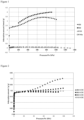
- Figure 1 shows the adsorption isotherms of chlorodifluoromethane (R22), difluoromethane (R32), pentafluoroethane (R125) and 1,1,1-trifluoroethane (R143a) measured at 303 K regarding the metal-organic framework (PCP) 1 (powder) of Example 1.
- Figure 1 shows that R22 and R32, fluorocarbons having one carbon atom, were adsorbed to the metal-organic framework 1, and that R125 and R143a, fluorocarbons having two carbon atoms, were hardly adsorbed thereto.
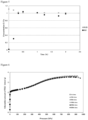
- Figure 2 shows the adsorption isotherms of R22 measured at 283 K, 293 K, 303 and 313 K regarding the metal-organic framework (PCP) 1 (powder) of Example 1.
- Figure 2 shows that the adsorption amount was largest at 283 K, and that there were almost no differences between the adsorption amounts at 293 K to 313 K.
- PCP metal-organic framework
- Figure 3 shows the adsorption isotherms of R22 and R125 measured at 303 K regarding MS-4A of Comparative Example 2 and MS-13X of Comparative Example 3 as the adsorbents (porous bodies).
- MS-4A of Comparative Example 2 and MS-13X of Comparative Example 3 as the adsorbents (porous bodies).
- MS-13X adsorbents (porous bodies).
- BELSORP-HP was used for the measurement.
- the adsorption amount of R22 estimated from the adsorption breakthrough curve was 0.223 g/g, which was almost the same value as the equilibrium adsorption amount of the adsorption isotherm.
- the molecular diameter of R125 was 0.446 nm, and the molecular diameter of R22 was 0.418 nm.
- the adsorption amount of R32 estimated from the adsorption breakthrough curve was 0.129 g/g, which was almost the same value as the equilibrium adsorption amount of the adsorption isotherm.
- the molecular diameter of R32 was 0.363 nm.
- Figure 6 shows adsorption isotherms obtained by repeating the adsorption and desorption of chlorodifluoromethane (R22) at a temperature of 303 K regarding the metal-organic framework (PCP) 1 of Example 1 and measuring the adsorption amount.
- PCP metal-organic framework
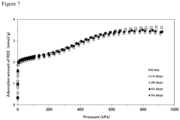
- Figure 7 shows adsorption isotherms obtained by measuring the adsorption amounts of chlorodifluoromethane (R22) at 303 K regarding the metal-organic framework (PCP) 1 of Example 1 and samples of the metal-organic framework (PCP) 1 of Example 1 stored under conditions of a temperature of 85°C and a humidity of 95%RH for 14 days, 28 days, 42 days or 56 days.
- PCP metal-organic framework
- Figure 7 shows adsorption isotherms obtained by measuring the adsorption amounts of chlorodifluoromethane (R22) at 303 K regarding the metal-organic framework (PCP) 1 of Example 1 and samples of the metal-organic framework (PCP) 1 of Example 1 stored under conditions of a temperature of 85°C and a humidity of 95%RH for 14 days, 28 days, 42 days or 56 days.
- BELSORP-HP was used for the measurement of the adsorption isotherms.
Landscapes
- Chemical & Material Sciences (AREA)
- Organic Chemistry (AREA)
- Analytical Chemistry (AREA)
- Chemical Kinetics & Catalysis (AREA)
- Engineering & Computer Science (AREA)
- General Chemical & Material Sciences (AREA)
- Oil, Petroleum & Natural Gas (AREA)
- Inorganic Chemistry (AREA)
- Organic Low-Molecular-Weight Compounds And Preparation Thereof (AREA)
- Separation Of Gases By Adsorption (AREA)
- Solid-Sorbent Or Filter-Aiding Compositions (AREA)
- Carbon And Carbon Compounds (AREA)
Abstract
separating a fluorocarbon having n carbon atoms from a mixture comprising the fluorocarbon having n carbon atoms and a fluorocarbon having n + m or more carbon atoms,
wherein the fluorocarbon having n carbon atoms is separated by bringing the mixture and an adsorbent into contact with each other, and
wherein n is an integer of 1 or more, and m is an integer of 1 or more.
Description
- The present disclosure relates to a separation method.
- A known method for separating fluorocarbon includes distilling a mixture of fluorocarbons.
Patent Literature 1 describes obtaining a mixture for extraction from a mixture containing 2,3,3,3-tetrafluoropropene and hexafluoropropene; and an extraction solvent, and distilling the mixture for extraction to obtain a distillate containing hexafluoropropene as a main component, and a bottom containing 2,3,3,3 -tetrafluoropropene. - Patent Literature 1:
JP2018-002602A - In a distillation method as described in
Patent Literature 1, it has been found that the separation of compounds having similar boiling points or azeotropic compounds is difficult, and that disadvantageously, separation of a fluorocarbon, for example, a fluorocarbon having one carbon atom, may be achieved insufficiently. - The present disclosure is to provide a method for separating a fluorocarbon having a specific number of carbon atoms and is to provide, for example, a method for separating a fluorocarbon having one carbon atom.
- The present disclosure comprises the following aspects.
- A method for separating a fluorocarbon, comprising:
- separating a fluorocarbon having n carbon atoms from a mixture comprising the fluorocarbon having n carbon atoms and a fluorocarbon having n + m or more carbon atoms,
- wherein the fluorocarbon having n carbon atoms is separated by bringing the mixture and an adsorbent into contact with each other, and
- n is an integer of 1 or higher, and m is an integer of 1 or more.
- [2] The method according to [1], wherein the mixture and the adsorbent are brought into contact with each other at a temperature of -10°C or higher and 30°C or lower.
- [3] The method according to [1] or [2], wherein n is an integer of 1 or more and 2 or less.
- [4] The method according to any one of [1] to [3], wherein m is an integer of 1 or more and 3 or less.
- [5] The method according to any one of [1] to [4], wherein the fluorocarbon having the number n of carbon atoms is at least one selected from the group consisting of difluoromethane and difluorochloromethane.
- [6] The method according to any one of [1] to [5], wherein the fluorocarbon having the number n + m or more of carbon atoms includes a fluorocarbon having 2 or 3 carbon atoms.
- [7] The method according to any one of [1] to [6], wherein the adsorbent contains a porous body, and the porous body has an effective pore diameter of 0.46 nm or less.
- [8] The method according to [7], wherein the porous body has a metal-organic framework.
- [9] The method according to [8], wherein the metal-organic framework has a metal ion and one or more organic ligands, and
the organic ligand has two or more groups capable of forming a coordinate bond to the metal ion, per molecule. - [10] The method according to [8], wherein the metal-organic framework has a metal ion.
- [11] The method according to [8], wherein the metal-organic framework has one or more organic ligands, and
the organic ligand has two or more groups capable of forming a coordinate bond to the metal ion, per molecule. - [12] The method according to [9], wherein the metal ion comprises zinc, and the organic ligands include oxalic acid and 1,2,4-triazole.
- [13] The method according to any one of [7] to [12], wherein the adsorbent further comprises a resin.
- [14] The isolation method according to any one of [1] to [13], wherein the adsorbent is in a form of powder, granules, flakes, or pellets.
- [15] The isolation method according to any one of [1] to [14], wherein the mixture is an azeotropic mixture or pseudoazeotropic mixture of fluorocarbons.
- [16] The isolation method according to any one of [1] to [15], further comprising: purifying the isolated fluorocarbon having the number n of carbon atoms.
- [17] A composite material comprising: a metal-organic framework; and a fluorocarbon having the number n of carbon atoms,
- wherein the metal-organic framework has a metal ion and one or more organic ligands,
- the metal ion includes zinc, the organic ligands include oxalic acid and 1,2,4-triazole, and
- n is an integer of 1 or more.
- According to the present disclosure, a fluorocarbon having a specific number of carbon atoms, for example, a fluorocarbon having one carbon atom, can be separated from a mixture comprising two or more fluorocarbons.
-
-
Figure 1 shows adsorption isotherms in Example 1. -
Figure 2 shows adsorption isotherms in Example 1. -
Figure 3 shows adsorption isotherms in Comparative Examples 2 and 3. -
Figure 4 shows adsorption breakthrough curves in Example 1. -
Figure 5 shows adsorption breakthrough curves in Example 2. -
Figure 6 shows adsorption isotherms in repeated adsorption and desorption in Example 1. -
Figure 7 shows adsorption isotherms after high temperature and high humidity storage, in Example 1. - A separation method of the present disclosure may comprise separating a specific fluorocarbon from a mixture comprising two or more fluorocarbons, and the specific fluorocarbon can be separated by bringing the mixture and an adsorbent into contact with each other.
- A separation method in one embodiment of the present disclosure comprises;
- separating a fluorocarbon having n carbon atoms from a mixture comprising the fluorocarbon having n carbon atoms and a fluorocarbon having n + m or more carbon atoms, and
- the fluorocarbon having n carbon atoms is separated by bringing the mixture and an adsorbent into contact with each other.
- In the separation method of the present disclosure, the fluorocarbon having n carbon atoms is adsorbed to the adsorbent, whereby the fluorocarbon having n carbon atoms can be separated from the mixture. In one embodiment, the mixture in a gas state is brought into contact with such an adsorbent.
- In one embodiment, such a separation method may comprise;
- separating a fluorocarbon having one carbon atom from a mixture comprising the fluorocarbon having one carbon atom and a fluorocarbon having two or more carbon atoms, and
- the fluorocarbon having one carbon atom is separated by bringing the mixture and an adsorbent into contact with each other.
- In another embodiment, such a separation method may comprise;
- separating a fluorocarbon having 2 carbon atoms from a mixture comprising the fluorocarbon having 2 carbon atoms and a fluorocarbon having 3 or more carbon atoms, and
- the fluorocarbon having 2 carbon atoms is separated by bringing the mixture and an adsorbent into contact with each other.
- In still another embodiment, such a separation method may comprise;
- separating a fluorocarbon having one carbon atom from a mixture comprising the fluorocarbon having one carbon atom and a fluorocarbon having 3 or more carbon atoms, and
- the fluorocarbon having one carbon atom is separated by bringing the mixture and an adsorbent into contact with each other.
- The mixture comprises a fluorocarbon having n carbon atoms. n is an integer of 1 or more and preferably 1 or more and 2 or less.
- In one embodiment, the molecular diameter of the fluorocarbon having n carbon atoms is, for example, 0.30 nm or more and 0.430 nm or less and preferably 0.320 nm or more and 0.420 nm or less. The molecular diameter of the fluorocarbon having n carbon atoms is, for example, 0.300 nm or more and preferably 0.320 nm or more and is, for example, 0.430 nm or less and preferably 0.420 nm or less.
- In another embodiment, the molecular diameter of the fluorocarbon having n carbon atoms is, for example, 0.300 nm or more and 0.460 nm or less and preferably 0.320 nm or more and 0.440 nm or less. The molecular diameter of the fluorocarbon having n carbon atoms is, for example, 0.300 nm or more and preferably 0.320 nm or more and is, for example, 0.460 nm or less and preferably 0.440 nm or less.
- In still another embodiment, the molecular diameter of the fluorocarbon having n carbon atoms is, for example, 0.480 nm or more and 1.0 nm or less and preferably 0.490 nm or more and 0.980 nm or less. In addition, the molecular diameter of the fluorocarbon having n carbon atoms is, for example, 0.480 nm or more and preferably 0.490 nm or more and is, for example, 1.0 nm or less and preferably 0.800 nm or less.
- The molecular diameter is a value that is calculated by the following formula:

- wherein d represents the molecular diameter, m represents the mass of one molecule, a represents the molecular speed, and η represents the viscosity coefficient.
- a is calculated by the following formula:

- wherein γ is the specific heat ratio and approximates 1.333, R is the gas constant, T is the absolute temperature, and M is the molar mass of the molecule.
- η may be measured by, for example, a capillary method.
- The boiling point of the fluorocarbon having n carbon atoms may be, for example, -80°C or higher and -20°C or lower and, furthermore, may be -60°C or higher and -30°C or lower. In one embodiment, the fluorocarbon having n carbon atoms is present in the form of a gas in the mixture.
- Examples of the fluorocarbon having n carbon atoms comprise hydrochlorofluorocarbon and hydrofluorocarbon. Examples of the hydrochlorofluorocarbon comprise chlorodifluoromethane, and examples of the hydrofluorocarbon comprise difluoromethane. In the present disclosure, the fluorocarbon having n carbon atoms is also referred to as an adsorbate.
- The fluorocarbon having n carbon atoms may comprise one or more compounds. When the fluorocarbon having n carbon atoms comprises two or more compounds, each compound preferably has a molecular diameter and a boiling point within the respective ranges described above.
- The content of the fluorocarbon having n carbon atoms in the mixture may be, for example, 0.1 mol% or more and 50 mol% or less and, furthermore, may be 0.5 mol% or more and 20 mol% or less, based on the entire mixture.
- The mixture comprises a fluorocarbon having n + m carbon atoms. m is an integer of 1 or more, preferably 1 or more and 3 or less and more preferably 1 or more and 2 or less.
- The content of a fluorocarbon having 2 or 3 carbon atoms in the fluorocarbon having n + m or more carbon atoms may be, for example, 50 mol% or more and 100 mol% or less and may be 80 mol% or more and 100 mol% or less.
- In one embodiment, the molecular diameter of the fluorocarbon having n + m or more carbon atoms is, for example, more than 0.430 nm, may be 0.440 nm or more and 2.00 nm or less or may be 0.440 nm or more and 1.00 nm or less. The molecular diameter of the fluorocarbon having n + m or more carbon atoms is, for example, more than 0.430 nm and preferably 0.440 nm or more and is, for example, 2.00 nm or less and preferably 1.00 nm or less.
- In another embodiment, the molecular diameter of the fluorocarbon having n + m or more carbon atoms is, for example, more than 0.460 nm, may be 0.470 nm or more and 2.00 nm or less or may be 0.470 nm or more and 1.00 nm or less. The molecular diameter of the fluorocarbon having n + m or more carbon atoms is, for example, more than 0.460 nm and preferably 0.470 nm or more and is, for example, 2.00 nm or less and preferably 1.00 nm or less.
- In still another embodiment, the molecular diameter of the fluorocarbon having n + m or more carbon atoms is, for example, more than 1.0 nm, may be 1.10 nm or more and 2.00 nm or less or may be 1.10 nm or more and 1.50 nm or less. The molecular diameter of the fluorocarbon having n + m or more carbon atoms is, for example, more than 1.0 nm and preferably 1.10 nm or more and is, for example, 2.00 nm or less and preferably 1.50 nm or less.
- The boiling point of the fluorocarbon having n + m or more carbon atoms may be, for example, -80°C or higher and -20°C or lower, and furthermore, may be - 60°C or higher and -30°C or lower and, particularly, -50°C or higher and -30°C or lower. In one embodiment, the fluorocarbon having n + m or more carbon atoms is present in the form of a gas in the mixture.
- The difference between the boiling point of the fluorocarbon having n carbon atoms and the boiling point of the fluorocarbon having n + m or more carbon atoms may be, for example, 0°C or more and 20°C or less and, furthermore, may be 0°C or more and 10°C or less. Even when the boiling point of the fluorocarbon having n carbon atoms and the boiling point of the fluorocarbon having n + m or more carbon atoms are close to each other, the fluorocarbon having n carbon atoms can be separated by the separation method of the present disclosure.
- The fluorocarbon having n + m or more carbon atoms may be a saturated fluorocarbon or an unsaturated fluorocarbon and is preferably a saturated fluorocarbon.
- Examples of the fluorocarbon having n + m or more carbon atoms comprise hydrochlorofluorocarbons and hydrofluorocarbons. Examples of the hydrochlorofluorocarbons comprise hydrochlorofluorocarbon having two carbon atoms such as chlorotrifluoroethane. Examples of the hydrofluorocarbons comprise difluoroethane (for example, 1,1-difluoroethane and 1,2-difluoroethane, particularly, 1,1-difluoroethane), trifluoroethane (for example, 1,1,1-trifluoroethane and 1,1,2-trifluoroethane, particularly 1,1,1-trifluoroethane), tetrafluoroethane (for example, 1,1,1,2-tetrafluoroethane and 1, 1,2,2-tetrafluoroethane, particularly, 1,1,1,2-tetrafluoroethane); hydrofluorocarbons having 2 carbon atoms such as pentafluoroethane; and hydrofluorocarbons having 3 carbon atoms such as tetrafluoropropene and hexafluoropropene. One or more of these may be comprised in the fluorocarbons having n + m or more carbon atoms.
- In a preferable embodiment, the fluorocarbon having n + m or more carbon atoms may be, for example, a fluorocarbon having 2 to 5 carbon atoms, and may preferably be a fluorocarbon having 2 or 3 carbon atoms.
- The fluorocarbon having n + m or more carbon atoms may comprise one or more compounds. When the fluorocarbon having n + m or more carbon atoms comprises two or more compounds, each compound preferably has a molecular diameter and a boiling point within the respective ranges described above.
- The contents of the fluorocarbon having n carbon atoms and the fluorocarbon having n + m or more carbon atoms in the mixture is preferably 90 mol% or more and 100 mol% or less and more preferably 95 mol% or more and 100 mol% or less, based on the entire mixture.
- The mixture may be an azeotropic mixture or pseudoazeotropic mixture of fluorocarbons. According to the separation method of the present disclosure, a fluorocarbon having a specific number of carbon atoms can be separated even when the mixture is an azeotropic mixture or a pseudoazeotropic mixture. Examples of such an azeotropic mixture or pseudoazeotropic mixture comprise mixtures in which the difference between the boiling point of a fluorocarbon that is a separation target (in the present embodiment, the fluorocarbon having n carbon atoms) and the boiling point of a different fluorocarbon (in the present embodiment, the fluorocarbon having n + m or more carbon atoms) is 1°C or more and 20°C or less, furthermore, 3°C or more and 18°C or less.
- In one embodiment, the fluorocarbon having n carbon atoms can be a fluorocarbon having 1 carbon atom, and the fluorocarbon having n + m or more carbon atoms can be a fluorocarbon having 2 or more carbon atoms.
- In another embodiment, the fluorocarbon having n carbon atoms can be a fluorocarbon having 2 carbon atoms, and the fluorocarbon having n + m or more carbon atoms can be a fluorocarbon having 3 or more carbon atoms.
- In still another embodiment, the fluorocarbon having n carbon atoms can be a fluorocarbon having 1 carbon atom, and the fluorocarbon having n + m or more carbon atoms can be a fluorocarbon having 3 or more carbon atoms.
- In far still another embodiment, the fluorocarbon having n carbon atoms can be a fluorocarbon having 1 carbon atom, and the fluorocarbon having n + m or more carbon atoms can be a fluorocarbon having 4 or more carbon atoms.
- In far still another embodiment, the fluorocarbon having n carbon atoms can be a fluorocarbon having 2 carbon atoms, and the fluorocarbon having n + m or more carbon atoms can be a fluorocarbon having 5 or more carbon atoms.
- The mixture may comprise other compounds, in addition to the fluorocarbon having n carbon atoms and the fluorocarbon having n + m or more carbon atoms. The boiling point of such other compounds may be, for example, - 100°C or lower or -150°C or lower. In one embodiment, such other compounds are comprised in the mixture as a gas.
- Examples of such other compounds comprise nitrogen, oxygen, carbon dioxide, and water.
- The adsorbent is capable of adsorbing the fluorocarbon having n carbon atoms. Typically, the adsorbent adsorbs the fluorocarbon having n carbon atoms, but does not adsorb the fluorocarbon having n + m or more carbon atoms. Therefore, when a mixture comprising the fluorocarbon having n carbon atoms and the fluorocarbon having n + m or more carbon atoms and the adsorbent are brought into contact with each other, it is possible to separate the fluorocarbon having n carbon atoms from the mixture.
- The adsorbent preferably comprises a porous body having a pore, as an adsorptive medium. When the fluorocarbon having n carbon atoms is adsorbed onto such a pore, it is possible to separate the fluorocarbon having n carbon atoms from the mixture.
- The effective pore diameter of the porous body is preferably smaller than the molecular diameter of the fluorocarbon having n + m or more carbon atoms. When the effective pore diameter is smaller than the molecular diameter of the fluorocarbon having n + m or more carbon atoms, it is possible to more reliably separate the fluorocarbon having n carbon atoms.
- Here, the effective pore diameter is the pore diameter of the porous body that is determined from the degree of adsorption and the molecular diameter of the adsorbate when the porous body and the adsorbate are brought into contact with each other and, specifically, can be obtained by converting the relative pressure of a nitrogen adsorption isotherm into the effective pore diameter using a Horvath-Kawazoe method. As a conversion formula, a calculation formula described in J. Chem. Eng, Jpn., 1983, 16, 6, 470 to 475 may be used, and as a parameter value in the conversion formula, a value based on a combination of carbon and nitrogen may be used.
- The effective pore diameter of the porous body is, for example, 0.30 nm or more and 0.46 nm or less and preferably 0.32 nm or more and 0.44 nm or less. In one embodiment, the effective pore diameter of the porous body is, for example, 0.30 nm or more and preferably 0.32 nm or more and is, for example, 0.46 nm or less and preferably 0.44 nm or less.
- The specific surface area of the porous body can be, for example, 40 m2/g or more, preferably 100 m2/g or more and more preferably 300 m2/g or more and may be, for example, 2,000 m2/g or less and may be 1,000 m2/g or less. The specific surface area of the porous body is calculated from the nitrogen gas adsorption isotherm using a BET method.
- The equilibrium adsorption amount of the fluorocarbon having n carbon atoms to the porous body may be, for example, 1 g/10 g or more or 100 g/10 g or less as measured at a temperature of 303 K and a pressure within a range of 0.4 Pa to 1 MPa.
- The porous body may be in the form of powder (particles), a film, granules, or a molded product (for example, pellets), for example, and is preferably a molded product and more preferably in the form of pellets. A pellet may have a cylindrical shape or a spherical shape. In the case of the cylindrical shape, the radius of the cylinder is preferably 1.6 mm or more and 6 mm or less, and the thickness of the cylinder is preferably 2 mm or more and 6 mm or less. In the case of the spherical shape, the spherical shape does not need to be truly spherical at all times, and the radius of the sphere is preferably 4 mm or more and 12 mm or less.
- The porous body preferably comprises, for example, at least one selected from the group consisting of zeolite, activated carbon, silica gel and a metal-organic framework (MOF, or PCP: porous coordination polymer), and typically comprises a metal-organic framework.
- The metal-organic framework preferably comprises metal ions and one or more kinds of organic ligands. Typically, the organic ligands preferably comprise two or more groups capable of forming a coordinate bond to the metal ion, per molecule. When the organic ligands coordinates to the metal ions, a highly regular and three-dimensionally continuous structure (for example, a network structure) is formed, and pores are formed between the metal ions and the organic ligands. The combination of the kinds of the metal ions and the organic ligands could control the effective pore diameter or flexibility of the metal-organic framework and the interaction between the metal-organic framework and the adsorbate in such a three-dimensional structure.
- In addition, the metal-organic framework exhibits an adsorption capacity (maximum adsorption capacity) that does not decrease even after the repeated adsorption and desorption of the adsorbate and thus exhibits high durability to repetition. Furthermore, the metal-organic framework is less likely to be affected by temperatures (heat) or humidity, exhibits an adsorption capacity that does not decrease even through storage at a high temperature and a high humidity for a long period of time and thus exhibits high durability to high-temperatures and high-humidities.
- The metal ion is not limited, and examples thereof comprise the ions of metals selected from the group consisting of Group Ia, Group IIa, Group IIIa, Groups IVa to VIII and Groups Ib to VIb. Such metals can be preferably one or more selected from the group consisting of Mg, Ca, Sr, Ba, Sc, Y, Ti, Zr, Hf, V, Nb, Ta, Cr, Mo, W, Mn, Re, Fe, Ro, Os, Co, Rh, Ir, Ni, Pd, Pt, Cu, Ag, Au, Zn, Cd, Hg, Al, Ga, In, Tl, Si, Ge, Sn, Pb, As, Sb, Bi, La, Ce, Pr, Nd, Pm, Sm, En, Gd, Tb, Dy, Ho, Er, Tm or Yb, and can be more preferably one or more selected from the group consisting of Zn, Cu, Ti, Co, Mn, Al, Ca, Zr or Mg.
- Specifically, such metal ions can be one or more selected from the group consisting of Mg2+, Ca2+, Sr2+, Ba2+, Sc3+, Y3+, Ln3+, Ti4+, Zr4+, Hf4+, V4+, V3+, V2+, Nb3+, Ta3+ , Cr3+, Mo3+, W3+, Mn3+, Mn2+, Re3+, Re2+, Fe3+, Fe2+, Ru3+, Ru2+, Os3+, Os2+, Co3+, Co2+, Rh2+, Rh+, Ir24, Ir+, Ni2+, Ni+, Pd2+, Pd+, Pt2+, Pt+, Cu2+, Cu+, Ag+, Au+, Zn2+, Cd2+, Hg2+, Al3+, Ga3+, In3+,Tl3+, Si4+, Si2+, Ge4+, Ge2+, Sn4+, Sn2+, Pb4+, Pb2+, As5+, As3+, As+, Sb5+, Sb3+, Sb+, Bi5+, Bi3+, Bi+, La3+ Ce3+, Pr3+, Nd3+, Pm3+, Sm3+, En3+, Gd3+, Tb3+, Dy3+, Ho3+, Er3+, Tm3+ or Yb3+ and can be more preferably one or more selected from the group consisting of Zn2+, Cu2+, Cu+, Ti4+, Ti3+, Co3+, Co2+, Mn3+, Mn2+, Al3+, Ca2+, Zr4+ or Mg2+.
- The number of types of the metal ions may be only 1 or 2 or more. The number of types of the metal ions is preferably 1.
- In a preferable embodiment, the metal ion is a Zn ion and preferably Zn2+.
- The organic ligand is not limited, as long as the organic ligand has two or more groups capable of forming a coordinate bond to the metal ion, per molecule. The coordinate bond is formed of, for example, a functional group capable of forming a coordinate bond to the metal ion.
- Examples of the functional group capable of forming the coordinate bond comprise -COOH, -CS2H, -NO2, -B(OH)2, -SO3H, -Si(OH)3, -Ge(OH)3, -Sn(OH)3, - Si(SH)4, -Ge(SH)4, -Sn(SH)3, -PO3H, -AsO3H, -AsO4H, -P(SH)3, -As(SH)3, - CH(RSH)2, -C(RSH)3, -CH(RNH2)2, -C(RNH2)3, -CH(ROH)2, -C(ROH)3, - CH(RCN)3 and -C(RCN)3. In the formulae, R is a single bond, an alkylene group having 1 to 5 carbon atoms (for example, methylene, ethylene, n-propylene, i-propylene, n-butylene, i-butylene, tert-butylene or n-pentylene group), a divalent aromatic group having 6 to 14 carbon atoms (for example, phenylene) or a combination of the alkylene group and the aromatic group (for example, -phenylene-alkylene-phenylene). Alternatively, the functional group capable of forming a coordinate bond may be a hetero atom (for example, N, O, S, B, P, Si or Al) comprised in a heterocycle and may be preferably a nitrogen atom in a heterocycle.
- In a preferable embodiment, the functional group capable of forming a coordinate bond can be -COOH, or a nitrogen atom in a heterocycle, for example.
- The organic ligand preferably comprises the functional group so as to be a bi- or higher-dentate ligand. In such an organic ligand, the moiety other than the functional group is not limited as long as the organic ligand is capable of forming a coordinate bond to the metal ion.
- In one embodiment, the organic ligand derives from a saturated or unsaturated aliphatic compound or aromatic compound. The ligand may be derived from a compound formed by bonding such an aliphatic compound to an aromatic compound bond (hereinafter, also referred to as "aliphatic aromatic compound").
- An aliphatic moiety of the aliphatic compound or the aliphatic aromatic compound may be linear, branched or cyclic. When the aliphatic moiety is cyclic, the aliphatic moiety may comprise a plurality of rings. The aliphatic moiety of the aliphatic compound or the aliphatic aromatic compound preferably has 1 to 15 carbon atoms and more preferably has 1 to 10 carbon atoms, for example, 1, 2, 3, 4, 5, 6, 7, 8, 9 or 10 carbon atoms. In a preferable embodiment, the aliphatic moiety derives from methane, adamantane, acetylene, ethylene or butadiene.
- An aromatic moiety of the aromatic compound or the aliphatic aromatic compound may have 1 or more rings, for example, 2, 3, 4 or 5 rings. These rings may or may not be condensed. The aromatic moiety of the aromatic compound or the aliphatic aromatic compound preferably has 1, 2 or 3 rings and more preferably 1 or 2 rings. Each ring of the compound may comprise at least one heteroatom, for example, N, O, S, B, P, Si or Al, preferably N, O or S, in the ring. The aromatic moiety of the aromatic compound or the aromatic aliphatic compound preferably has 1 or 2 rings having 6 carbon atoms. When there are 2 aromatic moieties, such two rings may or may not be condensed. In a preferable embodiment, such an aromatic moiety derives from benzene, naphthalene, biphenyl, bipyridyl or pyridyl.
- In one embodiment, the organic ligand derives from dicarboxylic acid, tricarboxylic acid or tetracarboxylic acid.
- Examples of the dicarboxylic acid comprise oxalic acid, succinic acid, tartaric acid, maleic acid, 1,4-butanedicarboxylic acid, 1,4-butenedicarboxylic acid, 4-oxopyran-2,6-dicarboxylic acid, 1,6-hexanedicarboxylic acid, decanedicarboxylic acid, 1,8-heptadecanedicarboxylic acid, 1,9-heptadecanedicarboxylic acid, heptadecanedicarboxylic acid, acetylenedicarboxylic acid, 1,2-benzenedicarboxylic acid, 1,3-benzenedicarboxylic acid, 2,3-pyridinedicarboxylic acid, pyridine-2,3-dicarboxylic acid, 1,3-butadiene-1,4-dicarboxylic acid, 1,4-benzenedicarboxylic acid, p-benzenedicarboxylic acid, imidazole-2,4-dicarboxylic acid, 2-methylquinoline-3,4-dicarboxylic acid, quinoline-2,4-dicarboxylic acid, quinoxaline-2,3-dicarboxylic acid, 6-chloroquinoxaline-2,3-dicarboxylic acid, 4,4'-diaminophenylmethane-3,3'-dicarboxylic acid, quinoline-3,4-dicarboxylic acid, 7-chloro-4-hydroxyquinoline-2,8-dicarboxylic acid, diimidodicarboxylic acid, pyridine-2,6-dicarboxylic acid, 2-methylimidazole-4,5-dicarboxylic acid, thiophene-3,4-dicarboxylic acid, 2-isopropylimidazole-4,5-dicarboxylic acid, tetrahydropyran-4,4-dicarboxylic acid, perylene-3,9-dicarboxylic acid, perylene dicarboxylic acid, PLURIOL E200-dicarboxylic acid, 3,6-dioxaoctanedicarboxylic acid, 3,5-cyclohexadiene-1,2-dicarboxylic acid, octanedicarboxylic acid, pentane-3,3-dicarboxylic acid, 4,4'-diamino-1,1'-biphenyl-3,3'-dicarboxylic acid, 4,4'-diaminobiphenyl-3,3'-dicarboxylic acid, benzidine-3,3'-dicarboxylic acid, 1,4-bis(phenylamino)benzene-2,5-dicarboxylic acid, 1,1'-binaphthyldicarboxylic acid, 7-chloro-8-methylquinoline-2,3-dicarboxylic acid, 1-anilino-anthraquinone-2,4'-dicarboxylic acid, polytetrahydrofuran 250-dicarboxylic acid, 1,4-bis(carboxymethyl)piperazine-2,3-dicarboxylic acid, 7-chloroquinoline-3,8-dicarboxylic acid, 1-(4-carboxy)phenyl-3-(4-chloro)phenylpyrazoline-4,5-dicarboxylic acid, 1,4,5,6,7,7-hexachloro-5-norbomene-2,3-dicarboxylic acid, phenylindanedicarboxylic acid, 1,3-dibenzyl-2-oxoimidazolidine-4,5-dicarboxylic acid, 1,4-cyclohexanedicarboxylic acid, naphthalene-1,8-dicarboxylic acid, 2-benzoylbenzene-1,3-dicarboxylic acid, 1,3-dibenzyl-2-oxoimidazolidene-4,5-cis-dicarboxylic acid, 2,2'-biquinoline-4,4'-dicarboxylic acid, pyridine-3,4-dicarboxylic acid, 3,6,9-trioxaundecanedicarboxylic acid, hydroxybenzophenone dicarboxylic acid, PLURIOL E300-dicarboxylic acid, PLURIOL E400-dicarboxylic acid, PLURIOL E600-dicarboxylic acid, pyrazole-3,4-dicarboxylic acid, 2,3-pyrazinedicarboxylic acid, 5,6-dimethyl-2,3-pyrazinedicarboxylic acid, 4,4'-diamino(diphenyl ether)diimidodicarboxylic acid, 4,4'-diaminodiphenylmethanediimidodicarboxylic acid, 4,4'-diamino(diphenylsulfone)diimidodicarboxylic acid, 1,4-naphthalene dicarboxylic acid, 2,6-naphthalene dicarboxylic acid, 1,3-adamantanedicarboxylic acid, 1,8-naphthalene dicarboxylic acid, 2,3-naphthalene dicarboxylic acid, 8-methoxy-2,3-naphthalene dicarboxylic acid, 8-nitro-2,3-naphthalene dicarboxylic acid, 8-sulfo-2,3-naphthalene dicarboxylic acid, anthracene-2,3-dicarboxylic acid, 2',3'-diphenyl-p-terphenyl-4,4"-dicarboxylic acid, (diphenyl ether)-4,4'-dicarboxylic acid, imidazole-4,5-dicarboxylic acid, 4(1H)-oxothiochromene-2,8-dicarboxylic acid, 5-tert-butyl-1,3-benzenedicarboxylic acid, 7,8-quinolinedicarboxylic acid, 4,5-imidazoledicarboxylic acid, 4-cyclohexene-1,2-dicarboxylic acid, hexatriacontanedicarboxylic acid, tetradedocanedicarboxylic acid, 1,7-heptanedicarboxylic acid, 5-hydroxy-1,3-benzenedicarboxylic acid, 2,5-dihydroxy-1,4-dicarboxylic acid, pyrazine-2,3-dicarboxylic acid, furan-2,5-dicarboxylic acid, 1-nonene-6,9-dicarboxylic acid, eicosene dicarboxylic acid, 4,4'-dihydroxydiphenylmethane-3,3'-dicarboxylic acid, 1-amino-4-methyl-9,10-dioxo-9,10-dihydroanthracene-2,3-dicarboxylic acid, 2,5-pyridinedicarboxylic acid, cyclohexene-2,3-dicarboxylic acid, 2,9-dichlorofluorobin-4,11-dicarboxylic acid, 7-chloro-3-methylquinoline-6,8-dicarboxylic acid, 2,4-dichlorobenzophenone-2',5'-dicarboxylic acid, 1,3-benzenedicarboxylic acid, 2,6-pyridinedicarboxylic acid, 1-methylpyrrole-3,4-dicarboxylic acid, 1-benzyl-1H-pyrrole-3,4-dicarboxylic acid, anthraquinone-1,5-dicarboxylic acid, 3,5-pyrazoledicarboxylic acid, 2-nitrobenzene-1,4-dicarboxylic acid, heptane-1,7-dicarboxylic acid, cyclobutane-1,1-dicarboxylic acid, 1,14-tetradedocanedicarboxylic acid, 5,6-dehydronorbornane-2,3-dicarboxylic acid, 5-ethyl-2,3-pyridinedicarboxylic acid or camphordicarboxylic acid.
- Examples of the tricarboxylic acid comprise 2-hydroxy-1,2,3-propanetricarboxylic acid, 7-chloro-2,3,8-quinolinetricarboxylic acid, 1,2,3-, 1,2,4-benzenetricarboxylic acid, 1,2,4-butanetricarboxylic acid, 2-phosphono-1,2,4-butanetricarboxylic acid, 1,3,5-benzenetricarboxylic acid, 4,4',4"-(1,3,5-benzenetriyl)trisbenzoic acid, 1-hydroxy-1,2,3-propanetricarboxylic acid, 4,5-dihydro-4,5-dioxo-1H-pyrrolo[2,3-F]quinoline-2,7,9-tricarboxylic acid, 5-acetyl-3-amino-6-methylbenzene-1,2,4-tricarboxylic acid, 3-amino-5-benzoyl-6-methylbenzene-1,2,4-tricarboxylic acid, 1,2,3-propane tricarboxylic acid or aurintricarboxylic acid.
- Examples of the tetracarboxylic acid comprise perylenetetracarboxylic acids such as 1,1-dioxideperylo[1,12-BCD]thiophene-3,4,9,10-tetracarboxylic acid, perylene-3,4,9,10-tetracarboxylic acid or (perylene-1,12-sulfone)-3,4,9,10-tetracarboxylic acid, butanetetracarboxylic acids such as 1,2,3,4-butanetetracarboxylic acid or meso-1,2,3,4-butanetetracarboxylic acid, decane-2,4,6,8-tetracarboxylic acid, 1,4,7,10,13,16-hexaoxacyclooctadecane-2,3,11,13-tetracarboxylic acid, 1,2,4,5-benzenetetracarboxylic acid, 1,2,11,12-dodecanetetracarboxylic acid, 1,2,5,6-hexanetetracarboxylic acid, 1,2,7,8-octanetetracarboxylic acid, 1,4,5,8-naphthalenetetracarboxylic acid, 1,2,9,10-decanetetracarboxylic acid, benzophenonetetracarboxylic acid, 3,3',4,4'-benzophenonetetracarboxylic acid, tetrahydrofurantetracarboxylic acid and cyclopentanetetracarboxylic acids such as cyclopentane-1,2,3,4-tetracarboxylic acid.
- In one embodiment, the organic ligand derives from a heterocycle capable of forming a coordinate bond at the ring heteroatom. Examples of such a heterocycle comprise the following heterocycles. The heterocycle may be unsubstituted or substituted.


- In one embodiment, the organic ligand derives from an azole such as a diazole or a triazole and preferably derived from a triazole.
- In a preferable embodiment, the organic ligand comprises an organic ligand that derives from dicarboxylic acid or an organic ligand that derives from an azole, and preferably comprises an organic ligand derived from oxalic acid or an organic ligand that derives from 1,2,4-triazole.
- In a preferable embodiment, the organic ligand is selected from 1,4-benzenedicarboxylic acid, 1,2-benzenedicarboxylic acid, maleic acid, 1,3,5-benzenetricarboxylic acid, 4,4',4"-(1,3,5-benzentriyl)trisbenzoic acid, oxalic acid, 4,4'-bipyridine, triazole, imidazole, 3,3'-bipyrazole, benzimidazole or 3,5-pyridinedicarboxylic acid.
- The number of types of the organic ligands may be only one, or two or more.
- In the present disclosure, "deriving from a compound" may encompass not only the compound itself but also a partially protonated form of such a compound and a fully protonated form of such a compound.
- The metal-organic framework can be produced by bringing the metal ion and the organic ligand into contact with each other. Such contact between the metal ion and the organic ligand may be performed in the presence of a solvent. The solvent can be water, ethanol, dimethylformamide, toluene, methanol, chlorobenzene, diethylformamide, dimethylsulfoxide, hydrogen peroxide, methylamine, a sodium hydroxide solution, N-methylpyrrolidone ether, acetonitrile, benzyl chloride, triethylamine, ethylene glycol or a mixture thereof.
- The contact between the metal ion and the organic ligand may be performed under increased pressure or under normal pressure. The temperature at the time of performing such contact may be, for example, 10°C to 200°C or 10°C to 150°C. During such contact, stirring may be performed.
- The metal ion and the organic ligand may comprise Zn2+ and combination of oxalic acid and 1,2,4-triazole, respectively. In such a case, the metal ion can be brought into contact with the organic ligand in a mixture of water and ethanol as the solvent while stirring under normal pressure at a temperature of, for example, 10°C to 30°C, to thereby obtain the metal-organic framework, which provides favorable productivity.
- The content of the porous body in the adsorbent is, for example, 50 % by mass or more and 100 % by mass or less, preferably 70 % by mass or more and 100 % by mass or less and more preferably 90 % by mass or more and 100 % by mass or less.
- The absorbent may comprise a resin in addition to the porous body. Examples of such a resin comprise an acrylic resin, a polyurethane resin, a polyolefin resin, a polyester resin, a polyamide resin, a vinyl chloride resin, a styrene resin, a vinyl ether resin, a polyvinyl alcohol resin, a polycarbonate resin, or a polysulfone resin.
- The absorbent may comprise an additive such as an emulsifier, an antifoaming agent, a surfactant, a leveling agent, a thickener, a viscoelastic modifier, an antifoaming agent, a wetting agent, a dispersant, a preservative, a plasticizer, a penetrant, a fragrance, a bactericide, an acaricide, a fungicide, an ultraviolet absorber, an antioxidant, an antistatic agent, a flame retarder, a dye or a pigment. The adsorbent may be in the form of powder, granules, flakes, or pellets.
- When the mixture and the adsorbent are brought into contact with each other, the fluorocarbon having n carbon atoms in the mixture is adsorbed to the adsorbent, so that the fluorocarbon having n carbon atoms can be separated from the mixture. In one embodiment, the mixture is preferably in the form of a gas when the mixture and the adsorbent are brought into contact with each other.
- The contact between the mixture and the adsorbent may be performed by, for example, a batch method or a column method. The batch method is a method in which the adsorbent and the mixture are put into a sealable container and left still for a certain period of time under conditions of a predetermined temperature and a predetermined pressure, thereby bringing the mixture and the adsorbent into contact with each other. The column method is a method in which a container (column) is packed with the adsorbent and the mixture is made to flow into the container (column), thereby bringing the mixture and the adsorbent into contact with each other.
- In one embodiment, the temperature at the time of the contact may be, for example, 10°C or higher and 40°C or lower and, furthermore, 15°C or higher and 35°C or lower. In another embodiment, the temperature at the time of the contact may be, for example, -10°C or higher and 30°C or lower, 0°C or higher and 30°C or lower or 15°C or higher and 30°C or lower. The pressure (gauge pressure) at the time of the contact may be 0.2 MPaG or higher and 2 MPaG or lower or 0.4 MPaG or higher and 1.5 MPaG or lower. When the pressure at the time of the contact is within the above-described range, it is easy for the adsorbate to be adsorbed to the adsorptive medium, so that the separation efficiency can improve, and the pore structure of the adsorptive medium can also be maintained.
- In the case of performing the contact by the column method, the flow rate of the mixture may be 50 mL/minute or faster and 1,000 mL/minute or slower or may be 100 mL/minute or faster and 500 mL/minute or slower.
- The fluorocarbon having n carbon atoms adsorbed to the adsorbent can be desorbed from the adsorbent by, for example, depressurization or heating. This recycles the adsorbent and makes it possible to collect the fluorocarbon having n carbon atoms.
- The separation method of the present disclosure may further comprise purifying the separated fluorocarbon having n carbon atoms. This makes it possible to reuse the fluorocarbon having n carbon atoms.
- In one embodiment, the purification can be performed by distillation or rectification. Such distillation may be performed using a generally used distillation tower, for example, a packed tower or a tray tower. A purified product is distilled as a distillate from the top portion of the distillation tower, and the residue is distilled as a bottom from the bottom portion of the distillation tower. The number of theoretical plates of the distillation tower may be, for example, 1 to 100 plates. The pressure (gauge pressure) at the time of the distillation or rectification may be, 0 MPaG or higher and 5 MPaG or lower. The temperature of the top portion of the distillation tower may be, for example, -60°C or higher and 100°C or lower, and the temperature of the bottom portion of the distillation tower may be, for example, 50°C or higher and 200°C or lower. During the distillation, an extraction solvent may coexist.
- The rectification can be performed by performing an operation of distilling the distillate again (operation of performing distillation twice or more).
- A composite material comprising an adsorbent and a fluorocarbon having n carbon atoms is also comprised in the technical scope of the present disclosure. In such a composite material, any of the adsorbents described above can be used as the adsorbent, and a metal-organic framework is preferably comprised. A metal ion in the metal-organic framework preferably comprises zinc, and an organic ligand preferably comprises oxalic acid and 1,2,4-triazole.
- In the composite material, the content of the fluorocarbon having n carbon atoms is, for example, 1 part by mass or more and 100 parts by mass or less and preferably 10 parts by mass or more and 50 parts by mass or less, per 100 parts by mass of the adsorbent.
- In one embodiment, the separation method of the present disclosure can comprise separating a fluorocarbon having a specific molecular diameter from a mixture comprising two or more fluorocarbons having molecular diameters different from each other, and the fluorocarbon having a specific molecular diameter can be separated by bringing the mixture and the adsorbent into contact with each other.
- In a preferable embodiment, the separation method of the present disclosure can comprise separating a fluorocarbon having a specific molecular diameter from a mixture comprising the fluorocarbon having a specific molecular diameter and a different fluorocarbon, and the fluorocarbon having a specific molecular diameter can be separated by bringing the mixture and the adsorbent into contact with each other.
- In one embodiment, such a separation method comprises separating a fluorocarbon having a molecular diameter of 0.30 nm or more and 0.430 nm or less from a mixture comprising the fluorocarbon having a molecular diameter of 0.300 nm or more and 0.430 nm or less and a fluorocarbon having a molecular diameter of more than 0.430 nm, and the fluorocarbon having a molecular diameter of 0.30 nm or more and 0.430 nm or less can be separated by bringing the mixture and the adsorbent into contact with each other.
- In another embodiment, such a separation method comprises separating a fluorocarbon having a molecular diameter of 0.30 nm or more and 0.460 nm or less from a mixture comprising the fluorocarbon having a molecular diameter of 0.300 nm or more and 0.460 nm or less and a fluorocarbon having a molecular diameter of more than 0.460 nm, and the fluorocarbon having a molecular diameter of 0.30 nm or more and 0.460 nm or less can be separated by bringing the mixture and the adsorbent into contact with each other.
- In still another embodiment, such a separation method comprises separating a fluorocarbon having a molecular diameter of 0.30 nm or more and 1.0 nm or less from a mixture containing the fluorocarbon having a molecular diameter of 0.300 nm or more and 1.0 nm or less and a fluorocarbon having a molecular diameter of more than 1.0 nm, and the fluorocarbon having a molecular diameter of 0.30 nm or more and 1.0 nm or less can be separated by bringing the mixture and the adsorbent into contact with each other.
- The molecular diameter of the fluorocarbon having a specific molecular diameter can be 0.300 nm or more and 0.430 nm or less in one embodiment, can be 0.300 nm or more and 0.460 nm or less in another embodiment, and can be 0.300 nm or more and 1.0 nm or less in still another embodiment.
- In the present embodiment, the boiling point of the fluorocarbon having a specific molecular diameter may be, for example, -80°C or higher and -20°C or lower and, furthermore, may be -60°C or higher and -30°C or lower. In one embodiment, the fluorocarbon having a specific molecular diameter is present as a gas in the mixture.
- In the present embodiment, the content of the fluorocarbon having a specific molecular diameter in the mixture may be, for example, 0.1 mol% or more and 50 mol% or less and, furthermore, may be 0.5 mol% or more and 20 mol% or less, based on the entire mixture.
- In the present embodiment, the boiling point of the different fluorocarbon may be, for example, -80°C or higher and -20°C or lower, furthermore, may be - 60°C or higher and -30°C or lower and particularly, may be -50°C or higher and - 30°C or lower. In one embodiment, the different fluorocarbon is present as a gas in the mixture.
- In the present embodiment, examples of the fluorocarbon having a specific molecular diameter and the different fluorocarbon comprise hydrochlorofluorocarbons and hydrofluorocarbons, and one or more fluorocarbons having predetermined molecular diameters can be selected.
- Examples of the hydrochlorofluorocarbons comprise chlorodifluoromethane or chlorotrifluoroethane.
- Examples of the hydrofluorocarbons comprise difluoromethane; difluoroethane (for example, 1,1-difluoroethane, 1,2-difluoroethane, particularly, 1, 1-difluoroethane), trifluoroethane (for example, 1,1,1-trifluoroethane, 1,1,2-trifluoroethane, particularly, 1,1,1-trifluoroethane), tetrafluoroethane (for example, 1,1,1,2-tetrafluoroethane, 1, 1,2,2-tetrafluoroethane, particularly, 1,1,1,2-tetrafluoroethane), hydrofluorocarbon having 2 carbon atoms such as pentafluoroethane; hydrofluorocarbons having 3 carbon atoms such as tetrafluoropropene, hexafluoropropene, heptafluoropropane and hexafluoropropane.
- In such an embodiment, the content of the fluorocarbon having a specific molecular diameter and the different fluorocarbon in the mixture is preferably 90 mol% or more and 100 mol% or less and more preferably 95 mol% or more and 100 mol% or less, based on the entire mixture.
- The mixture may comprise a compound other than fluorocarbons. The boiling point of such a compound may be, for example, -100°C or lower or -150°C or lower. In one embodiment, such a compound is comprised as a gas in the mixture. Examples of such a compound comprise nitrogen, oxygen, carbon dioxide, and water.
- In the present embodiment, to the adsorbent and the contact between the mixture and the adsorbent, the same description for the above-described embodiment can be applied. In the present embodiment, the above-described purification may be further performed.
- The present embodiment further includes a composite material comprising an adsorbent and a fluorocarbon having a specific molecular diameter. In such a composite material, the content of the fluorocarbon having a specific molecular diameter is, for example, 1 part by mass or more and 100 parts by mass or less and preferably 10 parts by mass or more and 50 parts by mass or less, per 100 parts by mass of the adsorbent.
- The present disclosure will be more specifically described by way of examples below, but the present disclosure is not limited thereto.
- As adsorbent, a metal-organic framework 1 (CALF-20, manufactured by Atomis Inc.), a metal-organic framework 2 (NEJSAY, manufactured by Atomis Inc.), a metal-organic framework 3 (MIL-120, manufactured by Atomis Inc.), a metal-organic framework 4 (ZIF-8, manufactured by Atomis Inc.), zeolite 1 (MS-4A, manufactured by Union Showa K.K.) and zeolite 2 (MS-13X, manufactured by Union Showa K.K.) in Tables 1 and 3 were used. The adsorbents to be used were vacuum-treated at 110°C for 12 h, as a pretreatment.
- For the metal-organic frameworks (PCP) 1 to 3 after the pretreatment, the specific surface areas were measured. The specific surface area was measured using an automatic specific surface area/pore size distribution analyzer "BELSORP-mini II" manufactured by MicrotracBEL and calculated by a BET method. The results are listed in Table 1.
Name Center metal BET(m2/g) Example 1 CALF-20 Zn 400 Example 2 NEJSAY Cu 110 Example 3 MIL-120 Al 50 - For the metal-organic frameworks (PCP) 1 to 3 of Examples 1 to 3 after the pretreatment, the adsorption amounts of chlorodifluoromethane (R22) and pentafluoroethane (R125) were measured at 303 K. As an instrument for measuring the adsorption amount, two instruments listed in the following table were used according to the measurement pressure range.
- In addition, for the metal-organic frameworks (PCP) 1 to 4 and
zeolites Name Measurement pressure range Instrument 1 High-precision gas and vapor adsorption analyzer 0.4Pa~100kPa "BELSORP-max" manufactured by MicrotracBEL Instrument 2 High-pressure gas adsorption instrument 1kPa~1MPa "BELSORP-HP" manufactured by MicrotracBEL -
Figure 1 shows the adsorption isotherms of chlorodifluoromethane (R22), difluoromethane (R32), pentafluoroethane (R125) and 1,1,1-trifluoroethane (R143a) measured at 303 K regarding the metal-organic framework (PCP) 1 (powder) of Example 1.Figure 1 shows that R22 and R32, fluorocarbons having one carbon atom, were adsorbed to the metal-organic framework 1, and that R125 and R143a, fluorocarbons having two carbon atoms, were hardly adsorbed thereto. -
Figure 2 shows the adsorption isotherms of R22 measured at 283 K, 293 K, 303 and 313 K regarding the metal-organic framework (PCP) 1 (powder) of Example 1.Figure 2 shows that the adsorption amount was largest at 283 K, and that there were almost no differences between the adsorption amounts at 293 K to 313 K. For the measurement, "BELSORP-max" was used. - Regarding the metal-organic frameworks (PCP) 2 and 3 of Examples 2 and 3, the metal-organic framework (PCP) 4 of Comparative Example 1 and the
zeolites 1 and 2 (powder) of Comparative Examples 2 and 3, the adsorption isotherms of R22 and R125 were obtained in the same manner, and the adsorption amounts at which equilibrium was reached are summarized in Table 3. For the measurement, "BELSORP-HP" was used.Name Adsorption amount of R22 (mmol) Adsorption amount of R125 (mmol) Pore diameter (nm) Opening diameter (nm) Example 1 CALF-20 2.15 0 0.44 0.29 Example 2 NEJSAY 0.35 0 0.45 0.37 Example 3 MIL-120 0.65 0 0.44 0.37 Comparative example 1 ZIF-8 0.25 0.23 1.14 0.34 Comparative example 2 MS-4A 0.23 0.15 0.4 - Comparative example 3 MS-13X 2.9 3.6 13 - -
Figure 3 shows the adsorption isotherms of R22 and R125 measured at 303 K regarding MS-4A of Comparative Example 2 and MS-13X of Comparative Example 3 as the adsorbents (porous bodies). For the measurement, "BELSORP-HP" was used. -
Figure 4 shows adsorption breakthrough curves obtained by circulating a gas mixture of R125/R22 = 98 mol%/2 mol% into an adsorption tower packed with CALF-20 (pellets) of Example 1 at a total pressure of 0.6 MPaG, a temperature of 298 K and a flow rate of 250 mL/min and measuring the concentrations of R22 and R125 at the outlet of the adsorption tower. The adsorption amount of R22 estimated from the adsorption breakthrough curve was 0.223 g/g, which was almost the same value as the equilibrium adsorption amount of the adsorption isotherm. The molecular diameter of R125 was 0.446 nm, and the molecular diameter of R22 was 0.418 nm. -
Figure 5 shows adsorption breakthrough curves obtained by circulating a gas mixture of R125/R32 = 92 mol%/8 mol% into an adsorption tower packed with CALF-20 (pellets) of Example 1 at a total pressure of 0.6 MPaG, a temperature of 298 K and a flow rate of 320 mL/min and measuring the concentrations of R32 and R125 at the outlet of the adsorption tower. The adsorption amount of R32 estimated from the adsorption breakthrough curve was 0.129 g/g, which was almost the same value as the equilibrium adsorption amount of the adsorption isotherm. The molecular diameter of R32 was 0.363 nm. -
Figure 6 shows adsorption isotherms obtained by repeating the adsorption and desorption of chlorodifluoromethane (R22) at a temperature of 303 K regarding the metal-organic framework (PCP) 1 of Example 1 and measuring the adsorption amount. For the measurement, "BELSORP-HP" was used. The maximum adsorption amount did not decrease even after 300 repetitions, and the durability to repeated adsorption and desorption is assumed to be high. -
Figure 7 shows adsorption isotherms obtained by measuring the adsorption amounts of chlorodifluoromethane (R22) at 303 K regarding the metal-organic framework (PCP) 1 of Example 1 and samples of the metal-organic framework (PCP) 1 of Example 1 stored under conditions of a temperature of 85°C and a humidity of 95%RH for 14 days, 28 days, 42 days or 56 days. For the measurement of the adsorption isotherms, "BELSORP-HP" was used. For the samples after storage at a high temperature and a high humidity, decreases in the adsorption amounts were suppressed even compared with cases where the samples were not stored at a high temperature or a high humidity, and thus, the durability to high-temperature and high-humidity is assumed to be satisfactory.
Claims (17)
- A method for separating a fluorocarbon, comprising:separating a fluorocarbon having n carbon atoms from a mixture comprising the fluorocarbon having n carbon atoms and a fluorocarbon having n + m or more carbon atoms,wherein the fluorocarbon having n carbon atoms is separated by bringing the mixture and an adsorbent into contact with each other, andwherein n is an integer of 1 or more, and m is an integer of 1 or more.
- The method according to claim 1, wherein the mixture and the adsorbent are brought into contact with each other at a temperature of -10°C or higher and 30°C or lower.
- The method according to claim 1 or 2, wherein n is an integer of 1 or more and 2 or less.
- The method according to any one of claims 1 to 3, wherein m is an integer of 1 or more and 3 or less.
- The method according to any one of claims 1 to 4, wherein the fluorocarbon having n carbon atoms is at least one selected from the group consisting of difluoromethane and difluorochloromethane.
- The method according to any one of claims 1 to 5, wherein the fluorocarbon having n + m or more carbon atoms comprises a fluorocarbon having 2 or 3 carbon atoms.
- The method according to any one of claims 1 to 6, wherein the adsorbent comprises a porous body, and the porous body has an effective pore diameter of 0.46 nm or less.
- The method according to claim 7, wherein the porous body has a metal-organic framework.
- The method according to claim 8, wherein the metal-organic framework comprises a metal ion and one or more organic ligands, and
the organic ligand comprises two or more groups capable of forming a coordinate bond to the metal ion, per molecule. - The method according to claim 8, wherein the metal-organic framework comprises a metal ion.
- The method according to claim 8, wherein the metal-organic framework comprises one or more organic ligands, and
the organic ligand comprises two or more groups capable of forming a coordinate bond to the metal ion, per molecule. - The method according to claim 9, wherein the metal ion comprises zinc, and the organic ligands comprise oxalic acid and 1,2,4-triazole.
- The method according to any one of claims 7 to 12, wherein the adsorbent further comprises a resin.
- The method according to any one of claims 1 to 13, wherein the adsorbent is in a form of powder, granules, flakes, or pellets.
- The method according to any one of claims 1 to 14, wherein the mixture is an azeotropic mixture or pseudoazeotropic mixture of fluorocarbons.
- The method according to any one of claims 1 to 15, further comprising:
purifying the separated fluorocarbon having n carbon atoms. - A composite material comprising: a metal-organic framework; and a fluorocarbon having n carbon atoms,wherein the metal-organic framework comprises a metal ion and one or more organic ligands,wherein the metal ion comprises zinc, the organic ligands comprise oxalic acid and 1,2,4-triazole, andwherein n is an integer of 1 or more.
Applications Claiming Priority (3)
| Application Number | Priority Date | Filing Date | Title |
|---|---|---|---|
| JP2022024980 | 2022-02-21 | ||
| JP2022155183 | 2022-09-28 | ||
| PCT/JP2023/006287 WO2023157982A1 (en) | 2022-02-21 | 2023-02-21 | Isolation method |
Publications (2)
| Publication Number | Publication Date |
|---|---|
| EP4467529A1 true EP4467529A1 (en) | 2024-11-27 |
| EP4467529A4 EP4467529A4 (en) | 2025-05-07 |
Family
ID=87578753
Family Applications (1)
| Application Number | Title | Priority Date | Filing Date |
|---|---|---|---|
| EP23756506.4A Pending EP4467529A4 (en) | 2022-02-21 | 2023-02-21 | ISOLATION PROCESS |
Country Status (6)
| Country | Link |
|---|---|
| US (1) | US20240408533A1 (en) |
| EP (1) | EP4467529A4 (en) |
| JP (2) | JP7441985B2 (en) |
| KR (1) | KR20240136403A (en) |
| TW (1) | TW202342408A (en) |
| WO (1) | WO2023157982A1 (en) |
Families Citing this family (3)
| Publication number | Priority date | Publication date | Assignee | Title |
|---|---|---|---|---|
| JP6963263B2 (en) * | 2019-12-27 | 2021-11-05 | ダイキン工業株式会社 | Method for Producing Halogenated Fluorine-Containing (Cyclo) Alkenyl Zinc Compound |
| CN118356677A (en) * | 2024-04-18 | 2024-07-19 | 浙江瑞亨电子材料有限公司 | Purification device and method for electronic grade difluoromethane |
| WO2025249312A1 (en) * | 2024-05-28 | 2025-12-04 | Agc株式会社 | Separation method |
Family Cites Families (8)
| Publication number | Priority date | Publication date | Assignee | Title |
|---|---|---|---|---|
| JP4471448B2 (en) * | 2000-04-28 | 2010-06-02 | 昭和電工株式会社 | Tetrafluoromethane purification method and use thereof |
| JP4666874B2 (en) * | 2002-07-02 | 2011-04-06 | 昭和電工株式会社 | Purification and production method of pentafluoroethane and use thereof |
| US6669760B1 (en) * | 2003-04-08 | 2003-12-30 | Air Products And Chemicals, Inc. | Separation of C2F6 from CF4 by adsorption on activated carbon |
| JP2013241390A (en) * | 2012-04-27 | 2013-12-05 | Asahi Glass Co Ltd | Method for purifying fluoroolefin, and method for producing fluoroolefin |
| JP6586366B2 (en) * | 2013-03-11 | 2019-10-02 | ユーティーアイ リミテッド パートナーシップ | Metal organic framework, its manufacture and use |
| EP2970058B1 (en) * | 2013-03-15 | 2023-12-13 | Honeywell International Inc. | Method for the removal of halogenated ethylene impuritites form a fluoroolefin mixture |
| WO2017029868A1 (en) * | 2015-08-17 | 2017-02-23 | ダイキン工業株式会社 | Method for separating halogenated unsaturated carbon compound |
| JP2018002602A (en) | 2016-06-27 | 2018-01-11 | 旭硝子株式会社 | Process for separating 2,3,3,3-tetrafluoropropene and hexafluoropropene, and process for producing 2,3,3,3-tetrafluoropropene |
-
2023
- 2023-02-21 TW TW112106352A patent/TW202342408A/en unknown
- 2023-02-21 JP JP2023025319A patent/JP7441985B2/en active Active
- 2023-02-21 KR KR1020247027384A patent/KR20240136403A/en active Pending
- 2023-02-21 EP EP23756506.4A patent/EP4467529A4/en active Pending
- 2023-02-21 WO PCT/JP2023/006287 patent/WO2023157982A1/en not_active Ceased
- 2023-12-04 JP JP2023204508A patent/JP2024022631A/en active Pending
-
2024
- 2024-08-19 US US18/808,199 patent/US20240408533A1/en active Pending
Also Published As
| Publication number | Publication date |
|---|---|
| KR20240136403A (en) | 2024-09-13 |
| US20240408533A1 (en) | 2024-12-12 |
| JP2023121747A (en) | 2023-08-31 |
| JP7441985B2 (en) | 2024-03-01 |
| JP2024022631A (en) | 2024-02-16 |
| TW202342408A (en) | 2023-11-01 |
| EP4467529A4 (en) | 2025-05-07 |
| WO2023157982A1 (en) | 2023-08-24 |
Similar Documents
| Publication | Publication Date | Title |
|---|---|---|
| US20240408533A1 (en) | Isolation method | |
| ES2847749T3 (en) | Composite materials | |
| EP2089137B1 (en) | Method for the separation of carbon dioxide using a porous metal-organic framework material | |
| EP3122451B1 (en) | Porous films comprising metal-organic framework materials | |
| KR20100118580A (en) | Porous metal-organic framework materials as drying agents | |
| KR101289492B1 (en) | Method for the controlled storage and release of gases using an electrochemically produced crystalline, porous, organometallic skeleton material | |
| KR20110139222A (en) | A process for separating acid gases by metal-organic backbones impregnated with amines | |
| DK2230288T3 (en) | Organometallic skeleton material in cool / heat machines | |
| JP2008540110A (en) | Separation of odorous substances from gas | |
| EP2985075A1 (en) | Shaped body made of a porous material | |
| JP2014500143A (en) | Method of coating the surface of a support with a porous metal organic structure | |
| US10422480B2 (en) | Storage vessel comprising a one-piece shaped body of a porous solid | |
| KR20160060727A (en) | Process for the recovery of components forming a metal-organic framework material | |
| WO2016075100A1 (en) | Storage vessel comprising layers of a shaped body of a porous solid separated by a seal | |
| WO2016075129A1 (en) | Storage vessel comprising at least one shaped body of a porous solid with spacers | |
| EP4549422A1 (en) | Separation method | |
| WO2008062034A1 (en) | Method for separating gases using a porous metal organic framework material | |
| US20260138938A1 (en) | Separation method | |
| CN118696021A (en) | Separation methods | |
| CN121038876A (en) | Systems for carbon dioxide capture using functionalized adsorbents and water management |
Legal Events
| Date | Code | Title | Description |
|---|---|---|---|
| STAA | Information on the status of an ep patent application or granted ep patent |
Free format text: STATUS: THE INTERNATIONAL PUBLICATION HAS BEEN MADE |
|
| PUAI | Public reference made under article 153(3) epc to a published international application that has entered the european phase |
Free format text: ORIGINAL CODE: 0009012 |
|
| STAA | Information on the status of an ep patent application or granted ep patent |
Free format text: STATUS: REQUEST FOR EXAMINATION WAS MADE |
|
| 17P | Request for examination filed |
Effective date: 20240819 |
|
| AK | Designated contracting states |
Kind code of ref document: A1 Designated state(s): AL AT BE BG CH CY CZ DE DK EE ES FI FR GB GR HR HU IE IS IT LI LT LU LV MC ME MK MT NL NO PL PT RO RS SE SI SK SM TR |
|
| A4 | Supplementary search report drawn up and despatched |
Effective date: 20250403 |
|
| RIC1 | Information provided on ipc code assigned before grant |
Ipc: B01J 20/22 20060101ALI20250328BHEP Ipc: B01D 53/02 20060101ALI20250328BHEP Ipc: C07C 55/06 20060101ALI20250328BHEP Ipc: C07C 19/10 20060101ALI20250328BHEP Ipc: C07C 19/08 20060101ALI20250328BHEP Ipc: B01J 20/28 20060101ALI20250328BHEP Ipc: B01J 20/26 20060101ALI20250328BHEP Ipc: B01D 53/04 20060101ALI20250328BHEP Ipc: C07C 17/389 20060101AFI20250328BHEP |
|
| DAV | Request for validation of the european patent (deleted) | ||
| DAX | Request for extension of the european patent (deleted) | ||
| STAA | Information on the status of an ep patent application or granted ep patent |
Free format text: STATUS: EXAMINATION IS IN PROGRESS |
|
| 17Q | First examination report despatched |
Effective date: 20251029 |