EP4465784A2 - Systeme und verfahren zur computerschrankkühlung - Google Patents
Systeme und verfahren zur computerschrankkühlung Download PDFInfo
- Publication number
- EP4465784A2 EP4465784A2 EP24175783.0A EP24175783A EP4465784A2 EP 4465784 A2 EP4465784 A2 EP 4465784A2 EP 24175783 A EP24175783 A EP 24175783A EP 4465784 A2 EP4465784 A2 EP 4465784A2
- Authority
- EP
- European Patent Office
- Prior art keywords
- cabinet
- interior space
- baffle
- rack
- computer equipment
- Prior art date
- Legal status (The legal status is an assumption and is not a legal conclusion. Google has not performed a legal analysis and makes no representation as to the accuracy of the status listed.)
- Pending
Links
Images


Classifications
-
- H—ELECTRICITY
- H05—ELECTRIC TECHNIQUES NOT OTHERWISE PROVIDED FOR
- H05K—PRINTED CIRCUITS; CASINGS OR CONSTRUCTIONAL DETAILS OF ELECTRIC APPARATUS; MANUFACTURE OF ASSEMBLAGES OF ELECTRICAL COMPONENTS
- H05K7/00—Constructional details common to different types of electric apparatus
- H05K7/20—Modifications to facilitate cooling, ventilating, or heating
- H05K7/20709—Modifications to facilitate cooling, ventilating, or heating for server racks or cabinets; for data centers, e.g. 19-inch computer racks
- H05K7/20718—Forced ventilation of a gaseous coolant
- H05K7/20736—Forced ventilation of a gaseous coolant within cabinets for removing heat from server blades
-
- H—ELECTRICITY
- H05—ELECTRIC TECHNIQUES NOT OTHERWISE PROVIDED FOR
- H05K—PRINTED CIRCUITS; CASINGS OR CONSTRUCTIONAL DETAILS OF ELECTRIC APPARATUS; MANUFACTURE OF ASSEMBLAGES OF ELECTRICAL COMPONENTS
- H05K7/00—Constructional details common to different types of electric apparatus
- H05K7/20—Modifications to facilitate cooling, ventilating, or heating
- H05K7/20009—Modifications to facilitate cooling, ventilating, or heating using a gaseous coolant in electronic enclosures
- H05K7/20127—Natural convection
-
- G—PHYSICS
- G06—COMPUTING OR CALCULATING; COUNTING
- G06F—ELECTRIC DIGITAL DATA PROCESSING
- G06F1/00—Details not covered by groups G06F3/00 - G06F13/00 and G06F21/00
- G06F1/16—Constructional details or arrangements
- G06F1/20—Cooling means
-
- H—ELECTRICITY
- H05—ELECTRIC TECHNIQUES NOT OTHERWISE PROVIDED FOR
- H05K—PRINTED CIRCUITS; CASINGS OR CONSTRUCTIONAL DETAILS OF ELECTRIC APPARATUS; MANUFACTURE OF ASSEMBLAGES OF ELECTRICAL COMPONENTS
- H05K7/00—Constructional details common to different types of electric apparatus
- H05K7/14—Mounting supporting structure in casing or on frame or rack
- H05K7/1485—Servers; Data center rooms, e.g. 19-inch computer racks
- H05K7/1488—Cabinets therefor, e.g. chassis or racks or mechanical interfaces between blades and support structures
- H05K7/1489—Cabinets therefor, e.g. chassis or racks or mechanical interfaces between blades and support structures characterized by the mounting of blades therein, e.g. brackets, rails, trays
-
- H—ELECTRICITY
- H05—ELECTRIC TECHNIQUES NOT OTHERWISE PROVIDED FOR
- H05K—PRINTED CIRCUITS; CASINGS OR CONSTRUCTIONAL DETAILS OF ELECTRIC APPARATUS; MANUFACTURE OF ASSEMBLAGES OF ELECTRICAL COMPONENTS
- H05K7/00—Constructional details common to different types of electric apparatus
- H05K7/20—Modifications to facilitate cooling, ventilating, or heating
- H05K7/20009—Modifications to facilitate cooling, ventilating, or heating using a gaseous coolant in electronic enclosures
- H05K7/20136—Forced ventilation, e.g. by fans
- H05K7/20145—Means for directing air flow, e.g. ducts, deflectors, plenum or guides
-
- H—ELECTRICITY
- H05—ELECTRIC TECHNIQUES NOT OTHERWISE PROVIDED FOR
- H05K—PRINTED CIRCUITS; CASINGS OR CONSTRUCTIONAL DETAILS OF ELECTRIC APPARATUS; MANUFACTURE OF ASSEMBLAGES OF ELECTRICAL COMPONENTS
- H05K7/00—Constructional details common to different types of electric apparatus
- H05K7/20—Modifications to facilitate cooling, ventilating, or heating
- H05K7/20709—Modifications to facilitate cooling, ventilating, or heating for server racks or cabinets; for data centers, e.g. 19-inch computer racks
Definitions
- the present disclosure relates generally to enclosures with heat generating equipment mounted therein and more specifically relates to cooling a computer equipment cabinet.
- a system can include a computer cabinet having an interior space, two or more vertical rails coupled within the interior space of the cabinet, one or more rack-mounted computer equipment modules attached between the vertical rails, a first baffle configured to separate the interior space of the cabinet into a first portion and a second portion, or any combination thereof.
- the module(s) can extend into both the first and second portions of the interior space of the cabinet.
- the first baffle can direct air flowing into the first portion of the interior space of the cabinet through the module and into the second portion of the interior space of the cabinet.
- a system can include a second baffle coupling the first baffle with the vertical rails.
- a system can include a plurality of modules.
- each module can extend into both the first and second portions of the interior space of the cabinet.
- the first baffle can direct air flowing into the first portion of the interior space of the cabinet through the modules and into the second portion of the interior space of the cabinet.
- a system can include a first vertical rail disposed adjacent to a right front of the interior space of the cabinet, a second vertical rail disposed adjacent to a right rear of the interior space of the cabinet, a third vertical rail disposed adjacent to a left front of the interior space of the cabinet, a fourth vertical rail disposed adjacent to a left rear of the interior space of the cabinet, or any combination thereof.
- a system can include a second baffle coupling the first baffle with the first and/or second vertical rails.
- a system can include a third baffle coupling the first baffle with the third and/or fourth vertical rails.
- the first baffle can be vertically disposed within the interior space of the cabinet.
- a system can include a cold air inlet vent through a bottom surface of the cabinet in communication with the first portion of the interior space of the cabinet.
- a system can include a hot air outlet vent through a top surface of the cabinet in communication with the second portion of the interior space of the cabinet.
- the first baffle can extend from a lower rear of the interior space of the cabinet to an upper front of the interior space of the cabinet, such that the first portion of the interior space of the cabinet includes a front portion of the cabinet and the second portion of the interior space of the cabinet includes a rear portion of the cabinet.
- a system can include a cold air inlet vent through a bottom surface of the cabinet in communication with the front portion of the cabinet.
- a system can include a hot air outlet vent through a top surface of the cabinet in communication with the rear portion of the cabinet.
- the first baffle can extend from a lower rear of the interior space of the cabinet to an upper front of the interior space of the cabinet, such that a first portion of the interior space of the cabinet includes a front portion of the cabinet and a second portion of the interior space of the cabinet includes a rear portion of the cabinet.
- the cabinet can include one or more vents or other openings, such as a cold air inlet vent for routing or otherwise allowing relatively cool air into the cabinet and a hot air outlet vent for routing or otherwise allowing relatively warm air out of the cabinet.
- the system can include a cold air inlet vent through a bottom surface of the cabinet in communication with the front portion of the cabinet and a hot air outlet vent through a top bottom surface of the cabinet in communication with the rear portion of the cabinet.
- the system can include a cold air inlet vent through a top surface of the cabinet in communication with the rear portion of the cabinet and a hot air outlet vent through a bottom surface of the cabinet in communication with the front portion of the cabinet.
- the first baffle can extend from an upper rear of the interior space of the cabinet to a lower front of the interior space of the cabinet, such that a first (or other) portion of the interior space of the cabinet includes a rear portion of the cabinet and a second (or other) portion of the interior space of the cabinet includes a front portion of the cabinet.
- the cabinet can include one or more vents or other openings, such as a cold air inlet vent for routing or otherwise allowing relatively cool air into the cabinet and a hot air outlet vent for routing or otherwise allowing relatively warm air out of the cabinet.
- the system can include a cold air inlet vent through a bottom surface of the cabinet in communication with the rear portion of the cabinet and a hot air outlet vent through a top bottom surface of the cabinet in communication with the front portion of the cabinet.
- the system can include a cold air inlet vent through a top surface of the cabinet in communication with the front portion of the cabinet and a hot air outlet vent through a bottom surface of the cabinet in communication with the rear portion of the cabinet.
- a cabinet can include one or more vents or other openings, such as a cold air inlet vent for routing or otherwise allowing relatively cool air into the cabinet and a hot air outlet vent for routing or otherwise allowing relatively warm air out of the cabinet.
- the system can include a cold air inlet vent through one of a top surface of the cabinet and a bottom surface of the cabinet and a hot air outlet vent through the other of the top surface of the cabinet and the bottom surface of the cabinet.
- a cold air inlet vent can be through the top surface of the cabinet and in communication with one of a front portion of the cabinet and a rear portion of the cabinet.
- a hot air outlet vent can be through the top surface of the cabinet and in communication with one of a front portion of the cabinet and a rear portion of the cabinet.
- the first baffle can provide a first air dam between the at least one rack-mounted computer equipment module and a top interior surface of the cabinet and/or a second air dam between the at least one rack-mounted computer equipment module and a bottom interior surface of the cabinet.
- the first baffle can provide a third air dam between the at least one rack-mounted computer equipment module and a first side interior surface of the cabinet and/or a fourth air dam between the at least one rack-mounted computer equipment module and a second side interior surface of the cabinet.
- any one or more of the first, second, third, and fourth air dams can be, or can be part of, a unitary structure.
- the system for cooling a computer cabinet having at least two vertical rails configured to support a plurality of rack-mounted computer equipment modules attached thereto can include a first baffle configured to separate an interior space of the cabinet into a first portion and a second portion.
- the first baffle can direct air flowing into the first portion of the interior space of the cabinet through the modules to the second portion of the interior space of the cabinet.
- the system for cooling a computer cabinet can include a second baffle coupling the first baffle with the vertical rails.
- the system for cooling a computer cabinet can include a first vertical rail disposed adjacent to a right front of the interior space of the cabinet, a second vertical rail disposed adjacent to a right rear of the interior space of the cabinet, a third vertical rail disposed adjacent to a left front of the interior space of the cabinet, a fourth vertical rail disposed adjacent to a left rear of the interior space of the cabinet, or any combination thereof.
- the system for cooling a computer cabinet can include a second baffle coupling the first baffle with the first and/or second vertical rails.
- the system for cooling a computer cabinet can include a third baffle coupling the first baffle with the third and/or fourth vertical rails.
- the first baffle can extend from a lower rear of the interior space of the cabinet to an upper front of the interior space of the cabinet, such that the first portion of the interior space of the cabinet includes a front portion of the cabinet and the second portion of the interior space of the cabinet includes a rear portion of the cabinet.
- the system for cooling a computer cabinet can include a cold air inlet vent through a bottom surface of the cabinet in communication with the front portion of the cabinet and/or a hot air outlet vent through a top surface of the cabinet in communication with the rear portion of the cabinet.
- the first baffle can provide a first air dam between the at least one rack-mounted computer equipment module and a top interior surface of the cabinet, a second air dam between the at least one rack-mounted computer equipment module and a bottom interior surface of the cabinet, a third air dam between the at least one rack-mounted computer equipment module and a first side interior surface of the cabinet, a fourth air dam between the at least one rack-mounted computer equipment module and a second side interior surface of the cabinet, or any combination thereof.
- any one or more of the first, second, third, and fourth air dams can be, or can be part of, a unitary structure.
- Couple can include any method or device for securing, binding, bonding, fastening, attaching, joining, inserting therein, forming thereon or therein, communicating, or otherwise associating, for example, mechanically, magnetically, electrically, chemically, operably, directly or indirectly with intermediate elements, one or more pieces of members together and can further include without limitation integrally forming one functional member with another in a unity fashion.
- the coupling can occur in any direction, including rotationally.
- all parts and components of the disclosure that are capable of being physically embodied inherently include imaginary and real characteristics regardless of whether such characteristics are expressly described herein, including but not limited to characteristics such as axes, ends, inner and outer surfaces, interior spaces, tops, bottoms, sides, boundaries, dimensions (e.g., height, length, width, thickness), mass, weight, volume and density, among others.
- each block in a flowchart may represent a module, segment, or portion of code, which can include one or more executable instructions for implementing the specified logical function(s).
- the function(s) noted in the block(s) might occur out of the order depicted in the figures.
- blocks shown in succession may, in fact, be executed substantially concurrently.
- each block of a flowchart illustration can be implemented by special purpose hardware-based systems that perform the specified functions or acts, or combinations of special purpose hardware and computer instructions.
- a system according to the disclosure can include one or more computer cabinets having an interior space, two or more rails coupled within the interior space, one or more equipment modules coupled to the rails, and one or more baffles for separating an interior space of the cabinet into two or more portions.
- one or more modules can be disposed at least partially within each of two or more portions of the interior space of the cabinet.
- a baffle can direct air flowing into one portion of an interior space of a cabinet through, past or along one or more modules and into another portion of the interior space of the cabinet.
- a system according to the disclosure can include one or more baffles for coupling one or more other baffles with or to one or more rails.
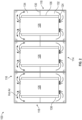
- FIG. 1 is a top sectional view of one of many examples of a system for cooling a computer cabinet according to the disclosure.
- FIG. 2 is a top sectional view of another one of many examples of a system for cooling a computer cabinet according to the disclosure.
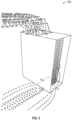
- FIG. 3 is a perspective view of one of many examples of a system for cooling a computer cabinet according to the disclosure showing air flow into and out of the cabinet.
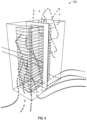
- FIG. 4 is a partial perspective view of one of many examples of a system for cooling a computer cabinet according to the disclosure showing air flow into and out of the cabinet.
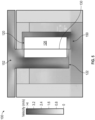
- FIG. 5 is a side elevation sectional view of one of many examples of a system for cooling a computer cabinet according to the disclosure showing air velocity through the cabinet.
- FIG. 1 is a top sectional view of one of many examples of a system for cooling a computer cabinet according to the disclosure.
- FIG. 2 is a top sectional view of another one of many examples of a system for cooling a computer cabinet according to the disclosure.
- FIG. 3 is a
- FIG. 6 is a side elevation sectional view of another one of many examples of a system for cooling a computer cabinet according to the disclosure.
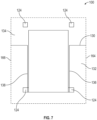
- FIG. 7 is a top sectional view of one of many examples of a system for cooling a computer cabinet according to the disclosure.
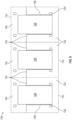
- FIG. 8 is a top sectional view of another one of many examples of a system for cooling a computer cabinet according to the disclosure.
- FIGS. 1-8 are described in conjunction with one another.
- the system 100 can include a computer cabinet 110 having an interior space 112.
- the computer cabinet 110 can have a front wall or door 114, an opposing rear wall or door 116, one or more side walls 118, a top surface 120, a bottom surface 122, or any combination thereof.
- two or more computer cabinets 110 can be combined.
- Combined computer cabinets 110 can include one or more sidewalls 118 between them.
- combined computer cabinets 110 can omit sidewalls 118 between them, and can have sidewalls 118 on distal ends of the combined cabinets 110, such that the combined cabinets 110 share a common interior space 112.
- the computer cabinet 110 can have two or more rails, such as vertical (i.e., at least about vertical) rails 124, disposed within the interior space 112, and one or more rack-mounted computer equipment modules 126 coupled to the vertical rails 124.
- the modules 126 can produce heat within the cabinet 110.
- An external cooling system (not shown) can provide cool air, or another cooling media, to the cabinet 110 and/or can remove hot air, or another cooling media, from the cabinet 110.
- the computer cabinet 110 can have one or more baffles 130 for separating the interior space 112 of the cabinet 110 into a first portion 132, such as a front portion, and a second portion 134, such as a rear portion.
- the module(s) 126 can extend into both the first and second portions 132, 134 of the interior space 112 of the cabinet 110.
- the baffles 130 can force cool air entering the cabinet 110 to flow through the module(s) 126 before exiting the cabinet 110.
- the baffles 130 can direct air flowing into the first portion 132 of the interior space 112 of the cabinet 110 through the module(s) 126 into the second portion 134 of the interior space 112 of the cabinet 110.
- the system 100 can include a second baffle 136 and/or third baffle 138 coupling the first baffle 130 with one or more of the vertical rails 124.
- the system 100 can include a plurality of modules 126.
- each module 126 can extend into both the first and second portions 132, 134 of the interior space 112 of the cabinet 110.
- the baffle 130 can direct air flowing into the first portion 132 of the interior space 112 of the cabinet 110 through any or all of the modules 126 and into the second portion 134 of the interior space 112 of the cabinet 110.
- the baffle 130 can direct air flowing into the first portion 132 of the interior space 112 through select ones of the modules 126 and into the second portion 134 of the interior space 112.
- the baffle 130 can direct air flowing into the first portion 132 of the interior space 112 through each module 126 and into the second portion 134 of the interior space 112. In at least one example, the baffle 130 can direct air flowing into the first portion 132 of the interior space 112 through all of the modules 126 and into the second portion 134 of the interior space 112.
- the system 100 can include a first vertical rail 124a coupled adjacent to a right front of the interior space 112 of the cabinet 110, a second vertical rail 124b coupled adjacent to a right rear of the interior space 112 of the cabinet 110, a third vertical rail 124c coupled adjacent to a left front of the interior space 112 of the cabinet 100, a fourth vertical rail 124d coupled adjacent to a left rear of the interior space 112 of the cabinet 100, or any combination thereof.
- the system 100 can include another baffle 136 coupling the first baffle 130 with the first and/or second vertical rails 124a, 124b.
- the system 100 can include a third baffle 138 coupling the first baffle 130 with the third and/or fourth vertical rails 124c, 124d.
- any or all of the baffles 130, 136, 138 can be integral or distinct and joined together during installation. Any of the baffles 130, 136, 138 can be constructed of multiple components, which can be joined together during installation. In at least one example, all of the baffles 130, 136, 138 can be integrally formed as one unit. In at least one example, each of the baffles 130, 136, 138 can be integrally formed and joined together during installation. In at least one example, the first baffle 130 can be integrally formed as one unit and the second and third baffles 136, 138 can be integrally formed as another unit, with the two units joined together during installation. In at least one example, the first baffle 130 from each cabinet 110 can be integrally formed as one unit. In at least one example, the first baffle 130 from each cabinet 110 can be separately formed and joined together during installation.
- the first baffle 130 can be vertically oriented within the interior space 112 of the cabinet 110.
- the system 100 can include a cold air inlet vent 150 through a bottom surface 122 of the cabinet 110 in communication with the first portion 132 of the interior space 112 of the cabinet 110.
- the cold air inlet vent 150 can occupy about half or a minority portion of the bottom surface 122 of the cabinet 110.
- the system 100 can include a hot air outlet vent 152 through a top surface 120 of the cabinet 110 in communication with the second portion 134 of the interior space 112 of the cabinet 110.
- the hot air outlet vent 152 can occupy about half or a minority portion of the top surface 120 of the cabinet 110.
- the first baffle 130 can extend from a lower rear of the interior space 112 of the cabinet 110 to an upper front of the interior space 112 of the cabinet 110, such that the first portion 132 of the interior space 112 of the cabinet 110 includes a front portion of the cabinet 110 and the second portion 134 of the interior space 112 of the cabinet 110 includes a rear portion of the cabinet 110.
- the first baffle 130 can extend from an upper rear of the interior space 112 of the cabinet 110 to a lower front of the interior space 112 of the cabinet 110, such that the first portion 132 of the interior space 112 of the cabinet 110 includes a rear portion of the cabinet 110 and the second portion 134 of the interior space 112 of the cabinet 110 includes a front portion of the cabinet 110.
- the system 100 can include a cold air inlet vent 150 through a bottom surface 122 of the cabinet 110 in communication with the front portion 132 of the cabinet 110.
- the cold air inlet vent 150 can occupy all or a majority of the bottom surface 122 of the cabinet 110.
- the system 100 can include a hot air outlet vent 152 through a top surface 120 of the cabinet 110 in communication with the rear portion 134 of the cabinet 110.
- the hot air outlet vent 152 can occupy all or a majority of the top surface 120 of the cabinet 110.
- the system 100 can include a cold air inlet vent 150 through a top surface 120 of the cabinet 110 in communication with the first portion 132 of the cabinet 110 and/or a hot air outlet vent 152 through a bottom surface 122 of the cabinet 110 in communication with the second portion 134 of the cabinet 110.
- the system 100 can include a cold air inlet vent 150 through a first side surface of the cabinet 110 in communication with the first portion 132 of the cabinet 110 and/or a hot air outlet vent 152 through an opposing side surface of the cabinet 110 in communication with the second portion 134 of the cabinet 110.
- the system 100 can include a cold air inlet vent 150 through a front surface of the cabinet 110 in communication with the first portion 132 of the cabinet 110 and/or a hot air outlet vent 152 through a rear of the cabinet 110 in communication with the second portion 134 of the cabinet 110.
- the first baffle 130 can provide a first air dam between the at least one rack-mounted computer equipment module 126 and a top interior surface 160 of the cabinet 110 and/or a second air dam between the at least one rack-mounted computer equipment module 126 and a bottom interior surface 162 of the cabinet 110.
- the first baffle 130 can provide a third air dam between the at least one rack-mounted computer equipment module 126 and a first side interior surface 164 of the cabinet 110 and/or a fourth air dam between the at least one rack-mounted computer equipment module 126 and a second side interior surface 166 of the cabinet 110.
- any one or more of the first, second, third, and fourth air dams can be part of a unitary structure.
- the system 100 for cooling a computer cabinet 110 having at least two vertical rails 124 configured to support a plurality of rack-mounted computer equipment modules 126 attached thereto can include a first baffle 130 configured to separate an interior space 112 of the cabinet 110 into a first portion 132 and a second portion 134.
- the first baffle 130 can direct air flowing into the first portion 132 of the interior space 112 of the cabinet 110 through the modules 126 to the second portion 134 of the interior space 112 of the cabinet 110.
- the system 100 for cooling a computer cabinet 110 can include a second and/or third baffle 136, 138 coupling the first baffle 130 with or to the vertical rails 124.
- the system 100 for cooling a computer cabinet 110 can include a first vertical rail 124a disposed adjacent to a right front of the interior space 112 of the cabinet 110, a second vertical rail 124b disposed adjacent to a right rear of the interior space 112 of the cabinet 110, a third vertical rail 124c disposed adjacent to a left front of the interior space 112 of the cabinet 110, a fourth vertical rail 124d disposed adjacent to a left rear of the interior space 112 of the cabinet 110, or any combination thereof.
- the system 100 for cooling a computer cabinet 110 can include a second baffle 136 coupling the first baffle 130 with the first and/or second vertical rails 124a, 124b.
- the system 100 for cooling a computer cabinet 110 can include a third baffle 138 coupling the first baffle 130 with the third and/or fourth vertical rails 124c, 124d.
- the first baffle 130 can extend from a lower rear of the interior space 112 of the cabinet 110 to an upper front of the interior space 112 of the cabinet 110, such that the first portion 132 of the interior space 112 of the cabinet 110 includes a front portion of the cabinet 110 and the second portion 134 of the interior space 112 of the cabinet 110 includes a rear portion of the cabinet.
- the first baffle 130 can extend from an upper rear of the interior space 112 of the cabinet 110 to a lower front of the interior space 112 of the cabinet 110, such that the first portion 132 of the interior space 112 of the cabinet 110 includes a rear portion of the cabinet 110 and the second portion 134 of the interior space 112 of the cabinet 110 includes a front portion of the cabinet 110.
- the system 100 for cooling a computer cabinet 110 can include a cold air inlet vent 150 through a bottom surface 122 of the cabinet 110 in communication with the front portion 132 of the cabinet 110 and/or a hot air outlet vent 152 through a top surface 120 of the cabinet 110 in communication with the rear portion 134 of the cabinet 110.
- the system 100 for cooling a computer cabinet 110 can include a cold air inlet vent 150 through a top surface 120 of the cabinet 110 in communication with the first portion 132 of the cabinet 110 and/or a hot air outlet vent 152 through a bottom surface 122 of the cabinet 110 in communication with the second portion 134 of the cabinet 110.
- the system 100 can include a cold air inlet vent 150 through a first side surface of the cabinet 110 in communication with the first portion 132 of the cabinet 110 and/or a hot air outlet vent 152 through an opposing side surface of the cabinet 110 in communication with the second portion 134 of the cabinet 110.
- the system 100 can include a cold air inlet vent 150 through a front surface of the cabinet 110 in communication with the first portion 132 of the cabinet 110 and/or a hot air outlet vent 152 through a rear of the cabinet 110 in communication with the second portion 134 of the cabinet 110.
- the first baffle 130 can provide a first air dam between the at least one rack-mounted computer equipment module 126 and a top interior surface 160 of the cabinet 110, a second air dam between the at least one rack-mounted computer equipment module 126 and a bottom interior surface 164 of the cabinet 110, a third air dam between the at least one rack-mounted computer equipment module 126 and a first side interior surface 164 of the cabinet 110, a fourth air dam between the at least one rack-mounted computer equipment module 126 and a second side interior surface 166 of the cabinet 110, or any combination thereof.
- any one or more of the first, second, third, and fourth air dams can be part of a unitary, or integrally formed, structure.
- the system for cooling a computer cabinet can include a computer cabinet having an interior space, two or more vertical rails disposed within the interior space of the cabinet, one or more rack-mounted computer equipment modules attached between the vertical rails, a first baffle configured to separate the interior space of the cabinet into a first portion and a second portion, or any combination thereof.
- the module(s) can extend into both the first and second portions of the interior space of the cabinet.
- the first baffle can direct air flowing into the first portion of the interior space of the cabinet through the module into the second portion of the interior space of the cabinet.
- a system can include a second baffle coupling the first baffle with the vertical rails.
- a system can include a plurality of modules.
- each module can extend into both the first and second portions of the interior space of the cabinet.
- the first baffle can direct air flowing into the first portion of the interior space of the cabinet through the modules and into the second portion of the interior space of the cabinet.
- a system can include a first vertical rail disposed adjacent to a right front of the interior space of the cabinet, a second vertical rail disposed adjacent to a right rear of the interior space of the cabinet, a third vertical rail disposed adjacent to a left front of the interior space of the cabinet, a fourth vertical rail disposed adjacent to a left rear of the interior space of the cabinet, or any combination thereof.
- a system can include a second baffle coupling the first baffle with the first and/or second vertical rails.
- a system can include a third baffle coupling the first baffle with the third and/or fourth vertical rails.
- the first baffle can be vertically disposed within the interior space of the cabinet.
- a system can include a cold air inlet vent through a bottom surface of the cabinet in communication with the first portion of the interior space of the cabinet.
- a system can include a hot air outlet vent through a top surface of the cabinet in communication with the second portion of the interior space of the cabinet.
- the first baffle can extend from a lower rear of the interior space of the cabinet to an upper front of the interior space of the cabinet, such that the first portion of the interior space of the cabinet includes a front portion of the cabinet and the second portion of the interior space of the cabinet includes a rear portion of the cabinet.
- a system can include a cold air inlet vent through a bottom surface of the cabinet in communication with the front portion of the cabinet.
- a system can include a hot air outlet vent through a top surface of the cabinet in communication with the rear portion of the cabinet.
- the first baffle can extend from a lower rear of the interior space of the cabinet to an upper front of the interior space of the cabinet, such that a first portion of the interior space of the cabinet includes a front portion of the cabinet and a second portion of the interior space of the cabinet includes a rear portion of the cabinet.
- the cabinet can include one or more vents or other openings, such as a cold air inlet vent for routing or otherwise allowing relatively cool air into the cabinet and a hot air outlet vent for routing or otherwise allowing relatively warm air out of the cabinet.
- the system can include a cold air inlet vent through a bottom surface of the cabinet in communication with the front portion of the cabinet and a hot air outlet vent through a top bottom surface of the cabinet in communication with the rear portion of the cabinet.
- the system can include a cold air inlet vent through a top surface of the cabinet in communication with the rear portion of the cabinet and a hot air outlet vent through a bottom surface of the cabinet in communication with the front portion of the cabinet.
- the first baffle can extend from an upper rear of the interior space of the cabinet to a lower front of the interior space of the cabinet, such that a first (or other) portion of the interior space of the cabinet includes a rear portion of the cabinet and a second (or other) portion of the interior space of the cabinet includes a front portion of the cabinet.
- the cabinet can include one or more vents or other openings, such as a cold air inlet vent for routing or otherwise allowing relatively cool air into the cabinet and a hot air outlet vent for routing or otherwise allowing relatively warm air out of the cabinet.
- the system can include a cold air inlet vent through a bottom surface of the cabinet in communication with the rear portion of the cabinet and a hot air outlet vent through a top bottom surface of the cabinet in communication with the front portion of the cabinet.
- the system can include a cold air inlet vent through a top surface of the cabinet in communication with the front portion of the cabinet and a hot air outlet vent through a bottom surface of the cabinet in communication with the rear portion of the cabinet.
- a cabinet can include one or more vents or other openings, such as a cold air inlet vent for routing or otherwise allowing relatively cool air into the cabinet and a hot air outlet vent for routing or otherwise allowing relatively warm air out of the cabinet.
- the system can include a cold air inlet vent through one of a top surface of the cabinet and a bottom surface of the cabinet and a hot air outlet vent through the other of the top surface of the cabinet and the bottom surface of the cabinet.
- a cold air inlet vent can be through the top surface of the cabinet and in communication with one of a front portion of the cabinet and a rear portion of the cabinet.
- a hot air outlet vent can be through the top surface of the cabinet and in communication with one of a front portion of the cabinet and a rear portion of the cabinet.
- the first baffle can provide a first air dam between the at least one rack-mounted computer equipment module and a top interior surface of the cabinet and/or a second air dam between the at least one rack-mounted computer equipment module and a bottom interior surface of the cabinet.
- the first baffle can provide a third air dam between the at least one rack-mounted computer equipment module and a first side interior surface of the cabinet and/or a fourth air dam between the at least one rack-mounted computer equipment module and a second side interior surface of the cabinet.
- any one or more of the first, second, third, and fourth air dams can be, or can be part of, a unitary structure.
- the system for cooling a computer cabinet having at least two vertical rails configured to support a plurality of rack-mounted computer equipment modules attached thereto can include a first baffle configured to separate an interior space of the cabinet into a first portion and a second portion.
- the first baffle can direct air flowing into the first portion of the interior space of the cabinet through the modules to the second portion of the interior space of the cabinet.
- the system for cooling a computer cabinet can include a second baffle coupling the first baffle with the vertical rails.
- the system for cooling a computer cabinet can include a first vertical rail disposed adjacent to a right front of the interior space of the cabinet, a second vertical rail disposed adjacent to a right rear of the interior space of the cabinet, a third vertical rail disposed adjacent to a left front of the interior space of the cabinet, a fourth vertical rail disposed adjacent to a left rear of the interior space of the cabinet, or any combination thereof.
- the system for cooling a computer cabinet can include a second baffle coupling the first baffle with the first and/or second vertical rails.
- the system for cooling a computer cabinet can include a third baffle coupling the first baffle with the third and/or fourth vertical rails.
- the first baffle can extend from a lower rear of the interior space of the cabinet to an upper front of the interior space of the cabinet, such that the first portion of the interior space of the cabinet includes a front portion of the cabinet and the second portion of the interior space of the cabinet includes a rear portion of the cabinet.
- the system for cooling a computer cabinet can include a cold air inlet vent through a bottom surface of the cabinet in communication with the front portion of the cabinet and/or a hot air outlet vent through a top surface of the cabinet in communication with the rear portion of the cabinet.
- the system can include a cold air inlet vent through the top surface of the cabinet and in communication with one of the front portion of the cabinet and the rear portion of the cabinet.
- the system can include a hot air outlet vent through the top surface of the cabinet and in communication with one of the front portion of the cabinet and the rear portion of the cabinet.
- the first baffle can provide a first air dam between the at least one rack-mounted computer equipment module and a top interior surface of the cabinet, a second air dam between the at least one rack-mounted computer equipment module and a bottom interior surface of the cabinet, a third air dam between the at least one rack-mounted computer equipment module and a first side interior surface of the cabinet, a fourth air dam between the at least one rack-mounted computer equipment module and a second side interior surface of the cabinet, or any combination thereof.
- any one or more of the first, second, third, and fourth air dams can be, or can be part of, a unitary structure.
- the devices, systems and methods can be implemented for numerous different types and sizes in numerous different industries.
- the various methods and examples of the devices, systems and methods can be included in combination with each other to produce variations of the disclosed methods and examples. Discussion of singular elements can include plural elements and vice versa.
- the order of steps can occur in a variety of sequences unless otherwise specifically limited.
- the various steps described herein can be combined with other steps, interlineated with the stated steps, and/or split into multiple steps.
- elements have been described functionally and can be embodied as separate components or can be combined into components having multiple functions.
Landscapes
- Engineering & Computer Science (AREA)
- Microelectronics & Electronic Packaging (AREA)
- Physics & Mathematics (AREA)
- General Engineering & Computer Science (AREA)
- Thermal Sciences (AREA)
- Computer Hardware Design (AREA)
- Theoretical Computer Science (AREA)
- Human Computer Interaction (AREA)
- General Physics & Mathematics (AREA)
- Cooling Or The Like Of Electrical Apparatus (AREA)
Applications Claiming Priority (1)
| Application Number | Priority Date | Filing Date | Title |
|---|---|---|---|
| US202363502583P | 2023-05-16 | 2023-05-16 |
Publications (2)
| Publication Number | Publication Date |
|---|---|
| EP4465784A2 true EP4465784A2 (de) | 2024-11-20 |
| EP4465784A3 EP4465784A3 (de) | 2024-12-11 |
Family
ID=91082078
Family Applications (1)
| Application Number | Title | Priority Date | Filing Date |
|---|---|---|---|
| EP24175783.0A Pending EP4465784A3 (de) | 2023-05-16 | 2024-05-14 | Systeme und verfahren zur computerschrankkühlung |
Country Status (2)
| Country | Link |
|---|---|
| US (1) | US20240389261A1 (de) |
| EP (1) | EP4465784A3 (de) |
Family Cites Families (4)
| Publication number | Priority date | Publication date | Assignee | Title |
|---|---|---|---|---|
| US7112131B2 (en) * | 2003-05-13 | 2006-09-26 | American Power Conversion Corporation | Rack enclosure |
| DE202004006552U1 (de) * | 2004-04-26 | 2004-07-08 | Knürr AG | Kühlungssystem für Geräte- und Netzwerkschränke |
| US20140206271A1 (en) * | 2013-01-22 | 2014-07-24 | Roland M. Ignacio | Electronics rack cooling duct |
| FI3603360T3 (fi) * | 2017-03-21 | 2023-06-13 | Jeff Hunter | Tiedonkäsittelylaitteiden kaappi |
-
2024
- 2024-05-14 EP EP24175783.0A patent/EP4465784A3/de active Pending
- 2024-05-15 US US18/665,542 patent/US20240389261A1/en active Pending
Also Published As
| Publication number | Publication date |
|---|---|
| US20240389261A1 (en) | 2024-11-21 |
| EP4465784A3 (de) | 2024-12-11 |
Similar Documents
| Publication | Publication Date | Title |
|---|---|---|
| US11985799B2 (en) | Electronic equipment enclosure | |
| US10791640B2 (en) | Vertical exhaust duct for electronic equipment enclosure | |
| US11678447B2 (en) | Vertical exhaust duct for electronic equipment enclosure | |
| US7869209B2 (en) | Electronic rack combining natural convection and forced air circulation for its cooling | |
| US10133320B2 (en) | Air directing device | |
| US6272016B1 (en) | Avionics rack with external electronics module | |
| US20070064389A1 (en) | Ducted exhaust equipment enclosure | |
| US20100091458A1 (en) | Electronics chassis with angled card cage | |
| WO2008092247A1 (en) | Cooling high performance computer systems | |
| EP4465784A2 (de) | Systeme und verfahren zur computerschrankkühlung | |
| CN102023683A (zh) | 服务器机柜 | |
| JP2007272293A (ja) | 電子機器 | |
| US20030117782A1 (en) | Electronic circuits | |
| US12295122B2 (en) | Coolant flow partition for cooling 3U boards in 6U chassis | |
| CN111655016A (zh) | 可分区散热的插箱以及机柜 | |
| EP3668296B1 (de) | Kühlkörper mit integriertem kartenführungsadapter | |
| JP3292793B2 (ja) | 電子機器における冷却構造及び方法 | |
| JP4562317B2 (ja) | 電子機器の冷却構造 | |
| US6987667B1 (en) | Computer system and method configured for improved cooling | |
| WO2025235636A1 (en) | Systems and methods for cooling high power density data centers | |
| WO2025216902A1 (en) | Integrated liquid cooling manifold for a data center cabinet |
Legal Events
| Date | Code | Title | Description |
|---|---|---|---|
| PUAI | Public reference made under article 153(3) epc to a published international application that has entered the european phase |
Free format text: ORIGINAL CODE: 0009012 |
|
| STAA | Information on the status of an ep patent application or granted ep patent |
Free format text: STATUS: THE APPLICATION HAS BEEN PUBLISHED |
|
| PUAL | Search report despatched |
Free format text: ORIGINAL CODE: 0009013 |
|
| AK | Designated contracting states |
Kind code of ref document: A2 Designated state(s): AL AT BE BG CH CY CZ DE DK EE ES FI FR GB GR HR HU IE IS IT LI LT LU LV MC ME MK MT NL NO PL PT RO RS SE SI SK SM TR |
|
| AK | Designated contracting states |
Kind code of ref document: A3 Designated state(s): AL AT BE BG CH CY CZ DE DK EE ES FI FR GB GR HR HU IE IS IT LI LT LU LV MC ME MK MT NL NO PL PT RO RS SE SI SK SM TR |
|
| RIC1 | Information provided on ipc code assigned before grant |
Ipc: H05K 7/20 20060101AFI20241104BHEP |
|
| RIN1 | Information on inventor provided before grant (corrected) |
Inventor name: NAMLIC, DENIS Inventor name: MERKAS, ANTONIO Inventor name: PAVLOVIC, KRESIMIR Inventor name: RANCIC, DENIS |
|
| STAA | Information on the status of an ep patent application or granted ep patent |
Free format text: STATUS: REQUEST FOR EXAMINATION WAS MADE |
|
| 17P | Request for examination filed |
Effective date: 20250611 |