EP4465467A2 - Usb-stromversorgungsverteilungsarchitektur - Google Patents
Usb-stromversorgungsverteilungsarchitektur Download PDFInfo
- Publication number
- EP4465467A2 EP4465467A2 EP24176519.7A EP24176519A EP4465467A2 EP 4465467 A2 EP4465467 A2 EP 4465467A2 EP 24176519 A EP24176519 A EP 24176519A EP 4465467 A2 EP4465467 A2 EP 4465467A2
- Authority
- EP
- European Patent Office
- Prior art keywords
- power delivery
- usb
- usb power
- power
- devices
- Prior art date
- Legal status (The legal status is an assumption and is not a legal conclusion. Google has not performed a legal analysis and makes no representation as to the accuracy of the status listed.)
- Pending
Links
Images
Classifications
-
- H—ELECTRICITY
- H02—GENERATION; CONVERSION OR DISTRIBUTION OF ELECTRIC POWER
- H02J—ELECTRIC POWER NETWORKS; CIRCUIT ARRANGEMENTS OR SYSTEMS FOR SUPPLYING OR DISTRIBUTING ELECTRIC POWER; SYSTEMS FOR STORING ELECTRIC ENERGY
- H02J1/00—Circuit arrangements for DC mains or DC distribution networks
- H02J1/08—Three-wire DC power distribution systems; Systems having more than three wires
- H02J1/082—DC supplies with two or more different DC voltage levels
-
- H—ELECTRICITY
- H02—GENERATION; CONVERSION OR DISTRIBUTION OF ELECTRIC POWER
- H02J—ELECTRIC POWER NETWORKS; CIRCUIT ARRANGEMENTS OR SYSTEMS FOR SUPPLYING OR DISTRIBUTING ELECTRIC POWER; SYSTEMS FOR STORING ELECTRIC ENERGY
- H02J4/00—Circuit arrangements for mains or distribution networks not specified as AC or DC; Circuit arrangements for mains or distribution networks combining AC and DC sections or sub-networks
- H02J4/20—Networks integrating separated AC and DC power sections
- H02J4/25—Networks integrating separated AC and DC power sections for transfer of electric power between AC and DC networks, e.g. for supplying the DC section within a load from an AC mains system
-
- H—ELECTRICITY
- H02—GENERATION; CONVERSION OR DISTRIBUTION OF ELECTRIC POWER
- H02J—ELECTRIC POWER NETWORKS; CIRCUIT ARRANGEMENTS OR SYSTEMS FOR SUPPLYING OR DISTRIBUTING ELECTRIC POWER; SYSTEMS FOR STORING ELECTRIC ENERGY
- H02J7/00—Circuit arrangements for charging or discharging batteries or for supplying loads from batteries
- H02J7/40—Circuit arrangements for charging or discharging batteries or for supplying loads from batteries characterised by the exchange of charge or discharge related data
- H02J7/42—Circuit arrangements for charging or discharging batteries or for supplying loads from batteries characterised by the exchange of charge or discharge related data with electronic devices having internal batteries, e.g. mobile phones
-
- H—ELECTRICITY
- H02—GENERATION; CONVERSION OR DISTRIBUTION OF ELECTRIC POWER
- H02J—ELECTRIC POWER NETWORKS; CIRCUIT ARRANGEMENTS OR SYSTEMS FOR SUPPLYING OR DISTRIBUTING ELECTRIC POWER; SYSTEMS FOR STORING ELECTRIC ENERGY
- H02J2207/00—Details of circuit arrangements for charging or discharging batteries or supplying loads from batteries
- H02J2207/30—Charge provided using DC bus or data bus of a computer
Definitions
- the present invention relates to electrical power distribution systems, specifically to a USB power delivery distribution architecture, for instance a USB-C power delivery distribution architecture.
- USB-C In the realm of electronic devices, USB-C has emerged as a prevalent interface due to its versatility and capability to transmit both data and power between devices. This universal adoption has led to increased reliance on USB in general, and USB-C in particular, for a wide range of applications, from charging smartphones and laptops to powering desktop peripherals and other consumer electronics. As the number of devices utilizing USB increases, the demand for efficient and effective power delivery systems that can manage multiple devices, including e.g. USB-C devices, simultaneously has become more pronounced.
- Existing power delivery architectures in existing homes comprise circuits of between 1 to 8, most often flush-mounted, sockets for receiving plugs from electric or electronic devices to be powered or charged. Often, users replace one or two of the sockets by a USB socket, for instance a USB-C socket, to be able to provide their new electric or electronic devices with power through the USB cable. However, in such architectures the power delivery the USB socket can deliver is low, with currently a maximum of not more than 70 Watt.
- USB power delivery distribution architecture it is an object of embodiments of the present invention to facilitate autonomous coordination and voltage regulation among multiple USB power delivery devices. This objective is accomplished by a USB power delivery distribution architecture according to embodiments of the present invention.
- the present invention relates to a USB power delivery distribution architecture, for instance, but not limited thereto, a USB-C power delivery distribution architecture, comprising:
- the USB power delivery devices may be configured to handle varying power capacities, facilitating the inclusion of devices with different power ratings. This allows for flexibility in system design and cost savings.
- a USB power delivery device may comprise:
- This modular design enables efficient power management and communication.
- a USB power delivery device may further comprise a user interface for receiving preference settings from a user. This allows for customization based on user needs.
- the dynamic allocation of power may be based on a priority system determined by user settings. This ensures critical devices receive power first.
- the power delivery management module may be configured for, when the USB power delivery distribution architecture is in use, setting up a communication protocol for controlling the plurality of USB power delivery devices in accordance with the preference settings of the user by dividing power from the power supply over the plurality of USB power delivery devices. This enables intelligent power sharing based on user preferences.
- the communication module may be configured for communicating the communication protocol to the plurality of USB power delivery devices. This ensures all devices operate based on the established protocol.
- the power delivery management module may comprise means for receiving and managing the input from the user interface and control the USB power delivery devices accordingly. This provides a mechanism to implement user settings.
- the user interface may comprise a selection menu for setting one or more of the following:
- This provides a comprehensive set of user customization options.
- the microcontroller and/or the power delivery management module may comprise means for instantly managing power supply that becomes available to optimize power supply to a connected USB load. This allows for dynamic reallocation of freed up power.
- the communication module may comprise:
- the communication module may use a wired or wireless communication protocol.
- the USB power delivery distribution architecture may further comprise a protective device, for instance a fuse, between an AC or DC electrical network and the power supply. This provides overcurrent protection.
- a protective device for instance a fuse
- the power supply may be adapted for bringing an input of between 90 VAC and 264 VAC or an equivalent DC voltage of between 90 VDC and 400 VDC to an output of lower than 60 VDC, for instance between 20 VDC and 60 VDC. This enables compatibility with standard power grids.
- the present invention relates to a method for distributing power in a USB power delivery system, the method comprising:
- coordinating the power delivery may include dynamically allocating power based on the power requirements of connected USB loads and/or a priority system determined by user settings. This optimizes power distribution efficiency.
- a decentralized control mechanism allows each USB power delivery device to autonomously regulate its output voltage, ensuring safety and compliance with electrical standards without the need for a central master controller. It is a further advantage of embodiments of the present invention that the ability to handle varying power capacities among the USB power delivery devices facilitates the inclusion of devices with different power ratings, which can lead to cost savings and enhanced system flexibility. Additionally, it is an advantage of embodiments of the present invention that the communication among USB power delivery devices for power coordination enhances the overall efficiency of power distribution, adapting dynamically to the connected loads' demands.
- the integration of a user interface allows for user-specific settings to influence power distribution priorities, thereby tailoring the power management to individual needs and preferences. It is also an advantage of embodiments of the present invention that the system's ability to manage connection orientation autonomously addresses issues of cable polarization, simplifying the user experience and reducing potential connectivity errors. Furthermore, it is an advantage of embodiments of the present invention that the architecture supports both wired and wireless communication protocols, offering flexibility in how devices within the system can interact and be managed remotely.
- the inclusion of a protective device between the power supply and the electrical network ensures additional safety measures against power surges and overloads, protecting both the hardware and the connected devices.
- the power supply is capable of converting a wide range of input voltages to a stable low voltage output, making the system versatile and adaptable to various power sources and geographical regions.
- Coupled should not be interpreted as being restricted to direct connections only.
- the terms “coupled” and “connected”, along with their derivatives, may be used. It should be understood that these terms are not intended as synonyms for each other.
- the scope of the expression “a device A coupled to a device B” should not be limited to devices or systems wherein an output of device A is directly connected to an input of device B. It means that there exists a path between an output of A and an input of B which may be a path including other devices or means.
- Coupled may mean that two or more elements are either in direct physical or electrical contact, or that two or more elements are not in direct contact with each other but yet still co-operate or interact with each other.
- architecture refers to the convergence of electronics hardware, network communications, software applications and wiring into one integrated system. This term “architecture” thus refers to the identification of a system's physical components, according to embodiments of the present invention, the power supply and the at least one USB power delivery device, and their interrelationships.
- USB power delivery device refers to a device that is capable of delivering power to a connected USB load and is compliant with the USB Power Delivery (USB-PD) specification.
- USB loads may for example be USB-C loads. If a USB-C load is connected to it, the USB power delivery device is as a USB-C power delivery device.
- USB-C power delivery devices include, but are not limited to, USB-C wall chargers, USB-C car chargers, USB-C power banks, and USB-C hubs with power delivery capabilities.
- flush-mounted refers to a device that is installed such that its outer surface is substantially aligned with the surrounding surface.
- flush-mounted USB power delivery devices include, but are not limited to, USB outlets installed in walls, furniture, or other surfaces such that the outlet face is substantially flush with the surrounding surface.
- surface-mounted power delivery devices may be implemented in accordance with embodiments of the present invention.
- autonomous regulate refers to the ability of a device to control its output voltage independently without requiring external control or intervention.
- Examples of autonomous voltage regulation include, but are not limited to, a USB power delivery device adjusting its output voltage based on the requirements of the connected load or the available input power.
- central master controller refers to a single, centralized device that controls and coordinates the operation of multiple subordinate devices. Examples of systems that use a central master controller include, but are not limited to, traditional power distribution systems where a central control unit manages the power allocation to connected devices.
- connection orientation refers to the physical orientation of a connector when it is mated with another connector.
- connection orientations include, but are not limited to, the up or down orientation of a USB-C connector when plugged into a USB-C receptacle.
- the term "power capacity" refers to the maximum amount of electrical power that a device is capable of delivering or consuming. Examples of power capacities include, but are not limited to, the wattage rating of a USB power delivery device or the maximum power draw of a connected USB load.
- An advantage of a USB power delivery distribution architecture, for instance a USB-C power delivery distribution architecture according to embodiments of the invention is that the yield or efficiency of the USB power delivery devices can be up to 240 Watt.
- a USB power delivery device in a power delivery distribution architecture according to embodiments can deliver up to 240 Watt to a load, e.g. to a device to be charged, which is much higher than the 70 Watt that current systems can deliver.
- priority system refers to a set of rules or criteria used to determine the order or importance of tasks, resources, or entities. Examples of priority systems include, but are not limited to, a user-defined ranking of connected USB loads that determines the order in which they receive power when the available power is limited.
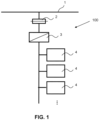
- FIG. 1 illustrates a schematic view of the USB power delivery distribution architecture (100) according to embodiments of the present invention.
- the architecture (100) comprises a power supply (3) for providing a low voltage output signal between 20 VDC and 60 VDC.
- the power supply (3) may receive an input from an AC or DC electrical network (1), and may be adapted to convert an input of such electrical network (1) of between 90 VAC and 264 VAC or an equivalent DC voltage of between 90 VDC and 400 VDC to an output of between 20 VDC and 60 VDC, i.e. in the range of or part of the range of SELV regulation, enabling compatibility with standard power grids.
- the SELV (Safety Extra Low Voltage) regulation describes a voltage that is set so low that in the event of direct touch either during proper operation or in the event of a single fault there is no danger of electric shock due to touch current. In the event of an insulation failure, adequate protection must still be provided.
- the USB power delivery distribution architecture (100) may include a protective device (2), e.g. a fuse, integrated between an AC or DC electrical network (1) and the power supply (3) to provide overcurrent protection.
- a protective device (2) e.g. a fuse
- the low voltage output signal of the power supply (3) is transmitted to a plurality of USB power delivery devices (4).
- the USB power delivery devices (4) have a low voltage input and the possibility to regulate the output voltage to a value of lower than 60 VDC.
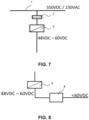
- the strength of the USB power delivery distribution architecture (100) according to embodiments of the invention lies in the fact that there is a two-step mechanism which provides a low voltage input for the USB power delivery devices (4) and which then provide an USBC power delivery device output of lower than 60VDC. This is illustrated in FIG. 7 and FIG. 8 . In FIG. 7 , the first step is illustrated. An input of between 90 VAC and 264 VAC or an equivalent DC voltage of between 90 VDC and 400 VDC (in the Figs.
- a USB power delivery device (4) in a power delivery distribution architecture (100) can deliver up to 240 Watt to a load, e.g. to a device to be powered or charged.
- FIG. 1 illustrates a USB power delivery distribution architecture (100) comprising three USB power delivery devices (4), but in practice the USB power delivery distribution architecture (100) may comprise any suitable number of USB power delivery devices (4), as required by a user, or as allowed by applicable regulations.
- the USB power delivery devices (4) may for instance be, but are not limited to, USB-C power delivery devices.
- the USB power delivery devices of a single USB power delivery distribution architecture (100) may all be of the same type, or may be of different types (e.g. USB-A, USB-C).
- the USB power delivery devices may be flush-mounted, or surface-mounted.
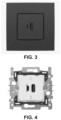
- An example of a flush-mounted combined USB-A and USB-C power delivery device is illustrated in FIG. 3 (front plate), and in FIG. 4 (built-in socket).
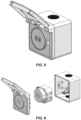
- An example of a surface-mounted double USB-C power delivery device is illustrated in FIG. 5 , and in exploded view in FIG. 6 .
- USB power delivery devices (4) for instance USB-C power delivery devices
- the USB power delivery devices (4) are typically provided in a wall mounted box provided in a wall. These wall mounted boxes can be provided wherever a user wants them to be.
- electrical wires are provided to connect the USB power delivery devices (4) to each other and to the power supply (3), there is no limit with respect to the number of USB power delivery devices (4) to be provided in the system.
- standard electrical circuits typically provided with electrical sockets
- typically only one to eight electrical sockets are provided in one circuit.
- an advantage of the system according to embodiments of the present invention is that it can easily replace the electrical sockets that are provided in the existing circuit.
- a power supply (3) has to be placed in between the existing fuse of the standard electrical circuits and the electrical sockets, and the electrical sockets have to be removed from the wall mounted box and replaced by USB power delivery devices.
- the system is limited to the 8 available boxes and thus, the system can only comprise 8 USB power delivery devices (4).
- a plurality of the USB power delivery devices (4) can have same or different power ratings.
- the architecture according to embodiments of the invention can thus in fact provide a flush-mounted (or surface-mounted) charger with different charging points, in case of a USB-C power delivery distribution architecture comprising a plurality of USB-C power delivery devices, of which each or the USB-C power delivery devices can deliver up to 240 Watt to the device to be powered or charged.
- the power delivery distribution architecture (100) may comprise a combination of 240W, 140W, and 100W power delivery devices (4), with lower power ratings resulting in cheaper devices.
- Each USB power delivery device (4) receives the low voltage output signal of the power supply (3) as an input and autonomously regulates its output voltage to a value of less than 60 VDC to provide an output power signal to a connected USB load (12).
- the USB power delivery devices (4) are capable of communicating with each other to coordinate power delivery without a central master controller.
- Each USB power delivery device (4) also autonomously manages connection orientation to address polarization. This allows the USB power delivery devices (4) to handle varying power capacities, facilitating the inclusion of devices with different power ratings in the architecture (100).
- its input module (11) may be provided with a suitable component, such as a bridge rectifier, e.g. a diode bridge.
- a suitable component such as a bridge rectifier, e.g. a diode bridge.
- polarization may be addressed by mechanical means, e.g. a connector may have rotational asymmetry.
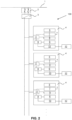
- FIG. 2 presents a more detailed block diagram of USB power delivery devices (4) within a USB power delivery distribution architecture (100) in accordance with embodiments of the present invention, showing various components according to embodiments of the present invention.
- a USB power delivery device (4) comprises an input module (11) for receiving the low voltage output signal from the power supply (3), a microcontroller (8) for controlling functions of the USB power delivery device (4), a communication module (7) for facilitating negotiating between the USB power delivery devices (4) forming part of the USB power delivery distribution architecture (100), a user interface (5) for receiving preference settings from a user, a power delivery management module (6) for dynamically allocating power output of the USB power delivery device (4) based at least on power requirements of a connected USB load (12), and an output module (10) for outputting power to the connected USB load (12).
- This modular design enables efficient power management and communication.
- the USB power delivery devices (4) can instantly manage power supply that becomes available to optimize power supply to a connected USB load (12), allowing for dynamic reallocation of freed up power.
- the microcontroller (8) facilitates the communication between the different devices and their power delivery management module (6) e.g. via RF-communication.
- the microcontroller (8) gets to know via the communication device (7) that is communicating with other power delivery devices (4) how much power is available, e.g. only 40W is available, and communicates this to the power delivery management module (6). So the microcontroller (8) tells the power delivery management module (6) how much power it has available for the load (12).
- the power delivery management module (6) does the negotiation/communication with the load (12), for instance it request what the load (12) wants (e.g. does the load want 5V/2A?) and/or what the load (12) can handle (e.g. can the load handle 9V/1A?).
- the microcontroller (8) gets to know how much power will be really taken by the load (12) and thus how much is left. This info can then be communicated to the other power delivery devices (4).
- the communication with the outside world via the communication device (7), the negation with the connected load (12) via the power delivery management module (6) and interfacing between the communication device (7) and the power delivery management module (6) via the microcontroller (8) could be implemented in a single component, but for the ease of understanding it is illustrated by means of a plurality of separate components.
- the user can provide his or her preferences to the USB power delivery distribution architecture (100) on how to charge or power electric or electronic devices connected to the plurality of USB power delivery devices (4) in the system.
- the user interface (5) may be provided, for instance, by means of a push button on a socket.
- the user interface (5) may comprise a display for visually showing different options.
- the user interface (5) may comprise a selection menu for setting one or more of the following:
- the user can, via the user interface (5), so to speak, program the USB power delivery distribution architecture (100) so as to, when the USB power delivery distribution architecture (100) is in use, manage charging and/or powering of the loads (12), e.g. electric or electronic devices, that are connected to the USB power delivery devices (4) in the system.
- the loads (12) e.g. electric or electronic devices
- the above selection options are examples only; the list is not exhaustive, but provides a comprehensive set of user customization options.
- the user interface (5) allows for customization based on user needs.
- the dynamic allocation of power by the power delivery management module (6) can be based on a priority system determined by these user settings.
- the microcontroller (8) may be configured for receiving and managing the input from the user via the user interface (5) and setting up a communication protocol for controlling the USB power delivery devices (4) accordingly.
- the preference settings of the user are analyzed and a communication protocol is set up comprising commands on how the power from the power supply will be divided over the USB power delivery devices (4) for charging and/or powering the loads (12), e.g. electric or electronic devices connected to those USB power delivery devices (4), in order to optimize power delivery/energy use for charging and/or powering all electric or electronic devices and minimize cable losses, thereby taking into account the preferences settings of the user.
- the communication protocol takes account of a priority order and/or a time frame for powering or charging the loads (12), by dividing power from the power supply (3), according to the input from the user. This provides a mechanism to implement user settings.
- the communication module (7) is configured for communicating the communication protocol to each of the plurality of USB power delivery devices (4). This ensures all devices operate based on the established protocol.
- the communication between the USB power delivery devices (4) may be via a wired or wireless system. No master device is involved in the communication.
- the USB power delivery devices (4) communicate amongst themselves.
- the communication module (7) in each USB power delivery device (4) may include means for communicating with an app on a mobile device, enabling remote communication capabilities, for instance for receiving user input.
- the user interface (5) may then be implemented by the app on the mobile device.
- the communication module (7) may communicate in a wireless manner, e.g. by RF, as illustrated by the little antenna in FIG. 2 .
- the communication module (7) may communicate in a wired manner, e.g. over a data over power link as illustrated by the dotted line in FIG. 2 between the communication module (7) and the input module (11). This latter solution provides wired communication, which is in general more robust than wireless communication.
- the power delivery management module (6) in cooperation with the communication module (7) and the microcontroller (8) will make sure that the plurality of USB power delivery devices (4) in the system are controlled in accordance with the preference settings of the user in a most optimized way with respect to use of power delivery and cable losses.
- a user can thus provide his or her preference settings to the USB power delivery distribution architecture (100) by means of a user interface (5) on or connected with one of the USB power delivery devices (4), but does not have to manage the control of power delivery to each of the plurality of USB power delivery devices (4) him- or herself.
- a user can provide a priority ordering in which he or she wants to have loads (12), e.g. electric or electronic devices, charged and/or powered.
- loads (12) e.g. electric or electronic devices, charged and/or powered.
- the microcontroller (8) of one of the USB power delivery devices (4) having received the user input, will, from this input, make a communication protocol with commands in order to control the USB power delivery devices (4) in the architecture (100) accordingly, and the electric or electronic device with highest priority will first be provided with full power.
- the other devices will get a command to adapt to this situation, and will get less or no power at that moment.
- the microcontroller (8) does the analyses and provides the maximum available power to the power delivery management module (6). First a communication takes place between the USB power delivery devices (4) concerning the priority.
- USB power delivery devices (4) have the same priority, a kind of randomly assigned priority may be taken and the USB power delivery device (4) that received the highest priority starts to take power for its load (12) and communicates to the other USB power delivery devices (4) how much is taken and what is left, for example. Then a second USB power delivery device (4) takes the power it needs, and so on. It is to be noted that every USB power delivery device (4) has a minimum assigned power, so loads (12) may already be charging during the more detailed negotiations.
- USB power delivery devices (4) have a higher priority than others, the one with the highest priority first takes the power it needs, then the one with the second highest priority takes the power it needs from what remains, and so on. Again, also in this situation, every USB power delivery device (4) has a minimum assigned power.
- the communication module (7) may also comprise means for communication with an app on a mobile device, for example to provide information about the status of the charging and/or powering of the load (12), e.g. electric or electronic device, to a user.
- a mobile device for example to provide information about the status of the charging and/or powering of the load (12), e.g. electric or electronic device, to a user.
- a USB power delivery device (4) may furthermore comprise a voltage regulator (9), such as a DC/DC converter, for instance of the type buck or buck-boost.
- a voltage regulator (9) may adjust the voltage level received from the input module (11) to a voltage level required by the output module (10), as required by an associated load (12), in view of priority and or user settings.
- a USB power delivery architecture (100) is described, coupled to a 230 VAC network, and having four USB power delivery devices (4).
- a television is connected to a first power delivery device (4), and a first and a second mobile phone are connected to a second and a third USB power delivery device (4), respectively.
- the fourth USB power delivery device is available for receiving a power cable of a further load (12).
- the television is permanently connected to the first power delivery device (4).
- the user via the user interface (5) of the first power delivery device (4), gives priority to the USB power delivery device (4), such that it is powered all the time.
- the communication module (7) of this first power delivery device (4) receives the user input received via user interface (5), and communicates this to the communication modules (7) of the second, third and fourth power delivery devices (4).
- the user can, via the user interfaces (5) of the second and third power delivery devices (4), set a target time for indicating when the connected mobile phones need to be fully charged.
- the communication modules (7) of this second and third power delivery devices (4) communicate these user settings to the communication modules (7) of the other power delivery devices (4) of the USB power delivery distribution architecture (100).
- the microcontroller (8) of each of the USB power delivery devices (4) to which a load (12) is connected can then dynamically allocate power output via the power delivery management module (6) to the output module (10) of its USB power delivery device (4), and hence to the connected load (12).
- the system by means of communication between the USB power delivery devices (4), can autonomously, without interference of a master device, control the power output of each of the USB power delivery devices, such that the television receives power continuously, while the first mobile phone receives full power in order to be fully charged by the time set by the user, and while the second mobile phone receives less power, and hence charges more slowly, which is fine, as it needs to be fully charged only later.
- the communication module (7) communicates this to the other USB power delivery devices (4) of the architecture (100).
- the first mobile phone does not require further power anymore, and the freed power budget can be allocated to the third USB power delivery device (4) for charging the second mobile phone.
- the communication module (7) of this fourth USB power delivery device (4) communicates this to the other USB power delivery devices (4), and, depending on the power requirements of this further load (12) and the user settings on this fourth USB power delivery device (4), the power budget for the third USB power delivery device (4) may potentially be re-allocated.
Landscapes
- Engineering & Computer Science (AREA)
- Power Engineering (AREA)
- Power Sources (AREA)
- Direct Current Feeding And Distribution (AREA)
- Charge And Discharge Circuits For Batteries Or The Like (AREA)
Applications Claiming Priority (1)
| Application Number | Priority Date | Filing Date | Title |
|---|---|---|---|
| BE20235412A BE1031626B1 (nl) | 2023-05-17 | 2023-05-17 | Usb-c stroomverdelingsarchitectuur |
Publications (2)
| Publication Number | Publication Date |
|---|---|
| EP4465467A2 true EP4465467A2 (de) | 2024-11-20 |
| EP4465467A3 EP4465467A3 (de) | 2025-01-01 |
Family
ID=87569877
Family Applications (1)
| Application Number | Title | Priority Date | Filing Date |
|---|---|---|---|
| EP24176519.7A Pending EP4465467A3 (de) | 2023-05-17 | 2024-05-17 | Usb-stromversorgungsverteilungsarchitektur |
Country Status (2)
| Country | Link |
|---|---|
| EP (1) | EP4465467A3 (de) |
| BE (1) | BE1031626B1 (de) |
Family Cites Families (5)
| Publication number | Priority date | Publication date | Assignee | Title |
|---|---|---|---|---|
| US20160241148A1 (en) * | 2015-02-13 | 2016-08-18 | Avogy, Inc. | Method and system for integrated power supply with accessory functions |
| US10199940B1 (en) * | 2017-03-28 | 2019-02-05 | ENRG-dc, Inc. | Direct current power delivery system |
| US11539306B2 (en) * | 2020-04-03 | 2022-12-27 | Pass & Seymour, Inc. | Electrical wiring device for delivering power to multiple mobile devices |
| US11463012B1 (en) * | 2021-03-16 | 2022-10-04 | Gan Systems Inc. | Architecture for multi-port AC/DC switching mode power supply |
| US11936282B2 (en) * | 2021-06-24 | 2024-03-19 | Siliconch Systems Pvt Ltd | System and method for improving efficiency in multiport USB based power adapters |
-
2023
- 2023-05-17 BE BE20235412A patent/BE1031626B1/nl active IP Right Grant
-
2024
- 2024-05-17 EP EP24176519.7A patent/EP4465467A3/de active Pending
Also Published As
| Publication number | Publication date |
|---|---|
| EP4465467A3 (de) | 2025-01-01 |
| BE1031626A1 (nl) | 2024-12-12 |
| BE1031626B1 (nl) | 2024-12-18 |
Similar Documents
| Publication | Publication Date | Title |
|---|---|---|
| US20250015606A1 (en) | Systems and methods for universal serial bus (usb) power delivery with multiple charging ports | |
| US12119701B2 (en) | Systems and methods for universal serial bus (USB) power delivery with multiple charging ports | |
| JP6626384B2 (ja) | 給電装置および給電方法、制御回路、acアダプタ、電子機器 | |
| CN109753467B (zh) | 功率供给系统和用于该功率供给系统的半导体设备 | |
| KR100415027B1 (ko) | 전원 시스템 | |
| US10431940B1 (en) | Power receptacle with wireless control | |
| US10574070B1 (en) | Multi-functional hub integrated with AC power supply | |
| US20130088084A1 (en) | Networklized DC Power System | |
| US20130015714A1 (en) | Smart Power Portal | |
| CN205882808U (zh) | 多端口电源输出电路和充电设备 | |
| US20080074077A1 (en) | System of supplying power between portable devices and portable device used therein | |
| US20210316631A1 (en) | Systems and Methods for Charging Electric Vehicles | |
| US20220416642A1 (en) | System and method for improving efficiency in multiport usb based power adapters | |
| TWI774207B (zh) | 通用序列匯流排的充電系統與方法 | |
| WO2020135263A1 (zh) | 一种放电控制电路及其放电控制方法、移动电源以及电源适配器 | |
| CN106160249A (zh) | 无线电力接收装置以及包括无线电力接收装置的电子装置 | |
| EP4465467A2 (de) | Usb-stromversorgungsverteilungsarchitektur | |
| US10061280B2 (en) | Controlled power adapter and cable | |
| CN211183781U (zh) | 一种电源适配器 | |
| CN110707494B (zh) | Usb充电线、usb充电系统和台灯 | |
| CN218498860U (zh) | 一种多口快充充电电源 | |
| CN210120496U (zh) | 家居供电装置及其系统 | |
| JP2026503917A (ja) | 携帯型移動電源、機器及びシステム | |
| EP4465479A2 (de) | Stromnetzverwaltungssystem | |
| JP2020198671A (ja) | 受電装置およびその制御回路、給電装置と受電装置のネゴシエーションの方法 |
Legal Events
| Date | Code | Title | Description |
|---|---|---|---|
| PUAI | Public reference made under article 153(3) epc to a published international application that has entered the european phase |
Free format text: ORIGINAL CODE: 0009012 |
|
| STAA | Information on the status of an ep patent application or granted ep patent |
Free format text: STATUS: THE APPLICATION HAS BEEN PUBLISHED |
|
| AK | Designated contracting states |
Kind code of ref document: A2 Designated state(s): AL AT BE BG CH CY CZ DE DK EE ES FI FR GB GR HR HU IE IS IT LI LT LU LV MC ME MK MT NL NO PL PT RO RS SE SI SK SM TR |
|
| PUAL | Search report despatched |
Free format text: ORIGINAL CODE: 0009013 |
|
| AK | Designated contracting states |
Kind code of ref document: A3 Designated state(s): AL AT BE BG CH CY CZ DE DK EE ES FI FR GB GR HR HU IE IS IT LI LT LU LV MC ME MK MT NL NO PL PT RO RS SE SI SK SM TR |
|
| RIC1 | Information provided on ipc code assigned before grant |
Ipc: H02J 7/00 20060101ALI20241122BHEP Ipc: H02J 5/00 20160101ALI20241122BHEP Ipc: H02J 1/08 20060101AFI20241122BHEP |
|
| STAA | Information on the status of an ep patent application or granted ep patent |
Free format text: STATUS: REQUEST FOR EXAMINATION WAS MADE |
|
| 17P | Request for examination filed |
Effective date: 20250318 |