EP4464839A2 - Mini-scan für dynamische korrelation - Google Patents
Mini-scan für dynamische korrelation Download PDFInfo
- Publication number
- EP4464839A2 EP4464839A2 EP24172567.0A EP24172567A EP4464839A2 EP 4464839 A2 EP4464839 A2 EP 4464839A2 EP 24172567 A EP24172567 A EP 24172567A EP 4464839 A2 EP4464839 A2 EP 4464839A2
- Authority
- EP
- European Patent Office
- Prior art keywords
- sheet
- scanning
- scanning sensor
- actuators
- profile
- Prior art date
- Legal status (The legal status is an assumption and is not a legal conclusion. Google has not performed a legal analysis and makes no representation as to the accuracy of the status listed.)
- Pending
Links
Images


Classifications
-
- D—TEXTILES; PAPER
- D21—PAPER-MAKING; PRODUCTION OF CELLULOSE
- D21G—CALENDERS; ACCESSORIES FOR PAPER-MAKING MACHINES
- D21G9/00—Other accessories for paper-making machines
- D21G9/0009—Paper-making control systems
-
- G—PHYSICS
- G01—MEASURING; TESTING
- G01N—INVESTIGATING OR ANALYSING MATERIALS BY DETERMINING THEIR CHEMICAL OR PHYSICAL PROPERTIES
- G01N21/00—Investigating or analysing materials by the use of optical means, i.e. using sub-millimetre waves, infrared, visible or ultraviolet light
- G01N21/84—Systems specially adapted for particular applications
- G01N21/86—Investigating moving sheets
-
- G—PHYSICS
- G01—MEASURING; TESTING
- G01B—MEASURING LENGTH, THICKNESS OR SIMILAR LINEAR DIMENSIONS; MEASURING ANGLES; MEASURING AREAS; MEASURING IRREGULARITIES OF SURFACES OR CONTOURS
- G01B21/00—Measuring arrangements or details thereof, where the measuring technique is not covered by the other groups of this subclass, unspecified or not relevant
- G01B21/20—Measuring arrangements or details thereof, where the measuring technique is not covered by the other groups of this subclass, unspecified or not relevant for measuring contours or curvatures, e.g. determining profile
-
- D—TEXTILES; PAPER
- D21—PAPER-MAKING; PRODUCTION OF CELLULOSE
- D21F—PAPER-MAKING MACHINES; METHODS OF PRODUCING PAPER THEREON
- D21F7/00—Other details of machines for making continuous webs of paper
- D21F7/06—Indicating or regulating the thickness of the layer; Signal devices
-
- G—PHYSICS
- G01—MEASURING; TESTING
- G01N—INVESTIGATING OR ANALYSING MATERIALS BY DETERMINING THEIR CHEMICAL OR PHYSICAL PROPERTIES
- G01N33/00—Investigating or analysing materials by specific methods not covered by groups G01N1/00 - G01N31/00
-
- G—PHYSICS
- G01—MEASURING; TESTING
- G01N—INVESTIGATING OR ANALYSING MATERIALS BY DETERMINING THEIR CHEMICAL OR PHYSICAL PROPERTIES
- G01N33/00—Investigating or analysing materials by specific methods not covered by groups G01N1/00 - G01N31/00
- G01N33/34—Paper
- G01N33/346—Paper sheets
-
- G—PHYSICS
- G01—MEASURING; TESTING
- G01N—INVESTIGATING OR ANALYSING MATERIALS BY DETERMINING THEIR CHEMICAL OR PHYSICAL PROPERTIES
- G01N21/00—Investigating or analysing materials by the use of optical means, i.e. using sub-millimetre waves, infrared, visible or ultraviolet light
- G01N21/84—Systems specially adapted for particular applications
- G01N21/86—Investigating moving sheets
- G01N2021/8609—Optical head specially adapted
-
- G—PHYSICS
- G01—MEASURING; TESTING
- G01N—INVESTIGATING OR ANALYSING MATERIALS BY DETERMINING THEIR CHEMICAL OR PHYSICAL PROPERTIES
- G01N21/00—Investigating or analysing materials by the use of optical means, i.e. using sub-millimetre waves, infrared, visible or ultraviolet light
- G01N21/84—Systems specially adapted for particular applications
- G01N21/86—Investigating moving sheets
- G01N2021/8663—Paper, e.g. gloss, moisture content
-
- G—PHYSICS
- G01—MEASURING; TESTING
- G01N—INVESTIGATING OR ANALYSING MATERIALS BY DETERMINING THEIR CHEMICAL OR PHYSICAL PROPERTIES
- G01N21/00—Investigating or analysing materials by the use of optical means, i.e. using sub-millimetre waves, infrared, visible or ultraviolet light
- G01N21/84—Systems specially adapted for particular applications
- G01N21/88—Investigating the presence of flaws or contamination
- G01N21/8806—Specially adapted optical and illumination features
- G01N2021/8845—Multiple wavelengths of illumination or detection
-
- G—PHYSICS
- G01—MEASURING; TESTING
- G01N—INVESTIGATING OR ANALYSING MATERIALS BY DETERMINING THEIR CHEMICAL OR PHYSICAL PROPERTIES
- G01N21/00—Investigating or analysing materials by the use of optical means, i.e. using sub-millimetre waves, infrared, visible or ultraviolet light
- G01N21/84—Systems specially adapted for particular applications
- G01N21/88—Investigating the presence of flaws or contamination
- G01N21/8851—Scan or image signal processing specially adapted therefor, e.g. for scan signal adjustment, for detecting different kinds of defects, for compensating for structures, markings, edges
- G01N2021/8854—Grading and classifying of flaws
-
- G—PHYSICS
- G01—MEASURING; TESTING
- G01N—INVESTIGATING OR ANALYSING MATERIALS BY DETERMINING THEIR CHEMICAL OR PHYSICAL PROPERTIES
- G01N2201/00—Features of devices classified in G01N21/00
- G01N2201/10—Scanning
- G01N2201/104—Mechano-optical scan, i.e. object and beam moving
- G01N2201/1042—X, Y scan, i.e. object moving in X, beam in Y
Definitions
- the present invention generally relates to quality control techniques for fabricating sheet materials and, more particularly, to methods facilitate correlating on-line scanning sensor readings to laboratory test results for sheet materials produced in a continuous process.
- On-line measurements are used to detect properties of sheet materials during manufacture to enable prompt control of the sheetmaking processes and, thus, to assure sheet quality while reducing the quantity of substandard sheet material which is produced.
- One of the main complications in making on-line measurements during sheetmaking is that the physical properties of sheet materials usually vary in the machine direction as well as in the cross direction.
- Machine direction refers to the direction of travel of the sheet material during manufacture
- cross direction refers to the direction across the surface of a sheet perpendicular to the machine direction.
- scanning sensors are employed that periodically traverse back and forth across a sheetmaking machine in the cross direction while detecting values of a selected sheet property such as basis weight or caliper along each scan. Normally, the sheet being produced is traversed from edge to edge during each scan.
- the time required for a typical scan is generally between a few seconds to tens of seconds depending on the cross-direction length which can be many meters.
- the rate at which measurement readings are provided by such scanners is usually adjustable; a typical rate is about one measurement reading every millisecond.
- measurement information provided by scanning sensors is usually assembled after each scan to provide a "profile" of the detected sheet property in the cross direction.
- each profile is comprised of a succession of sheet measurements at adjacent locations in the cross direction.
- the purpose of the profiles is to allow cross-directional variations in sheet properties to be detected easily. Based upon the detected cross-directional variations in the detected sheet property, appropriate control adjustments may be made to the sheetmaking machine with the goal of reducing profile variations both in the cross direction and in the machine direction.
- a scanning sensor that periodically traverses a sheet at generally constant speed cannot measure the selected sheet property at locations which are aligned exactly perpendicular to the longitudinal edges of the sheet. Because of the sheet velocity, scanning sensors actually travel diagonally across the sheet surface, with the result that consecutive scanning paths have a zig-zag pattern with respect to the direction perpendicular to the longitudinal edges of the sheet. In practice, it is typical to calculate an average of profile measurements over each scan.
- the present invention is based, in part, on the recognition that correlating on-line scanning sensor readings to laboratory test results for the verification of accuracy and repeatability can be facilitated by changing the scanning parameters of the scanner so that it only scan a small portion of the sheet that is to be sampled. This feature makes the sensor's mini-scan readings more relevant and more likely to be a repeatable result. The entire dynamic correlation process achieves more reliable results in a shorter length of time.
- the invention is directed to a method of operating a continuous sheet making system which includes a plurality of actuators that are positioned along a cross direction and a scanning sensor, which is positioned downstream of the plurality of actuators, for measuring and acquiring property data of the moving sheet of material, that includes:
- the invention is directed to a method of correlating scanning sensor measurements to laboratory analyses that is employed in a system for manufacturing a continuous sheet product that moves in a machine direction (MD) which employs a scanning sensor that periodically traverse back and forth across the full width of the moving sheet during a production mode.
- the method includes:
- the invention is directed to a method of measuring process variables in a continuous sheet process which has a machine direction and a cross direction, which includes:
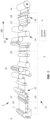
- FIG. 1 illustrates a sheetmaking system 10 that includes papermaking machine 2, control system 4 and network 6.
- the papermaking machine 2 produces a continuous sheet of paper material 12 that is collected in take-up reel 14.
- the paper material 12, having a specific width, is produced from a pulp suspension feedstock, comprising of an aqueous mixture of wood fibers and other materials, which undergoes various unit operations that are monitored and controlled by a quality control system 4.
- the network 6 facilitates communication between the components of system 10. Papermaking is described in U.S. Pat. No. 9,309,625 to Backstrom and Forbes and U.S. Pat. No. 8,021,517 to Hughes and Tixier , which are incorporated herein by reference.
- the papermaking machine 2 includes a headbox 8, which distributes an aqueous pulp suspension uniformly across the machine onto a continuous screen or wire 30 that is moving in the machine direction (MD).
- Headbox 8 includes slice openings through which the pulp suspension is distributed onto screen or wire 30 which comprise a suitable structure such as a mesh for receiving a pulp suspension and allowing water or other materials to drain or leave the pulp suspension.
- the formation of the paper sheet 12 is influenced by a plurality of linear actuators 3 extending in the cross direction across the sheet 12 of paper being formed. Actuators 3 control the sheet's weight in the cross direction (CD). Sensors located downstream from the actuators measure the properties of the sheet.
- the feedstock is fed from the head box through a gap or elongated orifice 5 onto a wire section 30.
- the orifice or gap is a relatively narrow opening that extends across the width of the machine.
- Weight profile control in such an arrangement is achieved by locally adjusting the position of the slice lip across the machine with motorized linear actuators 3 to vary the dimensions of the gap or orifice immediately adjacent the actuator.
- the "wet end” forming portion of sheetmaking system 10 comprises headbox 8 and wire 30 and those sections before the wire 30, and the “dry end” comprises the sections that are downstream from wire 30.
- Sheet 12 then enters a press section 32, which includes multiple press rolls where sheet 12 travels through the openings (referred to as "nips") between pairs of counter-rotating rolls in press section 32.
- the rolls in press section 32 compress the pulp material forming sheet 12. This may help to remove more water from the pulp material and to equalize the characteristics of the sheet 12 on both of its sides.
- a calendar 36 processes and finishes sheet 12, for example, by smoothing and imparting a final finish, thickness, gloss, or other characteristic to sheet 12. Other materials (such as starch or wax) can also be added to sheet 12 to obtain the desired finish.
- An array of induction heating actuators 24 applies heat along the CD to one or more of the rollers to control the roll diameters and thereby the size of the nips.
- Sheetmaking system 10 further includes an array of steam actuators 20 that controls the amount of hot steam that is projected along the CD.
- the hot steam increases the paper surface temperature and allows for easier cross direction removal of water from the paper sheet.
- paper material 14 is sprayed with water in the CD.
- an array of rewet shower actuators 22 controls the amount of water that is applied along the CD.
- Typical physical characteristics of paper that are can be measured include, for example, thickness, basis weight, moisture content, chemical composition such as ash, surface roughness, gloss, caliper, color, and crepe pattern surface features.
- CD control may be achieved by measuring sheet properties using one or more scanners 26, 28 that are capable of scanning sheet 12 and measuring one or more characteristics of sheet 12.
- scanner 28 could carry sensors for measuring the dry weight, moisture content, ash content, or any other or additional characteristics of sheet 12.
- Scanner 28 includes suitable structures for measuring or detecting one or more characteristics of sheet 12, such as a set or array of sensors. Scanner 28 is particularly suited for measuring the dry end dry weight and ash content of the paper product.
- Measurements from scanners 26 and 28 are provided to control system 4 that adjusts various actuators or operations of papermaking machine 2 that affect machine direction and cross direction characteristics of sheet 12.
- a machine direction characteristic of sheet 12 generally refers to an average characteristic of sheet 12 that varies and is controlled in the machine direction.
- control system 4 is capable of controlling the dry weight of the paper sheet by adjusting the supply of pulp to the headbox 8.
- control system 4 could provide information to a stock flow controller that regulates the flow of stock through valves and to headbox 8.
- Control system 4 includes any hardware, software, firmware, or combination thereof for controlling the operation of the sheetmaking machine 2 or other machine.
- Control system 4 can, for example, include a processor and memory storing instructions and data used, generated, and collected by the processor.
- CD scanner sheet property measurements are stored for future reference and/or accessed for real-time observation and analysis.
- Control systems for papermaking machines are described, for instance, in U.S. Pat. No. 9,309,625 to Backstrom and Forbes , U.S. Pat. No. 10,174,456 to Backstrom and Forbes and U.S. Pat. No. 10,358,771 to He et al. , which are incorporated by reference.
- FIG. 2 illustrates one particular implementation of the scanning sensor which is located at the dry end just before the take-up reel of FIG. 1 .
- the radiation source and detector are housed in a dual mounting head scanner 58 of scanner system 50 which can be employed to measure one or more characteristics of the paper that is produced.
- Upper scanner head 54 moves repeatedly back and forth in the CD across the width of the moving sheet 60, which moves in the MD, so that the characteristics of the entire sheet may be measured.
- Scanner 58 or gauge is supported by two transverse beams 52 and 62 on which are mounted upper and lower scanning heads 54 and 56, respectively.
- the operative faces of the lower and upper scanner heads 56, 54 define a measurement gap or window that accommodates sheet 60.
- the lower scanner head 56 may include a sheet stabilization system such as an air-bearing stabilizer (not shown) to maintain the sheet on a consistent plane as it passes through the measurement window.
- a sheet stabilization system such as an air-bearing stabilizer (not shown) to maintain the sheet on a consistent plane as it passes through the measurement window.
- the movement of the dual scanner heads 54, 56, is synchronized with respect to speed and direction so that they are aligned with each other.
- the width of the sheet in the CD in industrial can be more than ten meters; typically, in the normal production mode, the scanner heads move at a rate of 0.3 to 0.7 meters per second.
- the scanning sensors can be configured to operate in the transmissive mode or reflective mode.
- scanner head 54 can house a radiation source that directs a beam of radiation into a moving web or sheet 26 and scanner head 56 houses a radiation receiver that detects radiation that is transmitted through the material.
- the sensor measures one or more properties of the web or sheet 60.
- Sensors operating in the transmission mode are described, for instance, in U.S. Pat. No. 9,182,360 to Tixier and Hughes , U.S. Pat. No. 8,527,212 to Hughes and Tixier , U.S. Pat. No. 7,298,492 to Tixier , US 2021/0382173 to Hughes et al. and US 2021/0262776 to Tixier and Hughes , which are incorporated herein by reference.
- the sampling rate of the scanning sensor ranges from one sample every 10 to 200 milliseconds.
- the upper scanner head 54 can house both a radiation source and detector to measure one or more characteristics of the web or sheet 26. Sensors operating in the reflective mode are described, for instance, in in U.S. Pat. No. 9,182,360 , U.S. Pat. No. 8,527,212 , U.S. Pat. No. 7,298,492 and US2020/0096308 to Hughes et al. , which are incorporated herein by reference.
- Cameras can be secured to the upper or lower scanner head to capture surface images of the sheet 60. Cameras, for described, in U.S. Pat. No. 7,695,592 to Shakespeare and Kellomaki , which is incorporated herein by reference.
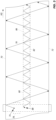
- the moving scanner does not measure the selected sheet property at locations which are aligned exactly perpendicular to the longitudinal edges of moving sheet 60. Instead, because of the sheet velocity, the scanning device travel diagonally across the sheet surface, with the result that consecutive scanning paths have a zig-zag pattern with respect to the direction perpendicular to the longitudinal edges of the sheet.
- FIG. 3 illustrates an example of a zig-zag scanning pattern 76 which would be traced during normal operations of a papermaking machine by a gauge as the scanning device 78 traverses the surface of sheet during back-and-forth consecutive scans.
- the gauge has an interrogation spot 74 and the pattern 76 represents where measurements are made on the moving sheet between edges 70 and 72 of the sheet.
- the angles of the scanning path relative to the true CD depend upon the cross-directional velocity of the scanning device 78 and upon the machine-directional velocity of the sheet.
- the zig-zag pattern of interrogation spot 74 covers a relatively small portion of the sheet surface.
- the scanner 78 decelerates as it approaches an edge of a sheet, stops at the edge and then accelerates as it moves away from the edge towards the center of the sheet.
- the zig-zag pattern is actually curved rather than exhibit the sharp corners as illustrated.
- measurement information provided by a scanning sensor is usually assembled after each scan to provide a "profile" of the detected sheet property in the cross direction.
- each profile is comprised of a succession of sheet measurements at adjacent locations in the cross direction.
- the characteristic measurements are averaged in finite sized bins of CD segments.
- the purpose of the profiles is to allow cross-directional variations in sheet properties to be detected easily.
- Maps displaying the scanner measurements are typically divided into points or bins across the width; for example, each bin can represent a distance of about 5 mm.
- FIG. 4 is an illustrative cross directional profile generated by scanner 28 ( FIG. 1 ) that measures a property of the paper at the dry end.
- the scanner is operating in the production mode which scans the full width the moving sheet from edge to edge.
- the property levels designated by arbitrary units fluctuate over the width of the paper from bin 1 to 600.
- the mini-scan can be conducted anytime to correlate the on-line sensor readings to laboratory tests for verification of accuracy and repeatability.
- the procedure matches the paper that is being sampled in the laboratory with the corresponding readings from the sensor.
- the sensor traverses the entire sheet in x seconds (scan time). Since only a small portion of the sheet is tested, a great deal of time is spent reading paper that is not relevant to the test.
- the scanning parameters are changed so that the scanner only scans the portion of the sheet that is to be sampled, thereby making all the sensor readings relevant and more likely to be a repeatable result.
- an operator reviews the cross directional profile and selects a CD region that exhibits relatively consistent readings.
- a "flat area" that is encircled indicates an area with less variability, which makes it easier to correlate.
- the length of this CD region for the mini-scan typically will be less than 10% of the CD length for the full-scan and preferably about 2 to 6%.
- the scanner heads move at a rate of 0.3 to 0.7 meters per second and the sampling rate of the scanning sensor ranges from one sample every 10 to 200 milliseconds.
- FIG. 3 shows the zig-zag pattern 86 generated during the mini-scan which would be traced during verification operations by a gauge as the scanning device 78 traverses the surface of sheet during back-and-forth consecutive scans within the region defined by borders 80, 82.
- the gauge has an interrogation spot 88 and the pattern 86 represents where measurements are made on the moving sheet.
- the mini-scan path contains many for reading on the actual sampled product.
- the sensor data generated in the mini-scans are averaged and printed and displayed to be used to compare to the laboratory values obtained when testing the samples. During the mini-scan, it is preferable that the scanning sensor's control operations be suspended.
- the papermaking machine can be disrupted by being controlled with a small subset of data.
- Mini-scans can be implemented when the take-up reel 14 ( FIG. 1 ) has reached the desired size. Once the mini-scan is complete, the running sheet being produced is transferred to a new spool and the full one is removed for testing. Paper samples are removed from the parts of the sheet that were subject to the mini-scanned and the samples analyzed for caliper, basis weight, ash content and the like.
- Mini-scans can also be used to diagnose upstream actuators. For instance, as shown in FIG. 1 , the formation of the paper sheet 12 is influenced by a plurality of linear actuators 3 extending in the CD. Actuators 3 control the sheet's weight in the CD. If there is a malfunction of one of the actuators, the effects will be shown in the measurements in scanner 28. A mini-scan at selected narrow segments of the CD can be employed to determine which of the actuators need tuning, adjustment or replacement.
Landscapes
- Life Sciences & Earth Sciences (AREA)
- Chemical & Material Sciences (AREA)
- Health & Medical Sciences (AREA)
- Physics & Mathematics (AREA)
- General Physics & Mathematics (AREA)
- General Health & Medical Sciences (AREA)
- Analytical Chemistry (AREA)
- Biochemistry (AREA)
- Immunology (AREA)
- Pathology (AREA)
- Medicinal Chemistry (AREA)
- Food Science & Technology (AREA)
- Engineering & Computer Science (AREA)
- Paper (AREA)
- Length Measuring Devices With Unspecified Measuring Means (AREA)
Applications Claiming Priority (1)
| Application Number | Priority Date | Filing Date | Title |
|---|---|---|---|
| US18/199,713 US20240384469A1 (en) | 2023-05-19 | 2023-05-19 | Mini-Scan for Dynamic Correlation |
Publications (2)
| Publication Number | Publication Date |
|---|---|
| EP4464839A2 true EP4464839A2 (de) | 2024-11-20 |
| EP4464839A3 EP4464839A3 (de) | 2025-12-03 |
Family
ID=90904529
Family Applications (1)
| Application Number | Title | Priority Date | Filing Date |
|---|---|---|---|
| EP24172567.0A Pending EP4464839A3 (de) | 2023-05-19 | 2024-04-25 | Mini-scan für dynamische korrelation |
Country Status (6)
| Country | Link |
|---|---|
| US (1) | US20240384469A1 (de) |
| EP (1) | EP4464839A3 (de) |
| JP (1) | JP7752206B2 (de) |
| KR (1) | KR20240167395A (de) |
| CN (1) | CN118999450A (de) |
| CA (1) | CA3237795A1 (de) |
Citations (11)
| Publication number | Priority date | Publication date | Assignee | Title |
|---|---|---|---|---|
| US7298492B2 (en) | 2004-12-29 | 2007-11-20 | Honeywell International Inc. | Method and system for on-line measurement of thickness and birefringence of thin plastic films |
| US7695592B2 (en) | 2005-04-21 | 2010-04-13 | Honeywell International Inc. | Method and apparatus for measuring fiber orientation of a moving web |
| US8021517B2 (en) | 2008-02-28 | 2011-09-20 | Honeywell Asca Inc. | Use of fluorescent nanoparticles to make on-line measurements of cross-web and machine-direction component and property variations in paper and continuous web products |
| US8527212B2 (en) | 2011-02-14 | 2013-09-03 | Honeywell Asca Inc. | Increased absorption-measurement accuracy through windowing of photon-transit times to account for scattering in continuous webs and powders |
| US9182360B2 (en) | 2013-07-22 | 2015-11-10 | Honeywell Asca Inc. | Multi-frequency microwave sensor for temperature independent measurement of moisture |
| US9309625B2 (en) | 2012-10-18 | 2016-04-12 | Honeywell Asca Inc. | Concept to separate wet end and dry end paper machine control through estimation of physical properties at the wire |
| US10174456B2 (en) | 2016-09-23 | 2019-01-08 | Honeywell Limited | Technique to improve paper machine cross-directional model predictive control performance by creating a measurement profile reference trajectory |
| US10358771B2 (en) | 2016-09-23 | 2019-07-23 | Honeywell Limited | Method of designing model predictive control for cross directional flat sheet manufacturing processes to guarantee spatial robustness and to prevent actuator picketing |
| US20200096308A1 (en) | 2018-09-24 | 2020-03-26 | Honeywell International Inc. | Thickness measurement with inductive and optical displacement sensors |
| US20210262776A1 (en) | 2020-02-26 | 2021-08-26 | Honeywell Limited | High Accuracy and High Stability Magnetic Displacement Sensor in the Presence of Electromagnetic Interferences |
| US20210382173A1 (en) | 2020-06-05 | 2021-12-09 | Honeywell International Inc. | Dual-optical displacement sensor alignment using knife edges |
Family Cites Families (10)
| Publication number | Priority date | Publication date | Assignee | Title |
|---|---|---|---|---|
| US4903528A (en) * | 1988-09-26 | 1990-02-27 | Measurex Corporation | System and process for detecting properties of travelling sheets in the cross direction |
| US5022966A (en) * | 1989-01-27 | 1991-06-11 | Measurex Corporation | Process for controlling properties of travelling sheets |
| FI94066C (fi) * | 1994-05-16 | 1995-07-10 | Valmet Paper Machinery Inc | Rainamateriaalin valmistuskoneella kuten kartonki- tai paperikoneella ja/tai jälkikäsittelykoneella valmistettavan paperiradan eri poikkiprofiilien kokonaisvaltainen hallintajärjestelmä |
| DE19913926A1 (de) * | 1999-03-26 | 2000-09-28 | Voith Sulzer Papiertech Patent | Verfahren zur Herstellung, insbesondere zur Beeinflussung von Qualitätseigenschaften, einer Materialbahn |
| US6564117B1 (en) | 2000-06-13 | 2003-05-13 | Abb Automation Inc. | Automated optimization of cross machine direction profile control performance for sheet making processes |
| US20040069059A1 (en) * | 2002-10-15 | 2004-04-15 | Metso Paper Automation Oy | Method and an apparatus for performing a measurement of a continuous sheet |
| JP2006255944A (ja) | 2005-03-15 | 2006-09-28 | Mitsubishi Heavy Ind Ltd | アクチュエータと計測点対応付け装置、その方法、およびプログラム |
| US7459060B2 (en) | 2005-08-22 | 2008-12-02 | Honeywell Asca Inc. | Reverse bump test for closed-loop identification of CD controller alignment |
| ATE445872T1 (de) * | 2007-02-01 | 2009-10-15 | Abb Oy | Verfahren zur erstellung eines optimierten schnittplans für ein streifenförmiges material |
| DE102007055820A1 (de) * | 2007-12-14 | 2009-06-18 | Voith Patent Gmbh | Verfahren und Vorrichtung zur Erfassung zumindest einer die Eigenschaften einer Oberfläche in einer Materialbahnbehandlungseinrichtung wenigstens mittelbar charaktersierenden Größe und Verfahren zur Optimierung der Betriebsweise einer Materialbahnbehandlungseinrichtung |
-
2023
- 2023-05-19 US US18/199,713 patent/US20240384469A1/en active Pending
-
2024
- 2024-04-15 CN CN202410450419.0A patent/CN118999450A/zh active Pending
- 2024-04-17 JP JP2024066575A patent/JP7752206B2/ja active Active
- 2024-04-25 EP EP24172567.0A patent/EP4464839A3/de active Pending
- 2024-05-08 CA CA3237795A patent/CA3237795A1/en active Pending
- 2024-05-13 KR KR1020240062345A patent/KR20240167395A/ko active Pending
Patent Citations (11)
| Publication number | Priority date | Publication date | Assignee | Title |
|---|---|---|---|---|
| US7298492B2 (en) | 2004-12-29 | 2007-11-20 | Honeywell International Inc. | Method and system for on-line measurement of thickness and birefringence of thin plastic films |
| US7695592B2 (en) | 2005-04-21 | 2010-04-13 | Honeywell International Inc. | Method and apparatus for measuring fiber orientation of a moving web |
| US8021517B2 (en) | 2008-02-28 | 2011-09-20 | Honeywell Asca Inc. | Use of fluorescent nanoparticles to make on-line measurements of cross-web and machine-direction component and property variations in paper and continuous web products |
| US8527212B2 (en) | 2011-02-14 | 2013-09-03 | Honeywell Asca Inc. | Increased absorption-measurement accuracy through windowing of photon-transit times to account for scattering in continuous webs and powders |
| US9309625B2 (en) | 2012-10-18 | 2016-04-12 | Honeywell Asca Inc. | Concept to separate wet end and dry end paper machine control through estimation of physical properties at the wire |
| US9182360B2 (en) | 2013-07-22 | 2015-11-10 | Honeywell Asca Inc. | Multi-frequency microwave sensor for temperature independent measurement of moisture |
| US10174456B2 (en) | 2016-09-23 | 2019-01-08 | Honeywell Limited | Technique to improve paper machine cross-directional model predictive control performance by creating a measurement profile reference trajectory |
| US10358771B2 (en) | 2016-09-23 | 2019-07-23 | Honeywell Limited | Method of designing model predictive control for cross directional flat sheet manufacturing processes to guarantee spatial robustness and to prevent actuator picketing |
| US20200096308A1 (en) | 2018-09-24 | 2020-03-26 | Honeywell International Inc. | Thickness measurement with inductive and optical displacement sensors |
| US20210262776A1 (en) | 2020-02-26 | 2021-08-26 | Honeywell Limited | High Accuracy and High Stability Magnetic Displacement Sensor in the Presence of Electromagnetic Interferences |
| US20210382173A1 (en) | 2020-06-05 | 2021-12-09 | Honeywell International Inc. | Dual-optical displacement sensor alignment using knife edges |
Also Published As
| Publication number | Publication date |
|---|---|
| CA3237795A1 (en) | 2025-07-08 |
| JP7752206B2 (ja) | 2025-10-09 |
| US20240384469A1 (en) | 2024-11-21 |
| JP2024167052A (ja) | 2024-11-29 |
| KR20240167395A (ko) | 2024-11-26 |
| EP4464839A3 (de) | 2025-12-03 |
| CN118999450A (zh) | 2024-11-22 |
Similar Documents
| Publication | Publication Date | Title |
|---|---|---|
| CA2193380C (en) | Method and apparatus for measuring and controlling the surface characteristics of sheet materials such as paper | |
| US5658432A (en) | Apparatus and method of determining sheet shrinkage or expansion characteristics | |
| US5400258A (en) | Automatic cross-directional control zone alignment for sheetmaking systems | |
| DE3872479T2 (de) | Anordnung zur kontinuierlichen bestimmung der papierkraft. | |
| US4921574A (en) | Process for controlling properties of travelling sheets with scan widths less than the sheet width | |
| US4955720A (en) | On-line fiber orientation distribution measurement | |
| EP3425112B1 (de) | Verfahren und system zur überwachung von eigenschaften von fehlern in einer materialbahn, die sich in einer bahnherstelungsmaschine bewegt and zur identifizierung der ursachen der materialbahnfehler | |
| US5104488A (en) | System and process for continuous determination and control of paper strength | |
| CA2754738C (en) | Apparatus and method for measuring properties of unstabilized moving sheets | |
| US6517679B1 (en) | Method for determination of an irreversible stretch and of a dynamic modulus of elasticity | |
| EP1960759A1 (de) | Kombinierter papierbogen-temperatur- und feuchtigkeitssensor | |
| US20080210396A1 (en) | Measurement System for Improved Paper Roll Runnability | |
| CA1147066A (en) | Radiation inspection system for a material making apparatus and method using a beta ray gauge | |
| US4982334A (en) | Calender control system for sheetmaking | |
| JP4850909B2 (ja) | Cdコントローラアライメントの閉ループ同定用逆バンプ試験 | |
| US5928475A (en) | High resolution system and method for measurement of traveling web | |
| FI116075B (fi) | Paperikoneen säätöjärjestelmä | |
| EP2169390A1 (de) | Verfahren zur Korrektur des Gipskristallwassereffektes auf Infrarotfeuchtigkeitsmessung | |
| US20240384469A1 (en) | Mini-Scan for Dynamic Correlation | |
| EP4481519A1 (de) | Automatisierte interframe-ausrichtungsüberwachung für blattherstellungsanwendungen | |
| CN101946170A (zh) | 检测至少间接表明材料幅面处理装置中表面特性的至少一个值的设备和方法和优化该装置运行状况的方法 | |
| US6712937B1 (en) | Method of operating a machine for the manufacture and/or refinement of material webs | |
| CA1293055C (en) | On-machine sheet material property analysis | |
| WO1999058436A1 (en) | Method for measurement of a paper web |
Legal Events
| Date | Code | Title | Description |
|---|---|---|---|
| PUAI | Public reference made under article 153(3) epc to a published international application that has entered the european phase |
Free format text: ORIGINAL CODE: 0009012 |
|
| STAA | Information on the status of an ep patent application or granted ep patent |
Free format text: STATUS: REQUEST FOR EXAMINATION WAS MADE |
|
| 17P | Request for examination filed |
Effective date: 20240425 |
|
| AK | Designated contracting states |
Kind code of ref document: A2 Designated state(s): AL AT BE BG CH CY CZ DE DK EE ES FI FR GB GR HR HU IE IS IT LI LT LU LV MC ME MK MT NL NO PL PT RO RS SE SI SK SM TR |
|
| REG | Reference to a national code |
Ref country code: DE Ref legal event code: R079 Free format text: PREVIOUS MAIN CLASS: D21G0009000000 Ipc: D21F0007060000 |
|
| PUAL | Search report despatched |
Free format text: ORIGINAL CODE: 0009013 |
|
| AK | Designated contracting states |
Kind code of ref document: A3 Designated state(s): AL AT BE BG CH CY CZ DE DK EE ES FI FR GB GR HR HU IE IS IT LI LT LU LV MC ME MK MT NL NO PL PT RO RS SE SI SK SM TR |
|
| RIC1 | Information provided on ipc code assigned before grant |
Ipc: D21F 7/06 20060101AFI20251024BHEP Ipc: D21G 9/00 20060101ALI20251024BHEP Ipc: G01N 33/34 20060101ALI20251024BHEP |