EP4464765A1 - Verfahren zur herstellung von apfelwein-essig - Google Patents
Verfahren zur herstellung von apfelwein-essig Download PDFInfo
- Publication number
- EP4464765A1 EP4464765A1 EP23461589.6A EP23461589A EP4464765A1 EP 4464765 A1 EP4464765 A1 EP 4464765A1 EP 23461589 A EP23461589 A EP 23461589A EP 4464765 A1 EP4464765 A1 EP 4464765A1
- Authority
- EP
- European Patent Office
- Prior art keywords
- apple
- moisture content
- extrudates
- bioreactor
- fermentation
- Prior art date
- Legal status (The legal status is an assumption and is not a legal conclusion. Google has not performed a legal analysis and makes no representation as to the accuracy of the status listed.)
- Granted
Links
Images
Classifications
-
- C—CHEMISTRY; METALLURGY
- C12—BIOCHEMISTRY; BEER; SPIRITS; WINE; VINEGAR; MICROBIOLOGY; ENZYMOLOGY; MUTATION OR GENETIC ENGINEERING
- C12J—VINEGAR; PREPARATION OR PURIFICATION THEREOF
- C12J1/00—Vinegar; Preparation or purification thereof
- C12J1/04—Vinegar; Preparation or purification thereof from alcohol
-
- C—CHEMISTRY; METALLURGY
- C12—BIOCHEMISTRY; BEER; SPIRITS; WINE; VINEGAR; MICROBIOLOGY; ENZYMOLOGY; MUTATION OR GENETIC ENGINEERING
- C12J—VINEGAR; PREPARATION OR PURIFICATION THEREOF
- C12J1/00—Vinegar; Preparation or purification thereof
- C12J1/10—Apparatus
-
- Y—GENERAL TAGGING OF NEW TECHNOLOGICAL DEVELOPMENTS; GENERAL TAGGING OF CROSS-SECTIONAL TECHNOLOGIES SPANNING OVER SEVERAL SECTIONS OF THE IPC; TECHNICAL SUBJECTS COVERED BY FORMER USPC CROSS-REFERENCE ART COLLECTIONS [XRACs] AND DIGESTS
- Y02—TECHNOLOGIES OR APPLICATIONS FOR MITIGATION OR ADAPTATION AGAINST CLIMATE CHANGE
- Y02E—REDUCTION OF GREENHOUSE GAS [GHG] EMISSIONS, RELATED TO ENERGY GENERATION, TRANSMISSION OR DISTRIBUTION
- Y02E50/00—Technologies for the production of fuel of non-fossil origin
- Y02E50/10—Biofuels, e.g. bio-diesel
Definitions
- the present invention relates to a method for producing apple cider vinegar using a bed based on apple pomace.
- Apple cider vinegar is a traditional product of the culinary arts, known since ancient historical times, which is traditionally obtained as an oxidation product of apple cider, i.e. a low-alcohol drink resulting from the alcoholic fermentation of apple juice.
- Apple cider vinegar is produced by the aerobic bacteria Acetobacter, which form a characteristic dross on the surface of the solution.
- Acetobacter which form a characteristic dross on the surface of the solution.
- three factors must be met: a sufficiently high concentration of oxygen available to the bacteria, alcohol content and, advantageously, the presence of a source of simple sugars in the environment.
- Chinese patent application CN105018384A describes an Acetobacter strain belonging to the field of industrial microorganisms and its use in fermenting apple cider vinegar.
- the Acetobacter strain is Acetobacter pasteurianus strain CYD1S9, which was deposited in the China Center for Type Culture Collection on 30 June 2015. The address of the collection is Wuhan University, Wuhan, PRC, and the collection number is CCTCC NO: 2015418.
- the strain has a higher acid production capacity (up to 110 g/l or more).
- Apple cider vinegar fermented with the Acetobacter strain is obtained with high yield and has a favourable taste, making Acetobacter pasteurianus strain CYD159 a suitable Acetobacter strain for obtaining apple cider vinegar.
- Korean patent publication KR102263129B1 relates to a method of making apple cider vinegar and apple cider vinegar produced by said method.
- the method includes: (1) the step of preparing apple concentrate by concentrating apple juice; (2) the step of preparing concentrated apple wine by inoculating a culture solution of Saccharomyces cerevisiae strain into the prepared apple concentrate from step (1) and culturing it; (3) the step of preparing an acetic starter in the prepared concentrated apple wine of step (2) by inoculating the mixture with a culture of the strain Acetobacter pasteurianus, to which the prepared apple concentrate of step (1) and its culture are added; and (4) the step of acetic fermentation of the mixture, in which the prepared acetic starter of step (3) is added to the prepared concentrated apple wine of step (2).
- cider vinegars are made by exposing the cider to oxygen over as large a surface area as possible, thus increasing the surface area in contact with oxygen.
- the methods used by some wineries also use coarsely cut oak chips to increase the surface area as well as to impart sensory characteristics.
- each of the methods mentioned is a batch method, meaning that the vessel in which the process is carried out is periodically filled with substrate and the product is removed at the end of the process.
- the aim of the present invention was to develop a method for obtaining apple cider vinegar by fermentation using aerobic Acetobacter bacteria in a column lined with a suitable bed - a carbon-apple extrudate.
- the subject matter of the invention is a method of producing acetic acid by acetic fermentation, wherein the fermentation medium, which is cider containing 5.2 % w/w ethanol and 20 g/dm 3 glucose, is fed from above into a tubular bioreactor at a volume rate of 30 cm 3 /h, using a retention time of 66.6 h for the fermentation medium in the reactor; oxygen is fed from the bottom of the bioreactor at a pressure of 110 000 Pa and a volume intensity of 480 cm 3 /h; characterised in that the tubular bioreactor is filled with a porous bed obtained by a method comprising the steps of: (a) the apple pomace shall be vacuum dried at a temperature of 40 to 80°C, preferably 50 to 70°C, more preferably at 60°C and under pressure of 60 000Pa to give a product with a moisture content of 40%; (b) the material obtained is subjected to further drying, preferably in a convection dryer, at a temperature of 100 to 110°C,
- a specially prepared bed consisting of a porous material, such as carbon-apple extrudate, is used as the filling of a tubular bioreactor in which the apple cider vinegar production process is carried out continuously, i.e. the nutrient solution is fed into the bed at the same time, as well as the product in the form of fermentation fluid containing acetic acid is collected.
- Example 1 the method of production of a porous bed
- the bed for filling the tubular bioreactor was produced by extrusion.
- the components of the bed and their proportions are shown in Table 1.
- the apple pomace, representing 61.82% of the mixture by weight, was pre-dried according to the following scheme:
- Bed preparation also included crushing the resulting porous mass of extrudates to grind them to a size that would fit into the tubular reactor cylinder. After crushing, the bed was poured into the reactor and washed twice with 5 l of distilled water at room temperature (20°C). The bioreactor was then flooded with a solution of the composition shown in Table 2 and left to condition for 48 h. During bed conditioning, a pure oxygen flow rate of 10 ml/min was applied. After this time, the conditioning solution was collected via a peristaltic pump.
- the bed thus prepared was ready for the fermentation process.
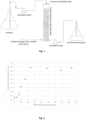
- a fermentation system was prepared according to the scheme shown in Fig. 1 .
- the fermentation medium was cider containing 5.2 by weight ethanol and 20 g/dm 3 glucose.
- the fermentation medium was fed into the bioreactor at a volume rate of 30 cm 3 /h, the working volume of the reactor was 2 dm 3 , the retention time of the medium in the reactor was 66.6 h.
- the nutrient solution was injected into the bed from the top and flowed freely down the reactor.
- Technical oxygen was injected from the bottom of the reactor, oxygen pressure 110 000 Pa, oxygen volume intensity 480 cm 3 /h.
- At the top of the bioreactor was a pressure equalisation valve, in the form of a tube plugged with a movable glass ball. The valve allowed the fermentation gases to escape freely from the bioreactor.
- the fermentation product was collected at the bottom of the tube and transported by a peristaltic pump to the product tank.
- Fig. 1 shows the fermentation system, a bioreactor with equipment.
- the use of a porous bed in a tubular bioreactor allowed the multiplication of Acetobacter and their immobilisation. Feeding the medium and oxygen in a countercurrent manner significantly increased the fermentation dynamics.
- the fermentation product, apple cider vinegar was obtained using a continuous method, i.e. the volume intensity of the nutrient solution fed was equal to the volume intensity of the fermentation product (apple cider vinegar) received.
- Example 3 Process flow and end results of fermentation
- Fig. 2 shows the dynamics of fermentation changes in the apple cider vinegar received from the bioreactor during the continuous process. It can be observed that the first 24 hours of the process were a period of gradual increase in the concentration of acetic acid in the receiving fermentation medium. This was related to the biomass multiplication period and the need for the dynamic equilibrium in the reactor to establish itself.
- the resulting product after biomass centrifugation was ready-to-eat apple cider vinegar.
- Fig. 2 shows the fermentation dynamics for a continuous process in a bioreactor.
Landscapes
- Chemical & Material Sciences (AREA)
- Organic Chemistry (AREA)
- Engineering & Computer Science (AREA)
- Bioinformatics & Cheminformatics (AREA)
- Life Sciences & Earth Sciences (AREA)
- Biochemistry (AREA)
- Health & Medical Sciences (AREA)
- General Engineering & Computer Science (AREA)
- General Health & Medical Sciences (AREA)
- Genetics & Genomics (AREA)
- Food Science & Technology (AREA)
- Wood Science & Technology (AREA)
- Zoology (AREA)
- Preparation Of Compounds By Using Micro-Organisms (AREA)
- Distillation Of Fermentation Liquor, Processing Of Alcohols, Vinegar And Beer (AREA)
Priority Applications (1)
| Application Number | Priority Date | Filing Date | Title |
|---|---|---|---|
| EP23461589.6A EP4464765B1 (de) | 2023-05-14 | 2023-05-14 | Verfahren zur herstellung von apfelwein-essig |
Applications Claiming Priority (1)
| Application Number | Priority Date | Filing Date | Title |
|---|---|---|---|
| EP23461589.6A EP4464765B1 (de) | 2023-05-14 | 2023-05-14 | Verfahren zur herstellung von apfelwein-essig |
Publications (2)
| Publication Number | Publication Date |
|---|---|
| EP4464765A1 true EP4464765A1 (de) | 2024-11-20 |
| EP4464765B1 EP4464765B1 (de) | 2026-03-25 |
Family
ID=86382807
Family Applications (1)
| Application Number | Title | Priority Date | Filing Date |
|---|---|---|---|
| EP23461589.6A Active EP4464765B1 (de) | 2023-05-14 | 2023-05-14 | Verfahren zur herstellung von apfelwein-essig |
Country Status (1)
| Country | Link |
|---|---|
| EP (1) | EP4464765B1 (de) |
Citations (2)
| Publication number | Priority date | Publication date | Assignee | Title |
|---|---|---|---|---|
| CN105018384A (zh) | 2015-07-30 | 2015-11-04 | 江南大学 | 一株醋酸菌及其在发酵苹果醋中的应用 |
| KR102263129B1 (ko) | 2019-08-16 | 2021-06-08 | 재단법인 발효미생물산업진흥원 | 사카로마이세스 세레비지에 및 아세토박터 파스테우리아너스 균주를 이용한 사과 식초의 제조방법 |
-
2023
- 2023-05-14 EP EP23461589.6A patent/EP4464765B1/de active Active
Patent Citations (2)
| Publication number | Priority date | Publication date | Assignee | Title |
|---|---|---|---|---|
| CN105018384A (zh) | 2015-07-30 | 2015-11-04 | 江南大学 | 一株醋酸菌及其在发酵苹果醋中的应用 |
| KR102263129B1 (ko) | 2019-08-16 | 2021-06-08 | 재단법인 발효미생물산업진흥원 | 사카로마이세스 세레비지에 및 아세토박터 파스테우리아너스 균주를 이용한 사과 식초의 제조방법 |
Non-Patent Citations (1)
| Title |
|---|
| HORIUCHI JUN ICHI: "Continuous Acetic Acid Production by a Packed Bed Bioreactor Employing Charcoal Pellets Derived from Waste Mushroom Medium", 2000, pages 126 - 131, XP093090513, Retrieved from the Internet <URL:https://www.sciencedirect.com/science/article/pii/S1389172300887253/pdf?md5=a1f396e1808e2ad43dabcf9aa404810d&pid=1-s2.0-S1389172300887253-main.pdf> [retrieved on 20231011] * |
Also Published As
| Publication number | Publication date |
|---|---|
| EP4464765B1 (de) | 2026-03-25 |
Similar Documents
| Publication | Publication Date | Title |
|---|---|---|
| US4929452A (en) | Method for rapidly fermenting alcoholic beverages | |
| CN102226155A (zh) | 中国酱香型白酒生产中高产乙醇低产杂醇油的酵母的筛选与应用 | |
| US4346113A (en) | Process for the continuous fermentation of aqueous slurries for the production of alcohol and yeast biomass | |
| CN115505473A (zh) | 一种浓香白酒的生产方法与发酵装置 | |
| CN109207306B (zh) | 提高米香型白酒乳酸乙酯含量并降低杂醇油含量的酿造方法 | |
| CN102766558B (zh) | 无泥窖浓香型白酒生产方法 | |
| CN106520509B (zh) | 一种纯米醋的生产方法 | |
| CN106035985A (zh) | 一种混菌液态发酵黄酒加工废弃物生产单细胞蛋白的方法 | |
| EP4464765B1 (de) | Verfahren zur herstellung von apfelwein-essig | |
| EP4464764B1 (de) | Verfahren zur herstellung eines apfelwein-essigbetts, das bett und seine verwendung | |
| CN102816706A (zh) | 中国酱香型白酒生产中高产乙醇低产杂醇油的酵母cgmcc 4745的筛选与应用 | |
| CN102766586A (zh) | 中国酱香型白酒生产中高产乙醇低产杂醇油的酵母cgmcc 4747的筛选与应用 | |
| CN107325929B (zh) | 一种采用米酒糟制备发酵饮料的方法以及发酵饮料 | |
| CN101906442B (zh) | 一种利用工业废糖水生产酒精的方法 | |
| CN105907506B (zh) | 一种北冰红和户太葡萄复合起泡酒的生产方法 | |
| CN104328000B (zh) | 一种缩短液态白酒发酵周期的方法及装置 | |
| CN102766582A (zh) | 中国酱香型白酒生产中高产乙醇低产杂醇油的酵母cgmcc 4750的筛选与应用 | |
| CN1492922A (zh) | 用于澄清啤酒和葡萄酒发酵的纤维惰性载体 | |
| CN117535110B (zh) | 一种醋糟水资源循环利用的食醋酿造方法 | |
| CN117535111B (zh) | 一种基于原料干法糊化的液态米醋酿造方法 | |
| CN112831390B (zh) | 一种生产糖化甜液和酸液的方法 | |
| CN102766585B (zh) | 中国酱香型白酒生产中高产乙醇低产杂醇油的酵母cgmcc 4740的筛选与应用 | |
| CN115044489B (zh) | 一种利用连续发酵分离一体化技术培养酿酒酵母的方法 | |
| CN119662359A (zh) | 一种茶酒专用酒曲及其制备方法 | |
| CN117866770A (zh) | 一种分离用于发酵苦荞黄酒酵母菌的方法 |
Legal Events
| Date | Code | Title | Description |
|---|---|---|---|
| PUAI | Public reference made under article 153(3) epc to a published international application that has entered the european phase |
Free format text: ORIGINAL CODE: 0009012 |
|
| STAA | Information on the status of an ep patent application or granted ep patent |
Free format text: STATUS: THE APPLICATION HAS BEEN PUBLISHED |
|
| AK | Designated contracting states |
Kind code of ref document: A1 Designated state(s): AL AT BE BG CH CY CZ DE DK EE ES FI FR GB GR HR HU IE IS IT LI LT LU LV MC ME MK MT NL NO PL PT RO RS SE SI SK SM TR |
|
| STAA | Information on the status of an ep patent application or granted ep patent |
Free format text: STATUS: REQUEST FOR EXAMINATION WAS MADE |
|
| 17P | Request for examination filed |
Effective date: 20250514 |
|
| GRAP | Despatch of communication of intention to grant a patent |
Free format text: ORIGINAL CODE: EPIDOSNIGR1 |
|
| STAA | Information on the status of an ep patent application or granted ep patent |
Free format text: STATUS: GRANT OF PATENT IS INTENDED |
|
| RIC1 | Information provided on ipc code assigned before grant |
Ipc: C12J 1/04 20060101AFI20251002BHEP Ipc: C12J 1/10 20060101ALI20251002BHEP Ipc: C07C 53/08 20060101ALI20251002BHEP |
|
| INTG | Intention to grant announced |
Effective date: 20251015 |
|
| GRAS | Grant fee paid |
Free format text: ORIGINAL CODE: EPIDOSNIGR3 |
|
| GRAA | (expected) grant |
Free format text: ORIGINAL CODE: 0009210 |
|
| STAA | Information on the status of an ep patent application or granted ep patent |
Free format text: STATUS: THE PATENT HAS BEEN GRANTED |
|
| AK | Designated contracting states |
Kind code of ref document: B1 Designated state(s): AL AT BE BG CH CY CZ DE DK EE ES FI FR GB GR HR HU IE IS IT LI LT LU LV MC ME MK MT NL NO PL PT RO RS SE SI SK SM TR |
|
| REG | Reference to a national code |
Ref country code: CH Ref legal event code: F10 Free format text: ST27 STATUS EVENT CODE: U-0-0-F10-F00 (AS PROVIDED BY THE NATIONAL OFFICE) Effective date: 20260325 Ref country code: GB Ref legal event code: FG4D |
|
| RIN1 | Information on inventor provided before grant (corrected) |
Inventor name: KLIKS, JAROSLAW Inventor name: KORYCKA-KORWEK, JUSTYNA Inventor name: MROWCZYNSKA, MARIA Inventor name: KROLICKA, ZUZANNA |