EP4464409A1 - Aufbau für die implementierung eines mehrstufigen chemischen prozesses - Google Patents
Aufbau für die implementierung eines mehrstufigen chemischen prozesses Download PDFInfo
- Publication number
- EP4464409A1 EP4464409A1 EP23305769.4A EP23305769A EP4464409A1 EP 4464409 A1 EP4464409 A1 EP 4464409A1 EP 23305769 A EP23305769 A EP 23305769A EP 4464409 A1 EP4464409 A1 EP 4464409A1
- Authority
- EP
- European Patent Office
- Prior art keywords
- fluidic
- setup
- interaction structure
- fluidic interaction
- setting
- Prior art date
- Legal status (The legal status is an assumption and is not a legal conclusion. Google has not performed a legal analysis and makes no representation as to the accuracy of the status listed.)
- Pending
Links
Images



Classifications
-
- B—PERFORMING OPERATIONS; TRANSPORTING
- B01—PHYSICAL OR CHEMICAL PROCESSES OR APPARATUS IN GENERAL
- B01J—CHEMICAL OR PHYSICAL PROCESSES, e.g. CATALYSIS OR COLLOID CHEMISTRY; THEIR RELEVANT APPARATUS
- B01J19/00—Chemical, physical or physico-chemical processes in general; Their relevant apparatus
- B01J19/0046—Sequential or parallel reactions, e.g. for the synthesis of polypeptides or polynucleotides; Apparatus and devices for combinatorial chemistry or for making molecular arrays
-
- B—PERFORMING OPERATIONS; TRANSPORTING
- B01—PHYSICAL OR CHEMICAL PROCESSES OR APPARATUS IN GENERAL
- B01J—CHEMICAL OR PHYSICAL PROCESSES, e.g. CATALYSIS OR COLLOID CHEMISTRY; THEIR RELEVANT APPARATUS
- B01J19/00—Chemical, physical or physico-chemical processes in general; Their relevant apparatus
- B01J19/0006—Controlling or regulating processes
- B01J19/0013—Controlling the temperature of the process
-
- B—PERFORMING OPERATIONS; TRANSPORTING
- B01—PHYSICAL OR CHEMICAL PROCESSES OR APPARATUS IN GENERAL
- B01J—CHEMICAL OR PHYSICAL PROCESSES, e.g. CATALYSIS OR COLLOID CHEMISTRY; THEIR RELEVANT APPARATUS
- B01J2204/00—Aspects relating to feed or outlet devices; Regulating devices for feed or outlet devices
- B01J2204/002—Aspects relating to feed or outlet devices; Regulating devices for feed or outlet devices the feeding side being of particular interest
-
- B—PERFORMING OPERATIONS; TRANSPORTING
- B01—PHYSICAL OR CHEMICAL PROCESSES OR APPARATUS IN GENERAL
- B01J—CHEMICAL OR PHYSICAL PROCESSES, e.g. CATALYSIS OR COLLOID CHEMISTRY; THEIR RELEVANT APPARATUS
- B01J2219/00—Chemical, physical or physico-chemical processes in general; Their relevant apparatus
- B01J2219/00002—Chemical plants
- B01J2219/00027—Process aspects
- B01J2219/0004—Processes in series
-
- B—PERFORMING OPERATIONS; TRANSPORTING
- B01—PHYSICAL OR CHEMICAL PROCESSES OR APPARATUS IN GENERAL
- B01J—CHEMICAL OR PHYSICAL PROCESSES, e.g. CATALYSIS OR COLLOID CHEMISTRY; THEIR RELEVANT APPARATUS
- B01J2219/00—Chemical, physical or physico-chemical processes in general; Their relevant apparatus
- B01J2219/00049—Controlling or regulating processes
- B01J2219/00051—Controlling the temperature
-
- B—PERFORMING OPERATIONS; TRANSPORTING
- B01—PHYSICAL OR CHEMICAL PROCESSES OR APPARATUS IN GENERAL
- B01J—CHEMICAL OR PHYSICAL PROCESSES, e.g. CATALYSIS OR COLLOID CHEMISTRY; THEIR RELEVANT APPARATUS
- B01J2219/00—Chemical, physical or physico-chemical processes in general; Their relevant apparatus
- B01J2219/00049—Controlling or regulating processes
- B01J2219/00164—Controlling or regulating processes controlling the flow
-
- B—PERFORMING OPERATIONS; TRANSPORTING
- B01—PHYSICAL OR CHEMICAL PROCESSES OR APPARATUS IN GENERAL
- B01J—CHEMICAL OR PHYSICAL PROCESSES, e.g. CATALYSIS OR COLLOID CHEMISTRY; THEIR RELEVANT APPARATUS
- B01J2219/00—Chemical, physical or physico-chemical processes in general; Their relevant apparatus
- B01J2219/00274—Sequential or parallel reactions; Apparatus and devices for combinatorial chemistry or for making arrays; Chemical library technology
- B01J2219/00277—Apparatus
- B01J2219/00279—Features relating to reactor vessels
- B01J2219/00331—Details of the reactor vessels
- B01J2219/00333—Closures attached to the reactor vessels
- B01J2219/00337—Valves
-
- B—PERFORMING OPERATIONS; TRANSPORTING
- B01—PHYSICAL OR CHEMICAL PROCESSES OR APPARATUS IN GENERAL
- B01J—CHEMICAL OR PHYSICAL PROCESSES, e.g. CATALYSIS OR COLLOID CHEMISTRY; THEIR RELEVANT APPARATUS
- B01J2219/00—Chemical, physical or physico-chemical processes in general; Their relevant apparatus
- B01J2219/00274—Sequential or parallel reactions; Apparatus and devices for combinatorial chemistry or for making arrays; Chemical library technology
- B01J2219/00583—Features relative to the processes being carried out
- B01J2219/0059—Sequential processes
-
- B—PERFORMING OPERATIONS; TRANSPORTING
- B01—PHYSICAL OR CHEMICAL PROCESSES OR APPARATUS IN GENERAL
- B01J—CHEMICAL OR PHYSICAL PROCESSES, e.g. CATALYSIS OR COLLOID CHEMISTRY; THEIR RELEVANT APPARATUS
- B01J2219/00—Chemical, physical or physico-chemical processes in general; Their relevant apparatus
- B01J2219/00274—Sequential or parallel reactions; Apparatus and devices for combinatorial chemistry or for making arrays; Chemical library technology
- B01J2219/0068—Means for controlling the apparatus of the process
- B01J2219/00686—Automatic
- B01J2219/00689—Automatic using computers
-
- B—PERFORMING OPERATIONS; TRANSPORTING
- B01—PHYSICAL OR CHEMICAL PROCESSES OR APPARATUS IN GENERAL
- B01J—CHEMICAL OR PHYSICAL PROCESSES, e.g. CATALYSIS OR COLLOID CHEMISTRY; THEIR RELEVANT APPARATUS
- B01J2219/00—Chemical, physical or physico-chemical processes in general; Their relevant apparatus
- B01J2219/00274—Sequential or parallel reactions; Apparatus and devices for combinatorial chemistry or for making arrays; Chemical library technology
- B01J2219/0068—Means for controlling the apparatus of the process
- B01J2219/00698—Measurement and control of process parameters
Definitions
- the present invention relates to a setup for implementing a multi-step chemical process and a computer program product to cause a processor arrangement to command the setup.
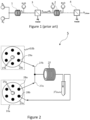
- FIG. 1 A schematic example of a multi-step process consisting in two telescoped reactions by two reactors indicated 1 and 2 with an aqueous quench (or work-up) by two liquid-liquid separators 3 and 4 after each reaction step is presented in Figure 1 .
- an experimental bench dedicated to it would be cluttered with five pumps, two reactors 1 and 2 and two step separators 3 and 4, to which must be added the tubes and connections between all these tools.
- the total cost of the set-up increases with the number of tools, hence with the number of steps.
- a subject of the invention is a setup for implementing a multi-step chemical process, comprising:
- the fluid manipulations are performed step-by-step by picking up and dispensing fluids through the two fluidic circulation system and the one or more fluidic interaction structures.
- the sequential nature of the process implies that at the end of each step, all fluids are motionless, such that that upstream and downstream notions are not relevant anymore.
- the constraints of a step are uncoupled from the constraints of the other steps. This is a major benefit in terms of feasibility for multi-step processes: essentially, flowrates at a given step do not depend on flowrates of the previous steps.
- the complexity of the process is then simply the inherent complexity of each step, rid of the complexity of intertwining steps. In practice, this allows varying parameters of a step without having to change the whole process, which highly facilitates process optimisation.
- the multi-step chemical process is one of photochemical, electrochemical and plasma-activated transformations.
- the setup could be used for inorganic synthesis as well as organic synthesis.
- the multi-step chemical process could be a non-medicinal process.
- the setup allows cleaning of the fluidic interaction structure(s) between two steps of the multi-step chemical process without manual operation.
- cross-contamination can be avoided, and the quantity of intermediate product collected can be maximized.
- a fluid notably an inert gas
- a fluid can be supplied by the first and/or second fluidic circulation systems to the fluidic interaction structure(s) to flush the fluid initially contained in the said fluidic interaction system(s).
- a fluid notably a liquid solvent
- a fluid can be supplied by the first and/or second fluidic circulation systems to the fluidic interaction structure(s) to dilute and flush residual species, hence cleaning internal parts of said fluidic interaction structure(s).
- the configuration of both the first and the second fluidic circulation system are different than in the first setting.
- only one of the first and second fluidic circulation system may have a different configuration than in the first setting.
- the first fluidic circulation system comprises a multi-way distribution valve configured to selectively connect fluidically two ways together, and a pump configured to control circulation of reagents in the multi-way distribution valve.
- the second fluidic circulation system comprises a multi-way distribution valve configured to selectively connect fluidically two ways together, and a pump configured to control circulation of reagents in the multi-way distribution valve.
- the first and second fluidic circulation systems each comprises a multi-way distribution valve configured to selectively connect fluidically two ways together, and a pump configured to control the circulation of reagents in the multi-way distribution valve.
- At least one of the first and the second fluidic circulation system comprises more than one multi-way distribution valve.
- it allows to increase the number of ways. Increasing the number of ways enables to connect a higher number of containers and/or fluidic interaction structures.
- the first and the second fluidic circulation system each comprises only one pump controlling all the multi-way distribution valves of said first or second fluidic circulation system.
- the connected ways of the multi-way distribution valve in the first setting are different from the connected ways in the second setting.
- the connected ways of at least one multi-way distribution valve of each of the first and second are different in the first setting and in the second setting.
- the intermediate product container is directly or indirectly connected to the outlet of the fluidic interaction structure supplied in first step.
- the setup comprises a redirection means configured to be fluidically connected to the outlet of the fluidic interaction structure and configured to be selectively connected to the inlet of the intermediate product container or of another container.
- the redirection means is a multi-way valve configured to redirect a fluid obtained at the outlet of the fluidic interaction structure supplied in first step towards selectively the intermediate product container collecting the product obtained from the interaction of reagents within the fluidic interaction structure or towards another container.
- Such redirection means allows in one selectable configuration to connect indirectly the intermediate product container to the outlet of the fluidic interaction structure supplied in first step.
- the fluidic interaction structure(s) are chosen among reaction structure, phase separation structure, or physico-chemical characterization structure.
- the fluidic reaction structure is chosen among thermally controlled reactor, a plasma reactor, an electrochemical reactor, a photochemical reactor, or a cartridge containing solid-phase reagents or catalysts.
- the phase separation structure is chosen among a liquid-liquid and/or gas-liquid separation structure.
- the physico-chemical characterization structure is chosen among a high-performance liquid chromatography structure, a gas chromatography structure, a mass spectrometry structure, a combined high performance liquid chromatography-mass spectrometry structure, a combined gas-chromatography-mass spectrometry structure, a nuclear magnetic resonance structure, an ultraviolet/visible spectrometer structure or an infrared spectrometer structure.
- the setup comprises two fluidic interaction structures comprising each inlets configured to be fluidically connected to both the first and second fluidic distribution systems, wherein the intermediate product container is configured to be fluidically connected to the outlet of one of the fluidic interaction structures and to one of the first and second fluidic circulation systems, wherein at least one of the fluidic circulation systems is configured to supply the product collected in the intermediate product container to the other fluidic interaction structure as a reagent for performing another step.
- the first and second fluidic circulation system are configured to be in another setting, different from the first and second setting to supply the fluidic interaction structure with the collected product.
- the setup may comprise two intermediate product containers configured to be fluidically connected each to the outlet of a different fluidic interaction structure and to one of the first and second fluidic circulation systems.
- the setup may comprise two redirection means each configured to be fluidically connected to the outlet of one different fluidic interaction structure and configured to be selectively connected to different container, in particular to the intermediate product container.
- each modular fluidic interaction structure when there is a plurality of fluidic interaction structures, they are all different. Only one copy of each modular fluidic interaction structure is needed since the setup allows to execute the steps of the multi-step chemical process one after the other: a single fluidic interaction structure can be used for as many steps needed.
- the two fluidic interaction structures are of different types among a reaction structure, a phase separation structure, or a physico-chemical characterization structure.
- the setup comprises a reaction structure and a phase separation structure.
- the setup may further comprise a temperature controller configured to control the temperature within the fluidic interaction structure.
- the fluidic interaction structure is a thermally controlled reactor including the temperature controller.
- the temperature controller is a separate device, for example a proportional-integral-derivative controller (PID), configured to control the temperature inside the fluidic interaction structure, and possibly other elements of the setup.
- PID proportional-integral-derivative controller
- the setup is configured to be connected to an electronic device, for instance a computer.
- the electronic device comprises a processor arrangement that is configured to execute computer readable instructions generated by a computer program product to command the setup to perform a method of fluid circulation and interaction in the setup.
- connection to the electronic device can be a physical connection, notably with wires, or a wireless connection.
- the setup is configured to receive commands.
- each multi-way distribution valve is configured to receive commands, for instance from an electronic device (e.g. a computer), for selecting the two ways that they fluidically connect together.
- an electronic device e.g. a computer
- the pumps are configured to receive commands, for instance from an electronic device (e.g. a computer), for activating or deactivating either synchronously, asynchronously with a controlled delay, or independently the pumps of the first and second circulation systems.
- an electronic device e.g. a computer
- each pump is configured to receive commands, in particular from the electronic device (e.g. a computer), for adjusting its flowrate, the volume of reagents supplied and/or the duration of supply.
- the electronic device e.g. a computer
- the temperature controller is configured to receive commands, in particular from the electronic device (e.g. a computer), for controlling the temperature within the fluidic interaction structure.
- the electronic device e.g. a computer
- the fluidic interaction structure is configured to receive commands, in particular from the electronic device (e.g. a computer), and to operate accordingly. This is the case, for instance, when a fluidic interaction structure is an electrochemical reactor, photo-chemical reactor or a plasma-activated reactor.
- the commands may comprise a voltage value or range target or an electrical current value or range target.
- the commands may comprise a light intensity value or range target or a light wavelength value or range target.
- the commands may comprise a voltage value or range target, or an electrical variable signal target, in particular a sinusoid, square, triangular, or any arbitrary signal predetermined by the processor.
- the redirection means is configured to receive commands, in particular from the electronic device (e.g. a computer), for connecting the outlet of the fluidic interaction structure to the inlet of the intermediate product container or of the other container.
- the electronic device e.g. a computer
- a subject of the invention is a computer program product comprising computer readable instructions that, when executed by a processor arrangement, causes the processor arrangement to perform a method of fluid circulation and interaction in a setup as described above.
- the method of fluid circulation and interaction comprises sending commands to the first or second fluidic circulation systems, to the temperature controller and/or to the fluidic interaction structure(s).
- the commands may comprise commands to be sent to:
- the disclosure relates to a computer-readable medium having stored thereon the computer program product as defined above.
- a subject of the invention is a system for implementing a multi-step chemical process, comprising a setup as described above and an electronic device, wherein the setup is configured to be connected to the electronic device, and the electronic device comprises a processor arrangement that is configured to execute the instructions of a computer program product as described above, to control the setup.
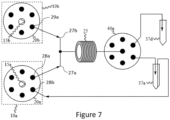
- FIG 2 shows a setup 5 according to first embodiments.
- the setup 5 is configured to perform steps of a method of fluid circulation and interaction 100, which will be described below in reference to Figure 3 .
- the setup 5 comprises a first and a second fluidic circulation system 10 a and 10 b , a fluidic interaction structure 25 and an intermediate product container 37 a .
- the fluidic interaction structure 25 comprises inlets configured to be fluidically connected to both the first and second fluidic distribution systems 10a, 10b.
- the first and second fluidic circulation systems 10a, 10b are configured to be in a first setting to supply the fluidic interaction structure 25 with reagents for performing a first step of the multi-step chemical process, and in a second setting, different from the first setting, to supply the fluidic interaction structure 25 with reagents for performing a second step of the multi-step chemical process.
- the intermediate product container is configured to be fluidically connected to the outlet of the fluidic interaction structure 25 and to one of the fluidic circulation systems 10a, 10b.
- the intermediate product container 37a is configured to collect a product obtained from the interaction between the reagents within the fluidic interaction structure 25 during the first step.
- At least one of the fluidic circulation systems 10a, 10b is configured to supply the product collected in the intermediate product container 37a to the fluidic interaction structure 25 as a reagent for performing the second step.
- At least one of the fluidic circulation systems 10a, 10b is configured to supply the product collected in the intermediate product container 37a to another fluidic interaction structure 30 as a reagent for performing another step.
- the first and a second fluidic circulation systems 10 a and 10 b each comprises a pump 15 a and 15 b and a multi-way distribution valve 20 a and 20 b .
- the multi-way distribution valve 20 a and 20 b are configured to selectively connect fluidically two ways together, and the pumps 15 a and 15 b are configured to control the circulation of reagents in the multi-way distribution valves 20a, 20b.
- the connected ways of at least one of the multi-way distribution valves 20a, 20b are different in the first setting are different from the connected ways and in the second setting.
- the fluidic interaction structure 25 is a reaction structure, a phase separation structure, or a physico-chemical characterization structure.
- the reaction structure is for instance a thermally controlled reactor, a plasma reactor, an electrochemical reactor, a photochemical reactor, or a cartridge containing solid-phase reagents or catalysts.
- the phase separation structure is for instance a liquid-liquid and/or gas-liquid separation structure.
- the physico-chemical characterization structure is for instance a high-performance liquid chromatography structure, a gas chromatography structure, a mass spectrometry structure or a combined high performance liquid chromatography-mass spectrometry structure or a combined gas chromatography-mass spectrometry structure, or a nuclear magnetic resonance structure or an ultraviolet/visible spectrometer structure or an infrared spectrometer structure.
- the fluidic interaction structure 25 is a reaction structure, in particular a thermally controlled reactor.
- the reactor 25 comprises a temperature controller (not illustrated) configured to control the temperature within the reactor 25.
- the fluidic interaction structure 25 comprises two inlets 27 a and 27 b that are connected respectively to ways 28 a and 29 a of the respective multi-way distribution valves 20 a and 20 b and an outlet connected to the intermediate product container 37 a .
- the intermediate product container 37 a is further connected to a way 28 b of the multi-way distribution valve 20 a of the first fluidic circulation systems 10 a .
- Some ways of the respective multi-way distribution valves 20 a and 20 b are connected to reagent reservoirs (not illustrated).
- Figure 3 shows steps of a method 100 for fluid circulation and interaction in a setup according to embodiments. In embodiments, those steps can be performed in the setup shown in any one of Figures 2 or 4 to 9 .
- a fluidic interaction structure 25 of the setup 5 is supplied with reagents for performing a first step of a multi-step chemical process.
- the supply is done through a first and a second fluidic circulation system 10a and 10b of the setup 5 that are configured in a first supply setting.
- the first and second fluidic circulation systems 10a, 10b each comprises a multi-way distribution valve 20a, 20b configured to selectively connect fluidically two ways together. As will be done in a later step (see step 106 below), one can switch from the first supply setting to another supply setting by connecting different ways of the multi-way distribution valves 20a and 20b than the ways connected in the first supply setting.
- step 102 includes receiving commands from an electronic device 500.
- the multi-way distribution valves 20 a and 20 b may receive commands to fluidically connect the ways 28 a and 29 a to other ways connected to reservoirs comprising some reagents to be supplied for the first step of a multi-step chemical process.
- the pumps 15 a and 15 b of the respective multi-way distribution valves 20 a and 20 b Upon activation of the pumps 15 a and 15 b of the respective multi-way distribution valves 20 a and 20 b , the reagents contained in the connected reservoirs are supplied to the fluidic interaction structure 25 for performing said first step.
- the pumps 15 a and 15 b may receive commands for activating either synchronously, asynchronously with a controlled delay, or independently.
- the pumps 15 a and 15 b may also receive commands for adjusting some parameters such as their flowrate, the volume of reagents supplied and/or the duration of supply, as well as commands for deactivating.
- the setup comprises a temperature controller, it receives, at step 102, commands to set the temperature of the fluidic interaction structure 25.
- the product obtained from the interaction between the reagents during the first step of the multi-step chemical process within the fluidic interaction structure 25 is collected in the product intermediate reservoir 37 a .
- the fluidic interaction structure 25 is supplied with reagents for performing a second step of the multi-step chemical process.
- the supply is done through the first and the second fluidic circulation system 10a and 10b that are configured in a second supply setting different from the first supply setting.
- the ways that are connected fluidically together in at least one of the multi-way distribution valves 20 a and 20 b are switched to be in the second setting and allow to perform the second step.
- At least one of the ways connected in at least one of the multi-way distribution valves 20 a and 20 b is different in the second setting from the ways that are connected in the first setting.
- the ways that are connected fluidically together in both multi-way distribution valves 20 a and 20b are switched to be in the second setting and allow to perform the second step. At least one of the ways connected in each of the multi-way distribution valves 20 a and 20b is different in the second setting from the ways that are connected in the first setting.
- the method further comprises switching from the first supply setting to the second supply setting by connecting different ways of the multi-way distribution valve than the ways connected in the first supply setting.
- the collected product can be provided as such to the same fluidic interaction structure 25 for performance of the second step of the multi-step chemical process.
- the product collected in the product intermediate reservoir 37 a is not provided as such to the fluidic interaction structure 25 but is further transformed during an intermediary step occurring in another fluidic interaction structure 30.
- the further transformed product is supplied to the fluidic interaction structure 25 as a reagent of the second step of the multi-step chemical process.
- step 106 includes receiving commands, in particular from an electronic device 500, as described below.
- the multi-way distribution valves 20 a and 20 b may receive commands to fluidically connect the ways of the multi-way distribution valve 20 a to a reagent reservoir comprising some reagents to be supplied for the second step of the multi-step chemical process and to the reagent of product intermediate reservoir 37 a comprising the collected product from the first step (in the first example) or to another product intermediate reservoir comprising the further transformed product (in the second example).
- step 104 upon activation of the pumps 15 a and 15 b of the respective multi-way distribution valves 20 a and 20 b , the reagents contained in the connected reservoirs are supplied to the fluidic interaction structure 25 for performing said second step.
- the pumps and eventually the temperature controller may receive commands to adjust some parameters.
- the product obtained from the interaction between the reagents during the second step of the multi-step chemical process within the fluidic interaction structure 25 may be collected in the product intermediate reservoir 37 a (or another connected reservoir) for further use in another step of the multi-step chemical process.
- the method and the setup according to the invention are particularly useful for chemical processes comprising lots of steps.
- the setup 5 allows cleaning of the fluidic interaction structure between two steps of the multi-step chemical process, especially without manual operation.
- cross-contamination can be avoided, and the quantity of intermediate product collected can be maximized.
- the first and/or second fluidic circulation systems may receive commands for supplying a fluid (in particular an inert gas) to the fluidic interaction structure to flush the fluid initially contained in the said fluidic interaction system.
- the first and/or second fluidic circulation systems may receive commands for supplying a fluid (in particular a liquid solvent) to the fluidic interaction structure to dilute and flush residual species, hence cleaning internal parts of said fluidic interaction structure.
- Embodiments are not limited to the description above.
- FIGS 4 to 8 show setups according to other embodiments. Only differences with the first embodiment described with reference to Figure 2 are detailed below.
- the second fluidic circulation system 10 b comprises a pump 15 b and two multi-way distribution valves 20 b and 20 c .
- the two multi-way distribution valves 20 b and 20 c are fluidically connected, a way 29b of the one having the pump 15 b connected thereon being fluidically connected to the central way 15c of the other such that the flow imposed by the pump 15b is transmitted from one to another.
- the fluidic interaction structure 25 may be fluidically connected by its inlet to the one having the pump 15 b connected thereon, as illustrated on Figure 4 , or to the other, as illustrated on Figure 5 .
- Such fluidic circulation system with more than one multi-way distribution valves and one pump allows to easily increase the quantity of accessible ways on the fluidic circulation system that can be controlled with only one pump than with only one multi-way distribution valve.
- the multi-way distribution valves 20 b and 20 c receive commands for fluidic connection of the way 29 a to another way connected to reagent reservoirs containing the reagents that must be inputted in the fluidic interaction structure structure 25 if necessary.
- the first fluidic circulation system 10 b may comprise a pump 15 a and two multi-way distribution valves.
- more multi-way distribution valves for each second fluidic circulation system is also possible.
- the setup 5 further comprises another fluidic interaction structure 30 having inlets 33a and 33b that are connected respectively to ways 28 c and 29 c of the respective multi-way distribution valves 20 a and 20 b .
- the fluidic interaction structure 30 is a phase separation structure. It has two outlets, one for each phase, connected each to an intermediate product container 37 b and 37 c .
- the container 37 b is connected to the multi-way valves 20 b through the way 29 d .
- the multi-way distribution valve 20 a and 20 b receive commands for fluidic connection of the way 28 b to the way 28 c of the multi-way distribution valve 20 a and the way 29 c to a way connected to a reagent reservoir containing a reagent.
- the products that are separated within the fluidic interaction structure 30 are received in the intermediate product container 37 b and 37 c .
- the multi-way distribution valve 20 a and 20 b receive commands for fluidic connection of the way 29 d to the way 29 a of the multi-way distribution valve 20 b and the way 28 a to a way connected to a reagent reservoir containing a reagent to input the product of reservoir 37 b and a further reagent to the fluidic interaction structure 25.
- the setup 5 comprises a redirection means 40 a that selectively connects the outlet of the fluidic interaction structure 25 to the intermediate product container 37 a or to another container 37 d .
- the container 37 d may be or not connected to the multi-way valves 20 a and 20 b .
- the redirection means 40 a is a multi-way valve. However, it could be any means allowing redirection of the product to at least two different container and that may be commanded by a processor of a computer.
- the redirection means receives commands for fluidic connection of the outlet of the fluidic interaction structure 25 to the intermediate product container 37 a or the other container 37 d .
- the sixth embodiment illustrated on Figure 8 is a variant of the fifth embodiment of Figure 7 , wherein the setup 5 further comprises another fluidic interaction structure 30 having inlets 33a and 33b that are connected respectively to ways 28 c and 29 c of the respective multi-way distribution valves 20 a and 20 b .
- the fluidic interaction structure 30 is a phase separation structure. It has two outlets, one for each phase, one being connected to an intermediate product container 37 c and the other being connected to a redirection means 40 b that selectively connects the outlet of the fluidic interaction structure 30 to two containers 37 b and 37 e .
- the redirection means 40 b is a multi-way valve.
- the container 37 e is connected to the multi-way valves 20 b through the way 29 d .
- the multi-way distribution valve 20 a and 20 b receive commands for fluidic connection of the way 28 b to the way 28 c of the multi-way distribution valve 20 a and the way 29 c to a way connected to a reagent reservoir containing a reagent.
- the redirection means 40 b receives commands for fluidically connecting the outlet of the fluidic interaction structure 30 to the intermediate product containers 37 b or 37 e .
- the multi-way distribution valve 20 a and 20 b receive commands for fluidic connection of the way 29 d to the way 29 a of the multi-way distribution valve 20 b and the way 28 a to a way connected to a reagent reservoir containing a reagent to input the product of reservoir 37 b and a further reagent to the fluidic interaction structure 25.
- Complex multi-step chemical processes can be performed using the set-up by taking advantage of the intermediate product containers 37a-d and of the multiplicity of ways on the multi-way distribution valves 20a and 20b.
- the following example is an illustration of a possible multi-step chemical process that can be performed within the setup.
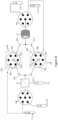
- the setup is based on two fluidic circulation systems 10 a and 10 b comprising each a micro-dispenser equipped with a 12-position distribution valve 20 a and 20 b and a pump 15 a and 15 b .
- the setup 5 further comprises a heated reactor 25 that has inlets 27 a and 27 b fluidically connected to respective ways 11 of the 12-position distribution valves 20 a and 20 b and outlet connected to an intermediate product reservoir 37 a .
- the setup 5 further comprises a phase separator 30.
- the phase separator 30 has inlets 33 a and 33 b fluidically connected to respective ways 12 of the 12-position distribution valves 20 a and 20 b and outlets for each phase connected to the central port of a 8-position distribution valves 40b and 40c to redirect the flow towards the adequate container.
- One of the ways of valve 40c is connected to an intermediate product reservoir 37b that is itself connected to a way of the valve 20a.
- the setup is connected to a computer.
- the computer is configured to execute computer readable instructions generated by a computer program to command the different elements of the setup as described previously to perform a method for fluid circulation and interaction.
- An example of method is illustrated on Figure 10 and detailed below.
- the first step consists in the liquid-liquid extraction of the amine using 1 mL of an acidic aqueous step (HCl 1 M).
- an acidic aqueous step HCl 1 M
- the alkene is recovered as is, while the amine is in protonated form in the aqueous step.
- the ammonium ion is deprotonated using 1 mL of an alkaline brine (NaOH 2 M + NaCl 120 g/L).
- the amine is recovered by liquid-liquid extraction using 2 mL of an organic solvent (e.g., ethyl acetate) followed by step separation.
- an organic solvent e.g., ethyl acetate
- the fluidic interaction structure can be different than a heated reactor or than a liquid-liquid separator and may be as mentioned above. Additional fluidic interaction structure, redirection means, container and/or intermediate reservoir container may be added.
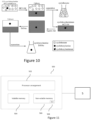
- Figure 11 shows a system for implementing a multi-step chemical process according to embodiments.
- the system comprises a setup 5 as previously described, which is connected physically or through a wireless connection to an electronic device 500, for instance a computer.
- the electronic device 500 comprises a processor configured to execute computer readable instructions of a computer program and to send commands to elements of the setup 5 to cause the setup performs steps of a method of fluid circulation and interaction 100, described in relation with Figure 3 .
- the electronic device 500 comprises one or more processors 502.
- the one or more processors control operation of other components of the electronic device 500.
- the one or more processors 502 may, for example, comprise a general-purpose processor.
- the one or more processors 502 may be a single core device or a multiple core device.
- the one or more processors 502 may comprise a central processing unit (CPU) and/or a graphical processing unit (GPU).
- the one or more processors 502 may comprise specialized processing hardware, for instance a RISC processor or programmable hardware with embedded firmware. Multiple processors may be included.
- the electronic device comprises a working or volatile memory 504.
- the one or more processors may access the volatile memory 504 to process data and may control the storage of data in memory.
- the volatile memory 504 may comprise RAM of any type, for example Static RAM (SRAM), Dynamic RAM (DRAM), or it may comprise Flash memory, such as an SD-Card.
- the electronic device comprises a non-volatile memory 506.
- the non-volatile memory 506 stores a set of operation instructions 508 for controlling the operation of the processors 502 in the form of computer readable instructions.
- the non-volatile memory 506 may be a memory of any kind such as a Read Only Memory (ROM), a Flash memory or a magnetic drive memory.
- the one or more processors 502 are configured to execute operating instructions 508 to cause the setup to perform the method of fluid circulation and interaction 100.
- the operating instructions 508 may comprise code (i.e. drivers) relating to the hardware components of the system/apparatus 500, as well as code relating to the basic operation of the system/apparatus 500.
- the one or more processors 502 execute one or more instructions of the operating instructions 508, which are stored permanently or semi-permanently in the non-volatile memory 506, using the volatile memory 504 to temporarily store data generated during execution of said operating instructions 508.
- Implementations of the methods described below may be realized as in digital electronic circuitry, integrated circuitry, specially designed ASICs (application specific integrated circuits), computer hardware, firmware, software, and/or combinations thereof.
- ASICs application specific integrated circuits
- These may include computer program products (such as software stored on e.g. magnetic discs, optical disks, memory, Programmable Logic Devices) comprising computer readable instructions that, when executed by a computer, such as that described in relation to Figure 11 , cause the computer to perform one or more of the methods described herein.
- Systems according to the invention may include a setup as shown in any of Figures 4 to 9 .
Landscapes
- Chemical & Material Sciences (AREA)
- Organic Chemistry (AREA)
- Chemical Kinetics & Catalysis (AREA)
- Physical Or Chemical Processes And Apparatus (AREA)
Priority Applications (2)
| Application Number | Priority Date | Filing Date | Title |
|---|---|---|---|
| EP23305769.4A EP4464409A1 (de) | 2023-05-15 | 2023-05-15 | Aufbau für die implementierung eines mehrstufigen chemischen prozesses |
| US18/665,121 US20240382923A1 (en) | 2023-05-15 | 2024-05-15 | Setup for implementing a multi-step chemical process |
Applications Claiming Priority (1)
| Application Number | Priority Date | Filing Date | Title |
|---|---|---|---|
| EP23305769.4A EP4464409A1 (de) | 2023-05-15 | 2023-05-15 | Aufbau für die implementierung eines mehrstufigen chemischen prozesses |
Publications (1)
| Publication Number | Publication Date |
|---|---|
| EP4464409A1 true EP4464409A1 (de) | 2024-11-20 |
Family
ID=86657121
Family Applications (1)
| Application Number | Title | Priority Date | Filing Date |
|---|---|---|---|
| EP23305769.4A Pending EP4464409A1 (de) | 2023-05-15 | 2023-05-15 | Aufbau für die implementierung eines mehrstufigen chemischen prozesses |
Country Status (2)
| Country | Link |
|---|---|
| US (1) | US20240382923A1 (de) |
| EP (1) | EP4464409A1 (de) |
Citations (4)
| Publication number | Priority date | Publication date | Assignee | Title |
|---|---|---|---|---|
| WO2001066245A2 (en) * | 2000-03-07 | 2001-09-13 | Symyx Technologies, Inc. | Parallel flow process optimization reactor |
| WO2006071470A2 (en) * | 2004-12-03 | 2006-07-06 | California Institute Of Technology | Microfluidic devices with chemical reaction circuits |
| US20120076692A1 (en) * | 2010-09-23 | 2012-03-29 | Siemens Medical Solutions Usa, Inc. | Modular Component Synthesis Unit |
| US20180311638A1 (en) * | 2017-04-26 | 2018-11-01 | Massachusetts Institute Of Technology | Reconfigurable chemical synthesis systems and methods |
-
2023
- 2023-05-15 EP EP23305769.4A patent/EP4464409A1/de active Pending
-
2024
- 2024-05-15 US US18/665,121 patent/US20240382923A1/en active Pending
Patent Citations (4)
| Publication number | Priority date | Publication date | Assignee | Title |
|---|---|---|---|---|
| WO2001066245A2 (en) * | 2000-03-07 | 2001-09-13 | Symyx Technologies, Inc. | Parallel flow process optimization reactor |
| WO2006071470A2 (en) * | 2004-12-03 | 2006-07-06 | California Institute Of Technology | Microfluidic devices with chemical reaction circuits |
| US20120076692A1 (en) * | 2010-09-23 | 2012-03-29 | Siemens Medical Solutions Usa, Inc. | Modular Component Synthesis Unit |
| US20180311638A1 (en) * | 2017-04-26 | 2018-11-01 | Massachusetts Institute Of Technology | Reconfigurable chemical synthesis systems and methods |
Also Published As
| Publication number | Publication date |
|---|---|
| US20240382923A1 (en) | 2024-11-21 |
Similar Documents
| Publication | Publication Date | Title |
|---|---|---|
| Collins et al. | Fully automated chemical synthesis: toward the universal synthesizer | |
| Jensen | Flow chemistry—microreaction technology comes of age | |
| Weeranoppanant et al. | In-line purification: A key component to facilitate drug synthesis and process development in medicinal chemistry | |
| Tula et al. | Computer–aided process intensification: Challenges, trends and opportunities | |
| US5635072A (en) | Simulated moving bed adsorptive separation process | |
| Chhatre et al. | Microscale methods for high‐throughput chromatography development in the pharmaceutical industry | |
| Torabinia et al. | Electrowetting-on-dielectric (EWOD) digital microfluidic device for in-line workup in organic reactions: A critical step in the drug discovery work cycle | |
| Lim et al. | Development of a robotic system for automatic organic chemistry synthesis | |
| EP4464409A1 (de) | Aufbau für die implementierung eines mehrstufigen chemischen prozesses | |
| EP4464408A1 (de) | Verfahren der flüssigkeitszirkulation und -interaktion in einem aufbau zur implementierung eines mehrstufigen chemischen prozesses | |
| Farrant | Automation of synthesis in medicinal chemistry: Progress and challenges | |
| CN111757780A (zh) | 微流体装置 | |
| US8935847B2 (en) | Modular reactive distillation emulation elements integrated with instrumentation, control, and simulation algorithms | |
| Arveiler et al. | An innovative sequential flow platform for automated multi-step chemical processes–proof of concept with the separation of amine/alkene model mixtures | |
| DE60126023T2 (de) | Sequentielles Reaktionsystem | |
| CN113029961A (zh) | 一种高通量液滴微反应器检测系统及方法 | |
| WO2017121724A1 (en) | Apparatus and process for the automated chemical synthesis of compounds | |
| Skiborowski et al. | Hybrid separation processes | |
| EP4590423A1 (de) | Verfahren und plattform für chemische synthese | |
| Lier et al. | Modular process engineering: Development of apparatuses for transformable production systems | |
| Power | The continuous extraction of carboxylic acids and amines | |
| Chen et al. | Continuous‐Flow Multistep Synthesis of Active Pharmaceutical Ingredients | |
| Fekete et al. | Technology overview/overview of the devices | |
| Bart et al. | Reactive processes for recovery of heavy metals in miniplants | |
| Guidi | An automated platform for multistep synthesis based on a new paradigm for combining flow modules |
Legal Events
| Date | Code | Title | Description |
|---|---|---|---|
| PUAI | Public reference made under article 153(3) epc to a published international application that has entered the european phase |
Free format text: ORIGINAL CODE: 0009012 |
|
| STAA | Information on the status of an ep patent application or granted ep patent |
Free format text: STATUS: THE APPLICATION HAS BEEN PUBLISHED |
|
| AK | Designated contracting states |
Kind code of ref document: A1 Designated state(s): AL AT BE BG CH CY CZ DE DK EE ES FI FR GB GR HR HU IE IS IT LI LT LU LV MC ME MK MT NL NO PL PT RO RS SE SI SK SM TR |
|
| STAA | Information on the status of an ep patent application or granted ep patent |
Free format text: STATUS: REQUEST FOR EXAMINATION WAS MADE |
|
| 17P | Request for examination filed |
Effective date: 20241210 |
|
| STAA | Information on the status of an ep patent application or granted ep patent |
Free format text: STATUS: EXAMINATION IS IN PROGRESS |
|
| 17Q | First examination report despatched |
Effective date: 20251118 |