EP4464259A2 - Ganznahtanker mit mehreren dichten - Google Patents
Ganznahtanker mit mehreren dichten Download PDFInfo
- Publication number
- EP4464259A2 EP4464259A2 EP24204631.6A EP24204631A EP4464259A2 EP 4464259 A2 EP4464259 A2 EP 4464259A2 EP 24204631 A EP24204631 A EP 24204631A EP 4464259 A2 EP4464259 A2 EP 4464259A2
- Authority
- EP
- European Patent Office
- Prior art keywords
- fibrous construct
- suture anchor
- monofilament
- density
- suture
- Prior art date
- Legal status (The legal status is an assumption and is not a legal conclusion. Google has not performed a legal analysis and makes no representation as to the accuracy of the status listed.)
- Pending
Links
Images




Classifications
-
- A—HUMAN NECESSITIES
- A61—MEDICAL OR VETERINARY SCIENCE; HYGIENE
- A61B—DIAGNOSIS; SURGERY; IDENTIFICATION
- A61B17/00—Surgical instruments, devices or methods
- A61B17/04—Surgical instruments, devices or methods for suturing wounds; Holders or packages for needles or suture materials
- A61B17/0401—Suture anchors, buttons or pledgets, i.e. means for attaching sutures to bone, cartilage or soft tissue; Instruments for applying or removing suture anchors
-
- A—HUMAN NECESSITIES
- A61—MEDICAL OR VETERINARY SCIENCE; HYGIENE
- A61B—DIAGNOSIS; SURGERY; IDENTIFICATION
- A61B17/00—Surgical instruments, devices or methods
- A61B2017/00831—Material properties
-
- A—HUMAN NECESSITIES
- A61—MEDICAL OR VETERINARY SCIENCE; HYGIENE
- A61B—DIAGNOSIS; SURGERY; IDENTIFICATION
- A61B17/00—Surgical instruments, devices or methods
- A61B2017/00831—Material properties
- A61B2017/00858—Material properties high friction or non-slip
-
- A—HUMAN NECESSITIES
- A61—MEDICAL OR VETERINARY SCIENCE; HYGIENE
- A61B—DIAGNOSIS; SURGERY; IDENTIFICATION
- A61B17/00—Surgical instruments, devices or methods
- A61B17/04—Surgical instruments, devices or methods for suturing wounds; Holders or packages for needles or suture materials
- A61B17/0401—Suture anchors, buttons or pledgets, i.e. means for attaching sutures to bone, cartilage or soft tissue; Instruments for applying or removing suture anchors
- A61B2017/0406—Pledgets
-
- A—HUMAN NECESSITIES
- A61—MEDICAL OR VETERINARY SCIENCE; HYGIENE
- A61B—DIAGNOSIS; SURGERY; IDENTIFICATION
- A61B17/00—Surgical instruments, devices or methods
- A61B17/04—Surgical instruments, devices or methods for suturing wounds; Holders or packages for needles or suture materials
- A61B17/0401—Suture anchors, buttons or pledgets, i.e. means for attaching sutures to bone, cartilage or soft tissue; Instruments for applying or removing suture anchors
- A61B2017/0409—Instruments for applying suture anchors
-
- A—HUMAN NECESSITIES
- A61—MEDICAL OR VETERINARY SCIENCE; HYGIENE
- A61B—DIAGNOSIS; SURGERY; IDENTIFICATION
- A61B17/00—Surgical instruments, devices or methods
- A61B17/04—Surgical instruments, devices or methods for suturing wounds; Holders or packages for needles or suture materials
- A61B17/0401—Suture anchors, buttons or pledgets, i.e. means for attaching sutures to bone, cartilage or soft tissue; Instruments for applying or removing suture anchors
- A61B2017/0427—Suture anchors, buttons or pledgets, i.e. means for attaching sutures to bone, cartilage or soft tissue; Instruments for applying or removing suture anchors having anchoring barbs or pins extending outwardly from the anchor body
-
- A—HUMAN NECESSITIES
- A61—MEDICAL OR VETERINARY SCIENCE; HYGIENE
- A61B—DIAGNOSIS; SURGERY; IDENTIFICATION
- A61B17/00—Surgical instruments, devices or methods
- A61B17/04—Surgical instruments, devices or methods for suturing wounds; Holders or packages for needles or suture materials
- A61B17/0401—Suture anchors, buttons or pledgets, i.e. means for attaching sutures to bone, cartilage or soft tissue; Instruments for applying or removing suture anchors
- A61B2017/0464—Suture anchors, buttons or pledgets, i.e. means for attaching sutures to bone, cartilage or soft tissue; Instruments for applying or removing suture anchors for soft tissue
-
- A—HUMAN NECESSITIES
- A61—MEDICAL OR VETERINARY SCIENCE; HYGIENE
- A61B—DIAGNOSIS; SURGERY; IDENTIFICATION
- A61B17/00—Surgical instruments, devices or methods
- A61B17/04—Surgical instruments, devices or methods for suturing wounds; Holders or packages for needles or suture materials
- A61B2017/0496—Surgical instruments, devices or methods for suturing wounds; Holders or packages for needles or suture materials for tensioning sutures
-
- A—HUMAN NECESSITIES
- A61—MEDICAL OR VETERINARY SCIENCE; HYGIENE
- A61B—DIAGNOSIS; SURGERY; IDENTIFICATION
- A61B17/00—Surgical instruments, devices or methods
- A61B17/04—Surgical instruments, devices or methods for suturing wounds; Holders or packages for needles or suture materials
- A61B17/06—Needles ; Sutures; Needle-suture combinations; Holders or packages for needles or suture materials
- A61B17/06166—Sutures
- A61B2017/06176—Sutures with protrusions, e.g. barbs
Definitions
- the present disclosure is directed generally to an all-suture anchor and, more particularly, to an all-suture anchor composed of materials of varying densities.
- FIG. 1 shows an example of a conventional all-suture anchor 1.
- the all-suture anchor 1 includes a braid 2 composed of a single material with a passing suture 3 woven therethrough for deployment.
- This homogenous all-suture anchor structure is relatively smooth and soft in nature.
- current all-suture anchors rely on expansion that is controlled by the density of the bone in addition to the mechanics of the anchor when it is deployed.
- the present invention is directed to an all-suture anchor composed of a material(s) with a density (or densities) that is optimal for generating bone compression and increasing interference fixation post-installation.
- the all-suture anchor is defined in Claim 1. Further advantageous features are set out in the dependent claims.
- the all-suture anchor includes a fibrous construct which is movable between a pre-deployment configuration and a deployed configuration.
- the fibrous construct has a first density.
- the all-suture anchor also includes a monofilament woven through the fibrous construct.
- the monofilament has a second density, which is different than the first density.
- the all-suture anchor of the present invention can be deployed by a method including the steps of: (i) providing an all-suture anchor having a fibrous construct movable between a pre-deployment configuration and a deployed configuration, the fibrous construct having a first density and a monofilament woven therethrough, the monofilament having a second density which is different than the first density; (ii) weaving a passing suture through the all-suture anchor; (iii) loading the all-suture anchor in a pre-deployment configuration onto a driver; and (iv) driving the all-suture anchor into a bone hole using the driver.
- the monofilament is preferably fixed with respect to the fibrous construct after it is woven through the fibrous construct, as opposed to a passing suture that can move through the fibrous construct (at least in the pre-deployment configuration).
- Suture material or sutures can include monofilament or multi-filament suture as well as any other metallic or non-metallic filamentary or wire-like material suitable for performing the function of a suture.
- This material can include both bio absorbable and non-absorbable materials.
- Suture anchors can include soft suture anchors and rigid suture anchors.
- Soft suture anchors are formed from filaments of suture material which are retained within pre-formed bone holes by being deformable to increase their diameter to a size greater than that of the bone hole, to thereby reside within the cancellous bone and under the bone cortex.
- One such suture anchor is disclosed in U.S. Patent No. 9826971 assigned to the assignee hereof and incorporated by reference herein in its entirety. Since soft anchors are commonly made entirely of suture materials, they are sometimes called "all-suture" anchors, and generally include a fibrous construct anchor body portion (or fibrous, braided or woven fabric-type structure such as a flexible web, as described in U.S. Pat. No. 9173652 ) and a suture or filament portion. Methods and devices for inserting/deploying such all-suture anchors are known, examples of which are disclosed in U.S. Pat. No. 9173652 .
- non-soft,” “hard” or “rigid” suture anchors generally include a “hard” anchor body portion (that may or may not include inner and outer members) and a suture/filament portion.
- the anchor body of such suture anchors may be formed of a biocompatible and/or bio absorbable material. These materials may be of such composition that they are reabsorbed by the body, e.g., during the healing process of the bone.
- Exemplary materials that are suitable for use in the inner and outer members include, but are not limited to, polyetheretherketone (“PEEK”), polylactic acid/beta-tricalcium phosphate (“PLA/Beta-TCP”) composites, ultra-high molecular weight polyethylene (“UHMWPE”), as well as other metallic, non-metallic, and polymeric materials.
- PEEK polyetheretherketone
- PLA/Beta-TCP polylactic acid/beta-tricalcium phosphate
- UHMWPE ultra-high molecular weight polyethylene
- FIG. 2 shows a top perspective view schematic representation of an all-suture anchor 10, according to an embodiment.
- the all-suture anchor 10 comprises a fibrous construct 12 and a monofilament 14 woven therethrough.
- the fibrous construct 12 can be any fibrous, braided (e.g., uniform or non-uniform braid) or woven fabric-type structure having a first density.
- the fibrous construct 12 is a flat length of suture having and extending between a first end 16 and a second end 18.
- the fibrous construct 12 can also be a tube braid or cored suture (as should be understood by a person of ordinary skill i the art in conjunction with a review of this disclosure).
- the fibrous construct 12 is movable between a pre-deployment configuration, as shown in FIG. 2 , and a deployed configuration, as shown in FIG. 7 .
- the fibrous construct 12 may be composed of any traditional suture material, such as polyethylene (e.g., UHMWPE).
- the fibrous construct 12 can be, for example, 1.5 - 2.5 mm in width, .350 - .399 mm in depth, and at least 6 inches long. In an embodiment, the fibrous construct 12 has, for example, a width of 2 mm and a depth of .37 mm.
- the fibrous construct 12 can also have, for example, an average USP knot pull strength ⁇ 30.00 LBF, with no individual value ⁇ 26.00 LBF.
- the monofilament 14 has a second density which is different (higher or lower) from the first density (i.e., density of the fibrous construct 12).
- the monofilament 14 can be, for example, USP #2/0 suture and is at least 6 inches in length.
- the monofilament 14 can be composed of any traditional suture material, such as nylon, for example.
- the monofilament 14 can have, for example, an average USP knot pull strength ⁇ 4.0 LBF, with no individual value ⁇ 3.8 LBF.
- the monofilament 14 may be segmented suture of multiple densities (e.g., suture with both a second density, a third density, a fourth density ...), or suture joined with a length of one or more sutures having contrasting (e.g., third, fourth ...) densities.
- the monofilament 14 is woven through the fibrous construct 12 from the first end 16 to the second end 18 (although, it does not have to stretch all the way to both ends, it can exist as it is woven through between both ends). As shown in FIG. 2 , the monofilament 14 can be woven through the fibrous construct 12 using a needle 20.
- the monofilament 14 is threaded through the needle 20 and the needle 20 is used to pull the monofilament 14 through the fibrous construct 12 to create a "baseball" stitch, for example, as shown in FIG. 3 .
- the monofilament 14, for example is woven through the fibrous construct 12 using a whip stitching technique to achieve the baseball stitch configuration.
- the fibrous construct 12 is tensioned and the monofilament 14, formed in a continuous loop, is threaded onto the needle 20.
- the loop of monofilament 14 is placed around the fibrous construct 12 such that the fibrous construct 12 is extending through the loop of monofilament 14.
- the needle 20 is used to puncture a first surface 22 of the fibrous construct 12 along a central longitudinal y - y axis extending through the fibrous construct 12 from the first end 16 to the second end 18.
- the needle 20 is pulled through the fibrous construct 12 to a second surface (not shown) and the monofilament 14 is pulled tight such that the monofilament 14 is snug on the first surface 22 of the fibrous construct 12.
- the first stitch 24 includes a first portion 26 of monofilament 14 extending from a first side 28 of the fibrous construct 12 to a first central passing location 30 (meaning a location near or along the central longitudinal y - y axis) and a second portion 32 of monofilament 14 extending from a second side 34 of the fibrous construct 12 to the first central passing location 30, as shown in FIG. 3 .
- the loop of monofilament 14 extends from the bottom surface (not shown) of the fibrous construct 12.
- the loop of monofilament 14 is pulled back around the fibrous construct 12. Stated differently, the fibrous construct 12 is pulled or extended through the loop of monofilament 14 again.
- the needle 20 is passed through a subsequent second central passing location 38, spaced from the first central passing location 30.
- the monofilament 14 is pulled tight, securing a second stitch 36.
- the method is repeated to place as many stitches 36 as desired along the length of the fibrous construct 12 to create added texture or irregularities in the all-suture anchor 10.
- the fibrous construct 12 Preferably, there are 6 - 8 central passing locations along the length of the fibrous construct 12 and at least 6 inches of the fibrous construct 12 contains woven monofilament 14. In an embodiment, the first and second ends 16, 18 of the fibrous construct 12 are left unstitched with monofilament 14.
- the stitch design does not have to look like what is shown in FIG. 3 .
- a portion of the monofilament 14 extend from the outside surface of the fibrous construct 12 in order for an outside surface of the portion of the monofilament 14 to be able to grip to the surface of a bone hole upon deployment of the anchor.
- multiple monofilaments 14 of the same or different material with the same or different densities can be woven through a fibrous construct 12, for added bone surface grip capability benefit.
- the all-suture anchor 10 comprises additional features for creating irregularity within the bone surface when the all-suture anchor 10 is deployed.
- the fibrous construct 12 may comprise rigid, mechanical barbs (or other similar protrusions, as should be understood by a person of ordinary skill in the art in conjunction with a review of this disclosure) on an exterior surface of the fibrous construct 12.
- the monofilament 14 (or fibrous construct 12) may comprise added texture or rigidity along its length (which can, but does not have to be, composed of a material of yet another different density), which creates greater interference for fixation, as shown in FIGs. 5-6 .
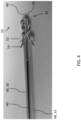
- FIGs. 4-6 there are shown various views schematic representations of the all-suture anchor 10 loaded on a driver 40.
- the driver 40 shown in FIG. 4 can be any standard anchor driver.
- the driver 40 has a pronged end 42 with spaced first and second arms 44, 46 ( FIG. 5 ).
- a passing suture 48 is threaded through the all-suture anchor 10 in the pre-deployment configuration, as shown in FIGs. 4-6 .
- a first end 50 of the passing suture 48 extends from the first end 16 of the all-suture anchor 10 and a second end 52 of the passing suture 48 extends from the second end 18 of the all-suture anchor 10.
- the all-suture anchor 10 With the passing suture 48 extending through the all-suture anchor, the all-suture anchor 10 can be loaded onto the driver 40.
- the all-suture anchor 10 is placed between the first and second arms 44, 46 of the pronged end 42.
- the all-suture anchor 10 is placed in the pronged end 42 such that a portion of the fibrous construct 12 between the first and second ends 16, 18 is placed between the arms 44, 46, and the first and second ends 50, 52 of the passing suture 48 extend on opposing sides of the driver 40, as shown in FIGs. 4-6 .
- an approximately central portion 54 of the fibrous construct 12 is placed between the arms 44, 46.
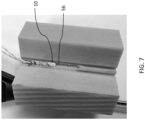
- FIG. 7 there is shown a side sectioned view schematic representation of an all-suture anchor 10 deployed in a bone hole 56, according to an embodiment.
- the all-suture anchor 10 in the pre-deployment configuration loaded on the driver 40, as shown in FIGs. 4-6 , the pronged end 42 of the driver 40 is pushed into the bone hole 56.
- the driver 40 can be removed.
- the passing suture 48 is tensioned to deploy the all-suture anchor 10.
- the contrasting density (i.e., irregularities) of the fibrous construct 12 and the monofilament 14 woven therethrough generates bone compression and additional interference fixation.
- the all-suture anchor 10 has additional purchase in hard and soft bone as compared to all-suture anchors composed of a single material (or multiple materials) of one density.
- the all-suture anchor 10 has more power in hard bone, such as in a hip, as compared to conventional all-suture anchors (of uniform density).
- the passing suture 48 can be used to secure a soft tissue in a desired position relative to the bone hole 56.
- the all suture anchor 10 can be deployed such that the thickness of the fibrous construct 12 is greater in the deployed state as compared to the thickness of the fibrous construct 12 in an un-deployed state.
- a method or device that "comprises”, “has”, “includes” or “contains” one or more steps or elements possesses those one or more features, but is not limited to possessing only those one or more features.
- a device or structure that is configured in a certain way is configured in at least that way, but may also be configured in ways that are not listed.
- an all-suture anchor comprises a fibrous construct movable between a pre-deployment configuration and a deployed configuration, the fibrous construct having a first density; and a monofilament woven through the fibrous construct, the monofilament having a second density, which is different than the first density.
- the all-suture anchor may further comprise a central longitudinal axis extending from a first end of the fibrous construct to a second end of the fibrous construct, wherein the monofilament is passed through the fibrous construct along the central longitudinal axis.
- the monofilament may pass through the fibrous construct in at least a first passing location and a second passing location.
- a first portion of the monofilament may extend around a first side of the fibrous construct between the first passing location and a second passing location and a second portion of the monofilament may extend around a second side of the fibrous construct between the first passing location and a second passing location.
- the all-suture anchor may further comprise a driver, wherein the fibrous construct is loaded on the driver, and the driver may comprise a pronged end having a first arm and a second arm, the fibrous construct being between the first arm and the second arm.
- the all-suture anchor may further comprise one or more barbs on an exterior surface of the fibrous construct.
- the fibrous construct may be a flat suture braid and/or may be composed of ultra-high molecular weight polyethylene ("UHMWPE").
- UHMWPE ultra-high molecular weight polyethylene
- the monofilament may comprise a segment of a third density.
- the all-suture anchor may further comprise a second monofilament woven through the fibrous construct
- a method for deploying an all-suture anchor comprises the steps of: providing an all-suture anchor having a fibrous construct movable between a pre-deployment configuration and a deployed configuration, the fibrous construct having a first density, and a monofilament woven through the fibrous construct, the monofilament having a second density, which is different than the first density; weaving a passing suture through the all-suture anchor; loading the all-suture anchor in a pre-deployment configuration onto a driver; and driving the all-suture anchor into a bone hole using the driver.
- the method may further comprise the step of removing the driver from the bone hole and /or the step of tensioning the all-suture anchor with the passing suture, where the step of tensioning the all-suture anchor with the passing suture may cause the fibrous construct to move from a pre-deployment configuration to a deployed configuration.
- the method may further comprise the step of removing the passing suture from the all-suture anchor.
- the fibrous construct may comprise a central longitudinal axis extending from a first end of the fibrous construct to a second end of the fibrous construct, wherein the monofilament is passed through the fibrous construct along the central longitudinal axis.
- the monofilament may pass through the fibrous construct in at least a first passing location and a second passing location.
- a first portion of the monofilament may extend around a first side of the fibrous construct between the first passing location and a second passing location and a second portion of the monofilament may extend around a second side of the fibrous construct between the first passing location and a second passing location.
- the thickness of the fibrous construct may be greater in the deployed configuration as compared to the thickness of the fibrous construct in a pre-deployment configuration.
Landscapes
- Health & Medical Sciences (AREA)
- Surgery (AREA)
- Life Sciences & Earth Sciences (AREA)
- Medical Informatics (AREA)
- Animal Behavior & Ethology (AREA)
- Engineering & Computer Science (AREA)
- Biomedical Technology (AREA)
- Heart & Thoracic Surgery (AREA)
- Veterinary Medicine (AREA)
- Molecular Biology (AREA)
- Nuclear Medicine, Radiotherapy & Molecular Imaging (AREA)
- General Health & Medical Sciences (AREA)
- Public Health (AREA)
- Rheumatology (AREA)
- Prostheses (AREA)
- Surgical Instruments (AREA)
- Looms (AREA)
Applications Claiming Priority (3)
| Application Number | Priority Date | Filing Date | Title |
|---|---|---|---|
| US201762598201P | 2017-12-13 | 2017-12-13 | |
| PCT/US2018/065375 WO2019118681A1 (en) | 2017-12-13 | 2018-12-13 | Multi-density all suture anchor |
| EP18836560.5A EP3723623B1 (de) | 2017-12-13 | 2018-12-13 | Multidichte-nahtfadenanker |
Related Parent Applications (1)
| Application Number | Title | Priority Date | Filing Date |
|---|---|---|---|
| EP18836560.5A Division EP3723623B1 (de) | 2017-12-13 | 2018-12-13 | Multidichte-nahtfadenanker |
Publications (2)
| Publication Number | Publication Date |
|---|---|
| EP4464259A2 true EP4464259A2 (de) | 2024-11-20 |
| EP4464259A3 EP4464259A3 (de) | 2025-01-01 |
Family
ID=65036891
Family Applications (2)
| Application Number | Title | Priority Date | Filing Date |
|---|---|---|---|
| EP24204631.6A Pending EP4464259A3 (de) | 2017-12-13 | 2018-12-13 | Ganznahtanker mit mehreren dichten |
| EP18836560.5A Active EP3723623B1 (de) | 2017-12-13 | 2018-12-13 | Multidichte-nahtfadenanker |
Family Applications After (1)
| Application Number | Title | Priority Date | Filing Date |
|---|---|---|---|
| EP18836560.5A Active EP3723623B1 (de) | 2017-12-13 | 2018-12-13 | Multidichte-nahtfadenanker |
Country Status (9)
| Country | Link |
|---|---|
| US (1) | US11627955B2 (de) |
| EP (2) | EP4464259A3 (de) |
| JP (2) | JP7034289B2 (de) |
| KR (3) | KR102904950B1 (de) |
| CN (2) | CN111465357B (de) |
| AU (2) | AU2018384805B2 (de) |
| CA (1) | CA3082842C (de) |
| ES (1) | ES3005861T3 (de) |
| WO (1) | WO2019118681A1 (de) |
Families Citing this family (3)
| Publication number | Priority date | Publication date | Assignee | Title |
|---|---|---|---|---|
| CA3082842C (en) * | 2017-12-13 | 2023-09-26 | Conmed Corporation | Multi-density all suture anchor |
| CN111588428B (zh) * | 2020-04-07 | 2022-01-25 | 上海市第六人民医院 | 一种带线缝合针 |
| KR20250025843A (ko) | 2023-08-16 | 2025-02-25 | 주식회사 엘지에너지솔루션 | 배터리 셀 어셈블리 및 이를 포함하는 배터리 팩 |
Citations (3)
| Publication number | Priority date | Publication date | Assignee | Title |
|---|---|---|---|---|
| US8409252B2 (en) | 2008-03-25 | 2013-04-02 | Linvatec Corporation | Knotless suture anchor |
| US9173652B2 (en) | 2013-03-11 | 2015-11-03 | Linvatec Corporation | All-suture anchor inserter |
| US9826971B2 (en) | 2011-05-06 | 2017-11-28 | Linvatec Corporation | Soft anchor made from suture filament and suture tape |
Family Cites Families (21)
| Publication number | Priority date | Publication date | Assignee | Title |
|---|---|---|---|---|
| US5256762A (en) * | 1992-07-14 | 1993-10-26 | United States Surgical Corporation | Polyesters having predetermined monomeric sequence |
| US6235057B1 (en) * | 1995-01-24 | 2001-05-22 | Smith & Nephew, Inc. | Method for soft tissue reconstruction |
| US7050928B2 (en) * | 2004-08-25 | 2006-05-23 | Microsoft Corporation | Relative range camera calibration |
| EP1832246B1 (de) * | 2006-03-08 | 2019-06-12 | Arthrex, Inc. | Bündeltransplantat und Herstellungsverfahren dafür |
| US20100222792A1 (en) * | 2009-02-27 | 2010-09-02 | Barnes Williams S | Method and apparatus for a soft tissue grasping device |
| US9089324B2 (en) * | 2009-05-04 | 2015-07-28 | Aegis Medical Innovations, Inc. | Suture locks and suture lock systems |
| US8814903B2 (en) | 2009-07-24 | 2014-08-26 | Depuy Mitek, Llc | Methods and devices for repairing meniscal tissue |
| GB2509679B (en) * | 2011-11-14 | 2018-09-05 | Arthrocare Corp | Tissue repair assembly |
| US10182806B2 (en) * | 2013-03-12 | 2019-01-22 | Arthrocare Corporation | Tissue repair assembly |
| US9198656B1 (en) * | 2013-09-04 | 2015-12-01 | River Point Medical, LLC | Locking suture loop apparatus surgery |
| US20150127049A1 (en) | 2013-11-06 | 2015-05-07 | Howmedica Osteonics Corp. | Filamentary fixation device having projections and method of use |
| US10182903B2 (en) * | 2014-12-22 | 2019-01-22 | Depuy Mitek, Llc | Whip-stitching with reinforcement material |
| US9622742B2 (en) * | 2014-12-29 | 2017-04-18 | Depuy Mitek, Llc | Systems and methods for preparing reinforced graft constructs |
| AU2016235375B2 (en) | 2015-03-22 | 2018-10-18 | Conmed Corporation | Suture anchor comprising suture filament and suture tape |
| US20160317162A1 (en) * | 2015-04-29 | 2016-11-03 | Tenjin LLC | Methods and systems for ligament repair |
| US20170055975A1 (en) * | 2015-09-02 | 2017-03-02 | Raymond Thal | Adjustable, locking all-suture anchor assembly and method for repair |
| US20170128063A1 (en) * | 2015-11-10 | 2017-05-11 | Jeffrey David Jackson | Tissue cinching suture system that is slideless against the tissue during cinching |
| US20170273680A1 (en) * | 2016-02-01 | 2017-09-28 | DePuy Synthes Products, Inc. | Tissue augmentation tacks for use with soft tissue fixation repair systems and methods |
| US11357495B2 (en) | 2016-02-01 | 2022-06-14 | Medos International Sarl | Tissue augmentation scaffolds for use with soft tissue fixation repair systems and methods |
| US10383619B2 (en) * | 2016-04-06 | 2019-08-20 | Raymond Thal | Modified adjustable, locking all-suture anchor assembly and method for repair |
| CA3082842C (en) * | 2017-12-13 | 2023-09-26 | Conmed Corporation | Multi-density all suture anchor |
-
2018
- 2018-12-13 CA CA3082842A patent/CA3082842C/en active Active
- 2018-12-13 KR KR1020237022444A patent/KR102904950B1/ko active Active
- 2018-12-13 CN CN201880080471.4A patent/CN111465357B/zh active Active
- 2018-12-13 ES ES18836560T patent/ES3005861T3/es active Active
- 2018-12-13 EP EP24204631.6A patent/EP4464259A3/de active Pending
- 2018-12-13 AU AU2018384805A patent/AU2018384805B2/en active Active
- 2018-12-13 US US16/771,975 patent/US11627955B2/en active Active
- 2018-12-13 JP JP2020531749A patent/JP7034289B2/ja active Active
- 2018-12-13 WO PCT/US2018/065375 patent/WO2019118681A1/en not_active Ceased
- 2018-12-13 KR KR1020207016273A patent/KR102571869B1/ko active Active
- 2018-12-13 KR KR1020227009082A patent/KR102552815B1/ko active Active
- 2018-12-13 EP EP18836560.5A patent/EP3723623B1/de active Active
- 2018-12-13 CN CN202310858121.9A patent/CN116831661A/zh active Pending
-
2021
- 2021-10-15 AU AU2021250955A patent/AU2021250955B2/en active Active
-
2022
- 2022-03-01 JP JP2022030696A patent/JP7381627B2/ja active Active
Patent Citations (3)
| Publication number | Priority date | Publication date | Assignee | Title |
|---|---|---|---|---|
| US8409252B2 (en) | 2008-03-25 | 2013-04-02 | Linvatec Corporation | Knotless suture anchor |
| US9826971B2 (en) | 2011-05-06 | 2017-11-28 | Linvatec Corporation | Soft anchor made from suture filament and suture tape |
| US9173652B2 (en) | 2013-03-11 | 2015-11-03 | Linvatec Corporation | All-suture anchor inserter |
Also Published As
| Publication number | Publication date |
|---|---|
| KR102904950B1 (ko) | 2025-12-30 |
| EP3723623B1 (de) | 2024-10-16 |
| KR20230106728A (ko) | 2023-07-13 |
| CA3082842A1 (en) | 2019-06-20 |
| JP2022078164A (ja) | 2022-05-24 |
| KR20220039844A (ko) | 2022-03-29 |
| WO2019118681A1 (en) | 2019-06-20 |
| ES3005861T3 (en) | 2025-03-17 |
| AU2018384805A1 (en) | 2020-06-11 |
| JP7381627B2 (ja) | 2023-11-15 |
| EP3723623A1 (de) | 2020-10-21 |
| KR102552815B1 (ko) | 2023-07-07 |
| US20210068807A1 (en) | 2021-03-11 |
| KR102571869B1 (ko) | 2023-08-29 |
| JP2021506362A (ja) | 2021-02-22 |
| JP7034289B2 (ja) | 2022-03-11 |
| AU2021250955A1 (en) | 2021-11-11 |
| CN111465357A (zh) | 2020-07-28 |
| KR20200086320A (ko) | 2020-07-16 |
| EP4464259A3 (de) | 2025-01-01 |
| AU2021250955B2 (en) | 2023-09-28 |
| AU2018384805B2 (en) | 2021-07-15 |
| US11627955B2 (en) | 2023-04-18 |
| CN116831661A (zh) | 2023-10-03 |
| CA3082842C (en) | 2023-09-26 |
| CN111465357B (zh) | 2023-07-21 |
Similar Documents
| Publication | Publication Date | Title |
|---|---|---|
| US12295565B2 (en) | All-suture anchor and deployment assembly | |
| US20210186485A1 (en) | Knotless all suture tissue repair | |
| AU2018278950B2 (en) | Suture anchor system | |
| AU2021250955B2 (en) | Multi-density all suture anchor | |
| US20180049734A1 (en) | Method and Device for Securing Suture to an Anchor Body of a Suture Anchor | |
| US20220361867A1 (en) | Knotless soft tissue implant systems and related methods | |
| CN107361806B (zh) | 用于递送组织固定装置的装置、系统和方法 | |
| JP7212769B2 (ja) | バックストップローダー |
Legal Events
| Date | Code | Title | Description |
|---|---|---|---|
| PUAI | Public reference made under article 153(3) epc to a published international application that has entered the european phase |
Free format text: ORIGINAL CODE: 0009012 |
|
| STAA | Information on the status of an ep patent application or granted ep patent |
Free format text: STATUS: REQUEST FOR EXAMINATION WAS MADE |
|
| 17P | Request for examination filed |
Effective date: 20241004 |
|
| AC | Divisional application: reference to earlier application |
Ref document number: 3723623 Country of ref document: EP Kind code of ref document: P |
|
| AK | Designated contracting states |
Kind code of ref document: A2 Designated state(s): AL AT BE BG CH CY CZ DE DK EE ES FI FR GB GR HR HU IE IS IT LI LT LU LV MC MK MT NL NO PL PT RO RS SE SI SK SM TR |
|
| REG | Reference to a national code |
Ref country code: DE Ref legal event code: R079 Free format text: PREVIOUS MAIN CLASS: A61B0017060000 Ipc: A61B0017040000 |
|
| PUAL | Search report despatched |
Free format text: ORIGINAL CODE: 0009013 |
|
| AK | Designated contracting states |
Kind code of ref document: A3 Designated state(s): AL AT BE BG CH CY CZ DE DK EE ES FI FR GB GR HR HU IE IS IT LI LT LU LV MC MK MT NL NO PL PT RO RS SE SI SK SM TR |
|
| RIC1 | Information provided on ipc code assigned before grant |
Ipc: A61B 17/06 20060101ALN20241128BHEP Ipc: A61B 17/00 20060101ALN20241128BHEP Ipc: A61B 17/04 20060101AFI20241128BHEP |
|
| STAA | Information on the status of an ep patent application or granted ep patent |
Free format text: STATUS: EXAMINATION IS IN PROGRESS |
|
| 17Q | First examination report despatched |
Effective date: 20260213 |