EP4464176A1 - Method for making multisegment, rod-shaped articles - Google Patents
Method for making multisegment, rod-shaped articles Download PDFInfo
- Publication number
- EP4464176A1 EP4464176A1 EP24173234.6A EP24173234A EP4464176A1 EP 4464176 A1 EP4464176 A1 EP 4464176A1 EP 24173234 A EP24173234 A EP 24173234A EP 4464176 A1 EP4464176 A1 EP 4464176A1
- Authority
- EP
- European Patent Office
- Prior art keywords
- rod
- shaped
- segments
- aggregate
- shaped aggregate
- Prior art date
- Legal status (The legal status is an assumption and is not a legal conclusion. Google has not performed a legal analysis and makes no representation as to the accuracy of the status listed.)
- Pending
Links
Images



Classifications
-
- A—HUMAN NECESSITIES
- A24—TOBACCO; CIGARS; CIGARETTES; SIMULATED SMOKING DEVICES; SMOKERS' REQUISITES
- A24C—MACHINES FOR MAKING CIGARS OR CIGARETTES
- A24C5/00—Making cigarettes; Making tipping materials for, or attaching filters or mouthpieces to, cigars or cigarettes
- A24C5/01—Making cigarettes for simulated smoking devices
-
- A—HUMAN NECESSITIES
- A24—TOBACCO; CIGARS; CIGARETTES; SIMULATED SMOKING DEVICES; SMOKERS' REQUISITES
- A24C—MACHINES FOR MAKING CIGARS OR CIGARETTES
- A24C5/00—Making cigarettes; Making tipping materials for, or attaching filters or mouthpieces to, cigars or cigarettes
- A24C5/47—Attaching filters or mouthpieces to cigars or cigarettes, e.g. inserting filters into cigarettes or their mouthpieces
- A24C5/475—Attaching filters or mouthpieces to cigars or cigarettes, e.g. inserting filters into cigarettes or their mouthpieces adapted for composite filters
-
- A—HUMAN NECESSITIES
- A24—TOBACCO; CIGARS; CIGARETTES; SIMULATED SMOKING DEVICES; SMOKERS' REQUISITES
- A24D—CIGARS; CIGARETTES; TOBACCO SMOKE FILTERS; MOUTHPIECES OF CIGARS OR CIGARETTES; MANUFACTURE OF TOBACCO SMOKE FILTERS OR MOUTHPIECES
- A24D3/00—Tobacco smoke filters, e.g. filter tips or filtering inserts; Filters specially adapted for simulated smoking devices; Mouthpieces of cigars or cigarettes
- A24D3/02—Manufacture of tobacco smoke filters
- A24D3/0275—Manufacture of tobacco smoke filters for filters with special features
- A24D3/0287—Manufacture of tobacco smoke filters for filters with special features for composite filters
Definitions
- This invention relates to a method for making multisegment, rod-shaped articles, in particular smoking articles.
- the invention is applicable both to the formation of multisegment filters and to the formation of filter cigarettes.
- multisegment articles are typically made by combining units which combine segments of various kinds, for example, acetate based filter segments, NWA segments, tubular segments, brittle segments (carbon tips).
- These combining units are of the axially operating type for forming a single uninterrupted succession of segments moved in a longitudinal direction and then wrapped in a web of paper, or of the transversely operating type, based on drums which combine groups of double- or multiple-length groups and then roll connecting strips round the segments.
- a mode of operating the second type of combining units is described in patent EP3298909 .
- the machine in the case of very long sequences, the machine must be provided with drums having large axial dimensions in order to be able to form the long sequences.
- the machines needed to make such articles are thus highly cumbersome.
- each downfeed line being intended to feed a respective type of segment.
- the technical purpose of this invention is therefore to provide a method for making multisegment, rod-shaped articles and which is capable of overcoming the above mentioned disadvantages of the prior art.
- the aim of this invention is therefore to provide a method for making multisegment, rod-shaped articles and which allows limiting the size of the machine used to implement it, in particular in the case of articles which are very long or which have a large number of segments of different kinds.
- Another aim of this invention is to provide a method for making multisegment, rod-shaped articles and which increases the range of products that can be made, with reference in particular to making segment sequences having gaps in them.
- rod-shaped aggregate is meant a single, monolithic entity composed of an outer connecting strip wrapped in cylindrical form (in particular by rolling), containing a succession of functional units connected to each other by the connecting strip.
- rod-shaped sub-aggregate is meant a part of a rod-shaped aggregate obtained by transversely cutting, in half, for example, to obtain two identical, flipped rod-shaped semi-aggregates.
- segment is meant a uniform entity of single or multiple length, cylindrical in shape and suitable for rolling in a connecting strip.
- gap is meant an empty space or cavity delimited by a tubular portion of the rolled connecting strip. It may be defined, for example, by wrapping the connecting strip round two segments which are spaced from each other to define an internal gap. A gap, though it is not filled, falls under the definition of "functional unit” in that it performs specific functions in the finished article (for example, mixing or diluting the aerosol with air, or cooling the aerosol).
- the method comprises initially providing a first rod-shaped aggregate 100 comprising a succession of functional units wrapped in a first connecting strip 10.
- the first rod-shaped aggregate 100 is formed from three functional units, specifically three segments 1, 2, 3 having different properties.
- the first rod-shaped aggregate 100 is, again, formed from three functional units but in this specific case, the functional units are two segments 1, 2 having different properties and separated by a gap C.
- the first rod-shaped aggregate 100 may be formed from two functional units or more than three functional units (by way of example only, five functional units comprising three different segments alternated with two gaps).
- the functional units may be of any type and length and the fact that those shown in the drawings are all the same in size cannot, under any circumstances, be construed as the need for functional units to have the same length.
- the first rod-shaped aggregate 100 may be made by cutting a continuous rod obtained by continuously wrapping a succession of segments. This solution is preferable when there is at least one gap, since the method adapts better to wrapping a broken succession of segments, where the breaks define the gaps.
- the first rod-shaped aggregate 100 may be made by rolling.
- first rod-shaped aggregate 100 made by rolling This solution comprises (a step of) transversely feeding two first segments 1 (or one first double-length segment, cut into two equal parts), followed by spacing the first segments 1 and then inserting two second segments 2 (or one double-length second segment, already cut into two equal parts or subsequently cut into two equal parts). Next, the second segments 2 are spaced apart and two third segments 3 (or one third double length segment, already cut into two equal parts or to be subsequently cut into two equal parts).
- first group S1 of segments (or more generically, functional units) abutted end to end.
- the first group S1 of segments is wrapped in a first connecting strip 10 to obtain a first rod-shaped aggregate 100 defining a single entity.
- the first rod-shaped aggregate 100 is cut in half to obtain two rod-shaped sub-aggregates 110 which, in the specific embodiment, are flipped (turned through 180°) so that the ends of the two rod-shaped sub-aggregates 110 originally facing each other, are located at the outermost ends, and the two rod-shaped sub-aggregates 110 originally at the outermost ends, face each other.
- the flip is associated with a mutual spacing between the two rod-shaped half-aggregates 110 (carried out during or after flipping) so that the two rod-shaped half-aggregates 110 are also axially spaced by a predetermined distance.
- a second rod-shaped aggregate 200 is then inserted between the two rod-shaped half-aggregates 110 which have been flipped and spaced.
- the second rod-shaped aggregate 200 is, and is fed, in the form of a single entity and comprises a succession of functional units wrapped in a second connecting strip 20.
- the second rod-shaped aggregate 200 may in turn be obtained by rolling or by cutting it off from a continuous rod.
- the second rod-shaped aggregate 200 may be transferred from a forming unit, for example, in a bulk flow or in trays or other containers, or it may be made "in line” and transferred in ordered succession together with other rod-shaped aggregates from a production unit to a combining machine which implements the method of the invention.
- the second rod-shaped aggregate 200 comprises at least two functional units of different kinds.
- the second rod-shaped aggregate 200 comprises at least two first segments 4 of a first kind and at least one second segment 5 (for example, a double-length segment) of a second kind, disposed between the first segments 4.
- the second rod-shaped aggregate 200 is then inserted between the two first rod-shaped half-aggregates 110 and abutted end to end against them to obtain a second group S2 of segments (or, more generally, of functional units).
- the second group S2 is rolled in a third connecting strip 30 to obtain a third rod-shaped aggregate 300, in particular, corresponding to a double-length article.
- the third connecting strip 30 is smaller in length (measured along the direction of extension of the article 300 to be made) than the third rod-shaped aggregate so as to leave a part of the first connecting strip 10 exposed.
- the third rod-shaped aggregate 300 is cut in half to obtain two single-length articles 400.
- Figure 2 shows an embodiment which differs from the embodiment of Figure 1 , described above, in that the two rod-shaped half-aggregates 110 are not rotated by 180° but only spaced apart.
- Figure 3 shows an embodiment which differs from the embodiment of Figure 1 , described above, in that the second rod-shaped aggregate 200 comprises, or is formed from, two aerosol-generating segments T (for example, based on tobacco, such as reconstituted tobacco in the form of strips, fibres, filaments or fragments; or based on other materials, such as cellulose, rapeseed, hemp) and a double-length, middle segment 4 disposed between two segments T and preferably in contact with the segments T.
- the middle segment 4 may be a full segment, for example, made from acetate or other material and intended to form an end plug on the side where air enters the article (opposite the suction side).
- the step of cutting the first rod-shaped aggregate 100 is accomplished by cutting the middle segment 4 in half.
- the first rod-shaped aggregate 100 comprises at least two filter segments of different kinds, preferably at least three different segments of different kinds.
- Figure 4 shows an embodiment which differs from the embodiment of Figure 3 , described above, in that the two rod-shaped half-aggregates 110 are not rotated by 180° but only spaced apart.
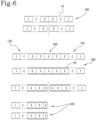
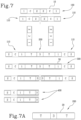
- Figures 5-8 differ from Figures 1-4 in that the first rod-shaped aggregate 100 is, again, formed from three functional units but in this specific case, the functional units are two segments 1, 2 having different properties and separated by a gap C.
- the first rod-shaped aggregate 100 is the one that includes at least two first segments T containing an aerosol-generating material, preferably tobacco, and more preferably, tobacco in the form of strips, fibres, filaments or fragments. Further, the first rod-shaped aggregate 100 also preferably comprises two middle segments 1 (or one double-length segment 1) disposed between the two first segments T and preferably in contact with the first segments T. In this solution too, the step of cutting the first rod-shaped aggregate 100 is accomplished by cutting the middle segments 1.
- the second rod-shaped aggregate in particular, comprises at least two filter segments 2, 3 of different kinds, for example, at least two filter segments of different kinds and at least one gap C.
- the embodiment of Figure 10 differs from the embodiment of Figure 9 , in that the second rod-shaped aggregate 200 comprises two segments 2, 3 of different kinds, alternated with gaps C, hence composed of five functional units.
- the second rod-shaped aggregate 200 comprises at least two segments of different kinds, preferably at least two different filter segments and at least one gap, and the second rod-shaped aggregate 200 preferably comprises three segments of different kinds, preferably at least three different filter segments and at least one gap (or at least two gaps disposed preferably mirror symmetrically about the cutting line which divides second rod-shaped aggregate 200 in half).
- the method according to the invention is preferably implemented by a combining machine of the type equipped with drums.
- feeding the second rod-shaped aggregates 200 is carried out by a respective downfeed line from a hopper containing second rod-shaped aggregates 200.
- the hopper can be fed by trays/containers or by a bulk flow.
- the second rod-shaped aggregates 200 can be fed via an in-line connection of the combining machine to a machine which forms the second rod-shaped aggregates 200 so that the second rod-shaped aggregates 200 are transferred individually and in controlled manner in an ordered succession, for example, via drums or belts provided with individual receiving seats or other systems, from the forming machine to the combining machine.
- the present invention achieves the preset aims, overcoming the disadvantages of the prior art.
- the method according to the invention offers considerable production flexibility, allowing the production of very long filter rod sections by inserting a different kind of segment between two rod-shaped half-aggregates which have already been axially spaced, thus reducing the machine part used for feeding very long segments.
- the method is applicable to the formation of complete articles containing an aerosol-generating segment.
Landscapes
- Cigarettes, Filters, And Manufacturing Of Filters (AREA)
Abstract
A method for making multisegment, rod-shaped articles, in particular smoking articles, comprising the following steps: providing a first rod-shaped aggregate (100) comprising a succession of functional units wrapped in a first connecting strip (10); cutting the first rod-shaped aggregate (100) in a halfway zone to obtain two rod-shaped sub-aggregates (110); inserting, between the rod-shaped sub-aggregates (110), a second rod-shaped aggregate (200) comprising a succession of functional units wrapped in a second connecting strip (20); abutting the rod-shaped sub-aggregates (110) against the second rod-shaped aggregate (200) and wrapping the rod-shaped sub-aggregates (110) and the second rod-shaped aggregate (200) in a third connecting strip (30) to obtain a third rod-shaped aggregate (300); cutting the third rod-shaped aggregate (300) in half to obtain two multisegment articles (400).
Description
- This invention relates to a method for making multisegment, rod-shaped articles, in particular smoking articles. The invention is applicable both to the formation of multisegment filters and to the formation of filter cigarettes.
- To date, multisegment articles are typically made by combining units which combine segments of various kinds, for example, acetate based filter segments, NWA segments, tubular segments, brittle segments (carbon tips). These combining units are of the axially operating type for forming a single uninterrupted succession of segments moved in a longitudinal direction and then wrapped in a web of paper, or of the transversely operating type, based on drums which combine groups of double- or multiple-length groups and then roll connecting strips round the segments. A mode of operating the second type of combining units is described in patent
EP3298909 . - The Applicant has found that prior art solutions for making rod-shaped multisegment articles have some disadvantages.
- In particular, in the case of very long sequences, the machine must be provided with drums having large axial dimensions in order to be able to form the long sequences. The machines needed to make such articles are thus highly cumbersome.
- Moreover, again in the case of very long sequences, the machines must be provided with a very large number of downfeed lines, each downfeed line being intended to feed a respective type of segment.
- Besides that, it is difficult to make provision for gaps between consecutive segments, since rolling groups of segments having empty spaces in them is tricky.
- The technical purpose of this invention is therefore to provide a method for making multisegment, rod-shaped articles and which is capable of overcoming the above mentioned disadvantages of the prior art.
- The aim of this invention is therefore to provide a method for making multisegment, rod-shaped articles and which allows limiting the size of the machine used to implement it, in particular in the case of articles which are very long or which have a large number of segments of different kinds.
- Another aim of this invention is to provide a method for making multisegment, rod-shaped articles and which increases the range of products that can be made, with reference in particular to making segment sequences having gaps in them.
- The technical purpose indicated and the aims specified are substantially achieved by a method for making multisegment rod-shaped articles comprising the technical features described in one or more of the appended claims.
- Further features of the invention and its advantages are more apparent in the following exemplary, hence non-limiting description of an embodiment of a method for making multisegment rod-shaped articles according to the invention.
- The description is set out below with reference to the accompanying drawings which are provided solely for purposes of illustration without restricting the scope of the invention and in which:
-
Figure 1 represents a method according to the invention in a first embodiment of it; -
Figure 2 represents a method according to the invention in a second embodiment of it; -
Figure 1A represents a rod-shaped aggregate used in the method ofFigures 1 and2 ; -
Figure 3 represents a method according to the invention in a third embodiment of it; -
Figure 4 represents a method according to the invention in a fourth embodiment of it; -
Figure 3A represents a rod-shaped aggregate used in the method ofFigures 3 and4 ; -
Figure 5 represents a method according to the invention in a fifth embodiment of it; -
Figure 6 represents a method according to the invention in a sixth embodiment of it; -
Figure 5A represents a rod-shaped aggregate used in the method ofFigures 5 and6 ; -
Figure 7 represents a method according to the invention in a seventh embodiment of it; -
Figure 8 represents a method according to the invention in an eighth embodiment of it; -
Figure 7A represents a rod-shaped aggregate used in the method ofFigures 7 and8 ; -
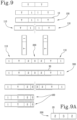
Figure 9 represents a method according to the invention in a ninth embodiment of it; -
Figure 9A represents a rod-shaped aggregate used in the method ofFigure 9 ; -
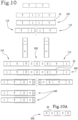
Figure 10 represents a method according to the invention in a tenth embodiment of it; -
Figure 10A represents a rod-shaped aggregate used in the method ofFigure 10 . - The description which follows uses specific terms such as "rod-shaped aggregate", "rod-shaped sub-aggregate", "segment", "functional unit" and "gap".
- By "rod-shaped aggregate" is meant a single, monolithic entity composed of an outer connecting strip wrapped in cylindrical form (in particular by rolling), containing a succession of functional units connected to each other by the connecting strip.
- By "rod-shaped sub-aggregate" is meant a part of a rod-shaped aggregate obtained by transversely cutting, in half, for example, to obtain two identical, flipped rod-shaped semi-aggregates.
- By "segment" is meant a uniform entity of single or multiple length, cylindrical in shape and suitable for rolling in a connecting strip.
- By "functional unit" is meant a uniform portion intended to perform a specific function in the article. Both segments and gaps fall under this definition.
- By "gap" is meant an empty space or cavity delimited by a tubular portion of the rolled connecting strip. It may be defined, for example, by wrapping the connecting strip round two segments which are spaced from each other to define an internal gap. A gap, though it is not filled, falls under the definition of "functional unit" in that it performs specific functions in the finished article (for example, mixing or diluting the aerosol with air, or cooling the aerosol).
- Also, in this description and in the drawings, identical entities are denoted by the same numerals (for example, the
reference numeral 1 denotes components of the same type and thus the presence of more than onereference numeral 1 in the same article indicates the simultaneous presence of identical segments at the corresponding positions). - According to the invention, the method comprises initially providing a first rod-
shaped aggregate 100 comprising a succession of functional units wrapped in a first connectingstrip 10. - In the embodiments of
Figures 1-4 , the first rod-shaped aggregate 100 is formed from three functional units, specifically threesegments - In the embodiments of
Figures 5-8 (which in their other aspects are identical toFigures 1-4 ), the first rod-shaped aggregate 100 is, again, formed from three functional units but in this specific case, the functional units are twosegments - In other embodiments, the first rod-
shaped aggregate 100 may be formed from two functional units or more than three functional units (by way of example only, five functional units comprising three different segments alternated with two gaps). - The functional units may be of any type and length and the fact that those shown in the drawings are all the same in size cannot, under any circumstances, be construed as the need for functional units to have the same length.
- Furthermore, the first rod-
shaped aggregate 100 may be made by cutting a continuous rod obtained by continuously wrapping a succession of segments. This solution is preferable when there is at least one gap, since the method adapts better to wrapping a broken succession of segments, where the breaks define the gaps. - Alternatively, the first rod-
shaped aggregate 100 may be made by rolling. - The embodiments of
Figures 1-4 are illustrated with reference to a first rod-shaped aggregate 100 made by rolling. This solution comprises (a step of) transversely feeding two first segments 1 (or one first double-length segment, cut into two equal parts), followed by spacing thefirst segments 1 and then inserting two second segments 2 (or one double-length second segment, already cut into two equal parts or subsequently cut into two equal parts). Next, thesecond segments 2 are spaced apart and two third segments 3 (or one third double length segment, already cut into two equal parts or to be subsequently cut into two equal parts). Thus obtained is a first group S1 of segments (or more generically, functional units) abutted end to end. - The first group S1 of segments is wrapped in a first connecting
strip 10 to obtain a first rod-shaped aggregate 100 defining a single entity. The first rod-shaped aggregate 100 is cut in half to obtain two rod-shaped sub-aggregates 110 which, in the specific embodiment, are flipped (turned through 180°) so that the ends of the two rod-shaped sub-aggregates 110 originally facing each other, are located at the outermost ends, and the two rod-shaped sub-aggregates 110 originally at the outermost ends, face each other. - The flip is associated with a mutual spacing between the two rod-shaped half-aggregates 110 (carried out during or after flipping) so that the two rod-shaped half-
aggregates 110 are also axially spaced by a predetermined distance. - According to the invention, a second rod-
shaped aggregate 200 is then inserted between the two rod-shaped half-aggregates 110 which have been flipped and spaced. The second rod-shaped aggregate 200 is, and is fed, in the form of a single entity and comprises a succession of functional units wrapped in a second connectingstrip 20. The second rod-shaped aggregate 200 may in turn be obtained by rolling or by cutting it off from a continuous rod. - Further, the second rod-
shaped aggregate 200 may be transferred from a forming unit, for example, in a bulk flow or in trays or other containers, or it may be made "in line" and transferred in ordered succession together with other rod-shaped aggregates from a production unit to a combining machine which implements the method of the invention. - Looking in more detail, the second rod-
shaped aggregate 200 comprises at least two functional units of different kinds. - In an embodiment, as shown in
Figure 1 , the second rod-shaped aggregate 200 comprises at least twofirst segments 4 of a first kind and at least one second segment 5 (for example, a double-length segment) of a second kind, disposed between thefirst segments 4. - The second rod-
shaped aggregate 200 is then inserted between the two first rod-shaped half-aggregates 110 and abutted end to end against them to obtain a second group S2 of segments (or, more generally, of functional units). Next, the second group S2 is rolled in a third connectingstrip 30 to obtain a third rod-shaped aggregate 300, in particular, corresponding to a double-length article. - Preferably, the third connecting
strip 30 is smaller in length (measured along the direction of extension of thearticle 300 to be made) than the third rod-shaped aggregate so as to leave a part of the first connectingstrip 10 exposed. - Lastly, the third rod-shaped
aggregate 300 is cut in half to obtain two single-length articles 400. -
Figure 2 shows an embodiment which differs from the embodiment ofFigure 1 , described above, in that the two rod-shaped half-aggregates 110 are not rotated by 180° but only spaced apart. -
Figure 3 shows an embodiment which differs from the embodiment ofFigure 1 , described above, in that the second rod-shapedaggregate 200 comprises, or is formed from, two aerosol-generating segments T (for example, based on tobacco, such as reconstituted tobacco in the form of strips, fibres, filaments or fragments; or based on other materials, such as cellulose, rapeseed, hemp) and a double-length,middle segment 4 disposed between two segments T and preferably in contact with the segments T. Themiddle segment 4 may be a full segment, for example, made from acetate or other material and intended to form an end plug on the side where air enters the article (opposite the suction side). In this solution, the step of cutting the first rod-shapedaggregate 100 is accomplished by cutting themiddle segment 4 in half. - Also, in this embodiment, where the second rod-shaped
aggregate 200 comprises two aerosol-generating segments T, the first rod-shapedaggregate 100 comprises at least two filter segments of different kinds, preferably at least three different segments of different kinds. -
Figure 4 shows an embodiment which differs from the embodiment ofFigure 3 , described above, in that the two rod-shaped half-aggregates 110 are not rotated by 180° but only spaced apart. - As stated above,
Figures 5-8 differ fromFigures 1-4 in that the first rod-shapedaggregate 100 is, again, formed from three functional units but in this specific case, the functional units are twosegments - In a different embodiment, illustrated in
Figure 9 , the first rod-shapedaggregate 100 is the one that includes at least two first segments T containing an aerosol-generating material, preferably tobacco, and more preferably, tobacco in the form of strips, fibres, filaments or fragments. Further, the first rod-shapedaggregate 100 also preferably comprises two middle segments 1 (or one double-length segment 1) disposed between the two first segments T and preferably in contact with the first segments T. In this solution too, the step of cutting the first rod-shapedaggregate 100 is accomplished by cutting themiddle segments 1. In this solution, it is also preferable that cutting the first rod-shapedaggregate 100 to obtain two rod-shaped half-aggregates 110 be followed by flipping the two rod-shaped half-aggregates 110 by turning them by 180° so that themiddle segment 1 defines two end plugs 1 on the respective finished articles. After that, the step of inserting the second rod-shapedaggregate 200 between two rod-shaped half-aggregates 110 can be carried out in the same way as in the solutions described above. The second rod-shaped aggregate, in particular, comprises at least twofilter segments - The embodiment of
Figure 10 differs from the embodiment ofFigure 9 , in that the second rod-shapedaggregate 200 comprises twosegments - More generally speaking, the second rod-shaped
aggregate 200 comprises at least two segments of different kinds, preferably at least two different filter segments and at least one gap, and the second rod-shapedaggregate 200 preferably comprises three segments of different kinds, preferably at least three different filter segments and at least one gap (or at least two gaps disposed preferably mirror symmetrically about the cutting line which divides second rod-shapedaggregate 200 in half). - The method according to the invention is preferably implemented by a combining machine of the type equipped with drums. In an embodiment, feeding the second rod-shaped
aggregates 200 is carried out by a respective downfeed line from a hopper containing second rod-shapedaggregates 200. The hopper can be fed by trays/containers or by a bulk flow. Alternatively, the second rod-shapedaggregates 200 can be fed via an in-line connection of the combining machine to a machine which forms the second rod-shapedaggregates 200 so that the second rod-shapedaggregates 200 are transferred individually and in controlled manner in an ordered succession, for example, via drums or belts provided with individual receiving seats or other systems, from the forming machine to the combining machine. - The present invention achieves the preset aims, overcoming the disadvantages of the prior art.
- Indeed, the method according to the invention offers considerable production flexibility, allowing the production of very long filter rod sections by inserting a different kind of segment between two rod-shaped half-aggregates which have already been axially spaced, thus reducing the machine part used for feeding very long segments. Moreover, the method is applicable to the formation of complete articles containing an aerosol-generating segment.
Claims (10)
- A method for making multisegment, rod-shaped articles, in particular smoking articles, comprising the following steps:- providing a first rod-shaped aggregate (100) comprising a succession of functional units wrapped in a first connecting strip (10);- cutting the first rod-shaped aggregate (100) in a halfway zone to obtain two rod-shaped sub-aggregates (110);- inserting, between the rod-shaped sub-aggregates (110), a second rod-shaped aggregate (200) comprising a succession of functional units wrapped in a second connecting strip (20);- abutting the rod-shaped sub-aggregates (110) against the second rod-shaped aggregate (200) and wrapping the rod-shaped sub-aggregates (110) and the second rod-shaped aggregate (200) in a third connecting strip (30) to obtain a third rod-shaped aggregate (300);- cutting the third rod-shaped aggregate (300) in half to obtain two multisegment articles (400).
- The method according to claim 1, wherein each functional unit comprises a segment (1, 2, 3, 4, 5), in particular, a full segment or a hollow tubular segment, or an empty space defining a gap (C) delimited directly by the first and/or the second connecting strip (10, 20).
- The method according to claim 1 or 2, wherein the second rod-shaped aggregate (200) comprises at least two functional units of different kinds, preferably at least two first segments of a first kind and at least one second segment of a second kind, positioned between the first segments.
- The method according to any one of the preceding claims, wherein the second rod-shaped aggregate (200) comprises at least two first segments (T) containing an aerosol-generating material, preferably based on tobacco, and more preferably, on reconstituted tobacco, tobacco in the form of strips, fibres, filaments or fragments, and a double, middle segment (1, 3, 4) positioned between the two first segments (T) and preferably in contact with the first segments (T), the step of cutting the first rod-shaped aggregate being carried out by cutting the middle segment.
- The method according to claim 4, wherein the first rod-shaped aggregate (100) comprises at least two filter segments (1, 2, 3) of different kinds, preferably at least two filter segments (1, 2, 3) of different kinds and at least one gap (C).
- The method according to claim 4 or 5, wherein the first rod-shaped aggregate (100) comprises at least three filter segments (1, 2, 3) of different kinds, preferably at least three filter segments (1, 2, 3) of different kinds and at least one gap (C).
- The method according to any one of claims 1 to 3, wherein the first rod-shaped aggregate (100) comprises at least two first segments (T) containing an aerosol-generating material, preferably based on tobacco, and more preferably, on reconstituted tobacco, tobacco in the form of strips, fibres, filaments or fragments, and at least one middle segment (1) positioned between the two first segments (T) and preferably in contact with the first segments (T), the step of cutting the first rod-shaped aggregate (100) being carried out at the at least one middle segment (1).
- The method according to claim 7, wherein the second rod-shaped aggregate (200) comprises at least two filter segments (2, 3) of different kinds, preferably at least two filter segments (2, 3) of different kinds and at least one gap (C).
- The method according to claim 7 or 8, wherein the second rod-shaped aggregate (200) comprises at least three filter segments (2, 3) of different kinds, preferably at least three filter segments (2, 3) of different kinds and at least one gap (C).
- The method according to any one of the preceding claims, comprising, between the step of cutting the first rod-shaped aggregate (100) into two rod-shaped sub-aggregates (110) and the step of inserting the second rod-shaped aggregate (200), a step of turning each rod-shaped sub-aggregate (110) by 180° so that the initially outermost ends of the rod-shaped sub-aggregates (110) are positioned to face each other.
Applications Claiming Priority (1)
| Application Number | Priority Date | Filing Date | Title |
|---|---|---|---|
| IT102023000008925A IT202300008925A1 (en) | 2023-05-05 | 2023-05-05 | METHOD FOR MAKING MULTI-SEGMENT BAR-SHAPED ITEMS. |
Publications (1)
| Publication Number | Publication Date |
|---|---|
| EP4464176A1 true EP4464176A1 (en) | 2024-11-20 |
Family
ID=87418857
Family Applications (1)
| Application Number | Title | Priority Date | Filing Date |
|---|---|---|---|
| EP24173234.6A Pending EP4464176A1 (en) | 2023-05-05 | 2024-04-30 | Method for making multisegment, rod-shaped articles |
Country Status (2)
| Country | Link |
|---|---|
| EP (1) | EP4464176A1 (en) |
| IT (1) | IT202300008925A1 (en) |
Citations (4)
| Publication number | Priority date | Publication date | Assignee | Title |
|---|---|---|---|---|
| WO2013164124A1 (en) * | 2012-04-30 | 2013-11-07 | Philip Morris Products S.A. | Two-part multi-component combiner |
| EP3298909A1 (en) | 2016-09-21 | 2018-03-28 | Hauni Maschinenbau GmbH | Manufacture of smoking products |
| EP3861868A1 (en) * | 2018-10-05 | 2021-08-11 | Japan Tobacco Inc. | Production method for smoking article |
| CN114831338A (en) * | 2022-06-15 | 2022-08-02 | 南通金源新材料有限公司 | Hollow three-section type heating cigarette and manufacturing method thereof |
-
2023
- 2023-05-05 IT IT102023000008925A patent/IT202300008925A1/en unknown
-
2024
- 2024-04-30 EP EP24173234.6A patent/EP4464176A1/en active Pending
Patent Citations (4)
| Publication number | Priority date | Publication date | Assignee | Title |
|---|---|---|---|---|
| WO2013164124A1 (en) * | 2012-04-30 | 2013-11-07 | Philip Morris Products S.A. | Two-part multi-component combiner |
| EP3298909A1 (en) | 2016-09-21 | 2018-03-28 | Hauni Maschinenbau GmbH | Manufacture of smoking products |
| EP3861868A1 (en) * | 2018-10-05 | 2021-08-11 | Japan Tobacco Inc. | Production method for smoking article |
| CN114831338A (en) * | 2022-06-15 | 2022-08-02 | 南通金源新材料有限公司 | Hollow three-section type heating cigarette and manufacturing method thereof |
Also Published As
| Publication number | Publication date |
|---|---|
| IT202300008925A1 (en) | 2024-11-05 |
Similar Documents
| Publication | Publication Date | Title |
|---|---|---|
| EP3007569B1 (en) | Tobacco smoke filter | |
| CN104754963B (en) | Assembly machine and corresponding mounting method for producing cigarette | |
| US7435208B2 (en) | Degradable slitted cigarette filter | |
| US20060157070A1 (en) | Parallel cigarette filter combining techniques with particle filling of cavities | |
| US20060201523A1 (en) | Arrangement for producing filter cigarettes | |
| KR20070022731A (en) | Manufacturing method and device of composite tobacco filter | |
| US20040102299A1 (en) | Process and device for assembling groups of filter segments | |
| EP3298909B1 (en) | Manufacture of smoking products | |
| CN109303351B (en) | Manufacture of rod-shaped smoking articles | |
| CN106307609B (en) | Segment combination for tobacco processing industry | |
| GB2267021A (en) | Filter cigarette machine | |
| CN110740649B (en) | Method for manufacturing a smoking article product | |
| GB2259847A (en) | Filter cigarette manufacture | |
| EP2952108B1 (en) | Cigarette production method and double cigarette | |
| DE102015001618A1 (en) | Method and device for producing a rod-shaped article made of vegetable foil | |
| US6131583A (en) | Method of conveying bar-shaped articles | |
| US5474091A (en) | Method of producing filter-tipped cigarettes | |
| EP1519657A2 (en) | Method of producing filter-tipped cigarettes | |
| CN105410991B (en) | Assembly machine and method for producing rod-shaped articles of the tobacco processing industry | |
| CN103476276B (en) | Conveying of rod-shaped products in the tobacco processing industry | |
| US20060207614A1 (en) | Method for producing filter cigarettes | |
| EP0895725B1 (en) | Method of rolling cigarette portions | |
| CN106954890B (en) | Method and device for producing multi-segment filters for the tobacco processing industry | |
| JP7752137B2 (en) | Method and machine for manufacturing multi-segment articles | |
| KR102024446B1 (en) | Tobacco rod comprising a plurality of tobacco materials |
Legal Events
| Date | Code | Title | Description |
|---|---|---|---|
| PUAI | Public reference made under article 153(3) epc to a published international application that has entered the european phase |
Free format text: ORIGINAL CODE: 0009012 |
|
| STAA | Information on the status of an ep patent application or granted ep patent |
Free format text: STATUS: THE APPLICATION HAS BEEN PUBLISHED |
|
| AK | Designated contracting states |
Kind code of ref document: A1 Designated state(s): AL AT BE BG CH CY CZ DE DK EE ES FI FR GB GR HR HU IE IS IT LI LT LU LV MC ME MK MT NL NO PL PT RO RS SE SI SK SM TR |
|
| STAA | Information on the status of an ep patent application or granted ep patent |
Free format text: STATUS: REQUEST FOR EXAMINATION WAS MADE |
|
| 17P | Request for examination filed |
Effective date: 20250509 |