EP4462283A2 - Erweiterte exploration für grosse datenmengen und mehr - Google Patents
Erweiterte exploration für grosse datenmengen und mehr Download PDFInfo
- Publication number
- EP4462283A2 EP4462283A2 EP24195711.7A EP24195711A EP4462283A2 EP 4462283 A2 EP4462283 A2 EP 4462283A2 EP 24195711 A EP24195711 A EP 24195711A EP 4462283 A2 EP4462283 A2 EP 4462283A2
- Authority
- EP
- European Patent Office
- Prior art keywords
- knowledge
- spec
- concept
- fragments
- nodes
- Prior art date
- Legal status (The legal status is an assumption and is not a legal conclusion. Google has not performed a legal analysis and makes no representation as to the accuracy of the status listed.)
- Pending
Links
Images




Classifications
-
- G—PHYSICS
- G06—COMPUTING OR CALCULATING; COUNTING
- G06F—ELECTRIC DIGITAL DATA PROCESSING
- G06F16/00—Information retrieval; Database structures therefor; File system structures therefor
- G06F16/20—Information retrieval; Database structures therefor; File system structures therefor of structured data, e.g. relational data
- G06F16/24—Querying
- G06F16/245—Query processing
- G06F16/2455—Query execution
- G06F16/24568—Data stream processing; Continuous queries
-
- G—PHYSICS
- G06—COMPUTING OR CALCULATING; COUNTING
- G06F—ELECTRIC DIGITAL DATA PROCESSING
- G06F16/00—Information retrieval; Database structures therefor; File system structures therefor
- G06F16/20—Information retrieval; Database structures therefor; File system structures therefor of structured data, e.g. relational data
- G06F16/24—Querying
- G06F16/245—Query processing
- G06F16/2457—Query processing with adaptation to user needs
- G06F16/24573—Query processing with adaptation to user needs using data annotations, e.g. user-defined metadata
-
- G—PHYSICS
- G06—COMPUTING OR CALCULATING; COUNTING
- G06F—ELECTRIC DIGITAL DATA PROCESSING
- G06F16/00—Information retrieval; Database structures therefor; File system structures therefor
- G06F16/20—Information retrieval; Database structures therefor; File system structures therefor of structured data, e.g. relational data
- G06F16/25—Integrating or interfacing systems involving database management systems
- G06F16/254—Extract, transform and load [ETL] procedures, e.g. ETL data flows in data warehouses
-
- G—PHYSICS
- G06—COMPUTING OR CALCULATING; COUNTING
- G06F—ELECTRIC DIGITAL DATA PROCESSING
- G06F16/00—Information retrieval; Database structures therefor; File system structures therefor
- G06F16/20—Information retrieval; Database structures therefor; File system structures therefor of structured data, e.g. relational data
- G06F16/27—Replication, distribution or synchronisation of data between databases or within a distributed database system; Distributed database system architectures therefor
-
- G—PHYSICS
- G06—COMPUTING OR CALCULATING; COUNTING
- G06F—ELECTRIC DIGITAL DATA PROCESSING
- G06F16/00—Information retrieval; Database structures therefor; File system structures therefor
- G06F16/20—Information retrieval; Database structures therefor; File system structures therefor of structured data, e.g. relational data
- G06F16/28—Databases characterised by their database models, e.g. relational or object models
-
- G—PHYSICS
- G06—COMPUTING OR CALCULATING; COUNTING
- G06F—ELECTRIC DIGITAL DATA PROCESSING
- G06F16/00—Information retrieval; Database structures therefor; File system structures therefor
- G06F16/20—Information retrieval; Database structures therefor; File system structures therefor of structured data, e.g. relational data
- G06F16/28—Databases characterised by their database models, e.g. relational or object models
- G06F16/284—Relational databases
- G06F16/285—Clustering or classification
-
- G—PHYSICS
- G06—COMPUTING OR CALCULATING; COUNTING
- G06F—ELECTRIC DIGITAL DATA PROCESSING
- G06F16/00—Information retrieval; Database structures therefor; File system structures therefor
- G06F16/90—Details of database functions independent of the retrieved data types
- G06F16/901—Indexing; Data structures therefor; Storage structures
- G06F16/9024—Graphs; Linked lists
-
- G—PHYSICS
- G06—COMPUTING OR CALCULATING; COUNTING
- G06F—ELECTRIC DIGITAL DATA PROCESSING
- G06F16/00—Information retrieval; Database structures therefor; File system structures therefor
- G06F16/90—Details of database functions independent of the retrieved data types
- G06F16/903—Querying
- G06F16/9038—Presentation of query results
-
- G—PHYSICS
- G06—COMPUTING OR CALCULATING; COUNTING
- G06F—ELECTRIC DIGITAL DATA PROCESSING
- G06F16/00—Information retrieval; Database structures therefor; File system structures therefor
- G06F16/90—Details of database functions independent of the retrieved data types
- G06F16/901—Indexing; Data structures therefor; Storage structures
- G06F16/9027—Trees
Definitions
- the embodiments discussed relate to computer implemented big data (large and complex data set), information and knowledge processing.
- a computer system including at least one computer is configured to generate, specification concept graphs of nodes spec 1 , spec 2 , ... , spec m including concepts node and relation nodes according to at least one of a plurality of digitized data from user input from a plurality of computerized data sources d 1 , d 2 ,..., d l forming a first set of evidences U ; generate concept graphs of nodes c ⁇ 1 , c ⁇ 2 ,..., c ⁇ n including concept nodes and relation nodes for corresponding obtained plurality of IKs ⁇ 1 , ⁇ 2 ,..., ⁇ n forming a second set of evidences U ; select a subset of concept graphs of nodes c ⁇ i 1 , c ⁇ i 2 ,..., c ⁇ i h from c ⁇ 1 , c ⁇ 2 ,..., c ⁇ n according to a computable measure of any one or combinations of consistency
- a knowledge fragment among the knowledge fragments storing a mapping of values to first and second sets of evidences U , where A is a rule among rules in the knowledge base, and E is a subset of the first and second sets of evidences U from the knowledge base that supports the rule A , so that the rule A is supportable by the subset of evidences E , according to the concept fragments.
- A is a rule among rules in the knowledge base
- E is a subset of the first and second sets of evidences U from the knowledge base that supports the rule A , so that the rule A is supportable by the subset of evidences E , according to the concept fragments.
- To create or add into at least one among a plurality of knowledge-bases (KBs) for the corresponding knowledge fragments obtained by creating objects in form ⁇ E ⁇ A from the concept fragments; determining relationship constraints in form of set relations among a plurality of subsets of evidences E. And to execute any one or combination of knowledge completion, augmentation, and analysis.
- inventions described in the attached description entitled “Augmented Exploration for Big Data and Beyond” can be implemented as an apparatus (a machine) that includes processing hardware configured, for example, by way of software executed by the processing hardware and/or by hardware logic circuitry, to perform the described features, functions, operations, and/or benefits.
- Big Data refers to large and complex data sets, for example, data from at least two or more dynamic (i.e., modified in real-time in response to events, or updating) heterogeneous data sources (i.e., different domain and/or similar domain but different sources) which are stored in and retrievable from computer readable storage media.
- data can be text and/or image documents, data queried from a database or a combination thereof.
- the embodiments provide predictive analytics, user behavior analytics, or certain other advanced data analytics to extract value from data.
- Big Data refers to the problem whereby the processing of large, complex, dynamic, and noisy data overwhelms current state of the art data processing software, thus limiting software applications to achieving only limited and/or simplistic tasks. Advanced tasks involving more complex data analytics such as semantics extraction or complex structure elicitation are in the purview of Big Data and in the search for innovative solutions, algorithms, and software application development.
- the data sources are interconnected computing devices or objects in heterogeneous domains (e.g., computers, vehicles, buildings, persons, animals, plants), as embedded with electronics, software, sensors to transceiver data over data networks including the Internet (Internet of Things (loT)).
- the data sources are Website content, including archived Website content.
- A-Exploration is a Comprehensive Computational Framework for Continuously Uncovering, Reasoning and Managing Big Data, Information and Knowledge.
- A-Exploration has the capabilities to continuously uncover, track, understand, analyze, manage, and/or utilize any desired information and knowledge, as well as, oversee, regulate and/or supervise the development, progression and/or evolvement of these information and knowledge.
- A-Exploration supplements extends, expands and integrates, among other things, the following related technologies:
- A-Exploration may have to be supplemented, suspended, combined and/or adjusted.
- One new paradigm includes not only the next generation scalable dynamic computational framework for large-scale information and knowledge retrieval in real-time, but also the capability to analyze immediately and seamlessly the partial and piece-meal information and knowledge acquired. Moreover, there is a need to be able to have a deep understanding of the different information and knowledge retrieved to perform the other required operations.
- A-Exploration can provide the necessary solution or simply provide the necessary information, knowledge and analyses to assist the decision makers in discovering the appropriate solutions and directions.
- A-Exploration is a Comprehensive Computational Framework for Continuously Uncovering, Reasoning and Managing Big Data, Information and Knowledge.
- A-Exploration has the capabilities to continuously uncover, track, understand, analyze, manage, and/or utilize any desired information and knowledge, as well as, oversee, regulate and/or supervise the development, progression and/or evolution of these information and knowledge. This is one of the most challenging and all-encompassing aspects of Big Data, and is now possible due to the advances in information and communication infrastructures and information technology applications, such as mobile communications, cloud computing, automation of knowledge works, internet of things, etc.
- A-Exploration allows organizations and policy makers to address and mitigate considerable challenges to capture the full benefit and potential of Big Data and Beyond. It contains many sequential and parallel phases and/or sub-systems required to control and handle its various operations. Individual phases, such as extracting, uncovering and understanding, have been used in other areas and examined in details using various approaches and tools, especially if the information is static and need NOT be acquired in real-time. However, overseeing and providing possible roadmap for management, utilization and projection of the outcomes and results obtained are regularly and primarily performed by human. Comprehensive formulations and tools to automate and integrate the latter are not currently available. Since enormous information is extracted and available to the human in the loop, information overload is clearly a significant problem. Last, but not the least, there exists no inclusive framework, at present, which consider all aspects of what are required, especially from a computational point of view, which makes it not viable for automation.
- A-Exploration is vital and essential in practically any field that deals with information and/or knowledge, which covers virtually all areas in this Big Data era. It involves every areas discussed in James Manyika, Michael Chui, Brad Brown, Jacques Bughin, Richard Dobbs, Charles Roxburgh, and Angela Hung Byers, "Big data: The next frontier for innovation, competition, and productivity," Technical report, McKinsey Global Institute, 2011, including health care, public sector administration, retail, manufacturing, personal location data; and many other specific applications, such as dealing with unfolding stories, knowledge/information sharing and discovery, personal assistance, to name just a few. As a matter of fact, A-Exploration provides a general platform, as well as, diverse and compound methods and techniques to fulfill the goal of the above White House Big Data Research and Development Initiatives and more.
- the representation of the data fragments is another potential problem.
- Most widely used representations such as at least one or any combination of keywords, relationships among the data fragments (see FIG. 2 , 204), expressions, vectors, etc. present hidden obstacles for the other phases involved.
- Even the most advanced existing representation - the concept graphs see discussions by John F. Sowa, "Conceptual Graphs For A Database Interface,” IBM Journal of Research and Development, 24(4):336-357, 1976 , and Michel Chein and Marie-Laure Mugnier, "Graph-based Knowledge Representation: Computational Foundations of Conceptual Graphs," Springer, 2009 ., suffer from the fact that it lacks reasoning capabilities to handle intelligent analyses and projections.
- One of the most difficult problems to overcome is how to manage, utilize and supervise the knowledge and insights obtained from the other phases to resolve the possible outcomes of the situations and to project into the future. Moreover, with sufficient information and knowledge of the situations, one may be able to help shape, influence, manipulate and/or direct how they will evolve/progress in the future. Furthermore, it may help and facilitate the discovery/invention of new and improved methods for solving the problem at hand.
- existing framework might not provide the users with the desired solutions, or even just to assist the intended users in making the appropriate decisions or to provide guidance to change the future statuses and/or courses in the desired/preferred directions.
- IK Information and knowledge
- lKs may be static or dynamic. Dynamic lKs may evolve, expand and/or progress, and may be subject to modification and/or alteration. They may also be combined or integrated with other lKs. The desirability or significance of specific lKs may depend on the applications. Except for proven or well-known lKs, in general, the importance of an IK may depend on the following characteristics:
- FIG. 1 is a functional block diagram of computer system functions, according to an embodiment. Operations (0) through (9) are indicated in the diagram.
- the Augmented Supervisor 100 is a computer that processes inputs and commands (see factors (i) and/or (ii) below) from the user and/or another computing device . Manages, regulates, and supervises the development, progression, and evolution of information and knowledge, together with the creation of new information and knowledge. Guides the User Model (102u) and Augmented Analyzer (112).
- LRIRE 102 is the web, external databases, and other information and knowledge (IK) repositories serve as sources (102a, 102b, ..., 102n) of inputs.
- the inputs include structured data (e.g. forms, spreadsheets, website content, databases, etc.) and free-form data (e.g. unstructured text, live news feeds, etc.), or a combination (e.g. meta-data tags on html documents containing free text).
- Inputs are retrieved and organized based on any one or combination of two factors: (i) target query or domain specification (information retrieval), and (ii) specific user interests and preferences (User Modeling (102u)) as specified by a use and/or by a computing device.
- Output is the organized information and knowledge (IK) according to the factors (i) and/or (ii).
- Knowledge Fragmenter The collection of concept graphs are used to construct knowledge fragments. Knowledge fragments identify value relationships between concepts found in the concept graphs.
- Knowledge-Base Injector The fragments are added into existing (or possibly empty) data/knowledge bases of varying forms (e.g. Relation DBs (106b), BKBs (106a), AKBs (106c), etc.). Injection translates the fragments into the appropriate database format. Each information/knowledge base can be directly accessed from 108 and 110.
- Relation DBs 106b
- BKBs 106a
- AKBs 106c
- Injection translates the fragments into the appropriate database format.
- Each information/knowledge base can be directly accessed from 108 and 110.
- Knowledge Augmenter - Inspects information/knowledge bases and generates new knowledge through the Projector/Forecaster (110a - FIG. 6 ) and the Abducer/Explainer (110b - FIG. 7 ). Knowledge is injected back into one or all information/knowledge bases. Augmented knowledge is sent to the Augmented Analyzer (112) for processing.
- Augmented Analyzer - Augmented analysis can produce new or existing IK such as through Deep Comprehender (112a), Explorer of Alternative Outcome (112b), Missing Link Hypothesizer (112d), detect unexpected or emergent phenomenons such as through the Emergence Detector (112c) as well as other innovative technologies unique to Augmented Exploration.
- the output provides new augmented analysis which is also injected into the information/knowledge bases and to the Augmented Supervisor (100) for evolving stories and continuous analyses.
- FIG. 1 pertains to new integration of related technologies (102 and 106) and new technologies (100, 104, 108, 110, and 112). More particularly, for example, according to an aspect of an embodiment, a computer system including at least one computer is configured to generate, at operation 2, specification concept graphs of nodes spec 1 , spec 2 ,..., spec m including concepts node and relation nodes according to at least one of a plurality of digitized data from user input (at operations 0, 1) from a plurality of computerized data sources d 1 , d 2 ,..., d l forming a first set of evidences U ; generate, at operation 2, concept graphs of nodes c ⁇ 1 , c ⁇ 2 ,..., c ⁇ n including concept nodes and relation nodes for corresponding obtained plurality of IKs ⁇ 1 , ⁇ 2 ,..., ⁇ n (at operations 0, 1) forming a second set of evidences U ;
- a knowledge fragment among the knowledge fragments storing a mapping of values to first and second sets of evidences U , where A is a rule among rules in the knowledge base, and E is a subset of the first and second sets of evidences U from the knowledge base that supports the rule A , so that the rule A is supportable by the subset of evidences E , according to the concept fragments.
- authorized proprietary hypothesis secured plug-in may provide other knowledge fragments.
- Other knowledge augmenting functions based upon the created objects ⁇ include, at operation 7, generating new knowledge through the Projector/Forecaster (110a - FIG. 6 ) and the Abducer/Explainer (110b - FIG. 7 ). Knowledge is injected back into one or all information/knowledge bases.
- Augmented knowledge may be further provided to the Augmented Analyzer (112) for processing through Deep Comprehender (112a), Explorer of Alternative Outcome (112b), Missing Link Hypothesizer (112d), detect unexpected or emergent phenomenons such as through the Emergence Detector (112c), which, at operation 9, may be further output in form of reports or user interface for further processing and re-input at operation 0.
- the plurality of data sources 100 (100 a ... n ) store information and knowledge (IK) which are dynamic (i.e., modified in real-time in response to events, or updating) heterogeneous data (i.e., different domain and/or similar domain but different sources) in form of text and/or image.
- IK information and knowledge
- the information includes meta data or semantic data indicative or representing a target knowledge.
- the concept graph generator 102 generates concept node graphs.
- FIG. 2 is a diagram of an example concept node graph 200 for hydraulic fracturing domain.
- the knowledge fragment 204 includes two keywords and a relation among the two keywords.
- the embodiments are not limited to a domain and data from any domain or combinations of domains can be utilized. Other representations, if needed, will be superimposed subsequently to enable and/or enhance the performance of other operations of A-Exploration.
- Two labeled relation nodes are said to be matched if and only if at least one of their concept parents and one of their concept children are matched and they share the same relation label.
- the number of concept/entity nodes and relation nodes in the larger CG instead of the total number of nodes in both CGs, are used.
- Equation 1 could be modified whenever necessary to provide more efficient measures to prioritize the resource allocations.
- each IK has at least two time-stamps: IK time-stamp, i.e., when the IK first appeared (initial or first version), and a representation time stamp, i.e., when the IK was last represented or modified (updated, second (new or subsequent) versions) in the system, also referred to as data version events.
- IK time-stamp i.e., when the IK first appeared (initial or first version)
- a representation time stamp i.e., when the IK was last represented or modified (updated, second (new or subsequent) versions
- data version events also referred to as data version events.
- IK ⁇ consist of IKs ⁇ 1 , ⁇ 2 ,..., ⁇ n from the same or affiliated sources with IK time-stamps t 1 , t 2 ,..., t n , respectively, where t 1 ⁇ t 2 ⁇ ⁇ ⁇ t n .
- ⁇ has IK time-stamp t n .
- the diversity D ( ⁇ , t ) of ⁇ is the average of all e t - t i
- any IK which is not a part of a combined IK is a stand-alone IK.
- the diversity D ( ⁇ , t ) and the volume V ( ⁇ , t ) of ⁇ are both equal to e t-t 0 , where t 0 is the IK time-stamp of ⁇ .
- the e t - t i above represents the decaying factor of the IK, and depends on the unit of time used. Thus, the unit of time should be selected appropriately, and should be based on how fast-moving the lKs are.
- ⁇ 1 and ⁇ 2 be two lKs where ⁇ 1 and ⁇ 2 need not be distinct.
- ⁇ be a (combined or stand-alone) IK.
- the diversity and volume of an IK also measure the timeliness and up-to-the minute changes of the IK.
- diversity and volume can be used to measure the importance and/or the significance of the IKs as they progress or evolve.
- Watch structures are semantic structures consisting of watchwords, e.g., the query used in information retrieval. They can further sharpen the search for the desired IKs.
- screening could potentially overlook key IKs which may seem or is initially unrelated to the desired lKs.
- Historical semantic nets could be constructed in this regard based on historical connections among different ideas, concepts and processes.
- metrics are provided to uncover and identify the desired lKs.
- IKs Indicaciones, metrics (Diversity and Volume) are provided to uncover and identify the desired lKs.
- BKF Bayesian Knowledge Fragments
- CBKF Compound Bayesian Knowledge Fragments
- AMF Augmented Knowledge Fragments
- LRIRE Large-scale Real-time Information Retrieval and Extraction
- a 2 DR Anytime Anywhere Dynamic Retrieval
- LRIRE is an example of one of the next generation scalable dynamic computational frameworks for large-scale information and knowledge retrieval in real-time, which is described in an article by Eugene Santos, Jr., Eunice E. Santos, Hien Nguyen, Long Pan, and John Korah, "A largescale distributed framework for information retrieval in large dynamic search spaces," Applied Intelligence, 35:375-398, 2011 .
- the LRIRE incorporates various state-of-the-art successful technologies available for large-scale data and information retrieval. It is built by supplementing, extending, expanding and integrating the technologies initiated in I-FGM (Information Foraging, Gathering and Matching), see discussion by Eugene Santos, Jr., Eunice E. Santos, Hien Nguyen, Long Pan, and John Korah, "A Largescale Distributed Framework For Information Retrieval In Large Dynamic Search Spaces," Applied Intelligence, 35:375-398, 2011 .
- I-FGM Information Foraging, Gathering and Matching
- LRIRE's goal is to focus on the rapid retrieval of relevant information/documents from a dynamic information space and to represent the retrieved items in the most appropriate forms for future processing.
- the information/documents in the search spaces are selected and processed incrementally using an anytime-anywhere intelligence resource allocation strategy and the results are provided to the users in real-time.
- LRIRE is capable of exploiting users modeling (UM) to sharpen the inquiry in an attempt to dynamically capture the target behavior of the users.
- anytime-anywhere algorithms were designed for both text and image documents: "Anytime refers to providing results at any given time and refining the results through time. Anywhere refers to incorporating new information wherever it happens and propagating it through the whole network.”
- LRIRE is an intelligent framework capable of incrementally and distributively gathers, processes, and matches information fragments in large heterogeneous dynamic search spaces, using anytime-anywhere technologies, as well as converting from one representation to another, when needed.
- the primary purpose of LRIRE is to assist the users at finding the pertinent information quickly and effectively, and to store them using the desired representations. Initially, the graphical structure of document graphs is ideal for anytime-anywhere processing as the overhead for adding new nodes and relations is minimal.
- LRIRE is capable of handling retrieval of multiple data types, including unstructured texts (typical format for most databases/sources), images, signals, etc.
- DG document graphs
- CG concept graph
- LRIRE uses various common representations of information for heterogeneous data types.
- LRIRE provides a seamless integration of text, image and signals through various unifying semantic representation of contents.
- BKB Bayesian Knowledge Base
- CBKB Compound Bayesian Knowledge Base
- the information and knowledge available in LRIRE are initially represented using CGs.
- the CGs may be transform into knowledge fragments, e.g., Bayesian Knowledge Fragments (BKF)s, Compound Bayesian Knowledge Fragments (CBKF)s and Augmented Knowledge Fragments (AKF)s, if needed.
- BKFs, CBKFs and AKFs are subsets of Bayesian Knowledge Base (BKB), Compound Bayesian Knowledge Base (CBKB) and Augmented Knowledge Base (AKB), respectively.
- CBKB Compound Bayesian Knowledge Base
- each S-node may be assign multiple values. Each value represents certain aspect of the rule and therefore is capable of more accurately reflect the different types of uncertainties involved.
- the resulting structure is similar to a BKB. However, it may or may not be an actual BKB, since it may or may not satisfy the "exclusivity" constraint of BKB. As a matter of fact, many BKB- like objects could be derived from a single CBKB.
- CBKBs are further enriched by encoding and distinguishing the node in a CBKB according to the types of relation given in the concepts or feature graphs.
- relation 'is-a' other relations exist between two concepts, such as 'is-located', 'is-colored', etc.
- 'is-located' we can view the node representing a location as a 'location' node.
- Augmented Knowledge Base (AKB) and Augmented Reasoning (AR) are discussed in patent no. 9,275,333 the content of which is incorporated herein by reference.
- An Augmented Knowledge Base (over and U ) is a collection of objects of the form ( E , A ), also denoted by E ⁇ A, where A ⁇ and E is the body of evidence that supports the proposition or rule A.
- E is a subset of some universal set U and is a collection of propositions or rules A or a first order logic.
- AR Augmented Reasoning
- AKBs encompass most existing knowledge bases including their respective reasoning schemes, e.g., probabilistic logic, Dempster-Shafer, Bayesian Networks, Bayesian Knowledge Bases, etc. may be viewed or reformulated as special cases of AKBs.
- AKBs and AR have pure probabilistic semantics and therefore not subject to any anomalies found in most of the existing knowledge bases and reasoning schemes.
- AKBs and AR are not only capable of solving virtually all the problems mentioned above, they can provide additional capabilities, e.g., inductive inferences with uncertainties and/or incompleteness, extraction of new knowledge, finding the missing link, augmented relational databases, augmented deductive databases, augmented inductive databases, etc. related to A-Exploration.
- the A in ( E ⁇ A ) is a rule in ⁇ , which is similar to a proposition or rule in a traditional knowledge base.
- the E in ( E ⁇ A ) is a set, which represents a body of evidence, and is not a rule.
- ⁇ be an AKB.
- ⁇ be an AKB.
- ⁇ ⁇ is the smallest collection of subsets of U that contains all (approximately all) the sets in ⁇ ⁇ and is closed under complement, union, and intersection operators.
- Measure probabilistic or not are usually associated with collection of evidence to specify their strength. Moreover, they are usually extended to cover ⁇ ⁇ . In the case where the measure is probabilistic, it can be interpreted as the probability that L is true.
- ⁇ extends ⁇ so that AKBs can deal with composite objects ⁇ , associated with combinations of sets of evidences E in the knowledge base and combinations of rules in the knowledge base. Therefore, the embodiments utilize both composite evidences and composite rules to establish support for a target rule. Since ⁇ is finite, so is ⁇ . Members of ⁇ are referred to as composite objects.
- u and n denote 'set union' and 'set intersection', respectively, while v and A denote 'logical or' and 'logical and', respectively.
- ⁇ be an AKB.
- ⁇ is a composite object
- l ( ⁇ ) denotes a composite set of evidences associated with ⁇
- r ( ⁇ ) denotes the composite rules associated with ⁇ . This enable ⁇ to extract the rule portion and the associated set of evidences portion from ⁇ , where ⁇ represents a composite object of a plurality of E ⁇ A.
- ⁇ be an AKB, G ⁇ U and L ⁇ .
- ⁇ be an AKB and L ⁇ . Then ⁇ ⁇ ( L ) ⁇ ⁇ ⁇ ⁇
- ⁇ ⁇ ( L ) is the support of L wrt ⁇
- ⁇ ⁇ ( L ) is the plausibility of L wrt ⁇
- ⁇ be an AKB, G ⁇ U and L ⁇ .
- G ⁇ i ⁇ L if and only if there exists L 0 ⁇ such that L ⁇ L 0 and G ⁇ ⁇ L 0 .
- ⁇ be an AKB.
- ⁇ 1 and ⁇ 2 be AKBs.
- An AKB ⁇ is disjunctive if and only if every ( E ⁇ A ) ⁇ ⁇ , A is a conjunction of disjunctions of atomic propositions.
- ⁇ be an AKB. If ⁇ ⁇ ⁇ , then ⁇ ( ⁇ ) is the collection of all atomic propositions that occur in r ( ⁇ ). Moreover, Let ⁇ 1 , ⁇ 2 ⁇ ⁇ . If both are atomic disjunction over ⁇ , and there exists an atomic proposition P such that P occur in ⁇ 1 and P' occur in ⁇ 2 , then ⁇ 1 ⁇ ⁇ 2 merges ⁇ 1 and ⁇ 2 where a single occurrence of P and P' are removed.
- Disjunctive AKB is introduced in patent no. 9,275,333 the content of which is incorporated herein by reference and an algorithm to transform any AKB to disjunctive AKB was given there. If ⁇ is an AKB, then ⁇ D denotes the corresponding disjunctive AKB.
- ⁇ be an AKB.
- ⁇ ⁇ ⁇ ⁇ ⁇ .
- ⁇ be a irreducible AKB, ⁇ 1 , ⁇ 2 ⁇ ⁇ ⁇ ⁇ and P ⁇ .
- P is complemented with respect to ⁇ 1 and ⁇ 2 if and only if either P ⁇ ⁇ ( ⁇ 1 ) and P ' ⁇ ⁇ ( ⁇ 2 ), or P ' ⁇ ⁇ ( ⁇ 1 ) and P ⁇ ⁇ ( ⁇ 2 ).
- ⁇ be a disjunctive AKB, ⁇ 1 , ⁇ 2 ⁇ ⁇ ⁇ ⁇ and P ⁇ .
- P is complemented with respect to ⁇ 1 and ⁇ 2 if and only if either P ⁇ ⁇ ( ⁇ 1 ) and P ' ⁇ ⁇ ( ⁇ 2 ), or P ' ⁇ ⁇ ( ⁇ 1 ) and P ⁇ ⁇ ( ⁇ 2 ).
- ⁇ be a disjunctive AKB and ⁇ 1 , ⁇ 2 ⁇ ⁇ ⁇ ⁇ .
- the ⁇ operator defined above is a powerful unification operator which is capable of handling uncertain knowledge in a natural manner. Therefore, it is a true generalization of the traditional unification operators.
- ⁇ is an AKB.
- AKB is further described in patent no. 9,275,333 .
- ⁇ D is the disjunctive knowledge base associated with ⁇ . Nevertheless, it is essential that ⁇ be kept intact, especially if inductive reasoning is part of the solutions.
- the unification algorithm below is different from related unification algorithms, including the unification algorithms discussed in patent no. 9,275,333 , because according to an aspect of an embodiment, it is determined whether any atomic proposition A is selectable, and if there are any atomic propositions A , construct the two sets Q(A) and Q ( A' ) and then combine the elements in Q(4) with the elements in Q ( A' ) using the ⁇ operations. The results are added into the knowledge base while discarding the original elements in Q(4) and Q(A').
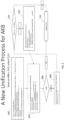
- FIG. 3 is a flow chart of a unification process for the knowledge fragments, according to an embodiment.
- process the first element of the list.
- output ⁇ ⁇ ( L ) whose union represents the validity of L .
- the above process may be modified for used as an Anytime-Anywhere algorithm. It does not require that ⁇ L be determined completely in advanced. It may be stopped anytime by executing Step 16, and continued at the place where it was stopped when more time are allocated. In addition, the algorithm can accept any addition to ⁇ L while continuing the unification process. Finally, other heuristics may be used instead of or in addition to Step 6 given in the algorithm to improve the results, Anytime-Anywhere or otherwise.
- the above unification method is applicable to both deductive reasoning and inductive reasoning.
- the AKB ⁇ must be kept intact for constructing the ⁇ .
- ⁇ D cannot be constructed from ⁇ D , i.e., ⁇ D ⁇ ⁇ D .
- the unification method can be used with validity or plausibility measures.
- Algorithm 6.1 is modified to introduce tags ⁇ to identify the sources of the results.
- information indicating a tag is associated with ⁇ .
- FIG. 4 is flow chart of the unification process described in FIG. 3 with tags, according to an embodiment.
- 402 404, 406, 408, 410, and 414 is the same as in Algorithm 6.2.
- the tags are updated accordingly.
- ⁇ t ⁇ ( L ) is as the same as in Algorithm 6.2 but with an associated tag.
- FIG. 5 is a flow chart of a unification process for the knowledge fragments without inconsistencies, according to an embodiment.
- 506, 508, and 510 are same as 306, 308 and 310.
- 512 is similar to 312 but the result is put back in ⁇ M .
- output the result ⁇ i ⁇ ( L ) whose union represents the validity of L, with all uncertainties removed.
- ⁇ be an AKB. Every ⁇ ⁇ ⁇ can be put in minimal disjunctive-conjunctive form, as well as in minimal conjunctive-disjunctive form.
- ⁇ be an AKB and ⁇ 1 , ⁇ 2 ⁇ ⁇ are expressed in minimal disjunctive-conjunctive forms.
- ⁇ be an AKB and L 1 , L 2 ⁇ .
- ⁇ be an AKB, and L 1 , L 2 ⁇ .
- Algorithm 6.3 can be used to compute ⁇ ⁇ ( L ). Observe that Algorithm 6.3 is a faster unification algorithm than Algorithm 6.1.
- ⁇ be an AKB and L ⁇ L .
- Deductive reasoning and inductive reasoning have been used to determine the validity and/or plausibility of any given proposition.
- the desired proposition is not known. Instead, one is given some target propositions to determine the target propositions which can be deduced or induced from the AKB using these target propositions.
- Projection and forecasting were used in Subsection on Information and Knowledge for the management and supervision of the evolution of the IKs, and abduction used for Analysis and Deep Understanding of IKs.
- projection/forecasting and abduction in more general settings.
- Augmented Projection / Forecasting and Augmented Abduction form the basis for the Knowledge Augmenter (KA).
- ⁇ be an AKB, and L, L 1 , L 2 ⁇ .
- DC and IC may be viewed as projection/forecasting of the given proposition using deductive and inductive reasoning, respectively.
- DC is deductive projection/forecasting while IC is inductive projection/forecasting.
- DA and IA may be viewed as abduction of the given proposition using deductive and inductive reasoning, respectively.
- DA is deductive abduction while IA is inductive abduction.
- ⁇ be an AKB and L ⁇ .
- ⁇ be an AKB and L ⁇ .
- DC and DA are concentrated upon. All the results obtained for DC and DA can then be transformed into IC and IA, respectively, by replacing ⁇ with ⁇ .
- construction of dC ⁇ ( L ) and dA ⁇ ( L ) can be done by adding U ⁇ A' and U ⁇ A, respectively, and then performing unification.
- FIG. 6 is flow chart of determining projection/forecasting based upon the knowledge fragments, according to an embodiment.
- initialize 3 new knowledge bases At 602, initialize another new knowledge base ⁇ 3 .
- At 606 apply unification unify the elements in ⁇ 1 and ⁇ 2 , and place the results in ⁇ 3 .
- output ⁇ 0 the results of Projection/Forecasting on P .
- FIG. 7 is a flow chart of determining abduction for the knowledge fragments, according to an embodiment. All blocks 702, 70 706, 708, 710 and 712, are the same as 602 to 612 except the initialization of ⁇ 0 uses P instead of P' , and 710 uses D-minimal instead of D-maximal, and 712, output the results of abduction on P .
- ⁇ be an AKB and L ⁇ .
- L disjunction of conjunctions or conjunction of disjunctions
- dC ⁇ ( L ) and/or dA ⁇ ( L ) can be sorted in order of m ⁇ ( ⁇ ) for ⁇ in dC ⁇ ( L ) and/or dA ⁇ ( L ) .
- the "best" or “most probable" projection/forecasting or abduction can be found at the top of the corresponding sorted lists.
- the remaining members of the sorted lists provide additional alternatives for projection/forecasting or abduction.
- a threshold for projection/forecasting and/or abduction can be enforced by removing all the members of the sorted lists according to certain specified value.
- iC ⁇ ( L ) and iA ⁇ ( L ) can also be defined and constructed in a similar manner using ⁇ .
- This Section shows how projection/forecasting and/or abduction can be realized given any propositions using either deductive or inductive reasoning based on the validity measures. All the above concepts and results can be carried over if plausibility measures are used. Moreover, if the AKB is consistent, then the use of plausibility measures could provide a wider range of projection/forecasting and/or abduction.
- the dC ⁇ ( dC ⁇ ( L )) given above may be viewed as a second order projection/forecasting with respect to L . Obviously, we can continue in this fashion to obtain higher order projections/forecasting.
- A-Exploration is an overall framework to accommodate and deal with the efforts and challenges mentioned above. It is intended to provide the capabilities to organize and understand, including the ramification of the IKs captured in real-time, as well as to manage, utilize and oversee these IKs to serve the intended users. Management of the lKs may include providing the necessary measures, whenever possible, to guide or redirect the courses of actions of the IKs, for the betterment of the users.
- an important component of A-Exploration is the facilities to transform the representation of information fragments acquired by LRIRE into more robust and flexible representations - knowledge fragments.
- the various transformations, carried out in A-Exploration are determined in such a way that it can optimally accomplish its tasks; e.g., transformation of CGs into CBKFs, CGs into AKFs, CBKFs into AKFs, AKFs into CBKFs, etc.
- CBKFs and AKFs The main advantage of knowledge fragments, such as, CBKFs and AKFs, is the fact that they are parts of knowledge bases, and therefore are amenable to reasoning. This allows the possibility of pursuing and engaging in the various functions listed above, including the understanding and projecting the directions of further progression of the IKs, to foresee how they may influence other subjects and/or areas. Ways of accomplishing the functionalities listed above are discussed in more details below.
- Abductive reasoning can be used in both CBKBs and AKBs with deductive reasoning. This permits a better understanding of the IKs and can provide the explanations of the possible courses/paths of how the IKs had evolved or progressed. Moreover, for AKB, abduction can be coupled not only with deduction (that is what existing abduction is all about), but can also be coupled with induction, and thereby allowing awareness and comprehension of suitable/fitting developments, generalizations and/or expansions of the desired lKs. For both CBKBs and AKBs, they can provide the following functionalities for A-Exploration:
- deductive prediction, projection, and/or forecasting When employing only deductive inferencing, the results provided by the above procedures will be referred to as deductive prediction, projection, and/or forecasting.
- deductive prediction, projection and/or forecasting present much larger opportunities to produce more diverse results, which may be more informative and valuable to the question at hand.
- CBKBs and AKBs have the capabilities of exploring for the desired/ideal alternative outcomes by management and supervising the evolution through user inputs taken into consideration through the user specifications spec 1 , ... spec m . Thus, they will permit A-Exploration to offer solutions to various functionalities such as those given below:
- IKs This forms the basis for the Explorer of Alternative Outcomes subcomponent of the Augmented Analyzer (AA).
- CBKBs With CBKBs, predicting, projecting and/or forecasting based on knowledge of established or proven lKs (complete or partial) can be done using existing mechanisms available in any CBKBs. Since prediction, projection and/or forecasting are forward looking, the usual inference mechanisms can be exploited for that purpose. In CBKBs, this means:
- the results can be sorted according to the values of the inference graphs. In this case, different scenarios and their possible outcomes may be offered to the intended users.
- AS Augmented Supervisor
- the user input can be menu-based inputs and/or term-based inputs and/or natural language-based inputs and/or database inputs.
- the requisite knowledge may also be available as proprietary hypothesis plug-ins, which allows the construction of proprietary knowledge bases, including AKFs, CBKFs, etc.
- proprietary hypothesis plug-in is the relation between a process and its efficacy, or a drug and how it is connected to certain illnesses.
- Proprietary information (including patents and other intellectual properties, private notes and communications, etc.) form the backbone of most businesses or enterprises, and virtually all companies maintained certain proprietary information and knowledge. These can be used as proprietary hypothesis plug-ins.
- a collection of hypothesis plug-ins may be kept in proprietarily constructed semantic networks, AKBs, CBKBs, etc. Part or all of this collection may be made available under controlled permitted or authorized limited access when constructing the desired AKBs, CBKBs, etc. For large collection, LRIRE, or some
- LRIRE simplified form of LRIRE
- proprietary hypothesis plug-ins need not be comprised of only proven or established proprietary knowledge. They may contain interim/preliminary results, conjectures, suppositions, provisional experimental outcomes, etc.
- the unproven items can be signified by specifying a lower probabilities and/or reliabilities.
- CBKBs and AKBs have the capabilities of inducing and/or exploring additional desired/ideal alternative outcomes for the IKs. This can be achieved by augmenting the knowledge bases with temporary, non-permanent and/or transitory knowledge fragments to the CBKBs or AKBs.
- the optional knowledge could consist of hypotheses generated using interim/partial/provisional results, conjectures, unproven or not completely proven outcomes, or simply guess works.
- the validity and/or reliability of the added knowledge should be associated with lower probabilities and/or reliabilities.
- the non-permanent knowledge should be held in separate knowledge bases. At any rate, any unsubstantiated hypotheses or temporary items not deemed feasible or useful should be removed promptly from the knowledge bases. In cases where there are multiple alternative outcomes, they can be sorted so the intended users can select the desired options.
- CBKBs and AKBs are capable of handling and managing the above requirements and conditions is the main reason we have chosen CBKBs and/or AKBs to play a central role in A-Exploration.
- CBKBs and AKBs can be used in A-Exploration to achieve the intended goals, especially if we are interested in deductive reasoning.
- CBKBs are more visual and allow the users to picture the possible scenarios and outcomes.
- AKBs are more powerful, they are also more logical.
- anything that can be accomplished using CBKBs can be accomplished using AKBs, and more.
- the type of information/knowledge considered in A-Exploration it is not difficult to transform and switch from one formulation to the other, and vice versa.
- A-Exploration systems each having its own objectives. These A-Exploration systems may then be used to build larger systems in hierarchical and/or other fashions, depending on their needs. Clearly, these systems can cross-pollinate to enhance their overall effects. Various subsystems of different A-Exploration systems may be combined to optimize their functions, e.g. A 2 DR.
- ⁇ be an AKB and ⁇ ⁇ ⁇ .
- ⁇ be an AKB and ⁇ ⁇ ⁇ .
- ⁇ be expressed in minimal disjunctive-conjunctive form ⁇ 1 ⁇ ⁇ 2 ⁇ ⁇ ⁇ ⁇ n .
- ⁇ ( ⁇ ) is obtain from ⁇ by removing all conjunctions ⁇ i from ⁇ where r ( ⁇ i ) ⁇ F and l ( ⁇ i ) ⁇ ⁇ .
- ⁇ ⁇ ⁇ ( ⁇ )
- ⁇ be an AKB and ⁇ ⁇ ⁇ .
- ⁇ is a ⁇ -consistent event if and only if ⁇ ⁇ ⁇ .
- the objects can also be associated with consistent events. In this case, we have created many new objects, and to distinguish them from the old ones, we shall represent them by adding an accent to these new objects, such as ⁇ for ⁇ , etc.
- Algorithm 7.3 can be used to compute ⁇ ⁇ ( L ). Observe that Algorithm 7.3 is a faster unification algorithm than Algorithm 7.1.
- L is a (d-valid, d-plausible, i-valid, i-plausible) x-non-emergent behavior if and only if L is NOT a (d-valid, d-plausible, i-valid, i-plausible) x-emergent behavior.
- Conjectures see discussion by Karl Popper, "Conjectures and Refutations:The Growth of Scientific Knowledge,” Routledge, 1963 , play a very important role in scientific and other discoveries. Conjectures maybe derived from experiences, educated guesses, findings from similar or related problems, preliminary experimental outcomes, etc. In general, they provide the missing links to clues in the discoveries. However, for most discoveries, there might be many clues or conjectures and it may be expensive to pursue the clues in general and/or to pursue the clues individually (as a matter of fact, it might be very costly even to pursue just a single clue). We shall show how AKBs, and similarly structured knowledge bases and systems, such as CBKBs, can be used to simplify and accelerate the search for the missing links.
- ⁇ be an AKB and m a ⁇ -measure.
- the central elements for finding the missing links are either the sets ⁇ or the sets ⁇ . In the first case, deductive inference is used, while in the second case, inductive inference is used. In either case, the measures need not be specified.
- ⁇ be an AKB and ⁇ a collection of conjectures over ⁇ .
- L ⁇ be the knowledge we want to assert. If ⁇ ⁇ ⁇ ⁇ ( L ) does not contain any element in ⁇ , then none of the conjectures will help in the establishment of L. In other words, the missing links are still out of reach, especially if the extended measure m ⁇ ( ⁇ ⁇ ( L )) is smaller than desired. Modifications or additions of the conjectures are therefore indicated.
- ⁇ be an AKB and ⁇ ⁇ ic.
- ⁇ be an AKB, and for all i ⁇ n , ⁇ i ⁇ ⁇ .
- ⁇ be an AKB.
- ⁇ ⁇ is the collection of all F -minimal conjunctions over ⁇ and ⁇ ⁇ is the collection of all T -minimal disjunctions over ⁇ .
- the elements in ⁇ ⁇ L may be sorted in descending order of m ⁇ (r(p ⁇ L ( ⁇ )) where ⁇ ⁇ ⁇ ⁇ L . In this case, it provides a priority list for examining the various conjectures given in ⁇ that supports L .
- A-Exploration has the capabilities to continuously uncover, track, understand, analyze, manage, and/or utilize any desired information and knowledge, as well as, oversee, regulate and/or supervise the development, progression and/or evolvement of these information and knowledge.
- the embodiments permit organizations and policy makers to employ A-Exploration to address, in real-time, and mitigate considerable challenges to capture the full benefit and potential of Big Data and Beyond. It is comprised of many sequential and parallel phases and/or sub-systems required to control and handle its various operations.
- the embodiments automate the overseeing and providing possible roadmap for management, utilization and projection of the outcomes and results obtained via A-Exploration.
- the embodiments provide real-time capabilities for handling health care, public sector administration, retail, manufacturing, personal location data, unfolding stories, knowledge/information sharing and discovery, personal assistance, as well as, any fields that deals with information and/or knowledge - which covers virtually all areas in this Big Data era.
- the embodiments enable and empower A-Exploration through the extensions, expansions, integrations and supplementations to create and establish diverse methods and functionalities to simplify and solve virtually all problems associated with Big Data, Information and Knowledge, including but not limited to: Continuously Uncover and Track the Desired Information and Knowledge.
- the embodiments provide a new unification process for use with Augmented Knowledge Base AKB which incorporates Anytime-Anywhere methodologies, and allows heuristics to be employed to speed-up the process and improve the results.
- This new process can also be extended to include tags to identify the sources of the results.
- the embodiments provide a method for purifying an object ⁇ in the knowledge base by removing all target inconsistencies (as determined by application criteria) contained in r ( ⁇ ), comprising of transforming the object into disjunctive normal form and then removing all conjunctions in r ( ⁇ ) which are equivalent to FALSE. This will be referred to as purified object.
- the embodiments provide constructing purified validity and purified plausibility by using purified objects from the knowledge base.
- the embodiments provide a new unification method for any AKBs, consistent or otherwise, where inconsistencies are approximately completely ignored in the unification process; and inconsistencies are handled directly without having to determine them in advanced or removing them first.
- the embodiment provide the purified validity and purified plausibility of L, which may be determined by repeated applications of the decomposition rules including:
- the embodiments analyses and deep understanding of many aspects of the information/knowledge comprising, among other things, of finding the best explanations for the various scenarios and possible courses/paths of how the information/knowledge evolved and/or progressed using deductive and/or inductive reasoning.
- A-Exploration includes the following functionalities:
- the embodiments may be utilized to manage and supervise the evolvement of the many aspects of the information/knowledge, comprising deductive and/or inductive prediction, projection and/or forecasting. And to Project, Predict and Forecast the Effects and Consequences of the Various Actions and Activities. And to Instigate Measures to Supervise and Regulate the Information and Knowledge. And to Initiate Credible Actions to Mitigate and/or Redirect the Plausible Effects and Outcomes of the Information and Knowledge.
- the embodiments provide the capabilities of exploring for the desired/ideal alternative outcomes. It may consist, among other things, of augmenting the knowledge bases with temporary, non-permanent and/or transitory knowledge fragments to the CBKBs or AKBs, e.g., Hypotheses Plug-Ins..
- the embodiment can be implemented by having multiple A-Exploration systems, each having its own objectives. These A-Exploration systems can be used to build larger systems in hierarchical and/or other fashions, depending on their needs; allowing these systems to cross-pollinate to enhance their overall effects; and the various
- the embodiments provide creating the building blocks needed to perform projection/forecasting of possible outcomes for any given hypothesis/situation, comprising of setting up the deductive consequent and inductive consequent.
- the embodiment provide for projecting/forecasting the possible outcomes of a given hypothesis or situation, using deductive validity measures, in terms of Augmented Knowledge Bases or other similarly structured constructs, comprising: methods for determining projection/forecasting with respect to any atomic proposition; and methods for combining and merging the projection/forecasting of atomic propositions to construct the possible outcomes of projection/forecasting for a given proposition.
- the projection/forecasting uses deductive plausibility measures, inductive validity measures and/or inductive plausibility measures.
- the possible projections/forecasting are ranked.
- the embodiments provide for creating the building blocks needed to perform abduction or determine best explanations of a given observation or situation, comprising of setting up the deductive antecedent and inductive antecedent.
- the embodiments provide for using abduction to determine the best explanations of a given observation or situation, using deductive validity measures, in terms of Augmented Knowledge Bases or other similarly structured constructs, comprising: ways for determining abduction with respect to any atomic proposition; and methods for combining and merging the abduction of atomic propositions to construct the possible explanation of given observations/propositions.
- the abduction uses deductive plausibility measures, inductive validity measures and/or inductive plausibility measures.
- the possible abductions are ranked.
- the inverses of ⁇ are used to perform inductive reasoning.
- the embodiments provide for speeding-up the projections/forecasting and/or abductions by storing the results of each atomic propositions for faster retrieval.
- the embodiments provide for extending and expanding the projections/forecasting and/or abductions to higher-order projections/forecasting and abductions.
- the embodiments determine and handle emergent events/behaviors of complex systems, including collections of AKBs.
- the embodiments promote scientific and other discoveries comprising of locating and unearthing the missing links between the current situations and the eventual desired solutions.
- the embodiments simplify and accelerate the search for the missing links in scientific and other discoveries comprising: introduction and formulation of conjectures which may consist of information and/or knowledge derived from experiences, educated guesses, findings from similar or related problems, preliminary experimental outcomes, etc.; expression of these conjectures in terms identifiable by the selected knowledge base to permit them to be part of the reasoning process in the knowledge base; establishes the conjectured knowledge base consisting of the given knowledge base and the conjectures; employs the reasoning mechanism of the resulting knowledge base to determine which conjectures is consequential and ranked the consequential conjectures to prioritize the conjecture(s) to be examined first; and eliminates the inconsequential conjectures to improve the search of the missing links.
- An apparatus comprising a computer readable storage medium configured to support managing required data objects and hardware processor to executes the necessary methods and procedures.
- any combinations of one or more of the described features, functions, operations, and/or benefits can be provided.
- the word (prefix or suffix article) "a” refers to one or more unless specifically indicated or determined to refer to a single item.
- the word (prefix or suffix article) "each” refers to one or more unless specifically indicated or determined to refer to all items.
- a combination can be any one of or a plurality.
- the expression “at least one of” a list of item(s) refers to one or any combination of the listed item(s).
- the expression “all” refers to an approximate, about, substantial amount or quantity up to and including “all” amounts or quantities.
- a computing apparatus such as (in a non-limiting example) any computer or computer processor, that includes processing hardware and/or software implemented on the processing hardware to transmit and receive (communicate (network) with other computing apparatuses), store and retrieve from computer readable storage media, process and/or output data.
- processing hardware such as (in a non-limiting example) any computer or computer processor, that includes processing hardware and/or software implemented on the processing hardware to transmit and receive (communicate (network) with other computing apparatuses), store and retrieve from computer readable storage media, process and/or output data.
- the described features, functions, operations, and/or benefits can be implemented by and/or use processing hardware and/or software executed by processing hardware.
- a computing apparatus such as (in a non-limiting example) any computer or computer processor, that includes processing hardware and/or software implemented on the processing hardware to transmit and receive (communicate (network) with other computing apparatuses), store and retrieve from computer readable storage media, process and/or output data.
- computing apparatus as illustrated in Fig. 8 can comprise a central processing unit (CPU) or computing processing system 804 (e.g., one or more processing devices (e.g., chipset(s), including memory, etc.) that processes or executes instructions, namely software/program, stored in the memory 806 and/or computer readable storage media 812, communication media interface (network interface) 810 (e.g., wire/wireless data network interface to transmit and received data), input device 814, and/or an output device 802, for example, a display device, a printing device, and which are coupled (directly or indirectly) to each other, for example, can be in communication among each other through one or more data communication buses 808.
- CPU central processing unit
- computing processing system 804 e.g., one or more processing devices (e.g., chipset(s), including memory, etc.) that processes or executes instructions, namely software/program, stored in the memory 806 and/or computer readable storage media 812, communication media interface (network interface
- an apparatus can include one or more apparatuses in computer network communication with each other or other apparatuses and the embodiments relate to augmented exploration for big data involving one or more apparatuses, for example, data or information involving local area network (LAN) and/or Intranet based computing, cloud computing in case of Internet based computing, Internet of Things (IoT) (network of physical objects - computer readable storage media (e.g., databases, knowledge bases), devices (e.g., appliances, cameras, mobile phones), vehicles, buildings, and other items, embedded with electronics, software, sensors that generate, collect, search (query), process, and/or analyze data, with network connectivity to exchange the data), online websites.
- IoT Internet of Things
- a computer processor can refer to one or more computer processors in one or more apparatuses or any combinations of one or more computer processors and/or apparatuses.
- An aspect of an embodiment relates to causing and/or configuring one or more apparatuses and/or computer processors to execute the described operations.
- the results produced can be output to an output device, for example, displayed on the display or by way of audio/sound.
- An apparatus or device refers to a physical machine that performs operations by way of electronics, mechanical processes, for example, electromechanical devices, sensors, a computer (physical computing hardware or machinery) that implement or execute instructions, for example, execute instructions by way of software, which is code executed by computing hardware including a programmable chip (chipset, computer processor, electronic component), and/or implement instructions by way of computing hardware (e.g., in circuitry, electronic components in integrated circuits, etc.) - collectively referred to as hardware processor(s), to achieve the functions or operations being described.
- the functions of embodiments described can be implemented in a type of apparatus that can execute instructions or code.
- programming or configuring or causing an apparatus or device for example, a computer
- an apparatus or device for example, a computer
- programming or configuring or causing an apparatus or device creates a new machine where in case of a computer a general purpose computer in effect becomes a special purpose computer once it is programmed or configured or caused to perform particular functions of the embodiments of the invention pursuant to instructions from program software.
- configuring an apparatus, device, computer processor refers to such apparatus, device or computer processor programmed or controlled by software to execute the described functions.
- a program/software implementing the embodiments may be recorded on a computer-readable storage media, e.g., a non-transitory or persistent computer-readable storage media.
- a computer-readable storage media e.g., a non-transitory or persistent computer-readable storage media.
- the non-transitory computer-readable media include a magnetic recording apparatus, an optical disk, a magneto-optical disk, and/or volatile and/or non-volatile semiconductor memory (for example, RAM, ROM, etc.).
- Examples of the magnetic recording apparatus include a hard disk device (HDD), a flexible disk (FD), and a magnetic tape (MT).
- HDD hard disk device
- FD flexible disk
- MT magnetic tape
- optical disk examples include a DVD (Digital Versatile Disc), DVD-ROM, DVD-RAM (DVD-Random Access Memory), BD (Blue-ray Disk), a CD-ROM (Compact Disc - Read Only Memory), and a CD-R (Recordable)/RW.
- the program/software implementing the embodiments may be transmitted over a transmission communication path, e.g., a wire and/or a wireless network implemented via hardware.
- An example of communication media via which the program/software may be sent includes, for example, a carrier-wave signal.
Landscapes
- Engineering & Computer Science (AREA)
- Theoretical Computer Science (AREA)
- Databases & Information Systems (AREA)
- Data Mining & Analysis (AREA)
- Physics & Mathematics (AREA)
- General Engineering & Computer Science (AREA)
- General Physics & Mathematics (AREA)
- Computational Linguistics (AREA)
- Library & Information Science (AREA)
- Software Systems (AREA)
- Computing Systems (AREA)
- Information Retrieval, Db Structures And Fs Structures Therefor (AREA)
Applications Claiming Priority (4)
| Application Number | Priority Date | Filing Date | Title |
|---|---|---|---|
| US201662331642P | 2016-05-04 | 2016-05-04 | |
| US15/584,874 US10482088B2 (en) | 2016-05-04 | 2017-05-02 | Augmented exploration for big data and beyond |
| PCT/US2017/030730 WO2017192649A1 (en) | 2016-05-04 | 2017-05-03 | Augmented exploration for big data and beyond |
| EP17793206.8A EP3452893A4 (de) | 2016-05-04 | 2017-05-03 | Erweiterte exploration für grosse datenmengen und mehr |
Related Parent Applications (1)
| Application Number | Title | Priority Date | Filing Date |
|---|---|---|---|
| EP17793206.8A Division EP3452893A4 (de) | 2016-05-04 | 2017-05-03 | Erweiterte exploration für grosse datenmengen und mehr |
Publications (2)
| Publication Number | Publication Date |
|---|---|
| EP4462283A2 true EP4462283A2 (de) | 2024-11-13 |
| EP4462283A3 EP4462283A3 (de) | 2025-01-29 |
Family
ID=60203308
Family Applications (2)
| Application Number | Title | Priority Date | Filing Date |
|---|---|---|---|
| EP24195711.7A Pending EP4462283A3 (de) | 2016-05-04 | 2017-05-03 | Erweiterte exploration für grosse datenmengen und mehr |
| EP17793206.8A Ceased EP3452893A4 (de) | 2016-05-04 | 2017-05-03 | Erweiterte exploration für grosse datenmengen und mehr |
Family Applications After (1)
| Application Number | Title | Priority Date | Filing Date |
|---|---|---|---|
| EP17793206.8A Ceased EP3452893A4 (de) | 2016-05-04 | 2017-05-03 | Erweiterte exploration für grosse datenmengen und mehr |
Country Status (4)
| Country | Link |
|---|---|
| US (3) | US10482088B2 (de) |
| EP (2) | EP4462283A3 (de) |
| CA (1) | CA3022821A1 (de) |
| WO (1) | WO2017192649A1 (de) |
Families Citing this family (3)
| Publication number | Priority date | Publication date | Assignee | Title |
|---|---|---|---|---|
| WO2022130393A1 (en) | 2020-12-20 | 2022-06-23 | Lumus Ltd. | Image projector with laser scanning over spatial light modulator |
| CN113362931B (zh) * | 2021-08-12 | 2021-11-16 | 北京好欣晴移动医疗科技有限公司 | 基于知识图谱的归因分析方法、装置和系统 |
| CN116108476B (zh) * | 2022-11-03 | 2023-08-25 | 深圳市和合信诺大数据科技有限公司 | 一种基于大数据的信息安全管理及监控系统 |
Citations (1)
| Publication number | Priority date | Publication date | Assignee | Title |
|---|---|---|---|---|
| US9275333B2 (en) | 2012-05-10 | 2016-03-01 | Eugene S. Santos | Augmented knowledge base and reasoning with uncertainties and/or incompleteness |
Family Cites Families (32)
| Publication number | Priority date | Publication date | Assignee | Title |
|---|---|---|---|---|
| US5179634A (en) | 1989-04-14 | 1993-01-12 | Omron Corporation | System for synthesizing new fuzzy rule sets from existing fuzzy rule sets |
| CA2065473C (en) | 1991-04-25 | 1999-08-10 | Kouichi Shibao | Knowledge base management system for an information reasoning apparatus |
| US5402526A (en) * | 1993-01-05 | 1995-03-28 | Mitsubishi Denki Kabushiki Kaisha | Interruptibility/priority control scheme for artificial intelligence software shell |
| US5379366A (en) | 1993-01-29 | 1995-01-03 | Noyes; Dallas B. | Method for representation of knowledge in a computer as a network database system |
| US5600831A (en) | 1994-02-28 | 1997-02-04 | Lucent Technologies Inc. | Apparatus and methods for retrieving information by modifying query plan based on description of information sources |
| US5630025A (en) * | 1994-07-13 | 1997-05-13 | Unisys Corporation | Generalized configurator using a declaratively constructed two-level bi-partite graph as a knowledge representation |
| US6385600B1 (en) | 1997-04-03 | 2002-05-07 | At&T Corp. | System and method for searching on a computer using an evidence set |
| WO2000041613A2 (en) | 1999-01-14 | 2000-07-20 | Point Loma Industries, Inc. | Expert system for real-time decision support |
| WO2001099010A1 (en) * | 2000-06-21 | 2001-12-27 | Applied Systems Intelligence, Inc. | Method and system for providing an intelligent goal-oriented user interface to data and services |
| US20090210081A1 (en) * | 2001-08-10 | 2009-08-20 | Rockwell Automation Technologies, Inc. | System and method for dynamic multi-objective optimization of machine selection, integration and utilization |
| US8015143B2 (en) * | 2002-05-22 | 2011-09-06 | Estes Timothy W | Knowledge discovery agent system and method |
| US7424466B2 (en) * | 2002-07-24 | 2008-09-09 | Northrop Grumman Corporation | General purpose fusion engine |
| JP2006508434A (ja) * | 2002-11-15 | 2006-03-09 | フォン・シュヴェーバー,エリック | 情報サーベイのための方法及び装置 |
| US8495002B2 (en) | 2003-05-06 | 2013-07-23 | International Business Machines Corporation | Software tool for training and testing a knowledge base |
| WO2006060476A2 (en) | 2004-12-01 | 2006-06-08 | William Marsh Rice University | Fibers comprised of epitaxially grown single-wall carbon nanotubes, and a method for added catalyst and continuous growth at the tip |
| US8849860B2 (en) * | 2005-03-30 | 2014-09-30 | Primal Fusion Inc. | Systems and methods for applying statistical inference techniques to knowledge representations |
| US7421419B2 (en) | 2005-04-12 | 2008-09-02 | Viziant Corporation | System and method for evidence accumulation and hypothesis generation |
| US7606784B2 (en) * | 2005-08-02 | 2009-10-20 | Northrop Grumman Corporation | Uncertainty management in a decision-making system |
| WO2007027967A2 (en) | 2005-08-31 | 2007-03-08 | Eagleforce Associates | System for hypothesis generation |
| US7555472B2 (en) * | 2005-09-02 | 2009-06-30 | The Board Of Trustees Of The University Of Illinois | Identifying conceptual gaps in a knowledge base |
| US20080021912A1 (en) | 2006-07-24 | 2008-01-24 | The Mitre Corporation | Tools and methods for semi-automatic schema matching |
| US8229881B2 (en) * | 2007-07-16 | 2012-07-24 | Siemens Medical Solutions Usa, Inc. | System and method for creating and searching medical ontologies |
| US20090271358A1 (en) | 2008-04-28 | 2009-10-29 | Eric Lindahl | Evidential Reasoning Network and Method |
| US20100063947A1 (en) * | 2008-05-16 | 2010-03-11 | Burnside Elizabeth S | System and Method for Dynamically Adaptable Learning Medical Diagnosis System |
| US20100153368A1 (en) | 2008-12-15 | 2010-06-17 | Raytheon Company | Determining Query Referents for Concept Types in Conceptual Graphs |
| US9235806B2 (en) * | 2010-06-22 | 2016-01-12 | Primal Fusion Inc. | Methods and devices for customizing knowledge representation systems |
| US9916538B2 (en) * | 2012-09-15 | 2018-03-13 | Z Advanced Computing, Inc. | Method and system for feature detection |
| US8639495B2 (en) | 2012-01-04 | 2014-01-28 | International Business Machines Corporation | Natural language processing (‘NLP’) |
| GB201200158D0 (en) * | 2012-01-05 | 2012-02-15 | Rugerro Gramatica Dott | Information network with linked information |
| US9514214B2 (en) | 2013-06-12 | 2016-12-06 | Microsoft Technology Licensing, Llc | Deterministic progressive big data analytics |
| US10402453B2 (en) * | 2014-06-27 | 2019-09-03 | Nuance Communications, Inc. | Utilizing large-scale knowledge graphs to support inference at scale and explanation generation |
| US20170161619A1 (en) * | 2015-12-08 | 2017-06-08 | International Business Machines Corporation | Concept-Based Navigation |
-
2017
- 2017-05-02 US US15/584,874 patent/US10482088B2/en active Active
- 2017-05-03 EP EP24195711.7A patent/EP4462283A3/de active Pending
- 2017-05-03 WO PCT/US2017/030730 patent/WO2017192649A1/en not_active Ceased
- 2017-05-03 CA CA3022821A patent/CA3022821A1/en active Pending
- 2017-05-03 EP EP17793206.8A patent/EP3452893A4/de not_active Ceased
-
2019
- 2019-10-08 US US16/596,112 patent/US11216467B2/en active Active
-
2021
- 2021-12-23 US US17/561,022 patent/US11782929B2/en active Active
Patent Citations (1)
| Publication number | Priority date | Publication date | Assignee | Title |
|---|---|---|---|---|
| US9275333B2 (en) | 2012-05-10 | 2016-03-01 | Eugene S. Santos | Augmented knowledge base and reasoning with uncertainties and/or incompleteness |
Non-Patent Citations (8)
| Title |
|---|
| AMIT SINGHAL: "Bulletin of the IEEE Computer", vol. 24, 2001, SOCIETY TECHNICAL COMMITTEE ON DATA ENGINEERING, article "Modern information retrieval: A brief overview", pages: 35 - 43 |
| ERIK T. MUELLER, STORY UNDERSTANDING RESOURCES, Retrieved from the Internet <URL:http://xenia.media.mit.edu/mueller/storyund/storyres.html> |
| EUGENE SANTOS, JR.EUGENE S. SANTOS: "A Framework For Building Knowledge-bases Under Uncertainty", JOURNAL OF EXPERIMENTAL AND THEORETICAL ARTIFICIAL INTELLIGENCE, vol. 11, 1999, pages 265 - 286 |
| EUGENE SANTOS, JR.EUNICE E. SANTOSHIEN NGUYENLONG PANJOHN KORAH: "A largescale distributed framework for information retrieval in large dynamic search spaces", APPLIED INTELLIGENCE, vol. 35, 2011, pages 375 - 398, XP019965696, DOI: 10.1007/s10489-010-0229-0 |
| JAMES MANYIKAMICHAEL CHUIBRAD BROWNJACQUES BUGHINRICHARD DOBBSCHARLES ROXBURGHANGELA HUNG BYERS: "Technical report", 2011, MCKINSEY GLOBAL INSTITUTE, article "Big data: The next frontier for innovation, competition, and productivity" |
| JOHN F. SOWA: "Conceptual Graphs For A Database Interface", IBM JOURNAL OF RESEARCH AND DEVELOPMENT, vol. 24, no. 4, 1976, pages 336 - 357 |
| MICHEL CHEINMARIE-LAURE MUGNIER: "Graph-based Knowledge Representation: Computational Foundations of Conceptual Graphs", 2009, SPRINGER |
| TIMOTHY O'CONNORHONG YU WONGEDWARD N. ZALTA: "Emergent Properties", THE STANFORD ENCYCLOPEDIA OF PHILOSOPHY, 2012 |
Also Published As
| Publication number | Publication date |
|---|---|
| CA3022821A1 (en) | 2017-11-09 |
| US11782929B2 (en) | 2023-10-10 |
| EP3452893A1 (de) | 2019-03-13 |
| EP3452893A4 (de) | 2019-11-13 |
| US10482088B2 (en) | 2019-11-19 |
| WO2017192649A1 (en) | 2017-11-09 |
| EP4462283A3 (de) | 2025-01-29 |
| US20200034368A1 (en) | 2020-01-30 |
| US20220114182A1 (en) | 2022-04-14 |
| US20170322979A1 (en) | 2017-11-09 |
| US11216467B2 (en) | 2022-01-04 |
Similar Documents
| Publication | Publication Date | Title |
|---|---|---|
| Calegari et al. | On the integration of symbolic and sub-symbolic techniques for XAI: A survey | |
| Dell’Aglio et al. | Stream reasoning: A survey and outlook: A summary of ten years of research and a vision for the next decade | |
| Endert et al. | The state of the art in integrating machine learning into visual analytics | |
| Hammer et al. | The OpenNARS implementation of the non-axiomatic reasoning system | |
| US11782929B2 (en) | Augmented exploration for big data and beyond | |
| US10878326B2 (en) | Augmented knowledge base and reasoning with uncertainties and/or incompleteness | |
| Djenouri et al. | Deep learning based hashtag recommendation system for multimedia data | |
| Felfernig et al. | Recommendation and decision technologies for requirements engineering | |
| Blin | Building narrative structures from knowledge graphs | |
| Krishnamurthy et al. | Representing social network patient data as evidence-based knowledge to support decision making in disease progression for comorbidities | |
| Khanh Duy et al. | Survey on IoT data analytics with semantic approaches | |
| Abramowicz et al. | Business Information Systems: 22nd International Conference, BIS 2019, Seville, Spain, June 26–28, 2019, Proceedings, Part I | |
| Babalou et al. | A subjective logic based approach to handling inconsistencies in ontology merging | |
| Gallardo-Delgado et al. | Large Language Models and Knowledge Graphs: A State-of-the-Art Exploration | |
| Deepa et al. | Application of Natural Language Processing Methods to Automated Ontology Building for Domain-Dependent Information Acquisition | |
| Koo et al. | Construction and utilization of problem-solving knowledge in open source software environments | |
| Chiariello et al. | Formal Explanations of Black-Box Ranking Functions | |
| Machmouchi | Exploring the Changes Needed Within the Data Lake Repository to Improve the Data Scientist Exploration | |
| Brattka et al. | Bibliography on Weihrauch complexity | |
| Mohamed et al. | An Intelligent Architecture for University Institutional Knowledge: Integrating Ontologies, Intelligent Agents, and the Semantic Web | |
| Ghor et al. | Linked Open Data Validity--A Technical Report from ISWS 2018 | |
| Martins | AI-Driven User Behavior Analysis and Recommendations in a Traffic Management Platform | |
| Tabia | Contributions to Reasoning Under Uncertainty in a Possibilistic Setting | |
| Saxena et al. | A Review of Knowledge Graphs: Modern Frameworks, Applications, and Open Challenges | |
| Hu | Make Knowledge Computable: Towards Differentiable Neural-Symbolic AI |
Legal Events
| Date | Code | Title | Description |
|---|---|---|---|
| PUAI | Public reference made under article 153(3) epc to a published international application that has entered the european phase |
Free format text: ORIGINAL CODE: 0009012 |
|
| STAA | Information on the status of an ep patent application or granted ep patent |
Free format text: STATUS: THE APPLICATION HAS BEEN PUBLISHED |
|
| AC | Divisional application: reference to earlier application |
Ref document number: 3452893 Country of ref document: EP Kind code of ref document: P |
|
| AK | Designated contracting states |
Kind code of ref document: A2 Designated state(s): AL AT BE BG CH CY CZ DE DK EE ES FI FR GB GR HR HU IE IS IT LI LT LU LV MC MK MT NL NO PL PT RO RS SE SI SK SM TR |
|
| REG | Reference to a national code |
Ref country code: DE Ref legal event code: R079 Free format text: PREVIOUS MAIN CLASS: G06F0016901000 Ipc: G06F0007060000 |
|
| PUAL | Search report despatched |
Free format text: ORIGINAL CODE: 0009013 |
|
| AK | Designated contracting states |
Kind code of ref document: A3 Designated state(s): AL AT BE BG CH CY CZ DE DK EE ES FI FR GB GR HR HU IE IS IT LI LT LU LV MC MK MT NL NO PL PT RO RS SE SI SK SM TR |
|
| RIC1 | Information provided on ipc code assigned before grant |
Ipc: G06F 16/901 20190101ALI20241223BHEP Ipc: G06F 16/25 20190101ALI20241223BHEP Ipc: G06F 16/2457 20190101ALI20241223BHEP Ipc: G06N 5/04 20230101ALI20241223BHEP Ipc: G06N 5/02 20230101ALI20241223BHEP Ipc: G06F 16/2455 20190101ALI20241223BHEP Ipc: G06F 7/06 20060101AFI20241223BHEP |
|
| STAA | Information on the status of an ep patent application or granted ep patent |
Free format text: STATUS: REQUEST FOR EXAMINATION WAS MADE |
|
| 17P | Request for examination filed |
Effective date: 20250728 |