EP4461843A1 - Method for applying thermal barrier coating and heat resistant member - Google Patents
Method for applying thermal barrier coating and heat resistant member Download PDFInfo
- Publication number
- EP4461843A1 EP4461843A1 EP23770533.0A EP23770533A EP4461843A1 EP 4461843 A1 EP4461843 A1 EP 4461843A1 EP 23770533 A EP23770533 A EP 23770533A EP 4461843 A1 EP4461843 A1 EP 4461843A1
- Authority
- EP
- European Patent Office
- Prior art keywords
- coat layer
- top coat
- thermal
- barrier coating
- thermal barrier
- Prior art date
- Legal status (The legal status is an assumption and is not a legal conclusion. Google has not performed a legal analysis and makes no representation as to the accuracy of the status listed.)
- Pending
Links
Images




Classifications
-
- C—CHEMISTRY; METALLURGY
- C23—COATING METALLIC MATERIAL; COATING MATERIAL WITH METALLIC MATERIAL; CHEMICAL SURFACE TREATMENT; DIFFUSION TREATMENT OF METALLIC MATERIAL; COATING BY VACUUM EVAPORATION, BY SPUTTERING, BY ION IMPLANTATION OR BY CHEMICAL VAPOUR DEPOSITION, IN GENERAL; INHIBITING CORROSION OF METALLIC MATERIAL OR INCRUSTATION IN GENERAL
- C23C—COATING METALLIC MATERIAL; COATING MATERIAL WITH METALLIC MATERIAL; SURFACE TREATMENT OF METALLIC MATERIAL BY DIFFUSION INTO THE SURFACE, BY CHEMICAL CONVERSION OR SUBSTITUTION; COATING BY VACUUM EVAPORATION, BY SPUTTERING, BY ION IMPLANTATION OR BY CHEMICAL VAPOUR DEPOSITION, IN GENERAL
- C23C4/00—Coating by spraying the coating material in the molten state, e.g. by flame, plasma or electric discharge
- C23C4/12—Coating by spraying the coating material in the molten state, e.g. by flame, plasma or electric discharge characterised by the method of spraying
- C23C4/129—Flame spraying
-
- C—CHEMISTRY; METALLURGY
- C23—COATING METALLIC MATERIAL; COATING MATERIAL WITH METALLIC MATERIAL; CHEMICAL SURFACE TREATMENT; DIFFUSION TREATMENT OF METALLIC MATERIAL; COATING BY VACUUM EVAPORATION, BY SPUTTERING, BY ION IMPLANTATION OR BY CHEMICAL VAPOUR DEPOSITION, IN GENERAL; INHIBITING CORROSION OF METALLIC MATERIAL OR INCRUSTATION IN GENERAL
- C23C—COATING METALLIC MATERIAL; COATING MATERIAL WITH METALLIC MATERIAL; SURFACE TREATMENT OF METALLIC MATERIAL BY DIFFUSION INTO THE SURFACE, BY CHEMICAL CONVERSION OR SUBSTITUTION; COATING BY VACUUM EVAPORATION, BY SPUTTERING, BY ION IMPLANTATION OR BY CHEMICAL VAPOUR DEPOSITION, IN GENERAL
- C23C4/00—Coating by spraying the coating material in the molten state, e.g. by flame, plasma or electric discharge
- C23C4/18—After-treatment
-
- C—CHEMISTRY; METALLURGY
- C23—COATING METALLIC MATERIAL; COATING MATERIAL WITH METALLIC MATERIAL; CHEMICAL SURFACE TREATMENT; DIFFUSION TREATMENT OF METALLIC MATERIAL; COATING BY VACUUM EVAPORATION, BY SPUTTERING, BY ION IMPLANTATION OR BY CHEMICAL VAPOUR DEPOSITION, IN GENERAL; INHIBITING CORROSION OF METALLIC MATERIAL OR INCRUSTATION IN GENERAL
- C23C—COATING METALLIC MATERIAL; COATING MATERIAL WITH METALLIC MATERIAL; SURFACE TREATMENT OF METALLIC MATERIAL BY DIFFUSION INTO THE SURFACE, BY CHEMICAL CONVERSION OR SUBSTITUTION; COATING BY VACUUM EVAPORATION, BY SPUTTERING, BY ION IMPLANTATION OR BY CHEMICAL VAPOUR DEPOSITION, IN GENERAL
- C23C28/00—Coating for obtaining at least two superposed coatings either by methods not provided for in a single one of groups C23C2/00 - C23C26/00 or by combinations of methods provided for in subclasses C23C and C25C or C25D
- C23C28/30—Coatings combining at least one metallic layer and at least one inorganic non-metallic layer
- C23C28/32—Coatings combining at least one metallic layer and at least one inorganic non-metallic layer including at least one pure metallic layer
- C23C28/321—Coatings combining at least one metallic layer and at least one inorganic non-metallic layer including at least one pure metallic layer with at least one metal alloy layer
- C23C28/3215—Coatings combining at least one metallic layer and at least one inorganic non-metallic layer including at least one pure metallic layer with at least one metal alloy layer at least one MCrAlX layer
-
- C—CHEMISTRY; METALLURGY
- C23—COATING METALLIC MATERIAL; COATING MATERIAL WITH METALLIC MATERIAL; CHEMICAL SURFACE TREATMENT; DIFFUSION TREATMENT OF METALLIC MATERIAL; COATING BY VACUUM EVAPORATION, BY SPUTTERING, BY ION IMPLANTATION OR BY CHEMICAL VAPOUR DEPOSITION, IN GENERAL; INHIBITING CORROSION OF METALLIC MATERIAL OR INCRUSTATION IN GENERAL
- C23C—COATING METALLIC MATERIAL; COATING MATERIAL WITH METALLIC MATERIAL; SURFACE TREATMENT OF METALLIC MATERIAL BY DIFFUSION INTO THE SURFACE, BY CHEMICAL CONVERSION OR SUBSTITUTION; COATING BY VACUUM EVAPORATION, BY SPUTTERING, BY ION IMPLANTATION OR BY CHEMICAL VAPOUR DEPOSITION, IN GENERAL
- C23C28/00—Coating for obtaining at least two superposed coatings either by methods not provided for in a single one of groups C23C2/00 - C23C26/00 or by combinations of methods provided for in subclasses C23C and C25C or C25D
- C23C28/30—Coatings combining at least one metallic layer and at least one inorganic non-metallic layer
- C23C28/34—Coatings combining at least one metallic layer and at least one inorganic non-metallic layer including at least one inorganic non-metallic material layer, e.g. metal carbide, nitride, boride, silicide layer and their mixtures, enamels, phosphates and sulphates
- C23C28/345—Coatings combining at least one metallic layer and at least one inorganic non-metallic layer including at least one inorganic non-metallic material layer, e.g. metal carbide, nitride, boride, silicide layer and their mixtures, enamels, phosphates and sulphates with at least one oxide layer
- C23C28/3455—Coatings combining at least one metallic layer and at least one inorganic non-metallic layer including at least one inorganic non-metallic material layer, e.g. metal carbide, nitride, boride, silicide layer and their mixtures, enamels, phosphates and sulphates with at least one oxide layer with a refractory ceramic layer, e.g. refractory metal oxide, ZrO2, rare earth oxides or a thermal barrier system comprising at least one refractory oxide layer
-
- C—CHEMISTRY; METALLURGY
- C23—COATING METALLIC MATERIAL; COATING MATERIAL WITH METALLIC MATERIAL; CHEMICAL SURFACE TREATMENT; DIFFUSION TREATMENT OF METALLIC MATERIAL; COATING BY VACUUM EVAPORATION, BY SPUTTERING, BY ION IMPLANTATION OR BY CHEMICAL VAPOUR DEPOSITION, IN GENERAL; INHIBITING CORROSION OF METALLIC MATERIAL OR INCRUSTATION IN GENERAL
- C23C—COATING METALLIC MATERIAL; COATING MATERIAL WITH METALLIC MATERIAL; SURFACE TREATMENT OF METALLIC MATERIAL BY DIFFUSION INTO THE SURFACE, BY CHEMICAL CONVERSION OR SUBSTITUTION; COATING BY VACUUM EVAPORATION, BY SPUTTERING, BY ION IMPLANTATION OR BY CHEMICAL VAPOUR DEPOSITION, IN GENERAL
- C23C4/00—Coating by spraying the coating material in the molten state, e.g. by flame, plasma or electric discharge
- C23C4/02—Pretreatment of the material to be coated, e.g. for coating on selected surface areas
-
- C—CHEMISTRY; METALLURGY
- C23—COATING METALLIC MATERIAL; COATING MATERIAL WITH METALLIC MATERIAL; CHEMICAL SURFACE TREATMENT; DIFFUSION TREATMENT OF METALLIC MATERIAL; COATING BY VACUUM EVAPORATION, BY SPUTTERING, BY ION IMPLANTATION OR BY CHEMICAL VAPOUR DEPOSITION, IN GENERAL; INHIBITING CORROSION OF METALLIC MATERIAL OR INCRUSTATION IN GENERAL
- C23C—COATING METALLIC MATERIAL; COATING MATERIAL WITH METALLIC MATERIAL; SURFACE TREATMENT OF METALLIC MATERIAL BY DIFFUSION INTO THE SURFACE, BY CHEMICAL CONVERSION OR SUBSTITUTION; COATING BY VACUUM EVAPORATION, BY SPUTTERING, BY ION IMPLANTATION OR BY CHEMICAL VAPOUR DEPOSITION, IN GENERAL
- C23C4/00—Coating by spraying the coating material in the molten state, e.g. by flame, plasma or electric discharge
- C23C4/04—Coating by spraying the coating material in the molten state, e.g. by flame, plasma or electric discharge characterised by the coating material
- C23C4/10—Oxides, borides, carbides, nitrides or silicides; Mixtures thereof
- C23C4/11—Oxides
-
- C—CHEMISTRY; METALLURGY
- C23—COATING METALLIC MATERIAL; COATING MATERIAL WITH METALLIC MATERIAL; CHEMICAL SURFACE TREATMENT; DIFFUSION TREATMENT OF METALLIC MATERIAL; COATING BY VACUUM EVAPORATION, BY SPUTTERING, BY ION IMPLANTATION OR BY CHEMICAL VAPOUR DEPOSITION, IN GENERAL; INHIBITING CORROSION OF METALLIC MATERIAL OR INCRUSTATION IN GENERAL
- C23C—COATING METALLIC MATERIAL; COATING MATERIAL WITH METALLIC MATERIAL; SURFACE TREATMENT OF METALLIC MATERIAL BY DIFFUSION INTO THE SURFACE, BY CHEMICAL CONVERSION OR SUBSTITUTION; COATING BY VACUUM EVAPORATION, BY SPUTTERING, BY ION IMPLANTATION OR BY CHEMICAL VAPOUR DEPOSITION, IN GENERAL
- C23C4/00—Coating by spraying the coating material in the molten state, e.g. by flame, plasma or electric discharge
- C23C4/12—Coating by spraying the coating material in the molten state, e.g. by flame, plasma or electric discharge characterised by the method of spraying
- C23C4/134—Plasma spraying
-
- F—MECHANICAL ENGINEERING; LIGHTING; HEATING; WEAPONS; BLASTING
- F01—MACHINES OR ENGINES IN GENERAL; ENGINE PLANTS IN GENERAL; STEAM ENGINES
- F01D—NON-POSITIVE DISPLACEMENT MACHINES OR ENGINES, e.g. STEAM TURBINES
- F01D25/00—Component parts, details, or accessories, not provided for in, or of interest apart from, other groups
-
- F—MECHANICAL ENGINEERING; LIGHTING; HEATING; WEAPONS; BLASTING
- F01—MACHINES OR ENGINES IN GENERAL; ENGINE PLANTS IN GENERAL; STEAM ENGINES
- F01D—NON-POSITIVE DISPLACEMENT MACHINES OR ENGINES, e.g. STEAM TURBINES
- F01D5/00—Blades; Blade-carrying members; Heating, heat-insulating, cooling or antivibration means on the blades or the members
- F01D5/12—Blades
- F01D5/28—Selecting particular materials; Particular measures relating thereto; Measures against erosion or corrosion
-
- F—MECHANICAL ENGINEERING; LIGHTING; HEATING; WEAPONS; BLASTING
- F02—COMBUSTION ENGINES; HOT-GAS OR COMBUSTION-PRODUCT ENGINE PLANTS
- F02C—GAS-TURBINE PLANTS; AIR INTAKES FOR JET-PROPULSION PLANTS; CONTROLLING FUEL SUPPLY IN AIR-BREATHING JET-PROPULSION PLANTS
- F02C7/00—Features, components parts, details or accessories, not provided for in, or of interest apart form groups F02C1/00 - F02C6/00; Air intakes for jet-propulsion plants
-
- B—PERFORMING OPERATIONS; TRANSPORTING
- B05—SPRAYING OR ATOMISING IN GENERAL; APPLYING FLUENT MATERIALS TO SURFACES, IN GENERAL
- B05B—SPRAYING APPARATUS; ATOMISING APPARATUS; NOZZLES
- B05B7/00—Spraying apparatus for discharge of liquids or other fluent materials from two or more sources, e.g. of liquid and air, of powder and gas
- B05B7/16—Spraying apparatus for discharge of liquids or other fluent materials from two or more sources, e.g. of liquid and air, of powder and gas incorporating means for heating or cooling the material to be sprayed
- B05B7/22—Spraying apparatus for discharge of liquids or other fluent materials from two or more sources, e.g. of liquid and air, of powder and gas incorporating means for heating or cooling the material to be sprayed electrically, magnetically or electromagnetically, e.g. by arc
- B05B7/222—Spraying apparatus for discharge of liquids or other fluent materials from two or more sources, e.g. of liquid and air, of powder and gas incorporating means for heating or cooling the material to be sprayed electrically, magnetically or electromagnetically, e.g. by arc using an arc
- B05B7/226—Spraying apparatus for discharge of liquids or other fluent materials from two or more sources, e.g. of liquid and air, of powder and gas incorporating means for heating or cooling the material to be sprayed electrically, magnetically or electromagnetically, e.g. by arc using an arc the material being originally a particulate material
Definitions
- the present disclosure relates to a method for applying a thermal barrier coating and a heat-resistant member.
- thermal barrier coating is provided on a heat-resistant member, which is exposed to a high-temperature combustion gas, such as a combustor panel or a turbine blade in an aircraft engine, or a turbine blade or a ring segment in an industrial gas turbine.
- a thermal barrier coating includes a bond coat layer formed on a heat-resistant alloy base material, and a top coat layer as a thermal barrier layer formed on the bond coat layer.
- the bond coat layer is formed on the heat-resistant alloy base material by, for example, thermal spraying (see, for example, Patent Document 1). Further, since the top coat layer is difficult to ensure desired thermal cycle durability with, for example, atmospheric pressure plasma spraying (APS), in order to ensure heat cycle durability, the top coat layer may be formed by electron-beam physical vapor deposition (EB-PVD) so as to internally include a crack which is called a vertical crack extending in a thickness direction of the top coat layer (see, for example, Patent Document 2).
- EB-PVD electron-beam physical vapor deposition
- An initial cost of a device for performing electron-beam physical vapor deposition is not less than ten times as high as that of a thermal spraying device, etc. Further, a running cost for forming a layer by electron-beam physical vapor deposition is about ten times as high as a running cost for forming a layer by thermal spraying, etc. Furthermore, a speed of layer formation by electron-beam physical vapor deposition is as low as about a fraction of a speed of layer formation by thermal spraying, etc. Therefore, there is a demand for a method for forming the top coat layer of the thermal barrier coating at a lower cost, while ensuring performance such as thermal barrier properties or heat cycle durability as the top coat layer.
- an object of at least one embodiment of the present disclosure is to suppress the cost of the thermal barrier coating in the heat-resistant member.
- it is necessary to improve the thermal barrier properties or heat cycle durability in the top coat of the thermal barrier coating formed by thermal spraying, etc.
- an expression of relative or absolute arrangement such as “in a direction”, “along a direction”, “parallel”, “orthogonal”, “centered”, “concentric” and “coaxial” shall not be construed as indicating only the arrangement in a strict literal sense, but also includes a state where the arrangement is relatively displaced by a tolerance, or by an angle or a distance whereby it is possible to achieve the same function.
- an expression of an equal state such as “same”, “equal”, and “uniform” shall not be construed as indicating only the state in which the feature is strictly equal, but also includes a state in which there is a tolerance or a difference that can still achieve the same function.
- an expression of a shape such as a rectangular shape or a tubular shape shall not be construed as only the geometrically strict shape, but also includes a shape with unevenness or chamfered corners within the range in which the same effect can be achieved.
- FIG. 1 is a schematic cross-sectional view of a heat-resistant member 1 with a thermal barrier coating 3 applied by a method for applying the thermal barrier coating according to some embodiments.
- FIG. 2 is a view showing the appearance of a combustor panel 1A, as an example of the heat-resistant member 1, for an aircraft engine.
- thermal barrier coating (TBC) 3 for thermal barrier of the heat-resistant member 1 is formed on the heat-resistant member 1 such as the combustor panel 1A or a turbine blade for the aircraft engine, or a turbine blade or a ring segment for an industrial gas turbine.
- a metal bond layer (bond coat layer) 7 and a top coat layer 9 as a thermal barrier layer are formed in sequence on a heat-resistant alloy base material (base material) 5 of the heat-resistant member 1 according to some embodiments. That is, in some embodiments, the thermal barrier coating 3 includes the bond coat layer 7 and the top coat layer 9.
- the heat-resistant alloy base material 5 is formed by, for example, a nickel-based alloy. Whereby, heat resistance of the heat-resistant alloy base material 5 is improved.
- the bond coat layer 7 is formed by, for example, an MCrAlY alloy (M indicates a metallic element such as Ni, Co, or Fe, or a combination of at least two of the above-described metallic elements).
- the top coat layer 9 is preferably formed by a ZrO 2 -based material, such as YSZ (yttria-stabilized zirconia) which is ZrO 2 partially or fully stabilized with Y 2 O 3 . Further, the top coat layer 9 according to some embodiments may be formed by any of DySZ (dysprosia stabilized zirconia), ErSZ (erbia stabilized zirconia), Gd 2 Zr 2 O 7 , or Gd 2 Hf 2 O 7 .
- the thermal barrier coating 3 having excellent thermal barrier properties is obtained.
- FIG. 3 is a flowchart showing a procedure of the method for applying the thermal barrier coating according to some embodiments.
- the method for applying the thermal barrier coating according to some embodiments includes a step S10 of forming the bond coat layer 7 and a step S20 of forming the top coat layer 9.
- the step S10 of forming the bond coat layer 7 is a step of forming the bond coat layer 7 on the heat-resistant alloy base material 5 with thermal spraying. In some embodiments, the step S10 of forming the bond coat layer 7 may be, for example, a step of forming the bond coat layer on the heat-resistant alloy base material 5 with atmospheric pressure plasma spraying.
- the step S10 of forming the bond coat layer 7 may include thermal-spraying powder such as the MCrAlY alloy as a thermal spray material onto a surface of the heat-resistant alloy base material 5 with atmospheric pressure plasma spraying.
- the step S20 of forming the top coat layer 9 is a step of forming the top coat layer 9 on the bond coat layer 7 formed on the heat-resistant alloy base material 5 of the heat-resistant member 1 which is a thermal spray object.
- the step S20 of forming the top coat layer 9 includes forming the top coat layer by thermal-spraying a suspension, which contains ceramic powder, with atmospheric pressure plasma spraying. That is, in some embodiments, the thermal spraying performed in the step S20 of forming the top coat layer 9 is suspension atmospheric pressure plasma spraying (SAPS).
- the step S20 of forming the top coat layer 9 includes thermal-spraying a suspension, which is obtained by dispersing ceramic powder as the thermal spray material in a solvent, onto a surface of the bond coat layer 7 with atmospheric pressure plasma spraying.
- a thermal spray material supplied as a suspension S is sprayed onto a surface of the thermal spray object by a plasma flame P blown from a nozzle of a thermal spray gun (see FIG. 4B described later).
- the step S20 of forming the top coat layer 9 includes forming the top coat layer 9 by thermal-spraying the suspension S, which contains the ceramic powder, with atmospheric pressure plasma spraying, while cooling a portion of the plasma flame with a cooling fluid from the periphery of the plasma flame P, as described in detail later.
- FIG. 4 is a view for describing an outline of a device related to the method for applying the thermal barrier coating according to some embodiments.
- the method for applying the thermal barrier coating applies the top coat layer 9 by using a thermal spray gun 30 for performing atmospheric pressure plasma spraying, a supply part 35 for supplying the suspension S containing powder of the thermal spray material for the top coat layer 9, and a cooling fluid supply part (water shroud) 40 for supplying water W as the cooling fluid from the periphery of the plasma flame P.
- a thermal spray control panel, a suspension supply device, a supply device for the water W as the cooling fluid, etc. is also included in the device configuration.
- a device configuration related to formation of the top coat layer 9 is not illustrated.
- the cooling fluid supply part 40 includes a plurality of nozzles 41 disposed, for example, downstream of the suspension S supply part 35 in an injection direction of the plasma flame P.
- the plurality of nozzles 41 are disposed along the circumferential direction centered on a virtual central axis AX of the plasma flame P along the injection direction of the plasma flame P, so as to surround the periphery of the plasma flame P.
- the cooling fluid supply part 40 is configured such that the water W from the plurality of nozzles 41 is injected toward the central axis AX.
- the cooling fluid supply part 40 is not limited to the above-described form as long as the cooling fluid supply part 40 is configured such that the water W is injected toward the central axis AX.
- a temperature of the plasma flame P decreases in a radially outer region (outer region Ro) of the plasma flame P, which is centered on the central axis AX. Therefore, the ceramic powder present in the outer region Ro, that is, raw-material powder for the top coat layer 9 collides with the surface of the thermal spray object (the surface of the bond coat layer 7) without being melted, and thus does not adhere (weld) to the surface of the thermal spray object.
- the plasma flame P is hardly influenced by the water W, and a temperature in the inner region Ri hardly decreases. Therefore, the raw-material powder for the top coat layer 9, which is present in the inner region Ri, collides with the surface of the bond coat layer 7 in a molten state, and thus is deposited on the surface of the bond coat layer 7.
- the temperature of the plasma flame P is lower in the radially outer region of the plasma flame P, which is centered on the central axis AX, than in the radially inner region centered on the central axis AX. Therefore, the ceramic powder present in the outer region, that is, the raw-material powder for the top coat layer 9 collides with the surface of the thermal spray object (the surface of the bond coat layer 7) without being sufficiently heated, and thus microstructure of the top coat layer 9 becomes coarse.
- ceramic powder with a relatively small particle size in the suspension S joins a flow of the plasma flame in the outer region Ro of the plasma flame P before reaching the inner region Ri.
- ceramic powder with a relatively large particle size in the suspension S has a relatively large inertial force moving along the radial direction centered on the central axis AX, and therefore penetrates the inner region Ri of the plasma flame P, reaches the outer region Ro present beyond the inner region Ri, and joins the flow of the plasma flame in the outer region Ro.
- the ceramic powder with the relatively small particle size and the ceramic powder with the relatively large particle size in the suspension S do not adhere (weld) to the bond coat layer 7. That is, in the method for applying the thermal barrier coating according to some embodiments, remaining ceramic powder, excluding the ceramic powder with the relatively small particle size in the suspension S and the ceramic powder with the relatively large particle size, is deposited on the surface of the bond coat layer 7.
- the thermal barrier coating it is possible to suppress the adhesion (weld), to the bond coat layer 7, of the ceramic powder which is insufficiently heated in the radially outer region of the plasma flame P when the water W is not injected toward the plasma flame P as described above.
- the microstructure of the top coat layer 9 is densified.
- thermal barrier coating it is required to suppress heat transfer to a base material side by keeping thermal conductivity low, but the densification of the microstructure leads to an increase in thermal conductivity. Therefore, thermal-spraying the suspension, which contains the ceramic powder, with atmospheric pressure plasma spraying, while cooling the portion of the plasma flame with the cooling fluid from the periphery of the plasma flame has not been done so far from the viewpoint of suppressing the densification of the microstructure of the thermal sprayed layer.
- the increase in thermal conductivity is kept relatively low although the microstructure of the top coat layer 9 is relatively densified, when the top coat layer 9 is formed by thermal-spraying the suspension, which contains the ceramic powder, with atmospheric pressure plasma spraying, while cooling the portion of the plasma flame P with the cooling fluid from the periphery of the plasma flame P. It was also found that thermal cycle durability is significantly improved by relatively densifying the microstructure of the top coat layer 9.
- thermal barrier layer (top coat layer 9) in thermal barrier coating 3 is suitable for forming the thermal barrier layer (top coat layer 9) in thermal barrier coating 3.
- the top coat layer 9 can be formed at low cost without performing electron-beam physical vapor deposition, and the thermal cycle durability in the thermal barrier coating 3 can be improved.
- the step S20 of forming the top coat layer 9 preferably includes supplying the water W as the cooling fluid to the periphery of the plasma flame P.
- the water W as the cooling fluid, a good cooling effect can be obtained at low cost, for example, in addition to easy availability of the cooling fluid, the periphery of the plasma flame P can efficiently be cooled since latent heat of vaporization is relatively large.
- the step S20 of forming the top coat layer 9 preferably includes supplying the water W to the periphery of the plasma flame P at a supply rate of not greater than 100 ml/min.
- the thermal cycle durability in the thermal barrier coating 3 is significantly improved as described later, if the step S20 of forming the top coat layer 9 includes supplying the water W to the periphery of the plasma flame P at the supply rate of not greater than 100 ml/min.
- a material of the above-described ceramic powder that is, the raw-material powder for the top coat layer 9 preferably contains any of yttria-stabilized zirconia, dysprosia stabilized zirconia, erbia stabilized zirconia, Gd 2 Zr 2 O 7 , or Gd 2 Hf 2 O 7 .
- the thermal barrier coating 3 having excellent thermal barrier properties is obtained.
- the heat-resistant alloy base material 5 is preferably a nickel-based alloy base material.
- the heat-resistant member 1 has the top coat layer 9 formed by the method for applying the thermal barrier coating, which is described above.
- top coat layer 9 is formed by the method for applying the thermal barrier coating according to some embodiments.
- FIG. 5 is a table showing application conditions common to Examples 1 to 3 and Comparative Example.
- FIG. 6 is a table showing test results when a flat-plate material is used as the heat-resistant alloy base material 5.
- the test results of Example 1, Example 2, and Comparative Example are expressed as relative values with the test result of Comparative Example set at 1.
- FIG. 6 shows the results of all tests conducted under the same thermal cycle test conditions.
- FIG. 7 is a graph showing a test result of a thermal cycle durability test for Example 3.
- Example 1 An application condition in Example 1, Example 3, and Comparative Example is referred to as Application Condition A, and an application condition in Example 2 is referred to as Application Condition B.
- a dispersion medium for the suspension S and a supply amount of the suspension S are different between Application Condition A and Application Condition B in respective Examples and Comparative Example, but the following respective conditions are the same.
- the concentration of Y 2 O 3 in the suspension S is 8 wt% and the concentration of yttria stabilized zirconia powder is 25 wt%.
- a thermal spray distance was 70 mm, a traverse speed was 1000 mm/s, and a traverse pitch was 4 mm.
- the ratio of gas flow rate was 85:57:57 between Ar, N 2 , and H 2 .
- a plasma output, that is, input power to the thermal spray gun 30 was 100 kW.
- the dispersion medium for the suspension S was anhydrous ethanol.
- the supply amount of the suspension S (material supply amount) was 45 ml/min under Application Condition A, and 63 ml/min under Application Condition B.
- the amount of the water W supplied from the cooling fluid supply part 40 was 100 ml/min in Example 1 to Example 3, and 0 ml/min in Comparative Example.
- the amount of the water W supplied from the cooling fluid supply part 40 is expressed as WS flow rate which is short for a water shroud flow rate.
- Example 1 the porosity rate of the top coat layer 9 was 0.7 as a relative value with Comparative Example set at 1, and the thermal conductivity of the top coat layer 9 was 0.9 as a relative value with Comparative Example set at 1. Further, even though the number of thermal cycles in the thermal cycle durability test was 32 as a relative value with Comparative Example set at 1, no separation occurred.
- the porosity rate was calculated from SEM images of cross sections of test pieces in respective Examples and Comparative Example by dividing a total area of pore portions in a certain range in the images by an entire area in that range, and was expressed as a relative value with Comparative Example set at 1.
- Example 2 the porosity rate of the top coat layer 9 was 0.1 as a relative value with Comparative Example set at 1, and the thermal conductivity of the top coat layer 9 was 1.3 as a relative value with Comparative Example set at 1. Further, even though the number of thermal cycles in the thermal cycle durability test was 32 as a relative value with Comparative Example set at 1, no separation occurred.
- Example 3 uses a cylindrical member as the heat-resistant alloy base material 5
- thermal spraying is performed by also moving the thermal spray gun 30 while the heat-resistant alloy base material 5 is rotated around a central axis of the cylinder during thermal spraying.
- thermal spraying is performed by moving only the thermal spray gun 30, while the heat-resistant alloy base material 5 is held stationary during thermal spraying.
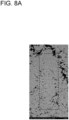
- FIG. 8A is a SEM image of a cross section of the test piece where the top coat layer 9 is formed under the same application condition as in Example 1.
- FIG. 8B is a grayscale image of a region surrounded by a dashed line in FIG. 8A , which is color-coded by crystal orientation through image processing.
- Regions represented in black in FIG. 8B represent either pores, crystals whose crystal orientation could not be identified due to their small grain size, or amorphous states.
- FIG. 8C is a graph showing a crystal grain size distribution in the region surrounded by the dashed line in FIG. 8A .
- FIG. 9A is a SEM image of a cross section of the test piece where the top coat layer 9 is formed under the same application condition as in Comparative Example described above.
- FIG. 9B is a grayscale image of a region surrounded by a dashed line in FIG. 9A , which is color-coded by crystal orientation through image processing.
- Regions represented in black in FIG. 9B represent pores.
- FIG. 9C is a graph showing a crystal grain size distribution in the region surrounded by the dashed line in FIG. 9A .
- An average grain size of the crystals in the top coat layer 9 in the test piece shown in FIGs. 8A to 8C was 0.36 ⁇ m. Further, the average grain size of the crystals in the top coat layer 9 in the test piece shown in FIGs. 9A to 9C was 1.03 ⁇ m.
- cracks in the top coat layer 9 can be suppressed and the average grain size of the crystals can be reduced by performing atmospheric pressure plasma spraying using the suspension while supplying the water W from the cooling fluid supply part 40.
- the average grain size of the crystals in the top coat layer 9 is preferably not less than 0.3 ⁇ m and not greater than 0.8 ⁇ m.
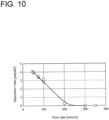
- FIG. 10 is a graph showing a relationship between the amount of the water W supplied from the cooling fluid supply part 40 and a deposition rate which is a film thickness per one path of thermal spraying during application of the top coat layer 9.
- the deposition rate was 3.9 or 4.0 ⁇ m/path when the supply amount of the water W was 50 ml/min, the deposition rate was 3.4 or 3.5 ⁇ m/path when the supply amount of the water W was 75 ml/min, the deposition rate was 2.8 or 3.1 ⁇ m/path when the supply amount of the water W was 100 ml/min, the deposition rate was 0.3 ⁇ m/path when the supply amount of the water W was 200 ml/min, the deposition rate was 0 ⁇ m/path when the supply amount of the water W was 300 ml/min, and the deposition rate was 0 ⁇ m/path when the supply amount of the water W was 400 ml/min.
- the deposition rate decreases as the amount of the water W supplied from the cooling fluid supply part 40 increases.
- the thermal cycle durability in the thermal barrier coating 3 is significantly improved, if the step S20 of forming the top coat layer 9 includes supplying the water W as the cooling fluid to the periphery of the plasma flame P at the supply rate of not less than 25 ml/min and not greater than 100 ml/min.
- the present disclosure is not limited to the above-described embodiments, and also includes an embodiment obtained by modifying the above-described embodiments or an embodiment obtained by combining these embodiments as appropriate.
- the top coat layer 9 can be formed at low cost without performing electron-beam physical vapor deposition, and the thermal cycle durability in the thermal barrier coating 3 can be improved.
- the thermal cycle durability in the thermal barrier coating 3 is significantly improved, if the step of forming the top coat layer 9 includes supplying the water W as the cooling fluid to the periphery of the plasma flame P at the supply rate of not less than 25 ml/min and not greater than 100 ml/min.
- the ceramic powder preferably contains any of yttria-stabilized zirconia, dysprosia stabilized zirconia, erbia stabilized zirconia, Gd 2 Zr 2 O 7 , or Gd 2 Hf 2 O 7 .
- the heat-resistant alloy base material 5 is preferably a nickel-based alloy base material.
- a heat-resistant member 1 according to at least one embodiment of the present disclosure, has the top coat layer 9 formed by the method for applying the thermal barrier coating according to any of the above (1) to (3).
Landscapes
- Chemical & Material Sciences (AREA)
- Engineering & Computer Science (AREA)
- Mechanical Engineering (AREA)
- Materials Engineering (AREA)
- Plasma & Fusion (AREA)
- Physics & Mathematics (AREA)
- Chemical Kinetics & Catalysis (AREA)
- Metallurgy (AREA)
- Organic Chemistry (AREA)
- Inorganic Chemistry (AREA)
- General Engineering & Computer Science (AREA)
- Combustion & Propulsion (AREA)
- Ceramic Engineering (AREA)
- Coating By Spraying Or Casting (AREA)
- Turbine Rotor Nozzle Sealing (AREA)
Abstract
A method for applying a thermal barrier coating according to an embodiment, includes: a step of forming a top coat layer on a bond coat layer formed on a heat-resistant alloy base material of an object. The step of forming the top coat layer includes forming the top coat layer by thermal-spraying a suspension, which contains ceramic powder, with atmospheric pressure plasma spraying, while cooling a portion of a plasma flame by supplying water as a cooling fluid to a periphery of the plasma flame at a supply rate of not less than 25 ml/min and not greater than 100 ml/min.
Description
- The present disclosure relates to a method for applying a thermal barrier coating and a heat-resistant member.
- This application claims the priority of
Japanese Patent Application No. 2022-043646 filed on March 18, 2022 - It is known that a thermal barrier coating (TBC) is provided on a heat-resistant member, which is exposed to a high-temperature combustion gas, such as a combustor panel or a turbine blade in an aircraft engine, or a turbine blade or a ring segment in an industrial gas turbine. Such thermal barrier coating includes a bond coat layer formed on a heat-resistant alloy base material, and a top coat layer as a thermal barrier layer formed on the bond coat layer.
- The bond coat layer is formed on the heat-resistant alloy base material by, for example, thermal spraying (see, for example, Patent Document 1). Further, since the top coat layer is difficult to ensure desired thermal cycle durability with, for example, atmospheric pressure plasma spraying (APS), in order to ensure heat cycle durability, the top coat layer may be formed by electron-beam physical vapor deposition (EB-PVD) so as to internally include a crack which is called a vertical crack extending in a thickness direction of the top coat layer (see, for example, Patent Document 2).
-
- Patent Document 1:
WO2016/076305A - Patent Document 2:
JP2019-065384A - An initial cost of a device for performing electron-beam physical vapor deposition is not less than ten times as high as that of a thermal spraying device, etc. Further, a running cost for forming a layer by electron-beam physical vapor deposition is about ten times as high as a running cost for forming a layer by thermal spraying, etc. Furthermore, a speed of layer formation by electron-beam physical vapor deposition is as low as about a fraction of a speed of layer formation by thermal spraying, etc. Therefore, there is a demand for a method for forming the top coat layer of the thermal barrier coating at a lower cost, while ensuring performance such as thermal barrier properties or heat cycle durability as the top coat layer.
- In view of the above, an object of at least one embodiment of the present disclosure is to suppress the cost of the thermal barrier coating in the heat-resistant member. In order to suppress the cost, it is necessary to improve the thermal barrier properties or heat cycle durability in the top coat of the thermal barrier coating formed by thermal spraying, etc.
-
- (1) A method for applying a thermal barrier coating according to at least one embodiment of the present disclosure, includes: a step of forming a top coat layer on a bond coat layer formed on a heat-resistant alloy base material of an object. The step of forming the top coat layer includes forming the top coat layer by thermal-spraying a suspension, which contains ceramic powder, with atmospheric pressure plasma spraying, while cooling a portion of a plasma flame by supplying water as a cooling fluid to a periphery of the plasma flame at a supply rate of not less than 25 ml/min and not greater than 100 ml/min.
- (2) A heat-resistant member according to at least one embodiment of the present disclosure, has the top coat layer formed by the method for applying the thermal barrier coating according to the above method (1).
- According to at least one embodiment of the present disclosure, it is possible to suppress a cost of a thermal barrier coating in a heat-resistant member.
-
-
FIG. 1 is a schematic cross-sectional view of a heat-resistant member with a thermal barrier coating applied by a method for applying the thermal barrier coating according to some embodiments. -
FIG. 2 is a view showing the appearance of a combustor panel, as an example of the heat-resistant member, for an aircraft engine. -
FIG. 3 is a flowchart showing a procedure of the method for applying the thermal barrier coating according to some embodiments. -
FIG. 4 is a view for describing an outline of a device related to the method for applying the thermal barrier coating according to some embodiments. -
FIG. 5 is a table showing application conditions common to Examples 1 to 3 and Comparative Example. -
FIG. 6 is a table showing test results when a flat-plate material is used as a heat-resistant alloy base material. -
FIG. 7 is a graph showing a test result of a thermal cycle durability test using a cylindrical member. -
FIG. 8A is a SEM image of a cross section of a test piece where a top coat layer is formed under the same application condition as in Example 1. -
FIG. 8B is a grayscale image of a region surrounded by a dashed line inFIG. 8A , which is color-coded by crystal orientation through image processing. -
FIG. 8C is a graph showing a crystal grain size distribution in the region surrounded by the dashed line inFIG. 8A . -
FIG. 9A is a SEM image of a cross section of a test piece where the top coat layer is formed under the same application condition as in Comparative Example. -
FIG. 9B is a grayscale image of a region surrounded by a dashed line inFIG. 9A , which is color-coded by crystal orientation through image processing. -
FIG. 9C is a graph showing a crystal grain size distribution in the region surrounded by the dashed line inFIG. 9A . -
FIG. 10 is a graph showing a relationship between an amount of water supplied from a cooling fluid supply part and a deposition rate which is a film thickness per one path of thermal spraying during application of the top coat layer. - Some embodiments of the present disclosure will be described below with reference to the accompanying drawings. It is intended, however, that unless particularly identified, dimensions, materials, shapes, relative positions and the like of components described or shown in the drawings as the embodiments shall be interpreted as illustrative only and not intended to limit the scope of the present disclosure.
- For instance, an expression of relative or absolute arrangement such as "in a direction", "along a direction", "parallel", "orthogonal", "centered", "concentric" and "coaxial" shall not be construed as indicating only the arrangement in a strict literal sense, but also includes a state where the arrangement is relatively displaced by a tolerance, or by an angle or a distance whereby it is possible to achieve the same function.
- For instance, an expression of an equal state such as "same", "equal", and "uniform" shall not be construed as indicating only the state in which the feature is strictly equal, but also includes a state in which there is a tolerance or a difference that can still achieve the same function.
- Further, for instance, an expression of a shape such as a rectangular shape or a tubular shape shall not be construed as only the geometrically strict shape, but also includes a shape with unevenness or chamfered corners within the range in which the same effect can be achieved.
- On the other hand, the expressions "comprising", "including", "having", "containing", and "constituting" one constituent component are not exclusive expressions that exclude the presence of other constituent components.
-
FIG. 1 is a schematic cross-sectional view of a heat-resistant member 1 with athermal barrier coating 3 applied by a method for applying the thermal barrier coating according to some embodiments. -
FIG. 2 is a view showing the appearance of acombustor panel 1A, as an example of the heat-resistant member 1, for an aircraft engine. - It is known that the thermal barrier coating (TBC) 3 for thermal barrier of the heat-
resistant member 1 is formed on the heat-resistant member 1 such as thecombustor panel 1A or a turbine blade for the aircraft engine, or a turbine blade or a ring segment for an industrial gas turbine. - A metal bond layer (bond coat layer) 7 and a
top coat layer 9 as a thermal barrier layer are formed in sequence on a heat-resistant alloy base material (base material) 5 of the heat-resistant member 1 according to some embodiments. That is, in some embodiments, thethermal barrier coating 3 includes thebond coat layer 7 and thetop coat layer 9. - The heat-resistant
alloy base material 5 according to some embodiments is formed by, for example, a nickel-based alloy. Whereby, heat resistance of the heat-resistantalloy base material 5 is improved. - The
bond coat layer 7 according to some embodiments is formed by, for example, an MCrAlY alloy (M indicates a metallic element such as Ni, Co, or Fe, or a combination of at least two of the above-described metallic elements). - The
top coat layer 9 according to some embodiments is preferably formed by a ZrO2-based material, such as YSZ (yttria-stabilized zirconia) which is ZrO2 partially or fully stabilized with Y2O3. Further, thetop coat layer 9 according to some embodiments may be formed by any of DySZ (dysprosia stabilized zirconia), ErSZ (erbia stabilized zirconia), Gd2Zr2O7, or Gd2Hf2O7. - Whereby, the
thermal barrier coating 3 having excellent thermal barrier properties is obtained. -
FIG. 3 is a flowchart showing a procedure of the method for applying the thermal barrier coating according to some embodiments. The method for applying the thermal barrier coating according to some embodiments includes a step S10 of forming thebond coat layer 7 and a step S20 of forming thetop coat layer 9. - In some embodiments, the step S10 of forming the
bond coat layer 7 is a step of forming thebond coat layer 7 on the heat-resistantalloy base material 5 with thermal spraying. In some embodiments, the step S10 of forming thebond coat layer 7 may be, for example, a step of forming the bond coat layer on the heat-resistantalloy base material 5 with atmospheric pressure plasma spraying. - That is, in some embodiments, the step S10 of forming the
bond coat layer 7 may include thermal-spraying powder such as the MCrAlY alloy as a thermal spray material onto a surface of the heat-resistantalloy base material 5 with atmospheric pressure plasma spraying. - In some embodiments, the step S20 of forming the
top coat layer 9 is a step of forming thetop coat layer 9 on thebond coat layer 7 formed on the heat-resistantalloy base material 5 of the heat-resistant member 1 which is a thermal spray object. In some embodiments, the step S20 of forming thetop coat layer 9 includes forming the top coat layer by thermal-spraying a suspension, which contains ceramic powder, with atmospheric pressure plasma spraying. That is, in some embodiments, the thermal spraying performed in the step S20 of forming thetop coat layer 9 is suspension atmospheric pressure plasma spraying (SAPS). In some embodiments, the step S20 of forming thetop coat layer 9 includes thermal-spraying a suspension, which is obtained by dispersing ceramic powder as the thermal spray material in a solvent, onto a surface of thebond coat layer 7 with atmospheric pressure plasma spraying. - In suspension atmospheric pressure plasma spraying, a thermal spray material supplied as a suspension S is sprayed onto a surface of the thermal spray object by a plasma flame P blown from a nozzle of a thermal spray gun (see FIG. 4B described later).
- In some embodiments, the step S20 of forming the
top coat layer 9 includes forming thetop coat layer 9 by thermal-spraying the suspension S, which contains the ceramic powder, with atmospheric pressure plasma spraying, while cooling a portion of the plasma flame with a cooling fluid from the periphery of the plasma flame P, as described in detail later. - Thermal spraying conditions in the step S20 of forming the
top coat layer 9 will be described later. -
FIG. 4 is a view for describing an outline of a device related to the method for applying the thermal barrier coating according to some embodiments. - As shown in
FIG. 4 , the method for applying the thermal barrier coating according to some embodiments applies thetop coat layer 9 by using athermal spray gun 30 for performing atmospheric pressure plasma spraying, asupply part 35 for supplying the suspension S containing powder of the thermal spray material for thetop coat layer 9, and a cooling fluid supply part (water shroud) 40 for supplying water W as the cooling fluid from the periphery of the plasma flame P. In the method for applying the thermal barrier coating according to some embodiments, in addition to these devices shown inFIG. 4 , although not shown, a thermal spray control panel, a suspension supply device, a supply device for the water W as the cooling fluid, etc. is also included in the device configuration. InFIG. 4 , a device configuration related to formation of thetop coat layer 9 is not illustrated. - The cooling fluid supply part 40 includes a plurality of nozzles 41 disposed, for example, downstream of the suspension S
supply part 35 in an injection direction of the plasma flame P. For example, the plurality of nozzles 41 are disposed along the circumferential direction centered on a virtual central axis AX of the plasma flame P along the injection direction of the plasma flame P, so as to surround the periphery of the plasma flame P. The cooling fluid supply part 40 is configured such that the water W from the plurality of nozzles 41 is injected toward the central axis AX. The cooling fluid supply part 40 is not limited to the above-described form as long as the cooling fluid supply part 40 is configured such that the water W is injected toward the central axis AX. - By injecting the water W from the cooling fluid supply part 40 toward the plasma flame P, a temperature of the plasma flame P decreases in a radially outer region (outer region Ro) of the plasma flame P, which is centered on the central axis AX. Therefore, the ceramic powder present in the outer region Ro, that is, raw-material powder for the
top coat layer 9 collides with the surface of the thermal spray object (the surface of the bond coat layer 7) without being melted, and thus does not adhere (weld) to the surface of the thermal spray object. - However, in a radially inner region (inner region Ri) of the plasma flame P, which is centered on the central axis AX, the plasma flame P is hardly influenced by the water W, and a temperature in the inner region Ri hardly decreases. Therefore, the raw-material powder for the
top coat layer 9, which is present in the inner region Ri, collides with the surface of thebond coat layer 7 in a molten state, and thus is deposited on the surface of thebond coat layer 7. - Even in a case where the water W is not injected from the cooling fluid supply part 40 toward the plasma flame P, the temperature of the plasma flame P is lower in the radially outer region of the plasma flame P, which is centered on the central axis AX, than in the radially inner region centered on the central axis AX. Therefore, the ceramic powder present in the outer region, that is, the raw-material powder for the
top coat layer 9 collides with the surface of the thermal spray object (the surface of the bond coat layer 7) without being sufficiently heated, and thus microstructure of thetop coat layer 9 becomes coarse. - For example, when the suspension S is supplied toward the plasma flame P from the radially outer side of the plasma flame P as in the device configuration shown in
FIG. 4 , ceramic powder with a relatively small particle size in the suspension S joins a flow of the plasma flame in the outer region Ro of the plasma flame P before reaching the inner region Ri. - Further, ceramic powder with a relatively large particle size in the suspension S has a relatively large inertial force moving along the radial direction centered on the central axis AX, and therefore penetrates the inner region Ri of the plasma flame P, reaches the outer region Ro present beyond the inner region Ri, and joins the flow of the plasma flame in the outer region Ro.
- Therefore, the ceramic powder with the relatively small particle size and the ceramic powder with the relatively large particle size in the suspension S do not adhere (weld) to the
bond coat layer 7. That is, in the method for applying the thermal barrier coating according to some embodiments, remaining ceramic powder, excluding the ceramic powder with the relatively small particle size in the suspension S and the ceramic powder with the relatively large particle size, is deposited on the surface of thebond coat layer 7. - Further, in the method for applying the thermal barrier coating according to some embodiments, it is possible to suppress the adhesion (weld), to the
bond coat layer 7, of the ceramic powder which is insufficiently heated in the radially outer region of the plasma flame P when the water W is not injected toward the plasma flame P as described above. - As a result, the microstructure of the
top coat layer 9 is densified. - Thus, it is possible to relatively densify the microstructure of the thermal sprayed layer by thermal-spraying the suspension, which contains the ceramic powder, with atmospheric pressure plasma spraying, while cooling the portion of the plasma flame with the cooling fluid from the periphery of the plasma flame.
- However, in the thermal barrier coating, it is required to suppress heat transfer to a base material side by keeping thermal conductivity low, but the densification of the microstructure leads to an increase in thermal conductivity. Therefore, thermal-spraying the suspension, which contains the ceramic powder, with atmospheric pressure plasma spraying, while cooling the portion of the plasma flame with the cooling fluid from the periphery of the plasma flame has not been done so far from the viewpoint of suppressing the densification of the microstructure of the thermal sprayed layer.
- As a result of intensive studies by the present inventors, it was found that the increase in thermal conductivity is kept relatively low although the microstructure of the
top coat layer 9 is relatively densified, when thetop coat layer 9 is formed by thermal-spraying the suspension, which contains the ceramic powder, with atmospheric pressure plasma spraying, while cooling the portion of the plasma flame P with the cooling fluid from the periphery of the plasma flame P. It was also found that thermal cycle durability is significantly improved by relatively densifying the microstructure of thetop coat layer 9. - That is, it was found that the application method that was previously thought to be unsuitable for forming the thermal barrier layer (top coat layer 9) in
thermal barrier coating 3 is suitable for forming the thermal barrier layer (top coat layer 9) inthermal barrier coating 3. - With the method for applying the thermal barrier coating according to some embodiments, the
top coat layer 9 can be formed at low cost without performing electron-beam physical vapor deposition, and the thermal cycle durability in thethermal barrier coating 3 can be improved. - In the method for applying the thermal barrier coating according to some embodiments, the step S20 of forming the
top coat layer 9 preferably includes supplying the water W as the cooling fluid to the periphery of the plasma flame P. - By using the water W as the cooling fluid, a good cooling effect can be obtained at low cost, for example, in addition to easy availability of the cooling fluid, the periphery of the plasma flame P can efficiently be cooled since latent heat of vaporization is relatively large.
- Further, in the method for applying the thermal barrier coating according to some embodiments, as described later, the step S20 of forming the
top coat layer 9 preferably includes supplying the water W to the periphery of the plasma flame P at a supply rate of not greater than 100 ml/min. - As a result of intensive studies by the present inventors, it was found that the thermal cycle durability in the
thermal barrier coating 3 is significantly improved as described later, if the step S20 of forming thetop coat layer 9 includes supplying the water W to the periphery of the plasma flame P at the supply rate of not greater than 100 ml/min. - Therefore, with the method for applying the thermal barrier coating according to some embodiments, it is possible to significantly improve the thermal cycle durability in the
thermal barrier coating 3. - In the method for applying the thermal barrier coating according to some embodiments, a material of the above-described ceramic powder, that is, the raw-material powder for the
top coat layer 9 preferably contains any of yttria-stabilized zirconia, dysprosia stabilized zirconia, erbia stabilized zirconia, Gd2Zr2O7, or Gd2Hf2O7. - Whereby, the
thermal barrier coating 3 having excellent thermal barrier properties is obtained. - In the method for applying the thermal barrier coating according to some embodiments, the heat-resistant
alloy base material 5 is preferably a nickel-based alloy base material. - Whereby, heat resistance of the heat-resistant
alloy base material 5 is improved. - The heat-
resistant member 1 according to some embodiments has thetop coat layer 9 formed by the method for applying the thermal barrier coating, which is described above. - Whereby, it is possible to improve the thermal cycle durability of the
thermal barrier coating 3 while suppressing the manufacturing cost of the heat-resistant member 1. - Hereinafter, Examples will be described in which the
top coat layer 9 is formed by the method for applying the thermal barrier coating according to some embodiments. -
FIG. 5 is a table showing application conditions common to Examples 1 to 3 and Comparative Example. -
FIG. 6 is a table showing test results when a flat-plate material is used as the heat-resistantalloy base material 5. InFIG. 6 , the test results of Example 1, Example 2, and Comparative Example are expressed as relative values with the test result of Comparative Example set at 1.FIG. 6 shows the results of all tests conducted under the same thermal cycle test conditions. -
FIG. 7 is a graph showing a test result of a thermal cycle durability test for Example 3. - An application condition in Example 1, Example 3, and Comparative Example is referred to as Application Condition A, and an application condition in Example 2 is referred to as Application Condition B.
- A dispersion medium for the suspension S and a supply amount of the suspension S (material supply amount) are different between Application Condition A and Application Condition B in respective Examples and Comparative Example, but the following respective conditions are the same.
- That is, the concentration of Y2O3 in the suspension S is 8 wt% and the concentration of yttria stabilized zirconia powder is 25 wt%.
- A thermal spray distance was 70 mm, a traverse speed was 1000 mm/s, and a traverse pitch was 4 mm.
- The ratio of gas flow rate was 85:57:57 between Ar, N2, and H2.
- A plasma output, that is, input power to the
thermal spray gun 30 was 100 kW. - The dispersion medium for the suspension S was anhydrous ethanol.
- The supply amount of the suspension S (material supply amount) was 45 ml/min under Application Condition A, and 63 ml/min under Application Condition B.
- The amount of the water W supplied from the cooling fluid supply part 40 was 100 ml/min in Example 1 to Example 3, and 0 ml/min in Comparative Example. In
FIG. 6 , the amount of the water W supplied from the cooling fluid supply part 40 is expressed as WS flow rate which is short for a water shroud flow rate. - In Example 1, the porosity rate of the
top coat layer 9 was 0.7 as a relative value with Comparative Example set at 1, and the thermal conductivity of thetop coat layer 9 was 0.9 as a relative value with Comparative Example set at 1. Further, even though the number of thermal cycles in the thermal cycle durability test was 32 as a relative value with Comparative Example set at 1, no separation occurred. - The porosity rate was calculated from SEM images of cross sections of test pieces in respective Examples and Comparative Example by dividing a total area of pore portions in a certain range in the images by an entire area in that range, and was expressed as a relative value with Comparative Example set at 1.
- Further, in the thermal cycle durability test, when a temperature difference of 1000°C was repeatedly given, the number of repetitions until separation of the thermal barrier coating occurs in the test piece was obtained, and the number of thermal cycles, which is the number of repetitions, was expressed as a relative value with Comparative Example set at 1.
- Comparing the test result of Example 1 with the test result of Comparative Example, the porosity rate decreases by 30%. The thermal conductivity does not increase, but on the contrary decreases by 10%. No separation occurs even at 32 times the number of thermal cycles of Comparative Example as described above, and the thermal cycle durability is significantly improved.
- In Example 2, the porosity rate of the
top coat layer 9 was 0.1 as a relative value with Comparative Example set at 1, and the thermal conductivity of thetop coat layer 9 was 1.3 as a relative value with Comparative Example set at 1. Further, even though the number of thermal cycles in the thermal cycle durability test was 32 as a relative value with Comparative Example set at 1, no separation occurred. - Comparing the test result of Example 2 with the test result of Comparative Example, the porosity rate decreases by 90%. The thermal conductivity increases by only 30%. No separation occurs even at 32 times the number of thermal cycles of Comparative Example as described above, and the thermal cycle durability is significantly improved.
- Unlike Example 1, Example 2, and Comparative Example, since Example 3 uses a cylindrical member as the heat-resistant
alloy base material 5, thermal spraying is performed by also moving thethermal spray gun 30 while the heat-resistantalloy base material 5 is rotated around a central axis of the cylinder during thermal spraying. In Example 1, Example 2, and Comparative Example, thermal spraying is performed by moving only thethermal spray gun 30, while the heat-resistantalloy base material 5 is held stationary during thermal spraying. - As shown in
FIG. 7 , from Example 1 to Example 3, in the thermal cycle durability test where the temperature difference of 1000°C was given, the number of repetitions until separation of the thermal barrier coating occurs in the test piece resulted in equal to or not less than a test result in the test piece where thetop coat layer 9 was formed by electron-beam physical vapor deposition (EB-PVD). It cannot be said that a test result in a test piece where thetop coat layer 9 was formed by atmospheric pressure plasma spraying (APS) without the supply of the water W from the cooling fluid supply part 40 is better than the test result in the test piece where thetop coat layer 9 was formed by electron-beam physical vapor deposition (EB-PVD) -
FIG. 8A is a SEM image of a cross section of the test piece where thetop coat layer 9 is formed under the same application condition as in Example 1. -
FIG. 8B is a grayscale image of a region surrounded by a dashed line inFIG. 8A , which is color-coded by crystal orientation through image processing. - Regions represented in black in
FIG. 8B represent either pores, crystals whose crystal orientation could not be identified due to their small grain size, or amorphous states. -
FIG. 8C is a graph showing a crystal grain size distribution in the region surrounded by the dashed line inFIG. 8A . -
FIG. 9A is a SEM image of a cross section of the test piece where thetop coat layer 9 is formed under the same application condition as in Comparative Example described above. -
FIG. 9B is a grayscale image of a region surrounded by a dashed line inFIG. 9A , which is color-coded by crystal orientation through image processing. - Regions represented in black in
FIG. 9B represent pores. -
FIG. 9C is a graph showing a crystal grain size distribution in the region surrounded by the dashed line inFIG. 9A . - An average grain size of the crystals in the
top coat layer 9 in the test piece shown inFIGs. 8A to 8C was 0.36 µm. Further, the average grain size of the crystals in thetop coat layer 9 in the test piece shown inFIGs. 9A to 9C was 1.03 µm. - As can be seen from
FIGs. 8A to 8C andFIGs. 9A to 9C , cracks in thetop coat layer 9 can be suppressed and the average grain size of the crystals can be reduced by performing atmospheric pressure plasma spraying using the suspension while supplying the water W from the cooling fluid supply part 40. - The average grain size of the crystals in the
top coat layer 9 is preferably not less than 0.3 µm and not greater than 0.8 µm. -
FIG. 10 is a graph showing a relationship between the amount of the water W supplied from the cooling fluid supply part 40 and a deposition rate which is a film thickness per one path of thermal spraying during application of thetop coat layer 9. - As shown in
FIG. 10 , the deposition rate was 3.9 or 4.0 µm/path when the supply amount of the water W was 50 ml/min, the deposition rate was 3.4 or 3.5 µm/path when the supply amount of the water W was 75 ml/min, the deposition rate was 2.8 or 3.1 µm/path when the supply amount of the water W was 100 ml/min, the deposition rate was 0.3 µm/path when the supply amount of the water W was 200 ml/min, the deposition rate was 0 µm/path when the supply amount of the water W was 300 ml/min, and the deposition rate was 0 µm/path when the supply amount of the water W was 400 ml/min. - As shown in
FIG. 10 , the deposition rate decreases as the amount of the water W supplied from the cooling fluid supply part 40 increases. - Further, from the test results in Example 1 to Example 3 described above, it was found that the thermal cycle durability in the
thermal barrier coating 3 is significantly improved, if the step S20 of forming thetop coat layer 9 includes supplying the water W as the cooling fluid to the periphery of the plasma flame P at the supply rate of not less than 25 ml/min and not greater than 100 ml/min. - The present disclosure is not limited to the above-described embodiments, and also includes an embodiment obtained by modifying the above-described embodiments or an embodiment obtained by combining these embodiments as appropriate.
- The contents described in the above embodiments would be understood as follows, for instance.
- (1) A method for applying a thermal barrier coating according to at least one embodiment of the present disclosure, includes: a step S20 of forming a
top coat layer 9 on abond coat layer 7 formed on a heat-resistantalloy base material 5 of an object. The step S20 of forming thetop coat layer 9 includes forming thetop coat layer 9 by thermal-spraying a suspension S, which contains ceramic powder, with atmospheric pressure plasma spraying, while cooling a portion of a plasma flame P by supplying water W as a cooling fluid to a periphery of the plasma flame P at a supply rate of not less than 25 ml/min and not greater than 100 ml/min. - With the above method (1), the
top coat layer 9 can be formed at low cost without performing electron-beam physical vapor deposition, and the thermal cycle durability in thethermal barrier coating 3 can be improved. - With the above method (1), by using the water W as the cooling fluid, a good cooling effect can be obtained at low cost, for example, in addition to easy availability of the cooling fluid, the periphery of the plasma flame P can efficiently be cooled since latent heat of vaporization is relatively large.
- As a result of intensive studies by the present inventors, it was found that the thermal cycle durability in the
thermal barrier coating 3 is significantly improved, if the step of forming thetop coat layer 9 includes supplying the water W as the cooling fluid to the periphery of the plasma flame P at the supply rate of not less than 25 ml/min and not greater than 100 ml/min. - With the above method (1), it is possible to significantly improve the thermal cycle durability in the
thermal barrier coating 3. - (2) In some embodiments, in the above method (1), the ceramic powder preferably contains any of yttria-stabilized zirconia, dysprosia stabilized zirconia, erbia stabilized zirconia, Gd2Zr2O7, or Gd2Hf2O7.
- With the above method (2), the
thermal barrier coating 3 having excellent thermal barrier properties is obtained. - (3) In some embodiments, in the above method (1) or (2), the heat-resistant
alloy base material 5 is preferably a nickel-based alloy base material. - With the above method (3), heat resistance of the heat-resistant
alloy base material 5 is improved. - (4) A heat-
resistant member 1 according to at least one embodiment of the present disclosure, has thetop coat layer 9 formed by the method for applying the thermal barrier coating according to any of the above (1) to (3). - With to the above configuration (4), it is possible to improve the thermal cycle durability of the
thermal barrier coating 3 while suppressing the manufacturing cost of the heat-resistant member 1. -
- 1
- Heat-resistant member
- 3
- Thermal barrier coating
- 5
- Heat-resistant alloy base material (base material)
- 7
- Metal bond layer (bond coat layer)
- 9
- Top coat layer
- 30
- Thermal spray gun
- 35
- Supply part
- 40
- Cooling fluid supply part (water shroud)
Claims (4)
- A method for applying a thermal barrier coating, comprising:a step of forming a top coat layer on a bond coat layer formed on a heat-resistant alloy base material of an object,wherein the step of forming the top coat layer includes forming the top coat layer by thermal-spraying a suspension, which contains ceramic powder, with atmospheric pressure plasma spraying, while cooling a portion of a plasma flame by supplying water as a cooling fluid to a periphery of the plasma flame at a supply rate of not less than 25 ml/min and not greater than 100 ml/min.
- The method for applying the thermal barrier coating according to claim 1,
wherein the ceramic powder contains any of yttria-stabilized zirconia, dysprosia stabilized zirconia, erbia stabilized zirconia, Gd2Zr2O7, or Gd2Hf2O7. - The method for applying the thermal barrier coating according to claim 1 or 2,
wherein the heat-resistant alloy base material is a nickel-based alloy base material. - A heat-resistant member having the top coat layer formed by the method for applying the thermal barrier coating according to claim 1 or 2.
Applications Claiming Priority (2)
| Application Number | Priority Date | Filing Date | Title |
|---|---|---|---|
| JP2022043646A JP2023137433A (en) | 2022-03-18 | 2022-03-18 | Method for constructing thermal barrier coating, and heat resistant member |
| PCT/JP2023/008508 WO2023176577A1 (en) | 2022-03-18 | 2023-03-07 | Method for applying thermal barrier coating and heat resistant member |
Publications (2)
| Publication Number | Publication Date |
|---|---|
| EP4461843A1 true EP4461843A1 (en) | 2024-11-13 |
| EP4461843A4 EP4461843A4 (en) | 2024-11-13 |
Family
ID=88023126
Family Applications (1)
| Application Number | Title | Priority Date | Filing Date |
|---|---|---|---|
| EP23770533.0A Pending EP4461843A4 (en) | 2022-03-18 | 2023-03-07 | Method for applying thermal barrier coating and heat resistant member |
Country Status (6)
| Country | Link |
|---|---|
| US (1) | US20250092502A1 (en) |
| EP (1) | EP4461843A4 (en) |
| JP (1) | JP2023137433A (en) |
| CN (1) | CN118679277A (en) |
| CA (1) | CA3252094A1 (en) |
| WO (1) | WO2023176577A1 (en) |
Family Cites Families (13)
| Publication number | Priority date | Publication date | Assignee | Title |
|---|---|---|---|---|
| JPH07110986B2 (en) * | 1991-08-26 | 1995-11-29 | 秩父小野田株式会社 | Plasma spraying method and apparatus |
| US5372857A (en) * | 1992-12-17 | 1994-12-13 | Browning; James A. | Method of high intensity steam cooling of air-cooled flame spray apparatus |
| US20060222777A1 (en) * | 2005-04-05 | 2006-10-05 | General Electric Company | Method for applying a plasma sprayed coating using liquid injection |
| JP5538101B2 (en) * | 2010-07-06 | 2014-07-02 | 三菱重工業株式会社 | Method for reusing sprayed powder, equipment for performing this method, and method for producing coating member |
| JP5943649B2 (en) * | 2012-02-29 | 2016-07-05 | 三菱重工業株式会社 | Manufacturing method of thermal barrier coating material |
| US10279365B2 (en) * | 2012-04-27 | 2019-05-07 | Progressive Surface, Inc. | Thermal spray method integrating selected removal of particulates |
| KR101909841B1 (en) * | 2014-09-05 | 2018-10-18 | 미츠비시 히타치 파워 시스템즈 가부시키가이샤 | Method for producing powder for thermal spray, apparatus for producing powder for thermal spray, and powder for thermal spray produced by said production method |
| CN107148493A (en) | 2014-11-11 | 2017-09-08 | 三菱日立电力系统株式会社 | Thermal barrier coating and turbine component |
| FR3067392B1 (en) * | 2017-06-12 | 2020-12-04 | Safran | DOUBLE REACTIVITY ANTI-CMAS COATING |
| US20190032189A1 (en) | 2017-07-31 | 2019-01-31 | General Electric Company | Adhesion of thermal spray coatings over a smooth surface |
| US10947625B2 (en) * | 2017-09-08 | 2021-03-16 | Raytheon Technologies Corporation | CMAS-resistant thermal barrier coating and method of making a coating thereof |
| US20190169730A1 (en) * | 2017-12-04 | 2019-06-06 | General Electric Company | Methods of forming a porous thermal barrier coating |
| JP2022043646A (en) | 2020-09-04 | 2022-03-16 | 村田機械株式会社 | Fixture and positioning method |
-
2022
- 2022-03-18 JP JP2022043646A patent/JP2023137433A/en active Pending
-
2023
- 2023-03-07 CN CN202380021339.7A patent/CN118679277A/en active Pending
- 2023-03-07 EP EP23770533.0A patent/EP4461843A4/en active Pending
- 2023-03-07 WO PCT/JP2023/008508 patent/WO2023176577A1/en not_active Ceased
- 2023-03-07 CA CA3252094A patent/CA3252094A1/en active Pending
- 2023-03-07 US US18/730,310 patent/US20250092502A1/en active Pending
Also Published As
| Publication number | Publication date |
|---|---|
| US20250092502A1 (en) | 2025-03-20 |
| CA3252094A1 (en) | 2025-01-22 |
| JP2023137433A (en) | 2023-09-29 |
| EP4461843A4 (en) | 2024-11-13 |
| CN118679277A (en) | 2024-09-20 |
| WO2023176577A1 (en) | 2023-09-21 |
Similar Documents
| Publication | Publication Date | Title |
|---|---|---|
| EP1908856B2 (en) | Segmented abradable coatings and process(es) for applying the same | |
| JP5554488B2 (en) | Alumina-based protective coating for thermal barrier coating | |
| US20130065077A1 (en) | Process for Applying a Heat Shielding Coating System on a Metallic Substrate | |
| US12529321B2 (en) | Segmented ceramic coating interlayer | |
| US20120231211A1 (en) | Method for the manufacture of a thermal barrier coating structure | |
| JP2011508093A (en) | Method for improving CMAS penetration resistance | |
| EP1927677A1 (en) | Thermal barrier coating for combustor panels | |
| JP2011047049A (en) | Method of depositing protective coating on turbine combustion component | |
| JP2011508092A (en) | Thermal barrier coating system comprising rare earth aluminate layer for improved CMAS penetration resistance and coated article | |
| EP2336381B1 (en) | Plasma application of thermal barrier coatings with reduced thermal conductivity on combustor hardware | |
| EP1889948A2 (en) | Dual layer ceramic coating | |
| CN109415795A (en) | Selfreparing thermal barrier coatings and its manufacturing method | |
| Tang et al. | Novel thermal barrier coatings produced by axial suspension plasma spray | |
| EP3470544B1 (en) | Method for applying thermal barrier coatings | |
| US20180282853A1 (en) | Hybrid Thermal Barrier Coating and Process of Making Same | |
| EP4461843A1 (en) | Method for applying thermal barrier coating and heat resistant member | |
| Mishra | Life enhancement of gas turbine combustor liner through thermal barrier coating | |
| US11339671B2 (en) | Methods for manufacturing porous barrier coatings using air plasma spray techniques | |
| JP2022134211A (en) | Heat-resistant member and power generation system | |
| RU2714345C1 (en) | Method of producing a gradient nanocomposite heat-shielding coating | |
| Rüßmann et al. | Thermal cycling tests of APS and SPS TBC systems on additively manufactured samples with cooling holes | |
| JP2019173101A (en) | Spray coating material, and coating film and production method for the same | |
| Tang et al. | Axial Injection Plasma Sprayed Thermal Barrier Coatings | |
| Ladru et al. | Tailoring of YSZ powders to meet fixed process windows, parameters and properties for land based turbine applications | |
| KR20240063672A (en) | Thermal barrier coating layer and method for manufacturing the same |
Legal Events
| Date | Code | Title | Description |
|---|---|---|---|
| STAA | Information on the status of an ep patent application or granted ep patent |
Free format text: STATUS: THE INTERNATIONAL PUBLICATION HAS BEEN MADE |
|
| PUAI | Public reference made under article 153(3) epc to a published international application that has entered the european phase |
Free format text: ORIGINAL CODE: 0009012 |
|
| STAA | Information on the status of an ep patent application or granted ep patent |
Free format text: STATUS: REQUEST FOR EXAMINATION WAS MADE |
|
| 17P | Request for examination filed |
Effective date: 20240809 |
|
| A4 | Supplementary search report drawn up and despatched |
Effective date: 20241001 |
|
| AK | Designated contracting states |
Kind code of ref document: A1 Designated state(s): AL AT BE BG CH CY CZ DE DK EE ES FI FR GB GR HR HU IE IS IT LI LT LU LV MC ME MK MT NL NO PL PT RO RS SE SI SK SM TR |
|
| DAV | Request for validation of the european patent (deleted) | ||
| DAX | Request for extension of the european patent (deleted) |