EP4461266A2 - Filzmaterial zur verwendung in einem verfahren zur reparatur oder verstärkung von weichgeweben von menschen oder tieren - Google Patents
Filzmaterial zur verwendung in einem verfahren zur reparatur oder verstärkung von weichgeweben von menschen oder tieren Download PDFInfo
- Publication number
- EP4461266A2 EP4461266A2 EP24191062.9A EP24191062A EP4461266A2 EP 4461266 A2 EP4461266 A2 EP 4461266A2 EP 24191062 A EP24191062 A EP 24191062A EP 4461266 A2 EP4461266 A2 EP 4461266A2
- Authority
- EP
- European Patent Office
- Prior art keywords
- patch
- felted
- needle
- matting
- fibers
- Prior art date
- Legal status (The legal status is an assumption and is not a legal conclusion. Google has not performed a legal analysis and makes no representation as to the accuracy of the status listed.)
- Pending
Links
Images





Classifications
-
- A—HUMAN NECESSITIES
- A61—MEDICAL OR VETERINARY SCIENCE; HYGIENE
- A61F—FILTERS IMPLANTABLE INTO BLOOD VESSELS; PROSTHESES; DEVICES PROVIDING PATENCY TO, OR PREVENTING COLLAPSING OF, TUBULAR STRUCTURES OF THE BODY, e.g. STENTS; ORTHOPAEDIC, NURSING OR CONTRACEPTIVE DEVICES; FOMENTATION; TREATMENT OR PROTECTION OF EYES OR EARS; BANDAGES, DRESSINGS OR ABSORBENT PADS; FIRST-AID KITS
- A61F2/00—Filters implantable into blood vessels; Prostheses, i.e. artificial substitutes or replacements for parts of the body; Appliances for connecting them with the body; Devices providing patency to, or preventing collapsing of, tubular structures of the body, e.g. stents
- A61F2/02—Prostheses implantable into the body
- A61F2/08—Muscles; Tendons; Ligaments
- A61F2/0805—Implements for inserting tendons or ligaments
-
- A—HUMAN NECESSITIES
- A61—MEDICAL OR VETERINARY SCIENCE; HYGIENE
- A61F—FILTERS IMPLANTABLE INTO BLOOD VESSELS; PROSTHESES; DEVICES PROVIDING PATENCY TO, OR PREVENTING COLLAPSING OF, TUBULAR STRUCTURES OF THE BODY, e.g. STENTS; ORTHOPAEDIC, NURSING OR CONTRACEPTIVE DEVICES; FOMENTATION; TREATMENT OR PROTECTION OF EYES OR EARS; BANDAGES, DRESSINGS OR ABSORBENT PADS; FIRST-AID KITS
- A61F2/00—Filters implantable into blood vessels; Prostheses, i.e. artificial substitutes or replacements for parts of the body; Appliances for connecting them with the body; Devices providing patency to, or preventing collapsing of, tubular structures of the body, e.g. stents
- A61F2/02—Prostheses implantable into the body
-
- A—HUMAN NECESSITIES
- A61—MEDICAL OR VETERINARY SCIENCE; HYGIENE
- A61B—DIAGNOSIS; SURGERY; IDENTIFICATION
- A61B17/00—Surgical instruments, devices or methods
- A61B17/064—Surgical staples, i.e. penetrating the tissue
-
- A—HUMAN NECESSITIES
- A61—MEDICAL OR VETERINARY SCIENCE; HYGIENE
- A61B—DIAGNOSIS; SURGERY; IDENTIFICATION
- A61B17/00—Surgical instruments, devices or methods
- A61B17/04—Surgical instruments, devices or methods for suturing wounds; Holders or packages for needles or suture materials
-
- A—HUMAN NECESSITIES
- A61—MEDICAL OR VETERINARY SCIENCE; HYGIENE
- A61B—DIAGNOSIS; SURGERY; IDENTIFICATION
- A61B17/00—Surgical instruments, devices or methods
- A61B17/04—Surgical instruments, devices or methods for suturing wounds; Holders or packages for needles or suture materials
- A61B17/0401—Suture anchors, buttons or pledgets, i.e. means for attaching sutures to bone, cartilage or soft tissue; Instruments for applying or removing suture anchors
-
- A—HUMAN NECESSITIES
- A61—MEDICAL OR VETERINARY SCIENCE; HYGIENE
- A61B—DIAGNOSIS; SURGERY; IDENTIFICATION
- A61B17/00—Surgical instruments, devices or methods
- A61B17/04—Surgical instruments, devices or methods for suturing wounds; Holders or packages for needles or suture materials
- A61B17/0482—Needle or suture guides
-
- A—HUMAN NECESSITIES
- A61—MEDICAL OR VETERINARY SCIENCE; HYGIENE
- A61B—DIAGNOSIS; SURGERY; IDENTIFICATION
- A61B17/00—Surgical instruments, devices or methods
- A61B17/04—Surgical instruments, devices or methods for suturing wounds; Holders or packages for needles or suture materials
- A61B17/0491—Sewing machines for surgery
-
- A—HUMAN NECESSITIES
- A61—MEDICAL OR VETERINARY SCIENCE; HYGIENE
- A61B—DIAGNOSIS; SURGERY; IDENTIFICATION
- A61B17/00—Surgical instruments, devices or methods
- A61B17/04—Surgical instruments, devices or methods for suturing wounds; Holders or packages for needles or suture materials
- A61B17/06—Needles ; Sutures; Needle-suture combinations; Holders or packages for needles or suture materials
-
- A—HUMAN NECESSITIES
- A61—MEDICAL OR VETERINARY SCIENCE; HYGIENE
- A61B—DIAGNOSIS; SURGERY; IDENTIFICATION
- A61B17/00—Surgical instruments, devices or methods
- A61B17/04—Surgical instruments, devices or methods for suturing wounds; Holders or packages for needles or suture materials
- A61B17/06—Needles ; Sutures; Needle-suture combinations; Holders or packages for needles or suture materials
- A61B17/062—Needle manipulators
-
- A—HUMAN NECESSITIES
- A61—MEDICAL OR VETERINARY SCIENCE; HYGIENE
- A61B—DIAGNOSIS; SURGERY; IDENTIFICATION
- A61B17/00—Surgical instruments, devices or methods
- A61B17/064—Surgical staples, i.e. penetrating the tissue
- A61B17/0642—Surgical staples, i.e. penetrating the tissue for bones, e.g. for osteosynthesis or connecting tendon to bone
-
- A—HUMAN NECESSITIES
- A61—MEDICAL OR VETERINARY SCIENCE; HYGIENE
- A61B—DIAGNOSIS; SURGERY; IDENTIFICATION
- A61B17/00—Surgical instruments, devices or methods
- A61B17/064—Surgical staples, i.e. penetrating the tissue
- A61B17/0643—Surgical staples, i.e. penetrating the tissue with separate closing member, e.g. for interlocking with staple
-
- A—HUMAN NECESSITIES
- A61—MEDICAL OR VETERINARY SCIENCE; HYGIENE
- A61B—DIAGNOSIS; SURGERY; IDENTIFICATION
- A61B17/00—Surgical instruments, devices or methods
- A61B17/064—Surgical staples, i.e. penetrating the tissue
- A61B17/0644—Surgical staples, i.e. penetrating the tissue penetrating the tissue, deformable to closed position
-
- A—HUMAN NECESSITIES
- A61—MEDICAL OR VETERINARY SCIENCE; HYGIENE
- A61B—DIAGNOSIS; SURGERY; IDENTIFICATION
- A61B17/00—Surgical instruments, devices or methods
- A61B17/34—Trocars; Puncturing needles
- A61B17/3417—Details of tips or shafts, e.g. grooves, expandable, bendable; Multiple coaxial sliding cannulas, e.g. for dilating
-
- A—HUMAN NECESSITIES
- A61—MEDICAL OR VETERINARY SCIENCE; HYGIENE
- A61B—DIAGNOSIS; SURGERY; IDENTIFICATION
- A61B17/00—Surgical instruments, devices or methods
- A61B17/34—Trocars; Puncturing needles
- A61B17/3472—Trocars; Puncturing needles for bones, e.g. intraosseus injections
-
- A—HUMAN NECESSITIES
- A61—MEDICAL OR VETERINARY SCIENCE; HYGIENE
- A61B—DIAGNOSIS; SURGERY; IDENTIFICATION
- A61B17/00—Surgical instruments, devices or methods
- A61B2017/00535—Surgical instruments, devices or methods pneumatically or hydraulically operated
-
- A—HUMAN NECESSITIES
- A61—MEDICAL OR VETERINARY SCIENCE; HYGIENE
- A61B—DIAGNOSIS; SURGERY; IDENTIFICATION
- A61B17/00—Surgical instruments, devices or methods
- A61B2017/00831—Material properties
- A61B2017/00893—Material properties pharmaceutically effective
-
- A—HUMAN NECESSITIES
- A61—MEDICAL OR VETERINARY SCIENCE; HYGIENE
- A61B—DIAGNOSIS; SURGERY; IDENTIFICATION
- A61B17/00—Surgical instruments, devices or methods
- A61B17/04—Surgical instruments, devices or methods for suturing wounds; Holders or packages for needles or suture materials
- A61B17/0401—Suture anchors, buttons or pledgets, i.e. means for attaching sutures to bone, cartilage or soft tissue; Instruments for applying or removing suture anchors
- A61B2017/0409—Instruments for applying suture anchors
-
- A—HUMAN NECESSITIES
- A61—MEDICAL OR VETERINARY SCIENCE; HYGIENE
- A61B—DIAGNOSIS; SURGERY; IDENTIFICATION
- A61B17/00—Surgical instruments, devices or methods
- A61B17/04—Surgical instruments, devices or methods for suturing wounds; Holders or packages for needles or suture materials
- A61B17/0401—Suture anchors, buttons or pledgets, i.e. means for attaching sutures to bone, cartilage or soft tissue; Instruments for applying or removing suture anchors
- A61B2017/0412—Suture anchors, buttons or pledgets, i.e. means for attaching sutures to bone, cartilage or soft tissue; Instruments for applying or removing suture anchors having anchoring barbs or pins extending outwardly from suture anchor body
-
- A—HUMAN NECESSITIES
- A61—MEDICAL OR VETERINARY SCIENCE; HYGIENE
- A61B—DIAGNOSIS; SURGERY; IDENTIFICATION
- A61B17/00—Surgical instruments, devices or methods
- A61B17/04—Surgical instruments, devices or methods for suturing wounds; Holders or packages for needles or suture materials
- A61B2017/0495—Reinforcements for suture lines
-
- A—HUMAN NECESSITIES
- A61—MEDICAL OR VETERINARY SCIENCE; HYGIENE
- A61B—DIAGNOSIS; SURGERY; IDENTIFICATION
- A61B17/00—Surgical instruments, devices or methods
- A61B17/04—Surgical instruments, devices or methods for suturing wounds; Holders or packages for needles or suture materials
- A61B17/06—Needles ; Sutures; Needle-suture combinations; Holders or packages for needles or suture materials
- A61B17/06004—Means for attaching suture to needle
- A61B2017/06042—Means for attaching suture to needle located close to needle tip
-
- A—HUMAN NECESSITIES
- A61—MEDICAL OR VETERINARY SCIENCE; HYGIENE
- A61B—DIAGNOSIS; SURGERY; IDENTIFICATION
- A61B17/00—Surgical instruments, devices or methods
- A61B17/04—Surgical instruments, devices or methods for suturing wounds; Holders or packages for needles or suture materials
- A61B17/06—Needles ; Sutures; Needle-suture combinations; Holders or packages for needles or suture materials
- A61B17/06004—Means for attaching suture to needle
- A61B2017/06047—Means for attaching suture to needle located at the middle of the needle
-
- A—HUMAN NECESSITIES
- A61—MEDICAL OR VETERINARY SCIENCE; HYGIENE
- A61B—DIAGNOSIS; SURGERY; IDENTIFICATION
- A61B17/00—Surgical instruments, devices or methods
- A61B17/04—Surgical instruments, devices or methods for suturing wounds; Holders or packages for needles or suture materials
- A61B17/06—Needles ; Sutures; Needle-suture combinations; Holders or packages for needles or suture materials
- A61B17/06066—Needles, e.g. needle tip configurations
- A61B2017/06071—Needles, e.g. needle tip configurations with an abrupt angle formed between two adjacent sections
-
- A—HUMAN NECESSITIES
- A61—MEDICAL OR VETERINARY SCIENCE; HYGIENE
- A61B—DIAGNOSIS; SURGERY; IDENTIFICATION
- A61B17/00—Surgical instruments, devices or methods
- A61B17/064—Surgical staples, i.e. penetrating the tissue
- A61B2017/0647—Surgical staples, i.e. penetrating the tissue having one single leg, e.g. tacks
-
- A—HUMAN NECESSITIES
- A61—MEDICAL OR VETERINARY SCIENCE; HYGIENE
- A61F—FILTERS IMPLANTABLE INTO BLOOD VESSELS; PROSTHESES; DEVICES PROVIDING PATENCY TO, OR PREVENTING COLLAPSING OF, TUBULAR STRUCTURES OF THE BODY, e.g. STENTS; ORTHOPAEDIC, NURSING OR CONTRACEPTIVE DEVICES; FOMENTATION; TREATMENT OR PROTECTION OF EYES OR EARS; BANDAGES, DRESSINGS OR ABSORBENT PADS; FIRST-AID KITS
- A61F2/00—Filters implantable into blood vessels; Prostheses, i.e. artificial substitutes or replacements for parts of the body; Appliances for connecting them with the body; Devices providing patency to, or preventing collapsing of, tubular structures of the body, e.g. stents
- A61F2/0063—Implantable repair or support meshes, e.g. hernia meshes
-
- A—HUMAN NECESSITIES
- A61—MEDICAL OR VETERINARY SCIENCE; HYGIENE
- A61F—FILTERS IMPLANTABLE INTO BLOOD VESSELS; PROSTHESES; DEVICES PROVIDING PATENCY TO, OR PREVENTING COLLAPSING OF, TUBULAR STRUCTURES OF THE BODY, e.g. STENTS; ORTHOPAEDIC, NURSING OR CONTRACEPTIVE DEVICES; FOMENTATION; TREATMENT OR PROTECTION OF EYES OR EARS; BANDAGES, DRESSINGS OR ABSORBENT PADS; FIRST-AID KITS
- A61F2/00—Filters implantable into blood vessels; Prostheses, i.e. artificial substitutes or replacements for parts of the body; Appliances for connecting them with the body; Devices providing patency to, or preventing collapsing of, tubular structures of the body, e.g. stents
- A61F2/0077—Special surfaces of prostheses, e.g. for improving ingrowth
-
- A—HUMAN NECESSITIES
- A61—MEDICAL OR VETERINARY SCIENCE; HYGIENE
- A61F—FILTERS IMPLANTABLE INTO BLOOD VESSELS; PROSTHESES; DEVICES PROVIDING PATENCY TO, OR PREVENTING COLLAPSING OF, TUBULAR STRUCTURES OF THE BODY, e.g. STENTS; ORTHOPAEDIC, NURSING OR CONTRACEPTIVE DEVICES; FOMENTATION; TREATMENT OR PROTECTION OF EYES OR EARS; BANDAGES, DRESSINGS OR ABSORBENT PADS; FIRST-AID KITS
- A61F2/00—Filters implantable into blood vessels; Prostheses, i.e. artificial substitutes or replacements for parts of the body; Appliances for connecting them with the body; Devices providing patency to, or preventing collapsing of, tubular structures of the body, e.g. stents
- A61F2/02—Prostheses implantable into the body
- A61F2/04—Hollow or tubular parts of organs, e.g. bladders, tracheae, bronchi or bile ducts
-
- A—HUMAN NECESSITIES
- A61—MEDICAL OR VETERINARY SCIENCE; HYGIENE
- A61F—FILTERS IMPLANTABLE INTO BLOOD VESSELS; PROSTHESES; DEVICES PROVIDING PATENCY TO, OR PREVENTING COLLAPSING OF, TUBULAR STRUCTURES OF THE BODY, e.g. STENTS; ORTHOPAEDIC, NURSING OR CONTRACEPTIVE DEVICES; FOMENTATION; TREATMENT OR PROTECTION OF EYES OR EARS; BANDAGES, DRESSINGS OR ABSORBENT PADS; FIRST-AID KITS
- A61F2/00—Filters implantable into blood vessels; Prostheses, i.e. artificial substitutes or replacements for parts of the body; Appliances for connecting them with the body; Devices providing patency to, or preventing collapsing of, tubular structures of the body, e.g. stents
- A61F2/02—Prostheses implantable into the body
- A61F2/24—Heart valves ; Vascular valves, e.g. venous valves; Heart implants, e.g. passive devices for improving the function of the native valve or the heart muscle; Transmyocardial revascularisation [TMR] devices; Valves implantable in the body
- A61F2/2412—Heart valves ; Vascular valves, e.g. venous valves; Heart implants, e.g. passive devices for improving the function of the native valve or the heart muscle; Transmyocardial revascularisation [TMR] devices; Valves implantable in the body with soft flexible valve members, e.g. tissue valves shaped like natural valves
- A61F2/2418—Scaffolds therefor, e.g. support stents
-
- A—HUMAN NECESSITIES
- A61—MEDICAL OR VETERINARY SCIENCE; HYGIENE
- A61F—FILTERS IMPLANTABLE INTO BLOOD VESSELS; PROSTHESES; DEVICES PROVIDING PATENCY TO, OR PREVENTING COLLAPSING OF, TUBULAR STRUCTURES OF THE BODY, e.g. STENTS; ORTHOPAEDIC, NURSING OR CONTRACEPTIVE DEVICES; FOMENTATION; TREATMENT OR PROTECTION OF EYES OR EARS; BANDAGES, DRESSINGS OR ABSORBENT PADS; FIRST-AID KITS
- A61F2220/00—Fixations or connections for prostheses classified in groups A61F2/00 - A61F2/26 or A61F2/82 or A61F9/00 or A61F11/00 or subgroups thereof
- A61F2220/0008—Fixation appliances for connecting prostheses to the body
- A61F2220/0016—Fixation appliances for connecting prostheses to the body with sharp anchoring protrusions, e.g. barbs, pins, spikes
-
- A—HUMAN NECESSITIES
- A61—MEDICAL OR VETERINARY SCIENCE; HYGIENE
- A61L—METHODS OR APPARATUS FOR STERILISING MATERIALS OR OBJECTS IN GENERAL; DISINFECTION, STERILISATION OR DEODORISATION OF AIR; CHEMICAL ASPECTS OF BANDAGES, DRESSINGS, ABSORBENT PADS OR SURGICAL ARTICLES; MATERIALS FOR BANDAGES, DRESSINGS, ABSORBENT PADS OR SURGICAL ARTICLES
- A61L2430/00—Materials or treatment for tissue regeneration
- A61L2430/10—Materials or treatment for tissue regeneration for reconstruction of tendons or ligaments
-
- A—HUMAN NECESSITIES
- A61—MEDICAL OR VETERINARY SCIENCE; HYGIENE
- A61L—METHODS OR APPARATUS FOR STERILISING MATERIALS OR OBJECTS IN GENERAL; DISINFECTION, STERILISATION OR DEODORISATION OF AIR; CHEMICAL ASPECTS OF BANDAGES, DRESSINGS, ABSORBENT PADS OR SURGICAL ARTICLES; MATERIALS FOR BANDAGES, DRESSINGS, ABSORBENT PADS OR SURGICAL ARTICLES
- A61L2430/00—Materials or treatment for tissue regeneration
- A61L2430/34—Materials or treatment for tissue regeneration for soft tissue reconstruction
Definitions
- the invention relates to a felt material comprising a multitude of fibers for use in a method of repairing or augmenting human or animal soft tissues according to the preamble of claim 1, to a set of surgical instruments for attaching the felt material to soft tissue according to the preamble of claim 25 and to a method of repairing or augmenting human or animal soft tissues according to the preamble of claim 36.
- sutures are indispensable for medical surgeries for guaranteeing tissue regeneration.
- the threads used for sutures can vary, depending on the location of the surgery and the targeted tissue. Not only mechanical properties of sutures and knotting techniques are essential for a good outcome.
- a medical implant for repairing tendons and ligaments is known from US 2008/0188936 A1 [Ball et al. ].
- This known medical implant comprises an anchor structure attachable to bone by means of bone anchors and a tension member made of a patch material as for example a woven mesh, fabric made by weaving, knitting, braiding or felting fibers. During surgery one end of the tension member is attached to a tendon and then a tension force is applied to the other end of the tension member, which end is then engaged under tension with the anchor structure.
- a drawback of this known medical implant is that the implant is attached to soft tissue and/or bone at each of its ends only so that a mechanical connection of the implant and the soft tissue or bone is achieved in a small area only.
- the invention solves the posed problem with a felt material for use in a method of repairing or augmenting human or animal soft tissue according to the features of claim 1, with a set of surgical instruments for attaching the felt material to soft tissue comprising the features of claim 25 and with a method of repairing or augmenting human or animal soft tissues comprising the features of claim 36.
- the advantages of the felt material for use in a method for repairing or augmenting human or animal soft tissue according to the invention is that a strong mechanical connection between soft tissue and the felt material is achievable in a broad range of the contacting surface resulting in optimal stress distribution.
- some of the fibers of the felted patch are pushed or pulled through the second surface into the soft tissue by means of a needle, pin or blade comprising barbs.
- the barbs catch the fibers of the felted patch or matting and push them through the second surface into the soft tissue.
- the barbs can be punched, carved or cut into the needle, pin or blade.
- the barbs are spaced at intervals along the needle, pin or blade.
- the needle comprises a tip portion and the barbs alternatingly face forward and backward with respect to the tip portion. This configuration permits the advantage that the fibers of the felted patch can be pushed or pulled through the second surface into the soft tissue.
- some fibers of the felted patch or matting are pushed or pulled to penetrate through the second surface in the complete area covered by the second surface.
- the felted patch or matting and the soft tissue can be interwoven in the complete area covered by the second surface so as to form a strong mechanical connection between the felted patch or matting and the soft tissue.
- the felted patch or matting can be highly loaded in an axial direction, i.e. in a direction parallel to the second surface but can be peeled of if the felted patch or matting is loaded perpendicular to the soft tissue. By this means the felted patch or matting can be repositioned or removed if necessary or beneficial.
- the second surface of the felt patch or matting is a continuous area, preferably a continuous and flat area.
- the felted patch or matting is configured to continuously extend over a large contacting area.
- the felt patch or matting can be configured for a flat connecting area or can be configured as a tubular construct provided with a longitudinal gap to apply the construct e.g. to blood vessels.
- the felt material additionally to the fibers of the felt material comprises fibers or strings of monofilament or multifilament nature and of higher tensile strength or having a larger diameter, wherein the ratio between the tensile force exertable on an additional fiber or string and on a fiber of the felt material is minimum 1.5, preferably minimum 2.0.
- the advantage can be achieved that by means of the additional fibers of higher tensile strength or having a larger diameter a higher tensile force can be applied to the felted patch or matting so as to significantly improve the stiffness and patch stability.
- the complete construct can be reinforced for example if sutures are stitched through the felted patch.
- An additional advantage is that non-linear stiffnesses can be achieved which are more similar to the natural behavior of tendons and ligaments.
- the additional fibers or strings are in the form of single fibers, a net, a fan or a weave.
- the felted patch or matting additionally comprises at least a second layer, wherein the at least one second layer is differently configured or comprises a different material than the felted patch or matting.
- This configuration permits the advantage that a layer providing an anchoring function to the assembly can be added, or a second layer e.g. in the form of a braided structure (mesh or net) to reinforce or augment the felted patch can be added.
- the felt material before attachment to soft tissue is pre-stretched in at least one direction along the first and second surfaces of the felted patch or matting.
- the felt material before attachment to soft tissue is additionally modified by means of a suture arranged with a diagonal stitching pattern.
- the felted patch or matting comprises one or more augmented zones which each comprise either fibers or strings of monofilament or multifilament nature and of higher tensile strength or having a larger diameter, or a second layer or at least one suture arranged with a diagonal stitching pattern.
- This configuration permits the advantage that the attachment of the felted patch or matting may be effected in the regions which are not augmented, e.g. not directly on the reinforcement second layer or stitching pattern so as to not destroy the fibers or sutures in the augmented regions.
- the felted patch or matting additionally comprises - before attachment to soft tissue - one or more sutures which are incorporated in the felt material.
- the one or more sutures - before attachment of the felted patch or matting to soft tissue - protrude from the felted patch or matting so as to form an anchor member.
- the patch-suture construct can be equipped with one or several anchor elements which are connected to the felted patch with sutures or other connecting elements.
- one end of a braided textile preferably of a suture is unraveled and reorganized to a felted textile and affixed to the felted patch or matting to form a second layer.
- the fibers of the felt material are aligned. This permits the advantage that higher unidirectional stiffness properties of the felt patch or matting can be achieved compared to a common felt material with randomly arranged fibers.
- the fibers of the felt material comprise barbs arranged along the fibers, wherein the barbs are preferably integral with the fibers of the felt material.
- the barbs are preferably integral with the fibers of the felt material.
- the felt material is covered or soaked with drugs or chemical agents like antibiotics, biocompatible glue or collagen.
- the felted patch or matting comprises an additional layer of a biocompatible self-adhesive film. This configuration allows a first mechanical connection or later permanent connection of the felted patch or matting to the soft tissue onto which it is attached.
- the needle is guided at an angle different from 90° with respect to the second surface of the felted patch or matting.
- the needle is subsequently or alternatingly guided at angles larger and smaller than 90° with respect to the second surface of the felted patch or matting.
- the fibers of the felt material are crosswise stitched oblique to the surface of the soft tissue.
- more than one felted patch or matting is attached to soft tissue.
- felted patches can be used to connect two tendon ends (e.g. on top and on bottom).
- more than one needle is used to displace some of the fibers of the felted patch or matting to penetrate through the second surface into the soft tissue at the same time and preferably from two or more directions.
- one or more rotating needles are used to displace some of the fibers of the felted patch or matting to helically penetrate through the second surface into the soft tissue.
- a set of instruments for attaching a felt material to soft tissue comprising:
- the stitching device comprises a drive mechanism, wherein the tubular member has a longitudinal axis and the drive mechanism is configured to displace the needle back and forth along the longitudinal axis of the tubular member.
- the first jaw comprises an opening, wherein the opening permits the tip portion of the needle to penetrate the first jaw in the range of the first surface of the felted patch or matting.
- the second jaw comprises a mesh covering the cavity, wherein the mesh has openings permitting the needle to pass there through.
- the second jaw comprises a plurality of brush fibers arranged in the cavity permitting the needle to pass between the brush fibers.
- the clamping device comprises a holder suitable to be attached to the stitching device, wherein the holder is configured to hold the felted patch or matting and to guide the needle at a selectable angle.
- the drive mechanism is attachable to an electric, pneumatic or hydraulic drive unit.
- the drive mechanism comprises means to adjust an amplitude of the back and forth movement of the needle.
- the drive mechanism or a drive unit attached to the stitching device comprises means to rotate the needle about the longitudinal axis of the tubular member.
- rotating or helically penetrating needles can be used with variable rotation of the needle during insertion or extraction.
- the tubular member comprises a hollow ball-shaped front end. This configuration permits the advantage that a better contact surface at the front end is achieved which particularly permits to prevent tilting or tipping over of the tubular member when contacting the surface of the felted patch or matting.
- the barbs of the needle are rounded.
- a method of repairing or augmenting human or animal soft tissues comprises the steps of: A) positioning a felt material in the form of a matting or felted patch comprising a first surface and oppositely arranged a second surface for contacting a surface of soft tissue onto soft tissue of a patient to be treated; and B) repeatedly advancing a needle through the felted patch or matting so that some of the fibers of the felted patch or matting are pushed or pulled through the second surface into the soft tissue by means of a needle producing a connection between the felt material and the soft tissue.
- Fig. 1 illustrates an embodiment of the felt material 1 comprising a multitude of fibers 2 for use in a method of repairing or augmenting human or animal soft tissue 3 according to the invention.
- the felt material 1 is in the form of a matting or felted patch 9 which comprises a first surface 5 and oppositely arranged a second surface 6 for contacting a surface of soft tissue 3.
- the felted patch 9 or matting is affixed to soft tissue, e.g.
- a tendon or ligament by applying a method of repairing or augmenting human or animal soft tissue 3 comprising the steps of: A) positioning a felt material 1 in the form of a matting or felted patch 9 comprising a first surface 5 and oppositely arranged a second surface 6 for contacting a surface of soft tissue 3 onto a patient's soft tissue 3 and B) repeatedly advancing a needle 10 through the felted patch 9 or matting so that some of the fibers 2 of the felted patch 9 or matting are pushed or pulled through the second surface 6 into the soft tissue 3 by means of the needle 10 to produce a firm connection between the felt material 1 and the soft tissue 3.
- the above method using a felted patch 9 or matting can be used to reinforce the surrounding soft tissue as a preparation for the use of a conventional suture stitch (tendon-patch). Alternatively, it can also be used to fasten the felted patch 9 to connect it directly to a second target organ (for example tendon-patch-tendon or tendon-patch-bone). Another application is to fasten the felted patch 9, embodied with sutures and or an anchoring element for further fixation to a second structure such as soft tissue (tendon-patch & suture) or bone (tendon-patch & suture-bone anchor).
- the felt material 1 applied according to the above method can be used for the repair, augmentation or fixation of anatomical structures such as: suture of collagenous tissues such as tendons or fascias, ligament reconstructions (collateral ligaments, cruciate ligaments, etc.), subcutaneous sutures, conventional suturing of skin closures, skeletal muscle, heart muscle and valves, hollow organs (large vessels, bladder, esophagus, possibly intestine).
- anatomical structures such as: suture of collagenous tissues such as tendons or fascias, ligament reconstructions (collateral ligaments, cruciate ligaments, etc.), subcutaneous sutures, conventional suturing of skin closures, skeletal muscle, heart muscle and valves, hollow organs (large vessels, bladder, esophagus, possibly intestine).
- the felted patch 9 can be pre-stretched and or additionally modified with a diagonal stitching pattern. Furthermore, the felted patch 9 or matting can be covered or soaked with drugs or chemical agents such as antibiotics, a biocompatible glue, collagen or a layer of biocompatible self-adhesive film to allow a first mechanical connection or later permanent connection to the soft tissue 3 on which it is felted on.
- drugs or chemical agents such as antibiotics, a biocompatible glue, collagen or a layer of biocompatible self-adhesive film to allow a first mechanical connection or later permanent connection to the soft tissue 3 on which it is felted on.
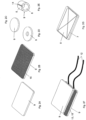
- the felted patch 9 or matting can have - besides basic geometrical shapes of the felted patch 9 or matting such as round or rectangular patches ( figs. 2A, 2C and 2D ) - special configurations such as rings as illustrated in fig. 2D (e.g. for heart valve repair) or tubes including a longitudinal gap 14 as illustrated in fig. 2E (similar like a catheter) can be used for repair of hollow organs such as blood vessels.
- other geometrical shapes like concave and convex surfaces may also be used.
- the felted patch 9 comprises a second layer 15 so as to form an assembly of different layers which improves the felted patch 9 or matting and adds an anchoring function.
- a net, fan or weave or is similar shapes can be incorporated into the felted patch 9 or matting.
- the ratio between the tensile force exertable on an additional fiber or string and on a fiber 2 of the felt material 1 is minimum 1.5, preferably minimum 2.0. This also allows to reinforce the construct for example if sutures are stitched through the felted patch 9 or matting.
- sutures can be incorporated into the felted patch 9 or matting.
- the patch-suture construct can be equipped with one or several anchor elements (not shown) which are connected to the felted patch 9 or matting with sutures or other connecting elements.
- one end of braided textiles e.g. sutures 12
- one end of braided textiles is unraveled, remodelled to a felted textile 13 and attached to the felted patch 9 or matting as a second layer 15.
- the felted patch 9 or matting comprises an additional stitching pattern e.g. zig-zag stitches with a yarn or suture 7 having a diameter of exemplarily 0.1 mm and a stitching distance of 2 mm so as to contribute to a higher construct stiffness (> 100 N/mm).
- additional stitching pattern e.g. zig-zag stitches with a yarn or suture 7 having a diameter of exemplarily 0.1 mm and a stitching distance of 2 mm so as to contribute to a higher construct stiffness (> 100 N/mm).
- the diagonal pattern adds stability if diagonal stress is applied which is favorable for e.g. rotator cuff surgery suture bridge augmentation.
- a diagonal stitching pattern makes the construct more robust against shear stresses which can occur e.g. when the shoulder is rotated.
- the embodiments of figs. 2B, 2F and 2G are configured to augment the felted patch 9 or matting with respect to its stiffness either through one or more additional augmenting second layers 15 or by additional suturing with a suture 7 (e.g. X-pattern, or stitched outer edges).
- a suture 7 e.g. X-pattern, or stitched outer edges.
- a long, almost endless thread, suture 7 or additional fiber that gives the felted patch 9 or matting a structure thus results in an overall construct with better mechanical properties and prevents the individual fibers 2 of the felt material 1 from being pulled apart.
- the combination of individual filaments that can be felted with a felting needle 10 but which are weak on the construct and additional long, systematically sutured threads or sutures 7 make the felted patch 9 a capable implant.
- the felted patch 9 or matting can comprise zones which are not augmented, and other zones which are augmented (e.g., by an additional second layer 15 or suturing).
- the augmented zones are not penetrated by the felting needle 10 while the non-augmented zones are used to attach the felted patch 9 or matting to the soft tissue 3.
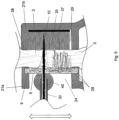
- Figs. 3-5 illustrate an embodiment of a set of instruments according to the invention for attaching the felt material 1 to soft tissue 3.
- the set of instruments comprises:
- the first jaw 21a is frame-like configured permitting the tip portion of the needle 10 to penetrate the first jaw 21a in the range of the first surface 5 of the felted patch 9 or matting and holding means 28 to hold the felted patch 9 or matting.
- the second jaw 21b comprises a cavity 29 open towards the first jaw 21a to receive the tip portion of the needle 10.
- the tubular member 32 has a longitudinal axis 33 and the drive mechanism 31 is configured to displace the needle 10 back and forth along the longitudinal axis 33 of the tubular member 32.
- the frame-like first jaw 21a comprises an opening 24 which permits the tip portion of the needle 10 to penetrate the first jaw 21a in the range of the first surface 5 of the felted patch 9 or matting.
- the tubular member 32 has a hollow ball-shaped front end 40 (e.g. with a diameter between 2 and 10 mm).
- a better contact surface can be achieved and tilting or tipping over of the tubular member 32 when abutting the felted patch 9 can be prevented.
- the drive mechanism 31 of the stitching device 30 can either be induced manually, motorized or by means of pneumatic, magnetic or hydraulic aids.
- the stitching device 30 can be plugged on a motorized source.
- the stitching device 30 is configured as a single needle device but - alternatively can be consistent of many needles.
- the drive mechanism 31 or a drive unit (not shown) attached to the stitching device 30 comprises means to rotate the needle 10 about the longitudinal axis 33 of the tubular member 32. Therewith rotating or helically penetrating needles can be used with variable rotation of the needle 10 during insertion or extraction.
- the drive mechanism 31 comprises means (not shown) to adjust an amplitude of the back and forth movement of the needle 10 so that dependent on the size and application different depths of needle penetration into the felted patch 9 or matting and soft tissue 3 can be adjusted by the user.
- This is particularly useful in combination with a needle 10 which has a defined transportation distance of the fibers 2 that are pushed into the soft tissue 3 particularly, if there is just single series of hooks near the tip of the needle 10.
- a pair or series of needles can stich consecutively if several needles are used. Parallel stich patters or crosswise patterns can be achieved.
- the shape of the needle 10 and the orientation of the felting barbs 11 can be configured to push the fibers 2 of the felt material 1 through the second surface 6 of the felted patch 9 or matting ( fig. 4A ) or to pull the fibers 2 of the felt material 1 through the second surface 6 of the felted patch or matting ( fig. 4B ).
- flat or round shaped needles 10 can be used dependent on preventing tissue damage.
- the felting barbs 11 can either be oriented in one direction or both linear (circular) directions. This will allow that fibers 2 of the felt material 1 are pushed and/or pulled in both directions (e.g. in a configuration were felted patches 9 are used on top and bottom of soft tissue 3).
- the felting barbs 11 can either be oriented side to side, in a gradual or circumferential pattern.
- the stitching technique can be perpendicular to the soft tissue 3, so that the needle guidance is parallel.
- the needle guidance is in a certain angle towards the surface of the soft tissue.
- a crosswise stitching, oblique to the surface is performed.
- several felted patches 9 are used to connect two tendon ends (e.g. on top and on bottom)
- several needles 10 can stich at the same time from two or several directions, each needle 10 equipped with barbs 11.
- the first jaw 21a comprises an opening 24, wherein the opening 24 permits the tip portion of the needle 10 to penetrate the first jaw 21a in the range of the first surface 5 of the felted patch 9 or matting.
- the second jaw 21b comprises a mesh 34 covering the cavity 29 ( fig. 3 ), wherein the mesh 34 has openings permitting the needle 10 to pass there through.
- the second jaw 21b can comprise a plurality of brush fibers 35 ( fig. 5 ) attached to a brush base 37 arranged in the cavity 29 instead of the mesh 34 so as to permit the needle 10 to pass between the brush fibers 35.
- the surface of the second jaw 21b which is opposite the first jaw 21a is provided with a teeth structure 38 to achieve a better grip of the soft tissue 3 ( fig. 5 ).
- both opposing surfaces of the first and second jaws 21a, 21b can be provided with a teeth structure 38.
- the needle 10 comprises barbs 11 which are oriented in a direction so that they catch and push or pull fibers 2 in the stitching direction of the needle 10.
- the soft tissue 3, in this example two torn ends of a tendon 4 are held in place together by a surgical or a specifically for the purpose devised clamp 20.
- the surgical clamp 20 has two jaws 21a; 21b with each a tip, while the tip of the first jaw 21a holds the felted patch 9 [flexible member] in place.
- the second jaw 21b of the surgical clamp 20 is spanned with a net or one or more brushes 22 which are pressed and therefore wrapped around the tendon 4.
- the brush structure allows the needle 10 to go through the brush hairs, while keeping the tendon 4 in position.
- fine wires can be used which are aligned in parallel with a certain distance.
- the purpose of this brush 22, net or wire structure is to constrain the soft tissue 3 while allowing the needle 10 to stich through the soft tissue 3.
- the second jaw 21b of the surgical clamp 20 has a space 23 to allow the needle 10 to stich deep and protects surrounding soft tissue 3 from needle penetration.
- the needle 10 is, exemplarily but not limiting, provided with specially rounded barbs 11 which allows for improved reprocessing after the mechanical production of these needles 10 (cleaning, washing, sterilizing). This configuration is thus particularly suitable for medical applications.
- the clamping device 20 comprises a positioning device 39 for the stitching device 30 (e.g. a guide tube for easier positioning of the stitching device 30). Furthermore, the first and second jaws 21a, 21b of the clamping device 20 are small enough to be transported through a surgical body opening with a diameter of 20mm. Alternatively, the surgical body opening may have a diameter of 10 mm or 6 mm.
- the felting method according to the invention has an almost 1000-times better stress distribution than conventional suturing methods.
- Differently oriented felting fibers 2 (isotropic or orthotropic) could be beneficial for cell ingrowth, mimicking the underlying soft tissue 3.
- a layer of parallel, longitudinal fibers 2 promotes ingrowth of tendon cells while an orthotropic structure promotes ingrowth of heart muscle cells.
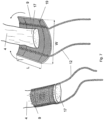
- a tendon end 17 is attached to a suture 12 as a preparation step before surgical attachment of this graft into the body (e.g. ACL reconstruction Semitendinosus-tendon graft preparation, or biceps tenodesis):
- a felted patch 9 with the dimension L x W (e.g. 40 x 40 mm) and a thickness of e.g. 3 mm is tightly enlaced/wrapped around a tendon end 17 and clamped together at its ends.
- Polyethyleneterephthalate (PET) fibers 2 of the felting patch 9 are a mix of different fiber length (20-60mm) with a thickness of 5 ⁇ m.
- the patch/suture construct comprises a tear strength of 250N when fully hydrated.
- the yet loose tendon-patch construct is placed on a brush mattress and felted with a stitching device which allows to stich 2500 times per minute.
- the felted patch 9 is now felted onto the tendon 4 by moving and angle the stitching device over the top surface of the felted patch 9 for 30 seconds.
- the tendon 4 is turned by 180° and the process is repeated with the bottom surface of the felted patch 9. This results in a 380° penetration of the needle 10 and a transportation of more than 10.000 fibers 2 into the tendon 4.
- the felted tendon-patch-suture construct can now be implanted into e.g. a bone tunnel and sutures can be enlaced and knotted to a cortical fixation device or suture anchor.
- the felting method took 60 seconds and avoids time consuming suture (e.g. Mason-Allan stitching) of tendon ends 17, while minimizes the risk of suture pull out of the tendon.
- Example 2 (augmentation of a rotator cuff tendon):
- a felted patch 9 with the dimensions w x I (20mm wide and 25mm long) and a thickness of 2mm is used.
- the felted patch 9 consists of Polyethyleneterephthalate (PET) fibers 2 of different fiber length (circa 40mm) with a thickness of 10 ⁇ m.
- PET Polyethyleneterephthalate
- the felted patch 9 is placed on top of a rotator cuff tendon 41 and fixed by means of a clamp into the rotator cuff tendon 41.
- a 3-sided felting needle cross-section looks like a triangle) each side having a length of 0.5mm is used.
- the total penetration depth of the needle is 20mm.
- the needle has a total of 6 barbs, each with a distance of 1mm separated and a barb depth of 0.1mm.
- a stitching device is used which allows to stich 2500 times per minute.
Landscapes
- Health & Medical Sciences (AREA)
- Life Sciences & Earth Sciences (AREA)
- Surgery (AREA)
- Animal Behavior & Ethology (AREA)
- Public Health (AREA)
- Veterinary Medicine (AREA)
- General Health & Medical Sciences (AREA)
- Engineering & Computer Science (AREA)
- Biomedical Technology (AREA)
- Heart & Thoracic Surgery (AREA)
- Nuclear Medicine, Radiotherapy & Molecular Imaging (AREA)
- Molecular Biology (AREA)
- Medical Informatics (AREA)
- Rheumatology (AREA)
- Orthopedic Medicine & Surgery (AREA)
- Pathology (AREA)
- Vascular Medicine (AREA)
- Oral & Maxillofacial Surgery (AREA)
- Cardiology (AREA)
- Transplantation (AREA)
- Rehabilitation Therapy (AREA)
- Materials For Medical Uses (AREA)
- Prostheses (AREA)
- Nonwoven Fabrics (AREA)
- Surgical Instruments (AREA)
Priority Applications (1)
| Application Number | Priority Date | Filing Date | Title |
|---|---|---|---|
| EP24191062.9A EP4461266A3 (de) | 2019-05-15 | 2019-05-15 | Filzmaterial zur verwendung in einem verfahren zur reparatur oder verstärkung von weichgeweben von menschen oder tieren |
Applications Claiming Priority (3)
| Application Number | Priority Date | Filing Date | Title |
|---|---|---|---|
| PCT/CH2019/000015 WO2020227838A1 (en) | 2019-05-15 | 2019-05-15 | Felt material for use in a method of repairing or augmenting human or animal soft tissues |
| EP24191062.9A EP4461266A3 (de) | 2019-05-15 | 2019-05-15 | Filzmaterial zur verwendung in einem verfahren zur reparatur oder verstärkung von weichgeweben von menschen oder tieren |
| EP19726890.7A EP3968899B1 (de) | 2019-05-15 | 2019-05-15 | Filzmaterial zur reparatur oder vergrösserung von menschlichen oder tierischen weichteilen |
Related Parent Applications (1)
| Application Number | Title | Priority Date | Filing Date |
|---|---|---|---|
| EP19726890.7A Division EP3968899B1 (de) | 2019-05-15 | 2019-05-15 | Filzmaterial zur reparatur oder vergrösserung von menschlichen oder tierischen weichteilen |
Publications (2)
| Publication Number | Publication Date |
|---|---|
| EP4461266A2 true EP4461266A2 (de) | 2024-11-13 |
| EP4461266A3 EP4461266A3 (de) | 2025-01-22 |
Family
ID=66668638
Family Applications (3)
| Application Number | Title | Priority Date | Filing Date |
|---|---|---|---|
| EP24191062.9A Pending EP4461266A3 (de) | 2019-05-15 | 2019-05-15 | Filzmaterial zur verwendung in einem verfahren zur reparatur oder verstärkung von weichgeweben von menschen oder tieren |
| EP19726890.7A Active EP3968899B1 (de) | 2019-05-15 | 2019-05-15 | Filzmaterial zur reparatur oder vergrösserung von menschlichen oder tierischen weichteilen |
| EP24189647.1A Pending EP4445871A3 (de) | 2019-05-15 | 2019-05-15 | Filzmaterial zur verwendung in einem verfahren zur reparatur oder verstärkung von weichgeweben von menschen oder tieren |
Family Applications After (2)
| Application Number | Title | Priority Date | Filing Date |
|---|---|---|---|
| EP19726890.7A Active EP3968899B1 (de) | 2019-05-15 | 2019-05-15 | Filzmaterial zur reparatur oder vergrösserung von menschlichen oder tierischen weichteilen |
| EP24189647.1A Pending EP4445871A3 (de) | 2019-05-15 | 2019-05-15 | Filzmaterial zur verwendung in einem verfahren zur reparatur oder verstärkung von weichgeweben von menschen oder tieren |
Country Status (4)
| Country | Link |
|---|---|
| US (3) | US20220211485A1 (de) |
| EP (3) | EP4461266A3 (de) |
| CN (3) | CN119856955A (de) |
| WO (1) | WO2020227838A1 (de) |
Families Citing this family (13)
| Publication number | Priority date | Publication date | Assignee | Title |
|---|---|---|---|---|
| US20240008897A1 (en) * | 2020-11-12 | 2024-01-11 | Zurimed Technologies Ag | Surgical device, a system, and a method of manufacturing a surgical device |
| US20240398403A1 (en) * | 2021-10-05 | 2024-12-05 | Raymond Michael Greiwe | Suture assembly |
| EP4186442B1 (de) | 2021-11-30 | 2024-08-21 | ZuriMED Technologies AG | Chirurgische vorrichtung mit knickdraht |
| EP4285982A1 (de) | 2022-06-03 | 2023-12-06 | ZuriMED Technologies AG | Filzset zum anbringen von implantaten an weichgewebe |
| TW202442196A (zh) * | 2023-03-07 | 2024-11-01 | 瑞士商蘇黎醫藥科技股份有限公司 | 手術裝置 |
| WO2025076167A1 (en) * | 2023-10-06 | 2025-04-10 | Smith & Nephew, Inc. | Felted implant and method of implantation |
| WO2025101763A1 (en) * | 2023-11-08 | 2025-05-15 | Smith & Nephew, Inc. | Tissue repair implant device |
| EP4552586A1 (de) | 2023-11-10 | 2025-05-14 | ZuriMED Technologies AG | Medizinisches filzsystem und antriebseinheit |
| CN121969313A (zh) * | 2023-11-13 | 2026-05-01 | 爱德华兹生命科学公司 | 基于毡化的锚固系统及其使用方法 |
| EP4631541A1 (de) * | 2024-04-09 | 2025-10-15 | ZuriMED Technologies AG | Medizinische vorrichtung, set und verfahren zur herstellung einer medizinischen vorrichtung |
| EP4656159A1 (de) | 2024-05-31 | 2025-12-03 | ZuriMED Technologies AG | Abgabevorrichtung, system mit der abgabevorrichtung und verfahren zum laden eines flexiblen blattförmigen implantats in eine abgabevorrichtung |
| EP4659705A1 (de) * | 2024-06-05 | 2025-12-10 | ZuriMED Technologies AG | Verfahren, set, präparationsvorrichtung, chirurgische klemme, system und verwendung einer präparationsvorrichtung oder chirurgischen klemme |
| EP4678142A1 (de) * | 2024-07-11 | 2026-01-14 | ZuriMED Technologies AG | Filzbares pflaster zur gewebereparatur mit einem verstärkungsabschnitt und einem verankerungsabschnitt |
Citations (1)
| Publication number | Priority date | Publication date | Assignee | Title |
|---|---|---|---|---|
| US20080188936A1 (en) | 2007-02-02 | 2008-08-07 | Tornier, Inc. | System and method for repairing tendons and ligaments |
Family Cites Families (21)
| Publication number | Priority date | Publication date | Assignee | Title |
|---|---|---|---|---|
| US6250307B1 (en) * | 1999-09-17 | 2001-06-26 | Pi Medical, Inc. | Snoring treatment |
| US20090216252A1 (en) * | 2004-02-13 | 2009-08-27 | The University Of Cincinnati | A coupling device enabled by mechanical continuity of cellular scaffolding across tissue boundaries |
| US7749250B2 (en) * | 2006-02-03 | 2010-07-06 | Biomet Sports Medicine, Llc | Soft tissue repair assembly and associated method |
| US7252832B1 (en) * | 2004-12-13 | 2007-08-07 | Biomet Sports Medicine, Inc. | Composite collagen material and method of forming same |
| CN2860404Y (zh) * | 2005-09-29 | 2007-01-24 | 上海市黄浦区中心医院 | 复合毡型人工韧带 |
| US8753391B2 (en) * | 2007-02-12 | 2014-06-17 | The Trustees Of Columbia University In The City Of New York | Fully synthetic implantable multi-phased scaffold |
| EP2166966A1 (de) * | 2007-07-03 | 2010-03-31 | Revolutionary Surgical Device, LLC | Verfahren und vorrichtungen zur kontinuierlichen durchführung von nahtmaterial |
| US20130053961A1 (en) * | 2008-03-27 | 2013-02-28 | The Cleveland Clinic Foundation | Reinforced tissue graft |
| US8262725B2 (en) * | 2008-04-16 | 2012-09-11 | Cardiovascular Technologies, Llc | Transvalvular intraannular band for valve repair |
| JP5718912B2 (ja) * | 2009-06-04 | 2015-05-13 | ローテーション メディカル インコーポレイテッドRotation Medical,Inc. | 移植物搬送システム及び搬送システムを準備する方法 |
| US20110015735A1 (en) * | 2009-07-16 | 2011-01-20 | Artimplant Ab | Implant for soft tissue reconstruction |
| EP2404557A1 (de) * | 2010-07-06 | 2012-01-11 | Tornier, Inc. | Mit Widerhaken versehene Proteingerüste |
| US8864777B2 (en) * | 2011-01-28 | 2014-10-21 | Anchor Orthopedics Xt Inc. | Methods for facilitating tissue puncture |
| AU2012294422B2 (en) * | 2011-08-08 | 2015-07-09 | Intuitive Surgical Operations, Inc. | Devices and methods for minimally invasive suturing |
| GB201302114D0 (en) * | 2013-02-06 | 2013-03-20 | Xiros Ltd | Connective tissue repair |
| CA2904976A1 (en) * | 2013-03-14 | 2014-10-02 | Cardiovantage Medical, Inc. | Tissue and vascular closure devices and methods of use thereof |
| EP3045574B1 (de) * | 2013-09-12 | 2018-02-14 | Asahi Kasei Kabushiki Kaisha | Ultrafeine polyesterfaser |
| US10363124B2 (en) * | 2014-09-18 | 2019-07-30 | Humacyte, Inc. | Methods and apparatuses for forming fibrous tubes |
| DK3212246T3 (da) * | 2014-10-27 | 2019-01-02 | Silk Biomaterials S R L | Fremgangsmåde til fremstilling af en hybridstruktur bestående af koblede silkefibroin-mikrofibre og -nanofibre, således opnået hybridstruktur og anvendelse deraf som implanterbar medicinsk anordning |
| EP3312325B1 (de) * | 2016-10-21 | 2021-09-22 | Sofradim Production | Verfahren zur herstellung eines netzes mit einem daran befestigten nahtmaterial mit widerhaken und dadurch erhaltenes netz |
| AU2019226562C1 (en) * | 2018-03-01 | 2022-10-06 | Tepha, Inc. | Medical devices containing poly(butylene succinate) and copolymers thereof |
-
2019
- 2019-05-15 EP EP24191062.9A patent/EP4461266A3/de active Pending
- 2019-05-15 US US17/610,566 patent/US20220211485A1/en active Pending
- 2019-05-15 EP EP19726890.7A patent/EP3968899B1/de active Active
- 2019-05-15 CN CN202411877396.8A patent/CN119856955A/zh active Pending
- 2019-05-15 CN CN202411877397.2A patent/CN119587097A/zh active Pending
- 2019-05-15 EP EP24189647.1A patent/EP4445871A3/de active Pending
- 2019-05-15 WO PCT/CH2019/000015 patent/WO2020227838A1/en not_active Ceased
- 2019-05-15 CN CN201980096432.8A patent/CN113825454B/zh active Active
-
2025
- 2025-12-03 US US19/407,799 patent/US20260083548A1/en active Pending
- 2025-12-03 US US19/407,724 patent/US20260083547A1/en active Pending
Patent Citations (1)
| Publication number | Priority date | Publication date | Assignee | Title |
|---|---|---|---|---|
| US20080188936A1 (en) | 2007-02-02 | 2008-08-07 | Tornier, Inc. | System and method for repairing tendons and ligaments |
Also Published As
| Publication number | Publication date |
|---|---|
| EP4445871A3 (de) | 2025-04-16 |
| CN113825454B (zh) | 2025-01-07 |
| EP3968899B1 (de) | 2024-07-31 |
| US20220211485A1 (en) | 2022-07-07 |
| EP4445871A2 (de) | 2024-10-16 |
| US20260083547A1 (en) | 2026-03-26 |
| US20260083548A1 (en) | 2026-03-26 |
| CN119856955A (zh) | 2025-04-22 |
| EP4461266A3 (de) | 2025-01-22 |
| CN119587097A (zh) | 2025-03-11 |
| WO2020227838A1 (en) | 2020-11-19 |
| EP3968899A1 (de) | 2022-03-23 |
| CN113825454A (zh) | 2021-12-21 |
Similar Documents
| Publication | Publication Date | Title |
|---|---|---|
| US20260083548A1 (en) | Felt material for use in a method of repairing or augmenting human or animal soft tissues | |
| JP6705951B2 (ja) | 縫合糸 | |
| JP6692613B2 (ja) | 靭帯移植片の調製のためのシステム及び方法 | |
| EP2739241B1 (de) | Bindegewebereparatur | |
| US8632454B2 (en) | Minimally invasive tissue support system and method with a superior tissue support and an inferior anchor | |
| US12502168B2 (en) | Knotless methods and constructs for tissue repairs and reconstructions | |
| JP2011517289A (ja) | 移植可能な人工コード | |
| EP2764845B1 (de) | Bindegewebereparatur | |
| CN115397363A (zh) | 医疗植入物、医疗设备、分离设备、毡合设备及方法 | |
| JP4670037B2 (ja) | 手術用縫合糸 | |
| CN112494174B (zh) | 一种界面锚钉编织钉鞘装置及其制作方法 | |
| US20240341750A1 (en) | Methods of Tissue Repairs | |
| US20260026800A1 (en) | Systems and methods for performing tensionable knotless tissue repairs | |
| US12226307B2 (en) | Individually lockable cinch loop micro suture anchor array for high density anatomical attachment of soft tissue to bone | |
| CN120813309A (zh) | 可张紧无结外科手术技术 | |
| WO2024158906A1 (en) | Tensionable knotless surgical techniques | |
| WO2025101763A1 (en) | Tissue repair implant device | |
| KR20260071288A (ko) | 봉합 재료 및 수술용 봉합 키트 | |
| CN120957668A (zh) | 多孔缝线以及使用的方法 |
Legal Events
| Date | Code | Title | Description |
|---|---|---|---|
| PUAI | Public reference made under article 153(3) epc to a published international application that has entered the european phase |
Free format text: ORIGINAL CODE: 0009012 |
|
| STAA | Information on the status of an ep patent application or granted ep patent |
Free format text: STATUS: THE APPLICATION HAS BEEN PUBLISHED |
|
| AC | Divisional application: reference to earlier application |
Ref document number: 3968899 Country of ref document: EP Kind code of ref document: P |
|
| AK | Designated contracting states |
Kind code of ref document: A2 Designated state(s): AL AT BE BG CH CY CZ DE DK EE ES FI FR GB GR HR HU IE IS IT LI LT LU LV MC MK MT NL NO PL PT RO RS SE SI SK SM TR |
|
| REG | Reference to a national code |
Ref country code: DE Ref legal event code: R079 Free format text: PREVIOUS MAIN CLASS: A61F0002240000 Ipc: A61F0002080000 |
|
| PUAL | Search report despatched |
Free format text: ORIGINAL CODE: 0009013 |
|
| AK | Designated contracting states |
Kind code of ref document: A3 Designated state(s): AL AT BE BG CH CY CZ DE DK EE ES FI FR GB GR HR HU IE IS IT LI LT LU LV MC MK MT NL NO PL PT RO RS SE SI SK SM TR |
|
| RIC1 | Information provided on ipc code assigned before grant |
Ipc: A61F 2/24 20060101ALN20241213BHEP Ipc: A61F 2/08 20060101AFI20241213BHEP |
|
| STAA | Information on the status of an ep patent application or granted ep patent |
Free format text: STATUS: REQUEST FOR EXAMINATION WAS MADE |
|
| 17P | Request for examination filed |
Effective date: 20250603 |
|
| STAA | Information on the status of an ep patent application or granted ep patent |
Free format text: STATUS: EXAMINATION IS IN PROGRESS |
|
| RIC1 | Information provided on ipc code assigned before grant |
Ipc: A61F 2/08 20060101AFI20250709BHEP Ipc: A61F 2/24 20060101ALN20250709BHEP |
|
| 17Q | First examination report despatched |
Effective date: 20250725 |