EP4461237A2 - Dispositif de collecte de matériau osseux - Google Patents
Dispositif de collecte de matériau osseux Download PDFInfo
- Publication number
- EP4461237A2 EP4461237A2 EP24203055.9A EP24203055A EP4461237A2 EP 4461237 A2 EP4461237 A2 EP 4461237A2 EP 24203055 A EP24203055 A EP 24203055A EP 4461237 A2 EP4461237 A2 EP 4461237A2
- Authority
- EP
- European Patent Office
- Prior art keywords
- bone
- inner tube
- cellular material
- distal end
- outer tube
- Prior art date
- Legal status (The legal status is an assumption and is not a legal conclusion. Google has not performed a legal analysis and makes no representation as to the accuracy of the status listed.)
- Pending
Links
Images




Classifications
-
- A—HUMAN NECESSITIES
- A61—MEDICAL OR VETERINARY SCIENCE; HYGIENE
- A61B—DIAGNOSIS; SURGERY; IDENTIFICATION
- A61B17/00—Surgical instruments, devices or methods
- A61B17/34—Trocars; Puncturing needles
- A61B17/3472—Trocars; Puncturing needles for bones, e.g. intraosseus injections
-
- A—HUMAN NECESSITIES
- A61—MEDICAL OR VETERINARY SCIENCE; HYGIENE
- A61B—DIAGNOSIS; SURGERY; IDENTIFICATION
- A61B10/00—Instruments for taking body samples for diagnostic purposes; Other methods or instruments for diagnosis, e.g. for vaccination diagnosis, sex determination or ovulation-period determination; Throat striking implements
- A61B10/02—Instruments for taking cell samples or for biopsy
- A61B10/0233—Pointed or sharp biopsy instruments
- A61B10/025—Pointed or sharp biopsy instruments for taking bone, bone marrow or cartilage samples
-
- A—HUMAN NECESSITIES
- A61—MEDICAL OR VETERINARY SCIENCE; HYGIENE
- A61B—DIAGNOSIS; SURGERY; IDENTIFICATION
- A61B17/00—Surgical instruments, devices or methods
- A61B17/16—Instruments for performing osteoclasis; Drills or chisels for bones; Trepans
- A61B17/1635—Instruments for performing osteoclasis; Drills or chisels for bones; Trepans for grafts, harvesting or transplants
-
- A—HUMAN NECESSITIES
- A61—MEDICAL OR VETERINARY SCIENCE; HYGIENE
- A61M—DEVICES FOR INTRODUCING MEDIA INTO, OR ONTO, THE BODY; DEVICES FOR TRANSDUCING BODY MEDIA OR FOR TAKING MEDIA FROM THE BODY; DEVICES FOR PRODUCING OR ENDING SLEEP OR STUPOR
- A61M1/00—Suction or pumping devices for medical purposes; Devices for carrying-off, for treatment of, or for carrying-over, body-liquids; Drainage systems
- A61M1/60—Containers for suction drainage, adapted to be used with an external suction source
-
- A—HUMAN NECESSITIES
- A61—MEDICAL OR VETERINARY SCIENCE; HYGIENE
- A61M—DEVICES FOR INTRODUCING MEDIA INTO, OR ONTO, THE BODY; DEVICES FOR TRANSDUCING BODY MEDIA OR FOR TAKING MEDIA FROM THE BODY; DEVICES FOR PRODUCING OR ENDING SLEEP OR STUPOR
- A61M1/00—Suction or pumping devices for medical purposes; Devices for carrying-off, for treatment of, or for carrying-over, body-liquids; Drainage systems
- A61M1/84—Drainage tubes; Aspiration tips
- A61M1/85—Drainage tubes; Aspiration tips with gas or fluid supply means, e.g. for supplying rinsing fluids or anticoagulants
-
- A—HUMAN NECESSITIES
- A61—MEDICAL OR VETERINARY SCIENCE; HYGIENE
- A61B—DIAGNOSIS; SURGERY; IDENTIFICATION
- A61B10/00—Instruments for taking body samples for diagnostic purposes; Other methods or instruments for diagnosis, e.g. for vaccination diagnosis, sex determination or ovulation-period determination; Throat striking implements
- A61B10/02—Instruments for taking cell samples or for biopsy
- A61B10/0233—Pointed or sharp biopsy instruments
- A61B10/025—Pointed or sharp biopsy instruments for taking bone, bone marrow or cartilage samples
- A61B2010/0258—Marrow samples
-
- A—HUMAN NECESSITIES
- A61—MEDICAL OR VETERINARY SCIENCE; HYGIENE
- A61B—DIAGNOSIS; SURGERY; IDENTIFICATION
- A61B17/00—Surgical instruments, devices or methods
- A61B2017/00969—Surgical instruments, devices or methods used for transplantation
-
- A—HUMAN NECESSITIES
- A61—MEDICAL OR VETERINARY SCIENCE; HYGIENE
- A61M—DEVICES FOR INTRODUCING MEDIA INTO, OR ONTO, THE BODY; DEVICES FOR TRANSDUCING BODY MEDIA OR FOR TAKING MEDIA FROM THE BODY; DEVICES FOR PRODUCING OR ENDING SLEEP OR STUPOR
- A61M1/00—Suction or pumping devices for medical purposes; Devices for carrying-off, for treatment of, or for carrying-over, body-liquids; Drainage systems
- A61M1/71—Suction drainage systems
- A61M1/76—Handpieces
-
- A—HUMAN NECESSITIES
- A61—MEDICAL OR VETERINARY SCIENCE; HYGIENE
- A61M—DEVICES FOR INTRODUCING MEDIA INTO, OR ONTO, THE BODY; DEVICES FOR TRANSDUCING BODY MEDIA OR FOR TAKING MEDIA FROM THE BODY; DEVICES FOR PRODUCING OR ENDING SLEEP OR STUPOR
- A61M1/00—Suction or pumping devices for medical purposes; Devices for carrying-off, for treatment of, or for carrying-over, body-liquids; Drainage systems
- A61M1/71—Suction drainage systems
- A61M1/79—Filters for solid matter
-
- A—HUMAN NECESSITIES
- A61—MEDICAL OR VETERINARY SCIENCE; HYGIENE
- A61M—DEVICES FOR INTRODUCING MEDIA INTO, OR ONTO, THE BODY; DEVICES FOR TRANSDUCING BODY MEDIA OR FOR TAKING MEDIA FROM THE BODY; DEVICES FOR PRODUCING OR ENDING SLEEP OR STUPOR
- A61M1/00—Suction or pumping devices for medical purposes; Devices for carrying-off, for treatment of, or for carrying-over, body-liquids; Drainage systems
- A61M1/84—Drainage tubes; Aspiration tips
- A61M1/86—Connectors between drainage tube and handpiece, e.g. drainage tubes detachable from handpiece
-
- A—HUMAN NECESSITIES
- A61—MEDICAL OR VETERINARY SCIENCE; HYGIENE
- A61M—DEVICES FOR INTRODUCING MEDIA INTO, OR ONTO, THE BODY; DEVICES FOR TRANSDUCING BODY MEDIA OR FOR TAKING MEDIA FROM THE BODY; DEVICES FOR PRODUCING OR ENDING SLEEP OR STUPOR
- A61M25/00—Catheters; Hollow probes
- A61M25/0021—Catheters; Hollow probes characterised by the form of the tubing
- A61M25/0023—Catheters; Hollow probes characterised by the form of the tubing by the form of the lumen, e.g. cross-section, variable diameter
- A61M25/0026—Multi-lumen catheters with stationary elements
- A61M2025/0039—Multi-lumen catheters with stationary elements characterized by lumina being arranged coaxially
-
- A—HUMAN NECESSITIES
- A61—MEDICAL OR VETERINARY SCIENCE; HYGIENE
- A61M—DEVICES FOR INTRODUCING MEDIA INTO, OR ONTO, THE BODY; DEVICES FOR TRANSDUCING BODY MEDIA OR FOR TAKING MEDIA FROM THE BODY; DEVICES FOR PRODUCING OR ENDING SLEEP OR STUPOR
- A61M2202/00—Special media to be introduced, removed or treated
- A61M2202/10—Bone-marrow
Definitions
- the present invention relates to devices and methods for harvesting and processing bone and/or cellular material for use in various medical treatments.
- Non-union of bone is a common complication of fracture treatment.
- Non-union occurs when a particular patient's fracture site fails to heal within a specified period of time, and thus requires an intervention (e.g., surgical) in order to achieve proper union and mobility.
- non-unions may be treated by bone grafting (e.g., allograft, autograft, or xenograft), through internal or external fixation, or a combination thereof. Bone grafting offers an opportunity to stimulate the fracture site so that bony formation occurs at the site to properly unionize the fracture.
- Stem cells e.g., Mesenchymal stem cells (MSCs), hematopoietic stem cells (HSCs), or other stem cells
- MSCs Mesenchymal stem cells
- HSCs hematopoietic stem cells
- stem cells can assist with the proper formation of bone and union of bone parts at a fracture site.
- Stem cells of the type discussed above must first be extracted from a patient and processed before use. As an example, extracted bone marrow of a patient can provide the necessary stem cells.
- Bone marrow is typically extracted in a multi-staged procedure. In a first stage of the procedure, bone marrow is aspirated from a patient and then sent to a laboratory for processing. It is only then, in a second stage of the procedure, that the previously harvested bone marrow is processed for the patient's particular application. Bone marrow from the iliac crest is widely considered the "gold standard" for its superior biologic quality. The drawback of harvesting bone marrow from the iliac crest, however, is that the iliac crest naturally produces a limited quantity of marrow.
- bone marrow is often harvested from the medullary canal of a long bone (e.g., the femur or tibia), which naturally produces a higher volume of bone marrow than the iliac crest. Bone marrow harvested from the medullary canal has proven to be an effective alternative to bone marrow harvested from the iliac crest and is capable of providing significant regenerative potential.
- a surgeon In order to harvest the desired volume of marrow from the medullary canal, a surgeon must access and aspirate bone marrow located deep within the bone canal. This procedure is often performed using a harvesting system that is typically equipped with a reamer, an irrigation system, a suction source (OR suction) and a filter. Although these systems are generally sufficient in harvesting the desired bone material, they are aggressive and carry significant clinical risks such as severe blood loss that often necessitates blood transfusion treatments. In fact, while the medical community appreciates the regenerative potential of bone marrow harvested from the medullary canal of long bone, some medical professionals have begun to question whether harvesting the autograft materials is worth the significant clinical risks.
- a device for harvesting bone and/or cellular material for use in various medical applications.
- the device includes a dual tubed aspiration assembly that reduces clogging and improves aspiration efficiency.
- the device is capable of performing clog-free transportation of even highly viscous material without the irrigation of fluids.
- the improved aspiration function reduces the surgeon's impulse to aggressively drill into the bone and, in turn, reduces the likelihood of severe blood loss and the clinical complications associated with sever blood loss.
- One embodiment of the bone harvesting device includes a main body having an internal cavity and a suction port adapted to be coupled to a suction source, an outer tube having an inner surface, an outer surface, a proximal end and a distal end, the proximal end of the outer tube being coupleable to the main body, an inner tube having an inner surface, an outer surface, a proximal end and a distal end, the inner tube being coupleable to the main body and at least partially disposed within the outer tube such that the inner tube is in fluid communication with the internal cavity, and a storage container coupleable to the main body such that the storage container is in fluid communication with the internal cavity for receiving bone and/or cellular material extracted from the patient.
- the storage container includes an outer sidewall extending from a base end to a top end, and an inner sidewall at least partially disposed within the outer sidewall and being concave with respect to the top end, the inner sidewall defining a collection space for receiving the extracted bone and/or cellular material. At least a portion of the inner sidewall is spaced a distance from the outer sidewall.
- the bone harvesting device may include a body having an internal cavity and a suction port adapted to be coupled to a suction source, an outer tube having an inner surface, an outer surface, a proximal end and a distal end, the proximal end of the outer tube being coupleable to the body, and an inner tube having an inner surface, an outer surface, a proximal end and a distal end.
- the inner tube may be in fluid communication with the internal cavity and at least partially disposed within the outer tube such that a venting channel is defined between at least a portion of the inner tube and at least a portion of the outer tube.
- a method of collecting bone and/or cellular material during a bone harvesting procedure includes the steps of (a) operating a reaming, milling, or drilling tool so that the tool reams, mills, or drills into a canal of a bone to generate bone and/or cellular material, (b) inserting a bone harvesting tool into the bone canal, the bone harvesting tool comprising an inner tube at least partially disposed within an outer tube such that a ventilation channel is formed between the inner and outer tubes, (c) generating negative pressure within an internal cavity of a bone harvesting tool, the negative pressure causing the bone and/or cellular material to flow from the patient through the inner tube and into the internal cavity of the bone harvesting tool, and collecting the bone and/or cellular material in a storage container fluidly connected to the internal cavity of the bone harvesting tool.
- axial means along or parallel to the longitudinal axis of the bone harvesting device and "radial” means in the perpendicular direction thereto.
- Interior or “inner” means radially inward, either toward or facing the longitudinal axis, and “exterior” or “outer” means radially outward, or away from the longitudinal axis.
- proximal and distal refer, respectively, to the end of the device nearest the surgeon or other user operating the device, and the opposite end of the device furthest from the user operating the device.
- Bone harvesting device 10 includes a body 100, an aspiration assembly 200 for aspirating bone and/or cellular material from a patient, and a collection storage container 300 for collecting the aspirated material.
- bone and/or cellular material refers to material that is extractable from bone, which may optionally then be processed and/or separated to produce another material.
- bone and/or cellular material may include cancellous bone, cortical bone (in the form of chips or morselized bone), bone marrow, or stem cells produced from any of the foregoing materials. Such materials are frequently found, for example, in the iliac crest, or the medullary canal of a long bone, as well as the bone surrounding the medullary canal.
- Bone harvesting device 10 may be formed entirely, or in part, from a transparent medical grade glass or plastic, thereby permitting an operator using the device to observe the collection of bone and/or cellular material during a harvesting procedure.
- Main body 100 includes a first connector, for example, a threaded bore 102, for removably securing aspiration assembly 200 to the body, and a second connector, for example, a threaded, lid-shaped platform 104 for removably securing storage container 300 to the body. It will be appreciated, however, that the first and second connectors need not include threads. Instead, aspiration assembly 200 and storage container 300 may alternatively be coupled to the main body 100 via an interference or snap-fit connection, or any other connector known in the art.
- Main body 100 also defines a suction port 106, for example, in lid-shaped platform 104 that is configured to be coupled to a suction source S such as a standard operating room suction source (OR suction). Suction port 106 may include a filter to prevent bone and/or cellular material from being drawn from storage container 300 into a suction tube connected suction source S.
- a suction source S such as a standard operating room suction source (OR suction).
- Suction port 106
- platform 104 has an aperture 108 that allows harvested bone and/or cellular material to flow from aspiration assembly 200 and into storage container 300 during a harvesting procedure.
- main body 100 may also include an ergonomically shaped handle 110 to aid a surgeon in positioning the bone harvesting device during operation.
- main body 100 defines an internal cavity 112 that is in fluid communication with aspiration assembly 200 and suction source S.
- aspiration assembly 200 and suction source S.
- suction when OR suction is applied, a negative pressure is produced within internal cavity 110. This negative pressure draws bone and/or cellular material through aspiration assembly 200, into the internal cavity, through the aperture 108 and into storage container 300.
- Aspiration assembly 200 includes a generally hollow adapter housing 202, an outer tube 204 and an inner tube 206.
- Outer tube 204 and inner tube 206 are formed of a resilient and flexible material that allows the tubes to bend, with respect to the main body 100 and with respect to one another, as the aspiration assembly navigates through the medullary canal of a long bone.
- Aspiration assembly 200 defines a length between a proximal end 208 and a distal end 210 of the assembly.
- Bone harvesting device 10 may include a single aspiration assembly 200 measuring approximately 500 mm in length, or a plurality of interchangeable aspiration assemblies having various lengths for harvesting bone of different length.
- the proximal end 208 of aspiration assembly 200 includes threads 212 for threading adapter 202 within the bore 102 of main body 100.
- Adapter 202 need not include threads, however, as aspiration assembly 200 may instead be removably coupled to main body 100 by an interference or snap fit connection, or any other connector known in the art.
- Adaptor 202 may also include a flange 214, or similar protrusion having an ergonomic grip to aid a user in coupling and/or decoupling the aspiration assembly 200 to the main body 100.
- adaptor 202 has one or more annular grooves 216 within its exterior surface.
- a gasket 218, such as an O-ring, is provided within each groove 216 to seal the space between the adaptor 202 and the bore 102 of the main body at each location.
- Adapter 202 also includes first and second inwardly projecting ledges 220, 222.
- the first ledge 220 is provided adjacent the proximal end of adapter 202, while the second ledge 222 is positioned between the first ledge and the flange 214.
- First ledge 220 protrudes further into the interior space of the adapter 202 than the second ledge 222.
- Outer tube 204 extends along a longitudinal axis L from a proximal end 224 to a distal end 226 and includes an exterior surface 228 and an interior surface 230.
- the exterior surface 228 of outer tube 204 engages the interior surface of adapter 202, while the proximal end 224 of the outer tube is bonded, welded, glued or otherwise sealed to a distal facing surface of the second ledge 222.
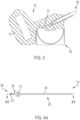
- the distal end 226 of outer tube 204 is preferably rounded, as shown in FIG. 4C , to reduce trauma as aspiration assembly 200 is operated within the medullary canal of bone.
- Inner tube 206 which is positioned at least partially within outer tube 204, extends along a longitudinal axis L' from a proximal end 232 to a distal end 234 and includes an exterior surface 236 and an interior surface 238. Inner tube 206 is bonded, welded, glued or otherwise sealed to an inwardly facing surface of the first ledge 220, thereby forming a venting channel 240 between the inner and outer tubes.
- Adapter 202 further defines a vent 242 axially located between the first and second ledges 220, 222.
- Vent 242 is in fluid communication with ambient air and venting channel 240. As shown in FIGS. 4C and 4D , this allows ambient air drawn into vent 242 to flow through venting channel 240 and into the medullary canal adjacent the distal end of the aspiration assembly, while bone and/or cellular material is concurrently aspirated through the inner tube 206 in the opposite direction (e.g., from the distal end of the aspiration assembly toward the main body).
- the ventilated air provides airflow through the medullary canal during the harvesting process and prevents the medullary canal from becoming negatively pressurized during aspiration and, as a result, reduces the amount of blood loss that occurs during bone and/or cellular aspiration as is further explained hereinafter.
- the distal end 234 of inner tube 206 may be proximal to the distal end 226 of outer tube 204.
- the vented air is thus drawn around the distal end 234 of inner tube 206 and into the aspiration channel of the inner tube. This reduces clogging at the distal end of the aspiration assembly and maintains optimal suction or aspiration power.
- inner tube 206 is surrounded by the outer tube 204, the inner is protected from being damaged.
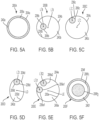
- FIG. 5A illustrates a preferred aspiration assembly 200A, in which inner tube 206a is coaxially positioned within outer tube 204a. Venting channel 240a is thus formed around the entire exterior surface of inner tube 206a.
- FIG. 5B shows aspiration assembly 200b, in which the longitudinal axis L' B of inner tube 206b is offset with respect to the longitudinal axis L B of outer tube 204b, and the exterior surface 236b of the inner tube is spaced from the interior surface 230b of the outer tube. Venting channel 240b entirely surrounds inner tube 206b.
- FIG. 5C illustrates a third configuration, aspiration assembly 200c, in which the longitudinal axis L'c of inner tube 206c is offset with respect to the longitudinal axis Lc of outer tube 204c.
- a portion of the exterior surface 236c of inner tube 206c engages a portion of the interior surface 230c of outer tube 204c.
- Venting channel 240c is thus only formed around a portion of inner tube 206c (i.e., the portion of the exterior surface of the inner tube that is not engaged with the outer tube).
- FIG. 5D illustrates aspiration assembly 200d, which is similar to aspiration assembly 200c, in that the longitudinal axis L' D of inner tube 206d is offset with respect to the longitudinal axis L D of outer tube 204d, and in that a portion of the exterior surface 236d of the inner tube is engaged with a portion of the interior surface 230d of the outer tube such that venting channel 240d is formed only around a portion of the inner tube.
- the cross-section of outer tube 204d is elliptical.
- the inner tube or the outer tube, or both the inner tube and the outer tube, of any of the configurations shown in FIGS. 5A-5F may have a cross-section forming an ellipse, a rectangle, a hexagon or any other shape.
- Aspiration assembly 200e includes first and second inner tubes 206e 1 , 206e 2
- the longitudinal axis L' E1 of first inner tube 206e 1 and the longitudinal axis L' E2 of second inner tube 206e 2 are offset with respect to the longitudinal axis L E of outer tube 204e.
- a portion of the exterior surface 236e 1 of first inner tube 206e 1 and a portion of the exterior surface 236e 2 of second inner tube 206e 2 are engaged with portions of the interior surface 230e of outer tube 204e. Venting channel 240e is thus formed only around the portions of inner tubes 206e 1 , 206e 2 that are not engaged with outer tube 204e.
- inner tubes 206e 1 , 206e 2 may instead be spaced from the interior surface 230e of outer tube 204e such that venting channel 240e is formed entirely around the inner tube, or the inner tubes, spaced from the interior surface of the outer tube.
- FIG. 5F illustrates aspiration assembly 200f.
- first inner tube 206f 1 is coaxially positioned within outer tube 204f and second inner tube 206f 2 is coaxially positioned within the first inner tube.
- Venting channel 240f is thus positioned between the first and second inner tubes 206f 1 , 206f 2 .
- aspiration assembly 200 may be constructed as described in any one of the embodiments shown in FIGS. 5A-5F or as a combination of the same. Regardless of the specific construction, it is generally desirable that the aspiration channel (e.g., the opening of the inner tube(s)) has a cross-sectional area of at least 12 mm 2 . Moreover, to ensure that sufficient air is vented into the medullary canal, it is desirable that the ratio of the surface area of the cross-section of the venting channel relative to the surface area of the cross-section of the aspiration channel be between 0.15 and 1.0. It will be understood that FIGS. 5A-5F illustrate the inner and outer tubes in their unbent, or not flexed, condition.
- any bending or flexing of inner tube 206, relative to outer tube 204, will change the location of the aspiration channel and, in turn, venting channel 240 relative to the outer tube, but will not modify the cross-sectional area of the aspiration channel or the cross sectional area of the venting channel.
- storage container 300 includes a stand 302 and a collection bowl 304.
- Storage container 300 is preferably formed as an integral component of a plastic material, for example, through an injection molding process.
- stand 302 and collection bowl 304 may be coupled together after the components are separately manufactured.
- Stand 302 may include a cylindrical sidewall 306 that extends from an annular base 308 to a top end 310 and that defines a diameter and height.
- Base 308 is planar and, thus, configured to rest on a flat surface, for example, an operating table.
- the diameter of stand 302 is at least 1.5 times greater than the height to save stance on soft and irregular surfaces.
- Base 308 may include a flange 312 for added stability.
- Top end 310 preferably includes an inwardly extending lip 314 for receiving a gasket (not shown) to seal the connection between container 300 and main body 100.
- Sidewall 306 may include a plurality of ergonomically shaped grips 316 to aid a user in connecting the storage container 300 to the main body 100 and for removing the container from the body. Grips 316 are also thickened areas of material that strengthen sidewall 306.
- Collection bowl 304 includes a sidewall 318 that is connected to lip 314 such that a first portion 320 of the collection bowl sits within the sidewall 306 of stand 302 and a second portion 322 of the collection bowl extends above the top end 310 of the stand.
- the second portion 322 includes threads 324, for example, steep or bayonet threads for coupling the storage container 300 to the lid-shaped platform 104 of the main body.
- Collections bowl 304 may alternatively include any connector capable of removably coupling the storage container and the main body.
- the inner surface of sidewall 318 is preferably smooth and hemispherical in shape.
- the interior surface of hemispherical collection bowl 304 is devoid of edges. Because bone and/or cellular material is harvested in relatively small and finite quantities, and through an invasive surgical procedure, it is desirable to preserve all of the material that is harvested from the patient for subsequently processing.
- the hemispherical shape of the collection bowl 304 assists in this effort as it allows a user to easily remove all of the highly viscous bone and/or cellular material without requiring that the user attempt to scrape material from the edges or the corners of the container before inevitably leaving traces of the material behind.
- the hemispherical collection bowl 304 saves the user both time and hassle and maximizes the bone and/or cellular material that is eventually processed.
- the open end of sidewall 318 is preferably at least 80 mm in diameter, thereby allowing the user to easily fit his or her hand into the collection bowl and to scoop out the material, for example, using his or her fingers.
- an indicator scale 326 may be molded to, or imprinted on, storage container 300 such that the user can easily determine the volume of bone and/or cellular material that is present within collection bowl 304.
- Bone harvesting device 10 may be used to harvest bone and/or cellular material in a harvesting method as provided herein.
- the method generally includes extracting bone and/or cellular material from a patient and then sending it to a storage, separation and processing facility (e.g., a "biobank”) for use in a later surgical procedure involving that patient, or a different patient.
- a storage, separation and processing facility e.g., a "biobank”
- a patient is scheduled to undergo a surgical procedure that necessitates resection of bone and/or reaming of a medullary canal of bone, but in which harvesting bone and/or cellular material is not the primary objective of the surgical procedure.
- IM nail intramedullary nailing
- hip replacements hip replacements
- knee revisions each require a substantial amount of resection and/or reaming of bone, and therefore, generate bone and/or cellular material as a byproduct of the surgery.
- a surgeon seeking to remedy a fracture in the tibia typically first makes an incision in the patient's skin adjacent the knee. A K-wire is then introduced through the patient's skin and into an entry point on the patient's tibial plateau. In a reamed technique, the surgeon then uses the K-wire to guide a reamer through the entry point and into the medullary canal of the long bone. With the K-wire extending into the long bone and past the fracture site (e.g., so that the fracture can be properly reduced), one or more reamers are then used to bore through cortical and cancellous bone, as well as bone marrow of the patient.
- bone and/or cellular material is generally only extracted from the medullary canal of the tibia to the extent necessary to make room for the IM implant. Any cortical bone, cancellous bone and bone marrow material that is extracted during the reaming procedure is often discarded. Using harvesting device 10, however, bone and/or cellular materials can be safely extracted from the patient for subsequent processing and reuse without placing the patient at risk.
- bone harvesting device 10 significantly reduces surgical complications when used to aspirate bone and/or cellular material within a medullary cavity and, thus, may likewise be used to harvest material from within the medullary canal of the tibia or any other bone from which bone and/or cellular material may be harvested.
- a surgeon may first approach the fracture by making an incision in the patient's skin adjacent the hip. The surgeon may then resect the greater trochanter, thereby creating an opening to the medullary canal of the femur. Resection of the greater trochanter generates loose cortical and cancellous bone, which may optionally be collected, either by hand or using bone harvesting device 10. To collect the loose cortical and cancellous bone using harvesting device 10, a user turns on the OR suction S, which generates a negative pressure in the internal cavity 112 of main body 10.
- the user may position the distal end 210 of the aspiration assembly adjacent the resected bone, causing the loose cortical and cancellous bone to be drawn through the aspiration channel of inner tube 206, into the internal cavity, through aperture 108 in lid 104 and into storage container 300. After the loose cortical and cancellous bone has been collected, the user may turn off the OR suction S.
- a K-wire may then be introduced through the patient's skin and into the medullary canal of the femur.
- the surgeon may then use the K-wire to guide one or more reaming, milling or drilling tools through an entry point and into the medullary canal of the femur.
- the tool With the K-wire extending within the medullary canal and past the fracture site, the tool is used to bore through cortical and cancellous bone, as well as bone marrow of the patient, generating bone and/or cellular material in the medullary canal.
- the tool may be removed from the patient. The surgeon may then optionally collect the residual bone and/or cellular material that adhered to the tool(s) during the reaming, milling or drilling of the medullary canal.
- the surgeon may utilize harvesting device 10 to safely collect bone and/or cellular material from the medullary canal of the femur.
- the OR suction S is again activated.
- the surgeon may position the distal end 210 of the aspiration assembly into the medullary canal of the femur such that the main body is positioned outside the patient.
- vent 242 enters vent 242 ( FIG. 4B ) and flows through venting channel 240 ( FIG. 4c ) and into the medullary canal.
- the negative pressure generated within the internal cavity 112 of main body 100 draws bone and/or cellular material through the aspiration channel of inner tube 206 and into storage container 300. Because air is continually vented within the medullary canal adjacent the distal end 210 of aspiration assembly 200, the medullary canal does not become negatively pressurized during aspiration of the bone and/or cellular material.
- the vented air is drawn around the distal end of the inner tube and into the aspiration channel thereof.
- the curling of the air adjacent the distal end 210 of aspiration assembly 200 guides bone and/or cellular material into the aspiration channel of inner tube 206 such that clogging is reduced and optimal suction or aspiration power is maintained.
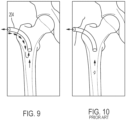
- FIG. 10 illustrating a known bone harvesting device that does not include the described venting features
- bone and/or cellular material is aspirated though the aspiration assembly
- the medullary canal becomes negatively pressurized.
- the negative pressure results in the aspiration of blood and can result in sever blood loss.
- the medullary canal drops in pressure, the aspiration power of the assembly is reduced, resulting in decreased aspiration efficiency and often clogging of the assembly.
- the user may optionally combine the bone and/or cellular materials into a cumulate harvest.
- the user first uncouples storage container 300 from main body 100, sticks his or her hand into collection bowl 304 and scoops out all of the bone and/or cellular material.
- the bone and/or cellular material may then be combined with the residual bone and/or cellular material collected from the reaming, milling or drilling tools and/or the loose bone and/or cellular material generated during the bone resection step.
- the surgeon may implant the IM nail and finish the IM nail procedure.
- the bone and/or cellular material may then be sent to a biobank as separate collections, or as a cumulate harvest, for subsequent processing and use in a later surgical procedure involving that patient, or a different patient.
Landscapes
- Health & Medical Sciences (AREA)
- Life Sciences & Earth Sciences (AREA)
- Heart & Thoracic Surgery (AREA)
- Surgery (AREA)
- Veterinary Medicine (AREA)
- Engineering & Computer Science (AREA)
- Biomedical Technology (AREA)
- Animal Behavior & Ethology (AREA)
- General Health & Medical Sciences (AREA)
- Public Health (AREA)
- Hematology (AREA)
- Medical Informatics (AREA)
- Molecular Biology (AREA)
- Orthopedic Medicine & Surgery (AREA)
- Vascular Medicine (AREA)
- Anesthesiology (AREA)
- Oral & Maxillofacial Surgery (AREA)
- Nuclear Medicine, Radiotherapy & Molecular Imaging (AREA)
- Pathology (AREA)
- Pulmonology (AREA)
- Immunology (AREA)
- Rheumatology (AREA)
- Transplantation (AREA)
- Dentistry (AREA)
- External Artificial Organs (AREA)
- Instructional Devices (AREA)
- Prostheses (AREA)
- Surgical Instruments (AREA)
Applications Claiming Priority (3)
| Application Number | Priority Date | Filing Date | Title |
|---|---|---|---|
| US201962804987P | 2019-02-13 | 2019-02-13 | |
| EP20723516.9A EP3923821B1 (fr) | 2019-02-13 | 2020-02-07 | Dispositif de collecte de matériau osseux |
| PCT/IB2020/000201 WO2020165657A2 (fr) | 2019-02-13 | 2020-02-07 | Dispositif de collecte de matériau osseux |
Related Parent Applications (1)
| Application Number | Title | Priority Date | Filing Date |
|---|---|---|---|
| EP20723516.9A Division EP3923821B1 (fr) | 2019-02-13 | 2020-02-07 | Dispositif de collecte de matériau osseux |
Publications (2)
| Publication Number | Publication Date |
|---|---|
| EP4461237A2 true EP4461237A2 (fr) | 2024-11-13 |
| EP4461237A3 EP4461237A3 (fr) | 2025-01-22 |
Family
ID=70482709
Family Applications (2)
| Application Number | Title | Priority Date | Filing Date |
|---|---|---|---|
| EP20723516.9A Active EP3923821B1 (fr) | 2019-02-13 | 2020-02-07 | Dispositif de collecte de matériau osseux |
| EP24203055.9A Pending EP4461237A3 (fr) | 2019-02-13 | 2020-02-07 | Dispositif de collecte de matériau osseux |
Family Applications Before (1)
| Application Number | Title | Priority Date | Filing Date |
|---|---|---|---|
| EP20723516.9A Active EP3923821B1 (fr) | 2019-02-13 | 2020-02-07 | Dispositif de collecte de matériau osseux |
Country Status (3)
| Country | Link |
|---|---|
| US (2) | US12042175B2 (fr) |
| EP (2) | EP3923821B1 (fr) |
| WO (1) | WO2020165657A2 (fr) |
Families Citing this family (1)
| Publication number | Priority date | Publication date | Assignee | Title |
|---|---|---|---|---|
| US20260096824A1 (en) * | 2022-10-13 | 2026-04-09 | Wright Medical Technology, Inc. | Bone Material Harvesting Device Having Radially Expandable And Retractable Shaft |
Family Cites Families (49)
| Publication number | Priority date | Publication date | Assignee | Title |
|---|---|---|---|---|
| US1696018A (en) | 1926-07-10 | 1928-12-18 | Schellberg Oscar Boto | Colonic theraphy apparatus |
| US3071129A (en) * | 1961-02-23 | 1963-01-01 | Isio F Wasserman | Surgical instrument |
| US3720203A (en) | 1970-06-12 | 1973-03-13 | J Brown | Tubular instrument |
| US4300550A (en) | 1978-04-26 | 1981-11-17 | Becton, Dickinson And Company | Suction and oxygenation catheter |
| US5024615A (en) * | 1980-12-04 | 1991-06-18 | Astra Meditec Aktiebocag | Surgical aspiration device |
| DE3400874C1 (de) | 1984-01-12 | 1985-02-07 | Karl Dr. 6301 Pohlheim Aigner | Doppellumiger Katheter fuer eine Vorrichtung zur in-vivo-Reinigung von Blut |
| US4857045A (en) * | 1987-04-30 | 1989-08-15 | Schneider (Usa) Inc., A Pfizer Company | Atherectomy catheter |
| US4821715A (en) | 1988-02-16 | 1989-04-18 | Downing Michael V | Nasopharyngeal airway |
| US5269785A (en) * | 1990-06-28 | 1993-12-14 | Bonutti Peter M | Apparatus and method for tissue removal |
| US5368017A (en) * | 1991-04-01 | 1994-11-29 | Sorenson Laboratories, Inc. | Apparatus for ventilating and aspirating |
| US5350358A (en) | 1992-12-22 | 1994-09-27 | Med-Pro Design, Inc. | Bent co-axial catheter |
| US5571093A (en) | 1994-09-21 | 1996-11-05 | Cruz; Cosme | Multiple-lumen catheter |
| US5766134A (en) * | 1995-07-18 | 1998-06-16 | Atrion Medical Products, Inc. | Autogenous bone specimen collector |
| US6846314B2 (en) * | 1997-07-01 | 2005-01-25 | Ira L. Shapira | Method and apparatus for extracting bone marrow |
| EP1053002A1 (fr) * | 1998-02-10 | 2000-11-22 | Oregon Health Sciences University | Traitement de malformations osseuses avec des cellules precurseurs osteoblastiques |
| US6152886A (en) * | 1998-05-05 | 2000-11-28 | Phelan; James C | Suction device for use during medical procedures and the like |
| US6022354A (en) * | 1998-12-04 | 2000-02-08 | Mercuri; Gregory M. | Bone harvesting collection and delivery system |
| DE29901723U1 (de) * | 1999-02-02 | 2000-06-29 | Synthes AG Chur, Chur, Graubünden | Vorrichtung zur Gewinnung von Knochenspänen |
| US6547724B1 (en) * | 1999-05-26 | 2003-04-15 | Scimed Life Systems, Inc. | Flexible sleeve slidingly transformable into a large suction sleeve |
| US6875198B2 (en) * | 2002-05-15 | 2005-04-05 | Kevin T. Foley | Surgical suction regulator valve |
| US7951089B2 (en) | 2002-05-31 | 2011-05-31 | Vidacare Corporation | Apparatus and methods to harvest bone and bone marrow |
| US8162966B2 (en) * | 2002-10-25 | 2012-04-24 | Hydrocision, Inc. | Surgical devices incorporating liquid jet assisted tissue manipulation and methods for their use |
| US20070055282A1 (en) * | 2003-03-31 | 2007-03-08 | The Cleveland Clinic Foundation | Apparatus and method for harvesting bone marrow |
| CA2520472A1 (fr) * | 2003-03-31 | 2004-10-21 | The Cleveland Clinic Foundation | Appareil et procede de culture de moelle osseuse |
| US7195617B2 (en) * | 2004-03-03 | 2007-03-27 | Six-O, Ltd. | Device for collecting surgical material |
| US8790349B2 (en) * | 2005-03-15 | 2014-07-29 | Atsushi Takahashi | Autologous bone collection device having enhanced suction efficiency |
| US8622997B2 (en) * | 2005-03-23 | 2014-01-07 | Ronald D. Shippert | Tissue transfer method and apparatus |
| AU2008232516B2 (en) * | 2007-03-30 | 2013-08-22 | Smith & Nephew, Inc. | Tissue harvesting |
| US8109956B2 (en) * | 2008-03-07 | 2012-02-07 | Medtronic Xomed, Inc. | Systems and methods for surgical removal of tissue |
| CA2745192C (fr) * | 2008-12-31 | 2017-04-11 | Kci Licensing, Inc. | Manchons, collecteurs, systemes et procedes d'application d'une pression reduite a un site de tissu sous-cutane |
| US9332970B2 (en) | 2010-02-25 | 2016-05-10 | Kohala Inc. | Full core biopsy device |
| US9155454B2 (en) * | 2010-09-28 | 2015-10-13 | Smith & Nephew, Inc. | Hysteroscopic system |
| CN103826670B (zh) * | 2011-03-14 | 2016-10-05 | 纽罗有限公司 | 自清洁外科抽吸装置 |
| US9144636B2 (en) * | 2011-03-14 | 2015-09-29 | Neuroenterprises, Llc | Self-cleaning surgical suction device with interchangeable tips |
| US10098991B2 (en) * | 2011-03-14 | 2018-10-16 | Neuroenterprises, Llc | Self-cleaning surgical suction device and method of use |
| US20160038660A1 (en) * | 2014-08-10 | 2016-02-11 | Nlt Spine Ltd. | Suction and irrigation instrument and method of use |
| US10772652B2 (en) * | 2015-01-28 | 2020-09-15 | Covidien Lp | Tissue resection system |
| EP3273881B1 (fr) | 2015-03-24 | 2019-10-09 | Stryker European Holdings I, LLC | Dispositif de prélèvement de moelle osseuse |
| US10750931B2 (en) * | 2015-05-26 | 2020-08-25 | Covidien Lp | Systems and methods for generating a fluid bearing for an operative procedure |
| EP3334322A1 (fr) * | 2015-08-11 | 2018-06-20 | Trice Medical, Inc. | Dispositif jetable et entièrement intégré de visualisation de tissus |
| CN108348266A (zh) * | 2015-11-25 | 2018-07-31 | 史密夫和内修有限公司 | 用于软骨自体移植物转移系统的组织捕获器 |
| JP7033331B2 (ja) * | 2016-08-12 | 2022-03-10 | トブラ メディカル,インコーポレイテッド | 外科手術用収集システム |
| US10123786B2 (en) * | 2016-09-16 | 2018-11-13 | Krishna Rocha-Singh, M.D. | Bone marrow harvesting device |
| US20180214217A1 (en) * | 2017-02-01 | 2018-08-02 | Jephrey S. Rodriguez | Surgical instrument with navigation wire interface features |
| US10772654B2 (en) * | 2017-03-02 | 2020-09-15 | Covidien Lp | Fluid-driven tissue resecting instruments, systems, and methods |
| US11602588B2 (en) * | 2017-06-07 | 2023-03-14 | Forcyte Medical, Llc | Connective tissue progenitor cell aspiration and processing system |
| US11305049B2 (en) * | 2018-06-07 | 2022-04-19 | Acclarent, Inc. | Suction instrument with varying inner diameter |
| US11000295B2 (en) * | 2018-09-27 | 2021-05-11 | Acumed Llc | Bone harvesting system |
| US11191885B2 (en) * | 2018-12-06 | 2021-12-07 | Joshua C. Arnone | Flow control system |
-
2020
- 2020-02-07 WO PCT/IB2020/000201 patent/WO2020165657A2/fr not_active Ceased
- 2020-02-07 US US17/427,749 patent/US12042175B2/en active Active
- 2020-02-07 EP EP20723516.9A patent/EP3923821B1/fr active Active
- 2020-02-07 EP EP24203055.9A patent/EP4461237A3/fr active Pending
-
2024
- 2024-06-20 US US18/748,812 patent/US20240358406A1/en active Pending
Also Published As
| Publication number | Publication date |
|---|---|
| US20240358406A1 (en) | 2024-10-31 |
| WO2020165657A3 (fr) | 2020-09-24 |
| US12042175B2 (en) | 2024-07-23 |
| EP3923821B1 (fr) | 2024-10-09 |
| EP3923821A2 (fr) | 2021-12-22 |
| WO2020165657A2 (fr) | 2020-08-20 |
| US20220226558A1 (en) | 2022-07-21 |
| EP4461237A3 (fr) | 2025-01-22 |
Similar Documents
| Publication | Publication Date | Title |
|---|---|---|
| US11337710B2 (en) | Bone fragment and tissue harvesting system | |
| EP1849418B1 (fr) | Dispositif pour la collecte osseuse autologue pendant une ostéotomie | |
| US12096947B2 (en) | Bone marrow harvesting device and storage methods | |
| JP6017480B2 (ja) | 医療装置及び方法 | |
| US8535316B2 (en) | Hollow reamer for medical applications | |
| US20250064461A1 (en) | Bone Marrow Harvesting and Storage | |
| US20240358406A1 (en) | Bone Material Harvesting Device | |
| US20250176951A1 (en) | Apparati, instruments, systems and methods of use and assembly | |
| CA3145562A1 (fr) | Recolte d'os spongieux et de moelle osseuse a l'aide d'un appareil de presse a os | |
| US20260096824A1 (en) | Bone Material Harvesting Device Having Radially Expandable And Retractable Shaft |
Legal Events
| Date | Code | Title | Description |
|---|---|---|---|
| PUAI | Public reference made under article 153(3) epc to a published international application that has entered the european phase |
Free format text: ORIGINAL CODE: 0009012 |
|
| STAA | Information on the status of an ep patent application or granted ep patent |
Free format text: STATUS: THE APPLICATION HAS BEEN PUBLISHED |
|
| AC | Divisional application: reference to earlier application |
Ref document number: 3923821 Country of ref document: EP Kind code of ref document: P |
|
| AK | Designated contracting states |
Kind code of ref document: A2 Designated state(s): AL AT BE BG CH CY CZ DE DK EE ES FI FR GB GR HR HU IE IS IT LI LT LU LV MC MK MT NL NO PL PT RO RS SE SI SK SM TR |
|
| REG | Reference to a national code |
Ref country code: DE Ref legal event code: R079 Free format text: PREVIOUS MAIN CLASS: A61B0017160000 Ipc: A61B0010020000 |
|
| PUAL | Search report despatched |
Free format text: ORIGINAL CODE: 0009013 |
|
| AK | Designated contracting states |
Kind code of ref document: A3 Designated state(s): AL AT BE BG CH CY CZ DE DK EE ES FI FR GB GR HR HU IE IS IT LI LT LU LV MC MK MT NL NO PL PT RO RS SE SI SK SM TR |
|
| RIC1 | Information provided on ipc code assigned before grant |
Ipc: A61B 17/16 20060101ALI20241219BHEP Ipc: A61B 17/34 20060101ALI20241219BHEP Ipc: A61M 1/00 20060101ALI20241219BHEP Ipc: A61B 10/02 20060101AFI20241219BHEP |
|
| STAA | Information on the status of an ep patent application or granted ep patent |
Free format text: STATUS: REQUEST FOR EXAMINATION WAS MADE |
|
| 17P | Request for examination filed |
Effective date: 20250620 |
|
| STAA | Information on the status of an ep patent application or granted ep patent |
Free format text: STATUS: EXAMINATION IS IN PROGRESS |
|
| 17Q | First examination report despatched |
Effective date: 20260120 |
|
| GRAP | Despatch of communication of intention to grant a patent |
Free format text: ORIGINAL CODE: EPIDOSNIGR1 |
|
| STAA | Information on the status of an ep patent application or granted ep patent |
Free format text: STATUS: GRANT OF PATENT IS INTENDED |