EP4459879A1 - Verfahren und vorrichtung zur signalinterferenzunterdrückung und elektronische vorrichtung - Google Patents
Verfahren und vorrichtung zur signalinterferenzunterdrückung und elektronische vorrichtung Download PDFInfo
- Publication number
- EP4459879A1 EP4459879A1 EP22918470.0A EP22918470A EP4459879A1 EP 4459879 A1 EP4459879 A1 EP 4459879A1 EP 22918470 A EP22918470 A EP 22918470A EP 4459879 A1 EP4459879 A1 EP 4459879A1
- Authority
- EP
- European Patent Office
- Prior art keywords
- signal
- passive intermodulation
- sample data
- cancellation
- channel filtering
- Prior art date
- Legal status (The legal status is an assumption and is not a legal conclusion. Google has not performed a legal analysis and makes no representation as to the accuracy of the status listed.)
- Withdrawn
Links
Images

Classifications
-
- H—ELECTRICITY
- H04—ELECTRIC COMMUNICATION TECHNIQUE
- H04B—TRANSMISSION
- H04B1/00—Details of transmission systems, not covered by a single one of groups H04B3/00 - H04B13/00; Details of transmission systems not characterised by the medium used for transmission
- H04B1/06—Receivers
- H04B1/10—Means associated with receiver for limiting or suppressing noise or interference
- H04B1/1027—Means associated with receiver for limiting or suppressing noise or interference assessing signal quality or detecting noise/interference for the received signal
- H04B1/1036—Means associated with receiver for limiting or suppressing noise or interference assessing signal quality or detecting noise/interference for the received signal with automatic suppression of narrow band noise or interference, e.g. by using tuneable notch filters
-
- H—ELECTRICITY
- H04—ELECTRIC COMMUNICATION TECHNIQUE
- H04B—TRANSMISSION
- H04B1/00—Details of transmission systems, not covered by a single one of groups H04B3/00 - H04B13/00; Details of transmission systems not characterised by the medium used for transmission
- H04B1/38—Transceivers, i.e. devices in which transmitter and receiver form a structural unit and in which at least one part is used for functions of transmitting and receiving
- H04B1/40—Circuits
- H04B1/50—Circuits using different frequencies for the two directions of communication
- H04B1/52—Hybrid arrangements, i.e. arrangements for transition from single-path two-direction transmission to single-direction transmission on each of two paths or vice versa
- H04B1/525—Hybrid arrangements, i.e. arrangements for transition from single-path two-direction transmission to single-direction transmission on each of two paths or vice versa with means for reducing leakage of transmitter signal into the receiver
-
- H—ELECTRICITY
- H04—ELECTRIC COMMUNICATION TECHNIQUE
- H04B—TRANSMISSION
- H04B1/00—Details of transmission systems, not covered by a single one of groups H04B3/00 - H04B13/00; Details of transmission systems not characterised by the medium used for transmission
- H04B1/005—Details of transmission systems, not covered by a single one of groups H04B3/00 - H04B13/00; Details of transmission systems not characterised by the medium used for transmission adapting radio receivers, transmitters andtransceivers for operation on two or more bands, i.e. frequency ranges
-
- H—ELECTRICITY
- H04—ELECTRIC COMMUNICATION TECHNIQUE
- H04B—TRANSMISSION
- H04B1/00—Details of transmission systems, not covered by a single one of groups H04B3/00 - H04B13/00; Details of transmission systems not characterised by the medium used for transmission
- H04B1/06—Receivers
- H04B1/16—Circuits
-
- H—ELECTRICITY
- H04—ELECTRIC COMMUNICATION TECHNIQUE
- H04W—WIRELESS COMMUNICATION NETWORKS
- H04W88/00—Devices specially adapted for wireless communication networks, e.g. terminals, base stations or access point devices
- H04W88/08—Access point devices
- H04W88/085—Access point devices with remote components
Definitions
- the present disclosure relates to the technical field of communication, and in particular, to a signal interference cancellation method and apparatus, and an electronic device.
- Frequency Division Duplexing FDD
- RRUs Remote Radio Units
- the high power and large bandwidth lead to serious passive intermodulation interference.
- a passive intermodulation interference signal generated by the transmitted signal will fall within a receiving band. If the power of the passive intermodulation interference signal is high enough, background noise of a received signal is raised, affecting the quality of the received signal and thus affecting the coverage of the base station.
- Existing FDD-based RRU base stations generally all support multi-band multi-antenna technologies, i.e., signals of more than two frequency bands can be configured on one antenna, and such a base station includes a plurality of transmit and receive antennas at the same time. These antennas are located on the same antenna installation platform, leading to a more complex composition of passive intermodulation interference and more serious impact on the receive end. Therefore, how to cancel passive intermodulation interference in multi-band multi-antenna scenarios concerns the transmission quality of communication signals and user
- Embodiments of the present disclosure provide a signal interference cancellation method and apparatus, and an electronic device, which can cancel passive intermodulation interference in multi-band multi-antenna scenarios to improve the transmission quality of communication signals and user experience.
- an embodiment provides a signal interference cancellation method, including: acquiring first sample data of a transmitted signal and second sample data of a received signal; obtaining an interference cancellation parameter according to the first sample data and the second sample data, where the interference cancellation parameter includes a transmit channel filtering coefficient, a nonlinear model coefficient, and a receive channel filtering coefficient; sequentially performing transmit channel filtering processing, nonlinear transformation, and receive channel filtering processing on the transmitted signal according to the interference cancellation parameter to obtain a cancellation signal; and generating, according to the cancellation signal and the received signal, an output signal capable of canceling passive intermodulation interference.
- an embodiment provides a signal interference cancellation apparatus, including: an acquisition module, configured for acquiring first sample data of a transmitted signal and second sample data of a received signal; a calculation module, configured for obtaining an interference cancellation parameter according to the first sample data and the second sample data, where the interference cancellation parameter includes a transmit channel filtering coefficient, a nonlinear model coefficient, and a receive channel filtering coefficient; a processing module, configured for sequentially performing transmit channel filtering processing, nonlinear transformation, and receive channel filtering processing on the transmitted signal according to the interference cancellation parameter to obtain a cancellation signal; and a generation module, configured for generating, according to the cancellation signal and the received signal, an output signal capable of canceling passive intermodulation interference.
- an embodiment provides an electronic device, including: a memory, a processor, and a computer program stored in the memory and executable by the processor, where the computer program, when executed by the processor, causes the processor to implement the signal interference cancellation method in accordance with the embodiments of the present disclosure.
- an embodiment provides a computer-readable storage medium, storing a computer program which, when executed by a processor, causes the processor to implement the signal interference cancellation method in accordance with the embodiments of the present disclosure.
- At least one of and similar expressions refer to any combination of items listed, including one item or any combination of a plurality of items.
- at least one of a, b, or c may represent a, b, c, "a and b", “a and c", “b and c", or "a, b, and c", where a, b, and c may be singular or plural.
- a signal interference cancellation method involved in the embodiments of the present disclosure is based on Passive Intermodulation Cancellation (PIMC) technology.
- PIMC Passive Intermodulation Cancellation
- filtering and nonlinear modeling processing in digital domain are performed on a passive intermodulation interference signal falling into a receive band.
- the signal interference cancellation method can effectively cancel passive intermodulation interference in multi-band multi-antenna scenarios to improve the transmission quality of communication signals and user experience, and is especially suitable for multi-band multi-antenna application scenarios of FDD-based base stations.
- a typical scenario of passive intermodulation interference in a communication network is a multi-band multi-antenna application environment in an FDD-based RRU base station.
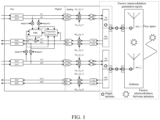
- FIG. 1 is a structural diagram of an RRU of an existing base station. As shown in FIG. 1 , the RRU has two radio frequency ports, which are respectively connected to two antennas by radio frequency cables. The two antennas are located on the same antenna installation platform, i.e., located inside the same radome. It should be noted that there may be a plurality of radio frequency ports and a plurality of antennas in practice, and two radio frequency ports and two antennas are described herein as an example.
- a basic operating process of the RRU is as follows.
- the RRU converts a digital baseband signal sent from a baseband unit through an optical fiber into a transmitted digital intermediate frequency signal through processing by a Digital Up Converter (DUC).
- the transmitted digital intermediate frequency signal is converted into a transmitted analog intermediate frequency signal through processing by a Digital to Analog Converter (DAC).
- DAC Digital to Analog Converter
- the transmitted analog intermediate frequency signal is then converted into a transmitted analog radio frequency signal through mixing processing by a Transmitter Local Oscillator (TX_LO).
- TX_DUP Transmitter Duplexer
- the antenna converts the transmitted analog radio frequency signal into an electromagnetic wave, which is radiated to a free space.
- an antenna converts the electromagnetic wave received in the free space into a received analog radio frequency signal.
- the received analog radio frequency signal is filtered by a Receiver Duplexer (RX_DUP) to remove a stray signal outside a receiving band, amplified by a Low Noise Amplifier (LNA), and then converted into a received analog intermediate frequency signal through mixing processing by a Receiver Local Oscillator (RX_LO).
- the received analog intermediate frequency signal is then converted into a received digital intermediate frequency signal through processing by an Analog to Digital Converter (ADC).
- ADC Analog to Digital Converter
- the received digital intermediate frequency signal is then converted into a received baseband signal through processing by a Digital Down Converter (DDC).
- the received baseband signal is sent to the baseband unit through the optical fiber.
- the RRU is as a whole divided into two parts: a digital signal processing part and an analog signal processing part, where the signal interference cancellation apparatus proposed in the present disclosure is located in the digital signal processing part of the RRU.
- the RRU generates a passive intermodulation interference signal when in operation.
- the passive intermodulation interference signal is mainly generated in the duplexer and passive devices after the duplexer.
- the passive devices include, but not limited to, a radio frequency cable, a radio frequency connector, an antenna, and a metal shield outside an antenna.
- the signal source that generates the passive intermodulation signal there are two types of passive intermodulation signals.
- One type is only related to a transmitted signal inside a single antenna, e.g., a passive intermodulation interference signal generated inside a duplexer, a radio frequency cable, a radio frequency connector, etc.
- the other type is related to transmitted signals of both antennas, e.g., a passive intermodulation interference signal generated on a metal component inside a radome, such as a passive intermodulation interference signal generated on an antenna reflection panel, a feeding network, or a metal shield in a free space outside the radome. It can be seen that, in order to cancel the two types of passive intermodulation signals at the same time, transmitted signals of multiple antennas need to be used, so as to collect sufficient data for interference cancellation on the received signal.
- a passive intermodulation interference signal falling into a receive band is non-linearly transformed and canceled in the digital domain.
- a method cannot fully indicate the coupling relationship between transmitted signals of multiple antennas, and does not involve combining processing and equalization filtering processing on cancellation signals, failing to achieve efficient and accurate interference cancellation in a multi-band multi-antenna scenario.
- the embodiments of the present disclosure provide a signal interference cancellation method and apparatus, an electronic device, and a computer-readable storage medium.
- first sample data of a transmitted signal and second sample data of a received signal are periodically acquired; an interference cancellation parameter is obtained through calculation according to the first sample data and the second sample data; transmit channel filtering processing, nonlinear transformation, and receive channel filtering processing are sequentially performed on the transmitted signal according to the interference cancellation parameter to obtain a cancellation signal; and finally an output signal capable of canceling passive intermodulation interference is generated according to the cancellation signal and the received signal.
- passive intermodulation interference in multi-band multi-antenna scenarios can be canceled to improve the transmission quality of communication signals and user experience.
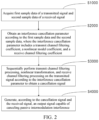
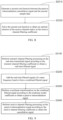
- FIG. 2 shows a process of a signal interference cancellation method according to an embodiment of the present disclosure.
- the signal interference cancellation method according to the embodiment of the present disclosure includes the following steps.
- first sample data of a transmitted signal and second sample data of a received signal are acquired.
- the first sample data covering transmitted digital intermediate frequency signals of all antennas and all frequency bands in the transmitted signal needs to be acquired.
- the second sample data of the received signal in the base station that requires interference cancellation i.e., sample data of a to-be-canceled signal of a certain frequency band of a certain antenna, needs to be acquired.
- the first sample data of the transmitted signal is defined as x
- the second sample data of the received signal is defined as rx .
- the first sample data and the second sample data may be periodically acquired and transmitted using an existing data acquisition module in the base station, which belongs to the existing technology and will not be detailed herein.
- an interference cancellation parameter is obtained according to the first sample data and the second sample data, where the interference cancellation parameter includes a transmit channel filtering coefficient, a nonlinear model coefficient, and a receive channel filtering coefficient.
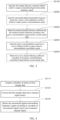
- FIG. 3 is a schematic diagram of a specific implementation process of another embodiment of S2000. As shown in FIG. 3 , S2000 includes at least the following steps.
- the first sample data is inputted into a transmit channel model to output a transmitted digital intermediate frequency signal.
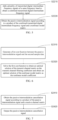
- FIG. 4 is a schematic diagram of a specific implementation process of another embodiment of S2100. As shown in FIG. 4 , S2100 includes at least the following steps.
- a plurality of pieces of first sample data are acquired.
- the first sample data is converted into a transmit signal matrix.
- each transmitted signal may be expressed as x ij , where i represents a sequence number of a frequency band, and j represents a sequence number of an antenna, i.e., x ij represents a transmitted signal from a j th antenna in an i th frequency band.
- the transmitted digital intermediate frequency signal is obtained according to a product of the transmit signal matrix and a transmit channel matrix.
- ⁇ ij represents a channel equalization filter parameter corresponding to the transmitted signal x ij .
- ⁇ ij is a complex vector
- the transmitted digital intermediate frequency signal is inputted into a passive intermodulation nonlinear model to output a passive intermodulation signal.
- FIG. 5 is a schematic diagram of a specific implementation process of another embodiment of S2200. As shown in FIG. 5 , S2200 includes at least the following steps.
- a plurality of transmitted digital intermediate frequency signals of a same frequency band are added to obtain a combined transmitted digital intermediate frequency signal.
- the passive intermodulation signal is obtained according to a product of the combined transmitted digital intermediate frequency signal and a nonlinear model matrix.
- an intermodulation type falling into the receiving band may be selected according to a frequency configuration of the transmitted signal and a frequency configuration of the received signal.
- ( s i )* represents a conjugate signal of the combined transmitted digital intermediate frequency signal in the i th frequency band
- g k (
- the basis function may be a polynomial basis, spline basis, or other commonly used basis functions.
- the type of the basis function representing the u th polynomial can also be determined.
- the selection of the order r ui will affect the modeling precision of the passive intermodulation cancellation signal.
- the selection of the specific order needs to be determined by a trade-off between cancellation performance to be achieved and resources required.
- the nonlinear model function is a N -variable function of the combined transmitted digital intermediate frequency signal s 1 , s 2 , ..., s N , with a parameter ⁇ .
- multiple stages of passive intermodulation signals may be constructed using the same method.
- the combined passive intermodulation signal y is a function of the transmitted signal x ij , with parameters [ ⁇ ( l ) ,..., ⁇ ( L ) ] and [ ⁇ ( l ) ,..., ⁇ ( L ) ].
- the transmit channel filtering coefficient and the nonlinear model coefficient are obtained according to the passive intermodulation signal and the second sample data.
- FIG. 6 is a schematic diagram of a specific implementation process of another embodiment of S2300. As shown in FIG. 6 , S2300 includes at least the following steps.
- a first cost function between the passive intermodulation signal and the second sample data is generated.
- the first cost function can be defined as a sum of squared errors between the combined passive intermodulation signal Y and the received signal rx .
- the first cost function is a function of the parameters ⁇ and ⁇ .
- a smaller sum of squared errors indicates a higher similarity between the combined passive intermodulation signal y and the received signal rx , i.e., higher precision of passive intermodulation modeling. In this way, the precision problem of passive intermodulation modeling is changed into finding appropriate parameters ⁇ and ⁇ , such that the first cost function J ( ⁇ , ⁇ ) reaches a minimum value.
- the first cost function is solved to obtain an optimal solution of the transmit channel matrix as the transmit channel filtering coefficient and obtain an optimal solution of the nonlinear model matrix as the nonlinear model coefficient.
- the combined passive intermodulation signal y is nonlinear with respect to the parameters ⁇ and ⁇ , so the first cost function is a nonlinear least squares optimization problem, and any nonlinear optimization algorithm such as a gradient descent method can be used to solve the parameters ⁇ and ⁇ , which will not be detailed herein.
- the optimal solution ⁇ of the transmit channel matrix obtained is used as the transmit channel filtering coefficient
- the optimal solution ⁇ of the nonlinear model matrix obtained is used as the nonlinear model coefficient
- the passive intermodulation signal is inputted into a receive channel model to output a passive intermodulation cancellation signal.
- the combined passive intermodulation signal y can be calculated according to the parameters ⁇ and ⁇ and the transmitted signal x .
- FIG. 7 is a schematic diagram of a specific implementation process of another embodiment of S2400. As shown in FIG. 7 , S2400 includes at least the following steps.
- the passive intermodulation cancellation signal is obtained according to a product of the passive intermodulation signal and a receive channel matrix.
- the passive intermodulation cancellation signal is outputted.
- the combined passive intermodulation signal y is converted into a passive intermodulation cancellation signal z through receive channel equalization filtering processing. Then, the passive intermodulation cancellation signal z is outputted.
- the passive intermodulation cancellation signal can be obtained by sequentially processing the first sample data by the transmit channel model, the passive intermodulation nonlinear model, and the receive channel model.
- the receive channel filtering coefficient is obtained according to the passive intermodulation cancellation signal and the second sample data.
- FIG. 8 is a schematic diagram of a specific implementation process of another embodiment of S2500. As shown in FIG. 8 , S2500 includes at least the following steps.
- a second cost function between the passive intermodulation cancellation signal and the second sample data is generated.
- the second cost function is defined as the sum of squared errors between the passive intermodulation cancellation signal z and the received signal rx .
- the second cost function J ( ⁇ ) represents the sum of squared errors between the passive intermodulation cancellation signal z obtained through the receive channel equalization filtering and the received signal rx .
- the second cost function is a function of the parameter ⁇ .
- a smaller sum of squared errors indicates a higher similarity between the passive intermodulation cancellation signal z and the received signal rx , i.e., higher precision of passive intermodulation modeling. In this way, the problem is changed into finding an appropriate parameter ⁇ , such that the second cost function reaches a minimum value.
- the second cost function is solved to obtain an optimal solution of the receive channel matrix as the receive channel filtering coefficient.
- the second cost function is still solved using the least squares method.
- the passive intermodulation cancellation signal z is linear with respect to the parameter ⁇ , so the second cost function is a linear least squares optimization problem, and can be solved using any linear least squares solution method.
- the optimal solution ⁇ of the receive channel matrix obtained is used as the receive channel filtering coefficient.
- transmit channel filtering processing, nonlinear transformation, and receive channel filtering processing are sequentially performed on the transmitted signal according to the interference cancellation parameter to obtain a cancellation signal.
- the transmit channel filtering coefficient ⁇ , the nonlinear model coefficient ⁇ , and the receive channel filtering coefficient ⁇ are obtained through the above steps, and a real-time cancellation signal can be acquired by performing transmit channel filtering processing, nonlinear transformation, and receive channel filtering processing on a real-time transmitted signal through the above steps.
- FIG. 9 is a schematic diagram of a specific implementation process of another embodiment of S3000. As shown in FIG. 9 , S3000 includes at least the following steps.
- transmit channel filtering processing is performed on the real-time transmitted signal according to the transmit channel filtering coefficient to obtain a real-time filtered signal.
- a step of S3200 the real-time filtered signals of a same frequency band are added to form a combined filtered signal.
- a nonlinear transformation is performed on the combined filtered signal according to the nonlinear model coefficient to obtain a passive intermodulation signal.
- FIG. 10 is a schematic diagram of a specific implementation process of another embodiment of S3300. As shown in FIG. 10 , S3300 includes at least the following steps.
- a signal order combination is determined according to a number of types of the combined filtered signals, to obtain a passive intermodulation main signal of each type.
- intermodulation types falling into the receiving band can be predetermined according to the frequency configuration of the transmitted signal and the frequency configuration of the received signal.
- a k th passive intermodulation main signal is calculated.
- a modulus signal order combination of the passive intermodulation main signal is determined, and a nonlinear basis signal of each type is obtained according to the combined filtered signal.
- the selection of the order r ui affects modeling precision of the passive intermodulation cancellation signal, and the selection of the specific order needs to be determined by a trade-off between cancellation performance to be achieved and resources required.
- a k th nonlinear basis signal is obtained.
- the passive intermodulation signal is obtained according to the passive intermodulation main signal, the nonlinear basis signal, and the nonlinear model coefficient.
- the k th passive intermodulation signal is calculated through multiplication according to the k th passive intermodulation main signal c k and the u th nonlinear basis signal b u calculated through the above steps.
- the plurality of types of passive intermodulation signals need to be added to generate a passive intermodulation signal.
- the multiple stages of passive intermodulation signals need to be added to generate a combined passive intermodulation signal.
- a step of S3400 receive channel filtering processing is performed on the passive intermodulation signal according to the receive channel filtering coefficient to obtain the cancellation signal.
- the passive intermodulation signal is obtained by convolving the combined passive intermodulation signal Y with the nonlinear model coefficient ⁇ .
- an output signal capable of canceling passive intermodulation interference is generated according to the cancellation signal and the received signal.
- FIG. 11 is a schematic diagram of a specific implementation process of another embodiment of S4000. As shown in FIG. 11 , S4000 includes at least the following steps.
- the cancellation signal and the received signal are acquired.
- the cancellation signal z and the received signal rx are acquired through the above step, so that real-time interference cancellation processing can be performed on the received signal rx .
- the cancellation signal is subtracted from the received signal to obtain the output signal.
- the output signal is a communication signal obtained by optimizing the received signal using the cancellation signal, and passive intermodulation interference in the received signal can be effectively eliminated.
- the signal interference cancellation method provided in the embodiments of the present disclosure is applicable to a Long Term Evolution (LTE) network scenario, a 5G network scenario, and a hybrid LTE/5G network scenario, and can effectively cancel passive intermodulation interference in multi-band multi-antenna scenarios to improve the transmission quality of communication signals and user experience.
- LTE Long Term Evolution
- 5G 5G
- hybrid LTE/5G hybrid LTE/5G network scenario
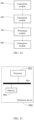
- FIG. 12 is a schematic structural diagram of a signal interference cancellation apparatus according to an embodiment of the present disclosure.
- the entire process of the signal interference cancellation method provided in the embodiments of the present disclosure involves the following modules in the signal interference cancellation apparatus: an acquisition module 500, a calculation module 600, a processing module 700, and a generation module 800.
- the acquisition module 500 is configured for acquiring first sample data of a transmitted signal and second sample data of a received signal.
- the calculation module 600 is configured for obtaining an interference cancellation parameter according to the first sample data and the second sample data, where the interference cancellation parameter includes a transmit channel filtering coefficient, a nonlinear model coefficient, and a receive channel filtering coefficient.
- the processing module 700 is configured for sequentially performing transmit channel filtering processing, nonlinear transformation, and receive channel filtering processing on the transmitted signal according to the interference cancellation parameter to obtain a cancellation signal.
- the generation module 800 is configured for generating, according to the cancellation signal and the received signal, an output signal capable of canceling passive intermodulation interference.
- FIG. 13 shows an electronic device 900 according to an embodiment of the present disclosure.
- the electronic device 900 includes, but not limited to:
- the processor 902 and the memory 901 may be connected by a bus or in other ways.
- the memory 901 as a non-transitory computer-readable storage medium, may be configured for storing a non-transitory software program and a non-transitory computer-executable program, for example, the signal interference cancellation method described in any one of the embodiments of the present disclosure.
- the processor 902 runs the non-transitory software program and the non-transitory computer-executable program stored in the memory 901, to implement the signal interference cancellation method.
- the memory 901 may include a program storage area and a data storage area.
- the program storage area may store an operating system, and an application required by at least one function.
- the data storage area may store data and the like required for executing the signal interference cancellation method.
- the memory 901 may include a high-speed random access memory, and may also include a non-transitory memory, e.g., at least one magnetic disk storage device, flash memory device, or other non-transitory solid-state storage device.
- the memory 901 optionally includes memories located remotely from the processor 902, and the remote memories may be connected to the processor 902 via a network. Examples of the network include, but not limited to, the Internet, an intranet, a local area network, a mobile communication network, and combinations thereof.
- the non-transitory software program and instructions required to implement the signal interference cancellation method are stored in the memory 901 which, when executed by one or more processors 902, cause the one or more processors 902 to implement the signal interference cancellation method according to any one of the embodiments of the present disclosure.
- An embodiment of the present disclosure provides a storage medium, storing computer-executable instruction which, when executed by a processor, causes the processor to implement the signal interference cancellation method.
- the storage medium stores a computer-executable instruction which, when executed by one or more control processors 902, for example, by the processor 902 in the electronic device 900, may cause the one or more processors 902 to execute the signal interference cancellation method according to any one of the embodiments of the present disclosure.
- the embodiments described above are merely examples.
- the units described as separate components may or may not be physically separated, i.e., may be located in one place or may be distributed over a plurality of network units. Some or all of the modules may be selected according to actual needs to achieve the objectives of the solution of this embodiment.
- the term "computer storage medium” includes volatile and nonvolatile, removable and non-removable media implemented in any method or technology for storage of information (such as computer-readable instructions, data structures, program modules, or other data).
- the computer storage medium includes, but not limited to, a Random Access Memory (RAM), a Read-Only Memory (ROM), an Electrically Erasable Programmable Read-Only Memory (EEPROM), a flash memory or other memory technology, a Compact Disc Read-Only Memory (CD-ROM), a Digital Versatile Disc (DVD) or other optical storage, a cassette, a magnetic tape, a magnetic disk storage or other magnetic storage device, or any other medium which can be used to store the desired information and can be accessed by a computer.
- the communication medium typically includes computer-readable instructions, data structures, program modules, or other data in a modulated data signal such as a carrier or other transport mechanism, and can include any information delivery medium.
Landscapes
- Engineering & Computer Science (AREA)
- Computer Networks & Wireless Communication (AREA)
- Signal Processing (AREA)
- Noise Elimination (AREA)
- Transceivers (AREA)
Applications Claiming Priority (2)
| Application Number | Priority Date | Filing Date | Title |
|---|---|---|---|
| CN202210004327.0A CN116436484A (zh) | 2022-01-04 | 2022-01-04 | 一种信号干扰抵消方法、装置及电子设备 |
| PCT/CN2022/142857 WO2023131029A1 (zh) | 2022-01-04 | 2022-12-28 | 一种信号干扰抵消方法、装置及电子设备 |
Publications (2)
| Publication Number | Publication Date |
|---|---|
| EP4459879A1 true EP4459879A1 (de) | 2024-11-06 |
| EP4459879A4 EP4459879A4 (de) | 2025-04-09 |
Family
ID=87073146
Family Applications (1)
| Application Number | Title | Priority Date | Filing Date |
|---|---|---|---|
| EP22918470.0A Withdrawn EP4459879A4 (de) | 2022-01-04 | 2022-12-28 | Verfahren und vorrichtung zur signalinterferenzunterdrückung und elektronische vorrichtung |
Country Status (4)
| Country | Link |
|---|---|
| EP (1) | EP4459879A4 (de) |
| JP (1) | JP2024545733A (de) |
| CN (1) | CN116436484A (de) |
| WO (1) | WO2023131029A1 (de) |
Families Citing this family (1)
| Publication number | Priority date | Publication date | Assignee | Title |
|---|---|---|---|---|
| CN118713687B (zh) * | 2024-07-19 | 2025-03-04 | 北京信息科技大学 | 一种无源互调干扰全数字抑制方法、系统、应用及终端 |
Family Cites Families (6)
| Publication number | Priority date | Publication date | Assignee | Title |
|---|---|---|---|---|
| EP2884668B1 (de) * | 2013-12-12 | 2020-11-18 | Nokia Solutions and Networks Oy | Verbesserung der Empfängerempfindlichkeit |
| US9461697B2 (en) * | 2014-02-27 | 2016-10-04 | Scintera Networks Llc | In-service monitoring and cancellation of passive intermodulation interferences |
| CN104283580B (zh) * | 2014-09-30 | 2016-09-28 | 上海华为技术有限公司 | 射频模块的无源互调pim干扰抵消方法及相关装置 |
| CN109075808B (zh) * | 2016-02-29 | 2021-02-09 | 华为技术有限公司 | 一种无源互调干扰抵消方法及装置 |
| EP3687074B1 (de) * | 2017-10-27 | 2023-08-30 | Huawei Technologies Co., Ltd. | Digitale mehrkanalige passive intermodulationsunterdrückungsschaltung |
| CN109495127B (zh) * | 2018-09-27 | 2021-09-03 | 香港梵行科技有限公司 | 自适应抵消无源互调信号的装置、方法及应用设备 |
-
2022
- 2022-01-04 CN CN202210004327.0A patent/CN116436484A/zh not_active Withdrawn
- 2022-12-28 WO PCT/CN2022/142857 patent/WO2023131029A1/zh not_active Ceased
- 2022-12-28 EP EP22918470.0A patent/EP4459879A4/de not_active Withdrawn
- 2022-12-28 JP JP2024540596A patent/JP2024545733A/ja active Pending
Also Published As
| Publication number | Publication date |
|---|---|
| WO2023131029A1 (zh) | 2023-07-13 |
| CN116436484A (zh) | 2023-07-14 |
| EP4459879A4 (de) | 2025-04-09 |
| JP2024545733A (ja) | 2024-12-10 |
Similar Documents
| Publication | Publication Date | Title |
|---|---|---|
| US10305524B2 (en) | Method and device for reducing intermodulation interference | |
| US10212716B2 (en) | Channelization for signal boosters | |
| US20240171211A1 (en) | Full-duplex self-interference cancellation method and apparatus | |
| US10715302B2 (en) | Channelization for signal boosters | |
| US20210226653A1 (en) | Digital predistortion for advanced antenna system | |
| US9461697B2 (en) | In-service monitoring and cancellation of passive intermodulation interferences | |
| EP3151438B1 (de) | Interferenzunterdrückungsvorrichtung und -verfahren | |
| US9231801B2 (en) | Adaptive non-linear interference cancellation for intermodulation distortion | |
| EP3151495A1 (de) | Interferenzunterdrückungsvorrichtung und -verfahren | |
| US8433242B2 (en) | Active antenna array for a mobile communications network with multiple amplifiers using separate polarisations for transmission and a combination of polarisations for reception of separate protocol signals | |
| EP2884669A1 (de) | Interferenzsignalverarbeitungsverfahren, - vorrichtung und -system | |
| CN105991157B (zh) | 消除通信系统中的无源互调干扰信号的方法和网络侧设备 | |
| CN102959882A (zh) | 使用rf消去参考的中继器的混合无线电架构 | |
| US9264113B2 (en) | Frame synchronization method and apparatus of wireless system, and wireless system | |
| EP3949129B1 (de) | Netzwerkvorrichtung und verfahren zur handhabung von passiven intermodulationssignalen in einem drahtlosen kommunikationsnetz | |
| US10516434B2 (en) | Communication circuit enabling optimal synchronization for self-interference cancellation (SIC) in a wireless communications system (WCS) | |
| EP4459879A1 (de) | Verfahren und vorrichtung zur signalinterferenzunterdrückung und elektronische vorrichtung | |
| Waheed et al. | Digital cancellation of passive intermodulation in FDD transceivers | |
| Lampu et al. | Air-induced PIM cancellation in FDD MIMO transceivers | |
| CN105530059A (zh) | 通信方法及通信系统 | |
| CN110417487B (zh) | 一种通道校准装置及方法、计算机装置及可读存储介质 | |
| WO2020227926A1 (en) | Radio network node with automatic gain control enhancement | |
| CN110519190B (zh) | 一种控制无线直放站进行工作的方法及无线直放站 | |
| Habibi et al. | Feasibility study on analogue cancellation of local interference in Multimode transceivers | |
| KR20060009767A (ko) | 휴대인터넷 시간분할이중방식 안테나단의 저잡음증폭기설계방법 및 그 저잡음증폭기 |
Legal Events
| Date | Code | Title | Description |
|---|---|---|---|
| STAA | Information on the status of an ep patent application or granted ep patent |
Free format text: STATUS: THE INTERNATIONAL PUBLICATION HAS BEEN MADE |
|
| PUAI | Public reference made under article 153(3) epc to a published international application that has entered the european phase |
Free format text: ORIGINAL CODE: 0009012 |
|
| STAA | Information on the status of an ep patent application or granted ep patent |
Free format text: STATUS: REQUEST FOR EXAMINATION WAS MADE |
|
| 17P | Request for examination filed |
Effective date: 20240731 |
|
| AK | Designated contracting states |
Kind code of ref document: A1 Designated state(s): AL AT BE BG CH CY CZ DE DK EE ES FI FR GB GR HR HU IE IS IT LI LT LU LV MC ME MK MT NL NO PL PT RO RS SE SI SK SM TR |
|
| A4 | Supplementary search report drawn up and despatched |
Effective date: 20250312 |
|
| DAV | Request for validation of the european patent (deleted) | ||
| DAX | Request for extension of the european patent (deleted) | ||
| RIC1 | Information provided on ipc code assigned before grant |
Ipc: H04B 1/525 20150101ALI20250306BHEP Ipc: H04B 1/10 20060101AFI20250306BHEP |
|
| STAA | Information on the status of an ep patent application or granted ep patent |
Free format text: STATUS: THE APPLICATION HAS BEEN WITHDRAWN |
|
| 18W | Application withdrawn |
Effective date: 20260108 |